
Binance News
387.6k Posts

Binance News
 Binance Officially Verified Account
Report
Follow Binance News to stay on top of industry trends & news
9 Following
2.3M+ Followers
2.8M+ Liked
Top
Replies
Videos
·
--
MSTR Trading Volume Surpasses Morgan Stanley, Becomes 25th Most Traded U.S. StockBitcoin treasury company Strategy’s MSTR trading volume has surpassed Morgan Stanley’s MS, making it the 25th most traded stock in the United States. According to Odaily, MSTR’s trading volume is higher than that of several companies with market capitalizations in the trillions of dollars.
MSTR Trading Volume Surpasses Morgan Stanley, Becomes 25th Most Traded U.S. Stock
Bitcoin treasury company Strategy’s MSTR trading volume has surpassed Morgan Stanley’s MS, making it the 25th most traded stock in the United States. According to Odaily, MSTR’s trading volume is higher than that of several companies with market capitalizations in the trillions of dollars.
1.1k
·
--

Article
OpenAI Discusses New Private Funding Round at About $1.2 Trillion ValuationOpenAI is discussing a new private funding round with investors at a target valuation of about $1.2 trillion as it prepares for a future IPO. According to ChainCatcher, the company’s valuation reached $852 billion after a financing round completed in March this year.
The company is also discussing additional fundraising plans with large investors, and the talks are still at an early stage. OpenAI CEO Sam Altman said an IPO may not come before 2027.
OpenAI Discusses New Private Funding Round at About $1.2 Trillion Valuation
OpenAI is discussing a new private funding round with investors at a target valuation of about $1.2 trillion as it prepares for a future IPO. According to ChainCatcher, the company’s valuation reached $852 billion after a financing round completed in March this year.
The company is also discussing additional fundraising plans with large investors, and the talks are still at an early stage. OpenAI CEO Sam Altman said an IPO may not come before 2027.
The company is also discussing additional fundraising plans with large investors, and the talks are still at an early stage. OpenAI CEO Sam Altman said an IPO may not come before 2027.
2
10
12.4k
·
--
Sihao Huang Joins Anthropic as Head of Frontier Compute StrategySihao Huang, formerly a senior policy adviser for artificial intelligence and emerging technologies at the White House Office of Science and Technology Policy, has joined Anthropic as head of frontier compute strategy. According to ChainCatcher, he will work with Anthropic compute lead Tom Brown on infrastructure expansion, industry coalition building, and planning for rapid AI development.
Huang said his White House role involved advancing U.S. artificial intelligence policy and related industrial infrastructure. He added that his new position will bring him closer to frontier technologies that continue to influence major policy decisions.
Sihao Huang Joins Anthropic as Head of Frontier Compute Strategy
Sihao Huang, formerly a senior policy adviser for artificial intelligence and emerging technologies at the White House Office of Science and Technology Policy, has joined Anthropic as head of frontier compute strategy. According to ChainCatcher, he will work with Anthropic compute lead Tom Brown on infrastructure expansion, industry coalition building, and planning for rapid AI development.
Huang said his White House role involved advancing U.S. artificial intelligence policy and related industrial infrastructure. He added that his new position will bring him closer to frontier technologies that continue to influence major policy decisions.
Huang said his White House role involved advancing U.S. artificial intelligence policy and related industrial infrastructure. He added that his new position will bring him closer to frontier technologies that continue to influence major policy decisions.
1
4
5k
·
--
Bitcoin Falls 4% as Senate Blocks Clarity ActThe Senate blocked the Clarity Act after the bill received 49 votes for and 50 against, falling short of the 60 votes needed to advance. According to NS3.AI, the proposal would divide oversight of digital assets among regulators and classify them as securities, commodities or stablecoins.
Bitcoin traded at $75,997 after falling 4% in 24 hours. U.S. President Donald Trump urged lawmakers to pass the bill last month.
Bitcoin Falls 4% as Senate Blocks Clarity Act
The Senate blocked the Clarity Act after the bill received 49 votes for and 50 against, falling short of the 60 votes needed to advance. According to NS3.AI, the proposal would divide oversight of digital assets among regulators and classify them as securities, commodities or stablecoins.
Bitcoin traded at $75,997 after falling 4% in 24 hours. U.S. President Donald Trump urged lawmakers to pass the bill last month.
Bitcoin traded at $75,997 after falling 4% in 24 hours. U.S. President Donald Trump urged lawmakers to pass the bill last month.
7
24
47.1k
·
--

Article
Anthropic's Amodei And Nvidia's Huang Clash Over AI Safety At Salesforce DreamforceAccording to CNBC, Anthropic CEO Dario Amodei and Nvidia CEO Jensen Huang offered contrasting views on artificial intelligence safety at Salesforce's Dreamforce conference in San Francisco, where Salesforce also announced a new reasoning model for its Agentforce platform built on one of Nvidia's open-weight Nemotron models. Amodei, speaking with Salesforce CEO Marc Benioff, said the industry should set an example and slow the pace of model development, while Huang argued that market forces already provide discipline and that speed and safety can coexist. Benioff said companies should slow down or speed up as they see fit, but should be held accountable. Salesforce and Anthropic also expanded their strategic partnership late last month and unveiled Claudeforce, a new way for salespeople to access data directly inside Anthropic's Claude chatbot.
Anthropic's Amodei And Nvidia's Huang Clash Over AI Safety At Salesforce Dreamforce
According to CNBC, Anthropic CEO Dario Amodei and Nvidia CEO Jensen Huang offered contrasting views on artificial intelligence safety at Salesforce's Dreamforce conference in San Francisco, where Salesforce also announced a new reasoning model for its Agentforce platform built on one of Nvidia's open-weight Nemotron models. Amodei, speaking with Salesforce CEO Marc Benioff, said the industry should set an example and slow the pace of model development, while Huang argued that market forces already provide discipline and that speed and safety can coexist. Benioff said companies should slow down or speed up as they see fit, but should be held accountable. Salesforce and Anthropic also expanded their strategic partnership late last month and unveiled Claudeforce, a new way for salespeople to access data directly inside Anthropic's Claude chatbot.
4
7.7k
·
--
Ethereum Spot ETFs Record $141 Million Net Outflow on September 15Ethereum spot ETFs recorded a total net outflow of $141 million on September 15, U.S. Eastern Time, according to SoSoValue. According to Odaily, BlackRock's Staked ETH ETF ETHB posted the largest daily net inflow at $12.3788 million, while 21Shares ETF TETH saw a net inflow of $2.4028 million. BlackRock's ETHA recorded the largest daily net outflow at $97.9738 million. As of press time, Ethereum spot ETFs held $15.42 billion in net assets, with a net asset ratio of 5.25% and cumulative net inflows of $13.37 billion.
Ethereum Spot ETFs Record $141 Million Net Outflow on September 15
Ethereum spot ETFs recorded a total net outflow of $141 million on September 15, U.S. Eastern Time, according to SoSoValue. According to Odaily, BlackRock's Staked ETH ETF ETHB posted the largest daily net inflow at $12.3788 million, while 21Shares ETF TETH saw a net inflow of $2.4028 million. BlackRock's ETHA recorded the largest daily net outflow at $97.9738 million. As of press time, Ethereum spot ETFs held $15.42 billion in net assets, with a net asset ratio of 5.25% and cumulative net inflows of $13.37 billion.
1
2.3k
·
--
aelf Restores Services After Block-Production Halt and Malicious Smart-Contract Activityaelf said its approximately one-week block-production halt generated no network staking rewards. According to NS3.AI, the network restored public node access and several services after malicious smart-contract activity led to a controlled recovery.
Exchange deposits and withdrawals were resuming gradually, with schedules differing by venue. Investigators identified 155 transactions linked to the activity, while the final security review has not yet been published.
aelf Restores Services After Block-Production Halt and Malicious Smart-Contract Activity
aelf said its approximately one-week block-production halt generated no network staking rewards. According to NS3.AI, the network restored public node access and several services after malicious smart-contract activity led to a controlled recovery.
Exchange deposits and withdrawals were resuming gradually, with schedules differing by venue. Investigators identified 155 transactions linked to the activity, while the final security review has not yet been published.
Exchange deposits and withdrawals were resuming gradually, with schedules differing by venue. Investigators identified 155 transactions linked to the activity, while the final security review has not yet been published.
1
11
33.6k
·
--

Article
Bitcoin News | Strategy Passes Ford by Market Cap With Its Bitcoin Position Up Less Than 1%Bitcoin treasury company Strategy's market capitalisation has surpassed that of US automaker Ford, making it the 200th largest publicly listed company in the United States, according to BitcoinTreasuries.NET.The company holds 845,050 BTC, unchanged after making no purchases or sales last week.The Underlying Position Is Barely ProfitableThe milestone arrives at an awkward moment for the holdings that justify it.At roughly $76,000 per Bitcoin, Strategy's stack is worth approximately $64.2 billion. Its cost basis of $75,385 puts the acquisition value near $63.7 billion.That leaves the position up roughly 0.8% — around $520 million on a $63.7 billion outlay.A company can be the 200th largest in the US while its core asset sits fractionally above water, because market capitalisation reflects what investors will pay for the structure rather than the mark on the holdings. But the gap is worth stating plainly, because the ranking invites an assumption of accumulated gains that the cost basis does not support.Bitcoin cleared that cost basis in late August during the run from $62,000 to $82,284. It has been oscillating around it since.The Comparison Is to a Company That Makes ThingsFord operates factories, employs a large workforce, generates revenue from vehicle sales and services, and carries the associated capital intensity and cyclical exposure.Strategy holds Bitcoin and issues securities to buy more of it.Comparing the two by market capitalisation is arithmetically valid and analytically odd. One valuation rests on discounted future cash flows from an operating business; the other rests on an asset price plus whatever premium investors assign to the vehicle holding it.That premium is the whole question for Strategy shareholders, and it is not a question Ford's valuation involves at all.Strategy Is Buying Back Preferred Rather Than BitcoinThe capital allocation tells a different story from the milestone.The company repurchased 1.4 million shares of its STRC preferred for $139.3 million using cash on hand, while making no Bitcoin purchases. STRC trades at $98.64, modestly below its $100 par value.Total STRC buybacks have now reached roughly $635.2 million, with the authorisation doubled to $2 billion from $1 billion.A treasury company spending cash to repurchase its own preferred rather than acquiring the asset it exists to hold is making a specific judgment: that the discount on its securities offers better value than the asset at current prices.That is defensible capital allocation. It is also a different activity from what the market capitalisation ranking implies the company is doing.Strive Is Running the Opposite PlaybookThe contrast with the other Bitcoin treasury issuer is now several weeks old.Strive acquired 469 Bitcoin last week, bringing holdings to 25,000 BTC, funded by selling its SATA preferred stock — which continues to trade right around its $100 par value.SATA at par lets Strive keep issuing to buy Bitcoin. STRC below par gives Strategy reason to buy back instead.Same instrument type, opposite direction, determined entirely by where the security trades relative to its stated value. The mechanism connecting preferred pricing to Bitcoin accumulation runs through both companies in reverse.The Ranking Moves With Three VariablesThe 200th-largest position is not a fixed achievement.It shifts with Bitcoin's price, with the premium investors assign to Strategy's structure, and with the valuations of every company ranked near it. Ford's own market capitalisation moves independently.Bitcoin fell to around $76,000 Tuesday, losing the 50-week exponential moving average at $77,430 it reclaimed Monday and breaking below the $77,100 level Bitfinex analysts had identified as the floor of a spot absorption zone.MSTR was flat pre-market Monday.The Fed decides Wednesday at 2:00 p.m. ET, with markets pricing roughly 94% odds of a 25 basis point increase and the 10-year Treasury yield at 5.04%, its highest since July 2007.
Bitcoin News | Strategy Passes Ford by Market Cap With Its Bitcoin Position Up Less Than 1%
Bitcoin treasury company Strategy's market capitalisation has surpassed that of US automaker Ford, making it the 200th largest publicly listed company in the United States, according to BitcoinTreasuries.NET.The company holds 845,050 BTC, unchanged after making no purchases or sales last week.The Underlying Position Is Barely ProfitableThe milestone arrives at an awkward moment for the holdings that justify it.At roughly $76,000 per Bitcoin, Strategy's stack is worth approximately $64.2 billion. Its cost basis of $75,385 puts the acquisition value near $63.7 billion.That leaves the position up roughly 0.8% — around $520 million on a $63.7 billion outlay.A company can be the 200th largest in the US while its core asset sits fractionally above water, because market capitalisation reflects what investors will pay for the structure rather than the mark on the holdings. But the gap is worth stating plainly, because the ranking invites an assumption of accumulated gains that the cost basis does not support.Bitcoin cleared that cost basis in late August during the run from $62,000 to $82,284. It has been oscillating around it since.The Comparison Is to a Company That Makes ThingsFord operates factories, employs a large workforce, generates revenue from vehicle sales and services, and carries the associated capital intensity and cyclical exposure.Strategy holds Bitcoin and issues securities to buy more of it.Comparing the two by market capitalisation is arithmetically valid and analytically odd. One valuation rests on discounted future cash flows from an operating business; the other rests on an asset price plus whatever premium investors assign to the vehicle holding it.That premium is the whole question for Strategy shareholders, and it is not a question Ford's valuation involves at all.Strategy Is Buying Back Preferred Rather Than BitcoinThe capital allocation tells a different story from the milestone.The company repurchased 1.4 million shares of its STRC preferred for $139.3 million using cash on hand, while making no Bitcoin purchases. STRC trades at $98.64, modestly below its $100 par value.Total STRC buybacks have now reached roughly $635.2 million, with the authorisation doubled to $2 billion from $1 billion.A treasury company spending cash to repurchase its own preferred rather than acquiring the asset it exists to hold is making a specific judgment: that the discount on its securities offers better value than the asset at current prices.That is defensible capital allocation. It is also a different activity from what the market capitalisation ranking implies the company is doing.Strive Is Running the Opposite PlaybookThe contrast with the other Bitcoin treasury issuer is now several weeks old.Strive acquired 469 Bitcoin last week, bringing holdings to 25,000 BTC, funded by selling its SATA preferred stock — which continues to trade right around its $100 par value.SATA at par lets Strive keep issuing to buy Bitcoin. STRC below par gives Strategy reason to buy back instead.Same instrument type, opposite direction, determined entirely by where the security trades relative to its stated value. The mechanism connecting preferred pricing to Bitcoin accumulation runs through both companies in reverse.The Ranking Moves With Three VariablesThe 200th-largest position is not a fixed achievement.It shifts with Bitcoin's price, with the premium investors assign to Strategy's structure, and with the valuations of every company ranked near it. Ford's own market capitalisation moves independently.Bitcoin fell to around $76,000 Tuesday, losing the 50-week exponential moving average at $77,430 it reclaimed Monday and breaking below the $77,100 level Bitfinex analysts had identified as the floor of a spot absorption zone.MSTR was flat pre-market Monday.The Fed decides Wednesday at 2:00 p.m. ET, with markets pricing roughly 94% odds of a 25 basis point increase and the 10-year Treasury yield at 5.04%, its highest since July 2007.
9
7.2k
·
--
South Korea's Finance Minister Nominee Says Crypto Tax Burden Will Be LimitedSouth Korea's deputy prime minister and finance minister nominee Lee Hyeong-il said at a parliamentary hearing that virtual asset taxation would place only a limited burden on most investors and is unlikely to have a major market impact. According to ChainCatcher, he said about 95% of investors hold assets worth less than 5 million won, and that when acquisition costs cannot be proven, 50% of income may be treated as necessary expenses, with an additional basic deduction of 2.5 million won, leaving small investors with limited effective tax burdens.
South Korea's Finance Minister Nominee Says Crypto Tax Burden Will Be Limited
South Korea's deputy prime minister and finance minister nominee Lee Hyeong-il said at a parliamentary hearing that virtual asset taxation would place only a limited burden on most investors and is unlikely to have a major market impact. According to ChainCatcher, he said about 95% of investors hold assets worth less than 5 million won, and that when acquisition costs cannot be proven, 50% of income may be treated as necessary expenses, with an additional basic deduction of 2.5 million won, leaving small investors with limited effective tax burdens.
1
2.1k
·
--

Article
Zuckerberg Says AI Safety Should Rely on Evaluators, Not Slower DevelopmentMeta Platforms CEO Mark Zuckerberg said AI labs should rely on independent evaluators and advisers to keep models safe. According to Sina Finance, Zuckerberg wrote on X on Tuesday that hiring independent evaluators and advisers is an industry best practice.
He said Meta independently decided to delay development of its Muse AI tool and did not ask peers to slow their own pace first. According to Sina Finance, Zuckerberg said Meta pushed back Muse's launch by several months to focus on safety protections.
The debate over AI economic and safety risks intensified over the weekend. According to Sina Finance, Anthropic CEO Dario Amodei published a 3,800-word essay calling for a slowdown in the development of frontier AI systems, and OpenAI CEO Sam Altman and SpaceX AI CEO Elon Musk both supported it. An OpenAI executive said the company is working with Anthropic and Google on AI safety.
Zuckerberg Says AI Safety Should Rely on Evaluators, Not Slower Development
Meta Platforms CEO Mark Zuckerberg said AI labs should rely on independent evaluators and advisers to keep models safe. According to Sina Finance, Zuckerberg wrote on X on Tuesday that hiring independent evaluators and advisers is an industry best practice.
He said Meta independently decided to delay development of its Muse AI tool and did not ask peers to slow their own pace first. According to Sina Finance, Zuckerberg said Meta pushed back Muse's launch by several months to focus on safety protections.
The debate over AI economic and safety risks intensified over the weekend. According to Sina Finance, Anthropic CEO Dario Amodei published a 3,800-word essay calling for a slowdown in the development of frontier AI systems, and OpenAI CEO Sam Altman and SpaceX AI CEO Elon Musk both supported it. An OpenAI executive said the company is working with Anthropic and Google on AI safety.
He said Meta independently decided to delay development of its Muse AI tool and did not ask peers to slow their own pace first. According to Sina Finance, Zuckerberg said Meta pushed back Muse's launch by several months to focus on safety protections.
The debate over AI economic and safety risks intensified over the weekend. According to Sina Finance, Anthropic CEO Dario Amodei published a 3,800-word essay calling for a slowdown in the development of frontier AI systems, and OpenAI CEO Sam Altman and SpaceX AI CEO Elon Musk both supported it. An OpenAI executive said the company is working with Anthropic and Google on AI safety.
3
4.3k
·
--
Trump Made More Stock Trades Than Congress Combined While Pushing Trading BanDonald Trump made nearly 28,700 stock trades in 17 months, more than the entire Congress’s 22,200 combined, while backing a bill to ban lawmakers and their families from trading individual stocks. According to BeInCrypto, House Republicans passed the measure in July, but it does not apply to the president, and the White House says outside firms manage Trump’s holdings through index-tracking models.
Trump Made More Stock Trades Than Congress Combined While Pushing Trading Ban
Donald Trump made nearly 28,700 stock trades in 17 months, more than the entire Congress’s 22,200 combined, while backing a bill to ban lawmakers and their families from trading individual stocks. According to BeInCrypto, House Republicans passed the measure in July, but it does not apply to the president, and the White House says outside firms manage Trump’s holdings through index-tracking models.
1
12
23.8k
·
--
Sui Says Hashi Mainnet Will Soon Launch to Bring Financial Services to Bitcoin on SuiSui said on X that more than $1.5 trillion worth of Bitcoin is sitting idle because using Bitcoin usually means handing it over to someone else. According to Odaily, Hashi will change that by keeping Bitcoin on the Bitcoin network while opening financial services on Sui, and its mainnet will launch soon.
Sui Says Hashi Mainnet Will Soon Launch to Bring Financial Services to Bitcoin on Sui
Sui said on X that more than $1.5 trillion worth of Bitcoin is sitting idle because using Bitcoin usually means handing it over to someone else. According to Odaily, Hashi will change that by keeping Bitcoin on the Bitcoin network while opening financial services on Sui, and its mainnet will launch soon.
5
1
14
26.6k
·
--
Standard Chartered Sees Arbitrum's ARB at $10 by End of 2030Standard Chartered expects Arbitrum's ARB token to reach $10 by the end of 2030, according to a new forecast. According to NS3.AI, the projection is about 70 times ARB's current price near 14 cents.
The bank said part of its outlook is based on revenue Arbitrum could generate by helping companies such as Robinhood build their own networks.
Standard Chartered Sees Arbitrum's ARB at $10 by End of 2030
Standard Chartered expects Arbitrum's ARB token to reach $10 by the end of 2030, according to a new forecast. According to NS3.AI, the projection is about 70 times ARB's current price near 14 cents.
The bank said part of its outlook is based on revenue Arbitrum could generate by helping companies such as Robinhood build their own networks.
The bank said part of its outlook is based on revenue Arbitrum could generate by helping companies such as Robinhood build their own networks.
1
6
31.5k
·
--

Article
US Senate Fails to Advance CLARITY Act on Digital Asset RegulationThe US Senate on Tuesday failed to pass a cloture motion on the Digital Asset Market Clarity (CLARITY) Act, blocking a bill that would have created the country’s first regulatory framework for digital assets. According to Cointelegraph, the setback means the legislation is unlikely to move forward for the rest of the year, with less than 36 days of business remaining before 2027, when a new session of Congress is scheduled to be sworn in after November’s midterm elections. The failure leaves unresolved key questions about how the cryptocurrency sector will be regulated at the federal level, including the division of oversight between the Commodity Futures Trading Commission and the Securities and Exchange Commission.
The bill had already stalled before Congress’ August recess amid debate over ethics provisions that would have restricted government officials and their families from issuing or profiting from digital assets while in office. U.S. President Donald Trump agreed to most of a bipartisan proposal aimed at strengthening those restrictions ahead of Tuesday’s vote, but the measure faced renewed resistance on Monday from 18 state attorneys general. They argued that the bill would weaken states’ ability to police crypto fraud and misconduct. The latest setback adds to uncertainty over the future of federal crypto regulation as lawmakers remain divided over both ethics safeguards and the scope of state and federal authority.
US Senate Fails to Advance CLARITY Act on Digital Asset Regulation
The US Senate on Tuesday failed to pass a cloture motion on the Digital Asset Market Clarity (CLARITY) Act, blocking a bill that would have created the country’s first regulatory framework for digital assets. According to Cointelegraph, the setback means the legislation is unlikely to move forward for the rest of the year, with less than 36 days of business remaining before 2027, when a new session of Congress is scheduled to be sworn in after November’s midterm elections. The failure leaves unresolved key questions about how the cryptocurrency sector will be regulated at the federal level, including the division of oversight between the Commodity Futures Trading Commission and the Securities and Exchange Commission.
The bill had already stalled before Congress’ August recess amid debate over ethics provisions that would have restricted government officials and their families from issuing or profiting from digital assets while in office. U.S. President Donald Trump agreed to most of a bipartisan proposal aimed at strengthening those restrictions ahead of Tuesday’s vote, but the measure faced renewed resistance on Monday from 18 state attorneys general. They argued that the bill would weaken states’ ability to police crypto fraud and misconduct. The latest setback adds to uncertainty over the future of federal crypto regulation as lawmakers remain divided over both ethics safeguards and the scope of state and federal authority.
The bill had already stalled before Congress’ August recess amid debate over ethics provisions that would have restricted government officials and their families from issuing or profiting from digital assets while in office. U.S. President Donald Trump agreed to most of a bipartisan proposal aimed at strengthening those restrictions ahead of Tuesday’s vote, but the measure faced renewed resistance on Monday from 18 state attorneys general. They argued that the bill would weaken states’ ability to police crypto fraud and misconduct. The latest setback adds to uncertainty over the future of federal crypto regulation as lawmakers remain divided over both ethics safeguards and the scope of state and federal authority.
4
3
35
42k
·
--
Article
Bitcoin Price Recovery Unlikely to Lure AI-Focused Miners Back, CoinShares SaysThe exodus of publicly traded bitcoin miners into artificial intelligence infrastructure will likely continue even if bitcoin prices recover, CoinShares said in its second-quarter bitcoin mining report published Tuesday, according to The Block. "A BTC recovery is unlikely to reverse the AI transition," the firm said. Report author Luke Nolan pointed to signs the shift is hard to undo: Core Scientific paid nearly $42 million to cancel an agreement for 15 EH/s of next-generation mining hardware, while several other operators have committed sites to AI and high-performance computing leases running upwards of 15 years.
At least 35 EH/s of computing power is already scheduled to leave the listed group of miners, equal to about 4.7% of Bitcoin's current 750 EH/s network hashrate. Keel, formerly Bitfarms, stopped mining entirely in June; IREN plans to complete its exit by the end of 2026; Cipher Digital is likely to leave mining by the end of 2027; and TeraWulf is winding down its remaining 145 megawatts of mining power. The economics explain the move: CoinShares estimates AI currently generates profits of roughly $1.5 million per megawatt for these companies, versus about $500,000 per megawatt from bitcoin mining.
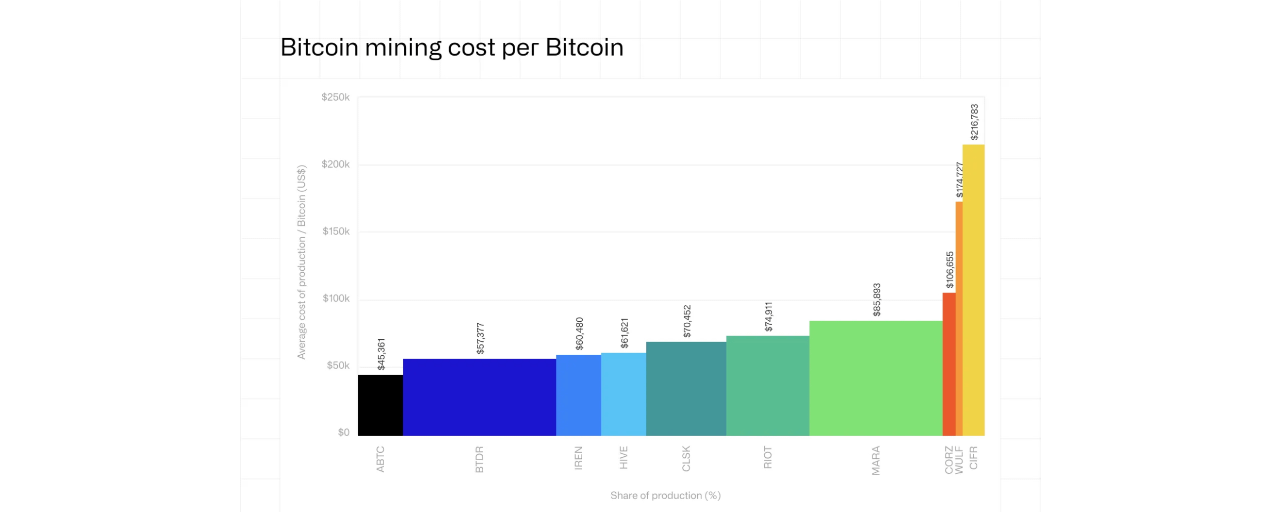
The average cash cost to produce a bitcoin reached roughly $75,500 in the second quarter, while bitcoin ended the period at just $58,400, and the monthly average hash price fell to an all-time low of $27.70 per PH/s per day in June. Conditions have improved since, with bitcoin's recovery to around $77,000 lifting hash price to about $38 per PH/s per day and pushing most operators back above cash breakeven. A sustained price rise could improve the numbers and even prompt some added mining capacity, but CoinShares expects such investment mainly among flexible miners such as Riot, MARA, HIVE and Bitdeer — while those that have already committed power and infrastructure to AI will stay the course and not return.
Bitcoin Price Recovery Unlikely to Lure AI-Focused Miners Back, CoinShares Says
The exodus of publicly traded bitcoin miners into artificial intelligence infrastructure will likely continue even if bitcoin prices recover, CoinShares said in its second-quarter bitcoin mining report published Tuesday, according to The Block. "A BTC recovery is unlikely to reverse the AI transition," the firm said. Report author Luke Nolan pointed to signs the shift is hard to undo: Core Scientific paid nearly $42 million to cancel an agreement for 15 EH/s of next-generation mining hardware, while several other operators have committed sites to AI and high-performance computing leases running upwards of 15 years.
At least 35 EH/s of computing power is already scheduled to leave the listed group of miners, equal to about 4.7% of Bitcoin's current 750 EH/s network hashrate. Keel, formerly Bitfarms, stopped mining entirely in June; IREN plans to complete its exit by the end of 2026; Cipher Digital is likely to leave mining by the end of 2027; and TeraWulf is winding down its remaining 145 megawatts of mining power. The economics explain the move: CoinShares estimates AI currently generates profits of roughly $1.5 million per megawatt for these companies, versus about $500,000 per megawatt from bitcoin mining.
The average cash cost to produce a bitcoin reached roughly $75,500 in the second quarter, while bitcoin ended the period at just $58,400, and the monthly average hash price fell to an all-time low of $27.70 per PH/s per day in June. Conditions have improved since, with bitcoin's recovery to around $77,000 lifting hash price to about $38 per PH/s per day and pushing most operators back above cash breakeven. A sustained price rise could improve the numbers and even prompt some added mining capacity, but CoinShares expects such investment mainly among flexible miners such as Riot, MARA, HIVE and Bitdeer — while those that have already committed power and infrastructure to AI will stay the course and not return.
At least 35 EH/s of computing power is already scheduled to leave the listed group of miners, equal to about 4.7% of Bitcoin's current 750 EH/s network hashrate. Keel, formerly Bitfarms, stopped mining entirely in June; IREN plans to complete its exit by the end of 2026; Cipher Digital is likely to leave mining by the end of 2027; and TeraWulf is winding down its remaining 145 megawatts of mining power. The economics explain the move: CoinShares estimates AI currently generates profits of roughly $1.5 million per megawatt for these companies, versus about $500,000 per megawatt from bitcoin mining.
The average cash cost to produce a bitcoin reached roughly $75,500 in the second quarter, while bitcoin ended the period at just $58,400, and the monthly average hash price fell to an all-time low of $27.70 per PH/s per day in June. Conditions have improved since, with bitcoin's recovery to around $77,000 lifting hash price to about $38 per PH/s per day and pushing most operators back above cash breakeven. A sustained price rise could improve the numbers and even prompt some added mining capacity, but CoinShares expects such investment mainly among flexible miners such as Riot, MARA, HIVE and Bitdeer — while those that have already committed power and infrastructure to AI will stay the course and not return.
6
6.8k
·
--
Aave Labs Seeks Approval for V4 Isolated Hub and Spoke for Custodied CollateralAave Labs published an ARFC on September 14 seeking approval to deploy a new Aave V4 Isolated Hub and Spoke for institutional custodied collateral to be used as stablecoin borrowing collateral. According to ChainCatcher, institutional borrowers would keep collateral in custody at Anchorage during the loan term, while the custody balance would be represented onchain by the non-transferable custody collateral token CoCT, minted and burned by Chainlink-designed CustodySync.
Borrowers would stake CoCT on the Spoke and withdraw stablecoins from the Isolated Hub. The proposal says loan lifecycle events, including liquidation, would be synchronized between the custodian and Aave through Chainlink infrastructure. The scope is limited to one Isolated Hub and one Spoke governed by the Aave DAO, with no changes to existing Hubs, Spokes, or reserves.
The underlying assets would remain in custody at all times, with Anchorage holding the assets as the custodian and counterparty to the account control agreement, while Chainlink would not hold the assets. CoCT is described as a transfer-restricted ERC-20 that can only be used by the Hub, Spoke, and CustodySync, with minting and burning handled exclusively by CustodySync and each borrower position mapped to a separate contract.
The initial plan is to launch one CoCT backed by BTC held in Anchorage custody. The next step is discussion of the ARFC, followed by Snapshot if supported and then a final AIP submission with parameters.
Aave Labs Seeks Approval for V4 Isolated Hub and Spoke for Custodied Collateral
Aave Labs published an ARFC on September 14 seeking approval to deploy a new Aave V4 Isolated Hub and Spoke for institutional custodied collateral to be used as stablecoin borrowing collateral. According to ChainCatcher, institutional borrowers would keep collateral in custody at Anchorage during the loan term, while the custody balance would be represented onchain by the non-transferable custody collateral token CoCT, minted and burned by Chainlink-designed CustodySync.
Borrowers would stake CoCT on the Spoke and withdraw stablecoins from the Isolated Hub. The proposal says loan lifecycle events, including liquidation, would be synchronized between the custodian and Aave through Chainlink infrastructure. The scope is limited to one Isolated Hub and one Spoke governed by the Aave DAO, with no changes to existing Hubs, Spokes, or reserves.
The underlying assets would remain in custody at all times, with Anchorage holding the assets as the custodian and counterparty to the account control agreement, while Chainlink would not hold the assets. CoCT is described as a transfer-restricted ERC-20 that can only be used by the Hub, Spoke, and CustodySync, with minting and burning handled exclusively by CustodySync and each borrower position mapped to a separate contract.
The initial plan is to launch one CoCT backed by BTC held in Anchorage custody. The next step is discussion of the ARFC, followed by Snapshot if supported and then a final AIP submission with parameters.
Borrowers would stake CoCT on the Spoke and withdraw stablecoins from the Isolated Hub. The proposal says loan lifecycle events, including liquidation, would be synchronized between the custodian and Aave through Chainlink infrastructure. The scope is limited to one Isolated Hub and one Spoke governed by the Aave DAO, with no changes to existing Hubs, Spokes, or reserves.
The underlying assets would remain in custody at all times, with Anchorage holding the assets as the custodian and counterparty to the account control agreement, while Chainlink would not hold the assets. CoCT is described as a transfer-restricted ERC-20 that can only be used by the Hub, Spoke, and CustodySync, with minting and burning handled exclusively by CustodySync and each borrower position mapped to a separate contract.
The initial plan is to launch one CoCT backed by BTC held in Anchorage custody. The next step is discussion of the ARFC, followed by Snapshot if supported and then a final AIP submission with parameters.
1
6.8k
·
--
Zcash Holders Back NU7 Upgrade Proposal With Two-Thirds of Eligible VotesAbout 2.4 million ZEC took part in the privacy vote for Zcash's next major network upgrade, NU7, accounting for roughly two-thirds of the tokens eligible to vote. According to Odaily, voters supported shortening block times to 25 seconds, keeping the Bitcoin-style halving schedule, and rolling out NU7 as soon as possible. They also backed delaying the reissuance of fees collected under the network sustainability mechanism until February 2031 and disabling transactions tied to the deprecated Sprout privacy system.
Zcash Holders Back NU7 Upgrade Proposal With Two-Thirds of Eligible Votes
About 2.4 million ZEC took part in the privacy vote for Zcash's next major network upgrade, NU7, accounting for roughly two-thirds of the tokens eligible to vote. According to Odaily, voters supported shortening block times to 25 seconds, keeping the Bitcoin-style halving schedule, and rolling out NU7 as soon as possible. They also backed delaying the reissuance of fees collected under the network sustainability mechanism until February 2031 and disabling transactions tied to the deprecated Sprout privacy system.
7
5.5k
·
--

Article
Keeper Expands Beyond TON to Support Seven Blockchain NetworksKeeper has rebranded from Tonkeeper and expanded its wallet support beyond TON to seven blockchain networks. According to NS3.AI, the wallet now supports TON, Bitcoin, Ethereum, TRON, BNB Smart Chain, Arbitrum, and Base. The change follows TOP's assumption of the wallet's operational leadership last month.
Keeper Expands Beyond TON to Support Seven Blockchain Networks
Keeper has rebranded from Tonkeeper and expanded its wallet support beyond TON to seven blockchain networks. According to NS3.AI, the wallet now supports TON, Bitcoin, Ethereum, TRON, BNB Smart Chain, Arbitrum, and Base. The change follows TOP's assumption of the wallet's operational leadership last month.
5
11.9k
·
--
Musk Teases Possible Tesla-SpaceX CombinationElon Musk again raised the idea of combining SpaceX with Tesla Inc., noting the close cooperation between the two companies he leads as chief executive officer, according to Bloomberg.
Musk made the comment while responding to a question about why Tesla and SpaceX remain separate.
Musk Teases Possible Tesla-SpaceX Combination
Elon Musk again raised the idea of combining SpaceX with Tesla Inc., noting the close cooperation between the two companies he leads as chief executive officer, according to Bloomberg.
Musk made the comment while responding to a question about why Tesla and SpaceX remain separate.
Musk made the comment while responding to a question about why Tesla and SpaceX remain separate.
6
32.1k
·
--
Argentina Commits to OECD Crypto Asset Reporting Framework by 2029Argentina has committed to implementing the OECD's Crypto Asset Reporting Framework and to begin automatic exchange of tax information on crypto asset transactions by September 2029 at the latest. According to Odaily, Argentina must incorporate the framework into domestic law by 2029 and define reporting obligations for relevant crypto asset service providers.
Trading platforms, intermediaries, and other related service providers will be responsible for identifying eligible users and collecting names, addresses, tax residency, taxpayer identification numbers, and transaction data, including crypto asset purchases, sales, and transfers. The measure will not create new taxes or automatically impose new tax obligations on users. Argentina's tax authority, ARCA, will be able to obtain standardized information on residents' overseas crypto asset transactions and compare it with tax filings. The first annual reporting period covered by the mechanism has not yet been announced.
Argentina Commits to OECD Crypto Asset Reporting Framework by 2029
Argentina has committed to implementing the OECD's Crypto Asset Reporting Framework and to begin automatic exchange of tax information on crypto asset transactions by September 2029 at the latest. According to Odaily, Argentina must incorporate the framework into domestic law by 2029 and define reporting obligations for relevant crypto asset service providers.
Trading platforms, intermediaries, and other related service providers will be responsible for identifying eligible users and collecting names, addresses, tax residency, taxpayer identification numbers, and transaction data, including crypto asset purchases, sales, and transfers. The measure will not create new taxes or automatically impose new tax obligations on users. Argentina's tax authority, ARCA, will be able to obtain standardized information on residents' overseas crypto asset transactions and compare it with tax filings. The first annual reporting period covered by the mechanism has not yet been announced.
Trading platforms, intermediaries, and other related service providers will be responsible for identifying eligible users and collecting names, addresses, tax residency, taxpayer identification numbers, and transaction data, including crypto asset purchases, sales, and transfers. The measure will not create new taxes or automatically impose new tax obligations on users. Argentina's tax authority, ARCA, will be able to obtain standardized information on residents' overseas crypto asset transactions and compare it with tax filings. The first annual reporting period covered by the mechanism has not yet been announced.
892
·
--
Tom Lee Says AI Debt Concerns Are Rising, Keeps Bullish View on Nvidia and Related AssetsTom Lee said concerns are rising over debt financing for AI infrastructure, but he argued that expanding growth industries do not rely entirely on equity capital. He said increased borrowing by AI companies does not mean their business models have failed or that a bubble is about to end badly. According to Odaily, Lee said AI will become the economy's third major growth engine and that investors often underestimate the long-term value and adoption speed of new technologies in their early stages. He said he remains positive on Nvidia, semiconductors, memory chips, and energy and power assets driven by expanding computing demand.
Tom Lee Says AI Debt Concerns Are Rising, Keeps Bullish View on Nvidia and Related Assets
Tom Lee said concerns are rising over debt financing for AI infrastructure, but he argued that expanding growth industries do not rely entirely on equity capital. He said increased borrowing by AI companies does not mean their business models have failed or that a bubble is about to end badly. According to Odaily, Lee said AI will become the economy's third major growth engine and that investors often underestimate the long-term value and adoption speed of new technologies in their early stages. He said he remains positive on Nvidia, semiconductors, memory chips, and energy and power assets driven by expanding computing demand.
1
6
11.8k
·
--
Former Sonic CEO Michael Kong Says Exit Was Not VoluntaryFormer Sonic CEO Michael Kong responded to Sonic Labs’ recent statement that it had immediately ended its relationship with him. According to ChainCatcher, Kong said the company still sought his help on the same day and wished him well, but did not explain the reason for the announcement, making any implication that he was dismissed for misconduct untrue.
Kong said his departure was not voluntary and that, after more than eight years working at Fantom and Sonic, he had negotiated and signed a severance and release agreement with Sonic Labs and related parties. He said Sonic Labs had repeatedly promised over the past two and a half months to honor the agreement, but has now refused to do so, and that his existing contractor agreement has also not been followed.
He said the release agreement barred both sides from publicly disparaging each other, but Sonic Labs disclosed matters that should have been handled internally, causing damage and prompting him to respond publicly. Kong also said he had nearly single-handedly helped the company win a South Korea lawsuit involving about $150 million, which was described at the time as one of the largest crypto disputes in South Korea, and cited a written remark from Fantom and Sonic owner David Richardson saying his work should be appreciated by the foundation.
Kong said he reserves all rights to bring any claims against Sonic Labs and related parties.
Former Sonic CEO Michael Kong Says Exit Was Not Voluntary
Former Sonic CEO Michael Kong responded to Sonic Labs’ recent statement that it had immediately ended its relationship with him. According to ChainCatcher, Kong said the company still sought his help on the same day and wished him well, but did not explain the reason for the announcement, making any implication that he was dismissed for misconduct untrue.
Kong said his departure was not voluntary and that, after more than eight years working at Fantom and Sonic, he had negotiated and signed a severance and release agreement with Sonic Labs and related parties. He said Sonic Labs had repeatedly promised over the past two and a half months to honor the agreement, but has now refused to do so, and that his existing contractor agreement has also not been followed.
He said the release agreement barred both sides from publicly disparaging each other, but Sonic Labs disclosed matters that should have been handled internally, causing damage and prompting him to respond publicly. Kong also said he had nearly single-handedly helped the company win a South Korea lawsuit involving about $150 million, which was described at the time as one of the largest crypto disputes in South Korea, and cited a written remark from Fantom and Sonic owner David Richardson saying his work should be appreciated by the foundation.
Kong said he reserves all rights to bring any claims against Sonic Labs and related parties.
Kong said his departure was not voluntary and that, after more than eight years working at Fantom and Sonic, he had negotiated and signed a severance and release agreement with Sonic Labs and related parties. He said Sonic Labs had repeatedly promised over the past two and a half months to honor the agreement, but has now refused to do so, and that his existing contractor agreement has also not been followed.
He said the release agreement barred both sides from publicly disparaging each other, but Sonic Labs disclosed matters that should have been handled internally, causing damage and prompting him to respond publicly. Kong also said he had nearly single-handedly helped the company win a South Korea lawsuit involving about $150 million, which was described at the time as one of the largest crypto disputes in South Korea, and cited a written remark from Fantom and Sonic owner David Richardson saying his work should be appreciated by the foundation.
Kong said he reserves all rights to bring any claims against Sonic Labs and related parties.
3
4k
·
--
BDACS Issues KRW1 on Avalanche, Pegged 1:1 to the South Korean WonBDACS has issued KRW1 on Avalanche, and the token is pegged 1:1 to the South Korean won. According to Odaily, users can use a Visa card to pay with KRW1.
BDACS Issues KRW1 on Avalanche, Pegged 1:1 to the South Korean Won
BDACS has issued KRW1 on Avalanche, and the token is pegged 1:1 to the South Korean won. According to Odaily, users can use a Visa card to pay with KRW1.
1
3
9.4k
·
--
Trader Opens $52.35 Million Longs in BTC, ETH and ZEC, Then Cuts Positions After Market FallsA blockchain analyst tracked address 0x970…62a93 opening $52.35 million in long positions at about 2:45 a.m. today during an uptrend, including 650 BTC, 500 ETH and 900 ZEC. According to ChainCatcher, the market then continued to decline after the positions were opened.
By this afternoon, the address had closed its ETH and ZEC longs and reduced its BTC position by 50 coins, exiting with a loss of about $150,000. It still holds 600 BTC, with an opening price of $78,663.8 and an unrealized loss of about $1.42 million.
Trader Opens $52.35 Million Longs in BTC, ETH and ZEC, Then Cuts Positions After Market Falls
A blockchain analyst tracked address 0x970…62a93 opening $52.35 million in long positions at about 2:45 a.m. today during an uptrend, including 650 BTC, 500 ETH and 900 ZEC. According to ChainCatcher, the market then continued to decline after the positions were opened.
By this afternoon, the address had closed its ETH and ZEC longs and reduced its BTC position by 50 coins, exiting with a loss of about $150,000. It still holds 600 BTC, with an opening price of $78,663.8 and an unrealized loss of about $1.42 million.
By this afternoon, the address had closed its ETH and ZEC longs and reduced its BTC position by 50 coins, exiting with a loss of about $150,000. It still holds 600 BTC, with an opening price of $78,663.8 and an unrealized loss of about $1.42 million.
12
33.7k
·
--
Senate Democrats Block Crypto Regulatory Framework Bill in 49-50 VoteSenate Democrats blocked legislation to create a cryptocurrency regulatory framework in a 49-50 vote. According to NS3.AI, Democrats pushed for stronger ethics restrictions on U.S. President Donald Trump's crypto investments while the bill sought to establish uniform rules for the $2.3 trillion cryptocurrency market. The measure had backing from the industry but failed to advance in the Senate.
Senate Democrats Block Crypto Regulatory Framework Bill in 49-50 Vote
Senate Democrats blocked legislation to create a cryptocurrency regulatory framework in a 49-50 vote. According to NS3.AI, Democrats pushed for stronger ethics restrictions on U.S. President Donald Trump's crypto investments while the bill sought to establish uniform rules for the $2.3 trillion cryptocurrency market. The measure had backing from the industry but failed to advance in the Senate.
1
11
13.7k
·
--
Article
Market News | Wall Street Is Unanimous on September and Split on Everything After ItMore than a dozen banks expect the Federal Reserve to raise rates 25 basis points on September 16.UBS, HSBC, Barclays, Citigroup, Wells Fargo, Morgan Stanley, Goldman Sachs, Bank of America and JPMorgan Chase have all converged on the call. Both JPMorgan and Goldman Sachs dropped hold positions to get there.The federal funds target currently sits at 3.50% to 3.75%.The Paths Diverge Immediately AfterConsensus on Wednesday masks substantial disagreement on what follows, and the range is wide enough to matter more than the decision.UBS projects 50 basis points of tightening by year-end. Bank of America sees 75 basis points in 2026. HSBC and Barclays both expect September and December moves. Morgan Stanley forecasts two hikes alongside an ECB move in the near term.Deutsche Bank runs longest, expecting September, December and March 2027.Jefferies sits at the other end, expecting fewer than the roughly 3.5 hikes markets price over the longer term. Global economist Mohit Kumar argued the first move is a credibility matter while subsequent ones depend on how long the war lasts and the trend of oil prices.That spread — from 50 basis points to a cycle extending into 2027 — is what Wednesday's dot plot either resolves or widens. The decision itself is priced. The projections are not.Barclays Shifted After Jackson Hole, Not After CPIThe sequencing of these revisions identifies what actually moved forecasters.Barclays shifted to September and December hikes following Warsh's Jackson Hole speech, weeks before the inflation data arrived.Warsh had said: "We must be confident that underlying inflation is moving to our objective, clearly and at sufficient speed. Otherwise, we have work to do."That warning did the work. August's core CPI at 0.3% against a 0.2% consensus confirmed rather than created the case, and PCE inflation running at 3.7% remains the figure Warsh built his argument around.Oil pushing back above $100 a barrel supplied the second input, with Brent at $105 after Saudi Arabia closed the pipeline that bypasses the Strait of Hormuz.Pompliano Is the Visible DissentBitcoin investor Anthony Pompliano posted that the Federal Reserve "should NOT raise interest rates," drawing substantial public backing.The position is normative rather than predictive — an argument about what the Fed ought to do rather than what it will. But it identifies the case that has largely disappeared from sell-side coverage.An energy-driven inflation impulse is a supply shock, and tightening into a supply shock constrains demand without addressing the cause. QCP Capital framed the same tension: continued energy prices could keep the Fed restrictive, while economic data weakness caused by those costs would argue for patience.Jefferies' framing of the first hike as a credibility measure implicitly concedes the point. A move justified by credibility is not a move justified by the inflation mechanism.Bitcoin Crossed $79,000 and Gave It BackMore than $100 million in shorts were liquidated in 30 minutes as Bitcoin crossed $79,000, after President Trump suggested the Iran conflict could end.Price has since slipped back to about $77,000.Analysts flag $79,500 to $80,000 as the area where selling pressure should build, and Bitcoin has failed at $80,000 repeatedly this month. Glassnode data explains why: nearly 8% of total supply was acquired between $80,000 and $82,000 — the largest concentration at any comparable range — with the US spot ETF cohort's average cost basis in the same band.The liquidation pattern this month has run in both directions. An inflation surprise earlier in September triggered $562 million in liquidations, and Monday's move produced $100 million on the short side.Santiment data shows BTC-denominated open contracts fell 13.5% between September 3 and 11 against a 5% price decline, leaving positioning roughly 20% below pre-rally levels. That limits the cascade available Wednesday in either direction.Two Events Land Within 24 HoursThe FOMC begins its two-day meeting September 15, the same day as the Senate's Clarity Act cloture vote, with the rate decision due September 16.The cloture vote requires 60 votes to advance H.R. 3633 to floor debate — a procedural gate rather than passage. A new draft circulating among lawmakers runs over 600 pages, and Democrats have continued to raise concerns about the absent bipartisan ethics agreement.Markets price the September hike at roughly 87% to 93% depending on venue and timing, up from around 60% at the end of August.The 30-year Treasury yield reached 5.40%, its highest since June 2007, while the 10-year cleared 5% for the first time since October 2023 — with the long end rising faster than the short end into a decision that only addresses the short end.
Market News | Wall Street Is Unanimous on September and Split on Everything After It
More than a dozen banks expect the Federal Reserve to raise rates 25 basis points on September 16.UBS, HSBC, Barclays, Citigroup, Wells Fargo, Morgan Stanley, Goldman Sachs, Bank of America and JPMorgan Chase have all converged on the call. Both JPMorgan and Goldman Sachs dropped hold positions to get there.The federal funds target currently sits at 3.50% to 3.75%.The Paths Diverge Immediately AfterConsensus on Wednesday masks substantial disagreement on what follows, and the range is wide enough to matter more than the decision.UBS projects 50 basis points of tightening by year-end. Bank of America sees 75 basis points in 2026. HSBC and Barclays both expect September and December moves. Morgan Stanley forecasts two hikes alongside an ECB move in the near term.Deutsche Bank runs longest, expecting September, December and March 2027.Jefferies sits at the other end, expecting fewer than the roughly 3.5 hikes markets price over the longer term. Global economist Mohit Kumar argued the first move is a credibility matter while subsequent ones depend on how long the war lasts and the trend of oil prices.That spread — from 50 basis points to a cycle extending into 2027 — is what Wednesday's dot plot either resolves or widens. The decision itself is priced. The projections are not.Barclays Shifted After Jackson Hole, Not After CPIThe sequencing of these revisions identifies what actually moved forecasters.Barclays shifted to September and December hikes following Warsh's Jackson Hole speech, weeks before the inflation data arrived.Warsh had said: "We must be confident that underlying inflation is moving to our objective, clearly and at sufficient speed. Otherwise, we have work to do."That warning did the work. August's core CPI at 0.3% against a 0.2% consensus confirmed rather than created the case, and PCE inflation running at 3.7% remains the figure Warsh built his argument around.Oil pushing back above $100 a barrel supplied the second input, with Brent at $105 after Saudi Arabia closed the pipeline that bypasses the Strait of Hormuz.Pompliano Is the Visible DissentBitcoin investor Anthony Pompliano posted that the Federal Reserve "should NOT raise interest rates," drawing substantial public backing.The position is normative rather than predictive — an argument about what the Fed ought to do rather than what it will. But it identifies the case that has largely disappeared from sell-side coverage.An energy-driven inflation impulse is a supply shock, and tightening into a supply shock constrains demand without addressing the cause. QCP Capital framed the same tension: continued energy prices could keep the Fed restrictive, while economic data weakness caused by those costs would argue for patience.Jefferies' framing of the first hike as a credibility measure implicitly concedes the point. A move justified by credibility is not a move justified by the inflation mechanism.Bitcoin Crossed $79,000 and Gave It BackMore than $100 million in shorts were liquidated in 30 minutes as Bitcoin crossed $79,000, after President Trump suggested the Iran conflict could end.Price has since slipped back to about $77,000.Analysts flag $79,500 to $80,000 as the area where selling pressure should build, and Bitcoin has failed at $80,000 repeatedly this month. Glassnode data explains why: nearly 8% of total supply was acquired between $80,000 and $82,000 — the largest concentration at any comparable range — with the US spot ETF cohort's average cost basis in the same band.The liquidation pattern this month has run in both directions. An inflation surprise earlier in September triggered $562 million in liquidations, and Monday's move produced $100 million on the short side.Santiment data shows BTC-denominated open contracts fell 13.5% between September 3 and 11 against a 5% price decline, leaving positioning roughly 20% below pre-rally levels. That limits the cascade available Wednesday in either direction.Two Events Land Within 24 HoursThe FOMC begins its two-day meeting September 15, the same day as the Senate's Clarity Act cloture vote, with the rate decision due September 16.The cloture vote requires 60 votes to advance H.R. 3633 to floor debate — a procedural gate rather than passage. A new draft circulating among lawmakers runs over 600 pages, and Democrats have continued to raise concerns about the absent bipartisan ethics agreement.Markets price the September hike at roughly 87% to 93% depending on venue and timing, up from around 60% at the end of August.The 30-year Treasury yield reached 5.40%, its highest since June 2007, while the 10-year cleared 5% for the first time since October 2023 — with the long end rising faster than the short end into a decision that only addresses the short end.
6
8.1k
·
--
European Central Bank Calls on Eurozone Merchants to Join Digital Euro PilotThe European Central Bank has called on merchants in the eurozone to join its digital euro pilot project, which will test the currency's beta version, technical setup, operating procedures, and user experience. According to Foresight News, the trial will involve the European Central Bank, 19 eurozone national central banks, and selected merchants.
Staff from the European Central Bank and national central banks will act as users in the test, which will cover online and offline person-to-person transfers, in-store payments, e-commerce purchases, and mobile payments.
European Central Bank Calls on Eurozone Merchants to Join Digital Euro Pilot
The European Central Bank has called on merchants in the eurozone to join its digital euro pilot project, which will test the currency's beta version, technical setup, operating procedures, and user experience. According to Foresight News, the trial will involve the European Central Bank, 19 eurozone national central banks, and selected merchants.
Staff from the European Central Bank and national central banks will act as users in the test, which will cover online and offline person-to-person transfers, in-store payments, e-commerce purchases, and mobile payments.
Staff from the European Central Bank and national central banks will act as users in the test, which will cover online and offline person-to-person transfers, in-store payments, e-commerce purchases, and mobile payments.
4
3.4k
·
--
Yoink Front-Runs Safe Multicall Exploit Attempt, Seizing 2,882 rsETHAn attacker tried to exploit an authorization flaw in a Multicall contract approved by a Safe multisig wallet to move about 2,900 rsETH. According to ChainCatcher, the automated trading bot yoink spotted the transaction in the public mempool, paid about $47,000 in fees to front-run it, and intercepted 2,882 rsETH before sending them to another address.
BlockSec, Blockaid, SlowMist, and AstraSec said the issue was in a user-authorized component rather than Safe's core contract. rsETH issuer Kelp DAO has placed a 24-hour pause on the receiving address.
Yoink Front-Runs Safe Multicall Exploit Attempt, Seizing 2,882 rsETH
An attacker tried to exploit an authorization flaw in a Multicall contract approved by a Safe multisig wallet to move about 2,900 rsETH. According to ChainCatcher, the automated trading bot yoink spotted the transaction in the public mempool, paid about $47,000 in fees to front-run it, and intercepted 2,882 rsETH before sending them to another address.
BlockSec, Blockaid, SlowMist, and AstraSec said the issue was in a user-authorized component rather than Safe's core contract. rsETH issuer Kelp DAO has placed a 24-hour pause on the receiving address.
BlockSec, Blockaid, SlowMist, and AstraSec said the issue was in a user-authorized component rather than Safe's core contract. rsETH issuer Kelp DAO has placed a 24-hour pause on the receiving address.
2
2.1k
·
--
Tether Says USDT Has Launched on Zama Privacy ProtocolTether said on X that USDT has launched on the Zama privacy protocol. According to Odaily, the announcement was posted on the social media platform X.
Tether Says USDT Has Launched on Zama Privacy Protocol
Tether said on X that USDT has launched on the Zama privacy protocol. According to Odaily, the announcement was posted on the social media platform X.
2.4k
·
--
Article
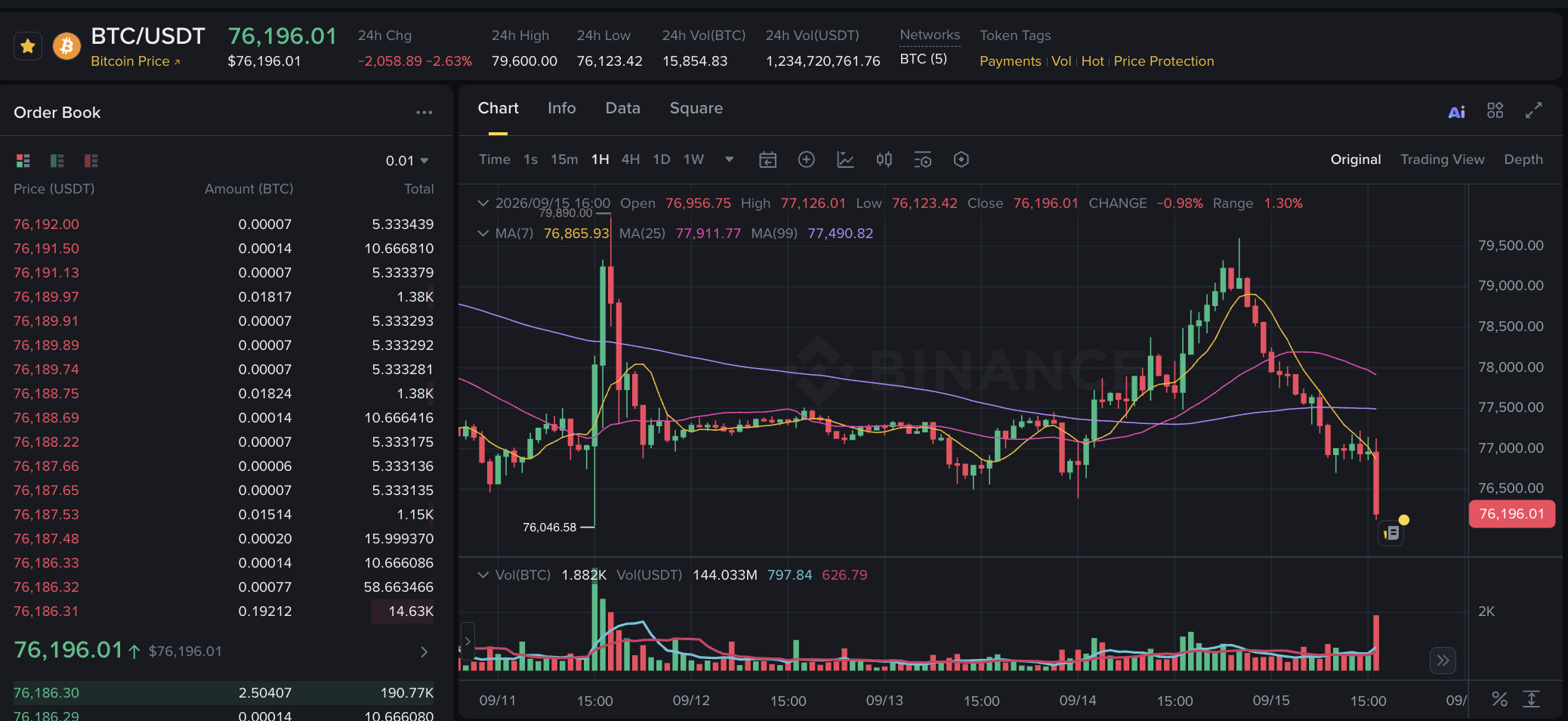
Bitcoin News | Bitcoin Slides to $76,000 as the 50-Week EMA Reclaim Fails and Yields Hit 5.04%Bitcoin fell to around $76,000, down roughly 4.4% from the $79,530 it touched overnight and 7.6% below the month's $82,284 high.The US 10-year Treasury yield reached 5.04%, its highest since July 2007. It briefly topped 5% in October 2023 but failed to hold and pulled back quickly.QCP Capital described the setup before last week's CPI print: "This is the worst mix for Bitcoin: a competing 5% risk-free rate without the nominal-growth impulse that usually accompanies yield moves."That 5% is no longer hypothetical.Monday's Technical Reclaim Has FailedBitcoin reclaimed its 50-week exponential moving average at $77,430 on Monday after initially closing the weekly candle below it, a level flagged as a key support target for a bull-market comeback.At $76,000, that reclaim has been lost within two sessions.The break also takes price below the $77,100 floor of the zone Bitfinex analysts identified as where spot demand had been absorbing overhead supply between $77,100 and $80,000.A level reclaimed and then lost carries the opposite implication of one that breaks and recovers. Friday's dip to $76,046 was bought within the session; this one has not been, and Bitcoin now sits at roughly the same level without the immediate rebound that followed it.Above price, the 50-week simple moving average sits at $81,081 and remains uncleared, with nearly 8% of total supply acquired between $80,000 and $82,000 per Glassnode — the largest concentration at any comparable range.The Fiscal Composition Is the Remaining Bull CaseThe argument for why Bitcoin should hold rests on why yields are rising rather than how far.This ascent is fuelled primarily by fiscal sustainability concerns rather than robust economic expansion. Higher yields driven by growth compress the appeal of non-yielding assets while the growth supports risk. Fiscal-driven yields carry no such offset, and signal investors demanding more compensation to hold government paper at all.On that reading, the move should not penalise gold and Bitcoin the way a growth-driven rate spike would. Bitcoin's 90-day correlation with the 10-year sits at −0.17 against gold's −0.41.Tuesday tests that argument directly. Bitcoin is falling anyway.Mischler Financial's Tom di Galoma listed the drivers as rate expectations, corporate and government debt supply, growth prospects and the long-term fiscal path. "Our budget, deficit, and overall debt structure continue to expand," he said. National debt approached $40 trillion in August, and the 10-year has surged 80 basis points this year with 25 in September alone.Thin Leverage Cuts Both WaysThe positioning explains the size of the swings rather than their direction.ARP Digital partner Yusuf Fakhro noted funding rates drifting toward zero, futures premiums below 5% and open interest stalled.Thin leverage means no pile of forced sellers waiting to be liquidated. It also means nothing anchors price, so each headline pushes Bitcoin further than it should.Last week showed it. Bitcoin ripped 5% to $81,000 Thursday on softer Fed signals, then gave the entire move back within hours when strong payrolls revived hike expectations. Monday's move to $79,427 and Tuesday's slide to $76,000 is the same pattern compressed.The overnight pullback was marked by taker selling in futures, according to Marex, with open interest hovering below 680,000 BTC. Santiment data shows BTC-denominated open contracts fell 13.5% between September 3 and 11 against a 5% price decline, leaving positioning roughly 20% below pre-rally levels.Puts Have Turned Pricier Than CallsBitcoin put options are once again slightly more expensive than calls.Laevitas noted seven-day 25-delta skew moved from +2.16v to −1.05v, a 3.21v shift week-over-week, with 30-day going from +1.33v to −1.39v.The seven-day tenor is where it is most pronounced, capturing the Senate's Clarity Act vote, Wednesday's Fed decision and Friday's Bank of Japan meeting.Bitcoin's 30-day implied volatility index and ether's equivalent have both ticked higher but remain well below February and June highs — measured hedging rather than a scramble.Ether and Solana carry mildly negative funding, implying a slight short bias that could fuel a squeeze on a favourable catalyst.The BOJ Decision Is the One Crypto Should WatchThree central banks decide within three days, and the least-covered carries the most direct transmission.Markets price a 94% chance of a 25 basis point Fed hike Wednesday, lifting the target range to 3.75%-4.00%. The Bank of England follows Thursday with its benchmark at 3.75%. The Bank of Japan is expected to raise to 1.25% Friday.Those follow last week's ECB increase to a 2.65% main refinancing rate.The yen has long funded positions in US stocks and Treasuries through the carry trade, and a rate increase raises that funding cost directly. Japan's 10-year touched 3% this month for the first time in three decades.Carry unwinds produce mechanical selling of dollar assets regardless of any view on those assets — the one channel Bitcoin's low rate sensitivity does not insulate it from, because forced liquidation does not respect correlation coefficients.US Demand Is Sitting on Its HandsCMC head of research Alice Liu identified the geographic split."BTC open interest is down about 3.5% over seven days alongside price, and the Coinbase premium has turned slightly negative, which tells you US spot demand is sitting on its hands," she said.Bitcoin trading at a discount on Coinbase relative to offshore venues is the clearest expression of that.Liu noted spot Bitcoin ETFs saw around $300 million of net outflows over five sessions before a $160 million inflow Monday. Bitcoin exchange-traded products took in nearly 14,000 BTC over a recent week, including 10,700 BTC on September 3 — the strongest single day since April 2025.The demand has not disappeared. It has paused.XRP and Zcash Held While the Rest SlippedEther continues trading choppily between $2,350 and $2,550, with occasional spikes to $2,600, following a steep August rally.XRP was the standout, up more than 2% to $1.41, with Zcash adding nearly 3% to about $1,149. Ether, BNB, Tron, Hyperliquid's HYPE and Dogecoin all slipped by less than 1%, and Solana was flat just above $101.Over seven days Dogecoin is down 7%, HYPE 5% and BNB 3%.Tanker Rates Passed $1 Million a DayThe inflation input driving the rate repricing produced a figure worth isolating.The cost of hiring an oil tanker for the benchmark Middle East to Far East route topped $1 million per day for the first time ever, per Bloomberg's Javier Blas. A year ago it was under $100,000.That tenfold increase is not priced into the barrel. It sits on top of it and passes through to every refined product moved by sea from the region.Saudi Arabia closed the East-West pipeline running to the Red Sea port of Yanbu, which exists specifically to bypass the Strait of Hormuz. With Hormuz disrupted, the bypass shut and Bab El-Mandeb now under threat, Saudi production fell to 6.238 million barrels per day — the lowest since 1990. Brent traded above $107.An export bottleneck unwinds only when a route reopens, which is why this feeds the inflation case in a way monetary policy cannot reach.The Fed decides Wednesday at 2:00 p.m. ET with updated projections and a Warsh press conference.
Bitcoin News | Bitcoin Slides to $76,000 as the 50-Week EMA Reclaim Fails and Yields Hit 5.04%
Bitcoin fell to around $76,000, down roughly 4.4% from the $79,530 it touched overnight and 7.6% below the month's $82,284 high.The US 10-year Treasury yield reached 5.04%, its highest since July 2007. It briefly topped 5% in October 2023 but failed to hold and pulled back quickly.QCP Capital described the setup before last week's CPI print: "This is the worst mix for Bitcoin: a competing 5% risk-free rate without the nominal-growth impulse that usually accompanies yield moves."That 5% is no longer hypothetical.Monday's Technical Reclaim Has FailedBitcoin reclaimed its 50-week exponential moving average at $77,430 on Monday after initially closing the weekly candle below it, a level flagged as a key support target for a bull-market comeback.At $76,000, that reclaim has been lost within two sessions.The break also takes price below the $77,100 floor of the zone Bitfinex analysts identified as where spot demand had been absorbing overhead supply between $77,100 and $80,000.A level reclaimed and then lost carries the opposite implication of one that breaks and recovers. Friday's dip to $76,046 was bought within the session; this one has not been, and Bitcoin now sits at roughly the same level without the immediate rebound that followed it.Above price, the 50-week simple moving average sits at $81,081 and remains uncleared, with nearly 8% of total supply acquired between $80,000 and $82,000 per Glassnode — the largest concentration at any comparable range.The Fiscal Composition Is the Remaining Bull CaseThe argument for why Bitcoin should hold rests on why yields are rising rather than how far.This ascent is fuelled primarily by fiscal sustainability concerns rather than robust economic expansion. Higher yields driven by growth compress the appeal of non-yielding assets while the growth supports risk. Fiscal-driven yields carry no such offset, and signal investors demanding more compensation to hold government paper at all.On that reading, the move should not penalise gold and Bitcoin the way a growth-driven rate spike would. Bitcoin's 90-day correlation with the 10-year sits at −0.17 against gold's −0.41.Tuesday tests that argument directly. Bitcoin is falling anyway.Mischler Financial's Tom di Galoma listed the drivers as rate expectations, corporate and government debt supply, growth prospects and the long-term fiscal path. "Our budget, deficit, and overall debt structure continue to expand," he said. National debt approached $40 trillion in August, and the 10-year has surged 80 basis points this year with 25 in September alone.Thin Leverage Cuts Both WaysThe positioning explains the size of the swings rather than their direction.ARP Digital partner Yusuf Fakhro noted funding rates drifting toward zero, futures premiums below 5% and open interest stalled.Thin leverage means no pile of forced sellers waiting to be liquidated. It also means nothing anchors price, so each headline pushes Bitcoin further than it should.Last week showed it. Bitcoin ripped 5% to $81,000 Thursday on softer Fed signals, then gave the entire move back within hours when strong payrolls revived hike expectations. Monday's move to $79,427 and Tuesday's slide to $76,000 is the same pattern compressed.The overnight pullback was marked by taker selling in futures, according to Marex, with open interest hovering below 680,000 BTC. Santiment data shows BTC-denominated open contracts fell 13.5% between September 3 and 11 against a 5% price decline, leaving positioning roughly 20% below pre-rally levels.Puts Have Turned Pricier Than CallsBitcoin put options are once again slightly more expensive than calls.Laevitas noted seven-day 25-delta skew moved from +2.16v to −1.05v, a 3.21v shift week-over-week, with 30-day going from +1.33v to −1.39v.The seven-day tenor is where it is most pronounced, capturing the Senate's Clarity Act vote, Wednesday's Fed decision and Friday's Bank of Japan meeting.Bitcoin's 30-day implied volatility index and ether's equivalent have both ticked higher but remain well below February and June highs — measured hedging rather than a scramble.Ether and Solana carry mildly negative funding, implying a slight short bias that could fuel a squeeze on a favourable catalyst.The BOJ Decision Is the One Crypto Should WatchThree central banks decide within three days, and the least-covered carries the most direct transmission.Markets price a 94% chance of a 25 basis point Fed hike Wednesday, lifting the target range to 3.75%-4.00%. The Bank of England follows Thursday with its benchmark at 3.75%. The Bank of Japan is expected to raise to 1.25% Friday.Those follow last week's ECB increase to a 2.65% main refinancing rate.The yen has long funded positions in US stocks and Treasuries through the carry trade, and a rate increase raises that funding cost directly. Japan's 10-year touched 3% this month for the first time in three decades.Carry unwinds produce mechanical selling of dollar assets regardless of any view on those assets — the one channel Bitcoin's low rate sensitivity does not insulate it from, because forced liquidation does not respect correlation coefficients.US Demand Is Sitting on Its HandsCMC head of research Alice Liu identified the geographic split."BTC open interest is down about 3.5% over seven days alongside price, and the Coinbase premium has turned slightly negative, which tells you US spot demand is sitting on its hands," she said.Bitcoin trading at a discount on Coinbase relative to offshore venues is the clearest expression of that.Liu noted spot Bitcoin ETFs saw around $300 million of net outflows over five sessions before a $160 million inflow Monday. Bitcoin exchange-traded products took in nearly 14,000 BTC over a recent week, including 10,700 BTC on September 3 — the strongest single day since April 2025.The demand has not disappeared. It has paused.XRP and Zcash Held While the Rest SlippedEther continues trading choppily between $2,350 and $2,550, with occasional spikes to $2,600, following a steep August rally.XRP was the standout, up more than 2% to $1.41, with Zcash adding nearly 3% to about $1,149. Ether, BNB, Tron, Hyperliquid's HYPE and Dogecoin all slipped by less than 1%, and Solana was flat just above $101.Over seven days Dogecoin is down 7%, HYPE 5% and BNB 3%.Tanker Rates Passed $1 Million a DayThe inflation input driving the rate repricing produced a figure worth isolating.The cost of hiring an oil tanker for the benchmark Middle East to Far East route topped $1 million per day for the first time ever, per Bloomberg's Javier Blas. A year ago it was under $100,000.That tenfold increase is not priced into the barrel. It sits on top of it and passes through to every refined product moved by sea from the region.Saudi Arabia closed the East-West pipeline running to the Red Sea port of Yanbu, which exists specifically to bypass the Strait of Hormuz. With Hormuz disrupted, the bypass shut and Bab El-Mandeb now under threat, Saudi production fell to 6.238 million barrels per day — the lowest since 1990. Brent traded above $107.An export bottleneck unwinds only when a route reopens, which is why this feeds the inflation case in a way monetary policy cannot reach.The Fed decides Wednesday at 2:00 p.m. ET with updated projections and a Warsh press conference.
24
4
45
36.8k
·
--
Japan FSA Sets 2026 Policy Focus on On-Chain Finance and TokenizationJapan's Financial Services Agency has published its 2026 administrative policy for financial affairs, outlining plans to clarify technical, institutional, and regulatory issues around on-chain finance through public-private testing and dialogue while maintaining user protection and financial system stability. According to ChainCatcher, the agency also aims to build financial infrastructure that is both convenient and competitive.
The agency said it will use the development of asset tokenization to shorten and upgrade securities settlement processes. It also plans to establish an on-chain finance forum for the AI era to discuss digital finance, decentralized finance, and the use of AI technology in financial services.
Japan FSA Sets 2026 Policy Focus on On-Chain Finance and Tokenization
Japan's Financial Services Agency has published its 2026 administrative policy for financial affairs, outlining plans to clarify technical, institutional, and regulatory issues around on-chain finance through public-private testing and dialogue while maintaining user protection and financial system stability. According to ChainCatcher, the agency also aims to build financial infrastructure that is both convenient and competitive.
The agency said it will use the development of asset tokenization to shorten and upgrade securities settlement processes. It also plans to establish an on-chain finance forum for the AI era to discuss digital finance, decentralized finance, and the use of AI technology in financial services.
The agency said it will use the development of asset tokenization to shorten and upgrade securities settlement processes. It also plans to establish an on-chain finance forum for the AI era to discuss digital finance, decentralized finance, and the use of AI technology in financial services.
602
·
--
JD Vance Says Iran War Will Enter a "Very Different Phase"U.S. Vice President JD Vance said in an interview with the New York Post that the war with Iran will enter a "very different phase" in a few months. According to Sina Finance, Vance said U.S. President Donald Trump was right that the war would end immediately after the U.S. midterm elections, and that Trump is the one who decides when the conflict starts and ends. Vance also said Iran "occasionally fires at merchant ships and usually does not succeed."
JD Vance Says Iran War Will Enter a "Very Different Phase"
U.S. Vice President JD Vance said in an interview with the New York Post that the war with Iran will enter a "very different phase" in a few months. According to Sina Finance, Vance said U.S. President Donald Trump was right that the war would end immediately after the U.S. midterm elections, and that Trump is the one who decides when the conflict starts and ends. Vance also said Iran "occasionally fires at merchant ships and usually does not succeed."
1
3.7k
·
--
Binance to Add GoPro and Reddit bStocks as Margin Collateral AssetsAccording to the announcement from Binance, Binance Cross Margin, Portfolio Margin, and Portfolio Margin Pro will add two bStocks tokens, GoPro (GPROB) and Reddit (RDDTB), as eligible collateral assets at 2026-09-16 12:00 (UTC). The corresponding bStocks trading pairs will also be available for margin trading. According to the announcement from Binance, eligible users will be able to use these bStocks tokens as collateral in Margin, expanding the set of assets available for margin trading. The update applies only to Cross Margin, Portfolio Margin, and Portfolio Margin Pro, and borrowing is not currently supported for the added tokens. Binance said the feature is available only to VIP 3 and above users in permitted jurisdictions and is not available to users in restricted regions. The announcement also noted that users should monitor their margin levels when using bStocks as collateral and that the index price methodology for these assets is covered under Binance’s bStocks Tokenized Securities Collateral Index Price Methodology.
The announcement further stated that bStocks are offered through an Approved Prospectus in the ADGM and are not offered in any other jurisdiction. Tokenized Securities are available only to eligible users in permitted jurisdictions on a secondary market basis only. Binance also said the tokens are added as collateral assets under Cross Margin, Portfolio Margin, and Portfolio Margin Pro only, and that users should refer to Margin Data for the most updated list of marginable assets and related information. The company did not indicate any additional changes beyond the collateral expansion and related margin trading availability.
Binance to Add GoPro and Reddit bStocks as Margin Collateral Assets
According to the announcement from Binance, Binance Cross Margin, Portfolio Margin, and Portfolio Margin Pro will add two bStocks tokens, GoPro (GPROB) and Reddit (RDDTB), as eligible collateral assets at 2026-09-16 12:00 (UTC). The corresponding bStocks trading pairs will also be available for margin trading. According to the announcement from Binance, eligible users will be able to use these bStocks tokens as collateral in Margin, expanding the set of assets available for margin trading. The update applies only to Cross Margin, Portfolio Margin, and Portfolio Margin Pro, and borrowing is not currently supported for the added tokens. Binance said the feature is available only to VIP 3 and above users in permitted jurisdictions and is not available to users in restricted regions. The announcement also noted that users should monitor their margin levels when using bStocks as collateral and that the index price methodology for these assets is covered under Binance’s bStocks Tokenized Securities Collateral Index Price Methodology.
The announcement further stated that bStocks are offered through an Approved Prospectus in the ADGM and are not offered in any other jurisdiction. Tokenized Securities are available only to eligible users in permitted jurisdictions on a secondary market basis only. Binance also said the tokens are added as collateral assets under Cross Margin, Portfolio Margin, and Portfolio Margin Pro only, and that users should refer to Margin Data for the most updated list of marginable assets and related information. The company did not indicate any additional changes beyond the collateral expansion and related margin trading availability.
The announcement further stated that bStocks are offered through an Approved Prospectus in the ADGM and are not offered in any other jurisdiction. Tokenized Securities are available only to eligible users in permitted jurisdictions on a secondary market basis only. Binance also said the tokens are added as collateral assets under Cross Margin, Portfolio Margin, and Portfolio Margin Pro only, and that users should refer to Margin Data for the most updated list of marginable assets and related information. The company did not indicate any additional changes beyond the collateral expansion and related margin trading availability.
2
2k
·
--
Bonk Guy’s Portfolio Falls $12.6 Million in 10 Days, Holdings Remain UnsoldAccording to Lookonchain monitoring, Bonk Guy, also known as Unipcs, saw his portfolio decline by $12.6 million over the past 10 days. According to Odaily, he has not sold PONS, USELESS, or MarsCoin.
Bonk Guy’s Portfolio Falls $12.6 Million in 10 Days, Holdings Remain Unsold
According to Lookonchain monitoring, Bonk Guy, also known as Unipcs, saw his portfolio decline by $12.6 million over the past 10 days. According to Odaily, he has not sold PONS, USELESS, or MarsCoin.
1
5.1k
·
--
Binance Alpha Launches DGrid AI (DGAI) Airdrop Claim for Eligible UsersBinance Wallet announced on X that Binance Alpha has launched DGrid AI (DGAI). Users holding at least 240 Binance Alpha Points can claim the token airdrop on a first-come, first-served basis through the Alpha event page. Eligible users may claim 44 DGAI tokens, and the points threshold will automatically decrease by 5 points every five minutes if the event has not ended. Claiming the airdrop will cost 15 Binance Alpha Points. Users must confirm the claim on the Alpha event page within 24 hours, or the airdrop will be considered forfeited.
Claim Details: The announcement states that the DGAI airdrop is available only to users who meet the minimum Binance Alpha Points requirement at the time of claim. The distribution follows a first-come, first-served format until the airdrop pool is fully allocated or the event ends. The threshold reduction mechanism applies only while the activity remains open, lowering the entry requirement in five-point increments every five minutes. Users who submit a claim must complete confirmation within the 24-hour window on the Alpha event page. If they do not confirm within that period, the claim will be treated as abandoned. The notice does not provide additional details beyond the token name, the claim amount, the points requirement, the deduction of 15 Binance Alpha Points, and the confirmation deadline.
Binance Alpha Launches DGrid AI (DGAI) Airdrop Claim for Eligible Users
Binance Wallet announced on X that Binance Alpha has launched DGrid AI (DGAI). Users holding at least 240 Binance Alpha Points can claim the token airdrop on a first-come, first-served basis through the Alpha event page. Eligible users may claim 44 DGAI tokens, and the points threshold will automatically decrease by 5 points every five minutes if the event has not ended. Claiming the airdrop will cost 15 Binance Alpha Points. Users must confirm the claim on the Alpha event page within 24 hours, or the airdrop will be considered forfeited.
Claim Details: The announcement states that the DGAI airdrop is available only to users who meet the minimum Binance Alpha Points requirement at the time of claim. The distribution follows a first-come, first-served format until the airdrop pool is fully allocated or the event ends. The threshold reduction mechanism applies only while the activity remains open, lowering the entry requirement in five-point increments every five minutes. Users who submit a claim must complete confirmation within the 24-hour window on the Alpha event page. If they do not confirm within that period, the claim will be treated as abandoned. The notice does not provide additional details beyond the token name, the claim amount, the points requirement, the deduction of 15 Binance Alpha Points, and the confirmation deadline.
Claim Details: The announcement states that the DGAI airdrop is available only to users who meet the minimum Binance Alpha Points requirement at the time of claim. The distribution follows a first-come, first-served format until the airdrop pool is fully allocated or the event ends. The threshold reduction mechanism applies only while the activity remains open, lowering the entry requirement in five-point increments every five minutes. Users who submit a claim must complete confirmation within the 24-hour window on the Alpha event page. If they do not confirm within that period, the claim will be treated as abandoned. The notice does not provide additional details beyond the token name, the claim amount, the points requirement, the deduction of 15 Binance Alpha Points, and the confirmation deadline.
1
1k
·
--
XRP Falls Nearly 10% After Senate Fails to Advance Clarity ActXRP fell nearly 10% after the Senate failed to advance the Clarity Act, while Bitcoin slipped nearly 3%. According to NS3.AI, XRP traded at $1.30 during Asian morning hours Wednesday. The bill failed on a 49-50 cloture vote.
XRP Falls Nearly 10% After Senate Fails to Advance Clarity Act
XRP fell nearly 10% after the Senate failed to advance the Clarity Act, while Bitcoin slipped nearly 3%. According to NS3.AI, XRP traded at $1.30 during Asian morning hours Wednesday. The bill failed on a 49-50 cloture vote.
2
17.3k
·
--
Bitmine Immersion Shares Fall 3.73% as Ethereum Drops 1.5%Bitmine Immersion shares fell 3.73% to $24.80 in premarket trading Tuesday as Ethereum declined 1.5% over the past 24 hours to $2,476.81. According to NS3.AI, Bitmine said its Ethereum holdings reached 5.96 million tokens. The company added that its total crypto, cash, marketable securities and other investments reached $15.8 billion.
Bitmine Immersion Shares Fall 3.73% as Ethereum Drops 1.5%
Bitmine Immersion shares fell 3.73% to $24.80 in premarket trading Tuesday as Ethereum declined 1.5% over the past 24 hours to $2,476.81. According to NS3.AI, Bitmine said its Ethereum holdings reached 5.96 million tokens. The company added that its total crypto, cash, marketable securities and other investments reached $15.8 billion.
1
1
9
13.6k
·
--
USDT Launches on Zama Privacy ProtocolTether said on X that USDT has launched on the Zama privacy protocol. According to ChainCatcher, the announcement did not include additional details about the rollout.
USDT Launches on Zama Privacy Protocol
Tether said on X that USDT has launched on the Zama privacy protocol. According to ChainCatcher, the announcement did not include additional details about the rollout.
2
1.9k
·
--
STOCKS | WTI Crude Rises 5.0% to $106.48 a Barrel After Saudi Port Operations HaltedAccording to Wallstreetcn, WTI crude rose 5.0% to $106.48 a barrel, and oil loading operations at Yanbu, Saudi Arabia's largest Red Sea port, were suspended after an attack on an east-west oil pipeline, shipping sources said.
STOCKS | WTI Crude Rises 5.0% to $106.48 a Barrel After Saudi Port Operations Halted
According to Wallstreetcn, WTI crude rose 5.0% to $106.48 a barrel, and oil loading operations at Yanbu, Saudi Arabia's largest Red Sea port, were suspended after an attack on an east-west oil pipeline, shipping sources said.
4
8.7k
·
--
Robinhood Former Engineer Arrested Over Insider Trading Allegations on HyperliquidA former Robinhood engineer was arrested over allegations of insider trading tied to undisclosed token listing information on Hyperliquid. According to PANews, he allegedly used the nonpublic listing details to open positions before the announcement and made more than $50,000 in profit. He could face up to 20 years in prison.
Robinhood Former Engineer Arrested Over Insider Trading Allegations on Hyperliquid
A former Robinhood engineer was arrested over allegations of insider trading tied to undisclosed token listing information on Hyperliquid. According to PANews, he allegedly used the nonpublic listing details to open positions before the announcement and made more than $50,000 in profit. He could face up to 20 years in prison.
1
2
1.4k
Join global crypto users on Binance Square
⚡️ Get latest and useful information about crypto.
💬 Trusted by the world’s largest crypto exchange.
👍 Discover real insights from verified creators.
Email / Phone number
Trending Topics
FedRateWatch
926,258 views
4,446 Discussing
Share & Win Traffic Reward in our Trending Hashtag Campaign
✨Topic: FOMC September, What's The Fed's Next Move?
👉How to Join:
Publish a short post or article with hashtag #FedRateWatch
Create content based on the below angles:
- August core CPI rose 0.3% month-over-month, and the odds of a 25bp hike this week are now close to 90%. Do you anticipate a rate hike this week? Is it a one-off, or the start of a longer hiking cycle?
- If the hike lands, how does it play out for BTC, tech stocks, and gold? Bullish or bearish?
- How are you planning to trade next? Share your BTC, stocks or gold trade/holdings with our trade sharing widget.
⏰Campaign Period:
- 2026-09-15 11:00 - 2026-09-17 3:00 UTC
🎁Reward:
- Qualified posts that comply with the above guidelines and contain more than 100 words will be reviewed and may receive a random traffic boost of 500 to 3,000 views. You will receive a notification from your feed secretary if your post is selected.
- Get a chance to have your article featured on Binance Square Official
Need ideas for your post? Visit the topic page #FedRateWatch or the Square Guide on How to Post for Better Reach.
Binance Square Official
·530 Likes
·1.2M views
MSTRTradingVolumeSurpassesMorganStanley
2,585 views
137 Discussing
BitcoinFalls4%
10,822 views
384 Discussing