

NguyenTien1514
4.9k Posts

NguyenTien1514
Report
Block User
Frequent Trader
3.5 Years
9 Following
1.1K+ Followers
3.7K+ Liked
Posts
All
Quotes
#binancep2pantoan
3 habits that help me never get tricked when selling USDT on P2P.
I sell USDT on P2P quite often, and so far I have never lost any money. I’m not that great—it's just because I stick to these 3 habits.
1. Always verify that the money has truly arrived before clicking Release
Don’t look at the notification and release immediately. I open my banking app and check the amount, the content, and the time before confirming. A few seconds of checking is worth far more than releasing early and regretting it.
2. Only accept orders from users with a high completion rate and many reviews
I almost never trade with new accounts or with a completion rate below 95%. Filtering carefully reduces risk a lot.
3. Never chat separately or transfer money outside the app
If anyone asks me to use Zalo, Telegram, or to transfer to another number, I cancel the order immediately. I only trade within Binance.
These 3 habits sound simple, but if you can maintain them, P2P is much safer. If you’re currently selling, try applying them and see how it goes—if you have any other experience or tips, comment to share nhé.
@Binance_Vietnam
#binancep2pantoan
3 habits that help me never get tricked when selling USDT on P2P.
I sell USDT on P2P quite often, and so far I have never lost any money. I’m not that great—it's just because I stick to these 3 habits.
1. Always verify that the money has truly arrived before clicking Release
Don’t look at the notification and release immediately. I open my banking app and check the amount, the content, and the time before confirming. A few seconds of checking is worth far more than releasing early and regretting it.
2. Only accept orders from users with a high completion rate and many reviews
I almost never trade with new accounts or with a completion rate below 95%. Filtering carefully reduces risk a lot.
3. Never chat separately or transfer money outside the app
If anyone asks me to use Zalo, Telegram, or to transfer to another number, I cancel the order immediately. I only trade within Binance.
These 3 habits sound simple, but if you can maintain them, P2P is much safer. If you’re currently selling, try applying them and see how it goes—if you have any other experience or tips, comment to share nhé.
@Binance Vietnam
3 habits that help me never get tricked when selling USDT on P2P.
I sell USDT on P2P quite often, and so far I have never lost any money. I’m not that great—it's just because I stick to these 3 habits.
1. Always verify that the money has truly arrived before clicking Release
Don’t look at the notification and release immediately. I open my banking app and check the amount, the content, and the time before confirming. A few seconds of checking is worth far more than releasing early and regretting it.
2. Only accept orders from users with a high completion rate and many reviews
I almost never trade with new accounts or with a completion rate below 95%. Filtering carefully reduces risk a lot.
3. Never chat separately or transfer money outside the app
If anyone asks me to use Zalo, Telegram, or to transfer to another number, I cancel the order immediately. I only trade within Binance.
These 3 habits sound simple, but if you can maintain them, P2P is much safer. If you’re currently selling, try applying them and see how it goes—if you have any other experience or tips, comment to share nhé.
@Binance Vietnam
119
#binancep2pantoan
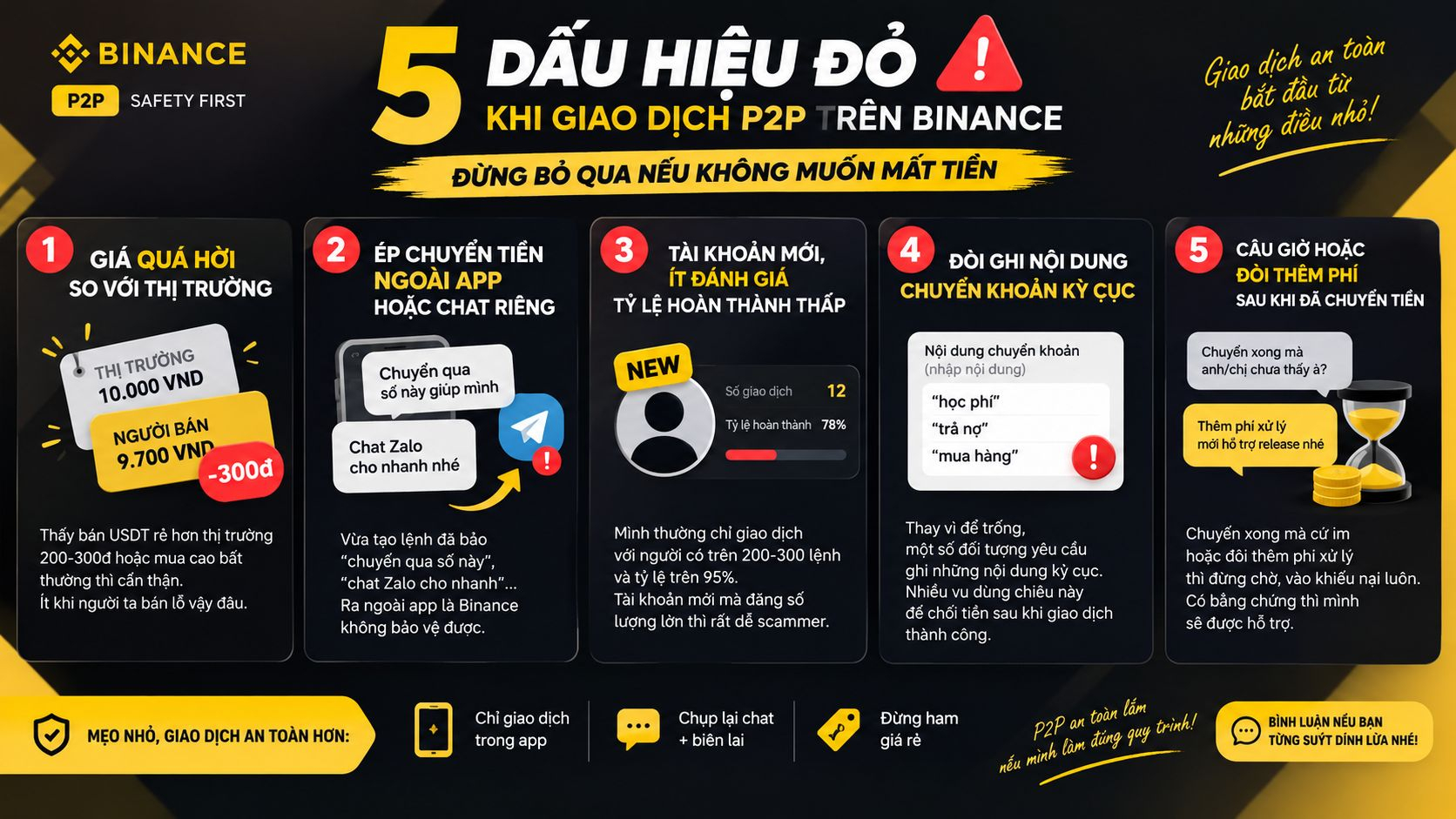
5 red flags when trading P2P on Binance – don’t miss them if you don’t want to lose money.
Lately I’ve seen a lot of newcomers asking about P2P. I’ve also fallen for it a few times before, so I’m sharing this again to help everyone avoid getting burned.
1. The price is too good compared to the market
If someone sells USDT much cheaper than the market by 200–300 VND, or buys at an unusually high price, be careful. People rarely sell at a loss like that.
2. Forcing you to transfer money outside the app or to a private chat
As soon as the order is created, they say “transfer to this number,” “message on Zalo for speed,” etc. This is the most dangerous sign. Once you go outside the app, Binance can’t protect you.
3. New account, few reviews, low completion rate
I usually only trade with people who have over 200–300 orders and a completion rate above 95%. If it’s a new account posting a large quantity, it’s very likely a scammer.
4. Demanding strange transfer memo/content
Stuff like “tuition,” “paying debt,” “buying goods”… instead of leaving it blank. Many scams use this trick to claim the transfer wasn’t for the intended purpose.
5. Delaying or demanding extra fees after you’ve transferred
After you pay, if they go silent or ask for an additional processing fee, file a dispute immediately—don’t wait.
Quick tip: trade only inside the app, take screenshots of the chat + the receipt, and don’t get tempted by bargain prices.
P2P is very safe if you follow the correct procedure. If anyone has almost fallen for a scam, comment and share your experience so we can all stay alert.
@Binance_Vietnam
#binancep2pantoan
5 red flags when trading P2P on Binance – don’t miss them if you don’t want to lose money.
Lately I’ve seen a lot of newcomers asking about P2P. I’ve also fallen for it a few times before, so I’m sharing this again to help everyone avoid getting burned.
1. The price is too good compared to the market
If someone sells USDT much cheaper than the market by 200–300 VND, or buys at an unusually high price, be careful. People rarely sell at a loss like that.
2. Forcing you to transfer money outside the app or to a private chat
As soon as the order is created, they say “transfer to this number,” “message on Zalo for speed,” etc. This is the most dangerous sign. Once you go outside the app, Binance can’t protect you.
3. New account, few reviews, low completion rate
I usually only trade with people who have over 200–300 orders and a completion rate above 95%. If it’s a new account posting a large quantity, it’s very likely a scammer.
4. Demanding strange transfer memo/content
Stuff like “tuition,” “paying debt,” “buying goods”… instead of leaving it blank. Many scams use this trick to claim the transfer wasn’t for the intended purpose.
5. Delaying or demanding extra fees after you’ve transferred
After you pay, if they go silent or ask for an additional processing fee, file a dispute immediately—don’t wait.
Quick tip: trade only inside the app, take screenshots of the chat + the receipt, and don’t get tempted by bargain prices.
P2P is very safe if you follow the correct procedure. If anyone has almost fallen for a scam, comment and share your experience so we can all stay alert.
@Binance Vietnam
5 red flags when trading P2P on Binance – don’t miss them if you don’t want to lose money.
Lately I’ve seen a lot of newcomers asking about P2P. I’ve also fallen for it a few times before, so I’m sharing this again to help everyone avoid getting burned.
1. The price is too good compared to the market
If someone sells USDT much cheaper than the market by 200–300 VND, or buys at an unusually high price, be careful. People rarely sell at a loss like that.
2. Forcing you to transfer money outside the app or to a private chat
As soon as the order is created, they say “transfer to this number,” “message on Zalo for speed,” etc. This is the most dangerous sign. Once you go outside the app, Binance can’t protect you.
3. New account, few reviews, low completion rate
I usually only trade with people who have over 200–300 orders and a completion rate above 95%. If it’s a new account posting a large quantity, it’s very likely a scammer.
4. Demanding strange transfer memo/content
Stuff like “tuition,” “paying debt,” “buying goods”… instead of leaving it blank. Many scams use this trick to claim the transfer wasn’t for the intended purpose.
5. Delaying or demanding extra fees after you’ve transferred
After you pay, if they go silent or ask for an additional processing fee, file a dispute immediately—don’t wait.
Quick tip: trade only inside the app, take screenshots of the chat + the receipt, and don’t get tempted by bargain prices.
P2P is very safe if you follow the correct procedure. If anyone has almost fallen for a scam, comment and share your experience so we can all stay alert.
@Binance Vietnam
120
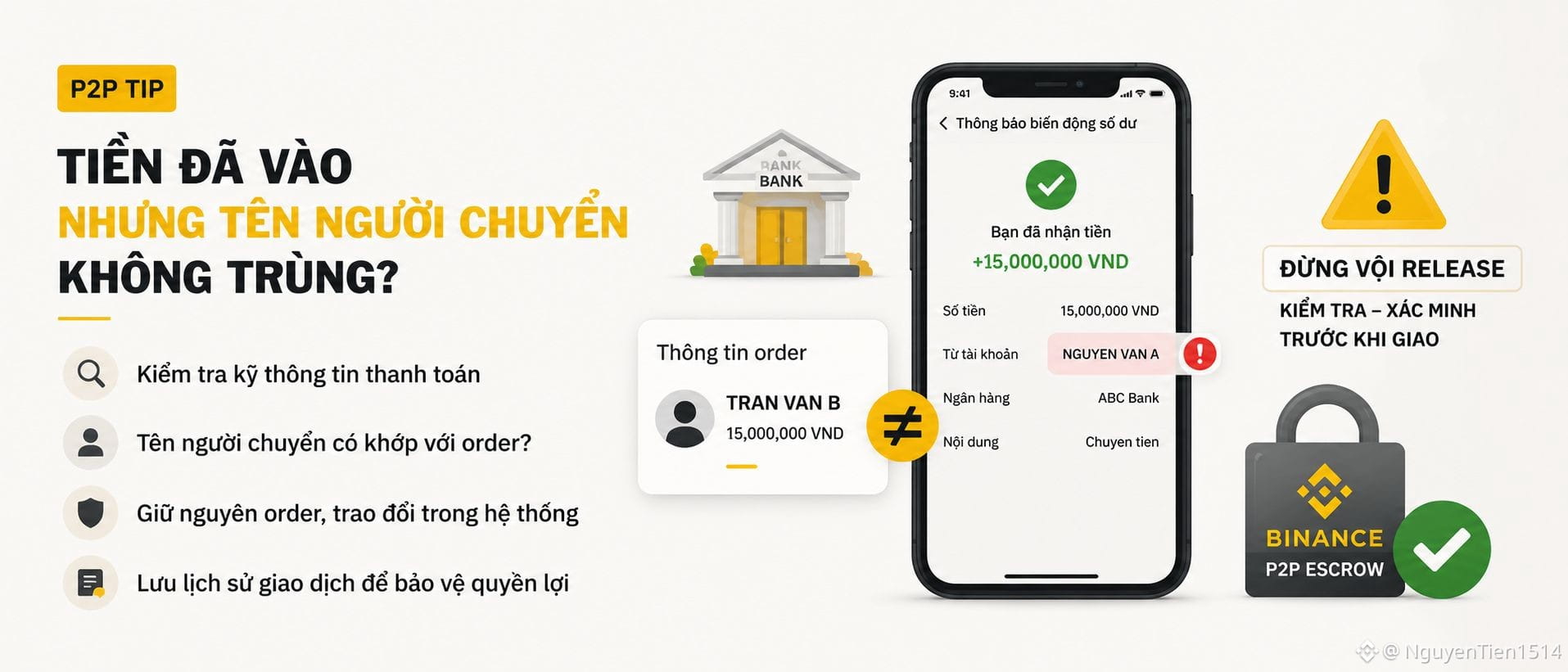
There’s a situation I think P2P traders should know about before they run into it:
You sell USDT. The money has been transferred into your bank account—exactly the amount shown in the order.
At first glance, everything seems to be done.
But when you check again, the name of the remitter doesn’t match the name of the person you’re trading with.
So at this point, should you release the USDT or not?
Previously, I might have thought simply: since the money is in, just release the USDT. But the more I trade, the more I notice that these “small off” details matter, and I need to stop and verify.
Confirming the transaction isn’t just checking whether the money has arrived. I want to know where the money came from, whether the payer’s information matches the details from the order request, and whether anything in the transaction is unusual.
If it doesn’t match, I won’t try to guess what’s going on. I keep the order in place, communicate through the system immediately, and re-check before releasing the USDT. If there’s a dispute, there’s still the transaction history and related information to serve as evidence.
The tricky part of P2P isn’t always recognizing a clear scam. Sometimes it’s about noticing a small detail that doesn’t match what I’m expecting.
And that’s exactly when you must not let the thought “the money has arrived” make you ignore it.
Verifying a transaction that takes a few extra minutes is better than making a rushed decision that you can’t undo afterward!
Learn and share how to trade P2P safely with @Binance_Vietnam #BinanceP2PAnToan
There’s a situation I think P2P traders should know about before they run into it:
You sell USDT. The money has been transferred into your bank account—exactly the amount shown in the order.
At first glance, everything seems to be done.
But when you check again, the name of the remitter doesn’t match the name of the person you’re trading with.
So at this point, should you release the USDT or not?
Previously, I might have thought simply: since the money is in, just release the USDT. But the more I trade, the more I notice that these “small off” details matter, and I need to stop and verify.
Confirming the transaction isn’t just checking whether the money has arrived. I want to know where the money came from, whether the payer’s information matches the details from the order request, and whether anything in the transaction is unusual.
If it doesn’t match, I won’t try to guess what’s going on. I keep the order in place, communicate through the system immediately, and re-check before releasing the USDT. If there’s a dispute, there’s still the transaction history and related information to serve as evidence.
The tricky part of P2P isn’t always recognizing a clear scam. Sometimes it’s about noticing a small detail that doesn’t match what I’m expecting.
And that’s exactly when you must not let the thought “the money has arrived” make you ignore it.
Verifying a transaction that takes a few extra minutes is better than making a rushed decision that you can’t undo afterward!
Learn and share how to trade P2P safely with @Binance Vietnam #BinanceP2PAnToan
You sell USDT. The money has been transferred into your bank account—exactly the amount shown in the order.
At first glance, everything seems to be done.
But when you check again, the name of the remitter doesn’t match the name of the person you’re trading with.
So at this point, should you release the USDT or not?
Previously, I might have thought simply: since the money is in, just release the USDT. But the more I trade, the more I notice that these “small off” details matter, and I need to stop and verify.
Confirming the transaction isn’t just checking whether the money has arrived. I want to know where the money came from, whether the payer’s information matches the details from the order request, and whether anything in the transaction is unusual.
If it doesn’t match, I won’t try to guess what’s going on. I keep the order in place, communicate through the system immediately, and re-check before releasing the USDT. If there’s a dispute, there’s still the transaction history and related information to serve as evidence.
The tricky part of P2P isn’t always recognizing a clear scam. Sometimes it’s about noticing a small detail that doesn’t match what I’m expecting.
And that’s exactly when you must not let the thought “the money has arrived” make you ignore it.
Verifying a transaction that takes a few extra minutes is better than making a rushed decision that you can’t undo afterward!
Learn and share how to trade P2P safely with @Binance Vietnam #BinanceP2PAnToan
95
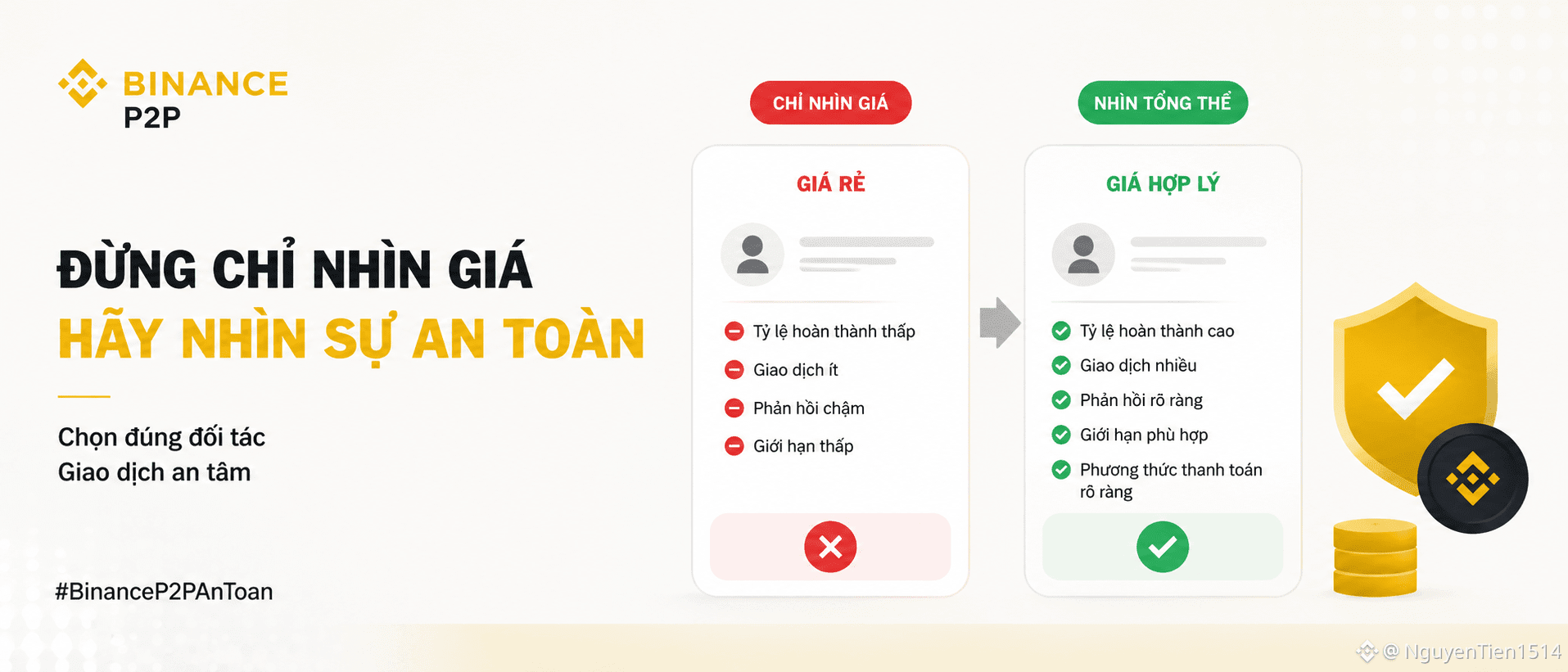
What do you think about a trader setting a P2P price cheaper than the general market, but with orders and completion rate that could be considered poor? I once spent a period choosing P2P almost solely because I thought the price was good. Even if it’s only off by a few dozen, I still think it’s cheap so I buy it.
Later, I realized you shouldn’t look at P2P based on price alone.
Some people offer very attractive prices, but their transactions are inconsistent. Others have a high completion rate, make a lot of trades, and respond clearly, but their price is a little higher. If it were me, I’d pay a bit more in exchange for a transaction with less risk.
Before buying, I usually check pretty straightforward things: number of transactions, completion rate, order limits, and payment method. Then I read how the other person talks. If they’re already pushing you when you’re just starting out—urging you to move to another platform to talk, or telling you to do things differently from the usual process—I drop it immediately. I don’t feel bad about it, because there’s a very high chance it’s a risky deal.
Many people think P2P is a game of finding the cheapest price. In my opinion, it isn’t.
A good price only helps you save a little. A safe transaction helps you preserve your capital.
So if you come across a trader with an unusually low price, the first question I ask isn’t “How much can I get out of it?” but “Why is it so cheap?”
@Binance_Vietnam #BinanceP2PAnToan
What do you think about a trader setting a P2P price cheaper than the general market, but with orders and completion rate that could be considered poor? I once spent a period choosing P2P almost solely because I thought the price was good. Even if it’s only off by a few dozen, I still think it’s cheap so I buy it.
Later, I realized you shouldn’t look at P2P based on price alone.
Some people offer very attractive prices, but their transactions are inconsistent. Others have a high completion rate, make a lot of trades, and respond clearly, but their price is a little higher. If it were me, I’d pay a bit more in exchange for a transaction with less risk.
Before buying, I usually check pretty straightforward things: number of transactions, completion rate, order limits, and payment method. Then I read how the other person talks. If they’re already pushing you when you’re just starting out—urging you to move to another platform to talk, or telling you to do things differently from the usual process—I drop it immediately. I don’t feel bad about it, because there’s a very high chance it’s a risky deal.
Many people think P2P is a game of finding the cheapest price. In my opinion, it isn’t.
A good price only helps you save a little. A safe transaction helps you preserve your capital.
So if you come across a trader with an unusually low price, the first question I ask isn’t “How much can I get out of it?” but “Why is it so cheap?”
@Binance Vietnam #BinanceP2PAnToan
Later, I realized you shouldn’t look at P2P based on price alone.
Some people offer very attractive prices, but their transactions are inconsistent. Others have a high completion rate, make a lot of trades, and respond clearly, but their price is a little higher. If it were me, I’d pay a bit more in exchange for a transaction with less risk.
Before buying, I usually check pretty straightforward things: number of transactions, completion rate, order limits, and payment method. Then I read how the other person talks. If they’re already pushing you when you’re just starting out—urging you to move to another platform to talk, or telling you to do things differently from the usual process—I drop it immediately. I don’t feel bad about it, because there’s a very high chance it’s a risky deal.
Many people think P2P is a game of finding the cheapest price. In my opinion, it isn’t.
A good price only helps you save a little. A safe transaction helps you preserve your capital.
So if you come across a trader with an unusually low price, the first question I ask isn’t “How much can I get out of it?” but “Why is it so cheap?”
@Binance Vietnam #BinanceP2PAnToan
132
There’s a lesson I’ve learned after lots of P2P trading: the most dangerous part usually isn’t when you click buy or sell—it’s in the few minutes afterward.
There was a time when the buyer messaged me that they’d transferred, and they sent a complete screenshot. It looked exactly like a real transaction. If I had been in a hurry and unlocked my coins because I was afraid they’d wait too long, then one wrong step could put all the crypto I had in the order at risk.
Since then, I’ve had a pretty strict rule: if the money hasn’t truly entered the account, I don’t release anything.
A screenshot isn’t money. A bank SMS isn’t the final proof either. I always open my banking app myself, verify the exact amount, the correct recipient account, and the transaction status—then I continue.
That’s also why I think trading directly on Binance P2P matters. Binance’s escrow keeps the assets during the transaction, provides profile information to check the counterparty, and if a dispute happens, there’s still a complaint mechanism to handle it instead of having to settle it outside on your own.
Another red flag I always watch for is when the buyer or seller tries to move the chat to Telegram, Zalo, or asks to do the transaction outside the platform for reasons like “it’s faster.” It sounds convenient, but when something goes wrong, that convenience often turns into risk.
If I had to give a short checklist, I’d remember 4 things:
Check the counterparty.
Trade correctly on the platform.
Confirm for myself that the money has been received.
If there’s a problem, stop and use the dispute/complaint process.
P2P isn’t hard. The hard part is sticking to your rules when the other side keeps pushing you to act faster.
Trading fast doesn’t necessarily mean you’ll earn more. But one mistake can sometimes be enough to wipe out the results of many successful trades before it.
@Binance_Vietnam #BinanceP2PAnToan
There’s a lesson I’ve learned after lots of P2P trading: the most dangerous part usually isn’t when you click buy or sell—it’s in the few minutes afterward.
There was a time when the buyer messaged me that they’d transferred, and they sent a complete screenshot. It looked exactly like a real transaction. If I had been in a hurry and unlocked my coins because I was afraid they’d wait too long, then one wrong step could put all the crypto I had in the order at risk.
Since then, I’ve had a pretty strict rule: if the money hasn’t truly entered the account, I don’t release anything.
A screenshot isn’t money. A bank SMS isn’t the final proof either. I always open my banking app myself, verify the exact amount, the correct recipient account, and the transaction status—then I continue.
That’s also why I think trading directly on Binance P2P matters. Binance’s escrow keeps the assets during the transaction, provides profile information to check the counterparty, and if a dispute happens, there’s still a complaint mechanism to handle it instead of having to settle it outside on your own.
Another red flag I always watch for is when the buyer or seller tries to move the chat to Telegram, Zalo, or asks to do the transaction outside the platform for reasons like “it’s faster.” It sounds convenient, but when something goes wrong, that convenience often turns into risk.
If I had to give a short checklist, I’d remember 4 things:
Check the counterparty.
Trade correctly on the platform.
Confirm for myself that the money has been received.
If there’s a problem, stop and use the dispute/complaint process.
P2P isn’t hard. The hard part is sticking to your rules when the other side keeps pushing you to act faster.
Trading fast doesn’t necessarily mean you’ll earn more. But one mistake can sometimes be enough to wipe out the results of many successful trades before it.
@Binance Vietnam #BinanceP2PAnToan
There was a time when the buyer messaged me that they’d transferred, and they sent a complete screenshot. It looked exactly like a real transaction. If I had been in a hurry and unlocked my coins because I was afraid they’d wait too long, then one wrong step could put all the crypto I had in the order at risk.
Since then, I’ve had a pretty strict rule: if the money hasn’t truly entered the account, I don’t release anything.
A screenshot isn’t money. A bank SMS isn’t the final proof either. I always open my banking app myself, verify the exact amount, the correct recipient account, and the transaction status—then I continue.
That’s also why I think trading directly on Binance P2P matters. Binance’s escrow keeps the assets during the transaction, provides profile information to check the counterparty, and if a dispute happens, there’s still a complaint mechanism to handle it instead of having to settle it outside on your own.
Another red flag I always watch for is when the buyer or seller tries to move the chat to Telegram, Zalo, or asks to do the transaction outside the platform for reasons like “it’s faster.” It sounds convenient, but when something goes wrong, that convenience often turns into risk.
If I had to give a short checklist, I’d remember 4 things:
Check the counterparty.
Trade correctly on the platform.
Confirm for myself that the money has been received.
If there’s a problem, stop and use the dispute/complaint process.
P2P isn’t hard. The hard part is sticking to your rules when the other side keeps pushing you to act faster.
Trading fast doesn’t necessarily mean you’ll earn more. But one mistake can sometimes be enough to wipe out the results of many successful trades before it.
@Binance Vietnam #BinanceP2PAnToan

108
$THE is moving again, but the real story isn't today's 27% candle.
The market is focusing on price, while the bigger discussion is THENA 2.0. The proposal introduces a strategic treasury expansion designed to accelerate ecosystem growth, AI products, BNB Chain integration and RWA liquidity. Some traders worry about token dilution, but others believe a stronger treasury could support long-term value creation if execution matches expectations.
On the 4H chart, THE has reclaimed the $0.050 base and broken above several weeks of resistance. The 15M chart shows buyers defending above $0.062 after rejecting the spike toward $0.069. That's a healthier structure than an immediate collapse after the breakout.
Strategy
• Entry: $0.061-0.063
I'd rather buy a pullback into fresh support than chase another vertical candle.
• Stop Loss: $0.058
Losing this level would put THE back inside the previous consolidation.
• TP1: $0.069
The latest intraday high where profit taking appeared.
• TP2: $0.075
If DeFi rotation continues and the THENA narrative gains traction, this becomes the next upside objective.
THE still needs governance approval and successful execution before the long-term story is fully priced in, but the current structure favors buyers as long as support continues holding.
$THE is moving again, but the real story isn't today's 27% candle.
The market is focusing on price, while the bigger discussion is THENA 2.0. The proposal introduces a strategic treasury expansion designed to accelerate ecosystem growth, AI products, BNB Chain integration and RWA liquidity. Some traders worry about token dilution, but others believe a stronger treasury could support long-term value creation if execution matches expectations.
On the 4H chart, THE has reclaimed the $0.050 base and broken above several weeks of resistance. The 15M chart shows buyers defending above $0.062 after rejecting the spike toward $0.069. That's a healthier structure than an immediate collapse after the breakout.
Strategy
• Entry: $0.061-0.063
I'd rather buy a pullback into fresh support than chase another vertical candle.
• Stop Loss: $0.058
Losing this level would put THE back inside the previous consolidation.
• TP1: $0.069
The latest intraday high where profit taking appeared.
• TP2: $0.075
If DeFi rotation continues and the THENA narrative gains traction, this becomes the next upside objective.
THE still needs governance approval and successful execution before the long-term story is fully priced in, but the current structure favors buyers as long as support continues holding.
The market is focusing on price, while the bigger discussion is THENA 2.0. The proposal introduces a strategic treasury expansion designed to accelerate ecosystem growth, AI products, BNB Chain integration and RWA liquidity. Some traders worry about token dilution, but others believe a stronger treasury could support long-term value creation if execution matches expectations.
On the 4H chart, THE has reclaimed the $0.050 base and broken above several weeks of resistance. The 15M chart shows buyers defending above $0.062 after rejecting the spike toward $0.069. That's a healthier structure than an immediate collapse after the breakout.
Strategy
• Entry: $0.061-0.063
I'd rather buy a pullback into fresh support than chase another vertical candle.
• Stop Loss: $0.058
Losing this level would put THE back inside the previous consolidation.
• TP1: $0.069
The latest intraday high where profit taking appeared.
• TP2: $0.075
If DeFi rotation continues and the THENA narrative gains traction, this becomes the next upside objective.
THE still needs governance approval and successful execution before the long-term story is fully priced in, but the current structure favors buyers as long as support continues holding.
1
197
$EDGE is moving like one of the strongest momentum trades in the market, but this rally isn't only about FOMO.
The bigger story is that edgeX keeps reinforcing a supply reduction narrative. The protocol continues its buyback and burn program funded by trading revenue, while most team and investor allocations remain locked under long vesting schedules. That combination gives the market a reason to pay attention beyond a simple breakout.
On the 4H chart, EDGE completed a full trend reversal from the $0.237 bottom and has now printed fresh highs near $0.523. The 15M chart shows buyers defending above $0.50 after the breakout instead of giving back the entire move. That's usually what a strong trend looks like when momentum is still in control.
Strategy
• Entry: $0.490-0.505
I'd rather buy a healthy retest than chase another vertical candle.
• Stop Loss: $0.468
Losing this support would suggest short-term momentum is fading.
• TP1: $0.550
The next resistance after today's breakout.
• TP2: $0.620
If buyback expectations and trading activity remain strong, this becomes the next expansion target.
EDGE has already delivered a huge move, but as long as buyback, burn and protocol activity continue supporting the narrative, the trend deserves respect more than fear.
$EDGE is moving like one of the strongest momentum trades in the market, but this rally isn't only about FOMO.
The bigger story is that edgeX keeps reinforcing a supply reduction narrative. The protocol continues its buyback and burn program funded by trading revenue, while most team and investor allocations remain locked under long vesting schedules. That combination gives the market a reason to pay attention beyond a simple breakout.
On the 4H chart, EDGE completed a full trend reversal from the $0.237 bottom and has now printed fresh highs near $0.523. The 15M chart shows buyers defending above $0.50 after the breakout instead of giving back the entire move. That's usually what a strong trend looks like when momentum is still in control.
Strategy
• Entry: $0.490-0.505
I'd rather buy a healthy retest than chase another vertical candle.
• Stop Loss: $0.468
Losing this support would suggest short-term momentum is fading.
• TP1: $0.550
The next resistance after today's breakout.
• TP2: $0.620
If buyback expectations and trading activity remain strong, this becomes the next expansion target.
EDGE has already delivered a huge move, but as long as buyback, burn and protocol activity continue supporting the narrative, the trend deserves respect more than fear.
The bigger story is that edgeX keeps reinforcing a supply reduction narrative. The protocol continues its buyback and burn program funded by trading revenue, while most team and investor allocations remain locked under long vesting schedules. That combination gives the market a reason to pay attention beyond a simple breakout.
On the 4H chart, EDGE completed a full trend reversal from the $0.237 bottom and has now printed fresh highs near $0.523. The 15M chart shows buyers defending above $0.50 after the breakout instead of giving back the entire move. That's usually what a strong trend looks like when momentum is still in control.
Strategy
• Entry: $0.490-0.505
I'd rather buy a healthy retest than chase another vertical candle.
• Stop Loss: $0.468
Losing this support would suggest short-term momentum is fading.
• TP1: $0.550
The next resistance after today's breakout.
• TP2: $0.620
If buyback expectations and trading activity remain strong, this becomes the next expansion target.
EDGE has already delivered a huge move, but as long as buyback, burn and protocol activity continue supporting the narrative, the trend deserves respect more than fear.
1
120
$KAITO is finally breaking out, but I don't think this rally is only about AI.
The bigger story is attention.
As more traders rely on AI to filter crypto information, platforms that monetize attention are starting to receive fresh liquidity. KAITO sits right in the middle of that narrative. At the same time, trading volume has exploded while sentiment from Asian markets continues improving. The market seems focused on today's 35% pump, but it may still be underestimating the value of the InfoFi narrative if adoption keeps growing.
On the 4H chart, KAITO has cleanly broken above the multi-week resistance around $0.60 and is trading at a new local high. That's a major shift in market structure. On the 15M, price accelerated vertically from $0.59 to $0.86. Momentum remains extremely bullish, but chasing after a parabolic candle usually offers poor risk-reward.
Strategy
• Entry: $0.74-0.78
I'd rather wait for buyers to defend the breakout than buy after a 35% candle.
• Stop Loss: $0.69
A move back below the breakout zone would weaken the bullish structure.
• TP1: $0.90
• TP2: $1.00
KAITO finally has both narrative and momentum on its side. The only thing missing now is a healthy pullback that gives new buyers a better opportunity.
$KAITO is finally breaking out, but I don't think this rally is only about AI.
The bigger story is attention.
As more traders rely on AI to filter crypto information, platforms that monetize attention are starting to receive fresh liquidity. KAITO sits right in the middle of that narrative. At the same time, trading volume has exploded while sentiment from Asian markets continues improving. The market seems focused on today's 35% pump, but it may still be underestimating the value of the InfoFi narrative if adoption keeps growing.
On the 4H chart, KAITO has cleanly broken above the multi-week resistance around $0.60 and is trading at a new local high. That's a major shift in market structure. On the 15M, price accelerated vertically from $0.59 to $0.86. Momentum remains extremely bullish, but chasing after a parabolic candle usually offers poor risk-reward.
Strategy
• Entry: $0.74-0.78
I'd rather wait for buyers to defend the breakout than buy after a 35% candle.
• Stop Loss: $0.69
A move back below the breakout zone would weaken the bullish structure.
• TP1: $0.90
• TP2: $1.00
KAITO finally has both narrative and momentum on its side. The only thing missing now is a healthy pullback that gives new buyers a better opportunity.
The bigger story is attention.
As more traders rely on AI to filter crypto information, platforms that monetize attention are starting to receive fresh liquidity. KAITO sits right in the middle of that narrative. At the same time, trading volume has exploded while sentiment from Asian markets continues improving. The market seems focused on today's 35% pump, but it may still be underestimating the value of the InfoFi narrative if adoption keeps growing.
On the 4H chart, KAITO has cleanly broken above the multi-week resistance around $0.60 and is trading at a new local high. That's a major shift in market structure. On the 15M, price accelerated vertically from $0.59 to $0.86. Momentum remains extremely bullish, but chasing after a parabolic candle usually offers poor risk-reward.
Strategy
• Entry: $0.74-0.78
I'd rather wait for buyers to defend the breakout than buy after a 35% candle.
• Stop Loss: $0.69
A move back below the breakout zone would weaken the bullish structure.
• TP1: $0.90
• TP2: $1.00
KAITO finally has both narrative and momentum on its side. The only thing missing now is a healthy pullback that gives new buyers a better opportunity.
1
97
$BTC isn't dropping because something is wrong with Bitcoin.
It's reacting to a macro shock.
Trump's latest comments on Iran pushed the market into risk-off mode almost instantly. Oil jumped, equities turned lower, and BTC followed as leveraged positions started getting flushed. The market seems focused on today's red candle, but it may be underestimating how quickly geopolitical headlines can change liquidity across every risk asset.
On the 4H chart, BTC is testing the first major demand zone after losing short-term momentum. The broader structure hasn't completely broken yet, but buyers need to defend this area soon. On the 15M, selling pressure is slowing down, although a clear reversal still hasn't appeared.
Strategy
• Entry: $61,800-62,200
I'd rather buy a controlled pullback into support than chase a random bounce.
• Stop Loss: $60,900
A break below this level would suggest the panic isn't over yet.
• TP1: $63,500
• TP2: $64,200
This looks more like a headline-driven correction than a fundamental change. If the geopolitical pressure eases, BTC could recover much faster than most traders expect.
$BTC isn't dropping because something is wrong with Bitcoin.
It's reacting to a macro shock.
Trump's latest comments on Iran pushed the market into risk-off mode almost instantly. Oil jumped, equities turned lower, and BTC followed as leveraged positions started getting flushed. The market seems focused on today's red candle, but it may be underestimating how quickly geopolitical headlines can change liquidity across every risk asset.
On the 4H chart, BTC is testing the first major demand zone after losing short-term momentum. The broader structure hasn't completely broken yet, but buyers need to defend this area soon. On the 15M, selling pressure is slowing down, although a clear reversal still hasn't appeared.
Strategy
• Entry: $61,800-62,200
I'd rather buy a controlled pullback into support than chase a random bounce.
• Stop Loss: $60,900
A break below this level would suggest the panic isn't over yet.
• TP1: $63,500
• TP2: $64,200
This looks more like a headline-driven correction than a fundamental change. If the geopolitical pressure eases, BTC could recover much faster than most traders expect.
It's reacting to a macro shock.
Trump's latest comments on Iran pushed the market into risk-off mode almost instantly. Oil jumped, equities turned lower, and BTC followed as leveraged positions started getting flushed. The market seems focused on today's red candle, but it may be underestimating how quickly geopolitical headlines can change liquidity across every risk asset.
On the 4H chart, BTC is testing the first major demand zone after losing short-term momentum. The broader structure hasn't completely broken yet, but buyers need to defend this area soon. On the 15M, selling pressure is slowing down, although a clear reversal still hasn't appeared.
Strategy
• Entry: $61,800-62,200
I'd rather buy a controlled pullback into support than chase a random bounce.
• Stop Loss: $60,900
A break below this level would suggest the panic isn't over yet.
• TP1: $63,500
• TP2: $64,200
This looks more like a headline-driven correction than a fundamental change. If the geopolitical pressure eases, BTC could recover much faster than most traders expect.
54
$SOL is finally pulling back, but I don't think that's the biggest story.
The bigger story is that Solana's fundamentals haven't slowed down at all. RWA activity continues expanding, Firedancer keeps moving closer to production, and Alpenglow remains one of the most important network upgrades this cycle. Meanwhile, today's sell-off looks more like traders locking in profits after a strong rally than investors losing confidence.
On the 4H chart, SOL is testing the previous breakout area around $76.5-77.5. That's the first level I'd expect buyers to defend if the uptrend is still healthy. On the 15M, sellers still have the upper hand, but momentum is fading as price approaches support instead of accelerating lower.
Strategy
• Entry: $76.8-77.5
I'd rather buy the retest of support than chase a recovery candle.
• Stop Loss: $75.3
A break below this area would invalidate the current higher-low structure.
• TP1: $80.0
First resistance where short-term traders may take profit.
• TP2: $84.0
A successful reclaim of the recent high would confirm buyers are back in control.
The narrative around Solana hasn't changed. If this support holds, today's weakness could end up looking like an opportunity rather than the start of a larger correction.
$SOL is finally pulling back, but I don't think that's the biggest story.
The bigger story is that Solana's fundamentals haven't slowed down at all. RWA activity continues expanding, Firedancer keeps moving closer to production, and Alpenglow remains one of the most important network upgrades this cycle. Meanwhile, today's sell-off looks more like traders locking in profits after a strong rally than investors losing confidence.
On the 4H chart, SOL is testing the previous breakout area around $76.5-77.5. That's the first level I'd expect buyers to defend if the uptrend is still healthy. On the 15M, sellers still have the upper hand, but momentum is fading as price approaches support instead of accelerating lower.
Strategy
• Entry: $76.8-77.5
I'd rather buy the retest of support than chase a recovery candle.
• Stop Loss: $75.3
A break below this area would invalidate the current higher-low structure.
• TP1: $80.0
First resistance where short-term traders may take profit.
• TP2: $84.0
A successful reclaim of the recent high would confirm buyers are back in control.
The narrative around Solana hasn't changed. If this support holds, today's weakness could end up looking like an opportunity rather than the start of a larger correction.
The bigger story is that Solana's fundamentals haven't slowed down at all. RWA activity continues expanding, Firedancer keeps moving closer to production, and Alpenglow remains one of the most important network upgrades this cycle. Meanwhile, today's sell-off looks more like traders locking in profits after a strong rally than investors losing confidence.
On the 4H chart, SOL is testing the previous breakout area around $76.5-77.5. That's the first level I'd expect buyers to defend if the uptrend is still healthy. On the 15M, sellers still have the upper hand, but momentum is fading as price approaches support instead of accelerating lower.
Strategy
• Entry: $76.8-77.5
I'd rather buy the retest of support than chase a recovery candle.
• Stop Loss: $75.3
A break below this area would invalidate the current higher-low structure.
• TP1: $80.0
First resistance where short-term traders may take profit.
• TP2: $84.0
A successful reclaim of the recent high would confirm buyers are back in control.
The narrative around Solana hasn't changed. If this support holds, today's weakness could end up looking like an opportunity rather than the start of a larger correction.
1
117
$SPELL is moving again, but the interesting part isn't the 25% candle.
Abracadabra hasn't announced a game-changing upgrade recently. What changed is the market. Capital is rotating back into DeFi, and older protocols like SPELL are starting to wake up after spending months near cycle lows. That's why I see this as a liquidity trade first, not a fundamental re-rating.
On the 4H chart, SPELL bounced cleanly from the $0.000086 area and is trying to establish a higher high. The 15M shows buyers defending above $0.000110 after rejecting the intraday top at $0.000130. That's a healthier structure than a straight vertical pump.
Strategy
• Entry: $0.000106-0.000110
I'd rather buy a pullback into fresh support than chase another green candle.
• Stop Loss: $0.000099
Losing this level would put SPELL back inside the old range.
• TP1: $0.000130
The recent high where sellers stepped in.
• TP2: $0.000150
If DeFi momentum stays strong, this becomes the next psychological target.
SPELL still needs a real catalyst, but as long as DeFi keeps attracting liquidity, I don't mind waiting for a clean retest instead of rushing in.
$SPELL is moving again, but the interesting part isn't the 25% candle.
Abracadabra hasn't announced a game-changing upgrade recently. What changed is the market. Capital is rotating back into DeFi, and older protocols like SPELL are starting to wake up after spending months near cycle lows. That's why I see this as a liquidity trade first, not a fundamental re-rating.
On the 4H chart, SPELL bounced cleanly from the $0.000086 area and is trying to establish a higher high. The 15M shows buyers defending above $0.000110 after rejecting the intraday top at $0.000130. That's a healthier structure than a straight vertical pump.
Strategy
• Entry: $0.000106-0.000110
I'd rather buy a pullback into fresh support than chase another green candle.
• Stop Loss: $0.000099
Losing this level would put SPELL back inside the old range.
• TP1: $0.000130
The recent high where sellers stepped in.
• TP2: $0.000150
If DeFi momentum stays strong, this becomes the next psychological target.
SPELL still needs a real catalyst, but as long as DeFi keeps attracting liquidity, I don't mind waiting for a clean retest instead of rushing in.
Abracadabra hasn't announced a game-changing upgrade recently. What changed is the market. Capital is rotating back into DeFi, and older protocols like SPELL are starting to wake up after spending months near cycle lows. That's why I see this as a liquidity trade first, not a fundamental re-rating.
On the 4H chart, SPELL bounced cleanly from the $0.000086 area and is trying to establish a higher high. The 15M shows buyers defending above $0.000110 after rejecting the intraday top at $0.000130. That's a healthier structure than a straight vertical pump.
Strategy
• Entry: $0.000106-0.000110
I'd rather buy a pullback into fresh support than chase another green candle.
• Stop Loss: $0.000099
Losing this level would put SPELL back inside the old range.
• TP1: $0.000130
The recent high where sellers stepped in.
• TP2: $0.000150
If DeFi momentum stays strong, this becomes the next psychological target.
SPELL still needs a real catalyst, but as long as DeFi keeps attracting liquidity, I don't mind waiting for a clean retest instead of rushing in.
89
$SYN is finally giving traders something they haven't seen for weeks, momentum backed by a real catalyst instead of random speculation.
The biggest trigger was Arthur Hayes accumulating around 6.1M SYN, while the team keeps expanding Hypercall, Synapse's on-chain derivatives platform. The market is slowly shifting from seeing Synapse as "just another bridge" to a protocol building new DeFi products. That's the part I think many people are still underpricing.
On the 4H chart, SYN has reclaimed every major EMA and is pressing into the $0.42 resistance. The 15M trend is still clean, but RSI is already running hot after today's push.
Strategy
• Entry: $0.405-0.412
I'd rather let price retest the breakout than buy after a 17% candle.
• Stop Loss: $0.389
If price falls back under the EMA cluster, today's breakout starts losing its edge.
• TP1: $0.450
The first supply zone from the previous structure.
• TP2: $0.500
If volume keeps expanding and buyers clear $0.45, momentum could accelerate.
I'm bullish while SYN holds above $0.40. Chasing resistance rarely pays, waiting for confirmation usually does.
$SYN is finally giving traders something they haven't seen for weeks, momentum backed by a real catalyst instead of random speculation.
The biggest trigger was Arthur Hayes accumulating around 6.1M SYN, while the team keeps expanding Hypercall, Synapse's on-chain derivatives platform. The market is slowly shifting from seeing Synapse as "just another bridge" to a protocol building new DeFi products. That's the part I think many people are still underpricing.
On the 4H chart, SYN has reclaimed every major EMA and is pressing into the $0.42 resistance. The 15M trend is still clean, but RSI is already running hot after today's push.
Strategy
• Entry: $0.405-0.412
I'd rather let price retest the breakout than buy after a 17% candle.
• Stop Loss: $0.389
If price falls back under the EMA cluster, today's breakout starts losing its edge.
• TP1: $0.450
The first supply zone from the previous structure.
• TP2: $0.500
If volume keeps expanding and buyers clear $0.45, momentum could accelerate.
I'm bullish while SYN holds above $0.40. Chasing resistance rarely pays, waiting for confirmation usually does.
The biggest trigger was Arthur Hayes accumulating around 6.1M SYN, while the team keeps expanding Hypercall, Synapse's on-chain derivatives platform. The market is slowly shifting from seeing Synapse as "just another bridge" to a protocol building new DeFi products. That's the part I think many people are still underpricing.
On the 4H chart, SYN has reclaimed every major EMA and is pressing into the $0.42 resistance. The 15M trend is still clean, but RSI is already running hot after today's push.
Strategy
• Entry: $0.405-0.412
I'd rather let price retest the breakout than buy after a 17% candle.
• Stop Loss: $0.389
If price falls back under the EMA cluster, today's breakout starts losing its edge.
• TP1: $0.450
The first supply zone from the previous structure.
• TP2: $0.500
If volume keeps expanding and buyers clear $0.45, momentum could accelerate.
I'm bullish while SYN holds above $0.40. Chasing resistance rarely pays, waiting for confirmation usually does.
100
$AI is finally showing some life again.
There hasn't been a major project announcement over the last few days, but that's exactly why this move is interesting. The rally looks driven by fresh capital rotating back into AI tokens rather than a one-off headline. The next thing worth watching is the scheduled token unlock in early August. If the market absorbs that supply well, sentiment could improve further.
The 4H chart just bounced from a long accumulation zone around $0.019 and is pushing back toward the late-June resistance. On the 15M, momentum exploded with a clean breakout, but price is already stretching away from support.
Strategy
• Entry: $0.0225-0.0230
Buying a retest makes more sense than chasing the first green candle.
• Stop Loss: $0.0210
Losing this level would likely send price back into the previous range.
• TP1: $0.0250
Recent rejection zone.
• TP2: $0.0270
The late-June swing high.
This looks like the first real trend change in weeks. I'd still wait for confirmation because low-cap AI tokens can reverse just as quickly as they rally.
$AI is finally showing some life again.
There hasn't been a major project announcement over the last few days, but that's exactly why this move is interesting. The rally looks driven by fresh capital rotating back into AI tokens rather than a one-off headline. The next thing worth watching is the scheduled token unlock in early August. If the market absorbs that supply well, sentiment could improve further.
The 4H chart just bounced from a long accumulation zone around $0.019 and is pushing back toward the late-June resistance. On the 15M, momentum exploded with a clean breakout, but price is already stretching away from support.
Strategy
• Entry: $0.0225-0.0230
Buying a retest makes more sense than chasing the first green candle.
• Stop Loss: $0.0210
Losing this level would likely send price back into the previous range.
• TP1: $0.0250
Recent rejection zone.
• TP2: $0.0270
The late-June swing high.
This looks like the first real trend change in weeks. I'd still wait for confirmation because low-cap AI tokens can reverse just as quickly as they rally.
There hasn't been a major project announcement over the last few days, but that's exactly why this move is interesting. The rally looks driven by fresh capital rotating back into AI tokens rather than a one-off headline. The next thing worth watching is the scheduled token unlock in early August. If the market absorbs that supply well, sentiment could improve further.
The 4H chart just bounced from a long accumulation zone around $0.019 and is pushing back toward the late-June resistance. On the 15M, momentum exploded with a clean breakout, but price is already stretching away from support.
Strategy
• Entry: $0.0225-0.0230
Buying a retest makes more sense than chasing the first green candle.
• Stop Loss: $0.0210
Losing this level would likely send price back into the previous range.
• TP1: $0.0250
Recent rejection zone.
• TP2: $0.0270
The late-June swing high.
This looks like the first real trend change in weeks. I'd still wait for confirmation because low-cap AI tokens can reverse just as quickly as they rally.
64
$EVAA is starting to look less like a hype token and more like the face of TON DeFi.
A few days ago everyone was talking about the 160% pump. Today I'm watching something else. Price didn't collapse after the first wave of profit-taking. That's usually a good sign. It tells me buyers are still willing to absorb supply instead of running for the exit.
The Cross-Chain Bridge narrative is also giving EVAA a longer story than just one green candle. If TVL and user activity keep growing, the market may still be underestimating how much attention TON DeFi can attract this cycle.
The 4H trend is still one of the strongest I've seen this week. On the 15M, price is building a base around $3.00 after rejecting $3.35. That's much healthier than another vertical move.
Strategy
• Entry: $2.90-3.00
I'd rather buy a successful retest than chase after another breakout.
• Stop Loss: $2.70
Losing this area would suggest buyers are no longer defending the trend.
• TP1: $3.35
Previous high where sellers already appeared.
• TP2: $3.70-3.90
If volume expands and $3.35 breaks cleanly, this becomes the next logical target.
I'm still bullish, but only while EVAA keeps turning resistance into support. That's what separates a real trend from a short-lived pump.
$EVAA is starting to look less like a hype token and more like the face of TON DeFi.
A few days ago everyone was talking about the 160% pump. Today I'm watching something else. Price didn't collapse after the first wave of profit-taking. That's usually a good sign. It tells me buyers are still willing to absorb supply instead of running for the exit.
The Cross-Chain Bridge narrative is also giving EVAA a longer story than just one green candle. If TVL and user activity keep growing, the market may still be underestimating how much attention TON DeFi can attract this cycle.
The 4H trend is still one of the strongest I've seen this week. On the 15M, price is building a base around $3.00 after rejecting $3.35. That's much healthier than another vertical move.
Strategy
• Entry: $2.90-3.00
I'd rather buy a successful retest than chase after another breakout.
• Stop Loss: $2.70
Losing this area would suggest buyers are no longer defending the trend.
• TP1: $3.35
Previous high where sellers already appeared.
• TP2: $3.70-3.90
If volume expands and $3.35 breaks cleanly, this becomes the next logical target.
I'm still bullish, but only while EVAA keeps turning resistance into support. That's what separates a real trend from a short-lived pump.
A few days ago everyone was talking about the 160% pump. Today I'm watching something else. Price didn't collapse after the first wave of profit-taking. That's usually a good sign. It tells me buyers are still willing to absorb supply instead of running for the exit.
The Cross-Chain Bridge narrative is also giving EVAA a longer story than just one green candle. If TVL and user activity keep growing, the market may still be underestimating how much attention TON DeFi can attract this cycle.
The 4H trend is still one of the strongest I've seen this week. On the 15M, price is building a base around $3.00 after rejecting $3.35. That's much healthier than another vertical move.
Strategy
• Entry: $2.90-3.00
I'd rather buy a successful retest than chase after another breakout.
• Stop Loss: $2.70
Losing this area would suggest buyers are no longer defending the trend.
• TP1: $3.35
Previous high where sellers already appeared.
• TP2: $3.70-3.90
If volume expands and $3.35 breaks cleanly, this becomes the next logical target.
I'm still bullish, but only while EVAA keeps turning resistance into support. That's what separates a real trend from a short-lived pump.
2
281
$EDGE has quietly become one of the strongest movers over the last two days, and I don't think it's just another random low-cap pump.
The project is gaining attention after expanding its decentralized AI infrastructure narrative. Recent product updates and ecosystem growth have brought fresh liquidity back, which explains why volume exploded alongside price instead of before it.
From the chart, the 4H trend has completely flipped after reclaiming the $0.30 area. Buyers pushed price close to the previous swing high around $0.42, then started consolidating instead of dumping. On the 15M, the range between $0.39 and $0.42 looks more like a pause than a reversal.
Strategy
• Entry: $0.385-0.395
I'd rather buy a retest of support than chase after a 30% candle.
• Stop Loss: $0.370
A break below this zone would invalidate the latest breakout structure.
• TP1: $0.420
Previous local high where sellers already reacted.
• TP2: $0.460-0.480
If buyers break $0.42 with strong volume, this becomes the next upside zone.
The narrative is getting stronger, but price has already rewarded early buyers. I'd rather wait for a cleaner risk-reward than FOMO into resistance.
$EDGE has quietly become one of the strongest movers over the last two days, and I don't think it's just another random low-cap pump.
The project is gaining attention after expanding its decentralized AI infrastructure narrative. Recent product updates and ecosystem growth have brought fresh liquidity back, which explains why volume exploded alongside price instead of before it.
From the chart, the 4H trend has completely flipped after reclaiming the $0.30 area. Buyers pushed price close to the previous swing high around $0.42, then started consolidating instead of dumping. On the 15M, the range between $0.39 and $0.42 looks more like a pause than a reversal.
Strategy
• Entry: $0.385-0.395
I'd rather buy a retest of support than chase after a 30% candle.
• Stop Loss: $0.370
A break below this zone would invalidate the latest breakout structure.
• TP1: $0.420
Previous local high where sellers already reacted.
• TP2: $0.460-0.480
If buyers break $0.42 with strong volume, this becomes the next upside zone.
The narrative is getting stronger, but price has already rewarded early buyers. I'd rather wait for a cleaner risk-reward than FOMO into resistance.
The project is gaining attention after expanding its decentralized AI infrastructure narrative. Recent product updates and ecosystem growth have brought fresh liquidity back, which explains why volume exploded alongside price instead of before it.
From the chart, the 4H trend has completely flipped after reclaiming the $0.30 area. Buyers pushed price close to the previous swing high around $0.42, then started consolidating instead of dumping. On the 15M, the range between $0.39 and $0.42 looks more like a pause than a reversal.
Strategy
• Entry: $0.385-0.395
I'd rather buy a retest of support than chase after a 30% candle.
• Stop Loss: $0.370
A break below this zone would invalidate the latest breakout structure.
• TP1: $0.420
Previous local high where sellers already reacted.
• TP2: $0.460-0.480
If buyers break $0.42 with strong volume, this becomes the next upside zone.
The narrative is getting stronger, but price has already rewarded early buyers. I'd rather wait for a cleaner risk-reward than FOMO into resistance.
81
$CLO isn't pumping because of hype alone. What's changed is the story behind it.
Yei Finance is starting to attract attention as one of the main lending protocols on Sei, while Clovis is pushing the idea of a shared liquidity layer instead of isolated liquidity across chains. If more users and TVL keep flowing into the ecosystem, today's move could be more than just another low-cap spike.
The 4H chart has finally broken its month-long downtrend and buyers have already reclaimed the $0.20 area. On the 15M, price is holding above the latest breakout instead of immediately giving everything back. That's usually a healthy sign, but chasing after a 40% day rarely offers the best reward.
Strategy
• Entry: $0.192-0.198
I'd rather buy a retest of the breakout than a green candle. If buyers defend this zone, the trend has a better chance of continuing.
• Stop Loss: $0.182
A loss of this support would suggest today's breakout is losing momentum.
• TP1: $0.220
The first area where profit-taking is likely to increase.
• TP2: $0.245
If volume keeps expanding and buyers stay in control, this becomes the next upside target.
I'm interested in CLO, but only if it proves today's breakout can turn into tomorrow's support.
$CLO isn't pumping because of hype alone. What's changed is the story behind it.
Yei Finance is starting to attract attention as one of the main lending protocols on Sei, while Clovis is pushing the idea of a shared liquidity layer instead of isolated liquidity across chains. If more users and TVL keep flowing into the ecosystem, today's move could be more than just another low-cap spike.
The 4H chart has finally broken its month-long downtrend and buyers have already reclaimed the $0.20 area. On the 15M, price is holding above the latest breakout instead of immediately giving everything back. That's usually a healthy sign, but chasing after a 40% day rarely offers the best reward.
Strategy
• Entry: $0.192-0.198
I'd rather buy a retest of the breakout than a green candle. If buyers defend this zone, the trend has a better chance of continuing.
• Stop Loss: $0.182
A loss of this support would suggest today's breakout is losing momentum.
• TP1: $0.220
The first area where profit-taking is likely to increase.
• TP2: $0.245
If volume keeps expanding and buyers stay in control, this becomes the next upside target.
I'm interested in CLO, but only if it proves today's breakout can turn into tomorrow's support.
Yei Finance is starting to attract attention as one of the main lending protocols on Sei, while Clovis is pushing the idea of a shared liquidity layer instead of isolated liquidity across chains. If more users and TVL keep flowing into the ecosystem, today's move could be more than just another low-cap spike.
The 4H chart has finally broken its month-long downtrend and buyers have already reclaimed the $0.20 area. On the 15M, price is holding above the latest breakout instead of immediately giving everything back. That's usually a healthy sign, but chasing after a 40% day rarely offers the best reward.
Strategy
• Entry: $0.192-0.198
I'd rather buy a retest of the breakout than a green candle. If buyers defend this zone, the trend has a better chance of continuing.
• Stop Loss: $0.182
A loss of this support would suggest today's breakout is losing momentum.
• TP1: $0.220
The first area where profit-taking is likely to increase.
• TP2: $0.245
If volume keeps expanding and buyers stay in control, this becomes the next upside target.
I'm interested in CLO, but only if it proves today's breakout can turn into tomorrow's support.
108
$EVAA is everywhere today, but I don't think the real opportunity is buying after a 160% candle.
The bigger story is TON DeFi. EVAA is becoming one of the key lending protocols in the ecosystem, and the upcoming Cross-Chain Bridge gives the project a catalyst beyond today's hype. If TVL and user activity continue growing, this rally has a stronger foundation than a typical low-cap pump.
The chart tells a different story though. The 4H trend is undeniably bullish, but price is now trading just below the $3.00 psychological resistance after a nearly vertical move. On the 15M, volatility is expanding and profit-taking has already started showing up.
Strategy
• Entry: $2.30-2.45
I'd rather wait for a healthy pullback into the latest breakout zone. The reward-to-risk looks much better there.
• Stop Loss: $2.10
If EVAA loses this support, it suggests momentum has faded and buyers are no longer defending the breakout.
• TP1: $3.00
The recent high and first major resistance.
• TP2: $3.40-3.60
If buyers absorb supply above $3.00, this becomes the next area worth watching.
I'm still bullish on EVAA long term, but after a move like this I'd rather buy strength after a reset than chase a candle that already doubled.
$EVAA is everywhere today, but I don't think the real opportunity is buying after a 160% candle.
The bigger story is TON DeFi. EVAA is becoming one of the key lending protocols in the ecosystem, and the upcoming Cross-Chain Bridge gives the project a catalyst beyond today's hype. If TVL and user activity continue growing, this rally has a stronger foundation than a typical low-cap pump.
The chart tells a different story though. The 4H trend is undeniably bullish, but price is now trading just below the $3.00 psychological resistance after a nearly vertical move. On the 15M, volatility is expanding and profit-taking has already started showing up.
Strategy
• Entry: $2.30-2.45
I'd rather wait for a healthy pullback into the latest breakout zone. The reward-to-risk looks much better there.
• Stop Loss: $2.10
If EVAA loses this support, it suggests momentum has faded and buyers are no longer defending the breakout.
• TP1: $3.00
The recent high and first major resistance.
• TP2: $3.40-3.60
If buyers absorb supply above $3.00, this becomes the next area worth watching.
I'm still bullish on EVAA long term, but after a move like this I'd rather buy strength after a reset than chase a candle that already doubled.
The bigger story is TON DeFi. EVAA is becoming one of the key lending protocols in the ecosystem, and the upcoming Cross-Chain Bridge gives the project a catalyst beyond today's hype. If TVL and user activity continue growing, this rally has a stronger foundation than a typical low-cap pump.
The chart tells a different story though. The 4H trend is undeniably bullish, but price is now trading just below the $3.00 psychological resistance after a nearly vertical move. On the 15M, volatility is expanding and profit-taking has already started showing up.
Strategy
• Entry: $2.30-2.45
I'd rather wait for a healthy pullback into the latest breakout zone. The reward-to-risk looks much better there.
• Stop Loss: $2.10
If EVAA loses this support, it suggests momentum has faded and buyers are no longer defending the breakout.
• TP1: $3.00
The recent high and first major resistance.
• TP2: $3.40-3.60
If buyers absorb supply above $3.00, this becomes the next area worth watching.
I'm still bullish on EVAA long term, but after a move like this I'd rather buy strength after a reset than chase a candle that already doubled.
285
$AGLD is suddenly back on everyone's watchlist, but I don't think the biggest story is the 25% pump.
What's more interesting is that the market has started paying attention to Adventure Layer again. The recent GameFi narrative brought fresh liquidity into AGLD, and that's something worth watching if it keeps attracting users instead of just traders.
The chart looks strong, but it's also running hot. On the 4H, buyers have completely flipped the short-term trend after weeks of weakness. The 15M, though, is showing profit-taking right below $0.196. That's not bearish, it's just where momentum usually cools off.
Strategy
• Entry: $0.175-0.180
A pullback into the latest breakout zone offers a much cleaner risk than chasing candles.
• Stop Loss: $0.168
If price loses this area, the breakout starts looking like a fake move.
• TP1: $0.196
Recent high where sellers already stepped in.
• TP2: $0.215
Next resistance if volume keeps expanding.
I still like the setup, but I'd rather let price come back to me. Good trades usually don't require rushing.
$AGLD is suddenly back on everyone's watchlist, but I don't think the biggest story is the 25% pump.
What's more interesting is that the market has started paying attention to Adventure Layer again. The recent GameFi narrative brought fresh liquidity into AGLD, and that's something worth watching if it keeps attracting users instead of just traders.
The chart looks strong, but it's also running hot. On the 4H, buyers have completely flipped the short-term trend after weeks of weakness. The 15M, though, is showing profit-taking right below $0.196. That's not bearish, it's just where momentum usually cools off.
Strategy
• Entry: $0.175-0.180
A pullback into the latest breakout zone offers a much cleaner risk than chasing candles.
• Stop Loss: $0.168
If price loses this area, the breakout starts looking like a fake move.
• TP1: $0.196
Recent high where sellers already stepped in.
• TP2: $0.215
Next resistance if volume keeps expanding.
I still like the setup, but I'd rather let price come back to me. Good trades usually don't require rushing.
What's more interesting is that the market has started paying attention to Adventure Layer again. The recent GameFi narrative brought fresh liquidity into AGLD, and that's something worth watching if it keeps attracting users instead of just traders.
The chart looks strong, but it's also running hot. On the 4H, buyers have completely flipped the short-term trend after weeks of weakness. The 15M, though, is showing profit-taking right below $0.196. That's not bearish, it's just where momentum usually cools off.
Strategy
• Entry: $0.175-0.180
A pullback into the latest breakout zone offers a much cleaner risk than chasing candles.
• Stop Loss: $0.168
If price loses this area, the breakout starts looking like a fake move.
• TP1: $0.196
Recent high where sellers already stepped in.
• TP2: $0.215
Next resistance if volume keeps expanding.
I still like the setup, but I'd rather let price come back to me. Good trades usually don't require rushing.
205
$ZEC just gave the market a reason to look again.
A few weeks ago everyone was talking about the security issue. Now the conversation has shifted toward Ironwood and the next network upgrades. Funny enough, price only started waking up after the bad news disappeared.
The 4H trend still looks healthy, but running straight into the $510 supply zone means buyers have work to do. On the lower timeframe, momentum is slowing instead of accelerating. That's usually where I stop chasing.
Strategy
✅ Entry: $472-480
Waiting for a pullback into previous demand gives a much cleaner risk.
🛑 Stop Loss: Below $455
Losing this level breaks the recent higher-low structure.
🎯 TP1: $510
First major resistance.
🎯 TP2: $540
If buyers clear $510 with volume, this becomes the next logical target.
I'm still positive on ZEC. I just think patience pays better than excitement.
$ZEC just gave the market a reason to look again.
A few weeks ago everyone was talking about the security issue. Now the conversation has shifted toward Ironwood and the next network upgrades. Funny enough, price only started waking up after the bad news disappeared.
The 4H trend still looks healthy, but running straight into the $510 supply zone means buyers have work to do. On the lower timeframe, momentum is slowing instead of accelerating. That's usually where I stop chasing.
Strategy
✅ Entry: $472-480
Waiting for a pullback into previous demand gives a much cleaner risk.
🛑 Stop Loss: Below $455
Losing this level breaks the recent higher-low structure.
🎯 TP1: $510
First major resistance.
🎯 TP2: $540
If buyers clear $510 with volume, this becomes the next logical target.
I'm still positive on ZEC. I just think patience pays better than excitement.
A few weeks ago everyone was talking about the security issue. Now the conversation has shifted toward Ironwood and the next network upgrades. Funny enough, price only started waking up after the bad news disappeared.
The 4H trend still looks healthy, but running straight into the $510 supply zone means buyers have work to do. On the lower timeframe, momentum is slowing instead of accelerating. That's usually where I stop chasing.
Strategy
✅ Entry: $472-480
Waiting for a pullback into previous demand gives a much cleaner risk.
🛑 Stop Loss: Below $455
Losing this level breaks the recent higher-low structure.
🎯 TP1: $510
First major resistance.
🎯 TP2: $540
If buyers clear $510 with volume, this becomes the next logical target.
I'm still positive on ZEC. I just think patience pays better than excitement.
398
Share Task – Post an article about Football of at least 100 characters with #BinancePickAndWin or Invite a Binance user to open your link so you can share.
Share Task – Post an article about Football of at least 100 characters with #BinancePickAndWin or Invite a Binance user to open your link so you can share.
33
Log in to explore more content
Join global crypto users on Binance Square
⚡️ Get latest and useful information about crypto.
💬 Trusted by the world’s largest crypto exchange.
👍 Discover real insights from verified creators.
Email / Phone number
Trending Topics
BitcoinClears$85200
13,308 views
218 Discussing
We got the move, and $BTC is standing exactly where we were before the data. That’s what actual patience for a trade looks like.
The data came in mixed but with some important numbers. ADP Non-Farm Employment Change came at 90K vs 73K forecast, while Core PCE came in at 0.2% vs 0.3% expected. Final GDP was also stronger at 2.2% vs 1.5% forecast, while Personal Spending came in at 0.9% vs 0.8% expected. At the same time, Personal Income missed at 0.2% vs 0.5% forecast.
BTC initially surged to $85,600 and is now back where it needs to be. I’m still looking toward the lower ranges at $82,759 and the $80,000 liquidity, because the overhead liquidity is done and dusted.
We had a live session during the data, and during that session we saw the market at $83,800, then $85,600, and then back toward $83,000 and we still didn’t enter a trade.
That’s what patience is.
We can’t force an entry when the market has no clear direction. The same range is still in focus, and we’ll wait for the market to give us the setup.
Let me know, guys, how was the session? And should we have more regular sessions with our respected members so we can have proper discussions regarding the market?
#BitcoinClears$85200 #AltcoinSeasonIndexHoldsAbove60For5Days #USADPAdds90000JobsInSeptember #BitcoinSlipsBelow$84000 #SECToClarifyOnChainFundraisingRules
Crypto_LUX
·26 Likes
·20.2k views
AltcoinSeasonIndexHoldsAbove60For5Days
66,051 views
1,211 Discussing
USADPAdds90000JobsInSeptember
29,959 views
677 Discussing