


Original title: (Binance data reveals: The bull market still has a glimmer of hope!)
Original author: Murphy, on-chain data analyst
Friends may subconsciously think that only paid data has value, but in fact, many free data are also very useful, such as the relevant data that Binance publishes after each LaunchPool event ends. Hidden within this data are traces of market sentiment, capital trends, and the game between large holders and retail investors.
We all know that Binance has the best on-site liquidity currently, gathering a massive amount of users and funds. Although we cannot directly access the relevant backend data, we can still observe some clues from the limited public data.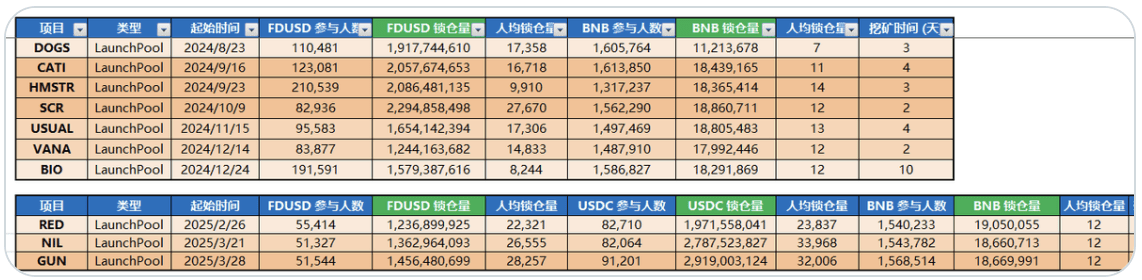
(Figure 1)
Figure 1 shows the relevant data I compiled from all LaunchPools from August 2024 to now. In 2024, only FDUSD and BNB could participate in LaunchPool, and in 2025, USDC was newly added, so we can divide the data into two parts for separate comparison.
From the 64th issue of RED to the 66th issue of GUN, the number of participants has been basically stable, but the locked amounts of FDUSD and USDC have increased each time. Since exchanging stablecoins on Binance is fee-free, theoretically, all idle stablecoins will have the willingness to 'take advantage', including USDT. The more stablecoins participate, the more idle purchasing power there is within the Binance exchange.
At the same time, we also noticed that in the three events of 2025, the scale of FDUSD+USDC was roughly around 3 billion to 4 billion USD, while the amount of FDUSD in the activities from August to December 2024 was roughly around 1.5 billion to 2 billion USD. This means that the funding scale in Q1 2025 is much larger than in 2024. Friends might think this is due to the addition of USDC in 2025, but I may have a different understanding.
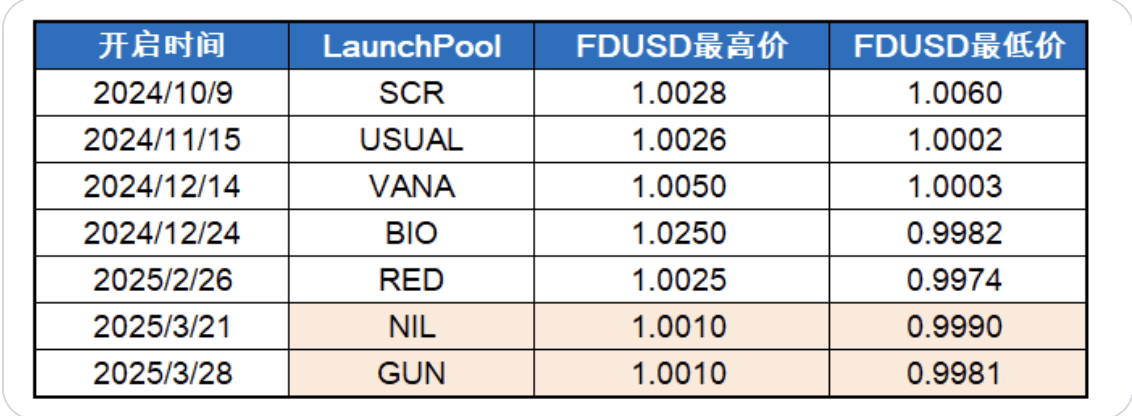
(Figure 2)
We can observe a detail: as shown in Figure 2, during each LaunchPool event in 2024, the premium of FDUSD was very high. This indicates a significant demand for FDUSD at that time, as all holders of USDT and USDC would exchange their holdings for FDUSD to participate in mining, thus temporarily driving up the exchange rate of FDUSD.
By the time the activities started in 2025, the premium of FDUSD began to decline, indicating that the demand for FDUSD was no longer as high as before. The fundamental reason is that USDC diverted the original demand for FDUSD. Investors holding USDC do not need to exchange it for FDUSD, and some investors holding USDT have also exchanged part of it for USDC (because after mining ends, USDC is more stable than FDUSD).
In other words, as long as there are idle funds, most will participate in LaunchPool. The FDUSD+USDC participating in 2025 and the FDUSD participating in 2024 should be considered the vast majority of idle funds accumulated within the exchange. It is not entirely because Binance opened a new participation channel for USDC in 2025 that led to a significant increase in the funding data.
In addition, the 'per capita locked amount' in Q1 2025 is also higher than that in November-December 2024, indicating the entry into a phase dominated by large holders. This means that the user group with idle purchasing power is becoming more 'large holder' oriented.
This seems to indicate a reality: during November-December 2024, more large holders primarily held 'coins', while in February-March 2025, large holders primarily held 'U'. By this point, the market has completed a round of wealth transfer, and large holders have also completed a siege against retail investors. They hold a large amount of idle funds and are patiently waiting for the next opportunity.
Based on the above observations, we can draw several conclusions:
1. The idle funds in the market have not only not decreased compared to 2024, but have actually increased; however, the overall sentiment is cautious, and effective purchasing power has not formed.
2. The increased number of participants in LaunchPool indicates that more people have cashed out, but the funds still remain in the market and are not willing to exit, meaning that although the sentiment is cautious, it is not yet completely desperate.
3. The increase in per capita locked amount indicates that idle purchasing power is controlled by more large holders; after a round of wealth redistribution, purchasing power has returned to the hands of large holders. They generally believe that the bull market has not ended, so they are still waiting for opportunities in the market.
Original link