
Binance News
374.7k Posts

Binance News
 Binance Officially Verified Account
Report
Follow Binance News to stay on top of industry trends & news
9 Following
2.3M+ Followers
2.8M+ Liked
Top
Replies
Videos
·
--
Market News Today: August Nonfarm Payrolls Due at 8:30 ET With Wage Growth the Number That MattersThe Bureau of Labor Statistics releases the August Employment Situation report Friday at 12:30 GMT, with economists expecting a modest rebound after July's contraction.Payrolls are forecast at 55,000 to 58,000 following July's 23,000 drop. The unemployment rate is expected to hold steady at 4.1%. Average hourly earnings are projected to rise 0.3% month-over-month, up from 0.1% previously.Average Hourly Earnings Is the Line to Read FirstThe headline payroll figure will move the tape. The wage line is what moves the Fed.A jump from 0.1% to 0.3% month-over-month is a tripling of the monthly pace. That matters disproportionately this cycle because Chair Kevin Warsh built his entire hawkish case at Jackson Hole on prices rather than employment, citing PCE at 3.7% annually and 4.1% over six months, with more than half the PCE basket rising over 3% in the past year.Governors Michael Barr and Christopher Waller have both signalled the labor market is not their constraint — Barr called it "stable," Waller "satisfactory shape."A committee that has already set employment aside will not reweight it on a 55,000 print. It will reweight on wage acceleration, because that is the transmission channel from labor to the inflation problem it says it is solving.The Payroll Number Is Mostly Noise This CycleTwo structural factors reduce the signal in the headline.The first is labor supply. July's unemployment rate fell to 4.1% while the labor force shrank 264,000 and participation dropped to 61.4% — the lowest outside the Covid period since the mid-1970s. With participation that low, the breakeven pace of job growth needed to hold unemployment steady sits far below historical norms. A small number no longer means a weak economy.The second is revisions. May was cut 66,000 and June 37,000 — 103,000 fewer jobs across two months. Initial August figures have been revised lower four years running. Whatever prints at 8:30 will not be the final number.That is why the unemployment rate holding at 4.1% and the wage line carry more weight than the payroll count itself.The Reaction Function Is InvertedRates have sat at 3.50%-3.75% since December 2025. The September question is whether tightening resumes, not how quickly easing proceeds.That reverses the usual trade. A strong print is the hawkish outcome. A soft one takes hike risk off the table.Hike odds have round-tripped over eight sessions — roughly 35% before Warsh spoke, up to about 70% Thursday, then back toward an even split. The FOMC decides September 15-16, with CPI landing September 11 in between.Dollar, Yields and Gold Are Positioned Ahead of the PrintThe dollar, Treasury yields and gold are all seeing heightened pre-report positioning.The setup into the release is unusual. The VIX dropped to nearly 14, its lowest since January, while bond yields sit near multi-year highs on fiscal rather than growth concerns. Mohamed El-Erian told CNBC at the Ambrosetti Forum he sees no appetite for immediate US fiscal consolidation and expects continued upward pressure on yields.For crypto, that fiscal-versus-growth distinction determines which way the yield move cuts. Bitcoin cleared $80,000 Thursday with yields elevated, and spot ETFs took in $731 million — their largest single day since January, with net assets crossing $103 billion.Whether that bid extends through a second session is the more informative signal than the payroll print itself.
Market News Today: August Nonfarm Payrolls Due at 8:30 ET With Wage Growth the Number That Matters
The Bureau of Labor Statistics releases the August Employment Situation report Friday at 12:30 GMT, with economists expecting a modest rebound after July's contraction.Payrolls are forecast at 55,000 to 58,000 following July's 23,000 drop. The unemployment rate is expected to hold steady at 4.1%. Average hourly earnings are projected to rise 0.3% month-over-month, up from 0.1% previously.Average Hourly Earnings Is the Line to Read FirstThe headline payroll figure will move the tape. The wage line is what moves the Fed.A jump from 0.1% to 0.3% month-over-month is a tripling of the monthly pace. That matters disproportionately this cycle because Chair Kevin Warsh built his entire hawkish case at Jackson Hole on prices rather than employment, citing PCE at 3.7% annually and 4.1% over six months, with more than half the PCE basket rising over 3% in the past year.Governors Michael Barr and Christopher Waller have both signalled the labor market is not their constraint — Barr called it "stable," Waller "satisfactory shape."A committee that has already set employment aside will not reweight it on a 55,000 print. It will reweight on wage acceleration, because that is the transmission channel from labor to the inflation problem it says it is solving.The Payroll Number Is Mostly Noise This CycleTwo structural factors reduce the signal in the headline.The first is labor supply. July's unemployment rate fell to 4.1% while the labor force shrank 264,000 and participation dropped to 61.4% — the lowest outside the Covid period since the mid-1970s. With participation that low, the breakeven pace of job growth needed to hold unemployment steady sits far below historical norms. A small number no longer means a weak economy.The second is revisions. May was cut 66,000 and June 37,000 — 103,000 fewer jobs across two months. Initial August figures have been revised lower four years running. Whatever prints at 8:30 will not be the final number.That is why the unemployment rate holding at 4.1% and the wage line carry more weight than the payroll count itself.The Reaction Function Is InvertedRates have sat at 3.50%-3.75% since December 2025. The September question is whether tightening resumes, not how quickly easing proceeds.That reverses the usual trade. A strong print is the hawkish outcome. A soft one takes hike risk off the table.Hike odds have round-tripped over eight sessions — roughly 35% before Warsh spoke, up to about 70% Thursday, then back toward an even split. The FOMC decides September 15-16, with CPI landing September 11 in between.Dollar, Yields and Gold Are Positioned Ahead of the PrintThe dollar, Treasury yields and gold are all seeing heightened pre-report positioning.The setup into the release is unusual. The VIX dropped to nearly 14, its lowest since January, while bond yields sit near multi-year highs on fiscal rather than growth concerns. Mohamed El-Erian told CNBC at the Ambrosetti Forum he sees no appetite for immediate US fiscal consolidation and expects continued upward pressure on yields.For crypto, that fiscal-versus-growth distinction determines which way the yield move cuts. Bitcoin cleared $80,000 Thursday with yields elevated, and spot ETFs took in $731 million — their largest single day since January, with net assets crossing $103 billion.Whether that bid extends through a second session is the more informative signal than the payroll print itself.
Voting
NFP Friday — wages matter most. How are you positioned?
De-risking — hot wages = hike kills rally
Buying now — BTC held $80K strong
Sitting in stables until print clears
Just HODLing — zoom out
285 votes • Voting
1
2
22
28.4k
·
--
Article
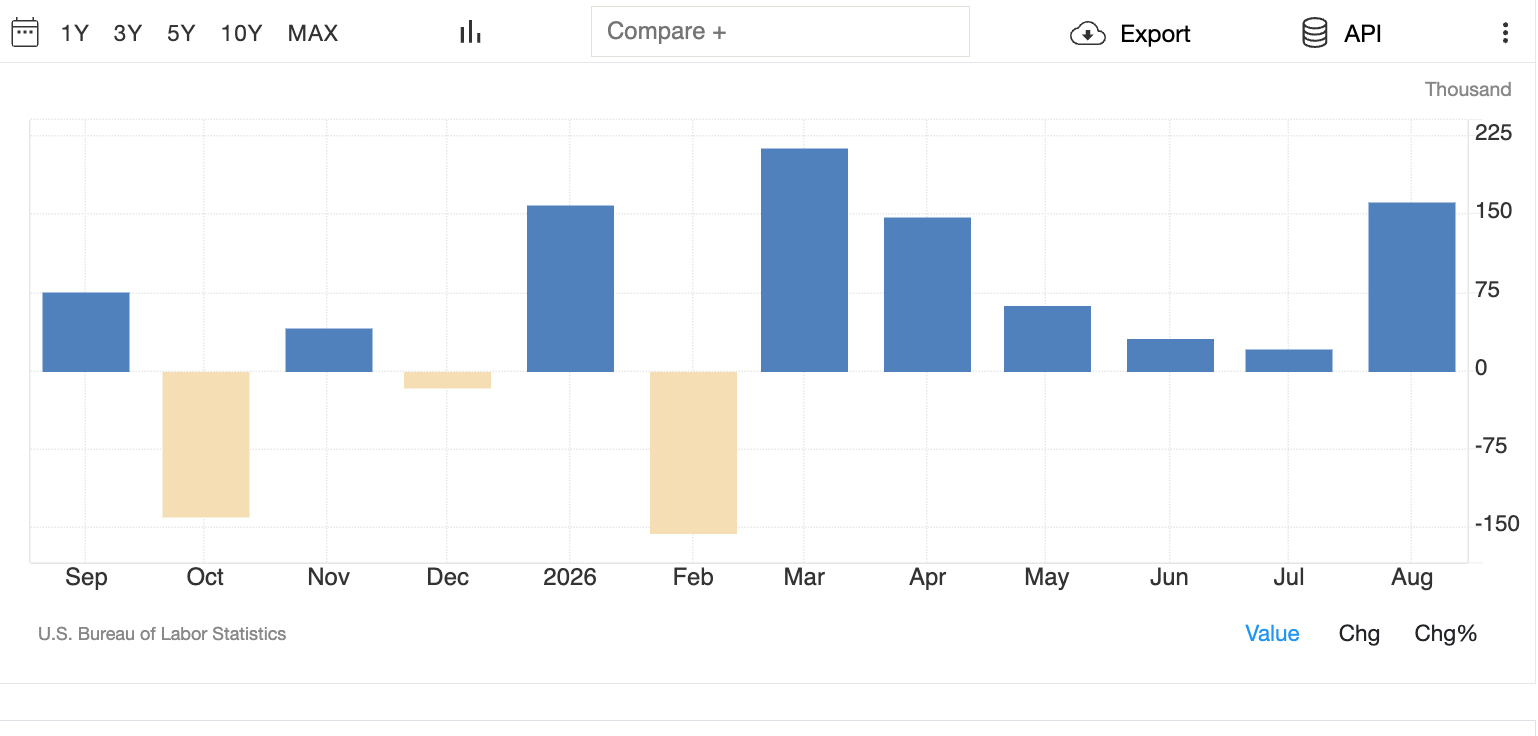
Market News Today: US Adds 162,000 Jobs in August, Nearly Triple Expectations, as July Revised to a GainThe US economy added 162,000 jobs in August, following an upwardly revised 23,000 rise in July and far exceeding market expectations of 56,000.June and July were revised up by a combined 55,000.Food services and drinking places added 59,000 and local government education 42,000, largely offsetting the prior month's declines in those categories. Manufacturing continued its upward trend at 16,000, with machinery manufacturing up 6,000 and fabricated metal products up 6,000. Health care rose 13,000, led by home health care services at 11,000 and hospitals at 8,000.Information employment fell 23,000 — driven by computing infrastructure providers, data processing and web hosting at −8,000, publishing industries at −7,000, and broadcasting and content providers at −5,000.July Was Never Negative, Which Voids the Precedent ArgumentThe revision is the more consequential number than the headline.July printed −23,000 at the time, missing a Dow Jones consensus of +83,000 by 106,000. It has now been revised to +23,000 — a 46,000 swing that turns the month from contraction to expansion.Bloomberg Chief Economist Anna Wong had argued that a second consecutive negative payroll print would block a September hike, noting no precedent in modern Fed history for the central bank raising rates after two negative readings. There is now no first negative print, let alone a second. That constraint has evaporated.The revision direction also flipped. May and June were previously cut by a combined 103,000, which fed the narrative of a steadily deteriorating labor market. June and July have now been revised up by 55,000, which does the opposite.The Categories That Rebounded Are the Ones That Caused July's MissFood services and local government education adding a combined 101,000 is the specific detail that vindicates one side of a live dispute.The camp arguing July overstated the cooling had pointed to outsized declines in leisure and hospitality and in state and local government education as accounting for most of the downside surprise — implying a rebound rather than a trend. That is precisely what happened, and the BLS notes these gains "largely offset" the prior month's decrease.The opposing forecast came from Fifth Third's Bill Adams, who had projected a 25,000 drop citing labor force contraction of 1.3 million over twelve months and a larger effect from the TPS cancellation. That call missed by 187,000.Warsh's Labor Framing Is Now Fully ValidatedChair Kevin Warsh used Jackson Hole to describe labor markets as "consistent with full employment" and to explain soft monthly gains as a labor supply effect: "When labor supply is barely growing, monthly job gains are naturally going to run low."That framing was designed to hold for weak-but-positive prints. It no longer needs to. At 162,000, the gains are not low by any measure.Governors Michael Barr and Christopher Waller had already characterised the labor situation as "stable" and in "satisfactory shape" respectively. Three FOMC members voted for a hike at the previous meeting.The hawkish case rested entirely on inflation, with employment set aside as a non-constraint. This print removes even the residual doubt about that assumption.The Reaction Function Is Inverted, So This Is the Bearish OutcomeRates have sat at 3.50%-3.75% since December 2025, and the September question is whether tightening resumes rather than how fast easing proceeds.That reverses the usual trade. A strong print is the hawkish outcome.Hike odds had round-tripped over eight sessions — roughly 35% before Warsh spoke, up to about 70% Thursday, then back toward an even split heading into the release. A 106,000 beat against consensus, combined with upward revisions, argues for a sharp move back toward and likely through the earlier highs.The FOMC decides September 15-16, with CPI landing September 11. Warsh built his case on PCE at 3.7% annually and 4.1% over six months. Labor is no longer available as a counterargument.Information Employment Falling 23,000 Is the Detail Worth TrackingWhile every other major category added, information shed 23,000 — with computing infrastructure providers, data processing and web hosting alone down 8,000.That is an AI-adjacent sector contracting in a month when manufacturing, health care and hospitality all expanded. It is a single month and should not be over-read, but it is the first clear instance of the automation displacement thesis appearing in a category-level breakdown rather than in forecasts.Warsh flagged this question directly at Jackson Hole, asking whether token usage will be complementary or competitive to labor, and noting a Fed task force on productivity and jobs is examining it. Its recommendations, he stressed, have no bearing on current policy decisions.What the Report Did Not IncludeThe BLS release detail provided here covers payrolls and industry breakdowns but not the unemployment rate or average hourly earnings.Both matter for the rate path. Unemployment was expected to hold at 4.1%, and average hourly earnings were forecast to rise 0.3% month-over-month against 0.1% previously — a tripling of the monthly pace that would represent the clearest wage-to-inflation transmission signal available to a Fed focused solely on prices.A 162,000 payroll print combined with accelerating wages would be the maximally hawkish combination. Traders should confirm both figures before positioning on the headline alone.
Market News Today: US Adds 162,000 Jobs in August, Nearly Triple Expectations, as July Revised to a Gain
The US economy added 162,000 jobs in August, following an upwardly revised 23,000 rise in July and far exceeding market expectations of 56,000.June and July were revised up by a combined 55,000.Food services and drinking places added 59,000 and local government education 42,000, largely offsetting the prior month's declines in those categories. Manufacturing continued its upward trend at 16,000, with machinery manufacturing up 6,000 and fabricated metal products up 6,000. Health care rose 13,000, led by home health care services at 11,000 and hospitals at 8,000.Information employment fell 23,000 — driven by computing infrastructure providers, data processing and web hosting at −8,000, publishing industries at −7,000, and broadcasting and content providers at −5,000.July Was Never Negative, Which Voids the Precedent ArgumentThe revision is the more consequential number than the headline.July printed −23,000 at the time, missing a Dow Jones consensus of +83,000 by 106,000. It has now been revised to +23,000 — a 46,000 swing that turns the month from contraction to expansion.Bloomberg Chief Economist Anna Wong had argued that a second consecutive negative payroll print would block a September hike, noting no precedent in modern Fed history for the central bank raising rates after two negative readings. There is now no first negative print, let alone a second. That constraint has evaporated.The revision direction also flipped. May and June were previously cut by a combined 103,000, which fed the narrative of a steadily deteriorating labor market. June and July have now been revised up by 55,000, which does the opposite.The Categories That Rebounded Are the Ones That Caused July's MissFood services and local government education adding a combined 101,000 is the specific detail that vindicates one side of a live dispute.The camp arguing July overstated the cooling had pointed to outsized declines in leisure and hospitality and in state and local government education as accounting for most of the downside surprise — implying a rebound rather than a trend. That is precisely what happened, and the BLS notes these gains "largely offset" the prior month's decrease.The opposing forecast came from Fifth Third's Bill Adams, who had projected a 25,000 drop citing labor force contraction of 1.3 million over twelve months and a larger effect from the TPS cancellation. That call missed by 187,000.Warsh's Labor Framing Is Now Fully ValidatedChair Kevin Warsh used Jackson Hole to describe labor markets as "consistent with full employment" and to explain soft monthly gains as a labor supply effect: "When labor supply is barely growing, monthly job gains are naturally going to run low."That framing was designed to hold for weak-but-positive prints. It no longer needs to. At 162,000, the gains are not low by any measure.Governors Michael Barr and Christopher Waller had already characterised the labor situation as "stable" and in "satisfactory shape" respectively. Three FOMC members voted for a hike at the previous meeting.The hawkish case rested entirely on inflation, with employment set aside as a non-constraint. This print removes even the residual doubt about that assumption.The Reaction Function Is Inverted, So This Is the Bearish OutcomeRates have sat at 3.50%-3.75% since December 2025, and the September question is whether tightening resumes rather than how fast easing proceeds.That reverses the usual trade. A strong print is the hawkish outcome.Hike odds had round-tripped over eight sessions — roughly 35% before Warsh spoke, up to about 70% Thursday, then back toward an even split heading into the release. A 106,000 beat against consensus, combined with upward revisions, argues for a sharp move back toward and likely through the earlier highs.The FOMC decides September 15-16, with CPI landing September 11. Warsh built his case on PCE at 3.7% annually and 4.1% over six months. Labor is no longer available as a counterargument.Information Employment Falling 23,000 Is the Detail Worth TrackingWhile every other major category added, information shed 23,000 — with computing infrastructure providers, data processing and web hosting alone down 8,000.That is an AI-adjacent sector contracting in a month when manufacturing, health care and hospitality all expanded. It is a single month and should not be over-read, but it is the first clear instance of the automation displacement thesis appearing in a category-level breakdown rather than in forecasts.Warsh flagged this question directly at Jackson Hole, asking whether token usage will be complementary or competitive to labor, and noting a Fed task force on productivity and jobs is examining it. Its recommendations, he stressed, have no bearing on current policy decisions.What the Report Did Not IncludeThe BLS release detail provided here covers payrolls and industry breakdowns but not the unemployment rate or average hourly earnings.Both matter for the rate path. Unemployment was expected to hold at 4.1%, and average hourly earnings were forecast to rise 0.3% month-over-month against 0.1% previously — a tripling of the monthly pace that would represent the clearest wage-to-inflation transmission signal available to a Fed focused solely on prices.A 162,000 payroll print combined with accelerating wages would be the maximally hawkish combination. Traders should confirm both figures before positioning on the headline alone.
1
2
11
27.9k
·
--
U.S. President Donald Trump: We Should Enjoy the World’s Lowest Interest RatesAccording to Wallstreetcn, U.S. President Donald Trump reiterated that the U.S. should enjoy the world’s lowest interest rates, said the market should have risen, and said economic growth would not trigger inflation.
U.S. President Donald Trump: We Should Enjoy the World’s Lowest Interest Rates
According to Wallstreetcn, U.S. President Donald Trump reiterated that the U.S. should enjoy the world’s lowest interest rates, said the market should have risen, and said economic growth would not trigger inflation.
2
2
1.2k
·
--
U.S. President Donald Trump Calls for Fed Rate Cuts After August Jobs ReportU.S. President Donald Trump posted on social media that the U.S. added 162,000 jobs in August, above market expectations, and urged the Federal Reserve to cut interest rates. He said the U.S. credit situation is stronger and should have the lowest interest rates in the world, and warned that trade deficit countries that do not cooperate could face halted trade.
According to PANews, Labor Department data showed the unemployment rate held at 4.1% in August, while job gains were significantly above expectations.
U.S. President Donald Trump Calls for Fed Rate Cuts After August Jobs Report
U.S. President Donald Trump posted on social media that the U.S. added 162,000 jobs in August, above market expectations, and urged the Federal Reserve to cut interest rates. He said the U.S. credit situation is stronger and should have the lowest interest rates in the world, and warned that trade deficit countries that do not cooperate could face halted trade.
According to PANews, Labor Department data showed the unemployment rate held at 4.1% in August, while job gains were significantly above expectations.
According to PANews, Labor Department data showed the unemployment rate held at 4.1% in August, while job gains were significantly above expectations.
5
13
35.6k
·
--
Article
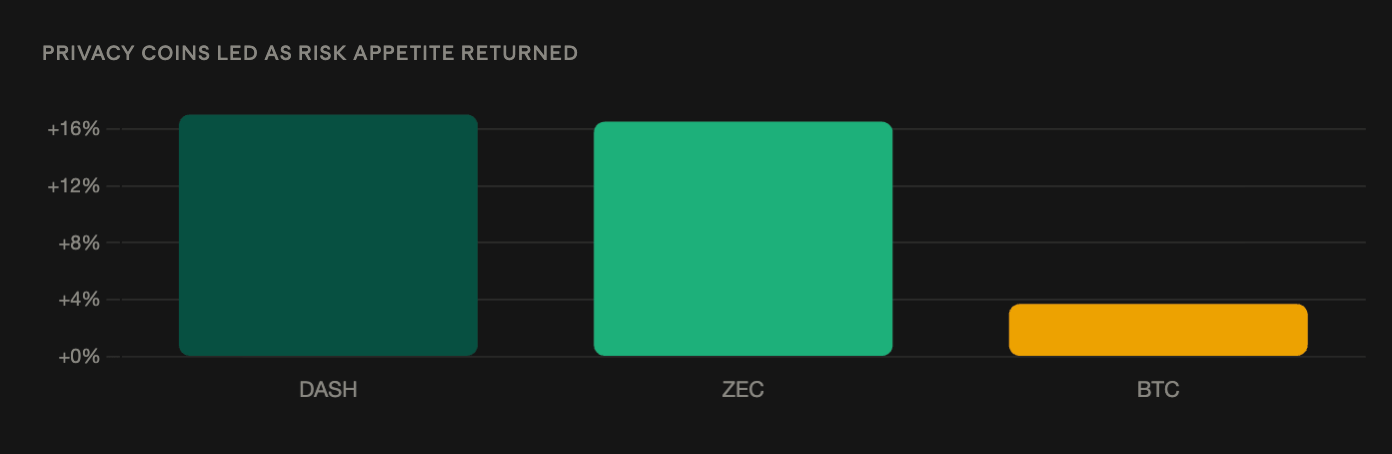
Bitcoin News: Bitcoin ETFs Pull $731 Million in Biggest Day Since January as BTC Tops $80,000US spot Bitcoin ETFs took in about $731 million on Thursday — the strongest daily haul since January, according to SoSoValue. That single session is more than three times the size of any day during the 11-day streak in late August.BlackRock's IBIT drew roughly $454 million of it, with Ark and 21Shares' ARKB taking $138 million and Fidelity's FBTC $74 million. Grayscale's two products added a combined $57 million. VanEck's HODL and WisdomTree's BTCW were the only funds to shed money, at $20 million and $5 million.Every fund gained between 5.7% and 5.9% on the day. Total net assets closed at $103.34 billion — now equal to just over 6% of Bitcoin's market capitalization — with cumulative net inflows since the January 2024 launches reaching $55.44 billion.IBIT Drove Both the Week's Largest Outflow and Its Largest InflowThursday reverses Tuesday's $236 million outflow, when IBIT alone accounted for $201 million of the redemptions.The same fund has now driven both extremes within four sessions. That is the detail worth holding onto when reading the headline number. A complex where one product supplies 62% of a record inflow and 85% of the preceding outflow is not showing broad allocator conviction — it is showing one very large desk repositioning.Friday's print is where this gets tested. A second consecutive session above $500 million would mark the first sustained institutional bid since the summer.Rising Yields May Be a Tailwind Rather Than a HeadwindMohamed El-Erian told CNBC at the Ambrosetti Forum that the government bond selloff has further to run. "I don't see any appetite in the U.S. for immediate fiscal consolidation. So I suspect we will continue to see upward pressures on yields," he said.The standard reading is that higher yields pressure non-yielding assets like Bitcoin and gold by raising the opportunity cost of holding them. That logic holds when yields rise on growth.It inverts when yields rise on fiscal concern. Investors demanding more compensation to hold government paper because they doubt the fiscal path are, by the same reasoning, more inclined toward assets outside that system. The mechanism that normally works against Bitcoin can work for it.Thursday's price action supports that reading — Bitcoin cleared $80,000 while yields stayed elevated. The gold divergence earlier in the week, when both fell together, argued the other way. This week has produced evidence for both, and the distinction between growth-driven and fiscal-driven yields is what separates them.Privacy Coins Lead the Move as Animal Spirits ReturnBitcoin's firm move above $80,000 revived risk appetite across the market, with privacy tokens posting the largest gains.Dash rose 17% over 24 hours to $50, the best performer among the top 100 by market value. Zcash was second at 16.5%. LIT, ENA and UNI also led. Bitcoin itself rose 3.7%.Privacy coins leading is a specific type of signal. They tend to outperform when speculative appetite returns rather than when institutional flows dominate — the cohort is retail-heavy and moves on sentiment more than on allocation decisions. Their leadership alongside a record ETF day describes both channels firing at once, which is unusual.VIX at 14 Shows No Fear Despite the Fiscal BackdropWall Street's fear gauge dropped to nearly 14, its lowest since January, per TradingView.The VIX measures options-based 30-day implied volatility in the S&P 500. A higher reading means more traders are paying up for protection.At 14, there is little fear priced in — even as rising bond yields signal a worsening fiscal situation in the US and elsewhere. That is a notable disconnect. El-Erian's warning about sustained upward pressure on yields describes a structural risk that equity options markets are currently pricing as remote.Compressed volatility ahead of a binary event has a history of resolving sharply. Bitcoin's own August breakout came out of exactly that setup, when BVIV sat at 2026 lows and a six-week range broke violently once a catalyst arrived.AMC Jumps 12% After CEO Attacks Robinhood's Tokenized StockAMC Entertainment shares climbed 12% in Friday pre-market trading after CEO Adam Aron condemned Robinhood for offering tokenized products tracking the company's stock without its approval.The tokens provide synthetic exposure to AMC's share price but no shareholder rights, prompting the cinema operator to instruct outside securities counsel to investigate.The dispute goes to an unresolved question in tokenized equities. A synthetic token tracking a share price without conveying shareholder rights is a derivative referencing the issuer, not a claim on it — which raises whether the issuer has any standing to object at all. Robinhood Chain has been generating over $2 million in daily transaction revenue, with 10% of net protocol revenue flowing back to the Arbitrum ecosystem, so the volumes involved are no longer trivial.The August Jobs Report Lands at 8:30 ETThe BLS publishes August nonfarm payrolls Friday morning.Consensus estimates cited by CoinDesk put job gains at 65,000 following July's unexpected 23,000 loss, with the unemployment rate seen rising to 4.2% from 4.1%. Other surveys have been lower — the Dow Jones consensus stood at 53,000 with unemployment holding at 4.1%, and Reuters at roughly 58,000.The reaction function is inverted this cycle. Rates have sat at 3.50%-3.75% since December 2025, and the September debate is whether tightening resumes rather than how fast easing proceeds. A strong print is the hawkish outcome; a soft one takes hike risk off the table.September hike odds have round-tripped over eight sessions — from roughly 35% before Warsh's Jackson Hole speech to about 70% Thursday, then back toward an even split. The FOMC decides September 15-16.
Bitcoin News: Bitcoin ETFs Pull $731 Million in Biggest Day Since January as BTC Tops $80,000
US spot Bitcoin ETFs took in about $731 million on Thursday — the strongest daily haul since January, according to SoSoValue. That single session is more than three times the size of any day during the 11-day streak in late August.BlackRock's IBIT drew roughly $454 million of it, with Ark and 21Shares' ARKB taking $138 million and Fidelity's FBTC $74 million. Grayscale's two products added a combined $57 million. VanEck's HODL and WisdomTree's BTCW were the only funds to shed money, at $20 million and $5 million.Every fund gained between 5.7% and 5.9% on the day. Total net assets closed at $103.34 billion — now equal to just over 6% of Bitcoin's market capitalization — with cumulative net inflows since the January 2024 launches reaching $55.44 billion.IBIT Drove Both the Week's Largest Outflow and Its Largest InflowThursday reverses Tuesday's $236 million outflow, when IBIT alone accounted for $201 million of the redemptions.The same fund has now driven both extremes within four sessions. That is the detail worth holding onto when reading the headline number. A complex where one product supplies 62% of a record inflow and 85% of the preceding outflow is not showing broad allocator conviction — it is showing one very large desk repositioning.Friday's print is where this gets tested. A second consecutive session above $500 million would mark the first sustained institutional bid since the summer.Rising Yields May Be a Tailwind Rather Than a HeadwindMohamed El-Erian told CNBC at the Ambrosetti Forum that the government bond selloff has further to run. "I don't see any appetite in the U.S. for immediate fiscal consolidation. So I suspect we will continue to see upward pressures on yields," he said.The standard reading is that higher yields pressure non-yielding assets like Bitcoin and gold by raising the opportunity cost of holding them. That logic holds when yields rise on growth.It inverts when yields rise on fiscal concern. Investors demanding more compensation to hold government paper because they doubt the fiscal path are, by the same reasoning, more inclined toward assets outside that system. The mechanism that normally works against Bitcoin can work for it.Thursday's price action supports that reading — Bitcoin cleared $80,000 while yields stayed elevated. The gold divergence earlier in the week, when both fell together, argued the other way. This week has produced evidence for both, and the distinction between growth-driven and fiscal-driven yields is what separates them.Privacy Coins Lead the Move as Animal Spirits ReturnBitcoin's firm move above $80,000 revived risk appetite across the market, with privacy tokens posting the largest gains.Dash rose 17% over 24 hours to $50, the best performer among the top 100 by market value. Zcash was second at 16.5%. LIT, ENA and UNI also led. Bitcoin itself rose 3.7%.Privacy coins leading is a specific type of signal. They tend to outperform when speculative appetite returns rather than when institutional flows dominate — the cohort is retail-heavy and moves on sentiment more than on allocation decisions. Their leadership alongside a record ETF day describes both channels firing at once, which is unusual.VIX at 14 Shows No Fear Despite the Fiscal BackdropWall Street's fear gauge dropped to nearly 14, its lowest since January, per TradingView.The VIX measures options-based 30-day implied volatility in the S&P 500. A higher reading means more traders are paying up for protection.At 14, there is little fear priced in — even as rising bond yields signal a worsening fiscal situation in the US and elsewhere. That is a notable disconnect. El-Erian's warning about sustained upward pressure on yields describes a structural risk that equity options markets are currently pricing as remote.Compressed volatility ahead of a binary event has a history of resolving sharply. Bitcoin's own August breakout came out of exactly that setup, when BVIV sat at 2026 lows and a six-week range broke violently once a catalyst arrived.AMC Jumps 12% After CEO Attacks Robinhood's Tokenized StockAMC Entertainment shares climbed 12% in Friday pre-market trading after CEO Adam Aron condemned Robinhood for offering tokenized products tracking the company's stock without its approval.The tokens provide synthetic exposure to AMC's share price but no shareholder rights, prompting the cinema operator to instruct outside securities counsel to investigate.The dispute goes to an unresolved question in tokenized equities. A synthetic token tracking a share price without conveying shareholder rights is a derivative referencing the issuer, not a claim on it — which raises whether the issuer has any standing to object at all. Robinhood Chain has been generating over $2 million in daily transaction revenue, with 10% of net protocol revenue flowing back to the Arbitrum ecosystem, so the volumes involved are no longer trivial.The August Jobs Report Lands at 8:30 ETThe BLS publishes August nonfarm payrolls Friday morning.Consensus estimates cited by CoinDesk put job gains at 65,000 following July's unexpected 23,000 loss, with the unemployment rate seen rising to 4.2% from 4.1%. Other surveys have been lower — the Dow Jones consensus stood at 53,000 with unemployment holding at 4.1%, and Reuters at roughly 58,000.The reaction function is inverted this cycle. Rates have sat at 3.50%-3.75% since December 2025, and the September debate is whether tightening resumes rather than how fast easing proceeds. A strong print is the hawkish outcome; a soft one takes hike risk off the table.September hike odds have round-tripped over eight sessions — from roughly 35% before Warsh's Jackson Hole speech to about 70% Thursday, then back toward an even split. The FOMC decides September 15-16.
7
2
20
22.6k
·
--
Trump Says August U.S. Jobs Data Beat ExpectationsAccording to Jin10, U.S. President Donald Trump said the latest jobs data was excellent and beat all expectations except his own, after U.S. employers added 162,000 jobs in August.
Trump Says August U.S. Jobs Data Beat Expectations
According to Jin10, U.S. President Donald Trump said the latest jobs data was excellent and beat all expectations except his own, after U.S. employers added 162,000 jobs in August.
2
7
36.7k
·
--
STOCKS | U.S. Stocks Open Mixed After August Nonfarm Payrolls Beat ExpectationsAccording to Jin10, U.S. stocks opened mixed after August nonfarm payrolls came in far above expectations, with the Dow Jones Industrial Average down 0.38%, the S&P 500 down 0.13%, and the Nasdaq up 0.02%. Tesla (TSLA.O) fell 3.5%, Oracle (ORCL.N) rose 3.7%, ASML (ASML.O) gained nearly 2%, and Nvidia (NVDA.O) and AMD (AMD.O) each rose more than 1%.
STOCKS | U.S. Stocks Open Mixed After August Nonfarm Payrolls Beat Expectations
According to Jin10, U.S. stocks opened mixed after August nonfarm payrolls came in far above expectations, with the Dow Jones Industrial Average down 0.38%, the S&P 500 down 0.13%, and the Nasdaq up 0.02%. Tesla (TSLA.O) fell 3.5%, Oracle (ORCL.N) rose 3.7%, ASML (ASML.O) gained nearly 2%, and Nvidia (NVDA.O) and AMD (AMD.O) each rose more than 1%.
3
5.7k
·
--
U.S. President Donald Trump: Strong Countries Mean Lower Interest RatesAccording to Jin10, U.S. President Donald Trump said, in remarks on nonfarm payroll data, that strong countries mean lower interest rates.
U.S. President Donald Trump: Strong Countries Mean Lower Interest Rates
According to Jin10, U.S. President Donald Trump said, in remarks on nonfarm payroll data, that strong countries mean lower interest rates.
1
2.6k
·
--
PREMARKET MOVES | Lululemon Tumbles 20% on Weak Guidance; Adobe Names New CEO; Rare Earth Stocks RiseAccording to CNBC, several stocks posted large premarket moves Friday. Lululemon Athletica sank 20% after issuing a downbeat forecast for the current quarter, guiding to earnings of 93 cents to 98 cents per share on revenue of $2.29 billion to $2.32 billion, below analyst expectations of $2.40 per share and $2.53 billion. Adobe fell nearly 3% after naming Anil Chakravarthy as its next CEO, succeeding Shantanu Narayen, who said last March he would step down. Rare earth stocks advanced after a Reuters report that some Chinese firms halted U.S. shipments over geopolitical concerns; USA Rare Earth and Critical Metals each gained roughly 4%, while MP Materials and Energy Fuels rose about 3%. AMC Entertainment climbed 5.5% after its CEO condemned Robinhood over its stock tokens for AMC and others, calling the practice contemptible, outrageous and vile; Robinhood shares slipped nearly 2%. Smith & Wesson jumped 11.7% after beating on the top and bottom lines, posting quarterly earnings of 6 cents per share versus an expected 6-cent loss, on revenue of $112.6 million against a $98.7 million estimate. Samsara surged 15% on upbeat projections, guiding to full-year revenue of $2.04 billion to $2.05 billion, above the $2.01 billion consensus. Planet Labs rose 13% after strong second-quarter results, posting adjusted earnings of 2 cents per share on revenue of $116.1 million. Guidewire Software tumbled 14.5% on soft revenue guidance of $372 million to $378 million, below the $387 million consensus. Asana fell 9.5% after weak current-quarter guidance. UiPath lost 7.4%. Zscaler slipped nearly 2% despite a fourth-quarter beat, posting adjusted earnings of $1.19 per share on revenue of $898 million.
PREMARKET MOVES | Lululemon Tumbles 20% on Weak Guidance; Adobe Names New CEO; Rare Earth Stocks Rise
According to CNBC, several stocks posted large premarket moves Friday. Lululemon Athletica sank 20% after issuing a downbeat forecast for the current quarter, guiding to earnings of 93 cents to 98 cents per share on revenue of $2.29 billion to $2.32 billion, below analyst expectations of $2.40 per share and $2.53 billion. Adobe fell nearly 3% after naming Anil Chakravarthy as its next CEO, succeeding Shantanu Narayen, who said last March he would step down. Rare earth stocks advanced after a Reuters report that some Chinese firms halted U.S. shipments over geopolitical concerns; USA Rare Earth and Critical Metals each gained roughly 4%, while MP Materials and Energy Fuels rose about 3%. AMC Entertainment climbed 5.5% after its CEO condemned Robinhood over its stock tokens for AMC and others, calling the practice contemptible, outrageous and vile; Robinhood shares slipped nearly 2%. Smith & Wesson jumped 11.7% after beating on the top and bottom lines, posting quarterly earnings of 6 cents per share versus an expected 6-cent loss, on revenue of $112.6 million against a $98.7 million estimate. Samsara surged 15% on upbeat projections, guiding to full-year revenue of $2.04 billion to $2.05 billion, above the $2.01 billion consensus. Planet Labs rose 13% after strong second-quarter results, posting adjusted earnings of 2 cents per share on revenue of $116.1 million. Guidewire Software tumbled 14.5% on soft revenue guidance of $372 million to $378 million, below the $387 million consensus. Asana fell 9.5% after weak current-quarter guidance. UiPath lost 7.4%. Zscaler slipped nearly 2% despite a fourth-quarter beat, posting adjusted earnings of $1.19 per share on revenue of $898 million.
1
6.9k
·
--
U.S. Average Hourly Earnings Rise 3.1% in AugustAccording to Jin10, U.S. average hourly earnings rose 3.1% year over year in August, above the expected 3% and the previous 3.20%.
U.S. Average Hourly Earnings Rise 3.1% in August
According to Jin10, U.S. average hourly earnings rose 3.1% year over year in August, above the expected 3% and the previous 3.20%.
3.2k
·
--
Strategy's MSTR Shares Rise Above $142 for First Time in Four MonthsBitcoinTreasuries.NET said on X that Strategy's MSTR shares rose above $142 for the first time in four months. According to Odaily, Strategy's Bitcoin holdings are currently showing an unrealized profit of $4.6 billion.
Strategy's MSTR Shares Rise Above $142 for First Time in Four Months
BitcoinTreasuries.NET said on X that Strategy's MSTR shares rose above $142 for the first time in four months. According to Odaily, Strategy's Bitcoin holdings are currently showing an unrealized profit of $4.6 billion.
1
1.2k
·
--
ASIA MARKET CLOSE | Hong Kong Tech Leads Regional Rally as Nikkei Ends Four-Day Slide; Mainland China SlipsAccording to RTHK, the Korea Herald and Hong Kong Economic Times, most Asian equity markets closed higher Friday as easing US rate-hike concerns lifted technology shares, though mainland China slipped.
Tokyo's Nikkei 225 ended a four-session losing streak, closing up 806 points, or 1.26 percent, at 65,020. Chip-related names advanced, with Advantest gaining 2.51 percent and Tokyo Electron edging up, while Sony eased 0.26 percent. For the week the index still fell about 2.1 percent as a stronger yen weighed on exporters; the yen rose more than 2 percent against the dollar to around 155.
Seoul's Kospi rose for a second straight session, finishing up 107.73 points, or 1.64 percent, at 6,687.21. Foreign and institutional investors bought a combined net 2.15 trillion won. Samsung Electronics gained 2.2 percent to 255,500 won and SK hynix added 3.2 percent to 1,647,000 won, while refiners SK Innovation and S-Oil jumped on higher oil prices. Daishin Securities analyst Lee Kyoung-min said rate-hike concerns eased after comments from Federal Reserve Governor Christopher Waller, though Middle East and yen carry-trade risks persist. The index shed about 1.5 percent for the week.
Hong Kong's Hang Seng Index closed up 437 points at 25,650, with the Hang Seng Tech Index rising 2.3 percent to 4,569; turnover reached HK$276.86 billion. Lenovo climbed 6 percent, Meituan rose more than 5 percent to HK$81.75, and Alibaba and Tencent each gained more than 2 percent, closing at HK$110.10 and HK$442.80 respectively. Hua Hong Semiconductor fell about 8 percent ahead of its inclusion in the benchmark.
Taiwan's TAIEX advanced 693.47 points, or 1.51 percent, to close at 46,551.13, with turnover of NT$825.6 billion. TSMC rose 0.84 percent to NT$2,410. The three major institutional investors bought a net NT$62.8 billion, and foreign funds returned as net buyers.
In mainland China, the Shanghai Composite closed down 11 points, or 0.3 percent, at 3,930, with semiconductor, computing-hardware and consumer-electronics shares weakening; more than 2,900 stocks fell. The Shenzhen Component Index dropped 0.79 percent to 13,516 and the ChiNext Index lost 0.78 percent to 3,286. For the week the Shanghai gauge fell 0.56 percent, the Shenzhen Component slid 3.13 percent and the ChiNext dropped 4.03 percent.
ASIA MARKET CLOSE | Hong Kong Tech Leads Regional Rally as Nikkei Ends Four-Day Slide; Mainland China Slips
According to RTHK, the Korea Herald and Hong Kong Economic Times, most Asian equity markets closed higher Friday as easing US rate-hike concerns lifted technology shares, though mainland China slipped.
Tokyo's Nikkei 225 ended a four-session losing streak, closing up 806 points, or 1.26 percent, at 65,020. Chip-related names advanced, with Advantest gaining 2.51 percent and Tokyo Electron edging up, while Sony eased 0.26 percent. For the week the index still fell about 2.1 percent as a stronger yen weighed on exporters; the yen rose more than 2 percent against the dollar to around 155.
Seoul's Kospi rose for a second straight session, finishing up 107.73 points, or 1.64 percent, at 6,687.21. Foreign and institutional investors bought a combined net 2.15 trillion won. Samsung Electronics gained 2.2 percent to 255,500 won and SK hynix added 3.2 percent to 1,647,000 won, while refiners SK Innovation and S-Oil jumped on higher oil prices. Daishin Securities analyst Lee Kyoung-min said rate-hike concerns eased after comments from Federal Reserve Governor Christopher Waller, though Middle East and yen carry-trade risks persist. The index shed about 1.5 percent for the week.
Hong Kong's Hang Seng Index closed up 437 points at 25,650, with the Hang Seng Tech Index rising 2.3 percent to 4,569; turnover reached HK$276.86 billion. Lenovo climbed 6 percent, Meituan rose more than 5 percent to HK$81.75, and Alibaba and Tencent each gained more than 2 percent, closing at HK$110.10 and HK$442.80 respectively. Hua Hong Semiconductor fell about 8 percent ahead of its inclusion in the benchmark.
Taiwan's TAIEX advanced 693.47 points, or 1.51 percent, to close at 46,551.13, with turnover of NT$825.6 billion. TSMC rose 0.84 percent to NT$2,410. The three major institutional investors bought a net NT$62.8 billion, and foreign funds returned as net buyers.
In mainland China, the Shanghai Composite closed down 11 points, or 0.3 percent, at 3,930, with semiconductor, computing-hardware and consumer-electronics shares weakening; more than 2,900 stocks fell. The Shenzhen Component Index dropped 0.79 percent to 13,516 and the ChiNext Index lost 0.78 percent to 3,286. For the week the Shanghai gauge fell 0.56 percent, the Shenzhen Component slid 3.13 percent and the ChiNext dropped 4.03 percent.
Tokyo's Nikkei 225 ended a four-session losing streak, closing up 806 points, or 1.26 percent, at 65,020. Chip-related names advanced, with Advantest gaining 2.51 percent and Tokyo Electron edging up, while Sony eased 0.26 percent. For the week the index still fell about 2.1 percent as a stronger yen weighed on exporters; the yen rose more than 2 percent against the dollar to around 155.
Seoul's Kospi rose for a second straight session, finishing up 107.73 points, or 1.64 percent, at 6,687.21. Foreign and institutional investors bought a combined net 2.15 trillion won. Samsung Electronics gained 2.2 percent to 255,500 won and SK hynix added 3.2 percent to 1,647,000 won, while refiners SK Innovation and S-Oil jumped on higher oil prices. Daishin Securities analyst Lee Kyoung-min said rate-hike concerns eased after comments from Federal Reserve Governor Christopher Waller, though Middle East and yen carry-trade risks persist. The index shed about 1.5 percent for the week.
Hong Kong's Hang Seng Index closed up 437 points at 25,650, with the Hang Seng Tech Index rising 2.3 percent to 4,569; turnover reached HK$276.86 billion. Lenovo climbed 6 percent, Meituan rose more than 5 percent to HK$81.75, and Alibaba and Tencent each gained more than 2 percent, closing at HK$110.10 and HK$442.80 respectively. Hua Hong Semiconductor fell about 8 percent ahead of its inclusion in the benchmark.
Taiwan's TAIEX advanced 693.47 points, or 1.51 percent, to close at 46,551.13, with turnover of NT$825.6 billion. TSMC rose 0.84 percent to NT$2,410. The three major institutional investors bought a net NT$62.8 billion, and foreign funds returned as net buyers.
In mainland China, the Shanghai Composite closed down 11 points, or 0.3 percent, at 3,930, with semiconductor, computing-hardware and consumer-electronics shares weakening; more than 2,900 stocks fell. The Shenzhen Component Index dropped 0.79 percent to 13,516 and the ChiNext Index lost 0.78 percent to 3,286. For the week the Shanghai gauge fell 0.56 percent, the Shenzhen Component slid 3.13 percent and the ChiNext dropped 4.03 percent.
1
3
8.9k
·
--
U.S. President Donald Trump Envoys Witkoff and Kushner to Visit Moscow, Then KyivAccording to Wallstreetcn, Russian sources said U.S. President Donald Trump’s special envoy Witkoff and Trump’s son-in-law Kushner will visit Moscow on September 5-6 before traveling to Kyiv.
U.S. President Donald Trump Envoys Witkoff and Kushner to Visit Moscow, Then Kyiv
According to Wallstreetcn, Russian sources said U.S. President Donald Trump’s special envoy Witkoff and Trump’s son-in-law Kushner will visit Moscow on September 5-6 before traveling to Kyiv.
4
6.5k
·
--
Bitcoin(BTC) Drops Below 81,000 USDT with a Narrowed 5.12% Increase in 24 HoursOn Sep 04, 2026, 00:57 AM(UTC). According to Binance Market Data, Bitcoin has dropped below 81,000 USDT and is now trading at 80,994 USDT, with a narrowed narrowed 5.12% increase in 24 hours.
Bitcoin(BTC) Drops Below 81,000 USDT with a Narrowed 5.12% Increase in 24 Hours
On Sep 04, 2026, 00:57 AM(UTC). According to Binance Market Data, Bitcoin has dropped below 81,000 USDT and is now trading at 80,994 USDT, with a narrowed narrowed 5.12% increase in 24 hours.
3
1
6
14.7k
·
--
House Completes Crypto Market Structure Work, Tom Emmer Presses Senate on CLARITY ActU.S. House Majority Whip Tom Emmer said the House has completed its work on crypto market structure and is pressing the Senate to act on the CLARITY Act. According to ChainCatcher, Emmer said the Senate must finish the job.
House Completes Crypto Market Structure Work, Tom Emmer Presses Senate on CLARITY Act
U.S. House Majority Whip Tom Emmer said the House has completed its work on crypto market structure and is pressing the Senate to act on the CLARITY Act. According to ChainCatcher, Emmer said the Senate must finish the job.
5
4.4k
·
--
Bitcoin(BTC) Surpasses 82,000 USDT with a 6.15% Increase in 24 HoursOn Sep 03, 2026, 21:34 PM(UTC). According to Binance Market Data, Bitcoin has crossed the 82,000 USDT benchmark and is now trading at 82,000.007813 USDT, with a narrowed 6.15% increase in 24 hours.
Bitcoin(BTC) Surpasses 82,000 USDT with a 6.15% Increase in 24 Hours
On Sep 03, 2026, 21:34 PM(UTC). According to Binance Market Data, Bitcoin has crossed the 82,000 USDT benchmark and is now trading at 82,000.007813 USDT, with a narrowed 6.15% increase in 24 hours.
2
30
35.9k
·
--
Dollar Faces Key Near-Term Catalyst as U.S. Jobs Data LoomsAccording to Jin10, tonight's nonfarm payrolls report is the dollar's most important short-term catalyst, with weaker employment helping to curb rate-hike expectations while services-sector resilience still limits room for dovish bets. Expectations for tighter policy from the Bank of Japan and the European Central Bank are also rising, continuing to reshape the relative strength of major currencies.
Dollar Faces Key Near-Term Catalyst as U.S. Jobs Data Looms
According to Jin10, tonight's nonfarm payrolls report is the dollar's most important short-term catalyst, with weaker employment helping to curb rate-hike expectations while services-sector resilience still limits room for dovish bets. Expectations for tighter policy from the Bank of Japan and the European Central Bank are also rising, continuing to reshape the relative strength of major currencies.
3
2.3k
·
--
Crypto News Today: Bitcoin Nears $82,000 as September Hike Odds Fall to 50/50 — $731M ETF Inflow Is the Biggest Day Since January and Bitcoin-Gold Correlation Hits a 6-Year HighFed Governor Waller signaled support for a hold, cutting September hike odds from 70% back to a coin flip. Bitcoin responded, rallying toward $82,000. ETFs pulled in $731M Thursday — the strongest single day since January, led by IBIT at $454M. Bitcoin-gold correlation hit a six-year high per Bitwise, last seen in 2020 during COVID stimulus. US public debt crossed $40 trillion for the first time. The yen surged 2%, pulling the dollar below its 200-day average and giving Bitcoin another macro tailwind. Friday's payrolls at 8:30am ET is the last variable — strong print hardens the hike case, weak one removes it.Bitcoin ETFs Pull $731 Million in Biggest Day Since January as BTC Tops $80,000Thursday's $731M inflow reversed Tuesday's $236M outflow in a single session — the strongest daily haul since January with IBIT alone pulling $454M, ARKB $138M, and FBTC $74M. Total Bitcoin ETF net assets crossed $103.34B — 6%+ of Bitcoin's market cap — with cumulative net inflows since launch reaching $55.44B. The caveat: IBIT drove both the week's largest outflow and its largest inflow in four sessions, pointing to one large desk repositioning rather than broad allocator conviction. Privacy coins led the accompanying rally — Dash +17%, Zcash +16.5% — the retail sentiment cohort that outperforms when speculative appetite returns. VIX fell to 14, its lowest since January, even as El-Erian warned the bond selloff has further to run. Friday's August payrolls at 8:30am ET with consensus at 53,000-65,000 is the binary that decides whether this bid holds.Bitcoin-Gold Correlation Hits Six-Year High, Bitwise SaysBitwise's André Dragosch reported Bitcoin's correlation with gold at a six-year high while its correlation with stocks fell to a one-year low — the last comparable level was 2020, during COVID-era fiscal and monetary stimulus. The trigger: the US Treasury's bond buyback expansion weakened the dollar and drew investors into both assets simultaneously, while US public debt crossed $40 trillion for the first time in the same week. Bitwise's key framing: investors are no longer debating gold versus Bitcoin as a debasement hedge — they are holding both. "Bitcoin was priced as a risk asset for its first 15 years. The next 15 years could look very different." The divergence from equities — both gold and Bitcoin rising while stocks lagged through August — is the sustained empirical evidence behind that thesis.Yen Surge Drives Dollar Weakness, Lifting Bitcoin and Gold — For NowUSD/JPY fell 1.4% to 156.40, dragging the DXY to 99.22 and testing its 200-day average — Bitcoin responded to the dollar weakness, not the yen directly. Bitcoin traded at $81,071, gold rose alongside it. The support is conditional: orderly yen appreciation weakens the dollar and helps risk assets; a disorderly surge forces yen-carry unwind, selling the dollar assets the trade funded. Bitcoin fell roughly 20% in days during the August 2024 carry unwind. The Fed decides September 15-16, the BOJ September 18 — a Fed hold combined with a BOJ hike narrows the rate differential from both directions at once, the configuration most likely to accelerate the yen. Today's 1.4% move is orderly. There is no reliable way to identify the transition to disorderly before it happens.Bitcoin Reclaims $81,000 as September Hike Odds Fall to a Coin Flip, Zcash Jumps 15%Fed Governor Waller said he would support holding rates steady if price pressures kept easing — cutting September hike odds from 70% back to roughly 50%. That is a meaningful shift from the same voice that cleared labor as an obstacle on Tuesday, and it cuts against Warsh's Jackson Hole framing that financial conditions are not restrictive. September hike odds have now round-tripped twice in a week: 35% pre-Jackson Hole, 70% Thursday, back to 50% Friday. The second hike has been pushed to March 2027. Bitcoin rose to $81,000, Ether +4-5%, XRP +6%, Zcash +15% for a 20% weekly gain — genuine outperformance versus a market broadly flat on the week. Bitcoin itself is only up 1% over seven days; Friday's move was recovery, not breakout.Fed September Hike Odds Fall To 50/50 As Bitcoin Nears $82,000CME FedWatch now shows September 16 split evenly between hold and hike after touching 70% Thursday — swings that tracked oil and yield volatility from the Iran conflict. Bitcoin rallied toward $82,000 on the repricing. The round-trip in hike odds — 35% pre-Jackson Hole, 70% peak, 50% now — reflects a data-dependent Fed with no pre-committed path, exactly as Warsh described. The second hike is not fully priced until March 2027. Friday's payrolls at 8:30am ET is the final inter-meeting data point before September 16: consensus 53,000-65,000 after July's -23,000. A strong print rehardens the case. A weak or negative one removes it entirely, given Bloomberg's Anna Wong has argued there is no modern precedent for the Fed hiking after two consecutive negative readings.
Crypto News Today: Bitcoin Nears $82,000 as September Hike Odds Fall to 50/50 — $731M ETF Inflow Is the Biggest Day Since January and Bitcoin-Gold Correlation Hits a 6-Year High
Fed Governor Waller signaled support for a hold, cutting September hike odds from 70% back to a coin flip. Bitcoin responded, rallying toward $82,000. ETFs pulled in $731M Thursday — the strongest single day since January, led by IBIT at $454M. Bitcoin-gold correlation hit a six-year high per Bitwise, last seen in 2020 during COVID stimulus. US public debt crossed $40 trillion for the first time. The yen surged 2%, pulling the dollar below its 200-day average and giving Bitcoin another macro tailwind. Friday's payrolls at 8:30am ET is the last variable — strong print hardens the hike case, weak one removes it.Bitcoin ETFs Pull $731 Million in Biggest Day Since January as BTC Tops $80,000Thursday's $731M inflow reversed Tuesday's $236M outflow in a single session — the strongest daily haul since January with IBIT alone pulling $454M, ARKB $138M, and FBTC $74M. Total Bitcoin ETF net assets crossed $103.34B — 6%+ of Bitcoin's market cap — with cumulative net inflows since launch reaching $55.44B. The caveat: IBIT drove both the week's largest outflow and its largest inflow in four sessions, pointing to one large desk repositioning rather than broad allocator conviction. Privacy coins led the accompanying rally — Dash +17%, Zcash +16.5% — the retail sentiment cohort that outperforms when speculative appetite returns. VIX fell to 14, its lowest since January, even as El-Erian warned the bond selloff has further to run. Friday's August payrolls at 8:30am ET with consensus at 53,000-65,000 is the binary that decides whether this bid holds.Bitcoin-Gold Correlation Hits Six-Year High, Bitwise SaysBitwise's André Dragosch reported Bitcoin's correlation with gold at a six-year high while its correlation with stocks fell to a one-year low — the last comparable level was 2020, during COVID-era fiscal and monetary stimulus. The trigger: the US Treasury's bond buyback expansion weakened the dollar and drew investors into both assets simultaneously, while US public debt crossed $40 trillion for the first time in the same week. Bitwise's key framing: investors are no longer debating gold versus Bitcoin as a debasement hedge — they are holding both. "Bitcoin was priced as a risk asset for its first 15 years. The next 15 years could look very different." The divergence from equities — both gold and Bitcoin rising while stocks lagged through August — is the sustained empirical evidence behind that thesis.Yen Surge Drives Dollar Weakness, Lifting Bitcoin and Gold — For NowUSD/JPY fell 1.4% to 156.40, dragging the DXY to 99.22 and testing its 200-day average — Bitcoin responded to the dollar weakness, not the yen directly. Bitcoin traded at $81,071, gold rose alongside it. The support is conditional: orderly yen appreciation weakens the dollar and helps risk assets; a disorderly surge forces yen-carry unwind, selling the dollar assets the trade funded. Bitcoin fell roughly 20% in days during the August 2024 carry unwind. The Fed decides September 15-16, the BOJ September 18 — a Fed hold combined with a BOJ hike narrows the rate differential from both directions at once, the configuration most likely to accelerate the yen. Today's 1.4% move is orderly. There is no reliable way to identify the transition to disorderly before it happens.Bitcoin Reclaims $81,000 as September Hike Odds Fall to a Coin Flip, Zcash Jumps 15%Fed Governor Waller said he would support holding rates steady if price pressures kept easing — cutting September hike odds from 70% back to roughly 50%. That is a meaningful shift from the same voice that cleared labor as an obstacle on Tuesday, and it cuts against Warsh's Jackson Hole framing that financial conditions are not restrictive. September hike odds have now round-tripped twice in a week: 35% pre-Jackson Hole, 70% Thursday, back to 50% Friday. The second hike has been pushed to March 2027. Bitcoin rose to $81,000, Ether +4-5%, XRP +6%, Zcash +15% for a 20% weekly gain — genuine outperformance versus a market broadly flat on the week. Bitcoin itself is only up 1% over seven days; Friday's move was recovery, not breakout.Fed September Hike Odds Fall To 50/50 As Bitcoin Nears $82,000CME FedWatch now shows September 16 split evenly between hold and hike after touching 70% Thursday — swings that tracked oil and yield volatility from the Iran conflict. Bitcoin rallied toward $82,000 on the repricing. The round-trip in hike odds — 35% pre-Jackson Hole, 70% peak, 50% now — reflects a data-dependent Fed with no pre-committed path, exactly as Warsh described. The second hike is not fully priced until March 2027. Friday's payrolls at 8:30am ET is the final inter-meeting data point before September 16: consensus 53,000-65,000 after July's -23,000. A strong print rehardens the case. A weak or negative one removes it entirely, given Bloomberg's Anna Wong has argued there is no modern precedent for the Fed hiking after two consecutive negative readings.
55
3
105
6.6k
·
--
STOCKS | Strong U.S. Jobs Data Revives Fed Rate-Hike Bets, Bitcoin Falls Below $80,000U.S. jobs data came in stronger than expected, reviving market bets on a September Fed rate hike and sending Bitcoin down nearly 3%. According to Sina Finance, the latest rally above $80,000 came to an abrupt end.
The August nonfarm payrolls increased by 162,000, above every economist's forecast in a Bloomberg survey, while the unemployment rate held at 4.1%. After the data, Bitcoin fell alongside stocks and bonds, briefly dropping 2.8% to $79,197. The two-year U.S. Treasury yield rose and the dollar strengthened.
Sygnum Bank Chief Investment Officer Fabian Dori said stronger economic data does not end the policy debate and instead gives hawks more support. He added that the data confirms current market pricing for the probability of a September rate hike.
STOCKS | Strong U.S. Jobs Data Revives Fed Rate-Hike Bets, Bitcoin Falls Below $80,000
U.S. jobs data came in stronger than expected, reviving market bets on a September Fed rate hike and sending Bitcoin down nearly 3%. According to Sina Finance, the latest rally above $80,000 came to an abrupt end.
The August nonfarm payrolls increased by 162,000, above every economist's forecast in a Bloomberg survey, while the unemployment rate held at 4.1%. After the data, Bitcoin fell alongside stocks and bonds, briefly dropping 2.8% to $79,197. The two-year U.S. Treasury yield rose and the dollar strengthened.
Sygnum Bank Chief Investment Officer Fabian Dori said stronger economic data does not end the policy debate and instead gives hawks more support. He added that the data confirms current market pricing for the probability of a September rate hike.
The August nonfarm payrolls increased by 162,000, above every economist's forecast in a Bloomberg survey, while the unemployment rate held at 4.1%. After the data, Bitcoin fell alongside stocks and bonds, briefly dropping 2.8% to $79,197. The two-year U.S. Treasury yield rose and the dollar strengthened.
Sygnum Bank Chief Investment Officer Fabian Dori said stronger economic data does not end the policy debate and instead gives hawks more support. He added that the data confirms current market pricing for the probability of a September rate hike.
1
1
3.4k
·
--
QuFi Network Launches Post-Quantum Verification Platform for Digital AssetsPost-quantum infrastructure company QuFi Network has launched a verification platform designed to protect digital assets against future quantum computing threats without requiring changes to existing blockchain settlement networks. The platform separates verification from settlement, using a decentralized network of nodes to validate transactions with post-quantum cryptography before they are settled on existing blockchain networks. According to Cointelegraph, QuFi also launched uBTC, a proof-of-concept that applies the verification system to Bitcoin (BTC) and is currently operating on Bitcoin Testnet4. The uBTC system verifies BTC collateral and generates cryptographic proofs governing how value moves between settlement environments, while redemptions ultimately settle as standard Bitcoin transactions. The platform uses three post-quantum cryptographic standards — ML-DSA-65, SLH-DSA and ML-KEM-1024 — for digital signatures and secure key exchange. QuFi said the external verification layer is intended to avoid the added storage, bandwidth and computing demands that can come with adopting larger post-quantum signatures directly on individual blockchains.
The launch comes amid a series of recent efforts to prepare blockchain networks for potential quantum computing threats. In August, StarkWare tested a quantum-resistant Bitcoin transaction on mainnet without requiring a fork. However, the transaction took hours of computation and cost roughly $150 to $200, and its nonstandard format required direct submission to a miner. The same month, banks and regulators across Europe, the Middle East and Asia joined a pilot testing post-quantum wallets and onchain transfers using ML-DSA-65, one of the same cryptographic standards incorporated into QuFi’s platform. Meanwhile, the Ethereum Foundation dropped the Poseidon hash function from its planned post-quantum architecture in favor of established alternatives such as SHA or BLAKE. Bitcoin developers are also exploring protocol-level defenses. In August, Blockstream researchers published a Bitcoin Improvement Proposal for SHRINCS, an experimental post-quantum signature scheme designed to reduce the size and performance costs associated with quantum-resistant signatures. The approach comes with trade-offs. SHRINCS uses stateful signatures to reduce their size, requiring wallets to track previously used signing keys. The scheme remains in an early stage without a completed security proof, and its design adds complexity and potential user failure modes.
QuFi Network Launches Post-Quantum Verification Platform for Digital Assets
Post-quantum infrastructure company QuFi Network has launched a verification platform designed to protect digital assets against future quantum computing threats without requiring changes to existing blockchain settlement networks. The platform separates verification from settlement, using a decentralized network of nodes to validate transactions with post-quantum cryptography before they are settled on existing blockchain networks. According to Cointelegraph, QuFi also launched uBTC, a proof-of-concept that applies the verification system to Bitcoin (BTC) and is currently operating on Bitcoin Testnet4. The uBTC system verifies BTC collateral and generates cryptographic proofs governing how value moves between settlement environments, while redemptions ultimately settle as standard Bitcoin transactions. The platform uses three post-quantum cryptographic standards — ML-DSA-65, SLH-DSA and ML-KEM-1024 — for digital signatures and secure key exchange. QuFi said the external verification layer is intended to avoid the added storage, bandwidth and computing demands that can come with adopting larger post-quantum signatures directly on individual blockchains.
The launch comes amid a series of recent efforts to prepare blockchain networks for potential quantum computing threats. In August, StarkWare tested a quantum-resistant Bitcoin transaction on mainnet without requiring a fork. However, the transaction took hours of computation and cost roughly $150 to $200, and its nonstandard format required direct submission to a miner. The same month, banks and regulators across Europe, the Middle East and Asia joined a pilot testing post-quantum wallets and onchain transfers using ML-DSA-65, one of the same cryptographic standards incorporated into QuFi’s platform. Meanwhile, the Ethereum Foundation dropped the Poseidon hash function from its planned post-quantum architecture in favor of established alternatives such as SHA or BLAKE. Bitcoin developers are also exploring protocol-level defenses. In August, Blockstream researchers published a Bitcoin Improvement Proposal for SHRINCS, an experimental post-quantum signature scheme designed to reduce the size and performance costs associated with quantum-resistant signatures. The approach comes with trade-offs. SHRINCS uses stateful signatures to reduce their size, requiring wallets to track previously used signing keys. The scheme remains in an early stage without a completed security proof, and its design adds complexity and potential user failure modes.
The launch comes amid a series of recent efforts to prepare blockchain networks for potential quantum computing threats. In August, StarkWare tested a quantum-resistant Bitcoin transaction on mainnet without requiring a fork. However, the transaction took hours of computation and cost roughly $150 to $200, and its nonstandard format required direct submission to a miner. The same month, banks and regulators across Europe, the Middle East and Asia joined a pilot testing post-quantum wallets and onchain transfers using ML-DSA-65, one of the same cryptographic standards incorporated into QuFi’s platform. Meanwhile, the Ethereum Foundation dropped the Poseidon hash function from its planned post-quantum architecture in favor of established alternatives such as SHA or BLAKE. Bitcoin developers are also exploring protocol-level defenses. In August, Blockstream researchers published a Bitcoin Improvement Proposal for SHRINCS, an experimental post-quantum signature scheme designed to reduce the size and performance costs associated with quantum-resistant signatures. The approach comes with trade-offs. SHRINCS uses stateful signatures to reduce their size, requiring wallets to track previously used signing keys. The scheme remains in an early stage without a completed security proof, and its design adds complexity and potential user failure modes.
591
·
--
PRECIOUS METALS | Gold and Silver Fall After U.S. August Nonfarm Payrolls Beat ForecastsSpot gold fell more than $70 to $4,405 per ounce after the U.S. nonfarm payrolls data was released, while spot silver dropped $1.5 to $65.7 per ounce. According to Odaily, the U.S. dollar index DXY rose 34 points to 99.36.
U.S. seasonally adjusted nonfarm payrolls increased by 162,000 in August, the highest since March and well above the market forecast of 56,000.
PRECIOUS METALS | Gold and Silver Fall After U.S. August Nonfarm Payrolls Beat Forecasts
Spot gold fell more than $70 to $4,405 per ounce after the U.S. nonfarm payrolls data was released, while spot silver dropped $1.5 to $65.7 per ounce. According to Odaily, the U.S. dollar index DXY rose 34 points to 99.36.
U.S. seasonally adjusted nonfarm payrolls increased by 162,000 in August, the highest since March and well above the market forecast of 56,000.
U.S. seasonally adjusted nonfarm payrolls increased by 162,000 in August, the highest since March and well above the market forecast of 56,000.
4
6.9k
·
--
U.S. Trade Representative Greer Says U.S.-China Talks May Target Trade DeficitU.S. Trade Representative Jamieson Greer said on Thursday that when Chinese President Xi Jinping visits the United States later this month to meet U.S. President Donald Trump, the two sides are expected to seek ways to reduce the trade deficit and may announce new measures on agriculture and non-tariff barriers to boost U.S. farm exports to China, according to ETNet.
Greer said in a Fox News interview that Washington is not seeking a comprehensive, large-scale trade deal with China at this stage, but instead aims to manage bilateral economic and trade ties pragmatically.
Separately, U.S. Vice President JD Vance said at a White House press briefing that China has shown a cooperative attitude and responded to several U.S. requests when asked whether Washington's economic war on Iran would work without Chinese cooperation. China's Commerce Ministry spokesperson Huang Ling said U.S. claims about so-called economic imbalances and overcapacity at G20 meetings amount to protectionism and are being used as a pretext to pressure and restrict China.
U.S. Trade Representative Greer Says U.S.-China Talks May Target Trade Deficit
U.S. Trade Representative Jamieson Greer said on Thursday that when Chinese President Xi Jinping visits the United States later this month to meet U.S. President Donald Trump, the two sides are expected to seek ways to reduce the trade deficit and may announce new measures on agriculture and non-tariff barriers to boost U.S. farm exports to China, according to ETNet.
Greer said in a Fox News interview that Washington is not seeking a comprehensive, large-scale trade deal with China at this stage, but instead aims to manage bilateral economic and trade ties pragmatically.
Separately, U.S. Vice President JD Vance said at a White House press briefing that China has shown a cooperative attitude and responded to several U.S. requests when asked whether Washington's economic war on Iran would work without Chinese cooperation. China's Commerce Ministry spokesperson Huang Ling said U.S. claims about so-called economic imbalances and overcapacity at G20 meetings amount to protectionism and are being used as a pretext to pressure and restrict China.
Greer said in a Fox News interview that Washington is not seeking a comprehensive, large-scale trade deal with China at this stage, but instead aims to manage bilateral economic and trade ties pragmatically.
Separately, U.S. Vice President JD Vance said at a White House press briefing that China has shown a cooperative attitude and responded to several U.S. requests when asked whether Washington's economic war on Iran would work without Chinese cooperation. China's Commerce Ministry spokesperson Huang Ling said U.S. claims about so-called economic imbalances and overcapacity at G20 meetings amount to protectionism and are being used as a pretext to pressure and restrict China.
1
2.1k
·
--
Cornell Tech Policy Institute Analysis Says Small Crypto Purchase Tax Exemption Could Add $859 Million in U.S. RevenueBitcoin News said on X that a new Cornell Tech Policy Institute analysis estimates exempting small digital asset purchases from capital gains tax could add about $859 million to U.S. federal revenue over the next 10 years. According to Odaily, Senator Cynthia Lummis' S. 2207 bill would exempt qualifying purchases under $300 from capital gains recognition, with an annual capital gains exclusion cap of $5,000. The study said that under its core assumptions, every $100 in qualifying baseline payments would generate $3.18 in net federal revenue.
Cornell Tech Policy Institute Analysis Says Small Crypto Purchase Tax Exemption Could Add $859 Million in U.S. Revenue
Bitcoin News said on X that a new Cornell Tech Policy Institute analysis estimates exempting small digital asset purchases from capital gains tax could add about $859 million to U.S. federal revenue over the next 10 years. According to Odaily, Senator Cynthia Lummis' S. 2207 bill would exempt qualifying purchases under $300 from capital gains recognition, with an annual capital gains exclusion cap of $5,000. The study said that under its core assumptions, every $100 in qualifying baseline payments would generate $3.18 in net federal revenue.
737
·
--
Bitcoin(BTC) Drops Below 80,000 USDT with a Narrowed 1.91% Increase in 24 HoursOn Sep 04, 2026, 12:32 PM(UTC). According to Binance Market Data, Bitcoin has dropped below 80,000 USDT and is now trading at 79,836 USDT, with a narrowed narrowed 1.91% increase in 24 hours.
Bitcoin(BTC) Drops Below 80,000 USDT with a Narrowed 1.91% Increase in 24 Hours
On Sep 04, 2026, 12:32 PM(UTC). According to Binance Market Data, Bitcoin has dropped below 80,000 USDT and is now trading at 79,836 USDT, with a narrowed narrowed 1.91% increase in 24 hours.
2
11.6k
·
--
Bitcoin-Gold Correlation Hits Six-Year High, Bitwise SaysBitwise said Bitcoin's correlation with gold has risen to a six-year high, while its correlation with stocks has fallen to a one-year low, suggesting a partial decoupling between hard assets and equities. According to ChainCatcher, Bitwise Europe research head André Dragosch said the last time the two assets reached this level was in 2020, during a period of repeated fiscal and monetary stimulus after the COVID-19 outbreak.
The report said the move in Bitcoin and gold reflects what it described as substantial U.S. government intervention in the macro backdrop. It cited the U.S. Treasury's decision last month to more than double the size of government debt buybacks, which weakened the dollar and drew investors back into gold and Bitcoin. It also noted that U.S. public debt surpassed $40 trillion for the first time in the same week, further weighing on confidence in the dollar.
Bitwise said investors are no longer debating whether to use gold or Bitcoin to hedge currency debasement, but are holding both. The firm added that Bitcoin was priced as a risk asset for its first 15 years and said the next 15 years could look very different if the correlation trend continues.
Bitcoin rose nearly 6% over the past 24 hours and briefly approached $81,438 this week.
Bitcoin-Gold Correlation Hits Six-Year High, Bitwise Says
Bitwise said Bitcoin's correlation with gold has risen to a six-year high, while its correlation with stocks has fallen to a one-year low, suggesting a partial decoupling between hard assets and equities. According to ChainCatcher, Bitwise Europe research head André Dragosch said the last time the two assets reached this level was in 2020, during a period of repeated fiscal and monetary stimulus after the COVID-19 outbreak.
The report said the move in Bitcoin and gold reflects what it described as substantial U.S. government intervention in the macro backdrop. It cited the U.S. Treasury's decision last month to more than double the size of government debt buybacks, which weakened the dollar and drew investors back into gold and Bitcoin. It also noted that U.S. public debt surpassed $40 trillion for the first time in the same week, further weighing on confidence in the dollar.
Bitwise said investors are no longer debating whether to use gold or Bitcoin to hedge currency debasement, but are holding both. The firm added that Bitcoin was priced as a risk asset for its first 15 years and said the next 15 years could look very different if the correlation trend continues.
Bitcoin rose nearly 6% over the past 24 hours and briefly approached $81,438 this week.
The report said the move in Bitcoin and gold reflects what it described as substantial U.S. government intervention in the macro backdrop. It cited the U.S. Treasury's decision last month to more than double the size of government debt buybacks, which weakened the dollar and drew investors back into gold and Bitcoin. It also noted that U.S. public debt surpassed $40 trillion for the first time in the same week, further weighing on confidence in the dollar.
Bitwise said investors are no longer debating whether to use gold or Bitcoin to hedge currency debasement, but are holding both. The firm added that Bitcoin was priced as a risk asset for its first 15 years and said the next 15 years could look very different if the correlation trend continues.
Bitcoin rose nearly 6% over the past 24 hours and briefly approached $81,438 this week.
1
5
5.8k
·
--
STOCKS | Lululemon Slips on China Sales, Tesla Rolls Out Cybercab ServiceLululemon shares fell after revenue in mainland China dropped 2% in the second quarter on a currency-adjusted basis, according to Bloomberg.
Tesla shares also declined after it formally launched Cybercab robotaxi service. The US National Highway Traffic Safety Administration opened a probe into the process and technical data Tesla used to self-certify the vehicles as compliant with federal safety standards.
Robinhood fell after AMC Entertainment Chief Executive Adam Aron criticized the platform over its tokenized version of AMC shares.
STOCKS | Lululemon Slips on China Sales, Tesla Rolls Out Cybercab Service
Lululemon shares fell after revenue in mainland China dropped 2% in the second quarter on a currency-adjusted basis, according to Bloomberg.
Tesla shares also declined after it formally launched Cybercab robotaxi service. The US National Highway Traffic Safety Administration opened a probe into the process and technical data Tesla used to self-certify the vehicles as compliant with federal safety standards.
Robinhood fell after AMC Entertainment Chief Executive Adam Aron criticized the platform over its tokenized version of AMC shares.
Tesla shares also declined after it formally launched Cybercab robotaxi service. The US National Highway Traffic Safety Administration opened a probe into the process and technical data Tesla used to self-certify the vehicles as compliant with federal safety standards.
Robinhood fell after AMC Entertainment Chief Executive Adam Aron criticized the platform over its tokenized version of AMC shares.
3
2.2k
·
--
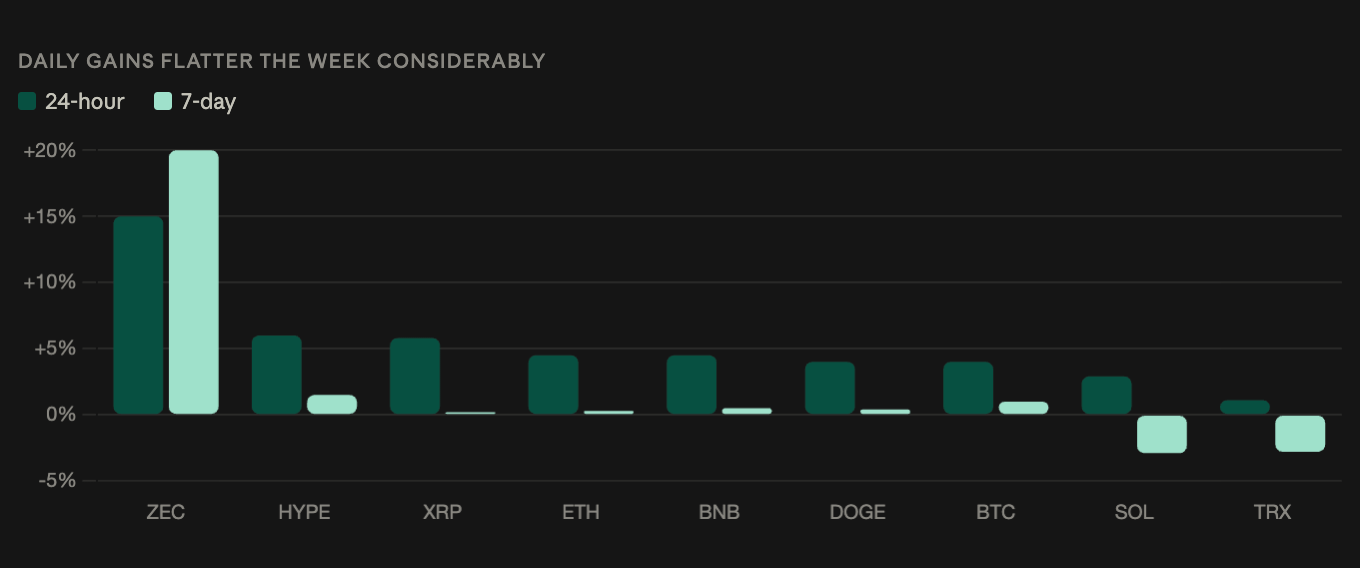
Article
Crypto News: Bitcoin Reclaims $81,000 as September Hike Odds Fall to a Coin Flip, Zcash Jumps 15%Bitcoin traded over $81,000 in Asian morning hours Friday, up about 4% over 24 hours, after the rates market did the work.Traders now put the odds of a Federal Reserve rate increase this month at roughly even, down from above 63% earlier in the week, per CME FedWatch. Softer expectations pulled bond yields back and sent buyers into risk assets across the board.Waller Gave the Move Its TriggerFed Governor Christopher Waller supplied the catalyst, saying he would support holding rates steady if price pressures kept easing. Treasuries and gold held the gains they made in the New York session that followed.The comment carries weight beyond its content. Waller said earlier this week that the jobs picture is in "satisfactory shape" — language that read as clearing the path for a hike by removing labor as an obstacle. A governor who set labor aside on Tuesday signalling comfort with a hold on Thursday is a meaningful shift in tone from the same voice.It also cuts against Chair Kevin Warsh's Jackson Hole framing, which built the hawkish case entirely on inflation and described financial conditions as not restrictive. Three FOMC members had already voted for an increase at the previous meeting.The Odds Have Now Round-Tripped TwiceThe September pricing has moved more than the underlying data has.Odds sat around 35% before Warsh spoke at Jackson Hole, climbed through 56% and 63% as oil pushed above $90 on the Iran conflict, peaked near 70% Thursday, and have now returned to an even split. The timeline for a second hike also pushed out — from December 2026 to March 2027.Rates have held at 3.50%-3.75% since December 2025 following three cuts in 2025. A September increase would be the first since July 2023.August payrolls land Friday at 8:30 a.m. ET with consensus in the 53,000-65,000 range depending on the survey, following July's 23,000 loss. The reaction function is inverted this cycle: a strong print hardens the hike case, and a soft one removes it.Zcash Extends a Run That Has Left the Market BehindZcash was the standout, up nearly 15% in 24 hours and 20% on the week — extending a run that has left it well clear of the rest of the market.Hyperliquid's HYPE added about 6% and XRP nearly 6%. Ether, BNB and Dogecoin each gained between 4% and 5%, while Solana rose nearly 3% and TRON managed just over 1%, the weakest of the majors.Privacy tokens have been leading for several sessions now. Dash rose 17% and Zcash 16.5% on Thursday as Bitcoin first cleared $80,000. That cohort tends to outperform when speculative appetite returns rather than when institutional flows dominate — it is retail-heavy and moves on sentiment more than allocation decisions.The Seven-Day Picture Is Far More MutedThe daily gains flatter the week considerably.Bitcoin is up roughly 1% over seven days. Ether and XRP sit close to flat. Solana and TRON are both down nearly 3%.That gap says Friday's move was a recovery of ground lost earlier in the week rather than a breakout. Bitcoin was rejected repeatedly at $80,000 through Tuesday and Wednesday, and the Iran strikes drove a broad risk selloff that hit the high-beta names hardest — Solana and TRON gave up more than 3% in a single session Tuesday.Zcash is the exception. Its 20% weekly gain against a market that is broadly flat is genuine outperformance rather than mean reversion.ETF Flows Have Not Yet Confirmed the BidUS spot Bitcoin ETFs took in about $731 million Thursday on provisional figures, following four sessions that alternated between inflows and outflows.That alternating pattern is the constraint. The funds have yet to string together a run of buying that would confirm the bid rather than a one-day rebound — and a single fund has driven both the largest outflow and the largest inflow of the past week, which points to one large desk repositioning rather than broad allocator conviction.The Yen Move Is the Bigger Asian StoryGlobal equities extended their advance, with MSCI's Asia Pacific gauge climbing nearly 1% and the All Country World Index rising for a third day. The dollar steadied after sliding to its lowest since May, and an index of Asian currencies reached levels last seen in October 2024.The yen took most of the attention, strengthening about 2% Thursday and erasing a month of gradual decline. Traders raised their bets on Bank of Japan rate increases and stayed alert to the risk of official intervention. It pared some of that move to trade near 156.35 per dollar, having touched 155.30 in the prior session.That reverses a slide that had carried the yen past 160 earlier in the week — a level where strategists placed intervention triggers at 161 and then 162-163. The July 31 coordinated US-Japan operation, the first joint yen buying since 1998, had seen more than half its gains unwind before this week's turn.For crypto, the yen matters through the carry trade. Yen-funded positions in US stocks and Treasuries unwind when the currency strengthens sharply, which sells the dollar assets the trade was funding. A 2% move is significant but orderly. Treasury Secretary Scott Bessent has described recent moves as "pretty well contained" while warning that a disorderly market could feed through to higher US rates.
Crypto News: Bitcoin Reclaims $81,000 as September Hike Odds Fall to a Coin Flip, Zcash Jumps 15%
Bitcoin traded over $81,000 in Asian morning hours Friday, up about 4% over 24 hours, after the rates market did the work.Traders now put the odds of a Federal Reserve rate increase this month at roughly even, down from above 63% earlier in the week, per CME FedWatch. Softer expectations pulled bond yields back and sent buyers into risk assets across the board.Waller Gave the Move Its TriggerFed Governor Christopher Waller supplied the catalyst, saying he would support holding rates steady if price pressures kept easing. Treasuries and gold held the gains they made in the New York session that followed.The comment carries weight beyond its content. Waller said earlier this week that the jobs picture is in "satisfactory shape" — language that read as clearing the path for a hike by removing labor as an obstacle. A governor who set labor aside on Tuesday signalling comfort with a hold on Thursday is a meaningful shift in tone from the same voice.It also cuts against Chair Kevin Warsh's Jackson Hole framing, which built the hawkish case entirely on inflation and described financial conditions as not restrictive. Three FOMC members had already voted for an increase at the previous meeting.The Odds Have Now Round-Tripped TwiceThe September pricing has moved more than the underlying data has.Odds sat around 35% before Warsh spoke at Jackson Hole, climbed through 56% and 63% as oil pushed above $90 on the Iran conflict, peaked near 70% Thursday, and have now returned to an even split. The timeline for a second hike also pushed out — from December 2026 to March 2027.Rates have held at 3.50%-3.75% since December 2025 following three cuts in 2025. A September increase would be the first since July 2023.August payrolls land Friday at 8:30 a.m. ET with consensus in the 53,000-65,000 range depending on the survey, following July's 23,000 loss. The reaction function is inverted this cycle: a strong print hardens the hike case, and a soft one removes it.Zcash Extends a Run That Has Left the Market BehindZcash was the standout, up nearly 15% in 24 hours and 20% on the week — extending a run that has left it well clear of the rest of the market.Hyperliquid's HYPE added about 6% and XRP nearly 6%. Ether, BNB and Dogecoin each gained between 4% and 5%, while Solana rose nearly 3% and TRON managed just over 1%, the weakest of the majors.Privacy tokens have been leading for several sessions now. Dash rose 17% and Zcash 16.5% on Thursday as Bitcoin first cleared $80,000. That cohort tends to outperform when speculative appetite returns rather than when institutional flows dominate — it is retail-heavy and moves on sentiment more than allocation decisions.The Seven-Day Picture Is Far More MutedThe daily gains flatter the week considerably.Bitcoin is up roughly 1% over seven days. Ether and XRP sit close to flat. Solana and TRON are both down nearly 3%.That gap says Friday's move was a recovery of ground lost earlier in the week rather than a breakout. Bitcoin was rejected repeatedly at $80,000 through Tuesday and Wednesday, and the Iran strikes drove a broad risk selloff that hit the high-beta names hardest — Solana and TRON gave up more than 3% in a single session Tuesday.Zcash is the exception. Its 20% weekly gain against a market that is broadly flat is genuine outperformance rather than mean reversion.ETF Flows Have Not Yet Confirmed the BidUS spot Bitcoin ETFs took in about $731 million Thursday on provisional figures, following four sessions that alternated between inflows and outflows.That alternating pattern is the constraint. The funds have yet to string together a run of buying that would confirm the bid rather than a one-day rebound — and a single fund has driven both the largest outflow and the largest inflow of the past week, which points to one large desk repositioning rather than broad allocator conviction.The Yen Move Is the Bigger Asian StoryGlobal equities extended their advance, with MSCI's Asia Pacific gauge climbing nearly 1% and the All Country World Index rising for a third day. The dollar steadied after sliding to its lowest since May, and an index of Asian currencies reached levels last seen in October 2024.The yen took most of the attention, strengthening about 2% Thursday and erasing a month of gradual decline. Traders raised their bets on Bank of Japan rate increases and stayed alert to the risk of official intervention. It pared some of that move to trade near 156.35 per dollar, having touched 155.30 in the prior session.That reverses a slide that had carried the yen past 160 earlier in the week — a level where strategists placed intervention triggers at 161 and then 162-163. The July 31 coordinated US-Japan operation, the first joint yen buying since 1998, had seen more than half its gains unwind before this week's turn.For crypto, the yen matters through the carry trade. Yen-funded positions in US stocks and Treasuries unwind when the currency strengthens sharply, which sells the dollar assets the trade was funding. A 2% move is significant but orderly. Treasury Secretary Scott Bessent has described recent moves as "pretty well contained" while warning that a disorderly market could feed through to higher US rates.
5
8.1k
·
--
Russian Drone Hits Ukraine's SBU Headquarters In KyivAccording to the BBC, a Russian drone struck the headquarters of Ukraine's Security Service (SBU) in central Kyiv on Friday afternoon, hitting a room used by security chief Oleksandr Poklad. President Volodymyr Zelensky said he had spoken to Poklad and ordered an appropriate response, while Foreign Minister Andriy Sybiha called the attack a major escalation. Kyiv Mayor Vitali Klitschko said five people were hurt. The Russian defense ministry also said it struck a cargo vessel in the Ukrainian port of Chornomorsk and a tanker near Odesa. The attack came as US mediators Steve Witkoff and Jared Kushner were due to visit Russia and Ukraine this weekend for talks on ending the war.
Russian Drone Hits Ukraine's SBU Headquarters In Kyiv
According to the BBC, a Russian drone struck the headquarters of Ukraine's Security Service (SBU) in central Kyiv on Friday afternoon, hitting a room used by security chief Oleksandr Poklad. President Volodymyr Zelensky said he had spoken to Poklad and ordered an appropriate response, while Foreign Minister Andriy Sybiha called the attack a major escalation. Kyiv Mayor Vitali Klitschko said five people were hurt. The Russian defense ministry also said it struck a cargo vessel in the Ukrainian port of Chornomorsk and a tanker near Odesa. The attack came as US mediators Steve Witkoff and Jared Kushner were due to visit Russia and Ukraine this weekend for talks on ending the war.
1.3k
·
--
XP Investimentos' Marco Oviedo Says CPI Is the Key Data Point for the FedAccording to Wallstreetcn, XP Investimentos strategist Marco Oviedo said U.S. nonfarm payrolls confirmed that CPI is the key data point, and that if CPI shows core annual inflation falling as expected, a Fed pause on rate hikes is basically certain; before then, he does not expect major volatility.
XP Investimentos' Marco Oviedo Says CPI Is the Key Data Point for the Fed
According to Wallstreetcn, XP Investimentos strategist Marco Oviedo said U.S. nonfarm payrolls confirmed that CPI is the key data point, and that if CPI shows core annual inflation falling as expected, a Fed pause on rate hikes is basically certain; before then, he does not expect major volatility.
2
6
1.6k
·
--
STOCKS | Fed Overnight Reverse Repo Usage Falls to $675 MillionAccording to Wallstreetcn, Federal Reserve overnight reverse repurchase agreement usage was $675 million on Friday, with two counterparties, down from $702 million in the previous trading day.
STOCKS | Fed Overnight Reverse Repo Usage Falls to $675 Million
According to Wallstreetcn, Federal Reserve overnight reverse repurchase agreement usage was $675 million on Friday, with two counterparties, down from $702 million in the previous trading day.
3
793
·
--
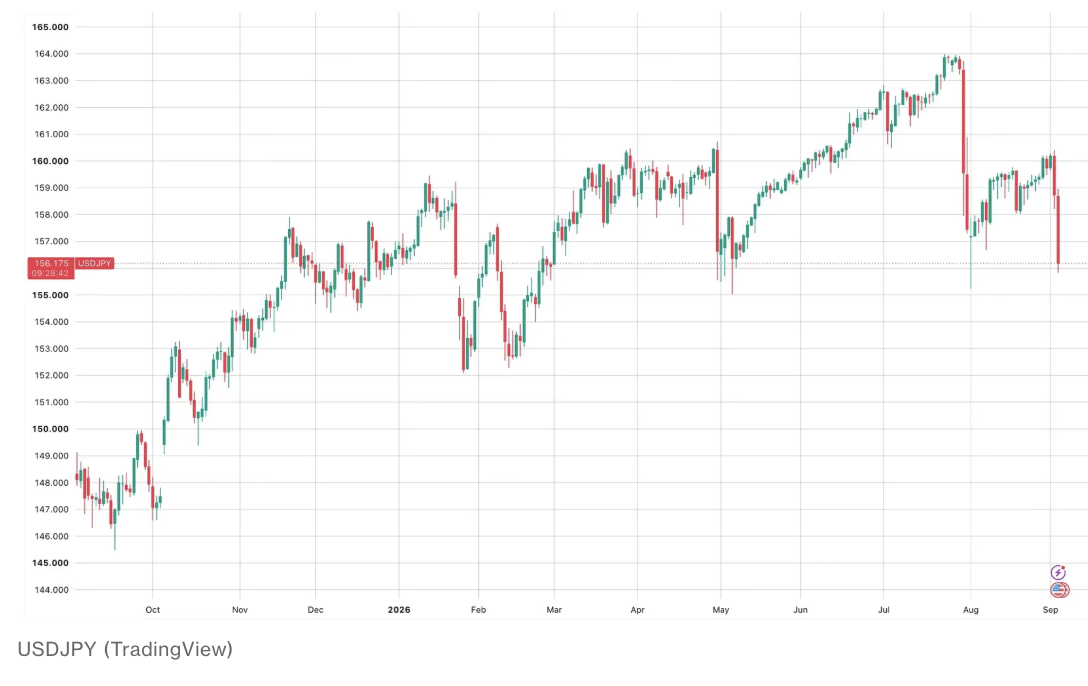
Article
Market News: Yen Surge Drives Dollar Weakness, Lifting Bitcoin and Gold — For NowThe Japanese yen is rising against every major currency and Bitcoin is rising with it — an outcome that runs against the standard reading of yen strength as a risk-off signal.The link is the Dollar Index. USD/JPY fell 1.4% to 156.40, extending Wednesday's 0.9% decline, per TradingView. EUR/USD, GBP/USD and AUD/USD all traded higher on the day, leaving the DXY down 0.4% at 99.22 and testing its 200-day average.Bitcoin changed hands at $81,071. Gold rose alongside it.Dollar Weakness Is the Mechanism, Not Risk AppetiteA weaker dollar supports USD-denominated assets and eases financial conditions globally, encouraging risk-taking in markets and the real economy. A stronger dollar does the reverse.That is the entire chain here. The yen's move is large enough to drag the dollar index lower against a basket of currencies, and Bitcoin is responding to the dollar rather than to the yen directly.The distinction matters because it makes the support conditional. Bitcoin is not benefiting from yen strength — it is benefiting from a second-order effect that holds only while the move stays measured.The 200-Day Average Is the Level to WatchA break below the 200-day average could trigger more pronounced dollar selling, precisely because so many traders reference the same line.Widely watched levels become self-fulfilling. They anchor entries, exits and stop-losses across desks, so price approaching one produces a collective reaction that pushes the market in the expected direction.The DXY has also been testing trendline support drawn from the 2011 lows in recent sessions. A break through both would remove the last macro variable working against Bitcoin, after oil above $90 and yields near multi-year highs both failed to break its relative strength this week.A Faster Yen Rally Would Invert the TradeThe dynamic supporting Bitcoin today reverses if the yen's rally accelerates.Traders have funded bullish positions in stocks, bonds and cryptocurrencies with cheap yen for over a decade. A disorderly surge forces those positions closed. Foreign investors who bought Japanese stocks on a weak yen may sell. Japanese investors who used cheap yen to buy overseas assets may liquidate. Both produce risk aversion.The precedent is recent and specific. Bitcoin fell roughly 20% within days during the yen carry trade unwind in August 2024.Orderly appreciation weakens the dollar and helps risk assets. A violent one forces liquidation and hurts them. Today's 1.4% move belongs to the first category, and there is no reliable way to identify the transition to the second before it happens.Two Forces Are Pushing the Yen HigherTraders are pricing a greater chance the Bank of Japan raises rates from 1% to 1.25% at its September 18 meeting. Japanese government bond yields have already moved sharply — the 10-year touched 3% this week for the first time in three decades and the five-year hit a record.Authorities are also steering. The US and Japan intervened in August to counter "disorderly yen movements" and support the currency, the first coordinated yen buying since 1998.That intervention had largely unwound before this week. The yen slid past 160 per dollar, with strategists placing further triggers at 161 and then 162-163. Treasury Secretary Scott Bessent called the moves "pretty well contained" and said they did not warrant another joint operation, while warning that a disorderly market could feed through to higher US interest rates.The Fed and BOJ Meet Two Days ApartThe Federal Reserve decides September 15-16. The Bank of Japan follows on September 18.Fed hike odds have fallen from above 63% to roughly even after Governor Christopher Waller said he would support holding rates steady if price pressures kept easing.A Fed hold combined with a BOJ hike narrows the rate differential from both directions at once — the configuration most likely to accelerate the yen rather than let it drift.Bitcoin reached $81,071 on falling rate expectations and dollar weakness rather than any crypto-specific catalyst. That is why the yen's next leg carries more weight than usual, and why the support it is providing should be read as conditional rather than structural.
Market News: Yen Surge Drives Dollar Weakness, Lifting Bitcoin and Gold — For Now
The Japanese yen is rising against every major currency and Bitcoin is rising with it — an outcome that runs against the standard reading of yen strength as a risk-off signal.The link is the Dollar Index. USD/JPY fell 1.4% to 156.40, extending Wednesday's 0.9% decline, per TradingView. EUR/USD, GBP/USD and AUD/USD all traded higher on the day, leaving the DXY down 0.4% at 99.22 and testing its 200-day average.Bitcoin changed hands at $81,071. Gold rose alongside it.Dollar Weakness Is the Mechanism, Not Risk AppetiteA weaker dollar supports USD-denominated assets and eases financial conditions globally, encouraging risk-taking in markets and the real economy. A stronger dollar does the reverse.That is the entire chain here. The yen's move is large enough to drag the dollar index lower against a basket of currencies, and Bitcoin is responding to the dollar rather than to the yen directly.The distinction matters because it makes the support conditional. Bitcoin is not benefiting from yen strength — it is benefiting from a second-order effect that holds only while the move stays measured.The 200-Day Average Is the Level to WatchA break below the 200-day average could trigger more pronounced dollar selling, precisely because so many traders reference the same line.Widely watched levels become self-fulfilling. They anchor entries, exits and stop-losses across desks, so price approaching one produces a collective reaction that pushes the market in the expected direction.The DXY has also been testing trendline support drawn from the 2011 lows in recent sessions. A break through both would remove the last macro variable working against Bitcoin, after oil above $90 and yields near multi-year highs both failed to break its relative strength this week.A Faster Yen Rally Would Invert the TradeThe dynamic supporting Bitcoin today reverses if the yen's rally accelerates.Traders have funded bullish positions in stocks, bonds and cryptocurrencies with cheap yen for over a decade. A disorderly surge forces those positions closed. Foreign investors who bought Japanese stocks on a weak yen may sell. Japanese investors who used cheap yen to buy overseas assets may liquidate. Both produce risk aversion.The precedent is recent and specific. Bitcoin fell roughly 20% within days during the yen carry trade unwind in August 2024.Orderly appreciation weakens the dollar and helps risk assets. A violent one forces liquidation and hurts them. Today's 1.4% move belongs to the first category, and there is no reliable way to identify the transition to the second before it happens.Two Forces Are Pushing the Yen HigherTraders are pricing a greater chance the Bank of Japan raises rates from 1% to 1.25% at its September 18 meeting. Japanese government bond yields have already moved sharply — the 10-year touched 3% this week for the first time in three decades and the five-year hit a record.Authorities are also steering. The US and Japan intervened in August to counter "disorderly yen movements" and support the currency, the first coordinated yen buying since 1998.That intervention had largely unwound before this week. The yen slid past 160 per dollar, with strategists placing further triggers at 161 and then 162-163. Treasury Secretary Scott Bessent called the moves "pretty well contained" and said they did not warrant another joint operation, while warning that a disorderly market could feed through to higher US interest rates.The Fed and BOJ Meet Two Days ApartThe Federal Reserve decides September 15-16. The Bank of Japan follows on September 18.Fed hike odds have fallen from above 63% to roughly even after Governor Christopher Waller said he would support holding rates steady if price pressures kept easing.A Fed hold combined with a BOJ hike narrows the rate differential from both directions at once — the configuration most likely to accelerate the yen rather than let it drift.Bitcoin reached $81,071 on falling rate expectations and dollar weakness rather than any crypto-specific catalyst. That is why the yen's next leg carries more weight than usual, and why the support it is providing should be read as conditional rather than structural.
7
8.4k
·
--
Guidewire, Tesla, Lululemon, Adobe Among Biggest Midday MoversAccording to CNBC, Guidewire Software fell 21% after its current-quarter revenue guidance missed expectations, while Tesla dropped 6% after the National Highway Traffic Safety Administration announced an investigation into whether the Cybercab complies with federal safety standards. Sandisk rose more than 8% and KLA gained 7% as chip stocks rallied, while the VanEck Semiconductor ETF (SMH) climbed more than 2% and the Roundhill Memory ETF (DRAM) advanced 5%.
Quanex Building Products surged 19% after reporting third-quarter adjusted earnings of 79 cents per share and revenue of $501.8 million, both above estimates. AMC Entertainment gained 6.5% after CEO Adam Aron criticized Robinhood’s stock tokens for AMC and other companies, while Equifax, TransUnion and Fair Isaac fell after Federal Housing Finance Agency Director Bill Pulte said on X that the credit bureaus had been overcharging Americans for too long. Smith & Wesson rose 6% after beating on earnings and revenue, while Lululemon Athletica tumbled 17% after issuing a weaker-than-expected forecast for the current quarter.
Zscaler slipped 5% despite beating quarterly estimates and issuing guidance that topped expectations. Adobe said Anil Chakravarthy will become its next CEO, succeeding Shantanu Narayen, and shares were last down 6%. Asana fell 14% after its third-quarter outlook missed estimates, while Samsara rose about 4% after lifting its full-year revenue and adjusted earnings guidance. UiPath lost 16% after its current-quarter outlook came in near estimates, and Oxford Industries sank 17% after cutting its full-year earnings and revenue guidance.
Guidewire, Tesla, Lululemon, Adobe Among Biggest Midday Movers
According to CNBC, Guidewire Software fell 21% after its current-quarter revenue guidance missed expectations, while Tesla dropped 6% after the National Highway Traffic Safety Administration announced an investigation into whether the Cybercab complies with federal safety standards. Sandisk rose more than 8% and KLA gained 7% as chip stocks rallied, while the VanEck Semiconductor ETF (SMH) climbed more than 2% and the Roundhill Memory ETF (DRAM) advanced 5%.
Quanex Building Products surged 19% after reporting third-quarter adjusted earnings of 79 cents per share and revenue of $501.8 million, both above estimates. AMC Entertainment gained 6.5% after CEO Adam Aron criticized Robinhood’s stock tokens for AMC and other companies, while Equifax, TransUnion and Fair Isaac fell after Federal Housing Finance Agency Director Bill Pulte said on X that the credit bureaus had been overcharging Americans for too long. Smith & Wesson rose 6% after beating on earnings and revenue, while Lululemon Athletica tumbled 17% after issuing a weaker-than-expected forecast for the current quarter.
Zscaler slipped 5% despite beating quarterly estimates and issuing guidance that topped expectations. Adobe said Anil Chakravarthy will become its next CEO, succeeding Shantanu Narayen, and shares were last down 6%. Asana fell 14% after its third-quarter outlook missed estimates, while Samsara rose about 4% after lifting its full-year revenue and adjusted earnings guidance. UiPath lost 16% after its current-quarter outlook came in near estimates, and Oxford Industries sank 17% after cutting its full-year earnings and revenue guidance.
Quanex Building Products surged 19% after reporting third-quarter adjusted earnings of 79 cents per share and revenue of $501.8 million, both above estimates. AMC Entertainment gained 6.5% after CEO Adam Aron criticized Robinhood’s stock tokens for AMC and other companies, while Equifax, TransUnion and Fair Isaac fell after Federal Housing Finance Agency Director Bill Pulte said on X that the credit bureaus had been overcharging Americans for too long. Smith & Wesson rose 6% after beating on earnings and revenue, while Lululemon Athletica tumbled 17% after issuing a weaker-than-expected forecast for the current quarter.
Zscaler slipped 5% despite beating quarterly estimates and issuing guidance that topped expectations. Adobe said Anil Chakravarthy will become its next CEO, succeeding Shantanu Narayen, and shares were last down 6%. Asana fell 14% after its third-quarter outlook missed estimates, while Samsara rose about 4% after lifting its full-year revenue and adjusted earnings guidance. UiPath lost 16% after its current-quarter outlook came in near estimates, and Oxford Industries sank 17% after cutting its full-year earnings and revenue guidance.
1
1.3k
·
--
Bitcoin(BTC) Drops Below 79,000 USDT with a 1.42% Decrease in 24 HoursOn Sep 04, 2026, 14:48 PM(UTC). According to Binance Market Data, Bitcoin has dropped below 79,000 USDT and is now trading at 78,866 USDT, with a narrowed 1.42% decrease in 24 hours.
Bitcoin(BTC) Drops Below 79,000 USDT with a 1.42% Decrease in 24 Hours
On Sep 04, 2026, 14:48 PM(UTC). According to Binance Market Data, Bitcoin has dropped below 79,000 USDT and is now trading at 78,866 USDT, with a narrowed 1.42% decrease in 24 hours.
1
2.6k
·
--
BNB Drops Below 710 USDT with a 1.78% Decrease in 24 HoursOn Sep 04, 2026, 14:50 PM(UTC). According to Binance Market Data, BNB has dropped below 710 USDT and is now trading at 708.909973 USDT, with a narrowed 1.78% decrease in 24 hours.
BNB Drops Below 710 USDT with a 1.78% Decrease in 24 Hours
On Sep 04, 2026, 14:50 PM(UTC). According to Binance Market Data, BNB has dropped below 710 USDT and is now trading at 708.909973 USDT, with a narrowed 1.78% decrease in 24 hours.
1
1.7k
·
--
Volkswagen CEO Says Group Will Invest Hundreds of Billions of Dollars Over Coming YearsAccording to Wallstreetcn, Volkswagen Chief Executive Officer said the company will invest hundreds of billions of dollars over the coming years to make its iconic brands more attractive, stronger, and more competitive, and said the supervisory board's approval of the 2030 future plan was a "strong signal" for the group's future development.
Volkswagen CEO Says Group Will Invest Hundreds of Billions of Dollars Over Coming Years
According to Wallstreetcn, Volkswagen Chief Executive Officer said the company will invest hundreds of billions of dollars over the coming years to make its iconic brands more attractive, stronger, and more competitive, and said the supervisory board's approval of the 2030 future plan was a "strong signal" for the group's future development.
1
970
·
--
Zelenskyy Says U.S. Talks Will Be Held in Moscow and KyivUkrainian President Volodymyr Zelenskyy said the U.S. side has confirmed that talks will be held separately in Moscow and Kyiv, with the Kyiv session expected to take place in the coming days. According to Sina Finance, Zelenskyy said Ukraine's negotiating team has maintained round-the-clock close communication with the U.S. delegation, held a special working meeting, and fully advanced preparations for the talks, which already have a preliminary schedule. He added that Ukraine is fully prepared to hold substantive talks with the U.S. in Kyiv at matching levels and with practical content.
Zelenskyy Says U.S. Talks Will Be Held in Moscow and Kyiv
Ukrainian President Volodymyr Zelenskyy said the U.S. side has confirmed that talks will be held separately in Moscow and Kyiv, with the Kyiv session expected to take place in the coming days. According to Sina Finance, Zelenskyy said Ukraine's negotiating team has maintained round-the-clock close communication with the U.S. delegation, held a special working meeting, and fully advanced preparations for the talks, which already have a preliminary schedule. He added that Ukraine is fully prepared to hold substantive talks with the U.S. in Kyiv at matching levels and with practical content.
1
2.3k
·
--
Ethereum(ETH) Drops Below 2,500 USDT with a Narrowed 2.34% Increase in 24 HoursOn Sep 04, 2026, 12:30 PM(UTC). According to Binance Market Data, Ethereum has dropped below 2,500 USDT and is now trading at 2,466.090088 USDT, with a narrowed narrowed 2.34% increase in 24 hours.
Ethereum(ETH) Drops Below 2,500 USDT with a Narrowed 2.34% Increase in 24 Hours
On Sep 04, 2026, 12:30 PM(UTC). According to Binance Market Data, Ethereum has dropped below 2,500 USDT and is now trading at 2,466.090088 USDT, with a narrowed narrowed 2.34% increase in 24 hours.
3.2k
·
--
STOCKS | Domestic Futures Mostly Rise as Synthetic Rubber Gains Nearly 5%According to Jin10, at the 23:00 close, most of China's domestic futures benchmark contracts rose, with synthetic rubber up nearly 5%, caustic soda up more than 3%, TSR20 rubber up nearly 3%, soda ash and rubber up more than 2%, while fuel oil fell more than 2%.
STOCKS | Domestic Futures Mostly Rise as Synthetic Rubber Gains Nearly 5%
According to Jin10, at the 23:00 close, most of China's domestic futures benchmark contracts rose, with synthetic rubber up nearly 5%, caustic soda up more than 3%, TSR20 rubber up nearly 3%, soda ash and rubber up more than 2%, while fuel oil fell more than 2%.
1
918
·
--
The Boring Company Seeks Investor Help With Hiring and Business DevelopmentThe Boring Company asked some investors in its latest funding round to help with hiring and business development, according to people familiar with the matter. According to Sina Finance, the company said investors would need to help recruit employees or expand business, such as introducing government officials in areas where it plans to build tunnels.
People familiar with the matter said the company recently completed a new funding round at a valuation of about $20 billion. The Boring Company also told prospective investors which roles it urgently needed to fill, and said it could buy back some of their shares if they could not provide suitable candidates.
After The Wall Street Journal published the report, Elon Musk said on X on Thursday night that it was true.
The Boring Company Seeks Investor Help With Hiring and Business Development
The Boring Company asked some investors in its latest funding round to help with hiring and business development, according to people familiar with the matter. According to Sina Finance, the company said investors would need to help recruit employees or expand business, such as introducing government officials in areas where it plans to build tunnels.
People familiar with the matter said the company recently completed a new funding round at a valuation of about $20 billion. The Boring Company also told prospective investors which roles it urgently needed to fill, and said it could buy back some of their shares if they could not provide suitable candidates.
After The Wall Street Journal published the report, Elon Musk said on X on Thursday night that it was true.
People familiar with the matter said the company recently completed a new funding round at a valuation of about $20 billion. The Boring Company also told prospective investors which roles it urgently needed to fill, and said it could buy back some of their shares if they could not provide suitable candidates.
After The Wall Street Journal published the report, Elon Musk said on X on Thursday night that it was true.
1
402
·
--
White House NEC Director Hassett: Rate Hikes Are On The TableAccording to Jin10, White House National Economic Council Director Hassett said rate hikes are an option on the table.
White House NEC Director Hassett: Rate Hikes Are On The Table
According to Jin10, White House National Economic Council Director Hassett said rate hikes are an option on the table.
2
1.8k
Join global crypto users on Binance Square
⚡️ Get latest and useful information about crypto.
💬 Trusted by the world’s largest crypto exchange.
👍 Discover real insights from verified creators.
Email / Phone number
Trending Topics
ZECHitsANewAllTimeHigh
2,372 views
76 Discussing
We’re Analyzing Market-Driven Liquidations!
Looking at the past few hours, the most significant liquidation activity occurred on $ZEC . The main reason for this was that it surpassed the $1,000 level, reaching a #zechitsanewalltimehigh
The fact that it even outperformed $BTC and $ETH shows just how intense trading activity has been on ZEC. This rally could remain a liquidity-driven move, but since the $1,000 level which investors had been anticipating was finally breached, the broader market is pleased with this development.
In my opinion, 60–70% of this rise was due to market manipulation and liquidity buying, but let’s keep an eye on it and see what happens.
Kripto Kurdu
·2 Likes
·3k views
LululemonTumbles20%OnWeakGuidance
6,834 views
258 Discussing
BitcoinETFsBiggestDailyInflowSinceJanuary
7,317 views
331 Discussing