
#opengradient
opengradient
518,638 views
5,919 Discussing
Hot
Latest

·
--
Bullish
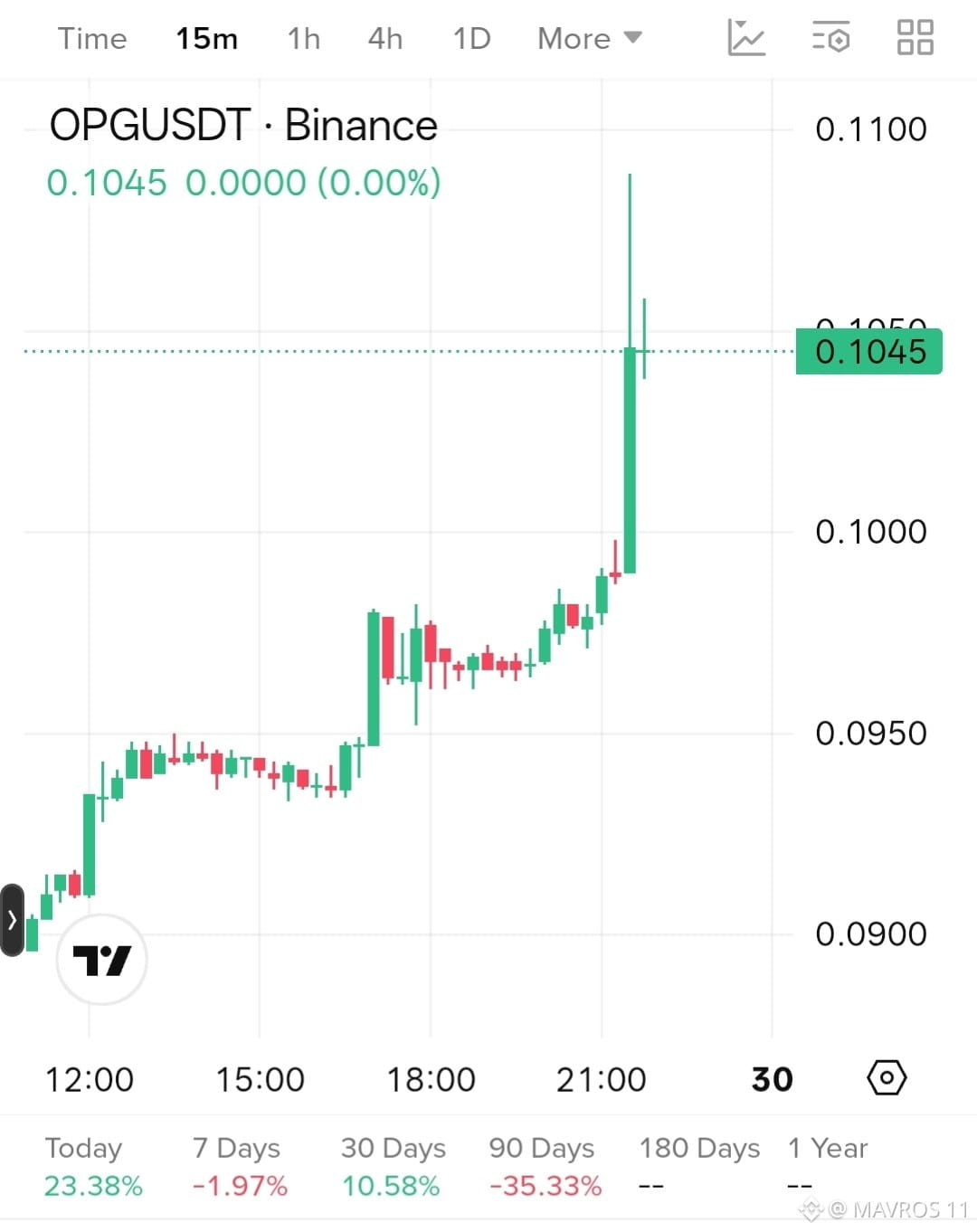
🚨 $OPG /USDT — BIG SHORT SETUP
$OPG just made a sharp 15M breakout toward 0.1090 and is showing rejection near the highs.
⚠️ After this aggressive pump, a pullback could be coming.
🎯 Watch: 0.102 → 0.098 → 0.094
🛑 Invalidation: above 0.110
Don’t chase the pump — wait for confirmation. 🔥📉
$OPG
{future}(OPGUSDT)
#OpenGradient #Crypto #NYSilverFuturesDrop3% #USShortTermTreasuryYieldsJump #TrumpSaysUSReachedVenezuelaOilDeal
🚨 $OPG /USDT — BIG SHORT SETUP
$OPG just made a sharp 15M breakout toward 0.1090 and is showing rejection near the highs.
⚠️ After this aggressive pump, a pullback could be coming.
🎯 Watch: 0.102 → 0.098 → 0.094
🛑 Invalidation: above 0.110
Don’t chase the pump — wait for confirmation. 🔥📉
$OPG
#OpenGradient #Crypto #NYSilverFuturesDrop3% #USShortTermTreasuryYieldsJump #TrumpSaysUSReachedVenezuelaOilDeal
$OPG just made a sharp 15M breakout toward 0.1090 and is showing rejection near the highs.
⚠️ After this aggressive pump, a pullback could be coming.
🎯 Watch: 0.102 → 0.098 → 0.094
🛑 Invalidation: above 0.110
Don’t chase the pump — wait for confirmation. 🔥📉
$OPG
#OpenGradient #Crypto #NYSilverFuturesDrop3% #USShortTermTreasuryYieldsJump #TrumpSaysUSReachedVenezuelaOilDeal
143

·
--
Bullish
🚨 $OPG on the verge of exploding?! Don’t just watch the price… watch what’s happening behind it 👀🔥
$OPG has started drawing attention again, and with returning liquidity and renewed interest in the project, the real question is no longer: Will it move?
But: When will the move that surprises the market begin? ⚡
OpenGradient is betting on the intersection of Artificial Intelligence + Blockchain—sectors that still attract money and growing attention.
🎯 Watch the volume + breakout of resistance + the price holding above support.
If these signals come together…
OPG could shift from a “watchlist” coin to a trader favorite. 🔥
DON’T CHASE. WATCH THE BREAKOUT. 👁️
$OPG
{future}(OPGUSDT)
#OPG #OpenGradient #AI #Binance
🚨 $OPG on the verge of exploding?! Don’t just watch the price… watch what’s happening behind it 👀🔥
$OPG has started drawing attention again, and with returning liquidity and renewed interest in the project, the real question is no longer: Will it move?
But: When will the move that surprises the market begin? ⚡
OpenGradient is betting on the intersection of Artificial Intelligence + Blockchain—sectors that still attract money and growing attention.
🎯 Watch the volume + breakout of resistance + the price holding above support.
If these signals come together…
OPG could shift from a “watchlist” coin to a trader favorite. 🔥
DON’T CHASE. WATCH THE BREAKOUT. 👁️
$OPG
#OPG #OpenGradient #AI #Binance
$OPG has started drawing attention again, and with returning liquidity and renewed interest in the project, the real question is no longer: Will it move?
But: When will the move that surprises the market begin? ⚡
OpenGradient is betting on the intersection of Artificial Intelligence + Blockchain—sectors that still attract money and growing attention.
🎯 Watch the volume + breakout of resistance + the price holding above support.
If these signals come together…
OPG could shift from a “watchlist” coin to a trader favorite. 🔥
DON’T CHASE. WATCH THE BREAKOUT. 👁️
$OPG
#OPG #OpenGradient #AI #Binance
1
143

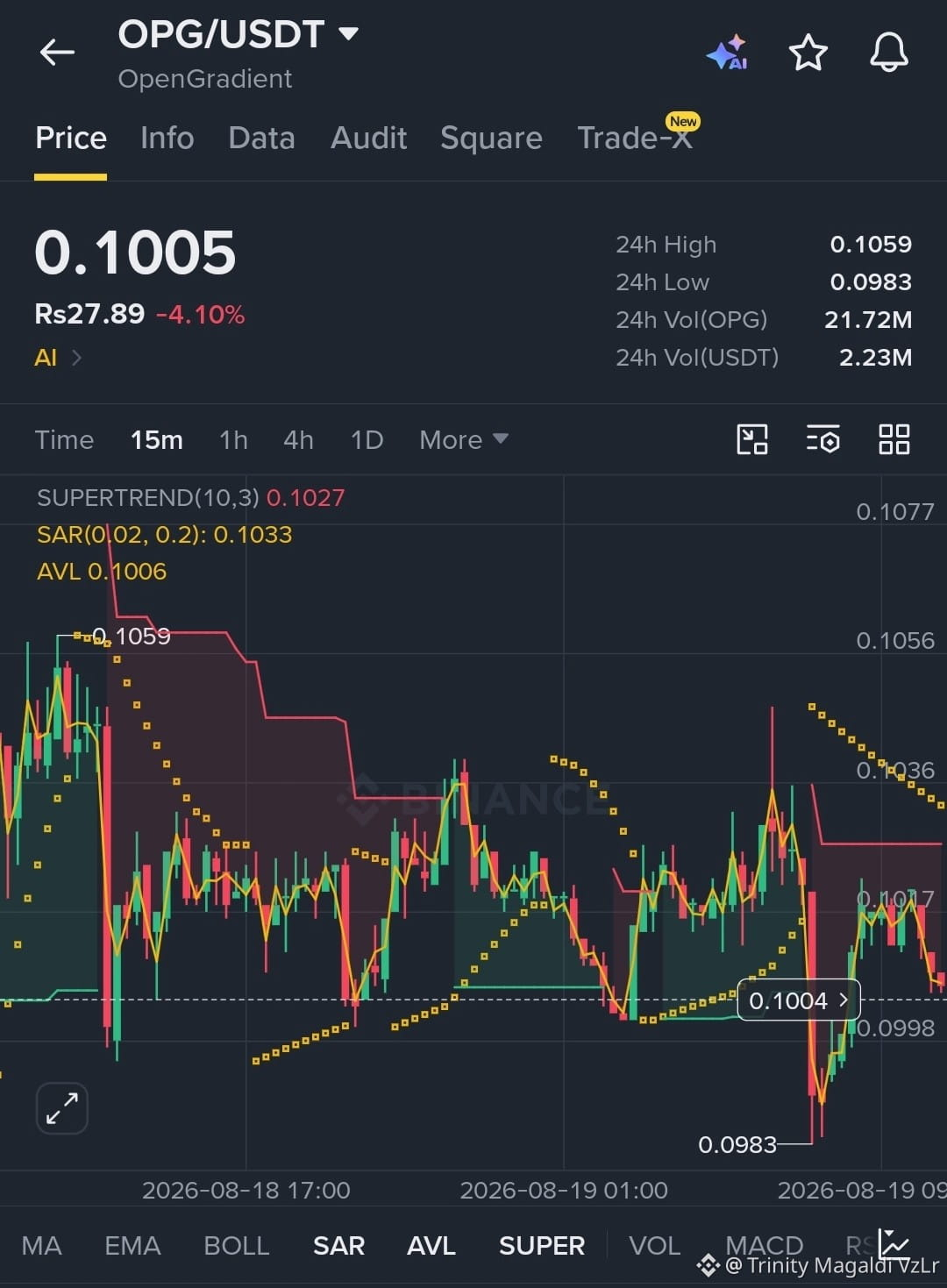
$OPG OPG BREAKDOWN INCOMING
is sitting near $0.1005 after a sharp 4.1% drop. Price is below the Supertrend at $0.1027, while $0.0983 is the key support. A reclaim of $0.1033 could trigger momentum back toward resistance.
#OPG #OpenGradient #Binance #Crypto
$GIGGLE
{spot}(GIGGLEUSDT)
$RIVER
{future}(RIVERUSDT)
$OPG OPG BREAKDOWN INCOMING
is sitting near $0.1005 after a sharp 4.1% drop. Price is below the Supertrend at $0.1027, while $0.0983 is the key support. A reclaim of $0.1033 could trigger momentum back toward resistance.
#OPG #OpenGradient #Binance #Crypto
$GIGGLE
$RIVER
is sitting near $0.1005 after a sharp 4.1% drop. Price is below the Supertrend at $0.1027, while $0.0983 is the key support. A reclaim of $0.1033 could trigger momentum back toward resistance.
#OPG #OpenGradient #Binance #Crypto
$GIGGLE
$RIVER
1
497

·
--
Bullish
We see ever each the new token,s are may be on the duty of major pump,s on listed day,s but $OPG play different and chart show some liquidity grapper,s and there is no major pump but in last 4 day,s $OPG chart showing the big one is coming 🤔
What your oppinions ?
#Opengradient #DCA
{future}(OPGUSDT)
We see ever each the new token,s are may be on the duty of major pump,s on listed day,s but $OPG play different and chart show some liquidity grapper,s and there is no major pump but in last 4 day,s $OPG chart showing the big one is coming 🤔
What your oppinions ?
#Opengradient #DCA
What your oppinions ?
#Opengradient #DCA

1
120
OpenGradient ($OPG) has seen a recent price surge, with the core drivers coming from the coordinated activity of two major exchanges: Upbit’s listing of KRW trading pairs has opened the door for incremental capital inflows from Asia, while Binance’s HODLer airdrop has sparked renewed expectations among coin holders.
The current quote is $0.12638, with $16.13 million in 24h trading volume and a market cap of about $24.97 million—liquidity has clearly been activated.
In the short term, the combined tailwinds from both exchanges and the ongoing speculation around the airdrop are likely to keep attracting opportunistic traders; however, be mindful of the sell-pressure window after the airdrop is distributed. Given the relatively small market-cap size, volatility may be amplified.
Before chasing the price, think through your position size and take-profit levels—don’t focus only on the narrative while ignoring timing.
#OpenGradient #Upbit #HODLer airdrop
OpenGradient ($OPG ) has seen a recent price surge, with the core drivers coming from the coordinated activity of two major exchanges: Upbit’s listing of KRW trading pairs has opened the door for incremental capital inflows from Asia, while Binance’s HODLer airdrop has sparked renewed expectations among coin holders.
The current quote is $0.12638, with $16.13 million in 24h trading volume and a market cap of about $24.97 million—liquidity has clearly been activated.
In the short term, the combined tailwinds from both exchanges and the ongoing speculation around the airdrop are likely to keep attracting opportunistic traders; however, be mindful of the sell-pressure window after the airdrop is distributed. Given the relatively small market-cap size, volatility may be amplified.
Before chasing the price, think through your position size and take-profit levels—don’t focus only on the narrative while ignoring timing.
#OpenGradient #Upbit #HODLer airdrop
The current quote is $0.12638, with $16.13 million in 24h trading volume and a market cap of about $24.97 million—liquidity has clearly been activated.
In the short term, the combined tailwinds from both exchanges and the ongoing speculation around the airdrop are likely to keep attracting opportunistic traders; however, be mindful of the sell-pressure window after the airdrop is distributed. Given the relatively small market-cap size, volatility may be amplified.
Before chasing the price, think through your position size and take-profit levels—don’t focus only on the narrative while ignoring timing.
#OpenGradient #Upbit #HODLer airdrop
29

OpenGradient's recent fluctuations are essentially a money-rush行情 created by a double-layered positive catalyst from two exchanges.
Upbit listing the KRW trading pair directly opens an entry channel for Korean retail users; at the same time, expectations of a Binance HODLer airdrop give users holding BNB an additional incentive to participate in the game. Two independent streams of capital nearly simultaneously surge toward the same target, rapidly igniting short-term sentiment.
At present, the quote for $OPG is $0.12638, with a market cap of about $24.97 million. The 24-hour trading volume has already surged to 16.13 million—an almost 64% turnover rate, which indicates the chips are changing hands at high speed; both the risks and the potential upside of chasing higher prices are magnified.
From a personal perspective: this kind of "listing on Upbit + airdrop" double-hit move often looks violent in the early phase and then gives back later. If you want to get involved, watch whether the KRW order-book premium remains stable. Once the Upbit price spread narrows and the airdrop is fulfilled, short-term momentum will most likely fade. Don’t treat news flow as fundamentals.
#OpenGradient #Upbit #HODLer airdrop
OpenGradient's recent fluctuations are essentially a money-rush行情 created by a double-layered positive catalyst from two exchanges.
Upbit listing the KRW trading pair directly opens an entry channel for Korean retail users; at the same time, expectations of a Binance HODLer airdrop give users holding BNB an additional incentive to participate in the game. Two independent streams of capital nearly simultaneously surge toward the same target, rapidly igniting short-term sentiment.
At present, the quote for $OPG is $0.12638, with a market cap of about $24.97 million. The 24-hour trading volume has already surged to 16.13 million—an almost 64% turnover rate, which indicates the chips are changing hands at high speed; both the risks and the potential upside of chasing higher prices are magnified.
From a personal perspective: this kind of "listing on Upbit + airdrop" double-hit move often looks violent in the early phase and then gives back later. If you want to get involved, watch whether the KRW order-book premium remains stable. Once the Upbit price spread narrows and the airdrop is fulfilled, short-term momentum will most likely fade. Don’t treat news flow as fundamentals.
#OpenGradient #Upbit #HODLer airdrop
Upbit listing the KRW trading pair directly opens an entry channel for Korean retail users; at the same time, expectations of a Binance HODLer airdrop give users holding BNB an additional incentive to participate in the game. Two independent streams of capital nearly simultaneously surge toward the same target, rapidly igniting short-term sentiment.
At present, the quote for $OPG is $0.12638, with a market cap of about $24.97 million. The 24-hour trading volume has already surged to 16.13 million—an almost 64% turnover rate, which indicates the chips are changing hands at high speed; both the risks and the potential upside of chasing higher prices are magnified.
From a personal perspective: this kind of "listing on Upbit + airdrop" double-hit move often looks violent in the early phase and then gives back later. If you want to get involved, watch whether the KRW order-book premium remains stable. Once the Upbit price spread narrows and the airdrop is fulfilled, short-term momentum will most likely fade. Don’t treat news flow as fundamentals.
#OpenGradient #Upbit #HODLer airdrop
160
Is the AI narrative losing steam, or is this just a massive accumulation discount? 🤖
$OPG (OpenGradient) has been highly volatile since its recent listings, but its decentralized AI infrastructure model is catching major attention. Institutional adoption takes time, but liquidity always comes first.
Buying the dip here or waiting for market stabilization? Let me know! 📊
#OpenGradient #Altcoins👀🚀
Is the AI narrative losing steam, or is this just a massive accumulation discount? 🤖
$OPG (OpenGradient) has been highly volatile since its recent listings, but its decentralized AI infrastructure model is catching major attention. Institutional adoption takes time, but liquidity always comes first.
Buying the dip here or waiting for market stabilization? Let me know! 📊
#OpenGradient #Altcoins👀🚀
$OPG (OpenGradient) has been highly volatile since its recent listings, but its decentralized AI infrastructure model is catching major attention. Institutional adoption takes time, but liquidity always comes first.
Buying the dip here or waiting for market stabilization? Let me know! 📊
#OpenGradient #Altcoins👀🚀
2
83

·
--
OPG is pumping again—its core logic is really just two things stacked: Upbit has added KRW trading pairs, and Binance HODLer airdrop is officially announced simultaneously.
One side is that a direct channel for Korean retail funds has been opened, and the other is that the airdrop expectations lock in demand to hold coins, so short-term buying pressure naturally gets ignited. The current price is $0.1264, market cap is under $25 million, yet 24h trading volume has already reached $16 million—turnover is extremely high. With a size like this, exchange catalysts can easily amplify volatility.
My view is: sentiment may still hold up for a while before the good news is fully realized, but watch out for two things—first, the wick/spike trading action on Upbit’s first day listing, and second, selling pressure after the airdrop unlocks. If you want to participate, don’t chase the emotional highs; wait for a pullback and confirmation before considering, and set a stop-loss firmly.
$OPG #OpenGradient #Upbit #HODLer airdrop
OPG is pumping again—its core logic is really just two things stacked: Upbit has added KRW trading pairs, and Binance HODLer airdrop is officially announced simultaneously.
One side is that a direct channel for Korean retail funds has been opened, and the other is that the airdrop expectations lock in demand to hold coins, so short-term buying pressure naturally gets ignited. The current price is $0.1264, market cap is under $25 million, yet 24h trading volume has already reached $16 million—turnover is extremely high. With a size like this, exchange catalysts can easily amplify volatility.
My view is: sentiment may still hold up for a while before the good news is fully realized, but watch out for two things—first, the wick/spike trading action on Upbit’s first day listing, and second, selling pressure after the airdrop unlocks. If you want to participate, don’t chase the emotional highs; wait for a pullback and confirmation before considering, and set a stop-loss firmly.
$OPG #OpenGradient #Upbit #HODLer airdrop
One side is that a direct channel for Korean retail funds has been opened, and the other is that the airdrop expectations lock in demand to hold coins, so short-term buying pressure naturally gets ignited. The current price is $0.1264, market cap is under $25 million, yet 24h trading volume has already reached $16 million—turnover is extremely high. With a size like this, exchange catalysts can easily amplify volatility.
My view is: sentiment may still hold up for a while before the good news is fully realized, but watch out for two things—first, the wick/spike trading action on Upbit’s first day listing, and second, selling pressure after the airdrop unlocks. If you want to participate, don’t chase the emotional highs; wait for a pullback and confirmation before considering, and set a stop-loss firmly.
$OPG #OpenGradient #Upbit #HODLer airdrop
187
$OPG The logic behind this short-term breakout is actually very clear: the listing of the KRW trading pair on Upbit plus the anticipation of Binance HODLer airdrop, with bullish news from both exchanges stacking together, directly igniting market sentiment.
Current price is $0.126, market cap is about $24.97 million, and 24h trading volume is $16.13 million — the volume is already close to 65% of the circulating market cap. This level of turnover suggests that most of the participants entering are short-term speculators, not long-term accumulators.
My observation angle:
1. Korean retail investors have always been amplifiers of new narratives. An Upbit listing often brings the first wave of momentum, but it also tends to give back gains at the peak of sentiment;
2. The HODLer airdrop claim point is a key dividing line; after receiving it, the selling pressure needs to be watched closely;
3. The io_flow sector itself has not yet formed a stable consensus, and OPG is more about capturing liquidity premium than fundamental revaluation.
In terms of strategy, chasing the price is not as good as waiting for the first wave of airdrop selling pressure to be released before assessing follow-through strength. Don’t mistake exchange-driven bullish news for fundamentals.
#OpenGradient #HODLer空投 #Upbit
$OPG The logic behind this short-term breakout is actually very clear: the listing of the KRW trading pair on Upbit plus the anticipation of Binance HODLer airdrop, with bullish news from both exchanges stacking together, directly igniting market sentiment.
Current price is $0.126, market cap is about $24.97 million, and 24h trading volume is $16.13 million — the volume is already close to 65% of the circulating market cap. This level of turnover suggests that most of the participants entering are short-term speculators, not long-term accumulators.
My observation angle:
1. Korean retail investors have always been amplifiers of new narratives. An Upbit listing often brings the first wave of momentum, but it also tends to give back gains at the peak of sentiment;
2. The HODLer airdrop claim point is a key dividing line; after receiving it, the selling pressure needs to be watched closely;
3. The io_flow sector itself has not yet formed a stable consensus, and OPG is more about capturing liquidity premium than fundamental revaluation.
In terms of strategy, chasing the price is not as good as waiting for the first wave of airdrop selling pressure to be released before assessing follow-through strength. Don’t mistake exchange-driven bullish news for fundamentals.
#OpenGradient #HODLer空投 #Upbit
Current price is $0.126, market cap is about $24.97 million, and 24h trading volume is $16.13 million — the volume is already close to 65% of the circulating market cap. This level of turnover suggests that most of the participants entering are short-term speculators, not long-term accumulators.
My observation angle:
1. Korean retail investors have always been amplifiers of new narratives. An Upbit listing often brings the first wave of momentum, but it also tends to give back gains at the peak of sentiment;
2. The HODLer airdrop claim point is a key dividing line; after receiving it, the selling pressure needs to be watched closely;
3. The io_flow sector itself has not yet formed a stable consensus, and OPG is more about capturing liquidity premium than fundamental revaluation.
In terms of strategy, chasing the price is not as good as waiting for the first wave of airdrop selling pressure to be released before assessing follow-through strength. Don’t mistake exchange-driven bullish news for fundamentals.
#OpenGradient #HODLer空投 #Upbit
188

·
--
The core logic behind OpenGradient ($OPG)’s short-term abnormal moves is actually very clear: Upbit lists the KRW trading pair + Binance HODLer airdrop expectations—two exchange catalysts combining, directly igniting FOMO sentiment on the capital side.
At the current price of $0.126, with a market cap of about $24.97 million and 24h trading volume of $16.13 million—the volume-to-market-cap ratio is already on the high side, indicating very active turnover of holdings. This is a typical event-driven pump.
My observations:
- When the KRW channel opens, it often brings a wave of “Korean kimchi premium,” but its sustainability depends on whether the local community keeps rallying
- HODLer airdrops are mostly a one-time release of sentiment; after the event is fulfilled, profit-taking often follows
- With a market cap under $30 million, the float is relatively small, so volatility gets amplified—be cautious in both directions
You can speculate in the short term, but don’t treat an event-driven market as value discovery. The moment the good news is realized is often when the sentiment turns.
#OpenGradient #Upbit #HODLer
The core logic behind OpenGradient ($OPG )’s short-term abnormal moves is actually very clear: Upbit lists the KRW trading pair + Binance HODLer airdrop expectations—two exchange catalysts combining, directly igniting FOMO sentiment on the capital side.
At the current price of $0.126, with a market cap of about $24.97 million and 24h trading volume of $16.13 million—the volume-to-market-cap ratio is already on the high side, indicating very active turnover of holdings. This is a typical event-driven pump.
My observations:
- When the KRW channel opens, it often brings a wave of “Korean kimchi premium,” but its sustainability depends on whether the local community keeps rallying
- HODLer airdrops are mostly a one-time release of sentiment; after the event is fulfilled, profit-taking often follows
- With a market cap under $30 million, the float is relatively small, so volatility gets amplified—be cautious in both directions
You can speculate in the short term, but don’t treat an event-driven market as value discovery. The moment the good news is realized is often when the sentiment turns.
#OpenGradient #Upbit #HODLer
At the current price of $0.126, with a market cap of about $24.97 million and 24h trading volume of $16.13 million—the volume-to-market-cap ratio is already on the high side, indicating very active turnover of holdings. This is a typical event-driven pump.
My observations:
- When the KRW channel opens, it often brings a wave of “Korean kimchi premium,” but its sustainability depends on whether the local community keeps rallying
- HODLer airdrops are mostly a one-time release of sentiment; after the event is fulfilled, profit-taking often follows
- With a market cap under $30 million, the float is relatively small, so volatility gets amplified—be cautious in both directions
You can speculate in the short term, but don’t treat an event-driven market as value discovery. The moment the good news is realized is often when the sentiment turns.
#OpenGradient #Upbit #HODLer
62
·
--
#opg $OPG 🔥 Everyone talks about token prices.
Few people talk about utility.
OpenGradient's ecosystem is designed around verifiable AI, where OPG helps power payments, rewards participants, and supports governance decisions.
If OpenGradient reaches mass adoption, who benefits the most?
✅ Early holders
✅ Active traders
✅ Node operators
✅ Developers building on the ecosystem
My prediction:
The biggest winners may not be the people watching charts all day, but the people actively participating in the ecosystem.
What's your prediction for OpenGradient in 2030? 👇
@OpenGradient $OPG #OpenGradient #AI
#opg $OPG 🔥 Everyone talks about token prices.
Few people talk about utility.
OpenGradient's ecosystem is designed around verifiable AI, where OPG helps power payments, rewards participants, and supports governance decisions.
If OpenGradient reaches mass adoption, who benefits the most?
✅ Early holders
✅ Active traders
✅ Node operators
✅ Developers building on the ecosystem
My prediction:
The biggest winners may not be the people watching charts all day, but the people actively participating in the ecosystem.
What's your prediction for OpenGradient in 2030? 👇
@OpenGradient $OPG #OpenGradient #AI
Few people talk about utility.
OpenGradient's ecosystem is designed around verifiable AI, where OPG helps power payments, rewards participants, and supports governance decisions.
If OpenGradient reaches mass adoption, who benefits the most?
✅ Early holders
✅ Active traders
✅ Node operators
✅ Developers building on the ecosystem
My prediction:
The biggest winners may not be the people watching charts all day, but the people actively participating in the ecosystem.
What's your prediction for OpenGradient in 2030? 👇
@OpenGradient $OPG #OpenGradient #AI
3
72

·
--
#opg $OPG
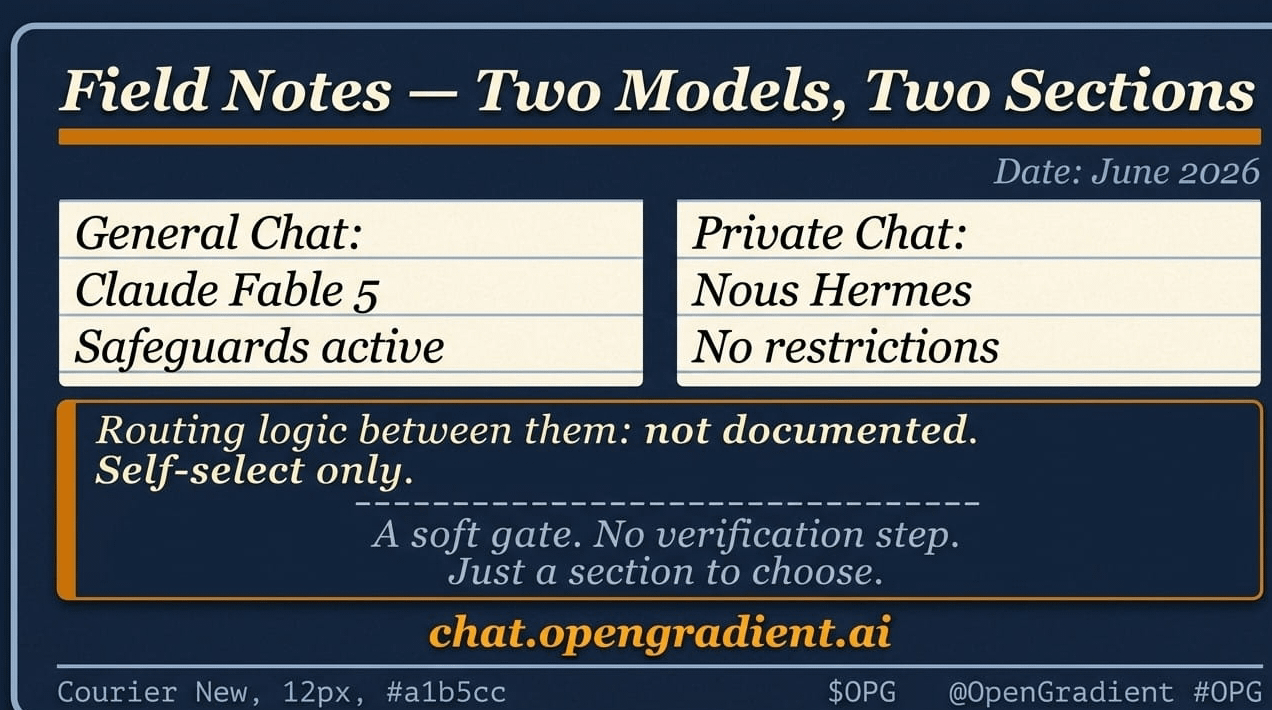
🔒 Stop trusting centralized AI corporations with your data. It is time for cryptographic proof.
I’ve been tracking @OpenGradient and their innovative OpenGradient Chat platform. Traditional AI models process your private conversations in vulnerable, centralized databases. OpenGradient completely changes the game by executing multi-model AI inference entirely within hardware-isolated Trusted Execution Environments (TEEs).
What this means for the user: Whether you are running complex queries on frontier models or interacting with unfiltered chat options, every request is protected by hardware-level cryptographic attestation that settles directly on-chain. This gives the $OPG token real, fundamental utility in an era where data privacy is non-negotiable.
If you believe the future of Decentralized AI (DeAI) relies on math over corporate promises, keep an eye on this project.
How do you see the utility of $OPG expanding as web3 AI gains mainstream adoption? 👇
#OPG #DeAI #Web3AI #CryptoPrivacy #OpenGradient
#opg $OPG
🔒 Stop trusting centralized AI corporations with your data. It is time for cryptographic proof.
I’ve been tracking @OpenGradient and their innovative OpenGradient Chat platform. Traditional AI models process your private conversations in vulnerable, centralized databases. OpenGradient completely changes the game by executing multi-model AI inference entirely within hardware-isolated Trusted Execution Environments (TEEs).
What this means for the user: Whether you are running complex queries on frontier models or interacting with unfiltered chat options, every request is protected by hardware-level cryptographic attestation that settles directly on-chain. This gives the $OPG token real, fundamental utility in an era where data privacy is non-negotiable.
If you believe the future of Decentralized AI (DeAI) relies on math over corporate promises, keep an eye on this project.
How do you see the utility of $OPG expanding as web3 AI gains mainstream adoption? 👇
#OPG #DeAI #Web3AI #CryptoPrivacy #OpenGradient
🔒 Stop trusting centralized AI corporations with your data. It is time for cryptographic proof.
I’ve been tracking @OpenGradient and their innovative OpenGradient Chat platform. Traditional AI models process your private conversations in vulnerable, centralized databases. OpenGradient completely changes the game by executing multi-model AI inference entirely within hardware-isolated Trusted Execution Environments (TEEs).
What this means for the user: Whether you are running complex queries on frontier models or interacting with unfiltered chat options, every request is protected by hardware-level cryptographic attestation that settles directly on-chain. This gives the $OPG token real, fundamental utility in an era where data privacy is non-negotiable.
If you believe the future of Decentralized AI (DeAI) relies on math over corporate promises, keep an eye on this project.
How do you see the utility of $OPG expanding as web3 AI gains mainstream adoption? 👇
#OPG #DeAI #Web3AI #CryptoPrivacy #OpenGradient
87

🔥 AI NEEDS TRUST NOT JUST INTELLIGENCE
Most AI projects are competing to create smarter and more powerful models.
@OpenGradient is focused on a much bigger challenge.
How can AI operate in a decentralized world where every output can be verified instead of blindly trusted?
The future of AI will not be defined only by intelligence. It will be defined by transparency accountability and verifiability.
With OpenGradient every prediction inference and decision can move closer to onchain verification creating a foundation for trustworthy AI systems.
As AI becomes a critical part of finance applications and digital infrastructure the demand for verifiable intelligence will continue to grow.
That is why I am watching @OpenGradient closely.
$OPG is not simply another AI token.
It represents a vision where decentralized AI can operate with trust transparency and accountability at scale.
#OPG #OpenGradient
{spot}(OPGUSDT)
#opg
$H
{future}(HUSDT)
$LAB
{future}(LABUSDT)
🔥 AI NEEDS TRUST NOT JUST INTELLIGENCE
Most AI projects are competing to create smarter and more powerful models.
@OpenGradient is focused on a much bigger challenge.
How can AI operate in a decentralized world where every output can be verified instead of blindly trusted?
The future of AI will not be defined only by intelligence. It will be defined by transparency accountability and verifiability.
With OpenGradient every prediction inference and decision can move closer to onchain verification creating a foundation for trustworthy AI systems.
As AI becomes a critical part of finance applications and digital infrastructure the demand for verifiable intelligence will continue to grow.
That is why I am watching @OpenGradient closely.
$OPG is not simply another AI token.
It represents a vision where decentralized AI can operate with trust transparency and accountability at scale.
#OPG #OpenGradient
#opg
$H
$LAB
Most AI projects are competing to create smarter and more powerful models.
@OpenGradient is focused on a much bigger challenge.
How can AI operate in a decentralized world where every output can be verified instead of blindly trusted?
The future of AI will not be defined only by intelligence. It will be defined by transparency accountability and verifiability.
With OpenGradient every prediction inference and decision can move closer to onchain verification creating a foundation for trustworthy AI systems.
As AI becomes a critical part of finance applications and digital infrastructure the demand for verifiable intelligence will continue to grow.
That is why I am watching @OpenGradient closely.
$OPG is not simply another AI token.
It represents a vision where decentralized AI can operate with trust transparency and accountability at scale.
#OPG #OpenGradient
#opg
$H
$LAB
1
1
9

·
--
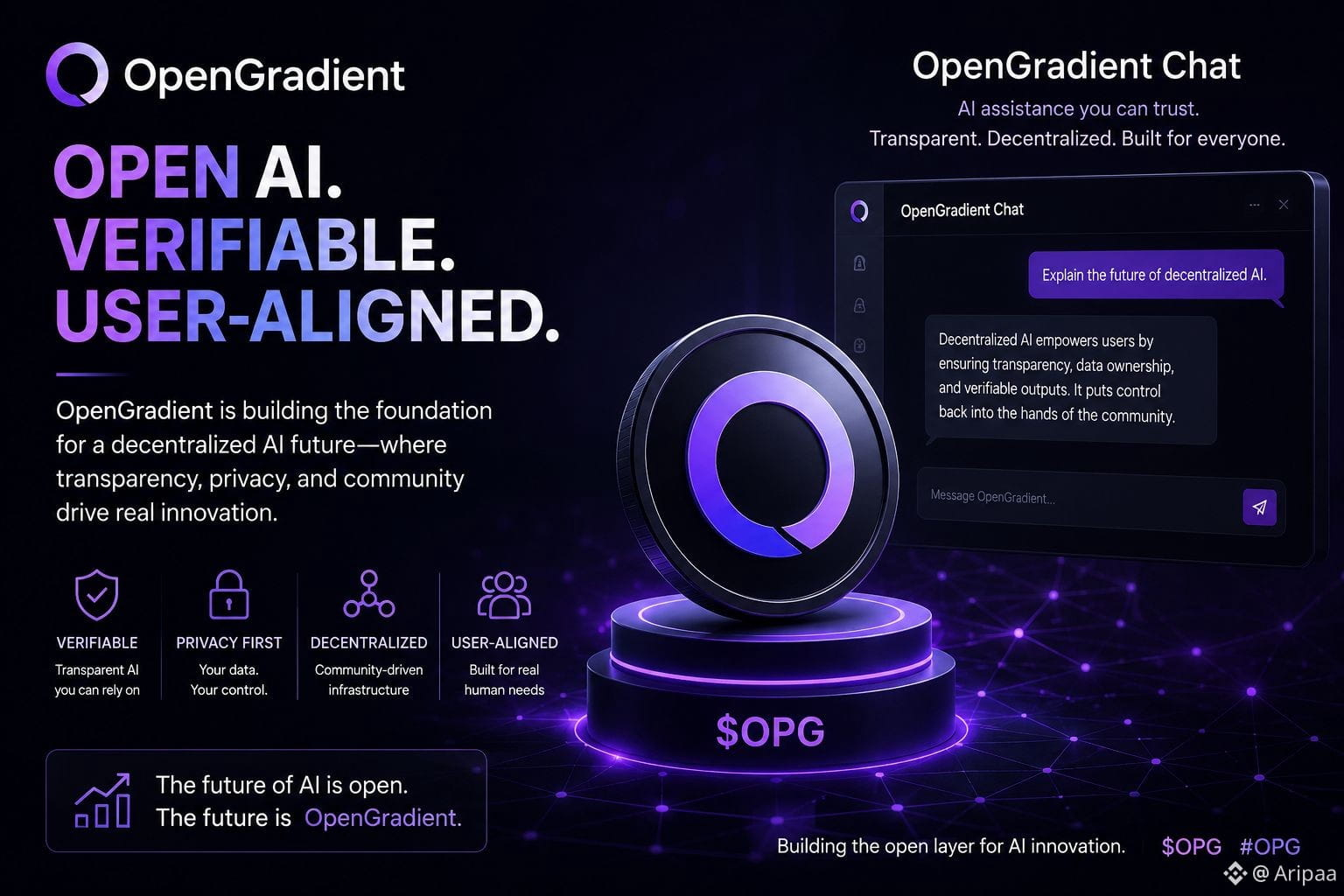
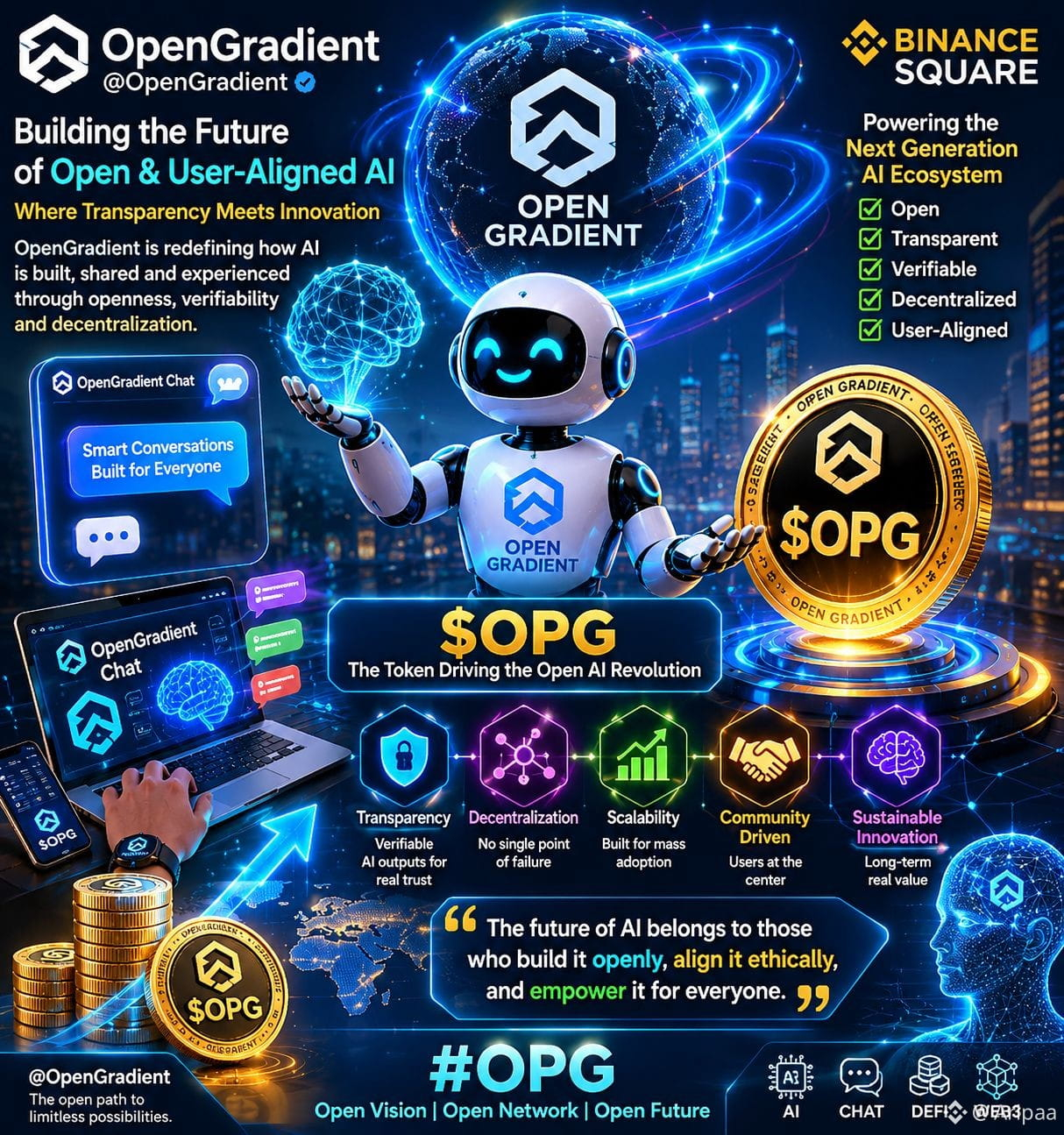
As AI continues to evolve, one of the biggest questions is not how powerful models can become, but how accessible, transparent, and verifiable they are for everyday users. This is why I’ve been paying close attention to @OpenGradient and the growing role of #OpenGradient Chat in the decentralized AI landscape.
Many AI platforms operate as black boxes, where users have little visibility into how outputs are generated or how data is handled. OpenGradient takes a different approach by focusing on openness, verifiability, and user alignment. This creates an environment where trust can be built through transparency rather than assumptions.
OpenGradient Chat demonstrates how AI can become more useful when users are given greater confidence in the systems they interact with. Instead of relying solely on centralized control, decentralized infrastructure can help create a more resilient and community-driven ecosystem. As adoption grows, this model could become increasingly important for developers, creators, researchers, and businesses seeking reliable AI tools.
The long-term opportunity for $OPG is not just about participating in the AI narrative. It is about supporting infrastructure that enables sustainable innovation while maintaining transparency and accountability. In a market filled with hype, projects that focus on real utility and verifiable outcomes may be the ones that create lasting value.
The future of AI may ultimately belong to platforms that balance performance, openness, and trust. OpenGradient is positioning itself at the intersection of these trends, making it a project worth following closely.
$OPG #OPG
#opg $OPG
As AI continues to evolve, one of the biggest questions is not how powerful models can become, but how accessible, transparent, and verifiable they are for everyday users. This is why I’ve been paying close attention to @OpenGradient and the growing role of #OpenGradient Chat in the decentralized AI landscape.
Many AI platforms operate as black boxes, where users have little visibility into how outputs are generated or how data is handled. OpenGradient takes a different approach by focusing on openness, verifiability, and user alignment. This creates an environment where trust can be built through transparency rather than assumptions.
OpenGradient Chat demonstrates how AI can become more useful when users are given greater confidence in the systems they interact with. Instead of relying solely on centralized control, decentralized infrastructure can help create a more resilient and community-driven ecosystem. As adoption grows, this model could become increasingly important for developers, creators, researchers, and businesses seeking reliable AI tools.
The long-term opportunity for $OPG is not just about participating in the AI narrative. It is about supporting infrastructure that enables sustainable innovation while maintaining transparency and accountability. In a market filled with hype, projects that focus on real utility and verifiable outcomes may be the ones that create lasting value.
The future of AI may ultimately belong to platforms that balance performance, openness, and trust. OpenGradient is positioning itself at the intersection of these trends, making it a project worth following closely.
$OPG #OPG
#opg $OPG
Many AI platforms operate as black boxes, where users have little visibility into how outputs are generated or how data is handled. OpenGradient takes a different approach by focusing on openness, verifiability, and user alignment. This creates an environment where trust can be built through transparency rather than assumptions.
OpenGradient Chat demonstrates how AI can become more useful when users are given greater confidence in the systems they interact with. Instead of relying solely on centralized control, decentralized infrastructure can help create a more resilient and community-driven ecosystem. As adoption grows, this model could become increasingly important for developers, creators, researchers, and businesses seeking reliable AI tools.
The long-term opportunity for $OPG is not just about participating in the AI narrative. It is about supporting infrastructure that enables sustainable innovation while maintaining transparency and accountability. In a market filled with hype, projects that focus on real utility and verifiable outcomes may be the ones that create lasting value.
The future of AI may ultimately belong to platforms that balance performance, openness, and trust. OpenGradient is positioning itself at the intersection of these trends, making it a project worth following closely.
$OPG #OPG
#opg $OPG
5
2
78

·
--
Everyone's obsessed with which chain is "fastest" but nobody's asking what actually happens after the transaction gets finalized.
That's where the real architecture debate lives.
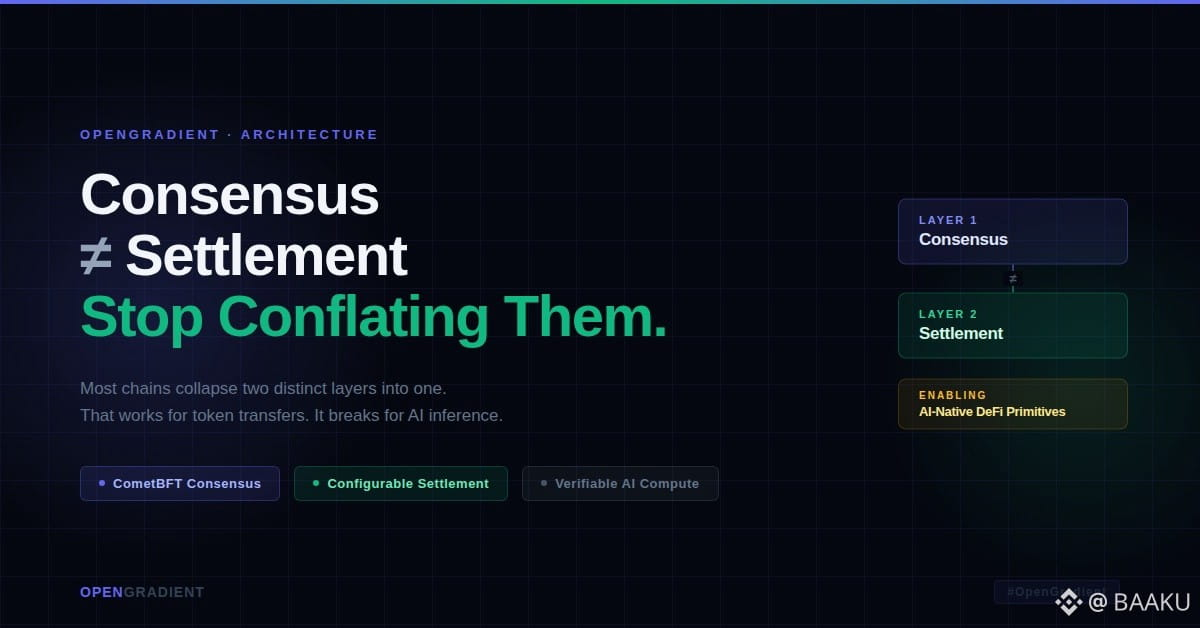
Most L1s treat consensus and settlement like they're the same thing. They're not. Consensus is nodes agreeing something happened. Settlement is the network actually committing to a state that downstream systems can trust and act on. Collapsing those two into one process feels clean until you're building something real on top of it.
The moment you need external systems — oracles, AI inference layers, cross-chain apps — to consume finalized state, you realize the gap matters enormously. A chain that finalizes fast but settles ambiguously is a liability disguised as a feature.
OpenGradient separates these. Consensus runs through CometBFT. Settlement operates as a distinct layer with configurable modes — you pick the settlement behavior that matches your use case. That design decision is quiet. Most people scroll past it. But if you're building AI-powered DeFi or on-chain inference pipelines, it changes what's actually possible.
Here's why: AI model outputs aren't static. They're probabilistic. They need a settlement layer that can handle verification of compute, not just token transfers. A monolithic consensus-settlement system was never designed for that. It was designed for "did wallet A send tokens to wallet B." Full stop.
The honest limitation? Separating consensus and settlement adds architectural complexity. More components means more surface area for failure. Any chain making this tradeoff is betting that the added expressiveness is worth the engineering overhead. That bet could absolutely be wrong depending on how the application layer evolves.
But collapsing them to stay simple also means you're permanently limited to what simple state transitions can express. And the next wave of on-chain primitives — verifiable AI inference, compute markets, model attestation — doesn't fit inside that box.
#OpenGradient #DeFi #Web3
#opg $OPG @OpenGradient
Everyone's obsessed with which chain is "fastest" but nobody's asking what actually happens after the transaction gets finalized.
That's where the real architecture debate lives.
Most L1s treat consensus and settlement like they're the same thing. They're not. Consensus is nodes agreeing something happened. Settlement is the network actually committing to a state that downstream systems can trust and act on. Collapsing those two into one process feels clean until you're building something real on top of it.
The moment you need external systems — oracles, AI inference layers, cross-chain apps — to consume finalized state, you realize the gap matters enormously. A chain that finalizes fast but settles ambiguously is a liability disguised as a feature.
OpenGradient separates these. Consensus runs through CometBFT. Settlement operates as a distinct layer with configurable modes — you pick the settlement behavior that matches your use case. That design decision is quiet. Most people scroll past it. But if you're building AI-powered DeFi or on-chain inference pipelines, it changes what's actually possible.
Here's why: AI model outputs aren't static. They're probabilistic. They need a settlement layer that can handle verification of compute, not just token transfers. A monolithic consensus-settlement system was never designed for that. It was designed for "did wallet A send tokens to wallet B." Full stop.
The honest limitation? Separating consensus and settlement adds architectural complexity. More components means more surface area for failure. Any chain making this tradeoff is betting that the added expressiveness is worth the engineering overhead. That bet could absolutely be wrong depending on how the application layer evolves.
But collapsing them to stay simple also means you're permanently limited to what simple state transitions can express. And the next wave of on-chain primitives — verifiable AI inference, compute markets, model attestation — doesn't fit inside that box.
#OpenGradient #DeFi #Web3
#opg $OPG @OpenGradient
That's where the real architecture debate lives.
Most L1s treat consensus and settlement like they're the same thing. They're not. Consensus is nodes agreeing something happened. Settlement is the network actually committing to a state that downstream systems can trust and act on. Collapsing those two into one process feels clean until you're building something real on top of it.
The moment you need external systems — oracles, AI inference layers, cross-chain apps — to consume finalized state, you realize the gap matters enormously. A chain that finalizes fast but settles ambiguously is a liability disguised as a feature.
OpenGradient separates these. Consensus runs through CometBFT. Settlement operates as a distinct layer with configurable modes — you pick the settlement behavior that matches your use case. That design decision is quiet. Most people scroll past it. But if you're building AI-powered DeFi or on-chain inference pipelines, it changes what's actually possible.
Here's why: AI model outputs aren't static. They're probabilistic. They need a settlement layer that can handle verification of compute, not just token transfers. A monolithic consensus-settlement system was never designed for that. It was designed for "did wallet A send tokens to wallet B." Full stop.
The honest limitation? Separating consensus and settlement adds architectural complexity. More components means more surface area for failure. Any chain making this tradeoff is betting that the added expressiveness is worth the engineering overhead. That bet could absolutely be wrong depending on how the application layer evolves.
But collapsing them to stay simple also means you're permanently limited to what simple state transitions can express. And the next wave of on-chain primitives — verifiable AI inference, compute markets, model attestation — doesn't fit inside that box.
#OpenGradient #DeFi #Web3
#opg $OPG @OpenGradient
1
1
103

·
--
The model invocation of OPG isn't just about "leaving it to the backend" and calling it done.
I've always had a bias against the whole AI on-chain thing:
As soon as I hear "the model will run for you," I've got my pause button ready.
Those three words "run for you" feel way too light.
Light enough to cover up a string of unanswered questions: Which version is running? In what environment is it running? Has the output been tampered with midway? Is the validator looking at the raw result or some second-hand packaging? #OPG
These aren't just technical cleanliness issues; they are the basic materials of trust.
Without these materials, AI on-chain turns from "trusting code" to "trusting some node you don't know."
This reminds me of the customs declaration for ocean freight.
A ship can sail fully automated, equipped with GPS, radar, and autopilot. But what's in the hold, where it was loaded, and whether any containers were switched mid-journey—these questions can't be answered by "autopilot." The customs declaration must be locked in before departure, and each port's customs checks against the same document. If the document can be changed on the fly, no matter how smart the ship is, it's still a black ship.
So when I look at @OpenGradient, I won't first ask how many models it supports or how high the TPS is. $OPG
I'll first look at how its HACA separates "setting sail" and "cargo inspection" into two distinct tasks.
Execution nodes are responsible for running the model, while verification nodes only handle checking the proof. More importantly, it gives developers an optional verification checklist: if you want mathematical certainty, go with ZKML; if you want hardware-level proof, use TEE; if you want low latency, go Vanilla. These three modes aren't just "whatever the backend picks"; they're verification levels chosen by the user before invoking.
This design doesn't sound as comfortable as "one-click AI invocation."
But it gives comfort to something more important: a sense of boundaries.
What the user hands over is an intention, and what the system returns is a verifiable customs declaration. Model version, input environment, output signature—all documented on-chain. It's not about "we trust the node won’t act maliciously," but rather "even if the node wants to act maliciously, it first has to pass this proof stage."
So my interest in #opengradient isn’t about "it makes AI invocation simpler."
What I care about is whether it has turned "hidden reasoning" into "verifiable records."
Computational power can be outsourced.
But every instance of reasoning should ideally be sealed with a stamp before docking. @OpenGradient $BTC $ETH
The model invocation of OPG isn't just about "leaving it to the backend" and calling it done.
I've always had a bias against the whole AI on-chain thing:
As soon as I hear "the model will run for you," I've got my pause button ready.
Those three words "run for you" feel way too light.
Light enough to cover up a string of unanswered questions: Which version is running? In what environment is it running? Has the output been tampered with midway? Is the validator looking at the raw result or some second-hand packaging? #OPG
These aren't just technical cleanliness issues; they are the basic materials of trust.
Without these materials, AI on-chain turns from "trusting code" to "trusting some node you don't know."
This reminds me of the customs declaration for ocean freight.
A ship can sail fully automated, equipped with GPS, radar, and autopilot. But what's in the hold, where it was loaded, and whether any containers were switched mid-journey—these questions can't be answered by "autopilot." The customs declaration must be locked in before departure, and each port's customs checks against the same document. If the document can be changed on the fly, no matter how smart the ship is, it's still a black ship.
So when I look at @OpenGradient, I won't first ask how many models it supports or how high the TPS is. $OPG
I'll first look at how its HACA separates "setting sail" and "cargo inspection" into two distinct tasks.
Execution nodes are responsible for running the model, while verification nodes only handle checking the proof. More importantly, it gives developers an optional verification checklist: if you want mathematical certainty, go with ZKML; if you want hardware-level proof, use TEE; if you want low latency, go Vanilla. These three modes aren't just "whatever the backend picks"; they're verification levels chosen by the user before invoking.
This design doesn't sound as comfortable as "one-click AI invocation."
But it gives comfort to something more important: a sense of boundaries.
What the user hands over is an intention, and what the system returns is a verifiable customs declaration. Model version, input environment, output signature—all documented on-chain. It's not about "we trust the node won’t act maliciously," but rather "even if the node wants to act maliciously, it first has to pass this proof stage."
So my interest in #opengradient isn’t about "it makes AI invocation simpler."
What I care about is whether it has turned "hidden reasoning" into "verifiable records."
Computational power can be outsourced.
But every instance of reasoning should ideally be sealed with a stamp before docking. @OpenGradient $BTC $ETH
I've always had a bias against the whole AI on-chain thing:
As soon as I hear "the model will run for you," I've got my pause button ready.
Those three words "run for you" feel way too light.
Light enough to cover up a string of unanswered questions: Which version is running? In what environment is it running? Has the output been tampered with midway? Is the validator looking at the raw result or some second-hand packaging? #OPG
These aren't just technical cleanliness issues; they are the basic materials of trust.
Without these materials, AI on-chain turns from "trusting code" to "trusting some node you don't know."
This reminds me of the customs declaration for ocean freight.
A ship can sail fully automated, equipped with GPS, radar, and autopilot. But what's in the hold, where it was loaded, and whether any containers were switched mid-journey—these questions can't be answered by "autopilot." The customs declaration must be locked in before departure, and each port's customs checks against the same document. If the document can be changed on the fly, no matter how smart the ship is, it's still a black ship.
So when I look at @OpenGradient, I won't first ask how many models it supports or how high the TPS is. $OPG
I'll first look at how its HACA separates "setting sail" and "cargo inspection" into two distinct tasks.
Execution nodes are responsible for running the model, while verification nodes only handle checking the proof. More importantly, it gives developers an optional verification checklist: if you want mathematical certainty, go with ZKML; if you want hardware-level proof, use TEE; if you want low latency, go Vanilla. These three modes aren't just "whatever the backend picks"; they're verification levels chosen by the user before invoking.
This design doesn't sound as comfortable as "one-click AI invocation."
But it gives comfort to something more important: a sense of boundaries.
What the user hands over is an intention, and what the system returns is a verifiable customs declaration. Model version, input environment, output signature—all documented on-chain. It's not about "we trust the node won’t act maliciously," but rather "even if the node wants to act maliciously, it first has to pass this proof stage."
So my interest in #opengradient isn’t about "it makes AI invocation simpler."
What I care about is whether it has turned "hidden reasoning" into "verifiable records."
Computational power can be outsourced.
But every instance of reasoning should ideally be sealed with a stamp before docking. @OpenGradient $BTC $ETH
355

·
--
Bullish
The OpenGradient project @OpenGradient is a decentralized network focused on verifiable AI. The idea is to allow applications to run artificial intelligence models and cryptographically prove that the output genuinely came from that model and hasn’t been tampered with. Instead of blindly trusting a company, the execution of the AI can be audited and verified on-chain.
Some highlights of the project:
🔹 Infrastructure to host and run AI models in a decentralized manner.
🔹 Use of GPU nodes to process AI inferences.
🔹 Cryptographic verification of results.
🔹 Integration with blockchain and smart contracts.
🔹 The OPG token is used to pay for network services, reward node operators, and participate in governance.
#OPG
#opgusdt
#OpenGradientAI
#opengradient
{future}(OPGUSDT)
The OpenGradient project @OpenGradient is a decentralized network focused on verifiable AI. The idea is to allow applications to run artificial intelligence models and cryptographically prove that the output genuinely came from that model and hasn’t been tampered with. Instead of blindly trusting a company, the execution of the AI can be audited and verified on-chain.
Some highlights of the project:
🔹 Infrastructure to host and run AI models in a decentralized manner.
🔹 Use of GPU nodes to process AI inferences.
🔹 Cryptographic verification of results.
🔹 Integration with blockchain and smart contracts.
🔹 The OPG token is used to pay for network services, reward node operators, and participate in governance.
#OPG
#opgusdt
#OpenGradientAI
#opengradient
Some highlights of the project:
🔹 Infrastructure to host and run AI models in a decentralized manner.
🔹 Use of GPU nodes to process AI inferences.
🔹 Cryptographic verification of results.
🔹 Integration with blockchain and smart contracts.
🔹 The OPG token is used to pay for network services, reward node operators, and participate in governance.
#OPG
#opgusdt
#OpenGradientAI
#opengradient
101

·
--
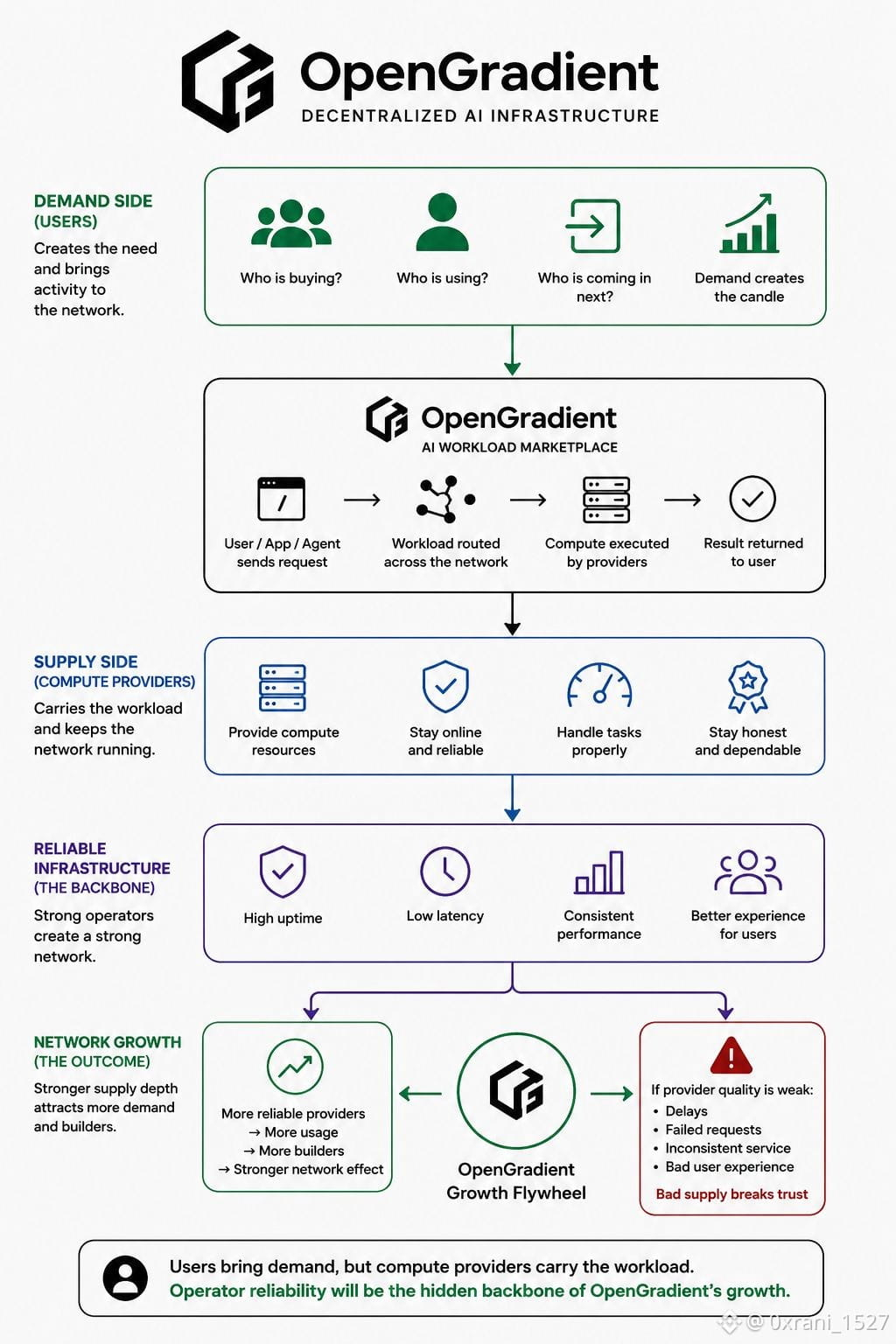
I have seen networks look strong from the user side, then struggle because the supply side was weak. Traders usually focus on demand first. Who is buying? Who is using? Who is coming in next? But every working system also needs reliable suppliers behind the screen.
That is how I think about OpenGradient’s compute side. AI infrastructure does not run on narrative alone. Models need machines. Requests need operators. Workloads need nodes that can stay online, handle tasks properly, and keep the experience from breaking when usage grows.
This is where decentralized AI becomes harder than it sounds. It is not only about letting people use AI. It is about building a network where compute providers have a real reason to stay honest, stay available, and keep serving useful work. In trader language, demand can create the candle, but supply depth keeps the market from falling apart.
The upside is clear. If OpenGradient can keep attracting reliable compute providers, the network becomes more useful for apps, agents, and builders. A stronger operator base can turn AI infrastructure from an idea into something people can actually depend on.
But the risk is also real. If provider quality is weak, users will feel it quickly through delays, failed requests, or inconsistent service. In infrastructure, bad supply shows up as bad user experience.
My view is simple: decentralized AI will not be judged only by how many people want to use it. It will also be judged by how many reliable operators can keep it running.
If users bring demand, but compute providers carry the workload, will operator reliability become the hidden backbone of OpenGradient’s growth?
@OpenGradient $OPG #OpenGradient #OPG
I have seen networks look strong from the user side, then struggle because the supply side was weak. Traders usually focus on demand first. Who is buying? Who is using? Who is coming in next? But every working system also needs reliable suppliers behind the screen.
That is how I think about OpenGradient’s compute side. AI infrastructure does not run on narrative alone. Models need machines. Requests need operators. Workloads need nodes that can stay online, handle tasks properly, and keep the experience from breaking when usage grows.
This is where decentralized AI becomes harder than it sounds. It is not only about letting people use AI. It is about building a network where compute providers have a real reason to stay honest, stay available, and keep serving useful work. In trader language, demand can create the candle, but supply depth keeps the market from falling apart.
The upside is clear. If OpenGradient can keep attracting reliable compute providers, the network becomes more useful for apps, agents, and builders. A stronger operator base can turn AI infrastructure from an idea into something people can actually depend on.
But the risk is also real. If provider quality is weak, users will feel it quickly through delays, failed requests, or inconsistent service. In infrastructure, bad supply shows up as bad user experience.
My view is simple: decentralized AI will not be judged only by how many people want to use it. It will also be judged by how many reliable operators can keep it running.
If users bring demand, but compute providers carry the workload, will operator reliability become the hidden backbone of OpenGradient’s growth?
@OpenGradient $OPG #OpenGradient #OPG
That is how I think about OpenGradient’s compute side. AI infrastructure does not run on narrative alone. Models need machines. Requests need operators. Workloads need nodes that can stay online, handle tasks properly, and keep the experience from breaking when usage grows.
This is where decentralized AI becomes harder than it sounds. It is not only about letting people use AI. It is about building a network where compute providers have a real reason to stay honest, stay available, and keep serving useful work. In trader language, demand can create the candle, but supply depth keeps the market from falling apart.
The upside is clear. If OpenGradient can keep attracting reliable compute providers, the network becomes more useful for apps, agents, and builders. A stronger operator base can turn AI infrastructure from an idea into something people can actually depend on.
But the risk is also real. If provider quality is weak, users will feel it quickly through delays, failed requests, or inconsistent service. In infrastructure, bad supply shows up as bad user experience.
My view is simple: decentralized AI will not be judged only by how many people want to use it. It will also be judged by how many reliable operators can keep it running.
If users bring demand, but compute providers carry the workload, will operator reliability become the hidden backbone of OpenGradient’s growth?
@OpenGradient $OPG #OpenGradient #OPG
4
2
149

·
--
I actually think the OpenGradient team is pretty sharp. They're willing to openly discuss the issue of administrative dependencies, which shows they're already thinking about how to solve it. A lot of folks get scared when they hear 'centralization', but early projects need a strong team to push through legal, technical directions, and ecosystem collaboration. The problem isn't whether there's a dependency, but whether there's a contingency plan. The author presents three dimensions: interference probability, degree of dependency, and recovery capability. The key focus is actually on recovery capability. As long as the team standardizes documentation, permissions, and operational processes in advance, even if there's staff turnover, new people can quickly get up to speed. Just look at the OPG token, it's up 4.96% right now, and the market seems pretty confident in this project. HEI has even skyrocketed by 65%, indicating that funds are pouring into the ecosystem related to OpenGradient. Long-term, I'm more optimistic about the 'faster recovery' option. It's unrealistic to completely eliminate dependencies, especially for new networks. But if you can design a system that allows key functions to transition smoothly within 48 hours, the risk is significantly reduced. If OpenGradient can solidify their recovery mechanism, the value of OPG will only become more stable. The voting results are in 23 hours, and I think reducing dependencies and achieving faster recovery aren't at odds; advancing both simultaneously is the optimal solution. #OPG #OpenGradient
I actually think the OpenGradient team is pretty sharp. They're willing to openly discuss the issue of administrative dependencies, which shows they're already thinking about how to solve it. A lot of folks get scared when they hear 'centralization', but early projects need a strong team to push through legal, technical directions, and ecosystem collaboration. The problem isn't whether there's a dependency, but whether there's a contingency plan. The author presents three dimensions: interference probability, degree of dependency, and recovery capability. The key focus is actually on recovery capability. As long as the team standardizes documentation, permissions, and operational processes in advance, even if there's staff turnover, new people can quickly get up to speed. Just look at the OPG token, it's up 4.96% right now, and the market seems pretty confident in this project. HEI has even skyrocketed by 65%, indicating that funds are pouring into the ecosystem related to OpenGradient. Long-term, I'm more optimistic about the 'faster recovery' option. It's unrealistic to completely eliminate dependencies, especially for new networks. But if you can design a system that allows key functions to transition smoothly within 48 hours, the risk is significantly reduced. If OpenGradient can solidify their recovery mechanism, the value of OPG will only become more stable. The voting results are in 23 hours, and I think reducing dependencies and achieving faster recovery aren't at odds; advancing both simultaneously is the optimal solution. #OPG #OpenGradient
63
·
--
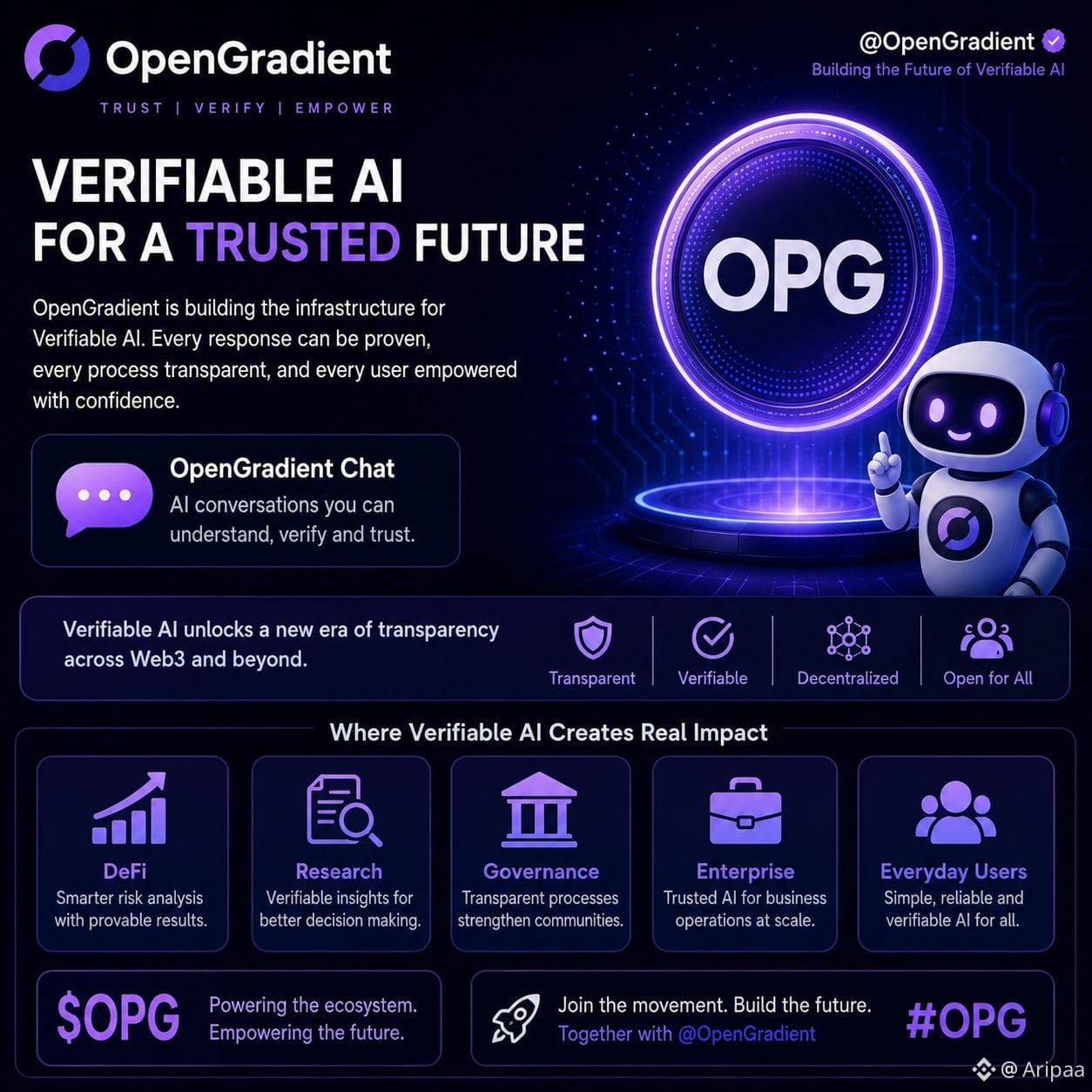
As AI becomes part of everyday decision-making, the biggest challenge is no longer just intelligence—it is trust. Powerful models are useful, but users also need confidence that every response is generated through a transparent and verifiable process. That is why I find @OpenGradient particularly interesting. Instead of asking the community to rely on blind trust, OpenGradient is building an ecosystem where AI outputs can be verified, creating a stronger foundation for developers, businesses, and everyday users.
#OpenGradient Chat represents this vision in a practical way. It combines the convenience of conversational AI with the principles of verifiable computation, helping users understand that trustworthy AI is possible without sacrificing usability. As decentralized technologies continue to evolve, projects that prioritize transparency may become the standard rather than the exception.
The long-term value of AI will depend on accountability just as much as performance. Verifiable AI can unlock new opportunities across DeFi, governance, research, and enterprise applications where confidence in AI-generated results truly matters. I believe @OpenGradient is taking meaningful steps toward that future, and it will be exciting to watch how the ecosystem grows alongside the adoption of $OPG.
#OPG $OPG
#opg $OPG
As AI becomes part of everyday decision-making, the biggest challenge is no longer just intelligence—it is trust. Powerful models are useful, but users also need confidence that every response is generated through a transparent and verifiable process. That is why I find @OpenGradient particularly interesting. Instead of asking the community to rely on blind trust, OpenGradient is building an ecosystem where AI outputs can be verified, creating a stronger foundation for developers, businesses, and everyday users.
#OpenGradient Chat represents this vision in a practical way. It combines the convenience of conversational AI with the principles of verifiable computation, helping users understand that trustworthy AI is possible without sacrificing usability. As decentralized technologies continue to evolve, projects that prioritize transparency may become the standard rather than the exception.
The long-term value of AI will depend on accountability just as much as performance. Verifiable AI can unlock new opportunities across DeFi, governance, research, and enterprise applications where confidence in AI-generated results truly matters. I believe @OpenGradient is taking meaningful steps toward that future, and it will be exciting to watch how the ecosystem grows alongside the adoption of $OPG .
#OPG $OPG
#opg $OPG
#OpenGradient Chat represents this vision in a practical way. It combines the convenience of conversational AI with the principles of verifiable computation, helping users understand that trustworthy AI is possible without sacrificing usability. As decentralized technologies continue to evolve, projects that prioritize transparency may become the standard rather than the exception.
The long-term value of AI will depend on accountability just as much as performance. Verifiable AI can unlock new opportunities across DeFi, governance, research, and enterprise applications where confidence in AI-generated results truly matters. I believe @OpenGradient is taking meaningful steps toward that future, and it will be exciting to watch how the ecosystem grows alongside the adoption of $OPG .
#OPG $OPG
#opg $OPG
10
2
116
Log in to explore more content
Join global crypto users on Binance Square
⚡️ Get latest and useful information about crypto.
💬 Trusted by the world’s largest crypto exchange.
👍 Discover real insights from verified creators.
Email / Phone number
Trending Topics
1
#CPIWatch
86.3M views
500,303 Discussing
2
#BitcoinFallsTo$77KAfterGoldenCross
146 views
19 Discussing
3
#OracleJumpsOver6%OnEarningsBeat
182 views
35 Discussing
4
#CLARITYActRevisionToRuleNonDeFiControllers
7,523 views
169 Discussing
5
#TencentBackedEnflameToStartTradingAfter$911MIPO
1,120 views
18 Discussing
6
#BlockstreamRefusesToPayRansomToLiquidAttacker
4,579 views
128 Discussing
7
#LiquidNetworkResumesBlocksAfter$320MExploit
1,472 views
52 Discussing
8
#USToSanctionBigBankMonday
11,827 views
295 Discussing
9
#TrumpDeclinesSaudiRequestToStrikeHouthis
17,667 views
389 Discussing
10
#CryptoSectorsFallSecondDay
25,769 views
634 Discussing