
#macrocrypto
macrocrypto
203,266 views
1,608 Discussing
Hot
Latest


Article
Are we actually building a parallel financial system—or are we just building a 24/7 frontend for theI spent the last 48 hours scrolling through the #TradFiForBeginners feed on Binance Square, and honestly, it made me realize most of us in crypto are looking at traditional finance completely backwards.
For years, I treated Wall Street like a slow, dusty museum that Web3 was eventually going to bulldoze.
Then I actually started tracking how liquidity moves between legacy markets and on-chain protocols—and it completely broke how I used to read a $BTC chart.
If you’ve spent your entire investing life inside MetaMask wallets, perpetual DEXs, and 24/7 orderbooks, stepping into Traditional Finance (TradFi) feels super clunky.
You suddenly hit closing bells, T+1 settlement delays, and accredited investor gates.
Yet, whether we like it or not, that "legacy" plumbing is now the primary engine driving crypto market structure in 2026—and I’m still wrapping my head around what that actually means for regular traders like us.
The "24/7 Liquidity" Illusion ⏰
When I first started trading $BNB and mid-cap altcoins, I loved that the market never slept.
Sunday night pumps felt pure—just raw, unfiltered crypto supply and demand without suits getting in the way.
What I didn't realize back then is that weekend price action is mostly a low-liquidity mirage waiting to get erased the second New York wakes up on Monday morning.
In TradFi, capital doesn't move because of a Discord announcement; it moves on a rigid macro calendar.
Interest rate decisions, CPI prints, and Treasury yields dictate the global cost of capital.
When the Federal Reserve tightens liquidity, institutional risk desks don't care how fast a Layer-1’s consensus mechanism is.
They hit a single "de-risk" button across their entire book, and $BTC gets sold right alongside tech stocks.
I used to stare at 15-minute RSI indicators all day—now I just check bond yields first, and it’s honestly a little depressing how much more predictive that is.
Why Real-World Assets (RWAs) Actually Click Now 🏦
For a long time, "tokenization" sounded like a corporate buzzword used to pitch boring enterprise chains nobody used.
I was totally skeptical until I started testing on-chain Treasury protocols and tokenized commodities myself during choppy sideways weeks.
Think about what happens when you hold idle stablecoins like USDT orUSDC when the market goes dead.
In pure DeFi, you used to have to chase sketchy, circular token emissions just to squeeze out 4% or 5% yield.
Now, TradFi bridges let you tap directly into US Treasury bills—literally the benchmark risk-free rate of the traditional world—straight from your self-custody wallet.
It’s the same story with tokenized gold like PAXG orXAUT.
Watching how institutional desks use $ETH as the settlement layer for tokenized money market funds made something click for me:
TradFi isn't replacing DeFi, and DeFi isn't killing TradFi—DeFi is slowly becoming the backend settlement rail for TradFi's balance sheet.
(Wait—except here’s the catch that nobody talks about: that entire RWA bridge only works as long as on-chain convenience outweighs custodial haircut risk. The second a major issuer freezes redemptions or Treasury yields drop below native DeFi demand, that capital evaporates right back into pure on-chain risk.)
Spot ETFs Aren't What Retail Thinks 📊
Every beginner hears that "institutional money is coming," usually followed by green rocket emojis.
When I actually dug into how spot BTC andETH ETFs operate behind the scenes, I realized it’s way more mechanical—and cold-blooded—than most of us want to admit.
TradFi asset managers don't "HODL" out of conviction or memes.
They run basis trades, arbitrage spreads, and quarterly portfolio rebalancing.
When you see massive daily inflows into a spot ETF, half the time it isn't a pension fund making a directional bet that $BTC is going to the moon.
It’s a hedge fund buying the spot ETF while simultaneously shorting $BTC futures on the CME to lock in a risk-free funding spread.
Honestly, I’m still not sure if that makes ETF inflows bullish or just noisy—half the time it feels like we’re celebrating hedge funds farming a 6% spread off retail hype.
What Actually Keeps Me Up at Night ⚠️
As wild as this convergence is, I’d be lying if I said watching Wall Street swallow crypto liquidity doesn't make me nervous.
The real threat here is centralization creep and systemic contagion.
Crypto was built as an opt-out mechanism—a lifeboat away from the exact banking fragility we saw during past credit crunches.
The deeper BTC andETH get woven into TradFi collateral frameworks, the more correlated we become to traditional market blowups.
If a major prime broker implodes in Tokyo or New York, they won't hesitate for a second to liquidate their crypto ETF holdings at 9:30 AM EST to cover a margin call on equities.
On top of that, tokenized RWAs introduce off-chain counterparty risk.
A smart contract can be 100% audited and immutable, but if the custodian holding the physical gold bars or Treasury bonds in a vault gets frozen by a regulator, your on-chain token is suddenly just a digital IOU.
We traded trustless code for institutional liquidity, and most beginners don't even realize they signed that deal.
The Paradox We Haven't Solved 💡
I’m not abandoning DeFi, and I’m definitely not opening a dusty brokerage account that closes at 4:00 PM.
I still check the macro calendar before touching leverage, compare DeFi yields against Treasury rates, and wait for Monday’s traditional open before trusting any Sunday night breakout on SOL orETH.
But stepping back, I can’t shake this contradiction:
Crypto needed TradFi liquidity to escape irrelevance, yet the more we absorb Wall Street’s plumbing, the less reason there is for crypto to exist as an alternative at all.
Are we actually building a parallel financial system—or are we just building a 24/7 frontend for the exact same banks?
#TradFiForBeginners #Write2Earn #MacroCrypto #RWA
Not financial advice. Always DYOR.
Are we actually building a parallel financial system—or are we just building a 24/7 frontend for the
I spent the last 48 hours scrolling through the #TradFiForBeginners feed on Binance Square, and honestly, it made me realize most of us in crypto are looking at traditional finance completely backwards.
For years, I treated Wall Street like a slow, dusty museum that Web3 was eventually going to bulldoze.
Then I actually started tracking how liquidity moves between legacy markets and on-chain protocols—and it completely broke how I used to read a $BTC chart.
If you’ve spent your entire investing life inside MetaMask wallets, perpetual DEXs, and 24/7 orderbooks, stepping into Traditional Finance (TradFi) feels super clunky.
You suddenly hit closing bells, T+1 settlement delays, and accredited investor gates.
Yet, whether we like it or not, that "legacy" plumbing is now the primary engine driving crypto market structure in 2026—and I’m still wrapping my head around what that actually means for regular traders like us.
The "24/7 Liquidity" Illusion ⏰
When I first started trading $BNB and mid-cap altcoins, I loved that the market never slept.
Sunday night pumps felt pure—just raw, unfiltered crypto supply and demand without suits getting in the way.
What I didn't realize back then is that weekend price action is mostly a low-liquidity mirage waiting to get erased the second New York wakes up on Monday morning.
In TradFi, capital doesn't move because of a Discord announcement; it moves on a rigid macro calendar.
Interest rate decisions, CPI prints, and Treasury yields dictate the global cost of capital.
When the Federal Reserve tightens liquidity, institutional risk desks don't care how fast a Layer-1’s consensus mechanism is.
They hit a single "de-risk" button across their entire book, and $BTC gets sold right alongside tech stocks.
I used to stare at 15-minute RSI indicators all day—now I just check bond yields first, and it’s honestly a little depressing how much more predictive that is.
Why Real-World Assets (RWAs) Actually Click Now 🏦
For a long time, "tokenization" sounded like a corporate buzzword used to pitch boring enterprise chains nobody used.
I was totally skeptical until I started testing on-chain Treasury protocols and tokenized commodities myself during choppy sideways weeks.
Think about what happens when you hold idle stablecoins like USDT orUSDC when the market goes dead.
In pure DeFi, you used to have to chase sketchy, circular token emissions just to squeeze out 4% or 5% yield.
Now, TradFi bridges let you tap directly into US Treasury bills—literally the benchmark risk-free rate of the traditional world—straight from your self-custody wallet.
It’s the same story with tokenized gold like PAXG orXAUT.
Watching how institutional desks use $ETH as the settlement layer for tokenized money market funds made something click for me:
TradFi isn't replacing DeFi, and DeFi isn't killing TradFi—DeFi is slowly becoming the backend settlement rail for TradFi's balance sheet.
(Wait—except here’s the catch that nobody talks about: that entire RWA bridge only works as long as on-chain convenience outweighs custodial haircut risk. The second a major issuer freezes redemptions or Treasury yields drop below native DeFi demand, that capital evaporates right back into pure on-chain risk.)
Spot ETFs Aren't What Retail Thinks 📊
Every beginner hears that "institutional money is coming," usually followed by green rocket emojis.
When I actually dug into how spot BTC andETH ETFs operate behind the scenes, I realized it’s way more mechanical—and cold-blooded—than most of us want to admit.
TradFi asset managers don't "HODL" out of conviction or memes.
They run basis trades, arbitrage spreads, and quarterly portfolio rebalancing.
When you see massive daily inflows into a spot ETF, half the time it isn't a pension fund making a directional bet that $BTC is going to the moon.
It’s a hedge fund buying the spot ETF while simultaneously shorting $BTC futures on the CME to lock in a risk-free funding spread.
Honestly, I’m still not sure if that makes ETF inflows bullish or just noisy—half the time it feels like we’re celebrating hedge funds farming a 6% spread off retail hype.
What Actually Keeps Me Up at Night ⚠️
As wild as this convergence is, I’d be lying if I said watching Wall Street swallow crypto liquidity doesn't make me nervous.
The real threat here is centralization creep and systemic contagion.
Crypto was built as an opt-out mechanism—a lifeboat away from the exact banking fragility we saw during past credit crunches.
The deeper BTC andETH get woven into TradFi collateral frameworks, the more correlated we become to traditional market blowups.
If a major prime broker implodes in Tokyo or New York, they won't hesitate for a second to liquidate their crypto ETF holdings at 9:30 AM EST to cover a margin call on equities.
On top of that, tokenized RWAs introduce off-chain counterparty risk.
A smart contract can be 100% audited and immutable, but if the custodian holding the physical gold bars or Treasury bonds in a vault gets frozen by a regulator, your on-chain token is suddenly just a digital IOU.
We traded trustless code for institutional liquidity, and most beginners don't even realize they signed that deal.
The Paradox We Haven't Solved 💡
I’m not abandoning DeFi, and I’m definitely not opening a dusty brokerage account that closes at 4:00 PM.
I still check the macro calendar before touching leverage, compare DeFi yields against Treasury rates, and wait for Monday’s traditional open before trusting any Sunday night breakout on SOL orETH.
But stepping back, I can’t shake this contradiction:
Crypto needed TradFi liquidity to escape irrelevance, yet the more we absorb Wall Street’s plumbing, the less reason there is for crypto to exist as an alternative at all.
Are we actually building a parallel financial system—or are we just building a 24/7 frontend for the exact same banks?
#TradFiForBeginners #Write2Earn #MacroCrypto #RWA
Not financial advice. Always DYOR.
1
225

·
--
Macro Headwinds & Record ETF Outflows: Key Levels for BTC, ETH & Capital RotationOver the past 24 hours, the broader crypto market remained under macro-driven selling pressure. $BTC slipped below the $60,000 threshold to $59,481.75 (-2.80%, 24h Vol $1,207.25M), hitting an intraday low of $59,260. $ETH followed lower to $1,667.56 (-3.46%, Vol $561.37M), while high-cap altcoin $XRP traded at $0.9168 (-2.38%, Vol $108.16M).
📉 1. Core Drivers: Structural ETF Redemptions & Hawkish Fed Pricing
Spot Bitcoin ETF outflows have weighed heavily on marginal spot demand. Across 16 November trading sessions, U.S. spot Bitcoin ETFs recorded roughly $4.71B in net redemptions, led by BlackRock IBIT at around $3.99B (roughly 85% of total exits), with recent single-day outflows reaching $509M-$569M.
On the macro front, sticky inflation readings have pushed traders to price in a more restrictive Federal Reserve stance ahead of the December 9 FOMC meeting. Higher Treasury yields and a firmer dollar continue to tighten liquidity across high-beta risk assets, pushing the Crypto Fear & Greed Index deep into Extreme Fear (10-11).
⚖️ 2. Derivatives Positioning: Controlled Deleveraging
Aggregate crypto open interest sits near $102.7B (-2.6%), while BTC futures OI compressed slightly to ~$39.2B. Although dipping under $60,000 triggered fresh long liquidations, perpetual funding rates across major venues remain flat to barely positive around 0.0011% per 8-hour cycle. Leverage is balanced rather than overextended, pointing to active rotation instead of full capitulation.
🎯 3. Key Levels & Sector Rotation
For $BTC, immediate support lies at $59,000-$59,260; a decisive breakdown opens the door toward the 7-day low at $55,130, while overhead supply sits at $61,682 and the 7-day high of $65,002. $ETH remains bounded by its 7-day range of $1,538-$1,845.07, facing near-term resistance near $1,730. $XRP holds above its 7-day low of $0.86, with resistance spanning $0.9615-$1.026.
In this risk-off tape, capital is avoiding broad beta exposure and rotating selectively toward DeFi protocols with tangible yield or ecosystem catalysts. Keep leverage light until ETF flows stabilize.
Market observation only, NFA.
#Bitcoin #Ethereum #MacroCrypto
Macro Headwinds & Record ETF Outflows: Key Levels for BTC, ETH & Capital Rotation
Over the past 24 hours, the broader crypto market remained under macro-driven selling pressure. $BTC slipped below the $60,000 threshold to $59,481.75 (-2.80%, 24h Vol $1,207.25M), hitting an intraday low of $59,260. $ETH followed lower to $1,667.56 (-3.46%, Vol $561.37M), while high-cap altcoin $XRP traded at $0.9168 (-2.38%, Vol $108.16M).
📉 1. Core Drivers: Structural ETF Redemptions & Hawkish Fed Pricing
Spot Bitcoin ETF outflows have weighed heavily on marginal spot demand. Across 16 November trading sessions, U.S. spot Bitcoin ETFs recorded roughly $4.71B in net redemptions, led by BlackRock IBIT at around $3.99B (roughly 85% of total exits), with recent single-day outflows reaching $509M-$569M.
On the macro front, sticky inflation readings have pushed traders to price in a more restrictive Federal Reserve stance ahead of the December 9 FOMC meeting. Higher Treasury yields and a firmer dollar continue to tighten liquidity across high-beta risk assets, pushing the Crypto Fear & Greed Index deep into Extreme Fear (10-11).
⚖️ 2. Derivatives Positioning: Controlled Deleveraging
Aggregate crypto open interest sits near $102.7B (-2.6%), while BTC futures OI compressed slightly to ~$39.2B. Although dipping under $60,000 triggered fresh long liquidations, perpetual funding rates across major venues remain flat to barely positive around 0.0011% per 8-hour cycle. Leverage is balanced rather than overextended, pointing to active rotation instead of full capitulation.
🎯 3. Key Levels & Sector Rotation
For $BTC , immediate support lies at $59,000-$59,260; a decisive breakdown opens the door toward the 7-day low at $55,130, while overhead supply sits at $61,682 and the 7-day high of $65,002. $ETH remains bounded by its 7-day range of $1,538-$1,845.07, facing near-term resistance near $1,730. $XRP holds above its 7-day low of $0.86, with resistance spanning $0.9615-$1.026.
In this risk-off tape, capital is avoiding broad beta exposure and rotating selectively toward DeFi protocols with tangible yield or ecosystem catalysts. Keep leverage light until ETF flows stabilize.
Market observation only, NFA.
#Bitcoin #Ethereum #MacroCrypto

🚨 Asia Just Activated Emergency Market Defenses. Here’s What Traders Need to Know.
After an AI and chip selloff pushed the S&P 500 to a 7-day losing streak and wiped out Nasdaq’s 2026 gains, Asian regulators stepped in ahead of Monday’s open:
🇨🇳 China: Cutting margin rules from 100% to 80% on Nov 30, unlocking ~400B yuan in liquidity.
🇰🇷 South Korea: Emergency weekend talks, a 10.76T won ($7.3B) stabilization fund on standby, and looser buyback rules from Nov 24.
🇹🇼 Taiwan: Short-selling curbs below prior closes, 150% short margin, and state fund buying after its worst week since 1991.
Why this matters for BTC & crypto:
Global liquidity rescues rarely stay confined to stocks. When TradFi hits high stress, crypto prices in the liquidity shift first.
Are you buying this dip or waiting for confirmation? Share your setup!
Tap the charts below to trade and support my work 👇
$BTC $ETH $BLESS
{future}(BLESSUSDT)
{future}(BTCUSDT)
{future}(ETHUSDT)
#chinakoreataiwanpreparestockrescuesaheadofmonday #MarketPullback #CryptoNews #MacroCrypto
🚨 Asia Just Activated Emergency Market Defenses. Here’s What Traders Need to Know.
After an AI and chip selloff pushed the S&P 500 to a 7-day losing streak and wiped out Nasdaq’s 2026 gains, Asian regulators stepped in ahead of Monday’s open:
🇨🇳 China: Cutting margin rules from 100% to 80% on Nov 30, unlocking ~400B yuan in liquidity.
🇰🇷 South Korea: Emergency weekend talks, a 10.76T won ($7.3B) stabilization fund on standby, and looser buyback rules from Nov 24.
🇹🇼 Taiwan: Short-selling curbs below prior closes, 150% short margin, and state fund buying after its worst week since 1991.
Why this matters for BTC & crypto:
Global liquidity rescues rarely stay confined to stocks. When TradFi hits high stress, crypto prices in the liquidity shift first.
Are you buying this dip or waiting for confirmation? Share your setup!
Tap the charts below to trade and support my work 👇
$BTC $ETH $BLESS
#chinakoreataiwanpreparestockrescuesaheadofmonday #MarketPullback #CryptoNews #MacroCrypto

6
4.7k
Will October Core PCE shift Fed rate hike expectations? With markets already pricing in ~90–95% odds of a 25bps hike at the Dec 8–9 FOMC meeting, Wednesday’s Nov 25 release is the ultimate volatility trigger for crypto. 📊
Here is the real setup traders are watching right now:
• Current Baseline: Fed funds sit at 3.75%–4.00% after September's 25bps hike and October's hold. September Core PCE came in hot at 3.1% YoY (+0.3% MoM).
• The Consensus: Oct Core PCE is projected at +0.3% MoM and 3.2% YoY.
• The Hawkish Risk: A print at 0.4% MoM or higher validates Governor Waller’s 50bps shock-hike talk and cements J.P. Morgan’s call for three straight hikes into Q1 2027. Expect DXY to surge and Bitcoin to face heavy downside pressure.
• The Relief Trigger: A soft print at 0.2% or lower won't stop a 25bps December move, but it kills 50bps tail risk and gives risk assets breathing room after $1.78B in recent ETF outflows.
Stay nimble on leverage ahead of Wednesday's 8:30 AM ET print. Are you positioning for a hawkish surprise or a relief bounce? 👇
$BTC $ARIA $BLESS
{future}(BLESSUSDT)
{future}(ARIAUSDT)
{future}(BTCUSDT)
#willoctcorepceshiftfedhikeexpectations?
#FOMC #MacroCrypto #Bitcoin
Will October Core PCE shift Fed rate hike expectations? With markets already pricing in ~90–95% odds of a 25bps hike at the Dec 8–9 FOMC meeting, Wednesday’s Nov 25 release is the ultimate volatility trigger for crypto. 📊
Here is the real setup traders are watching right now:
• Current Baseline: Fed funds sit at 3.75%–4.00% after September's 25bps hike and October's hold. September Core PCE came in hot at 3.1% YoY (+0.3% MoM).
• The Consensus: Oct Core PCE is projected at +0.3% MoM and 3.2% YoY.
• The Hawkish Risk: A print at 0.4% MoM or higher validates Governor Waller’s 50bps shock-hike talk and cements J.P. Morgan’s call for three straight hikes into Q1 2027. Expect DXY to surge and Bitcoin to face heavy downside pressure.
• The Relief Trigger: A soft print at 0.2% or lower won't stop a 25bps December move, but it kills 50bps tail risk and gives risk assets breathing room after $1.78B in recent ETF outflows.
Stay nimble on leverage ahead of Wednesday's 8:30 AM ET print. Are you positioning for a hawkish surprise or a relief bounce? 👇
$BTC $ARIA $BLESS
#willoctcorepceshiftfedhikeexpectations?
#FOMC #MacroCrypto #Bitcoin

2
4.3k

🚨 $BTC FACES THE ULTIMATE MACRO VOLATILITY TRIGGER THIS WEDNESDAY! ⚡
The macroeconomic battle lines are drawn as markets price in near certainty for a December rate move, leaving Wednesday's Core PCE print as the ultimate catalyst for crypto liquidity. 📊
A hot reading risks validating aggressive tightening talk and heavy downside pressure following recent institutional ETF outflows, while a soft print offers much-needed breathing room across $BTC , $ARIA , and $BLESS . ⚡
Are you positioning for a hawkish shock or preparing for a clean relief bounce before the holiday liquidity shift? 👇
⚠️ Not financial advice. Always manage your risk. 🛡️
🏷️ #BTC #MacroCrypto #FOMC #Crypto
🔥 💎

9
·
--
ETF outflows persist amid hawkish macro expectations: Tracking BTC’s battle for $60,000 and sector rotationOver the past 24 hours, the crypto market remained under macroeconomic pressure. $BTC fell below the $60,000 threshold and is currently trading at $59,481.75 (24-hour decline of -2.80%, trading volume of $1,207.25M), after touching an intraday low of $59,260. $ETH also slipped to $1,667.56 (-3.46%, trading volume of $561.37M), while large-cap altcoin $XRP is at $0.9168 (-2.38%, trading volume of $108.16M).
📉 I. Key sources of pressure: ETF redemptions and tighter Fed expectations
1. Institutional fund flows: U.S. spot Bitcoin ETFs saw cumulative net outflows of approximately $4.71B over the first 16 trading days of November, with BlackRock’s IBIT alone seeing outflows of about $3.99B (approximately 85% of the total). Recent daily net redemptions have also reached $509M–$569M, and the absence of institutional buying has weakened spot-market support.
ETF outflows persist amid hawkish macro expectations: Tracking BTC’s battle for $60,000 and sector rotation
Over the past 24 hours, the crypto market remained under macroeconomic pressure. $BTC fell below the $60,000 threshold and is currently trading at $59,481.75 (24-hour decline of -2.80%, trading volume of $1,207.25M), after touching an intraday low of $59,260. $ETH also slipped to $1,667.56 (-3.46%, trading volume of $561.37M), while large-cap altcoin $XRP is at $0.9168 (-2.38%, trading volume of $108.16M).
📉 I. Key sources of pressure: ETF redemptions and tighter Fed expectations
1. Institutional fund flows: U.S. spot Bitcoin ETFs saw cumulative net outflows of approximately $4.71B over the first 16 trading days of November, with BlackRock’s IBIT alone seeing outflows of about $3.99B (approximately 85% of the total). Recent daily net redemptions have also reached $509M–$569M, and the absence of institutional buying has weakened spot-market support.
3

·
--
Picture this: a nation cut off from traditional global banking channels suddenly instructs its largest financial institutions to start treating digital assets as legitimate economic tools.
Most retail traders get shaken out by regulatory headlines and panic sell, completely missing the fact that real institutional rails are usually built during periods of extreme friction. We obsess over short-term bans while sovereign players quietly lay the groundwork to move billions outside legacy rails.
What is unfolding across Russia right now feels remarkably similar to the pivot we saw with Hong Kong after years of crackdowns. When traditional cross-border settlement grinds to a halt, pragmatism wins over ideology. State-aligned banks are no longer just exploring pilot programs; they are actively preparing systems to settle international trade using $BTC and dollar-pegged liquidity like $USDT.
Historically, when a major economic power normalizes decentralized settlement out of pure necessity, neighboring markets are forced to adapt. We watched early sovereign experiments with $ETH and digital reserves play out on a smaller scale, but watching heavyweight institutions legitimize the asset class shifts the narrative from pure speculation to critical infrastructure.
Do you think necessity-driven adoption like this will speed up global clear-cut regulations, or will it split the market into competing regional systems?
#CryptoAdoption #Bitcoin #MacroCrypto

64
·
--
Post-Deleveraging Recovery Watch: Key Zones for $BTC, $ETH, and $BNBFollowing weeks of macro headwinds and a sharp derivatives reset, major crypto assets are staging a modest relief bounce today while remaining inside broader consolidation ranges.
📌 Macro and Derivatives Backdrop
Pressured by tech-equity pullbacks and a firmer U.S. dollar, U.S. spot Bitcoin ETFs recorded over $1.1B in weekly net outflows across mid-to-late November, while spot Ethereum ETFs extended multi-week outflow streaks. The prior selloff pushed cumulative market-wide liquidations toward $6B, and BTC-denominated futures open interest contracted from monthly highs near 356,000 BTC down toward 330,000 BTC or lower. Perpetual funding rates across major venues have cooled to neutral-to-mixed levels, confirming that aggressive leverage has been flushed out and price discovery is shifting back toward spot demand.
📊 Major Asset Levels on Binance Spot
1. $BTC trades at $61,318.95 (+2.33%, $1,210.88M 24h vol), rebounding from a $58,768.51 intraday low toward $61,669.99. Within its 7-day range ($55,130 to $65,696.16), immediate support sits around $58,700–$59,000, while bulls must reclaim $62,500–$65,700 on strong volume to shift medium-term structure.
2. $ETH is at $1,721.76 (+2.45%, $398.24M vol), moving between $1,648.35 and $1,732.52 over the past 24h (7d range $1,538 to $1,866.89). Key support holds near $1,650, with overhead resistance at $1,750–$1,867 as traders monitor whether ETF outflows stabilize.
3. $BNB trades at $559.62 (+2.43%, $48.82M vol), testing its 24h high of $560.15 inside a 7-day band of $503.75 to $599.42. Support sits near $536–$540, with resistance toward $580–$600.
🔄 Sector Rotation and Outlook
With sentiment still cautious, capital is avoiding blind beta chasing and rotating selectively into tokens backed by tangible RWA adoption or supply-cut governance catalysts. A durable recovery across majors still hinges on ETF flow stabilization and calmer macro equity conditions.
#Bitcoin #Ethereum #MacroCrypto
Market observation only, NFA.
Post-Deleveraging Recovery Watch: Key Zones for $BTC, $ETH, and $BNB
Following weeks of macro headwinds and a sharp derivatives reset, major crypto assets are staging a modest relief bounce today while remaining inside broader consolidation ranges.
📌 Macro and Derivatives Backdrop
Pressured by tech-equity pullbacks and a firmer U.S. dollar, U.S. spot Bitcoin ETFs recorded over $1.1B in weekly net outflows across mid-to-late November, while spot Ethereum ETFs extended multi-week outflow streaks. The prior selloff pushed cumulative market-wide liquidations toward $6B, and BTC-denominated futures open interest contracted from monthly highs near 356,000 BTC down toward 330,000 BTC or lower. Perpetual funding rates across major venues have cooled to neutral-to-mixed levels, confirming that aggressive leverage has been flushed out and price discovery is shifting back toward spot demand.
📊 Major Asset Levels on Binance Spot
1. $BTC trades at $61,318.95 (+2.33%, $1,210.88M 24h vol), rebounding from a $58,768.51 intraday low toward $61,669.99. Within its 7-day range ($55,130 to $65,696.16), immediate support sits around $58,700–$59,000, while bulls must reclaim $62,500–$65,700 on strong volume to shift medium-term structure.
2. $ETH is at $1,721.76 (+2.45%, $398.24M vol), moving between $1,648.35 and $1,732.52 over the past 24h (7d range $1,538 to $1,866.89). Key support holds near $1,650, with overhead resistance at $1,750–$1,867 as traders monitor whether ETF outflows stabilize.
3. $BNB trades at $559.62 (+2.43%, $48.82M vol), testing its 24h high of $560.15 inside a 7-day band of $503.75 to $599.42. Support sits near $536–$540, with resistance toward $580–$600.
🔄 Sector Rotation and Outlook
With sentiment still cautious, capital is avoiding blind beta chasing and rotating selectively into tokens backed by tangible RWA adoption or supply-cut governance catalysts. A durable recovery across majors still hinges on ETF flow stabilization and calmer macro equity conditions.
#Bitcoin #Ethereum #MacroCrypto
Market observation only, NFA.
2
·
--
Liquidity Recovery After Extreme Fear: BTC Back Above $61,000—A Full Analysis of ETF Outflows and the Battle Over Negative Funding RatesRecently, the crypto market experienced a sharp macro-driven deleveraging shock, with the Fear & Greed Index briefly falling to 7 (extreme fear). As Nasdaq 100 futures rebounded more than 3% and concerns about the AI sector temporarily eased, major assets staged an oversold recovery. However, institutional fund flows and derivatives market structure continue to send complex signals.
I. Prices of Core Assets and Key Ranges
1️⃣ $BTC Currently at $61,352.06 (24h +1.08%), with 24h spot trading volume of $970.45M. Over the past 7 days, the price has fluctuated widely between a low of $55,130 and a high of $65,447. After the earlier dip to $55,130 triggered heavy long liquidations, short covering pushed the price back above $61,000. Near-term support is at $57,300-$60,000, with strong resistance at $65,000-$65,447.
Liquidity Recovery After Extreme Fear: BTC Back Above $61,000—A Full Analysis of ETF Outflows and the Battle Over Negative Funding Rates
Recently, the crypto market experienced a sharp macro-driven deleveraging shock, with the Fear & Greed Index briefly falling to 7 (extreme fear). As Nasdaq 100 futures rebounded more than 3% and concerns about the AI sector temporarily eased, major assets staged an oversold recovery. However, institutional fund flows and derivatives market structure continue to send complex signals.
I. Prices of Core Assets and Key Ranges
1️⃣ $BTC Currently at $61,352.06 (24h +1.08%), with 24h spot trading volume of $970.45M. Over the past 7 days, the price has fluctuated widely between a low of $55,130 and a high of $65,447. After the earlier dip to $55,130 triggered heavy long liquidations, short covering pushed the price back above $61,000. Near-term support is at $57,300-$60,000, with strong resistance at $65,000-$65,447.
3

·
--
The Fed is hawkish, real yields are rising, and Bitcoin's link to the Nasdaq is 0.69. This is a macro selloff. 📊
Bitcoin's 40 day correlation with the Nasdaq 100 sits at about 0.69 during November 2026, according to TFTC, and the same report points to higher inflation adjusted Treasury yields and a more hawkish Federal Reserve as the main drivers of the fall. When real yields rise, bonds pay more for holding them, and a coin that pays nothing looks less attractive, so Bitcoin falls with stocks instead of trading on its own story. My view is that this is why the crypto bounce needs stocks to turn first, and why I watch the Nasdaq open every day before I trust a crypto long. 📰
Do you think Bitcoin breaks free from stocks soon, or does it need the Fed to turn first? 🤔
Source: TFTC.
Futures trading is risky, trade small and manage risk. ⚠️
Follow for more trades.
#Crypto #Bitcoin #FuturesTrading #TradingSignals #MacroCrypto


Why is nobody talking about how traditional consumer earnings reports like Airbnb's November 5 release expose the real direction of retail crypto liquidity?
Most traders lose capital because they stay glued to low-timeframe charts while completely ignoring the macro shifts that drain consumer wallets. You cannot expect sustained market rallies if retail discretionary spending is quietly contracting in the background.
The prevailing narrative tells you to only watch central bank policy, but household balance sheets dictate whether spare capital ever flows into $BTC. When consumer platform earnings drop, look closely at booking growth and consumer demand rather than just headline revenue. A slowdown in discretionary spending shows that the disposable cash fueling speculative markets is drying up weeks before on-chain volume reflects it.
To stay ahead, turn these corporate reports into an actionable liquidity roadmap. Compare consumer platform health against active volume across $ETH to spot momentum exhaustion before the herd catches on. If discretionary spending tightens while crypto pushes into resistance, use that divergence to trim risk rather than chasing breakouts, and wait for consumer sentiment to stabilize before re-entering assets like $SOL.
Are you factoring consumer earnings into your market bias, or do you strictly trade the charts?
#MacroCrypto #Bitcoin #TradingStrategy
Why is nobody talking about how traditional consumer earnings reports like Airbnb's November 5 release expose the real direction of retail crypto liquidity?
Most traders lose capital because they stay glued to low-timeframe charts while completely ignoring the macro shifts that drain consumer wallets. You cannot expect sustained market rallies if retail discretionary spending is quietly contracting in the background.
The prevailing narrative tells you to only watch central bank policy, but household balance sheets dictate whether spare capital ever flows into $BTC . When consumer platform earnings drop, look closely at booking growth and consumer demand rather than just headline revenue. A slowdown in discretionary spending shows that the disposable cash fueling speculative markets is drying up weeks before on-chain volume reflects it.
To stay ahead, turn these corporate reports into an actionable liquidity roadmap. Compare consumer platform health against active volume across $ETH to spot momentum exhaustion before the herd catches on. If discretionary spending tightens while crypto pushes into resistance, use that divergence to trim risk rather than chasing breakouts, and wait for consumer sentiment to stabilize before re-entering assets like $SOL .
Are you factoring consumer earnings into your market bias, or do you strictly trade the charts?
#MacroCrypto #Bitcoin #TradingStrategy
111
·
--
Macro Deleveraging and ETF Outflows: Key Defensive Levels for $BTC, $ETH, and $BNBThe crypto market has entered a macro-driven deleveraging phase as a firmer U.S. dollar, Treasury yields above 5%, and hawkish Federal Reserve expectations weigh on risk assets alongside a tech-led equities pullback.
1. Spot ETF Flows: Institutional Redemptions Add Overhead Supply
Throughout November, U.S. spot Bitcoin ETFs have logged nearly $3.5 billion in cumulative net outflows, including a sharp $582.3 million single-day exit on November 19 led by $541.1 million from BlackRock IBIT. This steady redemption pace has temporarily removed a major structural bid from spot markets.
2. Derivatives Reset: Leverage Cleared, Funding Compressed
Recent breakdown waves wiped out $1.2B–$2.0B in 24-hour liquidations, with 80%–86% coming from overleveraged longs. Aggregated futures open interest has contracted sharply, while 8h funding rates across major venues have cooled to near-neutral levels of 0.0015%–0.0056% (with occasional negative prints), signaling that speculative long crowding has largely been flushed.
3. Key Levels and Defensive Sector Rotation
$BTC trades at $59,110.56 (-4.85% 24h) on $2.31B Binance spot volume, testing its 7-day low support at $57,778.35 after slipping below $60,000. Reclaiming the $60,000–$62,640 zone is necessary to ease immediate downside pressure.
$ETH trades at $1,627.23 (-7.35% 24h) on $1.11B volume, hovering above its 7-day low at $1,581.47 with resistance at $1,700–$1,770.55.
$BNB stands at $540.14 (-6.98% 24h) on $135.65M volume, watching $530.00 support against $565–$581.92 resistance.
Sector rotation highlights a clear flight to safety: tokenized gold assets XAUT and PAXG slipped only 1.6%–1.8%, significantly outperforming high-beta altcoins and tech-linked tokens.
4. Bull vs. Bear Outlook
With leverage reset and funding flat, any pause in ETF outflows or softer macro data could spark a sharp short-covering bounce. Until then, defensive risk management around the $57,778 support remains essential.
Market observation only, NFA.
#Bitcoin #Ethereum #MacroCrypto
Macro Deleveraging and ETF Outflows: Key Defensive Levels for $BTC, $ETH, and $BNB
The crypto market has entered a macro-driven deleveraging phase as a firmer U.S. dollar, Treasury yields above 5%, and hawkish Federal Reserve expectations weigh on risk assets alongside a tech-led equities pullback.
1. Spot ETF Flows: Institutional Redemptions Add Overhead Supply
Throughout November, U.S. spot Bitcoin ETFs have logged nearly $3.5 billion in cumulative net outflows, including a sharp $582.3 million single-day exit on November 19 led by $541.1 million from BlackRock IBIT. This steady redemption pace has temporarily removed a major structural bid from spot markets.
2. Derivatives Reset: Leverage Cleared, Funding Compressed
Recent breakdown waves wiped out $1.2B–$2.0B in 24-hour liquidations, with 80%–86% coming from overleveraged longs. Aggregated futures open interest has contracted sharply, while 8h funding rates across major venues have cooled to near-neutral levels of 0.0015%–0.0056% (with occasional negative prints), signaling that speculative long crowding has largely been flushed.
3. Key Levels and Defensive Sector Rotation
$BTC trades at $59,110.56 (-4.85% 24h) on $2.31B Binance spot volume, testing its 7-day low support at $57,778.35 after slipping below $60,000. Reclaiming the $60,000–$62,640 zone is necessary to ease immediate downside pressure.
$ETH trades at $1,627.23 (-7.35% 24h) on $1.11B volume, hovering above its 7-day low at $1,581.47 with resistance at $1,700–$1,770.55.
$BNB stands at $540.14 (-6.98% 24h) on $135.65M volume, watching $530.00 support against $565–$581.92 resistance.
Sector rotation highlights a clear flight to safety: tokenized gold assets XAUT and PAXG slipped only 1.6%–1.8%, significantly outperforming high-beta altcoins and tech-linked tokens.
4. Bull vs. Bear Outlook
With leverage reset and funding flat, any pause in ETF outflows or softer macro data could spark a sharp short-covering bounce. Until then, defensive risk management around the $57,778 support remains essential.
Market observation only, NFA.
#Bitcoin #Ethereum #MacroCrypto
2
·
--
Key support structures for $BTC, $ETH, and $BNB amid ETF outflows and high interest ratesThe crypto market has recently entered a phase of deep, macro-driven deleveraging. A stronger U.S. dollar, Treasury yields holding above 5%, concerns about a hawkish Fed policy in December, and a pullback in U.S. tech stocks have all weighed on risk assets.
1️⃣ Spot ETF flows: Institutional withdrawals are creating overhead selling pressure
Since November, cumulative net outflows from U.S. spot Bitcoin ETFs have approached $3.5 billion, including a single-day net outflow of $582.3 million on November 19 (with BlackRock’s IBIT seeing $541.1 million in outflows that day). The temporary retreat of institutional buying has weakened a key source of demand that had previously absorbed spot selling pressure.
Key support structures for $BTC, $ETH, and $BNB amid ETF outflows and high interest rates
The crypto market has recently entered a phase of deep, macro-driven deleveraging. A stronger U.S. dollar, Treasury yields holding above 5%, concerns about a hawkish Fed policy in December, and a pullback in U.S. tech stocks have all weighed on risk assets.
1️⃣ Spot ETF flows: Institutional withdrawals are creating overhead selling pressure
Since November, cumulative net outflows from U.S. spot Bitcoin ETFs have approached $3.5 billion, including a single-day net outflow of $582.3 million on November 19 (with BlackRock’s IBIT seeing $541.1 million in outflows that day). The temporary retreat of institutional buying has weakened a key source of demand that had previously absorbed spot selling pressure.
33
·
--
Macro Tightening Meets ETF Outflows: Can $BTC Hold $61,760 as $ETH and $BNB Show Relative Resilience?The cryptocurrency market has navigated a sharp one-two punch of macroeconomic tightening and derivatives deleveraging over the past week. At press time, $BTC trades at $62,118 (-0.80% over 24h on $1,195.01M Binance spot volume), hovering just above its 7-day low of $61,760.25 and down more than 13% from its 7-day high of $71,514.01. Meanwhile, $ETH at $1,761.74 (+0.63%) and $BNB at $581.50 (+0.46%) are showing modest relative strength.
1. Macro Liquidity and Spot ETF Redemptions
Firmer-than-expected inflation prints have pushed market pricing for a December Federal Reserve rate hike near 92%, lifting 10-year U.S. Treasury yields above 5.1% and driving the U.S. Dollar Index (DXY) to multi-month highs. That liquidity drain is visible in institutional flows: U.S. spot Bitcoin ETFs have recorded roughly $1.9B to $2.1B in cumulative net outflows across November, removing a key pillar of spot demand.
2. Derivatives Flush, Negative Funding, and Options Skew
Mid-November volatility triggered $1.3B to $1.7B in leveraged liquidations, with long positions accounting for 88% to 92% of the wipeout. Following that reset, perpetual funding rates across major exchanges have flipped negative, while 1-month 25-delta options skew climbed above 20, signaling heavy demand for downside put protection. Even so, Binance has led a fresh uptick in Ethereum futures open interest, pointing to early, selective positioning in core large-caps.
3. Key Support and Resistance Zones
$BTC must defend the $61,760 7-day low to avoid another leg down, while initial overhead resistance sits at the 24h high of $64,080.80.
$ETH is watching $1,711 to $1,748 as structural support, with a break above $1,817.57 needed to confirm relative outperformance.
$BNB remains range-bound between $566.00 and $594.00, backed by steady ecosystem demand.
With funding negative and protective put skew elevated, defensive positioning dominates. Until spot ETF outflows stabilize, traders should respect key support boundaries and manage leverage tightly.
#Bitcoin #Ethereum #MacroCrypto
Market observation only, NFA.
Macro Tightening Meets ETF Outflows: Can $BTC Hold $61,760 as $ETH and $BNB Show Relative Resilience?
The cryptocurrency market has navigated a sharp one-two punch of macroeconomic tightening and derivatives deleveraging over the past week. At press time, $BTC trades at $62,118 (-0.80% over 24h on $1,195.01M Binance spot volume), hovering just above its 7-day low of $61,760.25 and down more than 13% from its 7-day high of $71,514.01. Meanwhile, $ETH at $1,761.74 (+0.63%) and $BNB at $581.50 (+0.46%) are showing modest relative strength.
1. Macro Liquidity and Spot ETF Redemptions
Firmer-than-expected inflation prints have pushed market pricing for a December Federal Reserve rate hike near 92%, lifting 10-year U.S. Treasury yields above 5.1% and driving the U.S. Dollar Index (DXY) to multi-month highs. That liquidity drain is visible in institutional flows: U.S. spot Bitcoin ETFs have recorded roughly $1.9B to $2.1B in cumulative net outflows across November, removing a key pillar of spot demand.
2. Derivatives Flush, Negative Funding, and Options Skew
Mid-November volatility triggered $1.3B to $1.7B in leveraged liquidations, with long positions accounting for 88% to 92% of the wipeout. Following that reset, perpetual funding rates across major exchanges have flipped negative, while 1-month 25-delta options skew climbed above 20, signaling heavy demand for downside put protection. Even so, Binance has led a fresh uptick in Ethereum futures open interest, pointing to early, selective positioning in core large-caps.
3. Key Support and Resistance Zones
$BTC must defend the $61,760 7-day low to avoid another leg down, while initial overhead resistance sits at the 24h high of $64,080.80.
$ETH is watching $1,711 to $1,748 as structural support, with a break above $1,817.57 needed to confirm relative outperformance.
$BNB remains range-bound between $566.00 and $594.00, backed by steady ecosystem demand.
With funding negative and protective put skew elevated, defensive positioning dominates. Until spot ETF outflows stabilize, traders should respect key support boundaries and manage leverage tightly.
#Bitcoin #Ethereum #MacroCrypto
Market observation only, NFA.
80
·
--
Squeezed by Macro Tightening and ETF Outflows: $BTC Defends $61,760—How Are Funds Rotating?Over the past week, the crypto market has faced the combined impact of significant macro-driven risk aversion and deleveraging in derivatives. As of now, $BTC is trading at $62,118 (down slightly by 0.80% over 24 hours, with a trading volume of $1,195.01M). It briefly fell to a 7-day low of $61,760.25 intraday, a decline of more than 13% from its 7-day high of $71,514.01. Over the same period, $ETH is at $1,761.74 (+0.63%), and $BNB is at $581.50 (+0.46%), showing slightly greater resilience than Bitcoin.
I. Macro Liquidity and ETF Flows Under Pressure
Recently hotter-than-expected inflation data have raised market expectations of a Fed rate hike in December (with the implied probability approaching 92%). The 10-year Treasury yield has broken above 5.1%, while the U.S. Dollar Index (DXY) has strengthened, continuing to drain liquidity from riskier assets. Institutional demand has also cooled: since November, U.S. spot Bitcoin ETFs have seen cumulative net outflows of approximately $1.9 billion to $2.1 billion, with buying support weakening significantly.
Squeezed by Macro Tightening and ETF Outflows: $BTC Defends $61,760—How Are Funds Rotating?
Over the past week, the crypto market has faced the combined impact of significant macro-driven risk aversion and deleveraging in derivatives. As of now, $BTC is trading at $62,118 (down slightly by 0.80% over 24 hours, with a trading volume of $1,195.01M). It briefly fell to a 7-day low of $61,760.25 intraday, a decline of more than 13% from its 7-day high of $71,514.01. Over the same period, $ETH is at $1,761.74 (+0.63%), and $BNB is at $581.50 (+0.46%), showing slightly greater resilience than Bitcoin.
I. Macro Liquidity and ETF Flows Under Pressure
Recently hotter-than-expected inflation data have raised market expectations of a Fed rate hike in December (with the implied probability approaching 92%). The 10-year Treasury yield has broken above 5.1%, while the U.S. Dollar Index (DXY) has strengthened, continuing to drain liquidity from riskier assets. Institutional demand has also cooled: since November, U.S. spot Bitcoin ETFs have seen cumulative net outflows of approximately $1.9 billion to $2.1 billion, with buying support weakening significantly.
1
·
--
Market-Wide Deleveraging Amid ETF Outflows and Macroeconomic Pressures: Key BTC, ETH, and BNB Support LevelsThe crypto market has recently undergone a sharp correction, with macro interest rate expectations and institutional fund flows emerging as the key drivers of short-term volatility. Real-time market data shows that major assets are broadly under pressure, while the derivatives market has already completed a round of substantial deleveraging.
📌 Real-Time Prices and 7-Day Range Performance
1️⃣ $BTC Currently at $62,612.01 (24h -2.28%), with daily trading volume reaching $1,241.24M. The 7-day high is $74,217.49 and the low is $62,006; the price is now approaching the week's low as a key support level.
2️⃣ $ETH Currently at $1,750.43 (24h -2.85%), with a trading volume of $547.87M and a 7-day range of $1,711.08 to $2,066.42.
Market-Wide Deleveraging Amid ETF Outflows and Macroeconomic Pressures: Key BTC, ETH, and BNB Support Levels
The crypto market has recently undergone a sharp correction, with macro interest rate expectations and institutional fund flows emerging as the key drivers of short-term volatility. Real-time market data shows that major assets are broadly under pressure, while the derivatives market has already completed a round of substantial deleveraging.
📌 Real-Time Prices and 7-Day Range Performance
1️⃣ $BTC Currently at $62,612.01 (24h -2.28%), with daily trading volume reaching $1,241.24M. The 7-day high is $74,217.49 and the low is $62,006; the price is now approaching the week's low as a key support level.
2️⃣ $ETH Currently at $1,750.43 (24h -2.85%), with a trading volume of $547.87M and a 7-day range of $1,711.08 to $2,066.42.
1
·
--
After the 2B Leverage Flush: Key Levels for $BTC, $ETH, and $BNBMacro headwinds drove a sharp risk-off correction across digital assets over the past 48 hours. With 10-year U.S. Treasury yields pressing near 5.15% and sticky inflation clouding the December Federal Reserve outlook, the Crypto Fear and Greed Index plunged toward 10 in extreme fear territory. Over $1.9 billion to $2 billion in leveraged positions were liquidated during the weekend sell-off, pulling global open interest down 8% to 9% in a single day and over 15% on the week. Perpetual funding rates across major venues have flattened or flipped negative, clearing out overcrowded long leverage.
🔍 Institutional Flows Remain the Key Driver
U.S. spot Bitcoin ETFs recorded seven consecutive sessions of net outflows, bringing cumulative redemptions past $2.5 billion over the past two weeks. Until spot ETF demand stabilizes, relief bounces remain vulnerable to macro-driven selling pressure.
📌 Key Technical Zones to Watch
1. $BTC currently trades near $65,062 ($1.40B 24h spot volume on Binance) after rebounding from its 7-day low of $62,006. Immediate support holds at $62,000 to $63,900, while bulls must reclaim $65,700 and the $70,000 psychological barrier to shift momentum.
2. $ETH sits at $1,817.91 (-0.69%, $573.78M volume) within a 7-day range of $1,711 to $2,137. Key downside support rests at $1,711 to $1,787, with near-term resistance stacked at $1,867 to $2,000.
3. $BNB trades at $591.59 (-0.24%, $67.70M volume), showing relative resilience above its $566 7-day low. Overhead resistance sits around $598 to $620.
💡 Rotation and Risk Outlook
With speculative leverage purged, capital is rotating defensively away from high-beta perpetuals toward spot assets with resilient liquidity or isolated catalysts. Watch daily ETF flow reversals and open interest rebuilding before assuming a sustained trend shift.
#Bitcoin #Ethereum #MacroCrypto
Market observation only, NFA.
After the 2B Leverage Flush: Key Levels for $BTC, $ETH, and $BNB
Macro headwinds drove a sharp risk-off correction across digital assets over the past 48 hours. With 10-year U.S. Treasury yields pressing near 5.15% and sticky inflation clouding the December Federal Reserve outlook, the Crypto Fear and Greed Index plunged toward 10 in extreme fear territory. Over $1.9 billion to $2 billion in leveraged positions were liquidated during the weekend sell-off, pulling global open interest down 8% to 9% in a single day and over 15% on the week. Perpetual funding rates across major venues have flattened or flipped negative, clearing out overcrowded long leverage.
🔍 Institutional Flows Remain the Key Driver
U.S. spot Bitcoin ETFs recorded seven consecutive sessions of net outflows, bringing cumulative redemptions past $2.5 billion over the past two weeks. Until spot ETF demand stabilizes, relief bounces remain vulnerable to macro-driven selling pressure.
📌 Key Technical Zones to Watch
1. $BTC currently trades near $65,062 ($1.40B 24h spot volume on Binance) after rebounding from its 7-day low of $62,006. Immediate support holds at $62,000 to $63,900, while bulls must reclaim $65,700 and the $70,000 psychological barrier to shift momentum.
2. $ETH sits at $1,817.91 (-0.69%, $573.78M volume) within a 7-day range of $1,711 to $2,137. Key downside support rests at $1,711 to $1,787, with near-term resistance stacked at $1,867 to $2,000.
3. $BNB trades at $591.59 (-0.24%, $67.70M volume), showing relative resilience above its $566 7-day low. Overhead resistance sits around $598 to $620.
💡 Rotation and Risk Outlook
With speculative leverage purged, capital is rotating defensively away from high-beta perpetuals toward spot assets with resilient liquidity or isolated catalysts. Watch daily ETF flow reversals and open interest rebuilding before assuming a sustained trend shift.
#Bitcoin #Ethereum #MacroCrypto
Market observation only, NFA.
45

🚨MACRO × CRYPTO INTELLIGENCE
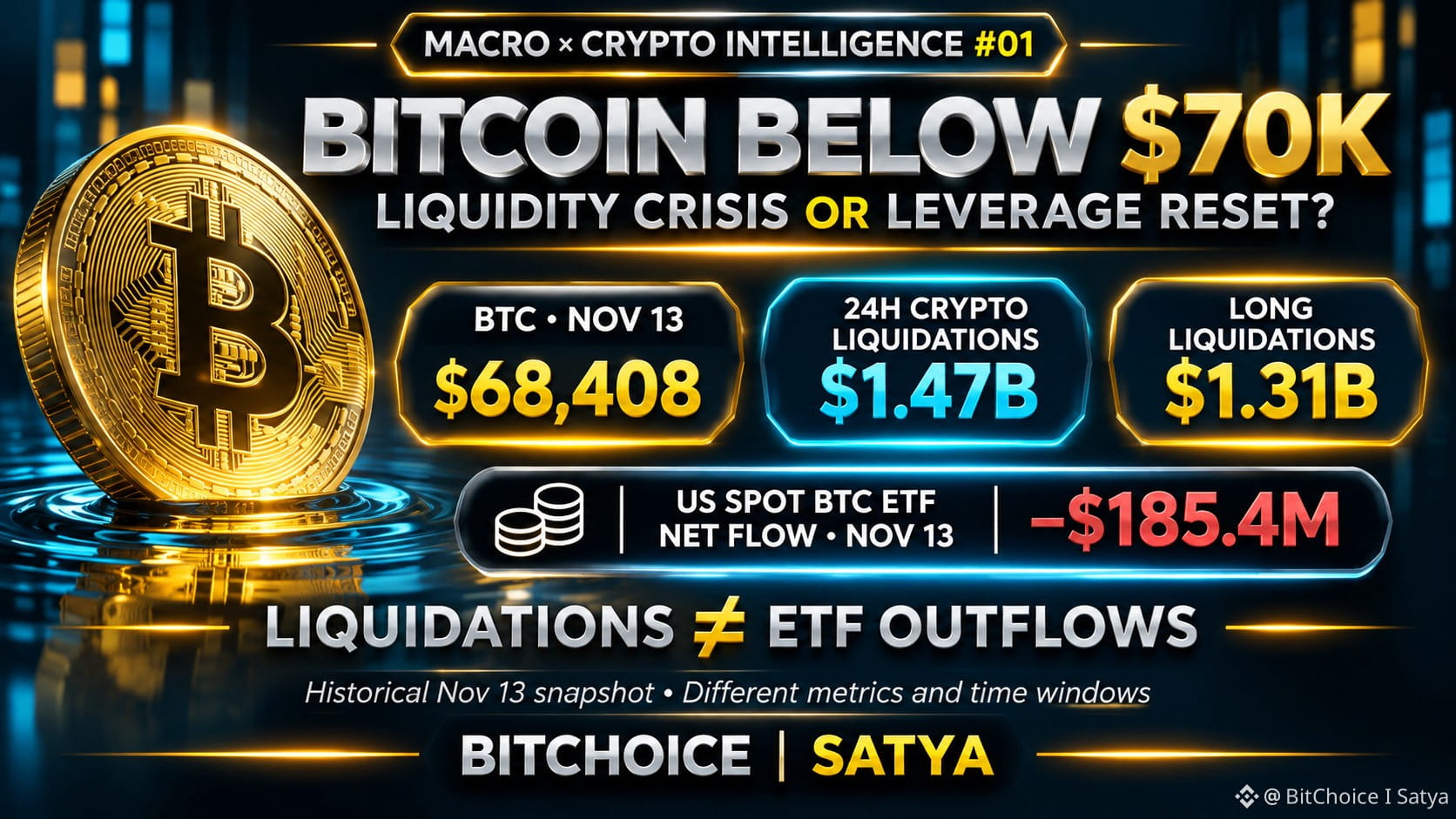
BITCOIN BELOW $70K: THE ETF & MACRO PRESSURE TEST
Bitcoin's November 13 selloff exposed two separate forces: forced closures in derivatives and weaker demand through spot ETFs.
THE NOV 13 SNAPSHOT
• BTC traded near $68,408 during the decline.
• Crypto-wide 24h liquidations reached ~$1.47B, including ~$1.31B in longs (CoinGlass snapshot).
• US spot BTC ETFs recorded a net outflow of $185.4M (Farside, Nov 13 session).
These are different metrics and time windows. Liquidations cannot be added to ETF outflows.
WHY MACRO MATTERS
Expectations of higher US rates, a stronger dollar and weakness in technology shares weighed on risk appetite.
When BTC breaks a crowded price level, leveraged long positions can be liquidated automatically. That intensifies the move, but doesn't establish that long-term holders are capitulating.
ETF redemptions are a separate signal of investment demand. One negative session is important, but not enough to establish a persistent trend.
THREE SIGNALS TO WATCH
ETF flows: Does net demand recover across multiple sessions?
Derivatives: Do open interest and funding stabilize after the flush?
Spot liquidity: Are bids and traded volumes improving on rebounds?
THE TAKEAWAY
A leverage reset can end quickly. A sustained liquidity squeeze is harder to resolve.
The distinction depends on evidence from spot demand, market depth and macro conditions — not liquidation headlines alone.
#Bitcoin #BTC #MacroCrypto #Liquidity $BTC
{spot}(BTCUSDT)
🚨MACRO × CRYPTO INTELLIGENCE
BITCOIN BELOW $70K: THE ETF & MACRO PRESSURE TEST
Bitcoin's November 13 selloff exposed two separate forces: forced closures in derivatives and weaker demand through spot ETFs.
THE NOV 13 SNAPSHOT
• BTC traded near $68,408 during the decline.
• Crypto-wide 24h liquidations reached ~$1.47B, including ~$1.31B in longs (CoinGlass snapshot).
• US spot BTC ETFs recorded a net outflow of $185.4M (Farside, Nov 13 session).
These are different metrics and time windows. Liquidations cannot be added to ETF outflows.
WHY MACRO MATTERS
Expectations of higher US rates, a stronger dollar and weakness in technology shares weighed on risk appetite.
When BTC breaks a crowded price level, leveraged long positions can be liquidated automatically. That intensifies the move, but doesn't establish that long-term holders are capitulating.
ETF redemptions are a separate signal of investment demand. One negative session is important, but not enough to establish a persistent trend.
THREE SIGNALS TO WATCH
ETF flows: Does net demand recover across multiple sessions?
Derivatives: Do open interest and funding stabilize after the flush?
Spot liquidity: Are bids and traded volumes improving on rebounds?
THE TAKEAWAY
A leverage reset can end quickly. A sustained liquidity squeeze is harder to resolve.
The distinction depends on evidence from spot demand, market depth and macro conditions — not liquidation headlines alone.
#Bitcoin #BTC #MacroCrypto #Liquidity $BTC
136

·
--
Where we are in the rate cycle matters more for crypto than most traders acknowledge.
Rate hikes: liquidity tightens, risk assets reprice lower. 2022 was a clean example.
Rate cuts: liquidity expands, capital flows back into risk. 2020 and early 2023 showed the effect.
The current setup: rates still restrictive, cuts being priced in for later this year. That's the anticipation phase: markets price the cut before it happens.
If cuts are delayed, that anticipation unwinds. That's the primary macro risk for crypto right now.
#MacroCrypto #Bitcoin #BTC
29

·
--
Global inflation and restrictive monetary policies to control it affect crypto. By reducing liquidity and increasing the cost of capital, investors tend to reassess risk assets, putting downward pressure on cryptocurrency prices. Its macroeconomic sensitivity is evident. #MacroCrypto #CryptoEconomy
📊 https://quant-fin.online
📢 @QuantF
━━━━━━━━━━━━━━━━━━
QuantFin — RUF-Flow Protocol v7
Powered by Nexus Flow Dynamics
© 2026 QuantFin. Trading involves risk.
📊 https://quant-fin.online
📢 @QuantF
━━━━━━━━━━━━━━━━━━
QuantFin — RUF-Flow Protocol v7
Powered by Nexus Flow Dynamics
© 2026 QuantFin. Trading involves risk.
52
Log in to explore more content
Join global crypto users on Binance Square
⚡️ Get latest and useful information about crypto.
💬 Trusted by the world’s largest crypto exchange.
👍 Discover real insights from verified creators.
Email / Phone number
Trending Topics
1
#CanMarketsReboundAfterThanksgiving?
66,183 views
988 Discussing
2
#CouldSpaceX’sOrbitalDataCentersBoostAIChipDemand?
34,716 views
615 Discussing
3
#EvolveAtBinanceBlockchainWeek
715,658 views
8,358 Discussing
4
#KoreaFSCSeeksPowerToSuspendCryptoListings
274 views
19 Discussing
5
#SouthKoreaPlansToRequireTetherCircleLocalReserves
99 views
13 Discussing
6
#UKFCAReportedlyPlansDeFiAuthorizationRules
183 views
10 Discussing
7
#ZcashDevelopersUrgeZECMoveToIronwood
0 views
1 Discussing
8
#TetherGoldFaces$2.55BUnrealizedLoss
52 views
4 Discussing
9
#CorePCEBeatLiftsFedHikeOdds
222,988 views
1,607 Discussing
10
#BitcoinAndStocksSlipAgainAmidTrump’sTariffPlans
255,703 views
2,351 Discussing