

#li
li
629 views
24 Discussing
Hot
Latest

·
--
$LI / Tokenized Stocks — look at the official on-chain data, not the headlines.
Token: LIon | Underlying stock: LI
On-chain price: $11.52 (24h -2.35%)
Number of holding addresses: 357 | US stock market cap: $11,255,270,106
P/E ratio: 99.38 | Dividend yield: -
52-week range: $11.34 - $27.10
Status: closed (Weekend or Holiday)
My take: Tokenized stocks package real stocks onto the blockchain. As long as custody receipts are issued on time, the on-chain price’s premium/discount versus the underlying should be very small—that’s exactly what this structure is for. I’ll be watching whether the on-chain price keeps up with the stock.
Do you think tokenizing stocks is promising, or is it still just hype?👇
#GeniusLife #LI
$LI / Tokenized Stocks — look at the official on-chain data, not the headlines.
Token: LIon | Underlying stock: LI
On-chain price: $11.52 (24h -2.35%)
Number of holding addresses: 357 | US stock market cap: $11,255,270,106
P/E ratio: 99.38 | Dividend yield: -
52-week range: $11.34 - $27.10
Status: closed (Weekend or Holiday)
My take: Tokenized stocks package real stocks onto the blockchain. As long as custody receipts are issued on time, the on-chain price’s premium/discount versus the underlying should be very small—that’s exactly what this structure is for. I’ll be watching whether the on-chain price keeps up with the stock.
Do you think tokenizing stocks is promising, or is it still just hype?👇
#GeniusLife #LI
Token: LIon | Underlying stock: LI
On-chain price: $11.52 (24h -2.35%)
Number of holding addresses: 357 | US stock market cap: $11,255,270,106
P/E ratio: 99.38 | Dividend yield: -
52-week range: $11.34 - $27.10
Status: closed (Weekend or Holiday)
My take: Tokenized stocks package real stocks onto the blockchain. As long as custody receipts are issued on time, the on-chain price’s premium/discount versus the underlying should be very small—that’s exactly what this structure is for. I’ll be watching whether the on-chain price keeps up with the stock.
Do you think tokenizing stocks is promising, or is it still just hype?👇
#GeniusLife #LI
4
·
--
$LI / Tokenized stocks——look at on-chain official data, not the headlines.
Token: LIon | Underlying stock: LI
On-chain price: $11.49 (24h -2.71%)
Number of holding addresses: 356 | US stock market cap: $11,222,368,206
P/E ratio: 99.38 | Dividend yield: -
52-week range: $11.34 - $27.10
Status: regular
My take: Tokenized stocks wrap real stocks onto the blockchain. As long as custody receipts are kept up to date, the on-chain price’s premium/discount versus the underlying should be very small—that’s exactly what this structure is for. I’ll watch whether the on-chain price keeps up with the stock.
Do you think tokenizing stocks is promising, or do you still think it’s just hype?👇
#CedricBullishonFlap #LI
$LI / Tokenized stocks——look at on-chain official data, not the headlines.
Token: LIon | Underlying stock: LI
On-chain price: $11.49 (24h -2.71%)
Number of holding addresses: 356 | US stock market cap: $11,222,368,206
P/E ratio: 99.38 | Dividend yield: -
52-week range: $11.34 - $27.10
Status: regular
My take: Tokenized stocks wrap real stocks onto the blockchain. As long as custody receipts are kept up to date, the on-chain price’s premium/discount versus the underlying should be very small—that’s exactly what this structure is for. I’ll watch whether the on-chain price keeps up with the stock.
Do you think tokenizing stocks is promising, or do you still think it’s just hype?👇
#CedricBullishonFlap #LI
Token: LIon | Underlying stock: LI
On-chain price: $11.49 (24h -2.71%)
Number of holding addresses: 356 | US stock market cap: $11,222,368,206
P/E ratio: 99.38 | Dividend yield: -
52-week range: $11.34 - $27.10
Status: regular
My take: Tokenized stocks wrap real stocks onto the blockchain. As long as custody receipts are kept up to date, the on-chain price’s premium/discount versus the underlying should be very small—that’s exactly what this structure is for. I’ll watch whether the on-chain price keeps up with the stock.
Do you think tokenizing stocks is promising, or do you still think it’s just hype?👇
#CedricBullishonFlap #LI
4

·
--
Bullish
Key levels: Price $1.4795 below $1.48 support; resistance at $1.52/$1.56; deeper support $1.44/$1.34.
Buy setup: Aggressive longs only if price reclaims $1.52 with volume or stabilizes above $1.48 with RSI divergence.
Sell setup: Trim zones at $1.52-$1.56 on bearish MA crossover; break below $1.44 targets $1.34 structural base.
Context: Binance LIT trading competition offers 50k USDT pool, but bearish 1h/4h structure overrides smart money long bias.
#LI #Write2Earn $LIT
Key levels: Price $1.4795 below $1.48 support; resistance at $1.52/$1.56; deeper support $1.44/$1.34.
Buy setup: Aggressive longs only if price reclaims $1.52 with volume or stabilizes above $1.48 with RSI divergence.
Sell setup: Trim zones at $1.52-$1.56 on bearish MA crossover; break below $1.44 targets $1.34 structural base.
Context: Binance LIT trading competition offers 50k USDT pool, but bearish 1h/4h structure overrides smart money long bias.
#LI #Write2Earn $LIT
Buy setup: Aggressive longs only if price reclaims $1.52 with volume or stabilizes above $1.48 with RSI divergence.
Sell setup: Trim zones at $1.52-$1.56 on bearish MA crossover; break below $1.44 targets $1.34 structural base.
Context: Binance LIT trading competition offers 50k USDT pool, but bearish 1h/4h structure overrides smart money long bias.
#LI #Write2Earn $LIT
165

·
--
Waking up one day and seeing TSLA climb 7.4% in 24 hours isn’t small. But what I care about more is another number: in Binance’s futures order book, the funding rate has stayed pinned at 0. Price and sentiment are completely decoupled.
The market is up seven points, yet longs don’t have to pay a single cent to shorts. That can only mean one thing: this surge wasn’t retail FOMO chasing higher; instead, shorts have been forced to cover. A funding rate at zero suggests that, right now, leverage between longs and shorts has reached a fragile equilibrium—no one wants to pay extra costs to fight for direction. A similar structure is something I’ve seen in the previous cycle. In spring 2023, after Meta was squeezed into a forced short-covering, price surged—but the funding rate stayed on the floor for a long time before entering an almost two-month consolidation period. The microstructure of TSLA right now has that same flavor.
Let’s zoom back out to the macro picture. The Fed’s rate path remains unclear, and market bets on the timing of rate cuts swing back and forth like a pendulum—this directly suppresses valuation sensitivity for long-duration assets. As the highest-beta member of the Mag7, TSLA is extremely sensitive to changes in the risk-free rate. Over the past two weeks, the semiconductor sector has loosened at the high end as the AI narrative cooled off; money began rotating within tech stocks toward better risk-reward opportunities. Some positions moved from high-flying AI chip names into leading companies with more definite stories—TSLA’s energy business narrative happens to be a perfect fit to receive this rotation.
Looking across asset classes: U.S. Treasury yields are chopping around at high levels, gold makes a new high then pulls back, and BTC keeps tug-of-war above $60k. Risk assets are in a sort of “not quite moving either way” wait-and-see mode. This TSLA rally looks less like a sign that macro risk appetite is broadly turning bullish, and more like a fleeting tilt in the internal sector capital seesaw.
On-chain futures data also supports this view. Open interest is 43,065, which—compared with its trading volume—doesn’t indicate anything close to a large-scale surge of new longs entering and adding leverage. It looks more like existing capital is rebalancing. Price gets pushed up, but leverage enthusiasm doesn’t keep pace. As for how sustainable this kind of rally is, we have to put a question mark on it.
So my core observation is very clear: TSLA’s rise right now is the result of sector capital seeking a relatively safer landing amid jittery macro rate expectations, combined with shorts periodically conceding and covering. It has carved out its own alpha, but it lacks macro beta synchronization.
Now, turning to trading, three scenarios make it clear.
Base case scenario: the Fed keeps its current guidance; the tech sector continues to rotate with differentiation.
Trading tag: #TradFi #链上美股 #TSLA #LI
Is the bigger environment for TSLA a tailwind or a headwind? Tell me your view.
Waking up one day and seeing TSLA climb 7.4% in 24 hours isn’t small. But what I care about more is another number: in Binance’s futures order book, the funding rate has stayed pinned at 0. Price and sentiment are completely decoupled.
The market is up seven points, yet longs don’t have to pay a single cent to shorts. That can only mean one thing: this surge wasn’t retail FOMO chasing higher; instead, shorts have been forced to cover. A funding rate at zero suggests that, right now, leverage between longs and shorts has reached a fragile equilibrium—no one wants to pay extra costs to fight for direction. A similar structure is something I’ve seen in the previous cycle. In spring 2023, after Meta was squeezed into a forced short-covering, price surged—but the funding rate stayed on the floor for a long time before entering an almost two-month consolidation period. The microstructure of TSLA right now has that same flavor.
Let’s zoom back out to the macro picture. The Fed’s rate path remains unclear, and market bets on the timing of rate cuts swing back and forth like a pendulum—this directly suppresses valuation sensitivity for long-duration assets. As the highest-beta member of the Mag7, TSLA is extremely sensitive to changes in the risk-free rate. Over the past two weeks, the semiconductor sector has loosened at the high end as the AI narrative cooled off; money began rotating within tech stocks toward better risk-reward opportunities. Some positions moved from high-flying AI chip names into leading companies with more definite stories—TSLA’s energy business narrative happens to be a perfect fit to receive this rotation.
Looking across asset classes: U.S. Treasury yields are chopping around at high levels, gold makes a new high then pulls back, and BTC keeps tug-of-war above $60k. Risk assets are in a sort of “not quite moving either way” wait-and-see mode. This TSLA rally looks less like a sign that macro risk appetite is broadly turning bullish, and more like a fleeting tilt in the internal sector capital seesaw.
On-chain futures data also supports this view. Open interest is 43,065, which—compared with its trading volume—doesn’t indicate anything close to a large-scale surge of new longs entering and adding leverage. It looks more like existing capital is rebalancing. Price gets pushed up, but leverage enthusiasm doesn’t keep pace. As for how sustainable this kind of rally is, we have to put a question mark on it.
So my core observation is very clear: TSLA’s rise right now is the result of sector capital seeking a relatively safer landing amid jittery macro rate expectations, combined with shorts periodically conceding and covering. It has carved out its own alpha, but it lacks macro beta synchronization.
Now, turning to trading, three scenarios make it clear.
Base case scenario: the Fed keeps its current guidance; the tech sector continues to rotate with differentiation.
Trading tag: #TradFi #链上美股 #TSLA #LI
Is the bigger environment for TSLA a tailwind or a headwind? Tell me your view.
The market is up seven points, yet longs don’t have to pay a single cent to shorts. That can only mean one thing: this surge wasn’t retail FOMO chasing higher; instead, shorts have been forced to cover. A funding rate at zero suggests that, right now, leverage between longs and shorts has reached a fragile equilibrium—no one wants to pay extra costs to fight for direction. A similar structure is something I’ve seen in the previous cycle. In spring 2023, after Meta was squeezed into a forced short-covering, price surged—but the funding rate stayed on the floor for a long time before entering an almost two-month consolidation period. The microstructure of TSLA right now has that same flavor.
Let’s zoom back out to the macro picture. The Fed’s rate path remains unclear, and market bets on the timing of rate cuts swing back and forth like a pendulum—this directly suppresses valuation sensitivity for long-duration assets. As the highest-beta member of the Mag7, TSLA is extremely sensitive to changes in the risk-free rate. Over the past two weeks, the semiconductor sector has loosened at the high end as the AI narrative cooled off; money began rotating within tech stocks toward better risk-reward opportunities. Some positions moved from high-flying AI chip names into leading companies with more definite stories—TSLA’s energy business narrative happens to be a perfect fit to receive this rotation.
Looking across asset classes: U.S. Treasury yields are chopping around at high levels, gold makes a new high then pulls back, and BTC keeps tug-of-war above $60k. Risk assets are in a sort of “not quite moving either way” wait-and-see mode. This TSLA rally looks less like a sign that macro risk appetite is broadly turning bullish, and more like a fleeting tilt in the internal sector capital seesaw.
On-chain futures data also supports this view. Open interest is 43,065, which—compared with its trading volume—doesn’t indicate anything close to a large-scale surge of new longs entering and adding leverage. It looks more like existing capital is rebalancing. Price gets pushed up, but leverage enthusiasm doesn’t keep pace. As for how sustainable this kind of rally is, we have to put a question mark on it.
So my core observation is very clear: TSLA’s rise right now is the result of sector capital seeking a relatively safer landing amid jittery macro rate expectations, combined with shorts periodically conceding and covering. It has carved out its own alpha, but it lacks macro beta synchronization.
Now, turning to trading, three scenarios make it clear.
Base case scenario: the Fed keeps its current guidance; the tech sector continues to rotate with differentiation.
Trading tag: #TradFi #链上美股 #TSLA #LI
Is the bigger environment for TSLA a tailwind or a headwind? Tell me your view.
BTC+0.67%
TSLAUS-1.18%
115

·
--
The market’s keeping an eye on Trump's play, and with funding rates at zero, it shows the big bucks are just spectating. Until the ground shakes, any expectations of easing for EVs are just bets. I’m not holding any faith, I'm starting with a 5000U base position to secure my spot; don’t wait for the news to blow up before jumping in. Once Trump makes a solid positive statement, I’ll push it to 20k U. Stop loss set at 395, don’t get lost in dreams of downward space. Last time, a single tariff tweet shot TSLA up 8% in a day; right now, it’s the calm before the storm—don’t get caught as fuel before dawn.
Trading Tag: #TradFi #链上美股 #TSLA #LI
Is Trump's play bullish or bearish for TSLA?
The market’s keeping an eye on Trump's play, and with funding rates at zero, it shows the big bucks are just spectating. Until the ground shakes, any expectations of easing for EVs are just bets. I’m not holding any faith, I'm starting with a 5000U base position to secure my spot; don’t wait for the news to blow up before jumping in. Once Trump makes a solid positive statement, I’ll push it to 20k U. Stop loss set at 395, don’t get lost in dreams of downward space. Last time, a single tariff tweet shot TSLA up 8% in a day; right now, it’s the calm before the storm—don’t get caught as fuel before dawn.
Trading Tag: #TradFi #链上美股 #TSLA #LI
Is Trump's play bullish or bearish for TSLA?
Trading Tag: #TradFi #链上美股 #TSLA #LI
Is Trump's play bullish or bearish for TSLA?
127

$TSLA hit 383, with a daily drop of 4.5%. The funding rate is still holding at 0.00047, and the bulls aren't throwing in the towel.
If Trump actually goes ahead and cancels the EV subsidies, it would be a real blow to Tesla. Right now, the slow decline isn't panic selling; the fact that the funding rate hasn't turned negative indicates that stop-loss orders haven't cleared out completely, so those bottom-fishing are likely to face unrealized losses.
I've placed a short position with 3x leverage, stop-loss set at 395, aiming to take profit at 370, keeping my position size to 15%. Until the policy is finalized, I'm not increasing my stake; just testing the waters with a small position while following the trend. We’ll see what happens when the dust settles.
Trade Tag: #TradFi #链上美股 #TSLA #LI
How should those trading TSLA respond to this headline?
$TSLA hit 383, with a daily drop of 4.5%. The funding rate is still holding at 0.00047, and the bulls aren't throwing in the towel.
If Trump actually goes ahead and cancels the EV subsidies, it would be a real blow to Tesla. Right now, the slow decline isn't panic selling; the fact that the funding rate hasn't turned negative indicates that stop-loss orders haven't cleared out completely, so those bottom-fishing are likely to face unrealized losses.
I've placed a short position with 3x leverage, stop-loss set at 395, aiming to take profit at 370, keeping my position size to 15%. Until the policy is finalized, I'm not increasing my stake; just testing the waters with a small position while following the trend. We’ll see what happens when the dust settles.
Trade Tag: #TradFi #链上美股 #TSLA #LI
How should those trading TSLA respond to this headline?
If Trump actually goes ahead and cancels the EV subsidies, it would be a real blow to Tesla. Right now, the slow decline isn't panic selling; the fact that the funding rate hasn't turned negative indicates that stop-loss orders haven't cleared out completely, so those bottom-fishing are likely to face unrealized losses.
I've placed a short position with 3x leverage, stop-loss set at 395, aiming to take profit at 370, keeping my position size to 15%. Until the policy is finalized, I'm not increasing my stake; just testing the waters with a small position while following the trend. We’ll see what happens when the dust settles.
Trade Tag: #TradFi #链上美股 #TSLA #LI
How should those trading TSLA respond to this headline?
64

·
--
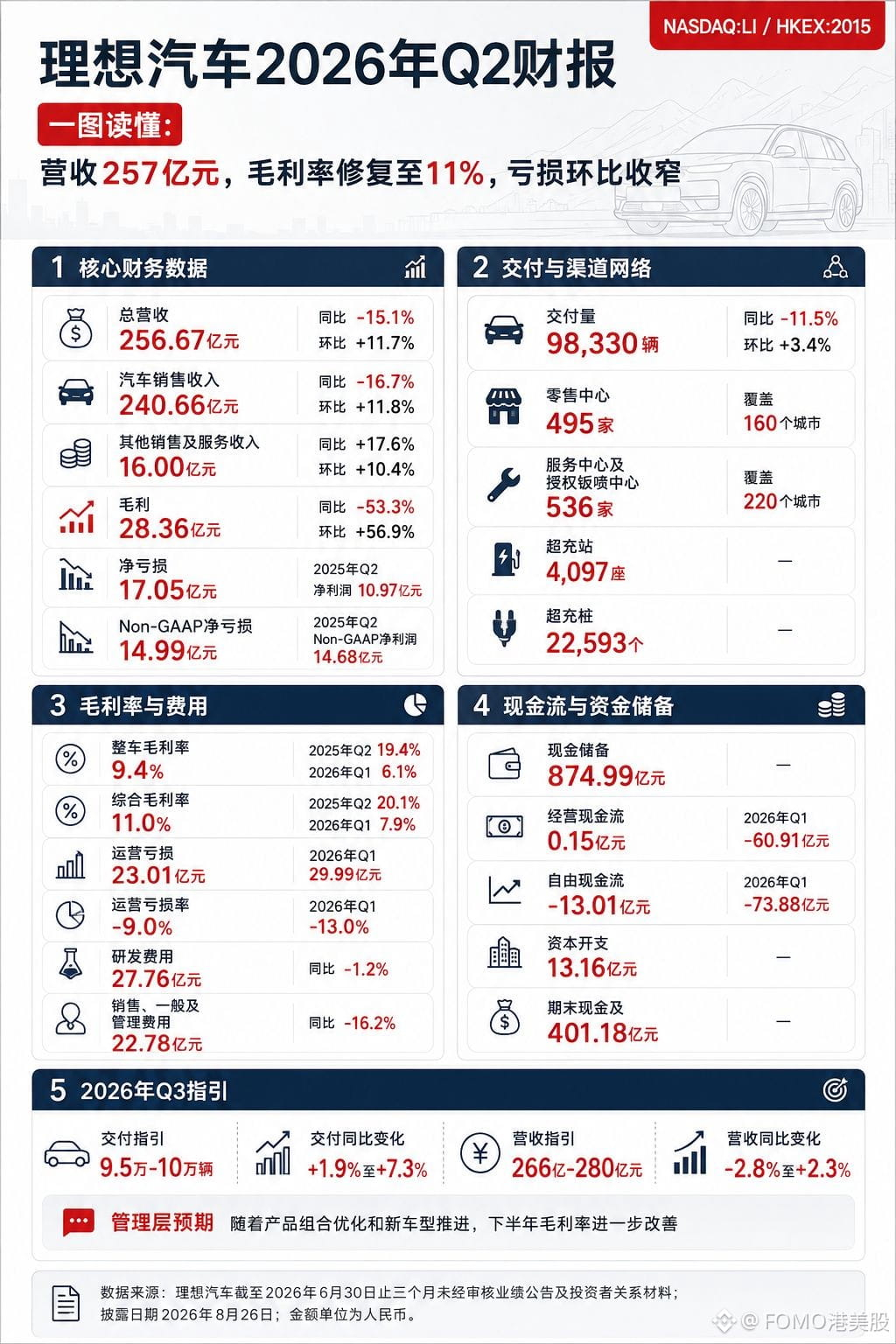
【Ideal Auto 2026 Q2 Earnings Report】One chart to understand: Revenue 25.7 billion yuan, gross margin restored to 11%, losses narrowed quarter-over-quarter
$LI.US The focus of Q2 isn’t that the company has already returned to high profitability, but that revenue, gross margin, and cash flow are all improving quarter-over-quarter. What truly determines the outlook going forward is whether the new product cycle can sustain this improvement into the second half of the year.
Follow me—I'll continue to update one-chart summaries of key earnings reports from important Hong Kong and U.S.-listed companies.
{stock_us}(LI.US)
#理想汽车 #LI #新能源车 #港股财报 #美股财报季来袭
【Ideal Auto 2026 Q2 Earnings Report】One chart to understand: Revenue 25.7 billion yuan, gross margin restored to 11%, losses narrowed quarter-over-quarter
$LI.US The focus of Q2 isn’t that the company has already returned to high profitability, but that revenue, gross margin, and cash flow are all improving quarter-over-quarter. What truly determines the outlook going forward is whether the new product cycle can sustain this improvement into the second half of the year.
Follow me—I'll continue to update one-chart summaries of key earnings reports from important Hong Kong and U.S.-listed companies.
#理想汽车 #LI #新能源车 #港股财报 #美股财报季来袭
$LI.US The focus of Q2 isn’t that the company has already returned to high profitability, but that revenue, gross margin, and cash flow are all improving quarter-over-quarter. What truly determines the outlook going forward is whether the new product cycle can sustain this improvement into the second half of the year.
Follow me—I'll continue to update one-chart summaries of key earnings reports from important Hong Kong and U.S.-listed companies.
#理想汽车 #LI #新能源车 #港股财报 #美股财报季来袭
LIUS-4.38%
1
389
·
--
$TSLA 24 hours dropped 4.71% to 392.2, with a volume of 72.95 million. O/I at 56,500 isn't huge, and the funding rate is sitting at 0, showing no signs of an accelerated sell-off. The biggest contradiction on the charts is that while prices are falling, the derivatives market shows no panic; this usually indicates that sellers are more likely to be reducing their positions passively rather than actively shorting.
Considering the global news transmission chain, recent risk assets have been digesting the noise around trade frictions and the Fed's hawkish stance, with tech giants being hit hardest.
Trading tag: #TradFi #链上美股 #TSLA #LI
How do you interpret the news surrounding TSLA?
$TSLA 24 hours dropped 4.71% to 392.2, with a volume of 72.95 million. O/I at 56,500 isn't huge, and the funding rate is sitting at 0, showing no signs of an accelerated sell-off. The biggest contradiction on the charts is that while prices are falling, the derivatives market shows no panic; this usually indicates that sellers are more likely to be reducing their positions passively rather than actively shorting.
Considering the global news transmission chain, recent risk assets have been digesting the noise around trade frictions and the Fed's hawkish stance, with tech giants being hit hardest.
Trading tag: #TradFi #链上美股 #TSLA #LI
How do you interpret the news surrounding TSLA?
Considering the global news transmission chain, recent risk assets have been digesting the noise around trade frictions and the Fed's hawkish stance, with tech giants being hit hardest.
Trading tag: #TradFi #链上美股 #TSLA #LI
How do you interpret the news surrounding TSLA?
254
Log in to explore more content
Join global crypto users on Binance Square
⚡️ Get latest and useful information about crypto.
💬 Trusted by the world’s largest crypto exchange.
👍 Discover real insights from verified creators.
Email / Phone number
Trending Topics
1
#EarningsSeason
89,041 views
842 Discussing
2
#ECBToTestAIAgentsInDigitalEuroPayments
504 views
82 Discussing
3
#JapanFSABacksFourthStablecoinTradeSettlementPilot
2,803 views
189 Discussing
4
#BitgetHackerFailsToMoveStolenFunds
11,106 views
324 Discussing
5
#BitMineETHHoldingsTop6Million
13,560 views
489 Discussing
6
#StrategyAdds1666BTCHoldingsReach847666
11,976 views
336 Discussing
7
#NvidiaApproves$150BBuyback
3,501 views
61 Discussing
8
#OpenAIDelaysGPT6.1OverSafetyIssues
24,723 views
678 Discussing
9
#AMDToAcquireWorldLabsFor$8.2B
1,741 views
52 Discussing
10
#AnthropicIPOProspectusCouldValueItOver$2T
5,598 views
75 Discussing