
#analystsaysirenbacklogover$20b
analystsaysirenbacklogover$20b
Hot
Latest

$LISTA
{spot}(LISTAUSDT)
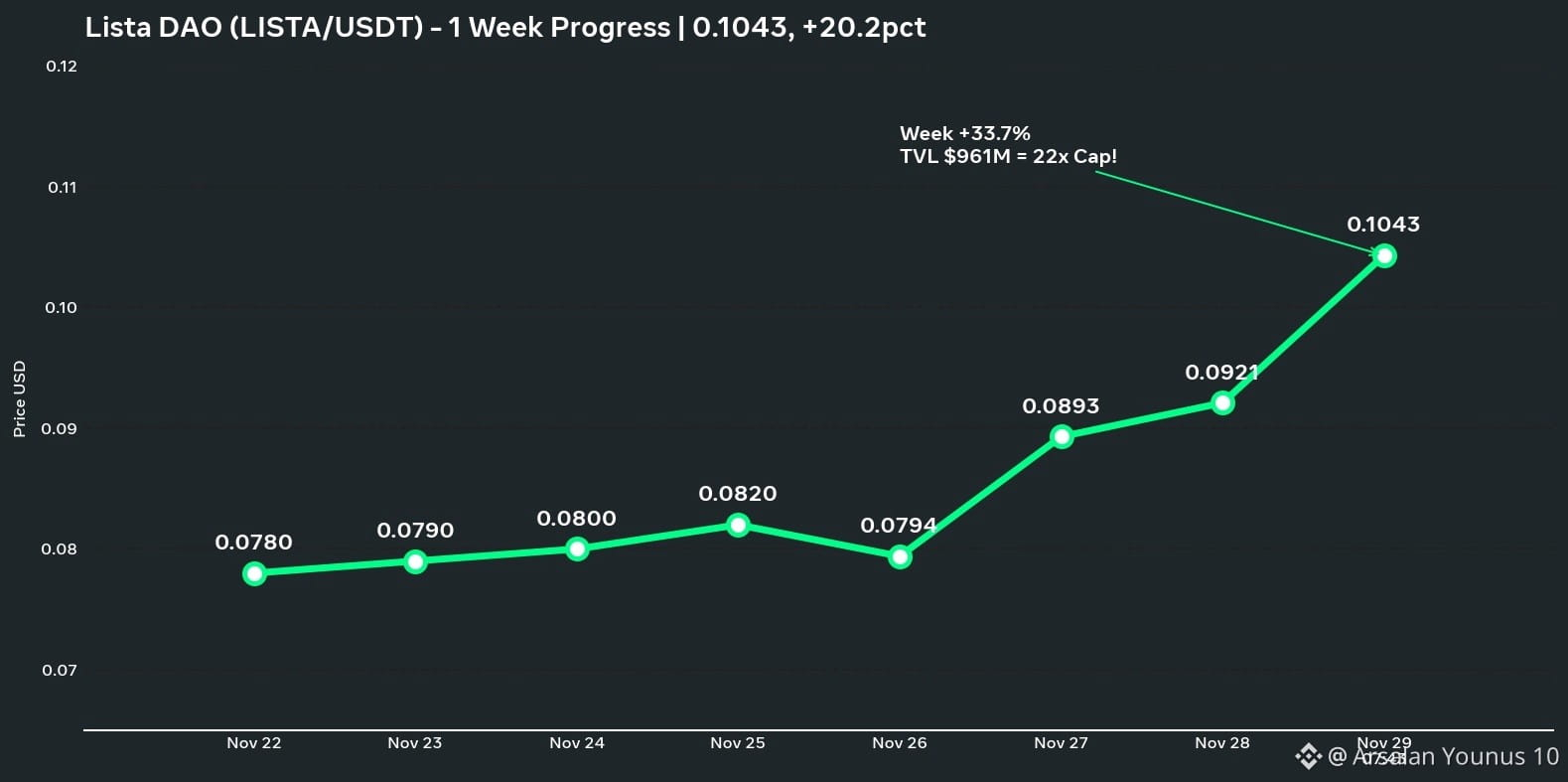
$0.1043 — +20.16% Today! Lista DAO Up +48.81% In 7 Days With $961M TVL — Cheapest DeFi On Binance?*
> Lista DAO (LISTA/USDT) is trading at *∼$0.1043*, up *+20.16% today* — Open: *$0.0868* | High: *$0.1082* | Low: *$0.0868* | Previous Close: *$0.0868*
> *What happened in 1 week? 2 phases:*
> 1. *Nov 22-25: Quiet Accumulation* — LISTA rose *+5.1% in 4 days* from $0.0780 to $0.0820. No hype.
> 2. *Nov 26-29: Breakout + Hold* — LISTA jumped *+12.4% in 1 day* to $0.0893, then held *$0.0921-$0.1043 for 2 days*. Week total: *+33.7%*, 7-day on some trackers *+48.81%*
> *What is LISTA?
> LISTA = *Lista DAO, LSDfi + Lending + Stablecoin On BNB*.
> *Why Pumping +20.16%?
> 1. *TVL Is INSANE*: TVL *$961.48M*, BSC *$944.36M*. Market cap *only $43M*. *TVL is 22.4x market cap!* For comparison, Aave TVL $20B / Cap $2B = 10x, Maker TVL $6B / Cap $1B = 6x, Lista TVL $961M / Cap $43M = *22x*. Lista is *cheapest DeFi by TVL on Binance*
> 2. *USD1 Warning*: Nov 28, *USD1 decoupling widened to 6%, price fell to $0.94*
> 3. *Futures Chasing*: Futures Turnover *$65.30M*, OI *$21.95M* — OI is *51% of $43M market cap*. MEXC *65.4% of OI*, Binance *25.7%*, Bitget 5.4%. Spot Volume *$13.9M-$14.49M*, Binance *$3.18M*, HTX $749K, BitMart $499K. This move is *futures + spot together*
> *Key Levels:*
> Support: $0.092 -> *$0.0868* (Today Low) -> $0.079
> Resistance: *$0.1082* (Today High) -> $0.12 (Psychological) -> $0.84 (ATH)
> *Stats:*
> Price: *$0.1043* | 24h Change: *+20.16%*
> Market Cap: *$42M-$47.51M* | Rank #324-439
> FDV: *$79.6M-$81.2M* (1.9x market cap!)
> TVL: *$961.48M* (22.4x market cap!) | BSC: *$944.36M*
> Spot Volume: *$13.9M-$14.49M*
> Futures Turnover: *$65.30M* | OI: *$21.95M (51% of market cap!)*
> Circulating: 430M / 1B LISTA (43% — 57% locked!)
> ATH: *$0.8428* — Now *-88.17% down* | ATL: *$0.0436* — Now *+139% up*
> 7 Days: *+30.09% to +48.81%* | 1 Month: *+17.93%* | 6 Months: *+42.13%* | YTD: *-46.64%* | 1 Year: *-51.01%* | 5 Sessions: *-2.33%*
#Lista #defi #bnb
$LISTA
$0.1043 — +20.16% Today! Lista DAO Up +48.81% In 7 Days With $961M TVL — Cheapest DeFi On Binance?*
> Lista DAO (LISTA/USDT) is trading at *∼$0.1043*, up *+20.16% today* — Open: *$0.0868* | High: *$0.1082* | Low: *$0.0868* | Previous Close: *$0.0868*
> *What happened in 1 week? 2 phases:*
> 1. *Nov 22-25: Quiet Accumulation* — LISTA rose *+5.1% in 4 days* from $0.0780 to $0.0820. No hype.
> 2. *Nov 26-29: Breakout + Hold* — LISTA jumped *+12.4% in 1 day* to $0.0893, then held *$0.0921-$0.1043 for 2 days*. Week total: *+33.7%*, 7-day on some trackers *+48.81%*
> *What is LISTA?
> LISTA = *Lista DAO, LSDfi + Lending + Stablecoin On BNB*.
> *Why Pumping +20.16%?
> 1. *TVL Is INSANE*: TVL *$961.48M*, BSC *$944.36M*. Market cap *only $43M*. *TVL is 22.4x market cap!* For comparison, Aave TVL $20B / Cap $2B = 10x, Maker TVL $6B / Cap $1B = 6x, Lista TVL $961M / Cap $43M = *22x*. Lista is *cheapest DeFi by TVL on Binance*
> 2. *USD1 Warning*: Nov 28, *USD1 decoupling widened to 6%, price fell to $0.94*
> 3. *Futures Chasing*: Futures Turnover *$65.30M*, OI *$21.95M* — OI is *51% of $43M market cap*. MEXC *65.4% of OI*, Binance *25.7%*, Bitget 5.4%. Spot Volume *$13.9M-$14.49M*, Binance *$3.18M*, HTX $749K, BitMart $499K. This move is *futures + spot together*
> *Key Levels:*
> Support: $0.092 -> *$0.0868* (Today Low) -> $0.079
> Resistance: *$0.1082* (Today High) -> $0.12 (Psychological) -> $0.84 (ATH)
> *Stats:*
> Price: *$0.1043* | 24h Change: *+20.16%*
> Market Cap: *$42M-$47.51M* | Rank #324-439
> FDV: *$79.6M-$81.2M* (1.9x market cap!)
> TVL: *$961.48M* (22.4x market cap!) | BSC: *$944.36M*
> Spot Volume: *$13.9M-$14.49M*
> Futures Turnover: *$65.30M* | OI: *$21.95M (51% of market cap!)*
> Circulating: 430M / 1B LISTA (43% — 57% locked!)
> ATH: *$0.8428* — Now *-88.17% down* | ATL: *$0.0436* — Now *+139% up*
> 7 Days: *+30.09% to +48.81%* | 1 Month: *+17.93%* | 6 Months: *+42.13%* | YTD: *-46.64%* | 1 Year: *-51.01%* | 5 Sessions: *-2.33%*
#Lista #defi #bnb
1
140

$BTW remains a cautious play despite its $20B FDV. I see potential for a contrarian opportunity, especially if short-term momentum continues and funding rates remain positive.
The strategy is about looking beyond market consensus and considering scenarios others may overlook. Still, uncertainty remains.
#Trading #BTW #Crypto $BTW
{future}(BTWUSDT)
$BTW remains a cautious play despite its $20B FDV. I see potential for a contrarian opportunity, especially if short-term momentum continues and funding rates remain positive.
The strategy is about looking beyond market consensus and considering scenarios others may overlook. Still, uncertainty remains.
#Trading #BTW #Crypto $BTW
The strategy is about looking beyond market consensus and considering scenarios others may overlook. Still, uncertainty remains.
#Trading #BTW #Crypto $BTW
116

·
--
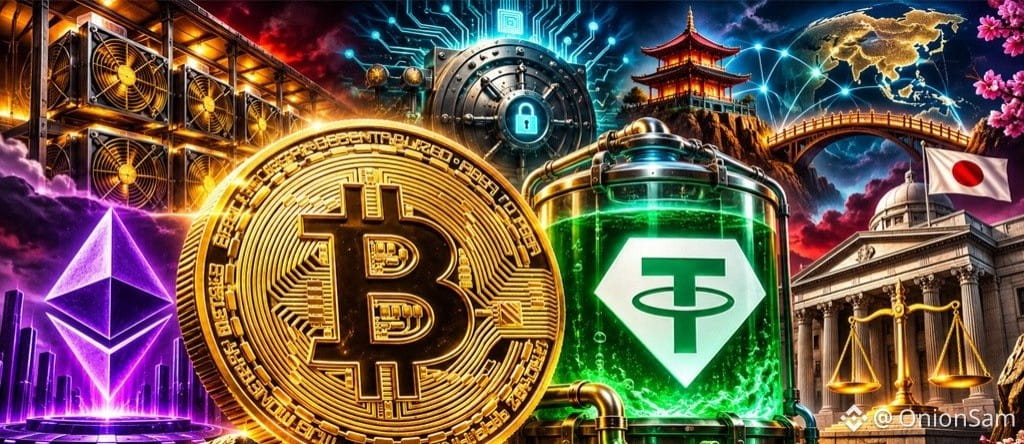
🚨📉 Bitcoin Drops Below $60K as $8.1B USDT Supply Contraction Threatens Market Recovery! 🚨
🔻 $ BTC is currently struggling around $59,400 after failing to hold recent bounces, weighed down by a massive liquidity drain across the crypto market. 💸
📊 Key On-Chain & Liquidity Metrics:
🔥 $8.1B USDT Burn:
Tether’s combined supply on Ethereum and Tron shrank by $8.1B (-4.4%) over the past 60 days—marking the sharpest contraction since August 2022! 📉
🏦 Institutional Outflows:
Roughly 89% of the redeemed $USDT flowed out from Binance and Bitfinex, pointing to institutional capital exits rather than simple retail rotation. 🐋
⚠️ Fragile Recovery:
Historically, $ BTC has never sustained a major bull run while stablecoin liquidity is shrinking. Short-term technical bounces remain high-risk until fresh dry powder re-enters the market. 🧊
🌐 Macro & Strategic Shifts:
⛏️ Tether Diversification:
Expanding aggressively into Bitcoin mining infrastructure and 🤖 AI ventures to offset tightening regulatory pressures.
⚖️ Regulatory Crackdown:
Global stablecoin oversight continues to intensify, driving a $20B+ sector-wide market cap drop in 2026. 🛡️
🚀 Ecosystem Catalysts: Ongoing $ ETH scaling upgrades and shifting 🌏 Asian market alliances remain critical narratives to watch.
🎯 Trading Takeaway:
Keep a close eye on the $60,000 psychological resistance and stablecoin netflows before chasing any upward momentum! 👀🛡️
#bitcoin #CryptoNews #USDT #MarketUpdate #Trading
$BTC
{spot}(BTCUSDT)
$ETH
{spot}(ETHUSDT)
$TRX
{spot}(TRXUSDT)
🚨📉 Bitcoin Drops Below $60K as $8.1B USDT Supply Contraction Threatens Market Recovery! 🚨
🔻 $ BTC is currently struggling around $59,400 after failing to hold recent bounces, weighed down by a massive liquidity drain across the crypto market. 💸
📊 Key On-Chain & Liquidity Metrics:
🔥 $8.1B USDT Burn:
Tether’s combined supply on Ethereum and Tron shrank by $8.1B (-4.4%) over the past 60 days—marking the sharpest contraction since August 2022! 📉
🏦 Institutional Outflows:
Roughly 89% of the redeemed $USDT flowed out from Binance and Bitfinex, pointing to institutional capital exits rather than simple retail rotation. 🐋
⚠️ Fragile Recovery:
Historically, $ BTC has never sustained a major bull run while stablecoin liquidity is shrinking. Short-term technical bounces remain high-risk until fresh dry powder re-enters the market. 🧊
🌐 Macro & Strategic Shifts:
⛏️ Tether Diversification:
Expanding aggressively into Bitcoin mining infrastructure and 🤖 AI ventures to offset tightening regulatory pressures.
⚖️ Regulatory Crackdown:
Global stablecoin oversight continues to intensify, driving a $20B+ sector-wide market cap drop in 2026. 🛡️
🚀 Ecosystem Catalysts: Ongoing $ ETH scaling upgrades and shifting 🌏 Asian market alliances remain critical narratives to watch.
🎯 Trading Takeaway:
Keep a close eye on the $60,000 psychological resistance and stablecoin netflows before chasing any upward momentum! 👀🛡️
#bitcoin #CryptoNews #USDT #MarketUpdate #Trading
$BTC
$ETH
$TRX

BTC 4U 🍀 Fast
From OnionSam
2
202

PORTAL whipsaw: $PORTAL is bouncing +5.3% in the current hour to $0.0155 — but this is a bounce inside a brutal round trip, not a recovery.
Binance Futures, last 24h: high $0.0570, low $0.0144, now $0.0157, down -58.7%. Volume is enormous for a token this size: $531M in 24h on futures alone, over 20B tokens changing hands.
Earlier today PORTAL spiked to a near 3-month high before giving it all back. No confirmed catalyst has surfaced for the surge — reporting so far points to a technical breakout from weeks of tight consolidation, not a project announcement.
Context matters: BTC is flat (-0.3% in the last hour, ~$59,356) and the Fear & Greed Index sits at 9, extreme fear. PORTAL is moving on its own flow, not with the market.
Is this bounce the start of stabilisation, or just a pause before another leg down? What level would you need to see hold before calling a bottom?
Sources: Binance Futures 24h ticker and 1h klines; BBX; CoinMarketCap.
1
Article
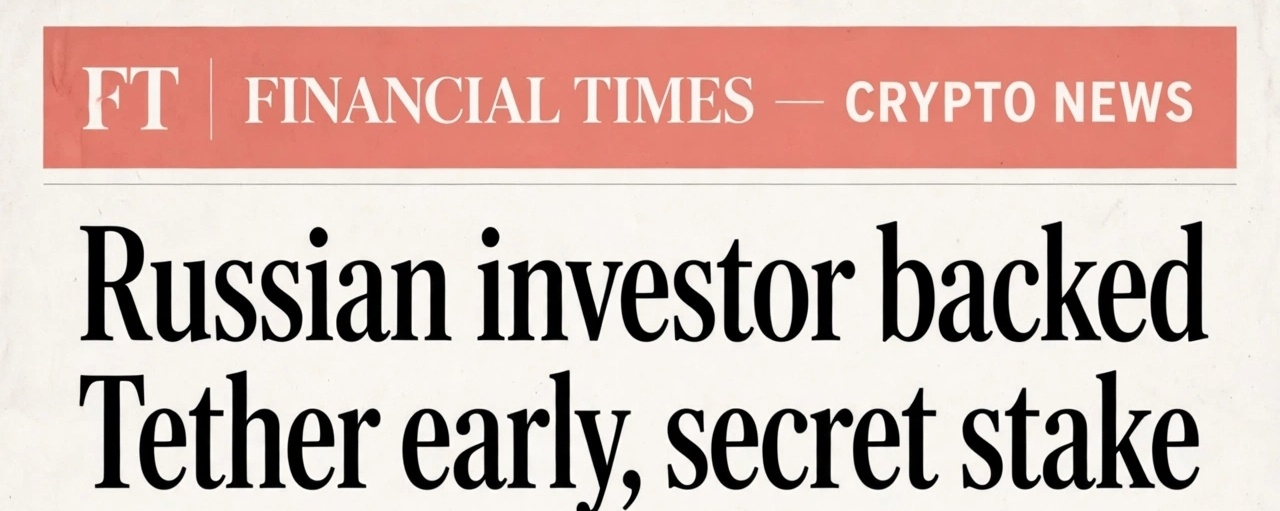
FT BOMBSHELL: RUSSIAN BILLIONAIRE HAD SECRET STAKE IN TETHER! 🤫🚨 FT BOMBSHELL: RUSSIAN BILLIONAIRE HAD SECRET STAKE IN TETHER! 🤫
Financial Times reports:
Little-known Russian venture capitalist Vitaly Bezrodnykh was an EARLY investor in Tether — the private crypto giant behind $USDT!
→ Report: Financial Times, 28 Nov 2026
→ Headline: "The Russian Billionaire With A Secret Stake In Tether"
→ Person: Vitaly Bezrodnykh
→ Role: Early investor in Tether
WHY IS THIS HUGE?
Tether is NOT a small startup anymore:
→ Issuer of $USDT — world's LARGEST stablecoin
→ ~$184 BILLION USDT in circulation (Q3 2026 attestation)
→ ~$191.5 BILLION in reserve assets
→ ~$7.95 BILLION excess reserves
→ 650M+ users worldwide (CEO Paolo Ardoino, Aug 2026)
→ Owner: iFinex (also owns Bitfinex)
And Tether's ownership has ALWAYS been secretive.
What we ALREADY knew:
→ Chairman Giancarlo Devasini = largest shareholder
→ CEO Paolo Ardoino leads company
→ Cantor Fitzgerald holds ~5% stake in Tether — now reportedly worth ~$10B (from $600M)
→ In 2018, 86% was held by just 4 people: Devasini 43%, Van der Velde 15%, Hoegner 15%, Harborne 13%
→ Tether was seeking $15-20B raise at ~$500B valuation
Now FT adds a NEW name to that secret list:
Vitaly Bezrodnykh
WHY DOES A RUSSIAN LINK MATTER NOW?
→ US Senator Blumenthal just pressed Cantor Fitzgerald for records on Tether ties, sanctions + AML checks
→ US has repeatedly warned Russian networks use Tether for sanctions evasion
→ Tether has blocked thousands of addresses holding billions
→ Russia just opened regulated crypto trading — BTC, ETH, USDT — on 17 Nov
→ VTB (sanctioned Russian bank) just started selling BTC + USDT to Russians on 27 Nov
So ANY undisclosed Russian early backing in Tether will face MASSIVE scrutiny in Washington.
⚠️ WHAT WE DON'T KNOW YET:
FT is paywalled — exact stake size, date, and structure NOT yet independently verified in public feeds.
Tether has NOT commented on individual investors.
Is this just an early VC bet that got huge?
Or is this the transparency problem Tether has always had? 👇
Does Tether need to reveal ALL its early owners? YES ✅ or NO ❌ ?
#FTSaysRussianInvestorBackedTetherEarly
#Tether #FinancialTimes #CryptoNew #stablecoin #Russia
FT BOMBSHELL: RUSSIAN BILLIONAIRE HAD SECRET STAKE IN TETHER! 🤫
🚨 FT BOMBSHELL: RUSSIAN BILLIONAIRE HAD SECRET STAKE IN TETHER! 🤫
Financial Times reports:
Little-known Russian venture capitalist Vitaly Bezrodnykh was an EARLY investor in Tether — the private crypto giant behind $USDT!
→ Report: Financial Times, 28 Nov 2026
→ Headline: "The Russian Billionaire With A Secret Stake In Tether"
→ Person: Vitaly Bezrodnykh
→ Role: Early investor in Tether
WHY IS THIS HUGE?
Tether is NOT a small startup anymore:
→ Issuer of $USDT — world's LARGEST stablecoin
→ ~$184 BILLION USDT in circulation (Q3 2026 attestation)
→ ~$191.5 BILLION in reserve assets
→ ~$7.95 BILLION excess reserves
→ 650M+ users worldwide (CEO Paolo Ardoino, Aug 2026)
→ Owner: iFinex (also owns Bitfinex)
And Tether's ownership has ALWAYS been secretive.
What we ALREADY knew:
→ Chairman Giancarlo Devasini = largest shareholder
→ CEO Paolo Ardoino leads company
→ Cantor Fitzgerald holds ~5% stake in Tether — now reportedly worth ~$10B (from $600M)
→ In 2018, 86% was held by just 4 people: Devasini 43%, Van der Velde 15%, Hoegner 15%, Harborne 13%
→ Tether was seeking $15-20B raise at ~$500B valuation
Now FT adds a NEW name to that secret list:
Vitaly Bezrodnykh
WHY DOES A RUSSIAN LINK MATTER NOW?
→ US Senator Blumenthal just pressed Cantor Fitzgerald for records on Tether ties, sanctions + AML checks
→ US has repeatedly warned Russian networks use Tether for sanctions evasion
→ Tether has blocked thousands of addresses holding billions
→ Russia just opened regulated crypto trading — BTC, ETH, USDT — on 17 Nov
→ VTB (sanctioned Russian bank) just started selling BTC + USDT to Russians on 27 Nov
So ANY undisclosed Russian early backing in Tether will face MASSIVE scrutiny in Washington.
⚠️ WHAT WE DON'T KNOW YET:
FT is paywalled — exact stake size, date, and structure NOT yet independently verified in public feeds.
Tether has NOT commented on individual investors.
Is this just an early VC bet that got huge?
Or is this the transparency problem Tether has always had? 👇
Does Tether need to reveal ALL its early owners? YES ✅ or NO ❌ ?
#FTSaysRussianInvestorBackedTetherEarly
#Tether #FinancialTimes #CryptoNew #stablecoin #Russia
1
69

·
--
Verified
TSMC's CoWoS math for 2027 points to an unavoidable structural spillover—opening Intel's ($INTC) cleanest side door into hyperscaler AI silicon.
DIGITIMES projects 26M high-end cloud AI accelerators in 2027, with TSMC holding an 85.8% packaging share (54.6% CoWoS-L) on 2.165M wafers of customer demand (~180k/month). Even with Nomura modeling an 80% jump in TSMC CoWoS output to 1.81M wafers, that still leaves a ~355k-wafer annual shortfall.
Where that overflow lands—and what it actually means for $INTC ($57.40, ~$305B cap, -59.7% off its $142.35 peak):
1/ OSATs capture the near-term wave; Intel plays the large-package wedge
In 2027, ASE ($ASX) and Amkor ($AMKR) absorb the bulk of immediate CoWoS-like overflow—466k combined wafers (5.5x YoY)—across server CPUs like AMD Venice and Nvidia Vera. Intel's EMIB wins target hyperscaler ASIC cost and reticle limits instead: partial AWS Trainium 3 adoption on EMIB-M (MIM capacitors) in 1H27, followed by Google TPU v9 on EMIB-T (TSV vertical power delivery) in 1H28.
2/ Attractive unit economics, distant P&L scale
CFO David Zinsner targets ~40% gross margins and ~30% operating margins on advanced packaging with far lower capital intensity than front-end fabs—a multi-billion-dollar annual opportunity per anchor customer. Yet Intel's own roadmap puts full-scale packaging revenue in 2029, not 2027.
3/ Packaging alone cannot offset front-end cash burn yet
In Q3 2026, Intel Foundry posted a -$1.9B operating loss on just $411M of external revenue, while management already guided negative free cash flow for 2027 as 18A/14A CapEx climbs above $20B. Meanwhile, TSMC is developing its own EMIB-like organic bridge (with Kinsus), and Nomura explicitly flagged EMIB-T maturity as a key 2028 execution risk.
EMIB gives $INTC a credible, capital-light wedge back into Amazon and Google's AI supply chain—something leading-edge wafer foundry hasn't unlocked yet. Near-term packaging earnings leverage still belongs to $ASX and $AMKR, while Intel's EMIB thesis remains a 2028–29 execution call.
#stocks
TSMC's CoWoS math for 2027 points to an unavoidable structural spillover—opening Intel's ($INTC ) cleanest side door into hyperscaler AI silicon.
DIGITIMES projects 26M high-end cloud AI accelerators in 2027, with TSMC holding an 85.8% packaging share (54.6% CoWoS-L) on 2.165M wafers of customer demand (~180k/month). Even with Nomura modeling an 80% jump in TSMC CoWoS output to 1.81M wafers, that still leaves a ~355k-wafer annual shortfall.
Where that overflow lands—and what it actually means for $INTC ($57.40, ~$305B cap, -59.7% off its $142.35 peak):
1/ OSATs capture the near-term wave; Intel plays the large-package wedge
In 2027, ASE ($ASX) and Amkor ($AMKR) absorb the bulk of immediate CoWoS-like overflow—466k combined wafers (5.5x YoY)—across server CPUs like AMD Venice and Nvidia Vera. Intel's EMIB wins target hyperscaler ASIC cost and reticle limits instead: partial AWS Trainium 3 adoption on EMIB-M (MIM capacitors) in 1H27, followed by Google TPU v9 on EMIB-T (TSV vertical power delivery) in 1H28.
2/ Attractive unit economics, distant P&L scale
CFO David Zinsner targets ~40% gross margins and ~30% operating margins on advanced packaging with far lower capital intensity than front-end fabs—a multi-billion-dollar annual opportunity per anchor customer. Yet Intel's own roadmap puts full-scale packaging revenue in 2029, not 2027.
3/ Packaging alone cannot offset front-end cash burn yet
In Q3 2026, Intel Foundry posted a -$1.9B operating loss on just $411M of external revenue, while management already guided negative free cash flow for 2027 as 18A/14A CapEx climbs above $20B. Meanwhile, TSMC is developing its own EMIB-like organic bridge (with Kinsus), and Nomura explicitly flagged EMIB-T maturity as a key 2028 execution risk.
EMIB gives $INTC a credible, capital-light wedge back into Amazon and Google's AI supply chain—something leading-edge wafer foundry hasn't unlocked yet. Near-term packaging earnings leverage still belongs to $ASX and $AMKR, while Intel's EMIB thesis remains a 2028–29 execution call.
#stocks
Murodjon_Jamolidinov:
🌍 A Small Help Can Make a Big Difference
Hi, Everybody!
My name is Murodjon. I’m 29 years old. I believe every act of kindness matters. If you’d like to support my journey, any voluntary contribution through Binance Pay would mean a lot to me, whether it’s $5, $10, or $50. No pressure, just kindness from the heart. Thank you for your generosity!
With gratitude,
Murodjon ❤️
1
710

·
--
Verified
Article
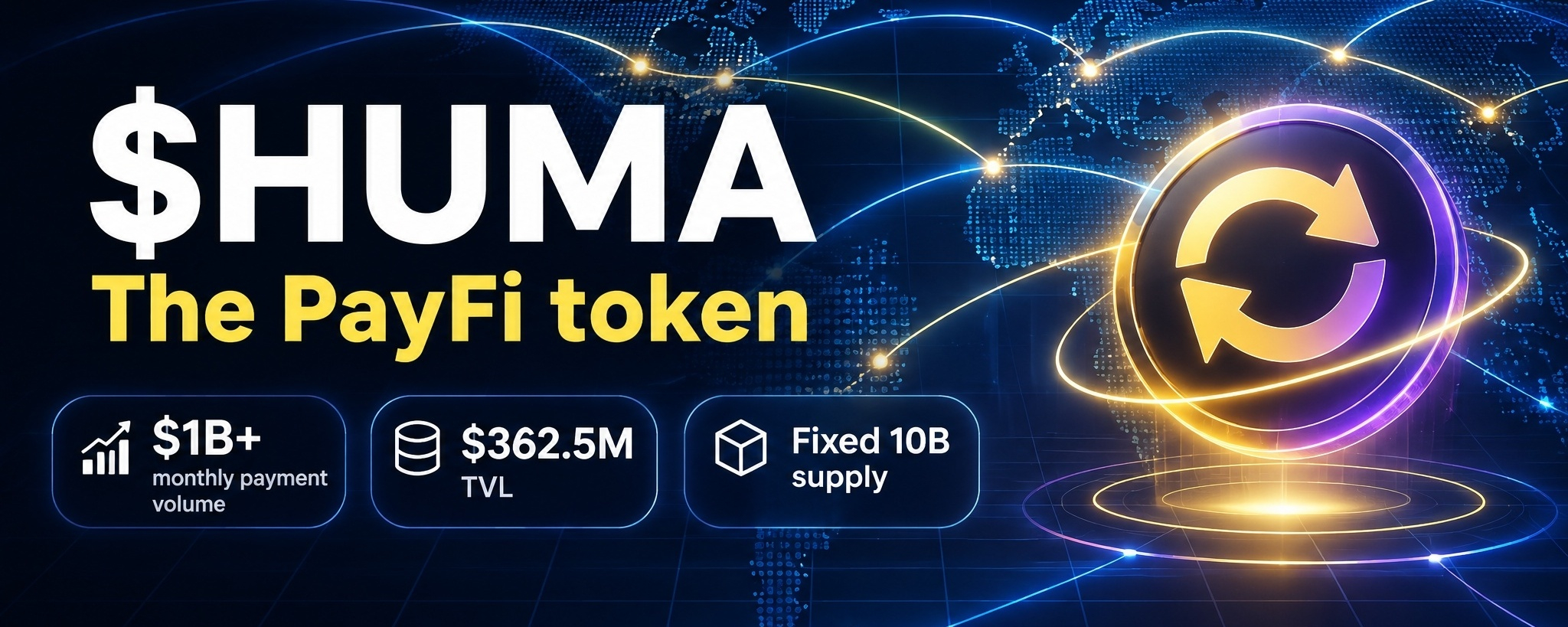
$HUMA: PayFi’s Missing Piece? A New Fee-Capture Mechanism Could Change the Investment ThesisMost investors still classify Huma Finance ($HUMA ) as another RWA lending project.
I think that misses the bigger picture.
Huma is building PayFi infrastructure, financing real-world payment flows, cross-border settlements and receivables. This is a market where liquidity and settlement speed matter.
But there is now a potentially important development: HUMA is moving towards a direct connection between protocol revenue and token value.
1. Real protocol activity
The reported fundamentals are worth watching:
- $1B+ monthly payment volume
- $20B+ cumulative payment volume
- $362.5M TVL
- 100,000+ liquidity providers
- $2.88M in 30-day fees
- $21.9M lifetime fees
These figures suggest meaningful payment infrastructure activity, although payment volume and protocol revenue should never be confused.
2. Institutional investors
Huma has attracted approximately $46.3M in funding across its Seed and Series A rounds.
Notable backers include:
- Race Capital
- Distributed Global
- ParaFi Capital
- Circle Ventures
- HashKey
- Stellar Development Foundation
- TIBAS Ventures, İşbank's venture capital arm
- Folius Ventures
Institutional backing does not guarantee token performance, but it provides credibility to the project's funding history.
3. Tokenomics: understand the supply
HUMA has a fixed maximum supply of 10 billion tokens on Solana.
Key allocations:
- LP & Ecosystem: 31%
- Investors: 20.6%
- Team & Advisors: 19.3%
- Treasury: 11.1%
- CEX & Marketing: 7%
- Airdrop: 5%
- Market Making & Liquidity: 4%
- Pre-sale: 2%
The mint and freeze authorities were revoked in May 2025, an important supply-control measure.
However, vesting and circulating supply remain critical risks.
The first major insider unlock reportedly took place on November 26, 2026, involving approximately 332.5M HUMA.
An OTC arrangement involving Magna and Anchorage is intended to help manage distribution without immediately flooding exchange order books.
That reduces neither the underlying supply nor the need to monitor selling pressure.
4. The development that matters most: HIP-002
This is where the investment thesis gets interesting.
Huma's governance proposals include:
- Burning unclaimed airdrop tokens.
- Activating a protocol fee mechanism.
- Introducing buybacks involving future claimed airdrop tokens.
Why does this matter?
Historically, Huma generated fees, but those fees did not directly create value for HUMA token holders.
The proposed fee switch could establish a connection between protocol activity and token economics.
That is the missing piece investors should be watching.
If implemented successfully, HUMA could evolve from a token associated with a growing payment ecosystem into a token with a more tangible value-accrual mechanism.
5. The risks investors cannot ignore
There are three major considerations:
1. Whether the proposed fee mechanism is approved and implemented effectively.
2. Whether protocol revenue translates into sustainable token value capture.
3. Whether upcoming unlocks create continued selling pressure into Q1 2027.
A growing protocol does not automatically mean a rising token price.
6. My investment perspective
HUMA has an interesting combination:
- Real payment infrastructure.
- Growing PayFi adoption.
- Institutional investment backing.
- Established protocol fee generation.
- A potential new token value-capture mechanism.
The token's reported price near $0.007 represents a substantial discount to its $0.1156 launch high.
However, a low price and depressed market cap are not sufficient reasons to buy.
The real question is whether HUMA can convert its growing business activity into sustainable value for token holders.
My conclusion: HUMA deserves attention as a PayFi infrastructure project. HIP-002 could be a meaningful turning point, but execution, governance outcomes and unlock absorption will determine whether the opportunity becomes reality.
The fundamentals are interesting. The token economics still need to prove themselves.
Not financial advice. Always DYOR.
#HUMA #PayFi #RWA #Crypto #BinanceSquare
$HUMA: PayFi’s Missing Piece? A New Fee-Capture Mechanism Could Change the Investment Thesis
Most investors still classify Huma Finance ($HUMA ) as another RWA lending project.
I think that misses the bigger picture.
Huma is building PayFi infrastructure, financing real-world payment flows, cross-border settlements and receivables. This is a market where liquidity and settlement speed matter.
But there is now a potentially important development: HUMA is moving towards a direct connection between protocol revenue and token value.
1. Real protocol activity
The reported fundamentals are worth watching:
- $1B+ monthly payment volume
- $20B+ cumulative payment volume
- $362.5M TVL
- 100,000+ liquidity providers
- $2.88M in 30-day fees
- $21.9M lifetime fees
These figures suggest meaningful payment infrastructure activity, although payment volume and protocol revenue should never be confused.
2. Institutional investors
Huma has attracted approximately $46.3M in funding across its Seed and Series A rounds.
Notable backers include:
- Race Capital
- Distributed Global
- ParaFi Capital
- Circle Ventures
- HashKey
- Stellar Development Foundation
- TIBAS Ventures, İşbank's venture capital arm
- Folius Ventures
Institutional backing does not guarantee token performance, but it provides credibility to the project's funding history.
3. Tokenomics: understand the supply
HUMA has a fixed maximum supply of 10 billion tokens on Solana.
Key allocations:
- LP & Ecosystem: 31%
- Investors: 20.6%
- Team & Advisors: 19.3%
- Treasury: 11.1%
- CEX & Marketing: 7%
- Airdrop: 5%
- Market Making & Liquidity: 4%
- Pre-sale: 2%
The mint and freeze authorities were revoked in May 2025, an important supply-control measure.
However, vesting and circulating supply remain critical risks.
The first major insider unlock reportedly took place on November 26, 2026, involving approximately 332.5M HUMA.
An OTC arrangement involving Magna and Anchorage is intended to help manage distribution without immediately flooding exchange order books.
That reduces neither the underlying supply nor the need to monitor selling pressure.
4. The development that matters most: HIP-002
This is where the investment thesis gets interesting.
Huma's governance proposals include:
- Burning unclaimed airdrop tokens.
- Activating a protocol fee mechanism.
- Introducing buybacks involving future claimed airdrop tokens.
Why does this matter?
Historically, Huma generated fees, but those fees did not directly create value for HUMA token holders.
The proposed fee switch could establish a connection between protocol activity and token economics.
That is the missing piece investors should be watching.
If implemented successfully, HUMA could evolve from a token associated with a growing payment ecosystem into a token with a more tangible value-accrual mechanism.
5. The risks investors cannot ignore
There are three major considerations:
1. Whether the proposed fee mechanism is approved and implemented effectively.
2. Whether protocol revenue translates into sustainable token value capture.
3. Whether upcoming unlocks create continued selling pressure into Q1 2027.
A growing protocol does not automatically mean a rising token price.
6. My investment perspective
HUMA has an interesting combination:
- Real payment infrastructure.
- Growing PayFi adoption.
- Institutional investment backing.
- Established protocol fee generation.
- A potential new token value-capture mechanism.
The token's reported price near $0.007 represents a substantial discount to its $0.1156 launch high.
However, a low price and depressed market cap are not sufficient reasons to buy.
The real question is whether HUMA can convert its growing business activity into sustainable value for token holders.
My conclusion: HUMA deserves attention as a PayFi infrastructure project. HIP-002 could be a meaningful turning point, but execution, governance outcomes and unlock absorption will determine whether the opportunity becomes reality.
The fundamentals are interesting. The token economics still need to prove themselves.
Not financial advice. Always DYOR.
#HUMA #PayFi #RWA #Crypto #BinanceSquare
3
993

·
--
Bullish
Partly True
🚨 Enso Routed $499M in 30 Days — How Much Value Actually Reaches $ENSO
{future}(ENSOUSDT)
? 📊⚡
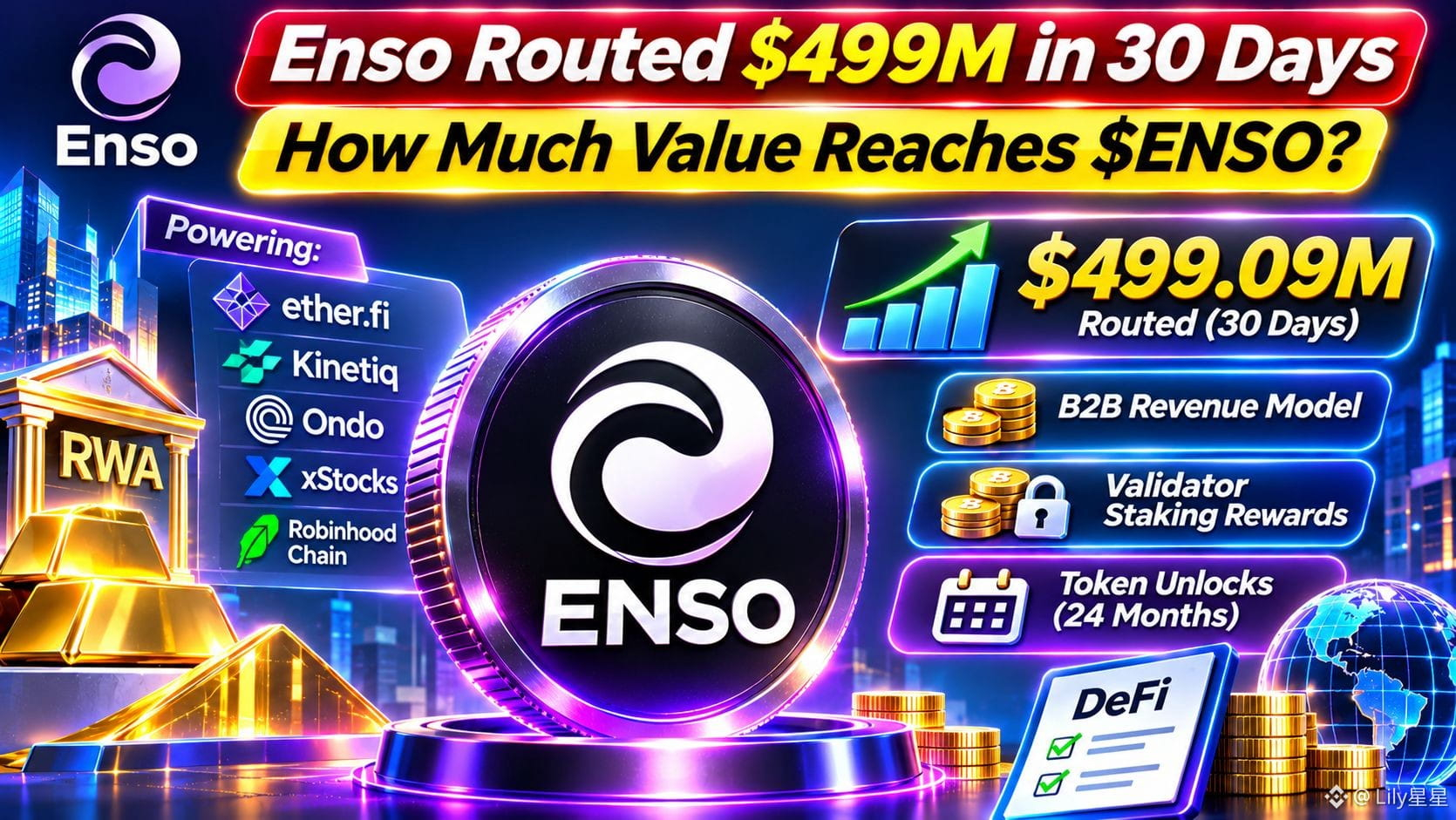
📈 Massive RWA & DeFi Volume: Enso routed $499.09M in 30-day swaps (with $357.27M, or 71.6%, on Ethereum), powering backend liquidity for ether.fi (PAXGy gold), Kinetiq’s Elysium L2 ($1B+ routed), Ondo, xStocks, and Robinhood Chain.
💼 B2B Revenue Model: Enso earns via custom API fees and negotiated B2B revenue-sharing deals—meaning flat DEX fee estimates don't show true protocol income.
🔒 Validator Staking vs. Governance: Holders can delegate ENSO to validators for a share of validation rewards (900K+ ENSO staked since Epoch 1), while governance staking pays 0% and DAO voting excludes treasury payouts.
⏳ Supply & Unlock Watch: Genesis supply of 100M ENSO (max 127.34M with inflation) includes 57.805% allocated to investors, team, and advisors—now past their 1-year cliff into a 24-month linear unlock following October 2025's Binance listing.
🔍$AAVE
{future}(AAVEUSDT)
Key Catalyst to Watch: With $20B+ in cumulative settlement across 350+ enterprise clients, clearer reporting separating organic API/validator revenue from token emissions is key to evaluating ENSO near $0.39.
$XRP
{future}(XRPUSDT)
💬 Your Take: Does Enso’s growing RWA & institutional DeFi footprint outweigh token unlock pressure for $ENSO? Drop your view below! 👇
#ENSO #RWA #defi i #CryptoNews #MoneroFalls13%OnDelistings
🚨 Enso Routed $499M in 30 Days — How Much Value Actually Reaches $ENSO
? 📊⚡
📈 Massive RWA & DeFi Volume: Enso routed $499.09M in 30-day swaps (with $357.27M, or 71.6%, on Ethereum), powering backend liquidity for ether.fi (PAXGy gold), Kinetiq’s Elysium L2 ($1B+ routed), Ondo, xStocks, and Robinhood Chain.
💼 B2B Revenue Model: Enso earns via custom API fees and negotiated B2B revenue-sharing deals—meaning flat DEX fee estimates don't show true protocol income.
🔒 Validator Staking vs. Governance: Holders can delegate ENSO to validators for a share of validation rewards (900K+ ENSO staked since Epoch 1), while governance staking pays 0% and DAO voting excludes treasury payouts.
⏳ Supply & Unlock Watch: Genesis supply of 100M ENSO (max 127.34M with inflation) includes 57.805% allocated to investors, team, and advisors—now past their 1-year cliff into a 24-month linear unlock following October 2025's Binance listing.
🔍$AAVE
Key Catalyst to Watch: With $20B+ in cumulative settlement across 350+ enterprise clients, clearer reporting separating organic API/validator revenue from token emissions is key to evaluating ENSO near $0.39.
$XRP
💬 Your Take: Does Enso’s growing RWA & institutional DeFi footprint outweigh token unlock pressure for $ENSO ? Drop your view below! 👇
#ENSO #RWA #defi i #CryptoNews #MoneroFalls13%OnDelistings
1
836
·
--
Article
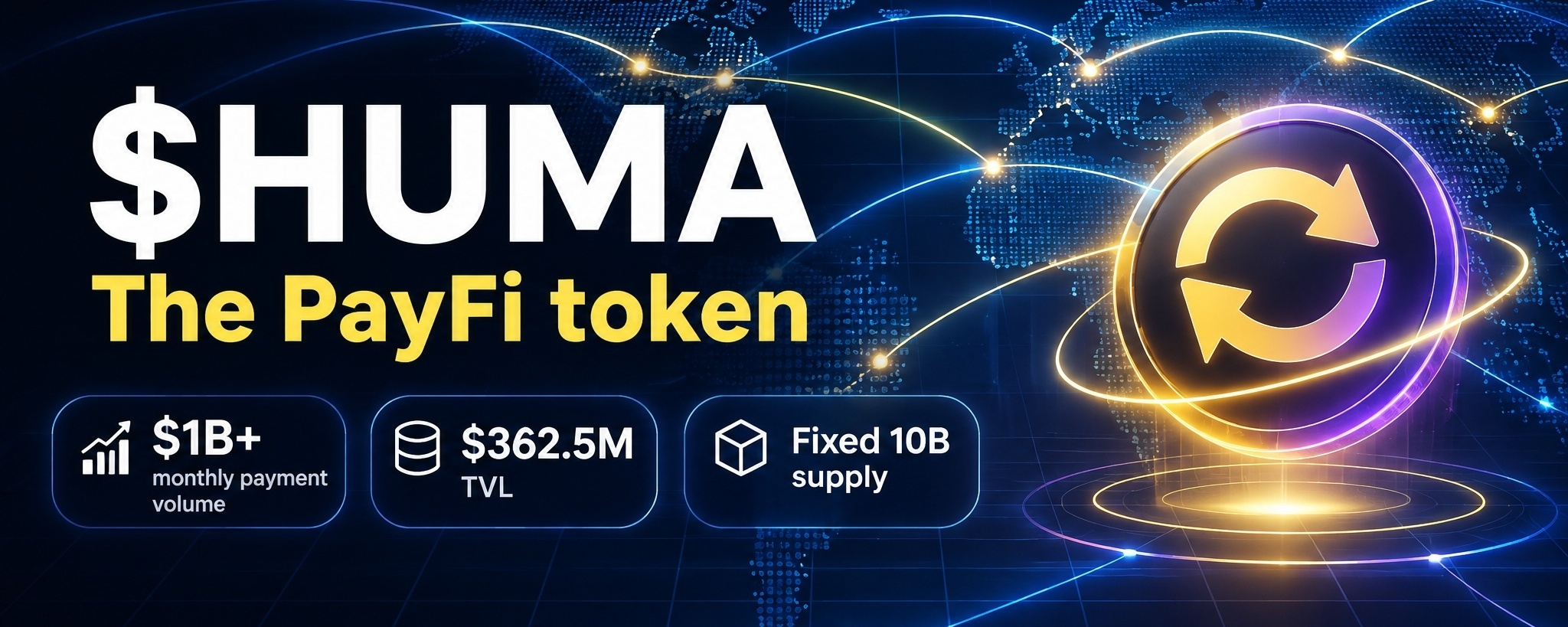
$HUMA — PayFi’s Hidden Opportunity? The Token Value-Capture Story Is ChangingMost investors still classify Huma Finance as another RWA lending project.
I believe that misses the bigger picture.
Huma is building PayFi infrastructure designed to finance real-world payment flows, cross-border settlements and receivables.
But something potentially more important is developing: HUMA could finally gain a direct connection to the economic activity generated by its protocol.
1. The fundamentals
The reported figures are worth watching:
- $1B+ monthly payment volume
- $20B+ cumulative payment volume
- $362.5M TVL
- $415.1M TVL all-time high
- 100,000+ liquidity providers
- $2.88M in 30-day fees
- $21.9M lifetime fees
This is meaningful infrastructure activity. However, payment volume, fees and actual protocol revenue are three different things.
2. Institutional backing
Huma has raised approximately $46.3M across its funding rounds.
Notable investors include:
- Race Capital
- Distributed Global
- ParaFi Capital
- Circle Ventures
- HashKey
- Stellar Development Foundation
- TIBAS Ventures (İşbank's venture capital arm)
- Folius Ventures
This is a notable investor group for a project operating at the intersection of payments, DeFi and RWA.
3. Tokenomics: the supply picture
HUMA has a fixed maximum supply of 10 billion tokens on Solana.
Allocation:
- LP & Ecosystem: 31%
- Investors: 20.6%
- Team & Advisors: 19.3%
- Treasury: 11.1%
- CEX & Marketing: 7%
- Airdrop: 5%
- Market Making & Liquidity: 4%
- Pre-sale: 2%
The mint and freeze authorities were revoked in May 2025.
However, fixed supply does not mean fixed circulating supply. Vesting and unlocks remain important risks.
The first major insider unlock reportedly took place on November 26, involving 332.5M HUMA, approximately 3.3% of total supply.
An OTC distribution arrangement involving Magna and Anchorage is intended to help manage the impact on exchange liquidity.
Investors should still monitor actual circulating supply and selling pressure.
4. The biggest potential catalyst: governance and HIP-002
This is where the investment thesis becomes interesting.
Huma's governance roadmap includes proposals concerning:
- Burning more than 77M unclaimed airdrop tokens.
- Introducing a protocol fee mechanism.
- Buybacks involving future claimed airdrop tokens.
The proposed fee switch is particularly important.
Until now, protocol fees have not translated into direct protocol revenue for HUMA token holders.
HIP-002 could introduce a mechanism connecting protocol economics with the token.
Important: The fee switch is a proposal, not an already activated mechanism.
The governance process is progressing through successive proposals. Investors should follow the actual voting results and implementation announcements.
If successfully implemented, this could materially improve HUMA's token value-capture model.
5. Staking and ecosystem incentives
HUMA also has a staking and governance ecosystem.
Reported figures include:
- 523.1M HUMA staked.
- Approximately 30.2% of circulating supply.
- Governance weight influenced by lock duration.
- Feathers rewards that can be converted into HUMA under the programme rules.
- A 14-day unstaking cooldown.
Staking incentives and access benefits may encourage longer-term participation, although rewards should not be confused with organic investment demand.
6. The risks
Three factors deserve particular attention:
1. Token value capture: Will the proposed fee mechanism actually benefit HUMA?
2. Unlock pressure: Can the market absorb additional supply through Q1 2027?
3. Execution: Can Huma sustain payment growth and convert fees into durable protocol economics?
A successful business does not automatically create a successful investment token.
7. My investment conclusion
HUMA has several attractive characteristics:
- Real-world payment infrastructure.
- Growing PayFi activity.
- Established institutional backing.
- Meaningful TVL and payment volume.
- A potential new token value-capture mechanism.
The token reportedly trades around $0.007, approximately 94% below its $0.1156 launch high.
That makes the valuation interesting to investigate, but a large decline alone does not establish undervaluation.
My view: HUMA deserves a place on the PayFi watchlist.
The next major question is whether governance can turn protocol activity into sustainable value for token holders.
If that happens while unlock pressure remains manageable, the investment thesis becomes considerably stronger.
The opportunity is interesting. The execution still needs to prove itself.
Not financial advice. DYOR.
#HUMA #PayFi #RWA #CryptoInvesting #BinanceSquare
$HUMA — PayFi’s Hidden Opportunity? The Token Value-Capture Story Is Changing
Most investors still classify Huma Finance as another RWA lending project.
I believe that misses the bigger picture.
Huma is building PayFi infrastructure designed to finance real-world payment flows, cross-border settlements and receivables.
But something potentially more important is developing: HUMA could finally gain a direct connection to the economic activity generated by its protocol.
1. The fundamentals
The reported figures are worth watching:
- $1B+ monthly payment volume
- $20B+ cumulative payment volume
- $362.5M TVL
- $415.1M TVL all-time high
- 100,000+ liquidity providers
- $2.88M in 30-day fees
- $21.9M lifetime fees
This is meaningful infrastructure activity. However, payment volume, fees and actual protocol revenue are three different things.
2. Institutional backing
Huma has raised approximately $46.3M across its funding rounds.
Notable investors include:
- Race Capital
- Distributed Global
- ParaFi Capital
- Circle Ventures
- HashKey
- Stellar Development Foundation
- TIBAS Ventures (İşbank's venture capital arm)
- Folius Ventures
This is a notable investor group for a project operating at the intersection of payments, DeFi and RWA.
3. Tokenomics: the supply picture
HUMA has a fixed maximum supply of 10 billion tokens on Solana.
Allocation:
- LP & Ecosystem: 31%
- Investors: 20.6%
- Team & Advisors: 19.3%
- Treasury: 11.1%
- CEX & Marketing: 7%
- Airdrop: 5%
- Market Making & Liquidity: 4%
- Pre-sale: 2%
The mint and freeze authorities were revoked in May 2025.
However, fixed supply does not mean fixed circulating supply. Vesting and unlocks remain important risks.
The first major insider unlock reportedly took place on November 26, involving 332.5M HUMA, approximately 3.3% of total supply.
An OTC distribution arrangement involving Magna and Anchorage is intended to help manage the impact on exchange liquidity.
Investors should still monitor actual circulating supply and selling pressure.
4. The biggest potential catalyst: governance and HIP-002
This is where the investment thesis becomes interesting.
Huma's governance roadmap includes proposals concerning:
- Burning more than 77M unclaimed airdrop tokens.
- Introducing a protocol fee mechanism.
- Buybacks involving future claimed airdrop tokens.
The proposed fee switch is particularly important.
Until now, protocol fees have not translated into direct protocol revenue for HUMA token holders.
HIP-002 could introduce a mechanism connecting protocol economics with the token.
Important: The fee switch is a proposal, not an already activated mechanism.
The governance process is progressing through successive proposals. Investors should follow the actual voting results and implementation announcements.
If successfully implemented, this could materially improve HUMA's token value-capture model.
5. Staking and ecosystem incentives
HUMA also has a staking and governance ecosystem.
Reported figures include:
- 523.1M HUMA staked.
- Approximately 30.2% of circulating supply.
- Governance weight influenced by lock duration.
- Feathers rewards that can be converted into HUMA under the programme rules.
- A 14-day unstaking cooldown.
Staking incentives and access benefits may encourage longer-term participation, although rewards should not be confused with organic investment demand.
6. The risks
Three factors deserve particular attention:
1. Token value capture: Will the proposed fee mechanism actually benefit HUMA?
2. Unlock pressure: Can the market absorb additional supply through Q1 2027?
3. Execution: Can Huma sustain payment growth and convert fees into durable protocol economics?
A successful business does not automatically create a successful investment token.
7. My investment conclusion
HUMA has several attractive characteristics:
- Real-world payment infrastructure.
- Growing PayFi activity.
- Established institutional backing.
- Meaningful TVL and payment volume.
- A potential new token value-capture mechanism.
The token reportedly trades around $0.007, approximately 94% below its $0.1156 launch high.
That makes the valuation interesting to investigate, but a large decline alone does not establish undervaluation.
My view: HUMA deserves a place on the PayFi watchlist.
The next major question is whether governance can turn protocol activity into sustainable value for token holders.
If that happens while unlock pressure remains manageable, the investment thesis becomes considerably stronger.
The opportunity is interesting. The execution still needs to prove itself.
Not financial advice. DYOR.
#HUMA #PayFi #RWA #CryptoInvesting #BinanceSquare
1
148

·
--
Everyone talks about AI like it's an all boys club.
Meanwhile, 2 women oversee over $370B in 2026 AI spending, and 2 others just closed an $8.2B AI deal at AMD.
Here are the 30 women shaping global AI in 2026:
A few verified numbers behind the 30 portraits above:
- Capital: Ruth Porat oversees $200B+ in 2026 AI infrastructure CapEx at Alphabet, while Amy Hood oversees ~$170B at Microsoft.
- Chips and World Models: AMD led by Lisa Su completed its $8.2B acquisition of Fei-Fei Li's World Labs in November 2026, while He Tingbo runs Huawei HiSilicon and its Ascend AI chips.
- Independent Labs: Mira Murati raised $5B at a $40B valuation for Thinking Machines Lab, Lin Qiao's Fireworks AI hit $1B+ ARR at a $17.5B valuation, and Chelsea Finn's Physical Intelligence entered talks near $20B.
- Frontier Ops and Reach: Daniela Amodei is president of Anthropic, Sarah Friar is CFO of OpenAI, Liz Reid runs Google Search across 2.5 billion+ monthly AI Overviews users, and Amanda Askell wrote Claude's Constitution. That's the short receipt behind the list.
If you had to add a 31st name for 2026, who's missing?

516

·
--
The FCC just cleared SpaceX to launch up to 1 million satellites for orbital AI data centers — the first approval of its kind in the US.
SpaceX isn't playing small: 1 GW of orbital AI compute by end-2026, scaling to 100 GW within 3.5 years. And it's teaming up with Nvidia — the first "Starmind" satellite will run on Vera Rubin architecture, with Musk saying SpaceX will exclusively use Nvidia AI chips going forward.
Here's the kicker: SpaceX's own IPO filing warns its orbital ambitions depend on accessing "significantly more AI chips than are currently available". It's even building its own $20B Terafab chip fab because it's "very concerned about supply chain constraints".
The takeaway? If orbital data centers scale as planned, AI chip demand doesn't just grow — it gets a whole new demand vector off the planet. The global space computing market is projected to hit $19B by 2030, up from ~$2.9B in 2025.
But don't ignore the fine print: Terafab has no binding deal, no timeline, no budget yet, and Amazon called Starmind "a grand vision rather than an actual plan".
Real catalyst for chip stocks — or just Musk math? 👇
#SpaceX #Nvidia #AIchips #OrbitalDataCenters #Starmind #CouldSpaceX’sOrbitalDataCentersBoostAIChipDemand?
194
Log in to explore more content
Join global crypto users on Binance Square
⚡️ Get latest and useful information about crypto.
💬 Trusted by the world’s largest crypto exchange.
👍 Discover real insights from verified creators.
Email / Phone number
Trending Topics
1
#EvolveAtBinanceBlockchainWeek
2.5M views
20,934 Discussing
2
#IBSGovAccountMints1BTokensDrains5.71M
6,256 views
91 Discussing
3
#WorldLibertyActsToCutLiquidationRisk
46,886 views
480 Discussing
4
#LiquidHackerMoves598BTC
36,077 views
316 Discussing
5
#XRPLAmendmentsEnterActivationWindow
3,215 views
24 Discussing
6
#TrumpMediaCouldFace883.5MRepaymentDemand
17,919 views
123 Discussing
7
#BitcoinETFsExtendOutflowStreakToEightDays
107,573 views
868 Discussing
8
#BitcoinETFsSee$5.39BNetOutflowRecord
1,468 views
10 Discussing
9
#VitalikWantsWalletChipDesignsOpened
142,086 views
767 Discussing
10
#AnalystSaysIRENBacklogOver$20B
0 views
13 Discussing