
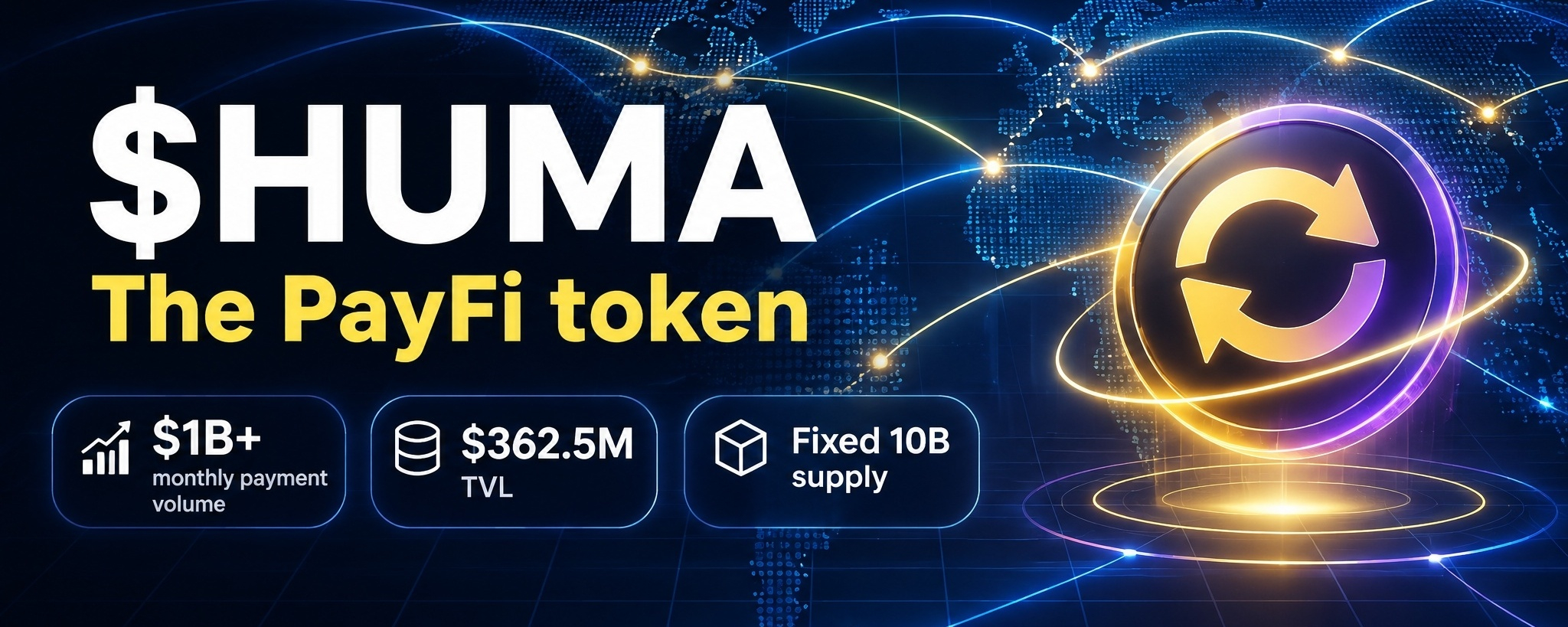

Most investors still classify Huma Finance ($HUMA ) as another RWA lending project.
I think that misses the bigger picture.
Huma is building PayFi infrastructure, financing real-world payment flows, cross-border settlements and receivables. This is a market where liquidity and settlement speed matter.
But there is now a potentially important development: HUMA is moving towards a direct connection between protocol revenue and token value.
1. Real protocol activity
The reported fundamentals are worth watching:
- $1B+ monthly payment volume
- $20B+ cumulative payment volume
- $362.5M TVL
- 100,000+ liquidity providers
- $2.88M in 30-day fees
- $21.9M lifetime fees
These figures suggest meaningful payment infrastructure activity, although payment volume and protocol revenue should never be confused.
2. Institutional investors
Huma has attracted approximately $46.3M in funding across its Seed and Series A rounds.
Notable backers include:
- Race Capital
- Distributed Global
- ParaFi Capital
- Circle Ventures
- HashKey
- Stellar Development Foundation
- TIBAS Ventures, İşbank's venture capital arm
- Folius Ventures
Institutional backing does not guarantee token performance, but it provides credibility to the project's funding history.
3. Tokenomics: understand the supply
HUMA has a fixed maximum supply of 10 billion tokens on Solana.
Key allocations:
- LP & Ecosystem: 31%
- Investors: 20.6%
- Team & Advisors: 19.3%
- Treasury: 11.1%
- CEX & Marketing: 7%
- Airdrop: 5%
- Market Making & Liquidity: 4%
- Pre-sale: 2%
The mint and freeze authorities were revoked in May 2025, an important supply-control measure.
However, vesting and circulating supply remain critical risks.
The first major insider unlock reportedly took place on November 26, 2026, involving approximately 332.5M HUMA.
An OTC arrangement involving Magna and Anchorage is intended to help manage distribution without immediately flooding exchange order books.
That reduces neither the underlying supply nor the need to monitor selling pressure.
4. The development that matters most: HIP-002
This is where the investment thesis gets interesting.
Huma's governance proposals include:
- Burning unclaimed airdrop tokens.
- Activating a protocol fee mechanism.
- Introducing buybacks involving future claimed airdrop tokens.
Why does this matter?
Historically, Huma generated fees, but those fees did not directly create value for HUMA token holders.
The proposed fee switch could establish a connection between protocol activity and token economics.
That is the missing piece investors should be watching.
If implemented successfully, HUMA could evolve from a token associated with a growing payment ecosystem into a token with a more tangible value-accrual mechanism.
5. The risks investors cannot ignore
There are three major considerations:
1. Whether the proposed fee mechanism is approved and implemented effectively.
2. Whether protocol revenue translates into sustainable token value capture.
3. Whether upcoming unlocks create continued selling pressure into Q1 2027.
A growing protocol does not automatically mean a rising token price.
6. My investment perspective
HUMA has an interesting combination:
- Real payment infrastructure.
- Growing PayFi adoption.
- Institutional investment backing.
- Established protocol fee generation.
- A potential new token value-capture mechanism.
The token's reported price near $0.007 represents a substantial discount to its $0.1156 launch high.
However, a low price and depressed market cap are not sufficient reasons to buy.
The real question is whether HUMA can convert its growing business activity into sustainable value for token holders.
My conclusion: HUMA deserves attention as a PayFi infrastructure project. HIP-002 could be a meaningful turning point, but execution, governance outcomes and unlock absorption will determine whether the opportunity becomes reality.
The fundamentals are interesting. The token economics still need to prove themselves.
Not financial advice. Always DYOR.
#HUMA #PayFi #RWA #Crypto #BinanceSquare