
#airobotics
airobotics
1,651 views
41 Discussing
Hot
Latest

🚨 AI ROBOTICS MILESTONE SHATTERS HUMAN RECORDS AS LIQUIDITY FLOWS INTO $FET 🚀
Ubtech Robotics has unleashed a next-generation humanoid model capable of a 2-meter vertical leap and 12.66m/s sprint, surpassing human limits in under three months of engineering. 🔍 This rapid pace of physical AI innovation is serving as a massive macro catalyst for AI sector order flow.
Smart money continues to track real-world AI breakthroughs as structural catalysts that front-run market re-expansions across decentralized compute and robotics assets. 📊 With significant model upgrades promised in coming months, capital efficiency in high-beta tech verticals is rising fast. 💬 How do you see hardware milestones shaping narrative momentum in $FET this quarter? 👇
⚠️ Not financial advice. Always manage your risk. 🛡️
🏷️ #FET #AIRobotics #Crypto #MarketStructure
🔥 ⚡
Ubtech Robotics has unleashed a next-generation humanoid model capable of a 2-meter vertical leap and 12.66m/s sprint, surpassing human limits in under three months of engineering. 🔍 This rapid pace of physical AI innovation is serving as a massive macro catalyst for AI sector order flow.
Smart money continues to track real-world AI breakthroughs as structural catalysts that front-run market re-expansions across decentralized compute and robotics assets. 📊 With significant model upgrades promised in coming months, capital efficiency in high-beta tech verticals is rising fast. 💬 How do you see hardware milestones shaping narrative momentum in $FET this quarter? 👇
⚠️ Not financial advice. Always manage your risk. 🛡️
🏷️ #FET #AIRobotics #Crypto #MarketStructure
🔥 ⚡
$FET AI SECTOR IGNITES AS OPEN SOURCE ROBOTICS SECURES 2.6M IN 24 HOURS! ⚡ 💥
Institutional capital is taking notice as Hugging Face subsidiary Pollen Robotics registered over 2.6 million dollars in pre-orders within 24 hours for its open-source Microduck bipedal robot. 📊 This overwhelming demand extended delivery lead times to 4-6 months while driving the underlying hardware supply chain supplier to its daily price limit.
Smart money recognizes that physical AI robotics and autonomous hardware are rapidly transitioning from conceptual R&D into immediate commercial order flow. 🔍 As onboard computing platforms scale up deployment across 15-motor systems and LiDAR hardware, institutional liquidity rotation into the AI sector is accelerating. 💬 Is physical AI robotics the ultimate fundamental catalyst that drives the next structural expansion wave for $FET ? 👇
⚠️ Not financial advice. Always manage your risk. 🛡️
🏷️ #FET #AIRobotics #Crypto #MarketAnalysis #SmartMoney
🔥 ⚡
Institutional capital is taking notice as Hugging Face subsidiary Pollen Robotics registered over 2.6 million dollars in pre-orders within 24 hours for its open-source Microduck bipedal robot. 📊 This overwhelming demand extended delivery lead times to 4-6 months while driving the underlying hardware supply chain supplier to its daily price limit.
Smart money recognizes that physical AI robotics and autonomous hardware are rapidly transitioning from conceptual R&D into immediate commercial order flow. 🔍 As onboard computing platforms scale up deployment across 15-motor systems and LiDAR hardware, institutional liquidity rotation into the AI sector is accelerating. 💬 Is physical AI robotics the ultimate fundamental catalyst that drives the next structural expansion wave for $FET ? 👇
⚠️ Not financial advice. Always manage your risk. 🛡️
🏷️ #FET #AIRobotics #Crypto #MarketAnalysis #SmartMoney
🔥 ⚡

🚨 HUGGING FACE UNLEASHES $399 ROBOTICS — PHYSICAL AI NARRATIVE REIGNITES FOR $FET ! ⚡
Open-source AI isn't just algorithms on a screen anymore — it just hit physical reality. Hugging Face’s Pollen Robotics dropping a $399 bipedal robot with a fully open-source reinforcement learning stack marks a tangible shift for autonomous agent narratives. 💡
Smart money always front-runs these physical hardware bridges before liquidity fully rotates. 📊 As low-cost robotics accelerate the demand for decentralized compute, order flow is quietly building bids under key AI sector protocols. ⚡
💬 Are you positioning into the physical AI narrative early, or waiting for secondary breakout confirmation? 👇
⚠️ Not financial advice. Always manage your risk. 🛡️
🏷️ #FET #AIRobotics #Crypto #ArtificialIntelligence #Altcoins
🔥 ⚡
Open-source AI isn't just algorithms on a screen anymore — it just hit physical reality. Hugging Face’s Pollen Robotics dropping a $399 bipedal robot with a fully open-source reinforcement learning stack marks a tangible shift for autonomous agent narratives. 💡
Smart money always front-runs these physical hardware bridges before liquidity fully rotates. 📊 As low-cost robotics accelerate the demand for decentralized compute, order flow is quietly building bids under key AI sector protocols. ⚡
💬 Are you positioning into the physical AI narrative early, or waiting for secondary breakout confirmation? 👇
⚠️ Not financial advice. Always manage your risk. 🛡️
🏷️ #FET #AIRobotics #Crypto #ArtificialIntelligence #Altcoins
🔥 ⚡
⚡ INSTITUTIONAL CAPITAL EXPANDS INTO AI ROBOTICS DRIVING $FET NARRATIVE REVALUATION 🔍
High-tier venture backing and high-profile validation in the humanoid robotics sector reflect a massive institutional liquidity rotation into real-world autonomous execution. 📊 When smart money capital backs tech teams capable of real-time execution, sector valuation benchmarks undergo structural recalibration.
Order flow across AI tokens reveals methodical smart money positioning ahead of narrative momentum. 🌊 As institutional validation accelerates from key tech leaders, structural support floors continue to elevate across major sector assets. 💬 Are you positioning during these re-accumulation zones or waiting for breakout confirmation? 👇
⚠️ Not financial advice. Always manage your risk. 🛡️
🏷️ #FET #AIRobotics #SmartMoney #Crypto #TechnicalAnalysis
🎯 🦈
High-tier venture backing and high-profile validation in the humanoid robotics sector reflect a massive institutional liquidity rotation into real-world autonomous execution. 📊 When smart money capital backs tech teams capable of real-time execution, sector valuation benchmarks undergo structural recalibration.
Order flow across AI tokens reveals methodical smart money positioning ahead of narrative momentum. 🌊 As institutional validation accelerates from key tech leaders, structural support floors continue to elevate across major sector assets. 💬 Are you positioning during these re-accumulation zones or waiting for breakout confirmation? 👇
⚠️ Not financial advice. Always manage your risk. 🛡️
🏷️ #FET #AIRobotics #SmartMoney #Crypto #TechnicalAnalysis
🎯 🦈

🚨 $UNITREE IGNITES DISCOVERY PHASE AS INSTITUTIONS FLOOD THE AI ROBOTICS SECTOR! 💥
Following an explosive initial price expansion upon listing, $UNITREE is capturing aggressive capital rotation into the AI Robotics thematic narrative. 📊 Institutional participants are rapidly repricing the asset, sweeping early market liquidity to establish structural positioning.
With capital velocity intensifying across emerging tech sectors, tracking higher-timeframe consolidation levels becomes paramount for structural continuity. 🔍 Sustained volume absorption above initial expansion zones will confirm whether smart money intends to fuel a secondary trend continuation leg.
💬 Are you waiting for a clean pullback into an order block, or tracking early structural momentum? 👇
⚠️ Not financial advice. Always manage your risk. 🛡️
🏷️ #UNITREE #AIRobotics #Crypto #MarketStructure #Altcoins
🦈 ⚡
Following an explosive initial price expansion upon listing, $UNITREE is capturing aggressive capital rotation into the AI Robotics thematic narrative. 📊 Institutional participants are rapidly repricing the asset, sweeping early market liquidity to establish structural positioning.
With capital velocity intensifying across emerging tech sectors, tracking higher-timeframe consolidation levels becomes paramount for structural continuity. 🔍 Sustained volume absorption above initial expansion zones will confirm whether smart money intends to fuel a secondary trend continuation leg.
💬 Are you waiting for a clean pullback into an order block, or tracking early structural momentum? 👇
⚠️ Not financial advice. Always manage your risk. 🛡️
🏷️ #UNITREE #AIRobotics #Crypto #MarketStructure #Altcoins
🦈 ⚡
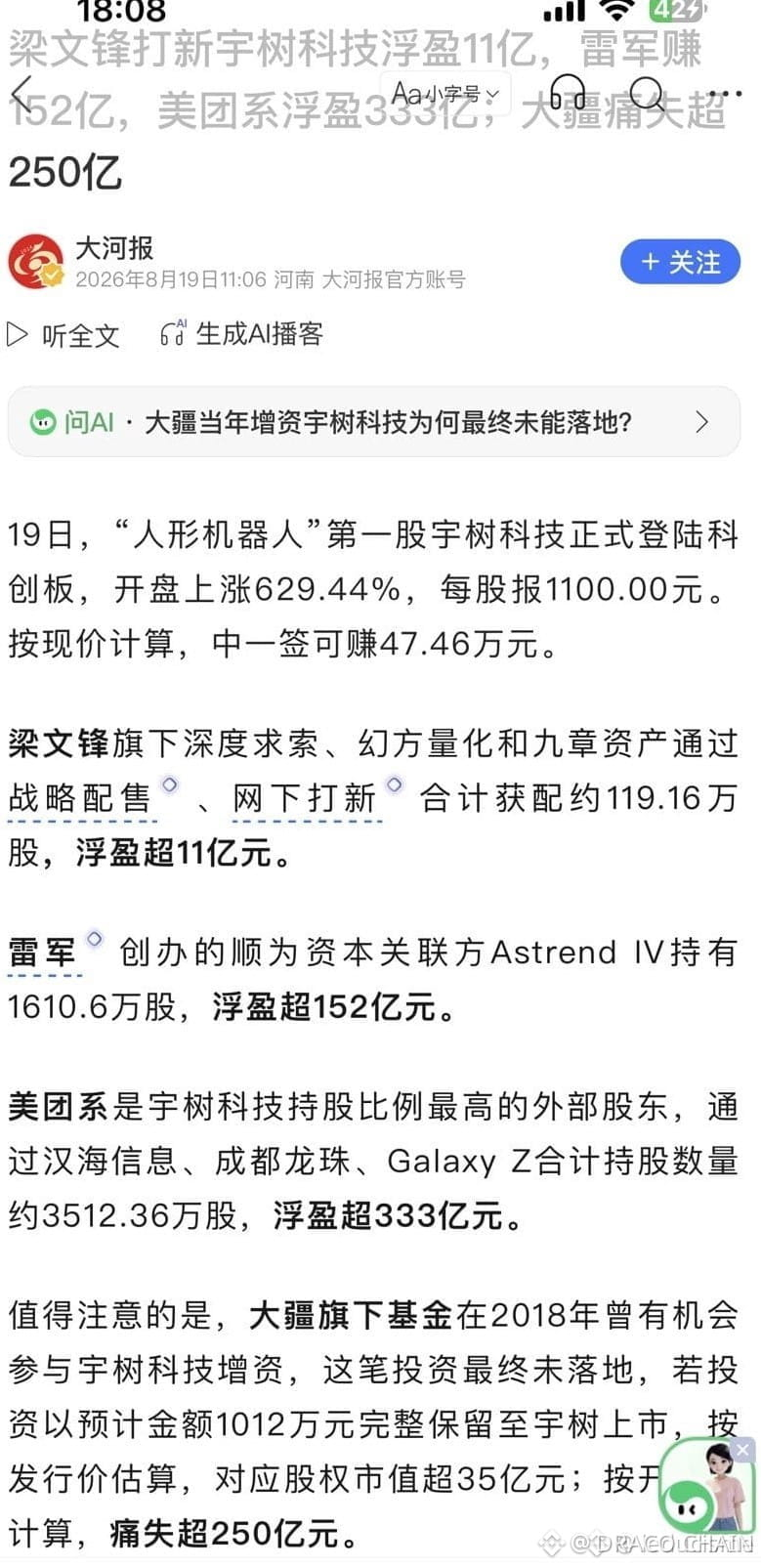

⚡ $UNITREE PUMPS 600% AT LAUNCH AS AI ROBOTICS CAPITAL FLOODS THE ORDER BOOKS! 💥
🌊 AI Robotics capital is cascading into the market like a broken dam, and $UNITREE just proved it with an insane 600% debut surge. Major institutional funds are already sitting on massive multiples while early seller pressure gets swallowed whole by aggressive limit orders.
⚡ Momentum of this magnitude does not just evaporate overnight—it builds high-level consolidation before the next leg higher. Smart money is watching the order flow closely as liquidity rotates heavily into high-conviction AI narratives. 💬 Are you positioning for the next expansion wave or watching from the sidelines again? 👇
⚠️ Not financial advice. Always manage your risk. 🛡️
🏷️ #UNITREE #AIRobotics #Crypto #Momentum #Breakout
🔥 ⚡
🌊 AI Robotics capital is cascading into the market like a broken dam, and $UNITREE just proved it with an insane 600% debut surge. Major institutional funds are already sitting on massive multiples while early seller pressure gets swallowed whole by aggressive limit orders.
⚡ Momentum of this magnitude does not just evaporate overnight—it builds high-level consolidation before the next leg higher. Smart money is watching the order flow closely as liquidity rotates heavily into high-conviction AI narratives. 💬 Are you positioning for the next expansion wave or watching from the sidelines again? 👇
⚠️ Not financial advice. Always manage your risk. 🛡️
🏷️ #UNITREE #AIRobotics #Crypto #Momentum #Breakout
🔥 ⚡
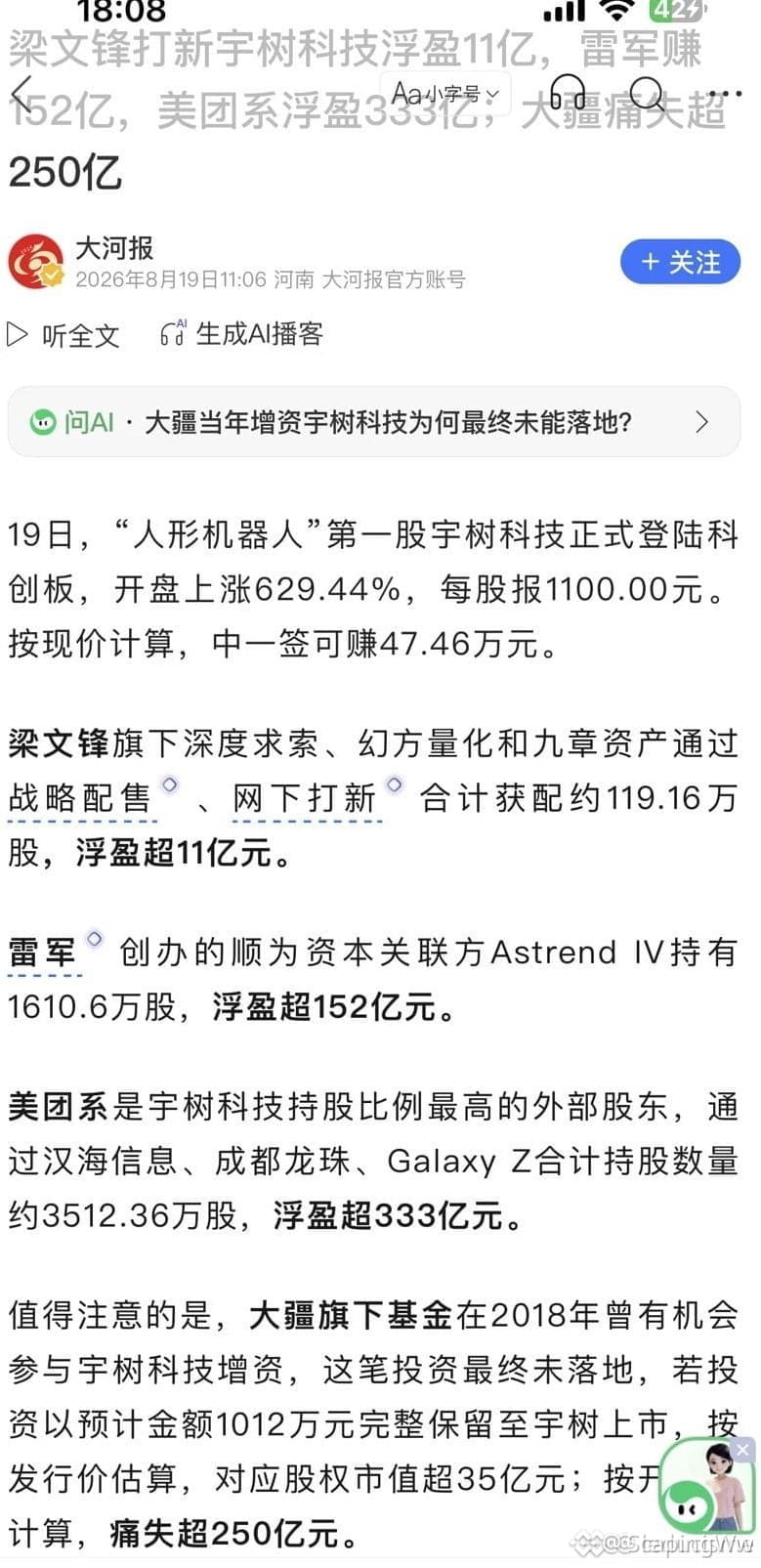
⚡ ROBOTICS IPO EXPLODES OVER 460% ON DAY ONE IGNITING THE $FET SECTOR! 💥
Smart capital is aggressively repricing hardtech as Ubitech surges from a 150.80 yuan IPO to an 845 yuan close. 📊 This explosive rally pushed market cap beyond 340 billion yuan, proving deep technical execution commands premium bids when market momentum hits.
Founder Wang Xingxing engineered low-cost drive solutions long before institutional capital caught on. ⚡ Now with humanoid units like the G1 scaling, smart money is front-running the convergence of physical robotics and decentralized AI tokens like $FET .
💡 Real-world hardware breakthroughs are rapidly expanding the addressable market for autonomous AI systems. 💬 Will physical AI robotics be the dominant narrative driving the next major altcoin sector flip? 👇
⚠️ Not financial advice. Always manage your risk. 🛡️
🏷️ #FET #AIRobotics #TechBoom #Crypto #MarketInsight
🔥 💎
Smart capital is aggressively repricing hardtech as Ubitech surges from a 150.80 yuan IPO to an 845 yuan close. 📊 This explosive rally pushed market cap beyond 340 billion yuan, proving deep technical execution commands premium bids when market momentum hits.
Founder Wang Xingxing engineered low-cost drive solutions long before institutional capital caught on. ⚡ Now with humanoid units like the G1 scaling, smart money is front-running the convergence of physical robotics and decentralized AI tokens like $FET .
💡 Real-world hardware breakthroughs are rapidly expanding the addressable market for autonomous AI systems. 💬 Will physical AI robotics be the dominant narrative driving the next major altcoin sector flip? 👇
⚠️ Not financial advice. Always manage your risk. 🛡️
🏷️ #FET #AIRobotics #TechBoom #Crypto #MarketInsight
🔥 💎
🚨 HUMANOID ROBOTICS VALUATIONS SURGE AS INSTITUTIONAL LIQUIDITY ROTATES INTO HARDWARE AI! $FET 🦈
Institutional order flow in the AI hardware segment is signaling a structural shift. Yutree Technology hitting a 53.3 billion dollar market cap on day one established a massive public market benchmark, proving traditional capital appetite for pure-play robotics is vastly exceeding initial pricing models. 📊
With Agility Robotics—backed by tech heavyweights Nvidia and Amazon—gearing up for a 2.5 billion dollar Q4 public launch, smart money is aggressively positioning across the entire AI ecosystem ahead of quarter-end catalysts. 🔍 ⚡
As institutional valuation benchmarks get recalibrated higher, will this hardware momentum trigger the next wave of capital repricing across decentralized AI protocols? 👇
⚠️ Not financial advice. Always manage your risk. 🛡️
🏷️ #FET #AIRobotics #Nvidia #SmartMoney #Crypto
🎯 🦈
Institutional order flow in the AI hardware segment is signaling a structural shift. Yutree Technology hitting a 53.3 billion dollar market cap on day one established a massive public market benchmark, proving traditional capital appetite for pure-play robotics is vastly exceeding initial pricing models. 📊
With Agility Robotics—backed by tech heavyweights Nvidia and Amazon—gearing up for a 2.5 billion dollar Q4 public launch, smart money is aggressively positioning across the entire AI ecosystem ahead of quarter-end catalysts. 🔍 ⚡
As institutional valuation benchmarks get recalibrated higher, will this hardware momentum trigger the next wave of capital repricing across decentralized AI protocols? 👇
⚠️ Not financial advice. Always manage your risk. 🛡️
🏷️ #FET #AIRobotics #Nvidia #SmartMoney #Crypto
🎯 🦈
🚨 $VIRTUAL ALIGNS WITH INSTITUTIONAL INTEREST AS HUMANOID ROBOTICS SURPASS HUMAN SPEED LIMITS! 💥
📌 Breakthrough physical AI metrics are accelerating capital flows directly into artificial intelligence market structures. The recent milestone of a humanoid robot reaching 45.6 km/h proves that autonomous robotics development is advancing at an exponential curve, catching institutional attention.
📊 As smart money seeks high-beta exposure to this technological shift, AI-native protocol assets like $VIRTUAL represent prime narrative-driven liquidity pools. Institutional position building often precedes major structural expansions during high-conviction fundamental catalysts like this. 💡 Is this real-world robotics momentum enough to trigger the next major liquidity expansion for $VIRTUAL , or are you waiting for structural confirmation first? 👇
⚠️ Not financial advice. Always manage your risk. 🛡️
🏷️ #VIRTUAL #AIRobotics #SmartMoney #Crypto #AI
🎯 🦈
📌 Breakthrough physical AI metrics are accelerating capital flows directly into artificial intelligence market structures. The recent milestone of a humanoid robot reaching 45.6 km/h proves that autonomous robotics development is advancing at an exponential curve, catching institutional attention.
📊 As smart money seeks high-beta exposure to this technological shift, AI-native protocol assets like $VIRTUAL represent prime narrative-driven liquidity pools. Institutional position building often precedes major structural expansions during high-conviction fundamental catalysts like this. 💡 Is this real-world robotics momentum enough to trigger the next major liquidity expansion for $VIRTUAL , or are you waiting for structural confirmation first? 👇
⚠️ Not financial advice. Always manage your risk. 🛡️
🏷️ #VIRTUAL #AIRobotics #SmartMoney #Crypto #AI
🎯 🦈
SOFTBANK FUELS $10B AI ROBOTICS GIANT AS REAL-WORLD AUTOMATION BULLS TARGET $FET 💥 ⚡
SoftBank just finalized its largest Series A round ever, pumping $2 billion into Swiss heavy-machinery AI pioneer Gravis Robotics at a staggering $10 billion valuation. 🦈 Institutional capital is officially bypassing pure digital hype to fund autonomous real-world infrastructure.
Gravis Robotics' plug-and-play AI control kits upgrade heavy machinery across global giants like Caterpillar and Volvo, boosting operational efficiency by 30%. 📊 As deep-pocketed smart money aggressively bids hardware-integrated artificial intelligence, expect real-world automation narratives to send massive shockwaves through AI-centric crypto assets. 💡
This monumental institutional bet proves the next wave of capital expansion belongs to actionable intelligence. 💬 Do you expect crypto AI tokens to front-run this massive industrial capital influx, or will market participants lag behind institutional moves? 👇
⚠️ Not financial advice. Always manage your risk. 🛡️
🏷️ #FET #AIRobotics #SmartMoney #Crypto #TechTrends
🔥 💎
SoftBank just finalized its largest Series A round ever, pumping $2 billion into Swiss heavy-machinery AI pioneer Gravis Robotics at a staggering $10 billion valuation. 🦈 Institutional capital is officially bypassing pure digital hype to fund autonomous real-world infrastructure.
Gravis Robotics' plug-and-play AI control kits upgrade heavy machinery across global giants like Caterpillar and Volvo, boosting operational efficiency by 30%. 📊 As deep-pocketed smart money aggressively bids hardware-integrated artificial intelligence, expect real-world automation narratives to send massive shockwaves through AI-centric crypto assets. 💡
This monumental institutional bet proves the next wave of capital expansion belongs to actionable intelligence. 💬 Do you expect crypto AI tokens to front-run this massive industrial capital influx, or will market participants lag behind institutional moves? 👇
⚠️ Not financial advice. Always manage your risk. 🛡️
🏷️ #FET #AIRobotics #SmartMoney #Crypto #TechTrends
🔥 💎

🚨 SOFTBANK FLOODS $2B INTO AI ROBOTICS INSIGHTS FOR THE $FET NARRATIVE SECTOR! 🦈
SoftBank completing a massive $2 billion Series A in Gravis Robotics at a $10B valuation signals heavy institutional capital absorbing real-world AI infrastructure. 💡 This massive capital deployment into ETH Zurich autonomous hardware represents macro smart money positioning far ahead of the retail curve.
📊 As legacy earthmoving equipment gets upgraded with AI-driven autonomy, cross-market liquidity flow tends to spill directly into decentralized AI protocols. 🌊 Smart money is taking notes on how real-world efficiency gains are pricing into tokenized compute and AI ecosystems like $FET .
🤔 Do you see this institutional capital injection triggering the next leg of AI token expansion, or are you waiting for structural reclaims first? 👇
⚠️ Not financial advice. Always manage your risk. 🛡️
🏷️ #FET #AIRobotics #SmartMoney #Crypto #AI
🦈 🎯
SoftBank completing a massive $2 billion Series A in Gravis Robotics at a $10B valuation signals heavy institutional capital absorbing real-world AI infrastructure. 💡 This massive capital deployment into ETH Zurich autonomous hardware represents macro smart money positioning far ahead of the retail curve.
📊 As legacy earthmoving equipment gets upgraded with AI-driven autonomy, cross-market liquidity flow tends to spill directly into decentralized AI protocols. 🌊 Smart money is taking notes on how real-world efficiency gains are pricing into tokenized compute and AI ecosystems like $FET .
🤔 Do you see this institutional capital injection triggering the next leg of AI token expansion, or are you waiting for structural reclaims first? 👇
⚠️ Not financial advice. Always manage your risk. 🛡️
🏷️ #FET #AIRobotics #SmartMoney #Crypto #AI
🦈 🎯

🤖 ROBO : The AI-Robotics Revolution Surging on Binance Alpha! 🚀
Fabric Protocol ($ROBO ) is rapidly becoming the standout narrative in the "Social-First AI" and DePIN sectors since its high-profile debut on Binance Alpha and Futures on February 27, 2026. This isn't just a speculative asset; it is the core utility token for a decentralized robotics economy, acting as a "Robot Passport" that allows machines to verify identities and settle payments autonomously. Since its launch, the number of ROBO holders has been increasing gradually as the airdrop claim portal opens and the broader crypto community recognizes the project's massive long-term potential.
With the token recently hitting a new all-time high of $0.0429 and maintaining strong 24-hour trading volumes exceeding $142 million, market confidence remains high despite broader industry volatility. The project’s strength is backed by heavy-hitting institutional support from names like Pantera and Coinbase Ventures, alongside a robust tokenomic structure that includes a 12-month lock-up cliff for team and investor tokens to prevent early selling pressure. As the protocol moves toward its goal of becoming the "Ethereum of Robots," the steady accumulation by informed participants suggests that ROBO is positioning itself as a foundational layer for the next decade of machine-to-machine transactions.
#ROBO #BinanceAlpha #FabricProtocol #AIRobotics #DePIN
Fabric Protocol ($ROBO ) is rapidly becoming the standout narrative in the "Social-First AI" and DePIN sectors since its high-profile debut on Binance Alpha and Futures on February 27, 2026. This isn't just a speculative asset; it is the core utility token for a decentralized robotics economy, acting as a "Robot Passport" that allows machines to verify identities and settle payments autonomously. Since its launch, the number of ROBO holders has been increasing gradually as the airdrop claim portal opens and the broader crypto community recognizes the project's massive long-term potential.
With the token recently hitting a new all-time high of $0.0429 and maintaining strong 24-hour trading volumes exceeding $142 million, market confidence remains high despite broader industry volatility. The project’s strength is backed by heavy-hitting institutional support from names like Pantera and Coinbase Ventures, alongside a robust tokenomic structure that includes a 12-month lock-up cliff for team and investor tokens to prevent early selling pressure. As the protocol moves toward its goal of becoming the "Ethereum of Robots," the steady accumulation by informed participants suggests that ROBO is positioning itself as a foundational layer for the next decade of machine-to-machine transactions.
#ROBO #BinanceAlpha #FabricProtocol #AIRobotics #DePIN

$ROBO
(Fabric Protocol) Market Update: Riding the AI & Robotics Wave 🤖🚀
Fabric Protocol (ROBO) is capturing significant market attention this May as the "AI + Robotics" narrative takes center stage. Currently trading with renewed momentum, the asset is benefiting from a broader institutional push into semiconductor and AI-driven ecosystem tokens.
📊 The Numbers (as of May 11, 2026)
Current Price: $0.0221 (Up +4.11% in 24H)
24H Volume: $11.47M
Market Cap: $49.36M
Circulating Supply: 2.23B ROBO
🔥 Why ROBO is Pumping
AI Narrative Strength: As artificial intelligence and automation continue to evolve, platforms that coordinate robots on the blockchain are attracting fresh investor interest.
ETF Tailwinds: ROBO has seen a short-term boost driven by the ongoing ETF boom in AI and the semiconductor industry chain, driving rapid increases in both price and volume.
Institutional Deployment: Top-tier venture capital and institutional funds are continuing to deploy capital into empowerment tokens, providing stronger fundamental support for the mid-to-long term.
🛡️ Technical Analysis & Targets
Active Range: The price is currently oscillating between $0.0210 and $0.0232.
Critical Support: Watch the $0.0209 level closely; holding this zone is key for maintaining the current bullish structure.
Short-Term Resistance: ROBO is facing immediate friction around $0.0222. A clean break here could target the $0.046 range.
Bullish Signal: The MACD line has recently crossed above the signal line on shorter timeframes, which many traders view as a tactical buying opportunity.
💡 Trader’s Note
While the short-term trend shows intensified volatility due to broader market pullbacks, the 200-day moving average remains in an uptrend since early May, signaling underlying strength.
Strategy: Pay attention to the critical support near $0.0210. Look for entries on successful retests of support rather than chasing vertical pumps.
#ROBO #FabricProtocol #AIRobotics #CryptoNews #TechnicalAnalysis #BinanceSquare
(Fabric Protocol) Market Update: Riding the AI & Robotics Wave 🤖🚀
Fabric Protocol (ROBO) is capturing significant market attention this May as the "AI + Robotics" narrative takes center stage. Currently trading with renewed momentum, the asset is benefiting from a broader institutional push into semiconductor and AI-driven ecosystem tokens.
📊 The Numbers (as of May 11, 2026)
Current Price: $0.0221 (Up +4.11% in 24H)
24H Volume: $11.47M
Market Cap: $49.36M
Circulating Supply: 2.23B ROBO
🔥 Why ROBO is Pumping
AI Narrative Strength: As artificial intelligence and automation continue to evolve, platforms that coordinate robots on the blockchain are attracting fresh investor interest.
ETF Tailwinds: ROBO has seen a short-term boost driven by the ongoing ETF boom in AI and the semiconductor industry chain, driving rapid increases in both price and volume.
Institutional Deployment: Top-tier venture capital and institutional funds are continuing to deploy capital into empowerment tokens, providing stronger fundamental support for the mid-to-long term.
🛡️ Technical Analysis & Targets
Active Range: The price is currently oscillating between $0.0210 and $0.0232.
Critical Support: Watch the $0.0209 level closely; holding this zone is key for maintaining the current bullish structure.
Short-Term Resistance: ROBO is facing immediate friction around $0.0222. A clean break here could target the $0.046 range.
Bullish Signal: The MACD line has recently crossed above the signal line on shorter timeframes, which many traders view as a tactical buying opportunity.
💡 Trader’s Note
While the short-term trend shows intensified volatility due to broader market pullbacks, the 200-day moving average remains in an uptrend since early May, signaling underlying strength.
Strategy: Pay attention to the critical support near $0.0210. Look for entries on successful retests of support rather than chasing vertical pumps.
#ROBO #FabricProtocol #AIRobotics #CryptoNews #TechnicalAnalysis #BinanceSquare

Log in to explore more content