
#singularitynet
singularitynet
164,481 views
184 Discussing
Hot
Latest

ALERT 🚨 Strong bullish wave surges through Litentry ( $LIT ), SingularityNET ( $AGIX ), and TrueFi ( $TRU ). Order blocks confirm breakout, volume spikes, and momentum builds. Adoption curves climb as ecosystem growth fuels new integrations. Liquidity deepens, investor sentiment turns positive. Trading activity surges, innovation fuels. This trio offers compelling entry for strategic allocation. #Litentry #SingularityNET #TrueFi #CryptoAnalysis

ALERT 🚨 Strong bullish convergence on $AR (ARWEAVE), $LIT (LITENTRY), $AGIX (SINGULARITYNET). Order blocks at 8 week high signal breakout momentum. Growing institutional adoption fuels liquidity surge. Ecosystem expansion through Layer 2 scaling and AI driven dApps boosts investor sentiment. Aggressive buy pressure expected. #Arweave #Litentry #SingularityNET #CryptoBuy

🤖🛡️ THE NEW PROTECTION: SingularityNET activates real-time audits with AI for smart contracts
Hacks in Web3 are on borrowed time. SingularityNET has officially launched "SentinAI", an infrastructure of AI agents specialized in auditing the code of smart contracts second by second, directly on the blockchain. 🌐📊
Why is this a game changer for security?
* Pre-Block Detection: Unlike traditional audits that happen once before launching a project, this AI monitors the pending transaction pool (mempool) to automatically identify and block any exploit attempts before they get confirmed on the network.
* DeFi Immunity: The system learns from each new global attack vector, updating the defenses of connected protocols in milliseconds without needing to manually pause dApps.
⚠️ Risk Management Guideline: While AI audits drastically boost security, no technology is infallible against complex logical failures. If you’re exploring new protocols protected by AI, manage your capital wisely. To safeguard your main liquidity, trade on the Spot market at @Binance and, when moving funds, always manually check every character of your destination addresses to ensure your digital hygiene. 🔒
💬 THE SCENARIO DEBATE: The automation of cybersecurity opens a new digital arms race: 👉 SIDE A: Defensive AI will standardize security, bringing DeFi exploits down to nearly zero in the coming years. 👉 SIDE B: Hackers will also use advanced AI models to uncover hidden vulnerabilities, keeping the risk level the same.
Vote below in the comments and tell me which side you think will win the race! 👇
#artificialintelligence #SingularityNET #DeFiSecurity2026 #BlockchainCrypto
Hacks in Web3 are on borrowed time. SingularityNET has officially launched "SentinAI", an infrastructure of AI agents specialized in auditing the code of smart contracts second by second, directly on the blockchain. 🌐📊
Why is this a game changer for security?
* Pre-Block Detection: Unlike traditional audits that happen once before launching a project, this AI monitors the pending transaction pool (mempool) to automatically identify and block any exploit attempts before they get confirmed on the network.
* DeFi Immunity: The system learns from each new global attack vector, updating the defenses of connected protocols in milliseconds without needing to manually pause dApps.
⚠️ Risk Management Guideline: While AI audits drastically boost security, no technology is infallible against complex logical failures. If you’re exploring new protocols protected by AI, manage your capital wisely. To safeguard your main liquidity, trade on the Spot market at @Binance and, when moving funds, always manually check every character of your destination addresses to ensure your digital hygiene. 🔒
💬 THE SCENARIO DEBATE: The automation of cybersecurity opens a new digital arms race: 👉 SIDE A: Defensive AI will standardize security, bringing DeFi exploits down to nearly zero in the coming years. 👉 SIDE B: Hackers will also use advanced AI models to uncover hidden vulnerabilities, keeping the risk level the same.
Vote below in the comments and tell me which side you think will win the race! 👇
#artificialintelligence #SingularityNET #DeFiSecurity2026 #BlockchainCrypto
ALERT 🚨 $AR ( ARWEAVE ), $NIGHT ( NIGHTFALL ), and $AGIX ( SINGULARITYNET ) are on a bullish run. Order blocks reveal sustained momentum. Trading volume surges indicate rising investor sentiment. Ecosystem innovations boost adoption and liquidity. Strong buy stance. 🚀 #Arweave #Nightfall #SingularityNET

$SINGULARITYNET IS REVOLUTIONIZING AI WITH BLOCKCHAIN TECHNOLOGY 🔥
Ben Goertzel, Chairman of the AGI Association, is pushing for a decentralized AGI ecosystem through a blockchain network, aiming to replace closed-model paths like OpenAI and Anthropic with a collective ownership and maintenance by users worldwide. This initiative is being advanced through his project SingularityNET and the Artificial General Intelligence Alliance.
The future system will offer paid AI services and maintain a decentralized backend architecture, with Goertzel forecasting AGI emergence between 2027 and 2030, will this development create a new wave of opportunities for $SINGULARITYNET or other blockchain-based AI projects?
Not financial advice, manage your risk.
#SingularityNET #AIGeneral #BlockchainAI
⚡️
Ben Goertzel, Chairman of the AGI Association, is pushing for a decentralized AGI ecosystem through a blockchain network, aiming to replace closed-model paths like OpenAI and Anthropic with a collective ownership and maintenance by users worldwide. This initiative is being advanced through his project SingularityNET and the Artificial General Intelligence Alliance.
The future system will offer paid AI services and maintain a decentralized backend architecture, with Goertzel forecasting AGI emergence between 2027 and 2030, will this development create a new wave of opportunities for $SINGULARITYNET or other blockchain-based AI projects?
Not financial advice, manage your risk.
#SingularityNET #AIGeneral #BlockchainAI
⚡️

Artificial Intelligence and Crypto
The Intersection of AI and Crypto: Why $FET and $AGIX are Leading the Charge
Content: Artificial Intelligence is the hottest narrative in the tech world, and its integration with blockchain is creating unprecedented opportunities. Tokens like $FET and $AGIX are at the forefront of this decentralized AI revolution.
The demand for decentralized computing power and AI-driven smart contracts is growing exponentially. Projects that combine these two technologies are attracting massive attention from both retail and institutional investors.
When you analyze the charts for FET ET and $AGIX, you can see the strong community backing and the potential for significant upside during the next bull run.
Which decentralized AI project do you think has the strongest fundamentals? Let’s discuss in the comments!
👇 Tap the $FET or AGIX tags to see the live markets and trade the AI narrative on Binance!
#AI #Crypto_Jobs🎯 pto #FetchAI I #SingularityNET ET
The Intersection of AI and Crypto: Why $FET and $AGIX are Leading the Charge
Content: Artificial Intelligence is the hottest narrative in the tech world, and its integration with blockchain is creating unprecedented opportunities. Tokens like $FET and $AGIX are at the forefront of this decentralized AI revolution.
The demand for decentralized computing power and AI-driven smart contracts is growing exponentially. Projects that combine these two technologies are attracting massive attention from both retail and institutional investors.
When you analyze the charts for FET ET and $AGIX, you can see the strong community backing and the potential for significant upside during the next bull run.
Which decentralized AI project do you think has the strongest fundamentals? Let’s discuss in the comments!
👇 Tap the $FET or AGIX tags to see the live markets and trade the AI narrative on Binance!
#AI #Crypto_Jobs🎯 pto #FetchAI I #SingularityNET ET
ALERT 🚨 $AGIX (SINGULARITYNET) 💹 shows bullish order blocks and rising volume momentum. $EGLD (ELROND) 🔥 continues to innovate with new sharding upgrades, fueling ecosystem growth and attracting institutional liquidity. $ASR (ASTRA) 🚀 is gaining adoption in DeFi cross chain bridges, boosting trader sentiment. Strong buy recommendation across the trio. #CryptoAnalysis #SMC #Elrond #SingularityNet #Astra
GPT-5.6 BEATS HUMAN INTERNS – $AGIX SENTIMENT SHIFT INCOMING 🔥
OpenAI researcher Noam Brown confirmed GPT-5.6 outperforms most human research interns, with the model released June 26 in a gated preview across Sol, Terra, and Luna tiers. This benchmark marks a clear acceleration toward Sam Altman’s 2026 automated intern target.
The endorsement carries weight because Brown helped build OpenAI's reasoning systems and rarely oversells. If AI can replace junior research roles, demand for decentralized AI infrastructure tokens like $AGIX may see a structural shift in attention.
Do you see this as a catalyst for AI-focused crypto projects?
Not financial advice. Always manage your risk.
#AGIX #AI #CryptoNews #SingularityNET
🔥
OpenAI researcher Noam Brown confirmed GPT-5.6 outperforms most human research interns, with the model released June 26 in a gated preview across Sol, Terra, and Luna tiers. This benchmark marks a clear acceleration toward Sam Altman’s 2026 automated intern target.
The endorsement carries weight because Brown helped build OpenAI's reasoning systems and rarely oversells. If AI can replace junior research roles, demand for decentralized AI infrastructure tokens like $AGIX may see a structural shift in attention.
Do you see this as a catalyst for AI-focused crypto projects?
Not financial advice. Always manage your risk.
#AGIX #AI #CryptoNews #SingularityNET
🔥

Alert 🚨. Market is going to be crazy. Moonriver ( $MOVR ) 🚀 shows bullish SMC support as volume spikes signaling strong buying momentum. Kumo Network ( $KMNO ) 💹 sees growing investor sentiment with liquidity influx, while SingularityNET ( $AGIX ) 📈 leverages ecosystem expansion to drive adoption. Traders should monitor order blocks volume and momentum for potential breakout opportunities. #Moonriver #KumoNetwork #SingularityNET
ALERT 🚨 $LIT (LIGHTSPEED) is advancing its Layer 2 rollout, $SNX (SYNTETIX) witnesses heightened synthetic asset demand, and $AGIX (SINGULARITYNET) broadens its AI‑token marketplace. Order blocks reveal solid bullish pressure, volume surges across all pairs, and momentum signals a positive trajectory. Ecosystem growth fuels adoption, liquidity stays strong, and investor sentiment remains upbeat. #Lightspeed #Synthetix #SingularityNet
ALERT 🚨 Strong bullish signal emerges as $AGIX ( SINGULARITYNET ) dominates order book depth, $TRU ( TRUEFI ) shows explosive volume, while $BROCCOLI714 ( BROCCOLI ) captures investor sentiment with rising liquidity. Adoption surges, ecosystem growth fuels momentum. Buy now, ride the wave 🚀 #SingularityNet #TrueFi #BroccoliCoin
ALERT 🚨 Strong bullish surge as $YGG ( YIELD GUILD GAMES ), $HMSTR ( HIMSTER ), and $AGIX ( SINGULARITYNET ) rally. Order blocks confirm upward pressure, high volume fuels momentum. Ecosystem growth and innovation drive adoption; liquidity deepens. Investor sentiment remains positive. Watch for breakout on key levels. 📈 #YieldGuild #Himster #SingularityNET #CryptoTrends
ALERT 🚨 Enjin Coin is carving new order blocks as its gaming ecosystem expands, pushing volume and liquidity up. Meanwhile SingularityNET continues to accelerate AI on chain adoption, with momentum reflected in growing trading activity. Wrapped Bitcoin stays resilient, providing institutional confidence and anchoring the market. Strong buy sentiment across the trio, expect further upside. 🚀📈 #Crypto #Enjin #SingularityNET #WBTC
ALERT 🚨 Strong bullish pulse on $SUSHI ( SUSHISWAP ), $AGIX ( SINGULARITYNET ), and $PARTI ( PARTICL ) as order blocks consolidate near key support, volume surges, and ecosystem momentum spikes. Investor sentiment brightens with new liquidity pools, cross chain bridges, and AI driven DeFi innovations. Momentum suggests a breakout ahead. #Crypto #DeFi #SushiSwap #SingularityNet #
ALERT 🚨 Strong momentum in $HOLO (HOLOCHAIN) as order blocks form on higher timeframes. $AGIX (SINGULARITYNET) shows surge in liquidity and investor sentiment, signaling adoption of AI services. $TRU (TRUEFI) benefits from ecosystem growth and increased trading activity. Combined signals point to a bullish trend and a compelling buy case. #Holochain #SingularityNET #TrueFi
VeChain ( VET ) has been carving out robust order blocks as institutional traders dig into its supply chain backbone. Meanwhile SingularityNET ( AGIX ) is pushing forward with AI driven dApps, fueling fresh volume and momentum. TrueFi ( TRU ) continues to expand its DeFi ecosystem, adding liquidity and attracting investor sentiment. Together, these projects showcase innovation and ecosystem growth in the crypto space. 🚀📈 #VeChain #SingularityNET #TrueFi

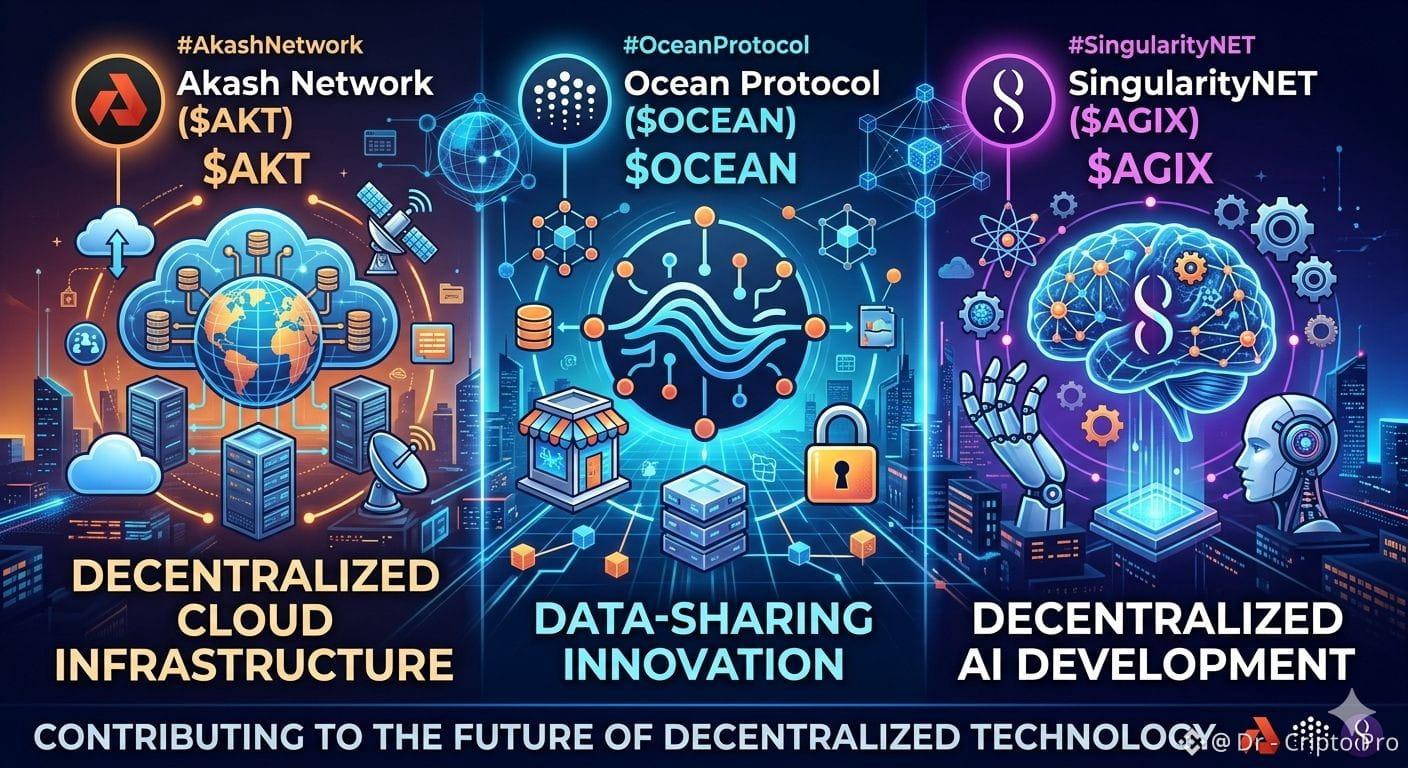
$AKT contributes to decentralized cloud infrastructure. #AkashNetwork
$OCEAN focuses on data-sharing innovation. #OceanProtocol
$AGIX remains associated with decentralized AI development. #SingularityNET
$OCEAN focuses on data-sharing innovation. #OceanProtocol
$AGIX remains associated with decentralized AI development. #SingularityNET
Order blocks on $LIT (LITENTRY) reveal bullish pressure as volume spikes, hinting at institutional backing. $GUN (GUNCOIN) benefits from fresh liquidity after its latest listing, propelling momentum higher. $AGIX (SINGULARITYNET) keeps attracting AI innovators, expanding its ecosystem. Together these signals support a bullish outlook. Strong buy stance recommended. 🚀💹 #Litentry #Guncoin #SingularityNET #CryptoBull
ALERT 🚨 $AR (ARWEAVE) is carving new order blocks as storage demand surges 📈, $ACT (PACT) shows bullish momentum with expanding DeFi integrations 💡, and $AGIX (SINGULARITYNET) fuels ecosystem growth through AI tokenization 🔗. Liquidity inflows confirm investor optimism. Strong buy for all three. #Arweave #Pact #SingularityNet #CryptoNews
ALERT 🚨 $PLA ( PLAYDAPP ) $LIT ( LITENTRY ) $AGIX ( SINGULARITYNET ) are riding robust order blocks. Momentum spikes as adoption accelerates and liquidity expands. Ecosystem innovation sparks bullish sentiment, driving trading activity. Watch volume surges to time entries. #PlayDapp #Litentry #SingularityNET #CryptoTrading
Log in to explore more content