
#retailsales
retailsales
33,692 views
114 Discussing
Hot
Latest

·
--

Article
Economic Calendar | 17 November 2026November 17 Economic Calendar: Why Slower U.S. Retail Sales Could Still Hurt Bitcoin
Imagine checking Tuesday's U.S. retail sales report and seeing consumer spending slow sharply from September. You switch to the Bitcoin chart expecting some relief, only to find Treasury yields climbing and $BTC struggling.
Wouldn't weaker spending normally mean less pressure on interest rates?
Not necessarily. And this is where Tuesday's economic calendar gets interesting.
September's retail sales grew 0.8% month over month. OCBC's November 16 calendar puts October's forecast at just 0.2%.
Now suppose the actual number comes in at 0.4%.
That's slower than September, but twice the forecast. The bond market could see surprisingly resilient consumer demand rather than the slowdown suggested by the headline.
The 0.4% is only an example, not a prediction. The point is that markets react to the gap between expectations and reality, not simply whether a number went up or down.
Two clues before Wall Street opens
Australia's RBA meeting minutes arrive first. I'll be interested in whether policymakers still sound uncomfortable with persistent inflation. If the board sees less room to cut rates than traders expected, the Australian dollar could find support.
Then comes the UK's labour market report.
Unemployment is expected to hold at 4.7%, while annual average earnings growth is forecast to ease from 3.7% to 3.5%.
Here's the interesting part: even if unemployment doesn't change, stronger-than-expected wage growth could make the Bank of England's inflation problem harder to solve.
That's potentially important for GBP/USD, although the market's reaction will also depend on what was already priced in.
The number I'd read before trusting a Bitcoin move
At 13:30 UTC / 19:00 IST, U.S. retail sales and import/export prices arrive together.
Most headlines will focus on the retail sales figure. I'd spend another minute looking at the retail sales control group.
This narrower measure strips out volatile categories including autos and gasoline, giving a more useful view of underlying consumer spending.
The control group is forecast to rise 0.4%, compared with the previous 0.1%.
Suppose headline retail sales beat expectations but the control group disappoints. Suddenly that impressive headline doesn't look quite as convincing.
Maybe a handful of categories did the heavy lifting while broader consumer demand remained softer.
And there's another possibility.
If import prices surprise on the upside at the same time, Treasury yields could rise because of inflation concerns, even while parts of the spending report look weak.
That's a very different story from saying Americans are spending more, therefore the economy is stronger.
For Bitcoin, the distinction matters. Higher U.S. yields and a firmer dollar can make the environment tougher for risk assets, although neither guarantees a BTC sell-off.
Give the market another 45 minutes
At 14:15 UTC / 19:45 IST, U.S. industrial production adds another piece to the picture.
October output is forecast to grow just 0.1% month over month, versus 0.7% previously.
I'll look beyond the headline at manufacturing output. Electricity and utilities can move the overall figure without telling us much about how factories are performing.
By then, we'll have consumer spending, trade-price inflation and industrial activity on the table.
That's when I'd revisit Bitcoin rather than trust the first excited candle after retail sales.
If $BTC rebounds, the U.S. two-year Treasury yield and dollar are still worth checking against their levels before the data.
Are yields and the dollar easing while Bitcoin holds its first pullback? That would make a rates-driven recovery more plausible.
Or have both reversed higher while Bitcoin is already giving back its gains?
Neither outcome proves exactly who bought or sold BTC. But the second check can tell us whether the original market interpretation is holding up.
Tuesday's lesson is simple: a slowdown isn't automatically a downside surprise. Sometimes the number that looks weaker is still stronger than the market was prepared for.
#EconomicCalendar #RetailSales #bitcoin
{spot}(XAUTUSDT)
{future}(BTCUSDT)
Economic Calendar | 17 November 2026
November 17 Economic Calendar: Why Slower U.S. Retail Sales Could Still Hurt Bitcoin
Imagine checking Tuesday's U.S. retail sales report and seeing consumer spending slow sharply from September. You switch to the Bitcoin chart expecting some relief, only to find Treasury yields climbing and $BTC struggling.
Wouldn't weaker spending normally mean less pressure on interest rates?
Not necessarily. And this is where Tuesday's economic calendar gets interesting.
September's retail sales grew 0.8% month over month. OCBC's November 16 calendar puts October's forecast at just 0.2%.
Now suppose the actual number comes in at 0.4%.
That's slower than September, but twice the forecast. The bond market could see surprisingly resilient consumer demand rather than the slowdown suggested by the headline.
The 0.4% is only an example, not a prediction. The point is that markets react to the gap between expectations and reality, not simply whether a number went up or down.
Two clues before Wall Street opens
Australia's RBA meeting minutes arrive first. I'll be interested in whether policymakers still sound uncomfortable with persistent inflation. If the board sees less room to cut rates than traders expected, the Australian dollar could find support.
Then comes the UK's labour market report.
Unemployment is expected to hold at 4.7%, while annual average earnings growth is forecast to ease from 3.7% to 3.5%.
Here's the interesting part: even if unemployment doesn't change, stronger-than-expected wage growth could make the Bank of England's inflation problem harder to solve.
That's potentially important for GBP/USD, although the market's reaction will also depend on what was already priced in.
The number I'd read before trusting a Bitcoin move
At 13:30 UTC / 19:00 IST, U.S. retail sales and import/export prices arrive together.
Most headlines will focus on the retail sales figure. I'd spend another minute looking at the retail sales control group.
This narrower measure strips out volatile categories including autos and gasoline, giving a more useful view of underlying consumer spending.
The control group is forecast to rise 0.4%, compared with the previous 0.1%.
Suppose headline retail sales beat expectations but the control group disappoints. Suddenly that impressive headline doesn't look quite as convincing.
Maybe a handful of categories did the heavy lifting while broader consumer demand remained softer.
And there's another possibility.
If import prices surprise on the upside at the same time, Treasury yields could rise because of inflation concerns, even while parts of the spending report look weak.
That's a very different story from saying Americans are spending more, therefore the economy is stronger.
For Bitcoin, the distinction matters. Higher U.S. yields and a firmer dollar can make the environment tougher for risk assets, although neither guarantees a BTC sell-off.
Give the market another 45 minutes
At 14:15 UTC / 19:45 IST, U.S. industrial production adds another piece to the picture.
October output is forecast to grow just 0.1% month over month, versus 0.7% previously.
I'll look beyond the headline at manufacturing output. Electricity and utilities can move the overall figure without telling us much about how factories are performing.
By then, we'll have consumer spending, trade-price inflation and industrial activity on the table.
That's when I'd revisit Bitcoin rather than trust the first excited candle after retail sales.
If $BTC rebounds, the U.S. two-year Treasury yield and dollar are still worth checking against their levels before the data.
Are yields and the dollar easing while Bitcoin holds its first pullback? That would make a rates-driven recovery more plausible.
Or have both reversed higher while Bitcoin is already giving back its gains?
Neither outcome proves exactly who bought or sold BTC. But the second check can tell us whether the original market interpretation is holding up.
Tuesday's lesson is simple: a slowdown isn't automatically a downside surprise. Sometimes the number that looks weaker is still stronger than the market was prepared for.
#EconomicCalendar #RetailSales #bitcoin
Sihab vaiya 38:
sir please live karo
1
1
199

·
--
US Retail Sales matched forecasts, $BTC barely moved, and I haven't seen a clear signal yet
📢 US Retail Sales data released at 20:30 on 17/11 (UTC+7).
🔹 Retail Sales MoM: actual 0.2%, matching the 0.2% forecast, down from 0.8% previously.
The figures were close to expectations, so the news did not create a major surprise for the market.
📈 Reaction since the data release:
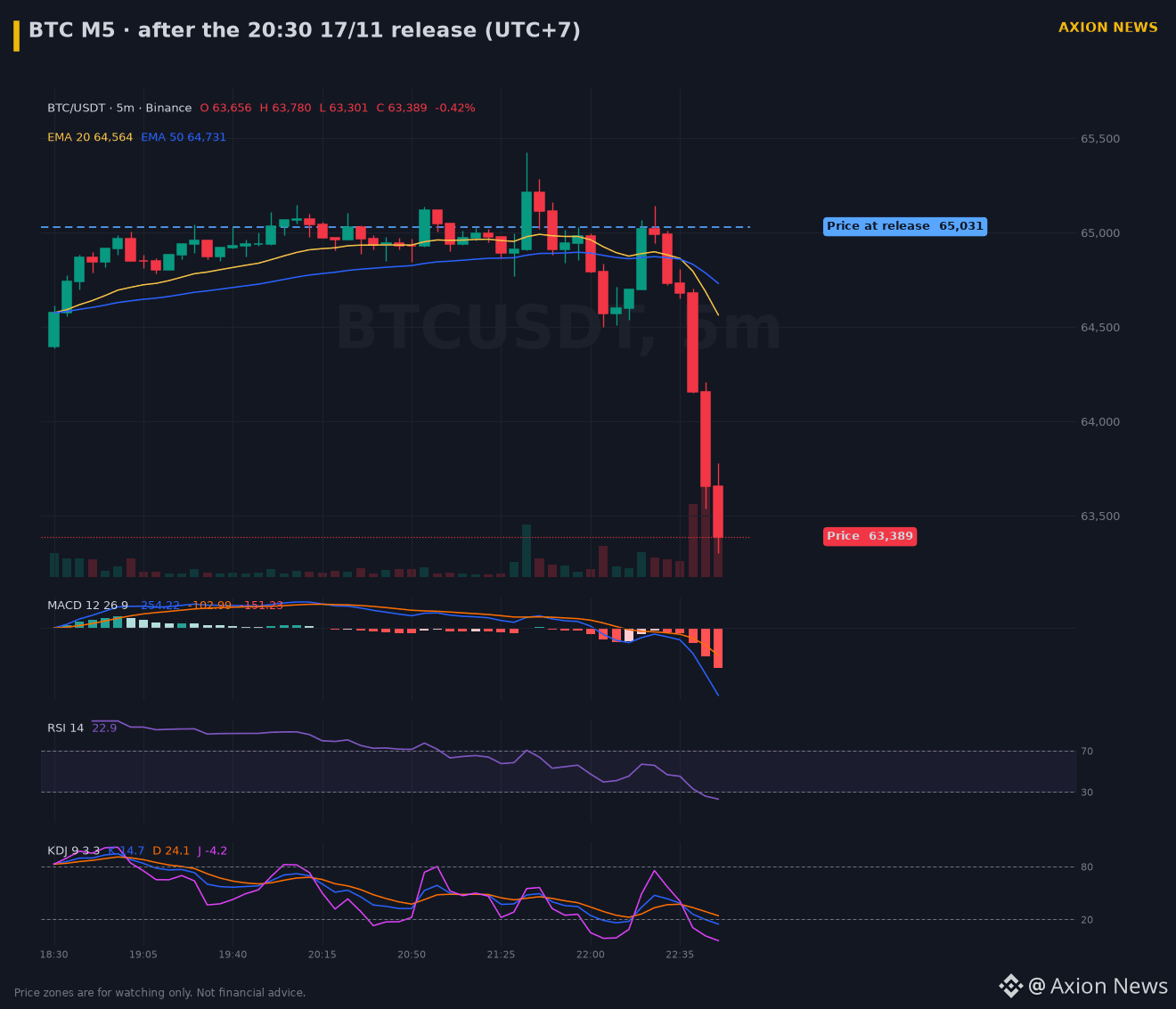
🔸 $BTC: 65,031 → 15 minutes -0.13%, 1 hour -0.21% (range -0.28% / +0.16%)
🔸 $ETH: 1,825 → 15 minutes -0.14%, 1 hour -0.19% (range -0.39% / +0.26%)
Both declined slightly within a narrow range, which is not enough to confirm a direction. The first-hour reaction is often noisy and can reverse, so I prefer to keep watching before drawing any conclusions.
This content is for informational purposes only and is not investment advice.
What do you think the market will wait for next to choose a direction?
#RetailSales #AxionNews
US Retail Sales matched forecasts, $BTC barely moved, and I haven't seen a clear signal yet
📢 US Retail Sales data released at 20:30 on 17/11 (UTC+7).
🔹 Retail Sales MoM: actual 0.2%, matching the 0.2% forecast, down from 0.8% previously.
The figures were close to expectations, so the news did not create a major surprise for the market.
📈 Reaction since the data release:
🔸 $BTC : 65,031 → 15 minutes -0.13%, 1 hour -0.21% (range -0.28% / +0.16%)
🔸 $ETH : 1,825 → 15 minutes -0.14%, 1 hour -0.19% (range -0.39% / +0.26%)
Both declined slightly within a narrow range, which is not enough to confirm a direction. The first-hour reaction is often noisy and can reverse, so I prefer to keep watching before drawing any conclusions.
This content is for informational purposes only and is not investment advice.
What do you think the market will wait for next to choose a direction?
#RetailSales #AxionNews
455

·
--
Retail Sales AS for October rose 0.2% — consumers are still spending, and that’s not great news for those hoping the Fed would ease soon.
Fact: the U.S. Census Bureau released it on Nov 17 at 20:30 WIB. Retail sales rose 0.2% MoM after a 0.8% surge in September — above the 0.1% expectation. Even hotter: core retail sales (excluding autos, gasoline, building materials, and food services — the closest to consumption in GDP) rose 0.6% vs. the 0.4% expectation, and the September figure was revised up to 0.5%.
My take: U.S. consumers are still strong, and this hotter-than-expected data gives the Fed even fewer reasons to ease. The market has already priced in the chance of a December rate hike — tonight’s data keeps that scenario alive, not dead. For crypto, the reaction was flat: BTC briefly dropped to 64,850 on the 20:30 candle then recovered to 65,118 — as if the market had already digested this hawkish scenario since last week’s hot CPI. Levels I’m watching: 64,000 as the short-term floor, 68,000 (the 200-week average) as the line to reclaim.
What I’m watching next: the FOMC minutes on Nov 19 at 02:00 WIB, and Nvidia’s earnings results after the U.S. market closes.
What do you think: does data this strong make the Fed more convinced to raise rates in December, or has the market already priced it in too far?
#RetailSales #Makro $BTC
76
·
--
U.S. retail sales numbers are out tonight, so I’m sitting on the sidelines to watch the charts thrash around for fun
🗓 RetailSales at 20:30 on 17/11 (UTC+7)
🔹 Retail Sales MoM: forecast 0.2%, previous 0.8%
📊 The two usual scenarios:
- Higher than forecast: the economy or inflation is still running hot, making it harder for the Fed to cut rates. The USD could strengthen, putting short-term pressure on BTC and ETH.
- Lower than forecast: rate-cut expectations could brighten, which often gives crypto a helping hand.
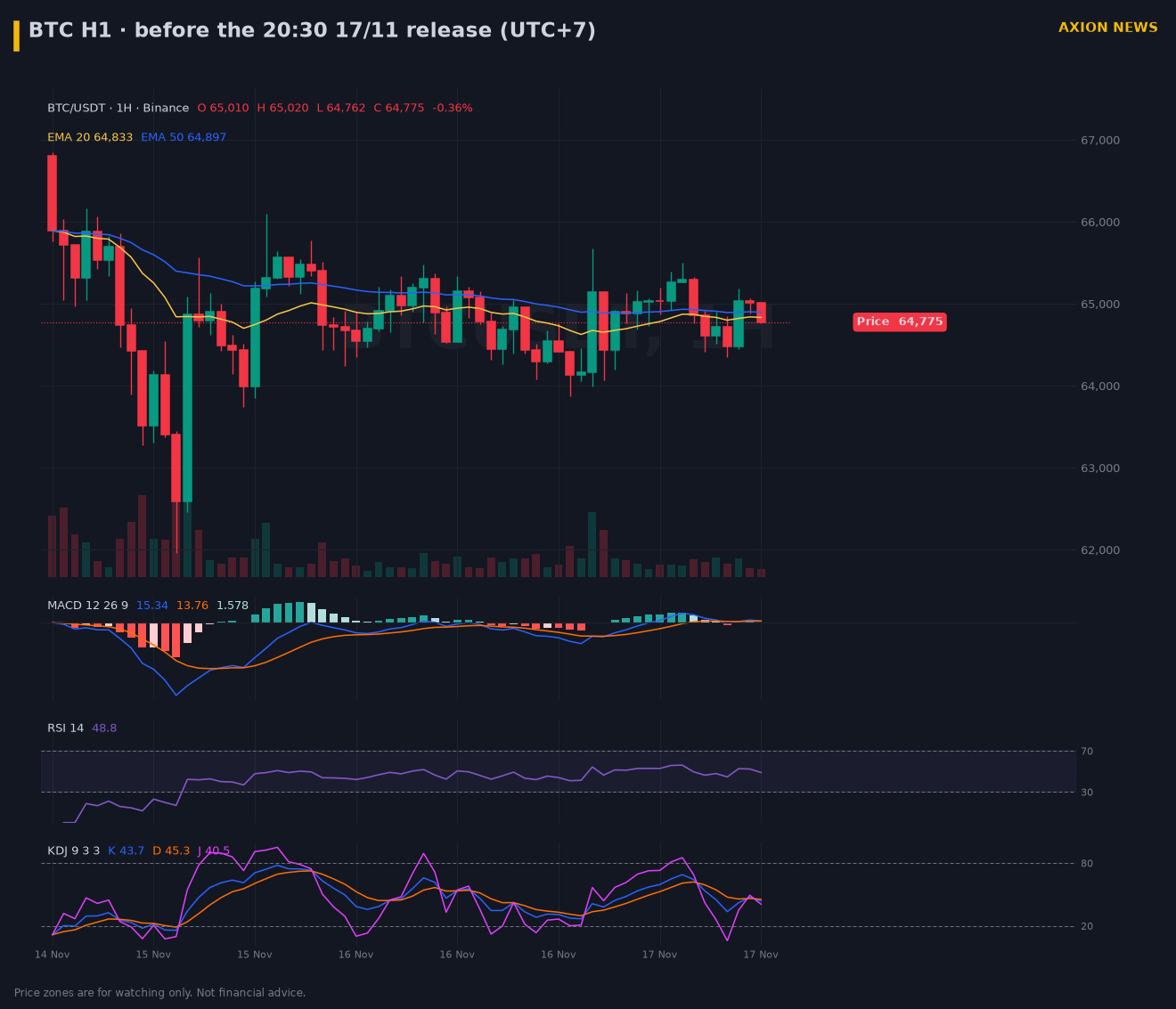
⚠️ Spreads can blow out around the release, and the market may hunt stop-losses in both directions—both longs and shorts can get caught. Don’t go into the release holding a big position. Wait for the first 5–15-minute candle to close before deciding.
These are just common scenarios, not fortune-telling or investment advice.
Are you sitting on the sidelines to watch, or waiting for the first candle?
#RetailSales #AxionNews
69

·
--
Besides Nvidia, this week’s test for consumers: on Tuesday at 3:30 p.m. Kyiv time, October retail sales (forecast: 0.0–0.3%); on Wednesday, $HD and $TGT report; on Thursday, $WMT . These reports will show whether shoppers are coping with high prices and yields. Scenario 1: Strong sales will support risk appetite but strengthen the case for a rate hike. Scenario 2: Weak data will shift the focus to recession risk. Not financial advice.
Which of the three companies will best show the state of the consumer? 👇
#RetailSales
Which of the three companies will best show the state of the consumer? 👇
#RetailSales
3
54

The UK Office for National Statistics released September retail sales data today. The figures showed that seasonally adjusted UK retail sales fell 0.4% month on month in September, significantly below market expectations of a 0.1% decline. Core retail sales fell 0.7% month on month and grew just 0.8% year on year, with all major consumer indicators coming in weaker than previously expected.
From a technical and macroeconomic perspective, the rapid slowdown in UK consumer momentum gives the Bank of England a stronger case for cutting interest rates. Although consumer data is soft in the short term, accelerating expectations of falling inflation are reshaping the yield curve and creating more room for monetary policy to shift from tightening to easing, fueling market speculation about rate cuts.
In traditional financial markets, the pound came under short-term pressure after the data release, while UK government bond yields fell rapidly. The marginal decline in global risk-free rates eases discount-rate pressure on risk assets from a liquidity perspective. Cross-asset investors are showing a willingness to absorb high-beta assets, helping to stabilize the equity market’s base.
For crypto markets, potential monetary easing by the Bank of England could provide additional support for global liquidity. $BTC is showing a solid accumulation pattern at a key support level. If expectations of monetary easing continue to build, ample fiat liquidity could help crypto assets break out, with overall risk sentiment remaining positively bullish.📈
#RetailSales #BankOfEngland #CryptoLiquidity
100

·
--
🔴 HIGH IMPACT — Friday August 15
Retail Sales + Core Retail Sales MoM July
📅 8:30 AM ET · Prev: -0.4%
Is the consumer still spending after a brutal month of job losses and Iran fears? A rebound = resilient economy. A miss = spending collapsing = recession confirmed. 🛍️
#RetailSales #dyor #ConsumerSpending
{future}(BICOUSDT)
{future}(KITEUSDT)
{future}(SENTUSDT)
🔴 HIGH IMPACT — Friday August 15
Retail Sales + Core Retail Sales MoM July
📅 8:30 AM ET · Prev: -0.4%
Is the consumer still spending after a brutal month of job losses and Iran fears? A rebound = resilient economy. A miss = spending collapsing = recession confirmed. 🛍️
#RetailSales #dyor #ConsumerSpending
Retail Sales + Core Retail Sales MoM July
📅 8:30 AM ET · Prev: -0.4%
Is the consumer still spending after a brutal month of job losses and Iran fears? A rebound = resilient economy. A miss = spending collapsing = recession confirmed. 🛍️
#RetailSales #dyor #ConsumerSpending
78

·
--
#USJulyRetailSalesFall0.6%
US July Retail Sales Fall 0.6% 📉
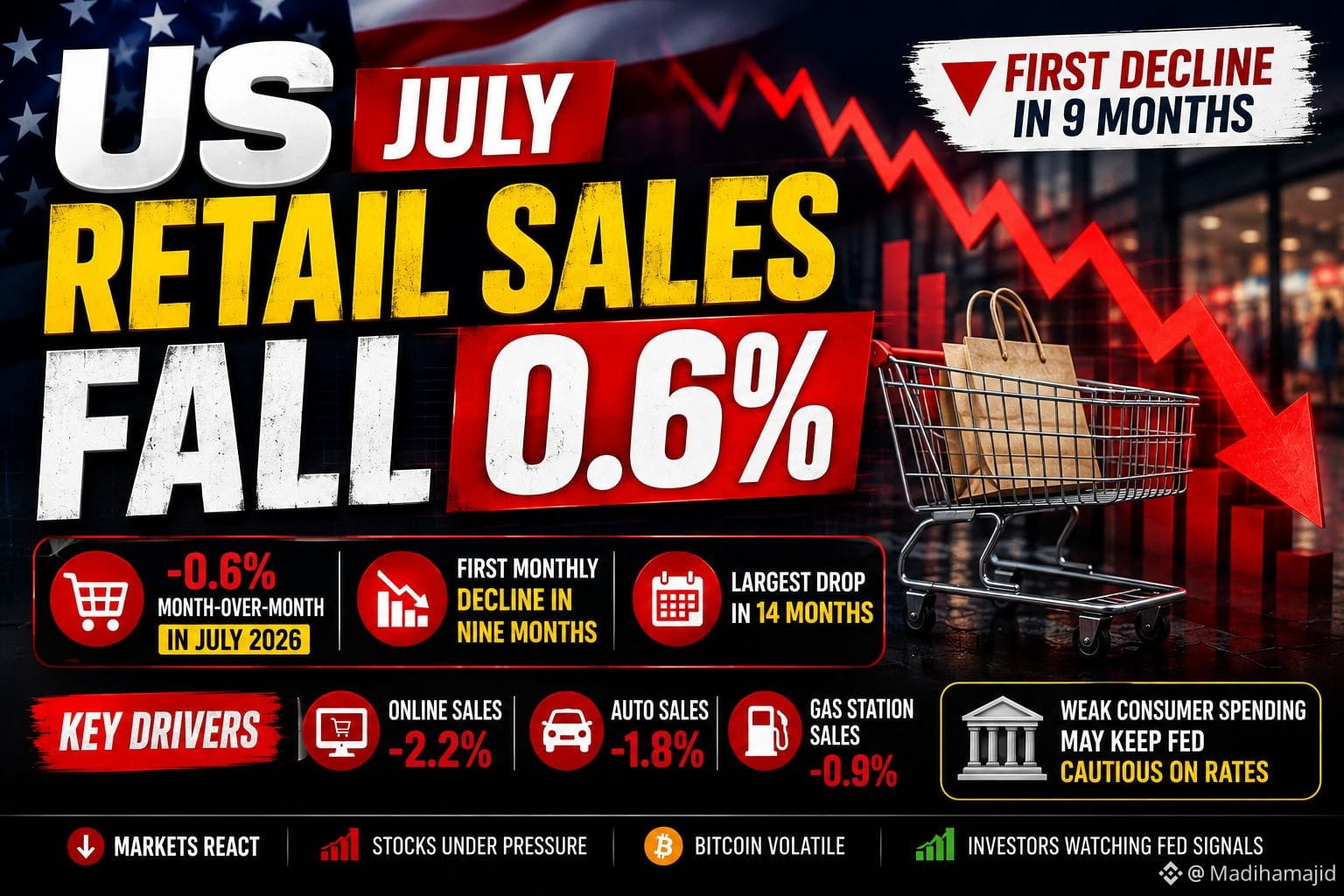
U.S. retail sales dropped 0.6% month-over-month in July 2026, sharply missing expectations for a 0.1% increase. It was the first monthly decline in nine months and the largest drop in 14 months.
The weakness was led by online sales (-2.2%), auto sales (-1.8%), and gas-station sales (-0.9%). The data adds to signs of softer consumer spending and could strengthen expectations that the Federal Reserve will remain cautious on rates.
#USJulyRetailSalesFall0.6% #RetailSales #USEconomy #FederalReserve #Fed #Inflation #InterestRates #Stocks #Crypto #Bitcoin
#USJulyRetailSalesFall0.6%
#USJulyRetailSalesFall0.6%
US July Retail Sales Fall 0.6% 📉
U.S. retail sales dropped 0.6% month-over-month in July 2026, sharply missing expectations for a 0.1% increase. It was the first monthly decline in nine months and the largest drop in 14 months.
The weakness was led by online sales (-2.2%), auto sales (-1.8%), and gas-station sales (-0.9%). The data adds to signs of softer consumer spending and could strengthen expectations that the Federal Reserve will remain cautious on rates.
#USJulyRetailSalesFall0.6% #RetailSales #USEconomy #FederalReserve #Fed #Inflation #InterestRates #Stocks #Crypto #Bitcoin
#USJulyRetailSalesFall0.6%
1
1
129

·
--
Bearish
💎Trading Strategy for $BTC Bitcoin Tonight.
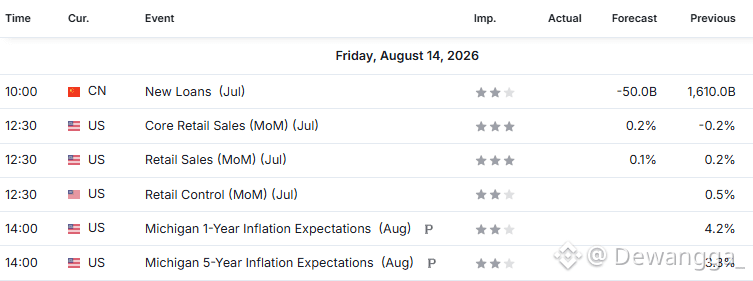
1. If Core Retail Sales and Retail Sales data 🟥RED => LONG📈
2. If Core Retail Sales and Retail Sales data 🟩GREEN => SHORT📉
3. If Core Retail Sales and Retail Sales is 🟩🟥MIXED => DON'T TRADE🛑
4. if not, Retail Sales actual data must be differ 100% more than <0.2 (-0.2, -0.3, -0.4, etc) => go LONG or go SHORT according to the strategy above
5. Don't be greedy, discipline Take Profits.
Data releases at 12:30 UTC+0 You can check the data on the Economic Calendar here: investing.com/economic-calendar or Investing apps (playstore/ appstore)
#NFA #DYOR 🔥
Not a Buy/Sell Signal🛑
Follow and tip if you find this helpful, unfollow and block if you are disturbed☕️
$METAB $POL #RedditToJoinSP500 #RetailSales #TRUMP
1
115

·
--
Bearish
Verified
#usjulyretailsalesfall0.6%
🚨 US RETAIL SALES SLIP 0.6% 📉
U.S. retail sales fell unexpectedly 0.6% in July to $763.6B, with weakness in online shopping, autos, and gas stations.
Spending is still 5% higher year-over-year, but the monthly drop signals growing consumer fatigue.
🎯 TRADING VIEW: SELL 📉
Near-term risk sentiment could weaken if consumer spending continues to slow.
❓ Is the U.S. consumer finally losing momentum? "CLICK ON THE BELOW YELLOW COIN TAG TO GO TO DESIRED TRADING PAGE TO GET BENEFIT TRADE"$BTC $SOL $AKE
{future}(AKEUSDT)
{spot}(SOLUSDT)
{spot}(BTCUSDT)
#RetailSales #USConsumerSentimentThirdMonthDecline
#usjulyretailsalesfall0.6%
🚨 US RETAIL SALES SLIP 0.6% 📉
U.S. retail sales fell unexpectedly 0.6% in July to $763.6B, with weakness in online shopping, autos, and gas stations.
Spending is still 5% higher year-over-year, but the monthly drop signals growing consumer fatigue.
🎯 TRADING VIEW: SELL 📉
Near-term risk sentiment could weaken if consumer spending continues to slow.
❓ Is the U.S. consumer finally losing momentum? "CLICK ON THE BELOW YELLOW COIN TAG TO GO TO DESIRED TRADING PAGE TO GET BENEFIT TRADE"$BTC $SOL $AKE
#RetailSales #USConsumerSentimentThirdMonthDecline

1
5
6.6k

·
--
The U.S. economic report released today just announced several key macroeconomic figures for August, with results far exceeding expectations. Specifically, retail sales rose sharply by 1.2% versus the forecast of 0.8% (the previous month was revised up to -0.5%), while the import price index also increased by 0.7%, higher than the predicted 0.4%.
The jump in retail sales indicates that Americans’ purchasing power and consumer demand remain extremely resilient, easing concerns about the risk of an economic recession. However, the sharp rise in the import price index signals that underlying inflationary pressure may not have cooled down as much as expected.
For financial markets, this data supports the scenario of a “soft landing,” but it also further complicates the path for monetary policy. Treasury yields and the DXY index are likely to stay at elevated levels, significantly narrowing expectations for aggressive rate cuts by the Fed.
For the crypto market, investor sentiment may experience short-term fluctuations. While a strong economy is a positive long-term tailwind for risk assets such as $BTC, pressure from a strong USD and interest rates remaining high could limit the inflow of new capital into the market over the next few weeks.
#USData #RetailSales #Inflation #MacroEconomics
The U.S. economic report released today just announced several key macroeconomic figures for August, with results far exceeding expectations. Specifically, retail sales rose sharply by 1.2% versus the forecast of 0.8% (the previous month was revised up to -0.5%), while the import price index also increased by 0.7%, higher than the predicted 0.4%.
The jump in retail sales indicates that Americans’ purchasing power and consumer demand remain extremely resilient, easing concerns about the risk of an economic recession. However, the sharp rise in the import price index signals that underlying inflationary pressure may not have cooled down as much as expected.
For financial markets, this data supports the scenario of a “soft landing,” but it also further complicates the path for monetary policy. Treasury yields and the DXY index are likely to stay at elevated levels, significantly narrowing expectations for aggressive rate cuts by the Fed.
For the crypto market, investor sentiment may experience short-term fluctuations. While a strong economy is a positive long-term tailwind for risk assets such as $BTC , pressure from a strong USD and interest rates remaining high could limit the inflow of new capital into the market over the next few weeks.
#USData #RetailSales #Inflation #MacroEconomics
173

·
--
U.S. macroeconomic data released today showed a significant surprise as August retail sales jumped by 1.2%, easily beating market expectations of 0.8% and rebounding sharply from an upwardly revised -0.5% in the prior month. Alongside this, the August import price index climbed 0.7% against a 0.4% consensus, signaling persistent upstream inflationary pressure.
This resilient consumer spending print combined with rising import prices complicates the broader disinflation narrative. Market participants had anticipated a clearer slowdown in economic activity, but robust household demand suggests underlying economic momentum remains unexpectedly sturdy despite tight monetary conditions.
For traditional markets, these numbers are likely to reinforce a 'higher-for-longer' interest rate narrative, driving upward pressure on U.S. Treasury yields and lending support to the U.S. Dollar. In this environment, risk assets may face short-term headwinds as aggressive rate-cut expectations get priced out.
In the crypto space, resilient macro data could delay broader liquidity inflows into $BTC and major altcoins. While underlying economic strength reduces recession risks, high borrowing costs continue to cap speculative capital, keeping market participants cautious until clearer monetary easing signals emerge. 📊
#RetailSales #MacroEconomy #Inflation
26
The U.S. Department of Commerce has just released the core macroeconomic data for August. Retail sales rose 1.2% month-over-month, significantly beating market expectations of 0.8%; the prior figure was also revised from -0.60% to -0.5%. Meanwhile, August’s import price index increased 0.7% month-over-month, higher than the expected 0.4%. The release of this set of heavyweight data provides the latest fundamental guidance for the current complex macro trading environment.
In terms of the data structure, strong retail sales directly shattered the market’s earlier concerns about a hard landing. Although higher import price inflation adds marginal upside pressure on inflation, the consumer side’s resilience beyond expectations indicates that the U.S. fundamentals remain solid and the economy’s core has not weakened as quickly as pessimistic expectations suggested. This provides a strong bottoming rationale for risk assets.
In traditional financial markets, the strong consumption data helped the U.S. dollar index rebound in the short term and test resistance overhead, while Treasury yields shifted up along the curve. However, from the perspective of long positions, economic resilience implies that a soft landing—or even a no-landing scenario—is becoming clearer. Risk appetite has not been materially crushed, and after risk assets such as U.S. stocks digest the rate-expectation disturbances, the technical setup still has structural momentum to break higher.
For the crypto market, the resolution of macro uncertainty often comes with a reshuffling of liquidity expectations. Supported by fundamentals, risk-off sentiment is likely to cool, and risk capital may accelerate back into high-beta assets. $BTC has demonstrated very strong buy-side order absorption at a key support level. If the price stabilizes on the daily timeframe and breaks above the upper consolidation range with volume expansion, the outlook most likely points to a new round of upside trend driven by a convergence of sentiment and technical factors.
#RetailSales #MacroEconomy #CryptoTrading
105

·
--
The National Bureau of Statistics has just released the core macroeconomic data for August, showing a fairly clear split in performance across different sectors. The data indicate that China’s industrial value added above designated size rose by 5.2% year-on-year in August, not only higher than the previous figure of 4.50% but also significantly better than market expectations of 4.80%. At the same time, however, August social retail sales of consumer goods increased by only 0.4% year-on-year, which is below the prior figure of 0.60% and also under the market expectation of 0.80%.
These figures reflect the objective reality of the current economic operation: “the production side is warmer, while the consumption side is cooler.” In industrial manufacturing, supported by policy measures and the resilience of exports, recovery has remained relatively rapid. But residents’ consumption willingness and end-demand still appear subdued. The pace of recovery is uneven, and market attention remains on whether subsequent policies will introduce more targeted measures to boost consumption.
Judging from traditional financial market reactions, this structural performance keeps macro sentiment in a neutral observation period. A stronger industrial sector provides support for the overall economic fundamentals, but weaker retail data also limits a rapid expansion in risk appetite. Commodities, the exchange rate, and the stock market overall are seeking balance amid conflicting bullish and bearish forces, and funds are more inclined to stay on the sidelines.
As for the crypto market, the macro fundamentals’ divergence has not yet triggered any direct one-way flows. As part of risk assets, $BTC and mainstream alternative coins will continue to fluctuate in line with global liquidity preferences until there is a fundamental change in macro liquidity expectations. Market participants generally focus on the sustainability of the overall economic recovery and the subsequent monetary actions of major global central banks.
#ChinaEconomy #RetailSales #IndustrialProduction
53
According to the latest data released by the U.S. Department of Commerce, in August U.S. retail sales rose 1.2% month-on-month, marking the largest increase since March this year. This robust consumption-spending figure directly dispels earlier market concerns about a rapid economic slowdown, showing that underlying consumer demand in the United States still has very strong resilience.
From a macro fundamental perspective, retail sales data is often called “scary data,” as it directly reflects personal consumption conditions, which account for roughly 70% of the U.S. economy. The above-forecast performance of 1.2% not only strongly refutes the “hard landing” narrative, but also reinforces the underlying logic of a “soft landing” and even ongoing expansion. Against the backdrop of inflation gradually coming under control, strong real demand provides solid fundamental support for asset prices, rather than relying solely on illusory booms fueled by loose liquidity.
In terms of cross-market asset linkages and technicals, after the data was released, the U.S. dollar index and U.S. Treasury yields experienced a pulsed fluctuation, but it did not trigger panic-driven selloffs. Instead, the technical structure of risk assets was further strengthened. The market is digesting the ideal “Goldilocks” scenario of “strong economy + moderate rate cuts.” The S&P 500 and the Nasdaq continue to trade along the upper boundary of the rising channel, and overall market risk appetite (Risk-on) continues to heat up.
For the crypto market, the stability of the macro fundamentals injects medium-term bullish confidence into risk assets. $BTC has demonstrated solid follow-through and strong support at a key level. After consolidation with shrinking volume, the bottom structure is becoming increasingly clear. The strong economic fundamentals reduce the risk of a systemic liquidity crisis, removing major concerns for incremental capital entering from outside the market. As buy orders gradually accumulate in the dense moving-average zone, bullish momentum may break upward through the key resistance level after consolidating and building energy in a range.
#RetailSales #MacroEconomy #CryptoTrading
89

·
--

Article
U.S. Retail Sales Fall 0.6% in July, Missing ForecastsU.S. retail sales declined by 0.6% in July, marking the largest month-over-month drop since May of last year. This decrease was significantly below market expectations, which had forecasted a modest 0.1% increase. The data indicates that consumer spending, a critical driver of economic growth, slowed more sharply than anticipated during the month.
The decline in retail sales was broad-based, affecting various sectors including motor vehicles, clothing, and general merchandise. Experts suggest that this slowdown could signal a shift in consumer behavior, possibly influenced by rising inflation, higher interest rates, or economic uncertainties impacting household budgets.
Market analysts are closely watching these figures as they may influence Federal Reserve policy decisions. A more pronounced slowdown in consumer spending could prompt the central bank to consider further adjustments to interest rates or other monetary measures to support economic stability.
The weaker-than-expected retail performance adds to concerns about the pace of economic recovery and growth prospects in the United States, especially amid ongoing inflationary pressures and global economic uncertainties. More details are available in the official Binance Square post. #RetailSales #USEconomy #ConsumerSpending
U.S. Retail Sales Fall 0.6% in July, Missing Forecasts
U.S. retail sales declined by 0.6% in July, marking the largest month-over-month drop since May of last year. This decrease was significantly below market expectations, which had forecasted a modest 0.1% increase. The data indicates that consumer spending, a critical driver of economic growth, slowed more sharply than anticipated during the month.
The decline in retail sales was broad-based, affecting various sectors including motor vehicles, clothing, and general merchandise. Experts suggest that this slowdown could signal a shift in consumer behavior, possibly influenced by rising inflation, higher interest rates, or economic uncertainties impacting household budgets.
Market analysts are closely watching these figures as they may influence Federal Reserve policy decisions. A more pronounced slowdown in consumer spending could prompt the central bank to consider further adjustments to interest rates or other monetary measures to support economic stability.
The weaker-than-expected retail performance adds to concerns about the pace of economic recovery and growth prospects in the United States, especially amid ongoing inflationary pressures and global economic uncertainties. More details are available in the official Binance Square post. #RetailSales #USEconomy #ConsumerSpending
90

·
--
The latest macro data released by the U.S. Department of Commerce shows that in August, the month-on-month retail sales rate in the United States recorded 1.2%, the highest increase since March of this year. This unexpectedly strong consumption data directly breaks the prevailing narrative in the market that the U.S. economy is rapidly cooling, indicating that underlying consumer demand remains more resilient than generally expected.
From a macroeconomic perspective, this rebound appears especially sensitive at the current stage. Retail sales—an essential indicator for measuring U.S. domestic demand and economic vitality—surging sharply implies that inflation stickiness may be more stubborn than what the Federal Reserve expects. The market had originally placed strong hopes on continued easing in monetary policy, but an overheated consumer sector could delay the pace of rate cuts and may even force policymakers to maintain a high interest-rate environment for a longer period to curb potential risks of second-round inflation.
In traditional financial markets, the strong retail data quickly triggered a reshaping of asset-pricing logic. U.S. Treasury yields came under upward pressure immediately, the U.S. dollar index received significant support, and expectations for aggressive easing within the year in the interest-rate swap market were notably scaled back. Funds wavered between strong macro realities and tightening expectations, and across-asset dimensions saw a renewed rise in risk-averse and defensive sentiment.
For high-risk assets such as cryptocurrencies, this undoubtedly creates an implicit headwind. A delay in the liquidity turning point will directly suppress the willingness of incremental capital to enter. In a backdrop where liquidity expectations fall short, mainstream assets such as $BTC will inevitably face near-term tests in the form of valuation pressure and heightened volatility. Until the macro policy path becomes fully clear, blindly betting on loose liquidity may carry a relatively high risk of drawdowns.
#RetailSales #FederalReserve #MacroEconomy
26
·
--
Bearish
Verified
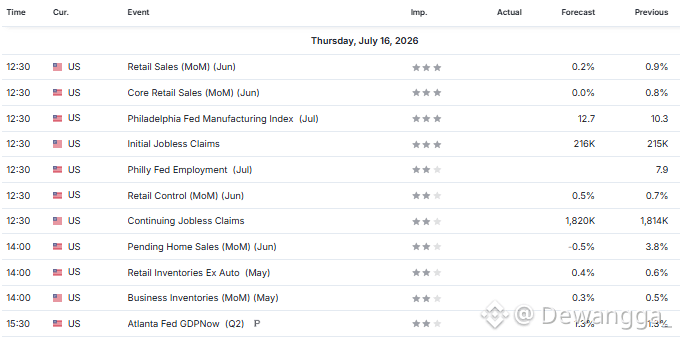
💎$BTC Bitcoin Trading Formula tonight;
1. If the data of Retail Sales, Core Retail Sales, Initial Jobless Claims all 3 of them has same 🟥RED => go LONG
2. If the data of Retail Sales, Core Retail Sales, Initial Jobless Claims all 3 of them has same 🟩GREEN => go SHORT
3. If the data of Retail Sales, Core Retail Sales, Initial Jobless Claims contadicting each other (🟩RED/GREEN🟥) => DON'T TRADING
This data is released at 12:30 UTC+0, u guys could watch the data at Economic Calendar by Investing. com.
#NFA #DYOR 🔥
Not a futures signal🛑
Follow and tips if it helps, unfollow and block if disturbs☕
Random Tags: $ETH $BNB #SenatePassesResolutionOpposingSBFPardon #RetailSales #InitialJoblessClaims
2
1
210

RETAIL SALES TERROR DATA DROPS TONIGHT — $BTC WAITS ON THE KNIFE'S EDGE 🎯
The market barely digested this week's CPI and PPI prints, and now the next catalyst is already knocking. July retail sales land tonight at 20:30 (UTC+8), and the whisper number is a measly 0.1% monthly bump. That's not a beat — that's a stumble waiting to happen.
Here's the battle map. Gold just pulled back from $4400/oz while the Fed's internal drama heats up. If retail sales crush expectations, we get the "resilient economy" narrative — dollar strengthens, rate cut hopes cool, and risk assets feel the squeeze. But if the data sinks below that whisper number, recession whispers turn into shouts, and safe-haven flows could reignite across the board.
The greenback's bid and gold's pullback are telling you one thing: the market is positioning for a pivot. Crypto sits right in the crossfire. A hot number pressures BTC. A cold number could send liquidity hunting for hedges — and that's where volatility lives.
Which side do you think the data favors tonight — resilience or stall? 🧲
⚠️ Not financial advice. Always manage your risk. 🛡️
🏷️ $BTC $GOLD #RetailSales #Macro #FedWatch
🫡🔥
18
·
--
The U.S. Department of Commerce has just released retail sales data for August, and the overall performance came in well above market expectations. After a 0.5% month-over-month decline in July, August retail sales rebounded strongly, recording a 1.2% month-over-month increase. The rebound was broadly based: among 13 tracked retail subcategories, 12 registered growth, spanning gas stations as well as major online retail platforms. Even the back-to-school shopping season clearly boosted spending on department stores, apparel, sporting goods, and electronics.
This data has drawn particular attention because it directly reflects the real purchasing power of typical U.S. consumers. Despite rising energy prices and persistent, stubborn inflation pressure hovering over the market, consumer demand has still shown remarkable resilience. Previously, the market broadly worried that weak consumption could drag the overall economy toward a downturn; however, the August rebound that beat expectations not only dispelled the downward shadow from the prior month, but also indicated that amid rising living costs, the household sector’s consumption demand has not immediately shown signs of stalling.
From a broader financial-market perspective, strong retail data can be a double-edged sword. On the one hand, buoyant consumer conditions suggest that the economic fundamentals still have support, reducing the risk of a hard landing in the short term. On the other hand, overheating consumption could make the path for inflation easing more complicated, which in turn would affect the Federal Reserve’s considerations regarding its policy path. After the data was released, the U.S. dollar index and Treasury yields are prone to disruptions from sticky-inflation expectations, and traditional assets continually reassess the liquidity environment expected going forward.
Turning back to the crypto market, this macro signal also feels somewhat nuanced for traders. If strong consumption supports the economy while delaying the pace of rapid liquidity easing, new incremental capital entering the crypto market in the near term may remain relatively on the sidelines. Still, a healthy economic backdrop also lowers the likelihood of extreme liquidity shocks. For players focused on $BTC and overall market conditions, the market is currently more about finding a balance between economic resilience and interest-rate expectations, and the next move will depend on further changes in the macro liquidity picture.
#RetailSales #USMacro #CryptoMarket
61
Log in to explore more content
Join global crypto users on Binance Square
⚡️ Get latest and useful information about crypto.
💬 Trusted by the world’s largest crypto exchange.
👍 Discover real insights from verified creators.
Email / Phone number
Trending Topics
1
#IsAnthropic’s$1.5TMarketCapJustified?
1,088 views
12 Discussing
2
#BTCRemainsUnderPressureAfterHawkishFOMCMinutes
155,677 views
1,698 Discussing
3
#NvidiaBoardReportedlySplitOverHuang’sReturn
73,586 views
872 Discussing
4
#StrategySTRCPreferredSlips3.65%Below$100Par
1,871 views
44 Discussing
5
#MASToUpgradeSGDTestnetToSGDigitalLedger
6,615 views
125 Discussing
6
#CanGTA6'sLaunchLiftTTWOShares?
47,992 views
659 Discussing
7
#Solana2027RoadmapTargetsDoubleComputeCapacity
1,078 views
41 Discussing
8
#InjectiveTokenizedRealEstateMortgagesTop$1.5B
542 views
26 Discussing
9
#TetherMakesStrategicInvestmentInSCRYPT
1,890 views
40 Discussing
10
#CapitalGroupAdds1264500StrategyShares
14,959 views
164 Discussing