
合约涨跌AI预判-VIP-0824版
9.2k Posts

合约涨跌AI预判-VIP-0824版
 Square Verified+
以咨询级视角拆解 AI 趋势、智能工具与商业应用,过滤信息噪音,提炼真正有价值的前沿洞察 | 任何帖子非财务投资建议 | Opinions are my own & Not Financial Advice

Creator Awards 2024

原创之星

Level 1 Creator
Open Trade
Occasional Trader
5.6 Years
0 Following
72.5K+ Followers
690.9K+ Liked
4 Badges
Posts
Portfolio
All
Quotes
Videos
Live
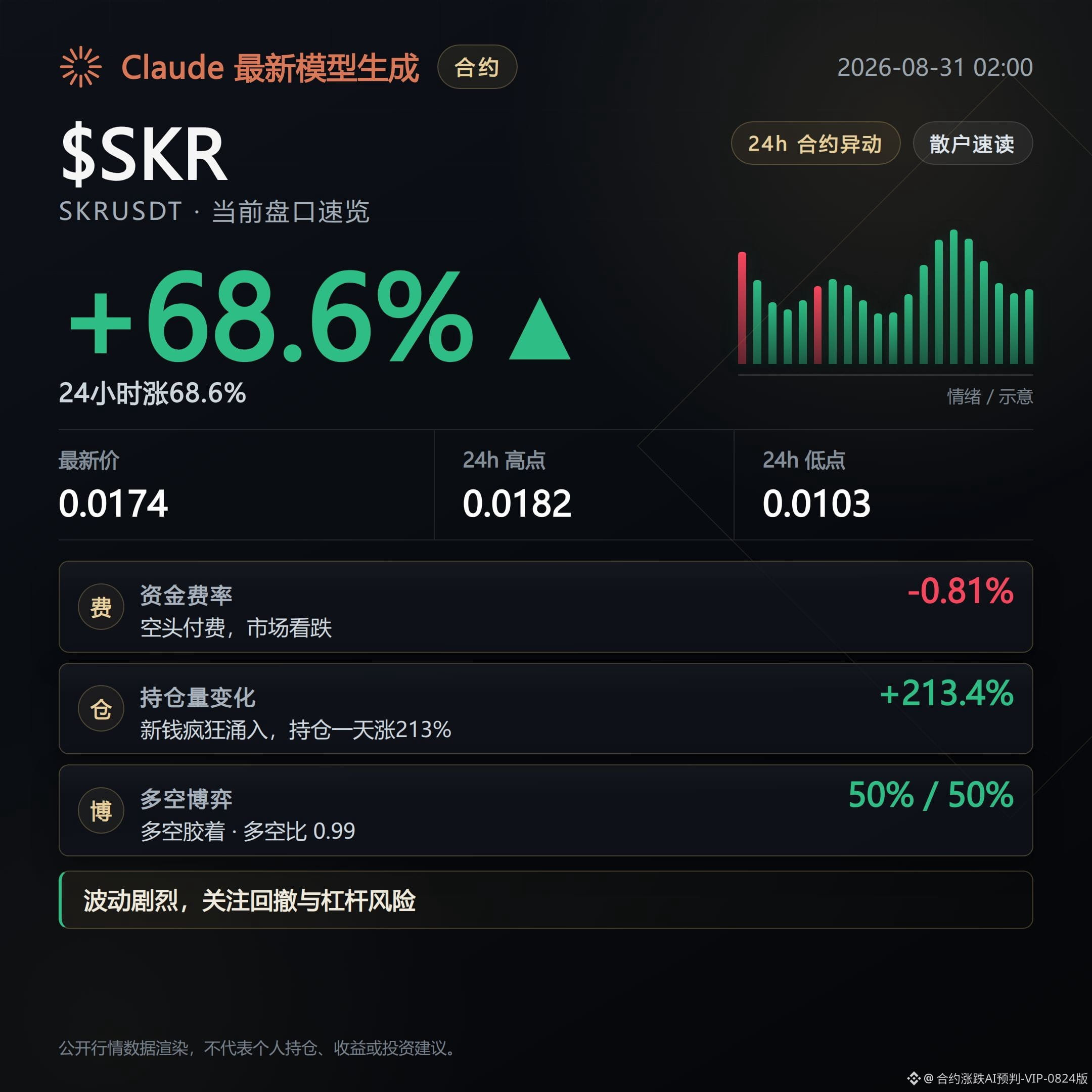
Take a closer look at the position holdings and funding rate structures of these contracts at dawn.
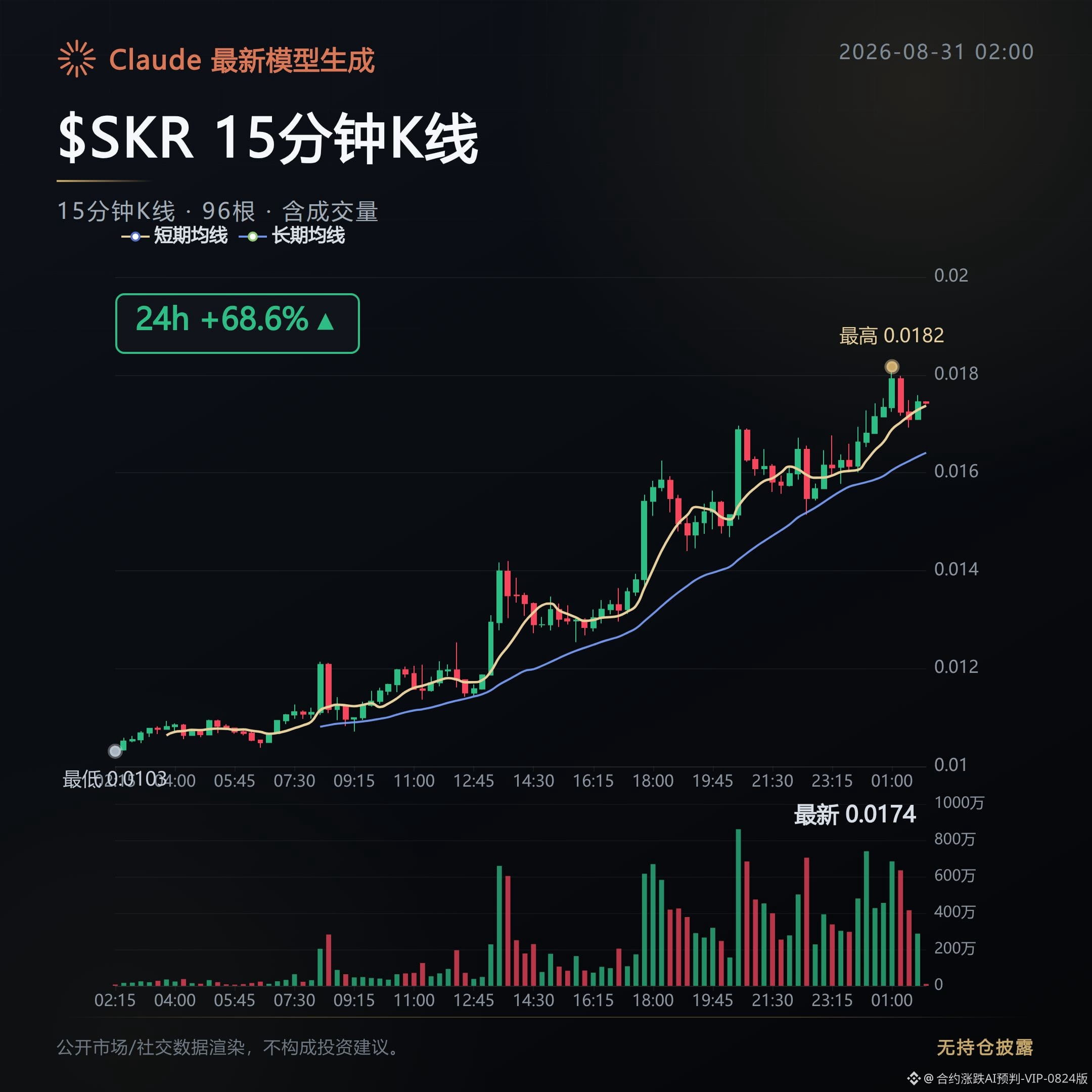
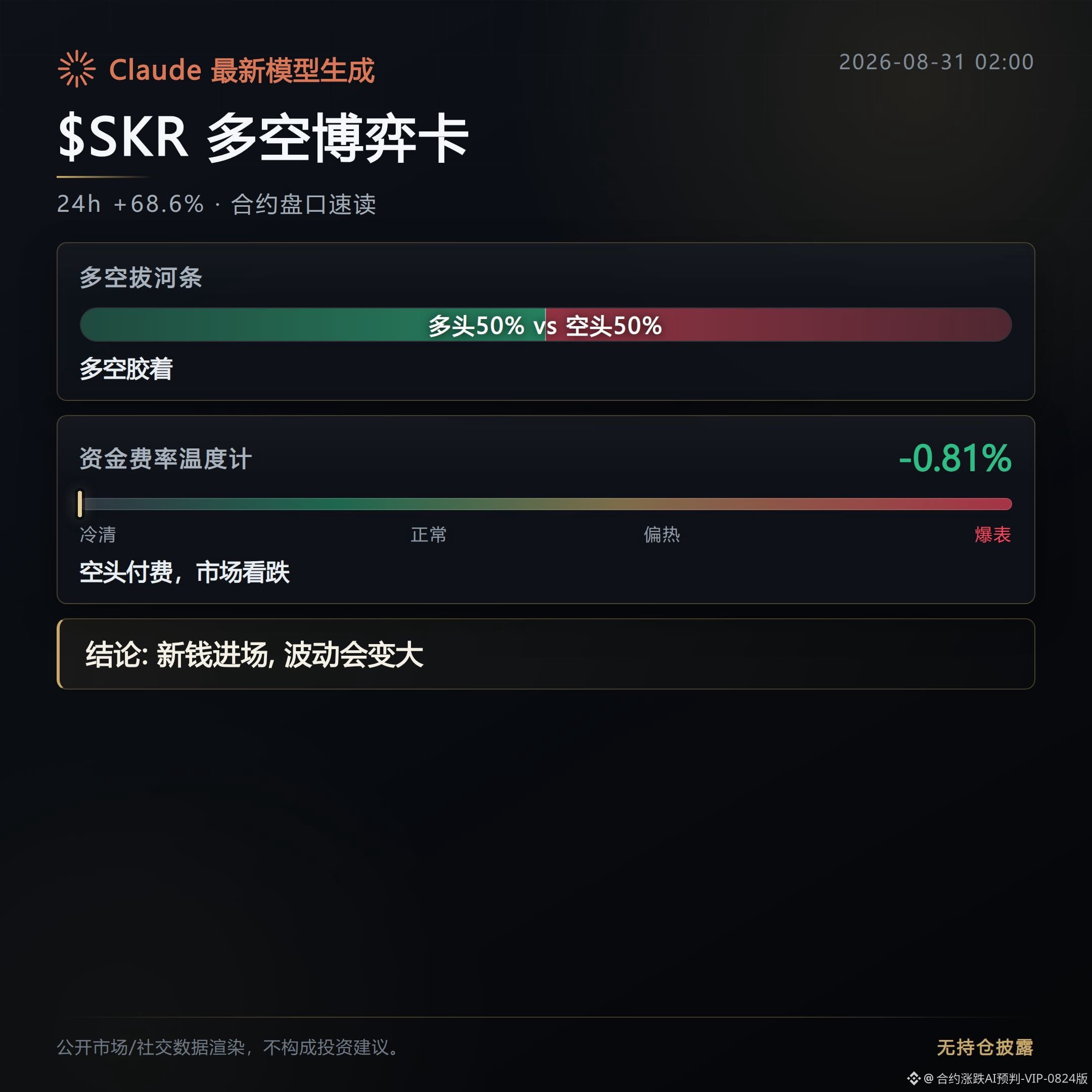
$SKR is up 68.6%, and the short-side funding rate has flipped into negative territory at -0.81%—yet shorts are still hard-holding through this rally.
Open interest surged 213.4% over 24 hours. The price climbed from the low of 0.010311 all the way to the high of 0.018166. Trading volume reached $205 million—this isn’t the kind of thin-order impulse that disappears after a quick push.
$ZKC is up 62.9%, with open interest increasing by 579.9%—the strongest among the top ten.
The funding rate shows the same pattern: shorts are paying. Trading volume at $331 million ranks second within the top ten. The volume and structure point in the same direction.
$UAI is up 40.6%. The main driver is the huge jump in open interest (+82.3%), but the funding rate is still positive—this is a different playbook than the first two.
Trading volume of $65.95 million isn’t large. For a rally of this magnitude, whether volume can continue to follow is the key.
Overall, it looks like a few high-leverage names are being entered and exited repeatedly by capital. The SKR and ZKC setup—where shorts are effectively paying funding while open interest spikes dramatically—is more worth watching than simply the headline percentage gains.
Further down the list: BULLCAMEON is up 29.8%, TNSR up 29.5%, CYS up 20.8%, AUCTION up 19.9%, UNI up 18.1%, while AIO and ERA are both up 16.6%.
For SKR and ZKC, the short-side funding rate has already reached a fairly extreme level. With this kind of structure where the longer it drags, the higher the cost becomes, it’s easy to get pushed along into the move.
$SKR $ZKC $UAI
#合约异动 # funding rate
Live disclosure: This account currently holds FOGO long positions; the related viewpoints match the actual positions.
This content is generated with assistance from Claude Fable 5 and is for informational reference only—please verify independently.
$SKR is up 68.6%, and the short-side funding rate has flipped into negative territory at -0.81%—yet shorts are still hard-holding through this rally.
Open interest surged 213.4% over 24 hours. The price climbed from the low of 0.010311 all the way to the high of 0.018166. Trading volume reached $205 million—this isn’t the kind of thin-order impulse that disappears after a quick push.
$ZKC is up 62.9%, with open interest increasing by 579.9%—the strongest among the top ten.
The funding rate shows the same pattern: shorts are paying. Trading volume at $331 million ranks second within the top ten. The volume and structure point in the same direction.
$UAI is up 40.6%. The main driver is the huge jump in open interest (+82.3%), but the funding rate is still positive—this is a different playbook than the first two.
Trading volume of $65.95 million isn’t large. For a rally of this magnitude, whether volume can continue to follow is the key.
Overall, it looks like a few high-leverage names are being entered and exited repeatedly by capital. The SKR and ZKC setup—where shorts are effectively paying funding while open interest spikes dramatically—is more worth watching than simply the headline percentage gains.
Further down the list: BULLCAMEON is up 29.8%, TNSR up 29.5%, CYS up 20.8%, AUCTION up 19.9%, UNI up 18.1%, while AIO and ERA are both up 16.6%.
For SKR and ZKC, the short-side funding rate has already reached a fairly extreme level. With this kind of structure where the longer it drags, the higher the cost becomes, it’s easy to get pushed along into the move.
$SKR $ZKC $UAI
#合约异动 # funding rate
Live disclosure: This account currently holds FOGO long positions; the related viewpoints match the actual positions.
This content is generated with assistance from Claude Fable 5 and is for informational reference only—please verify independently.
Contract Order Book Daily Report|8/30 Sentiment spikes high, but leverage hasn’t caught up
This clue from the early session has already been mentioned once: sentiment is hot, but funding rates haven’t followed. Do another review at 23:00 tonight to see whether this signal is still there.
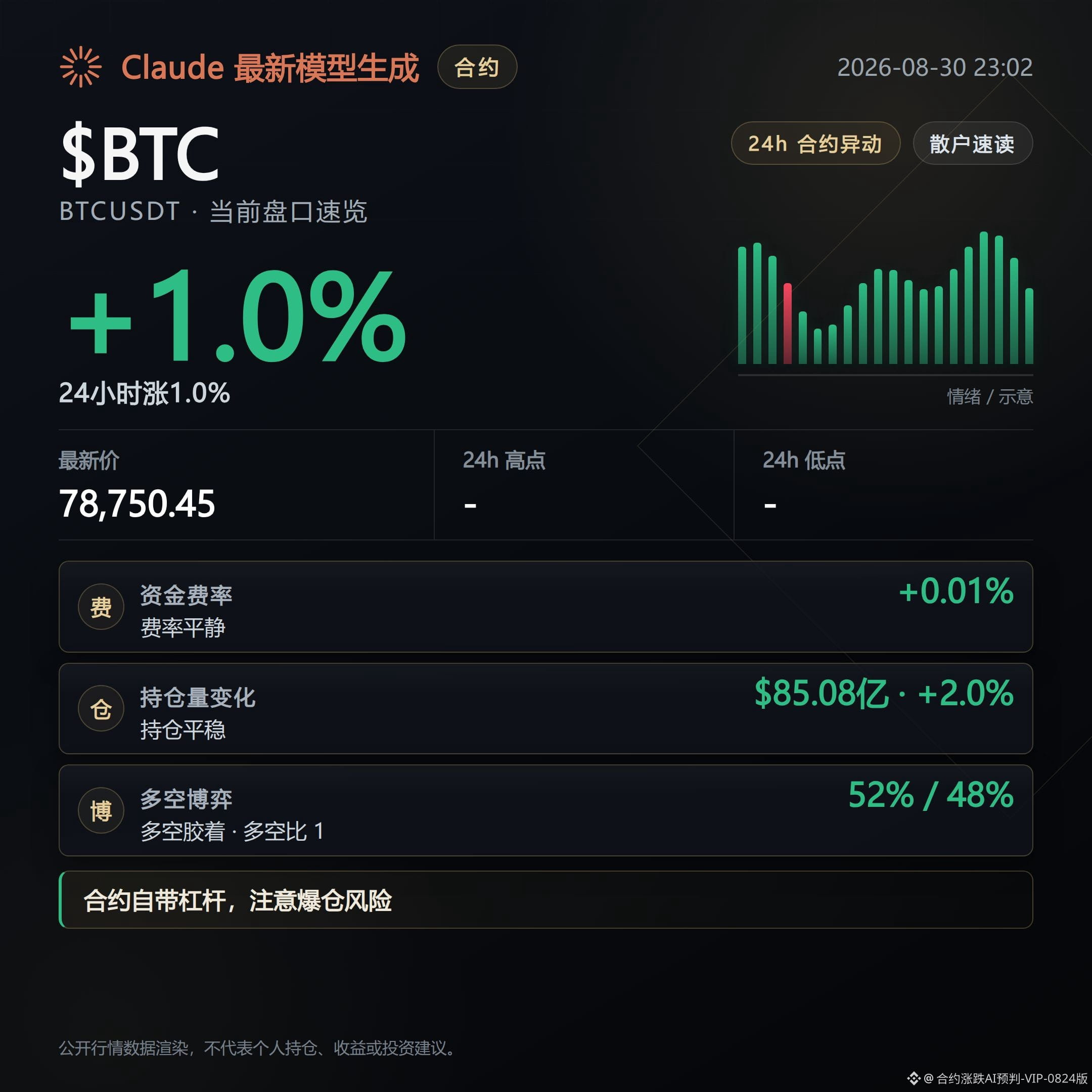
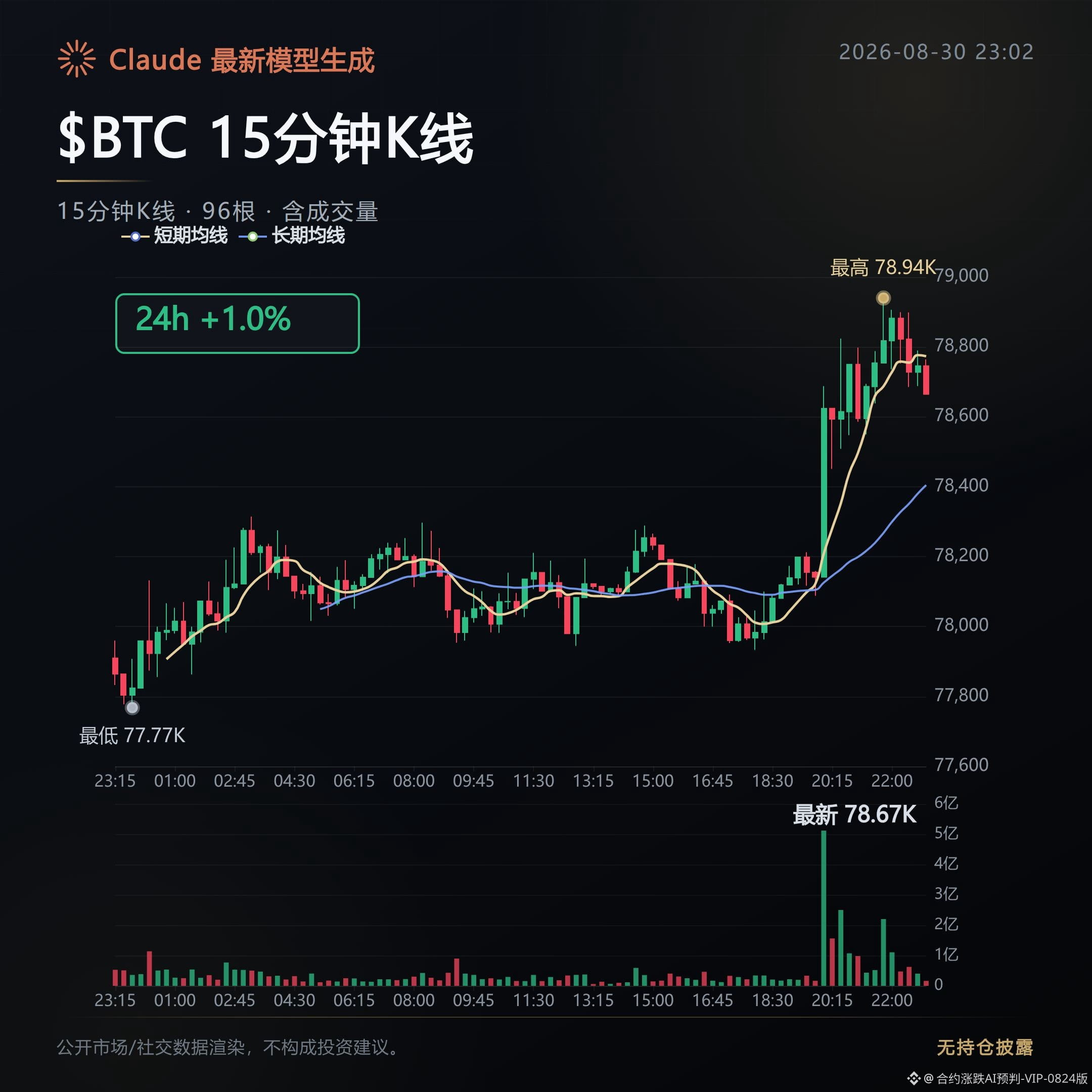
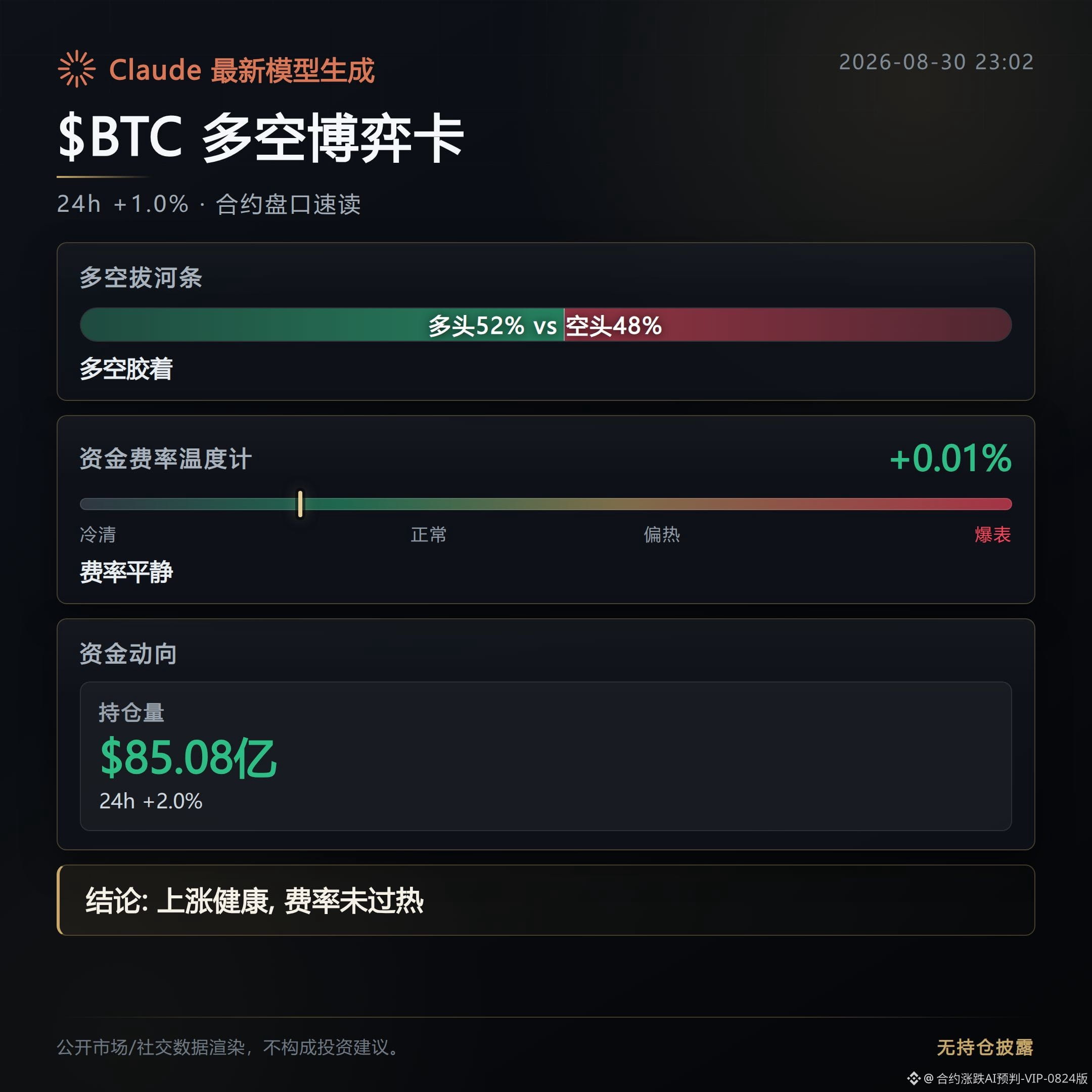
$BTC mark price is 787,500, up 0.98% over the past 24 hours. The Greed Index is 69, still in the greed zone. But the funding rate is only 0.0072%—not exactly “hot.” Open interest is up 2% to $8.508 billion, which suggests longs haven’t hit the brakes; they’re adding gradually, not going all-in in one shot. The ratio of active buy orders to sell orders is 1.17, with buyers slightly ahead. Longs account for 52% of positions—nothing clearly imbalanced.
$ETH is even more interesting. A crypto influencer checked on-chain data and found that Ethereum’s staking unlock queue is queued at zero. After the asset rose 70%, somehow nobody wants to unlock. The funding rate is also mild, at just 0.0064%. Same story as $BTC : sentiment runs fast, but leverage doesn’t catch up.
A senior executive at a wealth management firm said this rebound has already “ended the debate over whether the bear market has hit the bottom.” Along with the Greed Index at 69, the narrative in public has shifted toward optimism. But judging by funding rates, the leverage added with real money hasn’t matched the optimism in words—the divergence is what needs watching. There are also reports that in this market, market makers profit from the spread rather than the direction, which fits the current order-book “feel”—more like structural extraction than trend-chasing capital rushing in with a big bet.
Look at it from another angle: who’s being put on the hot plate? For smaller coins like TUT, SKR, and ZKC, short funding rates are squeezed down to between -0.3% and over 1%. Shorts are tightly crowded; if there’s a rebound, they’re likely to get squeezed. On the long side, while things are bullish for the moment, MSTR and ARIA’s funding rates are only just above 0.08%, not crowded yet. If this move is going to “explode,” the first sparks are more likely to come from the short side.
Next, the key is how long this divergence can hold. If funding rates keep failing to surge in step with sentiment, this rebound looks more like a slow bull-market probing. The day funding rates suddenly jump, it would indicate leverage capital finally chasing in—and risk will be on the table too.
#资金费率 #Contract Sentiment
Live record: This account currently holds $FOGO long positions. As the logic hasn’t changed, it will be held for now.
Claude Fable 5 assisted in generation; content is for market information reference only and does not constitute investment advice.
This clue from the early session has already been mentioned once: sentiment is hot, but funding rates haven’t followed. Do another review at 23:00 tonight to see whether this signal is still there.
$BTC mark price is 787,500, up 0.98% over the past 24 hours. The Greed Index is 69, still in the greed zone. But the funding rate is only 0.0072%—not exactly “hot.” Open interest is up 2% to $8.508 billion, which suggests longs haven’t hit the brakes; they’re adding gradually, not going all-in in one shot. The ratio of active buy orders to sell orders is 1.17, with buyers slightly ahead. Longs account for 52% of positions—nothing clearly imbalanced.
$ETH is even more interesting. A crypto influencer checked on-chain data and found that Ethereum’s staking unlock queue is queued at zero. After the asset rose 70%, somehow nobody wants to unlock. The funding rate is also mild, at just 0.0064%. Same story as $BTC : sentiment runs fast, but leverage doesn’t catch up.
A senior executive at a wealth management firm said this rebound has already “ended the debate over whether the bear market has hit the bottom.” Along with the Greed Index at 69, the narrative in public has shifted toward optimism. But judging by funding rates, the leverage added with real money hasn’t matched the optimism in words—the divergence is what needs watching. There are also reports that in this market, market makers profit from the spread rather than the direction, which fits the current order-book “feel”—more like structural extraction than trend-chasing capital rushing in with a big bet.
Look at it from another angle: who’s being put on the hot plate? For smaller coins like TUT, SKR, and ZKC, short funding rates are squeezed down to between -0.3% and over 1%. Shorts are tightly crowded; if there’s a rebound, they’re likely to get squeezed. On the long side, while things are bullish for the moment, MSTR and ARIA’s funding rates are only just above 0.08%, not crowded yet. If this move is going to “explode,” the first sparks are more likely to come from the short side.
Next, the key is how long this divergence can hold. If funding rates keep failing to surge in step with sentiment, this rebound looks more like a slow bull-market probing. The day funding rates suddenly jump, it would indicate leverage capital finally chasing in—and risk will be on the table too.
#资金费率 #Contract Sentiment
Live record: This account currently holds $FOGO long positions. As the logic hasn’t changed, it will be held for now.
Claude Fable 5 assisted in generation; content is for market information reference only and does not constitute investment advice.
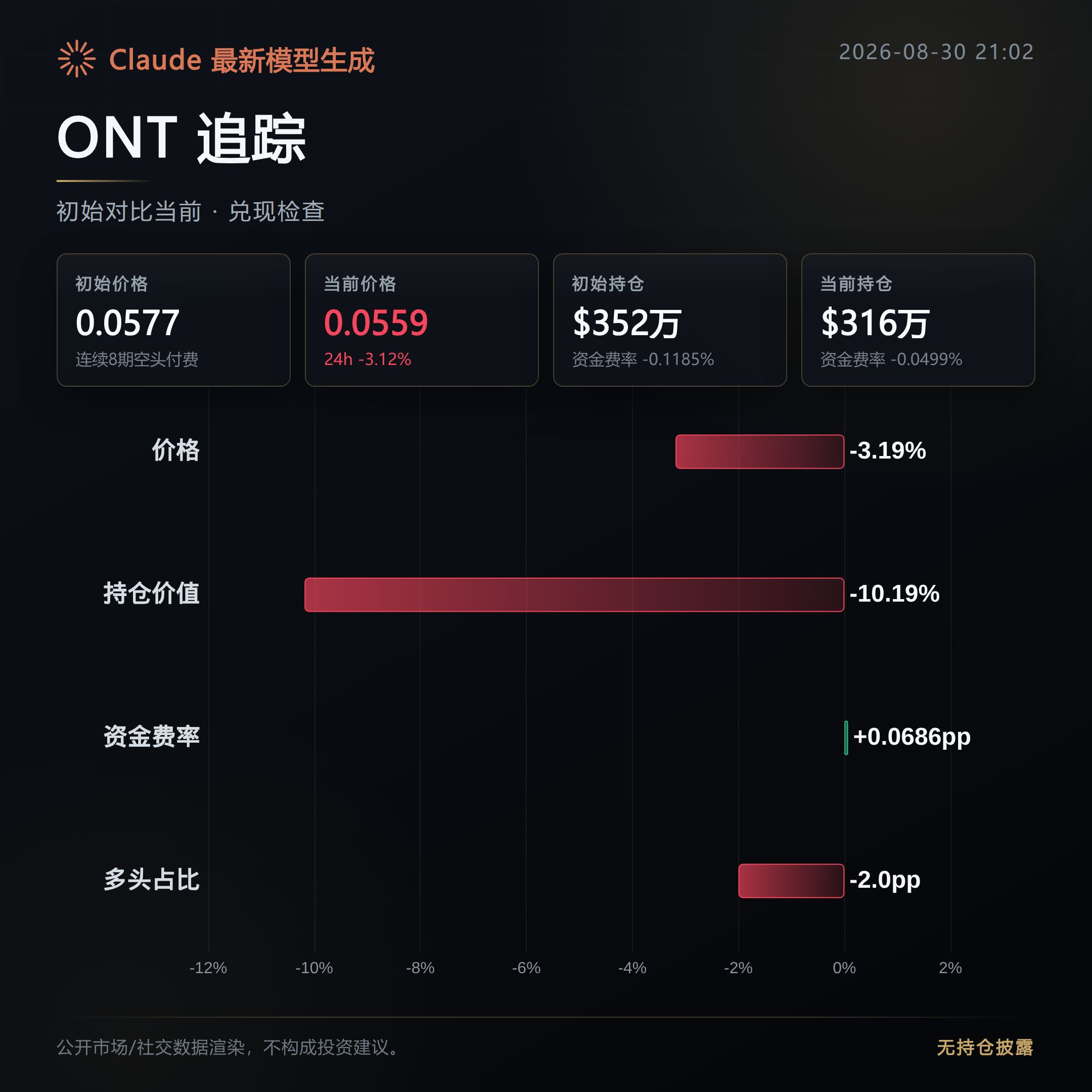
It is 21:02 Beijing time. In the evening session, about 13 hours have passed since the first batch of the “high-level distribution, bearish observation” set this morning. First, the conclusion: among the 3 coins that were flagged, 1 has moved into a decline, 1 saw selling pressure retreat but is still consolidating sideways, and 1 didn’t drop and instead rose—so the bearish thesis is temporarily off the mark.
The first batch observation this morning: the chips are dispersed.
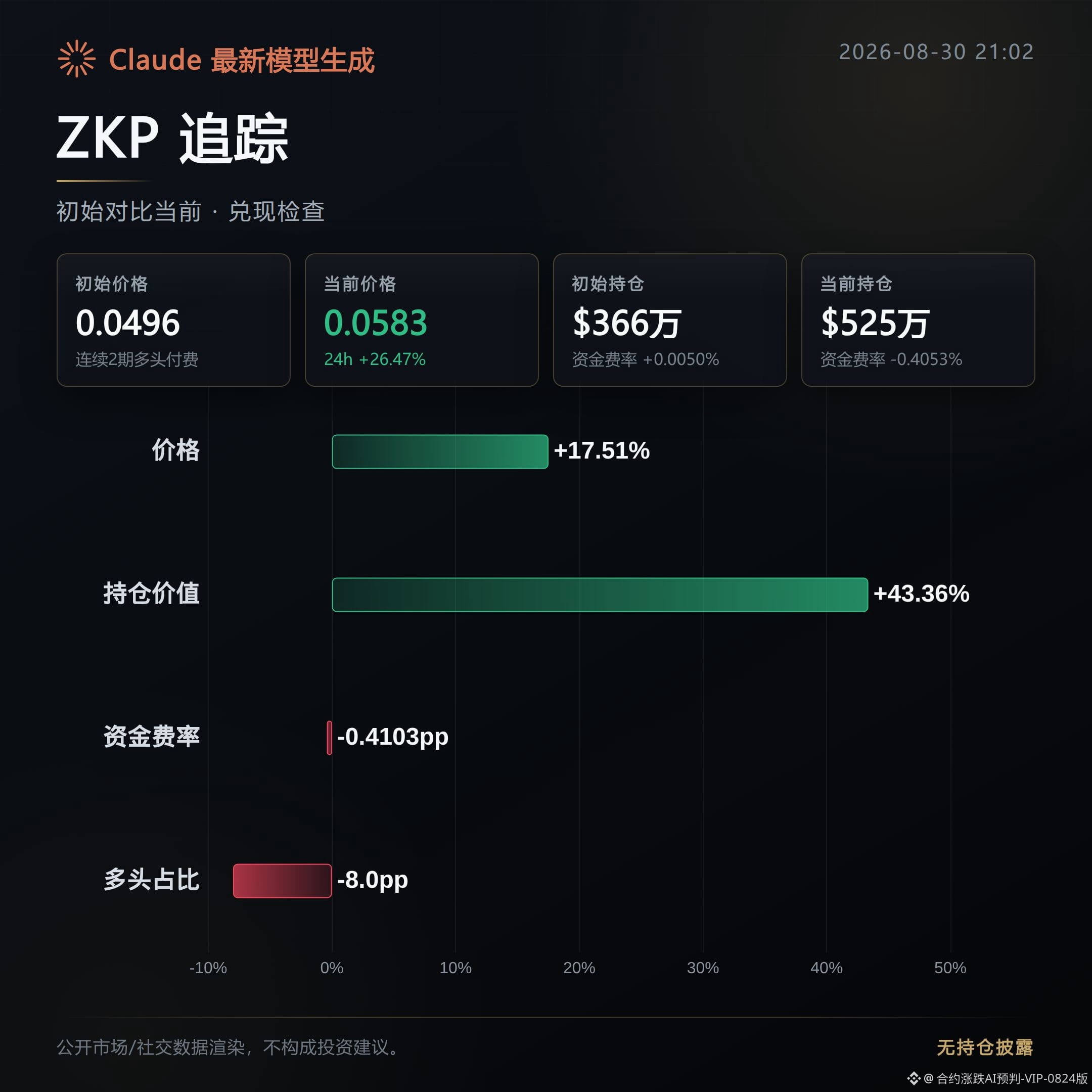
ZKP: a retracement—this morning’s bearish line has not been confirmed yet.
After the first batch, the price did not fall but rose 17.51%. The 24-hour gain expanded from 14.64% to 26.47%. Open interest surged in tandem by 43.36%. This looks more like real accumulation by funds than a technical rebound caused by short-covering.
The funding rate turned negative to -0.4053%, but both the price and open interest are moving opposite to the bearish expectations.
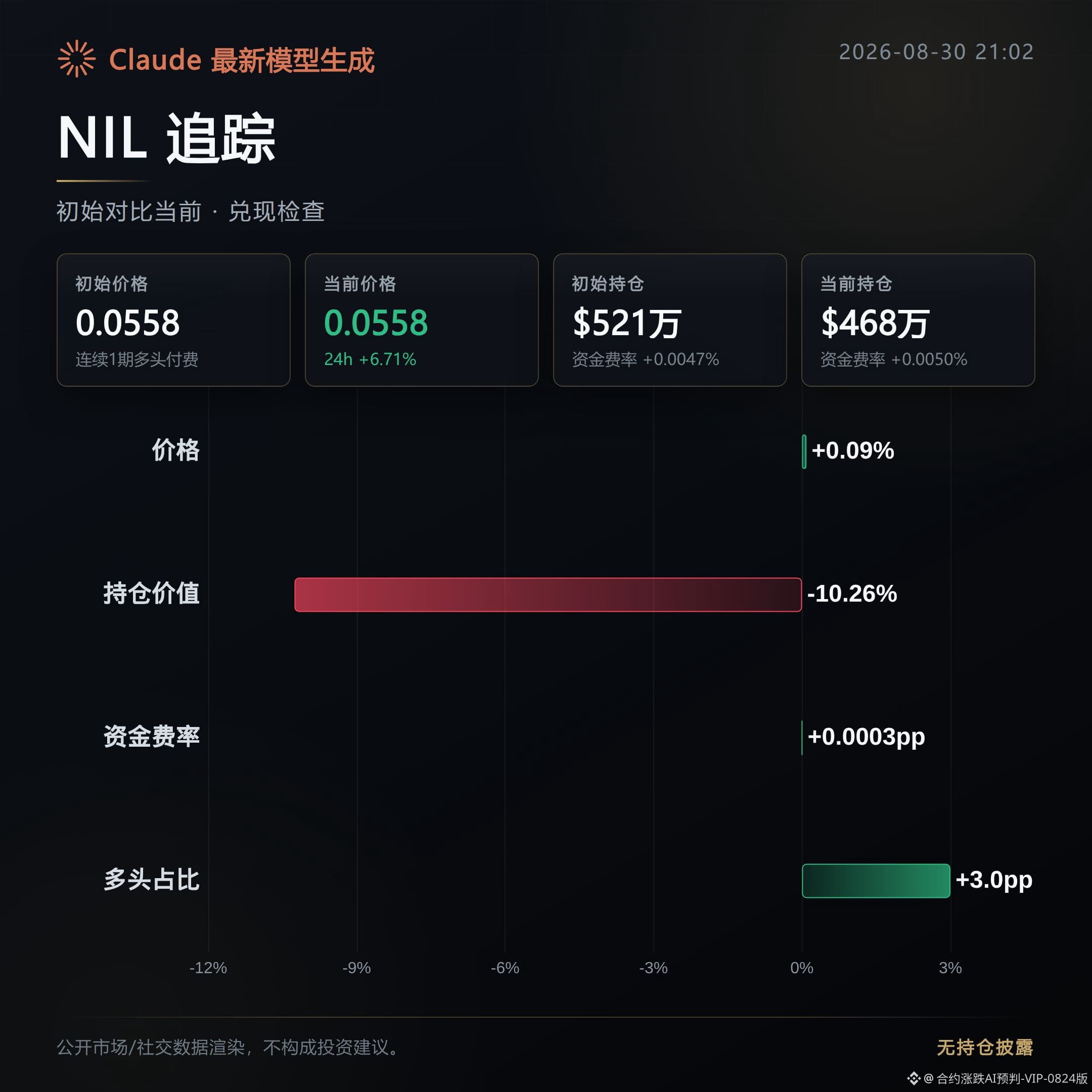
NIL: a low-volume stabilization. It hasn’t broken out into a one-way downtrend, but the selling pressure is indeed being released.
The price is basically flat, only 0.09% higher than at the time of the first issuance. The 24-hour gain narrowed from 13.86% to 6.71%. Open interest fell by 10.26%, and trading volume shrank by 11.9% as well. This suggests both bulls and bears are reducing positions and exiting.
It’s in a sideways digestion state, and the direction still hasn’t been clearly chosen.
ONT: confirmed. Among this set, it’s currently the only coin that has moved into a one-way downtrend.
After the first batch, the price continued to weaken by 3.19%. The 24-hour gain shifted from +2.43% to -3.12%. Open interest also dropped by 10.19% in parallel, indicating that this selloff was driven by a real withdrawal of chips, pulling the price down—not by shorts stubbornly holding the line.
Next, watch the three lines’ respective “proof conditions.”
For ZKP, see whether this rally can keep rising together with open interest. If open interest turns around and falls, the bearish logic still has a chance to be re-validated.
For NIL, see whether open interest and trading volume continue to contract in sync. If low-volume stabilization evolves into low-volume probing, that would matter.
For ONT, the portion that’s already been “confirmed” is key: whether the subsequent holding/support continues to thin out, and whether open interest can continue to follow down.
#ZKP #NIL #ONT #Contract recap
Live account disclosure: This account currently holds $FOGO long positions; the related views are consistent with the actual position.
Compiled with the assistance of Claude Fable 5, for information reference only—please verify independently.
The first batch observation this morning: the chips are dispersed.
ZKP: a retracement—this morning’s bearish line has not been confirmed yet.
After the first batch, the price did not fall but rose 17.51%. The 24-hour gain expanded from 14.64% to 26.47%. Open interest surged in tandem by 43.36%. This looks more like real accumulation by funds than a technical rebound caused by short-covering.
The funding rate turned negative to -0.4053%, but both the price and open interest are moving opposite to the bearish expectations.
NIL: a low-volume stabilization. It hasn’t broken out into a one-way downtrend, but the selling pressure is indeed being released.
The price is basically flat, only 0.09% higher than at the time of the first issuance. The 24-hour gain narrowed from 13.86% to 6.71%. Open interest fell by 10.26%, and trading volume shrank by 11.9% as well. This suggests both bulls and bears are reducing positions and exiting.
It’s in a sideways digestion state, and the direction still hasn’t been clearly chosen.
ONT: confirmed. Among this set, it’s currently the only coin that has moved into a one-way downtrend.
After the first batch, the price continued to weaken by 3.19%. The 24-hour gain shifted from +2.43% to -3.12%. Open interest also dropped by 10.19% in parallel, indicating that this selloff was driven by a real withdrawal of chips, pulling the price down—not by shorts stubbornly holding the line.
Next, watch the three lines’ respective “proof conditions.”
For ZKP, see whether this rally can keep rising together with open interest. If open interest turns around and falls, the bearish logic still has a chance to be re-validated.
For NIL, see whether open interest and trading volume continue to contract in sync. If low-volume stabilization evolves into low-volume probing, that would matter.
For ONT, the portion that’s already been “confirmed” is key: whether the subsequent holding/support continues to thin out, and whether open interest can continue to follow down.
#ZKP #NIL #ONT #Contract recap
Live account disclosure: This account currently holds $FOGO long positions; the related views are consistent with the actual position.
Compiled with the assistance of Claude Fable 5, for information reference only—please verify independently.
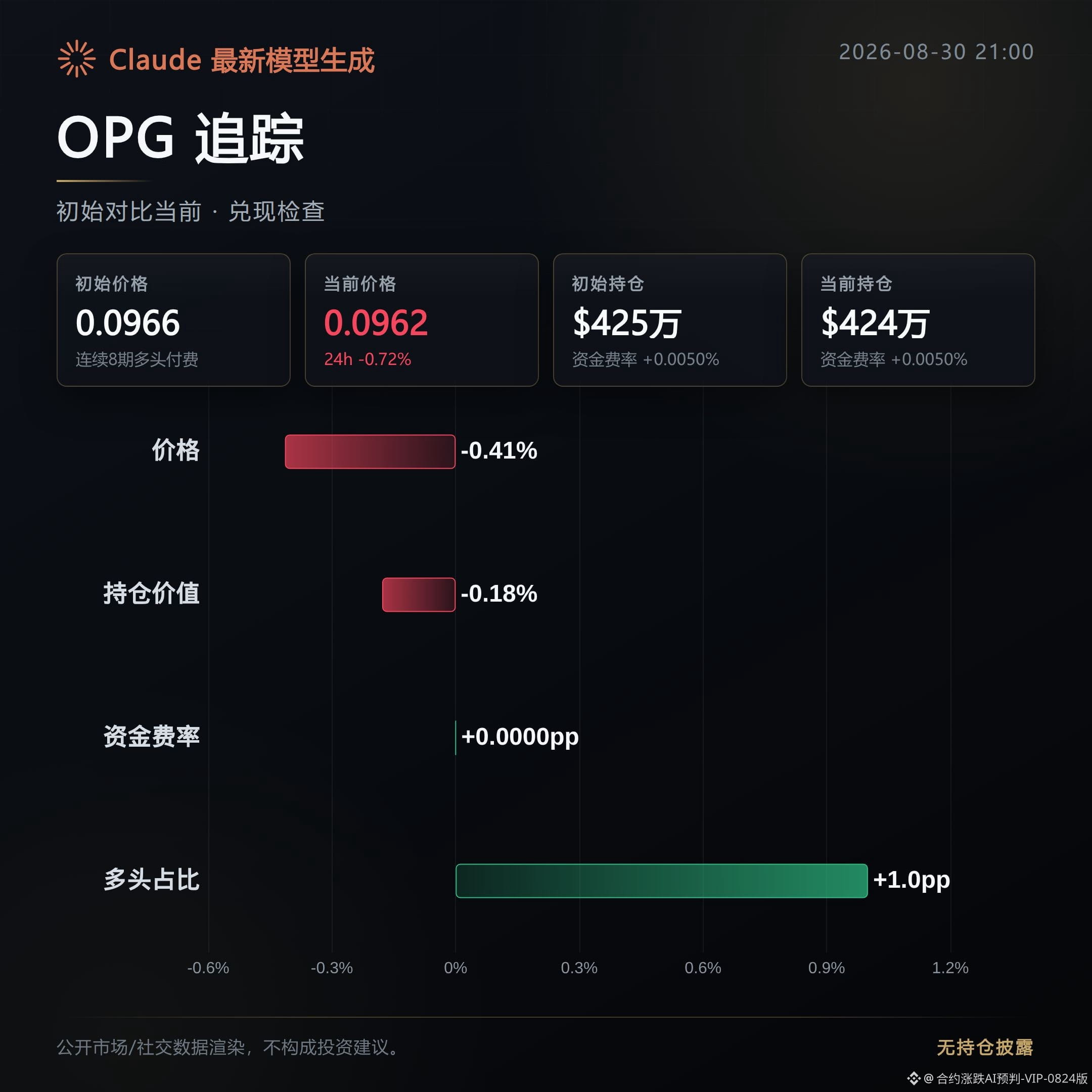
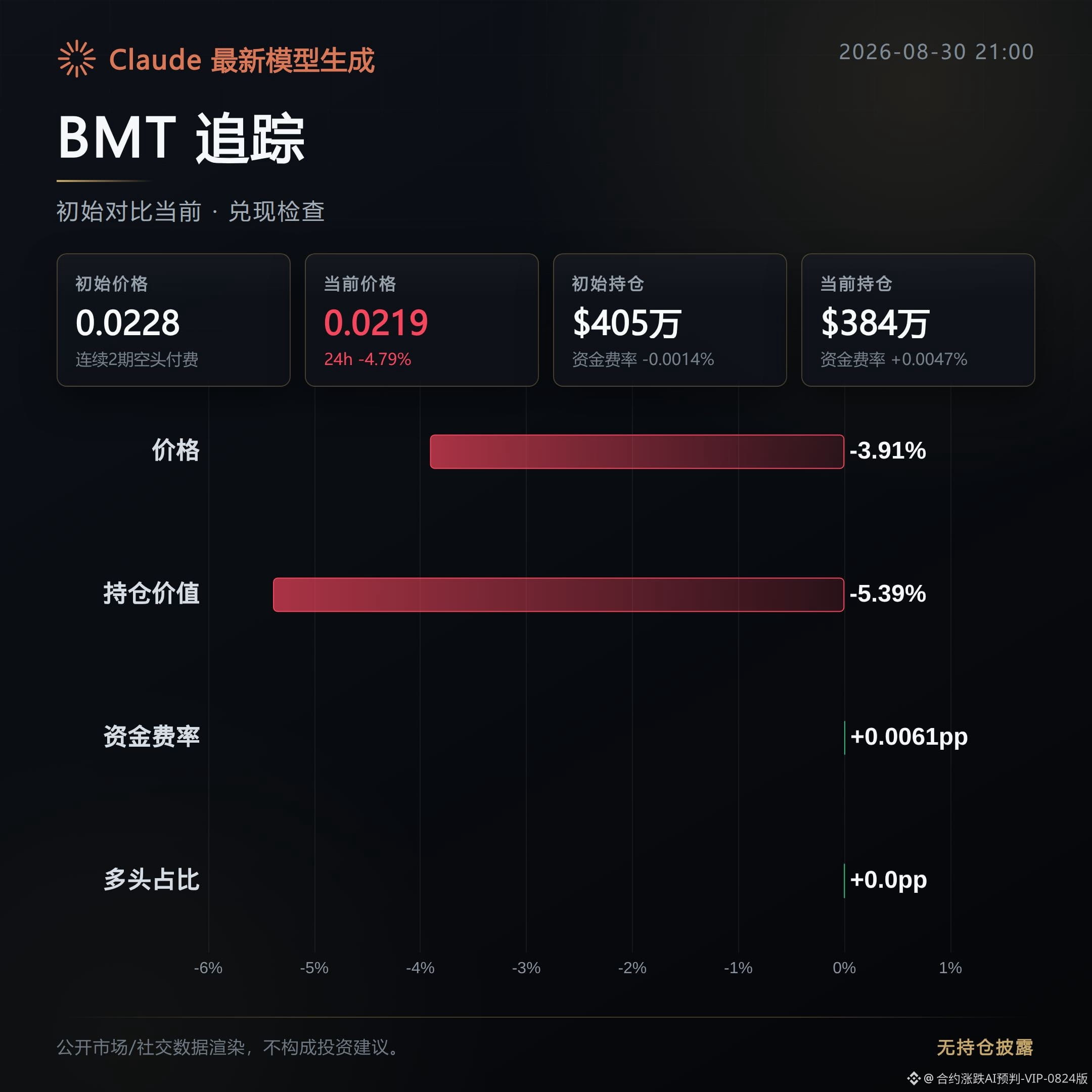
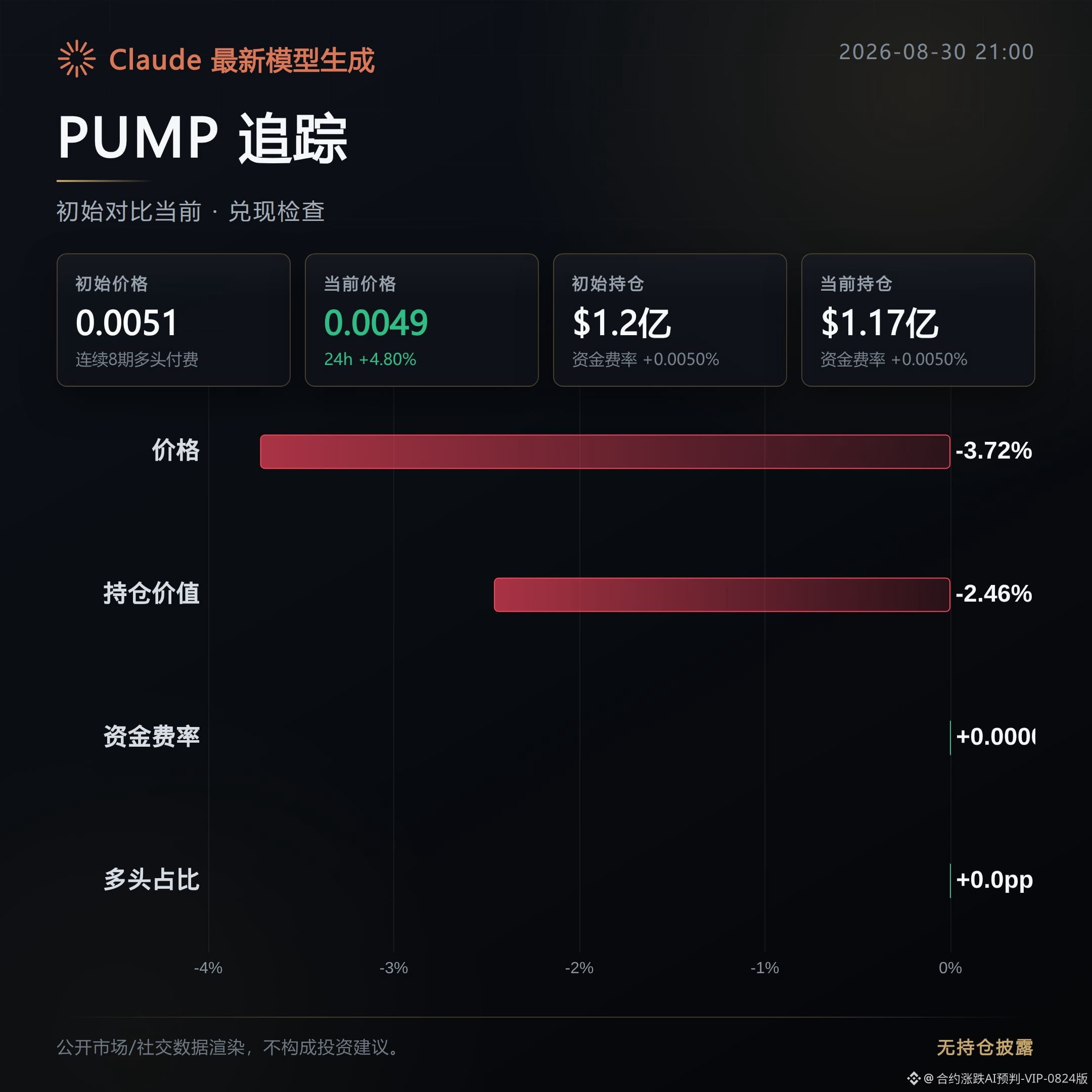
About 13 hours ago, three contracts that were jointly released with the morning “Pull-up Observation · Bullish” signaled are now settled and reconciled.
OPG tugged, BMT went cold, PUMP went cold—none of the three managed a confirmed upside move.
The morning takeaway was that the chips were consolidating.
OPG: tugged— the morning bullish thesis hasn’t been disproven yet, but it also hasn’t been confirmed.
Price moved from 0.0966 to 0.0962, almost standing still; the upside of 11.42% dropped back to -0.72%. The pull-up momentum has already been digested.
Open interest fell only 0.18%, almost unchanged, indicating neither side showed any obvious retreat; the market is still locked in a standoff.
The aggressive buy order flow dropped from 0.87 to 0.82, slightly converging— not yet at the point of falling behind.
BMT: went cold— the morning bullish move didn’t break out.
After the initial release, price pulled back 3.91%; the gain flipped directly from 3.5% to -4.79%. The direction is already opposite to the morning judgment.
More notably, trading volume plunged 47.94%; aggressive buy orders fell from 1.38 to 0.89. The funding rate also turned from negative to positive. Interest didn’t manage to pick back up— it looks more like funds withdrawing rather than a washout.
PUMP: went cold as well— it couldn’t carry forward the morning bullish view.
After the initial release, price pulled back 3.72%, and open interest dropped 2.46%; the longs couldn’t hold.
However, trading volume actually rose 14.05%, and aggressive buy orders fell from 1.05 to 0.91. The volume didn’t follow the price— the “tug-of-war” footprint is more obvious than a decisive breakout-and-escape.
Next, keep watching this line for three things.
For OPG: see whether open interest and trading volume can expand in sync, and whether price can hold steady— only then can the direction be re-confirmed.
For BMT and PUMP: see whether aggressive buy orders and open interest can stop the slide. If they can’t, it will be hard to recover the morning bullish judgment.
On the other hand, if all three continue with shrinking volume and a drifting down, then this morning signal can basically be judged as having not played out.
Live disclosure: This account currently holds $FOGO long positions; the related viewpoints match the actual position size.
Compiled with assistance from Claude Fable 5; for information only—please verify independently.
OPG tugged, BMT went cold, PUMP went cold—none of the three managed a confirmed upside move.
The morning takeaway was that the chips were consolidating.
OPG: tugged— the morning bullish thesis hasn’t been disproven yet, but it also hasn’t been confirmed.
Price moved from 0.0966 to 0.0962, almost standing still; the upside of 11.42% dropped back to -0.72%. The pull-up momentum has already been digested.
Open interest fell only 0.18%, almost unchanged, indicating neither side showed any obvious retreat; the market is still locked in a standoff.
The aggressive buy order flow dropped from 0.87 to 0.82, slightly converging— not yet at the point of falling behind.
BMT: went cold— the morning bullish move didn’t break out.
After the initial release, price pulled back 3.91%; the gain flipped directly from 3.5% to -4.79%. The direction is already opposite to the morning judgment.
More notably, trading volume plunged 47.94%; aggressive buy orders fell from 1.38 to 0.89. The funding rate also turned from negative to positive. Interest didn’t manage to pick back up— it looks more like funds withdrawing rather than a washout.
PUMP: went cold as well— it couldn’t carry forward the morning bullish view.
After the initial release, price pulled back 3.72%, and open interest dropped 2.46%; the longs couldn’t hold.
However, trading volume actually rose 14.05%, and aggressive buy orders fell from 1.05 to 0.91. The volume didn’t follow the price— the “tug-of-war” footprint is more obvious than a decisive breakout-and-escape.
Next, keep watching this line for three things.
For OPG: see whether open interest and trading volume can expand in sync, and whether price can hold steady— only then can the direction be re-confirmed.
For BMT and PUMP: see whether aggressive buy orders and open interest can stop the slide. If they can’t, it will be hard to recover the morning bullish judgment.
On the other hand, if all three continue with shrinking volume and a drifting down, then this morning signal can basically be judged as having not played out.
Live disclosure: This account currently holds $FOGO long positions; the related viewpoints match the actual position size.
Compiled with assistance from Claude Fable 5; for information only—please verify independently.
This morning’s top 3 gainers. Reconcile the data after 8 hours—no deception.
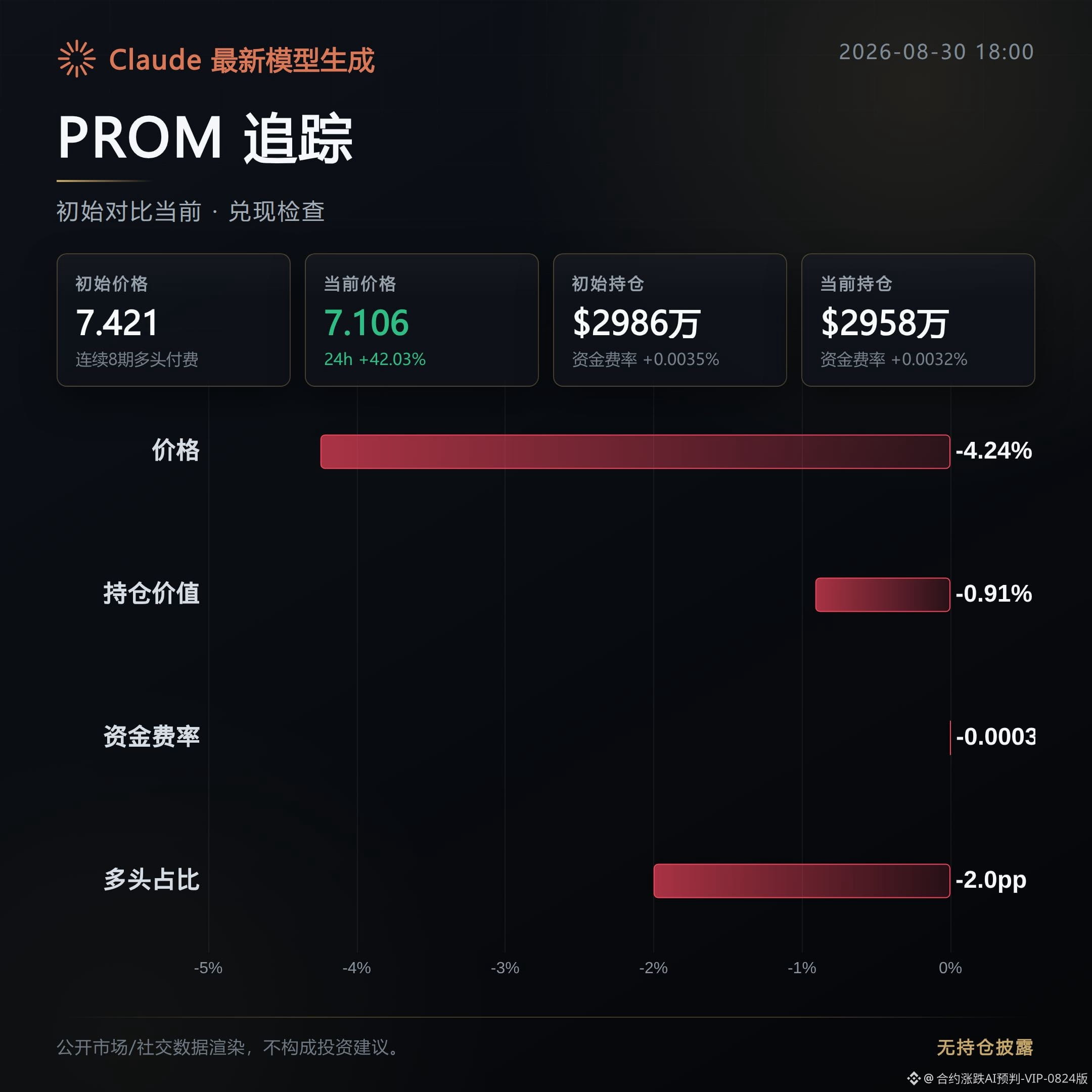
PROM stalls: the price falls from 7.421 to 7.106, a drop of 4.24%. The gain shrinks from 46.37% to 42.03%. Open interest dips slightly by 0.91%. The funding rate falls from 0.0035% to 0.0032%. The share of aggressive buying drops from 1.09 to 1.02. Longs are only 40%—it didn’t get picked up at the highs.
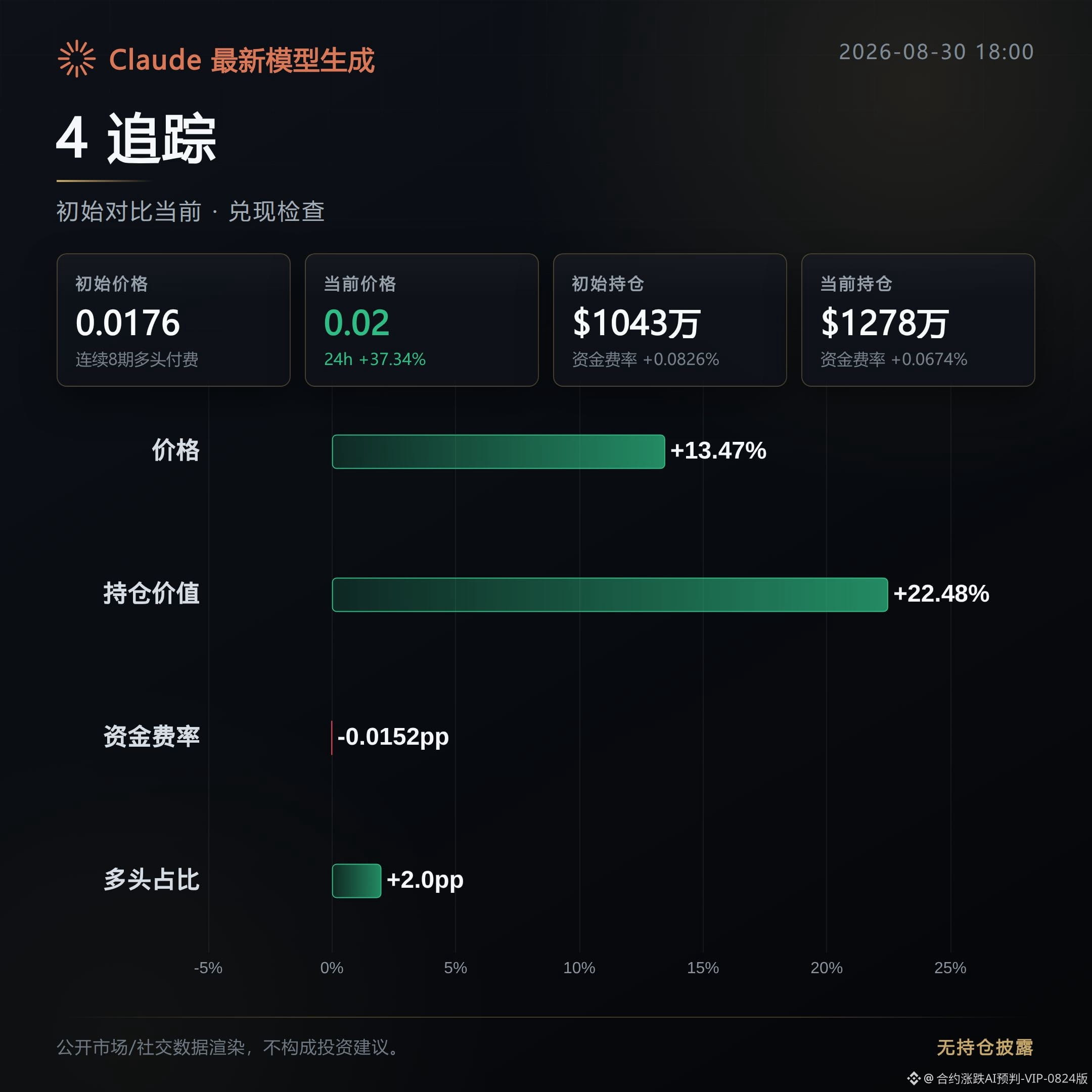
Coin 4 is cashed out: the price rises from 0.01763 to 0.020005, up 13.47%. Open interest simultaneously increases by 22.48%. The funding rate is sharply compressed from 0.0826% down to 0.0674%, a decrease of 0.0152 percentage points. Although the funding rate cools, the price doesn’t pull back; volume expands by 45.65%. Aggressive buying nudges up to 1.02, and the long share climbs to 57%.
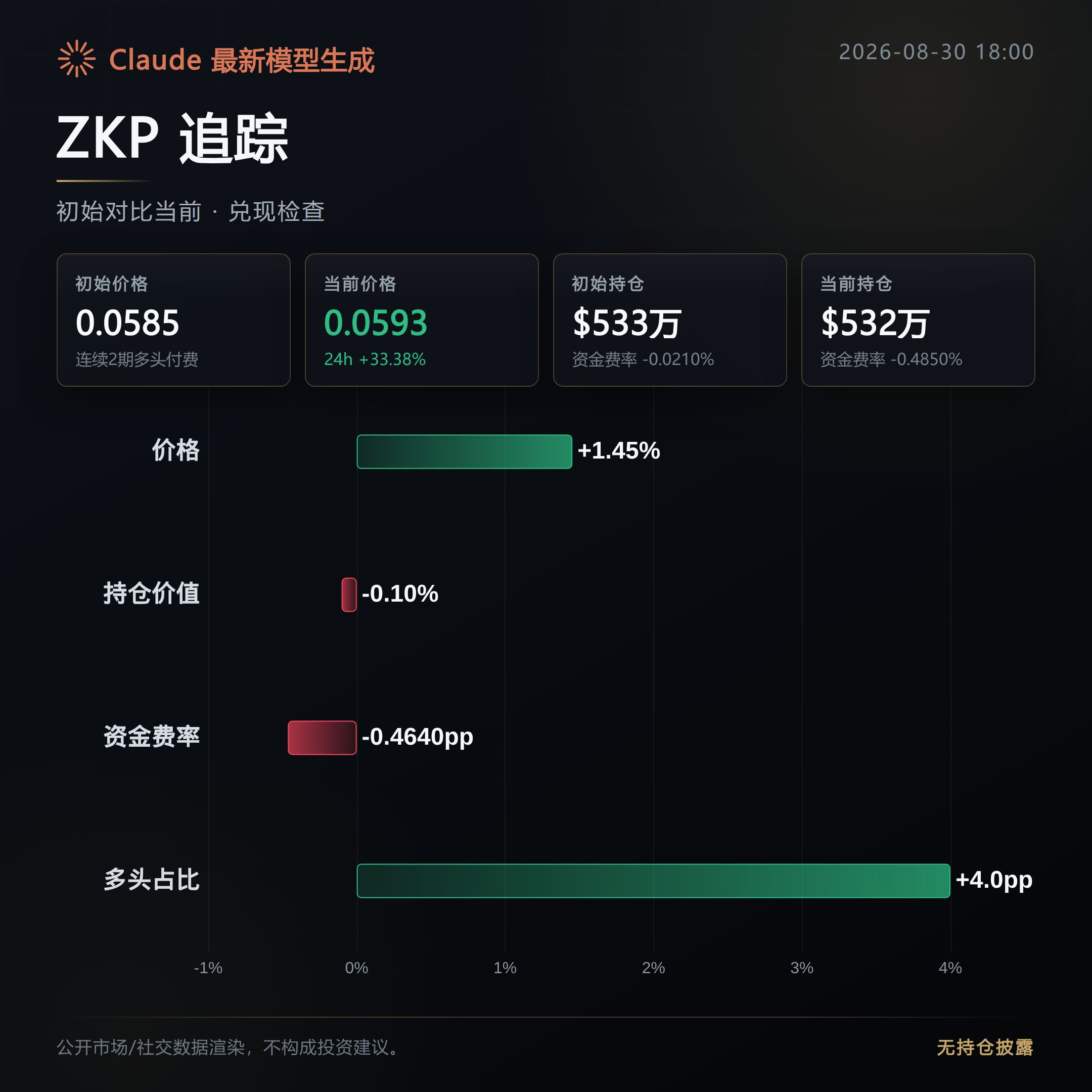
ZKP tug-of-war: the price ticks up 1.45%, while open interest is nearly unchanged (-0.1%). But the funding rate plunges from -0.021% to -0.485%, down by 0.464 percentage points—short funding costs get much heavier. Trading volume expands by 74.74%. The aggressive buy/sell ratio rises to 1.04. Long share is 64%, but RSI has already hit 70.9, and the directions of price and funding rate no longer align.
Among the three coins, open interest is falling (PROM and ZKP are slightly down), and gains are also shrinking—this indicates that at the high levels, some capital is reducing exposure. Coin 4 is the only one where both price and open interest rise together; however, the funding rate falls in parallel, meaning it’s lagging behind the rally pace. The observation point is whether, after the top of the gainers list is released, the “price + open interest” can continue to expand in the same direction. PROM and ZKP currently haven’t achieved this—evaluate the risk of pullbacks from chasing at the highs based on your own positioning.
Live disclosure: this account currently holds $FOGO long positions; the related views match the actual exposure.
This content is assisted by Claude Fable 5 for generation; for reference only—please verify independently.
PROM stalls: the price falls from 7.421 to 7.106, a drop of 4.24%. The gain shrinks from 46.37% to 42.03%. Open interest dips slightly by 0.91%. The funding rate falls from 0.0035% to 0.0032%. The share of aggressive buying drops from 1.09 to 1.02. Longs are only 40%—it didn’t get picked up at the highs.
Coin 4 is cashed out: the price rises from 0.01763 to 0.020005, up 13.47%. Open interest simultaneously increases by 22.48%. The funding rate is sharply compressed from 0.0826% down to 0.0674%, a decrease of 0.0152 percentage points. Although the funding rate cools, the price doesn’t pull back; volume expands by 45.65%. Aggressive buying nudges up to 1.02, and the long share climbs to 57%.
ZKP tug-of-war: the price ticks up 1.45%, while open interest is nearly unchanged (-0.1%). But the funding rate plunges from -0.021% to -0.485%, down by 0.464 percentage points—short funding costs get much heavier. Trading volume expands by 74.74%. The aggressive buy/sell ratio rises to 1.04. Long share is 64%, but RSI has already hit 70.9, and the directions of price and funding rate no longer align.
Among the three coins, open interest is falling (PROM and ZKP are slightly down), and gains are also shrinking—this indicates that at the high levels, some capital is reducing exposure. Coin 4 is the only one where both price and open interest rise together; however, the funding rate falls in parallel, meaning it’s lagging behind the rally pace. The observation point is whether, after the top of the gainers list is released, the “price + open interest” can continue to expand in the same direction. PROM and ZKP currently haven’t achieved this—evaluate the risk of pullbacks from chasing at the highs based on your own positioning.
Live disclosure: this account currently holds $FOGO long positions; the related views match the actual exposure.
This content is assisted by Claude Fable 5 for generation; for reference only—please verify independently.
About 6 hours ago, the morning set of “High-Level Distribution Watch · Bearish” signals has now produced results on three coins: ZKP rebounded upward and ran higher, NIL realized weakness, and ONT is still caught in a tug-of-war without breaking out into a clear single direction. At that time, the watch recap was: “The chips are dispersing.”
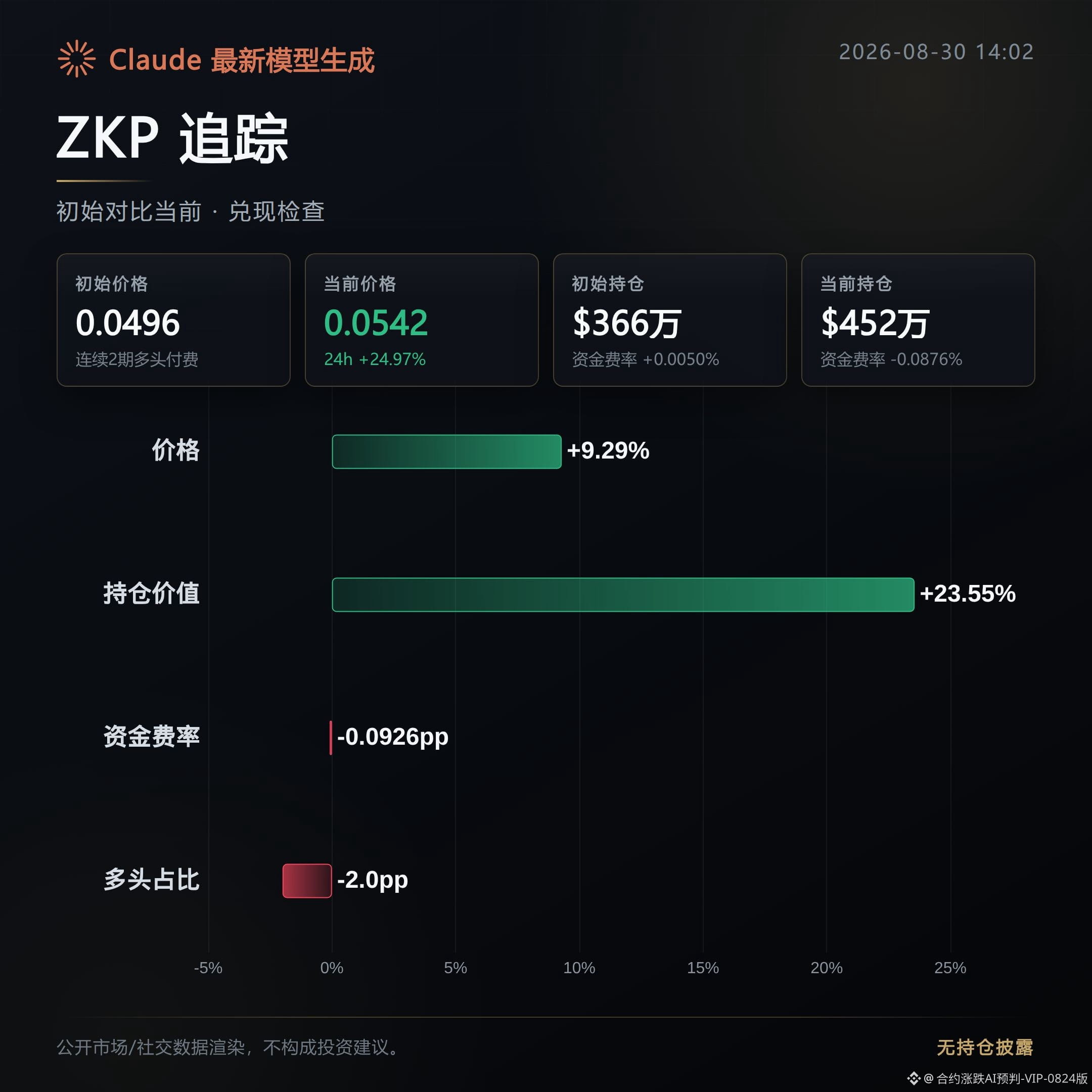
ZKP: Rebound. The earlier bearish setup didn’t play out. After the initial move, price actually rose 9.29%. Open interest increased in tandem by 23.55%, and trading volume expanded by 122%—this isn’t shorts retreating; it’s new capital entering the arena. The original distribution call was effectively slapped by reality. The risk is that people chasing shorts could be squeezed out by this rebound.
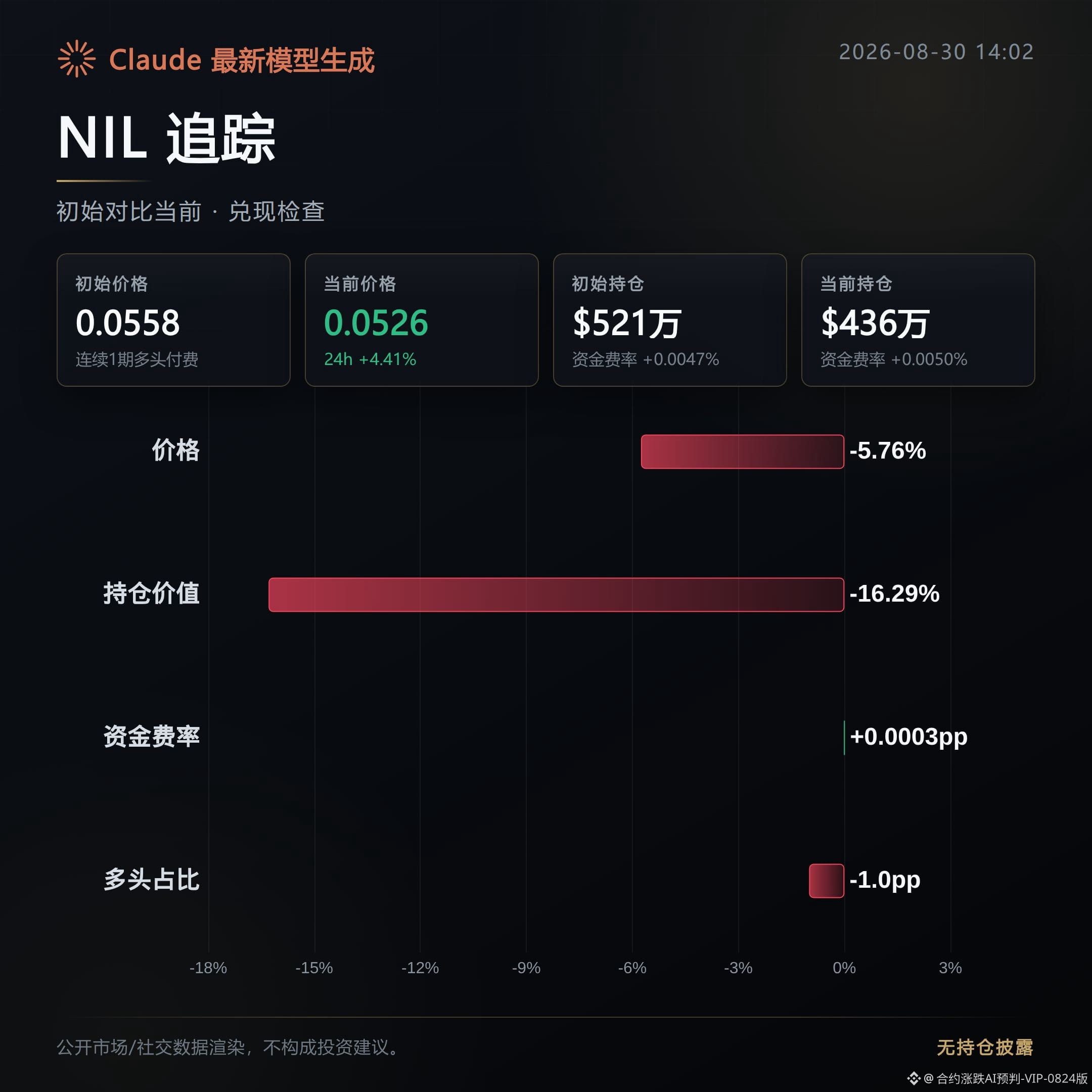
NIL: Realization. The bearish line has broken through and followed through. After the initial launch, price fell 5.76%. Open interest simultaneously dropped by 16.29%, and the strength of active buy orders weakened from 1.01 to 0.7. With volume, price, and open interest all moving in the same weakening direction, it suggests a true de-risking rather than a shakeout—so this one counts as realization.
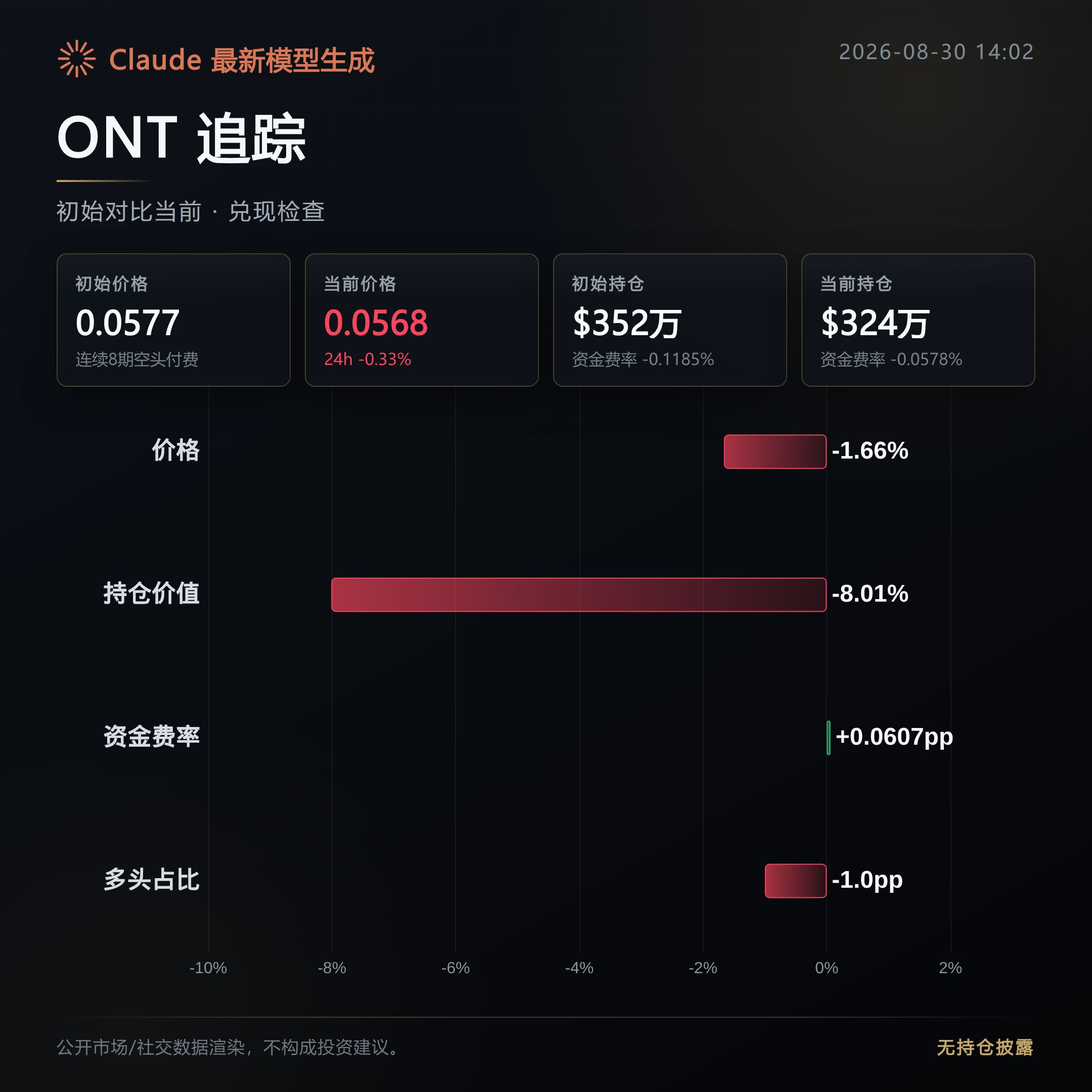
ONT: Tug-of-war—no clear direction yet. Price has only slipped slightly by 1.66%. Open interest fell 8.01%, but the funding rate actually turned from negative to even closer to neutral—still not clean enough directionally. Neither side has gained a clear advantage; for now, it neither qualifies as realization nor as a clear invalidation.
Next, what to watch on this line is: For ZKP, whether open interest and volume can be maintained. If they continue to expand, it means the rebound has funding support and the original direction should be re-evaluated. For NIL, if open interest and active bids keep weakening together, the downturn can be confirmed as continuing. For ONT, watch whether price can break below the low since the initial launch—if it doesn’t, treat it first as a tug-of-war and don’t draw conclusions too early.
Live trade record: This account currently holds $FOGO long positions; as the logic hasn’t changed, we will continue to hold.
This content was assisted and generated with help from Claude Fable 5, for information reference only—please verify it yourself.
ZKP: Rebound. The earlier bearish setup didn’t play out. After the initial move, price actually rose 9.29%. Open interest increased in tandem by 23.55%, and trading volume expanded by 122%—this isn’t shorts retreating; it’s new capital entering the arena. The original distribution call was effectively slapped by reality. The risk is that people chasing shorts could be squeezed out by this rebound.
NIL: Realization. The bearish line has broken through and followed through. After the initial launch, price fell 5.76%. Open interest simultaneously dropped by 16.29%, and the strength of active buy orders weakened from 1.01 to 0.7. With volume, price, and open interest all moving in the same weakening direction, it suggests a true de-risking rather than a shakeout—so this one counts as realization.
ONT: Tug-of-war—no clear direction yet. Price has only slipped slightly by 1.66%. Open interest fell 8.01%, but the funding rate actually turned from negative to even closer to neutral—still not clean enough directionally. Neither side has gained a clear advantage; for now, it neither qualifies as realization nor as a clear invalidation.
Next, what to watch on this line is: For ZKP, whether open interest and volume can be maintained. If they continue to expand, it means the rebound has funding support and the original direction should be re-evaluated. For NIL, if open interest and active bids keep weakening together, the downturn can be confirmed as continuing. For ONT, watch whether price can break below the low since the initial launch—if it doesn’t, treat it first as a tug-of-war and don’t draw conclusions too early.
Live trade record: This account currently holds $FOGO long positions; as the logic hasn’t changed, we will continue to hold.
This content was assisted and generated with help from Claude Fable 5, for information reference only—please verify it yourself.
The morning recap for the “Pullback Watch · Bullish” set is done—ready to post immediately:
---
This is the tracking recap of that “Pullback Watch · Bullish” set from about 6 hours ago.
For the three coins marked bullish in the morning, none has managed to break out into a single-direction confirmation yet. OPG, BMT, and PUMP are all still in the tug-of-war phase.
The initial observations from the first post were that the chips (positioning/participation) were still being compressed.
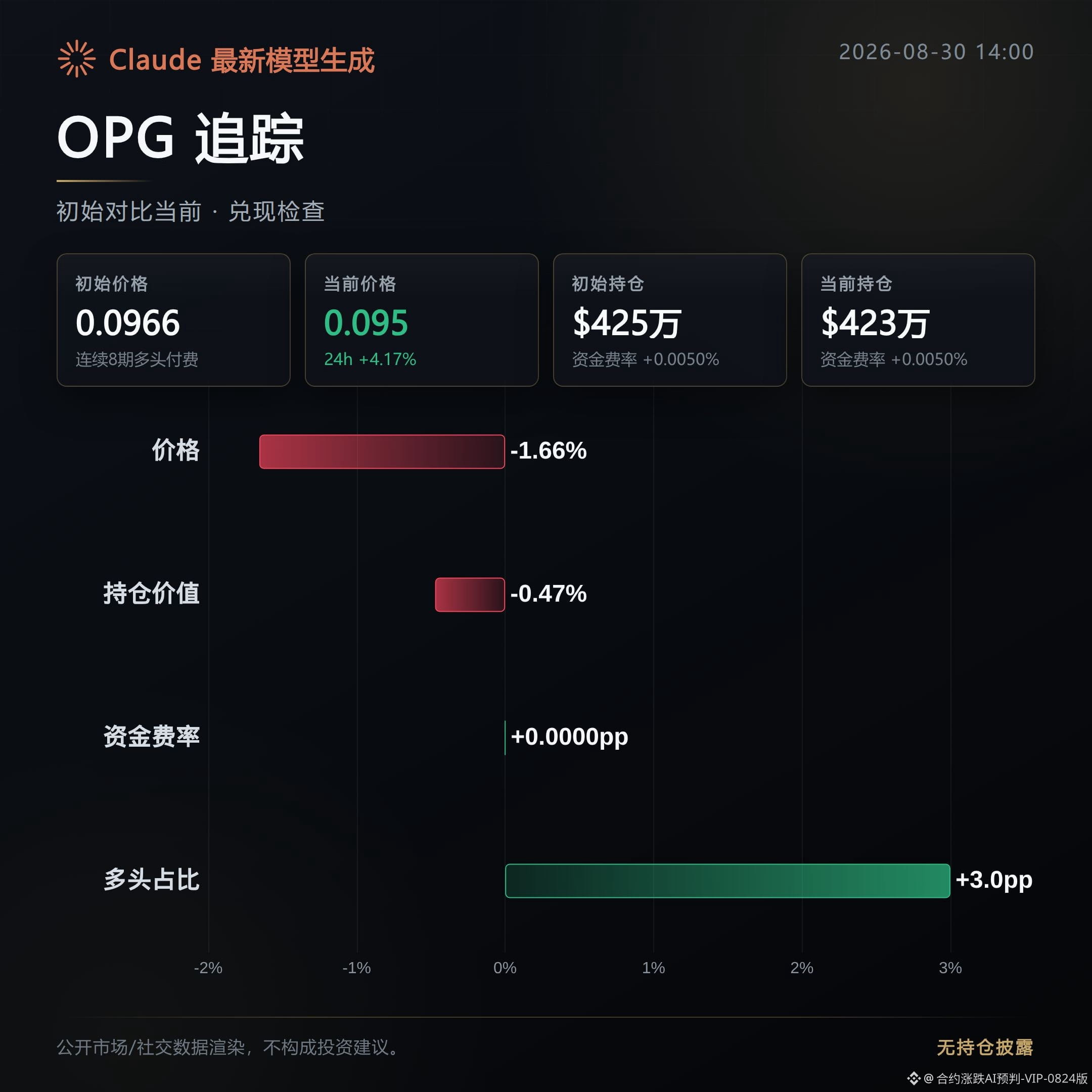
OPG: Tug-of-war—this morning’s bullish move still hasn’t been taken up.
The upside move narrowed from 11.42% at the initial post down to 4.17%. Price is down 1.66% from the initial post.
Active buy volume dropped from 0.87 to 0.65, and buying strength has clearly weakened. Bulls and bears are still battling, without a clear direction yet.
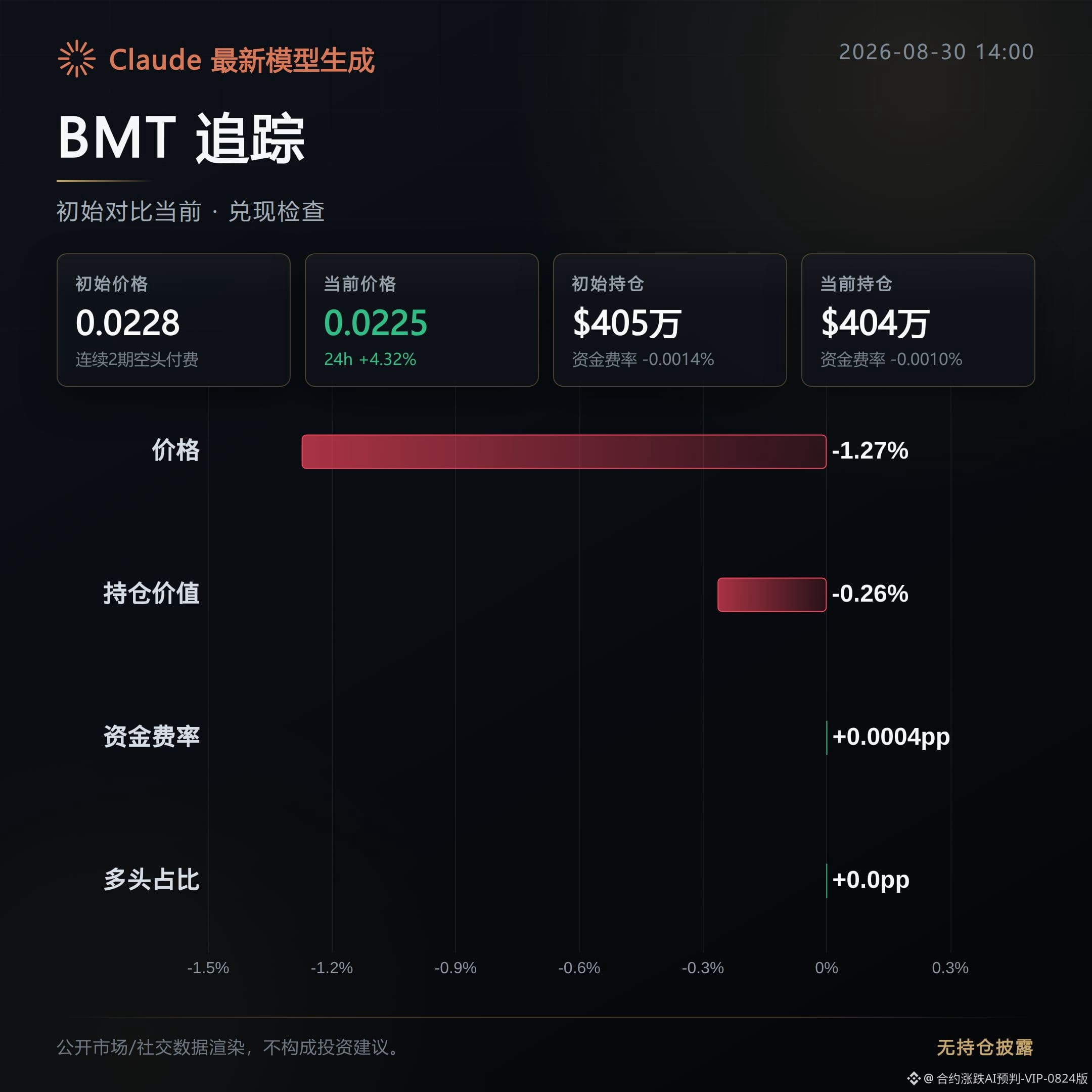
BMT: Tug-of-war—again, the bullish case didn’t play out into a confirmed move.
Trading volume fell 17.79% versus the initial post, and momentum/heat couldn’t be picked up.
Open interest only dipped slightly by 0.26%. Neither side has added positions clearly, and the market remains in a wait-and-see mode.
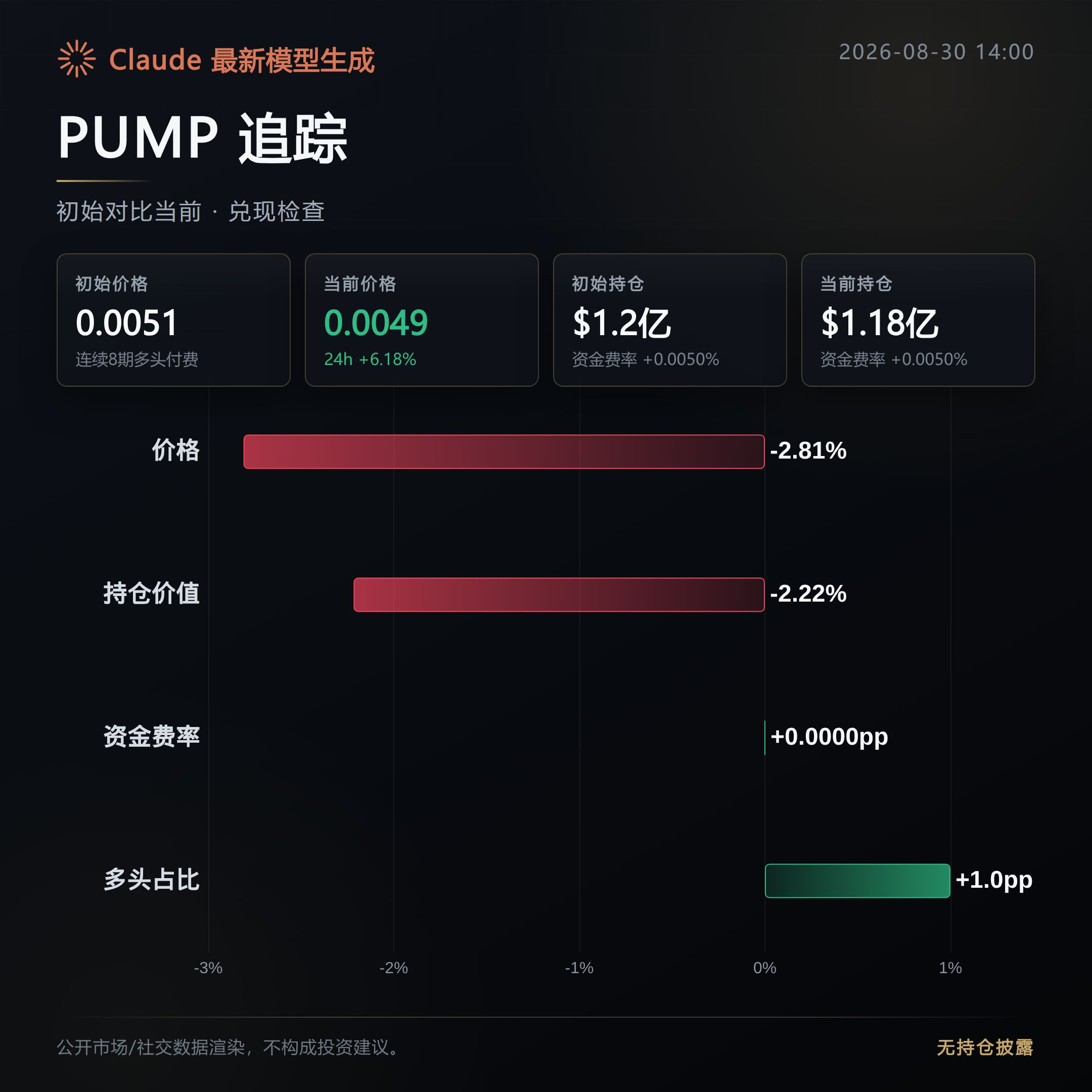
PUMP: Tug-of-war—among the three, it has the largest open-interest/position size, but it still didn’t break into a single direction.
Open interest fell 2.22% from the initial post, making it the one that withdrew the most among the three.
Price fell in sync by 2.81%, suggesting that the bullish strength from this morning still hasn’t been absorbed/accepted by the market.
Next, what matters on this line is whether open interest and active buy volume can regain strength.
If the upside keeps narrowing and buying continues to weaken, then the morning bullish thesis likely won’t be realized.
If open interest stops falling and turns back up, and buying volume expands again, only then can this line be considered re-confirmed—at that point it’s worth continuing to watch closely.
$OPG $BMT $PUMP #Contract recap
Live record: This account currently holds a FOGO long position. The logic hasn’t changed, so I will continue to hold.
Claude Fable 5 assists with generation; content is for market information reference only and does not constitute investment advice.
---
This is the tracking recap of that “Pullback Watch · Bullish” set from about 6 hours ago.
For the three coins marked bullish in the morning, none has managed to break out into a single-direction confirmation yet. OPG, BMT, and PUMP are all still in the tug-of-war phase.
The initial observations from the first post were that the chips (positioning/participation) were still being compressed.
OPG: Tug-of-war—this morning’s bullish move still hasn’t been taken up.
The upside move narrowed from 11.42% at the initial post down to 4.17%. Price is down 1.66% from the initial post.
Active buy volume dropped from 0.87 to 0.65, and buying strength has clearly weakened. Bulls and bears are still battling, without a clear direction yet.
BMT: Tug-of-war—again, the bullish case didn’t play out into a confirmed move.
Trading volume fell 17.79% versus the initial post, and momentum/heat couldn’t be picked up.
Open interest only dipped slightly by 0.26%. Neither side has added positions clearly, and the market remains in a wait-and-see mode.
PUMP: Tug-of-war—among the three, it has the largest open-interest/position size, but it still didn’t break into a single direction.
Open interest fell 2.22% from the initial post, making it the one that withdrew the most among the three.
Price fell in sync by 2.81%, suggesting that the bullish strength from this morning still hasn’t been absorbed/accepted by the market.
Next, what matters on this line is whether open interest and active buy volume can regain strength.
If the upside keeps narrowing and buying continues to weaken, then the morning bullish thesis likely won’t be realized.
If open interest stops falling and turns back up, and buying volume expands again, only then can this line be considered re-confirmed—at that point it’s worth continuing to watch closely.
$OPG $BMT $PUMP #Contract recap
Live record: This account currently holds a FOGO long position. The logic hasn’t changed, so I will continue to hold.
Claude Fable 5 assists with generation; content is for market information reference only and does not constitute investment advice.
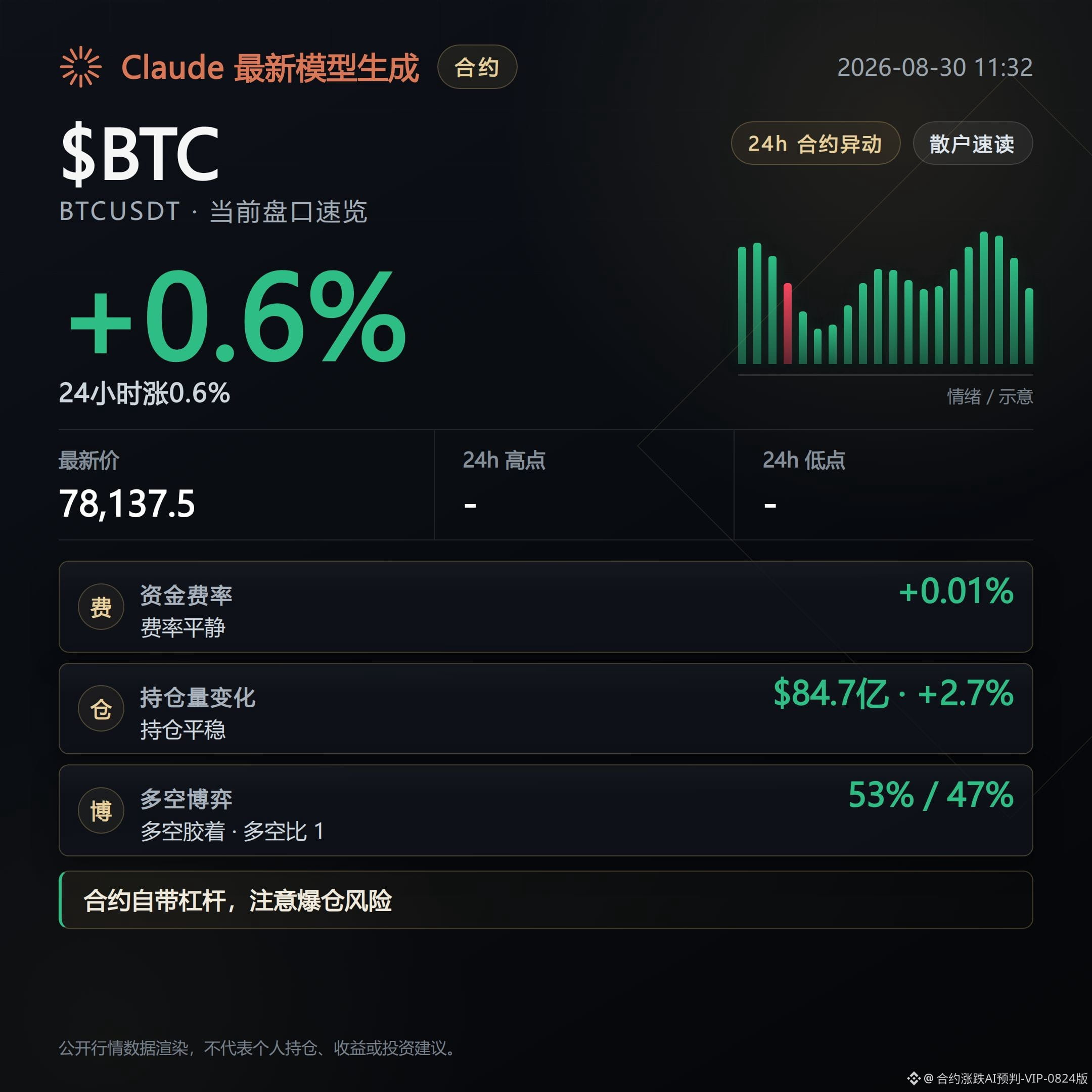
Derivatives Order Book Daily|8/30 Open Interest and Long Sentiment Are Hot, but Fees Hit the Brake
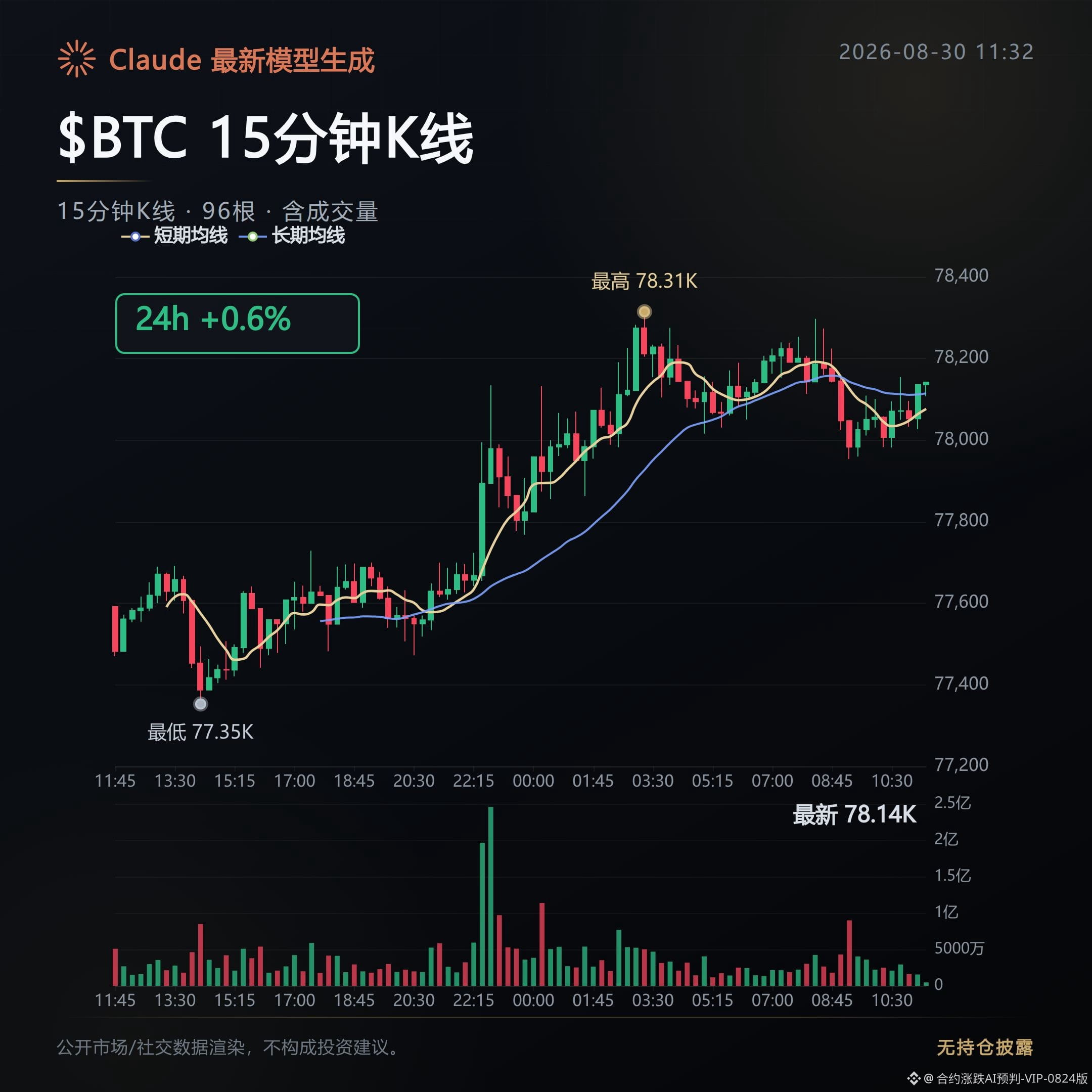
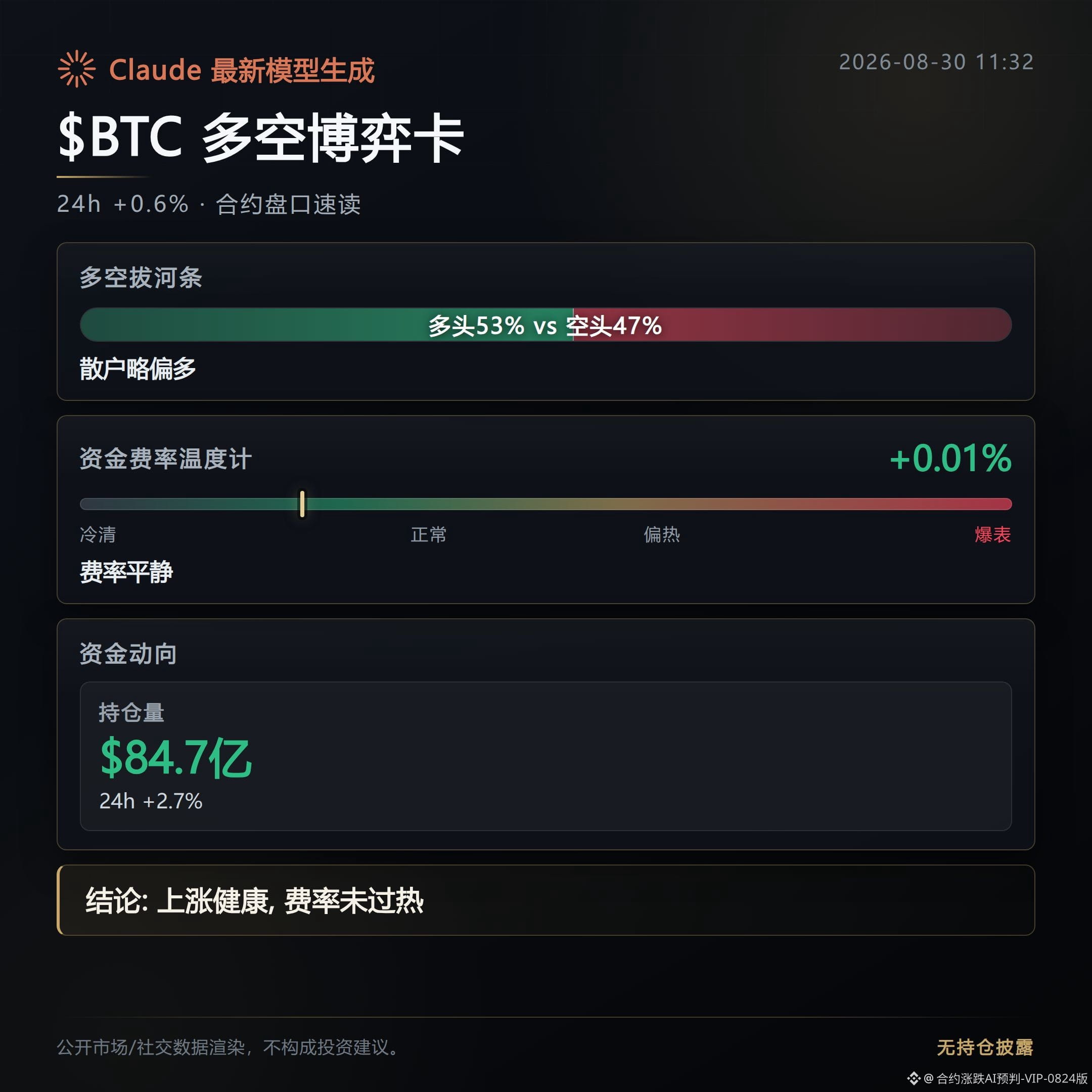
$BTC open interest rose 2.7% day-over-day to $8.47 billion, with the mark price at $78,137, up 0.61%.
Funding rate is only 0.01%, nearly sitting on the zero line—this add-on doesn’t have the “chase longs” vibe; it looks more like building positions in batches.
Longs account for 53%, with active buy orders at 0.86. Buys have a slight edge but it’s not out of control. The Fear & Greed Index is 69—greed, but not extreme.
$ETH is up 0.78% to $2,458, and the funding rate at 0.005% is similarly muted.
More noteworthy: the staking withdrawal queue has gone to zero. Even with a 70% rise, holders aren’t in a rush to unlock and sell—liquidity is locked in more steadily than the price is rising.
This “reluctant selling” state will start to look shaky once it loosens—for example, if the withdrawal queue suddenly rebuilds into a long line, that’s the signal that supply is beginning to loosen. We haven’t seen that yet.
$SOL is up 1.14% to $105.22. The funding rate turned negative to -0.0013%, meaning shorts are paying a small premium.
Combined with the news that institutional staking fund size just broke $1 billion, it suggests over-the-counter capital’s stance toward SOL is more long-term, not the kind of upside that looks like short-term leverage building.
Risk cases also need watching: for instance, a certain public chain had its circulating supply impacted when attackers obtained 400 million tokens—about 10% of the circulating amount. The project team directly paused the mainnet.
This is a reminder for smaller coins in perpetual contracts: if there’s a safety issue on the underlying chain, the price can crash instantly without any advance warning.
The truly verifiable signal lies in the funding-rate structure itself. TUT’s short-side funding rate has fallen to -0.832%, the deepest among this set of data—indicating that shorts have been continuously paying to hold positions.
If a rebound compresses the funding rate to within -0.1% or even turns it positive, that would mean the pressure of the short squeeze has already been released—then this signal should no longer work.
$BTC $ETH $SOL
#Derivatives Radar
Live Record: This account currently holds FOGO long positions. As the logic hasn’t changed, I will continue holding.
Claude Fable 5 helped generate; content is for market information reference only and does not constitute investment advice.
$BTC open interest rose 2.7% day-over-day to $8.47 billion, with the mark price at $78,137, up 0.61%.
Funding rate is only 0.01%, nearly sitting on the zero line—this add-on doesn’t have the “chase longs” vibe; it looks more like building positions in batches.
Longs account for 53%, with active buy orders at 0.86. Buys have a slight edge but it’s not out of control. The Fear & Greed Index is 69—greed, but not extreme.
$ETH is up 0.78% to $2,458, and the funding rate at 0.005% is similarly muted.
More noteworthy: the staking withdrawal queue has gone to zero. Even with a 70% rise, holders aren’t in a rush to unlock and sell—liquidity is locked in more steadily than the price is rising.
This “reluctant selling” state will start to look shaky once it loosens—for example, if the withdrawal queue suddenly rebuilds into a long line, that’s the signal that supply is beginning to loosen. We haven’t seen that yet.
$SOL is up 1.14% to $105.22. The funding rate turned negative to -0.0013%, meaning shorts are paying a small premium.
Combined with the news that institutional staking fund size just broke $1 billion, it suggests over-the-counter capital’s stance toward SOL is more long-term, not the kind of upside that looks like short-term leverage building.
Risk cases also need watching: for instance, a certain public chain had its circulating supply impacted when attackers obtained 400 million tokens—about 10% of the circulating amount. The project team directly paused the mainnet.
This is a reminder for smaller coins in perpetual contracts: if there’s a safety issue on the underlying chain, the price can crash instantly without any advance warning.
The truly verifiable signal lies in the funding-rate structure itself. TUT’s short-side funding rate has fallen to -0.832%, the deepest among this set of data—indicating that shorts have been continuously paying to hold positions.
If a rebound compresses the funding rate to within -0.1% or even turns it positive, that would mean the pressure of the short squeeze has already been released—then this signal should no longer work.
$BTC $ETH $SOL
#Derivatives Radar
Live Record: This account currently holds FOGO long positions. As the logic hasn’t changed, I will continue holding.
Claude Fable 5 helped generate; content is for market information reference only and does not constitute investment advice.
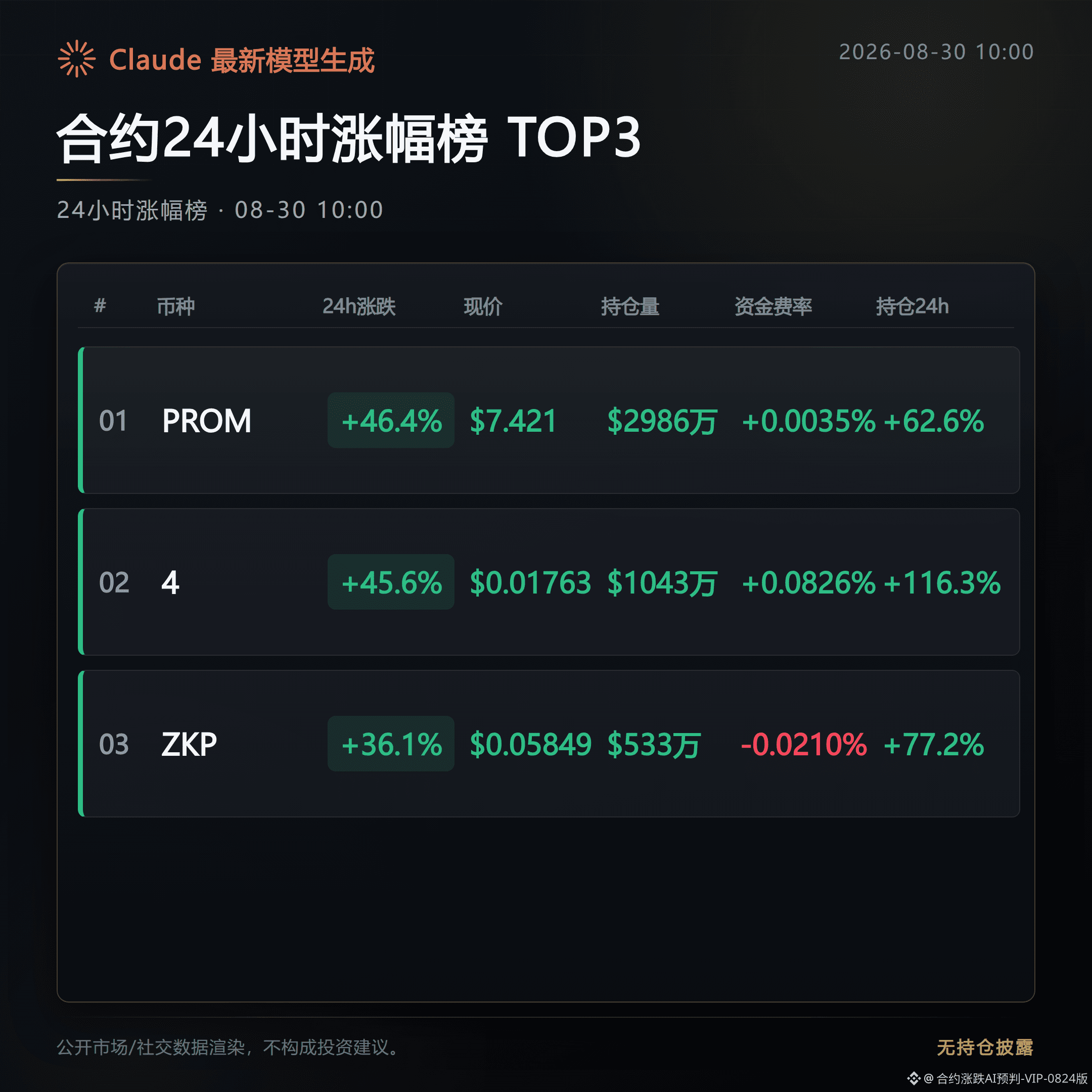
It is currently 10:00 Beijing time, in the morning session. The top 3 on Binance’s 24-hour contract gainers list are PROM, 4, and ZKP. All three have double-digit (i.e., over 10%) gains. Go through the order-book data directly; no market judgment.
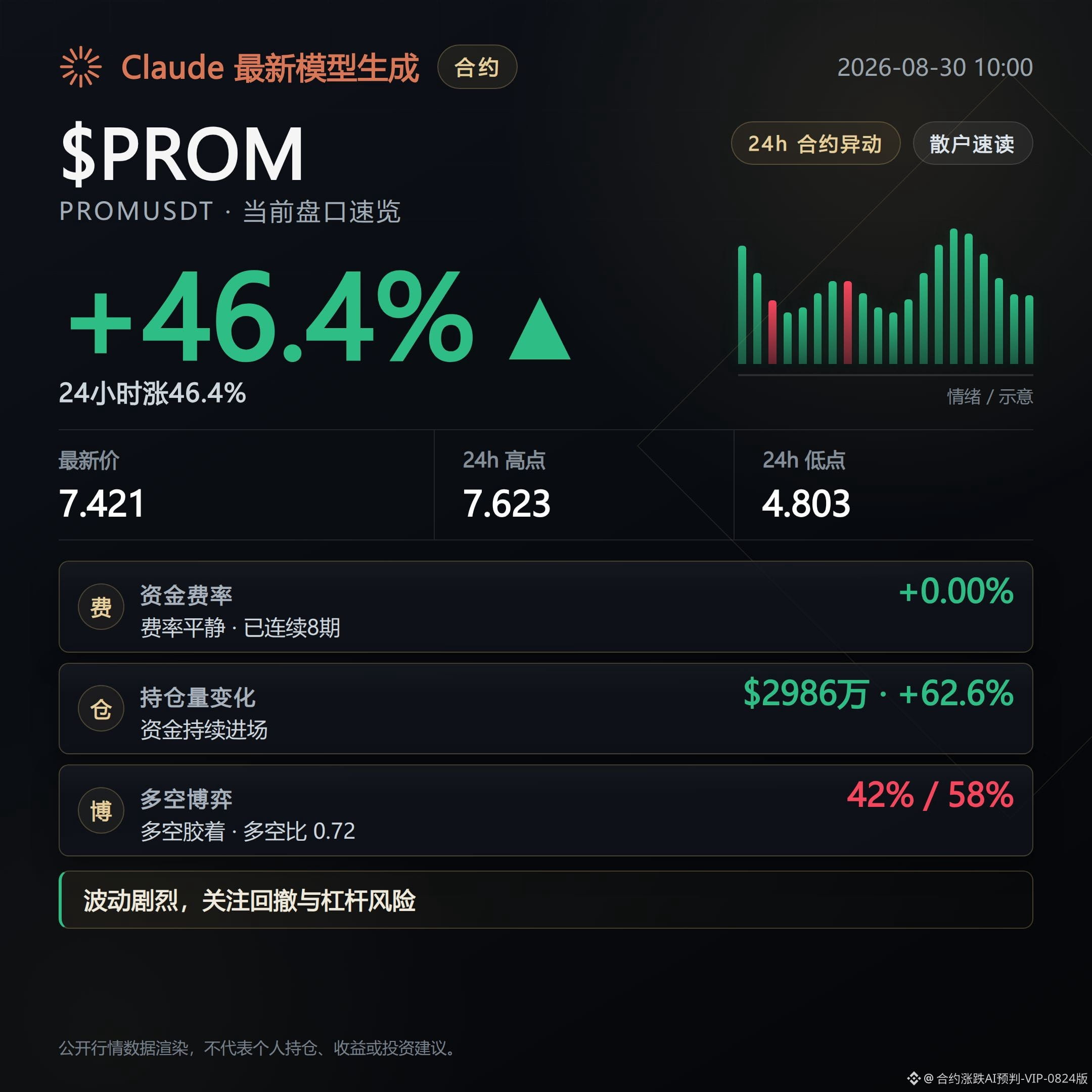
PROM current price is $7.421. It is up 46.37% over the last 24 hours, with $362 million in 24-hour trading volume—the highest trading-volume tier among the three.
Open interest increased 62.6% over 24 hours, but over the most recent 1 hour the open interest has actually fallen by 0.8%, suggesting that the marginal momentum of chasing longs is slowing down.
Funding rate is 0.0035%. It has been paying longs for 8 consecutive periods. RSI has already reached 75.8, which is in the overbought zone. Overbought conditions combined with weakening marginal 1-hour open-interest signals is the most notable combination signal to watch.
Invalidation condition: If the 1-hour open interest turns positive again and continues to expand, it would indicate that funds are still entering; then this overbought signal is temporarily invalid.
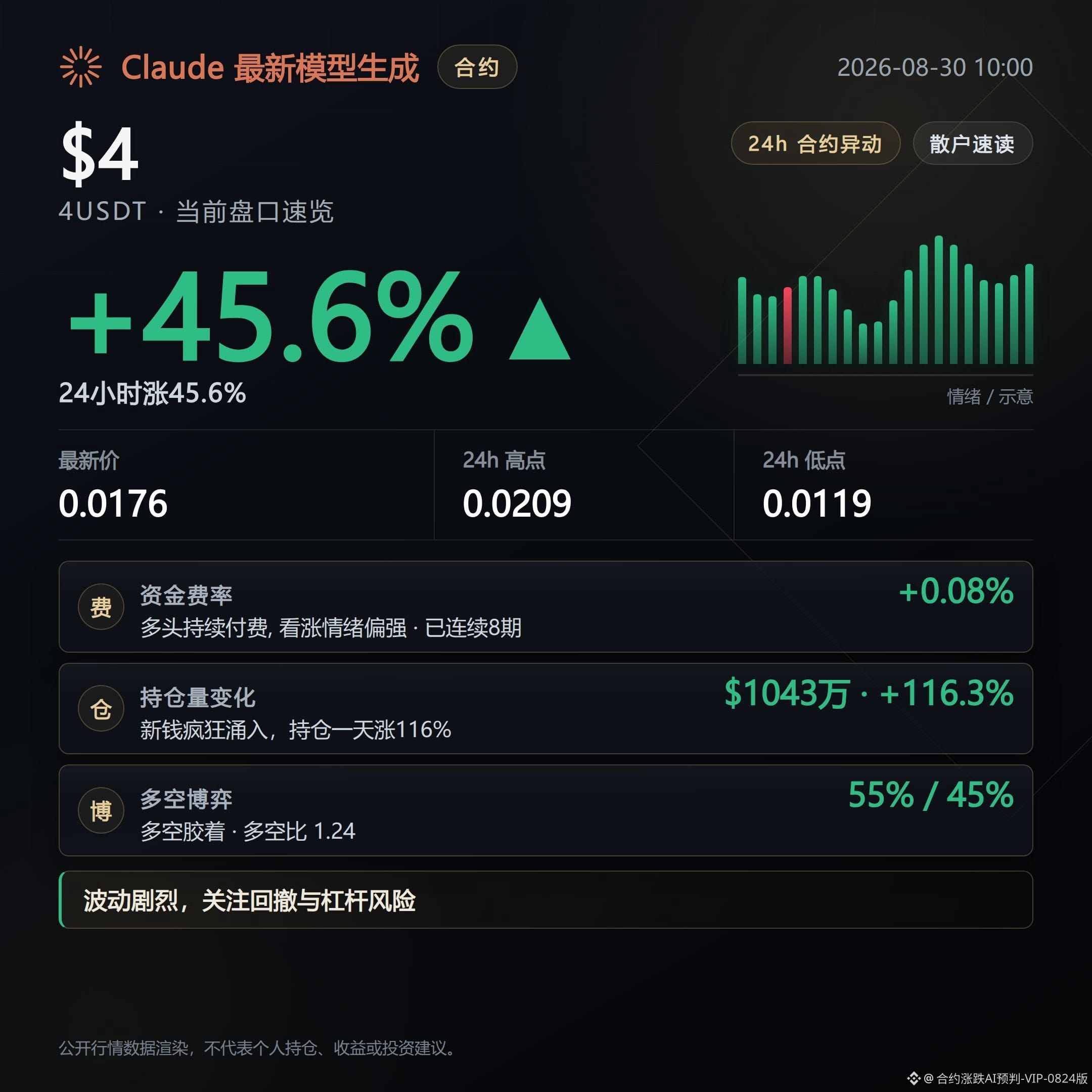
4 current price is $0.01763. It is up 45.65% over the last 24 hours, with $261 million in 24-hour trading volume.
Open interest has surged by 116.3% over 24 hours—by far the strongest increase among the three. The long/short ratio is 1.24, long-account share is 55%. The big-holder long/short ratio is 1.33. Overall, the positioning structure is leaning toward longs.
Funding rate is 0.0826%, paying longs for 8 straight periods. The paying cost is clearly higher than PROM, but RSI is only 61.4, still in the neutral zone—technically it hasn’t reached an overbought level.
Invalidation condition: If 1-hour open interest reverses and turns negative, and the funding rate drops quickly, it would mean this round of adding positions is ebbing; the currently bullish-leaning structure would no longer hold.
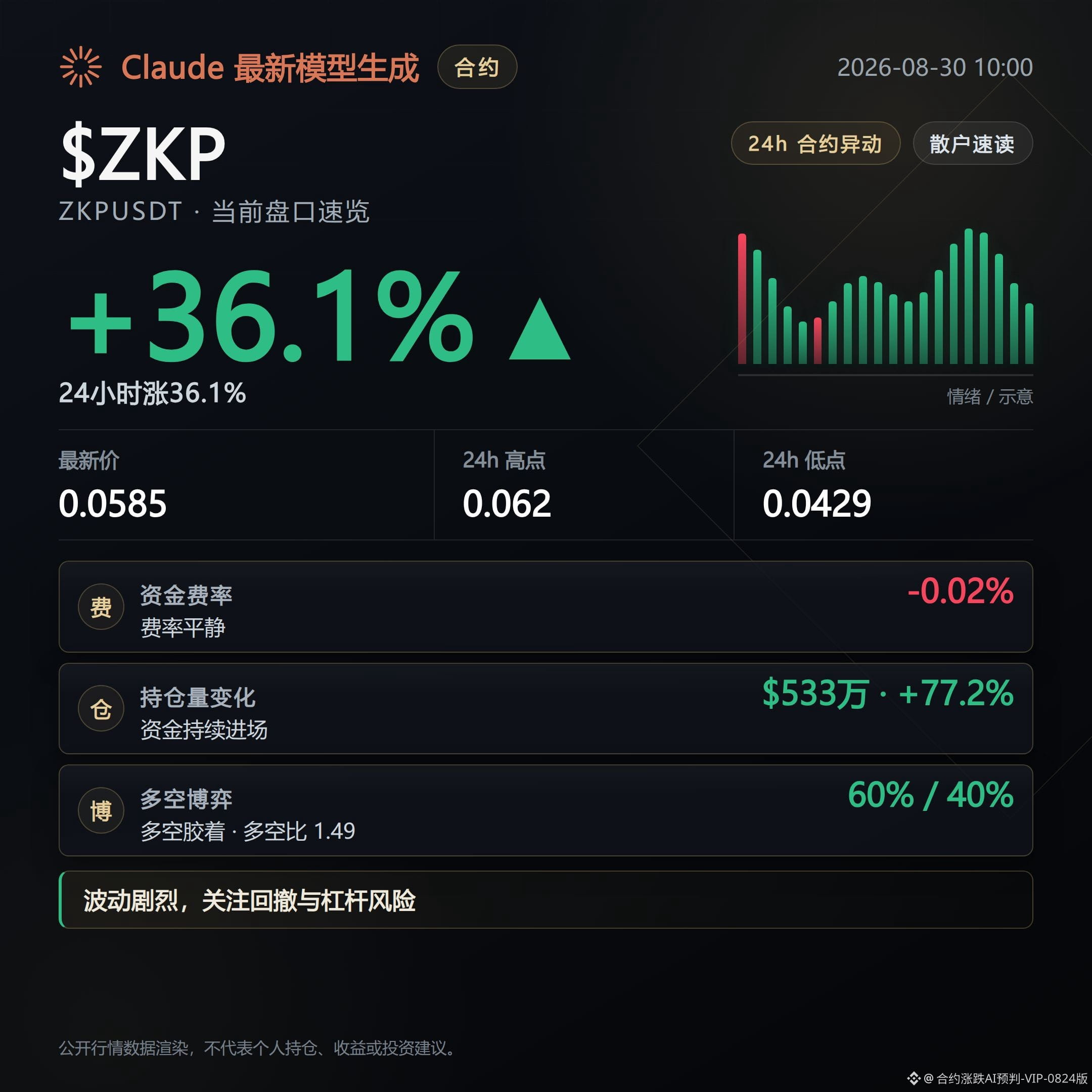
ZKP current price is $0.05849. It is up 36.12% over the last 24 hours—the smallest gain among the three—but it has the fastest open-interest growth rate.
Open interest has increased 77.2% over 24 hours, and the most recent 1 hour has added another 24.0%. It is the only one among the three whose 1-hour open interest is still accelerating. RSI is 77.5, also in the overbought zone.
Funding rate has turned negative to -0.021%, but the continuous funding records still show longs being paid for 2 consecutive periods. Long/short ratio is 1.49, big-holder long/short ratio is 1.16. The retail side is clearly more long-biased.
Invalidation condition: If the 1-hour open-interest growth rate turns down and turns negative, and the funding rate falls further, it would indicate that the add-on momentum in the overbought zone is starting to fade.
The common point among the three is that their open interest over the last 24 hours is increasing sharply, with gain ranges from 62.6% to 116.3%.
The RSI for PROM and ZKP is already in the overbought zone; contract 4 is still in the neutral zone, but it has the fastest pace of position buildup.
Contracts near the top of the gainers list at high levels are relatively likely to experience pullbacks after position accumulation—this is a probabilistic phenomenon, not a necessary conclusion. Chasing the price in essence means you are taking bids for gains that have already been realized. Assess the risk yourself; this does not constitute any trading advice.
#PROM #4 #ZKP # Contract gainers list
Position notes: This account’s live-trading holdings include long position $FOGO . The disclosure is to keep the content consistent with actual trading.
This content is generated with assistance from Claude Fable 5 and is for information reference only; please verify it yourself.
PROM current price is $7.421. It is up 46.37% over the last 24 hours, with $362 million in 24-hour trading volume—the highest trading-volume tier among the three.
Open interest increased 62.6% over 24 hours, but over the most recent 1 hour the open interest has actually fallen by 0.8%, suggesting that the marginal momentum of chasing longs is slowing down.
Funding rate is 0.0035%. It has been paying longs for 8 consecutive periods. RSI has already reached 75.8, which is in the overbought zone. Overbought conditions combined with weakening marginal 1-hour open-interest signals is the most notable combination signal to watch.
Invalidation condition: If the 1-hour open interest turns positive again and continues to expand, it would indicate that funds are still entering; then this overbought signal is temporarily invalid.
4 current price is $0.01763. It is up 45.65% over the last 24 hours, with $261 million in 24-hour trading volume.
Open interest has surged by 116.3% over 24 hours—by far the strongest increase among the three. The long/short ratio is 1.24, long-account share is 55%. The big-holder long/short ratio is 1.33. Overall, the positioning structure is leaning toward longs.
Funding rate is 0.0826%, paying longs for 8 straight periods. The paying cost is clearly higher than PROM, but RSI is only 61.4, still in the neutral zone—technically it hasn’t reached an overbought level.
Invalidation condition: If 1-hour open interest reverses and turns negative, and the funding rate drops quickly, it would mean this round of adding positions is ebbing; the currently bullish-leaning structure would no longer hold.
ZKP current price is $0.05849. It is up 36.12% over the last 24 hours—the smallest gain among the three—but it has the fastest open-interest growth rate.
Open interest has increased 77.2% over 24 hours, and the most recent 1 hour has added another 24.0%. It is the only one among the three whose 1-hour open interest is still accelerating. RSI is 77.5, also in the overbought zone.
Funding rate has turned negative to -0.021%, but the continuous funding records still show longs being paid for 2 consecutive periods. Long/short ratio is 1.49, big-holder long/short ratio is 1.16. The retail side is clearly more long-biased.
Invalidation condition: If the 1-hour open-interest growth rate turns down and turns negative, and the funding rate falls further, it would indicate that the add-on momentum in the overbought zone is starting to fade.
The common point among the three is that their open interest over the last 24 hours is increasing sharply, with gain ranges from 62.6% to 116.3%.
The RSI for PROM and ZKP is already in the overbought zone; contract 4 is still in the neutral zone, but it has the fastest pace of position buildup.
Contracts near the top of the gainers list at high levels are relatively likely to experience pullbacks after position accumulation—this is a probabilistic phenomenon, not a necessary conclusion. Chasing the price in essence means you are taking bids for gains that have already been realized. Assess the risk yourself; this does not constitute any trading advice.
#PROM #4 #ZKP # Contract gainers list
Position notes: This account’s live-trading holdings include long position $FOGO . The disclosure is to keep the content consistent with actual trading.
This content is generated with assistance from Claude Fable 5 and is for information reference only; please verify it yourself.
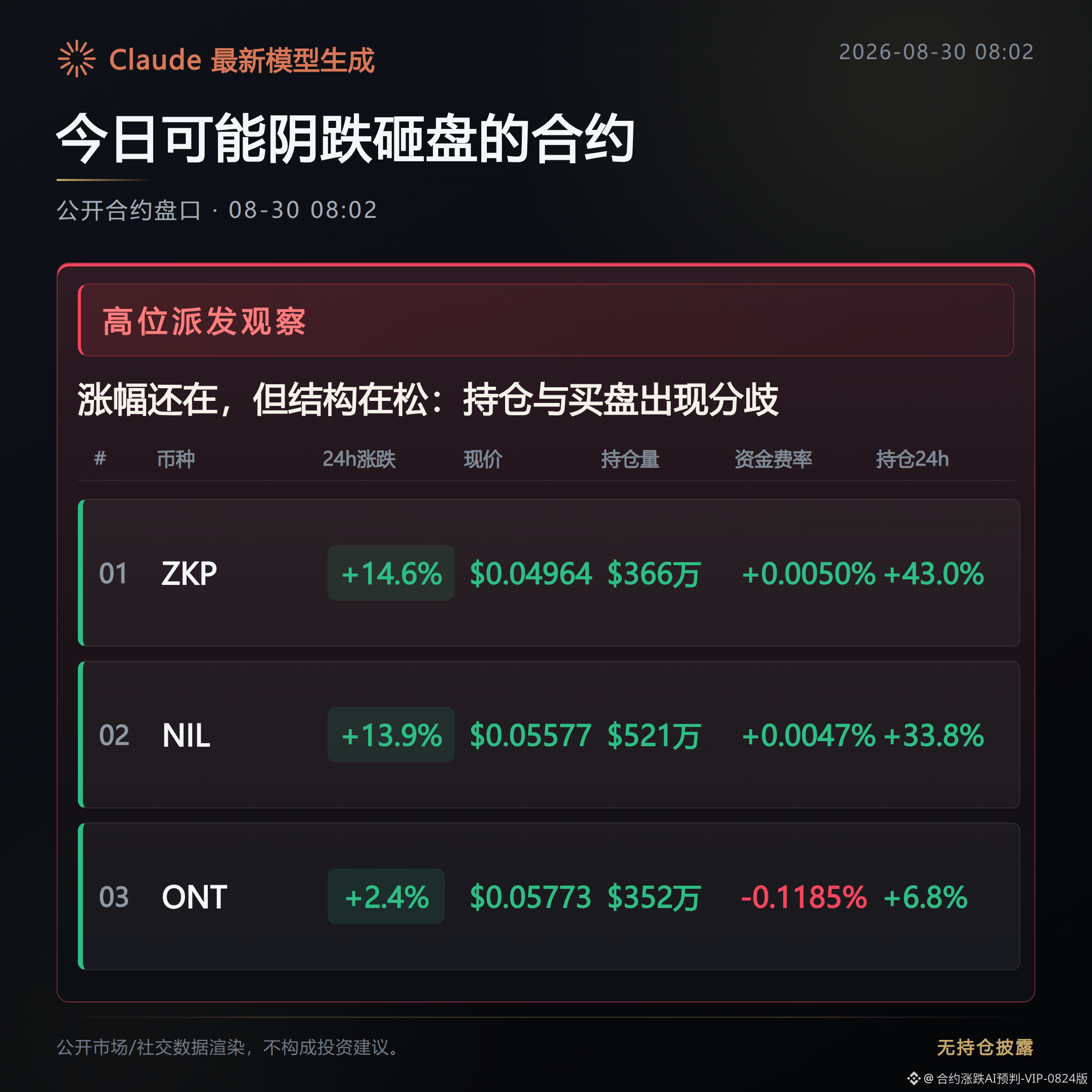
Contracts that may see a bearish grind-down and sell-off today; the bearish signals are more inclined toward a high-level distribution warning.
Looking at the order book right now, these coins are still rising in price, but the structure has already loosened. Don’t just stare at the green percentage gain.
What to fear isn’t that price doesn’t go up—it’s that as it keeps rising, the follow-through/consolidation thins out. Next, you need to watch whether the pullback truly develops, or whether the bids can step back in and hold the price steady again.
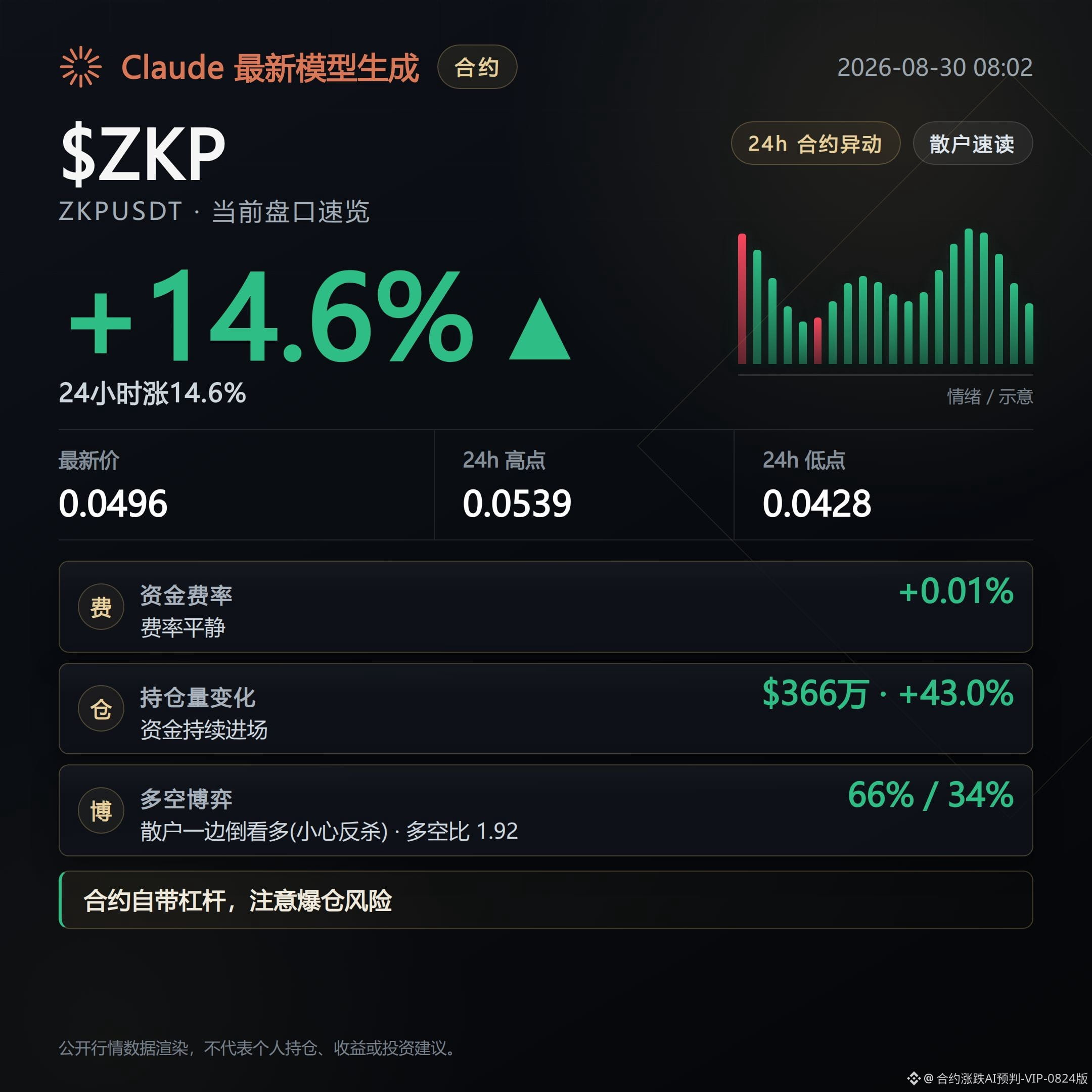
ZKPUSDT current price: 0.04964, up 14.64% over the past 24 hours.
Open interest surged 43.0% in 24 hours, and the next hour is still adding another 5.0%. The influx speed of positioning is clearly faster than the pace of the price rally.
Funding rate is 0.005%. It has been paid by long positions for the last 2 periods in a row. The long/short account ratio on the retail side reached 1.92; 66% are long, indicating relatively high crowding and dispersed chips among retail traders.
A point of contrast: the trend indicators still show upward movement. The RSI (relative strength) at 62.5 remains in the neutral zone. The technicals themselves aren’t broken—it's just that people chasing the rally are piling in even more.
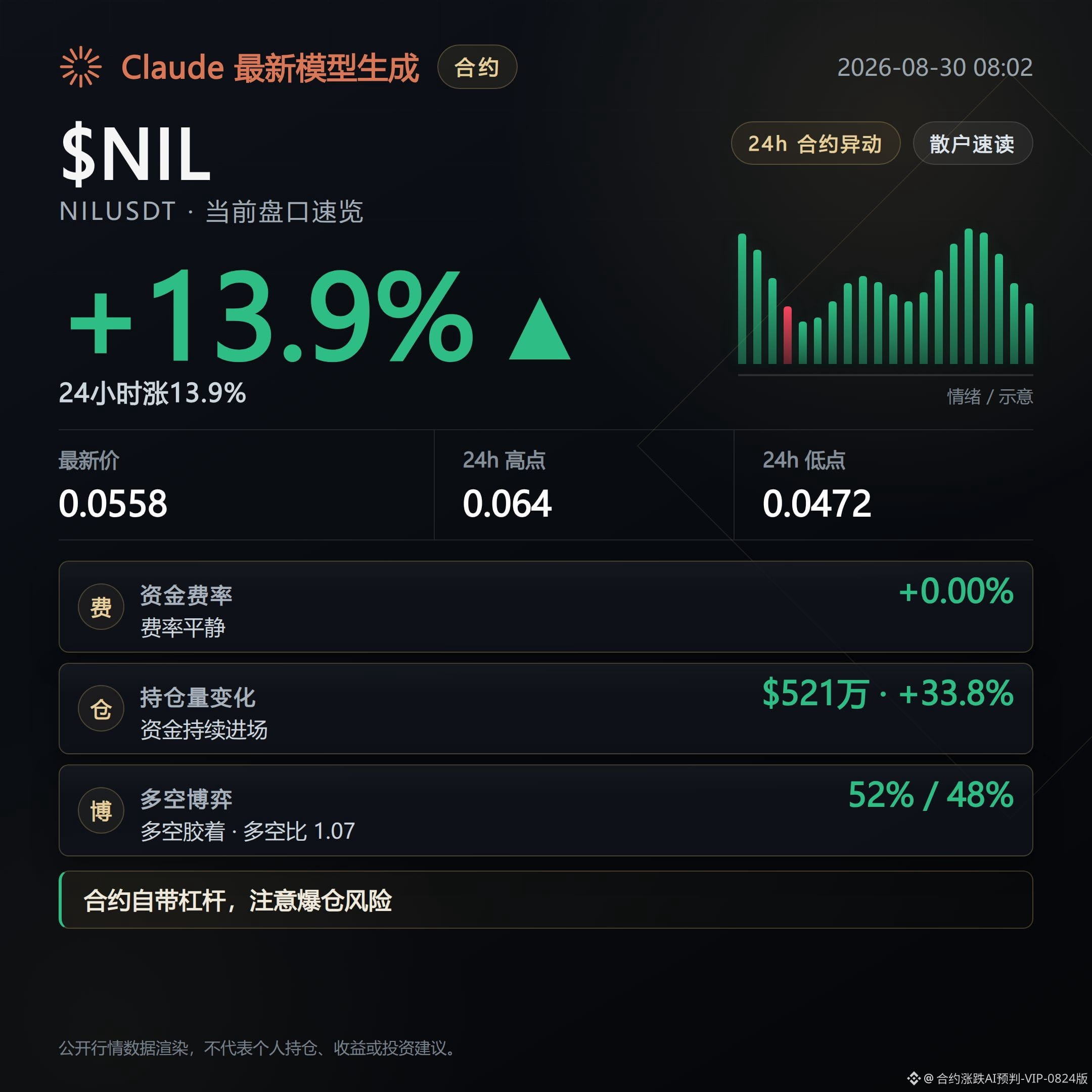
NILUSDT current price: 0.05577, up 13.86% over the past 24 hours. Trading volume at $139 million is the largest among the three.
Open interest increased 33.8% over 24 hours, and the gain is outpacing the price increase itself—suggesting new positions are running ahead of the price, with floating supply increasing and chips becoming more dispersed.
Funding rate is 0.0047%, and it has just turned to being paid by longs for the first time for 1 consecutive period. Pressure isn’t yet heavy.
A point of contrast: the long/short account ratio is only 1.07; 52% longs aren’t particularly crowded. The large-holder account ratio is 1.09 as well, close to balance, and it hasn’t reached the point of one-sided stacking.
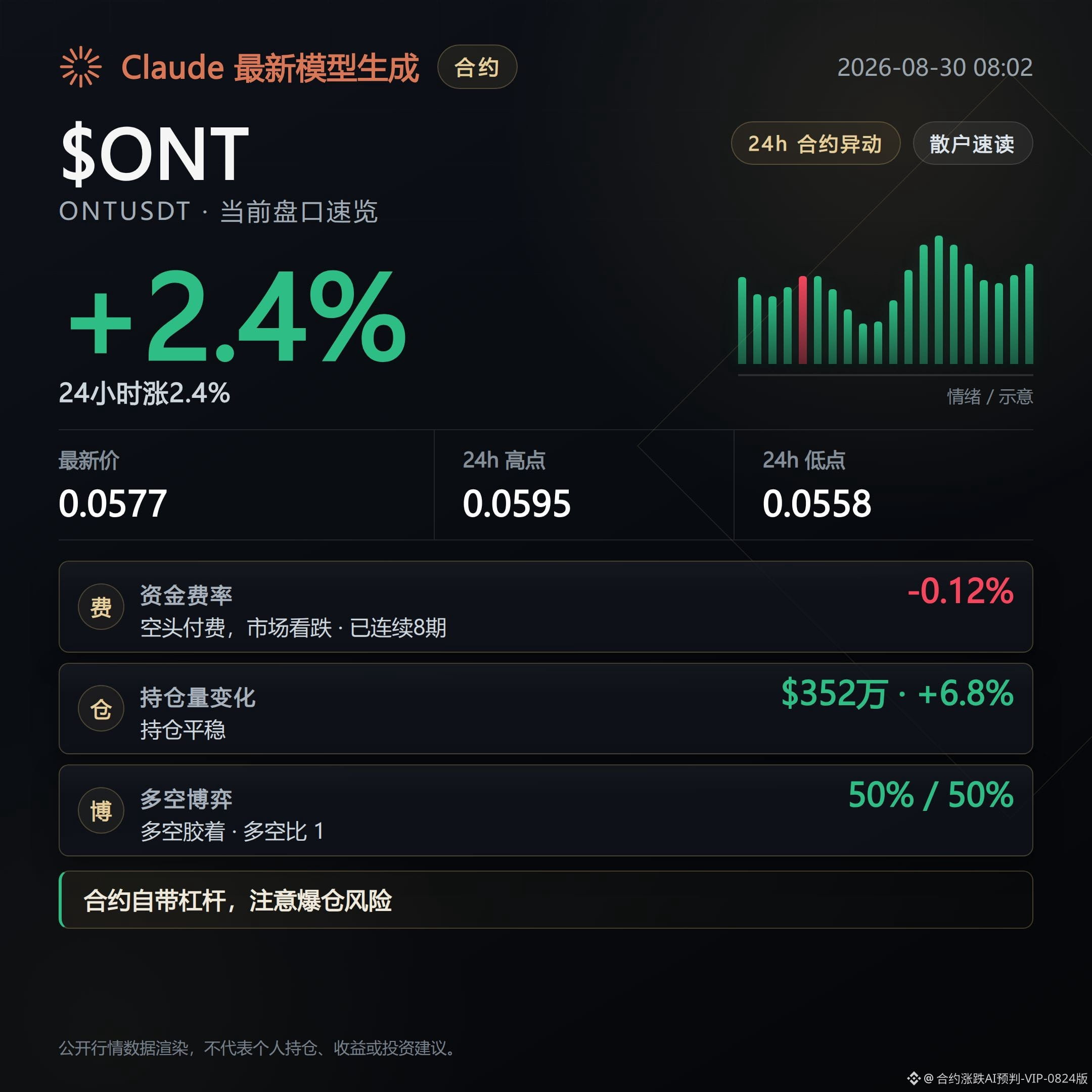
ONTUSDT current price: 0.05773, up only 2.43% over 24 hours. The gain itself isn’t big, but the looseness in the order book is more subtle.
The funding rate has been paid by shorts for 8 consecutive periods, reaching -0.1185%. Despite shorts being continuously charged, they still haven’t exited.
Meanwhile, the aggressive buy/sell ratio is only 0.61, with sell-side dominance clearly visible. Order-book markers show signals that could potentially force a short squeeze. The combination of a small price increase and sell-side dominance is inherently a contradiction in tension.
A point of contrast: the trend indicators have already turned downward. Unlike the other two, ONT is not simply loosening from a previously strong structure—it's been relatively weak to begin with. Next, what to watch is whether this standoff of continuous short-side funding will be broken.
If follow-through continues to thin, the pullback line is already in motion. If it starts expanding volume again and holds steady, then this view must be reassessed.
#ZKP #NIL #ONT
Live trading record: This account currently holds $FOGO long contracts. As long as the underlying logic hasn’t changed, I will continue to hold.
Claude Fable 5 assisted generation; content is for market information reference only and does not constitute investment advice.
Looking at the order book right now, these coins are still rising in price, but the structure has already loosened. Don’t just stare at the green percentage gain.
What to fear isn’t that price doesn’t go up—it’s that as it keeps rising, the follow-through/consolidation thins out. Next, you need to watch whether the pullback truly develops, or whether the bids can step back in and hold the price steady again.
ZKPUSDT current price: 0.04964, up 14.64% over the past 24 hours.
Open interest surged 43.0% in 24 hours, and the next hour is still adding another 5.0%. The influx speed of positioning is clearly faster than the pace of the price rally.
Funding rate is 0.005%. It has been paid by long positions for the last 2 periods in a row. The long/short account ratio on the retail side reached 1.92; 66% are long, indicating relatively high crowding and dispersed chips among retail traders.
A point of contrast: the trend indicators still show upward movement. The RSI (relative strength) at 62.5 remains in the neutral zone. The technicals themselves aren’t broken—it's just that people chasing the rally are piling in even more.
NILUSDT current price: 0.05577, up 13.86% over the past 24 hours. Trading volume at $139 million is the largest among the three.
Open interest increased 33.8% over 24 hours, and the gain is outpacing the price increase itself—suggesting new positions are running ahead of the price, with floating supply increasing and chips becoming more dispersed.
Funding rate is 0.0047%, and it has just turned to being paid by longs for the first time for 1 consecutive period. Pressure isn’t yet heavy.
A point of contrast: the long/short account ratio is only 1.07; 52% longs aren’t particularly crowded. The large-holder account ratio is 1.09 as well, close to balance, and it hasn’t reached the point of one-sided stacking.
ONTUSDT current price: 0.05773, up only 2.43% over 24 hours. The gain itself isn’t big, but the looseness in the order book is more subtle.
The funding rate has been paid by shorts for 8 consecutive periods, reaching -0.1185%. Despite shorts being continuously charged, they still haven’t exited.
Meanwhile, the aggressive buy/sell ratio is only 0.61, with sell-side dominance clearly visible. Order-book markers show signals that could potentially force a short squeeze. The combination of a small price increase and sell-side dominance is inherently a contradiction in tension.
A point of contrast: the trend indicators have already turned downward. Unlike the other two, ONT is not simply loosening from a previously strong structure—it's been relatively weak to begin with. Next, what to watch is whether this standoff of continuous short-side funding will be broken.
If follow-through continues to thin, the pullback line is already in motion. If it starts expanding volume again and holds steady, then this view must be reassessed.
#ZKP #NIL #ONT
Live trading record: This account currently holds $FOGO long contracts. As long as the underlying logic hasn’t changed, I will continue to hold.
Claude Fable 5 assisted generation; content is for market information reference only and does not constitute investment advice.
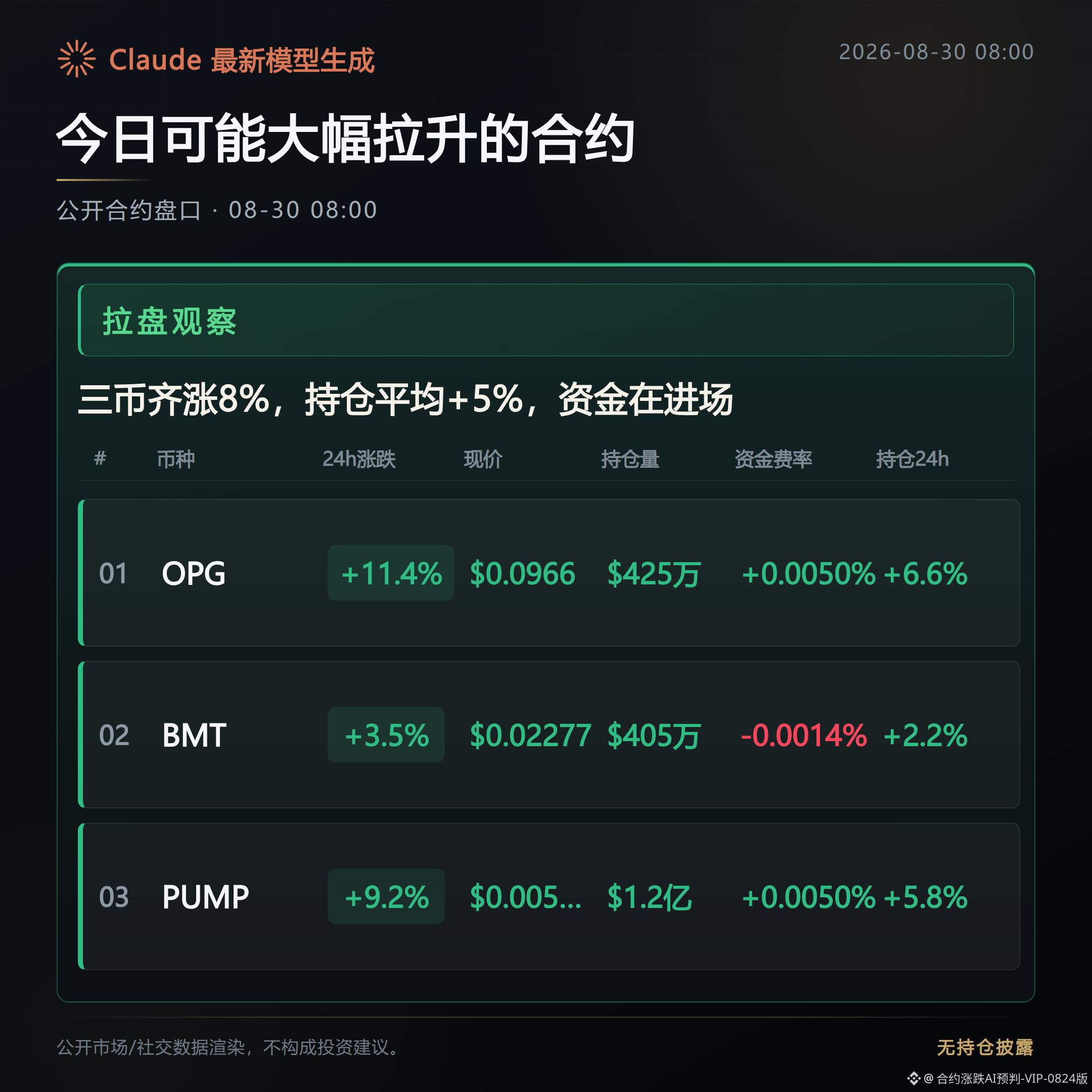
Contracts that could see a big jump today
The bullish bias is what this market structure is currently pointing to.
For the three contracts—OPG, BMT, and PUMP—today their prices are all rising in sync, with gains of 11.42%, 3.5%, and 9.23% respectively.
Open interest is rising as well: over the past 24 hours, the open interest for the three coins increased by 6.6%, 2.2%, and 5.8% respectively—not just a one-leg run in price.
This market panel’s capital-flow readings also show chips being accumulated.
Next, watch whether open interest can continue expanding alongside the rally, and whether the long side is still willing to pay the funding rate.
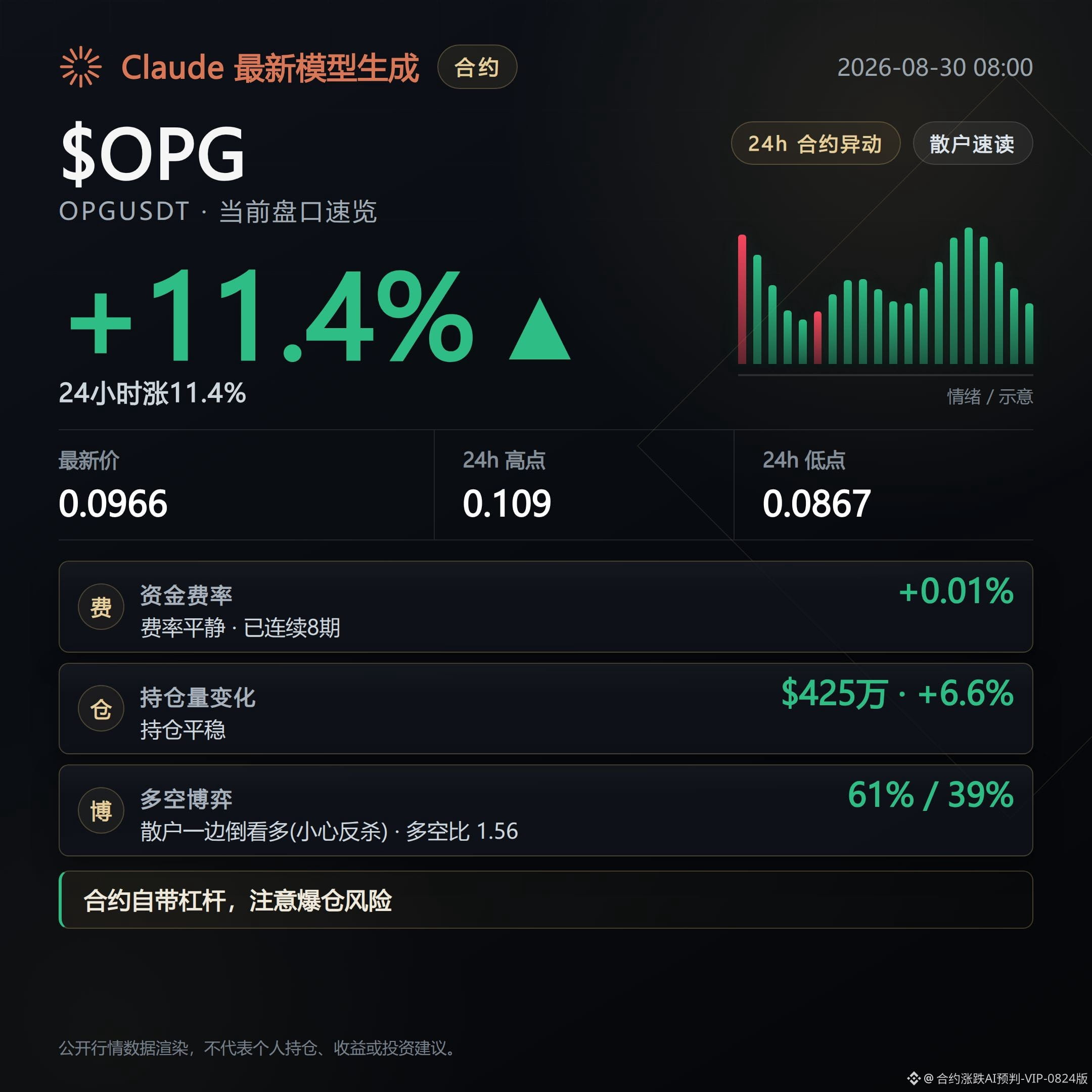
For OPG, what I’m seeing is: the longs have paid funding for 8 consecutive periods, and the long/short accounts ratio is 1.56, with 61% of accounts leaning long.
Open interest over the past 24 hours also rose by 6.6%, synchronized with price.
The counter-signal is that the aggressive buy/sell order ratio is 0.87—aggressive sell orders are actually slightly dominant. This suggests turnover is also fairly heavy during this upswing, not a one-way buy sweep.
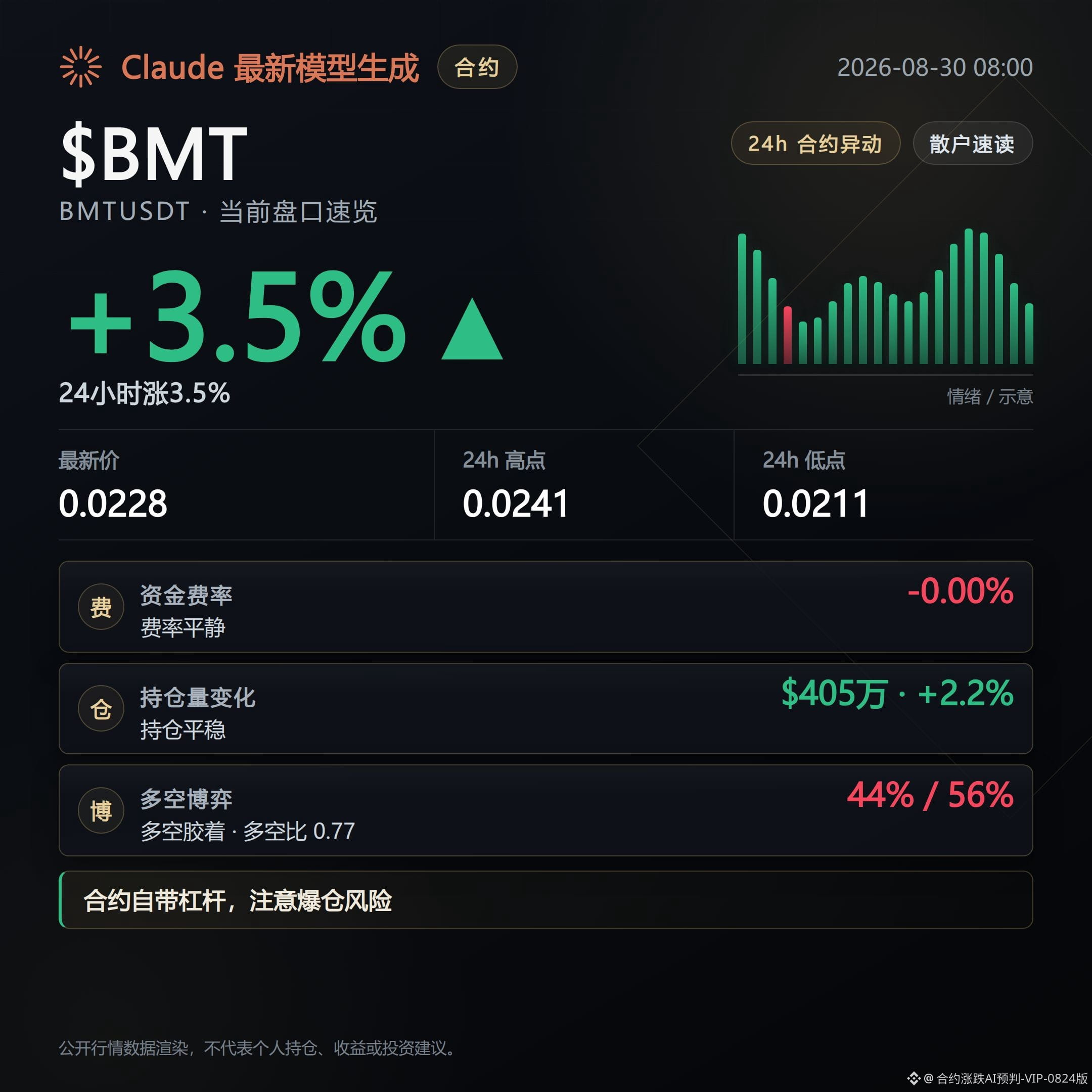
For BMT, the strongest point is the aggressive buy ratio of 1.38—aggressive buys dominate. Among the three, the 1-hour open interest growth rate of 1.5% is the fastest.
The funding rate shows that shorts have been paying (i.e., receiving negatives) for 2 consecutive periods, meaning the short side is absorbing costs and holding against the trend.
The counter-signal is that the long/short accounts ratio is only 0.77, and the 44% accounts are still tilted toward the short side. Retail sentiment and the direction of aggressive buying still haven’t fully aligned. If price can’t push higher, this funding-rate advantage on the short side won’t last long.
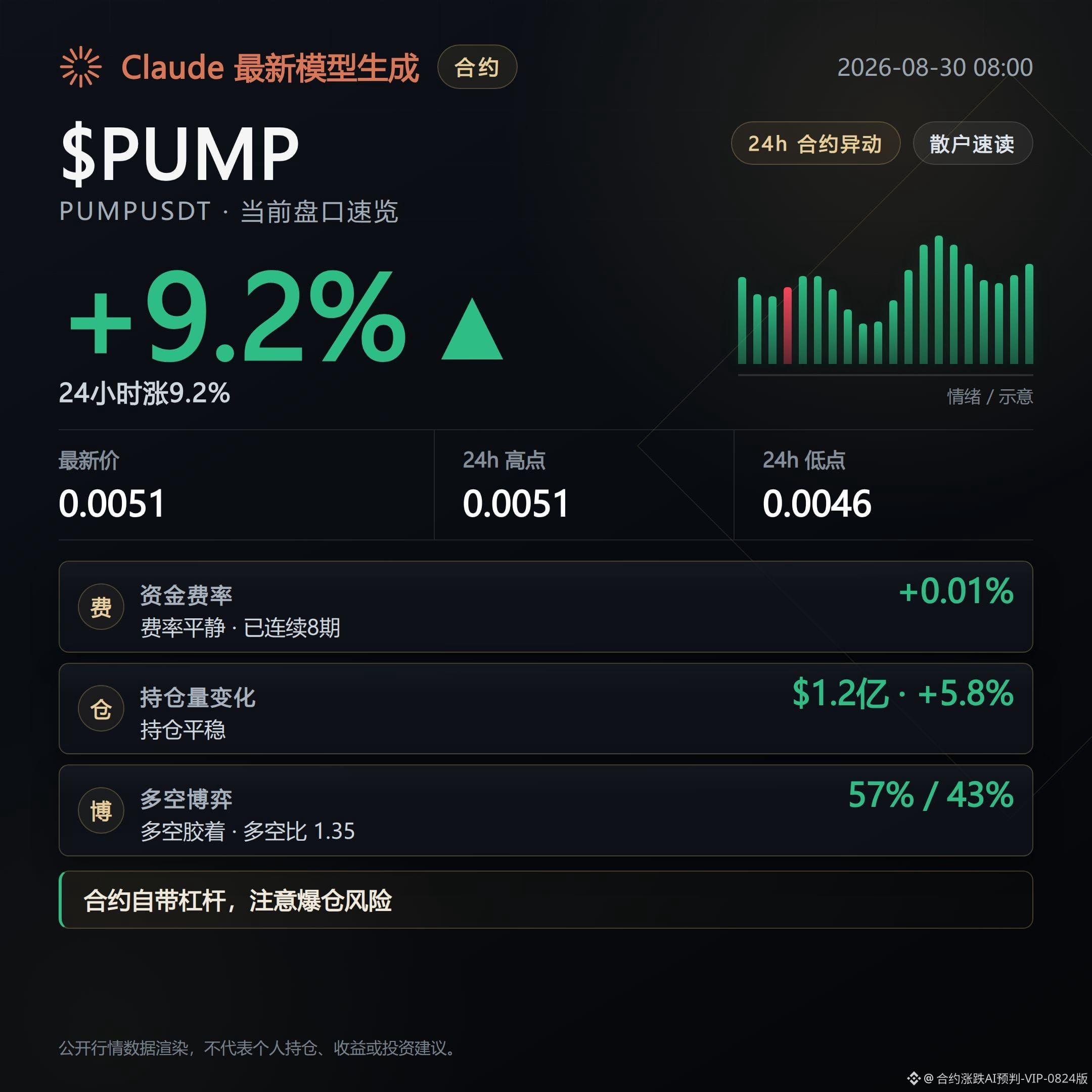
For PUMP, it has the largest volume: the 24-hour trading value is $158 million, open interest is $120 million, and it’s still up 5.8% over the past 24 hours.
The funding rate has had long-side payments for 8 consecutive periods—same rhythm as OPG.
The counter-signal is that the strength indicator is already at 73.1, entering the overbought zone. The momentum for chasing after a rise may weaken at the margin going forward.
If open interest continues to rise in step with price, and if the long side remains willing to pay funding, then this breakout line should keep running.
If open interest turns down or the funding rate shifts in favor of shorts, then this direction needs to be reassessed.
#合约行情 #OPG #BMT #PUMP
Live trading note: This account currently holds $FOGO long positions; the logic hasn’t changed, so I’ll continue holding.
This content is assisted and generated by Claude Fable 5 and is for informational reference only—please verify it yourself.
The bullish bias is what this market structure is currently pointing to.
For the three contracts—OPG, BMT, and PUMP—today their prices are all rising in sync, with gains of 11.42%, 3.5%, and 9.23% respectively.
Open interest is rising as well: over the past 24 hours, the open interest for the three coins increased by 6.6%, 2.2%, and 5.8% respectively—not just a one-leg run in price.
This market panel’s capital-flow readings also show chips being accumulated.
Next, watch whether open interest can continue expanding alongside the rally, and whether the long side is still willing to pay the funding rate.
For OPG, what I’m seeing is: the longs have paid funding for 8 consecutive periods, and the long/short accounts ratio is 1.56, with 61% of accounts leaning long.
Open interest over the past 24 hours also rose by 6.6%, synchronized with price.
The counter-signal is that the aggressive buy/sell order ratio is 0.87—aggressive sell orders are actually slightly dominant. This suggests turnover is also fairly heavy during this upswing, not a one-way buy sweep.
For BMT, the strongest point is the aggressive buy ratio of 1.38—aggressive buys dominate. Among the three, the 1-hour open interest growth rate of 1.5% is the fastest.
The funding rate shows that shorts have been paying (i.e., receiving negatives) for 2 consecutive periods, meaning the short side is absorbing costs and holding against the trend.
The counter-signal is that the long/short accounts ratio is only 0.77, and the 44% accounts are still tilted toward the short side. Retail sentiment and the direction of aggressive buying still haven’t fully aligned. If price can’t push higher, this funding-rate advantage on the short side won’t last long.
For PUMP, it has the largest volume: the 24-hour trading value is $158 million, open interest is $120 million, and it’s still up 5.8% over the past 24 hours.
The funding rate has had long-side payments for 8 consecutive periods—same rhythm as OPG.
The counter-signal is that the strength indicator is already at 73.1, entering the overbought zone. The momentum for chasing after a rise may weaken at the margin going forward.
If open interest continues to rise in step with price, and if the long side remains willing to pay funding, then this breakout line should keep running.
If open interest turns down or the funding rate shifts in favor of shorts, then this direction needs to be reassessed.
#合约行情 #OPG #BMT #PUMP
Live trading note: This account currently holds $FOGO long positions; the logic hasn’t changed, so I’ll continue holding.
This content is assisted and generated by Claude Fable 5 and is for informational reference only—please verify it yourself.
Contract Order Book Daily|8/30 Liquidations just barely over, leverage has been refilled
Last night’s contract order book was anything but calm.
In the early hours Beijing time, $BTC suddenly dipped by over $3,000 within 60 minutes, and $200 million worth of leveraged long positions were forcibly liquidated.
The sell pressure came from both the exchanges and the whales acting at the same time: exchanges collectively sold about 40,000 $BTC , while a whale alone sold more than 17,000 coins. This round of dumping was initiated by the big players’ ledgers first—not by retail panic collapsing first.
Morning data flipped very quickly.
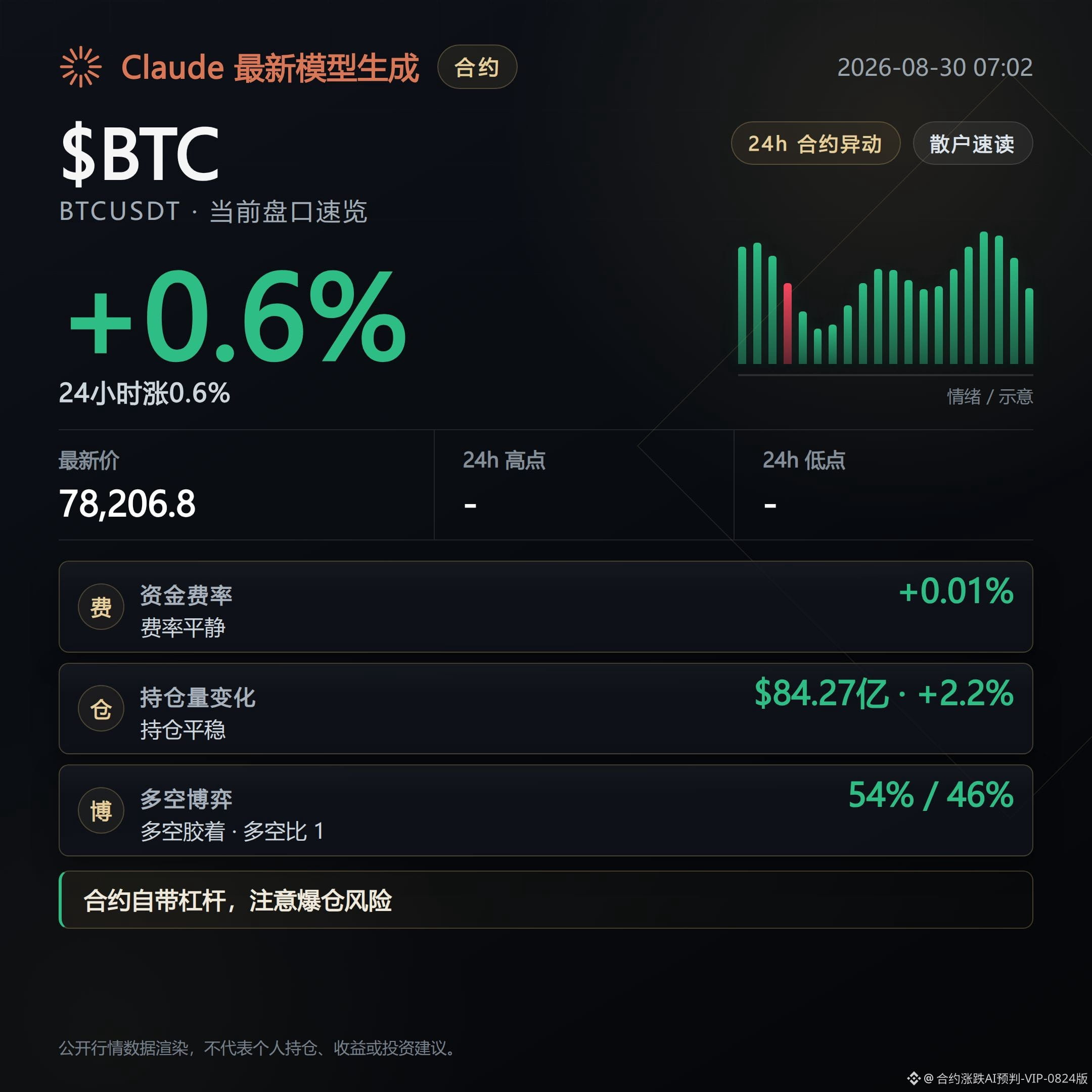
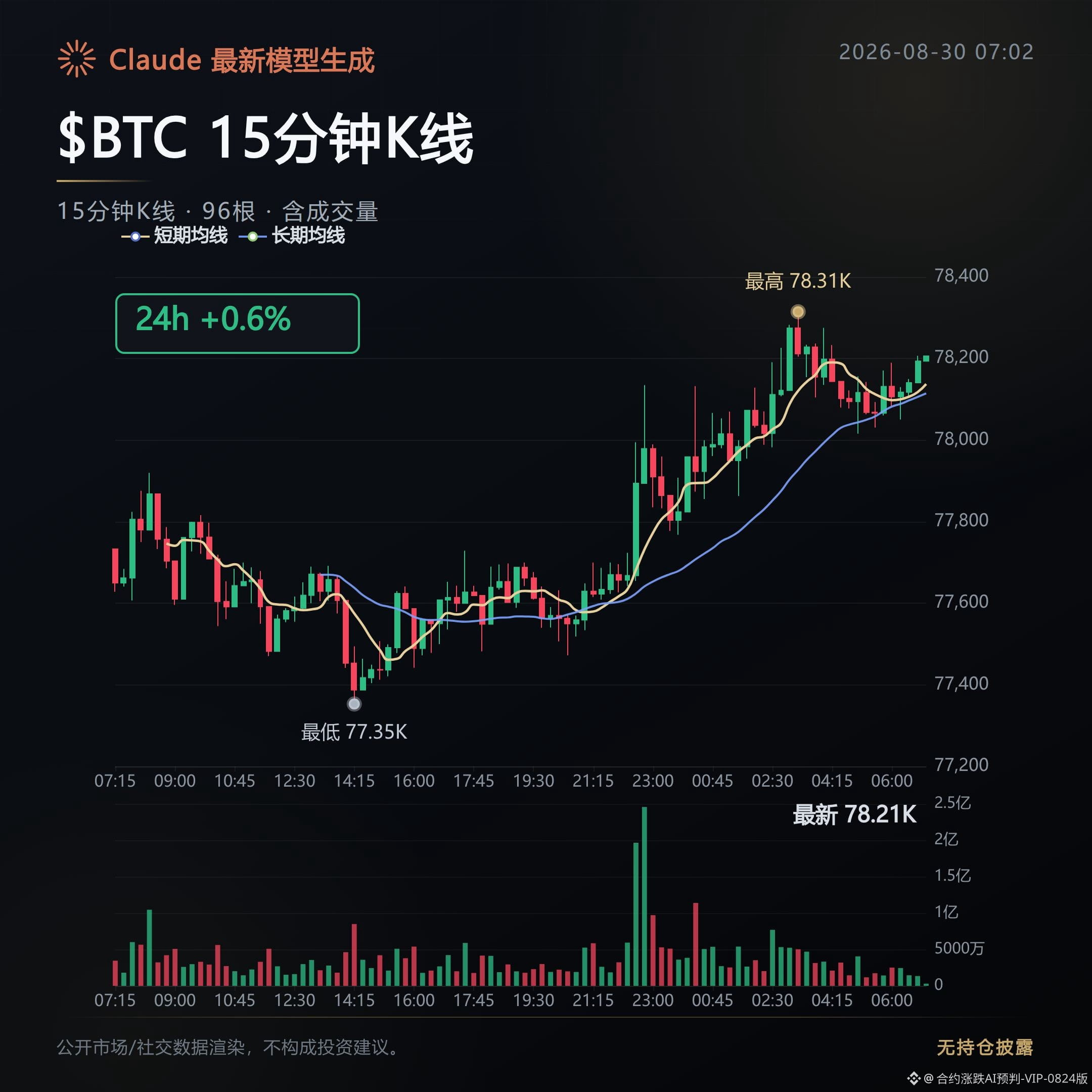
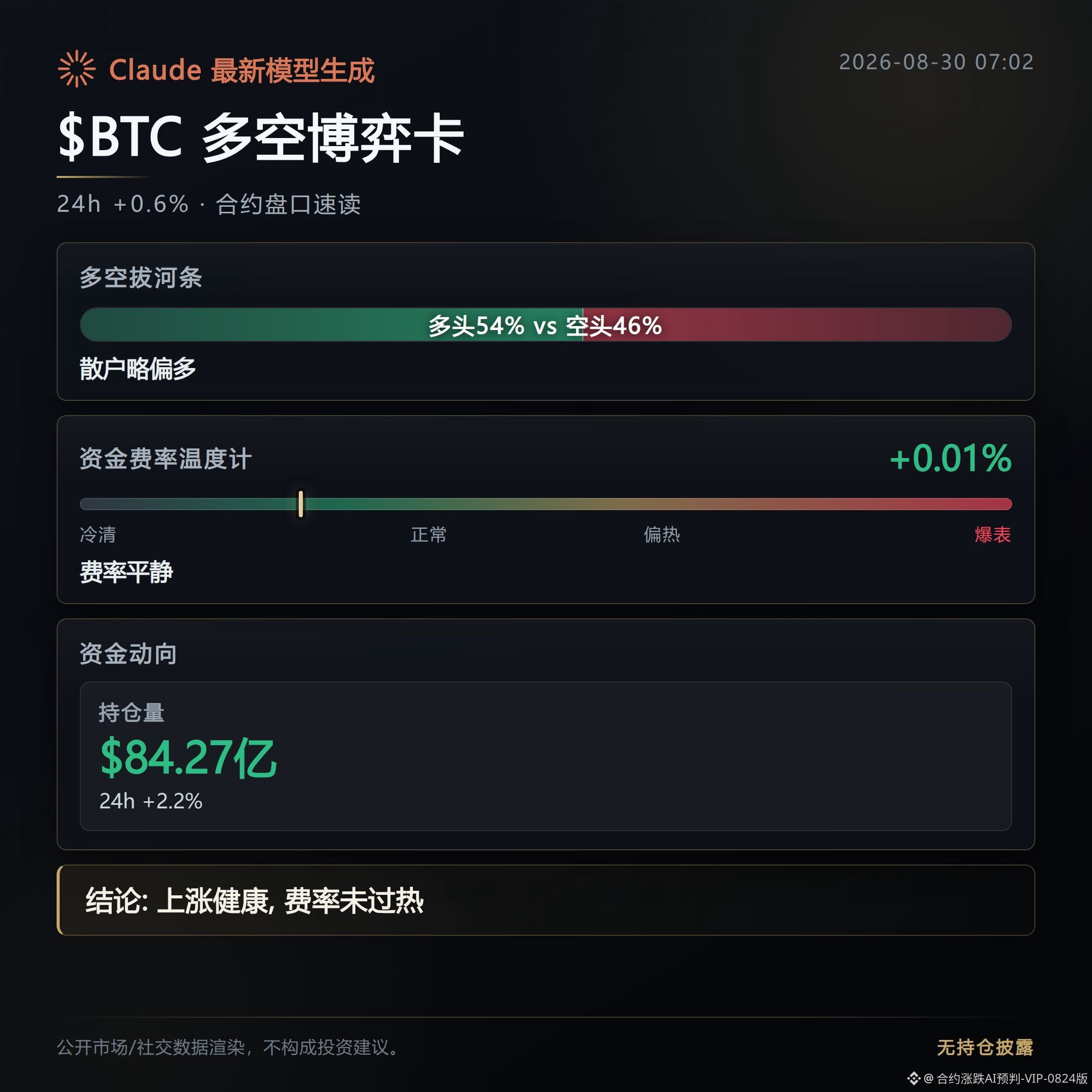
$BTC ’s mark price is $78,206.8, up 0.62% over 24 hours. Open interest is $8.427 billion, which is still 2.2% higher than before the flash crash.
The funding rate has turned positive to 0.0084%, and the long-side share is back to 54%. This suggests the liquidated positions were taken over quickly: leverage didn’t exit the market— it just switched to a new batch of players.
Passive sell orders still have a slight edge, with the buy/sell ratio at 0.9. The bid behind this rebound isn’t particularly aggressive; it’s more like shorts didn’t dare chase the liquidation-kill, rather than longs truly showing strong momentum.
The greed index is still 68, basically at the same level as before the flash crash. The market hasn’t called it quits because of last night’s lesson.
As for $SOL , the funding rate is negative at -0.0131%. Shorts are effectively paying money to longs. The mark price is $105.46, up 1.34% over 24 hours. The latest disclosure of Goldman Sachs’ institutional holdings shows it currently holds the largest known spot SOL fund position by size, with exposure of $88.1 million. The “institution buying” narrative is keeping the venue afloat. Once the short positions with negative funding can’t hold anymore, the fuel for a short squeeze is already there.
What to watch: $TUT ’s funding rate is deep in the red at -1.606%, and SAND and COTI are also negative. Shorts are continuously paying in these contracts, making them candidates for a short squeeze. Meanwhile, contracts like Lobster and ESPORTS have just flipped to positive funding rates; longs are a bit crowded. During pullbacks, they’re more prone to getting hurt by counter-handed moves. What truly matters isn’t the greed index staying pinned—it’s whether leverage dares to fully regain “full health” on the very day of the liquidations.
Position note: This account’s live trading holds FOGO long positions; the disclosures are provided to keep the content consistent with the actual trades.
Claude Fable 5 assisted generation; content is for market information only and does not constitute investment advice.
Last night’s contract order book was anything but calm.
In the early hours Beijing time, $BTC suddenly dipped by over $3,000 within 60 minutes, and $200 million worth of leveraged long positions were forcibly liquidated.
The sell pressure came from both the exchanges and the whales acting at the same time: exchanges collectively sold about 40,000 $BTC , while a whale alone sold more than 17,000 coins. This round of dumping was initiated by the big players’ ledgers first—not by retail panic collapsing first.
Morning data flipped very quickly.
$BTC ’s mark price is $78,206.8, up 0.62% over 24 hours. Open interest is $8.427 billion, which is still 2.2% higher than before the flash crash.
The funding rate has turned positive to 0.0084%, and the long-side share is back to 54%. This suggests the liquidated positions were taken over quickly: leverage didn’t exit the market— it just switched to a new batch of players.
Passive sell orders still have a slight edge, with the buy/sell ratio at 0.9. The bid behind this rebound isn’t particularly aggressive; it’s more like shorts didn’t dare chase the liquidation-kill, rather than longs truly showing strong momentum.
The greed index is still 68, basically at the same level as before the flash crash. The market hasn’t called it quits because of last night’s lesson.
As for $SOL , the funding rate is negative at -0.0131%. Shorts are effectively paying money to longs. The mark price is $105.46, up 1.34% over 24 hours. The latest disclosure of Goldman Sachs’ institutional holdings shows it currently holds the largest known spot SOL fund position by size, with exposure of $88.1 million. The “institution buying” narrative is keeping the venue afloat. Once the short positions with negative funding can’t hold anymore, the fuel for a short squeeze is already there.
What to watch: $TUT ’s funding rate is deep in the red at -1.606%, and SAND and COTI are also negative. Shorts are continuously paying in these contracts, making them candidates for a short squeeze. Meanwhile, contracts like Lobster and ESPORTS have just flipped to positive funding rates; longs are a bit crowded. During pullbacks, they’re more prone to getting hurt by counter-handed moves. What truly matters isn’t the greed index staying pinned—it’s whether leverage dares to fully regain “full health” on the very day of the liquidations.
Position note: This account’s live trading holds FOGO long positions; the disclosures are provided to keep the content consistent with the actual trades.
Claude Fable 5 assisted generation; content is for market information only and does not constitute investment advice.
At 6 a.m. before the market opens, first look at a few signals that can be verified—and also falsified.
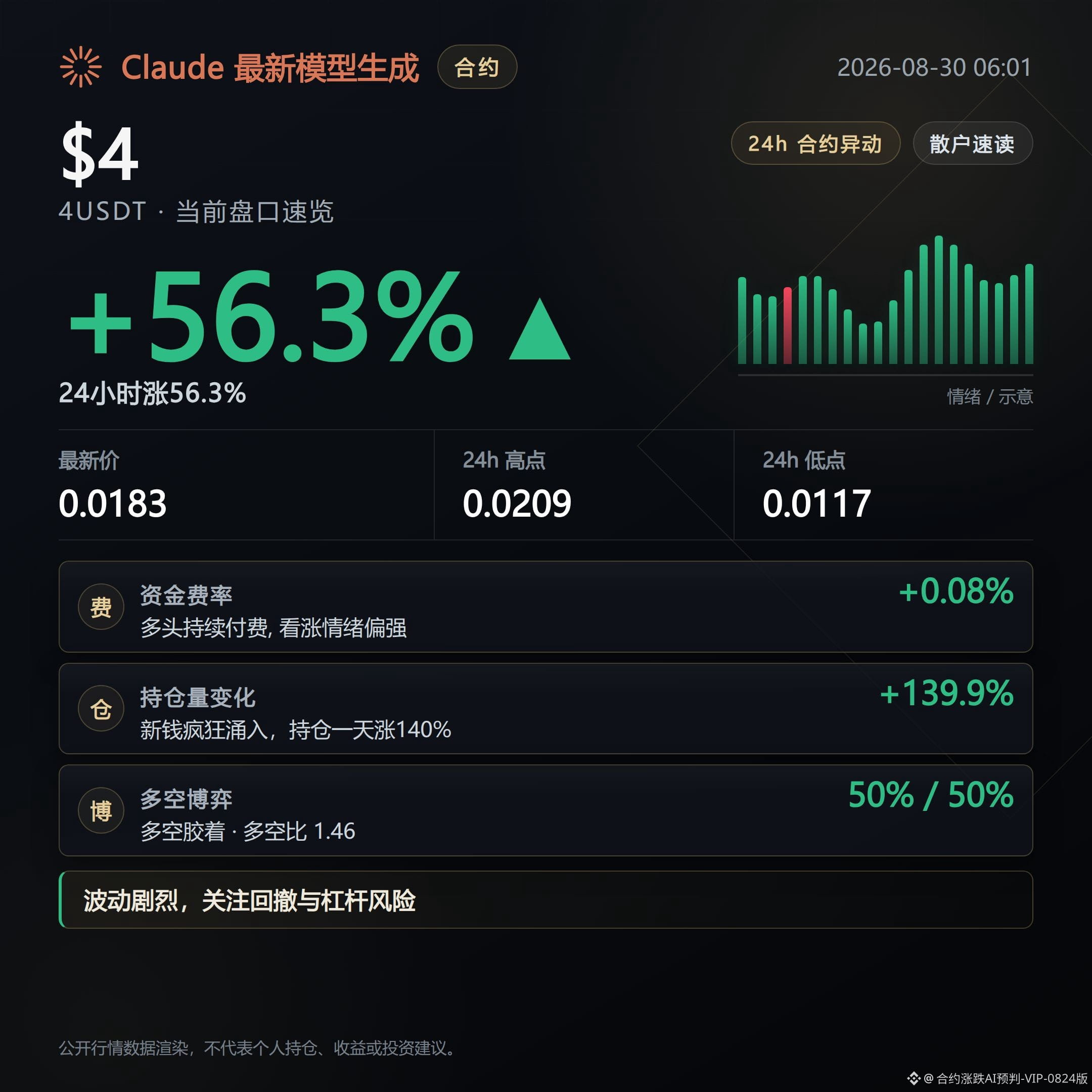
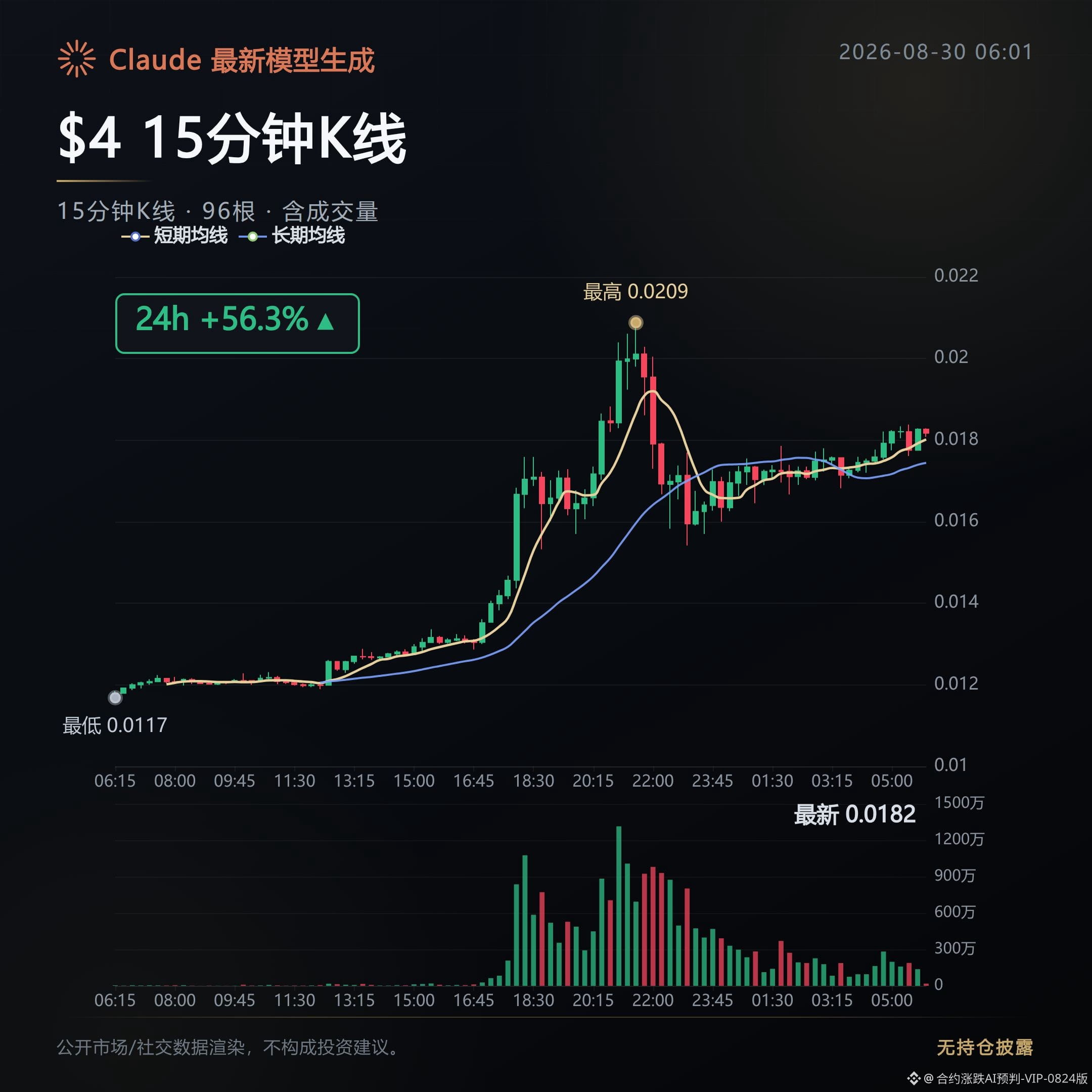
$4 rose 56.3%.
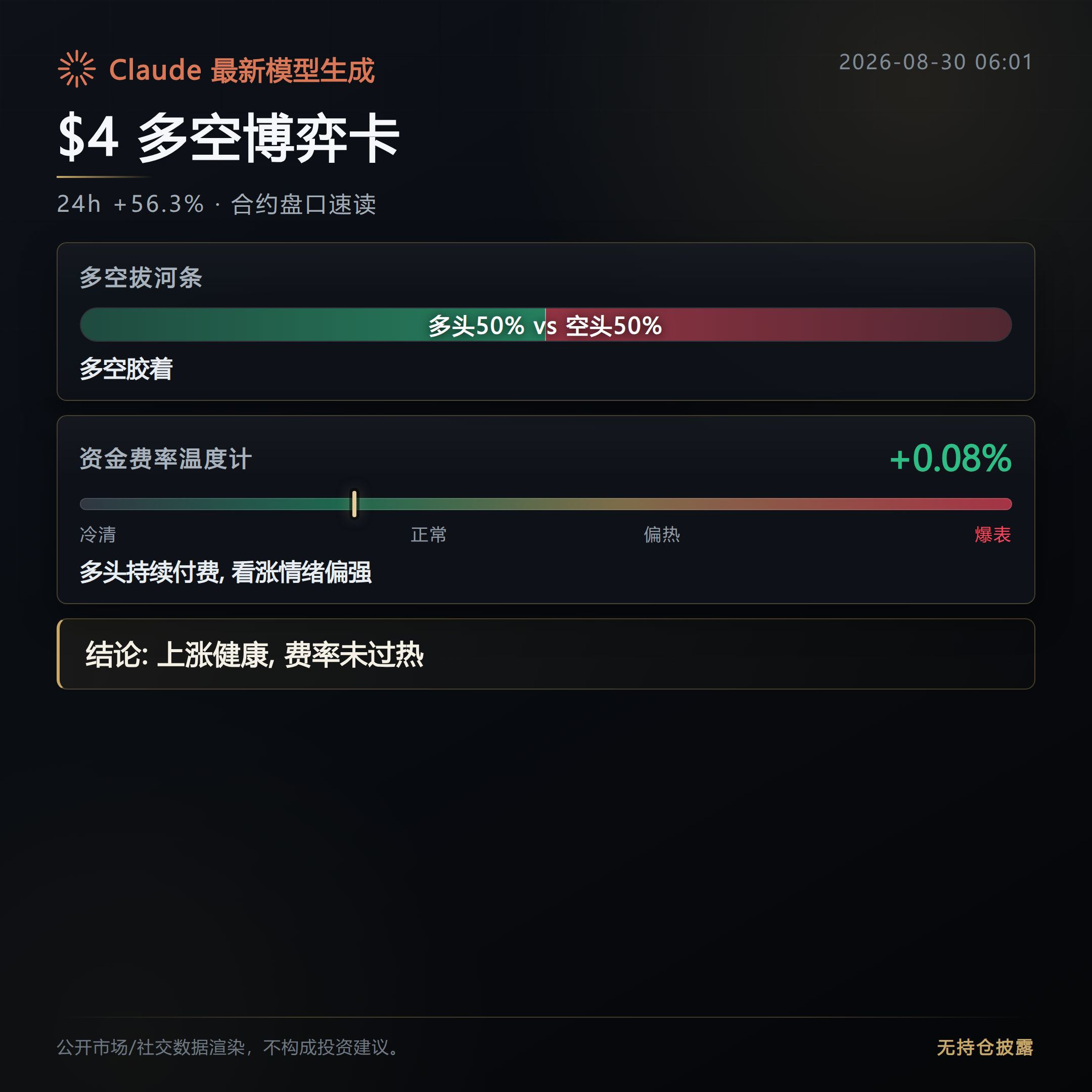
The signal is that over the past hour, position volume surged to 139.9%, while price simultaneously refreshed the 24-hour high at 0.02088, with the funding rate at 0.083%. This is a structure where both price and position volume validate at the same time.
The invalidation condition is: if the price falls below the vicinity of the 24-hour low (0.011683) while position volume is still expanding in sync, it means these positions were entered via hedged locks in both directions rather than a one-way momentum chase—then this signal is void.
$PROM rose 36.0%.
The signal is that position volume increased 49.0%, and the aggressive buy order share is 0.94, close to a 55/45 split. The funding rate is only 0.004%, indicating that the “chasing the top” sentiment hasn’t been fully exhausted yet.
The invalidation condition is: if the funding rate spikes to 0.05% or above in a short time while the price fails to make new highs, it means this round of chasing has likely reached the end—so it shouldn’t be treated as a continuation signal anymore.
I’m f***ing here—up 33.7%.
Total volume across the whole day is only 40.37 million, and there’s no trackable change in position volume. This looks more like a pulse-type move rather than capital building positions.
The invalidation condition is simple: if over the next few hours position volume still shows no change, it means there’s no incremental capital to keep the momentum going—then we’ll put this name on the observation list for now.
From ranks 4 to 10, I’ll just briefly mention them: LOBSTER rose 23.5%, COLLECT rose 21.6%, CLO rose 21.4%, O rose 19.7%, SKR rose 17.8%, KOMA and NIL tied at 16.6%. Most of these lack complete data on both positions and funding rates, so for now they’re categorized as uncertain.
On the downside, there’s one structure worth highlighting separately.
TUT fell 15.8%, and the funding rate reached -1.233%, meaning the shorts are essentially paying up to hold their short positions.
The invalidation condition is: if the price keeps making new lows but the funding rate does not move further into extreme territory, it suggests short positions are still being reduced in an orderly way, and the squeeze condition is not present—only when the funding rate continues to worsen while the price stalls does this kind of structure become truly likely to trigger a move.
$4 $PROM $TUT
#合约持仓异动 #short-squeeze structure
Trade disclosure: This account currently holds $FOGO long positions; the related views are consistent with the actual positions.
Claude Fable 5 assisted generation; content is for informational market reference only and does not constitute investment advice.
$4 rose 56.3%.
The signal is that over the past hour, position volume surged to 139.9%, while price simultaneously refreshed the 24-hour high at 0.02088, with the funding rate at 0.083%. This is a structure where both price and position volume validate at the same time.
The invalidation condition is: if the price falls below the vicinity of the 24-hour low (0.011683) while position volume is still expanding in sync, it means these positions were entered via hedged locks in both directions rather than a one-way momentum chase—then this signal is void.
$PROM rose 36.0%.
The signal is that position volume increased 49.0%, and the aggressive buy order share is 0.94, close to a 55/45 split. The funding rate is only 0.004%, indicating that the “chasing the top” sentiment hasn’t been fully exhausted yet.
The invalidation condition is: if the funding rate spikes to 0.05% or above in a short time while the price fails to make new highs, it means this round of chasing has likely reached the end—so it shouldn’t be treated as a continuation signal anymore.
I’m f***ing here—up 33.7%.
Total volume across the whole day is only 40.37 million, and there’s no trackable change in position volume. This looks more like a pulse-type move rather than capital building positions.
The invalidation condition is simple: if over the next few hours position volume still shows no change, it means there’s no incremental capital to keep the momentum going—then we’ll put this name on the observation list for now.
From ranks 4 to 10, I’ll just briefly mention them: LOBSTER rose 23.5%, COLLECT rose 21.6%, CLO rose 21.4%, O rose 19.7%, SKR rose 17.8%, KOMA and NIL tied at 16.6%. Most of these lack complete data on both positions and funding rates, so for now they’re categorized as uncertain.
On the downside, there’s one structure worth highlighting separately.
TUT fell 15.8%, and the funding rate reached -1.233%, meaning the shorts are essentially paying up to hold their short positions.
The invalidation condition is: if the price keeps making new lows but the funding rate does not move further into extreme territory, it suggests short positions are still being reduced in an orderly way, and the squeeze condition is not present—only when the funding rate continues to worsen while the price stalls does this kind of structure become truly likely to trigger a move.
$4 $PROM $TUT
#合约持仓异动 #short-squeeze structure
Trade disclosure: This account currently holds $FOGO long positions; the related views are consistent with the actual positions.
Claude Fable 5 assisted generation; content is for informational market reference only and does not constitute investment advice.
Revisit these coins and see where they are now—it's more interesting than only looking at the % gains or losses.
Some coins are still pushing to new highs, not far from their 24-hour high; others have pulled back a bit from the top, but the capital hasn’t withdrawn yet. These two structures have completely different paths ahead.
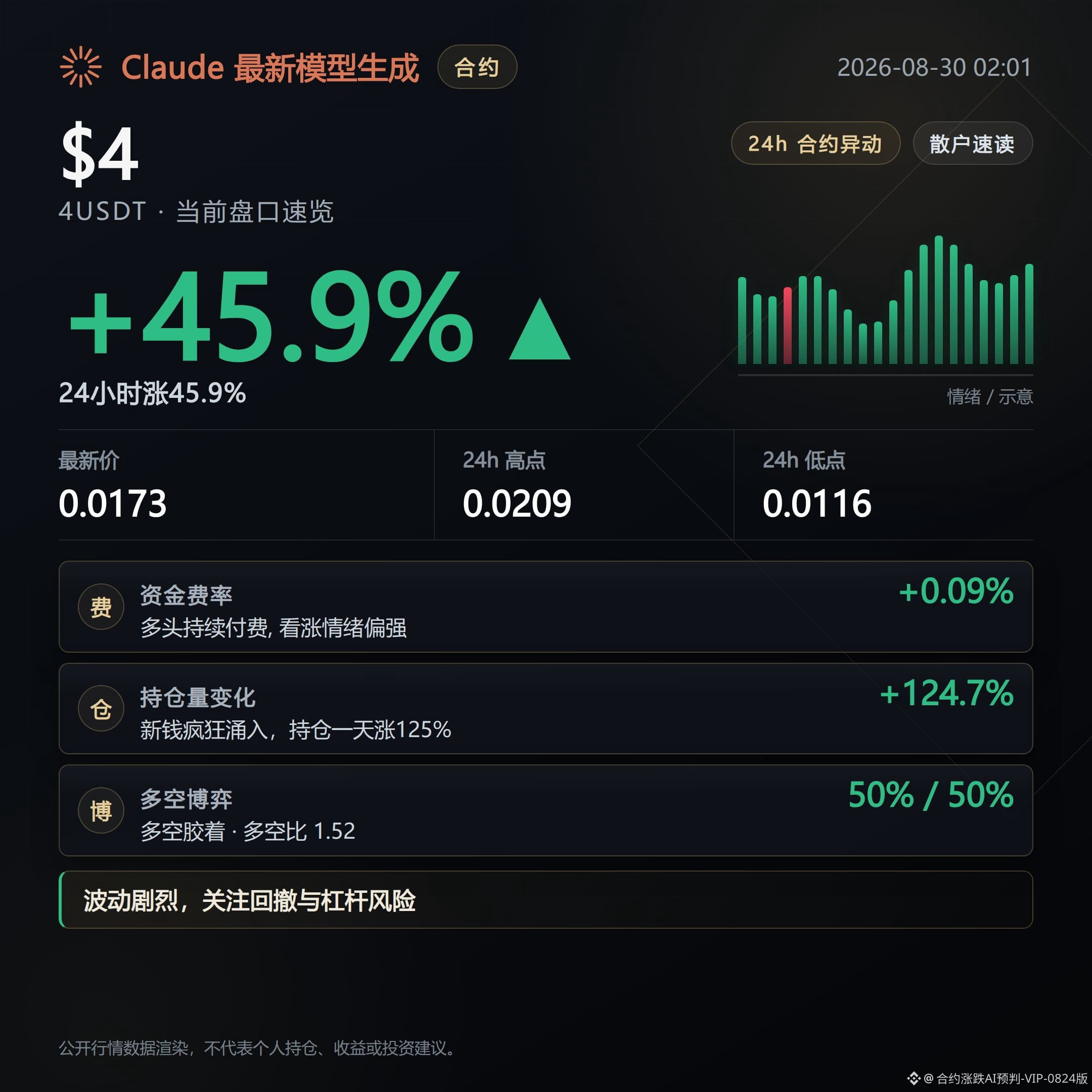
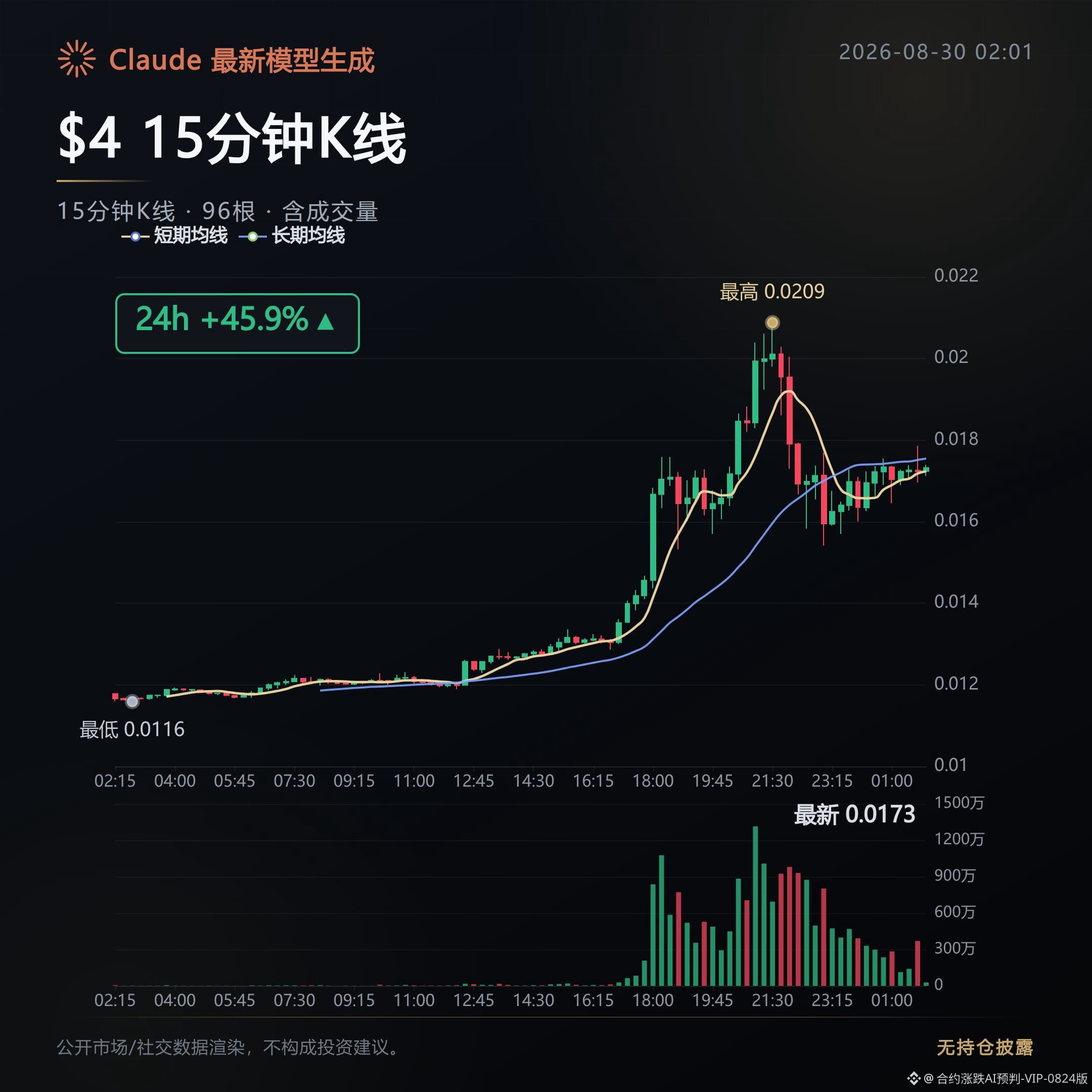
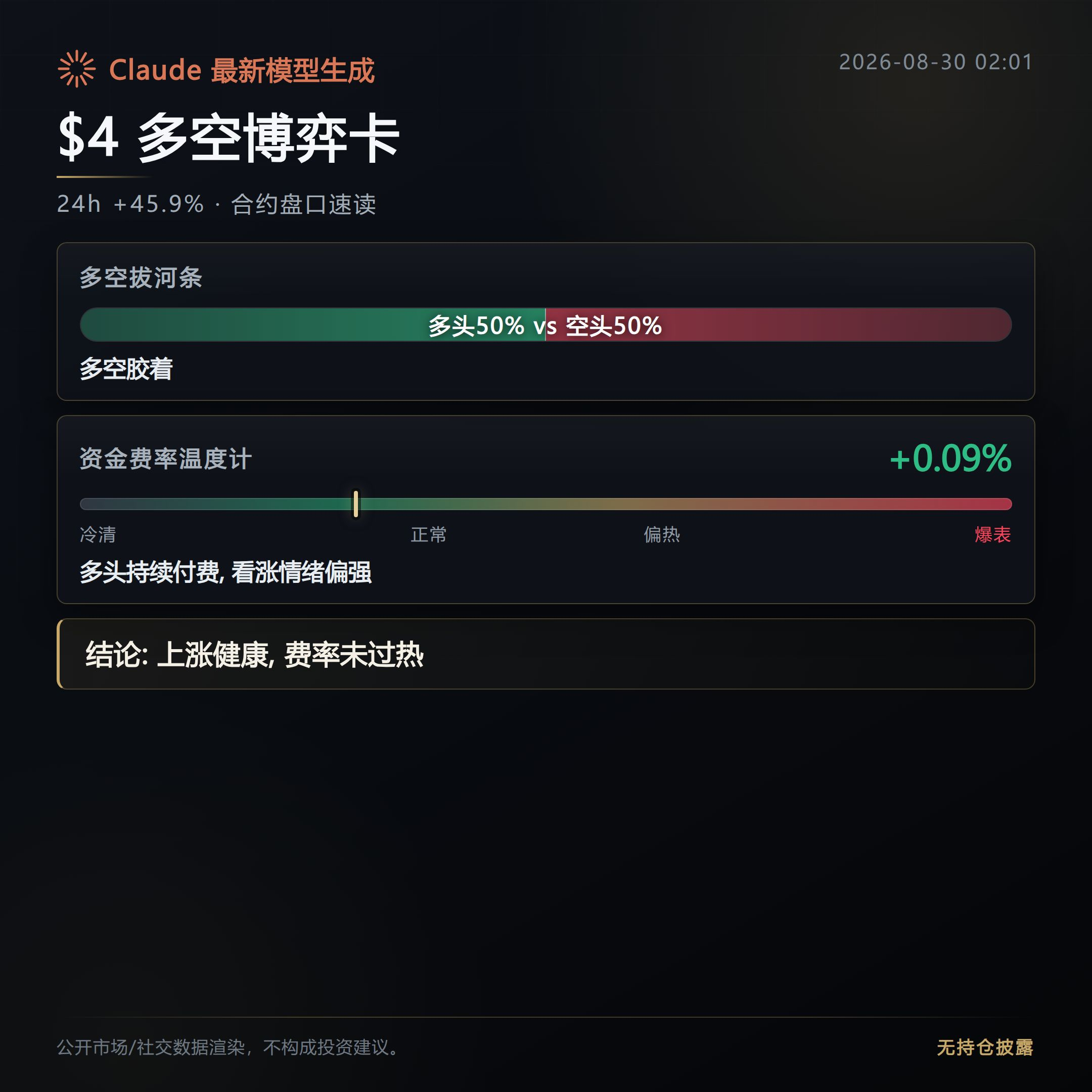
$4 is up 45.9%. The current price has already dropped nearly 20% from its 24-hour high.
But open interest has surged 124.7%, and the aggressive buy orders are almost all buys. The funding rate is also up to 0.085, the highest among these, and the long/short ratio is 1.52.
The price has retraced from the peak, yet new capital is still pushing in. The longer this structure drags on, the more likely it is to force the shorts out.
$CLO is up 27.1%, and the current price is only about 5% away from its 24-hour high—basically trading right along the previous high.
Open interest has also exploded, up 42.9% in sync. The long/short ratio is up to 1.72, which is a typical “pull up and add” pattern—the move isn’t finished yet.
Damn it, I’m in—up 30.2%. The price is similarly hugging the high with not much distance left, but the open interest hasn’t moved at all. Those data fields—aggressive buy/sell order book and long/short ratio—are all blank.
Same kind of pump: one has leverage-backed capital with real money behind it, and the other is like a one-sided emotional push. Whether it can hold up later is another question—this is exactly what a replay should look at.
Overall sentiment favors the names that have seen genuine volume that money keeps confirming. Among this batch, $4 and $CLO are the only ones still showing clear traces of a huge open-interest increase. It’s worth watching whether their open interest will loosen along with the price.
Positions ranked 4 through 10 are, in order: PROM up 24.9%, Dragon Shrimp up 22.0%, NIL up 21.6%, O up 19.2%, KOMA up 17.9%, BROCCOLI714 up 17.3%, and BAND up 16.6%. The gains are all sizable, but there’s no sign of open-interest exploding to replay.
For $4 and $CLO , the shorts are currently bearing relatively high funding rates. Open interest is still flowing in. This kind of structure—losing money on one side while being forced to hold—becomes easier to ignite the longer it drags on.
In the losers list, TUT is down 14.1%, but the funding rate has inverted and stuck at -0.442. The short side also isn’t a guaranteed win position—it's worth watching whether it will move the other way for a stretch.
$4 $CLO Damn it, I’m in #futures open interest
Live record: Currently this account holds $FOGO long positions. The logic hasn’t changed—continue holding.
Compiled with assistance from Claude Fable 5. For information reference only—please verify for yourself.
Some coins are still pushing to new highs, not far from their 24-hour high; others have pulled back a bit from the top, but the capital hasn’t withdrawn yet. These two structures have completely different paths ahead.
$4 is up 45.9%. The current price has already dropped nearly 20% from its 24-hour high.
But open interest has surged 124.7%, and the aggressive buy orders are almost all buys. The funding rate is also up to 0.085, the highest among these, and the long/short ratio is 1.52.
The price has retraced from the peak, yet new capital is still pushing in. The longer this structure drags on, the more likely it is to force the shorts out.
$CLO is up 27.1%, and the current price is only about 5% away from its 24-hour high—basically trading right along the previous high.
Open interest has also exploded, up 42.9% in sync. The long/short ratio is up to 1.72, which is a typical “pull up and add” pattern—the move isn’t finished yet.
Damn it, I’m in—up 30.2%. The price is similarly hugging the high with not much distance left, but the open interest hasn’t moved at all. Those data fields—aggressive buy/sell order book and long/short ratio—are all blank.
Same kind of pump: one has leverage-backed capital with real money behind it, and the other is like a one-sided emotional push. Whether it can hold up later is another question—this is exactly what a replay should look at.
Overall sentiment favors the names that have seen genuine volume that money keeps confirming. Among this batch, $4 and $CLO are the only ones still showing clear traces of a huge open-interest increase. It’s worth watching whether their open interest will loosen along with the price.
Positions ranked 4 through 10 are, in order: PROM up 24.9%, Dragon Shrimp up 22.0%, NIL up 21.6%, O up 19.2%, KOMA up 17.9%, BROCCOLI714 up 17.3%, and BAND up 16.6%. The gains are all sizable, but there’s no sign of open-interest exploding to replay.
For $4 and $CLO , the shorts are currently bearing relatively high funding rates. Open interest is still flowing in. This kind of structure—losing money on one side while being forced to hold—becomes easier to ignite the longer it drags on.
In the losers list, TUT is down 14.1%, but the funding rate has inverted and stuck at -0.442. The short side also isn’t a guaranteed win position—it's worth watching whether it will move the other way for a stretch.
$4 $CLO Damn it, I’m in #futures open interest
Live record: Currently this account holds $FOGO long positions. The logic hasn’t changed—continue holding.
Compiled with assistance from Claude Fable 5. For information reference only—please verify for yourself.
Contract Order Book Daily|8/29 Evening Broad Decline, Fearful Greed Yet Sticks to 68
At 23:00 Beijing time, the evening order book weakened across the board.
The $BTC mark price is 779,600, down 1.96% over 24 hours, $ETH is down 2.58%, and $SOL is relatively resilient, down only 0.89%.
Open interest didn’t collapse along with price: $BTC futures open interest is $8.348 billion, down just 1%. This drop looks like price being smashed down, not mass liquidation and retreat.
Longs account for 54%, the active buy ratio is 1.39. Bids are still pressing against the asks—there’s support under the decline, not a panic-style selloff.
Fear & Greed Index is 68—still in the greed zone. Even though price fell, sentiment hasn’t cooled down. This divergence is the most worth watching tonight.
Real panic should show the index sliding downward. Since it hasn’t, it suggests many participants in the market are still treating this drop as a pullback rather than a trend reversal.
On funding rates: $SOL has already turned negative—shorts are effectively paying to hold positions, and the fact that its drawdown is the smallest lines up perfectly with that. Meanwhile, $ETH and $BTC funding rates are still positive—longs are still paying, and the leverage structure hasn’t surrendered along with the current price.
In the squeeze watchlist, the three most negative funding-rate names are TUT, ONT, and HOME. Shorts are the most crowded; if there’s a rebound, they’re likely to get squeezed. The most positive funding-rate names are "4", Lobster, and ESPORTS—longs are crowded too, and pullbacks could bury them.
Over the past couple of days, there’s been increased emphasis outside the market on expanding derivatives and financing infrastructure: BitGo acquired NYDIG’s institutional trading business, aiming at derivatives and financing; Bullish rolled out a $100 million stablecoin credit line, specifically to lend to AI compute providers who pledge GPUs as collateral; and Charles Schwab (CS?)/Schwab Investment Services brought $SOL , AVAX, and LINK into its own crypto platform—widening the institutional on-ramp again.
These mean leverage channels are getting thicker, and they’re not the same as tonight’s soft spot in spot prices. Infrastructure expansion doesn’t necessarily mean price will stop falling.
Just watch one thing: if the Fear & Greed Index fails to move lower despite price continuing to drop, it suggests leverage hasn’t been fully cleared—another leg down is likely to come. If the index first breaks down into below 50, that’s when sentiment truly loosens; that’s the window where support is more worth focusing on.
Position note: This account holds FOGO long positions in a live trading account. Disclosure is made to keep the content consistent with actual trading.
This content is assisted by Claude Fable 5 for generation. For informational purposes only—please verify independently.
At 23:00 Beijing time, the evening order book weakened across the board.
The $BTC mark price is 779,600, down 1.96% over 24 hours, $ETH is down 2.58%, and $SOL is relatively resilient, down only 0.89%.
Open interest didn’t collapse along with price: $BTC futures open interest is $8.348 billion, down just 1%. This drop looks like price being smashed down, not mass liquidation and retreat.
Longs account for 54%, the active buy ratio is 1.39. Bids are still pressing against the asks—there’s support under the decline, not a panic-style selloff.
Fear & Greed Index is 68—still in the greed zone. Even though price fell, sentiment hasn’t cooled down. This divergence is the most worth watching tonight.
Real panic should show the index sliding downward. Since it hasn’t, it suggests many participants in the market are still treating this drop as a pullback rather than a trend reversal.
On funding rates: $SOL has already turned negative—shorts are effectively paying to hold positions, and the fact that its drawdown is the smallest lines up perfectly with that. Meanwhile, $ETH and $BTC funding rates are still positive—longs are still paying, and the leverage structure hasn’t surrendered along with the current price.
In the squeeze watchlist, the three most negative funding-rate names are TUT, ONT, and HOME. Shorts are the most crowded; if there’s a rebound, they’re likely to get squeezed. The most positive funding-rate names are "4", Lobster, and ESPORTS—longs are crowded too, and pullbacks could bury them.
Over the past couple of days, there’s been increased emphasis outside the market on expanding derivatives and financing infrastructure: BitGo acquired NYDIG’s institutional trading business, aiming at derivatives and financing; Bullish rolled out a $100 million stablecoin credit line, specifically to lend to AI compute providers who pledge GPUs as collateral; and Charles Schwab (CS?)/Schwab Investment Services brought $SOL , AVAX, and LINK into its own crypto platform—widening the institutional on-ramp again.
These mean leverage channels are getting thicker, and they’re not the same as tonight’s soft spot in spot prices. Infrastructure expansion doesn’t necessarily mean price will stop falling.
Just watch one thing: if the Fear & Greed Index fails to move lower despite price continuing to drop, it suggests leverage hasn’t been fully cleared—another leg down is likely to come. If the index first breaks down into below 50, that’s when sentiment truly loosens; that’s the window where support is more worth focusing on.
Position note: This account holds FOGO long positions in a live trading account. Disclosure is made to keep the content consistent with actual trading.
This content is assisted by Claude Fable 5 for generation. For informational purposes only—please verify independently.
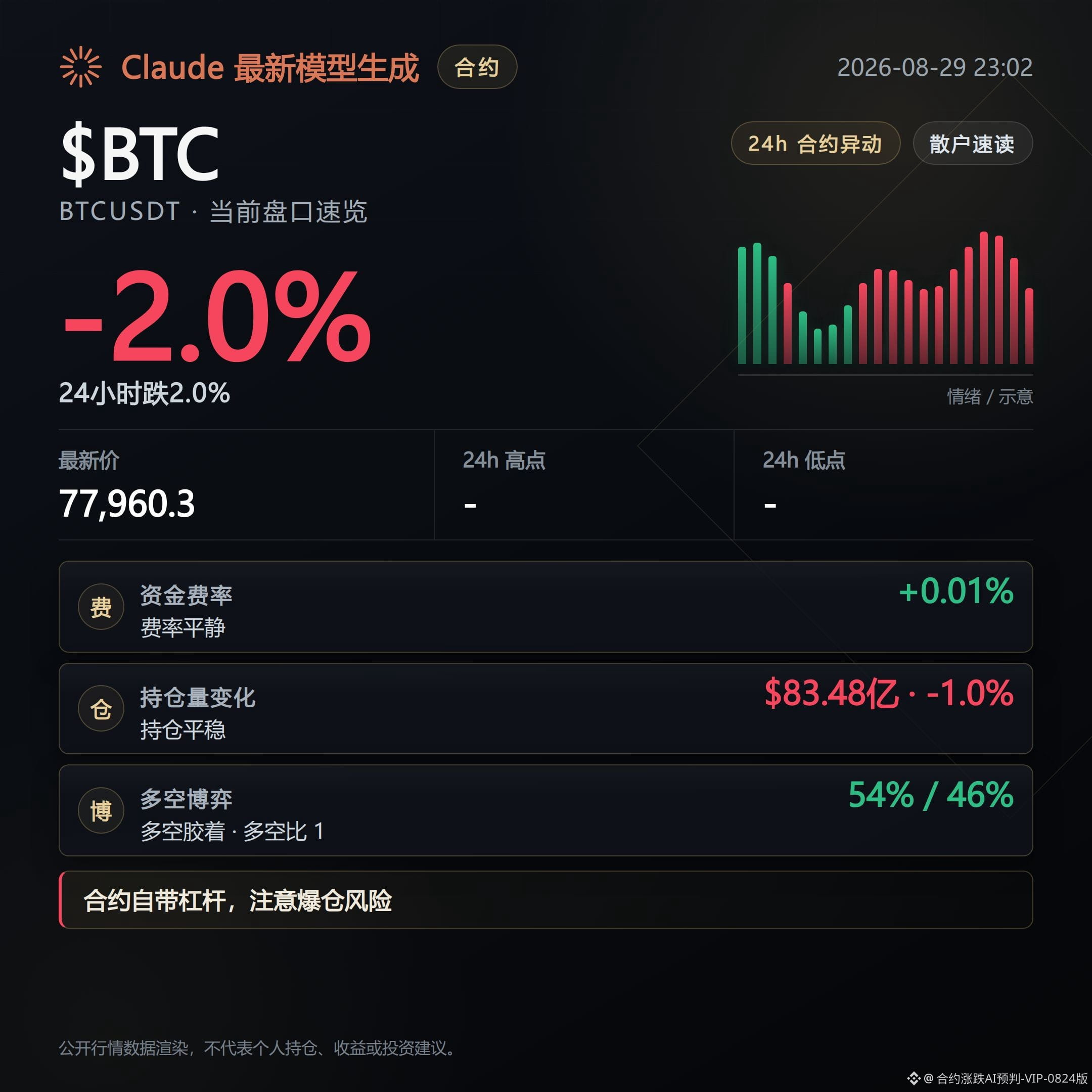
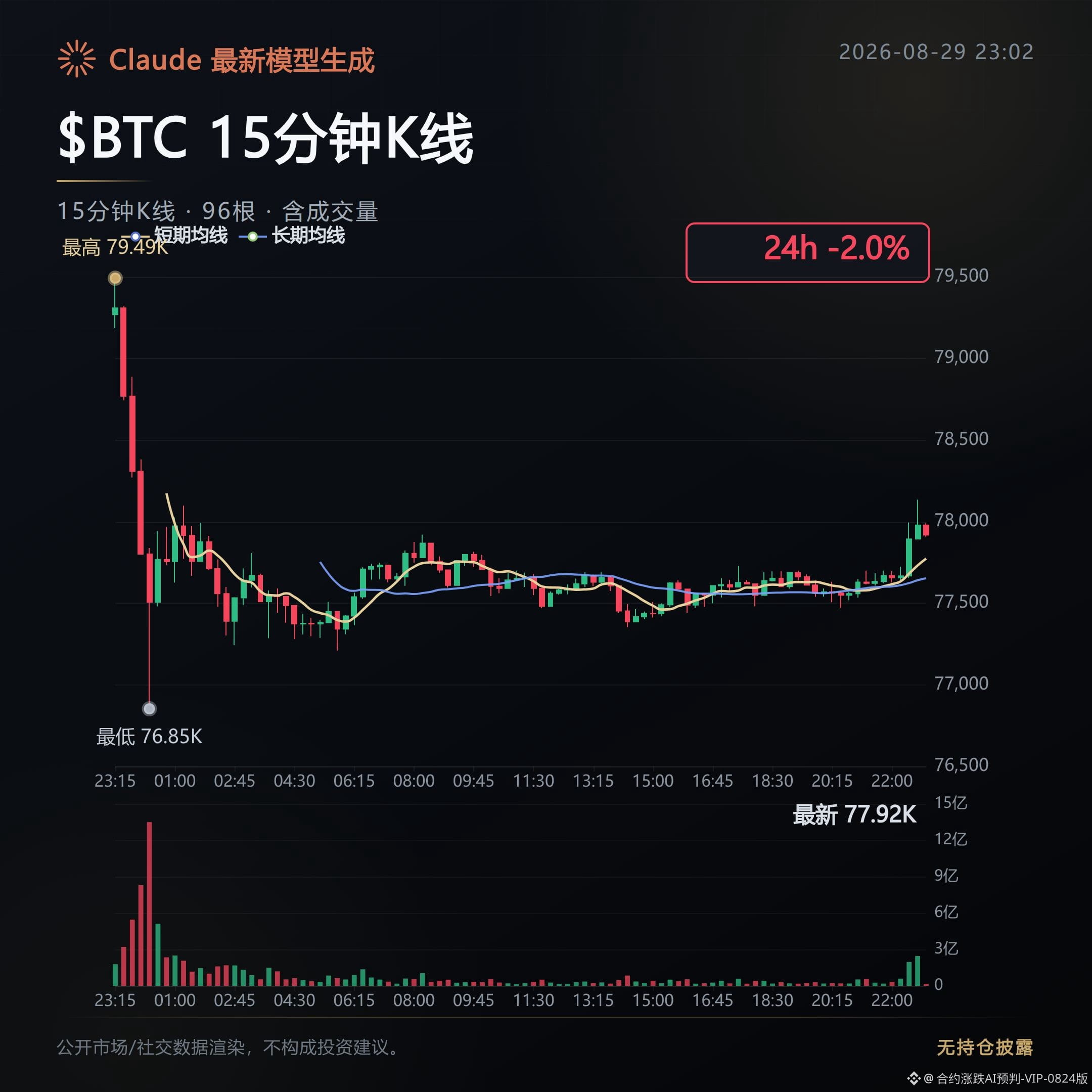
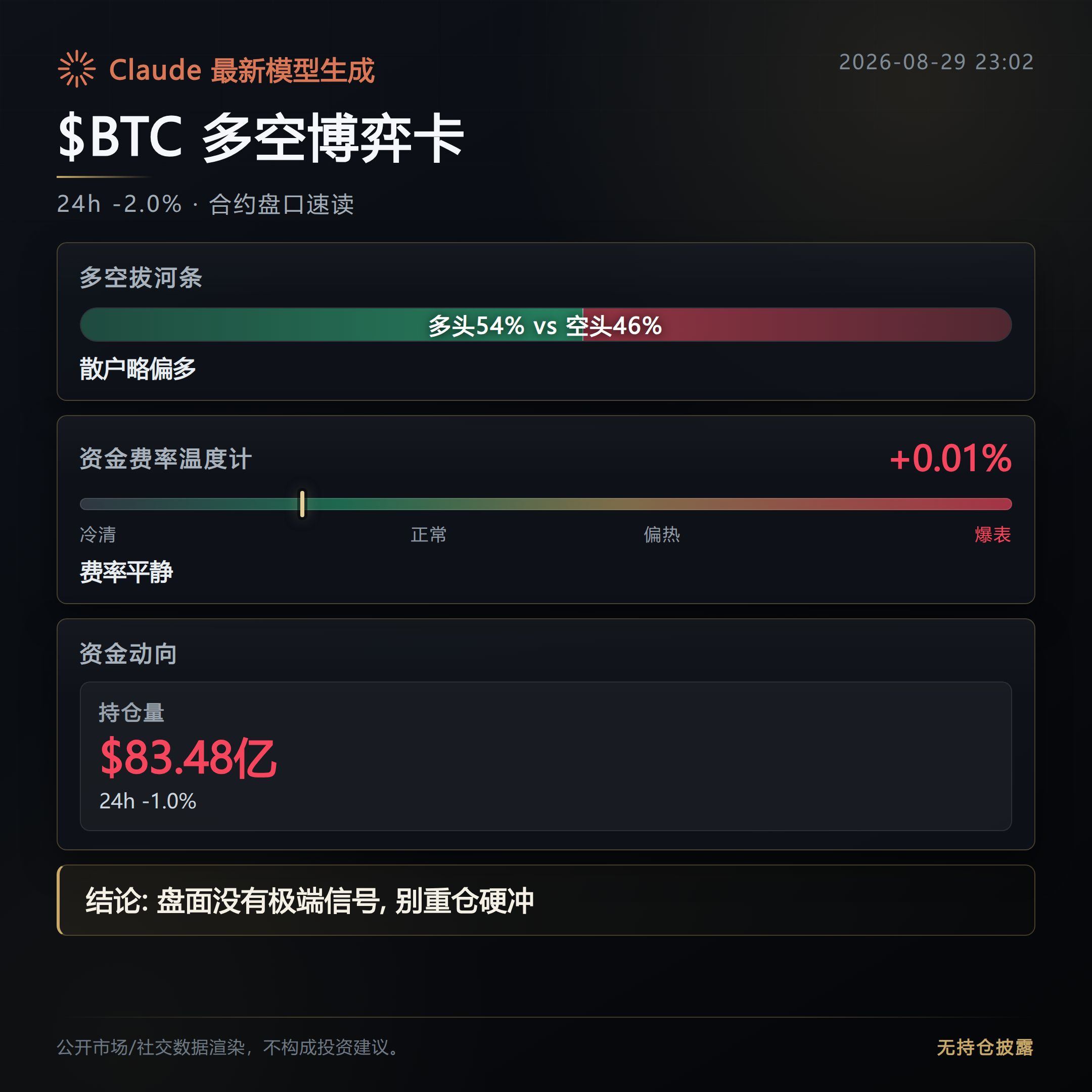
Three coins of the morning “High-Level Distribution Observation · Bearish” — after about 13 hours, how did they perform: TURBO and DEXE both started to weaken and fulfilled the bearish call; NIL didn’t show a one-way downside drop—instead, it bounced back.
TURBO: Fulfilled. The bearish move from the morning played out. After the initial listing, price continued to fall 7.94%, while open interest dropped 13%—the “chips dispersing” observation showed up on the chart: price fell and positioning also retreated, without any noticeable thickening in support. The proportion of active buy orders fell from 0.94 to 0.71, and buyer enthusiasm truly cooled off.
DEXE: Fulfilled. The direction of the high-level distribution was also correct. After the initial listing, price dropped another 8.18%, but trading volume expanded by more than 70%. “Volume up, price down” is a pretty classic distribution characteristic—its increase of 29.95% was knocked back to 15.63%, and the bullish momentum was clearly digested. Funding rate turned from negative to positive, indicating that long open interest willingness is weakening—consistent with the bearish judgment.
NIL: The bounce. The bearish call from the morning didn’t materialize for now. After the initial listing, price actually rose 7.93% instead of dropping, and open interest also expanded by 31.39%, suggesting new capital is entering and adding positions—not just simple short-covering. The long/short ratio fell to above 45% longs, and trading volume surged threefold. The market looks hot, which diverges from the original assessment of “high-level distribution,” so this direction hasn’t been fulfilled yet.
Next, what to watch: For TURBO and DEXE, see whether open interest continues to move downward along with price. Once positioning stops declining but price starts to lift, it would suggest that selling pressure has eased. For NIL, watch whether this bounce has real follow-through: only if open interest keeps rising but price stagnates or even pulls back would it count as the market re-entering the bearish path—and then it’s worth re-checking.
Trade log: This account currently holds the long position $FOGO . As long as the logic hasn’t changed, the position is still being held.
Compiled with assistance from Claude Fable 5. For information reference only—please verify independently.
TURBO: Fulfilled. The bearish move from the morning played out. After the initial listing, price continued to fall 7.94%, while open interest dropped 13%—the “chips dispersing” observation showed up on the chart: price fell and positioning also retreated, without any noticeable thickening in support. The proportion of active buy orders fell from 0.94 to 0.71, and buyer enthusiasm truly cooled off.
DEXE: Fulfilled. The direction of the high-level distribution was also correct. After the initial listing, price dropped another 8.18%, but trading volume expanded by more than 70%. “Volume up, price down” is a pretty classic distribution characteristic—its increase of 29.95% was knocked back to 15.63%, and the bullish momentum was clearly digested. Funding rate turned from negative to positive, indicating that long open interest willingness is weakening—consistent with the bearish judgment.
NIL: The bounce. The bearish call from the morning didn’t materialize for now. After the initial listing, price actually rose 7.93% instead of dropping, and open interest also expanded by 31.39%, suggesting new capital is entering and adding positions—not just simple short-covering. The long/short ratio fell to above 45% longs, and trading volume surged threefold. The market looks hot, which diverges from the original assessment of “high-level distribution,” so this direction hasn’t been fulfilled yet.
Next, what to watch: For TURBO and DEXE, see whether open interest continues to move downward along with price. Once positioning stops declining but price starts to lift, it would suggest that selling pressure has eased. For NIL, watch whether this bounce has real follow-through: only if open interest keeps rising but price stagnates or even pulls back would it count as the market re-entering the bearish path—and then it’s worth re-checking.
Trade log: This account currently holds the long position $FOGO . As long as the logic hasn’t changed, the position is still being held.
Compiled with assistance from Claude Fable 5. For information reference only—please verify independently.
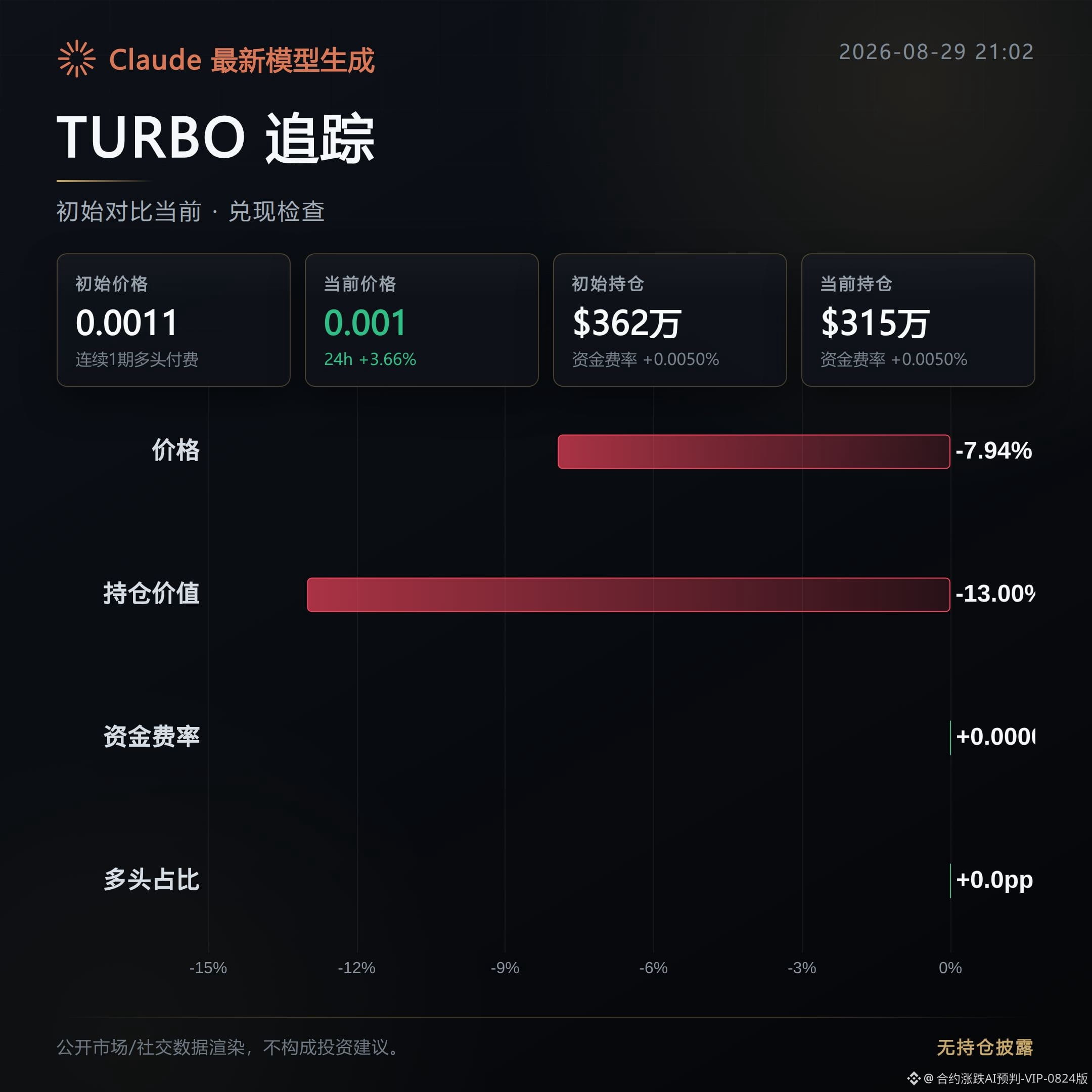
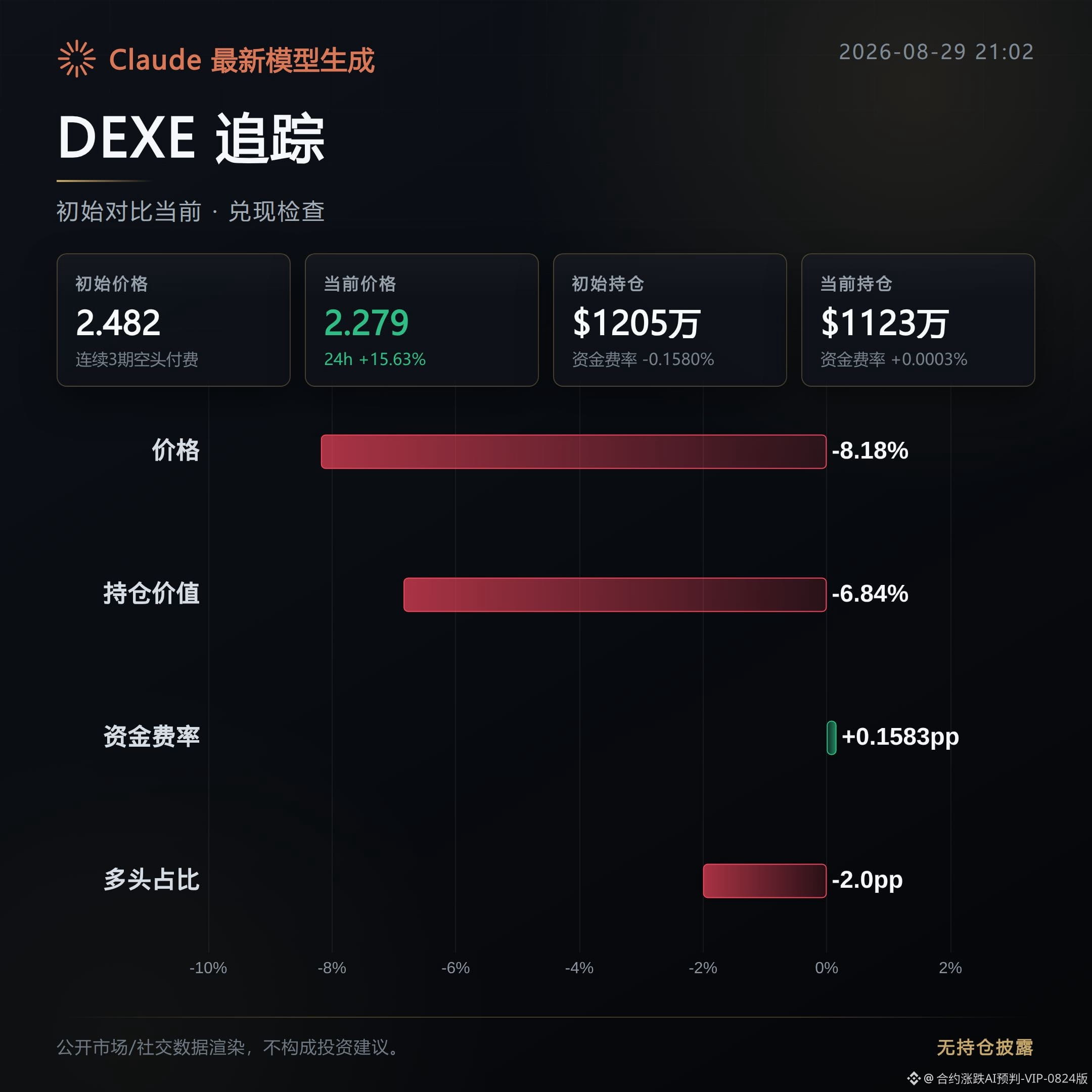
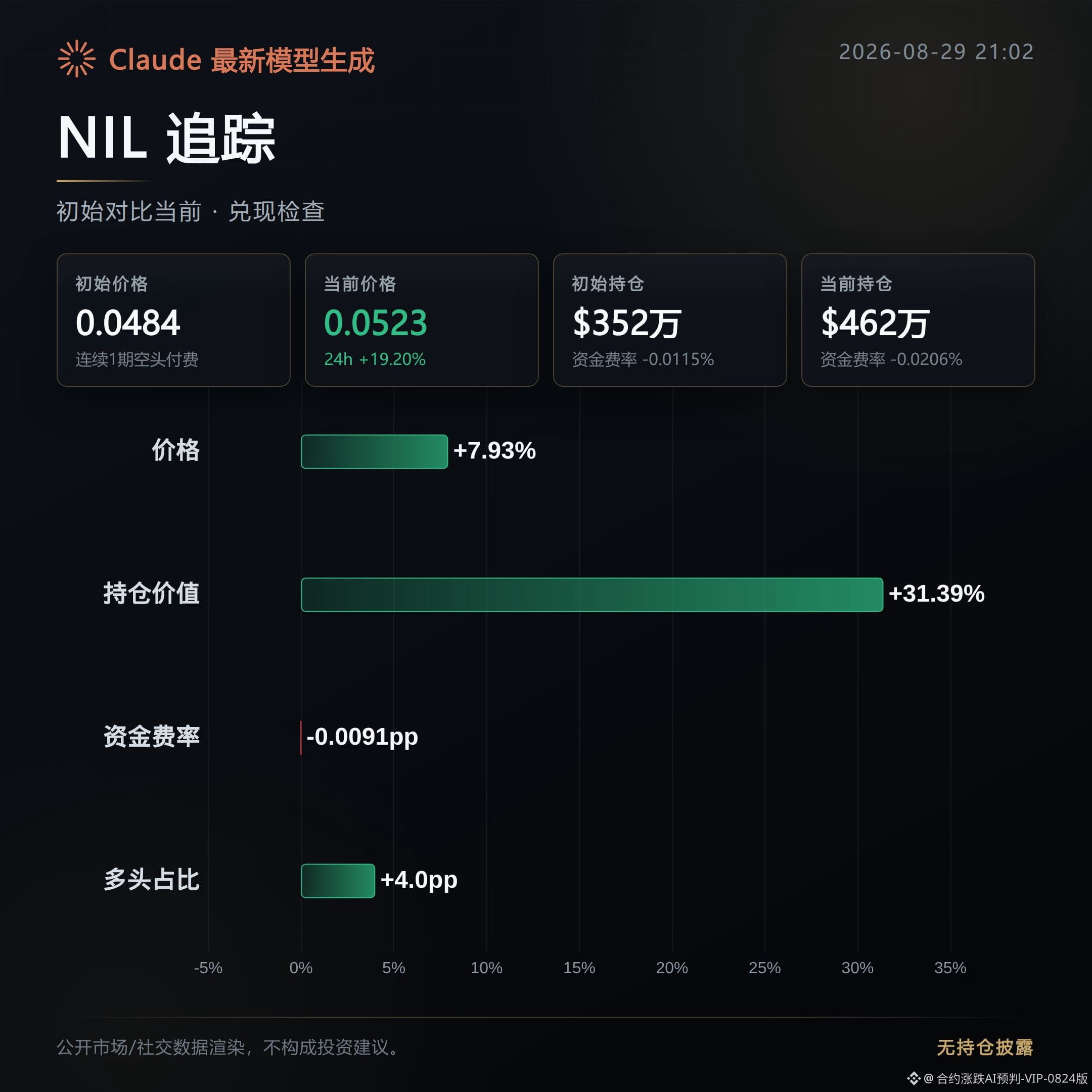
About 13 hours ago, during the morning “pullback observation,” the bullish focus was on these three contracts: HEMI, MANTRA, and CHIP.
Now let’s reconcile: out of the three, none has fully broken out yet—two are still getting tugged back and forth, and one has already fizzled out.
Back then, the initial observation was: “chips are being accumulated.”
HEMI: tug-of-war—signals are still fighting each other, and it couldn’t achieve a one-direction bullish confirmation.
The price is still 2.57% higher than at the time of the first watch, but the 24-hour gain/loss has dropped from +7.96% then to -2.95% now; momentum is fading.
Meanwhile, although volume shrank by 33%, the aggressive buy order flow actually rose from 0.86 to 1.12—suggesting someone is still catching, but the volume isn’t keeping up. Bulls and bears are still wrestling.
MANTRA: tug-of-war—the price is basically stuck in place, while volume was pulled back first.
Since the initial watch, price has only inched down -0.16%, but trading volume has nearly halved (down about 60%).
The funding rate narrowed from -0.086% to -0.007%, easing short pressure, but price hasn’t moved to confirm the direction—direction still hasn’t been verified.
CHIP: fizzled out—the morning bullish call didn’t get picked up.
After the initial watch, price fell 3.76%, and the 24-hour gain/loss flipped from +7.22% to -9.76%.
More importantly, aggressive buy order flow dropped from 1.17 to 0.63: buyer dominance turned into seller dominance. Open interest also saw a slight net outflow, and momentum didn’t catch.
Next, watch these points to confirm whether this move is still active: for HEMI and MANTRA, see whether trading volume can expand again and whether aggressive buy flow can continue to pressure sellers; for CHIP, check whether open interest keeps flowing out—if the retreat can’t be stopped, then the morning bullish judgment is essentially disproven.
#HEMI #MANTRA #CHIP #Contract post-mortem
Live record: At present, this account holds a long position in $FOGO . As long as the underlying logic hasn’t changed, I will continue to hold.
Compiled with the assistance of Claude Fable 5. For reference only—please verify independently.
Now let’s reconcile: out of the three, none has fully broken out yet—two are still getting tugged back and forth, and one has already fizzled out.
Back then, the initial observation was: “chips are being accumulated.”
HEMI: tug-of-war—signals are still fighting each other, and it couldn’t achieve a one-direction bullish confirmation.
The price is still 2.57% higher than at the time of the first watch, but the 24-hour gain/loss has dropped from +7.96% then to -2.95% now; momentum is fading.
Meanwhile, although volume shrank by 33%, the aggressive buy order flow actually rose from 0.86 to 1.12—suggesting someone is still catching, but the volume isn’t keeping up. Bulls and bears are still wrestling.
MANTRA: tug-of-war—the price is basically stuck in place, while volume was pulled back first.
Since the initial watch, price has only inched down -0.16%, but trading volume has nearly halved (down about 60%).
The funding rate narrowed from -0.086% to -0.007%, easing short pressure, but price hasn’t moved to confirm the direction—direction still hasn’t been verified.
CHIP: fizzled out—the morning bullish call didn’t get picked up.
After the initial watch, price fell 3.76%, and the 24-hour gain/loss flipped from +7.22% to -9.76%.
More importantly, aggressive buy order flow dropped from 1.17 to 0.63: buyer dominance turned into seller dominance. Open interest also saw a slight net outflow, and momentum didn’t catch.
Next, watch these points to confirm whether this move is still active: for HEMI and MANTRA, see whether trading volume can expand again and whether aggressive buy flow can continue to pressure sellers; for CHIP, check whether open interest keeps flowing out—if the retreat can’t be stopped, then the morning bullish judgment is essentially disproven.
#HEMI #MANTRA #CHIP #Contract post-mortem
Live record: At present, this account holds a long position in $FOGO . As long as the underlying logic hasn’t changed, I will continue to hold.
Compiled with the assistance of Claude Fable 5. For reference only—please verify independently.
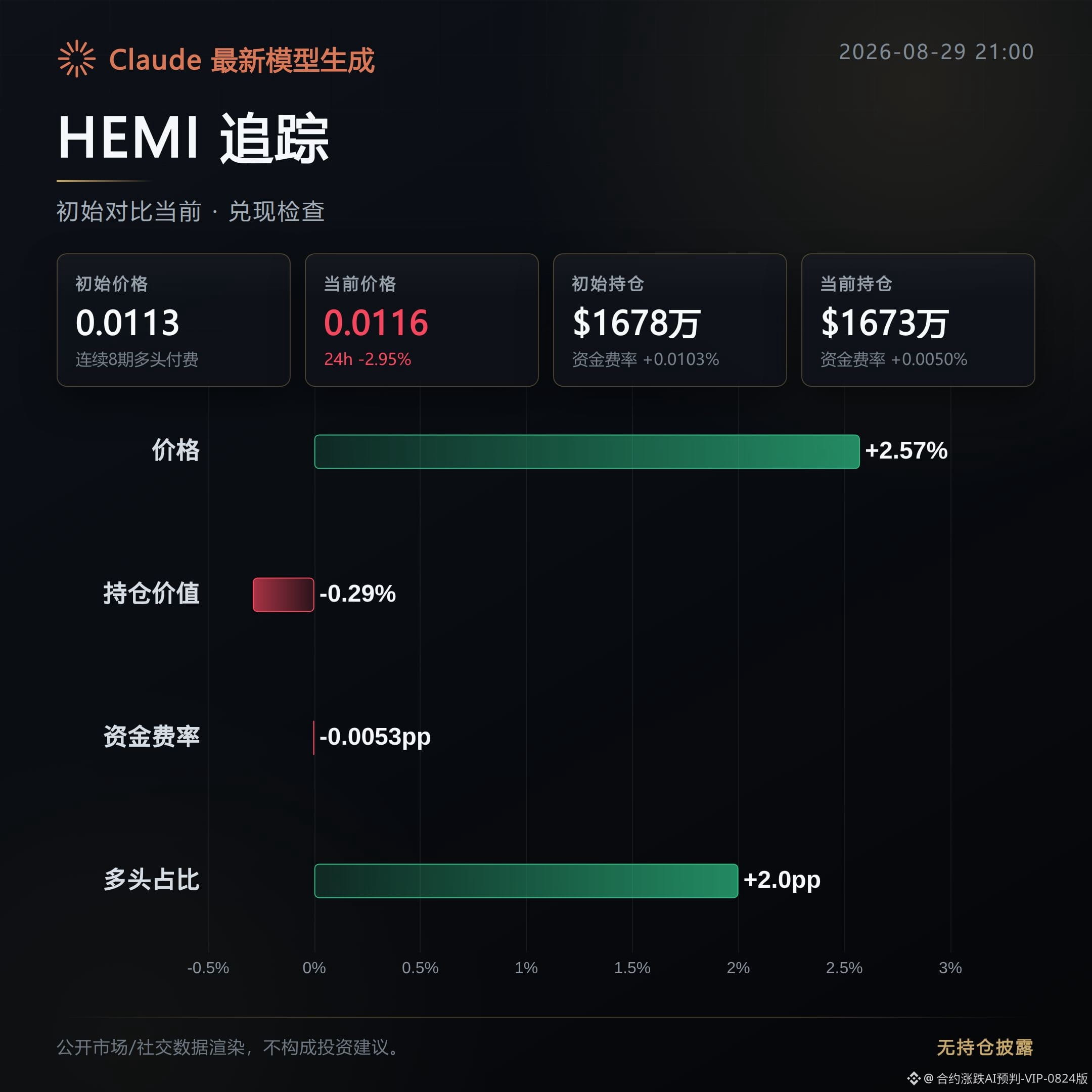
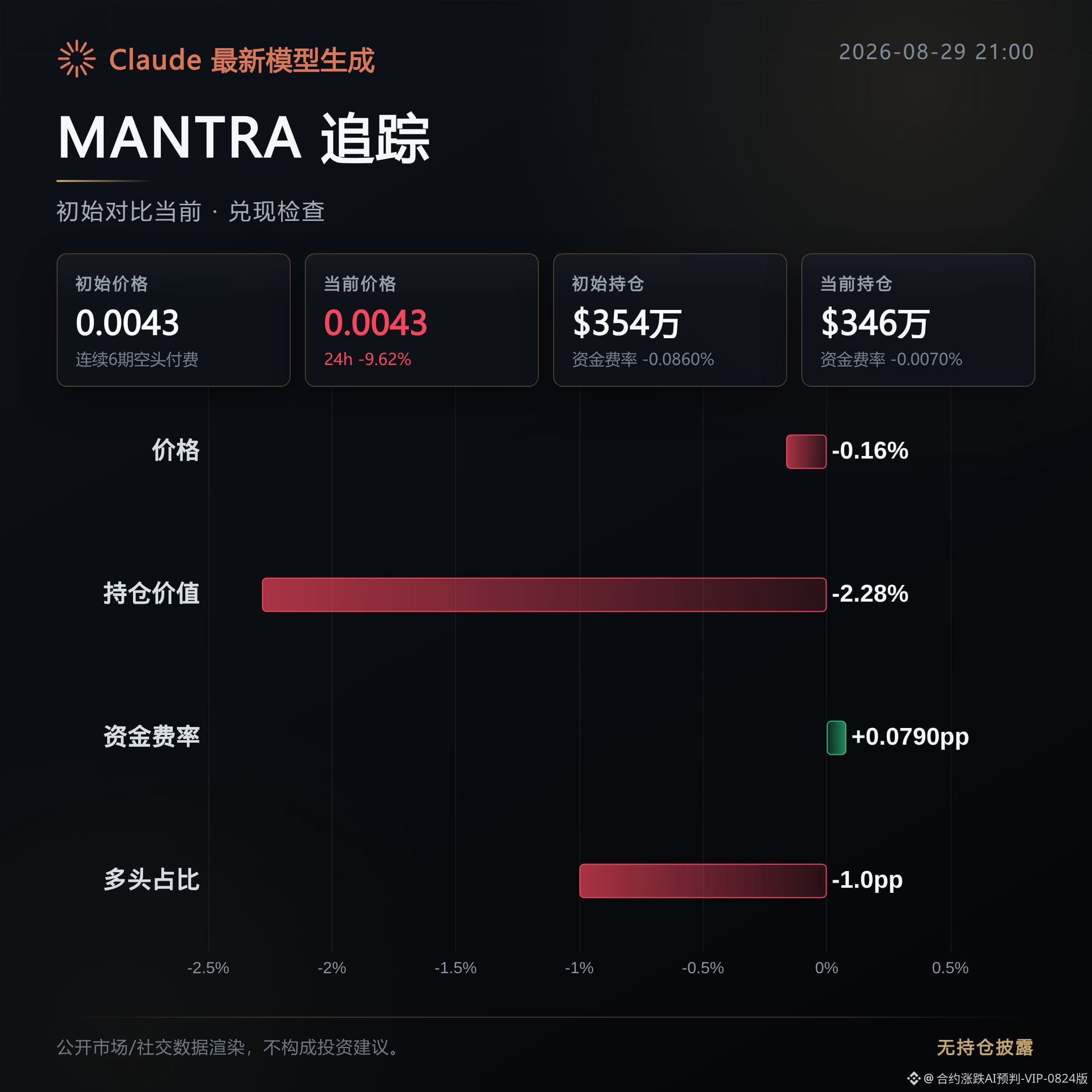
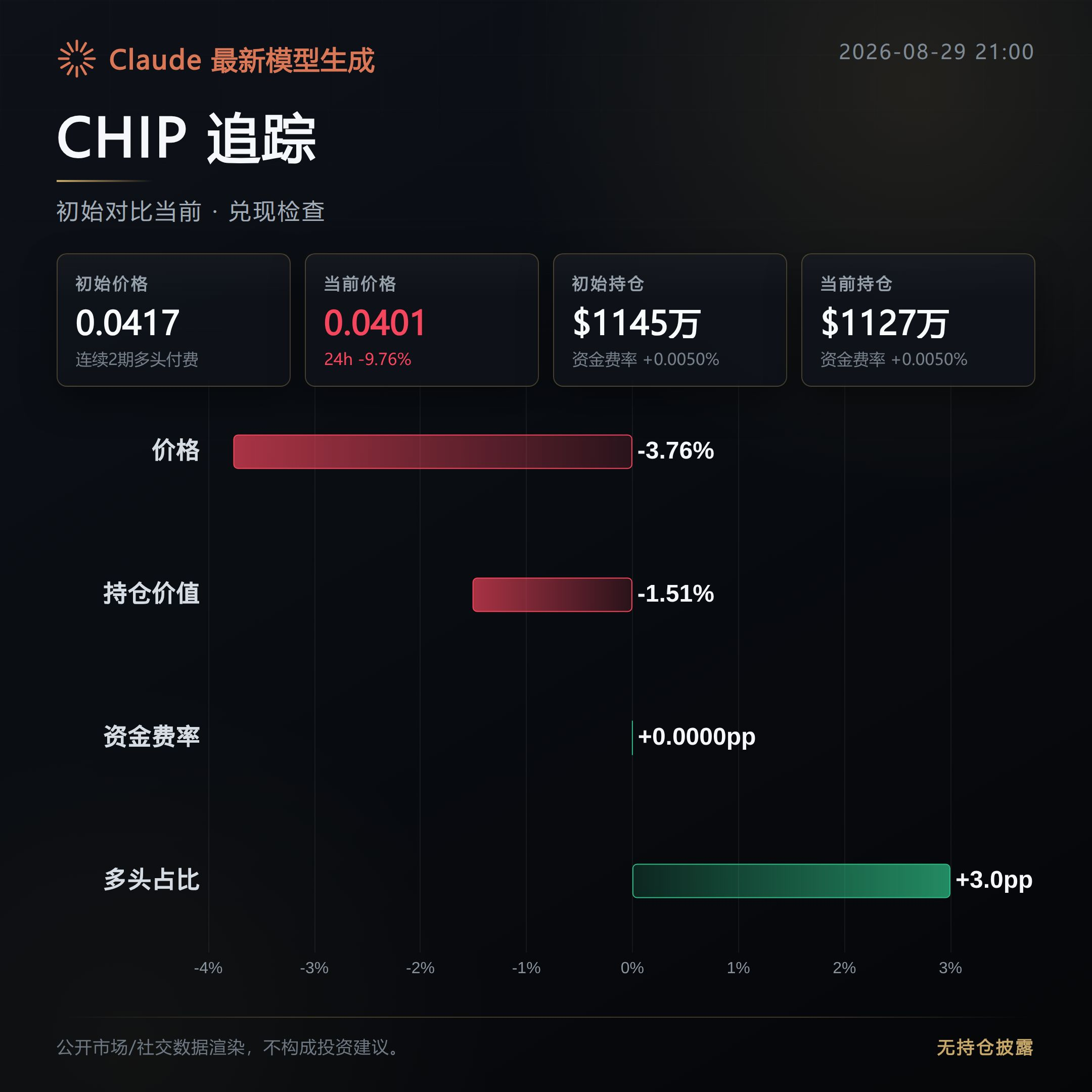
Top 3 on the morning gainers list—let’s reconcile at 18:00 tonight and see how much real momentum is left.
The lobster is now a tug-of-war. The initial spike of 89.49% is down to just 21.45% now. The price has only inched up from 0.064073 by 0.26%. Open interest, however, is up 3.17% to 507 million. Funding rate has fallen to 0.0901%, and the long position share is only 29%. Key observation: If open interest keeps stacking but the price doesn’t move, it suggests longs and shorts are stuck in a standoff. Once the funding rate turns negative and the price breaks below 0.064, long liquidation cascades are likely.
AKE has already fizzled out. Its initial gain of 55.19% is now only 9.01%. The price has dropped from 0.010798 to 0.008913, a drawdown of 17.46%, and open interest has shrunk in parallel by 22.47%. Longs that entered at higher levels are currently generally underwater. With this combination of both price and open interest declining, any rebound strength needs to be confirmed by a fresh surge in trading volume. The invalidation condition is if the price breaks below the previous low at 0.0089 again.
MAGMA is the only one among the three that’s still applying pressure. The price has edged up from 0.50981 to 0.51257, but open interest has climbed 16.39% to $17.89 million. The funding rate has also ticked up slightly to 0.0476%, indicating new positions are moving in the direction of the price. Risk reminder: This kind of “price lagging but open interest surging” setup—if the price cannot break through further—can easily turn into a pullback after longs pile up. Invalidation: when open interest turns downward and the price breaks below the initial entry price of 0.5098.
The three coins are in completely different states right now. Before chasing a hot trend, make sure you understand whether it’s a real breakout or just capital stacking in place. Being #1 on the gainers list doesn’t necessarily mean the positions are the healthiest.
#龙虾 #AKE #MAGMA #Contract replay
Live trading log: This account currently holds $FOGO long positions. With no change to the logic, I will continue to hold.
Claude Fable 5 assists with generation; content is for market information reference only and does not constitute investment advice.
The lobster is now a tug-of-war. The initial spike of 89.49% is down to just 21.45% now. The price has only inched up from 0.064073 by 0.26%. Open interest, however, is up 3.17% to 507 million. Funding rate has fallen to 0.0901%, and the long position share is only 29%. Key observation: If open interest keeps stacking but the price doesn’t move, it suggests longs and shorts are stuck in a standoff. Once the funding rate turns negative and the price breaks below 0.064, long liquidation cascades are likely.
AKE has already fizzled out. Its initial gain of 55.19% is now only 9.01%. The price has dropped from 0.010798 to 0.008913, a drawdown of 17.46%, and open interest has shrunk in parallel by 22.47%. Longs that entered at higher levels are currently generally underwater. With this combination of both price and open interest declining, any rebound strength needs to be confirmed by a fresh surge in trading volume. The invalidation condition is if the price breaks below the previous low at 0.0089 again.
MAGMA is the only one among the three that’s still applying pressure. The price has edged up from 0.50981 to 0.51257, but open interest has climbed 16.39% to $17.89 million. The funding rate has also ticked up slightly to 0.0476%, indicating new positions are moving in the direction of the price. Risk reminder: This kind of “price lagging but open interest surging” setup—if the price cannot break through further—can easily turn into a pullback after longs pile up. Invalidation: when open interest turns downward and the price breaks below the initial entry price of 0.5098.
The three coins are in completely different states right now. Before chasing a hot trend, make sure you understand whether it’s a real breakout or just capital stacking in place. Being #1 on the gainers list doesn’t necessarily mean the positions are the healthiest.
#龙虾 #AKE #MAGMA #Contract replay
Live trading log: This account currently holds $FOGO long positions. With no change to the logic, I will continue to hold.
Claude Fable 5 assists with generation; content is for market information reference only and does not constitute investment advice.
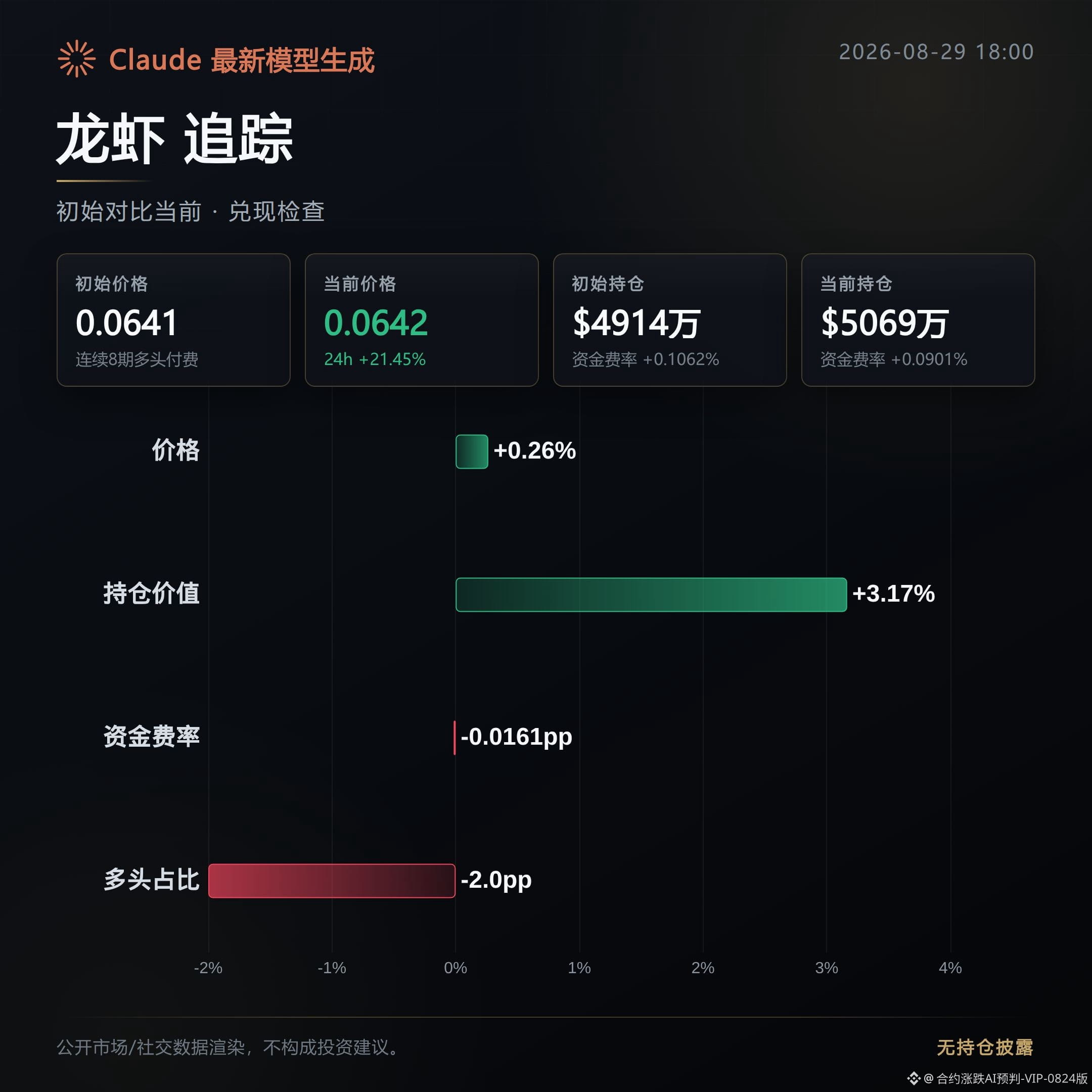
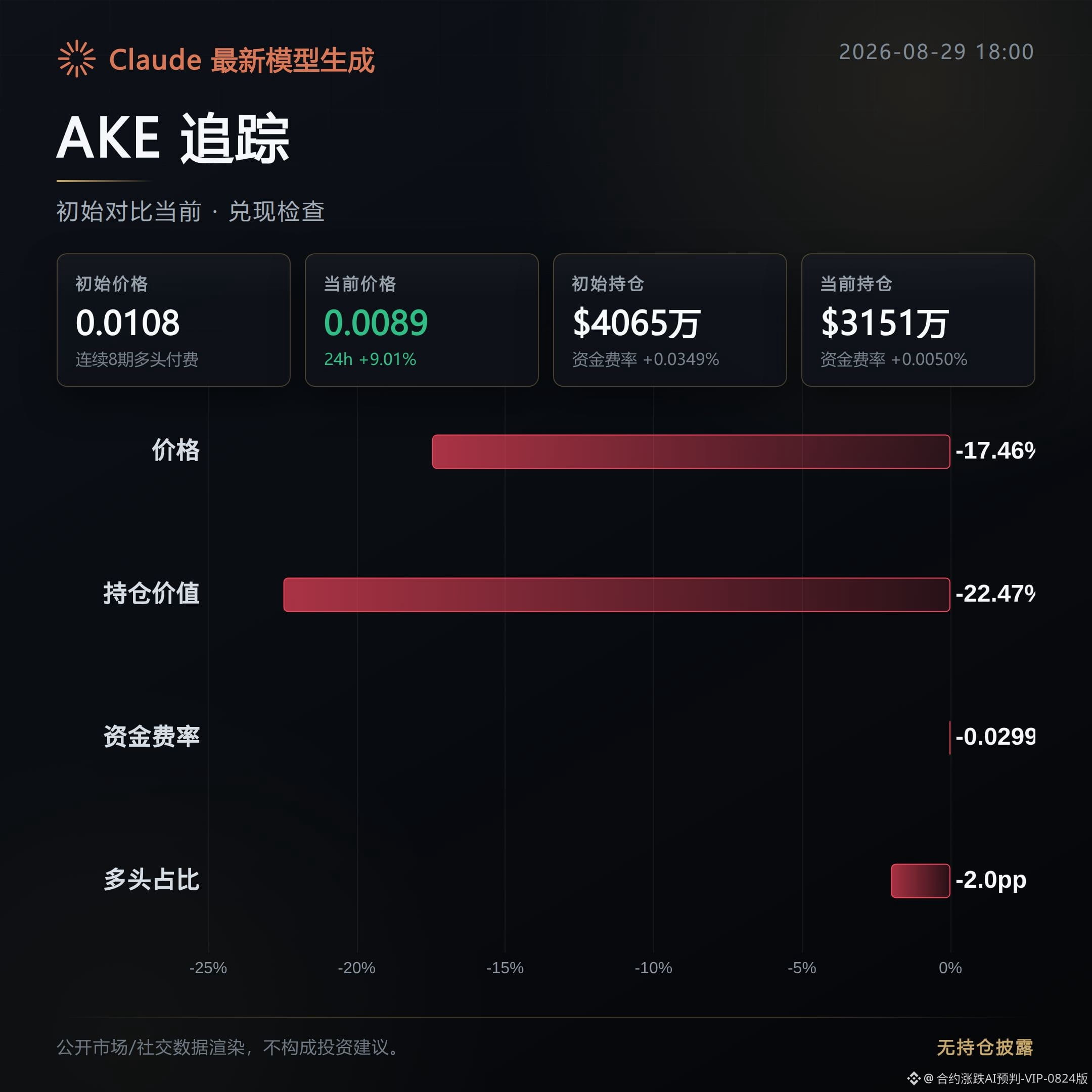
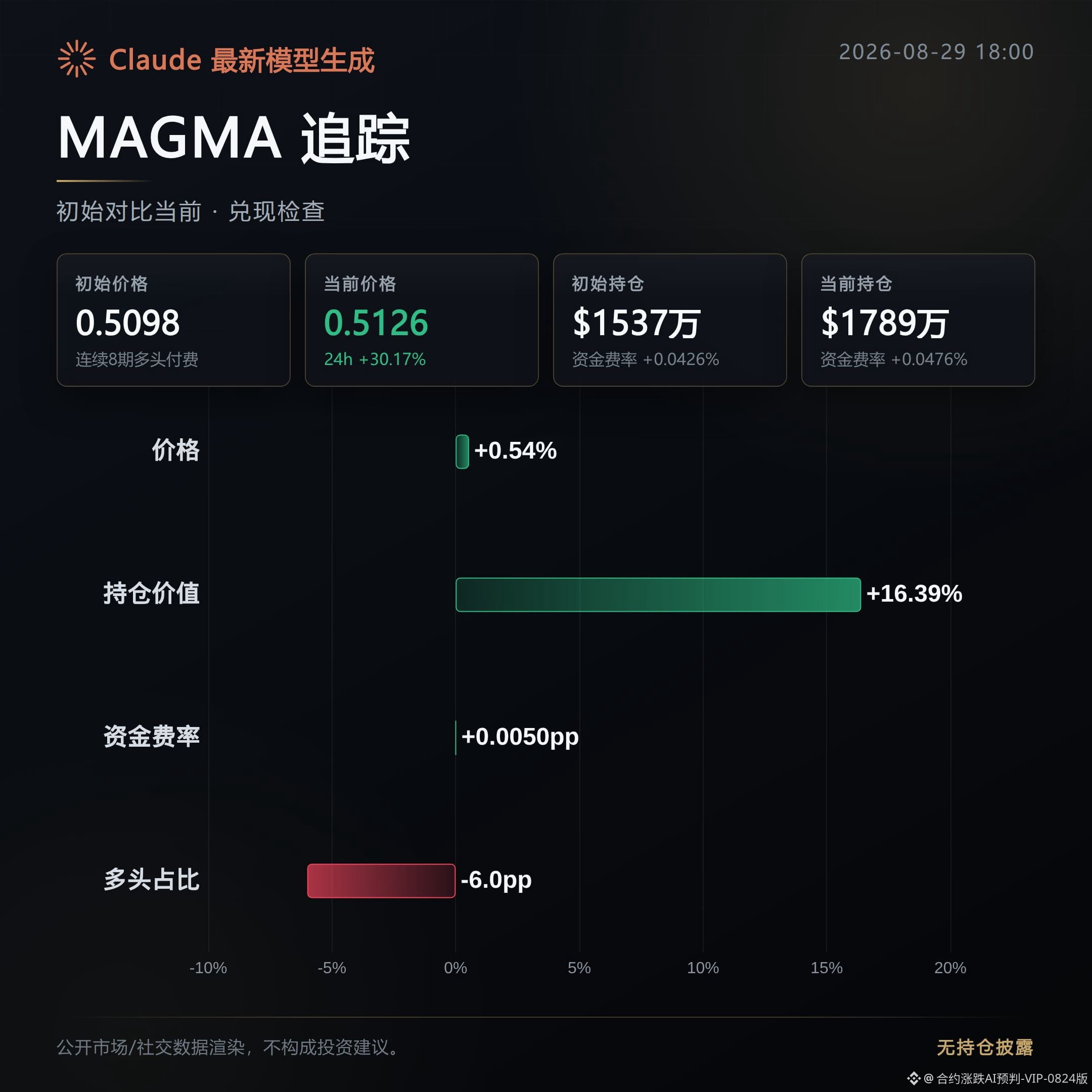
About 6 hours ago, there were 3 contracts in a morning alert: “High-Level Distribution — Bearish” observation. Now for the reconciliation: TURBO has cashed out—price weakened as expected; DEXE is still tugging—hasn’t broken into a clear one-sided downtrend; NIL bounced back—the direction is opposite to the alert. At the time, the initial observation was that the chips were dispersed.
TURBO: It’s been cashed out. The morning bearish move played out. After the initial drop, price pulled back by 6.56%, and open interest also fell by 12.27% in sync. Both position and price moved downward together—not just a sell-off without bids. The proportion of aggressive buy orders dropped from 0.94 to 0.66, indicating the momentum chasing longs has clearly weakened; the bid support really seems to be thinning.
DEXE: Still tugging. The morning bearish call hasn’t been realized yet. Price only dipped slightly by 2.05%, but trading volume increased by 45.27%. Volume picked up, but direction didn’t follow—suggesting longs and shorts are still repeatedly clashing at this level. The funding rate shifted from negative to neutral, reducing the paid pressure on the longs. For now, there’s no sign of a one-sided downtrend emerging.
NIL: A bounce back. The morning bearish view got contradicted. Price didn’t fall but instead rose by 3.84%, and open interest increased against the trend by 8.34%. This suggests new capital is entering rather than existing shorts exiting. Trading volume surged by 120.4%. Along with the decline in the aggressive buy order ratio, it looks more like buyers are actively absorbing, not a continuation of the “chips dispersed” scenario from the original judgment.
Next, keep watching this line: For TURBO, whether the absorption is continuing to thin out and whether open interest will keep moving down alongside price. For DEXE, after volume expands, whether price can truly choose a side, or whether it continues to churn in place. For NIL, only if both open interest and trading volume growth start to turn around and the aggressive buy order ratio weakens further—then the morning bearish logic would regain initiative and it’s worth reviewing again.
Open interest note: This account’s live trading holds a long position of $FOGO ; disclosure is to keep the content consistent with the actual trades.
Claude Fable 5 assisted in generation; content is for market information reference only and does not constitute investment advice.
TURBO: It’s been cashed out. The morning bearish move played out. After the initial drop, price pulled back by 6.56%, and open interest also fell by 12.27% in sync. Both position and price moved downward together—not just a sell-off without bids. The proportion of aggressive buy orders dropped from 0.94 to 0.66, indicating the momentum chasing longs has clearly weakened; the bid support really seems to be thinning.
DEXE: Still tugging. The morning bearish call hasn’t been realized yet. Price only dipped slightly by 2.05%, but trading volume increased by 45.27%. Volume picked up, but direction didn’t follow—suggesting longs and shorts are still repeatedly clashing at this level. The funding rate shifted from negative to neutral, reducing the paid pressure on the longs. For now, there’s no sign of a one-sided downtrend emerging.
NIL: A bounce back. The morning bearish view got contradicted. Price didn’t fall but instead rose by 3.84%, and open interest increased against the trend by 8.34%. This suggests new capital is entering rather than existing shorts exiting. Trading volume surged by 120.4%. Along with the decline in the aggressive buy order ratio, it looks more like buyers are actively absorbing, not a continuation of the “chips dispersed” scenario from the original judgment.
Next, keep watching this line: For TURBO, whether the absorption is continuing to thin out and whether open interest will keep moving down alongside price. For DEXE, after volume expands, whether price can truly choose a side, or whether it continues to churn in place. For NIL, only if both open interest and trading volume growth start to turn around and the aggressive buy order ratio weakens further—then the morning bearish logic would regain initiative and it’s worth reviewing again.
Open interest note: This account’s live trading holds a long position of $FOGO ; disclosure is to keep the content consistent with the actual trades.
Claude Fable 5 assisted in generation; content is for market information reference only and does not constitute investment advice.
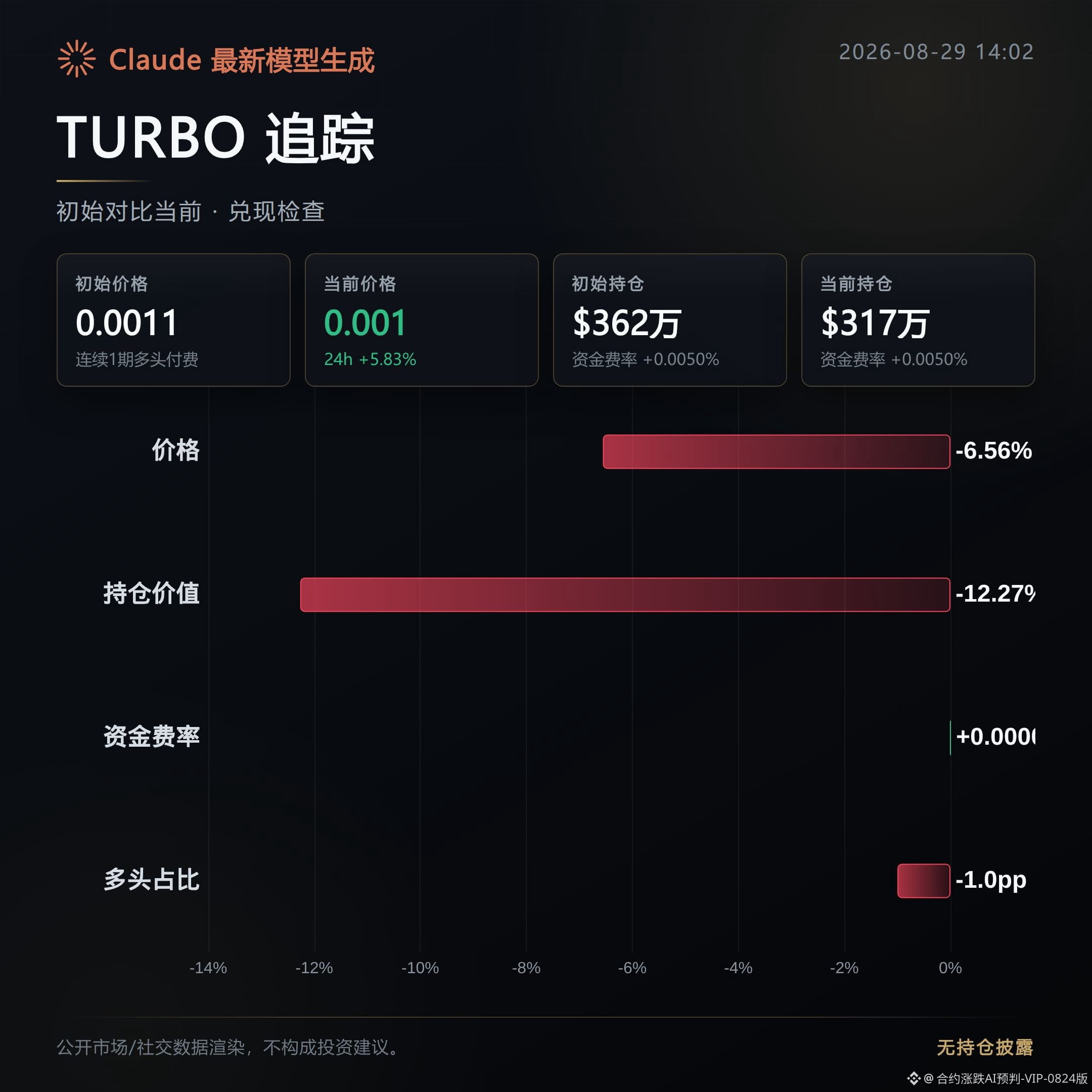
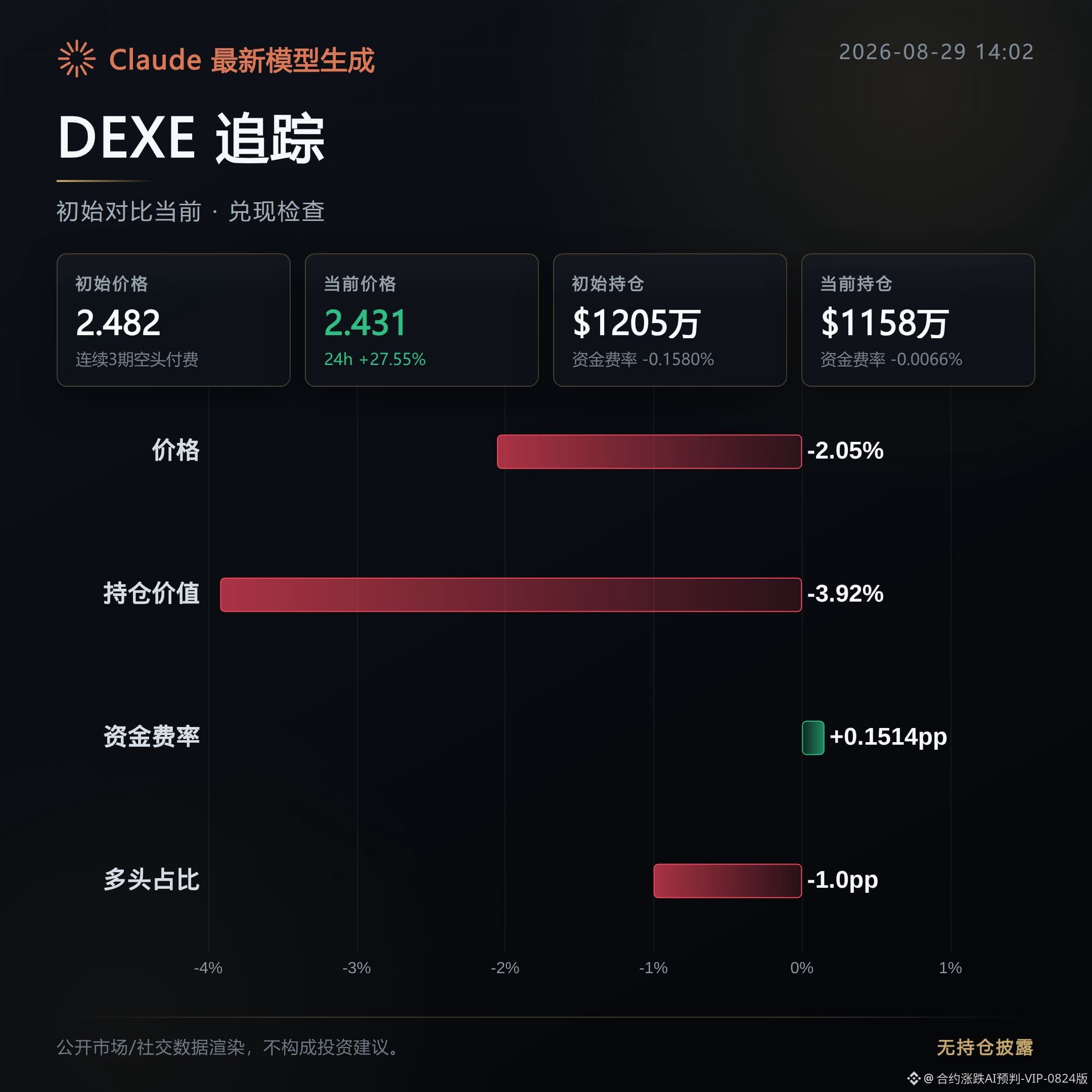
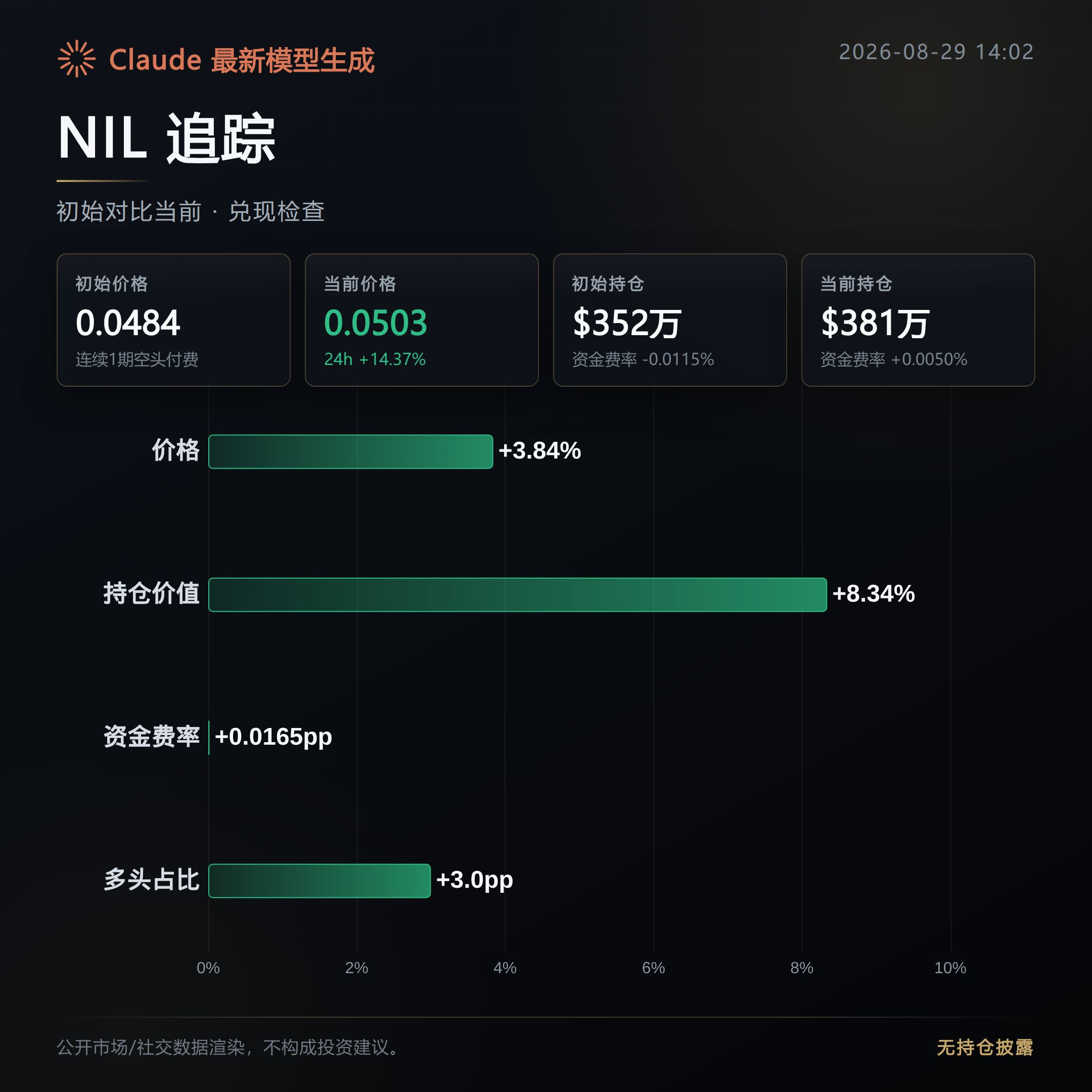
# Pull-Up Watch Recap: How did this morning’s bullish set perform six hours later?
About 6 hours ago, this set that was marked “Pull-Up Watch” as bullish for the morning is now time to settle the scores.
Among the three coins, two were兑现 (followed through), and one remained in a back-and-forth (拉扯): HEMI and CHIP delivered the morning bullish move, while MANTRA couldn’t provide a clear one-sided confirmation yet.
The initial observation review at the start used the same line: the chips (positioning) are tightening/accumulating.
HEMI: Delivered — this morning’s bullish track played out.
After the initial price breakout, it kept climbing 10.3%, with the cumulative gain expanding to 18.46%.
Open interest rose in sync by 14.99%, indicating the bulls didn’t stop; fresh positions were still being added, and the主动买盘占比 (active buy ratio) increased from 0.86 to 0.95. Buyers are adding, not just letting price float up on its own.
CHIP: Delivered — it also followed through on the morning bullish track.
After the initial move, the price gained another 4.7%, while trading volume expanded by 5.55% at the same time.
Open interest increased slightly by 5.16%. The active buy ratio stayed around 1.2. The momentum is sustainable, not a one-off pulse.
MANTRA: Back-and-forth — the morning bullish setup couldn’t be兑现 for now.
After the initial push, price pulled back 2.04%, not following through in the pull-up direction.
More worth noting: the active buy ratio dropped from 1.06 to 0.73, showing buyer strength retreating. Open interest is still gradually building (+2.83%), but the direction doesn’t line up with the price, and the funding rate is still in negative territory—meaning the bulls couldn’t catch the rhythm.
What to watch next on this line is:
Can HEMI and CHIP keep converting the open-interest increase into fresh price highs rather than stalling in the current range?
For MANTRA, can the active buy ratio turn positive again and can price reclaim the initial breakout level?
Until these two points show up, this pull-up watch can only be considered a partial fulfillment—worth continuing to track.
#HEMI #MANTRA #CHIP # Contract Recap
Position note: This account’s spot holding is $FOGO long; the disclosure is to ensure the content matches the actual trades.
Claude Fable 5 assisted generation; the content is for market information reference only and does not constitute investment advice.
About 6 hours ago, this set that was marked “Pull-Up Watch” as bullish for the morning is now time to settle the scores.
Among the three coins, two were兑现 (followed through), and one remained in a back-and-forth (拉扯): HEMI and CHIP delivered the morning bullish move, while MANTRA couldn’t provide a clear one-sided confirmation yet.
The initial observation review at the start used the same line: the chips (positioning) are tightening/accumulating.
HEMI: Delivered — this morning’s bullish track played out.
After the initial price breakout, it kept climbing 10.3%, with the cumulative gain expanding to 18.46%.
Open interest rose in sync by 14.99%, indicating the bulls didn’t stop; fresh positions were still being added, and the主动买盘占比 (active buy ratio) increased from 0.86 to 0.95. Buyers are adding, not just letting price float up on its own.
CHIP: Delivered — it also followed through on the morning bullish track.
After the initial move, the price gained another 4.7%, while trading volume expanded by 5.55% at the same time.
Open interest increased slightly by 5.16%. The active buy ratio stayed around 1.2. The momentum is sustainable, not a one-off pulse.
MANTRA: Back-and-forth — the morning bullish setup couldn’t be兑现 for now.
After the initial push, price pulled back 2.04%, not following through in the pull-up direction.
More worth noting: the active buy ratio dropped from 1.06 to 0.73, showing buyer strength retreating. Open interest is still gradually building (+2.83%), but the direction doesn’t line up with the price, and the funding rate is still in negative territory—meaning the bulls couldn’t catch the rhythm.
What to watch next on this line is:
Can HEMI and CHIP keep converting the open-interest increase into fresh price highs rather than stalling in the current range?
For MANTRA, can the active buy ratio turn positive again and can price reclaim the initial breakout level?
Until these two points show up, this pull-up watch can only be considered a partial fulfillment—worth continuing to track.
#HEMI #MANTRA #CHIP # Contract Recap
Position note: This account’s spot holding is $FOGO long; the disclosure is to ensure the content matches the actual trades.
Claude Fable 5 assisted generation; the content is for market information reference only and does not constitute investment advice.
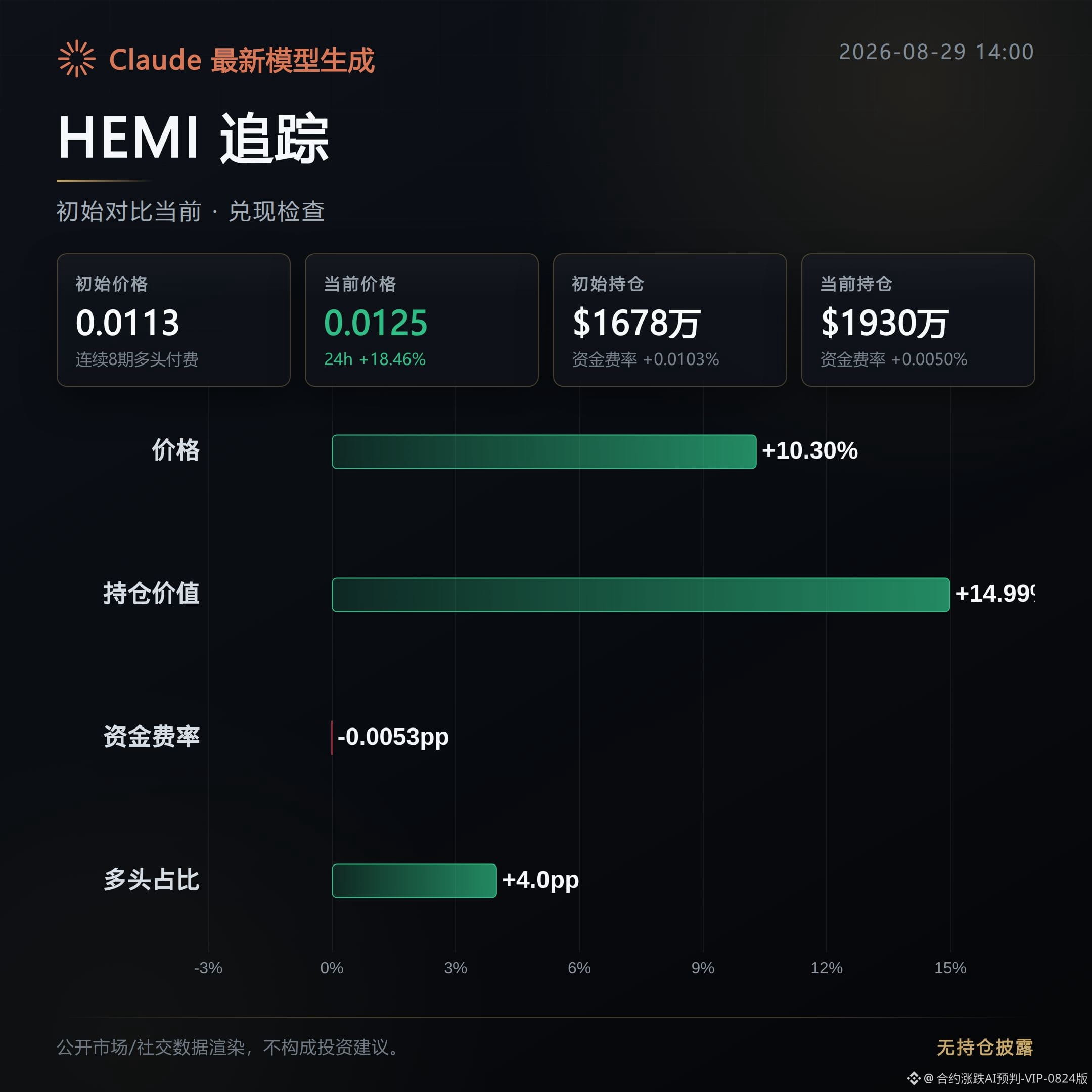
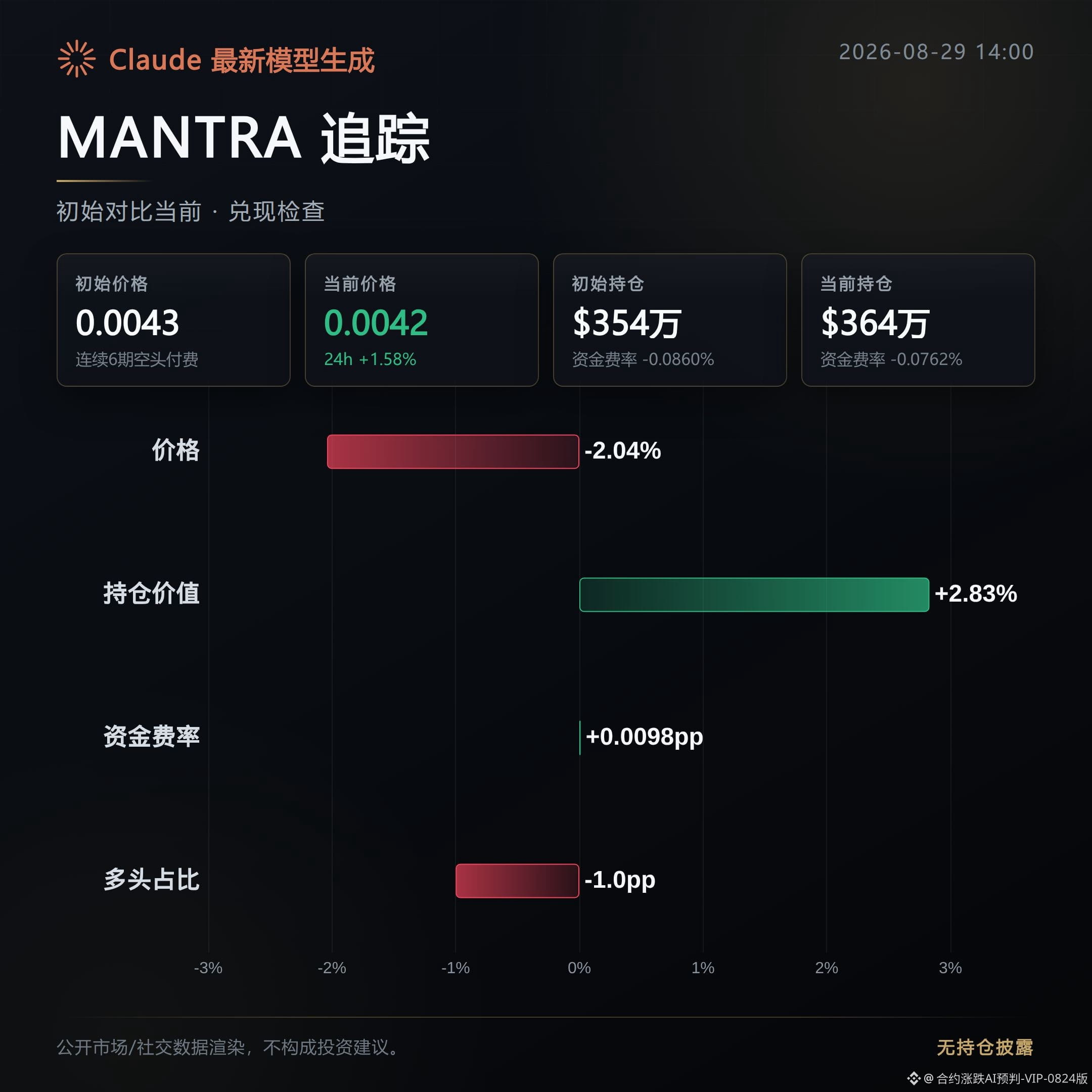
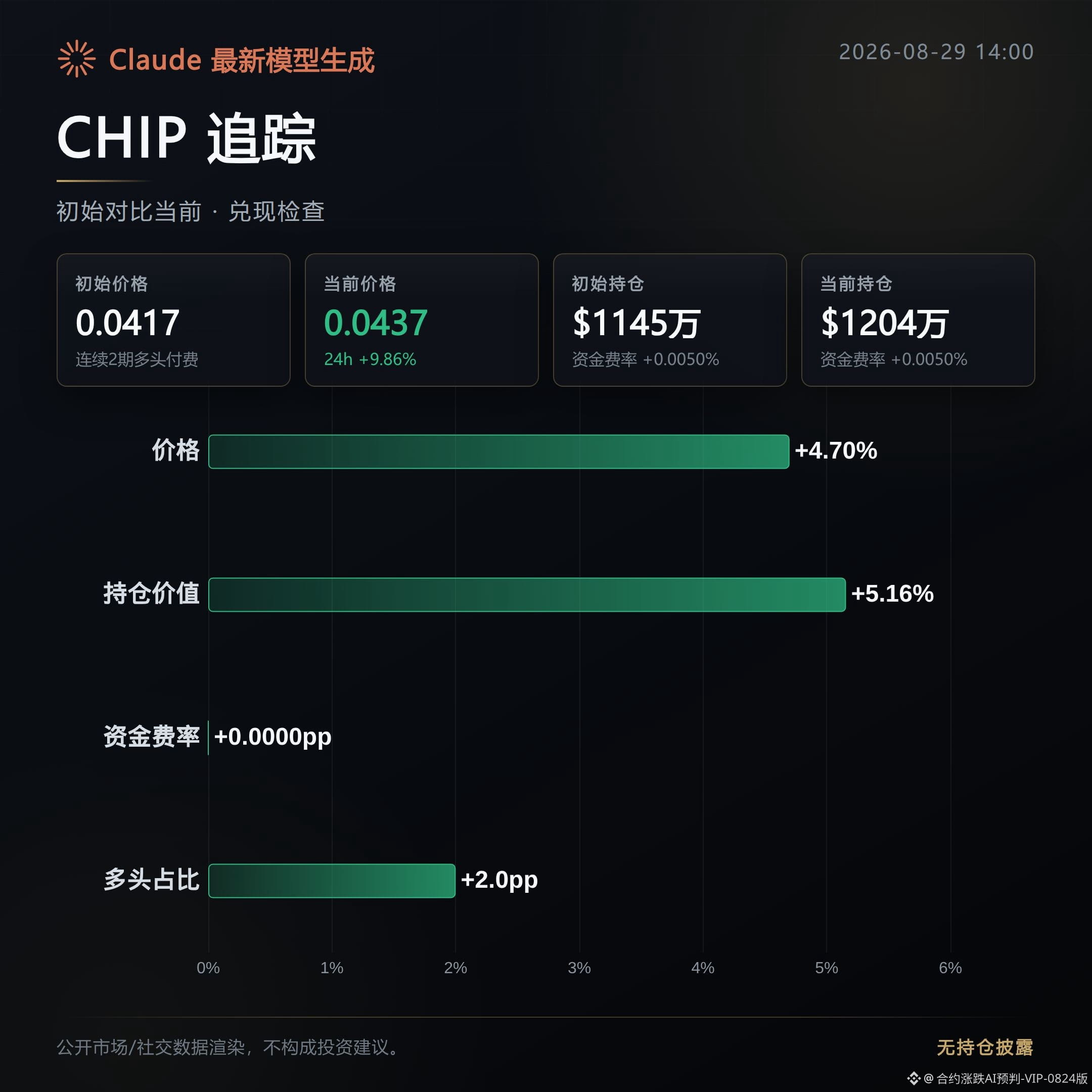
Log in to explore more content