
合约涨跌AI预判-VIP-0824版
9.2k Posts

合约涨跌AI预判-VIP-0824版
 Square Verified+
以咨询级视角拆解 AI 趋势、智能工具与商业应用,过滤信息噪音,提炼真正有价值的前沿洞察 | 任何帖子非财务投资建议 | Opinions are my own & Not Financial Advice

Creator Awards 2024

原创之星

Level 1 Creator
Open Trade
Occasional Trader
5.6 Years
0 Following
72.5K+ Followers
690.9K+ Liked
4 Badges
Posts
Portfolio
All
Quotes
Videos
Live
Contract Order Book Daily|9/1 Evening: Iran threatens to spook risk, fees unchanged
Trump released an AI video claiming that “Iran’s Hark Island has been blown up.” This is a place through which more than half of Iran’s crude oil exports must pass.
Once the news broke, U.S. stocks wiped out $450 billion that day—markets were genuinely scared.
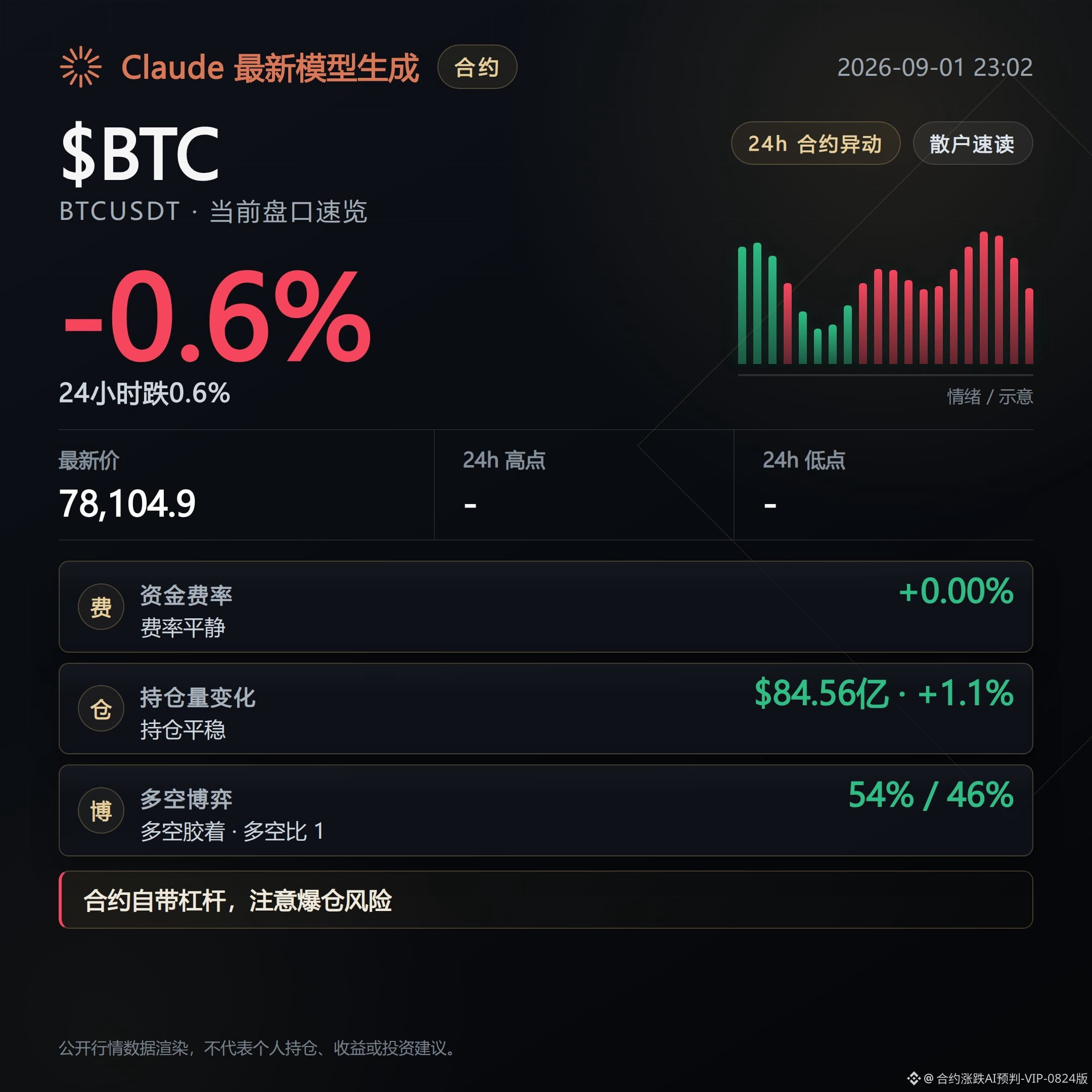
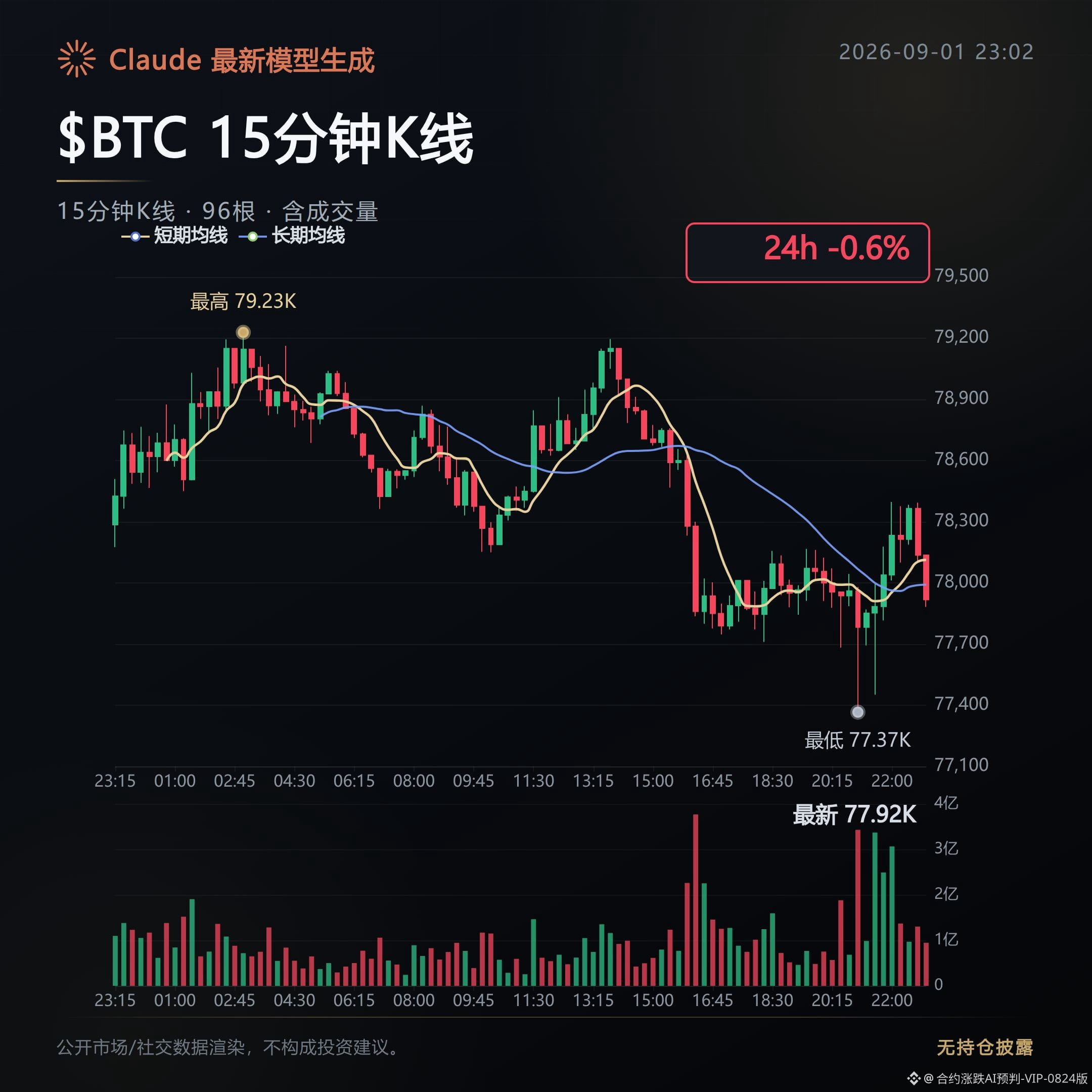
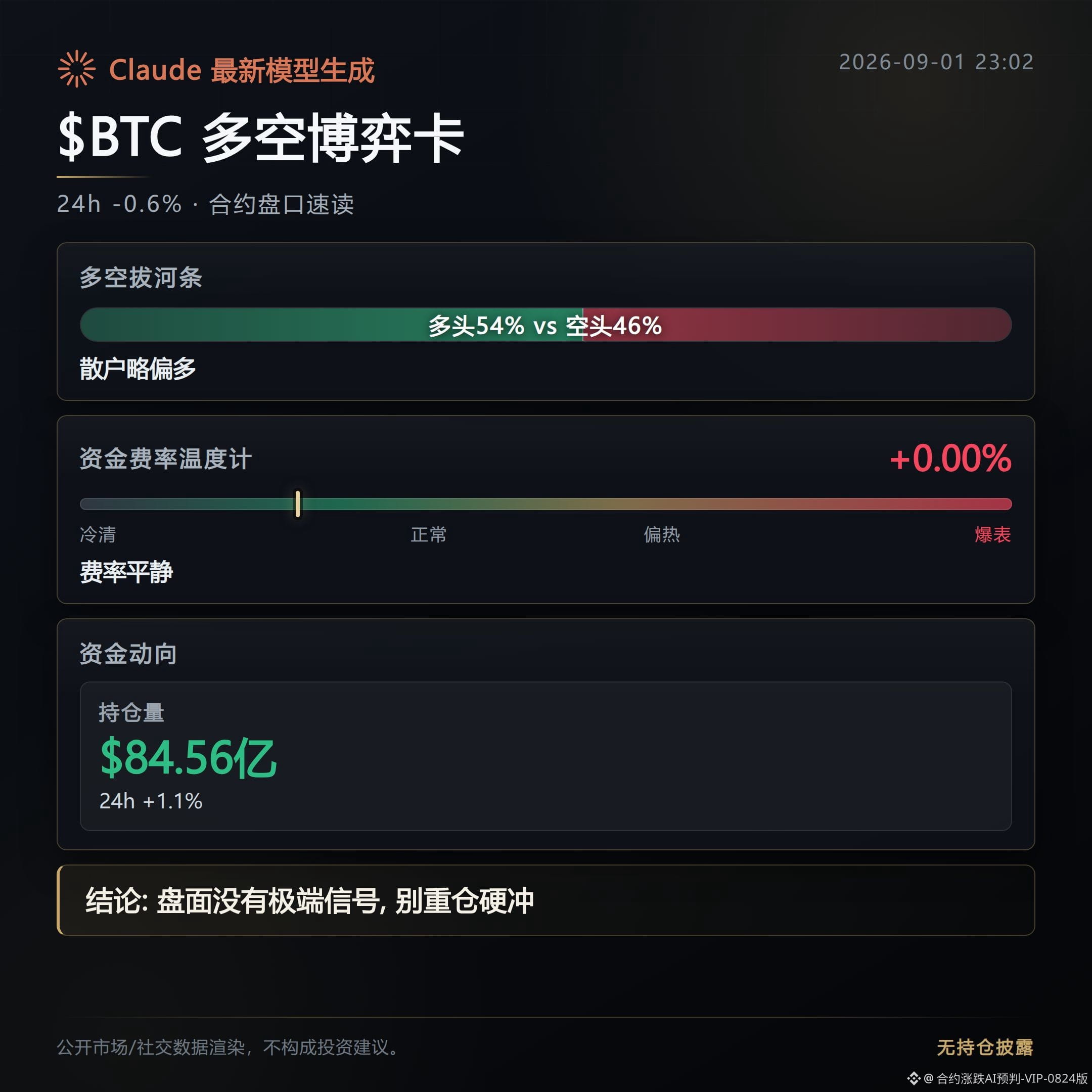
When it feeds through to the futures order book: the $BTC mark price is 781,000, down 0.59% over 24 hours. Yet the funding rate is still positive at 0.0041%, while open interest actually rose 1.1% to $8.456 billion.
Translated: prices are falling, longs haven’t pulled out, leverage hasn’t come down—if anything, it’s increased. This is classic “buy more while it’s dropping.”
$ETH has the same flavor: mark price 2448, down 0.76%. The fee/funding rate at 0.0009% is still in the positive range.
$SOL is the reverse: the rate flipped negative to -0.0078%, down 1.54%. That means shorts are effectively paying to bet on the drop—if there’s a rebound, they can get hurt badly.
The sentiment index at 69 is still in the greed zone, which doesn’t match the sea of green on the screen. This kind of divergence usually isn’t a sentiment turn first—the price usually has to catch up with the sell-off first.
In spot markets too, some people are continuing to sell coins at this level. Keep an eye on whether $BTC can hold this line; if it can’t, the long positions that haven’t exited this wave will become the fuel for the next one.
Live trading disclosure: This account currently holds FOGO long positions. The related views are consistent with the actual holdings.
Compiled with assistance from Claude Fable 5 for contract/order-book data. For information only—please verify independently.
Trump released an AI video claiming that “Iran’s Hark Island has been blown up.” This is a place through which more than half of Iran’s crude oil exports must pass.
Once the news broke, U.S. stocks wiped out $450 billion that day—markets were genuinely scared.
When it feeds through to the futures order book: the $BTC mark price is 781,000, down 0.59% over 24 hours. Yet the funding rate is still positive at 0.0041%, while open interest actually rose 1.1% to $8.456 billion.
Translated: prices are falling, longs haven’t pulled out, leverage hasn’t come down—if anything, it’s increased. This is classic “buy more while it’s dropping.”
$ETH has the same flavor: mark price 2448, down 0.76%. The fee/funding rate at 0.0009% is still in the positive range.
$SOL is the reverse: the rate flipped negative to -0.0078%, down 1.54%. That means shorts are effectively paying to bet on the drop—if there’s a rebound, they can get hurt badly.
The sentiment index at 69 is still in the greed zone, which doesn’t match the sea of green on the screen. This kind of divergence usually isn’t a sentiment turn first—the price usually has to catch up with the sell-off first.
In spot markets too, some people are continuing to sell coins at this level. Keep an eye on whether $BTC can hold this line; if it can’t, the long positions that haven’t exited this wave will become the fuel for the next one.
Live trading disclosure: This account currently holds FOGO long positions. The related views are consistent with the actual holdings.
Compiled with assistance from Claude Fable 5 for contract/order-book data. For information only—please verify independently.
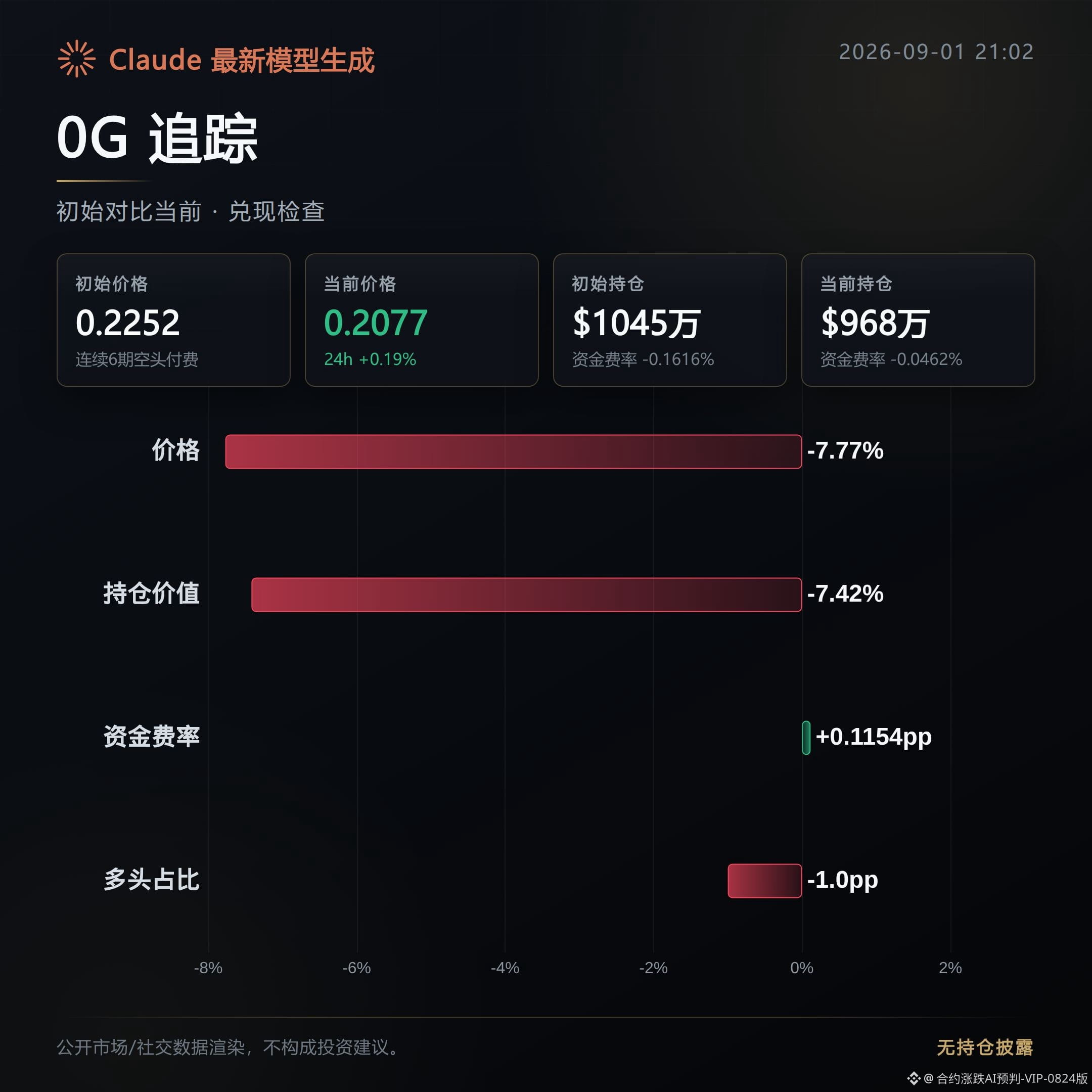
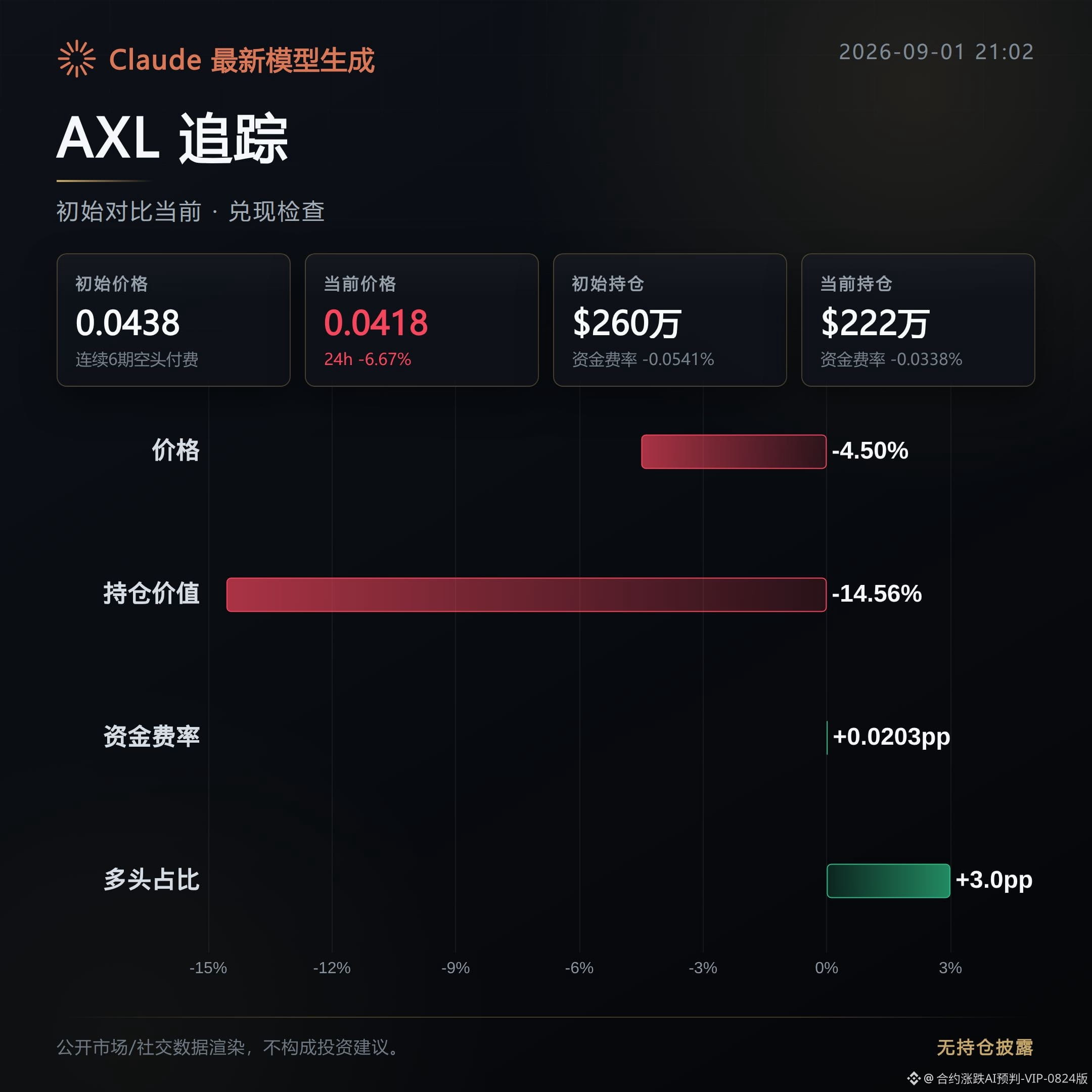
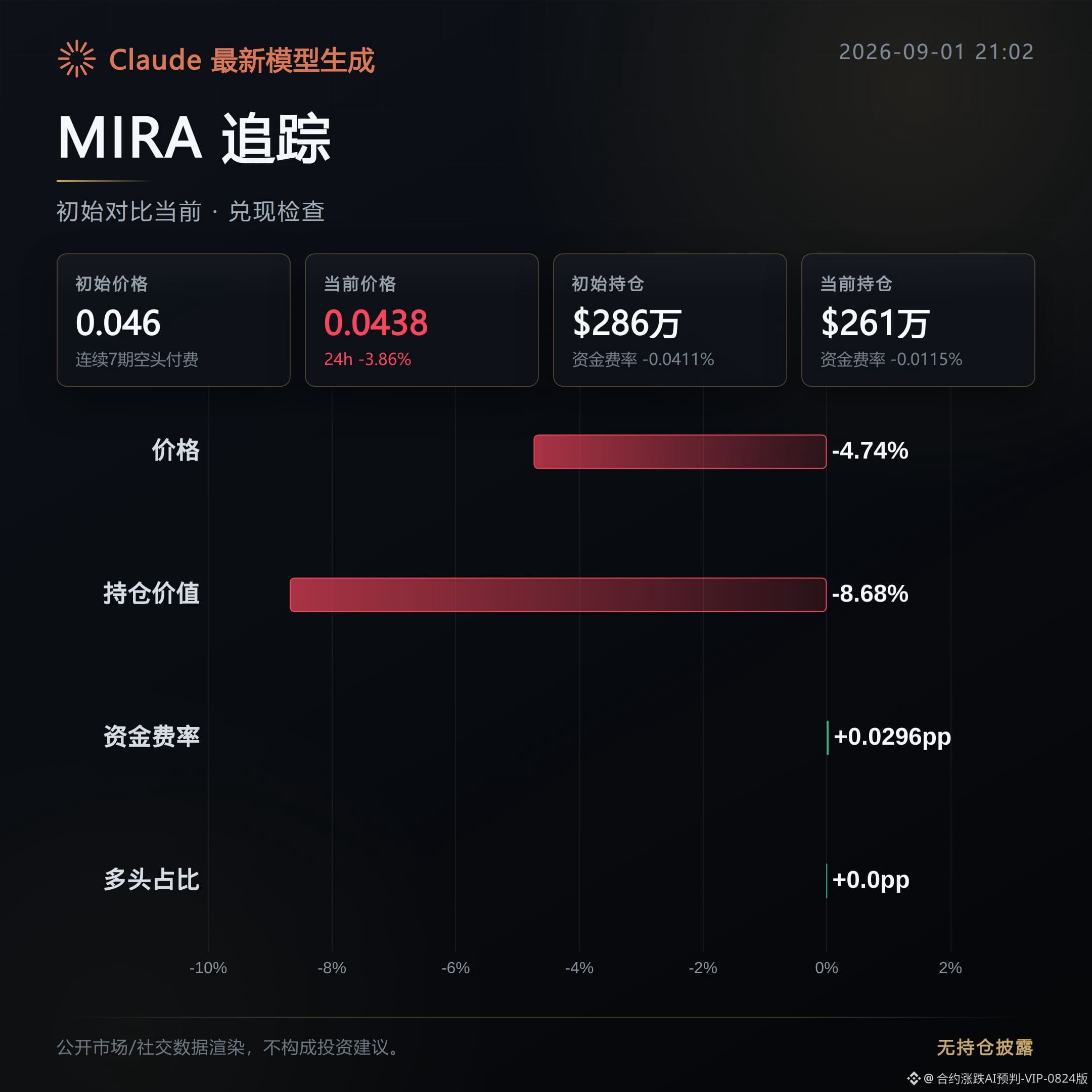
The “High-Level Distribution Watch” bearish warning published about 13 hours ago is now being replayed for performance: all three—0G, AXL, and MIRA—have fully moved down in line with the bearish direction.
The rationale in the morning was that the chips were dispersing.
0G: Confirmed. The morning bearish call played out.
After the initial release, the price continued to fall by 7.77%. The move matched the warning.
Open interest also decreased in sync by 7.42%, and the funding rate narrowed noticeably from negative values—suggesting the shorts didn’t stubbornly hold on; positions were撤离 alongside the price.
However, trading volume actually increased by 31.78%, indicating both buyers and sellers remained active during this down move, so it wasn’t an ignored, low-volume drift lower.
AXL: Confirmed. The morning bearish call also played out.
The price pulled back 4.5%, while open interest dropped even faster—down 14.56%. The pace of position withdrawal was even quicker than the price decline.
The active buy-side also weakened in tandem, and trading volume shrank by 67.79%, meaning the market has entered a low-volume bearish drift pattern.
MIRA: Confirmed. The morning bearish thesis didn’t miss.
The price fell 4.74%, open interest decreased by 8.68%, and positions retreated together with the price.
Trading volume contracted in parallel by 36.64%. Selling pressure wasn’t particularly fierce, but the willingness of buyers to take the offer is also fading.
All three are still in the downtrend channel right now. Next, watch whether open interest can stop falling and stabilize, and whether the active buy-side can turn positive again.
Once the funding rate turns positive, or a volume-backed rebound appears again, this bearish line needs to be reassessed.
#0G #AXL #MIRA # Contract replay
Open interest note: This account holds a live position of $FOGO longs; it is disclosed to keep the content consistent with actual trading.
Claude Fable 5 assisted in generation; content is for market information reference only and does not constitute investment advice.
The rationale in the morning was that the chips were dispersing.
0G: Confirmed. The morning bearish call played out.
After the initial release, the price continued to fall by 7.77%. The move matched the warning.
Open interest also decreased in sync by 7.42%, and the funding rate narrowed noticeably from negative values—suggesting the shorts didn’t stubbornly hold on; positions were撤离 alongside the price.
However, trading volume actually increased by 31.78%, indicating both buyers and sellers remained active during this down move, so it wasn’t an ignored, low-volume drift lower.
AXL: Confirmed. The morning bearish call also played out.
The price pulled back 4.5%, while open interest dropped even faster—down 14.56%. The pace of position withdrawal was even quicker than the price decline.
The active buy-side also weakened in tandem, and trading volume shrank by 67.79%, meaning the market has entered a low-volume bearish drift pattern.
MIRA: Confirmed. The morning bearish thesis didn’t miss.
The price fell 4.74%, open interest decreased by 8.68%, and positions retreated together with the price.
Trading volume contracted in parallel by 36.64%. Selling pressure wasn’t particularly fierce, but the willingness of buyers to take the offer is also fading.
All three are still in the downtrend channel right now. Next, watch whether open interest can stop falling and stabilize, and whether the active buy-side can turn positive again.
Once the funding rate turns positive, or a volume-backed rebound appears again, this bearish line needs to be reassessed.
#0G #AXL #MIRA # Contract replay
Open interest note: This account holds a live position of $FOGO longs; it is disclosed to keep the content consistent with actual trading.
Claude Fable 5 assisted in generation; content is for market information reference only and does not constitute investment advice.
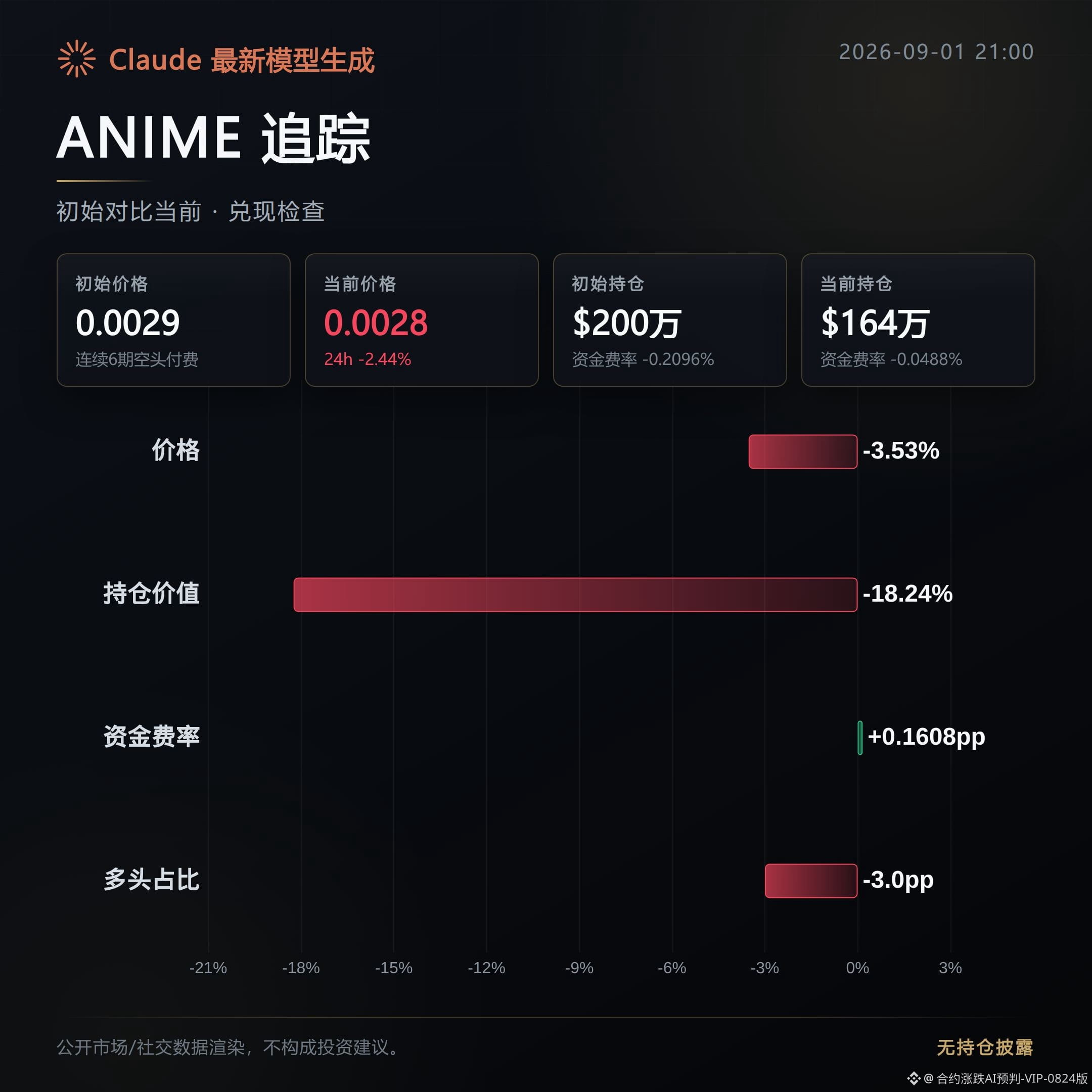
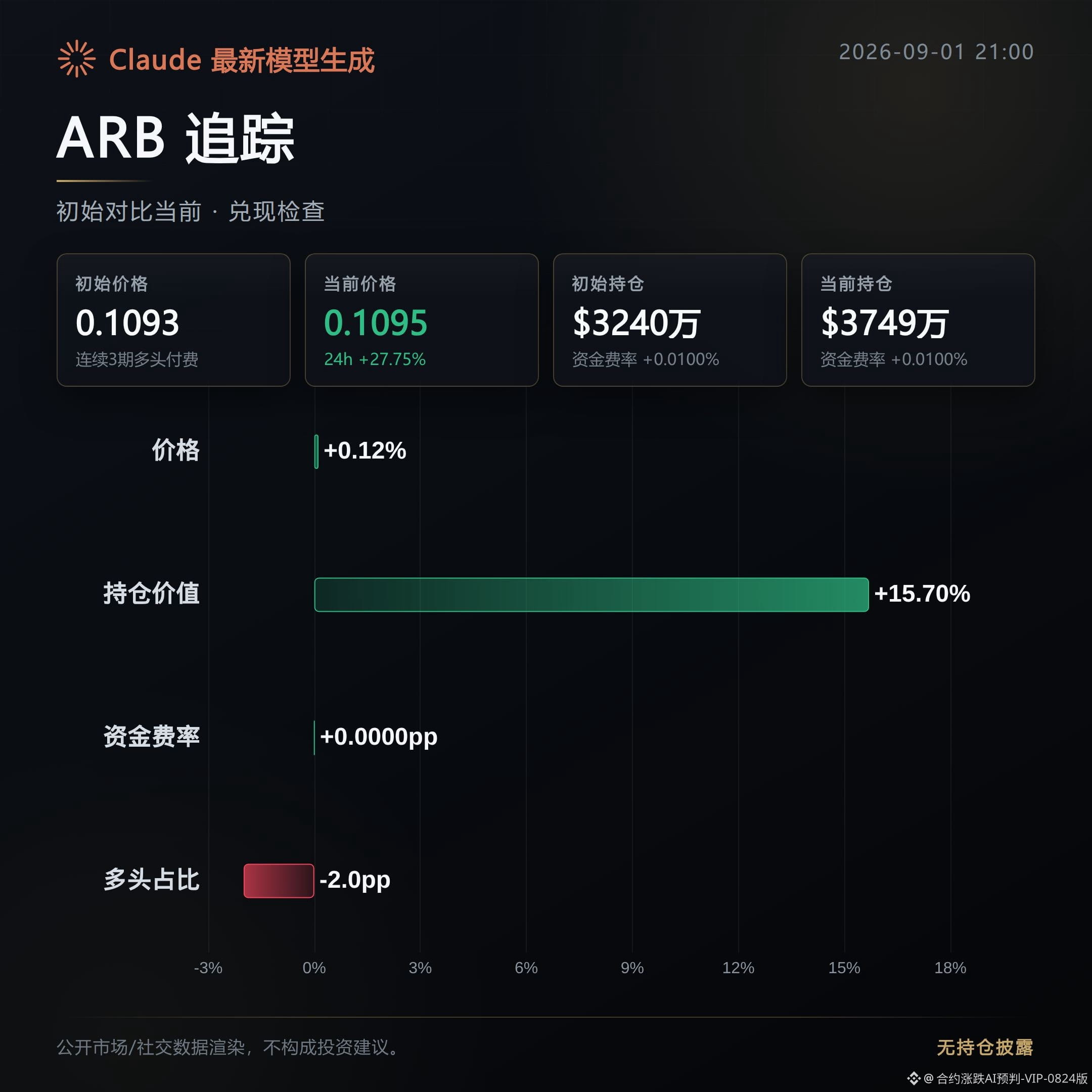
About 13 hours ago, the morning “Dip Pullback Watch · Bullish” signals are now being reviewed for the second time based on the public order book.
Of the three coins that were bullish in the morning, one broke out, while the other two didn’t hold.
The observation given in the morning was that the chips were gathering.
ANIME: Fizzle out—this morning’s bullish signal didn’t get followed through.
After the initial launch, the price fell by 3.53%; the direction has already flipped from what was judged in the morning pullback.
Even more clearly, the open interest dropped by 18.24% and the trading volume contracted by nearly 68%—that’s capital withdrawing, not a volume-contraction consolidation.
ARB: Keep up the pressure—this morning’s bullish track has played out.
After the initial launch, the price was basically flat with no obvious pullback, but open interest continued to rise by 15.7%, and trading volume expanded more than 2.5 times.
It’s not just the price rising alone; positions and capital are moving together. The主动 buy orders also edged stronger, indicating the longs are still getting replenished and staying in.
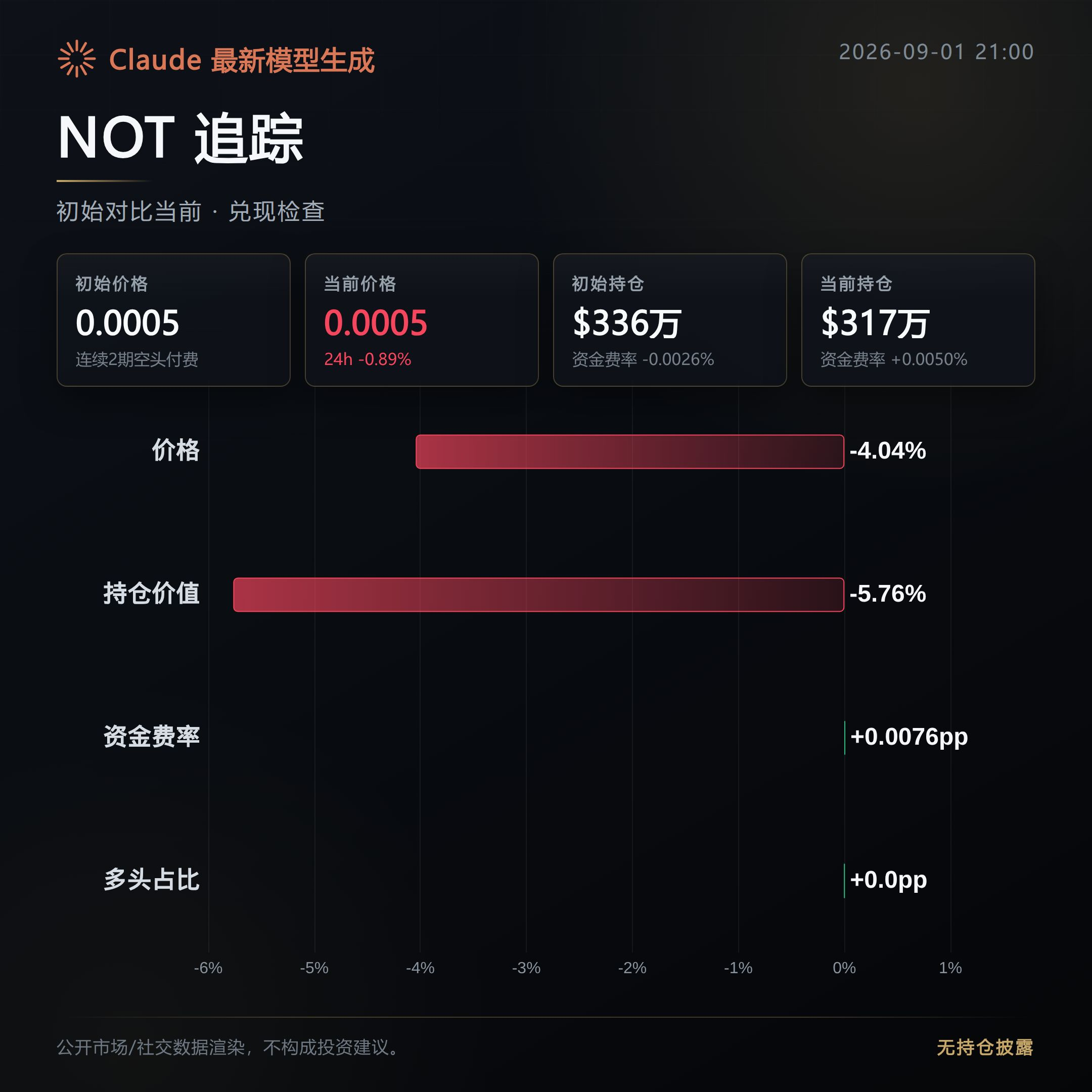
NOT: Fizzle out—this morning’s bullish signal also wasn’t held.
After the initial launch, the price dropped by 4.04%, open interest decreased in sync by 5.76%, and both price and volume weakened together.
The主动 buy orders did recover slightly, but the price didn’t follow through—more like there are bids absorbing at lower levels rather than a trend restart.
Next, what to watch on this line is:
Can ARB keep that momentum of open interest and trading volume going, without dropping volume first when price isn’t moving?
For ANIME and NOT, we need to see whether the price can first stop the decline and whether open interest can bottom and stabilize. If price breaks through this condition, it means this bullish line has completely run its course.
Position note: This account holds a live long position of $FOGO , as disclosed to keep the content consistent with actual trading.
This content was generated with the assistance of Claude Fable 5 for informational reference only—please verify it yourself.
Of the three coins that were bullish in the morning, one broke out, while the other two didn’t hold.
The observation given in the morning was that the chips were gathering.
ANIME: Fizzle out—this morning’s bullish signal didn’t get followed through.
After the initial launch, the price fell by 3.53%; the direction has already flipped from what was judged in the morning pullback.
Even more clearly, the open interest dropped by 18.24% and the trading volume contracted by nearly 68%—that’s capital withdrawing, not a volume-contraction consolidation.
ARB: Keep up the pressure—this morning’s bullish track has played out.
After the initial launch, the price was basically flat with no obvious pullback, but open interest continued to rise by 15.7%, and trading volume expanded more than 2.5 times.
It’s not just the price rising alone; positions and capital are moving together. The主动 buy orders also edged stronger, indicating the longs are still getting replenished and staying in.
NOT: Fizzle out—this morning’s bullish signal also wasn’t held.
After the initial launch, the price dropped by 4.04%, open interest decreased in sync by 5.76%, and both price and volume weakened together.
The主动 buy orders did recover slightly, but the price didn’t follow through—more like there are bids absorbing at lower levels rather than a trend restart.
Next, what to watch on this line is:
Can ARB keep that momentum of open interest and trading volume going, without dropping volume first when price isn’t moving?
For ANIME and NOT, we need to see whether the price can first stop the decline and whether open interest can bottom and stabilize. If price breaks through this condition, it means this bullish line has completely run its course.
Position note: This account holds a live long position of $FOGO , as disclosed to keep the content consistent with actual trading.
This content was generated with the assistance of Claude Fable 5 for informational reference only—please verify it yourself.
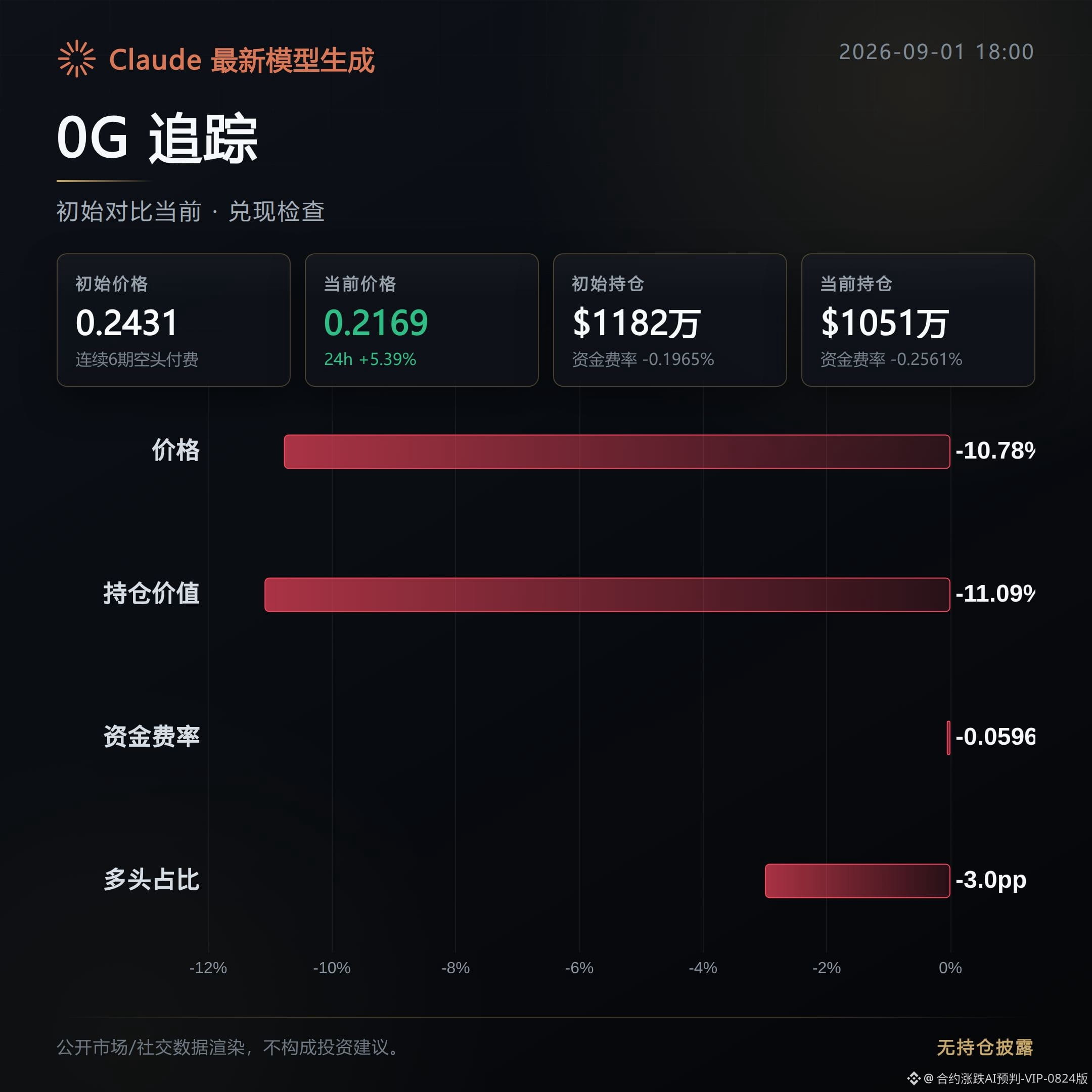
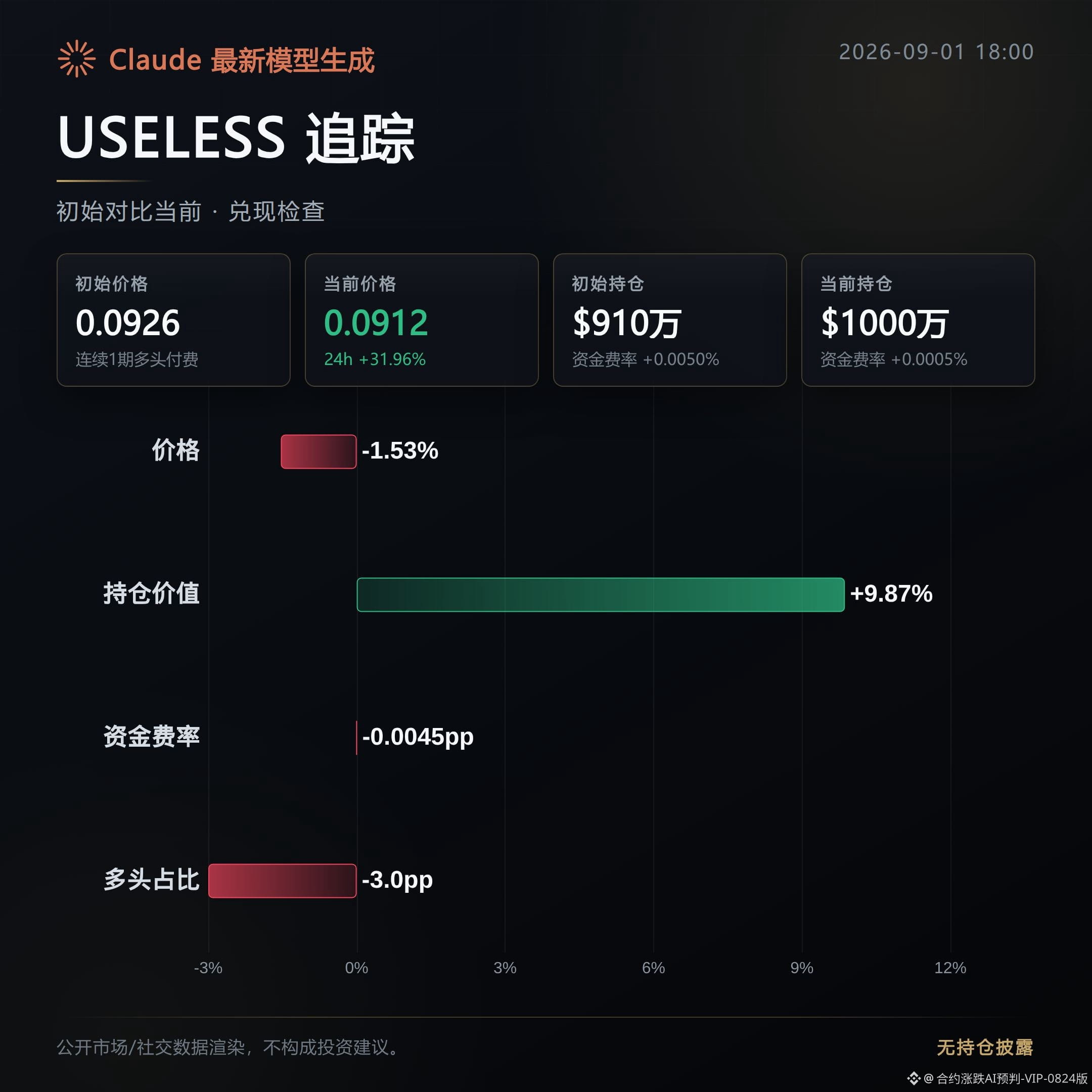
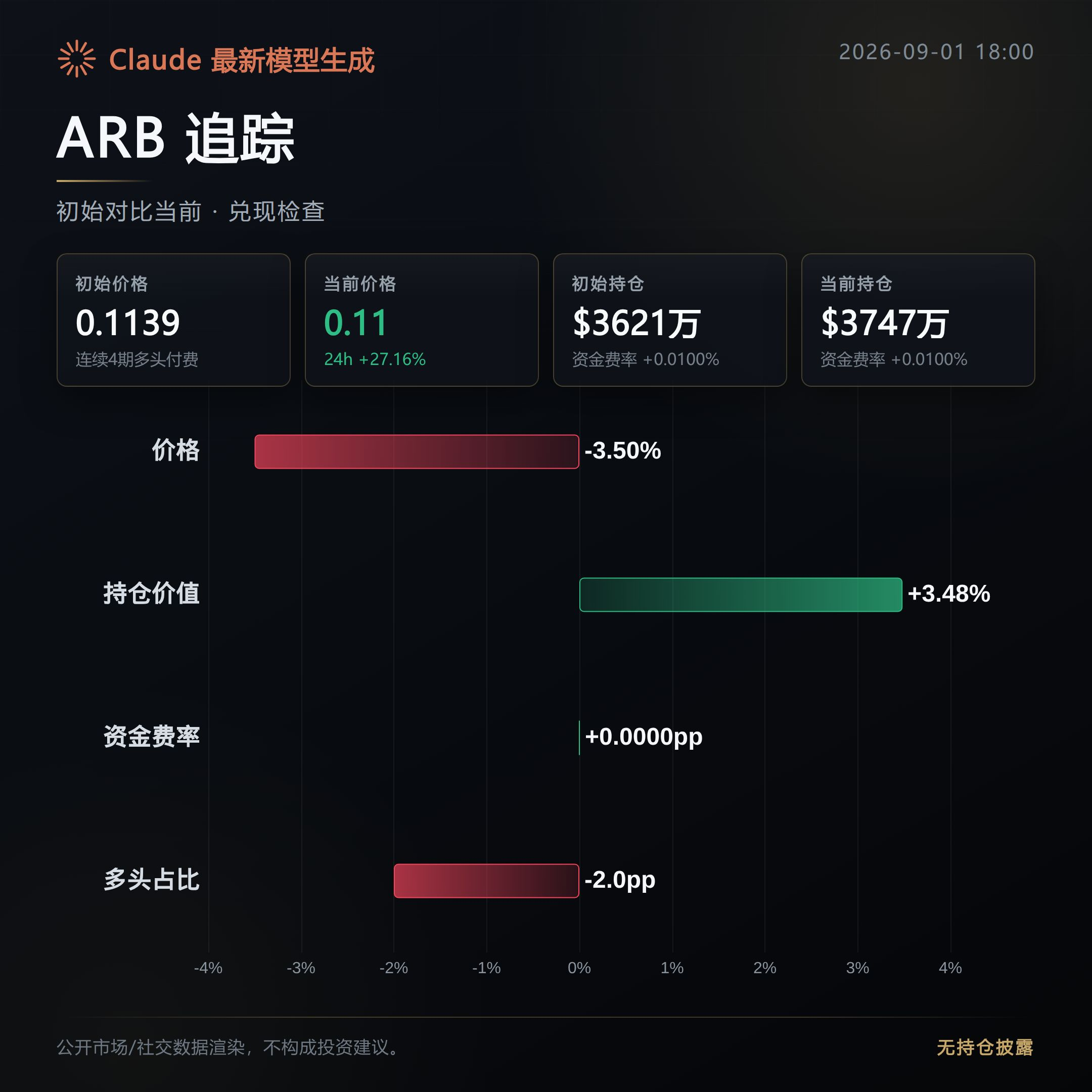
The top 3 gainers this morning—check balances at 18:00 this evening. The three coins’ performances are completely different.
0G is now at 0.2169, down 10.78% from the initial listing. Its gain has fallen from 39.95% to 5.39%. Open interest dropped from 11.82M to 10.51M, down 11.09%. The funding rate moved from -0.1965% to -0.2561%, with short-side fees getting worse. Sell orders from active traders are dominant. The long/short ratio is 57% long-side. But trading volume actually increased by 28.92%; volume is up while price is sluggish—there’s no longer any upside momentum.
USELESS is now at 0.09117, down 1.53% from the initial listing. Its gain has eased from 38.82% to 31.96%, which is still holding up. Interestingly, open interest rose from 9.09M to 9.99M, up 9.87%. The funding rate narrowed from 0.005% to 0.0005%, meaning long-side costs are almost back to zero. Trading volume expanded by 50.36%, but the price didn’t follow. The long/short ratio is 47%—fairly balanced. This is a typical “add positions without raising price.”
ARB is now at 0.10996, down 3.5% from the initial listing. Its gain has slipped from 35.33% to 27.16%. Open interest added slightly—up 3.48% to 37.47M. The funding rate stayed at 0.01%. Volume surged by 81.52% (the strongest in the whole market), but the share of active buy orders fell from 0.99 to 0.81. Volume is expanding, yet buying is retreating. The long/short ratio is 55% long-side, and the price/volume divergence is the most obvious.
All three coins still have open interest (either increasing or only slightly decreasing), and the funding rates haven’t shifted significantly. This suggests nobody is doing concentrated liquidation and exiting. Instead, prices are stalling upward or pulling back. With volume not lifting price and funding rates barely moving, how those positions at high levels will be worked off next is something worth watching closely.
#0G #USELESS #ARB
Position note: This account’s live position holds $FOGO long contracts. The disclosure is made to keep the content consistent with actual trading.
This content is generated with assistance from Claude Fable 5 and is for information purposes only—please verify it yourself.
0G is now at 0.2169, down 10.78% from the initial listing. Its gain has fallen from 39.95% to 5.39%. Open interest dropped from 11.82M to 10.51M, down 11.09%. The funding rate moved from -0.1965% to -0.2561%, with short-side fees getting worse. Sell orders from active traders are dominant. The long/short ratio is 57% long-side. But trading volume actually increased by 28.92%; volume is up while price is sluggish—there’s no longer any upside momentum.
USELESS is now at 0.09117, down 1.53% from the initial listing. Its gain has eased from 38.82% to 31.96%, which is still holding up. Interestingly, open interest rose from 9.09M to 9.99M, up 9.87%. The funding rate narrowed from 0.005% to 0.0005%, meaning long-side costs are almost back to zero. Trading volume expanded by 50.36%, but the price didn’t follow. The long/short ratio is 47%—fairly balanced. This is a typical “add positions without raising price.”
ARB is now at 0.10996, down 3.5% from the initial listing. Its gain has slipped from 35.33% to 27.16%. Open interest added slightly—up 3.48% to 37.47M. The funding rate stayed at 0.01%. Volume surged by 81.52% (the strongest in the whole market), but the share of active buy orders fell from 0.99 to 0.81. Volume is expanding, yet buying is retreating. The long/short ratio is 55% long-side, and the price/volume divergence is the most obvious.
All three coins still have open interest (either increasing or only slightly decreasing), and the funding rates haven’t shifted significantly. This suggests nobody is doing concentrated liquidation and exiting. Instead, prices are stalling upward or pulling back. With volume not lifting price and funding rates barely moving, how those positions at high levels will be worked off next is something worth watching closely.
#0G #USELESS #ARB
Position note: This account’s live position holds $FOGO long contracts. The disclosure is made to keep the content consistent with actual trading.
This content is generated with assistance from Claude Fable 5 and is for information purposes only—please verify it yourself.
About 6 hours ago, this setup contract received a warning of high-level distribution. The directional judgment was a slow grind lower followed by a pullback.
At the time, here’s what we observed in retrospect: the chips were dispersed.
Now, we verify one by one against the public order book:
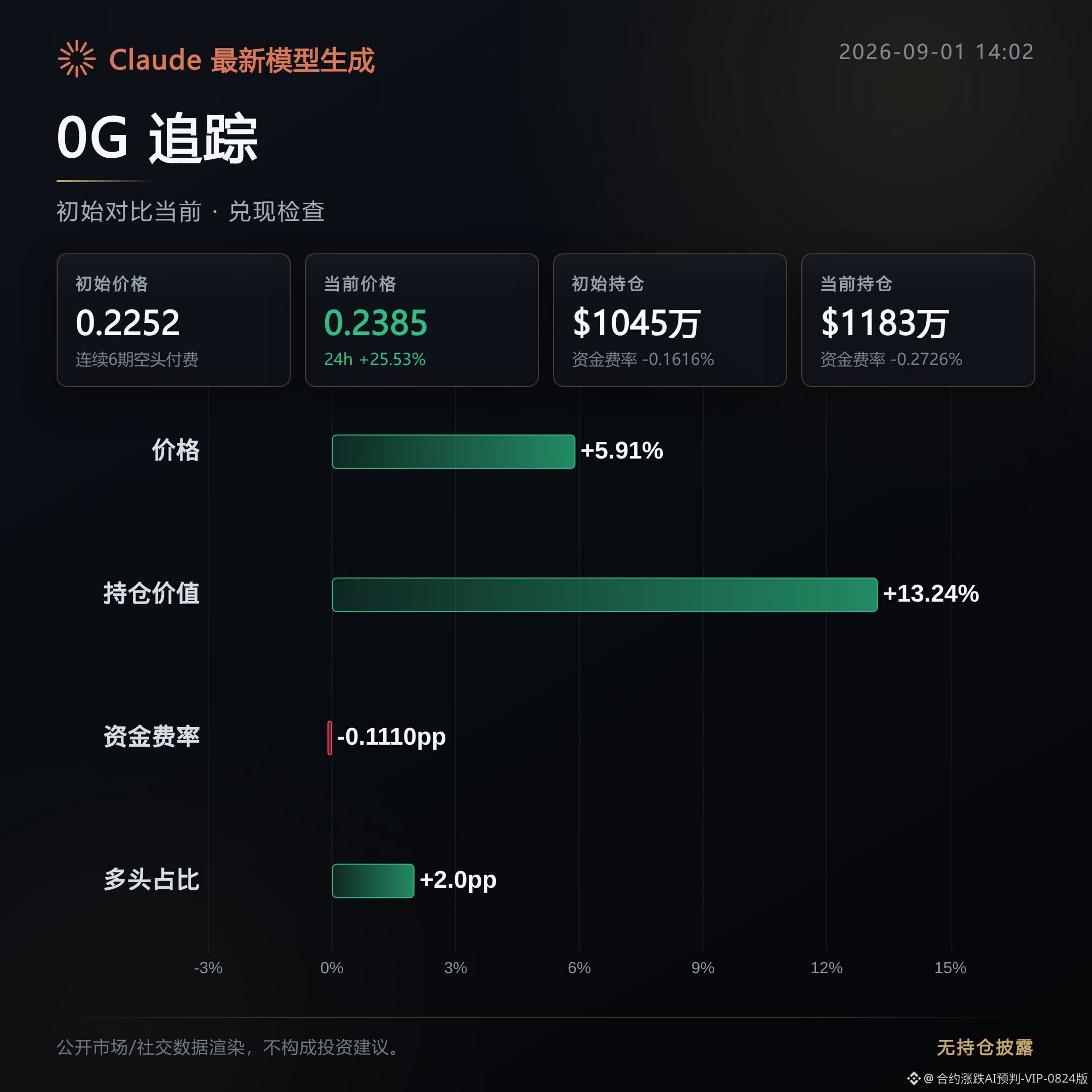
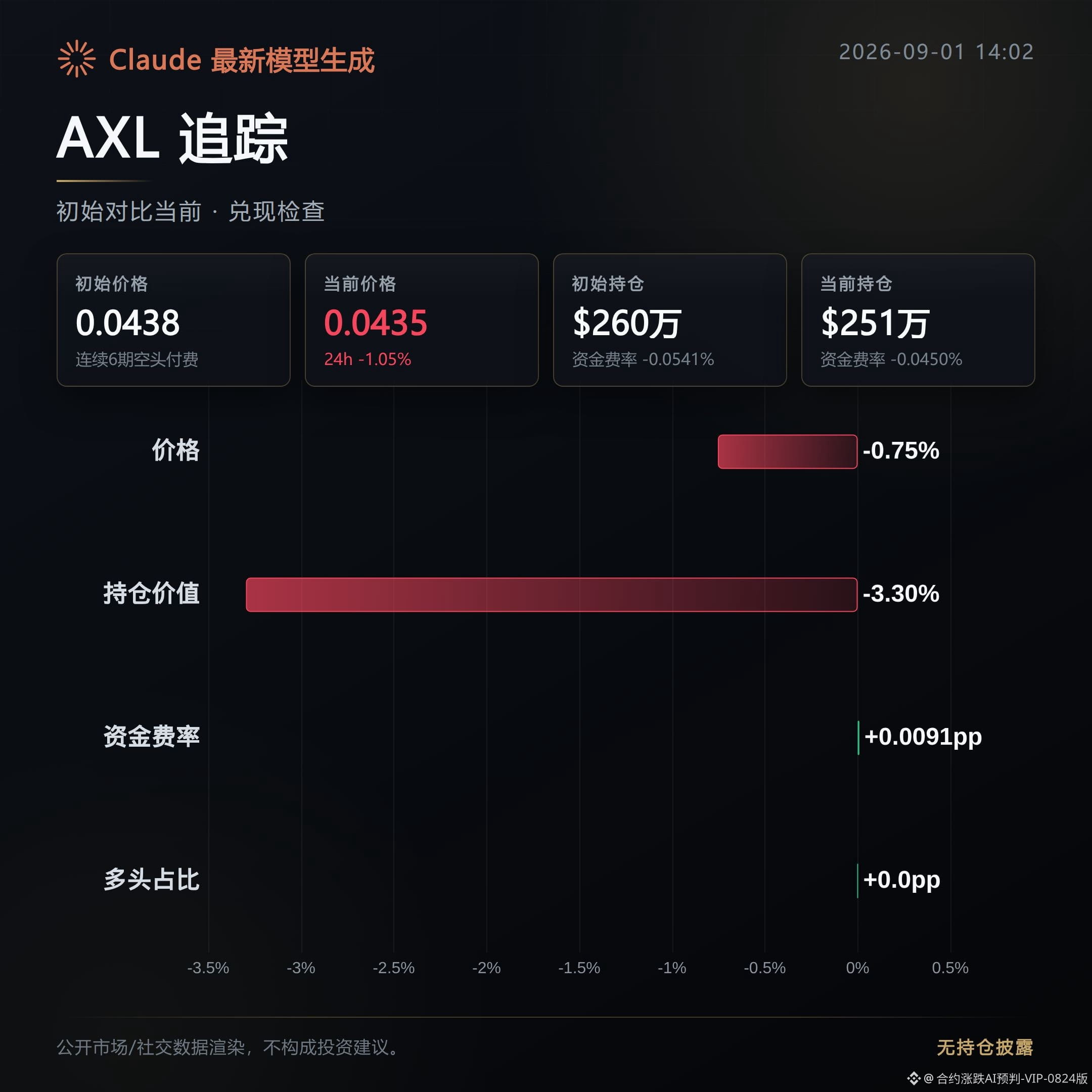
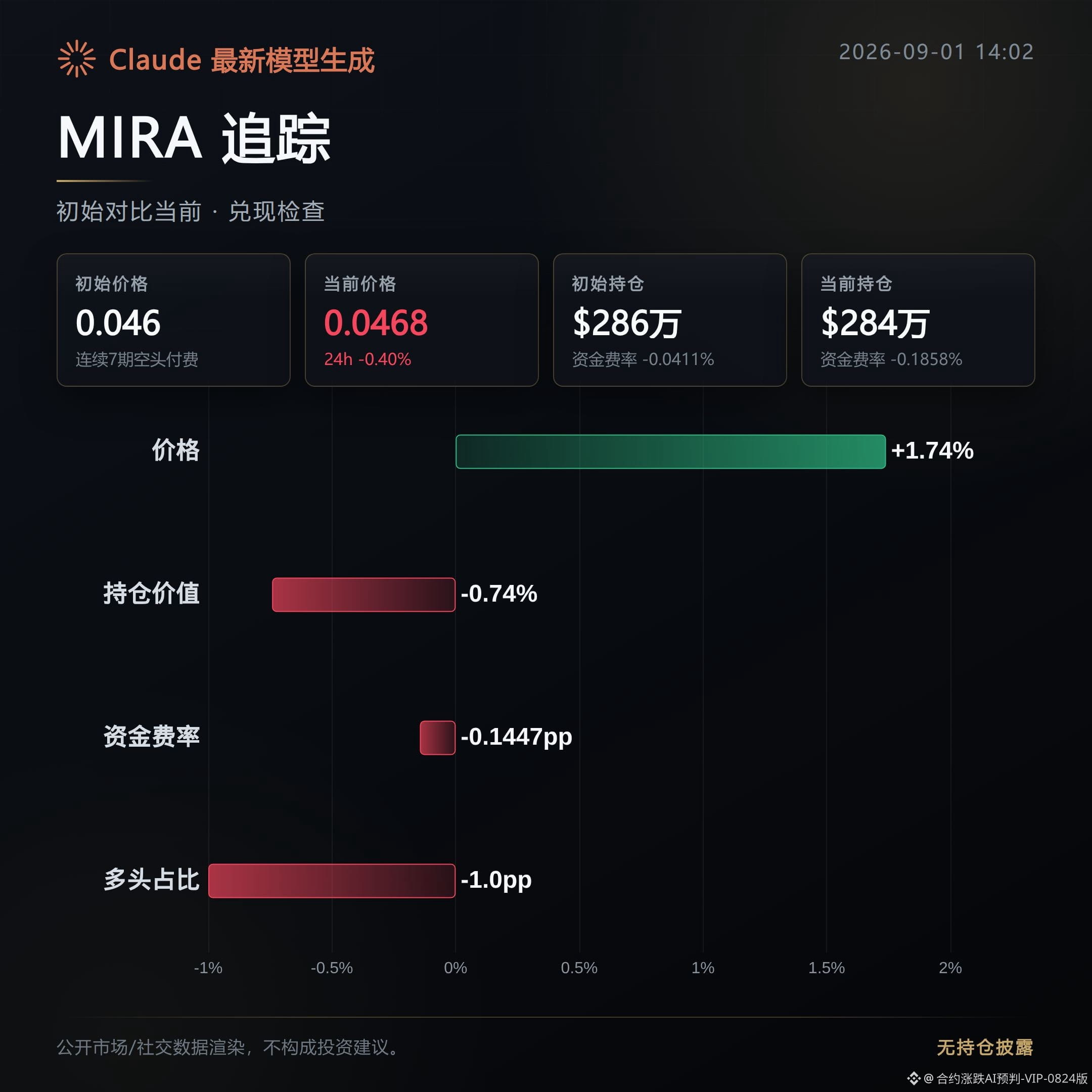
Of the 3 coins, 1 does not drop and instead rises. The other 2 are still in a tug-of-war; none has truly broken into a one-way downward trend. The bearish view in the morning has not been confirmed for now.
0G: a rebound. The bearish expectation from the morning has not played out.
Since the initial listing, the price is up 5.91% without dipping, and open interest has risen in sync by 13.24%, indicating that during the pullback, capital was stepping in to buy—distribution has been held off, and the sell-pressure tempo was resisted.
AXL: still in consolidation; a one-way down move hasn’t been confirmed yet.
Price has only slipped slightly by 0.75%, but volume has shrunk by 22.85%. The ratio of aggressive buy orders has also retreated. The tape looks more like no one wants to take decisive action than like a trend-driven selloff.
MIRA: also in consolidation; the price is actually 1.74% higher than at the initial listing. The bearish thesis still hasn’t been realized.
The funding rate has turned more negative, yet the proportion of aggressive buys has risen to 1.15. Long/short signals are fighting each other, and the direction hasn’t converged.
Next, what to watch along this line is whether the bid support will truly loosen: for 0G, only if open interest turns downward and aggressive-buy activity fades, can we say that distribution has been confirmed and “cashed out.” For AXL and MIRA, they’re still stuck in the range. Whether volume can shrink further and whether the funding rate can continue to turn negative is the key to judging whether this round of grind-lower can actually break out. It’s worth continuing to monitor closely.
#0G #AXL #MIRA #Contract replay
Live trading disclosure: This account currently holds $FOGO long positions; the related views match the actual position.
Claude Fable 5 assists in generating content. Information is for market reference only and does not constitute investment advice.
At the time, here’s what we observed in retrospect: the chips were dispersed.
Now, we verify one by one against the public order book:
Of the 3 coins, 1 does not drop and instead rises. The other 2 are still in a tug-of-war; none has truly broken into a one-way downward trend. The bearish view in the morning has not been confirmed for now.
0G: a rebound. The bearish expectation from the morning has not played out.
Since the initial listing, the price is up 5.91% without dipping, and open interest has risen in sync by 13.24%, indicating that during the pullback, capital was stepping in to buy—distribution has been held off, and the sell-pressure tempo was resisted.
AXL: still in consolidation; a one-way down move hasn’t been confirmed yet.
Price has only slipped slightly by 0.75%, but volume has shrunk by 22.85%. The ratio of aggressive buy orders has also retreated. The tape looks more like no one wants to take decisive action than like a trend-driven selloff.
MIRA: also in consolidation; the price is actually 1.74% higher than at the initial listing. The bearish thesis still hasn’t been realized.
The funding rate has turned more negative, yet the proportion of aggressive buys has risen to 1.15. Long/short signals are fighting each other, and the direction hasn’t converged.
Next, what to watch along this line is whether the bid support will truly loosen: for 0G, only if open interest turns downward and aggressive-buy activity fades, can we say that distribution has been confirmed and “cashed out.” For AXL and MIRA, they’re still stuck in the range. Whether volume can shrink further and whether the funding rate can continue to turn negative is the key to judging whether this round of grind-lower can actually break out. It’s worth continuing to monitor closely.
#0G #AXL #MIRA #Contract replay
Live trading disclosure: This account currently holds $FOGO long positions; the related views match the actual position.
Claude Fable 5 assists in generating content. Information is for market reference only and does not constitute investment advice.
About 6 hours ago, we published a set of pull-trap observations—bullish contract signals—and now we’re reconciling it against the publicly visible order book.
At the time, the observation was: the positions were closing (accumulating and settling).
Among the three coins, two of them exited the morning bullish setup, and one didn’t manage to hold.
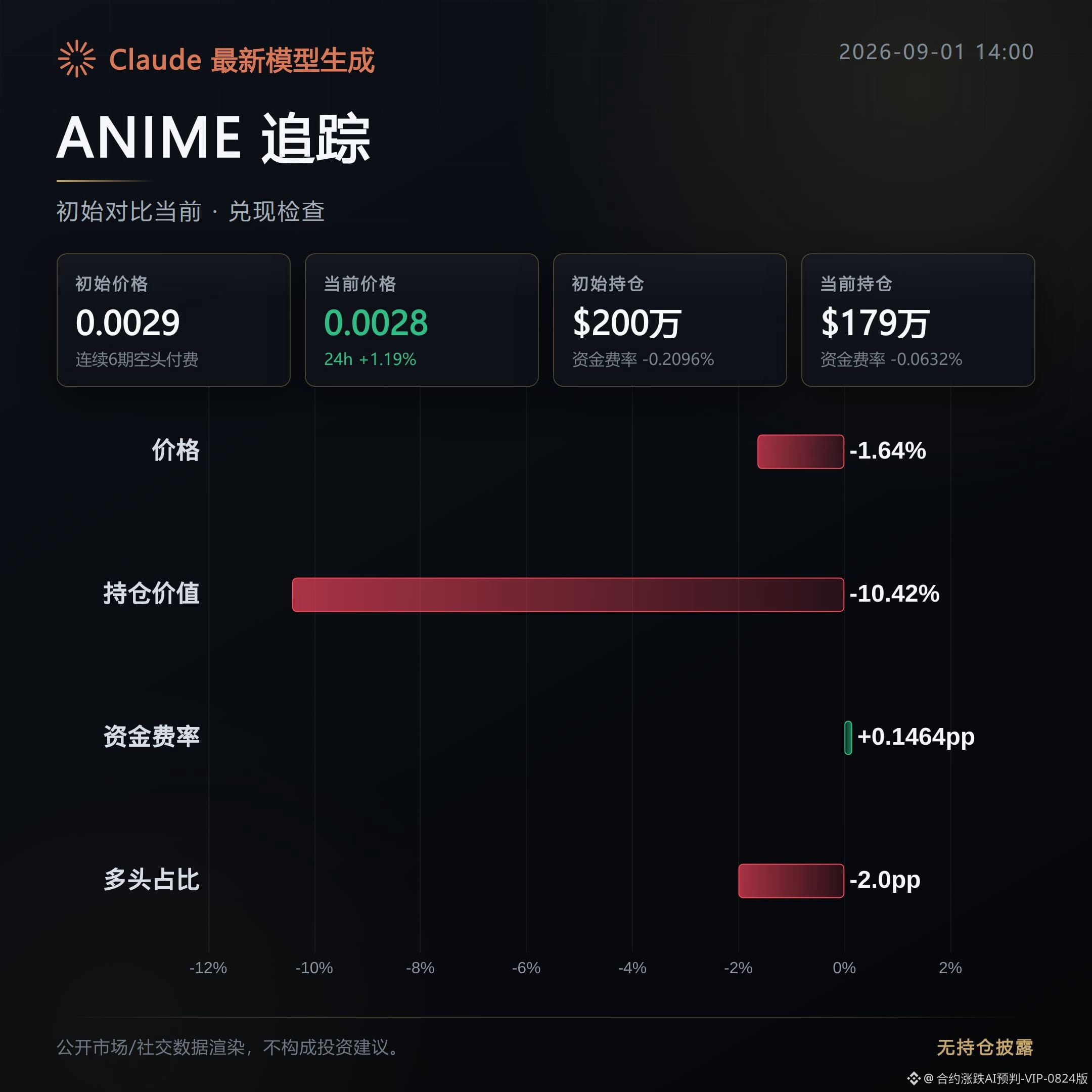
ANIME: Cooling off—the morning bullish move didn’t fully play out.
Open interest fell by 10.42% compared with the initial post, and the heat of the new positions is fading.
In the past six hours, the price increase is down to just 1.19%, noticeably narrower than the initial 6.39%; volume is also cut in half, and the number of people chasing longs is dropping.
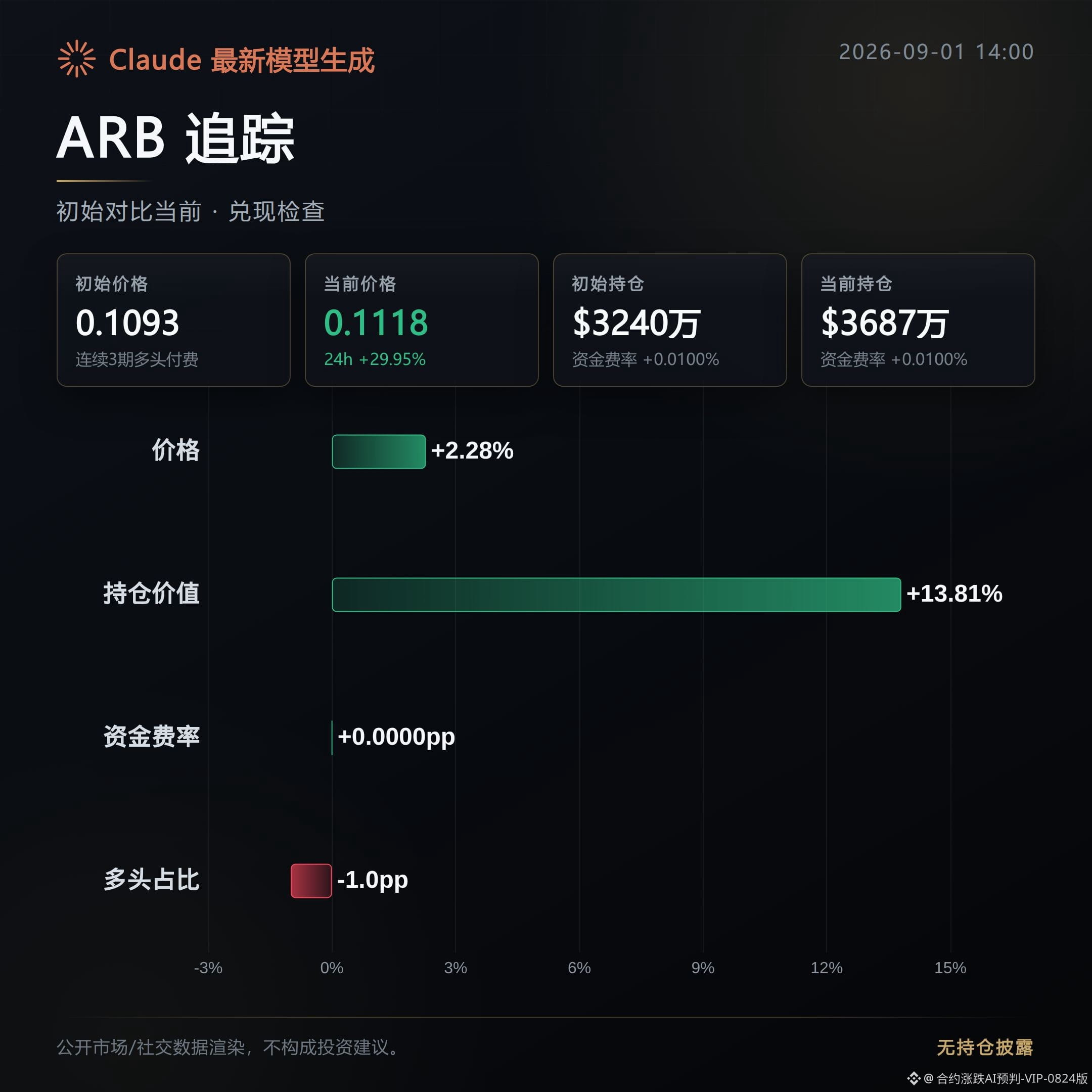
ARB: Keep applying pressure—this bullish wave held up.
Over the last six hours, the price climbed another 2.28%, while open interest increased in tandem by 13.81%. This suggests it’s not just a stagnant price move driven by churn; there are actually new positions entering.
Volume expanded by 139.71% at the same time, indicating momentum is still continuing. However, current technical levels are already overheated—so this is the natural outcome after the latest push.
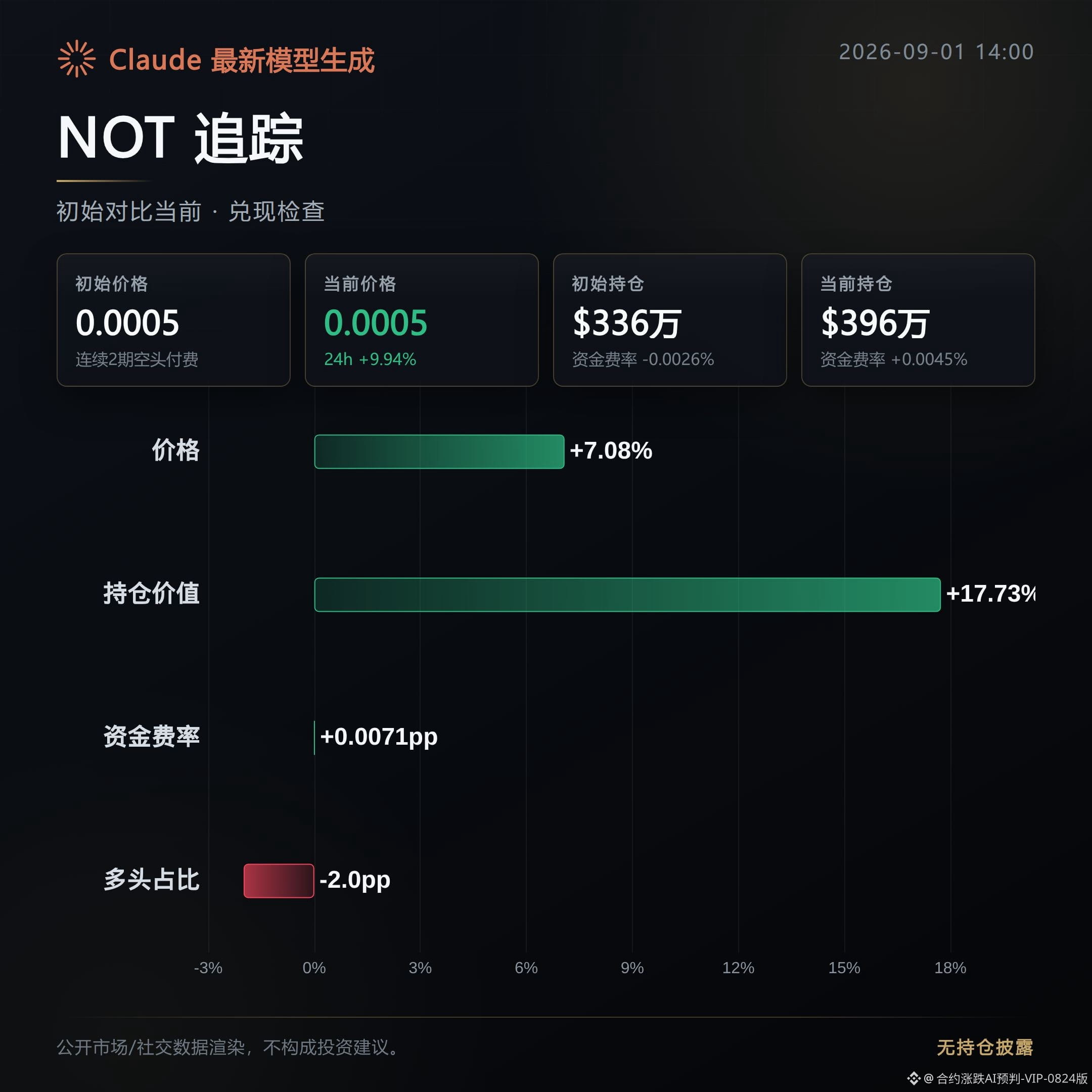
NOT: Realize the move—the morning bullish setup did play out.
After the initial post, the price rose another 7.08%, and open interest increased in tandem by 17.73%. This wasn’t old positions propping things up; it was new money coming in.
The funding rate also flipped from negative to positive. The longs are starting to pay the cost of holding—this is a continuation signal.
Next, the key focus is whether open interest can follow price action.
For ARB and NOT, as long as open interest continues to rise along with the price, it still counts as validating the morning judgment. If the price stalls while open interest continues rising, be mindful that sentiment may be overextended.
For ANIME, watch whether open interest and volume can stop falling and stabilize. Only when they stabilize can we say the morning bullish setup is effectively “picked back up”; otherwise, it’s likely this wave didn’t keep up.
#ANIME #ARB #NOT # Contract replay
Live-trade disclosure: This account currently holds $FOGO long positions. The related viewpoints match the actual positions.
Compiled with the assistance of Claude Fable 5. For information reference only—please verify independently.
At the time, the observation was: the positions were closing (accumulating and settling).
Among the three coins, two of them exited the morning bullish setup, and one didn’t manage to hold.
ANIME: Cooling off—the morning bullish move didn’t fully play out.
Open interest fell by 10.42% compared with the initial post, and the heat of the new positions is fading.
In the past six hours, the price increase is down to just 1.19%, noticeably narrower than the initial 6.39%; volume is also cut in half, and the number of people chasing longs is dropping.
ARB: Keep applying pressure—this bullish wave held up.
Over the last six hours, the price climbed another 2.28%, while open interest increased in tandem by 13.81%. This suggests it’s not just a stagnant price move driven by churn; there are actually new positions entering.
Volume expanded by 139.71% at the same time, indicating momentum is still continuing. However, current technical levels are already overheated—so this is the natural outcome after the latest push.
NOT: Realize the move—the morning bullish setup did play out.
After the initial post, the price rose another 7.08%, and open interest increased in tandem by 17.73%. This wasn’t old positions propping things up; it was new money coming in.
The funding rate also flipped from negative to positive. The longs are starting to pay the cost of holding—this is a continuation signal.
Next, the key focus is whether open interest can follow price action.
For ARB and NOT, as long as open interest continues to rise along with the price, it still counts as validating the morning judgment. If the price stalls while open interest continues rising, be mindful that sentiment may be overextended.
For ANIME, watch whether open interest and volume can stop falling and stabilize. Only when they stabilize can we say the morning bullish setup is effectively “picked back up”; otherwise, it’s likely this wave didn’t keep up.
#ANIME #ARB #NOT # Contract replay
Live-trade disclosure: This account currently holds $FOGO long positions. The related viewpoints match the actual positions.
Compiled with the assistance of Claude Fable 5. For information reference only—please verify independently.
Contract Order Book Daily Report|9/1 Noon: Spot Adds, Miscellaneous Coin Fees Max Out
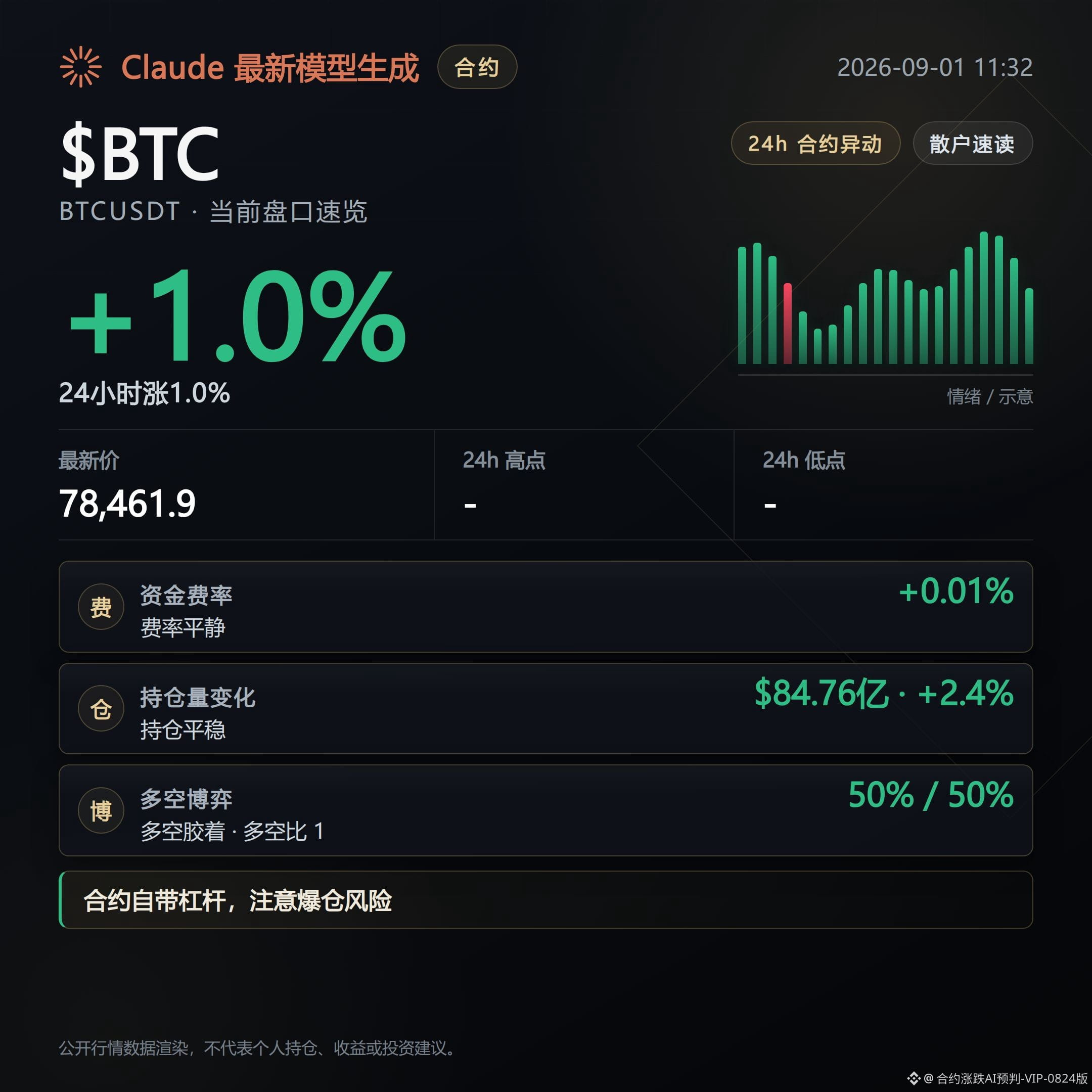
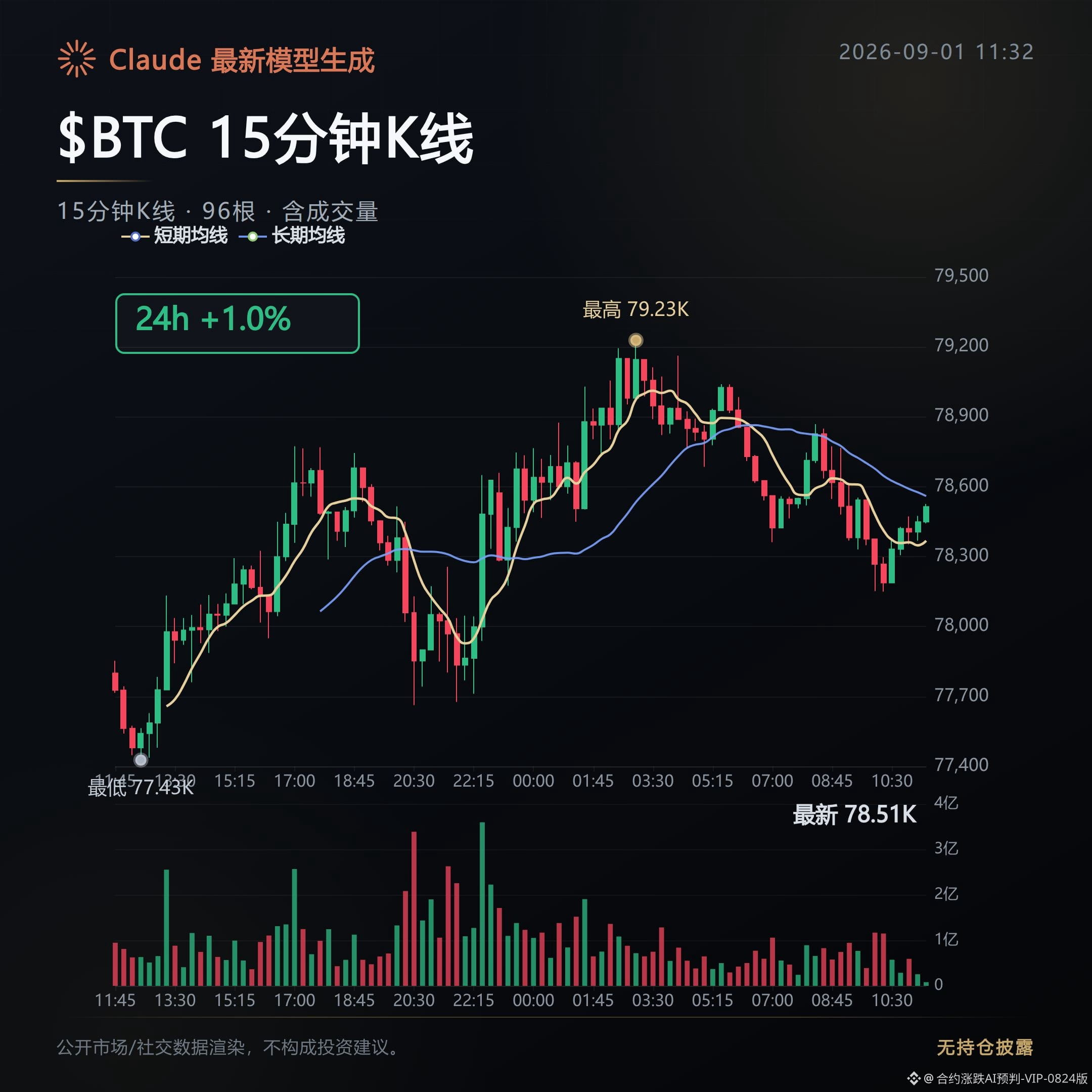
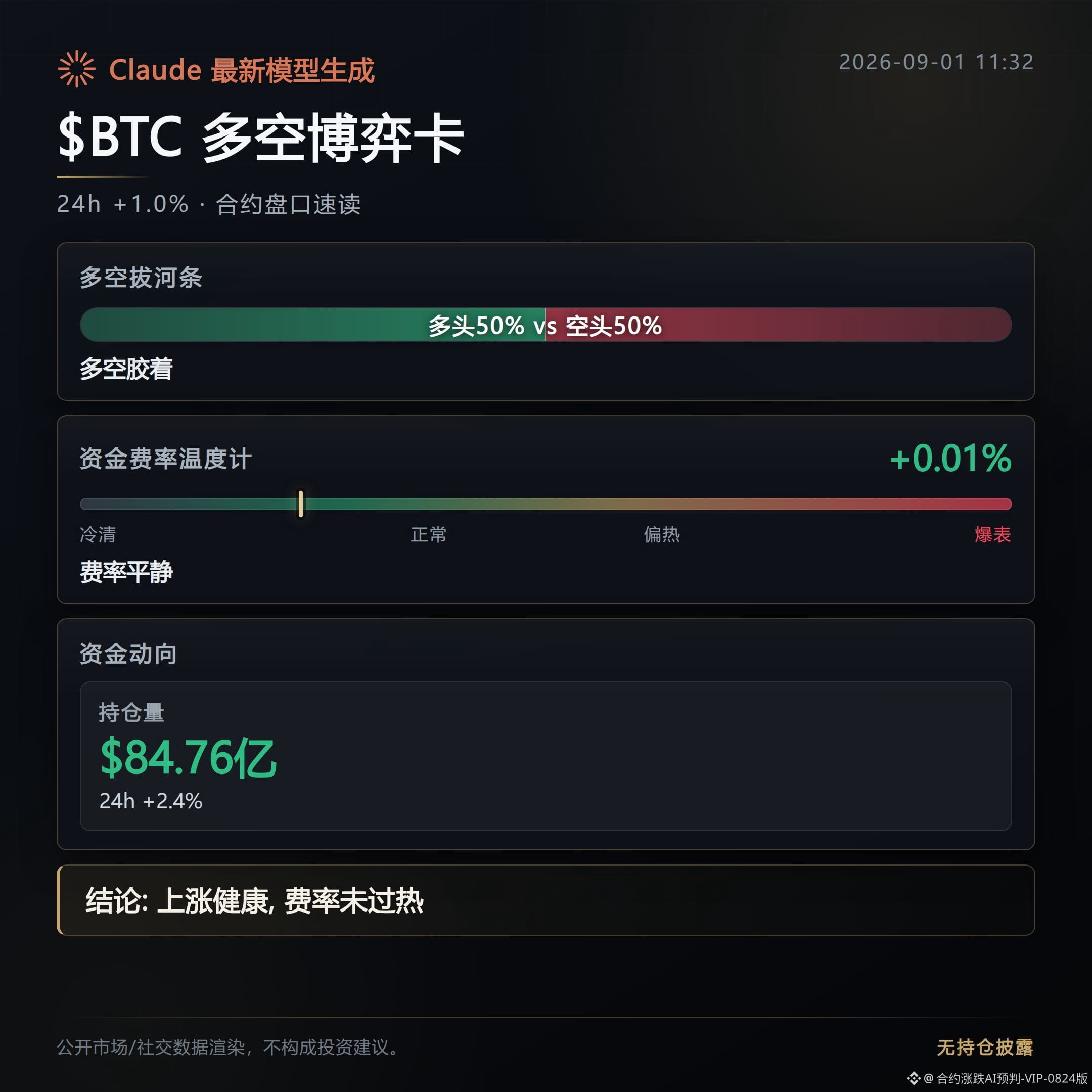
$BTC mark price is 78.5万, up nearly 1% over 24 hours. Open interest rose 2.4% in a single day to $8.476 billion. The long/short ratio is stuck at 50/50, and the active buy side is only 9% higher than the sell side.
Taken together, these numbers suggest this rally wasn’t driven by a sudden, aggressive leverage push. Funding rates also support this: BTC is at just 0.0083%, ETH 0.0075%, both relatively mild. Even BNB is basically zero—nobody is rushing to open leveraged longs and pay for it.
The spot market, however, is seeing action. This week, Strive bought another 1,800 BTC, spending $143 million. It’s the same playbook as the earlier institutional coin-hoarding—money is flowing into spot rather than being stacked into derivatives leverage.
Strategy is also trading blows with MSCI—opposing the exclusion of Bitcoin treasury/custodian companies from the index. In plain terms, these kinds of firms are currently in a sensitive position, and any move to the index rules can swing their valuation logic.
Another item worth noting, but don’t overinterpret: reports say North Korean hackers transferred tens of millions of dollars on Hyperliquid, coinciding with the timing of Trump pushing for crypto platforms to “return to shore.” If such large-scale fund movements show up on a derivatives platform, it’s worth recording, but for now there’s no clear sign of a direct impact on market sentiment.
The rates that really get maxed out are on smaller coins. The fees for BSP, TUT, and SKR have fallen to between -0.3% and -0.5%. Shorts are bunched tightly together—if price rebounds, they’re likely to get squeezed. On the other side, BNC, QNTX, and SHAZ have jumped to between +0.15% and +0.47%. Longs are piled in too heavily, and any pullback hurts just as much. The sentiment index is 69—greed territory—but leverage hasn’t gone haywire. The real risk lies in these small coins’ extreme funding/fee levels, not in the big “BTC-style” moves.
Live trading disclosure: This account currently holds $FOGO long positions. The views in this post are consistent with the actual positions.
This content was generated with assistance from Claude Fable 5 for informational reference only—please verify it yourself.
$BTC mark price is 78.5万, up nearly 1% over 24 hours. Open interest rose 2.4% in a single day to $8.476 billion. The long/short ratio is stuck at 50/50, and the active buy side is only 9% higher than the sell side.
Taken together, these numbers suggest this rally wasn’t driven by a sudden, aggressive leverage push. Funding rates also support this: BTC is at just 0.0083%, ETH 0.0075%, both relatively mild. Even BNB is basically zero—nobody is rushing to open leveraged longs and pay for it.
The spot market, however, is seeing action. This week, Strive bought another 1,800 BTC, spending $143 million. It’s the same playbook as the earlier institutional coin-hoarding—money is flowing into spot rather than being stacked into derivatives leverage.
Strategy is also trading blows with MSCI—opposing the exclusion of Bitcoin treasury/custodian companies from the index. In plain terms, these kinds of firms are currently in a sensitive position, and any move to the index rules can swing their valuation logic.
Another item worth noting, but don’t overinterpret: reports say North Korean hackers transferred tens of millions of dollars on Hyperliquid, coinciding with the timing of Trump pushing for crypto platforms to “return to shore.” If such large-scale fund movements show up on a derivatives platform, it’s worth recording, but for now there’s no clear sign of a direct impact on market sentiment.
The rates that really get maxed out are on smaller coins. The fees for BSP, TUT, and SKR have fallen to between -0.3% and -0.5%. Shorts are bunched tightly together—if price rebounds, they’re likely to get squeezed. On the other side, BNC, QNTX, and SHAZ have jumped to between +0.15% and +0.47%. Longs are piled in too heavily, and any pullback hurts just as much. The sentiment index is 69—greed territory—but leverage hasn’t gone haywire. The real risk lies in these small coins’ extreme funding/fee levels, not in the big “BTC-style” moves.
Live trading disclosure: This account currently holds $FOGO long positions. The views in this post are consistent with the actual positions.
This content was generated with assistance from Claude Fable 5 for informational reference only—please verify it yourself.
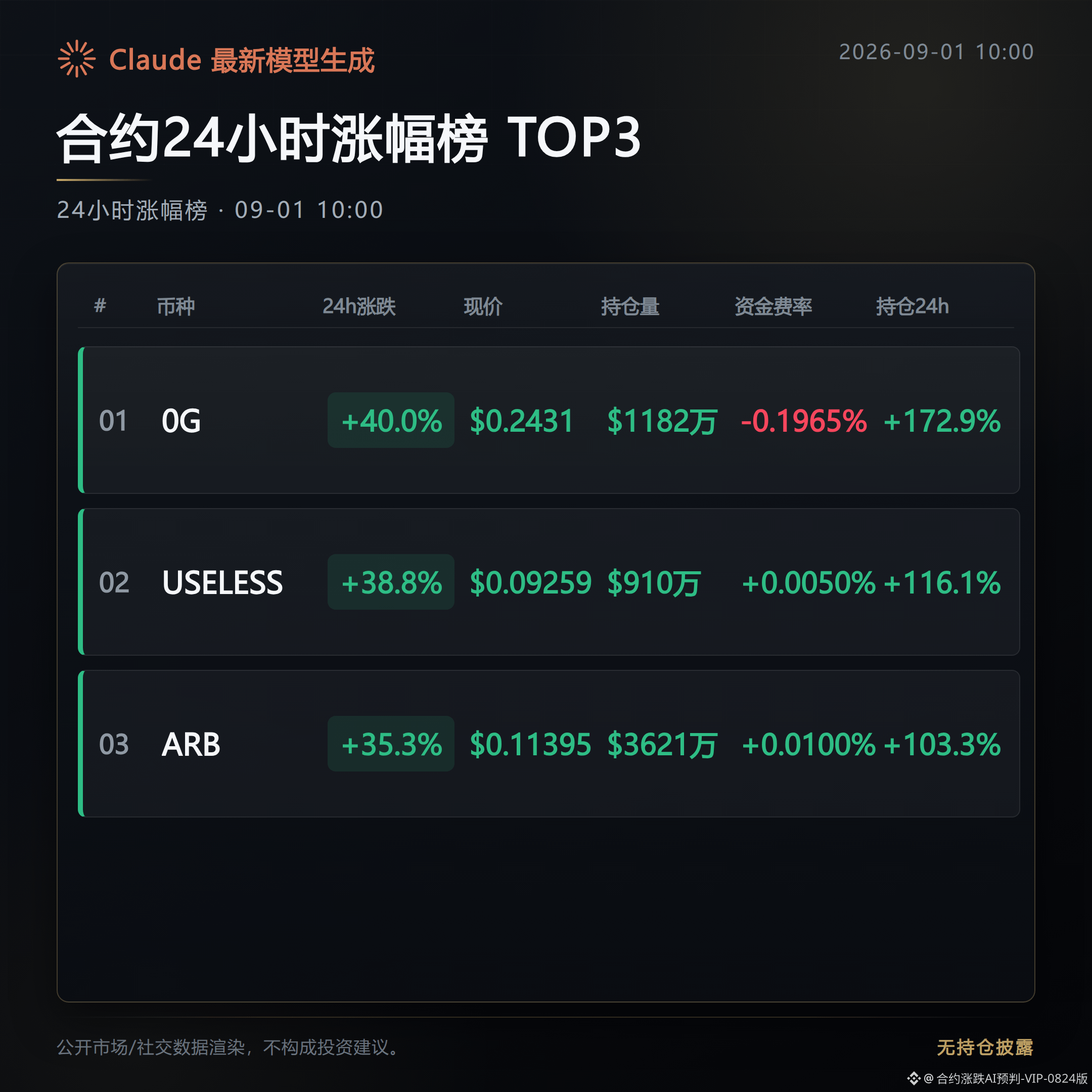
Contract 24h Gainers Board · In-depth breakdown of the top 3
At 10:00 (Beijing time), a recap of the morning order book.
Go through the current top 3 on Binance’s 24-hour contract gainers board, compare the 24-hour signals with the latest readings from the most recent 1 hour, and assess whether the signal is continuing or already fading.
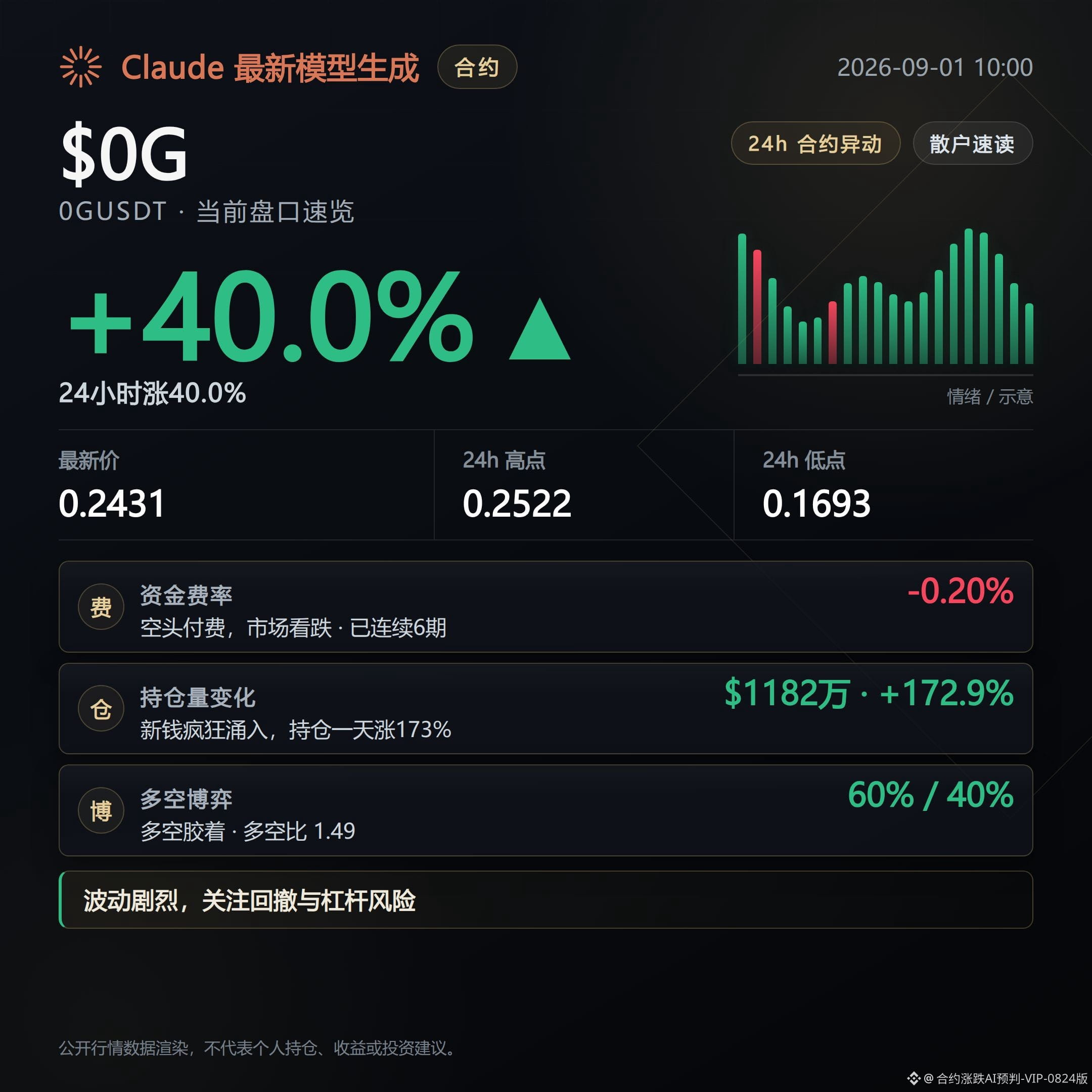
#1 0G: Up 39.95% over 24h, to $0.2431.
Trading volume: $261 million. Open interest surged 172.9% over 24h, but in the last 1 hour it increased only 12.7%, and the slope has clearly narrowed.
Funding rate: -0.1965%. It has been negative and has continued for 6 consecutive rounds, with the long/short ratio at 1.49. 60% of accounts are on the long side. The aggressive buy side is 1.03. RSI 67.8 is still in a neutral range.
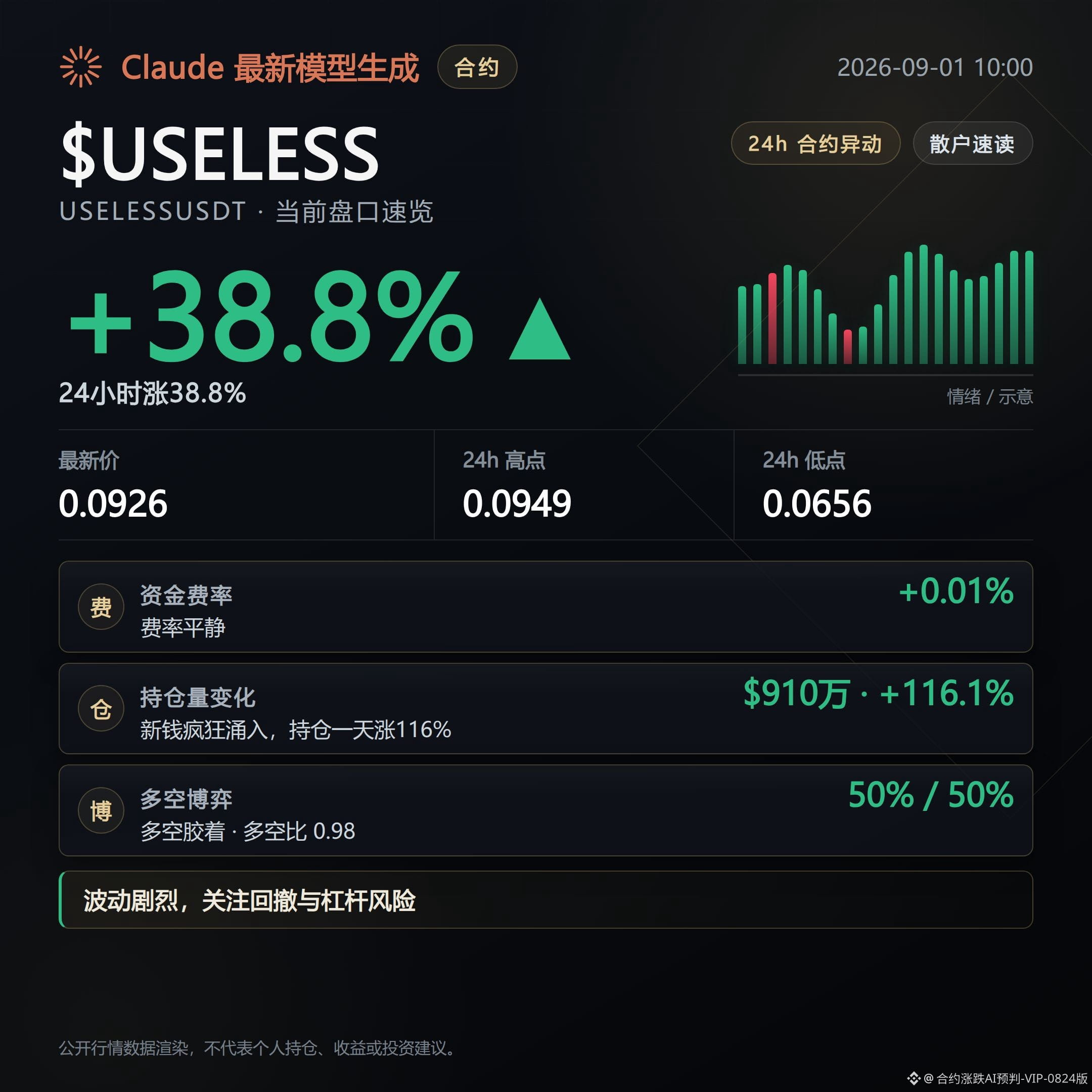
#2 USELESS: Up 38.82% over 24h, at $0.09259.
Trading volume: $138 million. Open interest surged 116.1% over 24h, but in the last 1 hour it added only 2.1%. The pace of adding positions is almost stalled, which doesn’t match the “burst” strength seen over 24h.
Funding rate just flipped to +0.005%, meaning it has only paid longs for 1 consecutive round—this is a newly emerging signal. RSI 78.3 is already in the overbought zone. The big-holder long/short ratio is 0.93, slightly more skewed toward shorts, and it’s not fully aligned with retail traders.
#3 ARB: Up 35.33% over 24h, at $0.11395.
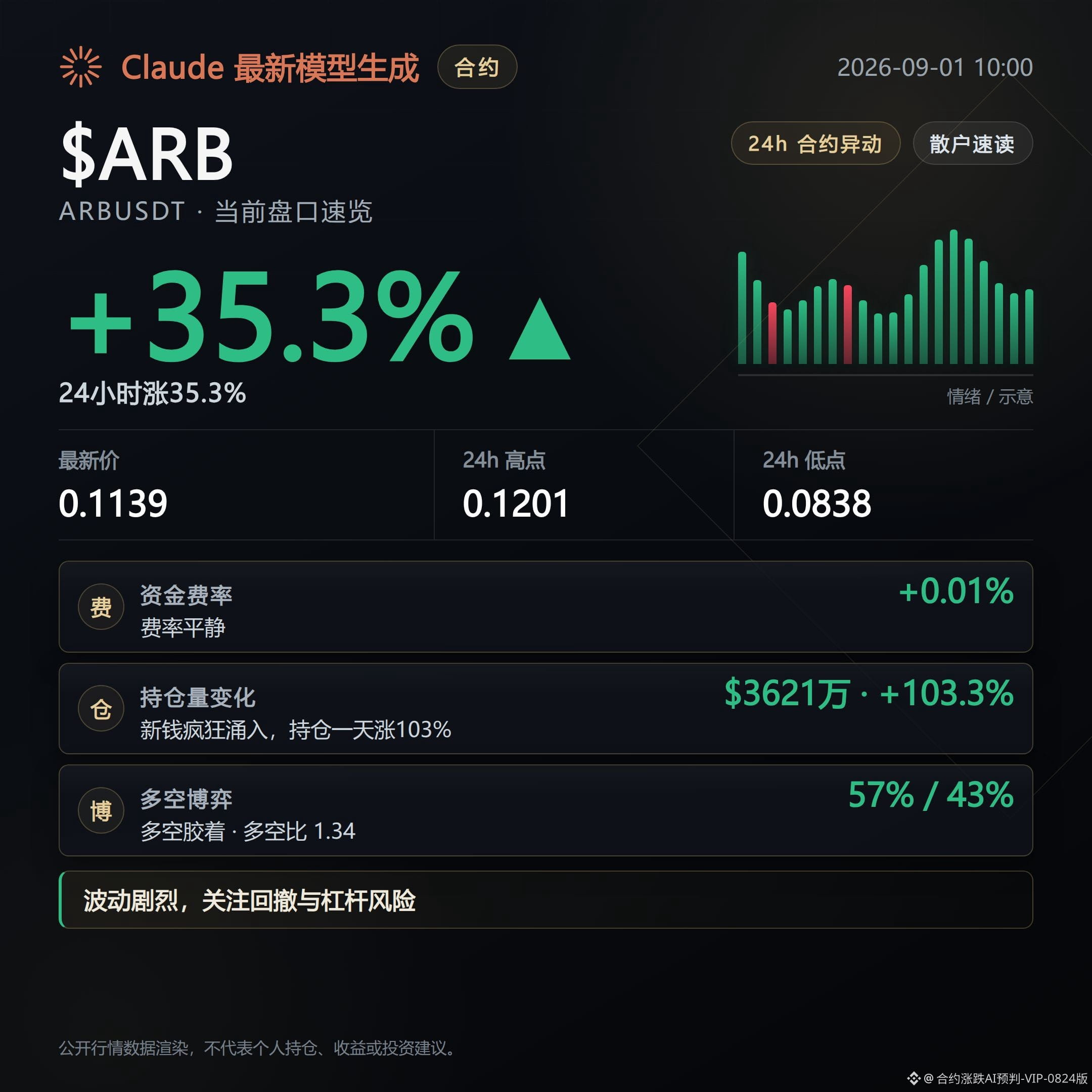
Trading volume: $219 million. Open interest increased 103.3% over 24h, and in the last 1 hour it still added 10.3%. The position-adding slope hasn’t shown obvious fading. Among the three, it’s the only one where open interest is still accelerating.
Funding rate: +0.01%. It has paid longs for 4 consecutive rounds, so this is a continuity signal rather than a new one. Long/short ratio: 1.34. Big-holder ratio: 1.57. Big holders and retail are aligned in direction. RSI 83.0 is in the overbought zone. The premium rate is -0.0179%, close to a slight discount.
All three coins have open interest that has at least doubled over 24h. RSI is approaching or already inside the overbought zone. For 0G and USELESS, the latest 1-hour increase in open-interest slope has clearly slowed down; only ARB is still accelerating. Signal continuity is diverging.
In the upper ranks of a gainers board, it’s common to see sharp volatility after position concentration, along with long/short “cross-killing” from both sides. By observing how the funding rate and open interest change over the next 1 hour, you can tell whether capital is continuing to enter or starting to retreat. This does not constitute any investment advice.
#0G #USELESS #ARB #Contract market data
Live record: This account currently holds $FOGO long positions. The logic remains unchanged, so I will continue to hold.
Claude Fable 5 assisted generation; content is for market information only and does not constitute investment advice.
At 10:00 (Beijing time), a recap of the morning order book.
Go through the current top 3 on Binance’s 24-hour contract gainers board, compare the 24-hour signals with the latest readings from the most recent 1 hour, and assess whether the signal is continuing or already fading.
#1 0G: Up 39.95% over 24h, to $0.2431.
Trading volume: $261 million. Open interest surged 172.9% over 24h, but in the last 1 hour it increased only 12.7%, and the slope has clearly narrowed.
Funding rate: -0.1965%. It has been negative and has continued for 6 consecutive rounds, with the long/short ratio at 1.49. 60% of accounts are on the long side. The aggressive buy side is 1.03. RSI 67.8 is still in a neutral range.
#2 USELESS: Up 38.82% over 24h, at $0.09259.
Trading volume: $138 million. Open interest surged 116.1% over 24h, but in the last 1 hour it added only 2.1%. The pace of adding positions is almost stalled, which doesn’t match the “burst” strength seen over 24h.
Funding rate just flipped to +0.005%, meaning it has only paid longs for 1 consecutive round—this is a newly emerging signal. RSI 78.3 is already in the overbought zone. The big-holder long/short ratio is 0.93, slightly more skewed toward shorts, and it’s not fully aligned with retail traders.
#3 ARB: Up 35.33% over 24h, at $0.11395.
Trading volume: $219 million. Open interest increased 103.3% over 24h, and in the last 1 hour it still added 10.3%. The position-adding slope hasn’t shown obvious fading. Among the three, it’s the only one where open interest is still accelerating.
Funding rate: +0.01%. It has paid longs for 4 consecutive rounds, so this is a continuity signal rather than a new one. Long/short ratio: 1.34. Big-holder ratio: 1.57. Big holders and retail are aligned in direction. RSI 83.0 is in the overbought zone. The premium rate is -0.0179%, close to a slight discount.
All three coins have open interest that has at least doubled over 24h. RSI is approaching or already inside the overbought zone. For 0G and USELESS, the latest 1-hour increase in open-interest slope has clearly slowed down; only ARB is still accelerating. Signal continuity is diverging.
In the upper ranks of a gainers board, it’s common to see sharp volatility after position concentration, along with long/short “cross-killing” from both sides. By observing how the funding rate and open interest change over the next 1 hour, you can tell whether capital is continuing to enter or starting to retreat. This does not constitute any investment advice.
#0G #USELESS #ARB #Contract market data
Live record: This account currently holds $FOGO long positions. The logic remains unchanged, so I will continue to hold.
Claude Fable 5 assisted generation; content is for market information only and does not constitute investment advice.
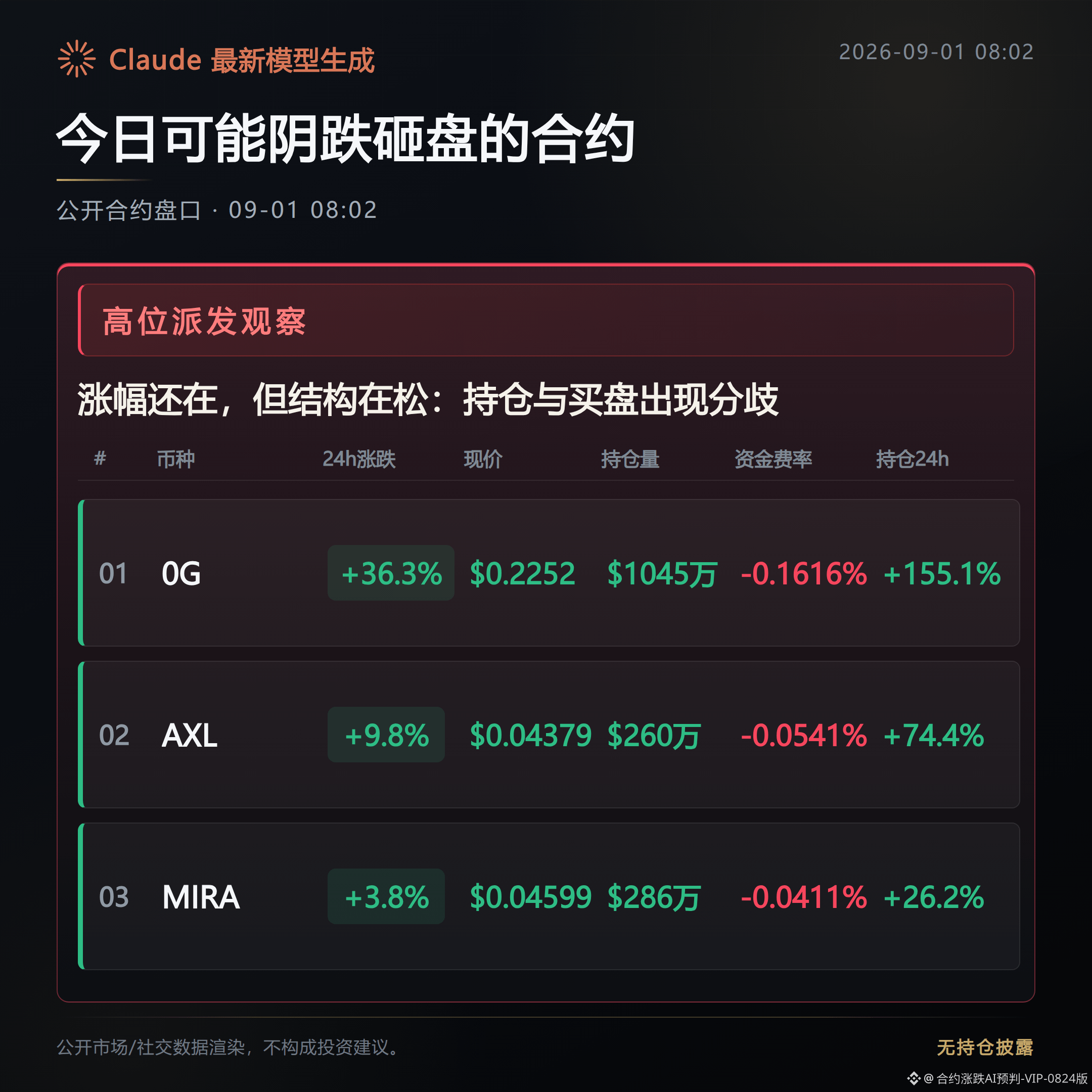
Bearish signals have started to show up in today’s futures order books. The three contracts—0G, AXL, and MIRA—are all telling the same story.
Prices are still rising, and the gains aren’t small, but the structure that’s propping up the move is already loosening.
Don’t just look at the green percentage increase. The danger isn’t that it doesn’t rise—it’s that the support for the rise thins out as it keeps going.
Next, watch whether a pullback and thinning support appear at the same time.
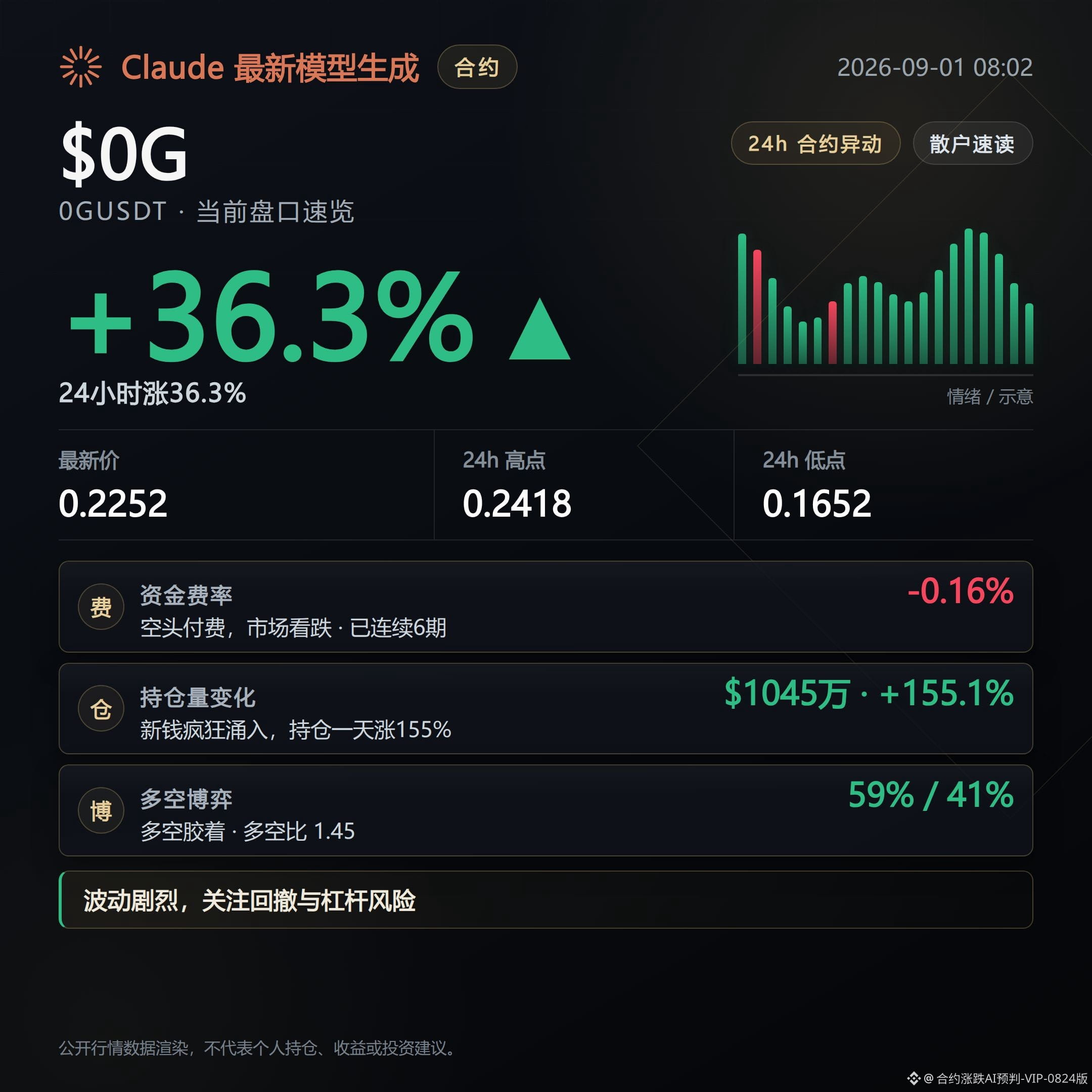
0G is currently at $0.2252, up 36.32% over the past 24 hours, with a trading volume of $222 million—its volume is sizeable.
The hard part is the funding rate: it has been charged to shorts for 6 straight periods, at -0.162%. Bulls are effectively paying shorts while still managing to hold the price up.
Open interest surged 155.1% in 24 hours to $10.45 million, and positions are really piling in.
But in the last 1 hour, open interest fell 2.8%. The chasing money has started to retreat first. Price still has upward momentum, yet the structure loosens first.
The chips are spreading out.
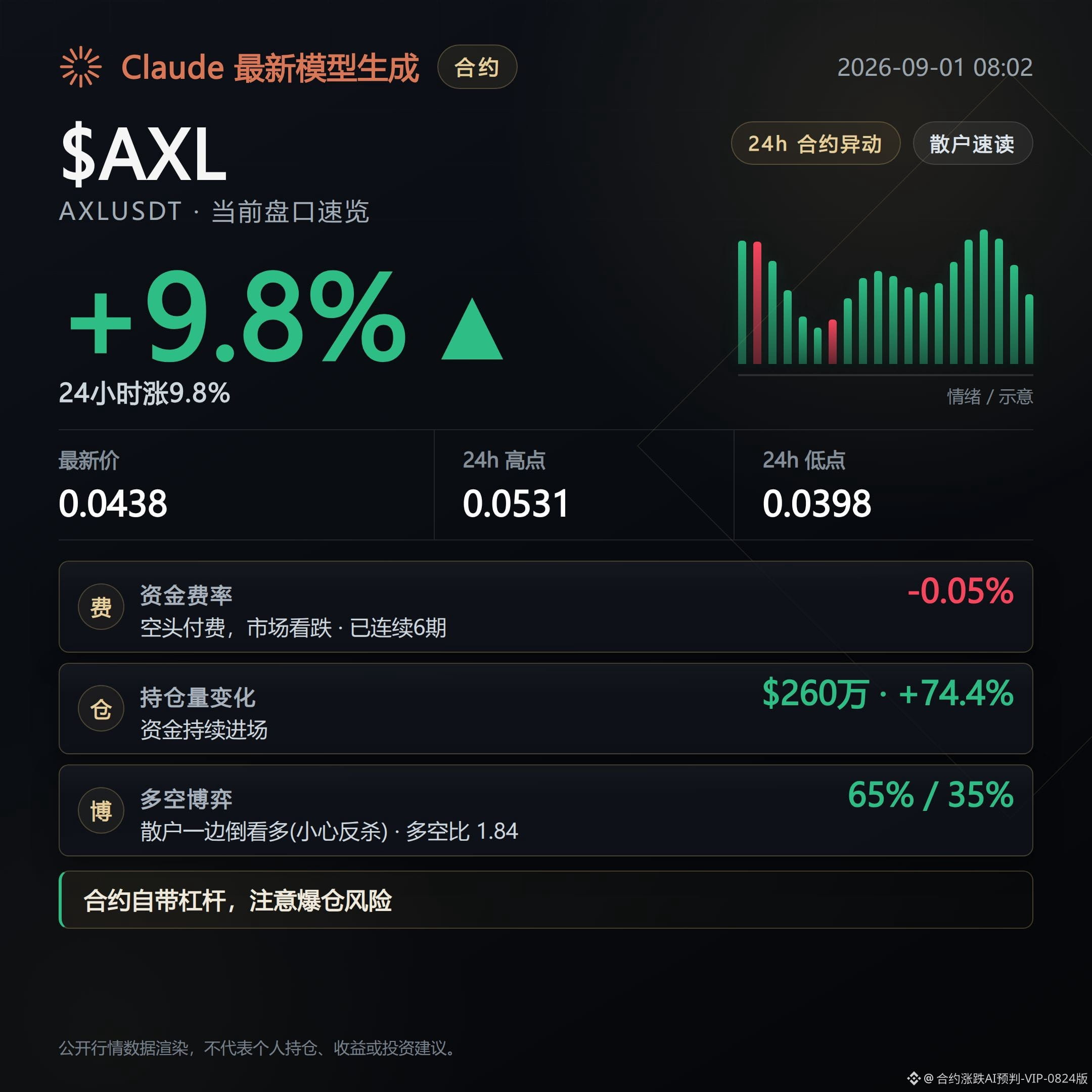
AXL is trading at $0.04379. Up 9.83% in the past 24 hours, with $39.11 million in volume. The rise isn’t crazy, but it’s not small either.
Funding has been charged to shorts for 6 straight periods, at -0.054%. Just like 0G, the direction feels like shorts are paying bulls—again, shorts are topping up rather than bulls.
Open interest increased 74.4% in 24 hours to $2.59 million. Active buy orders also dominate, with a buy/sell ratio of 1.29—looks pretty solid.
But the long/short ratio is already 1.84. With 65% of positions on the long side, price still shows gains, yet the structure has loosened. A lopsided position is exactly what fears a reversal.
The chips are spreading out. Chasing longs are likely to be “tormented” by both a rebound and a pullback at the same time.
MIRA is at $0.04599. Up 3.84% over the past 24 hours—the smallest gain among the three. Its volume is also the thinnest at $16.99 million.
Funding has been charged to shorts for 7 straight periods, at -0.041%. The paid cycle is one more period than the other two.
Open interest rose 26.2% in 24 hours to $2.86 million. The speed at which positions are flooding in is clearly slower than for 0G and AXL.
Active sell orders are dominant, with a buy/sell ratio of 0.83. Since the rise was already modest, and sellers are still leading while price rises but the structure loosens—this “structure loosening while price rises” signal is most obvious on MIRA.
The chips are spreading out. Chasing longs can easily be hit by both a rebound and a pullback at the same time.
If these three contracts continue to see thinning support next, and volume can’t keep up with the upward move, the line of drifting pullback will move forward.
If open interest re-expands, and price stabilizes back on its feet—no longer relying on funding rate unilateral “blood transfusion”—then this assessment needs to be reconsidered.
Next, keep an eye on which of these two things produces results first.
#0G #AXL #MIRA #Contract order book
Live account disclosure: This account currently holds $FOGO long positions; the related viewpoints match the actual position holdings.
Claude Fable 5 generated with assistance; content is for informational market reference only and does not constitute investment advice.
Prices are still rising, and the gains aren’t small, but the structure that’s propping up the move is already loosening.
Don’t just look at the green percentage increase. The danger isn’t that it doesn’t rise—it’s that the support for the rise thins out as it keeps going.
Next, watch whether a pullback and thinning support appear at the same time.
0G is currently at $0.2252, up 36.32% over the past 24 hours, with a trading volume of $222 million—its volume is sizeable.
The hard part is the funding rate: it has been charged to shorts for 6 straight periods, at -0.162%. Bulls are effectively paying shorts while still managing to hold the price up.
Open interest surged 155.1% in 24 hours to $10.45 million, and positions are really piling in.
But in the last 1 hour, open interest fell 2.8%. The chasing money has started to retreat first. Price still has upward momentum, yet the structure loosens first.
The chips are spreading out.
AXL is trading at $0.04379. Up 9.83% in the past 24 hours, with $39.11 million in volume. The rise isn’t crazy, but it’s not small either.
Funding has been charged to shorts for 6 straight periods, at -0.054%. Just like 0G, the direction feels like shorts are paying bulls—again, shorts are topping up rather than bulls.
Open interest increased 74.4% in 24 hours to $2.59 million. Active buy orders also dominate, with a buy/sell ratio of 1.29—looks pretty solid.
But the long/short ratio is already 1.84. With 65% of positions on the long side, price still shows gains, yet the structure has loosened. A lopsided position is exactly what fears a reversal.
The chips are spreading out. Chasing longs are likely to be “tormented” by both a rebound and a pullback at the same time.
MIRA is at $0.04599. Up 3.84% over the past 24 hours—the smallest gain among the three. Its volume is also the thinnest at $16.99 million.
Funding has been charged to shorts for 7 straight periods, at -0.041%. The paid cycle is one more period than the other two.
Open interest rose 26.2% in 24 hours to $2.86 million. The speed at which positions are flooding in is clearly slower than for 0G and AXL.
Active sell orders are dominant, with a buy/sell ratio of 0.83. Since the rise was already modest, and sellers are still leading while price rises but the structure loosens—this “structure loosening while price rises” signal is most obvious on MIRA.
The chips are spreading out. Chasing longs can easily be hit by both a rebound and a pullback at the same time.
If these three contracts continue to see thinning support next, and volume can’t keep up with the upward move, the line of drifting pullback will move forward.
If open interest re-expands, and price stabilizes back on its feet—no longer relying on funding rate unilateral “blood transfusion”—then this assessment needs to be reconsidered.
Next, keep an eye on which of these two things produces results first.
#0G #AXL #MIRA #Contract order book
Live account disclosure: This account currently holds $FOGO long positions; the related viewpoints match the actual position holdings.
Claude Fable 5 generated with assistance; content is for informational market reference only and does not constitute investment advice.
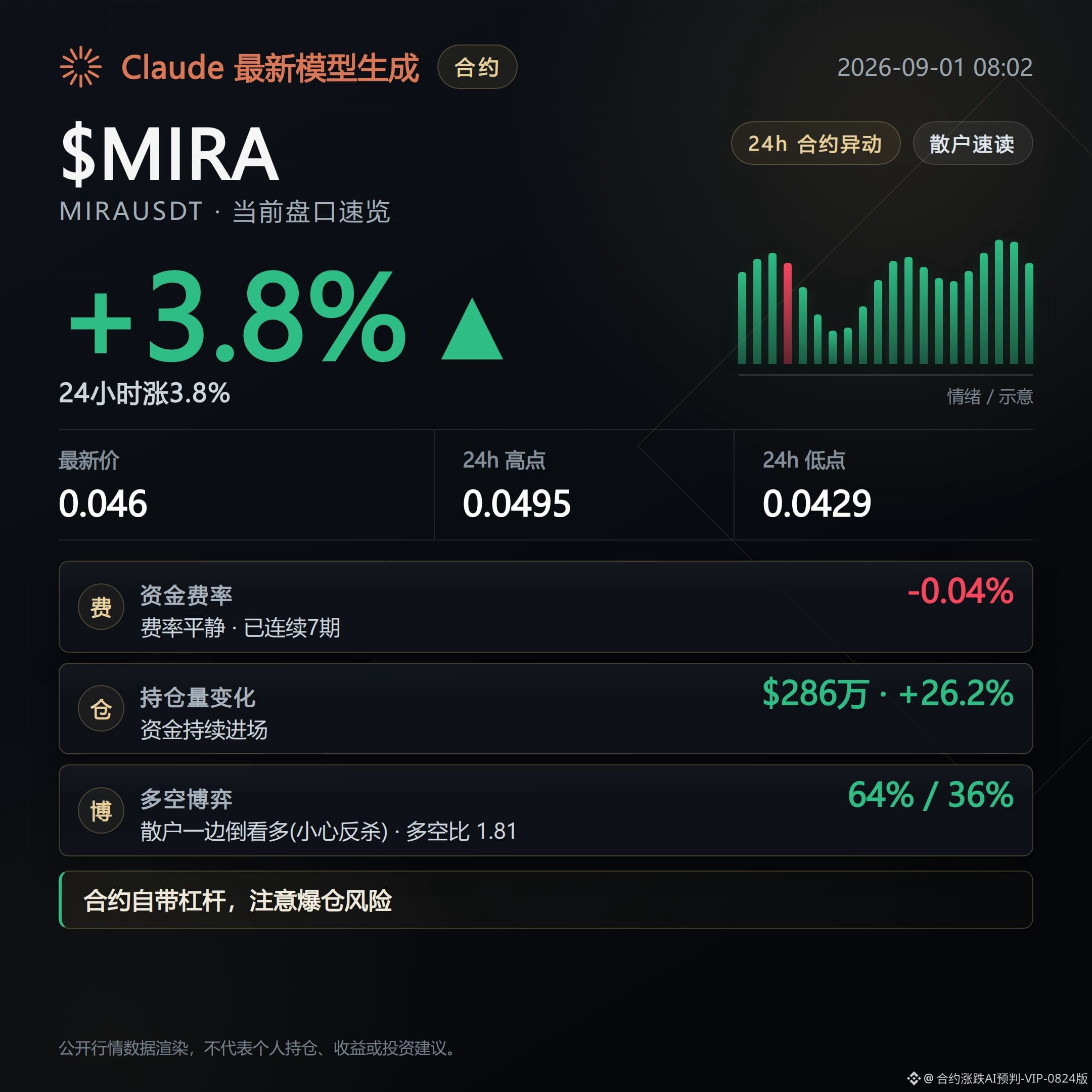
**Contracts that could see a big surge today**
Bullish—this is the direction shown by the current order-book setup for this combination of contracts.
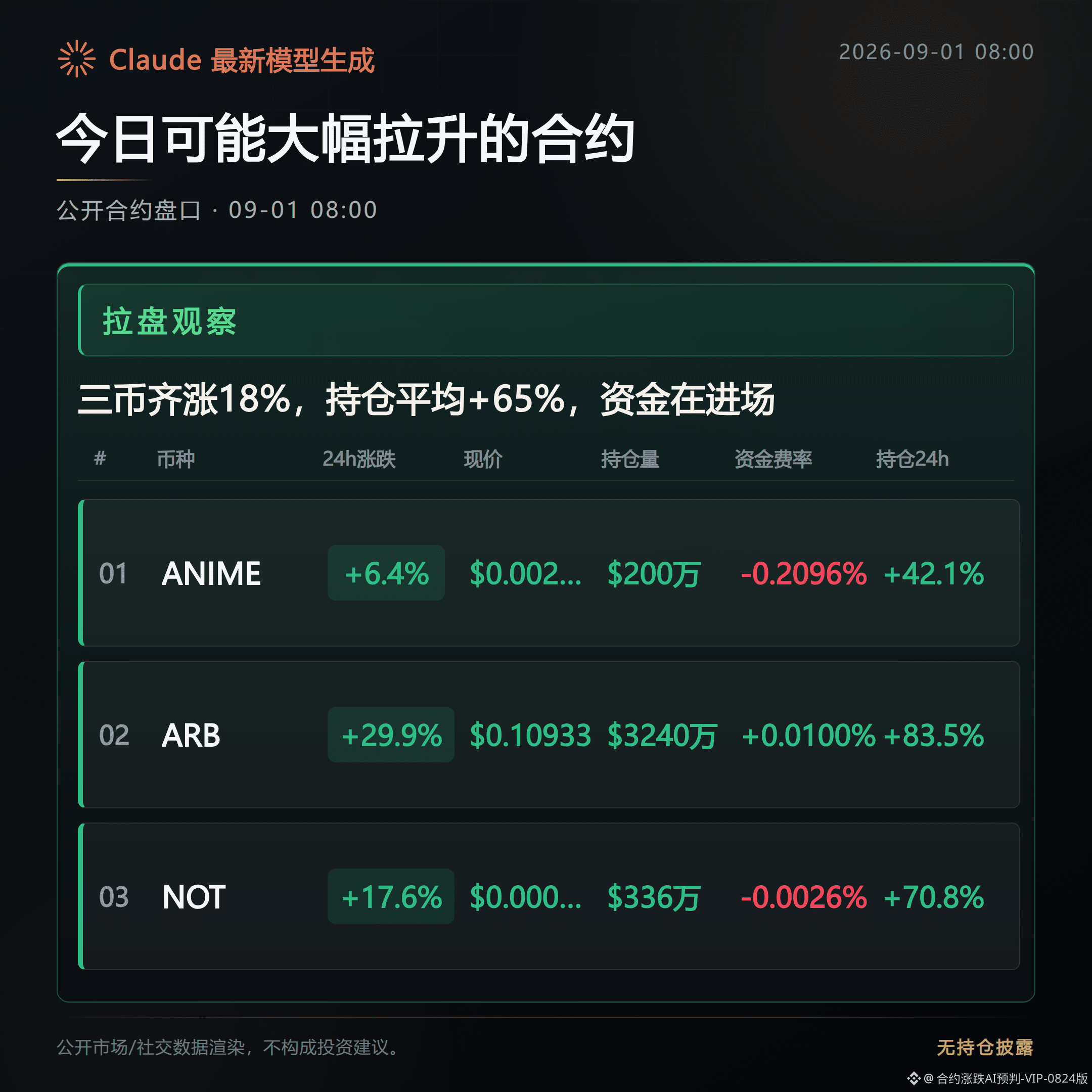
Today, all three contracts—ANIME, ARB, and NOT—are seeing their prices rise. Within the past 24 hours, their open interest has surged significantly. The aggressive buy-side orders also lean toward the buyers, and the order-book evidence aligns across the board.
Next, watch whether these open-interest growth rates can keep expanding in volume, and whether the price can hold above and maintain the current upward structure.
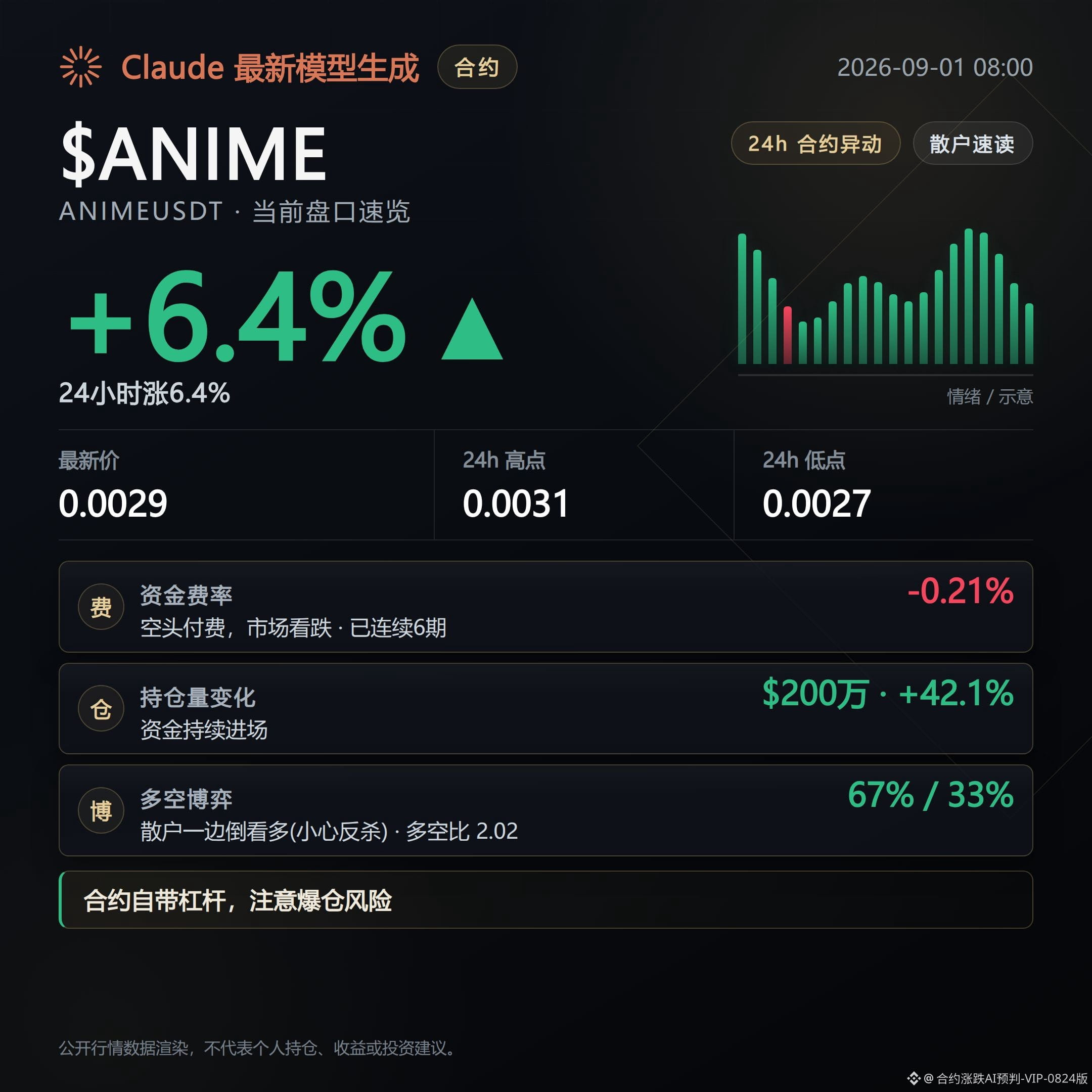
ANIME’s latest price is $0.002864, up 6.39% in the past 24 hours. Open interest over the past 24 hours increased by 42.1%, and the funding rate has been paying out to shorts for 6 consecutive periods.
Continuous funding payments to shorts, combined with rapid inflow of positions, has led the order book to label this set as a “possible short squeeze” type. The aggressive buy/sell ratio is 1.27, and retail long exposure is 67%, which is already somewhat crowded.
The chips are tightening.
However, in just the past hour, open interest rose only 0.2%, and the adding momentum has clearly slowed. If this number turns negative next, the logic behind “squeezing shorts” will need to be reconsidered.
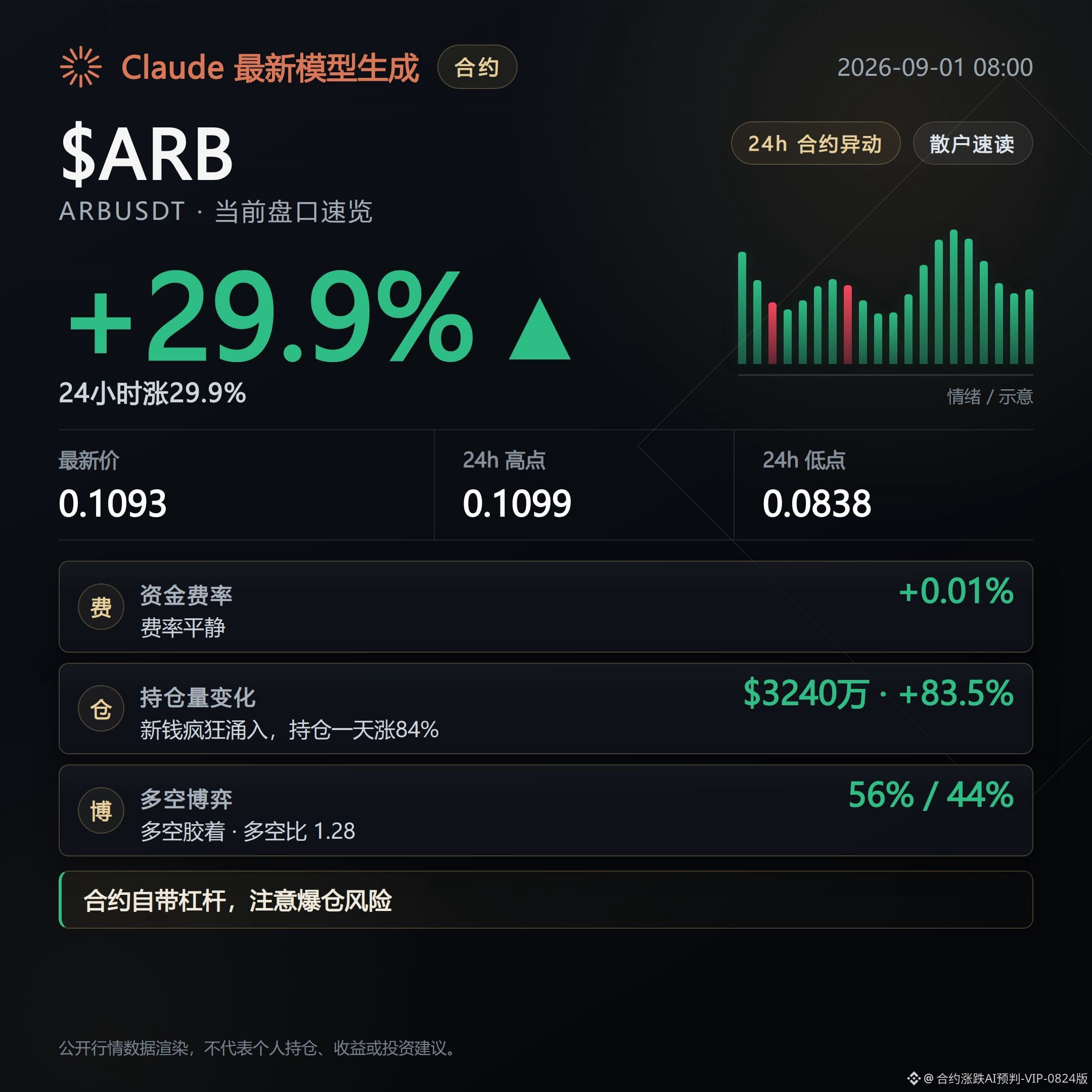
ARB is the biggest gainer among the three, up 29.88% in 24 hours. Trading volume is $131 million, and open interest in the past 24 hours has skyrocketed by 83.5%, with the past hour also adding another 10%.
Such a rapid surge in open interest suggests new positions are stacking quickly, and the trend structure remains upward.
The chips are tightening.
The counterpoint is that the relative strength indicator has already reached 88.9, placing it in the overbought zone. The faster it rises, the higher the probability of a short-term digestion/pullback occurring in parallel.
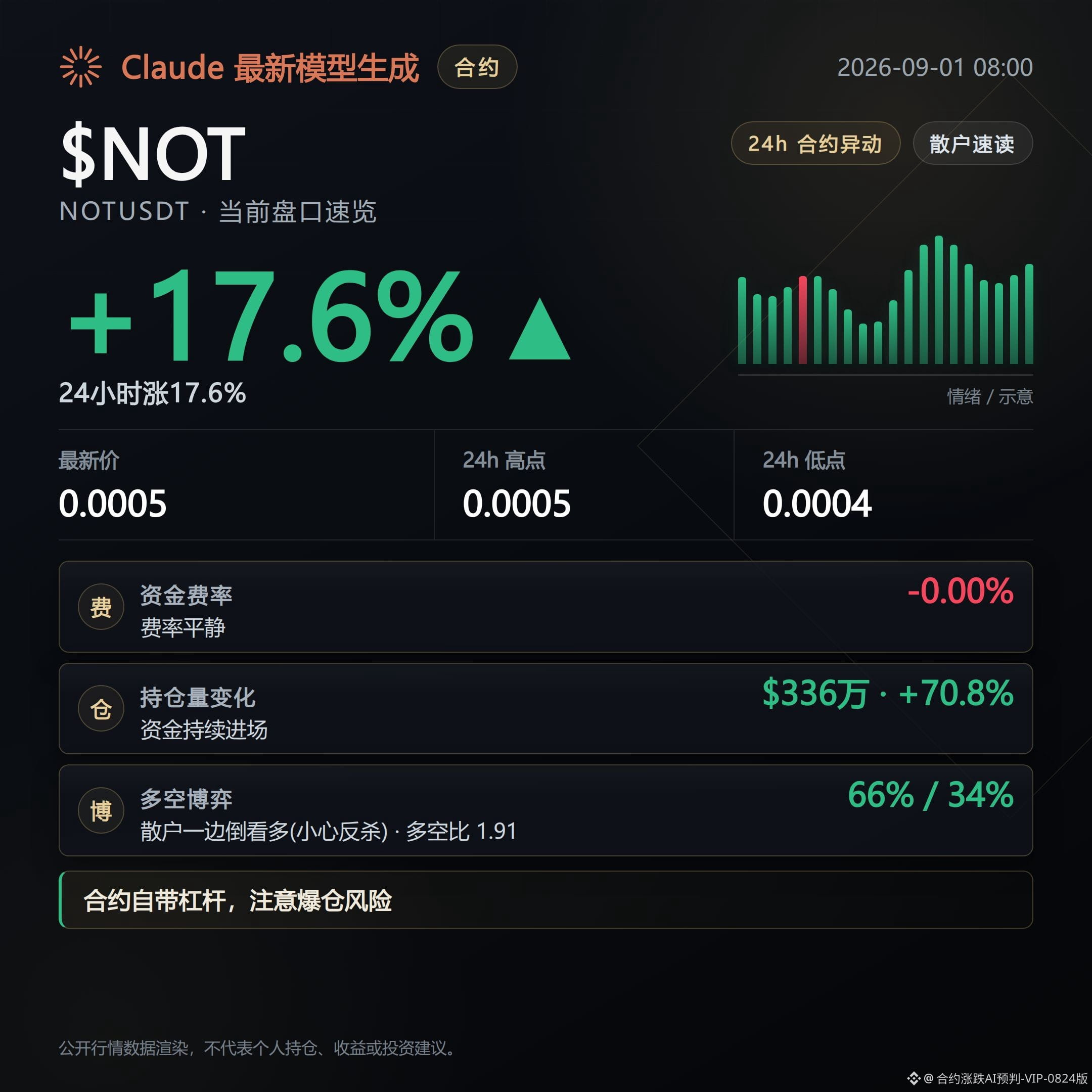
NOT is up 17.62% in price, with $33.75 million in trading value. Open interest increased by 70.8% over the past 24 hours, and retail long exposure is 66%.
Aggressive buy/sell ratio is 1.07. Positions are flowing in along with the price, and the trend structure is also skewed upward.
The chips are tightening.
The counterpoint is that open interest increased by only 2.6% over the past hour. The pace of chasing longs is slower than both ANIME and ARB, so this set’s confirmation may take a bit longer.
If these sets’ open-interest growth rates continue to rise in sync and the price holds the current upward structure, then the surge logic can continue. If open-interest growth rate turns downward and the RSI further spikes then rolls over, this direction will need to be reassessed.
#ANIME #ARB #NOT # Contract order book
Real-trade disclosure: This account currently holds $FOGO long positions. The related views are consistent with the actual positions.
This content is generated with the assistance of Claude Fable 5 and is for information reference only. Please verify it yourself.
Bullish—this is the direction shown by the current order-book setup for this combination of contracts.
Today, all three contracts—ANIME, ARB, and NOT—are seeing their prices rise. Within the past 24 hours, their open interest has surged significantly. The aggressive buy-side orders also lean toward the buyers, and the order-book evidence aligns across the board.
Next, watch whether these open-interest growth rates can keep expanding in volume, and whether the price can hold above and maintain the current upward structure.
ANIME’s latest price is $0.002864, up 6.39% in the past 24 hours. Open interest over the past 24 hours increased by 42.1%, and the funding rate has been paying out to shorts for 6 consecutive periods.
Continuous funding payments to shorts, combined with rapid inflow of positions, has led the order book to label this set as a “possible short squeeze” type. The aggressive buy/sell ratio is 1.27, and retail long exposure is 67%, which is already somewhat crowded.
The chips are tightening.
However, in just the past hour, open interest rose only 0.2%, and the adding momentum has clearly slowed. If this number turns negative next, the logic behind “squeezing shorts” will need to be reconsidered.
ARB is the biggest gainer among the three, up 29.88% in 24 hours. Trading volume is $131 million, and open interest in the past 24 hours has skyrocketed by 83.5%, with the past hour also adding another 10%.
Such a rapid surge in open interest suggests new positions are stacking quickly, and the trend structure remains upward.
The chips are tightening.
The counterpoint is that the relative strength indicator has already reached 88.9, placing it in the overbought zone. The faster it rises, the higher the probability of a short-term digestion/pullback occurring in parallel.
NOT is up 17.62% in price, with $33.75 million in trading value. Open interest increased by 70.8% over the past 24 hours, and retail long exposure is 66%.
Aggressive buy/sell ratio is 1.07. Positions are flowing in along with the price, and the trend structure is also skewed upward.
The chips are tightening.
The counterpoint is that open interest increased by only 2.6% over the past hour. The pace of chasing longs is slower than both ANIME and ARB, so this set’s confirmation may take a bit longer.
If these sets’ open-interest growth rates continue to rise in sync and the price holds the current upward structure, then the surge logic can continue. If open-interest growth rate turns downward and the RSI further spikes then rolls over, this direction will need to be reassessed.
#ANIME #ARB #NOT # Contract order book
Real-trade disclosure: This account currently holds $FOGO long positions. The related views are consistent with the actual positions.
This content is generated with the assistance of Claude Fable 5 and is for information reference only. Please verify it yourself.
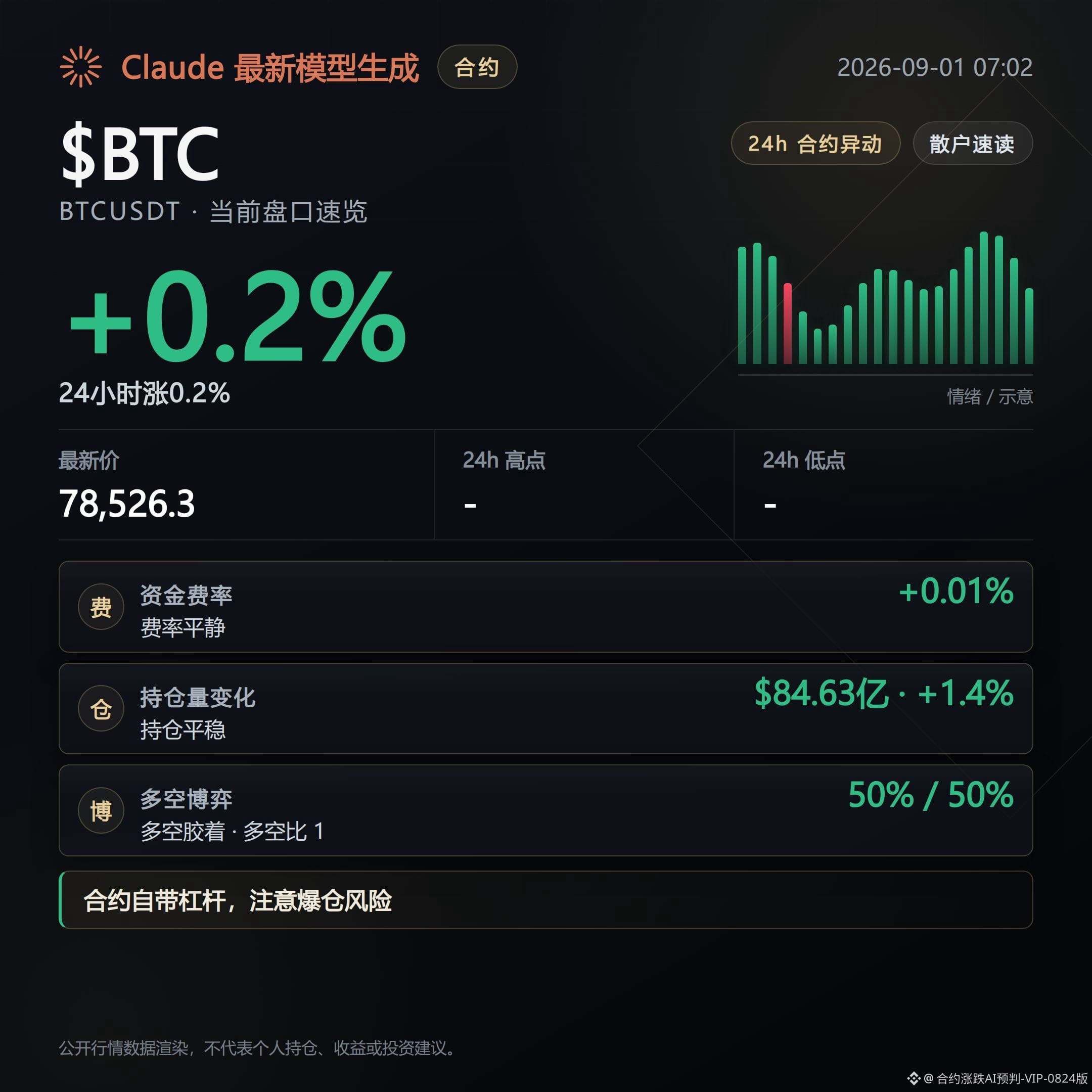
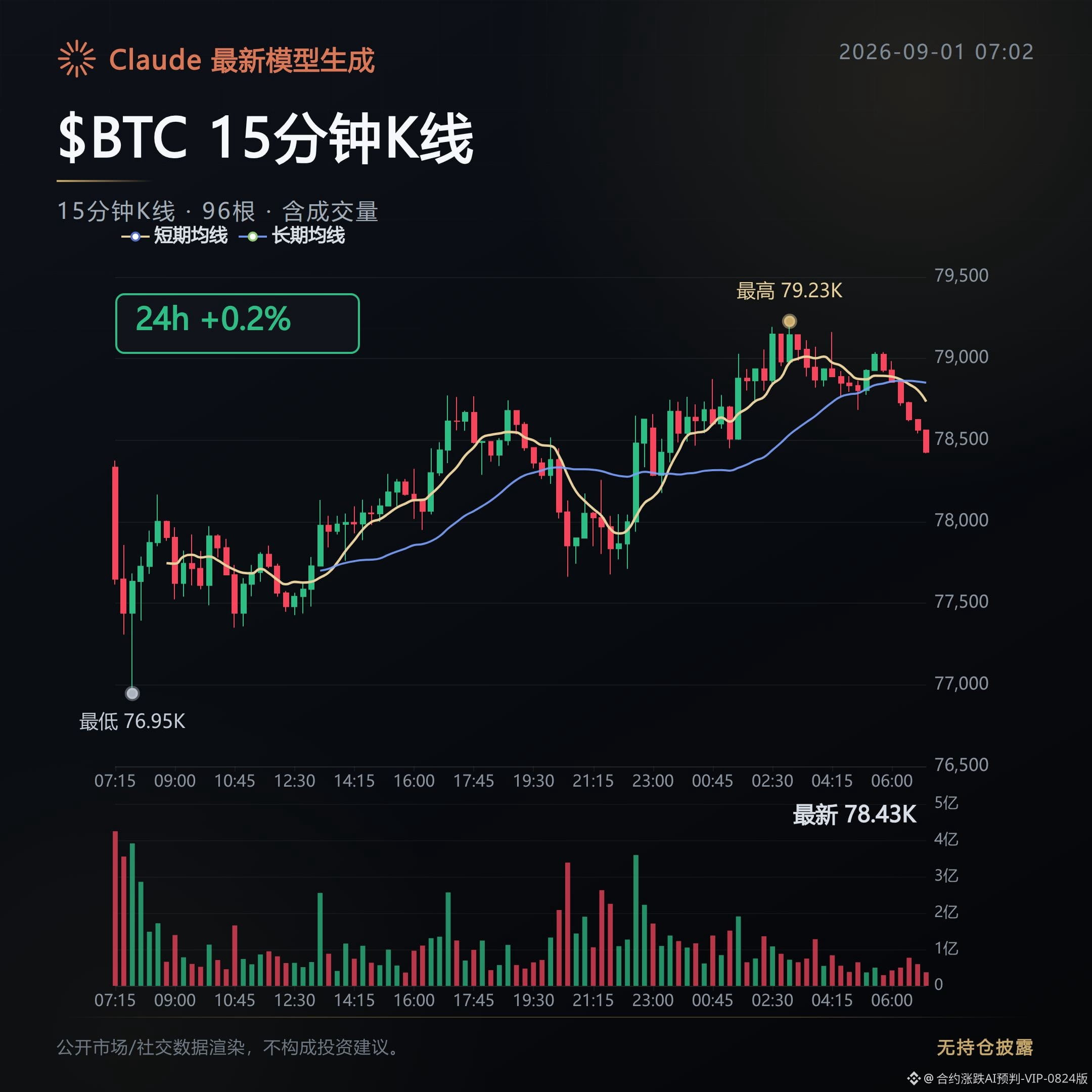
Contract Order Book Daily|9/1 Morning: Institutions are stocking up, yet the fees are oddly calm
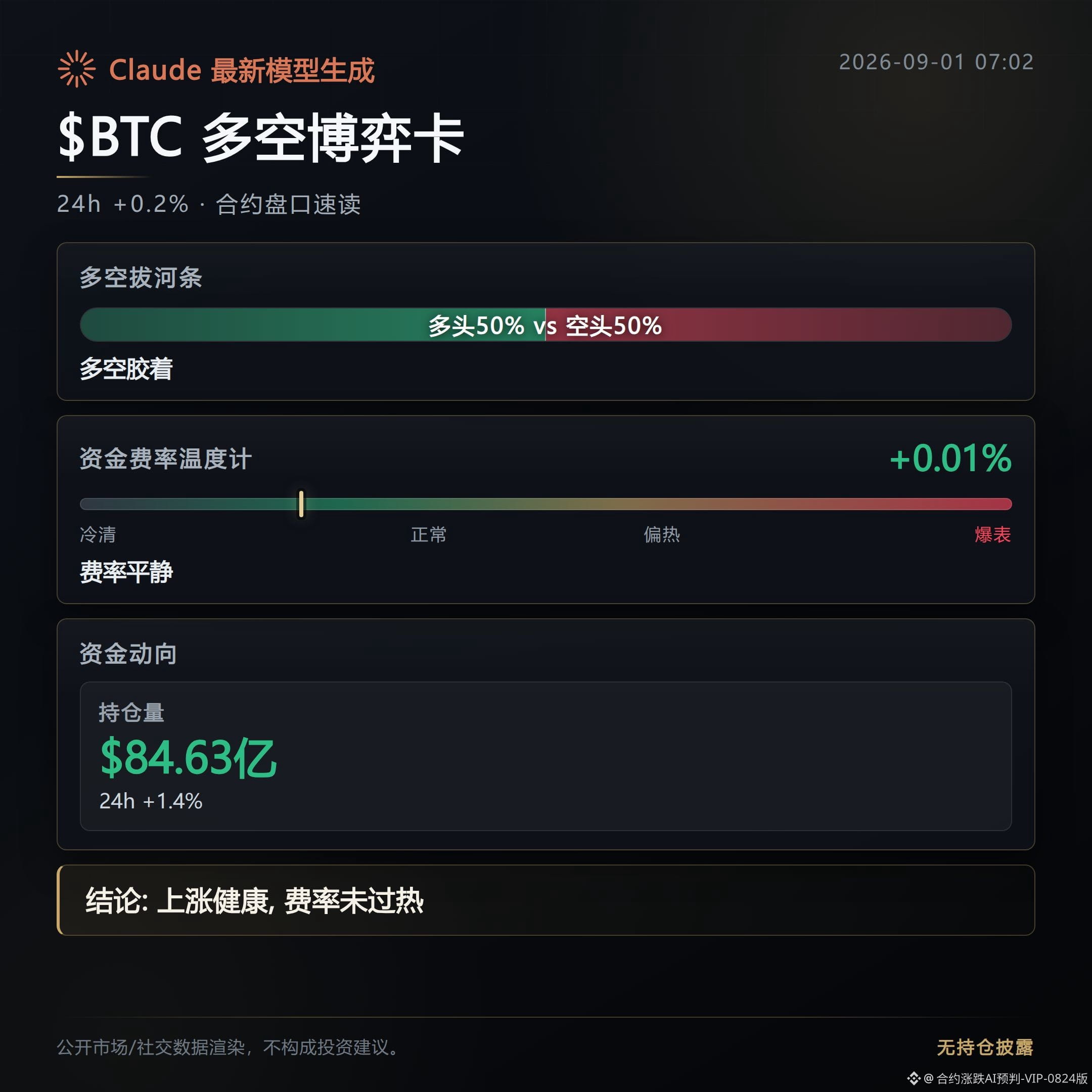
$BTC marked price is $78.5k, with a 24-hour rise/fall of +0.17%, not much of a move.
The contract funding rate is 0.0087%, which is relatively low—suggesting the longs aren’t desperately rushing ahead.
Open interest has risen to $8.463 billion, up 1.4% in a day. There’s truly incremental capital entering, not just propping prices with the current level.
The long-to-short account ratio is roughly 50/50; active sell orders are slightly more lively than buys.
Greed Index is 62—leaning toward greed, but not to the point of madness.
Spot, on the other hand, has been livelier these past couple of days.
Strategy returned after more than two months, buying $370 million of $BTC in one go—its first add-on since June.
Strive also followed with an additional $143 million.
This round from the Treasury firm is clearly about sweeping up on the dip.
But at the same time, Strategy is arguing with MSCI—opposing the removal of the Bitcoin Treasury firm from the index.
If it were actually kicked out, passive capital would withdraw, creating a different kind of selling pressure—exactly opposite to the direction of the current buying.
Over on the other side, risks aren’t idle either.
Reports say North Korean hackers are transferring tens of millions of dollars to Hyperliquid, while the U.S. is also pushing to bring these types of contract platforms back into compliance on home soil.
With both regulators and hacker funds targeting the same platform, it’s not good news for perpetual contract users.
On the short term, you can see some differentiation.
The worst (most negative) funding-rate products are BSP, FLOCK, and SKR—shorts are holding onto costs.
The most positive funding-rate is BNC, surging to 0.8%; longs are getting a bit crowded together.
$BTC ’s funding rate is relatively low, with long/short balance—so the real divergence is actually concentrated in these smaller coins’ contract funding rates. That’s the part worth watching a bit more going forward.
Live trading record: This account currently holds $FOGO long positions; with the rationale unchanged, I continue to hold.
This content was assisted in generation by Claude Fable 5 and is for information reference only—please verify independently.
$BTC marked price is $78.5k, with a 24-hour rise/fall of +0.17%, not much of a move.
The contract funding rate is 0.0087%, which is relatively low—suggesting the longs aren’t desperately rushing ahead.
Open interest has risen to $8.463 billion, up 1.4% in a day. There’s truly incremental capital entering, not just propping prices with the current level.
The long-to-short account ratio is roughly 50/50; active sell orders are slightly more lively than buys.
Greed Index is 62—leaning toward greed, but not to the point of madness.
Spot, on the other hand, has been livelier these past couple of days.
Strategy returned after more than two months, buying $370 million of $BTC in one go—its first add-on since June.
Strive also followed with an additional $143 million.
This round from the Treasury firm is clearly about sweeping up on the dip.
But at the same time, Strategy is arguing with MSCI—opposing the removal of the Bitcoin Treasury firm from the index.
If it were actually kicked out, passive capital would withdraw, creating a different kind of selling pressure—exactly opposite to the direction of the current buying.
Over on the other side, risks aren’t idle either.
Reports say North Korean hackers are transferring tens of millions of dollars to Hyperliquid, while the U.S. is also pushing to bring these types of contract platforms back into compliance on home soil.
With both regulators and hacker funds targeting the same platform, it’s not good news for perpetual contract users.
On the short term, you can see some differentiation.
The worst (most negative) funding-rate products are BSP, FLOCK, and SKR—shorts are holding onto costs.
The most positive funding-rate is BNC, surging to 0.8%; longs are getting a bit crowded together.
$BTC ’s funding rate is relatively low, with long/short balance—so the real divergence is actually concentrated in these smaller coins’ contract funding rates. That’s the part worth watching a bit more going forward.
Live trading record: This account currently holds $FOGO long positions; with the rationale unchanged, I continue to hold.
This content was assisted in generation by Claude Fable 5 and is for information reference only—please verify independently.
6:00 AM market recap. Several coins that were simultaneously marked by funding rates and open interest last night—now I’m going through them one by one to see whether the move has been兑现.
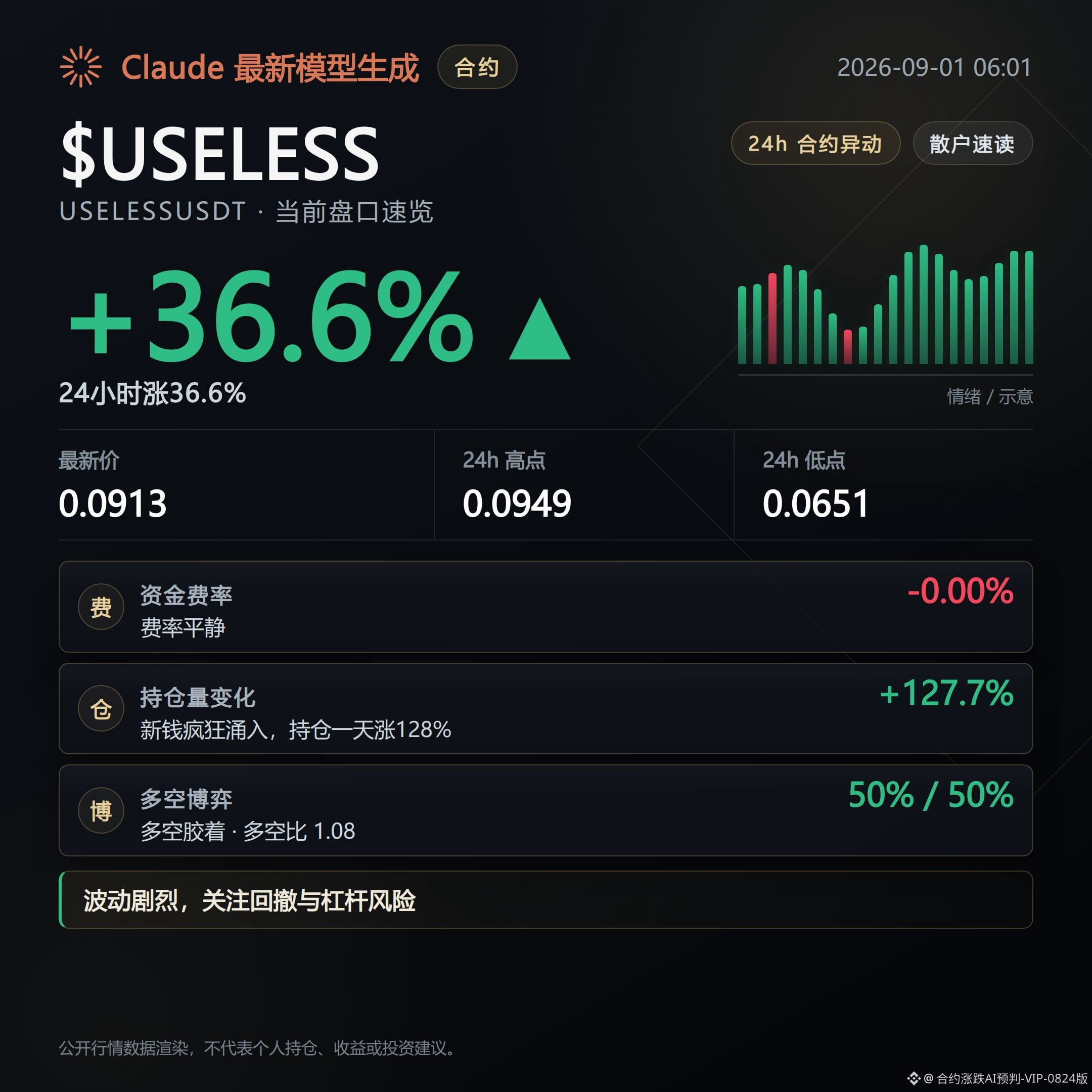
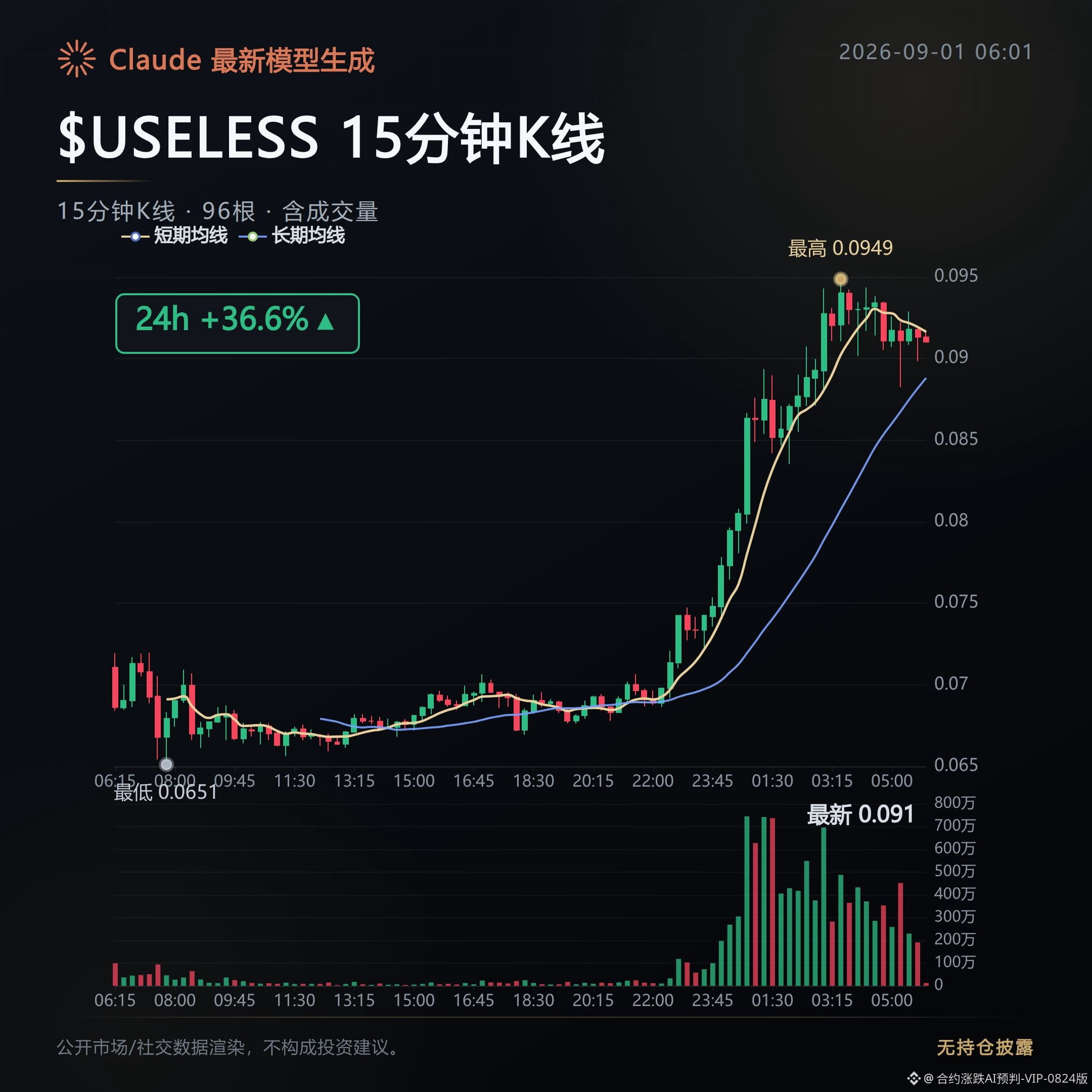
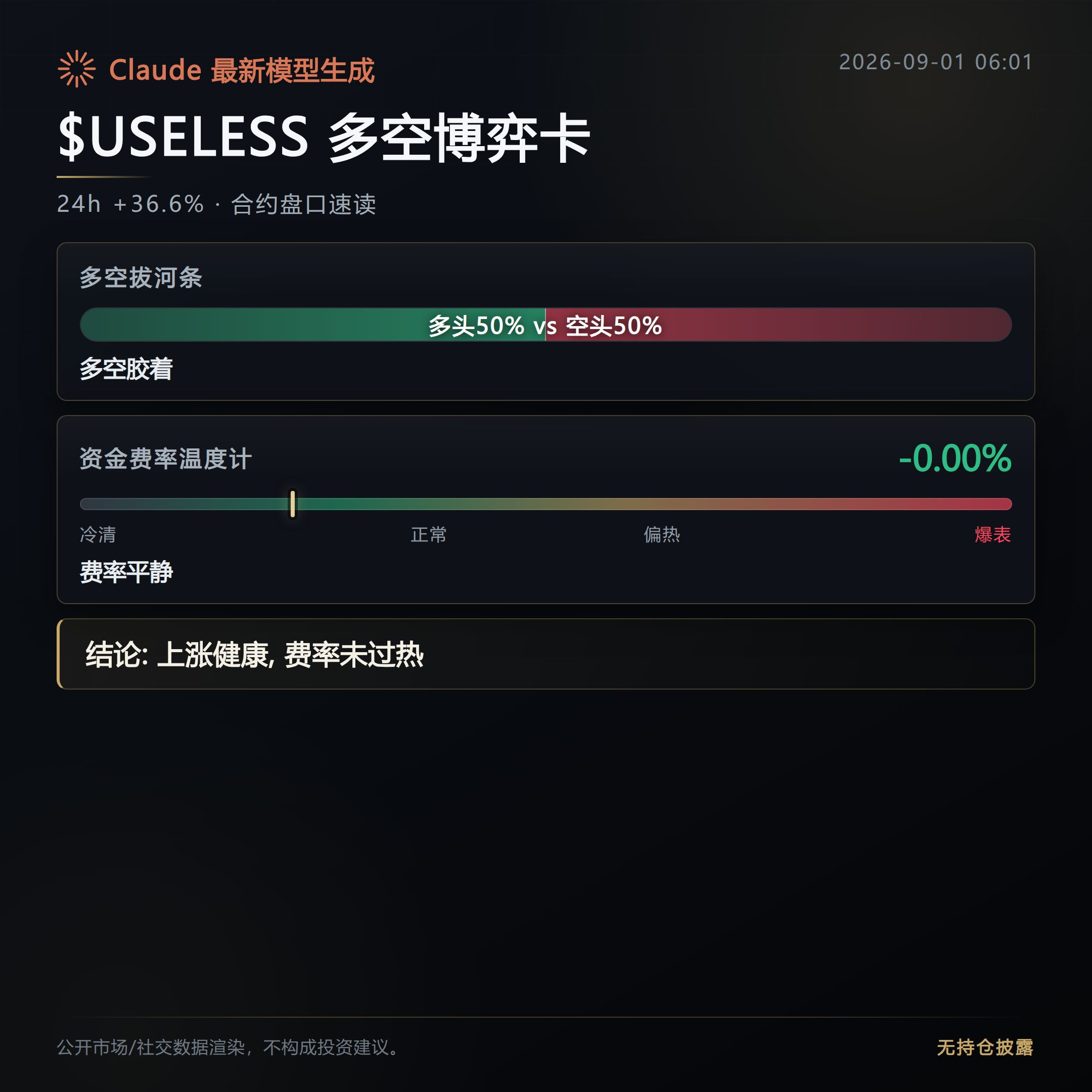
USELESS up 36.6%, price is closing in on the 24-hour high.
The first signal that lit up was a 127.7% one-hour surge in open interest—not a slow build, but a concentrated inflow.
Now the price has indeed caught up with the open-interest pace, the signal has played out, and it’s worth continuing to watch whether it will break the previous high.
0G up 31.8%, funding rate has stalled at -0.17%, shorts are still paying to hold their positions.
This signal was pushed from the bottom at 0.1613 all the way to the high at 0.2418. Now it has pulled back to 0.2217, but open interest is still up 149.1% with no cooldown.
Shorts haven’t surrendered; the funding rate remains extremely extreme—the signal hasn’t finished.
SKR up 24.8%, trading volume of 1.091 billion ranks the highest among the three, but the long/short ratio is only 0.75—there are actually more shorts inside the market.
A funding rate of -0.336% is the most extreme among the three, and open interest is still rising by 38.3%.
When volume is there and shorts are still holding on, this combination is most likely to grow more intense the longer it drags. This is the most complete signal after the audit today.
Overall, this round of shorts is collectively hard-absorbing rather than scattered freelancers. SKR has the highest match between funding rate and trading volume; the next few hours are worth watching to see whether it will truly get squeezed out.
For ranks 4 through 10: CLO up 19.7%, ARB up 19.0%, ZORA up 16.7%, FLOCK up 16.0%, MINIMAX up 15.6%, NOT up 15.3%, HEMI up 14.0%. All are in double digits, but there isn’t any especially extreme supporting signal.
As a comparison for the decliners: BTR down 40.2%, open interest drops in sync by 48.8%—this is a real position withdrawal, not a temporary short-term avoidance by shorts. It’s totally different in nature from SKR holding on without撤.
Squeeze-out candidate: keep an eye on SKR. With a funding rate of -0.336%, the cost shorts are bearing is already extremely high. The longer this structure continues, the more likely they’ll get forced out.
$USELESS $0G $SKR #合约行情 #Squeeze-out signal
Position note: This account’s live trading holds FOGO long positions; this is disclosed to keep the content consistent with actual trading.
This content is generated with the assistance of Claude Fable 5 for reference only—please verify it yourself.
USELESS up 36.6%, price is closing in on the 24-hour high.
The first signal that lit up was a 127.7% one-hour surge in open interest—not a slow build, but a concentrated inflow.
Now the price has indeed caught up with the open-interest pace, the signal has played out, and it’s worth continuing to watch whether it will break the previous high.
0G up 31.8%, funding rate has stalled at -0.17%, shorts are still paying to hold their positions.
This signal was pushed from the bottom at 0.1613 all the way to the high at 0.2418. Now it has pulled back to 0.2217, but open interest is still up 149.1% with no cooldown.
Shorts haven’t surrendered; the funding rate remains extremely extreme—the signal hasn’t finished.
SKR up 24.8%, trading volume of 1.091 billion ranks the highest among the three, but the long/short ratio is only 0.75—there are actually more shorts inside the market.
A funding rate of -0.336% is the most extreme among the three, and open interest is still rising by 38.3%.
When volume is there and shorts are still holding on, this combination is most likely to grow more intense the longer it drags. This is the most complete signal after the audit today.
Overall, this round of shorts is collectively hard-absorbing rather than scattered freelancers. SKR has the highest match between funding rate and trading volume; the next few hours are worth watching to see whether it will truly get squeezed out.
For ranks 4 through 10: CLO up 19.7%, ARB up 19.0%, ZORA up 16.7%, FLOCK up 16.0%, MINIMAX up 15.6%, NOT up 15.3%, HEMI up 14.0%. All are in double digits, but there isn’t any especially extreme supporting signal.
As a comparison for the decliners: BTR down 40.2%, open interest drops in sync by 48.8%—this is a real position withdrawal, not a temporary short-term avoidance by shorts. It’s totally different in nature from SKR holding on without撤.
Squeeze-out candidate: keep an eye on SKR. With a funding rate of -0.336%, the cost shorts are bearing is already extremely high. The longer this structure continues, the more likely they’ll get forced out.
$USELESS $0G $SKR #合约行情 #Squeeze-out signal
Position note: This account’s live trading holds FOGO long positions; this is disclosed to keep the content consistent with actual trading.
This content is generated with the assistance of Claude Fable 5 for reference only—please verify it yourself.
Early-session order book contracts: there aren’t many extractable signals, but these names are written very plainly.
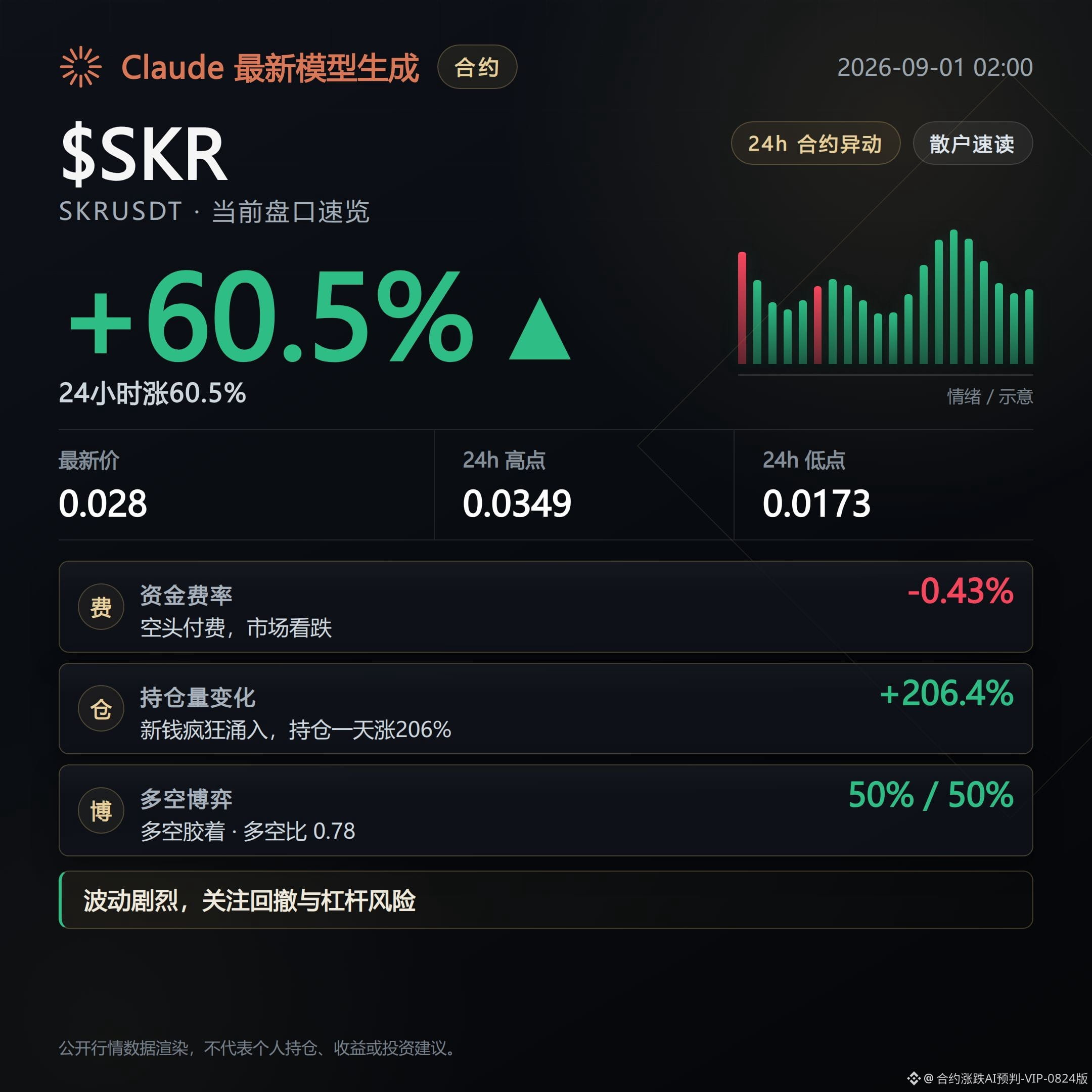
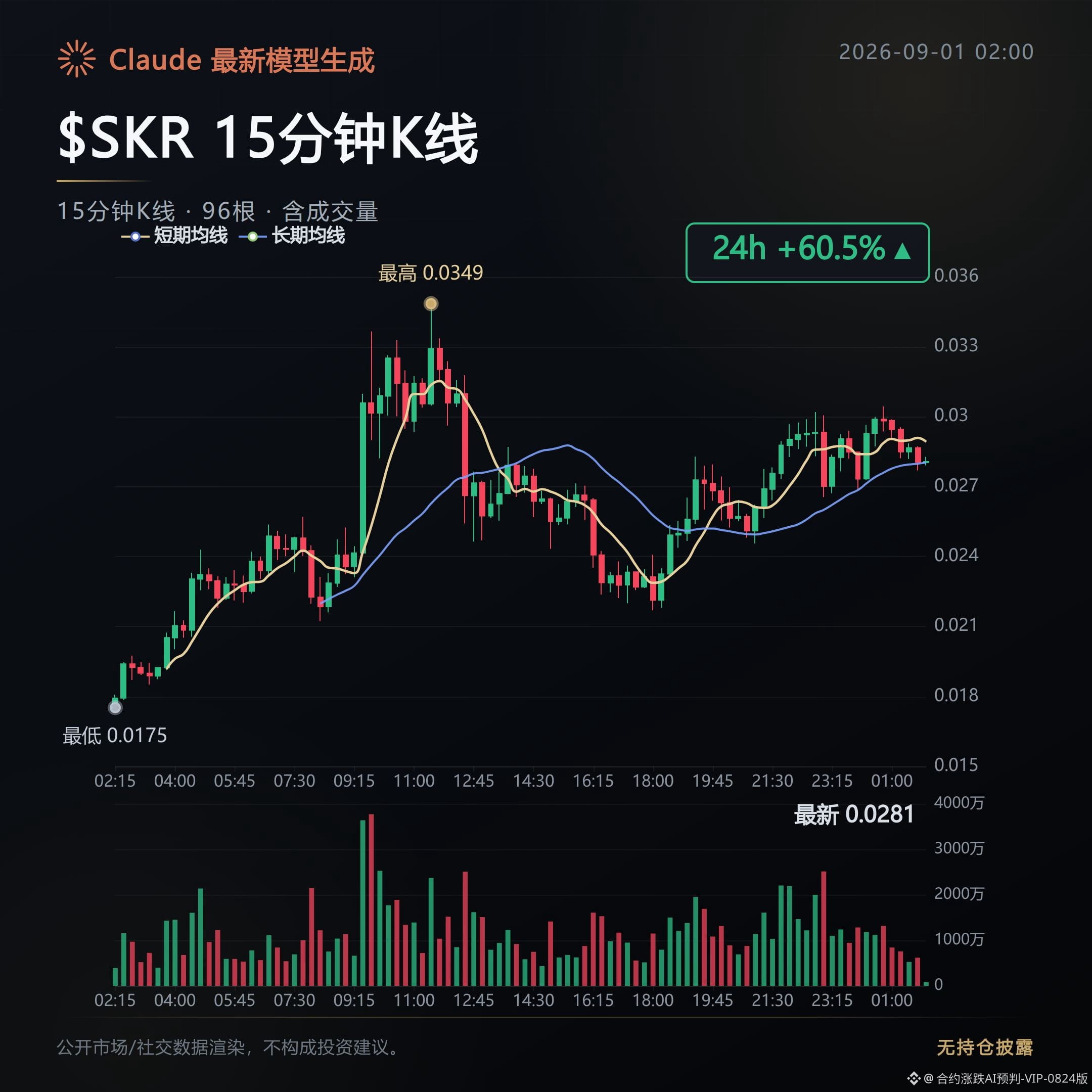
$SKR rose 60.5% on the day.
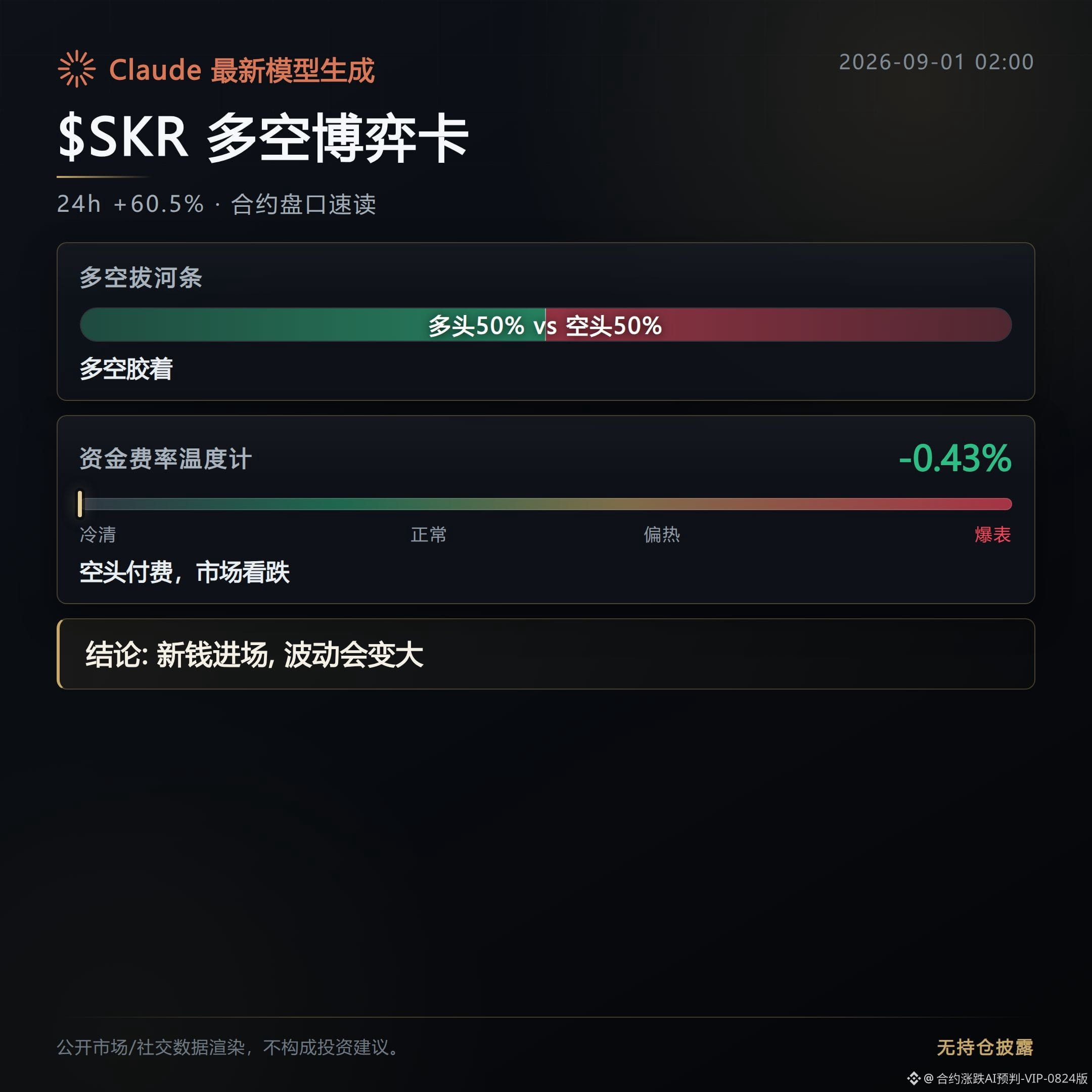
Funding rate is actually negative at -0.426%, and shorts are still dumping their own money out to subsidize losses while stubbornly holding on.
Open interest surged 206.4% within an hour; the aggressive buy side is slightly stronger. This kind of rise isn’t built slowly by stacking positions—it’s a flood of large new orders in a short time, with the order book being effectively overrun.
$0G is up 41%.
Rate is -0.254%, open interest is up 141.7%. The long/short account ratio climbed to 1.66, and the retail sentiment clearly leans long.
Aggressive buy and sell orders are nearly balanced, suggesting this leg higher is driven more by accumulated positioning than by a one-sided sweep.
$ZORA is up 34.5%, funding rate is -0.35%, and open interest has exploded by 174.4%.
The aggressive buy/sell side is almost a 50-50 split. The rally isn’t built by one-sided buying; it looks more like shorts are being forced to reduce due to the combined pressure of negative funding and heavy position accumulation.
The funding rates of all three names have turned negative across the board, and open interest has surged across the board. This same structure is repeating across different coins—worth watching whether the funding for these keeps deteriorating.
Further on: USELESS is up 34.1%, HEMI up 30.8%, CLO up 18.1%, FLOCK up 15.4%, AGT up 14.2%, MINIMAX up 13.7%, and NOT up 13.4%. They’re lower in the gain ranking, but they’re still moving, and volume hasn’t clearly fallen behind.
For SKR, 0G, and ZORA, the short-side funding rates have already reached extreme negative levels, yet they’re still stubbornly holding in a position of paying to hold.
The longer this structure drags on, the more likely it is to be forced into short-liquidation and trigger an even more brutal leg out.
#合约市场 # squeeze signal
$SKR $0G $ZORA
Live disclosure: This account currently holds FOGO long positions; the related views match the actual holdings.
This content was assisted and generated by Claude Fable 5 for reference only—please verify for yourself.
$SKR rose 60.5% on the day.
Funding rate is actually negative at -0.426%, and shorts are still dumping their own money out to subsidize losses while stubbornly holding on.
Open interest surged 206.4% within an hour; the aggressive buy side is slightly stronger. This kind of rise isn’t built slowly by stacking positions—it’s a flood of large new orders in a short time, with the order book being effectively overrun.
$0G is up 41%.
Rate is -0.254%, open interest is up 141.7%. The long/short account ratio climbed to 1.66, and the retail sentiment clearly leans long.
Aggressive buy and sell orders are nearly balanced, suggesting this leg higher is driven more by accumulated positioning than by a one-sided sweep.
$ZORA is up 34.5%, funding rate is -0.35%, and open interest has exploded by 174.4%.
The aggressive buy/sell side is almost a 50-50 split. The rally isn’t built by one-sided buying; it looks more like shorts are being forced to reduce due to the combined pressure of negative funding and heavy position accumulation.
The funding rates of all three names have turned negative across the board, and open interest has surged across the board. This same structure is repeating across different coins—worth watching whether the funding for these keeps deteriorating.
Further on: USELESS is up 34.1%, HEMI up 30.8%, CLO up 18.1%, FLOCK up 15.4%, AGT up 14.2%, MINIMAX up 13.7%, and NOT up 13.4%. They’re lower in the gain ranking, but they’re still moving, and volume hasn’t clearly fallen behind.
For SKR, 0G, and ZORA, the short-side funding rates have already reached extreme negative levels, yet they’re still stubbornly holding in a position of paying to hold.
The longer this structure drags on, the more likely it is to be forced into short-liquidation and trigger an even more brutal leg out.
#合约市场 # squeeze signal
$SKR $0G $ZORA
Live disclosure: This account currently holds FOGO long positions; the related views match the actual holdings.
This content was assisted and generated by Claude Fable 5 for reference only—please verify for yourself.
Contract Order Book Daily|8/31 BTC stuck at the weekly level; sentiment is greedier than capital
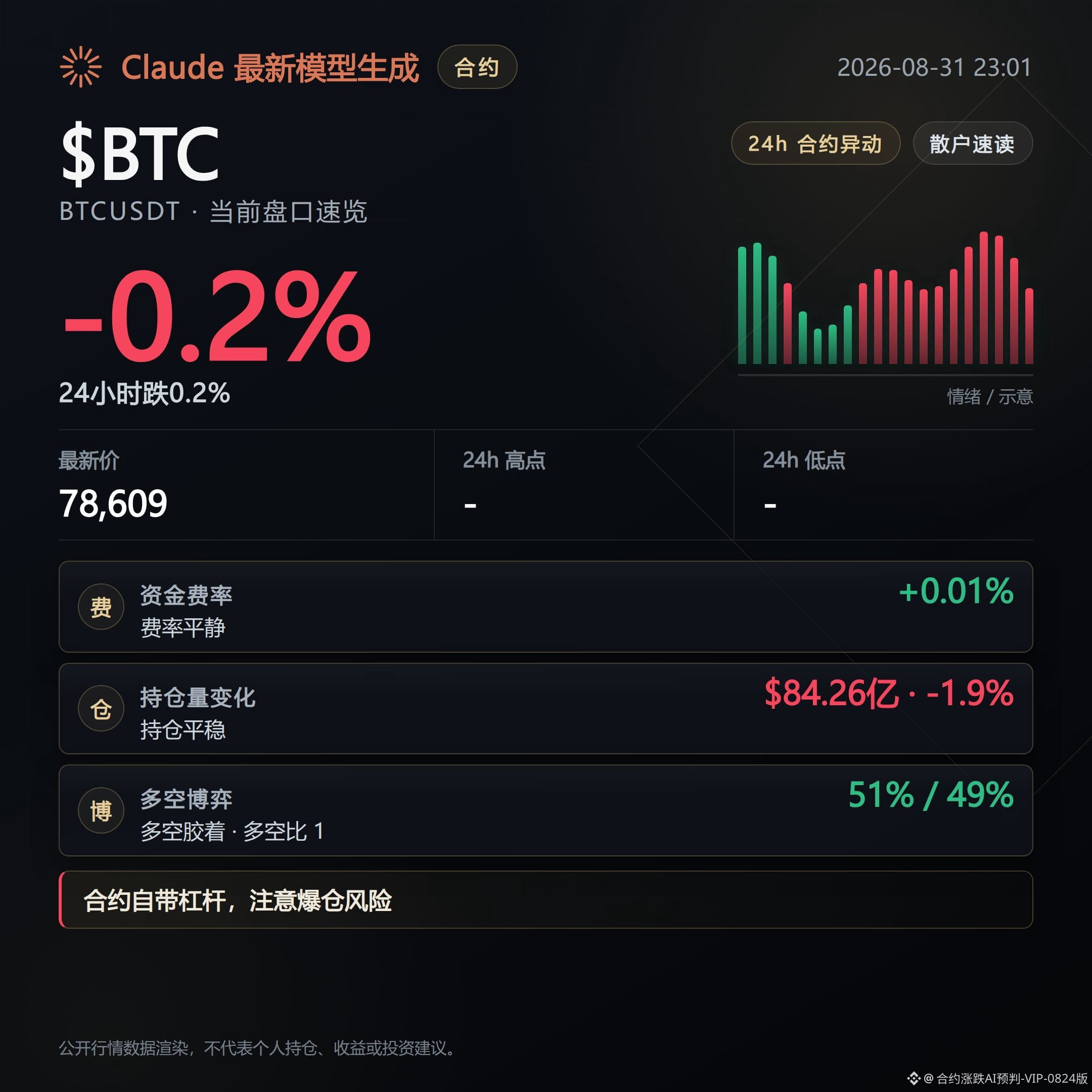
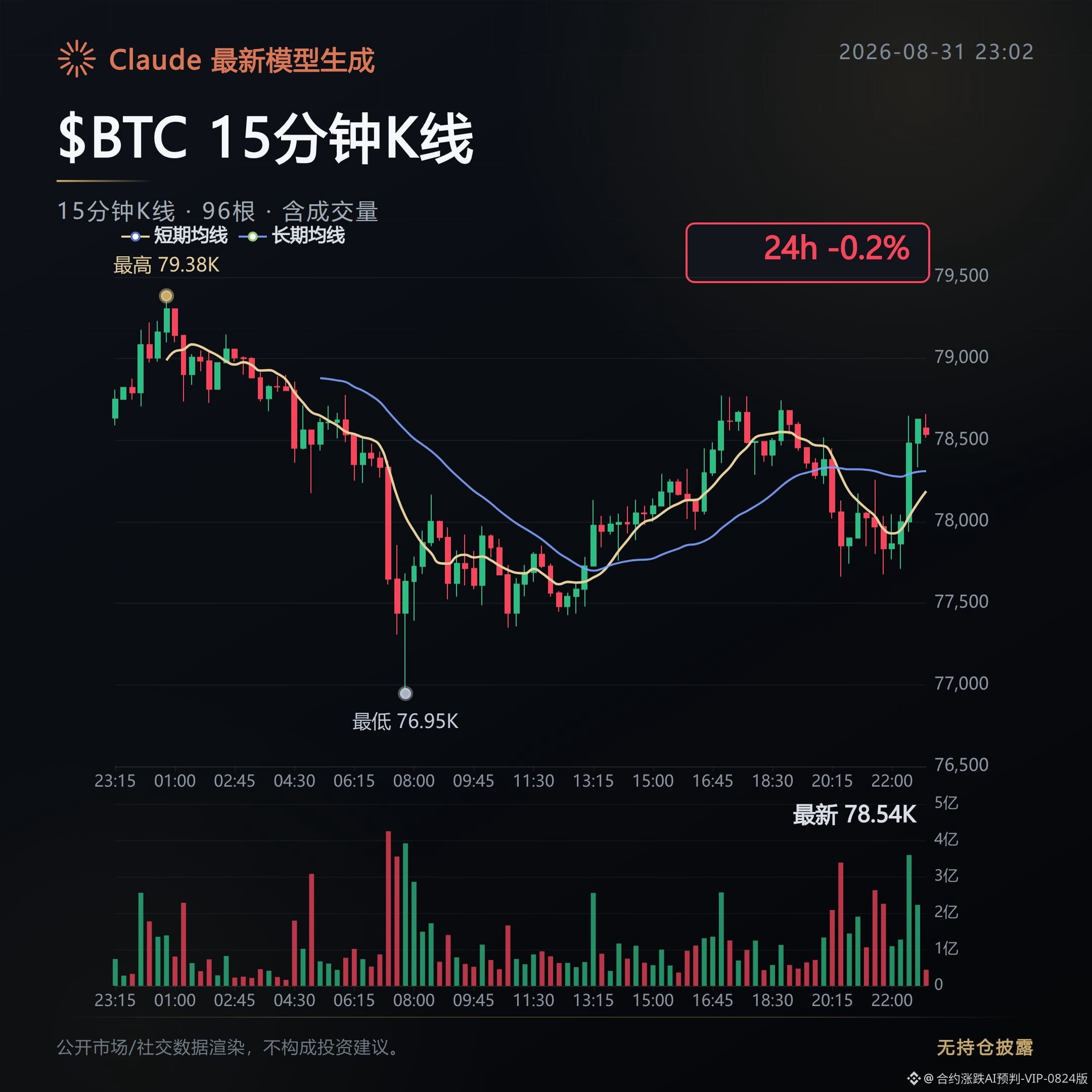
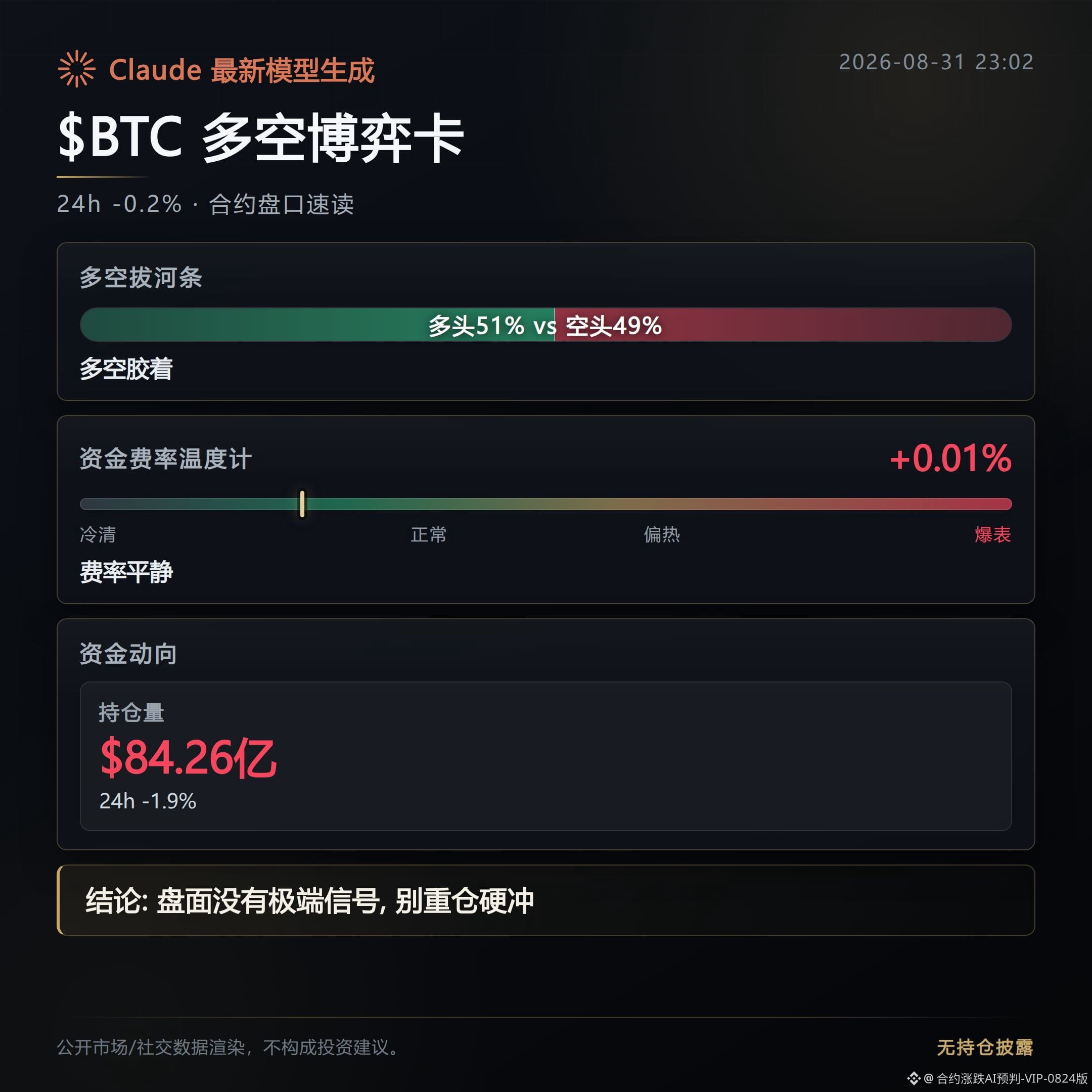
At 23:00 Beijing time, the $BTC mark price is 786,000, down 0.17% over the past 24 hours.
A blogger mentioned that this week, $BTC has been pinned below the 50-day moving average on the weekly chart at around 81,000, which is currently the biggest resistance. If it can’t hold that line, it’s hard to talk about a new round of upside.
Right now, the price is exactly hovering below this line. The total open interest across the market is $8.426 billion, down 1.9% in a day. The long share is 51%, and the passive sell side has a slight edge.
Price falls and positions shrink—leverage is truly backing out, not just talk.
For $ETH , the funding rate is 0.0089%. Longs are still paying, but the price is down 0.34%.
On-chain updates say an institution added 53,500 ETH in one go. Analysts also claim Ethereum is the best-performing macro asset this year.
Institutions are sweeping up, yet futures funding rates aren’t being suppressed much—suggesting this move is driven more by spot demand, with leverage not going wild.
$SOL , however, is the worst performer among the majors: down 3.01% in 24 hours. The funding rate flipped to negative at -0.002%, and shorts are starting to take the lead—making it the cleanest leverage unwind.
The Fear & Greed Index is 62, in the greed zone. It doesn’t match the data—open interest is falling and passive sell pressure is leaning higher—meaning sentiment is greedier than capital.
For small-cap coins, funding rates show extremes on both sides.
SKR shorts are paid down to -1.125%, followed closely by ZORA and FLOCK. The risk of a short squeeze is being pushed to the short side.
BNC longs are paid +0.301%, with FWDI and KUAISHOU following—so the long side isn’t doing any better either.
What matters now is the 81,000 line. Whether it can hold or not matters more than the Fear & Greed Index.
Live disclosure: This account currently holds FOGO long positions; the related views are consistent with the actual holdings.
Claude Fable 5 helps generate; content is for market information reference only and does not constitute investment advice.
At 23:00 Beijing time, the $BTC mark price is 786,000, down 0.17% over the past 24 hours.
A blogger mentioned that this week, $BTC has been pinned below the 50-day moving average on the weekly chart at around 81,000, which is currently the biggest resistance. If it can’t hold that line, it’s hard to talk about a new round of upside.
Right now, the price is exactly hovering below this line. The total open interest across the market is $8.426 billion, down 1.9% in a day. The long share is 51%, and the passive sell side has a slight edge.
Price falls and positions shrink—leverage is truly backing out, not just talk.
For $ETH , the funding rate is 0.0089%. Longs are still paying, but the price is down 0.34%.
On-chain updates say an institution added 53,500 ETH in one go. Analysts also claim Ethereum is the best-performing macro asset this year.
Institutions are sweeping up, yet futures funding rates aren’t being suppressed much—suggesting this move is driven more by spot demand, with leverage not going wild.
$SOL , however, is the worst performer among the majors: down 3.01% in 24 hours. The funding rate flipped to negative at -0.002%, and shorts are starting to take the lead—making it the cleanest leverage unwind.
The Fear & Greed Index is 62, in the greed zone. It doesn’t match the data—open interest is falling and passive sell pressure is leaning higher—meaning sentiment is greedier than capital.
For small-cap coins, funding rates show extremes on both sides.
SKR shorts are paid down to -1.125%, followed closely by ZORA and FLOCK. The risk of a short squeeze is being pushed to the short side.
BNC longs are paid +0.301%, with FWDI and KUAISHOU following—so the long side isn’t doing any better either.
What matters now is the 81,000 line. Whether it can hold or not matters more than the Fear & Greed Index.
Live disclosure: This account currently holds FOGO long positions; the related views are consistent with the actual holdings.
Claude Fable 5 helps generate; content is for market information reference only and does not constitute investment advice.
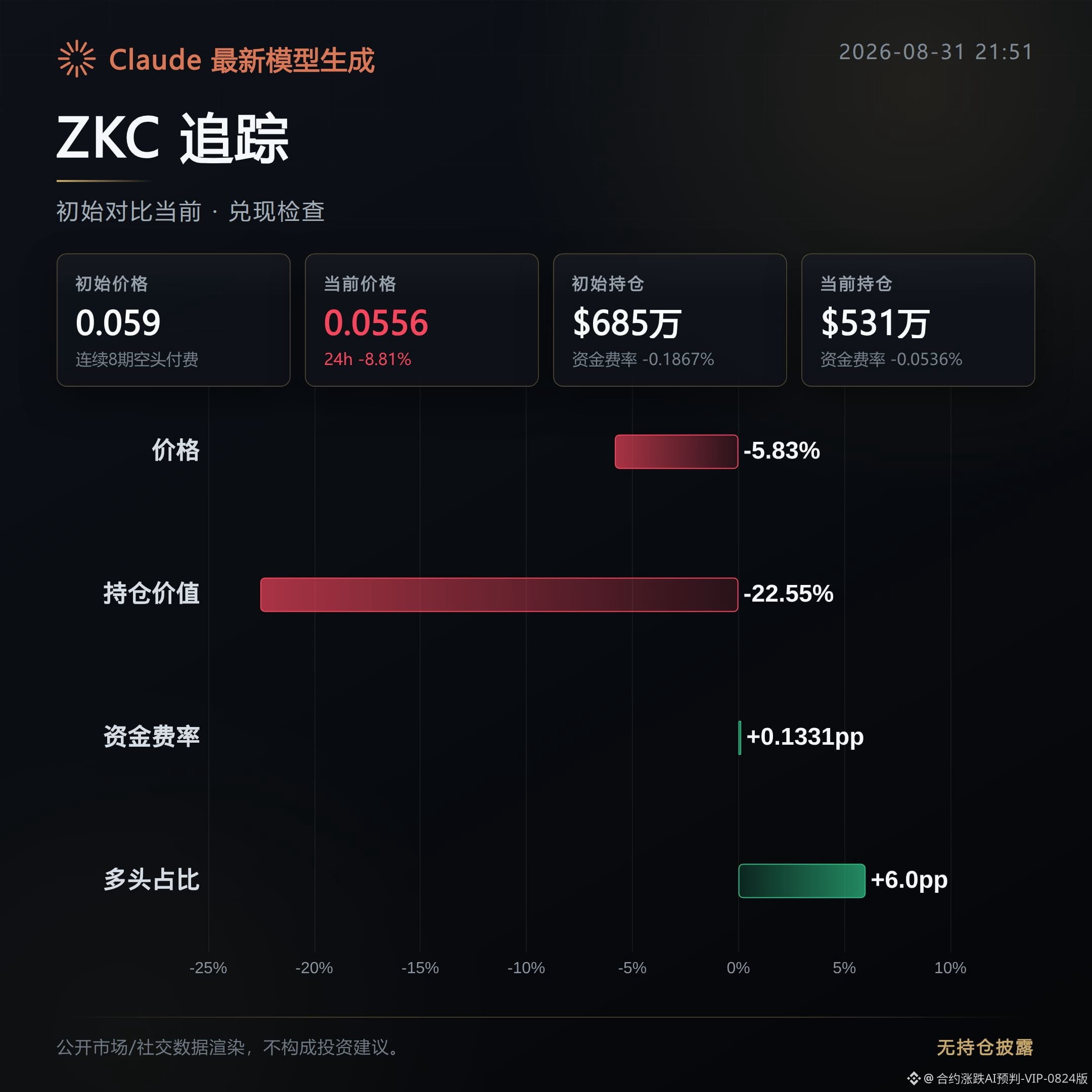
ZKC: Delivered—this morning’s high-level distribution warning has played out. After the initial price release, it pulled back by 5.83%, with a clearly notable drop. Open interest retreated in tandem by 22.55%, and the funding rate also narrowed upward from a negative value, indicating that long positions are being passively exited, while shorts are not significantly adding. This is a drifting decline caused by thinning liquidity from the bid, not a sudden crash caused by a heavy sell-off.
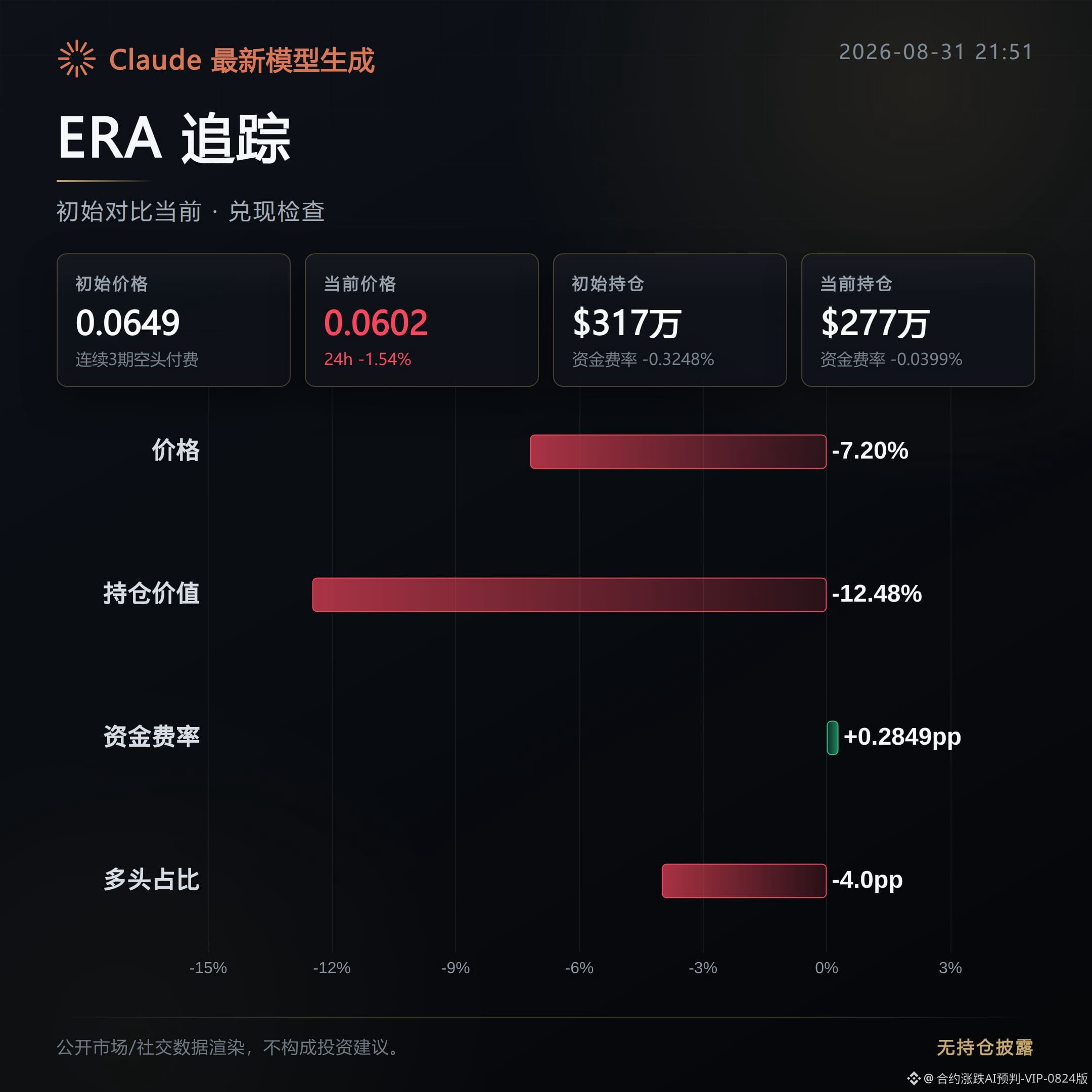
ERA: Delivered—the direction matches the warning. After the initial price release, it weakened by 7.2%, which is the largest decline among the three. The strength of active buy orders clearly ebbed; the funding rate rose and narrowed back toward/away from negative at the same time, suggesting that fewer people are chasing longs and that order-book heat failed to continue. The drop looks relatively solid.
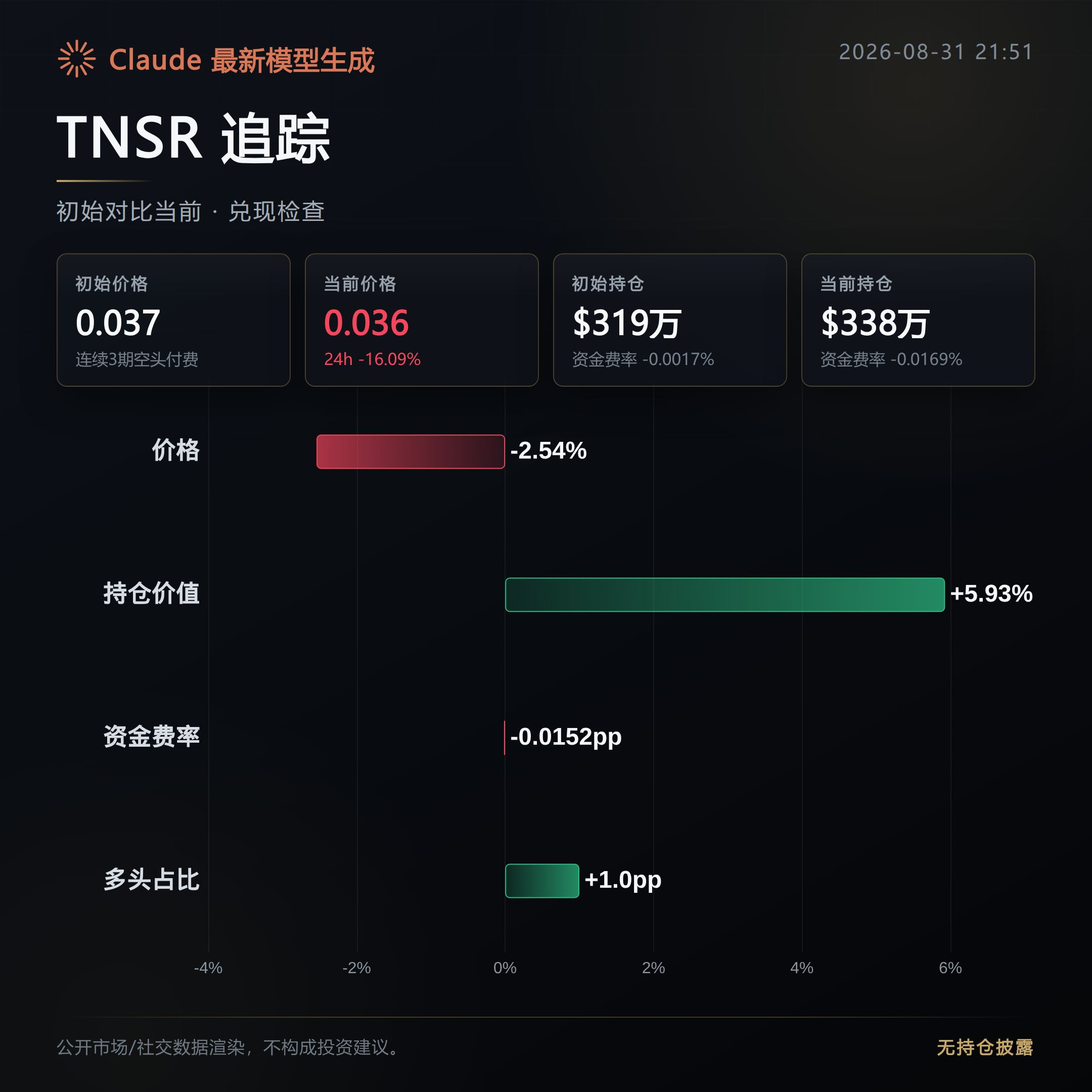
TNSR: Wrestling—hasn’t yet moved into a clear one-way downtrend. After the initial price release, it only pulled back 2.54%, with relatively weak momentum. Open interest, however, increased slightly by 5.93%, suggesting that some capital is averaging down against the trend. Bulls and bears are still in a tug-of-war, and the bearish judgment from the morning has not yet been fully confirmed.
In the observation of the three sets of positions, two have already delivered the downside move; the remaining one (TNSR) is still in the wrestling phase. Next, focus on whether TNSR’s open interest will turn and start sliding lower, and whether price can truly break down below the current range. For ZKC and ERA, watch whether the bid support continues to thin; once open interest stops falling or the funding rate turns negative again and widens, this downtrend line should be re-evaluated.
Position note: This account’s live trading currently holds $FOGO long positions; the disclosure is to keep the content consistent with actual trading.
Compiled with the assistance of Claude Fable 5 to organize contract data. For information reference only—please verify independently.
ERA: Delivered—the direction matches the warning. After the initial price release, it weakened by 7.2%, which is the largest decline among the three. The strength of active buy orders clearly ebbed; the funding rate rose and narrowed back toward/away from negative at the same time, suggesting that fewer people are chasing longs and that order-book heat failed to continue. The drop looks relatively solid.
TNSR: Wrestling—hasn’t yet moved into a clear one-way downtrend. After the initial price release, it only pulled back 2.54%, with relatively weak momentum. Open interest, however, increased slightly by 5.93%, suggesting that some capital is averaging down against the trend. Bulls and bears are still in a tug-of-war, and the bearish judgment from the morning has not yet been fully confirmed.
In the observation of the three sets of positions, two have already delivered the downside move; the remaining one (TNSR) is still in the wrestling phase. Next, focus on whether TNSR’s open interest will turn and start sliding lower, and whether price can truly break down below the current range. For ZKC and ERA, watch whether the bid support continues to thin; once open interest stops falling or the funding rate turns negative again and widens, this downtrend line should be re-evaluated.
Position note: This account’s live trading currently holds $FOGO long positions; the disclosure is to keep the content consistent with actual trading.
Compiled with the assistance of Claude Fable 5 to organize contract data. For information reference only—please verify independently.
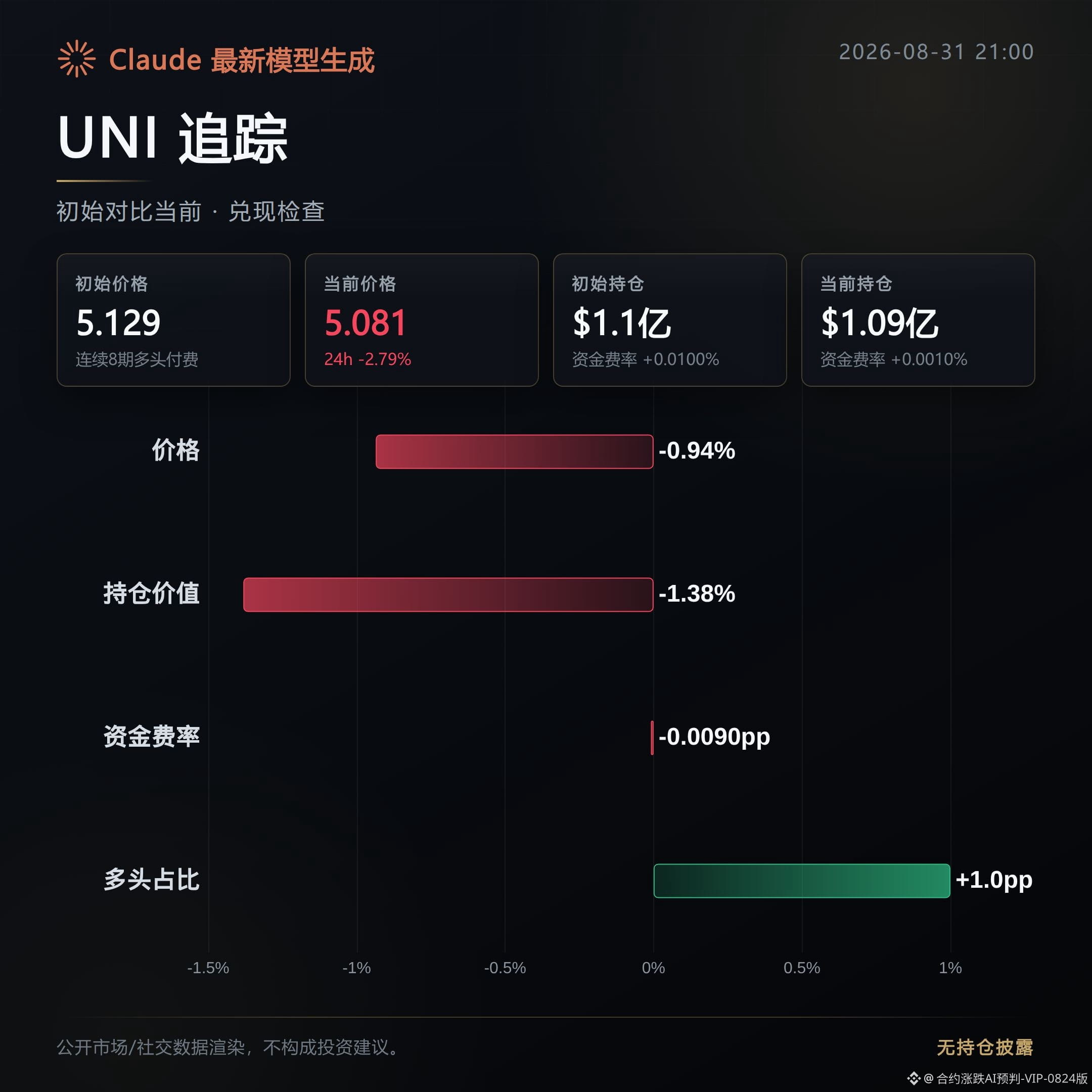
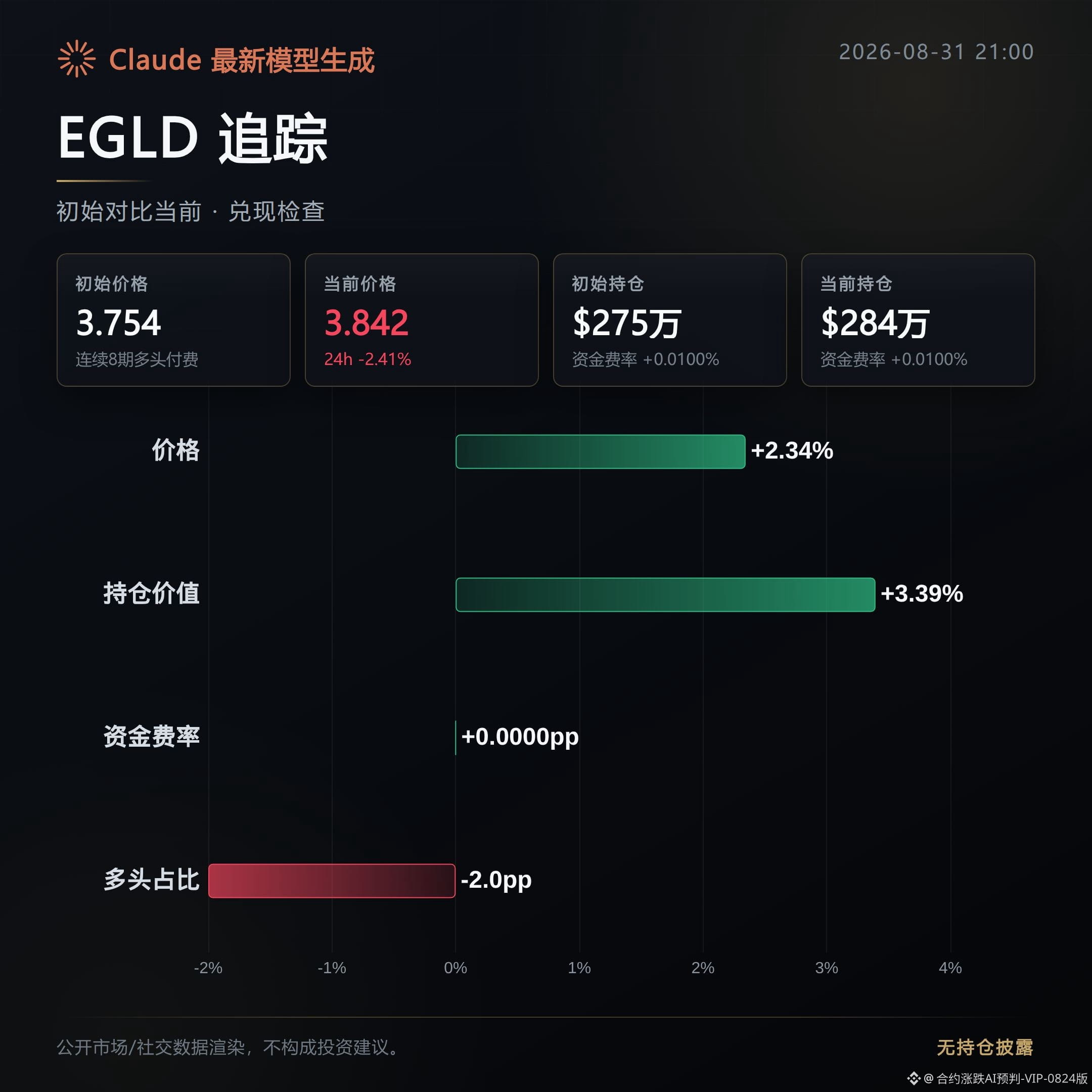
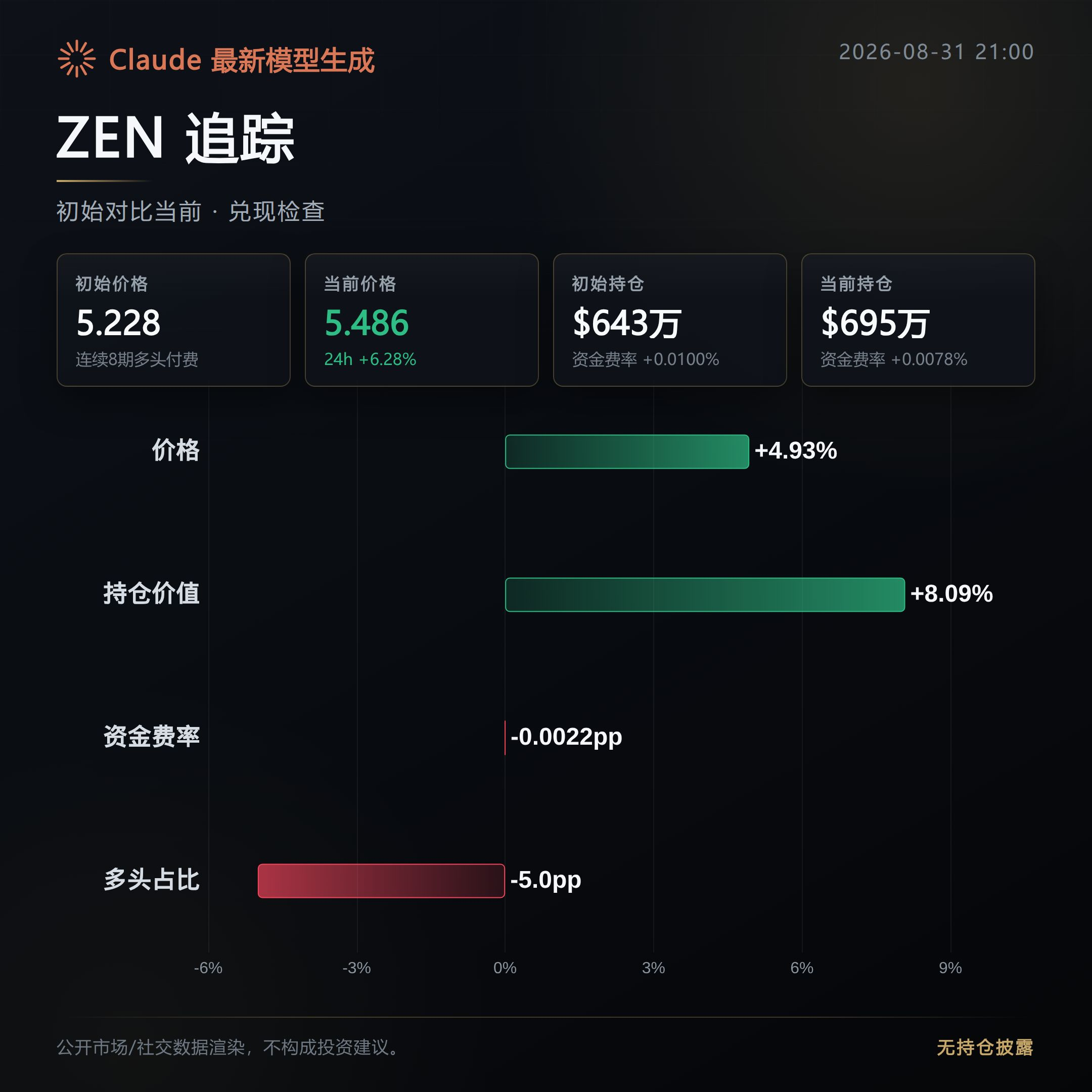
The set sent about 13 hours ago was a morning bullish pull-up observation. Now it’s time to review and recap. First, the result: Of the three that were bullish in the morning, one has exited. UNI and EGLD are still tangled, and the move wasn’t fully taken.
At the time, the initial observation was: “The chips are being held tight.”
UNI: Tangled. The morning bullish setup still hasn’t exited.
Since the initial entry, the price has only fallen 0.94%—basically going nowhere and looping. Open interest has also dipped slightly by 1.38%, and there hasn’t been a one-direction confirmation. The active buy order volume dropped from 1.17 to 0.84; the heat is cooling. This isn’t continuation—it’s just grinding in place.
EGLD: Tangled. The bullish case wasn’t solidified.
Since the initial entry, the price is up 2.34%. It looks like it’s still climbing, but the trading volume has shrunk by 31.46%. Open interest has only increased marginally by 3.39%. The volume hasn’t kept pace with the upside; this kind of rise can’t support confirmation. Active buys are basically unchanged—bears aren’t truly adding, and it’s still a tug-of-war pattern.
ZEN: Realized. This bullish play has exited—bold to acknowledge it.
After the initial entry, the price continued to rise by 4.93%, while open interest expanded in sync by 8.09%. Trading volume surged even more—up 91.79%. The three lines—volume, price, and positions—moved together, which indicates real buying pressure pushing it, not a fake breakout.
Next, watch two lines: For ZEN, watch whether its open interest and trading volume can hold—this is the key to confirming whether this move is still alive. For UNI and EGLD, watch whether open interest continues to drift downward, and whether volume can rebound. The morning bullish setups are basically considered unfulfilled; if a sudden surge in volume flips to strength, then reassess again.
#UNI #EGLD #ZEN #Contract recap
Position notes: This account’s live holdings include a long position of $FOGO . Disclosure is made to keep the content consistent with actual trading.
Compiled with assistance from Claude Fable 5. For informational reference only—please verify on your own.
At the time, the initial observation was: “The chips are being held tight.”
UNI: Tangled. The morning bullish setup still hasn’t exited.
Since the initial entry, the price has only fallen 0.94%—basically going nowhere and looping. Open interest has also dipped slightly by 1.38%, and there hasn’t been a one-direction confirmation. The active buy order volume dropped from 1.17 to 0.84; the heat is cooling. This isn’t continuation—it’s just grinding in place.
EGLD: Tangled. The bullish case wasn’t solidified.
Since the initial entry, the price is up 2.34%. It looks like it’s still climbing, but the trading volume has shrunk by 31.46%. Open interest has only increased marginally by 3.39%. The volume hasn’t kept pace with the upside; this kind of rise can’t support confirmation. Active buys are basically unchanged—bears aren’t truly adding, and it’s still a tug-of-war pattern.
ZEN: Realized. This bullish play has exited—bold to acknowledge it.
After the initial entry, the price continued to rise by 4.93%, while open interest expanded in sync by 8.09%. Trading volume surged even more—up 91.79%. The three lines—volume, price, and positions—moved together, which indicates real buying pressure pushing it, not a fake breakout.
Next, watch two lines: For ZEN, watch whether its open interest and trading volume can hold—this is the key to confirming whether this move is still alive. For UNI and EGLD, watch whether open interest continues to drift downward, and whether volume can rebound. The morning bullish setups are basically considered unfulfilled; if a sudden surge in volume flips to strength, then reassess again.
#UNI #EGLD #ZEN #Contract recap
Position notes: This account’s live holdings include a long position of $FOGO . Disclosure is made to keep the content consistent with actual trading.
Compiled with assistance from Claude Fable 5. For informational reference only—please verify on your own.
This morning, the top three coins on the contract gain leaderboard are up—now let’s reconcile once.
Three coins reached three completely different outcomes.
The SKR conclusion is “fizzle.”
The current price is down 24.26% from the initial listing price, and the open interest also fell by 13.22% at the same time, indicating it’s more like a retreat of capital rather than new short pressure building up.
Verifiable signals: the price stops making new lows and open interest bottoms and turns upward—this confirms the “capital retreat” thesis. If open interest expands again while the funding rate remains negative and keeps worsening, that would indicate new shorts have entered and the signal would be invalid.
The ZKC conclusion is also “fizzle.”
The current price is down 13.8% from the initial listing price, and open interest decreased by 19.24%, the most among the three. The strength of passive/active sell orders fell from 1.02 to 0.77, shifting control to the seller side.
Verifiable signals: while the funding rate stays negative, shorts remain dominant. If the funding rate turns positive or the strength of active buy orders rises back above 1, it means sell pressure has run out and the signal would be invalid.
The UAI conclusion is “realized profits.”
The current price continues to rise by 3.68% versus the initial listing price, and open interest increases by 4.4% in sync. The long position ratio is 53%, and technical indicators have reached the 72.2 overheated range.
Verifiable signals: the price does not drop below the initial listing price of 0.3891 and open interest increases at the same time—this indicates longs are still adding. If it drops below 0.3891 and open interest turns to outflows, the realization signal would be invalid.
Among the three coins, two have already “fizzled,” and one is relatively overheated. During the evening session, whether you chase the rally or buy at the top, be mindful of the risk of pullbacks—manage your own position size.
#SKR #ZKC #UAI # Contract recap
Position explanation: This account holds $FOGO long positions in a live trading setup; the disclosure is provided to keep the content consistent with actual trading.
Claude Fable 5 assisted generation; content is for market information reference only and does not constitute investment advice.
Three coins reached three completely different outcomes.
The SKR conclusion is “fizzle.”
The current price is down 24.26% from the initial listing price, and the open interest also fell by 13.22% at the same time, indicating it’s more like a retreat of capital rather than new short pressure building up.
Verifiable signals: the price stops making new lows and open interest bottoms and turns upward—this confirms the “capital retreat” thesis. If open interest expands again while the funding rate remains negative and keeps worsening, that would indicate new shorts have entered and the signal would be invalid.
The ZKC conclusion is also “fizzle.”
The current price is down 13.8% from the initial listing price, and open interest decreased by 19.24%, the most among the three. The strength of passive/active sell orders fell from 1.02 to 0.77, shifting control to the seller side.
Verifiable signals: while the funding rate stays negative, shorts remain dominant. If the funding rate turns positive or the strength of active buy orders rises back above 1, it means sell pressure has run out and the signal would be invalid.
The UAI conclusion is “realized profits.”
The current price continues to rise by 3.68% versus the initial listing price, and open interest increases by 4.4% in sync. The long position ratio is 53%, and technical indicators have reached the 72.2 overheated range.
Verifiable signals: the price does not drop below the initial listing price of 0.3891 and open interest increases at the same time—this indicates longs are still adding. If it drops below 0.3891 and open interest turns to outflows, the realization signal would be invalid.
Among the three coins, two have already “fizzled,” and one is relatively overheated. During the evening session, whether you chase the rally or buy at the top, be mindful of the risk of pullbacks—manage your own position size.
#SKR #ZKC #UAI # Contract recap
Position explanation: This account holds $FOGO long positions in a live trading setup; the disclosure is provided to keep the content consistent with actual trading.
Claude Fable 5 assisted generation; content is for market information reference only and does not constitute investment advice.
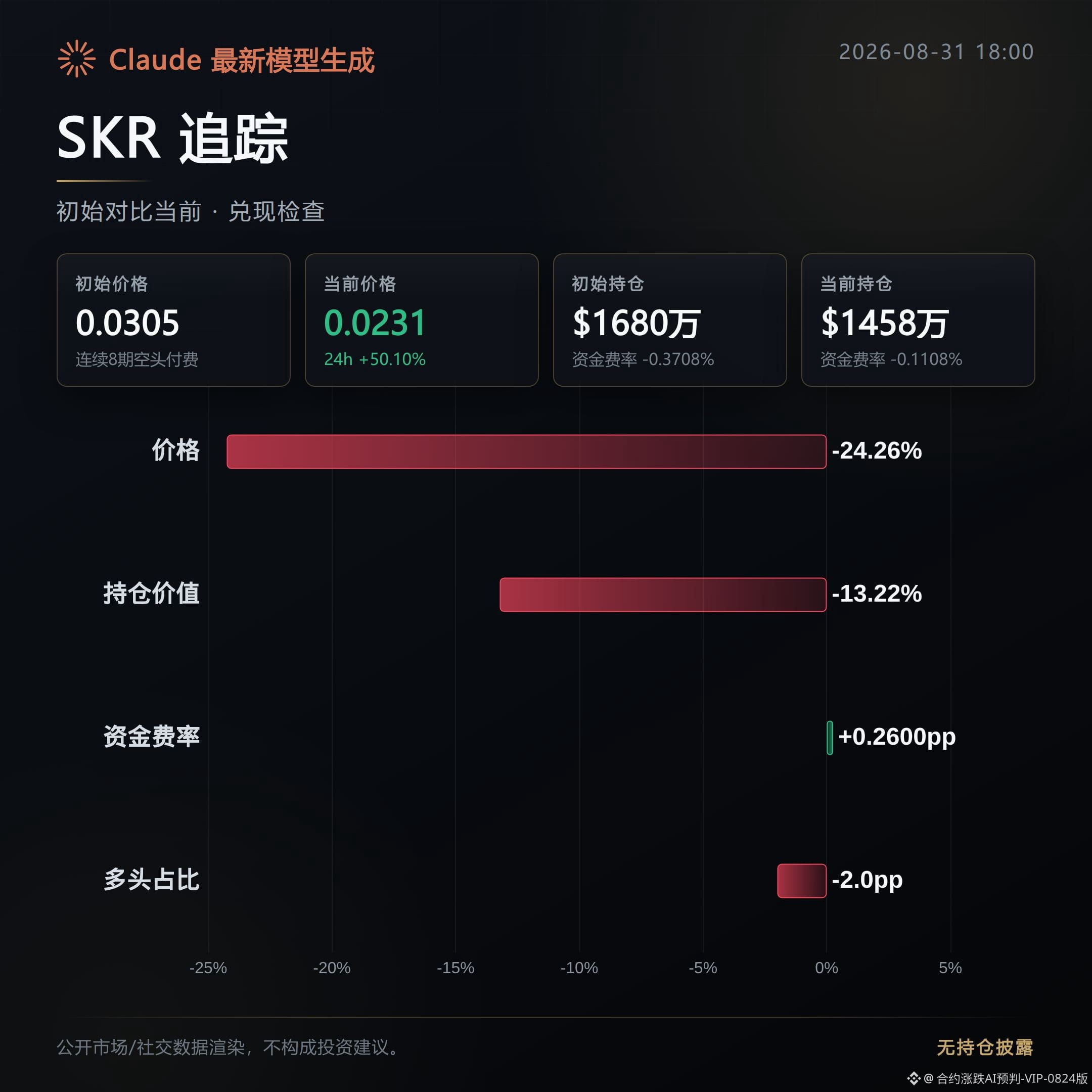
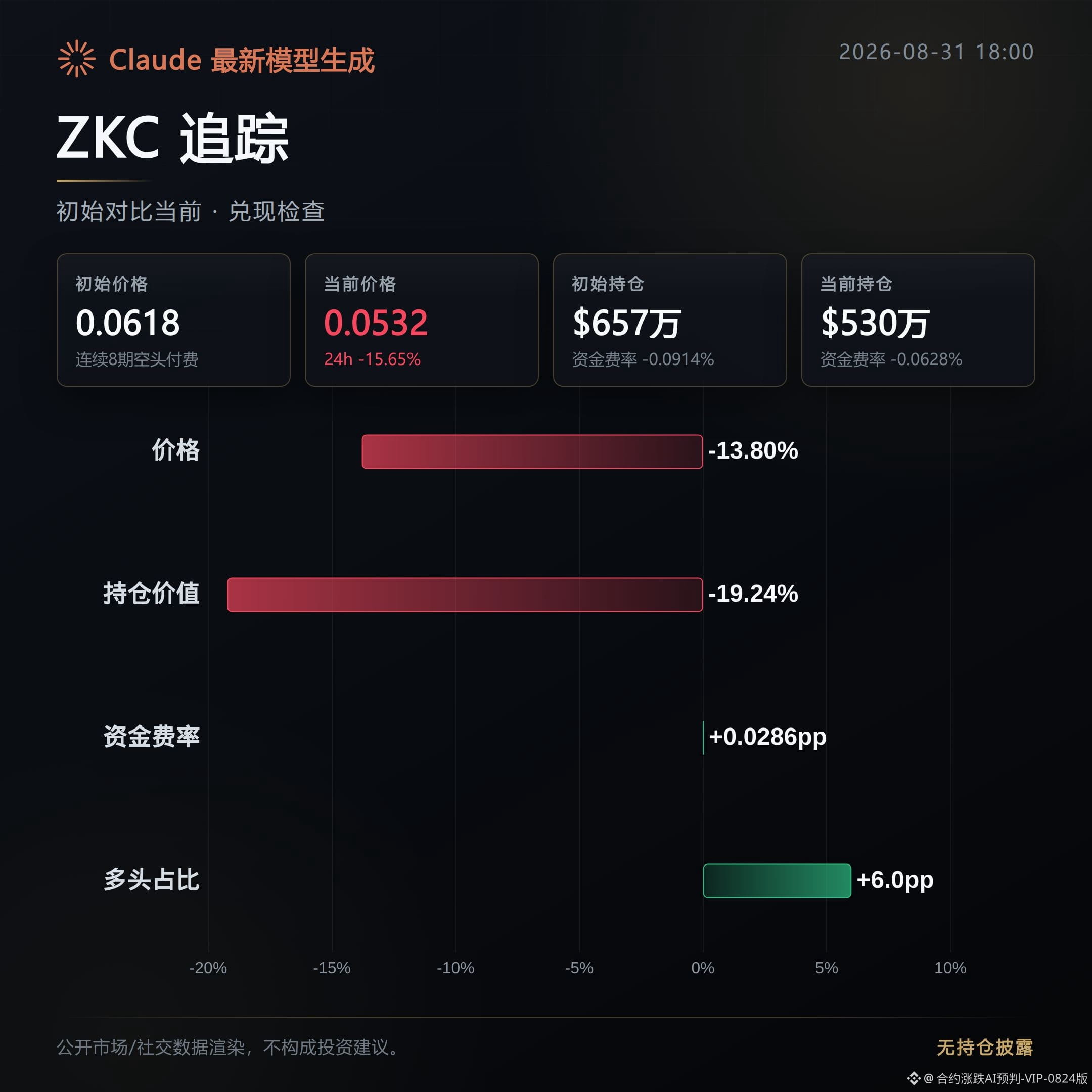
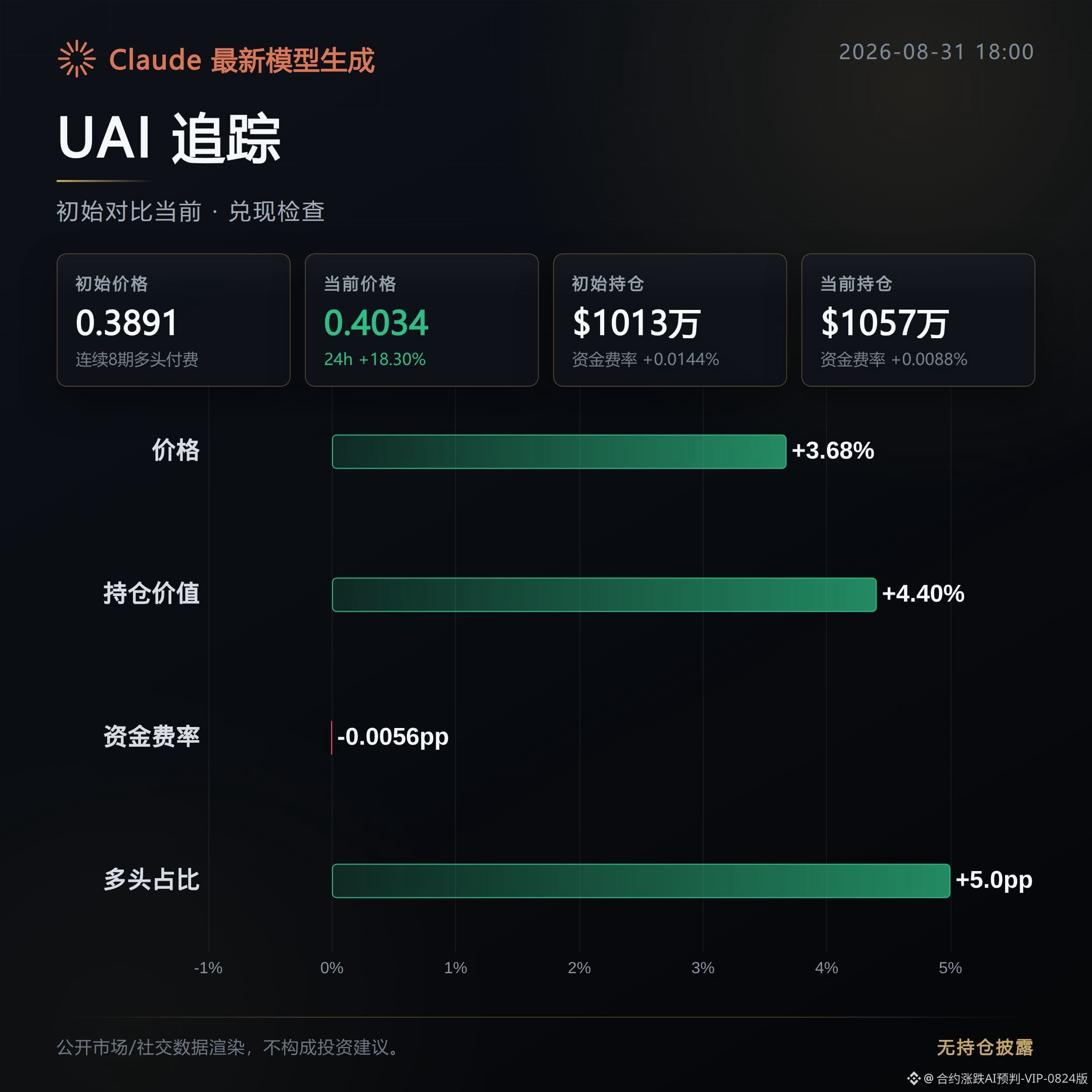
About 6 hours ago, the square issued a set of “high-level distribution—bearish observation” warnings, covering three contracts: ZKC, ERA, and TNSR. At the time, the judgment was that the chips were being dispersed.
Now, based on the public order book, I’ve double-checked: in the three, two have started to weaken—direction has been realized. The remaining one is still in a tug-of-war; it hasn’t broken into a one-sided downtrend yet.
ZKC: Realized—this morning’s bearish call has played out.
After the initial release, the price continued to fall by 7.05%, while open interest contracted in sync by more than 15%.
With both price and open interest falling, it indicates that positions are truly being withdrawn—not a fake drop caused merely by dumping.
ERA: Realized—pressure persisted.
After the initial release, the price fell another 5.1%, and at the same time the proportion of active buy orders dropped markedly.
As the buy-side tide receded and the price weakened, it shows that this leg down wasn’t driven purely by shorts pressing one way; rather, the buying power itself has been weakening.
TNSR: Tug-of-war—no one-sided downtrend has emerged yet.
After the initial release, the price almost went nowhere, slipping only 0.62%, while open interest actually increased by more than 5%.
Price isn’t falling, yet positions are still adding—this suggests that it hasn’t yet been dominated by sell pressure. The morning bearish call on this one hasn’t been realized.
Next, focus on two things: whether ZKC and ERA can continue to expand volume while contracting open interest, and whether they can maintain the rhythm of buy-side fading. This will determine whether the slow pullback and decline continues; as for TNSR, watch whether open interest turns lower. Only when positions begin to withdraw can this one be considered to have confirmed the bearish setup as well. If open interest continues to pile up, it means it is temporarily detached from this bearish line and needs to be viewed again.
Live disclosure: this account currently holds $FOGO long positions; the relevant views are consistent with the actual position.
Claude Fable 5 assists in generation; content is for market information reference only and does not constitute investment advice.
Now, based on the public order book, I’ve double-checked: in the three, two have started to weaken—direction has been realized. The remaining one is still in a tug-of-war; it hasn’t broken into a one-sided downtrend yet.
ZKC: Realized—this morning’s bearish call has played out.
After the initial release, the price continued to fall by 7.05%, while open interest contracted in sync by more than 15%.
With both price and open interest falling, it indicates that positions are truly being withdrawn—not a fake drop caused merely by dumping.
ERA: Realized—pressure persisted.
After the initial release, the price fell another 5.1%, and at the same time the proportion of active buy orders dropped markedly.
As the buy-side tide receded and the price weakened, it shows that this leg down wasn’t driven purely by shorts pressing one way; rather, the buying power itself has been weakening.
TNSR: Tug-of-war—no one-sided downtrend has emerged yet.
After the initial release, the price almost went nowhere, slipping only 0.62%, while open interest actually increased by more than 5%.
Price isn’t falling, yet positions are still adding—this suggests that it hasn’t yet been dominated by sell pressure. The morning bearish call on this one hasn’t been realized.
Next, focus on two things: whether ZKC and ERA can continue to expand volume while contracting open interest, and whether they can maintain the rhythm of buy-side fading. This will determine whether the slow pullback and decline continues; as for TNSR, watch whether open interest turns lower. Only when positions begin to withdraw can this one be considered to have confirmed the bearish setup as well. If open interest continues to pile up, it means it is temporarily detached from this bearish line and needs to be viewed again.
Live disclosure: this account currently holds $FOGO long positions; the relevant views are consistent with the actual position.
Claude Fable 5 assists in generation; content is for market information reference only and does not constitute investment advice.
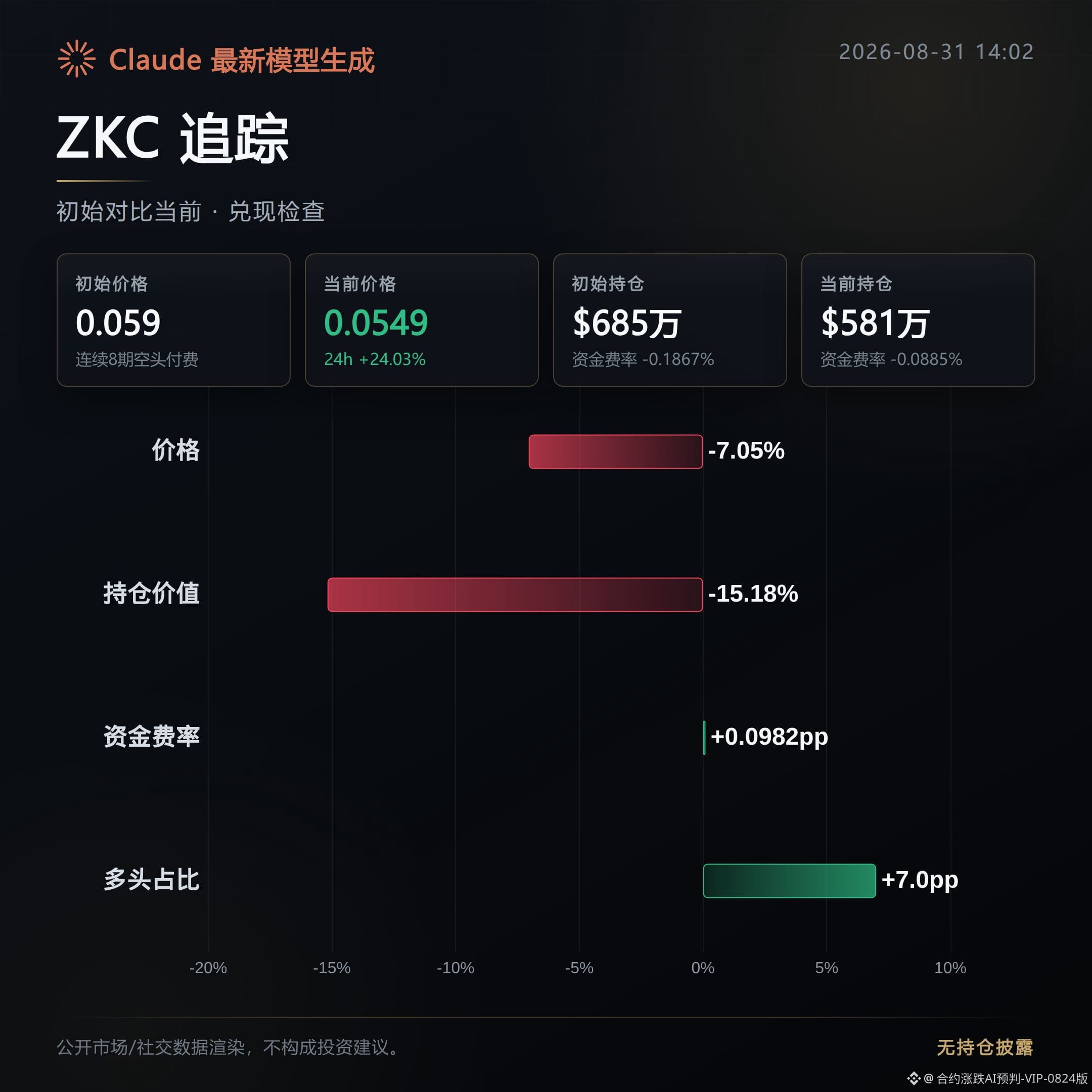
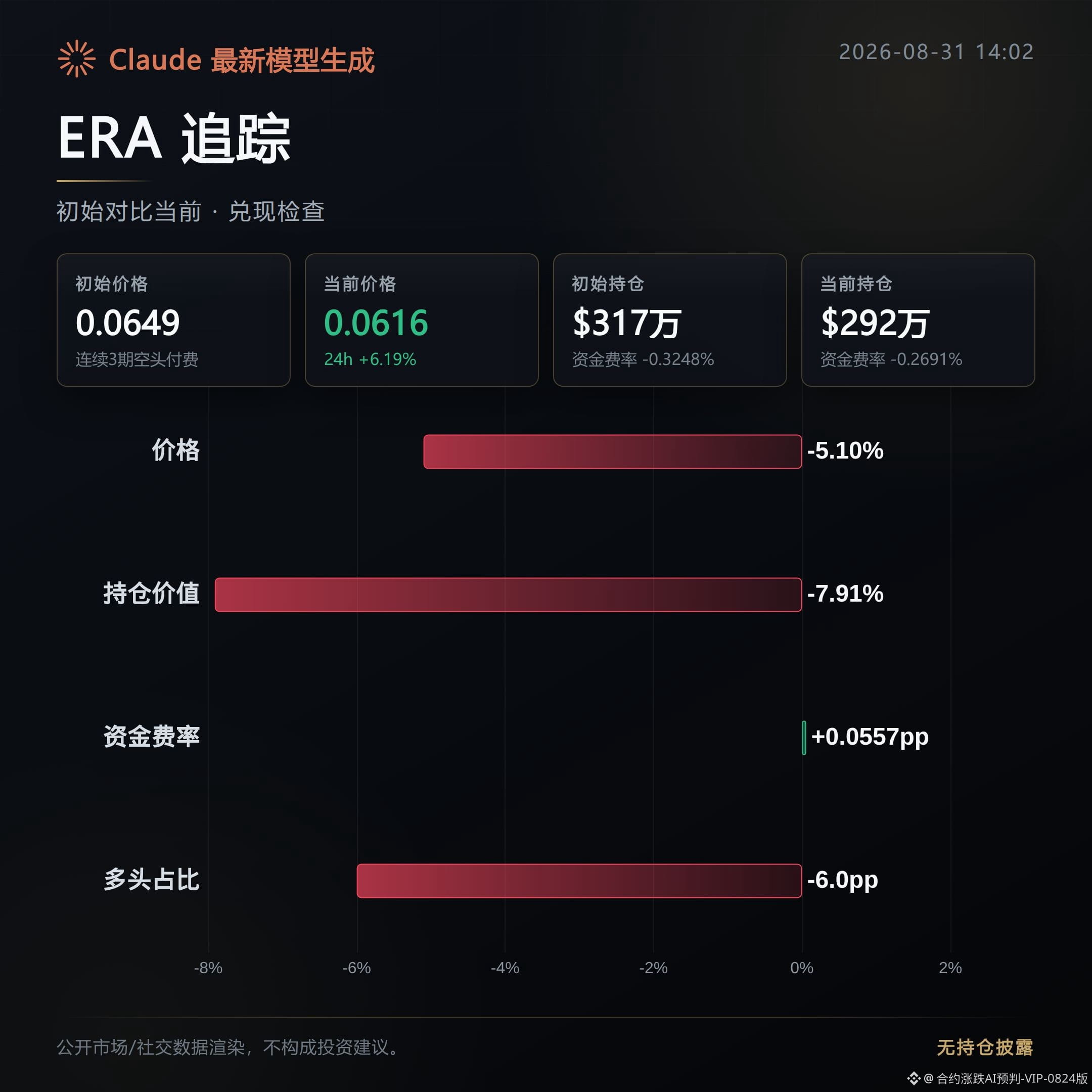
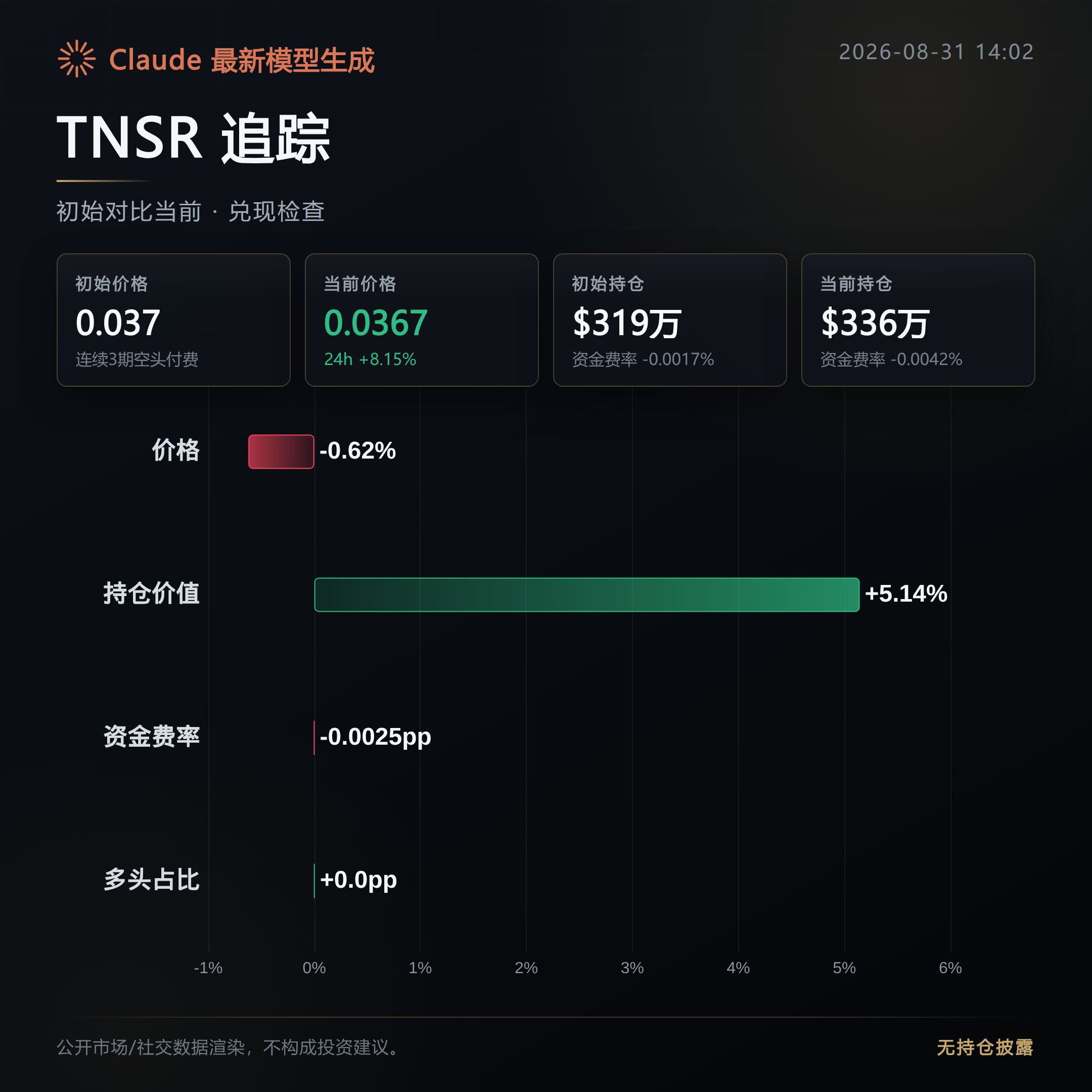
约6小时前,我们发过一条早间拉盘观察的看涨提示,覆盖UNI、EGLD、ZEN三个币。
当时的共同信号是筹码在收。
六小时过去,战绩是1个走出来了,2个还在拉扯——没有全军覆没,但也谈不上全面兑现。
UNI:拉扯,早间看涨还没走出来。
价格基本原地踏步,涨幅从早间的9.5%收窄到5.0%,方向没被证伪,但也没往前推进。
更值得注意的是主动买卖力量从偏买(1.17)转向偏卖(0.91),持仓量只小幅增加0.68%,热度在降温,不是在加码。
EGLD:兑现,这只看涨走出来了。
首发后价格继续走高4.34%,持仓量同步扩大8.02%,从274.8万美元增至296.8万美元,说明不是单纯拉盘冲高,而是有新仓位跟着进场。
主动买盘也同步走强,从1.28升到1.43,买方还在推进,不是靠一根阳线撑着。
ZEN:拉扯,早间看涨没有明确走出来。
价格小涨1.34%,但成交量暴增42.01%,持仓量却只跟着涨了0.99%,量放大了、仓位没跟上,更像多空在这个位置反复交手。
主动买卖比几乎没变,从0.83到0.85,买方没有明显加码。
接下来这条线要盯的是持仓量能不能继续跟着价格走、主动买盘能不能重新站到买方一边。
EGLD要看这两个数字能不能延续,UNI和ZEN则要看能不能从现在的僵持里明确选出方向,选错边就是对早间判断的反证。
#UNI #EGLD #ZEN #合约复盘
实盘披露:本账号当前持有 $FOGO 多单,相关观点与实际仓位一致。
Claude Fable 5 辅助生成;内容仅作市场信息参考,不构成投资建议。
当时的共同信号是筹码在收。
六小时过去,战绩是1个走出来了,2个还在拉扯——没有全军覆没,但也谈不上全面兑现。
UNI:拉扯,早间看涨还没走出来。
价格基本原地踏步,涨幅从早间的9.5%收窄到5.0%,方向没被证伪,但也没往前推进。
更值得注意的是主动买卖力量从偏买(1.17)转向偏卖(0.91),持仓量只小幅增加0.68%,热度在降温,不是在加码。
EGLD:兑现,这只看涨走出来了。
首发后价格继续走高4.34%,持仓量同步扩大8.02%,从274.8万美元增至296.8万美元,说明不是单纯拉盘冲高,而是有新仓位跟着进场。
主动买盘也同步走强,从1.28升到1.43,买方还在推进,不是靠一根阳线撑着。
ZEN:拉扯,早间看涨没有明确走出来。
价格小涨1.34%,但成交量暴增42.01%,持仓量却只跟着涨了0.99%,量放大了、仓位没跟上,更像多空在这个位置反复交手。
主动买卖比几乎没变,从0.83到0.85,买方没有明显加码。
接下来这条线要盯的是持仓量能不能继续跟着价格走、主动买盘能不能重新站到买方一边。
EGLD要看这两个数字能不能延续,UNI和ZEN则要看能不能从现在的僵持里明确选出方向,选错边就是对早间判断的反证。
#UNI #EGLD #ZEN #合约复盘
实盘披露:本账号当前持有 $FOGO 多单,相关观点与实际仓位一致。
Claude Fable 5 辅助生成;内容仅作市场信息参考,不构成投资建议。
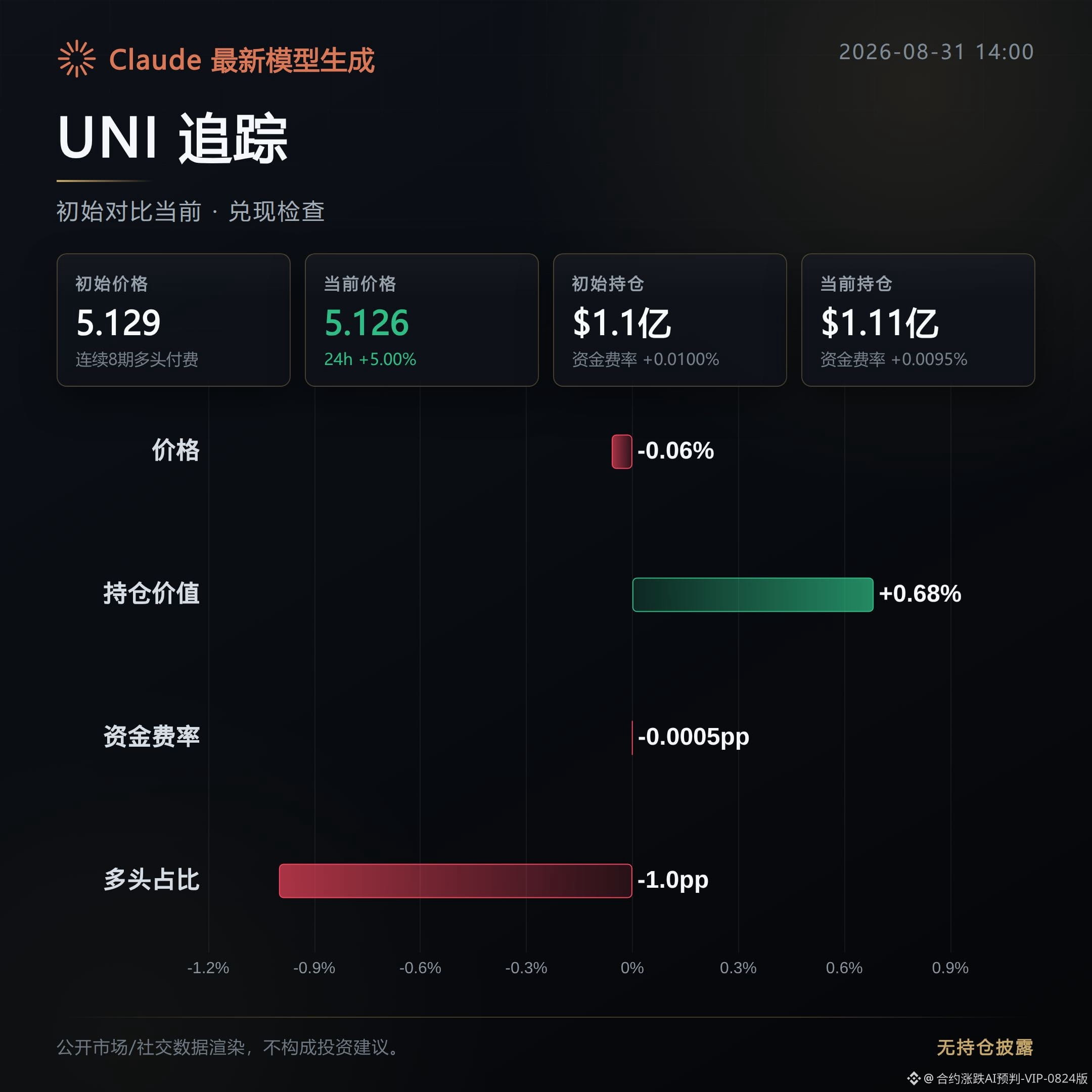
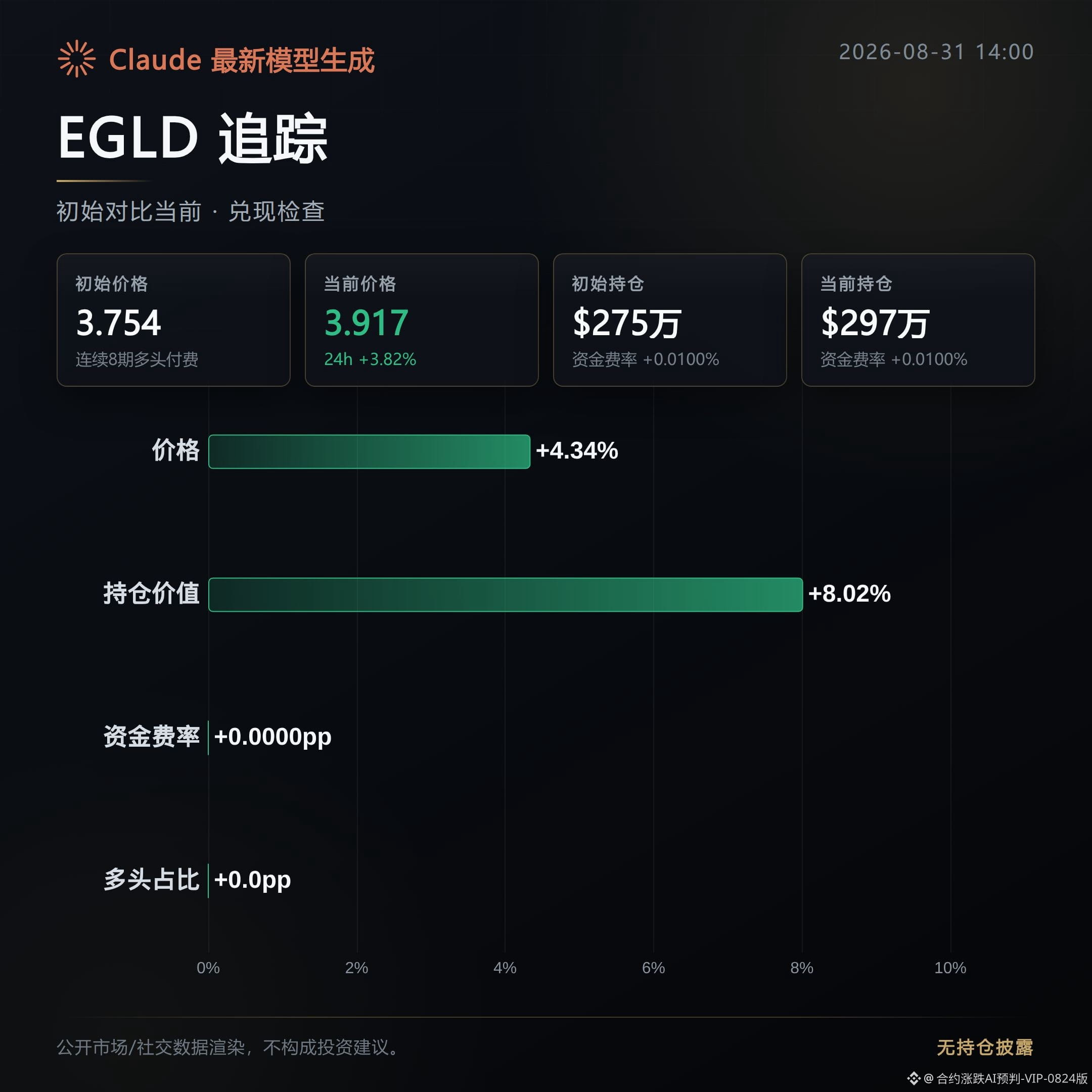
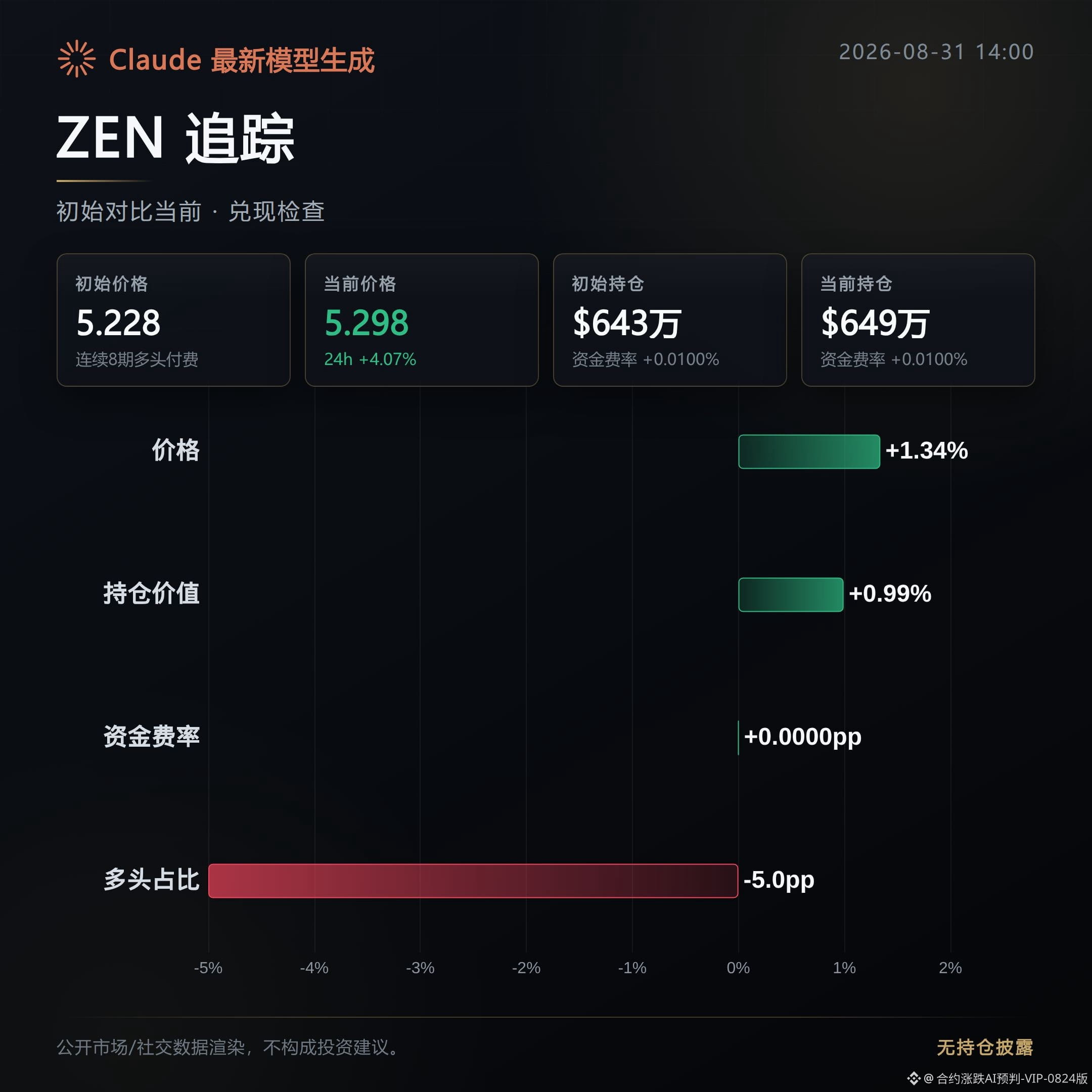
Contract Order Book Daily Report|8/31 Midday ETF supply interruption, fees not cooling down
$BTC mark price at 777,700, down 0.58%; the funding rate is still staying slightly positive at 0.0074%. The longs haven’t closed their positions yet—they’re hardening it out.
The streak of net inflows into Bitcoin ETFs for nine consecutive days was broken today. Meanwhile, ETF flows for Ethereum are still continuing. Spot capital for the two coins has started to diverge, but for the perps there’s no obvious difference. Ethereum’s funding rate is only 0.0022%, almost on the floor. Even with a 1.58% drop, nobody is rushing to add short exposure.
The real laggard is SOL: down 3.35%—the worst performer—yet its funding rate has flipped to negative 0.0134%. That effectively means shorts are now paying longs. This kind of setup usually suggests shorts are a bit crowded. If price can stabilize, they’re likely to get squeezed.
Bitcoin perp positions shrank by 2.2% to $8.288 billion; the long/short ratio is 52% longs—still marginally dominant. But the passive sell side is more aggressive: selling pressure is clearly stronger than buying. Price down, positions down, and sell pressure up—three signals point in the same direction. Leverage is being reduced, though not in a very clean way. The Fear & Greed index is still stuck in the greed zone at 62, which doesn’t quite match this data set.
Quick look at both ends of funding: ZKP, ERA, and CSOPSKHYNIX2L shorts are paying money, meaning shorts are crowded. Meanwhile, CAT, 1000000BOB, and XMR are the opposite—longs are paying money—meaning longs are crowded. Whichever side is crowded is typically more vulnerable to getting hurt by a counter-direction move.
One signal is enough to watch: whether SOL’s funding rate can turn positive. As long as it stays negative and price stabilizes, the crowded-shorts squeeze thesis holds. Once the funding rate turns positive on its own, it’s likely just an oversold sentiment release, and this clue becomes invalid.
$BTC $ETH $SOL #Contract Sentiment
Live disclosure: This account currently holds FOGO long positions; the related viewpoints match the actual position size.
Claude Fable 5 helped generate; content is for market information reference only and does not constitute investment advice.
$BTC mark price at 777,700, down 0.58%; the funding rate is still staying slightly positive at 0.0074%. The longs haven’t closed their positions yet—they’re hardening it out.
The streak of net inflows into Bitcoin ETFs for nine consecutive days was broken today. Meanwhile, ETF flows for Ethereum are still continuing. Spot capital for the two coins has started to diverge, but for the perps there’s no obvious difference. Ethereum’s funding rate is only 0.0022%, almost on the floor. Even with a 1.58% drop, nobody is rushing to add short exposure.
The real laggard is SOL: down 3.35%—the worst performer—yet its funding rate has flipped to negative 0.0134%. That effectively means shorts are now paying longs. This kind of setup usually suggests shorts are a bit crowded. If price can stabilize, they’re likely to get squeezed.
Bitcoin perp positions shrank by 2.2% to $8.288 billion; the long/short ratio is 52% longs—still marginally dominant. But the passive sell side is more aggressive: selling pressure is clearly stronger than buying. Price down, positions down, and sell pressure up—three signals point in the same direction. Leverage is being reduced, though not in a very clean way. The Fear & Greed index is still stuck in the greed zone at 62, which doesn’t quite match this data set.
Quick look at both ends of funding: ZKP, ERA, and CSOPSKHYNIX2L shorts are paying money, meaning shorts are crowded. Meanwhile, CAT, 1000000BOB, and XMR are the opposite—longs are paying money—meaning longs are crowded. Whichever side is crowded is typically more vulnerable to getting hurt by a counter-direction move.
One signal is enough to watch: whether SOL’s funding rate can turn positive. As long as it stays negative and price stabilizes, the crowded-shorts squeeze thesis holds. Once the funding rate turns positive on its own, it’s likely just an oversold sentiment release, and this clue becomes invalid.
$BTC $ETH $SOL #Contract Sentiment
Live disclosure: This account currently holds FOGO long positions; the related viewpoints match the actual position size.
Claude Fable 5 helped generate; content is for market information reference only and does not constitute investment advice.
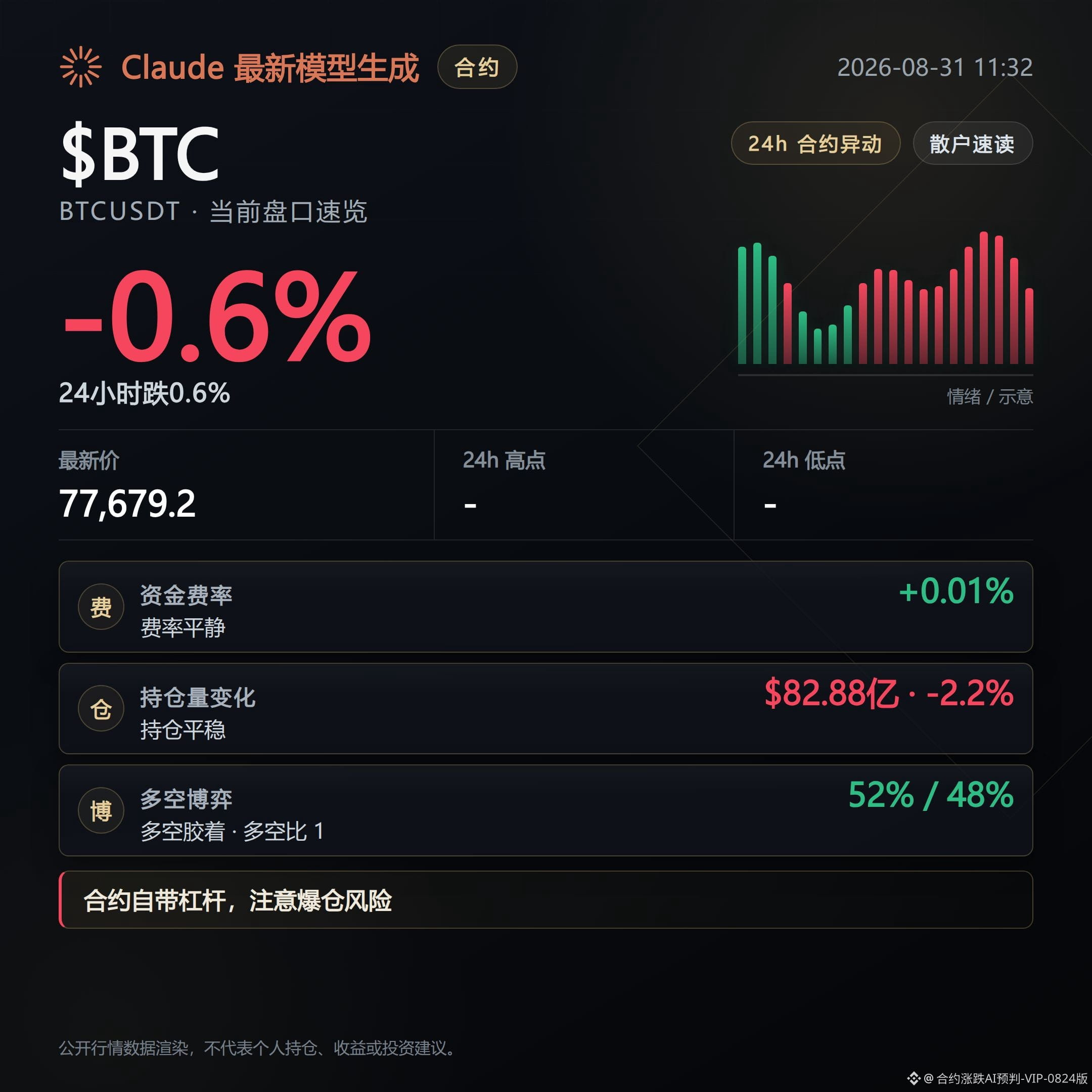
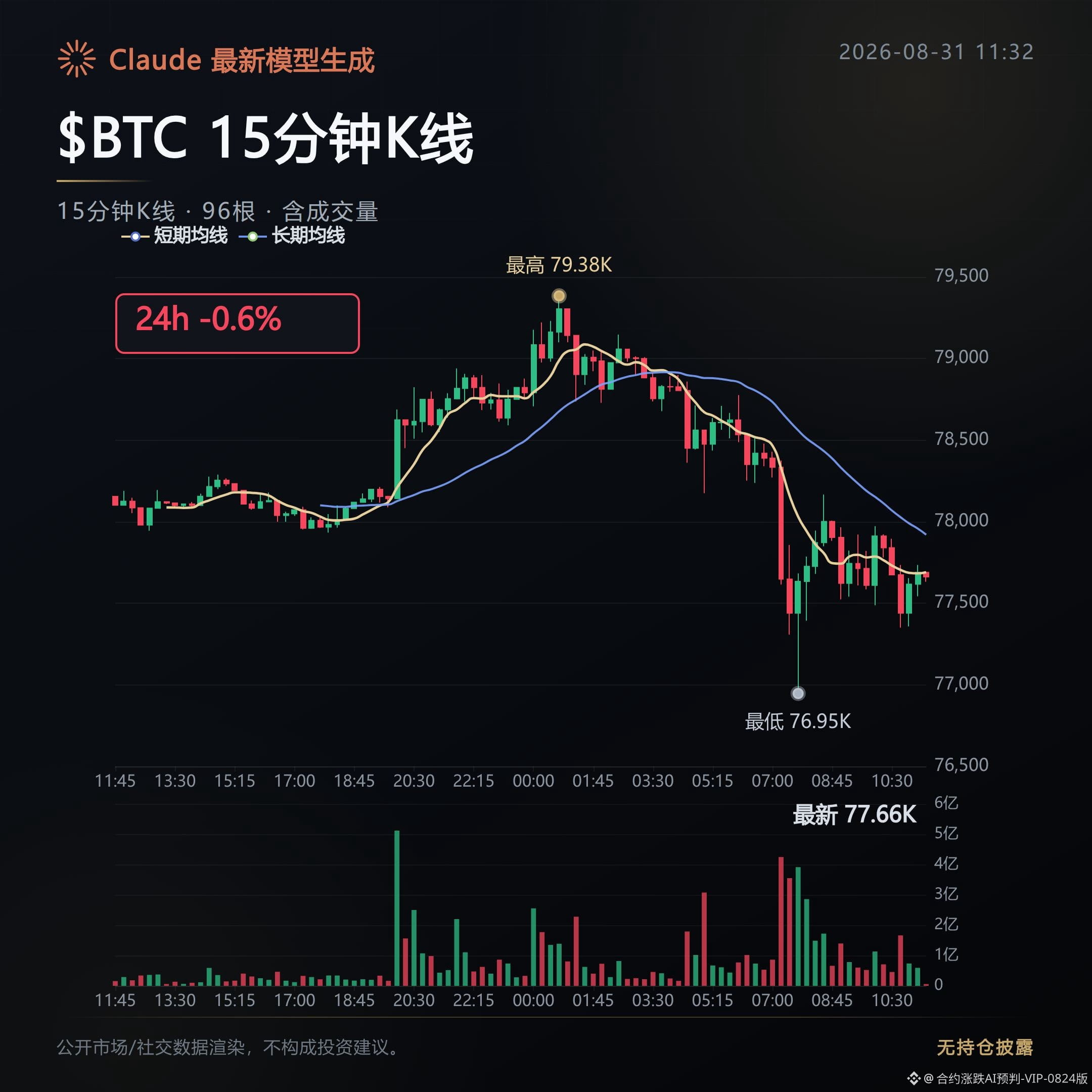
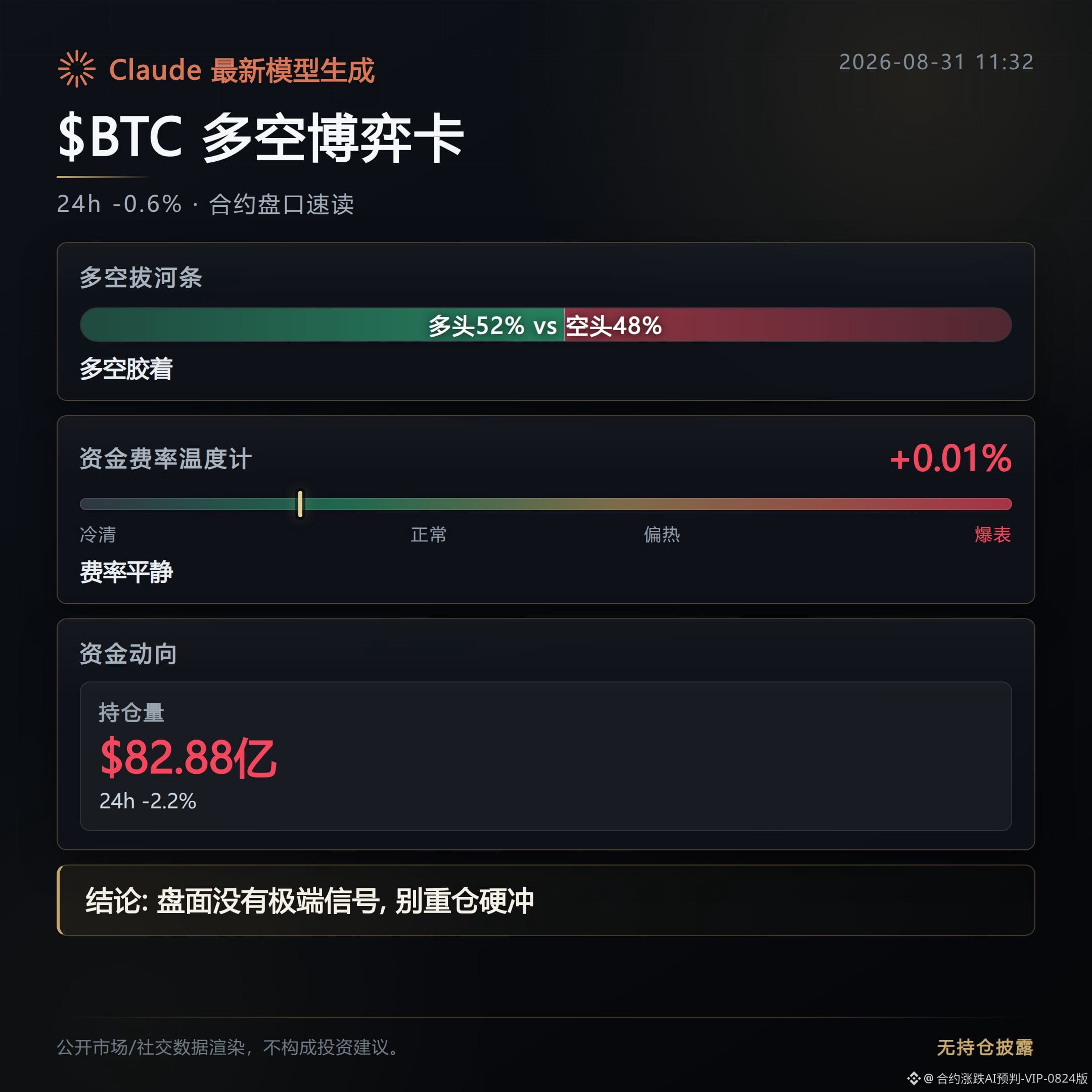
Log in to explore more content