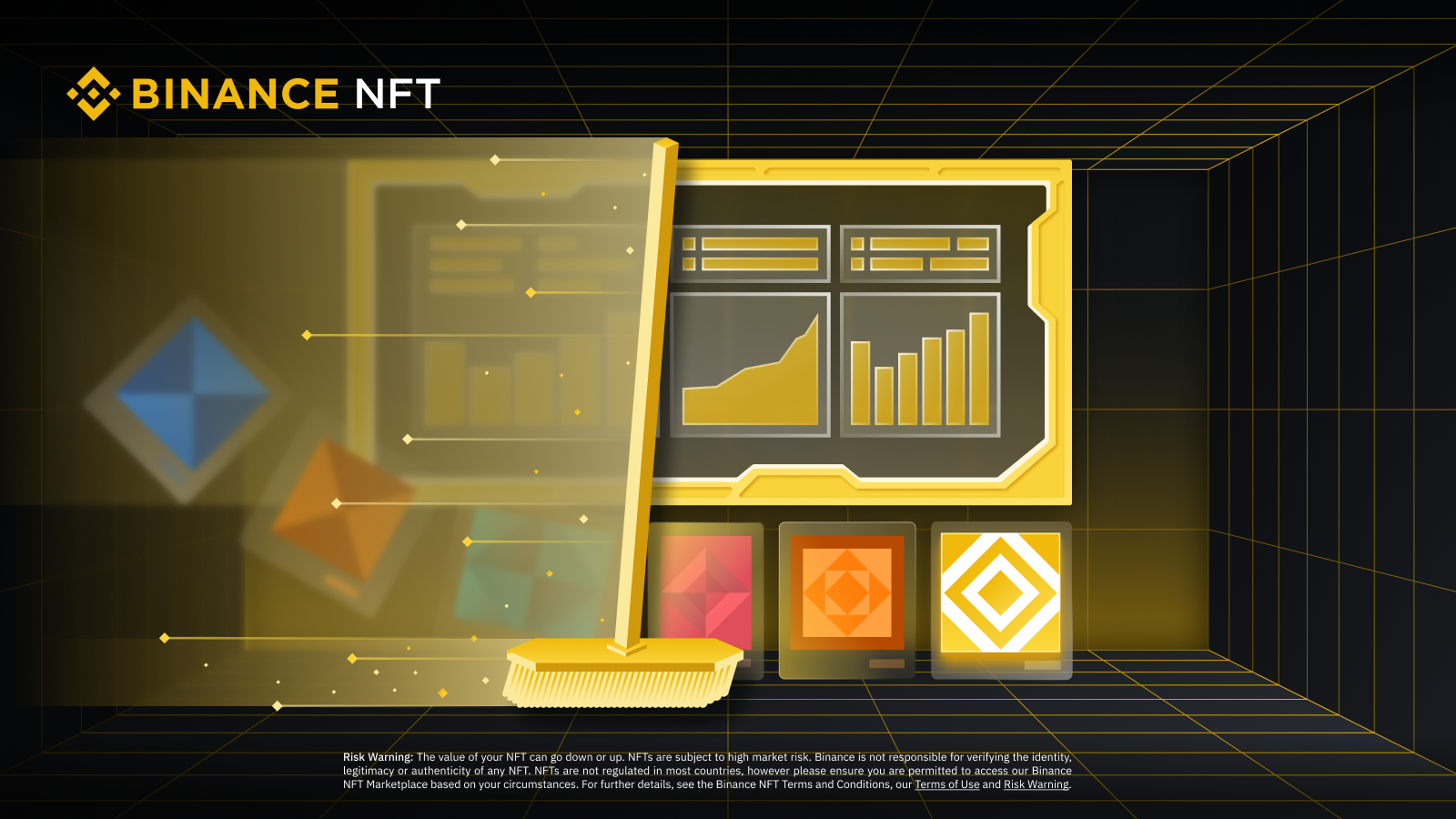
"Sweeping the floor" involves purchasing NFTs in a collection at the floor price.
Sweeping is often done to get lower-priced NFTs in promising projects, raise the floor price, and generate demand for a collection.
You can use Binance NFT Marketplace's sweeping feature to batch-buy NFTs in one transaction.
Learn more about what sweeping the floor means with NFT collections and how you can do it with Binance NFT Marketplace.
When it comes to NFTs and floor-sweeping, we're not talking about household chores here! You may have encountered the term on your NFT travels and been left scratching your head. Let's take a closer look at what sweeping the floor means and explain how to start doing it on the Binance NFT Marketplace.
"Sweeping the floor" is when a person, project, or other entity purchases all or a significant portion of a collection's NFTs available at its floor price. The floor price is a key metric representing the value of the lowest-priced NFT in a specific collection. Simply put, to sweep the floor is to buy up a collection's cheapest available NFTs.
For example, if the lowest price of any NFT in collection XYZ is one BNB, sweeping the floor would involve purchasing every NFT available at the one BNB floor price. The floor price would then increase to the value of the next cheapest NFT in the collection. Through floor-sweeping, a collection's floor price increases but usually only in the short term, as sellers can undercut the new floor price.
As mentioned, both projects and traders can sweep a collection's floor. Regular floor-sweeping by a project is sometimes done to keep buying pressure up for a collection. They can be attractive to NFT investors and collectors, as they know there's always some demand for NFTs. However, this dynamic usually applies only in the short term, and the long-term effects of a project sweeping its own collection's floor are highly debated. In some cases, floor-sweeping can be used nefariously to increase the value of an NFT collection artificially.
A particularly bullish collector of a project may also engage in sweeping to get as many NFTs as possible at the lowest price. A project's community often sees an investor sweeping the floor as positive since it can attract further investment.
Floor prices typically have a negative relationship with selling pressure. The more a community supplies a collection's NFTs for sale to the market, the lower the floor price often gets as sellers look to undercut one another and offer competitive prices. If there's an incentive to hold an NFT, such as utility or earning potential, there will be less selling pressure and likely a higher floor price. Other collectors will also want to purchase the NFTs if their use cases are attractive enough, increasing demand and the floor price.
Other factors beyond basic supply and demand that can affect a collection's floor price include:
The number of collection holders. A higher hold count often correlates with a higher floor price.
Related NFT services, such as use within a game or service.
Volatility. Highly volatile projects may see lower floor prices as NFT prices react to hype, pumps, and sell-offs.
Project renown. Big-name projects typically command higher prices in the market and higher floor prices.
Sweeping an NFT collection is a trading strategy with risk like any other. The tips outlined below are a start (but not an exhaustive guide) on what to consider before sweeping any collection.
DYOR. Do your own research! Before buying the cheapest NFTs in a collection, you should determine if the collection has growth potential. You can look at factors including quality, use cases, the artist or creator's reputation, and the collection's popularity.
Monitor the market and prices. Keep an eye on the NFT collection's prices and how they perform. If you notice volatility, you may be able to take advantage of potential price slumps. You should only take on risks you can afford, such as if you still have excess cash flow, and the specific amount will differ from person to person.
Set a budget. Decide how much you're willing to spend and stick to your plan. The dream goal is to accumulate many NFTs without spending too much money on any single one. Always spend within your limits and calculate what you can afford to spend by assessing your financial health beforehand.
Be patient. NFTs don't always have the liquidity of large-cap coins like bitcoin (BTC) or ether (ETH). You may have to wait to see returns (if any) on your floor-swept NFTs. Instantly reselling them can negate the impact of your floor-sweeping. Assess the price history charts for a better understanding of timelines before you purchase an NFT.
Let's look at an example to demonstrate floor-sweeping in action. Imagine you have 85 BNB to sweep the floor of a particular NFT collection. The floor price is set at 15 BNB with one NFT available, then 16.5 BNB with another, 17 BNB with two NFTs available, 19.5 BNB with one NFT available, and finally, one for 20 BNB.
After engaging in floor-sweeping by purchasing the (five) cheapest NFTs in this collection with your 85 BNB, the new floor price would be 20 BNB. You could then attempt to sell your NFTs for 20 BNB or above. Nevertheless, someone could always undercut the floor price for a quick sale. The demand for the NFTs may change, and the price of NFTs can fluctuate rapidly. Hence, sweeping the floor is a strategy that requires careful consideration and prior analysis.
If you're interested in sweeping the floor as part of your NFT trading strategy, you can do so with your Binance account. The Binance NFT Marketplace now has a sweep feature for purchasing multiple NFTs at the price floor. It's especially useful for fast-moving NFT collections in high demand, as you can batch purchase with just one transaction. To learn more about the feature, check our FAQ.
Sweeping the floor of an NFT collection can be a valuable strategy, but it's important to note it doesn't guarantee success. Risks are always involved, as with any investment, and the value of collections and their NFTs are often unpredictable. Using the tips outlined above, you can use floor-sweeping in a more prepared and responsible manner.
All About Utility NFTs, the Unique Tokens With Practical Applications
6 Key Indicators for NFT Collectors To Evaluate NFT Projects
Risk Warning: The value of your NFT can go down or up. NFTs are subject to high market risk. Binance is not responsible for verifying the identity, legitimacy, or authenticity of any NFT. NFTs are not regulated in most countries. However, please ensure you are permitted to access our Binance NFT Marketplace based on your circumstances. For further details, see the Binance NFT Terms and Conditions, our Terms of Use, and Risk Warning.
Disclaimer: Please note Binance is not recommending, vetting, or endorsing any third-party platform, research tool, or NFT project. Always do your own research – you are solely responsible for your investment decisions. Your use of any third-party platform or research tool is at your own risk.