Disclaimer: Digital asset prices can be volatile. Not financial advice. Do your own research. See full terms here and our risk warning here and below. Binance Futures products are restricted in certain countries and to certain users. This communication is not intended for users/countries to which restrictions apply.
Options Greeks (Greeks) are financial calculations used to measure the sensitivity of an options contract price to specific parameters.
Each Greek focuses on a different parameter, such as time decay, volatility, or interest rates, that impacts option premiums in different ways.
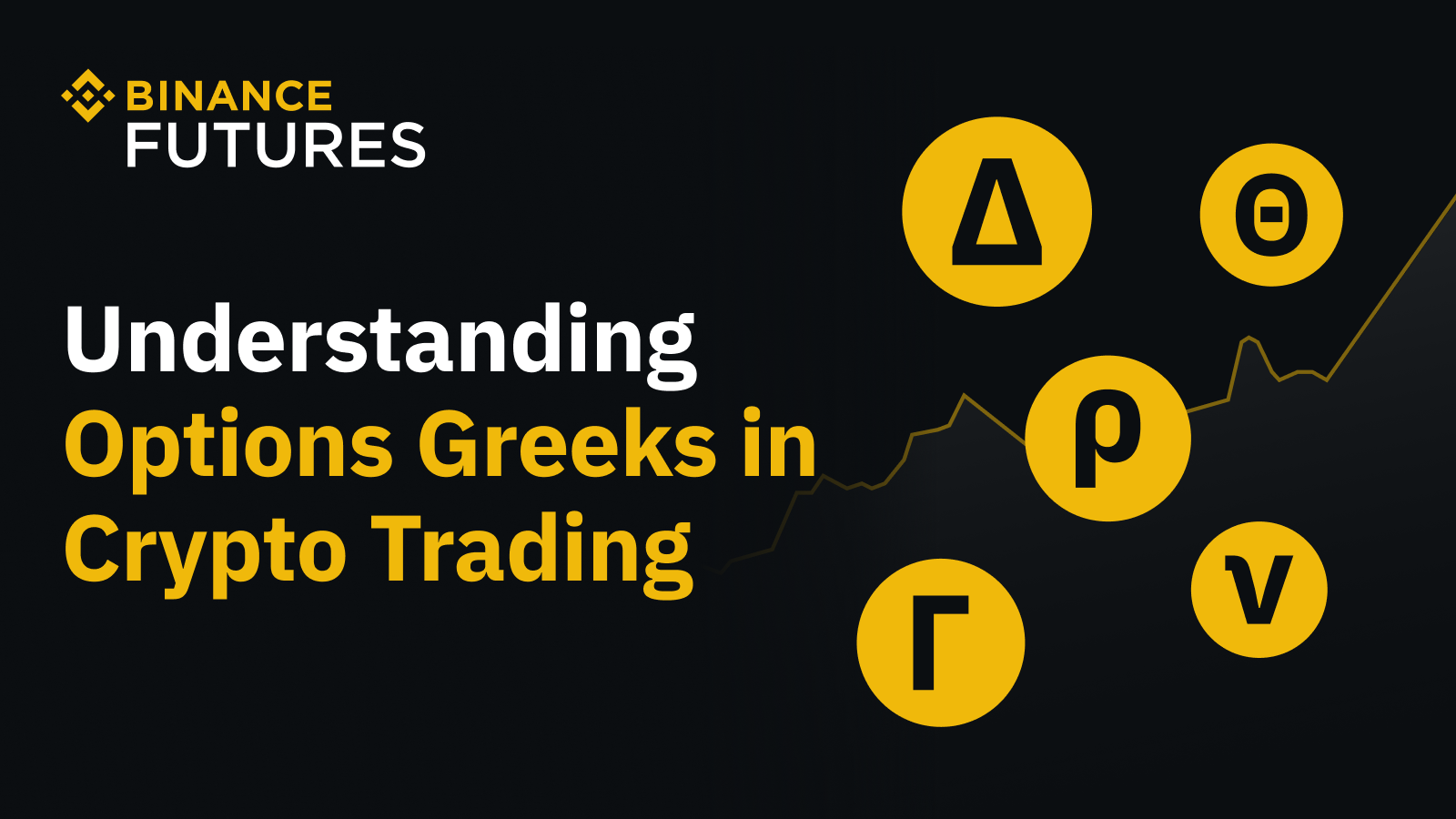
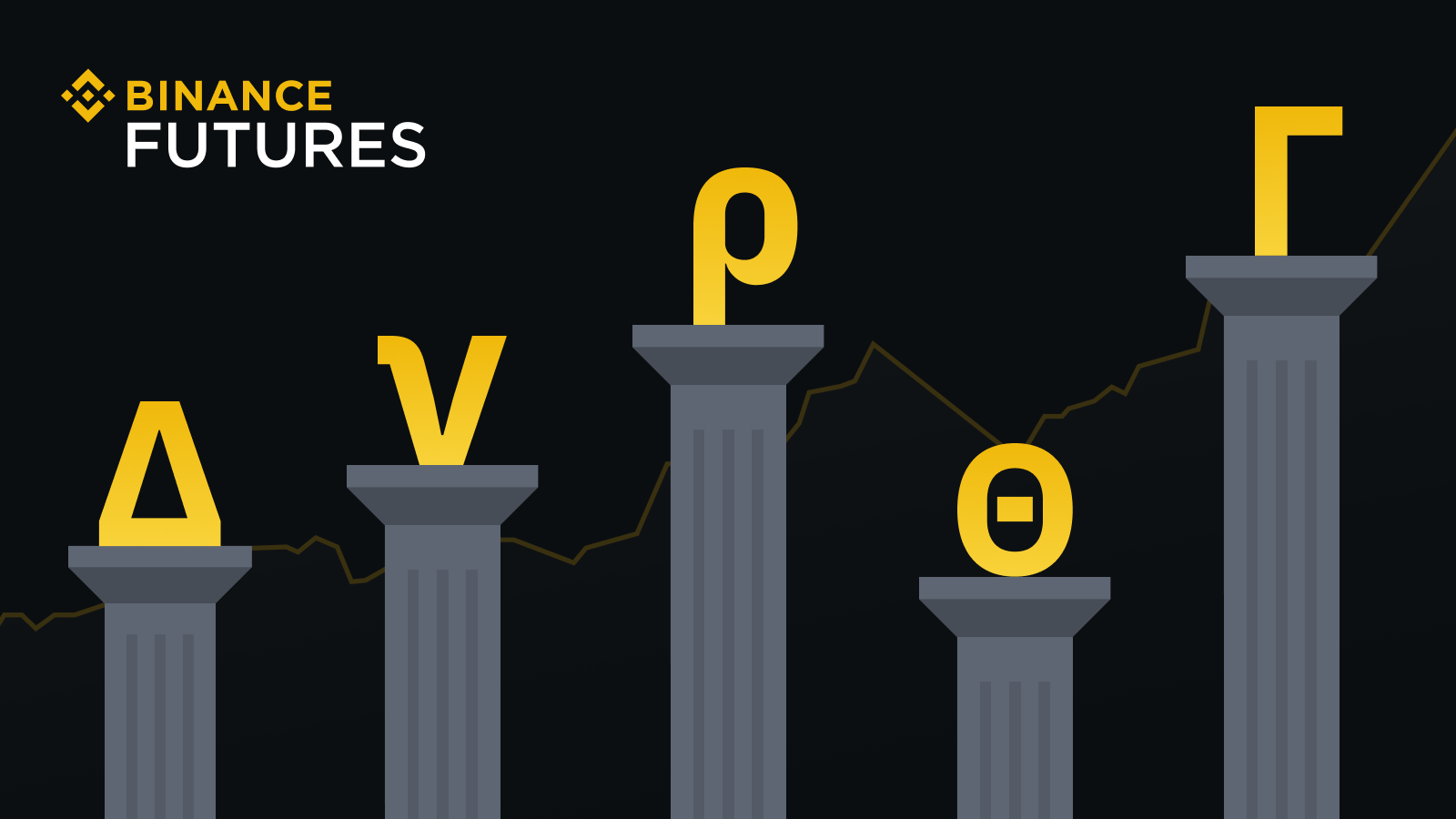
The most common Greeks used in options trading are delta, gamma, theta, vega, and rho.
Options trading in the cryptocurrency market has gained popularity as a method to hedge risks and maximize profits, and one of the most critical tools for traders is the concept of Options Greeks.
Options Greeks represent calculations that determine how sensitive an option is to changes in various factors, such as time-value decay, implied volatility, and the underlying asset’s price. The various Greeks work together to illustrate the nuances of how different forces can influence an option's theoretical value.
This article provides an in-depth overview of Options Greeks, the different Greek symbols, and how they are used to evaluate the potential risks and leverage Options trading.
Before delving into what Options Greeks are, it is important to understand the basic concepts of options contracts. An options contract is a type of derivatives contract that gives individuals the right (but not the obligation) to buy or sell an underlying asset at a predetermined price and date. Options are defined by the strike price, expiration date, and premium:
The strike price denotes the agreed-upon price at which the option buyer can trade the underlying asset.
The expiration date is the set future date after which the contract is deemed invalid.
The premium represents the option contract’s current market value or the price at which the buyer pays to acquire the contract from the seller. For more details about Options premiums, refer to this blog article.
An options contract can either be a put option or a call option.
Put options give the holders the right to sell an underlying asset at the strike price before the expiration date.
Call options allow the holders to buy the underlying asset at the strike price before the expiration date.
Since options contracts allow individuals to take bullish and bearish positions, traders can use them to hedge risks and speculate on price movements. Speaking about price movements, more advanced traders may use Options Greeks to understand the dynamics of price movements.
Options Greeks are financial calculations used to measure the sensitivity of an options contract price to specific parameters. Specifically, they provide quantitative values that aid traders in assessing their risks, predicting the profitability of an Options strategy, and making more informed decisions about their positions. Each Greek focuses on a different parameter, such as time decay, volatility, or interest rates, that impacts Options premiums* in different ways. Combining them can give traders insight into how an option's price may change as market conditions fluctuate at different times.
The Greeks are named after the Greek letters, and the most common ones used in options trading are delta, gamma, theta, vega, and rho.
Delta (Δ) calculates how much an option’s price has changed compared to a $1.00 movement in the underlying asset price. It estimates the impact of the underlying asset price movement on the option’s price. Delta ranges from 0.0 to 1.0 for call options and 0.0 to -1.0 for put options. This means that an option’s price in call options is proportional to the underlying asset’s price movement, i.e., it increases when the asset’s price increases and declines when the asset’s price falls. On the other hand, the put option’s premium is inversely proportional to the value of the underlying cryptocurrency, i.e., it decreases when the underlying asset’s price rises, and vice versa.
Delta can aid options traders in gauging overall price exposure and determining the directional risk of their options strategy. Traders often use low deltas or out-of-the-money options in speculative trading for high-risk high-reward strategies. For instance, individuals purchasing a call option are likely anticipating an increase in the option’s price in relation to a rise in the underlying asset. Traders might buy put options if they want to express a bearish directional view on the underlying cryptocurrency.
Example:
Suppose a trader has a BTC call option with a delta of 0.7 and the underlying asset price increases. For every $1 move in the price of Bitcoin, the option’s price will change by approximately $0.70. So, if the BTC price moves from $30,000 to $30,100, the call option will increase approximately by $70. Alternatively, if the Bitcoin price dropped to $29,900, the option’s price would decline approximately by $70 (- $70).
If the trader had a put option with a delta of -0.50, and Bitcoin’s price declined by the same margin, the option’s price would increase by $50. The negative delta shows an inverse relationship between the puts and the underlying asset price movement.
Gamma (Γ) measures the rate of change in an option’s delta in relation to a $1.00 price movement in the underlying asset. It shows how much delta will change based on the underlying cryptocurrency’s price movement.
Gamma indicates the depth of price exposure risk in an options position. It gives traders insight into how unstable an option’s delta may be – delta can rapidly shift with slight price movements in the underlying asset’s price towards expiry. The higher the gamma, the more volatile the options contract’s delta. Higher gamma is useful during major price swings since the delta increases rapidly. On the contrary, low gamma is beneficial in less volatile delta exposure.
Traders can also utilize this to plan entries/exits.
Example:
Suppose a BTC call option has a delta of 0.50 and a gamma of 0.10. If the BTC price were to rise by $100, the call option would increase by 0.50 delta or $50. However, if BTC rises again with another $100, the option will gain $60 instead of adding another $50. This is because the delta has increased by 0.60, i.e.,0.50 + 0.10 gamma.
Also known as time decay, theta (θ) is used to quantify how sensitive an option’s price is to the remaining time to expiration. It indicates the impact of time decay on an option’s extrinsic value. Time decay is the erosion or decline in an option’s value as it approaches its expiration date. This is because, as the expiration approaches, the probability of profitability decreases. Time decay will accelerate as the expiration draws closer.
Theta is often represented by a negative number since all option values decrease with time. Long positions are denoted using negative theta, while positive theta denotes the short positions. This means that time decay is beneficial for short option holders and detrimental for long options holders.
Example:
Suppose a BTC option has a theta of -0.5, this means the option’s value declines by $0.5 daily as the option moves closer to maturity. The negative theta reflects time decay.
Vega (v) calculates an option’s price sensitivity to the underlying asset’s volatility. It measures how much the option's price will move relative to a 1% change in implied volatility. Implied volatility refers to the prediction of a probable movement in the underlying asset’s value over a certain period of time. As volatility increases, so does an option's value since it has more room to make significant price swings.
Vega is an important metric since crypto volatility is among the most important factors that impact option values. The higher the vega the more a change in the implied volatility will affect the option’s value. For instance, both call and put options decline in price when volatility falls and appreciates when volatility rises. The rate of the rise or decline is determined by Vega. It’s important to note Vega is higher for longer expiries and will fall towards expiry, meaning implied volatility has a much more pronounced effect on longer dated options than shorter dated ones.
Example:
Suppose a BTC option has a vega of 0.6. For every 1% increase in BTC’s implied volatility, the option’s premium will increase by $0.6.
Rho measures an option’s sensitivity to interest rates. It calculates how much an option’s value changes relative to a 1% movement in interest rates. Generally, call premiums increase and put premiums decline when interest rates fluctuate for long-dated options. However, for short-dated options, the impact is limited or minimal.
Example:
Suppose a BTC option has a rho of -0.01. If the interest rates rose by 1%, the decline in value would be $0.01, all else being equal. Technically, higher interest rates would hurt put options but aid call options.
Greeks allow traders to actively participate in options price movements and make more informed trading decisions. Hence, mastering these major Greeks is a vital skill for options traders seeking to understand how options values react to changes in market conditions such as movements in the underlying asset.
Other minor Options Greeks include lambda, vera, epsilon, zomma, vomma, speed, and ultima, among others. In your journey through Options trading and the world of cryptocurrency, remember to stay informed and make well-informed decisions.
Risk Warning:
Options Trading
The risk in options trading is that loss of your entire investment within a relatively short period of time is comparatively high. It is possible that your loss and the resulting payment obligation may be higher than the amount you had invested. Therefore, you are advised to read carefully and understand the Options Service Agreement. You may experience a significant loss that can quickly exceed your initial investment. If you create contingent orders, such as a “stop loss” or “stop limit” order, such orders will not necessarily limit your losses to the intended amount, for instance, market conditions may make such limits unviable. Furthermore, as “leverage” is allowed in trading, please note that it can work both for you and against you. Exploiting such “leverage” may lead to larger losses or higher profits.
No Representation
This content is presented to you on an "as is" basis for general information and educational purposes only, without representation or warranty of any kind. It is not intended or should not be construed as financial or investment advice, nor is it to recommend or intend to recommend the purchase or sale of any specific product(s) or service(s).
Hypothetical Performance Results
Digital asset prices can be volatile. The value of your investment may go down or up, and you may not get back the amount invested. Any results posted herein are intended as examples only to provide you with a reference of what potentially could have made or lost trading with the technical indicators and tools, but are in no way a reflection of what you could have made or lost in the same situation. Therefore, you should not rely on the results as a representation of what your returns or losses would have been utilizing such technical indicators. There are numerous other factors related to the market in general or to the implementation of any specific trading program which cannot be fully accounted for in the preparation of hypothetical performance results and all of which can adversely affect actual trading results. Past performance should not be taken as an indication or guarantee of future performance, and no representation or warranty, expressed or implied is made regarding future performance. In no way is results or performance guaranteed by Binance.
Responsibilities
You are solely responsible for your investment decisions, and Binance is not liable for any losses or damages you may incur. The risk warning described herein is not exhaustive, therefore you should carefully consider your investment experience, financial situation, investment objective, risk tolerance level and consult your independent financial adviser as to the suitability of your situation prior making any investment. For more information, see our Terms of Use and Risk Warning.
The products and services referred to herein may be restricted in certain jurisdictions or regions or to certain users in accordance with applicable legal and regulatory requirements. You are solely responsible for informing yourself about and observing any restrictions and/or requirements imposed with respect to the access to and use of any products and services offered by or available through Binance in each country or region from which they are accessed by you or on your behalf. Binance reserves the right to change, modify or impose additional restrictions with respect to the access to and use of any products and/or services offered from time to time in its sole discretion at any time without notification.