

KrypToon
281 Posts

KrypToon
 Square Verified
Report
Block User
Web3 media & community platform covering crypto news, research, project discovery, AMAs and X Spaces. Connecting emerging projects with active crypto audiences.

Macro KOL
Open Trade
Occasional Trader
1.5 Years
204 Following
30.1K+ Followers
216 Liked
1 Badges
Posts
Portfolio
All
Quotes
Live
PINNED
·
--
Verified
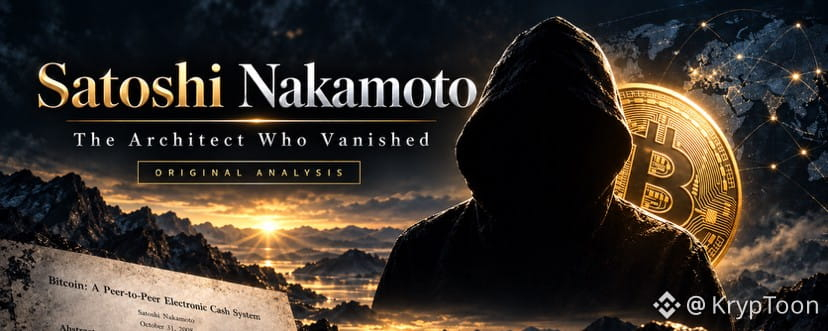
Article
Satoshi Nakamoto: The Architect Who Vanished, the Network That StayedBitcoin has produced fortunes, political debates, regulatory battles, technological revolutions and thousands of competing digital assets.
Yet the person, or perhaps group, who started it remains unknown.
That creator used the name Satoshi Nakamoto.
The mystery has lasted for nearly eighteen years because two very different questions are usually mixed together.
The first question is historical:
Who created Bitcoin?
The second is technological:
Why can Bitcoin continue functioning even though nobody knows who created it?
The second question may ultimately be more important.
Bitcoin was designed so that users would not need to trust a founder, company, government or financial institution to determine the validity of transactions.
Ironically, the system built around verification rather than personal trust has left its own creator surrounded by speculation.
This article separates four different categories:
• documented historical facts
• technically supported conclusions
• credible but unproven theories
• rumors with little or no verifiable evidence
The distinction matters.
A candidate can resemble Satoshi.
A writing style can resemble Satoshi.
A programmer can possess all the necessary skills.
None of those facts alone proves identity.
In cryptography, extraordinary claims deserve verifiable evidence.
🧭 Before Bitcoin: The Problem Satoshi Inherited
Bitcoin did not appear suddenly from nowhere.
Its foundations were built over decades of research into digital money, cryptography, distributed computing and online privacy.
Long before Bitcoin existed, researchers had already explored pieces of the puzzle.
David Chaum developed groundbreaking concepts involving cryptographic electronic cash and blind signatures.
Stuart Haber and W. Scott Stornetta worked on cryptographically secured timestamping.
Adam Back developed Hashcash, a proof-of-work system originally intended to make spam economically expensive.
Wei Dai proposed b-money, describing a distributed electronic cash system.
Nick Szabo designed the concept of Bit Gold, which explored digital scarcity created through computational work.
Hal Finney later developed Reusable Proof of Work, or RPOW.
Bitcoin's original white paper referenced several of these technologies and researchers.
Satoshi's breakthrough was therefore not that every individual ingredient was completely new.
The breakthrough was the architecture.
Bitcoin combined cryptographic signatures, peer-to-peer networking, proof-of-work, timestamping, economic incentives and decentralized consensus into one operational system.
The central challenge was called the double-spending problem.
Digital information can be copied.
If digital money is merely a file, someone could theoretically duplicate it and attempt to spend the same value twice.
Traditional finance solves this problem through trusted intermediaries.
Banks maintain account balances.
Card networks approve payments.
Clearing systems maintain authoritative transaction records.
Satoshi proposed something radically different.
Instead of trusting one institution to maintain the official ledger, thousands of independent participants could verify a shared transaction history.
That idea became Bitcoin.
📜 The Beginning of Bitcoin
August 2008: Bitcoin.org Appears
The domain bitcoin.org was registered on August 18, 2008.
That happened months before the Bitcoin network became operational.
It suggests that the project was already reasonably developed before Satoshi revealed it publicly.
October 31, 2008: The White Paper
Satoshi Nakamoto distributed a document titled:
Bitcoin: A Peer-to-Peer Electronic Cash System
The paper was only nine pages long.
Yet its opening idea was enormous.
It proposed electronic payments that could move directly between participants without depending on a financial institution to validate every transaction.
Satoshi described an electronic payment system based on cryptographic proof rather than reliance on a trusted third party.
The timing became historically significant.
The global financial system was experiencing one of its most severe crises in decades.
However, it would be misleading to claim that Bitcoin was created entirely because of the 2008 financial crisis.
Many of Bitcoin's technical predecessors had existed for years.
The intellectual development behind Bitcoin clearly predates the collapse of major financial institutions in 2008.
The crisis nevertheless gave Bitcoin's philosophy powerful historical context.
⛏️ January 3, 2009: The Genesis Block
Bitcoin officially began with what is now called the Genesis Block, or Block 0.
Embedded inside it was a newspaper headline:
“The Times 03/Jan/2009 Chancellor on brink of second bailout for banks.”
The headline came from the British newspaper The Times.
At the most basic level, it functioned as evidence that the block could not have been created before January 3.
But many Bitcoin historians also interpret it as commentary on the traditional banking system.
Whether Satoshi intended it primarily as a timestamp, political statement, or both remains open to interpretation.
The block contained a 50 BTC reward.
Because of how Bitcoin's original software treats the Genesis Block, those particular coins cannot be spent through the normal transaction process.
💻 Bitcoin Software Goes Public
A few days later, Satoshi released the first Bitcoin software.
Early participants could:
• run Bitcoin nodes
• validate transactions
• mine blocks
• send BTC directly to other participants
There were no institutional custodians.
No Bitcoin ETFs.
No industrial-scale mining farms.
No global exchange industry.
No established market price.
It began as an experimental peer-to-peer network operated by a handful of technically curious participants.
🤝 Hal Finney and Bitcoin's First Famous Transfer
One of the earliest people to recognize Bitcoin's potential was cryptographer and developer Hal Finney.
Finney downloaded the software almost immediately.
His famous January 2009 post simply said:
“Running bitcoin.”
On January 12, Satoshi sent Finney 10 BTC.
It is generally recognized as the first recorded Bitcoin transaction between Satoshi and another individual.
That transaction later became crucial in discussions about Satoshi's identity.
If Finney himself were Satoshi, he would have effectively been transferring bitcoin between identities while simultaneously maintaining correspondence in which he appeared to be independently testing Satoshi's software.
That is possible in theory.
But it makes the hypothesis more complicated.
⚙️ How Bitcoin's Blockchain Actually Works
“Blockchain” is frequently treated as though the chain itself were Satoshi's entire invention.
That misses the most important point.
Bitcoin is not simply a database containing blocks.
It is a system for allowing independent participants to agree on a transaction history even when they do not necessarily trust one another.
🔐 1. Private Keys Control Bitcoin
Bitcoin ownership is based on cryptography.
Users control private keys that can authorize transactions.
When someone spends bitcoin, the network verifies whether the required cryptographic authorization is valid.
Bitcoin does not need to know the user's legal name to validate the transaction.
This is why Bitcoin is generally described as pseudonymous, not completely anonymous.
Transactions remain visible publicly.
Blockchain analytics can sometimes connect addresses, exchanges and behavioral patterns to real people.
🧩 2. Bitcoin Uses UTXOs
Bitcoin does not operate exactly like a traditional bank account.
It uses something called the Unspent Transaction Output, or UTXO, model.
A transaction consumes previously unspent outputs and creates new ones.
Your wallet calculates the outputs you can spend and displays their combined value as your balance.
This architecture makes double-spending a verifiable question.
Has a particular output already been spent?
If yes, nodes reject attempts to spend it again.
🌐 3. Transactions Move Across a Peer-to-Peer Network
Bitcoin nodes communicate directly with other nodes.
When a transaction is broadcast, participating nodes independently verify whether it follows Bitcoin's consensus rules.
Invalid transactions can be rejected without needing authorization from Satoshi, a company or a central administrator.
⛏️ 4. Miners Perform Proof-of-Work
Miners gather valid transactions into candidate blocks.
They then perform enormous numbers of SHA-256 calculations.
Their objective is to discover a block hash that satisfies Bitcoin's current difficulty requirement.
Finding that solution requires computation.
Checking that the solution is correct is comparatively easy.
This imbalance is essential.
Creating proof is expensive.
Verifying proof is inexpensive.
🔗 5. Blocks Create a Historical Chain
Each new block references information from the previous block.
Changing an old transaction would alter the affected block.
That alteration would also change subsequent cryptographic relationships.
An attacker attempting to rewrite Bitcoin's history would therefore need to recreate the required proof-of-work and catch up with or overtake the legitimate chain's accumulated work.
The deeper a transaction becomes in Bitcoin's history, the more computational work protects it.
💰 6. Economics Secures the System
Mining is not charitable.
Bitcoin provides incentives.
A miner that discovers a valid block can receive:
• the block subsidy
• transaction fees
Bitcoin's original block subsidy was 50 BTC.
Approximately every 210,000 blocks, the subsidy halves.
It became:
50 BTC
25 BTC
12.5 BTC
6.25 BTC
3.125 BTC
This declining issuance is the mechanism behind Bitcoin's supply ceiling approaching 21 million BTC.
Cryptography, game theory, networking and monetary incentives work together.
That combination is the real architecture.
🕵️ Who Is Satoshi Nakamoto?
This is where documented history ends and investigation begins.
Satoshi's writings provide clues.
They do not provide proof of identity.
Researchers have studied:
• vocabulary
• spelling
• punctuation
• coding style
• email timestamps
• cryptographic knowledge
• economic views
• geographic hints
• forum activity
• historical relationships
But profile matching has a fundamental weakness.
The early cypherpunk community contained many technically sophisticated people who shared similar terminology, ideas and philosophical interests.
Similarity does not establish identity.
🧩 Adam Back
Adam Back is one of the most technically plausible and, as of 2026, one of the most discussed candidates.
He created Hashcash.
Bitcoin's white paper explicitly references Hashcash.
Back also participated extensively in the cypherpunk community and was researching digital cash, privacy and proof-of-work years before Bitcoin existed.
In April 2026, an extensive New York Times investigation led by journalist John Carreyrou renewed speculation that Back might have been Satoshi.
The investigation examined a large body of historical cryptography mailing-list material and focused partly on unusual similarities between Back's writing and Satoshi's.
The reported comparisons included spelling patterns, phrase construction and nonstandard hyphenation.
However, this remains circumstantial evidence.
Back has repeatedly denied being Satoshi.
There is another important counterpoint.
Back has previously produced correspondence showing someone using the Satoshi identity contacting him about Bitcoin before the white paper's publication.
A Back-is-Satoshi theory therefore requires explaining those communications as deliberate compartmentalization or identity management.
Possible?
Yes.
Proven?
No.
No publicly verified cryptographic evidence currently establishes Adam Back as Satoshi Nakamoto.
🧩 Hal Finney
Few candidates fit the technical profile better than Hal Finney.
Finney was:
• an accomplished cryptographer
• an early cypherpunk
• creator of RPOW
• one of Bitcoin's earliest users
• recipient of Satoshi's first famous BTC transfer
He also lived surprisingly close to a man whose legal surname was Nakamoto, another coincidence that later attracted attention.
But Finney denied being Satoshi.
More importantly, archived correspondence shows Finney apparently communicating with Satoshi while testing Bitcoin.
To accept the Finney theory, one must assume that he created an elaborate parallel identity and correspondence trail.
That cannot be completely ruled out.
But no decisive evidence establishes it.
🧩 Nick Szabo
Nick Szabo remains another major candidate.
Years before Bitcoin, Szabo conceptualized Bit Gold.
Bit Gold contained ideas that appear strikingly similar to elements later found in Bitcoin:
• computational scarcity
• cryptographic proofs
• distributed validation concepts
• digital value without conventional banking
Szabo also wrote extensively about money, law and trusted institutions.
Stylometric studies have periodically found similarities between his writing and Satoshi's.
Still, intellectual influence does not equal authorship.
Satoshi clearly studied previous digital-money systems.
A creator influenced by Szabo could naturally produce similar ideas.
Szabo has denied being Satoshi.
No cryptographic proof establishes otherwise.
🧩 Peter Todd
In 2024, the HBO documentary Money Electric: The Bitcoin Mystery proposed longtime Bitcoin developer Peter Todd as Satoshi.
The documentary relied on interpretations of early forum interactions, technical history and circumstantial behavioral evidence.
Todd rejected the conclusion.
No Satoshi-associated private-key signature was produced.
The documentary therefore created a major theory, not a verified identification.
🧩 Len Sassaman
Len Sassaman was a cryptographer, privacy advocate and active participant in the cypherpunk world.
His technical background, social connections and knowledge made him a plausible candidate.
Another frequently mentioned coincidence is timing.
Sassaman died in 2011, the same year Satoshi disappeared from public communication.
That coincidence has powered years of speculation.
Yet timeline alignment is not identity proof.
No known Satoshi key has been publicly demonstrated to belong to Sassaman.
🧩 Dorian Nakamoto
Perhaps the most famous mistaken identification involved Dorian Prentice Satoshi Nakamoto.
Newsweek identified him as the Bitcoin creator in 2014.
The case relied partly on:
• his name
• engineering background
• privacy
• an ambiguous statement
Dorian later said he had not known about Bitcoin before journalists approached him.
The episode became an important warning about Satoshi investigations.
Speculation can affect real people.
A compelling coincidence does not justify presenting identity as fact.
🧩 Paul Le Roux
Programmer Paul Le Roux has also appeared in Satoshi theories.
He possessed formidable programming and encryption skills and had extensive experience maintaining secrecy.
Journalists have explored parallels between his capabilities and Bitcoin.
However, no hard evidence has connected him to Satoshi's cryptographic identity.
His story remains one of the more dramatic hypotheses, but not one of the strongest proofs.
🧩 Could Satoshi Have Been Multiple People?
Another theory proposes that Satoshi Nakamoto was a team.
Supporters of this idea point to the breadth of expertise visible in Bitcoin:
cryptography
economics
C++ development
peer-to-peer networking
security
game theory
monetary design
The project certainly required knowledge across several disciplines.
But multidisciplinary competence does not automatically imply multiple authors.
Exceptional generalists exist.
A small team could maintain one writing identity.
A single programmer could also spend years developing expertise while seeking informal feedback from others.
Current evidence cannot conclusively distinguish these possibilities.
⚖️ Craig Wright: A Very Different Case
Craig Wright publicly claimed for years that he was Satoshi Nakamoto.
Unlike most candidate theories, his claim eventually received extensive judicial scrutiny.
In 2024, the High Court of England and Wales ruled in the Crypto Open Patent Alliance case that Wright was not:
• the author of the Bitcoin white paper
• the person operating under the Satoshi Nakamoto pseudonym
• the creator of Bitcoin
• the author of Bitcoin's original software
That ruling did not identify the real Satoshi.
But it created an unusually strong legal conclusion concerning one prominent claimant.
🌫️ The Biggest Satoshi Rumors
“Satoshi was an intelligence agency.”
This theory frequently points to Bitcoin's use of SHA-256.
SHA-256 was designed by the U.S. National Security Agency and standardized publicly.
But using a publicly available cryptographic standard does not prove that the organization that designed the algorithm also created every system using it.
No authenticated evidence currently proves that the NSA, CIA or another intelligence agency created Bitcoin.
“Satoshi disappeared because the CIA discovered him.”
This theory partly originates from Bitcoin developer Gavin Andresen's contact with U.S. intelligence-related organizations during Bitcoin's early history.
The chronology is less dramatic than many online versions suggest.
Satoshi had already been reducing participation and communicated that he had moved on.
The CIA theory remains speculation.
“Every old Bitcoin wallet belongs to Satoshi.”
Incorrect.
Many people mined Bitcoin during its earliest years.
Movement from a wallet created in 2009 or 2010 does not automatically mean Satoshi has returned.
Early-chain activity must be analyzed carefully.
₿ Did Satoshi Mine 1.1 Million BTC?
One of Bitcoin's most repeated claims is that Satoshi owns approximately 1.1 million BTC.
That figure should be treated as an estimate, not a confirmed account balance.
Researcher Sergio Demian Lerner studied patterns in Bitcoin's early mining history.
He identified characteristics suggesting that one dominant early miner produced a large number of blocks.
That inferred miner became known as Patoshi.
Some estimates based on the pattern approach approximately 1.1 million BTC.
Other researchers have produced lower estimates.
The important distinction is this:
Bitcoin's blockchain does not contain a label stating:
“These coins belong to Satoshi Nakamoto.”
Researchers are inferring ownership from mining patterns.
It is therefore more accurate to say:
A dominant early miner widely suspected to be Satoshi appears to have mined a very large quantity of BTC, much of which has apparently remained dormant.
That is evidence-based.
Declaring an exact Satoshi balance is not.
🔑 What Would Actually Prove Satoshi's Identity?
Cryptography offers a much stronger test than documentaries, writing comparisons or personality analysis.
A serious claimant could sign a new message using a private key independently established as belonging to Satoshi's earliest Bitcoin activity.
The test should involve a newly chosen public message so an old signature cannot simply be recycled.
Even then, precision matters.
A valid signature would prove control of the private key.
It would not automatically prove the claimant was the original human owner.
Keys can theoretically be:
stolen
transferred
inherited
shared
recovered
A truly compelling identification would ideally combine:
1. Cryptographic evidence
Control of historically credible Satoshi-associated keys.
2. Contemporaneous documentation
Records created before Bitcoin became famous.
3. Technical continuity
Knowledge consistent with Bitcoin's earliest implementation.
4. Independent verification
Publicly reproducible evidence rather than private demonstrations.
5. Provenance
Documents and metadata whose authenticity can be independently established.
Until evidence approaches that standard, every candidate should remain a candidate.
🧠 Why Satoshi's Disappearance May Have Helped Bitcoin
Bitcoin began with an unavoidable contradiction.
It was designed to decentralize monetary verification.
Yet its earliest development depended heavily on one creator.
Satoshi initially:
wrote the software
explained the protocol
fixed bugs
communicated with developers
managed infrastructure
guided development
That is significant centralized influence.
But decentralization can develop progressively.
Other developers learned the software.
More miners joined.
Independent nodes expanded.
Infrastructure moved beyond Satoshi's direct control.
By 2011, Bitcoin faced its biggest governance test:
Could the network survive without its creator?
It did.
That may be one of Bitcoin's most historically important achievements.
Today, no founder can simply announce a new Bitcoin rule and force everyone to accept it.
Developers can propose changes.
Miners can choose strategies.
Companies can support software.
Governments can regulate services.
Investors can influence markets.
But independent Bitcoin nodes ultimately enforce the consensus rules implemented in the software they choose to run.
There is no verified “Satoshi administrator account.”
No founder password controls the network.
🔍 Where the Mystery Stands in 2026
The Satoshi investigation is still open.
The 2026 Adam Back investigation brought sophisticated new historical and linguistic analysis into the debate.
Back denies being Satoshi.
The 2024 Peter Todd theory remains disputed.
Hal Finney remains one of the strongest historical candidates but denied being Satoshi.
Nick Szabo continues to attract attention because of Bit Gold and his intellectual background.
Len Sassaman remains part of the discussion.
The theory that Satoshi was a group remains possible.
Craig Wright's personal claim was rejected by the English High Court.
No theory has produced universally accepted cryptographic proof.
We also do not know with certainty whether Satoshi:
is alive
has died
lost the relevant keys
still controls early BTC
was one person
was several people
Anyone claiming certainty should therefore be asked for evidence.
🏁 Final Analysis
The most fascinating aspect of Satoshi Nakamoto may ultimately not be who disappeared.
It may be what remained.
The white paper survived.
The source code survived.
The blockchain survived.
The network survived.
The monetary policy survived.
And Bitcoin continued operating without verified communication from its creator.
That is unusual in technology.
Major technology platforms usually retain visible founders, executives, companies or foundations.
Bitcoin's creator became almost entirely absent from the system's later operation.
That absence transformed Satoshi from a leader into a historical mystery.
It also reinforced one of Bitcoin's deepest principles:
Verify. Do not simply trust.
That principle should apply to Satoshi investigations too.
A writing similarity is evidence.
It is not proof.
A technical background is evidence.
It is not proof.
A documentary theory is evidence.
It is not proof.
A journalist's investigation can strengthen a case.
It still does not replace cryptographic verification.
A person's own claim is not enough either.
Until decisive evidence appears, the most responsible conclusion remains simple:
Satoshi Nakamoto created Bitcoin.
Satoshi Nakamoto's verified real-world identity remains unknown.
And perhaps that unresolved identity is no longer a weakness in Bitcoin's story.
Perhaps it is the ultimate demonstration that the network became larger than its founder.
Disclaimer: This article is for educational, historical and informational purposes only. Identity theories discussed above remain unverified unless explicitly stated otherwise. Nothing in this article constitutes financial, investment, trading, legal or tax advice.
$BTC
Bitcoin • Satoshi Nakamoto • Blockchain • Crypto History
#Bitcoin #SatoshiNakamoto #Blockchain
Satoshi Nakamoto: The Architect Who Vanished, the Network That Stayed
Bitcoin has produced fortunes, political debates, regulatory battles, technological revolutions and thousands of competing digital assets.
Yet the person, or perhaps group, who started it remains unknown.
That creator used the name Satoshi Nakamoto.
The mystery has lasted for nearly eighteen years because two very different questions are usually mixed together.
The first question is historical:
Who created Bitcoin?
The second is technological:
Why can Bitcoin continue functioning even though nobody knows who created it?
The second question may ultimately be more important.
Bitcoin was designed so that users would not need to trust a founder, company, government or financial institution to determine the validity of transactions.
Ironically, the system built around verification rather than personal trust has left its own creator surrounded by speculation.
This article separates four different categories:
• documented historical facts
• technically supported conclusions
• credible but unproven theories
• rumors with little or no verifiable evidence
The distinction matters.
A candidate can resemble Satoshi.
A writing style can resemble Satoshi.
A programmer can possess all the necessary skills.
None of those facts alone proves identity.
In cryptography, extraordinary claims deserve verifiable evidence.
🧭 Before Bitcoin: The Problem Satoshi Inherited
Bitcoin did not appear suddenly from nowhere.
Its foundations were built over decades of research into digital money, cryptography, distributed computing and online privacy.
Long before Bitcoin existed, researchers had already explored pieces of the puzzle.
David Chaum developed groundbreaking concepts involving cryptographic electronic cash and blind signatures.
Stuart Haber and W. Scott Stornetta worked on cryptographically secured timestamping.
Adam Back developed Hashcash, a proof-of-work system originally intended to make spam economically expensive.
Wei Dai proposed b-money, describing a distributed electronic cash system.
Nick Szabo designed the concept of Bit Gold, which explored digital scarcity created through computational work.
Hal Finney later developed Reusable Proof of Work, or RPOW.
Bitcoin's original white paper referenced several of these technologies and researchers.
Satoshi's breakthrough was therefore not that every individual ingredient was completely new.
The breakthrough was the architecture.
Bitcoin combined cryptographic signatures, peer-to-peer networking, proof-of-work, timestamping, economic incentives and decentralized consensus into one operational system.
The central challenge was called the double-spending problem.
Digital information can be copied.
If digital money is merely a file, someone could theoretically duplicate it and attempt to spend the same value twice.
Traditional finance solves this problem through trusted intermediaries.
Banks maintain account balances.
Card networks approve payments.
Clearing systems maintain authoritative transaction records.
Satoshi proposed something radically different.
Instead of trusting one institution to maintain the official ledger, thousands of independent participants could verify a shared transaction history.
That idea became Bitcoin.
📜 The Beginning of Bitcoin
August 2008: Bitcoin.org Appears
The domain bitcoin.org was registered on August 18, 2008.
That happened months before the Bitcoin network became operational.
It suggests that the project was already reasonably developed before Satoshi revealed it publicly.
October 31, 2008: The White Paper
Satoshi Nakamoto distributed a document titled:
Bitcoin: A Peer-to-Peer Electronic Cash System
The paper was only nine pages long.
Yet its opening idea was enormous.
It proposed electronic payments that could move directly between participants without depending on a financial institution to validate every transaction.
Satoshi described an electronic payment system based on cryptographic proof rather than reliance on a trusted third party.
The timing became historically significant.
The global financial system was experiencing one of its most severe crises in decades.
However, it would be misleading to claim that Bitcoin was created entirely because of the 2008 financial crisis.
Many of Bitcoin's technical predecessors had existed for years.
The intellectual development behind Bitcoin clearly predates the collapse of major financial institutions in 2008.
The crisis nevertheless gave Bitcoin's philosophy powerful historical context.
⛏️ January 3, 2009: The Genesis Block
Bitcoin officially began with what is now called the Genesis Block, or Block 0.
Embedded inside it was a newspaper headline:
“The Times 03/Jan/2009 Chancellor on brink of second bailout for banks.”
The headline came from the British newspaper The Times.
At the most basic level, it functioned as evidence that the block could not have been created before January 3.
But many Bitcoin historians also interpret it as commentary on the traditional banking system.
Whether Satoshi intended it primarily as a timestamp, political statement, or both remains open to interpretation.
The block contained a 50 BTC reward.
Because of how Bitcoin's original software treats the Genesis Block, those particular coins cannot be spent through the normal transaction process.
💻 Bitcoin Software Goes Public
A few days later, Satoshi released the first Bitcoin software.
Early participants could:
• run Bitcoin nodes
• validate transactions
• mine blocks
• send BTC directly to other participants
There were no institutional custodians.
No Bitcoin ETFs.
No industrial-scale mining farms.
No global exchange industry.
No established market price.
It began as an experimental peer-to-peer network operated by a handful of technically curious participants.
🤝 Hal Finney and Bitcoin's First Famous Transfer
One of the earliest people to recognize Bitcoin's potential was cryptographer and developer Hal Finney.
Finney downloaded the software almost immediately.
His famous January 2009 post simply said:
“Running bitcoin.”
On January 12, Satoshi sent Finney 10 BTC.
It is generally recognized as the first recorded Bitcoin transaction between Satoshi and another individual.
That transaction later became crucial in discussions about Satoshi's identity.
If Finney himself were Satoshi, he would have effectively been transferring bitcoin between identities while simultaneously maintaining correspondence in which he appeared to be independently testing Satoshi's software.
That is possible in theory.
But it makes the hypothesis more complicated.
⚙️ How Bitcoin's Blockchain Actually Works
“Blockchain” is frequently treated as though the chain itself were Satoshi's entire invention.
That misses the most important point.
Bitcoin is not simply a database containing blocks.
It is a system for allowing independent participants to agree on a transaction history even when they do not necessarily trust one another.
🔐 1. Private Keys Control Bitcoin
Bitcoin ownership is based on cryptography.
Users control private keys that can authorize transactions.
When someone spends bitcoin, the network verifies whether the required cryptographic authorization is valid.
Bitcoin does not need to know the user's legal name to validate the transaction.
This is why Bitcoin is generally described as pseudonymous, not completely anonymous.
Transactions remain visible publicly.
Blockchain analytics can sometimes connect addresses, exchanges and behavioral patterns to real people.
🧩 2. Bitcoin Uses UTXOs
Bitcoin does not operate exactly like a traditional bank account.
It uses something called the Unspent Transaction Output, or UTXO, model.
A transaction consumes previously unspent outputs and creates new ones.
Your wallet calculates the outputs you can spend and displays their combined value as your balance.
This architecture makes double-spending a verifiable question.
Has a particular output already been spent?
If yes, nodes reject attempts to spend it again.
🌐 3. Transactions Move Across a Peer-to-Peer Network
Bitcoin nodes communicate directly with other nodes.
When a transaction is broadcast, participating nodes independently verify whether it follows Bitcoin's consensus rules.
Invalid transactions can be rejected without needing authorization from Satoshi, a company or a central administrator.
⛏️ 4. Miners Perform Proof-of-Work
Miners gather valid transactions into candidate blocks.
They then perform enormous numbers of SHA-256 calculations.
Their objective is to discover a block hash that satisfies Bitcoin's current difficulty requirement.
Finding that solution requires computation.
Checking that the solution is correct is comparatively easy.
This imbalance is essential.
Creating proof is expensive.
Verifying proof is inexpensive.
🔗 5. Blocks Create a Historical Chain
Each new block references information from the previous block.
Changing an old transaction would alter the affected block.
That alteration would also change subsequent cryptographic relationships.
An attacker attempting to rewrite Bitcoin's history would therefore need to recreate the required proof-of-work and catch up with or overtake the legitimate chain's accumulated work.
The deeper a transaction becomes in Bitcoin's history, the more computational work protects it.
💰 6. Economics Secures the System
Mining is not charitable.
Bitcoin provides incentives.
A miner that discovers a valid block can receive:
• the block subsidy
• transaction fees
Bitcoin's original block subsidy was 50 BTC.
Approximately every 210,000 blocks, the subsidy halves.
It became:
50 BTC
25 BTC
12.5 BTC
6.25 BTC
3.125 BTC
This declining issuance is the mechanism behind Bitcoin's supply ceiling approaching 21 million BTC.
Cryptography, game theory, networking and monetary incentives work together.
That combination is the real architecture.
🕵️ Who Is Satoshi Nakamoto?
This is where documented history ends and investigation begins.
Satoshi's writings provide clues.
They do not provide proof of identity.
Researchers have studied:
• vocabulary
• spelling
• punctuation
• coding style
• email timestamps
• cryptographic knowledge
• economic views
• geographic hints
• forum activity
• historical relationships
But profile matching has a fundamental weakness.
The early cypherpunk community contained many technically sophisticated people who shared similar terminology, ideas and philosophical interests.
Similarity does not establish identity.
🧩 Adam Back
Adam Back is one of the most technically plausible and, as of 2026, one of the most discussed candidates.
He created Hashcash.
Bitcoin's white paper explicitly references Hashcash.
Back also participated extensively in the cypherpunk community and was researching digital cash, privacy and proof-of-work years before Bitcoin existed.
In April 2026, an extensive New York Times investigation led by journalist John Carreyrou renewed speculation that Back might have been Satoshi.
The investigation examined a large body of historical cryptography mailing-list material and focused partly on unusual similarities between Back's writing and Satoshi's.
The reported comparisons included spelling patterns, phrase construction and nonstandard hyphenation.
However, this remains circumstantial evidence.
Back has repeatedly denied being Satoshi.
There is another important counterpoint.
Back has previously produced correspondence showing someone using the Satoshi identity contacting him about Bitcoin before the white paper's publication.
A Back-is-Satoshi theory therefore requires explaining those communications as deliberate compartmentalization or identity management.
Possible?
Yes.
Proven?
No.
No publicly verified cryptographic evidence currently establishes Adam Back as Satoshi Nakamoto.
🧩 Hal Finney
Few candidates fit the technical profile better than Hal Finney.
Finney was:
• an accomplished cryptographer
• an early cypherpunk
• creator of RPOW
• one of Bitcoin's earliest users
• recipient of Satoshi's first famous BTC transfer
He also lived surprisingly close to a man whose legal surname was Nakamoto, another coincidence that later attracted attention.
But Finney denied being Satoshi.
More importantly, archived correspondence shows Finney apparently communicating with Satoshi while testing Bitcoin.
To accept the Finney theory, one must assume that he created an elaborate parallel identity and correspondence trail.
That cannot be completely ruled out.
But no decisive evidence establishes it.
🧩 Nick Szabo
Nick Szabo remains another major candidate.
Years before Bitcoin, Szabo conceptualized Bit Gold.
Bit Gold contained ideas that appear strikingly similar to elements later found in Bitcoin:
• computational scarcity
• cryptographic proofs
• distributed validation concepts
• digital value without conventional banking
Szabo also wrote extensively about money, law and trusted institutions.
Stylometric studies have periodically found similarities between his writing and Satoshi's.
Still, intellectual influence does not equal authorship.
Satoshi clearly studied previous digital-money systems.
A creator influenced by Szabo could naturally produce similar ideas.
Szabo has denied being Satoshi.
No cryptographic proof establishes otherwise.
🧩 Peter Todd
In 2024, the HBO documentary Money Electric: The Bitcoin Mystery proposed longtime Bitcoin developer Peter Todd as Satoshi.
The documentary relied on interpretations of early forum interactions, technical history and circumstantial behavioral evidence.
Todd rejected the conclusion.
No Satoshi-associated private-key signature was produced.
The documentary therefore created a major theory, not a verified identification.
🧩 Len Sassaman
Len Sassaman was a cryptographer, privacy advocate and active participant in the cypherpunk world.
His technical background, social connections and knowledge made him a plausible candidate.
Another frequently mentioned coincidence is timing.
Sassaman died in 2011, the same year Satoshi disappeared from public communication.
That coincidence has powered years of speculation.
Yet timeline alignment is not identity proof.
No known Satoshi key has been publicly demonstrated to belong to Sassaman.
🧩 Dorian Nakamoto
Perhaps the most famous mistaken identification involved Dorian Prentice Satoshi Nakamoto.
Newsweek identified him as the Bitcoin creator in 2014.
The case relied partly on:
• his name
• engineering background
• privacy
• an ambiguous statement
Dorian later said he had not known about Bitcoin before journalists approached him.
The episode became an important warning about Satoshi investigations.
Speculation can affect real people.
A compelling coincidence does not justify presenting identity as fact.
🧩 Paul Le Roux
Programmer Paul Le Roux has also appeared in Satoshi theories.
He possessed formidable programming and encryption skills and had extensive experience maintaining secrecy.
Journalists have explored parallels between his capabilities and Bitcoin.
However, no hard evidence has connected him to Satoshi's cryptographic identity.
His story remains one of the more dramatic hypotheses, but not one of the strongest proofs.
🧩 Could Satoshi Have Been Multiple People?
Another theory proposes that Satoshi Nakamoto was a team.
Supporters of this idea point to the breadth of expertise visible in Bitcoin:
cryptography
economics
C++ development
peer-to-peer networking
security
game theory
monetary design
The project certainly required knowledge across several disciplines.
But multidisciplinary competence does not automatically imply multiple authors.
Exceptional generalists exist.
A small team could maintain one writing identity.
A single programmer could also spend years developing expertise while seeking informal feedback from others.
Current evidence cannot conclusively distinguish these possibilities.
⚖️ Craig Wright: A Very Different Case
Craig Wright publicly claimed for years that he was Satoshi Nakamoto.
Unlike most candidate theories, his claim eventually received extensive judicial scrutiny.
In 2024, the High Court of England and Wales ruled in the Crypto Open Patent Alliance case that Wright was not:
• the author of the Bitcoin white paper
• the person operating under the Satoshi Nakamoto pseudonym
• the creator of Bitcoin
• the author of Bitcoin's original software
That ruling did not identify the real Satoshi.
But it created an unusually strong legal conclusion concerning one prominent claimant.
🌫️ The Biggest Satoshi Rumors
“Satoshi was an intelligence agency.”
This theory frequently points to Bitcoin's use of SHA-256.
SHA-256 was designed by the U.S. National Security Agency and standardized publicly.
But using a publicly available cryptographic standard does not prove that the organization that designed the algorithm also created every system using it.
No authenticated evidence currently proves that the NSA, CIA or another intelligence agency created Bitcoin.
“Satoshi disappeared because the CIA discovered him.”
This theory partly originates from Bitcoin developer Gavin Andresen's contact with U.S. intelligence-related organizations during Bitcoin's early history.
The chronology is less dramatic than many online versions suggest.
Satoshi had already been reducing participation and communicated that he had moved on.
The CIA theory remains speculation.
“Every old Bitcoin wallet belongs to Satoshi.”
Incorrect.
Many people mined Bitcoin during its earliest years.
Movement from a wallet created in 2009 or 2010 does not automatically mean Satoshi has returned.
Early-chain activity must be analyzed carefully.
₿ Did Satoshi Mine 1.1 Million BTC?
One of Bitcoin's most repeated claims is that Satoshi owns approximately 1.1 million BTC.
That figure should be treated as an estimate, not a confirmed account balance.
Researcher Sergio Demian Lerner studied patterns in Bitcoin's early mining history.
He identified characteristics suggesting that one dominant early miner produced a large number of blocks.
That inferred miner became known as Patoshi.
Some estimates based on the pattern approach approximately 1.1 million BTC.
Other researchers have produced lower estimates.
The important distinction is this:
Bitcoin's blockchain does not contain a label stating:
“These coins belong to Satoshi Nakamoto.”
Researchers are inferring ownership from mining patterns.
It is therefore more accurate to say:
A dominant early miner widely suspected to be Satoshi appears to have mined a very large quantity of BTC, much of which has apparently remained dormant.
That is evidence-based.
Declaring an exact Satoshi balance is not.
🔑 What Would Actually Prove Satoshi's Identity?
Cryptography offers a much stronger test than documentaries, writing comparisons or personality analysis.
A serious claimant could sign a new message using a private key independently established as belonging to Satoshi's earliest Bitcoin activity.
The test should involve a newly chosen public message so an old signature cannot simply be recycled.
Even then, precision matters.
A valid signature would prove control of the private key.
It would not automatically prove the claimant was the original human owner.
Keys can theoretically be:
stolen
transferred
inherited
shared
recovered
A truly compelling identification would ideally combine:
1. Cryptographic evidence
Control of historically credible Satoshi-associated keys.
2. Contemporaneous documentation
Records created before Bitcoin became famous.
3. Technical continuity
Knowledge consistent with Bitcoin's earliest implementation.
4. Independent verification
Publicly reproducible evidence rather than private demonstrations.
5. Provenance
Documents and metadata whose authenticity can be independently established.
Until evidence approaches that standard, every candidate should remain a candidate.
🧠 Why Satoshi's Disappearance May Have Helped Bitcoin
Bitcoin began with an unavoidable contradiction.
It was designed to decentralize monetary verification.
Yet its earliest development depended heavily on one creator.
Satoshi initially:
wrote the software
explained the protocol
fixed bugs
communicated with developers
managed infrastructure
guided development
That is significant centralized influence.
But decentralization can develop progressively.
Other developers learned the software.
More miners joined.
Independent nodes expanded.
Infrastructure moved beyond Satoshi's direct control.
By 2011, Bitcoin faced its biggest governance test:
Could the network survive without its creator?
It did.
That may be one of Bitcoin's most historically important achievements.
Today, no founder can simply announce a new Bitcoin rule and force everyone to accept it.
Developers can propose changes.
Miners can choose strategies.
Companies can support software.
Governments can regulate services.
Investors can influence markets.
But independent Bitcoin nodes ultimately enforce the consensus rules implemented in the software they choose to run.
There is no verified “Satoshi administrator account.”
No founder password controls the network.
🔍 Where the Mystery Stands in 2026
The Satoshi investigation is still open.
The 2026 Adam Back investigation brought sophisticated new historical and linguistic analysis into the debate.
Back denies being Satoshi.
The 2024 Peter Todd theory remains disputed.
Hal Finney remains one of the strongest historical candidates but denied being Satoshi.
Nick Szabo continues to attract attention because of Bit Gold and his intellectual background.
Len Sassaman remains part of the discussion.
The theory that Satoshi was a group remains possible.
Craig Wright's personal claim was rejected by the English High Court.
No theory has produced universally accepted cryptographic proof.
We also do not know with certainty whether Satoshi:
is alive
has died
lost the relevant keys
still controls early BTC
was one person
was several people
Anyone claiming certainty should therefore be asked for evidence.
🏁 Final Analysis
The most fascinating aspect of Satoshi Nakamoto may ultimately not be who disappeared.
It may be what remained.
The white paper survived.
The source code survived.
The blockchain survived.
The network survived.
The monetary policy survived.
And Bitcoin continued operating without verified communication from its creator.
That is unusual in technology.
Major technology platforms usually retain visible founders, executives, companies or foundations.
Bitcoin's creator became almost entirely absent from the system's later operation.
That absence transformed Satoshi from a leader into a historical mystery.
It also reinforced one of Bitcoin's deepest principles:
Verify. Do not simply trust.
That principle should apply to Satoshi investigations too.
A writing similarity is evidence.
It is not proof.
A technical background is evidence.
It is not proof.
A documentary theory is evidence.
It is not proof.
A journalist's investigation can strengthen a case.
It still does not replace cryptographic verification.
A person's own claim is not enough either.
Until decisive evidence appears, the most responsible conclusion remains simple:
Satoshi Nakamoto created Bitcoin.
Satoshi Nakamoto's verified real-world identity remains unknown.
And perhaps that unresolved identity is no longer a weakness in Bitcoin's story.
Perhaps it is the ultimate demonstration that the network became larger than its founder.
Disclaimer: This article is for educational, historical and informational purposes only. Identity theories discussed above remain unverified unless explicitly stated otherwise. Nothing in this article constitutes financial, investment, trading, legal or tax advice.
$BTC
Bitcoin • Satoshi Nakamoto • Blockchain • Crypto History
#Bitcoin #SatoshiNakamoto #Blockchain
Yet the person, or perhaps group, who started it remains unknown.
That creator used the name Satoshi Nakamoto.
The mystery has lasted for nearly eighteen years because two very different questions are usually mixed together.
The first question is historical:
Who created Bitcoin?
The second is technological:
Why can Bitcoin continue functioning even though nobody knows who created it?
The second question may ultimately be more important.
Bitcoin was designed so that users would not need to trust a founder, company, government or financial institution to determine the validity of transactions.
Ironically, the system built around verification rather than personal trust has left its own creator surrounded by speculation.
This article separates four different categories:
• documented historical facts
• technically supported conclusions
• credible but unproven theories
• rumors with little or no verifiable evidence
The distinction matters.
A candidate can resemble Satoshi.
A writing style can resemble Satoshi.
A programmer can possess all the necessary skills.
None of those facts alone proves identity.
In cryptography, extraordinary claims deserve verifiable evidence.
🧭 Before Bitcoin: The Problem Satoshi Inherited
Bitcoin did not appear suddenly from nowhere.
Its foundations were built over decades of research into digital money, cryptography, distributed computing and online privacy.
Long before Bitcoin existed, researchers had already explored pieces of the puzzle.
David Chaum developed groundbreaking concepts involving cryptographic electronic cash and blind signatures.
Stuart Haber and W. Scott Stornetta worked on cryptographically secured timestamping.
Adam Back developed Hashcash, a proof-of-work system originally intended to make spam economically expensive.
Wei Dai proposed b-money, describing a distributed electronic cash system.
Nick Szabo designed the concept of Bit Gold, which explored digital scarcity created through computational work.
Hal Finney later developed Reusable Proof of Work, or RPOW.
Bitcoin's original white paper referenced several of these technologies and researchers.
Satoshi's breakthrough was therefore not that every individual ingredient was completely new.
The breakthrough was the architecture.
Bitcoin combined cryptographic signatures, peer-to-peer networking, proof-of-work, timestamping, economic incentives and decentralized consensus into one operational system.
The central challenge was called the double-spending problem.
Digital information can be copied.
If digital money is merely a file, someone could theoretically duplicate it and attempt to spend the same value twice.
Traditional finance solves this problem through trusted intermediaries.
Banks maintain account balances.
Card networks approve payments.
Clearing systems maintain authoritative transaction records.
Satoshi proposed something radically different.
Instead of trusting one institution to maintain the official ledger, thousands of independent participants could verify a shared transaction history.
That idea became Bitcoin.
📜 The Beginning of Bitcoin
August 2008: Bitcoin.org Appears
The domain bitcoin.org was registered on August 18, 2008.
That happened months before the Bitcoin network became operational.
It suggests that the project was already reasonably developed before Satoshi revealed it publicly.
October 31, 2008: The White Paper
Satoshi Nakamoto distributed a document titled:
Bitcoin: A Peer-to-Peer Electronic Cash System
The paper was only nine pages long.
Yet its opening idea was enormous.
It proposed electronic payments that could move directly between participants without depending on a financial institution to validate every transaction.
Satoshi described an electronic payment system based on cryptographic proof rather than reliance on a trusted third party.
The timing became historically significant.
The global financial system was experiencing one of its most severe crises in decades.
However, it would be misleading to claim that Bitcoin was created entirely because of the 2008 financial crisis.
Many of Bitcoin's technical predecessors had existed for years.
The intellectual development behind Bitcoin clearly predates the collapse of major financial institutions in 2008.
The crisis nevertheless gave Bitcoin's philosophy powerful historical context.
⛏️ January 3, 2009: The Genesis Block
Bitcoin officially began with what is now called the Genesis Block, or Block 0.
Embedded inside it was a newspaper headline:
“The Times 03/Jan/2009 Chancellor on brink of second bailout for banks.”
The headline came from the British newspaper The Times.
At the most basic level, it functioned as evidence that the block could not have been created before January 3.
But many Bitcoin historians also interpret it as commentary on the traditional banking system.
Whether Satoshi intended it primarily as a timestamp, political statement, or both remains open to interpretation.
The block contained a 50 BTC reward.
Because of how Bitcoin's original software treats the Genesis Block, those particular coins cannot be spent through the normal transaction process.
💻 Bitcoin Software Goes Public
A few days later, Satoshi released the first Bitcoin software.
Early participants could:
• run Bitcoin nodes
• validate transactions
• mine blocks
• send BTC directly to other participants
There were no institutional custodians.
No Bitcoin ETFs.
No industrial-scale mining farms.
No global exchange industry.
No established market price.
It began as an experimental peer-to-peer network operated by a handful of technically curious participants.
🤝 Hal Finney and Bitcoin's First Famous Transfer
One of the earliest people to recognize Bitcoin's potential was cryptographer and developer Hal Finney.
Finney downloaded the software almost immediately.
His famous January 2009 post simply said:
“Running bitcoin.”
On January 12, Satoshi sent Finney 10 BTC.
It is generally recognized as the first recorded Bitcoin transaction between Satoshi and another individual.
That transaction later became crucial in discussions about Satoshi's identity.
If Finney himself were Satoshi, he would have effectively been transferring bitcoin between identities while simultaneously maintaining correspondence in which he appeared to be independently testing Satoshi's software.
That is possible in theory.
But it makes the hypothesis more complicated.
⚙️ How Bitcoin's Blockchain Actually Works
“Blockchain” is frequently treated as though the chain itself were Satoshi's entire invention.
That misses the most important point.
Bitcoin is not simply a database containing blocks.
It is a system for allowing independent participants to agree on a transaction history even when they do not necessarily trust one another.
🔐 1. Private Keys Control Bitcoin
Bitcoin ownership is based on cryptography.
Users control private keys that can authorize transactions.
When someone spends bitcoin, the network verifies whether the required cryptographic authorization is valid.
Bitcoin does not need to know the user's legal name to validate the transaction.
This is why Bitcoin is generally described as pseudonymous, not completely anonymous.
Transactions remain visible publicly.
Blockchain analytics can sometimes connect addresses, exchanges and behavioral patterns to real people.
🧩 2. Bitcoin Uses UTXOs
Bitcoin does not operate exactly like a traditional bank account.
It uses something called the Unspent Transaction Output, or UTXO, model.
A transaction consumes previously unspent outputs and creates new ones.
Your wallet calculates the outputs you can spend and displays their combined value as your balance.
This architecture makes double-spending a verifiable question.
Has a particular output already been spent?
If yes, nodes reject attempts to spend it again.
🌐 3. Transactions Move Across a Peer-to-Peer Network
Bitcoin nodes communicate directly with other nodes.
When a transaction is broadcast, participating nodes independently verify whether it follows Bitcoin's consensus rules.
Invalid transactions can be rejected without needing authorization from Satoshi, a company or a central administrator.
⛏️ 4. Miners Perform Proof-of-Work
Miners gather valid transactions into candidate blocks.
They then perform enormous numbers of SHA-256 calculations.
Their objective is to discover a block hash that satisfies Bitcoin's current difficulty requirement.
Finding that solution requires computation.
Checking that the solution is correct is comparatively easy.
This imbalance is essential.
Creating proof is expensive.
Verifying proof is inexpensive.
🔗 5. Blocks Create a Historical Chain
Each new block references information from the previous block.
Changing an old transaction would alter the affected block.
That alteration would also change subsequent cryptographic relationships.
An attacker attempting to rewrite Bitcoin's history would therefore need to recreate the required proof-of-work and catch up with or overtake the legitimate chain's accumulated work.
The deeper a transaction becomes in Bitcoin's history, the more computational work protects it.
💰 6. Economics Secures the System
Mining is not charitable.
Bitcoin provides incentives.
A miner that discovers a valid block can receive:
• the block subsidy
• transaction fees
Bitcoin's original block subsidy was 50 BTC.
Approximately every 210,000 blocks, the subsidy halves.
It became:
50 BTC
25 BTC
12.5 BTC
6.25 BTC
3.125 BTC
This declining issuance is the mechanism behind Bitcoin's supply ceiling approaching 21 million BTC.
Cryptography, game theory, networking and monetary incentives work together.
That combination is the real architecture.
🕵️ Who Is Satoshi Nakamoto?
This is where documented history ends and investigation begins.
Satoshi's writings provide clues.
They do not provide proof of identity.
Researchers have studied:
• vocabulary
• spelling
• punctuation
• coding style
• email timestamps
• cryptographic knowledge
• economic views
• geographic hints
• forum activity
• historical relationships
But profile matching has a fundamental weakness.
The early cypherpunk community contained many technically sophisticated people who shared similar terminology, ideas and philosophical interests.
Similarity does not establish identity.
🧩 Adam Back
Adam Back is one of the most technically plausible and, as of 2026, one of the most discussed candidates.
He created Hashcash.
Bitcoin's white paper explicitly references Hashcash.
Back also participated extensively in the cypherpunk community and was researching digital cash, privacy and proof-of-work years before Bitcoin existed.
In April 2026, an extensive New York Times investigation led by journalist John Carreyrou renewed speculation that Back might have been Satoshi.
The investigation examined a large body of historical cryptography mailing-list material and focused partly on unusual similarities between Back's writing and Satoshi's.
The reported comparisons included spelling patterns, phrase construction and nonstandard hyphenation.
However, this remains circumstantial evidence.
Back has repeatedly denied being Satoshi.
There is another important counterpoint.
Back has previously produced correspondence showing someone using the Satoshi identity contacting him about Bitcoin before the white paper's publication.
A Back-is-Satoshi theory therefore requires explaining those communications as deliberate compartmentalization or identity management.
Possible?
Yes.
Proven?
No.
No publicly verified cryptographic evidence currently establishes Adam Back as Satoshi Nakamoto.
🧩 Hal Finney
Few candidates fit the technical profile better than Hal Finney.
Finney was:
• an accomplished cryptographer
• an early cypherpunk
• creator of RPOW
• one of Bitcoin's earliest users
• recipient of Satoshi's first famous BTC transfer
He also lived surprisingly close to a man whose legal surname was Nakamoto, another coincidence that later attracted attention.
But Finney denied being Satoshi.
More importantly, archived correspondence shows Finney apparently communicating with Satoshi while testing Bitcoin.
To accept the Finney theory, one must assume that he created an elaborate parallel identity and correspondence trail.
That cannot be completely ruled out.
But no decisive evidence establishes it.
🧩 Nick Szabo
Nick Szabo remains another major candidate.
Years before Bitcoin, Szabo conceptualized Bit Gold.
Bit Gold contained ideas that appear strikingly similar to elements later found in Bitcoin:
• computational scarcity
• cryptographic proofs
• distributed validation concepts
• digital value without conventional banking
Szabo also wrote extensively about money, law and trusted institutions.
Stylometric studies have periodically found similarities between his writing and Satoshi's.
Still, intellectual influence does not equal authorship.
Satoshi clearly studied previous digital-money systems.
A creator influenced by Szabo could naturally produce similar ideas.
Szabo has denied being Satoshi.
No cryptographic proof establishes otherwise.
🧩 Peter Todd
In 2024, the HBO documentary Money Electric: The Bitcoin Mystery proposed longtime Bitcoin developer Peter Todd as Satoshi.
The documentary relied on interpretations of early forum interactions, technical history and circumstantial behavioral evidence.
Todd rejected the conclusion.
No Satoshi-associated private-key signature was produced.
The documentary therefore created a major theory, not a verified identification.
🧩 Len Sassaman
Len Sassaman was a cryptographer, privacy advocate and active participant in the cypherpunk world.
His technical background, social connections and knowledge made him a plausible candidate.
Another frequently mentioned coincidence is timing.
Sassaman died in 2011, the same year Satoshi disappeared from public communication.
That coincidence has powered years of speculation.
Yet timeline alignment is not identity proof.
No known Satoshi key has been publicly demonstrated to belong to Sassaman.
🧩 Dorian Nakamoto
Perhaps the most famous mistaken identification involved Dorian Prentice Satoshi Nakamoto.
Newsweek identified him as the Bitcoin creator in 2014.
The case relied partly on:
• his name
• engineering background
• privacy
• an ambiguous statement
Dorian later said he had not known about Bitcoin before journalists approached him.
The episode became an important warning about Satoshi investigations.
Speculation can affect real people.
A compelling coincidence does not justify presenting identity as fact.
🧩 Paul Le Roux
Programmer Paul Le Roux has also appeared in Satoshi theories.
He possessed formidable programming and encryption skills and had extensive experience maintaining secrecy.
Journalists have explored parallels between his capabilities and Bitcoin.
However, no hard evidence has connected him to Satoshi's cryptographic identity.
His story remains one of the more dramatic hypotheses, but not one of the strongest proofs.
🧩 Could Satoshi Have Been Multiple People?
Another theory proposes that Satoshi Nakamoto was a team.
Supporters of this idea point to the breadth of expertise visible in Bitcoin:
cryptography
economics
C++ development
peer-to-peer networking
security
game theory
monetary design
The project certainly required knowledge across several disciplines.
But multidisciplinary competence does not automatically imply multiple authors.
Exceptional generalists exist.
A small team could maintain one writing identity.
A single programmer could also spend years developing expertise while seeking informal feedback from others.
Current evidence cannot conclusively distinguish these possibilities.
⚖️ Craig Wright: A Very Different Case
Craig Wright publicly claimed for years that he was Satoshi Nakamoto.
Unlike most candidate theories, his claim eventually received extensive judicial scrutiny.
In 2024, the High Court of England and Wales ruled in the Crypto Open Patent Alliance case that Wright was not:
• the author of the Bitcoin white paper
• the person operating under the Satoshi Nakamoto pseudonym
• the creator of Bitcoin
• the author of Bitcoin's original software
That ruling did not identify the real Satoshi.
But it created an unusually strong legal conclusion concerning one prominent claimant.
🌫️ The Biggest Satoshi Rumors
“Satoshi was an intelligence agency.”
This theory frequently points to Bitcoin's use of SHA-256.
SHA-256 was designed by the U.S. National Security Agency and standardized publicly.
But using a publicly available cryptographic standard does not prove that the organization that designed the algorithm also created every system using it.
No authenticated evidence currently proves that the NSA, CIA or another intelligence agency created Bitcoin.
“Satoshi disappeared because the CIA discovered him.”
This theory partly originates from Bitcoin developer Gavin Andresen's contact with U.S. intelligence-related organizations during Bitcoin's early history.
The chronology is less dramatic than many online versions suggest.
Satoshi had already been reducing participation and communicated that he had moved on.
The CIA theory remains speculation.
“Every old Bitcoin wallet belongs to Satoshi.”
Incorrect.
Many people mined Bitcoin during its earliest years.
Movement from a wallet created in 2009 or 2010 does not automatically mean Satoshi has returned.
Early-chain activity must be analyzed carefully.
₿ Did Satoshi Mine 1.1 Million BTC?
One of Bitcoin's most repeated claims is that Satoshi owns approximately 1.1 million BTC.
That figure should be treated as an estimate, not a confirmed account balance.
Researcher Sergio Demian Lerner studied patterns in Bitcoin's early mining history.
He identified characteristics suggesting that one dominant early miner produced a large number of blocks.
That inferred miner became known as Patoshi.
Some estimates based on the pattern approach approximately 1.1 million BTC.
Other researchers have produced lower estimates.
The important distinction is this:
Bitcoin's blockchain does not contain a label stating:
“These coins belong to Satoshi Nakamoto.”
Researchers are inferring ownership from mining patterns.
It is therefore more accurate to say:
A dominant early miner widely suspected to be Satoshi appears to have mined a very large quantity of BTC, much of which has apparently remained dormant.
That is evidence-based.
Declaring an exact Satoshi balance is not.
🔑 What Would Actually Prove Satoshi's Identity?
Cryptography offers a much stronger test than documentaries, writing comparisons or personality analysis.
A serious claimant could sign a new message using a private key independently established as belonging to Satoshi's earliest Bitcoin activity.
The test should involve a newly chosen public message so an old signature cannot simply be recycled.
Even then, precision matters.
A valid signature would prove control of the private key.
It would not automatically prove the claimant was the original human owner.
Keys can theoretically be:
stolen
transferred
inherited
shared
recovered
A truly compelling identification would ideally combine:
1. Cryptographic evidence
Control of historically credible Satoshi-associated keys.
2. Contemporaneous documentation
Records created before Bitcoin became famous.
3. Technical continuity
Knowledge consistent with Bitcoin's earliest implementation.
4. Independent verification
Publicly reproducible evidence rather than private demonstrations.
5. Provenance
Documents and metadata whose authenticity can be independently established.
Until evidence approaches that standard, every candidate should remain a candidate.
🧠 Why Satoshi's Disappearance May Have Helped Bitcoin
Bitcoin began with an unavoidable contradiction.
It was designed to decentralize monetary verification.
Yet its earliest development depended heavily on one creator.
Satoshi initially:
wrote the software
explained the protocol
fixed bugs
communicated with developers
managed infrastructure
guided development
That is significant centralized influence.
But decentralization can develop progressively.
Other developers learned the software.
More miners joined.
Independent nodes expanded.
Infrastructure moved beyond Satoshi's direct control.
By 2011, Bitcoin faced its biggest governance test:
Could the network survive without its creator?
It did.
That may be one of Bitcoin's most historically important achievements.
Today, no founder can simply announce a new Bitcoin rule and force everyone to accept it.
Developers can propose changes.
Miners can choose strategies.
Companies can support software.
Governments can regulate services.
Investors can influence markets.
But independent Bitcoin nodes ultimately enforce the consensus rules implemented in the software they choose to run.
There is no verified “Satoshi administrator account.”
No founder password controls the network.
🔍 Where the Mystery Stands in 2026
The Satoshi investigation is still open.
The 2026 Adam Back investigation brought sophisticated new historical and linguistic analysis into the debate.
Back denies being Satoshi.
The 2024 Peter Todd theory remains disputed.
Hal Finney remains one of the strongest historical candidates but denied being Satoshi.
Nick Szabo continues to attract attention because of Bit Gold and his intellectual background.
Len Sassaman remains part of the discussion.
The theory that Satoshi was a group remains possible.
Craig Wright's personal claim was rejected by the English High Court.
No theory has produced universally accepted cryptographic proof.
We also do not know with certainty whether Satoshi:
is alive
has died
lost the relevant keys
still controls early BTC
was one person
was several people
Anyone claiming certainty should therefore be asked for evidence.
🏁 Final Analysis
The most fascinating aspect of Satoshi Nakamoto may ultimately not be who disappeared.
It may be what remained.
The white paper survived.
The source code survived.
The blockchain survived.
The network survived.
The monetary policy survived.
And Bitcoin continued operating without verified communication from its creator.
That is unusual in technology.
Major technology platforms usually retain visible founders, executives, companies or foundations.
Bitcoin's creator became almost entirely absent from the system's later operation.
That absence transformed Satoshi from a leader into a historical mystery.
It also reinforced one of Bitcoin's deepest principles:
Verify. Do not simply trust.
That principle should apply to Satoshi investigations too.
A writing similarity is evidence.
It is not proof.
A technical background is evidence.
It is not proof.
A documentary theory is evidence.
It is not proof.
A journalist's investigation can strengthen a case.
It still does not replace cryptographic verification.
A person's own claim is not enough either.
Until decisive evidence appears, the most responsible conclusion remains simple:
Satoshi Nakamoto created Bitcoin.
Satoshi Nakamoto's verified real-world identity remains unknown.
And perhaps that unresolved identity is no longer a weakness in Bitcoin's story.
Perhaps it is the ultimate demonstration that the network became larger than its founder.
Disclaimer: This article is for educational, historical and informational purposes only. Identity theories discussed above remain unverified unless explicitly stated otherwise. Nothing in this article constitutes financial, investment, trading, legal or tax advice.
$BTC
Bitcoin • Satoshi Nakamoto • Blockchain • Crypto History
#Bitcoin #SatoshiNakamoto #Blockchain
3
172
PINNED
·
--
Verified
What happens when a DeFi ecosystem builds scarcity and liquidity incentives directly into its token mechanics?
$YFSX and $VIN are two BNB Smart Chain tokens built around fixed-supply structures, token burns and liquidity participation.
🔹 $YFSX
Maximum supply: 19,999 tokens
🔹 $VIN
Original supply: 19.999M tokens, with its documented burn mechanism designed to stop after 50% of the original supply has been burned.
According to the project’s documentation, transaction mechanics allocate portions of fees toward token burns and liquidity-related functions. The objective is to combine predefined supply mechanics with decentralized liquidity participation.
The ecosystem has been operating since 2022 and has expanded its presence across multiple DeFi liquidity markets.
Its documentation describes:
• No team allocation or premine
• Community-oriented distribution
• Liquidity incentives
• Token-burning mechanics
• Publicly accessible smart contracts
Security reviews have also been published by CertiK for the ecosystem, while Hacken has published an audit for VIN.
An audit does not guarantee security or future performance. Smart-contract vulnerabilities, liquidity conditions and market volatility remain important risks to consider.
Rather than focusing on short-term price narratives, YFSX and VIN offer an interesting case study in how fixed supply, burns and liquidity incentives can be combined within a DeFi token economy.
🔍 Verify the contracts, review the tokenomics and research independently before making any decision.
🌐 Website: yfsx.vin
📖 Whitepaper: yfsx.vin/Whitepaper.html
For informational purposes only. Not financial advice. Digital assets are volatile and involve risk.
#YFSX #VIN #DeFi #BNBChain
What happens when a DeFi ecosystem builds scarcity and liquidity incentives directly into its token mechanics?
$YFSX and $VIN are two BNB Smart Chain tokens built around fixed-supply structures, token burns and liquidity participation.
🔹 $YFSX
Maximum supply: 19,999 tokens
🔹 $VIN
Original supply: 19.999M tokens, with its documented burn mechanism designed to stop after 50% of the original supply has been burned.
According to the project’s documentation, transaction mechanics allocate portions of fees toward token burns and liquidity-related functions. The objective is to combine predefined supply mechanics with decentralized liquidity participation.
The ecosystem has been operating since 2022 and has expanded its presence across multiple DeFi liquidity markets.
Its documentation describes:
• No team allocation or premine
• Community-oriented distribution
• Liquidity incentives
• Token-burning mechanics
• Publicly accessible smart contracts
Security reviews have also been published by CertiK for the ecosystem, while Hacken has published an audit for VIN.
An audit does not guarantee security or future performance. Smart-contract vulnerabilities, liquidity conditions and market volatility remain important risks to consider.
Rather than focusing on short-term price narratives, YFSX and VIN offer an interesting case study in how fixed supply, burns and liquidity incentives can be combined within a DeFi token economy.
🔍 Verify the contracts, review the tokenomics and research independently before making any decision.
🌐 Website: yfsx.vin
📖 Whitepaper: yfsx.vin/Whitepaper.html
For informational purposes only. Not financial advice. Digital assets are volatile and involve risk.
#YFSX #VIN #DeFi #BNBChain
$YFSX and $VIN are two BNB Smart Chain tokens built around fixed-supply structures, token burns and liquidity participation.
🔹 $YFSX
Maximum supply: 19,999 tokens
🔹 $VIN
Original supply: 19.999M tokens, with its documented burn mechanism designed to stop after 50% of the original supply has been burned.
According to the project’s documentation, transaction mechanics allocate portions of fees toward token burns and liquidity-related functions. The objective is to combine predefined supply mechanics with decentralized liquidity participation.
The ecosystem has been operating since 2022 and has expanded its presence across multiple DeFi liquidity markets.
Its documentation describes:
• No team allocation or premine
• Community-oriented distribution
• Liquidity incentives
• Token-burning mechanics
• Publicly accessible smart contracts
Security reviews have also been published by CertiK for the ecosystem, while Hacken has published an audit for VIN.
An audit does not guarantee security or future performance. Smart-contract vulnerabilities, liquidity conditions and market volatility remain important risks to consider.
Rather than focusing on short-term price narratives, YFSX and VIN offer an interesting case study in how fixed supply, burns and liquidity incentives can be combined within a DeFi token economy.
🔍 Verify the contracts, review the tokenomics and research independently before making any decision.
🌐 Website: yfsx.vin
📖 Whitepaper: yfsx.vin/Whitepaper.html
For informational purposes only. Not financial advice. Digital assets are volatile and involve risk.
#YFSX #VIN #DeFi #BNBChain
3
372
·
--
Verified
dreamDEX Perps Arena: Four Weeks of Simulated Trading Competition
dreamDEX has announced its Perps Arena competition, running from October 12 to November 9, with a stated total prize pool of $15,000.
The event focuses on perpetual futures trading using simulated funds, allowing participants to test trading strategies without risking real trading capital.
Competition Overview:
• Duration: 4 weeks
• Weekly allocation: 1,000 paper USDso
• Total prizes: 510 across three categories
• Weekly leaderboard resets every Monday
Three Competition Categories:
1. Weekly Trading Leaderboard
2. Weekly Prize Raffles
3. Season Leaderboard
Eligibility Requirements
According to the campaign details, participants must hold at least 10 $SOMI in their registered wallet to qualify for rewards.
Although trading uses simulated funds, acquiring or holding $SOMI may involve financial risk.
The competition offers an opportunity to explore perpetual futures strategies and evaluate trading performance in a simulated environment.
Disclaimer: Competition information is provided for awareness only. Rewards are subject to official eligibility requirements and campaign terms. This is not financial advice or a guarantee of rewards.
#dreamDEX #Somnia #DeFi
dreamDEX Perps Arena: Four Weeks of Simulated Trading Competition
dreamDEX has announced its Perps Arena competition, running from October 12 to November 9, with a stated total prize pool of $15,000.
The event focuses on perpetual futures trading using simulated funds, allowing participants to test trading strategies without risking real trading capital.
Competition Overview:
• Duration: 4 weeks
• Weekly allocation: 1,000 paper USDso
• Total prizes: 510 across three categories
• Weekly leaderboard resets every Monday
Three Competition Categories:
1. Weekly Trading Leaderboard
2. Weekly Prize Raffles
3. Season Leaderboard
Eligibility Requirements
According to the campaign details, participants must hold at least 10 $SOMI in their registered wallet to qualify for rewards.
Although trading uses simulated funds, acquiring or holding $SOMI may involve financial risk.
The competition offers an opportunity to explore perpetual futures strategies and evaluate trading performance in a simulated environment.
Disclaimer: Competition information is provided for awareness only. Rewards are subject to official eligibility requirements and campaign terms. This is not financial advice or a guarantee of rewards.
#dreamDEX #Somnia #DeFi
dreamDEX has announced its Perps Arena competition, running from October 12 to November 9, with a stated total prize pool of $15,000.
The event focuses on perpetual futures trading using simulated funds, allowing participants to test trading strategies without risking real trading capital.
Competition Overview:
• Duration: 4 weeks
• Weekly allocation: 1,000 paper USDso
• Total prizes: 510 across three categories
• Weekly leaderboard resets every Monday
Three Competition Categories:
1. Weekly Trading Leaderboard
2. Weekly Prize Raffles
3. Season Leaderboard
Eligibility Requirements
According to the campaign details, participants must hold at least 10 $SOMI in their registered wallet to qualify for rewards.
Although trading uses simulated funds, acquiring or holding $SOMI may involve financial risk.
The competition offers an opportunity to explore perpetual futures strategies and evaluate trading performance in a simulated environment.
Disclaimer: Competition information is provided for awareness only. Rewards are subject to official eligibility requirements and campaign terms. This is not financial advice or a guarantee of rewards.
#dreamDEX #Somnia #DeFi
297
·
--
🧯 Recovery Depends on More Than Reopening the Protocol
Drift reported that approximately $295 million in user losses remained outstanding following its exploit.
Its recovery framework included up to $127.5 million in support from Tether, approximately $20 million from partners and a $100 million revenue-linked credit facility. Drift also proposed a separate recovery token for affected users rather than using the existing DRIFT governance token for the same purpose.
That separation is important.
A recovery token represents a claim connected to recovery resources or future repayments. DRIFT represents governance and broader ecosystem exposure. Treating them as interchangeable could obscure the different risks held by each group.
The recovery plan should be judged through claim transparency, enforceable funding, repayment progress and demonstrated security improvements—not relaunch speed alone.
If repayment relies partly on future business revenue, affected users remain exposed to execution risk and the protocol’s operating performance.
The next evidence should include completed audits, funded recovery pools, repayment cadence and changes to the settlement architecture.
Disclaimer: DeFi recovery analysis only, not financial advice. Commitments, funding availability and repayment timelines may change.
$DRIFT
Drift • Solana DeFi • Protocol Recovery
#DRIFT #DeFiSecurity #Solana
🧯 Recovery Depends on More Than Reopening the Protocol
Drift reported that approximately $295 million in user losses remained outstanding following its exploit.
Its recovery framework included up to $127.5 million in support from Tether, approximately $20 million from partners and a $100 million revenue-linked credit facility. Drift also proposed a separate recovery token for affected users rather than using the existing DRIFT governance token for the same purpose.
That separation is important.
A recovery token represents a claim connected to recovery resources or future repayments. DRIFT represents governance and broader ecosystem exposure. Treating them as interchangeable could obscure the different risks held by each group.
The recovery plan should be judged through claim transparency, enforceable funding, repayment progress and demonstrated security improvements—not relaunch speed alone.
If repayment relies partly on future business revenue, affected users remain exposed to execution risk and the protocol’s operating performance.
The next evidence should include completed audits, funded recovery pools, repayment cadence and changes to the settlement architecture.
Disclaimer: DeFi recovery analysis only, not financial advice. Commitments, funding availability and repayment timelines may change.
$DRIFT
Drift • Solana DeFi • Protocol Recovery
#DRIFT #DeFiSecurity #Solana
Drift reported that approximately $295 million in user losses remained outstanding following its exploit.
Its recovery framework included up to $127.5 million in support from Tether, approximately $20 million from partners and a $100 million revenue-linked credit facility. Drift also proposed a separate recovery token for affected users rather than using the existing DRIFT governance token for the same purpose.
That separation is important.
A recovery token represents a claim connected to recovery resources or future repayments. DRIFT represents governance and broader ecosystem exposure. Treating them as interchangeable could obscure the different risks held by each group.
The recovery plan should be judged through claim transparency, enforceable funding, repayment progress and demonstrated security improvements—not relaunch speed alone.
If repayment relies partly on future business revenue, affected users remain exposed to execution risk and the protocol’s operating performance.
The next evidence should include completed audits, funded recovery pools, repayment cadence and changes to the settlement architecture.
Disclaimer: DeFi recovery analysis only, not financial advice. Commitments, funding availability and repayment timelines may change.
$DRIFT
Drift • Solana DeFi • Protocol Recovery
#DRIFT #DeFiSecurity #Solana
1
251
·
--
🏗️ a16z Crypto’s $2.2B Fund Reflects Long-Term Deployment Capacity
a16z crypto raised a $2.2 billion fifth fund during a weaker period for crypto trading activity.
TechCrunch reported that March 2026 was the slowest month for exchange volume since November 2023 and that first-quarter crypto startup funding was below the previous year.
The contrast highlights two different timelines.
Venture funds can deploy capital over several years. Liquid markets react to short-term supply, demand and leverage. A large fund therefore indicates long-duration investment capacity—but not an immediate inflow into SOL or another listed token.
For Solana, the relevant question is what the funded companies eventually create. Applications and infrastructure matter if they attract users, consume blockspace and generate demand for ecosystem services.
Venture abundance also carries risk. It can finance weak projects, encourage unnecessary token issuance and fragment developer attention.
Watch deployment pace, sector allocation, product launches and sustained user activity rather than the headline fund size alone.
Disclaimer: Venture and ecosystem analysis only, not financial advice. Fundraising does not imply purchases of SOL or guaranteed ecosystem growth.
$SOL
a16z Crypto • Solana Ecosystem • Venture Capital
#SOL #CryptoVC #Web3Startups
🏗️ a16z Crypto’s $2.2B Fund Reflects Long-Term Deployment Capacity
a16z crypto raised a $2.2 billion fifth fund during a weaker period for crypto trading activity.
TechCrunch reported that March 2026 was the slowest month for exchange volume since November 2023 and that first-quarter crypto startup funding was below the previous year.
The contrast highlights two different timelines.
Venture funds can deploy capital over several years. Liquid markets react to short-term supply, demand and leverage. A large fund therefore indicates long-duration investment capacity—but not an immediate inflow into SOL or another listed token.
For Solana, the relevant question is what the funded companies eventually create. Applications and infrastructure matter if they attract users, consume blockspace and generate demand for ecosystem services.
Venture abundance also carries risk. It can finance weak projects, encourage unnecessary token issuance and fragment developer attention.
Watch deployment pace, sector allocation, product launches and sustained user activity rather than the headline fund size alone.
Disclaimer: Venture and ecosystem analysis only, not financial advice. Fundraising does not imply purchases of SOL or guaranteed ecosystem growth.
$SOL
a16z Crypto • Solana Ecosystem • Venture Capital
#SOL #CryptoVC #Web3Startups
a16z crypto raised a $2.2 billion fifth fund during a weaker period for crypto trading activity.
TechCrunch reported that March 2026 was the slowest month for exchange volume since November 2023 and that first-quarter crypto startup funding was below the previous year.
The contrast highlights two different timelines.
Venture funds can deploy capital over several years. Liquid markets react to short-term supply, demand and leverage. A large fund therefore indicates long-duration investment capacity—but not an immediate inflow into SOL or another listed token.
For Solana, the relevant question is what the funded companies eventually create. Applications and infrastructure matter if they attract users, consume blockspace and generate demand for ecosystem services.
Venture abundance also carries risk. It can finance weak projects, encourage unnecessary token issuance and fragment developer attention.
Watch deployment pace, sector allocation, product launches and sustained user activity rather than the headline fund size alone.
Disclaimer: Venture and ecosystem analysis only, not financial advice. Fundraising does not imply purchases of SOL or guaranteed ecosystem growth.
$SOL
a16z Crypto • Solana Ecosystem • Venture Capital
#SOL #CryptoVC #Web3Startups

1
99
·
--
🎯 A Smart Contract Can Work Correctly While the User Interface Is Compromised
Polymarket confirmed that a third-party compromise allowed malicious code to reach some users and led to stolen funds.
An external estimate reported by TechCrunch placed losses near $3 million across more than 11 victims. Polymarket said affected users would be refunded, although final incident accounting may differ from preliminary estimates.
The broader lesson is architectural.
Blockchain settlement can operate as designed while a website, external script, authentication process or other frontend component is compromised. A user may still be deceived into approving a malicious transaction.
Security analysis should therefore consider the full blast radius:
• Which vendor or component failed?
• What permissions became available?
• Could users understand what they were signing?
• How quickly was the threat contained?
Transaction simulation, clearer approval screens and stronger isolation of third-party code could reduce similar risks.
Disclaimer: Security and infrastructure analysis only, not financial advice. Preliminary loss estimates and recovery figures can change.
$USDC
Polymarket • Prediction Markets • Frontend Security
#USDC #PredictionMarkets #Web3Security
🎯 A Smart Contract Can Work Correctly While the User Interface Is Compromised
Polymarket confirmed that a third-party compromise allowed malicious code to reach some users and led to stolen funds.
An external estimate reported by TechCrunch placed losses near $3 million across more than 11 victims. Polymarket said affected users would be refunded, although final incident accounting may differ from preliminary estimates.
The broader lesson is architectural.
Blockchain settlement can operate as designed while a website, external script, authentication process or other frontend component is compromised. A user may still be deceived into approving a malicious transaction.
Security analysis should therefore consider the full blast radius:
• Which vendor or component failed?
• What permissions became available?
• Could users understand what they were signing?
• How quickly was the threat contained?
Transaction simulation, clearer approval screens and stronger isolation of third-party code could reduce similar risks.
Disclaimer: Security and infrastructure analysis only, not financial advice. Preliminary loss estimates and recovery figures can change.
$USDC
Polymarket • Prediction Markets • Frontend Security
#USDC #PredictionMarkets #Web3Security
Polymarket confirmed that a third-party compromise allowed malicious code to reach some users and led to stolen funds.
An external estimate reported by TechCrunch placed losses near $3 million across more than 11 victims. Polymarket said affected users would be refunded, although final incident accounting may differ from preliminary estimates.
The broader lesson is architectural.
Blockchain settlement can operate as designed while a website, external script, authentication process or other frontend component is compromised. A user may still be deceived into approving a malicious transaction.
Security analysis should therefore consider the full blast radius:
• Which vendor or component failed?
• What permissions became available?
• Could users understand what they were signing?
• How quickly was the threat contained?
Transaction simulation, clearer approval screens and stronger isolation of third-party code could reduce similar risks.
Disclaimer: Security and infrastructure analysis only, not financial advice. Preliminary loss estimates and recovery figures can change.
$USDC
Polymarket • Prediction Markets • Frontend Security
#USDC #PredictionMarkets #Web3Security
2
88
·
--
⚙️ OKX AI Is Testing Whether Autonomous Software Can Become an Economic Participant
OKX reported registering more than 10,000 agent identities and listing over 4,000 approved providers by September.
The proposed model extends beyond trading. Agents can discover tasks, engage other agents, make payments and build onchain work histories. Stablecoins may handle direct payments, while more complicated jobs can involve escrow and dispute-resolution mechanisms.
Payments are probably not the hardest part. Crypto networks already transfer value globally and continuously.
The harder questions are about trust:
Who completed the task?
Did the result satisfy the specification?
Can the work be verified?
Who resolves a dispute?
That makes identity, reputation and verifiable performance history central infrastructure for an agent economy.
Large registration totals alone are not proof of demand. The stronger metrics will be paid task volume, completion rates, repeat buyers, dispute frequency and average transaction value.
Disclaimer: Technology and ecosystem commentary only, not financial advice. Early marketplace statistics do not establish sustainable adoption.
$USDT
OKX AI • Agent Economy • Stablecoin Payments
#AIAgents #Stablecoins #Web3Infrastructure
⚙️ OKX AI Is Testing Whether Autonomous Software Can Become an Economic Participant
OKX reported registering more than 10,000 agent identities and listing over 4,000 approved providers by September.
The proposed model extends beyond trading. Agents can discover tasks, engage other agents, make payments and build onchain work histories. Stablecoins may handle direct payments, while more complicated jobs can involve escrow and dispute-resolution mechanisms.
Payments are probably not the hardest part. Crypto networks already transfer value globally and continuously.
The harder questions are about trust:
Who completed the task?
Did the result satisfy the specification?
Can the work be verified?
Who resolves a dispute?
That makes identity, reputation and verifiable performance history central infrastructure for an agent economy.
Large registration totals alone are not proof of demand. The stronger metrics will be paid task volume, completion rates, repeat buyers, dispute frequency and average transaction value.
Disclaimer: Technology and ecosystem commentary only, not financial advice. Early marketplace statistics do not establish sustainable adoption.
$USDT
OKX AI • Agent Economy • Stablecoin Payments
#AIAgents #Stablecoins #Web3Infrastructure
OKX reported registering more than 10,000 agent identities and listing over 4,000 approved providers by September.
The proposed model extends beyond trading. Agents can discover tasks, engage other agents, make payments and build onchain work histories. Stablecoins may handle direct payments, while more complicated jobs can involve escrow and dispute-resolution mechanisms.
Payments are probably not the hardest part. Crypto networks already transfer value globally and continuously.
The harder questions are about trust:
Who completed the task?
Did the result satisfy the specification?
Can the work be verified?
Who resolves a dispute?
That makes identity, reputation and verifiable performance history central infrastructure for an agent economy.
Large registration totals alone are not proof of demand. The stronger metrics will be paid task volume, completion rates, repeat buyers, dispute frequency and average transaction value.
Disclaimer: Technology and ecosystem commentary only, not financial advice. Early marketplace statistics do not establish sustainable adoption.
$USDT
OKX AI • Agent Economy • Stablecoin Payments
#AIAgents #Stablecoins #Web3Infrastructure

2
103
·
--
🧠 The Important Question Is Whether Product Usage Produces Measurable VVV Demand
Venice AI raised a $65 million Series A at a reported $1 billion valuation. The company also reports millions of users and more than one trillion model tokens processed monthly.
For crypto investors, the valuation is only one part of the story.
VVV can be staked and used to mint DIEM, which provides recurring API credits. Venice also introduced a program under which $5 from every $100 of purchased credits is used to buy and burn VVV. Annual token emissions are being reduced in stages.
This creates a model that can be measured against actual platform activity. Revenue, credit purchases, staking and burns can be compared instead of relying entirely on an AI narrative.
The central risk is that strong product usage may not create equivalent token demand. Users can access parts of the platform without necessarily buying or staking VVV.
Watch monthly burn value, DIEM issuance, staking participation, platform revenue and net token emissions together.
Disclaimer: Project and tokenomics analysis only, not financial advice. Revenue, staking and burns do not guarantee token appreciation.
$VVV
Venice AI • AI Compute • Token Utility
#VVV #AICrypto #Base
🧠 The Important Question Is Whether Product Usage Produces Measurable VVV Demand
Venice AI raised a $65 million Series A at a reported $1 billion valuation. The company also reports millions of users and more than one trillion model tokens processed monthly.
For crypto investors, the valuation is only one part of the story.
VVV can be staked and used to mint DIEM, which provides recurring API credits. Venice also introduced a program under which $5 from every $100 of purchased credits is used to buy and burn VVV. Annual token emissions are being reduced in stages.
This creates a model that can be measured against actual platform activity. Revenue, credit purchases, staking and burns can be compared instead of relying entirely on an AI narrative.
The central risk is that strong product usage may not create equivalent token demand. Users can access parts of the platform without necessarily buying or staking VVV.
Watch monthly burn value, DIEM issuance, staking participation, platform revenue and net token emissions together.
Disclaimer: Project and tokenomics analysis only, not financial advice. Revenue, staking and burns do not guarantee token appreciation.
$VVV
Venice AI • AI Compute • Token Utility
#VVV #AICrypto #Base
Venice AI raised a $65 million Series A at a reported $1 billion valuation. The company also reports millions of users and more than one trillion model tokens processed monthly.
For crypto investors, the valuation is only one part of the story.
VVV can be staked and used to mint DIEM, which provides recurring API credits. Venice also introduced a program under which $5 from every $100 of purchased credits is used to buy and burn VVV. Annual token emissions are being reduced in stages.
This creates a model that can be measured against actual platform activity. Revenue, credit purchases, staking and burns can be compared instead of relying entirely on an AI narrative.
The central risk is that strong product usage may not create equivalent token demand. Users can access parts of the platform without necessarily buying or staking VVV.
Watch monthly burn value, DIEM issuance, staking participation, platform revenue and net token emissions together.
Disclaimer: Project and tokenomics analysis only, not financial advice. Revenue, staking and burns do not guarantee token appreciation.
$VVV
Venice AI • AI Compute • Token Utility
#VVV #AICrypto #Base

2
379
·
--
🛠️ Paradigm’s New Fund Should Be Evaluated Through What It Builds
Paradigm raised a $1.2 billion fund focused on what it describes as the “technical frontier,” including crypto, artificial intelligence, robotics and related technologies.
For Ethereum, the relevant connection is the infrastructure layer. Paradigm has supported developer and research tools including Foundry, Reth and security-focused systems that can improve how Ethereum applications are built and operated.
However, fund size should not be interpreted as a direct purchase of ETH.
Venture capital can extend developer runway, finance experimentation and improve open-source infrastructure. Token holders benefit only if that work eventually produces durable applications, active users, settlement demand or sustainable fees.
The fund’s wider mandate also means not every dollar will be deployed into crypto, let alone Ethereum.
Instead of treating the announcement as a price catalyst, watch open-source releases, developer adoption and measurable onchain activity produced by funded teams.
Disclaimer: Ecosystem analysis only, not financial advice. Venture fundraising does not establish future token purchases or investment returns.
$ETH
Paradigm • Ethereum Developers • Open Source
#Ethereum #Web3Builders #CryptoVC
🛠️ Paradigm’s New Fund Should Be Evaluated Through What It Builds
Paradigm raised a $1.2 billion fund focused on what it describes as the “technical frontier,” including crypto, artificial intelligence, robotics and related technologies.
For Ethereum, the relevant connection is the infrastructure layer. Paradigm has supported developer and research tools including Foundry, Reth and security-focused systems that can improve how Ethereum applications are built and operated.
However, fund size should not be interpreted as a direct purchase of ETH.
Venture capital can extend developer runway, finance experimentation and improve open-source infrastructure. Token holders benefit only if that work eventually produces durable applications, active users, settlement demand or sustainable fees.
The fund’s wider mandate also means not every dollar will be deployed into crypto, let alone Ethereum.
Instead of treating the announcement as a price catalyst, watch open-source releases, developer adoption and measurable onchain activity produced by funded teams.
Disclaimer: Ecosystem analysis only, not financial advice. Venture fundraising does not establish future token purchases or investment returns.
$ETH
Paradigm • Ethereum Developers • Open Source
#Ethereum #Web3Builders #CryptoVC
Paradigm raised a $1.2 billion fund focused on what it describes as the “technical frontier,” including crypto, artificial intelligence, robotics and related technologies.
For Ethereum, the relevant connection is the infrastructure layer. Paradigm has supported developer and research tools including Foundry, Reth and security-focused systems that can improve how Ethereum applications are built and operated.
However, fund size should not be interpreted as a direct purchase of ETH.
Venture capital can extend developer runway, finance experimentation and improve open-source infrastructure. Token holders benefit only if that work eventually produces durable applications, active users, settlement demand or sustainable fees.
The fund’s wider mandate also means not every dollar will be deployed into crypto, let alone Ethereum.
Instead of treating the announcement as a price catalyst, watch open-source releases, developer adoption and measurable onchain activity produced by funded teams.
Disclaimer: Ecosystem analysis only, not financial advice. Venture fundraising does not establish future token purchases or investment returns.
$ETH
Paradigm • Ethereum Developers • Open Source
#Ethereum #Web3Builders #CryptoVC
1
74
·
--
🧬 World Raised $52.5 Million—but the Supply Picture Requires More Than One Number
World completed a $52.5 million strategic WLD sale with a 12-month lockup.
Separately, World disclosed that the aggregate WLD unlock rate decreased by 43% on July 24, from approximately 5.1 million WLD per day to around 2.9 million per day under the existing schedules.
These developments should not be combined into a single bullish or bearish headline.
A locked strategic sale can finance development without creating immediate spot-market supply. Scheduled unlocks still expand the unlocked token pool over time, even after the daily rate falls.
A better framework tracks three variables independently:
• Treasury and strategic sales
• Scheduled token unlocks
• Actual movement into circulating markets
A slower unlock rate does not guarantee scarcity. Demand from World ID adoption and other token utility must still absorb future supply.
The most useful evidence will be circulating-supply composition, network adoption and whether ecosystem revenue reduces reliance on additional treasury sales.
Disclaimer: Tokenomics analysis only, not financial advice. Lockups and slower unlock schedules do not guarantee price appreciation.
$WLD
World • World ID • Tokenomics
#WLD #Tokenomics #ProofOfHuman
🧬 World Raised $52.5 Million—but the Supply Picture Requires More Than One Number
World completed a $52.5 million strategic WLD sale with a 12-month lockup.
Separately, World disclosed that the aggregate WLD unlock rate decreased by 43% on July 24, from approximately 5.1 million WLD per day to around 2.9 million per day under the existing schedules.
These developments should not be combined into a single bullish or bearish headline.
A locked strategic sale can finance development without creating immediate spot-market supply. Scheduled unlocks still expand the unlocked token pool over time, even after the daily rate falls.
A better framework tracks three variables independently:
• Treasury and strategic sales
• Scheduled token unlocks
• Actual movement into circulating markets
A slower unlock rate does not guarantee scarcity. Demand from World ID adoption and other token utility must still absorb future supply.
The most useful evidence will be circulating-supply composition, network adoption and whether ecosystem revenue reduces reliance on additional treasury sales.
Disclaimer: Tokenomics analysis only, not financial advice. Lockups and slower unlock schedules do not guarantee price appreciation.
$WLD
World • World ID • Tokenomics
#WLD #Tokenomics #ProofOfHuman
World completed a $52.5 million strategic WLD sale with a 12-month lockup.
Separately, World disclosed that the aggregate WLD unlock rate decreased by 43% on July 24, from approximately 5.1 million WLD per day to around 2.9 million per day under the existing schedules.
These developments should not be combined into a single bullish or bearish headline.
A locked strategic sale can finance development without creating immediate spot-market supply. Scheduled unlocks still expand the unlocked token pool over time, even after the daily rate falls.
A better framework tracks three variables independently:
• Treasury and strategic sales
• Scheduled token unlocks
• Actual movement into circulating markets
A slower unlock rate does not guarantee scarcity. Demand from World ID adoption and other token utility must still absorb future supply.
The most useful evidence will be circulating-supply composition, network adoption and whether ecosystem revenue reduces reliance on additional treasury sales.
Disclaimer: Tokenomics analysis only, not financial advice. Lockups and slower unlock schedules do not guarantee price appreciation.
$WLD
World • World ID • Tokenomics
#WLD #Tokenomics #ProofOfHuman
1
297
·
--
🤖 Binance Agent OS Moves the Debate Beyond Prediction Quality
Binance Agent OS allows compatible AI agents to read market information and, when authorized, interact with designated trading functions through an Agentic sub-account.
Binance says the integration does not provide external withdrawal permissions. Users can also configure whether orders require individual approval or whether an agent may operate more autonomously within established permissions.
Those controls reduce the area in which an agent can act, but they do not remove strategy risk.
An AI system can still act on faulty market data, weak reasoning, prompt injection, misunderstood instructions or a strategy that performs poorly when conditions change.
The strongest AI-trading systems may therefore compete on sandbox design as much as model intelligence. Account isolation, funding limits, approval gates, audit logs and emergency controls can matter more than a confident-looking trading signal.
A sensible evaluation begins with the amount at risk and the permissions granted—not the sophistication of the agent’s language.
Disclaimer: Technology and market-structure analysis only, not financial advice. Automated trading can produce rapid losses.
$BNB
Binance • AI Agents • Trading Infrastructure
#BNB #AIAgents #CryptoTrading
🤖 Binance Agent OS Moves the Debate Beyond Prediction Quality
Binance Agent OS allows compatible AI agents to read market information and, when authorized, interact with designated trading functions through an Agentic sub-account.
Binance says the integration does not provide external withdrawal permissions. Users can also configure whether orders require individual approval or whether an agent may operate more autonomously within established permissions.
Those controls reduce the area in which an agent can act, but they do not remove strategy risk.
An AI system can still act on faulty market data, weak reasoning, prompt injection, misunderstood instructions or a strategy that performs poorly when conditions change.
The strongest AI-trading systems may therefore compete on sandbox design as much as model intelligence. Account isolation, funding limits, approval gates, audit logs and emergency controls can matter more than a confident-looking trading signal.
A sensible evaluation begins with the amount at risk and the permissions granted—not the sophistication of the agent’s language.
Disclaimer: Technology and market-structure analysis only, not financial advice. Automated trading can produce rapid losses.
$BNB
Binance • AI Agents • Trading Infrastructure
#BNB #AIAgents #CryptoTrading
Binance Agent OS allows compatible AI agents to read market information and, when authorized, interact with designated trading functions through an Agentic sub-account.
Binance says the integration does not provide external withdrawal permissions. Users can also configure whether orders require individual approval or whether an agent may operate more autonomously within established permissions.
Those controls reduce the area in which an agent can act, but they do not remove strategy risk.
An AI system can still act on faulty market data, weak reasoning, prompt injection, misunderstood instructions or a strategy that performs poorly when conditions change.
The strongest AI-trading systems may therefore compete on sandbox design as much as model intelligence. Account isolation, funding limits, approval gates, audit logs and emergency controls can matter more than a confident-looking trading signal.
A sensible evaluation begins with the amount at risk and the permissions granted—not the sophistication of the agent’s language.
Disclaimer: Technology and market-structure analysis only, not financial advice. Automated trading can produce rapid losses.
$BNB
Binance • AI Agents • Trading Infrastructure
#BNB #AIAgents #CryptoTrading

1
65
·
--
🧩 One Incident Can Create Two Different Recovery Problems
Blockstream reported that an attacker exploited a rangeproof-verification cache bug on September 6. Federation signers released approximately 3,996 BTC on Bitcoin mainnet before the Liquid network was paused.
The attacker later returned around 3,400 BTC, leaving approximately 600 BTC subject to continuing recovery and accounting efforts at the time of the later assessment.
The chain problem and reserve problem are related, but they are not identical.
Replaying the chain without the faulty cache allowed invalid transactions and their descendants to be identified deterministically. That helps restore confidence in chain history. It does not automatically replace every reserve asset or settle every outstanding accounting question.
Sidechain security should be measured across code correctness, federation controls, peg accounting, monitoring and recovery procedures.
Reopening operations should depend on independently verified chain history and reserve reconciliation—not only the amount already recovered.
Disclaimer: Protocol-security commentary only. Recovery totals and incident status may change as technical and financial reviews continue.
$BTC
Liquid Network • Blockstream • Bitcoin Infrastructure
#Bitcoin #Sidechains #BlockchainSecurity
🧩 One Incident Can Create Two Different Recovery Problems
Blockstream reported that an attacker exploited a rangeproof-verification cache bug on September 6. Federation signers released approximately 3,996 BTC on Bitcoin mainnet before the Liquid network was paused.
The attacker later returned around 3,400 BTC, leaving approximately 600 BTC subject to continuing recovery and accounting efforts at the time of the later assessment.
The chain problem and reserve problem are related, but they are not identical.
Replaying the chain without the faulty cache allowed invalid transactions and their descendants to be identified deterministically. That helps restore confidence in chain history. It does not automatically replace every reserve asset or settle every outstanding accounting question.
Sidechain security should be measured across code correctness, federation controls, peg accounting, monitoring and recovery procedures.
Reopening operations should depend on independently verified chain history and reserve reconciliation—not only the amount already recovered.
Disclaimer: Protocol-security commentary only. Recovery totals and incident status may change as technical and financial reviews continue.
$BTC
Liquid Network • Blockstream • Bitcoin Infrastructure
#Bitcoin #Sidechains #BlockchainSecurity
Blockstream reported that an attacker exploited a rangeproof-verification cache bug on September 6. Federation signers released approximately 3,996 BTC on Bitcoin mainnet before the Liquid network was paused.
The attacker later returned around 3,400 BTC, leaving approximately 600 BTC subject to continuing recovery and accounting efforts at the time of the later assessment.
The chain problem and reserve problem are related, but they are not identical.
Replaying the chain without the faulty cache allowed invalid transactions and their descendants to be identified deterministically. That helps restore confidence in chain history. It does not automatically replace every reserve asset or settle every outstanding accounting question.
Sidechain security should be measured across code correctness, federation controls, peg accounting, monitoring and recovery procedures.
Reopening operations should depend on independently verified chain history and reserve reconciliation—not only the amount already recovered.
Disclaimer: Protocol-security commentary only. Recovery totals and incident status may change as technical and financial reviews continue.
$BTC
Liquid Network • Blockstream • Bitcoin Infrastructure
#Bitcoin #Sidechains #BlockchainSecurity
1
104
·
--
🔐 Trezor’s Third-Party Email Incident Shows That Self-Custody Security Extends Beyond the Device
Trezor reported that a compromise involving Brevo, its third-party email provider, exposed 347,149 marketing contacts. Attackers subsequently used phishing messages that directed recipients toward a fake application requesting wallet backups.
Trezor said its wallet systems were not breached. That distinction is technically important, but it does not mean users faced no practical danger.
A secure hardware wallet can still be surrounded by vulnerable communication, support and customer-data systems. Social engineering targets the person holding the recovery phrase because obtaining that phrase can bypass the protection offered by the device.
Wallet companies should therefore treat email vendors, support channels, delivery systems, data retention and recovery education as parts of the security perimeter.
For users, the rule remains simple: a recovery phrase should never be entered into a website, message or unverified application.
Disclaimer: Security education only, not financial advice. Verify instructions through official channels and never share a recovery phrase.
$BTC
Trezor • Self-Custody • Wallet Security
#CryptoSecurity #SelfCustody #Bitcoin
🔐 Trezor’s Third-Party Email Incident Shows That Self-Custody Security Extends Beyond the Device
Trezor reported that a compromise involving Brevo, its third-party email provider, exposed 347,149 marketing contacts. Attackers subsequently used phishing messages that directed recipients toward a fake application requesting wallet backups.
Trezor said its wallet systems were not breached. That distinction is technically important, but it does not mean users faced no practical danger.
A secure hardware wallet can still be surrounded by vulnerable communication, support and customer-data systems. Social engineering targets the person holding the recovery phrase because obtaining that phrase can bypass the protection offered by the device.
Wallet companies should therefore treat email vendors, support channels, delivery systems, data retention and recovery education as parts of the security perimeter.
For users, the rule remains simple: a recovery phrase should never be entered into a website, message or unverified application.
Disclaimer: Security education only, not financial advice. Verify instructions through official channels and never share a recovery phrase.
$BTC
Trezor • Self-Custody • Wallet Security
#CryptoSecurity #SelfCustody #Bitcoin
Trezor reported that a compromise involving Brevo, its third-party email provider, exposed 347,149 marketing contacts. Attackers subsequently used phishing messages that directed recipients toward a fake application requesting wallet backups.
Trezor said its wallet systems were not breached. That distinction is technically important, but it does not mean users faced no practical danger.
A secure hardware wallet can still be surrounded by vulnerable communication, support and customer-data systems. Social engineering targets the person holding the recovery phrase because obtaining that phrase can bypass the protection offered by the device.
Wallet companies should therefore treat email vendors, support channels, delivery systems, data retention and recovery education as parts of the security perimeter.
For users, the rule remains simple: a recovery phrase should never be entered into a website, message or unverified application.
Disclaimer: Security education only, not financial advice. Verify instructions through official channels and never share a recovery phrase.
$BTC
Trezor • Self-Custody • Wallet Security
#CryptoSecurity #SelfCustody #Bitcoin
1
75
·
--
🔐 The EU’s Quantum Warning Is About Migration Time—not a Claim That Bitcoin Is Broken Today
European banking, insurance and markets supervisors recently warned that a sufficiently advanced quantum computer could eventually undermine cryptography used across communications, transactions, databases and blockchains.
The warning also addressed “harvest now, decrypt later”: attackers can collect encrypted information today in the hope that future quantum systems will be capable of reading it.
This is a preparedness issue, not evidence that current quantum hardware can break Bitcoin signatures today.
The EU’s NIS Cooperation Group has recommended that member states develop post-quantum migration strategies by the end of 2026. The practical concern is lead time. Wallets, exchanges, custodians, signing standards and user funds cannot all migrate immediately after a major technical breakthrough.
For crypto networks, post-quantum research should be viewed as infrastructure insurance. Urgency would increase if fault-tolerant quantum computing advanced faster than protocol and wallet migration capabilities.
Starting early carries complexity, but waiting too long could leave difficult coordination problems unresolved.
Disclaimer: Cybersecurity commentary only, not financial advice. Quantum timelines are uncertain and should not be presented as confirmed predictions.
$BTC
Bitcoin Security • Quantum Computing • Protocol Risk
#Bitcoin #QuantumComputing #Cybersecurity
🔐 The EU’s Quantum Warning Is About Migration Time—not a Claim That Bitcoin Is Broken Today
European banking, insurance and markets supervisors recently warned that a sufficiently advanced quantum computer could eventually undermine cryptography used across communications, transactions, databases and blockchains.
The warning also addressed “harvest now, decrypt later”: attackers can collect encrypted information today in the hope that future quantum systems will be capable of reading it.
This is a preparedness issue, not evidence that current quantum hardware can break Bitcoin signatures today.
The EU’s NIS Cooperation Group has recommended that member states develop post-quantum migration strategies by the end of 2026. The practical concern is lead time. Wallets, exchanges, custodians, signing standards and user funds cannot all migrate immediately after a major technical breakthrough.
For crypto networks, post-quantum research should be viewed as infrastructure insurance. Urgency would increase if fault-tolerant quantum computing advanced faster than protocol and wallet migration capabilities.
Starting early carries complexity, but waiting too long could leave difficult coordination problems unresolved.
Disclaimer: Cybersecurity commentary only, not financial advice. Quantum timelines are uncertain and should not be presented as confirmed predictions.
$BTC
Bitcoin Security • Quantum Computing • Protocol Risk
#Bitcoin #QuantumComputing #Cybersecurity
European banking, insurance and markets supervisors recently warned that a sufficiently advanced quantum computer could eventually undermine cryptography used across communications, transactions, databases and blockchains.
The warning also addressed “harvest now, decrypt later”: attackers can collect encrypted information today in the hope that future quantum systems will be capable of reading it.
This is a preparedness issue, not evidence that current quantum hardware can break Bitcoin signatures today.
The EU’s NIS Cooperation Group has recommended that member states develop post-quantum migration strategies by the end of 2026. The practical concern is lead time. Wallets, exchanges, custodians, signing standards and user funds cannot all migrate immediately after a major technical breakthrough.
For crypto networks, post-quantum research should be viewed as infrastructure insurance. Urgency would increase if fault-tolerant quantum computing advanced faster than protocol and wallet migration capabilities.
Starting early carries complexity, but waiting too long could leave difficult coordination problems unresolved.
Disclaimer: Cybersecurity commentary only, not financial advice. Quantum timelines are uncertain and should not be presented as confirmed predictions.
$BTC
Bitcoin Security • Quantum Computing • Protocol Risk
#Bitcoin #QuantumComputing #Cybersecurity
72
·
--
🏦 Coinbase and Morpho Are Bringing Fixed-Rate Credit Into Onchain Lending
Coinbase has introduced fixed-rate loans powered by Morpho, allowing eligible users to borrow USDC against Bitcoin with the interest rate and repayment date established at origination.
The reported structure assigns different responsibilities across the stack: Coinbase provides the user experience, Morpho supplies the credit infrastructure and Base handles settlement.
Scale is already relevant. Morpho figures cited by Decrypt indicated that Coinbase’s existing variable-rate lending channel exceeded $1.4 billion in active loans backed by approximately $3 billion in collateral.
Fixed rates make borrowing costs easier to model because users do not face an interest rate that changes continuously. They do not eliminate collateral risk.
A sharp decline in Bitcoin can still push positions toward liquidation. Smart-contract, oracle, liquidity and platform risks also remain part of the structure.
The real test is whether predictable rates generate sustainable borrowing demand without weakening collateral standards. Fixed-rate credit improves planning, but collateral volatility remains the primary stress variable.
Disclaimer: Educational analysis only, not financial advice. Crypto-backed loans can result in rapid liquidation and loss of collateral.
$MORPHO $BTC
Morpho • Fixed-Rate Lending • Onchain Credit
#DeFi #CryptoLending #Base
🏦 Coinbase and Morpho Are Bringing Fixed-Rate Credit Into Onchain Lending
Coinbase has introduced fixed-rate loans powered by Morpho, allowing eligible users to borrow USDC against Bitcoin with the interest rate and repayment date established at origination.
The reported structure assigns different responsibilities across the stack: Coinbase provides the user experience, Morpho supplies the credit infrastructure and Base handles settlement.
Scale is already relevant. Morpho figures cited by Decrypt indicated that Coinbase’s existing variable-rate lending channel exceeded $1.4 billion in active loans backed by approximately $3 billion in collateral.
Fixed rates make borrowing costs easier to model because users do not face an interest rate that changes continuously. They do not eliminate collateral risk.
A sharp decline in Bitcoin can still push positions toward liquidation. Smart-contract, oracle, liquidity and platform risks also remain part of the structure.
The real test is whether predictable rates generate sustainable borrowing demand without weakening collateral standards. Fixed-rate credit improves planning, but collateral volatility remains the primary stress variable.
Disclaimer: Educational analysis only, not financial advice. Crypto-backed loans can result in rapid liquidation and loss of collateral.
$MORPHO $BTC
Morpho • Fixed-Rate Lending • Onchain Credit
#DeFi #CryptoLending #Base
Coinbase has introduced fixed-rate loans powered by Morpho, allowing eligible users to borrow USDC against Bitcoin with the interest rate and repayment date established at origination.
The reported structure assigns different responsibilities across the stack: Coinbase provides the user experience, Morpho supplies the credit infrastructure and Base handles settlement.
Scale is already relevant. Morpho figures cited by Decrypt indicated that Coinbase’s existing variable-rate lending channel exceeded $1.4 billion in active loans backed by approximately $3 billion in collateral.
Fixed rates make borrowing costs easier to model because users do not face an interest rate that changes continuously. They do not eliminate collateral risk.
A sharp decline in Bitcoin can still push positions toward liquidation. Smart-contract, oracle, liquidity and platform risks also remain part of the structure.
The real test is whether predictable rates generate sustainable borrowing demand without weakening collateral standards. Fixed-rate credit improves planning, but collateral volatility remains the primary stress variable.
Disclaimer: Educational analysis only, not financial advice. Crypto-backed loans can result in rapid liquidation and loss of collateral.
$MORPHO $BTC
Morpho • Fixed-Rate Lending • Onchain Credit
#DeFi #CryptoLending #Base
194
·
--
🕶️ The 21Shares Zcash ETP Expands Market Access—but Does Not Recreate Onchain Privacy
21Shares launched its Zcash ETP with an inception date of September 21. The product trades under the ticker ZCASH, is physically backed, uses institutional custody and carries a 2.50% annual management fee. BitGo is listed among its custodial service providers.
The important distinction is access versus functionality.
An exchange-traded product allows eligible investors to obtain ZEC price exposure through a brokerage account without directly managing private keys. That may broaden regulated access, but ETP ownership is not the same as directly holding ZEC or using shielded transactions on the Zcash network.
The product should be evaluated through sustained assets under management, trading volume, spreads and investor demand—not launch-day attention alone.
The 2.50% annual fee also matters because it creates a continuing cost that direct token holders do not face in the same form.
This is primarily a financial-access development. It does not independently prove that private onchain transaction usage is increasing.
Disclaimer: Informational analysis only, not financial advice. ETPs carry fee, custody, issuer, tracking and liquidity risks.
$ZEC
Zcash • ETP • Regulated Access
#Zcash #Privacy #DigitalAssets
🕶️ The 21Shares Zcash ETP Expands Market Access—but Does Not Recreate Onchain Privacy
21Shares launched its Zcash ETP with an inception date of September 21. The product trades under the ticker ZCASH, is physically backed, uses institutional custody and carries a 2.50% annual management fee. BitGo is listed among its custodial service providers.
The important distinction is access versus functionality.
An exchange-traded product allows eligible investors to obtain ZEC price exposure through a brokerage account without directly managing private keys. That may broaden regulated access, but ETP ownership is not the same as directly holding ZEC or using shielded transactions on the Zcash network.
The product should be evaluated through sustained assets under management, trading volume, spreads and investor demand—not launch-day attention alone.
The 2.50% annual fee also matters because it creates a continuing cost that direct token holders do not face in the same form.
This is primarily a financial-access development. It does not independently prove that private onchain transaction usage is increasing.
Disclaimer: Informational analysis only, not financial advice. ETPs carry fee, custody, issuer, tracking and liquidity risks.
$ZEC
Zcash • ETP • Regulated Access
#Zcash #Privacy #DigitalAssets
21Shares launched its Zcash ETP with an inception date of September 21. The product trades under the ticker ZCASH, is physically backed, uses institutional custody and carries a 2.50% annual management fee. BitGo is listed among its custodial service providers.
The important distinction is access versus functionality.
An exchange-traded product allows eligible investors to obtain ZEC price exposure through a brokerage account without directly managing private keys. That may broaden regulated access, but ETP ownership is not the same as directly holding ZEC or using shielded transactions on the Zcash network.
The product should be evaluated through sustained assets under management, trading volume, spreads and investor demand—not launch-day attention alone.
The 2.50% annual fee also matters because it creates a continuing cost that direct token holders do not face in the same form.
This is primarily a financial-access development. It does not independently prove that private onchain transaction usage is increasing.
Disclaimer: Informational analysis only, not financial advice. ETPs carry fee, custody, issuer, tracking and liquidity risks.
$ZEC
Zcash • ETP • Regulated Access
#Zcash #Privacy #DigitalAssets
424
·
--
🧠 VVV’s Utility Is Measurable, but Its Holder Concentration Remains the Hard Risk
Venice’s VVV reached a reported all-time high of $34.51 on September 21 after trading as low as $0.92 the previous December. Decrypt reported a market capitalization near $1.6 billion at the time.
VVV has a measurable utility model. Holders can stake it to access Venice AI inference capacity and use staked positions to mint DIEM, which provides recurring API credits. Venice also uses portions of platform activity to buy and burn VVV.
Annual issuance was reduced to 2.5 million VVV on September 1, with a further reduction to 2 million scheduled for October 1. Venice also reported crossing a $100 million annualized revenue run rate in August.
The major counterweight is concentration. Onchain data cited by Decrypt indicated that the 100 largest wallets controlled roughly 98% of supply. Concentrated ownership can dominate liquidity and price discovery even when product usage grows.
The useful dashboard is therefore not price alone: API consumption, revenue, staking, burns, net issuance and holder distribution all matter.
Disclaimer: Project analysis only, not financial advice. VVV is highly volatile, and concentrated ownership can increase liquidity risk.
$VVV
Venice AI • Token Utility • AI Inference
#VVV #AICrypto #Tokenomics
🧠 VVV’s Utility Is Measurable, but Its Holder Concentration Remains the Hard Risk
Venice’s VVV reached a reported all-time high of $34.51 on September 21 after trading as low as $0.92 the previous December. Decrypt reported a market capitalization near $1.6 billion at the time.
VVV has a measurable utility model. Holders can stake it to access Venice AI inference capacity and use staked positions to mint DIEM, which provides recurring API credits. Venice also uses portions of platform activity to buy and burn VVV.
Annual issuance was reduced to 2.5 million VVV on September 1, with a further reduction to 2 million scheduled for October 1. Venice also reported crossing a $100 million annualized revenue run rate in August.
The major counterweight is concentration. Onchain data cited by Decrypt indicated that the 100 largest wallets controlled roughly 98% of supply. Concentrated ownership can dominate liquidity and price discovery even when product usage grows.
The useful dashboard is therefore not price alone: API consumption, revenue, staking, burns, net issuance and holder distribution all matter.
Disclaimer: Project analysis only, not financial advice. VVV is highly volatile, and concentrated ownership can increase liquidity risk.
$VVV
Venice AI • Token Utility • AI Inference
#VVV #AICrypto #Tokenomics
Venice’s VVV reached a reported all-time high of $34.51 on September 21 after trading as low as $0.92 the previous December. Decrypt reported a market capitalization near $1.6 billion at the time.
VVV has a measurable utility model. Holders can stake it to access Venice AI inference capacity and use staked positions to mint DIEM, which provides recurring API credits. Venice also uses portions of platform activity to buy and burn VVV.
Annual issuance was reduced to 2.5 million VVV on September 1, with a further reduction to 2 million scheduled for October 1. Venice also reported crossing a $100 million annualized revenue run rate in August.
The major counterweight is concentration. Onchain data cited by Decrypt indicated that the 100 largest wallets controlled roughly 98% of supply. Concentrated ownership can dominate liquidity and price discovery even when product usage grows.
The useful dashboard is therefore not price alone: API consumption, revenue, staking, burns, net issuance and holder distribution all matter.
Disclaimer: Project analysis only, not financial advice. VVV is highly volatile, and concentrated ownership can increase liquidity risk.
$VVV
Venice AI • Token Utility • AI Inference
#VVV #AICrypto #Tokenomics

379
·
--
🐘 BitMine’s ETH Treasury Is Approaching 5% of Supply—Making Concentration Impossible to Ignore
BitMine disclosed holdings of 5,983,940 ETH as of September 20, 2026.
Using the company’s stated Ethereum supply figure of 122.1 million ETH, the position represents approximately 4.9% of supply and places BitMine near its stated objective of owning 5%. The company also reported that more than 5 million ETH had been staked.
Its disclosed crypto holdings, cash, marketable securities and other investments totaled approximately $17.1 billion, including around $714 million in cash and marketable securities.
The accumulation thesis is straightforward: a large corporate treasury may reduce liquid supply and generate staking income. The concentration risk is equally important. A substantial ETH position becomes connected to one company’s financing costs, equity issuance, staking operations and treasury policy.
The thesis would weaken if accumulation slowed materially, financing became less attractive or the company changed its treasury strategy.
Corporate ETH treasuries should therefore be evaluated as both potential demand sinks and sources of concentrated exposure.
Disclaimer: Informational analysis only, not financial advice. Company holdings and supply figures can change after the reporting date.
$ETH
Ethereum • Corporate Treasury • Staking
#Ethereum #ETHTreasury #OnchainFinance
🐘 BitMine’s ETH Treasury Is Approaching 5% of Supply—Making Concentration Impossible to Ignore
BitMine disclosed holdings of 5,983,940 ETH as of September 20, 2026.
Using the company’s stated Ethereum supply figure of 122.1 million ETH, the position represents approximately 4.9% of supply and places BitMine near its stated objective of owning 5%. The company also reported that more than 5 million ETH had been staked.
Its disclosed crypto holdings, cash, marketable securities and other investments totaled approximately $17.1 billion, including around $714 million in cash and marketable securities.
The accumulation thesis is straightforward: a large corporate treasury may reduce liquid supply and generate staking income. The concentration risk is equally important. A substantial ETH position becomes connected to one company’s financing costs, equity issuance, staking operations and treasury policy.
The thesis would weaken if accumulation slowed materially, financing became less attractive or the company changed its treasury strategy.
Corporate ETH treasuries should therefore be evaluated as both potential demand sinks and sources of concentrated exposure.
Disclaimer: Informational analysis only, not financial advice. Company holdings and supply figures can change after the reporting date.
$ETH
Ethereum • Corporate Treasury • Staking
#Ethereum #ETHTreasury #OnchainFinance
BitMine disclosed holdings of 5,983,940 ETH as of September 20, 2026.
Using the company’s stated Ethereum supply figure of 122.1 million ETH, the position represents approximately 4.9% of supply and places BitMine near its stated objective of owning 5%. The company also reported that more than 5 million ETH had been staked.
Its disclosed crypto holdings, cash, marketable securities and other investments totaled approximately $17.1 billion, including around $714 million in cash and marketable securities.
The accumulation thesis is straightforward: a large corporate treasury may reduce liquid supply and generate staking income. The concentration risk is equally important. A substantial ETH position becomes connected to one company’s financing costs, equity issuance, staking operations and treasury policy.
The thesis would weaken if accumulation slowed materially, financing became less attractive or the company changed its treasury strategy.
Corporate ETH treasuries should therefore be evaluated as both potential demand sinks and sources of concentrated exposure.
Disclaimer: Informational analysis only, not financial advice. Company holdings and supply figures can change after the reporting date.
$ETH
Ethereum • Corporate Treasury • Staking
#Ethereum #ETHTreasury #OnchainFinance
78
·
--
🛡️ Visa’s Stablecoin Survey Suggests Trust May Matter More Than Speed
Visa’s Money Travels 2026 research surveyed more than 2,000 U.S. consumers about international transfers and stablecoin use.
In the U.S. sample, reported willingness to use stablecoins was:
• 36% in the base scenario
• 45% when offered through an existing financial provider
• 56% in a hypothetical scenario with bank-level fraud protection and deposit insurance
Visa also reported that 56% of respondents had never heard of stablecoins, while 36% said they had encountered a scam involving international money transfers.
The 56% figure needs careful interpretation. It measures stated interest under hypothetical protections. It does not mean stablecoins currently carry deposit insurance or that such protections are guaranteed to arrive.
Stablecoin settlement may already be faster than the trust systems surrounding it. Providers combining onchain payments with clear fraud controls, accountable distribution and understandable dispute processes could have an advantage.
The risk is assuming survey answers will translate directly into real transaction volume.
Disclaimer: Informational analysis only, not financial advice. Stablecoins are not bank deposits and may carry issuer, liquidity and regulatory risks.
$USDC $USDT
Stablecoins • Payments • Consumer Trust
#Stablecoins #Payments #DigitalAssets
🛡️ Visa’s Stablecoin Survey Suggests Trust May Matter More Than Speed
Visa’s Money Travels 2026 research surveyed more than 2,000 U.S. consumers about international transfers and stablecoin use.
In the U.S. sample, reported willingness to use stablecoins was:
• 36% in the base scenario
• 45% when offered through an existing financial provider
• 56% in a hypothetical scenario with bank-level fraud protection and deposit insurance
Visa also reported that 56% of respondents had never heard of stablecoins, while 36% said they had encountered a scam involving international money transfers.
The 56% figure needs careful interpretation. It measures stated interest under hypothetical protections. It does not mean stablecoins currently carry deposit insurance or that such protections are guaranteed to arrive.
Stablecoin settlement may already be faster than the trust systems surrounding it. Providers combining onchain payments with clear fraud controls, accountable distribution and understandable dispute processes could have an advantage.
The risk is assuming survey answers will translate directly into real transaction volume.
Disclaimer: Informational analysis only, not financial advice. Stablecoins are not bank deposits and may carry issuer, liquidity and regulatory risks.
$USDC $USDT
Stablecoins • Payments • Consumer Trust
#Stablecoins #Payments #DigitalAssets
Visa’s Money Travels 2026 research surveyed more than 2,000 U.S. consumers about international transfers and stablecoin use.
In the U.S. sample, reported willingness to use stablecoins was:
• 36% in the base scenario
• 45% when offered through an existing financial provider
• 56% in a hypothetical scenario with bank-level fraud protection and deposit insurance
Visa also reported that 56% of respondents had never heard of stablecoins, while 36% said they had encountered a scam involving international money transfers.
The 56% figure needs careful interpretation. It measures stated interest under hypothetical protections. It does not mean stablecoins currently carry deposit insurance or that such protections are guaranteed to arrive.
Stablecoin settlement may already be faster than the trust systems surrounding it. Providers combining onchain payments with clear fraud controls, accountable distribution and understandable dispute processes could have an advantage.
The risk is assuming survey answers will translate directly into real transaction volume.
Disclaimer: Informational analysis only, not financial advice. Stablecoins are not bank deposits and may carry issuer, liquidity and regulatory risks.
$USDC $USDT
Stablecoins • Payments • Consumer Trust
#Stablecoins #Payments #DigitalAssets
107
·
--
🐕 DOGE Cleared $0.10, but the Follow-Through Mattered More Than the Headline
Dogecoin reached a reported intraday high of $0.1059 after X announced trading arrangements involving Gemini, Kraken, Coinbase, Moomoo and Interactive Brokers.
The breakout did not fully hold. Decrypt later reported DOGE around $0.0992 in the same session, while derivatives open interest increased roughly 10% in one hour to approximately $350 million.
That combination deserves attention. Rising price and leverage can extend momentum, but a fast increase in open interest also makes the market more sensitive to liquidations.
At the reported snapshot, daily RSI stood near 69.4 and ADX around 32.5. Meanwhile, the 50-day EMA remained below the 200-day EMA. Short-term momentum had strengthened, but the longer-term trend had not fully repaired.
X expanding access to trading is a distribution catalyst. It is not evidence that DOGE has been adopted as X’s payment asset.
The setup improves if spot volume expands and $0.10 becomes support. It weakens if leverage stays elevated while price repeatedly falls below that level.
Disclaimer: Market analysis only, not financial advice. Meme assets can experience extreme volatility.
$DOGE
Dogecoin • Trading Access • Leverage
#Dogecoin #MemeCoins #CryptoMarkets
🐕 DOGE Cleared $0.10, but the Follow-Through Mattered More Than the Headline
Dogecoin reached a reported intraday high of $0.1059 after X announced trading arrangements involving Gemini, Kraken, Coinbase, Moomoo and Interactive Brokers.
The breakout did not fully hold. Decrypt later reported DOGE around $0.0992 in the same session, while derivatives open interest increased roughly 10% in one hour to approximately $350 million.
That combination deserves attention. Rising price and leverage can extend momentum, but a fast increase in open interest also makes the market more sensitive to liquidations.
At the reported snapshot, daily RSI stood near 69.4 and ADX around 32.5. Meanwhile, the 50-day EMA remained below the 200-day EMA. Short-term momentum had strengthened, but the longer-term trend had not fully repaired.
X expanding access to trading is a distribution catalyst. It is not evidence that DOGE has been adopted as X’s payment asset.
The setup improves if spot volume expands and $0.10 becomes support. It weakens if leverage stays elevated while price repeatedly falls below that level.
Disclaimer: Market analysis only, not financial advice. Meme assets can experience extreme volatility.
$DOGE
Dogecoin • Trading Access • Leverage
#Dogecoin #MemeCoins #CryptoMarkets
Dogecoin reached a reported intraday high of $0.1059 after X announced trading arrangements involving Gemini, Kraken, Coinbase, Moomoo and Interactive Brokers.
The breakout did not fully hold. Decrypt later reported DOGE around $0.0992 in the same session, while derivatives open interest increased roughly 10% in one hour to approximately $350 million.
That combination deserves attention. Rising price and leverage can extend momentum, but a fast increase in open interest also makes the market more sensitive to liquidations.
At the reported snapshot, daily RSI stood near 69.4 and ADX around 32.5. Meanwhile, the 50-day EMA remained below the 200-day EMA. Short-term momentum had strengthened, but the longer-term trend had not fully repaired.
X expanding access to trading is a distribution catalyst. It is not evidence that DOGE has been adopted as X’s payment asset.
The setup improves if spot volume expands and $0.10 becomes support. It weakens if leverage stays elevated while price repeatedly falls below that level.
Disclaimer: Market analysis only, not financial advice. Meme assets can experience extreme volatility.
$DOGE
Dogecoin • Trading Access • Leverage
#Dogecoin #MemeCoins #CryptoMarkets

137
Log in to explore more content
Join global crypto users on Binance Square
⚡️ Get latest and useful information about crypto.
💬 Trusted by the world’s largest crypto exchange.
👍 Discover real insights from verified creators.
Email / Phone number