

Arkiv_Posts
354 Posts

Arkiv_Posts
Report
Block User
I'm a nerd!
Open Trade
Frequent Trader
4.4 Years
8 Following
100 Followers
219 Liked
Posts
Portfolio
All
Quotes
PINNED
·
--

Article
Why $CASH Is Interesting Beyond the RewardI have been looking at $CASH from a different angle lately.
A lot of crypto campaigns immediately become about the reward. How much can you get, how quickly can you qualify, and what numbers do you need to hit.
But I think the more useful question is whether the campaign actually gives people a reason to create something worth reading.
The current Plaza Cash Creator Program is built around that idea. The requirement is simple. Create an original public post, include $CASH, meet the account and holding requirements, and submit it for review.
The interesting part is that the rules do not require everyone to say positive things about the project. The current rules specifically allow dissenting opinions when they are supported by evidence.
That matters.
A campaign becomes more useful when creators are allowed to explain what they actually think instead of simply repeating promotional language.
For someone researching $CASH, I would focus on a few basic questions before writing anything.
What problem is the project trying to solve
What is actually happening on chain
Who is building or maintaining the project
What is the token used for
What are the risks
And perhaps most importantly, what information can be independently verified
Those questions are much more useful than simply asking whether a token is going up.
The current program also makes an important distinction between automatic verification and human review. Passing the automatic checks does not mean that a post has been confirmed as authentic or original. The project team still reviews the content before the reward is distributed.
That means creating a thoughtful post is still more important than trying to satisfy a checklist.
The current basic reward is 1 BNCB after approval, while a small percentage of approved posts can receive additional rewards. The published rules say those additional rewards can reach 7 BNCB, but meeting the stated activity thresholds does not guarantee an additional reward.
So I would not approach this as a guaranteed earning opportunity.
I would approach it as an opportunity to research $CASH, form an actual opinion, and share something another person can learn from.
If you are participating, my advice is simple.
Do your own research.
Use information you can verify.
Explain your reasoning instead of making empty claims.
If you disagree with something, explain why and show the evidence.
And do not write something just because you think it will sound bullish.
Good crypto content does not need to shout.
Sometimes the most valuable post is simply one that helps another person understand what they are looking at before they make their own decision.
That is the kind of content I want to see more of on Square.
Why I structured it this way
I deliberately did not make it a fake bullish advertisement.
Your supplied rules explicitly say dissenting opinions with supporting evidence are allowed and that positive feedback is not required.
I also avoided claims such as "this will pump", "guaranteed reward", "best project", or "easy money." That fits better with Binance's guidance around useful, authentic content and avoiding misleading or manipulative material.
And I would not add a pile of hashtags. Binance's guidelines specifically warn against hashtag abuse and irrelevant hashtags. Your campaign's own rule requires $CASH, so that one should remain exactly as required.
One thing I strongly recommend before publishing
Add 2 to 4 genuinely personal observations from your own research. For example:
"I noticed..."
"What surprised me was..."
"One thing I still cannot verify is..."
"I initially thought X, but after looking at Y, I changed my view..."
That will make it sound much more like a real Square creator and less like a polished generic article. Don't invent personal experiences or research you haven't actually done.
SR-6AA166D59CE914EEE09E501D
Why $CASH Is Interesting Beyond the Reward
I have been looking at $CASH from a different angle lately.
A lot of crypto campaigns immediately become about the reward. How much can you get, how quickly can you qualify, and what numbers do you need to hit.
But I think the more useful question is whether the campaign actually gives people a reason to create something worth reading.
The current Plaza Cash Creator Program is built around that idea. The requirement is simple. Create an original public post, include $CASH, meet the account and holding requirements, and submit it for review.
The interesting part is that the rules do not require everyone to say positive things about the project. The current rules specifically allow dissenting opinions when they are supported by evidence.
That matters.
A campaign becomes more useful when creators are allowed to explain what they actually think instead of simply repeating promotional language.
For someone researching $CASH, I would focus on a few basic questions before writing anything.
What problem is the project trying to solve
What is actually happening on chain
Who is building or maintaining the project
What is the token used for
What are the risks
And perhaps most importantly, what information can be independently verified
Those questions are much more useful than simply asking whether a token is going up.
The current program also makes an important distinction between automatic verification and human review. Passing the automatic checks does not mean that a post has been confirmed as authentic or original. The project team still reviews the content before the reward is distributed.
That means creating a thoughtful post is still more important than trying to satisfy a checklist.
The current basic reward is 1 BNCB after approval, while a small percentage of approved posts can receive additional rewards. The published rules say those additional rewards can reach 7 BNCB, but meeting the stated activity thresholds does not guarantee an additional reward.
So I would not approach this as a guaranteed earning opportunity.
I would approach it as an opportunity to research $CASH, form an actual opinion, and share something another person can learn from.
If you are participating, my advice is simple.
Do your own research.
Use information you can verify.
Explain your reasoning instead of making empty claims.
If you disagree with something, explain why and show the evidence.
And do not write something just because you think it will sound bullish.
Good crypto content does not need to shout.
Sometimes the most valuable post is simply one that helps another person understand what they are looking at before they make their own decision.
That is the kind of content I want to see more of on Square.
Why I structured it this way
I deliberately did not make it a fake bullish advertisement.
Your supplied rules explicitly say dissenting opinions with supporting evidence are allowed and that positive feedback is not required.
I also avoided claims such as "this will pump", "guaranteed reward", "best project", or "easy money." That fits better with Binance's guidance around useful, authentic content and avoiding misleading or manipulative material.
And I would not add a pile of hashtags. Binance's guidelines specifically warn against hashtag abuse and irrelevant hashtags. Your campaign's own rule requires $CASH, so that one should remain exactly as required.
One thing I strongly recommend before publishing
Add 2 to 4 genuinely personal observations from your own research. For example:
"I noticed..."
"What surprised me was..."
"One thing I still cannot verify is..."
"I initially thought X, but after looking at Y, I changed my view..."
That will make it sound much more like a real Square creator and less like a polished generic article. Don't invent personal experiences or research you haven't actually done.
SR-6AA166D59CE914EEE09E501D
A lot of crypto campaigns immediately become about the reward. How much can you get, how quickly can you qualify, and what numbers do you need to hit.
But I think the more useful question is whether the campaign actually gives people a reason to create something worth reading.
The current Plaza Cash Creator Program is built around that idea. The requirement is simple. Create an original public post, include $CASH, meet the account and holding requirements, and submit it for review.
The interesting part is that the rules do not require everyone to say positive things about the project. The current rules specifically allow dissenting opinions when they are supported by evidence.
That matters.
A campaign becomes more useful when creators are allowed to explain what they actually think instead of simply repeating promotional language.
For someone researching $CASH, I would focus on a few basic questions before writing anything.
What problem is the project trying to solve
What is actually happening on chain
Who is building or maintaining the project
What is the token used for
What are the risks
And perhaps most importantly, what information can be independently verified
Those questions are much more useful than simply asking whether a token is going up.
The current program also makes an important distinction between automatic verification and human review. Passing the automatic checks does not mean that a post has been confirmed as authentic or original. The project team still reviews the content before the reward is distributed.
That means creating a thoughtful post is still more important than trying to satisfy a checklist.
The current basic reward is 1 BNCB after approval, while a small percentage of approved posts can receive additional rewards. The published rules say those additional rewards can reach 7 BNCB, but meeting the stated activity thresholds does not guarantee an additional reward.
So I would not approach this as a guaranteed earning opportunity.
I would approach it as an opportunity to research $CASH, form an actual opinion, and share something another person can learn from.
If you are participating, my advice is simple.
Do your own research.
Use information you can verify.
Explain your reasoning instead of making empty claims.
If you disagree with something, explain why and show the evidence.
And do not write something just because you think it will sound bullish.
Good crypto content does not need to shout.
Sometimes the most valuable post is simply one that helps another person understand what they are looking at before they make their own decision.
That is the kind of content I want to see more of on Square.
Why I structured it this way
I deliberately did not make it a fake bullish advertisement.
Your supplied rules explicitly say dissenting opinions with supporting evidence are allowed and that positive feedback is not required.
I also avoided claims such as "this will pump", "guaranteed reward", "best project", or "easy money." That fits better with Binance's guidance around useful, authentic content and avoiding misleading or manipulative material.
And I would not add a pile of hashtags. Binance's guidelines specifically warn against hashtag abuse and irrelevant hashtags. Your campaign's own rule requires $CASH, so that one should remain exactly as required.
One thing I strongly recommend before publishing
Add 2 to 4 genuinely personal observations from your own research. For example:
"I noticed..."
"What surprised me was..."
"One thing I still cannot verify is..."
"I initially thought X, but after looking at Y, I changed my view..."
That will make it sound much more like a real Square creator and less like a polished generic article. Don't invent personal experiences or research you haven't actually done.
SR-6AA166D59CE914EEE09E501D
78
PINNED
·
--
Article
What NOT to Do in Futures Trading—From Newbie Fumbles to Pro Pitfalls🧃 BEGINNER PHASE: Where Innocence Meets Liquidation
❌ 1. Don’t Confuse Futures With Spot
You’re not buying coins—you’re buying bets on price direction. Futures = leverage, expiry dates (in some cases), and much higher risk. Treat it like a casino with consequences.
❌ 2. Never Trade Before Understanding “Liquidation”
The phrase “100x leverage sounds cool” often precedes financial annihilation. Learn your liquidation price, and assume the market wants to hit it.
❌ 3. Don’t Go In Without a Stop-Loss
No stop-loss = no mercy. Your account can go from $500 to a Netflix documentary subject in one candle. Set stops—hard, logical, unromantic.
❌ 4. Don’t Copy Trade Blindly
Copying a whale's trade without knowing their risk profile is like wearing someone else’s parachute—good luck.
❌ 5. Don’t Ignore Funding Fees
Every 8 hours, funding fees can eat your soul (and P&L). Especially in sideways markets, holding positions too long can turn winning trades into slow bleeds.
⚙️ INTERMEDIATE LEVEL: The Comfort Zone That Bites Back
❌ 6. Don’t Trade the News—Trade the Reaction
CPI just dropped? BTC spiking? Cool. The smart money already positioned hours ago. You’re now entering the “whipsaw zone.” Let the dust settle before diving in.
❌ 7. Don’t Trade Without a Plan
Thinking: “I'll just wing it based on vibes.”
Reality: “Account -87% in 3 days.”
Predefine entry, exit, invalidation, and size—before you hit buy.
❌ 8. Don’t Revenge Trade
Lost a trade? Walk away. Doubling size on the next one to “win it back” = emotional spiraling. The chart doesn’t owe you anything.
❌ 9. Don’t Rely Solely on Indicators
RSI, MACD, Fib levels—they’re tools, not guarantees. Combine them with price action, volume, and narrative.
❌ 10. Don’t Ignore Market Structure
Trading against the trend is like swimming upstream with ankle weights. Know whether you’re in a range, breakout, or distribution phase.
🧠 ADVANCED LEVEL: Mastery Meets Mayhem
❌ 11. Don’t Underestimate Macro Events
Fed meetings, China bans, ETF rumors—macro nukes don't care about your triangle breakout. Adjust size or stay flat when the world goes crazy.
❌ 12. Don’t Overoptimize or Overtrade
Tinkering with your strategy every day is a fast track to inconsistency. Master one edge, scale it, then evolve.
❌ 13. Don’t Forget About Liquidity Pools
Whales hunt stops like sharks hunt blood. That “obvious” resistance? Might just be bait. Think like an antagonist: Where would I place the trap?
❌ 14. Don’t Trade When You’re Burned Out
Low sleep + caffeine shakes + market volatility = liquidation cocktail. Rested brains trade cleaner. Emotional hygiene matters.
❌ 15. Don’t Break Risk Rules—Ever
1–2% max per trade. You break it once, you’ll break it again. Risk management is boring, until it saves your entire account.
🧨 CRAZY OUT-OF-THE-BOX DON’Ts
🤡 16. Don’t Trade While Bragging on Twitter
Performance dips 43% when you start tweeting mid-trade. Stay humble, stay private, then flex.
🤖 17. Don’t Trust the “Green Candle Gurus”
“If this hits $34k, it’s over for bears.” They disappear when wrong. Vet your sources.
🦍 18. Don’t Triple Down to “Prove the Market Wrong”
The market has no ego. Don’t drag yours into battle—it’s always outgunned.
⏳ 19. Don’t Chase Breakouts If You Slept Through the Setup
Missed it? Let it go. Don’t enter post-breakout just to feel involved. Wait for the retest—or wait for your next edge.
🧨 20. Don’t Trade Just Because “Everyone Is Making Money”
FOMO is a drug. And futures is a brutal detox center. If it’s not your setup, let it pass.
💬 Final Word: Futures Are a Weapon. Are You the Warrior or the Casualty?
This space rewards the calculated, not the emotional. Futures amplify your process—not your luck. If you're feeling the itch to YOLO... reread this article.
#FuturesFailsExposed
#LiquidationLessons
#TradeSmartOrVanish
#HighLeverageHazards
#Write2Earn $BTC
{spot}(BTCUSDT)
What NOT to Do in Futures Trading—From Newbie Fumbles to Pro Pitfalls
🧃 BEGINNER PHASE: Where Innocence Meets Liquidation
❌ 1. Don’t Confuse Futures With Spot
You’re not buying coins—you’re buying bets on price direction. Futures = leverage, expiry dates (in some cases), and much higher risk. Treat it like a casino with consequences.
❌ 2. Never Trade Before Understanding “Liquidation”
The phrase “100x leverage sounds cool” often precedes financial annihilation. Learn your liquidation price, and assume the market wants to hit it.
❌ 3. Don’t Go In Without a Stop-Loss
No stop-loss = no mercy. Your account can go from $500 to a Netflix documentary subject in one candle. Set stops—hard, logical, unromantic.
❌ 4. Don’t Copy Trade Blindly
Copying a whale's trade without knowing their risk profile is like wearing someone else’s parachute—good luck.
❌ 5. Don’t Ignore Funding Fees
Every 8 hours, funding fees can eat your soul (and P&L). Especially in sideways markets, holding positions too long can turn winning trades into slow bleeds.
⚙️ INTERMEDIATE LEVEL: The Comfort Zone That Bites Back
❌ 6. Don’t Trade the News—Trade the Reaction
CPI just dropped? BTC spiking? Cool. The smart money already positioned hours ago. You’re now entering the “whipsaw zone.” Let the dust settle before diving in.
❌ 7. Don’t Trade Without a Plan
Thinking: “I'll just wing it based on vibes.”
Reality: “Account -87% in 3 days.”
Predefine entry, exit, invalidation, and size—before you hit buy.
❌ 8. Don’t Revenge Trade
Lost a trade? Walk away. Doubling size on the next one to “win it back” = emotional spiraling. The chart doesn’t owe you anything.
❌ 9. Don’t Rely Solely on Indicators
RSI, MACD, Fib levels—they’re tools, not guarantees. Combine them with price action, volume, and narrative.
❌ 10. Don’t Ignore Market Structure
Trading against the trend is like swimming upstream with ankle weights. Know whether you’re in a range, breakout, or distribution phase.
🧠 ADVANCED LEVEL: Mastery Meets Mayhem
❌ 11. Don’t Underestimate Macro Events
Fed meetings, China bans, ETF rumors—macro nukes don't care about your triangle breakout. Adjust size or stay flat when the world goes crazy.
❌ 12. Don’t Overoptimize or Overtrade
Tinkering with your strategy every day is a fast track to inconsistency. Master one edge, scale it, then evolve.
❌ 13. Don’t Forget About Liquidity Pools
Whales hunt stops like sharks hunt blood. That “obvious” resistance? Might just be bait. Think like an antagonist: Where would I place the trap?
❌ 14. Don’t Trade When You’re Burned Out
Low sleep + caffeine shakes + market volatility = liquidation cocktail. Rested brains trade cleaner. Emotional hygiene matters.
❌ 15. Don’t Break Risk Rules—Ever
1–2% max per trade. You break it once, you’ll break it again. Risk management is boring, until it saves your entire account.
🧨 CRAZY OUT-OF-THE-BOX DON’Ts
🤡 16. Don’t Trade While Bragging on Twitter
Performance dips 43% when you start tweeting mid-trade. Stay humble, stay private, then flex.
🤖 17. Don’t Trust the “Green Candle Gurus”
“If this hits $34k, it’s over for bears.” They disappear when wrong. Vet your sources.
🦍 18. Don’t Triple Down to “Prove the Market Wrong”
The market has no ego. Don’t drag yours into battle—it’s always outgunned.
⏳ 19. Don’t Chase Breakouts If You Slept Through the Setup
Missed it? Let it go. Don’t enter post-breakout just to feel involved. Wait for the retest—or wait for your next edge.
🧨 20. Don’t Trade Just Because “Everyone Is Making Money”
FOMO is a drug. And futures is a brutal detox center. If it’s not your setup, let it pass.
💬 Final Word: Futures Are a Weapon. Are You the Warrior or the Casualty?
This space rewards the calculated, not the emotional. Futures amplify your process—not your luck. If you're feeling the itch to YOLO... reread this article.
#FuturesFailsExposed
#LiquidationLessons
#TradeSmartOrVanish
#HighLeverageHazards
#Write2Earn $BTC
❌ 1. Don’t Confuse Futures With Spot
You’re not buying coins—you’re buying bets on price direction. Futures = leverage, expiry dates (in some cases), and much higher risk. Treat it like a casino with consequences.
❌ 2. Never Trade Before Understanding “Liquidation”
The phrase “100x leverage sounds cool” often precedes financial annihilation. Learn your liquidation price, and assume the market wants to hit it.
❌ 3. Don’t Go In Without a Stop-Loss
No stop-loss = no mercy. Your account can go from $500 to a Netflix documentary subject in one candle. Set stops—hard, logical, unromantic.
❌ 4. Don’t Copy Trade Blindly
Copying a whale's trade without knowing their risk profile is like wearing someone else’s parachute—good luck.
❌ 5. Don’t Ignore Funding Fees
Every 8 hours, funding fees can eat your soul (and P&L). Especially in sideways markets, holding positions too long can turn winning trades into slow bleeds.
⚙️ INTERMEDIATE LEVEL: The Comfort Zone That Bites Back
❌ 6. Don’t Trade the News—Trade the Reaction
CPI just dropped? BTC spiking? Cool. The smart money already positioned hours ago. You’re now entering the “whipsaw zone.” Let the dust settle before diving in.
❌ 7. Don’t Trade Without a Plan
Thinking: “I'll just wing it based on vibes.”
Reality: “Account -87% in 3 days.”
Predefine entry, exit, invalidation, and size—before you hit buy.
❌ 8. Don’t Revenge Trade
Lost a trade? Walk away. Doubling size on the next one to “win it back” = emotional spiraling. The chart doesn’t owe you anything.
❌ 9. Don’t Rely Solely on Indicators
RSI, MACD, Fib levels—they’re tools, not guarantees. Combine them with price action, volume, and narrative.
❌ 10. Don’t Ignore Market Structure
Trading against the trend is like swimming upstream with ankle weights. Know whether you’re in a range, breakout, or distribution phase.
🧠 ADVANCED LEVEL: Mastery Meets Mayhem
❌ 11. Don’t Underestimate Macro Events
Fed meetings, China bans, ETF rumors—macro nukes don't care about your triangle breakout. Adjust size or stay flat when the world goes crazy.
❌ 12. Don’t Overoptimize or Overtrade
Tinkering with your strategy every day is a fast track to inconsistency. Master one edge, scale it, then evolve.
❌ 13. Don’t Forget About Liquidity Pools
Whales hunt stops like sharks hunt blood. That “obvious” resistance? Might just be bait. Think like an antagonist: Where would I place the trap?
❌ 14. Don’t Trade When You’re Burned Out
Low sleep + caffeine shakes + market volatility = liquidation cocktail. Rested brains trade cleaner. Emotional hygiene matters.
❌ 15. Don’t Break Risk Rules—Ever
1–2% max per trade. You break it once, you’ll break it again. Risk management is boring, until it saves your entire account.
🧨 CRAZY OUT-OF-THE-BOX DON’Ts
🤡 16. Don’t Trade While Bragging on Twitter
Performance dips 43% when you start tweeting mid-trade. Stay humble, stay private, then flex.
🤖 17. Don’t Trust the “Green Candle Gurus”
“If this hits $34k, it’s over for bears.” They disappear when wrong. Vet your sources.
🦍 18. Don’t Triple Down to “Prove the Market Wrong”
The market has no ego. Don’t drag yours into battle—it’s always outgunned.
⏳ 19. Don’t Chase Breakouts If You Slept Through the Setup
Missed it? Let it go. Don’t enter post-breakout just to feel involved. Wait for the retest—or wait for your next edge.
🧨 20. Don’t Trade Just Because “Everyone Is Making Money”
FOMO is a drug. And futures is a brutal detox center. If it’s not your setup, let it pass.
💬 Final Word: Futures Are a Weapon. Are You the Warrior or the Casualty?
This space rewards the calculated, not the emotional. Futures amplify your process—not your luck. If you're feeling the itch to YOLO... reread this article.
#FuturesFailsExposed
#LiquidationLessons
#TradeSmartOrVanish
#HighLeverageHazards
#Write2Earn $BTC
8
7
54
30.9k
·
--
Article
The $CASH Reward Is Almost the Least Interesting Part1 BNCB.
Up to 7 BNCB.
7 followers.
Post something.
Add $CASH.
Done.
But after going through the current $CASH Creator Program rules, I think that's actually the least interesting way to look at it.
Because this isn't really a test of whether someone can write 40 characters.
It's a test of whether giving creators an incentive can produce something worth reading.
And those are two very different things.
The current rules are straightforward: a creator needs at least 7 followers, an original public post of at least 40 characters, the $CASH tag, and a receiving wallet holding at least 1111 CASH at both submission and approval. The current base approved creator reward is 1 BNCB, with rewards up to 7 BNCB possible under the program's conditions.
None of that guarantees that the resulting post is interesting.
That's where the real experiment begins.
A requirement can produce a post. It can't produce an idea.
Imagine 1,000 creators all see the same campaign.
If all 1,000 simply rewrite the campaign announcement, the platform gets 1,000 versions of basically the same sentence.
Technically, they're posts.
Practically, they're noise.
Now imagine those same 1,000 people approach the campaign from completely different angles.
One examines the reward mechanics.
Another looks at the on-chain side.
Another asks whether creator incentives actually improve information quality.
Another explains the campaign to someone who has never used Square.
Another looks at what happens when criticism is allowed instead of requiring positive sentiment.
Suddenly, the same campaign produces completely different information.
That's the part I find worth discussing.
The scoring system makes this even more interesting
There's a number floating around in the campaign material that can easily be misunderstood:
140.
But 140 isn't simply a quality grade that you unlock by writing an exceptionally good article.
The current reference formula starts at 100 and adds separate components based on followers and engagement, with a maximum of 140. The campaign documentation explicitly says this is a reference score, not an official Binance rating and not a guarantee of reward.
That's an important distinction.
A creator with a small audience isn't going to magically reach the maximum just because they discovered the perfect paragraph.
And there isn't some secret sentence that turns a post into “140.”
The better question is what you can actually control.
You can control whether the idea is original.
You can control whether the information is accurate.
You can control whether you're adding something instead of repeating the campaign page.
And you can control whether your post gives another person a reason to stop scrolling.
Those things matter.
Binance's own CreatorPad documentation says its system evaluates creativity, professionalism and relevance, with originality and meaningful analysis specifically emphasized. It also warns that shallow, repetitive, copied or heavily AI-generated material can be deweighted.
There's a detail I think deserves more attention
The current $CASH rules don't require creators to be blindly positive.
They explicitly state that reasoned criticism is welcome and positive opinions are not a condition of eligibility.
That changes the character of the campaign.
Because a real creator shouldn't have to turn every campaign into:
“This is amazing.
Everyone should participate.
Don't miss this opportunity.”
That's not analysis.
It's advertising.
If something about the mechanics is confusing, say it's confusing.
If something is interesting, explain why.
If something isn't supported by the available information, don't pretend it is.
That approach is much more useful to the reader.
And Binance's own Square guidance encourages creators to do their own research, provide clear logic and structure, share personal views honestly, and avoid misleading or exaggerated information.
The reward creates the incentive. The creator decides what happens next.
This is where I think the $CASH campaign becomes more interesting than the number attached to the reward.
The reward is measurable.
The quality of the information isn't.
You can count BNCB.
You can count followers.
You can count views.
You can count likes.
But you can't reduce a genuinely useful insight to one number quite as easily.
That's why I don't think the smartest way to approach a creator campaign is to ask:
“What do I need to say to get rewarded?”
I'd rather ask:
“What can I say that wouldn't have existed on Square if I hadn't written it?”
That's a much harder question.
It's also a much better standard.
Because if the answer is nothing, then I'm probably just adding another copy of the announcement to the feed.
And this is where $CASH matters
The $CASH tag is a requirement for this campaign.
But the tag itself isn't the content.
That's an easy distinction to forget.
A post doesn't become insightful because $CASH appears at the bottom.
The tag tells the system what the post is about.
The actual writing has to tell the reader why they should care.
That's the difference between participating in a campaign and actually creating something.
One more thing: don't confuse engagement with value
This is probably the easiest trap in creator campaigns.
A post gets views, so it must be good.
A post gets comments, so it must be useful.
Not necessarily.
Binance itself says engagement farming can be detected and that authentic interaction matters; its guidance also warns against repetitive or artificial engagement.
A hundred meaningless comments aren't the same as one person reading something, disagreeing with it, and adding an intelligent point.
The second one actually creates a conversation.
And that's what a creator platform should ultimately be trying to produce.
Not just more posts.
Better conversations.
So, what is the $CASH Creator Program really testing?
On the surface, it's testing whether creators can meet a set of campaign requirements.
Underneath that, I think there's a more interesting test:
Can an incentive create better information instead of simply creating more information?
That's something worth watching.
Because the reward can attract people to the campaign.
But it can't decide what those people contribute.
That's still up to the creator.
And maybe that's the part worth remembering.
The BNCB is the reward.
The post is the work.
And if the work is genuinely useful, the reward becomes the smallest part of the story.
$CASH
#binance #cash #bncb #Write2Earn
The $CASH Reward Is Almost the Least Interesting Part
1 BNCB.
Up to 7 BNCB.
7 followers.
Post something.
Add $CASH.
Done.
But after going through the current $CASH Creator Program rules, I think that's actually the least interesting way to look at it.
Because this isn't really a test of whether someone can write 40 characters.
It's a test of whether giving creators an incentive can produce something worth reading.
And those are two very different things.
The current rules are straightforward: a creator needs at least 7 followers, an original public post of at least 40 characters, the $CASH tag, and a receiving wallet holding at least 1111 CASH at both submission and approval. The current base approved creator reward is 1 BNCB, with rewards up to 7 BNCB possible under the program's conditions.
None of that guarantees that the resulting post is interesting.
That's where the real experiment begins.
A requirement can produce a post. It can't produce an idea.
Imagine 1,000 creators all see the same campaign.
If all 1,000 simply rewrite the campaign announcement, the platform gets 1,000 versions of basically the same sentence.
Technically, they're posts.
Practically, they're noise.
Now imagine those same 1,000 people approach the campaign from completely different angles.
One examines the reward mechanics.
Another looks at the on-chain side.
Another asks whether creator incentives actually improve information quality.
Another explains the campaign to someone who has never used Square.
Another looks at what happens when criticism is allowed instead of requiring positive sentiment.
Suddenly, the same campaign produces completely different information.
That's the part I find worth discussing.
The scoring system makes this even more interesting
There's a number floating around in the campaign material that can easily be misunderstood:
140.
But 140 isn't simply a quality grade that you unlock by writing an exceptionally good article.
The current reference formula starts at 100 and adds separate components based on followers and engagement, with a maximum of 140. The campaign documentation explicitly says this is a reference score, not an official Binance rating and not a guarantee of reward.
That's an important distinction.
A creator with a small audience isn't going to magically reach the maximum just because they discovered the perfect paragraph.
And there isn't some secret sentence that turns a post into “140.”
The better question is what you can actually control.
You can control whether the idea is original.
You can control whether the information is accurate.
You can control whether you're adding something instead of repeating the campaign page.
And you can control whether your post gives another person a reason to stop scrolling.
Those things matter.
Binance's own CreatorPad documentation says its system evaluates creativity, professionalism and relevance, with originality and meaningful analysis specifically emphasized. It also warns that shallow, repetitive, copied or heavily AI-generated material can be deweighted.
There's a detail I think deserves more attention
The current $CASH rules don't require creators to be blindly positive.
They explicitly state that reasoned criticism is welcome and positive opinions are not a condition of eligibility.
That changes the character of the campaign.
Because a real creator shouldn't have to turn every campaign into:
“This is amazing.
Everyone should participate.
Don't miss this opportunity.”
That's not analysis.
It's advertising.
If something about the mechanics is confusing, say it's confusing.
If something is interesting, explain why.
If something isn't supported by the available information, don't pretend it is.
That approach is much more useful to the reader.
And Binance's own Square guidance encourages creators to do their own research, provide clear logic and structure, share personal views honestly, and avoid misleading or exaggerated information.
The reward creates the incentive. The creator decides what happens next.
This is where I think the $CASH campaign becomes more interesting than the number attached to the reward.
The reward is measurable.
The quality of the information isn't.
You can count BNCB.
You can count followers.
You can count views.
You can count likes.
But you can't reduce a genuinely useful insight to one number quite as easily.
That's why I don't think the smartest way to approach a creator campaign is to ask:
“What do I need to say to get rewarded?”
I'd rather ask:
“What can I say that wouldn't have existed on Square if I hadn't written it?”
That's a much harder question.
It's also a much better standard.
Because if the answer is nothing, then I'm probably just adding another copy of the announcement to the feed.
And this is where $CASH matters
The $CASH tag is a requirement for this campaign.
But the tag itself isn't the content.
That's an easy distinction to forget.
A post doesn't become insightful because $CASH appears at the bottom.
The tag tells the system what the post is about.
The actual writing has to tell the reader why they should care.
That's the difference between participating in a campaign and actually creating something.
One more thing: don't confuse engagement with value
This is probably the easiest trap in creator campaigns.
A post gets views, so it must be good.
A post gets comments, so it must be useful.
Not necessarily.
Binance itself says engagement farming can be detected and that authentic interaction matters; its guidance also warns against repetitive or artificial engagement.
A hundred meaningless comments aren't the same as one person reading something, disagreeing with it, and adding an intelligent point.
The second one actually creates a conversation.
And that's what a creator platform should ultimately be trying to produce.
Not just more posts.
Better conversations.
So, what is the $CASH Creator Program really testing?
On the surface, it's testing whether creators can meet a set of campaign requirements.
Underneath that, I think there's a more interesting test:
Can an incentive create better information instead of simply creating more information?
That's something worth watching.
Because the reward can attract people to the campaign.
But it can't decide what those people contribute.
That's still up to the creator.
And maybe that's the part worth remembering.
The BNCB is the reward.
The post is the work.
And if the work is genuinely useful, the reward becomes the smallest part of the story.
$CASH
#binance #cash #bncb #Write2Earn
Up to 7 BNCB.
7 followers.
Post something.
Add $CASH.
Done.
But after going through the current $CASH Creator Program rules, I think that's actually the least interesting way to look at it.
Because this isn't really a test of whether someone can write 40 characters.
It's a test of whether giving creators an incentive can produce something worth reading.
And those are two very different things.
The current rules are straightforward: a creator needs at least 7 followers, an original public post of at least 40 characters, the $CASH tag, and a receiving wallet holding at least 1111 CASH at both submission and approval. The current base approved creator reward is 1 BNCB, with rewards up to 7 BNCB possible under the program's conditions.
None of that guarantees that the resulting post is interesting.
That's where the real experiment begins.
A requirement can produce a post. It can't produce an idea.
Imagine 1,000 creators all see the same campaign.
If all 1,000 simply rewrite the campaign announcement, the platform gets 1,000 versions of basically the same sentence.
Technically, they're posts.
Practically, they're noise.
Now imagine those same 1,000 people approach the campaign from completely different angles.
One examines the reward mechanics.
Another looks at the on-chain side.
Another asks whether creator incentives actually improve information quality.
Another explains the campaign to someone who has never used Square.
Another looks at what happens when criticism is allowed instead of requiring positive sentiment.
Suddenly, the same campaign produces completely different information.
That's the part I find worth discussing.
The scoring system makes this even more interesting
There's a number floating around in the campaign material that can easily be misunderstood:
140.
But 140 isn't simply a quality grade that you unlock by writing an exceptionally good article.
The current reference formula starts at 100 and adds separate components based on followers and engagement, with a maximum of 140. The campaign documentation explicitly says this is a reference score, not an official Binance rating and not a guarantee of reward.
That's an important distinction.
A creator with a small audience isn't going to magically reach the maximum just because they discovered the perfect paragraph.
And there isn't some secret sentence that turns a post into “140.”
The better question is what you can actually control.
You can control whether the idea is original.
You can control whether the information is accurate.
You can control whether you're adding something instead of repeating the campaign page.
And you can control whether your post gives another person a reason to stop scrolling.
Those things matter.
Binance's own CreatorPad documentation says its system evaluates creativity, professionalism and relevance, with originality and meaningful analysis specifically emphasized. It also warns that shallow, repetitive, copied or heavily AI-generated material can be deweighted.
There's a detail I think deserves more attention
The current $CASH rules don't require creators to be blindly positive.
They explicitly state that reasoned criticism is welcome and positive opinions are not a condition of eligibility.
That changes the character of the campaign.
Because a real creator shouldn't have to turn every campaign into:
“This is amazing.
Everyone should participate.
Don't miss this opportunity.”
That's not analysis.
It's advertising.
If something about the mechanics is confusing, say it's confusing.
If something is interesting, explain why.
If something isn't supported by the available information, don't pretend it is.
That approach is much more useful to the reader.
And Binance's own Square guidance encourages creators to do their own research, provide clear logic and structure, share personal views honestly, and avoid misleading or exaggerated information.
The reward creates the incentive. The creator decides what happens next.
This is where I think the $CASH campaign becomes more interesting than the number attached to the reward.
The reward is measurable.
The quality of the information isn't.
You can count BNCB.
You can count followers.
You can count views.
You can count likes.
But you can't reduce a genuinely useful insight to one number quite as easily.
That's why I don't think the smartest way to approach a creator campaign is to ask:
“What do I need to say to get rewarded?”
I'd rather ask:
“What can I say that wouldn't have existed on Square if I hadn't written it?”
That's a much harder question.
It's also a much better standard.
Because if the answer is nothing, then I'm probably just adding another copy of the announcement to the feed.
And this is where $CASH matters
The $CASH tag is a requirement for this campaign.
But the tag itself isn't the content.
That's an easy distinction to forget.
A post doesn't become insightful because $CASH appears at the bottom.
The tag tells the system what the post is about.
The actual writing has to tell the reader why they should care.
That's the difference between participating in a campaign and actually creating something.
One more thing: don't confuse engagement with value
This is probably the easiest trap in creator campaigns.
A post gets views, so it must be good.
A post gets comments, so it must be useful.
Not necessarily.
Binance itself says engagement farming can be detected and that authentic interaction matters; its guidance also warns against repetitive or artificial engagement.
A hundred meaningless comments aren't the same as one person reading something, disagreeing with it, and adding an intelligent point.
The second one actually creates a conversation.
And that's what a creator platform should ultimately be trying to produce.
Not just more posts.
Better conversations.
So, what is the $CASH Creator Program really testing?
On the surface, it's testing whether creators can meet a set of campaign requirements.
Underneath that, I think there's a more interesting test:
Can an incentive create better information instead of simply creating more information?
That's something worth watching.
Because the reward can attract people to the campaign.
But it can't decide what those people contribute.
That's still up to the creator.
And maybe that's the part worth remembering.
The BNCB is the reward.
The post is the work.
And if the work is genuinely useful, the reward becomes the smallest part of the story.
$CASH
#binance #cash #bncb #Write2Earn
157
·
--

Article
The Part of a BSC Loss That the Chart Does Not ShowI used to look at a losing trade in a very simple way.
The price went down.
I lost money.
End of story.
After spending more time looking at what actually happens when a trade is executed on BSC, I think that explanation is too simple.
A trading loss is not always just the distance between two numbers on a chart.
There is the price shown on the screen, but there is also the price at which an order can actually execute. There is available liquidity. There is price impact. There is the difference between what someone expects to receive and what the transaction actually settles for.
That distinction became much more obvious to me after experiencing a recent loss on BSC.
What bothered me most was not simply seeing the position go against me.
It was realizing how easy it is to focus on the chart and ignore the mechanics underneath it.
A candle can look perfectly clear after the fact.
The actual trade is not a candle.
It is a transaction happening against available liquidity at a particular moment.
That is an important difference.
Research into cryptocurrency markets has repeatedly looked at liquidity, trading activity, spreads and price impact because these factors affect how markets behave beyond the headline price itself.
During periods of stress, liquidity can deteriorate quickly. When that happens, getting out of a position can become more expensive than the chart initially suggests.
That is one of the lessons I took from my own experience.
I also learned that a cheap blockchain transaction does not necessarily mean a cheap trade.
The network fee is only one part of the equation.
If the asset has thin liquidity or the market moves quickly, the execution itself can matter much more than the network fee.
This is where I think a lot of newer traders misunderstand on chain trading.
They see a low transaction fee and think the transaction is inexpensive.
But the bigger question can be what happens between the price you expect and the price you actually receive.
There is another problem that is even less technical.
After taking a loss, there is a very strong temptation to immediately win it back.
That is where one bad trade can become a series of bad decisions.
Instead of asking whether the next trade is actually good, the mind starts asking how quickly the previous loss can be recovered.
That is not analysis.
That is emotion trying to repair a number on a screen.
I do not think there is anything impressive about pretending a losing trade never happened.
The useful part is understanding it.
What did I assume before entering?
What information did I ignore?
How much liquidity was actually available?
Did I understand the execution conditions?
Was I reacting to the market or reacting to my previous loss?
Those questions are much more useful to me now than simply asking whether the next candle will be green.
And this is also why I am not writing this post as a prediction about $CASH.
I am not going to tell anyone that $CASH will recover a loss.
I am not going to promise profit.
I am not going to turn a community aid program into a trading signal.
A loss is a loss.
The only thing I can honestly take from it is the lesson.
For anyone trading on BSC, I think one of the most useful habits is to look beyond the chart before entering a position.
Look at the liquidity.
Look at the expected execution.
Think about what happens if the market moves quickly.
Understand the transaction you are actually signing.
And perhaps most importantly, know when you are making a decision because the setup makes sense and when you are making it because you want to recover yesterday's mistake.
My recent loss did not teach me how to predict the market.
It taught me that I understood less about execution than I thought I did.
That lesson cost me money.
I would rather learn it once than keep paying for it.
$CASH
This version is deliberately not begging for aid, not promising anything, not pretending the loss proves something about CASH, and not stuffing the article with hashtags. That fits the current Square environment much better: Binance's published guidance emphasizes useful, authentic content and prohibits dishonest or low-quality activity.
One thing you should add yourself if it is true is one concrete sentence from your actual trade, such as the real token, approximate date, and what happened during execution. That is the missing piece that makes this genuinely yours rather than manufactured.
The Part of a BSC Loss That the Chart Does Not Show
I used to look at a losing trade in a very simple way.
The price went down.
I lost money.
End of story.
After spending more time looking at what actually happens when a trade is executed on BSC, I think that explanation is too simple.
A trading loss is not always just the distance between two numbers on a chart.
There is the price shown on the screen, but there is also the price at which an order can actually execute. There is available liquidity. There is price impact. There is the difference between what someone expects to receive and what the transaction actually settles for.
That distinction became much more obvious to me after experiencing a recent loss on BSC.
What bothered me most was not simply seeing the position go against me.
It was realizing how easy it is to focus on the chart and ignore the mechanics underneath it.
A candle can look perfectly clear after the fact.
The actual trade is not a candle.
It is a transaction happening against available liquidity at a particular moment.
That is an important difference.
Research into cryptocurrency markets has repeatedly looked at liquidity, trading activity, spreads and price impact because these factors affect how markets behave beyond the headline price itself.
During periods of stress, liquidity can deteriorate quickly. When that happens, getting out of a position can become more expensive than the chart initially suggests.
That is one of the lessons I took from my own experience.
I also learned that a cheap blockchain transaction does not necessarily mean a cheap trade.
The network fee is only one part of the equation.
If the asset has thin liquidity or the market moves quickly, the execution itself can matter much more than the network fee.
This is where I think a lot of newer traders misunderstand on chain trading.
They see a low transaction fee and think the transaction is inexpensive.
But the bigger question can be what happens between the price you expect and the price you actually receive.
There is another problem that is even less technical.
After taking a loss, there is a very strong temptation to immediately win it back.
That is where one bad trade can become a series of bad decisions.
Instead of asking whether the next trade is actually good, the mind starts asking how quickly the previous loss can be recovered.
That is not analysis.
That is emotion trying to repair a number on a screen.
I do not think there is anything impressive about pretending a losing trade never happened.
The useful part is understanding it.
What did I assume before entering?
What information did I ignore?
How much liquidity was actually available?
Did I understand the execution conditions?
Was I reacting to the market or reacting to my previous loss?
Those questions are much more useful to me now than simply asking whether the next candle will be green.
And this is also why I am not writing this post as a prediction about $CASH.
I am not going to tell anyone that $CASH will recover a loss.
I am not going to promise profit.
I am not going to turn a community aid program into a trading signal.
A loss is a loss.
The only thing I can honestly take from it is the lesson.
For anyone trading on BSC, I think one of the most useful habits is to look beyond the chart before entering a position.
Look at the liquidity.
Look at the expected execution.
Think about what happens if the market moves quickly.
Understand the transaction you are actually signing.
And perhaps most importantly, know when you are making a decision because the setup makes sense and when you are making it because you want to recover yesterday's mistake.
My recent loss did not teach me how to predict the market.
It taught me that I understood less about execution than I thought I did.
That lesson cost me money.
I would rather learn it once than keep paying for it.
$CASH
This version is deliberately not begging for aid, not promising anything, not pretending the loss proves something about CASH, and not stuffing the article with hashtags. That fits the current Square environment much better: Binance's published guidance emphasizes useful, authentic content and prohibits dishonest or low-quality activity.
One thing you should add yourself if it is true is one concrete sentence from your actual trade, such as the real token, approximate date, and what happened during execution. That is the missing piece that makes this genuinely yours rather than manufactured.
The price went down.
I lost money.
End of story.
After spending more time looking at what actually happens when a trade is executed on BSC, I think that explanation is too simple.
A trading loss is not always just the distance between two numbers on a chart.
There is the price shown on the screen, but there is also the price at which an order can actually execute. There is available liquidity. There is price impact. There is the difference between what someone expects to receive and what the transaction actually settles for.
That distinction became much more obvious to me after experiencing a recent loss on BSC.
What bothered me most was not simply seeing the position go against me.
It was realizing how easy it is to focus on the chart and ignore the mechanics underneath it.
A candle can look perfectly clear after the fact.
The actual trade is not a candle.
It is a transaction happening against available liquidity at a particular moment.
That is an important difference.
Research into cryptocurrency markets has repeatedly looked at liquidity, trading activity, spreads and price impact because these factors affect how markets behave beyond the headline price itself.
During periods of stress, liquidity can deteriorate quickly. When that happens, getting out of a position can become more expensive than the chart initially suggests.
That is one of the lessons I took from my own experience.
I also learned that a cheap blockchain transaction does not necessarily mean a cheap trade.
The network fee is only one part of the equation.
If the asset has thin liquidity or the market moves quickly, the execution itself can matter much more than the network fee.
This is where I think a lot of newer traders misunderstand on chain trading.
They see a low transaction fee and think the transaction is inexpensive.
But the bigger question can be what happens between the price you expect and the price you actually receive.
There is another problem that is even less technical.
After taking a loss, there is a very strong temptation to immediately win it back.
That is where one bad trade can become a series of bad decisions.
Instead of asking whether the next trade is actually good, the mind starts asking how quickly the previous loss can be recovered.
That is not analysis.
That is emotion trying to repair a number on a screen.
I do not think there is anything impressive about pretending a losing trade never happened.
The useful part is understanding it.
What did I assume before entering?
What information did I ignore?
How much liquidity was actually available?
Did I understand the execution conditions?
Was I reacting to the market or reacting to my previous loss?
Those questions are much more useful to me now than simply asking whether the next candle will be green.
And this is also why I am not writing this post as a prediction about $CASH.
I am not going to tell anyone that $CASH will recover a loss.
I am not going to promise profit.
I am not going to turn a community aid program into a trading signal.
A loss is a loss.
The only thing I can honestly take from it is the lesson.
For anyone trading on BSC, I think one of the most useful habits is to look beyond the chart before entering a position.
Look at the liquidity.
Look at the expected execution.
Think about what happens if the market moves quickly.
Understand the transaction you are actually signing.
And perhaps most importantly, know when you are making a decision because the setup makes sense and when you are making it because you want to recover yesterday's mistake.
My recent loss did not teach me how to predict the market.
It taught me that I understood less about execution than I thought I did.
That lesson cost me money.
I would rather learn it once than keep paying for it.
$CASH
This version is deliberately not begging for aid, not promising anything, not pretending the loss proves something about CASH, and not stuffing the article with hashtags. That fits the current Square environment much better: Binance's published guidance emphasizes useful, authentic content and prohibits dishonest or low-quality activity.
One thing you should add yourself if it is true is one concrete sentence from your actual trade, such as the real token, approximate date, and what happened during execution. That is the missing piece that makes this genuinely yours rather than manufactured.
65
·
--
[Binance WORD OF THE DAY is RUSH](https://www.binance.com/activity/word-of-the-day/G1231476812483747840/shared?shareParam=eyJhY3Rpdml0eUlkIjoiRzEyMzE0NzY4MTI0ODM3NDc4NDAiLCJuZXdzSWQiOjc2NDU5NTAxOTE2NjAxNjA4MDIsInJvdW5kIjowLCJ1c2VyS2V5IjoiV1UxMjMyNzQ3Mzg0MDI5MDg5NzkyIn0=)
Binance WORD OF THE DAY is RUSH
16
·
--
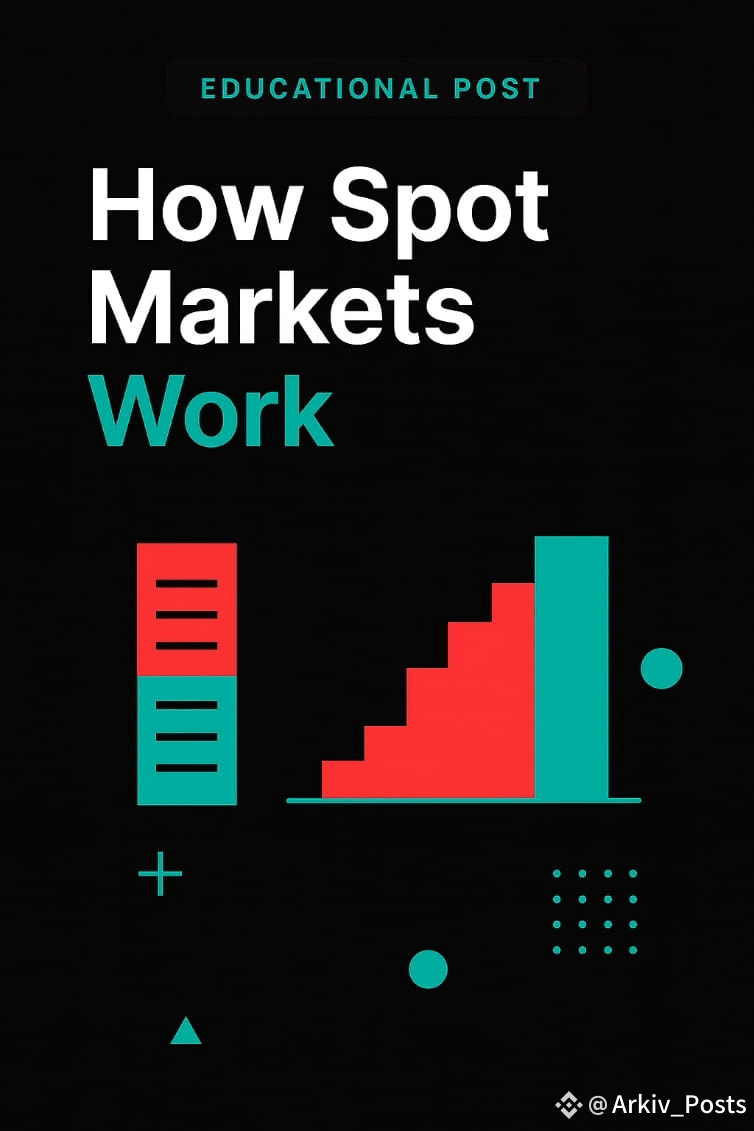
📚 Spot Trading Masterclass — Episode 2
Topic: How Spot Markets Work
Spot markets are where assets are traded for **immediate delivery** — no waiting, no contracts. You buy, you own. You sell, you get paid.
🧠 Here's how it works:
- Buyers and sellers place orders in the **order book**
- The market matches them based on price and volume
- Trades are executed at the **spot price** — the real-time value
💡 Example:
You place a BUY order for $ETH at 3,600. If someone is selling at that price, the trade happens instantly. That’s spot trading.
Spot markets are also called **cash markets** because the exchange is direct and fast. No leverage, no expiry — just pure price action.
#TrendingTopic #Write2Earn #CryptoEducation #BinanceSquare $BTC $ETH $BNB
📚 Spot Trading Masterclass — Episode 2
Topic: How Spot Markets Work
Spot markets are where assets are traded for **immediate delivery** — no waiting, no contracts. You buy, you own. You sell, you get paid.
🧠 Here's how it works:
- Buyers and sellers place orders in the **order book**
- The market matches them based on price and volume
- Trades are executed at the **spot price** — the real-time value
💡 Example:
You place a BUY order for $ETH at 3,600. If someone is selling at that price, the trade happens instantly. That’s spot trading.
Spot markets are also called **cash markets** because the exchange is direct and fast. No leverage, no expiry — just pure price action.
#TrendingTopic #Write2Earn #CryptoEducation #BinanceSquare $BTC $ETH $BNB
Topic: How Spot Markets Work
Spot markets are where assets are traded for **immediate delivery** — no waiting, no contracts. You buy, you own. You sell, you get paid.
🧠 Here's how it works:
- Buyers and sellers place orders in the **order book**
- The market matches them based on price and volume
- Trades are executed at the **spot price** — the real-time value
💡 Example:
You place a BUY order for $ETH at 3,600. If someone is selling at that price, the trade happens instantly. That’s spot trading.
Spot markets are also called **cash markets** because the exchange is direct and fast. No leverage, no expiry — just pure price action.
#TrendingTopic #Write2Earn #CryptoEducation #BinanceSquare $BTC $ETH $BNB
78
·
--
📚 Spot Trading Masterclass — Episode 1
Topic: What Is Spot Trading?
Spot trading is the **purest form of trading** — buying or selling an asset at its current market price for immediate delivery. No contracts. No expiry. Just real-time ownership.
✅ You buy → You own it instantly
✅ You sell → You get paid instantly
Spot trading happens in markets like:
- $BTC / $ETH / $BNB (Crypto)
- Forex pairs like EUR/USD
- Commodities like Gold or Oil
- Stocks like AAPL or TSLA
💡 Why beginners love it:
- Simple to understand
- Transparent pricing
- No leverage = lower risk
- Immediate access to your asset
This series will guide you from basic concepts to pro-level strategies — including technical analysis, risk management, and live trade breakdowns.
#TrendingTopic #Write2Earn #CryptoEducation #BinanceSquare $BNB
{spot}(BNBUSDT)
📚 Spot Trading Masterclass — Episode 1
Topic: What Is Spot Trading?
Spot trading is the **purest form of trading** — buying or selling an asset at its current market price for immediate delivery. No contracts. No expiry. Just real-time ownership.
✅ You buy → You own it instantly
✅ You sell → You get paid instantly
Spot trading happens in markets like:
- $BTC / $ETH / $BNB (Crypto)
- Forex pairs like EUR/USD
- Commodities like Gold or Oil
- Stocks like AAPL or TSLA
💡 Why beginners love it:
- Simple to understand
- Transparent pricing
- No leverage = lower risk
- Immediate access to your asset
This series will guide you from basic concepts to pro-level strategies — including technical analysis, risk management, and live trade breakdowns.
#TrendingTopic #Write2Earn #CryptoEducation #BinanceSquare $BNB
Topic: What Is Spot Trading?
Spot trading is the **purest form of trading** — buying or selling an asset at its current market price for immediate delivery. No contracts. No expiry. Just real-time ownership.
✅ You buy → You own it instantly
✅ You sell → You get paid instantly
Spot trading happens in markets like:
- $BTC / $ETH / $BNB (Crypto)
- Forex pairs like EUR/USD
- Commodities like Gold or Oil
- Stocks like AAPL or TSLA
💡 Why beginners love it:
- Simple to understand
- Transparent pricing
- No leverage = lower risk
- Immediate access to your asset
This series will guide you from basic concepts to pro-level strategies — including technical analysis, risk management, and live trade breakdowns.
#TrendingTopic #Write2Earn #CryptoEducation #BinanceSquare $BNB

64
·
--
Bullish
📚 Educational Post
Topic: How to Use RSI for Profitable Crypto Trades
The **Relative Strength Index (RSI)** is one of the most powerful tools for spotting entry and exit points in crypto. It measures momentum and tells you when an asset is **overbought** (likely to drop) or **oversold** (likely to bounce).
✅ RSI below 30 = Oversold → Possible BUY
✅ RSI above 70 = Overbought → Possible SELL
Example:
$BTC recently dipped below RSI 30 on the 1-hour chart and bounced back within 2 hours. Traders who spotted it early made solid gains.
💡 Tip: Combine RSI with support/resistance zones for stronger confirmation.
#TrendingTopic #Write2Earn #CryptoEducation #BinanceSquare $ETH
{spot}(ETHUSDT)
$BNB
{spot}(BNBUSDT)
📚 Educational Post
Topic: How to Use RSI for Profitable Crypto Trades
The **Relative Strength Index (RSI)** is one of the most powerful tools for spotting entry and exit points in crypto. It measures momentum and tells you when an asset is **overbought** (likely to drop) or **oversold** (likely to bounce).
✅ RSI below 30 = Oversold → Possible BUY
✅ RSI above 70 = Overbought → Possible SELL
Example:
$BTC recently dipped below RSI 30 on the 1-hour chart and bounced back within 2 hours. Traders who spotted it early made solid gains.
💡 Tip: Combine RSI with support/resistance zones for stronger confirmation.
#TrendingTopic #Write2Earn #CryptoEducation #BinanceSquare $ETH
$BNB
Topic: How to Use RSI for Profitable Crypto Trades
The **Relative Strength Index (RSI)** is one of the most powerful tools for spotting entry and exit points in crypto. It measures momentum and tells you when an asset is **overbought** (likely to drop) or **oversold** (likely to bounce).
✅ RSI below 30 = Oversold → Possible BUY
✅ RSI above 70 = Overbought → Possible SELL
Example:
$BTC recently dipped below RSI 30 on the 1-hour chart and bounced back within 2 hours. Traders who spotted it early made solid gains.
💡 Tip: Combine RSI with support/resistance zones for stronger confirmation.
#TrendingTopic #Write2Earn #CryptoEducation #BinanceSquare $ETH
$BNB
75
·
--
What if querying blockchain data was lightning-fast and decentralized? Lagrange is making it real. Shoutout to @lagrangedev for unlocking modular magic with $LA !Game-changer for developers, validators, and the whole Web3 ecosystem. #lagrange 💡
What if querying blockchain data was lightning-fast and decentralized? Lagrange is making it real. Shoutout to @Lagrange Official for unlocking modular magic with $LA !Game-changer for developers, validators, and the whole Web3 ecosystem. #lagrange 💡

244
·
--
Ever feel like blockchain tech moves too fast to keep up? Caldera makes it smooth—modular, lightning-fast, and seriously developer-friendly. Big love to @Calderaxyz for building the future of Web3 one scalable block at a time. Powered by $ERA 💥 #caldera
Ever feel like blockchain tech moves too fast to keep up? Caldera makes it smooth—modular, lightning-fast, and seriously developer-friendly. Big love to @Calderaxyz for building the future of Web3 one scalable block at a time. Powered by $ERA 💥 #caldera
1
140
·
--
#BinanceTurns8 Join us in the #BinanceTurns8 celebration and win a share of up to $888,888 in BNB!
#BinanceTurns8 Join us in the #BinanceTurns8 celebration and win a share of up to $888,888 in BNB!
20
·
--
Article
Scalping Strategy: Mastering the Art of Micro Profits in MinutesIn the high-octane world of crypto trading, scalping stands out as one of the most intense and rewarding strategies—if done right. It’s not about catching the big wave; it’s about riding dozens of small ripples with precision, speed, and discipline.
Let’s break down what scalping really is, how it works, and how top traders manage the chaos.
🧠 What Is Scalping?
Scalping is a high-frequency trading strategy where traders aim to profit from tiny price movements—often within seconds or minutes. Unlike swing or position trading, scalpers don’t care about long-term trends. They thrive on volatility, liquidity, and momentum.
🔹 Timeframe: 1-minute to 5-minute charts
🔹 Targets: 0.1% to 1% per trade
🔹 Volume: Dozens to hundreds of trades per day
⚙️ Tools of the Trade
To succeed in scalping, you need more than just guts—you need the right gear:
🖥️ Low-latency trading platform
📊 Real-time charting tools (e.g., TradingView, Binance Pro)
📈 Indicators: VWAP, EMA, RSI, Bollinger Bands
⚡ Fast internet + hotkeys for instant execution
🛡️ Risk Management: The Real MVP
Scalping is fast—but risk management must be faster. Here’s how pros stay alive in the storm:
🔐 1️⃣ Set strict stop-loss and take-profit levels
Never enter a trade without knowing your exit. A 1:1.5 risk-reward ratio is a solid baseline.
📏 2️⃣ Use proper position sizing
Stick to the 1% rule: never risk more than 1% of your capital on a single trade.
⚖️ 3️⃣ Avoid over-leveraging
Leverage can amplify gains—but it can also wipe you out. Start small and scale up with experience.
🧠 4️⃣ Stay emotionally disciplined
Scalping is mentally taxing. Fatigue leads to mistakes. Take breaks, breathe, and don’t chase losses.
🧬 Real-World Challenges
Scalping isn’t for everyone. Here’s what you’re up against:
🚨 High transaction costs: Spreads and fees can eat into profits
🚨 Slippage: Fast markets can execute your order at worse prices
🚨 Execution risk: One second of lag can ruin a perfect setup
🚨 Emotional burnout: The pressure is real—don’t underestimate it
🔍 Pro Tips from the Trenches
💡 Trade only during high-liquidity sessions (e.g., London or New York open)
💡 Focus on 1–2 pairs to master their behavior
💡 Use limit orders to control entry and exit
💡 Keep a trading journal to refine your edge
🧭 Final Word
Scalping isn’t gambling—it’s surgical trading. It demands focus, discipline, and a deep respect for risk. If you can master the chaos, the rewards are real—but so are the consequences.
“In scalping, survival is success. Profit is the bonus.”
#ScalpingStrategy #Write2Earn
Scalping Strategy: Mastering the Art of Micro Profits in Minutes
In the high-octane world of crypto trading, scalping stands out as one of the most intense and rewarding strategies—if done right. It’s not about catching the big wave; it’s about riding dozens of small ripples with precision, speed, and discipline.
Let’s break down what scalping really is, how it works, and how top traders manage the chaos.
🧠 What Is Scalping?
Scalping is a high-frequency trading strategy where traders aim to profit from tiny price movements—often within seconds or minutes. Unlike swing or position trading, scalpers don’t care about long-term trends. They thrive on volatility, liquidity, and momentum.
🔹 Timeframe: 1-minute to 5-minute charts
🔹 Targets: 0.1% to 1% per trade
🔹 Volume: Dozens to hundreds of trades per day
⚙️ Tools of the Trade
To succeed in scalping, you need more than just guts—you need the right gear:
🖥️ Low-latency trading platform
📊 Real-time charting tools (e.g., TradingView, Binance Pro)
📈 Indicators: VWAP, EMA, RSI, Bollinger Bands
⚡ Fast internet + hotkeys for instant execution
🛡️ Risk Management: The Real MVP
Scalping is fast—but risk management must be faster. Here’s how pros stay alive in the storm:
🔐 1️⃣ Set strict stop-loss and take-profit levels
Never enter a trade without knowing your exit. A 1:1.5 risk-reward ratio is a solid baseline.
📏 2️⃣ Use proper position sizing
Stick to the 1% rule: never risk more than 1% of your capital on a single trade.
⚖️ 3️⃣ Avoid over-leveraging
Leverage can amplify gains—but it can also wipe you out. Start small and scale up with experience.
🧠 4️⃣ Stay emotionally disciplined
Scalping is mentally taxing. Fatigue leads to mistakes. Take breaks, breathe, and don’t chase losses.
🧬 Real-World Challenges
Scalping isn’t for everyone. Here’s what you’re up against:
🚨 High transaction costs: Spreads and fees can eat into profits
🚨 Slippage: Fast markets can execute your order at worse prices
🚨 Execution risk: One second of lag can ruin a perfect setup
🚨 Emotional burnout: The pressure is real—don’t underestimate it
🔍 Pro Tips from the Trenches
💡 Trade only during high-liquidity sessions (e.g., London or New York open)
💡 Focus on 1–2 pairs to master their behavior
💡 Use limit orders to control entry and exit
💡 Keep a trading journal to refine your edge
🧭 Final Word
Scalping isn’t gambling—it’s surgical trading. It demands focus, discipline, and a deep respect for risk. If you can master the chaos, the rewards are real—but so are the consequences.
“In scalping, survival is success. Profit is the bonus.”
#ScalpingStrategy #Write2Earn
Let’s break down what scalping really is, how it works, and how top traders manage the chaos.
🧠 What Is Scalping?
Scalping is a high-frequency trading strategy where traders aim to profit from tiny price movements—often within seconds or minutes. Unlike swing or position trading, scalpers don’t care about long-term trends. They thrive on volatility, liquidity, and momentum.
🔹 Timeframe: 1-minute to 5-minute charts
🔹 Targets: 0.1% to 1% per trade
🔹 Volume: Dozens to hundreds of trades per day
⚙️ Tools of the Trade
To succeed in scalping, you need more than just guts—you need the right gear:
🖥️ Low-latency trading platform
📊 Real-time charting tools (e.g., TradingView, Binance Pro)
📈 Indicators: VWAP, EMA, RSI, Bollinger Bands
⚡ Fast internet + hotkeys for instant execution
🛡️ Risk Management: The Real MVP
Scalping is fast—but risk management must be faster. Here’s how pros stay alive in the storm:
🔐 1️⃣ Set strict stop-loss and take-profit levels
Never enter a trade without knowing your exit. A 1:1.5 risk-reward ratio is a solid baseline.
📏 2️⃣ Use proper position sizing
Stick to the 1% rule: never risk more than 1% of your capital on a single trade.
⚖️ 3️⃣ Avoid over-leveraging
Leverage can amplify gains—but it can also wipe you out. Start small and scale up with experience.
🧠 4️⃣ Stay emotionally disciplined
Scalping is mentally taxing. Fatigue leads to mistakes. Take breaks, breathe, and don’t chase losses.
🧬 Real-World Challenges
Scalping isn’t for everyone. Here’s what you’re up against:
🚨 High transaction costs: Spreads and fees can eat into profits
🚨 Slippage: Fast markets can execute your order at worse prices
🚨 Execution risk: One second of lag can ruin a perfect setup
🚨 Emotional burnout: The pressure is real—don’t underestimate it
🔍 Pro Tips from the Trenches
💡 Trade only during high-liquidity sessions (e.g., London or New York open)
💡 Focus on 1–2 pairs to master their behavior
💡 Use limit orders to control entry and exit
💡 Keep a trading journal to refine your edge
🧭 Final Word
Scalping isn’t gambling—it’s surgical trading. It demands focus, discipline, and a deep respect for risk. If you can master the chaos, the rewards are real—but so are the consequences.
“In scalping, survival is success. Profit is the bonus.”
#ScalpingStrategy #Write2Earn
106
·
--
Article
16 Billion Passwords Leaked: Why I’m Screaming This From the Rooftops (Again and Again and Again)June 21, 2025
I’ve said it before.
I’m saying it now.
And I’ll keep saying it until every last one of you is safe.
Because this isn’t just another breach.
This is the largest password leak in internet history—and it’s already being used to destroy lives, drain wallets, and hijack identities.
🧨 What Just Happened?
Over 16 billion login credentials—yes, 16,000,000,000+—have been leaked and are now circulating on the dark web. This includes:
🔴 Usernames
🔴 Passwords
🔴 Session cookies
🔴 Access tokens
🔴 Metadata from platforms like Google, Apple, Facebook, Telegram, GitHub, VPNs, and even government services
These aren’t old, recycled leaks. They’re fresh, structured, and ready for exploitation—collected by infostealer malware silently running on infected devices.
🧠 Why I’m Telling You This (Again and Again)
Because I care.
Because I’ve seen what happens when people ignore the signs.
Because one leaked password can be the difference between security and devastation.
If your credentials are in this breach, you could lose:
⚠️ Your crypto wallet
⚠️ Your bank account
⚠️ Your identity
⚠️ Your business
⚠️ Your freedom
And if your finance account gets drained, you could be out on the street.
No warning. No mercy. No undo button.
🛡️ How to Check If You’ve Been Breached
🔍 Use trusted tools like:
Have I Been Pwned (haveibeenpwned. com)Google One’s Dark Web Report (for Gmail users)Revoke . cash to remove suspicious wallet approvals
If your email or password shows up—act immediately.
🔐 What You MUST Do Now
✅ 1️⃣ Change all your passwords—especially for email, banking, and crypto
✅ 2️⃣ Enable 2FA (Two-Factor Authentication) on every account
✅ 3️⃣ Run a full malware scan—infostealers may still be active
✅ 4️⃣ Use a password manager to generate strong, unique passwords
✅ 5️⃣ Revoke access from unfamiliar devices and sessions
✅ 6️⃣ Never trust pop-ups or fake app updates—go directly to the App Store or Play Store
🧬 Final Word: This Is Bigger Than You Think
This isn’t just a tech issue.
This is a global digital emergency.
The crypto community—our community—is especially vulnerable.
We live on-chain. We breathe decentralization. But we must also protect our keys, our wallets, and our people.
“In a world where data is currency, your password is your last line of defense.”
So I’ll keep shouting this until it sinks in.
Because if I don’t, who will?
#16Breach #CryptoSecurity #DarkWebAlert #DigitalVigilance #Write2Earn
16 Billion Passwords Leaked: Why I’m Screaming This From the Rooftops (Again and Again and Again)
June 21, 2025
I’ve said it before.
I’m saying it now.
And I’ll keep saying it until every last one of you is safe.
Because this isn’t just another breach.
This is the largest password leak in internet history—and it’s already being used to destroy lives, drain wallets, and hijack identities.
🧨 What Just Happened?
Over 16 billion login credentials—yes, 16,000,000,000+—have been leaked and are now circulating on the dark web. This includes:
🔴 Usernames
🔴 Passwords
🔴 Session cookies
🔴 Access tokens
🔴 Metadata from platforms like Google, Apple, Facebook, Telegram, GitHub, VPNs, and even government services
These aren’t old, recycled leaks. They’re fresh, structured, and ready for exploitation—collected by infostealer malware silently running on infected devices.
🧠 Why I’m Telling You This (Again and Again)
Because I care.
Because I’ve seen what happens when people ignore the signs.
Because one leaked password can be the difference between security and devastation.
If your credentials are in this breach, you could lose:
⚠️ Your crypto wallet
⚠️ Your bank account
⚠️ Your identity
⚠️ Your business
⚠️ Your freedom
And if your finance account gets drained, you could be out on the street.
No warning. No mercy. No undo button.
🛡️ How to Check If You’ve Been Breached
🔍 Use trusted tools like:
Have I Been Pwned (haveibeenpwned. com)Google One’s Dark Web Report (for Gmail users)Revoke . cash to remove suspicious wallet approvals
If your email or password shows up—act immediately.
🔐 What You MUST Do Now
✅ 1️⃣ Change all your passwords—especially for email, banking, and crypto
✅ 2️⃣ Enable 2FA (Two-Factor Authentication) on every account
✅ 3️⃣ Run a full malware scan—infostealers may still be active
✅ 4️⃣ Use a password manager to generate strong, unique passwords
✅ 5️⃣ Revoke access from unfamiliar devices and sessions
✅ 6️⃣ Never trust pop-ups or fake app updates—go directly to the App Store or Play Store
🧬 Final Word: This Is Bigger Than You Think
This isn’t just a tech issue.
This is a global digital emergency.
The crypto community—our community—is especially vulnerable.
We live on-chain. We breathe decentralization. But we must also protect our keys, our wallets, and our people.
“In a world where data is currency, your password is your last line of defense.”
So I’ll keep shouting this until it sinks in.
Because if I don’t, who will?
#16Breach #CryptoSecurity #DarkWebAlert #DigitalVigilance #Write2Earn
I’ve said it before.
I’m saying it now.
And I’ll keep saying it until every last one of you is safe.
Because this isn’t just another breach.
This is the largest password leak in internet history—and it’s already being used to destroy lives, drain wallets, and hijack identities.
🧨 What Just Happened?
Over 16 billion login credentials—yes, 16,000,000,000+—have been leaked and are now circulating on the dark web. This includes:
🔴 Usernames
🔴 Passwords
🔴 Session cookies
🔴 Access tokens
🔴 Metadata from platforms like Google, Apple, Facebook, Telegram, GitHub, VPNs, and even government services
These aren’t old, recycled leaks. They’re fresh, structured, and ready for exploitation—collected by infostealer malware silently running on infected devices.
🧠 Why I’m Telling You This (Again and Again)
Because I care.
Because I’ve seen what happens when people ignore the signs.
Because one leaked password can be the difference between security and devastation.
If your credentials are in this breach, you could lose:
⚠️ Your crypto wallet
⚠️ Your bank account
⚠️ Your identity
⚠️ Your business
⚠️ Your freedom
And if your finance account gets drained, you could be out on the street.
No warning. No mercy. No undo button.
🛡️ How to Check If You’ve Been Breached
🔍 Use trusted tools like:
Have I Been Pwned (haveibeenpwned. com)Google One’s Dark Web Report (for Gmail users)Revoke . cash to remove suspicious wallet approvals
If your email or password shows up—act immediately.
🔐 What You MUST Do Now
✅ 1️⃣ Change all your passwords—especially for email, banking, and crypto
✅ 2️⃣ Enable 2FA (Two-Factor Authentication) on every account
✅ 3️⃣ Run a full malware scan—infostealers may still be active
✅ 4️⃣ Use a password manager to generate strong, unique passwords
✅ 5️⃣ Revoke access from unfamiliar devices and sessions
✅ 6️⃣ Never trust pop-ups or fake app updates—go directly to the App Store or Play Store
🧬 Final Word: This Is Bigger Than You Think
This isn’t just a tech issue.
This is a global digital emergency.
The crypto community—our community—is especially vulnerable.
We live on-chain. We breathe decentralization. But we must also protect our keys, our wallets, and our people.
“In a world where data is currency, your password is your last line of defense.”
So I’ll keep shouting this until it sinks in.
Because if I don’t, who will?
#16Breach #CryptoSecurity #DarkWebAlert #DigitalVigilance #Write2Earn
1
264
·
--
Article
Crypto x Gaming: The Real Revolution That’s Already HappeningIn 2025, the fusion of crypto and gaming is no longer a futuristic concept—it’s a living, breathing ecosystem reshaping how we play, earn, and own. This isn’t speculation. This is real-world disruption, backed by millions of users, billions in volume, and a new generation of digital economies.
Let’s dive into the real stories, real platforms, and real impact of this unstoppable convergence.
🧬 1. From Pixels to Profits: The Rise of Play-to-Earn
The turning point came in 2024, when games like Hamster Combat and Pixels exploded across Telegram and Web3 platforms. These weren’t just games—they were financial ecosystems.
🔹 1️⃣ Over 30 million users joined Hamster Combat within months
🔹 2️⃣ Players earned tradable tokens with real market value
🔹 3️⃣ Tightly integrated with TON blockchain, easing onboarding for non-crypto natives
This was financial empowerment through gaming, at scale.
🔗 2. Real Ownership: NFTs and In-Game Assets
Traditional games lock your progress and items on centralized servers. But crypto gaming gives that power back.
🎮 1️⃣ Own digital land in The Sandbox
🎮 2️⃣ Trade rare cards in Gods Unchained
🎮 3️⃣ Sell or rent characters from DeFi Kingdoms on-chain
These assets live in your wallet—not in someone else’s server farm.
🛠️ 3. Builders’ Paradise: Blockchain Unlocks Creator Freedom
For developers, crypto means independence and programmable economies.
⚙️ 1️⃣ Launch games without major publishers
⚙️ 2️⃣ Crowdfund through token launches and NFT sales
⚙️ 3️⃣ Automate royalties and reward systems via smart contracts
Builders finally control their worlds—and their revenue.
🌍 4. Global Impact: Gaming as Survival
In emerging markets, crypto games have become economic lifelines.
🌐 1️⃣ In the Philippines, players used Axie Infinity earnings to pay for daily needs
🌐 2️⃣ In Nigeria, mobile-based Web3 games are introducing banking alternatives
🌐 3️⃣ In Venezuela, crypto games offered rewards in stablecoins, beating hyperinflation
Real lives. Real relief. Real change.
🧠 5. Education Through Gamification
Games are now onboarding tools for Web3 literacy.
📚 1️⃣ Galxe Quests and BitDegree reward users for learning protocols
📚 2️⃣ CryptoZombies teaches smart contract coding through battles
📚 3️⃣ Airdrop quests from zkSync, Starknet, and LayerZero turn players into power users
Learning, earning, and playing—all at once.
🔮 6. What’s Next?
The frontier is accelerating:
🚀 1️⃣ AI-generated NPCs evolve based on on-chain user behavior
🚀 2️⃣ Cross-chain avatars move across multiple game worlds
🚀 3️⃣ Decentralized esports tournaments run on DAOs with real-time prize distribution
And yes—major studios are quietly building in Web3 behind the scenes.
🧭 Final Word
This isn’t just a shift in genre. It’s a rewrite of the gaming economy. In this new era:
You own your identity. You earn from your time. And your wallet is your game controller.
#CryptoGaming #PlayToEarn #Web3Games #Write2Earn
$BTC
{future}(BTCUSDT)
Crypto x Gaming: The Real Revolution That’s Already Happening
In 2025, the fusion of crypto and gaming is no longer a futuristic concept—it’s a living, breathing ecosystem reshaping how we play, earn, and own. This isn’t speculation. This is real-world disruption, backed by millions of users, billions in volume, and a new generation of digital economies.
Let’s dive into the real stories, real platforms, and real impact of this unstoppable convergence.
🧬 1. From Pixels to Profits: The Rise of Play-to-Earn
The turning point came in 2024, when games like Hamster Combat and Pixels exploded across Telegram and Web3 platforms. These weren’t just games—they were financial ecosystems.
🔹 1️⃣ Over 30 million users joined Hamster Combat within months
🔹 2️⃣ Players earned tradable tokens with real market value
🔹 3️⃣ Tightly integrated with TON blockchain, easing onboarding for non-crypto natives
This was financial empowerment through gaming, at scale.
🔗 2. Real Ownership: NFTs and In-Game Assets
Traditional games lock your progress and items on centralized servers. But crypto gaming gives that power back.
🎮 1️⃣ Own digital land in The Sandbox
🎮 2️⃣ Trade rare cards in Gods Unchained
🎮 3️⃣ Sell or rent characters from DeFi Kingdoms on-chain
These assets live in your wallet—not in someone else’s server farm.
🛠️ 3. Builders’ Paradise: Blockchain Unlocks Creator Freedom
For developers, crypto means independence and programmable economies.
⚙️ 1️⃣ Launch games without major publishers
⚙️ 2️⃣ Crowdfund through token launches and NFT sales
⚙️ 3️⃣ Automate royalties and reward systems via smart contracts
Builders finally control their worlds—and their revenue.
🌍 4. Global Impact: Gaming as Survival
In emerging markets, crypto games have become economic lifelines.
🌐 1️⃣ In the Philippines, players used Axie Infinity earnings to pay for daily needs
🌐 2️⃣ In Nigeria, mobile-based Web3 games are introducing banking alternatives
🌐 3️⃣ In Venezuela, crypto games offered rewards in stablecoins, beating hyperinflation
Real lives. Real relief. Real change.
🧠 5. Education Through Gamification
Games are now onboarding tools for Web3 literacy.
📚 1️⃣ Galxe Quests and BitDegree reward users for learning protocols
📚 2️⃣ CryptoZombies teaches smart contract coding through battles
📚 3️⃣ Airdrop quests from zkSync, Starknet, and LayerZero turn players into power users
Learning, earning, and playing—all at once.
🔮 6. What’s Next?
The frontier is accelerating:
🚀 1️⃣ AI-generated NPCs evolve based on on-chain user behavior
🚀 2️⃣ Cross-chain avatars move across multiple game worlds
🚀 3️⃣ Decentralized esports tournaments run on DAOs with real-time prize distribution
And yes—major studios are quietly building in Web3 behind the scenes.
🧭 Final Word
This isn’t just a shift in genre. It’s a rewrite of the gaming economy. In this new era:
You own your identity. You earn from your time. And your wallet is your game controller.
#CryptoGaming #PlayToEarn #Web3Games #Write2Earn
$BTC
Let’s dive into the real stories, real platforms, and real impact of this unstoppable convergence.
🧬 1. From Pixels to Profits: The Rise of Play-to-Earn
The turning point came in 2024, when games like Hamster Combat and Pixels exploded across Telegram and Web3 platforms. These weren’t just games—they were financial ecosystems.
🔹 1️⃣ Over 30 million users joined Hamster Combat within months
🔹 2️⃣ Players earned tradable tokens with real market value
🔹 3️⃣ Tightly integrated with TON blockchain, easing onboarding for non-crypto natives
This was financial empowerment through gaming, at scale.
🔗 2. Real Ownership: NFTs and In-Game Assets
Traditional games lock your progress and items on centralized servers. But crypto gaming gives that power back.
🎮 1️⃣ Own digital land in The Sandbox
🎮 2️⃣ Trade rare cards in Gods Unchained
🎮 3️⃣ Sell or rent characters from DeFi Kingdoms on-chain
These assets live in your wallet—not in someone else’s server farm.
🛠️ 3. Builders’ Paradise: Blockchain Unlocks Creator Freedom
For developers, crypto means independence and programmable economies.
⚙️ 1️⃣ Launch games without major publishers
⚙️ 2️⃣ Crowdfund through token launches and NFT sales
⚙️ 3️⃣ Automate royalties and reward systems via smart contracts
Builders finally control their worlds—and their revenue.
🌍 4. Global Impact: Gaming as Survival
In emerging markets, crypto games have become economic lifelines.
🌐 1️⃣ In the Philippines, players used Axie Infinity earnings to pay for daily needs
🌐 2️⃣ In Nigeria, mobile-based Web3 games are introducing banking alternatives
🌐 3️⃣ In Venezuela, crypto games offered rewards in stablecoins, beating hyperinflation
Real lives. Real relief. Real change.
🧠 5. Education Through Gamification
Games are now onboarding tools for Web3 literacy.
📚 1️⃣ Galxe Quests and BitDegree reward users for learning protocols
📚 2️⃣ CryptoZombies teaches smart contract coding through battles
📚 3️⃣ Airdrop quests from zkSync, Starknet, and LayerZero turn players into power users
Learning, earning, and playing—all at once.
🔮 6. What’s Next?
The frontier is accelerating:
🚀 1️⃣ AI-generated NPCs evolve based on on-chain user behavior
🚀 2️⃣ Cross-chain avatars move across multiple game worlds
🚀 3️⃣ Decentralized esports tournaments run on DAOs with real-time prize distribution
And yes—major studios are quietly building in Web3 behind the scenes.
🧭 Final Word
This isn’t just a shift in genre. It’s a rewrite of the gaming economy. In this new era:
You own your identity. You earn from your time. And your wallet is your game controller.
#CryptoGaming #PlayToEarn #Web3Games #Write2Earn
$BTC
540
·
--
Bearish
🚨 BREAKING: Hacken’s $HAI Token Crashes 97% Amid Cross-Chain Bridge Shutdowns 🚨
The cybersecurity-focused crypto project Hacken ($HAI) has suffered a devastating 97% price collapse, following a major security breach affecting both its BSC and Ethereum bridges. In response, all cross-chain bridges have been suspended, with VeChain now being the only valid and secure network for HAI transactions.
⚠️ What You Need to Know
🔴 $HAI token has plummeted from ~$0.47 to ~$0.015, wiping out nearly all of its market value
🔴 BSC and ETH bridges compromised—users are urged to avoid any transactions on these chains
🔴 Only VeChain remains operational and secure for HAI transfers
🔴 Fake approvals and phishing pop-ups are being reported—do NOT approve any wallet prompts unless verified
🛡️ Immediate Actions for HAI Holders
✅ Do NOT interact with BSC or ETH contracts related to HAI
✅ Revoke any recent approvals using tools like Revoke.cash
✅ Move your HAI to VeChain if possible
✅ Stay off suspicious dApps or pop-ups—deepfake-style phishing is on the rise
✅ Monitor Hacken’s official channels for verified updates
🙏 Final Word
This isn’t just a price drop—it’s a full-blown security crisis. If you hold $HAI, act fast, stay alert, and pray for protection in this AI-driven threat landscape.
“In a world of smart contracts, stay smarter. In a world of deepfakes, stay deeper in truth.”
$HAI
#HAIHack #CryptoAlert #BridgeExploit #VeChainSafe #BinanceSquare #Write2Earn
🚨 BREAKING: Hacken’s $HAI Token Crashes 97% Amid Cross-Chain Bridge Shutdowns 🚨
The cybersecurity-focused crypto project Hacken ($HAI) has suffered a devastating 97% price collapse, following a major security breach affecting both its BSC and Ethereum bridges. In response, all cross-chain bridges have been suspended, with VeChain now being the only valid and secure network for HAI transactions.
⚠️ What You Need to Know
🔴 $HAI token has plummeted from ~$0.47 to ~$0.015, wiping out nearly all of its market value
🔴 BSC and ETH bridges compromised—users are urged to avoid any transactions on these chains
🔴 Only VeChain remains operational and secure for HAI transfers
🔴 Fake approvals and phishing pop-ups are being reported—do NOT approve any wallet prompts unless verified
🛡️ Immediate Actions for HAI Holders
✅ Do NOT interact with BSC or ETH contracts related to HAI
✅ Revoke any recent approvals using tools like Revoke.cash
✅ Move your HAI to VeChain if possible
✅ Stay off suspicious dApps or pop-ups—deepfake-style phishing is on the rise
✅ Monitor Hacken’s official channels for verified updates
🙏 Final Word
This isn’t just a price drop—it’s a full-blown security crisis. If you hold $HAI, act fast, stay alert, and pray for protection in this AI-driven threat landscape.
“In a world of smart contracts, stay smarter. In a world of deepfakes, stay deeper in truth.”
$HAI
#HAIHack #CryptoAlert #BridgeExploit #VeChainSafe #BinanceSquare #Write2Earn
The cybersecurity-focused crypto project Hacken ($HAI) has suffered a devastating 97% price collapse, following a major security breach affecting both its BSC and Ethereum bridges. In response, all cross-chain bridges have been suspended, with VeChain now being the only valid and secure network for HAI transactions.
⚠️ What You Need to Know
🔴 $HAI token has plummeted from ~$0.47 to ~$0.015, wiping out nearly all of its market value
🔴 BSC and ETH bridges compromised—users are urged to avoid any transactions on these chains
🔴 Only VeChain remains operational and secure for HAI transfers
🔴 Fake approvals and phishing pop-ups are being reported—do NOT approve any wallet prompts unless verified
🛡️ Immediate Actions for HAI Holders
✅ Do NOT interact with BSC or ETH contracts related to HAI
✅ Revoke any recent approvals using tools like Revoke.cash
✅ Move your HAI to VeChain if possible
✅ Stay off suspicious dApps or pop-ups—deepfake-style phishing is on the rise
✅ Monitor Hacken’s official channels for verified updates
🙏 Final Word
This isn’t just a price drop—it’s a full-blown security crisis. If you hold $HAI, act fast, stay alert, and pray for protection in this AI-driven threat landscape.
“In a world of smart contracts, stay smarter. In a world of deepfakes, stay deeper in truth.”
$HAI
#HAIHack #CryptoAlert #BridgeExploit #VeChainSafe #BinanceSquare #Write2Earn
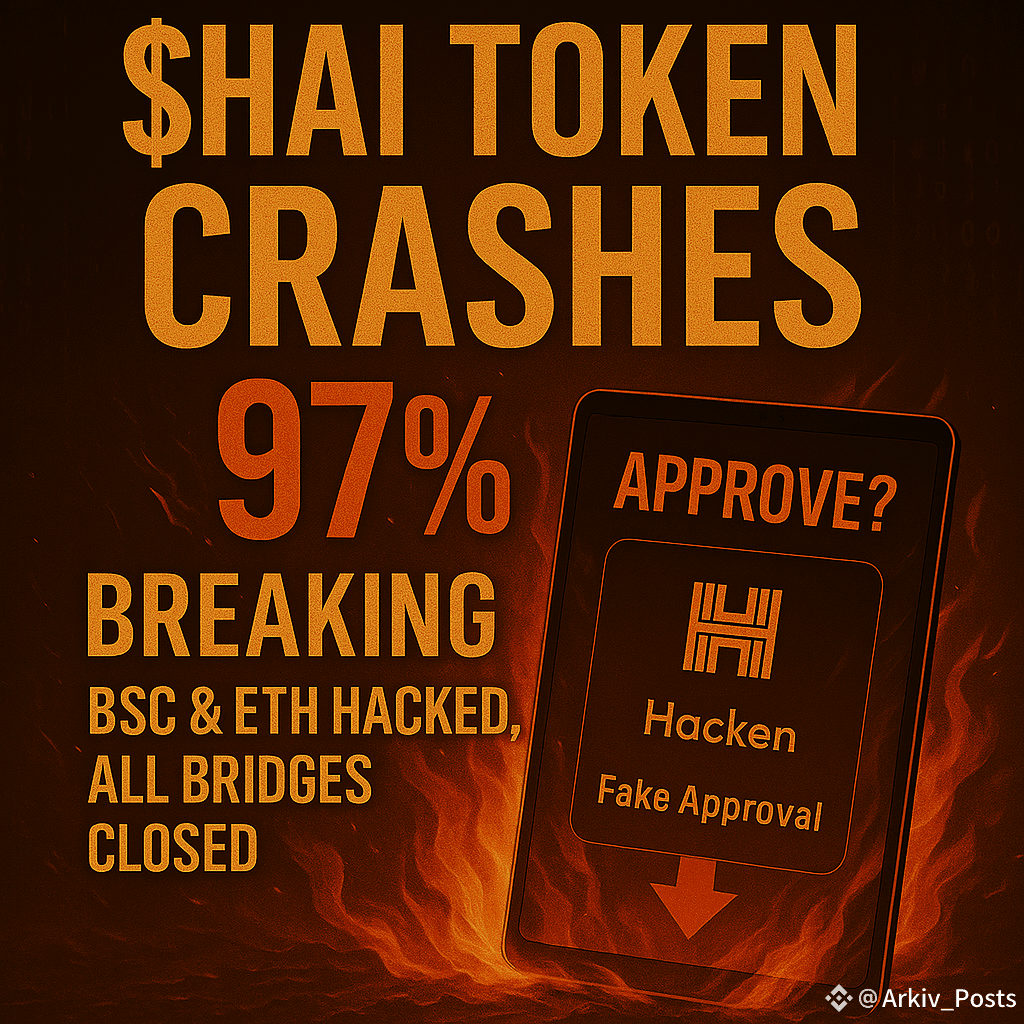
221
·
--
Bullish
🚨 BREAKING: CoinMarketCap Hacked — Deepfake Pop-Ups Targeting Wallets 🚨
A major security breach has rocked the crypto world. CoinMarketCap, one of the most trusted names in crypto data, has been hacked, exposing millions of users to malicious deepfake pop-ups designed to drain wallets.
⚠️ What Happened?
🔴 Users visiting CoinMarketCap were shown fake “Verify Wallet” pop-ups, urging them to connect their wallets and approve access. These pop-ups mimicked legitimate wallet prompts using deepfake-style UI overlays.
🔴 Once clicked, users unknowingly approved ERC-20 token access, allowing attackers to drain funds directly from wallets.
🔴 Wallet providers like MetaMask and Phantom immediately flagged the site as unsafe, warning users not to interact with any prompts.
🧠 Why This Is So Dangerous
The pop-ups appeared authentic, tricking even experienced users.
Victims believed they were approving app updates or security checks.
Once approved, wallets were compromised instantly.
🛡️ What You MUST Do Now
✅ Do NOT approve any pop-ups on CoinMarketCap or similar sites.
✅ Only update apps via Play Store or App Store—never through browser prompts.
✅ Run a malware scan and revoke any suspicious wallet permissions.
✅ Check your wallet activity and use tools like Revoke.cash to remove unauthorized approvals.
✅ Pray for protection—because in this AI-powered era, even your instincts can be deceived.
🙏 Final Word
This isn’t just a hack. It’s a wake-up call.
AI is now being used to mimic trust, exploit habits, and steal identities.
We must stay vigilant, informed, and grounded in truth.
May God protect your assets, your identity, and your peace of mind.
Stay safe. Stay sharp. Stay sovereign.
#Write2Earn
#CoinMarketCapHack #CryptoSecurity #DeepfakeAlert
🚨 BREAKING: CoinMarketCap Hacked — Deepfake Pop-Ups Targeting Wallets 🚨
A major security breach has rocked the crypto world. CoinMarketCap, one of the most trusted names in crypto data, has been hacked, exposing millions of users to malicious deepfake pop-ups designed to drain wallets.
⚠️ What Happened?
🔴 Users visiting CoinMarketCap were shown fake “Verify Wallet” pop-ups, urging them to connect their wallets and approve access. These pop-ups mimicked legitimate wallet prompts using deepfake-style UI overlays.
🔴 Once clicked, users unknowingly approved ERC-20 token access, allowing attackers to drain funds directly from wallets.
🔴 Wallet providers like MetaMask and Phantom immediately flagged the site as unsafe, warning users not to interact with any prompts.
🧠 Why This Is So Dangerous
The pop-ups appeared authentic, tricking even experienced users.
Victims believed they were approving app updates or security checks.
Once approved, wallets were compromised instantly.
🛡️ What You MUST Do Now
✅ Do NOT approve any pop-ups on CoinMarketCap or similar sites.
✅ Only update apps via Play Store or App Store—never through browser prompts.
✅ Run a malware scan and revoke any suspicious wallet permissions.
✅ Check your wallet activity and use tools like Revoke.cash to remove unauthorized approvals.
✅ Pray for protection—because in this AI-powered era, even your instincts can be deceived.
🙏 Final Word
This isn’t just a hack. It’s a wake-up call.
AI is now being used to mimic trust, exploit habits, and steal identities.
We must stay vigilant, informed, and grounded in truth.
May God protect your assets, your identity, and your peace of mind.
Stay safe. Stay sharp. Stay sovereign.
#Write2Earn
#CoinMarketCapHack #CryptoSecurity #DeepfakeAlert
A major security breach has rocked the crypto world. CoinMarketCap, one of the most trusted names in crypto data, has been hacked, exposing millions of users to malicious deepfake pop-ups designed to drain wallets.
⚠️ What Happened?
🔴 Users visiting CoinMarketCap were shown fake “Verify Wallet” pop-ups, urging them to connect their wallets and approve access. These pop-ups mimicked legitimate wallet prompts using deepfake-style UI overlays.
🔴 Once clicked, users unknowingly approved ERC-20 token access, allowing attackers to drain funds directly from wallets.
🔴 Wallet providers like MetaMask and Phantom immediately flagged the site as unsafe, warning users not to interact with any prompts.
🧠 Why This Is So Dangerous
The pop-ups appeared authentic, tricking even experienced users.
Victims believed they were approving app updates or security checks.
Once approved, wallets were compromised instantly.
🛡️ What You MUST Do Now
✅ Do NOT approve any pop-ups on CoinMarketCap or similar sites.
✅ Only update apps via Play Store or App Store—never through browser prompts.
✅ Run a malware scan and revoke any suspicious wallet permissions.
✅ Check your wallet activity and use tools like Revoke.cash to remove unauthorized approvals.
✅ Pray for protection—because in this AI-powered era, even your instincts can be deceived.
🙏 Final Word
This isn’t just a hack. It’s a wake-up call.
AI is now being used to mimic trust, exploit habits, and steal identities.
We must stay vigilant, informed, and grounded in truth.
May God protect your assets, your identity, and your peace of mind.
Stay safe. Stay sharp. Stay sovereign.
#Write2Earn
#CoinMarketCapHack #CryptoSecurity #DeepfakeAlert
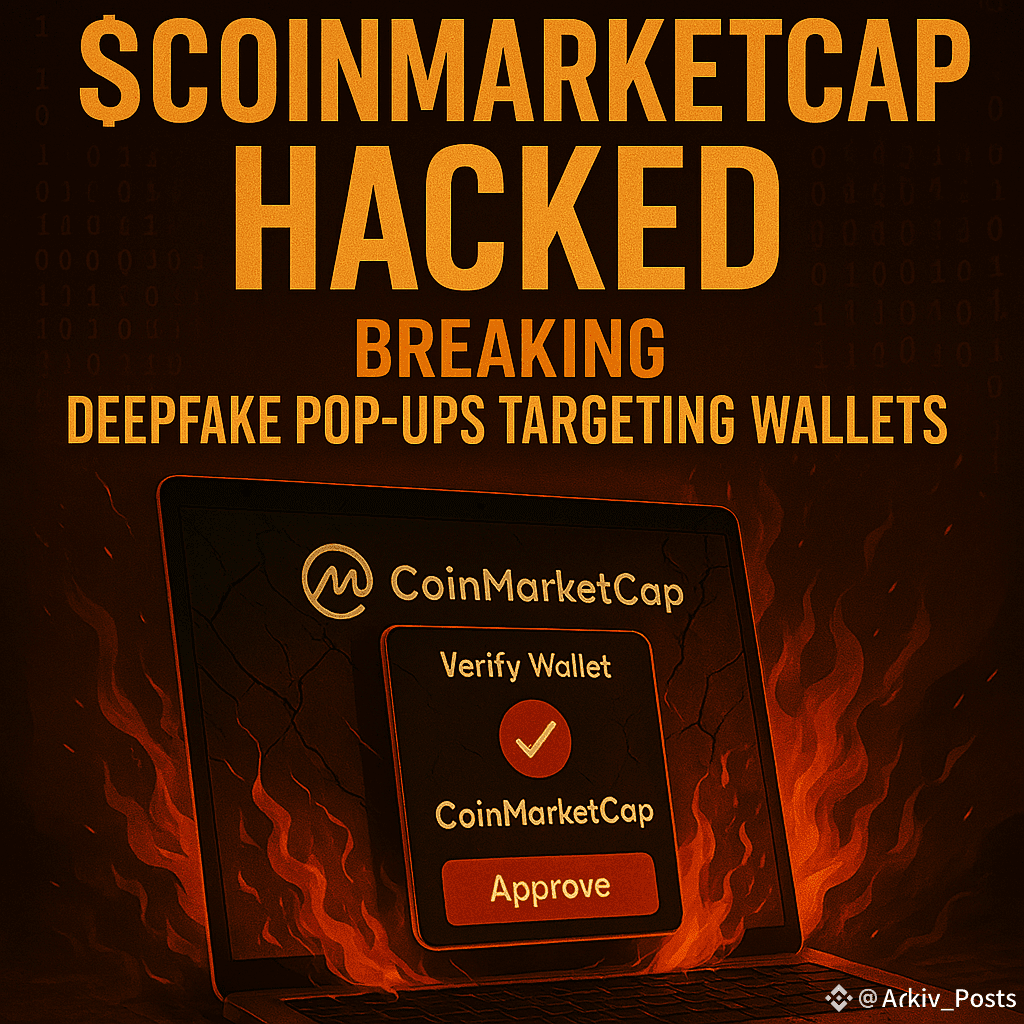
38
Log in to explore more content
Join global crypto users on Binance Square
⚡️ Get latest and useful information about crypto.
💬 Trusted by the world’s largest crypto exchange.
👍 Discover real insights from verified creators.
Email / Phone number