
#cryptorisk
cryptorisk
1.6M views
2,825 Discussing
Hot
Latest

·
--
Bearish
Verified
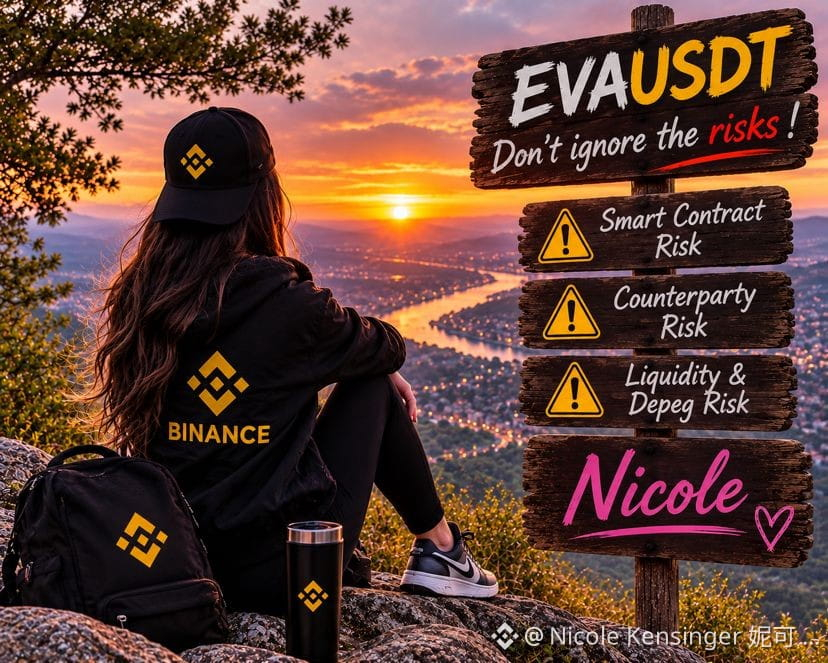
🚨 $EVAA : THE RISK INVESTORS SHOULD NOT IGNORE!
A token designed to maintain a value close to 1 USDT may give investors a sense of security. But remember: price stability does not mean zero risk.
🔍 When analyzing evaUSDT, one important aspect deserves particular attention:
⚠️ The Upgradeable Proxy Smart Contract Risk.
This means that certain parts of the contract’s logic can be modified. This is an important factor to understand before exposing your funds to risk.
Here are 3 key risks to watch:
1️⃣ Smart Contract Risk: Changes to the contract may affect how the protocol operates.
2️⃣ Counterparty Risk: The backing mechanism involves lending to Wintermute through Wildcat. Investors should monitor repayment obligations and the quality of the collateral.
3️⃣ Liquidity & Depeg Risk: Even though the token aims to maintain a value close to 1 USDT, its liquidity and redemption mechanisms remain essential.
🎯 My rule: Never confuse a dollar-pegged token with a risk-free stablecoin.
The real question is: If the market enters a crisis, will you be able to recover your USDT when you need them most?
💬 Do you trust the evaUSDT model? Or do you think counterparty and smart contract risks deserve more attention?
#EVAAUSDT #defi #stablecoin #CryptoRisk #BinanceSquare
Abohitm966:
right
115
1
13
658

·
--

Article
High-APY Hype and the One Mistake That Blew My YieldI was watching the market on a gray Tuesday, BTC hovering at $58,842 and ETH slipping to $1,627, when the Fear & Greed Index flashed a bleak 11 (Extreme Fear). The numbers should have been a warning, but the siren of a +7.81% jump for $NIGHT at $0.0558 drowned it out. I leapt in, convinced I'd caught a hidden gem, only to watch $WLFI tumble -19.14% at $0.0169 a few hours later.
The Lure of Sky-High APY
New DeFi farms are advertising APYs that look like lottery tickets. $NIGHT's surge felt like a shortcut to the moon, especially when the broader market was down, BTC down -1.18% and -3.96% over seven days, BNB down -0.57% and -2.30%, SOL down -1.42% and -1.13%. The story that sells is simple: "Stake now, earn massive returns." I ignored the fine print that those returns often depend on volatile token prices and aggressive incentive emissions.
When Fear Screams
Extreme fear isn't just a mood; it's a data point. The index stayed at 11 for a week, and volume was thin, BTC 24h volume $577M, ETH $264M, BNB $39M, SOL $99M. Low liquidity means price swings can be brutal. I chased the $NIGHT rally while the market's core assets were losing ground, a classic mismatch of risk appetite and market condition.
Token Economics Matter
Every token has a supply curve, emission schedule, and utility. $NIGHT's price at $0.0558 masks a tokenomics model that burns a large chunk of rewards each week, inflating supply faster than demand. In contrast, $SOXLB's modest +0.92% at $36.29 shows a more stable, albeit slower, growth path. I learned to compare the reward rate against the token's inflation rate before locking capital.
Risk Management Checklist
1. Verify liquidity: check the 24h range, $58,440 - $59,711 for BTC, $1,610 - $1,657 for ETH.
2. Look at volume: thin pools amplify slippage.
3. Scan the Fear & Greed Index: a reading of 11 signals caution.
4. Review tokenomics: high APY often comes with high inflation or lock-up penalties.
What I Learned
Chasing the biggest percentage move without a safety net is a recipe for disappointment. The market's downtrend, reflected in BTC's -3.96% 7d slide and SOL's -1.13% 7d dip, should have reminded me that yield is only as good as the capital that survives the dip. Next time I'll let the numbers guide the gamble, not the hype.
What's your biggest "high-APY" regret, and how do you guard against it?
Not financial advice.
Case closed. 🕵️
#DeFi #YieldFarming #CryptoRisk #FearAndGreed
High-APY Hype and the One Mistake That Blew My Yield
I was watching the market on a gray Tuesday, BTC hovering at $58,842 and ETH slipping to $1,627, when the Fear & Greed Index flashed a bleak 11 (Extreme Fear). The numbers should have been a warning, but the siren of a +7.81% jump for $NIGHT at $0.0558 drowned it out. I leapt in, convinced I'd caught a hidden gem, only to watch $WLFI tumble -19.14% at $0.0169 a few hours later.
The Lure of Sky-High APY
New DeFi farms are advertising APYs that look like lottery tickets. $NIGHT 's surge felt like a shortcut to the moon, especially when the broader market was down, BTC down -1.18% and -3.96% over seven days, BNB down -0.57% and -2.30%, SOL down -1.42% and -1.13%. The story that sells is simple: "Stake now, earn massive returns." I ignored the fine print that those returns often depend on volatile token prices and aggressive incentive emissions.
When Fear Screams
Extreme fear isn't just a mood; it's a data point. The index stayed at 11 for a week, and volume was thin, BTC 24h volume $577M, ETH $264M, BNB $39M, SOL $99M. Low liquidity means price swings can be brutal. I chased the $NIGHT rally while the market's core assets were losing ground, a classic mismatch of risk appetite and market condition.
Token Economics Matter
Every token has a supply curve, emission schedule, and utility. $NIGHT 's price at $0.0558 masks a tokenomics model that burns a large chunk of rewards each week, inflating supply faster than demand. In contrast, $SOXLB 's modest +0.92% at $36.29 shows a more stable, albeit slower, growth path. I learned to compare the reward rate against the token's inflation rate before locking capital.
Risk Management Checklist
1. Verify liquidity: check the 24h range, $58,440 - $59,711 for BTC, $1,610 - $1,657 for ETH.
2. Look at volume: thin pools amplify slippage.
3. Scan the Fear & Greed Index: a reading of 11 signals caution.
4. Review tokenomics: high APY often comes with high inflation or lock-up penalties.
What I Learned
Chasing the biggest percentage move without a safety net is a recipe for disappointment. The market's downtrend, reflected in BTC's -3.96% 7d slide and SOL's -1.13% 7d dip, should have reminded me that yield is only as good as the capital that survives the dip. Next time I'll let the numbers guide the gamble, not the hype.
What's your biggest "high-APY" regret, and how do you guard against it?
Not financial advice.
Case closed. 🕵️
#DeFi #YieldFarming #CryptoRisk #FearAndGreed
384

·
--
Verified
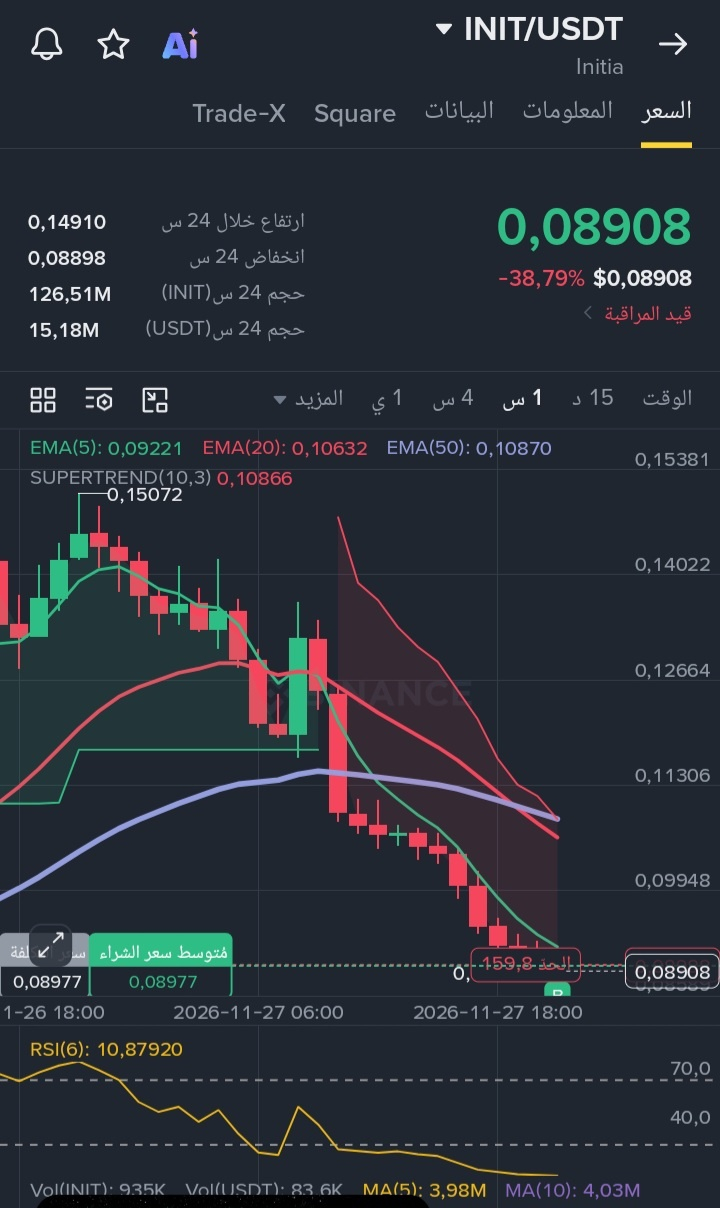
🚨 Warning to traders: Beware of INIT!
🔴 $INIT
Binance has placed INIT on its Monitoring Tag list, a classification that indicates an elevated risk level and calls for caution.
⚠️ What does this mean? $INIT
The coin is exposed to higher-than-usual volatility and risks.
It is subject to periodic reviews by Binance.
Failure to meet the platform’s standards could result in it being delisted in the future.
🛑 My advice: Don’t mistake a price drop for a buying opportunity, and don’t chase bottoms without doing your research. Keep an eye on the project’s developments and protect your capital.
🔥 Remember: Not every drop is an opportunity; some coins may never recover.
#INIT #Binance #CryptoRisk #DYOR*
⚠️ This post is for informational purposes only and is not investment advice.
$INIT
Ali Ismail SY:
كلام محترم و مرتب
2
5
1.6k
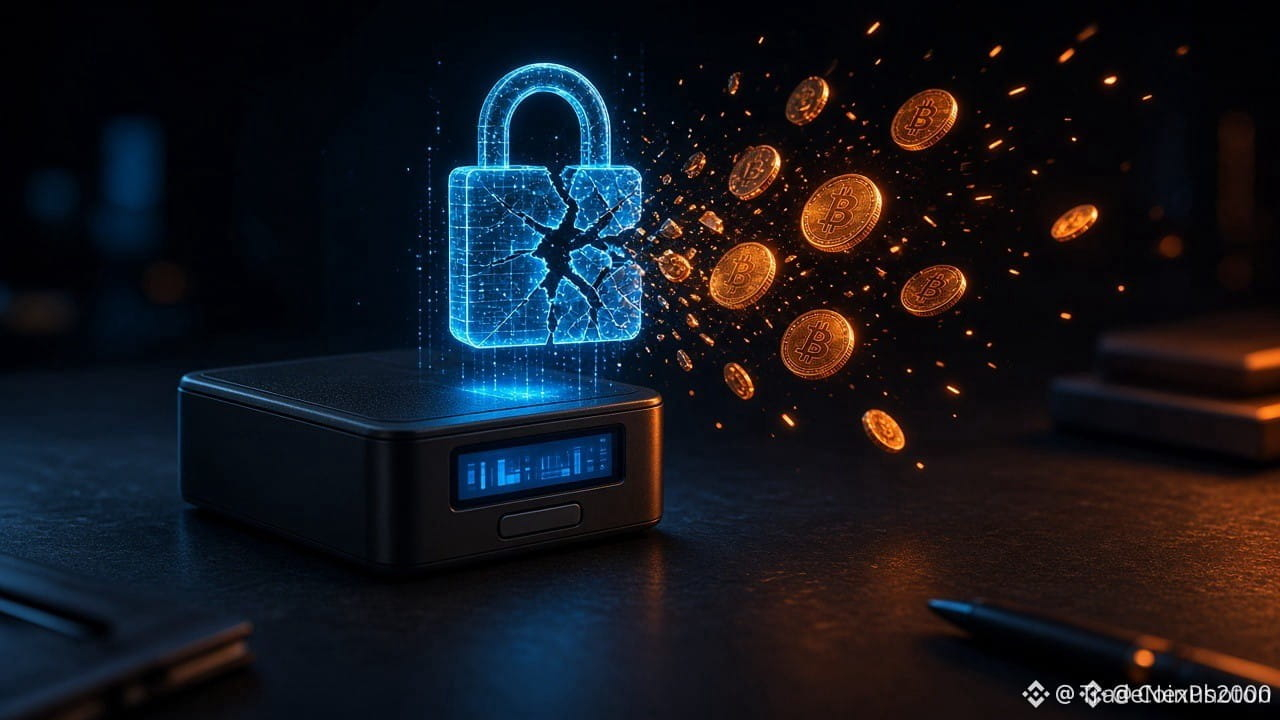
🚨 CRITICAL $BTC SECURITY FLAW EXPOSED IN COLD STORAGE INFRASTRUCTURE ⚠️
Institutional-grade security relies on uncompromised architecture, yet a silent vulnerability in $BTC hardware storage recently drained over 1,700 coins due to a fallback entropy flaw. 🔍 This oversight proves that even trusted offline vaults demand rigorous multi-layered verification before capital allocation. 🛡️
Smart market participants understand that operational security is the ultimate risk parameter, superseding even chart structure during systemic anomalies. ⚡ Are you regularly auditing your storage redundancy and key generation protocols to insulate against hidden code failures? 💬
⚠️ Not financial advice. Always manage your risk. 🛡️
🏷️ #BTC #Security #HardwareWallet #CryptoRisk
🔒 ⚡
5

A major liquidation wave recently hit the crypto market.
Approximately $1.8 billion in leveraged positions were liquidated over a 24-hour period.
High leverage can increase losses quickly when prices move against a trade.
Risk management is essential.
#CryptoLiquidations #LeverageTrading #CryptoRisk #trading
Approximately $1.8 billion in leveraged positions were liquidated over a 24-hour period.
High leverage can increase losses quickly when prices move against a trade.
Risk management is essential.
#CryptoLiquidations #LeverageTrading #CryptoRisk #trading
66
·
--
Bullish
Meme coins can attract attention quickly, but their volatility can be extreme.
Strong social media activity does not always mean strong fundamentals or sustainable demand.
Research the project, understand liquidity risks, and never risk money you cannot afford to lose.
$DOGE $PEPE #memecoins #CryptoRisk
{spot}(DOGEUSDT)
{spot}(PEPEUSDT)
Meme coins can attract attention quickly, but their volatility can be extreme.
Strong social media activity does not always mean strong fundamentals or sustainable demand.
Research the project, understand liquidity risks, and never risk money you cannot afford to lose.
$DOGE $PEPE #memecoins #CryptoRisk
Strong social media activity does not always mean strong fundamentals or sustainable demand.
Research the project, understand liquidity risks, and never risk money you cannot afford to lose.
$DOGE $PEPE #memecoins #CryptoRisk
Trong_Hatachi:
Good point on liquidity—hype around DOGE or PEPE doesn’t always tell the whole story. Follow me back for more crypto chats!
2
1
298

·
--
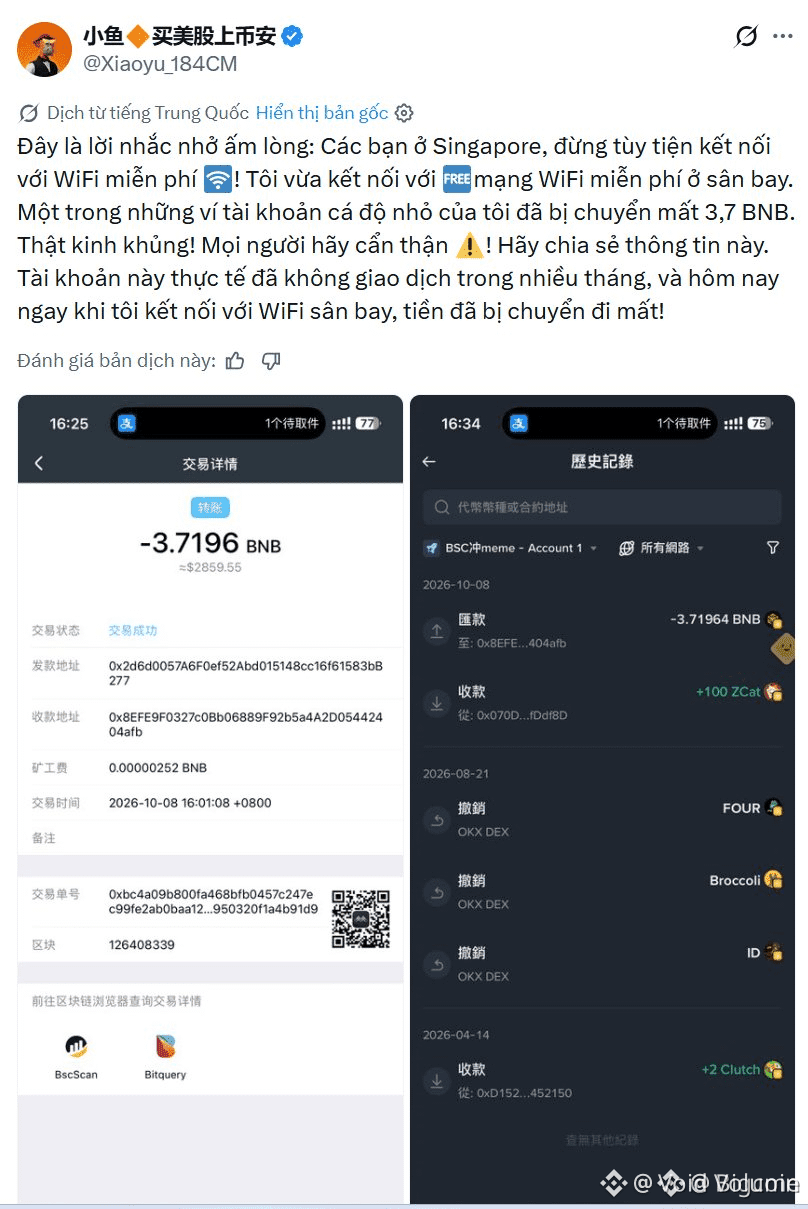
🚨 $BNB PUBLIC WIFI security incident ALERT: 3.71 BNB VANISHED! 💥
📊 A recent breach at Singapore’s airport exposed a direct wallet call‑out, siphoning 3.71 $BNB (~$2.8k). The pattern mirrors the 4 M $ security incident at Token2049—smart money never grants API or signing permissions over unsecured networks. 🦈 Institutional actors flag public Wi‑Fi as a liquidity sweep vector; every rogue packet is a potential order‑block breach. 📌 Stick to 4G/5G, enable hardware wallets, and audit app permissions before any connection.
💬 How are you fortifying your access layer against public Wi‑Fi attacks? 👇
⚠️ Not financial advice. Always manage your risk. 🛡️
🏷️ #BNB #Security #CryptoRisk #Token2049
🦈 🔥
6

Verified
Sky is currently dangling a massive 30% yield, but there is a major catch that investors need to scrutinize. Recent data reveals that over 99.9% of the assets in its lending vault are locked, leaving liquidity razor-thin for immediate withdrawals. While double-digit returns are always tempting in the DeFi space, this liquidity crunch serves as a harsh reminder to prioritize capital safety over pure APY. Always check the vault utilization before committing your liquidity. $SKY #DeFi #YieldFarming #CryptoRisk
Sky is currently dangling a massive 30% yield, but there is a major catch that investors need to scrutinize. Recent data reveals that over 99.9% of the assets in its lending vault are locked, leaving liquidity razor-thin for immediate withdrawals. While double-digit returns are always tempting in the DeFi space, this liquidity crunch serves as a harsh reminder to prioritize capital safety over pure APY. Always check the vault utilization before committing your liquidity. $SKY #DeFi #YieldFarming #CryptoRisk
162

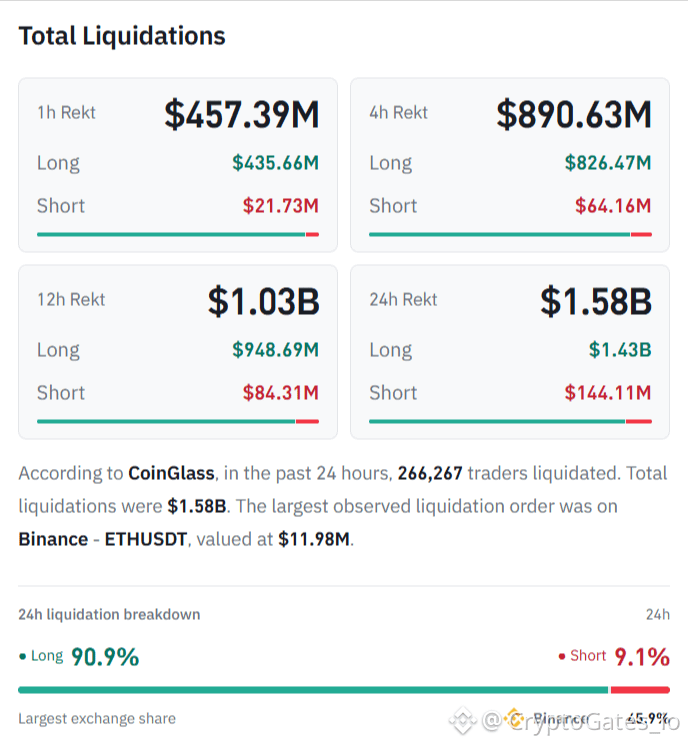
$1.58B Liquidated in 24 Hours: Longs Took 90.9%
CoinGlass data shows $1.43B in long liquidations against $144.11M in shorts, with 266,267 traders affected. The last hour alone saw $457.39M, with $435.66M from longs.
📊 Key takeaways:
Binance accounted for 45.9% of total liquidations. The largest single order was a $11.98M ETHUSDT long.
A leverage flush is not the same as capitulation. Liquidations clear overleveraged positions; capitulation needs spot holders selling at a loss.
Scenario map: if funding resets and open interest rebuilds slowly, expect range-bound base-building. If forced selling spills into spot, the cascade can extend.
Track funding rates, open interest and spot volume before adding exposure. Position size matters more than direction in moments like this.
Verify first. Risk later. Scale slowly.
#Bitcoin #Liquidations #CryptoRisk
88

·
--
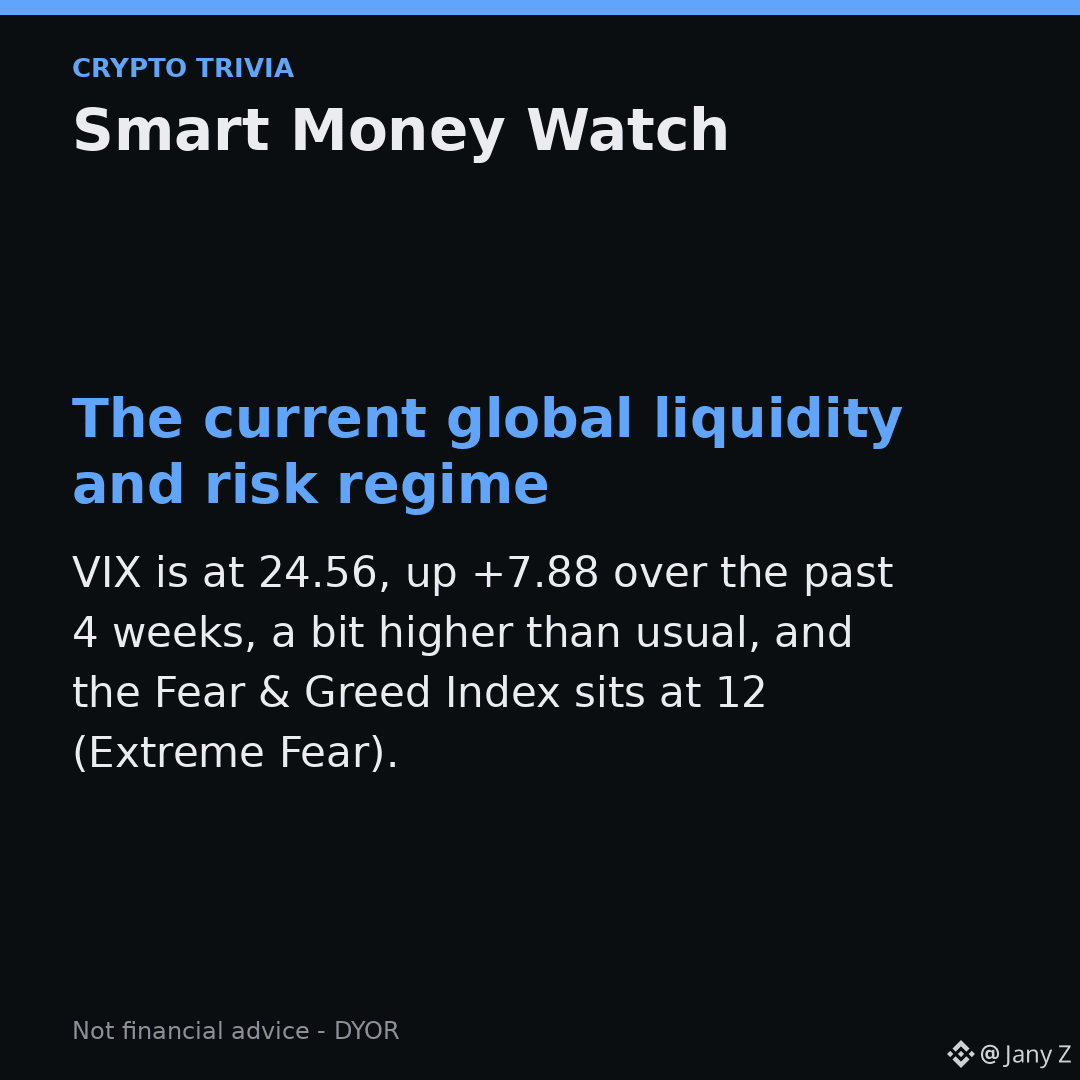
🚨 VIX is at 24.56, up +7.88 over the past 4 weeks, a bit higher than usual, and the Fear & Greed Index sits at 12 (Extreme Fear). The high-yield spread nudged up +0.20 to 3.47%, real 10-yr yield rose +0.12 to 2.88%, and the dollar index ticked +1.25 to 122.65. All this comes from official public data (CFTC, Federal Reserve) and paints a clear risk-off picture.
Crypto is feeling the chill: $BTC $61,420 (-3.66% 24h), $ETH $1,733 (-4.08%), $SOL $70.74 (-5.60%). Tighter global liquidity and a stressed risk regime could keep appetite low, but we'll see if any surprise rally pops up.
Which side are you on, cautious or ready to jump in?
Score kept. 🏆
#SmartMoney #CryptoRisk
119
$PEPE : High Potential, High Risk
Meme coins can attract attention quickly, but their volatility can be extreme.
Before entering a trade, consider liquidity, position size and the possibility of sudden losses.
Never risk money you cannot afford to lose.
Do you prefer meme coins or established projects?
$PEPE #pepe #memecoin #CryptoRisk
{spot}(PEPEUSDT)
$PEPE : High Potential, High Risk
Meme coins can attract attention quickly, but their volatility can be extreme.
Before entering a trade, consider liquidity, position size and the possibility of sudden losses.
Never risk money you cannot afford to lose.
Do you prefer meme coins or established projects?
$PEPE #pepe #memecoin #CryptoRisk
1
189

·
--
Native ICNT delegation exposes your tokens to your hardware provider's operational failures.
As of 2026-11-18 17:08 UTC+8, Binance's ICNTUSDT perpetual was up 27.7% on its rolling 24-hour ticker.
ICN's Hardware Providers guide says penalties called slashing can affect both a provider's own collateral and tokens delegated to it. Its Slashing guide identifies service downtime as a trigger. A provider's operational failure can therefore cost you tokens, beyond merely missing a reward payment.
For holders deciding whether to commit existing ICNT, compare the chosen provider's service record alongside rewards and the lock period. If you cannot accept token losses caused by provider failures, skip native delegation.
This applies to ICN's native collateral delegation.
$ICNT #Staking #CryptoRisk
155

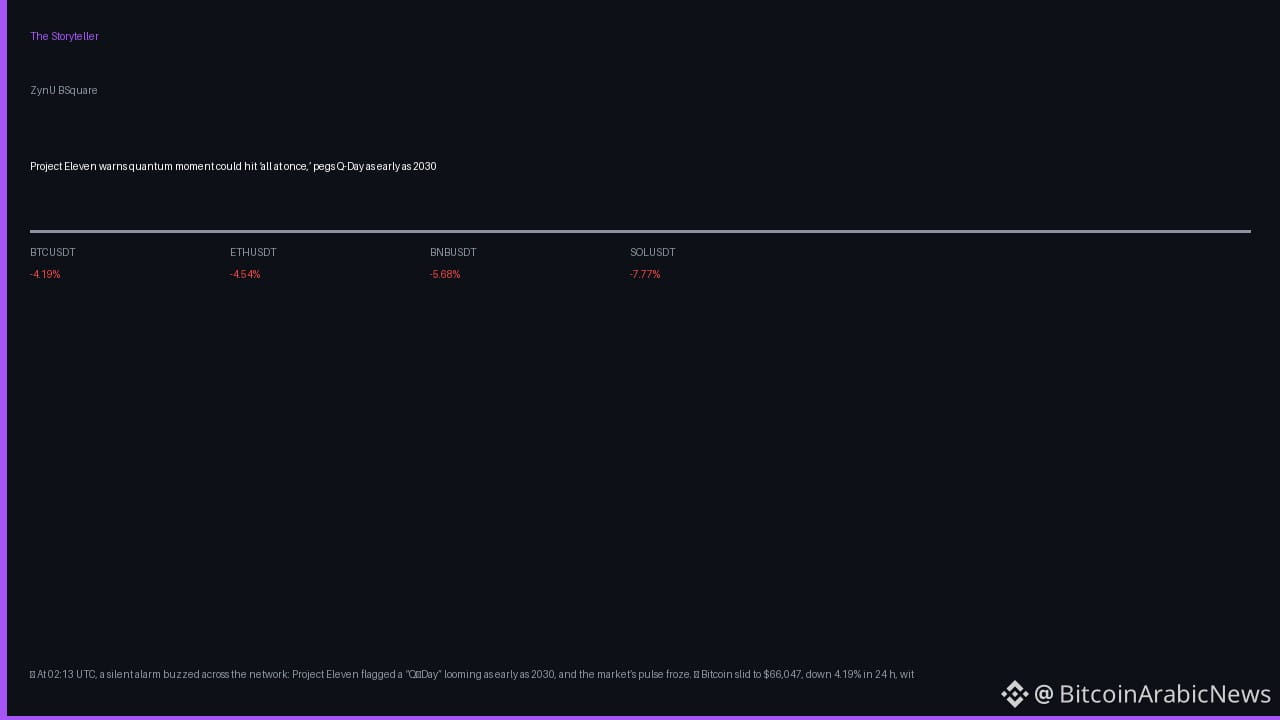
🔥 At 02:13 UTC, a silent alarm buzzed across the network: Project Eleven flagged a “Q‑Day” looming as early as 2030, and the market’s pulse froze.
📊 Bitcoin slid to $66,047, down 4.19% in 24 h, with RSI crushed at 20 and Bollinger Bands glued to the lower band – a textbook oversold abyss. Open interest still sits at $6.38 B and longs dominate 75.6% of contracts, showing institutions are already bracing. #BTC’s 6.9 million coin exposure to quantum decryption could vanish overnight, a risk magnified by the bearish MACD crossover. Meanwhile, #Quantum whispers have become #CryptoRisk headlines, and market sentiment is stuck at an extreme fear 13/100.
💡 The twist? The same smart wallets quietly snapping up Solana tokens are now eyeing the quantum narrative, hinting at a hedge that could flip the script on the impending digital apocalypse.
❓ Will the next wave of smart‑money inflows protect the crypto kingdom, or will quantum fire melt the foundation before the market even notices?
61

·
--
PLATFORM WARNING — #CrypFine
Investor safety should always come first!
Before depositing money, carefully check:
🔍 Platform ownership and company background.
💰 All deposit trading and withdrawal fees.
📋 Regulatory status and licensing.
⚠️ Any reports of delayed withdrawals or unclear financial terms.
Never risk your hard-earned money without proper verification.
📩 DM for guidance.
#CryptoSafety #InvestorAlert #DYOR #CryptoRisk
40

·
--
Bearish
⚠️ 5 Crypto Risks Every Beginner Must Avoid
1️⃣ Don't chase pumps (FOMO)
A coin that already jumped 20-30% in a day is often near the end of its move. Buying in excitement usually means buying at the top. Wait, check the reason behind the move, then decide.
2️⃣ Don't put everything in one coin
Even strong projects can drop hard. Spread your money across different assets, and only invest what you can afford to lose. Keep $BTC and $ETH as a base before touching small coins.
3️⃣ Stay away from leverage as a beginner
Futures with high leverage can wipe out your balance on a small price move. Learn spot trading first, understand the market, then think about anything advanced.
4️⃣ Avoid scams and fake links
"Guaranteed profit", "double your money" and unknown links on Telegram or WhatsApp are red flags. Never share your seed phrase or password with anyone, and turn on 2FA today.
5️⃣ Don't buy small coins without research
Low-volume and meme coins can crash in hours, and sometimes you cannot even sell. Check the team, volume, supply and use case before buying. Always DYOR.
💡 Bonus tip: Set a stop-loss before you enter any trade, and never trade on emotions.
Which of these mistakes have you made before? Share in the comments 👇
This is educational content, not financial advice.
#CryptoRisk #RiskManagement #BinanceSquar #BeginnerGuide #StaySafe
{spot}(NVDABUSDT)
{spot}(METABUSDT)
{spot}(ASMLBUSDT)
⚠️ 5 Crypto Risks Every Beginner Must Avoid
1️⃣ Don't chase pumps (FOMO)
A coin that already jumped 20-30% in a day is often near the end of its move. Buying in excitement usually means buying at the top. Wait, check the reason behind the move, then decide.
2️⃣ Don't put everything in one coin
Even strong projects can drop hard. Spread your money across different assets, and only invest what you can afford to lose. Keep $BTC and $ETH as a base before touching small coins.
3️⃣ Stay away from leverage as a beginner
Futures with high leverage can wipe out your balance on a small price move. Learn spot trading first, understand the market, then think about anything advanced.
4️⃣ Avoid scams and fake links
"Guaranteed profit", "double your money" and unknown links on Telegram or WhatsApp are red flags. Never share your seed phrase or password with anyone, and turn on 2FA today.
5️⃣ Don't buy small coins without research
Low-volume and meme coins can crash in hours, and sometimes you cannot even sell. Check the team, volume, supply and use case before buying. Always DYOR.
💡 Bonus tip: Set a stop-loss before you enter any trade, and never trade on emotions.
Which of these mistakes have you made before? Share in the comments 👇
This is educational content, not financial advice.
#CryptoRisk #RiskManagement #BinanceSquar #BeginnerGuide #StaySafe
1
419

·
--
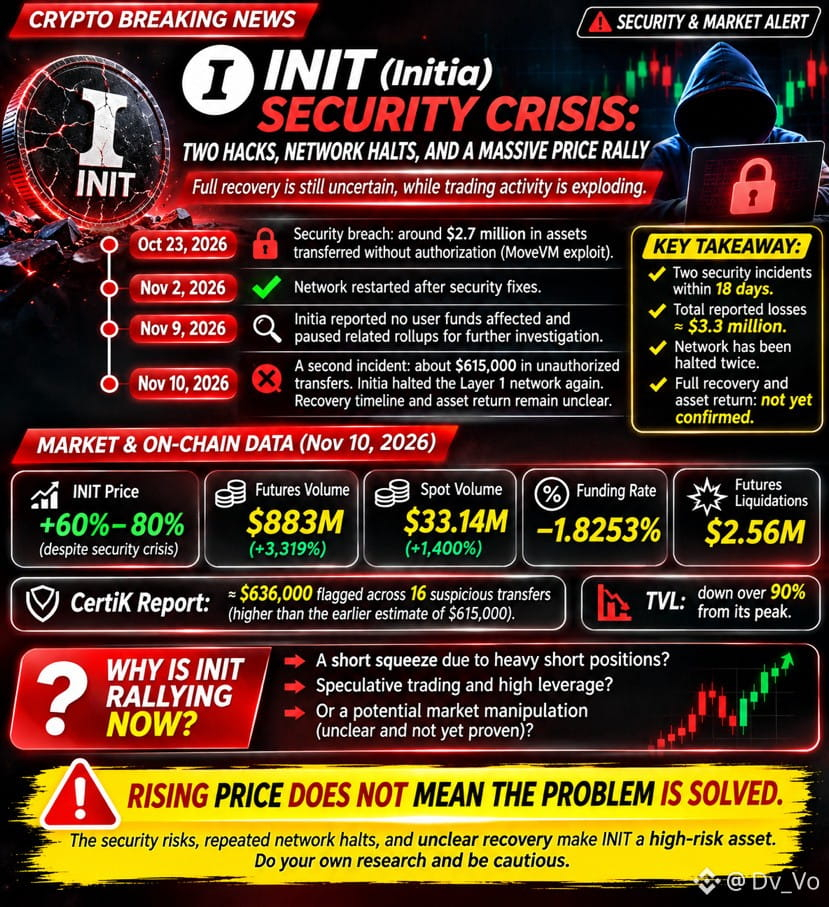
🚨 INIT SECURITY CRISIS: TWO BREACHES IN JUST 18 DAYS!
Something seriously concerning is happening with Initia (INIT).
🔴 Oct 23: $2.7M security exploit.
🔴 Nov 2: Network restarted after repairs.
🔴 Nov 9: Rollups temporarily paused for investigation.
🔴 Nov 10: Another $615K incident forced the network to halt again.
💸 Total reported losses: $3.3 MILLION.
📉 TVL down over 90% from its peak.
But here’s what makes this even more concerning.
🚀 INIT surged 60–80% during the security crisis.
🔥 Futures volume reportedly exploded to $883M, up 3,319%.
🔥 Spot volume jumped 1,400%.
🔥 Funding rate: −1.8253%.
🔥 Futures liquidations: $2.56M.
How can trading activity explode while network security and asset recovery remain uncertain?
Is this genuine demand, a massive short squeeze, or a potential fake pump?
These figures raise serious red flags, although manipulation has not been proven.
⚠️ A TEMPORARY NETWORK RESTART IS NOT A FULL RECOVERY.
⚠️ A MASSIVE PRICE PUMP DOES NOT MEAN THE PROJECT IS SAFE.
Investors deserve transparency, not just rising charts.
BE CAREFUL. DON’T BECOME EXIT LIQUIDITY.
#INIT #Initia #CryptoWarning #CryptoSecurity #FakePump #CryptoRisk $INIT
351

·
--
Many newcomers chase the next big pump. 🚀 But true success in crypto isn't about chasing hype; it's about protecting your capital. 🛡️ Risk management is your best friend. It means understanding your potential losses and setting limits. 📉 Without it, even one bad trade can wipe out weeks of gains. Don't let FOMO drive your decisions. Emotional trading often leads to painful losses. 🔴 Focus on sustainable growth, not quick riches. Learn to manage your risk, set stop-losses, and invest only what you can afford to lose. This approach helps you stay in the game longer. 💎 What's your top risk management rule? Share below!
#CryptoRisk #BeginnerTips #StaySafe #TradingSmart #CryptoEducation
Not financial advice. DYOR.
#CryptoRisk #BeginnerTips #StaySafe #TradingSmart #CryptoEducation
Not financial advice. DYOR.
10
·
--
Article
High-APY DeFi Gems: How to Spot the Sweet Spots and Guard Against the PitfallsThe market is quiet today, $BTC hovers at $75,732 with a modest 24-hour dip of 0.44%, and $ETH slides to $2,233, down 0.68%. Yet the DeFi labs are humming, rolling out protocols that promise eye-popping yields. I've been chasing these offers for months, and I'm finally ready to lay out the playbook that separates the real opportunities from the glitter.
Why The Yield Spike Feels Real
Even with $BNB stuck around $695.06 and a 7-day slide of 2.47%, liquidity is still flowing into newer farms. The fear-driven mood is evident, the Fear & Greed Index is sitting at 28, a clear sign of caution. That nervousness actually fuels higher incentives, as project teams compete for capital. When the market is nervous, the reward per dollar locked often climbs, making the current window attractive for risk-aware hunters.
Tokenomics Under the Hood
Most of the fresh projects use a dual-token model: a governance token that accrues voting power and a utility token that fuels rewards. The governance token typically has a capped supply, while the utility token is minted on a schedule tied to the amount of assets staked. This creates a built-in inflation that can erode long-term value if the protocol doesn't lock enough demand. I always check whether the reward token can be burned, bought back, or used to pay fees, those mechanisms act like a safety valve.
Risk Signals to Watch
The numbers on the main chains tell a story. SOL is down 1.69% in 24 hours, and its 7-day decline sits at 5.84%, hinting at broader market stress. When a DeFi protocol's TVL (total value locked) is heavily correlated with a falling asset, the upside can evaporate quickly. Also keep an eye on the top gainers list, ONE surged 8.82% today, but a sudden spike often precedes a correction. A token that spikes without a clear use case is a red flag.
Safe Playbook for Capture
First, allocate only a slice of your portfolio that you could comfortably lose. Second, use a hardware wallet or a reputable non-custodial interface to interact with the contract, that keeps your private keys out of the hands of a possibly compromised front-end. Third, set a hard stop on the reward token's price; if it falls back to a level where the APY no longer justifies the risk, pull out. Finally, diversify across a few unrelated protocols, that spreads the risk if one project runs into a smart-contract bug.
What high-APY protocol are you eyeing, and how are you structuring your risk controls?
Not financial advice
#DeFi #YieldFarming #CryptoRisk #InvestSmart
High-APY DeFi Gems: How to Spot the Sweet Spots and Guard Against the Pitfalls
The market is quiet today, $BTC hovers at $75,732 with a modest 24-hour dip of 0.44%, and $ETH slides to $2,233, down 0.68%. Yet the DeFi labs are humming, rolling out protocols that promise eye-popping yields. I've been chasing these offers for months, and I'm finally ready to lay out the playbook that separates the real opportunities from the glitter.
Why The Yield Spike Feels Real
Even with $BNB stuck around $695.06 and a 7-day slide of 2.47%, liquidity is still flowing into newer farms. The fear-driven mood is evident, the Fear & Greed Index is sitting at 28, a clear sign of caution. That nervousness actually fuels higher incentives, as project teams compete for capital. When the market is nervous, the reward per dollar locked often climbs, making the current window attractive for risk-aware hunters.
Tokenomics Under the Hood
Most of the fresh projects use a dual-token model: a governance token that accrues voting power and a utility token that fuels rewards. The governance token typically has a capped supply, while the utility token is minted on a schedule tied to the amount of assets staked. This creates a built-in inflation that can erode long-term value if the protocol doesn't lock enough demand. I always check whether the reward token can be burned, bought back, or used to pay fees, those mechanisms act like a safety valve.
Risk Signals to Watch
The numbers on the main chains tell a story. SOL is down 1.69% in 24 hours, and its 7-day decline sits at 5.84%, hinting at broader market stress. When a DeFi protocol's TVL (total value locked) is heavily correlated with a falling asset, the upside can evaporate quickly. Also keep an eye on the top gainers list, ONE surged 8.82% today, but a sudden spike often precedes a correction. A token that spikes without a clear use case is a red flag.
Safe Playbook for Capture
First, allocate only a slice of your portfolio that you could comfortably lose. Second, use a hardware wallet or a reputable non-custodial interface to interact with the contract, that keeps your private keys out of the hands of a possibly compromised front-end. Third, set a hard stop on the reward token's price; if it falls back to a level where the APY no longer justifies the risk, pull out. Finally, diversify across a few unrelated protocols, that spreads the risk if one project runs into a smart-contract bug.
What high-APY protocol are you eyeing, and how are you structuring your risk controls?
Not financial advice
#DeFi #YieldFarming #CryptoRisk #InvestSmart
126


·
--
Verified
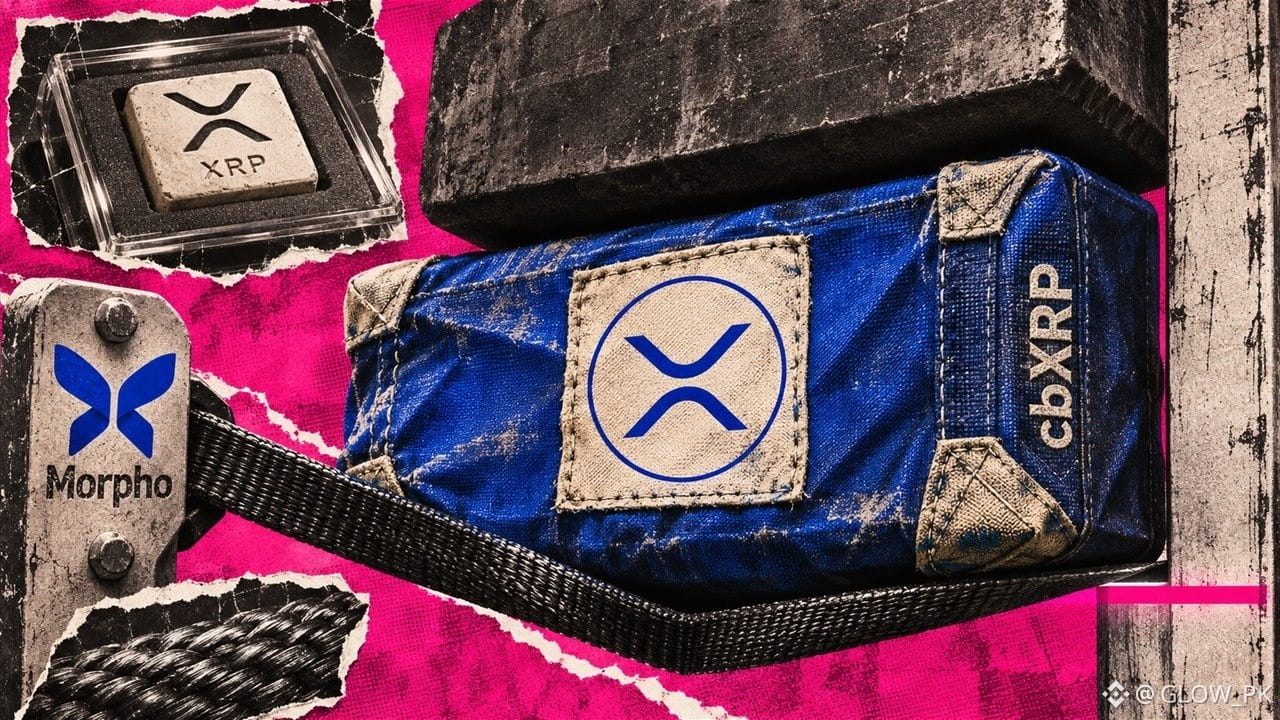
⚠️ Morpho Faces Potential $8.84M Liquidation Risk!
A new development in DeFi lending has caught my attention.
According to a November 6 snapshot, another 10% drop in collateral prices could put $8.84 million in USDC debt at risk of liquidation in a single Morpho market.
The interesting part is that these loans are backed by Coinbase's cbXRP, not native XRP.
📊 Here's what I'm watching:
🔹 A further 10% collateral decline could trigger significant liquidation pressure.
🔹 The exposure is linked to cbXRP-backed borrowing positions.
🔹 Repayments or additional collateral could reduce the estimated risk.
My biggest takeaway is that wrapped and tokenized assets can carry lending risks that aren't always obvious when looking at the underlying asset alone.
DeFi liquidity can look healthy until collateral starts losing value.
Is this an early warning sign for cbXRP lending markets, or just a temporary stress point?
$ONE $AIN $IDOL
#DeFi #Morpho #xrp #CryptoNews #CryptoRisk
3
5
1k
·
--
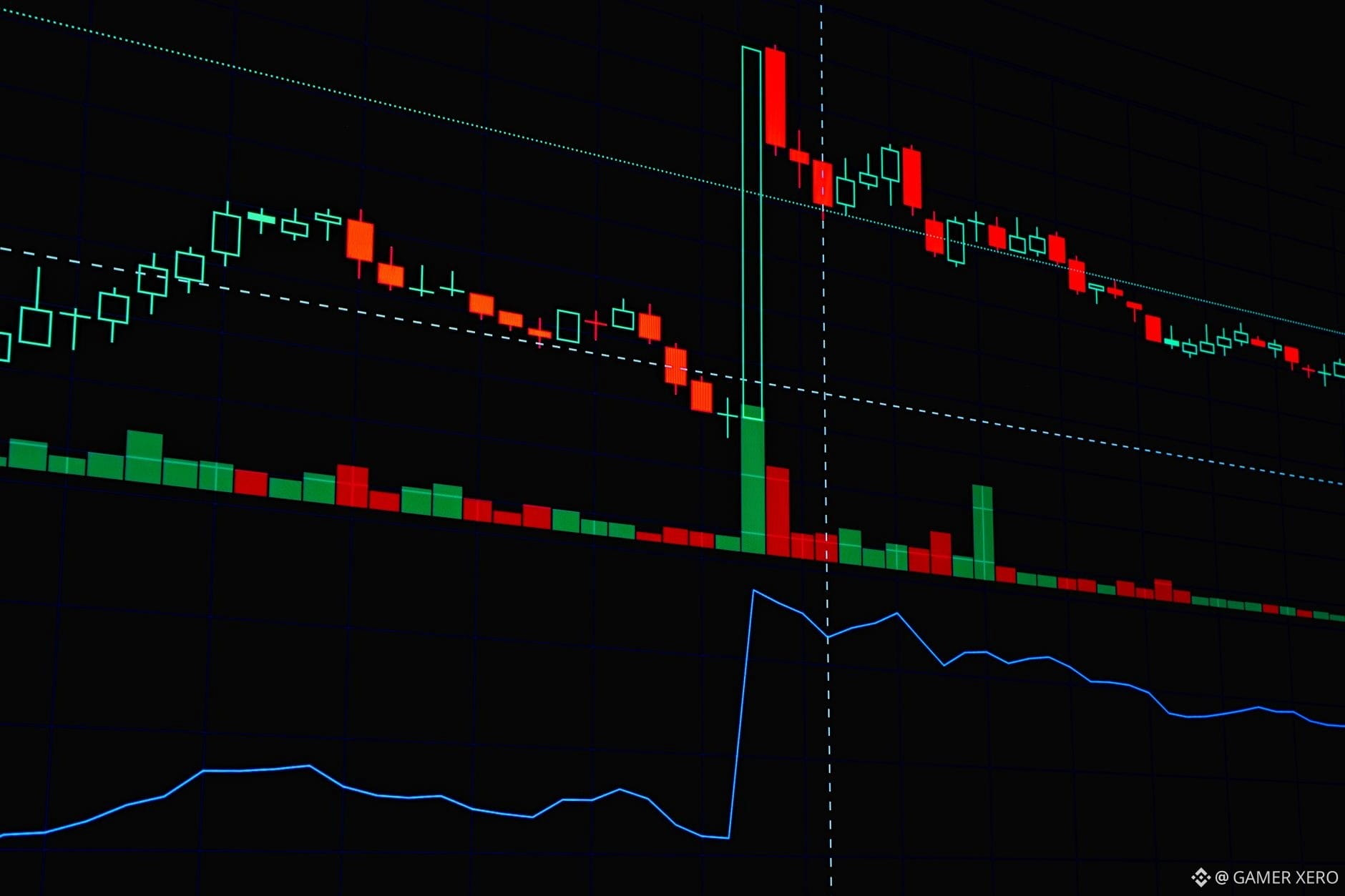
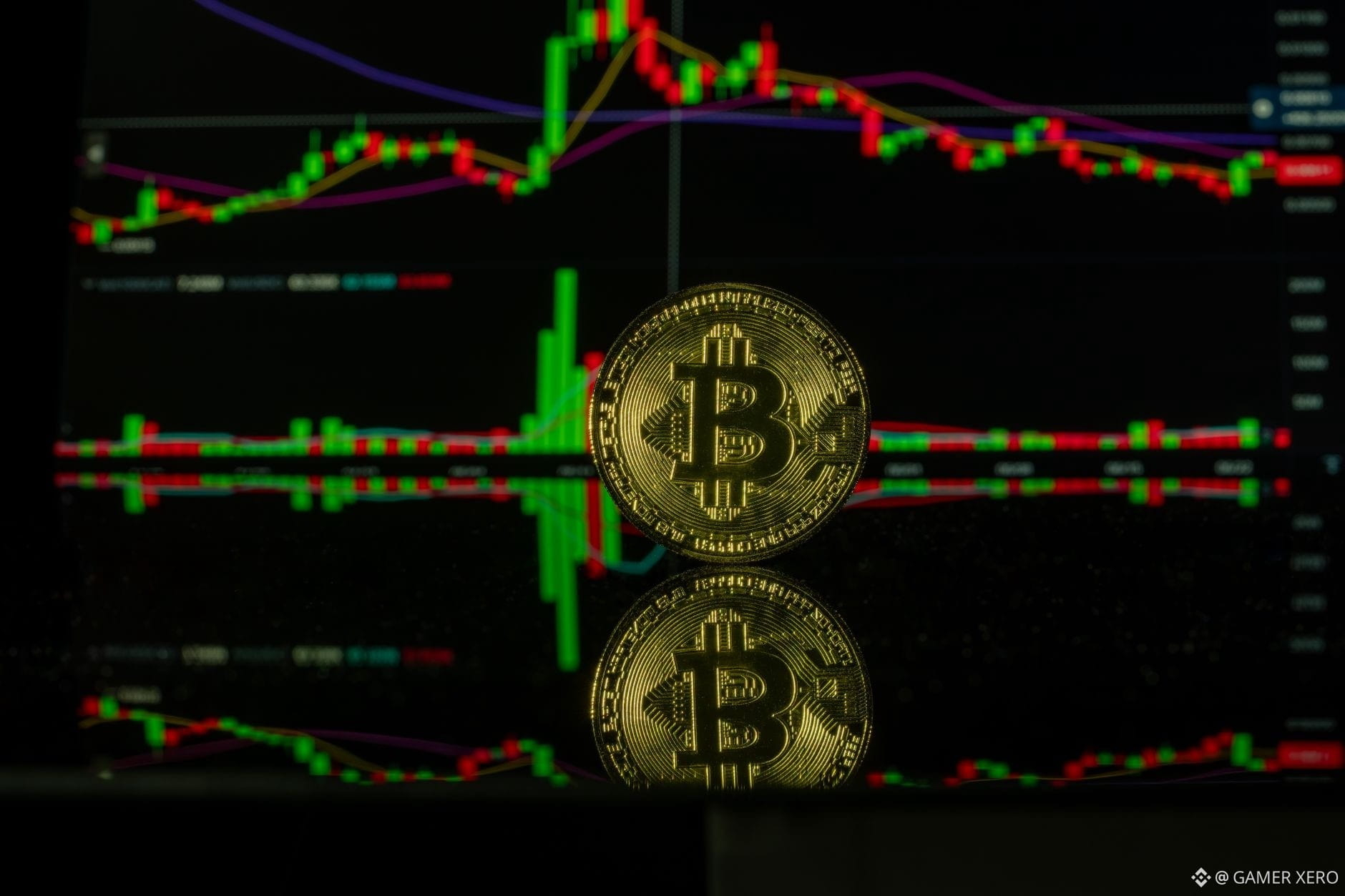
$BTC’s recent dip to $75,694, paired with a 5.8 % drop in 24 hours, highlights why a single‑asset focus can erode a portfolio fast. A practical way to cap that risk is to set an exposure ceiling – for example, no more than 20 % of total capital in any one coin. If you hold $10 k, that means a maximum $2 k position in $BTC, regardless of its swing potential.
Diversify the remaining allocation across assets with lower correlation. $ETH, down 8 % and trading around $2,225, often moves out of phase with $BTC during broad market stress, offering a buffer. Allocate another 15 % to $ETH and spread the rest among stablecoins or low‑volatility tokens to keep the overall portfolio volatility under a target threshold, say 10 % daily.
When a drawdown hits, recovery math matters. A 30 % loss on the $BTC slice requires a 43 % gain just to break even. By limiting the slice size, the recovery distance shrinks dramatically, making the path back to capital preservation much shorter.
How do you currently size your crypto positions to balance upside chances with drawdown risk?
#CryptoRisk #PortfolioManagement #DiversifySmart #GAMERXERO
$BTC ’s recent dip to $75,694, paired with a 5.8 % drop in 24 hours, highlights why a single‑asset focus can erode a portfolio fast. A practical way to cap that risk is to set an exposure ceiling – for example, no more than 20 % of total capital in any one coin. If you hold $10 k, that means a maximum $2 k position in $BTC , regardless of its swing potential.
Diversify the remaining allocation across assets with lower correlation. $ETH , down 8 % and trading around $2,225, often moves out of phase with $BTC during broad market stress, offering a buffer. Allocate another 15 % to $ETH and spread the rest among stablecoins or low‑volatility tokens to keep the overall portfolio volatility under a target threshold, say 10 % daily.
When a drawdown hits, recovery math matters. A 30 % loss on the $BTC slice requires a 43 % gain just to break even. By limiting the slice size, the recovery distance shrinks dramatically, making the path back to capital preservation much shorter.
How do you currently size your crypto positions to balance upside chances with drawdown risk?
#CryptoRisk #PortfolioManagement #DiversifySmart #GAMERXERO
106
Log in to explore more content
Join global crypto users on Binance Square
⚡️ Get latest and useful information about crypto.
💬 Trusted by the world’s largest crypto exchange.
👍 Discover real insights from verified creators.
Email / Phone number
Trending Topics
1
#EvolveAtBinanceBlockchainWeek
3.2M views
23,404 Discussing
2
#CryptographersFormGroupForEncryptionBreak
7,326 views
99 Discussing
3
#SunReportedlyOffered4BToRescueFTX
72,122 views
502 Discussing
4
#XRPLAmendmentsEnterActivationWindow
61,950 views
427 Discussing
5
#Kuwait362BitcoinMinersSeized
472 views
19 Discussing
6
#BitcoinETFsExtendOutflowStreakToEightDays
192,359 views
1,186 Discussing
7
#SouthKorea’sStockStabilizationFundCouldDoubleTo$15B
135 views
9 Discussing
8
#NovaTechFoundersOrderedToPay1.37B
0 views
0 Discussing
9
#LatviaSaysRussiaA7NetworkUnslowedAfterSanctions
0 views
3 Discussing
10
#KalshiExitsUtahAfterCriminalCharges
0 views
1 Discussing