
#cefi.
cefi.
2,079 views
15 Discussing
Hot
Latest
Article
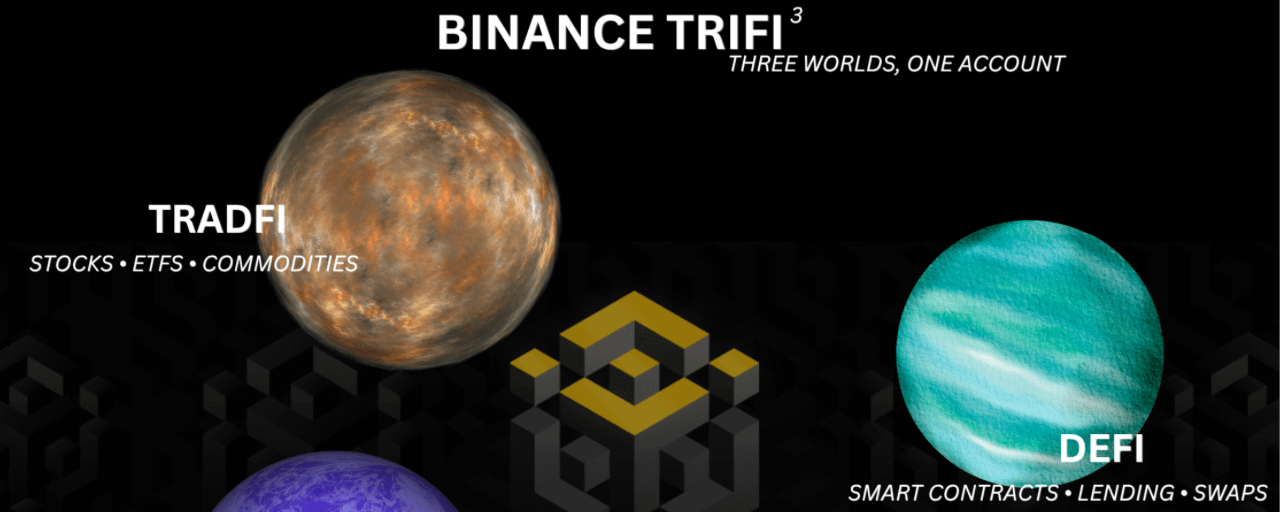
Three Worlds. One Account.For years, finance has been divided into separate worlds. You had traditional finance for stocks, ETFs, commodities and other established financial instruments; crypto for digital assets and 24/7 markets; and DeFi for financial applications built directly on blockchains through smart contracts. Different platforms, different accounts, different interfaces, different rules. But that separation is becoming harder to maintain. We are moving toward something much more connected: TriFi — TradFi, Crypto/CeFi, and DeFi working within one broader financial ecosystem. Binance itself describes this convergence as a shift toward an integrated financial experience where users can move between traditional assets, centralized crypto services and on-chain opportunities rather than treating them as completely separate worlds.
Start with TradFi. Traditional Finance is the financial system most people already know: banks, brokers, stock markets, ETFs, commodities and other regulated financial products. Traditionally, accessing a U.S. stock might mean opening a brokerage account, transferring funds, dealing with another platform and keeping your traditional investments completely separate from your crypto portfolio. Today, Binance is expanding its TradFi offering with products that include direct U.S.-listed stocks and ETFs, as well as TradFi Perpetuals that provide price exposure to selected stocks, ETFs and commodities without directly owning the underlying asset.
Then there is Crypto, or what is often called CeFi — Centralized Finance in this context. This is the world of centralized crypto platforms where users can buy and sell digital assets, trade spot markets, use derivatives, manage stablecoins and access other financial services through a centralized platform. It is different from TradFi because the assets and infrastructure are primarily crypto-native, but it provides something traditional markets historically did not: a financial environment designed around digital assets and markets that can operate around the clock.
And then comes DeFi — Decentralized Finance. Here, the financial infrastructure moves onto public blockchains and smart contracts. Instead of relying on one centralized company to execute every financial function, users can interact with decentralized protocols directly through a compatible wallet. Lending, borrowing, liquidity provision, swaps and other financial activities can be executed through blockchain-based protocols according to their programmed rules. Binance Wallet DeFi now aggregates access to more than 40 protocols and 1,000 pools across supported networks, bringing DeFi activities such as lending, liquidity provision and on-chain yield opportunities into its wallet experience.
Three worlds. Three different philosophies. So why connect them?
Because the person using financial products does not necessarily think in three categories. Someone might hold Bitcoin, follow NVIDIA, keep USDT, explore an on-chain opportunity and watch the price of gold — all within the same week. Traditionally, each activity could require a completely different platform. The emerging model is to make the transition between them much more seamless.
Think of one person named Nino. Nino starts with crypto. He holds digital assets and uses a centralized exchange to manage them. Then he becomes interested in U.S. equities. Instead of immediately moving into a completely separate financial environment, he can explore available TradFi products within the same broader Binance ecosystem. Later, he wants to explore DeFi. He can access Binance Wallet and interact with supported on-chain protocols. The financial products are still fundamentally different, but the experience around them can become increasingly connected.
That distinction is important: one account does not mean one product. It means one ecosystem can provide access to multiple financial environments while the underlying products retain their own mechanics, risks, ownership structures and regulatory requirements.
For example, owning a U.S. stock is fundamentally different from trading a stock perpetual. A stock represents ownership in a company, while a perpetual is a derivative designed to track the price of an underlying asset. Binance's TradFi Perpetuals are USDT-settled and do not give the trader direct ownership of the underlying traditional asset.
Likewise, holding crypto on a centralized platform is different from using DeFi. In centralized finance, the platform provides the infrastructure and users interact through an account. In DeFi, users can interact with smart contracts and protocols through a self-custodial wallet. Binance Wallet is designed as a self-custodial wallet, giving users access to blockchain networks, decentralized applications and DeFi services.
This is where the idea of a single financial ecosystem becomes much more interesting than simply saying “Binance now has stocks.”
The bigger development is the possibility of moving between financial categories without constantly rebuilding your financial setup from zero. Crypto does not have to exist in one isolated corner. Traditional assets do not have to remain completely separate from digital assets. And DeFi does not necessarily have to feel like an entirely disconnected universe.
The bridge between these worlds is already becoming visible. Binance has described its ecosystem as bringing together TradFi, CeFi and DeFi, while its newer offerings include direct U.S. stocks and ETFs, TradFi Perpetuals and on-chain DeFi access through Binance Wallet.
But there is one thing that should never get lost in the excitement around convergence: different products still mean different risks.
A stock is not a perpetual. A perpetual is not an option. Bitcoin is not a stock. DeFi lending is not the same as depositing money into a traditional bank. A self-custodial wallet is not the same as a centralized exchange account. Each has different mechanics, custody arrangements, fees, liquidity considerations, smart-contract risks, market risks and regulatory considerations.
So TriFi is not about making every financial product identical. It is about making different financial worlds more connected.
And that could be the most important part of the story.
The future financial experience may not ask, “Are you a crypto investor, a stock investor or a DeFi user?”
It may simply give you one financial ecosystem where you can explore all three, while still understanding exactly which world you are entering.
TradFi. Crypto. DeFi. Three financial worlds. Increasingly connected. And potentially, one place to navigate them.
#Binance #TriFi #TradFi #CeFi. #defi
Three Worlds. One Account.
For years, finance has been divided into separate worlds. You had traditional finance for stocks, ETFs, commodities and other established financial instruments; crypto for digital assets and 24/7 markets; and DeFi for financial applications built directly on blockchains through smart contracts. Different platforms, different accounts, different interfaces, different rules. But that separation is becoming harder to maintain. We are moving toward something much more connected: TriFi — TradFi, Crypto/CeFi, and DeFi working within one broader financial ecosystem. Binance itself describes this convergence as a shift toward an integrated financial experience where users can move between traditional assets, centralized crypto services and on-chain opportunities rather than treating them as completely separate worlds.
Start with TradFi. Traditional Finance is the financial system most people already know: banks, brokers, stock markets, ETFs, commodities and other regulated financial products. Traditionally, accessing a U.S. stock might mean opening a brokerage account, transferring funds, dealing with another platform and keeping your traditional investments completely separate from your crypto portfolio. Today, Binance is expanding its TradFi offering with products that include direct U.S.-listed stocks and ETFs, as well as TradFi Perpetuals that provide price exposure to selected stocks, ETFs and commodities without directly owning the underlying asset.
Then there is Crypto, or what is often called CeFi — Centralized Finance in this context. This is the world of centralized crypto platforms where users can buy and sell digital assets, trade spot markets, use derivatives, manage stablecoins and access other financial services through a centralized platform. It is different from TradFi because the assets and infrastructure are primarily crypto-native, but it provides something traditional markets historically did not: a financial environment designed around digital assets and markets that can operate around the clock.
And then comes DeFi — Decentralized Finance. Here, the financial infrastructure moves onto public blockchains and smart contracts. Instead of relying on one centralized company to execute every financial function, users can interact with decentralized protocols directly through a compatible wallet. Lending, borrowing, liquidity provision, swaps and other financial activities can be executed through blockchain-based protocols according to their programmed rules. Binance Wallet DeFi now aggregates access to more than 40 protocols and 1,000 pools across supported networks, bringing DeFi activities such as lending, liquidity provision and on-chain yield opportunities into its wallet experience.
Three worlds. Three different philosophies. So why connect them?
Because the person using financial products does not necessarily think in three categories. Someone might hold Bitcoin, follow NVIDIA, keep USDT, explore an on-chain opportunity and watch the price of gold — all within the same week. Traditionally, each activity could require a completely different platform. The emerging model is to make the transition between them much more seamless.
Think of one person named Nino. Nino starts with crypto. He holds digital assets and uses a centralized exchange to manage them. Then he becomes interested in U.S. equities. Instead of immediately moving into a completely separate financial environment, he can explore available TradFi products within the same broader Binance ecosystem. Later, he wants to explore DeFi. He can access Binance Wallet and interact with supported on-chain protocols. The financial products are still fundamentally different, but the experience around them can become increasingly connected.
That distinction is important: one account does not mean one product. It means one ecosystem can provide access to multiple financial environments while the underlying products retain their own mechanics, risks, ownership structures and regulatory requirements.
For example, owning a U.S. stock is fundamentally different from trading a stock perpetual. A stock represents ownership in a company, while a perpetual is a derivative designed to track the price of an underlying asset. Binance's TradFi Perpetuals are USDT-settled and do not give the trader direct ownership of the underlying traditional asset.
Likewise, holding crypto on a centralized platform is different from using DeFi. In centralized finance, the platform provides the infrastructure and users interact through an account. In DeFi, users can interact with smart contracts and protocols through a self-custodial wallet. Binance Wallet is designed as a self-custodial wallet, giving users access to blockchain networks, decentralized applications and DeFi services.
This is where the idea of a single financial ecosystem becomes much more interesting than simply saying “Binance now has stocks.”
The bigger development is the possibility of moving between financial categories without constantly rebuilding your financial setup from zero. Crypto does not have to exist in one isolated corner. Traditional assets do not have to remain completely separate from digital assets. And DeFi does not necessarily have to feel like an entirely disconnected universe.
The bridge between these worlds is already becoming visible. Binance has described its ecosystem as bringing together TradFi, CeFi and DeFi, while its newer offerings include direct U.S. stocks and ETFs, TradFi Perpetuals and on-chain DeFi access through Binance Wallet.
But there is one thing that should never get lost in the excitement around convergence: different products still mean different risks.
A stock is not a perpetual. A perpetual is not an option. Bitcoin is not a stock. DeFi lending is not the same as depositing money into a traditional bank. A self-custodial wallet is not the same as a centralized exchange account. Each has different mechanics, custody arrangements, fees, liquidity considerations, smart-contract risks, market risks and regulatory considerations.
So TriFi is not about making every financial product identical. It is about making different financial worlds more connected.
And that could be the most important part of the story.
The future financial experience may not ask, “Are you a crypto investor, a stock investor or a DeFi user?”
It may simply give you one financial ecosystem where you can explore all three, while still understanding exactly which world you are entering.
TradFi. Crypto. DeFi. Three financial worlds. Increasingly connected. And potentially, one place to navigate them.
#Binance #TriFi #TradFi #CeFi. #defi
Start with TradFi. Traditional Finance is the financial system most people already know: banks, brokers, stock markets, ETFs, commodities and other regulated financial products. Traditionally, accessing a U.S. stock might mean opening a brokerage account, transferring funds, dealing with another platform and keeping your traditional investments completely separate from your crypto portfolio. Today, Binance is expanding its TradFi offering with products that include direct U.S.-listed stocks and ETFs, as well as TradFi Perpetuals that provide price exposure to selected stocks, ETFs and commodities without directly owning the underlying asset.
Then there is Crypto, or what is often called CeFi — Centralized Finance in this context. This is the world of centralized crypto platforms where users can buy and sell digital assets, trade spot markets, use derivatives, manage stablecoins and access other financial services through a centralized platform. It is different from TradFi because the assets and infrastructure are primarily crypto-native, but it provides something traditional markets historically did not: a financial environment designed around digital assets and markets that can operate around the clock.
And then comes DeFi — Decentralized Finance. Here, the financial infrastructure moves onto public blockchains and smart contracts. Instead of relying on one centralized company to execute every financial function, users can interact with decentralized protocols directly through a compatible wallet. Lending, borrowing, liquidity provision, swaps and other financial activities can be executed through blockchain-based protocols according to their programmed rules. Binance Wallet DeFi now aggregates access to more than 40 protocols and 1,000 pools across supported networks, bringing DeFi activities such as lending, liquidity provision and on-chain yield opportunities into its wallet experience.
Three worlds. Three different philosophies. So why connect them?
Because the person using financial products does not necessarily think in three categories. Someone might hold Bitcoin, follow NVIDIA, keep USDT, explore an on-chain opportunity and watch the price of gold — all within the same week. Traditionally, each activity could require a completely different platform. The emerging model is to make the transition between them much more seamless.
Think of one person named Nino. Nino starts with crypto. He holds digital assets and uses a centralized exchange to manage them. Then he becomes interested in U.S. equities. Instead of immediately moving into a completely separate financial environment, he can explore available TradFi products within the same broader Binance ecosystem. Later, he wants to explore DeFi. He can access Binance Wallet and interact with supported on-chain protocols. The financial products are still fundamentally different, but the experience around them can become increasingly connected.
That distinction is important: one account does not mean one product. It means one ecosystem can provide access to multiple financial environments while the underlying products retain their own mechanics, risks, ownership structures and regulatory requirements.
For example, owning a U.S. stock is fundamentally different from trading a stock perpetual. A stock represents ownership in a company, while a perpetual is a derivative designed to track the price of an underlying asset. Binance's TradFi Perpetuals are USDT-settled and do not give the trader direct ownership of the underlying traditional asset.
Likewise, holding crypto on a centralized platform is different from using DeFi. In centralized finance, the platform provides the infrastructure and users interact through an account. In DeFi, users can interact with smart contracts and protocols through a self-custodial wallet. Binance Wallet is designed as a self-custodial wallet, giving users access to blockchain networks, decentralized applications and DeFi services.
This is where the idea of a single financial ecosystem becomes much more interesting than simply saying “Binance now has stocks.”
The bigger development is the possibility of moving between financial categories without constantly rebuilding your financial setup from zero. Crypto does not have to exist in one isolated corner. Traditional assets do not have to remain completely separate from digital assets. And DeFi does not necessarily have to feel like an entirely disconnected universe.
The bridge between these worlds is already becoming visible. Binance has described its ecosystem as bringing together TradFi, CeFi and DeFi, while its newer offerings include direct U.S. stocks and ETFs, TradFi Perpetuals and on-chain DeFi access through Binance Wallet.
But there is one thing that should never get lost in the excitement around convergence: different products still mean different risks.
A stock is not a perpetual. A perpetual is not an option. Bitcoin is not a stock. DeFi lending is not the same as depositing money into a traditional bank. A self-custodial wallet is not the same as a centralized exchange account. Each has different mechanics, custody arrangements, fees, liquidity considerations, smart-contract risks, market risks and regulatory considerations.
So TriFi is not about making every financial product identical. It is about making different financial worlds more connected.
And that could be the most important part of the story.
The future financial experience may not ask, “Are you a crypto investor, a stock investor or a DeFi user?”
It may simply give you one financial ecosystem where you can explore all three, while still understanding exactly which world you are entering.
TradFi. Crypto. DeFi. Three financial worlds. Increasingly connected. And potentially, one place to navigate them.
#Binance #TriFi #TradFi #CeFi. #defi
1
160
Log in to explore more content
Join global crypto users on Binance Square
⚡️ Get latest and useful information about crypto.
💬 Trusted by the world’s largest crypto exchange.
👍 Discover real insights from verified creators.
Email / Phone number
Trending Topics
1
#BTCBreaks80K
76,134 views
1,498 Discussing
2
#比特币突破8万
68,597 views
241 Discussing
3
#BuffettBecomesBerkshireChairmanEmeritus
18,752 views
523 Discussing
4
#ZcashSpotETFTops$230MMonthlyInflow
4,950 views
79 Discussing
5
#HYPEJumpsOver11%
70,339 views
1,091 Discussing
6
#ZcashDevelopersTargetNU7MainnetActivationNov5
31,870 views
540 Discussing
7
#BitcoinSpotETFsNetInflow$159M
27,360 views
102 Discussing
8
#HKMAPlansWholesaleCBDCByYearEnd
49,869 views
932 Discussing
9
#NEARSurges26%Past$3.45
22,430 views
148 Discussing
10
#BOJHikesRatesTo31YearHigh
86,262 views
1,322 Discussing