
#avail
avail
174,387 views
189 Discussing
Hot
Latest

$AVAIL BREAKING DOWN FROM RESISTANCE TARGETS AHEAD 🎯
Entry: 0.020 🔥
Target: 0.017 🚀
Price just got rejected hard at the 0.020 level after a fakeout breakout. Volume is spiking on the sell side and the 15-minute structure has flipped bearish. The next support zone sits around 0.017 with lower targets at 0.015 and 0.013 if momentum accelerates.
This is a clean breakdown play with clear levels to take profit along the way. Are you shorting this or waiting for a retest?
Not financial advice. Always manage your risk.
#AVAIL #ShortSetup #Breakdown #Crypto
💎
$AVAIL BREAKING DOWN FROM RESISTANCE TARGETS AHEAD 🎯
Entry: 0.020 🔥
Target: 0.017 🚀
Price just got rejected hard at the 0.020 level after a fakeout breakout. Volume is spiking on the sell side and the 15-minute structure has flipped bearish. The next support zone sits around 0.017 with lower targets at 0.015 and 0.013 if momentum accelerates.
This is a clean breakdown play with clear levels to take profit along the way. Are you shorting this or waiting for a retest?
Not financial advice. Always manage your risk.
#AVAIL #ShortSetup #Breakdown #Crypto
💎
Entry: 0.020 🔥
Target: 0.017 🚀
Price just got rejected hard at the 0.020 level after a fakeout breakout. Volume is spiking on the sell side and the 15-minute structure has flipped bearish. The next support zone sits around 0.017 with lower targets at 0.015 and 0.013 if momentum accelerates.
This is a clean breakdown play with clear levels to take profit along the way. Are you shorting this or waiting for a retest?
Not financial advice. Always manage your risk.
#AVAIL #ShortSetup #Breakdown #Crypto
💎
107


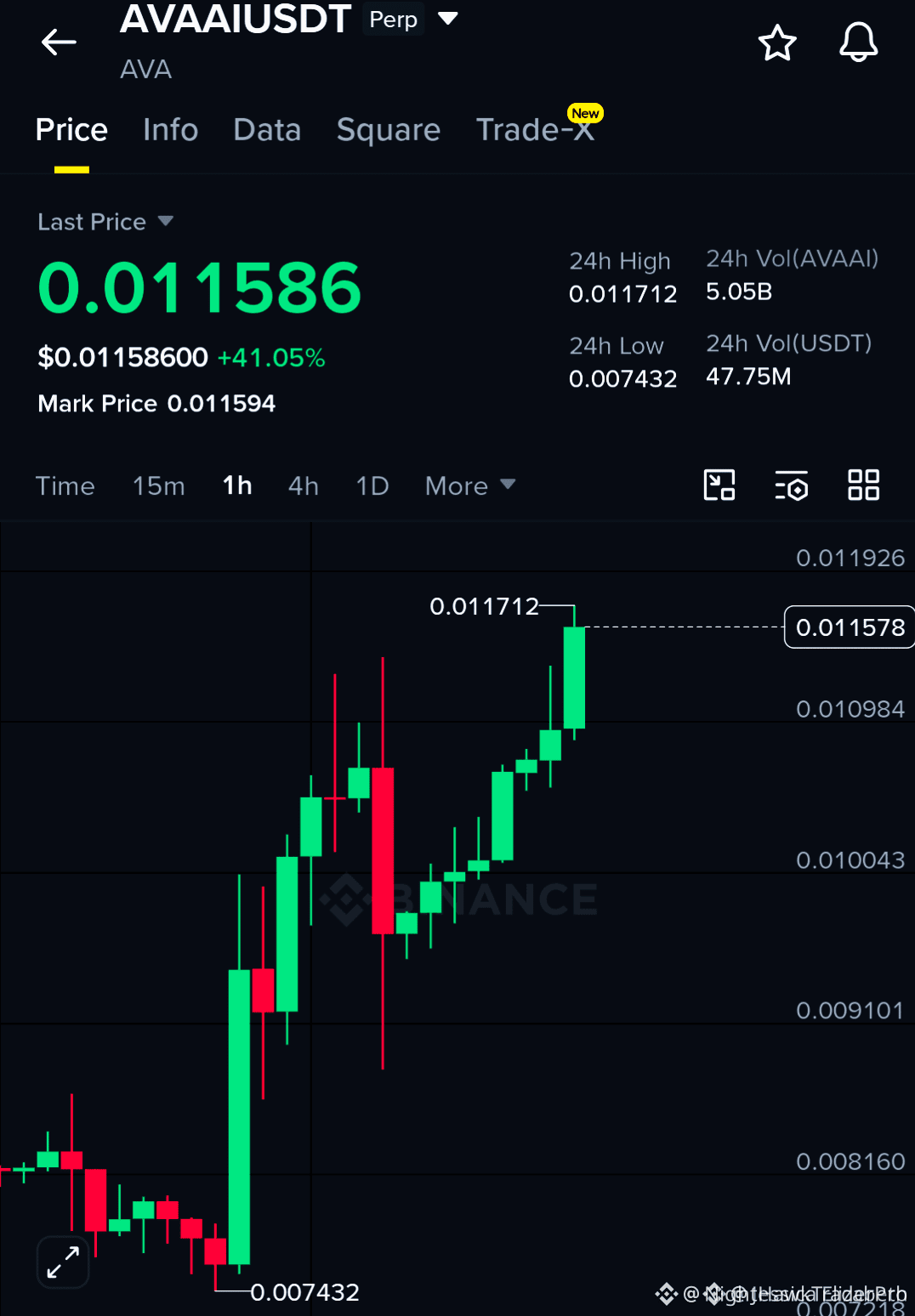
⚡🚀 AVAIL is showing resilience as traders watch for a fresh momentum shift. Price action remains volatile, but stronger buying pressure could support a breakout. Smart traders are focusing on volume, support, and resistance before making decisions. Stay patient, manage risk, and let confirmation lead the trade.
(Not any financial advice)
(Only current market opinion)
#AVAIL
#Crypto
#BinanceSquare
#Altcoins
#CryptoMarket
⚡🚀 AVAIL is showing resilience as traders watch for a fresh momentum shift. Price action remains volatile, but stronger buying pressure could support a breakout. Smart traders are focusing on volume, support, and resistance before making decisions. Stay patient, manage risk, and let confirmation lead the trade.
(Not any financial advice)
(Only current market opinion)
#AVAIL
#Crypto
#BinanceSquare
#Altcoins
#CryptoMarket
(Not any financial advice)
(Only current market opinion)
#AVAIL
#Crypto
#BinanceSquare
#Altcoins
#CryptoMarket
169

·
--
$AVAIL +6.78% | $APR +6.77% | $ASP +6.59%
#AVAIL on BSC nudged to $0.00224670, up +6.78% on $21.3K volume and a $16.2M market cap.
APR on BSC climbed to $0.1596, up +6.77% with $1.0M traded, backing a $44.3M market cap.
ASP on BSC slipped to $0.00993813, up +6.59% on $10.3K volume, sitting at a $4.0M market cap.
⚡️ The sub‑$5M caps can swing sharply on modest order flow, so today’s green streak could reverse quickly.
#BinanceAlpha #TopGainers #Write2Earn #Binance
$AVAIL +6.78% | $APR +6.77% | $ASP +6.59%
#AVAIL on BSC nudged to $0.00224670, up +6.78% on $21.3K volume and a $16.2M market cap.
APR on BSC climbed to $0.1596, up +6.77% with $1.0M traded, backing a $44.3M market cap.
ASP on BSC slipped to $0.00993813, up +6.59% on $10.3K volume, sitting at a $4.0M market cap.
⚡️ The sub‑$5M caps can swing sharply on modest order flow, so today’s green streak could reverse quickly.
#BinanceAlpha #TopGainers #Write2Earn #Binance
#AVAIL on BSC nudged to $0.00224670, up +6.78% on $21.3K volume and a $16.2M market cap.
APR on BSC climbed to $0.1596, up +6.77% with $1.0M traded, backing a $44.3M market cap.
ASP on BSC slipped to $0.00993813, up +6.59% on $10.3K volume, sitting at a $4.0M market cap.
⚡️ The sub‑$5M caps can swing sharply on modest order flow, so today’s green streak could reverse quickly.
#BinanceAlpha #TopGainers #Write2Earn #Binance
10

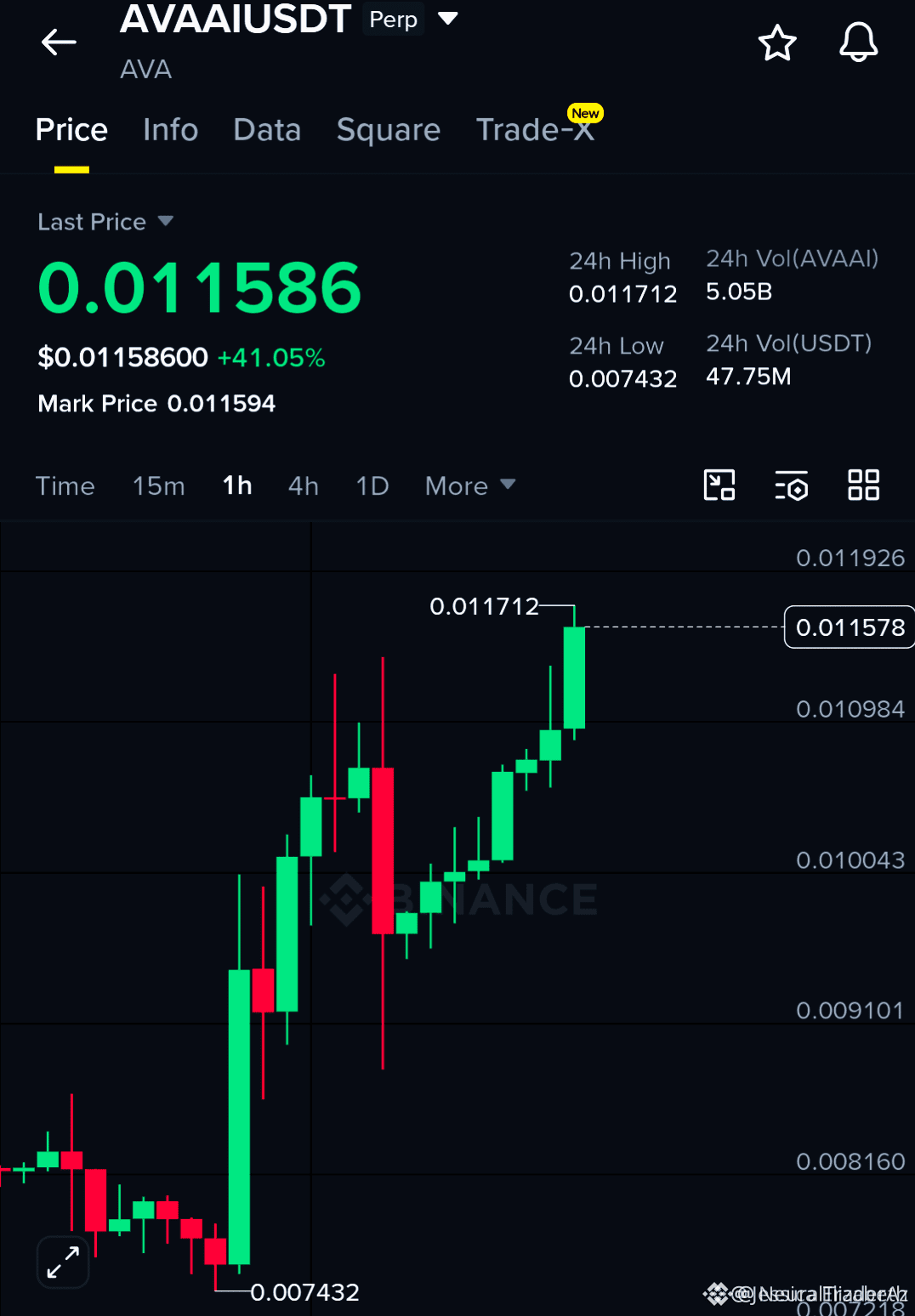
$AVAIL BREAKOUT CONFIRMED AT 0.020 — NEXT UPSIDE TARGET IN PLAY 🔥
Entry: 0.020 🔥
Target: 0.017 🚀
Price just broke above the 0.020 resistance that rejected two sweeps last week. Volume on the 1H spike is 40% above the 20-period average, and the order flow shows aggressive bids at this level. The 0.017 target aligns with the previous high — a clean 1:1.5 risk-to-reward for a quick move.
Are you already in or waiting for a retest of 0.020?
Not financial advice. Always manage your risk.
#AVAIL #Breakout #Crypto #Altcoins
🔥
$AVAIL BREAKOUT CONFIRMED AT 0.020 — NEXT UPSIDE TARGET IN PLAY 🔥
Entry: 0.020 🔥
Target: 0.017 🚀
Price just broke above the 0.020 resistance that rejected two sweeps last week. Volume on the 1H spike is 40% above the 20-period average, and the order flow shows aggressive bids at this level. The 0.017 target aligns with the previous high — a clean 1:1.5 risk-to-reward for a quick move.
Are you already in or waiting for a retest of 0.020?
Not financial advice. Always manage your risk.
#AVAIL #Breakout #Crypto #Altcoins
🔥
Entry: 0.020 🔥
Target: 0.017 🚀
Price just broke above the 0.020 resistance that rejected two sweeps last week. Volume on the 1H spike is 40% above the 20-period average, and the order flow shows aggressive bids at this level. The 0.017 target aligns with the previous high — a clean 1:1.5 risk-to-reward for a quick move.
Are you already in or waiting for a retest of 0.020?
Not financial advice. Always manage your risk.
#AVAIL #Breakout #Crypto #Altcoins
🔥
39

·
--
Bullish
🚨 $AVAIL
{alpha}(560x39702843a6733932ec7ce0dde404e5a6dbd8c989)
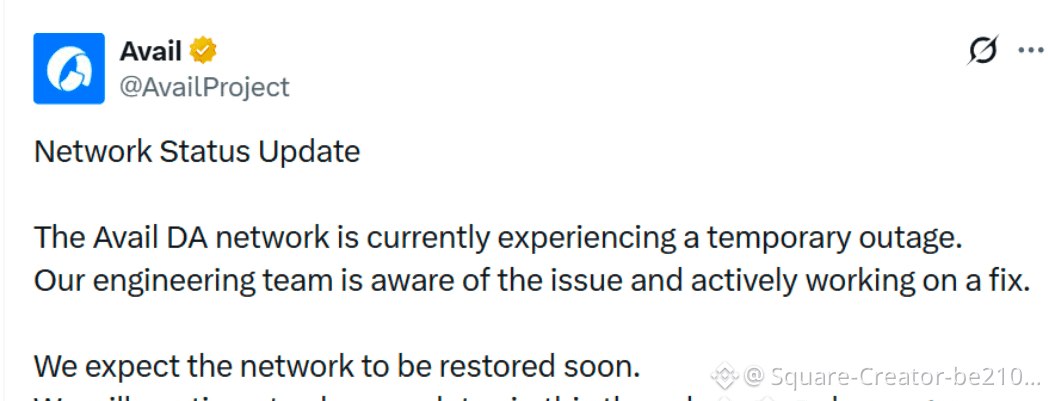
Suffered a sudden outage – the standardized layer is under testing!
Avail DA network faced an unexpected technical issue, putting the structure of vital data availability under real pressure, while the core team works to resolve the problem.
⏳ When the infrastructure goes down, all protocols that rely on it are affected. Attention is now focused on the speed of recovery—do the builders have emergency mechanisms ready?
📌 This outage reveals potential weaknesses, and how AVAIL handles the situation will determine the direction of the modular networking sector as a whole.
💬 Does this event change your long-term view of modular DA networks?
$X
{alpha}(560x0510101ec6c49d24ed911f0011e22a0d697ee776)
$P
{alpha}(560x810df4c7daf4ee06ae7c621d0680e73a505c9a06)
⚠️ Technical analysis only, not investment advice. Always understand your risks.
🏷️ #Avail #أخبار_العملات #بلوكشين #X #pepe⚡
🚨 $AVAIL
Suffered a sudden outage – the standardized layer is under testing!
Avail DA network faced an unexpected technical issue, putting the structure of vital data availability under real pressure, while the core team works to resolve the problem.
⏳ When the infrastructure goes down, all protocols that rely on it are affected. Attention is now focused on the speed of recovery—do the builders have emergency mechanisms ready?
📌 This outage reveals potential weaknesses, and how AVAIL handles the situation will determine the direction of the modular networking sector as a whole.
💬 Does this event change your long-term view of modular DA networks?
$X
$P
⚠️ Technical analysis only, not investment advice. Always understand your risks.
🏷️ #Avail #أخبار_العملات #بلوكشين #X #pepe⚡
Suffered a sudden outage – the standardized layer is under testing!
Avail DA network faced an unexpected technical issue, putting the structure of vital data availability under real pressure, while the core team works to resolve the problem.
⏳ When the infrastructure goes down, all protocols that rely on it are affected. Attention is now focused on the speed of recovery—do the builders have emergency mechanisms ready?
📌 This outage reveals potential weaknesses, and how AVAIL handles the situation will determine the direction of the modular networking sector as a whole.
💬 Does this event change your long-term view of modular DA networks?
$X
$P
⚠️ Technical analysis only, not investment advice. Always understand your risks.
🏷️ #Avail #أخبار_العملات #بلوكشين #X #pepe⚡
1
1
100

Verified
#AVAIL
Build what's next
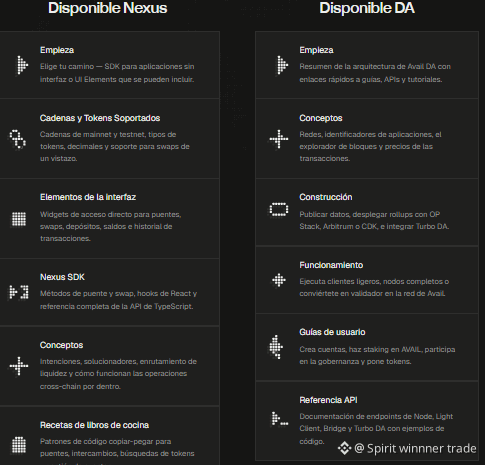
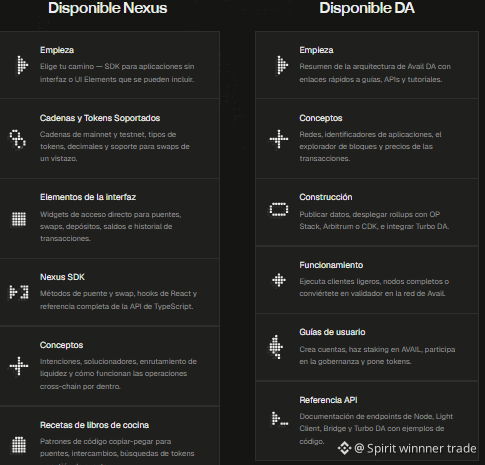
Secure and scalable infrastructure to connect your application to all the major blockchain networks from day one.
Build on the blockchain of your choice, whether L1 or L2, without limiting your reach. Avail Nexus allows developers to tap into all users, tokens, and applications from all major blockchain networks without having to worry about which chain an asset or application is based on.
Avail DA unlocks an unlimited block space for the next generation of high-performance chains. Power DeFi, stablecoins, RWAs, games, and TradFi with a cryptographically verifiable DA layer that scales horizontally, making blockchains faster, lighter, and infinitely extensible.
$AVAIL
{alpha}(560x39702843a6733932ec7ce0dde404e5a6dbd8c989)
#AVAIL
Build what's next
Secure and scalable infrastructure to connect your application to all the major blockchain networks from day one.
Build on the blockchain of your choice, whether L1 or L2, without limiting your reach. Avail Nexus allows developers to tap into all users, tokens, and applications from all major blockchain networks without having to worry about which chain an asset or application is based on.
Avail DA unlocks an unlimited block space for the next generation of high-performance chains. Power DeFi, stablecoins, RWAs, games, and TradFi with a cryptographically verifiable DA layer that scales horizontally, making blockchains faster, lighter, and infinitely extensible.
$AVAIL
Build what's next
Secure and scalable infrastructure to connect your application to all the major blockchain networks from day one.
Build on the blockchain of your choice, whether L1 or L2, without limiting your reach. Avail Nexus allows developers to tap into all users, tokens, and applications from all major blockchain networks without having to worry about which chain an asset or application is based on.
Avail DA unlocks an unlimited block space for the next generation of high-performance chains. Power DeFi, stablecoins, RWAs, games, and TradFi with a cryptographically verifiable DA layer that scales horizontally, making blockchains faster, lighter, and infinitely extensible.
$AVAIL


1
2
144

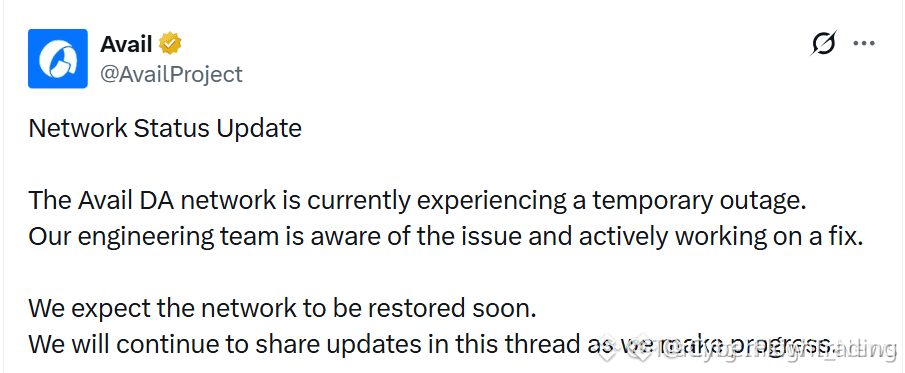
MODULAR LAYER UNDER PRESSURE AS $AVAIL SUFFERS UNEXPECTED NETWORK OUTAGE! 🚨 💥
The modular narrative just hit a sudden bump in the road. 🚨 Avail DA is currently down due to an unexpected technical outage, putting critical data availability infrastructure under a real-time stress test while the core team races for a fix.
When infrastructure halts, the ripple effects hit every protocol relying on its execution pipeline. 📊 Smart money is watching closely to see how quickly consensus recovers and whether builders have contingency fail-safes ready.
Downtime exposes systemic vulnerabilities, and how $AVAIL handles this recovery will set the tone for the entire modular sector. 💬 Does this outage change your long-term thesis on modular DA networks? 👇
⚠️ Not financial advice. Always manage your risk. 🛡️
🏷️ #AVAIL #CryptoNews #Modular #Blockchain
🚨 👁️
MODULAR LAYER UNDER PRESSURE AS $AVAIL SUFFERS UNEXPECTED NETWORK OUTAGE! 🚨 💥
The modular narrative just hit a sudden bump in the road. 🚨 Avail DA is currently down due to an unexpected technical outage, putting critical data availability infrastructure under a real-time stress test while the core team races for a fix.
When infrastructure halts, the ripple effects hit every protocol relying on its execution pipeline. 📊 Smart money is watching closely to see how quickly consensus recovers and whether builders have contingency fail-safes ready.
Downtime exposes systemic vulnerabilities, and how $AVAIL handles this recovery will set the tone for the entire modular sector. 💬 Does this outage change your long-term thesis on modular DA networks? 👇
⚠️ Not financial advice. Always manage your risk. 🛡️
🏷️ #AVAIL #CryptoNews #Modular #Blockchain
🚨 👁️
The modular narrative just hit a sudden bump in the road. 🚨 Avail DA is currently down due to an unexpected technical outage, putting critical data availability infrastructure under a real-time stress test while the core team races for a fix.
When infrastructure halts, the ripple effects hit every protocol relying on its execution pipeline. 📊 Smart money is watching closely to see how quickly consensus recovers and whether builders have contingency fail-safes ready.
Downtime exposes systemic vulnerabilities, and how $AVAIL handles this recovery will set the tone for the entire modular sector. 💬 Does this outage change your long-term thesis on modular DA networks? 👇
⚠️ Not financial advice. Always manage your risk. 🛡️
🏷️ #AVAIL #CryptoNews #Modular #Blockchain
🚨 👁️
1
62

·
--
$PIEVERSE +4.67% → $1.06136
$MAGMA +4.67% → $0.35212
$AVAIL +4.60% → $0.002199
PIEVERSE and MAGMA are running exactly identically tonight, both holding modest gains. AVAIL trails slightly but still posts a respectable move on the board.
#Binance #Write2Earn #PIEVERSE #MAGMA #AVAIL
$PIEVERSE +4.67% → $1.06136
$MAGMA +4.67% → $0.35212
$AVAIL +4.60% → $0.002199
PIEVERSE and MAGMA are running exactly identically tonight, both holding modest gains. AVAIL trails slightly but still posts a respectable move on the board.
#Binance #Write2Earn #PIEVERSE #MAGMA #AVAIL
$MAGMA +4.67% → $0.35212
$AVAIL +4.60% → $0.002199
PIEVERSE and MAGMA are running exactly identically tonight, both holding modest gains. AVAIL trails slightly but still posts a respectable move on the board.
#Binance #Write2Earn #PIEVERSE #MAGMA #AVAIL
1
207

·
--
🔷 Why you should look at $AVAIL
{alpha}(560x39702843a6733932ec7ce0dde404e5a6dbd8c989)
📋 Achievements and milestones:
• Modular data availability layer for rollups, L2s, and app-chains
• Three-part architecture: DA (data), Nexus (interoperability), Fusion (security)
• Live mainnet since 2024 alongside Celestia and EigenDA
• Nexus connects chains: seamless asset movement between rollups
🧠 My take: AVAIL sells rollups “space for data”: instead of expensive publication on Ethereum, rollups publish data to Avail more cheaply. The data-availability market is a price war: Celestia started earlier, and EigenDA has the Ethereum ecosystem. Avail’s answer is Nexus: not just data, but a chain-to-chain unification through interoperability. If Nexus succeeds, Avail becomes more than a data layer: a bridge between rollups without fragmentation. But while Nexus is still under development, the project is selling a product whose price is falling.
🔮 What to watch: Nexus launch and adoption; rollups on Avail DA; Fusion for shared security.
⚠️ Risks: a price war with Celestia and EigenDA; data as a commodity with a declining price; Nexus delays.
❓ Can Avail escape the commodity trap through Nexus? 👇
#Avail
🔷 Why you should look at $AVAIL
📋 Achievements and milestones:
• Modular data availability layer for rollups, L2s, and app-chains
• Three-part architecture: DA (data), Nexus (interoperability), Fusion (security)
• Live mainnet since 2024 alongside Celestia and EigenDA
• Nexus connects chains: seamless asset movement between rollups
🧠 My take: AVAIL sells rollups “space for data”: instead of expensive publication on Ethereum, rollups publish data to Avail more cheaply. The data-availability market is a price war: Celestia started earlier, and EigenDA has the Ethereum ecosystem. Avail’s answer is Nexus: not just data, but a chain-to-chain unification through interoperability. If Nexus succeeds, Avail becomes more than a data layer: a bridge between rollups without fragmentation. But while Nexus is still under development, the project is selling a product whose price is falling.
🔮 What to watch: Nexus launch and adoption; rollups on Avail DA; Fusion for shared security.
⚠️ Risks: a price war with Celestia and EigenDA; data as a commodity with a declining price; Nexus delays.
❓ Can Avail escape the commodity trap through Nexus? 👇
#Avail
📋 Achievements and milestones:
• Modular data availability layer for rollups, L2s, and app-chains
• Three-part architecture: DA (data), Nexus (interoperability), Fusion (security)
• Live mainnet since 2024 alongside Celestia and EigenDA
• Nexus connects chains: seamless asset movement between rollups
🧠 My take: AVAIL sells rollups “space for data”: instead of expensive publication on Ethereum, rollups publish data to Avail more cheaply. The data-availability market is a price war: Celestia started earlier, and EigenDA has the Ethereum ecosystem. Avail’s answer is Nexus: not just data, but a chain-to-chain unification through interoperability. If Nexus succeeds, Avail becomes more than a data layer: a bridge between rollups without fragmentation. But while Nexus is still under development, the project is selling a product whose price is falling.
🔮 What to watch: Nexus launch and adoption; rollups on Avail DA; Fusion for shared security.
⚠️ Risks: a price war with Celestia and EigenDA; data as a commodity with a declining price; Nexus delays.
❓ Can Avail escape the commodity trap through Nexus? 👇
#Avail
2
64
·
--
$AVAIL +16.39% | $DOS +16.02% | $PEPE +15.06%
#AVAIL on BSC nudged up to $0.00170633, climbing +16.39% with $86.0K traded and a $7.0M market cap.
DOS on BSC rose to $0.1991, gaining +16.02% on $3.9M of volume and a $39.8M market cap.
PEPE on TRON edged higher to $0.00101666, up +15.06% with $52.7K traded and a $1.0M market cap. ⚠️ Such a jump could reverse quickly given the low market cap.
DOS’s relatively strong volume compared to its market size makes its momentum worth watching.
#BinanceAlpha #TopGainers #Write2Earn #Binance
$AVAIL +16.39% | $DOS +16.02% | $PEPE +15.06%
#AVAIL on BSC nudged up to $0.00170633, climbing +16.39% with $86.0K traded and a $7.0M market cap.
DOS on BSC rose to $0.1991, gaining +16.02% on $3.9M of volume and a $39.8M market cap.
PEPE on TRON edged higher to $0.00101666, up +15.06% with $52.7K traded and a $1.0M market cap. ⚠️ Such a jump could reverse quickly given the low market cap.
DOS’s relatively strong volume compared to its market size makes its momentum worth watching.
#BinanceAlpha #TopGainers #Write2Earn #Binance
#AVAIL on BSC nudged up to $0.00170633, climbing +16.39% with $86.0K traded and a $7.0M market cap.
DOS on BSC rose to $0.1991, gaining +16.02% on $3.9M of volume and a $39.8M market cap.
PEPE on TRON edged higher to $0.00101666, up +15.06% with $52.7K traded and a $1.0M market cap. ⚠️ Such a jump could reverse quickly given the low market cap.
DOS’s relatively strong volume compared to its market size makes its momentum worth watching.
#BinanceAlpha #TopGainers #Write2Earn #Binance

Verified
Article
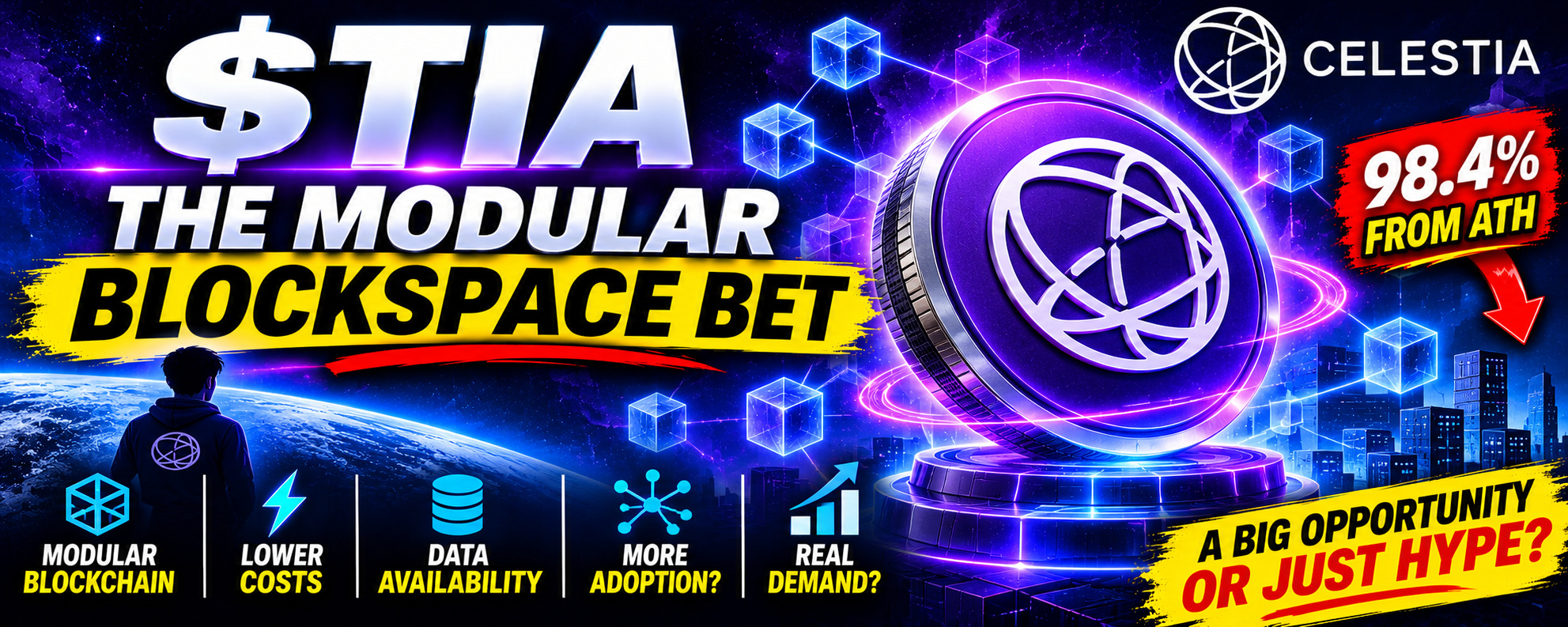
🌚$TIA — THE MODULAR BLOCKSPACE BET👀A roughly $342 MILLION cryptocurrency.
⠀
Nearly 993 MILLION tokens circulating.
⠀
Infrastructure designed to supply data availability to other blockchains.
⠀
And a token trading approximately 98.4% below its all-time high.
⠀
But here's the contradiction.
⠀
Celestia wants blockspace to become dramatically cheaper and more abundant.
⠀
$TIA investors still need that abundant capacity to generate meaningful economic demand.
⠀
More data does not automatically mean more revenue.
⠀
Is $TIA an overlooked bet on the next generation of blockchain infrastructure?
⠀
Or does cheap blockspace remain a difficult business for token holders?
⠀
Let's examine the numbers.
⠀
01 | WHAT IS CELESTIA?
⠀
Celestia is a modular data availability network.
⠀
Its central function is helping other chains publish data that participants can verify is available.
⠀
Execution and settlement can operate elsewhere.
⠀
This lets developers build application-specific chains without recreating every infrastructure component.
⠀
Data availability sampling allows light nodes to check availability without downloading entire blocks.
⠀
However, availability is different from permanent archival storage.
⠀
Applications still need to consider how older data remains retrievable.
⠀
The investment thesis is that many independent chains could purchase a shared infrastructure service.
⠀
The challenge is making that service economically valuable at scale.
⠀
02 | THE NUMBERS THAT MATTER
⠀
November 20, 2026 snapshot:
⠀
TIA Price: ~$0.3450
Market Cap: ~$342.5M
Reported FDV: ~$407.8M
Circulating Supply: ~992.7M TIA
Current Total Supply: ~1.182B TIA
Circulating / Current Total Supply: ~84.0%
Genesis Supply: 1B TIA
Maximum Supply: No fixed cap
24H Trading Volume: ~$18.7M
All-Time High: ~$20.91
Decline From ATH: ~98.4%
⠀
NETWORK ECONOMICS:
⠀
DefiLlama Tracked Chain Fees, 24H: ~$46
Post-v6 Inflation Framework: ~2.5% initially, declining annually
Long-Term Scheduled Inflation Floor: 1.5%
⠀
Exchange trading volume is not customer spending on Celestia.
⠀
The reported FDV uses currently issued supply.
⠀
It does not include every token that could be created through future inflation.
⠀
03 | THE CUSTOMER IS ANOTHER CHAIN
⠀
Celestia's customer relationship differs from that of a consumer trading application.
⠀
Rollups and infrastructure operators purchase data availability.
⠀
Their users may never interact directly with Celestia.
⠀
That can create efficient distribution.
⠀
One successful customer could bring substantial recurring demand.
⠀
But it also makes customer quality important.
⠀
A list of integrations does not reveal how many customers publish data consistently.
⠀
Investors should examine recurring paying namespaces, spending concentration, and customer retention.
⠀
Ten experimental chains can be less valuable than one durable production customer.
⠀
04 | THE FIBRE CHANGE
⠀
Fibre materially expands Celestia's technical ambitions.
⠀
The team reported an end-to-end benchmark sustaining approximately 3.07 terabits per second across 120 validators.
⠀
Its October 29 announcement also confirmed that Fibre had gone live on mainnet the previous week.
⠀
That moves the discussion beyond an entirely future roadmap.
⠀
However, benchmark throughput is capacity.
⠀
It is not customer utilization.
⠀
Nor is it fee revenue.
⠀
Fibre separates bulk data distribution from the commitments recorded onchain.
⠀
The investment question is whether applications actually need and pay for that capacity.
⠀
05 | THE VOYAGER OPPORTUNITY
⠀
Celestia introduced Voyager as an execution architecture targeting high-volume payments.
⠀
Its initial benchmark reported 21 million transactions per second.
⠀
The proposed market includes agents making small payments for content, data, and services.
⠀
That is a plausible reason applications might demand much more bandwidth.
⠀
But a benchmark payment is not a paying customer.
⠀
And the value transferred by an application is not automatically Celestia revenue.
⠀
The useful evidence would be production applications, recurring funded usage, and fees attributable to their data requirements.
⠀
The commercial opportunity remains separate from the performance demonstration.
⠀
06 | HOW TIA CAPTURES VALUE
⠀
Publishing conventional blobs on Celestia requires fees denominated in TIA.
⠀
That creates a direct utility connection.
⠀
TIA also supports staking and governance.
⠀
Developers can choose to use TIA as their own chain's gas token.
⠀
That additional role is optional.
⠀
A rollup using Celestia does not automatically require every user to hold TIA.
⠀
An operator can acquire the tokens needed for its publishing costs.
⠀
Consequently, the relevant demand is the amount of TIA customers need to purchase, hold, or commit.
⠀
An integration count alone cannot establish that amount.
⠀
07 | THE CHEAP BLOCKSPACE PARADOX
⠀
Lower costs make Celestia more attractive to developers.
⠀
But lower revenue per unit means usage must grow enough to compensate.
⠀
Compression can reduce the data required for each transaction.
⠀
Batching can spread publishing costs across more users.
⠀
These improvements benefit applications.
⠀
They can also weaken the relationship between application transaction counts and Celestia fees.
⠀
The latest tracked daily chain fees were approximately $46.
⠀
That is a single-day observation, not a complete revenue forecast or independently audited Fibre business statement.
⠀
Nevertheless, it illustrates why a capacity headline cannot substitute for evidence of monetization.
⠀
08 | THE INFLATION FRAMEWORK CHANGED
⠀
Repeating Celestia's original 8% inflation schedule would misdescribe its current framework.
⠀
The July 2025 Lotus upgrade reduced inflation to approximately 5%.
⠀
The November 2025 v6 upgrade reduced it again to approximately 2.5%.
⠀
The revised schedule decreases the rate by 6.7% annually toward a 1.5% floor.
⠀
These changes reduce ongoing issuance relative to the original design.
⠀
They do not create a fixed supply.
⠀
Lower inflation means slower dilution.
⠀
Deflation would require total supply to decline.
⠀
Those are different outcomes.
⠀
09 | THE UNLOCK STORY HAS ALSO CHANGED
⠀
The original vesting schedule placed early-backer completion in October 2025 and initial core-contributor completion in October 2026.
⠀
R&D and ecosystem vesting continues into October 2027.
⠀
The remaining scheduled R&D release is approximately 183,562 TIA daily.
⠀
That means old narratives about every initial investor allocation still vesting are outdated.
⠀
However, unlocked tokens can remain in custody and be distributed later.
⠀
Transferability is different from selling.
⠀
Staking issuance is also separate from allocation unlocks.
⠀
The relevant analysis combines actual circulation changes, treasury distributions, and new issuance without counting the same tokens twice.
⠀
10 | THE VALUATION QUESTION
⠀
Using approximately 1.182 billion current total tokens:
⠀
$0.50 TIA implies ~$591M total-supply valuation.
$1.00 implies ~$1.18B.
$2.00 implies ~$2.36B.
$5.00 implies ~$5.91B.
$10.00 implies ~$11.82B.
$20.91 implies ~$24.72B.
⠀
These are valuation illustrations, not price targets.
⠀
Future issuance changes the denominator.
⠀
The old price high is therefore not a shortcut to fair value.
⠀
Likewise, conventional DeFi TVL is a weak standalone measure for a network selling data availability.
⠀
A better valuation discussion starts with recurring customer spending, competitive pricing, and the security costs required to deliver the service.
⠀
11 | THE BULL AND BEAR CASE
⠀
THE BULL CASE:
⠀
Fibre attracts applications that existing infrastructure struggles to serve.
⠀
Production customers publish substantially more paid data.
⠀
Demand grows faster than improvements reduce cost per transaction.
⠀
Customer spending becomes broader and more durable.
⠀
And reduced issuance improves the balance between token demand and supply.
⠀
THE BEAR CASE:
⠀
Technical capacity grows faster than commercial demand.
⠀
Competing data availability services compress pricing.
⠀
Customers optimize away much of their publishing expense.
⠀
Activity remains concentrated in a few subsidized applications.
⠀
And issuance continues while fee demand stays small.
⠀
The network can become more useful without the token becoming proportionately more valuable.
⠀
12 | THE FINAL VERDICT
⠀
Celestia has a specific product and a clear customer category.
⠀
Fibre is now a deployed development.
⠀
The inflation framework is materially less aggressive than the original schedule.
⠀
And much of the initial backer and contributor vesting period has passed.
⠀
Those changes deserve recognition.
⠀
But the central investment question remains unresolved.
⠀
Can cheap, abundant data availability produce enough recurring economic demand to support TIA's valuation?
⠀
My assessment:
⠀
TIA is a bet on future paid infrastructure demand whose commercial evidence must catch up with its technical progress.
⠀
A roughly $342 million market capitalization creates a different starting valuation from the previous cycle.
⠀
It does not prove the token is cheap.
⠀
More capacity creates an opportunity.
⠀
Retained customers create recurring usage.
⠀
Paid publishing creates TIA demand.
⠀
Demand relative to issuance determines how much of that progress benefits holders.
⠀
Bookmark this analysis before the next modular infrastructure rotation.
⠀
Which has the strongest long-term data availability thesis?
⠀
TIA , $AVAIL , or $EIGEN?
⠀
And can Celestia turn abundant blockspace into sustainable token value?
⠀
Drop your view below.
#tia #Avail #eigen
🌚$TIA — THE MODULAR BLOCKSPACE BET👀
A roughly $342 MILLION cryptocurrency.
⠀
Nearly 993 MILLION tokens circulating.
⠀
Infrastructure designed to supply data availability to other blockchains.
⠀
And a token trading approximately 98.4% below its all-time high.
⠀
But here's the contradiction.
⠀
Celestia wants blockspace to become dramatically cheaper and more abundant.
⠀
$TIA investors still need that abundant capacity to generate meaningful economic demand.
⠀
More data does not automatically mean more revenue.
⠀
Is $TIA an overlooked bet on the next generation of blockchain infrastructure?
⠀
Or does cheap blockspace remain a difficult business for token holders?
⠀
Let's examine the numbers.
⠀
01 | WHAT IS CELESTIA?
⠀
Celestia is a modular data availability network.
⠀
Its central function is helping other chains publish data that participants can verify is available.
⠀
Execution and settlement can operate elsewhere.
⠀
This lets developers build application-specific chains without recreating every infrastructure component.
⠀
Data availability sampling allows light nodes to check availability without downloading entire blocks.
⠀
However, availability is different from permanent archival storage.
⠀
Applications still need to consider how older data remains retrievable.
⠀
The investment thesis is that many independent chains could purchase a shared infrastructure service.
⠀
The challenge is making that service economically valuable at scale.
⠀
02 | THE NUMBERS THAT MATTER
⠀
November 20, 2026 snapshot:
⠀
TIA Price: ~$0.3450
Market Cap: ~$342.5M
Reported FDV: ~$407.8M
Circulating Supply: ~992.7M TIA
Current Total Supply: ~1.182B TIA
Circulating / Current Total Supply: ~84.0%
Genesis Supply: 1B TIA
Maximum Supply: No fixed cap
24H Trading Volume: ~$18.7M
All-Time High: ~$20.91
Decline From ATH: ~98.4%
⠀
NETWORK ECONOMICS:
⠀
DefiLlama Tracked Chain Fees, 24H: ~$46
Post-v6 Inflation Framework: ~2.5% initially, declining annually
Long-Term Scheduled Inflation Floor: 1.5%
⠀
Exchange trading volume is not customer spending on Celestia.
⠀
The reported FDV uses currently issued supply.
⠀
It does not include every token that could be created through future inflation.
⠀
03 | THE CUSTOMER IS ANOTHER CHAIN
⠀
Celestia's customer relationship differs from that of a consumer trading application.
⠀
Rollups and infrastructure operators purchase data availability.
⠀
Their users may never interact directly with Celestia.
⠀
That can create efficient distribution.
⠀
One successful customer could bring substantial recurring demand.
⠀
But it also makes customer quality important.
⠀
A list of integrations does not reveal how many customers publish data consistently.
⠀
Investors should examine recurring paying namespaces, spending concentration, and customer retention.
⠀
Ten experimental chains can be less valuable than one durable production customer.
⠀
04 | THE FIBRE CHANGE
⠀
Fibre materially expands Celestia's technical ambitions.
⠀
The team reported an end-to-end benchmark sustaining approximately 3.07 terabits per second across 120 validators.
⠀
Its October 29 announcement also confirmed that Fibre had gone live on mainnet the previous week.
⠀
That moves the discussion beyond an entirely future roadmap.
⠀
However, benchmark throughput is capacity.
⠀
It is not customer utilization.
⠀
Nor is it fee revenue.
⠀
Fibre separates bulk data distribution from the commitments recorded onchain.
⠀
The investment question is whether applications actually need and pay for that capacity.
⠀
05 | THE VOYAGER OPPORTUNITY
⠀
Celestia introduced Voyager as an execution architecture targeting high-volume payments.
⠀
Its initial benchmark reported 21 million transactions per second.
⠀
The proposed market includes agents making small payments for content, data, and services.
⠀
That is a plausible reason applications might demand much more bandwidth.
⠀
But a benchmark payment is not a paying customer.
⠀
And the value transferred by an application is not automatically Celestia revenue.
⠀
The useful evidence would be production applications, recurring funded usage, and fees attributable to their data requirements.
⠀
The commercial opportunity remains separate from the performance demonstration.
⠀
06 | HOW TIA CAPTURES VALUE
⠀
Publishing conventional blobs on Celestia requires fees denominated in TIA.
⠀
That creates a direct utility connection.
⠀
TIA also supports staking and governance.
⠀
Developers can choose to use TIA as their own chain's gas token.
⠀
That additional role is optional.
⠀
A rollup using Celestia does not automatically require every user to hold TIA.
⠀
An operator can acquire the tokens needed for its publishing costs.
⠀
Consequently, the relevant demand is the amount of TIA customers need to purchase, hold, or commit.
⠀
An integration count alone cannot establish that amount.
⠀
07 | THE CHEAP BLOCKSPACE PARADOX
⠀
Lower costs make Celestia more attractive to developers.
⠀
But lower revenue per unit means usage must grow enough to compensate.
⠀
Compression can reduce the data required for each transaction.
⠀
Batching can spread publishing costs across more users.
⠀
These improvements benefit applications.
⠀
They can also weaken the relationship between application transaction counts and Celestia fees.
⠀
The latest tracked daily chain fees were approximately $46.
⠀
That is a single-day observation, not a complete revenue forecast or independently audited Fibre business statement.
⠀
Nevertheless, it illustrates why a capacity headline cannot substitute for evidence of monetization.
⠀
08 | THE INFLATION FRAMEWORK CHANGED
⠀
Repeating Celestia's original 8% inflation schedule would misdescribe its current framework.
⠀
The July 2025 Lotus upgrade reduced inflation to approximately 5%.
⠀
The November 2025 v6 upgrade reduced it again to approximately 2.5%.
⠀
The revised schedule decreases the rate by 6.7% annually toward a 1.5% floor.
⠀
These changes reduce ongoing issuance relative to the original design.
⠀
They do not create a fixed supply.
⠀
Lower inflation means slower dilution.
⠀
Deflation would require total supply to decline.
⠀
Those are different outcomes.
⠀
09 | THE UNLOCK STORY HAS ALSO CHANGED
⠀
The original vesting schedule placed early-backer completion in October 2025 and initial core-contributor completion in October 2026.
⠀
R&D and ecosystem vesting continues into October 2027.
⠀
The remaining scheduled R&D release is approximately 183,562 TIA daily.
⠀
That means old narratives about every initial investor allocation still vesting are outdated.
⠀
However, unlocked tokens can remain in custody and be distributed later.
⠀
Transferability is different from selling.
⠀
Staking issuance is also separate from allocation unlocks.
⠀
The relevant analysis combines actual circulation changes, treasury distributions, and new issuance without counting the same tokens twice.
⠀
10 | THE VALUATION QUESTION
⠀
Using approximately 1.182 billion current total tokens:
⠀
$0.50 TIA implies ~$591M total-supply valuation.
$1.00 implies ~$1.18B.
$2.00 implies ~$2.36B.
$5.00 implies ~$5.91B.
$10.00 implies ~$11.82B.
$20.91 implies ~$24.72B.
⠀
These are valuation illustrations, not price targets.
⠀
Future issuance changes the denominator.
⠀
The old price high is therefore not a shortcut to fair value.
⠀
Likewise, conventional DeFi TVL is a weak standalone measure for a network selling data availability.
⠀
A better valuation discussion starts with recurring customer spending, competitive pricing, and the security costs required to deliver the service.
⠀
11 | THE BULL AND BEAR CASE
⠀
THE BULL CASE:
⠀
Fibre attracts applications that existing infrastructure struggles to serve.
⠀
Production customers publish substantially more paid data.
⠀
Demand grows faster than improvements reduce cost per transaction.
⠀
Customer spending becomes broader and more durable.
⠀
And reduced issuance improves the balance between token demand and supply.
⠀
THE BEAR CASE:
⠀
Technical capacity grows faster than commercial demand.
⠀
Competing data availability services compress pricing.
⠀
Customers optimize away much of their publishing expense.
⠀
Activity remains concentrated in a few subsidized applications.
⠀
And issuance continues while fee demand stays small.
⠀
The network can become more useful without the token becoming proportionately more valuable.
⠀
12 | THE FINAL VERDICT
⠀
Celestia has a specific product and a clear customer category.
⠀
Fibre is now a deployed development.
⠀
The inflation framework is materially less aggressive than the original schedule.
⠀
And much of the initial backer and contributor vesting period has passed.
⠀
Those changes deserve recognition.
⠀
But the central investment question remains unresolved.
⠀
Can cheap, abundant data availability produce enough recurring economic demand to support TIA's valuation?
⠀
My assessment:
⠀
TIA is a bet on future paid infrastructure demand whose commercial evidence must catch up with its technical progress.
⠀
A roughly $342 million market capitalization creates a different starting valuation from the previous cycle.
⠀
It does not prove the token is cheap.
⠀
More capacity creates an opportunity.
⠀
Retained customers create recurring usage.
⠀
Paid publishing creates TIA demand.
⠀
Demand relative to issuance determines how much of that progress benefits holders.
⠀
Bookmark this analysis before the next modular infrastructure rotation.
⠀
Which has the strongest long-term data availability thesis?
⠀
TIA , $AVAIL , or $EIGEN?
⠀
And can Celestia turn abundant blockspace into sustainable token value?
⠀
Drop your view below.
#tia #Avail #eigen
⠀
Nearly 993 MILLION tokens circulating.
⠀
Infrastructure designed to supply data availability to other blockchains.
⠀
And a token trading approximately 98.4% below its all-time high.
⠀
But here's the contradiction.
⠀
Celestia wants blockspace to become dramatically cheaper and more abundant.
⠀
$TIA investors still need that abundant capacity to generate meaningful economic demand.
⠀
More data does not automatically mean more revenue.
⠀
Is $TIA an overlooked bet on the next generation of blockchain infrastructure?
⠀
Or does cheap blockspace remain a difficult business for token holders?
⠀
Let's examine the numbers.
⠀
01 | WHAT IS CELESTIA?
⠀
Celestia is a modular data availability network.
⠀
Its central function is helping other chains publish data that participants can verify is available.
⠀
Execution and settlement can operate elsewhere.
⠀
This lets developers build application-specific chains without recreating every infrastructure component.
⠀
Data availability sampling allows light nodes to check availability without downloading entire blocks.
⠀
However, availability is different from permanent archival storage.
⠀
Applications still need to consider how older data remains retrievable.
⠀
The investment thesis is that many independent chains could purchase a shared infrastructure service.
⠀
The challenge is making that service economically valuable at scale.
⠀
02 | THE NUMBERS THAT MATTER
⠀
November 20, 2026 snapshot:
⠀
TIA Price: ~$0.3450
Market Cap: ~$342.5M
Reported FDV: ~$407.8M
Circulating Supply: ~992.7M TIA
Current Total Supply: ~1.182B TIA
Circulating / Current Total Supply: ~84.0%
Genesis Supply: 1B TIA
Maximum Supply: No fixed cap
24H Trading Volume: ~$18.7M
All-Time High: ~$20.91
Decline From ATH: ~98.4%
⠀
NETWORK ECONOMICS:
⠀
DefiLlama Tracked Chain Fees, 24H: ~$46
Post-v6 Inflation Framework: ~2.5% initially, declining annually
Long-Term Scheduled Inflation Floor: 1.5%
⠀
Exchange trading volume is not customer spending on Celestia.
⠀
The reported FDV uses currently issued supply.
⠀
It does not include every token that could be created through future inflation.
⠀
03 | THE CUSTOMER IS ANOTHER CHAIN
⠀
Celestia's customer relationship differs from that of a consumer trading application.
⠀
Rollups and infrastructure operators purchase data availability.
⠀
Their users may never interact directly with Celestia.
⠀
That can create efficient distribution.
⠀
One successful customer could bring substantial recurring demand.
⠀
But it also makes customer quality important.
⠀
A list of integrations does not reveal how many customers publish data consistently.
⠀
Investors should examine recurring paying namespaces, spending concentration, and customer retention.
⠀
Ten experimental chains can be less valuable than one durable production customer.
⠀
04 | THE FIBRE CHANGE
⠀
Fibre materially expands Celestia's technical ambitions.
⠀
The team reported an end-to-end benchmark sustaining approximately 3.07 terabits per second across 120 validators.
⠀
Its October 29 announcement also confirmed that Fibre had gone live on mainnet the previous week.
⠀
That moves the discussion beyond an entirely future roadmap.
⠀
However, benchmark throughput is capacity.
⠀
It is not customer utilization.
⠀
Nor is it fee revenue.
⠀
Fibre separates bulk data distribution from the commitments recorded onchain.
⠀
The investment question is whether applications actually need and pay for that capacity.
⠀
05 | THE VOYAGER OPPORTUNITY
⠀
Celestia introduced Voyager as an execution architecture targeting high-volume payments.
⠀
Its initial benchmark reported 21 million transactions per second.
⠀
The proposed market includes agents making small payments for content, data, and services.
⠀
That is a plausible reason applications might demand much more bandwidth.
⠀
But a benchmark payment is not a paying customer.
⠀
And the value transferred by an application is not automatically Celestia revenue.
⠀
The useful evidence would be production applications, recurring funded usage, and fees attributable to their data requirements.
⠀
The commercial opportunity remains separate from the performance demonstration.
⠀
06 | HOW TIA CAPTURES VALUE
⠀
Publishing conventional blobs on Celestia requires fees denominated in TIA.
⠀
That creates a direct utility connection.
⠀
TIA also supports staking and governance.
⠀
Developers can choose to use TIA as their own chain's gas token.
⠀
That additional role is optional.
⠀
A rollup using Celestia does not automatically require every user to hold TIA.
⠀
An operator can acquire the tokens needed for its publishing costs.
⠀
Consequently, the relevant demand is the amount of TIA customers need to purchase, hold, or commit.
⠀
An integration count alone cannot establish that amount.
⠀
07 | THE CHEAP BLOCKSPACE PARADOX
⠀
Lower costs make Celestia more attractive to developers.
⠀
But lower revenue per unit means usage must grow enough to compensate.
⠀
Compression can reduce the data required for each transaction.
⠀
Batching can spread publishing costs across more users.
⠀
These improvements benefit applications.
⠀
They can also weaken the relationship between application transaction counts and Celestia fees.
⠀
The latest tracked daily chain fees were approximately $46.
⠀
That is a single-day observation, not a complete revenue forecast or independently audited Fibre business statement.
⠀
Nevertheless, it illustrates why a capacity headline cannot substitute for evidence of monetization.
⠀
08 | THE INFLATION FRAMEWORK CHANGED
⠀
Repeating Celestia's original 8% inflation schedule would misdescribe its current framework.
⠀
The July 2025 Lotus upgrade reduced inflation to approximately 5%.
⠀
The November 2025 v6 upgrade reduced it again to approximately 2.5%.
⠀
The revised schedule decreases the rate by 6.7% annually toward a 1.5% floor.
⠀
These changes reduce ongoing issuance relative to the original design.
⠀
They do not create a fixed supply.
⠀
Lower inflation means slower dilution.
⠀
Deflation would require total supply to decline.
⠀
Those are different outcomes.
⠀
09 | THE UNLOCK STORY HAS ALSO CHANGED
⠀
The original vesting schedule placed early-backer completion in October 2025 and initial core-contributor completion in October 2026.
⠀
R&D and ecosystem vesting continues into October 2027.
⠀
The remaining scheduled R&D release is approximately 183,562 TIA daily.
⠀
That means old narratives about every initial investor allocation still vesting are outdated.
⠀
However, unlocked tokens can remain in custody and be distributed later.
⠀
Transferability is different from selling.
⠀
Staking issuance is also separate from allocation unlocks.
⠀
The relevant analysis combines actual circulation changes, treasury distributions, and new issuance without counting the same tokens twice.
⠀
10 | THE VALUATION QUESTION
⠀
Using approximately 1.182 billion current total tokens:
⠀
$0.50 TIA implies ~$591M total-supply valuation.
$1.00 implies ~$1.18B.
$2.00 implies ~$2.36B.
$5.00 implies ~$5.91B.
$10.00 implies ~$11.82B.
$20.91 implies ~$24.72B.
⠀
These are valuation illustrations, not price targets.
⠀
Future issuance changes the denominator.
⠀
The old price high is therefore not a shortcut to fair value.
⠀
Likewise, conventional DeFi TVL is a weak standalone measure for a network selling data availability.
⠀
A better valuation discussion starts with recurring customer spending, competitive pricing, and the security costs required to deliver the service.
⠀
11 | THE BULL AND BEAR CASE
⠀
THE BULL CASE:
⠀
Fibre attracts applications that existing infrastructure struggles to serve.
⠀
Production customers publish substantially more paid data.
⠀
Demand grows faster than improvements reduce cost per transaction.
⠀
Customer spending becomes broader and more durable.
⠀
And reduced issuance improves the balance between token demand and supply.
⠀
THE BEAR CASE:
⠀
Technical capacity grows faster than commercial demand.
⠀
Competing data availability services compress pricing.
⠀
Customers optimize away much of their publishing expense.
⠀
Activity remains concentrated in a few subsidized applications.
⠀
And issuance continues while fee demand stays small.
⠀
The network can become more useful without the token becoming proportionately more valuable.
⠀
12 | THE FINAL VERDICT
⠀
Celestia has a specific product and a clear customer category.
⠀
Fibre is now a deployed development.
⠀
The inflation framework is materially less aggressive than the original schedule.
⠀
And much of the initial backer and contributor vesting period has passed.
⠀
Those changes deserve recognition.
⠀
But the central investment question remains unresolved.
⠀
Can cheap, abundant data availability produce enough recurring economic demand to support TIA's valuation?
⠀
My assessment:
⠀
TIA is a bet on future paid infrastructure demand whose commercial evidence must catch up with its technical progress.
⠀
A roughly $342 million market capitalization creates a different starting valuation from the previous cycle.
⠀
It does not prove the token is cheap.
⠀
More capacity creates an opportunity.
⠀
Retained customers create recurring usage.
⠀
Paid publishing creates TIA demand.
⠀
Demand relative to issuance determines how much of that progress benefits holders.
⠀
Bookmark this analysis before the next modular infrastructure rotation.
⠀
Which has the strongest long-term data availability thesis?
⠀
TIA , $AVAIL , or $EIGEN?
⠀
And can Celestia turn abundant blockspace into sustainable token value?
⠀
Drop your view below.
#tia #Avail #eigen
BitXenMaster:
tremendous
1
1
91

·
--
Bullish
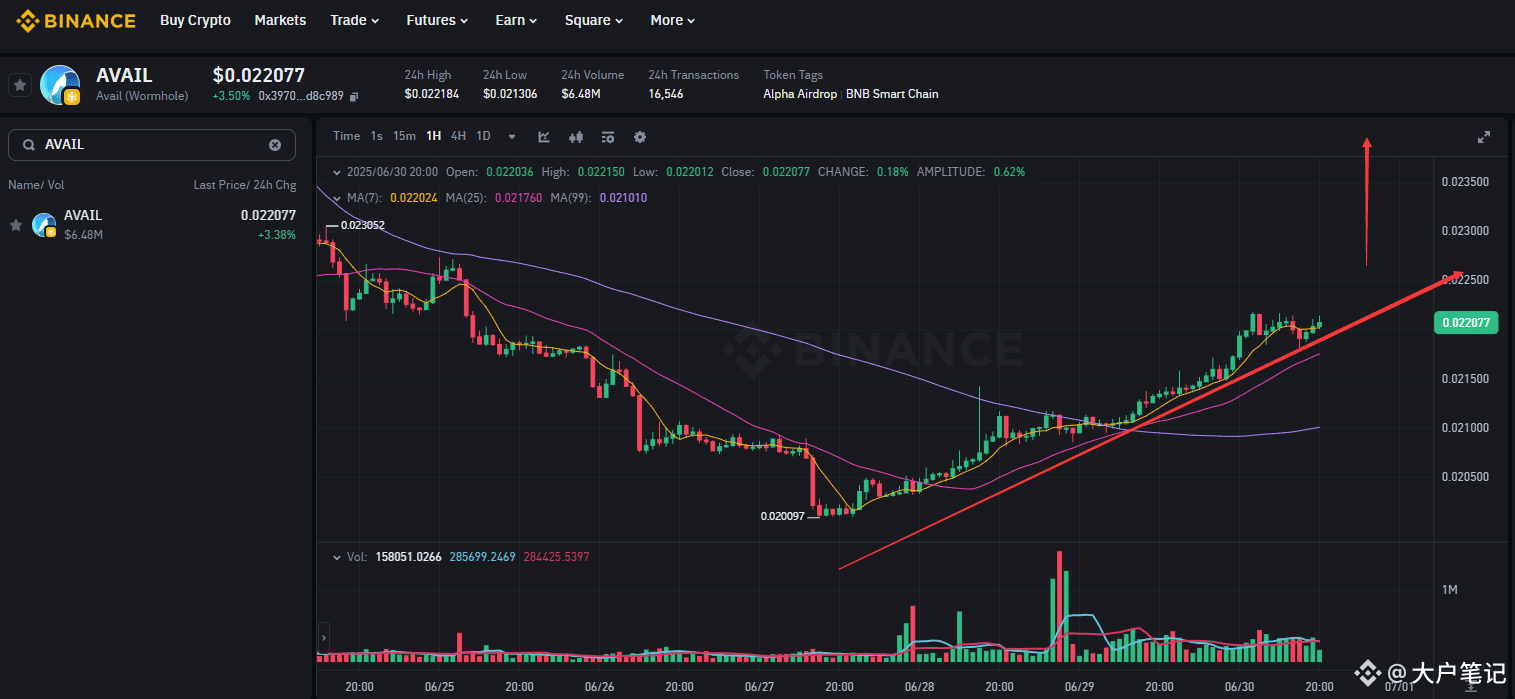
Binance Alpha launches 1-3 projects daily, bustling with activity, but to be honest, there are not many that are truly dedicated to building the ecosystem for Web3.
Today, let's talk about @AvailChina, this low-profile modular blockchain that is doing great things.
On the 20th, it went live on Binance Alpha and held a $1 million trading competition (ending on July 4), definitely giving away benefits!
Avail (@AvailProject) is a modular blockchain platform focused on data availability and cross-chain interoperability.
It has secured $75 million in funding from top institutions, with over 10 chains already operating within its ecosystem, including Lens, Sophon, Space and Time, Lumia, and more than 50 additional chains poised to launch.
Avail's core technology and competitive advantages
• Turbo DA: Efficient data availability
Avail's Turbo DA technology significantly reduces Rollup costs by optimizing data storage and verification.
• Avail Stack: Developer-friendly full-stack ecosystem
Avail Stack integrates DA, light client validation, and cross-chain interoperability tools to provide developers with a one-stop solution.
• Avail Nexus: The bridge for cross-chain interoperability
Nexus utilizes zero-knowledge technology to achieve seamless connections between multiple chains, supporting cross-chain transactions and data sharing among ecosystems like Ethereum, Solana, and Cosmos, providing limitless possibilities for Web3 applications.
• Avail state collaboration and RWA potential
Avail collaborates with five major Ethereum Rollups such as Arbitrum, Optimism, Polygon, and over 100 partners, covering DeFi, SocialFi, RWA, and other tracks.
AVAIL token, the “fuel” of the ecosystem
The AVAIL token runs throughout the Avail ecosystem, possessing both functional and governance value, with main uses including:
• DA and transaction fees: To pay for data storage and cross-chain transaction fees.
• PoS security: Staking ensures the mainnet's security, with community validators and stakers maintaining it together.
• Nexus cross-chain: Supports cross-chain messaging and interoperability.
• Incentive mechanism: Provides stakers with an annual yield of 8%-12%, and some ecosystem projects airdrop native tokens to AVAIL holders.
Why are we optimistic about Avail?
Avail is not the kind of vapor project that appears on Binance Alpha and disappears; it is genuinely laying the foundation, building roads, and creating an ecosystem for Web3. With solid technology, a reliable team, and a rapidly growing ecosystem, plus the traffic boost from Binance Alpha and the million-dollar trading competition, the momentum of AVAIL is quite strong.
#Alpha交易大赛 #币安Alpha上新 #AVAIL
Binance Alpha launches 1-3 projects daily, bustling with activity, but to be honest, there are not many that are truly dedicated to building the ecosystem for Web3.
Today, let's talk about @AvailChina, this low-profile modular blockchain that is doing great things.
On the 20th, it went live on Binance Alpha and held a $1 million trading competition (ending on July 4), definitely giving away benefits!
Avail (@AvailProject) is a modular blockchain platform focused on data availability and cross-chain interoperability.
It has secured $75 million in funding from top institutions, with over 10 chains already operating within its ecosystem, including Lens, Sophon, Space and Time, Lumia, and more than 50 additional chains poised to launch.
Avail's core technology and competitive advantages
• Turbo DA: Efficient data availability
Avail's Turbo DA technology significantly reduces Rollup costs by optimizing data storage and verification.
• Avail Stack: Developer-friendly full-stack ecosystem
Avail Stack integrates DA, light client validation, and cross-chain interoperability tools to provide developers with a one-stop solution.
• Avail Nexus: The bridge for cross-chain interoperability
Nexus utilizes zero-knowledge technology to achieve seamless connections between multiple chains, supporting cross-chain transactions and data sharing among ecosystems like Ethereum, Solana, and Cosmos, providing limitless possibilities for Web3 applications.
• Avail state collaboration and RWA potential
Avail collaborates with five major Ethereum Rollups such as Arbitrum, Optimism, Polygon, and over 100 partners, covering DeFi, SocialFi, RWA, and other tracks.
AVAIL token, the “fuel” of the ecosystem
The AVAIL token runs throughout the Avail ecosystem, possessing both functional and governance value, with main uses including:
• DA and transaction fees: To pay for data storage and cross-chain transaction fees.
• PoS security: Staking ensures the mainnet's security, with community validators and stakers maintaining it together.
• Nexus cross-chain: Supports cross-chain messaging and interoperability.
• Incentive mechanism: Provides stakers with an annual yield of 8%-12%, and some ecosystem projects airdrop native tokens to AVAIL holders.
Why are we optimistic about Avail?
Avail is not the kind of vapor project that appears on Binance Alpha and disappears; it is genuinely laying the foundation, building roads, and creating an ecosystem for Web3. With solid technology, a reliable team, and a rapidly growing ecosystem, plus the traffic boost from Binance Alpha and the million-dollar trading competition, the momentum of AVAIL is quite strong.
#Alpha交易大赛 #币安Alpha上新 #AVAIL
Today, let's talk about @AvailChina, this low-profile modular blockchain that is doing great things.
On the 20th, it went live on Binance Alpha and held a $1 million trading competition (ending on July 4), definitely giving away benefits!
Avail (@AvailProject) is a modular blockchain platform focused on data availability and cross-chain interoperability.
It has secured $75 million in funding from top institutions, with over 10 chains already operating within its ecosystem, including Lens, Sophon, Space and Time, Lumia, and more than 50 additional chains poised to launch.
Avail's core technology and competitive advantages
• Turbo DA: Efficient data availability
Avail's Turbo DA technology significantly reduces Rollup costs by optimizing data storage and verification.
• Avail Stack: Developer-friendly full-stack ecosystem
Avail Stack integrates DA, light client validation, and cross-chain interoperability tools to provide developers with a one-stop solution.
• Avail Nexus: The bridge for cross-chain interoperability
Nexus utilizes zero-knowledge technology to achieve seamless connections between multiple chains, supporting cross-chain transactions and data sharing among ecosystems like Ethereum, Solana, and Cosmos, providing limitless possibilities for Web3 applications.
• Avail state collaboration and RWA potential
Avail collaborates with five major Ethereum Rollups such as Arbitrum, Optimism, Polygon, and over 100 partners, covering DeFi, SocialFi, RWA, and other tracks.
AVAIL token, the “fuel” of the ecosystem
The AVAIL token runs throughout the Avail ecosystem, possessing both functional and governance value, with main uses including:
• DA and transaction fees: To pay for data storage and cross-chain transaction fees.
• PoS security: Staking ensures the mainnet's security, with community validators and stakers maintaining it together.
• Nexus cross-chain: Supports cross-chain messaging and interoperability.
• Incentive mechanism: Provides stakers with an annual yield of 8%-12%, and some ecosystem projects airdrop native tokens to AVAIL holders.
Why are we optimistic about Avail?
Avail is not the kind of vapor project that appears on Binance Alpha and disappears; it is genuinely laying the foundation, building roads, and creating an ecosystem for Web3. With solid technology, a reliable team, and a rapidly growing ecosystem, plus the traffic boost from Binance Alpha and the million-dollar trading competition, the momentum of AVAIL is quite strong.
#Alpha交易大赛 #币安Alpha上新 #AVAIL
20
6
8
921

·
--
$AVAIL token is currently trading at ~$0.0039 - $0.0042. Market cap is around $15 million. Ranking is between 800-1000. Not much movement in 24 hours, sideways or slightly up-down. Volume is not very high either. It is a modular blockchain project — focused on data availability (DA) and cross-chain interoperability. Technically there is potential, but there is not much hype or adoption in the market yet.
What could the future be like? Short term (2026): Many analysts say it could be between $0.0035 and $0.006. It won't skyrocket unless there's a big catalyst. Long term (2028-2030): If the project is successful, and adoption increases on the Nexus and DA layers, then there's a chance it could go up to $0.01+. But that's not a guarantee in crypto — there's a lot of competition.
In my opinion: Still too risky. Low cap token, if it's a good project it can give multiple, but it can also be a dump. Do DYOR, don't pour all your money in one place. If you want to hold, keep a long term mindset. What do you think about AVAIL? Tell me in the comments.
#AVAIL #Crypto #AvailToken
$AVAIL token is currently trading at ~$0.0039 - $0.0042. Market cap is around $15 million. Ranking is between 800-1000. Not much movement in 24 hours, sideways or slightly up-down. Volume is not very high either. It is a modular blockchain project — focused on data availability (DA) and cross-chain interoperability. Technically there is potential, but there is not much hype or adoption in the market yet.
What could the future be like? Short term (2026): Many analysts say it could be between $0.0035 and $0.006. It won't skyrocket unless there's a big catalyst. Long term (2028-2030): If the project is successful, and adoption increases on the Nexus and DA layers, then there's a chance it could go up to $0.01+. But that's not a guarantee in crypto — there's a lot of competition.
In my opinion: Still too risky. Low cap token, if it's a good project it can give multiple, but it can also be a dump. Do DYOR, don't pour all your money in one place. If you want to hold, keep a long term mindset. What do you think about AVAIL? Tell me in the comments.
#AVAIL #Crypto #AvailToken
What could the future be like? Short term (2026): Many analysts say it could be between $0.0035 and $0.006. It won't skyrocket unless there's a big catalyst. Long term (2028-2030): If the project is successful, and adoption increases on the Nexus and DA layers, then there's a chance it could go up to $0.01+. But that's not a guarantee in crypto — there's a lot of competition.
In my opinion: Still too risky. Low cap token, if it's a good project it can give multiple, but it can also be a dump. Do DYOR, don't pour all your money in one place. If you want to hold, keep a long term mindset. What do you think about AVAIL? Tell me in the comments.
#AVAIL #Crypto #AvailToken

368
·
--
$AVAIL +7.76% | $I stepped in, here +7.67% | $TAG +7.46%
#AVAIL on BSC nudged to $0.00267553, up +7.76% on $73.3K volume, market cap $20.0M.
I stepped in, here on BSC nudged to $0.0139, up +7.67% on $343.7K volume, market cap $13.9M.
TAG on BSC nudged to $0.00088013, up +7.46% on $481.9K volume, market cap $95.4M.
⚠️ With such steep gains on modest caps, a sudden shift in sentiment could erase today’s upside quickly.
#BinanceAlpha #TopGainers #Write2Earn #Binance
$AVAIL +7.76% | $I stepped in, here +7.67% | $TAG +7.46%
#AVAIL on BSC nudged to $0.00267553, up +7.76% on $73.3K volume, market cap $20.0M.
I stepped in, here on BSC nudged to $0.0139, up +7.67% on $343.7K volume, market cap $13.9M.
TAG on BSC nudged to $0.00088013, up +7.46% on $481.9K volume, market cap $95.4M.
⚠️ With such steep gains on modest caps, a sudden shift in sentiment could erase today’s upside quickly.
#BinanceAlpha #TopGainers #Write2Earn #Binance
#AVAIL on BSC nudged to $0.00267553, up +7.76% on $73.3K volume, market cap $20.0M.
I stepped in, here on BSC nudged to $0.0139, up +7.67% on $343.7K volume, market cap $13.9M.
TAG on BSC nudged to $0.00088013, up +7.46% on $481.9K volume, market cap $95.4M.
⚠️ With such steep gains on modest caps, a sudden shift in sentiment could erase today’s upside quickly.
#BinanceAlpha #TopGainers #Write2Earn #Binance
6
·
--
$AVAIL +4.99% → $0.0022178
$RWA +4.99% → $0.0012945
$SKYAI +4. → $0.055364
Closing the visible list with AVAIL and RWA both printing almost identical +4.99% moves, while SKYAI’s percentage is partially obscured by the UI overlay (only “+4.” fully readable). Volumes are modest on the first two; SKYAI carries more activity. Always double-check the live quote when the screenshot cuts the number.
#Binance #Write2Earn #AVAIL #RWA #SKYAI
$AVAIL +4.99% → $0.0022178
$RWA +4.99% → $0.0012945
$SKYAI +4. → $0.055364
Closing the visible list with AVAIL and RWA both printing almost identical +4.99% moves, while SKYAI’s percentage is partially obscured by the UI overlay (only “+4.” fully readable). Volumes are modest on the first two; SKYAI carries more activity. Always double-check the live quote when the screenshot cuts the number.
#Binance #Write2Earn #AVAIL #RWA #SKYAI
$RWA +4.99% → $0.0012945
$SKYAI +4. → $0.055364
Closing the visible list with AVAIL and RWA both printing almost identical +4.99% moves, while SKYAI’s percentage is partially obscured by the UI overlay (only “+4.” fully readable). Volumes are modest on the first two; SKYAI carries more activity. Always double-check the live quote when the screenshot cuts the number.
#Binance #Write2Earn #AVAIL #RWA #SKYAI
195
Log in to explore more content
Join global crypto users on Binance Square
⚡️ Get latest and useful information about crypto.
💬 Trusted by the world’s largest crypto exchange.
👍 Discover real insights from verified creators.
Email / Phone number
Trending Topics
1
#IsAnthropic’s$1.5TMarketCapJustified?
57,377 views
290 Discussing
2
#BTCBelow$62KAmidHikeFearsAndShiftToAnthropic
14,978 views
95 Discussing
3
#NvidiaBoardReportedlySplitOverHuang’sReturn
241,469 views
1,916 Discussing
4
#CanGTA6'sLaunchLiftTTWOShares?
193,788 views
1,364 Discussing
5
#HongKongProposesSFCLicensingForFourVirtualAssetServices
218 views
7 Discussing
6
#BlackRockBitcoinETFRecordsLargestDailyOutflow
11,723 views
128 Discussing
7
#LedgerProbesTamperedWalletsInBerlinAndDubai
21,881 views
285 Discussing
8
#13FInstitutionsBitcoinSpotETPHoldingsHitRecord
37,759 views
345 Discussing
9
#BTCRemainsUnderPressureAfterHawkishFOMCMinutes
410,350 views
2,612 Discussing
10
#StrategySTRCPreferredSlips3.65%Below$100Par
14,026 views
104 Discussing