
#tokenizedstocks
tokenizedstocks
231,263 views
2,357 Discussing
Hot
Latest
🚨 $BTC AT $58,000 AS TRADITIONAL ASSETS CONVERGE ONCHAIN WITH YIELD! 💥
Entry: 58,000 ⚡
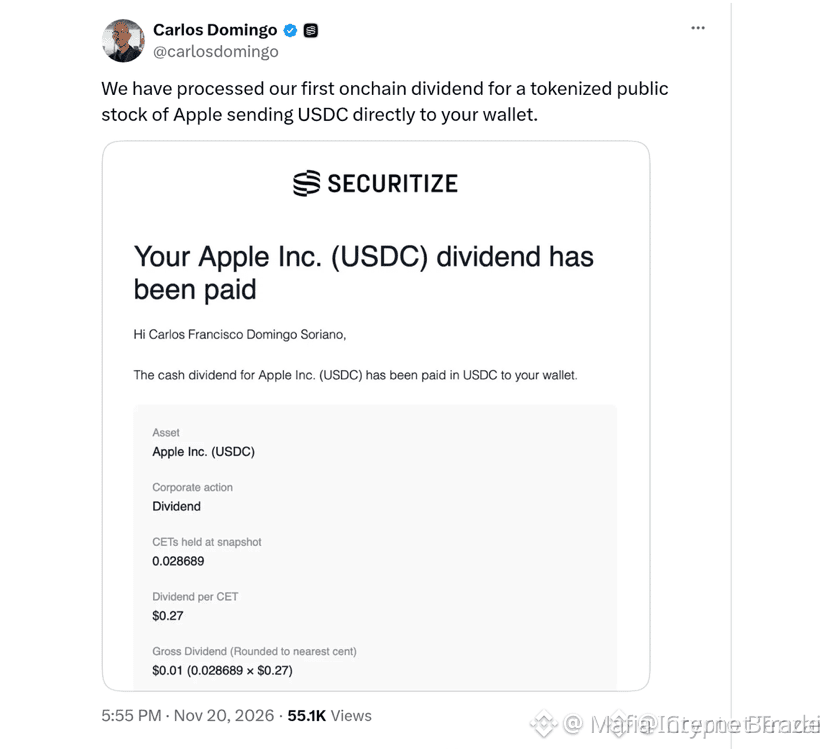
The traditional financial walls are crumbling as Apple stock holders just received their first onchain dividend payout in USDC. This execution bridges traditional equity value directly into decentralized wallets while $SOL defends key structural support near 68. 📊
We are watching a fundamental shift where yield generation moves off legacy ledgers and onto high-speed rails. Traditional equities meeting decentralized settlement layers unlocks entirely new liquidity pathways for market participants. 💡
💬 Would you consider holding dividend-paying traditional assets directly onchain? 👇
⚠️ Not financial advice. Always manage your risk. 🛡️
🏷️ #BTC #SOL #TokenizedStocks #Crypto
🔥 💎
8

·
--
🆕 Tokenized stock promo on Binance
A limited-time offer for new verified users:
🔹 A chance at a $3 ANTB voucher after a first eligible fiat deposit, crypto purchase or bStocks purchase
🔹 Cap: 15,000 participants
🔹 Period: Nov 19 to Dec 9, 2026
⚠️ This is a tokenized stock campaign. Read the terms, eligibility and risks on the official page carefully.
Are you interested in tokenized stocks? 👇
#Binance #TokenizedStocks #BinanceSquare #CryptoNews
Not financial advice.
7

Gold is correcting. Tokenized stocks are growing. Is the market offering two different opportunities?
Something interesting is happening in the RWA market, and I think investors should pay attention.
Look at the historical numbers.
PAXG delivered approximately 64.7% growth in 2025. But by November 20, 2026, it had fallen around 18.6% year-to-date. That's a significant correction, not a guaranteed bargain. Still, it gives long-term gold investors a reason to reassess their entry levels.
Now look at Binance bStocks.
The tokenized-equity market reached $4.8 billion in AUM by November 2026, while bStocks crossed $1.5 billion. That's a major adoption milestone for bringing traditional equities into crypto markets.
My investment perspective:
🟡 Gold (PAXG / XAUT): Consider gradual accumulation during corrections. Gold offers an alternative to pure crypto exposure, although it can fall too.
📈 bStocks: Watch established businesses with strong earnings, cash flow and reasonable valuations. Tokenization makes access easier, but it doesn't make an overpriced stock cheap.
I wouldn't put all my capital into either category. I'd consider staggered entries rather than chasing green candles.
One lesson from 2025 is worth remembering: PAXG's 64% annual gain rewarded those who understood the longer-term trend, not necessarily those who bought at the top.
The next opportunity may belong to investors who prepare during corrections rather than chase rallies.
Research the asset. Check its backing, valuation, liquidity and fees before buying.
#XAUT #bStocks #TokenizedStocks
577

·
--
Article
Same Tesla stock, four onchain prices at once. Which one do you read?If you run a broker, an exchange or a wallet, or you are thinking about letting a DeFi protocol accept stock tokens as collateral, start with these numbers.
November 15 was a Sunday, and the US stock market was closed. At 21:48 UTC that day, I checked the onchain prices of Tesla tokens from four issuers:
TSLAon, issued by Ondo (Ethereum): $390.47TSLAx, issued by xStocks (Solana): $389.03TSLAB, issued by a Binance affiliate (BNB Chain): $388.76Robinhood's own TSLA (Robinhood Chain): $388.12
Tesla closed Friday at $390.22. All four tokens sit on the same stock, yet at the same moment they showed four prices. The highest and the lowest were $2.35 apart, about 0.6%.
Figure 1. Same stock, four issuers
0.6% does not sound like much. For a lending protocol with a 1% liquidation threshold, or a market maker moving inventory between venues every day, it is the whole profit or the whole risk.
The bigger problem: of the four numbers, the one closest to Friday's close was a price that had not traded for 19 and a half hours. Over the next day and a half I recorded these four tokens every hour, and every 10 minutes around the open. The conclusion: reading the price wrong is more dangerous than the gap itself. Last trade prices freeze, pool fees push quotes away from the stock, and data sources quietly drop pools. The rest is in five steps: first correct for the multiplier, then look at the mint/redeem door, then the measurements over the weekend and at Monday's open, then the pools, and finally a checklist for reading a price.
1. Divide by the multiplier before you compare
One step before any comparison cannot be skipped. One stock token does not necessarily equal exactly 1 share.
When a stock pays a dividend, some issuers do not pay cash; they fold the dividend into the number of shares each token represents. Over time, one token might represent 1.02 shares. If the token then trades 2% above the stock, that is not a premium. The token simply represents an extra 0.02 shares. This ratio is called the multiplier.
Figure 2. Divide by the multiplier before comparing prices
I picked Tesla because it is clean: it pays no dividend and has not split since August 2022, so every issuer's multiplier is 1. xStocks writes the multiplier into the token's configuration on Solana, and reading it onchain gives 1. With dividend payers such as Apple or Microsoft, if you skip the multiplier correction, part of the "gap" you calculate is fake.
2. The mint/redeem door: open, but with a 2% fee in front of it
What keeps a stock token's price tied to the stock? Arbitrage. When the token is more expensive than the stock, an eligible institution mints new tokens with the issuer (it pays dollars or stablecoins, the issuer buys and holds the stock, then mints the tokens) and sells them onchain. When the token is cheaper, it does the reverse: buys tokens and redeems them with the issuer. Each round trip moves the gap back toward zero.
The catch is that this door is not open to everyone, or at all times.
Who can go through the door. All four require identity verification (KYC), and none are open to US persons. Ondo is open to verified institutions and individuals in supported regions, with a $1 minimum. xStocks lets individuals mint and redeem directly, with a $5,000 minimum. bStocks minting is open only to eligible subscribers in Abu Dhabi Global Market (ADGM). Robinhood's door is open only to authorized participants, and at launch there was one: Bitstamp Global Ltd. Anyone outside the door can only trade with other people on the secondary market; they can see the gap but cannot arbitrage it.
When the door is open. xStocks minting and redemption follow US market hours, 5 days a week. Robinhood's tokenization window runs from Monday 02:00 to Saturday 02:00 CET. bStocks officially offers conversion between the token and the stock 24/7, but on weekends the stock itself cannot be bought or sold, and new issuance is priced off the previous business day's reference price, so the cash leg of the arbitrage is cut. Ondo's regular window runs from Sunday 20:05 to Friday 19:59 ET, and it also opens off-hours sessions token by token; outside market hours it quotes using a "proprietary pricing methodology" and sets a limit for each token. Ondo says TSLAon can be minted and redeemed on weekends, but its materials disagree on which tokens are 24/7 (the blog, the product page and the docs each say something different), so platforms should go by its terms of sale and the live status of its API.
Figure 3. Whether the gap closes depends on whether the mint/redeem door is open
So over the weekend, only Ondo's door may have been open. Looking back at Sunday's numbers, the easy reading is this: Ondo was open on the weekend, so arbitrage pinned it near Friday's close, just 0.06% off; the other three were closed, ranging from −0.31% to −0.54%, leaning toward the last Friday after-hours trade at $387.11.
That reading does not hold. About three quarters of the weight in DexScreener's Ondo reading came from a USDC pool on Ethereum whose fee is 2% (read from the pool's fee() onchain). Its last trade of the weekend was at 02:23 UTC on November 15, about 19.5 hours before the 21:48 snapshot, and the next one came 5 minutes after Monday's open, about 36 hours with no movement. That +0.06% was a frozen price.
One layer down, the picture is more specific than "frozen". We read every TSLAon mint and burn event and every trade in this pool between 01:00 UTC on November 14 and 01:00 UTC on November 16:
The door was open, and people used it. Over the weekend there were 33 mints totaling about 933 tokens and 17 burns totaling about 23 tokens. Mints were concentrated on Saturday.Almost every trade in the pool was "mint, then sell". All 19 trades sold tokens into the pool, and 14 of them minted with Ondo and sold into the pool in the same transaction.Arbitrage stopped at the edge of the fee. Working from the amounts in each transaction, the mint price fell from about $385.71 to about $383.15 over Saturday (this is an estimate that does not deduct swap-route fees; it is not a quote published by Ondo), and sellers' proceeds fell from $386.05 to $383.19. After the last trade, the pool's marginal price was about 383.2 ÷ 0.98 ≈ $391. Selling any more would have netted less than the cost of minting, so the arbitrage stopped.
In other words, the pool price sat about 2% above Ondo's own quote, and nobody had a reason to close that gap. Sunday's +0.06% sat right on that line. Its closeness to Friday's close was a coincidence and had nothing to do with "the door keeps the price tighter". This only tests the upper bound: over the weekend there was not a single trade that bought from the pool and then redeemed, so this data cannot say where the lower bound is. "The longer the door is open, the tighter the price tracks" is still a reasonable hypothesis, but it has to be tested against the issuer's own quotes and limits, not against a DEX's last trade price.
One more detail to keep: by these estimates, Ondo's Saturday quote was between $383 and $386, close to the stock's first premarket trade of $385.40 at 4 a.m. on Monday. One weekend cannot show it is consistently accurate, but it does show the quote was not simply pinned to Friday's close.
3. Two weekend days: how the prices moved
I started recording hourly from a little after 2 p.m. ET on Sunday, and by 3 a.m. Monday I had 15 snapshots (Robinhood from the 4th snapshot on).
Figure 5. Weekend to Monday open: how far each token drifted from Tesla
The three issuers with the door closed (xStocks, bStocks, Robinhood) moved almost identically. The gaps among the three were between 0.05% and 0.33%, much smaller than their deviation from the stock. Against Friday's close of $390.22, their medians were −0.48%, −0.53% and −0.59%, with a range from −1.52% to +0.62%. If the reference is switched to Friday's last after-hours trade at $387.11, the average deviation drops from 0.68%–0.75% to 0.47%–0.51%. This is one weekend, but the direction is clear: when an interface shows a reference stock price on weekends, the after-hours price is closer to what actually trades onchain than the close is, and the interface should say which one it uses.
The move had two parts. Around 7 p.m. ET on Sunday, all three rose together to 0.4%–0.6% above Friday's close; from about 9 p.m. they fell back together, reaching −1.2% to −1.5% between 1 a.m. and 2 a.m. Monday. At 3 a.m. the three were between $384.85 and $385.05, and an hour later the stock's first premarket trade was $385.40, less than 0.15% away from each of them. The outside cause of the three moving together could be stock perpetual futures or overnight trading, but we did not record those two prices over the same period, so this cannot yet be confirmed.
In all 15 snapshots, Ondo was the closest to Friday's close, with a median of +0.06%. That line looks the steadiest, for the reason given in the previous section: until 9 p.m. ET on Sunday it stayed between $390.46 and $390.52, which was the frozen pool. After that it got worse: from 10 p.m. ET on Sunday until Monday's open, the list of Ondo pools returned by DexScreener no longer included the two large pools. Counted liquidity fell from about $7.92 million to $130,000–$160,000, and the Ondo line was left with only the prices of a few small pools. We could not find out why. A system that watches only price, not pool count and liquidity, would have seen nothing wrong for those dozen-plus hours.
4. Monday's open: how fast the gap closed
At the 9:30 a.m. ET open on Monday, the three closed-door issuers were already sitting next to the stock: xStocks −0.01%, bStocks 0.00%, Robinhood −0.12%. They had lined up during premarket, and the open itself brought no gap.
Figure 6. After Monday's open: how far the four tokens sat from the stock
The largest deviations came in the first half hour after the open. From 9:40 to 10:10, the stock fell from $388.28 to $377.27, down 2.8%, and the three tokens lagged a step behind, hanging above the stock: at the 10:00 point, bStocks was +0.54% and Robinhood +0.48%. After that, each recovered differently. xStocks was back within ±0.1% from 11:00 and stayed there until the close; of the 14 snapshots after the open, 9 were within ±0.1%, with an average deviation of 0.08% and a maximum of 0.23%. bStocks and Robinhood returned to within ±0.1% between 11:00 and 12:00 (that stretch was sampled hourly, so it cannot be pinned to 10 minutes), stayed within 0.20% through the afternoon, and were within ±0.1% in 5 and 6 of the 14 snapshots respectively.
Ondo never came back. In the 14 snapshots after the open, it was between +0.67% and +2.15% against the stock, averaging +1.30%. The high of +2.15% came at 10:00, when DexScreener gave it a price of $386.69 against the stock's $378.55. Yet between 10:00 and 10:01, someone made three sales into Ondo's largest pool and received $379.26 to $379.57, only about 0.2% from the stock. That 2% existed only in the price field; nobody traded at it.
Two caveats on method. First, at one point every 10 minutes, the token price is DexScreener's last trade price and the stock price is from Yahoo's 1-minute bars, and a gap of a minute or two between them is common; when the stock is falling 1.6% in 10 minutes, a one-minute difference can mean 0.1%–0.2%, so these numbers are good for direction and sequence, not for single basis points. Second, Kraken says xStocks' deviation at Monday's open has historically been within 1%; on this day the three closed-door issuers' maximum deviation was 0.54%, consistent with that claim, but Kraken has not published data.
5. Same issuer, different pools, different prices
There is a less visible kind of gap: between different trading pools of the same issuer on the same chain.
Ondo's TSLAon has several USDC pools on Ethereum. At the same moment on Sunday, the largest pool (about $5.93 million in liquidity) had a last trade price of $391.00, while two small pools, one with a bit over $100,000 and one with tens of thousands of dollars, sat at about $387, a difference of about 1%, larger than the gap between the four issuers.
Figure 4. Same token, different pools, different prices
One reason is that nobody wants to arbitrage a pool holding a few tens of thousands of dollars, so the quote stays at whatever the last trade was. The other is fees: the largest pool charges 2%, the other two 1.5% and 1%. The higher the fee, the further a pool's price can drift from the stock before anyone arbitrages it. On Monday, Ondo's NVDAon had four pools on Ethereum with fees of 0.3%, 1%, 2% and 3%; their in-pool prices relative to the stock were, in that order, +0.9%, +1.2%, +2.2% and +3.0%, and their 24-hour trade counts were 288, 97, 52 and 5.
This is not just about Tesla. Shortly before 1 p.m. ET on Monday (17:57 UTC), I took the same snapshot for 10 tickers. For seven of them (Tesla, NVIDIA, Apple, Google, Meta, SPY and QQQ), Ondo's Ethereum tokens were all between +1.0% and +1.9% against the stock; at the same moment, xStocks (Solana), bStocks and Robinhood were mostly within +0.5%, with the highest being xStocks' SPY at +0.77%. Microsoft was the exception, with Ondo only 0.31% above. These numbers are not corrected for Ondo's and xStocks' dividend multipliers, so a small part of the deviation for dividend payers may come from the multiplier; Tesla pays no dividend and is not affected.
A pool's price is also not a price you can trade at. Around midday the same day, we used the onchain pool state to simulate buying and selling $10,000: in Ondo's 2% pool, buying cost 3.3% more than the stock, and selling fetched only 0.8% less. The +1.26% the pool displayed was neither the bid nor the ask. If a protocol's price feed happens to read a pool like that, it sees Tesla as 1% to 2% more expensive than it is; if it reads a stalled small pool, it may see it 1% cheaper.
6. Four questions before you read a price
The points above come down to four questions you can ask of any stock token:
What is the multiplier, and how does it change? Correct dividend payers for the multiplier first, or the gap is fake.How long since this price last traded? Attach the last trade time to every reading, and drop it when it exceeds a threshold. Sunday's Ondo reading, the one closest to Friday's close, was a trade from 19 and a half hours earlier; during the dozen-plus hours when DexScreener dropped the large pools, the price field still showed a number as usual. Also watch the pool count and counted liquidity: if either suddenly falls by an order of magnitude, stop using that round of readings.Which pool are you reading, and what is its fee? A 2% pool cannot carry the same weight as a 0.05% pool, and a small pool's last trade price cannot be used as the price. For liquidation or as a trade reference, you need an executable quote for a set size and direction, not the in-pool price. During stock market hours, use the stock price times the multiplier as the anchor; if a token's price deviates too far, treat it as a data problem first, not an arbitrage opportunity.Who is the mint/redeem door open to, and when? While the door is closed, the weekend price is only the secondary market's guess. An open door only means arbitrage has a path; on that path there are still pool fees, the issuer's quote spread and limits. In this sample, Ondo, with its door open, was the furthest from the stock in its pools. "The longer the door is open, the tighter the price tracks" has to be tested with the issuer's own quotes and its mint and burn records, and we have not finished that work.
Anyone can look up the prices on a given day. The hard part is recording them weekend after weekend, with one consistent method, across several issuers. Only then do you know which issuer deviates year-round, by how much, how fast it comes back, and which readings stopped updating long ago. The quarterly tokenized stock monitor we are building does exactly that.
Data and sources (as of 2026-11-16):
Onchain prices: DexScreener last trade price for each pool, counting only pools quoted in stablecoins (USDC, USDT; USDG on Robinhood Chain) with at least $1,000 of liquidity, removing outlier pools more than 3% away from the liquidity-weighted median (such as a pool on Robinhood Chain quoting $263), then weighting by liquidity. The four prices at the top are from 21:48 UTC on 2026-11-15; Figure 4 is from 19:50 UTC. Figures 5 and 6 and sections 3 and 4: the author's monitoring file tsla_spread.csv, hourly from 19:54 UTC on 2026-11-15, every 10 minutes from 14:10 to 15:50 UTC on 11-16, through 22:00 UTC. xStocks always means TSLAx on Solana; an address on Mantle that calls itself xStocks (0x4368…1883) is not in the deployment list of the official xStocks API and has been excluded.Tesla reference price: Friday 11-13 close $390.22, last after-hours trade $387.11; Monday premarket and intraday use the latest price from Yahoo Finance 1-minute bars (used only if there was a trade within 20 minutes, otherwise the most recent close).Multiplier: the Solana mint account of xStocks TSLAx, scaledUiAmountConfig.multiplier = 1.Ondo pools and minting: all mint and burn events for TSLAon on Ethereum (0xf6b1…103f) from 01:00 UTC on 2026-11-14 to 01:00 UTC on 11-16, and all Swap events in the largest USDC pool 0xF200…28AD (public RPC eth_getLogs); pool fees read from each pool's fee(): 0xF200…28AD 2%, 0x49b7…E988 1.5%, 0xfd62…3231 and 0x3122…95Da 1%; trades on 11-16 from GeckoTerminal's trade list for that pool. Mint prices are estimates computed as "USDC in the transaction ÷ tokens minted". Source: the source notes of chapters 3 and 4 of the author's manuscript Listing Tokenized Stocks.Multi-ticker snapshot and NVDAon fee ladder: the author's monitoring file stocks_spread.csv (17:57 UTC on 2026-11-16); token addresses from each issuer's official list (Ondo docs token list, the public xStocks API, Binance asset configuration, Robinhood Chain asset registry API); the four NVDAon pools are DexScreener readings at about 18:01 UTC plus onchain fee().Executable range: simulated pool by pool from onchain slot0, liquidity and ticks at about 17:51–17:56 UTC on 2026-11-16, including pool fees, excluding gas.Ondo minting and redemption: Ondo docs, Ondo Stocks section (Market Hours, Off-Hours Trading, Investing & Redeeming); Ondo blog posts "Ondo Launches First 24/7 Minting and Redemption for Tokenized Stocks" (2026-06-25) and "What Sets Ondo Stocks Apart" (2026-10-21); the Ondo Stocks product page (accessed 2026-11-16).xStocks: xStocks partner information page (individuals can mint and redeem directly, $5,000 minimum, 24/5, not available to US persons).bStocks: issuer BTech Holdings (Binance-affiliated, ADGM), Binance press release of 2026-06-12; BTech prospectus (eligible ADGM subscribers, issue price based on the previous business day's reference price); Binance bStocks FAQ and landing page (24/7 conversion).Robinhood: Robinhood Chain docs, Stock Tokens page (tokenization window Monday 02:00 to Saturday 02:00 CET, only authorized participants can subscribe); RHJ base prospectus (authorized participant Bitstamp Global Ltd). The TSLA contract 0x322F0929c4625eD5bAd873c95208D54E1c003b2d appears in the official Robinhood Chain asset registry API (the data source for the Contracts page of the Robinhood Chain docs), checked 2026-11-16.Kraken: Kraken xStocks FAQ (xStocks' deviation at Monday's open "historically within 1%").Not verified: the outside cause of the three issuers moving together on Sunday evening ET (perpetual futures and overnight prices were not recorded over the same period); why DexScreener did not return Ondo's two large pools from 03:00 to 14:30 UTC on 11-16; the specific values of Ondo's off-hours quotes and limits; a binding list of Ondo's 24/7 mint/redeem tokens.Limitations: a sample of one weekend and one Monday; the last trade price is not an executable price; 10-minute sampling, so token and stock prices may be taken a minute or two apart.
#TokenizedStocks #RWA #xStocks
Same Tesla stock, four onchain prices at once. Which one do you read?
If you run a broker, an exchange or a wallet, or you are thinking about letting a DeFi protocol accept stock tokens as collateral, start with these numbers.
November 15 was a Sunday, and the US stock market was closed. At 21:48 UTC that day, I checked the onchain prices of Tesla tokens from four issuers:
TSLAon, issued by Ondo (Ethereum): $390.47TSLAx, issued by xStocks (Solana): $389.03TSLAB, issued by a Binance affiliate (BNB Chain): $388.76Robinhood's own TSLA (Robinhood Chain): $388.12
Tesla closed Friday at $390.22. All four tokens sit on the same stock, yet at the same moment they showed four prices. The highest and the lowest were $2.35 apart, about 0.6%.
Figure 1. Same stock, four issuers
0.6% does not sound like much. For a lending protocol with a 1% liquidation threshold, or a market maker moving inventory between venues every day, it is the whole profit or the whole risk.
The bigger problem: of the four numbers, the one closest to Friday's close was a price that had not traded for 19 and a half hours. Over the next day and a half I recorded these four tokens every hour, and every 10 minutes around the open. The conclusion: reading the price wrong is more dangerous than the gap itself. Last trade prices freeze, pool fees push quotes away from the stock, and data sources quietly drop pools. The rest is in five steps: first correct for the multiplier, then look at the mint/redeem door, then the measurements over the weekend and at Monday's open, then the pools, and finally a checklist for reading a price.
1. Divide by the multiplier before you compare
One step before any comparison cannot be skipped. One stock token does not necessarily equal exactly 1 share.
When a stock pays a dividend, some issuers do not pay cash; they fold the dividend into the number of shares each token represents. Over time, one token might represent 1.02 shares. If the token then trades 2% above the stock, that is not a premium. The token simply represents an extra 0.02 shares. This ratio is called the multiplier.
Figure 2. Divide by the multiplier before comparing prices
I picked Tesla because it is clean: it pays no dividend and has not split since August 2022, so every issuer's multiplier is 1. xStocks writes the multiplier into the token's configuration on Solana, and reading it onchain gives 1. With dividend payers such as Apple or Microsoft, if you skip the multiplier correction, part of the "gap" you calculate is fake.
2. The mint/redeem door: open, but with a 2% fee in front of it
What keeps a stock token's price tied to the stock? Arbitrage. When the token is more expensive than the stock, an eligible institution mints new tokens with the issuer (it pays dollars or stablecoins, the issuer buys and holds the stock, then mints the tokens) and sells them onchain. When the token is cheaper, it does the reverse: buys tokens and redeems them with the issuer. Each round trip moves the gap back toward zero.
The catch is that this door is not open to everyone, or at all times.
Who can go through the door. All four require identity verification (KYC), and none are open to US persons. Ondo is open to verified institutions and individuals in supported regions, with a $1 minimum. xStocks lets individuals mint and redeem directly, with a $5,000 minimum. bStocks minting is open only to eligible subscribers in Abu Dhabi Global Market (ADGM). Robinhood's door is open only to authorized participants, and at launch there was one: Bitstamp Global Ltd. Anyone outside the door can only trade with other people on the secondary market; they can see the gap but cannot arbitrage it.
When the door is open. xStocks minting and redemption follow US market hours, 5 days a week. Robinhood's tokenization window runs from Monday 02:00 to Saturday 02:00 CET. bStocks officially offers conversion between the token and the stock 24/7, but on weekends the stock itself cannot be bought or sold, and new issuance is priced off the previous business day's reference price, so the cash leg of the arbitrage is cut. Ondo's regular window runs from Sunday 20:05 to Friday 19:59 ET, and it also opens off-hours sessions token by token; outside market hours it quotes using a "proprietary pricing methodology" and sets a limit for each token. Ondo says TSLAon can be minted and redeemed on weekends, but its materials disagree on which tokens are 24/7 (the blog, the product page and the docs each say something different), so platforms should go by its terms of sale and the live status of its API.
Figure 3. Whether the gap closes depends on whether the mint/redeem door is open
So over the weekend, only Ondo's door may have been open. Looking back at Sunday's numbers, the easy reading is this: Ondo was open on the weekend, so arbitrage pinned it near Friday's close, just 0.06% off; the other three were closed, ranging from −0.31% to −0.54%, leaning toward the last Friday after-hours trade at $387.11.
That reading does not hold. About three quarters of the weight in DexScreener's Ondo reading came from a USDC pool on Ethereum whose fee is 2% (read from the pool's fee() onchain). Its last trade of the weekend was at 02:23 UTC on November 15, about 19.5 hours before the 21:48 snapshot, and the next one came 5 minutes after Monday's open, about 36 hours with no movement. That +0.06% was a frozen price.
One layer down, the picture is more specific than "frozen". We read every TSLAon mint and burn event and every trade in this pool between 01:00 UTC on November 14 and 01:00 UTC on November 16:
The door was open, and people used it. Over the weekend there were 33 mints totaling about 933 tokens and 17 burns totaling about 23 tokens. Mints were concentrated on Saturday.Almost every trade in the pool was "mint, then sell". All 19 trades sold tokens into the pool, and 14 of them minted with Ondo and sold into the pool in the same transaction.Arbitrage stopped at the edge of the fee. Working from the amounts in each transaction, the mint price fell from about $385.71 to about $383.15 over Saturday (this is an estimate that does not deduct swap-route fees; it is not a quote published by Ondo), and sellers' proceeds fell from $386.05 to $383.19. After the last trade, the pool's marginal price was about 383.2 ÷ 0.98 ≈ $391. Selling any more would have netted less than the cost of minting, so the arbitrage stopped.
In other words, the pool price sat about 2% above Ondo's own quote, and nobody had a reason to close that gap. Sunday's +0.06% sat right on that line. Its closeness to Friday's close was a coincidence and had nothing to do with "the door keeps the price tighter". This only tests the upper bound: over the weekend there was not a single trade that bought from the pool and then redeemed, so this data cannot say where the lower bound is. "The longer the door is open, the tighter the price tracks" is still a reasonable hypothesis, but it has to be tested against the issuer's own quotes and limits, not against a DEX's last trade price.
One more detail to keep: by these estimates, Ondo's Saturday quote was between $383 and $386, close to the stock's first premarket trade of $385.40 at 4 a.m. on Monday. One weekend cannot show it is consistently accurate, but it does show the quote was not simply pinned to Friday's close.
3. Two weekend days: how the prices moved
I started recording hourly from a little after 2 p.m. ET on Sunday, and by 3 a.m. Monday I had 15 snapshots (Robinhood from the 4th snapshot on).
Figure 5. Weekend to Monday open: how far each token drifted from Tesla
The three issuers with the door closed (xStocks, bStocks, Robinhood) moved almost identically. The gaps among the three were between 0.05% and 0.33%, much smaller than their deviation from the stock. Against Friday's close of $390.22, their medians were −0.48%, −0.53% and −0.59%, with a range from −1.52% to +0.62%. If the reference is switched to Friday's last after-hours trade at $387.11, the average deviation drops from 0.68%–0.75% to 0.47%–0.51%. This is one weekend, but the direction is clear: when an interface shows a reference stock price on weekends, the after-hours price is closer to what actually trades onchain than the close is, and the interface should say which one it uses.
The move had two parts. Around 7 p.m. ET on Sunday, all three rose together to 0.4%–0.6% above Friday's close; from about 9 p.m. they fell back together, reaching −1.2% to −1.5% between 1 a.m. and 2 a.m. Monday. At 3 a.m. the three were between $384.85 and $385.05, and an hour later the stock's first premarket trade was $385.40, less than 0.15% away from each of them. The outside cause of the three moving together could be stock perpetual futures or overnight trading, but we did not record those two prices over the same period, so this cannot yet be confirmed.
In all 15 snapshots, Ondo was the closest to Friday's close, with a median of +0.06%. That line looks the steadiest, for the reason given in the previous section: until 9 p.m. ET on Sunday it stayed between $390.46 and $390.52, which was the frozen pool. After that it got worse: from 10 p.m. ET on Sunday until Monday's open, the list of Ondo pools returned by DexScreener no longer included the two large pools. Counted liquidity fell from about $7.92 million to $130,000–$160,000, and the Ondo line was left with only the prices of a few small pools. We could not find out why. A system that watches only price, not pool count and liquidity, would have seen nothing wrong for those dozen-plus hours.
4. Monday's open: how fast the gap closed
At the 9:30 a.m. ET open on Monday, the three closed-door issuers were already sitting next to the stock: xStocks −0.01%, bStocks 0.00%, Robinhood −0.12%. They had lined up during premarket, and the open itself brought no gap.
Figure 6. After Monday's open: how far the four tokens sat from the stock
The largest deviations came in the first half hour after the open. From 9:40 to 10:10, the stock fell from $388.28 to $377.27, down 2.8%, and the three tokens lagged a step behind, hanging above the stock: at the 10:00 point, bStocks was +0.54% and Robinhood +0.48%. After that, each recovered differently. xStocks was back within ±0.1% from 11:00 and stayed there until the close; of the 14 snapshots after the open, 9 were within ±0.1%, with an average deviation of 0.08% and a maximum of 0.23%. bStocks and Robinhood returned to within ±0.1% between 11:00 and 12:00 (that stretch was sampled hourly, so it cannot be pinned to 10 minutes), stayed within 0.20% through the afternoon, and were within ±0.1% in 5 and 6 of the 14 snapshots respectively.
Ondo never came back. In the 14 snapshots after the open, it was between +0.67% and +2.15% against the stock, averaging +1.30%. The high of +2.15% came at 10:00, when DexScreener gave it a price of $386.69 against the stock's $378.55. Yet between 10:00 and 10:01, someone made three sales into Ondo's largest pool and received $379.26 to $379.57, only about 0.2% from the stock. That 2% existed only in the price field; nobody traded at it.
Two caveats on method. First, at one point every 10 minutes, the token price is DexScreener's last trade price and the stock price is from Yahoo's 1-minute bars, and a gap of a minute or two between them is common; when the stock is falling 1.6% in 10 minutes, a one-minute difference can mean 0.1%–0.2%, so these numbers are good for direction and sequence, not for single basis points. Second, Kraken says xStocks' deviation at Monday's open has historically been within 1%; on this day the three closed-door issuers' maximum deviation was 0.54%, consistent with that claim, but Kraken has not published data.
5. Same issuer, different pools, different prices
There is a less visible kind of gap: between different trading pools of the same issuer on the same chain.
Ondo's TSLAon has several USDC pools on Ethereum. At the same moment on Sunday, the largest pool (about $5.93 million in liquidity) had a last trade price of $391.00, while two small pools, one with a bit over $100,000 and one with tens of thousands of dollars, sat at about $387, a difference of about 1%, larger than the gap between the four issuers.
Figure 4. Same token, different pools, different prices
One reason is that nobody wants to arbitrage a pool holding a few tens of thousands of dollars, so the quote stays at whatever the last trade was. The other is fees: the largest pool charges 2%, the other two 1.5% and 1%. The higher the fee, the further a pool's price can drift from the stock before anyone arbitrages it. On Monday, Ondo's NVDAon had four pools on Ethereum with fees of 0.3%, 1%, 2% and 3%; their in-pool prices relative to the stock were, in that order, +0.9%, +1.2%, +2.2% and +3.0%, and their 24-hour trade counts were 288, 97, 52 and 5.
This is not just about Tesla. Shortly before 1 p.m. ET on Monday (17:57 UTC), I took the same snapshot for 10 tickers. For seven of them (Tesla, NVIDIA, Apple, Google, Meta, SPY and QQQ), Ondo's Ethereum tokens were all between +1.0% and +1.9% against the stock; at the same moment, xStocks (Solana), bStocks and Robinhood were mostly within +0.5%, with the highest being xStocks' SPY at +0.77%. Microsoft was the exception, with Ondo only 0.31% above. These numbers are not corrected for Ondo's and xStocks' dividend multipliers, so a small part of the deviation for dividend payers may come from the multiplier; Tesla pays no dividend and is not affected.
A pool's price is also not a price you can trade at. Around midday the same day, we used the onchain pool state to simulate buying and selling $10,000: in Ondo's 2% pool, buying cost 3.3% more than the stock, and selling fetched only 0.8% less. The +1.26% the pool displayed was neither the bid nor the ask. If a protocol's price feed happens to read a pool like that, it sees Tesla as 1% to 2% more expensive than it is; if it reads a stalled small pool, it may see it 1% cheaper.
6. Four questions before you read a price
The points above come down to four questions you can ask of any stock token:
What is the multiplier, and how does it change? Correct dividend payers for the multiplier first, or the gap is fake.How long since this price last traded? Attach the last trade time to every reading, and drop it when it exceeds a threshold. Sunday's Ondo reading, the one closest to Friday's close, was a trade from 19 and a half hours earlier; during the dozen-plus hours when DexScreener dropped the large pools, the price field still showed a number as usual. Also watch the pool count and counted liquidity: if either suddenly falls by an order of magnitude, stop using that round of readings.Which pool are you reading, and what is its fee? A 2% pool cannot carry the same weight as a 0.05% pool, and a small pool's last trade price cannot be used as the price. For liquidation or as a trade reference, you need an executable quote for a set size and direction, not the in-pool price. During stock market hours, use the stock price times the multiplier as the anchor; if a token's price deviates too far, treat it as a data problem first, not an arbitrage opportunity.Who is the mint/redeem door open to, and when? While the door is closed, the weekend price is only the secondary market's guess. An open door only means arbitrage has a path; on that path there are still pool fees, the issuer's quote spread and limits. In this sample, Ondo, with its door open, was the furthest from the stock in its pools. "The longer the door is open, the tighter the price tracks" has to be tested with the issuer's own quotes and its mint and burn records, and we have not finished that work.
Anyone can look up the prices on a given day. The hard part is recording them weekend after weekend, with one consistent method, across several issuers. Only then do you know which issuer deviates year-round, by how much, how fast it comes back, and which readings stopped updating long ago. The quarterly tokenized stock monitor we are building does exactly that.
Data and sources (as of 2026-11-16):
Onchain prices: DexScreener last trade price for each pool, counting only pools quoted in stablecoins (USDC, USDT; USDG on Robinhood Chain) with at least $1,000 of liquidity, removing outlier pools more than 3% away from the liquidity-weighted median (such as a pool on Robinhood Chain quoting $263), then weighting by liquidity. The four prices at the top are from 21:48 UTC on 2026-11-15; Figure 4 is from 19:50 UTC. Figures 5 and 6 and sections 3 and 4: the author's monitoring file tsla_spread.csv, hourly from 19:54 UTC on 2026-11-15, every 10 minutes from 14:10 to 15:50 UTC on 11-16, through 22:00 UTC. xStocks always means TSLAx on Solana; an address on Mantle that calls itself xStocks (0x4368…1883) is not in the deployment list of the official xStocks API and has been excluded.Tesla reference price: Friday 11-13 close $390.22, last after-hours trade $387.11; Monday premarket and intraday use the latest price from Yahoo Finance 1-minute bars (used only if there was a trade within 20 minutes, otherwise the most recent close).Multiplier: the Solana mint account of xStocks TSLAx, scaledUiAmountConfig.multiplier = 1.Ondo pools and minting: all mint and burn events for TSLAon on Ethereum (0xf6b1…103f) from 01:00 UTC on 2026-11-14 to 01:00 UTC on 11-16, and all Swap events in the largest USDC pool 0xF200…28AD (public RPC eth_getLogs); pool fees read from each pool's fee(): 0xF200…28AD 2%, 0x49b7…E988 1.5%, 0xfd62…3231 and 0x3122…95Da 1%; trades on 11-16 from GeckoTerminal's trade list for that pool. Mint prices are estimates computed as "USDC in the transaction ÷ tokens minted". Source: the source notes of chapters 3 and 4 of the author's manuscript Listing Tokenized Stocks.Multi-ticker snapshot and NVDAon fee ladder: the author's monitoring file stocks_spread.csv (17:57 UTC on 2026-11-16); token addresses from each issuer's official list (Ondo docs token list, the public xStocks API, Binance asset configuration, Robinhood Chain asset registry API); the four NVDAon pools are DexScreener readings at about 18:01 UTC plus onchain fee().Executable range: simulated pool by pool from onchain slot0, liquidity and ticks at about 17:51–17:56 UTC on 2026-11-16, including pool fees, excluding gas.Ondo minting and redemption: Ondo docs, Ondo Stocks section (Market Hours, Off-Hours Trading, Investing & Redeeming); Ondo blog posts "Ondo Launches First 24/7 Minting and Redemption for Tokenized Stocks" (2026-06-25) and "What Sets Ondo Stocks Apart" (2026-10-21); the Ondo Stocks product page (accessed 2026-11-16).xStocks: xStocks partner information page (individuals can mint and redeem directly, $5,000 minimum, 24/5, not available to US persons).bStocks: issuer BTech Holdings (Binance-affiliated, ADGM), Binance press release of 2026-06-12; BTech prospectus (eligible ADGM subscribers, issue price based on the previous business day's reference price); Binance bStocks FAQ and landing page (24/7 conversion).Robinhood: Robinhood Chain docs, Stock Tokens page (tokenization window Monday 02:00 to Saturday 02:00 CET, only authorized participants can subscribe); RHJ base prospectus (authorized participant Bitstamp Global Ltd). The TSLA contract 0x322F0929c4625eD5bAd873c95208D54E1c003b2d appears in the official Robinhood Chain asset registry API (the data source for the Contracts page of the Robinhood Chain docs), checked 2026-11-16.Kraken: Kraken xStocks FAQ (xStocks' deviation at Monday's open "historically within 1%").Not verified: the outside cause of the three issuers moving together on Sunday evening ET (perpetual futures and overnight prices were not recorded over the same period); why DexScreener did not return Ondo's two large pools from 03:00 to 14:30 UTC on 11-16; the specific values of Ondo's off-hours quotes and limits; a binding list of Ondo's 24/7 mint/redeem tokens.Limitations: a sample of one weekend and one Monday; the last trade price is not an executable price; 10-minute sampling, so token and stock prices may be taken a minute or two apart.
#TokenizedStocks #RWA #xStocks
92

🚨 BINANCE + AI: IS A NEW CRYPTO OPPORTUNITY TAKING SHAPE?
What if you could get exposure to an AI company's stock through a crypto platform? Would you be interested?
Something interesting is happening between artificial intelligence and the crypto industry.
Binance has introduced Anthropic's tokenized stock, ANTB, through its bStocks offering. This is another example of how traditional financial markets and blockchain technology are beginning to connect.
But here's what caught my attention.
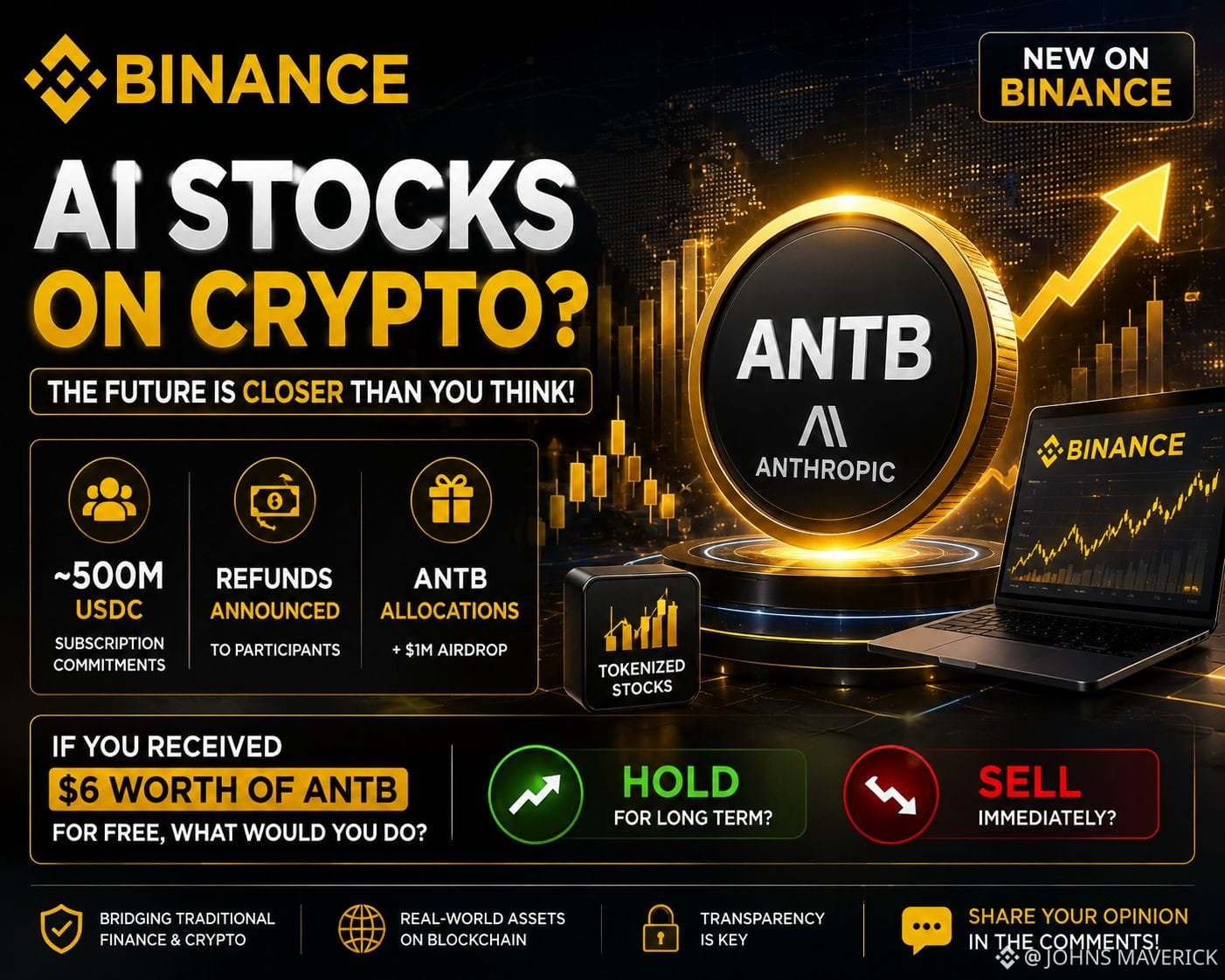
The Anthropic IPO xStocks campaign attracted approximately 500 million USDC in subscription commitments. However, the allocation process did not go as initially expected.
Binance Wallet announced refunds for participants, along with ANTB allocations for eligible users and a separate $1 million ANTB airdrop.
I think the bigger story goes beyond one token or one campaign.
AI is becoming an increasingly important part of the global economy, while crypto platforms are exploring new ways to bring traditional financial assets onto blockchain infrastructure.
However, there is something investors should never ignore: tokenized stock exposure does not necessarily mean direct ownership of company shares or traditional shareholder rights.
Personally, I believe transparency, investor protection, and real utility will determine whether this market grows sustainably.
🔥 NOW I WANT YOUR HONEST OPINION!
Imagine you received $6 worth of ANTB for free.
Would you:
🟢 HOLD it for the long term?
🔴 SELL it immediately?
And most importantly, WHY?
Let's have a real discussion in the comments. I want to hear different opinions from the Binance community!
#Binance #CryptoNews #Anthropic #TokenizedStocks #BinanceSquare
$BNB $BTC $ANTB
{spot}(BNBUSDT)
{spot}(ANTBUSDT)
{spot}(BTCUSDT)
🚨 BINANCE + AI: IS A NEW CRYPTO OPPORTUNITY TAKING SHAPE?
What if you could get exposure to an AI company's stock through a crypto platform? Would you be interested?
Something interesting is happening between artificial intelligence and the crypto industry.
Binance has introduced Anthropic's tokenized stock, ANTB, through its bStocks offering. This is another example of how traditional financial markets and blockchain technology are beginning to connect.
But here's what caught my attention.
The Anthropic IPO xStocks campaign attracted approximately 500 million USDC in subscription commitments. However, the allocation process did not go as initially expected.
Binance Wallet announced refunds for participants, along with ANTB allocations for eligible users and a separate $1 million ANTB airdrop.
I think the bigger story goes beyond one token or one campaign.
AI is becoming an increasingly important part of the global economy, while crypto platforms are exploring new ways to bring traditional financial assets onto blockchain infrastructure.
However, there is something investors should never ignore: tokenized stock exposure does not necessarily mean direct ownership of company shares or traditional shareholder rights.
Personally, I believe transparency, investor protection, and real utility will determine whether this market grows sustainably.
🔥 NOW I WANT YOUR HONEST OPINION!
Imagine you received $6 worth of ANTB for free.
Would you:
🟢 HOLD it for the long term?
🔴 SELL it immediately?
And most importantly, WHY?
Let's have a real discussion in the comments. I want to hear different opinions from the Binance community!
#Binance #CryptoNews #Anthropic #TokenizedStocks #BinanceSquare
$BNB $BTC $ANTB
1
200

·
--
🚀 Anthropic’s first day was wild. Onchain too 👀
📈 ANT closed its first day as a public company at $97.17, up more than 17% from its $83 IPO price
⚡ It opened at $111.50, 34.3% above the IPO price, so the day was a fade from the open
🪙 Ondo’s ANTon went live the same day, with 24/7 minting and redemption, weekends included
🌐 Securitize put a tokenized Anthropic product on Solana on day one, and Backpack announced its own ANT token for 24/7 trading on Solana
⚔️ $ONDO got there on day one. Now it’s a race
Anthropic ends its first trading day at $97.17, up 17% from its $83 IPO price, after opening at $111.50
+3
The onchain story is distribution. Anyone outside the US can get Anthropic exposure on a weekend, from a wallet, without a brokerage account. But several issuers now sell near-
identical exposure, so being first is a head start, not a moat.
Two caveats matter. These tokens are not shares. ANTon gives exposure to ANT share prices, but holders don’t have direct ownership of the stock, and Ondo says it is not affiliated with Anthropic and ANTon is not issued, sponsored, or endorsed by Anthropic. And a product doing well doesn’t automatically mean the $ONDO token does. Our earlier Ondo posts covered that gap.
theblock
finanznachrichten
❓ Does winning the first-day race lift $ONDO, or do rival issuers split the demand?
👇 Bullish, bearish, or just noise? Drop your take below!
📌 Follow for daily on-chain updates.
Not financial advice. DYOR.
#ONDO #Anthropic #TokenizedStocks #RWA #Crypto #Binance #BinanceSquare
🚀 Anthropic’s first day was wild. Onchain too 👀
📈 ANT closed its first day as a public company at $97.17, up more than 17% from its $83 IPO price
⚡ It opened at $111.50, 34.3% above the IPO price, so the day was a fade from the open
🪙 Ondo’s ANTon went live the same day, with 24/7 minting and redemption, weekends included
🌐 Securitize put a tokenized Anthropic product on Solana on day one, and Backpack announced its own ANT token for 24/7 trading on Solana
⚔️ $ONDO got there on day one. Now it’s a race
Anthropic ends its first trading day at $97.17, up 17% from its $83 IPO price, after opening at $111.50
+3
The onchain story is distribution. Anyone outside the US can get Anthropic exposure on a weekend, from a wallet, without a brokerage account. But several issuers now sell near-
identical exposure, so being first is a head start, not a moat.
Two caveats matter. These tokens are not shares. ANTon gives exposure to ANT share prices, but holders don’t have direct ownership of the stock, and Ondo says it is not affiliated with Anthropic and ANTon is not issued, sponsored, or endorsed by Anthropic. And a product doing well doesn’t automatically mean the $ONDO token does. Our earlier Ondo posts covered that gap.
theblock
finanznachrichten
❓ Does winning the first-day race lift $ONDO , or do rival issuers split the demand?
👇 Bullish, bearish, or just noise? Drop your take below!
📌 Follow for daily on-chain updates.
Not financial advice. DYOR.
#ONDO #Anthropic #TokenizedStocks #RWA #Crypto #Binance #BinanceSquare

101


·
--
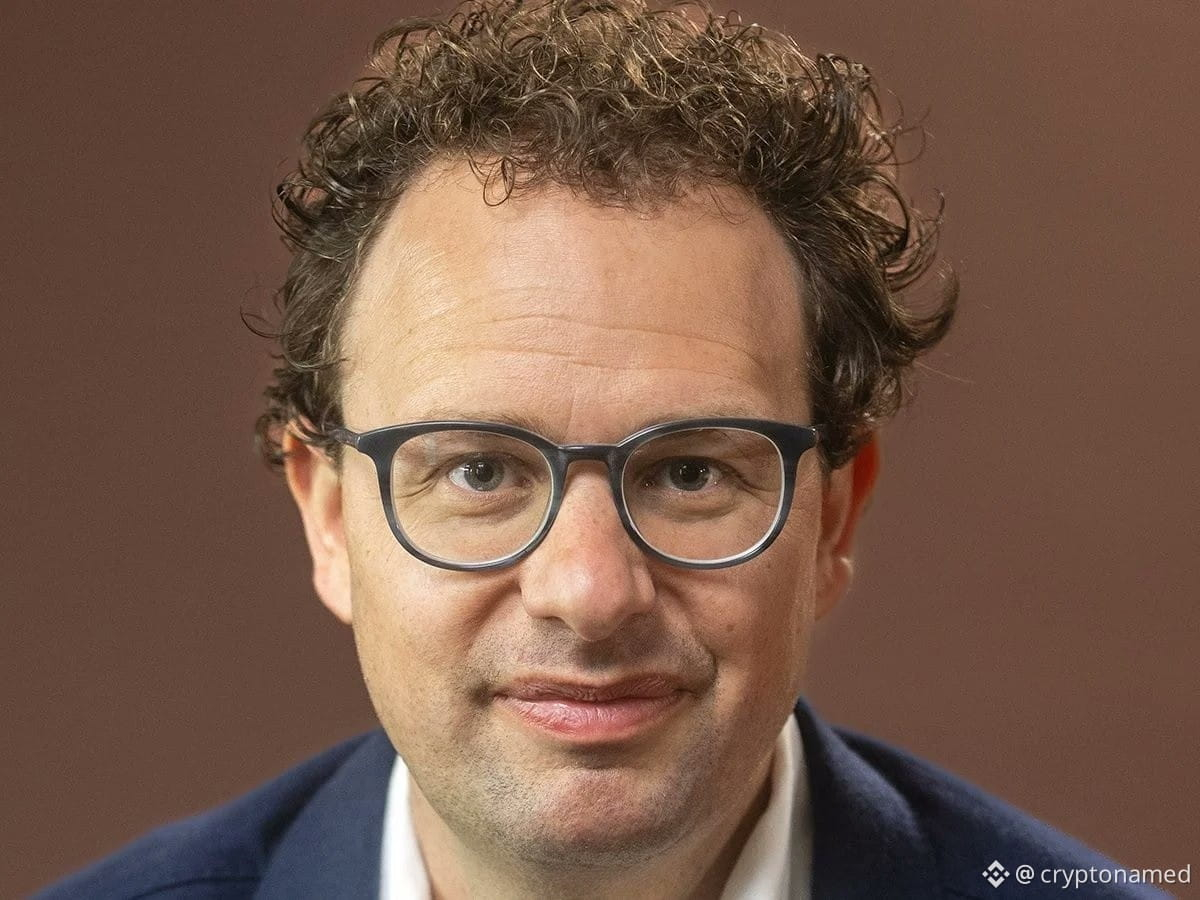
Trump's own SEC nominee says tokenized stocks need a full rulebook!
Per Cointelegraph and CoinDesk, Democrat Kristin Johnson, a former CFTC commissioner, told lawmakers on Nov. 19:
🔴 Johnson backs formal SEC rulemaking for tokenized stock trading
🔸 Steven Levine, an ex-SEC aide, appeared at the same hearing
🔸 Neither nominee has been confirmed yet
What stands out: a slower, formal rule process is less exciting than quick exemptions, but it gives tokenization a legal footing that can outlast a change of administration.
To be fair, a nominee's view isn't SEC policy, and both still need Senate approval.
Sometimes the boring path is the one that lasts.
Not financial advice. DYOR.
#SEC #TokenizedStocks
321

BOOM! SEC-compliant tokenized securities are about to hit the U.S.! Fairmint is preparing to launch an exchange for securities issued by companies themselves, under the SEC’s temporary innovation exemption. This is a huge turning point for the convergence of TradFi and crypto.
The exchange will run on Canton Network, followed by Ethereum, using AMMs with liquidity pools just like DeFi. Fairmint TSV, a Fairmint subsidiary, will operate it, combining SEC-registered transfer agents to ensure legal compliance and transparent on-chain ownership records.
What does this mean? Traditional assets are finding their way onto the blockchain in a REGULATED way. Imagine the stocks you hold being traded like $UNI or $CAKE!
But don’t celebrate just yet. Trading hasn’t started, and it still depends on SEC requirements and other agreements. This is a legal experiment, not a fully fledged stock market.
Could this be the future we’ve been waiting for when it comes to mainstream blockchain adoption?
#TokenizedStocks #SEC
$ETH
BOOM! SEC-compliant tokenized securities are about to hit the U.S.! Fairmint is preparing to launch an exchange for securities issued by companies themselves, under the SEC’s temporary innovation exemption. This is a huge turning point for the convergence of TradFi and crypto.
The exchange will run on Canton Network, followed by Ethereum, using AMMs with liquidity pools just like DeFi. Fairmint TSV, a Fairmint subsidiary, will operate it, combining SEC-registered transfer agents to ensure legal compliance and transparent on-chain ownership records.
What does this mean? Traditional assets are finding their way onto the blockchain in a REGULATED way. Imagine the stocks you hold being traded like $UNI or $CAKE !
But don’t celebrate just yet. Trading hasn’t started, and it still depends on SEC requirements and other agreements. This is a legal experiment, not a fully fledged stock market.
Could this be the future we’ve been waiting for when it comes to mainstream blockchain adoption?
#TokenizedStocks #SEC
$ETH
69

·
--
Original Anthropic xStocks applicants: check the USDC refund separately from your ANTB rewards. Receiving tokens does not settle the refund.
Unlike the original plan to deduct an allocation's cost, Binance's revised notice promises a full USDC return even if you receive free tokens.
As of 2026-11-20, Binance Wallet says the second refund batch is being distributed and both token rewards have been sent. Check your original Wallet for returned USDC and the free ANTB allocation; check your Binance Exchange Spot Account for the separate appreciation airdrop.
Match returned USDC against your original commitment. ANTB's market value should not offset a missing USDC refund in that check. The appreciation airdrop's minimum of about 6 USDC worth of ANTB uses the stated valuation basis after stable Nasdaq trading begins; it is not a fixed cash payout or guaranteed resale value.
Eligible original applicants receive these distributions automatically, with no manual claim required. Buying ANTB now does not create an entitlement to these past-participant distributions.
$ANTB #TokenizedStocks #CryptoRewards
167
·
--
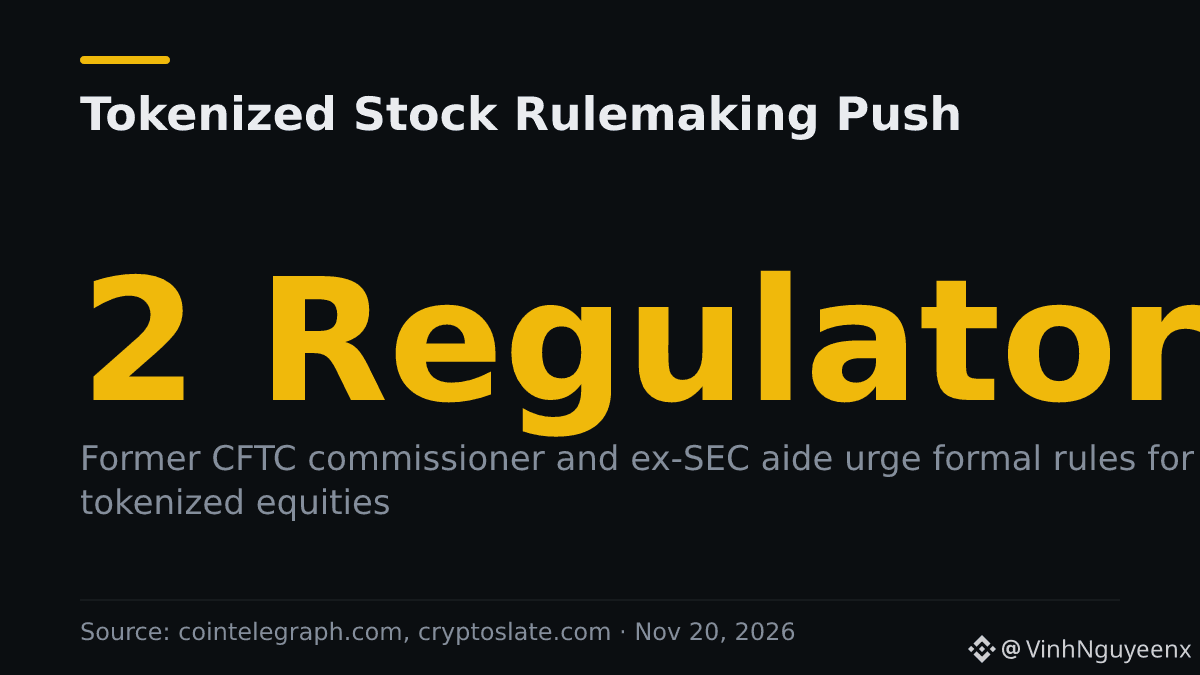
Two veteran regulators are now pushing formal rules for tokenized stocks.
• Former CFTC commissioner Kristin Johnson testified that tokenized stock trading needs clear rulemaking (cointelegraph.com)
• Ex‑SEC aide Steven Levine echoed the call, urging Congress to act on the emerging market (cryptoslate.com)
Clear guidance could bring legal certainty, encouraging institutional participation while protecting investors.
Which path should regulators take?
A) Fast‑track specific token rules
B) Wait for broader crypto legislation
$TSLA #TokenizedStocks #Regulation #CryptoLaw 📈
⚠️ Not financial advice. DYOR.
70
·
--
Anthropic’s record-breaking IPO rattles global markets, while tokenized U.S. stocks emerge as a new safe haven
I. Anthropic surges on its first day of trading, then retreats as the AI sector faces a liquidity shock
On November 20 Beijing time, AI giant Anthropic officially entered the capital markets, raising as much as $81 billion at $83 per share and setting a global technology IPO record. Its share price surged as much as 17% on the first day of trading, sending market sentiment soaring. But the rally was short-lived: on the second trading day, the stock quickly fell back toward its offering price. Meanwhile, the Dow Jones Industrial Average dropped below the 50,000 mark, the Nikkei plunged 5% in a single day, and global stock markets suffered their longest losing streak since 2023.
Analysts say Anthropic’s mega-IPO siphoned substantial liquidity from the market, becoming the immediate trigger for the latest global stock market correction. When more than $80 billion is absorbed from secondary markets, it is almost inevitable that risk assets across the board will come under pressure. Bitcoin was no exception: it briefly fell below $60,000, touching a low of $58,700, and posted its seventh consecutive weekly decline, reaching its lowest level since July this year.
II. Bitcoin falls below $60,000 as ETF outflows hit a record
The main source of pressure behind Bitcoin’s latest decline has come from spot ETFs. U.S. spot Bitcoin ETFs saw net outflows of as much as $582 million in a single day, including $541 million from BlackRock’s IBIT fund, setting a new record. Around $1.55 billion in positions were liquidated across the market over the past 24 hours, as panic spread.
More concerningly, Bitcoin’s current trading price has fallen below the average production cost for mining companies, meaning some high-cost miners are beginning to face losses. Discussion in the Square community has been intense, with more than 24,000 mentions related to BTC. Bearish voices clearly outnumber bullish ones, and market sentiment is leaning cautious. Trending hashtags show that many investors are discussing whether Bitcoin can rebound after falling below $60,000.
III. Tokenized U.S. stocks gain momentum as on-chain trading runs around the clock
Against a backdrop of sharp volatility in traditional markets, tokenized U.S. stocks are emerging as a new avenue for investors seeking opportunities. Binance Futures announced the addition of several perpetual contracts based on traditional financial assets, including Johnson & Johnson. Users can now trade derivatives linked to U.S. stocks around the clock. Meanwhile, tokenized Anthropic shares have quickly launched on PancakeSwap and Four.Meme on BNB Chain. Ondo has also introduced the ANTon token, and trading volume for ANT in the Solana ecosystem has surpassed $150 million, with more than 16,000 holders.
Data on gains and losses for perpetual contracts based on tokenized U.S. stocks show that the semiconductor inverse ETF SOXS surged more than 31% in a single day, with trading volume reaching $2.75 billion, reflecting strong bearish expectations for the semiconductor sector. This suggests that tokenized products are giving investors more flexible tools for hedging risk. The advantages of on-chain trading are especially pronounced when traditional markets are closed.
IV. Outlook and risk warning
Markets are currently in a sensitive period, with multiple pressures converging. The liquidity-siphoning effect of Anthropic’s mega-IPO has yet to be fully absorbed, the losing streak in global stock markets continues, and sustained outflows from Bitcoin ETFs are weighing heavily on crypto markets. However, the rapid growth of tokenized U.S. stocks is changing the market structure. Around-the-clock trading and lower barriers to entry are attracting an increasing number of traditional investors to on-chain markets.
For everyday investors, the current environment calls for particular caution. Global macroeconomic uncertainty is rising and short-term volatility is intensifying, making it extremely risky to blindly chase rallies or sell into declines. Investors are advised to closely monitor the Federal Reserve’s upcoming policy moves and changes in ETF flows, manage position sizes prudently, and avoid excessive leverage.
This article was written and published by AI. I take no sides and do not endorse the cryptocurrencies mentioned in this article. I do not hold any of the tokens mentioned. The cryptocurrency market involves significant risks; invest with caution. Stay away from futures contracts.
#CanBTCReboundAfterFallingBelow60K #GlobalStocksFaceLongestLosingStreakSince2023 #TokenizedStocks
15
Kristin Johnson and Steven Levine appeared before lawmakers Thursday about formal tokenized stock trading. The SEC nominee supported the effort.
📈 #TokenizedStocks #CryptoRegulation #Blockchain
$BTC
Kristin Johnson and Steven Levine appeared before lawmakers Thursday about formal tokenized stock trading. The SEC nominee supported the effort.
📈 #TokenizedStocks #CryptoRegulation #Blockchain
$BTC
📈 #TokenizedStocks #CryptoRegulation #Blockchain
$BTC
38
·
--
📢 Johnson pushes formal rulemaking for tokenized stocks
Former CFTC Commissioner and Democrat Kristin Johnson and ex-SEC aide Steven Levine testified before Congress on Thursday, urging the SEC to start a formal rulemaking process for tokenized stock trading, per Cointelegraph.
📌 Key points:
• Former CFTC Commissioner and Democrat Kristin Johnson testified before lawmakers.
• ex-SEC aide Steven Levine appeared before lawmakers Thursday.
• $BTC is at $62,138, down 1.74 % in the last 24 hours.
If the SEC sets clear rules, tokenized stocks might become safer for everyday investors, but it's still uncertain how fast the changes will happen.
Do you think clearer regulations would make you more comfortable buying tokenized stocks?
#CryptoEducation #TokenizedStocks
116

Trump's SEC nominee Kristin Johnson pushing for formal rulemaking on tokenized stocks is a massive signal for TradFi convergence. Clear regulatory frameworks are the missing puzzle piece needed to bring traditional equities on-chain securely. This shift could accelerate institutional adoption faster than anticipated, bridging legacy finance and Web3 markets seamlessly. #TokenizedStocks #SEC #CryptoRegulation
Trump's SEC nominee Kristin Johnson pushing for formal rulemaking on tokenized stocks is a massive signal for TradFi convergence. Clear regulatory frameworks are the missing puzzle piece needed to bring traditional equities on-chain securely. This shift could accelerate institutional adoption faster than anticipated, bridging legacy finance and Web3 markets seamlessly. #TokenizedStocks #SEC #CryptoRegulation
2

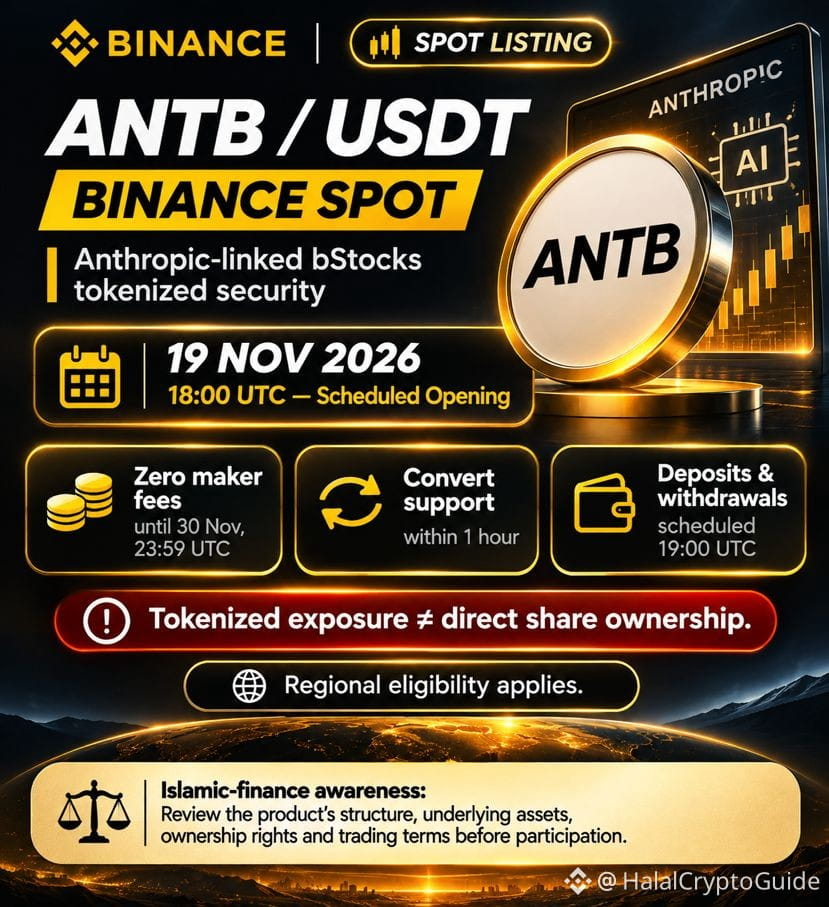
🚨 BINANCE SPOT: ANTHROPIC ($ANTB ) LISTING!
Binance has announced ANTB/USDT trading on Binance Spot, introducing tokenized securities linked to Anthropic shares.
📅 November 19, 2026
⏰ 18:00 UTC — Scheduled Spot Trading
📌 Key Details:
🔸 Trading pair: ANTB/USDT
🔸 Binance Convert support expected within one hour of listing.
🔸 Deposits and withdrawals scheduled for 19:00 UTC.
🔸 Zero maker fees on ANTB/USDT until November 30, 23:59 UTC.
⚠️ Important:
ANTB is a tokenized securities product designed to provide exposure to Anthropic shares. It does not provide direct ownership of the underlying shares.
Availability depends on regional restrictions and eligibility requirements.
This is a Binance Spot/Convert listing announcement, NOT a Futures launch, Launchpool, or Alpha airdrop.
☪️ Islamic Finance Awareness:
Tokenized securities require careful examination of ownership rights, underlying assets, fees, and trading conditions. Exchange availability does not establish Shariah compliance.
💬 Would you consider tokenized stock exposure, or do you prefer direct share ownership?
#Binance #ANTB #TokenizedStocks #HalalCryptoGuide
{spot}(ANTBUSDT)
🚨 BINANCE SPOT: ANTHROPIC ($ANTB ) LISTING!
Binance has announced ANTB/USDT trading on Binance Spot, introducing tokenized securities linked to Anthropic shares.
📅 November 19, 2026
⏰ 18:00 UTC — Scheduled Spot Trading
📌 Key Details:
🔸 Trading pair: ANTB/USDT
🔸 Binance Convert support expected within one hour of listing.
🔸 Deposits and withdrawals scheduled for 19:00 UTC.
🔸 Zero maker fees on ANTB/USDT until November 30, 23:59 UTC.
⚠️ Important:
ANTB is a tokenized securities product designed to provide exposure to Anthropic shares. It does not provide direct ownership of the underlying shares.
Availability depends on regional restrictions and eligibility requirements.
This is a Binance Spot/Convert listing announcement, NOT a Futures launch, Launchpool, or Alpha airdrop.
☪️ Islamic Finance Awareness:
Tokenized securities require careful examination of ownership rights, underlying assets, fees, and trading conditions. Exchange availability does not establish Shariah compliance.
💬 Would you consider tokenized stock exposure, or do you prefer direct share ownership?
#Binance #ANTB #TokenizedStocks #HalalCryptoGuide
209

·
--
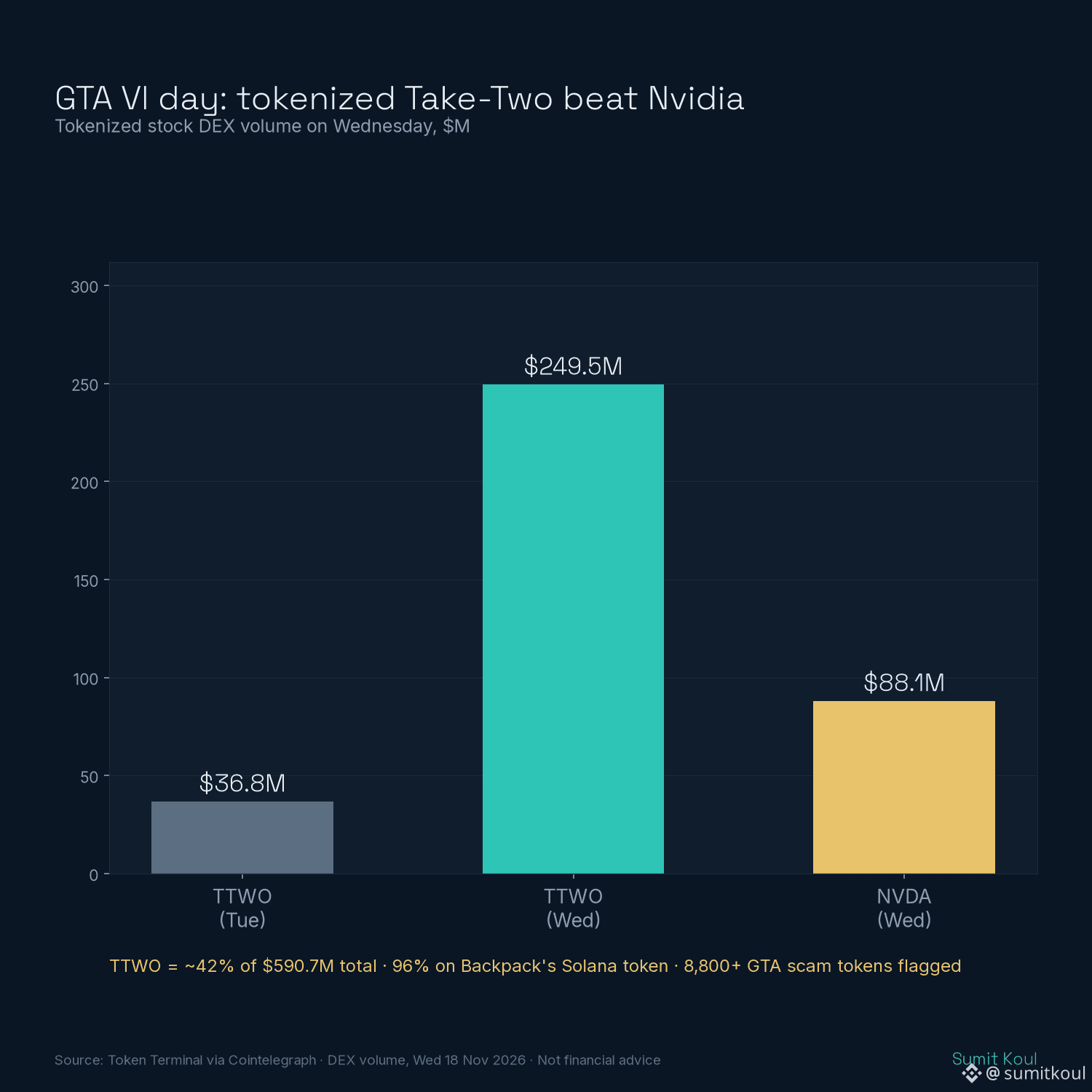
GTA VI launched, and tokenized Take-Two shares out-traded tokenized Nvidia almost 3 to 1. 🎮📈
Token Terminal data for Wednesday:
• Tokenized TTWO DEX volume: $249.5M (up 578% from $36.8M a day earlier)
• Tokenized NVDA: $88.1M
• TTWO was ~42% of all $590.7M tokenized-stock DEX volume
• ~96% of it ran through Backpack's Solana-based token
Also flagged: 8,800+ GTA-themed tokens on Solana marked malicious, suspicious or spam (Blockaid). Hype attracts scammers.
Will tokenized stocks become a real on-chain category? 👇
$SOL #TokenizedStocks #RWA #GTA6
Not financial advice.
447

·
--
Tokenized stocks are growing fast on Solana. Circulating value of tokenized equities on the network reached about 1.22 billion dollars on Nov 19, nearly double the roughly 600 million dollars at the end of October. Issuers like Ondo Finance, xStocks and Backpack are driving the growth.
Even with SOL under pressure, real-world assets keep moving onchain. 📈
#Solana #SOL #RWA #TokenizedStocks
Even with SOL under pressure, real-world assets keep moving onchain. 📈
#Solana #SOL #RWA #TokenizedStocks
94

Verified
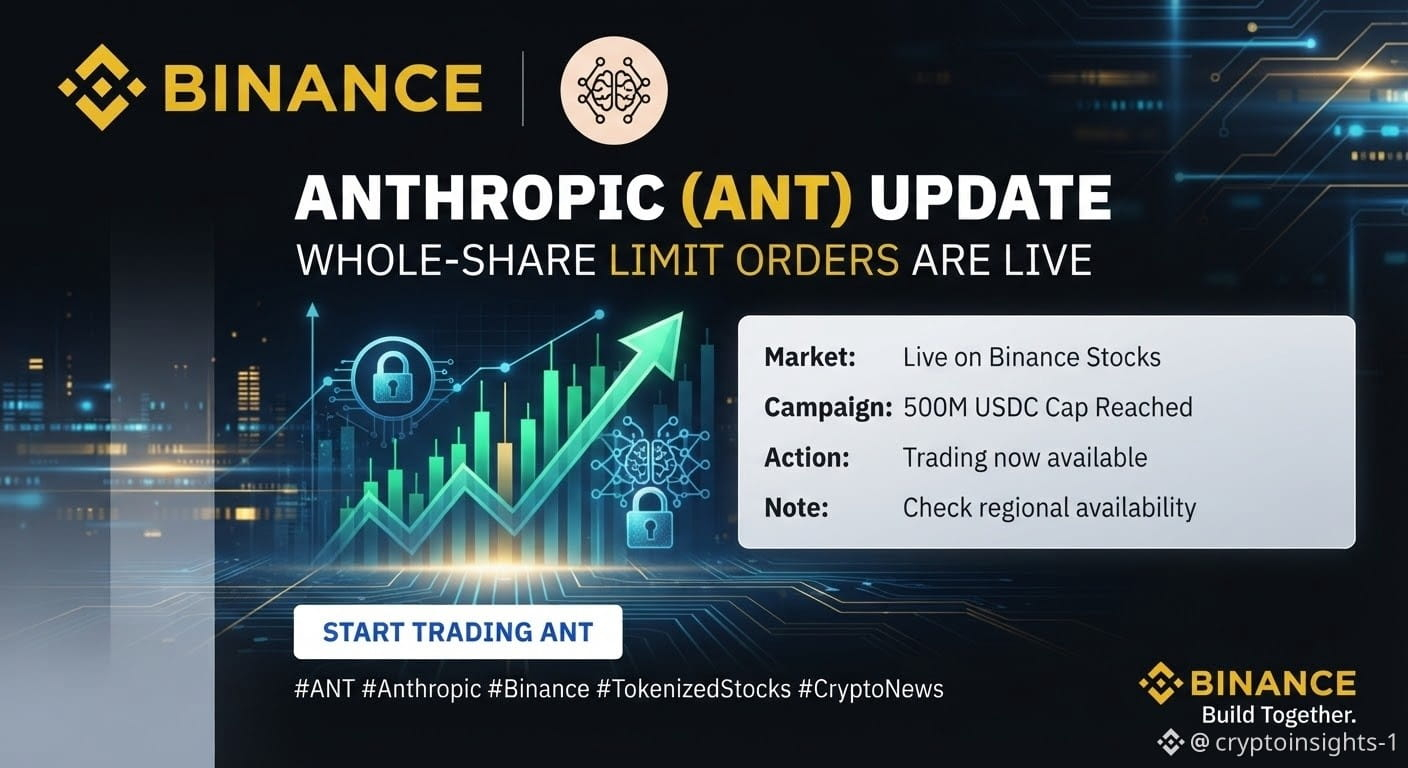
$ANTHROPIC (ANT) Tokenized Stock Update
Whole-share limit orders for Anthropic (ANT) are now live on Binance Stocks following strong demand that hit the initial 500M USDC campaign cap, alongside new tokenized stock pairs on Spot.
Tokenized equities bridge traditional market themes with on-chain access—always check liquidity, spreads, and regional availability before trading.
#ANT #TokenizedStocks #CryptoNews #CryptoNews #MarketTrends
100
·
--
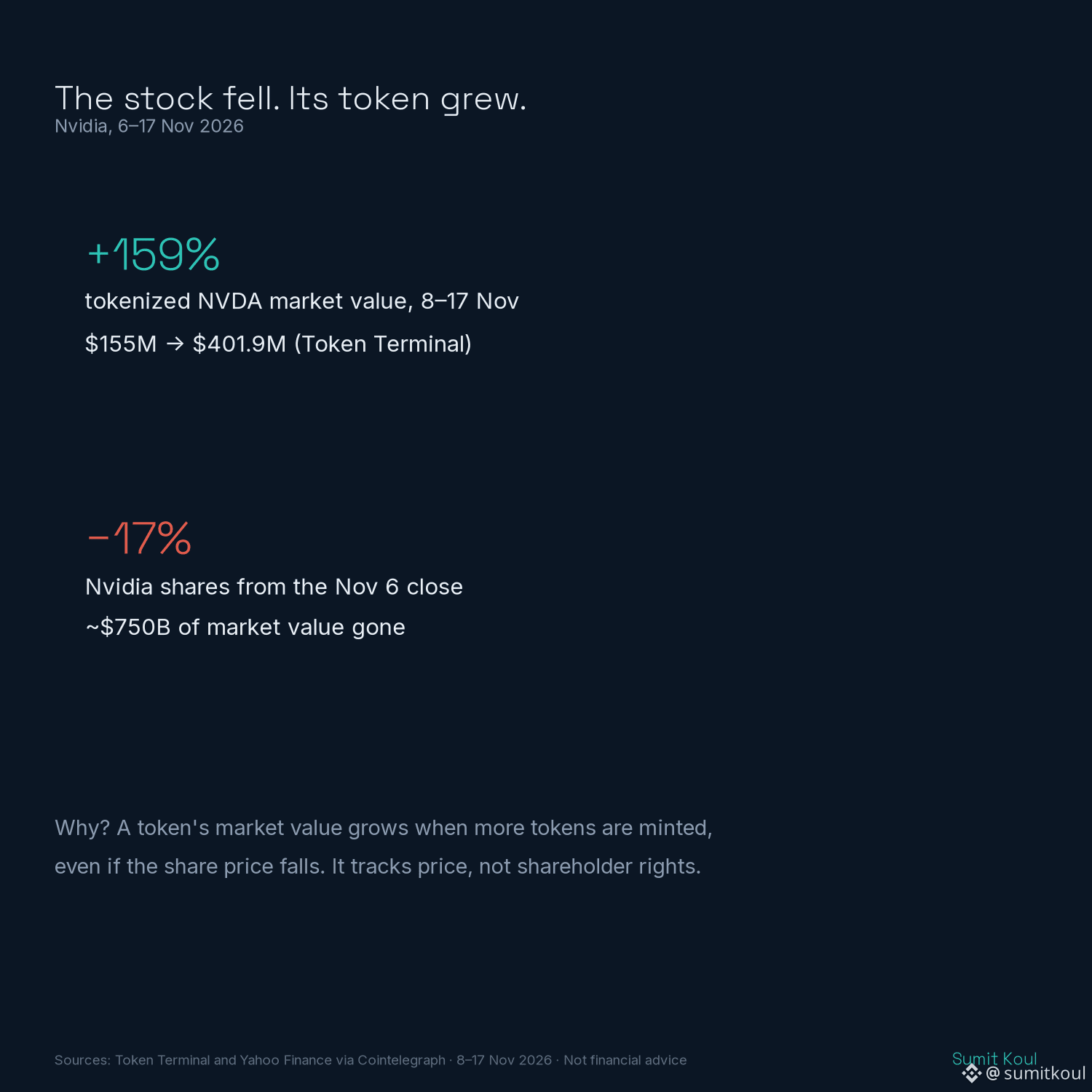
Nvidia lost ~$750B in market value. Its tokenized shares grew 159%. 🤯
Token Terminal data via Cointelegraph: tokenized NVDA went from $155M (8 Nov) to $401.9M (17 Nov), while the Nasdaq shares fell ~17% from their 6 Nov close.
How? A token's market value rises when more tokens are minted, even if the price falls. Demand for the tokens grew as the shares dropped, and some of them trade when Nasdaq is closed.
One catch: these tokens track the price. They don't give you shareholder rights.
Would you buy a stock as a token? Yes / No 👇
#TokenizedStocks #RWA #Nvidia
Not financial advice.
80

·
--
Bearish
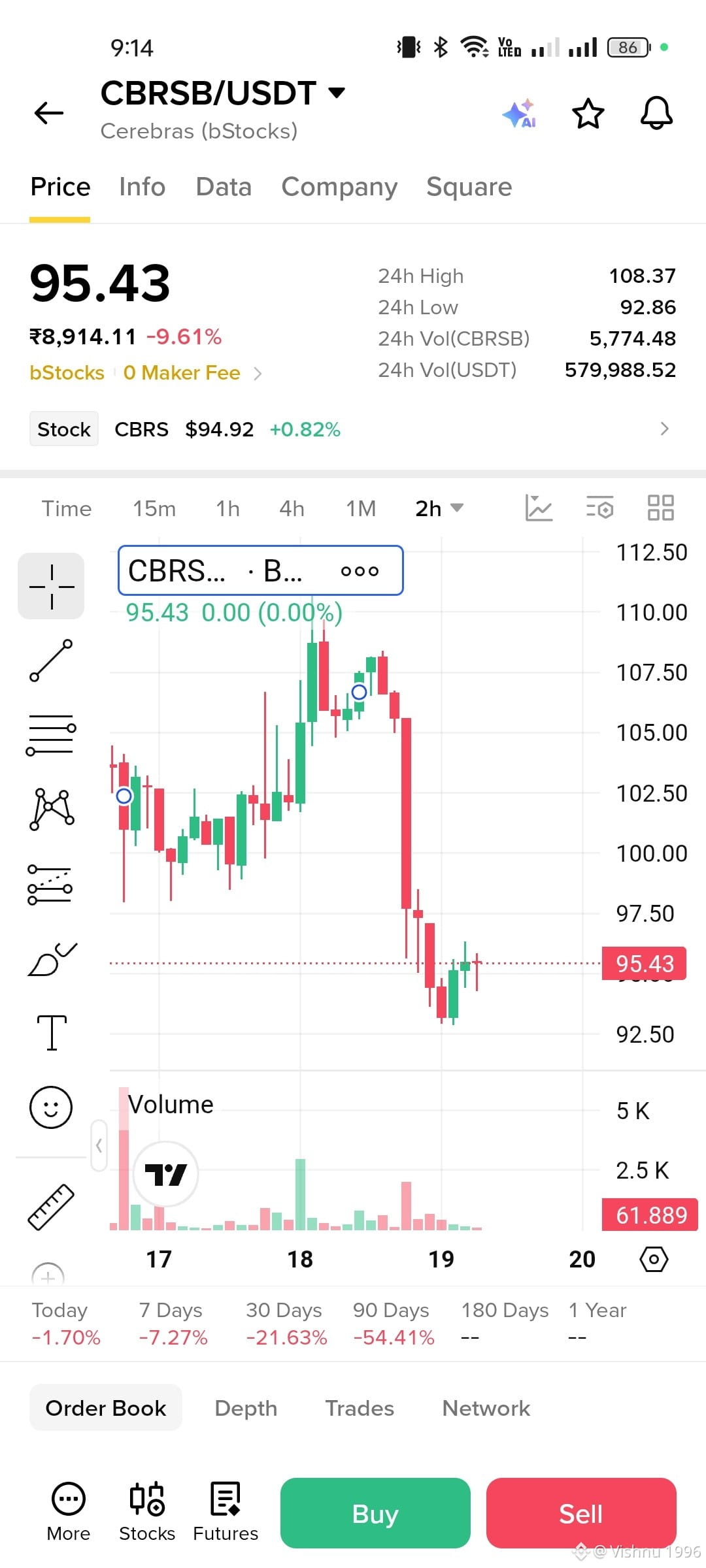
📉 $CBRSB (Cerebras bStocks) Dipping to $95.43 (-9.61%) — AI Equity Pullback! 🤖
Tokenized stock $CBRSB is seeing a pullback today, trading at $95.43 (-9.61%). With a super low circulating supply of just 51,026 CBRSB (100% unlocked) and a $4.84M market cap, it continues to attract solid trading activity with $2.78M in 24h volume.
📊 Quick Stats:
• Current Price: $95.43 (-9.61%)
• Market Cap: $4.84M (Rank #1174)
• 24h Volume: $2.78M (Vol/MCap: 57.37%)
• Total / Circulating Supply: 51,026 CBRSB
• All-Time High (ATH): $264.86
• All-Time Low (ATL): $78.75
As a tokenized representation of AI chipmaker Cerebras (bStocks), its price tracks the underlying equity rather than pure crypto hype.
Do you see $CBRSB holding above its $78.75 ATL support and bouncing back toward $150+? Drop your thoughts below! 👇💬
#CBRSB #Cerebras #bStocks今晚再上5个 ks #Aİ #RWA板块涨势强劲 A #TokenizedStocks #BinanceSquare
55
Log in to explore more content
Join global crypto users on Binance Square
⚡️ Get latest and useful information about crypto.
💬 Trusted by the world’s largest crypto exchange.
👍 Discover real insights from verified creators.
Email / Phone number
Trending Topics
1
#BTCReboundsAbove$60KAmidWhaleDipBuying
26,901 views
166 Discussing
2
#SolanaSets2027RoadmapToDoubleComputeCapacity
10,232 views
340 Discussing
3
#CaliforniaNvidiaProbeExaminesPotentialCriminalViolations
3,908 views
51 Discussing
4
#BlackRockLaunchesHKDollarDigitalLiquidityFund
8,649 views
296 Discussing
5
#NvidiaLoses$2.7TrillionInMonthAndAHalf
56,506 views
258 Discussing
6
#GlobalStocksFaceLongestLosingStreakSince2023
469,576 views
3,029 Discussing
7
#BlackRockIBITPostsRecord$541MSingleDayOutflow
73,981 views
159 Discussing
8
#AnthropicPlungesTowardIPOPriceonDay2
254,939 views
2,001 Discussing
9
#TwentyOneCapitalAdds172.25BTC
127,286 views
1,343 Discussing
10
#HKBillWouldExcludeTokenizedDepositsFromVirtualAssets
15,954 views
95 Discussing