
#usde
usde
1.4M views
1,815 Discussing
Hot
Latest

·
--
Article
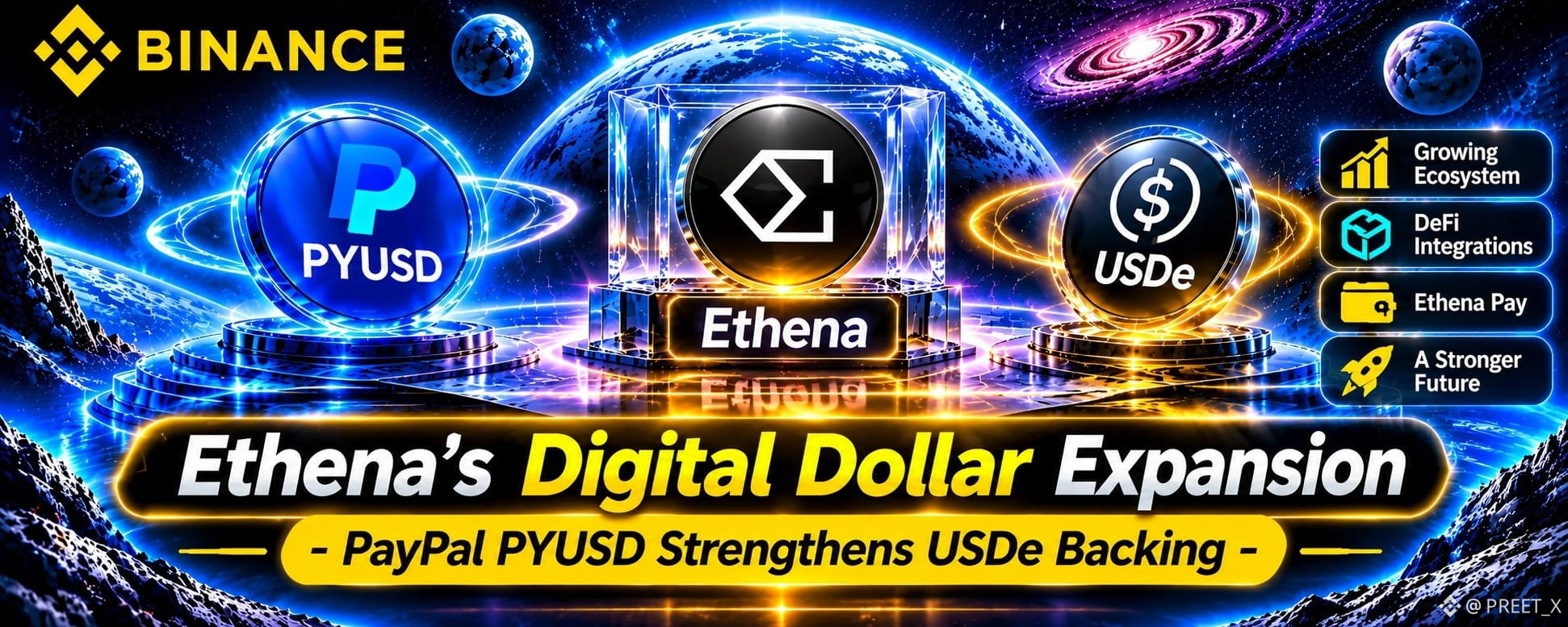
Ethena’s Digital Dollar Expansion: Why PayPal PYUSD Matters for USDe 🚀The digital dollar ecosystem is evolving, and Ethena is becoming an increasingly interesting player in this growing market.
One development gaining attention is the growing role of PayPal USD (PYUSD) in backing Ethena’s USDe.
1. PayPal PYUSD: A Major Development for Ethena
According to the on-chain figures shared in the November 26 report, approximately $740.56 million in PYUSD is being used as part of USDe's backing.
With PYUSD supply reported at approximately $2.32 billion, this represents nearly 32% of its total supply.
This is significant because it highlights how Ethena's ecosystem is connecting with established digital dollar infrastructure.
It also adds another important stablecoin exposure to USDe's backing portfolio.
2. Ethena Is Expanding Beyond Stablecoins
Ethena's growth is not limited to USDe.
Several developments are expanding its ecosystem:
- OKX Wallet: USDe is now accessible through OKX Wallet.
- X Layer: USDe launched natively on X Layer, with Aave V3 as its first integration.
- Ethena Pay: Expanding the use of digital dollars through a self-custodial payment experience.
- Earn+: Introducing additional ways to access dollar-based DeFi strategies.
These developments show Ethena's ambition to make digital dollars useful across different financial applications.
3. What About ENA Token?
The ENA ecosystem also has an important tokenomics development.
Ethena governance approved a fee-switch framework that can direct up to 95% of eligible net protocol revenue toward ENA buybacks.
However, buybacks are tied to USDe supply milestones. The first activation threshold is a 14-day average USDe supply of $7.5 billion.
This means the framework is approved, but approval does not mean buybacks have already started.
4. The Bigger Picture
Ethena is developing across multiple areas:
- Digital dollar infrastructure
- Stablecoin backing diversification
- DeFi integrations
- Payment applications
- Institutional adoption
- ENA value-accrual mechanisms
The combination of these developments could strengthen Ethena's position in the digital dollar market.
5. Risks to Watch
Growth does not come without risks.
USDe depends on its backing assets, counterparties, lending markets and hedging strategies. Stablecoin issuer risk, smart-contract risk, liquidity and market conditions remain important factors.
Adoption alone does not guarantee ENA price appreciation.
Final Thoughts
Ethena is building more than a synthetic dollar.
Its expanding integrations, PYUSD exposure and payment ecosystem show how digital dollars could become part of a broader financial infrastructure.
The next important milestone will be sustained USDe growth, stronger real-world usage and actual value accrual for ENA
The digital dollar ecosystem is evolving. Ethena is positioning itself for the next phase. ⚡
$ENA #Ethena #USDe #PYUSD #DEFİ
Ethena’s Digital Dollar Expansion: Why PayPal PYUSD Matters for USDe 🚀
The digital dollar ecosystem is evolving, and Ethena is becoming an increasingly interesting player in this growing market.
One development gaining attention is the growing role of PayPal USD (PYUSD) in backing Ethena’s USDe.
1. PayPal PYUSD: A Major Development for Ethena
According to the on-chain figures shared in the November 26 report, approximately $740.56 million in PYUSD is being used as part of USDe's backing.
With PYUSD supply reported at approximately $2.32 billion, this represents nearly 32% of its total supply.
This is significant because it highlights how Ethena's ecosystem is connecting with established digital dollar infrastructure.
It also adds another important stablecoin exposure to USDe's backing portfolio.
2. Ethena Is Expanding Beyond Stablecoins
Ethena's growth is not limited to USDe.
Several developments are expanding its ecosystem:
- OKX Wallet: USDe is now accessible through OKX Wallet.
- X Layer: USDe launched natively on X Layer, with Aave V3 as its first integration.
- Ethena Pay: Expanding the use of digital dollars through a self-custodial payment experience.
- Earn+: Introducing additional ways to access dollar-based DeFi strategies.
These developments show Ethena's ambition to make digital dollars useful across different financial applications.
3. What About ENA Token?
The ENA ecosystem also has an important tokenomics development.
Ethena governance approved a fee-switch framework that can direct up to 95% of eligible net protocol revenue toward ENA buybacks.
However, buybacks are tied to USDe supply milestones. The first activation threshold is a 14-day average USDe supply of $7.5 billion.
This means the framework is approved, but approval does not mean buybacks have already started.
4. The Bigger Picture
Ethena is developing across multiple areas:
- Digital dollar infrastructure
- Stablecoin backing diversification
- DeFi integrations
- Payment applications
- Institutional adoption
- ENA value-accrual mechanisms
The combination of these developments could strengthen Ethena's position in the digital dollar market.
5. Risks to Watch
Growth does not come without risks.
USDe depends on its backing assets, counterparties, lending markets and hedging strategies. Stablecoin issuer risk, smart-contract risk, liquidity and market conditions remain important factors.
Adoption alone does not guarantee ENA price appreciation.
Final Thoughts
Ethena is building more than a synthetic dollar.
Its expanding integrations, PYUSD exposure and payment ecosystem show how digital dollars could become part of a broader financial infrastructure.
The next important milestone will be sustained USDe growth, stronger real-world usage and actual value accrual for ENA
The digital dollar ecosystem is evolving. Ethena is positioning itself for the next phase. ⚡
$ENA #Ethena #USDe #PYUSD #DEFİ
339
·
--
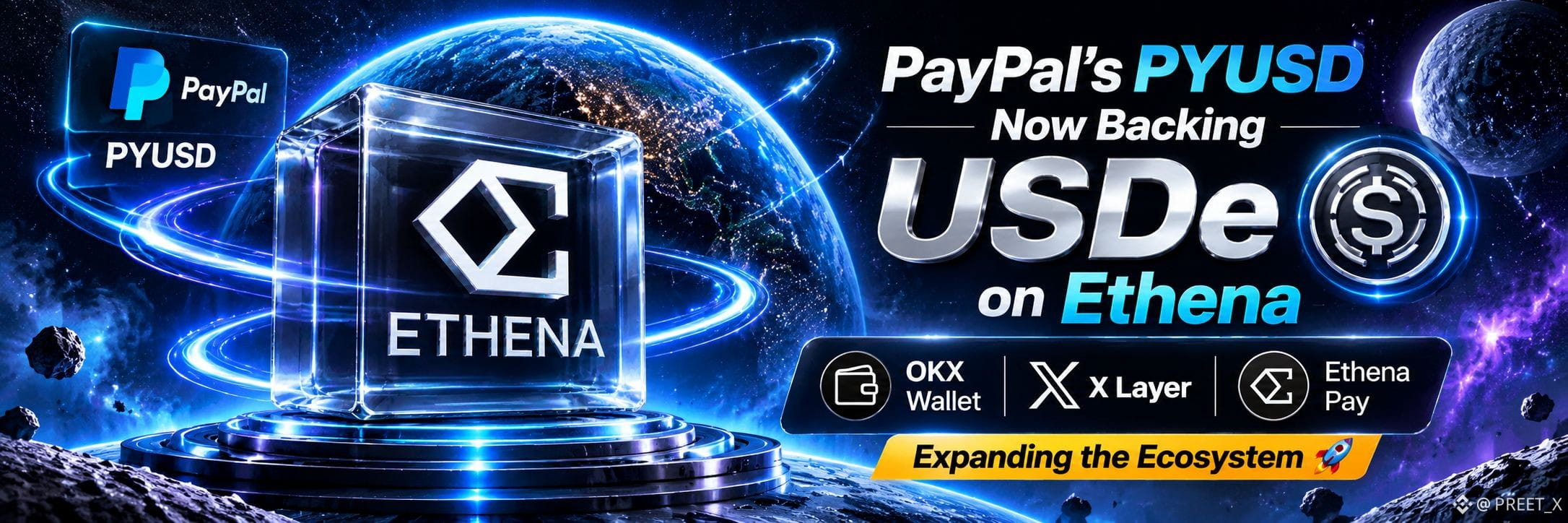
Digital dollars are expanding and Ethena is becoming an interesting part of this growth
PYUSD is now a meaningful part of USDe's backing, adding another layer to Ethena's ecosystem.
With expansion across OKX Wallet, X Layer and Ethena Pay, the project is moving beyond just stablecoins
The next phase of digital finance is taking shape. 🚀
$ENA #EthenaLabs #USDe #crypto
PYUSD is now a meaningful part of USDe's backing, adding another layer to Ethena's ecosystem.
With expansion across OKX Wallet, X Layer and Ethena Pay, the project is moving beyond just stablecoins
The next phase of digital finance is taking shape. 🚀
$ENA #EthenaLabs #USDe #crypto
209

·
--
📉 USDEB is showing short-term weakness amid volatility; watch 3.52 USDT
USDEB/USDT is a Binance spot trading pair. USDEB is issued by BTECH Holdings and represents Class A common stock in StablecoinX (USDE), listed on Nasdaq. Eligible users can convert it at a 1:1 ratio. The company focuses on stablecoin infrastructure, and ENA, one of its reserve assets, is also worth watching in the short term.
At 05:06 Beijing time on November 24, a historical Binance spot snapshot showed a price of 4.13 USDT, up 10.24% over 24 hours. However, it had already fallen 1.67% in the preceding four hours. Later, during US stock market hours at 04:41 Beijing time on November 25, USDE was trading at $3.66, down 10.18%. The Nasdaq Composite closed down 1.5% that day. Since the two quotes are from different times, the current premium and Binance’s latest 24-hour change still need to be confirmed.
Over the next 4–24 hours, the outlook is for volatile trading with a downward bias. If a spot rebound is capped near the previous traded price of 4.13 USDT, the first level to watch is the seven-day hourly closing low of 3.52. A high-volume break below that level would put the two-week low of 3.45 in focus. The bearish outlook would be invalidated if Binance spot trading recovers above 4.13 on high volume and holds there, while USDE stabilizes after the US market opens at 22:30 Beijing time on November 25. US markets will be closed for Thanksgiving on November 26, so watch for spot price discrepancies during the gap in US stock quotes.
#USDEB #USDE #美股 #RWA
6

·
--
Ethena just drew a line in the sand on stablecoin trust — and the market can't decide if it's a strength or a red flag.
After investigators linked $101.9M in swaps through Sky's stablecoin system to North Korean actors, Ethena confirmed on Nov 19 that direct minting and redemption of its $4.88B synthetic dollar USDe has always been restricted to screened counterparties — identity verification, sanctions and AML checks included. Everyone else can only buy USDe on secondary markets.
Ethena admits the gated model has at times been a "competitive disadvantage." Sky disputes the framing, saying flagged flows were under 0.06% of its module volume. Meanwhile USDe expanded to Stellar on Nov 20, and governance has approved a buyback framework for $ENA tied to USDe supply milestones.
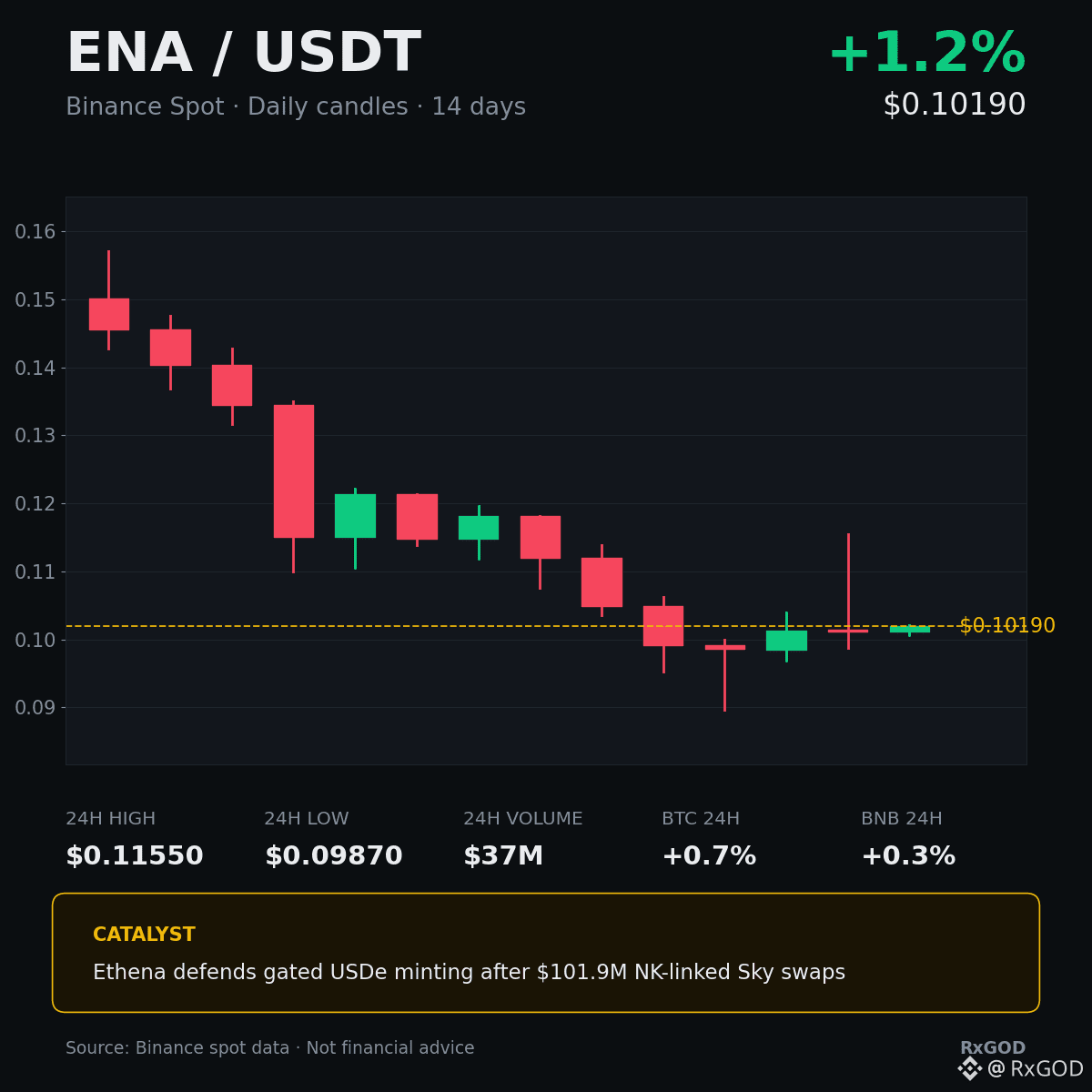
The token tells a harsher story: $ENA trades at $0.1018, up just 1.1% in 24 hours, down 30% over 14 days and 93% below its $1.52 all-time high — sitting at only 18% of its two-week range. This is a fragile bounce, not a reversal, and tomorrow's US PCE report could shake the whole market.
So here's the real debate: is permissioned minting the only way a synthetic dollar survives in 2026 — or does gating access betray what DeFi was supposed to be? And does $ENA recover first, or does $BTC drag everything down again?
Not financial advice — DYOR.
#Ethena #USDe #ExtremeFear #CryptoNews
1
307

·
--
💵 What is USDe? Is it really a Digital Dollar?
In the world of crypto, USDe is an interesting digital asset that every new investor should know about. 🚀
🔹 What is USDe? USDe is a synthetic dollar introduced by the Ethena protocol. Its goal is to maintain a value close to 1 US dollar.
🔹 How is it different from USDT? USDT is a traditional stablecoin, while USDe works differently and uses crypto collateral and hedging strategies.
🔹 Key features of USDe: ✅ Aims to stay close to the dollar’s value
✅ Used in DeFi
✅ Various earning opportunities
✅ A unique role in the crypto ecosystem
⚠️ Important: Don’t consider USDe risk-free. It’s important to understand price fluctuations, collateral, funding rates, and protocol risks. There is no guarantee of profit.
🌱 My Crypto Learning Journey
I’m still learning about the world of crypto. My goal is not only to invest, but also to gain knowledge and share useful information with others.
Tell me: Have you ever used USDe? What do you think? 👇
#USDe #CryptoEducation #BinanceSquare $USDE $USDT

Tx TOSLIM334:
Hi friend I'm Toslim form Bangladesh and you
2
4
78

The 0-loss instant swap is real, but it only applies to the single action of “swapping tokens”—it doesn’t cover the books for the entire strategy. A phrase like “deposit USDe, instantly swap it to USDC, no slippage, no fees, ten grand a day” compresses a multi-leg hedging structure into an action that looks like it has just one leg and no costs. The costs haven’t disappeared; they’ve just been moved to three other bills.
First bill: funding rates. The bulk of the returns from USDe’s delta-neutral setup has never come from instant swaps, but from funding fees received on perpetual shorts. That means your cash flow works like this: “the crazier others get about going long, the more you collect”—and the reverse is true, too. Once the rate turns negative, that same position structure starts bleeding at a fixed daily rate, and the larger the position, the faster the losses mount. Volume-farming strategies encourage people to scale up their positions, because in a positive-funding environment, returns grow linearly with position size. The problem is that funding rates don’t give you advance notice before they turn. They only need to stay negative for a few days to claw back most of the returns you’ve accumulated. You won’t see this number on the instant-swap page; it’s in your derivatives account history.
Second bill: trading friction. At VIP 0, a 0.05% taker fee means 0.1% for opening and closing a position, before you even account for slippage. The order-book depth for USDEUSDT perpetuals is nowhere near BTC or ETH, and market impact becomes more pronounced as you increase your notional position. More importantly, the claim “making ten grand a day” needs to be unpacked: it usually refers to trading volume, not net profit. Trading volume is what the exchange uses to calculate fees; net profit is the money actually added to your account. Passing off the former as the latter is the most common bait-and-switch in posts like these.
Third bill: the redemption channel. The reason an instant swap can have “0 loss” is that someone on the other side is willing to take the tokens at close to a 1:1 rate. What really determines USDe’s price isn’t the quote on the instant-swap page, but the capacity and speed of primary-market minting and redemption, as well as whether the secondary market is willing to take the other side under stress. In normal conditions, this channel is wide open, so it looks free; during extreme market conditions, it narrows, and the discount shows up first where liquidity is thinnest. That’s when “0 loss” gets settled all at once in another form. Assuming that short-term liquidity guarantees long-term exitability is one of the most common recurring mistakes in stablecoin strategies.
There’s another dimension that’s easy to overlook: crowding. When a strategy is packaged as “officially endorsed, not a bug, and infinitely stackable” and widely promoted, the participants themselves start changing the source of the returns. When everyone puts on the same hedge at once, funding rates get compressed and yields converge toward zero, while costs like fees, slippage, and the risk of negative funding remain unchanged. Returns are endogenous and decay over time; costs are exogenous and fixed. The point where those two lines cross is often when this kind of strategy goes from “easy money” to “all effort for nothing.”
My view: USDe itself is a cleverly designed tool, but it’s better treated as a position that requires monitoring funding rates and channel conditions—not as a mindless volume-farming loop. If you do participate, keep an eye on at least three things: the real-time perpetual funding rate and its direction of movement, your position size relative to order-book depth, and how smoothly the redemption channel is operating. If two of these three start deteriorating, it’s time to stop.
Risk warning: Persistent negative funding, congestion in redemption channels, and brief stablecoin depegs can happen at the same time—and they may all occur when you least want to reduce your position.
#USDE #稳定币 #Crypto
12

·
--
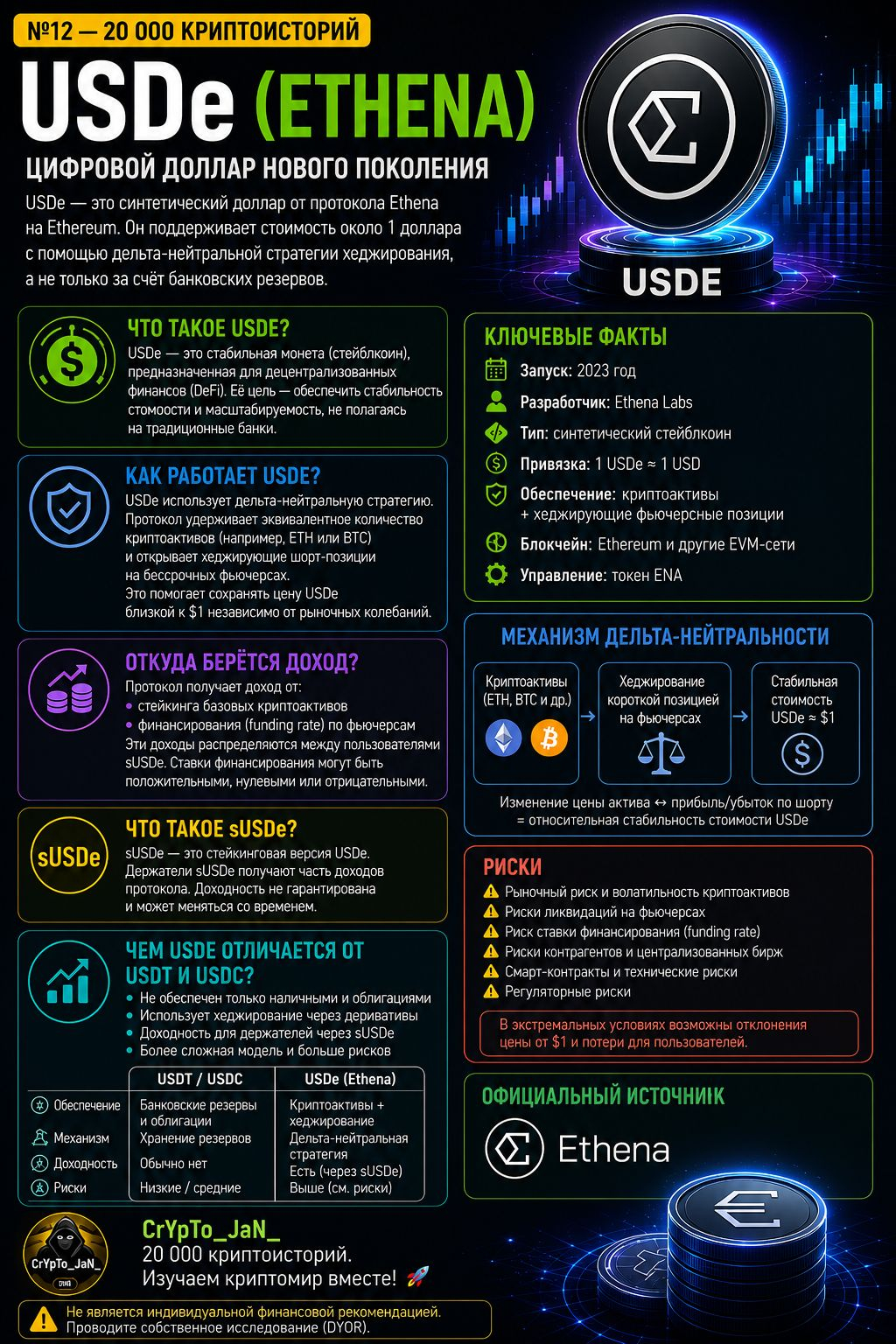
💵 №12 — USDe (#Ethena ): digital dollar without conventional bank backing
USDe is a synthetic dollar created by the Ethena protocol on Ethereum. Its goal is to maintain a value close to 1 US dollar. But it is important to understand: USDe is not an ordinary stablecoin backed only by bank dollars or government bonds.
🔹 How does USDe work?
Ethena uses crypto assets such as BTC and ETH, as well as corresponding hedging positions on futures markets. When the value of a crypto asset changes, the opposite position is meant to offset a significant part of that movement.
This approach is called delta hedging. It helps maintain the relative stability of USDe’s value.
🔹 Where does the income come from?
The protocol’s income may come from staking crypto assets and financing futures positions. However, funding rates change: sometimes they can be low or even negative.
🔹 What is sUSDe?
#USDe — this is the staking version of USDe. Users can receive rewards linked to the protocol’s income. The yield is not guaranteed and may change.
60

Verified
A powerful addition to the Stellar network: USDe officially launches! 🚀
The $XLM network announced a new strategic step to boost its liquidity and ecosystem: USDe, from the Ethena protocol (the third-largest stablecoin, with a market cap exceeding $4.87 billion), and its staking version, sUSDe, launched on the network on November 19.
Key highlights:
• Expanded liquidity: The addition of USDe and sUSDe opens up new opportunities for yield and decentralized finance on the Stellar network.
• Stablecoin leadership: With this launch, Stellar now supports two of the market’s three largest dollar-pegged stablecoins, alongside Circle’s USDC.
• A move that reflects growing confidence in Stellar’s infrastructure and its ability to attract major crypto projects.
What do you think this move means for the future of $XLM and its ecosystem? Share your predictions in the comments! 👇
#xlm #USDe #CryptoNews #crypto
{spot}(XLMUSDT)
A powerful addition to the Stellar network: USDe officially launches! 🚀
The $XLM network announced a new strategic step to boost its liquidity and ecosystem: USDe, from the Ethena protocol (the third-largest stablecoin, with a market cap exceeding $4.87 billion), and its staking version, sUSDe, launched on the network on November 19.
Key highlights:
• Expanded liquidity: The addition of USDe and sUSDe opens up new opportunities for yield and decentralized finance on the Stellar network.
• Stablecoin leadership: With this launch, Stellar now supports two of the market’s three largest dollar-pegged stablecoins, alongside Circle’s USDC.
• A move that reflects growing confidence in Stellar’s infrastructure and its ability to attract major crypto projects.
What do you think this move means for the future of $XLM and its ecosystem? Share your predictions in the comments! 👇
#xlm #USDe #CryptoNews #crypto

2
686

·
--
$USDE +0.04% | $U +0.04% | $XUSD +0.01%
#USDE edged higher to $1.00, up +0.04% on $3.3 M of volume.
#U also nudged to $1.00, matching the +0.04% gain but on a much larger $57.9 M of trade.
#XUSD ticked up very slightly to $1.00, +0.01% with $5.1 M moving hands.
📈 The spread in volume suggests liquidity may shift quickly if any of these stablecoins see a larger inflow.
#Write2Earn #Binance
6

·
--
Funding rates have turned negative. Can USDe’s “dollar-printing machine” keep running?The bottom line first: USDe’s $1 peg is still holding firm, but its profit engine has stalled—funding rates for Bitcoin and Ethereum perpetuals have turned negative across the board today. The 5% annualized yield shown for sUSDe is the average over the past 30 days, not the current rate. This article runs the numbers: if negative funding rates persist, how long can each of USDe’s three lines of defense hold out?
1. Where does USDe’s money come from?
USDe isn’t a stablecoin issued by depositing dollars in a bank. It’s a “basis arbitrage machine”: the protocol takes in spot ETH and BTC as collateral while opening an equal-sized short position on perpetual futures to hedge. Price moves cancel each other out, and it earns from two things—the funding payments it receives on its shorts and the yield from staking the ETH collateral. When markets are good, longs scramble to pay the funding rate, and the machine prints money; when markets turn bad, the rate goes negative, and the machine starts losing money.
Funding rates have turned negative. Can USDe’s “dollar-printing machine” keep running?
The bottom line first: USDe’s $1 peg is still holding firm, but its profit engine has stalled—funding rates for Bitcoin and Ethereum perpetuals have turned negative across the board today. The 5% annualized yield shown for sUSDe is the average over the past 30 days, not the current rate. This article runs the numbers: if negative funding rates persist, how long can each of USDe’s three lines of defense hold out?
1. Where does USDe’s money come from?
USDe isn’t a stablecoin issued by depositing dollars in a bank. It’s a “basis arbitrage machine”: the protocol takes in spot ETH and BTC as collateral while opening an equal-sized short position on perpetual futures to hedge. Price moves cancel each other out, and it earns from two things—the funding payments it receives on its shorts and the yield from staking the ETH collateral. When markets are good, longs scramble to pay the funding rate, and the machine prints money; when markets turn bad, the rate goes negative, and the machine starts losing money.
1
1.1k

·
--
$USDE -0.05% | $EUR -0.11% | $BMT -0.24%
#USDE held at $1.00, slipping 0.05% on $1.1 M volume. Its delta‑hedged synthetic dollar still earns native crypto yield from staking and perpetual funding, a modest dip but the mechanism remains intact.
#EUR traded at $1.10, down 0.11% with a comparatively robust $13.8 M of activity, indicating steady interest despite the slight pullback.
#BMT moved to $0.0204, down 0.24% on $12.1 M volume, a modest retreat that keeps it in a tight range alongside its peers.
The divergence between EUR’s larger trade flow and the tighter volumes of USDE and BMT may hint at shifting liquidity preferences among synthetic stablecoins.
#Write2Earn #Binance
7

·
--
【Market Flash】USDe rebounds on whale support, health factor just 1.02
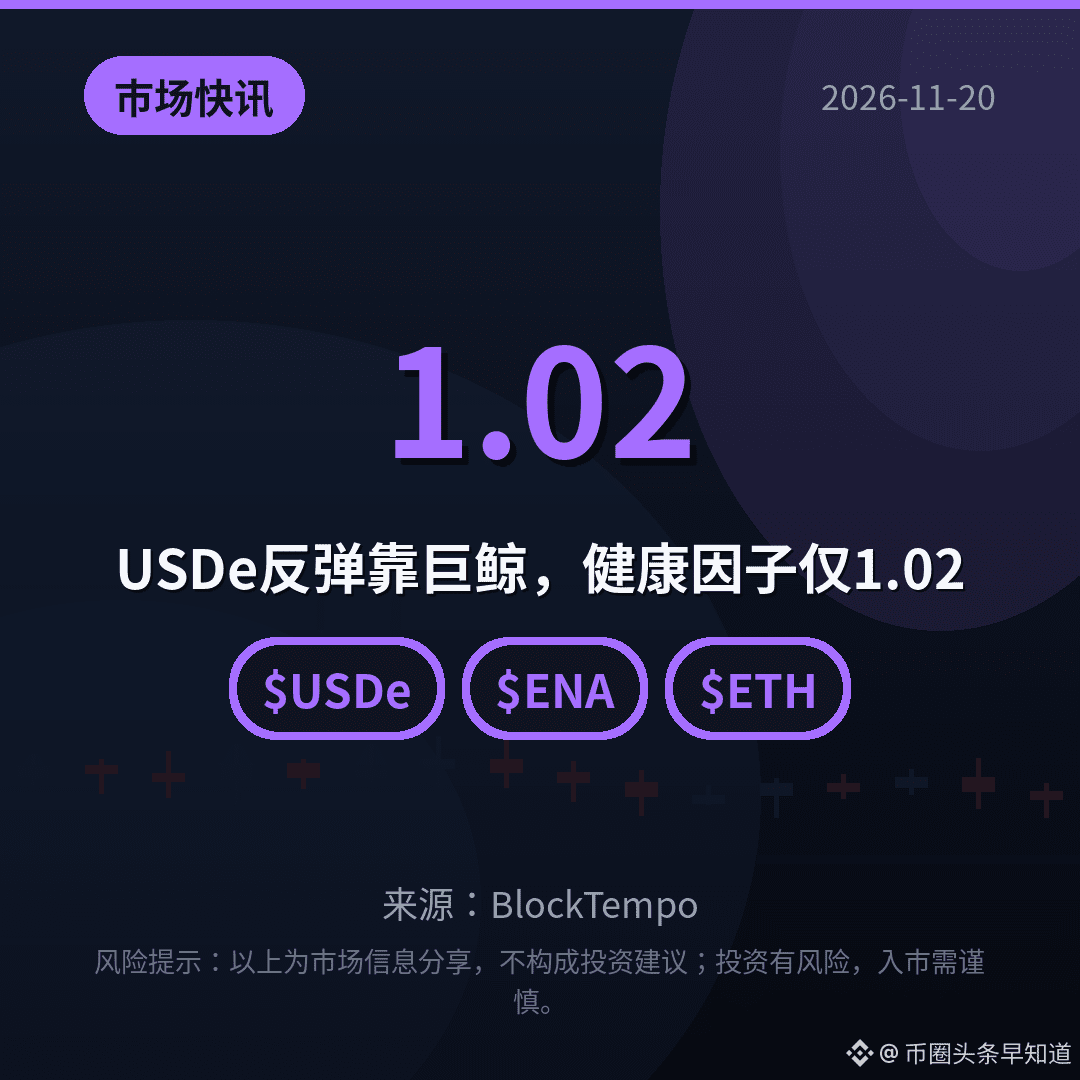
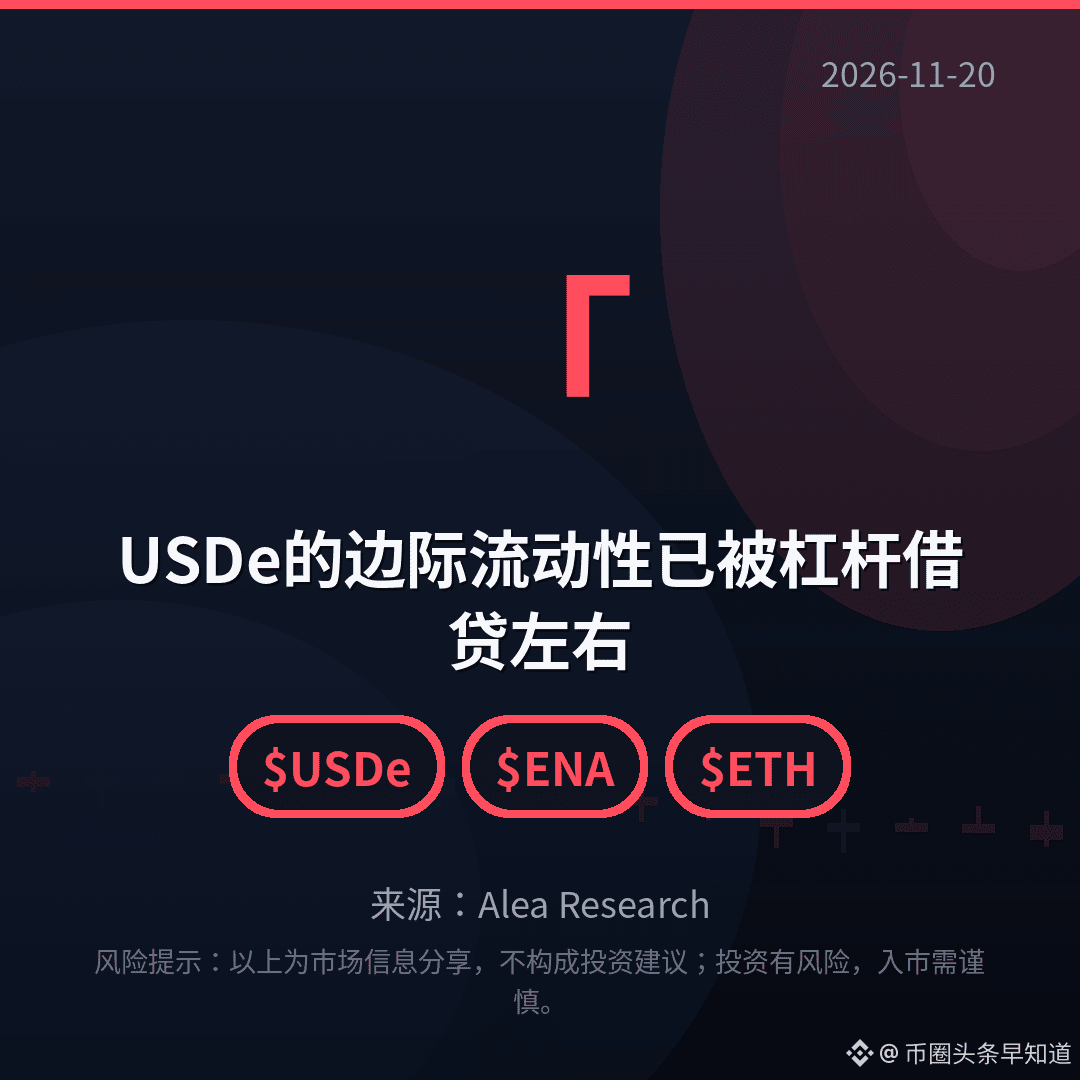
Ethena’s USDe rebound is entirely dependent on a single whale: on November 6, the whale made 21 rounds of looping loans over four hours, minting $1.162 billion worth of USDe that week and bringing the supply back to around $3.88 billion. But its health factor is just 1.02, meaning a roughly 2.3% drop in collateral value could trigger liquidation. ENA’s first buyback may be delayed until 2027. Can the rebound hold? Share your thoughts in the comments.
$USDe $ENA $ETH
#币安广场 #Ethena #USDe
(Source: BlockTempo)
⚠️Risk warning: The above is shared for market information purposes only and does not constitute investment advice. Investing involves risks; exercise caution when entering the market.
8

·
--
USDE Binance Spot (tokenized stocks/ETFs), 5m close at 22:35 Beijing time on 2026-11-16: -7.72%; at 22:35:02 Beijing time on 2026-11-16, the current price was 4.54, 24h volume was 90.7K, price was below VWAP 4.8292, and RSI was 5.5. First, focus on the key data: the market is reassessing risk.
Can the rebound get back above VWAP 4.8292? If it fails to follow through, weakness will persist; only a move back above it would signal a meaningful recovery.
Note: This is spot trading for tokenized stocks/ETFs, with higher liquidity and gap risks outside market hours. 24h trading volume is under $5 million, and the order book is thin, so watch out for slippage.
#USDE #Unusual Activity Alert
4
·
--
$USDE -0.03% | $USDC -0.03% | $XUSD -0.04%
#USDE held steady at $1.00, slipping just 0.03% with $1.4 M of volume. Its synthetic dollar design pulls yield from staking and perpetual funding, so the tiny dip may simply reflect short‑term market noise.
#USDC also sat at $1.00, down 0.03% on a hefty $1.43 B of trades. As a fully collateralized stablecoin, the modest move suggests liquidity is staying intact despite the broader dollar‑peg pressure.
#XUSD priced at $1.00, marginally down 0.04% with $3.9 M moving. The minimal change mirrors the other USD‑linked tokens, hinting at a synchronized stability across the trio.
👀 Keep an eye on volume spikes; a sudden surge could push any of these pegs off their narrow bands.
#Write2Earn #Binance
7
·
--
$USDE -0.01% | $U -0.02% | $USD1 -0.02%
#USDE holds at $1.00, slipping 0.01% with $1.5 M of volume. Its delta‑hedged synthetic dollar draws native crypto yield from staking and perpetual funding rates, which may cushion the modest dip.
#U trades flat at $1.00, down 0.02% on a relatively hefty $32.7 M of volume, suggesting steady interest despite the slight pullback.
#USD1 is priced at $0.9988, also down 0.02% but moving on a much larger $196.0 M of volume, indicating deeper market activity around this near‑par stablecoin.
The contrast between USD1’s high volume and the modest flows of USDE and U could hint at shifting liquidity preferences among dollar‑pegged tokens.
#Write2Earn #Binance
6
·
--
$USDE -0.03% | $U -0.03% | $USDC -0.04%
#USDE slipped to $1.00, down 0.03% on $2.1 M volume. Its synthetic dollar model draws yield from staking and perpetual funding, so any shift in funding rates could matter.
#U also held $1.00, down 0.03% with $21.8 M changing hands. The modest dip mirrors the broader stablecoin trend today.
#USDC stayed at $1.00, off 0.04% on a massive $1.17 B volume, underscoring its continued dominance in fiat‑crypto flows.
👀 Watch whether the synchronized down‑ticks across these three dollar‑pegs hint at short‑term pressure on stablecoin demand.
#Write2Earn #Binance
6
·
--
$USDE -0.01% | $RLUSD -0.02% | $USDC -0.03%
#USDE held at $1.00, slipping 0.01% with $2.1 M traded. Its delta‑hedged synthetic dollar model still draws yield from staking and perpetual funding.
#RLUSD also sat at $1.00, down 0.02% on a relatively hefty $38.1 M volume, suggesting modest interest despite the slight dip.
#USDC remained steady at $1.00, edging down 0.03% while seeing $1.17 B of volume. As a fully collateralized stablecoin, its liquidity stays robust.
👀 Watch how the stark volume gap between USDC and the other two may influence price stability in the coming hours.
#Write2Earn #Binance
4
·
--
$USDE -0.01% | $U -0.01% | $RLUSD -0.01%
#USDE trades at $1.00, down 0.01% on $2.1 M of volume. Its delta‑hedged synthetic dollar model still draws yield from staking and perpetual funding, a niche that could attract yield‑seeking traders.
#U holds $1.00, slipping 0.01% with $21.1 M changing hands. The modest dip comes amid a solid turnover, suggesting steady interest despite the flat price.
#RLUSD is $1.00, also down 0.01% on a hefty $38.3 M of volume. The larger trade flow may hint at broader market moves into stablecoin alternatives.
👀 Keep an eye on RLUSD’s volume spike; it could signal the start of a shift toward higher‑liquidity synthetic dollars.
#Write2Earn #Binance
5
·
--
$USDE -0.01% | $RLUSD -0.01% | $USD1 -0.02%
#USDE sits at $1.00, slipping 0.01% despite a modest $2.0 M of trade. Its delta‑hedged synthetic dollar model still promises native crypto yield from staking and perpetual funding.
#RLUSD also hovers at $1.00, down 0.01% on a noticeably higher $51.1 M volume, suggesting more active interest despite the flat price.
#USD1 trades just under parity at $0.9990, down 0.02% while handling the biggest flow of the trio at $148.8 M, hinting at liquidity‑seeking moves.
👀 Watch whether the rising volume on USD‑pegged tokens translates into tighter spreads as traders chase the slight discounts.
#Write2Earn #Binance
5
·
--
$USDE +0.00% | $RWUSD +0.00% | $U -0.01%
#USDE holds steady at $1.00 with no price change and $2.0 M of volume. Its delta‑hedged synthetic dollar earns native crypto yield from staking and perpetual funding, offering a modest yet stable option.
#RWUSD also sits near parity at $0.9999, unchanged on $13.7 M of trades, suggesting quiet confidence in its peg.
#U slipped marginally to $1.00, down 0.01% on a solid $20.5 M volume, hinting a slight pressure despite the high flow.
👀 Watch how the modest move in U contrasts with the flat but active volumes of USDE and RWUSD; a divergence could signal early market positioning.
#Write2Earn #Binance
7
Log in to explore more content
Join global crypto users on Binance Square
⚡️ Get latest and useful information about crypto.
💬 Trusted by the world’s largest crypto exchange.
👍 Discover real insights from verified creators.
Email / Phone number
Trending Topics
1
#CanMarketsReboundAfterThanksgiving?
44,546 views
822 Discussing
2
#CouldSpaceX’sOrbitalDataCentersBoostAIChipDemand?
26,566 views
508 Discussing
3
#EvolveAtBinanceBlockchainWeek
696,197 views
7,983 Discussing
4
#CorePCEBeatLiftsFedHikeOdds
204,568 views
1,539 Discussing
5
#BitcoinAndStocksSlipAgainAmidTrump’sTariffPlans
243,900 views
2,284 Discussing
6
#JensenHuangSaysNvidiaDoesn’tNeedASuccessionPlan
117,004 views
1,359 Discussing
7
#NasdaqFuturesSlideMoreThan3%
51,427 views
452 Discussing
8
#USOctoberPCEPriceIndexAt0.3%MoM
58,794 views
443 Discussing
9
#BitcoinETFsPostRecord$4.94BNovemberOutflows
10,650 views
57 Discussing
10
#TetherInvestsInArgentinasLemon
22,549 views
266 Discussing