
#pendle
pendle
2.5M views
8,078 Discussing
Hot
Latest
·
--
Bearish
SHORT SETUP'S IDEAS - 🔭 Market scan:
$PENDLE DLE 4h SHORT 1.4397 / sl 1.4769 / tp 1.3289 (level ✓); $BANANAS31 AS31 4h SHORT 0.004718 / sl 0.004939 / tp 0.004436 (R:R 1.3, low BTC corr 0.15).
Signal Ideas for potential deal's.
Manage ur risk's!
Not investment advice, just signals.
#PENDLE #BANANAS31Trading #short #setup #BTC
{future}(BANANAS31USDT)
{future}(PENDLEUSDT)
SHORT SETUP'S IDEAS - 🔭 Market scan:
$PENDLE DLE 4h SHORT 1.4397 / sl 1.4769 / tp 1.3289 (level ✓); $BANANAS31 AS31 4h SHORT 0.004718 / sl 0.004939 / tp 0.004436 (R:R 1.3, low BTC corr 0.15).
Signal Ideas for potential deal's.
Manage ur risk's!
Not investment advice, just signals.
#PENDLE #BANANAS31Trading #short #setup #BTC
$PENDLE DLE 4h SHORT 1.4397 / sl 1.4769 / tp 1.3289 (level ✓); $BANANAS31 AS31 4h SHORT 0.004718 / sl 0.004939 / tp 0.004436 (R:R 1.3, low BTC corr 0.15).
Signal Ideas for potential deal's.
Manage ur risk's!
Not investment advice, just signals.
#PENDLE #BANANAS31Trading #short #setup #BTC
2
1
74

·
--
$PENDLE short — Rejection below key MAs, targeting lower support 🩸
PENDLE attempted a V-shaped bounce from the $1.33 low but is now facing heavy rejection below the MA cluster (MA7, MA25, and MA99). The overall trend remains bearish, with the price printing lower highs. A clean 1H close below the $1.400 local support will confirm the continuation of the downtrend.
Entry: 1H close below $1.400
SL: Above $1.440 (Above the MA cluster)
Target 1: $1.360
Target 2: $1.330 (Recent swing low)
If price reclaims $1.440, the setup is invalid — cut your losses.
$PENDLE
{future}(PENDLEUSDT)
DYOR. NFA. Always use strict risk management.
#PENDLE #DeFi #TradeIdea #TradingPsychology
$PENDLE short — Rejection below key MAs, targeting lower support 🩸
PENDLE attempted a V-shaped bounce from the $1.33 low but is now facing heavy rejection below the MA cluster (MA7, MA25, and MA99). The overall trend remains bearish, with the price printing lower highs. A clean 1H close below the $1.400 local support will confirm the continuation of the downtrend.
Entry: 1H close below $1.400
SL: Above $1.440 (Above the MA cluster)
Target 1: $1.360
Target 2: $1.330 (Recent swing low)
If price reclaims $1.440, the setup is invalid — cut your losses.
$PENDLE
DYOR. NFA. Always use strict risk management.
#PENDLE #DeFi #TradeIdea #TradingPsychology
PENDLE attempted a V-shaped bounce from the $1.33 low but is now facing heavy rejection below the MA cluster (MA7, MA25, and MA99). The overall trend remains bearish, with the price printing lower highs. A clean 1H close below the $1.400 local support will confirm the continuation of the downtrend.
Entry: 1H close below $1.400
SL: Above $1.440 (Above the MA cluster)
Target 1: $1.360
Target 2: $1.330 (Recent swing low)
If price reclaims $1.440, the setup is invalid — cut your losses.
$PENDLE
DYOR. NFA. Always use strict risk management.
#PENDLE #DeFi #TradeIdea #TradingPsychology
1
73

·
--
$PENDLE +2.14% | $RAY +1.98% | $AMP +1.86%
#PENDLE nudges up to $1.43, gaining +2.14% on $1.0 M volume. Its tokenized future‑yield model keeps it on watchlists as yield‑seeking traders shift allocations.
Raydium climbs to $1.40, up +1.98% with $1.7 M changing hands. The Solana‑based AMM’s link to Serum continues to feed liquidity, supporting the modest rally.
#AMP ticks higher at $0.00054700, +1.86% on $1.7 M volume. The stable‑coin collateral token’s steady inflow hints at growing demand for on‑chain credit.
👀 Keep an eye on the converging volume levels for #RAY and AMP; similar flow could signal a short‑term bias toward low‑price, high‑volume assets.
#Write2Earn #Binance
$PENDLE +2.14% | $RAY +1.98% | $AMP +1.86%
#PENDLE nudges up to $1.43, gaining +2.14% on $1.0 M volume. Its tokenized future‑yield model keeps it on watchlists as yield‑seeking traders shift allocations.
Raydium climbs to $1.40, up +1.98% with $1.7 M changing hands. The Solana‑based AMM’s link to Serum continues to feed liquidity, supporting the modest rally.
#AMP ticks higher at $0.00054700, +1.86% on $1.7 M volume. The stable‑coin collateral token’s steady inflow hints at growing demand for on‑chain credit.
👀 Keep an eye on the converging volume levels for #RAY and AMP; similar flow could signal a short‑term bias toward low‑price, high‑volume assets.
#Write2Earn #Binance
#PENDLE nudges up to $1.43, gaining +2.14% on $1.0 M volume. Its tokenized future‑yield model keeps it on watchlists as yield‑seeking traders shift allocations.
Raydium climbs to $1.40, up +1.98% with $1.7 M changing hands. The Solana‑based AMM’s link to Serum continues to feed liquidity, supporting the modest rally.
#AMP ticks higher at $0.00054700, +1.86% on $1.7 M volume. The stable‑coin collateral token’s steady inflow hints at growing demand for on‑chain credit.
👀 Keep an eye on the converging volume levels for #RAY and AMP; similar flow could signal a short‑term bias toward low‑price, high‑volume assets.
#Write2Earn #Binance
5
·
--
$PENDLE +2.58% | $BEAMX +2.54% | $NOM +2.42%
#PENDLE trades at $1.43, up +2.58% on $1.1M volume. Its yield‑tokenization model keeps attracting interest as traders chase future yield exposure.
#BEAMX is at $0.00423800, climbing +2.54% with $1.6M changing hands. The modest price still sees healthy flow, suggesting short‑term optimism.
#NOM sits at $0.00123000, up +2.42% on $1.0M volume. The token’s dip‑buy pattern appears to be re‑igniting.
👀 Watch the clustering of modest‑sized volume spikes—they could signal a broader re‑entry wave if market sentiment steadies.
#Write2Earn #Binance
$PENDLE +2.58% | $BEAMX +2.54% | $NOM +2.42%
#PENDLE trades at $1.43, up +2.58% on $1.1M volume. Its yield‑tokenization model keeps attracting interest as traders chase future yield exposure.
#BEAMX is at $0.00423800, climbing +2.54% with $1.6M changing hands. The modest price still sees healthy flow, suggesting short‑term optimism.
#NOM sits at $0.00123000, up +2.42% on $1.0M volume. The token’s dip‑buy pattern appears to be re‑igniting.
👀 Watch the clustering of modest‑sized volume spikes—they could signal a broader re‑entry wave if market sentiment steadies.
#Write2Earn #Binance
#PENDLE trades at $1.43, up +2.58% on $1.1M volume. Its yield‑tokenization model keeps attracting interest as traders chase future yield exposure.
#BEAMX is at $0.00423800, climbing +2.54% with $1.6M changing hands. The modest price still sees healthy flow, suggesting short‑term optimism.
#NOM sits at $0.00123000, up +2.42% on $1.0M volume. The token’s dip‑buy pattern appears to be re‑igniting.
👀 Watch the clustering of modest‑sized volume spikes—they could signal a broader re‑entry wave if market sentiment steadies.
#Write2Earn #Binance
20

·
--
Set an alert on $PENDLE at $1.4670 because here is what I am watching
An hourly close above that $1.4670 level puts the 7 day high back in play
If it fails there expect a drift right back down toward support at $1.3910
Break or reject 🧐
Do not take my word for it, tap $PENDLE and look at the candles
#PENDLE #PriceAction
Set an alert on $PENDLE at $1.4670 because here is what I am watching
An hourly close above that $1.4670 level puts the 7 day high back in play
If it fails there expect a drift right back down toward support at $1.3910
Break or reject 🧐
Do not take my word for it, tap $PENDLE and look at the candles
#PENDLE #PriceAction
An hourly close above that $1.4670 level puts the 7 day high back in play
If it fails there expect a drift right back down toward support at $1.3910
Break or reject 🧐
Do not take my word for it, tap $PENDLE and look at the candles
#PENDLE #PriceAction
1

·
--
🦈 $PENDLE LAUNCHES UNINCENTIVIZED FIXED-TERM USDe MARKETS: WILL SMART MONEY COMMIT CAPITAL? ⚡
The latest $PENDLE deployment introduces four fixed-term USDe maturities on Ethereum without a single token incentive from Ethena. 📊 This forces organic yield evaluation purely on structural demand rather than inflationary rewards.
Participants can lock in implied returns at entry by purchasing discounted tokens, though underlying asset peg integrity remains the critical risk variable. 💡 Monitoring liquidity depth and deposit velocity post-launch will reveal true institutional appetite for unrewarded fixed income. 💬 Are you treating these zero-incentive tranches as a risk-off yield play or passing until depth stabilizes? 👇
⚠️ Not financial advice. Always manage your risk. 🛡️
🏷️ #PENDLE #DeFi #Yield #SmartMoney #Crypto
🦈 ⚖️
🦈 $PENDLE LAUNCHES UNINCENTIVIZED FIXED-TERM USDe MARKETS: WILL SMART MONEY COMMIT CAPITAL? ⚡
The latest $PENDLE deployment introduces four fixed-term USDe maturities on Ethereum without a single token incentive from Ethena. 📊 This forces organic yield evaluation purely on structural demand rather than inflationary rewards.
Participants can lock in implied returns at entry by purchasing discounted tokens, though underlying asset peg integrity remains the critical risk variable. 💡 Monitoring liquidity depth and deposit velocity post-launch will reveal true institutional appetite for unrewarded fixed income. 💬 Are you treating these zero-incentive tranches as a risk-off yield play or passing until depth stabilizes? 👇
⚠️ Not financial advice. Always manage your risk. 🛡️
🏷️ #PENDLE #DeFi #Yield #SmartMoney #Crypto
🦈 ⚖️
The latest $PENDLE deployment introduces four fixed-term USDe maturities on Ethereum without a single token incentive from Ethena. 📊 This forces organic yield evaluation purely on structural demand rather than inflationary rewards.
Participants can lock in implied returns at entry by purchasing discounted tokens, though underlying asset peg integrity remains the critical risk variable. 💡 Monitoring liquidity depth and deposit velocity post-launch will reveal true institutional appetite for unrewarded fixed income. 💬 Are you treating these zero-incentive tranches as a risk-off yield play or passing until depth stabilizes? 👇
⚠️ Not financial advice. Always manage your risk. 🛡️
🏷️ #PENDLE #DeFi #Yield #SmartMoney #Crypto
🦈 ⚖️

2
·
--
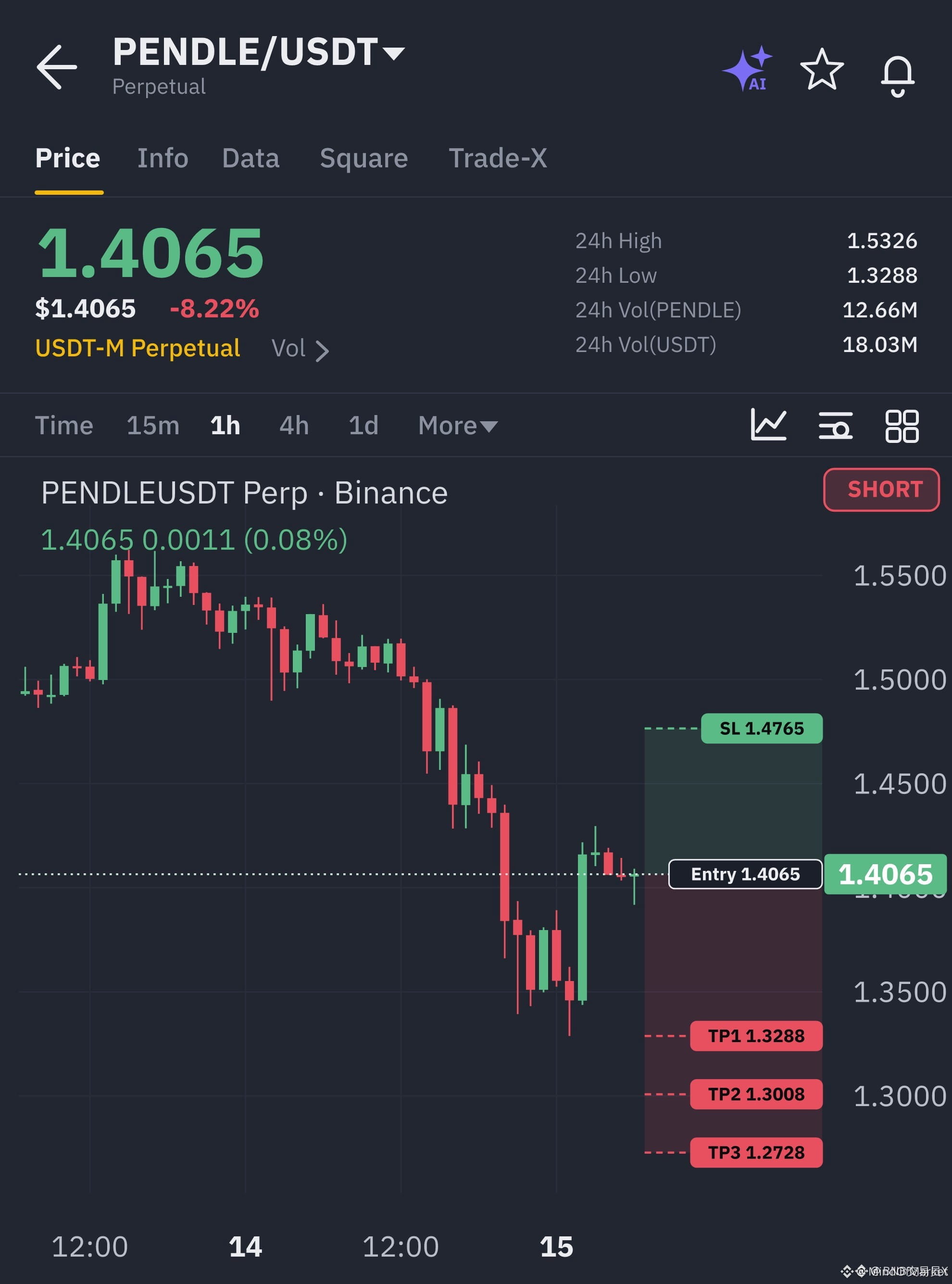
🔴 $PENDLE REJECTS MAJOR SUPPLY AT 1.5196 AS INSTITUTIONAL SELLERS BUILD MOMENTUM 📉
Entry: 1.3978–1.4152 ⚡
Target: 1.3288 🎯
Stop Loss: 1.4765 🛑
Price action continues to respect overhead distribution, with aggressive sellers capping any recovery attempts below the 1.5196 structural resistance. Order flow reveals persistent institutional distribution as momentum shifts heavily toward the downside. 📊
We are eyeing a retest of the lower liquidity pools starting down toward 1.3288 as the path of least resistance. ⚡
Are you positioning for this continuation lower or waiting for a deeper sweep into the range? 🤔
⚠️ Not financial advice. Always manage your risk. 🛡️
🏷️ #PENDLE #ShortSetup #OrderFlow #Bearish #Crypto
📉 🦈
🔴 $PENDLE REJECTS MAJOR SUPPLY AT 1.5196 AS INSTITUTIONAL SELLERS BUILD MOMENTUM 📉
Entry: 1.3978–1.4152 ⚡
Target: 1.3288 🎯
Stop Loss: 1.4765 🛑
Price action continues to respect overhead distribution, with aggressive sellers capping any recovery attempts below the 1.5196 structural resistance. Order flow reveals persistent institutional distribution as momentum shifts heavily toward the downside. 📊
We are eyeing a retest of the lower liquidity pools starting down toward 1.3288 as the path of least resistance. ⚡
Are you positioning for this continuation lower or waiting for a deeper sweep into the range? 🤔
⚠️ Not financial advice. Always manage your risk. 🛡️
🏷️ #PENDLE #ShortSetup #OrderFlow #Bearish #Crypto
📉 🦈
Entry: 1.3978–1.4152 ⚡
Target: 1.3288 🎯
Stop Loss: 1.4765 🛑
Price action continues to respect overhead distribution, with aggressive sellers capping any recovery attempts below the 1.5196 structural resistance. Order flow reveals persistent institutional distribution as momentum shifts heavily toward the downside. 📊
We are eyeing a retest of the lower liquidity pools starting down toward 1.3288 as the path of least resistance. ⚡
Are you positioning for this continuation lower or waiting for a deeper sweep into the range? 🤔
⚠️ Not financial advice. Always manage your risk. 🛡️
🏷️ #PENDLE #ShortSetup #OrderFlow #Bearish #Crypto
📉 🦈
2

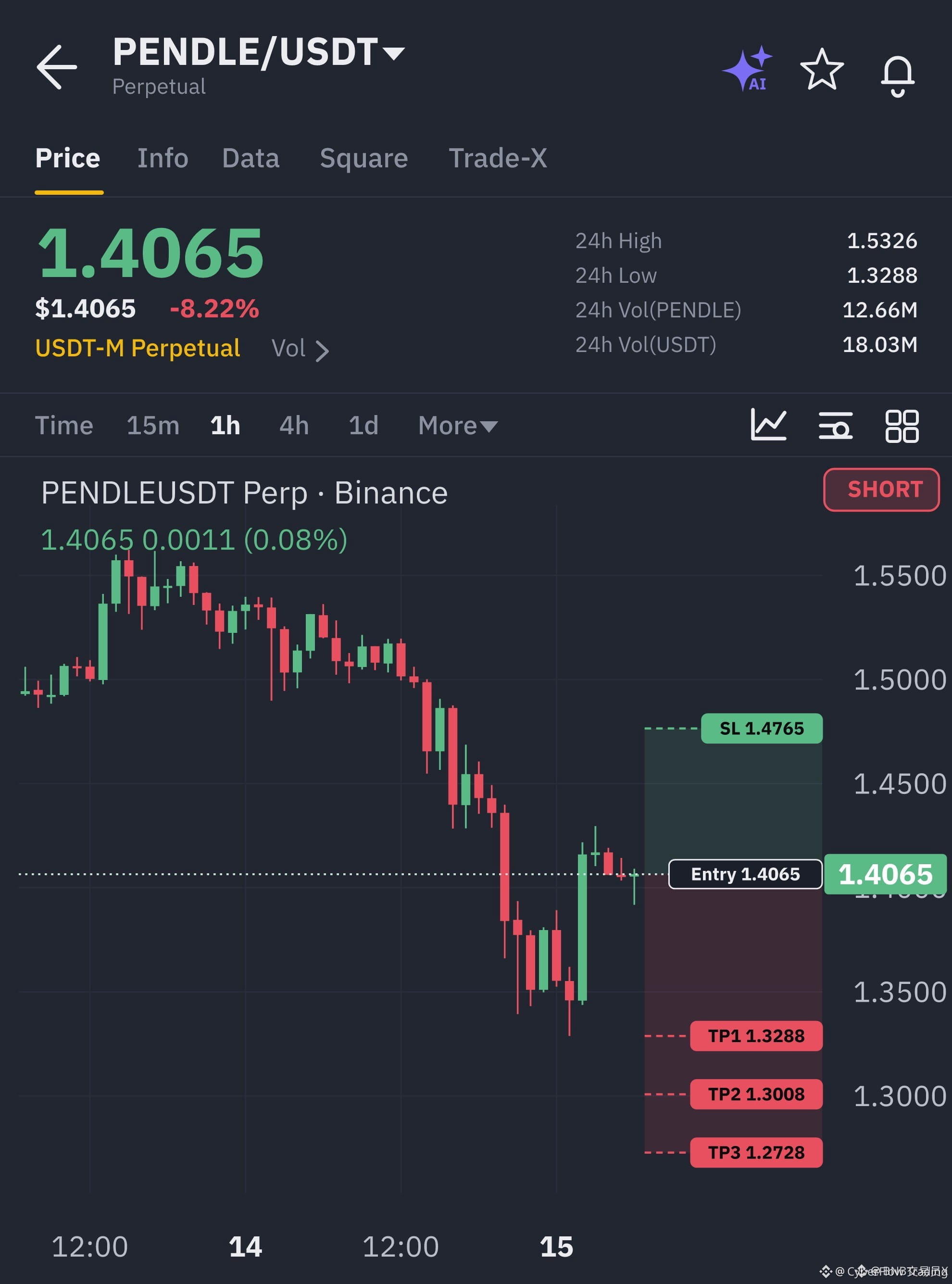
$PENDLE BEARS ARE CRUSHING THE RESISTANCE CEILING AS MOMENTUM ROLLS OVER 🔴 📉
Entry: 1.3978–1.4152 ⚡
Target: 1.2728 🚀
Stop Loss: 1.4765 ⚠️
Sellers are aggressively defending the 1.5196 ceiling, suffocating any attempt by buyers to stage a recovery. Price action is bleeding lower inside a clear distribution channel as supply swamps the order books. 📊
Momentum indicators on the lower timeframes confirm heavy institutional distribution, leaving bulls trapped below key structural pivots. With the path of least resistance pointing straight down, patience is key while waiting for optimal retest entries. ⚡
Are you riding this downward wave or waiting for a deeper flush before stepping in? 👇
⚠️ Not financial advice. Always manage your risk. 🛡️
🏷️ #PENDLE #ShortSetup #Crypto #DeFi
🐻 🩸
$PENDLE BEARS ARE CRUSHING THE RESISTANCE CEILING AS MOMENTUM ROLLS OVER 🔴 📉
Entry: 1.3978–1.4152 ⚡
Target: 1.2728 🚀
Stop Loss: 1.4765 ⚠️
Sellers are aggressively defending the 1.5196 ceiling, suffocating any attempt by buyers to stage a recovery. Price action is bleeding lower inside a clear distribution channel as supply swamps the order books. 📊
Momentum indicators on the lower timeframes confirm heavy institutional distribution, leaving bulls trapped below key structural pivots. With the path of least resistance pointing straight down, patience is key while waiting for optimal retest entries. ⚡
Are you riding this downward wave or waiting for a deeper flush before stepping in? 👇
⚠️ Not financial advice. Always manage your risk. 🛡️
🏷️ #PENDLE #ShortSetup #Crypto #DeFi
🐻 🩸
Entry: 1.3978–1.4152 ⚡
Target: 1.2728 🚀
Stop Loss: 1.4765 ⚠️
Sellers are aggressively defending the 1.5196 ceiling, suffocating any attempt by buyers to stage a recovery. Price action is bleeding lower inside a clear distribution channel as supply swamps the order books. 📊
Momentum indicators on the lower timeframes confirm heavy institutional distribution, leaving bulls trapped below key structural pivots. With the path of least resistance pointing straight down, patience is key while waiting for optimal retest entries. ⚡
Are you riding this downward wave or waiting for a deeper flush before stepping in? 👇
⚠️ Not financial advice. Always manage your risk. 🛡️
🏷️ #PENDLE #ShortSetup #Crypto #DeFi
🐻 🩸
4

·
--
I came across this while browsing the news: Pendle has launched a USDe fixed-term market, offering a new framework for on-chain credit.
Incentives can bring in attention for a while, but in the long run, it comes down to whether people stick around.
I’m saving this news to see later whether the market actually follows through.
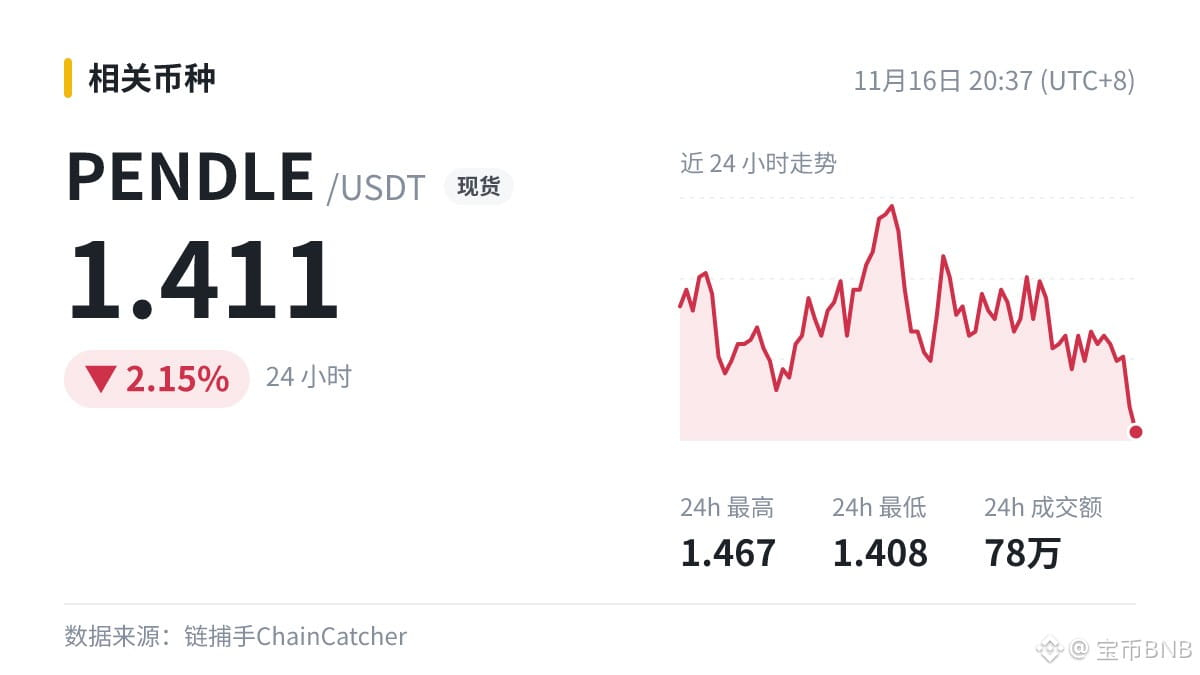
I also looked up $PENDLE while I was at it—it’s at 1.411 right now. Don’t just look at the number; volume matters too. Does everyone think this is credible?
#PENDLE
I came across this while browsing the news: Pendle has launched a USDe fixed-term market, offering a new framework for on-chain credit.
Incentives can bring in attention for a while, but in the long run, it comes down to whether people stick around.
I’m saving this news to see later whether the market actually follows through.
I also looked up $PENDLE while I was at it—it’s at 1.411 right now. Don’t just look at the number; volume matters too. Does everyone think this is credible?
#PENDLE
Incentives can bring in attention for a while, but in the long run, it comes down to whether people stick around.
I’m saving this news to see later whether the market actually follows through.
I also looked up $PENDLE while I was at it—it’s at 1.411 right now. Don’t just look at the number; volume matters too. Does everyone think this is credible?
#PENDLE
89

·
--
{future}(PENDLEUSDT)
#PENDLE : Fixed income—what exactly is fixed?
When you see a fixed annualized yield, the first impression is that your principal is protected and you can still make money. Pendle lets you trade future yield separately, but it cannot immediately eliminate the risks of the underlying assets.
It originally addressed a practical problem: people holding yield-bearing assets may not want to track interest-rate fluctuations every day. Some want to lock in returns early, while others are willing to bet that future returns will be higher. The protocol splits assets into principal tokens (PT) and yield tokens (YT), so each side can get what it wants.
PTs typically trade at a discount and, at maturity, can be redeemed according to the rules for the corresponding underlying asset. YTs capture the variable yield and related rights before maturity. The three words most easily overlooked here are: which currency? The yield is locked in relative to a specific asset, not necessarily in terms of purchasing power in U.S. dollars. Problems with the underlying protocol, an asset depegging, or an unfavorable price when exiting early do not disappear just because the principal is wrapped.
PENDLE is currently around $1.44, up 6.20% in 24 hours, with about $40.02 million in trading volume. The DefiLlama page shows that the protocol has about $971 million in total value locked and generated about $540,000 in fees over the past 30 days. TVL is an amount held, not trading volume—and certainly not income for token holders.
PENDLE itself serves incentive and governance functions. Under the current official mechanism, staking earns sPENDLE; 80% of V2 yield fees and trading fees are used to buy back PENDLE, and the repurchased tokens may be distributed to sPENDLE holders who meet the activity requirements.
The supply side also matters: under the official rules, starting in April 2026, the token will shift to a terminal inflation schedule of 2% per year. Buybacks create demand, while new incentives increase supply; you can't tell the story by focusing on just one side.
Over the next three months, what's worth watching is whether users keep trading real yield, rather than depositing funds just for points or subsidies. The harder interest rates are to predict, the more appealing it may be to lock in yield. But rising risks in underlying assets could also prompt users to withdraw first.
If fees and buybacks grow alongside real trading, there is a basis for the token to benefit. If TVL is high but fees are weak, ask whether the funds are actually being used in the product.
Pendle sells a tool for managing yield volatility. Mistaking it for a risk-free deposit is the biggest misjudgment...
#PENDLE #DeFi
#PENDLE : Fixed income—what exactly is fixed?
When you see a fixed annualized yield, the first impression is that your principal is protected and you can still make money. Pendle lets you trade future yield separately, but it cannot immediately eliminate the risks of the underlying assets.
It originally addressed a practical problem: people holding yield-bearing assets may not want to track interest-rate fluctuations every day. Some want to lock in returns early, while others are willing to bet that future returns will be higher. The protocol splits assets into principal tokens (PT) and yield tokens (YT), so each side can get what it wants.
PTs typically trade at a discount and, at maturity, can be redeemed according to the rules for the corresponding underlying asset. YTs capture the variable yield and related rights before maturity. The three words most easily overlooked here are: which currency? The yield is locked in relative to a specific asset, not necessarily in terms of purchasing power in U.S. dollars. Problems with the underlying protocol, an asset depegging, or an unfavorable price when exiting early do not disappear just because the principal is wrapped.
PENDLE is currently around $1.44, up 6.20% in 24 hours, with about $40.02 million in trading volume. The DefiLlama page shows that the protocol has about $971 million in total value locked and generated about $540,000 in fees over the past 30 days. TVL is an amount held, not trading volume—and certainly not income for token holders.
PENDLE itself serves incentive and governance functions. Under the current official mechanism, staking earns sPENDLE; 80% of V2 yield fees and trading fees are used to buy back PENDLE, and the repurchased tokens may be distributed to sPENDLE holders who meet the activity requirements.
The supply side also matters: under the official rules, starting in April 2026, the token will shift to a terminal inflation schedule of 2% per year. Buybacks create demand, while new incentives increase supply; you can't tell the story by focusing on just one side.
Over the next three months, what's worth watching is whether users keep trading real yield, rather than depositing funds just for points or subsidies. The harder interest rates are to predict, the more appealing it may be to lock in yield. But rising risks in underlying assets could also prompt users to withdraw first.
If fees and buybacks grow alongside real trading, there is a basis for the token to benefit. If TVL is high but fees are weak, ask whether the funds are actually being used in the product.
Pendle sells a tool for managing yield volatility. Mistaking it for a risk-free deposit is the biggest misjudgment...
#PENDLE #DeFi
When you see a fixed annualized yield, the first impression is that your principal is protected and you can still make money. Pendle lets you trade future yield separately, but it cannot immediately eliminate the risks of the underlying assets.
It originally addressed a practical problem: people holding yield-bearing assets may not want to track interest-rate fluctuations every day. Some want to lock in returns early, while others are willing to bet that future returns will be higher. The protocol splits assets into principal tokens (PT) and yield tokens (YT), so each side can get what it wants.
PTs typically trade at a discount and, at maturity, can be redeemed according to the rules for the corresponding underlying asset. YTs capture the variable yield and related rights before maturity. The three words most easily overlooked here are: which currency? The yield is locked in relative to a specific asset, not necessarily in terms of purchasing power in U.S. dollars. Problems with the underlying protocol, an asset depegging, or an unfavorable price when exiting early do not disappear just because the principal is wrapped.
PENDLE is currently around $1.44, up 6.20% in 24 hours, with about $40.02 million in trading volume. The DefiLlama page shows that the protocol has about $971 million in total value locked and generated about $540,000 in fees over the past 30 days. TVL is an amount held, not trading volume—and certainly not income for token holders.
PENDLE itself serves incentive and governance functions. Under the current official mechanism, staking earns sPENDLE; 80% of V2 yield fees and trading fees are used to buy back PENDLE, and the repurchased tokens may be distributed to sPENDLE holders who meet the activity requirements.
The supply side also matters: under the official rules, starting in April 2026, the token will shift to a terminal inflation schedule of 2% per year. Buybacks create demand, while new incentives increase supply; you can't tell the story by focusing on just one side.
Over the next three months, what's worth watching is whether users keep trading real yield, rather than depositing funds just for points or subsidies. The harder interest rates are to predict, the more appealing it may be to lock in yield. But rising risks in underlying assets could also prompt users to withdraw first.
If fees and buybacks grow alongside real trading, there is a basis for the token to benefit. If TVL is high but fees are weak, ask whether the funds are actually being used in the product.
Pendle sells a tool for managing yield volatility. Mistaking it for a risk-free deposit is the biggest misjudgment...
#PENDLE #DeFi
169

·
--
A look from the perspective of token holders: Pendle: PendleLoop uses flash loans to enable looping, reducing gas costs by about 90%
When news breaks, two things usually happen in the market at the same time:
· Early movers start taking profits
· Funds that only came in after seeing the news step in to buy
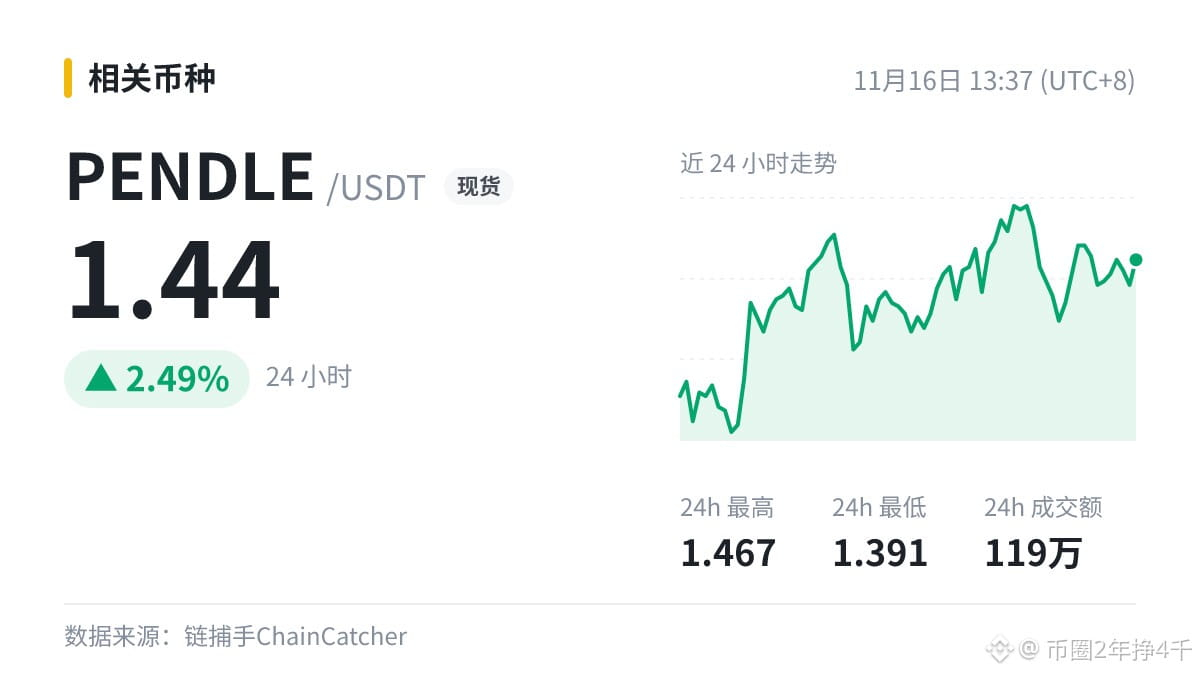
Whichever group is larger determines the direction of the price movement. $PENDLE 24h Trading volume: $1.19 million. Watch for a sudden increase in turnover.
#PENDLE
A look from the perspective of token holders: Pendle: PendleLoop uses flash loans to enable looping, reducing gas costs by about 90%
When news breaks, two things usually happen in the market at the same time:
· Early movers start taking profits
· Funds that only came in after seeing the news step in to buy
Whichever group is larger determines the direction of the price movement. $PENDLE 24h Trading volume: $1.19 million. Watch for a sudden increase in turnover.
#PENDLE
When news breaks, two things usually happen in the market at the same time:
· Early movers start taking profits
· Funds that only came in after seeing the news step in to buy
Whichever group is larger determines the direction of the price movement. $PENDLE 24h Trading volume: $1.19 million. Watch for a sudden increase in turnover.
#PENDLE
40

·
--
One item I saw today: Pendle launches a fixed-term USDe market, providing a new framework for on-chain credit.
With this positive news, I’m more interested in whether buying support will be strong during a pullback. Honestly, there’s news every day; what really helps people make fewer mistakes is having their own plan.
$PENDLE I’ll wait and see.
#PENDLE
One item I saw today: Pendle launches a fixed-term USDe market, providing a new framework for on-chain credit.
With this positive news, I’m more interested in whether buying support will be strong during a pullback. Honestly, there’s news every day; what really helps people make fewer mistakes is having their own plan.
$PENDLE I’ll wait and see.
#PENDLE
With this positive news, I’m more interested in whether buying support will be strong during a pullback. Honestly, there’s news every day; what really helps people make fewer mistakes is having their own plan.
$PENDLE I’ll wait and see.
#PENDLE
3

·
--
Pendle launches USDe fixed-term markets and an on-chain credit framework
Large investors often don't rush in at the first hint of news; they prefer to accumulate in batches on pullbacks.
The news is positive, but the key question is how much of it is already priced in.
$PENDLE , 24h -2.21%, 24h trading volume: $776,000.
#PENDLE
Pendle launches USDe fixed-term markets and an on-chain credit framework
Large investors often don't rush in at the first hint of news; they prefer to accumulate in batches on pullbacks.
The news is positive, but the key question is how much of it is already priced in.
$PENDLE , 24h -2.21%, 24h trading volume: $776,000.
#PENDLE
Large investors often don't rush in at the first hint of news; they prefer to accumulate in batches on pullbacks.
The news is positive, but the key question is how much of it is already priced in.
$PENDLE , 24h -2.21%, 24h trading volume: $776,000.
#PENDLE
1

·
--
$PENDLE |Pendle and Ethena launch PT markets for four USDe maturities in 2027
I saw this and my hands started itching, but thankfully my wallet stopped me. The news itself has limited impact; it’s more background information. Check in in the comments: did you miss the boat, or are you left holding the bag?
#PENDLE
$PENDLE |Pendle and Ethena launch PT markets for four USDe maturities in 2027
I saw this and my hands started itching, but thankfully my wallet stopped me. The news itself has limited impact; it’s more background information. Check in in the comments: did you miss the boat, or are you left holding the bag?
#PENDLE
I saw this and my hands started itching, but thankfully my wallet stopped me. The news itself has limited impact; it’s more background information. Check in in the comments: did you miss the boat, or are you left holding the bag?
#PENDLE
1

Capital is the most honest expression; talking bullish and placing orders are two different things.
The item at hand: Pendle launches a USDe fixed-term market, providing a new framework for on-chain credit.
Ultimately, what matters is whether capital is flowing in or out.
$PENDLE 1.416
#PENDLE
Capital is the most honest expression; talking bullish and placing orders are two different things.
The item at hand: Pendle launches a USDe fixed-term market, providing a new framework for on-chain credit.
Ultimately, what matters is whether capital is flowing in or out.
$PENDLE 1.416
#PENDLE
The item at hand: Pendle launches a USDe fixed-term market, providing a new framework for on-chain credit.
Ultimately, what matters is whether capital is flowing in or out.
$PENDLE 1.416
#PENDLE
1

·
--
Pendle launches fixed-term USDe markets, offering a new framework for on-chain credit—after news like this, I watch the flow of funds first, then the price.
It’s fine to be optimistic, but there’s no need to get carried away: prices can still pull back after positive news.
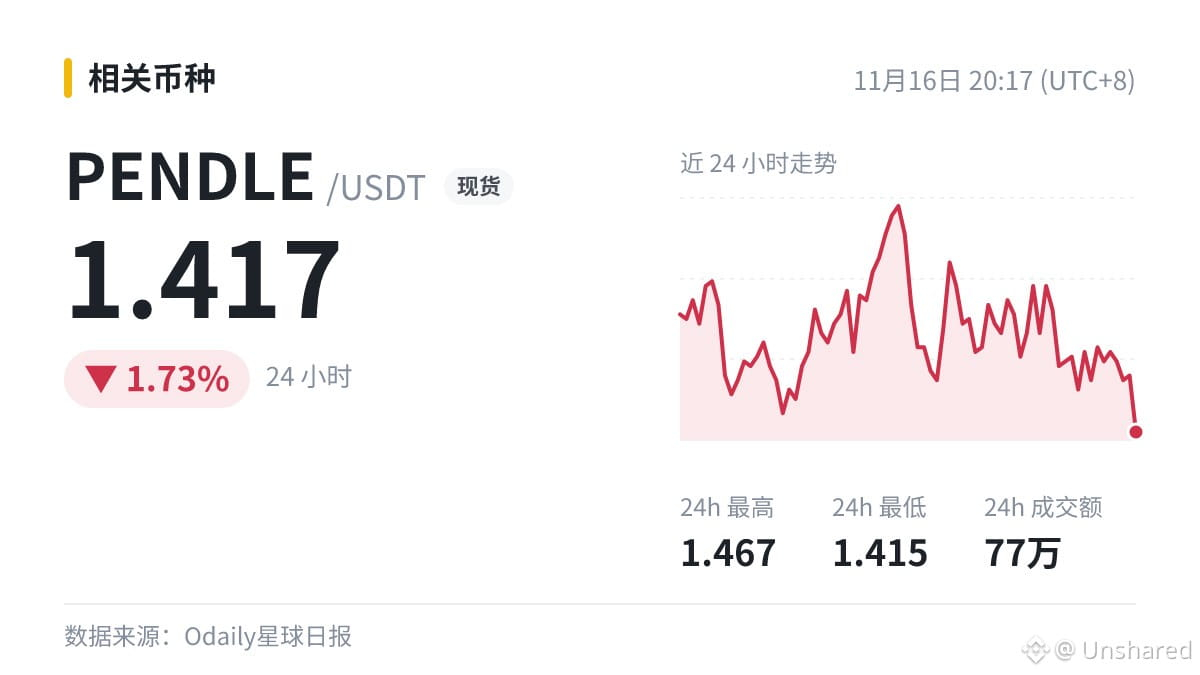
$PENDLE (24h -1.73%).
#PENDLE
Pendle launches fixed-term USDe markets, offering a new framework for on-chain credit—after news like this, I watch the flow of funds first, then the price.
It’s fine to be optimistic, but there’s no need to get carried away: prices can still pull back after positive news.
$PENDLE (24h -1.73%).
#PENDLE
It’s fine to be optimistic, but there’s no need to get carried away: prices can still pull back after positive news.
$PENDLE (24h -1.73%).
#PENDLE
41

·
--
⚠️ Pendle launches a fixed-term USDe market: a new framework for on-chain credit
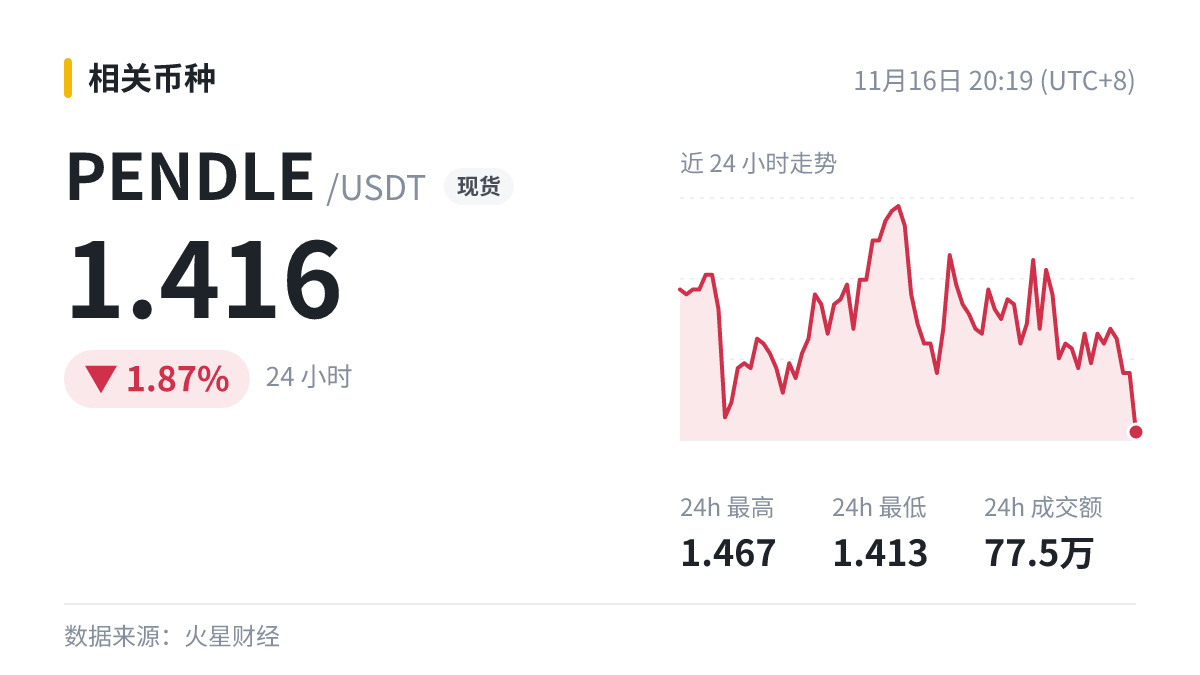
Honestly, the first thing I did when this came out was check the chart: $PENDLE 1.416, 1h -1.19%.
Sentiment is clearly heating up 🔥 But moments like this are exactly when you need to stay calm—don’t rush in when the hype is at its peak!
Is this a big deal or just noise?
#PENDLE
⚠️ Pendle launches a fixed-term USDe market: a new framework for on-chain credit
Honestly, the first thing I did when this came out was check the chart: $PENDLE 1.416, 1h -1.19%.
Sentiment is clearly heating up 🔥 But moments like this are exactly when you need to stay calm—don’t rush in when the hype is at its peak!
Is this a big deal or just noise?
#PENDLE
Honestly, the first thing I did when this came out was check the chart: $PENDLE 1.416, 1h -1.19%.
Sentiment is clearly heating up 🔥 But moments like this are exactly when you need to stay calm—don’t rush in when the hype is at its peak!
Is this a big deal or just noise?
#PENDLE
32

·
--
Just adding my two cents: after following projects for so long, the two things I care about most are whether the team is still working on the project and whether the number of users is growing.
I just saw this: Pendle launches a fixed-term USDe market, providing a new framework for on-chain credit.
At least the first point is a plus; we’ll have to wait and see about the second.
$PENDLE What do you all think?
#PENDLE
I may not be right, so make up your own mind.
Just adding my two cents: after following projects for so long, the two things I care about most are whether the team is still working on the project and whether the number of users is growing.
I just saw this: Pendle launches a fixed-term USDe market, providing a new framework for on-chain credit.
At least the first point is a plus; we’ll have to wait and see about the second.
$PENDLE What do you all think?
#PENDLE
I may not be right, so make up your own mind.
I just saw this: Pendle launches a fixed-term USDe market, providing a new framework for on-chain credit.
At least the first point is a plus; we’ll have to wait and see about the second.
$PENDLE What do you all think?
#PENDLE
I may not be right, so make up your own mind.
2

·
--
📊 A set of figures: Pendle: PendleLoop enables looping operations with flash loans, reducing gas consumption by about 90%
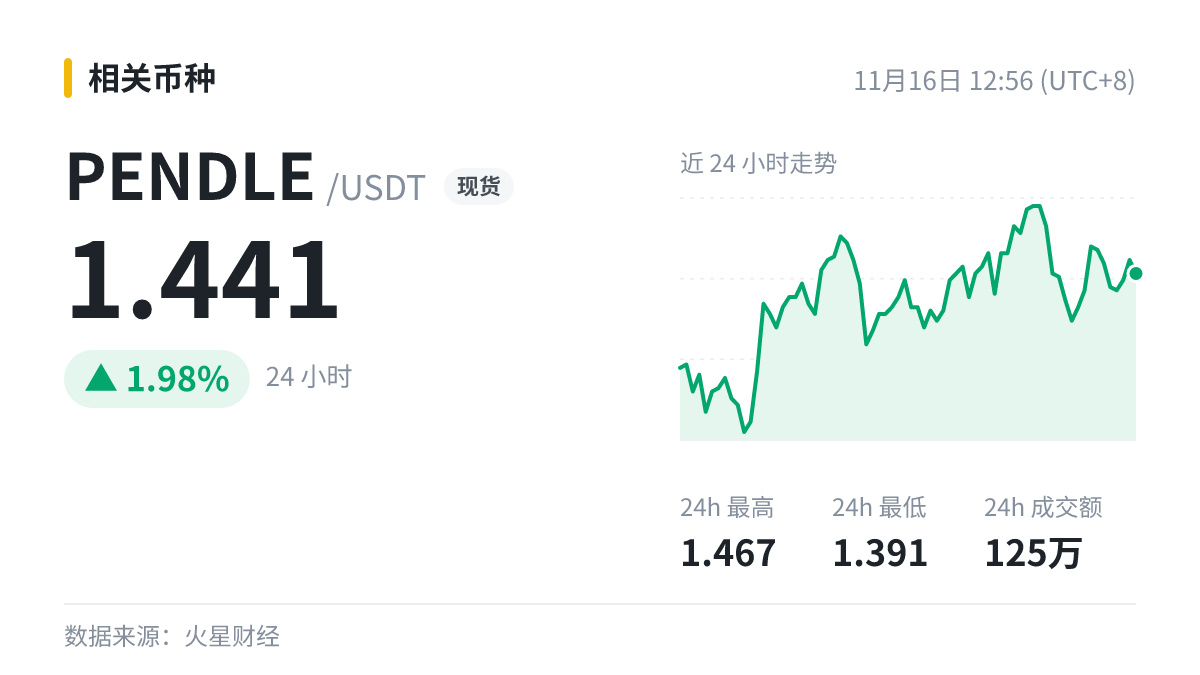
$PENDLE 24h 4h trading volume: $1.25 million, change: +1.98%, range: 1.391 ~ 1.467.
Trading volume is the first indicator of the significance of a piece of news: the more significant the news, the more volume tends to come in.
#PENDLE
📊 A set of figures: Pendle: PendleLoop enables looping operations with flash loans, reducing gas consumption by about 90%
$PENDLE 24h 4h trading volume: $1.25 million, change: +1.98%, range: 1.391 ~ 1.467.
Trading volume is the first indicator of the significance of a piece of news: the more significant the news, the more volume tends to come in.
#PENDLE
$PENDLE 24h 4h trading volume: $1.25 million, change: +1.98%, range: 1.391 ~ 1.467.
Trading volume is the first indicator of the significance of a piece of news: the more significant the news, the more volume tends to come in.
#PENDLE
27

·
--
Pendle: PendleLoop enables flash-loan looping, reducing gas consumption by about 90%.
I think I’ll keep an eye on this for now, but let’s not read too much into it.
Things like this have happened before; usually, the activity looks a bit different.
Don’t rush to chase it—wait and see.
$PENDLE is at 1.441 right now. Does anyone have related tokens in their accounts?
#PENDLE
Just one person’s opinion—take it for what it’s worth. This isn’t financial advice.
Pendle: PendleLoop enables flash-loan looping, reducing gas consumption by about 90%.
I think I’ll keep an eye on this for now, but let’s not read too much into it.
Things like this have happened before; usually, the activity looks a bit different.
Don’t rush to chase it—wait and see.
$PENDLE is at 1.441 right now. Does anyone have related tokens in their accounts?
#PENDLE
Just one person’s opinion—take it for what it’s worth. This isn’t financial advice.
I think I’ll keep an eye on this for now, but let’s not read too much into it.
Things like this have happened before; usually, the activity looks a bit different.
Don’t rush to chase it—wait and see.
$PENDLE is at 1.441 right now. Does anyone have related tokens in their accounts?
#PENDLE
Just one person’s opinion—take it for what it’s worth. This isn’t financial advice.
3
Log in to explore more content
Join global crypto users on Binance Square
⚡️ Get latest and useful information about crypto.
💬 Trusted by the world’s largest crypto exchange.
👍 Discover real insights from verified creators.
Email / Phone number
Trending Topics
1
#A Packed Week of Earnings and Data Tests Markets
50,707 views
338 Discussing
2
#AnthropicIPOTestsInvestorAppetiteForAI
85,185 views
1,200 Discussing
3
#BitcoinExtendsLosingStreakToSixWeeks
46,814 views
556 Discussing
4
#XRPFallsTo$0.89LowestSinceNovember2024
8,876 views
49 Discussing
5
#HuangReportedlyConsidersReturnToNvidia
97,900 views
1,115 Discussing
6
#SP500AndNasdaqFuturesHitQuarterlyLows
13,672 views
183 Discussing
7
#CaliforniaVotersBackProp42BarringNewCryptoTaxes
9,982 views
175 Discussing
8
#HKPlansDigitalAssetRegulatoryBillByYearEnd
9,621 views
133 Discussing
9
#MUFGSMFGMizuhoPlanYenBackedStablecoin
23,626 views
255 Discussing
10
#HKMAAndSwiftExploreTokenizedDepositInteroperability
1,129 views
16 Discussing