

#macrocrypto
macrocrypto
195,505 views
1,506 Discussing
Hot
Latest

Article
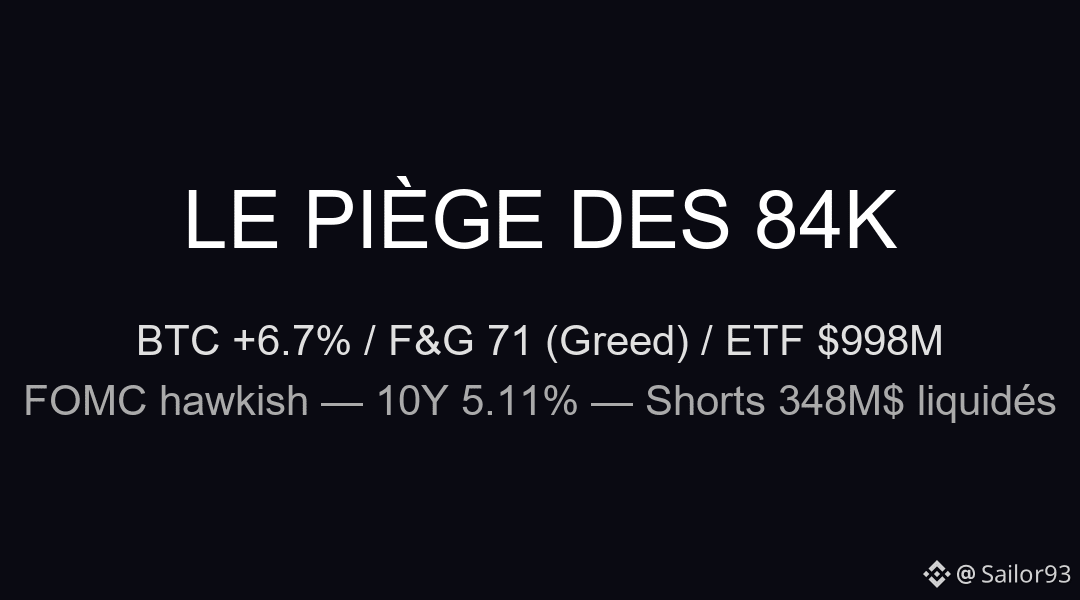
THE 84K TRAP: BTC RECLAIMS BUT MACRO SOUNDS THE ALARM🚨 BTC retouched 85K for the first time in 280 days... and then REFLUXED. Why doesn’t this rally hold?
• BTC ETF: +98M net inflows on Sept 21 (BlackRock/Fidelity) — MASSIVE spot buying, not leverage. Yet BTC is flat at 4.3K.
• 10Y US at 5.11% (2007 peak) + hawkish FOMC 3.75-4.00% = the cost of money is too high for taking risk. Institutions absorb the supply, yields absorb demand.
• Fear & Greed 71 (Greed ↓ from 78) — euphoria that’s running out of steam. Liquidations 48M longs yesterday. The market is LONG but nervous.
THE 84K TRAP: BTC RECLAIMS BUT MACRO SOUNDS THE ALARM
🚨 BTC retouched 85K for the first time in 280 days... and then REFLUXED. Why doesn’t this rally hold?
• BTC ETF: +98M net inflows on Sept 21 (BlackRock/Fidelity) — MASSIVE spot buying, not leverage. Yet BTC is flat at 4.3K.
• 10Y US at 5.11% (2007 peak) + hawkish FOMC 3.75-4.00% = the cost of money is too high for taking risk. Institutions absorb the supply, yields absorb demand.
• Fear & Greed 71 (Greed ↓ from 78) — euphoria that’s running out of steam. Liquidations 48M longs yesterday. The market is LONG but nervous.
• BTC ETF: +98M net inflows on Sept 21 (BlackRock/Fidelity) — MASSIVE spot buying, not leverage. Yet BTC is flat at 4.3K.
• 10Y US at 5.11% (2007 peak) + hawkish FOMC 3.75-4.00% = the cost of money is too high for taking risk. Institutions absorb the supply, yields absorb demand.
• Fear & Greed 71 (Greed ↓ from 78) — euphoria that’s running out of steam. Liquidations 48M longs yesterday. The market is LONG but nervous.
BTC-0.99%
IEFETF+0.04%
64

#us30yearyieldhighestsince2004
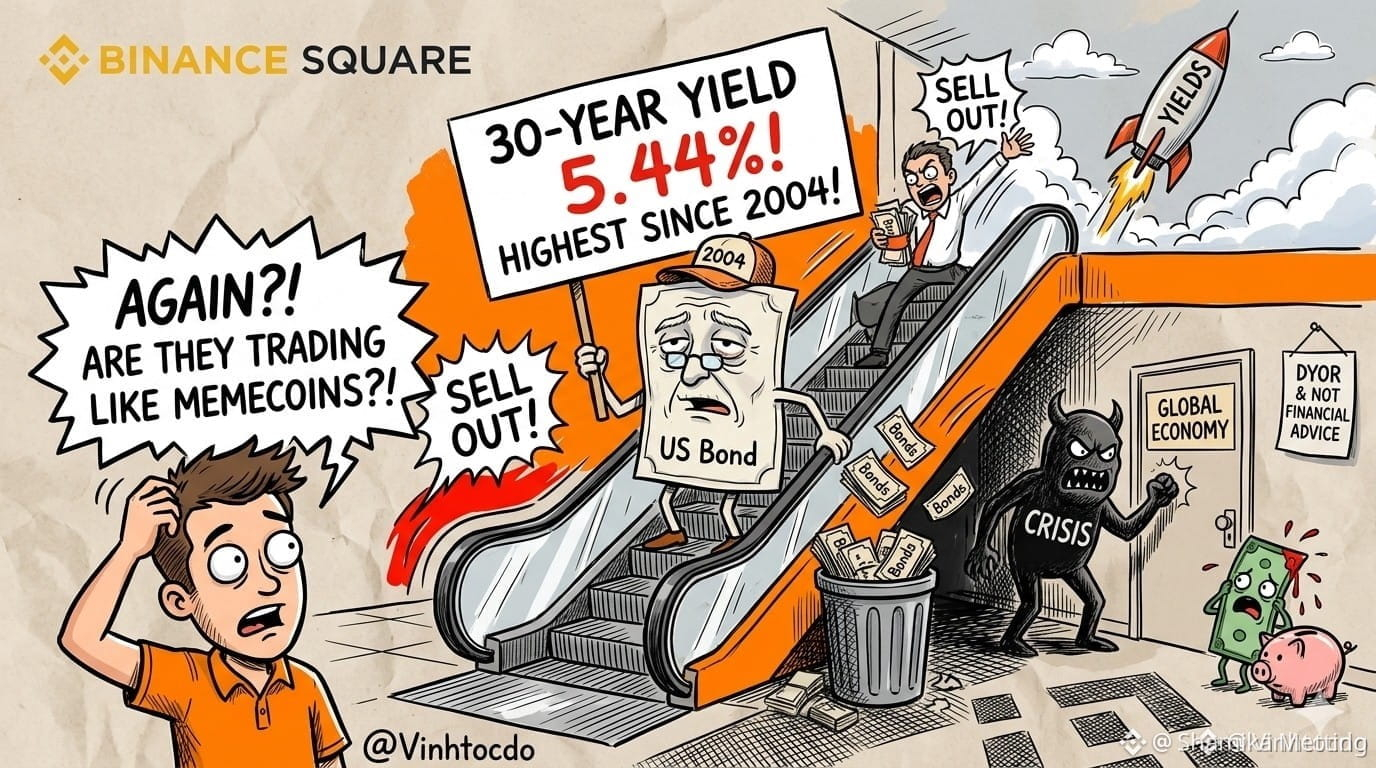
📈 Wait, what?! #us30yearyieldhighestsince2004 is heading up crazily—up to 5.44%! 🤯
Once again?! U.S. Treasury bond yields for 30 years just hit their highest level in 22 years! Is a financial crisis knocking at our door? 🚨 And wait... "sell the bonds"? Are people trading bonds now the same way they trade meme coins? 😂
It turns out that high inflation and a rocket-like rise in oil prices have investors in panic—selling long-term bonds, pushing yields to the moon! 🚀
What should crypto traders do?
1️⃣ Don’t panic! Cash is bleeding, but crypto is built for this. 🧠
2️⃣ Watch the market volatility. 📉📈
3️⃣ Do your own research (DYOR)! This is not financial advice! 👀
Please follow along
$BTC
$BNB
$ETH
#YieldsRising #BondSellOff #MacroCrypto #CryptoNews #FinancialCrisis
#us30yearyieldhighestsince2004
📈 Wait, what?! #us30yearyieldhighestsince2004 is heading up crazily—up to 5.44%! 🤯
Once again?! U.S. Treasury bond yields for 30 years just hit their highest level in 22 years! Is a financial crisis knocking at our door? 🚨 And wait... "sell the bonds"? Are people trading bonds now the same way they trade meme coins? 😂
It turns out that high inflation and a rocket-like rise in oil prices have investors in panic—selling long-term bonds, pushing yields to the moon! 🚀
What should crypto traders do?
1️⃣ Don’t panic! Cash is bleeding, but crypto is built for this. 🧠
2️⃣ Watch the market volatility. 📉📈
3️⃣ Do your own research (DYOR)! This is not financial advice! 👀
Please follow along
$BTC
$BNB
$ETH
#YieldsRising #BondSellOff #MacroCrypto #CryptoNews #FinancialCrisis
📈 Wait, what?! #us30yearyieldhighestsince2004 is heading up crazily—up to 5.44%! 🤯
Once again?! U.S. Treasury bond yields for 30 years just hit their highest level in 22 years! Is a financial crisis knocking at our door? 🚨 And wait... "sell the bonds"? Are people trading bonds now the same way they trade meme coins? 😂
It turns out that high inflation and a rocket-like rise in oil prices have investors in panic—selling long-term bonds, pushing yields to the moon! 🚀
What should crypto traders do?
1️⃣ Don’t panic! Cash is bleeding, but crypto is built for this. 🧠
2️⃣ Watch the market volatility. 📉📈
3️⃣ Do your own research (DYOR)! This is not financial advice! 👀
Please follow along
$BTC
$BNB
$ETH
#YieldsRising #BondSellOff #MacroCrypto #CryptoNews #FinancialCrisis
2
5k
Verified
#fedoctoberratehikeoddsriseto69.7%
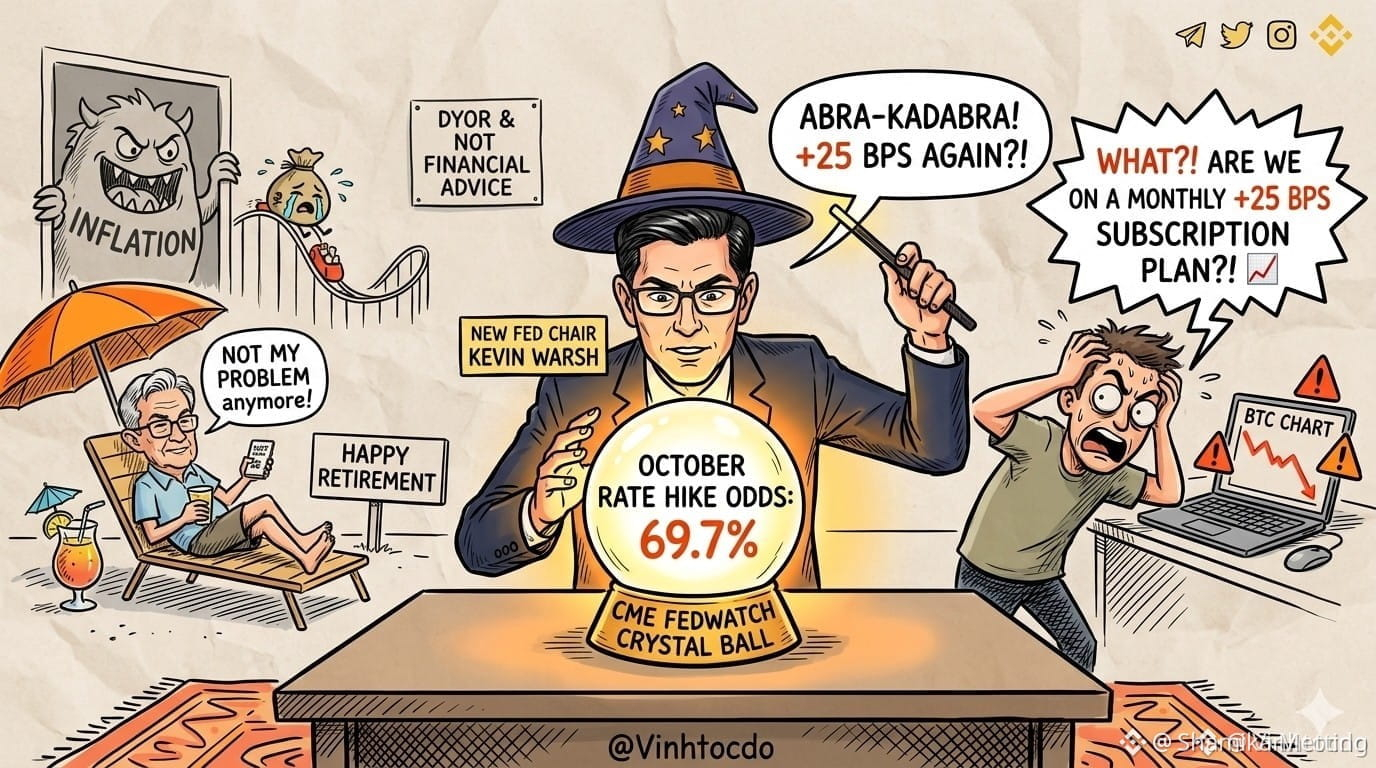
🎲 What a sight! Look at the crystal ball! 🔮
CME FedWatch screams with a 69.7% chance of a 25-basis-point interest rate hike in October. Wait... after the September hike, the crypto market exploded, right? So, can the Federal Reserve just inject +25 basis points every month, like a paid subscription? 😂 Unfortunately, macroeconomics doesn’t work like a monthly Netflix subscription, my friend! The pressure is starting to become real! 📈
What should traders do?
1️⃣ Keep a close eye on the Federal Reserve’s dot plot. 📅
2️⃣ Understand your financial lever—things are starting to heat up! 🛡️
3️⃣ Do your own research (DYOR)! This is not financial advice! 👀
Please follow up
$BTC
$BNB
$ETH
#FedRateHike #CMEFedWatch #MacroCrypto #CryptoTrading #BinanceSquare
#fedoctoberratehikeoddsriseto69.7%
🎲 What a sight! Look at the crystal ball! 🔮
CME FedWatch screams with a 69.7% chance of a 25-basis-point interest rate hike in October. Wait... after the September hike, the crypto market exploded, right? So, can the Federal Reserve just inject +25 basis points every month, like a paid subscription? 😂 Unfortunately, macroeconomics doesn’t work like a monthly Netflix subscription, my friend! The pressure is starting to become real! 📈
What should traders do?
1️⃣ Keep a close eye on the Federal Reserve’s dot plot. 📅
2️⃣ Understand your financial lever—things are starting to heat up! 🛡️
3️⃣ Do your own research (DYOR)! This is not financial advice! 👀
Please follow up
$BTC
$BNB
$ETH
#FedRateHike #CMEFedWatch #MacroCrypto #CryptoTrading #BinanceSquare
🎲 What a sight! Look at the crystal ball! 🔮
CME FedWatch screams with a 69.7% chance of a 25-basis-point interest rate hike in October. Wait... after the September hike, the crypto market exploded, right? So, can the Federal Reserve just inject +25 basis points every month, like a paid subscription? 😂 Unfortunately, macroeconomics doesn’t work like a monthly Netflix subscription, my friend! The pressure is starting to become real! 📈
What should traders do?
1️⃣ Keep a close eye on the Federal Reserve’s dot plot. 📅
2️⃣ Understand your financial lever—things are starting to heat up! 🛡️
3️⃣ Do your own research (DYOR)! This is not financial advice! 👀
Please follow up
$BTC
$BNB
$ETH
#FedRateHike #CMEFedWatch #MacroCrypto #CryptoTrading #BinanceSquare
2
1.4k

🏦 BTC drops 1.7% after Clarity Act bets are cut
Bitcoin’s price has fallen 1.7% since midnight UTC, reaching $76,862, after reversing a rally from earlier in the day. The drop was due to the odds on Polymarket for the Clarity Act law being cut in half.
Do you think this will affect the price of Bitcoin? 👇
$BTC #MacroCrypto
Informative content. Does not constitute financial advice.
🏦 BTC drops 1.7% after Clarity Act bets are cut
Bitcoin’s price has fallen 1.7% since midnight UTC, reaching $76,862, after reversing a rally from earlier in the day. The drop was due to the odds on Polymarket for the Clarity Act law being cut in half.
Do you think this will affect the price of Bitcoin? 👇
$BTC #MacroCrypto
Informative content. Does not constitute financial advice.
Bitcoin’s price has fallen 1.7% since midnight UTC, reaching $76,862, after reversing a rally from earlier in the day. The drop was due to the odds on Polymarket for the Clarity Act law being cut in half.
Do you think this will affect the price of Bitcoin? 👇
$BTC #MacroCrypto
Informative content. Does not constitute financial advice.
13
🏦 Bitcoin falls after rise in core CPI
Inflation in the US exceeded expectations, impacting the price of Bitcoin. The asset dropped to $243 after the data was released.
Do you think this will affect Bitcoin’s direction? 👇
$BTC #MacroCrypto
Informational content. Does not constitute financial advice.
🏦 Bitcoin falls after rise in core CPI
Inflation in the US exceeded expectations, impacting the price of Bitcoin. The asset dropped to $243 after the data was released.
Do you think this will affect Bitcoin’s direction? 👇
$BTC #MacroCrypto
Informational content. Does not constitute financial advice.
Inflation in the US exceeded expectations, impacting the price of Bitcoin. The asset dropped to $243 after the data was released.
Do you think this will affect Bitcoin’s direction? 👇
$BTC #MacroCrypto
Informational content. Does not constitute financial advice.
1
8

·
--
After the Bank of Japan’s 1.25% rate hike, Bitcoin surged higher—but this is just a warm-up! Yen carry trades will face a real stress test next week, as rising financing costs could trigger a major reshuffle in the market.
In the short term, after the rate-hike news is digested, Bitcoin may surge and then pull back. In the long term, if Japan continues to tighten policy, the supply of low-interest yen funding will shrink, and high-risk assets will face liquidity challenges.
Real investors don’t chase pumps—they lie in wait for bearish opportunities after the bad news has run its course. Next week, closely watch fund flows; there may be a big buying opportunity after panic selling.
$BTC #日元套利交易 #Rate-Hike Cycle
Bitcoin surges on BOJ's 1.25% hike, but the real party's over next week! Yen carry trades about to face the music with higher funding costs kicking in.
Short-term pump may lead to dump as markets digest the real impact. If Japan keeps tightening, the cheap yen flood gates are closing. Watch for volatility and potential panic buys after the initial selloff.
$BTC #CarryTrade #MacroCrypto
After the Bank of Japan’s 1.25% rate hike, Bitcoin surged higher—but this is just a warm-up! Yen carry trades will face a real stress test next week, as rising financing costs could trigger a major reshuffle in the market.
In the short term, after the rate-hike news is digested, Bitcoin may surge and then pull back. In the long term, if Japan continues to tighten policy, the supply of low-interest yen funding will shrink, and high-risk assets will face liquidity challenges.
Real investors don’t chase pumps—they lie in wait for bearish opportunities after the bad news has run its course. Next week, closely watch fund flows; there may be a big buying opportunity after panic selling.
$BTC #日元套利交易 #Rate-Hike Cycle
Bitcoin surges on BOJ's 1.25% hike, but the real party's over next week! Yen carry trades about to face the music with higher funding costs kicking in.
Short-term pump may lead to dump as markets digest the real impact. If Japan keeps tightening, the cheap yen flood gates are closing. Watch for volatility and potential panic buys after the initial selloff.
$BTC #CarryTrade #MacroCrypto
In the short term, after the rate-hike news is digested, Bitcoin may surge and then pull back. In the long term, if Japan continues to tighten policy, the supply of low-interest yen funding will shrink, and high-risk assets will face liquidity challenges.
Real investors don’t chase pumps—they lie in wait for bearish opportunities after the bad news has run its course. Next week, closely watch fund flows; there may be a big buying opportunity after panic selling.
$BTC #日元套利交易 #Rate-Hike Cycle
Bitcoin surges on BOJ's 1.25% hike, but the real party's over next week! Yen carry trades about to face the music with higher funding costs kicking in.
Short-term pump may lead to dump as markets digest the real impact. If Japan keeps tightening, the cheap yen flood gates are closing. Watch for volatility and potential panic buys after the initial selloff.
$BTC #CarryTrade #MacroCrypto
252

🚨 $SAGA $ASTR $FF SEE BOND YIELDS DRAIN SPECULATIVE OXYGEN
📊 When U.S. 10-year yields top 5% and 30-year yields cross 5.4%, the global bid for risk gets taxed. 🌊 That is not just macro noise; it is liquidity being pulled from the speculative pond, forcing $SAGA , $ASTR , and $FF to fight for attention with heavier sell pressure.
The trade idea is patience, not panic. Stronger alt narratives need volume confirmation and a clean reclaim, not a reflex bounce. 💬 Are you buying dips or waiting for yields to cool?
⚠️ Not financial advice. Always manage your risk. 🛡️
🏷️ #SAGA #MacroCrypto #Altcoins #Crypto
🔥
🚨 $SAGA $ASTR $FF SEE BOND YIELDS DRAIN SPECULATIVE OXYGEN
📊 When U.S. 10-year yields top 5% and 30-year yields cross 5.4%, the global bid for risk gets taxed. 🌊 That is not just macro noise; it is liquidity being pulled from the speculative pond, forcing $SAGA , $ASTR , and $FF to fight for attention with heavier sell pressure.
The trade idea is patience, not panic. Stronger alt narratives need volume confirmation and a clean reclaim, not a reflex bounce. 💬 Are you buying dips or waiting for yields to cool?
⚠️ Not financial advice. Always manage your risk. 🛡️
🏷️ #SAGA #MacroCrypto #Altcoins #Crypto
🔥
📊 When U.S. 10-year yields top 5% and 30-year yields cross 5.4%, the global bid for risk gets taxed. 🌊 That is not just macro noise; it is liquidity being pulled from the speculative pond, forcing $SAGA , $ASTR , and $FF to fight for attention with heavier sell pressure.
The trade idea is patience, not panic. Stronger alt narratives need volume confirmation and a clean reclaim, not a reflex bounce. 💬 Are you buying dips or waiting for yields to cool?
⚠️ Not financial advice. Always manage your risk. 🛡️
🏷️ #SAGA #MacroCrypto #Altcoins #Crypto
🔥


118

U.S. President Donald Trump recently made public remarks, stressing that the United States must maintain absolute leadership in the field of artificial intelligence. He opposes establishing too many cumbersome regulatory barriers and reiterated that the government has sufficient capacity to ensure technological security. Meanwhile, in financial markets, the yield on U.S. 10-year Treasury notes surged strongly, breaking through the key psychological level of 5.0%, reaching a new high in nearly three years.
Judging from both macro and technical perspectives, when the yield on the 10-year U.S. Treasury breaks above 5%, it usually puts valuation pressure on the market—but this is mainly because the market is fully pricing in economic resilience and growth expectations driven by technology. Trump’s pro-growth, more liberal stance toward the AI industry directly strengthens market confidence in future technological innovation and a surge in productivity, alleviating prior concerns that tough policy measures would stifle emerging industries.
In terms of asset performance, the approach of the U.S. Treasury yield to 5% is a typical top-testing signal. From the structure of liquidity, high yields often indicate that the final momentum of the rate-hike cycle has already been released. Once yields struggle and consolidate around this resistance level, long-end capital is likely to seek out higher-elasticity risk assets again for hedging and allocation, and U.S. dollar liquidity could rebalance.
For the crypto market, this amounts to a medium-to-long-term technical positive. $BTC , along with major altcoins, has shown strong resilience after macro-driven volatility. Tokens in the AI concept sector are even more directly benefited by the policy-level tilt toward development. As long as the broader market stabilizes at key support levels, the return of liquidity is likely to further ignite risk appetite and push crypto assets into a new round of breakout rallies.🚀
#ArtificialIntelligence #TreasuryYields #MacroCrypto
U.S. President Donald Trump recently made public remarks, stressing that the United States must maintain absolute leadership in the field of artificial intelligence. He opposes establishing too many cumbersome regulatory barriers and reiterated that the government has sufficient capacity to ensure technological security. Meanwhile, in financial markets, the yield on U.S. 10-year Treasury notes surged strongly, breaking through the key psychological level of 5.0%, reaching a new high in nearly three years.
Judging from both macro and technical perspectives, when the yield on the 10-year U.S. Treasury breaks above 5%, it usually puts valuation pressure on the market—but this is mainly because the market is fully pricing in economic resilience and growth expectations driven by technology. Trump’s pro-growth, more liberal stance toward the AI industry directly strengthens market confidence in future technological innovation and a surge in productivity, alleviating prior concerns that tough policy measures would stifle emerging industries.
In terms of asset performance, the approach of the U.S. Treasury yield to 5% is a typical top-testing signal. From the structure of liquidity, high yields often indicate that the final momentum of the rate-hike cycle has already been released. Once yields struggle and consolidate around this resistance level, long-end capital is likely to seek out higher-elasticity risk assets again for hedging and allocation, and U.S. dollar liquidity could rebalance.
For the crypto market, this amounts to a medium-to-long-term technical positive. $BTC , along with major altcoins, has shown strong resilience after macro-driven volatility. Tokens in the AI concept sector are even more directly benefited by the policy-level tilt toward development. As long as the broader market stabilizes at key support levels, the return of liquidity is likely to further ignite risk appetite and push crypto assets into a new round of breakout rallies.🚀
#ArtificialIntelligence #TreasuryYields #MacroCrypto
Judging from both macro and technical perspectives, when the yield on the 10-year U.S. Treasury breaks above 5%, it usually puts valuation pressure on the market—but this is mainly because the market is fully pricing in economic resilience and growth expectations driven by technology. Trump’s pro-growth, more liberal stance toward the AI industry directly strengthens market confidence in future technological innovation and a surge in productivity, alleviating prior concerns that tough policy measures would stifle emerging industries.
In terms of asset performance, the approach of the U.S. Treasury yield to 5% is a typical top-testing signal. From the structure of liquidity, high yields often indicate that the final momentum of the rate-hike cycle has already been released. Once yields struggle and consolidate around this resistance level, long-end capital is likely to seek out higher-elasticity risk assets again for hedging and allocation, and U.S. dollar liquidity could rebalance.
For the crypto market, this amounts to a medium-to-long-term technical positive. $BTC , along with major altcoins, has shown strong resilience after macro-driven volatility. Tokens in the AI concept sector are even more directly benefited by the policy-level tilt toward development. As long as the broader market stabilizes at key support levels, the return of liquidity is likely to further ignite risk appetite and push crypto assets into a new round of breakout rallies.🚀
#ArtificialIntelligence #TreasuryYields #MacroCrypto
58

·
--
🧠 The "Bad News" Paradox.
Macro textbooks say high core CPI and looming Fed rate hikes should crash crypto. Instead, $665M in short positions just got vaporized in 24 hours—and $ETH led the liquidation pain over $BTC ($250M vs $170M).
When the market refuses to drop on objectively bad macro news, it’s screaming one thing: the path of least resistance is up. Smart money is looking past the rate headlines to focus on massive ETF inflows and aggressive supply absorption via corporate staking.
Stop trading the daily panic. Look at the structural holding of higher highs.
Are you sitting in stablecoins or buying the macro dip? 👇
{spot}(ETHUSDT)
{spot}(BTCUSDT)
#Ethereum #MacroCrypto #Web3 #CryptoNews #CryptoMarket
🧠 The "Bad News" Paradox.
Macro textbooks say high core CPI and looming Fed rate hikes should crash crypto. Instead, $665M in short positions just got vaporized in 24 hours—and $ETH led the liquidation pain over $BTC ($250M vs $170M).
When the market refuses to drop on objectively bad macro news, it’s screaming one thing: the path of least resistance is up. Smart money is looking past the rate headlines to focus on massive ETF inflows and aggressive supply absorption via corporate staking.
Stop trading the daily panic. Look at the structural holding of higher highs.
Are you sitting in stablecoins or buying the macro dip? 👇
#Ethereum #MacroCrypto #Web3 #CryptoNews #CryptoMarket
Macro textbooks say high core CPI and looming Fed rate hikes should crash crypto. Instead, $665M in short positions just got vaporized in 24 hours—and $ETH led the liquidation pain over $BTC ($250M vs $170M).
When the market refuses to drop on objectively bad macro news, it’s screaming one thing: the path of least resistance is up. Smart money is looking past the rate headlines to focus on massive ETF inflows and aggressive supply absorption via corporate staking.
Stop trading the daily panic. Look at the structural holding of higher highs.
Are you sitting in stablecoins or buying the macro dip? 👇
#Ethereum #MacroCrypto #Web3 #CryptoNews #CryptoMarket
71

·
--
🚨 BTC reacted sharply to CPI data, showing sensitivity alongside stocks and gold. The move suggests investors are pricing in Fed expectations. Watch for how macro cues shape short-term BTC momentum — especially if risk sentiment shifts. Is Bitcoin pricing in the next Fed move, or waiting for confirmation?
#BTC #MacroCrypto
$MOVE #TradingSignal #CryptoAnalysis
🚨 BTC reacted sharply to CPI data, showing sensitivity alongside stocks and gold. The move suggests investors are pricing in Fed expectations. Watch for how macro cues shape short-term BTC momentum — especially if risk sentiment shifts. Is Bitcoin pricing in the next Fed move, or waiting for confirmation?
#BTC #MacroCrypto
$MOVE #TradingSignal #CryptoAnalysis
#BTC #MacroCrypto
$MOVE #TradingSignal #CryptoAnalysis

52

🏛️ Fed Meets Sept 15-16 — Why This Decision Could Make or Break Crypto's Rally**
All eyes are on the Federal Reserve as the FOMC prepares to meet September 15-16. The federal funds rate has held steady at 3.50%-3.75% since December 2025, and this time prediction markets are split almost 50/50 — Polymarket pricing roughly 53.5% odds of a hold vs. 46.5% odds of a 25bps hike, on over $65M in trading volume.
**📊 What Each Outcome Means for Crypto:**
- **Hold (as slight favorite):** Neutral-to-mildly-bullish — status quo keeps borrowing conditions favorable, limiting dollar strength
- **Hike:** Mildly bearish — strengthens USD, reduces risk appetite across crypto and equities
- **Any dovish hint about future cuts:** Historically the most bullish trigger — crypto tends to front-run expected liquidity increases
**🔑 What to Actually Watch:**
The rate decision itself often matters less than Powell's press conference tone and the Fed's "dot plot" projections for future policy. In January 2026, even a widely-expected hold saw Bitcoin drop over 7% in 48 hours once the accompanying commentary leaned hawkish — proof that language moves markets as much as numbers.
**⚠️ Context for This Cycle:**
Notably, Bitcoin's recent climb from $64K to $78K in August was driven more by Treasury liquidity moves than by rate expectations directly — a reminder that crypto's Fed-sensitivity isn't always a clean 1:1 relationship.
**🧠 My Take:**
Position sizing matters more than direction-calling here. A coin-flip macro event landing during an already-volatile September (alongside the Senate vote and quadruple witching) is exactly the kind of setup where leverage gets punished hardest — in either direction.
---
⚠️ *Not financial advice. DYOR before trading around macro events.*
#FederalReserveFlood #fomc #bitcoin #CryptoMarkets #BinanceSquare #MacroCrypto
🏛️ Fed Meets Sept 15-16 — Why This Decision Could Make or Break Crypto's Rally**
All eyes are on the Federal Reserve as the FOMC prepares to meet September 15-16. The federal funds rate has held steady at 3.50%-3.75% since December 2025, and this time prediction markets are split almost 50/50 — Polymarket pricing roughly 53.5% odds of a hold vs. 46.5% odds of a 25bps hike, on over $65M in trading volume.
**📊 What Each Outcome Means for Crypto:**
- **Hold (as slight favorite):** Neutral-to-mildly-bullish — status quo keeps borrowing conditions favorable, limiting dollar strength
- **Hike:** Mildly bearish — strengthens USD, reduces risk appetite across crypto and equities
- **Any dovish hint about future cuts:** Historically the most bullish trigger — crypto tends to front-run expected liquidity increases
**🔑 What to Actually Watch:**
The rate decision itself often matters less than Powell's press conference tone and the Fed's "dot plot" projections for future policy. In January 2026, even a widely-expected hold saw Bitcoin drop over 7% in 48 hours once the accompanying commentary leaned hawkish — proof that language moves markets as much as numbers.
**⚠️ Context for This Cycle:**
Notably, Bitcoin's recent climb from $64K to $78K in August was driven more by Treasury liquidity moves than by rate expectations directly — a reminder that crypto's Fed-sensitivity isn't always a clean 1:1 relationship.
**🧠 My Take:**
Position sizing matters more than direction-calling here. A coin-flip macro event landing during an already-volatile September (alongside the Senate vote and quadruple witching) is exactly the kind of setup where leverage gets punished hardest — in either direction.
---
⚠️ *Not financial advice. DYOR before trading around macro events.*
#FederalReserveFlood #fomc #bitcoin #CryptoMarkets #BinanceSquare #MacroCrypto
All eyes are on the Federal Reserve as the FOMC prepares to meet September 15-16. The federal funds rate has held steady at 3.50%-3.75% since December 2025, and this time prediction markets are split almost 50/50 — Polymarket pricing roughly 53.5% odds of a hold vs. 46.5% odds of a 25bps hike, on over $65M in trading volume.
**📊 What Each Outcome Means for Crypto:**
- **Hold (as slight favorite):** Neutral-to-mildly-bullish — status quo keeps borrowing conditions favorable, limiting dollar strength
- **Hike:** Mildly bearish — strengthens USD, reduces risk appetite across crypto and equities
- **Any dovish hint about future cuts:** Historically the most bullish trigger — crypto tends to front-run expected liquidity increases
**🔑 What to Actually Watch:**
The rate decision itself often matters less than Powell's press conference tone and the Fed's "dot plot" projections for future policy. In January 2026, even a widely-expected hold saw Bitcoin drop over 7% in 48 hours once the accompanying commentary leaned hawkish — proof that language moves markets as much as numbers.
**⚠️ Context for This Cycle:**
Notably, Bitcoin's recent climb from $64K to $78K in August was driven more by Treasury liquidity moves than by rate expectations directly — a reminder that crypto's Fed-sensitivity isn't always a clean 1:1 relationship.
**🧠 My Take:**
Position sizing matters more than direction-calling here. A coin-flip macro event landing during an already-volatile September (alongside the Senate vote and quadruple witching) is exactly the kind of setup where leverage gets punished hardest — in either direction.
---
⚠️ *Not financial advice. DYOR before trading around macro events.*
#FederalReserveFlood #fomc #bitcoin #CryptoMarkets #BinanceSquare #MacroCrypto
11

Last week, a quiet oil headline landed that could ripple into crypto markets more than most traders noticed.
The risk is not just missing a move. It is chasing $BTC or $ETH after macro liquidity shifts are already priced in, while energy headlines quietly change inflation expectations, dollar flows, and risk appetite.
Here’s the case study: the U.S. and Venezuela reportedly agreed to a 100-year oil partnership covering 17 fields with an estimated 65B barrels of proven potential. The deal could bring up to $100B into Venezuela’s oil industry, with Venezuelan crude potentially helping refill the U.S. Strategic Petroleum Reserve.
Why does this matter for crypto? Cheaper or more available oil can cool inflation pressure, but the path is rarely clean. If markets read this as lower energy risk, risk assets may catch a bid. If the deal triggers political pushback, supply uncertainty, or a stronger dollar reaction, $BTC and $BNB traders could get the opposite move.
The lesson is simple: some crypto volatility starts outside crypto. Energy policy can shift rates expectations, liquidity, and positioning before it shows up on a chart.
What’s your take on this oil deal’s impact on crypto from here?
#CryptoMarkets #Bitcoin #MacroCrypto
Last week, a quiet oil headline landed that could ripple into crypto markets more than most traders noticed.
The risk is not just missing a move. It is chasing $BTC or $ETH after macro liquidity shifts are already priced in, while energy headlines quietly change inflation expectations, dollar flows, and risk appetite.
Here’s the case study: the U.S. and Venezuela reportedly agreed to a 100-year oil partnership covering 17 fields with an estimated 65B barrels of proven potential. The deal could bring up to $100B into Venezuela’s oil industry, with Venezuelan crude potentially helping refill the U.S. Strategic Petroleum Reserve.
Why does this matter for crypto? Cheaper or more available oil can cool inflation pressure, but the path is rarely clean. If markets read this as lower energy risk, risk assets may catch a bid. If the deal triggers political pushback, supply uncertainty, or a stronger dollar reaction, $BTC and $BNB traders could get the opposite move.
The lesson is simple: some crypto volatility starts outside crypto. Energy policy can shift rates expectations, liquidity, and positioning before it shows up on a chart.
What’s your take on this oil deal’s impact on crypto from here?
#CryptoMarkets #Bitcoin #MacroCrypto
The risk is not just missing a move. It is chasing $BTC or $ETH after macro liquidity shifts are already priced in, while energy headlines quietly change inflation expectations, dollar flows, and risk appetite.
Here’s the case study: the U.S. and Venezuela reportedly agreed to a 100-year oil partnership covering 17 fields with an estimated 65B barrels of proven potential. The deal could bring up to $100B into Venezuela’s oil industry, with Venezuelan crude potentially helping refill the U.S. Strategic Petroleum Reserve.
Why does this matter for crypto? Cheaper or more available oil can cool inflation pressure, but the path is rarely clean. If markets read this as lower energy risk, risk assets may catch a bid. If the deal triggers political pushback, supply uncertainty, or a stronger dollar reaction, $BTC and $BNB traders could get the opposite move.
The lesson is simple: some crypto volatility starts outside crypto. Energy policy can shift rates expectations, liquidity, and positioning before it shows up on a chart.
What’s your take on this oil deal’s impact on crypto from here?
#CryptoMarkets #Bitcoin #MacroCrypto
22

·
--
The yen has just broken through the 160 level against the dollar, its lowest point in a month, and hedge funds are shorting the Japanese currency for the second consecutive week. The BOJ is expected to act in September: a coordinated intervention with Washington is shaping up behind the scenes, while Kevin Warsh (Fed) keeps pressure on inflation. In this tight macro backdrop, BTC holds firm at 78 238 $ (+0,54%) and ETH at 2 457 $ (+0,57%) — the crypto market is playing the role of a safe haven amid instability in traditional currencies. If the BOJ raises rates in September and the yen rebounds sharply, what will Bitcoin do? #BTC #MacroCrypto
The yen has just broken through the 160 level against the dollar, its lowest point in a month, and hedge funds are shorting the Japanese currency for the second consecutive week. The BOJ is expected to act in September: a coordinated intervention with Washington is shaping up behind the scenes, while Kevin Warsh (Fed) keeps pressure on inflation. In this tight macro backdrop, BTC holds firm at 78 238 $ (+0,54%) and ETH at 2 457 $ (+0,57%) — the crypto market is playing the role of a safe haven amid instability in traditional currencies. If the BOJ raises rates in September and the yen rebounds sharply, what will Bitcoin do? #BTC #MacroCrypto
113

🚨 $BTC CATCHING GOLD FASTER THAN EXPECTED AS MACRO CAPITAL FLOODS RWA AND AI METAS! 💥
📌 The 10x market cap gap between $BTC and gold is closing faster than legacy models predict. As real-world assets and traditional equities tokenize, non-US capital flows directly onto crypto infrastructure, creating an inescapable vacuum that inevitably feeds back into Bitcoin as the ultimate reserve asset. 🌊
💡 Notice where the true momentum is concentrating: AI agent execution and RWA integration. When autonomous AI agents start trading compute and real-time data on-chain, liquidity velocity won't just increase—it will rewrite the entire order book landscape. 📊
💬 Are you positioning early in the AI and RWA pipeline, or are you waiting for legacy finance to hand you the blueprint? 👇
⚠️ Not financial advice. Always manage your risk. 🛡️
🏷️ #BTC #RWA #AIAgents #MacroCrypto
🔥 💎
🚨 $BTC CATCHING GOLD FASTER THAN EXPECTED AS MACRO CAPITAL FLOODS RWA AND AI METAS! 💥
📌 The 10x market cap gap between $BTC and gold is closing faster than legacy models predict. As real-world assets and traditional equities tokenize, non-US capital flows directly onto crypto infrastructure, creating an inescapable vacuum that inevitably feeds back into Bitcoin as the ultimate reserve asset. 🌊
💡 Notice where the true momentum is concentrating: AI agent execution and RWA integration. When autonomous AI agents start trading compute and real-time data on-chain, liquidity velocity won't just increase—it will rewrite the entire order book landscape. 📊
💬 Are you positioning early in the AI and RWA pipeline, or are you waiting for legacy finance to hand you the blueprint? 👇
⚠️ Not financial advice. Always manage your risk. 🛡️
🏷️ #BTC #RWA #AIAgents #MacroCrypto
🔥 💎
📌 The 10x market cap gap between $BTC and gold is closing faster than legacy models predict. As real-world assets and traditional equities tokenize, non-US capital flows directly onto crypto infrastructure, creating an inescapable vacuum that inevitably feeds back into Bitcoin as the ultimate reserve asset. 🌊
💡 Notice where the true momentum is concentrating: AI agent execution and RWA integration. When autonomous AI agents start trading compute and real-time data on-chain, liquidity velocity won't just increase—it will rewrite the entire order book landscape. 📊
💬 Are you positioning early in the AI and RWA pipeline, or are you waiting for legacy finance to hand you the blueprint? 👇
⚠️ Not financial advice. Always manage your risk. 🛡️
🏷️ #BTC #RWA #AIAgents #MacroCrypto
🔥 💎
35

·
--
Where we are in the rate cycle matters more for crypto than most traders acknowledge.
Rate hikes: liquidity tightens, risk assets reprice lower. 2022 was a clean example.
Rate cuts: liquidity expands, capital flows back into risk. 2020 and early 2023 showed the effect.
The current setup: rates still restrictive, cuts being priced in for later this year. That's the anticipation phase: markets price the cut before it happens.
If cuts are delayed, that anticipation unwinds. That's the primary macro risk for crypto right now.
#MacroCrypto #Bitcoin #BTC
Where we are in the rate cycle matters more for crypto than most traders acknowledge.
Rate hikes: liquidity tightens, risk assets reprice lower. 2022 was a clean example.
Rate cuts: liquidity expands, capital flows back into risk. 2020 and early 2023 showed the effect.
The current setup: rates still restrictive, cuts being priced in for later this year. That's the anticipation phase: markets price the cut before it happens.
If cuts are delayed, that anticipation unwinds. That's the primary macro risk for crypto right now.
#MacroCrypto #Bitcoin #BTC
Rate hikes: liquidity tightens, risk assets reprice lower. 2022 was a clean example.
Rate cuts: liquidity expands, capital flows back into risk. 2020 and early 2023 showed the effect.
The current setup: rates still restrictive, cuts being priced in for later this year. That's the anticipation phase: markets price the cut before it happens.
If cuts are delayed, that anticipation unwinds. That's the primary macro risk for crypto right now.
#MacroCrypto #Bitcoin #BTC
13

·
--
Global inflation and restrictive monetary policies to control it affect crypto. By reducing liquidity and increasing the cost of capital, investors tend to reassess risk assets, putting downward pressure on cryptocurrency prices. Its macroeconomic sensitivity is evident. #MacroCrypto #CryptoEconomy
📊 https://quant-fin.online
📢 @QuantF
━━━━━━━━━━━━━━━━━━
QuantFin — RUF-Flow Protocol v7
Powered by Nexus Flow Dynamics
© 2026 QuantFin. Trading involves risk.
Global inflation and restrictive monetary policies to control it affect crypto. By reducing liquidity and increasing the cost of capital, investors tend to reassess risk assets, putting downward pressure on cryptocurrency prices. Its macroeconomic sensitivity is evident. #MacroCrypto #CryptoEconomy
📊 https://quant-fin.online
📢 @QuantF
━━━━━━━━━━━━━━━━━━
QuantFin — RUF-Flow Protocol v7
Powered by Nexus Flow Dynamics
© 2026 QuantFin. Trading involves risk.
📊 https://quant-fin.online
📢 @QuantF
━━━━━━━━━━━━━━━━━━
QuantFin — RUF-Flow Protocol v7
Powered by Nexus Flow Dynamics
© 2026 QuantFin. Trading involves risk.
24

·
--
everyone thinks $btc dumps are just whale games, but actually this case shows the yen carry trade can smack your portfolio harder than a bad entry.
the mistake is staring at candles only while macro liquidity is getting pulled in the background. that’s how traders fomo buy “support” at $62.5k, then panic if the next liquidity pocket is closer to $50k.
look at the setup: $BTC is hovering near $62,500, around 50% below its oct 2025 peak of $126,198. every major correction in this case lines up with japan defending the yen, not just crypto-native drama.
tokyo and washington also pulled off their first joint yen intervention since 1998, with $59b deployed and $32b dumped in just one week. when the yen carry trade unwinds, risk assets can get hit fast because leveraged money has to de-risk, and that can spill into $ETH, $SOL, and basically anything with beta.
ngl ser, the warning here is simple: if you’re trading crypto while ignoring yen moves, bond yields, and intervention headlines, you’re playing half the board. what’s your take on $BTC from here, bounce zone or $50k magnet?
#Bitcoin #CryptoTrading #MacroCrypto
everyone thinks $btc dumps are just whale games, but actually this case shows the yen carry trade can smack your portfolio harder than a bad entry.
the mistake is staring at candles only while macro liquidity is getting pulled in the background. that’s how traders fomo buy “support” at $62.5k, then panic if the next liquidity pocket is closer to $50k.
look at the setup: $BTC is hovering near $62,500, around 50% below its oct 2025 peak of $126,198. every major correction in this case lines up with japan defending the yen, not just crypto-native drama.
tokyo and washington also pulled off their first joint yen intervention since 1998, with $59b deployed and $32b dumped in just one week. when the yen carry trade unwinds, risk assets can get hit fast because leveraged money has to de-risk, and that can spill into $ETH , $SOL , and basically anything with beta.
ngl ser, the warning here is simple: if you’re trading crypto while ignoring yen moves, bond yields, and intervention headlines, you’re playing half the board. what’s your take on $BTC from here, bounce zone or $50k magnet?
#Bitcoin #CryptoTrading #MacroCrypto
the mistake is staring at candles only while macro liquidity is getting pulled in the background. that’s how traders fomo buy “support” at $62.5k, then panic if the next liquidity pocket is closer to $50k.
look at the setup: $BTC is hovering near $62,500, around 50% below its oct 2025 peak of $126,198. every major correction in this case lines up with japan defending the yen, not just crypto-native drama.
tokyo and washington also pulled off their first joint yen intervention since 1998, with $59b deployed and $32b dumped in just one week. when the yen carry trade unwinds, risk assets can get hit fast because leveraged money has to de-risk, and that can spill into $ETH , $SOL , and basically anything with beta.
ngl ser, the warning here is simple: if you’re trading crypto while ignoring yen moves, bond yields, and intervention headlines, you’re playing half the board. what’s your take on $BTC from here, bounce zone or $50k magnet?
#Bitcoin #CryptoTrading #MacroCrypto

27
·
--
Here’s what happened when geopolitics, oil, and $BTC all moved in the same conversation.
Crypto traders know this pain too well: you see Bitcoin reclaim $64K, FOMO kicks in, and then it slips back toward $63.5K before you can even decide if it’s a breakout or a trap. Macro headlines can turn a clean setup into noise fast.
In this case, $BTC bounced after Qatar said Iran-Oman talks over the Strait of Hormuz had reached an “advanced” stage. That mattered because the Strait is a major oil chokepoint, and lower war risk usually cools oil pressure. Bitcoin traded between roughly $63.7K and $64.25K, up about 0.8%, while volume jumped 42% before the move faded over the next few hours.
We’ve seen this movie before. During past Middle East tension spikes and the Russia-Ukraine shock, oil often reacts first, then risk assets like $BTC and $ETH follow the mood shift. When oil dropped more than 2% below $82, the market briefly read it as relief. But the later jump back above $88 showed how fragile that relief can be.
The lesson is simple: macro-driven pumps are not the same as strong trend reversals. If the headline risk fades, $BNB and broader crypto can catch a bid. If the oil market stays jumpy, traders may keep selling rallies instead of chasing them.
What’s your take: is Bitcoin reacting to real risk relief here, or just another headline-driven fakeout?
#Bitcoin #CryptoMarkets #MacroCrypto
Here’s what happened when geopolitics, oil, and $BTC all moved in the same conversation.
Crypto traders know this pain too well: you see Bitcoin reclaim $64K, FOMO kicks in, and then it slips back toward $63.5K before you can even decide if it’s a breakout or a trap. Macro headlines can turn a clean setup into noise fast.
In this case, $BTC bounced after Qatar said Iran-Oman talks over the Strait of Hormuz had reached an “advanced” stage. That mattered because the Strait is a major oil chokepoint, and lower war risk usually cools oil pressure. Bitcoin traded between roughly $63.7K and $64.25K, up about 0.8%, while volume jumped 42% before the move faded over the next few hours.
We’ve seen this movie before. During past Middle East tension spikes and the Russia-Ukraine shock, oil often reacts first, then risk assets like $BTC and $ETH follow the mood shift. When oil dropped more than 2% below $82, the market briefly read it as relief. But the later jump back above $88 showed how fragile that relief can be.
The lesson is simple: macro-driven pumps are not the same as strong trend reversals. If the headline risk fades, $BNB and broader crypto can catch a bid. If the oil market stays jumpy, traders may keep selling rallies instead of chasing them.
What’s your take: is Bitcoin reacting to real risk relief here, or just another headline-driven fakeout?
#Bitcoin #CryptoMarkets #MacroCrypto
Crypto traders know this pain too well: you see Bitcoin reclaim $64K, FOMO kicks in, and then it slips back toward $63.5K before you can even decide if it’s a breakout or a trap. Macro headlines can turn a clean setup into noise fast.
In this case, $BTC bounced after Qatar said Iran-Oman talks over the Strait of Hormuz had reached an “advanced” stage. That mattered because the Strait is a major oil chokepoint, and lower war risk usually cools oil pressure. Bitcoin traded between roughly $63.7K and $64.25K, up about 0.8%, while volume jumped 42% before the move faded over the next few hours.
We’ve seen this movie before. During past Middle East tension spikes and the Russia-Ukraine shock, oil often reacts first, then risk assets like $BTC and $ETH follow the mood shift. When oil dropped more than 2% below $82, the market briefly read it as relief. But the later jump back above $88 showed how fragile that relief can be.
The lesson is simple: macro-driven pumps are not the same as strong trend reversals. If the headline risk fades, $BNB and broader crypto can catch a bid. If the oil market stays jumpy, traders may keep selling rallies instead of chasing them.
What’s your take: is Bitcoin reacting to real risk relief here, or just another headline-driven fakeout?
#Bitcoin #CryptoMarkets #MacroCrypto

22
·
--
A diplomatic headline can move $BTC faster than a chart pattern: today, “advanced” Iran-Oman talks over the Strait of Hormuz helped Bitcoin reclaim $64K before slipping back near $63.5K.
If you’ve ever chased a green candle and watched it fade within hours, this is why macro matters. Crypto traders don’t just trade charts. We trade fear, oil, war risk, liquidity, and positioning.
$BTC moved roughly 0.8% higher, trading between $63.7K and $64.25K as volume jumped 42%, then gave back part of the move over the last 4 hours. That’s not random noise. It’s the market repricing geopolitical risk in real time.
Oil told the same story, but louder. It dropped more than 2% back below $82 as war-risk premium cooled, then spiked above $88 again when uncertainty returned. In past cycles, I’ve seen this pattern many times: less conflict risk often means lower oil pressure, softer inflation fears, and a better mood for risk assets like $BTC, $ETH, and $BNB.
The lesson is simple. When headlines drive the move, entries need patience. A calmer macro backdrop can support crypto, but headline rallies can reverse fast when fear comes back into the room.
Are you treating this $BTC move as a real risk-on signal, or just another headline-driven trap?
#Bitcoin #CryptoTrading #MacroCrypto
A diplomatic headline can move $BTC faster than a chart pattern: today, “advanced” Iran-Oman talks over the Strait of Hormuz helped Bitcoin reclaim $64K before slipping back near $63.5K.
If you’ve ever chased a green candle and watched it fade within hours, this is why macro matters. Crypto traders don’t just trade charts. We trade fear, oil, war risk, liquidity, and positioning.
$BTC moved roughly 0.8% higher, trading between $63.7K and $64.25K as volume jumped 42%, then gave back part of the move over the last 4 hours. That’s not random noise. It’s the market repricing geopolitical risk in real time.
Oil told the same story, but louder. It dropped more than 2% back below $82 as war-risk premium cooled, then spiked above $88 again when uncertainty returned. In past cycles, I’ve seen this pattern many times: less conflict risk often means lower oil pressure, softer inflation fears, and a better mood for risk assets like $BTC , $ETH , and $BNB .
The lesson is simple. When headlines drive the move, entries need patience. A calmer macro backdrop can support crypto, but headline rallies can reverse fast when fear comes back into the room.
Are you treating this $BTC move as a real risk-on signal, or just another headline-driven trap?
#Bitcoin #CryptoTrading #MacroCrypto
If you’ve ever chased a green candle and watched it fade within hours, this is why macro matters. Crypto traders don’t just trade charts. We trade fear, oil, war risk, liquidity, and positioning.
$BTC moved roughly 0.8% higher, trading between $63.7K and $64.25K as volume jumped 42%, then gave back part of the move over the last 4 hours. That’s not random noise. It’s the market repricing geopolitical risk in real time.
Oil told the same story, but louder. It dropped more than 2% back below $82 as war-risk premium cooled, then spiked above $88 again when uncertainty returned. In past cycles, I’ve seen this pattern many times: less conflict risk often means lower oil pressure, softer inflation fears, and a better mood for risk assets like $BTC , $ETH , and $BNB .
The lesson is simple. When headlines drive the move, entries need patience. A calmer macro backdrop can support crypto, but headline rallies can reverse fast when fear comes back into the room.
Are you treating this $BTC move as a real risk-on signal, or just another headline-driven trap?
#Bitcoin #CryptoTrading #MacroCrypto

24

After Trump publicly backed Dell, the company’s stock surged 4.4% in a single day.
The value of this unusual move goes beyond the gain itself—political endorsements are becoming an explicit factor in how US equities are priced. From tariff exemptions to AI hardware supply chains, the administration’s stance directly affects the timing and rhythm of reassessments of individual stocks.
It’s also worth noting how this maps onto the crypto market:
1)In the AI infrastructure narrative, Dell is a key distributor of NVIDIA servers. Strength in traditional AI hardware typically boosts sentiment across on-chain AI sectors, creating a synchronization of mood in the chain;
2)The “Trump Trade” has been reactivated: policy beta for risk assets is being amplified, and the correlation between BTC and US tech stocks may rise further;
3)When political factors become the dominant variable, the marginal usefulness of purely technical analysis declines, making the macro–policy–liquidity three-part framework more practical.
In the short term, sector rotation that follows policy narratives is likely to accelerate, and on-chain AI, RWA, and assets tied to US local compliance are more likely to capture a valuation premium.
#TrumpTrade #AI #MacroCrypto
After Trump publicly backed Dell, the company’s stock surged 4.4% in a single day.
The value of this unusual move goes beyond the gain itself—political endorsements are becoming an explicit factor in how US equities are priced. From tariff exemptions to AI hardware supply chains, the administration’s stance directly affects the timing and rhythm of reassessments of individual stocks.
It’s also worth noting how this maps onto the crypto market:
1)In the AI infrastructure narrative, Dell is a key distributor of NVIDIA servers. Strength in traditional AI hardware typically boosts sentiment across on-chain AI sectors, creating a synchronization of mood in the chain;
2)The “Trump Trade” has been reactivated: policy beta for risk assets is being amplified, and the correlation between BTC and US tech stocks may rise further;
3)When political factors become the dominant variable, the marginal usefulness of purely technical analysis declines, making the macro–policy–liquidity three-part framework more practical.
In the short term, sector rotation that follows policy narratives is likely to accelerate, and on-chain AI, RWA, and assets tied to US local compliance are more likely to capture a valuation premium.
#TrumpTrade #AI #MacroCrypto
The value of this unusual move goes beyond the gain itself—political endorsements are becoming an explicit factor in how US equities are priced. From tariff exemptions to AI hardware supply chains, the administration’s stance directly affects the timing and rhythm of reassessments of individual stocks.
It’s also worth noting how this maps onto the crypto market:
1)In the AI infrastructure narrative, Dell is a key distributor of NVIDIA servers. Strength in traditional AI hardware typically boosts sentiment across on-chain AI sectors, creating a synchronization of mood in the chain;
2)The “Trump Trade” has been reactivated: policy beta for risk assets is being amplified, and the correlation between BTC and US tech stocks may rise further;
3)When political factors become the dominant variable, the marginal usefulness of purely technical analysis declines, making the macro–policy–liquidity three-part framework more practical.
In the short term, sector rotation that follows policy narratives is likely to accelerate, and on-chain AI, RWA, and assets tied to US local compliance are more likely to capture a valuation premium.
#TrumpTrade #AI #MacroCrypto
103
Log in to explore more content
Join global crypto users on Binance Square
⚡️ Get latest and useful information about crypto.
💬 Trusted by the world’s largest crypto exchange.
👍 Discover real insights from verified creators.
Email / Phone number
Trending Topics
1
#UKFCAWinsCourtOrderToRecover851400Pounds
32,030 views
757 Discussing
2
#ChainlinkLaunchesCCIP2WithEnterpriseVerification
45,869 views
936 Discussing
3
#GoldFallsTo$4144
15,706 views
160 Discussing
4
#QNTFallsOver40%FromMorningHigh
92,110 views
1,348 Discussing
5
#USDTAdds845900HoldersInPast7Days
18,027 views
407 Discussing
6
#KospiFalls2.7%SamsungSKHynixDropOver5%
31,338 views
592 Discussing
7
#BitgetCEOConfirms$388MStolenInHack
5,446 views
43 Discussing
8
#BTCFallsBelow$83000
33,216 views
167 Discussing
9
#BitgetDetailsSecurityIncidentTimeline
52,376 views
743 Discussing
10
#BitcoinSpotETFs$2.39BWeeklyNetInflow
15,445 views
49 Discussing