

#derive
derive
26,730 views
54 Discussing
Hot
Latest

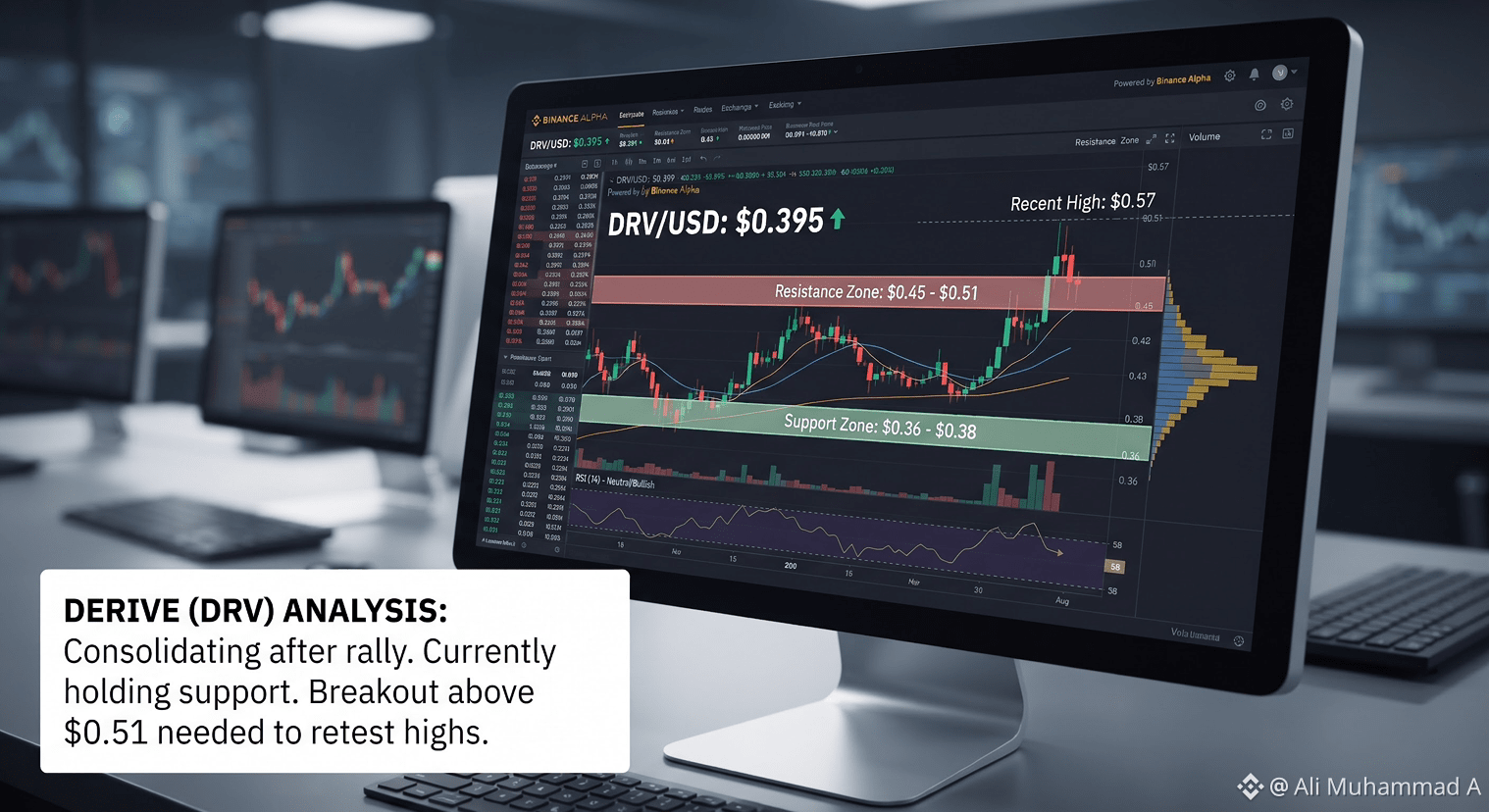
$DRV Current Price: ~$0.38 – $0.41 USD (experiencing a healthy short-term consolidation after recent rallies)
Support Zone: $0.36 – $0.38 (acting as a solid structural floor following broader market corrections)
Resistance Zone: $0.45 – $0.51 (breaking past this overhead zone is necessary to retest the recent record highs near $0.57)
Ecosystem & Market Outlook: Backed by its evolution as an advanced decentralized on-chain options and perpetual futures protocol (formerly Lyra Finance), strong protocol revenue buybacks, and recent expansion onto platforms like Binance Alpha, momentum remains resilient despite short-term volatility. #derive
166

·
--
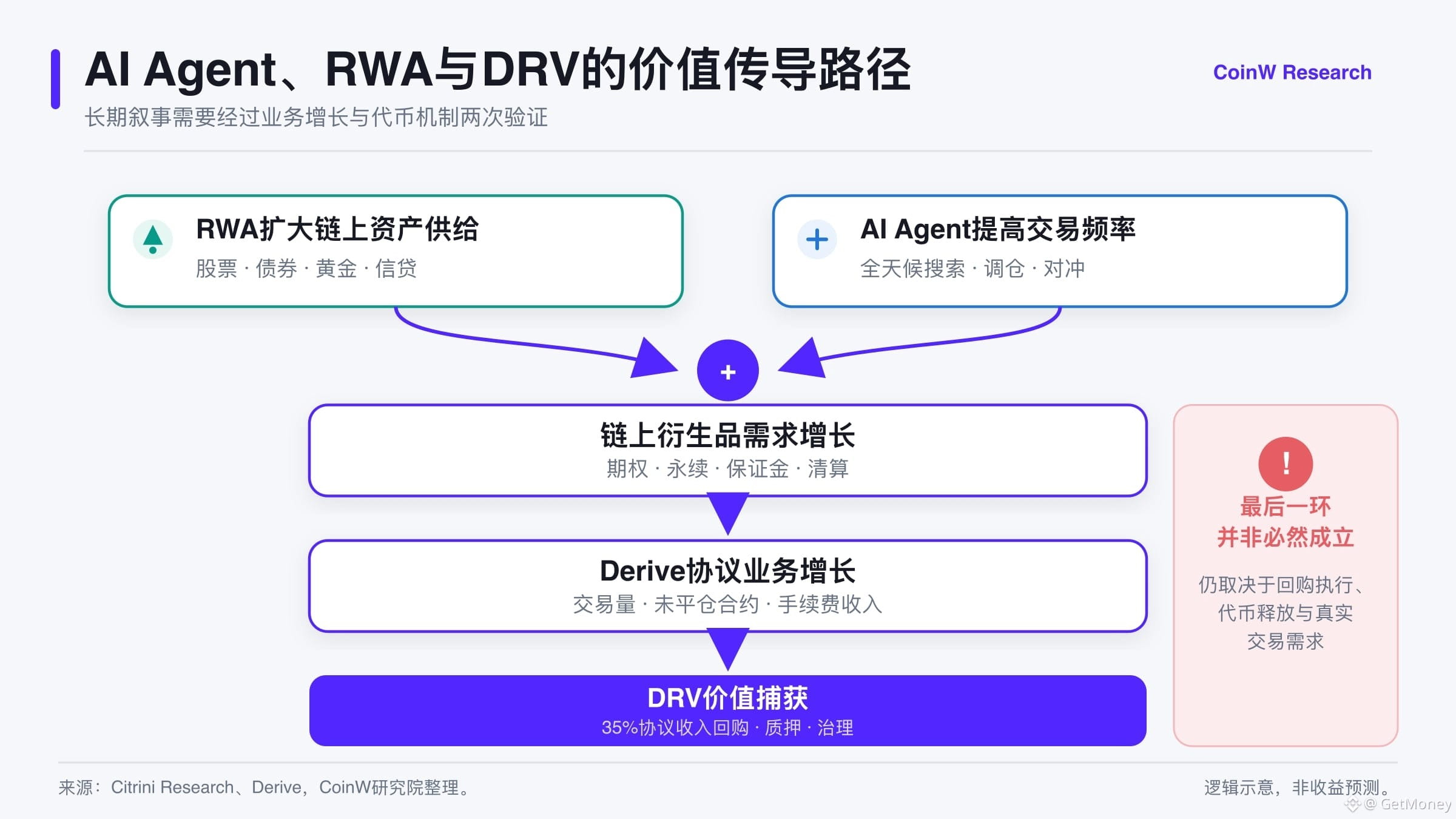
📰 Citrini added DRV to its model portfolio, with a target weight of around 10%. That’s eye-catching news, but let’s be clear: a target allocation in a model portfolio doesn’t mean it has already bought that much.
🔥 The opportunity it sees is easy to understand: RWA could bring more assets on-chain, while AI agents may drive demand for automated trading and hedging. Derive offers options and perpetuals, and could earn ongoing fees from trading and risk management. But whether that demand actually materializes depends on real-world usage.
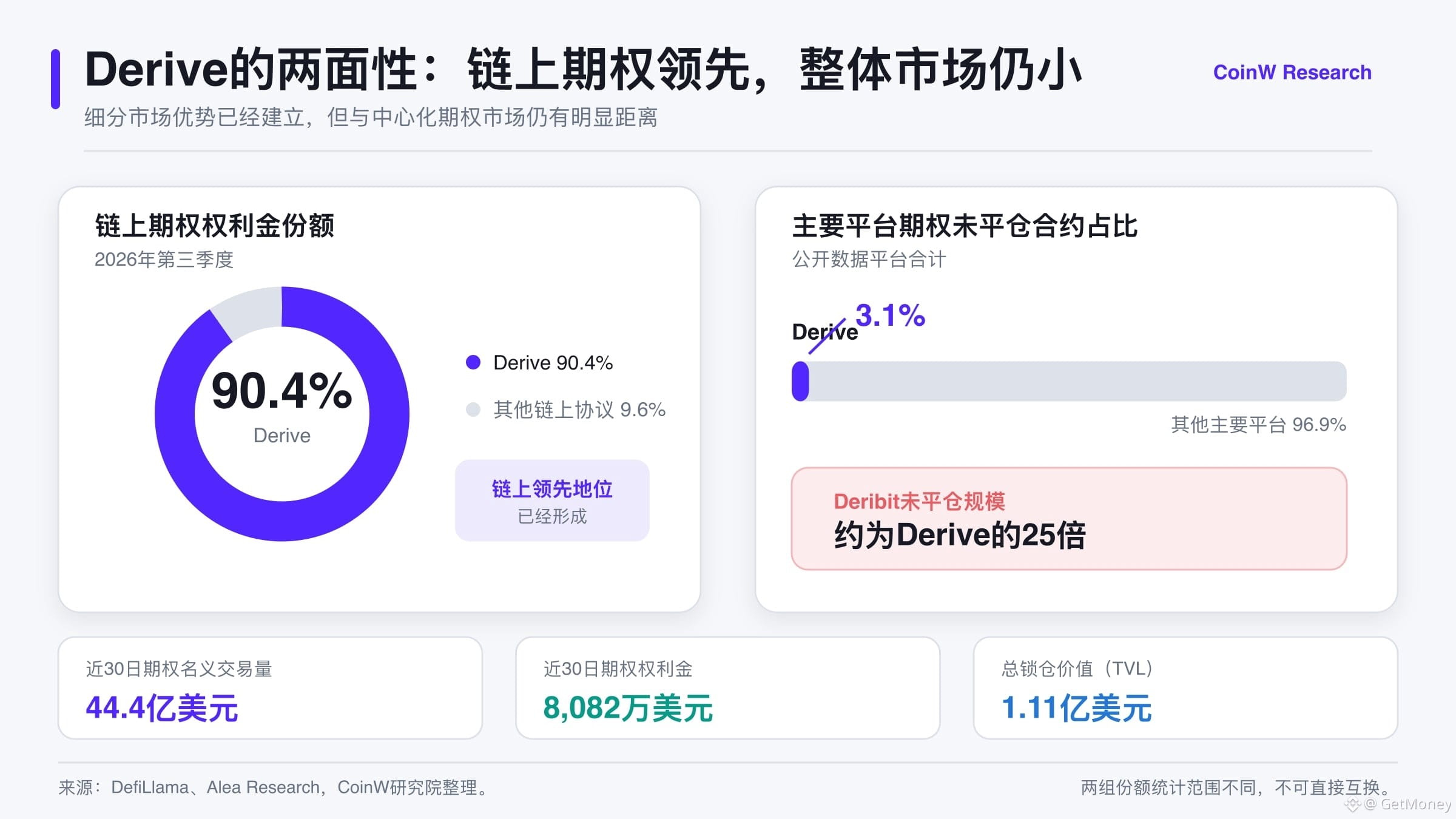
To be fair, Derive’s achievements and its gaps are both pretty clear. In Q3 2026, it accounted for about 90.4% of on-chain options premium trading volume. But among the major platforms listed in the source, its share of options open interest was only around 3.1%, and Deribit was still about 25 times its size. Its on-chain share is strong, but it still has a way to go in the broader market.
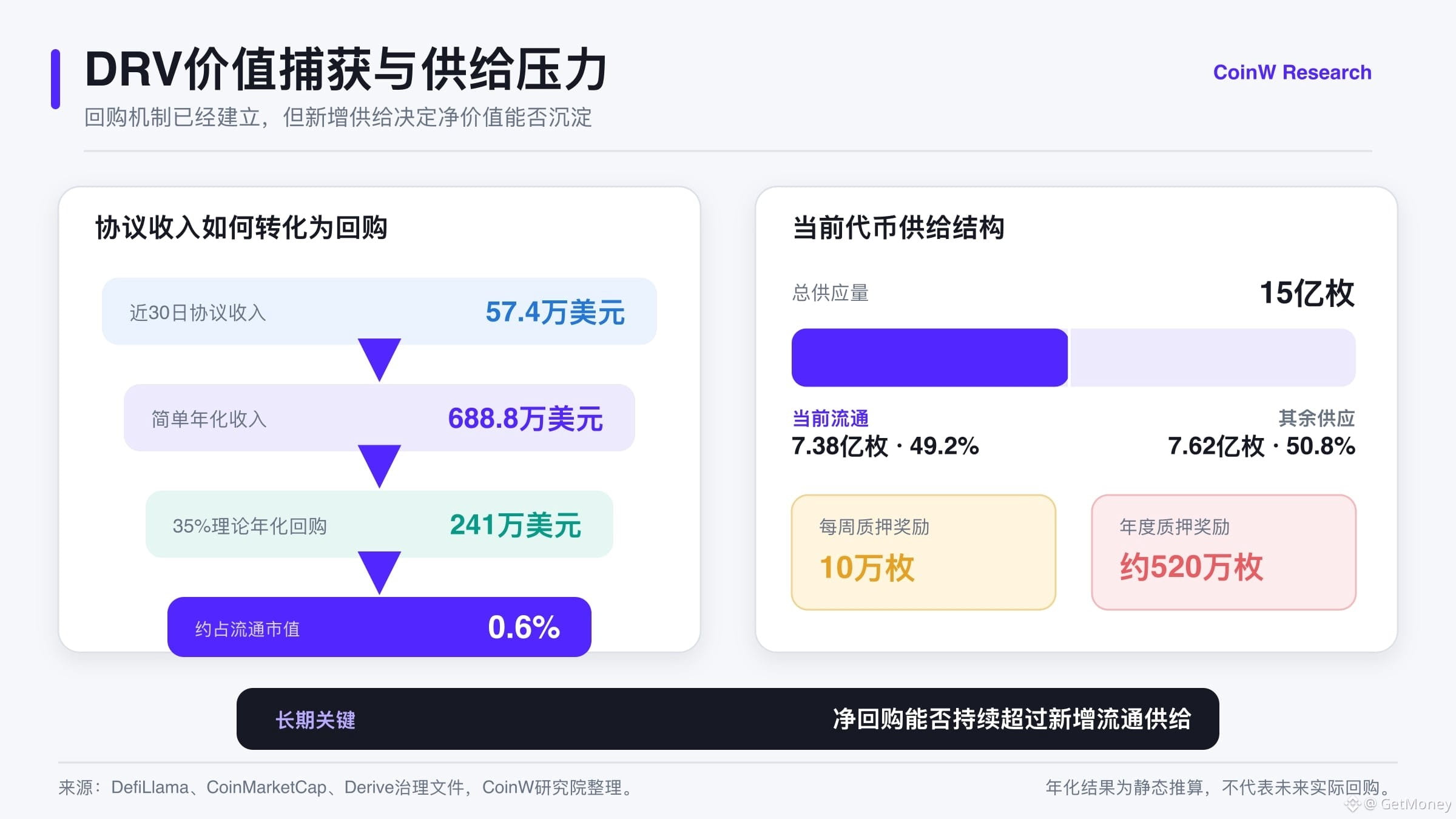
💡 What I care more about is how much buybacks can support the token. The protocol uses 35% of its revenue to buy back DRV. Annualizing its revenue over the 30 days through October 10 gives an estimated buyback budget of about $2.41 million—just around 0.6% of the circulating market cap cited in the source. Having a buyback mechanism and having buybacks with meaningful impact are two different things.
🤔 In any case, I’d look at the protocol’s business and token supply together: can fee revenue keep growing, and can buybacks offset new token issuance? When you assess DRV, would you put more weight on its 90.4% on-chain share or its roughly 0.6% theoretical annualized buyback ratio?
#DRV #Derive #链上衍生品 #RWA
95

·
--
📰 Derive didn’t appear out of nowhere. It started as Lyra in 2021, initially using an AMM before switching to an order book. Now, with V3, it has replaced the original Derive Chain, moving the verification of core trading rules and custody of funds to Ethereum.
🔥 In the new architecture, orders are still matched off-chain, and margin, pricing, and settlement logic also run off-chain. Zero-knowledge proofs are then submitted to Ethereum contracts for verification. Collateral is held in Ethereum contracts, while state data is published to Celestia. Note that the sub-millisecond speed cited by the team refers to order matching, not Ethereum’s final settlement speed.
💡 The business figures are certainly eye-catching: as of October 12, Derive’s options notional trading volume over the past 30 days was about $4.236 billion, accounting for roughly 86.8% of the total across on-chain options protocols. By premium, its share was about 93%. But notional volume and the capital actually flowing into the options market aren’t the same thing.
🤔 Whether strong trading activity can translate into lasting value for DRV remains to be seen. The project plans to use more fee revenue to buy back DRV, and V3 aims to make it easier for new products and partners to integrate. Do you think fee-funded buybacks can truly pass the business’s edge on to the token?
#Derive #DRV #链上期权 #DeFi

48

·
--
DRV is up over 10x year to date. Why?
$DRV is the undisputed leader in on-chain options right now—and it’s actually making money to buy back its own token.
On-chain options never really took off before: liquidity was poor and the user experience was bad. Derive (formerly Lyra) managed to make the experience almost as good as a centralized exchange, while users still retain control of their funds. As a result, it captured nearly 90% of on-chain options premiums this year, with trading volume surging.
Even more important is the token mechanism: the protocol uses a substantial share of its fees to buy back DRV on the secondary market and burn it. Buybacks have exceeded new issuance for several months in a row, resulting in net deflation. Starting this month, the buyback allocation will rise from 35% to 50%.
Add in the V3 upgrade, listings on Korean exchanges, and institutions starting to build positions, and the market is finally repricing the leader in on-chain options.
The business is really taking off + the token is really capturing revenue. This 10x run isn’t purely hype.
(Data can change. DYOR.)
#DRV #链上期权 #Derive
44

·
--
Derive (DRV) just surged over 21% in a single day, hitting $0.55 and pushing its market cap past $550 million!
For beginners, Derive is a decentralized options protocol (formerly Lyra) built on Ethereum and its own Layer 2. Think of it like a crypto version of traditional stock options — letting you bet on price direction or hedge your bags without a middleman. The recent pump likely stems from rising on-chain derivatives volume and fresh incentive campaigns attracting liquidity.
With $111M in 24h volume, traders are clearly active. However, options involve complex risks like time decay and volatility shifts — not just simple "up or down" bets. Always understand the "Greeks" (Delta, Theta, Vega) before diving in, or stick to simpler spot trading first.
#Derive #DeFiOptions
What’s your go-to strategy for hedging crypto risk — options, perps, or just stablecoins?
6

·
--
Came across Bankless: Derive, a leading on-chain options platform, has officially launched V3, and trading is back open.
The key change: Derive has retired its own OP Stack-based Derive Chain and switched to a zkVM exchange. Matching remains off-chain (sub-millisecond), while margin and settlement are verified with ZK proofs in Ethereum mainnet contracts. State data is stored on Celestia, and if the operator goes down, users can still force withdrawals from L1. V2 balances and positions have been migrated automatically, but trigger and TWAP orders need to be resubmitted. New features: ETH and BTC can be used together as collateral; borrowing, previously limited to USDC on V2, now also supports ETH, WBTC, and HYPE. U.S. users still can’t access the platform. According to Alea Research, as of October 1, Derive’s 2026 options notional trading volume was about $14.2 billion—nearly three times its total for all of 2025.
Bringing custody of funds for on-chain options back from its own L2 to mainnet is a substantial move—you want speed, but you also need an escape hatch.
$ETH #期权 #DeFi #Derive

81

·
--
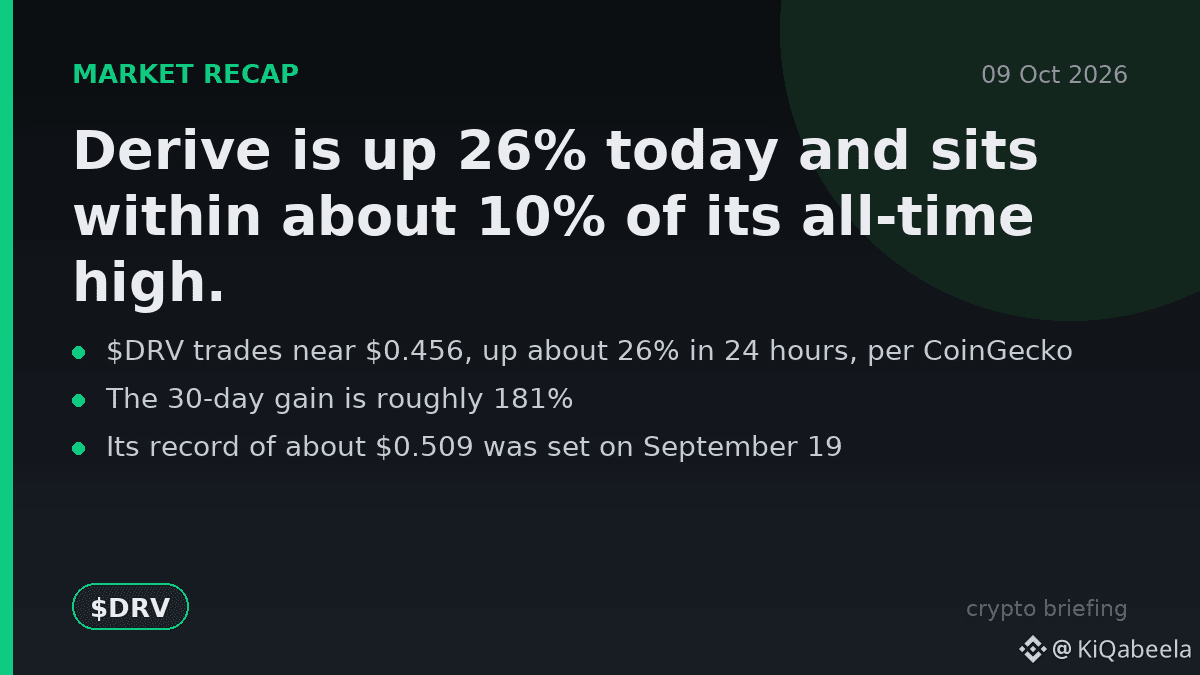
Derive is up 26% today and sits within about 10% of its all-time high.
📊 By the numbers
• $DRV trades near $0.456, up about 26% in 24 hours, per CoinGecko
• The 30-day gain is roughly 181%
• Its record of about $0.509 was set on September 19
• Citrini Research named Derive among the decentralized options venues in its tokenization token basket, per CoinDesk
🎯 Levels to watch
A clean break above the September high would put the token in price discovery, where moves can get volatile in both directions. If it stalls under that level, a range between today's lows and the record is the more likely scenario.
Are onchain options finally getting their moment?
#Derive #DeFi
5

·
--
Bullish
DRV is among the assets that caught my attention the most today.
Up approximately 24% in one recent snapshot. Daily volume close to US$72 million.
And this time, there’s a concrete technological update behind the attention. Derive has officially launched its V3 version. But the interesting part isn’t simply the launch.
It’s the change in infrastructure. The new architecture keeps users’ funds in contracts on Ethereum.
Meanwhile, orders are matched off-chain for speed, and zero-knowledge proofs are used in the margin verification and liquidation process.
In practice, the project is trying to combine trading speed, the security of Ethereum contracts, and advanced financial products.
There’s another change, too. It’s now possible to use ETH and BTC together for margin management. The platform has also expanded its lending features and created tools for building vaults without coding.
To me, this news reinforces a rarely explored narrative.
DeFi doesn’t need to compete only with banks. It can also compete for a share of the traditional derivatives infrastructure—and we’re talking about a huge market.
But there’s an important risk. Improving the infrastructure doesn’t eliminate the risks of liquidation, smart contracts, or execution.
It also doesn’t mean that all platform usage will accrue to the token $DRV.ETF
{etf_us}(DRV.ETF)
That’s why I separate two questions: Has the technology become more interesting? Yes.
Does that mean the current price represents a good opportunity?
That’s a separate analysis.
$DRV.ETF $ETH #Derive #Options #Crypto
Do you believe decentralized derivatives exchanges will be able to truly compete with traditional platforms?
Or will most investors continue to prefer centralized exchanges?
DRV is among the assets that caught my attention the most today.
Up approximately 24% in one recent snapshot. Daily volume close to US$72 million.
And this time, there’s a concrete technological update behind the attention. Derive has officially launched its V3 version. But the interesting part isn’t simply the launch.
It’s the change in infrastructure. The new architecture keeps users’ funds in contracts on Ethereum.
Meanwhile, orders are matched off-chain for speed, and zero-knowledge proofs are used in the margin verification and liquidation process.
In practice, the project is trying to combine trading speed, the security of Ethereum contracts, and advanced financial products.
There’s another change, too. It’s now possible to use ETH and BTC together for margin management. The platform has also expanded its lending features and created tools for building vaults without coding.
To me, this news reinforces a rarely explored narrative.
DeFi doesn’t need to compete only with banks. It can also compete for a share of the traditional derivatives infrastructure—and we’re talking about a huge market.
But there’s an important risk. Improving the infrastructure doesn’t eliminate the risks of liquidation, smart contracts, or execution.
It also doesn’t mean that all platform usage will accrue to the token $DRV.ETF
That’s why I separate two questions: Has the technology become more interesting? Yes.
Does that mean the current price represents a good opportunity?
That’s a separate analysis.
$DRV.ETF $ETH #Derive #Options #Crypto
Do you believe decentralized derivatives exchanges will be able to truly compete with traditional platforms?
Or will most investors continue to prefer centralized exchanges?
1
135

·
--
Derive has moved custody of user funds onto Ethereum. Its token rose 23.9% that day to $0.455, with $70.6 million in trading volume. But the move that was actually supposed to drive the price higher—the increase in the buyback ratio from 35% to 50%—wouldn’t take effect for another six days.
Was it the narrative driving the price, or the fundamentals?
Here’s the timeline: On October 8, the team confirmed that the V3 migration was complete and trading had resumed. Matching, the order book, and KYC all remained in the centralized exchange’s API; only custody of funds and proof of settlement moved, powered by Ethereum smart contracts and zero-knowledge proofs. The buyback ratio wouldn’t actually rise from 35% to 50% until October 14. The market had already priced in the increase before it even took effect.
Two popular narratives don’t hold up.
Calling it a “major decentralization upgrade” doesn’t quite fit: neither matching nor KYC moved. The upgrade’s core benefit is that users can get their funds out if something goes wrong—not that the exchange has disappeared.
And “buybacks = supply contraction” doesn’t hold up either. The official page says buybacks are monthly, but doesn’t mention burning. This round bought back 124,000 DRV, worth about $50,900—a drop in the bucket next to a $455 million market cap. With 1 billion tokens circulating out of a total supply of 1.5 billion, the 500 million-token overhang is still there.
The buybacks themselves aren’t news; they’ve been happening all along. The only genuinely “new” information is that the ratio will rise to 50%—and that hasn’t happened yet.
My short-term view is choppy to lower, and that risk isn’t going away. Spot buying is pushing the price up, while derivatives open interest and liquidation figures are both tiny. There’s no short squeeze; sentiment has simply moved ahead of the money. There’s only one thing that could change my mind: after October 14, on-chain buyback amounts rise substantially, and trading volume and TVL both pick up following the V3 migration. That would be real supply tightening. I can revise my view then; there’s no rush.
#Derive #DeFi #Ethereum #Options
166

·
--
The decentralized derivatives space is heating up, and one project is capturing serious attention: Derive. Formerly known as Lyra Finance, Derive has evolved from a leading options protocol into a powerhouse custom Appchain built on the OP Stack.
Why is Derive making waves in the current market?
First, it tackles the biggest hurdles in DeFi options: high gas fees and fragmented liquidity. By operating on its own dedicated Layer 2 network, Derive offers lightning-fast execution, instant settlement, and near-zero fees. This makes on-chain options trading feel as seamless as using a centralized exchange, but with the security of self-custody.
Beyond technical upgrades, Derive is expanding its product suite. It is no longer just about options. The platform now supports perpetuals and structured yield vaults, creating a unified ecosystem for advanced traders.
One of its most compelling features is portfolio margin. By allowing traders to use multi-asset collateral and offset risk across different positions, Derive dramatically improves capital efficiency. This is a game-changer for both retail traders and institutional players who want to optimize their capital deployment.
As the broader crypto market matures, the demand for sophisticated hedging and trading instruments on-chain is skyrocketing. Platforms that can successfully bridge the gap between CeFi usability and DeFi transparency are positioned for massive long-term growth. The evolution from Lyra to Derive represents a major step forward in this direction.
Are you trading options on-chain yet, or do you still prefer centralized platforms? Keep an eye on the Derive ecosystem as the DeFi derivatives narrative continues to gain momentum.
#Derive #DeFi #CryptoOptions
77

·
--
🎯 The old on-chain options track suddenly caught fire
📰 Derive (DRV) surged to the top of the trending list, up 82% in 24 hours and +159% on the 30th, with trading volume of $110 million hitting an all-time high
💬 The broader market is still consolidating around $76K, but the money has gone to those trading on-chain options. Derivatives are a real need, not just pure sentiment—there’s substance in this move. But don’t chase the rally so aggressively
🏷️ #Derive #DRV #链上衍生品 #DeFi #Shanzhai (altcoin) anomaly
65

Log in to DRV on Upbit spot, with short-term volume surging to catch the eye.
Upbit’s listing effects have always been immediate and obvious. With KRW liquidity combined with retail sentiment, it often drives a burst of price action right in the opening phase. As a newcomer in the derivatives track, Derive has leveraged Upbit to gain mainstream visibility this time. The sudden spike in short-term trading volume suggests the market is willing to pay for a "new story + new liquidity."
However, it’s important to stay calm and look at it objectively: after Upbit’s listing, the price action typically follows a three-stage pattern of "a high open—then a pullback—followed by re-pricing." Only after the first day’s sentiment premium fades do you truly start to see whether the project fundamentals hold up. For Derive, the core competitiveness of derivatives protocols lies in product depth, real trading volume, and fee-capture capability—not in a one-off exchange listing windfall.
Short-term traders may want to watch how the KRW premium and spot market depth change. Medium- to long-term holders should focus on whether on-chain activity remains sustainable after the initial listing hype cools off. Hype is the ticket to enter; what keeps you here is the product.
#Upbit #Derive #Altcoin
43
·
--
Decentralized derivatives are experiencing a massive renaissance, and at the forefront of this evolution is Derive. Formerly known as Lyra, this protocol has completed a successful rebrand to align with its vision of becoming the ultimate decentralized financial engine for options, perpetuals, and structured products.
What makes Derive stand out in a crowded DeFi landscape?
It all starts with its infrastructure. Transitioning from a simple decentralized app to its own dedicated Appchain, built on the Optimism OP Stack, was a game-changer. The Derive L2 offers traders millisecond-level execution speed and gasless trading experiences, effectively mimicking the performance of centralized exchanges while preserving the core ethos of self-custody.
Derive is no longer just about options. By consolidating perpetual swaps, options trading, and yield-bearing structured vaults into a single portfolio margin system, it offers capital efficiency that few other DEXs can match. Users can use their collateral to simultaneously earn yield, write options, and hedge positions under one roof.
With the migration from the LYRA token to the DRV token, the ecosystem has successfully aligned incentives for long-term builders, traders, and stakers. As liquidity continues to migrate onto decentralized Layer 2 networks, Derive’s position as a core liquidity hub for on-chain derivatives makes it a project to watch closely.
As the crypto market craves more secure, transparent, and capital-efficient trading venues, platforms like Derive are bridging the gap between traditional finance capabilities and DeFi transparency. Are you trading options on-chain yet, or are you sticking to standard perpetuals? Let us know your strategy in the comments below.
#Derive #DeFi #CryptoTrading
68

·
--
Bullish

222
·
--
The decentralized derivatives landscape is undergoing a massive evolution, and at the forefront of this shift is Derive, formerly known as Lyra. As DeFi users increasingly seek the sophistication of centralized exchanges combined with the security of self-custody, Derive is positioning itself as the go-to decentralized options and perpetuals powerhouse.
What makes Derive stand out in a crowded DeFi market? It is not just another dApp; it operates on its own dedicated Ethereum Layer 2 appchain, built using the OP Stack. This infrastructure allows Derive to offer sub-second transaction execution, extremely low gas fees, and a seamless user experience that closely mimics a traditional trading desk.
The core strength of Derive lies in its options trading liquidity. While perpetual swaps have dominated DeFi for years, the crypto options market is ripe for exponential growth. Derive has successfully captured a dominant share of this niche by offering robust options chains, automated market makers, and structured yield products. Their Earn vaults allow passive depositors to earn organic yield by underwriting options strategies, creating a sustainable loop of liquidity and rewards.
From an analytical perspective, the rebranding from Lyra to Derive represents more than just a name change. It signals an expansion into a comprehensive financial ecosystem. The protocol is unifying options, perpetuals, and structured vaults under one highly scalable roof. This ecosystem expansion is backed by solid fundamentals, with consistent trading volume and TVL (Total Value Locked) showcasing strong user retention despite market volatility.
For traders and investors, tracking Derive is essential as the DeFi derivatives sector matures. Keep an eye on their tokenomics transition and the integration of new collateral assets, which could act as significant catalysts for TVL growth. As capital efficiency becomes the ultimate metric for DeFi success, Derive is well-equipped to lead the next wave of on-chain trading.
#DeFi #Derive #CryptoTrading
76
·
--
🎯 Derive options surge to the top of the hot searches first
📰 DRV dominates the headlines, with ZEC and FIRO close behind. BTC is hovering around 81K, cutting back and forth, while ETH jumps 6% to $2607
💬 After privacy coins just got traded up, hot money has turned again to poke at options derivatives. Same old track, played again and again—only real tools can keep the volume; if you chase after a rally, watch out for getting stuck holding the last bag
🏷️ #Derive #DRV #期权 #DeFi #altcoin frenzy
72

·
--
Log in to DRV on Upbit spot trading, with a clear surge in trading volume over a short period that draws market attention.
As an old player in the on-chain derivatives track, the Derive protocol leverages a traffic entry point from a South Korean compliant exchange this time, which may unlock a new wave of user growth. Upbit’s first listing is often accompanied by a Korean won premium and an outbreak of short-term sentiment, but you need to be careful about the profit-taking pullback rhythm after the listing.
Key points:
- Whether the volume continues in the first hour after the listing
- The potential price gap between the Korean won market and other trading pairs
- How the Derive protocol’s own TVL and derivatives trading volume move together
Short-term speculative sentiment is strong—be sure to control your position size, set stop-loss orders, and don’t turn the exchange’s listing bonus into a bag-holding game.
#Upbit #Derive #DRV
$DRV
38

·
--
I think the best trading platform is Derive. For everyone who hasn't tried it, I advise you to try it. It has many features—discover them and you won't regret it #Derive
I think the best trading platform is Derive. For everyone who hasn't tried it, I advise you to try it. It has many features—discover them and you won't regret it #Derive
105
·
--
🎯 The trending list has had another shake-up—this time, it’s all unfamiliar faces
📰 STREAM, Derive, and Pearl have popped up on Binance’s trending list, alongside familiar names TIA, INJ, NEAR, Sui, and PENGU. ETH is up 4.3% over 24 hours to $2,463, while BTC is up just 1.7%.
💬 Honestly, when BTC moves sideways, money just shifts between tables on the trending list. Old coins turn green, new ones emerge, and the relay race never stops. Chasing new faces for a thrill is one thing, but don’t mistake it for a trend to hold onto.
🏷️ #STREAM #Derive #Pearl #NewTokenListing
334
Log in to explore more content
Join global crypto users on Binance Square
⚡️ Get latest and useful information about crypto.
💬 Trusted by the world’s largest crypto exchange.
👍 Discover real insights from verified creators.
Email / Phone number
Trending Topics
1
#BinanceSAFUFundTransferCompleted7499BTC
36,845 views
791 Discussing
2
#BinanceRecovery90% of stolen assets
136,365 views
173 Discussing
3
#YiHe:ProofOfReserves:10TokensAt100%Backing
136,742 views
745 Discussing
4
#BackedNotBroken:RichardTengSaysUsersBearNoLoss
42,637 views
465 Discussing
5
#CZSaysCompensationIsinPlaceUsersAreProtected
125,733 views
1,383 Discussing
6
#IntelHasItsWorstDaySince1974
47,838 views
701 Discussing
7
#TRMCambodianCasinosReceived$1.07BInCrypto
13,047 views
69 Discussing
8
#USDCCirculationFallsAbout800MInSevenDays
70,813 views
724 Discussing
9
#SuspectedNorthKoreaAttacksAccountForNearly89%OfCryptoHackLosses
14,740 views
97 Discussing
10
#OpenAICutsFundraisingTargetBy$10B
3,667 views
73 Discussing