

umair0007
19 Posts

umair0007
Report
Block User
Simplifying Crypto for Beginners 📊 Sharing daily market trends, risk management tips & smart trading strategies. No hype, just real value. Hit Follow to grow
Open Trade
Occasional Trader
2.9 Years
0 Following
17 Followers
20 Liked
Posts
Portfolio
·
--
See translation
Binance $6.3 Billion Hack, Full Details1. What happened?
Binance was hit late Thursday by the biggest crypto hack ever, with $6.3 billion in funds impacted. According to TRM Labs, an attacker moved about $6.36 billion out of Binance wallets across 10 blockchains, most of it in about 20 minutes.
According to (Yahoo Finance) & (cbc)
2. How did it happen?
Binance first said the hack may have begun with a compromised engineer's laptop.
Later, the investigation found additional breach points beyond the laptop. According to (cryptotimes)
Binance said it found no evidence that any wallet's private key was leaked.
According to (Al Jazeera)
Richard Teng said it was not a single "one-click" action.
3. Who did it?
TRM Labs says the attack resembles a North Korea-linked state-sponsored group. Well-known investigator ZachXBT called Lazarus Group the "likely attacker." This is still suspicion, not final proof.
According to (CNBC) & (CoinDesk)
4. Binance's response
Binance pledged to cover all losses using its SAFU fund and company resources.
The SAFU fund holds roughly $1 billion in Bitcoin.
According to (CoinDesk)
Frozen funds: first reported as $3 billion, then updated to $5 billion on Friday afternoon. Tether and Circle froze more than $2.3 billion.
According to (cbc) & (Al Jazeera)
Binance says it reserved $6.34 billion, withdrawals will reopen in phases after security checks, and Proof of Reserves results are due Monday, November 2. According to (crypto)
Binance says deposits were unaffected.
5. Can Binance collapse?
Fundstrat's Sean Farrell says there's currently no major solvency risk for Binance. That is one analyst's opinion, not a guarantee.
According to (CNBC)
6. Market impact
BNB fell more than 6%. Bitcoin dropped back to $77,000.
According to (Yahoo Finance) & (CoinDesk)
7. Comparison with the past
The previous biggest hack was Bybit in February 2025, where $1.5 billion was stolen. Binance was also hit in 2022, when about $570 million was taken from the BNB bridge.
According to (Yahoo Finance) & (NBC News)
.
.
.
What should you do?
Don't panic-sell everything and don't follow rumors.
Take updates only from Binance's official channels (the app and the official X account).
Avoid messages asking you to "claim compensation" with links or passwords. Scams rise after hacks like this.
Keep 2FA, anti-phishing code, and withdrawal address whitelist turned on.
Check the Proof of Reserves results on Monday.
Finally:
This story is still developing and figures may change. This is only information, not financial advice.
$SOL
$NVDAB
$MSFTB
#BinanceSquareTalks #Binancehacked #CryptoSecurity
Binance $6.3 Billion Hack, Full Details
1. What happened?
Binance was hit late Thursday by the biggest crypto hack ever, with $6.3 billion in funds impacted. According to TRM Labs, an attacker moved about $6.36 billion out of Binance wallets across 10 blockchains, most of it in about 20 minutes.
According to (Yahoo Finance) & (cbc)
2. How did it happen?
Binance first said the hack may have begun with a compromised engineer's laptop.
Later, the investigation found additional breach points beyond the laptop. According to (cryptotimes)
Binance said it found no evidence that any wallet's private key was leaked.
According to (Al Jazeera)
Richard Teng said it was not a single "one-click" action.
3. Who did it?
TRM Labs says the attack resembles a North Korea-linked state-sponsored group. Well-known investigator ZachXBT called Lazarus Group the "likely attacker." This is still suspicion, not final proof.
According to (CNBC) & (CoinDesk)
4. Binance's response
Binance pledged to cover all losses using its SAFU fund and company resources.
The SAFU fund holds roughly $1 billion in Bitcoin.
According to (CoinDesk)
Frozen funds: first reported as $3 billion, then updated to $5 billion on Friday afternoon. Tether and Circle froze more than $2.3 billion.
According to (cbc) & (Al Jazeera)
Binance says it reserved $6.34 billion, withdrawals will reopen in phases after security checks, and Proof of Reserves results are due Monday, November 2. According to (crypto)
Binance says deposits were unaffected.
5. Can Binance collapse?
Fundstrat's Sean Farrell says there's currently no major solvency risk for Binance. That is one analyst's opinion, not a guarantee.
According to (CNBC)
6. Market impact
BNB fell more than 6%. Bitcoin dropped back to $77,000.
According to (Yahoo Finance) & (CoinDesk)
7. Comparison with the past
The previous biggest hack was Bybit in February 2025, where $1.5 billion was stolen. Binance was also hit in 2022, when about $570 million was taken from the BNB bridge.
According to (Yahoo Finance) & (NBC News)
.
.
.
What should you do?
Don't panic-sell everything and don't follow rumors.
Take updates only from Binance's official channels (the app and the official X account).
Avoid messages asking you to "claim compensation" with links or passwords. Scams rise after hacks like this.
Keep 2FA, anti-phishing code, and withdrawal address whitelist turned on.
Check the Proof of Reserves results on Monday.
Finally:
This story is still developing and figures may change. This is only information, not financial advice.
$SOL
$NVDAB
$MSFTB
#BinanceSquareTalks #Binancehacked #CryptoSecurity
539
·
--
See translation
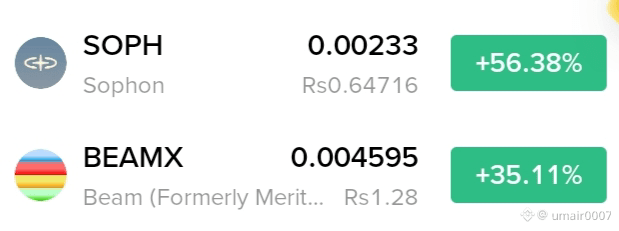
SOPH and BEAMX, what are these fast-rising coins really?
$SOPH +56%
{spot}(SOPHUSDT)
What it is: Sophon is an entertainment network, and SOPH is its native token. Its goal is to use blockchain for games and entertainment apps.
Supply: Its maximum supply is 10 billion SOPH. When supply is huge and new tokens keep unlocking, the price can come under pressure.
Past record: After its Binance listing, an airdrop of 900 million tokens pushed the price down more than 33% within 24 hours.
According to one data page, it is 96% below its all-time high. So +56% doesn't mean the coin is safe, because it is rising from a very low level.
$BEAMX (Beam, formerly Merit Circle) +35%
{spot}(BEAMXUSDT)
What it is: Beam is a gaming network powered by the Merit Circle DAO, focused on play-to-earn games and the metaverse.
The name issue: The old token was MC. Merit Circle's MC token migrated to BEAM at a 1:100 ratio. A different privacy project with a similar name, Beam, also exists, so check the exact name and contract before buying.
Why did they rise today? I found no clear news behind these jumps. Small coins like these often pump when volume suddenly arrives, and they can fall back just as fast.
Don't put money in when you don't know why a coin is rising.
A jump from a very low level is often just a small bounce.
Exiting small coins can be hard, so only use a small amount.
This is only information, not financial advice.
$SOL
#BEAMX #BinanceSquareTalks #GAINERS #crypto #cryptoeducation
SOPH and BEAMX, what are these fast-rising coins really?
$SOPH +56%
What it is: Sophon is an entertainment network, and SOPH is its native token. Its goal is to use blockchain for games and entertainment apps.
Supply: Its maximum supply is 10 billion SOPH. When supply is huge and new tokens keep unlocking, the price can come under pressure.
Past record: After its Binance listing, an airdrop of 900 million tokens pushed the price down more than 33% within 24 hours.
According to one data page, it is 96% below its all-time high. So +56% doesn't mean the coin is safe, because it is rising from a very low level.
$BEAMX (Beam, formerly Merit Circle) +35%
What it is: Beam is a gaming network powered by the Merit Circle DAO, focused on play-to-earn games and the metaverse.
The name issue: The old token was MC. Merit Circle's MC token migrated to BEAM at a 1:100 ratio. A different privacy project with a similar name, Beam, also exists, so check the exact name and contract before buying.
Why did they rise today? I found no clear news behind these jumps. Small coins like these often pump when volume suddenly arrives, and they can fall back just as fast.
Don't put money in when you don't know why a coin is rising.
A jump from a very low level is often just a small bounce.
Exiting small coins can be hard, so only use a small amount.
This is only information, not financial advice.
$SOL
#BEAMX #BinanceSquareTalks #GAINERS #crypto #cryptoeducation
316
·
--
See translation
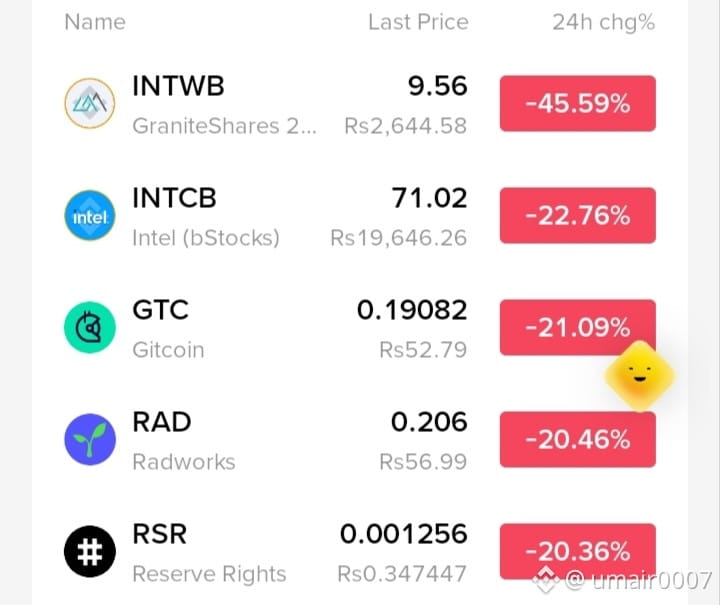
Today Losers : What These Coins Actually Do;
INTCB (Intel bStock): It represents shares of the Intel company. Intel gave its Q3 results on October 29 after the market closed, and chip shares were already falling on AI spending worries. (heygotrade) (mitrade)
INTWB: Probably a GraniteShares 2x leveraged product. If the share falls 10%, it can fall about 20%, which is why it dropped -45%.
$GTC
{spot}(GTCUSDT)
Gitcoin: A platform for funding open-source Ethereum projects. GTC is its governance token.
$RAD
{spot}(RADUSDT)
Radworks: The token of the Radicle network, which works on sharing code without a big central server.
$RSR
{spot}(RSRUSDT)
Reserve Rights: The token of the Reserve stablecoin system. It acts as insurance to keep the system stable.
Lessons to learn
A coin that rises 47% can fall just as fast.
Leveraged and tokenized stock products are risky for beginners.
Before buying any coin, understand its purpose, team, and risks.
.
.
This is only information, not financial advice.
.
.
#BİNANCE #crypto #cryptoeducation #TodayMarketAlert
Today Losers : What These Coins Actually Do;
INTCB (Intel bStock): It represents shares of the Intel company. Intel gave its Q3 results on October 29 after the market closed, and chip shares were already falling on AI spending worries. (heygotrade) (mitrade)
INTWB: Probably a GraniteShares 2x leveraged product. If the share falls 10%, it can fall about 20%, which is why it dropped -45%.
$GTC
Gitcoin: A platform for funding open-source Ethereum projects. GTC is its governance token.
$RAD
Radworks: The token of the Radicle network, which works on sharing code without a big central server.
$RSR
Reserve Rights: The token of the Reserve stablecoin system. It acts as insurance to keep the system stable.
Lessons to learn
A coin that rises 47% can fall just as fast.
Leveraged and tokenized stock products are risky for beginners.
Before buying any coin, understand its purpose, team, and risks.
.
.
This is only information, not financial advice.
.
.
#BİNANCE #crypto #cryptoeducation #TodayMarketAlert
1
881
·
--
See translation
$PARTI : This project makes crypto wallets easier to create. It rose 47% in a day, and coins that rise this fast often fall just as fast.
$HYPE (Hyperliquid): This is the token of a trading platform. It rose thanks to ETF and Coinbase support. But some big institutions are asking for it to be watched closely.
$RUNE (THORChain): This is a platform for swapping different coins with each other. It had hacking problems this year, so its risk is higher.
SOXSB and SKDDB: These are not normal coins. They are stock-like products that probably rise when the market falls. Beginners should avoid them.
Only invest what you can afford to lose. Use a stop-loss on every trade. Don't buy just because someone said so; do your own research first.
{spot}(PARTIUSDT)
{spot}(HYPEUSDT)
{spot}(RUNEUSDT)
#EarningsSeason #USMidtermElections #PARTI #hype #Rune
$PARTI : This project makes crypto wallets easier to create. It rose 47% in a day, and coins that rise this fast often fall just as fast.
$HYPE (Hyperliquid): This is the token of a trading platform. It rose thanks to ETF and Coinbase support. But some big institutions are asking for it to be watched closely.
$RUNE (THORChain): This is a platform for swapping different coins with each other. It had hacking problems this year, so its risk is higher.
SOXSB and SKDDB: These are not normal coins. They are stock-like products that probably rise when the market falls. Beginners should avoid them.
Only invest what you can afford to lose. Use a stop-loss on every trade. Don't buy just because someone said so; do your own research first.
#EarningsSeason #USMidtermElections #PARTI #hype #Rune
272
·
--
See translation
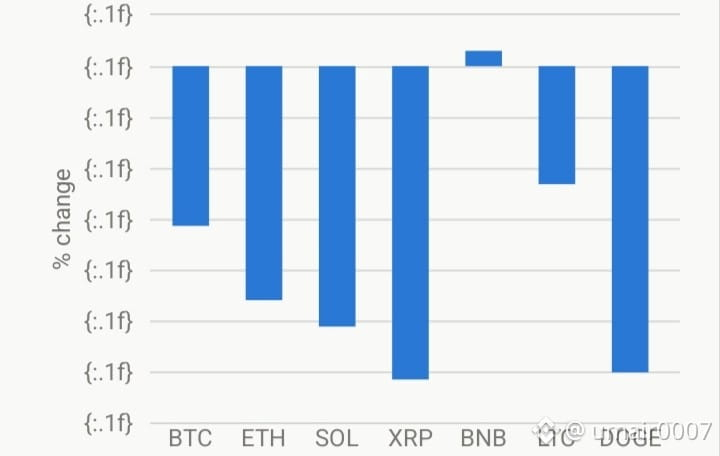
Crypto snapshot, Oct 29, 2026: risk-off after the Fed.
Bitcoin slipped below $80,000 after the Fed meeting failed to give risk assets the reassurance traders wanted. Ether is near $2,308, Solana near $99.67 and $XRP near $1.29, with nearly every major coin down on the day, as the chart shows. $BNB was the only one to hold up.
What's driving it
Macro: The Fed held rates as expected, but two officials argued for a hike. Bitcoin has also been trading closely with tech stocks, so Alphabet's results and Samsung's chip miss hit crypto too.
Leverage: About $356 million in leveraged positions, mostly longs, were reset in 24 hours, which made the drop worse.
Ethereum: US spot Ether ETFs saw continued outflows, with $21.41 million net out on October 28.
Levels to watch
BTC: Holding $79,000–$80,000 would calm some concerns. Resistance sits around $81,500–$81,750.
$ETH : $2,295 is the support level, and $2,400 is the first level to reclaim.
#FedWatch #EarningsSeason
{spot}(ETHUSDT)
Crypto snapshot, Oct 29, 2026: risk-off after the Fed.
Bitcoin slipped below $80,000 after the Fed meeting failed to give risk assets the reassurance traders wanted. Ether is near $2,308, Solana near $99.67 and $XRP near $1.29, with nearly every major coin down on the day, as the chart shows. $BNB was the only one to hold up.
What's driving it
Macro: The Fed held rates as expected, but two officials argued for a hike. Bitcoin has also been trading closely with tech stocks, so Alphabet's results and Samsung's chip miss hit crypto too.
Leverage: About $356 million in leveraged positions, mostly longs, were reset in 24 hours, which made the drop worse.
Ethereum: US spot Ether ETFs saw continued outflows, with $21.41 million net out on October 28.
Levels to watch
BTC: Holding $79,000–$80,000 would calm some concerns. Resistance sits around $81,500–$81,750.
$ETH : $2,295 is the support level, and $2,400 is the first level to reclaim.
#FedWatch #EarningsSeason
133
·
--
See translation
Why Most Beginners Lose Money in Crypto (And How to Avoid It)
If you've recently stepped into the crypto market, you’ve probably noticed how fast things move. It’s easy to get caught up in the hype, jump into a trending coin, and end up watching your portfolio dip.
The truth is, trading isn’t about luck—it’s about discipline. Here are three simple habits that helped me protect my capital when I first started;
Stop Chasing Green Candles: By the time a coin is trending everywhere on social media, the smart money is usually already taking profits. Chasing pumps often leaves you holding the bag. Always wait for a healthy pullback or accumulation phase.
Define Your Risk Before Entering: Before you open any trade, know your exit plan. Where is your stop-loss? What is your profit target? If you don't have a plan, hope is your only strategy—and hope is a terrible trading tool.
Keep Emotions Out of It: Fear and greed are a trader’s worst enemies. Panic-selling during a market dip or FOMO-buying at the top will drain your account faster than anything else.
Remember, consistency beats quick wins every single time. Master the boring risk management rules now, and the profits will follow.
.
.
If you found this helpful, hit that Follow button for daily market breakdowns and beginner-friendly tips.
How does this tone feel
$BTC $SOL $ETH
#CryptoTrading. #BinanceSquareTalks #begginermistake #begginers
100
·
--
See translation
✅ Tips to Make Trend Trading Profitable:
1. Learn to Identify the Trend:
Higher Highs & Higher Lows = Uptrend
Lower Highs & Lower Lows = Downtrend
Use indicators like Moving Averages (EMA 50, 200) to confirm the trend.
2. Wait for Confirmation:
Don’t enter just by seeing price movement. Use Volume, RSI, or MACD for confirmation to avoid fake trends.
3. Always Use a Stop Loss:
A stop loss is essential to protect yourself from big losses.
For example, if the market goes in the opposite direction, your loss remains limited.
4. Don’t Go Against the Trend:
If the market is in an uptrend, only look for buying opportunities.
In a downtrend, focus on selling – following the trend is always safer.
5. Watch News & Events:
Market-moving news (like interest rates, wars, inflation data) can break trends.
So always check the economic calendar before entering trades.
6. Small Profits, Long-Term Gains:
Patience is important in trend trading.
Small, consistent profits over time lead to good overall returns.
7. Use Trailing Stop Loss:
If the market moves in your favor, use a trailing stop to lock in profits.
8. Practice on Demo First:
Use platforms like MetaTrader 5 to practice.
Only use real money when you feel confident in your strategy.
---
❌ Things to Avoid Losses:
Don’t Overtrade – taking trades on every signal can be risky.
Don’t Be Greedy – exit when the trend is clearly over.
Understand Market Structure – avoid fake breakouts and sudden reversals.
Avoid Emotional Decisions – keep away from fear and greed.
---
Best Coin for Trend Trading Strategies 🔽
$BTC $ETH $SOL
#TrendTradingStrategy
289
·
--
See translation
🔍What is break out strategies ⛓️💥
Resistance level: A level where price keeps falling back down
Support level: A level where price keeps bouncing back up
When does breakout happen?
When the price breaks out of either support or resistance level.
---
✅ How to Use Breakout Strategy (Step-by-Step):
🧩 Step 1: Identify support & resistance on the chart
– Look where the price is repeatedly touching and bouncing off.
🧩 Step 2: Wait for the breakout
– If price breaks resistance → Buy
– If price breaks support → Sell
🧩 Step 3: Look for confirmation (to avoid fake breakouts)
– Make sure volume is high or the breakout candle is strong
🧩 Step 4: Set Stop-loss & Target
– Always place a stop-loss to avoid big losses
– Set a fixed target profit (like 5%, 10%)
---
🧠 Example (BUY Trade):
Coin: SOL
Resistance level: 2,000 PKR
Price breaks 2,000 with a strong candle
You Buy at 2,020
Stop-loss: 1,950
Target: 2,200+
---
⚠️ Risks☢️:
Fake breakouts happen
If volume is low, the move may fail
That’s why confirmation and stop-loss are important
---
🪄 Unique Idea for Beginners:
🎯 “Breakout + News Strategy”
> Combine breakout strategy with news-based events — you’ll get double confirmation!
Example:
1. Binance announces a major update for a coin
2. Check the chart of that coin
3. If the price is near resistance → Watch it closely
4. After news, if price breaks out → Buy confidently
5. High chance of quick profit
---
🔧 Helpful Tools:
Tool Use
TradingView To view charts and draw levels
CoinMarketCal To find crypto news and events
Volume Indicator To confirm breakout strength
---
Best Coin forever 🔽
$BTC $ETH $BNB
#BreakoutTradingStrategy
1
61
·
--
See translation
💡 What is Hold Trading Strategy?
Hold trading or HODLing means:
> "Buying a coin or stock and keeping it for a long time (weeks, months, or even years), hoping that its value will increase in the future."
---
🔰 How Does Hold Trading Work?
1. Buy low (when the price is down)
2. Hold it (don’t panic if price goes up or down)
3. Sell high (when it reaches your target price)
---
🧠 Example:
You bought Bitcoin at Rs. 30,000
You decided not to sell it for 1 year, even if the market drops
After 1 year, Bitcoin's price becomes Rs. 80,000
You sell it = You made a good profit
---
✅ Benefits of Hold Strategy:
1. Less stress – No need to check the market daily
2. Long-term profit – Most coins grow in value over time
3. Easy for beginners – No deep technical skills required
---
⚠️ Risks or Drawbacks:
1. Market may crash – You need patience
2. Takes time – Not a quick-money method
3. Wrong coin = loss – Proper research is important
---
🔍 Best Coins to Hold (for 2025):
(Good for small investments)
$BTC
$ETH
$SOL
polygon
BNB
---
🎯 Tips for Beginners:
Only invest what you can afford to lose
Always do research
#HODLTradingStrategy
43
·
--
See translation
Day trading means buying and selling a coin or stock within the same day to earn profit from small price movements. This type of trading happens throughout the day and requires both patience and quick decision-making.
Here are some easy and common day trading strategies:
---
1. Scalping Strategy:
In this strategy, a trader makes many small trades every 5–10 minutes. Each trade brings small profits, but by doing many trades, the total profit adds up.
📌 This is a fast-paced strategy and can be difficult for beginners.
---
2. Momentum Trading:
When the price of a coin or stock suddenly rises (due to news or a trend), the trader enters in the same direction.
📌 As long as the trend continues, the trader stays in. When momentum slows, they exit.
---
3. Breakout Strategy:
When the market breaks a support or resistance level (up or down), it may start a new trend. Traders enter at that breakout point.
📌 This strategy requires technical analysis.
---
4. Pullback Trading:
When the price drops temporarily during an upward trend, traders buy at the lower point, expecting it to go back up.
📌 This is a bit safer if the trend is already strong.
---
Important Points:
Always use a stop loss to protect against large losses.
Day trading needs time and full focus.
Decisions must be made quickly, so emotional control is very important.
Learn to read charts and use technical indicators like RSI, MACD, and Moving Averages.
---
#DayTradingStrategy
$BTC $ETH $BNB
11
·
--
See translation
Spot vs Futures Strategy......
Spot trading and futures trading are two different methods used in the crypto or stock market to earn money, but both involve very different strategies and risks. Spot trading means you buy or sell an asset at the current market price, and the transaction happens instantly. As soon as you click the buy button, the asset is transferred to your wallet. This strategy is mostly used for long-term or medium-term investments, and it carries relatively lower risk, though the profit is usually smaller.
Futures trading is a more advanced and risky method. In this, you don’t actually own the asset—you buy a contract that predicts whether the price will go up or down in the future. It involves leverage, which can turn a small investment into a larger one—but it also increases the risk of heavy loss. Futures strategy is aimed at short-term gains and allows traders to profit in both directions (whether the price rises or falls). For beginners, spot trading is the safer choice.
#SpotVSFuturesStrategy
8
·
--
See translation
When it comes to trading, one of the smartest moves is to follow the trend. Trend trading strategies are all about identifying the direction of the market—up or down—and riding that wave. Instead of trying to predict every turn, you go with the flow. Use tools like moving averages or trendlines to spot the trend, then set clear entry and exit points. Always remember: trends don’t last forever, so manage your risk with stop-loss orders. The beauty of trend trading is its simplicity—it’s about patience and discipline. If you can stay calm and follow the market’s lead, you can trade confidently.
#TrendTradingStrategy
$BTC $ETH $BNB
#TrendTradingStrategy
$BTC $ETH $BNB
1
·
--
See translation
When it comes to trading, one of the smartest moves is to follow the trend. Trend trading strategies are all about identifying the direction of the market—up or down—and riding that wave. Instead of trying to predict every turn, you go with the flow. Use tools like moving averages or trendlines to spot the trend, then set clear entry and exit points. Always remember: trends don’t last forever, so manage your risk with stop-loss orders. The beauty of trend trading is its simplicity—it’s about patience and discipline. If you can stay calm and follow the market’s lead, you can trade confidently.
#TrendTradingStrategy
$BTC $ETH $BNB
When it comes to trading, one of the smartest moves is to follow the trend. Trend trading strategies are all about identifying the direction of the market—up or down—and riding that wave. Instead of trying to predict every turn, you go with the flow. Use tools like moving averages or trendlines to spot the trend, then set clear entry and exit points. Always remember: trends don’t last forever, so manage your risk with stop-loss orders. The beauty of trend trading is its simplicity—it’s about patience and discipline. If you can stay calm and follow the market’s lead, you can trade confidently.
#TrendTradingStrategy
$BTC $ETH $BNB
#TrendTradingStrategy
$BTC $ETH $BNB
60
·
--
See translation
Trading Strategies Mistake: Many traders fail by ignoring risk, chasing losses, or trading emotionally. The real lesson? Keep it simple, stay disciplined, and manage risk carefully. Learn from mistakes, adapt your strategy, and never let greed control you. Smart trading isn’t luck—it’s patience, planning, and constant learning.
#TradingStrategyMistakes $BTC $ETH
#TradingStrategyMistakes $BTC $ETH
1
·
--
See translation
My Strategy Evolution is the story of constant learning and reinvention. I began with rigid plans, quickly realizing the world rewards flexibility. Through trial and error, I learned to analyze, adapt, and innovate. My strategy evolved from cautious steps to bold, calculated risks. Embracing feedback and data, I refined every move to maximize results. Today, my approach is dynamic—balancing vision with real-time insights. It’s not just about achieving goals but staying ahead of the curve. My strategy evolution proves success demands continuous growth, creative thinking, and the courage to change course when needed. It’s my blueprint for lasting impact.
#MyStrategyEvolution
#MyStrategyEvolution
·
--
See translation
#BinanceTurns8 Binance Turns 8
Binance, the world’s largest cryptocurrency exchange, celebrates its 8th anniversary this year. Founded in 2017 by Changpeng Zhao, Binance rapidly grew to dominate global crypto trading with its user-friendly platform, low fees, and wide range of tokens. Over eight years, it has expanded into DeFi, NFTs, and blockchain education. Despite facing regulatory challenges in several countries, Binance continues to innovate and adapt. Its eighth anniversary marks a milestone of resilience, growth, and commitment to advancing the crypto ecosystem. As Binance turns 8, it thanks its millions of users worldwide for their trust and promises to keep building the future of finance.
Binance, the world’s largest cryptocurrency exchange, celebrates its 8th anniversary this year. Founded in 2017 by Changpeng Zhao, Binance rapidly grew to dominate global crypto trading with its user-friendly platform, low fees, and wide range of tokens. Over eight years, it has expanded into DeFi, NFTs, and blockchain education. Despite facing regulatory challenges in several countries, Binance continues to innovate and adapt. Its eighth anniversary marks a milestone of resilience, growth, and commitment to advancing the crypto ecosystem. As Binance turns 8, it thanks its millions of users worldwide for their trust and promises to keep building the future of finance.
10
10
Log in to explore more content
Join global crypto users on Binance Square
⚡️ Get latest and useful information about crypto.
💬 Trusted by the world’s largest crypto exchange.
👍 Discover real insights from verified creators.
Email / Phone number
Trending Topics
BinanceReports80%Recoveryof$6.3BillioninLossesfromHackIncident
15,622 views
147 Discussing
Security Incident Update #2 (2026-10-30)
Binance Announcement
·1.1k Likes
·1.3M views
HeYiSaysWithdrawalsExpectedtoResumeWithin42Hours
27,086 views
540 Discussing
CZSaysCompensationIsinPlaceUsersAreProtected
30,433 views
431 Discussing