

#tether
tether
4.8M views
7,349 Discussing
Hot
Latest

·
--
See translation
💲 USDT returns to Bitcoin. Launch planned for October
The Utexo project has received a commercial license to issue $USDT and is preparing to launch it via the RGB protocol.
What they plan to offer:
▪️ private USDT transfers;
▪️ direct exchange of $BTC for $USDT without an exchange;
▪️ loans secured by BTC without transferring Bitcoin to another blockchain.
USDT first appeared in the Bitcoin ecosystem back in 2014 through Omni. Now its return is being prepared with a new infrastructure.
“It is coming home,” commented Tether CEO Paolo Ardoino.
#Bitcoin❗ #Tether #NewsAboutCrypto
💲 USDT returns to Bitcoin. Launch planned for October
The Utexo project has received a commercial license to issue $USDT and is preparing to launch it via the RGB protocol.
What they plan to offer:
▪️ private USDT transfers;
▪️ direct exchange of $BTC for $USDT without an exchange;
▪️ loans secured by BTC without transferring Bitcoin to another blockchain.
USDT first appeared in the Bitcoin ecosystem back in 2014 through Omni. Now its return is being prepared with a new infrastructure.
“It is coming home,” commented Tether CEO Paolo Ardoino.
#Bitcoin❗ #Tether #NewsAboutCrypto
The Utexo project has received a commercial license to issue $USDT and is preparing to launch it via the RGB protocol.
What they plan to offer:
▪️ private USDT transfers;
▪️ direct exchange of $BTC for $USDT without an exchange;
▪️ loans secured by BTC without transferring Bitcoin to another blockchain.
USDT first appeared in the Bitcoin ecosystem back in 2014 through Omni. Now its return is being prepared with a new infrastructure.
“It is coming home,” commented Tether CEO Paolo Ardoino.
#Bitcoin❗ #Tether #NewsAboutCrypto
2
90

See translation
Why is nobody talking about Tether's $184 billion USDT coming back to Bitcoin this month?
Most traders lose money chasing the wrong narrative. They pile into altcoins at the top and completely miss the real liquidity rotation that actually moves the market.
Tether holding $184B in $USDT is not a small detail. As a case study of previous cycles, this size of stablecoin capital rotating into $BTC has consistently preceded Bitcoin's biggest moves. It is official this month.
The mainstream still expects the usual $ETH and altcoin pump first. History and Tether's own flow data suggest they have it backwards. When this much $USDT starts buying $BTC, the rest of the market tends to follow later.
Where do you think this goes from here?
#Bitcoin #USDT #Tether
Why is nobody talking about Tether's $184 billion USDT coming back to Bitcoin this month?
Most traders lose money chasing the wrong narrative. They pile into altcoins at the top and completely miss the real liquidity rotation that actually moves the market.
Tether holding $184B in $USDT is not a small detail. As a case study of previous cycles, this size of stablecoin capital rotating into $BTC has consistently preceded Bitcoin's biggest moves. It is official this month.
The mainstream still expects the usual $ETH and altcoin pump first. History and Tether's own flow data suggest they have it backwards. When this much $USDT starts buying $BTC , the rest of the market tends to follow later.
Where do you think this goes from here?
#Bitcoin #USDT #Tether
Most traders lose money chasing the wrong narrative. They pile into altcoins at the top and completely miss the real liquidity rotation that actually moves the market.
Tether holding $184B in $USDT is not a small detail. As a case study of previous cycles, this size of stablecoin capital rotating into $BTC has consistently preceded Bitcoin's biggest moves. It is official this month.
The mainstream still expects the usual $ETH and altcoin pump first. History and Tether's own flow data suggest they have it backwards. When this much $USDT starts buying $BTC , the rest of the market tends to follow later.
Where do you think this goes from here?
#Bitcoin #USDT #Tether
9

·
--
See translation
Picture this: the world’s largest stablecoin with $184B in market cap is preparing to return to the exact chain where its story first began.
For years, anyone holding $BTC while trying to navigate dollar liquidity had to jump through hoops, bridging assets across networks or getting stuck with high gas fees just to swap into stablecoins. Most of us simply watched billions in volume migrate over to chains like Ethereum and Tron because the tooling on Bitcoin was too clunky for everyday DeFi.
Now, Tether-backed Utexo is bringing Bitcoin-native $USDT back this month after securing a dedicated license. Instead of relying on external smart contract platforms, users will get direct Bitcoin swaps, private settlement rails, and collateralized loans natively.
When you look back at how Omni hosted the earliest iterations of Tether before Tron took over the daily transfer volume, this shift represents a fascinating full circle moment. If capital can borrow and swap directly on the base layer without counterparty bridging risk, liquidity dynamics across multiple ecosystems might look very different by the end of the year.
Do you see capital actually rotating back to native Bitcoin settlement, or will faster L1s keep holding the liquidity crown?
#Bitcoin #Tether #CryptoMarket
Picture this: the world’s largest stablecoin with $184B in market cap is preparing to return to the exact chain where its story first began.
For years, anyone holding $BTC while trying to navigate dollar liquidity had to jump through hoops, bridging assets across networks or getting stuck with high gas fees just to swap into stablecoins. Most of us simply watched billions in volume migrate over to chains like Ethereum and Tron because the tooling on Bitcoin was too clunky for everyday DeFi.
Now, Tether-backed Utexo is bringing Bitcoin-native $USDT back this month after securing a dedicated license. Instead of relying on external smart contract platforms, users will get direct Bitcoin swaps, private settlement rails, and collateralized loans natively.
When you look back at how Omni hosted the earliest iterations of Tether before Tron took over the daily transfer volume, this shift represents a fascinating full circle moment. If capital can borrow and swap directly on the base layer without counterparty bridging risk, liquidity dynamics across multiple ecosystems might look very different by the end of the year.
Do you see capital actually rotating back to native Bitcoin settlement, or will faster L1s keep holding the liquidity crown?
#Bitcoin #Tether #CryptoMarket
For years, anyone holding $BTC while trying to navigate dollar liquidity had to jump through hoops, bridging assets across networks or getting stuck with high gas fees just to swap into stablecoins. Most of us simply watched billions in volume migrate over to chains like Ethereum and Tron because the tooling on Bitcoin was too clunky for everyday DeFi.
Now, Tether-backed Utexo is bringing Bitcoin-native $USDT back this month after securing a dedicated license. Instead of relying on external smart contract platforms, users will get direct Bitcoin swaps, private settlement rails, and collateralized loans natively.
When you look back at how Omni hosted the earliest iterations of Tether before Tron took over the daily transfer volume, this shift represents a fascinating full circle moment. If capital can borrow and swap directly on the base layer without counterparty bridging risk, liquidity dynamics across multiple ecosystems might look very different by the end of the year.
Do you see capital actually rotating back to native Bitcoin settlement, or will faster L1s keep holding the liquidity crown?
#Bitcoin #Tether #CryptoMarket

12
See translation
Have you noticed how the entire market just accepted that Bitcoin could never handle real DeFi liquidity on its own base layer?
For years, traders have taken on massive bridge risks and fragmented their portfolios across complex networks just to swap assets or access yield. Every cross-chain jump meant exposing capital to smart contract exploits and paying unnecessary friction fees along the way.
Tether is about to flip that assumption entirely. Through Utexo, a newly licensed platform backed by Tether, native $USDT is returning directly to the Bitcoin rail this month. The integration introduces direct $BTC swaps, private transfers, and native collateral lending anchored to Tether's $184B stablecoin reserves.
Most dollar volume migrated over to Tron and Ethereum simply because the tooling was smoother at the time. Rebuilding native settlement infrastructure right where the deepest liquidity lives removes the need to leave the primary chain for everyday dollar transactions.
Where do you think this leaves alternative settlement layers once Bitcoin reclaims its own stablecoin volume?
#Bitcoin #Tether #CryptoMarket
Have you noticed how the entire market just accepted that Bitcoin could never handle real DeFi liquidity on its own base layer?
For years, traders have taken on massive bridge risks and fragmented their portfolios across complex networks just to swap assets or access yield. Every cross-chain jump meant exposing capital to smart contract exploits and paying unnecessary friction fees along the way.
Tether is about to flip that assumption entirely. Through Utexo, a newly licensed platform backed by Tether, native $USDT is returning directly to the Bitcoin rail this month. The integration introduces direct $BTC swaps, private transfers, and native collateral lending anchored to Tether's $184B stablecoin reserves.
Most dollar volume migrated over to Tron and Ethereum simply because the tooling was smoother at the time. Rebuilding native settlement infrastructure right where the deepest liquidity lives removes the need to leave the primary chain for everyday dollar transactions.
Where do you think this leaves alternative settlement layers once Bitcoin reclaims its own stablecoin volume?
#Bitcoin #Tether #CryptoMarket
For years, traders have taken on massive bridge risks and fragmented their portfolios across complex networks just to swap assets or access yield. Every cross-chain jump meant exposing capital to smart contract exploits and paying unnecessary friction fees along the way.
Tether is about to flip that assumption entirely. Through Utexo, a newly licensed platform backed by Tether, native $USDT is returning directly to the Bitcoin rail this month. The integration introduces direct $BTC swaps, private transfers, and native collateral lending anchored to Tether's $184B stablecoin reserves.
Most dollar volume migrated over to Tron and Ethereum simply because the tooling was smoother at the time. Rebuilding native settlement infrastructure right where the deepest liquidity lives removes the need to leave the primary chain for everyday dollar transactions.
Where do you think this leaves alternative settlement layers once Bitcoin reclaims its own stablecoin volume?
#Bitcoin #Tether #CryptoMarket

6
See translation
Picture this: years ago, we watched stablecoin volume abandon the original network because moving dollars on smart contract chains was simply faster and cheaper.
For most traders, that migration meant dealing with risky bridges, wrapped tokens, and fragmented liquidity. You had to leave the most secure network just to manage risk or take out a simple dollar loan.
Tether is now shifting that balance by backing Utexo to bring native $USDT settlement back to Bitcoin this month. Armed with over $184B in market supply, the project introduces licensed direct swaps, private transfers, and dollar lending collateralized directly by native $BTC.
Historically, networks like Tron absorbed daily transaction volume while Ethereum captured complex trading pairs, leaving Bitcoin primarily as a passive reserve asset. Integrating native dollar rails allows the network to compete directly with smart contract platforms without relying on custodial wrappers.
Where do you think liquidity flows once native Bitcoin dollars go live?
#Bitcoin #Tether #Stablecoins
Picture this: years ago, we watched stablecoin volume abandon the original network because moving dollars on smart contract chains was simply faster and cheaper.
For most traders, that migration meant dealing with risky bridges, wrapped tokens, and fragmented liquidity. You had to leave the most secure network just to manage risk or take out a simple dollar loan.
Tether is now shifting that balance by backing Utexo to bring native $USDT settlement back to Bitcoin this month. Armed with over $184B in market supply, the project introduces licensed direct swaps, private transfers, and dollar lending collateralized directly by native $BTC .
Historically, networks like Tron absorbed daily transaction volume while Ethereum captured complex trading pairs, leaving Bitcoin primarily as a passive reserve asset. Integrating native dollar rails allows the network to compete directly with smart contract platforms without relying on custodial wrappers.
Where do you think liquidity flows once native Bitcoin dollars go live?
#Bitcoin #Tether #Stablecoins
For most traders, that migration meant dealing with risky bridges, wrapped tokens, and fragmented liquidity. You had to leave the most secure network just to manage risk or take out a simple dollar loan.
Tether is now shifting that balance by backing Utexo to bring native $USDT settlement back to Bitcoin this month. Armed with over $184B in market supply, the project introduces licensed direct swaps, private transfers, and dollar lending collateralized directly by native $BTC .
Historically, networks like Tron absorbed daily transaction volume while Ethereum captured complex trading pairs, leaving Bitcoin primarily as a passive reserve asset. Integrating native dollar rails allows the network to compete directly with smart contract platforms without relying on custodial wrappers.
Where do you think liquidity flows once native Bitcoin dollars go live?
#Bitcoin #Tether #Stablecoins

7
·
--
See translation
Tether is preparing to bring its 184B $USDT market back to native Bitcoin rails this month, but most people are completely overlooking the architectural risks that come with it.
Most traders get burned jumping into brand new Layer 2 or native routing protocols on day one, assuming that big institutional backing automatically guarantees zero slippage and bulletproof smart contracts.
The plan involves Utexo rolling out Bitcoin-native $USDT alongside direct native $BTC swaps, collateralized lending, and private transfers. While shifting dollar liquidity away from the cheaper congestion of Tron and Ethereum back to base-layer settlement sounds great on paper, early liquidity pools on new settlement layers are historically thin. That means anyone rushing into direct swaps or borrowing without testing the routing risks getting crushed by execution inefficiencies and bridge bottlenecks.
How do you plan to handle liquidity on native Bitcoin rails before the infrastructure actually matures?
#Bitcoin #Tether #CryptoAnalysis
Tether is preparing to bring its 184B $USDT market back to native Bitcoin rails this month, but most people are completely overlooking the architectural risks that come with it.
Most traders get burned jumping into brand new Layer 2 or native routing protocols on day one, assuming that big institutional backing automatically guarantees zero slippage and bulletproof smart contracts.
The plan involves Utexo rolling out Bitcoin-native $USDT alongside direct native $BTC swaps, collateralized lending, and private transfers. While shifting dollar liquidity away from the cheaper congestion of Tron and Ethereum back to base-layer settlement sounds great on paper, early liquidity pools on new settlement layers are historically thin. That means anyone rushing into direct swaps or borrowing without testing the routing risks getting crushed by execution inefficiencies and bridge bottlenecks.
How do you plan to handle liquidity on native Bitcoin rails before the infrastructure actually matures?
#Bitcoin #Tether #CryptoAnalysis
Most traders get burned jumping into brand new Layer 2 or native routing protocols on day one, assuming that big institutional backing automatically guarantees zero slippage and bulletproof smart contracts.
The plan involves Utexo rolling out Bitcoin-native $USDT alongside direct native $BTC swaps, collateralized lending, and private transfers. While shifting dollar liquidity away from the cheaper congestion of Tron and Ethereum back to base-layer settlement sounds great on paper, early liquidity pools on new settlement layers are historically thin. That means anyone rushing into direct swaps or borrowing without testing the routing risks getting crushed by execution inefficiencies and bridge bottlenecks.
How do you plan to handle liquidity on native Bitcoin rails before the infrastructure actually matures?
#Bitcoin #Tether #CryptoAnalysis
8


·
--
Bullish
See translation
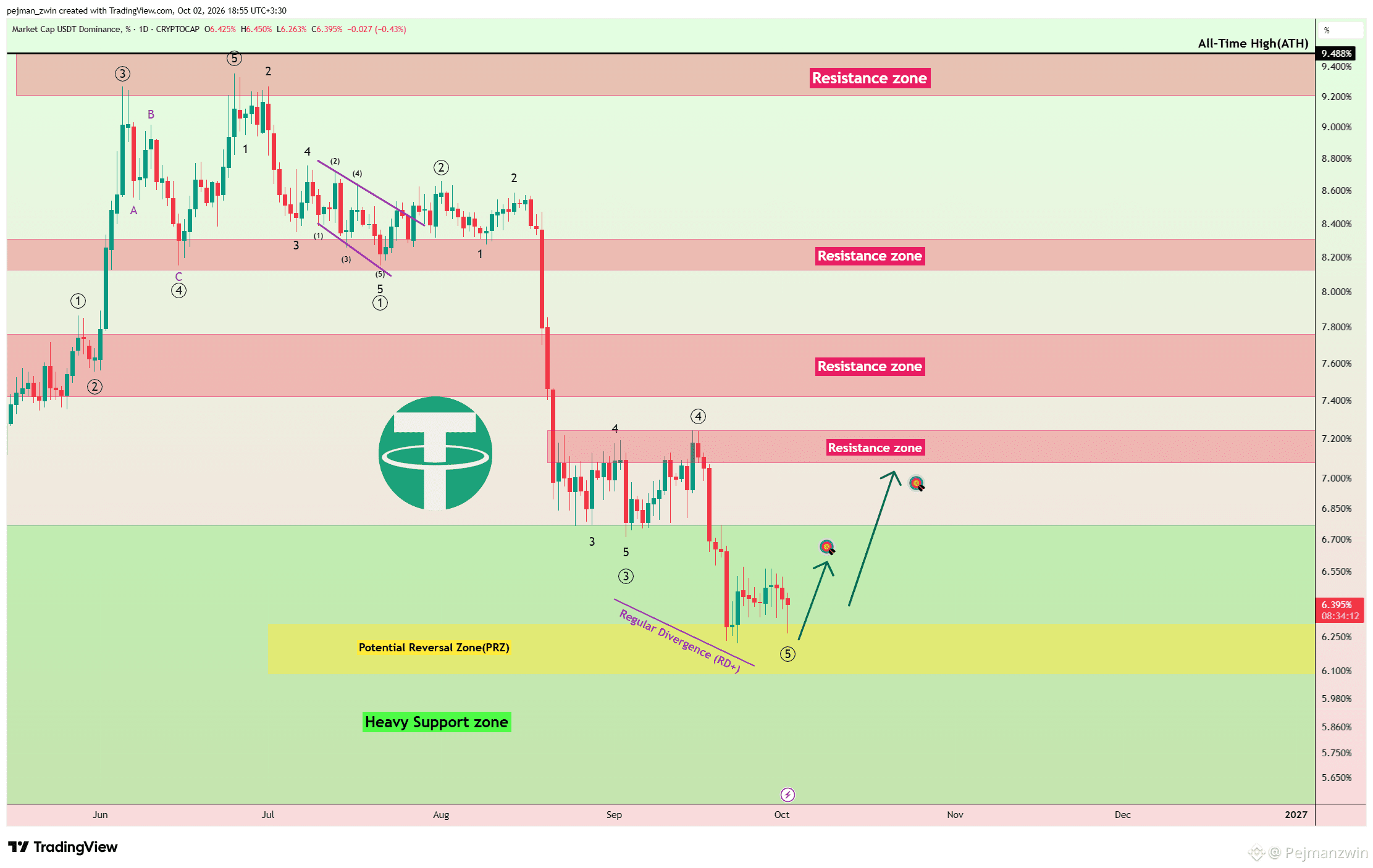
$USDT Dominance Hits Major Support — Is Crypto About to Face New Selling Pressure?
USDT.D is currently trading inside a major Support Zone and has reacted strongly from the Potential Reversal Zone (PRZ).
Several technical signals are now aligning for a potential short-term reversal.
From an Elliott Wave perspective, the main Wave 5 appears to be approaching completion inside the PRZ, suggesting that the recent decline in USDT Dominance could be nearing exhaustion.
At the same time, a clear Regular Bullish Divergence (RD+) is visible between two consecutive lows, providing additional confirmation that bullish momentum may be starting to develop.
I expect USDT.D to potentially begin another upward move, at least in the short term.
This matters for the broader crypto market.
A sustained rise in USDT Dominance often reflects capital rotating toward stablecoins and a more defensive market environment. If this scenario develops, $BTC , $ETH , and altcoins could come under renewed selling pressure.
For now, the reaction from the current Support Zone and PRZ will be critical.
What comes next?
🔴 USDT.D rebounds and pressures crypto
🟢 Support fails and crypto gains strength
#tether
$USDT Dominance Hits Major Support — Is Crypto About to Face New Selling Pressure?
USDT.D is currently trading inside a major Support Zone and has reacted strongly from the Potential Reversal Zone (PRZ).
Several technical signals are now aligning for a potential short-term reversal.
From an Elliott Wave perspective, the main Wave 5 appears to be approaching completion inside the PRZ, suggesting that the recent decline in USDT Dominance could be nearing exhaustion.
At the same time, a clear Regular Bullish Divergence (RD+) is visible between two consecutive lows, providing additional confirmation that bullish momentum may be starting to develop.
I expect USDT.D to potentially begin another upward move, at least in the short term.
This matters for the broader crypto market.
A sustained rise in USDT Dominance often reflects capital rotating toward stablecoins and a more defensive market environment. If this scenario develops, $BTC , $ETH , and altcoins could come under renewed selling pressure.
For now, the reaction from the current Support Zone and PRZ will be critical.
What comes next?
🔴 USDT.D rebounds and pressures crypto
🟢 Support fails and crypto gains strength
#tether
USDT.D is currently trading inside a major Support Zone and has reacted strongly from the Potential Reversal Zone (PRZ).
Several technical signals are now aligning for a potential short-term reversal.
From an Elliott Wave perspective, the main Wave 5 appears to be approaching completion inside the PRZ, suggesting that the recent decline in USDT Dominance could be nearing exhaustion.
At the same time, a clear Regular Bullish Divergence (RD+) is visible between two consecutive lows, providing additional confirmation that bullish momentum may be starting to develop.
I expect USDT.D to potentially begin another upward move, at least in the short term.
This matters for the broader crypto market.
A sustained rise in USDT Dominance often reflects capital rotating toward stablecoins and a more defensive market environment. If this scenario develops, $BTC , $ETH , and altcoins could come under renewed selling pressure.
For now, the reaction from the current Support Zone and PRZ will be critical.
What comes next?
🔴 USDT.D rebounds and pressures crypto
🟢 Support fails and crypto gains strength
#tether
1
556

See translation
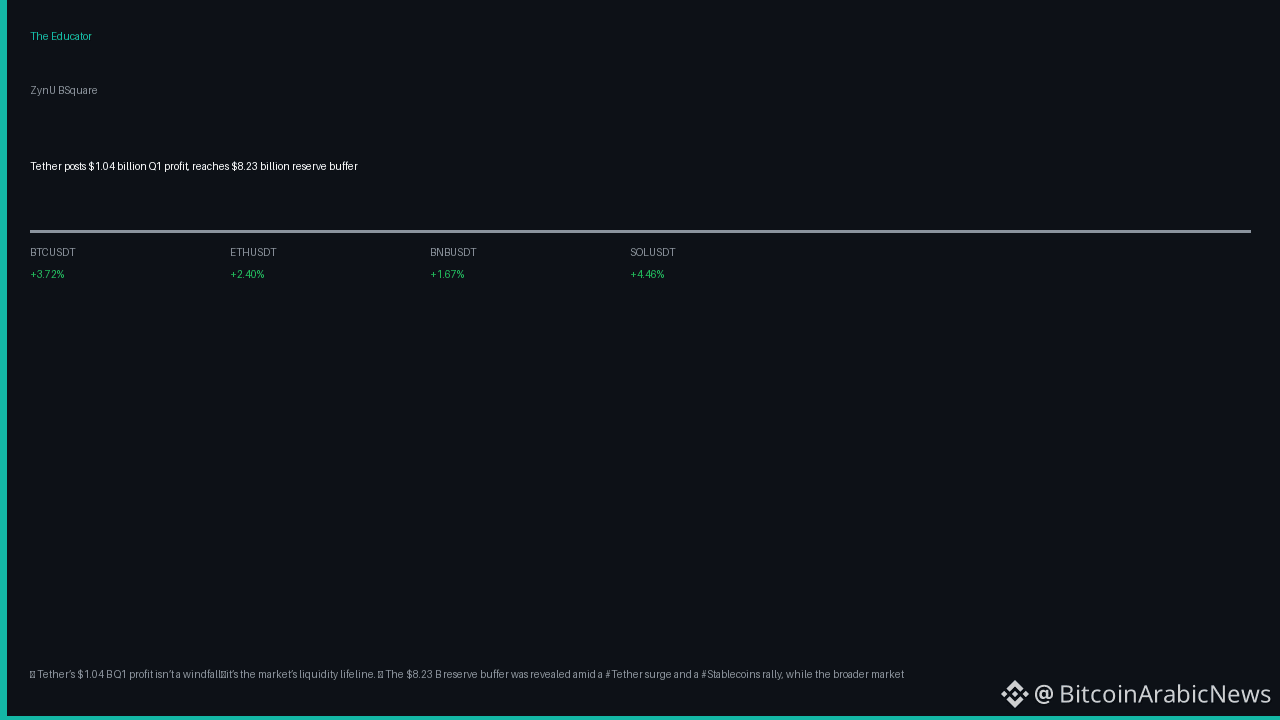
🔥 Tether’s $1.04 B Q1 profit isn’t a windfall—it’s the market’s liquidity lifeline.
📈 The $8.23 B reserve buffer was revealed amid a #Tether surge and a #Stablecoins rally, while the broader market shows Greed at 72/100, BTC trading at $86,847 (+3.72%) and ETH at $2,755 (+2.4%).
💡 In a bullish #BullMarket, such a deep reserve reinforces confidence that stablecoins can absorb shock, keeping on‑chain liquidity robust as BTC open interest sits at $8.66 B and funding rates stay positive, signaling long‑side pressure.
💰 Practical move: allocate a modest, liquid slice of your portfolio to USDT on Binance to benefit from tight spreads, high volume, and the safety net that Tether’s buffer provides during market spikes.
❓ How are you positioning USDT in your strategy—ready to deploy on the next dip, or waiting for the next reserve update?
🔥 Tether’s $1.04 B Q1 profit isn’t a windfall—it’s the market’s liquidity lifeline.
📈 The $8.23 B reserve buffer was revealed amid a #Tether surge and a #Stablecoins rally, while the broader market shows Greed at 72/100, BTC trading at $86,847 (+3.72%) and ETH at $2,755 (+2.4%).
💡 In a bullish #BullMarket, such a deep reserve reinforces confidence that stablecoins can absorb shock, keeping on‑chain liquidity robust as BTC open interest sits at $8.66 B and funding rates stay positive, signaling long‑side pressure.
💰 Practical move: allocate a modest, liquid slice of your portfolio to USDT on Binance to benefit from tight spreads, high volume, and the safety net that Tether’s buffer provides during market spikes.
❓ How are you positioning USDT in your strategy—ready to deploy on the next dip, or waiting for the next reserve update?
📈 The $8.23 B reserve buffer was revealed amid a #Tether surge and a #Stablecoins rally, while the broader market shows Greed at 72/100, BTC trading at $86,847 (+3.72%) and ETH at $2,755 (+2.4%).
💡 In a bullish #BullMarket, such a deep reserve reinforces confidence that stablecoins can absorb shock, keeping on‑chain liquidity robust as BTC open interest sits at $8.66 B and funding rates stay positive, signaling long‑side pressure.
💰 Practical move: allocate a modest, liquid slice of your portfolio to USDT on Binance to benefit from tight spreads, high volume, and the safety net that Tether’s buffer provides during market spikes.
❓ How are you positioning USDT in your strategy—ready to deploy on the next dip, or waiting for the next reserve update?
13

·
--

Article
See translation
🚨 USDT Is Coming Back to Bitcoin — What Could Change?🚨 USDT IS COMING BACK TO BITCOIN
Tether’s USDT is set to return to the Bitcoin ecosystem more than a decade after its original debut there.
A Tether-backed project called Utexo is developing infrastructure designed to bring USDT settlement to Bitcoin through Bitcoin, Lightning and RGB technology.
But this is more than simply putting USDT on another network.
Utexo plans to support:
Private USDT transfersDirect BTC ↔ USDT swapsBTC-backed lendingFast settlement through Bitcoin and LightningPredictable transaction costsPrivate execution with most transaction activity kept away from Bitcoin’s public ledger
Why Does This Matter?
Bitcoin has traditionally been known primarily for BTC transfers and long-term value storage, while USDT has become one of the most widely used dollar-denominated stablecoins.
Connecting the two could open new possibilities for:
🌍 Cross-border payments
💵 Dollar-based digital payments
⚡ Lightning-based settlement
🔄 BTC/USDT trading
🏦 Institutional settlement
🔐 More private stablecoin transactions
Utexo is targeting exchanges, wallets, payment providers, custodians and other businesses that handle USDT at scale.
The Privacy Factor
One of the most interesting parts of the project is its focus on privacy.
Utexo says its infrastructure is designed to provide confidential USDT transfers while using Bitcoin as the underlying settlement network.
That could be particularly relevant for businesses handling high-volume payments and settlements.
Could Bitcoin Become a USDT Settlement Layer?
If this infrastructure gains adoption, Bitcoin could potentially play a larger role in stablecoin payments—not just as the network behind BTC.
It could become another important settlement rail for dollar-based digital transactions.
However, this does not mean USDT will suddenly become universally available on Bitcoin for every user or wallet. Actual availability will depend on integrations, deployment and adoption.
The Big Question 👀
Could Bitcoin become one of the major settlement layers for USDT and global dollar-based payments?
Or will stablecoins continue to rely mainly on other blockchain networks?
What do you think? 👇
#Tether #stablecoin #lightningnetwork #CryptoNews #trading
— @NMTrader99
$BTC
{spot}(BTCUSDT)
🚨 USDT Is Coming Back to Bitcoin — What Could Change?
🚨 USDT IS COMING BACK TO BITCOIN
Tether’s USDT is set to return to the Bitcoin ecosystem more than a decade after its original debut there.
A Tether-backed project called Utexo is developing infrastructure designed to bring USDT settlement to Bitcoin through Bitcoin, Lightning and RGB technology.
But this is more than simply putting USDT on another network.
Utexo plans to support:
Private USDT transfersDirect BTC ↔ USDT swapsBTC-backed lendingFast settlement through Bitcoin and LightningPredictable transaction costsPrivate execution with most transaction activity kept away from Bitcoin’s public ledger
Why Does This Matter?
Bitcoin has traditionally been known primarily for BTC transfers and long-term value storage, while USDT has become one of the most widely used dollar-denominated stablecoins.
Connecting the two could open new possibilities for:
🌍 Cross-border payments
💵 Dollar-based digital payments
⚡ Lightning-based settlement
🔄 BTC/USDT trading
🏦 Institutional settlement
🔐 More private stablecoin transactions
Utexo is targeting exchanges, wallets, payment providers, custodians and other businesses that handle USDT at scale.
The Privacy Factor
One of the most interesting parts of the project is its focus on privacy.
Utexo says its infrastructure is designed to provide confidential USDT transfers while using Bitcoin as the underlying settlement network.
That could be particularly relevant for businesses handling high-volume payments and settlements.
Could Bitcoin Become a USDT Settlement Layer?
If this infrastructure gains adoption, Bitcoin could potentially play a larger role in stablecoin payments—not just as the network behind BTC.
It could become another important settlement rail for dollar-based digital transactions.
However, this does not mean USDT will suddenly become universally available on Bitcoin for every user or wallet. Actual availability will depend on integrations, deployment and adoption.
The Big Question 👀
Could Bitcoin become one of the major settlement layers for USDT and global dollar-based payments?
Or will stablecoins continue to rely mainly on other blockchain networks?
What do you think? 👇
#Tether #stablecoin #lightningnetwork #CryptoNews #trading
— @NMTrader99
$BTC
Tether’s USDT is set to return to the Bitcoin ecosystem more than a decade after its original debut there.
A Tether-backed project called Utexo is developing infrastructure designed to bring USDT settlement to Bitcoin through Bitcoin, Lightning and RGB technology.
But this is more than simply putting USDT on another network.
Utexo plans to support:
Private USDT transfersDirect BTC ↔ USDT swapsBTC-backed lendingFast settlement through Bitcoin and LightningPredictable transaction costsPrivate execution with most transaction activity kept away from Bitcoin’s public ledger
Why Does This Matter?
Bitcoin has traditionally been known primarily for BTC transfers and long-term value storage, while USDT has become one of the most widely used dollar-denominated stablecoins.
Connecting the two could open new possibilities for:
🌍 Cross-border payments
💵 Dollar-based digital payments
⚡ Lightning-based settlement
🔄 BTC/USDT trading
🏦 Institutional settlement
🔐 More private stablecoin transactions
Utexo is targeting exchanges, wallets, payment providers, custodians and other businesses that handle USDT at scale.
The Privacy Factor
One of the most interesting parts of the project is its focus on privacy.
Utexo says its infrastructure is designed to provide confidential USDT transfers while using Bitcoin as the underlying settlement network.
That could be particularly relevant for businesses handling high-volume payments and settlements.
Could Bitcoin Become a USDT Settlement Layer?
If this infrastructure gains adoption, Bitcoin could potentially play a larger role in stablecoin payments—not just as the network behind BTC.
It could become another important settlement rail for dollar-based digital transactions.
However, this does not mean USDT will suddenly become universally available on Bitcoin for every user or wallet. Actual availability will depend on integrations, deployment and adoption.
The Big Question 👀
Could Bitcoin become one of the major settlement layers for USDT and global dollar-based payments?
Or will stablecoins continue to rely mainly on other blockchain networks?
What do you think? 👇
#Tether #stablecoin #lightningnetwork #CryptoNews #trading
— @NMTrader99
$BTC
1
77

🔗 Tether is bringing USDT back to the Bitcoin blockchain via Utexo
Tether, the issuer of the USDT stablecoin, has announced plans to bring its token back to the Bitcoin blockchain this month through its new project, Utexo. This project will enable private transfers of USDT, direct swaps between Bitcoin and USDT, as well as Bitcoin-backed loans, while preserving the privacy of most transaction data.
━━━━━━━━━━━━━━
📊 Impact: 📈 High
🏷️ DEFI
#Tether #USDT #Bitcoin #Utexo #Stablecoin
📰 Source: coindesk.com
🔗 Tether is bringing USDT back to the Bitcoin blockchain via Utexo
Tether, the issuer of the USDT stablecoin, has announced plans to bring its token back to the Bitcoin blockchain this month through its new project, Utexo. This project will enable private transfers of USDT, direct swaps between Bitcoin and USDT, as well as Bitcoin-backed loans, while preserving the privacy of most transaction data.
━━━━━━━━━━━━━━
📊 Impact: 📈 High
🏷️ DEFI
#Tether #USDT #Bitcoin #Utexo #Stablecoin
📰 Source: coindesk.com
Tether, the issuer of the USDT stablecoin, has announced plans to bring its token back to the Bitcoin blockchain this month through its new project, Utexo. This project will enable private transfers of USDT, direct swaps between Bitcoin and USDT, as well as Bitcoin-backed loans, while preserving the privacy of most transaction data.
━━━━━━━━━━━━━━
📊 Impact: 📈 High
🏷️ DEFI
#Tether #USDT #Bitcoin #Utexo #Stablecoin
📰 Source: coindesk.com
11

·
--
Bullish
🚨 USDT
Returns to where it all began… the Bitcoin network!
After more than a decade, USDT is set to return to the Bitcoin network in October through the Tether-backed Utexo infrastructure, using the RGB protocol.
🔥 The plan goes beyond just moving USDT:
• USDT transfers with greater privacy
• Direct swaps between $BTC and USDT
• Loans backed by native Bitcoin without Wrapped BTC
• Lightning Network support in a later phase.
This step could expand Bitcoin’s use from native storage and transfers into a settlement layer for digital dollars and financial services.
👀 If USDT succeeds on Bitcoin… are we witnessing the start of a new era for using the BTC network?
#Bitcoin #BTC #USDT #Tether
{spot}(BTCUSDT)
🚨 USDT
Returns to where it all began… the Bitcoin network!
After more than a decade, USDT is set to return to the Bitcoin network in October through the Tether-backed Utexo infrastructure, using the RGB protocol.
🔥 The plan goes beyond just moving USDT:
• USDT transfers with greater privacy
• Direct swaps between $BTC and USDT
• Loans backed by native Bitcoin without Wrapped BTC
• Lightning Network support in a later phase.
This step could expand Bitcoin’s use from native storage and transfers into a settlement layer for digital dollars and financial services.
👀 If USDT succeeds on Bitcoin… are we witnessing the start of a new era for using the BTC network?
#Bitcoin #BTC #USDT #Tether
Returns to where it all began… the Bitcoin network!
After more than a decade, USDT is set to return to the Bitcoin network in October through the Tether-backed Utexo infrastructure, using the RGB protocol.
🔥 The plan goes beyond just moving USDT:
• USDT transfers with greater privacy
• Direct swaps between $BTC and USDT
• Loans backed by native Bitcoin without Wrapped BTC
• Lightning Network support in a later phase.
This step could expand Bitcoin’s use from native storage and transfers into a settlement layer for digital dollars and financial services.
👀 If USDT succeeds on Bitcoin… are we witnessing the start of a new era for using the BTC network?
#Bitcoin #BTC #USDT #Tether
1
157

·
--
【USDT is coming back to Bitcoin! BTC isn’t just “digital gold” anymore 🔥】
[🚀 币圈热点资讯快进群聊](https://app.binance.com/uni-qr/MwYFhLo4)
A change that many people didn’t expect is here:
$USDT is preparing to return to the Bitcoin network.
USDT was originally issued back in 2014 on the Bitcoin network. But later, as networks like Ethereum and Tron developed, USDT’s main activity scenarios gradually shifted.
Now, the Utexo project supported by Tether plans to use the RGB protocol to bring USDT back to Bitcoin—and it’s expected that issuance will begin this month.
But this time, it’s not just a matter of “moving USDT back to BTC.”
It aims to enable several new applications:
Direct swapping between USDT and BTC, more private stablecoin transfers, and lending by using BTC as collateral.
More importantly, in the future it also plans to integrate with the Lightning Network, so USDT can be used for faster, lower-cost payments.
The question is: why is Tether targeting Bitcoin again now?
Simply put, Bitcoin was mostly treated as a store-of-value asset in the past—but now the infrastructure is being expanded continuously.
If functions like stablecoins, payments, and lending also start building on the Bitcoin ecosystem, then BTC’s role may no longer be just “digital gold,” but gradually evolve into a more complete financial infrastructure.
📌 So what’s truly worth paying attention to with USDT “coming home” this time isn’t the addition of another issuance network—it’s that stablecoins are entering the Bitcoin ecosystem, which could change the future use cases of BTC.
#USDT #Utexo #Tether
【USDT is coming back to Bitcoin! BTC isn’t just “digital gold” anymore 🔥】
🚀 币圈热点资讯快进群聊
A change that many people didn’t expect is here:
$USDT is preparing to return to the Bitcoin network.
USDT was originally issued back in 2014 on the Bitcoin network. But later, as networks like Ethereum and Tron developed, USDT’s main activity scenarios gradually shifted.
Now, the Utexo project supported by Tether plans to use the RGB protocol to bring USDT back to Bitcoin—and it’s expected that issuance will begin this month.
But this time, it’s not just a matter of “moving USDT back to BTC.”
It aims to enable several new applications:
Direct swapping between USDT and BTC, more private stablecoin transfers, and lending by using BTC as collateral.
More importantly, in the future it also plans to integrate with the Lightning Network, so USDT can be used for faster, lower-cost payments.
The question is: why is Tether targeting Bitcoin again now?
Simply put, Bitcoin was mostly treated as a store-of-value asset in the past—but now the infrastructure is being expanded continuously.
If functions like stablecoins, payments, and lending also start building on the Bitcoin ecosystem, then BTC’s role may no longer be just “digital gold,” but gradually evolve into a more complete financial infrastructure.
📌 So what’s truly worth paying attention to with USDT “coming home” this time isn’t the addition of another issuance network—it’s that stablecoins are entering the Bitcoin ecosystem, which could change the future use cases of BTC.
#USDT #Utexo #Tether
🚀 币圈热点资讯快进群聊
A change that many people didn’t expect is here:
$USDT is preparing to return to the Bitcoin network.
USDT was originally issued back in 2014 on the Bitcoin network. But later, as networks like Ethereum and Tron developed, USDT’s main activity scenarios gradually shifted.
Now, the Utexo project supported by Tether plans to use the RGB protocol to bring USDT back to Bitcoin—and it’s expected that issuance will begin this month.
But this time, it’s not just a matter of “moving USDT back to BTC.”
It aims to enable several new applications:
Direct swapping between USDT and BTC, more private stablecoin transfers, and lending by using BTC as collateral.
More importantly, in the future it also plans to integrate with the Lightning Network, so USDT can be used for faster, lower-cost payments.
The question is: why is Tether targeting Bitcoin again now?
Simply put, Bitcoin was mostly treated as a store-of-value asset in the past—but now the infrastructure is being expanded continuously.
If functions like stablecoins, payments, and lending also start building on the Bitcoin ecosystem, then BTC’s role may no longer be just “digital gold,” but gradually evolve into a more complete financial infrastructure.
📌 So what’s truly worth paying attention to with USDT “coming home” this time isn’t the addition of another issuance network—it’s that stablecoins are entering the Bitcoin ecosystem, which could change the future use cases of BTC.
#USDT #Utexo #Tether

136

·
--
Tether is preparing the return of USDT to Bitcoin this month, marking a structural milestone more than ten years after its original debut on the network. This move aims to boost the efficiency of value transfer and expand native liquidity within the Bitcoin ecosystem through modern protocols. 📊
Why does it matter? Integrating large-cap stablecoins into the main network optimizes liquidation options and decentralized use cases without relying exclusively on external layers, reshaping transaction dynamics on the main chain.
What to watch: The real adoption of the new minting rails, compatibility with major wallets, and the volumetric impact on on-chain activity over the coming weeks. 🔍
#Bitcoin #Tether #CryptoNews #DeFi $BTC $USDT
Tether is preparing the return of USDT to Bitcoin this month, marking a structural milestone more than ten years after its original debut on the network. This move aims to boost the efficiency of value transfer and expand native liquidity within the Bitcoin ecosystem through modern protocols. 📊
Why does it matter? Integrating large-cap stablecoins into the main network optimizes liquidation options and decentralized use cases without relying exclusively on external layers, reshaping transaction dynamics on the main chain.
What to watch: The real adoption of the new minting rails, compatibility with major wallets, and the volumetric impact on on-chain activity over the coming weeks. 🔍
#Bitcoin #Tether #CryptoNews #DeFi $BTC $USDT
Why does it matter? Integrating large-cap stablecoins into the main network optimizes liquidation options and decentralized use cases without relying exclusively on external layers, reshaping transaction dynamics on the main chain.
What to watch: The real adoption of the new minting rails, compatibility with major wallets, and the volumetric impact on on-chain activity over the coming weeks. 🔍
#Bitcoin #Tether #CryptoNews #DeFi $BTC $USDT
Kato Crypto:
the part worth watching is what “native” really means at the record layer 👀 if the issuance leans on client-side validation, the chain only timestamps a commitment and the balance history travels with the holder — so the thing you can lose stops being a bridge and becomes your proof data 🔥 so the question becomes who stores and serves that history, and whether wallets agree on it. a very different support problem than an extra layer 🙌
1
16

·
--
Putting Tether’s statements and the U.S. Senate’s statements from the past couple of days side by side, you’ll notice a detail that all ties together.
Tether itself admits: this year it has already frozen $550 million worth of USDT—all from wallets belonging to Iran’s central bank and its sanctions-linked network. Just the April event alone froze $344 million.
And on the same day, the Senate report said: among the 846 Iran-related wallets being investigated, 84% used USDT almost exclusively. USDT is Iran’s “financial lifeline” to bypass sanctions.
In reality, the two statements are talking about the same thing: USDT isn’t the “digital cash” you think it is—its issuer has a one-click freeze switch in hand. Copy this link and send it to your friends who are still treating USDT like a safe storage box.
Pick a side: A. This is the compliance cost that stablecoins must pay to go mainstream; B. This proves that USDT is not, at its roots, a decentralized currency. Which side are you on?
#USDT #Tether
Putting Tether’s statements and the U.S. Senate’s statements from the past couple of days side by side, you’ll notice a detail that all ties together.
Tether itself admits: this year it has already frozen $550 million worth of USDT—all from wallets belonging to Iran’s central bank and its sanctions-linked network. Just the April event alone froze $344 million.
And on the same day, the Senate report said: among the 846 Iran-related wallets being investigated, 84% used USDT almost exclusively. USDT is Iran’s “financial lifeline” to bypass sanctions.
In reality, the two statements are talking about the same thing: USDT isn’t the “digital cash” you think it is—its issuer has a one-click freeze switch in hand. Copy this link and send it to your friends who are still treating USDT like a safe storage box.
Pick a side: A. This is the compliance cost that stablecoins must pay to go mainstream; B. This proves that USDT is not, at its roots, a decentralized currency. Which side are you on?
#USDT #Tether
Tether itself admits: this year it has already frozen $550 million worth of USDT—all from wallets belonging to Iran’s central bank and its sanctions-linked network. Just the April event alone froze $344 million.
And on the same day, the Senate report said: among the 846 Iran-related wallets being investigated, 84% used USDT almost exclusively. USDT is Iran’s “financial lifeline” to bypass sanctions.
In reality, the two statements are talking about the same thing: USDT isn’t the “digital cash” you think it is—its issuer has a one-click freeze switch in hand. Copy this link and send it to your friends who are still treating USDT like a safe storage box.
Pick a side: A. This is the compliance cost that stablecoins must pay to go mainstream; B. This proves that USDT is not, at its roots, a decentralized currency. Which side are you on?
#USDT #Tether
72

·
--
🚨 Five major players back a $1 billion infusion to support the market—new “digital dollars” are live and go straight after the top dog
Group: [点击进入玖玖的粉丝群](https://app.binance.com/uni-qr/YXXQJrPb)
📊 According to CoinDesk, this new dollar-denominated token officially went live on Wednesday, with its initial launch rolled out across four blockchain networks at once; and the five founding partners behind it directly put up $1 billion in liquidity—among the participants are exchanges as well as payment giants like Mastercard, Stripe, and Visa.
🔥 The scale isn’t small. It’s entering a market with a size exceeding $300 billion—where the first two incumbents are already massive: Tether’s USDT, with a circulating supply of about $143 billion, and Circle’s USDC, at roughly $74 billion; in other words, from day one, this new product is aimed at those two names.
📌 The gameplay is also a bit different. CEO Zach Abrams said that the company’s equity will be allocated gradually according to the supply contributed by partners and their trading activity, rather than being held tightly by a single issuer; the partner roster has expanded from more than 140 to over 200—UBS, Japan’s SBI Holdings, fintech company Jeeves, and others are new faces. Bridge, the stablecoin infrastructure company founded by Abrams, was acquired by Stripe in 2024 for $1.1 billion.
💡 What’s truly worth watching isn’t just yet another dollar token, but the reshuffling of issuance rights: when payment giants and banks can all earn equity by growing the “pie,” competition shifts from who can offer the highest yield to who has the best distribution channels.
⚠️ A splash of cold water: in this arena, winner-takes-all has long been the rule. Users’ habits for USDT and USDC aren’t something you can change overnight; the $1 billion is a liquidity arrangement, not necessarily equivalent to real demand. Whether it can stick around depends on the trading data over the coming months.
👀 One side says the giants teaming up can shake up the landscape and force a reshuffle; the other says it’s just another storytelling project that, in the end, still loses to USDT. Do you think this is a positive or negative development? Cast your vote in the comments below 👇
Click the avatar to watch the livestream + join the Jiujiu chat group to get daily strategies 🚀
#稳定币 #USDC #Tether
🚨 Five major players back a $1 billion infusion to support the market—new “digital dollars” are live and go straight after the top dog
Group: 点击进入玖玖的粉丝群
📊 According to CoinDesk, this new dollar-denominated token officially went live on Wednesday, with its initial launch rolled out across four blockchain networks at once; and the five founding partners behind it directly put up $1 billion in liquidity—among the participants are exchanges as well as payment giants like Mastercard, Stripe, and Visa.
🔥 The scale isn’t small. It’s entering a market with a size exceeding $300 billion—where the first two incumbents are already massive: Tether’s USDT, with a circulating supply of about $143 billion, and Circle’s USDC, at roughly $74 billion; in other words, from day one, this new product is aimed at those two names.
📌 The gameplay is also a bit different. CEO Zach Abrams said that the company’s equity will be allocated gradually according to the supply contributed by partners and their trading activity, rather than being held tightly by a single issuer; the partner roster has expanded from more than 140 to over 200—UBS, Japan’s SBI Holdings, fintech company Jeeves, and others are new faces. Bridge, the stablecoin infrastructure company founded by Abrams, was acquired by Stripe in 2024 for $1.1 billion.
💡 What’s truly worth watching isn’t just yet another dollar token, but the reshuffling of issuance rights: when payment giants and banks can all earn equity by growing the “pie,” competition shifts from who can offer the highest yield to who has the best distribution channels.
⚠️ A splash of cold water: in this arena, winner-takes-all has long been the rule. Users’ habits for USDT and USDC aren’t something you can change overnight; the $1 billion is a liquidity arrangement, not necessarily equivalent to real demand. Whether it can stick around depends on the trading data over the coming months.
👀 One side says the giants teaming up can shake up the landscape and force a reshuffle; the other says it’s just another storytelling project that, in the end, still loses to USDT. Do you think this is a positive or negative development? Cast your vote in the comments below 👇
Click the avatar to watch the livestream + join the Jiujiu chat group to get daily strategies 🚀
#稳定币 #USDC #Tether
Group: 点击进入玖玖的粉丝群
📊 According to CoinDesk, this new dollar-denominated token officially went live on Wednesday, with its initial launch rolled out across four blockchain networks at once; and the five founding partners behind it directly put up $1 billion in liquidity—among the participants are exchanges as well as payment giants like Mastercard, Stripe, and Visa.
🔥 The scale isn’t small. It’s entering a market with a size exceeding $300 billion—where the first two incumbents are already massive: Tether’s USDT, with a circulating supply of about $143 billion, and Circle’s USDC, at roughly $74 billion; in other words, from day one, this new product is aimed at those two names.
📌 The gameplay is also a bit different. CEO Zach Abrams said that the company’s equity will be allocated gradually according to the supply contributed by partners and their trading activity, rather than being held tightly by a single issuer; the partner roster has expanded from more than 140 to over 200—UBS, Japan’s SBI Holdings, fintech company Jeeves, and others are new faces. Bridge, the stablecoin infrastructure company founded by Abrams, was acquired by Stripe in 2024 for $1.1 billion.
💡 What’s truly worth watching isn’t just yet another dollar token, but the reshuffling of issuance rights: when payment giants and banks can all earn equity by growing the “pie,” competition shifts from who can offer the highest yield to who has the best distribution channels.
⚠️ A splash of cold water: in this arena, winner-takes-all has long been the rule. Users’ habits for USDT and USDC aren’t something you can change overnight; the $1 billion is a liquidity arrangement, not necessarily equivalent to real demand. Whether it can stick around depends on the trading data over the coming months.
👀 One side says the giants teaming up can shake up the landscape and force a reshuffle; the other says it’s just another storytelling project that, in the end, still loses to USDT. Do you think this is a positive or negative development? Cast your vote in the comments below 👇
Click the avatar to watch the livestream + join the Jiujiu chat group to get daily strategies 🚀
#稳定币 #USDC #Tether

55

·
--
See translation
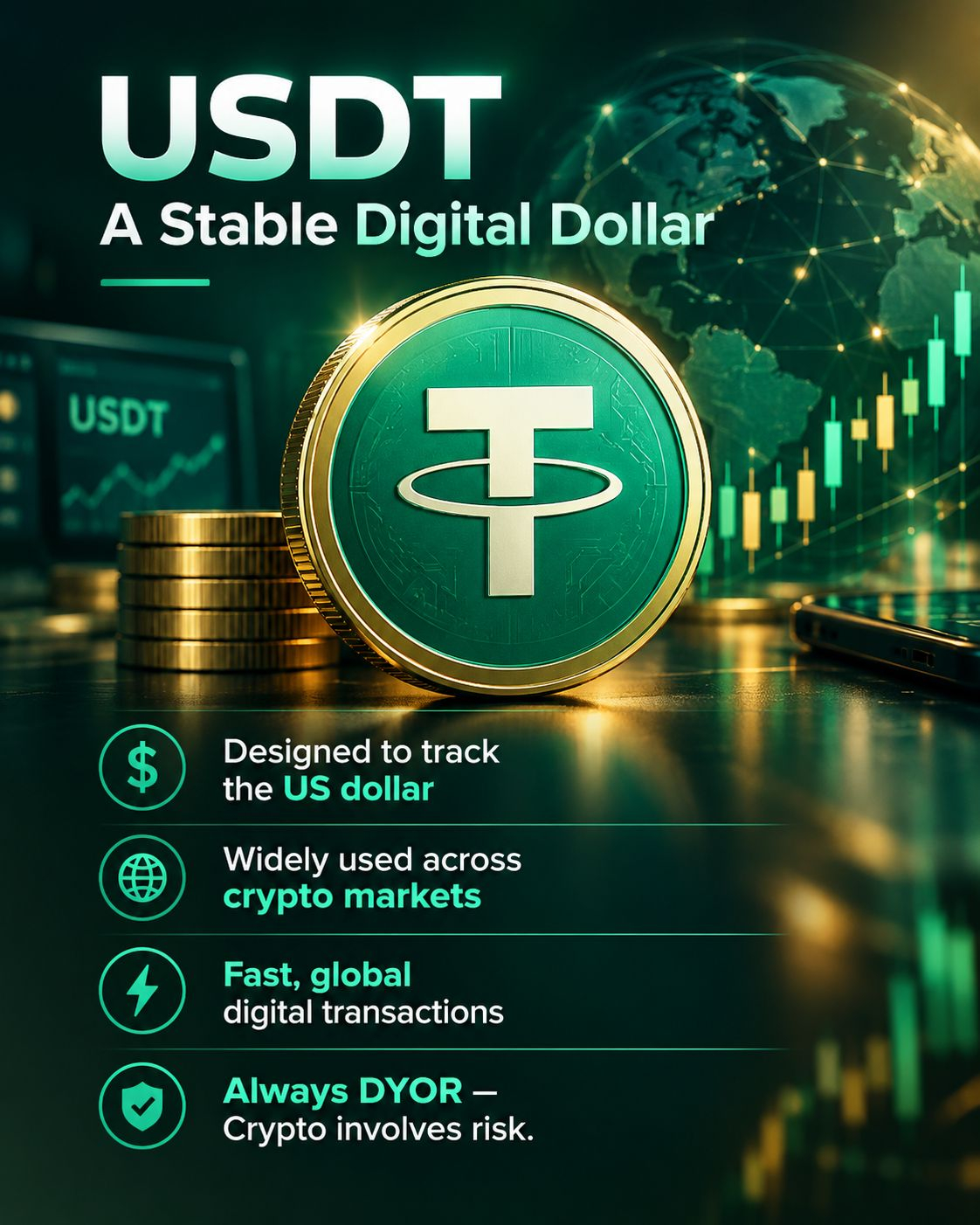
💵 USDT is a stablecoin designed to track the value of the US dollar.
🌍 It is widely used across the global crypto market.
⚡ USDT enables fast digital transactions across borders.
📊 It is commonly used for trading and moving funds between crypto assets.
⚠️ Always do your own research—crypto involves risk.
$USDT
#Tether #Crypto #BİNANCESQUARE
💵 USDT is a stablecoin designed to track the value of the US dollar.
🌍 It is widely used across the global crypto market.
⚡ USDT enables fast digital transactions across borders.
📊 It is commonly used for trading and moving funds between crypto assets.
⚠️ Always do your own research—crypto involves risk.
$USDT
#Tether #Crypto #BİNANCESQUARE
🌍 It is widely used across the global crypto market.
⚡ USDT enables fast digital transactions across borders.
📊 It is commonly used for trading and moving funds between crypto assets.
⚠️ Always do your own research—crypto involves risk.
$USDT
#Tether #Crypto #BİNANCESQUARE
105
·
--
🚨 84%! US Senate report calls out Tether: 846 sanctioned wallets rely on it
Group: [点击进入玖玖的粉丝群](https://app.binance.com/uni-qr/YXXQJrPb)
📊 A standing U.S. Senate investigative subcommittee has released a report. Its core finding is: Among 846 sanctioned wallets connected to Iran and its regional proxies, 84% almost exclusively use Tether’s tokens for transactions—not other crypto assets or traditional banking channels.
🔥 The report also says that before 2024, Tether did not comprehensively freeze wallets that were sanctioned by the U.S., leaving sanctioned parties room to keep operating; the report calls this “historical backlog,” while Tether emphasizes that its more recent freezing records have clearly improved.
📌 The report also takes a quick look at the ownership structure: Cantor Fitzgerald, associated with Commerce Secretary Howard Lutnick, holds a 5% stake in Tether and has custody over a significant portion of the more than $100 billion in U.S. assets that Tether reports.
💡 What’s really worth关注 is not whether Tether will get “cracked down on,” but that the “freeze obligations” of stablecoins are being put on the table for the first time in pricing—once the standard tightens, the impact is on all stablecoins, not just one company.
⚠️ A dose of cold water: This is a senator’s report, not a bill or an enforcement action; the real issue is the use of USDT in a gray area, but there’s still a long way to go before anything is “proven.” Don’t treat an investigation as a ruling.
👀 One camp says USDT has become a channel for sanctions evasion and needs stricter regulation; the other says compliance has already been in place and this is just political theater. Do you think stablecoins should be regulated more strictly? Comment below 👇
Click the avatar to watch the livestream + join the Jiuji chat group to get daily strategies 🚀
#USDT #Tether #stablecoins
🚨 84%! US Senate report calls out Tether: 846 sanctioned wallets rely on it
Group: 点击进入玖玖的粉丝群
📊 A standing U.S. Senate investigative subcommittee has released a report. Its core finding is: Among 846 sanctioned wallets connected to Iran and its regional proxies, 84% almost exclusively use Tether’s tokens for transactions—not other crypto assets or traditional banking channels.
🔥 The report also says that before 2024, Tether did not comprehensively freeze wallets that were sanctioned by the U.S., leaving sanctioned parties room to keep operating; the report calls this “historical backlog,” while Tether emphasizes that its more recent freezing records have clearly improved.
📌 The report also takes a quick look at the ownership structure: Cantor Fitzgerald, associated with Commerce Secretary Howard Lutnick, holds a 5% stake in Tether and has custody over a significant portion of the more than $100 billion in U.S. assets that Tether reports.
💡 What’s really worth关注 is not whether Tether will get “cracked down on,” but that the “freeze obligations” of stablecoins are being put on the table for the first time in pricing—once the standard tightens, the impact is on all stablecoins, not just one company.
⚠️ A dose of cold water: This is a senator’s report, not a bill or an enforcement action; the real issue is the use of USDT in a gray area, but there’s still a long way to go before anything is “proven.” Don’t treat an investigation as a ruling.
👀 One camp says USDT has become a channel for sanctions evasion and needs stricter regulation; the other says compliance has already been in place and this is just political theater. Do you think stablecoins should be regulated more strictly? Comment below 👇
Click the avatar to watch the livestream + join the Jiuji chat group to get daily strategies 🚀
#USDT #Tether #stablecoins
Group: 点击进入玖玖的粉丝群
📊 A standing U.S. Senate investigative subcommittee has released a report. Its core finding is: Among 846 sanctioned wallets connected to Iran and its regional proxies, 84% almost exclusively use Tether’s tokens for transactions—not other crypto assets or traditional banking channels.
🔥 The report also says that before 2024, Tether did not comprehensively freeze wallets that were sanctioned by the U.S., leaving sanctioned parties room to keep operating; the report calls this “historical backlog,” while Tether emphasizes that its more recent freezing records have clearly improved.
📌 The report also takes a quick look at the ownership structure: Cantor Fitzgerald, associated with Commerce Secretary Howard Lutnick, holds a 5% stake in Tether and has custody over a significant portion of the more than $100 billion in U.S. assets that Tether reports.
💡 What’s really worth关注 is not whether Tether will get “cracked down on,” but that the “freeze obligations” of stablecoins are being put on the table for the first time in pricing—once the standard tightens, the impact is on all stablecoins, not just one company.
⚠️ A dose of cold water: This is a senator’s report, not a bill or an enforcement action; the real issue is the use of USDT in a gray area, but there’s still a long way to go before anything is “proven.” Don’t treat an investigation as a ruling.
👀 One camp says USDT has become a channel for sanctions evasion and needs stricter regulation; the other says compliance has already been in place and this is just political theater. Do you think stablecoins should be regulated more strictly? Comment below 👇
Click the avatar to watch the livestream + join the Jiuji chat group to get daily strategies 🚀
#USDT #Tether #stablecoins
19

·
--
Binance Pay lets users spend USDT with PayPay merchants in Japan
Cointelegraph reported that Binance Pay will enable overseas users to spend USDT with most merchants supporting PayPay in Japan. The merchants will receive payments in yen through this integration, which runs via HIVEX.
• The service is aimed at users coming from outside Japan.
• Coverage includes most PayPay-supporting merchants, not all of them.
• Spending is done in USDT, while merchants receive yen.
💧 Impact on the market and liquidity: The integration may expand the use of USDT in payments in Japan, but the available information does not include transaction volumes that would allow its impact on liquidity to be estimated.
🎯 Most affected: Tether, the stablecoin payments sector
Source: Cointelegraph
$BNB #Binance $USDT #Tether #Crypto #Stablecoins
Binance Pay lets users spend USDT with PayPay merchants in Japan
Cointelegraph reported that Binance Pay will enable overseas users to spend USDT with most merchants supporting PayPay in Japan. The merchants will receive payments in yen through this integration, which runs via HIVEX.
• The service is aimed at users coming from outside Japan.
• Coverage includes most PayPay-supporting merchants, not all of them.
• Spending is done in USDT, while merchants receive yen.
💧 Impact on the market and liquidity: The integration may expand the use of USDT in payments in Japan, but the available information does not include transaction volumes that would allow its impact on liquidity to be estimated.
🎯 Most affected: Tether, the stablecoin payments sector
Source: Cointelegraph
$BNB #Binance $USDT #Tether #Crypto #Stablecoins
Cointelegraph reported that Binance Pay will enable overseas users to spend USDT with most merchants supporting PayPay in Japan. The merchants will receive payments in yen through this integration, which runs via HIVEX.
• The service is aimed at users coming from outside Japan.
• Coverage includes most PayPay-supporting merchants, not all of them.
• Spending is done in USDT, while merchants receive yen.
💧 Impact on the market and liquidity: The integration may expand the use of USDT in payments in Japan, but the available information does not include transaction volumes that would allow its impact on liquidity to be estimated.
🎯 Most affected: Tether, the stablecoin payments sector
Source: Cointelegraph
$BNB #Binance $USDT #Tether #Crypto #Stablecoins
61

·
--
🎯 Stablecoins are pushed to the front lines of law enforcement
📰 Tether revealed that it helped freeze $550 million worth of Iran-related USDT this year, while the U.S. Senate simultaneously accused it of being a key link in Iran’s shadow banking network
💬 Stablecoins are no longer just “on-chain dollars.” They’re now a lever in geopolitical games. Compliance pressure will be passed on to issuers and exchanges—those who cross the line will be cooled off first
🏷️ #Tether #稳定币 #监管合规 #伊朗制裁 #Geopolitical games
🎯 Stablecoins are pushed to the front lines of law enforcement
📰 Tether revealed that it helped freeze $550 million worth of Iran-related USDT this year, while the U.S. Senate simultaneously accused it of being a key link in Iran’s shadow banking network
💬 Stablecoins are no longer just “on-chain dollars.” They’re now a lever in geopolitical games. Compliance pressure will be passed on to issuers and exchanges—those who cross the line will be cooled off first
🏷️ #Tether #稳定币 #监管合规 #伊朗制裁 #Geopolitical games
📰 Tether revealed that it helped freeze $550 million worth of Iran-related USDT this year, while the U.S. Senate simultaneously accused it of being a key link in Iran’s shadow banking network
💬 Stablecoins are no longer just “on-chain dollars.” They’re now a lever in geopolitical games. Compliance pressure will be passed on to issuers and exchanges—those who cross the line will be cooled off first
🏷️ #Tether #稳定币 #监管合规 #伊朗制裁 #Geopolitical games
7
Log in to explore more content
Join global crypto users on Binance Square
⚡️ Get latest and useful information about crypto.
💬 Trusted by the world’s largest crypto exchange.
👍 Discover real insights from verified creators.
Email / Phone number
Trending Topics
1
#SECHaltsCryptoETFReviewsAmidFundingLapse
36,574 views
488 Discussing
2
#ZcashETFPostsFirstWeeklyOutflow$93.6M
61,821 views
195 Discussing
3
#GreekPoliceBustCryptoScamRingArrest17
197,763 views
1,428 Discussing
4
#BitcoinRejectedAt$87K
165,317 views
247 Discussing
5
#FedOctoberRateHikeOddsFallTo17%
224,182 views
1,604 Discussing
6
#NvidiaHitsRecordHighUp2.4%
158,387 views
1,134 Discussing
7
#CanaryFilesAmendedS1ForPEPEETF
43,656 views
756 Discussing
8
#BitcoinParesGainsAfterRallyTo$86.5K
58,365 views
175 Discussing
9
#CerebrasSinksNearly20%OnReportNvidiaToPowerOpenAI
156,568 views
1,372 Discussing
10
#SECProposesCryptoCustodyRules
214,290 views
1,694 Discussing