
#pots
pots
724 views
5 Discussing
Hot
Latest

·
--
See translation
🔻 POTS Money’s IBS token implodes to near zero after a $5.71 million liquidity drain on BNB Chain.
An unknown party minted 1 billion $IBS tokens and cashed out $5.71 million in USDT by raiding the project’s main trading pool on PancakeSwap. The episode sent the token’s price from about $4.40 to just $0.00000008, leaving barely $2,200 in remaining liquidity, per CoinGecko data.
PeckShield tracked the stolen funds to a wallet ending in ccceD2. Blockaid explained that the attacker exploited a privileged governance role, called the Range Bounded Stability executor in the official documentation, to mint new IBS straight into the IBS/USDT pool and then swap them for USDT.
The protocol had marketed IBS as a token that would always trade above $1, citing a permanently locked liquidity mechanism. Yet the attack inflated the supply from roughly 871,000 tokens to more than 1 billion.
POTS Money lists a CertiK audit at 99% completion and a $1 million bug bounty. Neither the team nor the auditor has disclosed how the privileged account was compromised. No official communication appeared as of Sunday afternoon.
According to Cointelegraph, the attacker carried out two consecutive mint-and-sell operations, each pulling USDT from the liquidity pool. The project has not yet determined the affected liquidity providers or outlined a path to compensation.
#POTS #IBS #exploit #COINMAG $IBS
1

·
--
#POTS Money hacked for $5.71 million 🔥 IBS, supposedly pegged at $1, plunged to zero in an hour
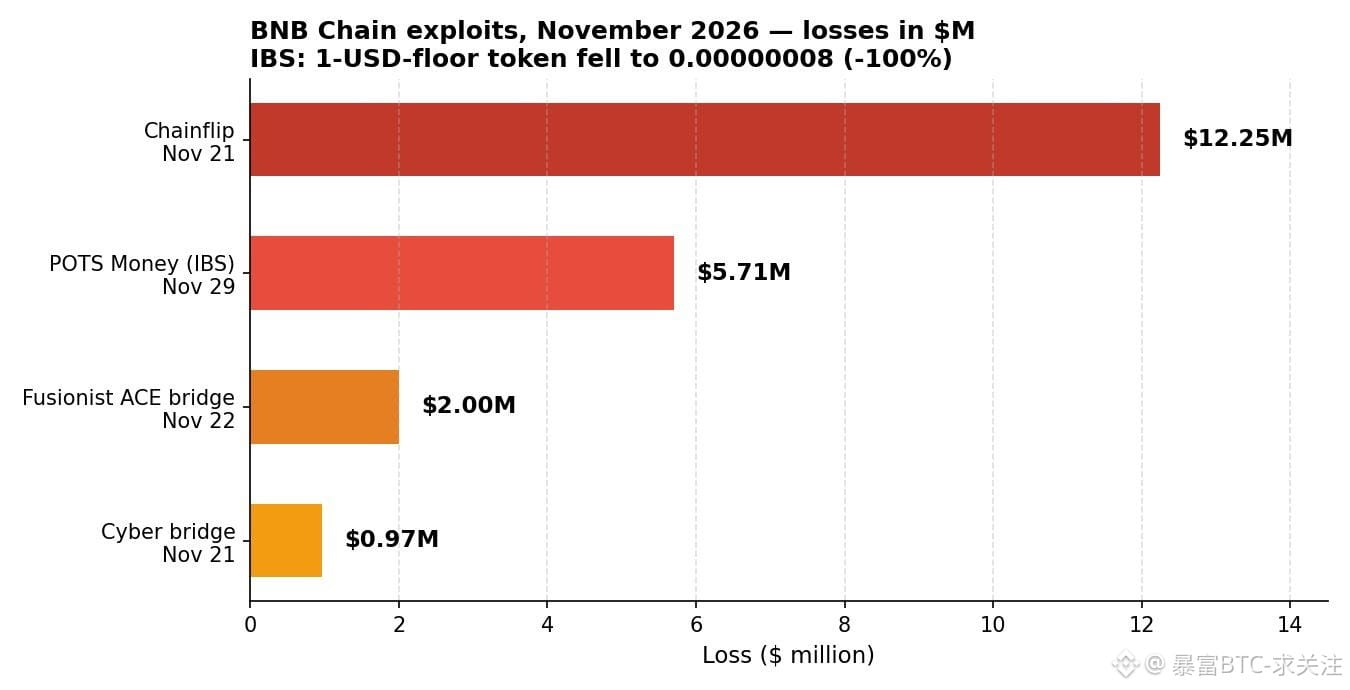
At 12:59 p.m. today, security firm Blockaid sounded the alarm: On the $BNB Chain, a privileged governance account for the POTS Money protocol minted 1 billion $IBS tokens out of thin air and dumped them into PancakeSwap’s IBS/USDT pool. Two rounds of selling drained $5.71 million in USDT. IBS, an algorithmic asset supposedly backed by a $1 floor, fell to $0.00000008 within an hour—effectively zero—leaving just $2,200 in liquidity in the pool. PeckShield tracked the $5.71 million to the address 0x25D21c…ccceD2, where it remains untouched. The project team has yet to propose any compensation plan.
This isn’t an isolated incident. There have been a string of breaches on BNB Chain this month: On the 21st, copied validator keys were used to steal $12.25 million from Chainflip; on the 22nd, Fusionist’s ACE bridge was drained of about $2 million through unauthorized minting, and Cyber’s bridge was also exploited that same day: 5.21 million tokens were minted and sold for $968,000. Going further back, $6.3 billion was stolen from Binance on October 29. CertiK estimates that the crypto industry lost $1.26 billion to hacks across 247 incidents in the third quarter, up 54% from the previous quarter. Hackers are changing their tactics: instead of just exploiting contract vulnerabilities, they’re taking privileged keys and governance accounts and printing money directly.
Two details are especially concerning. First, POTS Money’s audits had already flagged the risks: ScaleBit’s March 23 audit specifically identified centralization risks and unlimited minting privileges. CertiK’s audit is still marked as “in remediation,” with 99% completion—the difference between 99% and 100% is this $5.71 million. Second, many people think that “locked liquidity” means a project is safe. This incident proves that locking liquidity can prevent LPs from withdrawing from the pool, but it can’t stop someone from minting tokens out of thin air and exchanging them for real money in that pool.
I see this in two time frames. In the medium to long term, security is becoming the most expensive ticket in a bull market. CZ also warned today that there could be 5 to 10 hacks a day over the next year. AI is compressing six months of auditing into a single day, and both sides of the security arms race are accelerating. Small protocols don’t have much time left to operate unprotected. Access controls, minting caps, and multisig governance will go from nice-to-haves to existential requirements. In the short term, IBS is already at zero—there’s no such thing as buying the dip here. If you hold similar algorithmic assets or projects built around a “price floor” narrative, check who controls their minting privileges and whether their audits flag centralization risks. That’s more useful than looking at a price chart. The stolen $5.71 million is still sitting in that address. Whether it moves or not will be the next signal.
Let’s keep this in perspective: $5.71 million is small next to $6.3 billion, but it proves one thing—a “$1 floor” can’t protect you from a privileged key.

·
--

Article
A $4.40 token hit zero in a minute. The pool was left with just 76 USDTThe audit was done, the bug bounty was live, and the documentation said permissions had been renounced. Yet the token still went to zero in a minute. Today at 12:47 p.m., on BNB Chain, a POTS Money governance account with minting privileges conjured up 1 billion IBS and dumped it straight into the IBS and USDT pool, swapping it for 5.71 million USDT in a single transaction. A minute later, another transaction followed: 100 billion tokens, for just 14,000 USDT, because the pool was already empty. Only 76 USDT remained. IBS plunged from $4.40 to $0.00000008, a 100% drop in 24 hours. In May, it had reached $40.64.
What does 1 billion tokens mean? CoinGecko lists the circulating supply of IBS at only around 870,000. The amount minted in that one transaction was more than 1,100 times the circulating supply. The pool had just over 5.72 million USDT in total; the first transaction cleared it out, leaving 76 USDT—the last dregs at the bottom of the pool.
A $4.40 token hit zero in a minute. The pool was left with just 76 USDT
The audit was done, the bug bounty was live, and the documentation said permissions had been renounced. Yet the token still went to zero in a minute. Today at 12:47 p.m., on BNB Chain, a POTS Money governance account with minting privileges conjured up 1 billion IBS and dumped it straight into the IBS and USDT pool, swapping it for 5.71 million USDT in a single transaction. A minute later, another transaction followed: 100 billion tokens, for just 14,000 USDT, because the pool was already empty. Only 76 USDT remained. IBS plunged from $4.40 to $0.00000008, a 100% drop in 24 hours. In May, it had reached $40.64.
What does 1 billion tokens mean? CoinGecko lists the circulating supply of IBS at only around 870,000. The amount minted in that one transaction was more than 1,100 times the circulating supply. The pool had just over 5.72 million USDT in total; the first transaction cleared it out, leaving 76 USDT—the last dregs at the bottom of the pool.
What does 1 billion tokens mean? CoinGecko lists the circulating supply of IBS at only around 870,000. The amount minted in that one transaction was more than 1,100 times the circulating supply. The pool had just over 5.72 million USDT in total; the first transaction cleared it out, leaving 76 USDT—the last dregs at the bottom of the pool.
10

⚠️ Limited Opportunity! Potential Gains from the $POTS Airdrop!
Many are regretting skipping the last airdrop, don’t let that be you. This project is currently hyped and the steps are super straightforward.
✅ 100% Free
✅ Fast & Easy
✅ Official Link: https://t.me/POTSAirdropBot?start=ref_7450550058
Secure your position right now! 🌕
#Airdrop #Crypto #POTS #FreeCrypto #Blockchain
$PEPE
{spot}(PEPEUSDT)
$DOGE
{future}(DOGEUSDT)
$TRUMP
{future}(TRUMPUSDT)
⚠️ Limited Opportunity! Potential Gains from the $POTS Airdrop!
Many are regretting skipping the last airdrop, don’t let that be you. This project is currently hyped and the steps are super straightforward.
✅ 100% Free
✅ Fast & Easy
✅ Official Link: https://t.me/POTSAirdropBot?start=ref_7450550058
Secure your position right now! 🌕
#Airdrop #Crypto #POTS #FreeCrypto #Blockchain
$PEPE
$DOGE
$TRUMP

3
2
1.2k
Log in to explore more content
Join global crypto users on Binance Square
⚡️ Get latest and useful information about crypto.
💬 Trusted by the world’s largest crypto exchange.
👍 Discover real insights from verified creators.
Email / Phone number
Trending Topics
1
#EvolveAtBinanceBlockchainWeek
3M views
22,969 Discussing
2
#SunReportedlyOffered4BToRescueFTX
43,366 views
399 Discussing
3
#XRPLAmendmentsEnterActivationWindow
39,615 views
349 Discussing
4
#OPECReportedlyKeepsOilQuotasUnchangedForQ1
27,015 views
325 Discussing
5
#IBSGovAccountMints1BTokensDrains5.71M
79,300 views
670 Discussing
6
#WorldLibertyActsToCutLiquidationRisk
119,015 views
874 Discussing
7
#LiquidHackerMoves598BTC
88,131 views
520 Discussing
8
#BitcoinETFsExtendOutflowStreakToEightDays
163,861 views
1,124 Discussing
9
#TrumpMediaCouldFace883.5MRepaymentDemand
49,791 views
218 Discussing
10
#CryptographersFormGroupForEncryptionBreak
3 views
6 Discussing