
#sunreportedlyoffered4btorescueftx
sunreportedlyoffered4btorescueftx
Hot
Latest


Verified
See translation
#sunreportedlyoffered4btorescueftx
🚨 Sun Reportedly Offered $4B To Rescue FTX, But Was It Too Late? ⏳
It is 4:40 a.m. Inside FTX, tired staff are still calling investors. A pen has just signed the company away. Then a message lands.
Former FTX COO Constance Wang says Justin Sun offered 4 billion in liquidity about ten minutes after Sam Bankman-Fried appointed John Ray as CEO.
The collateral was the FTX Ventures portfolio. So this was a loan, not fresh cash.
FTX's reported hole was about $8 billion. The offer covered roughly half.
My take: the primary driver was trust, not liquidity. Binance had already walked away after reviewing the books, and about $6 billion had left in 72 hours.
A bridge can fix a liquidity gap. It cannot erase a solvency gap.
This is one person's recollection, shared years later. Treat it as a claim, not a verdict.
Practical lesson: check reserves, collateral quality, and transparency before trusting any platform.
Sometimes the offer is not too small. The clock is simply too fast.
Would 4 billion have saved FTX, or only delayed the ending?
Disclaimer: This is not financial advice. Always do your own research.
#JustinSun #FTX #GrowWithSAC $TRX $INIT $PEPE
#SunReportedlyOffered4BToRescueFTX

6
3.5k

Verified
See translation
#sunreportedlyoffered4btorescueftx
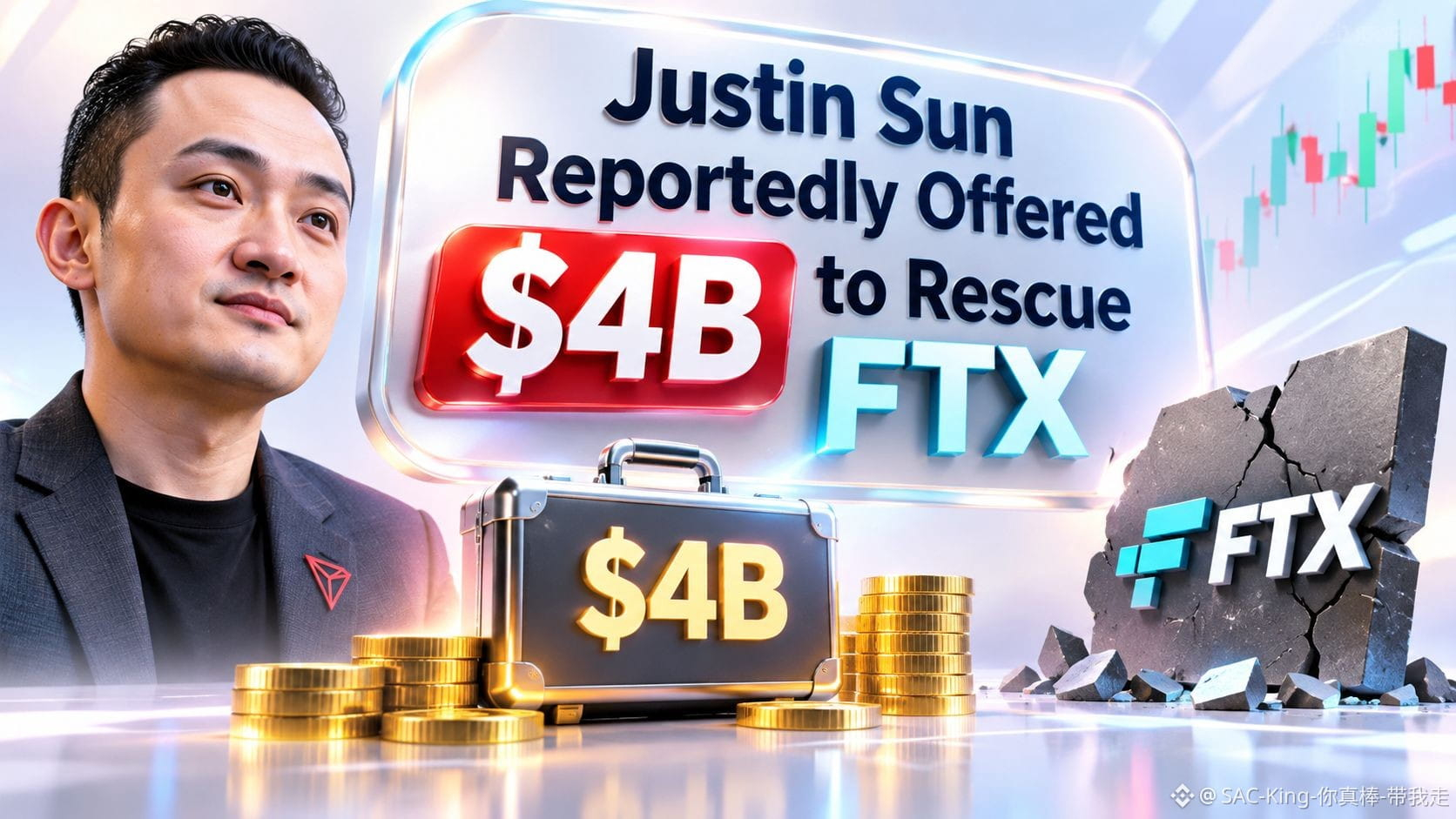
🚨 Justin Sun Reportedly Offered $4B to Rescue FTX, But It Was Too Late! 💥
Imagine an exchange standing on the edge of collapse. A billionaire steps forward with a potential dollers 4 billion lifeline. But there's one problem: the decision to enter bankruptcy has already been signed.
That's the extraordinary detail emerging from FTX's final hours.
According to former FTX COO Constance Wang, TRON founder Justin Sun offered dollers 4 billion in liquidity support on November 11, 2022, backed by FTX Ventures' investment portfolio. The message reportedly arrived around 10 minutes after Sam Bankman-Fried signed documents transferring control to John Ray III.
The crisis had accelerated after Binance announced plans to sell its FTT holdings. Approximately $6 billion reportedly left FTX within 72 hours, exposing a devastating liquidity crisis.
Here's what makes this revelation important: Sun's proposal was not simply a dollers 4 billion cash injection. It was financing backed by existing investments, and FTX reportedly faced an $8 billion shortfall.
Could this offer have changed FTX's fate? Possibly, but nobody can establish that it would have prevented bankruptcy. The financing terms, collateral value, and actual recovery prospects remain uncertain.
My takeaway: In crypto, liquidity can disappear faster than confidence can be restored. Even billions may arrive too late when trust has already collapsed.
Do you think Justin Sun's dollers 4 billion proposal could have changed crypto history if it had arrived earlier?
Disclaimer: This post is for educational purposes only, not financial advice.
#FTX #JustinSun #GrowWithSAC $OUST.US $IDOL $FF
#SunReportedlyOffered4BToRescueFTX
3
1.1k

·
--
Verified
See translation
#sunreportedlyoffered4btorescueftx 🚨 $4BILLION OFFER TO SAVE FTX — BUT WAS IT ALREADY TOO LATE? ⏳
A shocking new detail has emerged from the FTX collapse.
According to former FTX COO Constance Wang, Justin Sun reportedly offered $4 billion in liquidity just 10 minutes after Sam Bankman-Fried appointed John Ray as CEO.
But there was a major problem:
💰 The Deal:
Reported offer: $4billion
Proposed collateral: FTX Ventures portfolio
Estimated FTX shortfall: $8 billion
Potential coverage: Around 50%
⚠️ Why It May Not Have Worked:
Binance had already walked away after reviewing FTX's financial situation, while approximately $6 billion in withdrawals had reportedly occurred within 72 hours.
The real issue may not have been liquidity alone. It was a complete breakdown of trust.
A liquidity injection can help a struggling exchange survive temporary pressure, but it cannot automatically fix insolvency or restore customer confidence.
🧠 The Biggest Lesson:
Never trust an exchange blindly.
Always pay attention to:
Proof of Reserves
Quality of collateral
Financial transparency
Withdrawal accessibility
Sometimes billions of dollars aren't enough when confidence disappears.
🔥 What do you think?
Could Justin Sun's reported $4B offer have saved FTX, or would it only have delayed the inevitable?
Share your thoughts below! 👇
⚠️ Disclaimer: This is a reported recollection, not an independently established verdict. This post is for informational purposes only, not financial advice. Always DYOR.
#FTX #JustinSun #CryptoNews #SamBankmanFried
CLICK TO BELOW TRADE👇
$FTT $TRX
{future}(TRXUSDT)
{spot}(FTTUSDT)
#sunreportedlyoffered4btorescueftx 🚨 $4BILLION OFFER TO SAVE FTX — BUT WAS IT ALREADY TOO LATE? ⏳
A shocking new detail has emerged from the FTX collapse.
According to former FTX COO Constance Wang, Justin Sun reportedly offered $4 billion in liquidity just 10 minutes after Sam Bankman-Fried appointed John Ray as CEO.
But there was a major problem:
💰 The Deal:
Reported offer: $4billion
Proposed collateral: FTX Ventures portfolio
Estimated FTX shortfall: $8 billion
Potential coverage: Around 50%
⚠️ Why It May Not Have Worked:
Binance had already walked away after reviewing FTX's financial situation, while approximately $6 billion in withdrawals had reportedly occurred within 72 hours.
The real issue may not have been liquidity alone. It was a complete breakdown of trust.
A liquidity injection can help a struggling exchange survive temporary pressure, but it cannot automatically fix insolvency or restore customer confidence.
🧠 The Biggest Lesson:
Never trust an exchange blindly.
Always pay attention to:
Proof of Reserves
Quality of collateral
Financial transparency
Withdrawal accessibility
Sometimes billions of dollars aren't enough when confidence disappears.
🔥 What do you think?
Could Justin Sun's reported $4B offer have saved FTX, or would it only have delayed the inevitable?
Share your thoughts below! 👇
⚠️ Disclaimer: This is a reported recollection, not an independently established verdict. This post is for informational purposes only, not financial advice. Always DYOR.
#FTX #JustinSun #CryptoNews #SamBankmanFried
CLICK TO BELOW TRADE👇
$FTT $TRX

Alpha H U N T E R:
good job 👍
2
687

·
--
See translation
One of the most dramatic untold chapters in digital asset history has finally surfaced after former FTX Chief Operating Officer Constance Wang revealed that Justin Sun offered $4 billion to rescue the collapsing exchange. The stunning lifeline missed the deadline by just ten minutes before bankruptcy papers were signed.
#SunReportedlyOffered4BToRescueFTX
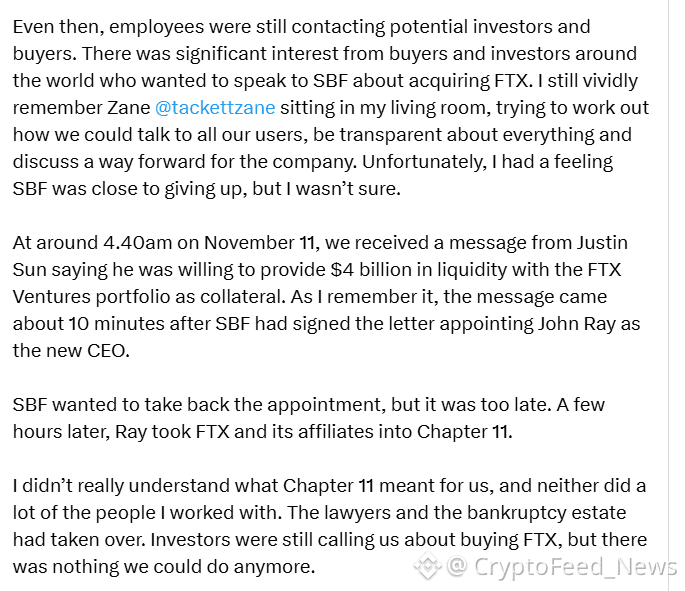
According to Wang the frantic final hours unfolded on the morning of November 11 2022. TRON founder Justin Sun sent a message at 4:40 a.m. expressing readiness to inject up to $4 billion in emergency liquidity backed by the FTX Ventures investment portfolio. Unfortunately Sam Bankman Fried had already signed the Chapter 11 bankruptcy filing and transferred authority to incoming Chief Executive John J. Ray III at 4:30 a.m.
Learning about the offer triggered an immediate scramble inside the crumbling firm. Bankman Fried and his remaining team desperately attempted to reverse the signatures and pause Ray from taking control so they could secure the capital injection. Legal procedures were already locked in motion and the filing became public hours later sealing the fate of billions in customer funds.
#BitcoinETFsExtendOutflowStreakToEightDays
Market skeptics still debate whether $4 billion could have bridged an estimated $8 billion balance sheet hole or whether the deal would have survived thorough due diligence. Even so that narrow ten minute window highlights how close the entire industry came to a completely different outcome.
Would a $4 billion rescue from Justin Sun have saved the market from a brutal crypto winter or merely delayed an inevitable collapse?
Yes or No show me in the comments below.
$BTC
{future}(BTCUSDT)
$SOL
{future}(SOLUSDT)
$TSLA.US
{web3_wallet_create}(10x42778037d69350508cdd34d9fa17053970591101)
One of the most dramatic untold chapters in digital asset history has finally surfaced after former FTX Chief Operating Officer Constance Wang revealed that Justin Sun offered $4 billion to rescue the collapsing exchange. The stunning lifeline missed the deadline by just ten minutes before bankruptcy papers were signed.
#SunReportedlyOffered4BToRescueFTX
According to Wang the frantic final hours unfolded on the morning of November 11 2022. TRON founder Justin Sun sent a message at 4:40 a.m. expressing readiness to inject up to $4 billion in emergency liquidity backed by the FTX Ventures investment portfolio. Unfortunately Sam Bankman Fried had already signed the Chapter 11 bankruptcy filing and transferred authority to incoming Chief Executive John J. Ray III at 4:30 a.m.
Learning about the offer triggered an immediate scramble inside the crumbling firm. Bankman Fried and his remaining team desperately attempted to reverse the signatures and pause Ray from taking control so they could secure the capital injection. Legal procedures were already locked in motion and the filing became public hours later sealing the fate of billions in customer funds.
#BitcoinETFsExtendOutflowStreakToEightDays
Market skeptics still debate whether $4 billion could have bridged an estimated $8 billion balance sheet hole or whether the deal would have survived thorough due diligence. Even so that narrow ten minute window highlights how close the entire industry came to a completely different outcome.
Would a $4 billion rescue from Justin Sun have saved the market from a brutal crypto winter or merely delayed an inevitable collapse?
Yes or No show me in the comments below.
$BTC
$SOL
$TSLA.US

Shalim92:
good job bro🫂
2
2
18
1.3k

See translation
#SunReportedlyOffered4BToRescueFTX
According to former FTX COO Constance Wang, TRON($TRX ) founder Justin Sun reportedly offered $4 billion in emergency liquidity to save $FTT in November 2022.
The offer came after Sam Bankman-Fried had already handed over control to the new CEO, John J. Ray III.
The proposal reportedly involved using FTX Ventures' investment portfolio as collateral.
A fascinating reminder of how timing, liquidity and trust can shape the fate of a crypto exchange. #Mahanadi $SOL
{spot}(FTTUSDT)
{spot}(TRXUSDT)
{spot}(SOLUSDT)
#SunReportedlyOffered4BToRescueFTX
According to former FTX COO Constance Wang, TRON($TRX ) founder Justin Sun reportedly offered $4 billion in emergency liquidity to save $FTT in November 2022.
The offer came after Sam Bankman-Fried had already handed over control to the new CEO, John J. Ray III.
The proposal reportedly involved using FTX Ventures' investment portfolio as collateral.
A fascinating reminder of how timing, liquidity and trust can shape the fate of a crypto exchange. #Mahanadi $SOL

Aftershock 💥
From Digital Mahanadi
Nic Morshed khan:
thanks
1
7
204

·
--
See translation
#sunreportedlyoffered4btorescueftx Crypto founder Justin Sun offered $4 billion to rescue FTX in 2022, just 10 minutes too late. Former FTX executive Constance Wang shared this new detail this week. Sun sent the loan offer right after FTX founder Sam Bankman-Fried gave control of the company to a new boss. Bankman-Fried tried to cancel the change, but the lawyers had already taken over. Hours later, FTX filed for bankruptcy, changing crypto history forever.
$BTC $BNB $SOL
{future}(SOLUSDT)
{future}(BNBUSDT)
{future}(BTCUSDT)
#sunreportedlyoffered4btorescueftx Crypto founder Justin Sun offered $4 billion to rescue FTX in 2022, just 10 minutes too late. Former FTX executive Constance Wang shared this new detail this week. Sun sent the loan offer right after FTX founder Sam Bankman-Fried gave control of the company to a new boss. Bankman-Fried tried to cancel the change, but the lawyers had already taken over. Hours later, FTX filed for bankruptcy, changing crypto history forever.
$BTC $BNB $SOL
$BTC $BNB $SOL

1
153
·
--
See translation
#sunreportedlyoffered4btorescueftx
According to new statements from former FTX executive Constance Wang, Tron founder Justin Sun offered $4 billion to rescue FTX during its collapse in November 2022. However, the emergency offer arrived just 10 minutes after Sam Bankman-Fried signed over control to a new CEO. Bankman-Fried tried to cancel the leadership change to accept the money, but it was too late. Speaking at an event today, Justin Sun confirmed this and said he still wishes to buy FTX to help users.
#SunReportedlyOffered4BToRescueFTX
$BTC $XRP $BNB
{future}(BNBUSDT)
{future}(XRPUSDT)
{future}(BTCUSDT)
#sunreportedlyoffered4btorescueftx
According to new statements from former FTX executive Constance Wang, Tron founder Justin Sun offered $4 billion to rescue FTX during its collapse in November 2022. However, the emergency offer arrived just 10 minutes after Sam Bankman-Fried signed over control to a new CEO. Bankman-Fried tried to cancel the leadership change to accept the money, but it was too late. Speaking at an event today, Justin Sun confirmed this and said he still wishes to buy FTX to help users.
#SunReportedlyOffered4BToRescueFTX
$BTC $XRP $BNB

234

See translation
#sunreportedlyoffered4btorescueftx 🚨 4 BILLION TO SAVE FTX: RESCUE OR TOO LATE? 🚨
It's November 2022. FTX is bleeding, its founder is scrambling, and the clock is running out. ⏳
Sam Bankman-Fried told investors that FTX needed at least 4 billion to stay solvent, with a gap of up to $8 billion. Binance had walked away from its rescue bid. And into that vacuum stepped Justin Sun, the founder of Tron. 🔥
💸 The offer on the table
Sun publicly said Tron was ready to provide billions in aid, pending due diligence. Reuters reported that SBF was pulling together a rescue package of up to $9.4 billion, with roughly 1 billion expected from Sun, another $1 billion from OKX, $1 billion from Tether, and $2 billion from a group of investment funds. 🤝
🧮 The math problem
Here's the catch. Even if every piece had come through, the gap was enormous. A $4 billion lifeline can fix a cash shortage. It can't fix a balance sheet that doesn't add up. Trust was the real currency FTX had lost, and once customers started pulling funds, no single investor could stop the run. 📉
⚖️ Would it have worked?
Sun has presented himself as ready to help. Critics say the talks were a race against time that FTX could never win. Both can be true. The deal depended on due diligence, and the company had already lost the confidence of the people it needed most. 🧠
🔥 The lesson every trader should remember
Before you trust any platform, check the things that matter: reserves, collateral quality, and transparency. A rescue headline can look reassuring while the underlying numbers are still broken. 🔍
📢 Your call: Could 4 billion have saved FTX, or was the collapse already locked in? Drop your take below. 👇
This is not financial advice. Always do your own research.
#FTX #JustinSun #Crypto


Cryptivoza:
ftx
10
1
10

See translation
Ten minutes changed crypto history—and the math still wouldn't have saved it 🚨
Former FTX COO Constance Wang just revealed a wild detail from the final hours of the November 2022 collapse: TRON founder Justin Sun offered $4 billion in emergency liquidity to rescue FTX.
The timeline is razor-thin:
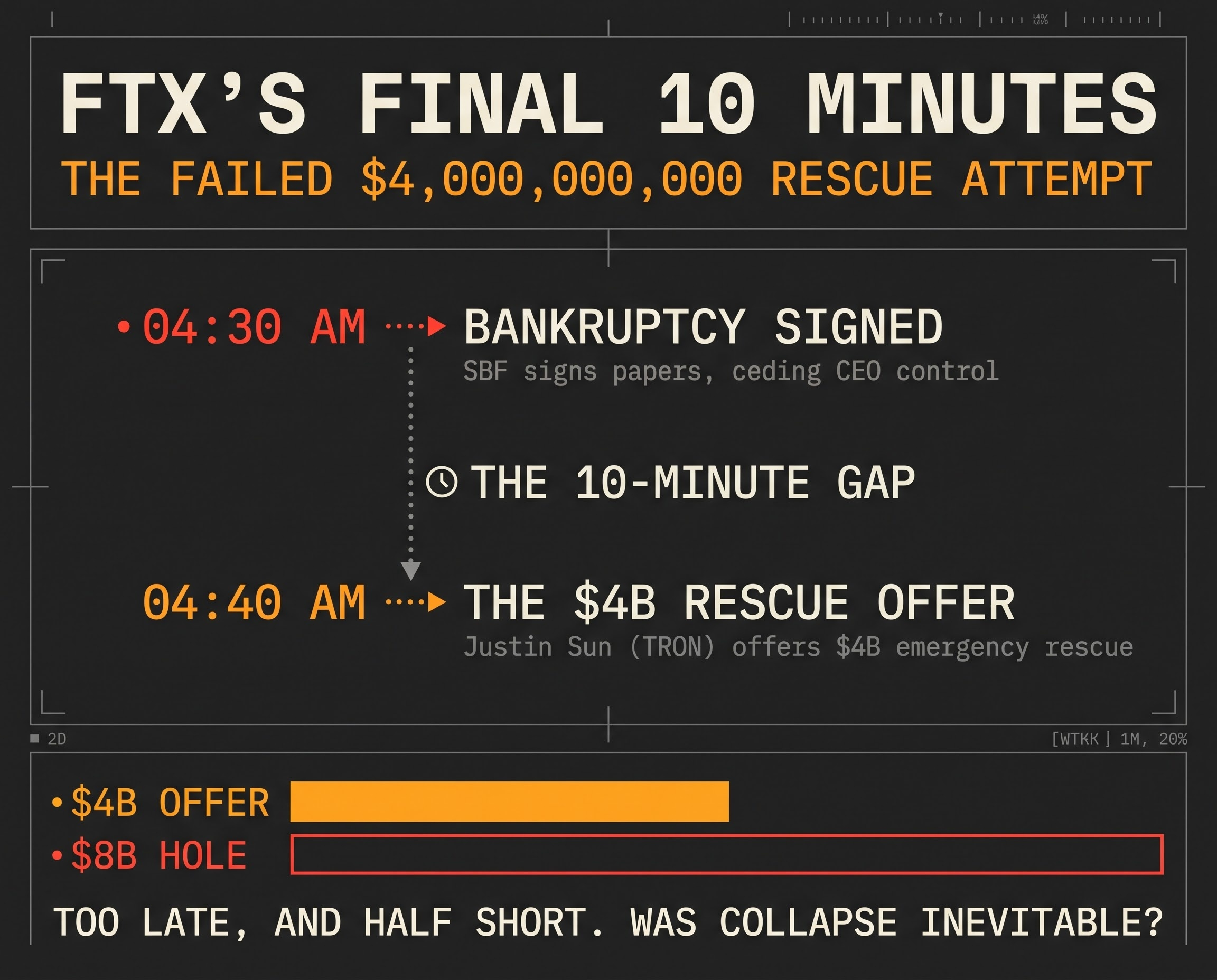
• 4:30 AM (Nov 11, 2022): SBF signs papers handing CEO control to bankruptcy chief John J. Ray III.
• 4:40 AM: Sun's message lands—offering $4B backed by the FTX Ventures startup portfolio.
SBF reportedly tried to revoke Ray's appointment immediately, but legal control had already shifted. Hours later, Chapter 11 was filed.
📉 Trader's Reality Check:
Even if the message arrived 10 minutes earlier, a $4B collateralized loan only covered half of FTX's ~$8B balance sheet hole—and roughly $6B had already drained in 72 hours. Liquidity loans don't fix structural insolvency.
Key takeaway for every trader: Never trust "everything is fine" tweets during a bank run, and always verify Proof of Reserves. Self-custody isn't optional.
Could $4B have bought FTX enough time to survive, or was collapse inevitable? Drop your take below 👇
$TRX $FTT $EVAA
{future}(TRXUSDT)
{future}(EVAAUSDT)
{spot}(FTTUSDT)
#sunreportedlyoffered4btorescueftx #FTX #JustinSun #CryptoHistory
Ten minutes changed crypto history—and the math still wouldn't have saved it 🚨
Former FTX COO Constance Wang just revealed a wild detail from the final hours of the November 2022 collapse: TRON founder Justin Sun offered $4 billion in emergency liquidity to rescue FTX.
The timeline is razor-thin:
• 4:30 AM (Nov 11, 2022): SBF signs papers handing CEO control to bankruptcy chief John J. Ray III.
• 4:40 AM: Sun's message lands—offering $4B backed by the FTX Ventures startup portfolio.
SBF reportedly tried to revoke Ray's appointment immediately, but legal control had already shifted. Hours later, Chapter 11 was filed.
📉 Trader's Reality Check:
Even if the message arrived 10 minutes earlier, a $4B collateralized loan only covered half of FTX's ~$8B balance sheet hole—and roughly $6B had already drained in 72 hours. Liquidity loans don't fix structural insolvency.
Key takeaway for every trader: Never trust "everything is fine" tweets during a bank run, and always verify Proof of Reserves. Self-custody isn't optional.
Could $4B have bought FTX enough time to survive, or was collapse inevitable? Drop your take below 👇
$TRX $FTT $EVAA
#sunreportedlyoffered4btorescueftx #FTX #JustinSun #CryptoHistory
2
872

See translation
🚨10 MINUTES TOO LATE
#SunReportedlyOffered4BToRescueFTX November 11, 2022. 4:40 AM.
SBF had just signed FTX over to a new CEO. Ten minutes later, a message from Justin Sun arrived: $4B to save the exchange.
Too late. SBF tried to undo it and couldn't. Hours later, FTX filed for bankruptcy.
The story only came out now, from FTX's former COO.
Would it have worked? The hole was around $8B. Maybe not.
But imagine how different crypto might look today.
33

·
--
Bullish
See translation
#sunreportedlyoffered4btorescueftx
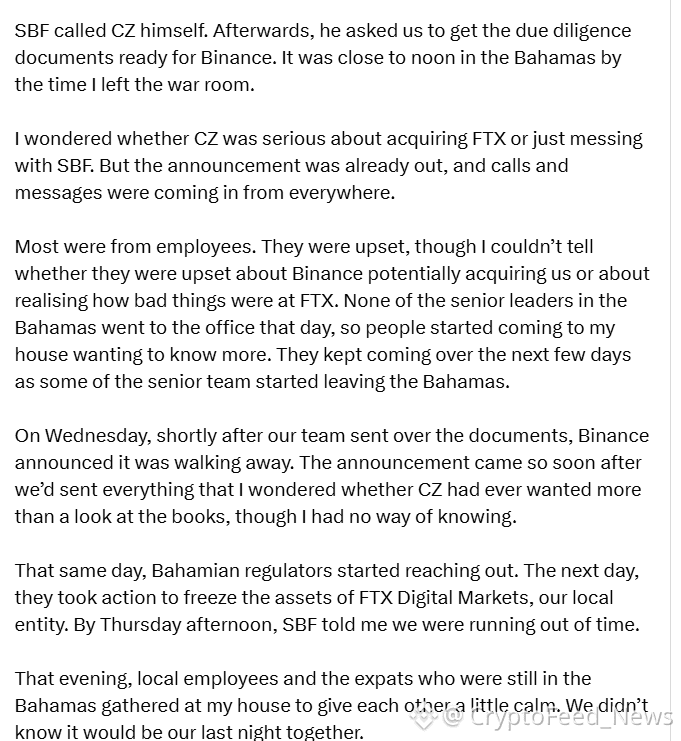
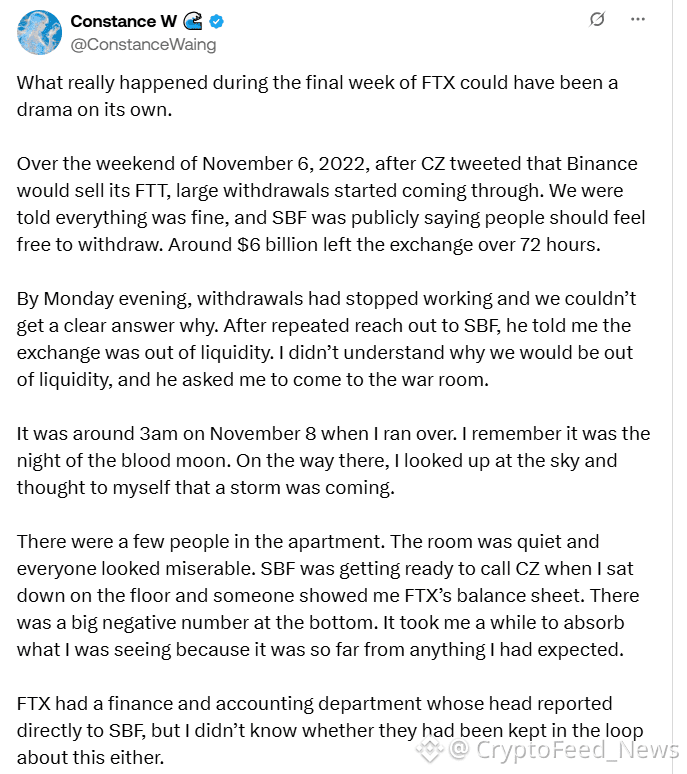
👀 Justin Sun reportedly offered FTX $4B in emergency liquidity just 10 minutes after SBF handed over control in November 2022.
Former FTX COO Constance Wang says Sun’s proposal involved using FTX Ventures’ investment portfolio as collateral, but the offer came after John J. Ray III had already taken over.
Meanwhile, FTX’s $FTT collapse saw roughly $6B leave within 72 hours, Binance abandon its acquisition bid and regulators freeze assets.
A dramatic behind-the-scenes revelation from one of crypto’s biggest collapses. #Write2Earn
59

See translation
#SunReportedlyOffered4BToRescueFTX
🚨 JUSTIN SUN REPORTEDLY OFFERED $4 BILLION TO SAVE FTX!
Tron founder Justin Sun reportedly offered $4 billion in emergency liquidity to rescue FTX in November 2022.
But here's the shocking twist: Former FTX COO Constance Wang says the offer arrived just 10 minutes after Sam Bankman-Fried handed over control of the company. 😳
Could this massive bailout have changed crypto history?
🤔 What do you think? Could Justin Sun have saved FTX?
$TRX $FTT $BTC
#JustinSun #FTX #CryptoNews #TRON #Crypto
#SunReportedlyOffered4BToRescueFTX #IBSGovAccountMints1BTokensDrains5.71M #OPECReportedlyKeepsOilQuotasUnchangedForQ1 #XRPLAmendmentsEnterActivationWindow
This is for educational purposes only, not financial advice (NFA). Always do your own research (DYOR).

35

·
--
See translation
#sunreportedlyoffered4btorescueftx
🚨 Crypto Bombshell: Justin Sun Reportedly Offered $4 Billion to Rescue FTX — Just 10 Minutes Too Late
A stunning new revelation from former FTX Chief Operating Officer Constance Wang has reopened one of crypto's biggest "what-if" moments. According to Wang, TRON founder Justin Sun sent a message at roughly 4:40 a.m. on November 11, 2022, offering 4 billion in liquidity backed by the FTX Ventures portfolio to rescue the collapsing exchange. However, the offer arrived just 10 minutes after Sam Bankman-Fried had already signed over control to bankruptcy CEO John Ray III—locking in Chapter 11 proceedings before the lifeline could be executed.
As traders revisit the history behind the headline, here is how the key associated tokens are performing right now:
📉 $FTT (FTX Token): Currently trading at $0.1825 (with a 24-hour range between $0.1776 and $0.1876), FTT continues to trade purely on speculative bankruptcy headlines despite having no operational utility. Holding above $0.1750 support is critical to avoid sliding back toward its $0.1590 low, while resistance sits near $0.1930.
📊 $TRX (TRON): Sitting at $0.3033, TRON remains one of the market's steadier high-liquidity Layer-1 networks. Defending the $0.3000 psychological support level keeps the broader structure intact for a potential push back toward $0.3120 as attention centers on Justin Sun's newly revealed role in 2022's biggest rescue attempt.
Trader's Action Plan: Treat FTT strictly as a high-risk, headline-driven trade—volatility spikes quickly on bankruptcy revelations, so tight risk management around the $0.1800 pivot is essential. Meanwhile, watch TRX around the $0.3000 support zone for steady spot accumulation if broader market sentiment stabilizes.
Do you think 4 billion in liquidity could have actually saved FTX in 2022, or was the $8 billion hole too deep? Drop your take below 👇
{spot}(FTTUSDT)
{spot}(TRXUSDT)
#FTX #TRX #CryptoNews #CryptoNewss
#sunreportedlyoffered4btorescueftx
🚨 Crypto Bombshell: Justin Sun Reportedly Offered $4 Billion to Rescue FTX — Just 10 Minutes Too Late
A stunning new revelation from former FTX Chief Operating Officer Constance Wang has reopened one of crypto's biggest "what-if" moments. According to Wang, TRON founder Justin Sun sent a message at roughly 4:40 a.m. on November 11, 2022, offering 4 billion in liquidity backed by the FTX Ventures portfolio to rescue the collapsing exchange. However, the offer arrived just 10 minutes after Sam Bankman-Fried had already signed over control to bankruptcy CEO John Ray III—locking in Chapter 11 proceedings before the lifeline could be executed.
As traders revisit the history behind the headline, here is how the key associated tokens are performing right now:
📉 $FTT (FTX Token): Currently trading at $0.1825 (with a 24-hour range between $0.1776 and $0.1876), FTT continues to trade purely on speculative bankruptcy headlines despite having no operational utility. Holding above $0.1750 support is critical to avoid sliding back toward its $0.1590 low, while resistance sits near $0.1930.
📊 $TRX (TRON): Sitting at $0.3033, TRON remains one of the market's steadier high-liquidity Layer-1 networks. Defending the $0.3000 psychological support level keeps the broader structure intact for a potential push back toward $0.3120 as attention centers on Justin Sun's newly revealed role in 2022's biggest rescue attempt.
Trader's Action Plan: Treat FTT strictly as a high-risk, headline-driven trade—volatility spikes quickly on bankruptcy revelations, so tight risk management around the $0.1800 pivot is essential. Meanwhile, watch TRX around the $0.3000 support zone for steady spot accumulation if broader market sentiment stabilizes.
Do you think 4 billion in liquidity could have actually saved FTX in 2022, or was the $8 billion hole too deep? Drop your take below 👇
#FTX #TRX #CryptoNews #CryptoNewss

1
65

·
--
Article
See translation
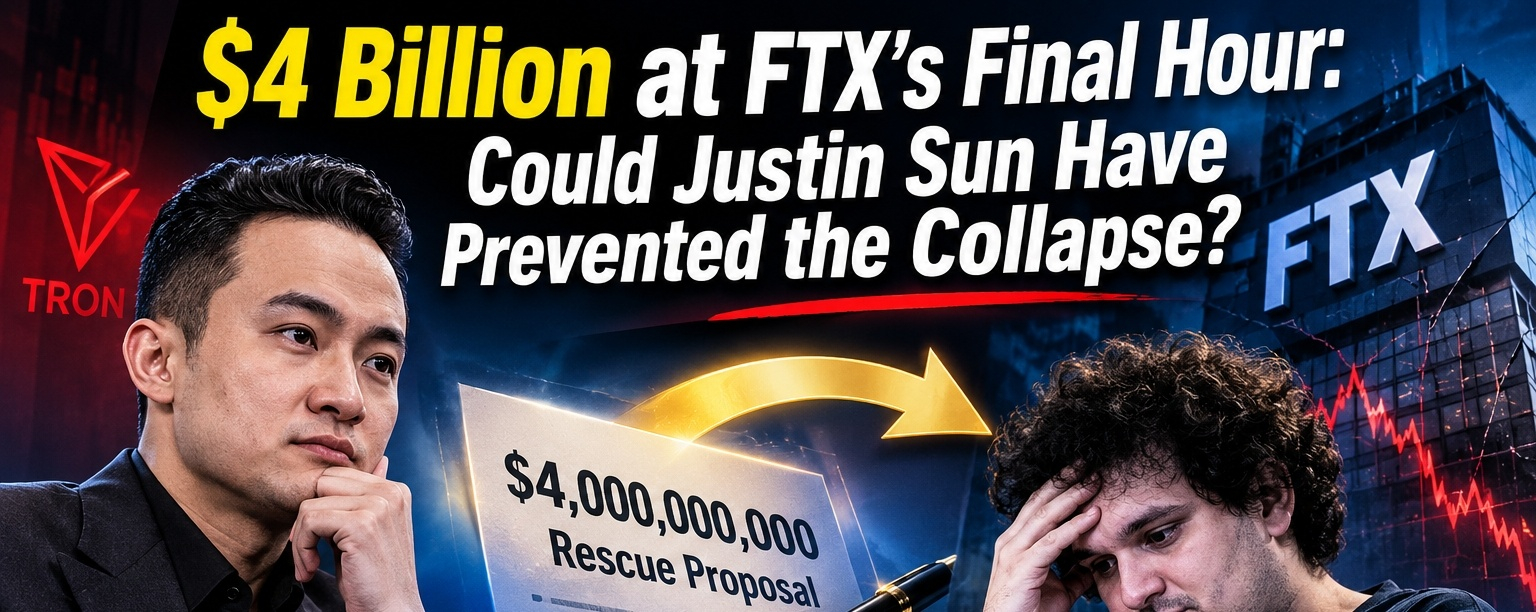
$4 Billion at FTX’s Final Hour: Could Justin Sun Have Prevented the Collapse?Even $4 billion may not be enough to save a failing financial institution when the loss of trust becomes greater than the value of its remaining assets. FTX’s final hours offer a clear illustration of that reality.
November 11, 2022. Inside $FTXO.ETF , uncertainty had reached an extreme level. Employees were contacting investors, discussions about returning customer funds were underway, and the company was preparing for a change in leadership.
Sam Bankman-Fried (SBF) had agreed to transfer control of the company to John J. Ray III.
According to a recent recollection by former FTX COO Constance Wang, approximately 10 minutes after that decision, a $4 billion financing proposal reportedly arrived from Justin Sun.
The proposed financing was reportedly backed by $FTXL.ETF Ventures’ investment portfolio. In other words, this was not simply a financial rescue package or an unconditional capital injection. It was a proposal for secured financing.
That raises a fundamental question: Could $4 billion have saved FTX, or had the company’s financial and institutional problems already become too severe for additional funding to make a meaningful difference?
The central argument of this analysis is that FTX’s collapse cannot be explained as a simple liquidity crisis. It involved asset deficiencies, failures in customer fund management, conflicts of interest, and a fundamental breakdown in financial transparency.
Important qualification: The details of the $4 billion proposal are based on Constance Wang’s personal recollection. Publicly available information does not establish that a finalized financing agreement was executed. Therefore, while the reported proposal deserves attention, its final terms and practical feasibility remain independently unverified.
---
1. What Was Really Behind FTX’s Collapse?
Although FTX’s crisis became public within days, the underlying weaknesses had developed much earlier.
The 2022 crypto bear market, Alameda Research’s debt-driven investment strategy, excessive dependence on FTT, and weak institutional separation between FTX and Alameda created a highly vulnerable financial structure.
FTX was a Centralized Exchange (CEX), while Alameda Research operated as a trading and investment firm.
Although their business activities were different, the two companies maintained close ownership and management relationships. The fundamental problem was that effective Independent Governance and Risk Controls were not established to manage those relationships.
1.1 FTT: Excessive Dependence on a Self-Issued Asset
FTT was FTX’s native exchange token, offering benefits such as trading fee discounts.
However, Alameda held substantial positions in FTT and other relatively illiquid tokens on its balance sheet.
This created a Circular Valuation Problem.
Consider the following sequence:
FTX issues its own token.
Alameda holds a substantial portion of that token as an asset.
The token’s market value is used to support borrowing.
Borrowed funds are used for additional investments.
If the token price declines, the value of the collateral also falls.
The critical distinction is that an asset’s market price is not the same as its ability to generate cash.
Even if Alameda held a large quantity of FTT, selling all of it at once could have been difficult because market demand might not have been sufficient. Heavy selling pressure could also have pushed the token’s price lower.
This is the fundamental problem of Market Liquidity Risk and Market Impact.
The CFTC’s court-approved 2024 Consent Order documented serious problems involving Alameda’s positions in FTT and other less-liquid tokens, as well as their valuation. It also described special software privileges that allowed Alameda to withdraw assets beyond normal limits, including when its account had a negative balance.
In other words, the problem was not simply declining market prices. There were deeper weaknesses in asset valuation, borrowing practices, and risk management.
1.2 $6 Billion in Withdrawals: The Beginning of the Bank Run
On November 6, 2022, Binance founder Changpeng Zhao (CZ) announced plans to sell Binance’s FTT holdings. This intensified concerns about FTX’s financial position.
Customers subsequently began withdrawing their assets at an accelerated pace.
On November 8, SBF informed employees that FTX had experienced approximately $6 billion in net withdrawals over the previous 72 hours. Around the same period, withdrawals from FTX.com were effectively suspended.
The situation resembled a traditional Bank Run.
Banks do not normally hold every customer deposit in cash. They maintain a portion in liquid assets while using the remainder for lending and investment activities.
However, when large numbers of depositors demand their money simultaneously, insufficient available liquidity can create a crisis.
A similar pressure emerged at FTX. But there was an additional and more serious problem: some customer assets had been used in Alameda’s trading and investment activities.
Therefore, FTX’s collapse was not simply a conventional Bank Run. It was a Bank Run combined with serious failures in customer asset management.
---
2. Liquidity Crisis vs. Solvency Crisis: FTX’s Fundamental Weakness
To understand whether Justin Sun’s proposal could have worked, we first need to distinguish between two important economic concepts.
A Liquidity Crisis occurs when an institution has sufficient total assets to cover its liabilities but cannot convert those assets into cash quickly enough to meet immediate obligations.
A Solvency Crisis, by contrast, occurs when the actual value of an institution’s assets falls below its total liabilities.
Consider two simplified scenarios.
Scenario A: Liquidity Crisis
Total assets: $12 billion
Total liabilities: $10 billion
Immediately available cash: $1 billion
The institution is solvent overall. However, if everyone demands repayment simultaneously, it may still fail to meet its obligations.
Scenario B: Solvency Crisis
Actual asset value: $6 billion
Total liabilities: $10 billion
Asset shortfall: $4 billion
In this situation, additional borrowing alone cannot solve the problem. New debt increases available cash, but it also creates additional liabilities.
FTX’s situation was considerably more complicated.
Various reports referred to an approximately $8 billion shortfall. However, this figure should not be treated as a definitive, audited net solvency calculation.
Alameda’s internal accounts reportedly showed approximately $8 billion in USD liabilities. Separately, a balance sheet presented to potential investors on November 9 also revealed a negative position of roughly $8 billion.
These figures are related, but they do not represent exactly the same measurement.
The central questions were:
How much genuine asset value did FTX actually control? How much of it could be recovered? And what were its total obligations to customers?
This was where FTX’s crisis extended beyond an ordinary liquidity problem.
---
3. Justin Sun’s $4 Billion Proposal: How Effective Could It Have Been?
According to Constance Wang, Sun’s proposal involved using FTX Ventures’ investment portfolio as collateral.
This would have been a Secured Financing Structure.
In such an arrangement, the lender receives collateral that may be liquidated under specified conditions if the borrower fails to repay.
However, collateral alone does not make a loan safe, especially when the borrower is already facing a financial collapse.
3.1 Collateral Quality: Book Value Is Not Liquidation Value
FTX Ventures held investments in various companies, including equity positions and other financial assets.
These investments had several limitations:
They could not necessarily be converted into cash immediately.
Their valuations often depended on future growth expectations.
Some investments might have been subject to lock-up periods or transfer restrictions.
Private company equity generally lacks a reliable, continuously available market price.
Selling a large portfolio during a financial emergency could require substantial discounts.
Consider an investment portfolio with a reported book value of $5 billion.
If it could only be sold for $2 billion during an emergency, its practical liquidation value would be closer to $2 billion, not $5 billion.
This is why financial institutions assess collateral through concepts such as Haircuts and Recovery Value.
3.2 Could $4 Billion Have Covered an $8 Billion Shortfall?
If the reported $8 billion shortfall and the proposed $4 billion financing are measured on a comparable basis, the proposed amount would equal approximately half of the reported gap.
However, several important factors must be considered.
First, $4 billion was a reported financing proposal, not confirmed funding.
Second, if structured as a loan, it would have increased FTX’s cash assets while simultaneously creating a new liability.
Third, the actual value of the collateral and the existence of competing claims against those assets would have required verification.
Fourth, even if the funding had been used to return customer assets, the obligation to repay the loan would still have remained.
Therefore, $4 billion might have reduced immediate liquidity pressure, but it would not automatically have eliminated an $8 billion shortfall.
3.3 What Would a Viable Rescue Have Required?
For the proposal to become practically executable, at least five conditions would have been important:
Independent valuation of FTX Ventures’ investment portfolio.
Legal verification of collateral ownership and lender priority.
Verification of the funding source and the ability to release the capital.
A clear assessment of customer liabilities and other creditor claims.
Transparent accounting and independent oversight under new management.
Without these conditions, $4 billion in financing could have introduced additional debt risks rather than resolving the underlying crisis.
---
4. Asymmetric Information: Why Did FTX Lose Investor Confidence?
Asymmetric Information describes a situation in which the parties involved in a transaction do not have equal access to relevant information.
Management typically knows more about a company’s actual financial condition than its customers or investors.
At FTX, this information imbalance became particularly serious.
Customers believed that the digital assets they deposited were being safely held by the exchange.
However, CFTC documentation described serious financial relationships between customer assets and Alameda’s activities, including the use of customer funds.
This was a clear example of the Principal-Agent Problem.
Consider the structure:
Principal: FTX customers.
Agent: FTX management.
Responsibility: Safeguarding and managing customer assets.
Conflict of interest: Customer assets were used in the activities of an affiliated business.
Customers did not know how much of their assets were being used elsewhere. Consequently, they lacked the information necessary to evaluate their actual exposure.
4.1 How Did Moral Hazard Develop?
Moral Hazard occurs when an individual or institution takes excessive risks without bearing the full consequences of those decisions.
Within FTX’s structure, customer funds were available for use in Alameda’s trading and investment activities.
However, when those investments failed, customers bore a substantial portion of the resulting losses.
This created a fundamental mismatch between the incentives to take risks and responsibility for the consequences.
Such problems cannot be resolved through internal policies alone. They require Independent Audits, Segregation of Assets, Board Oversight, and effective Regulatory Supervision.
4.2 Why Did Binance Walk Away?
On November 8, Binance agreed to a non-binding Letter of Intent to acquire FTX.com.
However, after conducting Due Diligence, Binance withdrew from the proposed acquisition on November 9.
Binance publicly cited concerns arising from corporate due diligence and reports involving the mishandling of customer funds.
This decision further deepened FTX’s crisis.
Initially, the problem appeared to be a shortage of liquidity. But the due diligence process raised much more fundamental questions about the company’s assets, liabilities, and the actual condition of customer funds.
When a company's balance sheet is weak, investors demand a higher risk premium. But when the balance sheet itself cannot be trusted, accurately measuring that risk becomes extremely difficult.
FTX did not simply lack money. It also lacked the reliable financial information that potential investors needed to justify providing it.
---
5. Blockchain and Crypto Market Microstructure: Why Could On-Chain Transparency Not Protect FTX?
Following FTX’s collapse, an important question emerged: If blockchain technology is transparent, how could a crypto exchange experience such serious problems involving customer funds?
The answer lies in understanding how a Centralized Exchange operates.
FTX was a Centralized Exchange, meaning that not every customer trade was directly executed on a blockchain.
5.1 On-Chain Assets vs. Off-Chain Liabilities
A Centralized Exchange generally operates through two separate layers.
On-chain Asset Management: Bitcoin, Ethereum, stablecoins, and other digital assets are held in wallets controlled by the exchange.
Off-chain Internal Ledger: Customer account balances, including BTC, ETH, and USDT holdings, are generally recorded in the exchange’s internal database.
In other words, seeing 2 BTC in a customer's exchange account does not necessarily mean that 2 BTC are separately held on the blockchain in that customer's name.
The exchange is responsible for maintaining sufficient assets against the total customer liabilities recorded in its internal ledger.
FTX experienced serious failures in this area.
5.2 Why Is Proof of Reserves Not Enough?
Following FTX’s collapse, Proof of Reserves (PoR) became an increasingly important topic.
PoR allows an exchange to demonstrate how much cryptocurrency it controls in its wallets at a particular point in time.
However, showing reserves alone does not prove that customer funds are safe.
A meaningful verification framework requires three elements:
Verification What It Establishes
Proof of Reserves How much asset value the exchange controls
Proof of Liabilities How much it owes its customers
Independent Verification Whether the reported information is reliable
Consider an exchange with $10 billion in wallet assets but $14 billion in customer liabilities.
Simply demonstrating $10 billion in reserves cannot establish that the exchange is financially secure.
Furthermore, even if the exchange holds $10 billion in assets, competing claims from other creditors could reduce the amount actually available to customers.
Merkle Tree-based Proof of Liabilities can help verify the aggregation of customer balances. However, it cannot independently reveal undisclosed debt, legal claims, or third-party rights over assets.
That is why comprehensive financial audits and independent verification remain essential.
5.3 Was FTX’s Collapse a Failure of Blockchain Technology?
No.
Bitcoin’s Consensus Mechanism, Ethereum’s Smart Contracts, and blockchain’s immutable ledger did not control FTX’s internal financial management.
The failures were primarily related to Centralized Custody, Internal Accounting, Governance, and Risk Management.
Blockchain can verify records of specific transactions. Smart contracts can transfer assets according to predefined rules.
But blockchain alone cannot confirm whether a centralized exchange maintains sufficient assets against its off-chain customer liabilities.
Technical transparency and institutional integrity are not the same thing.
---
6. Comparing FTX with Traditional Finance: How Do Banks Handle Similar Crises?
Understanding FTX also requires examining how traditional banking systems respond to financial distress.
In conventional banking, central banks provide a Lender of Last Resort facility to address liquidity emergencies.
When a bank faces temporary liquidity pressure, a central bank may provide financing against eligible collateral under specified conditions.
However, this arrangement is based on an important economic principle:
Liquidity support is most effective when an institution is solvent but temporarily illiquid.
If an institution is genuinely insolvent, additional borrowing cannot eliminate its underlying financial deficit.
6.1 Lessons from the 2008 Financial Crisis
The 2008 Global Financial Crisis demonstrated how excessive leverage, complex financial products, and weak risk assessment can destabilize the broader financial system.
In the case of Lehman Brothers, a shortage of financing was an immediate problem. However, questions about the actual value of assets, their ability to be sold in the market, and confidence in the institution were equally important.
This is where the comparison with FTX becomes relevant.
The institutional structures of the two cases were not identical. Traditional banking systems have central banks, deposit insurance, and established resolution frameworks. Crypto exchanges do not automatically receive equivalent protection.
Nevertheless, both cases illustrate the same economic reality:
When market participants become uncertain about an institution’s actual financial condition, a liquidity crisis can rapidly deepen into a solvency crisis.
6.2 FTX vs. Traditional Banks
Category Traditional Banks FTX
Type of funds Fiat deposits Digital assets
Liquidity support May access central bank facilities No guaranteed lender of last resort
Asset custody Regulated banking framework Exchange-controlled custody and internal ledger
Customer protection Deposit insurance, depending on jurisdiction No automatic equivalent protection
Crisis resolution Resolution and bankruptcy frameworks Bankruptcy and asset recovery
FTX demonstrated that the ability to transfer money quickly through technology does not guarantee financial stability during a crisis.
---
7. Game Theory: Why Was the Timing of Justin Sun’s Proposal So Important?
During FTX’s final hours, the interests of several parties were closely interconnected.
These included FTX management, potential investors, customers and creditors, Binance, and potential financiers such as Justin Sun.
Each party’s decision influenced the decisions of others.
This created a Strategic Interaction Problem.
7.1 Nash Equilibrium and Investor Behavior
Imagine a company experiencing a financial crisis.
An investor may hesitate to provide capital if they believe other investors will withdraw. However, they may be willing to participate if others also commit funding.
Each investor therefore evaluates the decisions of the others.
If everyone believes that nobody else will rescue the institution, each may independently decide to withdraw support.
The collective result can be a situation in which an institution with some potential for recovery fails because the necessary financing never materializes.
This is known as Coordination Failure.
In FTX’s case, Binance’s withdrawal could have sent a negative signal to other potential investors.
However, Binance publicly cited problems identified during due diligence. There is no sufficient basis to interpret its decision simply as a competitive strategy.
7.2 The 10-Minute Gap: More Than a Timing Issue
According to Constance Wang, Sun’s proposal arrived approximately 10 minutes after SBF signed the documents appointing John Ray as CEO.
The importance of this timing was not limited to the passage of 10 minutes. It also involved a change in Decision Rights.
A change in CEO meant that the company's control structure was changing.
As management authority shifted away from SBF toward John Ray, the authority to make major financing decisions also changed.
Accepting a $4 billion loan would have required:
Approval from the new management.
Independent financial verification.
Verification of collateral value and ownership.
Consideration of creditor interests.
Necessary legal approvals.
Receiving a financing proposal and having the legal and institutional ability to accept it are two very different things.
Therefore, the significance of those 10 minutes was not merely chronological. The entire decision-making structure was changing.
---
8. Critical Assessment: Could $4 Billion Really Have Saved FTX?
A balanced answer requires examining three possible scenarios.
Scenario One: The Proposal Arrives Several Days Earlier
If Sun’s financing proposal had arrived around November 6 or 7, FTX might have had more time to respond.
At that point, customer withdrawals had not yet reached the same level of disruption.
However, this does not mean $4 billion would automatically have solved the problem.
The company would first have needed to establish its actual financial shortfall and develop a credible plan to recover customer assets.
Scenario Two: Funding Arrives, but the Old Management Remains in Control
This would have been one of the riskiest possibilities.
If new financing had been managed under the same governance structure, the existing weaknesses could have remained.
Additional capital might temporarily have reduced withdrawal pressure. But without resolving the problems surrounding customer asset control, Alameda’s special privileges, and financial transparency, the crisis could have returned.
Scenario Three: Financing Comes with a Complete Restructuring
This would have offered a comparatively stronger possibility of recovery.
If the $4 billion financing had been accompanied by:
Independent management.
Segregation of customer assets.
Comprehensive financial audits.
Effective separation between Alameda and FTX.
Transparent accounting of debt and liabilities.
A credible plan for returning customer funds.
Then some of the company's operations might have had an opportunity for restructuring.
However, one critical question would still remain: What was the actual collateral value of FTX Ventures’ portfolio, and could it realistically support a $4 billion loan?
Publicly available information does not establish this sufficiently.
Therefore, it would be inaccurate to claim that Sun’s proposal would definitely have saved FTX. Equally, there is insufficient evidence to conclude that it could never have worked under any circumstances.
---
9. Five Important Lessons for the Future of the Crypto Industry
FTX raised a fundamental question for the crypto industry: Should the security of an exchange depend only on its technological infrastructure, or should financial and institutional accountability receive equal importance?
In practice, both are necessary.
1. Asset Segregation
Customer assets and company-owned assets must remain separate. Exchanges need technical and legal controls to prevent affiliated trading firms from using customer funds without authorization.
2. Independent Audits
Annual audits alone may not be sufficient. Regular financial reconciliation is necessary to ensure that exchange assets match customer liabilities.
3. Disclosure of Related-Party Exposure
Exchanges should disclose their financial relationships with affiliated trading firms, market makers, and investment companies.
Using an exchange’s own token as collateral to finance an affiliated business can create significant systemic risks.
4. Stress Testing and Liquidity Buffers
Exchanges should regularly assess whether they can withstand large withdrawals over a 24-hour or 72-hour period.
Market shocks, stablecoin depegging, token price collapses, and counterparty defaults should also be included in these assessments.
5. Proof of Liabilities Alongside Proof of Reserves
It is not enough to disclose how much an exchange holds in its wallets. Its total customer liabilities and any competing claims against those assets must also be independently verified.
---
10. Conclusion: Did FTX Collapse Because It Ran Out of Money or Because It Ran Out of Credibility?
Justin Sun’s reported $4 billion proposal raises an important economic question in crypto history.
The amount of capital required to rescue a financial institution cannot be determined solely by looking at its immediate cash shortage.
The actual value of its assets, the size of its liabilities, collateral quality, management credibility, and legal structure must all be considered together.
FTX faced problems that went far beyond a shortage of cash.
Approximately $6 billion in net withdrawals, the misuse of customer assets in connection with Alameda, the valuation risks surrounding FTT, weak corporate governance, and the absence of reliable financial information created a situation in which potential investors could no longer confidently assess the company's true exposure.
One distinction is essential: Liquidity depends on the availability of funds and market confidence. Solvency depends on the actual economic value of assets relative to liabilities.
Without restored confidence, customers will continue withdrawing their funds. And if the real value of assets is lower than total liabilities, additional borrowing will merely push the problem further into the future.
In my assessment, the most important lesson from $FTXN.ETF is that having sufficient capital is not enough for a crypto institution. Equally important is maintaining credible control over the ownership, custody, and use of that capital.
What would have happened if Sun’s proposal had arrived 10 minutes earlier remains an unanswered historical question. But there is no evidence that $4 billion in financing would have guaranteed FTX’s survival.
Sometimes a financial institution collapses because it runs out of money. At other times, it collapses because potential financiers can no longer trust the financial information on which their decisions depend. FTX’s downfall was driven most profoundly by the second problem.
---
What Do You Think?
Do you believe FTX could have had a genuine chance of restructuring if Justin Sun’s $4 billion proposal had arrived just 10 minutes before John Ray took control?
Or were FTX’s underlying financial and governance problems already so severe that another $4 billion in debt would have only delayed the inevitable?
Share your reasoning in the comments.
{etf_us}(FTXO.ETF)
{etf_us}(FTXL.ETF)
{etf_us}(FTXN.ETF)
#IBSGovAccountMints1BTokensDrains5.71M #SunReportedlyOffered4BToRescueFTX
#CryptoAnalysis #altcoins #FTX
$4 Billion at FTX’s Final Hour: Could Justin Sun Have Prevented the Collapse?
Even $4 billion may not be enough to save a failing financial institution when the loss of trust becomes greater than the value of its remaining assets. FTX’s final hours offer a clear illustration of that reality.
November 11, 2022. Inside $FTXO.ETF , uncertainty had reached an extreme level. Employees were contacting investors, discussions about returning customer funds were underway, and the company was preparing for a change in leadership.
Sam Bankman-Fried (SBF) had agreed to transfer control of the company to John J. Ray III.
According to a recent recollection by former FTX COO Constance Wang, approximately 10 minutes after that decision, a $4 billion financing proposal reportedly arrived from Justin Sun.
The proposed financing was reportedly backed by $FTXL.ETF Ventures’ investment portfolio. In other words, this was not simply a financial rescue package or an unconditional capital injection. It was a proposal for secured financing.
That raises a fundamental question: Could $4 billion have saved FTX, or had the company’s financial and institutional problems already become too severe for additional funding to make a meaningful difference?
The central argument of this analysis is that FTX’s collapse cannot be explained as a simple liquidity crisis. It involved asset deficiencies, failures in customer fund management, conflicts of interest, and a fundamental breakdown in financial transparency.
Important qualification: The details of the $4 billion proposal are based on Constance Wang’s personal recollection. Publicly available information does not establish that a finalized financing agreement was executed. Therefore, while the reported proposal deserves attention, its final terms and practical feasibility remain independently unverified.
---
1. What Was Really Behind FTX’s Collapse?
Although FTX’s crisis became public within days, the underlying weaknesses had developed much earlier.
The 2022 crypto bear market, Alameda Research’s debt-driven investment strategy, excessive dependence on FTT, and weak institutional separation between FTX and Alameda created a highly vulnerable financial structure.
FTX was a Centralized Exchange (CEX), while Alameda Research operated as a trading and investment firm.
Although their business activities were different, the two companies maintained close ownership and management relationships. The fundamental problem was that effective Independent Governance and Risk Controls were not established to manage those relationships.
1.1 FTT: Excessive Dependence on a Self-Issued Asset
FTT was FTX’s native exchange token, offering benefits such as trading fee discounts.
However, Alameda held substantial positions in FTT and other relatively illiquid tokens on its balance sheet.
This created a Circular Valuation Problem.
Consider the following sequence:
FTX issues its own token.
Alameda holds a substantial portion of that token as an asset.
The token’s market value is used to support borrowing.
Borrowed funds are used for additional investments.
If the token price declines, the value of the collateral also falls.
The critical distinction is that an asset’s market price is not the same as its ability to generate cash.
Even if Alameda held a large quantity of FTT, selling all of it at once could have been difficult because market demand might not have been sufficient. Heavy selling pressure could also have pushed the token’s price lower.
This is the fundamental problem of Market Liquidity Risk and Market Impact.
The CFTC’s court-approved 2024 Consent Order documented serious problems involving Alameda’s positions in FTT and other less-liquid tokens, as well as their valuation. It also described special software privileges that allowed Alameda to withdraw assets beyond normal limits, including when its account had a negative balance.
In other words, the problem was not simply declining market prices. There were deeper weaknesses in asset valuation, borrowing practices, and risk management.
1.2 $6 Billion in Withdrawals: The Beginning of the Bank Run
On November 6, 2022, Binance founder Changpeng Zhao (CZ) announced plans to sell Binance’s FTT holdings. This intensified concerns about FTX’s financial position.
Customers subsequently began withdrawing their assets at an accelerated pace.
On November 8, SBF informed employees that FTX had experienced approximately $6 billion in net withdrawals over the previous 72 hours. Around the same period, withdrawals from FTX.com were effectively suspended.
The situation resembled a traditional Bank Run.
Banks do not normally hold every customer deposit in cash. They maintain a portion in liquid assets while using the remainder for lending and investment activities.
However, when large numbers of depositors demand their money simultaneously, insufficient available liquidity can create a crisis.
A similar pressure emerged at FTX. But there was an additional and more serious problem: some customer assets had been used in Alameda’s trading and investment activities.
Therefore, FTX’s collapse was not simply a conventional Bank Run. It was a Bank Run combined with serious failures in customer asset management.
---
2. Liquidity Crisis vs. Solvency Crisis: FTX’s Fundamental Weakness
To understand whether Justin Sun’s proposal could have worked, we first need to distinguish between two important economic concepts.
A Liquidity Crisis occurs when an institution has sufficient total assets to cover its liabilities but cannot convert those assets into cash quickly enough to meet immediate obligations.
A Solvency Crisis, by contrast, occurs when the actual value of an institution’s assets falls below its total liabilities.
Consider two simplified scenarios.
Scenario A: Liquidity Crisis
Total assets: $12 billion
Total liabilities: $10 billion
Immediately available cash: $1 billion
The institution is solvent overall. However, if everyone demands repayment simultaneously, it may still fail to meet its obligations.
Scenario B: Solvency Crisis
Actual asset value: $6 billion
Total liabilities: $10 billion
Asset shortfall: $4 billion
In this situation, additional borrowing alone cannot solve the problem. New debt increases available cash, but it also creates additional liabilities.
FTX’s situation was considerably more complicated.
Various reports referred to an approximately $8 billion shortfall. However, this figure should not be treated as a definitive, audited net solvency calculation.
Alameda’s internal accounts reportedly showed approximately $8 billion in USD liabilities. Separately, a balance sheet presented to potential investors on November 9 also revealed a negative position of roughly $8 billion.
These figures are related, but they do not represent exactly the same measurement.
The central questions were:
How much genuine asset value did FTX actually control? How much of it could be recovered? And what were its total obligations to customers?
This was where FTX’s crisis extended beyond an ordinary liquidity problem.
---
3. Justin Sun’s $4 Billion Proposal: How Effective Could It Have Been?
According to Constance Wang, Sun’s proposal involved using FTX Ventures’ investment portfolio as collateral.
This would have been a Secured Financing Structure.
In such an arrangement, the lender receives collateral that may be liquidated under specified conditions if the borrower fails to repay.
However, collateral alone does not make a loan safe, especially when the borrower is already facing a financial collapse.
3.1 Collateral Quality: Book Value Is Not Liquidation Value
FTX Ventures held investments in various companies, including equity positions and other financial assets.
These investments had several limitations:
They could not necessarily be converted into cash immediately.
Their valuations often depended on future growth expectations.
Some investments might have been subject to lock-up periods or transfer restrictions.
Private company equity generally lacks a reliable, continuously available market price.
Selling a large portfolio during a financial emergency could require substantial discounts.
Consider an investment portfolio with a reported book value of $5 billion.
If it could only be sold for $2 billion during an emergency, its practical liquidation value would be closer to $2 billion, not $5 billion.
This is why financial institutions assess collateral through concepts such as Haircuts and Recovery Value.
3.2 Could $4 Billion Have Covered an $8 Billion Shortfall?
If the reported $8 billion shortfall and the proposed $4 billion financing are measured on a comparable basis, the proposed amount would equal approximately half of the reported gap.
However, several important factors must be considered.
First, $4 billion was a reported financing proposal, not confirmed funding.
Second, if structured as a loan, it would have increased FTX’s cash assets while simultaneously creating a new liability.
Third, the actual value of the collateral and the existence of competing claims against those assets would have required verification.
Fourth, even if the funding had been used to return customer assets, the obligation to repay the loan would still have remained.
Therefore, $4 billion might have reduced immediate liquidity pressure, but it would not automatically have eliminated an $8 billion shortfall.
3.3 What Would a Viable Rescue Have Required?
For the proposal to become practically executable, at least five conditions would have been important:
Independent valuation of FTX Ventures’ investment portfolio.
Legal verification of collateral ownership and lender priority.
Verification of the funding source and the ability to release the capital.
A clear assessment of customer liabilities and other creditor claims.
Transparent accounting and independent oversight under new management.
Without these conditions, $4 billion in financing could have introduced additional debt risks rather than resolving the underlying crisis.
---
4. Asymmetric Information: Why Did FTX Lose Investor Confidence?
Asymmetric Information describes a situation in which the parties involved in a transaction do not have equal access to relevant information.
Management typically knows more about a company’s actual financial condition than its customers or investors.
At FTX, this information imbalance became particularly serious.
Customers believed that the digital assets they deposited were being safely held by the exchange.
However, CFTC documentation described serious financial relationships between customer assets and Alameda’s activities, including the use of customer funds.
This was a clear example of the Principal-Agent Problem.
Consider the structure:
Principal: FTX customers.
Agent: FTX management.
Responsibility: Safeguarding and managing customer assets.
Conflict of interest: Customer assets were used in the activities of an affiliated business.
Customers did not know how much of their assets were being used elsewhere. Consequently, they lacked the information necessary to evaluate their actual exposure.
4.1 How Did Moral Hazard Develop?
Moral Hazard occurs when an individual or institution takes excessive risks without bearing the full consequences of those decisions.
Within FTX’s structure, customer funds were available for use in Alameda’s trading and investment activities.
However, when those investments failed, customers bore a substantial portion of the resulting losses.
This created a fundamental mismatch between the incentives to take risks and responsibility for the consequences.
Such problems cannot be resolved through internal policies alone. They require Independent Audits, Segregation of Assets, Board Oversight, and effective Regulatory Supervision.
4.2 Why Did Binance Walk Away?
On November 8, Binance agreed to a non-binding Letter of Intent to acquire FTX.com.
However, after conducting Due Diligence, Binance withdrew from the proposed acquisition on November 9.
Binance publicly cited concerns arising from corporate due diligence and reports involving the mishandling of customer funds.
This decision further deepened FTX’s crisis.
Initially, the problem appeared to be a shortage of liquidity. But the due diligence process raised much more fundamental questions about the company’s assets, liabilities, and the actual condition of customer funds.
When a company's balance sheet is weak, investors demand a higher risk premium. But when the balance sheet itself cannot be trusted, accurately measuring that risk becomes extremely difficult.
FTX did not simply lack money. It also lacked the reliable financial information that potential investors needed to justify providing it.
---
5. Blockchain and Crypto Market Microstructure: Why Could On-Chain Transparency Not Protect FTX?
Following FTX’s collapse, an important question emerged: If blockchain technology is transparent, how could a crypto exchange experience such serious problems involving customer funds?
The answer lies in understanding how a Centralized Exchange operates.
FTX was a Centralized Exchange, meaning that not every customer trade was directly executed on a blockchain.
5.1 On-Chain Assets vs. Off-Chain Liabilities
A Centralized Exchange generally operates through two separate layers.
On-chain Asset Management: Bitcoin, Ethereum, stablecoins, and other digital assets are held in wallets controlled by the exchange.
Off-chain Internal Ledger: Customer account balances, including BTC, ETH, and USDT holdings, are generally recorded in the exchange’s internal database.
In other words, seeing 2 BTC in a customer's exchange account does not necessarily mean that 2 BTC are separately held on the blockchain in that customer's name.
The exchange is responsible for maintaining sufficient assets against the total customer liabilities recorded in its internal ledger.
FTX experienced serious failures in this area.
5.2 Why Is Proof of Reserves Not Enough?
Following FTX’s collapse, Proof of Reserves (PoR) became an increasingly important topic.
PoR allows an exchange to demonstrate how much cryptocurrency it controls in its wallets at a particular point in time.
However, showing reserves alone does not prove that customer funds are safe.
A meaningful verification framework requires three elements:
Verification What It Establishes
Proof of Reserves How much asset value the exchange controls
Proof of Liabilities How much it owes its customers
Independent Verification Whether the reported information is reliable
Consider an exchange with $10 billion in wallet assets but $14 billion in customer liabilities.
Simply demonstrating $10 billion in reserves cannot establish that the exchange is financially secure.
Furthermore, even if the exchange holds $10 billion in assets, competing claims from other creditors could reduce the amount actually available to customers.
Merkle Tree-based Proof of Liabilities can help verify the aggregation of customer balances. However, it cannot independently reveal undisclosed debt, legal claims, or third-party rights over assets.
That is why comprehensive financial audits and independent verification remain essential.
5.3 Was FTX’s Collapse a Failure of Blockchain Technology?
No.
Bitcoin’s Consensus Mechanism, Ethereum’s Smart Contracts, and blockchain’s immutable ledger did not control FTX’s internal financial management.
The failures were primarily related to Centralized Custody, Internal Accounting, Governance, and Risk Management.
Blockchain can verify records of specific transactions. Smart contracts can transfer assets according to predefined rules.
But blockchain alone cannot confirm whether a centralized exchange maintains sufficient assets against its off-chain customer liabilities.
Technical transparency and institutional integrity are not the same thing.
---
6. Comparing FTX with Traditional Finance: How Do Banks Handle Similar Crises?
Understanding FTX also requires examining how traditional banking systems respond to financial distress.
In conventional banking, central banks provide a Lender of Last Resort facility to address liquidity emergencies.
When a bank faces temporary liquidity pressure, a central bank may provide financing against eligible collateral under specified conditions.
However, this arrangement is based on an important economic principle:
Liquidity support is most effective when an institution is solvent but temporarily illiquid.
If an institution is genuinely insolvent, additional borrowing cannot eliminate its underlying financial deficit.
6.1 Lessons from the 2008 Financial Crisis
The 2008 Global Financial Crisis demonstrated how excessive leverage, complex financial products, and weak risk assessment can destabilize the broader financial system.
In the case of Lehman Brothers, a shortage of financing was an immediate problem. However, questions about the actual value of assets, their ability to be sold in the market, and confidence in the institution were equally important.
This is where the comparison with FTX becomes relevant.
The institutional structures of the two cases were not identical. Traditional banking systems have central banks, deposit insurance, and established resolution frameworks. Crypto exchanges do not automatically receive equivalent protection.
Nevertheless, both cases illustrate the same economic reality:
When market participants become uncertain about an institution’s actual financial condition, a liquidity crisis can rapidly deepen into a solvency crisis.
6.2 FTX vs. Traditional Banks
Category Traditional Banks FTX
Type of funds Fiat deposits Digital assets
Liquidity support May access central bank facilities No guaranteed lender of last resort
Asset custody Regulated banking framework Exchange-controlled custody and internal ledger
Customer protection Deposit insurance, depending on jurisdiction No automatic equivalent protection
Crisis resolution Resolution and bankruptcy frameworks Bankruptcy and asset recovery
FTX demonstrated that the ability to transfer money quickly through technology does not guarantee financial stability during a crisis.
---
7. Game Theory: Why Was the Timing of Justin Sun’s Proposal So Important?
During FTX’s final hours, the interests of several parties were closely interconnected.
These included FTX management, potential investors, customers and creditors, Binance, and potential financiers such as Justin Sun.
Each party’s decision influenced the decisions of others.
This created a Strategic Interaction Problem.
7.1 Nash Equilibrium and Investor Behavior
Imagine a company experiencing a financial crisis.
An investor may hesitate to provide capital if they believe other investors will withdraw. However, they may be willing to participate if others also commit funding.
Each investor therefore evaluates the decisions of the others.
If everyone believes that nobody else will rescue the institution, each may independently decide to withdraw support.
The collective result can be a situation in which an institution with some potential for recovery fails because the necessary financing never materializes.
This is known as Coordination Failure.
In FTX’s case, Binance’s withdrawal could have sent a negative signal to other potential investors.
However, Binance publicly cited problems identified during due diligence. There is no sufficient basis to interpret its decision simply as a competitive strategy.
7.2 The 10-Minute Gap: More Than a Timing Issue
According to Constance Wang, Sun’s proposal arrived approximately 10 minutes after SBF signed the documents appointing John Ray as CEO.
The importance of this timing was not limited to the passage of 10 minutes. It also involved a change in Decision Rights.
A change in CEO meant that the company's control structure was changing.
As management authority shifted away from SBF toward John Ray, the authority to make major financing decisions also changed.
Accepting a $4 billion loan would have required:
Approval from the new management.
Independent financial verification.
Verification of collateral value and ownership.
Consideration of creditor interests.
Necessary legal approvals.
Receiving a financing proposal and having the legal and institutional ability to accept it are two very different things.
Therefore, the significance of those 10 minutes was not merely chronological. The entire decision-making structure was changing.
---
8. Critical Assessment: Could $4 Billion Really Have Saved FTX?
A balanced answer requires examining three possible scenarios.
Scenario One: The Proposal Arrives Several Days Earlier
If Sun’s financing proposal had arrived around November 6 or 7, FTX might have had more time to respond.
At that point, customer withdrawals had not yet reached the same level of disruption.
However, this does not mean $4 billion would automatically have solved the problem.
The company would first have needed to establish its actual financial shortfall and develop a credible plan to recover customer assets.
Scenario Two: Funding Arrives, but the Old Management Remains in Control
This would have been one of the riskiest possibilities.
If new financing had been managed under the same governance structure, the existing weaknesses could have remained.
Additional capital might temporarily have reduced withdrawal pressure. But without resolving the problems surrounding customer asset control, Alameda’s special privileges, and financial transparency, the crisis could have returned.
Scenario Three: Financing Comes with a Complete Restructuring
This would have offered a comparatively stronger possibility of recovery.
If the $4 billion financing had been accompanied by:
Independent management.
Segregation of customer assets.
Comprehensive financial audits.
Effective separation between Alameda and FTX.
Transparent accounting of debt and liabilities.
A credible plan for returning customer funds.
Then some of the company's operations might have had an opportunity for restructuring.
However, one critical question would still remain: What was the actual collateral value of FTX Ventures’ portfolio, and could it realistically support a $4 billion loan?
Publicly available information does not establish this sufficiently.
Therefore, it would be inaccurate to claim that Sun’s proposal would definitely have saved FTX. Equally, there is insufficient evidence to conclude that it could never have worked under any circumstances.
---
9. Five Important Lessons for the Future of the Crypto Industry
FTX raised a fundamental question for the crypto industry: Should the security of an exchange depend only on its technological infrastructure, or should financial and institutional accountability receive equal importance?
In practice, both are necessary.
1. Asset Segregation
Customer assets and company-owned assets must remain separate. Exchanges need technical and legal controls to prevent affiliated trading firms from using customer funds without authorization.
2. Independent Audits
Annual audits alone may not be sufficient. Regular financial reconciliation is necessary to ensure that exchange assets match customer liabilities.
3. Disclosure of Related-Party Exposure
Exchanges should disclose their financial relationships with affiliated trading firms, market makers, and investment companies.
Using an exchange’s own token as collateral to finance an affiliated business can create significant systemic risks.
4. Stress Testing and Liquidity Buffers
Exchanges should regularly assess whether they can withstand large withdrawals over a 24-hour or 72-hour period.
Market shocks, stablecoin depegging, token price collapses, and counterparty defaults should also be included in these assessments.
5. Proof of Liabilities Alongside Proof of Reserves
It is not enough to disclose how much an exchange holds in its wallets. Its total customer liabilities and any competing claims against those assets must also be independently verified.
---
10. Conclusion: Did FTX Collapse Because It Ran Out of Money or Because It Ran Out of Credibility?
Justin Sun’s reported $4 billion proposal raises an important economic question in crypto history.
The amount of capital required to rescue a financial institution cannot be determined solely by looking at its immediate cash shortage.
The actual value of its assets, the size of its liabilities, collateral quality, management credibility, and legal structure must all be considered together.
FTX faced problems that went far beyond a shortage of cash.
Approximately $6 billion in net withdrawals, the misuse of customer assets in connection with Alameda, the valuation risks surrounding FTT, weak corporate governance, and the absence of reliable financial information created a situation in which potential investors could no longer confidently assess the company's true exposure.
One distinction is essential: Liquidity depends on the availability of funds and market confidence. Solvency depends on the actual economic value of assets relative to liabilities.
Without restored confidence, customers will continue withdrawing their funds. And if the real value of assets is lower than total liabilities, additional borrowing will merely push the problem further into the future.
In my assessment, the most important lesson from $FTXN.ETF is that having sufficient capital is not enough for a crypto institution. Equally important is maintaining credible control over the ownership, custody, and use of that capital.
What would have happened if Sun’s proposal had arrived 10 minutes earlier remains an unanswered historical question. But there is no evidence that $4 billion in financing would have guaranteed FTX’s survival.
Sometimes a financial institution collapses because it runs out of money. At other times, it collapses because potential financiers can no longer trust the financial information on which their decisions depend. FTX’s downfall was driven most profoundly by the second problem.
---
What Do You Think?
Do you believe FTX could have had a genuine chance of restructuring if Justin Sun’s $4 billion proposal had arrived just 10 minutes before John Ray took control?
Or were FTX’s underlying financial and governance problems already so severe that another $4 billion in debt would have only delayed the inevitable?
Share your reasoning in the comments.
#IBSGovAccountMints1BTokensDrains5.71M #SunReportedlyOffered4BToRescueFTX
#CryptoAnalysis #altcoins #FTX
FTXLETF+4.64%
FTXNETF+1.47%
FTXOETF+1.11%
1
44

See translation
$4B was on the table. It arrived 10 minutes too late.
Former FTX COO Constance Wang revealed on X on Nov 28 that Tron founder Justin Sun offered FTX $4B in emergency liquidity at around 4:40am on Nov 11, 2022. The message landed about 10 minutes after Sam Bankman-Fried had signed control of the exchange over to restructuring chief John Ray III.
The offer was a loan, secured against the FTX Ventures investment portfolio. It covered only about half of the roughly $8B hole in FTX's books. Within hours, Ray filed for Chapter 11 and the rescue window shut for good.
Why it matters: this puts a name and a number on the final hours of FTX. Even $4B could not close an $8B gap built on misused customer funds, and the timing shows how thin the line was between a rescue and a bankruptcy.
What to watch: whether Wang's account gets corroborated, and SBF's Supreme Court petition to review his fraud conviction, which keeps the collapse back in the headlines.
BTC $59,878, +0.88% in 24h, while Fear & Greed sits at 11, Extreme Fear. (Sources: Constance Wang X post Nov 28 via BeInCrypto, Blockonomi; TRX price Binance data-api; BTC Binance digest, as of 22:05 ICT Nov 29.)
If Sun's $4B had landed 10 minutes earlier, would FTX have survived, or just died slower?
$TRX #SunReportedlyOffered4BToRescueFTX #Crypto

54

See translation
🚨 BREAKING: Justin Sun Reportedly Offered 4 Billion USD to Rescue FTX
Justin Sun reportedly offered 4 billion USD to rescue FTX, as 136 posts and 9,831 views on Square track the fallout.
A massive rescue bid that could have changed the entire collapse timeline.
Did the market miss a bullet, or just delay the inevitable?
Not financial advice. DYOR.
#SunReportedlyOffered4BToRescueFTX $BTC $ETH
276

See translation
#SunReportedlyOffered4BToRescueFTX
Crypto history almost took a wild turn! 🚨
Former FTX COO Constance Wang just revealed that TRON founder Justin Sun offered a $4 billion lifeline to save the exchange back in November 2022.
The catch? His message arrived at 4:40 a.m.—just 10 minutes after Sam Bankman-Fried had already signed over control to bankruptcy chief John Ray III. SBF tried to reverse it, but it was too late.
Even if it had arrived on time, the $4B loan (backed by FTX Ventures assets) would have only covered half of FTX’s massive $8B shortfall.
Ten minutes that changed crypto forever. ⏳📉
#SunReportedlyOffered4BToRescueFTX #CryptoNews #FTX #JustinSun
141

·
--
See translation
Justin Sun’s $4 Billion FTX Rescue Offer Came Just 10 Minutes Too Late! ⏳
A surprising detail has emerged about FTX’s final hours. Former FTX COO Constance Wang revealed that Justin Sun offered $4 billion in emergency liquidity on November 11, 2022, using FTX Ventures’ investment portfolio as collateral.
But there was a major timing problem. Sam Bankman-Fried had reportedly signed the document handing control to John J. Ray III around 10 minutes before Sun’s message arrived. FTX entered Chapter 11 bankruptcy hours later.
Personally, what stands out to me is how close these events were. A $4 billion proposal sounds significant, but it was not a completed rescue, and its actual terms remain unclear.
It shows how quickly a liquidity crisis can become irreversible when confidence disappears.
#SunReportedlyOffered4BToRescueFTX
4
92

See translation
#SunReportedlyOffered4BToRescueFTX
4 years later, the most painful "what if" in crypto history just got a name and a number.
Former FTX COO *Constance Wang* revealed on Nov 28, 2026 that Tron founder *Justin Sun offered $4 BILLION* to rescue FTX — but arrived *10 minutes too late*.
*The timeline:*
*Nov 6, 2022:* CZ announces Binance will dump FTT. Panic starts. *∼$6B leaves FTX in 72 hours.*
*Nov 8:* Binance walks away after due diligence. SBF desperately calls for rescue.
*Nov 11, 4:30 AM:* SBF signs letter appointing *John J. Ray III* as new CEO, giving up control.
*Nov 11, 4:40 AM:* Sun's message arrives — $4B liquidity, secured against *FTX Ventures portfolio* as collateral. SBF tries to reverse Ray's appointment. Too late.
Hours later, Ray files *Chapter 11*.
*Would it have saved FTX? Probably NOT.*
1. *Math didn't work:* FTX hole was ∼$8B. Sun's $4B covered only half.
2. *It was a loan, not equity:* Not fresh cash. Backed by FTX's own investments.
3. *LTV was insane:* FTX Ventures portfolio was valued at ∼$4.6B in Jan 2023. $4B loan = *87% LTV* on illiquid venture bets.
Sun would have jumped to front of creditor line, bought maybe 3 more weeks of withdrawals.
*Why it matters now:* SBF is appealing to Supreme Court claiming FTX could have repaid customers. In June 2026, appeals court rejected that. Wang's story confirms SBF's "billions offer came minutes late" claim from Dec 2022 — but also proves it wouldn't have fixed the fraud.
10 minutes changed crypto history forever.
84

·
--
See translation
#SunReportedlyOffered4BToRescueFTX
⏱️ A $4B Lifeline, 10 Minutes Too Late: FTX's Last Morning
Former FTX COO Constance Wang says Justin Sun offered rescue cash just after SBF handed control to a bankruptcy CEO.
📊 $4B in liquidity offered, backed by the FTX Ventures portfolio
📅 Sun's message arrived around 4:40 a.m. on Nov 11, 2022
⚠️ About 10 minutes after SBF signed John Ray in as CEO
🏦 A day earlier, FTX and Tron set up a facility starting at $13M
The catch: it is one ex-executive's memory; no sign a binding deal was ready.
Would $4B on Nov 11, 2022 have saved FTX, yes or no? 👇
$FTT $TRX
#SunReportedlyOffered4BToRescueFTX #FTX #Tron
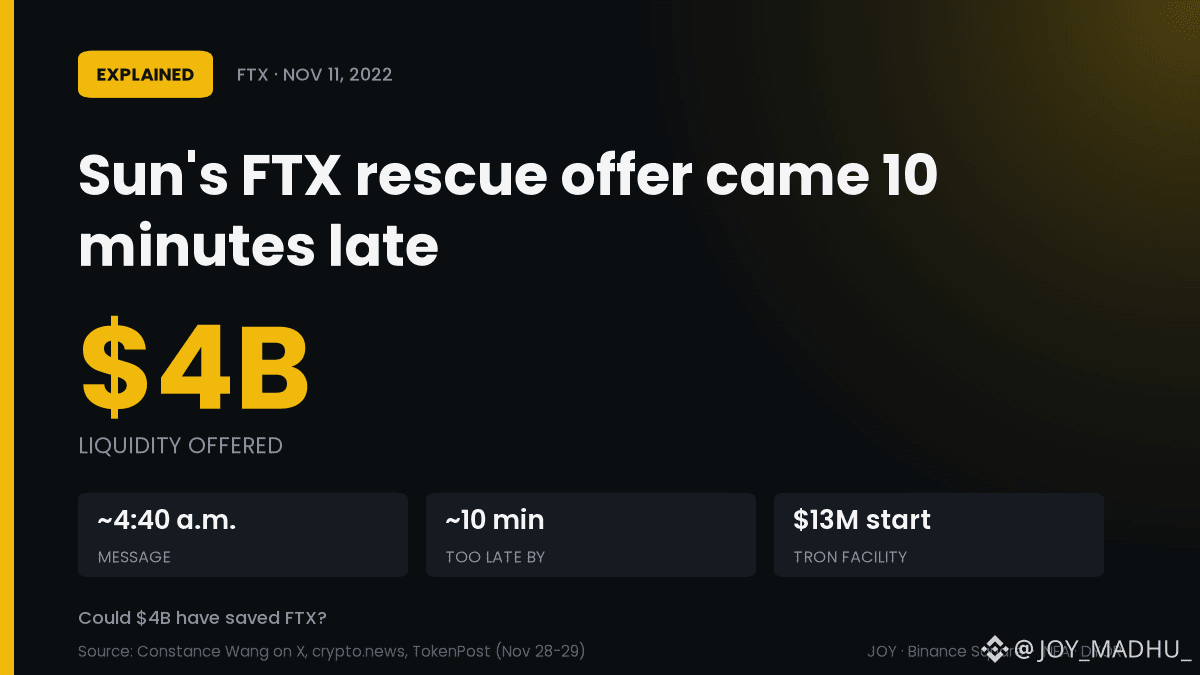
77
Log in to explore more content
Join global crypto users on Binance Square
⚡️ Get latest and useful information about crypto.
💬 Trusted by the world’s largest crypto exchange.
👍 Discover real insights from verified creators.
Email / Phone number
Trending Topics
1
#EvolveAtBinanceBlockchainWeek
3M views
22,954 Discussing
2
#SunReportedlyOffered4BToRescueFTX
43,366 views
399 Discussing
3
#XRPLAmendmentsEnterActivationWindow
39,615 views
347 Discussing
4
#OPECReportedlyKeepsOilQuotasUnchangedForQ1
27,015 views
325 Discussing
5
#IBSGovAccountMints1BTokensDrains5.71M
79,300 views
669 Discussing
6
#WorldLibertyActsToCutLiquidationRisk
119,015 views
871 Discussing
7
#LiquidHackerMoves598BTC
88,131 views
518 Discussing
8
#TrumpMediaCouldFace883.5MRepaymentDemand
49,791 views
217 Discussing
9
#BitcoinETFsExtendOutflowStreakToEightDays
163,861 views
1,120 Discussing
10
#CryptographersFormGroupForEncryptionBreak
3 views
5 Discussing