
#coldcard
coldcard
168,776 views
564 Discussing
Hot
Latest


Article
See translation
Coinkite COLDCARD postmortem: Yasmarang RNG, 1,778.84 BTC from 8,600+ addressesCoinkite COLDCARD postmortem: Yasmarang RNG, 1,778.84 $BTC from 8,600+ addresses
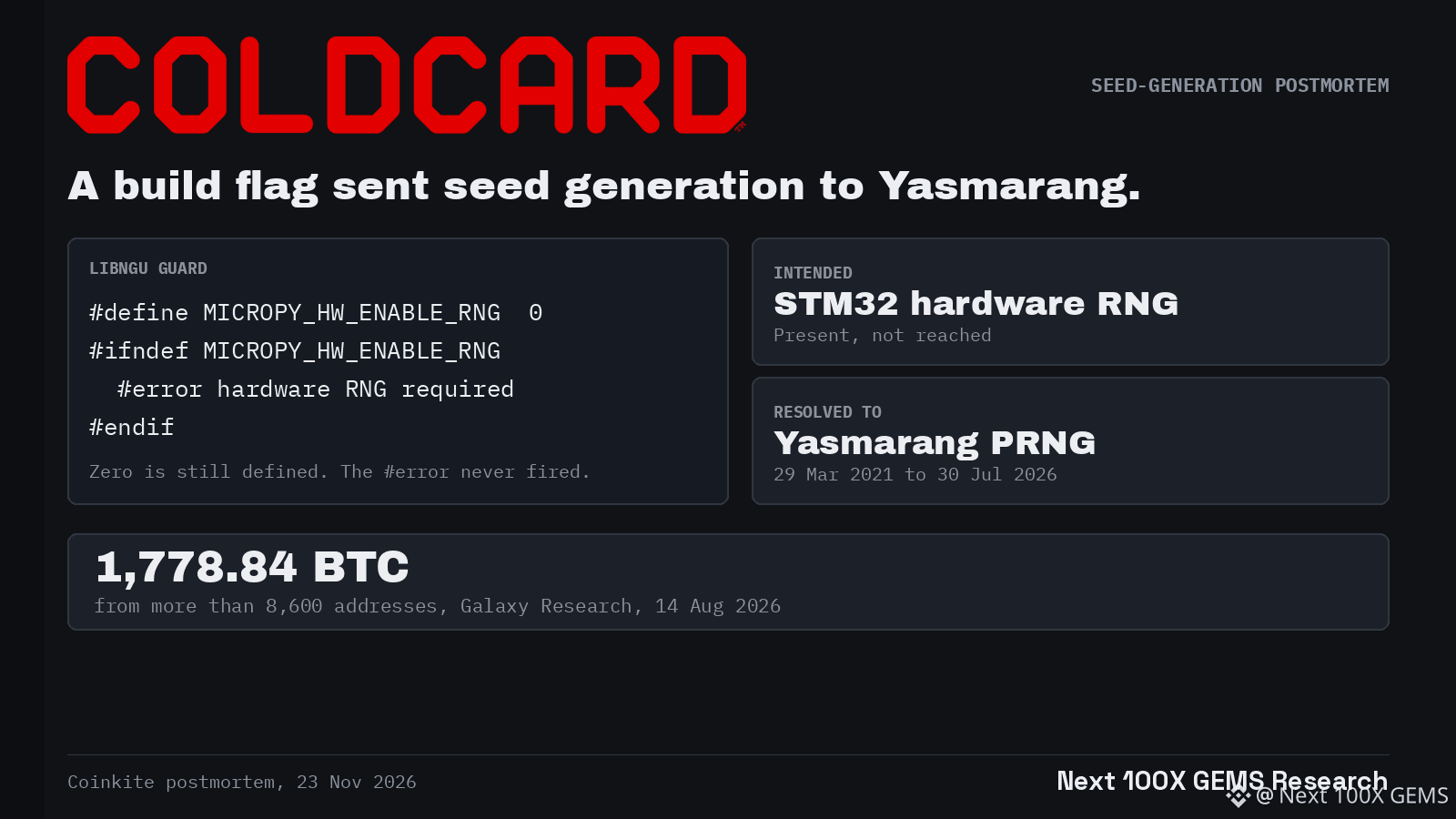
The thefts started on 29 July 2026. Nobody had to touch a COLDCARD. Attackers rebuilt private keys for seeds the devices had already made, then swept the coins. On 14 August 2026, Galaxy Research said it had confirmed, with high confidence and after speaking with 190 people who reported losses, that 1,778.84 BTC had been taken from more than 8,600 addresses. That count left out lower-confidence sets, including an unconfirmed "Wave 4." If those had been included, Galaxy's figure would have been 2,417.35 BTC.
Coinkite's postmortem, dated 23 November 2026, cites Galaxy's address count as 8,865 as of 24 August, and says no public total of users or losses across every wave has been established. As of 18 November, the company had 300 loss-related support tickets tied to 242 accounts, about 0.21% of its estimated user base, a share it says is likely low because not every victim files a ticket.
The devices were never entered. The seeds were weak.
A zero that counted as a yes
From 29 March 2021 through 30 July 2026, COLDCARD firmware generated wallet seeds with MicroPython's Yasmarang software pseudo-random number generator instead of the device's STM32 hardware random-number generator. That window is Coinkite's.
The design was supposed to have no software fallback. In March 2021, when seed generation moved through a library called libNgU, the firmware set MICROPY_HW_ENABLE_RNG to 0, meaning to switch the software path off. A guard in the pinned libNgU code used ifndef, which only asks whether the macro is defined, not whether its value is nonzero. Zero still counts as defined. The build passed. libNgU's rng_get() resolved to Yasmarang. The hardware generator sat in the binary and was never reached by seed generation. The device still produced well-formed seed words.
Coinkite calls this a COLDCARD integration defect, not a bug in libNgU itself, and not a runtime failure of the hardware RNG. Attackers did not need physical access. They regenerated keys offline.
Coinkite estimates the affected seeds had roughly 40 bits of effective entropy on Mk2 and Mk3, and roughly 72 bits on Mk4, Mk5 and Q, against a 128-bit security target. The 72-bit figure, the postmortem says, has not been independently established. Block's Bitcoin Engineering and Security teams, in a 30 July write-up, described a further constraint on the later models: boot mixed in secure-element entropy, then a reseed replaced only one 32-bit Yasmarang state word, leaving at most 2^32 securely distinguished output streams once the fallback state and call history were fixed. Hashing the output, both Coinkite and Block say, could not add entropy that was not there.
The ranges Coinkite published
The 23 November report lists the affected firmware by model and track, and the first fixed release for each. For Mk2 and Mk3, seeds generated on 4.0.1 through 4.1.9 are affected; the minimum fixed release is 4.2.0 or later. For Mk4 and Mk5 on the standard track, the affected range is any seed generated before 5.6.0, with 5.6.0 or later as the fix. On the Mk4 and Mk5 Edge track, the cut is before 6.6.0X, fixed in 6.6.0X or later. For Q on the standard track, the affected range is before 1.5.0Q, fixed in 1.5.0Q or later; on the Q Edge track, before 6.6.0QX, fixed in 6.6.0QX or later. Standard and Edge are separate tracks with independent version numbers. As of the report, the current standard releases were 5.6.3 and 1.5.3Q, and the current Edge releases were 6.6.2X and 6.6.2QX.
v4.0.0, which is visible in the source lineage, was not distributed as a signed public binary. The first signed public release in the series was 4.0.1, on 29 March 2021.
A seed generated on affected firmware stays affected after it is restored, imported, backed up or cloned. A seed that was securely generated outside that on-device flow was not weakened by later import into an affected device. Seeds made with at least 50 fair, independent, private dice rolls entered through Add Dice Rolls, with the sequence never recorded or exposed and the final post-roll words used, "were not weakened by the defect," the report says. A strong BIP-39 passphrase or a multisig setup, Coinkite says, added a barrier the weak seed did not; those layers do not repair the seed itself.
Coinkite identified the defect on 30 July and published fixed firmware for all supported tracks on 31 July. Keylabs, in a review published 15 October, concluded that, within its stated scope, the defect is fully closed in Mk5 5.6.3 and 5.6.2 and in Q 1.5.3Q and 1.5.2Q. Edge releases were outside that review.
Between 2021 and 2026, Coinkite documented at least 15 independent review and security-research efforts on COLDCARD hardware, firmware, entropy tooling and release controls, including two commissioned third-party product reviews. The scopes varied, and not all of the work examined seed generation. A 17 June 2026 review by Nick Farrow expressly included weak RNG in its scope, concluded the path was sound, and did not find the defect. No contemporaneous report, Coinkite says, identified and reproduced the build-integration error.
What Coinkite tells owners
The company points owners to sections 1.4 and 4.1 of the report, and to the Security Status page at coldcard.com/security/status, to check whether they are affected and what to do. A firmware update, it says, does not repair a seed generated on affected firmware.
If a seed was generated on affected firmware, Coinkite's user recommendations are to install verified fixed firmware, create a new seed, verify it and its backup, and move the funds, including from passphrase wallets. Never send seed words, passphrases, dice rolls, private keys, backup files or backup passwords to anyone, including Coinkite, or enter them into any website. Use only support routes linked from coldcard.com, and treat unsolicited recovery, migration or compensation offers as likely impersonation.
A recommendation to decide on and publish any compensation or assistance plan for affected customers remains open, with no decision recorded in the report.
TAPSIGNER, OPENDIME and SATSCARD, Coinkite has said, are not affected, because they use different codebases.
Sources
Coinkite, "COLDCARD Seed-Generation Incident Postmortem," 23 Nov 2026
Coinkite, "Our COLDCARD seed-generation postmortem is now public," 24 Nov 2026
Coinkite, "Technical Deep Dive into the Entropy Issue"
Block Engineering, "Predictable RNG Fallback and 32-Bit Reseed in COLDCARD Firmware," 30 Jul 2026
Galaxy Research, "Coldcard Exploit Abates as Total Losses Climb to (at Least) 1,700 BTC," 14 Aug 2026
Coinkite, "Adding to the Public Record on Our Ongoing Investigation"
#COLDCARD #Bitcoin
NFA. DYOR.
Coinkite COLDCARD postmortem: Yasmarang RNG, 1,778.84 BTC from 8,600+ addresses
Coinkite COLDCARD postmortem: Yasmarang RNG, 1,778.84 $BTC from 8,600+ addresses
The thefts started on 29 July 2026. Nobody had to touch a COLDCARD. Attackers rebuilt private keys for seeds the devices had already made, then swept the coins. On 14 August 2026, Galaxy Research said it had confirmed, with high confidence and after speaking with 190 people who reported losses, that 1,778.84 BTC had been taken from more than 8,600 addresses. That count left out lower-confidence sets, including an unconfirmed "Wave 4." If those had been included, Galaxy's figure would have been 2,417.35 BTC.
Coinkite's postmortem, dated 23 November 2026, cites Galaxy's address count as 8,865 as of 24 August, and says no public total of users or losses across every wave has been established. As of 18 November, the company had 300 loss-related support tickets tied to 242 accounts, about 0.21% of its estimated user base, a share it says is likely low because not every victim files a ticket.
The devices were never entered. The seeds were weak.
A zero that counted as a yes
From 29 March 2021 through 30 July 2026, COLDCARD firmware generated wallet seeds with MicroPython's Yasmarang software pseudo-random number generator instead of the device's STM32 hardware random-number generator. That window is Coinkite's.
The design was supposed to have no software fallback. In March 2021, when seed generation moved through a library called libNgU, the firmware set MICROPY_HW_ENABLE_RNG to 0, meaning to switch the software path off. A guard in the pinned libNgU code used ifndef, which only asks whether the macro is defined, not whether its value is nonzero. Zero still counts as defined. The build passed. libNgU's rng_get() resolved to Yasmarang. The hardware generator sat in the binary and was never reached by seed generation. The device still produced well-formed seed words.
Coinkite calls this a COLDCARD integration defect, not a bug in libNgU itself, and not a runtime failure of the hardware RNG. Attackers did not need physical access. They regenerated keys offline.
Coinkite estimates the affected seeds had roughly 40 bits of effective entropy on Mk2 and Mk3, and roughly 72 bits on Mk4, Mk5 and Q, against a 128-bit security target. The 72-bit figure, the postmortem says, has not been independently established. Block's Bitcoin Engineering and Security teams, in a 30 July write-up, described a further constraint on the later models: boot mixed in secure-element entropy, then a reseed replaced only one 32-bit Yasmarang state word, leaving at most 2^32 securely distinguished output streams once the fallback state and call history were fixed. Hashing the output, both Coinkite and Block say, could not add entropy that was not there.
The ranges Coinkite published
The 23 November report lists the affected firmware by model and track, and the first fixed release for each. For Mk2 and Mk3, seeds generated on 4.0.1 through 4.1.9 are affected; the minimum fixed release is 4.2.0 or later. For Mk4 and Mk5 on the standard track, the affected range is any seed generated before 5.6.0, with 5.6.0 or later as the fix. On the Mk4 and Mk5 Edge track, the cut is before 6.6.0X, fixed in 6.6.0X or later. For Q on the standard track, the affected range is before 1.5.0Q, fixed in 1.5.0Q or later; on the Q Edge track, before 6.6.0QX, fixed in 6.6.0QX or later. Standard and Edge are separate tracks with independent version numbers. As of the report, the current standard releases were 5.6.3 and 1.5.3Q, and the current Edge releases were 6.6.2X and 6.6.2QX.
v4.0.0, which is visible in the source lineage, was not distributed as a signed public binary. The first signed public release in the series was 4.0.1, on 29 March 2021.
A seed generated on affected firmware stays affected after it is restored, imported, backed up or cloned. A seed that was securely generated outside that on-device flow was not weakened by later import into an affected device. Seeds made with at least 50 fair, independent, private dice rolls entered through Add Dice Rolls, with the sequence never recorded or exposed and the final post-roll words used, "were not weakened by the defect," the report says. A strong BIP-39 passphrase or a multisig setup, Coinkite says, added a barrier the weak seed did not; those layers do not repair the seed itself.
Coinkite identified the defect on 30 July and published fixed firmware for all supported tracks on 31 July. Keylabs, in a review published 15 October, concluded that, within its stated scope, the defect is fully closed in Mk5 5.6.3 and 5.6.2 and in Q 1.5.3Q and 1.5.2Q. Edge releases were outside that review.
Between 2021 and 2026, Coinkite documented at least 15 independent review and security-research efforts on COLDCARD hardware, firmware, entropy tooling and release controls, including two commissioned third-party product reviews. The scopes varied, and not all of the work examined seed generation. A 17 June 2026 review by Nick Farrow expressly included weak RNG in its scope, concluded the path was sound, and did not find the defect. No contemporaneous report, Coinkite says, identified and reproduced the build-integration error.
What Coinkite tells owners
The company points owners to sections 1.4 and 4.1 of the report, and to the Security Status page at coldcard.com/security/status, to check whether they are affected and what to do. A firmware update, it says, does not repair a seed generated on affected firmware.
If a seed was generated on affected firmware, Coinkite's user recommendations are to install verified fixed firmware, create a new seed, verify it and its backup, and move the funds, including from passphrase wallets. Never send seed words, passphrases, dice rolls, private keys, backup files or backup passwords to anyone, including Coinkite, or enter them into any website. Use only support routes linked from coldcard.com, and treat unsolicited recovery, migration or compensation offers as likely impersonation.
A recommendation to decide on and publish any compensation or assistance plan for affected customers remains open, with no decision recorded in the report.
TAPSIGNER, OPENDIME and SATSCARD, Coinkite has said, are not affected, because they use different codebases.
Sources
Coinkite, "COLDCARD Seed-Generation Incident Postmortem," 23 Nov 2026
Coinkite, "Our COLDCARD seed-generation postmortem is now public," 24 Nov 2026
Coinkite, "Technical Deep Dive into the Entropy Issue"
Block Engineering, "Predictable RNG Fallback and 32-Bit Reseed in COLDCARD Firmware," 30 Jul 2026
Galaxy Research, "Coldcard Exploit Abates as Total Losses Climb to (at Least) 1,700 BTC," 14 Aug 2026
Coinkite, "Adding to the Public Record on Our Ongoing Investigation"
#COLDCARD #Bitcoin
NFA. DYOR.
119

·
--
See translation
Your hardware wallet's seed phrase was supposed to be unguessable. For five years, Coldcard's wasn't — and that flaw cost users $100 million in $BTC.
On November 23, Coinkite published an 18-page postmortem on the Coldcard seed-generation flaw. A firmware change in March 2021 disabled the hardware random number generator: the code checked whether a config flag was defined, not whether it was enabled. Seeds fell back to a weak software generator, leaving Mk2 and Mk3 devices with roughly 40 bits of effective entropy.
Galaxy Research tracked at least 1,778.84 BTC stolen from more than 8,600 addresses, worth about $107 million — the first sweep alone drained 1,082.65 BTC from 1,196 addresses in 41 minutes on July 30. The flaw survived at least 15 independent security reviews over five years. Coinkite patched it on July 31, but updating firmware does not fix seeds already generated — affected users must create a fresh seed and move their coins.
The open question is liability: around 300 loss tickets filed, no compensation decision announced.
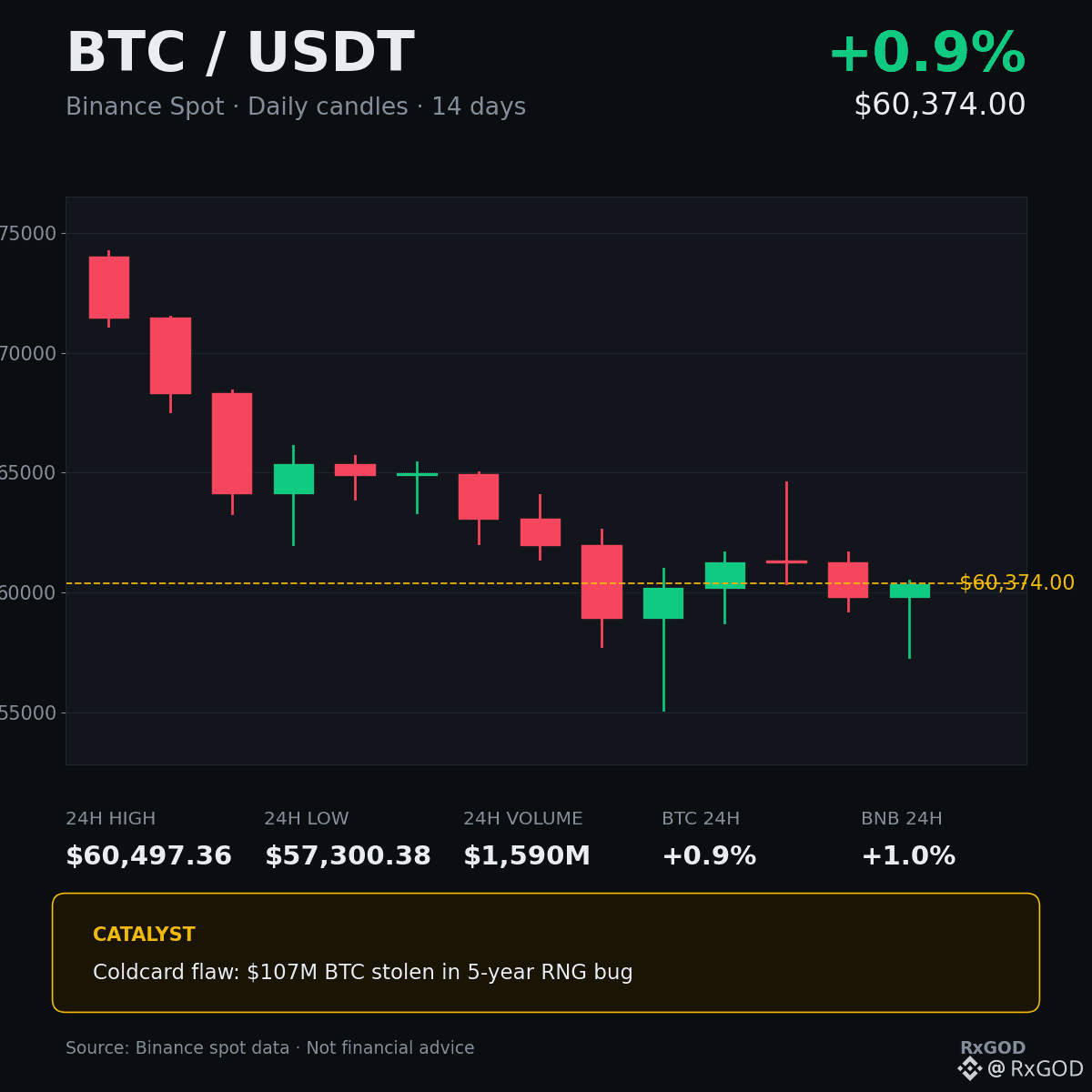
$BTC trades at $60,374, up 0.93% in 24 hours and near the top of its $57,300–$60,497 range, though down 15.5% over 14 days with Fear & Greed at 9 — Extreme Fear.
Coldcard owners: check your firmware version today. Would you move your coins immediately if your seed came from affected firmware — or trust the patch and stay put? And should the maker pay when its own bug costs users $107 million?
Not financial advice — DYOR.
#Coldcard #Bitcoin #CryptoNews #ExtremeFear
Your hardware wallet's seed phrase was supposed to be unguessable. For five years, Coldcard's wasn't — and that flaw cost users $100 million in $BTC .
On November 23, Coinkite published an 18-page postmortem on the Coldcard seed-generation flaw. A firmware change in March 2021 disabled the hardware random number generator: the code checked whether a config flag was defined, not whether it was enabled. Seeds fell back to a weak software generator, leaving Mk2 and Mk3 devices with roughly 40 bits of effective entropy.
Galaxy Research tracked at least 1,778.84 BTC stolen from more than 8,600 addresses, worth about $107 million — the first sweep alone drained 1,082.65 BTC from 1,196 addresses in 41 minutes on July 30. The flaw survived at least 15 independent security reviews over five years. Coinkite patched it on July 31, but updating firmware does not fix seeds already generated — affected users must create a fresh seed and move their coins.
The open question is liability: around 300 loss tickets filed, no compensation decision announced.
$BTC trades at $60,374, up 0.93% in 24 hours and near the top of its $57,300–$60,497 range, though down 15.5% over 14 days with Fear & Greed at 9 — Extreme Fear.
Coldcard owners: check your firmware version today. Would you move your coins immediately if your seed came from affected firmware — or trust the patch and stay put? And should the maker pay when its own bug costs users $107 million?
Not financial advice — DYOR.
#Coldcard #Bitcoin #CryptoNews #ExtremeFear
2
·
--
See translation
The wallet that was supposed to be unhackable just admitted it wasn't.
Coinkite, maker of the Coldcard hardware wallet, published a postmortem on November 23 explaining how a seed-phrase flaw went undetected for more than five years — despite at least 15 independent security reviews. The checks confirmed the wallet had the right system for generating recovery phrases. They never verified the device was actually using it. A software bug fell back to a weaker system, making phrases easier to guess.
Galaxy Research reported in August that attackers stole at least 1,789 $BTC — around $114.7 million at the time. As of November 18, Coinkite had received about 300 loss-related support tickets tied to 242 accounts, and says the real victim count is likely higher. The flaw was patched on July 31, but a firmware update cannot fix phrases already generated — affected users must create new phrases and move their funds. No compensation plan has been decided, and investigators don't know who did it.
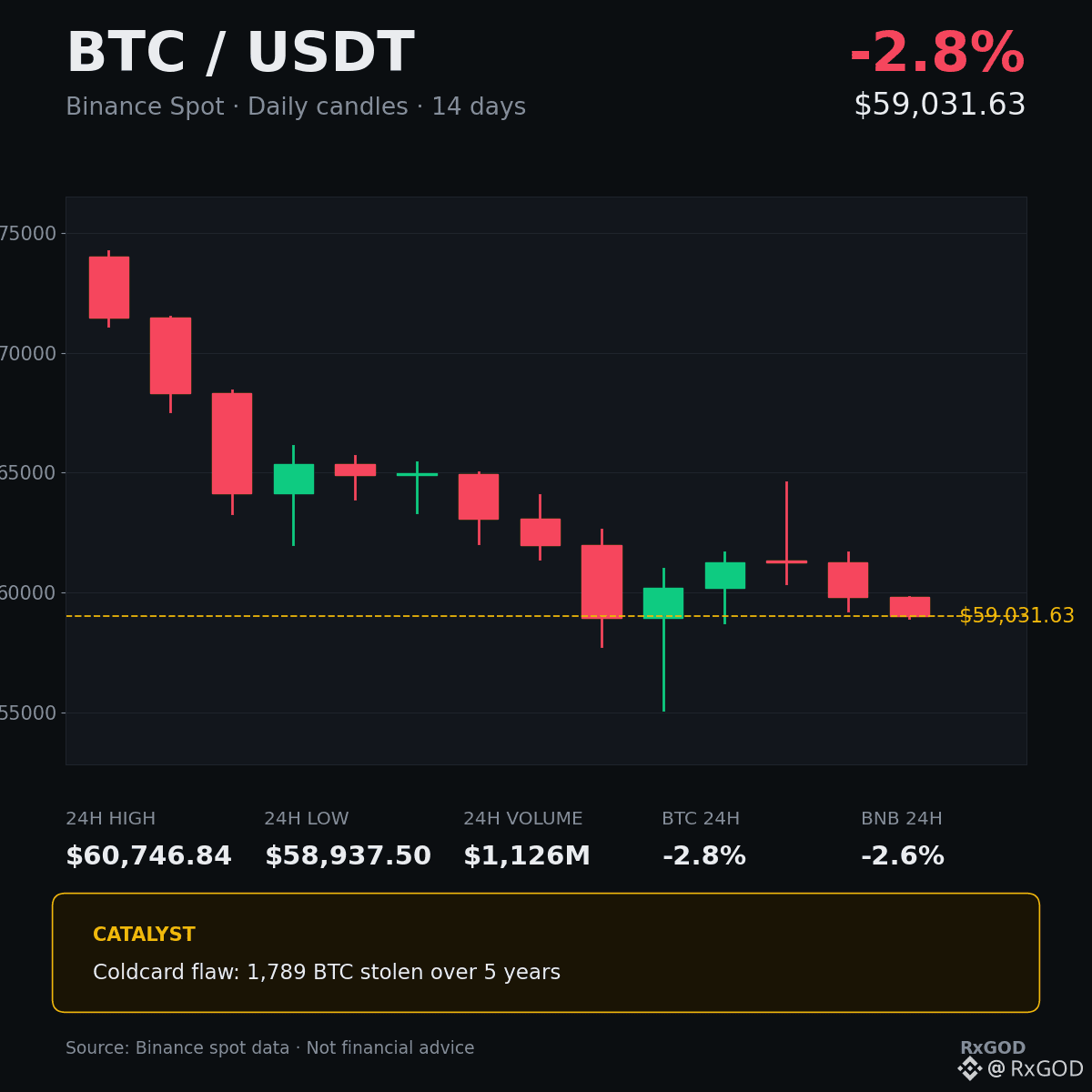
The timing stings. $BTC trades at $59,032, down 2.8% in 24 hours and 17.4% over 14 days, in the bottom fifth of its $55,130–$74,217 range, with Fear & Greed at 8 (Extreme Fear). A self-custody scandal is the last thing this market needed.
The uncomfortable question: if 15 audits couldn't catch this, is cold storage still the gold standard? Would you still trust a hardware wallet with your life savings — or has this changed how you store your crypto?
Not financial advice — DYOR.
#ExtremeFear #CryptoNews #Bitcoin #Coldcard
4

·
--
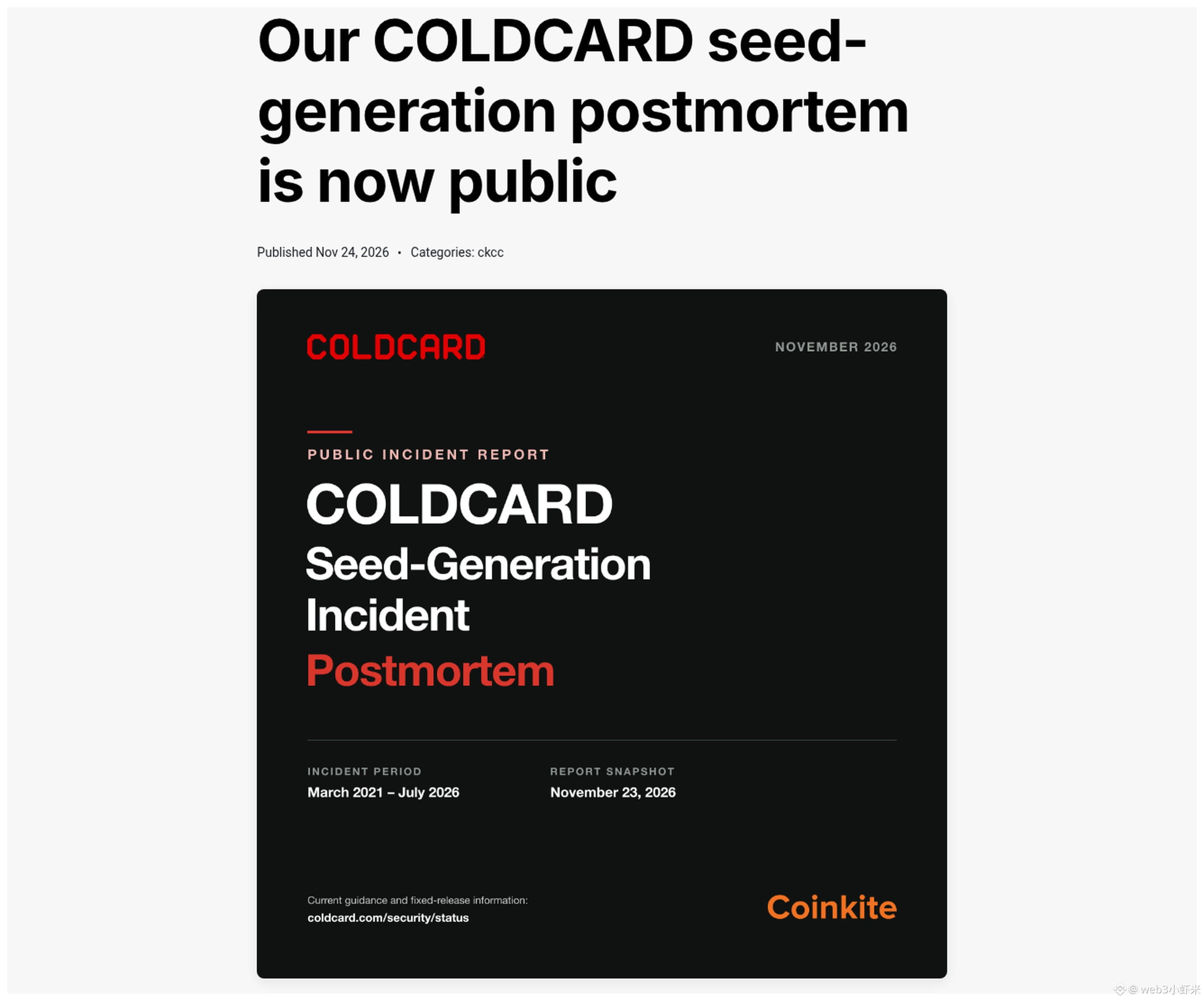
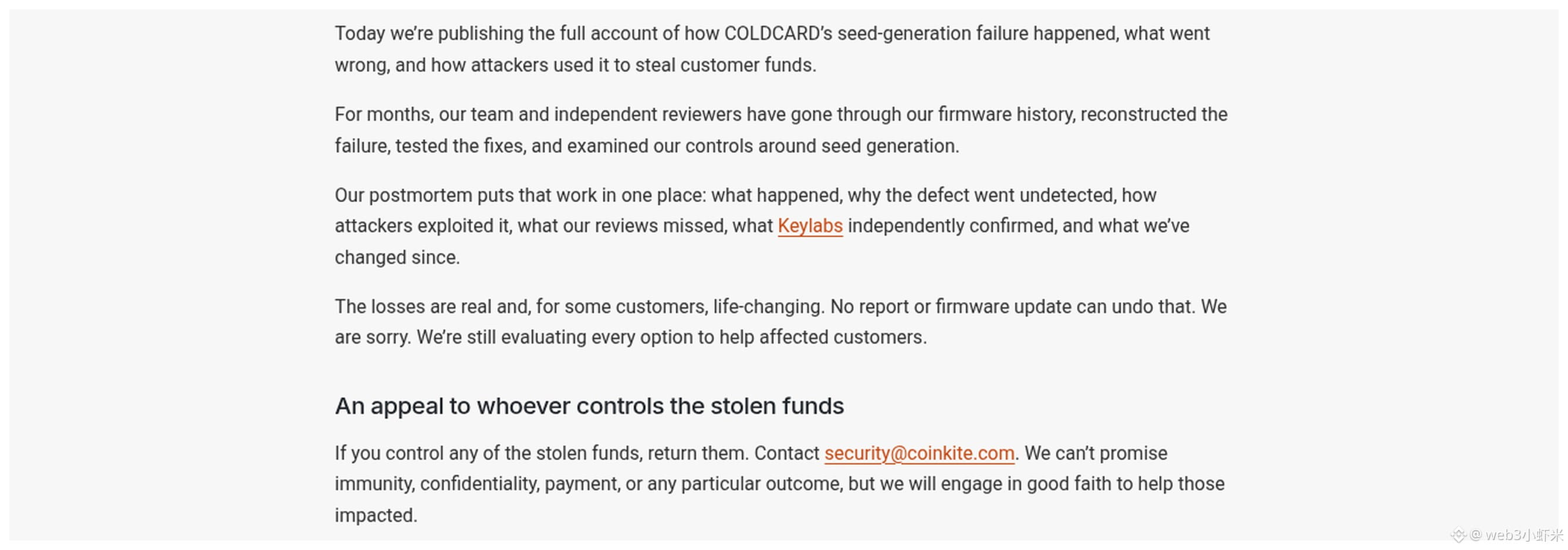
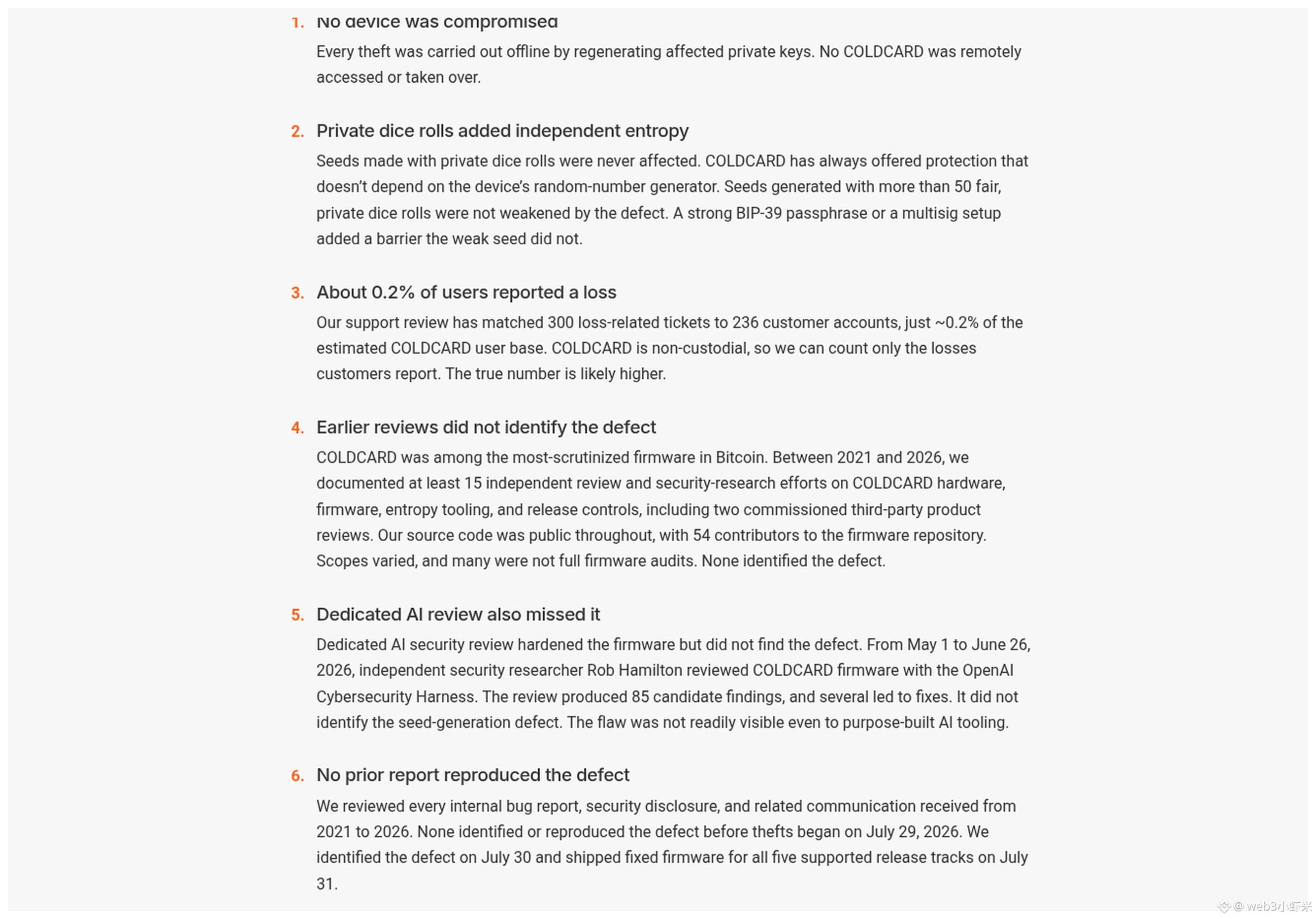
I just saw that Coinkite published a full postmortem on November 24 about the COLDCARD seed-generation issue. The company says that from March 2021 through this July, the firmware used software-based pseudorandom numbers to generate seeds instead of the device’s hardware random number generator. An attacker could calculate the affected private keys offline and move the funds; the device itself was not remotely compromised.
They identified about 300 loss-related support tickets associated with 236 customer accounts, roughly 0.2% of estimated users, and said the actual number may be higher. The company located the issue on July 30 and released patched firmware for all five supported version lines on July 31. But they made it very clear: upgrading the firmware will not fix seeds generated on affected versions.
Seeds generated with entropy from more than 50 independent, private dice rolls are not affected. If you have this hardware wallet, check the report and security status page directly on the official website. Don’t send your recovery phrase, private keys, or backups to anyone.
#COLDCARD #Security

50

·
--
See translation
If you set up a COLDCARD between March 2021 and July 2026, read this today. 🔐
Coinkite has published its postmortem on the seed flaw:
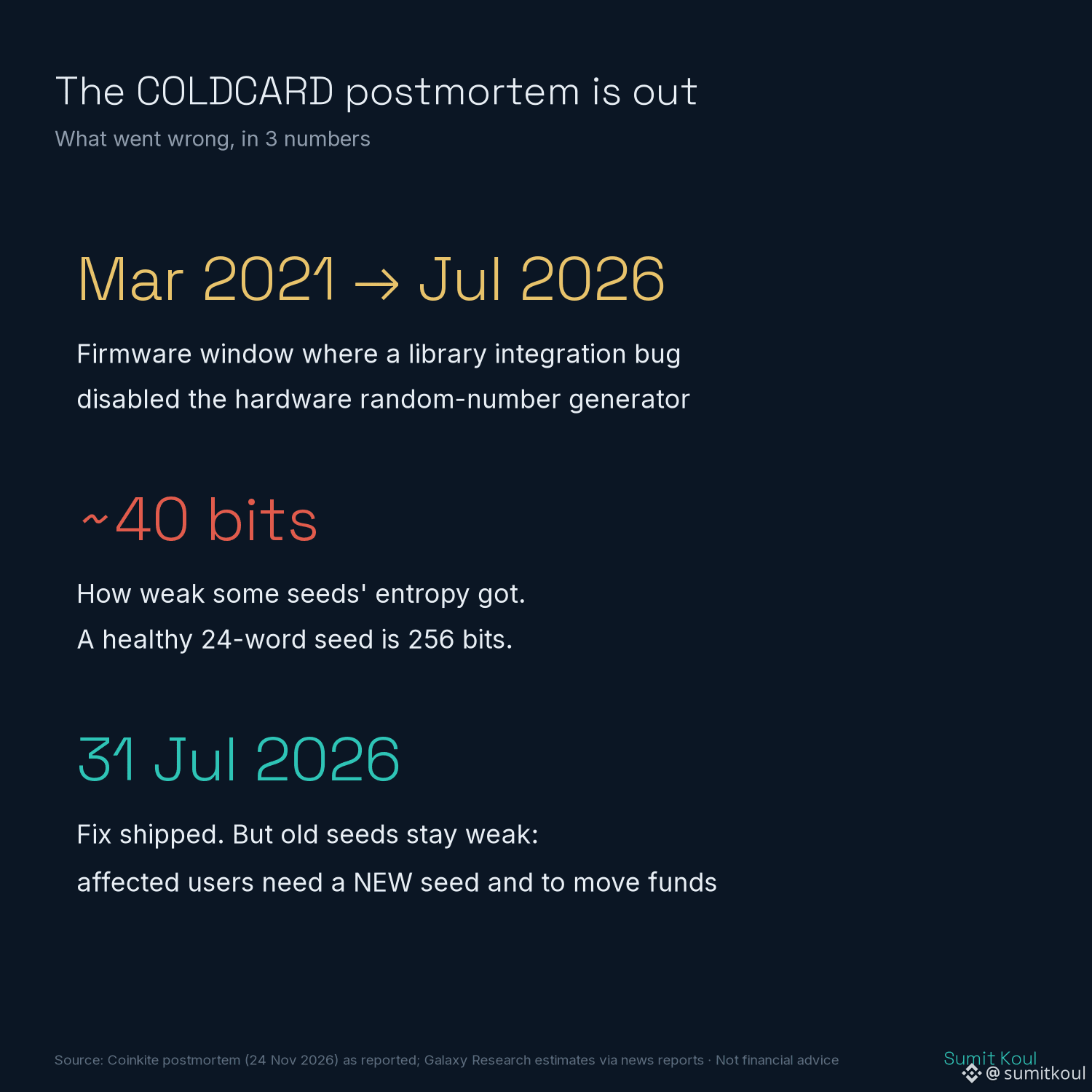
• A library integration bug disabled the hardware random-number generator
• Some seeds ended up with as little as ~40 bits of entropy. A healthy 24-word seed has 256
• That made affected seeds crackable offline, without anyone touching the device
• A fix shipped on 31 July 2026
The part people miss: updating firmware does NOT fix an old seed.
If your seed was generated on affected firmware:
1. Update to current official firmware
2. Generate a brand-new seed (dice rolls help add your own entropy)
3. Move funds to the new wallet
4. Never type a seed into a website or "recovery service"
Know someone who uses a COLDCARD? Tag them or share this. It could save their stack. 👇
Follow me for security alerts that actually matter.
#COLDCARD #CryptoSecurity #Bitcoin
Not financial advice.

·
--
See translation
🔐 Coldcard Postmortem: 5-Year Seed Flaw Behind $107M Bitcoin Theft
📌 What happened
Coinkite published an 18-page postmortem on Nov 23 on the Coldcard seed-generation flaw that let thieves drain Bitcoin from customer wallets starting in July. A firmware setting switched off the hardware random number generator, so seeds fell back to a predictable software generator — and the defect survived at least 15 security reviews over five years.
📊 Key numbers
• 1,778.84 BTC stolen from 8,600+ addresses — ~$107M at current prices
• Flaw shipped in firmware from Mar 29, 2021 to Jul 30, 2026
• Effective seed entropy: ~40 bits (Mk2/Mk3) and ~72 bits (Mk4/Mk5/Q) vs 128 intended
• Thefts began Jul 29; fixed firmware shipped Jul 31
• ~300 loss tickets from 242 accounts as of Nov 18
• Compensation: "open; no decision" — Coinkite has not committed to reimburse victims
🔍 Why it matters
Coldcard is one of the most trusted names in Bitcoin self-custody, and this is a trust shock for the whole hardware-wallet sector: a single config error — a check that tested whether a setting was defined rather than enabled — silently weakened seeds for five years while reviewers confirmed the secure component existed without testing whether the code path reached it. It lands as BTC trades below $60,000, and the unanswered compensation question plus a September class-action filing keep the fallout live.
👀 What to watch
• Whether Coinkite announces a compensation plan
• The class-action case in Ontario and any further legal moves
• Whether other wallet makers publish RNG audits in response
• Any movement of the stolen 1,778.84 BTC
Not financial advice. Source: Coinkite postmortem / Bitcoin Magazine / CoinStats, Nov 24.
$BTC #Bitcoin #Coldcard #Security
81


·
--
See translation
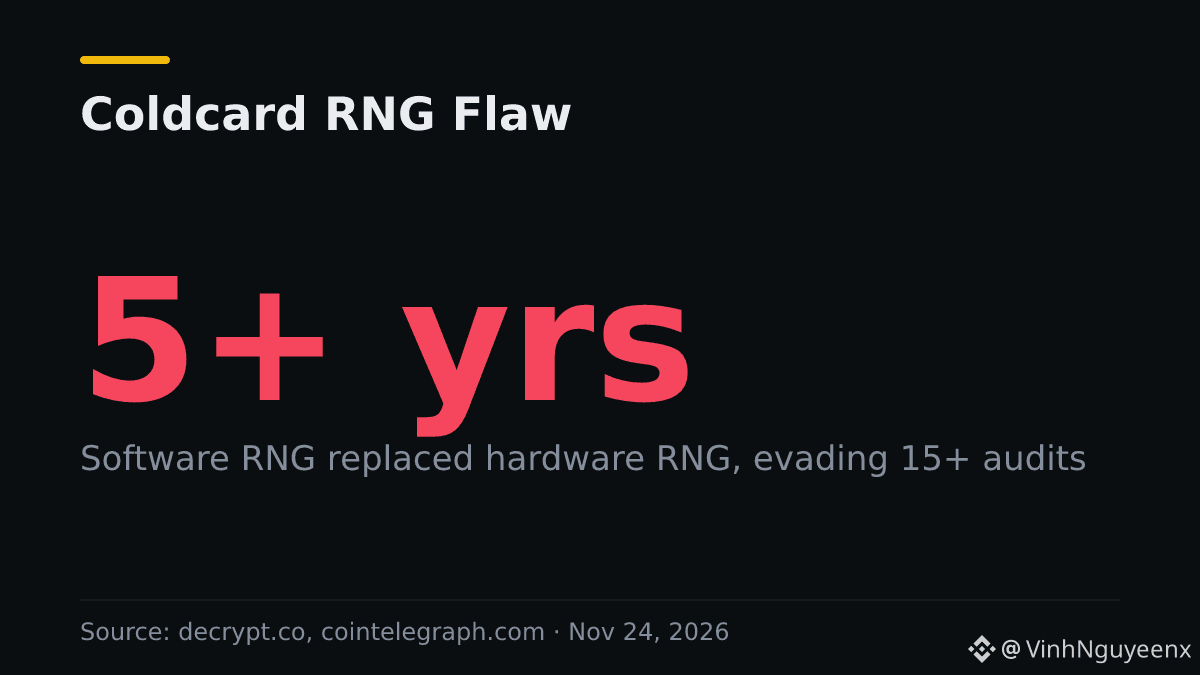
A hidden RNG flaw let Coldcard wallets evade detection for more than five years.
• Coinkite’s post‑mortem shows a software RNG replaced the hardware one for over five years (decrypt.co)
• Cointelegraph reports the flaw survived at least 15 security reviews before being disclosed (cointelegraph.com)
The incident highlights how even rigorous audits can miss subtle software swaps, urging hardware wallet makers to tighten supply‑chain checks.
What’s your top priority after this reveal?
A) Strengthen hardware audits
B) Rely on multi‑signature wallets
C) Switch to alternative wallets
$BTC #Coldcard #Security 🔐
⚠️ Not financial advice. DYOR.
50

·
--
See translation
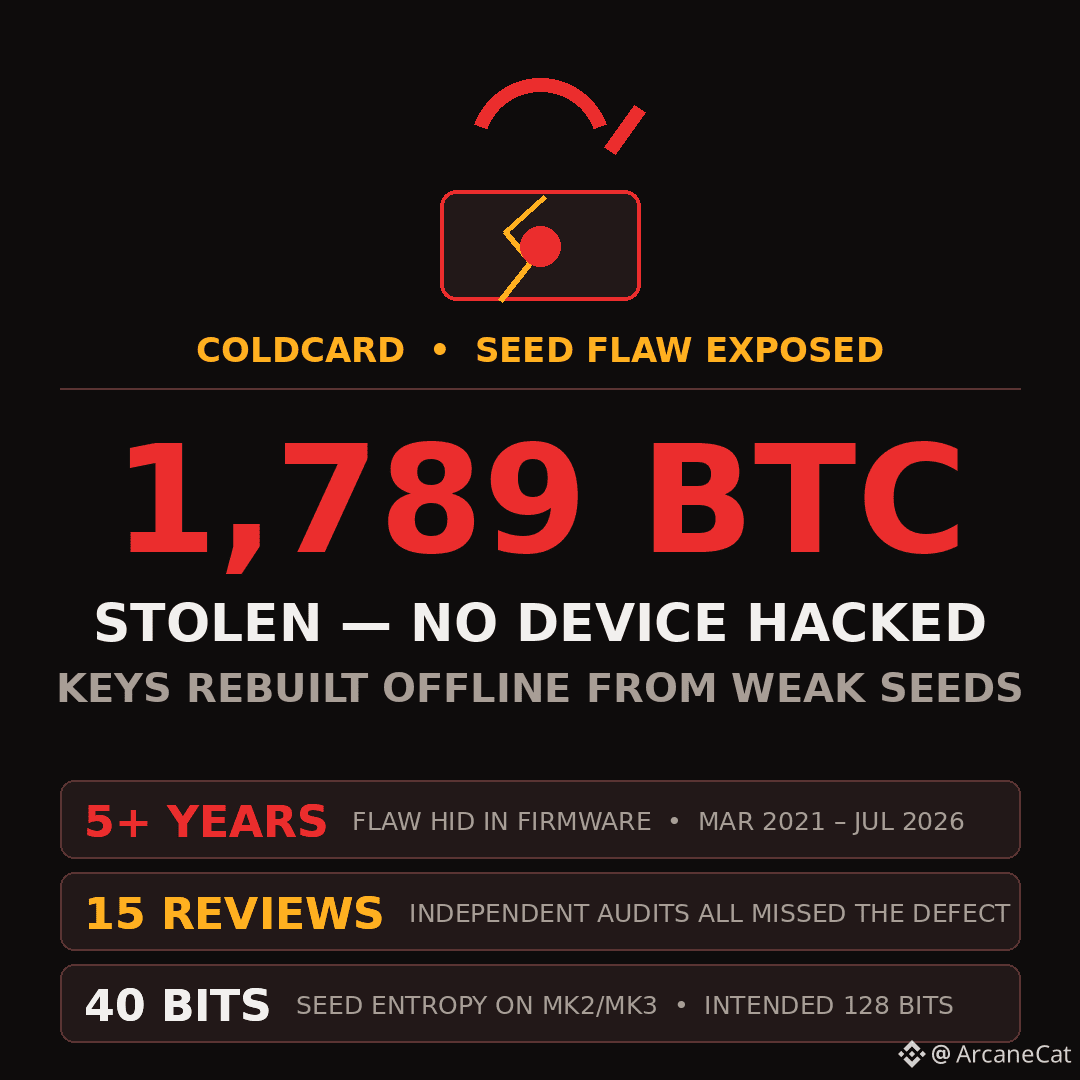
🚨 1,789 BTC STOLEN — 15 SECURITY AUDITS MISSED THE FLAW
Coinkite's Nov 23 postmortem is out: a Coldcard firmware bug ran undetected for 5+ years (Mar 2021–Jul 2026), silently swapping the hardware random-number generator for a predictable software one.
Seeds carried just 40–72 bits of entropy instead of 128 — attackers rebuilt private keys offline and drained 1,778.84 BTC from 8,600+ addresses, ~$107M. No device was hacked.
Thefts began Jul 29. Fixed Jul 31. The thief is still unknown.
Coldcard owners: update to the fixed firmware now.
#Bitcoin #BTC #Coldcard #Security
Not financial advice.
13

·
--
See translation
🔓 Coldcard explains how a Bitcoin wallet flaw went unnoticed for 5+ years
In a Nov. 23 postmortem, Coldcard maker Coinkite said its security checks confirmed the devices had a proper system for generating recovery phrases but never verified they were actually using it. A software bug made the wallets fall back to a weaker method, leaving seed phrases easier to guess.
At least 15 independent reviews missed the issue, and attackers drained at least 1,789 BTC, worth about $114.7 million at the time. As of Nov. 18, Coinkite had about 300 loss-related tickets tied to 242 accounts and has not yet decided on compensation.
⭐ Even hardware wallets can fail silently: affected users are urged to create new recovery phrases and move funds to new wallets.
#Bitcoin #Security #HardwareWallet #Coldcard
42

·
--
See translation
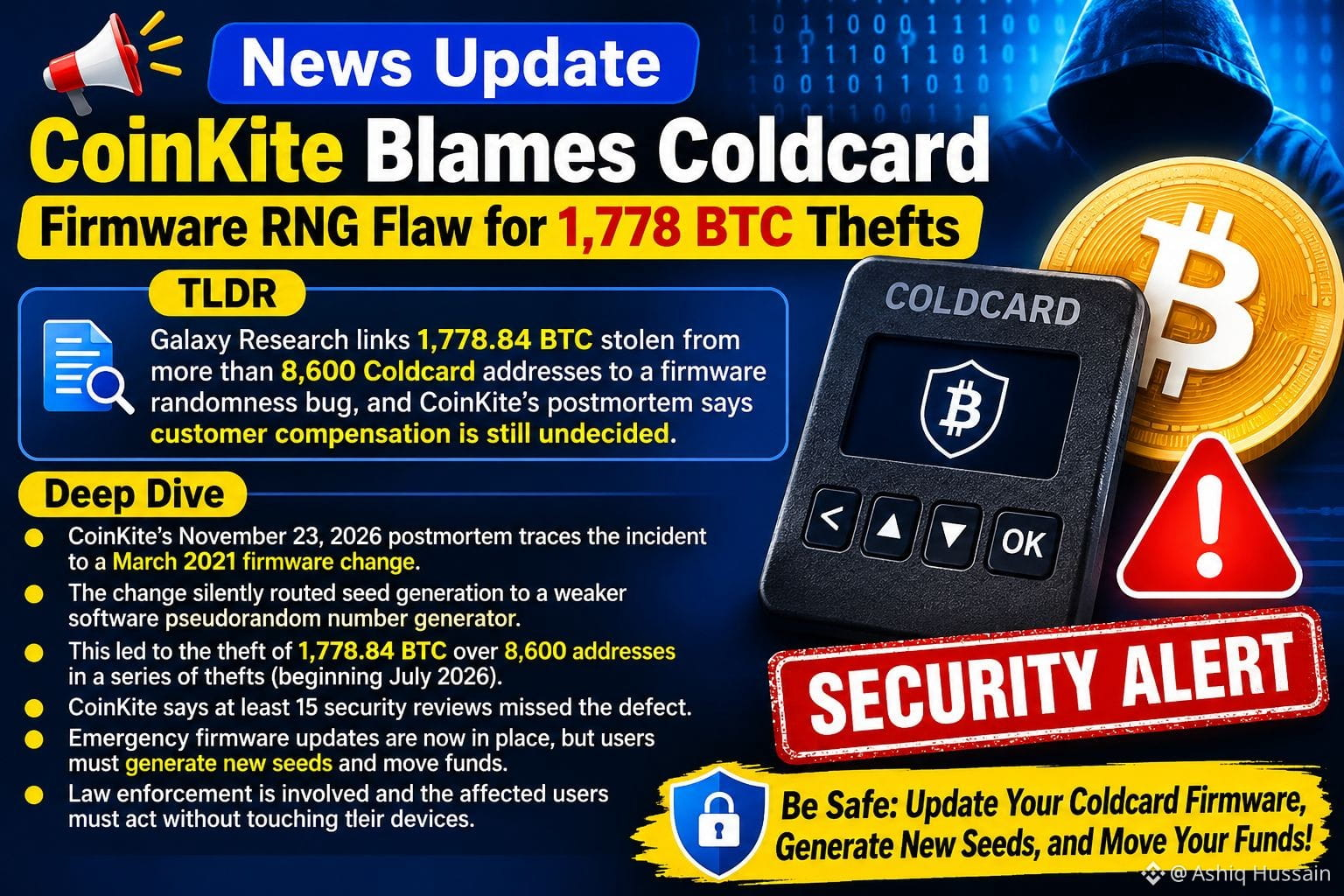
$BTC 🚨 MASSIVE BITCOIN SECURITY BREACH!
A major security incident has reportedly exposed a serious vulnerability in Coldcard hardware wallets.
According to the report:
🔴 1,778.84 BTC reportedly stolen
🔴 More than 8,600 Bitcoin addresses affected
🔴 A firmware randomness flaw weakened wallet seed generation
🔴 Attackers allegedly reconstructed private keys offline
🔴 Customer compensation remains undecided
The reported vulnerability was linked to a firmware change dating back to March 2021. Emergency firmware updates have been released, but affected users may need to generate entirely new seed phrases and move their funds.
⚠️ IMPORTANT SECURITY REMINDER:
Never share your recovery phrase with anyone. Keep your wallet software updated and follow official security guidance.
💬 Could this incident change the way people trust hardware wallets?
$BTC
{spot}(BTCUSDT)
#BTC #CryptoSecurity #Coldcard #Blockchain #CryptoNews
$BTC 🚨 MASSIVE BITCOIN SECURITY BREACH!
A major security incident has reportedly exposed a serious vulnerability in Coldcard hardware wallets.
According to the report:
🔴 1,778.84 BTC reportedly stolen
🔴 More than 8,600 Bitcoin addresses affected
🔴 A firmware randomness flaw weakened wallet seed generation
🔴 Attackers allegedly reconstructed private keys offline
🔴 Customer compensation remains undecided
The reported vulnerability was linked to a firmware change dating back to March 2021. Emergency firmware updates have been released, but affected users may need to generate entirely new seed phrases and move their funds.
⚠️ IMPORTANT SECURITY REMINDER:
Never share your recovery phrase with anyone. Keep your wallet software updated and follow official security guidance.
💬 Could this incident change the way people trust hardware wallets?
$BTC
#BTC #CryptoSecurity #Coldcard #Blockchain #CryptoNews
65

·
--
1,780 BTC stolen: Coldcard postmortem reveals “fake randomness” missed by 15 auditsA random number that “looked random” turned a hardware wallet into an ATM.
On November 23, Coinkite published an 18-page postmortem: from March 2021 to July 2026, Coldcard did not call the hardware random number generator when generating seed phrases, causing seeds to fall back to software pseudorandom numbers. Of the 128 bits of entropy, Mk2/Mk3 had only about 40 bits, while newer models had about 72 bits.
Attackers don’t need to touch the device: they can brute-force seeds offline, compare them against on-chain addresses, and get the private key if they find a match. Galaxy Research estimates that around 1,778 $BTC were transferred from more than 8,600 addresses between late July and early August, worth approximately $107 million.
1,780 BTC stolen: Coldcard postmortem reveals “fake randomness” missed by 15 audits
A random number that “looked random” turned a hardware wallet into an ATM.
On November 23, Coinkite published an 18-page postmortem: from March 2021 to July 2026, Coldcard did not call the hardware random number generator when generating seed phrases, causing seeds to fall back to software pseudorandom numbers. Of the 128 bits of entropy, Mk2/Mk3 had only about 40 bits, while newer models had about 72 bits.
Attackers don’t need to touch the device: they can brute-force seeds offline, compare them against on-chain addresses, and get the private key if they find a match. Galaxy Research estimates that around 1,778 $BTC were transferred from more than 8,600 addresses between late July and early August, worth approximately $107 million.
1.4k

·
--
Coldcard vulnerability lay dormant for 5 years: 1,789 BTC stolen—can $58,600 cover it?Coinkite has published a postmortem on the Coldcard security incident: a seed-generation vulnerability remained undetected for more than five years. At least 15 independent security reviews and research efforts failed to uncover it, because the recovery phrase looked normal and could pass partial checks. The vulnerability allowed hackers to steal at least 1,789 BTC, worth about $114.7 million at the time (Cointelegraph, November 25).
The company said the vulnerability was fixed on July 31, with additional security measures added in August. As of November 18, it had received about 300 loss reports related to 242 accounts; the actual number of victims may be higher. A compensation plan has yet to be determined, and law enforcement agencies are investigating. Old recovery phrases do not become safe automatically after a software update.
Coldcard vulnerability lay dormant for 5 years: 1,789 BTC stolen—can $58,600 cover it?
Coinkite has published a postmortem on the Coldcard security incident: a seed-generation vulnerability remained undetected for more than five years. At least 15 independent security reviews and research efforts failed to uncover it, because the recovery phrase looked normal and could pass partial checks. The vulnerability allowed hackers to steal at least 1,789 BTC, worth about $114.7 million at the time (Cointelegraph, November 25).
The company said the vulnerability was fixed on July 31, with additional security measures added in August. As of November 18, it had received about 300 loss reports related to 242 accounts; the actual number of victims may be higher. A compensation plan has yet to be determined, and law enforcement agencies are investigating. Old recovery phrases do not become safe automatically after a software update.
The company said the vulnerability was fixed on July 31, with additional security measures added in August. As of November 18, it had received about 300 loss reports related to 242 accounts; the actual number of victims may be higher. A compensation plan has yet to be determined, and law enforcement agencies are investigating. Old recovery phrases do not become safe automatically after a software update.
58

·
--

Article
The hardware wallet isn’t broken, but its seed phrase can still be calculatedThe hardware wallet isn’t broken, but its seed phrase can still be calculated
On November 23, Coinkite published an 18-page incident report about a flaw in its Coldcard hardware wallet that had gone unnoticed for more than five years. Seed phrases generated during the 1,949 days from March 29, 2021, to July 30, 2026, relied on a generic software pseudorandom number generator. The chip’s hardware random number generator was always there, but it wasn’t being used. A configuration setting had disabled the hardware random number generator, and the check meant to catch this only checked whether the setting existed—not whether it was enabled.
The seed phrase looks completely normal: all 24 words are there, and the device has never been damaged. The only problem is insufficient randomness. Seed phrases generated by older Mk2 and Mk3 models had only about 40 bits of effective entropy; newer Mk4, Mk5, and Q models had about 72 bits, when they should have had 128. With insufficient entropy, the private key can be calculated offline—without touching your device or asking you to click any links.
The hardware wallet isn’t broken, but its seed phrase can still be calculated
The hardware wallet isn’t broken, but its seed phrase can still be calculated
On November 23, Coinkite published an 18-page incident report about a flaw in its Coldcard hardware wallet that had gone unnoticed for more than five years. Seed phrases generated during the 1,949 days from March 29, 2021, to July 30, 2026, relied on a generic software pseudorandom number generator. The chip’s hardware random number generator was always there, but it wasn’t being used. A configuration setting had disabled the hardware random number generator, and the check meant to catch this only checked whether the setting existed—not whether it was enabled.
The seed phrase looks completely normal: all 24 words are there, and the device has never been damaged. The only problem is insufficient randomness. Seed phrases generated by older Mk2 and Mk3 models had only about 40 bits of effective entropy; newer Mk4, Mk5, and Q models had about 72 bits, when they should have had 128. With insufficient entropy, the private key can be calculated offline—without touching your device or asking you to click any links.
7

·
--
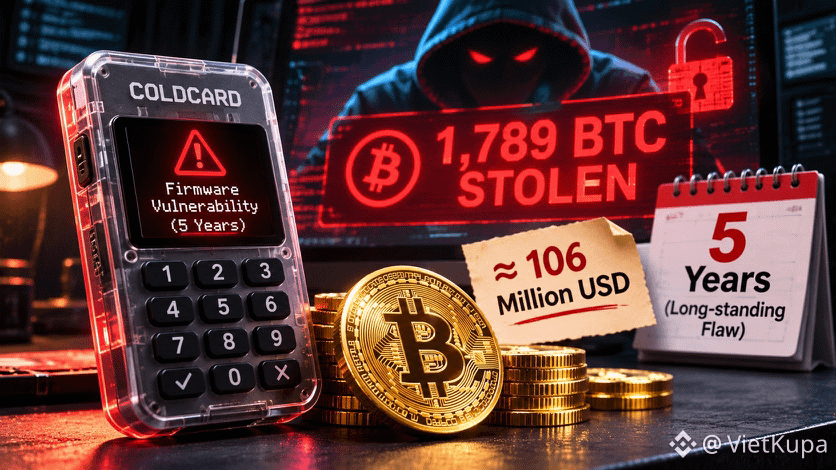
1,789 BTC STOLEN: ARE COLD WALLETS REALLY COMPLETELY SAFE?
Many people buy hardware wallets because they believe that moving their private keys offline will keep their assets safe.
But an incident involving Coldcard has just reminded us that wallet security isn’t that simple.
1. Notable figures
According to the market report dated 25/11/2026:
- A firmware vulnerability in Coldcard is believed to have existed for 5 years.
- 1,789 BTC were stolen.
- The estimated value was around $106 million.
What’s concerning isn’t just the amount of Bitcoin lost, but also how long the vulnerability went undetected.
2. Why are cold wallets still at risk?
Cold wallets help reduce the risk of private keys being stolen in online attacks.
But hardware devices still depend on firmware, transaction-signing processes, and how users safeguard their devices.
Put simply: cold wallets provide greater protection, but they don’t create an absolute shield.
3. My perspective
In Web3, we often spend a lot of time looking for the best wallet, but sometimes forget to check how we use it.
An expensive wallet can’t replace good security habits.
I think users should:
- Only download firmware from official channels.
- Check for security notices and updates from the manufacturer.
- Never enter your seed phrase on websites or apps from unknown sources.
- Never sign a transaction without understanding what it does.
Taking custody of your own assets means taking responsibility for their security.
Do you use a hot wallet or a cold wallet to store your assets long term? And when was the last time you checked your firmware?
#bitcoin #Coldcard
JMH_CRYPTO:
great info
1
1
379

·
--
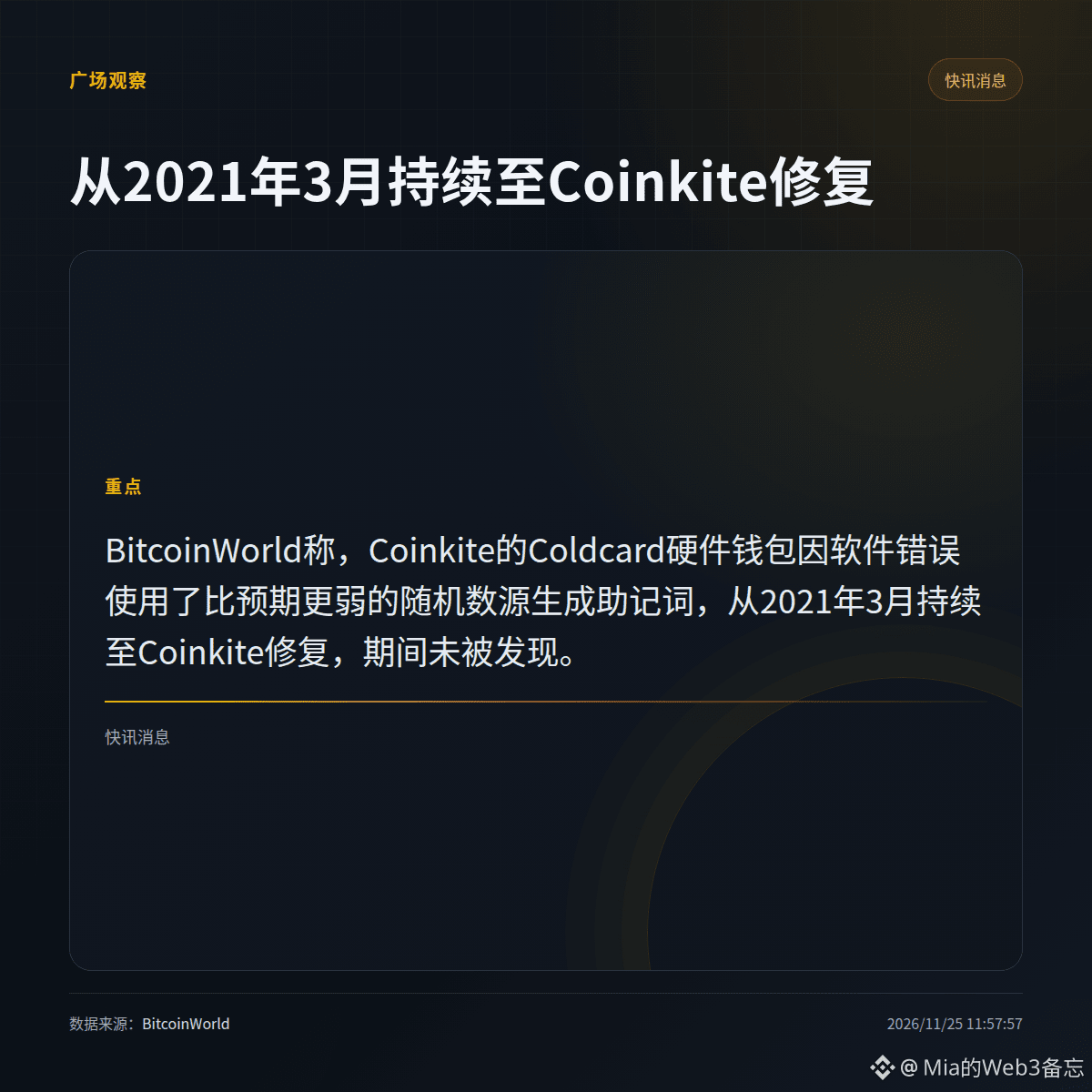
Coldcard had a software bug that caused the hardware wallet to use a weaker-than-designed source of randomness when generating recovery phrases. The issue persisted from March 2021 until Coinkite patched it. The key term here is “source of randomness”: the unpredictability of a mnemonic phrase depends entirely on it, so a weaker source changes everything. What has been confirmed is that the bug existed and persisted for years; it has also been reported that it evaded 15 audits, though that claim comes from BitcoinWorld. For ordinary users, the main concern isn’t market trends, but whether their device’s firmware is patched and whether their recovery phrase was generated under weak randomness. $BTC #Coldcard. For short-term moves, don’t focus on a single statement—trading volume and price ranges tell you more.
Coldcard had a software bug that caused the hardware wallet to use a weaker-than-designed source of randomness when generating recovery phrases. The issue persisted from March 2021 until Coinkite patched it. The key term here is “source of randomness”: the unpredictability of a mnemonic phrase depends entirely on it, so a weaker source changes everything. What has been confirmed is that the bug existed and persisted for years; it has also been reported that it evaded 15 audits, though that claim comes from BitcoinWorld. For ordinary users, the main concern isn’t market trends, but whether their device’s firmware is patched and whether their recovery phrase was generated under weak randomness. $BTC #Coldcard. For short-term moves, don’t focus on a single statement—trading volume and price ranges tell you more.
7

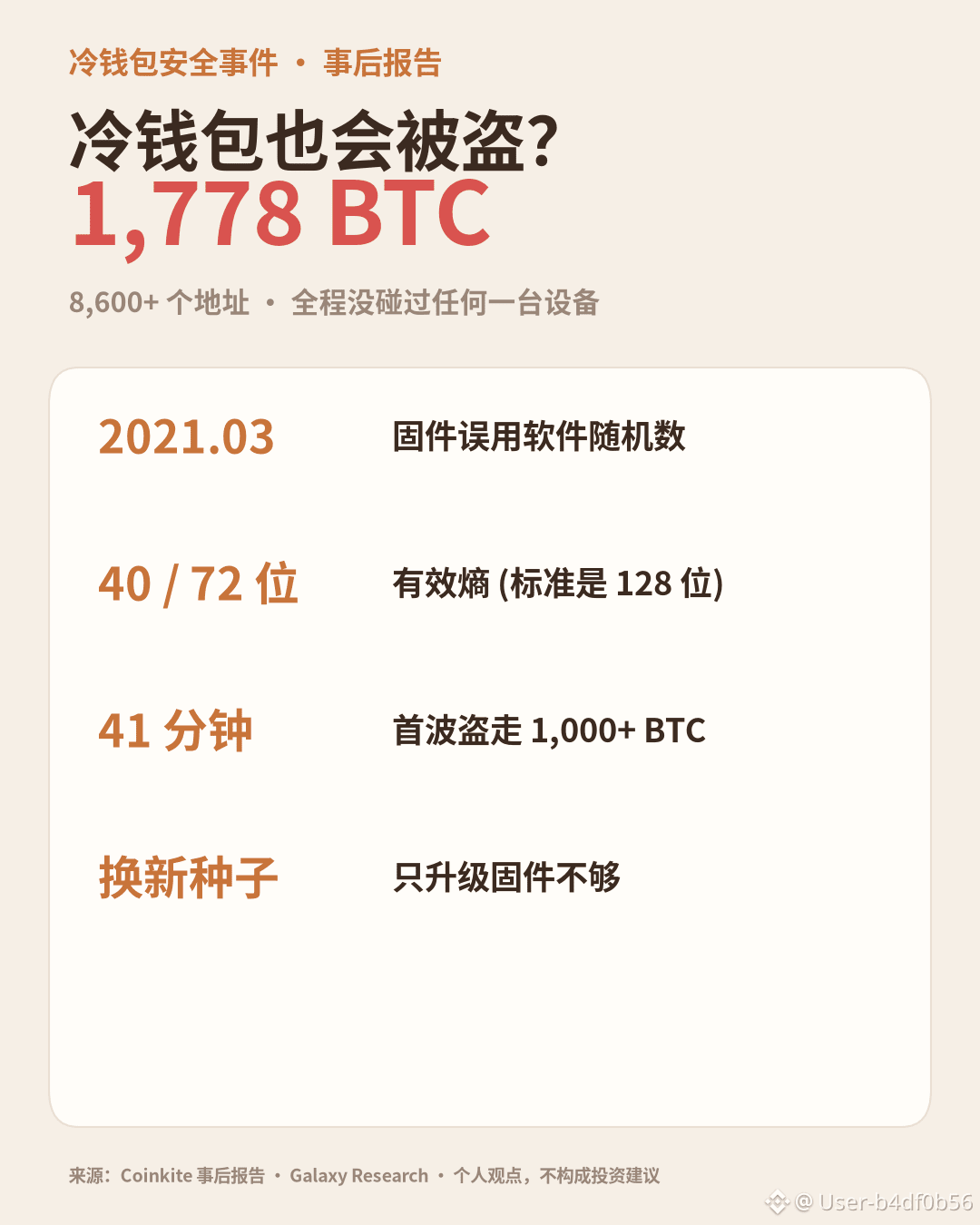
Can cold wallets get stolen too? I finished reading Coldcard’s 18-page postmortem, and the most unsettling part is: nobody hacked the device.
1️⃣ Since March 2021, the firmware had mistakenly used software-generated random numbers, leaving the seed with only about 40–72 bits of effective entropy (the standard is 128 bits)
2️⃣ Attackers brute-forced the keys offline to recover the private keys. More than 8,600 addresses were emptied, totaling at least 1,778 BTC. The first wave took 1,000+ BTC in just 41 minutes
3️⃣ A firmware upgrade alone won’t help—the old seeds are still weak. You need to create a new seed and transfer your coins
My take: $BTC was already being held below 60,000 by ETF outflows. This kind of “storage-layer” trust event won’t directly trigger a sell-off, but it will prompt many people to check their wallets again. What I do is check the device model and how the seed was generated; if I’m not sure, I switch. If a compensation plan is slow to emerge, confidence will be low; if there’s clear compensation, sentiment may actually improve. The same goes for $ETH holders.
How do you mainly store your coins?
A. Cold wallet B. Exchange (Leave a letter in the comments; I’ll pick a few to discuss.)
Follow me: I’ll keep tracking the PCE data over the next few days and go over the answers with you on Thursday morning.
#比特币 #Coldcard #钱包安全 #PCE数据
Personal opinion only; not investment advice. This post may earn creator rewards on the platform.
33

·
--
🚨 $BTC BETRAYAL IN THE SAFEST VAULT
Coinkite published the postmortem on the Coldcard theft: a firmware bug generated seeds with a weak generator for more than 5 years, and the thieves emptied wallets without ever touching a device. To me, this is the most serious part: it wasn’t an exchange hack—the vault itself handed over the keys.
Look at the detail no one is noticing:
→ The seeds had only 40 bits of security on the Mk2 and Mk3 (and 72 on the Mk4, Mk5, and Q), compared with the 128 bits they should have had: an attacker could regenerate the keys on their own.
→ The bug survived more than 15 security reviews, including 2 paid audits and an AI review that produced 85 findings... and none of them caught it.
→ Galaxy Research counted 1,778.84 BTC stolen from more than 8,600 addresses, about $107 million, and Coinkite received ~300 claims from 242 accounts.
Do you still trust hardware wallets to store your BTC, yes or no? 👇
$BTC
#Bitcoin #Coldcard #Cybersecurity
4
11.5k
Log in to explore more content
Join global crypto users on Binance Square
⚡️ Get latest and useful information about crypto.
💬 Trusted by the world’s largest crypto exchange.
👍 Discover real insights from verified creators.
Email / Phone number
Trending Topics
1
#EvolveAtBinanceBlockchainWeek
959,904 views
11,928 Discussing
2
#CanMarketsReboundAfterThanksgiving?
289,170 views
2,468 Discussing
3
#Nasdaq100FiveDayAvgIntradayVolatilityHits3.8%
16,520 views
227 Discussing
4
#CorePCEBeatLiftsFedHikeOdds
357,170 views
1,918 Discussing
5
#ZcashDevelopersUrgeZECMoveToIronwood
63,533 views
326 Discussing
6
#XRPLedgerVaultGets29Votes
922 views
17 Discussing
7
#CouldSpaceX’sOrbitalDataCentersBoostAIChipDemand?
132,879 views
1,448 Discussing
8
#ASEANPlus3ToFormCrossBorderPaymentsCryptoWorkingGroup
4,608 views
11 Discussing
9
#StellarAdds$80.4MTokenizedFundsInOneDay
6,104 views
21 Discussing
10
#TudorInvestmentRaisesIBITHoldings98%
9,163 views
58 Discussing