Binance Square
#web3

web3

49.8M views
285,269 Discussing
ThuHang
·
--
$EPIC is on my radar right here. Big wash, fast. 📉 $0.4915 after a -47.33% day and the 4h candle got nuked -47% too. That’s ugly, but this is where I start paying attention, not after the bounce is already gone. RSI(14) on 4h is 31, volume is $29.41M, and it’s running 1.3x its 20d avg. Shorts are still crowded with funding at -0.020% 💥 MAs are chopping, sure. But it’s only 14% up its 30d range and still 62% off the high. That’s the kind of setup I watch on @epiconchain 👀 #EPIC #CryptoNews #Web3
$EPIC is on my radar right here. Big wash, fast. 📉

$0.4915 after a -47.33% day and the 4h candle got nuked -47% too. That’s ugly, but this is where I start paying attention, not after the bounce is already gone.

RSI(14) on 4h is 31, volume is $29.41M, and it’s running 1.3x its 20d avg. Shorts are still crowded with funding at -0.020% 💥

MAs are chopping, sure. But it’s only 14% up its 30d range and still 62% off the high. That’s the kind of setup I watch on @epiconchain 👀

#EPIC
#CryptoNews
#Web3
·
--
Bullish
Verified
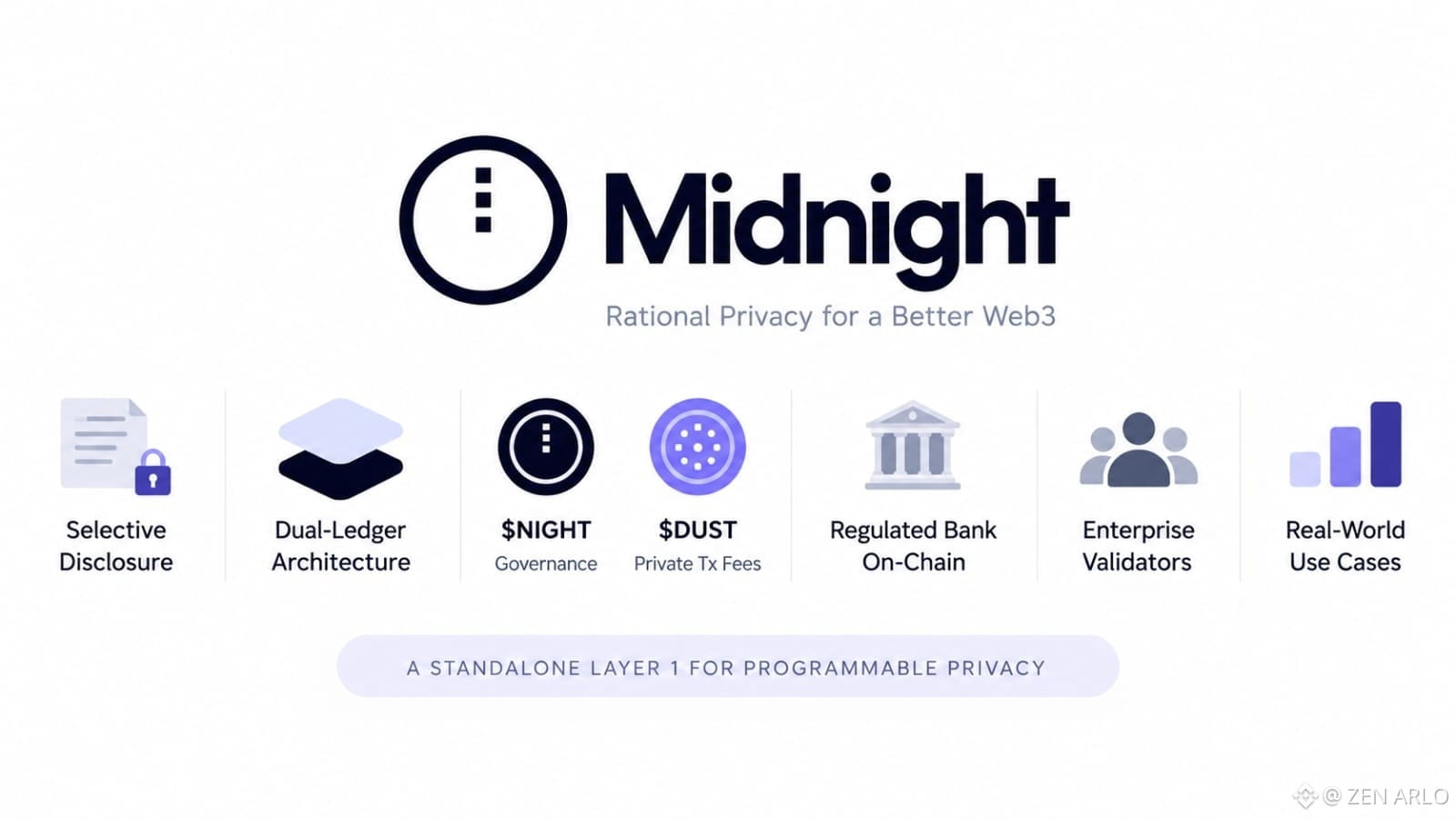
Midnight Privacy in Web3 is moving beyond simply hiding data. Midnight is a standalone Layer 1 designed around programmable, rational privacy. Its core idea is selective disclosure. You can prove something is true without revealing the sensitive information behind that proof. That creates a middle ground between blockchains where everything is public and systems where everything stays hidden. Midnight uses a dual-ledger architecture. One layer coordinates public transaction metadata. The shielded execution layer keeps the actual transaction details private. Its dual-token design separates responsibilities too. $NIGHT is the public governance and value asset. Holding NIGHT automatically generates $DUST, a non-transferable resource used for private transaction fees that regenerates over time. Real-world adoption makes the model more interesting. A Bank of England-regulated institution is working to tokenize up to £250M in customer deposits on Midnight. Enterprise validators include major names across cloud infrastructure, payments, finance and telecom. Builders are also developing RWA tokenization, institutional dark-pool trading, identity and KYC infrastructure, and private voting. Midnight was built by Input Output, but it is an independent Layer 1 — not a Cardano subchain or L2. And NIGHT is completely distinct from $ADA. While $ZEC , $ADA , $XRP and $TAO represent different parts of the privacy, payments and infrastructure landscape, Midnight is focused on something specific: Privacy that can prove compliance without surrendering personal data. That distinction could matter enormously as blockchain moves deeper into real-world finance. Only information not financial advice #Midnight #NIGHT #Web3
Midnight Privacy in Web3 is moving beyond simply hiding data.

Midnight is a standalone Layer 1 designed around programmable, rational privacy.

Its core idea is selective disclosure.

You can prove something is true without revealing the sensitive information behind that proof.

That creates a middle ground between blockchains where everything is public and systems where everything stays hidden.

Midnight uses a dual-ledger architecture.

One layer coordinates public transaction metadata.

The shielded execution layer keeps the actual transaction details private.

Its dual-token design separates responsibilities too.

$NIGHT is the public governance and value asset.

Holding NIGHT automatically generates $DUST, a non-transferable resource used for private transaction fees that regenerates over time.

Real-world adoption makes the model more interesting.

A Bank of England-regulated institution is working to tokenize up to £250M in customer deposits on Midnight.

Enterprise validators include major names across cloud infrastructure, payments, finance and telecom.

Builders are also developing RWA tokenization, institutional dark-pool trading, identity and KYC infrastructure, and private voting.

Midnight was built by Input Output, but it is an independent Layer 1 — not a Cardano subchain or L2.

And NIGHT is completely distinct from $ADA .

While $ZEC , $ADA , $XRP and $TAO represent different parts of the privacy, payments and infrastructure landscape, Midnight is focused on something specific:

Privacy that can prove compliance without surrendering personal data.

That distinction could matter enormously as blockchain moves deeper into real-world finance.

Only information not financial advice

#Midnight #NIGHT #Web3
Anaya Khan ㅤㅤㅤㅤㅤ:
NIGHT utility makes sense
·
--
Bullish
Polymarket Prediction markets are turning information into something you can actually trade. Politics. Crypto. AI. Economics. Sports. Entertainment. Major global narratives increasingly have a market attached to them. Instead of scrolling through endless opinions, Polymarket lets users see how expectations change in real time. New information arrives. Probabilities move. The market adjusts. That simplicity has helped Polymarket grow into one of Web3’s most recognizable prediction-market platforms. The campaign cites 250K–500K monthly active traders, more than 17M monthly visits, and a projected $18B in 2025 trading volume. Getting started is designed to remain crypto-native and straightforward. Connect a compatible wallet, fund it through supported methods, and explore markets covering everything from geopolitics to technology. The biggest advantage can be knowledge. A sports expert understands sports. An AI researcher understands AI. A macro trader understands economics. Prediction markets give specialized knowledge somewhere to compete against the crowd. Then there’s $POLY. A potential token and possible user rewards have generated significant speculation, but the launch, airdrop and exact mechanics remain unconfirmed until officially announced. Alongside narratives around $PENGU , $DOOD $HYPE and $POLY, prediction markets are building a category of their own. Polymarket’s bigger opportunity is becoming a real-time map of what people believe happens next. Only information not financial advice #Polymarket #PredictionMarkets #Web3
Polymarket Prediction markets are turning information into something you can actually trade.

Politics. Crypto. AI. Economics. Sports. Entertainment.

Major global narratives increasingly have a market attached to them.

Instead of scrolling through endless opinions, Polymarket lets users see how expectations change in real time.

New information arrives.

Probabilities move.

The market adjusts.

That simplicity has helped Polymarket grow into one of Web3’s most recognizable prediction-market platforms.

The campaign cites 250K–500K monthly active traders, more than 17M monthly visits, and a projected $18B in 2025 trading volume.

Getting started is designed to remain crypto-native and straightforward.

Connect a compatible wallet, fund it through supported methods, and explore markets covering everything from geopolitics to technology.

The biggest advantage can be knowledge.

A sports expert understands sports.

An AI researcher understands AI.

A macro trader understands economics.

Prediction markets give specialized knowledge somewhere to compete against the crowd.

Then there’s $POLY.

A potential token and possible user rewards have generated significant speculation, but the launch, airdrop and exact mechanics remain unconfirmed until officially announced.

Alongside narratives around $PENGU , $DOOD $HYPE and $POLY, prediction markets are building a category of their own.

Polymarket’s bigger opportunity is becoming a real-time map of what people believe happens next.

Only information not financial advice

#Polymarket #PredictionMarkets #Web3
MAX_CRYPTO10:
Getting rid of endless opinions and replacing them with skin-in-the-game probabilities is the best evolution of internet discourse.
$TUT just did the ugly shakeout I like 👀 I caught the wick, blinked, and it was already back to $0.1123. -49% on the day, -30% in the last 4h, but it’s still holding above the 20d and 50d MA. That’s not dead, that’s getting flushed. RSI on 4h at 51 says this move isn’t finished either. Longs still paying too. Wild tape. 📉🔥 #TUT #Web3 #Crypto
$TUT just did the ugly shakeout I like 👀

I caught the wick, blinked, and it was already back to $0.1123. -49% on the day, -30% in the last 4h, but it’s still holding above the 20d and 50d MA. That’s not dead, that’s getting flushed. RSI on 4h at 51 says this move isn’t finished either. Longs still paying too.

Wild tape. 📉🔥

#TUT
#Web3
#Crypto
$ETH has become an important part of the blockchain ecosystem, powering smart contracts, decentralized applications and much more. The real potential of blockchain technology is not only about price—it is also about what people can build on top of it. The future of Web3 will be interesting to watch. 🚀 #Ethereum #ETH #Web3 #Blockchain #Crypto
$ETH has become an important part of the blockchain ecosystem, powering smart contracts, decentralized applications and much more.
The real potential of blockchain technology is not only about price—it is also about what people can build on top of it.
The future of Web3 will be interesting to watch. 🚀
#Ethereum #ETH #Web3 #Blockchain #Crypto
$ARB AI needs data. A LOT of it. That’s why decentralized storage projects deserve more attention when the AI narrative heats up. Arweave is one of the projects worth researching in this space. Could decentralized storage become an underrated AI narrative? $ARB {spot}(ARBUSDT) #Arweave #AI #Web3
$ARB
AI needs data. A LOT of it.
That’s why decentralized storage projects deserve more attention when the AI narrative heats up.
Arweave is one of the projects worth researching in this space.
Could decentralized storage become an underrated AI narrative?
$ARB
#Arweave #AI #Web3
Why is nobody talking about the millions of dollars mid-sized trading desks waste trying to build their own proprietary infrastructure? Most emerging funds and active traders bleed capital on tech overhead, thinking they need custom setups to compete. By the time they finish building, they have missed the market cycle and run out of runway. The smartest players in the space are quietly abandoning the build-your-own mentality. Instead, they leverage established institutional rails to access deep liquidity and enterprise-grade execution. By plugging directly into mature ecosystems like $BNB or utilizing decentralized oracle networks like $LINK, small teams can run heavy volume without the massive upfront capital expenditure. The catch is that many platforms claim to offer institutional support, but very few actually deliver infrastructure structured for external integration. When analyzing how these desks scale, the successful ones focus purely on execution, outsourcing their tech stack to proven networks so they can focus on trading $SOL and other high-velocity assets. Are you building your own tools, or are you leveraging existing rails? #CryptoTrading #DeFi #Web3
Why is nobody talking about the millions of dollars mid-sized trading desks waste trying to build their own proprietary infrastructure?

Most emerging funds and active traders bleed capital on tech overhead, thinking they need custom setups to compete. By the time they finish building, they have missed the market cycle and run out of runway.

The smartest players in the space are quietly abandoning the build-your-own mentality. Instead, they leverage established institutional rails to access deep liquidity and enterprise-grade execution. By plugging directly into mature ecosystems like $BNB or utilizing decentralized oracle networks like $LINK , small teams can run heavy volume without the massive upfront capital expenditure.

The catch is that many platforms claim to offer institutional support, but very few actually deliver infrastructure structured for external integration. When analyzing how these desks scale, the successful ones focus purely on execution, outsourcing their tech stack to proven networks so they can focus on trading $SOL and other high-velocity assets.

Are you building your own tools, or are you leveraging existing rails?

#CryptoTrading #DeFi #Web3
If you are still trying to build your own proprietary trading infrastructure from scratch, stop now. Too many emerging funds burn through their runway trying to code custom routing and connectivity, only to get rugged by latency issues and missed entries. By the time their setup is live, the market cycle has already shifted. Some managers argue that proprietary code is the only way to maintain a true edge when trading volatile assets like $BTC. But the reality of today's market is different. Building a basic institutional-grade setup easily costs upward of one hundred thousand dollars and months of development time. Why waste capital reinventing the wheel when you can plug into existing pipelines. The smart move is leveraging prime brokerage programs that actually support infrastructure sharing rather than just listing it as a marketing gimmick. Utilizing established data networks like $LINK allows smaller desks to execute with the same precision as billion-dollar funds without the overhead. It keeps your capital where it belongs, which is in the market. Would you rather spend your budget on building custom tech or put that capital directly into trading? #CryptoTrading #CryptoInfrastructure #Web3
If you are still trying to build your own proprietary trading infrastructure from scratch, stop now.

Too many emerging funds burn through their runway trying to code custom routing and connectivity, only to get rugged by latency issues and missed entries. By the time their setup is live, the market cycle has already shifted.

Some managers argue that proprietary code is the only way to maintain a true edge when trading volatile assets like $BTC . But the reality of today's market is different. Building a basic institutional-grade setup easily costs upward of one hundred thousand dollars and months of development time. Why waste capital reinventing the wheel when you can plug into existing pipelines.

The smart move is leveraging prime brokerage programs that actually support infrastructure sharing rather than just listing it as a marketing gimmick. Utilizing established data networks like $LINK allows smaller desks to execute with the same precision as billion-dollar funds without the overhead. It keeps your capital where it belongs, which is in the market.

Would you rather spend your budget on building custom tech or put that capital directly into trading?

#CryptoTrading #CryptoInfrastructure #Web3
everyone thinks you need to build your own proprietary trading tech stack to compete with the big boys, but actually, trying to build custom infrastructure is the fastest way for a new fund to go broke. ngl most emerging desks bleed half their capital runway just trying to set up low-latency connections and API routing. by the time they actually deploy size into $SOL or $LINK, they are already lagging behind the market and missing critical entries because their custom system is buggy. let's look at how the smart money actually operates. a case study of successful mid-sized desks shows they almost never build from scratch anymore. instead, they lease institutional-grade infrastructure from established prime brokers. this lets them execute complex arbitrage and leverage strategies on tokens like $ENA without the massive upfront engineering debt. but here is the catch ser. tons of infrastructure providers list institutional support on their landing page as a marketing gimmick, but their actual API limits and SLA agreements are garbage. you have to look at the actual architecture of these programs to see who is actually structured to support high-frequency flow versus who is just selling repackaged retail endpoints. anyone else seeing small funds blow their seed rounds on tech instead of trading? #CryptoTrading #Web3 #DeFi
everyone thinks you need to build your own proprietary trading tech stack to compete with the big boys, but actually, trying to build custom infrastructure is the fastest way for a new fund to go broke.

ngl most emerging desks bleed half their capital runway just trying to set up low-latency connections and API routing. by the time they actually deploy size into $SOL or $LINK , they are already lagging behind the market and missing critical entries because their custom system is buggy.

let's look at how the smart money actually operates. a case study of successful mid-sized desks shows they almost never build from scratch anymore. instead, they lease institutional-grade infrastructure from established prime brokers. this lets them execute complex arbitrage and leverage strategies on tokens like $ENA without the massive upfront engineering debt.

but here is the catch ser. tons of infrastructure providers list institutional support on their landing page as a marketing gimmick, but their actual API limits and SLA agreements are garbage. you have to look at the actual architecture of these programs to see who is actually structured to support high-frequency flow versus who is just selling repackaged retail endpoints.

anyone else seeing small funds blow their seed rounds on tech instead of trading?

#CryptoTrading #Web3 #DeFi
Most retail investors lose money by backing projects with massive, bloated teams, ignoring the fact that the most resilient protocols in crypto history were built by fewer than five people. We've all watched promising projects raise millions, hire fifty community managers, and then slowly bleed to zero because their operational costs ate them alive. It is painful to realize the token you held, hoping it would be the next $ETH, collapsed simply because the founders didn't know how to scale sustainably. In past cycles, allocators used to demand a massive headcount checklist before sending funds. But seasoned founders are changing the game. I recently saw a lean team secure funding and, instead of hiring a massive ops department, they automated their entire backend infrastructure through code. The allocators actually flagged their setup as disproportionate to their team size, failing to realize that code is far more reliable than human headcount. This is how protocols like $UNI manage billions in volume with a fraction of the staff of a traditional financial institution. When you are scouting for long-term holds, look for projects that prioritize program infrastructure over marketing hype. A lean team building on $SOL with automated operations is far more likely to survive a multi-year bear market than a bloated startup spending its treasury on high-profile office spaces. How do you evaluate team size and operational efficiency before investing in a new project? #CryptoInvesting #DeFi #Web3
Most retail investors lose money by backing projects with massive, bloated teams, ignoring the fact that the most resilient protocols in crypto history were built by fewer than five people.

We've all watched promising projects raise millions, hire fifty community managers, and then slowly bleed to zero because their operational costs ate them alive. It is painful to realize the token you held, hoping it would be the next $ETH , collapsed simply because the founders didn't know how to scale sustainably.

In past cycles, allocators used to demand a massive headcount checklist before sending funds. But seasoned founders are changing the game. I recently saw a lean team secure funding and, instead of hiring a massive ops department, they automated their entire backend infrastructure through code. The allocators actually flagged their setup as disproportionate to their team size, failing to realize that code is far more reliable than human headcount.

This is how protocols like $UNI manage billions in volume with a fraction of the staff of a traditional financial institution. When you are scouting for long-term holds, look for projects that prioritize program infrastructure over marketing hype. A lean team building on $SOL with automated operations is far more likely to survive a multi-year bear market than a bloated startup spending its treasury on high-profile office spaces.

How do you evaluate team size and operational efficiency before investing in a new project?

#CryptoInvesting #DeFi #Web3
Have you noticed how the crypto space still equates a massive headcount with project legitimacy? Most founders think they need to raise millions and immediately hire a bloated operations team just to satisfy investor checklists. This overhead drains treasury funds long before the product finds market fit, leaving early backers to bear the risk of a premature collapse. Look at a recent case of two founders who just closed a major funding round. They had zero ops employees and no intention of hiring any. Instead of scaling headcount, they built their operational infrastructure programmatically. When the allocators sent over a complex operational checklist, the founders satisfied every single requirement using automated software and smart contracts. The allocators initially flagged the setup as disproportionate to the team size, but this was a feature, not a bug. By leveraging decentralized networks like $LINK and deploying lean smart contracts on $SOL, small teams can now run institutional-grade operations at a fraction of the cost. We need to stop valuing corporate bloat and start rewarding capital efficiency. Do you think lean, automated teams are safer for investors than heavily staffed startups? #CryptoInvesting #Web3 #VentureCapital
Have you noticed how the crypto space still equates a massive headcount with project legitimacy?

Most founders think they need to raise millions and immediately hire a bloated operations team just to satisfy investor checklists. This overhead drains treasury funds long before the product finds market fit, leaving early backers to bear the risk of a premature collapse.

Look at a recent case of two founders who just closed a major funding round. They had zero ops employees and no intention of hiring any. Instead of scaling headcount, they built their operational infrastructure programmatically. When the allocators sent over a complex operational checklist, the founders satisfied every single requirement using automated software and smart contracts.

The allocators initially flagged the setup as disproportionate to the team size, but this was a feature, not a bug. By leveraging decentralized networks like $LINK and deploying lean smart contracts on $SOL , small teams can now run institutional-grade operations at a fraction of the cost. We need to stop valuing corporate bloat and start rewarding capital efficiency.

Do you think lean, automated teams are safer for investors than heavily staffed startups?

#CryptoInvesting #Web3 #VentureCapital
everyone thinks you need to hire a massive ops team to keep allocators happy, but actually, bloating your headcount is the fastest way to get flagged during post-close due diligence. so many founders build killer dapps on $ETH only to lose their allocations because their operational setup doesn't look like a traditional corporate office. it is a massive waste of energy and capital when you are just trying to survive the early stages. i was talking to a couple of founders who ran into this exact wall after closing a round. they had zero ops team and wanted to keep it that way, choosing to run their entire backend using automated infrastructure instead of hiring warm bodies. when they filled out the allocator's compliance checklist, the review came back flagging their setup as disproportionate to their team size. the allocators literally viewed their lean efficiency as a risk. ngl ser, this web2 mindset is holding the space back when we should be leveraging protocol design on chains like $SOL to automate the boring stuff. running lean is a strategy, not a bug. anyone else seeing allocators penalize projects for actually being efficient? #crypto #web3 #venturecapital
everyone thinks you need to hire a massive ops team to keep allocators happy, but actually, bloating your headcount is the fastest way to get flagged during post-close due diligence.

so many founders build killer dapps on $ETH only to lose their allocations because their operational setup doesn't look like a traditional corporate office. it is a massive waste of energy and capital when you are just trying to survive the early stages.

i was talking to a couple of founders who ran into this exact wall after closing a round. they had zero ops team and wanted to keep it that way, choosing to run their entire backend using automated infrastructure instead of hiring warm bodies. when they filled out the allocator's compliance checklist, the review came back flagging their setup as disproportionate to their team size.

the allocators literally viewed their lean efficiency as a risk. ngl ser, this web2 mindset is holding the space back when we should be leveraging protocol design on chains like $SOL to automate the boring stuff. running lean is a strategy, not a bug.

anyone else seeing allocators penalize projects for actually being efficient?

#crypto #web3 #venturecapital
DeFi continues to grow and evolve, with STON.fi playing a role in that development across the TON ecosystem. The platform focuses on decentralized token swaps and liquidity while working toward a simple and seamless experience for users. For CoinMarketCap users exploring TON based DeFi, STON.fi is worth keeping an eye on as the ecosystem continues to develop. #STONfi✅ #TON #Web3 #CryptoNews
DeFi continues to grow and evolve, with STON.fi playing a role in that development across the TON ecosystem.

The platform focuses on decentralized token swaps and liquidity while working toward a simple and seamless experience for users.

For CoinMarketCap users exploring TON based DeFi, STON.fi is worth keeping an eye on as the ecosystem continues to develop.
#STONfi✅ #TON #Web3 #CryptoNews
Winner success:
Nice
Why Staking STON Goes Beyond Earning Rewards A strong DeFi ecosystem needs more than technology. It also needs an active community, and STON.fi gives STON holders several ways to get involved beyond simply holding the token. Staking STON combines governance participation, additional earning opportunities, and community benefits, giving holders a more active role within the ecosystem. When users stake STON, they receive ARKENSTON, which represents their voting power in the STON.fi DAO. This gives the community an opportunity to contribute to governance and have a say in the direction of the protocol. There are also added benefits for liquidity providers. Users who stake STON while farming the STON/USDT V2 pool can qualify for boosted APR multipliers. Staking 500+ STON can provide up to 1.5× farming APR, while staking 1,000+ STON can unlock up to 2× APR, alongside additional STON incentives. Staking 1,000 STON or more can also provide access to the STON.fi Club, an exclusive community where members can connect more closely with the core team, get early insights into upcoming products, and access useful market information. As DeFi continues to evolve, ecosystems that encourage participation while giving their communities a meaningful voice can have a stronger foundation. STON.fi brings governance, incentives, and community engagement together through its staking system. As always, it’s important to do your own research because staking rewards can change based on market conditions, campaign budgets, liquidity, and the amount staked. Stake, participate, and become part of the next phase of DeFi with STON.fi. #stonfi #DEFİ #Web3 #CryptoNews
Why Staking STON Goes Beyond Earning Rewards

A strong DeFi ecosystem needs more than technology. It also needs an active community, and STON.fi gives STON holders several ways to get involved beyond simply holding the token.

Staking STON combines governance participation, additional earning opportunities, and community benefits, giving holders a more active role within the ecosystem.

When users stake STON, they receive ARKENSTON, which represents their voting power in the STON.fi DAO. This gives the community an opportunity to contribute to governance and have a say in the direction of the protocol.

There are also added benefits for liquidity providers. Users who stake STON while farming the STON/USDT V2 pool can qualify for boosted APR multipliers. Staking 500+ STON can provide up to 1.5× farming APR, while staking 1,000+ STON can unlock up to 2× APR, alongside additional STON incentives.

Staking 1,000 STON or more can also provide access to the STON.fi Club, an exclusive community where members can connect more closely with the core team, get early insights into upcoming products, and access useful market information.

As DeFi continues to evolve, ecosystems that encourage participation while giving their communities a meaningful voice can have a stronger foundation.

STON.fi brings governance, incentives, and community engagement together through its staking system.

As always, it’s important to do your own research because staking rewards can change based on market conditions, campaign budgets, liquidity, and the amount staked.

Stake, participate, and become part of the next phase of DeFi with STON.fi.
#stonfi #DEFİ #Web3 #CryptoNews
Centralized exchanges were designed around a straightforward idea: Concentrate liquidity in one place and make trading as efficient as possible. But this approach comes with a limitation. Users keep their balances within centralized systems, while accessing DeFi, self custody, and permissionless applications often means moving those assets somewhere else. That is what makes GT$GT interesting. GateToken is part of an ecosystem exploring how centralized exchange infrastructure can interact with public blockchains, creating a bridge between familiar exchange markets and onchain applications. This is at the heart of the broader CeDeFi narrative: reducing the friction between centralized and decentralized finance. Rather than keeping CeFi and DeFi completely separate, the goal is to enable capital to move between centralized liquidity and permissionless smart contracts more seamlessly. However, connectivity alone is not enough. Onchain liquidity has to be deep enough to support that movement. A trader might have access to strong liquidity on a centralized exchange, but if moving the same asset onchain results in significant slippage, the value of that connectivity quickly decreases. This is where TON Blockchain offers an interesting comparison. STONfi acts as a native liquidity layer for TON while expanding access to connected networks through cross chain routing and Omniston. The bigger takeaway is simple: Connectivity creates possibilities. Liquidity determines whether those possibilities are actually useful. #stonfi #TON #Web3 #cryptonews
Centralized exchanges were designed around a straightforward idea:

Concentrate liquidity in one place and make trading as efficient as possible.

But this approach comes with a limitation.

Users keep their balances within centralized systems, while accessing DeFi, self custody, and permissionless applications often means moving those assets somewhere else.

That is what makes GT$GT interesting.

GateToken is part of an ecosystem exploring how centralized exchange infrastructure can interact with public blockchains, creating a bridge between familiar exchange markets and onchain applications.

This is at the heart of the broader CeDeFi narrative: reducing the friction between centralized and decentralized finance.

Rather than keeping CeFi and DeFi completely separate, the goal is to enable capital to move between centralized liquidity and permissionless smart contracts more seamlessly.

However, connectivity alone is not enough.

Onchain liquidity has to be deep enough to support that movement.

A trader might have access to strong liquidity on a centralized exchange, but if moving the same asset onchain results in significant slippage, the value of that connectivity quickly decreases.

This is where TON Blockchain offers an interesting comparison.

STONfi acts as a native liquidity layer for TON while expanding access to connected networks through cross chain routing and Omniston.

The bigger takeaway is simple:

Connectivity creates possibilities.

Liquidity determines whether those possibilities are actually useful.
#stonfi #TON #Web3 #cryptonews
Another productive week for STON.fi, with plenty of important developments across the ecosystem. From exploring the benefits of STON staking and discovering new boosted farming opportunities to staying updated on the upcoming bridge changes, there is a lot for the community to follow. The latest cross-chain infrastructure articles also highlight how interoperability is evolving and how better connections between ecosystems can create a smoother DeFi experience. As the ecosystem continues to grow, staying informed and understanding these developments can help users make better decisions and discover new opportunities across TON. Keep learning. Keep building. Keep exploring. #STONfi #DeFi #STON #Web3
Another productive week for STON.fi, with plenty of important developments across the ecosystem.

From exploring the benefits of STON staking and discovering new boosted farming opportunities to staying updated on the upcoming bridge changes, there is a lot for the community to follow.

The latest cross-chain infrastructure articles also highlight how interoperability is evolving and how better connections between ecosystems can create a smoother DeFi experience.

As the ecosystem continues to grow, staying informed and understanding these developments can help users make better decisions and discover new opportunities across TON.

Keep learning. Keep building. Keep exploring.

#STONfi #DeFi #STON #Web3
·
--
Article
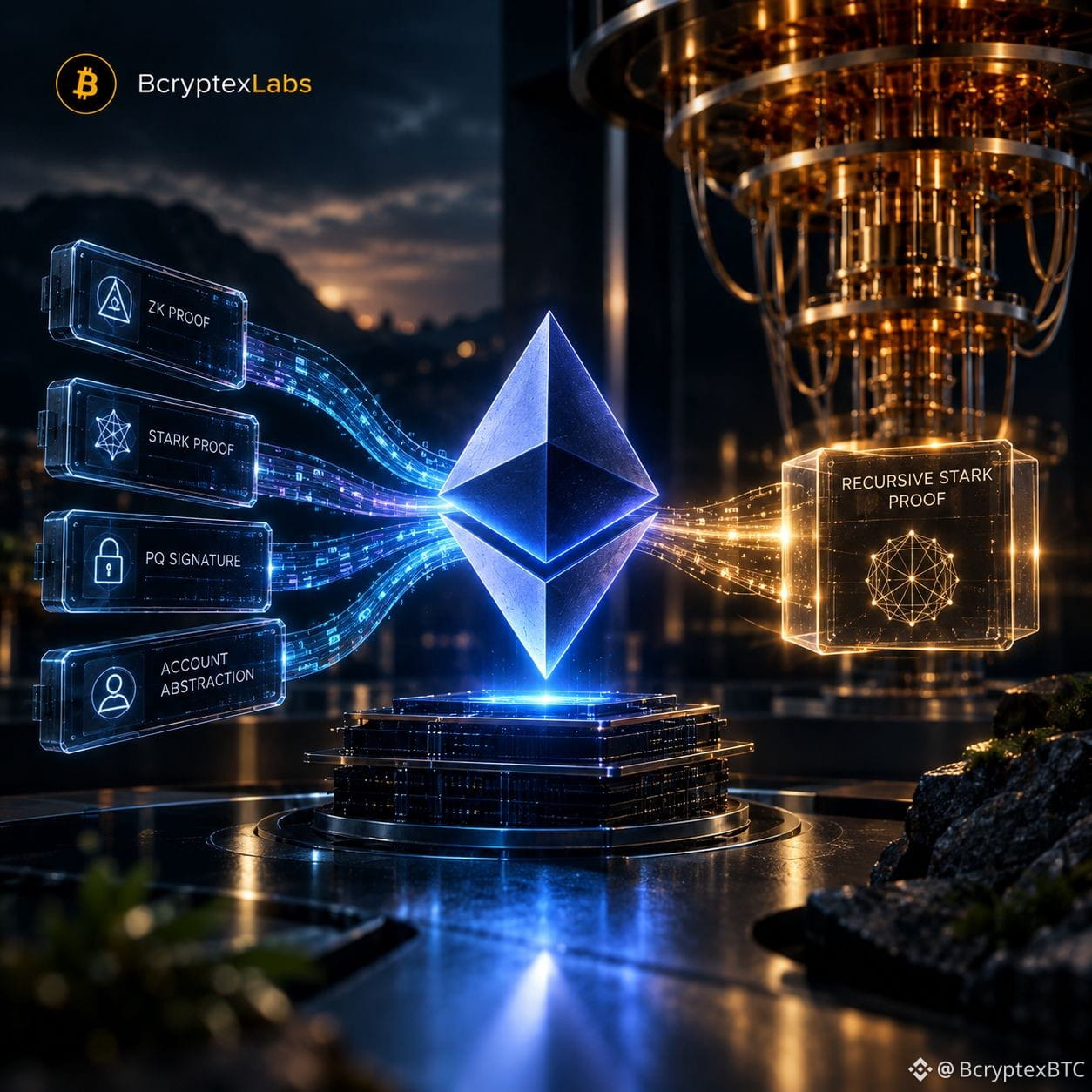
Quantum Computing: Crypto’s Next Big ChallengeCrypto has another problem coming — and it has nothing to do with price. For years, the biggest conversations in crypto have been about adoption, regulation, liquidity and institutional money. But there is another technological shift that could eventually force the entire industry to rethink how digital assets are protected. Quantum computing. The important point is that this is not about saying Bitcoin or Ethereum will suddenly become unsafe tomorrow. They won’t. The real issue is preparation. Today’s major blockchains rely on cryptographic systems that were designed for classical computers. As quantum technology develops, some of those assumptions may eventually need to change. That is why post-quantum cryptography is becoming a serious topic. NIST has already released standards designed to protect digital systems against future quantum attacks, and migration work is already underway. What interests me most is the transition itself. A blockchain cannot simply change its security model overnight. Wallets, signatures, software, hardware, developers and millions of users would all have to move together. That makes quantum resistance much more than a technology story. It could become a major infrastructure challenge for the entire crypto industry. For me, the interesting question is not whether quantum computing will destroy crypto. It is whether the crypto industry will upgrade its security before it is forced to. That race may already be starting. Do you think quantum resistance will become one of the most important narratives in crypto over the next decade? #Bitcoin #Blockchain #QuantumComputing #Web3

Quantum Computing: Crypto’s Next Big Challenge

Crypto has another problem coming — and it has nothing to do with price.
For years, the biggest conversations in crypto have been about adoption, regulation, liquidity and institutional money.
But there is another technological shift that could eventually force the entire industry to rethink how digital assets are protected.
Quantum computing.
The important point is that this is not about saying Bitcoin or Ethereum will suddenly become unsafe tomorrow.
They won’t.
The real issue is preparation.
Today’s major blockchains rely on cryptographic systems that were designed for classical computers. As quantum technology develops, some of those assumptions may eventually need to change.
That is why post-quantum cryptography is becoming a serious topic.
NIST has already released standards designed to protect digital systems against future quantum attacks, and migration work is already underway.
What interests me most is the transition itself.
A blockchain cannot simply change its security model overnight.
Wallets, signatures, software, hardware, developers and millions of users would all have to move together.
That makes quantum resistance much more than a technology story.
It could become a major infrastructure challenge for the entire crypto industry.
For me, the interesting question is not whether quantum computing will destroy crypto.
It is whether the crypto industry will upgrade its security before it is forced to.
That race may already be starting.
Do you think quantum resistance will become one of the most important narratives in crypto over the next decade?
#Bitcoin #Blockchain #QuantumComputing #Web3
$ATOM Everyone talks about chains. Fewer people talk about how those chains communicate. 🌐 That’s where the Cosmos ecosystem becomes interesting. Interoperability remains one of the major problems crypto infrastructure is trying to solve. Could interoperability become the next major narrative? $ATOM {future}(ATOMUSDT) #Cosmos #ATOM #Web3
$ATOM
Everyone talks about chains. Fewer people talk about how those chains communicate. 🌐
That’s where the Cosmos ecosystem becomes interesting.
Interoperability remains one of the major problems crypto infrastructure is trying to solve.
Could interoperability become the next major narrative?
$ATOM
#Cosmos #ATOM #Web3
Partly True
Article
DOS: The Product Story Behind the AI NarrativeOne thing I’ve learned from watching crypto market is that the loudest part of a token’s story is rarely the part I end up caring about most. A chart can go vertical, influencers start talking, the community gets busy, and suddenly everyone has an explanation for why it is happening. But after the first reaction fades, there is always the same question sitting underneath it: what is actually being used? That is what makes DOS interesting to me right now. The obvious narrative is AI, and we have seen enough AI tokens this cycle to know that the word alone doesn't mean much. What caught my attention is the product sitting behind the token, xBubble, which is designed around letting users build applications without needing traditional coding skills. I remember when no-code products were often treated as tools for people who couldn't code. That attitude has changed quite a bit. Add AI into the process and the barrier becomes even lower. Someone with an idea can potentially move from thinking about an application to actually building something without spending months learning a programming stack. That doesn't automatically make DOS valuable, though. This is where I think the market needs to slow down a little. According to the information circulating around the project, xBubble has more than 10,000 OPCs onboard and has generated around $6.8 million in subscription revenue. Those are meaningful numbers if they can be independently confirmed and sustained. More importantly, they give the project something beyond a purely speculative AI narrative. But I always separate product traction from token demand. A platform can have users, revenue and a useful product while its token still struggles to capture that value. Crypto has plenty of examples of this. So one of the things I'd personally want to understand better is exactly where DOS fits into the xBubble economy. Is demand for the product naturally creating demand for DOS, or are traders mainly buying the token because the narrative is attracting liquidity? That distinction could become very important later. Then there is the community side. The pre-TGE airdrop campaign has clearly added another layer of attention around DOS, while discussion in Chinese crypto communities appears to have helped the project spread quickly. Airdrops can be powerful distribution mechanisms because they give people a reason to pay attention before a token even fully enters the market. I've also seen the other side of that story. A community can look incredibly active when incentives are strong, then become much quieter once those incentives disappear. So I'm curious to see what happens when the airdrop excitement becomes less central to the conversation. Influencer attention is another factor. It can accelerate discovery, especially for a relatively new project, but I don't consider it proof of anything by itself. Attention can bring liquidity. It can also bring traders who have no interest in the underlying product at all. And that creates an interesting tension for DOS. The project appears to be sitting between two very different audiences: people interested in AI application building and people trading an AI-related crypto asset. Those groups overlap, but they aren't the same. Long-term strength would probably require more than just keeping both groups interested for a few weeks. The reported backing from names such as Sequoia and Binance adds another layer to the story. Strong backers can provide resources, connections and credibility. Still, I wouldn't buy a token simply because recognizable investors are associated with it. The product eventually has to stand on its own. Maybe I'm overthinking it, but this is where I find the DOS narrative more interesting than the usual AI-token discussion. The question isn't whether AI is going to matter. It almost certainly will. The harder question is which projects actually capture lasting usage from that shift. xBubble gives DOS a clear story to build around. The idea of lowering the barrier to application creation makes sense, especially as AI tools become more capable. But execution matters more than the pitch. Users need to keep coming back, developers need reasons to stay, and the economics need to make sense beyond the initial attention cycle. Price action will probably tell a different story in the short term. If the token continues attracting speculative liquidity, DOS could experience large moves that have very little to do with changes in the underlying product. That's normal in crypto, especially around TGE and airdrop narratives. I wouldn't confuse a strong chart with proof that adoption is accelerating. What I'd rather watch is the quieter data: recurring subscription activity, actual user retention, application creation, ecosystem growth and the relationship between product usage and DOS demand. Those numbers won't necessarily make the most exciting headline. But they are the ones that could eventually separate a temporary narrative from something with staying power. For now, I'm interested without being convinced. DOS has enough going on to deserve attention, but there are still pieces of the story I would want to see develop before making a strong long-term judgment. Maybe that's actually the healthier way to look at new AI tokens. Don't dismiss them because the narrative is crowded, but don't accept the narrative simply because the community is loud either. DOS has the product story, the reported traction, the community attention and the AI angle. Now comes the harder part: proving that all of those pieces can continue working when the excitement becomes less intense. That's the part I'll be watching. @Binance_Labs #DOS #xBubble #AI #Web3 $DOS {alpha}(560xb0f09ea9ae0515c3551080d4a745c8115aa30e37)

DOS: The Product Story Behind the AI Narrative

One thing I’ve learned from watching crypto market is that the loudest part of a token’s story is rarely the part I end up caring about most. A chart can go vertical, influencers start talking, the community gets busy, and suddenly everyone has an explanation for why it is happening. But after the first reaction fades, there is always the same question sitting underneath it: what is actually being used?
That is what makes DOS interesting to me right now. The obvious narrative is AI, and we have seen enough AI tokens this cycle to know that the word alone doesn't mean much. What caught my attention is the product sitting behind the token, xBubble, which is designed around letting users build applications without needing traditional coding skills.
I remember when no-code products were often treated as tools for people who couldn't code. That attitude has changed quite a bit. Add AI into the process and the barrier becomes even lower. Someone with an idea can potentially move from thinking about an application to actually building something without spending months learning a programming stack.
That doesn't automatically make DOS valuable, though. This is where I think the market needs to slow down a little.
According to the information circulating around the project, xBubble has more than 10,000 OPCs onboard and has generated around $6.8 million in subscription revenue. Those are meaningful numbers if they can be independently confirmed and sustained. More importantly, they give the project something beyond a purely speculative AI narrative.
But I always separate product traction from token demand.
A platform can have users, revenue and a useful product while its token still struggles to capture that value. Crypto has plenty of examples of this. So one of the things I'd personally want to understand better is exactly where DOS fits into the xBubble economy. Is demand for the product naturally creating demand for DOS, or are traders mainly buying the token because the narrative is attracting liquidity?
That distinction could become very important later.
Then there is the community side. The pre-TGE airdrop campaign has clearly added another layer of attention around DOS, while discussion in Chinese crypto communities appears to have helped the project spread quickly. Airdrops can be powerful distribution mechanisms because they give people a reason to pay attention before a token even fully enters the market.
I've also seen the other side of that story. A community can look incredibly active when incentives are strong, then become much quieter once those incentives disappear. So I'm curious to see what happens when the airdrop excitement becomes less central to the conversation.
Influencer attention is another factor. It can accelerate discovery, especially for a relatively new project, but I don't consider it proof of anything by itself. Attention can bring liquidity. It can also bring traders who have no interest in the underlying product at all.
And that creates an interesting tension for DOS.
The project appears to be sitting between two very different audiences: people interested in AI application building and people trading an AI-related crypto asset. Those groups overlap, but they aren't the same. Long-term strength would probably require more than just keeping both groups interested for a few weeks.
The reported backing from names such as Sequoia and Binance adds another layer to the story. Strong backers can provide resources, connections and credibility. Still, I wouldn't buy a token simply because recognizable investors are associated with it. The product eventually has to stand on its own.
Maybe I'm overthinking it, but this is where I find the DOS narrative more interesting than the usual AI-token discussion. The question isn't whether AI is going to matter. It almost certainly will. The harder question is which projects actually capture lasting usage from that shift.
xBubble gives DOS a clear story to build around. The idea of lowering the barrier to application creation makes sense, especially as AI tools become more capable. But execution matters more than the pitch. Users need to keep coming back, developers need reasons to stay, and the economics need to make sense beyond the initial attention cycle.
Price action will probably tell a different story in the short term.
If the token continues attracting speculative liquidity, DOS could experience large moves that have very little to do with changes in the underlying product. That's normal in crypto, especially around TGE and airdrop narratives. I wouldn't confuse a strong chart with proof that adoption is accelerating.
What I'd rather watch is the quieter data: recurring subscription activity, actual user retention, application creation, ecosystem growth and the relationship between product usage and DOS demand.
Those numbers won't necessarily make the most exciting headline. But they are the ones that could eventually separate a temporary narrative from something with staying power.
For now, I'm interested without being convinced. DOS has enough going on to deserve attention, but there are still pieces of the story I would want to see develop before making a strong long-term judgment.
Maybe that's actually the healthier way to look at new AI tokens. Don't dismiss them because the narrative is crowded, but don't accept the narrative simply because the community is loud either.
DOS has the product story, the reported traction, the community attention and the AI angle. Now comes the harder part: proving that all of those pieces can continue working when the excitement becomes less intense.
That's the part I'll be watching.
@Binance Labs
#DOS #xBubble #AI #Web3 $DOS
K H Á N H _ L I N H:
The market's noise can easily overshadow the core purpose of a project. It's refreshing to see DOS focusing on real-world utility amidst the hype around AI. Understanding the actual applications of technology often proves more valuable than the fleeting excitement.
4. 💎 The Future of Crypto: Adoption Over Hype Crypto growth is slowly moving beyond speculation. Real adoption comes from better technology, easier access, security improvements, and solving real-world problems. The projects that create useful solutions may have the strongest future. Which crypto project has the most real-world potential? #blockchain n #Crypto #Web3
4. 💎 The Future of Crypto: Adoption Over Hype
Crypto growth is slowly moving beyond speculation.
Real adoption comes from better technology, easier access, security improvements, and solving real-world problems.
The projects that create useful solutions may have the strongest future.
Which crypto project has the most real-world potential?
#blockchain n #Crypto #Web3
Log in to explore more content
Join global crypto users on Binance Square
⚡️ Get latest and useful information about crypto.
💬 Trusted by the world’s largest crypto exchange.
👍 Discover real insights from verified creators.
Email / Phone number