

Wirelesswrs
43 Posts

Wirelesswrs
Report
Block User
Open Trade
Frequent Trader
7.4 Years
8 Following
26 Followers
32 Liked
Posts
Portfolio
All
Quotes
Videos
·
--
See translation
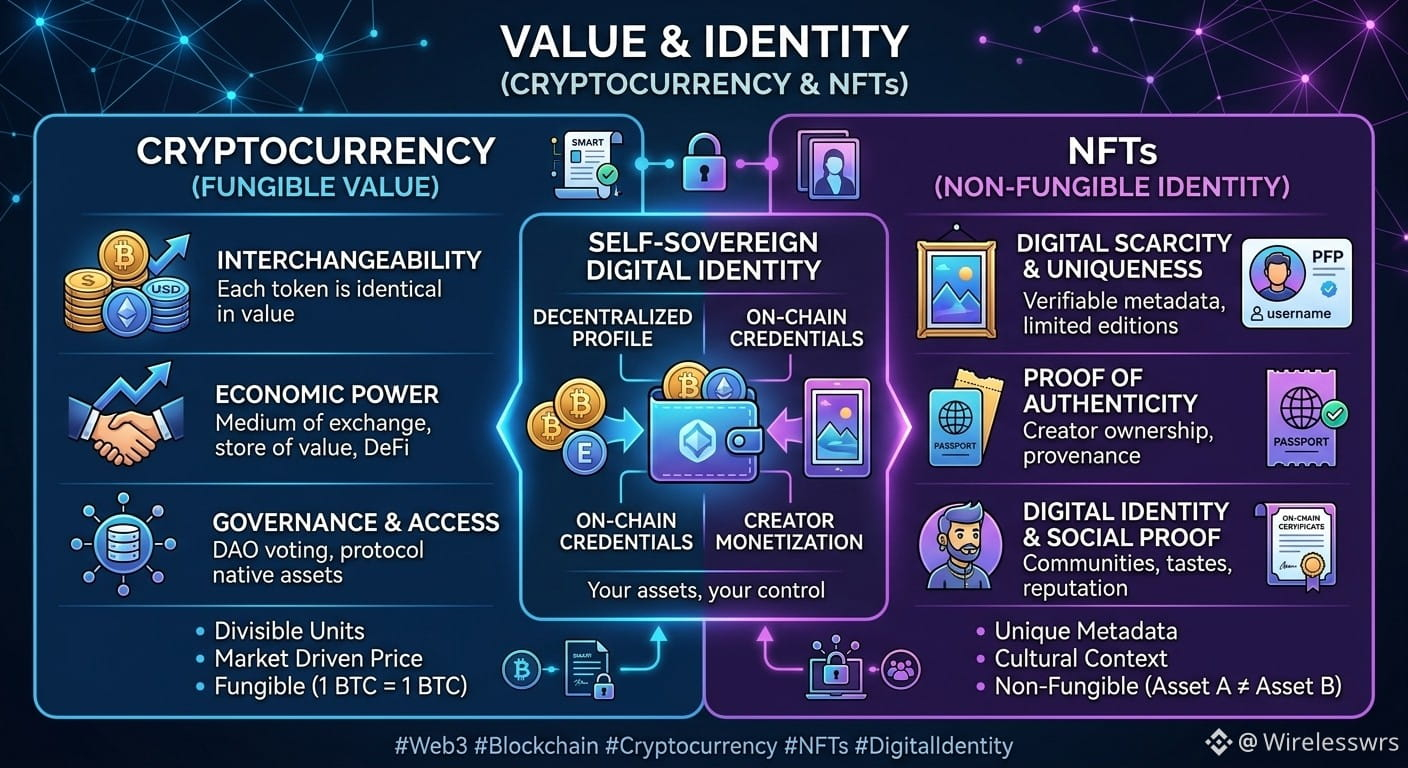
In Web3, we often lump Cryptocurrency and NFTs into the same conversation, but they actually represent two fundamentally different pillars of the digital economy: Value vs. Identity.
Understanding the distinction is key to grasping where decentralized technology is headed.
💡 Cryptocurrency = Fungible Value
Cryptocurrencies like Bitcoin and Ether function as liquid financial power:
Interchangeability: Every token holds the exact same value as another unit of the same type (1 ETH = 1 ETH).
Utility: They serve as a medium of exchange, store of value, and protocol gas.
Economic Governance: Holding native or governance tokens gives you voting power in DAOs and protocol decisions.
In short, crypto is your digital purchasing power.
🎨 NFTs = Non-Fungible Identity
Non-Fungible Tokens represent uniqueness, provenance, and self-expression:
Scarcity & Authenticity: Each NFT carries unique cryptographic metadata, serving as permanent proof of ownership.
Social Capital: PFPs, digital badges, and soulbound tokens (SBTs) reflect your community memberships, tastes, and reputation.
Access & Utility: NFTs act as digital keys—granting access to exclusive communities, events, and token-gated content.
In short, NFTs are your digital passport and persona.
🔗 The Intersection: Self-Sovereign Identity
When you combine these two primitives, your cryptographic wallet becomes a complete digital representation of who you are:
1. Your Capital (Crypto holdings)
2. Your Credentials (NFT access passes and verified credentials)
3. Your Reputation (On-chain history and digital assets)
Instead of trusting centralized platforms with your data, Web3 allows you to hold your net worth and your identity in a wallet that only you control.
How do you see the relationship between digital ownership and online identity evolving in your field?
#Web3 #Cryptocurrency #NFTs #Blockchain #DigitalIdentity #DeFi
In Web3, we often lump Cryptocurrency and NFTs into the same conversation, but they actually represent two fundamentally different pillars of the digital economy: Value vs. Identity.
Understanding the distinction is key to grasping where decentralized technology is headed.
💡 Cryptocurrency = Fungible Value
Cryptocurrencies like Bitcoin and Ether function as liquid financial power:
Interchangeability: Every token holds the exact same value as another unit of the same type (1 ETH = 1 ETH).
Utility: They serve as a medium of exchange, store of value, and protocol gas.
Economic Governance: Holding native or governance tokens gives you voting power in DAOs and protocol decisions.
In short, crypto is your digital purchasing power.
🎨 NFTs = Non-Fungible Identity
Non-Fungible Tokens represent uniqueness, provenance, and self-expression:
Scarcity & Authenticity: Each NFT carries unique cryptographic metadata, serving as permanent proof of ownership.
Social Capital: PFPs, digital badges, and soulbound tokens (SBTs) reflect your community memberships, tastes, and reputation.
Access & Utility: NFTs act as digital keys—granting access to exclusive communities, events, and token-gated content.
In short, NFTs are your digital passport and persona.
🔗 The Intersection: Self-Sovereign Identity
When you combine these two primitives, your cryptographic wallet becomes a complete digital representation of who you are:
1. Your Capital (Crypto holdings)
2. Your Credentials (NFT access passes and verified credentials)
3. Your Reputation (On-chain history and digital assets)
Instead of trusting centralized platforms with your data, Web3 allows you to hold your net worth and your identity in a wallet that only you control.
How do you see the relationship between digital ownership and online identity evolving in your field?
#Web3 #Cryptocurrency #NFTs #Blockchain #DigitalIdentity #DeFi
Understanding the distinction is key to grasping where decentralized technology is headed.
💡 Cryptocurrency = Fungible Value
Cryptocurrencies like Bitcoin and Ether function as liquid financial power:
Interchangeability: Every token holds the exact same value as another unit of the same type (1 ETH = 1 ETH).
Utility: They serve as a medium of exchange, store of value, and protocol gas.
Economic Governance: Holding native or governance tokens gives you voting power in DAOs and protocol decisions.
In short, crypto is your digital purchasing power.
🎨 NFTs = Non-Fungible Identity
Non-Fungible Tokens represent uniqueness, provenance, and self-expression:
Scarcity & Authenticity: Each NFT carries unique cryptographic metadata, serving as permanent proof of ownership.
Social Capital: PFPs, digital badges, and soulbound tokens (SBTs) reflect your community memberships, tastes, and reputation.
Access & Utility: NFTs act as digital keys—granting access to exclusive communities, events, and token-gated content.
In short, NFTs are your digital passport and persona.
🔗 The Intersection: Self-Sovereign Identity
When you combine these two primitives, your cryptographic wallet becomes a complete digital representation of who you are:
1. Your Capital (Crypto holdings)
2. Your Credentials (NFT access passes and verified credentials)
3. Your Reputation (On-chain history and digital assets)
Instead of trusting centralized platforms with your data, Web3 allows you to hold your net worth and your identity in a wallet that only you control.
How do you see the relationship between digital ownership and online identity evolving in your field?
#Web3 #Cryptocurrency #NFTs #Blockchain #DigitalIdentity #DeFi
86
·
--
See translation
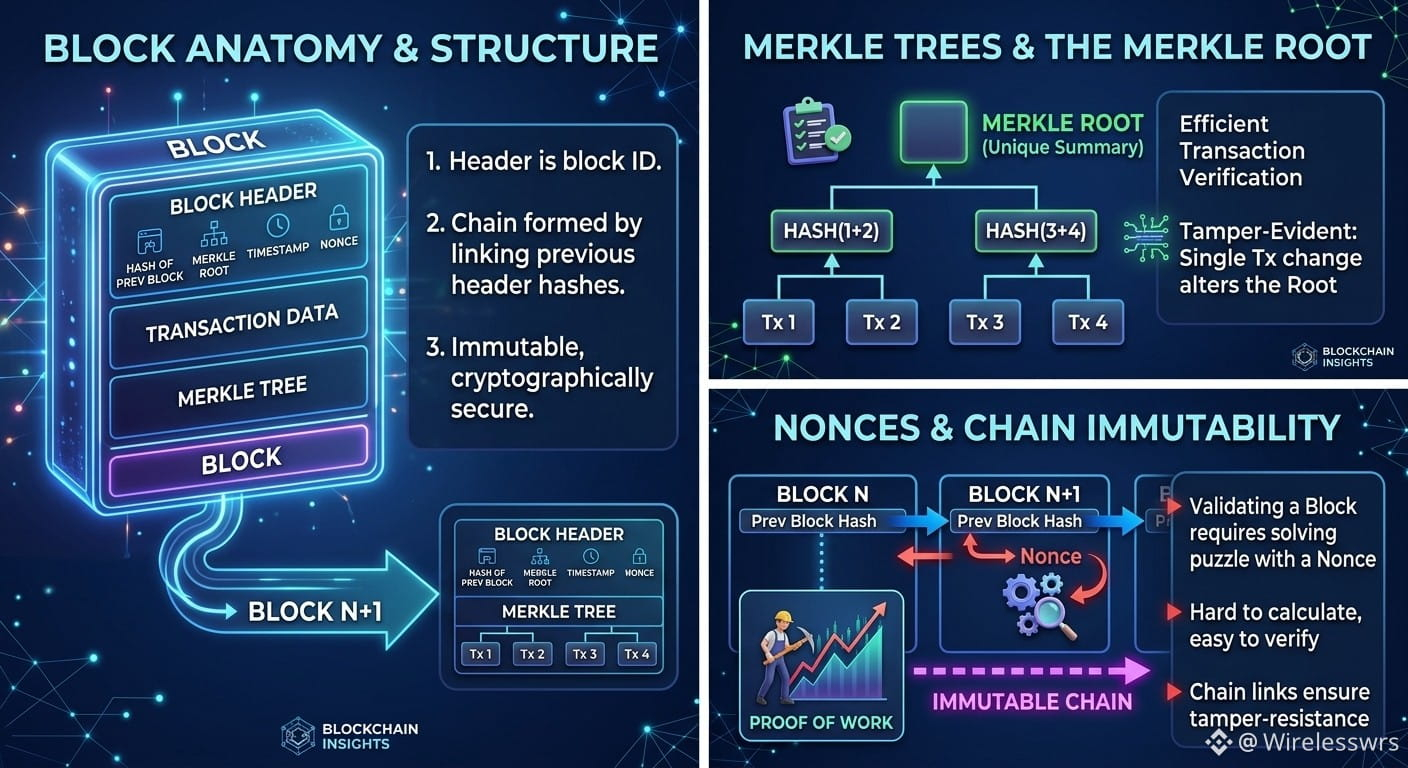
The anatomy of an immutable blockchain block:
▪️ Block Header: Contains metadata & previous block's hash ▪️ Merkle Root: Condenses thousands of transactions into one tamper-proof hash ▪️ Nonce: The random number miners guess to solve Proof of Work ▪️ Immutability: Re-writing history requires out-mining the entire network
Math > Trust. 🔐 #Web3 #Blockchain #Crypto
The anatomy of an immutable blockchain block:
▪️ Block Header: Contains metadata & previous block's hash ▪️ Merkle Root: Condenses thousands of transactions into one tamper-proof hash ▪️ Nonce: The random number miners guess to solve Proof of Work ▪️ Immutability: Re-writing history requires out-mining the entire network
Math > Trust. 🔐 #Web3 #Blockchain #Crypto
▪️ Block Header: Contains metadata & previous block's hash ▪️ Merkle Root: Condenses thousands of transactions into one tamper-proof hash ▪️ Nonce: The random number miners guess to solve Proof of Work ▪️ Immutability: Re-writing history requires out-mining the entire network
Math > Trust. 🔐 #Web3 #Blockchain #Crypto
23
·
--
See translation
The Ledger Evolution: From centralized databases to decentralized state machines on Cryptocurrency
For centuries, accounting was simple: one central ledger, one central authority. Whether recorded on clay tablets, in paper journals, or hosted on cloud servers, the rule was clear—trust the middleman.
The rise of cryptocurrency quietly sparked a massive architectural revolution:
1️⃣ The Centralized Database (Trust the Server)
Traditional networks rely on relational or NoSQL databases managed by banks or cloud platforms. High throughput and low latency, but with a massive catch: a single point of failure, vulnerable to outages, bad migrations, or single-entity control.
2️⃣ The Append-Only Ledger (Trust the Cryptography)
In 2008, Bitcoin introduced the UTXO (Unspent Transaction Output) model. Instead of editing balances in place, transactions were appended to a cryptographically linked, peer-to-peer chain. Perfect for value transfers, but fundamentally limited in programmable logic.
3️⃣ The Decentralized State Machine (Trust the Code)
Networks like Ethereum transformed distributed ledgers into global computers. Through the account-based model, every transaction shifts the global network state from $S$ to $S'$ via a deterministic execution environment (like the EVM). Ledgers stopped being digital checkbooks and became programmable engines for smart contracts and DeFi.
🚀 What’s Next?
We are now entering the modular era. Next-gen state machines are scaling via "parallel execution environments" (processing transactions simultaneously rather than sequentially) and "Zero-Knowledge Rollups" (moving execution off-chain while posting cryptographic proofs on-chain).
We transitioned from trusting central authorities to trusting append-only logs, and finally to running code on a global, zero-trust execution engine.
Where do you see the biggest bottleneck in current decentralized state machines—execution speed, storage, or developer UX?
#crypto #bitcoin #BTC
The Ledger Evolution: From centralized databases to decentralized state machines on Cryptocurrency
For centuries, accounting was simple: one central ledger, one central authority. Whether recorded on clay tablets, in paper journals, or hosted on cloud servers, the rule was clear—trust the middleman.
The rise of cryptocurrency quietly sparked a massive architectural revolution:
1️⃣ The Centralized Database (Trust the Server)
Traditional networks rely on relational or NoSQL databases managed by banks or cloud platforms. High throughput and low latency, but with a massive catch: a single point of failure, vulnerable to outages, bad migrations, or single-entity control.
2️⃣ The Append-Only Ledger (Trust the Cryptography)
In 2008, Bitcoin introduced the UTXO (Unspent Transaction Output) model. Instead of editing balances in place, transactions were appended to a cryptographically linked, peer-to-peer chain. Perfect for value transfers, but fundamentally limited in programmable logic.
3️⃣ The Decentralized State Machine (Trust the Code)
Networks like Ethereum transformed distributed ledgers into global computers. Through the account-based model, every transaction shifts the global network state from $S$ to $S'$ via a deterministic execution environment (like the EVM). Ledgers stopped being digital checkbooks and became programmable engines for smart contracts and DeFi.
🚀 What’s Next?
We are now entering the modular era. Next-gen state machines are scaling via "parallel execution environments" (processing transactions simultaneously rather than sequentially) and "Zero-Knowledge Rollups" (moving execution off-chain while posting cryptographic proofs on-chain).
We transitioned from trusting central authorities to trusting append-only logs, and finally to running code on a global, zero-trust execution engine.
Where do you see the biggest bottleneck in current decentralized state machines—execution speed, storage, or developer UX?
#crypto #bitcoin #BTC
For centuries, accounting was simple: one central ledger, one central authority. Whether recorded on clay tablets, in paper journals, or hosted on cloud servers, the rule was clear—trust the middleman.
The rise of cryptocurrency quietly sparked a massive architectural revolution:
1️⃣ The Centralized Database (Trust the Server)
Traditional networks rely on relational or NoSQL databases managed by banks or cloud platforms. High throughput and low latency, but with a massive catch: a single point of failure, vulnerable to outages, bad migrations, or single-entity control.
2️⃣ The Append-Only Ledger (Trust the Cryptography)
In 2008, Bitcoin introduced the UTXO (Unspent Transaction Output) model. Instead of editing balances in place, transactions were appended to a cryptographically linked, peer-to-peer chain. Perfect for value transfers, but fundamentally limited in programmable logic.
3️⃣ The Decentralized State Machine (Trust the Code)
Networks like Ethereum transformed distributed ledgers into global computers. Through the account-based model, every transaction shifts the global network state from $S$ to $S'$ via a deterministic execution environment (like the EVM). Ledgers stopped being digital checkbooks and became programmable engines for smart contracts and DeFi.
🚀 What’s Next?
We are now entering the modular era. Next-gen state machines are scaling via "parallel execution environments" (processing transactions simultaneously rather than sequentially) and "Zero-Knowledge Rollups" (moving execution off-chain while posting cryptographic proofs on-chain).
We transitioned from trusting central authorities to trusting append-only logs, and finally to running code on a global, zero-trust execution engine.
Where do you see the biggest bottleneck in current decentralized state machines—execution speed, storage, or developer UX?
#crypto #bitcoin #BTC
86
·
--
See translation
The modality of cryptocurrency refers to the different forms, operational frameworks, and functional dimensions through which digital assets exist, validate value, and execute transactions.
Cryptocurrency does not operate under a single mode; rather, its modality can be analyzed across four primary layers:
1. Asset Modality (Token Classification)
How the cryptocurrency is structured financially and functionally:
Native Cryptocurrencies (Layer 1 Coins): Digital currencies that operate on their own independent blockchain protocol (e.g., Bitcoin, Ethereum, Solana). They serve as the primary medium to pay transaction fees (gas) and secure the underlying network.
Tokens (Layer 2 / DApp Tokens): Digital assets built on top of an existing blockchain platform via smart contracts (e.g., ERC-20 tokens on Ethereum). They typically represent utility, governance rights, or access within a specific application.
Stablecoins: Cryptocurrencies pegged to an underlying real-world asset (such as fiat currencies like the USD, or commodities like gold) to minimize price volatility (e.g., USDT, USDC). They can be fiat-backed, crypto-collateralized, or algorithmic.
Non-Fungible Tokens (NFTs): Cryptographic assets representing unique ownership of a specific item or piece of data (e.g., digital art, domain names, real-world asset tokenization). Unlike fungible coins, each NFT is distinct and non-interchangeable 1:1.
2. Structural & Consensus Modality (Architecture)
How transactions are verified and maintained in a decentralized, trustless environment:
Proof-of-Work (PoW): Requires computational energy and hardware ("miners") to solve cryptographic puzzles, securing the network and validating transactions (e.g., Bitcoin).
Proof-of-Stake (PoS): Replaces energy-intensive mining with validator nodes that "stake" (lock up) native tokens as collateral to validate transactions (e.g., Ethereum, Cardano).
Hybrid & Alternative Models: Includes mechanisms like Proof-of-History (PoH), Delegated Proof-of-Stake (DPoS), and Proof-of-Authority (PoA), optimized for speed, scalability
The modality of cryptocurrency refers to the different forms, operational frameworks, and functional dimensions through which digital assets exist, validate value, and execute transactions.
Cryptocurrency does not operate under a single mode; rather, its modality can be analyzed across four primary layers:
1. Asset Modality (Token Classification)
How the cryptocurrency is structured financially and functionally:
Native Cryptocurrencies (Layer 1 Coins): Digital currencies that operate on their own independent blockchain protocol (e.g., Bitcoin, Ethereum, Solana). They serve as the primary medium to pay transaction fees (gas) and secure the underlying network.
Tokens (Layer 2 / DApp Tokens): Digital assets built on top of an existing blockchain platform via smart contracts (e.g., ERC-20 tokens on Ethereum). They typically represent utility, governance rights, or access within a specific application.
Stablecoins: Cryptocurrencies pegged to an underlying real-world asset (such as fiat currencies like the USD, or commodities like gold) to minimize price volatility (e.g., USDT, USDC). They can be fiat-backed, crypto-collateralized, or algorithmic.
Non-Fungible Tokens (NFTs): Cryptographic assets representing unique ownership of a specific item or piece of data (e.g., digital art, domain names, real-world asset tokenization). Unlike fungible coins, each NFT is distinct and non-interchangeable 1:1.
2. Structural & Consensus Modality (Architecture)
How transactions are verified and maintained in a decentralized, trustless environment:
Proof-of-Work (PoW): Requires computational energy and hardware ("miners") to solve cryptographic puzzles, securing the network and validating transactions (e.g., Bitcoin).
Proof-of-Stake (PoS): Replaces energy-intensive mining with validator nodes that "stake" (lock up) native tokens as collateral to validate transactions (e.g., Ethereum, Cardano).
Hybrid & Alternative Models: Includes mechanisms like Proof-of-History (PoH), Delegated Proof-of-Stake (DPoS), and Proof-of-Authority (PoA), optimized for speed, scalability
Cryptocurrency does not operate under a single mode; rather, its modality can be analyzed across four primary layers:
1. Asset Modality (Token Classification)
How the cryptocurrency is structured financially and functionally:
Native Cryptocurrencies (Layer 1 Coins): Digital currencies that operate on their own independent blockchain protocol (e.g., Bitcoin, Ethereum, Solana). They serve as the primary medium to pay transaction fees (gas) and secure the underlying network.
Tokens (Layer 2 / DApp Tokens): Digital assets built on top of an existing blockchain platform via smart contracts (e.g., ERC-20 tokens on Ethereum). They typically represent utility, governance rights, or access within a specific application.
Stablecoins: Cryptocurrencies pegged to an underlying real-world asset (such as fiat currencies like the USD, or commodities like gold) to minimize price volatility (e.g., USDT, USDC). They can be fiat-backed, crypto-collateralized, or algorithmic.
Non-Fungible Tokens (NFTs): Cryptographic assets representing unique ownership of a specific item or piece of data (e.g., digital art, domain names, real-world asset tokenization). Unlike fungible coins, each NFT is distinct and non-interchangeable 1:1.
2. Structural & Consensus Modality (Architecture)
How transactions are verified and maintained in a decentralized, trustless environment:
Proof-of-Work (PoW): Requires computational energy and hardware ("miners") to solve cryptographic puzzles, securing the network and validating transactions (e.g., Bitcoin).
Proof-of-Stake (PoS): Replaces energy-intensive mining with validator nodes that "stake" (lock up) native tokens as collateral to validate transactions (e.g., Ethereum, Cardano).
Hybrid & Alternative Models: Includes mechanisms like Proof-of-History (PoH), Delegated Proof-of-Stake (DPoS), and Proof-of-Authority (PoA), optimized for speed, scalability

83
·
--

79

·
--
See translation
CZ just dropped this at Bitcoin Asia 2026
“I think for Bitcoin to hit $1,000,000 would be a good thing. And it’ll happen. I don’t think we need 25 years. I think it’s gonna happen much quicker.” 🚀 He’s not just chasing a number. The former Binance CEO stressed that price is secondary — real utility (mass payments + pension/retirement reserves) is what matters, and he expects the core pieces of that infrastructure within ~10 years.
#bitcoin #BTC
CZ just dropped this at Bitcoin Asia 2026
“I think for Bitcoin to hit $1,000,000 would be a good thing. And it’ll happen. I don’t think we need 25 years. I think it’s gonna happen much quicker.” 🚀 He’s not just chasing a number. The former Binance CEO stressed that price is secondary — real utility (mass payments + pension/retirement reserves) is what matters, and he expects the core pieces of that infrastructure within ~10 years.
#bitcoin #BTC
“I think for Bitcoin to hit $1,000,000 would be a good thing. And it’ll happen. I don’t think we need 25 years. I think it’s gonna happen much quicker.” 🚀 He’s not just chasing a number. The former Binance CEO stressed that price is secondary — real utility (mass payments + pension/retirement reserves) is what matters, and he expects the core pieces of that infrastructure within ~10 years.
#bitcoin #BTC
76

·
--
See translation
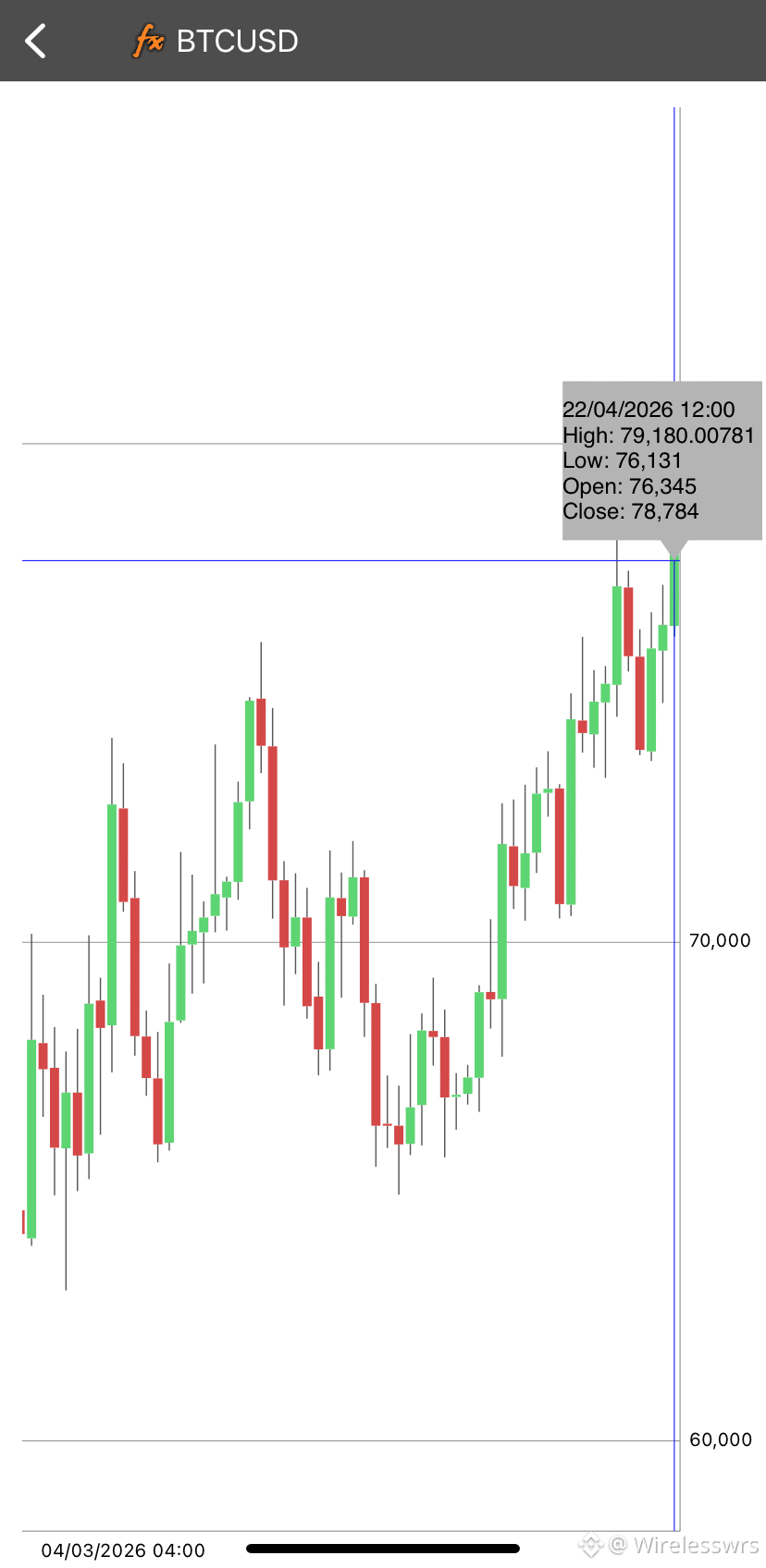
Bitcoin is preparing to stay above $80,000#Btc
Bitcoin is preparing to stay above $80,000#Btc
24


·
--
See translation
Hackers using the ClickFix technique are now posing as venture capitalists (VCs) and hijacking browser extensions like QuickLens in a wave of cryptocurrency theft attacks.
The ClickFix method, which surged in popularity among crypto scammers last year, tricks victims into manually executing malicious code—often by copying and pasting commands under the pretense of a verification, browser update, or CAPTCHA check. This social engineering bypasses many traditional security defenses, as users unwittingly become the execution mechanism.
Security researchers have monitored ClickFix since 2024, initially seeing it target various sectors beyond just crypto. In the latest incidents, attackers have evolved their tactics in two notable ways:
- Impersonating VCs — Fraudsters create fake firms (e.g., SolidBit, MegaBit, and Lumax Capital) to reach out via LinkedIn with enticing partnership or investment offers. Victims are then directed to bogus Zoom or Google Meet links, setting the stage for further compromise and ClickFix deployment to steal crypto assets.
- Hijacking QuickLens — The previously legitimate Chrome extension "QuickLens - Search Screen with Google Lens" (which had around 7,000 users and once earned a Google featured badge) was compromised after a change in ownership. A malicious update (version 5.8, released around February 17, 2026) introduced info-stealing capabilities and ClickFix prompts. It stripped browser security features, communicated with attacker-controlled servers, displayed fake Google Update alerts, and ultimately targeted cryptocurrency wallets, credentials, seed phrases, and more. The extension has since been removed from the Chrome Web Store.
These attacks highlight how threat actors combine supply-chain compromises (like extension takeovers) with targeted phishing and user manipulation to drain crypto holdings effectively. Users in the crypto space should remain vigilant against unsolicited VC outreach, avoid running unknown commands, and regularly audit installed browser extensions.
#Clickfix #cryptothreat #CryptoAttacks
Hackers using the ClickFix technique are now posing as venture capitalists (VCs) and hijacking browser extensions like QuickLens in a wave of cryptocurrency theft attacks.
The ClickFix method, which surged in popularity among crypto scammers last year, tricks victims into manually executing malicious code—often by copying and pasting commands under the pretense of a verification, browser update, or CAPTCHA check. This social engineering bypasses many traditional security defenses, as users unwittingly become the execution mechanism.
Security researchers have monitored ClickFix since 2024, initially seeing it target various sectors beyond just crypto. In the latest incidents, attackers have evolved their tactics in two notable ways:
- Impersonating VCs — Fraudsters create fake firms (e.g., SolidBit, MegaBit, and Lumax Capital) to reach out via LinkedIn with enticing partnership or investment offers. Victims are then directed to bogus Zoom or Google Meet links, setting the stage for further compromise and ClickFix deployment to steal crypto assets.
- Hijacking QuickLens — The previously legitimate Chrome extension "QuickLens - Search Screen with Google Lens" (which had around 7,000 users and once earned a Google featured badge) was compromised after a change in ownership. A malicious update (version 5.8, released around February 17, 2026) introduced info-stealing capabilities and ClickFix prompts. It stripped browser security features, communicated with attacker-controlled servers, displayed fake Google Update alerts, and ultimately targeted cryptocurrency wallets, credentials, seed phrases, and more. The extension has since been removed from the Chrome Web Store.
These attacks highlight how threat actors combine supply-chain compromises (like extension takeovers) with targeted phishing and user manipulation to drain crypto holdings effectively. Users in the crypto space should remain vigilant against unsolicited VC outreach, avoid running unknown commands, and regularly audit installed browser extensions.
#Clickfix #cryptothreat #CryptoAttacks
The ClickFix method, which surged in popularity among crypto scammers last year, tricks victims into manually executing malicious code—often by copying and pasting commands under the pretense of a verification, browser update, or CAPTCHA check. This social engineering bypasses many traditional security defenses, as users unwittingly become the execution mechanism.
Security researchers have monitored ClickFix since 2024, initially seeing it target various sectors beyond just crypto. In the latest incidents, attackers have evolved their tactics in two notable ways:
- Impersonating VCs — Fraudsters create fake firms (e.g., SolidBit, MegaBit, and Lumax Capital) to reach out via LinkedIn with enticing partnership or investment offers. Victims are then directed to bogus Zoom or Google Meet links, setting the stage for further compromise and ClickFix deployment to steal crypto assets.
- Hijacking QuickLens — The previously legitimate Chrome extension "QuickLens - Search Screen with Google Lens" (which had around 7,000 users and once earned a Google featured badge) was compromised after a change in ownership. A malicious update (version 5.8, released around February 17, 2026) introduced info-stealing capabilities and ClickFix prompts. It stripped browser security features, communicated with attacker-controlled servers, displayed fake Google Update alerts, and ultimately targeted cryptocurrency wallets, credentials, seed phrases, and more. The extension has since been removed from the Chrome Web Store.
These attacks highlight how threat actors combine supply-chain compromises (like extension takeovers) with targeted phishing and user manipulation to drain crypto holdings effectively. Users in the crypto space should remain vigilant against unsolicited VC outreach, avoid running unknown commands, and regularly audit installed browser extensions.
#Clickfix #cryptothreat #CryptoAttacks
1
3
47
·
--

2
111
·
--
See translation
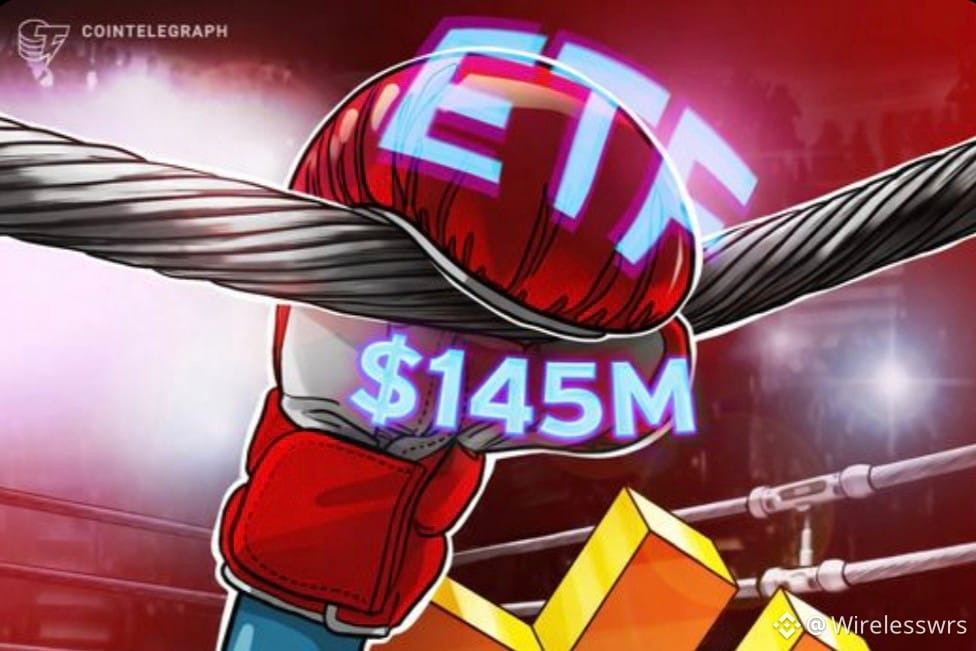
Bitcoin ETFs extend rebound as $145M in fresh inflows hit market
The Bitcoin ETF rebound comes as analysts flag slowing outflows. Early BTC holders trim positions rather than exit as BTC hovers near $70,000,
Bitcoin ETFs extend rebound as $145M in fresh inflows hit market
The Bitcoin ETF rebound comes as analysts flag slowing outflows. Early BTC holders trim positions rather than exit as BTC hovers near $70,000,
The Bitcoin ETF rebound comes as analysts flag slowing outflows. Early BTC holders trim positions rather than exit as BTC hovers near $70,000,
1
95

Log in to explore more content
Join global crypto users on Binance Square
⚡️ Get latest and useful information about crypto.
💬 Trusted by the world’s largest crypto exchange.
👍 Discover real insights from verified creators.
Email / Phone number
Trending Topics
BinancePick
2.6M views
140,664 Discussing
Join #EarningsSeason: Predict Earnings on Binance Pick, Share Your Take on Binance Square!
Binance Square Official
·400 Likes
·338.1k views
EarningsSeason
5M views
24,263 Discussing
FranklinTempletonFilesForTwoDividendToBitcoinETFs
427 views
50 Discussing