

Crypto knowledge P
149 Posts

Crypto knowledge P
Report
Block User
17 Following
1.9K+ Followers
609 Liked
Posts
All
Quotes
See translation
🌕✨ A Binance Moon Cake for the Mid-Autumn Festival! 🥮💛
I mixed the warmth of the Mid-Autumn moon with the Binance spirit — golden details, moonlight, and a little crypto magic. 🌙🟡
What do you think of my Binance Moon Cake? 🥮🐰
Happy Mid-Autumn Festival! ❤️
#BinanceMidAutumn #BinanceSquareTG
🌕✨ A Binance Moon Cake for the Mid-Autumn Festival! 🥮💛
I mixed the warmth of the Mid-Autumn moon with the Binance spirit — golden details, moonlight, and a little crypto magic. 🌙🟡
What do you think of my Binance Moon Cake? 🥮🐰
Happy Mid-Autumn Festival! ❤️
#BinanceMidAutumn #BinanceSquareTG
I mixed the warmth of the Mid-Autumn moon with the Binance spirit — golden details, moonlight, and a little crypto magic. 🌙🟡
What do you think of my Binance Moon Cake? 🥮🐰
Happy Mid-Autumn Festival! ❤️
#BinanceMidAutumn #BinanceSquareTG

2
92
See translation
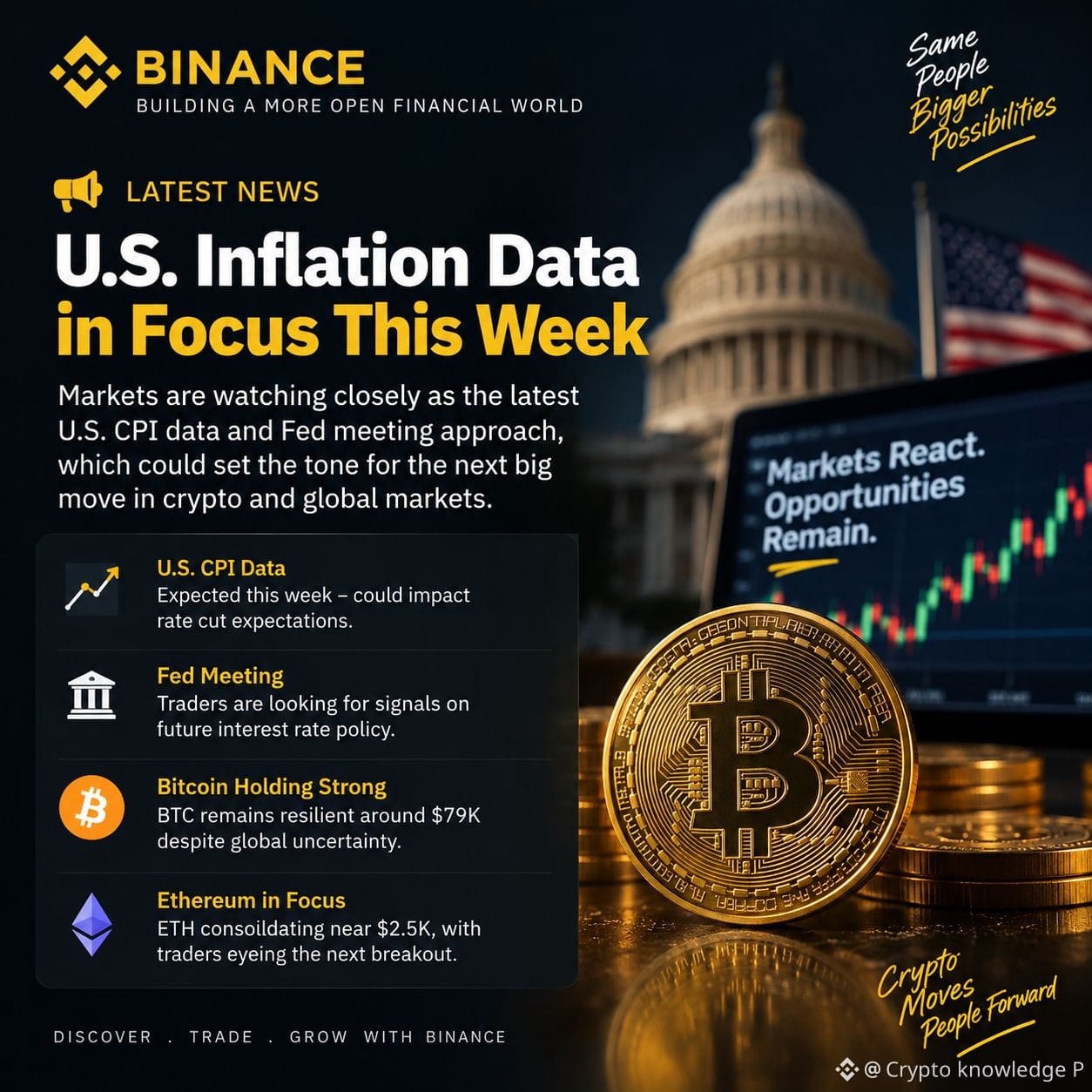
Bitcoin is back around $79K, but the bigger story today is what’s happening outside crypto.
Oil just pushed above $100 as tensions in the Middle East escalated, while global stocks moved lower. At the same time, traders are watching the upcoming U.S. inflation data and the Fed meeting closely.
What I find interesting is that BTC is still holding relatively well despite all that macro pressure.
Ethereum is also worth watching here. After a strong rally, ETH is consolidating around the $2.5K area, with traders looking for the next breakout.
For me, this is one of those moments where patience matters more than chasing candles.
The next few days could get interesting. 👀
#Bitcoin #BTC #ETH #crypto
#CryptoNews
$BTC $ETH
Bitcoin is back around $79K, but the bigger story today is what’s happening outside crypto.
Oil just pushed above $100 as tensions in the Middle East escalated, while global stocks moved lower. At the same time, traders are watching the upcoming U.S. inflation data and the Fed meeting closely.
What I find interesting is that BTC is still holding relatively well despite all that macro pressure.
Ethereum is also worth watching here. After a strong rally, ETH is consolidating around the $2.5K area, with traders looking for the next breakout.
For me, this is one of those moments where patience matters more than chasing candles.
The next few days could get interesting. 👀
#Bitcoin #BTC #ETH #crypto
#CryptoNews
$BTC $ETH
Oil just pushed above $100 as tensions in the Middle East escalated, while global stocks moved lower. At the same time, traders are watching the upcoming U.S. inflation data and the Fed meeting closely.
What I find interesting is that BTC is still holding relatively well despite all that macro pressure.
Ethereum is also worth watching here. After a strong rally, ETH is consolidating around the $2.5K area, with traders looking for the next breakout.
For me, this is one of those moments where patience matters more than chasing candles.
The next few days could get interesting. 👀
#Bitcoin #BTC #ETH #crypto
#CryptoNews
$BTC $ETH
110
See translation
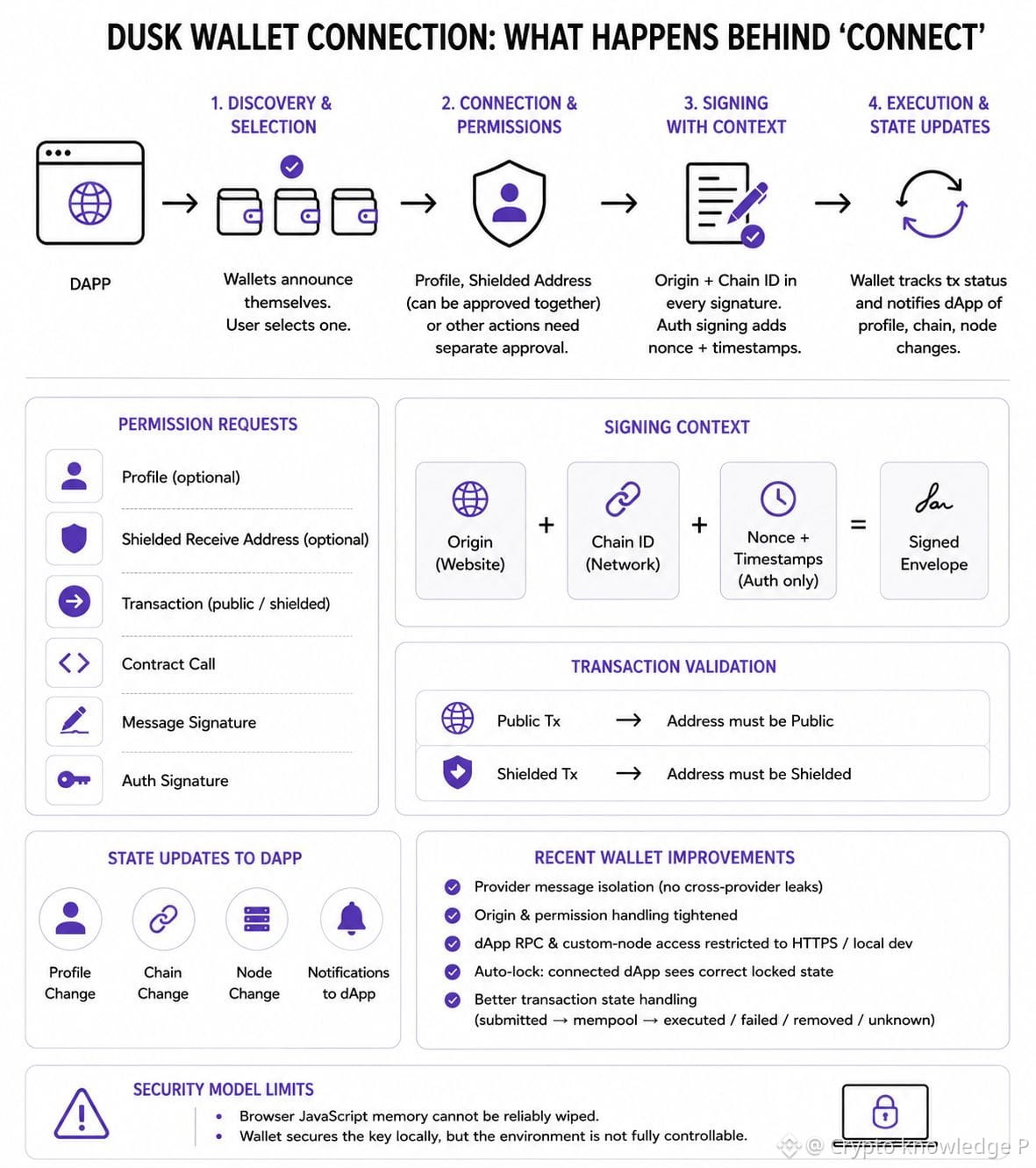
A Dusk wallet connection looks like one simple click. But when I started looking at what sits behind it, I realised there’s quite a bit going on.
I went through the wallet discovery flow first. A dApp doesn’t just grab whichever Dusk wallet is sitting on the page. Wallets announce themselves, the dApp discovers them, and if there’s more than one installed, a provider has to be selected. Each one also carries its own identity. It’s a small detail, but it matters because the site needs to know which wallet it is actually talking to.
Then I looked at the permission side. A profile request, shielded receive address, transaction, contract call or signature are not all the same thing. They go through different wallet requests, and the wallet can also report profile, chain and selected-node changes while the connection is active. So “connected” doesn’t really mean the dApp has unlimited access.
The signing part was the one I found most interesting. Dusk puts the origin and chain ID into the signed message context. Auth signing also carries a nonce and timestamps. So the signature isn’t just “this account signed something” — there’s context around the request as well.
I also checked the recent wallet changes around this. Provider messages were restricted so another installed Dusk provider can’t receive the same dApp request. Origin and permission handling were tightened, and dApp RPC and custom-node connections were restricted to HTTPS or local development endpoints. Dusk’s own security notes also mention limits like JavaScript memory not being reliably wipeable.
For me, that changes how the little Connect Wallet button looks. It’s not really one permission. There’s a whole layer between the website and the key deciding which wallet is being used, what the dApp can ask for, and what the user actually signs.
$DUSK @Dusk_Foundation #dusk
{spot}(DUSKUSDT)
A Dusk wallet connection looks like one simple click. But when I started looking at what sits behind it, I realised there’s quite a bit going on.
I went through the wallet discovery flow first. A dApp doesn’t just grab whichever Dusk wallet is sitting on the page. Wallets announce themselves, the dApp discovers them, and if there’s more than one installed, a provider has to be selected. Each one also carries its own identity. It’s a small detail, but it matters because the site needs to know which wallet it is actually talking to.
Then I looked at the permission side. A profile request, shielded receive address, transaction, contract call or signature are not all the same thing. They go through different wallet requests, and the wallet can also report profile, chain and selected-node changes while the connection is active. So “connected” doesn’t really mean the dApp has unlimited access.
The signing part was the one I found most interesting. Dusk puts the origin and chain ID into the signed message context. Auth signing also carries a nonce and timestamps. So the signature isn’t just “this account signed something” — there’s context around the request as well.
I also checked the recent wallet changes around this. Provider messages were restricted so another installed Dusk provider can’t receive the same dApp request. Origin and permission handling were tightened, and dApp RPC and custom-node connections were restricted to HTTPS or local development endpoints. Dusk’s own security notes also mention limits like JavaScript memory not being reliably wipeable.
For me, that changes how the little Connect Wallet button looks. It’s not really one permission. There’s a whole layer between the website and the key deciding which wallet is being used, what the dApp can ask for, and what the user actually signs.
$DUSK @Dusk #dusk
I went through the wallet discovery flow first. A dApp doesn’t just grab whichever Dusk wallet is sitting on the page. Wallets announce themselves, the dApp discovers them, and if there’s more than one installed, a provider has to be selected. Each one also carries its own identity. It’s a small detail, but it matters because the site needs to know which wallet it is actually talking to.
Then I looked at the permission side. A profile request, shielded receive address, transaction, contract call or signature are not all the same thing. They go through different wallet requests, and the wallet can also report profile, chain and selected-node changes while the connection is active. So “connected” doesn’t really mean the dApp has unlimited access.
The signing part was the one I found most interesting. Dusk puts the origin and chain ID into the signed message context. Auth signing also carries a nonce and timestamps. So the signature isn’t just “this account signed something” — there’s context around the request as well.
I also checked the recent wallet changes around this. Provider messages were restricted so another installed Dusk provider can’t receive the same dApp request. Origin and permission handling were tightened, and dApp RPC and custom-node connections were restricted to HTTPS or local development endpoints. Dusk’s own security notes also mention limits like JavaScript memory not being reliably wipeable.
For me, that changes how the little Connect Wallet button looks. It’s not really one permission. There’s a whole layer between the website and the key deciding which wallet is being used, what the dApp can ask for, and what the user actually signs.
$DUSK @Dusk #dusk
2
158
Verified
See translation
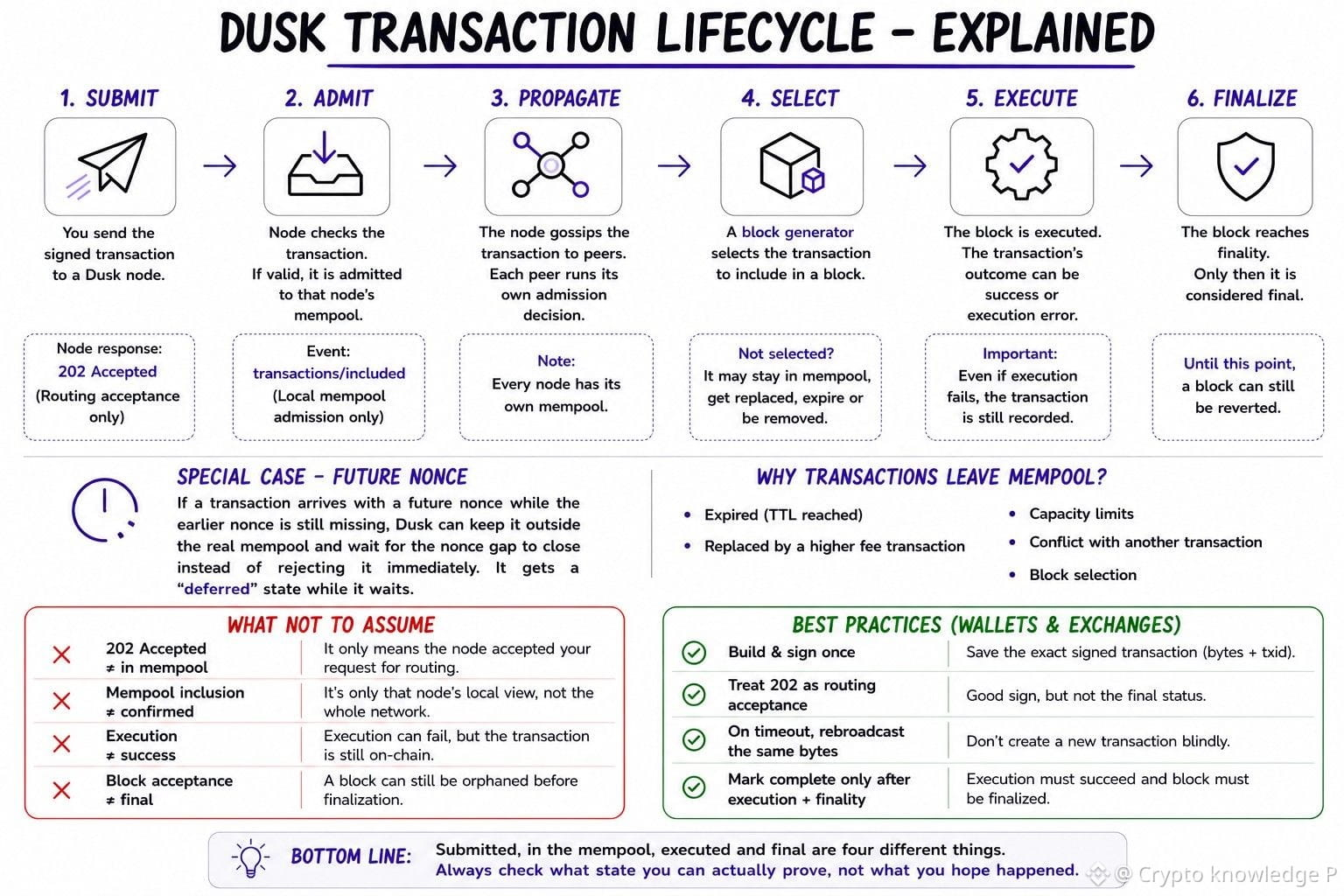
I think we usually ask the wrong question when a Dusk transaction “fails”.
A 202 Accepted only means the node accepted the request for routing. It does not mean the transaction is already in the mempool or in a block. One example I found interesting is a future nonce. If a Moonlight transaction arrives with a future nonce while an earlier nonce is still missing, Dusk can keep it outside the real mempool and wait for the nonce gap to close instead of rejecting it immediately. It gets a deferred state while that happens.
That is only one part of the story. Once a transaction passes admission, it enters that node’s local mempool. Other nodes keep their own mempools and run their own admission checks too. Later, a transaction can be selected for a block, executed, and eventually finalized. It can also leave the local mempool without that automatically meaning it failed. Expiry, replacement, capacity limits and conflicts can all lead to removal.
This is where I think the difference matters for wallets and exchanges. Dusk’s own integration guidance says to keep the exact signed transaction, treat 202 Accepted only as successful routing, and rebroadcast the same signed bytes after a transport timeout instead of creating a new transaction blindly. A withdrawal should only be marked complete after execution is checked and the block is finalized.
The more I looked at it, the less “transaction submitted” sounded like a useful status on its own. A transaction can be waiting for a nonce, sitting in one node’s mempool, executed with an error, or sitting in a block that is not final yet. Those are very different situations, even though they can all look like “it’s still pending” from the outside.
For me, that is the useful takeaway from Dusk’s transaction flow: submitted is only the beginning. What matters is the state you can actually prove the transaction reached.
$DUSK @Dusk_Foundation #dusk
{spot}(DUSKUSDT)
I think we usually ask the wrong question when a Dusk transaction “fails”.
A 202 Accepted only means the node accepted the request for routing. It does not mean the transaction is already in the mempool or in a block. One example I found interesting is a future nonce. If a Moonlight transaction arrives with a future nonce while an earlier nonce is still missing, Dusk can keep it outside the real mempool and wait for the nonce gap to close instead of rejecting it immediately. It gets a deferred state while that happens.
That is only one part of the story. Once a transaction passes admission, it enters that node’s local mempool. Other nodes keep their own mempools and run their own admission checks too. Later, a transaction can be selected for a block, executed, and eventually finalized. It can also leave the local mempool without that automatically meaning it failed. Expiry, replacement, capacity limits and conflicts can all lead to removal.
This is where I think the difference matters for wallets and exchanges. Dusk’s own integration guidance says to keep the exact signed transaction, treat 202 Accepted only as successful routing, and rebroadcast the same signed bytes after a transport timeout instead of creating a new transaction blindly. A withdrawal should only be marked complete after execution is checked and the block is finalized.
The more I looked at it, the less “transaction submitted” sounded like a useful status on its own. A transaction can be waiting for a nonce, sitting in one node’s mempool, executed with an error, or sitting in a block that is not final yet. Those are very different situations, even though they can all look like “it’s still pending” from the outside.
For me, that is the useful takeaway from Dusk’s transaction flow: submitted is only the beginning. What matters is the state you can actually prove the transaction reached.
$DUSK @Dusk #dusk
A 202 Accepted only means the node accepted the request for routing. It does not mean the transaction is already in the mempool or in a block. One example I found interesting is a future nonce. If a Moonlight transaction arrives with a future nonce while an earlier nonce is still missing, Dusk can keep it outside the real mempool and wait for the nonce gap to close instead of rejecting it immediately. It gets a deferred state while that happens.
That is only one part of the story. Once a transaction passes admission, it enters that node’s local mempool. Other nodes keep their own mempools and run their own admission checks too. Later, a transaction can be selected for a block, executed, and eventually finalized. It can also leave the local mempool without that automatically meaning it failed. Expiry, replacement, capacity limits and conflicts can all lead to removal.
This is where I think the difference matters for wallets and exchanges. Dusk’s own integration guidance says to keep the exact signed transaction, treat 202 Accepted only as successful routing, and rebroadcast the same signed bytes after a transport timeout instead of creating a new transaction blindly. A withdrawal should only be marked complete after execution is checked and the block is finalized.
The more I looked at it, the less “transaction submitted” sounded like a useful status on its own. A transaction can be waiting for a nonce, sitting in one node’s mempool, executed with an error, or sitting in a block that is not final yet. Those are very different situations, even though they can all look like “it’s still pending” from the outside.
For me, that is the useful takeaway from Dusk’s transaction flow: submitted is only the beginning. What matters is the state you can actually prove the transaction reached.
$DUSK @Dusk #dusk
8
7
193
Verified
See translation
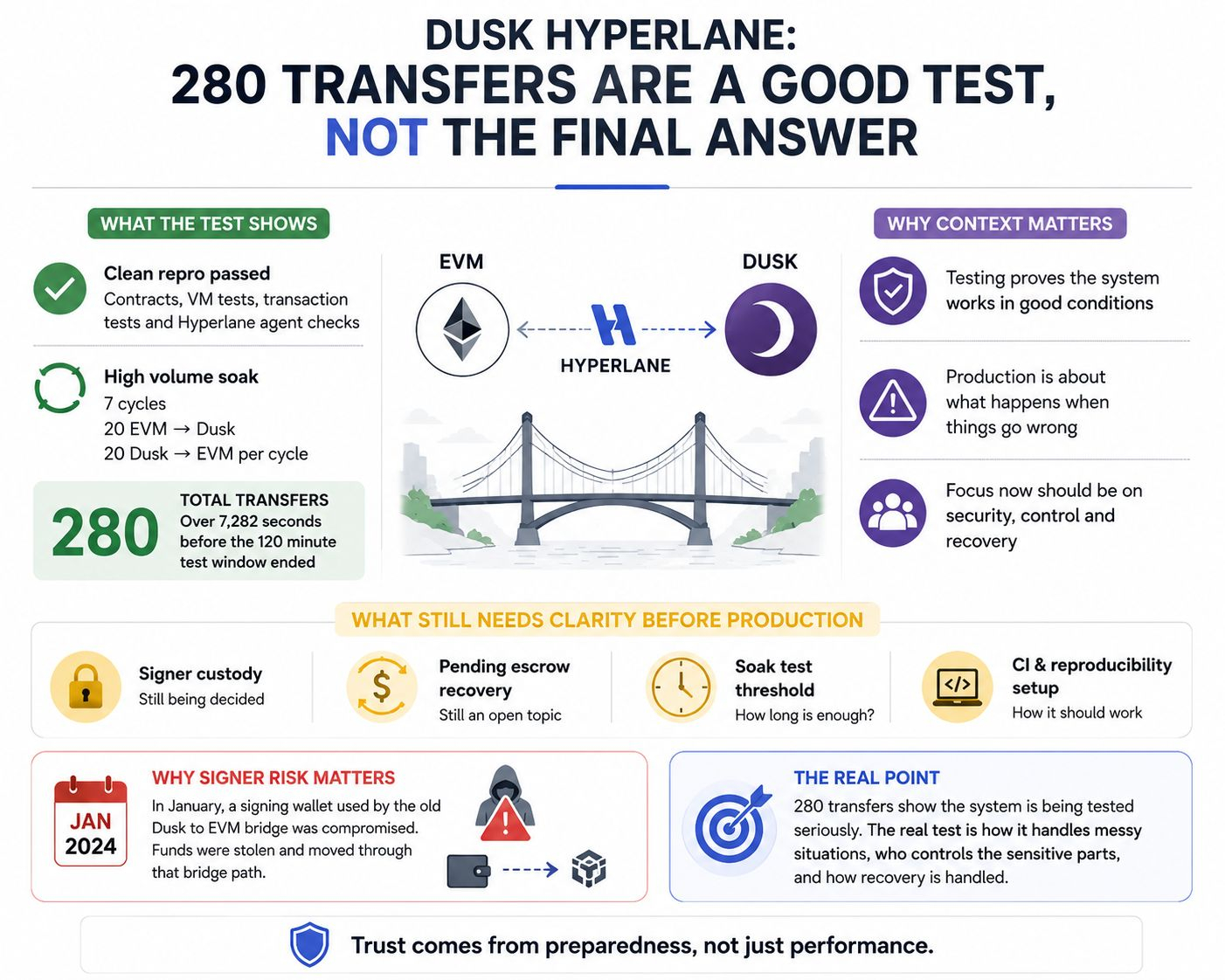
The 280 transfers caught my eye, but I ended up paying more attention to everything around them.
I went through the latest Dusk Hyperlane sign off work and the testing so far looks solid. The latest clean repro passed the contract builds, VM tests, transaction tests and Hyperlane agent checks. Then the high volume soak ran 7 cycles, with 20 EVM to Dusk and 20 Dusk to EVM transfers in each cycle. That came to 280 total transfers over 7,282 seconds before the 120 minute test window ended.
What I found more important was the production checklist sitting beside those results. Production signer custody is still being decided. There is also an open decision around pending escrow recovery, how long the soak should run, and how the CI and reproducibility setup should work. Those are easy to overlook when the headline number is a successful test, but they are the things I would want to understand before real liquidity is involved.
The signer question is especially hard to ignore after what happened with the old Dusk to EVM bridge in January. An attacker gained access to the bridge signing wallet, stole DUSK from it, and moved part of the stolen funds through the bridge to BNB Smart Chain. Dusk was clear that the incident was a bridge wallet compromise, not a Dusk consensus or protocol exploit. The bridge was later redesigned with stronger separation between signing, event handling and fund release, along with tighter balance and recovery controls.
So I’m not looking at the 280 transfers as either a green light or a red flag. They show that the system is being tested seriously. What matters to me now is how the system is supposed to behave when something goes wrong, who controls the sensitive parts, and how recovery is handled.
That’s what I’d want settled before treating Dusk Hyperlane as infrastructure for meaningful liquidity.
$DUSK @Dusk_Foundation #dusk
{spot}(DUSKUSDT)
The 280 transfers caught my eye, but I ended up paying more attention to everything around them.
I went through the latest Dusk Hyperlane sign off work and the testing so far looks solid. The latest clean repro passed the contract builds, VM tests, transaction tests and Hyperlane agent checks. Then the high volume soak ran 7 cycles, with 20 EVM to Dusk and 20 Dusk to EVM transfers in each cycle. That came to 280 total transfers over 7,282 seconds before the 120 minute test window ended.
What I found more important was the production checklist sitting beside those results. Production signer custody is still being decided. There is also an open decision around pending escrow recovery, how long the soak should run, and how the CI and reproducibility setup should work. Those are easy to overlook when the headline number is a successful test, but they are the things I would want to understand before real liquidity is involved.
The signer question is especially hard to ignore after what happened with the old Dusk to EVM bridge in January. An attacker gained access to the bridge signing wallet, stole DUSK from it, and moved part of the stolen funds through the bridge to BNB Smart Chain. Dusk was clear that the incident was a bridge wallet compromise, not a Dusk consensus or protocol exploit. The bridge was later redesigned with stronger separation between signing, event handling and fund release, along with tighter balance and recovery controls.
So I’m not looking at the 280 transfers as either a green light or a red flag. They show that the system is being tested seriously. What matters to me now is how the system is supposed to behave when something goes wrong, who controls the sensitive parts, and how recovery is handled.
That’s what I’d want settled before treating Dusk Hyperlane as infrastructure for meaningful liquidity.
$DUSK @Dusk #dusk
I went through the latest Dusk Hyperlane sign off work and the testing so far looks solid. The latest clean repro passed the contract builds, VM tests, transaction tests and Hyperlane agent checks. Then the high volume soak ran 7 cycles, with 20 EVM to Dusk and 20 Dusk to EVM transfers in each cycle. That came to 280 total transfers over 7,282 seconds before the 120 minute test window ended.
What I found more important was the production checklist sitting beside those results. Production signer custody is still being decided. There is also an open decision around pending escrow recovery, how long the soak should run, and how the CI and reproducibility setup should work. Those are easy to overlook when the headline number is a successful test, but they are the things I would want to understand before real liquidity is involved.
The signer question is especially hard to ignore after what happened with the old Dusk to EVM bridge in January. An attacker gained access to the bridge signing wallet, stole DUSK from it, and moved part of the stolen funds through the bridge to BNB Smart Chain. Dusk was clear that the incident was a bridge wallet compromise, not a Dusk consensus or protocol exploit. The bridge was later redesigned with stronger separation between signing, event handling and fund release, along with tighter balance and recovery controls.
So I’m not looking at the 280 transfers as either a green light or a red flag. They show that the system is being tested seriously. What matters to me now is how the system is supposed to behave when something goes wrong, who controls the sensitive parts, and how recovery is handled.
That’s what I’d want settled before treating Dusk Hyperlane as infrastructure for meaningful liquidity.
$DUSK @Dusk #dusk
7
7
279
Partly True
See translation
One small thing about Dusk transactions kept bothering me.
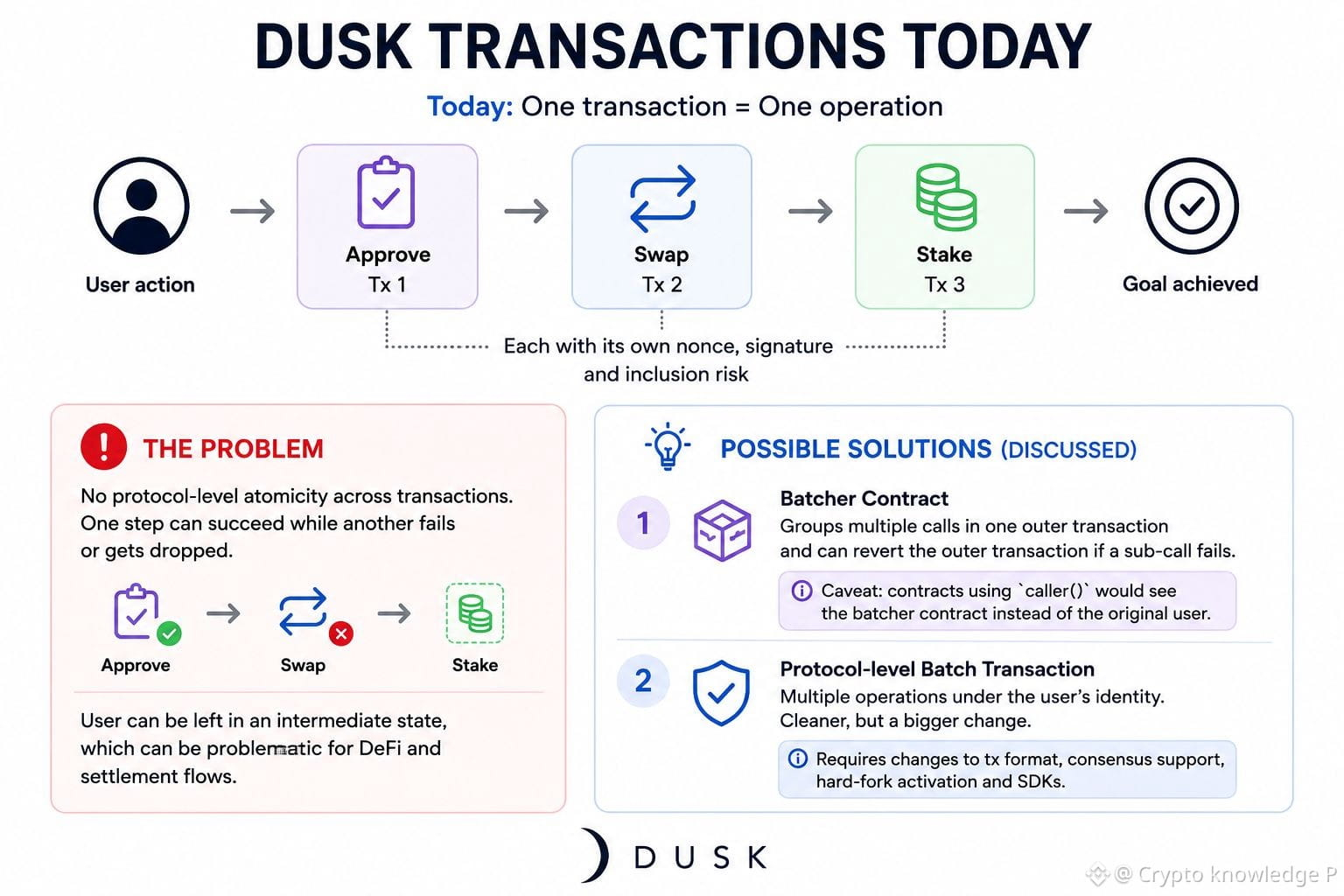
I was reading through Dusk’s transaction flow and found out that one transaction currently carries one operation. For something basic, that’s actually pretty sensible. It keeps things easier to validate and understand. But then I thought about a more complex DeFi flow, like preparing funds, doing a swap, and then staking. To the user, that feels like one action. On Dusk, it becomes several separate transactions, each with its own nonce, signature and chance of being included.
That’s where I started wondering what happens if only part of the sequence goes through. There’s no protocol level rollback across those transactions, so you can end up halfway through a larger flow. For a normal trade, probably not a big deal. But for DeFi, settlement or treasury operations, I can see this becoming a real headache.
What I found interesting is that Dusk already has an open GitHub issue, #4058, discussing batch transactions. One idea is a batcher contract that puts several calls into one transaction, but contracts using caller() could see the batcher instead of the original user. The other option is a protocol level batch where multiple operations stay under the user’s identity, but that would mean changes to the transaction format, consensus support, hard fork activation and SDKs.
So I wouldn’t replace the current single operation model. I think it makes sense as the simple default. I’d rather see an optional atomic batch for complex workflows, where the operations run in order, the whole batch can revert if one fails, and the original user remains visible to each call.
Would that be the right balance for Dusk, or is the extra protocol complexity not worth it?
$DUSK @Dusk_Foundation #dusk
{spot}(DUSKUSDT)
One small thing about Dusk transactions kept bothering me.
I was reading through Dusk’s transaction flow and found out that one transaction currently carries one operation. For something basic, that’s actually pretty sensible. It keeps things easier to validate and understand. But then I thought about a more complex DeFi flow, like preparing funds, doing a swap, and then staking. To the user, that feels like one action. On Dusk, it becomes several separate transactions, each with its own nonce, signature and chance of being included.
That’s where I started wondering what happens if only part of the sequence goes through. There’s no protocol level rollback across those transactions, so you can end up halfway through a larger flow. For a normal trade, probably not a big deal. But for DeFi, settlement or treasury operations, I can see this becoming a real headache.
What I found interesting is that Dusk already has an open GitHub issue, #4058, discussing batch transactions. One idea is a batcher contract that puts several calls into one transaction, but contracts using caller() could see the batcher instead of the original user. The other option is a protocol level batch where multiple operations stay under the user’s identity, but that would mean changes to the transaction format, consensus support, hard fork activation and SDKs.
So I wouldn’t replace the current single operation model. I think it makes sense as the simple default. I’d rather see an optional atomic batch for complex workflows, where the operations run in order, the whole batch can revert if one fails, and the original user remains visible to each call.
Would that be the right balance for Dusk, or is the extra protocol complexity not worth it?
$DUSK @Dusk #dusk
I was reading through Dusk’s transaction flow and found out that one transaction currently carries one operation. For something basic, that’s actually pretty sensible. It keeps things easier to validate and understand. But then I thought about a more complex DeFi flow, like preparing funds, doing a swap, and then staking. To the user, that feels like one action. On Dusk, it becomes several separate transactions, each with its own nonce, signature and chance of being included.
That’s where I started wondering what happens if only part of the sequence goes through. There’s no protocol level rollback across those transactions, so you can end up halfway through a larger flow. For a normal trade, probably not a big deal. But for DeFi, settlement or treasury operations, I can see this becoming a real headache.
What I found interesting is that Dusk already has an open GitHub issue, #4058, discussing batch transactions. One idea is a batcher contract that puts several calls into one transaction, but contracts using caller() could see the batcher instead of the original user. The other option is a protocol level batch where multiple operations stay under the user’s identity, but that would mean changes to the transaction format, consensus support, hard fork activation and SDKs.
So I wouldn’t replace the current single operation model. I think it makes sense as the simple default. I’d rather see an optional atomic batch for complex workflows, where the operations run in order, the whole batch can revert if one fails, and the original user remains visible to each call.
Would that be the right balance for Dusk, or is the extra protocol complexity not worth it?
$DUSK @Dusk #dusk
6
5
230
See translation
#dusk $DUSK @Dusk_Foundation
I’ve been looking at the SME side of Dusk recently and one thing kept coming back to me.
Tokenizing an SME sounds simple when you say it in one line.
Put the asset onchain.
Let investors access it.
Done.
But it really isn’t that simple.
Someone still has to decide who can invest, how ownership is handled, how transfers work, what information needs to be disclosed, and how the actual money gets settled.
And this is where I think people sometimes underestimate the RWA problem.
The token itself is only one part of the process. The market around it still has to work.
That’s where the Dusk approach gets interesting to me.
Their recent focus on private markets and SMEs isn’t really about putting another asset on a blockchain just for the sake of it.
It’s more about connecting the different parts of the process.
Because the difficult part isn’t creating the token.
The difficult part is making the token usable.
An SME can have a tokenized security, but if investors can’t access it properly, transfers are complicated, or there’s no real market around it, then not much has changed.
That’s also why I’m curious to see how the Dusk Trade side develops.
If it can make the process simpler for both companies and investors, then this becomes more interesting than just another RWA narrative.
Still early though.
For me, the real test is simple:
Can Dusk make private markets actually easier to use, or are we just putting an old process onchain and calling it new?
That’s the part I’ll be watching closely as Dusk Trade starts to take shape.
{spot}(DUSKUSDT)
#dusk $DUSK @Dusk
I’ve been looking at the SME side of Dusk recently and one thing kept coming back to me.
Tokenizing an SME sounds simple when you say it in one line.
Put the asset onchain.
Let investors access it.
Done.
But it really isn’t that simple.
Someone still has to decide who can invest, how ownership is handled, how transfers work, what information needs to be disclosed, and how the actual money gets settled.
And this is where I think people sometimes underestimate the RWA problem.
The token itself is only one part of the process. The market around it still has to work.
That’s where the Dusk approach gets interesting to me.
Their recent focus on private markets and SMEs isn’t really about putting another asset on a blockchain just for the sake of it.
It’s more about connecting the different parts of the process.
Because the difficult part isn’t creating the token.
The difficult part is making the token usable.
An SME can have a tokenized security, but if investors can’t access it properly, transfers are complicated, or there’s no real market around it, then not much has changed.
That’s also why I’m curious to see how the Dusk Trade side develops.
If it can make the process simpler for both companies and investors, then this becomes more interesting than just another RWA narrative.
Still early though.
For me, the real test is simple:
Can Dusk make private markets actually easier to use, or are we just putting an old process onchain and calling it new?
That’s the part I’ll be watching closely as Dusk Trade starts to take shape.
I’ve been looking at the SME side of Dusk recently and one thing kept coming back to me.
Tokenizing an SME sounds simple when you say it in one line.
Put the asset onchain.
Let investors access it.
Done.
But it really isn’t that simple.
Someone still has to decide who can invest, how ownership is handled, how transfers work, what information needs to be disclosed, and how the actual money gets settled.
And this is where I think people sometimes underestimate the RWA problem.
The token itself is only one part of the process. The market around it still has to work.
That’s where the Dusk approach gets interesting to me.
Their recent focus on private markets and SMEs isn’t really about putting another asset on a blockchain just for the sake of it.
It’s more about connecting the different parts of the process.
Because the difficult part isn’t creating the token.
The difficult part is making the token usable.
An SME can have a tokenized security, but if investors can’t access it properly, transfers are complicated, or there’s no real market around it, then not much has changed.
That’s also why I’m curious to see how the Dusk Trade side develops.
If it can make the process simpler for both companies and investors, then this becomes more interesting than just another RWA narrative.
Still early though.
For me, the real test is simple:
Can Dusk make private markets actually easier to use, or are we just putting an old process onchain and calling it new?
That’s the part I’ll be watching closely as Dusk Trade starts to take shape.
1
4
229
See translation
Been looking deeper into how Dusk handles transactions, and I noticed something I hadn’t really thought about before.
Moonlight and Phoenix aren’t just two versions of the same thing.
Moonlight is account-based. You have an account, balance, nonce and keys, and the network checks the transaction against that state.
Phoenix takes a different approach.
It uses notes stored in a Merkle tree. When a note is spent, a nullifier is created so the same note can’t be spent again.
What caught my attention is that the network doesn’t need to reveal which specific note was spent.
That’s where the ZK proofs come in — the transaction can be verified without exposing the underlying private details. The one-time note keys also help reduce transaction linkability.
There’s also a delegation mechanism for things like scanning and proof generation, without giving the delegated party access to spend the funds.
So I wouldn’t describe it simply as “Moonlight is transparent and Phoenix is private.”
They’re different transaction models designed around different requirements, while operating on the same Dusk network.
And honestly, I think that’s a pretty interesting design choice.
Which would you prefer on Dusk?
@Dusk_Foundation $DUSK #dusk
{spot}(DUSKUSDT)
Been looking deeper into how Dusk handles transactions, and I noticed something I hadn’t really thought about before.
Moonlight and Phoenix aren’t just two versions of the same thing.
Moonlight is account-based. You have an account, balance, nonce and keys, and the network checks the transaction against that state.
Phoenix takes a different approach.
It uses notes stored in a Merkle tree. When a note is spent, a nullifier is created so the same note can’t be spent again.
What caught my attention is that the network doesn’t need to reveal which specific note was spent.
That’s where the ZK proofs come in — the transaction can be verified without exposing the underlying private details. The one-time note keys also help reduce transaction linkability.
There’s also a delegation mechanism for things like scanning and proof generation, without giving the delegated party access to spend the funds.
So I wouldn’t describe it simply as “Moonlight is transparent and Phoenix is private.”
They’re different transaction models designed around different requirements, while operating on the same Dusk network.
And honestly, I think that’s a pretty interesting design choice.
Which would you prefer on Dusk?
@Dusk $DUSK #dusk
Moonlight and Phoenix aren’t just two versions of the same thing.
Moonlight is account-based. You have an account, balance, nonce and keys, and the network checks the transaction against that state.
Phoenix takes a different approach.
It uses notes stored in a Merkle tree. When a note is spent, a nullifier is created so the same note can’t be spent again.
What caught my attention is that the network doesn’t need to reveal which specific note was spent.
That’s where the ZK proofs come in — the transaction can be verified without exposing the underlying private details. The one-time note keys also help reduce transaction linkability.
There’s also a delegation mechanism for things like scanning and proof generation, without giving the delegated party access to spend the funds.
So I wouldn’t describe it simply as “Moonlight is transparent and Phoenix is private.”
They’re different transaction models designed around different requirements, while operating on the same Dusk network.
And honestly, I think that’s a pretty interesting design choice.
Which would you prefer on Dusk?
@Dusk $DUSK #dusk
🔥 Phoenix
50%
🌙 Moonlight
10%
⚡ Both
20%
🤔 Depends on the use case
20%
10 votes • Voting closed
13
13
221
See translation
A token being on-chain is only the beginning.
The real question is: can the rules around that asset move on-chain too?
Take a regulated bond.
Turning it into a token might be the easy part. But a real financial market needs more:
• Only eligible investors should be able to hold it
• Transfers may need built-in restrictions
• Sensitive positions shouldn’t be public by default
• The right parties need access to the right information
• Cash and asset delivery need to settle together
That is where tokenization becomes more than a digital wrapper.
It becomes market infrastructure.
This is why @Dusk_Foundation stands out to me. Its focus isn’t simply putting assets on-chain, but enabling regulated workflows around them—controlled transfers, selective disclosure, privacy, eligibility, and settlement as connected parts of one system.
The bigger opportunity isn’t just tokenized assets.
It is programmable markets:
Rules that follow the asset.
Privacy that can coexist with accountability.
Settlement that happens as part of the transaction.
Ownership changes that don’t break compliance requirements.
If that model works at scale, on-chain finance could look less like traditional markets with a new database—and more like a redesigned financial system.
What do you think is the hardest hurdle for real-world finance moving on-chain: identity, privacy, trading, settlement, or asset servicing?
$DUSK #dusk @Dusk_Foundation
{spot}(DUSKUSDT)
A token being on-chain is only the beginning.
The real question is: can the rules around that asset move on-chain too?
Take a regulated bond.
Turning it into a token might be the easy part. But a real financial market needs more:
• Only eligible investors should be able to hold it
• Transfers may need built-in restrictions
• Sensitive positions shouldn’t be public by default
• The right parties need access to the right information
• Cash and asset delivery need to settle together
That is where tokenization becomes more than a digital wrapper.
It becomes market infrastructure.
This is why @Dusk stands out to me. Its focus isn’t simply putting assets on-chain, but enabling regulated workflows around them—controlled transfers, selective disclosure, privacy, eligibility, and settlement as connected parts of one system.
The bigger opportunity isn’t just tokenized assets.
It is programmable markets:
Rules that follow the asset.
Privacy that can coexist with accountability.
Settlement that happens as part of the transaction.
Ownership changes that don’t break compliance requirements.
If that model works at scale, on-chain finance could look less like traditional markets with a new database—and more like a redesigned financial system.
What do you think is the hardest hurdle for real-world finance moving on-chain: identity, privacy, trading, settlement, or asset servicing?
$DUSK #dusk @Dusk
The real question is: can the rules around that asset move on-chain too?
Take a regulated bond.
Turning it into a token might be the easy part. But a real financial market needs more:
• Only eligible investors should be able to hold it
• Transfers may need built-in restrictions
• Sensitive positions shouldn’t be public by default
• The right parties need access to the right information
• Cash and asset delivery need to settle together
That is where tokenization becomes more than a digital wrapper.
It becomes market infrastructure.
This is why @Dusk stands out to me. Its focus isn’t simply putting assets on-chain, but enabling regulated workflows around them—controlled transfers, selective disclosure, privacy, eligibility, and settlement as connected parts of one system.
The bigger opportunity isn’t just tokenized assets.
It is programmable markets:
Rules that follow the asset.
Privacy that can coexist with accountability.
Settlement that happens as part of the transaction.
Ownership changes that don’t break compliance requirements.
If that model works at scale, on-chain finance could look less like traditional markets with a new database—and more like a redesigned financial system.
What do you think is the hardest hurdle for real-world finance moving on-chain: identity, privacy, trading, settlement, or asset servicing?
$DUSK #dusk @Dusk
13
9
162
Partly True
See translation
Everyone talks about blockchain scalability.
Almost nobody talks about the cost of remembering.
A network can process huge amounts of activity, but every block, event and state transition also creates historical data that eventually has to be stored and maintained.
That’s why I found Dusk’s recent infrastructure update more interesting than another TPS headline.
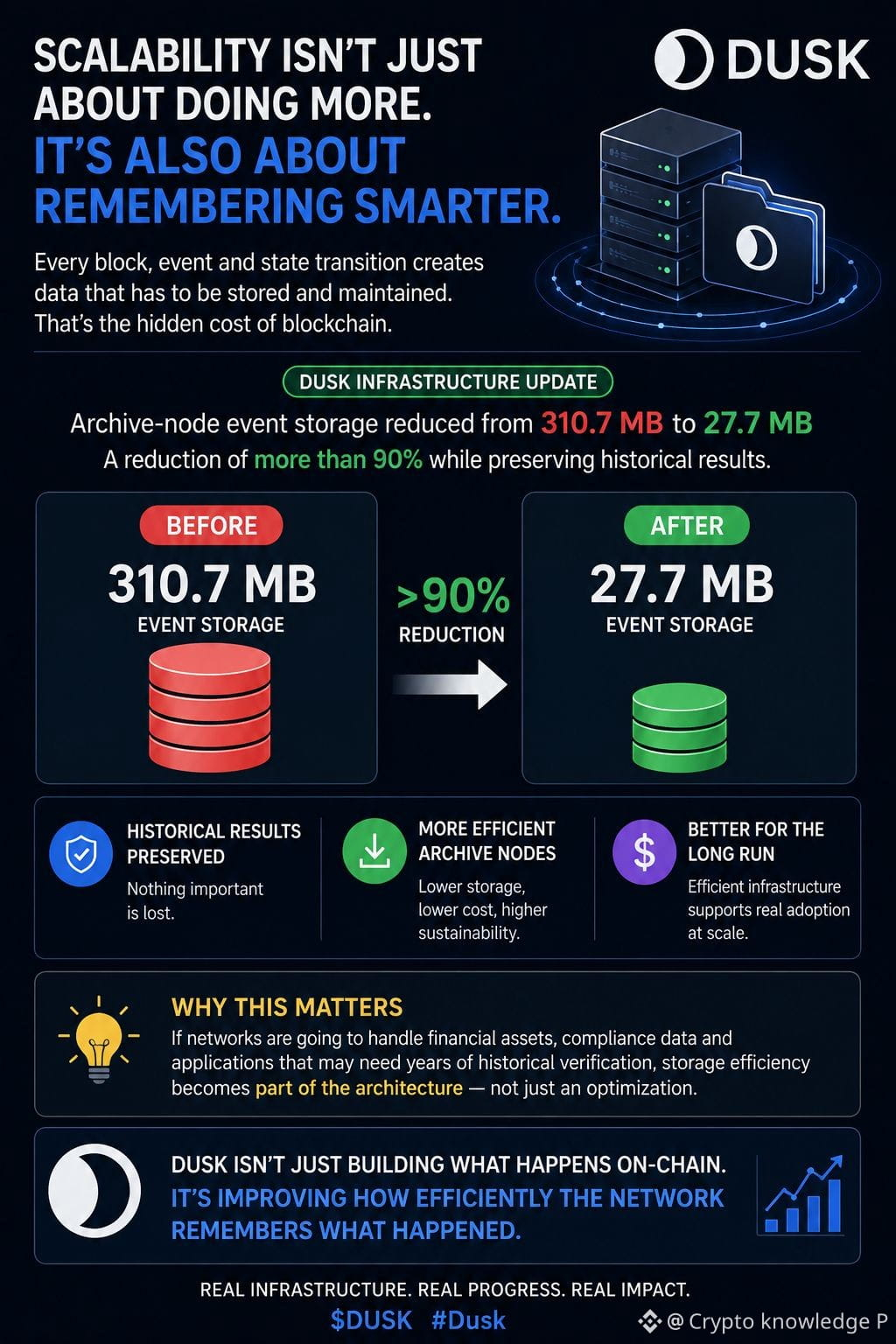
Dusk reduced archive-node event storage from 310.7 MB to 27.7 MB — more than a 90% reduction — while preserving historical results.
The interesting part isn’t simply the number.
It’s what this says about blockchain infrastructure.
If networks are eventually going to support financial assets and applications that may need years of historical verification, storage efficiency becomes part of the architecture itself.
Scalability isn’t only about processing more. It’s also about carrying less data without losing the history that makes the network verifiable.
These improvements probably won’t create the loudest headlines.
But the boring infrastructure work is often what makes large-scale adoption possible.
Dusk isn’t only working on what happens on-chain.
It’s also improving how efficiently the network can remember what happened.
@Dusk_Foundation $DUSK #dusk
{spot}(DUSKUSDT)
Everyone talks about blockchain scalability.
Almost nobody talks about the cost of remembering.
A network can process huge amounts of activity, but every block, event and state transition also creates historical data that eventually has to be stored and maintained.
That’s why I found Dusk’s recent infrastructure update more interesting than another TPS headline.
Dusk reduced archive-node event storage from 310.7 MB to 27.7 MB — more than a 90% reduction — while preserving historical results.
The interesting part isn’t simply the number.
It’s what this says about blockchain infrastructure.
If networks are eventually going to support financial assets and applications that may need years of historical verification, storage efficiency becomes part of the architecture itself.
Scalability isn’t only about processing more. It’s also about carrying less data without losing the history that makes the network verifiable.
These improvements probably won’t create the loudest headlines.
But the boring infrastructure work is often what makes large-scale adoption possible.
Dusk isn’t only working on what happens on-chain.
It’s also improving how efficiently the network can remember what happened.
@Dusk $DUSK #dusk
Almost nobody talks about the cost of remembering.
A network can process huge amounts of activity, but every block, event and state transition also creates historical data that eventually has to be stored and maintained.
That’s why I found Dusk’s recent infrastructure update more interesting than another TPS headline.
Dusk reduced archive-node event storage from 310.7 MB to 27.7 MB — more than a 90% reduction — while preserving historical results.
The interesting part isn’t simply the number.
It’s what this says about blockchain infrastructure.
If networks are eventually going to support financial assets and applications that may need years of historical verification, storage efficiency becomes part of the architecture itself.
Scalability isn’t only about processing more. It’s also about carrying less data without losing the history that makes the network verifiable.
These improvements probably won’t create the loudest headlines.
But the boring infrastructure work is often what makes large-scale adoption possible.
Dusk isn’t only working on what happens on-chain.
It’s also improving how efficiently the network can remember what happened.
@Dusk $DUSK #dusk
9
6
113
Verified
See translation
One Dusk update I think deserves more attention is the DuskEVM testnet going live.
At first glance, “another EVM environment” doesn’t sound particularly interesting. But the architecture tells a different story.
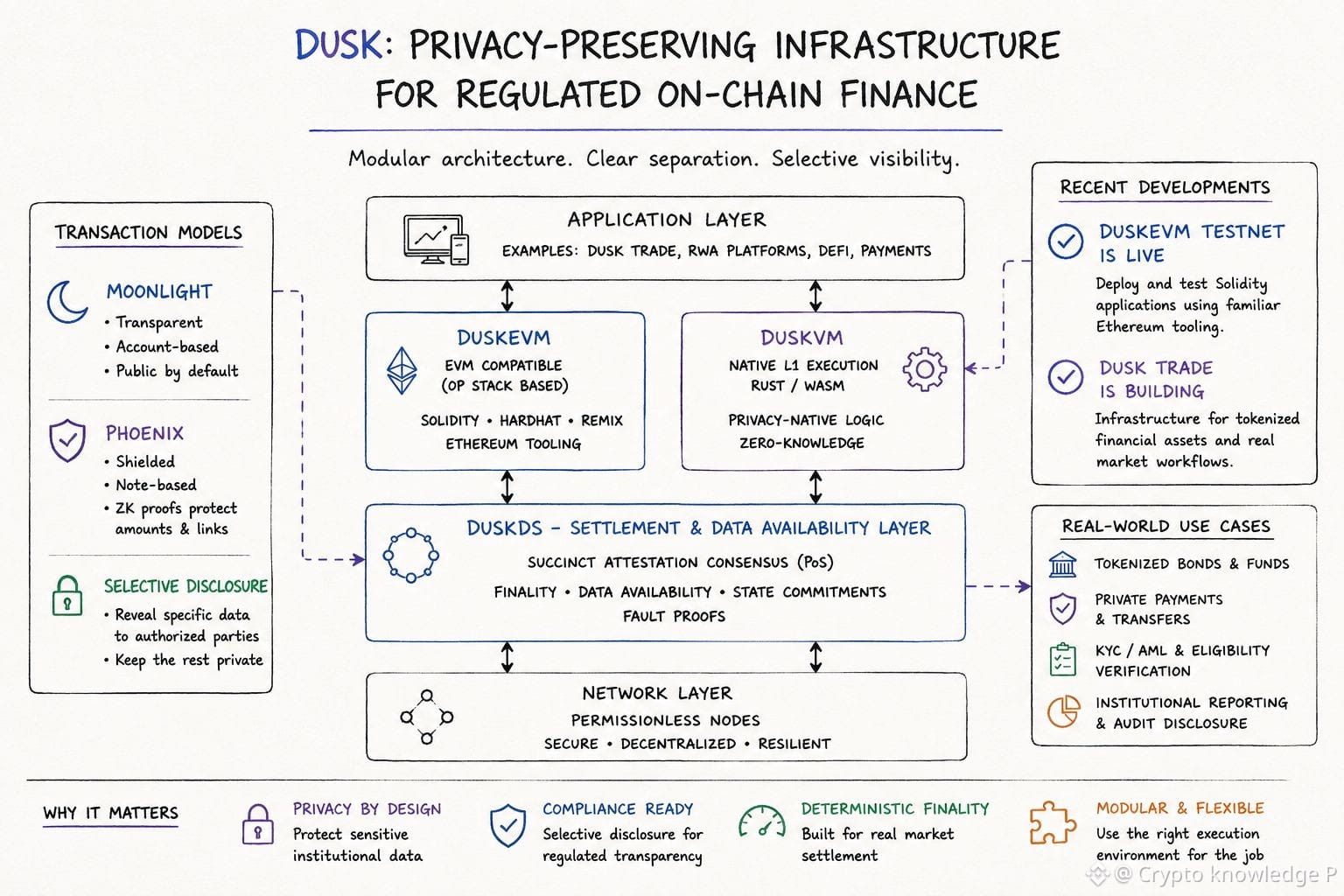
DuskEVM brings Solidity, Hardhat and standard Ethereum tooling to Dusk, while execution settles through DuskDS. That separation matters because developers can use a familiar application stack without giving up Dusk’s native settlement and data-availability layer.
The more interesting part is what sits around it.
Dusk is also building Dusk Trade as an application layer for tokenized financial assets, with workflows around investor onboarding, wallet binding, controlled transfers, payment coordination and compliant settlement.
So the recent development is not just about adding EVM compatibility.
It looks more like Dusk is moving toward a full stack where different pieces handle different problems:
→ DuskDS: consensus, settlement and data availability
→ DuskEVM: familiar EVM execution
→ DuskVM: native Rust/WASM execution with direct access to Dusk’s privacy capabilities
→ Dusk Trade: application-level infrastructure for tokenized markets
And this is where the RWA thesis becomes more interesting.
Tokenizing an asset is relatively easy to describe. Building the actual infrastructure for issuance, eligibility, transfers, privacy, disclosure and settlement is the harder problem.
With DuskEVM now available for testing and Dusk Trade being built around real market workflows, the next thing I’ll be watching is not another announcement.
It’s what developers and financial applications actually build on top of this stack.
@Dusk_Foundation $DUSK #dusk
{spot}(DUSKUSDT)
One Dusk update I think deserves more attention is the DuskEVM testnet going live.
At first glance, “another EVM environment” doesn’t sound particularly interesting. But the architecture tells a different story.
DuskEVM brings Solidity, Hardhat and standard Ethereum tooling to Dusk, while execution settles through DuskDS. That separation matters because developers can use a familiar application stack without giving up Dusk’s native settlement and data-availability layer.
The more interesting part is what sits around it.
Dusk is also building Dusk Trade as an application layer for tokenized financial assets, with workflows around investor onboarding, wallet binding, controlled transfers, payment coordination and compliant settlement.
So the recent development is not just about adding EVM compatibility.
It looks more like Dusk is moving toward a full stack where different pieces handle different problems:
→ DuskDS: consensus, settlement and data availability
→ DuskEVM: familiar EVM execution
→ DuskVM: native Rust/WASM execution with direct access to Dusk’s privacy capabilities
→ Dusk Trade: application-level infrastructure for tokenized markets
And this is where the RWA thesis becomes more interesting.
Tokenizing an asset is relatively easy to describe. Building the actual infrastructure for issuance, eligibility, transfers, privacy, disclosure and settlement is the harder problem.
With DuskEVM now available for testing and Dusk Trade being built around real market workflows, the next thing I’ll be watching is not another announcement.
It’s what developers and financial applications actually build on top of this stack.
@Dusk $DUSK #dusk
At first glance, “another EVM environment” doesn’t sound particularly interesting. But the architecture tells a different story.
DuskEVM brings Solidity, Hardhat and standard Ethereum tooling to Dusk, while execution settles through DuskDS. That separation matters because developers can use a familiar application stack without giving up Dusk’s native settlement and data-availability layer.
The more interesting part is what sits around it.
Dusk is also building Dusk Trade as an application layer for tokenized financial assets, with workflows around investor onboarding, wallet binding, controlled transfers, payment coordination and compliant settlement.
So the recent development is not just about adding EVM compatibility.
It looks more like Dusk is moving toward a full stack where different pieces handle different problems:
→ DuskDS: consensus, settlement and data availability
→ DuskEVM: familiar EVM execution
→ DuskVM: native Rust/WASM execution with direct access to Dusk’s privacy capabilities
→ Dusk Trade: application-level infrastructure for tokenized markets
And this is where the RWA thesis becomes more interesting.
Tokenizing an asset is relatively easy to describe. Building the actual infrastructure for issuance, eligibility, transfers, privacy, disclosure and settlement is the harder problem.
With DuskEVM now available for testing and Dusk Trade being built around real market workflows, the next thing I’ll be watching is not another announcement.
It’s what developers and financial applications actually build on top of this stack.
@Dusk $DUSK #dusk
16
10
122
See translation
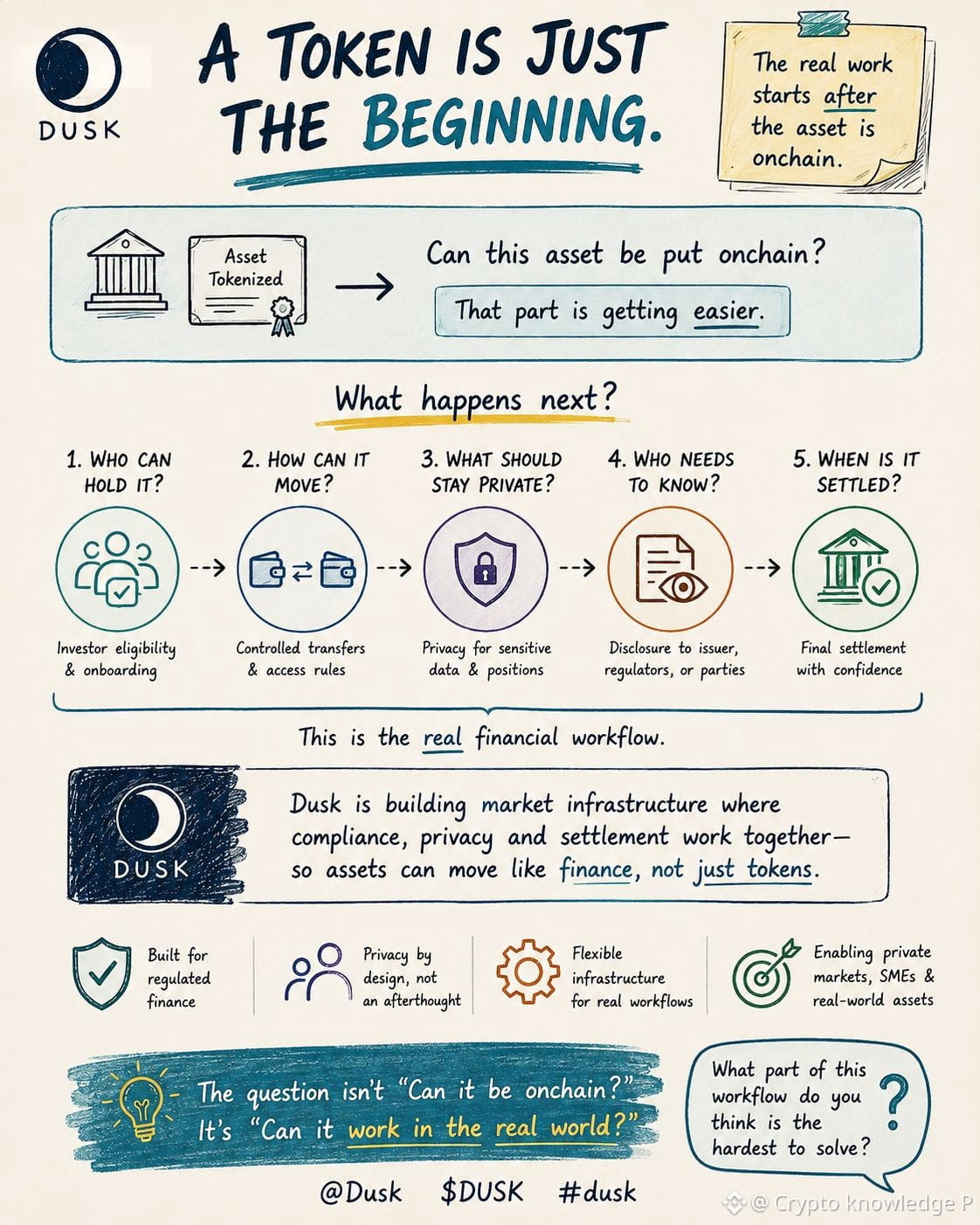
The more I look at tokenization, the more I think we’re asking the wrong question.
Everyone asks: “Can this asset be put onchain?”
But imagine the asset is already there.
Now an investor wants to buy it. Another wants to sell it. The issuer needs to enforce who can hold it. A regulator may need evidence later. And somewhere in between, sensitive information still shouldn’t become public data.
That’s the interesting part of @Dusk_Foundation for me. Its market infrastructure is being designed around the whole workflow — eligibility, controlled transfers, privacy, disclosure and settlement — rather than treating a token as the finished product.
Maybe the real breakthrough in RWA won’t be creating more tokens.
Maybe it will be making those tokens actually behave like financial assets.
What part of that workflow do you think is hardest to solve?
$DUSK #dusk @Dusk_Foundation
{future}(DUSKUSDT)
The more I look at tokenization, the more I think we’re asking the wrong question.
Everyone asks: “Can this asset be put onchain?”
But imagine the asset is already there.
Now an investor wants to buy it. Another wants to sell it. The issuer needs to enforce who can hold it. A regulator may need evidence later. And somewhere in between, sensitive information still shouldn’t become public data.
That’s the interesting part of @Dusk for me. Its market infrastructure is being designed around the whole workflow — eligibility, controlled transfers, privacy, disclosure and settlement — rather than treating a token as the finished product.
Maybe the real breakthrough in RWA won’t be creating more tokens.
Maybe it will be making those tokens actually behave like financial assets.
What part of that workflow do you think is hardest to solve?
$DUSK #dusk @Dusk
Everyone asks: “Can this asset be put onchain?”
But imagine the asset is already there.
Now an investor wants to buy it. Another wants to sell it. The issuer needs to enforce who can hold it. A regulator may need evidence later. And somewhere in between, sensitive information still shouldn’t become public data.
That’s the interesting part of @Dusk for me. Its market infrastructure is being designed around the whole workflow — eligibility, controlled transfers, privacy, disclosure and settlement — rather than treating a token as the finished product.
Maybe the real breakthrough in RWA won’t be creating more tokens.
Maybe it will be making those tokens actually behave like financial assets.
What part of that workflow do you think is hardest to solve?
$DUSK #dusk @Dusk
22
11
148
See translation
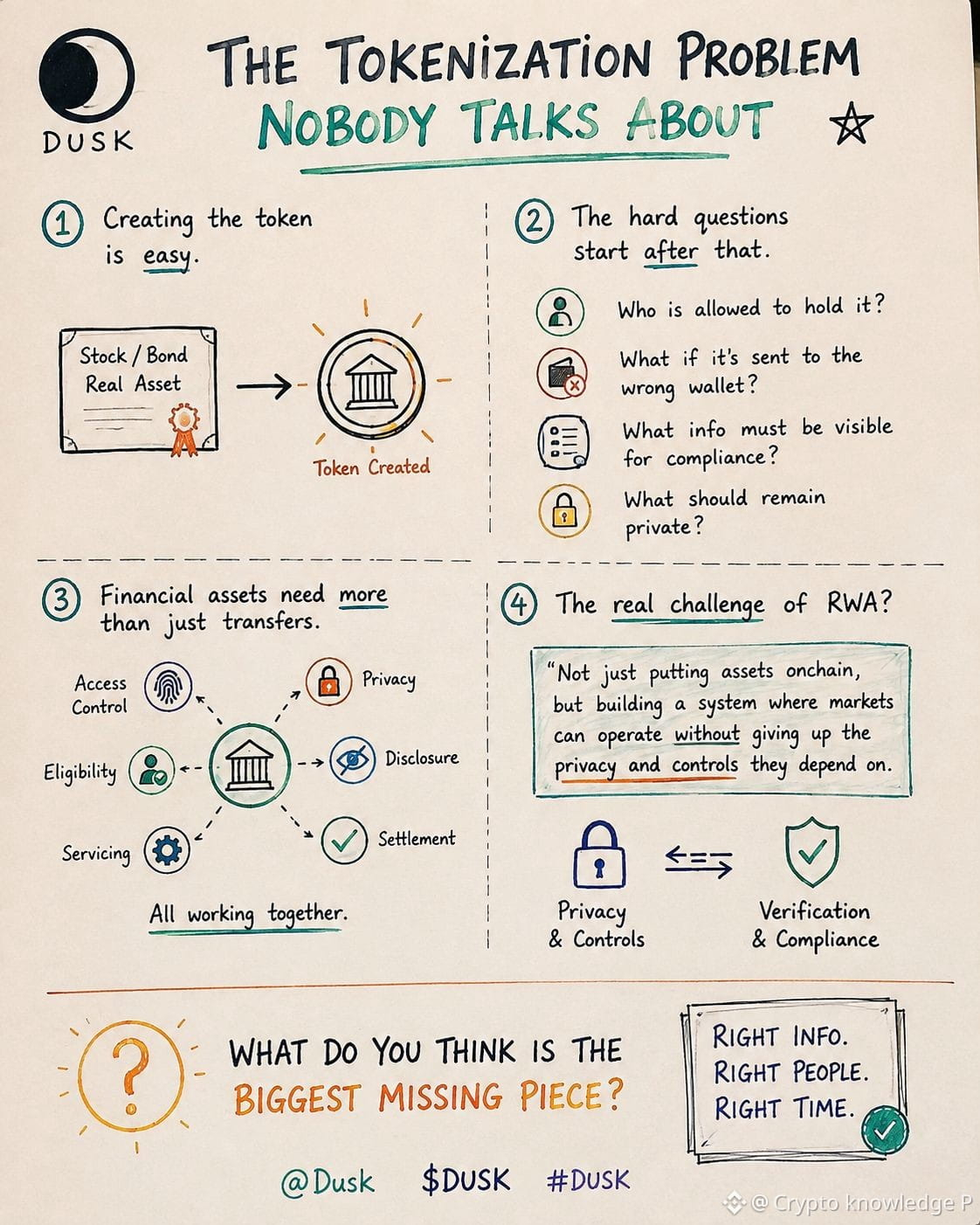
A few days ago I was thinking about what “tokenizing an asset” actually means. At first, it sounds simple — take a stock, bond, or financial asset and put it onchain. But creating the token is probably the easy part.
The harder questions start after that. Who can actually hold it? What happens when someone tries to transfer it to the wrong wallet? What information needs to be visible for compliance, and what should stay private?
That’s where $DUSK gets interesting to me. Real financial assets need more than just fast transfers — they need rules, privacy, verification and settlement to work together without turning everything into a public spreadsheet.
Maybe the real challenge of RWA isn’t putting assets onchain. Maybe it’s building a system where financial markets can actually operate there without giving up the privacy and controls they already depend on. What do you think is the biggest missing piece? 👀
@Dusk_Foundation $DUSK #Dusk
{future}(DUSKUSDT)
A few days ago I was thinking about what “tokenizing an asset” actually means. At first, it sounds simple — take a stock, bond, or financial asset and put it onchain. But creating the token is probably the easy part.
The harder questions start after that. Who can actually hold it? What happens when someone tries to transfer it to the wrong wallet? What information needs to be visible for compliance, and what should stay private?
That’s where $DUSK gets interesting to me. Real financial assets need more than just fast transfers — they need rules, privacy, verification and settlement to work together without turning everything into a public spreadsheet.
Maybe the real challenge of RWA isn’t putting assets onchain. Maybe it’s building a system where financial markets can actually operate there without giving up the privacy and controls they already depend on. What do you think is the biggest missing piece? 👀
@Dusk $DUSK #Dusk
The harder questions start after that. Who can actually hold it? What happens when someone tries to transfer it to the wrong wallet? What information needs to be visible for compliance, and what should stay private?
That’s where $DUSK gets interesting to me. Real financial assets need more than just fast transfers — they need rules, privacy, verification and settlement to work together without turning everything into a public spreadsheet.
Maybe the real challenge of RWA isn’t putting assets onchain. Maybe it’s building a system where financial markets can actually operate there without giving up the privacy and controls they already depend on. What do you think is the biggest missing piece? 👀
@Dusk $DUSK #Dusk
8
8
167
See translation
#dusk $DUSK
A blockchain’s security story isn’t “we never found a bug.”
It’s what happens after a serious audit finds one.
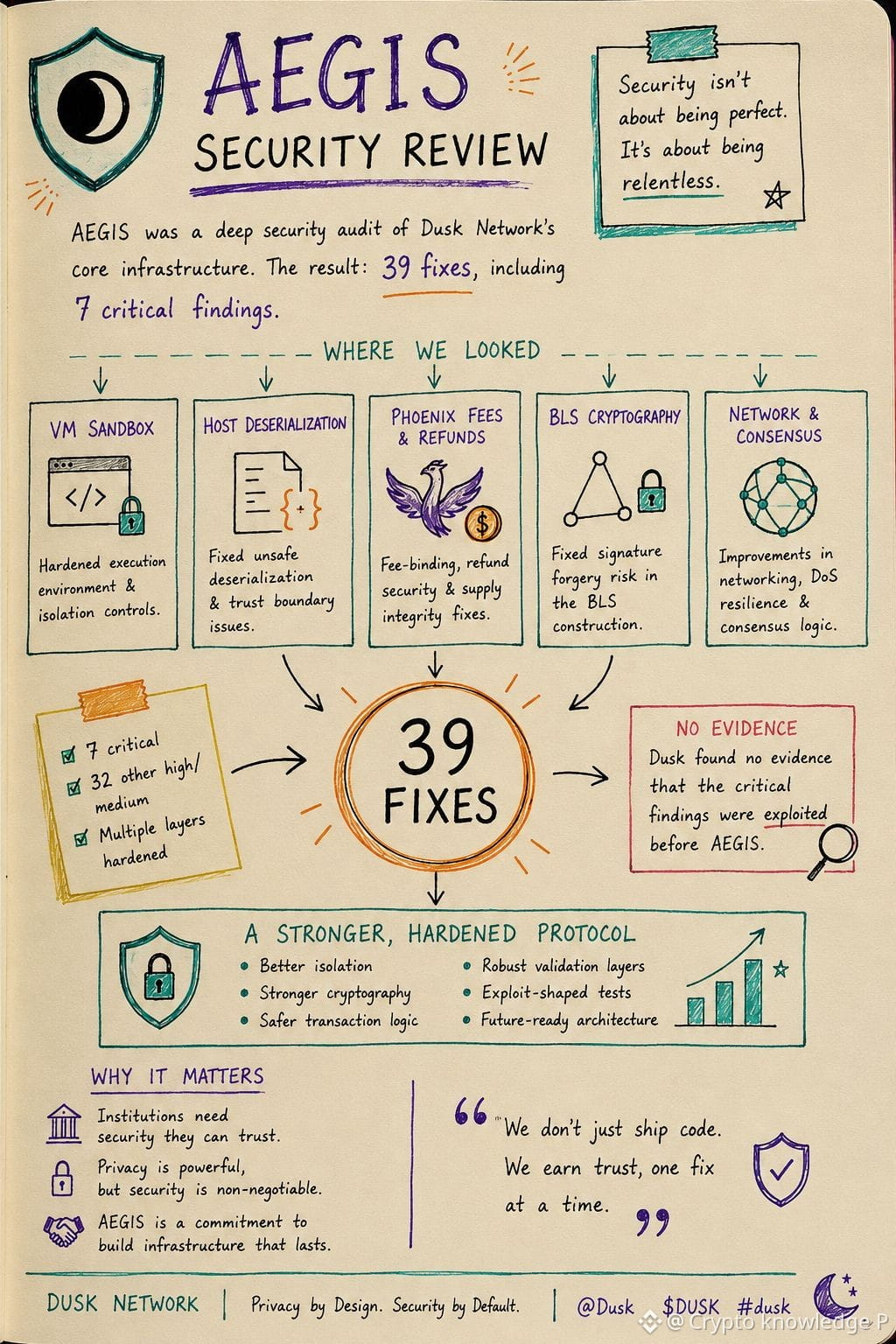
That’s why I went down the AEGIS rabbit hole on @Dusk_Foundation .
Dusk’s 2026 AEGIS remediation shipped 39 security fixes, including 7 critical findings.
The interesting part? These weren’t just surface-level issues.
The audit reached deep into the stack:
→ VM sandbox execution
→ Host-side deserialization
→ Phoenix fee & refund logic
→ BLS signature security
→ Consensus, networking & cryptographic components
One Phoenix fee issue could affect supply integrity, chain availability and refund security. The BLS issue involved the cryptographic construction used for signature verification.
AEGIS didn’t just patch one line and move on. Dusk says it reworked the affected ownership model, hardened trust boundaries, added fee-consistency checks at multiple layers, strengthened the BLS path and added exploit-shaped regression tests.
And according to Dusk, they found no evidence that the critical findings had been exploited before AEGIS.
For me, that’s the real takeaway.
In regulated finance, privacy is important.
But privacy without security is useless.
The infrastructure has to survive adversarial thinking before institutions can trust it.
That’s the side of @Dusk_Foundation I find worth watching:
not just what the protocol promises,
but how seriously it responds when someone tries to break it.
$DUSK #dusk @Dusk_Foundation
{spot}(DUSKUSDT)
#dusk $DUSK
A blockchain’s security story isn’t “we never found a bug.”
It’s what happens after a serious audit finds one.
That’s why I went down the AEGIS rabbit hole on @Dusk .
Dusk’s 2026 AEGIS remediation shipped 39 security fixes, including 7 critical findings.
The interesting part? These weren’t just surface-level issues.
The audit reached deep into the stack:
→ VM sandbox execution
→ Host-side deserialization
→ Phoenix fee & refund logic
→ BLS signature security
→ Consensus, networking & cryptographic components
One Phoenix fee issue could affect supply integrity, chain availability and refund security. The BLS issue involved the cryptographic construction used for signature verification.
AEGIS didn’t just patch one line and move on. Dusk says it reworked the affected ownership model, hardened trust boundaries, added fee-consistency checks at multiple layers, strengthened the BLS path and added exploit-shaped regression tests.
And according to Dusk, they found no evidence that the critical findings had been exploited before AEGIS.
For me, that’s the real takeaway.
In regulated finance, privacy is important.
But privacy without security is useless.
The infrastructure has to survive adversarial thinking before institutions can trust it.
That’s the side of @Dusk I find worth watching:
not just what the protocol promises,
but how seriously it responds when someone tries to break it.
$DUSK #dusk @Dusk
A blockchain’s security story isn’t “we never found a bug.”
It’s what happens after a serious audit finds one.
That’s why I went down the AEGIS rabbit hole on @Dusk .
Dusk’s 2026 AEGIS remediation shipped 39 security fixes, including 7 critical findings.
The interesting part? These weren’t just surface-level issues.
The audit reached deep into the stack:
→ VM sandbox execution
→ Host-side deserialization
→ Phoenix fee & refund logic
→ BLS signature security
→ Consensus, networking & cryptographic components
One Phoenix fee issue could affect supply integrity, chain availability and refund security. The BLS issue involved the cryptographic construction used for signature verification.
AEGIS didn’t just patch one line and move on. Dusk says it reworked the affected ownership model, hardened trust boundaries, added fee-consistency checks at multiple layers, strengthened the BLS path and added exploit-shaped regression tests.
And according to Dusk, they found no evidence that the critical findings had been exploited before AEGIS.
For me, that’s the real takeaway.
In regulated finance, privacy is important.
But privacy without security is useless.
The infrastructure has to survive adversarial thinking before institutions can trust it.
That’s the side of @Dusk I find worth watching:
not just what the protocol promises,
but how seriously it responds when someone tries to break it.
$DUSK #dusk @Dusk
6
9
233
Verified
See translation
#dusk $DUSK
Most blockchains were designed around one idea:
Transparency.
But real financial markets need something more nuanced.
You can’t expect institutions to put every balance, position and transaction detail on a public ledger for everyone to see.
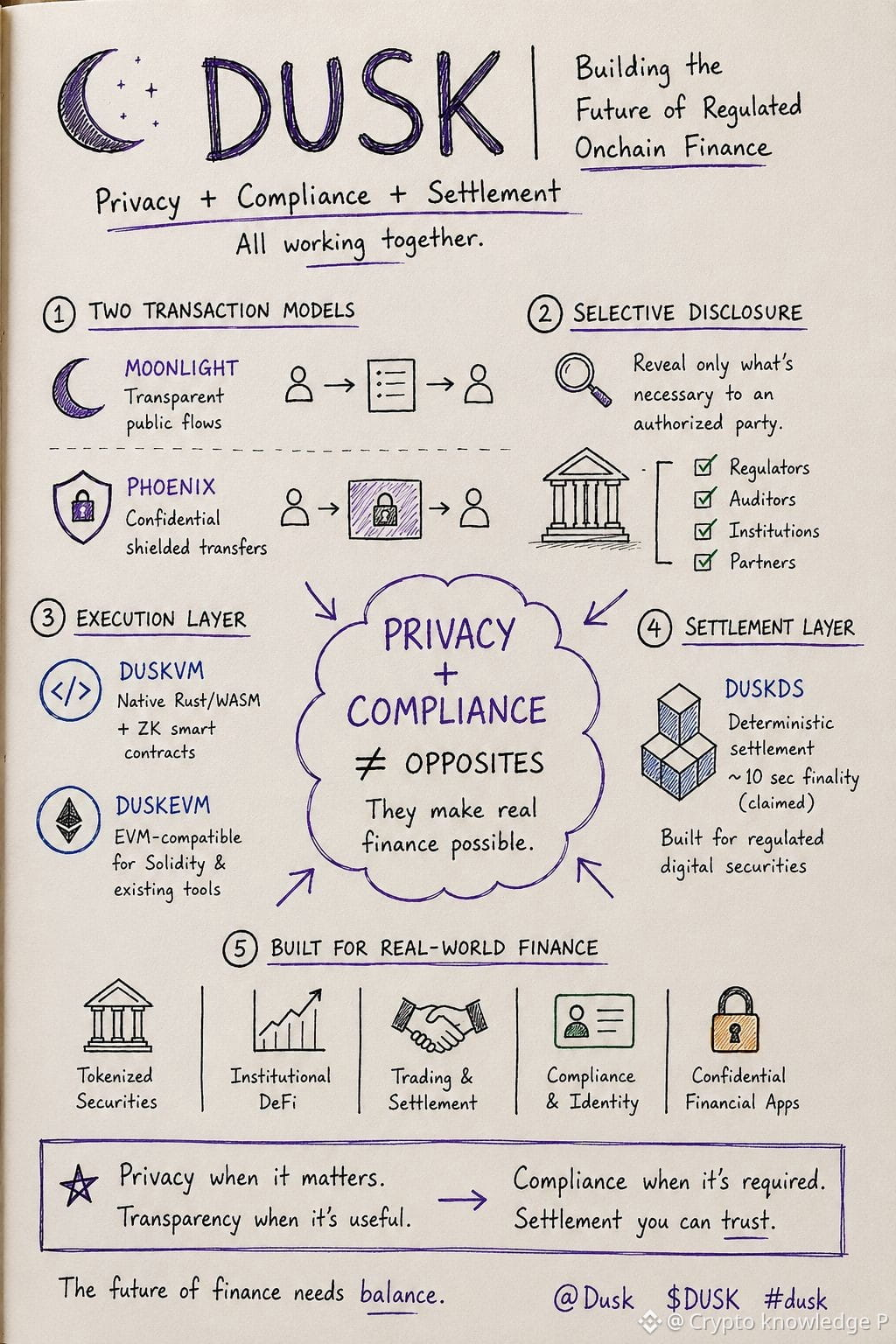
That’s where @Dusk_Foundation gets interesting.
Dusk is building infrastructure for regulated onchain finance where privacy, compliance and deterministic settlement can work together.
→ Moonlight for transparent public flows
→ Phoenix for confidential shielded transfers
→ Selective disclosure when an authorized party needs specific information
→ DuskVM for native Rust/WASM + ZK smart contracts
→ DuskEVM for an EVM-compatible development path
And the bigger idea goes beyond simply “tokenizing an asset.”
For regulated securities, you need investor eligibility, controlled transfers, privacy, disclosure, reporting and settlement to work together.
That’s the part I find most interesting about Dusk.
Tokenization is easy to describe.
Building the financial infrastructure around it is the hard part.
Dusk is betting that the future of onchain finance needs both:
Privacy when it matters.
Transparency when it’s useful.
Compliance when it’s required.
Settlement that can be trusted.
That’s a thesis worth watching. 👀
@Dusk_Foundation $DUSK #dusk
#dusk $DUSK
Most blockchains were designed around one idea:
Transparency.
But real financial markets need something more nuanced.
You can’t expect institutions to put every balance, position and transaction detail on a public ledger for everyone to see.
That’s where @Dusk gets interesting.
Dusk is building infrastructure for regulated onchain finance where privacy, compliance and deterministic settlement can work together.
→ Moonlight for transparent public flows
→ Phoenix for confidential shielded transfers
→ Selective disclosure when an authorized party needs specific information
→ DuskVM for native Rust/WASM + ZK smart contracts
→ DuskEVM for an EVM-compatible development path
And the bigger idea goes beyond simply “tokenizing an asset.”
For regulated securities, you need investor eligibility, controlled transfers, privacy, disclosure, reporting and settlement to work together.
That’s the part I find most interesting about Dusk.
Tokenization is easy to describe.
Building the financial infrastructure around it is the hard part.
Dusk is betting that the future of onchain finance needs both:
Privacy when it matters.
Transparency when it’s useful.
Compliance when it’s required.
Settlement that can be trusted.
That’s a thesis worth watching. 👀
@Dusk $DUSK #dusk
Most blockchains were designed around one idea:
Transparency.
But real financial markets need something more nuanced.
You can’t expect institutions to put every balance, position and transaction detail on a public ledger for everyone to see.
That’s where @Dusk gets interesting.
Dusk is building infrastructure for regulated onchain finance where privacy, compliance and deterministic settlement can work together.
→ Moonlight for transparent public flows
→ Phoenix for confidential shielded transfers
→ Selective disclosure when an authorized party needs specific information
→ DuskVM for native Rust/WASM + ZK smart contracts
→ DuskEVM for an EVM-compatible development path
And the bigger idea goes beyond simply “tokenizing an asset.”
For regulated securities, you need investor eligibility, controlled transfers, privacy, disclosure, reporting and settlement to work together.
That’s the part I find most interesting about Dusk.
Tokenization is easy to describe.
Building the financial infrastructure around it is the hard part.
Dusk is betting that the future of onchain finance needs both:
Privacy when it matters.
Transparency when it’s useful.
Compliance when it’s required.
Settlement that can be trusted.
That’s a thesis worth watching. 👀
@Dusk $DUSK #dusk
2
8
288
See translation
⚡ FUTURES TRADERS POLL ⚡
RSI above 78 = overbought zone 📊
These top gainers are pumping… what’s your move in futures? 👇
High risk, high reward — don’t get liquidated!
💬 Comment your entry & leverage#CryptoPoll #SKLUSDT #CryptoPatience #FutureTradingSignals #MOVR/USDT $ZBT $KERNEL $SKL
⚡ FUTURES TRADERS POLL ⚡
RSI above 78 = overbought zone 📊
These top gainers are pumping… what’s your move in futures? 👇
High risk, high reward — don’t get liquidated!
💬 Comment your entry & leverage#CryptoPoll #SKLUSDT #CryptoPatience #FutureTradingSignals #MOVR/USDT $ZBT $KERNEL $SKL
RSI above 78 = overbought zone 📊
These top gainers are pumping… what’s your move in futures? 👇
High risk, high reward — don’t get liquidated!
💬 Comment your entry & leverage#CryptoPoll #SKLUSDT #CryptoPatience #FutureTradingSignals #MOVR/USDT $ZBT $KERNEL $SKL
Short KERNEL
57%
Short SKL
13%
Short MOVR
27%
Short ZBT
3%
104 votes • Voting closed
1
2
3.5k
See translation
Which type of crypto are you betting on for the next bull run? 👇
💬 Comment your pick + why
#BTC #solana #MEME #CryptoPoll #Dogecoin $NOM $ON $KAT
Which type of crypto are you betting on for the next bull run? 👇
💬 Comment your pick + why
#BTC #solana #MEME #CryptoPoll #Dogecoin $NOM $ON $KAT
💬 Comment your pick + why
#BTC #solana #MEME #CryptoPoll #Dogecoin $NOM $ON $KAT
Store of Value — Bitcoin (BTC)
22%
Oracle Power— Chainlink (LINK)
14%
High-Speed Chains— Solana(SOL)
33%
Memecoins — Dogecoin (DOGE)
31%
36 votes • Voting closed
1
1
4.7k
Article
See translation
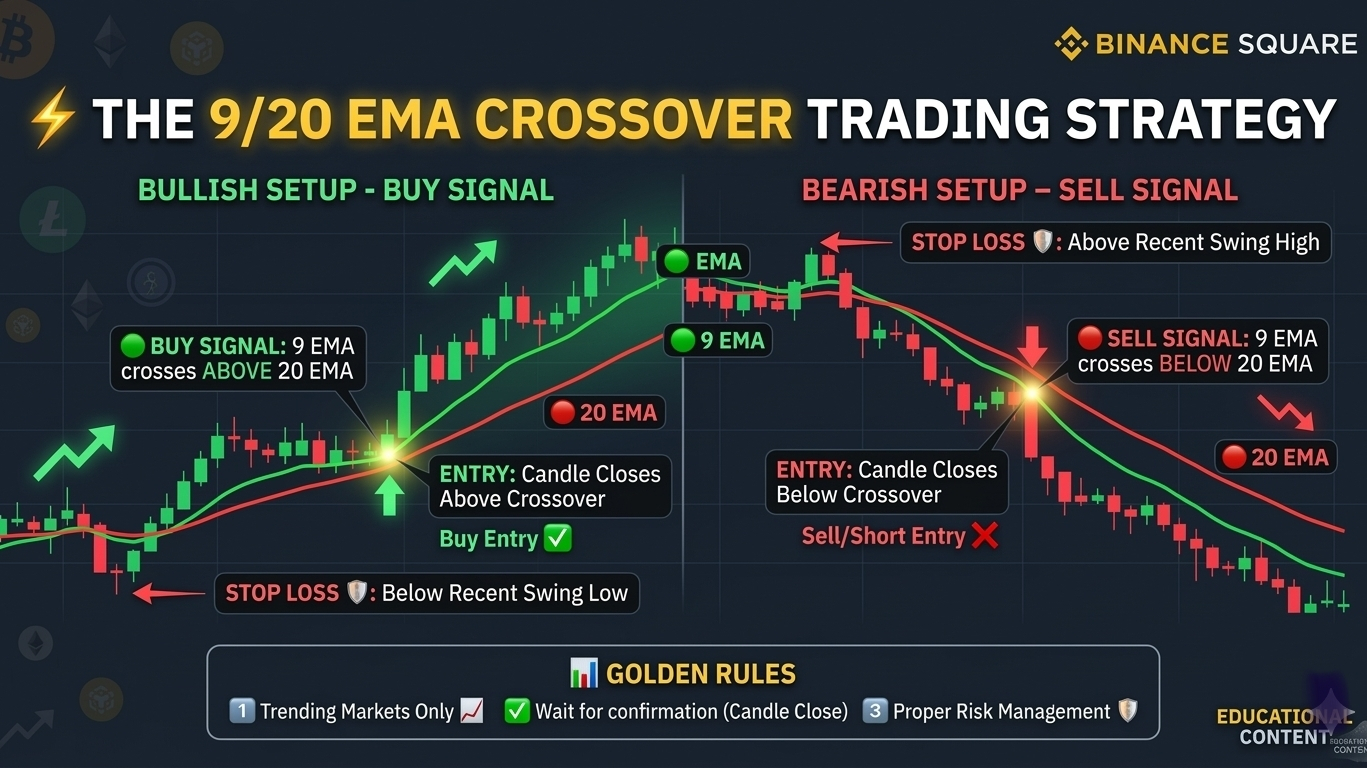
🔥 THE 9/20 EMA CROSSOVER: Your Blueprint for Catching Crypto TrendsTired of lagging indicators giving you late signals? If you want to catch momentum before the crowd, it's time to master the 9/20 Exponential Moving Average (EMA) strategy.
Here is exactly how to set it up and trade it like a pro. 🧵👇
━━━━━━━━━━━━━━━━━━━━━
⚙️ THE CHART SETUP
━━━━━━━━━━━━━━━━━━━━━
Open your Binance chart (Best for 15m, 1H, or 4H timeframes) and add two EMAs:
🟢 Fast Line: 9 EMA (Tracks immediate momentum)
🔴 Slow Line: 20 EMA (Identifies the short-term trend)
━━━━━━━━━━━━━━━━━━━━━
🚀 HOW TO ENTER A LONG (BUY)
━━━━━━━━━━━━━━━━━━━━━
Wait for the perfect alignment:
1️⃣ The Cross: The 9 EMA (🟢) crosses firmly ABOVE the 20 EMA (🔴).
2️⃣ The Candle: The price candle closes above both lines.
3️⃣ The Entry: Buy at the open of the next candle.
🛡️ Invalidation (Stop-Loss): Place your stop just below the recent swing low.
━━━━━━━━━━━━━━━━━━━━━
📉 HOW TO ENTER A SHORT (SELL)
━━━━━━━━━━━━━━━━━━━━━
Flip the script for downtrends:
1️⃣ The Cross: The 9 EMA (🟢) crosses sharply BELOW the 20 EMA (🔴).
2️⃣ The Candle: The price candle closes below both lines.
3️⃣ The Entry: Sell/Short at the open of the next candle.
🛡️ Invalidation (Stop-Loss): Place your stop just above the recent swing high.
━━━━━━━━━━━━━━━━━━━━━
⚠️ GOLDEN RULES FOR TRADING THIS
━━━━━━━━━━━━━━━━━━━━━
Volume is King: A crossover with high trading volume has a much higher win rate. Look for big spikes!
Avoid the Chop: If the 9 and 20 EMAs are flat and weaving together like a braided rope, DO NOT TRADE. The market is ranging.
Let Winners Run: You can use the 20 EMA as a trailing stop. Don't exit until the price closes back below the 20 EMA!
Trading isn't about being right 100% of the time; it's about having a system and managing your risk. 🧠💰
💬 What is your favorite timeframe to trade crossovers? Drop it in the comments! 👇
#cryptotrading #TechnicalAnalysis #BinanceSquare #cryptoeducation #TrendingTopic $BTC $SOL $PEPE
{spot}(PEPEUSDT)
🔥 THE 9/20 EMA CROSSOVER: Your Blueprint for Catching Crypto Trends
Tired of lagging indicators giving you late signals? If you want to catch momentum before the crowd, it's time to master the 9/20 Exponential Moving Average (EMA) strategy.
Here is exactly how to set it up and trade it like a pro. 🧵👇
━━━━━━━━━━━━━━━━━━━━━
⚙️ THE CHART SETUP
━━━━━━━━━━━━━━━━━━━━━
Open your Binance chart (Best for 15m, 1H, or 4H timeframes) and add two EMAs:
🟢 Fast Line: 9 EMA (Tracks immediate momentum)
🔴 Slow Line: 20 EMA (Identifies the short-term trend)
━━━━━━━━━━━━━━━━━━━━━
🚀 HOW TO ENTER A LONG (BUY)
━━━━━━━━━━━━━━━━━━━━━
Wait for the perfect alignment:
1️⃣ The Cross: The 9 EMA (🟢) crosses firmly ABOVE the 20 EMA (🔴).
2️⃣ The Candle: The price candle closes above both lines.
3️⃣ The Entry: Buy at the open of the next candle.
🛡️ Invalidation (Stop-Loss): Place your stop just below the recent swing low.
━━━━━━━━━━━━━━━━━━━━━
📉 HOW TO ENTER A SHORT (SELL)
━━━━━━━━━━━━━━━━━━━━━
Flip the script for downtrends:
1️⃣ The Cross: The 9 EMA (🟢) crosses sharply BELOW the 20 EMA (🔴).
2️⃣ The Candle: The price candle closes below both lines.
3️⃣ The Entry: Sell/Short at the open of the next candle.
🛡️ Invalidation (Stop-Loss): Place your stop just above the recent swing high.
━━━━━━━━━━━━━━━━━━━━━
⚠️ GOLDEN RULES FOR TRADING THIS
━━━━━━━━━━━━━━━━━━━━━
Volume is King: A crossover with high trading volume has a much higher win rate. Look for big spikes!
Avoid the Chop: If the 9 and 20 EMAs are flat and weaving together like a braided rope, DO NOT TRADE. The market is ranging.
Let Winners Run: You can use the 20 EMA as a trailing stop. Don't exit until the price closes back below the 20 EMA!
Trading isn't about being right 100% of the time; it's about having a system and managing your risk. 🧠💰
💬 What is your favorite timeframe to trade crossovers? Drop it in the comments! 👇
#cryptotrading #TechnicalAnalysis #BinanceSquare #cryptoeducation #TrendingTopic $BTC $SOL $PEPE
Here is exactly how to set it up and trade it like a pro. 🧵👇
━━━━━━━━━━━━━━━━━━━━━
⚙️ THE CHART SETUP
━━━━━━━━━━━━━━━━━━━━━
Open your Binance chart (Best for 15m, 1H, or 4H timeframes) and add two EMAs:
🟢 Fast Line: 9 EMA (Tracks immediate momentum)
🔴 Slow Line: 20 EMA (Identifies the short-term trend)
━━━━━━━━━━━━━━━━━━━━━
🚀 HOW TO ENTER A LONG (BUY)
━━━━━━━━━━━━━━━━━━━━━
Wait for the perfect alignment:
1️⃣ The Cross: The 9 EMA (🟢) crosses firmly ABOVE the 20 EMA (🔴).
2️⃣ The Candle: The price candle closes above both lines.
3️⃣ The Entry: Buy at the open of the next candle.
🛡️ Invalidation (Stop-Loss): Place your stop just below the recent swing low.
━━━━━━━━━━━━━━━━━━━━━
📉 HOW TO ENTER A SHORT (SELL)
━━━━━━━━━━━━━━━━━━━━━
Flip the script for downtrends:
1️⃣ The Cross: The 9 EMA (🟢) crosses sharply BELOW the 20 EMA (🔴).
2️⃣ The Candle: The price candle closes below both lines.
3️⃣ The Entry: Sell/Short at the open of the next candle.
🛡️ Invalidation (Stop-Loss): Place your stop just above the recent swing high.
━━━━━━━━━━━━━━━━━━━━━
⚠️ GOLDEN RULES FOR TRADING THIS
━━━━━━━━━━━━━━━━━━━━━
Volume is King: A crossover with high trading volume has a much higher win rate. Look for big spikes!
Avoid the Chop: If the 9 and 20 EMAs are flat and weaving together like a braided rope, DO NOT TRADE. The market is ranging.
Let Winners Run: You can use the 20 EMA as a trailing stop. Don't exit until the price closes back below the 20 EMA!
Trading isn't about being right 100% of the time; it's about having a system and managing your risk. 🧠💰
💬 What is your favorite timeframe to trade crossovers? Drop it in the comments! 👇
#cryptotrading #TechnicalAnalysis #BinanceSquare #cryptoeducation #TrendingTopic $BTC $SOL $PEPE
2
84
See translation
Trending Hidden Gems Poll (Binance) 💎
Everyone watches BTC & ETH…
But real gains come from hidden gems 👀
Which trending altcoin has the biggest 10x potential?$FET $RNDR $TIA
📊 Vote now & comment your hidden gem
The best alpha is always in the comments 👇
#crypto #CryptoPoll #BTC #BinanceSquareTalks #CryptoPoll
Trending Hidden Gems Poll (Binance) 💎
Everyone watches BTC & ETH…
But real gains come from hidden gems 👀
Which trending altcoin has the biggest 10x potential?$FET $RNDR $TIA
📊 Vote now & comment your hidden gem
The best alpha is always in the comments 👇
#crypto #CryptoPoll #BTC #BinanceSquareTalks #CryptoPoll
Everyone watches BTC & ETH…
But real gains come from hidden gems 👀
Which trending altcoin has the biggest 10x potential?$FET $RNDR $TIA
📊 Vote now & comment your hidden gem
The best alpha is always in the comments 👇
#crypto #CryptoPoll #BTC #BinanceSquareTalks #CryptoPoll
FET (AI narrative)
63%
RNDR (GPU / AI infrastructure)
10%
TIA (Modular blockchain)
24%
SEI (High-speed DeFi chain)
3%
71 votes • Voting closed
1
4
3k
See translation
Which memecoin are you accumulating right now?
💬 Comment the memecoin you're bullish on
Let’s see which community is strongest 👀
#MemecoinArmy #CryptoPoll #BinanceSquare #PEPE #memecoin🚀🚀🚀
$PEPE $DOGE $FLOKI
Which memecoin are you accumulating right now?
💬 Comment the memecoin you're bullish on
Let’s see which community is strongest 👀
#MemecoinArmy #CryptoPoll #BinanceSquare #PEPE #memecoin🚀🚀🚀
$PEPE $DOGE $FLOKI
💬 Comment the memecoin you're bullish on
Let’s see which community is strongest 👀
#MemecoinArmy #CryptoPoll #BinanceSquare #PEPE #memecoin🚀🚀🚀
$PEPE $DOGE $FLOKI
DOGE
43%
SHIB
7%
PEPE
39%
OTHER (COMMENT IT)
11%
87 votes • Voting closed
1
3
1.2k
Log in to explore more content
Join global crypto users on Binance Square
⚡️ Get latest and useful information about crypto.
💬 Trusted by the world’s largest crypto exchange.
👍 Discover real insights from verified creators.
Email / Phone number