

Mobius_CryptoZ
168 Posts
Mobius_CryptoZ
Report
Block User
BP-F3284BB4A756
Open Trade

BTC Holder
High-Frequency Trader
5.5 Years
20 Following
226 Followers
512 Liked
Posts
Portfolio
All
Quotes
Verified
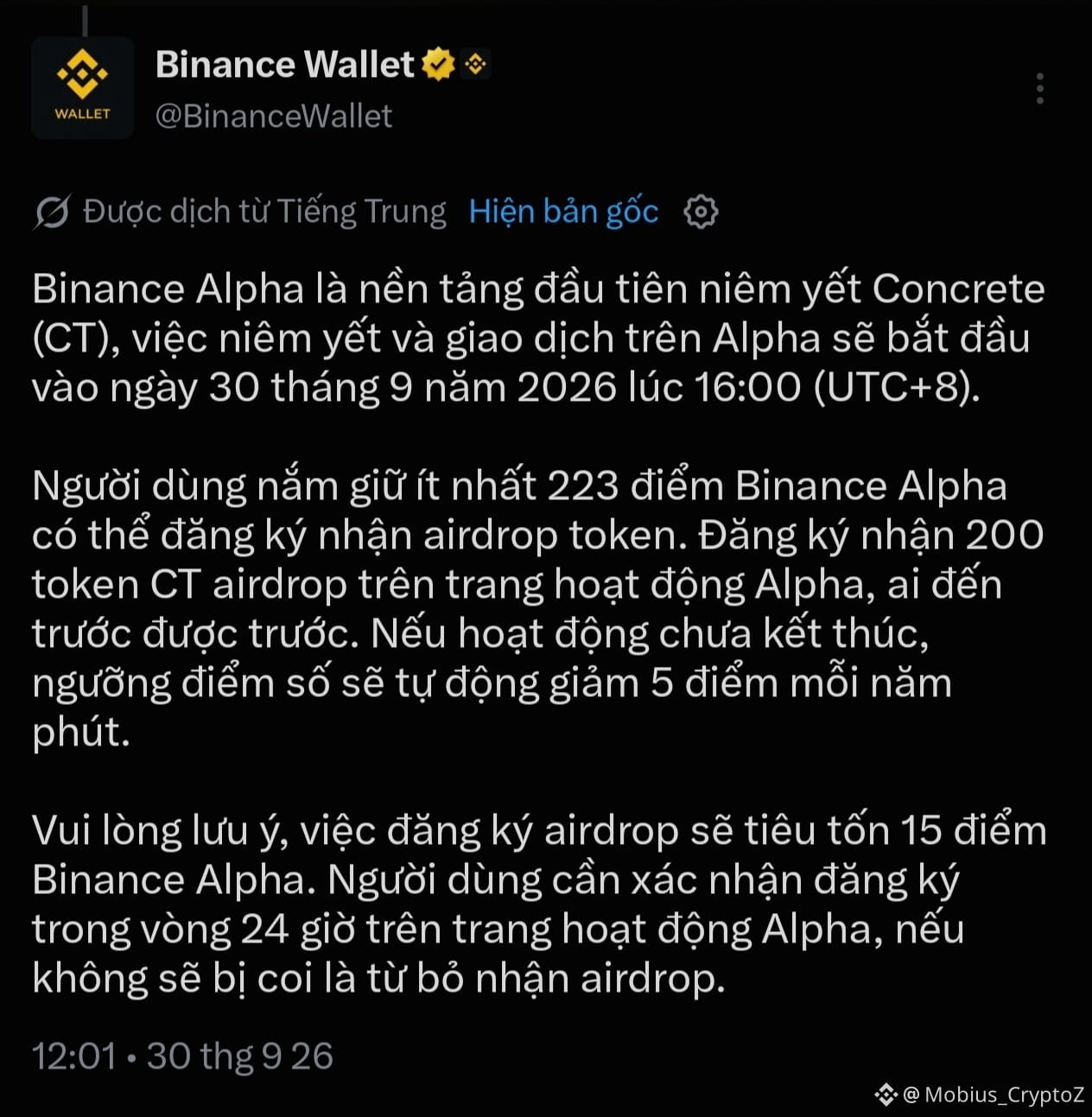
Binance Alpha will list $CT at 8h UTC (15h VN)
+ 223 points to farm
+ 200 CT per network
+ 50k networks competing
Even though the alpha is a bit worn out, picking up what you can is still fine. If you have points, watch for the farming time nhé
Binance Alpha will list $CT at 8h UTC (15h VN)
+ 223 points to farm
+ 200 CT per network
+ 50k networks competing
Even though the alpha is a bit worn out, picking up what you can is still fine. If you have points, watch for the farming time nhé
+ 223 points to farm
+ 200 CT per network
+ 50k networks competing
Even though the alpha is a bit worn out, picking up what you can is still fine. If you have points, watch for the farming time nhé
2
1.6k
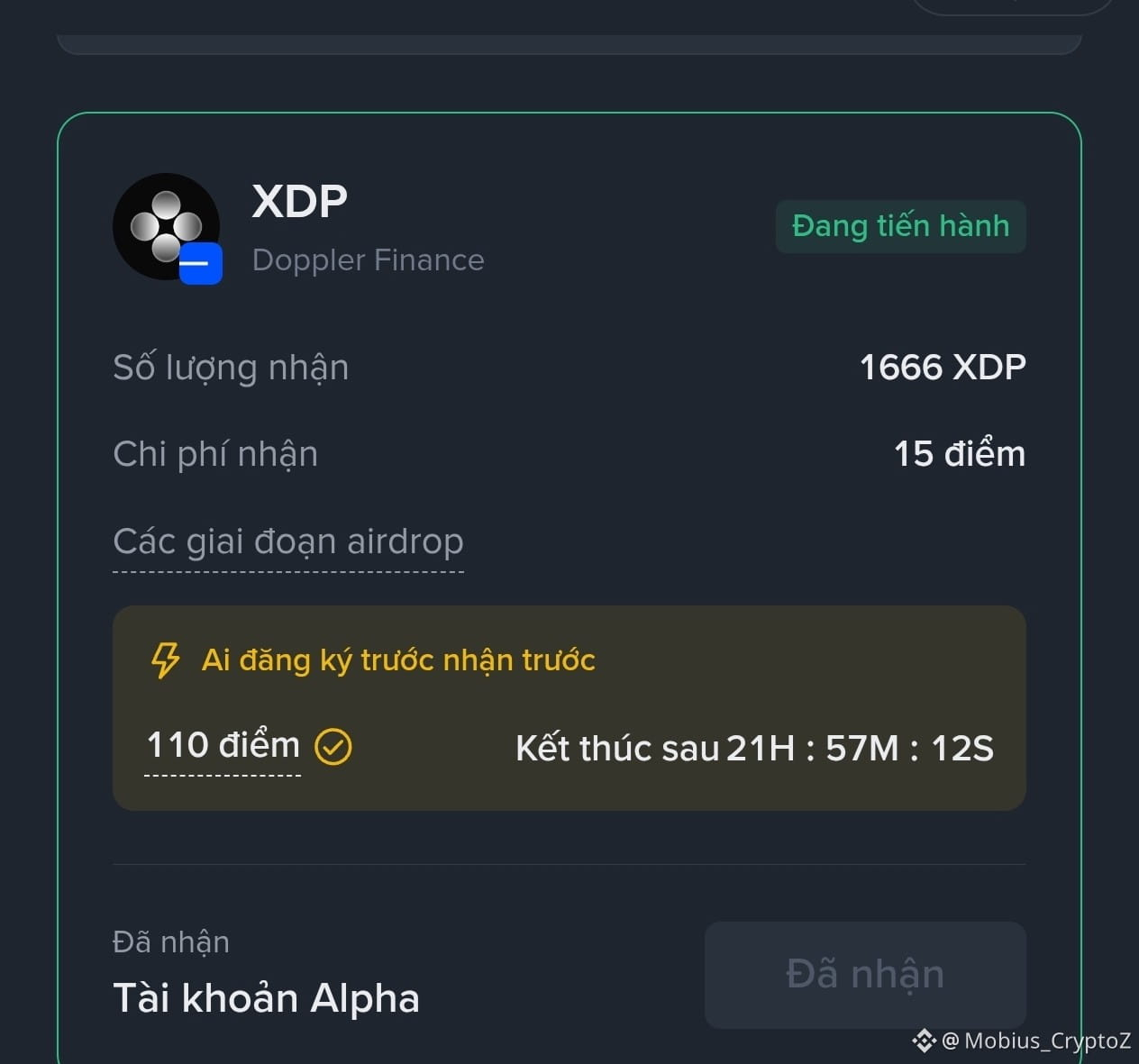
There’s still 6% and 110 points left, but are people already going to sleep?
There’s still 6% and 110 points left, but are people already going to sleep?
4
1
844
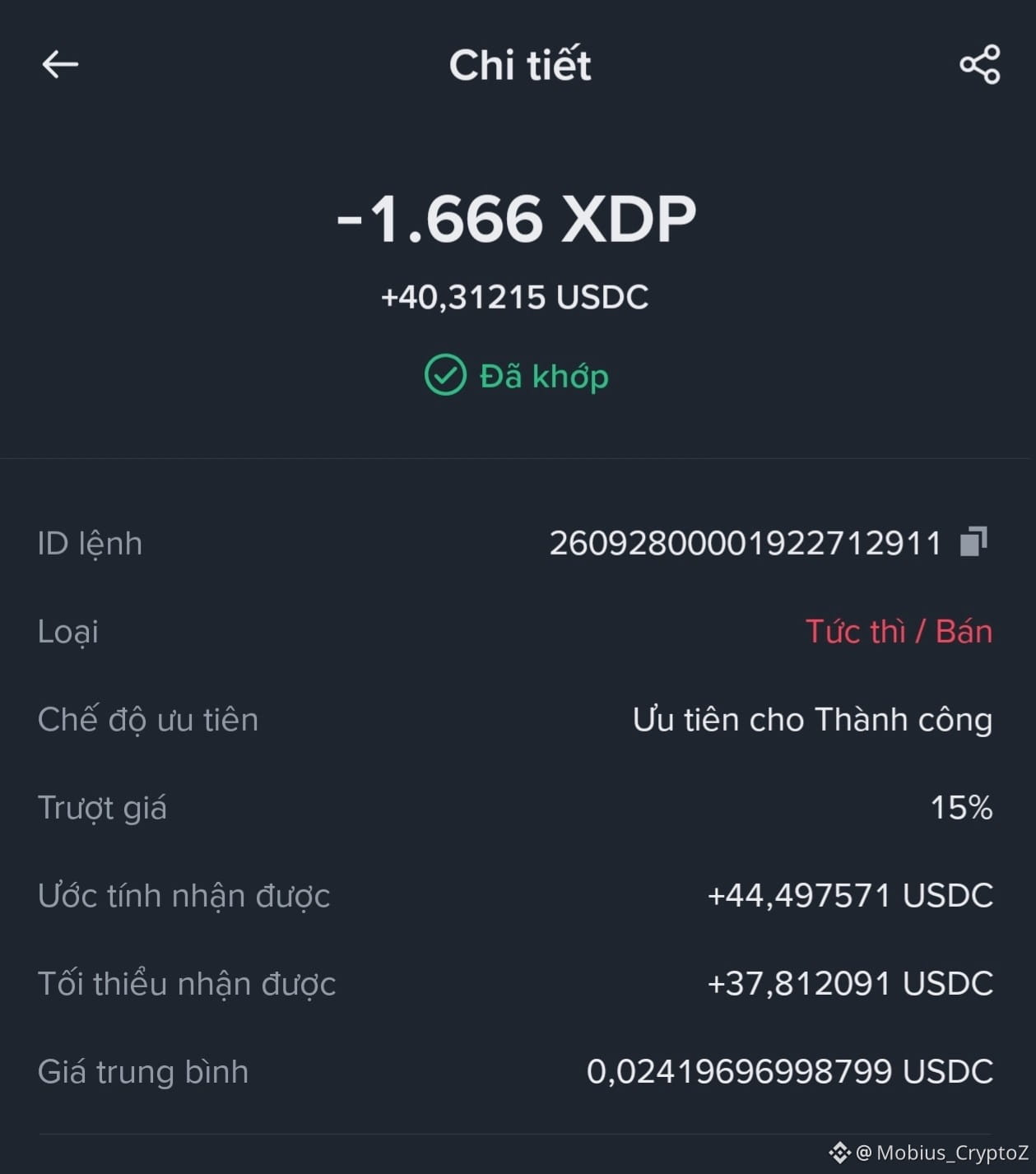
Bad luck, bad luck, it’s not outside expectations 1666XDP 60k slots, currently there is still 28% not claimed yet, the chance of finishing with 100 points is still pending, if you have alpha points then watch for it, pick it up, grab those accounts $XDP
Bad luck, bad luck, it’s not outside expectations 1666XDP 60k slots, currently there is still 28% not claimed yet, the chance of finishing with 100 points is still pending, if you have alpha points then watch for it, pick it up, grab those accounts $XDP
Mobius_CryptoZ
·
--
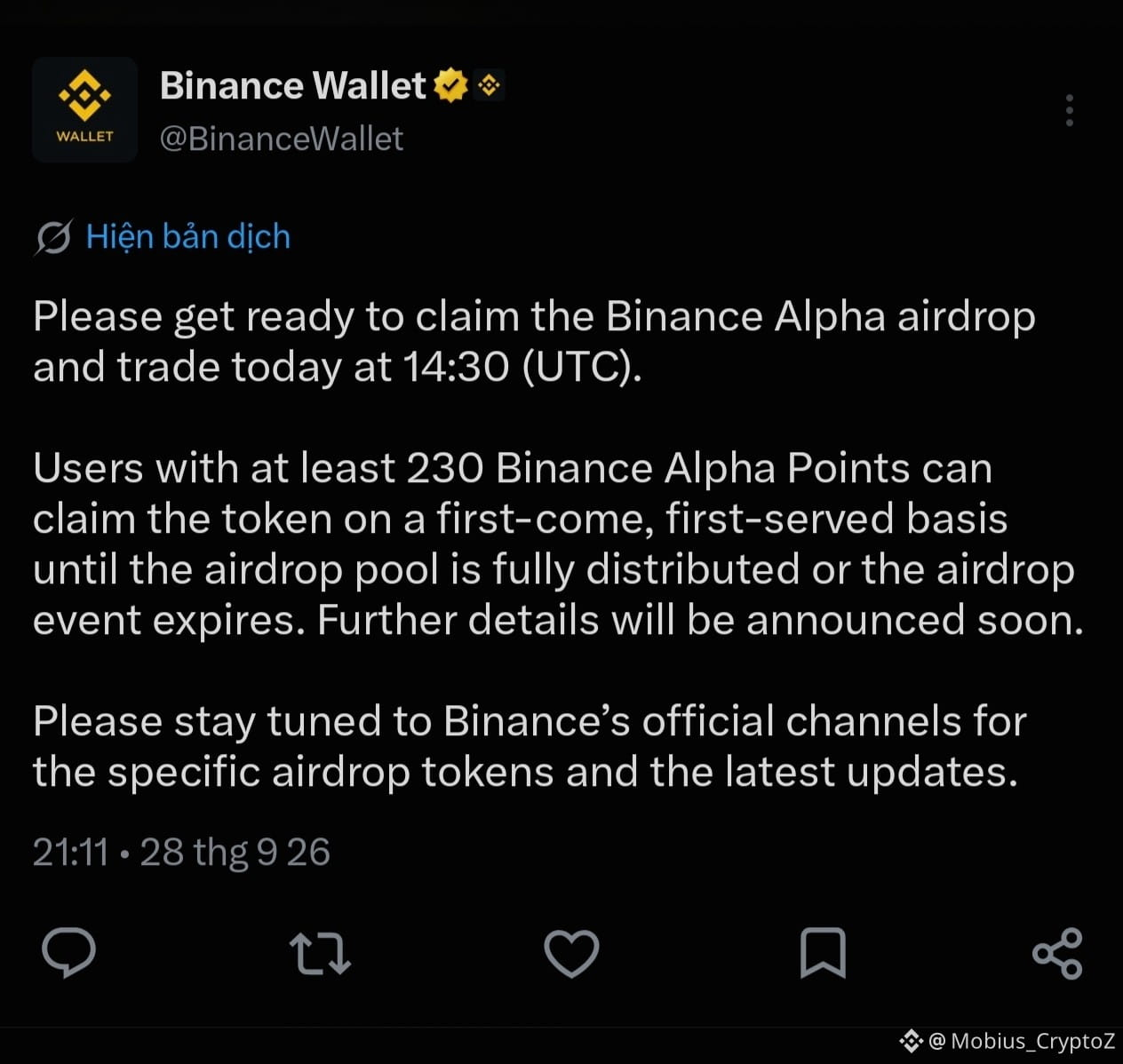
SO FANTASTIC WITCH, the air bet after 15 minutes will be very surprising, only 230 points, chances of 60k slots sucking in, sucking in
1
363
SO FANTASTIC WITCH, the air bet after 15 minutes will be very surprising, only 230 points, chances of 60k slots sucking in, sucking in
SO FANTASTIC WITCH, the air bet after 15 minutes will be very surprising, only 230 points, chances of 60k slots sucking in, sucking in
1
1
342
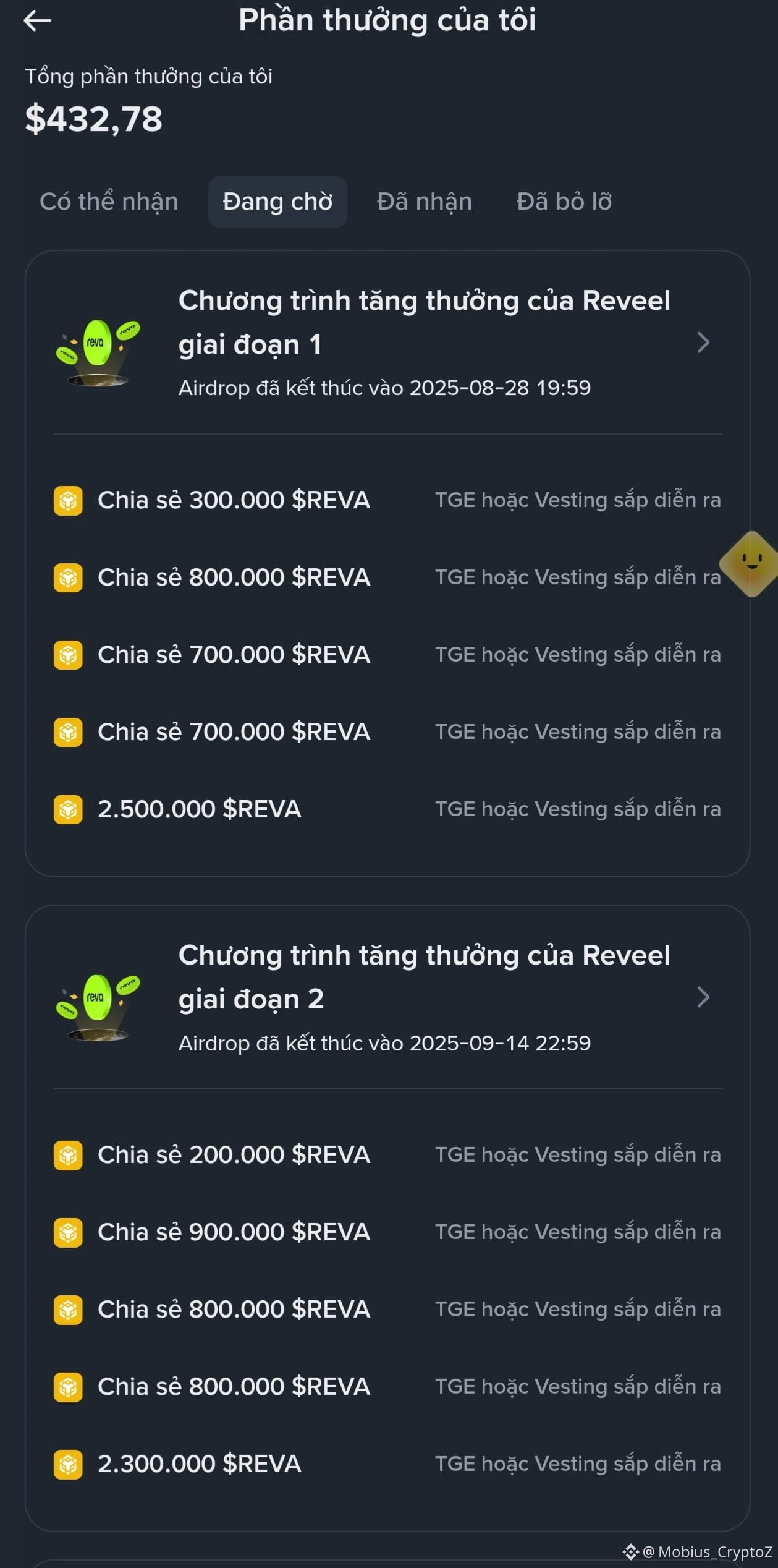
WHY DID THE DEVELOPER RUN AWAY AFTER THIS PROJECT, YET THE PLATFORM STILL LEAVES IT THERE WITHOUT DELETING IT?
$Reva sold pre TGE more than 1 year ago, and released 6 booster phases. The X project is no longer being updated; the dev took the money and ran. It’s reasonable to think the exchange should remove it from the booster and resolve things for the participants of the pre TGE
$BTW
{future}(BTWUSDT)
WHY DID THE DEVELOPER RUN AWAY AFTER THIS PROJECT, YET THE PLATFORM STILL LEAVES IT THERE WITHOUT DELETING IT?
$Reva sold pre TGE more than 1 year ago, and released 6 booster phases. The X project is no longer being updated; the dev took the money and ran. It’s reasonable to think the exchange should remove it from the booster and resolve things for the participants of the pre TGE
$BTW
$Reva sold pre TGE more than 1 year ago, and released 6 booster phases. The X project is no longer being updated; the dev took the money and ran. It’s reasonable to think the exchange should remove it from the booster and resolve things for the participants of the pre TGE
$BTW
1
529
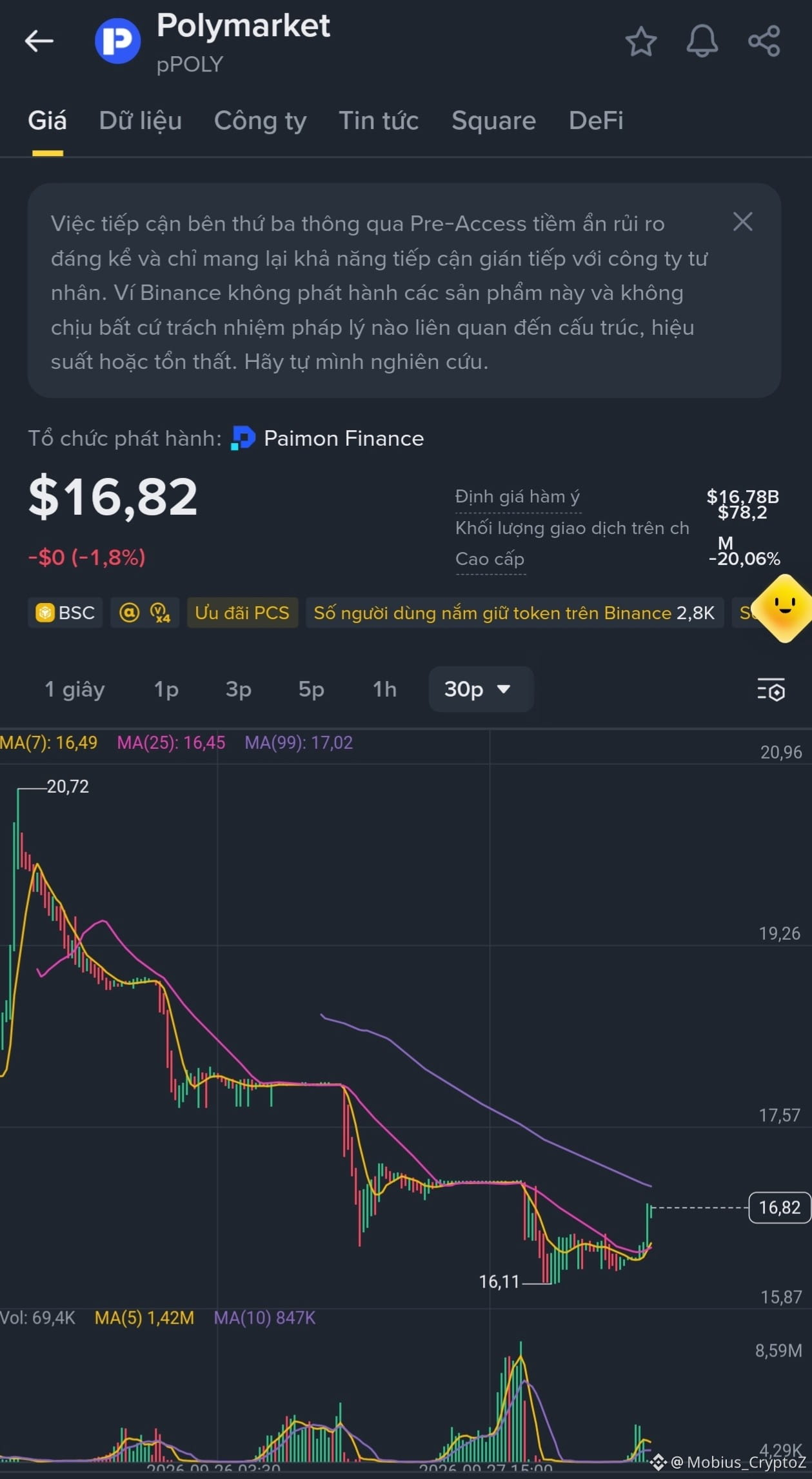
$pPoly chart rice terraced fields, like bro, who goes deep 10k pulls, drinks 500u sweetly, a bit slow—but the only thing is I listed everything and then it went all out
$pPoly chart rice terraced fields, like bro, who goes deep 10k pulls, drinks 500u sweetly, a bit slow—but the only thing is I listed everything and then it went all out
1
258
Verified
$QNT
{future}(QNTUSDT)
$QNT has just made an extremely important step forward 👀
The Clearing House – the payment organization of the 25 largest banks in the U.S. – has selected Quant as the interoperability, orchestration, and transaction management layer for the On-Chain Money Initiative.
This is no longer a story of “potential on paper,” but real infrastructure for banks to issue and settle tokenized deposits, while also connecting directly to the existing RTP and CHIPS systems.
Narrative RWA + institutional adoption + interoperability are converging right into Quant. If major financial institutions increasingly move assets onto the chain, the need for a standardized connection layer will become even clearer.
It’s not just blockchain—this is a story of connecting the entire traditional financial system with the digital economy.
If this momentum continues, $QNT still has a lot of room ahead.
DYOR.
$QNT
$QNT has just made an extremely important step forward 👀
The Clearing House – the payment organization of the 25 largest banks in the U.S. – has selected Quant as the interoperability, orchestration, and transaction management layer for the On-Chain Money Initiative.
This is no longer a story of “potential on paper,” but real infrastructure for banks to issue and settle tokenized deposits, while also connecting directly to the existing RTP and CHIPS systems.
Narrative RWA + institutional adoption + interoperability are converging right into Quant. If major financial institutions increasingly move assets onto the chain, the need for a standardized connection layer will become even clearer.
It’s not just blockchain—this is a story of connecting the entire traditional financial system with the digital economy.
If this momentum continues, $QNT still has a lot of room ahead.
DYOR.
$QNT has just made an extremely important step forward 👀
The Clearing House – the payment organization of the 25 largest banks in the U.S. – has selected Quant as the interoperability, orchestration, and transaction management layer for the On-Chain Money Initiative.
This is no longer a story of “potential on paper,” but real infrastructure for banks to issue and settle tokenized deposits, while also connecting directly to the existing RTP and CHIPS systems.
Narrative RWA + institutional adoption + interoperability are converging right into Quant. If major financial institutions increasingly move assets onto the chain, the need for a standardized connection layer will become even clearer.
It’s not just blockchain—this is a story of connecting the entire traditional financial system with the digital economy.
If this momentum continues, $QNT still has a lot of room ahead.
DYOR.
2
648
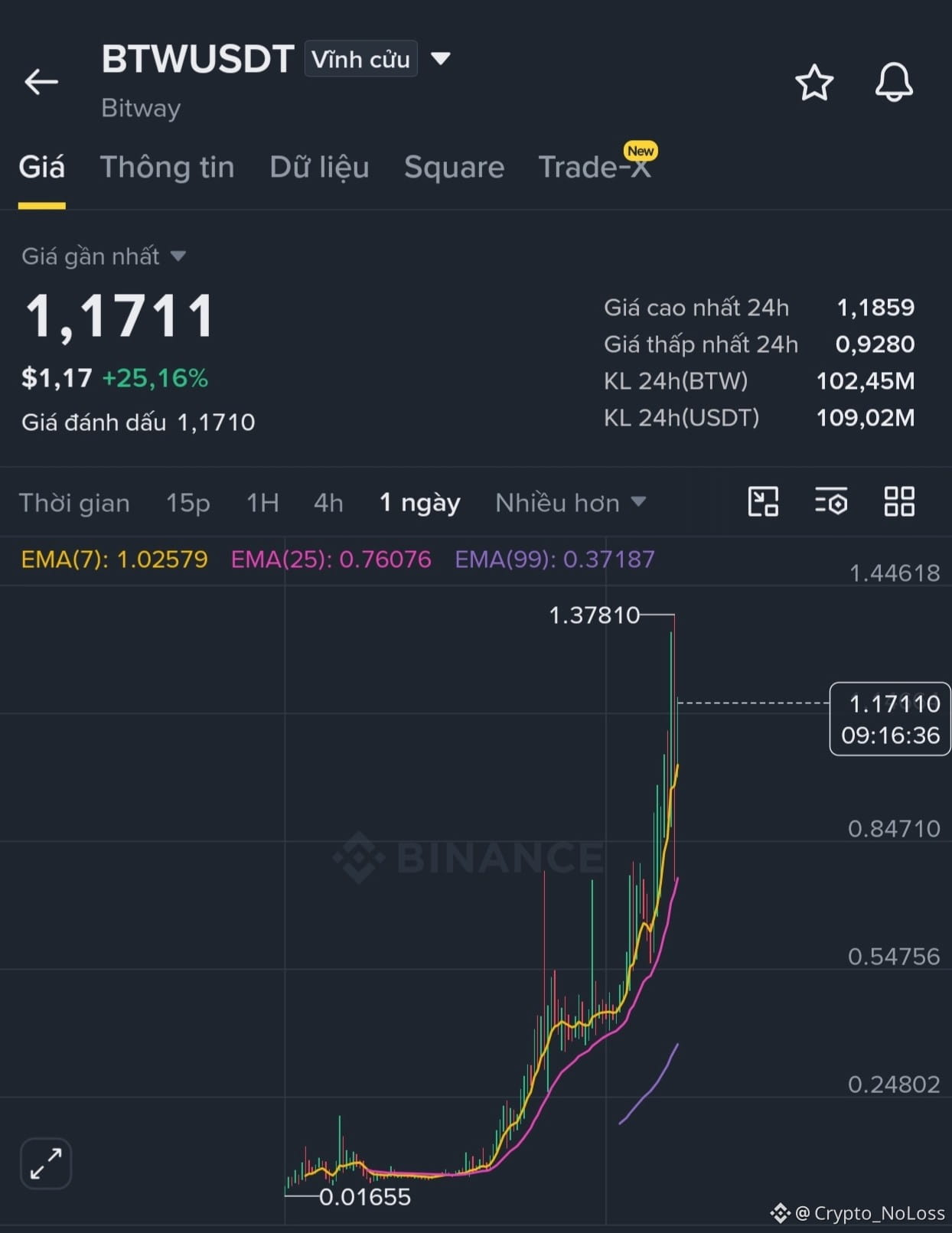
Con $BTW these evil ones are real, keep the alpha pile with a bootleg and you’ll be overflowing with it; in the end, everyone knows where it’s going—but when you surf the future waves, you’re still addicted 😂😂
{future}(BTWUSDT)
Con $BTW these evil ones are real, keep the alpha pile with a bootleg and you’ll be overflowing with it; in the end, everyone knows where it’s going—but when you surf the future waves, you’re still addicted 😂😂
1
834
See translation
THORChain and Stolen Funds: The Industry Still Needs Answers
After last year’s $1.46 billion Bybit hack, nearly $1.2 billion in stolen assets was reportedly routed through THORChain as the attackers moved funds across chains.
Now, after another major security breach at Bitget, the same pattern is appearing again: funds tied to the Bitget Exploiter are being sent into THORChain for swaps and cross-chain transfers.
The issue is no longer whether THORChain “knows” these funds are linked to hackers.
The attacker addresses have already been publicly flagged. Exchanges, blockchain security firms, AML teams, and the wider crypto industry are already tracking them.
The real question is this:
If a protocol knows that funds came from a publicly identified major hack and still processes large-scale cross-chain swaps, how should the industry treat that under the banner of “decentralization”?
Decentralization should not become a catch-all excuse for handling known stolen money.
If, after every major crypto hack, attackers can keep using THORChain as a bridge from ETH to BTC, BNB to BTC, and across other networks, the industry has to ask a harder question:
What responsibility should THORChain carry when it continues to move funds that are already known to be stolen?
$RUNE $BTC
THORChain and Stolen Funds: The Industry Still Needs Answers
After last year’s $1.46 billion Bybit hack, nearly $1.2 billion in stolen assets was reportedly routed through THORChain as the attackers moved funds across chains.
Now, after another major security breach at Bitget, the same pattern is appearing again: funds tied to the Bitget Exploiter are being sent into THORChain for swaps and cross-chain transfers.
The issue is no longer whether THORChain “knows” these funds are linked to hackers.
The attacker addresses have already been publicly flagged. Exchanges, blockchain security firms, AML teams, and the wider crypto industry are already tracking them.
The real question is this:
If a protocol knows that funds came from a publicly identified major hack and still processes large-scale cross-chain swaps, how should the industry treat that under the banner of “decentralization”?
Decentralization should not become a catch-all excuse for handling known stolen money.
If, after every major crypto hack, attackers can keep using THORChain as a bridge from ETH to BTC, BNB to BTC, and across other networks, the industry has to ask a harder question:
What responsibility should THORChain carry when it continues to move funds that are already known to be stolen?
$RUNE $BTC
After last year’s $1.46 billion Bybit hack, nearly $1.2 billion in stolen assets was reportedly routed through THORChain as the attackers moved funds across chains.
Now, after another major security breach at Bitget, the same pattern is appearing again: funds tied to the Bitget Exploiter are being sent into THORChain for swaps and cross-chain transfers.
The issue is no longer whether THORChain “knows” these funds are linked to hackers.
The attacker addresses have already been publicly flagged. Exchanges, blockchain security firms, AML teams, and the wider crypto industry are already tracking them.
The real question is this:
If a protocol knows that funds came from a publicly identified major hack and still processes large-scale cross-chain swaps, how should the industry treat that under the banner of “decentralization”?
Decentralization should not become a catch-all excuse for handling known stolen money.
If, after every major crypto hack, attackers can keep using THORChain as a bridge from ETH to BTC, BNB to BTC, and across other networks, the industry has to ask a harder question:
What responsibility should THORChain carry when it continues to move funds that are already known to be stolen?
$RUNE $BTC
2
215
WisdomTree, an asset manager overseeing approximately $172B in assets, believes Bitcoin is playing the expected role in an unstable environment.
According to the quoted assessment:
• $BTC has traded through war, an oil shock, and rising interest rates.
• Bitcoin has risen by about 46% since July.
Notable point: Bitcoin is being tracked not only as a speculative asset, but also as an asset that may perform across a variety of macro environments.
Platform CA:
0x11dC0Fd5e2C9A4407fdb15aA6871501Ba9307777
payout address: 0x27ce5Fb02753D393c031A6F7A84eeF493754DCcF
WisdomTree, an asset manager overseeing approximately $172B in assets, believes Bitcoin is playing the expected role in an unstable environment.
According to the quoted assessment:
• $BTC has traded through war, an oil shock, and rising interest rates.
• Bitcoin has risen by about 46% since July.
Notable point: Bitcoin is being tracked not only as a speculative asset, but also as an asset that may perform across a variety of macro environments.
Platform CA:
0x11dC0Fd5e2C9A4407fdb15aA6871501Ba9307777
payout address: 0x27ce5Fb02753D393c031A6F7A84eeF493754DCcF
According to the quoted assessment:
• $BTC has traded through war, an oil shock, and rising interest rates.
• Bitcoin has risen by about 46% since July.
Notable point: Bitcoin is being tracked not only as a speculative asset, but also as an asset that may perform across a variety of macro environments.
Platform CA:
0x11dC0Fd5e2C9A4407fdb15aA6871501Ba9307777
payout address: 0x27ce5Fb02753D393c031A6F7A84eeF493754DCcF
1
262
#binancep2pantoan
I tried to become a P2P merchant on Binance and here’s what I learned
After a while of buying and selling, I registered as a merchant to sell USDT. Maintaining a high completion rate and replying quickly is very important. There were days when I had to stay online continuously to avoid losing my rating. The advantage is that I can earn an additional amount from the currency exchange spread that’s fairly decent. The disadvantage is time pressure and the risk that a buyer might transfer money with the wrong content. The operating principle when you’re a merchant requires strict management of both funds and time. Safety for the seller means only releasing funds once the money has clearly arrived in your account. After a few months, I paused because I didn’t have enough time, but the experience helped me understand both sides of the P2P market.
Imagine
@Binance_Vietnam
#binancep2pantoan
I tried to become a P2P merchant on Binance and here’s what I learned
After a while of buying and selling, I registered as a merchant to sell USDT. Maintaining a high completion rate and replying quickly is very important. There were days when I had to stay online continuously to avoid losing my rating. The advantage is that I can earn an additional amount from the currency exchange spread that’s fairly decent. The disadvantage is time pressure and the risk that a buyer might transfer money with the wrong content. The operating principle when you’re a merchant requires strict management of both funds and time. Safety for the seller means only releasing funds once the money has clearly arrived in your account. After a few months, I paused because I didn’t have enough time, but the experience helped me understand both sides of the P2P market.
Imagine
@Binance Vietnam
I tried to become a P2P merchant on Binance and here’s what I learned
After a while of buying and selling, I registered as a merchant to sell USDT. Maintaining a high completion rate and replying quickly is very important. There were days when I had to stay online continuously to avoid losing my rating. The advantage is that I can earn an additional amount from the currency exchange spread that’s fairly decent. The disadvantage is time pressure and the risk that a buyer might transfer money with the wrong content. The operating principle when you’re a merchant requires strict management of both funds and time. Safety for the seller means only releasing funds once the money has clearly arrived in your account. After a few months, I paused because I didn’t have enough time, but the experience helped me understand both sides of the P2P market.
Imagine
@Binance Vietnam
1
67
See translation
#termmax
The Multi-Chain Morning Routine
My assets used to live in separate universes. Ethereum for size, Arbitrum for speed, BNB Chain for specific opportunities. Moving between them meant bridges, waiting, and mental accounting. TermMaxFi’s multi-chain deployment changed my morning routine.
I opened the same interface and simply switched networks. On Ethereum I maintained a larger vault position. On Arbitrum I ran shorter-term fixed-rate experiments with lower fees. On BNB Chain I explored RWA collateral markets. The core mechanics remained consistent: fixed rates, clear maturities, curator-managed vaults. That consistency across chains removed the cognitive load of learning a new interface every time I moved capital.
One morning I rebalanced across three networks in under fifteen minutes. The positions stayed coherent in my mental model because the product logic was the same everywhere. I no longer needed separate spreadsheets for each chain’s “version” of lending. @termmax TermMaxFi became the common language my portfolio spoke regardless of the underlying blockchain.
The expansion to additional networks only reinforced the feeling. Capital efficiency improved because I could deploy wherever liquidity and opportunity were best without abandoning the fixed-rate framework I had come to rely on. Multi-chain no longer felt fragmented. It felt like one protocol with many doors
$BNB $NVDAB
#termmax
The Multi-Chain Morning Routine
My assets used to live in separate universes. Ethereum for size, Arbitrum for speed, BNB Chain for specific opportunities. Moving between them meant bridges, waiting, and mental accounting. TermMaxFi’s multi-chain deployment changed my morning routine.
I opened the same interface and simply switched networks. On Ethereum I maintained a larger vault position. On Arbitrum I ran shorter-term fixed-rate experiments with lower fees. On BNB Chain I explored RWA collateral markets. The core mechanics remained consistent: fixed rates, clear maturities, curator-managed vaults. That consistency across chains removed the cognitive load of learning a new interface every time I moved capital.
One morning I rebalanced across three networks in under fifteen minutes. The positions stayed coherent in my mental model because the product logic was the same everywhere. I no longer needed separate spreadsheets for each chain’s “version” of lending. @TermMax TermMaxFi became the common language my portfolio spoke regardless of the underlying blockchain.
The expansion to additional networks only reinforced the feeling. Capital efficiency improved because I could deploy wherever liquidity and opportunity were best without abandoning the fixed-rate framework I had come to rely on. Multi-chain no longer felt fragmented. It felt like one protocol with many doors
$BNB $NVDAB
The Multi-Chain Morning Routine
My assets used to live in separate universes. Ethereum for size, Arbitrum for speed, BNB Chain for specific opportunities. Moving between them meant bridges, waiting, and mental accounting. TermMaxFi’s multi-chain deployment changed my morning routine.
I opened the same interface and simply switched networks. On Ethereum I maintained a larger vault position. On Arbitrum I ran shorter-term fixed-rate experiments with lower fees. On BNB Chain I explored RWA collateral markets. The core mechanics remained consistent: fixed rates, clear maturities, curator-managed vaults. That consistency across chains removed the cognitive load of learning a new interface every time I moved capital.
One morning I rebalanced across three networks in under fifteen minutes. The positions stayed coherent in my mental model because the product logic was the same everywhere. I no longer needed separate spreadsheets for each chain’s “version” of lending. @TermMax TermMaxFi became the common language my portfolio spoke regardless of the underlying blockchain.
The expansion to additional networks only reinforced the feeling. Capital efficiency improved because I could deploy wherever liquidity and opportunity were best without abandoning the fixed-rate framework I had come to rely on. Multi-chain no longer felt fragmented. It felt like one protocol with many doors
$BNB $NVDAB
1
73
#binancep2pantoan @Binance_Vietnam
A “great exchange rate” scam on P2P—stay alert
While browsing P2P, I saw a USDT sell order priced nearly 400 VND below the market rate. The quantity matched exactly what I needed. It was too good to pass up. I placed the order right away. The seller chatted very quickly and politely, then said: “To make the transaction faster, please install this verification app for me—it only takes 30 seconds.” A link was sent along with the message.
Greed almost made me click. But my instincts told me something was wrong. I took an old phone that had been factory reset—no SIM, no bank account—and opened that link. Immediately, the app requested permission to read all my messages, my contacts, and even granted camera access. I powered the device off right away, went back to cancel the order, and reported it. Later, I learned it was malware designed to steal bank OTPs. All because I wanted to save a few hundred thousand VND, I almost lost my entire account. P2P isn’t only a battle with the person across the screen—it’s also a battle against the greed within yourself.
Have you ever been lured by a “too good to be true” price so much that you almost ignored even the most basic safety rules?
#binancep2pantoan @Binance Vietnam
A “great exchange rate” scam on P2P—stay alert
While browsing P2P, I saw a USDT sell order priced nearly 400 VND below the market rate. The quantity matched exactly what I needed. It was too good to pass up. I placed the order right away. The seller chatted very quickly and politely, then said: “To make the transaction faster, please install this verification app for me—it only takes 30 seconds.” A link was sent along with the message.
Greed almost made me click. But my instincts told me something was wrong. I took an old phone that had been factory reset—no SIM, no bank account—and opened that link. Immediately, the app requested permission to read all my messages, my contacts, and even granted camera access. I powered the device off right away, went back to cancel the order, and reported it. Later, I learned it was malware designed to steal bank OTPs. All because I wanted to save a few hundred thousand VND, I almost lost my entire account. P2P isn’t only a battle with the person across the screen—it’s also a battle against the greed within yourself.
Have you ever been lured by a “too good to be true” price so much that you almost ignored even the most basic safety rules?
A “great exchange rate” scam on P2P—stay alert
While browsing P2P, I saw a USDT sell order priced nearly 400 VND below the market rate. The quantity matched exactly what I needed. It was too good to pass up. I placed the order right away. The seller chatted very quickly and politely, then said: “To make the transaction faster, please install this verification app for me—it only takes 30 seconds.” A link was sent along with the message.
Greed almost made me click. But my instincts told me something was wrong. I took an old phone that had been factory reset—no SIM, no bank account—and opened that link. Immediately, the app requested permission to read all my messages, my contacts, and even granted camera access. I powered the device off right away, went back to cancel the order, and reported it. Later, I learned it was malware designed to steal bank OTPs. All because I wanted to save a few hundred thousand VND, I almost lost my entire account. P2P isn’t only a battle with the person across the screen—it’s also a battle against the greed within yourself.
Have you ever been lured by a “too good to be true” price so much that you almost ignored even the most basic safety rules?
77
See translation
#termmax @termmax
Collateral I Never Thought I Could Use
For a long time my tokenized real-world assets sat idle. I liked the exposure to traditional markets through Ondo-style products, yet I could not easily unlock liquidity without selling. Selling defeated the purpose of holding them. TermMaxFi changed that calculation.I deposited my tokenized stock positions as collateral on a supported market. Within the same interface I borrowed stablecoins at a fixed rate for a defined term. Suddenly the assets I wanted to keep were working for me instead of just sitting there. I used the borrowed capital for other opportunities while the original RWA exposure remained intact. The fixed rate meant I could forecast the exact cost of that liquidity.
The experience felt like bridging two worlds that had previously lived in separate silos. Traditional finance habits—knowing your cost of capital in advance—met on-chain speed and transparency. I monitored the loan-to-value ratios carefully, of course, but the absence of sudden rate shocks removed a major source of stress. When the term approached, I had clear options: repay, roll, or adjust.
That single use case expanded how I think about my entire portfolio.
Assets I once considered “hold-only” became productive collateral. TermMaxFi’s support for diverse collateral types, including RWAs, turned static holdings into active balance-sheet tools. It was the first time I felt DeFi was genuinely catching up to the sophistication of traditional fixed-income markets while keeping the permissionless nature I value.
$BTW
#termmax @TermMax
Collateral I Never Thought I Could Use
For a long time my tokenized real-world assets sat idle. I liked the exposure to traditional markets through Ondo-style products, yet I could not easily unlock liquidity without selling. Selling defeated the purpose of holding them. TermMaxFi changed that calculation.I deposited my tokenized stock positions as collateral on a supported market. Within the same interface I borrowed stablecoins at a fixed rate for a defined term. Suddenly the assets I wanted to keep were working for me instead of just sitting there. I used the borrowed capital for other opportunities while the original RWA exposure remained intact. The fixed rate meant I could forecast the exact cost of that liquidity.
The experience felt like bridging two worlds that had previously lived in separate silos. Traditional finance habits—knowing your cost of capital in advance—met on-chain speed and transparency. I monitored the loan-to-value ratios carefully, of course, but the absence of sudden rate shocks removed a major source of stress. When the term approached, I had clear options: repay, roll, or adjust.
That single use case expanded how I think about my entire portfolio.
Assets I once considered “hold-only” became productive collateral. TermMaxFi’s support for diverse collateral types, including RWAs, turned static holdings into active balance-sheet tools. It was the first time I felt DeFi was genuinely catching up to the sophistication of traditional fixed-income markets while keeping the permissionless nature I value.
$BTW
Collateral I Never Thought I Could Use
For a long time my tokenized real-world assets sat idle. I liked the exposure to traditional markets through Ondo-style products, yet I could not easily unlock liquidity without selling. Selling defeated the purpose of holding them. TermMaxFi changed that calculation.I deposited my tokenized stock positions as collateral on a supported market. Within the same interface I borrowed stablecoins at a fixed rate for a defined term. Suddenly the assets I wanted to keep were working for me instead of just sitting there. I used the borrowed capital for other opportunities while the original RWA exposure remained intact. The fixed rate meant I could forecast the exact cost of that liquidity.
The experience felt like bridging two worlds that had previously lived in separate silos. Traditional finance habits—knowing your cost of capital in advance—met on-chain speed and transparency. I monitored the loan-to-value ratios carefully, of course, but the absence of sudden rate shocks removed a major source of stress. When the term approached, I had clear options: repay, roll, or adjust.
That single use case expanded how I think about my entire portfolio.
Assets I once considered “hold-only” became productive collateral. TermMaxFi’s support for diverse collateral types, including RWAs, turned static holdings into active balance-sheet tools. It was the first time I felt DeFi was genuinely catching up to the sophistication of traditional fixed-income markets while keeping the permissionless nature I value.
$BTW
1
295
#binancep2pantoan @Binance_Vietnam
An impostor posing as Binance support appeared at exactly the right time—just after I finished a P2P order
I had just tapped the button to complete the transaction when an unfamiliar account messaged me: “Hello, I’m a Binance support staff member. The transaction you just made was flagged by the system as suspicious for money laundering. You need to verify it by transferring that USDT to this secure wallet.”
They even sent the official logo, a fake employee ID, and a link that looked extremely professional. Because I’d just finished placing the order and I was mentally relaxed, I almost believed it. Luckily, I opened the correct Binance app and checked the official Support section—there was no such notice.
I blocked them immediately and filed a report. Later I learned this is a very common tactic, targeting precisely people who have just completed a big transaction, when their guard is at its lowest. Scammers don’t attack when you’re stressed—they attack when you’ve just exhaled.
Are you sure you won’t be thrown off if an impostor support account appears at the exact moment you’ve just completed a large order?
#binancep2pantoan @Binance Vietnam
An impostor posing as Binance support appeared at exactly the right time—just after I finished a P2P order
I had just tapped the button to complete the transaction when an unfamiliar account messaged me: “Hello, I’m a Binance support staff member. The transaction you just made was flagged by the system as suspicious for money laundering. You need to verify it by transferring that USDT to this secure wallet.”
They even sent the official logo, a fake employee ID, and a link that looked extremely professional. Because I’d just finished placing the order and I was mentally relaxed, I almost believed it. Luckily, I opened the correct Binance app and checked the official Support section—there was no such notice.
I blocked them immediately and filed a report. Later I learned this is a very common tactic, targeting precisely people who have just completed a big transaction, when their guard is at its lowest. Scammers don’t attack when you’re stressed—they attack when you’ve just exhaled.
Are you sure you won’t be thrown off if an impostor support account appears at the exact moment you’ve just completed a large order?
An impostor posing as Binance support appeared at exactly the right time—just after I finished a P2P order
I had just tapped the button to complete the transaction when an unfamiliar account messaged me: “Hello, I’m a Binance support staff member. The transaction you just made was flagged by the system as suspicious for money laundering. You need to verify it by transferring that USDT to this secure wallet.”
They even sent the official logo, a fake employee ID, and a link that looked extremely professional. Because I’d just finished placing the order and I was mentally relaxed, I almost believed it. Luckily, I opened the correct Binance app and checked the official Support section—there was no such notice.
I blocked them immediately and filed a report. Later I learned this is a very common tactic, targeting precisely people who have just completed a big transaction, when their guard is at its lowest. Scammers don’t attack when you’re stressed—they attack when you’ve just exhaled.
Are you sure you won’t be thrown off if an impostor support account appears at the exact moment you’ve just completed a large order?
1
70
·
--
Bearish
See translation
#termmax @termmax
One Click That Replaced Twenty Transactions
I used to run leverage the hard way. Borrow on one protocol, swap on another, stake on a third, then repeat the loop while praying gas fees and timing would not destroy the edge. It was exhausting, expensive, and one wrong click away from disaster. Then I tried TermMaxFi’s one-click leverage feature.
I selected my collateral—some liquid staking tokens—and chose a fixed-rate market with a maturity that matched my outlook. A single transaction later, the protocol had constructed the entire leveraged position for me. No manual looping. No intermediate swaps I had to babysit. The borrowing cost was locked for the entire term. I knew exactly what I would pay and roughly what the amplified yield should look like if the underlying held.
The first week felt almost suspicious in its simplicity. I kept refreshing the dashboard expecting some hidden complexity to appear. Instead I saw clean position metrics, fixed interest, and the option to unwind early if I wanted. When market volatility arrived, my effective cost of capital did not spike the way it used to on variable-rate platforms. That predictability let me size the position more confidently than I ever had before.
Later I experimented with different collateral types and terms. Each time the one-click flow removed the operational friction that used to eat both time and alpha. I started thinking of leverage less as a high-maintenance machine and more as a precise tool I could deploy and then largely leave alone. For someone who once spent entire evenings managing loops across multiple protocols, the ability to open a sophisticated fixed-rate leveraged position in seconds felt revolutionary. TermMaxFi did not just simplify the process—it restored my evenings.
$BTC
#termmax @TermMax
One Click That Replaced Twenty Transactions
I used to run leverage the hard way. Borrow on one protocol, swap on another, stake on a third, then repeat the loop while praying gas fees and timing would not destroy the edge. It was exhausting, expensive, and one wrong click away from disaster. Then I tried TermMaxFi’s one-click leverage feature.
I selected my collateral—some liquid staking tokens—and chose a fixed-rate market with a maturity that matched my outlook. A single transaction later, the protocol had constructed the entire leveraged position for me. No manual looping. No intermediate swaps I had to babysit. The borrowing cost was locked for the entire term. I knew exactly what I would pay and roughly what the amplified yield should look like if the underlying held.
The first week felt almost suspicious in its simplicity. I kept refreshing the dashboard expecting some hidden complexity to appear. Instead I saw clean position metrics, fixed interest, and the option to unwind early if I wanted. When market volatility arrived, my effective cost of capital did not spike the way it used to on variable-rate platforms. That predictability let me size the position more confidently than I ever had before.
Later I experimented with different collateral types and terms. Each time the one-click flow removed the operational friction that used to eat both time and alpha. I started thinking of leverage less as a high-maintenance machine and more as a precise tool I could deploy and then largely leave alone. For someone who once spent entire evenings managing loops across multiple protocols, the ability to open a sophisticated fixed-rate leveraged position in seconds felt revolutionary. TermMaxFi did not just simplify the process—it restored my evenings.
$BTC
One Click That Replaced Twenty Transactions
I used to run leverage the hard way. Borrow on one protocol, swap on another, stake on a third, then repeat the loop while praying gas fees and timing would not destroy the edge. It was exhausting, expensive, and one wrong click away from disaster. Then I tried TermMaxFi’s one-click leverage feature.
I selected my collateral—some liquid staking tokens—and chose a fixed-rate market with a maturity that matched my outlook. A single transaction later, the protocol had constructed the entire leveraged position for me. No manual looping. No intermediate swaps I had to babysit. The borrowing cost was locked for the entire term. I knew exactly what I would pay and roughly what the amplified yield should look like if the underlying held.
The first week felt almost suspicious in its simplicity. I kept refreshing the dashboard expecting some hidden complexity to appear. Instead I saw clean position metrics, fixed interest, and the option to unwind early if I wanted. When market volatility arrived, my effective cost of capital did not spike the way it used to on variable-rate platforms. That predictability let me size the position more confidently than I ever had before.
Later I experimented with different collateral types and terms. Each time the one-click flow removed the operational friction that used to eat both time and alpha. I started thinking of leverage less as a high-maintenance machine and more as a precise tool I could deploy and then largely leave alone. For someone who once spent entire evenings managing loops across multiple protocols, the ability to open a sophisticated fixed-rate leveraged position in seconds felt revolutionary. TermMaxFi did not just simplify the process—it restored my evenings.
$BTC
2
1
130
#binancep2pantoan @Binance_Vietnam
These are the best practices I learned after a long time using P2P
Always trade within the app, start small, double-check the account name, keep evidence, and don’t rush.
The advantage of following these is that you almost never face risk. The downside of ignoring them is that it’s easy to fall into traps. Safety comes down to personal discipline. I’m sharing this because I want others to avoid the mistakes I made in the past.
#binancep2pantoan @Binance Vietnam
These are the best practices I learned after a long time using P2P
Always trade within the app, start small, double-check the account name, keep evidence, and don’t rush.
The advantage of following these is that you almost never face risk. The downside of ignoring them is that it’s easy to fall into traps. Safety comes down to personal discipline. I’m sharing this because I want others to avoid the mistakes I made in the past.
These are the best practices I learned after a long time using P2P
Always trade within the app, start small, double-check the account name, keep evidence, and don’t rush.
The advantage of following these is that you almost never face risk. The downside of ignoring them is that it’s easy to fall into traps. Safety comes down to personal discipline. I’m sharing this because I want others to avoid the mistakes I made in the past.
70
See translation
#termmax @termmax
The Night I Finally Slept Through a Rate Spike
I used to wake up at 3 a.m. just to check my lending dashboard. Variable rates on other protocols had a cruel habit of jumping exactly when I least expected it. One night last spring, after another restless scroll through charts that looked more like electrocardiograms than finance, I decided enough was enough. I opened TermMaxFi for the first time.
The interface felt different—cleaner, almost calm. I deposited a portion of my USDC into a curated V2 Vault. Within minutes the system allocated my funds across several fixed-rate markets with predetermined maturities. No more chasing the highest APY of the hour. The rate locked in the moment I confirmed. I remember staring at the screen: a clear number, a clear end date, and zero anxiety about what the market would do tomorrow.
Over the following weeks I watched other platforms’ yields swing wildly while my TermMaxFi position stayed steady. I started treating my capital like an actual bond portfolio instead of a high-stakes roulette wheel. I even began planning a small trip knowing exactly how much yield I would receive by the maturity date. The vault curators handled the rebalancing; I simply checked in occasionally and collected the predictable returns.
What surprised me most was the psychological shift. For years DeFi had trained me to be hyper-vigilant. TermMaxFi quietly untrained that habit. I slept through the next big rate spike without opening a single app. When I woke up, my position was exactly where it was supposed to be. That single night of uninterrupted sleep felt more valuable than any temporary high APY I had ever chased. Fixed-rate infrastructure, it turns out, is not just a technical improvement—it is a lifestyle upgrade for anyone who has ever lost sleep over floating numbers.
#termmax @TermMax
The Night I Finally Slept Through a Rate Spike
I used to wake up at 3 a.m. just to check my lending dashboard. Variable rates on other protocols had a cruel habit of jumping exactly when I least expected it. One night last spring, after another restless scroll through charts that looked more like electrocardiograms than finance, I decided enough was enough. I opened TermMaxFi for the first time.
The interface felt different—cleaner, almost calm. I deposited a portion of my USDC into a curated V2 Vault. Within minutes the system allocated my funds across several fixed-rate markets with predetermined maturities. No more chasing the highest APY of the hour. The rate locked in the moment I confirmed. I remember staring at the screen: a clear number, a clear end date, and zero anxiety about what the market would do tomorrow.
Over the following weeks I watched other platforms’ yields swing wildly while my TermMaxFi position stayed steady. I started treating my capital like an actual bond portfolio instead of a high-stakes roulette wheel. I even began planning a small trip knowing exactly how much yield I would receive by the maturity date. The vault curators handled the rebalancing; I simply checked in occasionally and collected the predictable returns.
What surprised me most was the psychological shift. For years DeFi had trained me to be hyper-vigilant. TermMaxFi quietly untrained that habit. I slept through the next big rate spike without opening a single app. When I woke up, my position was exactly where it was supposed to be. That single night of uninterrupted sleep felt more valuable than any temporary high APY I had ever chased. Fixed-rate infrastructure, it turns out, is not just a technical improvement—it is a lifestyle upgrade for anyone who has ever lost sleep over floating numbers.
The Night I Finally Slept Through a Rate Spike
I used to wake up at 3 a.m. just to check my lending dashboard. Variable rates on other protocols had a cruel habit of jumping exactly when I least expected it. One night last spring, after another restless scroll through charts that looked more like electrocardiograms than finance, I decided enough was enough. I opened TermMaxFi for the first time.
The interface felt different—cleaner, almost calm. I deposited a portion of my USDC into a curated V2 Vault. Within minutes the system allocated my funds across several fixed-rate markets with predetermined maturities. No more chasing the highest APY of the hour. The rate locked in the moment I confirmed. I remember staring at the screen: a clear number, a clear end date, and zero anxiety about what the market would do tomorrow.
Over the following weeks I watched other platforms’ yields swing wildly while my TermMaxFi position stayed steady. I started treating my capital like an actual bond portfolio instead of a high-stakes roulette wheel. I even began planning a small trip knowing exactly how much yield I would receive by the maturity date. The vault curators handled the rebalancing; I simply checked in occasionally and collected the predictable returns.
What surprised me most was the psychological shift. For years DeFi had trained me to be hyper-vigilant. TermMaxFi quietly untrained that habit. I slept through the next big rate spike without opening a single app. When I woke up, my position was exactly where it was supposed to be. That single night of uninterrupted sleep felt more valuable than any temporary high APY I had ever chased. Fixed-rate infrastructure, it turns out, is not just a technical improvement—it is a lifestyle upgrade for anyone who has ever lost sleep over floating numbers.
2
76
#binancep2pantoan @Binance_Vietnam
Trading with foreign merchants on Binance P2P – an exciting experience with risks
I used to buy USDT from Thai and Singapore merchants because the exchange rate was better at the time. International bank transfers are more complicated—you need to use Wise or a bank that supports it.
The waiting time is also longer than with domestic trades. The advantage is having more exchange-rate options. The biggest downside is the risk of FX rate fluctuations and longer confirmation times. The escrow principle still protects you, but international disputes usually take more time to resolve.
In terms of safety, I only choose merchants with very large order volumes and nearly perfect ratings. After a few times, I realized that domestic trading is still much safer and more convenient for me.
#binancep2pantoan @Binance Vietnam
Trading with foreign merchants on Binance P2P – an exciting experience with risks
I used to buy USDT from Thai and Singapore merchants because the exchange rate was better at the time. International bank transfers are more complicated—you need to use Wise or a bank that supports it.
The waiting time is also longer than with domestic trades. The advantage is having more exchange-rate options. The biggest downside is the risk of FX rate fluctuations and longer confirmation times. The escrow principle still protects you, but international disputes usually take more time to resolve.
In terms of safety, I only choose merchants with very large order volumes and nearly perfect ratings. After a few times, I realized that domestic trading is still much safer and more convenient for me.
Trading with foreign merchants on Binance P2P – an exciting experience with risks
I used to buy USDT from Thai and Singapore merchants because the exchange rate was better at the time. International bank transfers are more complicated—you need to use Wise or a bank that supports it.
The waiting time is also longer than with domestic trades. The advantage is having more exchange-rate options. The biggest downside is the risk of FX rate fluctuations and longer confirmation times. The escrow principle still protects you, but international disputes usually take more time to resolve.
In terms of safety, I only choose merchants with very large order volumes and nearly perfect ratings. After a few times, I realized that domestic trading is still much safer and more convenient for me.
78
#binancep2pantoan @Binance_Vietnam
The biggest advantage of Binance P2P based on my experienceAfter many months of use, I realized that the most outstanding advantage of Binance P2P is its flexibility in payment methods.
I can choose bank transfer, MoMo, ZaloPay, or even cash depending on the seller. The exchange rate is usually better than buying directly on the exchange. There is no trading fee from Binance—only a bank fee if applicable. I once managed to buy USDT at a price 0.5–1% lower than the market. The average transaction speed is under 10 minutes with good merchants. The ability to trade 24/7 is also a big plus. However, this advantage only really shines when you choose the right counterparty.
The escrow mechanism gives me more peace of mind than external OTC transactions. Safety comes from the rating system and the number of completed orders displayed clearly. I always prioritize sellers with over 1000 orders and a completion rate of 98% or higher.
#binancep2pantoan @Binance Vietnam
The biggest advantage of Binance P2P based on my experienceAfter many months of use, I realized that the most outstanding advantage of Binance P2P is its flexibility in payment methods.
I can choose bank transfer, MoMo, ZaloPay, or even cash depending on the seller. The exchange rate is usually better than buying directly on the exchange. There is no trading fee from Binance—only a bank fee if applicable. I once managed to buy USDT at a price 0.5–1% lower than the market. The average transaction speed is under 10 minutes with good merchants. The ability to trade 24/7 is also a big plus. However, this advantage only really shines when you choose the right counterparty.
The escrow mechanism gives me more peace of mind than external OTC transactions. Safety comes from the rating system and the number of completed orders displayed clearly. I always prioritize sellers with over 1000 orders and a completion rate of 98% or higher.
The biggest advantage of Binance P2P based on my experienceAfter many months of use, I realized that the most outstanding advantage of Binance P2P is its flexibility in payment methods.
I can choose bank transfer, MoMo, ZaloPay, or even cash depending on the seller. The exchange rate is usually better than buying directly on the exchange. There is no trading fee from Binance—only a bank fee if applicable. I once managed to buy USDT at a price 0.5–1% lower than the market. The average transaction speed is under 10 minutes with good merchants. The ability to trade 24/7 is also a big plus. However, this advantage only really shines when you choose the right counterparty.
The escrow mechanism gives me more peace of mind than external OTC transactions. Safety comes from the rating system and the number of completed orders displayed clearly. I always prioritize sellers with over 1000 orders and a completion rate of 98% or higher.
84
Log in to explore more content
Join global crypto users on Binance Square
⚡️ Get latest and useful information about crypto.
💬 Trusted by the world’s largest crypto exchange.
👍 Discover real insights from verified creators.
Email / Phone number
Trending Topics
BNBSurpasses$790
8,156 views
70 Discussing
$BNB strategic long plan -> FOCUS NOW
BNB has created 2 strong lows after taking out internal liquidity
I'm expecting a move towards swing high $815-$830 and looking for a long on a retest of the green box
#BNBSurpasses$790 #bnb
Ghost Writer
·4 Likes
·3.5k views
ZamaRises15.99%ToIntradayHigh$0.09
2,343 views
63 Discussing
BitcoinSpotETFsDraw$6.34BInflowsInQ3
3,028 views
52 Discussing