

#starknet
starknet
744,641 views
1,431 Discussing
Hot
Latest

·
--
See translation
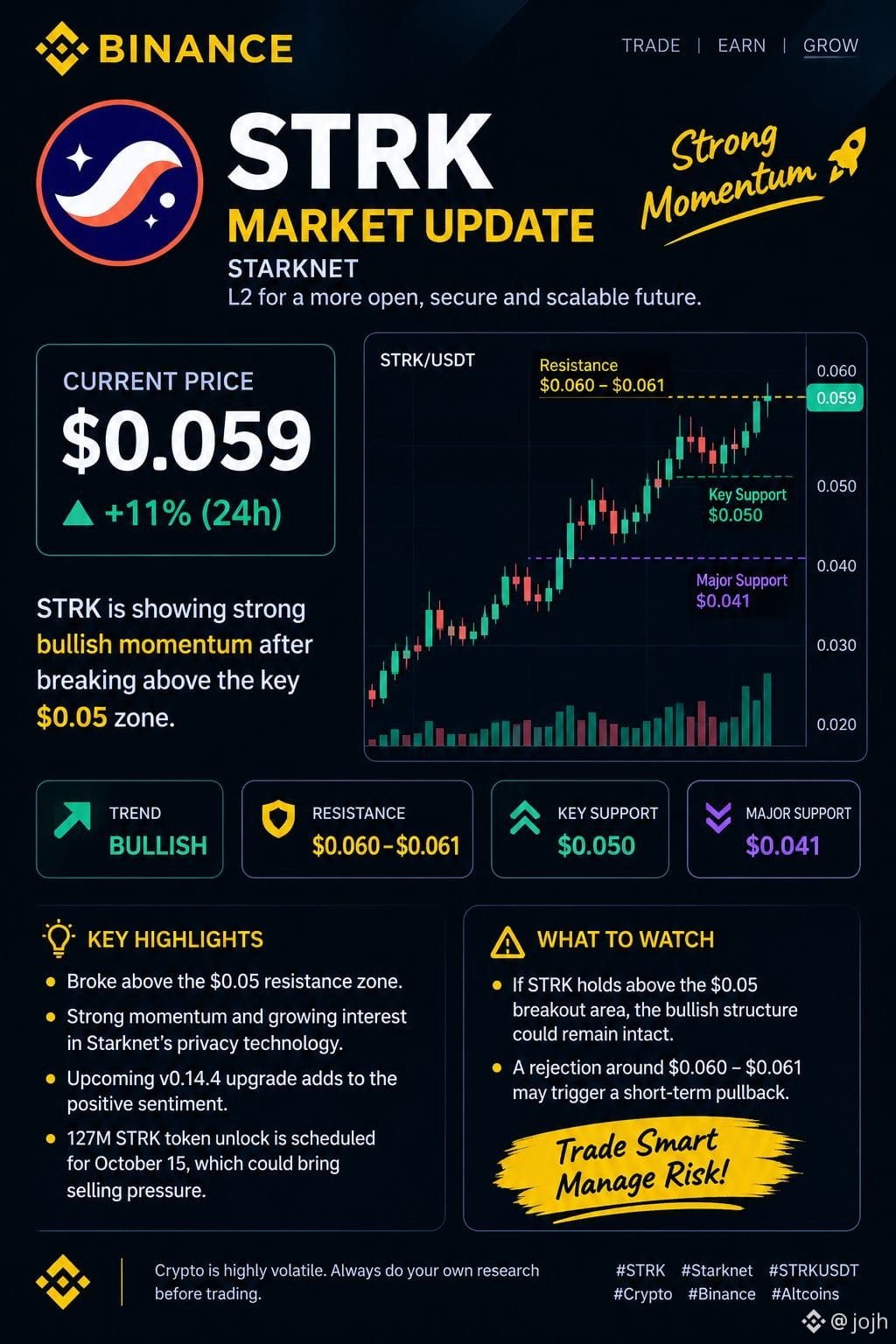
$STRK is showing strong bullish momentum after breaking above the key $0.05 zone.
📈 Current Price: ~$0.059
🔥 Trend: Bullish
🎯 Resistance: $0.060–$0.061
🟢 Key Support: $0.050
🟡 Major Support: $0.041
If $STRK holds above the $0.05 breakout area, the bullish structure could remain intact. A rejection around $0.060–$0.061 may trigger a short-term pullback.
⚠️ Risk Management: Crypto is highly volatile. Always do your own research before trading.
#STRK #Starknet #STRKUSDT #CryptoTrading
{future}(STRKUSDT)
$STRK is showing strong bullish momentum after breaking above the key $0.05 zone.
📈 Current Price: ~$0.059
🔥 Trend: Bullish
🎯 Resistance: $0.060–$0.061
🟢 Key Support: $0.050
🟡 Major Support: $0.041
If $STRK holds above the $0.05 breakout area, the bullish structure could remain intact. A rejection around $0.060–$0.061 may trigger a short-term pullback.
⚠️ Risk Management: Crypto is highly volatile. Always do your own research before trading.
#STRK #Starknet #STRKUSDT #CryptoTrading
📈 Current Price: ~$0.059
🔥 Trend: Bullish
🎯 Resistance: $0.060–$0.061
🟢 Key Support: $0.050
🟡 Major Support: $0.041
If $STRK holds above the $0.05 breakout area, the bullish structure could remain intact. A rejection around $0.060–$0.061 may trigger a short-term pullback.
⚠️ Risk Management: Crypto is highly volatile. Always do your own research before trading.
#STRK #Starknet #STRKUSDT #CryptoTrading
197

See translation
{spot}(STRKUSDT)
UPDATE: $STRK TP1 HIT! 🚀🔥
Remember my call at $0.05714? TP1 $0.060 DONE! ✅
Entry: $0.054-$0.056 → Now $0.060+ = +7% profit! 💰
Next Targets: $0.070 → $0.080 → $0.10
I moved SL to entry — Risk free now! 🔒
Did you follow? Comment your PNL! 👇
#STRK #Starknet #TradingUpdate
Original call 👉
[https://app.binance.com/uni-qr/cpos/373706727734819?r=KSY8FE0T&l=en&uco=IHFsLnuqhoFyybH1DTXbRg&uc=app_square_share_link&us=copylink](https://app.binance.com/uni-qr/cpos/373706727734819?r=KSY8FE0T&l=en&uco=IHFsLnuqhoFyybH1DTXbRg&uc=app_square_share_link&us=copylink)
UPDATE: $STRK TP1 HIT! 🚀🔥
Remember my call at $0.05714? TP1 $0.060 DONE! ✅
Entry: $0.054-$0.056 → Now $0.060+ = +7% profit! 💰
Next Targets: $0.070 → $0.080 → $0.10
I moved SL to entry — Risk free now! 🔒
Did you follow? Comment your PNL! 👇
#STRK #Starknet #TradingUpdate
Original call 👉
https://app.binance.com/uni-qr/cpos/373706727734819?r=KSY8FE0T&l=en&uco=IHFsLnuqhoFyybH1DTXbRg&uc=app_square_share_link&us=copylink
Remember my call at $0.05714? TP1 $0.060 DONE! ✅
Entry: $0.054-$0.056 → Now $0.060+ = +7% profit! 💰
Next Targets: $0.070 → $0.080 → $0.10
I moved SL to entry — Risk free now! 🔒
Did you follow? Comment your PNL! 👇
#STRK #Starknet #TradingUpdate
Original call 👉
https://app.binance.com/uni-qr/cpos/373706727734819?r=KSY8FE0T&l=en&uco=IHFsLnuqhoFyybH1DTXbRg&uc=app_square_share_link&us=copylink
1
172

·
--
See translation
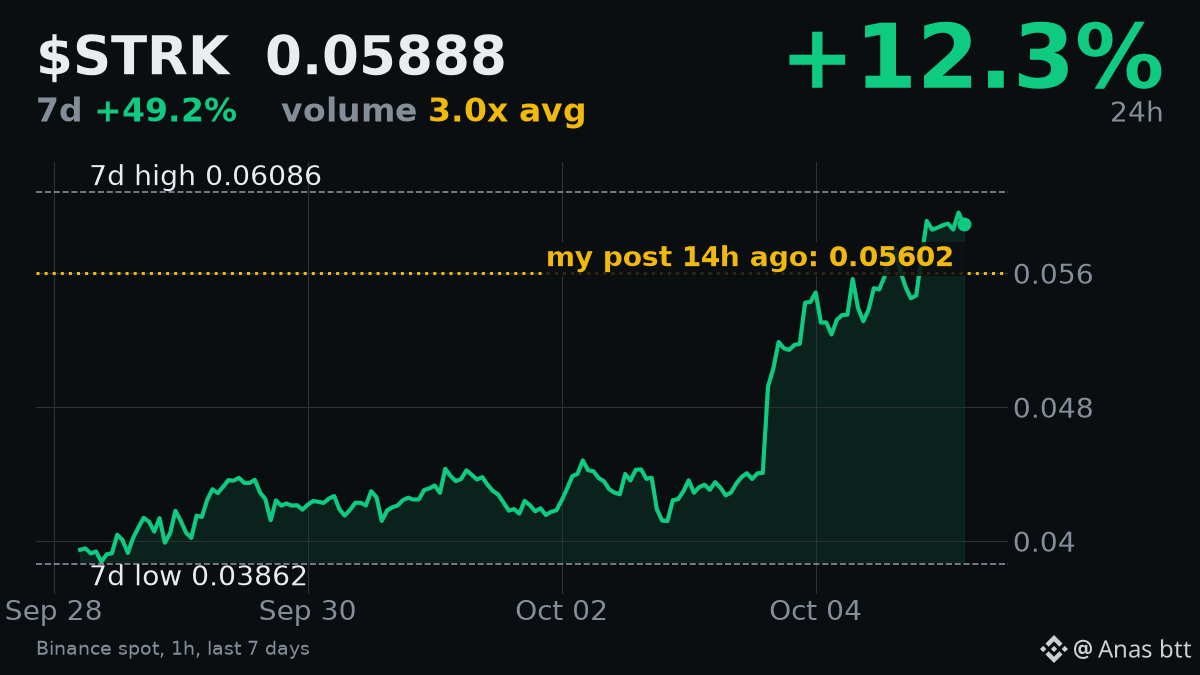
$STRK is now up 49.2% in 7 days, and it is 3.3% from its weekly high. 14 hours ago I said the level to hold was 0.05349. It held.
Then: 0.05602. Now: 0.05888. That is another 5.1% since my last post, and price never needed to test the level I named.
The volume picture changed too. The 24h volume is about 21.9M USDT, lower than the 27.4M I noted last time, but it is still 2.97x its 7-day average. So the move is still drawing far more trading than a normal day, just less than at the peak of the burst.
Hourly RSI is 64.8: strong, not yet stretched. BTC is up 1.45% and Fear & Greed rose to 70 (Greed), so the market is helping, but a 49% week is STRK's own story.
Updated view: the trend is intact. The next test is the 7-day high at 0.06086. A clean move above it on rising volume would be a new leg.
The level that now matters is 0.05602, my last post's price. A fall back under it would mean the follow-through is fading.
#Starknet #WeeklyHigh
$STRK is now up 49.2% in 7 days, and it is 3.3% from its weekly high. 14 hours ago I said the level to hold was 0.05349. It held.
Then: 0.05602. Now: 0.05888. That is another 5.1% since my last post, and price never needed to test the level I named.
The volume picture changed too. The 24h volume is about 21.9M USDT, lower than the 27.4M I noted last time, but it is still 2.97x its 7-day average. So the move is still drawing far more trading than a normal day, just less than at the peak of the burst.
Hourly RSI is 64.8: strong, not yet stretched. BTC is up 1.45% and Fear & Greed rose to 70 (Greed), so the market is helping, but a 49% week is STRK's own story.
Updated view: the trend is intact. The next test is the 7-day high at 0.06086. A clean move above it on rising volume would be a new leg.
The level that now matters is 0.05602, my last post's price. A fall back under it would mean the follow-through is fading.
#Starknet #WeeklyHigh
Then: 0.05602. Now: 0.05888. That is another 5.1% since my last post, and price never needed to test the level I named.
The volume picture changed too. The 24h volume is about 21.9M USDT, lower than the 27.4M I noted last time, but it is still 2.97x its 7-day average. So the move is still drawing far more trading than a normal day, just less than at the peak of the burst.
Hourly RSI is 64.8: strong, not yet stretched. BTC is up 1.45% and Fear & Greed rose to 70 (Greed), so the market is helping, but a 49% week is STRK's own story.
Updated view: the trend is intact. The next test is the 7-day high at 0.06086. A clean move above it on rising volume would be a new leg.
The level that now matters is 0.05602, my last post's price. A fall back under it would mean the follow-through is fading.
#Starknet #WeeklyHigh
143


·
--
See translation
CryptoJobs3
·
--
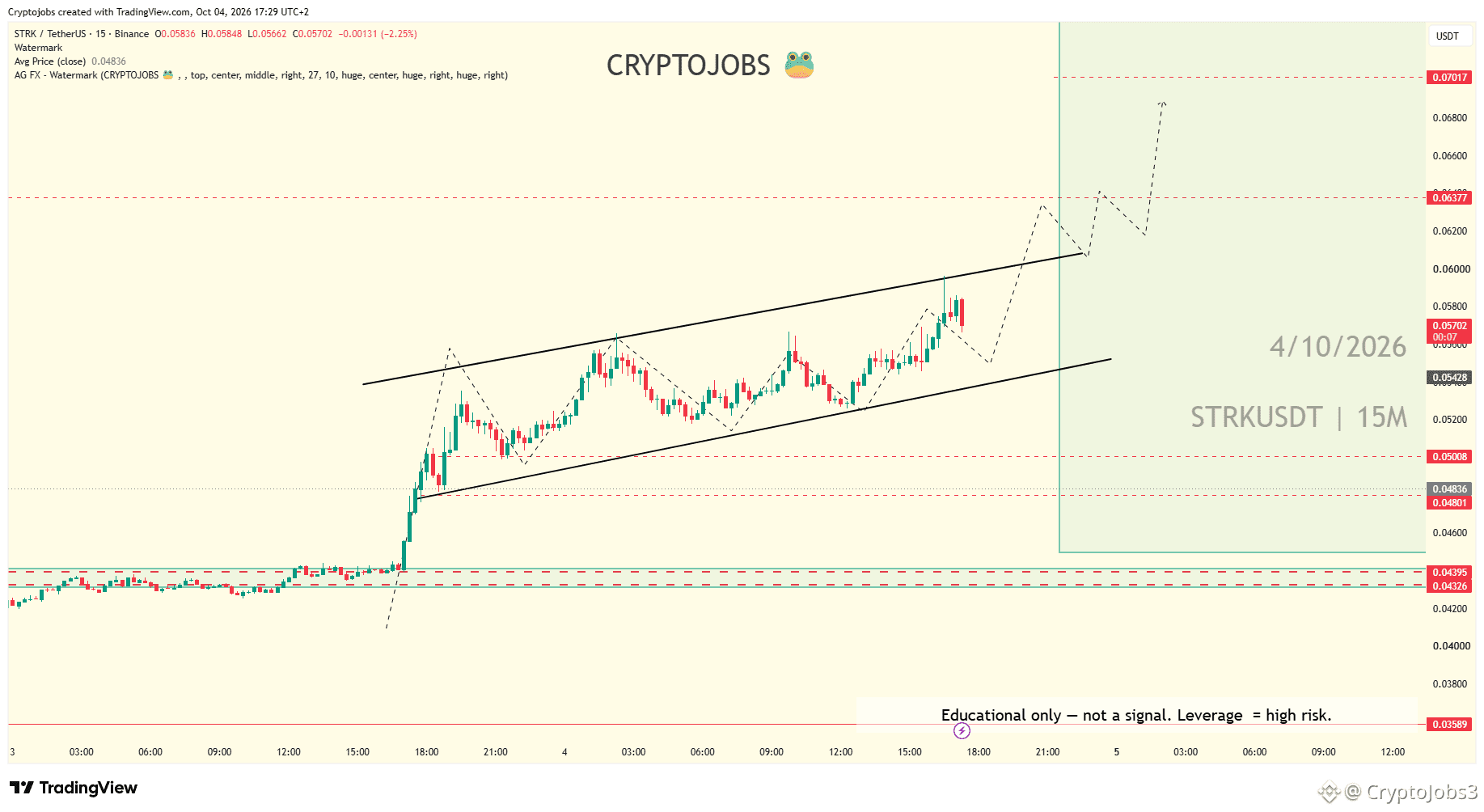
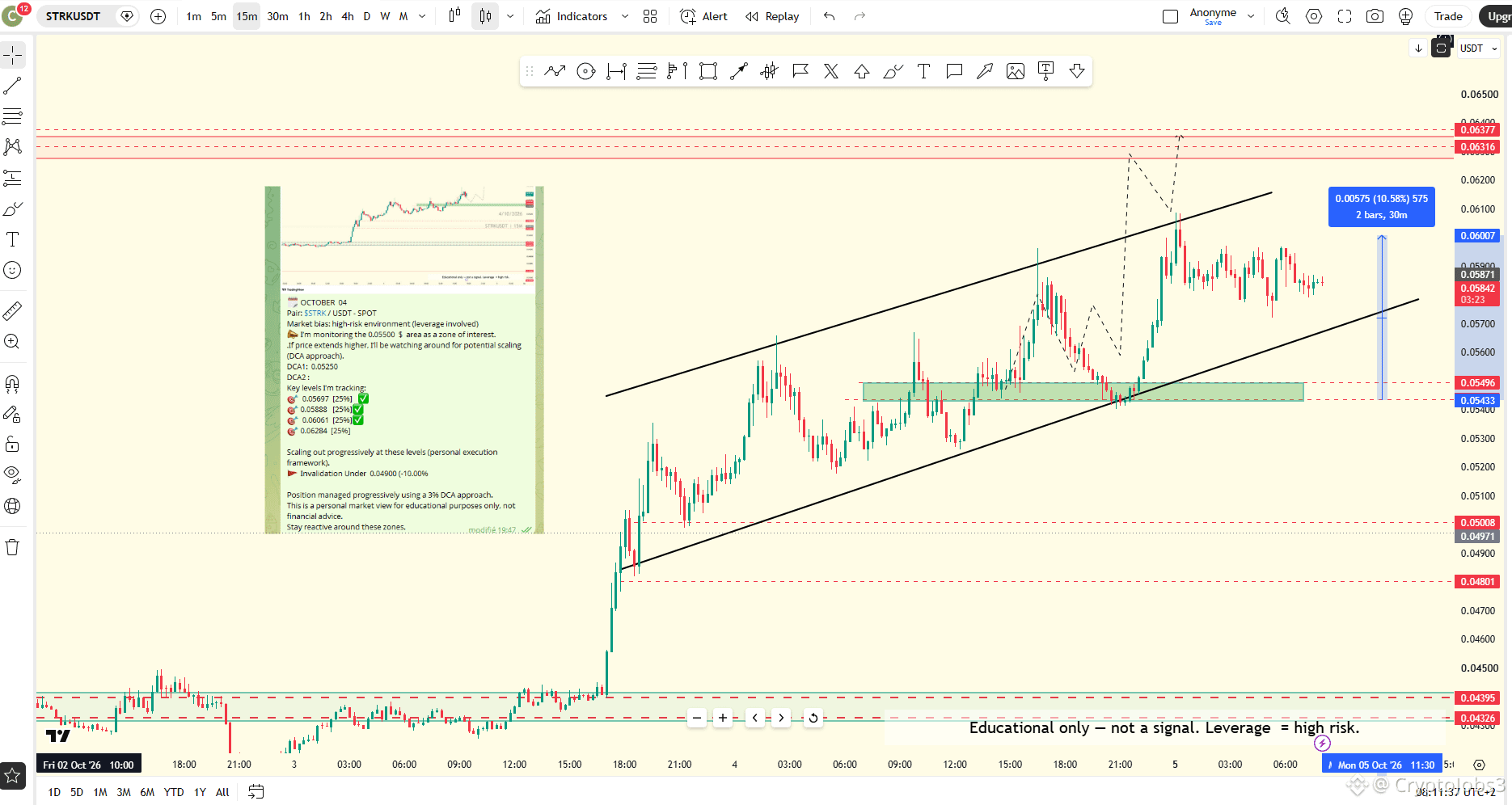
Weekly correction is in on $STRK and resistances won't hold
Upper weekly level I see: 0.07800 - 0.0800 🎯
Bulls should remain in control above 0.0480 and 0.04400
NFA
#STRK #altcoins
Upper weekly level I see: 0.07800 - 0.0800 🎯
Bulls should remain in control above 0.0480 and 0.04400
NFA
#STRK #altcoins
514

·
--
See translation
🚨 $STRK IS MAKING NOISE 👀🔥
STRK just extended its rally, but there’s no single headline behind the latest move.
The bigger picture looks like this:
₿ Bitcoin liquidity push via strkBTC
🐋 Large accumulation
📈 Spot volume exploding
⚡ Futures & open interest rising
And while the broader market is only mildly bullish, STRK is outperforming.
Momentum is building… but can $STRK keep the pressure on? 👀🚀
#STRK #Starknet #BinanceSquare
🚨 $STRK IS MAKING NOISE 👀🔥
STRK just extended its rally, but there’s no single headline behind the latest move.
The bigger picture looks like this:
₿ Bitcoin liquidity push via strkBTC
🐋 Large accumulation
📈 Spot volume exploding
⚡ Futures & open interest rising
And while the broader market is only mildly bullish, STRK is outperforming.
Momentum is building… but can $STRK keep the pressure on? 👀🚀
#STRK #Starknet #BinanceSquare
STRK just extended its rally, but there’s no single headline behind the latest move.
The bigger picture looks like this:
₿ Bitcoin liquidity push via strkBTC
🐋 Large accumulation
📈 Spot volume exploding
⚡ Futures & open interest rising
And while the broader market is only mildly bullish, STRK is outperforming.
Momentum is building… but can $STRK keep the pressure on? 👀🚀
#STRK #Starknet #BinanceSquare
307
See translation
DOGE, FET & STRK: Broad-Based Momentum Across Meme, AI and Layer-2 Narratives
DOGE is trading near $0.09566, up approximately +2.64% over the latest 24-hour session. Price has held close to its intraday high of $0.09624, pointing to steady short-term demand, while the active trading volume shows that the meme-coin segment remains highly responsive to broader market sentiment.
FET is trading around $0.2538, gaining roughly +12.20% in 24 hours. It is leading this group on momentum after moving between $0.2209 and $0.2599. The sharp range expansion reflects renewed attention toward AI-linked crypto infrastructure, though it also signals higher volatility and the potential for rapid sentiment shifts.
STRK is trading near $0.05646, up about +10.25% over the latest 24 hours. After reaching a session high of $0.05962, STRK is showing strong participation relative to its opening level. Its move highlights renewed interest in Layer-2 exposure, but the wide intraday range suggests traders are still actively reassessing risk.
Overall, FET and STRK are showing stronger short-term momentum, while DOGE is advancing with comparatively steadier price action. Sustained volume and broader risk appetite will remain key factors in determining whether the current strength can persist.
#Dogecoin #FET #Starknet #CryptoMarket #Binance
$DOGE
{spot}(DOGEUSDT)
$FET
{spot}(FETUSDT)
$STRK
{spot}(STRKUSDT)
DOGE, FET & STRK: Broad-Based Momentum Across Meme, AI and Layer-2 Narratives
DOGE is trading near $0.09566, up approximately +2.64% over the latest 24-hour session. Price has held close to its intraday high of $0.09624, pointing to steady short-term demand, while the active trading volume shows that the meme-coin segment remains highly responsive to broader market sentiment.
FET is trading around $0.2538, gaining roughly +12.20% in 24 hours. It is leading this group on momentum after moving between $0.2209 and $0.2599. The sharp range expansion reflects renewed attention toward AI-linked crypto infrastructure, though it also signals higher volatility and the potential for rapid sentiment shifts.
STRK is trading near $0.05646, up about +10.25% over the latest 24 hours. After reaching a session high of $0.05962, STRK is showing strong participation relative to its opening level. Its move highlights renewed interest in Layer-2 exposure, but the wide intraday range suggests traders are still actively reassessing risk.
Overall, FET and STRK are showing stronger short-term momentum, while DOGE is advancing with comparatively steadier price action. Sustained volume and broader risk appetite will remain key factors in determining whether the current strength can persist.
#Dogecoin #FET #Starknet #CryptoMarket #Binance
$DOGE
$FET
$STRK
DOGE is trading near $0.09566, up approximately +2.64% over the latest 24-hour session. Price has held close to its intraday high of $0.09624, pointing to steady short-term demand, while the active trading volume shows that the meme-coin segment remains highly responsive to broader market sentiment.
FET is trading around $0.2538, gaining roughly +12.20% in 24 hours. It is leading this group on momentum after moving between $0.2209 and $0.2599. The sharp range expansion reflects renewed attention toward AI-linked crypto infrastructure, though it also signals higher volatility and the potential for rapid sentiment shifts.
STRK is trading near $0.05646, up about +10.25% over the latest 24 hours. After reaching a session high of $0.05962, STRK is showing strong participation relative to its opening level. Its move highlights renewed interest in Layer-2 exposure, but the wide intraday range suggests traders are still actively reassessing risk.
Overall, FET and STRK are showing stronger short-term momentum, while DOGE is advancing with comparatively steadier price action. Sustained volume and broader risk appetite will remain key factors in determining whether the current strength can persist.
#Dogecoin #FET #Starknet #CryptoMarket #Binance
$DOGE
$FET
$STRK
1
53

·
--
Bullish
See translation
🚀 $STRK — LONG SETUP
Entry: 0.0548 – 0.0558
TP1: 0.0585 | TP2: 0.0610
SL: 0.0525
STRK is showing strong momentum with heavy buying pressure. A clean hold above entry could open another upside move.
#strk #Starknet
#ZamaRises15.99%ToIntradayHigh$0.09
{spot}(STRKUSDT)
🚀 $STRK — LONG SETUP
Entry: 0.0548 – 0.0558
TP1: 0.0585 | TP2: 0.0610
SL: 0.0525
STRK is showing strong momentum with heavy buying pressure. A clean hold above entry could open another upside move.
#strk #Starknet
#ZamaRises15.99%ToIntradayHigh$0.09
Entry: 0.0548 – 0.0558
TP1: 0.0585 | TP2: 0.0610
SL: 0.0525
STRK is showing strong momentum with heavy buying pressure. A clean hold above entry could open another upside move.
#strk #Starknet
#ZamaRises15.99%ToIntradayHigh$0.09
3
263

·
--
See translation
🚀 STRK (Starknet) — Ethereum Scaling Is Getting Bigger!
Starknet is building a powerful Layer-2 ecosystem focused on scaling Ethereum with high throughput, lower fees, and advanced ZK technology. ⚡
🔹 Strong Ethereum connection
🔹 Zero-Knowledge technology
🔹 Growing DeFi & Web3 ecosystem
🔹 Potentially strong narrative in the next bull market 📈
STRK is still a project worth watching closely. 👀
💭 Could STRK become one of the stronger L2 tokens of the next bull run?
#STRK #Starknet #Ethereum✅ #Layer2 #Crypto #Altcoins #BullRun #Web3 #defi
{spot}(STRKUSDT)
🚀 STRK (Starknet) — Ethereum Scaling Is Getting Bigger!
Starknet is building a powerful Layer-2 ecosystem focused on scaling Ethereum with high throughput, lower fees, and advanced ZK technology. ⚡
🔹 Strong Ethereum connection
🔹 Zero-Knowledge technology
🔹 Growing DeFi & Web3 ecosystem
🔹 Potentially strong narrative in the next bull market 📈
STRK is still a project worth watching closely. 👀
💭 Could STRK become one of the stronger L2 tokens of the next bull run?
#STRK #Starknet #Ethereum✅ #Layer2 #Crypto #Altcoins #BullRun #Web3 #defi
Starknet is building a powerful Layer-2 ecosystem focused on scaling Ethereum with high throughput, lower fees, and advanced ZK technology. ⚡
🔹 Strong Ethereum connection
🔹 Zero-Knowledge technology
🔹 Growing DeFi & Web3 ecosystem
🔹 Potentially strong narrative in the next bull market 📈
STRK is still a project worth watching closely. 👀
💭 Could STRK become one of the stronger L2 tokens of the next bull run?
#STRK #Starknet #Ethereum✅ #Layer2 #Crypto #Altcoins #BullRun #Web3 #defi
1
236
·
--
Bullish
See translation
🚀 $STRK LONG SETUP
Entry: 0.0880–0.0900
TP1: 0.0940
TP2: 0.0980
SL: 0.0845
STRK is showing strong momentum and is among today’s stronger movers. Wait for confirmation around entry and manage risk carefully.
#strk #Starknet #BitcoinSpotETFsDraw$6.34BInflowsInQ3
🚀 $STRK LONG SETUP
Entry: 0.0880–0.0900
TP1: 0.0940
TP2: 0.0980
SL: 0.0845
STRK is showing strong momentum and is among today’s stronger movers. Wait for confirmation around entry and manage risk carefully.
#strk #Starknet #BitcoinSpotETFsDraw$6.34BInflowsInQ3
Entry: 0.0880–0.0900
TP1: 0.0940
TP2: 0.0980
SL: 0.0845
STRK is showing strong momentum and is among today’s stronger movers. Wait for confirmation around entry and manage risk carefully.
#strk #Starknet #BitcoinSpotETFsDraw$6.34BInflowsInQ3
1
188

·
--
See translation
Starknet is quickly positioning itself as a cornerstone of Ethereum’s scaling future. As a Validity Rollup (ZK-Rollup) Layer 2 network, it has captured the crypto community's attention not just through its STRK token, but through its relentless focus on developer-friendly innovation and massive fee reductions.
Following Ethereum’s Dencun upgrade, Starknet implemented major fee-saving measures that made transactions incredibly cheap, often costing fractions of a cent. This has made it one of the most cost-effective L2 solutions on the market today. For users and developers alike, this is a game-changer, especially for high-frequency use cases like Web3 gaming and decentralized finance (DeFi).
What sets Starknet apart from its competitors is its native programming language, Cairo. While it presents a learning curve for traditional Solidity developers, Cairo unlocks highly efficient smart contracts and allows for provable computing. This technological edge is drawing a dedicated wave of developers who are building decentralized applications that simply are not possible on standard EVM chains.
Looking ahead, the Starknet roadmap is highly promising. With discussions and proposals around the implementation of STRK token staking, along with continuous parallel execution upgrades, the ecosystem is priming itself for long-term utility. Additionally, the rise of Starknet Appchains allows enterprises to build customized, scalable networks tailored to their specific needs.
While market volatility always plays a role in short-term token price action, Starknet’s fundamental growth metrics—including developer activity and technological upgrades—suggest it is building a highly sustainable L2 ecosystem. Keep a close eye on Starknet as it continues to push the boundaries of zero-knowledge technology.
#Starknet #STRK #Layer2
Starknet is quickly positioning itself as a cornerstone of Ethereum’s scaling future. As a Validity Rollup (ZK-Rollup) Layer 2 network, it has captured the crypto community's attention not just through its STRK token, but through its relentless focus on developer-friendly innovation and massive fee reductions.
Following Ethereum’s Dencun upgrade, Starknet implemented major fee-saving measures that made transactions incredibly cheap, often costing fractions of a cent. This has made it one of the most cost-effective L2 solutions on the market today. For users and developers alike, this is a game-changer, especially for high-frequency use cases like Web3 gaming and decentralized finance (DeFi).
What sets Starknet apart from its competitors is its native programming language, Cairo. While it presents a learning curve for traditional Solidity developers, Cairo unlocks highly efficient smart contracts and allows for provable computing. This technological edge is drawing a dedicated wave of developers who are building decentralized applications that simply are not possible on standard EVM chains.
Looking ahead, the Starknet roadmap is highly promising. With discussions and proposals around the implementation of STRK token staking, along with continuous parallel execution upgrades, the ecosystem is priming itself for long-term utility. Additionally, the rise of Starknet Appchains allows enterprises to build customized, scalable networks tailored to their specific needs.
While market volatility always plays a role in short-term token price action, Starknet’s fundamental growth metrics—including developer activity and technological upgrades—suggest it is building a highly sustainable L2 ecosystem. Keep a close eye on Starknet as it continues to push the boundaries of zero-knowledge technology.
#Starknet #STRK #Layer2
Following Ethereum’s Dencun upgrade, Starknet implemented major fee-saving measures that made transactions incredibly cheap, often costing fractions of a cent. This has made it one of the most cost-effective L2 solutions on the market today. For users and developers alike, this is a game-changer, especially for high-frequency use cases like Web3 gaming and decentralized finance (DeFi).
What sets Starknet apart from its competitors is its native programming language, Cairo. While it presents a learning curve for traditional Solidity developers, Cairo unlocks highly efficient smart contracts and allows for provable computing. This technological edge is drawing a dedicated wave of developers who are building decentralized applications that simply are not possible on standard EVM chains.
Looking ahead, the Starknet roadmap is highly promising. With discussions and proposals around the implementation of STRK token staking, along with continuous parallel execution upgrades, the ecosystem is priming itself for long-term utility. Additionally, the rise of Starknet Appchains allows enterprises to build customized, scalable networks tailored to their specific needs.
While market volatility always plays a role in short-term token price action, Starknet’s fundamental growth metrics—including developer activity and technological upgrades—suggest it is building a highly sustainable L2 ecosystem. Keep a close eye on Starknet as it continues to push the boundaries of zero-knowledge technology.
#Starknet #STRK #Layer2
179
See translation
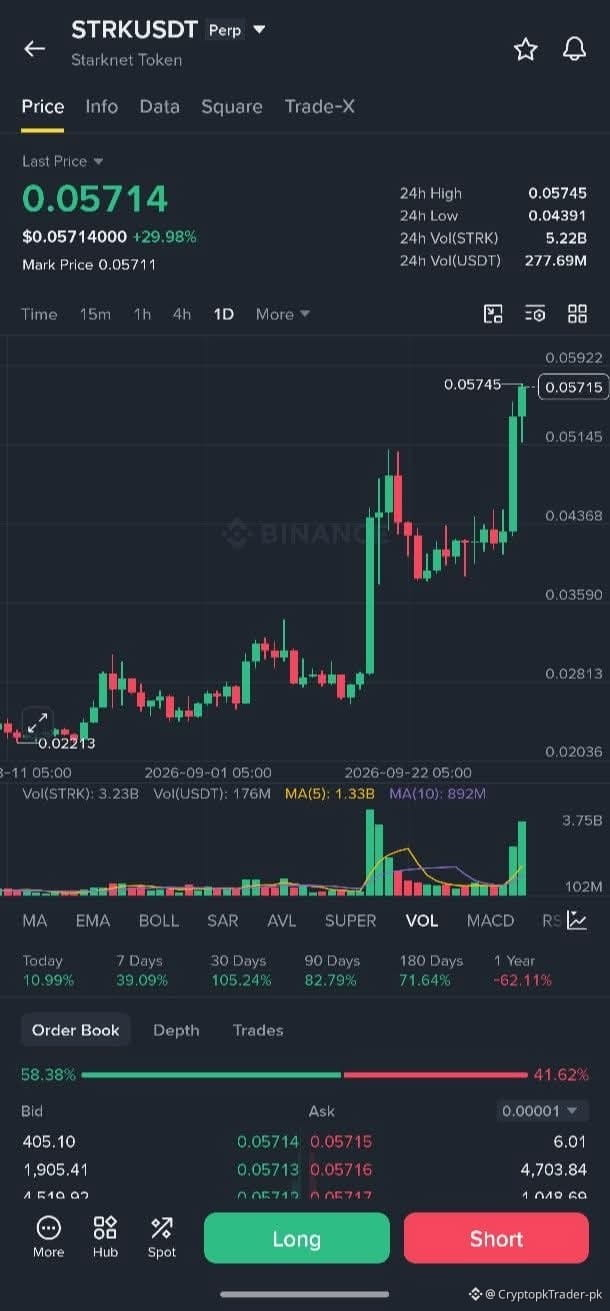
$STRK LONG SETUP — BREAKOUT!
Price: $0.05714 🔥
Entry: $0.054–$0.056 ✅
SL: $0.0505
🎯 TP1: $0.060
🎯 TP2: $0.070
🎯 TP3: $0.080
🎯 TP4: $0.100
💥 Long consolidation finally broken!
Bulls remain strong above $0.05.
TP1 → SL to Entry 🔒
TP2 → SL to $0.060
TP3 → SL to $0.070
Would you take the long or wait for a retest? 👇
$STRK #Starknet #Trading #Breakout
{spot}(STRKUSDT)
$STRK LONG SETUP — BREAKOUT!
Price: $0.05714 🔥
Entry: $0.054–$0.056 ✅
SL: $0.0505
🎯 TP1: $0.060
🎯 TP2: $0.070
🎯 TP3: $0.080
🎯 TP4: $0.100
💥 Long consolidation finally broken!
Bulls remain strong above $0.05.
TP1 → SL to Entry 🔒
TP2 → SL to $0.060
TP3 → SL to $0.070
Would you take the long or wait for a retest? 👇
$STRK #Starknet #Trading #Breakout
Price: $0.05714 🔥
Entry: $0.054–$0.056 ✅
SL: $0.0505
🎯 TP1: $0.060
🎯 TP2: $0.070
🎯 TP3: $0.080
🎯 TP4: $0.100
💥 Long consolidation finally broken!
Bulls remain strong above $0.05.
TP1 → SL to Entry 🔒
TP2 → SL to $0.060
TP3 → SL to $0.070
Would you take the long or wait for a retest? 👇
$STRK #Starknet #Trading #Breakout
1
1
204

·
--
Bullish
See translation
Starknet ($STRK ) Market Update: Short-Term Surge Hits Technical Resistance 📈
Starknet ($STRK ) has seen notable short-term momentum, pushing its price up over 30% in recent weeks to around the $0.053–$0.055 range.
Key Takeaways:
Momentum Overbought: Technical indicators like the daily RSI peaked near 74, signaling that the token entered overbought territory after a strong short-term rally.
Crucial Resistance: $STRK is testing short-term resistance levels. Buyers need a clean breakout to keep the upward trend alive, while failure to hold could trigger a brief cooling-off period toward lower support zones.
Long-Term Outlook: While short-term volatility remains high, trader sentiment is leaning cautiously optimistic as network upgrades and Layer-2 scaling activity remain key catalysts.
Summary: High volatility with strong buying pressure, but watch out for a potential short-term pullback before the next leg up!
#Starknet #strk #Layer2 #Altcoins #cryptotrading
{spot}(STRKUSDT)
Starknet ($STRK ) Market Update: Short-Term Surge Hits Technical Resistance 📈
Starknet ($STRK ) has seen notable short-term momentum, pushing its price up over 30% in recent weeks to around the $0.053–$0.055 range.
Key Takeaways:
Momentum Overbought: Technical indicators like the daily RSI peaked near 74, signaling that the token entered overbought territory after a strong short-term rally.
Crucial Resistance: $STRK is testing short-term resistance levels. Buyers need a clean breakout to keep the upward trend alive, while failure to hold could trigger a brief cooling-off period toward lower support zones.
Long-Term Outlook: While short-term volatility remains high, trader sentiment is leaning cautiously optimistic as network upgrades and Layer-2 scaling activity remain key catalysts.
Summary: High volatility with strong buying pressure, but watch out for a potential short-term pullback before the next leg up!
#Starknet #strk #Layer2 #Altcoins #cryptotrading
Starknet ($STRK ) has seen notable short-term momentum, pushing its price up over 30% in recent weeks to around the $0.053–$0.055 range.
Key Takeaways:
Momentum Overbought: Technical indicators like the daily RSI peaked near 74, signaling that the token entered overbought territory after a strong short-term rally.
Crucial Resistance: $STRK is testing short-term resistance levels. Buyers need a clean breakout to keep the upward trend alive, while failure to hold could trigger a brief cooling-off period toward lower support zones.
Long-Term Outlook: While short-term volatility remains high, trader sentiment is leaning cautiously optimistic as network upgrades and Layer-2 scaling activity remain key catalysts.
Summary: High volatility with strong buying pressure, but watch out for a potential short-term pullback before the next leg up!
#Starknet #strk #Layer2 #Altcoins #cryptotrading
85

·
--
See translation
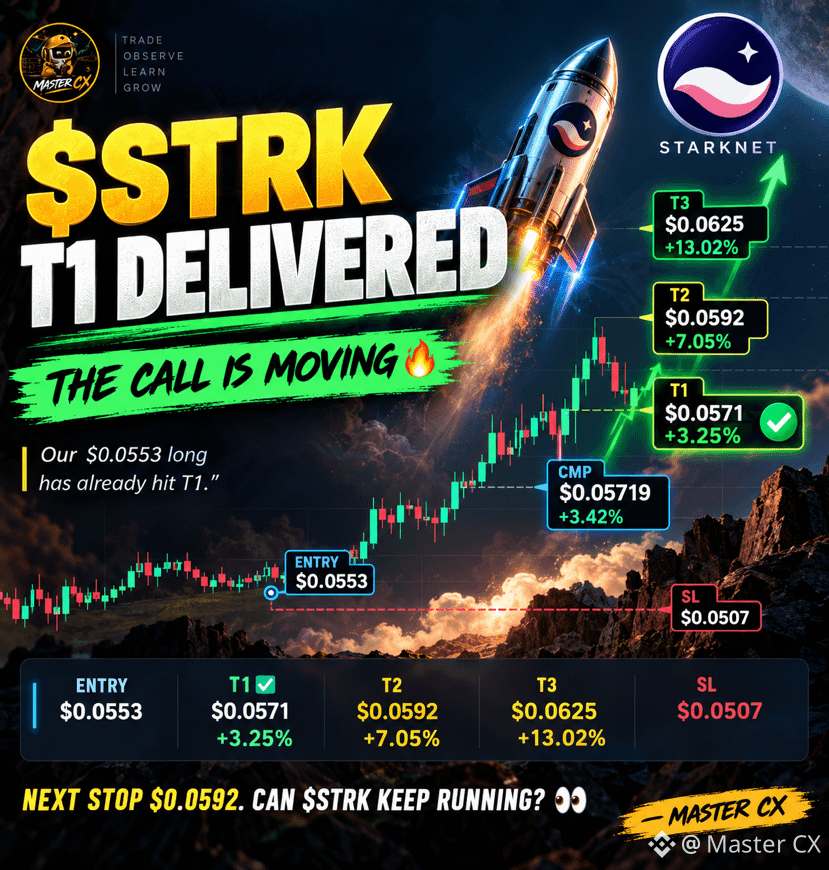
🚨 $STRK T1 CRUSHED — NOW WATCH THIS. 👀🔥
Called at $0.0553.
T1 $0.0571 DELIVERED +3.25%
🎯 T2: $0.0592
🔥 T3: $0.0625
🛑 SL: $0.0507
No chasing. No changing levels. The call is doing the talking.
Next stop $0.0592 — does STRK have another gear? 🚀
#strk #Starknet
🚨 $STRK T1 CRUSHED — NOW WATCH THIS. 👀🔥
Called at $0.0553.
T1 $0.0571 DELIVERED +3.25%
🎯 T2: $0.0592
🔥 T3: $0.0625
🛑 SL: $0.0507
No chasing. No changing levels. The call is doing the talking.
Next stop $0.0592 — does STRK have another gear? 🚀
#strk #Starknet
Called at $0.0553.
T1 $0.0571 DELIVERED +3.25%
🎯 T2: $0.0592
🔥 T3: $0.0625
🛑 SL: $0.0507
No chasing. No changing levels. The call is doing the talking.
Next stop $0.0592 — does STRK have another gear? 🚀
#strk #Starknet
149
·
--
See translation
Follow-up on $STRK. This morning I wrote that it led the gainers on thin volume, and that I wanted to see volume grow with price holding above 0.05.
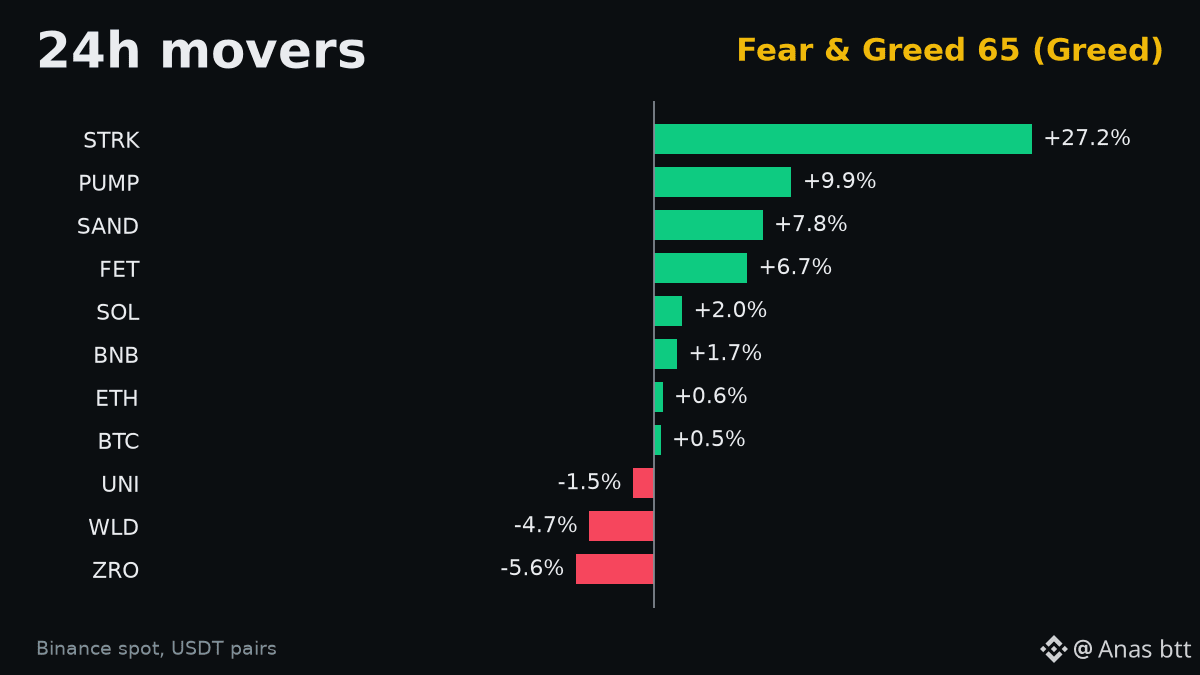
Eight hours later, both happened. STRK is at 0.05602, up 27.2% in 24 hours. In my earlier post it was 0.05349 on about 20.8M USDT. Now the 24h volume is about 27.4M. Price is higher and more money is behind it.
It is still the top gainer by a wide margin. Second place, $PUMP, is up 9.9%.
The rest of the market is quiet. BTC is up 0.5% at 85,212, and the weak side now has some real red: ZRO is down 5.6% and WLD down 4.7%. Fear & Greed is 65 (Greed), down from 67.
What this means: the move I called thin has started to fill in. That makes it more credible, not safe. A 27% day is still a big move to chase.
What I am watching next: whether STRK holds above 0.05349, the level from this morning. Losing it would undo the follow-through.
#Starknet #FollowUp
Follow-up on $STRK . This morning I wrote that it led the gainers on thin volume, and that I wanted to see volume grow with price holding above 0.05.
Eight hours later, both happened. STRK is at 0.05602, up 27.2% in 24 hours. In my earlier post it was 0.05349 on about 20.8M USDT. Now the 24h volume is about 27.4M. Price is higher and more money is behind it.
It is still the top gainer by a wide margin. Second place, $PUMP , is up 9.9%.
The rest of the market is quiet. BTC is up 0.5% at 85,212, and the weak side now has some real red: ZRO is down 5.6% and WLD down 4.7%. Fear & Greed is 65 (Greed), down from 67.
What this means: the move I called thin has started to fill in. That makes it more credible, not safe. A 27% day is still a big move to chase.
What I am watching next: whether STRK holds above 0.05349, the level from this morning. Losing it would undo the follow-through.
#Starknet #FollowUp
Eight hours later, both happened. STRK is at 0.05602, up 27.2% in 24 hours. In my earlier post it was 0.05349 on about 20.8M USDT. Now the 24h volume is about 27.4M. Price is higher and more money is behind it.
It is still the top gainer by a wide margin. Second place, $PUMP , is up 9.9%.
The rest of the market is quiet. BTC is up 0.5% at 85,212, and the weak side now has some real red: ZRO is down 5.6% and WLD down 4.7%. Fear & Greed is 65 (Greed), down from 67.
What this means: the move I called thin has started to fill in. That makes it more credible, not safe. A 27% day is still a big move to chase.
What I am watching next: whether STRK holds above 0.05349, the level from this morning. Losing it would undo the follow-through.
#Starknet #FollowUp
1
329
·
--
Bullish
See translation
🚀 $STRK /USDT — LONG SETUP
Entry: 0.0535 – 0.0545
TP1: 0.0570
TP2: 0.0600
SL: 0.0515
STRK is showing strong bullish momentum with heavy buying pressure. I’m watching the 0.0535–0.0545 zone for a controlled entry rather than chasing the pump. If support holds, another push toward 0.0570 and 0.0600 could be possible.
Manage risk carefully and avoid over-leverage. DYOR.
#strk #Starknet
{spot}(STRKUSDT)
🚀 $STRK /USDT — LONG SETUP
Entry: 0.0535 – 0.0545
TP1: 0.0570
TP2: 0.0600
SL: 0.0515
STRK is showing strong bullish momentum with heavy buying pressure. I’m watching the 0.0535–0.0545 zone for a controlled entry rather than chasing the pump. If support holds, another push toward 0.0570 and 0.0600 could be possible.
Manage risk carefully and avoid over-leverage. DYOR.
#strk #Starknet
Entry: 0.0535 – 0.0545
TP1: 0.0570
TP2: 0.0600
SL: 0.0515
STRK is showing strong bullish momentum with heavy buying pressure. I’m watching the 0.0535–0.0545 zone for a controlled entry rather than chasing the pump. If support holds, another push toward 0.0570 and 0.0600 could be possible.
Manage risk carefully and avoid over-leverage. DYOR.
#strk #Starknet
1
130

See translation
🚀 $STRK is the native token of Starknet, a Layer-2 network built to scale Ethereum.
⚡ Starknet uses advanced zero-knowledge technology to enable faster and more efficient transactions.
🔐 The network is designed to provide strong security while reducing transaction costs.
🌐 Starknet supports decentralized applications (dApps) and smart contracts on Ethereum.
💡 STRK plays a role in network governance and ecosystem participation.
⛓️ Starknet aims to bring greater scalability to the Ethereum ecosystem.
🔥 Its technology is focused on making blockchain applications more accessible and efficient.
🤝 Developers can build innovative DeFi, gaming, and Web3 applications on Starknet.
📈 $STRK has attracted attention as a major token within the Ethereum Layer-2 ecosystem.
#STRK #STARKNET #STRKCoin #Crypto #Cryptocurrency #Blockchain #Ethereum #Layer2 #Web3 #DeFi #dApps #Altcoins #CryptoCommunity #CryptoTrading #CryptoInvestment #DigitalAssets #DYOR
{spot}(STRKUSDT)
🚀 $STRK is the native token of Starknet, a Layer-2 network built to scale Ethereum.
⚡ Starknet uses advanced zero-knowledge technology to enable faster and more efficient transactions.
🔐 The network is designed to provide strong security while reducing transaction costs.
🌐 Starknet supports decentralized applications (dApps) and smart contracts on Ethereum.
💡 STRK plays a role in network governance and ecosystem participation.
⛓️ Starknet aims to bring greater scalability to the Ethereum ecosystem.
🔥 Its technology is focused on making blockchain applications more accessible and efficient.
🤝 Developers can build innovative DeFi, gaming, and Web3 applications on Starknet.
📈 $STRK has attracted attention as a major token within the Ethereum Layer-2 ecosystem.
#STRK #STARKNET #STRKCoin #Crypto #Cryptocurrency #Blockchain #Ethereum #Layer2 #Web3 #DeFi #dApps #Altcoins #CryptoCommunity #CryptoTrading #CryptoInvestment #DigitalAssets #DYOR
⚡ Starknet uses advanced zero-knowledge technology to enable faster and more efficient transactions.
🔐 The network is designed to provide strong security while reducing transaction costs.
🌐 Starknet supports decentralized applications (dApps) and smart contracts on Ethereum.
💡 STRK plays a role in network governance and ecosystem participation.
⛓️ Starknet aims to bring greater scalability to the Ethereum ecosystem.
🔥 Its technology is focused on making blockchain applications more accessible and efficient.
🤝 Developers can build innovative DeFi, gaming, and Web3 applications on Starknet.
📈 $STRK has attracted attention as a major token within the Ethereum Layer-2 ecosystem.
#STRK #STARKNET #STRKCoin #Crypto #Cryptocurrency #Blockchain #Ethereum #Layer2 #Web3 #DeFi #dApps #Altcoins #CryptoCommunity #CryptoTrading #CryptoInvestment #DigitalAssets #DYOR
96

·
--
Bullish
See translation
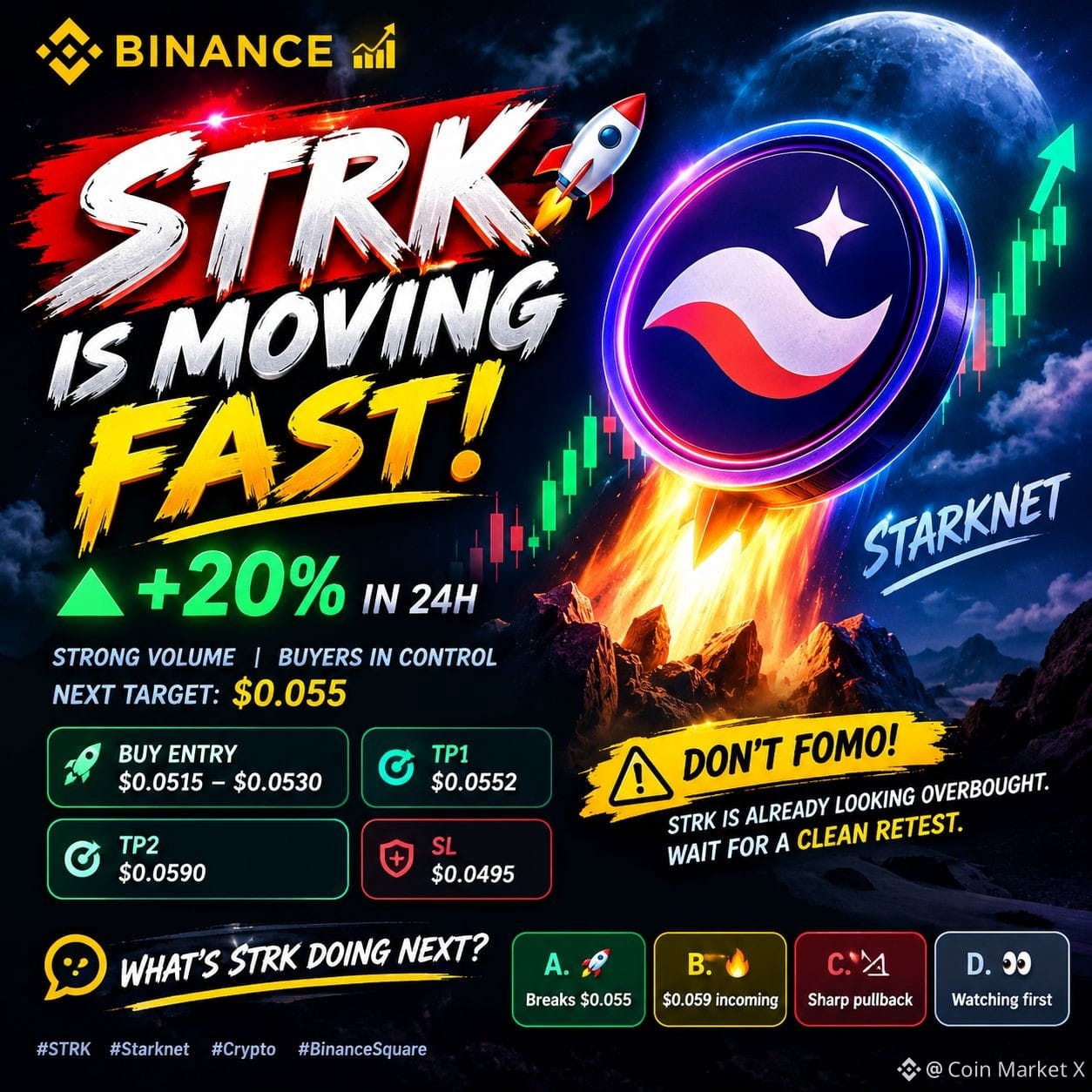
🚨 $STRK IS MOVING FAST! 🔥👀 $STRK is up 20%+ in 24H, with strong volume and buyers pushing toward the $0.055 area. Binance currently ranks STRK among the top gainers. �📍 BUY Entry: $0.0515–$0.0530
🎯 TP1: $0.0552
🎯 TP2: $0.0590
🛑 SL: $0.0495
⚠️ STRK is already looking overbought, so don’t FOMO. Wait for a clean retest. �
👇 What’s STRK doing next?
🟢 A. 🚀 Breaks $0.055
🟡 B. 🔥 $0.059 incoming
🔴 C. 📉 Sharp pullback
⚪ D. 👀 Watching first
{spot}(STRKUSDT)
#STRK #Starknet #crypto #BİNANCESQUARE
🚨 $STRK IS MOVING FAST! 🔥👀 $STRK is up 20%+ in 24H, with strong volume and buyers pushing toward the $0.055 area. Binance currently ranks STRK among the top gainers. �📍 BUY Entry: $0.0515–$0.0530
🎯 TP1: $0.0552
🎯 TP2: $0.0590
🛑 SL: $0.0495
⚠️ STRK is already looking overbought, so don’t FOMO. Wait for a clean retest. �
👇 What’s STRK doing next?
🟢 A. 🚀 Breaks $0.055
🟡 B. 🔥 $0.059 incoming
🔴 C. 📉 Sharp pullback
⚪ D. 👀 Watching first
#STRK #Starknet #crypto #BİNANCESQUARE
🎯 TP1: $0.0552
🎯 TP2: $0.0590
🛑 SL: $0.0495
⚠️ STRK is already looking overbought, so don’t FOMO. Wait for a clean retest. �
👇 What’s STRK doing next?
🟢 A. 🚀 Breaks $0.055
🟡 B. 🔥 $0.059 incoming
🔴 C. 📉 Sharp pullback
⚪ D. 👀 Watching first
#STRK #Starknet #crypto #BİNANCESQUARE
128

·
--
Bullish
See translation
Starknet Vs Moonbeam Coin
Starknet is a layer 2 scaling solution for Ethereum, that leverages zero-knowledge proofs to offer both high transaction throughput and reduced fees. Functioning as a permissionless, decentralized Validity-Rollup, often referred to as a "ZK-Rollup," StarkNet serves as an L2 network atop Ethereum. This setup allows decentralized applications (dApps) to scale their computations while maintaining Ethereum's composability and security. StarkNet's efficiency and safety are underpinned by its use of the STARK cryptographic proof system, renowned for its scalability and robustness.
STRK, the native digital currency of Starknet L2, serves multiple critical functions within the network. It is primarily designed as a governance token, allowing holders to vote on or delegate decision-making for protocol improvements and changes. Additionally, STRK is used for staking, essential for key network operations like sequencing and ensuring data availability.
Moonbeam is an Ethereum-compatible smart contract parachain on Polkadot. Moonbeam makes it easy to use popular Ethereum developer tools to build or redeploy Solidity projects in a Substrate-based environment. Moonbeam is much more than just an EVM implementation: it’s a highly specialized parachain that mirrors Ethereum’s Web3 RPC, accounts, keys, subscriptions, logs, and more. The Moonbeam platform extends the base Ethereum feature set with additional features, such as on-chain governance, staking, and cross-chain integrations. #STARKNET #Moonbeam $STAR $GLMR
{spot}(GLMRUSDT)
{future}(STARUSDT)
Starknet Vs Moonbeam Coin
Starknet is a layer 2 scaling solution for Ethereum, that leverages zero-knowledge proofs to offer both high transaction throughput and reduced fees. Functioning as a permissionless, decentralized Validity-Rollup, often referred to as a "ZK-Rollup," StarkNet serves as an L2 network atop Ethereum. This setup allows decentralized applications (dApps) to scale their computations while maintaining Ethereum's composability and security. StarkNet's efficiency and safety are underpinned by its use of the STARK cryptographic proof system, renowned for its scalability and robustness.
STRK, the native digital currency of Starknet L2, serves multiple critical functions within the network. It is primarily designed as a governance token, allowing holders to vote on or delegate decision-making for protocol improvements and changes. Additionally, STRK is used for staking, essential for key network operations like sequencing and ensuring data availability.
Moonbeam is an Ethereum-compatible smart contract parachain on Polkadot. Moonbeam makes it easy to use popular Ethereum developer tools to build or redeploy Solidity projects in a Substrate-based environment. Moonbeam is much more than just an EVM implementation: it’s a highly specialized parachain that mirrors Ethereum’s Web3 RPC, accounts, keys, subscriptions, logs, and more. The Moonbeam platform extends the base Ethereum feature set with additional features, such as on-chain governance, staking, and cross-chain integrations. #STARKNET #Moonbeam $STAR $GLMR
Starknet is a layer 2 scaling solution for Ethereum, that leverages zero-knowledge proofs to offer both high transaction throughput and reduced fees. Functioning as a permissionless, decentralized Validity-Rollup, often referred to as a "ZK-Rollup," StarkNet serves as an L2 network atop Ethereum. This setup allows decentralized applications (dApps) to scale their computations while maintaining Ethereum's composability and security. StarkNet's efficiency and safety are underpinned by its use of the STARK cryptographic proof system, renowned for its scalability and robustness.
STRK, the native digital currency of Starknet L2, serves multiple critical functions within the network. It is primarily designed as a governance token, allowing holders to vote on or delegate decision-making for protocol improvements and changes. Additionally, STRK is used for staking, essential for key network operations like sequencing and ensuring data availability.
Moonbeam is an Ethereum-compatible smart contract parachain on Polkadot. Moonbeam makes it easy to use popular Ethereum developer tools to build or redeploy Solidity projects in a Substrate-based environment. Moonbeam is much more than just an EVM implementation: it’s a highly specialized parachain that mirrors Ethereum’s Web3 RPC, accounts, keys, subscriptions, logs, and more. The Moonbeam platform extends the base Ethereum feature set with additional features, such as on-chain governance, staking, and cross-chain integrations. #STARKNET #Moonbeam $STAR $GLMR

180

·
--
Bullish
See translation
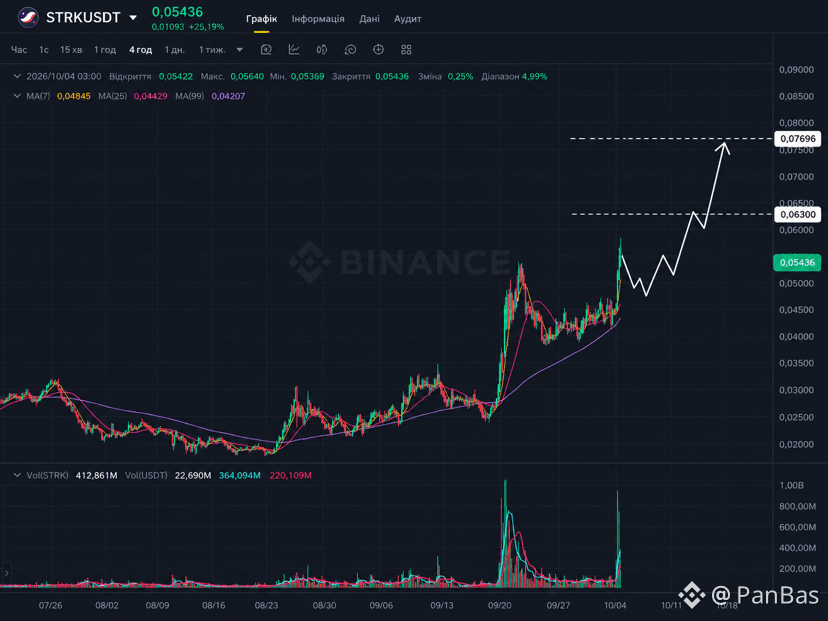
🚨 $STRK IS BREAKING OUT — BUT THE BIGGER MOVE MAY STILL BE AHEAD.
$STRK is pushing hard again and momentum is clearly back.
The chart still leaves room for another expansion leg if buyers keep control of the current zone.
My key upside levels:
🎯 $0.06300
🎯 $0.07696
That’s the area where this move gets much more interesting.
What matters now:
If STRK keeps holding strength here → continuation stays alive.
If momentum fades → expect a deeper pullback first.
Right now, I’m watching one thing:
Is this just another spike…
or the start of the next leg higher?
$STRK
#strk #STARKNET #Crypto
{spot}(STRKUSDT)
🚨 $STRK IS BREAKING OUT — BUT THE BIGGER MOVE MAY STILL BE AHEAD.
$STRK is pushing hard again and momentum is clearly back.
The chart still leaves room for another expansion leg if buyers keep control of the current zone.
My key upside levels:
🎯 $0.06300
🎯 $0.07696
That’s the area where this move gets much more interesting.
What matters now:
If STRK keeps holding strength here → continuation stays alive.
If momentum fades → expect a deeper pullback first.
Right now, I’m watching one thing:
Is this just another spike…
or the start of the next leg higher?
$STRK
#strk #STARKNET #Crypto
$STRK is pushing hard again and momentum is clearly back.
The chart still leaves room for another expansion leg if buyers keep control of the current zone.
My key upside levels:
🎯 $0.06300
🎯 $0.07696
That’s the area where this move gets much more interesting.
What matters now:
If STRK keeps holding strength here → continuation stays alive.
If momentum fades → expect a deeper pullback first.
Right now, I’m watching one thing:
Is this just another spike…
or the start of the next leg higher?
$STRK
#strk #STARKNET #Crypto
71
·
--
Verified
See translation
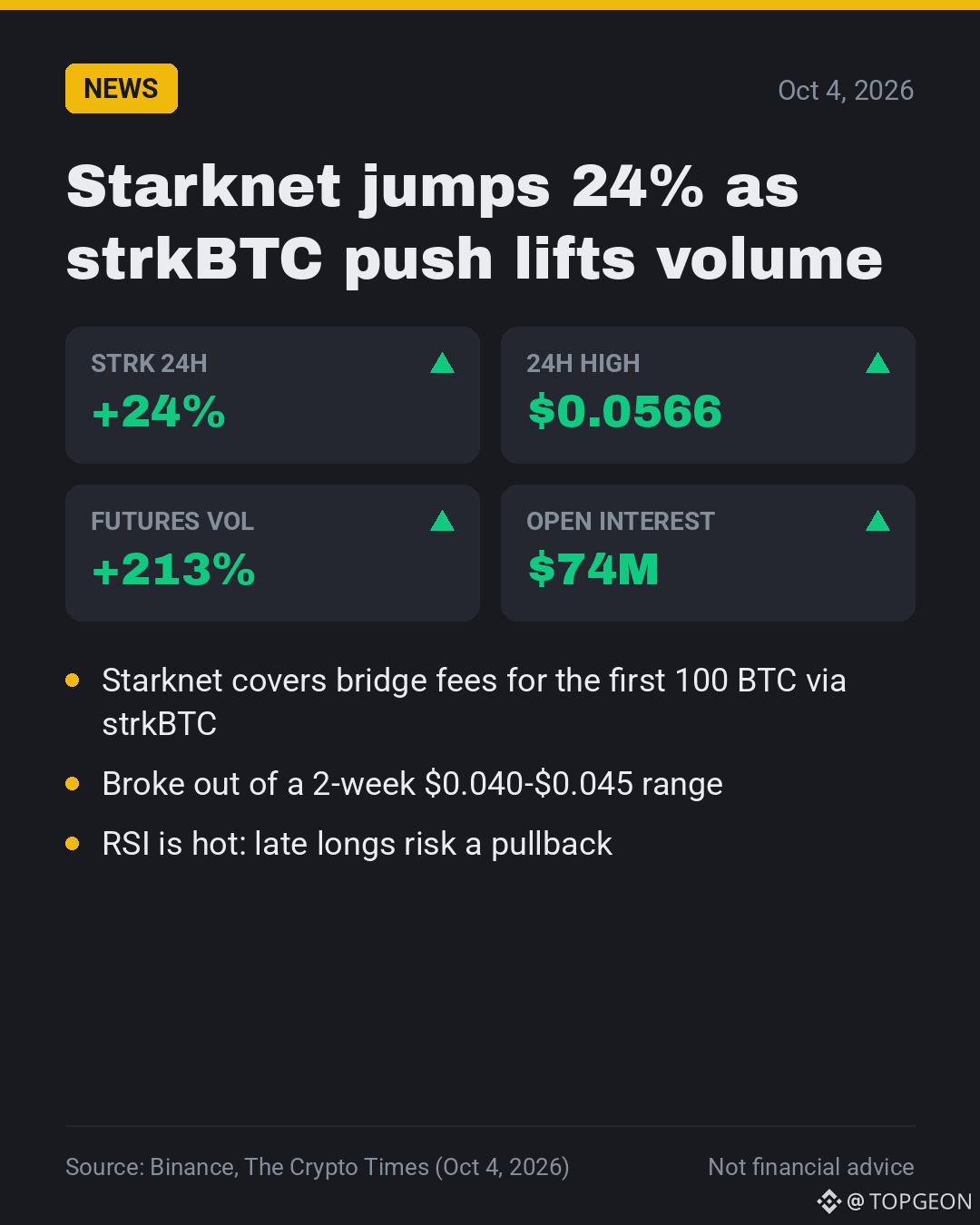
🚀 $STRK is up 24% in a day, top-2 gainer on Binance right now
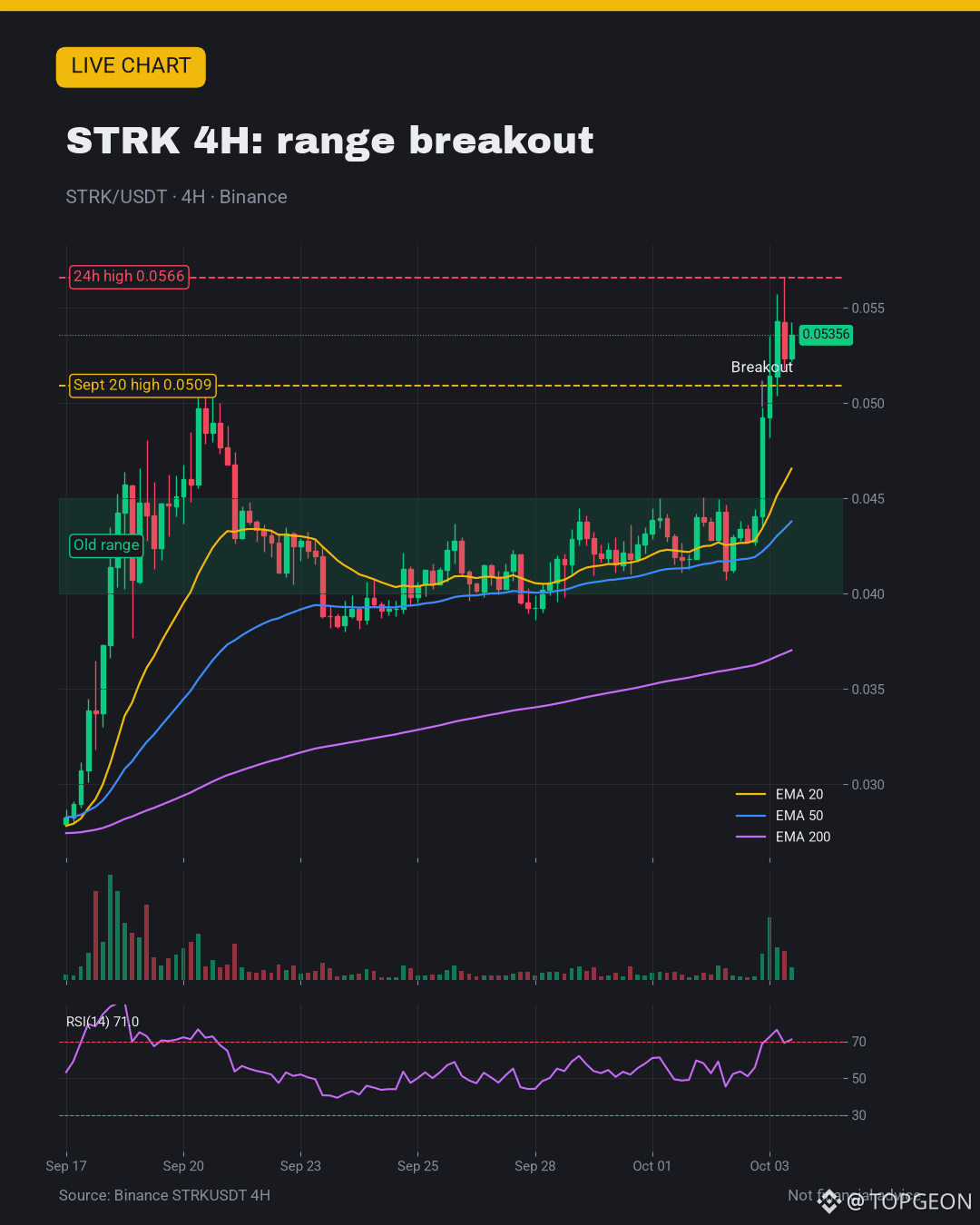
Starknet says it will cover bridge fees for the first 100 BTC moved in through strkBTC, plus staking and liquidity rewards for BTC holders. Traders piled in: STRK broke out of a two-week $0.040–$0.045 box and tagged $0.0566.
📊 Price $0.0535 · futures volume +213% · OI $74M · 4H RSI 71
My take: $0.051 (the Sept 20 high) is the line to hold; losing it likely sends STRK back toward $0.045. A clean 4H close above $0.0566 opens $0.06.
Chasing this move or waiting for a retest? 👇
#Starknet #strkBTC #Altcoins
🚀 $STRK is up 24% in a day, top-2 gainer on Binance right now
Starknet says it will cover bridge fees for the first 100 BTC moved in through strkBTC, plus staking and liquidity rewards for BTC holders. Traders piled in: STRK broke out of a two-week $0.040–$0.045 box and tagged $0.0566.
📊 Price $0.0535 · futures volume +213% · OI $74M · 4H RSI 71
My take: $0.051 (the Sept 20 high) is the line to hold; losing it likely sends STRK back toward $0.045. A clean 4H close above $0.0566 opens $0.06.
Chasing this move or waiting for a retest? 👇
#Starknet #strkBTC #Altcoins
Starknet says it will cover bridge fees for the first 100 BTC moved in through strkBTC, plus staking and liquidity rewards for BTC holders. Traders piled in: STRK broke out of a two-week $0.040–$0.045 box and tagged $0.0566.
📊 Price $0.0535 · futures volume +213% · OI $74M · 4H RSI 71
My take: $0.051 (the Sept 20 high) is the line to hold; losing it likely sends STRK back toward $0.045. A clean 4H close above $0.0566 opens $0.06.
Chasing this move or waiting for a retest? 👇
#Starknet #strkBTC #Altcoins
1
1
121
Log in to explore more content
Join global crypto users on Binance Square
⚡️ Get latest and useful information about crypto.
💬 Trusted by the world’s largest crypto exchange.
👍 Discover real insights from verified creators.
Email / Phone number
Trending Topics
1
#DriftHackVictimsBeginClaims
32,430 views
488 Discussing
2
#SolanaTokenizedStockVolumeTops$4.4BInSeptember
5,127 views
58 Discussing
3
#BitcoinSpotETFsDraw$6.34BInflowsInQ3
16,767 views
175 Discussing
4
#EthereumValidatorExitQueueJumps392%
196,745 views
1,614 Discussing
5
#IMFApprovesElSalvador$138MWithBitcoinWaiver
19,084 views
104 Discussing
6
#SECHaltsCryptoETFReviewsAmidFundingLapse
325,475 views
2,382 Discussing
7
#ZcashETFPostsFirstWeeklyOutflow$93.6M
104,285 views
270 Discussing
8
#GreekPoliceBustCryptoScamRingArrest17
447,913 views
2,955 Discussing
9
#BitcoinRejectedAt$87K
239,436 views
348 Discussing
10
#FedOctoberRateHikeOddsFallTo17%
467,506 views
3,055 Discussing