

#macro
macro
8.2M views
41,583 Discussing
Hot
Latest

·
--
See translation
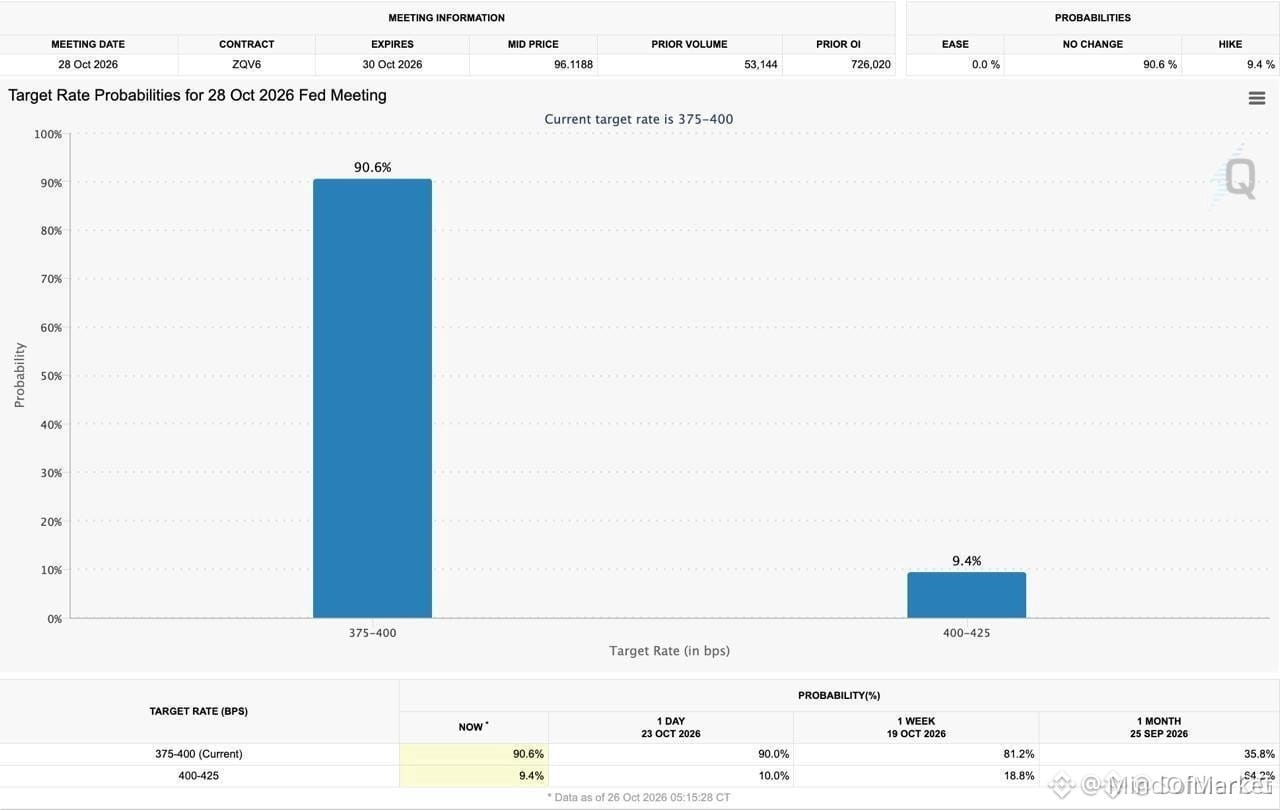
🚨 $ERA $BEAMX $BULLA FED HOLD BOOST? 📈
📊 The Fed’s upcoming decision carries a 90.6% odds of a rate‑stay, a signal the smart‑money community is already pricing into the order flow. 🦈 Institutional liquidity pools are aligning just above current equity and crypto valuations, creating a subtle bullish bias for risk‑on assets.
💡 Yet the residual uncertainty fuels short‑term volatility spikes, especially on the 4‑hour frames where volume bursts hint at a potential liquidity sweep. 📌 Positioning now could capture the upside if the hold holds, but be ready for a rapid pullback on any surprise hike. 🤔 What’s your stance – brace for a steady rally or hedge against a sudden shake‑out? 👇
⚠️ Not financial advice. Always manage your risk. 🛡️
🏷️ #ERA #FedHold #Macro #Crypto
🔥 💎
🚨 $ERA $BEAMX $BULLA FED HOLD BOOST? 📈
📊 The Fed’s upcoming decision carries a 90.6% odds of a rate‑stay, a signal the smart‑money community is already pricing into the order flow. 🦈 Institutional liquidity pools are aligning just above current equity and crypto valuations, creating a subtle bullish bias for risk‑on assets.
💡 Yet the residual uncertainty fuels short‑term volatility spikes, especially on the 4‑hour frames where volume bursts hint at a potential liquidity sweep. 📌 Positioning now could capture the upside if the hold holds, but be ready for a rapid pullback on any surprise hike. 🤔 What’s your stance – brace for a steady rally or hedge against a sudden shake‑out? 👇
⚠️ Not financial advice. Always manage your risk. 🛡️
🏷️ #ERA #FedHold #Macro #Crypto
🔥 💎
📊 The Fed’s upcoming decision carries a 90.6% odds of a rate‑stay, a signal the smart‑money community is already pricing into the order flow. 🦈 Institutional liquidity pools are aligning just above current equity and crypto valuations, creating a subtle bullish bias for risk‑on assets.
💡 Yet the residual uncertainty fuels short‑term volatility spikes, especially on the 4‑hour frames where volume bursts hint at a potential liquidity sweep. 📌 Positioning now could capture the upside if the hold holds, but be ready for a rapid pullback on any surprise hike. 🤔 What’s your stance – brace for a steady rally or hedge against a sudden shake‑out? 👇
⚠️ Not financial advice. Always manage your risk. 🛡️
🏷️ #ERA #FedHold #Macro #Crypto
🔥 💎
5

·
--
Article
See translation
Central Bank Decisions and Market Trends: The Week AheadCentral bank interest-rate decisions are taking center stage this week as investors prepare for major updates from the Federal Reserve, the ECB, and the BOJ.
It is going to be a busy few days for anyone keeping an eye on global macro trends. The Federal Reserve, the European Central Bank, and the Bank of Japan are all scheduled to deliver interest-rate decisions that could shift the tone for financial markets worldwide. These meetings are the main event, as traders look for clues on how policymakers view current inflation and economic growth.
Beyond the central banks, the market is also bracing for a wave of corporate earnings reports. These updates often provide a clearer picture of how businesses are navigating the current high-interest-rate environment. When big companies share their results, it tends to set the mood for broader market sentim
Why it matters 💡
Crypto traders watch these macro updates closely because they influence global risk appetite and liquidity levels. When central banks adjust rates, it often changes the attractiveness of the dollar, which typically impacts how capital flows into and out of the digital asset market.
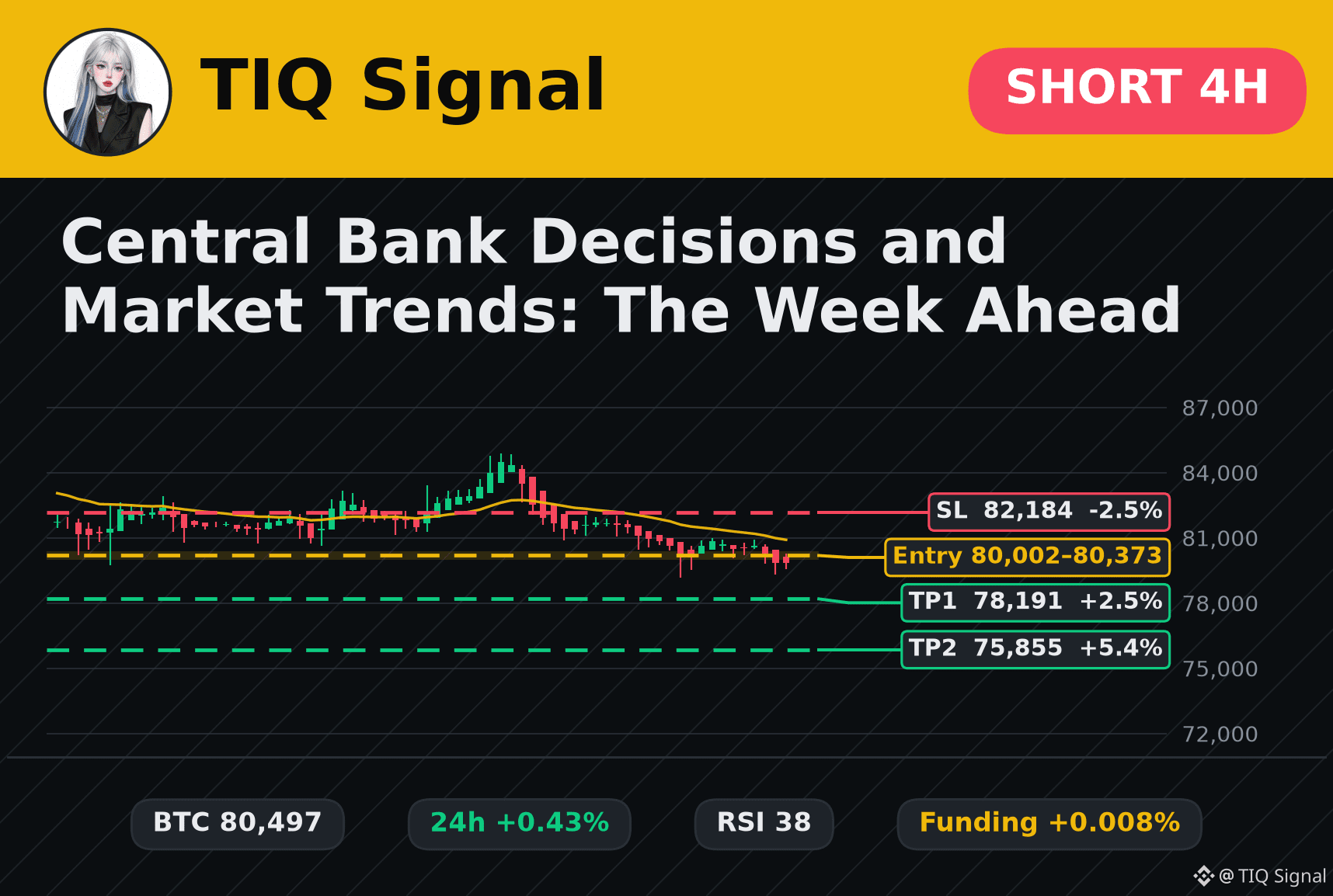
4H signal view on $BTC 📊
Short 🔴
Entry 80,002 - 80,373
TP 78,191 - 75,855 - 75,101
SL 82,184
RSI 38 still has room to move. MACD momentum is leaning down. Price is on the right side of EMA200.
$BTC $ETH #Macro #MacroEconomy #FederalReserve #CryptoNews #MarketTrends
ℹ️ News roundup from public sources, not financial advice.
Central Bank Decisions and Market Trends: The Week Ahead
Central bank interest-rate decisions are taking center stage this week as investors prepare for major updates from the Federal Reserve, the ECB, and the BOJ.
It is going to be a busy few days for anyone keeping an eye on global macro trends. The Federal Reserve, the European Central Bank, and the Bank of Japan are all scheduled to deliver interest-rate decisions that could shift the tone for financial markets worldwide. These meetings are the main event, as traders look for clues on how policymakers view current inflation and economic growth.
Beyond the central banks, the market is also bracing for a wave of corporate earnings reports. These updates often provide a clearer picture of how businesses are navigating the current high-interest-rate environment. When big companies share their results, it tends to set the mood for broader market sentim
Why it matters 💡
Crypto traders watch these macro updates closely because they influence global risk appetite and liquidity levels. When central banks adjust rates, it often changes the attractiveness of the dollar, which typically impacts how capital flows into and out of the digital asset market.
4H signal view on $BTC 📊
Short 🔴
Entry 80,002 - 80,373
TP 78,191 - 75,855 - 75,101
SL 82,184
RSI 38 still has room to move. MACD momentum is leaning down. Price is on the right side of EMA200.
$BTC $ETH #Macro #MacroEconomy #FederalReserve #CryptoNews #MarketTrends
ℹ️ News roundup from public sources, not financial advice.
It is going to be a busy few days for anyone keeping an eye on global macro trends. The Federal Reserve, the European Central Bank, and the Bank of Japan are all scheduled to deliver interest-rate decisions that could shift the tone for financial markets worldwide. These meetings are the main event, as traders look for clues on how policymakers view current inflation and economic growth.
Beyond the central banks, the market is also bracing for a wave of corporate earnings reports. These updates often provide a clearer picture of how businesses are navigating the current high-interest-rate environment. When big companies share their results, it tends to set the mood for broader market sentim
Why it matters 💡
Crypto traders watch these macro updates closely because they influence global risk appetite and liquidity levels. When central banks adjust rates, it often changes the attractiveness of the dollar, which typically impacts how capital flows into and out of the digital asset market.
4H signal view on $BTC 📊
Short 🔴
Entry 80,002 - 80,373
TP 78,191 - 75,855 - 75,101
SL 82,184
RSI 38 still has room to move. MACD momentum is leaning down. Price is on the right side of EMA200.
$BTC $ETH #Macro #MacroEconomy #FederalReserve #CryptoNews #MarketTrends
ℹ️ News roundup from public sources, not financial advice.

·
--
See translation
#USQ3GDPAndSeptemberPCEDueNextWeek
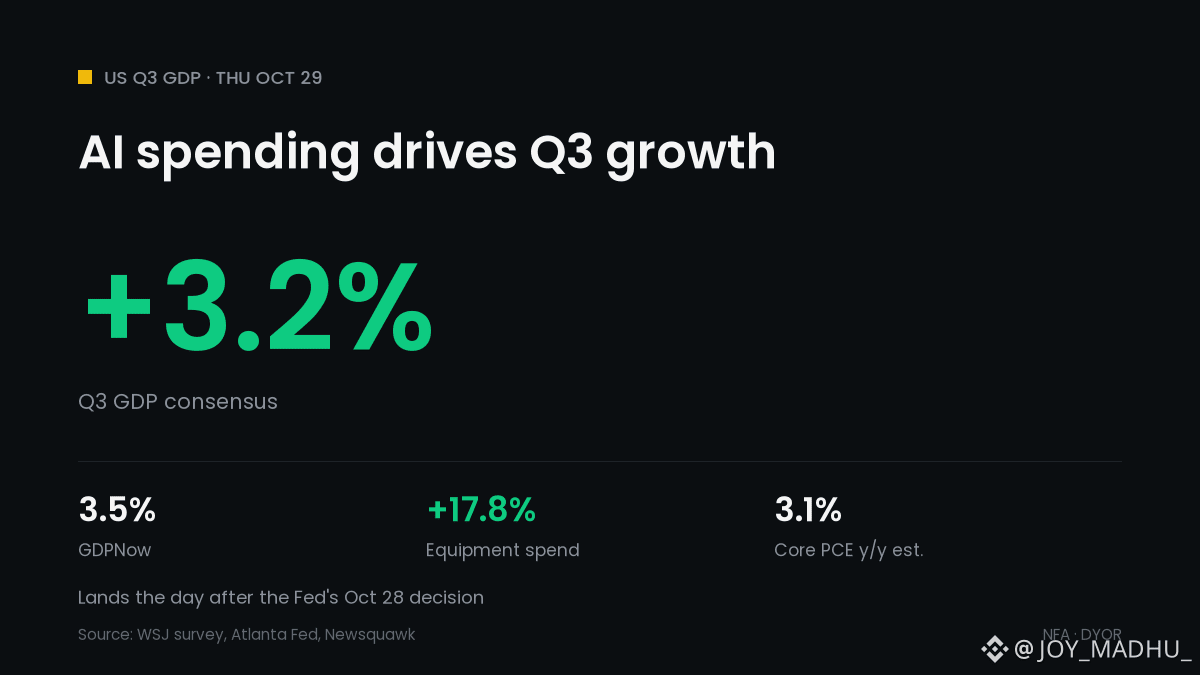
🇺🇸 Q3 GDP Could Top 3%. The AI Boom Is Doing the Heavy Lifting
📅 Q3 GDP and September PCE land Thursday, Oct 29, the day after the Fed decides
📊 WSJ's survey median is +3.2%, up from 2.2% in Q2. The Atlanta Fed's GDPNow model tracks 3.5%
🤖 GDPNow sees business equipment spending up 17.8% on AI investment
🔍 Continuum Economics expects an 18.7% jump in imports, mostly AI hardware, to subtract 3.4 points from growth
🔥 Headline PCE is seen at 3.6-3.7% a year and core at 3.1%. Pantheon says that could lift 3-month core to ~3.0% from 2.0%
What it means for crypto: strong growth plus sticky inflation keeps December hike talk alive, which can weigh on risk assets. A softer print would ease that. $BTC is near $80.3K, flat on the day.
Is AI spending now a bigger macro driver than the Fed? 👇
$BTC $ETH
#USQ3GDPAndSeptemberPCEDueNextWeek #CryptoNews #Macro #AI
#USQ3GDPAndSeptemberPCEDueNextWeek
🇺🇸 Q3 GDP Could Top 3%. The AI Boom Is Doing the Heavy Lifting
📅 Q3 GDP and September PCE land Thursday, Oct 29, the day after the Fed decides
📊 WSJ's survey median is +3.2%, up from 2.2% in Q2. The Atlanta Fed's GDPNow model tracks 3.5%
🤖 GDPNow sees business equipment spending up 17.8% on AI investment
🔍 Continuum Economics expects an 18.7% jump in imports, mostly AI hardware, to subtract 3.4 points from growth
🔥 Headline PCE is seen at 3.6-3.7% a year and core at 3.1%. Pantheon says that could lift 3-month core to ~3.0% from 2.0%
What it means for crypto: strong growth plus sticky inflation keeps December hike talk alive, which can weigh on risk assets. A softer print would ease that. $BTC is near $80.3K, flat on the day.
Is AI spending now a bigger macro driver than the Fed? 👇
$BTC $ETH
#USQ3GDPAndSeptemberPCEDueNextWeek #CryptoNews #Macro #AI
🇺🇸 Q3 GDP Could Top 3%. The AI Boom Is Doing the Heavy Lifting
📅 Q3 GDP and September PCE land Thursday, Oct 29, the day after the Fed decides
📊 WSJ's survey median is +3.2%, up from 2.2% in Q2. The Atlanta Fed's GDPNow model tracks 3.5%
🤖 GDPNow sees business equipment spending up 17.8% on AI investment
🔍 Continuum Economics expects an 18.7% jump in imports, mostly AI hardware, to subtract 3.4 points from growth
🔥 Headline PCE is seen at 3.6-3.7% a year and core at 3.1%. Pantheon says that could lift 3-month core to ~3.0% from 2.0%
What it means for crypto: strong growth plus sticky inflation keeps December hike talk alive, which can weigh on risk assets. A softer print would ease that. $BTC is near $80.3K, flat on the day.
Is AI spending now a bigger macro driver than the Fed? 👇
$BTC $ETH
#USQ3GDPAndSeptemberPCEDueNextWeek #CryptoNews #Macro #AI

·
--
Bullish
See translation
🔥 JUST IN: US TREASURY TO BUY BACK $6 BILLION IN DEBT
$BTC $SPCXB
The US Treasury is planning a $6B debt buyback, but this is not the same as printing $6B in new money.
The goal of Treasury buybacks is generally to improve liquidity in the government bond market and manage outstanding debt.
👀 Crypto traders should watch Treasury yields and broader liquidity conditions. The move alone doesn’t guarantee a bullish reaction for $BTC or altcoins.
#Bitcoin #Crypto #USTreasury #Macro
🔥 JUST IN: US TREASURY TO BUY BACK $6 BILLION IN DEBT
$BTC $SPCXB
The US Treasury is planning a $6B debt buyback, but this is not the same as printing $6B in new money.
The goal of Treasury buybacks is generally to improve liquidity in the government bond market and manage outstanding debt.
👀 Crypto traders should watch Treasury yields and broader liquidity conditions. The move alone doesn’t guarantee a bullish reaction for $BTC or altcoins.
#Bitcoin #Crypto #USTreasury #Macro
$BTC $SPCXB
The US Treasury is planning a $6B debt buyback, but this is not the same as printing $6B in new money.
The goal of Treasury buybacks is generally to improve liquidity in the government bond market and manage outstanding debt.
👀 Crypto traders should watch Treasury yields and broader liquidity conditions. The move alone doesn’t guarantee a bullish reaction for $BTC or altcoins.
#Bitcoin #Crypto #USTreasury #Macro
233

·
--
See translation
#USQ3GDPAndSeptemberPCEDueNextWeek
*What is happening:*
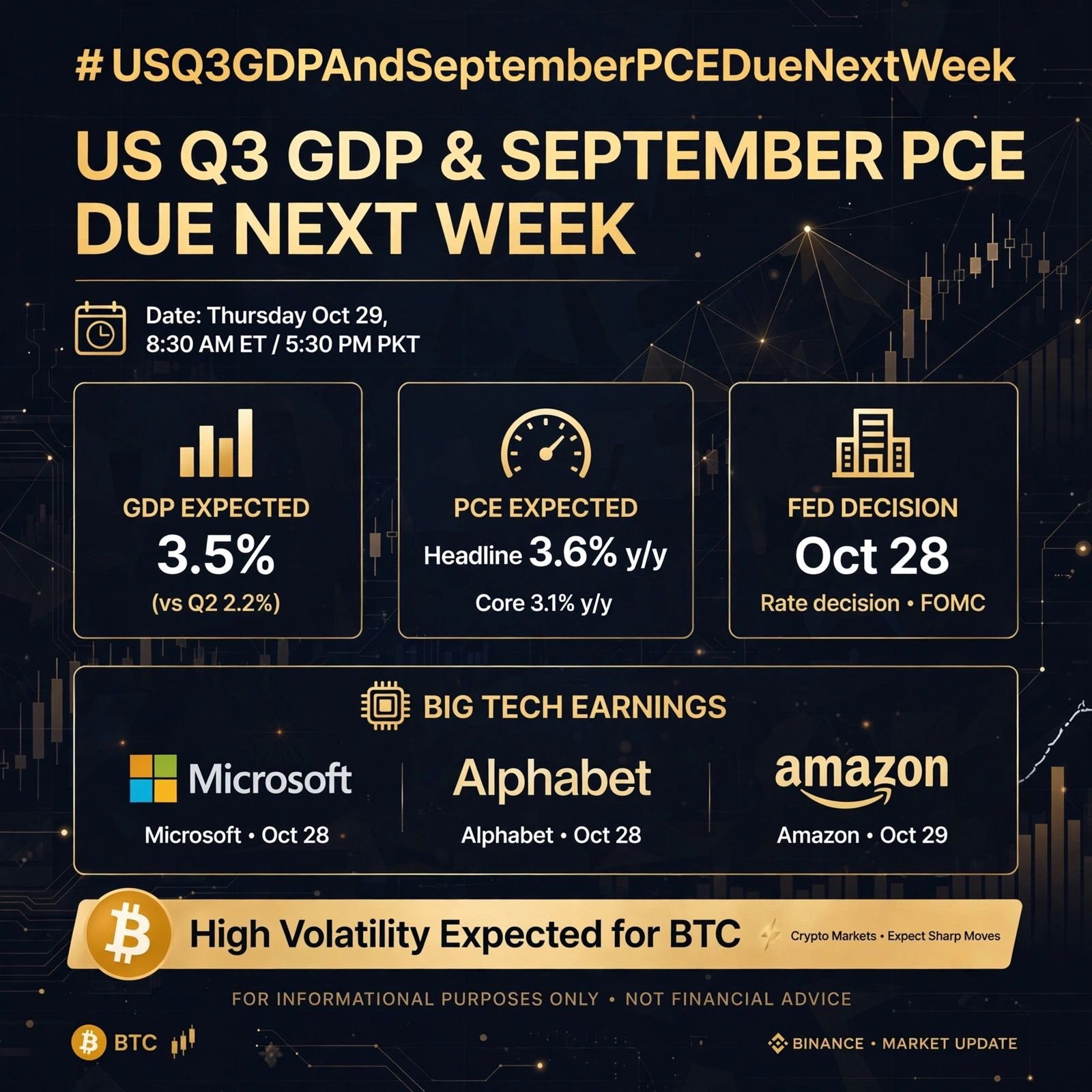
📅 *Thursday Oct 29, 8:30 AM ET (5:30 PM PKT)*
- Q3 GDP Advance Estimate + September PCE Inflation together
- One day AFTER Fed decision on Oct 28
- GDP Expected: 3.0-3.5% (Atlanta Fed GDPNow: 3.5%) vs Q2 2.2%
- PCE Expected: Headline +0.5% m/m → 3.6% y/y, Core +0.3% m/m → 3.1% y/y
- Also: Microsoft + Alphabet earnings Oct 28, Amazon Oct 29 6c4f7c12
This is the biggest macro day of October — BTC volatility incoming.
*ONE VIRAL POST for #USQ3GDPAndSeptemberPCEDueNextWeek:*
> #USQ3GDPAndSeptemberPCEDueNextWeek — The most important 24 hours for Crypto 🚨
>
> Oct 28: FED Decision + Microsoft & Alphabet earnings
> Oct 29: US Q3 GDP + PCE Inflation SAME TIME 8:30 AM ET
>
> Expectations:
> GDP: 3.5% 🔥 (vs 2.2% Q2)
> PCE: 3.6% y/y & Core 3.1% — sticky inflation
>
> If hot GDP + hot PCE = Dollar pumps, BTC dumps
> If soft PCE = Rate cut hopes back, BTC pumps to $85K
>
> I'm not trading before Thursday — are you?
>
> $BTC $ETH
> #USQ3GDPAndSeptemberPCEDueNextWeek #Fed #Macro #CryptoNews
#USQ3GDPAndSeptemberPCEDueNextWeek
*What is happening:*
📅 *Thursday Oct 29, 8:30 AM ET (5:30 PM PKT)*
- Q3 GDP Advance Estimate + September PCE Inflation together
- One day AFTER Fed decision on Oct 28
- GDP Expected: 3.0-3.5% (Atlanta Fed GDPNow: 3.5%) vs Q2 2.2%
- PCE Expected: Headline +0.5% m/m → 3.6% y/y, Core +0.3% m/m → 3.1% y/y
- Also: Microsoft + Alphabet earnings Oct 28, Amazon Oct 29 6c4f7c12
This is the biggest macro day of October — BTC volatility incoming.
*ONE VIRAL POST for #USQ3GDPAndSeptemberPCEDueNextWeek:*
> #USQ3GDPAndSeptemberPCEDueNextWeek — The most important 24 hours for Crypto 🚨
>
> Oct 28: FED Decision + Microsoft & Alphabet earnings
> Oct 29: US Q3 GDP + PCE Inflation SAME TIME 8:30 AM ET
>
> Expectations:
> GDP: 3.5% 🔥 (vs 2.2% Q2)
> PCE: 3.6% y/y & Core 3.1% — sticky inflation
>
> If hot GDP + hot PCE = Dollar pumps, BTC dumps
> If soft PCE = Rate cut hopes back, BTC pumps to $85K
>
> I'm not trading before Thursday — are you?
>
> $BTC $ETH
> #USQ3GDPAndSeptemberPCEDueNextWeek #Fed #Macro #CryptoNews
*What is happening:*
📅 *Thursday Oct 29, 8:30 AM ET (5:30 PM PKT)*
- Q3 GDP Advance Estimate + September PCE Inflation together
- One day AFTER Fed decision on Oct 28
- GDP Expected: 3.0-3.5% (Atlanta Fed GDPNow: 3.5%) vs Q2 2.2%
- PCE Expected: Headline +0.5% m/m → 3.6% y/y, Core +0.3% m/m → 3.1% y/y
- Also: Microsoft + Alphabet earnings Oct 28, Amazon Oct 29 6c4f7c12
This is the biggest macro day of October — BTC volatility incoming.
*ONE VIRAL POST for #USQ3GDPAndSeptemberPCEDueNextWeek:*
> #USQ3GDPAndSeptemberPCEDueNextWeek — The most important 24 hours for Crypto 🚨
>
> Oct 28: FED Decision + Microsoft & Alphabet earnings
> Oct 29: US Q3 GDP + PCE Inflation SAME TIME 8:30 AM ET
>
> Expectations:
> GDP: 3.5% 🔥 (vs 2.2% Q2)
> PCE: 3.6% y/y & Core 3.1% — sticky inflation
>
> If hot GDP + hot PCE = Dollar pumps, BTC dumps
> If soft PCE = Rate cut hopes back, BTC pumps to $85K
>
> I'm not trading before Thursday — are you?
>
> $BTC $ETH
> #USQ3GDPAndSeptemberPCEDueNextWeek #Fed #Macro #CryptoNews
1
99

·
--
Verified
Article
See translation
Bank of England interest rates: What the latest forecasts meanThe Bank of England interest rates trajectory is currently a hot topic, as economists push back against market expectations of aggressive hikes by next summer.
It seems the financial markets might be getting a bit ahead of themselves. While some traders were betting on a full percentage point increase in borrowing costs, experts in the City are suggesting that such a sharp rise is unlikely to happen.
Instead of the rapid tightening many anticipated, analysts are pointing toward a more measured approach. Some even suggest that we could see rates start to head downward by the end of 2027, which is quite a different tune than what the current market sentiment implies.
This gap between market predictions and expert analysis often happens when everyone tries to guess the central bank's next move. It is a classic case of the market pricing in a scenari
Why it matters 💡
Crypto traders keep a close eye on these interest rate discussions because they directly influence global liquidity and risk appetite. When central banks signal a shift in policy, it often ripples through the dollar and affects how investors allocate capital across various asset classes.
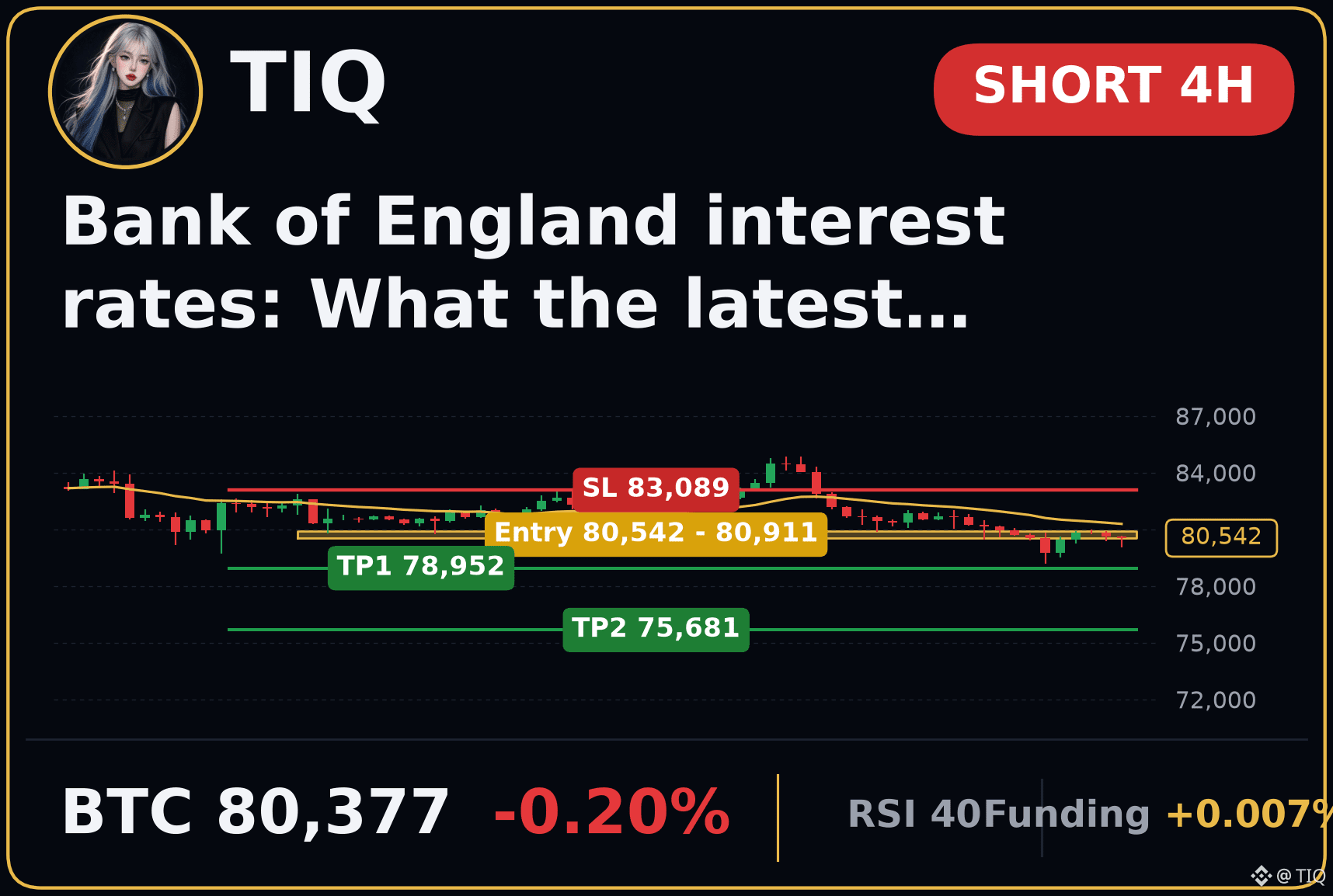
4H signal view on $BTC 📊
Short 🔴
Entry 80,542 - 80,911
TP 78,952 - 75,681 - 75,178
SL 83,089
RSI 40 still has room to move. MACD momentum is leaning down. Price is on the right side of EMA200.
$BNB $ETH #Macro #MacroEconomics #BankOfEngland #InterestRates #MarketAnalysis
ℹ️ News roundup from public sources, not financial advice.
Bank of England interest rates: What the latest forecasts mean
The Bank of England interest rates trajectory is currently a hot topic, as economists push back against market expectations of aggressive hikes by next summer.
It seems the financial markets might be getting a bit ahead of themselves. While some traders were betting on a full percentage point increase in borrowing costs, experts in the City are suggesting that such a sharp rise is unlikely to happen.
Instead of the rapid tightening many anticipated, analysts are pointing toward a more measured approach. Some even suggest that we could see rates start to head downward by the end of 2027, which is quite a different tune than what the current market sentiment implies.
This gap between market predictions and expert analysis often happens when everyone tries to guess the central bank's next move. It is a classic case of the market pricing in a scenari
Why it matters 💡
Crypto traders keep a close eye on these interest rate discussions because they directly influence global liquidity and risk appetite. When central banks signal a shift in policy, it often ripples through the dollar and affects how investors allocate capital across various asset classes.
4H signal view on $BTC 📊
Short 🔴
Entry 80,542 - 80,911
TP 78,952 - 75,681 - 75,178
SL 83,089
RSI 40 still has room to move. MACD momentum is leaning down. Price is on the right side of EMA200.
$BNB $ETH #Macro #MacroEconomics #BankOfEngland #InterestRates #MarketAnalysis
ℹ️ News roundup from public sources, not financial advice.
It seems the financial markets might be getting a bit ahead of themselves. While some traders were betting on a full percentage point increase in borrowing costs, experts in the City are suggesting that such a sharp rise is unlikely to happen.
Instead of the rapid tightening many anticipated, analysts are pointing toward a more measured approach. Some even suggest that we could see rates start to head downward by the end of 2027, which is quite a different tune than what the current market sentiment implies.
This gap between market predictions and expert analysis often happens when everyone tries to guess the central bank's next move. It is a classic case of the market pricing in a scenari
Why it matters 💡
Crypto traders keep a close eye on these interest rate discussions because they directly influence global liquidity and risk appetite. When central banks signal a shift in policy, it often ripples through the dollar and affects how investors allocate capital across various asset classes.
4H signal view on $BTC 📊
Short 🔴
Entry 80,542 - 80,911
TP 78,952 - 75,681 - 75,178
SL 83,089
RSI 40 still has room to move. MACD momentum is leaning down. Price is on the right side of EMA200.
$BNB $ETH #Macro #MacroEconomics #BankOfEngland #InterestRates #MarketAnalysis
ℹ️ News roundup from public sources, not financial advice.
Pair Rock:
Really? Bitcoin is gonna drop to 76k. OMG
1
201

·
--
See translation
📅 KEY EVENTS THIS WEEK 📅
⚠️ SPECIAL ATTENTION: The FOMC meeting on Wednesday may cause high volatility across all markets!
🗓 MONDAY, OCTOBER 26
USA 17:30 GMT - Dallas Fed Manufacturing Index (Oct)
🗓 TUESDAY, OCTOBER 27
USA15:15 GMT - ADP Employment (weekly)
USA 15:30 GMT - Durable Goods Orders (Sep)
USA 16:00 GMT - SP-Case-Schiller Index (Aug)
USA 17:00 GMT - CB Consumer Confidence (Oct)
USA 17:00 GMT - New Home Sales (Sep)
USA17:00 GMT - Richmond Manufacturing Index (Oct)
🗓 WEDNESDAY, OCTOBER 28 🔥
USA15:30 GMT - Trade Balance (Sep preliminary)
USA 21:00 GMT - FOMC MEETING ⭐⭐⭐
USA 21:30 GMT - FOMC PRESS CONFERENCE ⭐⭐⭐
🗓 THURSDAY, OCTOBER 29
USA 15:30 GMT - GDP (Q3 2026 preliminary)
USA 15:30 GMT - Initial Jobless Claims
USA 15:30 GMT - PCE Price Index (Sep) - Inflation
🗓 FRIDAY, OCTOBER 30
USA 16:45 GMT - Chicago PMI (Oct)
Stay informed. Trade smart.
{future}(BTCUSDT)
{future}(ETHUSDT)
#EconomicCalendar #FOMC #Macro #BİNANCE
📅 KEY EVENTS THIS WEEK 📅
⚠️ SPECIAL ATTENTION: The FOMC meeting on Wednesday may cause high volatility across all markets!
🗓 MONDAY, OCTOBER 26
USA 17:30 GMT - Dallas Fed Manufacturing Index (Oct)
🗓 TUESDAY, OCTOBER 27
USA15:15 GMT - ADP Employment (weekly)
USA 15:30 GMT - Durable Goods Orders (Sep)
USA 16:00 GMT - SP-Case-Schiller Index (Aug)
USA 17:00 GMT - CB Consumer Confidence (Oct)
USA 17:00 GMT - New Home Sales (Sep)
USA17:00 GMT - Richmond Manufacturing Index (Oct)
🗓 WEDNESDAY, OCTOBER 28 🔥
USA15:30 GMT - Trade Balance (Sep preliminary)
USA 21:00 GMT - FOMC MEETING ⭐⭐⭐
USA 21:30 GMT - FOMC PRESS CONFERENCE ⭐⭐⭐
🗓 THURSDAY, OCTOBER 29
USA 15:30 GMT - GDP (Q3 2026 preliminary)
USA 15:30 GMT - Initial Jobless Claims
USA 15:30 GMT - PCE Price Index (Sep) - Inflation
🗓 FRIDAY, OCTOBER 30
USA 16:45 GMT - Chicago PMI (Oct)
Stay informed. Trade smart.
#EconomicCalendar #FOMC #Macro #BİNANCE
⚠️ SPECIAL ATTENTION: The FOMC meeting on Wednesday may cause high volatility across all markets!
🗓 MONDAY, OCTOBER 26
USA 17:30 GMT - Dallas Fed Manufacturing Index (Oct)
🗓 TUESDAY, OCTOBER 27
USA15:15 GMT - ADP Employment (weekly)
USA 15:30 GMT - Durable Goods Orders (Sep)
USA 16:00 GMT - SP-Case-Schiller Index (Aug)
USA 17:00 GMT - CB Consumer Confidence (Oct)
USA 17:00 GMT - New Home Sales (Sep)
USA17:00 GMT - Richmond Manufacturing Index (Oct)
🗓 WEDNESDAY, OCTOBER 28 🔥
USA15:30 GMT - Trade Balance (Sep preliminary)
USA 21:00 GMT - FOMC MEETING ⭐⭐⭐
USA 21:30 GMT - FOMC PRESS CONFERENCE ⭐⭐⭐
🗓 THURSDAY, OCTOBER 29
USA 15:30 GMT - GDP (Q3 2026 preliminary)
USA 15:30 GMT - Initial Jobless Claims
USA 15:30 GMT - PCE Price Index (Sep) - Inflation
🗓 FRIDAY, OCTOBER 30
USA 16:45 GMT - Chicago PMI (Oct)
Stay informed. Trade smart.
#EconomicCalendar #FOMC #Macro #BİNANCE
·
--
See translation
#USQ3GDPAndSeptemberPCEDueNextWeek
🇺🇸 GDP and PCE Land Thursday, Right After the Fed
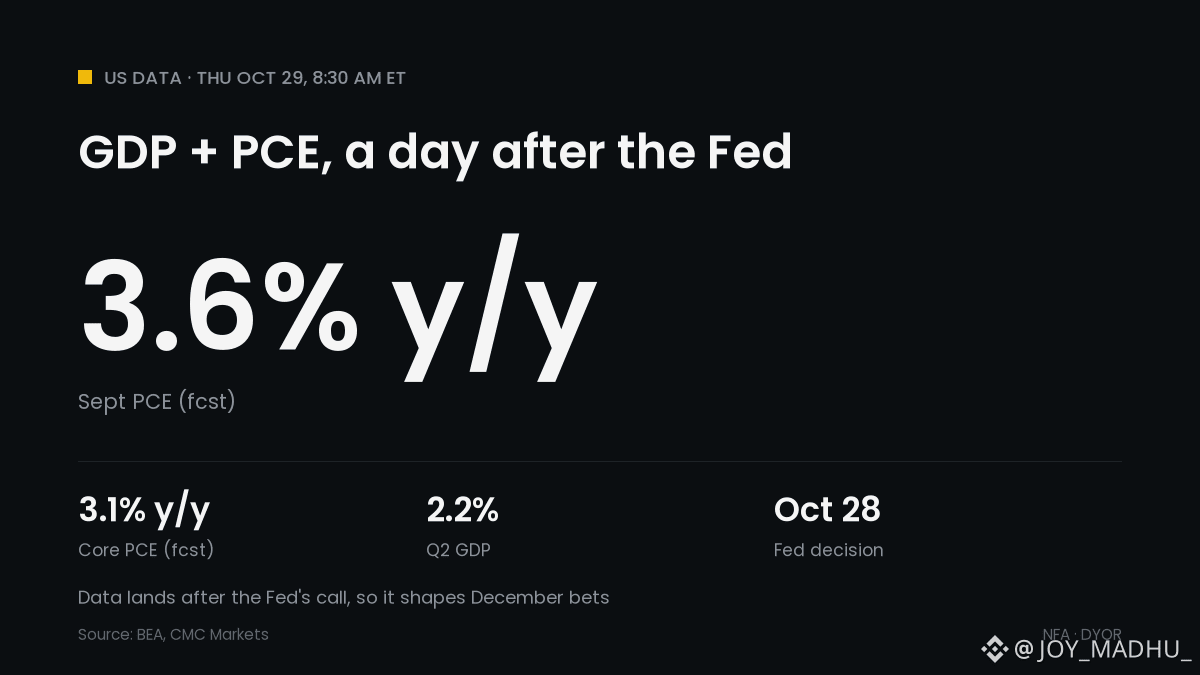
📅 The BEA releases Q3 GDP (advance) and September PCE together on Oct 29 at 8:30 AM ET
🏦 That's one day after the Fed's Oct 28 decision, so the data hits after the call is made
📊 Q2 growth was revised up to 2.2%. Forecasts for Q3 range from 1.7% (AP survey) to about 3%
🔥 Headline PCE is seen at +0.5% m/m, lifting the yearly rate to 3.6% from 3.4% (CMC Markets)
📈 Core PCE is seen at +0.3% m/m, or 3.1% a year, up from 3.0%
⚠️ A hold is expected Wednesday, so Thursday's numbers mostly reshape December hike bets
What it means for crypto: hot inflation with solid growth would keep hike talk alive, while soft data could ease pressure on risk assets. BTC sits near $80.5K, flat on the day.
Which matters more for Bitcoin this week, the Fed or PCE? 👇
$BTC $ETH
#USQ3GDPAndSeptemberPCEDueNextWeek #CryptoNews #Macro #Fed
#USQ3GDPAndSeptemberPCEDueNextWeek
🇺🇸 GDP and PCE Land Thursday, Right After the Fed
📅 The BEA releases Q3 GDP (advance) and September PCE together on Oct 29 at 8:30 AM ET
🏦 That's one day after the Fed's Oct 28 decision, so the data hits after the call is made
📊 Q2 growth was revised up to 2.2%. Forecasts for Q3 range from 1.7% (AP survey) to about 3%
🔥 Headline PCE is seen at +0.5% m/m, lifting the yearly rate to 3.6% from 3.4% (CMC Markets)
📈 Core PCE is seen at +0.3% m/m, or 3.1% a year, up from 3.0%
⚠️ A hold is expected Wednesday, so Thursday's numbers mostly reshape December hike bets
What it means for crypto: hot inflation with solid growth would keep hike talk alive, while soft data could ease pressure on risk assets. BTC sits near $80.5K, flat on the day.
Which matters more for Bitcoin this week, the Fed or PCE? 👇
$BTC $ETH
#USQ3GDPAndSeptemberPCEDueNextWeek #CryptoNews #Macro #Fed
🇺🇸 GDP and PCE Land Thursday, Right After the Fed
📅 The BEA releases Q3 GDP (advance) and September PCE together on Oct 29 at 8:30 AM ET
🏦 That's one day after the Fed's Oct 28 decision, so the data hits after the call is made
📊 Q2 growth was revised up to 2.2%. Forecasts for Q3 range from 1.7% (AP survey) to about 3%
🔥 Headline PCE is seen at +0.5% m/m, lifting the yearly rate to 3.6% from 3.4% (CMC Markets)
📈 Core PCE is seen at +0.3% m/m, or 3.1% a year, up from 3.0%
⚠️ A hold is expected Wednesday, so Thursday's numbers mostly reshape December hike bets
What it means for crypto: hot inflation with solid growth would keep hike talk alive, while soft data could ease pressure on risk assets. BTC sits near $80.5K, flat on the day.
Which matters more for Bitcoin this week, the Fed or PCE? 👇
$BTC $ETH
#USQ3GDPAndSeptemberPCEDueNextWeek #CryptoNews #Macro #Fed
29

See translation
📉 MACRO SHOCK: CANADA SHEDS 41K JOBS WHILE $MARSCOIN SITS ON HIGH ALERT! 🚨
North American trad-fi just took a heavy blow as Canada bleeds over 41,000 jobs under tariff pressure, sending shockwaves through legacy FX. 📉 When traditional fiat assets bleed and retail confidence cracks, capital naturally searches for dynamic order flow in liquid crypto channels. 📊
We are watching smart money rebalance aggressively across high-beta plays like $MARSCOIN and $SNXXB while legacy markets digest this volatility. 💡 Cross-border economic friction usually triggers structural liquidity rotation before the main headline waves land.
💬 How are you positioning your capital as global macro weakness forces fresh capital allocation into crypto momentum? 👇
⚠️ Not financial advice. Always manage your risk. 🛡️
🏷️ #MARSCOIN #SNXXB #Macro #Crypto #Trading
⚡ 💎
📉 MACRO SHOCK: CANADA SHEDS 41K JOBS WHILE $MARSCOIN SITS ON HIGH ALERT! 🚨
North American trad-fi just took a heavy blow as Canada bleeds over 41,000 jobs under tariff pressure, sending shockwaves through legacy FX. 📉 When traditional fiat assets bleed and retail confidence cracks, capital naturally searches for dynamic order flow in liquid crypto channels. 📊
We are watching smart money rebalance aggressively across high-beta plays like $MARSCOIN and $SNXXB while legacy markets digest this volatility. 💡 Cross-border economic friction usually triggers structural liquidity rotation before the main headline waves land.
💬 How are you positioning your capital as global macro weakness forces fresh capital allocation into crypto momentum? 👇
⚠️ Not financial advice. Always manage your risk. 🛡️
🏷️ #MARSCOIN #SNXXB #Macro #Crypto #Trading
⚡ 💎
North American trad-fi just took a heavy blow as Canada bleeds over 41,000 jobs under tariff pressure, sending shockwaves through legacy FX. 📉 When traditional fiat assets bleed and retail confidence cracks, capital naturally searches for dynamic order flow in liquid crypto channels. 📊
We are watching smart money rebalance aggressively across high-beta plays like $MARSCOIN and $SNXXB while legacy markets digest this volatility. 💡 Cross-border economic friction usually triggers structural liquidity rotation before the main headline waves land.
💬 How are you positioning your capital as global macro weakness forces fresh capital allocation into crypto momentum? 👇
⚠️ Not financial advice. Always manage your risk. 🛡️
🏷️ #MARSCOIN #SNXXB #Macro #Crypto #Trading
⚡ 💎
4

·
--
See translation
🚨 41K CANADIAN JOBS LOST AS MACRO TURBULENCE RIPPLES INTO $MARSCOIN AND $SNXXB ! 📉
Canada just bled 41,700 jobs in August, directly hit by escalating trade friction with Washington. 📊 While institutional sellers eye heavy downside pressure on the Canadian dollar, smart money is watching how capital rotates across global liquidity pools.
Macro shocks like this usually trigger sharp knee-jerk moves before the real trend establishes itself. 🔍 Risk management is paramount here while the market digests whether this is an aggressive structural sell-off or just a temporary liquidity sweep. 💬 Are you positioning for a deeper macro breakdown or bidding the dip? 👇
⚠️ Not financial advice. Always manage your risk. 🛡️
🏷️ #MARSCOIN #SNXXB #Macro #MarketUpdate #Crypto
⚡ 📉
🚨 41K CANADIAN JOBS LOST AS MACRO TURBULENCE RIPPLES INTO $MARSCOIN AND $SNXXB ! 📉
Canada just bled 41,700 jobs in August, directly hit by escalating trade friction with Washington. 📊 While institutional sellers eye heavy downside pressure on the Canadian dollar, smart money is watching how capital rotates across global liquidity pools.
Macro shocks like this usually trigger sharp knee-jerk moves before the real trend establishes itself. 🔍 Risk management is paramount here while the market digests whether this is an aggressive structural sell-off or just a temporary liquidity sweep. 💬 Are you positioning for a deeper macro breakdown or bidding the dip? 👇
⚠️ Not financial advice. Always manage your risk. 🛡️
🏷️ #MARSCOIN #SNXXB #Macro #MarketUpdate #Crypto
⚡ 📉
Canada just bled 41,700 jobs in August, directly hit by escalating trade friction with Washington. 📊 While institutional sellers eye heavy downside pressure on the Canadian dollar, smart money is watching how capital rotates across global liquidity pools.
Macro shocks like this usually trigger sharp knee-jerk moves before the real trend establishes itself. 🔍 Risk management is paramount here while the market digests whether this is an aggressive structural sell-off or just a temporary liquidity sweep. 💬 Are you positioning for a deeper macro breakdown or bidding the dip? 👇
⚠️ Not financial advice. Always manage your risk. 🛡️
🏷️ #MARSCOIN #SNXXB #Macro #MarketUpdate #Crypto
⚡ 📉
12
·
--
See translation
#USConsumerSentimentHoldsAtSecondLowestOnRecord
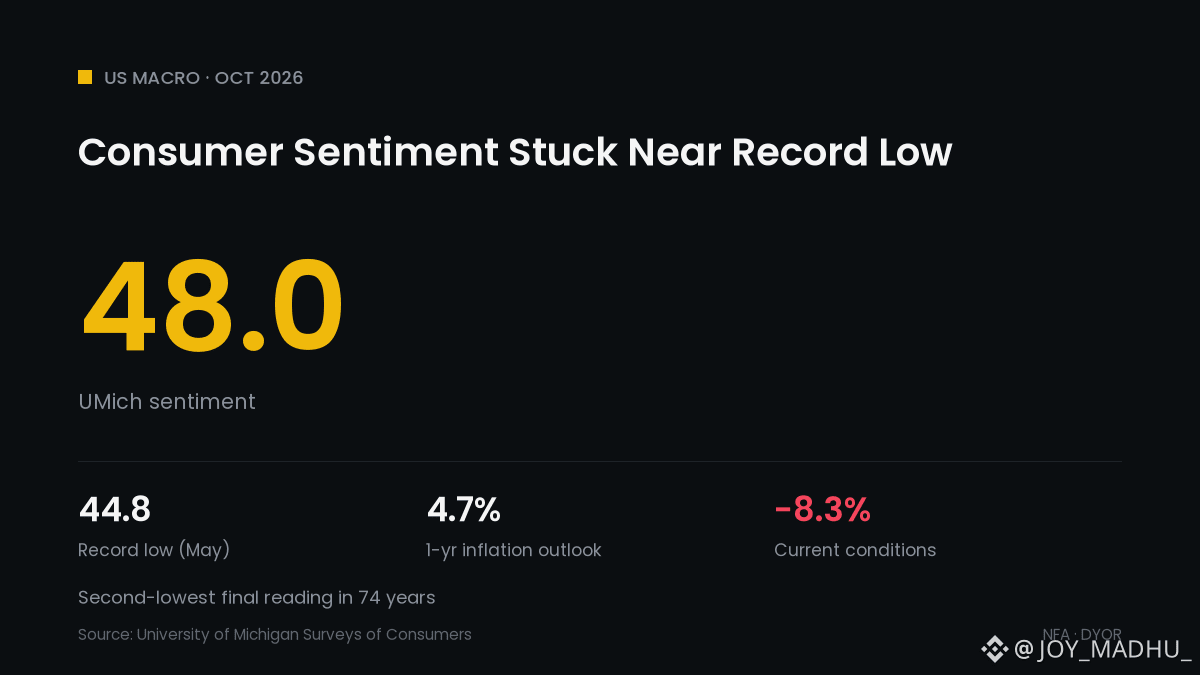
🇺🇸 US Consumer Sentiment Stuck at 48, Second-Lowest on Record
📊 University of Michigan final October index: 48.0, vs 48.1 in September
📉 Only May's 44.8 was lower in the survey's 74-year history
📈 Revised up from the preliminary 46.3, topping forecasts
⚠️ Current conditions fell 8.3% to 46.7 as durable-goods buying conditions plunged 18%
🔍 Year-ahead inflation expectations rose to 4.7%, long-run to 3.5%, highest since May
🌍 Sentiment sits 15% below February, before the Iran conflict, with oil above $116
What it means for crypto: rising inflation expectations give the Fed less room to ease, which can weigh on risk assets, while weak households could cool growth. Bitcoin is near $80.7K, down about 1.6% in 24 hours.
Does sticky inflation change your crypto plans? 👇
$BTC $ETH
#CryptoNews #Macro #Inflation #USConsumerSentimentHoldsAtSecondLowestOnRecord
#USConsumerSentimentHoldsAtSecondLowestOnRecord
🇺🇸 US Consumer Sentiment Stuck at 48, Second-Lowest on Record
📊 University of Michigan final October index: 48.0, vs 48.1 in September
📉 Only May's 44.8 was lower in the survey's 74-year history
📈 Revised up from the preliminary 46.3, topping forecasts
⚠️ Current conditions fell 8.3% to 46.7 as durable-goods buying conditions plunged 18%
🔍 Year-ahead inflation expectations rose to 4.7%, long-run to 3.5%, highest since May
🌍 Sentiment sits 15% below February, before the Iran conflict, with oil above $116
What it means for crypto: rising inflation expectations give the Fed less room to ease, which can weigh on risk assets, while weak households could cool growth. Bitcoin is near $80.7K, down about 1.6% in 24 hours.
Does sticky inflation change your crypto plans? 👇
$BTC $ETH
#CryptoNews #Macro #Inflation #USConsumerSentimentHoldsAtSecondLowestOnRecord
🇺🇸 US Consumer Sentiment Stuck at 48, Second-Lowest on Record
📊 University of Michigan final October index: 48.0, vs 48.1 in September
📉 Only May's 44.8 was lower in the survey's 74-year history
📈 Revised up from the preliminary 46.3, topping forecasts
⚠️ Current conditions fell 8.3% to 46.7 as durable-goods buying conditions plunged 18%
🔍 Year-ahead inflation expectations rose to 4.7%, long-run to 3.5%, highest since May
🌍 Sentiment sits 15% below February, before the Iran conflict, with oil above $116
What it means for crypto: rising inflation expectations give the Fed less room to ease, which can weigh on risk assets, while weak households could cool growth. Bitcoin is near $80.7K, down about 1.6% in 24 hours.
Does sticky inflation change your crypto plans? 👇
$BTC $ETH
#CryptoNews #Macro #Inflation #USConsumerSentimentHoldsAtSecondLowestOnRecord
7

·
--
🗓 Today’s agenda: Sunday, October 25 + Fed week
It’s a completely quiet macro day — no economic releases are scheduled (according to CME), and crypto is the only market open. But next week is one of the busiest weeks of the year.
Today:
• Europe turns its clocks back one hour — starting tomorrow, the London session will open an hour later than usual relative to Amman
• 15:00: Plasma token unlock (details in the 17:00 post)
This week’s agenda (Amman time):
• Monday ~20:42: Glamsterdam upgrade on Ethereum’s Hoodi testnet (timing depends on network settings and may change)
• Tuesday: U.S. new home sales + durable goods orders
• Wednesday 21:00: U.S. interest rate decision + 21:30 press conference
• Wednesday after the close: Microsoft and Alphabet earnings
• Thursday 15:30: U.S. GDP + PCE inflation index
• Thursday 16:15: European Central Bank decision — and after the close: Amazon earnings
• Friday: U.S. employment cost index
• Saturday: Chinese purchasing managers’ index
Also ongoing:
• Blockchain 100 Awards voting through October 28 — winners announced October 29 (we’ll have a dedicated post that day)
• Binance Pick campaign runs through November 15
Why does it matter for crypto? The Fed + tech earnings on the same night = the market’s direction for the whole week could be set in a single day.
Which event are you most looking forward to: Wednesday’s Fed decision or Microsoft and Alphabet earnings that same night? Comment “Fed” or “earnings” 👇
Source: CME / Global Economic Calendar
#Macro #BinancePick
🗓 Today’s agenda: Sunday, October 25 + Fed week
It’s a completely quiet macro day — no economic releases are scheduled (according to CME), and crypto is the only market open. But next week is one of the busiest weeks of the year.
Today:
• Europe turns its clocks back one hour — starting tomorrow, the London session will open an hour later than usual relative to Amman
• 15:00: Plasma token unlock (details in the 17:00 post)
This week’s agenda (Amman time):
• Monday ~20:42: Glamsterdam upgrade on Ethereum’s Hoodi testnet (timing depends on network settings and may change)
• Tuesday: U.S. new home sales + durable goods orders
• Wednesday 21:00: U.S. interest rate decision + 21:30 press conference
• Wednesday after the close: Microsoft and Alphabet earnings
• Thursday 15:30: U.S. GDP + PCE inflation index
• Thursday 16:15: European Central Bank decision — and after the close: Amazon earnings
• Friday: U.S. employment cost index
• Saturday: Chinese purchasing managers’ index
Also ongoing:
• Blockchain 100 Awards voting through October 28 — winners announced October 29 (we’ll have a dedicated post that day)
• Binance Pick campaign runs through November 15
Why does it matter for crypto? The Fed + tech earnings on the same night = the market’s direction for the whole week could be set in a single day.
Which event are you most looking forward to: Wednesday’s Fed decision or Microsoft and Alphabet earnings that same night? Comment “Fed” or “earnings” 👇
Source: CME / Global Economic Calendar
#Macro #BinancePick
It’s a completely quiet macro day — no economic releases are scheduled (according to CME), and crypto is the only market open. But next week is one of the busiest weeks of the year.
Today:
• Europe turns its clocks back one hour — starting tomorrow, the London session will open an hour later than usual relative to Amman
• 15:00: Plasma token unlock (details in the 17:00 post)
This week’s agenda (Amman time):
• Monday ~20:42: Glamsterdam upgrade on Ethereum’s Hoodi testnet (timing depends on network settings and may change)
• Tuesday: U.S. new home sales + durable goods orders
• Wednesday 21:00: U.S. interest rate decision + 21:30 press conference
• Wednesday after the close: Microsoft and Alphabet earnings
• Thursday 15:30: U.S. GDP + PCE inflation index
• Thursday 16:15: European Central Bank decision — and after the close: Amazon earnings
• Friday: U.S. employment cost index
• Saturday: Chinese purchasing managers’ index
Also ongoing:
• Blockchain 100 Awards voting through October 28 — winners announced October 29 (we’ll have a dedicated post that day)
• Binance Pick campaign runs through November 15
Why does it matter for crypto? The Fed + tech earnings on the same night = the market’s direction for the whole week could be set in a single day.
Which event are you most looking forward to: Wednesday’s Fed decision or Microsoft and Alphabet earnings that same night? Comment “Fed” or “earnings” 👇
Source: CME / Global Economic Calendar
#Macro #BinancePick

62

See translation
🔴 $BTC REELS FROM $140B MACRO SINKHOLE! 📉
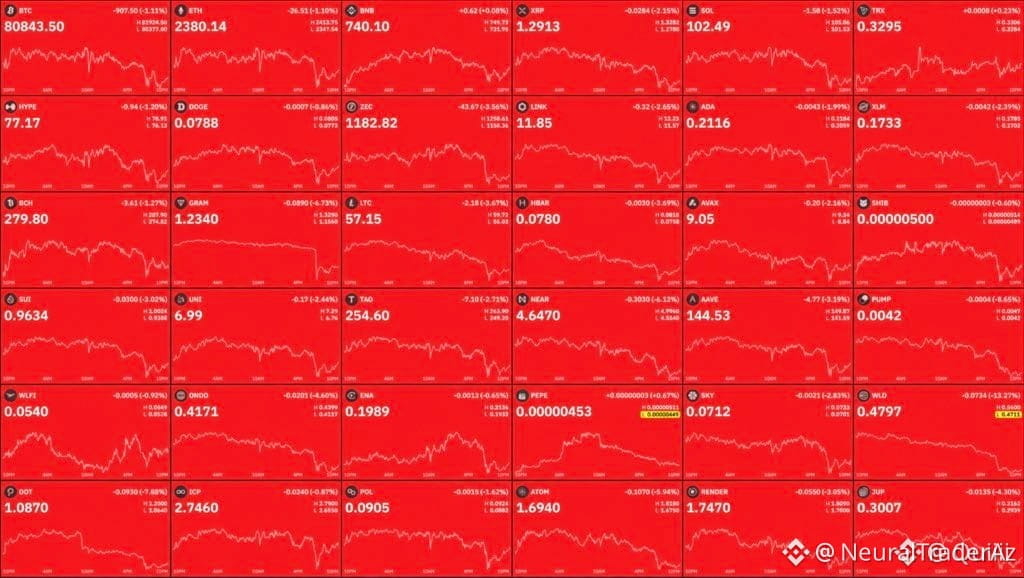
📊 Oil climbing toward $120 a barrel and the US‑Iran flare‑up have siphoned $140 B from crypto this week, draining liquidity from the order books. ⚡ The sell‑off mirrors a classic smart‑money liquidity sweep, where institutional players absorb the panic and reposition at deeper levels. 🌊 Watch the 27,800 $BTC cluster – it’s become the de‑facto demand pocket after three consecutive breaks.
💬 Will you brace for a deeper correction or start re‑allocating into safer havens? 👇
⚠️ Not financial advice. Always manage your risk. 🛡️
🏷️ #BTC #Bearish #Macro #Crypto
🔥 💎
🔴 $BTC REELS FROM $140B MACRO SINKHOLE! 📉
📊 Oil climbing toward $120 a barrel and the US‑Iran flare‑up have siphoned $140 B from crypto this week, draining liquidity from the order books. ⚡ The sell‑off mirrors a classic smart‑money liquidity sweep, where institutional players absorb the panic and reposition at deeper levels. 🌊 Watch the 27,800 $BTC cluster – it’s become the de‑facto demand pocket after three consecutive breaks.
💬 Will you brace for a deeper correction or start re‑allocating into safer havens? 👇
⚠️ Not financial advice. Always manage your risk. 🛡️
🏷️ #BTC #Bearish #Macro #Crypto
🔥 💎
📊 Oil climbing toward $120 a barrel and the US‑Iran flare‑up have siphoned $140 B from crypto this week, draining liquidity from the order books. ⚡ The sell‑off mirrors a classic smart‑money liquidity sweep, where institutional players absorb the panic and reposition at deeper levels. 🌊 Watch the 27,800 $BTC cluster – it’s become the de‑facto demand pocket after three consecutive breaks.
💬 Will you brace for a deeper correction or start re‑allocating into safer havens? 👇
⚠️ Not financial advice. Always manage your risk. 🛡️
🏷️ #BTC #Bearish #Macro #Crypto
🔥 💎

·
--
See translation
🔴 Bearish
🚨 FED HIKES RATES AGAIN! 🚨
The Federal Reserve just announced another 25 basis point rate hike, pushing borrowing costs higher than expected. This signals continued tightening.
📊 Market Impact: Crypto markets seeing immediate sell-off as risk-off sentiment takes hold. Expect volatility and a potential dip in altcoins.
#FED #Macro
🔴 Bearish
🚨 FED HIKES RATES AGAIN! 🚨
The Federal Reserve just announced another 25 basis point rate hike, pushing borrowing costs higher than expected. This signals continued tightening.
📊 Market Impact: Crypto markets seeing immediate sell-off as risk-off sentiment takes hold. Expect volatility and a potential dip in altcoins.
#FED #Macro
🚨 FED HIKES RATES AGAIN! 🚨
The Federal Reserve just announced another 25 basis point rate hike, pushing borrowing costs higher than expected. This signals continued tightening.
📊 Market Impact: Crypto markets seeing immediate sell-off as risk-off sentiment takes hold. Expect volatility and a potential dip in altcoins.
#FED #Macro

·
--
See translation
Oil at $102 is the only thing that matters. Brent up 2.5%. Crypto’s lazy 42% green? Meh.
Altcoins are noise. $SKY bleeding 4.3%, $PUMP down 2.5%. Small potatoes compared to inflation creeping back. If crude holds 100+, rates go up. That caps BTC near $82k for a while.
Not fighting the macro tape today. Energy spike is the signal, not the 6h moves on lesser names. Watch the yield curve before you touch those alts.
#Macro #Oil #BinanceSquare
Oil at $102 is the only thing that matters. Brent up 2.5%. Crypto’s lazy 42% green? Meh.
Altcoins are noise. $SKY bleeding 4.3%, $PUMP down 2.5%. Small potatoes compared to inflation creeping back. If crude holds 100+, rates go up. That caps BTC near $82k for a while.
Not fighting the macro tape today. Energy spike is the signal, not the 6h moves on lesser names. Watch the yield curve before you touch those alts.
#Macro #Oil #BinanceSquare
Altcoins are noise. $SKY bleeding 4.3%, $PUMP down 2.5%. Small potatoes compared to inflation creeping back. If crude holds 100+, rates go up. That caps BTC near $82k for a while.
Not fighting the macro tape today. Energy spike is the signal, not the 6h moves on lesser names. Watch the yield curve before you touch those alts.
#Macro #Oil #BinanceSquare
1.2k
·
--
See translation
The 10-year Treasury traded below 5% on Thursday for the first time since 23 September, on the same session December $BZ closed up 4.00% at 113.17. You'd normally expect an oil move that size to push yields up, since energy feeds straight into the inflation prints... this time the bid for duration came from Europe.
France's 10-year hit 5.142%, its highest since 2002 and above Treasuries for the first time since 2013, with the Bund spread at 176bp and French 5-year CDS over 100bp for the first time since October 2012. I think that's money running into Treasuries out of a European credit scare, and for a session it beat the oil impulse. The Fed is in blackout until the 29th, so none of it came from anything the Fed said.
$BTC fell 3.59% the same day, which isn't what the rates picture alone would have you expect from an asset with no cash flow.
I'm watching whether the 10-year can stay under 5% into the FOMC on 27-28 October while Brent holds this bid.
#Bonds #Treasuries #Macro #Bitcoin
The 10-year Treasury traded below 5% on Thursday for the first time since 23 September, on the same session December $BZ closed up 4.00% at 113.17. You'd normally expect an oil move that size to push yields up, since energy feeds straight into the inflation prints... this time the bid for duration came from Europe.
France's 10-year hit 5.142%, its highest since 2002 and above Treasuries for the first time since 2013, with the Bund spread at 176bp and French 5-year CDS over 100bp for the first time since October 2012. I think that's money running into Treasuries out of a European credit scare, and for a session it beat the oil impulse. The Fed is in blackout until the 29th, so none of it came from anything the Fed said.
$BTC fell 3.59% the same day, which isn't what the rates picture alone would have you expect from an asset with no cash flow.
I'm watching whether the 10-year can stay under 5% into the FOMC on 27-28 October while Brent holds this bid.
#Bonds #Treasuries #Macro #Bitcoin
France's 10-year hit 5.142%, its highest since 2002 and above Treasuries for the first time since 2013, with the Bund spread at 176bp and French 5-year CDS over 100bp for the first time since October 2012. I think that's money running into Treasuries out of a European credit scare, and for a session it beat the oil impulse. The Fed is in blackout until the 29th, so none of it came from anything the Fed said.
$BTC fell 3.59% the same day, which isn't what the rates picture alone would have you expect from an asset with no cash flow.
I'm watching whether the 10-year can stay under 5% into the FOMC on 27-28 October while Brent holds this bid.
#Bonds #Treasuries #Macro #Bitcoin
415

·
--
See translation
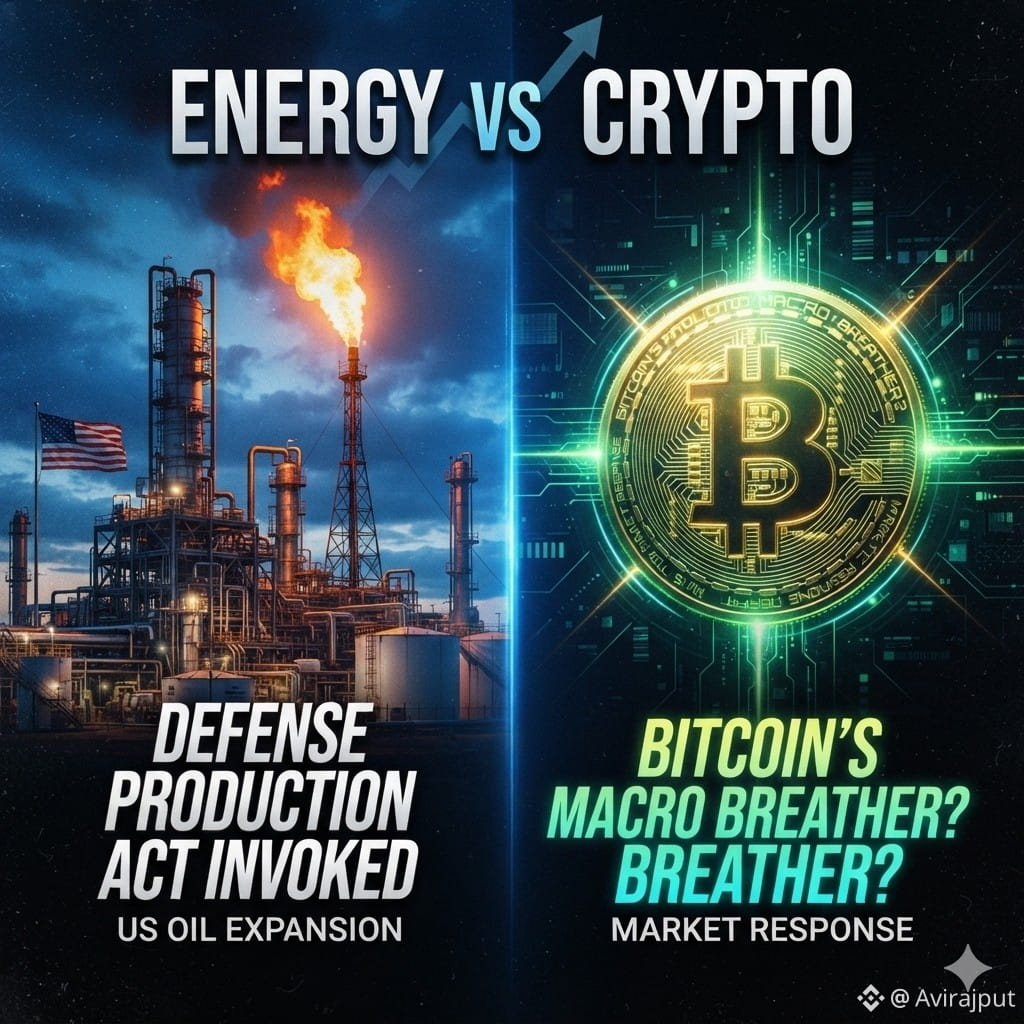
🔥 MACRO SHOCK: Trump Invokes Cold War Law to Force US Oil Surge! 🇺🇸🛢️
President Donald Trump just weaponised the Defense Production Act (DPA). Domestic oil refining and supply chains are now officially classified as crucial to national defense.
The White House is fast-tracking $150 million to aggressively scale up diesel and gasoline refining capacity. The goal? Crash soaring energy costs and blunt global supply shocks.
The Crypto Impact:
Energy drives inflation. Sticky inflation keeps interest rates high, bleeding risk assets. If this move successfully forces oil prices down, it removes a major macroeconomic chokehold—giving $BTC and the broader crypto market serious room to run.
👇 Let's debate in the comments:
Is this the supply shock absorber that triggers the next massive crypto rally, or is the global energy crisis too big to policy away? Are you buying the dip or staying hedged? 💬
#TrumpInvokesDefenseProductionActToExpandOilCapacit #BTC☀️ #Macro
{spot}(ASTERUSDT)
🔥 MACRO SHOCK: Trump Invokes Cold War Law to Force US Oil Surge! 🇺🇸🛢️
President Donald Trump just weaponised the Defense Production Act (DPA). Domestic oil refining and supply chains are now officially classified as crucial to national defense.
The White House is fast-tracking $150 million to aggressively scale up diesel and gasoline refining capacity. The goal? Crash soaring energy costs and blunt global supply shocks.
The Crypto Impact:
Energy drives inflation. Sticky inflation keeps interest rates high, bleeding risk assets. If this move successfully forces oil prices down, it removes a major macroeconomic chokehold—giving $BTC and the broader crypto market serious room to run.
👇 Let's debate in the comments:
Is this the supply shock absorber that triggers the next massive crypto rally, or is the global energy crisis too big to policy away? Are you buying the dip or staying hedged? 💬
#TrumpInvokesDefenseProductionActToExpandOilCapacit #BTC☀️ #Macro
President Donald Trump just weaponised the Defense Production Act (DPA). Domestic oil refining and supply chains are now officially classified as crucial to national defense.
The White House is fast-tracking $150 million to aggressively scale up diesel and gasoline refining capacity. The goal? Crash soaring energy costs and blunt global supply shocks.
The Crypto Impact:
Energy drives inflation. Sticky inflation keeps interest rates high, bleeding risk assets. If this move successfully forces oil prices down, it removes a major macroeconomic chokehold—giving $BTC and the broader crypto market serious room to run.
👇 Let's debate in the comments:
Is this the supply shock absorber that triggers the next massive crypto rally, or is the global energy crisis too big to policy away? Are you buying the dip or staying hedged? 💬
#TrumpInvokesDefenseProductionActToExpandOilCapacit #BTC☀️ #Macro
1
161


·
--
See translation
$BTC - Macro crosswinds tighten as Japan and US central banks eye December moves.
Japan core CPI topped 2% in September, first time in nine months, per BeInCrypto.
BOJ seen holding next week but December hike odds rise.
Fed also expected to move in December.
Dual tightening would drain dollar liquidity - risk-off pressure on risk assets.
Unknown if BOJ follows through given recent dovish signals.
#Inflation #Macro
$BTC - Macro crosswinds tighten as Japan and US central banks eye December moves.
Japan core CPI topped 2% in September, first time in nine months, per BeInCrypto.
BOJ seen holding next week but December hike odds rise.
Fed also expected to move in December.
Dual tightening would drain dollar liquidity - risk-off pressure on risk assets.
Unknown if BOJ follows through given recent dovish signals.
#Inflation #Macro
Japan core CPI topped 2% in September, first time in nine months, per BeInCrypto.
BOJ seen holding next week but December hike odds rise.
Fed also expected to move in December.
Dual tightening would drain dollar liquidity - risk-off pressure on risk assets.
Unknown if BOJ follows through given recent dovish signals.
#Inflation #Macro
33

See translation
Bitcoin's December just got a rate-hike problem — from Tokyo.
Japan's September core CPI rose to 2.1%, crossing the Bank of Japan's 2% target for the first time since December. It matched forecasts, but removes the doves' last excuse: dissenters who voted against September's 1.25% hike argued inflation was still below target. It isn't anymore.
Reuters sources say the BOJ will likely use next week's meeting to signal underlying inflation has roughly hit 2% — keeping a December hike to 1.50% on the table. And it's not alone: CME FedWatch puts an 80.5% chance on a Fed hike by December 9, with the BOJ meeting December 17–18.
Why it matters: two of the world's biggest central banks tightening in the same month would tighten global liquidity — the classic headwind for risk assets. $BTC sits near $82K (-1.0%/24h) heading into it. Counterweight: some of this is already priced — polls already lean toward a December hike, and 2.1% matching forecast exactly isn't a shock.
Does December's crypto rally thesis survive two rate hikes?
$BTC #Bitcoin #BOJ #Inflation #Macro
Bitcoin's December just got a rate-hike problem — from Tokyo.
Japan's September core CPI rose to 2.1%, crossing the Bank of Japan's 2% target for the first time since December. It matched forecasts, but removes the doves' last excuse: dissenters who voted against September's 1.25% hike argued inflation was still below target. It isn't anymore.
Reuters sources say the BOJ will likely use next week's meeting to signal underlying inflation has roughly hit 2% — keeping a December hike to 1.50% on the table. And it's not alone: CME FedWatch puts an 80.5% chance on a Fed hike by December 9, with the BOJ meeting December 17–18.
Why it matters: two of the world's biggest central banks tightening in the same month would tighten global liquidity — the classic headwind for risk assets. $BTC sits near $82K (-1.0%/24h) heading into it. Counterweight: some of this is already priced — polls already lean toward a December hike, and 2.1% matching forecast exactly isn't a shock.
Does December's crypto rally thesis survive two rate hikes?
$BTC #Bitcoin #BOJ #Inflation #Macro
Japan's September core CPI rose to 2.1%, crossing the Bank of Japan's 2% target for the first time since December. It matched forecasts, but removes the doves' last excuse: dissenters who voted against September's 1.25% hike argued inflation was still below target. It isn't anymore.
Reuters sources say the BOJ will likely use next week's meeting to signal underlying inflation has roughly hit 2% — keeping a December hike to 1.50% on the table. And it's not alone: CME FedWatch puts an 80.5% chance on a Fed hike by December 9, with the BOJ meeting December 17–18.
Why it matters: two of the world's biggest central banks tightening in the same month would tighten global liquidity — the classic headwind for risk assets. $BTC sits near $82K (-1.0%/24h) heading into it. Counterweight: some of this is already priced — polls already lean toward a December hike, and 2.1% matching forecast exactly isn't a shock.
Does December's crypto rally thesis survive two rate hikes?
$BTC #Bitcoin #BOJ #Inflation #Macro
7

See translation
Why is nobody talking about how oil prices are the real driver behind these high-growth crypto dumps?
Most traders lose money chasing names like $ETH and $SOL without factoring energy costs into their thesis. You FOMO into the latest expansion narrative then watch the market reverse with no clear signal on when to exit.
This latest spike is a textbook case. Brent crude jumped above $111 a barrel, which immediately pushed Treasury yields higher and made the Fed's inflation puzzle even messier than it already was.
High-growth tech expansion took the hit first. In crypto that means the scaling and ecosystem stories around $ETH and $SOL suddenly look more expensive to fund when rates get pushed up by energy costs.
People still treat $BTC inflows as the only story that matters while this energy pressure quietly dictates risk appetite across the rest of the market.
Where do you think this goes from here if crude stays elevated?
#Inflation #Crypto #Macro
Why is nobody talking about how oil prices are the real driver behind these high-growth crypto dumps?
Most traders lose money chasing names like $ETH and $SOL without factoring energy costs into their thesis. You FOMO into the latest expansion narrative then watch the market reverse with no clear signal on when to exit.
This latest spike is a textbook case. Brent crude jumped above $111 a barrel, which immediately pushed Treasury yields higher and made the Fed's inflation puzzle even messier than it already was.
High-growth tech expansion took the hit first. In crypto that means the scaling and ecosystem stories around $ETH and $SOL suddenly look more expensive to fund when rates get pushed up by energy costs.
People still treat $BTC inflows as the only story that matters while this energy pressure quietly dictates risk appetite across the rest of the market.
Where do you think this goes from here if crude stays elevated?
#Inflation #Crypto #Macro
Most traders lose money chasing names like $ETH and $SOL without factoring energy costs into their thesis. You FOMO into the latest expansion narrative then watch the market reverse with no clear signal on when to exit.
This latest spike is a textbook case. Brent crude jumped above $111 a barrel, which immediately pushed Treasury yields higher and made the Fed's inflation puzzle even messier than it already was.
High-growth tech expansion took the hit first. In crypto that means the scaling and ecosystem stories around $ETH and $SOL suddenly look more expensive to fund when rates get pushed up by energy costs.
People still treat $BTC inflows as the only story that matters while this energy pressure quietly dictates risk appetite across the rest of the market.
Where do you think this goes from here if crude stays elevated?
#Inflation #Crypto #Macro

45
Log in to explore more content
Join global crypto users on Binance Square
⚡️ Get latest and useful information about crypto.
💬 Trusted by the world’s largest crypto exchange.
👍 Discover real insights from verified creators.
Email / Phone number
Trending Topics
1
#BinancePick
3.2M views
159,920 Discussing
2
#EarningsSeason
5.4M views
26,419 Discussing
3
#StrategySkipsBitcoinPurchasesSpends$205MOnSTRCBuybacks
0 views
0 Discussing
4
#BitmineAdds10452ETH
2,049 views
64 Discussing
5
#SouthKoreaConsidersEducationTaxOnCryptoExchanges
2,300 views
70 Discussing
6
#OCCUrgesCommunityBanksToEnterStablecoinPayments
1,901 views
51 Discussing
7
#RippleWinsFullApprovalAsNationalTrustBank
1,465 views
44 Discussing
8
#AkashSelectsSolanaAsMigrationTarget
692 views
15 Discussing
9
#OndoToOpenSubscriptionsForOpenAIPreIPOTokenizedNotes
57 views
4 Discussing
10
#AnthropicTTMRevenueGrewAbout1200%
48,291 views
526 Discussing