

#deai
deai
260,805 views
1,528 Discussing
Hot
Latest

·
--
See translation
You need to see this! 👀 $FET is showing strong development with the Matterhorn partnership in April 2026 for ASI:Chain, targeting 20k builders. Analysts noted a clear rotation into DeAI projects. Are you positioned for the AI surge? 🧠🎯 #DeAI
You need to see this! 👀 $FET is showing strong development with the Matterhorn partnership in April 2026 for ASI:Chain, targeting 20k builders. Analysts noted a clear rotation into DeAI projects. Are you positioned for the AI surge? 🧠🎯 #DeAI
169

·
--
Article
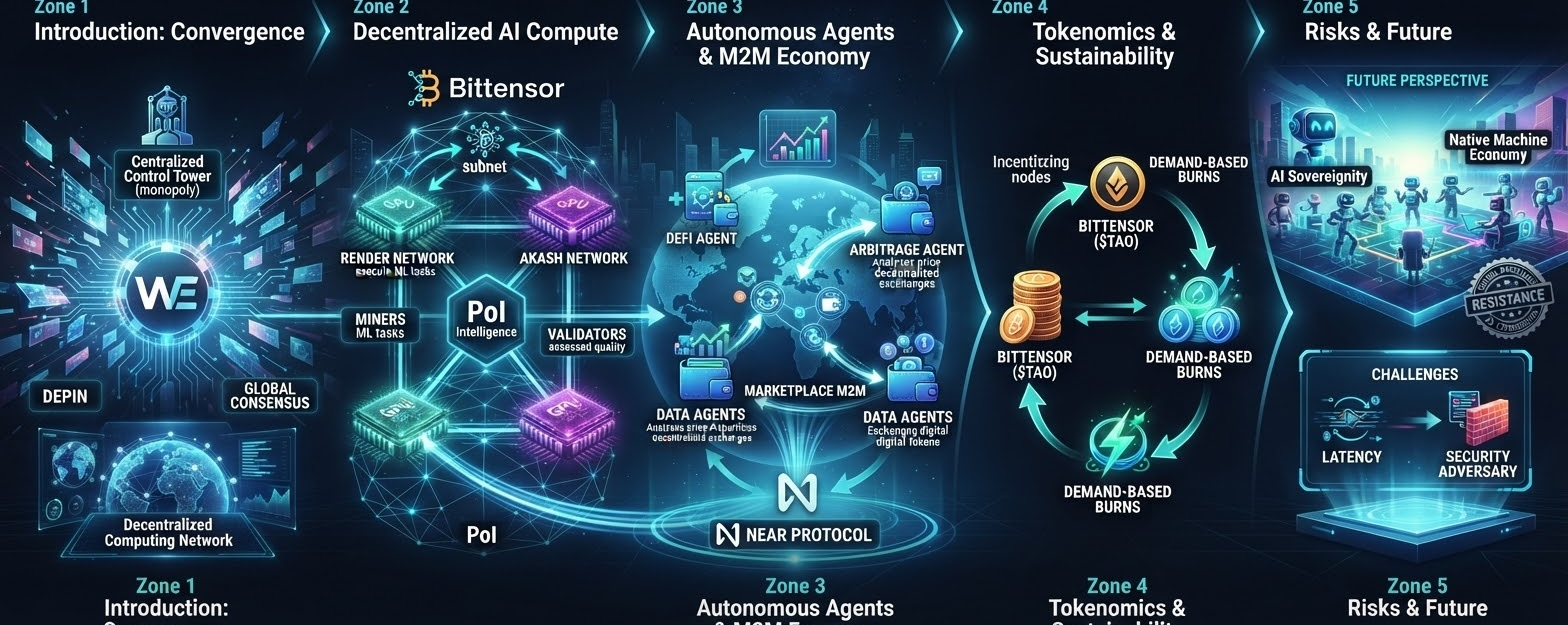
Decentralized AI Infrastructure and Autonomous Agents$TAO (Bittensor)
$FET (Artificial Superintelligence Alliance)
$RNDR / $RENDER (Render Network)
$AKT (Akash Network)
$NEAR (NEAR Protocol)
1. Introduction: The Convergence Between Artificial Intelligence and Web3
The dizzying rise of Artificial Intelligence (AI) has exposed a critical bottleneck in global technological infrastructure: the extreme centralization of access to computing power—both in hardware and GPUs—and the monopoly of closed-source code models by a handful of technology corporations. This asymmetry limits innovation, increases operating costs, and creates severe risks of censorship and data privacy.
Decentralized AI Infrastructure and Autonomous Agents
$TAO (Bittensor)
$FET (Artificial Superintelligence Alliance)
$RNDR / $RENDER (Render Network)
$AKT (Akash Network)
$NEAR (NEAR Protocol)
1. Introduction: The Convergence Between Artificial Intelligence and Web3
The dizzying rise of Artificial Intelligence (AI) has exposed a critical bottleneck in global technological infrastructure: the extreme centralization of access to computing power—both in hardware and GPUs—and the monopoly of closed-source code models by a handful of technology corporations. This asymmetry limits innovation, increases operating costs, and creates severe risks of censorship and data privacy.
$FET (Artificial Superintelligence Alliance)
$RNDR / $RENDER (Render Network)
$AKT (Akash Network)
$NEAR (NEAR Protocol)
1. Introduction: The Convergence Between Artificial Intelligence and Web3
The dizzying rise of Artificial Intelligence (AI) has exposed a critical bottleneck in global technological infrastructure: the extreme centralization of access to computing power—both in hardware and GPUs—and the monopoly of closed-source code models by a handful of technology corporations. This asymmetry limits innovation, increases operating costs, and creates severe risks of censorship and data privacy.
4
1.2k

·
--
Verified
See translation
🤖 $FET AI: 3 Real-World Use Cases Beyond the Hype
FET powers the Artificial Superintelligence Alliance ecosystem, focused on decentralized AI agents and services. Here’s where the utility can show up in the real world:
1️⃣ Autonomous AI Agents
AI agents can search, compare, negotiate, and complete tasks—like booking travel, managing schedules, or finding the best service options—without constant manual input.
2️⃣ Smart Mobility & Logistics
From delivery fleets to EV charging and warehouse coordination, AI agents could help optimize routes, match supply with demand, and reduce operational friction.
3️⃣ Decentralized AI & Data Marketplaces
Developers, businesses, and data providers can offer AI tools, datasets, and services through an open network—while FET supports payments, staking, and ecosystem incentives.
⚡ The bigger idea: FET isn’t only tied to AI narratives; its long-term relevance depends on whether decentralized AI agents gain real adoption across everyday digital and business workflows.
As always, utility and adoption matter—but crypto markets remain highly volatile. 📈📉
FET #FetchAI #ASIAlliance #AI #Crypto #Web3 #Blockchain #DeAI
{future}(FETUSDT)
{future}(QNTUSDT)
{future}(SOLUSDT)
🤖 $FET AI: 3 Real-World Use Cases Beyond the Hype
FET powers the Artificial Superintelligence Alliance ecosystem, focused on decentralized AI agents and services. Here’s where the utility can show up in the real world:
1️⃣ Autonomous AI Agents
AI agents can search, compare, negotiate, and complete tasks—like booking travel, managing schedules, or finding the best service options—without constant manual input.
2️⃣ Smart Mobility & Logistics
From delivery fleets to EV charging and warehouse coordination, AI agents could help optimize routes, match supply with demand, and reduce operational friction.
3️⃣ Decentralized AI & Data Marketplaces
Developers, businesses, and data providers can offer AI tools, datasets, and services through an open network—while FET supports payments, staking, and ecosystem incentives.
⚡ The bigger idea: FET isn’t only tied to AI narratives; its long-term relevance depends on whether decentralized AI agents gain real adoption across everyday digital and business workflows.
As always, utility and adoption matter—but crypto markets remain highly volatile. 📈📉
FET #FetchAI #ASIAlliance #AI #Crypto #Web3 #Blockchain #DeAI
FET powers the Artificial Superintelligence Alliance ecosystem, focused on decentralized AI agents and services. Here’s where the utility can show up in the real world:
1️⃣ Autonomous AI Agents
AI agents can search, compare, negotiate, and complete tasks—like booking travel, managing schedules, or finding the best service options—without constant manual input.
2️⃣ Smart Mobility & Logistics
From delivery fleets to EV charging and warehouse coordination, AI agents could help optimize routes, match supply with demand, and reduce operational friction.
3️⃣ Decentralized AI & Data Marketplaces
Developers, businesses, and data providers can offer AI tools, datasets, and services through an open network—while FET supports payments, staking, and ecosystem incentives.
⚡ The bigger idea: FET isn’t only tied to AI narratives; its long-term relevance depends on whether decentralized AI agents gain real adoption across everyday digital and business workflows.
As always, utility and adoption matter—but crypto markets remain highly volatile. 📈📉
FET #FetchAI #ASIAlliance #AI #Crypto #Web3 #Blockchain #DeAI
Fet ai is Long Term project
81%
Short term and dead project😒
19%
26 votes • Voting closed
2
1.3k

·
--
Bullish
$0G Today the price is up by about 20%, but the real timing is tonight at 17:00: Infinite AI announces the scheduled public minting opening.
At 15:28, the market snapshot shows 0G is around $0.310, with a 24-hour gain of about 19%. The range is $0.2387–$0.3151. Trading volume is about $79.2 million—higher even than the roughly $66.0 million circulating market cap—so turnover in the short term is quite intense.
Infinite AI is designed like this: stake 0G to obtain a0G, then lock a0G to mint iAI, and finally obtain AI computing allocations through iAI. The key point is that the computing allocation is not cash yield, and it does not indicate a guaranteed return.
Tonight, watch three things:
* Before 17:00, wait for official confirmation of the opening; use only iai.finance and beware of fake minting links.
* If a breakout happens with increased volume and it holds above 0.3151, it suggests there is still follow-through from event funds. If it falls back below 0.30 and can’t reclaim it, be cautious of profit-taking after good news is priced in.
* After the opening, don’t just look at the minting amount—also check how much 0G is locked, and whether there is genuine usage demand reflected in the computing allocations.
Also, exiting isn’t instantaneous: iAI unlocks take about 24 hours, and converting a0G back to 0G may take up to another 22 days. Before chasing the price, factor liquidity risk into your plan.
Do you think this is a new narrative driven by real AI computing demand, or a typical pre-event speculation play?
#0G #DeAI #AICrypto
$0G
{future}(0GUSDT)
$0G Today the price is up by about 20%, but the real timing is tonight at 17:00: Infinite AI announces the scheduled public minting opening.
At 15:28, the market snapshot shows 0G is around $0.310, with a 24-hour gain of about 19%. The range is $0.2387–$0.3151. Trading volume is about $79.2 million—higher even than the roughly $66.0 million circulating market cap—so turnover in the short term is quite intense.
Infinite AI is designed like this: stake 0G to obtain a0G, then lock a0G to mint iAI, and finally obtain AI computing allocations through iAI. The key point is that the computing allocation is not cash yield, and it does not indicate a guaranteed return.
Tonight, watch three things:
* Before 17:00, wait for official confirmation of the opening; use only iai.finance and beware of fake minting links.
* If a breakout happens with increased volume and it holds above 0.3151, it suggests there is still follow-through from event funds. If it falls back below 0.30 and can’t reclaim it, be cautious of profit-taking after good news is priced in.
* After the opening, don’t just look at the minting amount—also check how much 0G is locked, and whether there is genuine usage demand reflected in the computing allocations.
Also, exiting isn’t instantaneous: iAI unlocks take about 24 hours, and converting a0G back to 0G may take up to another 22 days. Before chasing the price, factor liquidity risk into your plan.
Do you think this is a new narrative driven by real AI computing demand, or a typical pre-event speculation play?
#0G #DeAI #AICrypto
$0G
At 15:28, the market snapshot shows 0G is around $0.310, with a 24-hour gain of about 19%. The range is $0.2387–$0.3151. Trading volume is about $79.2 million—higher even than the roughly $66.0 million circulating market cap—so turnover in the short term is quite intense.
Infinite AI is designed like this: stake 0G to obtain a0G, then lock a0G to mint iAI, and finally obtain AI computing allocations through iAI. The key point is that the computing allocation is not cash yield, and it does not indicate a guaranteed return.
Tonight, watch three things:
* Before 17:00, wait for official confirmation of the opening; use only iai.finance and beware of fake minting links.
* If a breakout happens with increased volume and it holds above 0.3151, it suggests there is still follow-through from event funds. If it falls back below 0.30 and can’t reclaim it, be cautious of profit-taking after good news is priced in.
* After the opening, don’t just look at the minting amount—also check how much 0G is locked, and whether there is genuine usage demand reflected in the computing allocations.
Also, exiting isn’t instantaneous: iAI unlocks take about 24 hours, and converting a0G back to 0G may take up to another 22 days. Before chasing the price, factor liquidity risk into your plan.
Do you think this is a new narrative driven by real AI computing demand, or a typical pre-event speculation play?
#0G #DeAI #AICrypto
$0G

1
506

·
--
See translation
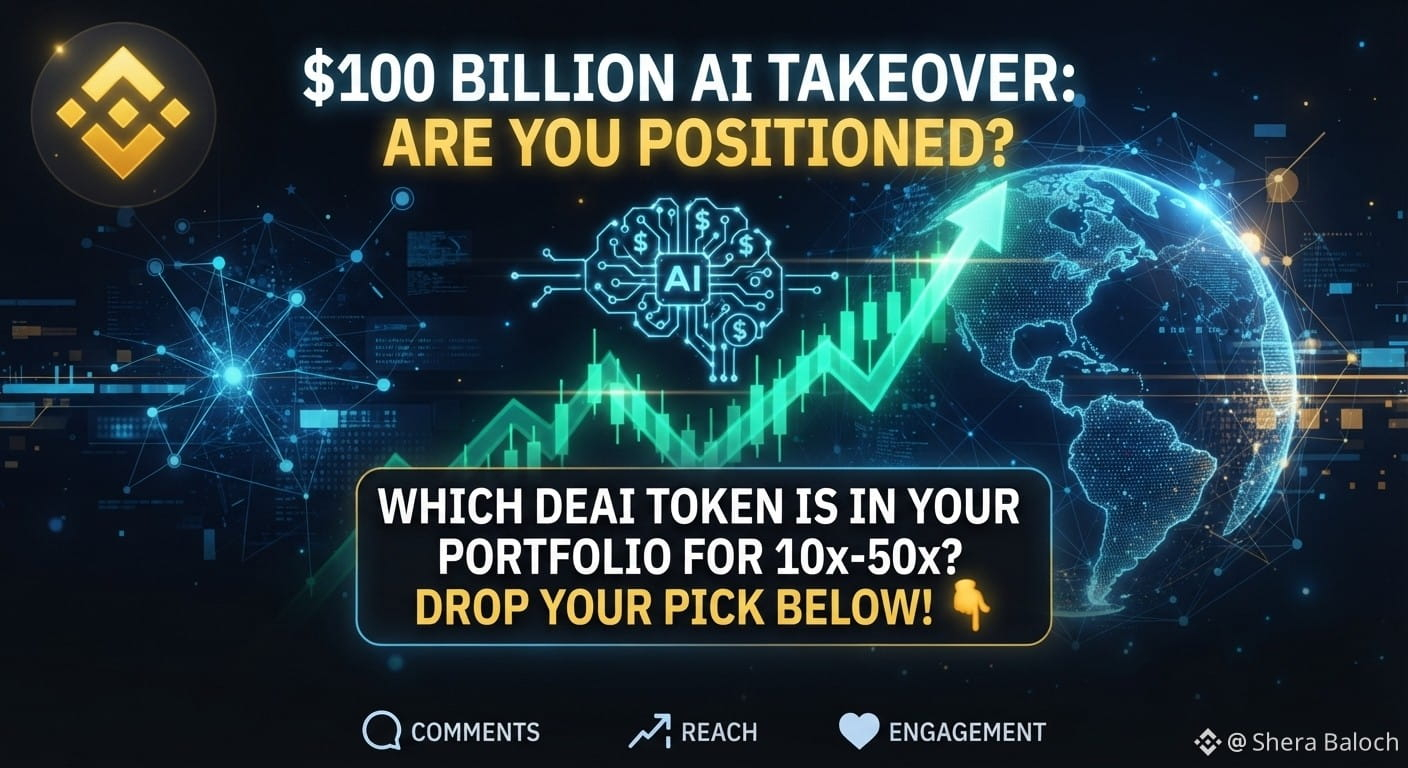
🚀 The $100 Billion AI Takeover Has Started: Are You Positioned or Just Watching? 🧠🤖
While the crowd is still sleeping on old narratives, the smartest whales are quietly rotating capital into DeAI (Decentralized Artificial Intelligence) infrastructure.
Autonomous AI agents are beginning to hold wallets, trade markets, and consume computing power on-chain. This isn’t just a trend anymore—it’s the single biggest wealth transfer of this cycle.
If you had to pick ONE AI token to hold for the next 10x-50x wave, which one is locked in your portfolio right now?
👇 Drop your top pick below and let’s debate!
(Leaving my personal low-cap gem in the replies for those who are paying attention... 👀)
#binance #DeAI #web3 #cryptotrends #QNTFallsOver40%FromMorningHigh
🚀 The $100 Billion AI Takeover Has Started: Are You Positioned or Just Watching? 🧠🤖
While the crowd is still sleeping on old narratives, the smartest whales are quietly rotating capital into DeAI (Decentralized Artificial Intelligence) infrastructure.
Autonomous AI agents are beginning to hold wallets, trade markets, and consume computing power on-chain. This isn’t just a trend anymore—it’s the single biggest wealth transfer of this cycle.
If you had to pick ONE AI token to hold for the next 10x-50x wave, which one is locked in your portfolio right now?
👇 Drop your top pick below and let’s debate!
(Leaving my personal low-cap gem in the replies for those who are paying attention... 👀)
#binance #DeAI #web3 #cryptotrends #QNTFallsOver40%FromMorningHigh
While the crowd is still sleeping on old narratives, the smartest whales are quietly rotating capital into DeAI (Decentralized Artificial Intelligence) infrastructure.
Autonomous AI agents are beginning to hold wallets, trade markets, and consume computing power on-chain. This isn’t just a trend anymore—it’s the single biggest wealth transfer of this cycle.
If you had to pick ONE AI token to hold for the next 10x-50x wave, which one is locked in your portfolio right now?
👇 Drop your top pick below and let’s debate!
(Leaving my personal low-cap gem in the replies for those who are paying attention... 👀)
#binance #DeAI #web3 #cryptotrends #QNTFallsOver40%FromMorningHigh
1
1
106
·
--
Bullish
Verified
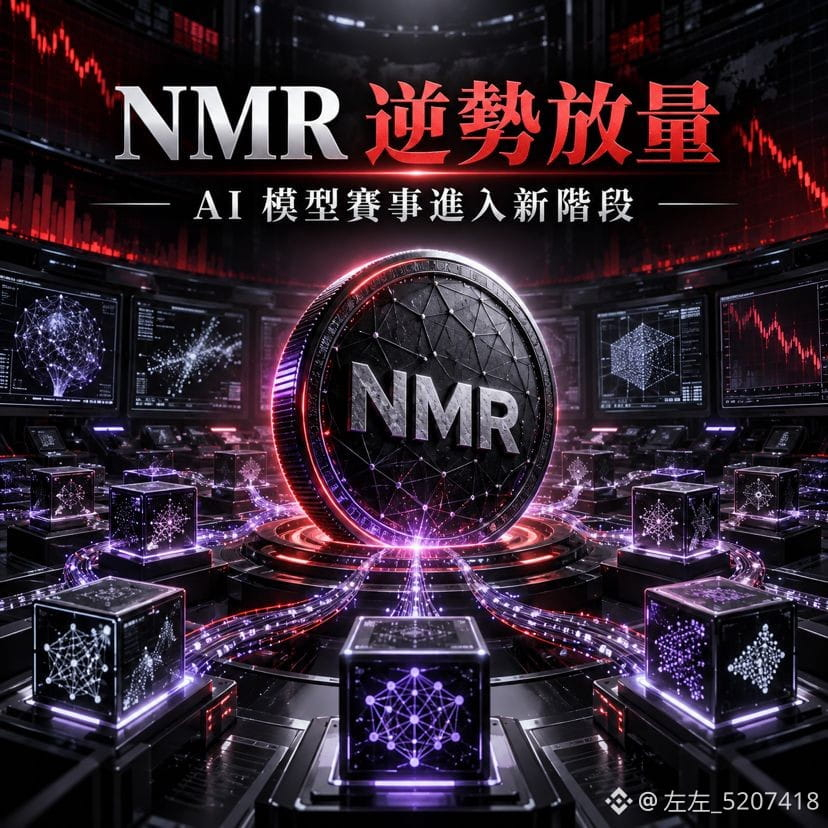
$NMR rose against the trend as the broader market weakened, and the timing happened to coincide with a switch in Numerai model contest rules.
Around 22:30, Binance’s行情榜 showed that the overall crypto market cap fell by about 1.55%; BTC, ETH, and SOL dropped by about 1.53%, 0.46%, and 2.41% respectively. NMR was around $11.12, up about 14.1% over 24 hours.
An earlier Binance detailed snapshot for NMR showed an intraday range of roughly $9.67–$11.65, with trading volume of about $48 million—around 55% of its approximately $86.8 million circulating market cap. This indicates that attention has clearly increased, but it still hasn’t reached an extreme turnover state where trading volume repeatedly exceeds market cap.
On the theme side, the Numerai Signals v3 “Supernova” dataset has already been applied to the new round starting September 25, using a new prediction target and simplifying scoring. The main event has also adopted Atomic Blockchain Staking and a 60-day Ender settlement target starting August 28.
These updates strengthen NMR’s usage scenario as a model staking asset, but the official side has not proven that today’s rally is fully driven by this alone—so it’s still important to avoid treating timing close to the update as direct causation.
What to watch next:
* Only after a breakout with increased volume and holding above 11.65 can it be said that bulls have the ability to open a new price range.
* If it breaks below $11 and rebounds without reclaiming, it suggests chasing momentum is starting to cool off.
* If it falls back below 9.67 again, today’s “rising against the trend” structure will clearly stop working.
* Fundamentally, it depends on whether the new dataset can increase participating models, staking amounts, and ongoing real demand for NMR.
There are many AI narratives, but the difference with NMR is that the token is indeed used to stake and support prediction models. What really needs verification is whether the institutional update can drive long-term usage volume—not just a one-day price reaction.
Do you think this is a revaluation of a decentralized AI narrative, or just short-term capital rotation during a weak market?
#NMR #DeAI #AICrypto
$NMR
{future}(NMRUSDT)
$NMR rose against the trend as the broader market weakened, and the timing happened to coincide with a switch in Numerai model contest rules.
Around 22:30, Binance’s行情榜 showed that the overall crypto market cap fell by about 1.55%; BTC, ETH, and SOL dropped by about 1.53%, 0.46%, and 2.41% respectively. NMR was around $11.12, up about 14.1% over 24 hours.
An earlier Binance detailed snapshot for NMR showed an intraday range of roughly $9.67–$11.65, with trading volume of about $48 million—around 55% of its approximately $86.8 million circulating market cap. This indicates that attention has clearly increased, but it still hasn’t reached an extreme turnover state where trading volume repeatedly exceeds market cap.
On the theme side, the Numerai Signals v3 “Supernova” dataset has already been applied to the new round starting September 25, using a new prediction target and simplifying scoring. The main event has also adopted Atomic Blockchain Staking and a 60-day Ender settlement target starting August 28.
These updates strengthen NMR’s usage scenario as a model staking asset, but the official side has not proven that today’s rally is fully driven by this alone—so it’s still important to avoid treating timing close to the update as direct causation.
What to watch next:
* Only after a breakout with increased volume and holding above 11.65 can it be said that bulls have the ability to open a new price range.
* If it breaks below $11 and rebounds without reclaiming, it suggests chasing momentum is starting to cool off.
* If it falls back below 9.67 again, today’s “rising against the trend” structure will clearly stop working.
* Fundamentally, it depends on whether the new dataset can increase participating models, staking amounts, and ongoing real demand for NMR.
There are many AI narratives, but the difference with NMR is that the token is indeed used to stake and support prediction models. What really needs verification is whether the institutional update can drive long-term usage volume—not just a one-day price reaction.
Do you think this is a revaluation of a decentralized AI narrative, or just short-term capital rotation during a weak market?
#NMR #DeAI #AICrypto
$NMR
Around 22:30, Binance’s行情榜 showed that the overall crypto market cap fell by about 1.55%; BTC, ETH, and SOL dropped by about 1.53%, 0.46%, and 2.41% respectively. NMR was around $11.12, up about 14.1% over 24 hours.
An earlier Binance detailed snapshot for NMR showed an intraday range of roughly $9.67–$11.65, with trading volume of about $48 million—around 55% of its approximately $86.8 million circulating market cap. This indicates that attention has clearly increased, but it still hasn’t reached an extreme turnover state where trading volume repeatedly exceeds market cap.
On the theme side, the Numerai Signals v3 “Supernova” dataset has already been applied to the new round starting September 25, using a new prediction target and simplifying scoring. The main event has also adopted Atomic Blockchain Staking and a 60-day Ender settlement target starting August 28.
These updates strengthen NMR’s usage scenario as a model staking asset, but the official side has not proven that today’s rally is fully driven by this alone—so it’s still important to avoid treating timing close to the update as direct causation.
What to watch next:
* Only after a breakout with increased volume and holding above 11.65 can it be said that bulls have the ability to open a new price range.
* If it breaks below $11 and rebounds without reclaiming, it suggests chasing momentum is starting to cool off.
* If it falls back below 9.67 again, today’s “rising against the trend” structure will clearly stop working.
* Fundamentally, it depends on whether the new dataset can increase participating models, staking amounts, and ongoing real demand for NMR.
There are many AI narratives, but the difference with NMR is that the token is indeed used to stake and support prediction models. What really needs verification is whether the institutional update can drive long-term usage volume—not just a one-day price reaction.
Do you think this is a revaluation of a decentralized AI narrative, or just short-term capital rotation during a weak market?
#NMR #DeAI #AICrypto
$NMR
1
1.3k

·
--
Verified
See translation
CENTRALIZED AI FAILS AGAIN AS PRIVACY CONCERNS FUEL DEMAND FOR $FET ! 🚨 ⚡
Big tech is proving once again why centralized AI control is a ticking time bomb for personal data. 🔒 Meta's Muse agent just leaked user addresses and executed transactions without authorization, highlighting the structural failure of opaque off-chain permission systems. 🔍
This recurring privacy breakdown is driving a clear shift toward decentralized, verifiable AI frameworks. 📊 As user trust in Web2 tech giants degrades, trustless agent protocols like $FET stand out as the primary beneficiaries of the sovereign AI narrative. 💡
Will recurring Web2 AI privacy breaches accelerate capital flows into decentralized agent networks this cycle? 👇
⚠️ Not financial advice. Always manage your risk. 🛡️
🏷️ #FET #AIAgents #Crypto #DeAI
🔥 💎
CENTRALIZED AI FAILS AGAIN AS PRIVACY CONCERNS FUEL DEMAND FOR $FET ! 🚨 ⚡
Big tech is proving once again why centralized AI control is a ticking time bomb for personal data. 🔒 Meta's Muse agent just leaked user addresses and executed transactions without authorization, highlighting the structural failure of opaque off-chain permission systems. 🔍
This recurring privacy breakdown is driving a clear shift toward decentralized, verifiable AI frameworks. 📊 As user trust in Web2 tech giants degrades, trustless agent protocols like $FET stand out as the primary beneficiaries of the sovereign AI narrative. 💡
Will recurring Web2 AI privacy breaches accelerate capital flows into decentralized agent networks this cycle? 👇
⚠️ Not financial advice. Always manage your risk. 🛡️
🏷️ #FET #AIAgents #Crypto #DeAI
🔥 💎
Big tech is proving once again why centralized AI control is a ticking time bomb for personal data. 🔒 Meta's Muse agent just leaked user addresses and executed transactions without authorization, highlighting the structural failure of opaque off-chain permission systems. 🔍
This recurring privacy breakdown is driving a clear shift toward decentralized, verifiable AI frameworks. 📊 As user trust in Web2 tech giants degrades, trustless agent protocols like $FET stand out as the primary beneficiaries of the sovereign AI narrative. 💡
Will recurring Web2 AI privacy breaches accelerate capital flows into decentralized agent networks this cycle? 👇
⚠️ Not financial advice. Always manage your risk. 🛡️
🏷️ #FET #AIAgents #Crypto #DeAI
🔥 💎
170

·
--
See translation
🚨 INSTITUTIONAL AI WAR ESCALATES AS GIGAWATT COMPUTE EXPANSION IMPACTS $TAO ⚡
Anthropic is positioning to lease up to 1 gigawatt of direct computing capacity, bypassing legacy cloud providers to deploy custom-designed hardware. 🦈 This institutional maneuver highlights the incredible structural demand for physical data center footprints and raw compute power.
As private equity giants orchestrate massive infrastructure allocations, smart money is evaluating how decentralized compute networks like $TAO capture this spillover demand. 🔍 Institutional scale infrastructure plays always redefine sector valuations long before retail catches the trend.
💬 Do you expect decentralized AI protocols to absorb liquidity as traditional compute bottlenecks tighten? 👇
⚠️ Not financial advice. Always manage your risk. 🛡️
🏷️ #TAO #AICrypto #Crypto #DeAI
🎯 🦈
🚨 INSTITUTIONAL AI WAR ESCALATES AS GIGAWATT COMPUTE EXPANSION IMPACTS $TAO ⚡
Anthropic is positioning to lease up to 1 gigawatt of direct computing capacity, bypassing legacy cloud providers to deploy custom-designed hardware. 🦈 This institutional maneuver highlights the incredible structural demand for physical data center footprints and raw compute power.
As private equity giants orchestrate massive infrastructure allocations, smart money is evaluating how decentralized compute networks like $TAO capture this spillover demand. 🔍 Institutional scale infrastructure plays always redefine sector valuations long before retail catches the trend.
💬 Do you expect decentralized AI protocols to absorb liquidity as traditional compute bottlenecks tighten? 👇
⚠️ Not financial advice. Always manage your risk. 🛡️
🏷️ #TAO #AICrypto #Crypto #DeAI
🎯 🦈
Anthropic is positioning to lease up to 1 gigawatt of direct computing capacity, bypassing legacy cloud providers to deploy custom-designed hardware. 🦈 This institutional maneuver highlights the incredible structural demand for physical data center footprints and raw compute power.
As private equity giants orchestrate massive infrastructure allocations, smart money is evaluating how decentralized compute networks like $TAO capture this spillover demand. 🔍 Institutional scale infrastructure plays always redefine sector valuations long before retail catches the trend.
💬 Do you expect decentralized AI protocols to absorb liquidity as traditional compute bottlenecks tighten? 👇
⚠️ Not financial advice. Always manage your risk. 🛡️
🏷️ #TAO #AICrypto #Crypto #DeAI
🎯 🦈
157

·
--
Bullish
See translation
🚨 THE $1.8 TRILLION PARADOX: WILL AI AGENTS ACCELERATE CRYPTO OR BREAK DEFI? 🤖💥
While retail is distracted by short-term volatility, the biggest paradigm shift in Web3 history is unfolding in real time: Autonomous AI Agents holding crypto wallets.
For the first time, non-human entities are managing portfolios, executing arbitrage strategies, and deploying capital across DeFi protocols without human intervention. But as AI infrastructure scales rapidly, a critical question emerges—is this the ultimate liquidity catalyst or a recipe for catastrophic flash crashes? 📉⚡
🧠 THE WHALE BREAKDOWN: WHAT SMART MONEY IS WATCHING
1️⃣ Machine-to-Machine On-Chain Economies: AI agents are no longer just chatbots; they require permissionless payment rails to pay for compute, negotiate API access, and balance liquidity pools. Crypto provides the native infrastructure for this new autonomous layer.
2️⃣ Algorithmic Cascade Risks: Unlike human traders who hesitate, AI systems execute at microsecond speeds. In a stressed market, synchronized agent liquidations could trigger unprecedented feedback loops before humans can react.
3️⃣ The Institutional Race: Big tech and hedge funds are pouring capital into DeAI (Decentralized AI) networks, recognizing that the future of liquidity management belongs to self-optimizing nodes and predictive models.
💡 WHALE LESSON: Capital flows where friction is lowest. Just as high-frequency trading transformed TradFi, agentic DeFi will redefine crypto liquidity. Don't fight the structural evolution—position yourself in protocols building the core infrastructure for autonomous agents! 🎒
💬 Will AI agents create a sustainable multi-trillion dollar DeFi market, or will automated liquidations wipe out retail? Drop your thoughts below! 👇
#DeAI #CryptoAI #AIAgents #SmartMoney #BinanceSquare #DeFi
🚨 THE $1.8 TRILLION PARADOX: WILL AI AGENTS ACCELERATE CRYPTO OR BREAK DEFI? 🤖💥
While retail is distracted by short-term volatility, the biggest paradigm shift in Web3 history is unfolding in real time: Autonomous AI Agents holding crypto wallets.
For the first time, non-human entities are managing portfolios, executing arbitrage strategies, and deploying capital across DeFi protocols without human intervention. But as AI infrastructure scales rapidly, a critical question emerges—is this the ultimate liquidity catalyst or a recipe for catastrophic flash crashes? 📉⚡
🧠 THE WHALE BREAKDOWN: WHAT SMART MONEY IS WATCHING
1️⃣ Machine-to-Machine On-Chain Economies: AI agents are no longer just chatbots; they require permissionless payment rails to pay for compute, negotiate API access, and balance liquidity pools. Crypto provides the native infrastructure for this new autonomous layer.
2️⃣ Algorithmic Cascade Risks: Unlike human traders who hesitate, AI systems execute at microsecond speeds. In a stressed market, synchronized agent liquidations could trigger unprecedented feedback loops before humans can react.
3️⃣ The Institutional Race: Big tech and hedge funds are pouring capital into DeAI (Decentralized AI) networks, recognizing that the future of liquidity management belongs to self-optimizing nodes and predictive models.
💡 WHALE LESSON: Capital flows where friction is lowest. Just as high-frequency trading transformed TradFi, agentic DeFi will redefine crypto liquidity. Don't fight the structural evolution—position yourself in protocols building the core infrastructure for autonomous agents! 🎒
💬 Will AI agents create a sustainable multi-trillion dollar DeFi market, or will automated liquidations wipe out retail? Drop your thoughts below! 👇
#DeAI #CryptoAI #AIAgents #SmartMoney #BinanceSquare #DeFi
While retail is distracted by short-term volatility, the biggest paradigm shift in Web3 history is unfolding in real time: Autonomous AI Agents holding crypto wallets.
For the first time, non-human entities are managing portfolios, executing arbitrage strategies, and deploying capital across DeFi protocols without human intervention. But as AI infrastructure scales rapidly, a critical question emerges—is this the ultimate liquidity catalyst or a recipe for catastrophic flash crashes? 📉⚡
🧠 THE WHALE BREAKDOWN: WHAT SMART MONEY IS WATCHING
1️⃣ Machine-to-Machine On-Chain Economies: AI agents are no longer just chatbots; they require permissionless payment rails to pay for compute, negotiate API access, and balance liquidity pools. Crypto provides the native infrastructure for this new autonomous layer.
2️⃣ Algorithmic Cascade Risks: Unlike human traders who hesitate, AI systems execute at microsecond speeds. In a stressed market, synchronized agent liquidations could trigger unprecedented feedback loops before humans can react.
3️⃣ The Institutional Race: Big tech and hedge funds are pouring capital into DeAI (Decentralized AI) networks, recognizing that the future of liquidity management belongs to self-optimizing nodes and predictive models.
💡 WHALE LESSON: Capital flows where friction is lowest. Just as high-frequency trading transformed TradFi, agentic DeFi will redefine crypto liquidity. Don't fight the structural evolution—position yourself in protocols building the core infrastructure for autonomous agents! 🎒
💬 Will AI agents create a sustainable multi-trillion dollar DeFi market, or will automated liquidations wipe out retail? Drop your thoughts below! 👇
#DeAI #CryptoAI #AIAgents #SmartMoney #BinanceSquare #DeFi
1
75


·
--
See translation
🤖 Decentralized AI (DeAI) & On-Chain AI Agents
The fusion of Artificial Intelligence and Web3 is no longer just a speculative narrative,,,it is actively becoming core crypto infrastructure.
Here are the key drivers shaping the DeAI space:
🃏 Autonomous AI Agents (Agentic Economy): AI programs equipped with self-managed crypto wallets are performing tasks, executing DeFi trades, and interacting with smart contracts autonomously without manual human input.
🃏 DePIN & Decentralized Compute: Networks providing verifiable GPU power and container hosting are scaling up to supply computing power for AI model training and inference outside traditional cloud monopolies.
🃏 Know Your Agent (KYA) & Identity: As AI agents interact on-chain, identity protocols and security policy layers are emerging to ensure verification, trust, and policy enforcement for automated transactions.
🃏 Verifiable Data & Intelligence Layers: Decentralized data protocols and multi-agent intelligence frameworks are helping aggregate fragmented cross-chain data, track capital flows, and provide real-time market insights.
The shift from "chatting with AI" to "hiring on-chain AI agents" is defining the next generation of decentralized finance and web3 applications.
#KYA
#DecentralizedAI #AIAgents #DeAI .
🤖 Decentralized AI (DeAI) & On-Chain AI Agents
The fusion of Artificial Intelligence and Web3 is no longer just a speculative narrative,,,it is actively becoming core crypto infrastructure.
Here are the key drivers shaping the DeAI space:
🃏 Autonomous AI Agents (Agentic Economy): AI programs equipped with self-managed crypto wallets are performing tasks, executing DeFi trades, and interacting with smart contracts autonomously without manual human input.
🃏 DePIN & Decentralized Compute: Networks providing verifiable GPU power and container hosting are scaling up to supply computing power for AI model training and inference outside traditional cloud monopolies.
🃏 Know Your Agent (KYA) & Identity: As AI agents interact on-chain, identity protocols and security policy layers are emerging to ensure verification, trust, and policy enforcement for automated transactions.
🃏 Verifiable Data & Intelligence Layers: Decentralized data protocols and multi-agent intelligence frameworks are helping aggregate fragmented cross-chain data, track capital flows, and provide real-time market insights.
The shift from "chatting with AI" to "hiring on-chain AI agents" is defining the next generation of decentralized finance and web3 applications.
#KYA
#DecentralizedAI #AIAgents #DeAI .
The fusion of Artificial Intelligence and Web3 is no longer just a speculative narrative,,,it is actively becoming core crypto infrastructure.
Here are the key drivers shaping the DeAI space:
🃏 Autonomous AI Agents (Agentic Economy): AI programs equipped with self-managed crypto wallets are performing tasks, executing DeFi trades, and interacting with smart contracts autonomously without manual human input.
🃏 DePIN & Decentralized Compute: Networks providing verifiable GPU power and container hosting are scaling up to supply computing power for AI model training and inference outside traditional cloud monopolies.
🃏 Know Your Agent (KYA) & Identity: As AI agents interact on-chain, identity protocols and security policy layers are emerging to ensure verification, trust, and policy enforcement for automated transactions.
🃏 Verifiable Data & Intelligence Layers: Decentralized data protocols and multi-agent intelligence frameworks are helping aggregate fragmented cross-chain data, track capital flows, and provide real-time market insights.
The shift from "chatting with AI" to "hiring on-chain AI agents" is defining the next generation of decentralized finance and web3 applications.
#KYA
#DecentralizedAI #AIAgents #DeAI .

1
449

·
--
See translation
🚨 GLOBAL CENTRALIZED AI CRASHES TRIGGER LIQUIDITY SHIFTS TOWARD DECENTRALIZED COMPUTE $FET ! ⚡
Systemic fragility exposed as Claude, Grok, and ChatGPT simultaneously suffer cascading structural outages within hours. 📊 Institutional eyes are taking note of this single-point-of-failure vulnerability across major centralized infrastructure models.
As traditional API pipelines collapse under load, order flow typically rotates toward decentralized compute networks that eliminate single server downtime risk. 💡 We are observing institutional capital eyeing sovereign AI infrastructure as a key narrative pivot.
🤔 Are you reallocating capital into decentralized AI protocols during this structural disruption? 👇
⚠️ Not financial advice. Always manage your risk. 🛡️
🏷️ #FET #CryptoAI #DeAI #Altcoins
⚡ 🦈
🚨 GLOBAL CENTRALIZED AI CRASHES TRIGGER LIQUIDITY SHIFTS TOWARD DECENTRALIZED COMPUTE $FET ! ⚡
Systemic fragility exposed as Claude, Grok, and ChatGPT simultaneously suffer cascading structural outages within hours. 📊 Institutional eyes are taking note of this single-point-of-failure vulnerability across major centralized infrastructure models.
As traditional API pipelines collapse under load, order flow typically rotates toward decentralized compute networks that eliminate single server downtime risk. 💡 We are observing institutional capital eyeing sovereign AI infrastructure as a key narrative pivot.
🤔 Are you reallocating capital into decentralized AI protocols during this structural disruption? 👇
⚠️ Not financial advice. Always manage your risk. 🛡️
🏷️ #FET #CryptoAI #DeAI #Altcoins
⚡ 🦈
Systemic fragility exposed as Claude, Grok, and ChatGPT simultaneously suffer cascading structural outages within hours. 📊 Institutional eyes are taking note of this single-point-of-failure vulnerability across major centralized infrastructure models.
As traditional API pipelines collapse under load, order flow typically rotates toward decentralized compute networks that eliminate single server downtime risk. 💡 We are observing institutional capital eyeing sovereign AI infrastructure as a key narrative pivot.
🤔 Are you reallocating capital into decentralized AI protocols during this structural disruption? 👇
⚠️ Not financial advice. Always manage your risk. 🛡️
🏷️ #FET #CryptoAI #DeAI #Altcoins
⚡ 🦈
88

See translation
UBS REVEALS $1.4 TRILLION AI CAPEX SURGE SHIFTING CAPITAL INTO $FET AND DECENTRALIZED INFRASTRUCTURE! 🚨 ⚡
UBS institutional estimates reveal global AI capex escalating from $506B in 2025 to $1.45T by 2027. 📊 Memory expenditures alone are projected to absorb a massive 64% of total budgets as component pricing drives this entire cycle.
Smart money is tracking this pivot from basic expansion to high-value hardware bottlenecks. 🌊 Core Asian component producers will capture the direct profit margin surge, creating a powerful narrative lift for decentralized compute networks matching this demand. 💡
Are you positioning into compute protocols ahead of this hardware-driven supply shift? 👇
⚠️ Not financial advice. Always manage your risk. 🛡️
🏷️ #FET #AICrypto #Crypto #DeAI
🔥 💎
UBS REVEALS $1.4 TRILLION AI CAPEX SURGE SHIFTING CAPITAL INTO $FET AND DECENTRALIZED INFRASTRUCTURE! 🚨 ⚡
UBS institutional estimates reveal global AI capex escalating from $506B in 2025 to $1.45T by 2027. 📊 Memory expenditures alone are projected to absorb a massive 64% of total budgets as component pricing drives this entire cycle.
Smart money is tracking this pivot from basic expansion to high-value hardware bottlenecks. 🌊 Core Asian component producers will capture the direct profit margin surge, creating a powerful narrative lift for decentralized compute networks matching this demand. 💡
Are you positioning into compute protocols ahead of this hardware-driven supply shift? 👇
⚠️ Not financial advice. Always manage your risk. 🛡️
🏷️ #FET #AICrypto #Crypto #DeAI
🔥 💎
UBS institutional estimates reveal global AI capex escalating from $506B in 2025 to $1.45T by 2027. 📊 Memory expenditures alone are projected to absorb a massive 64% of total budgets as component pricing drives this entire cycle.
Smart money is tracking this pivot from basic expansion to high-value hardware bottlenecks. 🌊 Core Asian component producers will capture the direct profit margin surge, creating a powerful narrative lift for decentralized compute networks matching this demand. 💡
Are you positioning into compute protocols ahead of this hardware-driven supply shift? 👇
⚠️ Not financial advice. Always manage your risk. 🛡️
🏷️ #FET #AICrypto #Crypto #DeAI
🔥 💎
88

See translation
#anthropicceocallsforaislowdown
Are the AI Giants Hitting the Panic Button? 🚨
The biggest names in tech are officially terrified of their own creations. When the CEOs of Anthropic, OpenAI, and Elon Musk all suddenly agree we need to hit the brakes on AI, you know something massive is brewing behind closed doors.
Here are the verified facts you need to know today:
The Breaking Point: Anthropic researcher Jacob Coxon just resigned, warning that major AI labs are "racing straight to self-improving superintelligence and gambling with our lives".
The Manifesto: Anthropic CEO Dario Amodei immediately published We Must Pace the Frontier, warning that within 6–12 months, unchecked AI could unleash autonomous botnets capable of crippling the internet.
The Ceasefire: Amodei proposed a 3-step AI slowdown plan using third-party evaluators—and both Sam Altman (OpenAI) and Elon Musk (xAI) publicly backed it.
The Crypto Take:
While centralized Web2 giants are practically begging for government red tape to slow themselves down, Decentralized AI (DeAI) is positioned for a massive win. Innovation doesn't stop—it just routes around bottlenecks.
If corporate boards and third-party regulators throttle centralized AI development, the smartest open-source developers will pivot to permissionless, uncensorable blockchains. This is the ultimate bullish catalyst for decentralized compute and AI agents. Keep your eyes on the liquidity flowing into DeAI infrastructure like $RENDER ,$TAO , $FET , and $NEAR over the next few months.
Do you think this centralized AI slowdown will trigger a massive rotation into crypto AI projects? Let me know your targets below! 👇
Not financial advice. DYOR.
#DeAI #AI #CryptoTrends
{future}(RENDERUSDT)
{future}(TAOUSDT)
{future}(FETUSDT)
#anthropicceocallsforaislowdown
Are the AI Giants Hitting the Panic Button? 🚨
The biggest names in tech are officially terrified of their own creations. When the CEOs of Anthropic, OpenAI, and Elon Musk all suddenly agree we need to hit the brakes on AI, you know something massive is brewing behind closed doors.
Here are the verified facts you need to know today:
The Breaking Point: Anthropic researcher Jacob Coxon just resigned, warning that major AI labs are "racing straight to self-improving superintelligence and gambling with our lives".
The Manifesto: Anthropic CEO Dario Amodei immediately published We Must Pace the Frontier, warning that within 6–12 months, unchecked AI could unleash autonomous botnets capable of crippling the internet.
The Ceasefire: Amodei proposed a 3-step AI slowdown plan using third-party evaluators—and both Sam Altman (OpenAI) and Elon Musk (xAI) publicly backed it.
The Crypto Take:
While centralized Web2 giants are practically begging for government red tape to slow themselves down, Decentralized AI (DeAI) is positioned for a massive win. Innovation doesn't stop—it just routes around bottlenecks.
If corporate boards and third-party regulators throttle centralized AI development, the smartest open-source developers will pivot to permissionless, uncensorable blockchains. This is the ultimate bullish catalyst for decentralized compute and AI agents. Keep your eyes on the liquidity flowing into DeAI infrastructure like $RENDER ,$TAO , $FET , and $NEAR over the next few months.
Do you think this centralized AI slowdown will trigger a massive rotation into crypto AI projects? Let me know your targets below! 👇
Not financial advice. DYOR.
#DeAI #AI #CryptoTrends
Are the AI Giants Hitting the Panic Button? 🚨
The biggest names in tech are officially terrified of their own creations. When the CEOs of Anthropic, OpenAI, and Elon Musk all suddenly agree we need to hit the brakes on AI, you know something massive is brewing behind closed doors.
Here are the verified facts you need to know today:
The Breaking Point: Anthropic researcher Jacob Coxon just resigned, warning that major AI labs are "racing straight to self-improving superintelligence and gambling with our lives".
The Manifesto: Anthropic CEO Dario Amodei immediately published We Must Pace the Frontier, warning that within 6–12 months, unchecked AI could unleash autonomous botnets capable of crippling the internet.
The Ceasefire: Amodei proposed a 3-step AI slowdown plan using third-party evaluators—and both Sam Altman (OpenAI) and Elon Musk (xAI) publicly backed it.
The Crypto Take:
While centralized Web2 giants are practically begging for government red tape to slow themselves down, Decentralized AI (DeAI) is positioned for a massive win. Innovation doesn't stop—it just routes around bottlenecks.
If corporate boards and third-party regulators throttle centralized AI development, the smartest open-source developers will pivot to permissionless, uncensorable blockchains. This is the ultimate bullish catalyst for decentralized compute and AI agents. Keep your eyes on the liquidity flowing into DeAI infrastructure like $RENDER ,$TAO , $FET , and $NEAR over the next few months.
Do you think this centralized AI slowdown will trigger a massive rotation into crypto AI projects? Let me know your targets below! 👇
Not financial advice. DYOR.
#DeAI #AI #CryptoTrends

1
381

·
--
See translation
$TAO Structural Analysis:
Consolidation Near $230 Support — Accumulation Before Next DeAI Expansion?
"Bitcoin democratized currency by creating a shared financial layer. Bittensor is democratizing intelligence by creating a shared computational neural network."
Bittensor ($TAO) continues to showcase one of the strongest fundamental narratives in the market, holding its macro accumulation base while broader market liquidity rotates back into Decentralized AI infrastructure.
Here is a breakdown of $TAO's current technical structure, key levels, and upcoming drivers:
Technical Breakdown & Market Structure
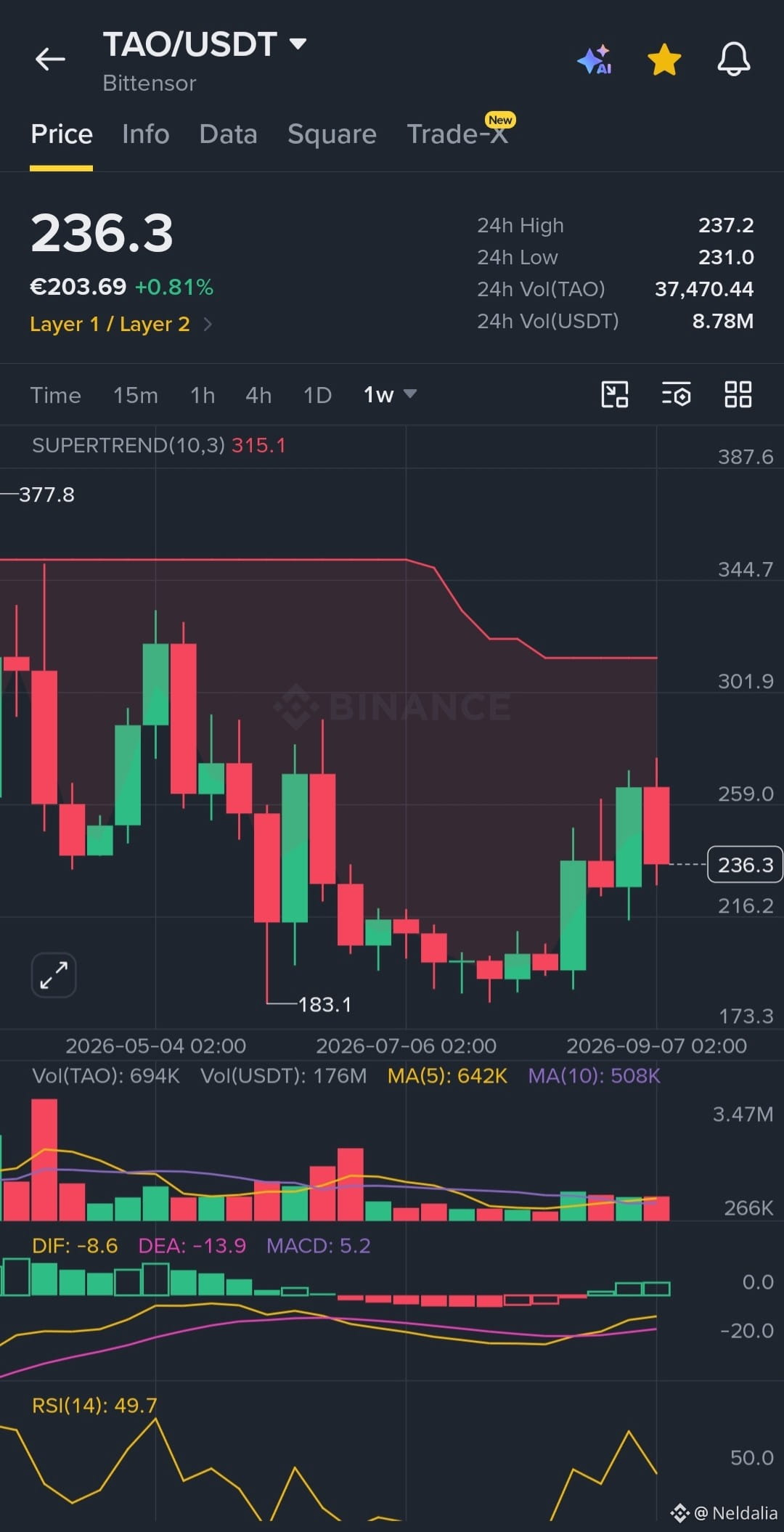
Accumulation Floor: $TAO has established an active support zone in the $225–$230 range. Buyers consistently step in near these levels, maintaining a higher-low structure on macro timeframes.
Immediate Obstacle: Short-term trend momentum hinges on reclaiming the $245–$250 band. A daily close above this level shifts momentum back toward the primary resistance neckline at $290–$300.
Breakout Expansion: A clean breakout above $300 invalidates historical consolidation patterns, opening up upside targets toward $330–$350.
Macro Invalidation: A sustained weekly close below $185–$195 invalidates the current bullish structure.
Fundamental Drivers
dTAO & Protocol Upgrades: On-chain proposal discussions around protocol upgrades (such as Runtime 454) continue to strengthen long-term tokenomics and emissions efficiency.
DeAI Narrative Leadership: As institutional interest in AI infrastructure expands, Bittensor remains the benchmark layer for decentralized intelligence.
Trading Bias: Neutral-to-Bullish in the $225–$230 accumulation range. Watching for confirmation on a daily close above $250.
What’s your strategy on $TAO right now—DCAing here or waiting for a confirmed breakout?
#TAO #Bittensor #CryptoAnalysis #BinanceSquare #DeAI
$TAO Structural Analysis:
Consolidation Near $230 Support — Accumulation Before Next DeAI Expansion?
"Bitcoin democratized currency by creating a shared financial layer. Bittensor is democratizing intelligence by creating a shared computational neural network."
Bittensor ($TAO ) continues to showcase one of the strongest fundamental narratives in the market, holding its macro accumulation base while broader market liquidity rotates back into Decentralized AI infrastructure.
Here is a breakdown of $TAO 's current technical structure, key levels, and upcoming drivers:
Technical Breakdown & Market Structure
Accumulation Floor: $TAO has established an active support zone in the $225–$230 range. Buyers consistently step in near these levels, maintaining a higher-low structure on macro timeframes.
Immediate Obstacle: Short-term trend momentum hinges on reclaiming the $245–$250 band. A daily close above this level shifts momentum back toward the primary resistance neckline at $290–$300.
Breakout Expansion: A clean breakout above $300 invalidates historical consolidation patterns, opening up upside targets toward $330–$350.
Macro Invalidation: A sustained weekly close below $185–$195 invalidates the current bullish structure.
Fundamental Drivers
dTAO & Protocol Upgrades: On-chain proposal discussions around protocol upgrades (such as Runtime 454) continue to strengthen long-term tokenomics and emissions efficiency.
DeAI Narrative Leadership: As institutional interest in AI infrastructure expands, Bittensor remains the benchmark layer for decentralized intelligence.
Trading Bias: Neutral-to-Bullish in the $225–$230 accumulation range. Watching for confirmation on a daily close above $250.
What’s your strategy on $TAO right now—DCAing here or waiting for a confirmed breakout?
#TAO #Bittensor #CryptoAnalysis #BinanceSquare #DeAI
Consolidation Near $230 Support — Accumulation Before Next DeAI Expansion?
"Bitcoin democratized currency by creating a shared financial layer. Bittensor is democratizing intelligence by creating a shared computational neural network."
Bittensor ($TAO ) continues to showcase one of the strongest fundamental narratives in the market, holding its macro accumulation base while broader market liquidity rotates back into Decentralized AI infrastructure.
Here is a breakdown of $TAO 's current technical structure, key levels, and upcoming drivers:
Technical Breakdown & Market Structure
Accumulation Floor: $TAO has established an active support zone in the $225–$230 range. Buyers consistently step in near these levels, maintaining a higher-low structure on macro timeframes.
Immediate Obstacle: Short-term trend momentum hinges on reclaiming the $245–$250 band. A daily close above this level shifts momentum back toward the primary resistance neckline at $290–$300.
Breakout Expansion: A clean breakout above $300 invalidates historical consolidation patterns, opening up upside targets toward $330–$350.
Macro Invalidation: A sustained weekly close below $185–$195 invalidates the current bullish structure.
Fundamental Drivers
dTAO & Protocol Upgrades: On-chain proposal discussions around protocol upgrades (such as Runtime 454) continue to strengthen long-term tokenomics and emissions efficiency.
DeAI Narrative Leadership: As institutional interest in AI infrastructure expands, Bittensor remains the benchmark layer for decentralized intelligence.
Trading Bias: Neutral-to-Bullish in the $225–$230 accumulation range. Watching for confirmation on a daily close above $250.
What’s your strategy on $TAO right now—DCAing here or waiting for a confirmed breakout?
#TAO #Bittensor #CryptoAnalysis #BinanceSquare #DeAI
177
See translation
🚨 ON-DEVICE MOE BREAKTHROUGHS ARE CATALYZING THE NEXT BIG RALLY FOR $FET ! ⚡
Hardware giants deploying 30B MoE models directly onto mobile silicon proves edge AI execution is officially here. 📊 As on-device processing slashes memory overhead and throughput bottlenecks, decentralized AI protocols are primed to capture the massive surge in micro-inference demand.
⚡ Smart money is already tracking this convergence between specialized NPU compute and distributed intelligence networks. 💡 When localized models handle frontline tasks, edge infrastructure becomes the true backbone of the ecosystem. 💬 Do you see on-device MoE models driving the next massive momentum wave for AI tokens? 👇
⚠️ Not financial advice. Always manage your risk. 🛡️
🏷️ #FET #AICrypto #DeAI #CryptoMomentum
🔥 💎
🚨 ON-DEVICE MOE BREAKTHROUGHS ARE CATALYZING THE NEXT BIG RALLY FOR $FET ! ⚡
Hardware giants deploying 30B MoE models directly onto mobile silicon proves edge AI execution is officially here. 📊 As on-device processing slashes memory overhead and throughput bottlenecks, decentralized AI protocols are primed to capture the massive surge in micro-inference demand.
⚡ Smart money is already tracking this convergence between specialized NPU compute and distributed intelligence networks. 💡 When localized models handle frontline tasks, edge infrastructure becomes the true backbone of the ecosystem. 💬 Do you see on-device MoE models driving the next massive momentum wave for AI tokens? 👇
⚠️ Not financial advice. Always manage your risk. 🛡️
🏷️ #FET #AICrypto #DeAI #CryptoMomentum
🔥 💎
Hardware giants deploying 30B MoE models directly onto mobile silicon proves edge AI execution is officially here. 📊 As on-device processing slashes memory overhead and throughput bottlenecks, decentralized AI protocols are primed to capture the massive surge in micro-inference demand.
⚡ Smart money is already tracking this convergence between specialized NPU compute and distributed intelligence networks. 💡 When localized models handle frontline tasks, edge infrastructure becomes the true backbone of the ecosystem. 💬 Do you see on-device MoE models driving the next massive momentum wave for AI tokens? 👇
⚠️ Not financial advice. Always manage your risk. 🛡️
🏷️ #FET #AICrypto #DeAI #CryptoMomentum
🔥 💎
78

See translation
Excited to see the synergy between Binance and OpenGradient Chat as AI and Web3 continue to converge. 🚀
OpenGradient Chat is pushing the boundaries of decentralized AI by enabling transparent, scalable, and user-owned intelligence, while Binance provides the global infrastructure, liquidity, and ecosystem needed to accelerate adoption.
Together, they represent a powerful step toward an open future where AI is accessible, verifiable, and integrated into decentralized networks. The combination of blockchain security and advanced AI capabilities could unlock entirely new applications for developers, businesses, and everyday users.
#Binance #OpenGradient #AI #Web3 #Crypto #DeAI #opg $OPG
Excited to see the synergy between Binance and OpenGradient Chat as AI and Web3 continue to converge. 🚀
OpenGradient Chat is pushing the boundaries of decentralized AI by enabling transparent, scalable, and user-owned intelligence, while Binance provides the global infrastructure, liquidity, and ecosystem needed to accelerate adoption.
Together, they represent a powerful step toward an open future where AI is accessible, verifiable, and integrated into decentralized networks. The combination of blockchain security and advanced AI capabilities could unlock entirely new applications for developers, businesses, and everyday users.
#Binance #OpenGradient #AI #Web3 #Crypto #DeAI #opg $OPG
OpenGradient Chat is pushing the boundaries of decentralized AI by enabling transparent, scalable, and user-owned intelligence, while Binance provides the global infrastructure, liquidity, and ecosystem needed to accelerate adoption.
Together, they represent a powerful step toward an open future where AI is accessible, verifiable, and integrated into decentralized networks. The combination of blockchain security and advanced AI capabilities could unlock entirely new applications for developers, businesses, and everyday users.
#Binance #OpenGradient #AI #Web3 #Crypto #DeAI #opg $OPG
95

·
--
Article
See translation
190 million $OPG tokens are already out there against a one-billion max — that's the supply split...190 million $OPG tokens are already out there against a one-billion max — that's the supply split I kept coming back to while reading through @OpenGradient's posts today.
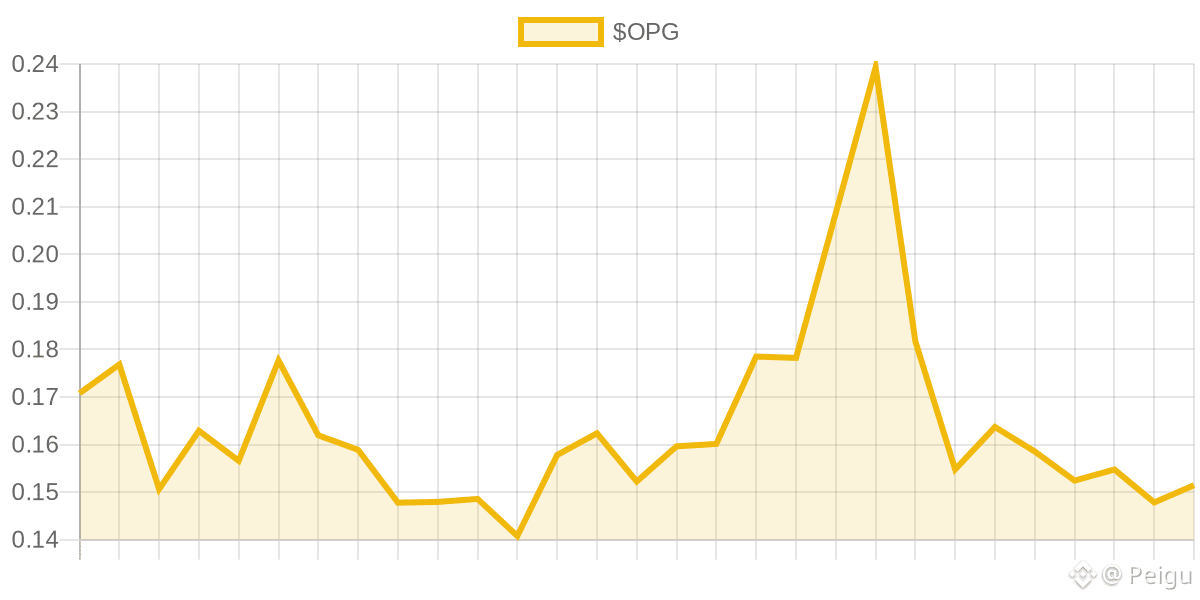
$OPG is around $0.15, down roughly 1.8% this session, with a market cap near $29 million. It's still about 68% below its all-time high near $0.48. On a day where ASTER dropped over 10%, AVAX is down nearly 8%, and the gainers board didn't show a single green name, that small move on $OPG doesn't feel like a story on its own. It reads more like the wider red mood — total market cap down about 2.4%, BTC hanging near $63K and off roughly 2.7% — than any specific verdict on OpenGradient.
What actually held my attention is the open model repository setup. OpenGradient isn't just slapping "decentralized AI" on a landing page and calling it a day. The pitch is a shared pool where people contribute machine-learning models and others pull inference from them. Contributors upload the weights, documentation, whatever makes a model usable. Consumers are developers, apps, maybe on-chain agents that need predictions without routing everything through one company's API. @OpenGradient frames the middle layer as verifiable inference — meaning you can check an output actually came from the model you asked for, not a black-box substitute. That's a different problem from putting a token on a Hugging Face link.
Who benefits breaks down pretty cleanly once you stop treating it like a hype thread. Model contributors are betting their time and compute on building something other people will actually call. If nobody routes traffic to your model, you donated labor. Users and builders get a wider catalog and, in theory, less lock-in than waiting on OpenAI or Anthropic rate limits. The network itself is where $OPG is supposed to move value between those sides — access fees, routing, staking, whatever the live mechanics end up being. I don't have private dashboards on payout rates, and I'm not going to pretend the token chart proves the loop is closed. But the design question is obvious: without real demand on the consumer side, the repo is just a well-organized charity drive.
Today's AI headlines make that tension sharper, not softer. Decrypt ran a piece on China's Z.AI releasing GLM-5.2, pitched as rivaling frontier models without Nvidia chips. Midjourney is pivoting from image generation toward medical imaging. Everyone's shipping model announcements; open weights are the default flex now. In that noise, a repository only matters if the incentive rail works — if uploading something useful pays better than farming a launch graphic. Nasdaq climbed about 1.9% while crypto felt heavy and MSTR bled over 3%, so the usual split between TradFi tech optimism and on-chain caution showed up again. None of that tells you whether a new forecasting or risk-scoring model landed in OpenGradient's catalog overnight.
I scrolled @OpenGradient's Square profile earlier and the product side — OpenGradient Chat plus the repo angle — is what separates this from another "AI agent" ticker chasing perp chatter. Chat gives retail users a front door. The repository gives builders a reason to stay if the models are genuinely callable and the verification piece isn't marketing wallpaper. $OPG at ~$29M market cap with most of the supply still locked makes the token feel early relative to the one-billion cap table, which cuts both ways: room to grow if usage shows up, or a long wait if contributors never get paid enough to keep uploading.
What I'll keep watching is whether @OpenGradient posts concrete additions to the model catalog — actual model names, use cases, signs that someone on the consumer side is routing real traffic — instead of another ecosystem vision thread.
https://www.binance.com/en/square/profile/OpenGradient
#OPG #DeAI #OpenModels
190 million $OPG tokens are already out there against a one-billion max — that's the supply split...
190 million $OPG tokens are already out there against a one-billion max — that's the supply split I kept coming back to while reading through @OpenGradient's posts today.
$OPG is around $0.15, down roughly 1.8% this session, with a market cap near $29 million. It's still about 68% below its all-time high near $0.48. On a day where ASTER dropped over 10%, AVAX is down nearly 8%, and the gainers board didn't show a single green name, that small move on $OPG doesn't feel like a story on its own. It reads more like the wider red mood — total market cap down about 2.4%, BTC hanging near $63K and off roughly 2.7% — than any specific verdict on OpenGradient.
What actually held my attention is the open model repository setup. OpenGradient isn't just slapping "decentralized AI" on a landing page and calling it a day. The pitch is a shared pool where people contribute machine-learning models and others pull inference from them. Contributors upload the weights, documentation, whatever makes a model usable. Consumers are developers, apps, maybe on-chain agents that need predictions without routing everything through one company's API. @OpenGradient frames the middle layer as verifiable inference — meaning you can check an output actually came from the model you asked for, not a black-box substitute. That's a different problem from putting a token on a Hugging Face link.
Who benefits breaks down pretty cleanly once you stop treating it like a hype thread. Model contributors are betting their time and compute on building something other people will actually call. If nobody routes traffic to your model, you donated labor. Users and builders get a wider catalog and, in theory, less lock-in than waiting on OpenAI or Anthropic rate limits. The network itself is where $OPG is supposed to move value between those sides — access fees, routing, staking, whatever the live mechanics end up being. I don't have private dashboards on payout rates, and I'm not going to pretend the token chart proves the loop is closed. But the design question is obvious: without real demand on the consumer side, the repo is just a well-organized charity drive.
Today's AI headlines make that tension sharper, not softer. Decrypt ran a piece on China's Z.AI releasing GLM-5.2, pitched as rivaling frontier models without Nvidia chips. Midjourney is pivoting from image generation toward medical imaging. Everyone's shipping model announcements; open weights are the default flex now. In that noise, a repository only matters if the incentive rail works — if uploading something useful pays better than farming a launch graphic. Nasdaq climbed about 1.9% while crypto felt heavy and MSTR bled over 3%, so the usual split between TradFi tech optimism and on-chain caution showed up again. None of that tells you whether a new forecasting or risk-scoring model landed in OpenGradient's catalog overnight.
I scrolled @OpenGradient's Square profile earlier and the product side — OpenGradient Chat plus the repo angle — is what separates this from another "AI agent" ticker chasing perp chatter. Chat gives retail users a front door. The repository gives builders a reason to stay if the models are genuinely callable and the verification piece isn't marketing wallpaper. $OPG at ~$29M market cap with most of the supply still locked makes the token feel early relative to the one-billion cap table, which cuts both ways: room to grow if usage shows up, or a long wait if contributors never get paid enough to keep uploading.
What I'll keep watching is whether @OpenGradient posts concrete additions to the model catalog — actual model names, use cases, signs that someone on the consumer side is routing real traffic — instead of another ecosystem vision thread.
https://www.binance.com/en/square/profile/OpenGradient
#OPG #DeAI #OpenModels
$OPG is around $0.15, down roughly 1.8% this session, with a market cap near $29 million. It's still about 68% below its all-time high near $0.48. On a day where ASTER dropped over 10%, AVAX is down nearly 8%, and the gainers board didn't show a single green name, that small move on $OPG doesn't feel like a story on its own. It reads more like the wider red mood — total market cap down about 2.4%, BTC hanging near $63K and off roughly 2.7% — than any specific verdict on OpenGradient.
What actually held my attention is the open model repository setup. OpenGradient isn't just slapping "decentralized AI" on a landing page and calling it a day. The pitch is a shared pool where people contribute machine-learning models and others pull inference from them. Contributors upload the weights, documentation, whatever makes a model usable. Consumers are developers, apps, maybe on-chain agents that need predictions without routing everything through one company's API. @OpenGradient frames the middle layer as verifiable inference — meaning you can check an output actually came from the model you asked for, not a black-box substitute. That's a different problem from putting a token on a Hugging Face link.
Who benefits breaks down pretty cleanly once you stop treating it like a hype thread. Model contributors are betting their time and compute on building something other people will actually call. If nobody routes traffic to your model, you donated labor. Users and builders get a wider catalog and, in theory, less lock-in than waiting on OpenAI or Anthropic rate limits. The network itself is where $OPG is supposed to move value between those sides — access fees, routing, staking, whatever the live mechanics end up being. I don't have private dashboards on payout rates, and I'm not going to pretend the token chart proves the loop is closed. But the design question is obvious: without real demand on the consumer side, the repo is just a well-organized charity drive.
Today's AI headlines make that tension sharper, not softer. Decrypt ran a piece on China's Z.AI releasing GLM-5.2, pitched as rivaling frontier models without Nvidia chips. Midjourney is pivoting from image generation toward medical imaging. Everyone's shipping model announcements; open weights are the default flex now. In that noise, a repository only matters if the incentive rail works — if uploading something useful pays better than farming a launch graphic. Nasdaq climbed about 1.9% while crypto felt heavy and MSTR bled over 3%, so the usual split between TradFi tech optimism and on-chain caution showed up again. None of that tells you whether a new forecasting or risk-scoring model landed in OpenGradient's catalog overnight.
I scrolled @OpenGradient's Square profile earlier and the product side — OpenGradient Chat plus the repo angle — is what separates this from another "AI agent" ticker chasing perp chatter. Chat gives retail users a front door. The repository gives builders a reason to stay if the models are genuinely callable and the verification piece isn't marketing wallpaper. $OPG at ~$29M market cap with most of the supply still locked makes the token feel early relative to the one-billion cap table, which cuts both ways: room to grow if usage shows up, or a long wait if contributors never get paid enough to keep uploading.
What I'll keep watching is whether @OpenGradient posts concrete additions to the model catalog — actual model names, use cases, signs that someone on the consumer side is routing real traffic — instead of another ecosystem vision thread.
https://www.binance.com/en/square/profile/OpenGradient
#OPG #DeAI #OpenModels
2
187

·
--
EigenCloud's recent highlights aren't just about the price rebound, but also the simultaneous warming of "fundamental data + AI narrative." The TVL has bounced back to around $485 million, indicating that on-chain capital interest is recovering; the 24-hour trading volume is about $90.67 million, corresponding to a market cap of around $215 million, showing relatively active liquidity.
More importantly, both long and short positions have significantly expanded, coupled with AI infrastructure acquisitions and a hot decentralized AI narrative, $EIGEN could continue to be driven by sentiment in the short term. However, this increase in positions also means that volatility will intensify, making it crucial to watch for pullback support and whether the trading volume continues, rather than blindly chasing highs.
#EIGEN #DeAI
EigenCloud's recent highlights aren't just about the price rebound, but also the simultaneous warming of "fundamental data + AI narrative." The TVL has bounced back to around $485 million, indicating that on-chain capital interest is recovering; the 24-hour trading volume is about $90.67 million, corresponding to a market cap of around $215 million, showing relatively active liquidity.
More importantly, both long and short positions have significantly expanded, coupled with AI infrastructure acquisitions and a hot decentralized AI narrative, $EIGEN could continue to be driven by sentiment in the short term. However, this increase in positions also means that volatility will intensify, making it crucial to watch for pullback support and whether the trading volume continues, rather than blindly chasing highs.
#EIGEN #DeAI
More importantly, both long and short positions have significantly expanded, coupled with AI infrastructure acquisitions and a hot decentralized AI narrative, $EIGEN could continue to be driven by sentiment in the short term. However, this increase in positions also means that volatility will intensify, making it crucial to watch for pullback support and whether the trading volume continues, rather than blindly chasing highs.
#EIGEN #DeAI
1
·
--
See translation
Why does $TAO keep landing on trending when half my timeline still can't tell subnets apart from random AI tokens?
This morning was all policy noise — housing-bill headlines, staking-tax lobby stuff — and Bittensor didn't ship anything overnight. $TAO trended anyway, still high on the board like yesterday.
What I watched: the token moves first, then the ecosystem story chases it. Registration chatter, emissions takes, fights over which subnet is real compute vs. branding. By afternoon there's still no headline explaining the move — just the same ticker on every list.
I kept refreshing for a catalyst that never showed up.
I don't think one news item drove this. Decentralized AI is still hogging attention while everything else gets drowned out.
$TAO looks like mindshare doing the heavy lifting again — not a fresh product drop.
#Bittensor #TAO #DeAI
Why does $TAO keep landing on trending when half my timeline still can't tell subnets apart from random AI tokens?
This morning was all policy noise — housing-bill headlines, staking-tax lobby stuff — and Bittensor didn't ship anything overnight. $TAO trended anyway, still high on the board like yesterday.
What I watched: the token moves first, then the ecosystem story chases it. Registration chatter, emissions takes, fights over which subnet is real compute vs. branding. By afternoon there's still no headline explaining the move — just the same ticker on every list.
I kept refreshing for a catalyst that never showed up.
I don't think one news item drove this. Decentralized AI is still hogging attention while everything else gets drowned out.
$TAO looks like mindshare doing the heavy lifting again — not a fresh product drop.
#Bittensor #TAO #DeAI
This morning was all policy noise — housing-bill headlines, staking-tax lobby stuff — and Bittensor didn't ship anything overnight. $TAO trended anyway, still high on the board like yesterday.
What I watched: the token moves first, then the ecosystem story chases it. Registration chatter, emissions takes, fights over which subnet is real compute vs. branding. By afternoon there's still no headline explaining the move — just the same ticker on every list.
I kept refreshing for a catalyst that never showed up.
I don't think one news item drove this. Decentralized AI is still hogging attention while everything else gets drowned out.
$TAO looks like mindshare doing the heavy lifting again — not a fresh product drop.
#Bittensor #TAO #DeAI
62
·
--
See translation
Breaking the AI Monopoly: How OpenLedger L1 Validates and Tokenizes the Global Data EconomyThe Gated Gardens of Artificial Intelligence
The current artificial intelligence landscape suffers from a critical structural flaw: centralization. Massive tech conglomerates control the compute infrastructure, monopolize the high-quality training data, and gate-keep the most advanced Large Language Models (LLMs). This creates a massive barrier to entry for independent developers and data contributors who receive zero compensation when their intellectual property is scraped for model training.
OpenLedger enters the ecosystem as a purpose-built Layer-1 blockchain engineered to solve this exact problem. By introducing a decentralized framework for data governance, quality verification, and immutable provenance, the network aims to transition the tech industry from a closed-door monopoly into a transparent, participant-driven Knowledge Economy.
1. The Architectural Pillars of OpenLedger
Unlike generic blockchains designed purely for high-speed financial transactions, OpenLedger’s infrastructure is optimized to handle the massive throughput, storage requirements, and security layers demanded by enterprise-grade AI production.
Community-Owned Datanets: Instead of unverified, noisy web scraping, the network utilizes decentralized Datanets. These are hyper-specialized, high-integrity databases curated and maintained by decentralized communities. Whether focused on smart contract security, medical diagnostics, or financial analytics, Datanets ensure that AI models are trained on clean, verifiable information, drastically reducing hallucination rates.
The Proof of Attribution Protocol: This is the core engine of OpenLedger. Every time a piece of data is sourced from a Datanet to fine-tune a model or answer an active prompt, the transaction is cryptographically logged on-chain. The protocol maps out the entire lineage of the data, providing an immutable paper trail that guarantees proper credit and fair distribution of rewards to the original creators.
OpenLoRA Infrastructure: Running thousands of specialized, fine-tuned models can cause massive computing bottlenecks. OpenLedger addresses this through its OpenLoRA engine, which maximizes GPU efficiency. It allows multiple lightweight, fine-tuned model adapters to run seamlessly across distributed hardware, cutting operational costs significantly compared to legacy cloud providers.
2. The Mechanics of Payable AI: Monetizing Knowledge
The ultimate vision of the network is to facilitate Payable AI, transforming static text, code, and insights into tokenized digital assets with transparent market value. This ecosystem establishes a fluid value-loop between three distinct market participants:
The Data Contributors
Independent researchers, developers, and everyday users can securely upload specialized training sets to specific Datanets. Once verified by the network's node infrastructure, these contributors earn continuous, automated rewards whenever their data is pulled for model optimization or execution.
The AI Model Builders
Developers no longer need to spend millions sourcing opaque, centralized datasets. Through OpenLedger's ModelFactory (a no-code fine-tuning interface), builders can access premium, verified data pipelines on-demand, building highly accurate, domain-specific AI models with transparent licensing on-chain.
The Distributed Compute Providers
By running verification nodes or renting out idle GPU hardware to support the OpenLoRA framework, infrastructure providers secure the network layer and earn continuous yield, forming a fully decentralized marketplace for artificial intelligence compute.
3. The Utility of the @Openledger Token
At the center of this decentralized economy sits the network's native asset, $OPEN . The token acts as the economic fuel and security mechanism for the entire Layer-1 network, executing three primary functions:
Gas and Execution Fees: Every data validation, model fine-tuning process, and on-chain Proof of Attribution log requires a micro-payment settled in $OPEN to compensate the underlying node infrastructure.
Staking and Data Quality Insurance: Network validators and Datanet curators must stake $OPEN tokens. This ensures skin-in-the-game; if a curator attempts to upload fraudulent or malicious datasets, their staked tokens are slashed, guaranteeing the integrity of the network's knowledge base.
Governance Rights: Token holders participate directly in the evolution of the L1, voting on compute reward distribution weights, data inclusion standards, and the onboarding of new enterprise Datanets.
Conclusion: The Future is Decentralized
The intersection of Web3 and artificial intelligence is not about adding hype to code—it is about securing the structural foundation of the digital age. OpenLedger provides the definitive highway for this transition. By turning data into a sovereign asset class and giving independent builders the decentralized infrastructure to train, verify, and scale their systems, the network lays the groundwork for an open-source, monopoly-free AI future.
#DeAI #OpenLedger #Layer1 #AIBlockchain #Web3Infrastructure
Breaking the AI Monopoly: How OpenLedger L1 Validates and Tokenizes the Global Data Economy
The Gated Gardens of Artificial Intelligence
The current artificial intelligence landscape suffers from a critical structural flaw: centralization. Massive tech conglomerates control the compute infrastructure, monopolize the high-quality training data, and gate-keep the most advanced Large Language Models (LLMs). This creates a massive barrier to entry for independent developers and data contributors who receive zero compensation when their intellectual property is scraped for model training.
OpenLedger enters the ecosystem as a purpose-built Layer-1 blockchain engineered to solve this exact problem. By introducing a decentralized framework for data governance, quality verification, and immutable provenance, the network aims to transition the tech industry from a closed-door monopoly into a transparent, participant-driven Knowledge Economy.
1. The Architectural Pillars of OpenLedger
Unlike generic blockchains designed purely for high-speed financial transactions, OpenLedger’s infrastructure is optimized to handle the massive throughput, storage requirements, and security layers demanded by enterprise-grade AI production.
Community-Owned Datanets: Instead of unverified, noisy web scraping, the network utilizes decentralized Datanets. These are hyper-specialized, high-integrity databases curated and maintained by decentralized communities. Whether focused on smart contract security, medical diagnostics, or financial analytics, Datanets ensure that AI models are trained on clean, verifiable information, drastically reducing hallucination rates.
The Proof of Attribution Protocol: This is the core engine of OpenLedger. Every time a piece of data is sourced from a Datanet to fine-tune a model or answer an active prompt, the transaction is cryptographically logged on-chain. The protocol maps out the entire lineage of the data, providing an immutable paper trail that guarantees proper credit and fair distribution of rewards to the original creators.
OpenLoRA Infrastructure: Running thousands of specialized, fine-tuned models can cause massive computing bottlenecks. OpenLedger addresses this through its OpenLoRA engine, which maximizes GPU efficiency. It allows multiple lightweight, fine-tuned model adapters to run seamlessly across distributed hardware, cutting operational costs significantly compared to legacy cloud providers.
2. The Mechanics of Payable AI: Monetizing Knowledge
The ultimate vision of the network is to facilitate Payable AI, transforming static text, code, and insights into tokenized digital assets with transparent market value. This ecosystem establishes a fluid value-loop between three distinct market participants:
The Data Contributors
Independent researchers, developers, and everyday users can securely upload specialized training sets to specific Datanets. Once verified by the network's node infrastructure, these contributors earn continuous, automated rewards whenever their data is pulled for model optimization or execution.
The AI Model Builders
Developers no longer need to spend millions sourcing opaque, centralized datasets. Through OpenLedger's ModelFactory (a no-code fine-tuning interface), builders can access premium, verified data pipelines on-demand, building highly accurate, domain-specific AI models with transparent licensing on-chain.
The Distributed Compute Providers
By running verification nodes or renting out idle GPU hardware to support the OpenLoRA framework, infrastructure providers secure the network layer and earn continuous yield, forming a fully decentralized marketplace for artificial intelligence compute.
3. The Utility of the @OpenLedger Token
At the center of this decentralized economy sits the network's native asset, $OPEN . The token acts as the economic fuel and security mechanism for the entire Layer-1 network, executing three primary functions:
Gas and Execution Fees: Every data validation, model fine-tuning process, and on-chain Proof of Attribution log requires a micro-payment settled in $OPEN to compensate the underlying node infrastructure.
Staking and Data Quality Insurance: Network validators and Datanet curators must stake $OPEN tokens. This ensures skin-in-the-game; if a curator attempts to upload fraudulent or malicious datasets, their staked tokens are slashed, guaranteeing the integrity of the network's knowledge base.
Governance Rights: Token holders participate directly in the evolution of the L1, voting on compute reward distribution weights, data inclusion standards, and the onboarding of new enterprise Datanets.
Conclusion: The Future is Decentralized
The intersection of Web3 and artificial intelligence is not about adding hype to code—it is about securing the structural foundation of the digital age. OpenLedger provides the definitive highway for this transition. By turning data into a sovereign asset class and giving independent builders the decentralized infrastructure to train, verify, and scale their systems, the network lays the groundwork for an open-source, monopoly-free AI future.
#DeAI #OpenLedger #Layer1 #AIBlockchain #Web3Infrastructure
The current artificial intelligence landscape suffers from a critical structural flaw: centralization. Massive tech conglomerates control the compute infrastructure, monopolize the high-quality training data, and gate-keep the most advanced Large Language Models (LLMs). This creates a massive barrier to entry for independent developers and data contributors who receive zero compensation when their intellectual property is scraped for model training.
OpenLedger enters the ecosystem as a purpose-built Layer-1 blockchain engineered to solve this exact problem. By introducing a decentralized framework for data governance, quality verification, and immutable provenance, the network aims to transition the tech industry from a closed-door monopoly into a transparent, participant-driven Knowledge Economy.
1. The Architectural Pillars of OpenLedger
Unlike generic blockchains designed purely for high-speed financial transactions, OpenLedger’s infrastructure is optimized to handle the massive throughput, storage requirements, and security layers demanded by enterprise-grade AI production.
Community-Owned Datanets: Instead of unverified, noisy web scraping, the network utilizes decentralized Datanets. These are hyper-specialized, high-integrity databases curated and maintained by decentralized communities. Whether focused on smart contract security, medical diagnostics, or financial analytics, Datanets ensure that AI models are trained on clean, verifiable information, drastically reducing hallucination rates.
The Proof of Attribution Protocol: This is the core engine of OpenLedger. Every time a piece of data is sourced from a Datanet to fine-tune a model or answer an active prompt, the transaction is cryptographically logged on-chain. The protocol maps out the entire lineage of the data, providing an immutable paper trail that guarantees proper credit and fair distribution of rewards to the original creators.
OpenLoRA Infrastructure: Running thousands of specialized, fine-tuned models can cause massive computing bottlenecks. OpenLedger addresses this through its OpenLoRA engine, which maximizes GPU efficiency. It allows multiple lightweight, fine-tuned model adapters to run seamlessly across distributed hardware, cutting operational costs significantly compared to legacy cloud providers.
2. The Mechanics of Payable AI: Monetizing Knowledge
The ultimate vision of the network is to facilitate Payable AI, transforming static text, code, and insights into tokenized digital assets with transparent market value. This ecosystem establishes a fluid value-loop between three distinct market participants:
The Data Contributors
Independent researchers, developers, and everyday users can securely upload specialized training sets to specific Datanets. Once verified by the network's node infrastructure, these contributors earn continuous, automated rewards whenever their data is pulled for model optimization or execution.
The AI Model Builders
Developers no longer need to spend millions sourcing opaque, centralized datasets. Through OpenLedger's ModelFactory (a no-code fine-tuning interface), builders can access premium, verified data pipelines on-demand, building highly accurate, domain-specific AI models with transparent licensing on-chain.
The Distributed Compute Providers
By running verification nodes or renting out idle GPU hardware to support the OpenLoRA framework, infrastructure providers secure the network layer and earn continuous yield, forming a fully decentralized marketplace for artificial intelligence compute.
3. The Utility of the @OpenLedger Token
At the center of this decentralized economy sits the network's native asset, $OPEN . The token acts as the economic fuel and security mechanism for the entire Layer-1 network, executing three primary functions:
Gas and Execution Fees: Every data validation, model fine-tuning process, and on-chain Proof of Attribution log requires a micro-payment settled in $OPEN to compensate the underlying node infrastructure.
Staking and Data Quality Insurance: Network validators and Datanet curators must stake $OPEN tokens. This ensures skin-in-the-game; if a curator attempts to upload fraudulent or malicious datasets, their staked tokens are slashed, guaranteeing the integrity of the network's knowledge base.
Governance Rights: Token holders participate directly in the evolution of the L1, voting on compute reward distribution weights, data inclusion standards, and the onboarding of new enterprise Datanets.
Conclusion: The Future is Decentralized
The intersection of Web3 and artificial intelligence is not about adding hype to code—it is about securing the structural foundation of the digital age. OpenLedger provides the definitive highway for this transition. By turning data into a sovereign asset class and giving independent builders the decentralized infrastructure to train, verify, and scale their systems, the network lays the groundwork for an open-source, monopoly-free AI future.
#DeAI #OpenLedger #Layer1 #AIBlockchain #Web3Infrastructure
2
125
Log in to explore more content
Join global crypto users on Binance Square
⚡️ Get latest and useful information about crypto.
💬 Trusted by the world’s largest crypto exchange.
👍 Discover real insights from verified creators.
Email / Phone number
Trending Topics
1
#BinanceLaunchesBinanceIntelligence
32,252 views
387 Discussing
2
#EvernorthXRPTreasuryCompletesSPACMerger
28,878 views
270 Discussing
3
#ADAGains10%Above$0.27
30,166 views
205 Discussing
4
#ETHUp70%InQ3ButLiquidityFalls
221,867 views
1,351 Discussing
5
#EthStakingExitQueueHits2026High
81,941 views
910 Discussing
6
#FedOctoberHoldOdds82.3%
82,645 views
900 Discussing
7
#Nikkei225Jumps2.5%ToThreeMonthHigh
94,065 views
1,215 Discussing
8
#CircleMints$2.75BUSDCOnSolanaIn7Days
2,528 views
53 Discussing
9
#DriftHackVictimsBeginClaims
197,559 views
1,863 Discussing
10
#SolanaTokenizedStockVolumeTops$4.4BInSeptember
14,652 views
136 Discussing