
#cloudstorage
cloudstorage
3,990 views
32 Discussing
Hot
Latest

·
--
See translation
Orthogonal Persistence vs Storage Deals: The Evolution of Decentralized Cloud ArchitectureThe architectural design of decentralized storage networks has evolved significantly over the past decade. Early decentralized storage protocols introduced novel peer-to-peer data distribution and proof-of-replication models, yet developers building real-time production software frequently encounter structural operational constraints.
1. Structural Limitations in Early Decentralized Storage
First-generation decentralized storage architectures present specific trade-offs for enterprise applications:
- Contractual Storage Deals: Protocols relying on storage deals require ongoing negotiation with third-party storage providers. Because deals expire within set duration windows, automated renewal logic and monitoring overhead are mandatory. Furthermore, retrieval latencies often take tens of seconds to locate and unseal data partitions.
- Fragile Content Pinning: Addressing rails like IPFS require external centralized pinning infrastructure to prevent unreferenced data from being garbage-collected. Public gateways frequently experience rate limits and connection timeouts under high load.
- Static Data Immutability: Permanent pay-once networks ensure byte-level preservation, but data remains strictly write-once and isolated from real-time compute execution.
2. Orthogonal Persistence and Co-Located Compute on the Internet Computer
Smart contract storage canisters deployed on the Internet Computer Protocol ($ICP) resolve these limitations through orthogonal persistence and native WebAssembly execution:
- Continuous Memory Persistence: Canister memory allocations within sixty-four-bit stable memory structures are permanently preserved across upgrades. Applications maintain persistent data stores without managing expiring contracts or serialization layers.
- In-Canister Turing-Complete Compute: Unlike static storage networks, canisters execute computational logic directly over stored assets. Applications can authenticate user principals, enforce dynamic access gating, calculate cryptographic hashes, and mutate state within the exact same execution boundary.
- Sub-Second Global HTTP Streaming: Boundary nodes act as consensus-certified edge gateways, caching signed assets globally and delivering sub-second response times directly to standard web browsers without specialized extensions.
3. S3 Specification Interoperability
By implementing standard S3 object storage APIs, decentralized storage canisters allow development teams to connect modern backend frameworks, automated pipelines, and cloud services to on-chain infrastructure using familiar developer tools.
As Web3 architecture transitions toward enterprise-grade performance throughout 2026, orthogonal persistence and smart contract storage canisters deliver a scalable, resilient foundation for decentralized cloud computing.
$ICP #ICP #BinanceSquare #Web3 #CloudStorage
Orthogonal Persistence vs Storage Deals: The Evolution of Decentralized Cloud Architecture
The architectural design of decentralized storage networks has evolved significantly over the past decade. Early decentralized storage protocols introduced novel peer-to-peer data distribution and proof-of-replication models, yet developers building real-time production software frequently encounter structural operational constraints.
1. Structural Limitations in Early Decentralized Storage
First-generation decentralized storage architectures present specific trade-offs for enterprise applications:
- Contractual Storage Deals: Protocols relying on storage deals require ongoing negotiation with third-party storage providers. Because deals expire within set duration windows, automated renewal logic and monitoring overhead are mandatory. Furthermore, retrieval latencies often take tens of seconds to locate and unseal data partitions.
- Fragile Content Pinning: Addressing rails like IPFS require external centralized pinning infrastructure to prevent unreferenced data from being garbage-collected. Public gateways frequently experience rate limits and connection timeouts under high load.
- Static Data Immutability: Permanent pay-once networks ensure byte-level preservation, but data remains strictly write-once and isolated from real-time compute execution.
2. Orthogonal Persistence and Co-Located Compute on the Internet Computer
Smart contract storage canisters deployed on the Internet Computer Protocol ($ICP ) resolve these limitations through orthogonal persistence and native WebAssembly execution:
- Continuous Memory Persistence: Canister memory allocations within sixty-four-bit stable memory structures are permanently preserved across upgrades. Applications maintain persistent data stores without managing expiring contracts or serialization layers.
- In-Canister Turing-Complete Compute: Unlike static storage networks, canisters execute computational logic directly over stored assets. Applications can authenticate user principals, enforce dynamic access gating, calculate cryptographic hashes, and mutate state within the exact same execution boundary.
- Sub-Second Global HTTP Streaming: Boundary nodes act as consensus-certified edge gateways, caching signed assets globally and delivering sub-second response times directly to standard web browsers without specialized extensions.
3. S3 Specification Interoperability
By implementing standard S3 object storage APIs, decentralized storage canisters allow development teams to connect modern backend frameworks, automated pipelines, and cloud services to on-chain infrastructure using familiar developer tools.
As Web3 architecture transitions toward enterprise-grade performance throughout 2026, orthogonal persistence and smart contract storage canisters deliver a scalable, resilient foundation for decentralized cloud computing.
$ICP #ICP #BinanceSquare #Web3 #CloudStorage
1
404

·
--
See translation
AI needs massive data storage—is $FIL the decentralized solution? 💾🌐
As artificial intelligence models expand exponentially, the demand for verifiable, censorship-resistant, decentralized cloud storage has never been higher.
Filecoin’s integration of smart contracts (FVM) allows developers to build data-driven apps directly on top of raw storage capacity.
Is $FIL an undervalued infrastructure play, or does it move too slow for your portfolio? Let’s debate! 🗣️
#Filecoin #CloudStorage #DecentralizedData
216
·
--
See translation
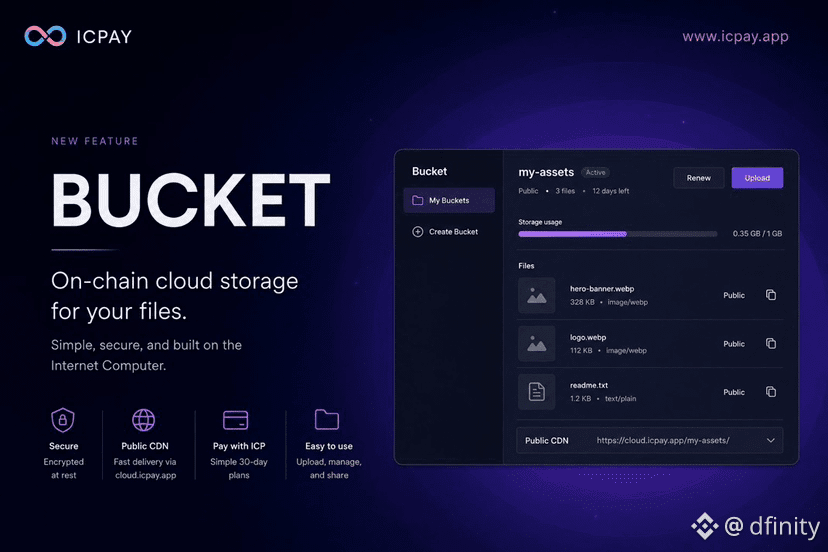
$ICP ICPay Bucket is officially live!
On-chain storage, built for the next generation of apps.
Like Cloudinary and Supabase Storage, but powered by the Internet Computer — your files are stored directly on-chain.
☁️ Upload & store files
🔗 Public file URLs
🔐 Private buckets
⚡ Built for developers
⛓️ Fully on-chain infrastructure
Build your next app with decentralized storage.
🔗 https://icpay. app/products/icbucket
#ICP #InternetComputerProtocol #OnChainSuccess #CloudStorage #Developers
216

See translation
Order blocks on Tavuk (TVK) show bullish momentum, high volume spiking as retail investors chase meme gains. Muub (MUUB) mirrors the trend with liquidity inflows, signaling confidence in its community. Storj (STORJ) continues ecosystem growth, attracting institutional cloud storage demand. Strong buy sentiment across all three innovation fuels long term upside. 🚀💹 #crypto #meme #cloudstorage
Order blocks on Tavuk (TVK) show bullish momentum, high volume spiking as retail investors chase meme gains. Muub (MUUB) mirrors the trend with liquidity inflows, signaling confidence in its community. Storj (STORJ) continues ecosystem growth, attracting institutional cloud storage demand. Strong buy sentiment across all three innovation fuels long term upside. 🚀💹 #crypto #meme #cloudstorage
139

See translation
ALERT 🚨 $STORJ (STORJ) pushes order blocks with robust volume as institutional adoption accelerates. $JST (JustOne) shows bullish momentum, driven by ecosystem growth and user engagement on its social platform. $KITE (Kite) liquidity surges, signaling strong investor sentiment and new staking incentives. Innovation in decentralized storage and social media integration fuels trading activity. 🚀 #Crypto #DeFi #CloudStorage #SocialFi
ALERT 🚨 $STORJ (STORJ) pushes order blocks with robust volume as institutional adoption accelerates. $JST (JustOne) shows bullish momentum, driven by ecosystem growth and user engagement on its social platform. $KITE (Kite) liquidity surges, signaling strong investor sentiment and new staking incentives. Innovation in decentralized storage and social media integration fuels trading activity. 🚀 #Crypto #DeFi #CloudStorage #SocialFi
167

·
--
See translation
$AI SECTOR ROTATION IS SHIFTING CAPITAL INTO CLOUD AND STORAGE 🔥
Morgan Stanley sees funds moving from semiconductors to cloud giants like Microsoft and Meta. UBS goes bigger—they expect AI infrastructure profit to explode from $200B to $14T by 2027. Storage chips are the new value creators.
That's a 6,900% growth projection from a top-tier bank. The rotation playbook is changing. Cloud and storage are the next bid.
Which AI subsector are you watching right now?
Not financial advice. Always manage your risk.
#AI #AISector #Rotation #CloudStorage #Crypto
🔥
34
Log in to explore more content
Join global crypto users on Binance Square
⚡️ Get latest and useful information about crypto.
💬 Trusted by the world’s largest crypto exchange.
👍 Discover real insights from verified creators.
Email / Phone number
Trending Topics
1
#IsAnthropic’s$1.5TMarketCapJustified?
6,245 views
58 Discussing
2
#BTCRemainsUnderPressureAfterHawkishFOMCMinutes
195,849 views
1,940 Discussing
3
#NvidiaBoardReportedlySplitOverHuang’sReturn
94,839 views
1,039 Discussing
4
#StrategySTRCPreferredSlips3.65%Below$100Par
4,887 views
61 Discussing
5
#MASToUpgradeSGDTestnetToSGDigitalLedger
14,020 views
209 Discussing
6
#CanGTA6'sLaunchLiftTTWOShares?
66,815 views
768 Discussing
7
#Solana2027RoadmapTargetsDoubleComputeCapacity
4,557 views
109 Discussing
8
#InjectiveTokenizedRealEstateMortgagesTop$1.5B
932 views
27 Discussing
9
#TetherMakesStrategicInvestmentInSCRYPT
4,448 views
92 Discussing
10
#CapitalGroupAdds1264500StrategyShares
20,737 views
218 Discussing