
#cbdc
cbdc
36.1M views
157,190 Discussing
Hot
Latest


Article
See translation
Singapore & Germany Trial Cross-Border CBDC Settlement with Zero-Knowledge ProofsSingapore and Germany have just completed a cross-border CBDC settlement test using zero-knowledge proofs, offering a glimpse into the future of secure digital payments without intermediaries.
The core of this experiment is the use of zero-knowledge proofs. This cryptographic tool lets each central bank prove its currency is locked for settlement, without exposing or integrating their systems. The result: no euro or Singapore dollar settles unless both sides confirm, sharply reducing counterparty risk for traders.
This pilot is part of Project Simbolon, launched under a memorandum of understanding dated November 2025 between MAS and Deutsche Bundesbank. Unlike other blockchain pilots, this test did not use a shared ledger or third-party. Each bank ran its own digital currency ledger, maintaining full control and privacy while still achieving atomic settlement.
The project focused on euro, Singapore dollar trades, targeting large-value foreign exchange settlements handled by financial institutions. By using wholesale CBDCs instead of retail or commercial bank money, the aim is to modernize cross-border transactions and set a new standard for global payment systems.
Payment-versus-payment (PvP) logic was key: transfers only happen if both sides are ready, minimizing principal risk. The structure contrasts with other initiatives like Project Meridian FX APAC, where interoperability relied on shared platforms. Here, Singapore and Germany proved that secure, atomic settlement is possible even with siloed systems.
While the technical success is clear, it’s still unknown how quickly these methods will move beyond pilots or be adopted by other central banks. The memorandum dates from November 2025, and more milestones are expected in the coming year, but the exact timeline remains uncertain.
Could this approach change the way cross-border settlements are handled worldwide? What challenges do you see for wider adoption?
#MAS #Bundesbank #CBDC #Singapore
Singapore & Germany Trial Cross-Border CBDC Settlement with Zero-Knowledge Proofs
Singapore and Germany have just completed a cross-border CBDC settlement test using zero-knowledge proofs, offering a glimpse into the future of secure digital payments without intermediaries.
The core of this experiment is the use of zero-knowledge proofs. This cryptographic tool lets each central bank prove its currency is locked for settlement, without exposing or integrating their systems. The result: no euro or Singapore dollar settles unless both sides confirm, sharply reducing counterparty risk for traders.
This pilot is part of Project Simbolon, launched under a memorandum of understanding dated November 2025 between MAS and Deutsche Bundesbank. Unlike other blockchain pilots, this test did not use a shared ledger or third-party. Each bank ran its own digital currency ledger, maintaining full control and privacy while still achieving atomic settlement.
The project focused on euro, Singapore dollar trades, targeting large-value foreign exchange settlements handled by financial institutions. By using wholesale CBDCs instead of retail or commercial bank money, the aim is to modernize cross-border transactions and set a new standard for global payment systems.
Payment-versus-payment (PvP) logic was key: transfers only happen if both sides are ready, minimizing principal risk. The structure contrasts with other initiatives like Project Meridian FX APAC, where interoperability relied on shared platforms. Here, Singapore and Germany proved that secure, atomic settlement is possible even with siloed systems.
While the technical success is clear, it’s still unknown how quickly these methods will move beyond pilots or be adopted by other central banks. The memorandum dates from November 2025, and more milestones are expected in the coming year, but the exact timeline remains uncertain.
Could this approach change the way cross-border settlements are handled worldwide? What challenges do you see for wider adoption?
#MAS #Bundesbank #CBDC #Singapore
64

·
--
Singapore issues S$100 million in tokenised bills: an interbank trial, not digital currency for you
The Monetary Authority of Singapore (MAS) announced today (November 19) that it issued S$100 million worth of tokenised MAS bills with a four-week tenor on November 6, and settled them using wholesale central bank digital currency. This is a trial for financial institutions, not a retail digital currency available to the public, nor a new token that can be traded on exchanges.
The bills were issued natively on the “Singapore Dollar Test Network” operated by MAS, without first being issued through traditional means and then tokenised. Five primary dealers—DBS, HSBC Singapore, OCBC, Standard Chartered Singapore and UOB—participated in the auction. Applications exceeded twice the issuance amount, and the bills will mature on December 4. The official website also states that only institutional investors may subscribe; applications from non-institutions will be rejected.
MAS said the next steps will be to expand issuance, bring in more financial institutions, and use these bills for collateral management. The next phase of field trials is planned for 2027. The test network will later be renamed SG Digital Ledger.
Have you recently seen anyone using this news to promote a so-called “MAS coin,” or claiming that Singapore’s digital currency is already available for ordinary people to use?
Not investment advice.
Sources: MAS press release “MAS Announces Successful Issuance of Tokenised MAS Bills on the Singapore Dollar Test Network Using Wholesale Central Bank Digital Currency” (2026-11-19, https://www.mas.gov.sg/news/media-releases/2026/mas-announces-successful-issuance-of-tokenised-mas-bills-on-the-singapore-dollar-test-network); Wu Blockchain (2026-11-19 13:58 Hong Kong time, https://x.com/wublockchain12/status/2123294914293215253); Cointelegraph (2026-11-19 13:53 Hong Kong time, https://x.com/Cointelegraph/status/2123293623684899045) · 2026-11-19 Hong Kong time
#MAS #CBDC #代币化 #HangB Media

53

See translation
Singapore and Germany are taking CBDCs to the next level with Project Simbolon, targeting faster and cheaper cross-border FX settlements. This initiative highlights how major economies are actively testing blockchain rails for traditional finance. While retail CBDCs spark privacy debates, wholesale applications like this prove that institutional efficiency will likely drive the next wave of digital asset adoption globally. #CBDC #Forex #CryptoRegulation
Singapore and Germany are taking CBDCs to the next level with Project Simbolon, targeting faster and cheaper cross-border FX settlements. This initiative highlights how major economies are actively testing blockchain rails for traditional finance. While retail CBDCs spark privacy debates, wholesale applications like this prove that institutional efficiency will likely drive the next wave of digital asset adoption globally. #CBDC #Forex #CryptoRegulation

🚨 Singapore and Germany pilot CBDC-based cross-border foreign exchange settlement 🧠
📊 | $BTC | $ETH | $BNB |
- Visit my profile, like, save, and leave a comment 📈
- Singapore and Germany launch a pilot project for cross-border foreign exchange settlement
- The project, named Simbolon, aims to reduce cross-border settlement costs
- The project seeks to shorten the time required for cross-border payments and foreign exchange transactions
- Both parties will work together to promote standardization in payments and foreign exchange 🔥
- The adoption of a cross-border CBDC settlement system could reshape traditional foreign exchange markets
- If standardization progresses smoothly, it could improve the efficiency of global payments
- Liquidity for large fund flows is expected to remain stable in the short term
- Whale fund movements are neutral, while overall market sentiment is leaning toward caution
- How do you think CBDCs will change the cross-border payments landscape? Leave a comment
- Follow me for the latest crypto market news, and join the discussion in the comments
#CBDC #Blockchain #Crypto #FX #Payments
118

·
--
📰 SINGAPORE AND GERMANY TEST DIGITAL CURRENCIES
On November 16, the Monetary Authority of Singapore (MAS) and the Bundesbank announced the successful testing of cross-border euro and Singapore dollar payments. DBS, Deutsche Bank, and technology partner Partior took part in the Simbolon project.
The experiment used wholesale central bank digital currencies and zero-knowledge proofs. These make it possible to coordinate the two sides of an exchange on separate ledgers: settlement is not completed until both parties are ready. This reduces the risk of sending one currency without receiving the other.
Important: this was a test of banking infrastructure, not the launch of a publicly available digital currency. Legal and operational issues still need to be resolved before it can be scaled up.
Source: CoinDesk, MAS announcement. November 16, 2026.
#CBDC #Tokenization
11
🚨 Honduras Central Bank explores digital currencies and instant payments 🧠
📊 | $BTC | $ETH | $BNB |
- Follow this account, like and leave a comment for first-hand insights into the crypto market 📈
- Cosmos Labs and Pierce Systems announce an academic partnership with the Central Bank of Honduras
- The two parties will study central bank digital currencies, instant payments, and cross-border transfer solutions
- The partnership is currently in the research phase, with no commitment to formal implementation
- The project focuses on assessing technical feasibility rather than immediate deployment 🔥
- Market sentiment is bearish, with prices facing downward pressure and panic-driven volatility
- Whales are showing mixed behavior, either selling or buying the dip, with no clear direction yet
- Volatility is expected to remain high in the short term, and investors should be alert to the risk of a pullback
- If no substantive progress follows, related concept tokens may remain under pressure
- Do you think central bank digital currency research is bullish or bearish for the crypto market?
- Feel free to like and follow, and share your market views in the comments
#Crypto #CBDC #Whales #Blockchain #Trading
300

Singapore and Germany test cross-border foreign exchange payments using CBDC
- Singapore and Germany are testing cross-border foreign exchange (FX) payments using CBDC.
- The project is called Project Simbolon.
- Goal: reduce the cost and time required for cross-border payments.
- Another goal: promote common standards for payments and FX.
- The RSS source has not provided further details.
#BinanceSquare #CryptoNews #CBDC #Blockchain
$btc $eth
#vlikevn Titanbot
Source: CoinTelegraph
208
🚨 Singapore and Germany test cross-border CBDC settlement 🧠
📊 | $BTC | $ETH | $BNB |
- Follow, like, and share your thoughts on cross-border payment trends in the comments 📈
- The Monetary Authority of Singapore and the German Bundesbank conducted a cross-border CBDC settlement test
- Codenamed Project Simbolon, it covered euro and Singapore dollar scenarios
- The test introduced zero-knowledge proofs, emphasizing a balance between privacy and compliance
- This move is seen as an important exploration of a multilateral central bank digital currency bridge 🔥
- Market sentiment is bearish, with possible near-term downward pressure and increased volatility
- Institutional investors may seize the opportunity to position themselves, while signs of whales buying the dip are emerging
- Regulatory developments are expected to affect valuations in the stablecoin and payments sectors
- The market is expected to remain volatile in the short term; beware of panic selling
- Do you think cross-border CBDC settlement will accelerate or slow down?
- Follow and leave a comment for future updates on CBDC policy and market analysis
#CBDC #Crypto #Blockchain #Whales #Trading
85

·
--
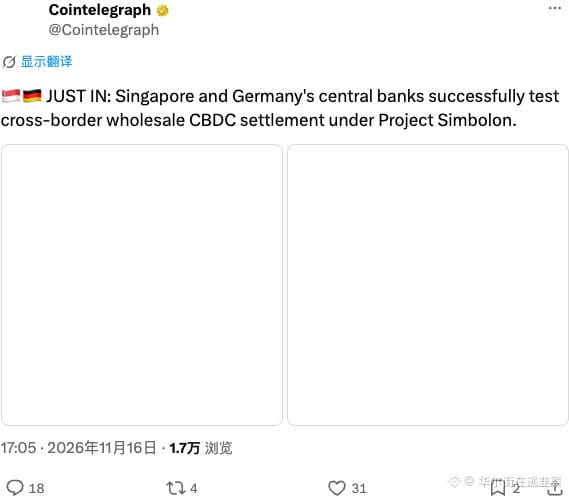
Singapore and Germany’s central banks launched Project Simbolon, and successfully tested cross-border wholesale CBDC settlement. With this development, traditional finance’s cross-border payment efficiency is set to take off—a sort of one-sided blow to DeFi and stablecoins. Hoping to make easy money from cross-border payments? Another avenue just got blocked.
$BTC #宏观 #CBDC
$BTC #宏观 #CBDC
101
·
--
Verified
The central banks of the UK, Singapore, and Thailand have finally dropped the act: they’re going to use blockchain for cross-currency settlement in 2028. These old fossils are finally getting serious—the moat protecting dollar hegemony may be about to get breached. Don’t just focus on ETFs; this is the real big story.
$BTC $XRP #CBDC #CryptoNews
$BTC $XRP #CBDC #CryptoNews

1
884


·
--
Article
See translation
They Took the Ledger. They Left the Revolution.This week three central banks — the Bank of England, the Monetary Authority of Singapore, and the Bank of Thailand — ran Project Meridian FX: an experiment linking their national settlement systems with distributed ledger tech to settle cross-border currency trades atomically, both sides clearing together or not at all. The crypto timeline erupted: “TradFi is going onchain. Game over. Bullish.”
Read what they actually built.
The mechanism. Meridian uses a “synchronisation operator” — a permissioned coordinator that connects existing central-bank systems through a shared ledger. The ledger is real. The efficiency is real. But there is no public blockchain here. No cryptocurrency. No token anyone can buy, hold, or stake. It’s the plumbing of blockchain, installed inside the plumbing of central banking.
The hidden dependency. The cheering assumes “uses a ledger” means “adopted crypto.” But crypto was never just the ledger — a shared database that records transactions is forty years old. What made crypto different was the ledger without a gatekeeper: settlement no single party could approve, reverse, or deny. Central banks kept the gatekeeper. They adopted the technology and quietly rejected the idea underneath it.
The human consequence. Look at who the benefits go to. Faster settlement, less counterparty risk, lower cost — those accrue to the institutions running the system. The decentralization, the self-custody, the permissionlessness — the parts that were supposed to be for you — are exactly what got left out. You can’t own Meridian. You can’t hold it. It makes banks faster. It doesn’t make users freer.
The strategic fork. One read: this normalizes tokenization, and a rising institutional tide eventually lifts every onchain asset. The harder read: it proves institutions can capture every efficiency of blockchain while discarding decentralization entirely — making permissionless crypto not the future of finance, but a niche beside it. Both can look true for a while. Only one survives contact with scale.
The unanswered question. If a settlement rail can be fast, programmable, and onchain without being decentralized, then decentralization no longer gets to justify itself on efficiency. It has to stand on something else — censorship-resistance, self-custody, access for the unbanked. The real question Meridian forces isn’t whether crypto won. It’s: once the institutions have taken the ledger, what is decentralization actually for?
That’s the question worth sitting with. The banks took the part that was easy to copy. What’s left is the part crypto still has to prove was worth building.
786 Crypto Wolf Research — Follow the signal, not the noise.
#Tokenization #CBDC #ProjectMeridian #786CryptoWolf
They Took the Ledger. They Left the Revolution.
This week three central banks — the Bank of England, the Monetary Authority of Singapore, and the Bank of Thailand — ran Project Meridian FX: an experiment linking their national settlement systems with distributed ledger tech to settle cross-border currency trades atomically, both sides clearing together or not at all. The crypto timeline erupted: “TradFi is going onchain. Game over. Bullish.”
Read what they actually built.
The mechanism. Meridian uses a “synchronisation operator” — a permissioned coordinator that connects existing central-bank systems through a shared ledger. The ledger is real. The efficiency is real. But there is no public blockchain here. No cryptocurrency. No token anyone can buy, hold, or stake. It’s the plumbing of blockchain, installed inside the plumbing of central banking.
The hidden dependency. The cheering assumes “uses a ledger” means “adopted crypto.” But crypto was never just the ledger — a shared database that records transactions is forty years old. What made crypto different was the ledger without a gatekeeper: settlement no single party could approve, reverse, or deny. Central banks kept the gatekeeper. They adopted the technology and quietly rejected the idea underneath it.
The human consequence. Look at who the benefits go to. Faster settlement, less counterparty risk, lower cost — those accrue to the institutions running the system. The decentralization, the self-custody, the permissionlessness — the parts that were supposed to be for you — are exactly what got left out. You can’t own Meridian. You can’t hold it. It makes banks faster. It doesn’t make users freer.
The strategic fork. One read: this normalizes tokenization, and a rising institutional tide eventually lifts every onchain asset. The harder read: it proves institutions can capture every efficiency of blockchain while discarding decentralization entirely — making permissionless crypto not the future of finance, but a niche beside it. Both can look true for a while. Only one survives contact with scale.
The unanswered question. If a settlement rail can be fast, programmable, and onchain without being decentralized, then decentralization no longer gets to justify itself on efficiency. It has to stand on something else — censorship-resistance, self-custody, access for the unbanked. The real question Meridian forces isn’t whether crypto won. It’s: once the institutions have taken the ledger, what is decentralization actually for?
That’s the question worth sitting with. The banks took the part that was easy to copy. What’s left is the part crypto still has to prove was worth building.
786 Crypto Wolf Research — Follow the signal, not the noise.
#Tokenization #CBDC #ProjectMeridian #786CryptoWolf
92

·
--
See translation
The ECB says its 2029 digital euro target depends on EU lawmakers finishing the legislation by year-end.
• Cipollone told EU lawmakers on Nov. 10 that a delay in adopting the law could postpone the digital euro
• The ECB aims to be ready for a possible first issuance in 2029 if the law passes by end-2026
• A pilot without legal tender status still starts in the second half of 2027
Why it matters: The timeline of Europe's CBDC shapes how banks, payment firms and euro stablecoins plan ahead.
Source: European Central Bank
Not financial advice.
💬 Will the digital euro arrive before euro stablecoins go mainstream? Share your view below.
#DigitalEuro #CBDC #ECB
3
ECB warns legal delays could push back the launch of the digital euro
- ECB Executive Board member Piero Cipollone has warned EU lawmakers about delays in finalizing the digital euro bill.
- Delays in passing the legislation could affect the planned launch date in 2029.
- This highlights the importance of a legal framework for implementing central bank digital currencies (CBDCs) in the euro area.
#BinanceSquare #CryptoNews #CBDC #DigitalEuro
$btc $eth
#vlikevn Titanbot
Source: CoinTelegraph

·
--
The ECB warns: legislative delays could postpone the launch of the digital euro until 2029! Competition in the CBDC race is intensifying, and the European Central Bank is also accelerating its plans. Is the era of digital wallet payments really coming? #DigitalEuro #CBDC
ECB warns legislative delays could push back digital euro launch to 2029! CBDC race heats up as European central bank accelerates plans. Are we really entering the digital wallet payment era? #DigitalEuro #CBDC $BTC
ECB warns legislative delays could push back digital euro launch to 2029! CBDC race heats up as European central bank accelerates plans. Are we really entering the digital wallet payment era? #DigitalEuro #CBDC $BTC
98
ECB warns delayed legislation could postpone digital euro to 2029
- ECB Executive Board member Piero Cipollone warns EU lawmakers
- Delays in finalizing digital euro legislation could push back the 2029 launch plan
- The RSS source has not provided further details on the specific timeline
#BinanceSquare #CryptoNews #CBDC #Euro #ECB
$btc $eth
vlikevn Titanbot
Source: CoinTelegraph
134

·
--
Bullish
See translation
🚨 ECB Targets Digital Euro Launch in 2029!
The European Central Bank is moving closer to introducing its Digital Euro, with a potential launch targeted for 2029.
Key Highlights:
🔹 A 12-month pilot is planned for the second half of 2027.
🔹 36 payment service providers have been selected.
🔹EU lawmakers are working on the required legislation.
🔹 The Digital Euro will support online and offline payments.
Why Does It Matter?
This could be a major step towards digital payments and the future of Europe's financial system.
The Digital Euro will complement cash rather than replace it.
Could this accelerate global adoption of digital currencies?
Share your thoughts! 👇
#DigitalEuro #ECB #CBDC #CryptoNews
{spot}(BTCUSDT)
{spot}(LINKUSDT)
{spot}(XPLUSDT)
🚨 ECB Targets Digital Euro Launch in 2029!
The European Central Bank is moving closer to introducing its Digital Euro, with a potential launch targeted for 2029.
Key Highlights:
🔹 A 12-month pilot is planned for the second half of 2027.
🔹 36 payment service providers have been selected.
🔹EU lawmakers are working on the required legislation.
🔹 The Digital Euro will support online and offline payments.
Why Does It Matter?
This could be a major step towards digital payments and the future of Europe's financial system.
The Digital Euro will complement cash rather than replace it.
Could this accelerate global adoption of digital currencies?
Share your thoughts! 👇
#DigitalEuro #ECB #CBDC #CryptoNews
21

·
--
See translation
INDIA LAUNCHES FIRST BLOCKCHAIN TOKENIZED BOND POWERED BY WHOLESALE $CBDC INFRASTRUCTURE! 🏦⚡
India is taking institutional real-world asset tokenization live this September with a state-owned bond pilot worth up to 5 billion rupees. 🏦 Capital flow is shifting directly onto distributed ledger rails, settling natively through wholesale $CBDC and newly engineered DEMT 2.0 security wallets.
A dedicated off-exchange secondary market is slated to activate by December, bypassing legacy financial platforms entirely. 💡 This pilot signals a heavy structural shift as sovereign institutions build native liquidity networks directly on-chain.
🔍 As real-world assets integrate directly with central bank digital currencies, the historic friction between traditional finance and blockchain infrastructure is rapidly evaporating. 💬 Will tokenized sovereign debt become the ultimate catalyst for institutional crypto adoption? 👇
⚠️ Not financial advice. Always manage your risk. 🛡️
🏷️ #CBDC #RWA #Tokenization #Blockchain #Crypto
🔥 💎
14

·
--
Today, China and Oman signed an agreement covering two areas: digital currencies and cross-border payments. Two independent sources separately reported the same details: the cooperation includes digital payments and central bank digital currencies.
It’s easy to read this kind of document as an immediate positive catalyst. In practice, implementation has to clear three hurdles: how to connect the settlement arrangements, how to align regulatory approaches, and how to define the scope of the pilot. Getting from signing to a fully functioning system is a project measured in years.
What this does is broaden a settlement channel; it doesn’t change the pricing of any asset. The market often won’t feel the impact until the first real transaction is settled.
Competition at the settlement layer is being written into agreements one by one. Prices, meanwhile, are always a step behind.
#CBDC #Cross-border payments

7

·
--
See translation
The ECB just said its digital euro pilot is underway, with a 2029 launch target.
It's pitched as a complement to cash, not a replacement. Meanwhile stablecoins like $USDC keep growing outside the euro system, and tokenized assets are moving onchain at the same time.
My take: central bank digital money and crypto rails may end up competing for the same payments use case, while $BTC stays a separate store-of-value debate.
Would you actually use a digital euro if it launched, or stick with stablecoins? Tell me why.
#DigitalEuro #CBDC #Stablecoins #ECB
16


Article
Who protects your purchases if you pay with the digital euro?If you pay by card and your order doesn’t arrive, you usually get your money back. With the digital euro advocated by the European Council, maybe not.
In the new episode of Territorio Bitcoin, I review the three battles being wrapped up in Brussels before the end of the year that will determine what the digital euro will look like in your day-to-day life:
• Refunds: what happens when a purchase goes wrong.
• Fees: who pays for each payment.
• The per-person limit: how many digital euros you’ll be able to hold.
Full episode (22 minutes) on Territorio Bitcoin, the Territorio Blockchain podcast, on iVoox.
Who protects your purchases if you pay with the digital euro?
If you pay by card and your order doesn’t arrive, you usually get your money back. With the digital euro advocated by the European Council, maybe not.
In the new episode of Territorio Bitcoin, I review the three battles being wrapped up in Brussels before the end of the year that will determine what the digital euro will look like in your day-to-day life:
• Refunds: what happens when a purchase goes wrong.
• Fees: who pays for each payment.
• The per-person limit: how many digital euros you’ll be able to hold.
Full episode (22 minutes) on Territorio Bitcoin, the Territorio Blockchain podcast, on iVoox.
1
321
Log in to explore more content
Join global crypto users on Binance Square
⚡️ Get latest and useful information about crypto.
💬 Trusted by the world’s largest crypto exchange.
👍 Discover real insights from verified creators.
Email / Phone number
Trending Topics
1
#BTCRemainsUnderPressureAfterHawkishFOMCMinutes
54,372 views
718 Discussing
2
#AnthropicToDebutAfter$83IPOPricing
14,446 views
74 Discussing
3
#NvidiaBoardReportedlySplitOverHuang’sReturn
18,026 views
311 Discussing
4
#CanGTA6'sLaunchLiftTTWOShares?
9,824 views
230 Discussing
5
#FOMCMinutesHighlightAIDebtRisks
18,408 views
294 Discussing
6
#SouthKoreaPlansToLet3500ListedFirmsBuyBitcoin
18,554 views
316 Discussing
7
#AnthropicGrayMarketSharesPointTo22%To26%Gains
4,002 views
57 Discussing
8
#BitcoinSpotETFsSee$306MNetOutflows
142 views
2 Discussing
9
#TrumpAdministrationLaunchesProjectToCombatCybercrime
60 views
8 Discussing
10
#FedMinutesShowAlmostAllOfficialsExpectMoreHikes
6,149 views
76 Discussing