

#staking
staking
2.2M views
8,199 Discussing
Hot
Latest

·
--
See translation
- No markdown (so plain text, no formatting like **, *, etc.)
- 200-250 words.
- Explain staking in plain English.
- List 3 popular coins/platforms to stake on.
- Mention realistic APY ranges (conservative estimates).
- Include one risk warning.
- End with: "Are you staking any crypto right now? Drop your favourite coin below!"
- Final line: "#CryptoMarket #BinanceSquare #Staking #PassiveIncome"
- No extra commentary, no thinking, just the final post text.
- Must be 200-250 words inclusive. Let's target around 225 words.
We need to reference current trending coins if relevant: Quant. So mention Quant as maybe a trending coin.
We need to mention 3 popular coins/platforms to stake on. Could be Ethereum (ETH) via Lido, Binance Coin (BNB) on Binance Earn, Solana (SOL) via Marinade, or Polkadot, Cardano, etc. Also could mention Quant (QNT) staking? Quant maybe not staking but can be staked via some platforms? Might mention Quant as trending.
We need to mention realistic APY ranges conservative. Eg: ETH ~4-5%, BNB ~3-4%, SOL ~5-6%, ADA ~3-4%. Provide ranges.
Include one risk warning: e.g., slashing, smart contract risk, lock-up periods, market volatility.
End with the required line.
Final line with hashtags.
Word count: Need to count words.
We must not include markdown. So plain text.
We must not include any extra text like "Post:" etc.
Let's draft.
We'll aim for around 225 words.
Count words manually.
Draft:
"Staking lets you lock up a cryptocurrency to help secure a blockchain and earn rewards, similar to earning interest on a savings account. When you delegate your tokens to a validator or a staking pool, the network uses them to validate transactions and, in return, pays you a share of the newly minted coins or transaction fees. Popular options today include Ethereum staked through Lido (around 4‑5% APY), Binance Coin on Binance Earn (roughly 3‑4% AP
- No markdown (so plain text, no formatting like **, *, etc.)
- 200-250 words.
- Explain staking in plain English.
- List 3 popular coins/platforms to stake on.
- Mention realistic APY ranges (conservative estimates).
- Include one risk warning.
- End with: "Are you staking any crypto right now? Drop your favourite coin below!"
- Final line: "#CryptoMarket #BinanceSquare #Staking #PassiveIncome"
- No extra commentary, no thinking, just the final post text.
- Must be 200-250 words inclusive. Let's target around 225 words.
We need to reference current trending coins if relevant: Quant. So mention Quant as maybe a trending coin.
We need to mention 3 popular coins/platforms to stake on. Could be Ethereum (ETH) via Lido, Binance Coin (BNB) on Binance Earn, Solana (SOL) via Marinade, or Polkadot, Cardano, etc. Also could mention Quant (QNT) staking? Quant maybe not staking but can be staked via some platforms? Might mention Quant as trending.
We need to mention realistic APY ranges conservative. Eg: ETH ~4-5%, BNB ~3-4%, SOL ~5-6%, ADA ~3-4%. Provide ranges.
Include one risk warning: e.g., slashing, smart contract risk, lock-up periods, market volatility.
End with the required line.
Final line with hashtags.
Word count: Need to count words.
We must not include markdown. So plain text.
We must not include any extra text like "Post:" etc.
Let's draft.
We'll aim for around 225 words.
Count words manually.
Draft:
"Staking lets you lock up a cryptocurrency to help secure a blockchain and earn rewards, similar to earning interest on a savings account. When you delegate your tokens to a validator or a staking pool, the network uses them to validate transactions and, in return, pays you a share of the newly minted coins or transaction fees. Popular options today include Ethereum staked through Lido (around 4‑5% APY), Binance Coin on Binance Earn (roughly 3‑4% AP
- 200-250 words.
- Explain staking in plain English.
- List 3 popular coins/platforms to stake on.
- Mention realistic APY ranges (conservative estimates).
- Include one risk warning.
- End with: "Are you staking any crypto right now? Drop your favourite coin below!"
- Final line: "#CryptoMarket #BinanceSquare #Staking #PassiveIncome"
- No extra commentary, no thinking, just the final post text.
- Must be 200-250 words inclusive. Let's target around 225 words.
We need to reference current trending coins if relevant: Quant. So mention Quant as maybe a trending coin.
We need to mention 3 popular coins/platforms to stake on. Could be Ethereum (ETH) via Lido, Binance Coin (BNB) on Binance Earn, Solana (SOL) via Marinade, or Polkadot, Cardano, etc. Also could mention Quant (QNT) staking? Quant maybe not staking but can be staked via some platforms? Might mention Quant as trending.
We need to mention realistic APY ranges conservative. Eg: ETH ~4-5%, BNB ~3-4%, SOL ~5-6%, ADA ~3-4%. Provide ranges.
Include one risk warning: e.g., slashing, smart contract risk, lock-up periods, market volatility.
End with the required line.
Final line with hashtags.
Word count: Need to count words.
We must not include markdown. So plain text.
We must not include any extra text like "Post:" etc.
Let's draft.
We'll aim for around 225 words.
Count words manually.
Draft:
"Staking lets you lock up a cryptocurrency to help secure a blockchain and earn rewards, similar to earning interest on a savings account. When you delegate your tokens to a validator or a staking pool, the network uses them to validate transactions and, in return, pays you a share of the newly minted coins or transaction fees. Popular options today include Ethereum staked through Lido (around 4‑5% APY), Binance Coin on Binance Earn (roughly 3‑4% AP
16

See translation
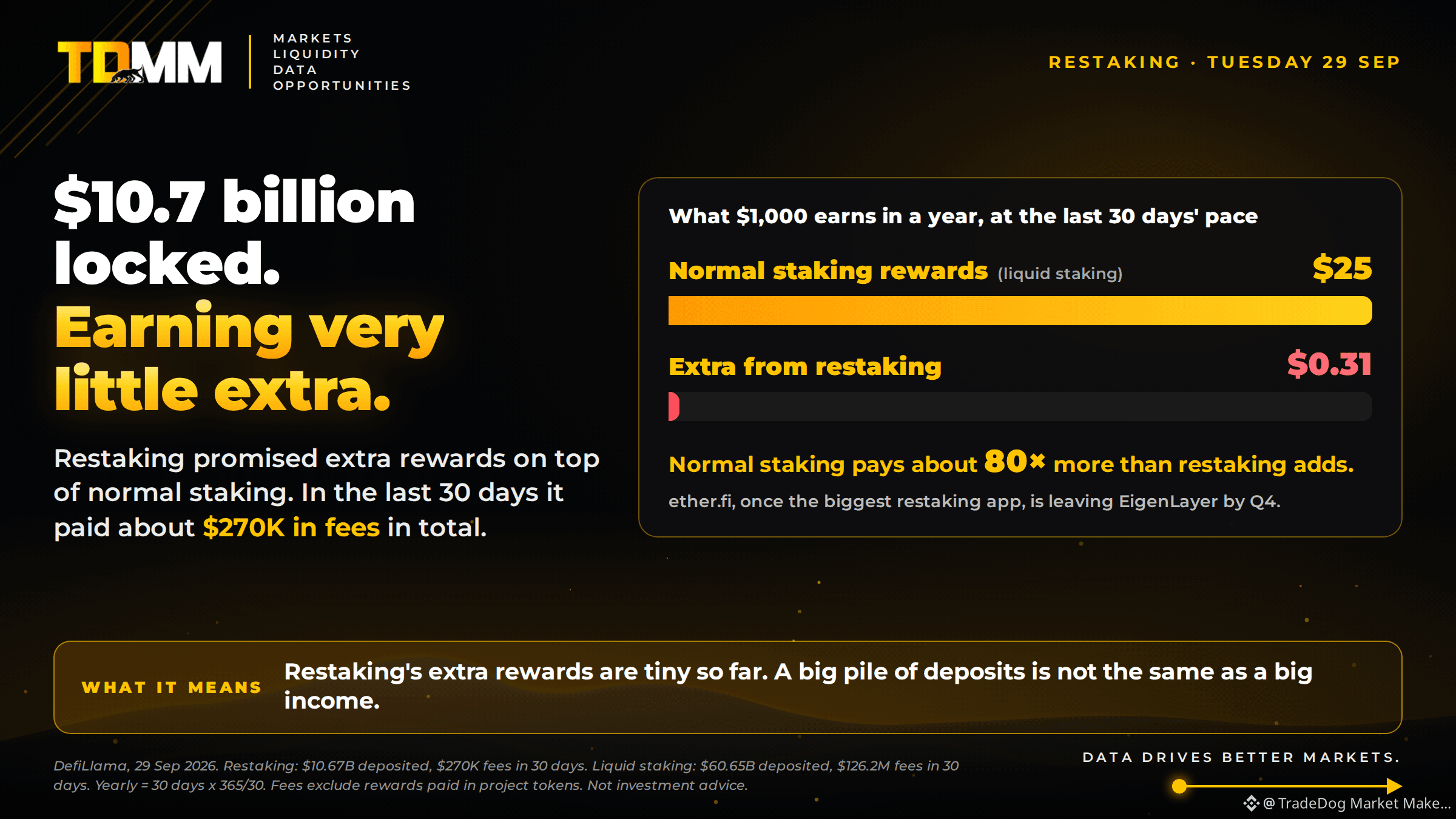
💸 $10.7B locked in restaking. Earning very little extra.
What $1,000 earns in a year (at the last 30 days' pace):
🟡 Normal staking rewards: ~$25
🔴 Extra from restaking: ~$0.31
➡️ Normal staking pays ~80× more than restaking adds
📊 The whole restaking sector paid ~$270K in fees in 30 days. $ETH restaking on EigenLayer alone holds ~$7.0B and earned ~$169K.
📰 Ether.fi, once the biggest restaking app, is fully exiting EigenLayer by Q4.
💡 Money parked is not money earned. Check what deposits actually produce.
What would make restaking pay again? 👇
#Restaking #ETH #DeFi #Staking
Data: DefiLlama, 29 Sep. Fees exclude rewards paid in project tokens. Not financial advice. DYOR.
💸 $10.7B locked in restaking. Earning very little extra.
What $1,000 earns in a year (at the last 30 days' pace):
🟡 Normal staking rewards: ~$25
🔴 Extra from restaking: ~$0.31
➡️ Normal staking pays ~80× more than restaking adds
📊 The whole restaking sector paid ~$270K in fees in 30 days. $ETH restaking on EigenLayer alone holds ~$7.0B and earned ~$169K.
📰 Ether.fi, once the biggest restaking app, is fully exiting EigenLayer by Q4.
💡 Money parked is not money earned. Check what deposits actually produce.
What would make restaking pay again? 👇
#Restaking #ETH #DeFi #Staking
Data: DefiLlama, 29 Sep. Fees exclude rewards paid in project tokens. Not financial advice. DYOR.
What $1,000 earns in a year (at the last 30 days' pace):
🟡 Normal staking rewards: ~$25
🔴 Extra from restaking: ~$0.31
➡️ Normal staking pays ~80× more than restaking adds
📊 The whole restaking sector paid ~$270K in fees in 30 days. $ETH restaking on EigenLayer alone holds ~$7.0B and earned ~$169K.
📰 Ether.fi, once the biggest restaking app, is fully exiting EigenLayer by Q4.
💡 Money parked is not money earned. Check what deposits actually produce.
What would make restaking pay again? 👇
#Restaking #ETH #DeFi #Staking
Data: DefiLlama, 29 Sep. Fees exclude rewards paid in project tokens. Not financial advice. DYOR.
2
229

·
--
See translation
🌟 Why Stake $CZR.US ?
Staking $CZR isn’t just about earning yield — it’s about tying rewards directly to ecosystem growth.
Potential benefits:
Competitive passive rewardsReduced circulating supply, which may support healthier token economicsBonus incentivesPriority access to upcoming launchpads and ecosystem opportunities
If adoption keeps expanding, staking could become one of the main ways holders participate in the growth of the CZR ecosystem.
Hold it, stake it, and let the ecosystem do the work. 👀
{stock_us}(CZR.US)
#staking #PassiveIncome #crypto #Launchpad #AnthropicIPOProspectusCouldValueItOver$2T
🌟 Why Stake $CZR.US ?
Staking $CZR isn’t just about earning yield — it’s about tying rewards directly to ecosystem growth.
Potential benefits:
Competitive passive rewardsReduced circulating supply, which may support healthier token economicsBonus incentivesPriority access to upcoming launchpads and ecosystem opportunities
If adoption keeps expanding, staking could become one of the main ways holders participate in the growth of the CZR ecosystem.
Hold it, stake it, and let the ecosystem do the work. 👀
#staking #PassiveIncome #crypto #Launchpad #AnthropicIPOProspectusCouldValueItOver$2T
Staking $CZR isn’t just about earning yield — it’s about tying rewards directly to ecosystem growth.
Potential benefits:
Competitive passive rewardsReduced circulating supply, which may support healthier token economicsBonus incentivesPriority access to upcoming launchpads and ecosystem opportunities
If adoption keeps expanding, staking could become one of the main ways holders participate in the growth of the CZR ecosystem.
Hold it, stake it, and let the ecosystem do the work. 👀
#staking #PassiveIncome #crypto #Launchpad #AnthropicIPOProspectusCouldValueItOver$2T
CZRUS+0.01%
8

·
--
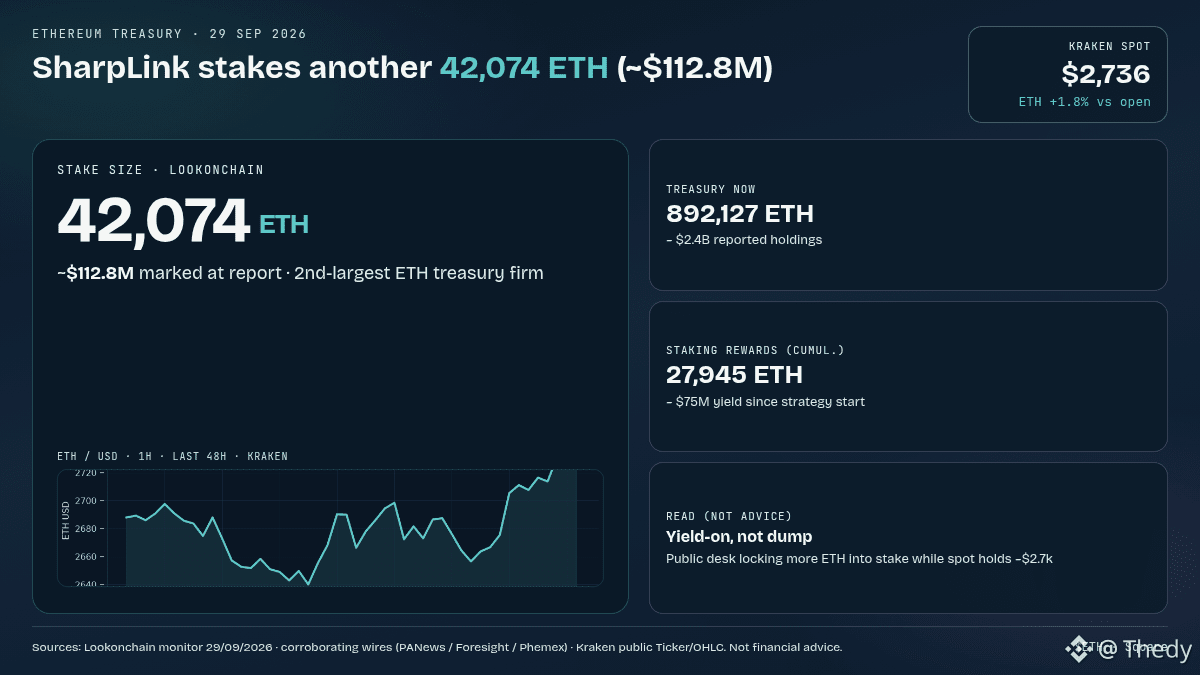
SharpLink locks in another 42,074 $ETH. About $112.8M moving into staking, not being sold.
Facts (Lookonchain, 29/09; via PANews / Foresight / Phemex):
• +42,074 ETH staked today, valued at ~ $112.8M at the time of the report.
• SharpLink treasury: 892,127 ETH (~$2.4B). Second-largest publicly tracked ETH treasury per the monitor.
• Cumulative staking rewards: 27,945 ETH (~$75M) since the strategy launched.
• Kraken spot (~13:00 UTC, 29/09): ETH ≈ $2,736 (+1.8% vs open), $BTC ≈ $84,284, $SOL ≈ $120.9. Fear & Greed 73 (Greed).
Read-through (interpretation, not advice):
A listed desk keeps activating ETH’s native yield rather than reducing. This isn’t an ETF flow, nor a fresh spot buy: it’s yield-on a position already held. Worth cross-checking with the still slightly green ETH ETF landscape (SoSoValue / media 28/09), but the SharpLink signal remains a treasury move, not proof of external demand.
Scenarios:
• A: new staking batches + ETH holding above ~ $2,650–$2,700 → the “productive treasury” narrative stays supported.
• B: unwind or visible selling after staking, or a drop below ~ $2,600 without new inflows → the move reads as cosmetic, not a re-rating.
Do you track ETH treasuries like SharpLink, or only ETF flows?
$ETH $BTC $SOL
#Ethereum #Crypto #Staking
SharpLink locks in another 42,074 $ETH . About $112.8M moving into staking, not being sold.
Facts (Lookonchain, 29/09; via PANews / Foresight / Phemex):
• +42,074 ETH staked today, valued at ~ $112.8M at the time of the report.
• SharpLink treasury: 892,127 ETH (~$2.4B). Second-largest publicly tracked ETH treasury per the monitor.
• Cumulative staking rewards: 27,945 ETH (~$75M) since the strategy launched.
• Kraken spot (~13:00 UTC, 29/09): ETH ≈ $2,736 (+1.8% vs open), $BTC ≈ $84,284, $SOL ≈ $120.9. Fear & Greed 73 (Greed).
Read-through (interpretation, not advice):
A listed desk keeps activating ETH’s native yield rather than reducing. This isn’t an ETF flow, nor a fresh spot buy: it’s yield-on a position already held. Worth cross-checking with the still slightly green ETH ETF landscape (SoSoValue / media 28/09), but the SharpLink signal remains a treasury move, not proof of external demand.
Scenarios:
• A: new staking batches + ETH holding above ~ $2,650–$2,700 → the “productive treasury” narrative stays supported.
• B: unwind or visible selling after staking, or a drop below ~ $2,600 without new inflows → the move reads as cosmetic, not a re-rating.
Do you track ETH treasuries like SharpLink, or only ETF flows?
$ETH $BTC $SOL
#Ethereum #Crypto #Staking
Facts (Lookonchain, 29/09; via PANews / Foresight / Phemex):
• +42,074 ETH staked today, valued at ~ $112.8M at the time of the report.
• SharpLink treasury: 892,127 ETH (~$2.4B). Second-largest publicly tracked ETH treasury per the monitor.
• Cumulative staking rewards: 27,945 ETH (~$75M) since the strategy launched.
• Kraken spot (~13:00 UTC, 29/09): ETH ≈ $2,736 (+1.8% vs open), $BTC ≈ $84,284, $SOL ≈ $120.9. Fear & Greed 73 (Greed).
Read-through (interpretation, not advice):
A listed desk keeps activating ETH’s native yield rather than reducing. This isn’t an ETF flow, nor a fresh spot buy: it’s yield-on a position already held. Worth cross-checking with the still slightly green ETH ETF landscape (SoSoValue / media 28/09), but the SharpLink signal remains a treasury move, not proof of external demand.
Scenarios:
• A: new staking batches + ETH holding above ~ $2,650–$2,700 → the “productive treasury” narrative stays supported.
• B: unwind or visible selling after staking, or a drop below ~ $2,600 without new inflows → the move reads as cosmetic, not a re-rating.
Do you track ETH treasuries like SharpLink, or only ETF flows?
$ETH $BTC $SOL
#Ethereum #Crypto #Staking
1
426

See translation
🔥 Dividends aren't exclusive to stocks; crypto can hand you comparable yields right now.
📈 STRC’s April VWAP of $99.76 locked a steady 11.5% dividend and delivered its first monthly gain in nine — a rare #Dividends #Equities signal that investors are craving reliable cash flow.
💡 While traditional payouts rise, the crypto cycle is humming: #Staking on Solana now yields ~6% APY, BNB offers ~5% on Binance Earn, and #DeFi protocols on BSC are pulling in $71K+ in the Hermès narrative, all while BTC sits at $84,612 with a bullish MACD crossover and $8.01 B open interest, indicating institutional confidence.
🚀 Practical move: allocate a modest slice of your portfolio to high‑yield on‑chain assets—e.g., stake SOL (RSI 60.5, bullish) or lock BNB (MACD bullish, $51 M volume) and monitor funding rates (+0.0029% for BTC, +0.0037% for ETH) to gauge long‑short pressure before rebalancing.
❓ How are you balancing traditional dividend stocks like STRC with crypto yield strategies—leaning heavier on cash flow, or shifting toward on‑chain income?
🔥 Dividends aren't exclusive to stocks; crypto can hand you comparable yields right now.
📈 STRC’s April VWAP of $99.76 locked a steady 11.5% dividend and delivered its first monthly gain in nine — a rare #Dividends #Equities signal that investors are craving reliable cash flow.
💡 While traditional payouts rise, the crypto cycle is humming: #Staking on Solana now yields ~6% APY, BNB offers ~5% on Binance Earn, and #DeFi protocols on BSC are pulling in $71K+ in the Hermès narrative, all while BTC sits at $84,612 with a bullish MACD crossover and $8.01 B open interest, indicating institutional confidence.
🚀 Practical move: allocate a modest slice of your portfolio to high‑yield on‑chain assets—e.g., stake SOL (RSI 60.5, bullish) or lock BNB (MACD bullish, $51 M volume) and monitor funding rates (+0.0029% for BTC, +0.0037% for ETH) to gauge long‑short pressure before rebalancing.
❓ How are you balancing traditional dividend stocks like STRC with crypto yield strategies—leaning heavier on cash flow, or shifting toward on‑chain income?
📈 STRC’s April VWAP of $99.76 locked a steady 11.5% dividend and delivered its first monthly gain in nine — a rare #Dividends #Equities signal that investors are craving reliable cash flow.
💡 While traditional payouts rise, the crypto cycle is humming: #Staking on Solana now yields ~6% APY, BNB offers ~5% on Binance Earn, and #DeFi protocols on BSC are pulling in $71K+ in the Hermès narrative, all while BTC sits at $84,612 with a bullish MACD crossover and $8.01 B open interest, indicating institutional confidence.
🚀 Practical move: allocate a modest slice of your portfolio to high‑yield on‑chain assets—e.g., stake SOL (RSI 60.5, bullish) or lock BNB (MACD bullish, $51 M volume) and monitor funding rates (+0.0029% for BTC, +0.0037% for ETH) to gauge long‑short pressure before rebalancing.
❓ How are you balancing traditional dividend stocks like STRC with crypto yield strategies—leaning heavier on cash flow, or shifting toward on‑chain income?
9

See translation
The SEC is taking a closer look at liquid staking tokens, highlighting a crucial detail many traders overlook: exit liquidity. While assets like cbETH and stETH offer great yield opportunities, your ability to convert them back to native ETH depends heavily on platform-specific withdrawal queues and terms. Regulatory scrutiny on these mechanics could shift how the market perceives staking risk. Always factor in potential unstaking delays before locking up your capital in DeFi protocols. $ETH #Ethereum #Staking #CryptoRegulation
The SEC is taking a closer look at liquid staking tokens, highlighting a crucial detail many traders overlook: exit liquidity. While assets like cbETH and stETH offer great yield opportunities, your ability to convert them back to native ETH depends heavily on platform-specific withdrawal queues and terms. Regulatory scrutiny on these mechanics could shift how the market perceives staking risk. Always factor in potential unstaking delays before locking up your capital in DeFi protocols. $ETH #Ethereum #Staking #CryptoRegulation
1
34

See translation
💰 Passive Income from Lazy Funds with Binance Earn!
Want to earn without trading or holding coins? You can use the Binance Earn feature of Binance.
🔹 Simple Earn (Flexible): You can withdraw funds at any time.
🔹 Locked Staking: Get higher APY/returns by locking for a fixed period.
Get regular returns by stacking instead of lazily leaving crypto in the wallet! 💸$USDC $BNB $ETH
#BinanceEarn #PassiveIncome #staking #CryptoEarnings
💰 Passive Income from Lazy Funds with Binance Earn!
Want to earn without trading or holding coins? You can use the Binance Earn feature of Binance.
🔹 Simple Earn (Flexible): You can withdraw funds at any time.
🔹 Locked Staking: Get higher APY/returns by locking for a fixed period.
Get regular returns by stacking instead of lazily leaving crypto in the wallet! 💸$USDC $BNB $ETH
#BinanceEarn #PassiveIncome #staking #CryptoEarnings
Want to earn without trading or holding coins? You can use the Binance Earn feature of Binance.
🔹 Simple Earn (Flexible): You can withdraw funds at any time.
🔹 Locked Staking: Get higher APY/returns by locking for a fixed period.
Get regular returns by stacking instead of lazily leaving crypto in the wallet! 💸$USDC $BNB $ETH
#BinanceEarn #PassiveIncome #staking #CryptoEarnings
58

·
--
See translation
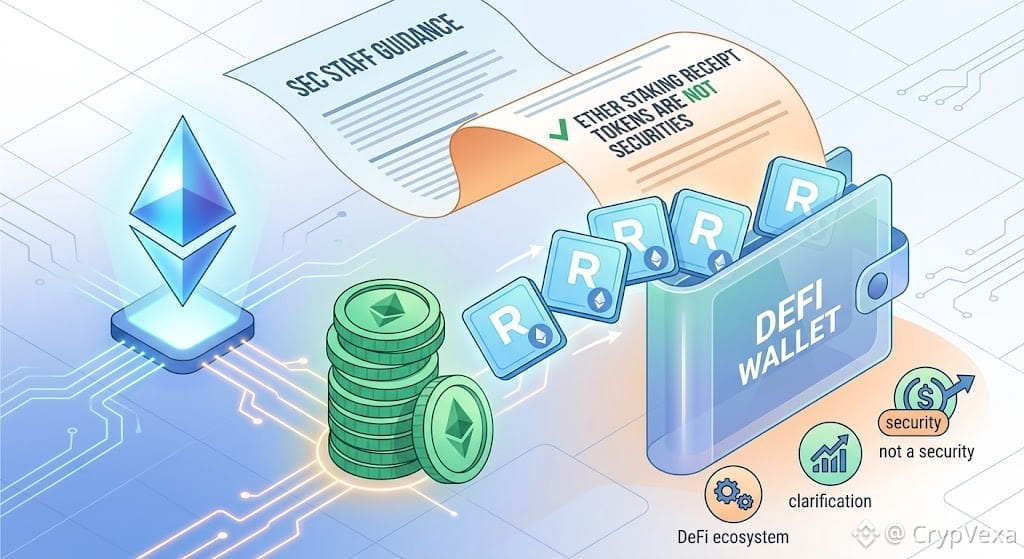
⚡ SEC Staff Clarifies Ethereum Staking Receipt Tokens
🇺🇸 SEC staff guidance says a staking receipt token representing a non-security crypto asset such as ETH is not itself a security, when it functions purely as a receipt under the described conditions.
🪙 The receipt simply represents ownership of the underlying staked asset. It does not create a separate right to rewards or additional financial benefits.
⚠️ Important: This is staff guidance, not a new SEC rule. The SEC says the FAQs are nonbinding and do not have legal force.
🌐 The clarification could provide more regulatory certainty for Ethereum staking and liquid-staking infrastructure.
👀 Could clearer staking rules accelerate institutional participation in Ethereum?
#Ethereum #ETH #Staking #CryptoRegulation
⚡ SEC Staff Clarifies Ethereum Staking Receipt Tokens
🇺🇸 SEC staff guidance says a staking receipt token representing a non-security crypto asset such as ETH is not itself a security, when it functions purely as a receipt under the described conditions.
🪙 The receipt simply represents ownership of the underlying staked asset. It does not create a separate right to rewards or additional financial benefits.
⚠️ Important: This is staff guidance, not a new SEC rule. The SEC says the FAQs are nonbinding and do not have legal force.
🌐 The clarification could provide more regulatory certainty for Ethereum staking and liquid-staking infrastructure.
👀 Could clearer staking rules accelerate institutional participation in Ethereum?
#Ethereum #ETH #Staking #CryptoRegulation
🇺🇸 SEC staff guidance says a staking receipt token representing a non-security crypto asset such as ETH is not itself a security, when it functions purely as a receipt under the described conditions.
🪙 The receipt simply represents ownership of the underlying staked asset. It does not create a separate right to rewards or additional financial benefits.
⚠️ Important: This is staff guidance, not a new SEC rule. The SEC says the FAQs are nonbinding and do not have legal force.
🌐 The clarification could provide more regulatory certainty for Ethereum staking and liquid-staking infrastructure.
👀 Could clearer staking rules accelerate institutional participation in Ethereum?
#Ethereum #ETH #Staking #CryptoRegulation
1
89

·
--
SEC's latest move is crazy! The risks of staking ETH have been amplified, especially the exit mechanism. Coinbase and Lido's withdrawal rules determine when you can get your ETH back. Staking rewards are tempting, but you need to understand the exit route too! #staking #DeFi $ETH $stETH
SEC's latest move is wild! Staked ETH exit risks are now in the spotlight. Coinbase's terms and Lido's withdrawal queue dictate when you actually get your ETH back. Staking yields are tempting, but make sure you understand the exit path! #staking #DeFi $ETH $stETH
SEC's latest move is crazy! The risks of staking ETH have been amplified, especially the exit mechanism. Coinbase and Lido's withdrawal rules determine when you can get your ETH back. Staking rewards are tempting, but you need to understand the exit route too! #staking #DeFi $ETH $stETH
SEC's latest move is wild! Staked ETH exit risks are now in the spotlight. Coinbase's terms and Lido's withdrawal queue dictate when you actually get your ETH back. Staking yields are tempting, but make sure you understand the exit path! #staking #DeFi $ETH $stETH
SEC's latest move is wild! Staked ETH exit risks are now in the spotlight. Coinbase's terms and Lido's withdrawal queue dictate when you actually get your ETH back. Staking yields are tempting, but make sure you understand the exit path! #staking #DeFi $ETH $stETH
295

·
--
See translation
Every proof-of-stake network has a quiet problem that never shows up in price charts: staking concentration.
Ask who actually validates $ETH and the answer gets uncomfortable fast. A large share of staked supply routes through a handful of liquid staking protocols and institutional staking services — not thousands of independent home validators. $SOL advertises one of the largest validator sets in crypto, yet stake weight clusters heavily among a small group of professional operators running data-center infrastructure. $BNB is even more explicit about it: a deliberately small validator committee that trades decentralization for speed and cost.
None of this makes these chains broken. But it changes what you're actually underwriting when you hold them.
The honest metric isn't validator count — it's how many independent entities would need to coordinate to censor or halt the chain. On paper, most majors look impressively decentralized. In practice, that number is far smaller than the marketing suggests.
Concentration creates correlated failure modes: a single staking provider under regulatory pressure, a slashing bug propagating through a shared client, unstaking queues flooding the moment confidence dips. None are hypotheticals — each has already happened somewhere in crypto.
The signal to watch isn't a headline, it's flows: where unstaking requests concentrate during stress, and whether governance actually disperses stake when one operator dominates.
Decentralization is a process, not a launch announcement.
$ETH $SOL $BNB
#Staking #Layer1 #DeFi #Crypto #PoS
Every proof-of-stake network has a quiet problem that never shows up in price charts: staking concentration.
Ask who actually validates $ETH and the answer gets uncomfortable fast. A large share of staked supply routes through a handful of liquid staking protocols and institutional staking services — not thousands of independent home validators. $SOL advertises one of the largest validator sets in crypto, yet stake weight clusters heavily among a small group of professional operators running data-center infrastructure. $BNB is even more explicit about it: a deliberately small validator committee that trades decentralization for speed and cost.
None of this makes these chains broken. But it changes what you're actually underwriting when you hold them.
The honest metric isn't validator count — it's how many independent entities would need to coordinate to censor or halt the chain. On paper, most majors look impressively decentralized. In practice, that number is far smaller than the marketing suggests.
Concentration creates correlated failure modes: a single staking provider under regulatory pressure, a slashing bug propagating through a shared client, unstaking queues flooding the moment confidence dips. None are hypotheticals — each has already happened somewhere in crypto.
The signal to watch isn't a headline, it's flows: where unstaking requests concentrate during stress, and whether governance actually disperses stake when one operator dominates.
Decentralization is a process, not a launch announcement.
$ETH $SOL $BNB
#Staking #Layer1 #DeFi #Crypto #PoS
Ask who actually validates $ETH and the answer gets uncomfortable fast. A large share of staked supply routes through a handful of liquid staking protocols and institutional staking services — not thousands of independent home validators. $SOL advertises one of the largest validator sets in crypto, yet stake weight clusters heavily among a small group of professional operators running data-center infrastructure. $BNB is even more explicit about it: a deliberately small validator committee that trades decentralization for speed and cost.
None of this makes these chains broken. But it changes what you're actually underwriting when you hold them.
The honest metric isn't validator count — it's how many independent entities would need to coordinate to censor or halt the chain. On paper, most majors look impressively decentralized. In practice, that number is far smaller than the marketing suggests.
Concentration creates correlated failure modes: a single staking provider under regulatory pressure, a slashing bug propagating through a shared client, unstaking queues flooding the moment confidence dips. None are hypotheticals — each has already happened somewhere in crypto.
The signal to watch isn't a headline, it's flows: where unstaking requests concentrate during stress, and whether governance actually disperses stake when one operator dominates.
Decentralization is a process, not a launch announcement.
$ETH $SOL $BNB
#Staking #Layer1 #DeFi #Crypto #PoS
162

·
--
See translation
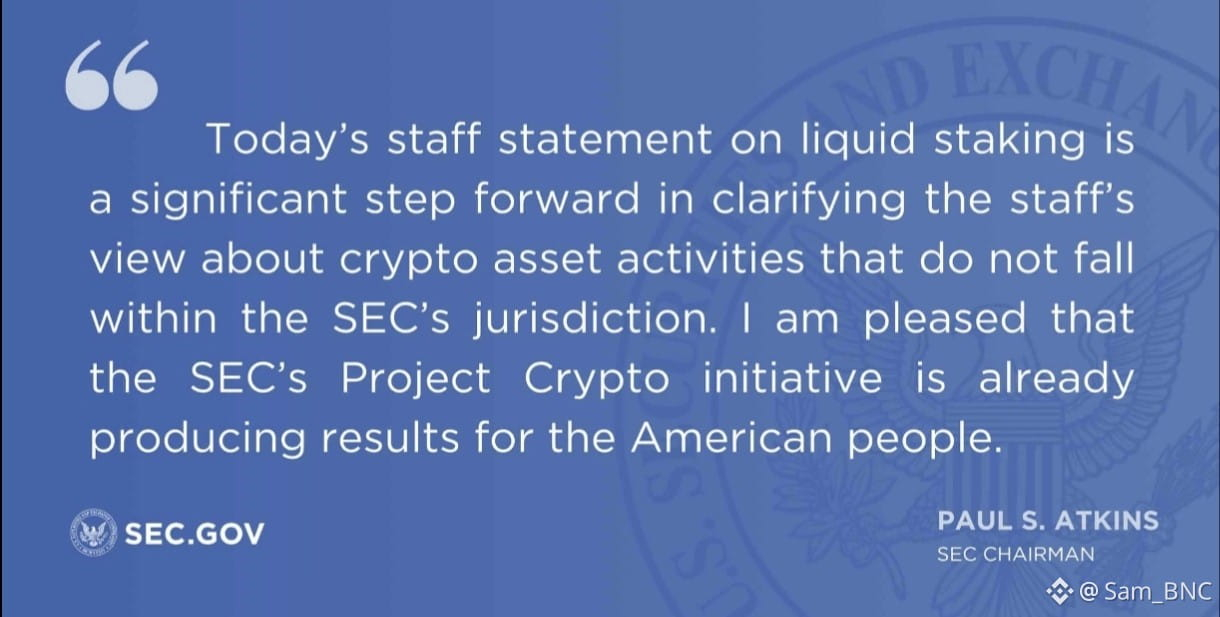
🚨 SEC JUST CLARIFIED LIQUID STAKING!
SEC staff says certain staking receipt tokens may be treated as digital tools rather than securities, depending on how they work.
{future}(ETHUSDT)
Could this impact the staking sector? 👀
#Ethereum #ETH #Crypto #Staking #BinanceSquare
🚨 SEC JUST CLARIFIED LIQUID STAKING!
SEC staff says certain staking receipt tokens may be treated as digital tools rather than securities, depending on how they work.
Could this impact the staking sector? 👀
#Ethereum #ETH #Crypto #Staking #BinanceSquare
SEC staff says certain staking receipt tokens may be treated as digital tools rather than securities, depending on how they work.
Could this impact the staking sector? 👀
#Ethereum #ETH #Crypto #Staking #BinanceSquare
1
46

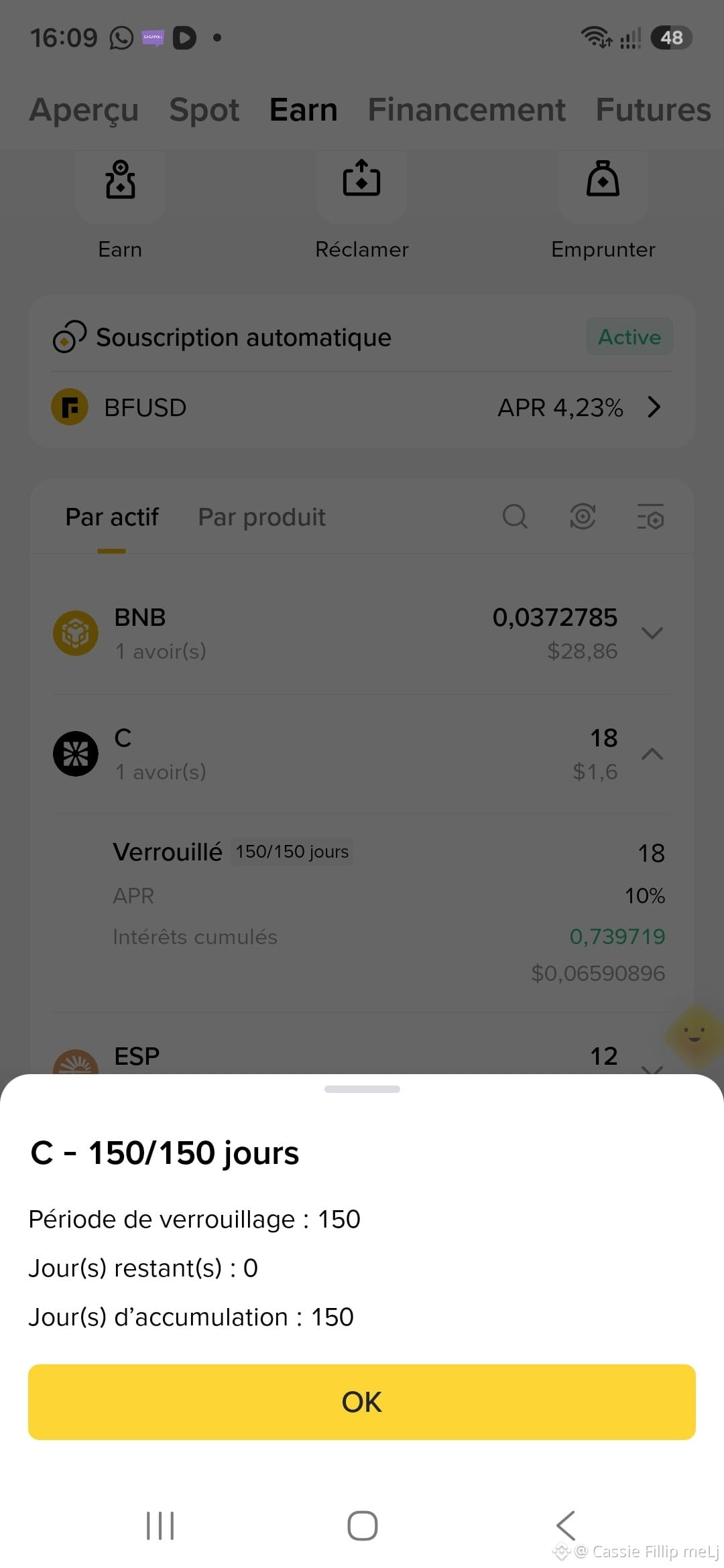
1. The patience of the staker: When the counter shows 150/150 ⏳💡
Title: Earn Locked: Why your tokens aren’t unlocked to the second?
Content:
Have you ever seen your Binance Earn product display 150/150 days, yet still not found your tokens immediately in your Spot wallet? This is a very common question among traders!
📌 How the redemption process works:
The end of the contract (\text{J}+150): The system stops calculating new interest.
Automatic processing: Unlocking requires a batch processing delay (often between 00:00 and 08:00 UTC).
Release of capital: The principal, along with the accumulated interest generated, transfers to the Spot wallet within 24 to 48 hours.
In crypto, patience isn’t only about waiting for the Bull Run—it also applies to the technical operation of the blockchain and smart contracts.
#BinanceEarn #SimpleEarn #CryptoTrading #Staking #BinanceSquare
1. The patience of the staker: When the counter shows 150/150 ⏳💡
Title: Earn Locked: Why your tokens aren’t unlocked to the second?
Content:
Have you ever seen your Binance Earn product display 150/150 days, yet still not found your tokens immediately in your Spot wallet? This is a very common question among traders!
📌 How the redemption process works:
The end of the contract (\text{J}+150): The system stops calculating new interest.
Automatic processing: Unlocking requires a batch processing delay (often between 00:00 and 08:00 UTC).
Release of capital: The principal, along with the accumulated interest generated, transfers to the Spot wallet within 24 to 48 hours.
In crypto, patience isn’t only about waiting for the Bull Run—it also applies to the technical operation of the blockchain and smart contracts.
#BinanceEarn #SimpleEarn #CryptoTrading #Staking #BinanceSquare
Title: Earn Locked: Why your tokens aren’t unlocked to the second?
Content:
Have you ever seen your Binance Earn product display 150/150 days, yet still not found your tokens immediately in your Spot wallet? This is a very common question among traders!
📌 How the redemption process works:
The end of the contract (\text{J}+150): The system stops calculating new interest.
Automatic processing: Unlocking requires a batch processing delay (often between 00:00 and 08:00 UTC).
Release of capital: The principal, along with the accumulated interest generated, transfers to the Spot wallet within 24 to 48 hours.
In crypto, patience isn’t only about waiting for the Bull Run—it also applies to the technical operation of the blockchain and smart contracts.
#BinanceEarn #SimpleEarn #CryptoTrading #Staking #BinanceSquare
107

·
--

Article
🚀 WHAT IS STAKING ON BINANCE AND HOW TO EARN CRYPTO WHILE YOU SLEEP? 🛌💰If you’ve seen the word Staking in the Binance app and it sounds like something you don’t understand, don’t worry! It happened to all of us at the beginning. You don’t need to be a programmer or a blockchain expert to understand it.
I’ll explain it to you in plain language, without beating around the bush:
💡 What is staking in simple terms?
Imagine that a crypto network (like Solana or Ethereum) needs “security guards” to verify that transactions are real. Instead of using giant computers that consume electricity, the network uses the community’s cryptocurrencies to stay strong and secure.
🚀 WHAT IS STAKING ON BINANCE AND HOW TO EARN CRYPTO WHILE YOU SLEEP? 🛌💰
If you’ve seen the word Staking in the Binance app and it sounds like something you don’t understand, don’t worry! It happened to all of us at the beginning. You don’t need to be a programmer or a blockchain expert to understand it.
I’ll explain it to you in plain language, without beating around the bush:
💡 What is staking in simple terms?
Imagine that a crypto network (like Solana or Ethereum) needs “security guards” to verify that transactions are real. Instead of using giant computers that consume electricity, the network uses the community’s cryptocurrencies to stay strong and secure.
I’ll explain it to you in plain language, without beating around the bush:
💡 What is staking in simple terms?
Imagine that a crypto network (like Solana or Ethereum) needs “security guards” to verify that transactions are real. Instead of using giant computers that consume electricity, the network uses the community’s cryptocurrencies to stay strong and secure.
1
3
89
·
--
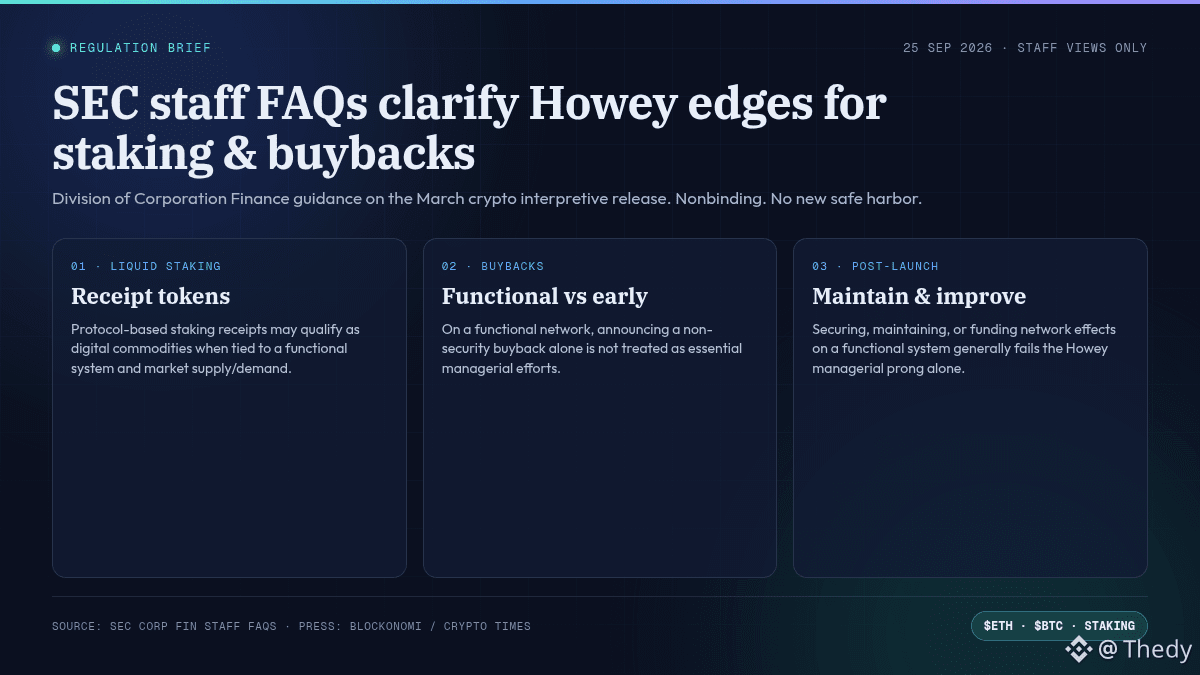
The SEC does not change the law. It clarifies where Howey ends for staking and buybacks.
Facts (Corp Fin staff, FAQs dated 09/25, staff-only views, with no legal force):
• Receipts from liquid staking tied to a crypto system that is already functioning may, depending on the circumstances described, be treated as digital commodities (value tied to programmatic functioning + supply/demand).
• Announcing a buyback of a non-security token on a network that is already functioning, by itself, is not viewed as a promise of “essential managerial efforts.”
• Securing, maintaining, improving a functioning system, or funding network effects, generally is not enough to satisfy the “managerial efforts” prong of Howey.
• The document does not create a safe harbor. It interprets the March 2026 framework. Confirmation press: Blockonomi, The Crypto Times.
Market context (Kraken, ~00:45 UTC 09/26): BTC ≈ $83,870, ETH ≈ $2,685, SOL ≈ $121.5, XRP ≈ $1.56. No violent break while the regulatory thread advances.
Interpretation (not legal advice):
Less ambiguity around networks that are already live, more discipline in marketing yield/buybacks before functionality. For $ETH et liquid staking, the detail “receipt = tool / commodity depending on the issuer” deserves to be read line by line, not summarized in a tweet.
Scenarios:
• A: projects that clearly frame utility vs. a promise of returns → perceived regulatory friction decreases, with no immediate price change.
• B: projects that are still pre-functional selling the buyback as “yield” → the Howey signal remains active, and the risk of reclassification remains as well.
Are you reading the staking receipts angle, or the buybacks angle?
$ETH $BTC
#Crypto #Staking
The SEC does not change the law. It clarifies where Howey ends for staking and buybacks.
Facts (Corp Fin staff, FAQs dated 09/25, staff-only views, with no legal force):
• Receipts from liquid staking tied to a crypto system that is already functioning may, depending on the circumstances described, be treated as digital commodities (value tied to programmatic functioning + supply/demand).
• Announcing a buyback of a non-security token on a network that is already functioning, by itself, is not viewed as a promise of “essential managerial efforts.”
• Securing, maintaining, improving a functioning system, or funding network effects, generally is not enough to satisfy the “managerial efforts” prong of Howey.
• The document does not create a safe harbor. It interprets the March 2026 framework. Confirmation press: Blockonomi, The Crypto Times.
Market context (Kraken, ~00:45 UTC 09/26): BTC ≈ $83,870, ETH ≈ $2,685, SOL ≈ $121.5, XRP ≈ $1.56. No violent break while the regulatory thread advances.
Interpretation (not legal advice):
Less ambiguity around networks that are already live, more discipline in marketing yield/buybacks before functionality. For $ETH et liquid staking, the detail “receipt = tool / commodity depending on the issuer” deserves to be read line by line, not summarized in a tweet.
Scenarios:
• A: projects that clearly frame utility vs. a promise of returns → perceived regulatory friction decreases, with no immediate price change.
• B: projects that are still pre-functional selling the buyback as “yield” → the Howey signal remains active, and the risk of reclassification remains as well.
Are you reading the staking receipts angle, or the buybacks angle?
$ETH $BTC
#Crypto #Staking
Facts (Corp Fin staff, FAQs dated 09/25, staff-only views, with no legal force):
• Receipts from liquid staking tied to a crypto system that is already functioning may, depending on the circumstances described, be treated as digital commodities (value tied to programmatic functioning + supply/demand).
• Announcing a buyback of a non-security token on a network that is already functioning, by itself, is not viewed as a promise of “essential managerial efforts.”
• Securing, maintaining, improving a functioning system, or funding network effects, generally is not enough to satisfy the “managerial efforts” prong of Howey.
• The document does not create a safe harbor. It interprets the March 2026 framework. Confirmation press: Blockonomi, The Crypto Times.
Market context (Kraken, ~00:45 UTC 09/26): BTC ≈ $83,870, ETH ≈ $2,685, SOL ≈ $121.5, XRP ≈ $1.56. No violent break while the regulatory thread advances.
Interpretation (not legal advice):
Less ambiguity around networks that are already live, more discipline in marketing yield/buybacks before functionality. For $ETH et liquid staking, the detail “receipt = tool / commodity depending on the issuer” deserves to be read line by line, not summarized in a tweet.
Scenarios:
• A: projects that clearly frame utility vs. a promise of returns → perceived regulatory friction decreases, with no immediate price change.
• B: projects that are still pre-functional selling the buyback as “yield” → the Howey signal remains active, and the risk of reclassification remains as well.
Are you reading the staking receipts angle, or the buybacks angle?
$ETH $BTC
#Crypto #Staking
210
·
--
See translation
Staking yield is the most misunderstood number in crypto.
When a chain advertises 8% staking APY, most people read it as income. Read it as inflation first. Nominal staking yield is mostly new token issuance — a transfer from non-stakers to stakers. If everyone stakes, everyone gets diluted in lockstep, and that "yield" simply buys back the share of your own inflation.
The honest number is real yield: what the chain actually earns. A chain paying 8% while inflating 6% hands you roughly 2% of true economic yield. A chain paying 3% with heavy fee burn and real user demand can quietly pay more.
This reframes the Layer 1 comparison. $ETH's fee-burn design separates the books: issuance is payroll for security, fees are revenue, and the burn refunds part of the inflation back to every holder. $SOL's high nominal yield is a deliberate adoption subsidy — transparent, but funded by non-stakers. $DOT ties its inflation to participation, paying those who show up and pruning those who don't.
The rule of thumb: yield paid from outside the system (fees, MEV, real demand) is income. Yield paid from inside the system (fresh issuance) is a refund on money already taken from you.
Before chasing any APY, ask one question: who is actually paying for this yield?
#Staking #Tokenomics #Layer1 #Yield #Crypto
Staking yield is the most misunderstood number in crypto.
When a chain advertises 8% staking APY, most people read it as income. Read it as inflation first. Nominal staking yield is mostly new token issuance — a transfer from non-stakers to stakers. If everyone stakes, everyone gets diluted in lockstep, and that "yield" simply buys back the share of your own inflation.
The honest number is real yield: what the chain actually earns. A chain paying 8% while inflating 6% hands you roughly 2% of true economic yield. A chain paying 3% with heavy fee burn and real user demand can quietly pay more.
This reframes the Layer 1 comparison. $ETH 's fee-burn design separates the books: issuance is payroll for security, fees are revenue, and the burn refunds part of the inflation back to every holder. $SOL 's high nominal yield is a deliberate adoption subsidy — transparent, but funded by non-stakers. $DOT ties its inflation to participation, paying those who show up and pruning those who don't.
The rule of thumb: yield paid from outside the system (fees, MEV, real demand) is income. Yield paid from inside the system (fresh issuance) is a refund on money already taken from you.
Before chasing any APY, ask one question: who is actually paying for this yield?
#Staking #Tokenomics #Layer1 #Yield #Crypto
When a chain advertises 8% staking APY, most people read it as income. Read it as inflation first. Nominal staking yield is mostly new token issuance — a transfer from non-stakers to stakers. If everyone stakes, everyone gets diluted in lockstep, and that "yield" simply buys back the share of your own inflation.
The honest number is real yield: what the chain actually earns. A chain paying 8% while inflating 6% hands you roughly 2% of true economic yield. A chain paying 3% with heavy fee burn and real user demand can quietly pay more.
This reframes the Layer 1 comparison. $ETH 's fee-burn design separates the books: issuance is payroll for security, fees are revenue, and the burn refunds part of the inflation back to every holder. $SOL 's high nominal yield is a deliberate adoption subsidy — transparent, but funded by non-stakers. $DOT ties its inflation to participation, paying those who show up and pruning those who don't.
The rule of thumb: yield paid from outside the system (fees, MEV, real demand) is income. Yield paid from inside the system (fresh issuance) is a refund on money already taken from you.
Before chasing any APY, ask one question: who is actually paying for this yield?
#Staking #Tokenomics #Layer1 #Yield #Crypto
278


·
--
Bullish
@LidoFinance LDO is trading at $0.4612 with +16.20%. I don’t start from the price at all. I start from Ethereum itself: when staking becomes massive, how do we preserve the distribution of power? Lido’s developments around validator operations models and community participation matter for exactly this reason. For me, Lido’s success is not only that it grows; but that it grows without becoming a new centralized layer on top of Ethereum.
#staking #marouan47 #ldo @LidoFinance
$LDO
{spot}(LDOUSDT)
$ETH
{spot}(ETHUSDT)
@Lido LDO is trading at $0.4612 with +16.20%. I don’t start from the price at all. I start from Ethereum itself: when staking becomes massive, how do we preserve the distribution of power? Lido’s developments around validator operations models and community participation matter for exactly this reason. For me, Lido’s success is not only that it grows; but that it grows without becoming a new centralized layer on top of Ethereum.
#staking #marouan47 #ldo @Lido
$LDO
$ETH
#staking #marouan47 #ldo @Lido
$LDO
$ETH
1
380

STAKING💰 ❗️❗️❗️ Or, How to make crypto work for you while you sleep?
Staking is like a digital bank deposit, but without the bank’s involvement. You lock your coins on the blockchain (for example, via the #Binance Earn tab) to help the network operate.
The blockchain uses your coins to verify transactions and ensure security. In return for helping the network run, it rewards you—by issuing new coins as interest.
⚖️ Two main types of staking:
1. FIXED (Locked): You freeze your crypto for a specific period (30, 60, 90, or 120 days). The percentage (APR) here is the most tempting, but you can’t withdraw the coins early without losing the accumulated interest.
2. FLEXIBLE (Flexible): You can withdraw coins at any moment. Ideal for those who are afraid of sudden market moves, but the interest here is lower.
⚡️ What’s the main trick for earning?
It’s compound interest! The coins you earn each day automatically get added to your balance, and the next day they bring in even more profit. Over a few months, it turns into a powerful snowball. 📈
$BTC $BNB $ETH
#staking #cryptoearning #PassiveIncome
STAKING💰 ❗️❗️❗️ Or, How to make crypto work for you while you sleep?
Staking is like a digital bank deposit, but without the bank’s involvement. You lock your coins on the blockchain (for example, via the #Binance Earn tab) to help the network operate.
The blockchain uses your coins to verify transactions and ensure security. In return for helping the network run, it rewards you—by issuing new coins as interest.
⚖️ Two main types of staking:
1. FIXED (Locked): You freeze your crypto for a specific period (30, 60, 90, or 120 days). The percentage (APR) here is the most tempting, but you can’t withdraw the coins early without losing the accumulated interest.
2. FLEXIBLE (Flexible): You can withdraw coins at any moment. Ideal for those who are afraid of sudden market moves, but the interest here is lower.
⚡️ What’s the main trick for earning?
It’s compound interest! The coins you earn each day automatically get added to your balance, and the next day they bring in even more profit. Over a few months, it turns into a powerful snowball. 📈
$BTC $BNB $ETH
#staking #cryptoearning #PassiveIncome
Staking is like a digital bank deposit, but without the bank’s involvement. You lock your coins on the blockchain (for example, via the #Binance Earn tab) to help the network operate.
The blockchain uses your coins to verify transactions and ensure security. In return for helping the network run, it rewards you—by issuing new coins as interest.
⚖️ Two main types of staking:
1. FIXED (Locked): You freeze your crypto for a specific period (30, 60, 90, or 120 days). The percentage (APR) here is the most tempting, but you can’t withdraw the coins early without losing the accumulated interest.
2. FLEXIBLE (Flexible): You can withdraw coins at any moment. Ideal for those who are afraid of sudden market moves, but the interest here is lower.
⚡️ What’s the main trick for earning?
It’s compound interest! The coins you earn each day automatically get added to your balance, and the next day they bring in even more profit. Over a few months, it turns into a powerful snowball. 📈
$BTC $BNB $ETH
#staking #cryptoearning #PassiveIncome
110
·
--
See translation
Staking is like putting your crypto to work instead of letting it sit idle. You lock up tokens to help secure a blockchain network, and in return you earn rewards — similar to interest on a savings account but powered by code not banks.
Popular options right now include Ethereum (ETH) via liquid staking on Lido at 3-4% APY, Solana (SOL) through native delegation around 6-7%, and Polygon (MATIC) on Binance Earn or Lido near 4-5%. These are conservative estimates — actual yields fluctuate with network activity and validator performance.
Platforms like Binance Earn, Lido, and Coinbase make it simple with one-click staking. No technical setup needed. Just choose your asset, confirm the lock period if any, and watch rewards compound daily.
Risk warning: slashing penalties can slash your principal if validators misbehave or go offline. Always research validator reputation and diversify across multiple operators.
Staking turns holders into earners without trading stress. The best part? You keep custody of your keys on non-custodial options.
Are you staking any crypto right now? Drop your favourite coin below!
#Altcoins #CryptoNews #Staking #PassiveIncome
Staking is like putting your crypto to work instead of letting it sit idle. You lock up tokens to help secure a blockchain network, and in return you earn rewards — similar to interest on a savings account but powered by code not banks.
Popular options right now include Ethereum (ETH) via liquid staking on Lido at 3-4% APY, Solana (SOL) through native delegation around 6-7%, and Polygon (MATIC) on Binance Earn or Lido near 4-5%. These are conservative estimates — actual yields fluctuate with network activity and validator performance.
Platforms like Binance Earn, Lido, and Coinbase make it simple with one-click staking. No technical setup needed. Just choose your asset, confirm the lock period if any, and watch rewards compound daily.
Risk warning: slashing penalties can slash your principal if validators misbehave or go offline. Always research validator reputation and diversify across multiple operators.
Staking turns holders into earners without trading stress. The best part? You keep custody of your keys on non-custodial options.
Are you staking any crypto right now? Drop your favourite coin below!
#Altcoins #CryptoNews #Staking #PassiveIncome
Popular options right now include Ethereum (ETH) via liquid staking on Lido at 3-4% APY, Solana (SOL) through native delegation around 6-7%, and Polygon (MATIC) on Binance Earn or Lido near 4-5%. These are conservative estimates — actual yields fluctuate with network activity and validator performance.
Platforms like Binance Earn, Lido, and Coinbase make it simple with one-click staking. No technical setup needed. Just choose your asset, confirm the lock period if any, and watch rewards compound daily.
Risk warning: slashing penalties can slash your principal if validators misbehave or go offline. Always research validator reputation and diversify across multiple operators.
Staking turns holders into earners without trading stress. The best part? You keep custody of your keys on non-custodial options.
Are you staking any crypto right now? Drop your favourite coin below!
#Altcoins #CryptoNews #Staking #PassiveIncome
20

See translation
⚡ $HYPE SECURES PRIME LISTING WITH STAKING REWARDS OFFICIALLY UNLOCKED! 🚀
The waiting game is officially over as $HYPE hits a top-tier exchange under the Seed Tag umbrella. 📊 This opens up direct access to deep institutional liquidity while enabling native staking options right at launch.
Early accumulators are already watching order books closely to see how initial price discovery shapes up. 💡 With spot access and yield integration landing simultaneously, market momentum could ignite aggressive bid defense around initial order blocks. 💬 Will you be locking in yield on day one, or waiting for secondary price discovery to settle? 👇
⚠️ Not financial advice. Always manage your risk. 🛡️
🏷️ #HYPE #CryptoListing #Altcoins #Staking
⚡ 💎
⚡ $HYPE SECURES PRIME LISTING WITH STAKING REWARDS OFFICIALLY UNLOCKED! 🚀
The waiting game is officially over as $HYPE hits a top-tier exchange under the Seed Tag umbrella. 📊 This opens up direct access to deep institutional liquidity while enabling native staking options right at launch.
Early accumulators are already watching order books closely to see how initial price discovery shapes up. 💡 With spot access and yield integration landing simultaneously, market momentum could ignite aggressive bid defense around initial order blocks. 💬 Will you be locking in yield on day one, or waiting for secondary price discovery to settle? 👇
⚠️ Not financial advice. Always manage your risk. 🛡️
🏷️ #HYPE #CryptoListing #Altcoins #Staking
⚡ 💎
The waiting game is officially over as $HYPE hits a top-tier exchange under the Seed Tag umbrella. 📊 This opens up direct access to deep institutional liquidity while enabling native staking options right at launch.
Early accumulators are already watching order books closely to see how initial price discovery shapes up. 💡 With spot access and yield integration landing simultaneously, market momentum could ignite aggressive bid defense around initial order blocks. 💬 Will you be locking in yield on day one, or waiting for secondary price discovery to settle? 👇
⚠️ Not financial advice. Always manage your risk. 🛡️
🏷️ #HYPE #CryptoListing #Altcoins #Staking
⚡ 💎

44

2️⃣ — DeFi Concept for Beginners
🔑 Staking: the simplest way to make your crypto workIf you have $ETH o $SOL sleeping in your wallet without doing anything, you’re missing out on something.
Staking is basically this:
✅ You lock your tokens to help validate the network
✅ In return, you receive rewards—like interest, but in crypto
✅ You don’t need to be a programmer or have a gaming PC—many networks let you do it directly from the exchange
⚠️ Watch out: there’s a lock-up period on some networks, and the token value can go up or down during that time. This is not a guaranteed profit—just another tool.
2️⃣ — DeFi Concept for Beginners 🔑 Staking: the simplest way to make your crypto work
If you have $ETH o $SOL sleeping in your wallet without doing anything, you’re missing out on something.
Staking is basically this:
✅ You lock your tokens to help validate the network
✅ In return, you receive rewards—like interest, but in crypto
✅ You don’t need to be a programmer or have a gaming PC—many networks let you do it directly from the exchange
⚠️ Watch out: there’s a lock-up period on some networks, and the token value can go up or down during that time. This is not a guaranteed profit—just another tool.
Staking is basically this:
✅ You lock your tokens to help validate the network
✅ In return, you receive rewards—like interest, but in crypto
✅ You don’t need to be a programmer or have a gaming PC—many networks let you do it directly from the exchange
⚠️ Watch out: there’s a lock-up period on some networks, and the token value can go up or down during that time. This is not a guaranteed profit—just another tool.
491
Log in to explore more content
Join global crypto users on Binance Square
⚡️ Get latest and useful information about crypto.
💬 Trusted by the world’s largest crypto exchange.
👍 Discover real insights from verified creators.
Email / Phone number
Trending Topics
1
#BitcoinClears$85200
800 views
71 Discussing
2
#AltcoinSeasonIndexHoldsAbove60For5Days
7,899 views
453 Discussing
3
#USADPAdds90000JobsInSeptember
2,036 views
207 Discussing
4
#USCorePCEEasesTo3%InAugust
2,045 views
180 Discussing
5
#KospiPostsWorstQuarterSince2020
2,658 views
233 Discussing
6
#SECToClarifyOnChainFundraisingRules
8,824 views
396 Discussing
7
#UKFCAOpensCryptoFirmAuthorization
12,352 views
371 Discussing
8
#JapanMOFStudyGroupOnTokenizedGovtBonds
10,705 views
309 Discussing
9
#QNTRises287%
52,166 views
708 Discussing
10
#TrumpRejectsAIRulesForVoluntaryAudits
34,174 views
634 Discussing