
#cyber
cyber
26.6M views
80,825 Discussing
Hot
Latest

See translation
Massive whale accumulation just hit $CYBER. Big players scooped 171.28K tokens worth 39.64K USDT in a tight 14-minute window while volume touched 789.43K USDT at a 0.234 USDT price (+5.41%). To me, this sudden order size spike signals smart money positioning for a bigger move. Are you riding this wave? #CYBER #Binance #CryptoWhales #Altcoins
Massive whale accumulation just hit $CYBER . Big players scooped 171.28K tokens worth 39.64K USDT in a tight 14-minute window while volume touched 789.43K USDT at a 0.234 USDT price (+5.41%). To me, this sudden order size spike signals smart money positioning for a bigger move. Are you riding this wave? #CYBER #Binance #CryptoWhales #Altcoins
7

See translation
Upbit and Bithumb have suspended deposits and withdrawals of CYBER after reports of unexpected token minting on Solana and transfers from the Ethereum bridge contract. The exchanges moved fast — a sign they are taking the anomaly seriously. $CYBER holders on those platforms are locked out of moving tokens until the investigation clears. Unexplained minting is one of the sharpest red flags in crypto: new supply from nowhere dilutes everyone. Watch for the official explanation.
#CyberConnect #CYBER $CYBER #Security
#CyberConnect #CYBER $CYBER #Security
276
·
--
See translation
🔴 $CYBER SHORT · 1h
✅ Proven · Donchian Breakout, Bearish
Entry 0.203
Target 0.187 (−7.9%)
Stop 0.231 (+13.8%)
Reward:risk 0.6
📊 All coins, 1h: 72% won of 2070 · avg +1.3%
🪙 On CYBER: 15 of 22 won
Automated chart-pattern signal. Not financial advice.
#CYBER #CryptoSignals
🔴 $CYBER SHORT · 1h
✅ Proven · Donchian Breakout, Bearish
Entry 0.203
Target 0.187 (−7.9%)
Stop 0.231 (+13.8%)
Reward:risk 0.6
📊 All coins, 1h: 72% won of 2070 · avg +1.3%
🪙 On CYBER: 15 of 22 won
Automated chart-pattern signal. Not financial advice.
#CYBER #CryptoSignals
✅ Proven · Donchian Breakout, Bearish
Entry 0.203
Target 0.187 (−7.9%)
Stop 0.231 (+13.8%)
Reward:risk 0.6
📊 All coins, 1h: 72% won of 2070 · avg +1.3%
🪙 On CYBER: 15 of 22 won
Automated chart-pattern signal. Not financial advice.
#CYBER #CryptoSignals
26

·
--
windykiss:
follow em theo kèo với bác ơi
2
457

·
--
$CYBER is drawing increased attention. Let me put my take up front, with the reasoning to follow.
I came across it again a day later. I barely noticed it at first, and only after checking twice did I realize it was the same batch of positions moving as last time.
The funding rate fell to -1.72%, and long accounts made up just 43.97%. I stared at those two figures together for a while. There are even more betting on the other side to narrow the gap than chasing longs.
The disagreement still hasn’t been resolved.
I’ll keep watching.
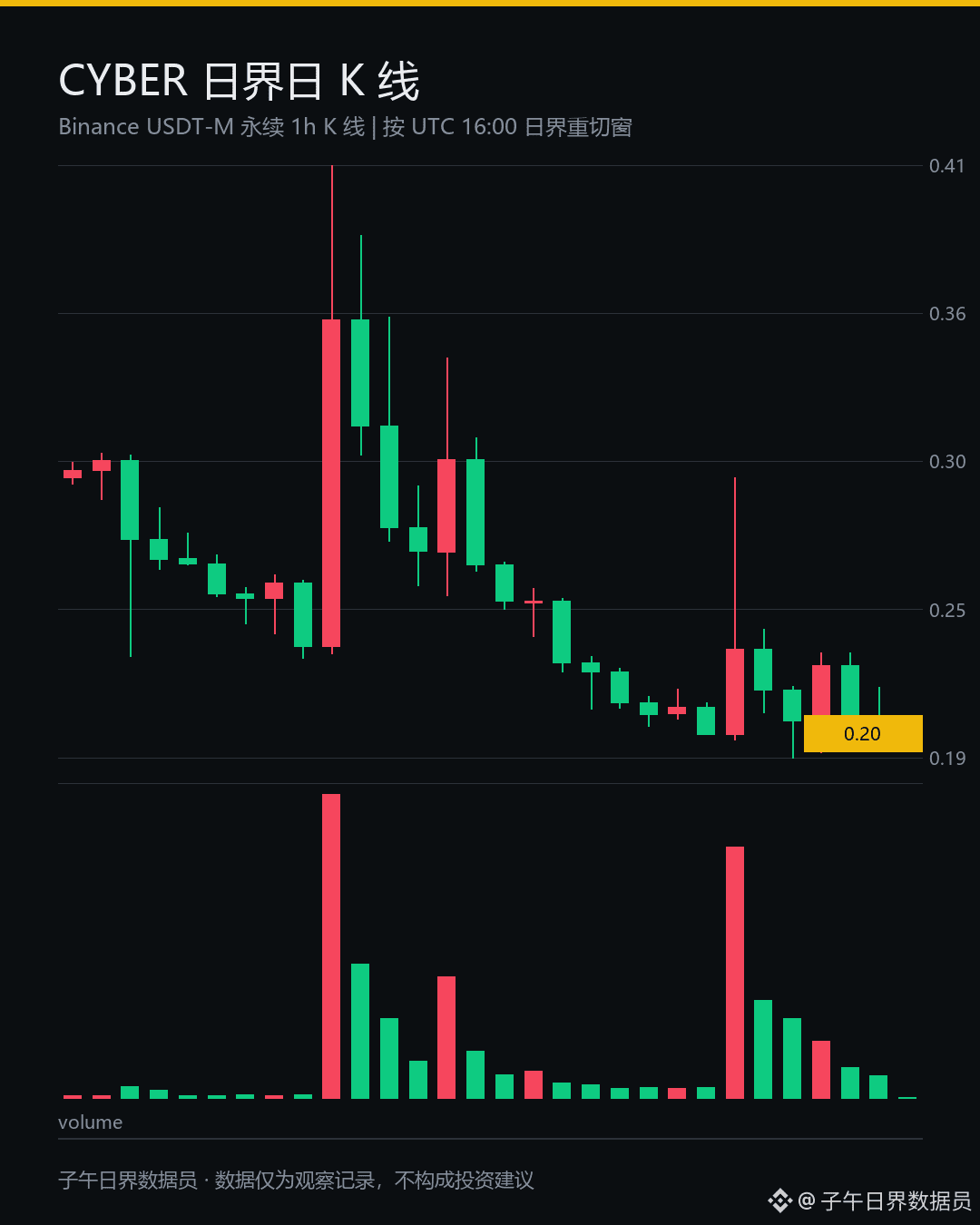
Over the past 20 days, the range runs from 0.1991 to 0.4111. The current price of 0.281 sits at the 38.63rd percentile—not particularly high or low.
The volume on those earlier slow-grind-down days doesn’t compare with this. Daily trading volume hit 70.03 million, while the previous day’s was barely a fraction of that. The new volume is real.
Open interest rose 83.89%, and notional value rose 158.17%. New positions are coming in at higher prices, so there are two layers of positions, not one.
It’s like an upstream reservoir opening its gates in the middle of the night. The water first rushes into the stretch of river nearest the gate, while everywhere else is still waiting for it to reach them.
The pool is only so big. Whoever’s camped closest to the gate gets the water first, and right now, this is closest to the gate.
It covered almost a month’s worth of ground in a single day. Honestly, that makes me less eager to jump in. I’ve seen this kind of move too many times.
What do you all think—is this just the beginning, or the last hurrah?
$BTC $ETH
#CYBER #比特币 #Cryptocurrency
The above is a record of my personal trading system and observations of market data. It does not constitute investment advice.
219

See translation
CYBER Bridge Security Incident: A Wake-Up Call for the Entire DeFi Industrythe Entire DeFi Industry
A blockchain bridge incident has put cross-chain security back in the spotlight. Here's what crypto users need to understand.
What happened?
On November 21, unusual CYBER token minting activity was detected on Solana, followed by transfers involving the Ethereum bridge infrastructure.
Cyber's official account subsequently warned users against using its CYBER bridge while the investigation was underway.
The project's communication also advised users not to migrate tokens, connect wallets or sign unexpected transactions in response to the incident.
However, they introduce additional security components:
Smart contracts.
Validators and verification systems.
Cross-chain messaging infrastructure.
Token minting and burning mechanisms.
If one of these components is compromised, attackers may potentially manipulate transfers or create unauthorized token supply.
What happened after the incident?
Binance Square's November 24 news feed reports that Cyber said it had stopped the attack and that its treasury would cover abnormally minted CYBER tokens.
The same report says the bridge remained suspended during security checks and that the detailed handling plan was still pending.
The DeFi industry needs stronger verification systems, better monitoring and transparent incident reporting.
Users also need to understand that a bridge is not simply a transfer button. It is an additional layer of technology with its own risks.
Let's discuss!
What do you think is the biggest security weakness in cross-chain bridges?
A) Smart contract vulnerabilities
B) Compromised validator keys
C) Weak monitoring systems
D) Lack of user awareness
Share your thoughts below! 👇
#CYBER #DeFi #BlockchainSecurity #CryptoNews #Web3 $BTC
CYBER Bridge Security Incident: A Wake-Up Call for the Entire DeFi Industry
the Entire DeFi Industry
A blockchain bridge incident has put cross-chain security back in the spotlight. Here's what crypto users need to understand.
What happened?
On November 21, unusual CYBER token minting activity was detected on Solana, followed by transfers involving the Ethereum bridge infrastructure.
Cyber's official account subsequently warned users against using its CYBER bridge while the investigation was underway.
The project's communication also advised users not to migrate tokens, connect wallets or sign unexpected transactions in response to the incident.
However, they introduce additional security components:
Smart contracts.
Validators and verification systems.
Cross-chain messaging infrastructure.
Token minting and burning mechanisms.
If one of these components is compromised, attackers may potentially manipulate transfers or create unauthorized token supply.
What happened after the incident?
Binance Square's November 24 news feed reports that Cyber said it had stopped the attack and that its treasury would cover abnormally minted CYBER tokens.
The same report says the bridge remained suspended during security checks and that the detailed handling plan was still pending.
The DeFi industry needs stronger verification systems, better monitoring and transparent incident reporting.
Users also need to understand that a bridge is not simply a transfer button. It is an additional layer of technology with its own risks.
Let's discuss!
What do you think is the biggest security weakness in cross-chain bridges?
A) Smart contract vulnerabilities
B) Compromised validator keys
C) Weak monitoring systems
D) Lack of user awareness
Share your thoughts below! 👇
#CYBER #DeFi #BlockchainSecurity #CryptoNews #Web3 $BTC
311

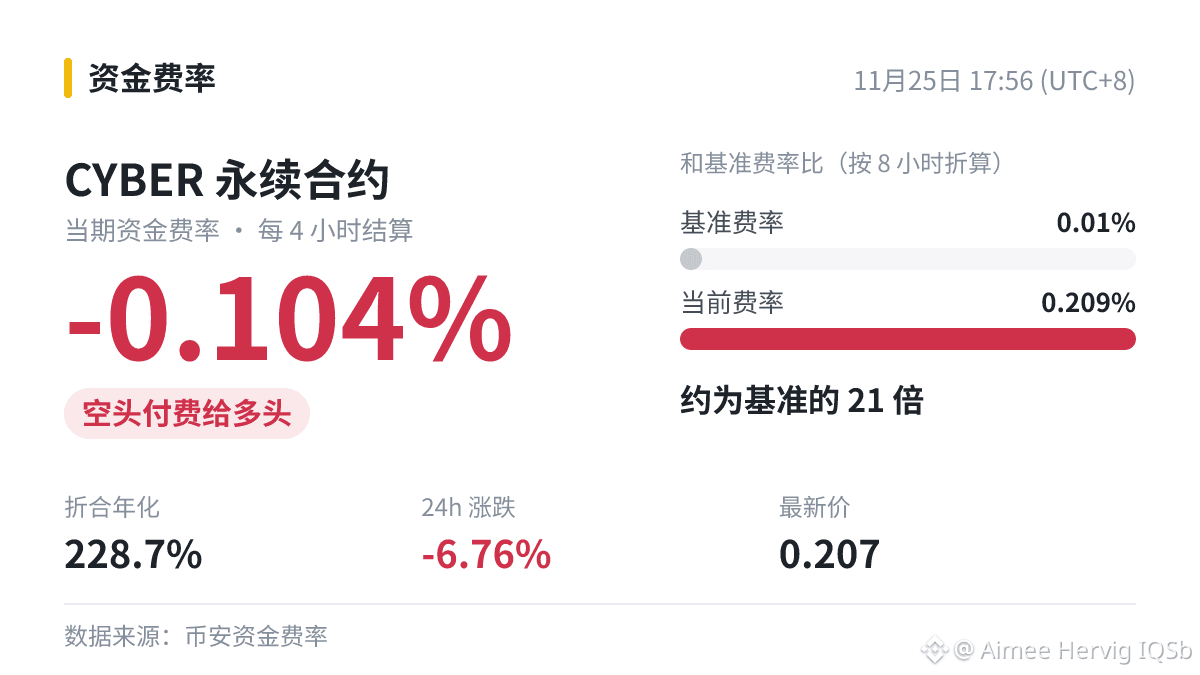
$CYBER Shorts are paying longs: funding rate -0.104%, approximately 228.7% annualized, 24h -6.76%.
Holding oversized losing positions is the most common reason for liquidation.
#CYBER
Just a note, not investment advice.
$CYBER Shorts are paying longs: funding rate -0.104%, approximately 228.7% annualized, 24h -6.76%.
Holding oversized losing positions is the most common reason for liquidation.
#CYBER
Just a note, not investment advice.
Holding oversized losing positions is the most common reason for liquidation.
#CYBER
Just a note, not investment advice.
3

·
--
🔎 Let’s break down the market: $CYBER funding rate -0.104%, settlement interval 4 hours, annualized at approximately 228.7%, with shorts paying.
Price over the same period: 24h -2.8%, current price 0.208.
The more negative the funding rate gets, the more crowded short positions are. What do you think?
#CYBER
Price over the same period: 24h -2.8%, current price 0.208.
The more negative the funding rate gets, the more crowded short positions are. What do you think?
#CYBER
46

·
--
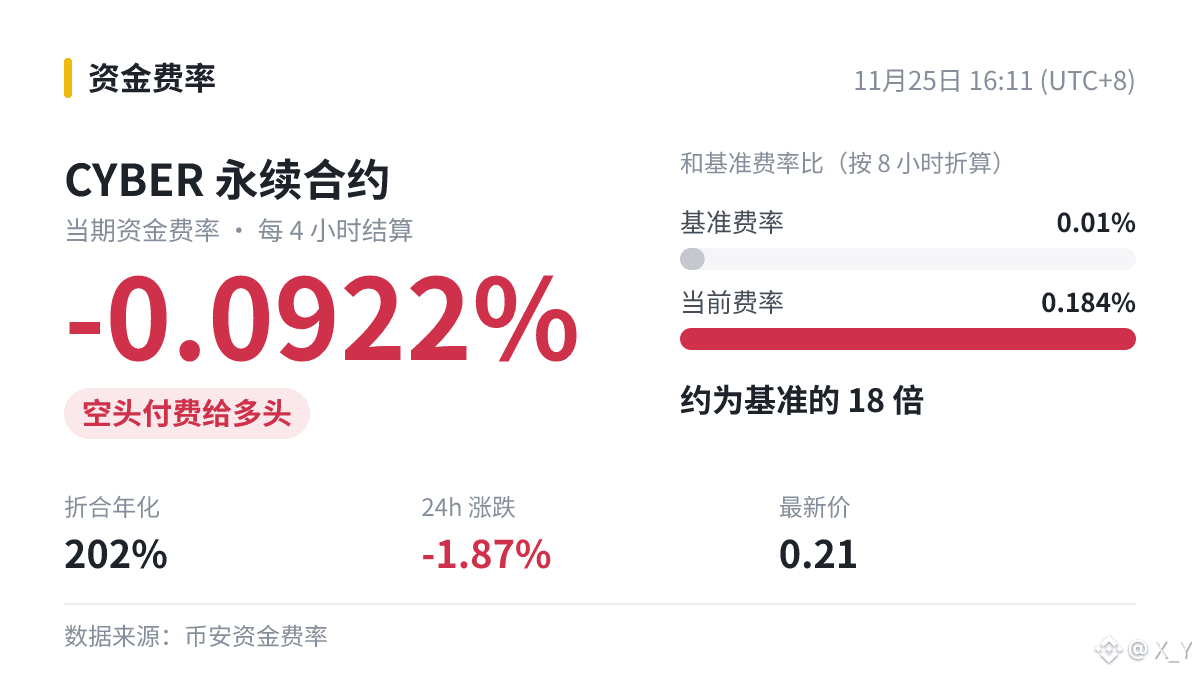
Contract Watch | $CYBER
Shorts are paying: -0.0922%, 24h -1.87%.
There will always be another market move. Don’t bet everything on a single one.
#CYBER
Personal opinion; may not be accurate. Use caution.
Contract Watch | $CYBER
Shorts are paying: -0.0922%, 24h -1.87%.
There will always be another market move. Don’t bet everything on a single one.
#CYBER
Personal opinion; may not be accurate. Use caution.
Shorts are paying: -0.0922%, 24h -1.87%.
There will always be another market move. Don’t bet everything on a single one.
#CYBER
Personal opinion; may not be accurate. Use caution.
25

·
--
Crazy!
$CYBER The funding rate has plunged to -0.0922%! Shorts are piling in, huh? 🔥
Annualized at 202%, shorts keep paying funding—watch out for a short squeeze!
Changes in open interest can show whether the move is backed by real money or driven by sentiment. Will the market turn next?
#CYBER
Crazy!
$CYBER The funding rate has plunged to -0.0922%! Shorts are piling in, huh? 🔥
Annualized at 202%, shorts keep paying funding—watch out for a short squeeze!
Changes in open interest can show whether the move is backed by real money or driven by sentiment. Will the market turn next?
#CYBER
$CYBER The funding rate has plunged to -0.0922%! Shorts are piling in, huh? 🔥
Annualized at 202%, shorts keep paying funding—watch out for a short squeeze!
Changes in open interest can show whether the move is backed by real money or driven by sentiment. Will the market turn next?
#CYBER
29
·
--
See translation
🔴 $CYBER SHORT · 1h
✅ Proven · Diamond Bottom
Entry 0.215
Target 0.1525 (−29.1%)
Stop 0.24 (+11.6%)
Reward:risk 2.5
📊 All coins, 1h: 47% won of 111 · avg +2.6%
🪙 On CYBER: 1 of 2 won
Automated chart-pattern signal. Not financial advice.
#CYBER #CryptoSignals
🔴 $CYBER SHORT · 1h
✅ Proven · Diamond Bottom
Entry 0.215
Target 0.1525 (−29.1%)
Stop 0.24 (+11.6%)
Reward:risk 2.5
📊 All coins, 1h: 47% won of 111 · avg +2.6%
🪙 On CYBER: 1 of 2 won
Automated chart-pattern signal. Not financial advice.
#CYBER #CryptoSignals
✅ Proven · Diamond Bottom
Entry 0.215
Target 0.1525 (−29.1%)
Stop 0.24 (+11.6%)
Reward:risk 2.5
📊 All coins, 1h: 47% won of 111 · avg +2.6%
🪙 On CYBER: 1 of 2 won
Automated chart-pattern signal. Not financial advice.
#CYBER #CryptoSignals
5

Funding rate: -0.1897%/4h, annualized -415%, but shorts are paying only $9,750 every 4 hours. Put those two numbers together, and you get the real story CYBER is telling right now.
First, break the annualized rate down into dollars. With open interest at 5.14 million USDT, a funding rate of -0.1897%, and settlement every 4 hours, shorts pay longs about 5.14 million × 0.1897% ≈ 9,750 USDT each time, or less than 59,000 a day across six settlements. Compared with 12.1 million USDT in 24-hour trading volume, the cost of carrying a negative funding rate for a day is about 0.5% of the day's total volume. For a short whose directional thesis hasn't been disproven, that isn't enough to hurt. So the funding rate dropping from -0.0590% to -0.1897% is essentially price pressure in a thin market, not shorts doubling down. On such low open interest, the annualized percentage can greatly amplify the sense of panic: -415% sounds like a countdown to liquidation, but in reality it's a bill of just over $50,000 a day.
Now look at the long-account share of 37.8%, which means more than 60% of accounts are short. But open interest is only 5.14 million USDT—many accounts, small individual positions. That's a retail structure, not a whale-led one. The side with more people isn't necessarily the side with more money. When funding is negative and account numbers are lopsided, a common misjudgment is to mistake “more people” for “more money,” then take the other side of a trade that actually has little capital behind it. What matters here isn't the account ratio; it's the direction of change in open interest.
Trading volume of 12.1 million against open interest of 5.14 million gives a ratio of 2.35x. This turnover indicates a very thin derivatives market: a little net buying can push the price up 1.87%, and likewise, if either side starts to exit, slippage will be amplified. In a thin market, direction is determined by marginal capital, not by existing positions. After 5.213 million tokens were burned, the circulating-supply ledger was reset, but funding and the order book weren't. The price is still at 0.2174, which shows that the market hasn't finished pricing in the aftermath of the bridge attack.
The signal truly worth waiting for isn't funding falling further to -0.3% or -0.4%, but open interest rising sharply from the 5.14 million level while funding remains negative. That would mean new shorts are paying to open positions, rather than existing positions simply bearing the cost—those two scenarios have completely different outcomes. The former means the fuel for a squeeze is building; the latter is just a matter of time. Time is on the longs' side, but the process is slow.
View: The current structure looks like “shorts aren't willing to leave, and longs aren't in a hurry to push.” The resistance to an upward move comes from the thin market itself, not from short positions. If you want to participate, the favorable risk/reward lies in waiting for open interest to confirm a sharp increase, not in making an emotional trade based on the annualized -415% figure.
Risk warning: This is a small-cap token, and the aftermath of the bridge attack has yet to fully play out. If something really goes wrong, slippage could cost an order of magnitude more than funding.
#CYBER #Crypto
15

Put simply, the funding rate is a “toll” that longs and shorts pay each other.
$CYBER Right now, shorts are paying: -0.102%, or about 223.9% annualized.
Willing to pay just to hold onto a short position suggests that leverage on the short side is very high; if the price rebounds, buying to close positions could come in a rush.
Did you come out ahead or lose on this move?
#CYBER
114

·
--
$CYBER Current funding rate: -0.102% (settled every 4 hours); shorts pay.
Funding rates usually quickly reflect which side is getting crowded.
Perpetual contracts have no expiry date. Funding rates keep the contract price anchored to spot: longs and shorts periodically pay fees to each other.
Don't place an order when the market is moving fastest. Wait for the price to settle before deciding.
#CYBER
Just sharing some thoughts—how you trade is up to you.
87

·
--
📢 $CYBER Funding rate: -0.0888%; shorts pay, annualized rate 194.4%.
Short positions are too crowded—watch out for a short squeeze.
No matter how large the liquidation amount is, it’s just the result. The key is to watch how positions rebuild next. Do you use funding rates as a reference?
#CYBER
📢 $CYBER Funding rate: -0.0888%; shorts pay, annualized rate 194.4%.
Short positions are too crowded—watch out for a short squeeze.
No matter how large the liquidation amount is, it’s just the result. The key is to watch how positions rebuild next. Do you use funding rates as a reference?
#CYBER
Short positions are too crowded—watch out for a short squeeze.
No matter how large the liquidation amount is, it’s just the result. The key is to watch how positions rebuild next. Do you use funding rates as a reference?
#CYBER
65

·
--
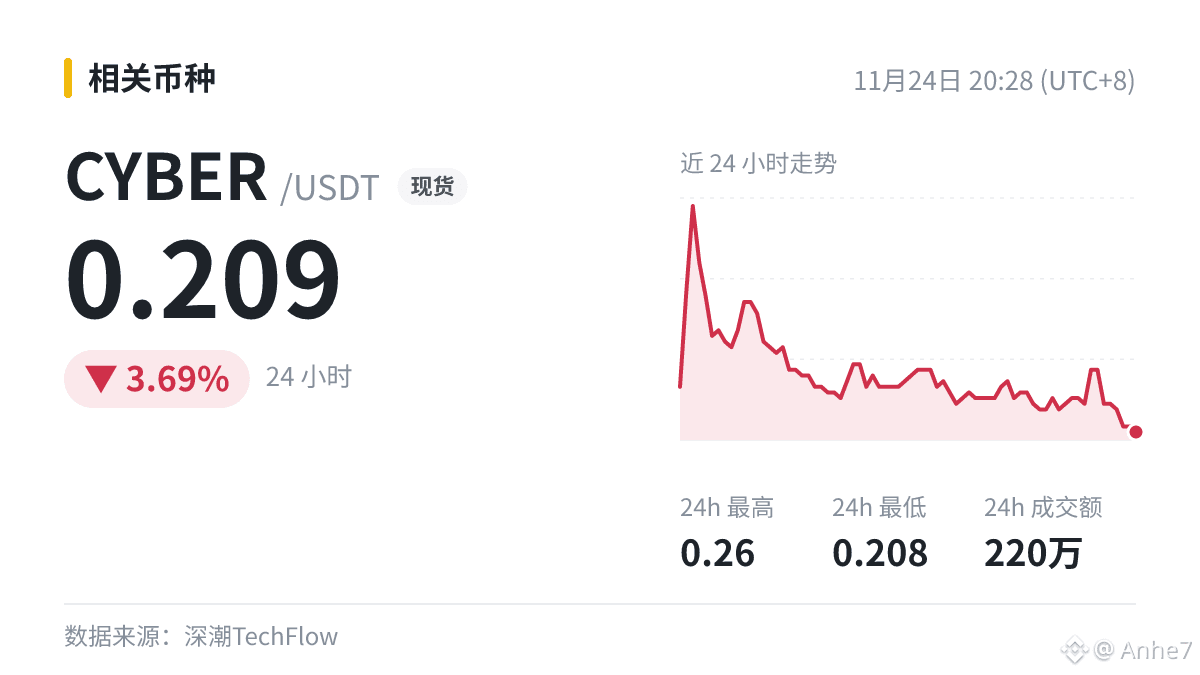
The Cyber cross-chain bridge was attacked, resulting in losses of approximately $1.1 million
My takeaway: The outlook has turned bearish; don't go against the trend and take on large positions intraday.
Honestly, there's news every day, but what really helps you lose less is sticking to your own pace.
$CYBER 24h -3.69%
#CYBER
My takeaway: The outlook has turned bearish; don't go against the trend and take on large positions intraday.
Honestly, there's news every day, but what really helps you lose less is sticking to your own pace.
$CYBER 24h -3.69%
#CYBER
5

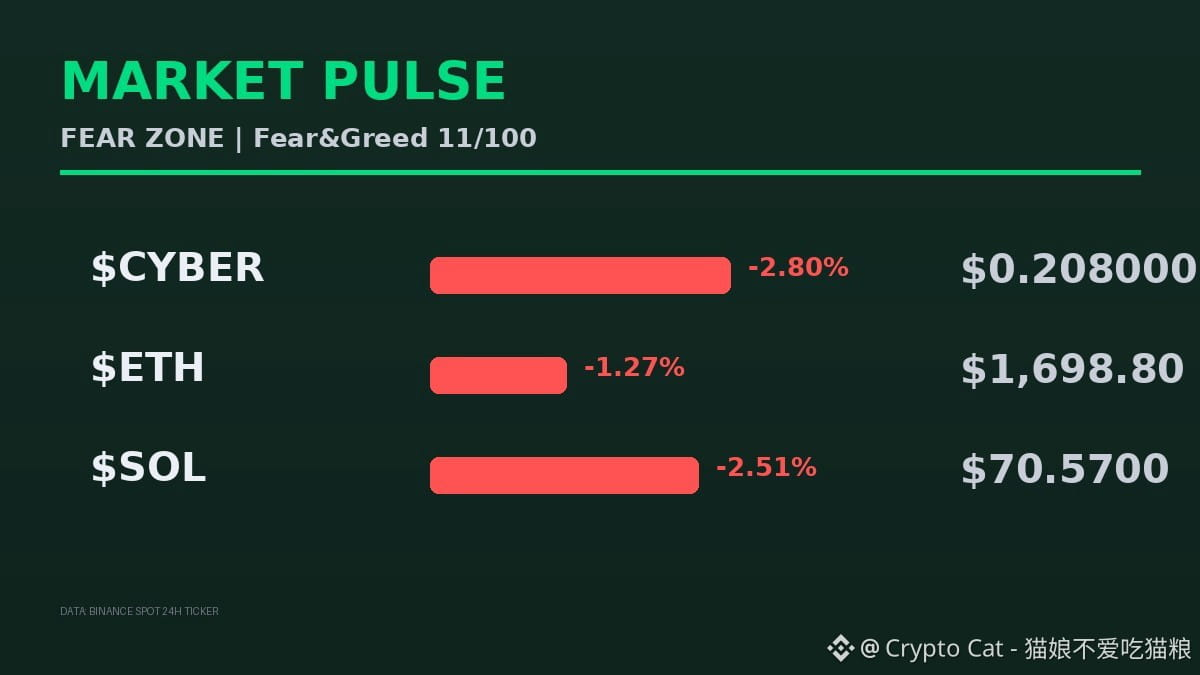
$1.1 million was stolen, but $CYBER only fell 2.8%—the market barely noticed.
The real vulnerability wasn’t in the bridge code, but in the cloud system. The private key was taken, and 5.213 million tokens were minted out of thin air on Solana.
They were swapped for 575 tokens and withdrawn by $ETH . The team burned an equivalent amount from the treasury to fill the hole, but the bridge is still closed.
The books may balance, but trust doesn’t. I’m sitting this one out—the direction is unclear, and so is the risk-reward.
Can it get back to its previous level within a week of reopening the bridge? Reply 1 if it holds, 2 if it keeps sliding.
The Carnival contract is still running. If you want to test this approach in the field, make sure you understand the rules before taking action.
#Write2Earn #BinanceSquare #CYBER #DeFi #TradingTournament
11

🐳 $CYBER Funding Snapshot|Cyber’s cross-chain bridge was attacked, resulting in losses of approximately $1.1 million
The bad news has provided an excuse. Will funds take the opportunity to flee? Watch the trading volume over the coming period.
#CYBER
Markets involve risk; enter with caution.
🐳 $CYBER Funding Snapshot|Cyber’s cross-chain bridge was attacked, resulting in losses of approximately $1.1 million
The bad news has provided an excuse. Will funds take the opportunity to flee? Watch the trading volume over the coming period.
#CYBER
Markets involve risk; enter with caution.
The bad news has provided an excuse. Will funds take the opportunity to flee? Watch the trading volume over the coming period.
#CYBER
Markets involve risk; enter with caution.
3

Another incident ⚠️ Social network Cyber's cross-chain bridge was attacked, resulting in losses of approximately $1.1 million
The flow of the affected funds is the key question now. Whether they will be sold off in a concentrated manner will affect short-term pressure. When bearish news breaks, the worst thing to do is add to your position while panicking. First, get a clear sense of the pace.
$CYBER Current price 0.21 (24h -0.47%)
#CYBER
2

·
--
See translation
🛡️ Cyber Stops Bridge Exploit — Treasury to Cover All Abnormally Minted CYBER
📌 What happened
Cyber (formerly CyberConnect) said on Nov 23 it has identified and blocked the exploit behind the abnormal CYBER minting on Solana on Nov 21, and its treasury will cover all CYBER minted in the attack. The cross-chain bridge stays paused for a full security review, and the team is working with exchanges to restore CYBER deposits and withdrawals.
📊 Key numbers
• ~5.21M CYBER abnormally minted on Solana on Nov 21
• ~575 ETH (~$1.1M) — most of the minted tokens were swapped into ETH
• Upbit and Bithumb suspended CYBER deposits and withdrawals on Nov 22; Upbit later added a trading-caution flag on CYBER
• Bridge: still paused pending a full security review; findings to be published after the review
• No root cause, cover amount, or timetable disclosed yet
🔍 Why it matters
This moves the CYBER incident from investigation to containment and compensation — the first concrete remediation since the Nov 21 mint shock and the Korean exchange freezes. A treasury backstop for the extra supply is the key reassurance for holders, but the pledge has no mechanics yet: no cause named, no cover method, no date. Until the security review lands, the "stopped" claim is a containment step, not a closed case — and CYBER transfers remain restricted at major venues in the meantime.
👀 What to watch
• The security-review findings — root cause and how the treasury cover will work
• When Upbit and Bithumb restore CYBER deposits and withdrawals
• Whether the bridge reopens, and on what terms
Not financial advice. Source: Cyber / Binance Square / KuCoin News / The Block, Nov 23.
$CYBER #Cyber #CYBER #Bridge
190
Log in to explore more content
Join global crypto users on Binance Square
⚡️ Get latest and useful information about crypto.
💬 Trusted by the world’s largest crypto exchange.
👍 Discover real insights from verified creators.
Email / Phone number
Trending Topics
1
#CanMarketsReboundAfterThanksgiving?
202,458 views
2,005 Discussing
2
#CouldSpaceX’sOrbitalDataCentersBoostAIChipDemand?
99,642 views
1,201 Discussing
3
#SouthKoreaProposesMandatoryDigitalAssetTransactionDisclosure
5,356 views
112 Discussing
4
#EvolveAtBinanceBlockchainWeek
850,202 views
10,584 Discussing
5
#KoreaFSCSeeksPowerToSuspendCryptoListings
22,660 views
337 Discussing
6
#SouthKoreaPlansToRequireTetherCircleLocalReserves
20,998 views
238 Discussing
7
#UKFCAReportedlyPlansDeFiAuthorizationRules
15,874 views
141 Discussing
8
#ZcashDevelopersUrgeZECMoveToIronwood
34,629 views
176 Discussing
9
#TetherGoldFaces$2.55BUnrealizedLoss
3,506 views
20 Discussing
10
#CorePCEBeatLiftsFedHikeOdds
311,577 views
1,844 Discussing