
#binancelaunchpool
binancelaunchpool
19.1M views
7,370 Discussing
Hot
Latest

See translation
📢 Binance Launchpool & Earn Spotlight!
New token launches and flexible yield options keep drawing traders who want exposure to fresh ecosystems without keeping funds completely idle.
👉 Check Active Pools:
https://launchpad.binance.com/en
Are you farming new launches or keeping dry powder ready for dips? 👇
Trackers: $BNB $SOL $RENDER
#BinanceLaunchpool #CryptoNews #BinanceSquare
30

·
--
See translation
Breaking Down the Real Tokenomics, Supply Float & Utility Behind $BTC Alongside $ETH
Every time a major token launch or Launchpool event hits the market, timelines fill up with hype while very few traders actually read the supply schedule. Today I sat down and went through the raw tokenomics and liquidity distribution for BTC near 62858.75 to see how the fundamentals really stack up.
Here is what stood out in the supply and distribution numbers:
• Distribution architecture: BNB, FDUSD & USDC Farming Pools (80%–85% Reward Weight Allocated to BNB Pool)
• Circulating float & unlock profile: Launchpool Rewards: 3%–7% of Total Supply | Initial Circulating Supply at Listing: ~13%–19% of Max Supply
• Orderbook & valuation dynamic: High BNB & Stablecoin lockup participation creates structural demand while distributing new tokens across millions of verified users.
Before forming any long-term view on a newly listed asset, I always check four core metrics:
• Total BNB & Stablecoin TVL Committed Across Launchpool Farming Pools
• Initial Circulating Float vs Fully Diluted Valuation (FDV) Benchmark
• Tokenomics Allocation: Launchpool, Ecosystem Growth, Team & Investor Cliffs
• Core Protocol Architecture, On-Chain Adoption & Post-TGE Utility
The biggest factor that separates sustainable ecosystem runners from short-lived TGE spikes is whether initial circulating supply is cleanly absorbed by real staking utility and on-chain demand, or if high FDV overhang caps momentum against ETH and $BNB.
Have you looked into the tokenomics on BTC yet, or are you waiting for a few weeks of on-chain volume data first? Drop your take below 👇
#BinanceSquare #BinanceLaunchpool
Breaking Down the Real Tokenomics, Supply Float & Utility Behind $BTC Alongside $ETH
Every time a major token launch or Launchpool event hits the market, timelines fill up with hype while very few traders actually read the supply schedule. Today I sat down and went through the raw tokenomics and liquidity distribution for BTC near 62858.75 to see how the fundamentals really stack up.
Here is what stood out in the supply and distribution numbers:
• Distribution architecture: BNB, FDUSD & USDC Farming Pools (80%–85% Reward Weight Allocated to BNB Pool)
• Circulating float & unlock profile: Launchpool Rewards: 3%–7% of Total Supply | Initial Circulating Supply at Listing: ~13%–19% of Max Supply
• Orderbook & valuation dynamic: High BNB & Stablecoin lockup participation creates structural demand while distributing new tokens across millions of verified users.
Before forming any long-term view on a newly listed asset, I always check four core metrics:
• Total BNB & Stablecoin TVL Committed Across Launchpool Farming Pools
• Initial Circulating Float vs Fully Diluted Valuation (FDV) Benchmark
• Tokenomics Allocation: Launchpool, Ecosystem Growth, Team & Investor Cliffs
• Core Protocol Architecture, On-Chain Adoption & Post-TGE Utility
The biggest factor that separates sustainable ecosystem runners from short-lived TGE spikes is whether initial circulating supply is cleanly absorbed by real staking utility and on-chain demand, or if high FDV overhang caps momentum against ETH and $BNB .
Have you looked into the tokenomics on BTC yet, or are you waiting for a few weeks of on-chain volume data first? Drop your take below 👇
#BinanceSquare #BinanceLaunchpool
1
3

🎯 CAPITAL OPTIMIZATION: $BTC enters extreme fear territory — accumulate through Launchpool!Breaking down this morning’s capital flows (07:00):
• BTC is at 62,017 USD, down 1.47% over 24h. Fear & Greed hits 12 — extreme fear. Funding is just 0.002%, but global Long positions are still at 75.6% (top traders: 65.3%) → the crowd is still holding Longs, so a squeeze candle could trigger a sharp shakeout.
• Instead of buying the dip, smart money is shifting capital into farming: BNB staking is estimated at ~8–12% APY, and FDUSD pools at ~5–7% APY — a significant difference while prices are consolidating.
• Alpha 2.0 token: 24h volume ~1.25 billion USD, expected price compression of 15–20% before trading opens, valued around the equivalent niche FDV.
🎯 CAPITAL OPTIMIZATION: $BTC enters extreme fear territory — accumulate through Launchpool!
Breaking down this morning’s capital flows (07:00):
• BTC is at 62,017 USD, down 1.47% over 24h. Fear & Greed hits 12 — extreme fear. Funding is just 0.002%, but global Long positions are still at 75.6% (top traders: 65.3%) → the crowd is still holding Longs, so a squeeze candle could trigger a sharp shakeout.
• Instead of buying the dip, smart money is shifting capital into farming: BNB staking is estimated at ~8–12% APY, and FDUSD pools at ~5–7% APY — a significant difference while prices are consolidating.
• Alpha 2.0 token: 24h volume ~1.25 billion USD, expected price compression of 15–20% before trading opens, valued around the equivalent niche FDV.
20
🎯 64.9K, 597: should idle funds be farmed or left on standby?🎯 MORNING SESSION CAPITAL OPTIMIZATION STRATEGY: $BTC hold 64.9K, $BNB 597 — should idle funds be farmed or left on standby?
Breaking down the profit equation with real numbers:
• $BTC: 64,939, 24h trading range 63,336–65,447, volume 1.83 billion USDT. Funding is just 0.006%/8h, so longs are barely paying any fees → there’s no sign of “crowded longs” yet, and dip-buying demand remains weak.
• Positioning is clearly skewed: 75.55% long across all exchanges (ratio 3.09), but only 64.63% among top traders (1.83). Retail is more heavily long than whales → the risk of a sweep of lower support remains unchanged.
🎯 64.9K, 597: should idle funds be farmed or left on standby?
🎯 MORNING SESSION CAPITAL OPTIMIZATION STRATEGY: $BTC hold 64.9K, $BNB 597 — should idle funds be farmed or left on standby?
Breaking down the profit equation with real numbers:
• $BTC : 64,939, 24h trading range 63,336–65,447, volume 1.83 billion USDT. Funding is just 0.006%/8h, so longs are barely paying any fees → there’s no sign of “crowded longs” yet, and dip-buying demand remains weak.
• Positioning is clearly skewed: 75.55% long across all exchanges (ratio 3.09), but only 64.63% among top traders (1.83). Retail is more heavily long than whales → the risk of a sweep of lower support remains unchanged.
132
🎯 CAPITAL OPTIMIZATION STRATEGY: BACK TO THE 75 USDT ZONE — HUNT FOR ALPHA OR POUR FUNDS INTO LAUNCHPOOL FARMING?🎯 CAPITAL OPTIMIZATION STRATEGY: $SOL BACK TO THE 75 USDT ZONE — HUNT FOR ALPHA OR POUR FUNDS INTO $BNB LAUNCHPOOL FARMING?
The market is awash in red (F&G hits 13 — Extreme Fear), and BTC’s drop below 67k has dragged $SOL down close to 75.03 USDT (-4.41%). Derivatives data shows an extremely imbalanced Long ratio (Global L/S reaches 3.62, with 78.38% of positions holding Longs and trying to catch the bottom). When crowd sentiment makes high-risk dip-buying a losing bet, optimizing capital through Launchpool and hunting for Alpha is a superior way to preserve assets.
🎯 CAPITAL OPTIMIZATION STRATEGY: BACK TO THE 75 USDT ZONE — HUNT FOR ALPHA OR POUR FUNDS INTO LAUNCHPOOL FARMING?
🎯 CAPITAL OPTIMIZATION STRATEGY: $SOL BACK TO THE 75 USDT ZONE — HUNT FOR ALPHA OR POUR FUNDS INTO $BNB LAUNCHPOOL FARMING?
The market is awash in red (F&G hits 13 — Extreme Fear), and BTC’s drop below 67k has dragged $SOL down close to 75.03 USDT (-4.41%). Derivatives data shows an extremely imbalanced Long ratio (Global L/S reaches 3.62, with 78.38% of positions holding Longs and trying to catch the bottom). When crowd sentiment makes high-risk dip-buying a losing bet, optimizing capital through Launchpool and hunting for Alpha is a superior way to preserve assets.
The market is awash in red (F&G hits 13 — Extreme Fear), and BTC’s drop below 67k has dragged $SOL down close to 75.03 USDT (-4.41%). Derivatives data shows an extremely imbalanced Long ratio (Global L/S reaches 3.62, with 78.38% of positions holding Longs and trying to catch the bottom). When crowd sentiment makes high-risk dip-buying a losing bet, optimizing capital through Launchpool and hunting for Alpha is a superior way to preserve assets.
201
🎯 OPTIMIZING CAPITAL STRATEGY DURING VOLATILITY: CATCH THE BOTTOM OR ALLOCATE CAPITAL TO LAUNCHPOOL FARMING?🎯 OPTIMIZING CAPITAL STRATEGY DURING $BTC VOLATILITY: CATCH THE BOTTOM OR ALLOCATE CAPITAL TO LAUNCHPOOL FARMING?
As $BTC slid toward $68,335 (-4.35%), the Fear & Greed Index plunged to 13 (Extreme Fear), while retail traders stubbornly held on, with the Long/Short ratio reaching 3.12. Amid the huge risk of liquidations sweeping both sides, here's how smart whales optimize capital flows across the Binance ecosystem:
Breaking down the capital allocation strategy:
• $FDUSD Pool: An absolutely safe haven during the storm. Parking idle capital in stablecoins to farm Launchpool preserves your principal amid market turbulence while maintaining a steady stream of passive income.
🎯 OPTIMIZING CAPITAL STRATEGY DURING VOLATILITY: CATCH THE BOTTOM OR ALLOCATE CAPITAL TO LAUNCHPOOL FARMING?
🎯 OPTIMIZING CAPITAL STRATEGY DURING $BTC VOLATILITY: CATCH THE BOTTOM OR ALLOCATE CAPITAL TO LAUNCHPOOL FARMING?
As $BTC slid toward $68,335 (-4.35%), the Fear & Greed Index plunged to 13 (Extreme Fear), while retail traders stubbornly held on, with the Long/Short ratio reaching 3.12. Amid the huge risk of liquidations sweeping both sides, here's how smart whales optimize capital flows across the Binance ecosystem:
Breaking down the capital allocation strategy:
• $FDUSD Pool: An absolutely safe haven during the storm. Parking idle capital in stablecoins to farm Launchpool preserves your principal amid market turbulence while maintaining a steady stream of passive income.
126

What is Binance Launchpool?
It’s a platform where you earn tokens from new projects without buying them. Here’s how it works: you lock up your BNB or FDUSD for a period (usually 7–30 days) and, in return, mine tokens from the project being launched. Your share is proportional to how much you locked up compared to the total pool.
You don’t sell anything. Your assets remain temporarily staked, and when the event ends, you get them back 100% plus the new tokens you’ve accumulated.
The key difference from Launchpad: on Launchpad, you buy tokens (exchange BNB for the new token). On Launchpool, you simply lock up your assets and mine, without losing your original capital.
Is it worth it? It depends. If you were going to hold that BNB anyway, it’s pure profit. If you needed to trade it, being locked up limits you. With little capital, the rewards are small, but there’s no risk of loss.
Many people take part to sell the new tokens as soon as they’re listed and capture the initial spike. Others hold them, betting on the project.
Follow us for more guides that save you hours of research.
#BinanceLaunchpool
71
🎯 CAPITAL OPTIMIZATION STRATEGY: AT $78, SHOULD YOU HOLD SPOT AND STAKE OR MOVE YOUR CAPITAL INTO LAUNCHPOOL FARMING?🎯 CAPITAL OPTIMIZATION STRATEGY: $SOL AT $78, SHOULD YOU HOLD SPOT AND STAKE OR MOVE YOUR CAPITAL INTO $BNB LAUNCHPOOL FARMING?
When the market plunges into extreme panic (Fear & Greed Index hits 20 - Extreme Fear) and $SOL is under correction pressure toward around 78.44 USDT (-5.9%), leaving capital idle while waiting is a waste. This is when true crypto farmers work out how to optimize yield on Binance:
Breaking down the profit and cash flow equation:
🎯 CAPITAL OPTIMIZATION STRATEGY: AT $78, SHOULD YOU HOLD SPOT AND STAKE OR MOVE YOUR CAPITAL INTO LAUNCHPOOL FARMING?
🎯 CAPITAL OPTIMIZATION STRATEGY: $SOL AT $78, SHOULD YOU HOLD SPOT AND STAKE OR MOVE YOUR CAPITAL INTO $BNB LAUNCHPOOL FARMING?
When the market plunges into extreme panic (Fear & Greed Index hits 20 - Extreme Fear) and $SOL is under correction pressure toward around 78.44 USDT (-5.9%), leaving capital idle while waiting is a waste. This is when true crypto farmers work out how to optimize yield on Binance:
Breaking down the profit and cash flow equation:
76
🎯 CAPITAL OPTIMIZATION STRATEGY: PULLBACK TO 1K—WHERE IS EXCHANGE CAPITAL FLOWING?With $BTC correcting by more than 3.4% to the $71,400 zone and the Fear & Greed Index plunging straight into Extreme Fear (20), jumping into derivatives to catch a falling knife is extremely risky while the exchange-wide Long/Short ratio remains heavily skewed at 3.15 (75.9% of accounts are holding Long positions). Rather than leave capital exposed to liquidation risk, smart whales on Binance are shifting their funds to optimize ROI:
Breaking down the profitability and capital optimization equation:
• Capital preservation strategy: Use $BTC as collateral to borrow at $FDUSD preferential interest rates, so you’re ready to participate in upcoming Binance Launchpool events without having to sell any of your spot $BTC.
🎯 CAPITAL OPTIMIZATION STRATEGY: PULLBACK TO 1K—WHERE IS EXCHANGE CAPITAL FLOWING?
With $BTC correcting by more than 3.4% to the $71,400 zone and the Fear & Greed Index plunging straight into Extreme Fear (20), jumping into derivatives to catch a falling knife is extremely risky while the exchange-wide Long/Short ratio remains heavily skewed at 3.15 (75.9% of accounts are holding Long positions). Rather than leave capital exposed to liquidation risk, smart whales on Binance are shifting their funds to optimize ROI:
Breaking down the profitability and capital optimization equation:
• Capital preservation strategy: Use $BTC as collateral to borrow at $FDUSD preferential interest rates, so you’re ready to participate in upcoming Binance Launchpool events without having to sell any of your spot $BTC .
Breaking down the profitability and capital optimization equation:
• Capital preservation strategy: Use $BTC as collateral to borrow at $FDUSD preferential interest rates, so you’re ready to participate in upcoming Binance Launchpool events without having to sell any of your spot $BTC .
134
·
--
See translation
The BNB Supply Sink: Decoding the Real Engine Behind the $BTC Market Expansion
Everyone is staring at the 77750.43 level on the screen right now, but the actual structural shift isn't happening on the spot chart. It is happening in the way liquidity is being funnelled through the latest Launchpool cycles. We are seeing a very deliberate strategy where the ecosystem is prioritizing BNB-heavy farming pools. By locking 80% to 85% of total rewards into the BNB pool, these launches are acting as a permanent sink for circulating supply. This isn't just a marketing gimmick; it is a fundamental shift in how capital is retained within the system.
When you look at the tokenomics of these new projects, the supply dynamics are becoming increasingly aggressive. Most of these assets are hitting the exchange with an initial circulating float between 13% and 19% of the maximum supply. With Launchpool rewards usually accounting for 3% to 7% of that total, the thin float at TGE is designed to absorb the massive stablecoin TVL currently sitting in FDUSD and USDC. This setup keeps the Fully Diluted Valuation high while the liquid market cap remains small enough for early price discovery to happen efficiently without immediate dilution.
The institutional cliffs are another key piece of the puzzle. Team and investor tokens are frequently locked for a 12-month period before any linear vesting begins. This creates a window of scarcity where the primary liquid supply comes from the farming participants. If you track the whale flows, sophisticated capital isn't just flipping these new tokens for quick gains. They are harvesting the farming yield and rotating it straight back into BTC. This reinforces the king coin as the primary collateral for the entire ecosystem while new projects provide the necessary volatility. The protocol architecture matters, but the macro consensus is that the Launchpool is now a liquidity furnace.
Are you guys actually farming these new cycles to build your core positions, or just waiting for the secondary market to cool off?
#BinanceLaunchpool
1
12
·
--
See translation
No clear edge on $BTC around 77270 right now, so I'm putting capital to work in the latest Binance Launchpool. Maximizing BNB pool allocation (80% weight) is key. I always evaluate the initial float against FDV before listing—getting that ratio right is where the yield actually pays off.
#BinanceLaunchpool #NewCryptoLaunch #BTC
#BinanceLaunchpool #NewCryptoLaunch #BTC
1
19
·
--
See translation
Breaking Down the Real Tokenomics, Supply Float & Utility Behind $BNB Alongside BTC
Every time a major token launch or Launchpool event hits the market, timelines fill up with hype while very few traders actually read the supply schedule. Today I sat down and went through the raw tokenomics and liquidity distribution for BNB near 748.39 to see how the fundamentals really stack up.
Here is what stood out in the supply and distribution numbers:
• Distribution architecture: BNB, FDUSD & USDC Farming Pools (80%–85% Reward Weight Allocated to BNB Pool)
• Circulating float & unlock profile: Launchpool Rewards: 3%–7% of Total Supply | Initial Circulating Supply at Listing: ~13%–19% of Max Supply
• Orderbook & valuation dynamic: High BNB & Stablecoin lockup participation creates structural demand while distributing new tokens across millions of verified users.
Before forming any long-term view on a newly listed asset, I always check four core metrics:
• Total BNB & Stablecoin TVL Committed Across Launchpool Farming Pools
• Initial Circulating Float vs Fully Diluted Valuation (FDV) Benchmark
• Tokenomics Allocation: Launchpool, Ecosystem Growth, Team & Investor Cliffs
• Core Protocol Architecture, On-Chain Adoption & Post-TGE Utility
The biggest factor that separates sustainable ecosystem runners from short-lived TGE spikes is whether initial circulating supply is cleanly absorbed by real staking utility and on-chain demand, or if high FDV overhang caps momentum against BTC and BNB.
Have you looked into the tokenomics on BNB yet, or are you waiting for a few weeks of on-chain volume data first? Drop your take below 👇
#BinanceSquare #BinanceLaunchpool
1
14
·
--
See translation
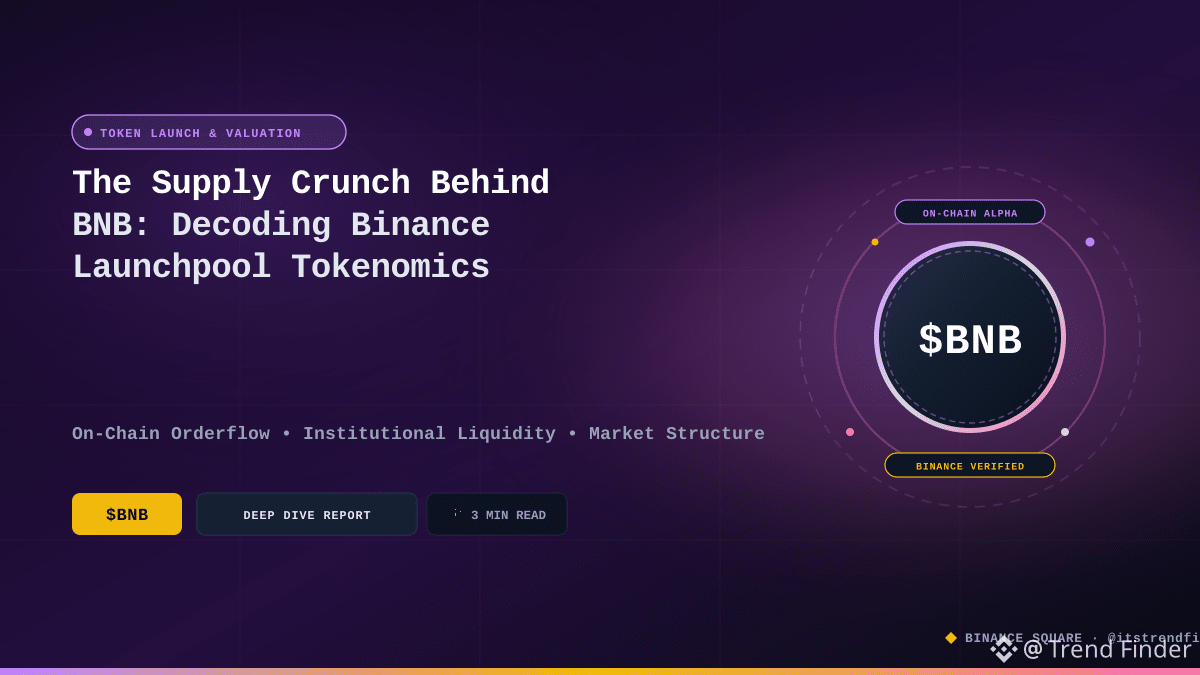
The Supply Crunch Behind BNB: Decoding Binance Launchpool Tokenomics
While the retail crowd chases short-term volatility across alternative layer-one plays, $BNB is quietly executing a structural supply contraction right around the 740.11 level. The catalyst is not purely speculative spot demand; it is embedded directly into the mechanics of recent Binance Launchpool releases and ecosystem deployments.
When you audit the architecture of recent token listings, a clear structural playbook emerges. Most newly launched protocols are hitting TGE with an initial circulating float tightly capped between 13 percent and 19 percent of max supply. Out of this initial float, Launchpool farming allocations account for 3 percent to 7 percent of total supply. Crucially, the protocol design allocates 80 to 85 percent of all farming reward weights straight to the BNB pool, leaving the remainder split between stablecoins like FDUSD and USDC.
This distribution engine creates an intense localized liquidity vacuum. By funneling the vast majority of yield to BNB stakers, millions in TVL get locked out of open market circulating supply for days at a time. Sophisticated capital and whale desks are actively leveraging this mechanic, moving massive stablecoin liquidity alongside spot BNB to capture immediate token emissions while avoiding aggressive spot exposure.
The real risk-reward ratio lives in evaluating the initial circulating float against the fully diluted valuation. With team and ecosystem allocations locked behind multi-month cliff periods and vesting schedules, post-TGE liquidity stays thin. Holders who stake their earned emissions back into protocol governance reinforce this locked-value loop, making BNB an institutional yield vehicle rather than a simple spot asset.
How are you balancing your liquid spot holdings against locking capital into these Launchpool yield cycles right now?
#BinanceLaunchpool #NewCryptoLaunch
18
·
--
See translation
The Math of the Float: Why Launchpool Structure Matters More Than Hype
The 12:34 AM quiet is where the real work happens at my desk. While the broader market is busy digesting the current $BTC spot price near 81146.4, I am digging into the plumbing of recent Binance Launchpool mechanics. There is a noticeable shift in how these new listings are being structured lately, moving toward a model of institutional-grade float management that many retail participants overlook.
When you break down the latest cycles, the distribution weight reveals the true strategy. The BNB pool is consistently absorbing 80 to 85 percent of the reward weight. This is a clear signal that the exchange is prioritizing long-term holders over mercenary farming. Most of these Launchpool allocations are being capped between 3 and 7 percent of the total supply. The metric that really matters for the first 72 hours of trading, however, is the initial circulating supply. I am seeing a sweet spot between 13 and 19 percent of the max supply. This range creates the necessary tension between the initial float and the Fully Diluted Valuation to maintain healthy price action.
I have been mapping out unlock schedules for the upcoming cohort tonight. If a project allocates a massive chunk for ecosystem growth or team payouts with a cliff shorter than six months, the supply side usually fails to hold up against spot demand. Whale wallets are mirroring this caution, showing a clear preference for protocols with transparent vesting and genuine on-chain adoption rather than just inflated TVL. In this environment, utility is the only thing that prevents a post-TGE dump once the farming period ends.
How are you handling your farming rewards for these high-FDV projects lately? Are you holding your tokens for the long haul or rotating out immediately after the listing?
助
#BinanceLaunchpool #NewCryptoLaunch

1
21

See translation
WHY CHOICE BINANCEStop letting your idle crypto sit in your wallet. Use Binance Launchpool to stake your BNB or FDUSD and farm brand new tokens completely for free. It is a risk-free way to earn passive rewards. Just lock your assets, farm the new coin, and trade it when it lists. Check the "Earn" section daily to catch the latest pools.
#BinanceLaunchpool #BinanceLaunchPool🔥 BNB #FreeCrypto #BinanceSquare $NVDAB
WHY CHOICE BINANCE
Stop letting your idle crypto sit in your wallet. Use Binance Launchpool to stake your BNB or FDUSD and farm brand new tokens completely for free. It is a risk-free way to earn passive rewards. Just lock your assets, farm the new coin, and trade it when it lists. Check the "Earn" section daily to catch the latest pools.
#BinanceLaunchpool #BinanceLaunchPool🔥 BNB #FreeCrypto #BinanceSquare $NVDAB
#BinanceLaunchpool #BinanceLaunchPool🔥 BNB #FreeCrypto #BinanceSquare $NVDAB
3
2
480

💰 “Why do others join Launchpool and keep winning without losing, but when you mine, the price crashes and you end up cutting losses?” Unveiling the “no-risk hedged arbitrage” playbook used by big players!
Many retail users see that a Binance Launchpool has launched and rush to chase the price by buying spot $BNB . Then after mining for a few days, they only sell the new coin for a few hundred U. Once the activity ends, the BNB dumps—and they end up losing several thousand U instead!
How exactly do institutions, big whales, and professional traders manage to “mine new coins for free while completely ignoring a sudden crash in the coin price”?
📌 Three ultra-optimized arbitrage rules secretly kept by big players:
1️⃣ “Futures-Spot Hedging (Delta Neutral)” pure free-mint technique:
Buy the spot $BNB and deposit it into the Launchpool, and at the same time open an equivalent 1x short position in the derivatives market 1:1. No matter whether BNB surges or crashes, your principal will never fluctuate. The new coins you mine become 100% pure profit! (⚠️ Note: make sure the contract margin is sufficient to withstand extreme price spikes.)
2️⃣ “$FDUSD vs BNB Pool” dynamic balance:
Don’t blindly push only stablecoins! For the first 6 hours before you start, closely monitor the size of capital inflows in the two pools. When FDUSD is flooded by whales and its annualized return gets severely diluted, after factoring in the cost of opening shorts on contracts, the BNB pool’s net yield is often 20%~30% higher!
3️⃣ The “Sell Your Position in the First 15 Minutes” iron rule:
Unless it’s a once-in-a-century super phenomenon-level project, historical data shows that 80% of new coins reach the peak of market-maker pull-ups and sentiment premium in the first 15~30 minutes after launch. Sell at market without mercy as soon as possible, convert to $BTC or a stablecoin, and never treat Launchpool mining as a value investment to “hold and think long-term”!
💬 Soulful interaction:
Every time Binance opens a new Launchpool, which camp are you usually in?
▫️ Bet 1: The calm-and-hold camp (you’re already a believer in $BNB , so short-term fluctuations don’t matter)
▫️ Bet 2: The futures-spot hedging camp (professional arbitrage, pursuing the ultimate 0-risk “free lunch”)
▫️ Bet 3: The pure stablecoin camp (only stake $FDUSD —earn less, but sleep well)
👇 Drop your number in the comments and share your Launchpool winning record!
#BinanceLaunchpool #BNB #BinanceSquare
238

See translation
Smart Passive Yield: Why the Pros Accumulate $BNB Before the Crowd 🚀Every retail trader chases the next 100x gem in the altcoin trenches, but seasoned market participants know that the most sustainable edge often lies right at the gateway: $BNB
While general market volatility plays out, $BNB continues to function as an elite capital-efficiency tool. If you are holding it just for spot price appreciation, you’re missing half the engine. Here is a breakdown of why smart money structurally accumulates and holds $BNB:
1. The Supply Shock Mechanism 📉
Whenever Binance introduces a new project via Launchpool, Megadrop, or HODLer Airdrops (like the recent Gensyn distribution), millions of BNB are instantly locked and staked. This removes massive volume from the active circulating supply, creating a classic structural supply crunch. Buying pressure naturally shifts upward as the farming window approaches.
2. The Multi-Yield Stacking Strategy 💸
Holding $BNB isn't a passive wait-and-see game; it’s an active yield-generation play. By routing your holdings into Simple Earn (Flexible or Locked), you automatically put your capital to work across multiple tracks simultaneously:
Zero-Liquidation Farming: You accumulate brand-new, high-potential Web3 tokens before their official market debut without risking your principal or facing leverage liquidation.Retroactive Airdrops: Historical balance snapshots reward consistent holders directly into their spot wallets.Double Exposure: You capture the organic capital appreciation of BNB while stacking free ecosystem tokens on top.
3. Core Ecosystem Infrastructure 🏗️
Beyond the launchpads, BNB remains the native fuel for the BNB Chain, offering deep utility from gas fee discounts to governance. It isn't just a speculative token—it's an operational asset tied to the highest-volume liquidity hub in crypto.
The Trader’s Takeaway: When the broader market undergoes corrections or transitions into sideways consolidation, focus on assets that provide high utility and native yield. Stop treating your portfolio like a lottery ticket and start treating it like a cash-flowing engine. 💼
Are you staking your BNB or the upcoming ecosystem launches, or are you sitting on stablecoins waiting for a directional confirmation? Let’s talk in the comments! 👇
#BinanceLaunchpool #CryptoEducation #Web3 #tradingstrategy
Smart Passive Yield: Why the Pros Accumulate $BNB Before the Crowd 🚀
Every retail trader chases the next 100x gem in the altcoin trenches, but seasoned market participants know that the most sustainable edge often lies right at the gateway: $BNB
While general market volatility plays out, $BNB continues to function as an elite capital-efficiency tool. If you are holding it just for spot price appreciation, you’re missing half the engine. Here is a breakdown of why smart money structurally accumulates and holds $BNB :
1. The Supply Shock Mechanism 📉
Whenever Binance introduces a new project via Launchpool, Megadrop, or HODLer Airdrops (like the recent Gensyn distribution), millions of BNB are instantly locked and staked. This removes massive volume from the active circulating supply, creating a classic structural supply crunch. Buying pressure naturally shifts upward as the farming window approaches.
2. The Multi-Yield Stacking Strategy 💸
Holding $BNB isn't a passive wait-and-see game; it’s an active yield-generation play. By routing your holdings into Simple Earn (Flexible or Locked), you automatically put your capital to work across multiple tracks simultaneously:
Zero-Liquidation Farming: You accumulate brand-new, high-potential Web3 tokens before their official market debut without risking your principal or facing leverage liquidation.Retroactive Airdrops: Historical balance snapshots reward consistent holders directly into their spot wallets.Double Exposure: You capture the organic capital appreciation of BNB while stacking free ecosystem tokens on top.
3. Core Ecosystem Infrastructure 🏗️
Beyond the launchpads, BNB remains the native fuel for the BNB Chain, offering deep utility from gas fee discounts to governance. It isn't just a speculative token—it's an operational asset tied to the highest-volume liquidity hub in crypto.
The Trader’s Takeaway: When the broader market undergoes corrections or transitions into sideways consolidation, focus on assets that provide high utility and native yield. Stop treating your portfolio like a lottery ticket and start treating it like a cash-flowing engine. 💼
Are you staking your BNB or the upcoming ecosystem launches, or are you sitting on stablecoins waiting for a directional confirmation? Let’s talk in the comments! 👇
#BinanceLaunchpool #CryptoEducation #Web3 #tradingstrategy
1
165

·
--
Crypto Market Update: How to Securely Profit in the Current Situation?🚀 How can you make profits safely in the current situation? 💰
In the crypto market, quite a few major movements are currently being seen. On one side, BTC is trying to break through its new resistance level, while on the other, altcoins are gradually regaining momentum. In this situation, it’s essential to use the right strategy and not make incorrect trades out of emotion.
Crypto Market Update: How to Securely Profit in the Current Situation?
🚀 How can you make profits safely in the current situation? 💰
In the crypto market, quite a few major movements are currently being seen. On one side, BTC is trying to break through its new resistance level, while on the other, altcoins are gradually regaining momentum. In this situation, it’s essential to use the right strategy and not make incorrect trades out of emotion.
In the crypto market, quite a few major movements are currently being seen. On one side, BTC is trying to break through its new resistance level, while on the other, altcoins are gradually regaining momentum. In this situation, it’s essential to use the right strategy and not make incorrect trades out of emotion.
1
298

·
--
See translation
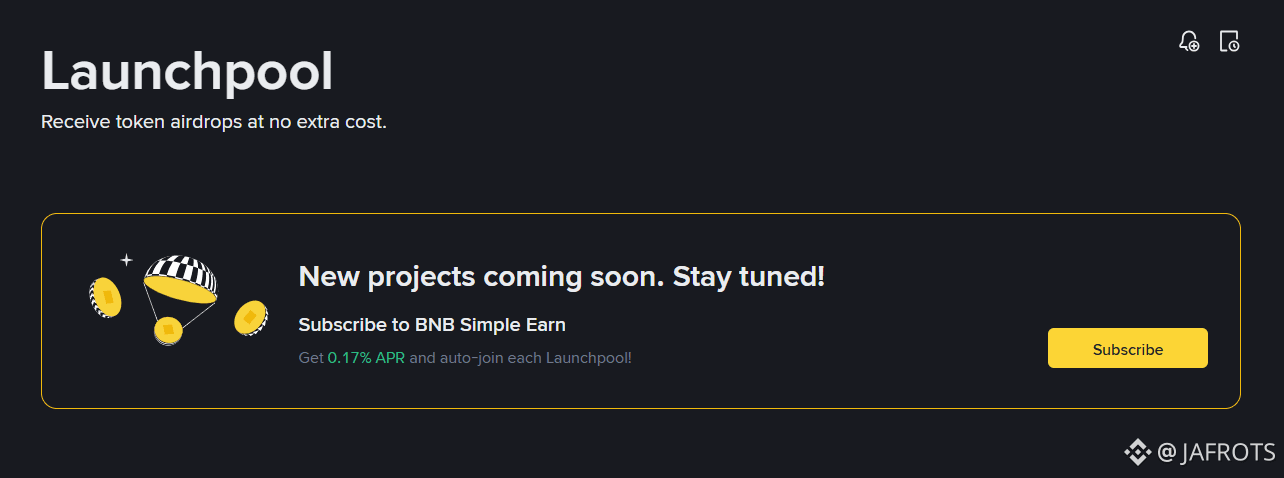
🚨 NEXT BINANCE LAUNCHPOOL COMING SOON?! 🚨
I just checked the Launchpool section and spotted this official update: "New projects coming soon. Stay tuned!" 🚀
Historically, whenever a new project drops, the demand for $BNB spikes massively because everyone rushes to buy and stake for those free token airdrops. If you want to maximize your idle assets without missing the daily snapshot windows, turning on the automatic subscription feature via BNB Simple Earn is a great set-and-forget strategy.
What sector do you think the next token will be? Cast your vote below and let's talk strategy! 👇
#BinanceLaunchpool #TrendingTopic #WriteToEarn #CryptoEarnings
1
139

·
--
See translation
The Launchpool & Megadrop Effect: How to Play the New Token Hype? 🚨
Binance has been rolling out new projects back-to-back recently. While some traders love farming them with $BNB, others are waiting for the listing day to trade the extreme volatility.
If you want to trade these newly listed tokens without getting wrecked, here is the exact game plan you need to follow:
1. The 15-Minute Rule
Never buy in the first 5 to 15 minutes of a new listing. The initial candle is almost always driven by bots and FOMO, creating artificial price spikes. Let the market settle down and establish a clear support level first.
2. Watch the Ecosystem Leaders
New tokens usually bring Hype to their entire ecosystem. For example, if a new Solana-based project gets listed, we often see massive volume moving back into $SOL. Always keep an eye on the major pair to predict the market direction.
3. The "Post-Airdrop" Dip Buying
Airdrop hunters usually dump their free tokens within the first 24 hours, causing the price to drop. This "post-airdrop dip" is often the best entry point if you believe in the project's long-term utility. Look for a rounding bottom on the 1-hour chart.
👇 What's your strategy for new listings? Do you hold your rewards or sell them instantly?
Click on $BNB or $SOL below to adjust your portfolio and prep for the next big listing!
#WriteToEarn #BinanceLaunchpool #CryptoTrading #TradingTips #Megadrop
1
148
Log in to explore more content
Join global crypto users on Binance Square
⚡️ Get latest and useful information about crypto.
💬 Trusted by the world’s largest crypto exchange.
👍 Discover real insights from verified creators.
Email / Phone number
Trending Topics
1
#IsAnthropic’s$1.5TMarketCapJustified?
13,603 views
108 Discussing
2
#BTCRemainsUnderPressureAfterHawkishFOMCMinutes
266,602 views
2,145 Discussing
3
#NvidiaBoardReportedlySplitOverHuang’sReturn
130,758 views
1,163 Discussing
4
#StrategySTRCPreferredSlips3.65%Below$100Par
9,046 views
88 Discussing
5
#MASToUpgradeSGDTestnetToSGDigitalLedger
26,124 views
290 Discussing
6
#CanGTA6'sLaunchLiftTTWOShares?
95,825 views
837 Discussing
7
#Solana2027RoadmapTargetsDoubleComputeCapacity
11,211 views
153 Discussing
8
#InjectiveTokenizedRealEstateMortgagesTop$1.5B
1,268 views
29 Discussing
9
#TetherMakesStrategicInvestmentInSCRYPT
8,441 views
114 Discussing
10
#CapitalGroupAdds1264500StrategyShares
35,102 views
247 Discussing