
S A M R A
5.4k Posts

S A M R A
Report
Block User
Follow for Pro Tips 💡 | Content Creator | Learn & Earn with Crypto 🚀

Traders League Badge Beginner
Open Trade
Frequent Trader
4.8 Years
10 Following
5.4K+ Followers
23.5K+ Liked
1 Badges
Posts
Portfolio
All
Quotes
Videos
Live
·
--
Bullish
1
265
·
--
#Binance March Super Airdrop: $50,000 USDT Allocation, Complete Tasks & Farm Points https://www.binance.com/activity/trading-competition/march-super-airdrop-V1?ref=353006301
#Binance March Super Airdrop: $50,000 USDT Allocation, Complete Tasks & Farm Points https://www.binance.com/activity/trading-competition/march-super-airdrop-V1?ref=353006301
1
124
·
--
Creation Alone Isn’t Enough: Real Value Comes From What Keeps MovingI used to see electronic signatures as a solved problem. Click, sign, done—a neat confirmation that everything is secure and legitimate. Like most people, I trusted the process without thinking much about what sits beneath it. If big platforms built it, surely it must be reliable everywhere… right?
Over time, that assumption started to feel a bit shallow. Not completely wrong—but incomplete. Because once you step outside a single platform or region, things get messy. Legal systems differ, jurisdictions don’t always align, and what’s valid in one place might not carry the same weight somewhere else. A tool that works perfectly in isolation can struggle the moment it has to interact with another system that doesn’t recognize it.
That’s when my perspective changed. I stopped focusing on the act itself—signing—and started thinking about what happens afterward. A signature isn’t the finish line; it’s the beginning of a dependency. The real question is whether that proof holds up over time, travels across systems, and still means something when it’s needed.
Looking into newer approaches like decentralized attestations shifted my thinking even more. Instead of relying on a single company to store and validate records, the idea is to create proofs that exist independently—something no single authority controls, but anyone can verify.
But that only matters if those proofs don’t just exist—they need to stay relevant.
I started seeing the difference more clearly: traditional signatures can feel like leaving an important document in someone else’s office, trusting it will still be there when you need it. A decentralized record, on the other hand, is more like placing that document in a shared archive—accessible, persistent, and not dependent on one gatekeeper.
Still, there’s a catch. Just because something is recorded doesn’t mean it’s useful.
This is where many systems fall short—not in creating outputs, but in making them usable. If what’s created doesn’t move, connect, or get reused, it loses value. It’s like printing currency that never enters circulation—it exists, but it doesn’t do anything.
So I started evaluating things differently.
First, interaction. A system matters only if people can actually use it together—creating, verifying, and building without friction.
Second, reusability. If something created in one context can be used in another, it becomes more than a one-time record—it becomes a building block.
Third, network growth. Not just more users, but meaningful participation where each addition strengthens what’s already there.
When I look at current implementations, I see signs of progress—but also signs that things are still developing. Presence in different regions is one thing; real integration into everyday workflows is another. True infrastructure doesn’t need constant attention—it quietly becomes part of how things operate.
And that leads to an important question: is the system being used because it’s essential, or because it’s being promoted?
There’s a big difference. Short-term incentives can create activity, but they don’t guarantee long-term value. Systems only become strong when people return to them repeatedly because they solve ongoing problems.
There’s also a deeper layer to consider. If systems like this gain widespread adoption—especially at institutional or government levels—they introduce permanence. The ability to preserve proof indefinitely is powerful, but it also raises questions about control and long-term implications.
So now, I look for different signals.
If records are being reused across platforms, that’s meaningful. If organizations rely on them regularly, that’s stronger. If builders are extending existing data instead of starting from scratch, that shows momentum.
But if activity comes in bursts, tied to campaigns or announcements, and outputs remain isolated, then it suggests something is missing.
I keep coming back to one simple idea:
The systems that truly matter aren’t the ones that just create something—they’re the ones where that something keeps moving. Being used, referenced, and integrated naturally into everyday processes.
That’s when it stops being just an idea.
That’s when it becomes real infrastructure.
#SignDigitalSovereignInfra $SIGN @SignOfficial
Creation Alone Isn’t Enough: Real Value Comes From What Keeps Moving
I used to see electronic signatures as a solved problem. Click, sign, done—a neat confirmation that everything is secure and legitimate. Like most people, I trusted the process without thinking much about what sits beneath it. If big platforms built it, surely it must be reliable everywhere… right?
Over time, that assumption started to feel a bit shallow. Not completely wrong—but incomplete. Because once you step outside a single platform or region, things get messy. Legal systems differ, jurisdictions don’t always align, and what’s valid in one place might not carry the same weight somewhere else. A tool that works perfectly in isolation can struggle the moment it has to interact with another system that doesn’t recognize it.
That’s when my perspective changed. I stopped focusing on the act itself—signing—and started thinking about what happens afterward. A signature isn’t the finish line; it’s the beginning of a dependency. The real question is whether that proof holds up over time, travels across systems, and still means something when it’s needed.
Looking into newer approaches like decentralized attestations shifted my thinking even more. Instead of relying on a single company to store and validate records, the idea is to create proofs that exist independently—something no single authority controls, but anyone can verify.
But that only matters if those proofs don’t just exist—they need to stay relevant.
I started seeing the difference more clearly: traditional signatures can feel like leaving an important document in someone else’s office, trusting it will still be there when you need it. A decentralized record, on the other hand, is more like placing that document in a shared archive—accessible, persistent, and not dependent on one gatekeeper.
Still, there’s a catch. Just because something is recorded doesn’t mean it’s useful.
This is where many systems fall short—not in creating outputs, but in making them usable. If what’s created doesn’t move, connect, or get reused, it loses value. It’s like printing currency that never enters circulation—it exists, but it doesn’t do anything.
So I started evaluating things differently.
First, interaction. A system matters only if people can actually use it together—creating, verifying, and building without friction.
Second, reusability. If something created in one context can be used in another, it becomes more than a one-time record—it becomes a building block.
Third, network growth. Not just more users, but meaningful participation where each addition strengthens what’s already there.
When I look at current implementations, I see signs of progress—but also signs that things are still developing. Presence in different regions is one thing; real integration into everyday workflows is another. True infrastructure doesn’t need constant attention—it quietly becomes part of how things operate.
And that leads to an important question: is the system being used because it’s essential, or because it’s being promoted?
There’s a big difference. Short-term incentives can create activity, but they don’t guarantee long-term value. Systems only become strong when people return to them repeatedly because they solve ongoing problems.
There’s also a deeper layer to consider. If systems like this gain widespread adoption—especially at institutional or government levels—they introduce permanence. The ability to preserve proof indefinitely is powerful, but it also raises questions about control and long-term implications.
So now, I look for different signals.
If records are being reused across platforms, that’s meaningful. If organizations rely on them regularly, that’s stronger. If builders are extending existing data instead of starting from scratch, that shows momentum.
But if activity comes in bursts, tied to campaigns or announcements, and outputs remain isolated, then it suggests something is missing.
I keep coming back to one simple idea:
The systems that truly matter aren’t the ones that just create something—they’re the ones where that something keeps moving. Being used, referenced, and integrated naturally into everyday processes.
That’s when it stops being just an idea.
That’s when it becomes real infrastructure.
#SignDigitalSovereignInfra $SIGN @SignOfficial
Over time, that assumption started to feel a bit shallow. Not completely wrong—but incomplete. Because once you step outside a single platform or region, things get messy. Legal systems differ, jurisdictions don’t always align, and what’s valid in one place might not carry the same weight somewhere else. A tool that works perfectly in isolation can struggle the moment it has to interact with another system that doesn’t recognize it.
That’s when my perspective changed. I stopped focusing on the act itself—signing—and started thinking about what happens afterward. A signature isn’t the finish line; it’s the beginning of a dependency. The real question is whether that proof holds up over time, travels across systems, and still means something when it’s needed.
Looking into newer approaches like decentralized attestations shifted my thinking even more. Instead of relying on a single company to store and validate records, the idea is to create proofs that exist independently—something no single authority controls, but anyone can verify.
But that only matters if those proofs don’t just exist—they need to stay relevant.
I started seeing the difference more clearly: traditional signatures can feel like leaving an important document in someone else’s office, trusting it will still be there when you need it. A decentralized record, on the other hand, is more like placing that document in a shared archive—accessible, persistent, and not dependent on one gatekeeper.
Still, there’s a catch. Just because something is recorded doesn’t mean it’s useful.
This is where many systems fall short—not in creating outputs, but in making them usable. If what’s created doesn’t move, connect, or get reused, it loses value. It’s like printing currency that never enters circulation—it exists, but it doesn’t do anything.
So I started evaluating things differently.
First, interaction. A system matters only if people can actually use it together—creating, verifying, and building without friction.
Second, reusability. If something created in one context can be used in another, it becomes more than a one-time record—it becomes a building block.
Third, network growth. Not just more users, but meaningful participation where each addition strengthens what’s already there.
When I look at current implementations, I see signs of progress—but also signs that things are still developing. Presence in different regions is one thing; real integration into everyday workflows is another. True infrastructure doesn’t need constant attention—it quietly becomes part of how things operate.
And that leads to an important question: is the system being used because it’s essential, or because it’s being promoted?
There’s a big difference. Short-term incentives can create activity, but they don’t guarantee long-term value. Systems only become strong when people return to them repeatedly because they solve ongoing problems.
There’s also a deeper layer to consider. If systems like this gain widespread adoption—especially at institutional or government levels—they introduce permanence. The ability to preserve proof indefinitely is powerful, but it also raises questions about control and long-term implications.
So now, I look for different signals.
If records are being reused across platforms, that’s meaningful. If organizations rely on them regularly, that’s stronger. If builders are extending existing data instead of starting from scratch, that shows momentum.
But if activity comes in bursts, tied to campaigns or announcements, and outputs remain isolated, then it suggests something is missing.
I keep coming back to one simple idea:
The systems that truly matter aren’t the ones that just create something—they’re the ones where that something keeps moving. Being used, referenced, and integrated naturally into everyday processes.
That’s when it stops being just an idea.
That’s when it becomes real infrastructure.
#SignDigitalSovereignInfra $SIGN @SignOfficial
3
98
·
--
Ever feel like Web3 is evolving quickly, yet something essential still isn’t quite there? Systems are getting more sophisticated, but trust can still feel shaky. Credentials exist, but they’re fragmented. Participation happens, but it isn’t always properly recognized. And while value is distributed, it doesn’t always reach the right contributors. Over time, these small gaps start to create bigger issues.
That’s where @SignOfficial stands out. Instead of chasing hype, it focuses on the foundation—verifiable credentials and structured distribution. It shifts trust from assumption to proof. Information isn’t just stored; it becomes verifiable. Credentials aren’t locked into one platform; they can move across ecosystems. And distribution becomes more intentional, guided by validated data rather than guesswork.
We’ve already seen cases where genuine users were overlooked while automated accounts benefited from weak verification. That kind of imbalance erodes trust. By linking identity, participation, and value more effectively, Sign helps bring fairness and accuracy back into the equation.
What makes this approach compelling is that it doesn’t aim to replace existing systems—it strengthens them by adding a layer that’s been missing: reliable, portable trust.
#signdigitalsovereigninfra $SIGN
Ever feel like Web3 is evolving quickly, yet something essential still isn’t quite there? Systems are getting more sophisticated, but trust can still feel shaky. Credentials exist, but they’re fragmented. Participation happens, but it isn’t always properly recognized. And while value is distributed, it doesn’t always reach the right contributors. Over time, these small gaps start to create bigger issues.
That’s where @SignOfficial stands out. Instead of chasing hype, it focuses on the foundation—verifiable credentials and structured distribution. It shifts trust from assumption to proof. Information isn’t just stored; it becomes verifiable. Credentials aren’t locked into one platform; they can move across ecosystems. And distribution becomes more intentional, guided by validated data rather than guesswork.
We’ve already seen cases where genuine users were overlooked while automated accounts benefited from weak verification. That kind of imbalance erodes trust. By linking identity, participation, and value more effectively, Sign helps bring fairness and accuracy back into the equation.
What makes this approach compelling is that it doesn’t aim to replace existing systems—it strengthens them by adding a layer that’s been missing: reliable, portable trust.
#signdigitalsovereigninfra $SIGN
That’s where @SignOfficial stands out. Instead of chasing hype, it focuses on the foundation—verifiable credentials and structured distribution. It shifts trust from assumption to proof. Information isn’t just stored; it becomes verifiable. Credentials aren’t locked into one platform; they can move across ecosystems. And distribution becomes more intentional, guided by validated data rather than guesswork.
We’ve already seen cases where genuine users were overlooked while automated accounts benefited from weak verification. That kind of imbalance erodes trust. By linking identity, participation, and value more effectively, Sign helps bring fairness and accuracy back into the equation.
What makes this approach compelling is that it doesn’t aim to replace existing systems—it strengthens them by adding a layer that’s been missing: reliable, portable trust.
#signdigitalsovereigninfra $SIGN
1
158
·
--
MIDNIGHT: RATIONAL PRIVACY AND SELECTIVE DISCLOSUREMost people hear “privacy chain” and immediately think hidden transactions and black-box ledgers.
That’s usually my first thought too.
But after hearing Midnight’s team speak—somewhere between the noise of a trade show floor and hallway debates at Consensus Toronto—I realized they’re approaching it differently.
They’re not positioning it as a privacy coin.
They call it a programmable privacy layer.
It’s a subtle distinction—but it changes everything.
The core tension is obvious if you’ve built in crypto.
Blockchains are transparent by design—that’s where trust comes from.
But try applying that to industries like finance or healthcare, and it falls apart. You can’t expose everything. At the same time, you can’t hide everything either—regulators won’t allow it, and users shouldn’t trust it.
So you end up stuck in an uncomfortable middle ground.
Midnight is trying to live right there.
Not by switching privacy fully on or off—but by making it configurable.
That’s where rational privacy comes in.
It’s not about absolute secrecy—it’s about selective disclosure.
In theory, it sounds clean. In practice, it’s messy.
Take identity as an example:
Instead of revealing who you are, you prove you’re allowed to act.
Or in an auction:
You prove you have sufficient funds—without exposing the exact amount.
Simple idea. Hard execution.
Because information itself becomes strategic.
Users will game whatever is revealed.
So the system has to assume unpredictable behavior—and still hold up.
That’s the real challenge.
What stands out is how Midnight handles this at the smart contract level.
You’re not locked into a single mode.
Contracts can contain both public and private states:
Some data remains fully transparentSome is shielded using zero-knowledge proofs
This allows sensitive inputs to stay hidden, while outcomes remain verifiable.
In other words:
You can validate results without ever exposing the underlying data.
The token model is also more nuanced than it first appears.
NIGHT handles the expected roles—security, staking, governance.
But DUST is where it gets practical.
It’s used to pay for private computation—and importantly, it’s not tradable. It’s issued in a predictable way.
That matters.
You’re not dealing with volatile fees just to run private logic.
For real-world applications, cost stability is a bigger deal than most people admit.
The cross-chain approach is another interesting layer.
Midnight doesn’t force a full migration.
You can keep parts of your app on networks like Ethereum or Cardano, and only use Midnight where privacy is required. Users can interact with native assets—no duplication, no fragmentation of identity or liquidity.
At least, that’s the goal. Execution will be the real test.
What’s compelling here is the attempt to operate within real-world constraints.
Full privacy is easy in theory—just hide everything.
But real systems don’t work like that.
I’m not fully convinced they’ve solved the balance.
That trade-off between transparency and compliance is one of the hardest problems in crypto—and it’s often underestimated.
But this approach feels more grounded than the usual extremes.
It’s not about hiding everything.
It’s about revealing just enough—and keeping the rest out of reach.
#night @MidnightNetwork $NIGHT
{spot}(NIGHTUSDT)
MIDNIGHT: RATIONAL PRIVACY AND SELECTIVE DISCLOSURE
Most people hear “privacy chain” and immediately think hidden transactions and black-box ledgers.
That’s usually my first thought too.
But after hearing Midnight’s team speak—somewhere between the noise of a trade show floor and hallway debates at Consensus Toronto—I realized they’re approaching it differently.
They’re not positioning it as a privacy coin.
They call it a programmable privacy layer.
It’s a subtle distinction—but it changes everything.
The core tension is obvious if you’ve built in crypto.
Blockchains are transparent by design—that’s where trust comes from.
But try applying that to industries like finance or healthcare, and it falls apart. You can’t expose everything. At the same time, you can’t hide everything either—regulators won’t allow it, and users shouldn’t trust it.
So you end up stuck in an uncomfortable middle ground.
Midnight is trying to live right there.
Not by switching privacy fully on or off—but by making it configurable.
That’s where rational privacy comes in.
It’s not about absolute secrecy—it’s about selective disclosure.
In theory, it sounds clean. In practice, it’s messy.
Take identity as an example:
Instead of revealing who you are, you prove you’re allowed to act.
Or in an auction:
You prove you have sufficient funds—without exposing the exact amount.
Simple idea. Hard execution.
Because information itself becomes strategic.
Users will game whatever is revealed.
So the system has to assume unpredictable behavior—and still hold up.
That’s the real challenge.
What stands out is how Midnight handles this at the smart contract level.
You’re not locked into a single mode.
Contracts can contain both public and private states:
Some data remains fully transparentSome is shielded using zero-knowledge proofs
This allows sensitive inputs to stay hidden, while outcomes remain verifiable.
In other words:
You can validate results without ever exposing the underlying data.
The token model is also more nuanced than it first appears.
NIGHT handles the expected roles—security, staking, governance.
But DUST is where it gets practical.
It’s used to pay for private computation—and importantly, it’s not tradable. It’s issued in a predictable way.
That matters.
You’re not dealing with volatile fees just to run private logic.
For real-world applications, cost stability is a bigger deal than most people admit.
The cross-chain approach is another interesting layer.
Midnight doesn’t force a full migration.
You can keep parts of your app on networks like Ethereum or Cardano, and only use Midnight where privacy is required. Users can interact with native assets—no duplication, no fragmentation of identity or liquidity.
At least, that’s the goal. Execution will be the real test.
What’s compelling here is the attempt to operate within real-world constraints.
Full privacy is easy in theory—just hide everything.
But real systems don’t work like that.
I’m not fully convinced they’ve solved the balance.
That trade-off between transparency and compliance is one of the hardest problems in crypto—and it’s often underestimated.
But this approach feels more grounded than the usual extremes.
It’s not about hiding everything.
It’s about revealing just enough—and keeping the rest out of reach.
#night @MidnightNetwork $NIGHT
That’s usually my first thought too.
But after hearing Midnight’s team speak—somewhere between the noise of a trade show floor and hallway debates at Consensus Toronto—I realized they’re approaching it differently.
They’re not positioning it as a privacy coin.
They call it a programmable privacy layer.
It’s a subtle distinction—but it changes everything.
The core tension is obvious if you’ve built in crypto.
Blockchains are transparent by design—that’s where trust comes from.
But try applying that to industries like finance or healthcare, and it falls apart. You can’t expose everything. At the same time, you can’t hide everything either—regulators won’t allow it, and users shouldn’t trust it.
So you end up stuck in an uncomfortable middle ground.
Midnight is trying to live right there.
Not by switching privacy fully on or off—but by making it configurable.
That’s where rational privacy comes in.
It’s not about absolute secrecy—it’s about selective disclosure.
In theory, it sounds clean. In practice, it’s messy.
Take identity as an example:
Instead of revealing who you are, you prove you’re allowed to act.
Or in an auction:
You prove you have sufficient funds—without exposing the exact amount.
Simple idea. Hard execution.
Because information itself becomes strategic.
Users will game whatever is revealed.
So the system has to assume unpredictable behavior—and still hold up.
That’s the real challenge.
What stands out is how Midnight handles this at the smart contract level.
You’re not locked into a single mode.
Contracts can contain both public and private states:
Some data remains fully transparentSome is shielded using zero-knowledge proofs
This allows sensitive inputs to stay hidden, while outcomes remain verifiable.
In other words:
You can validate results without ever exposing the underlying data.
The token model is also more nuanced than it first appears.
NIGHT handles the expected roles—security, staking, governance.
But DUST is where it gets practical.
It’s used to pay for private computation—and importantly, it’s not tradable. It’s issued in a predictable way.
That matters.
You’re not dealing with volatile fees just to run private logic.
For real-world applications, cost stability is a bigger deal than most people admit.
The cross-chain approach is another interesting layer.
Midnight doesn’t force a full migration.
You can keep parts of your app on networks like Ethereum or Cardano, and only use Midnight where privacy is required. Users can interact with native assets—no duplication, no fragmentation of identity or liquidity.
At least, that’s the goal. Execution will be the real test.
What’s compelling here is the attempt to operate within real-world constraints.
Full privacy is easy in theory—just hide everything.
But real systems don’t work like that.
I’m not fully convinced they’ve solved the balance.
That trade-off between transparency and compliance is one of the hardest problems in crypto—and it’s often underestimated.
But this approach feels more grounded than the usual extremes.
It’s not about hiding everything.
It’s about revealing just enough—and keeping the rest out of reach.
#night @MidnightNetwork $NIGHT
2
53
·
--
Midnight reduces the workload in a pretty fundamental way.
Instead of every node re-executing every computation, it relies on proofs—so the network only needs to verify results, not reproduce them. That means less computational overhead, lower costs, and a much lighter lift for validators running nodes.
I also noticed how the Midnight Foundation and Shielded Technologies are pushing this forward post-Consensus 2025, with a clear focus on real-world applications rather than just theoretical design.
To me, that’s the real angle here:
scaling not by doing more—but by doing less.
@MidnightNetwork #night $NIGHT
Midnight reduces the workload in a pretty fundamental way.
Instead of every node re-executing every computation, it relies on proofs—so the network only needs to verify results, not reproduce them. That means less computational overhead, lower costs, and a much lighter lift for validators running nodes.
I also noticed how the Midnight Foundation and Shielded Technologies are pushing this forward post-Consensus 2025, with a clear focus on real-world applications rather than just theoretical design.
To me, that’s the real angle here:
scaling not by doing more—but by doing less.
@MidnightNetwork #night $NIGHT
Instead of every node re-executing every computation, it relies on proofs—so the network only needs to verify results, not reproduce them. That means less computational overhead, lower costs, and a much lighter lift for validators running nodes.
I also noticed how the Midnight Foundation and Shielded Technologies are pushing this forward post-Consensus 2025, with a clear focus on real-world applications rather than just theoretical design.
To me, that’s the real angle here:
scaling not by doing more—but by doing less.
@MidnightNetwork #night $NIGHT
1
104
·
--
Bearish
🚨 BREAKING:
Reports claim U.S. House Democrats are just two votes short of impeaching Trump before March 31.
However, this has not been officially confirmed, and the situation remains unclear.
$TRUMP
{spot}(TRUMPUSDT)
#iOSSecurityUpdate
🚨 BREAKING:
Reports claim U.S. House Democrats are just two votes short of impeaching Trump before March 31.
However, this has not been officially confirmed, and the situation remains unclear.
$TRUMP
#iOSSecurityUpdate
Reports claim U.S. House Democrats are just two votes short of impeaching Trump before March 31.
However, this has not been officially confirmed, and the situation remains unclear.
$TRUMP
#iOSSecurityUpdate
2
60
·
--
Bearish
🚨 BREAKING:
Reports suggest that Trump’s decision to pursue war with Iran may have been shaped in part by pressure from external allies.
At the same time, sources indicate there were internal divisions within his administration, with some officials not fully aligned on the course of action.
Overall, the situation highlights the complexity behind the decision, with both outside influence and internal disagreements contributing to the outcome.
$BTC $ETH $XRP
{spot}(XRPUSDT)
{spot}(ETHUSDT)
{spot}(BTCUSDT)
#TrumpConsidersEndingIranConflict
🚨 BREAKING:
Reports suggest that Trump’s decision to pursue war with Iran may have been shaped in part by pressure from external allies.
At the same time, sources indicate there were internal divisions within his administration, with some officials not fully aligned on the course of action.
Overall, the situation highlights the complexity behind the decision, with both outside influence and internal disagreements contributing to the outcome.
$BTC $ETH $XRP
#TrumpConsidersEndingIranConflict
Reports suggest that Trump’s decision to pursue war with Iran may have been shaped in part by pressure from external allies.
At the same time, sources indicate there were internal divisions within his administration, with some officials not fully aligned on the course of action.
Overall, the situation highlights the complexity behind the decision, with both outside influence and internal disagreements contributing to the outcome.
$BTC $ETH $XRP
#TrumpConsidersEndingIranConflict
2
46
·
--
Bullish
$XRP — LONG
Everyone expected more downside… but it $XRP is starting to reclaim momentum....
Entry: 1.355 – 1.365
SL: 1.335
Targets:
TP1: 1.390
TP2: 1.420
TP3: 1.470
{spot}(XRPUSDT)
{future}(XRPUSDT)
After the sharp drop toward the 1.34 zone, XRP found strong support, and buyers stepped in quickly.
#Trump'sCyberStrategy
$XRP — LONG
Everyone expected more downside… but it $XRP is starting to reclaim momentum....
Entry: 1.355 – 1.365
SL: 1.335
Targets:
TP1: 1.390
TP2: 1.420
TP3: 1.470
After the sharp drop toward the 1.34 zone, XRP found strong support, and buyers stepped in quickly.
#Trump'sCyberStrategy
Everyone expected more downside… but it $XRP is starting to reclaim momentum....
Entry: 1.355 – 1.365
SL: 1.335
Targets:
TP1: 1.390
TP2: 1.420
TP3: 1.470
After the sharp drop toward the 1.34 zone, XRP found strong support, and buyers stepped in quickly.
#Trump'sCyberStrategy
4
211
·
--
A Dangerous Claim Is Circulating — But It’s Not Verified YetReports are spreading online that the United States struck a freshwater desalination plant on Qeshm Island in Iran.
Iran’s foreign minister has warned there will be “consequences.”
However, there is currently no independent verification that this strike actually happened.
So far:
❌ No satellite imagery confirming damage❌ No confirmation from the United States Department of Defense or United States Central Command❌ No verification from major international news outlets
At the moment, the claim appears to originate from Iranian state-affiliated media.
That doesn’t automatically mean it’s false, but it also does not make it confirmed.
Why This Matters
Qeshm Island sits at the entrance of the Strait of Hormuz, one of the most strategically important energy chokepoints in the world.
A desalination plant is civilian infrastructure.
If a strike against it were confirmed, it would represent a major escalation and could potentially be viewed under international law as an attack on civilian infrastructure.
Another Scenario Analysts Are Considering
There is also a possibility being discussed in geopolitical circles:
If infrastructure damage were blamed on foreign actors, it could be used to justify retaliatory strikes against infrastructure in Gulf states.
That would be extremely serious because many countries in the region depend heavily on desalination for drinking water, including:
United Arab EmiratesSaudi ArabiaKuwaitBahrainQatar
In some of these countries, the majority of the freshwater supply comes from desalination plants.
A single major strike on such infrastructure could create an immediate humanitarian crisis, especially given the region’s desert climate.
What to Watch Next
Right now, three possibilities exist:
1️⃣ The report is accurate and escalation is underway.
2️⃣ The report is misinformation or premature reporting.
3️⃣ The narrative is being shaped ahead of potential retaliation.
Until credible evidence emerges, the claim should be treated as unconfirmed.
The most important signal will likely come from what Iran does next and whether international verification appears.
For markets, developments around the Strait of Hormuz are especially critical because they directly affect energy supply, commodities, and global risk assets.
Assets like Bitcoin ($BTC ), Ethereum ($ETH ), and Gold ($XAU ) often react quickly to rising geopolitical risk.
I’ll keep monitoring for confirmed information.
#RFKJr.RunningforUSPresidentin2028 #Trump'sCyberStrategy #JobsDataShock
A Dangerous Claim Is Circulating — But It’s Not Verified Yet
Reports are spreading online that the United States struck a freshwater desalination plant on Qeshm Island in Iran.
Iran’s foreign minister has warned there will be “consequences.”
However, there is currently no independent verification that this strike actually happened.
So far:
❌ No satellite imagery confirming damage❌ No confirmation from the United States Department of Defense or United States Central Command❌ No verification from major international news outlets
At the moment, the claim appears to originate from Iranian state-affiliated media.
That doesn’t automatically mean it’s false, but it also does not make it confirmed.
Why This Matters
Qeshm Island sits at the entrance of the Strait of Hormuz, one of the most strategically important energy chokepoints in the world.
A desalination plant is civilian infrastructure.
If a strike against it were confirmed, it would represent a major escalation and could potentially be viewed under international law as an attack on civilian infrastructure.
Another Scenario Analysts Are Considering
There is also a possibility being discussed in geopolitical circles:
If infrastructure damage were blamed on foreign actors, it could be used to justify retaliatory strikes against infrastructure in Gulf states.
That would be extremely serious because many countries in the region depend heavily on desalination for drinking water, including:
United Arab EmiratesSaudi ArabiaKuwaitBahrainQatar
In some of these countries, the majority of the freshwater supply comes from desalination plants.
A single major strike on such infrastructure could create an immediate humanitarian crisis, especially given the region’s desert climate.
What to Watch Next
Right now, three possibilities exist:
1️⃣ The report is accurate and escalation is underway.
2️⃣ The report is misinformation or premature reporting.
3️⃣ The narrative is being shaped ahead of potential retaliation.
Until credible evidence emerges, the claim should be treated as unconfirmed.
The most important signal will likely come from what Iran does next and whether international verification appears.
For markets, developments around the Strait of Hormuz are especially critical because they directly affect energy supply, commodities, and global risk assets.
Assets like Bitcoin ($BTC ), Ethereum ($ETH ), and Gold ($XAU ) often react quickly to rising geopolitical risk.
I’ll keep monitoring for confirmed information.
#RFKJr.RunningforUSPresidentin2028 #Trump'sCyberStrategy #JobsDataShock
Iran’s foreign minister has warned there will be “consequences.”
However, there is currently no independent verification that this strike actually happened.
So far:
❌ No satellite imagery confirming damage❌ No confirmation from the United States Department of Defense or United States Central Command❌ No verification from major international news outlets
At the moment, the claim appears to originate from Iranian state-affiliated media.
That doesn’t automatically mean it’s false, but it also does not make it confirmed.
Why This Matters
Qeshm Island sits at the entrance of the Strait of Hormuz, one of the most strategically important energy chokepoints in the world.
A desalination plant is civilian infrastructure.
If a strike against it were confirmed, it would represent a major escalation and could potentially be viewed under international law as an attack on civilian infrastructure.
Another Scenario Analysts Are Considering
There is also a possibility being discussed in geopolitical circles:
If infrastructure damage were blamed on foreign actors, it could be used to justify retaliatory strikes against infrastructure in Gulf states.
That would be extremely serious because many countries in the region depend heavily on desalination for drinking water, including:
United Arab EmiratesSaudi ArabiaKuwaitBahrainQatar
In some of these countries, the majority of the freshwater supply comes from desalination plants.
A single major strike on such infrastructure could create an immediate humanitarian crisis, especially given the region’s desert climate.
What to Watch Next
Right now, three possibilities exist:
1️⃣ The report is accurate and escalation is underway.
2️⃣ The report is misinformation or premature reporting.
3️⃣ The narrative is being shaped ahead of potential retaliation.
Until credible evidence emerges, the claim should be treated as unconfirmed.
The most important signal will likely come from what Iran does next and whether international verification appears.
For markets, developments around the Strait of Hormuz are especially critical because they directly affect energy supply, commodities, and global risk assets.
Assets like Bitcoin ($BTC ), Ethereum ($ETH ), and Gold ($XAU ) often react quickly to rising geopolitical risk.
I’ll keep monitoring for confirmed information.
#RFKJr.RunningforUSPresidentin2028 #Trump'sCyberStrategy #JobsDataShock
3
120
·
--
🚨Global uncertainty is now at a record high.
This year, uncertainty around the world has climbed above the levels seen during COVID, the Global Financial Crisis, and even the Dot-Com Bubble.
#RFKJr.RunningforUSPresidentin2028 #Trump'sCyberStrategy
🚨Global uncertainty is now at a record high.
This year, uncertainty around the world has climbed above the levels seen during COVID, the Global Financial Crisis, and even the Dot-Com Bubble.
#RFKJr.RunningforUSPresidentin2028 #Trump'sCyberStrategy
This year, uncertainty around the world has climbed above the levels seen during COVID, the Global Financial Crisis, and even the Dot-Com Bubble.
#RFKJr.RunningforUSPresidentin2028 #Trump'sCyberStrategy
3
70
·
--
Bearish
💥 BREAKING:
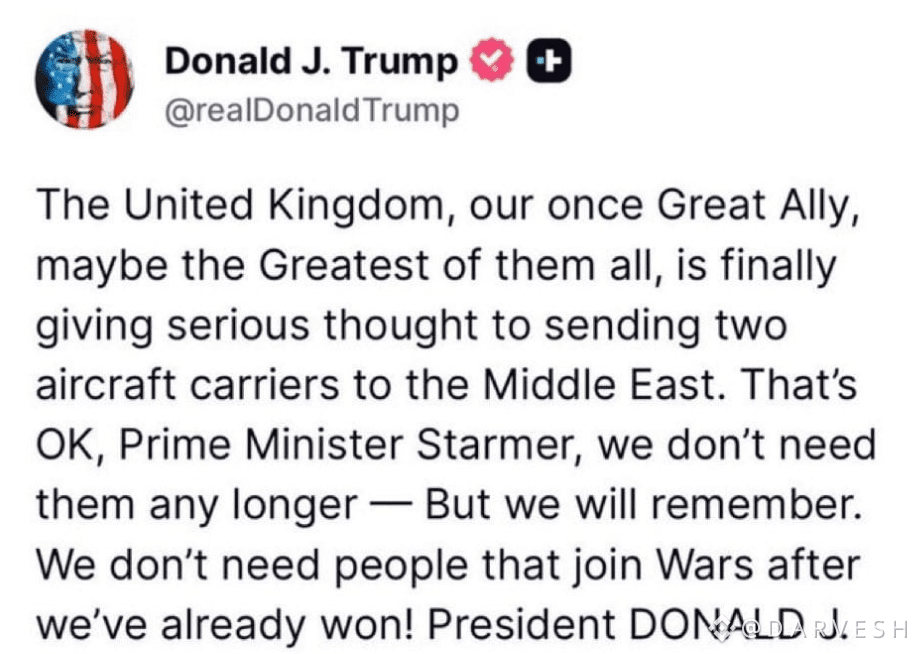
President Donald Trump reportedly took aim at Keir Starmer, saying:
“We don’t need people that join wars after we’ve already won.”
The remark appears to be a jab at the United Kingdom’s role in conflicts alongside the United States, suggesting frustration with allies who enter military operations later in the process.
Why This Matters
Alliance Tensions: Comments like this can strain relations between long-standing allies such as the U.S. and the U.K.
Political Messaging: Statements framed this way often play well domestically by emphasizing national strength and leadership.
Global Signal: Even rhetorical disputes between Western leaders can influence diplomatic dynamics, especially during ongoing geopolitical tensions.
💬 The big question now:
Is this just political rhetoric, or does it signal a deeper shift in how the U.S. expects allies to participate in future conflicts?
#Trump'sCyberStrategy
$DOT $ADA $XRP
{spot}(XRPUSDT)
{spot}(ADAUSDT)
{spot}(DOTUSDT)
💥 BREAKING:
President Donald Trump reportedly took aim at Keir Starmer, saying:
“We don’t need people that join wars after we’ve already won.”
The remark appears to be a jab at the United Kingdom’s role in conflicts alongside the United States, suggesting frustration with allies who enter military operations later in the process.
Why This Matters
Alliance Tensions: Comments like this can strain relations between long-standing allies such as the U.S. and the U.K.
Political Messaging: Statements framed this way often play well domestically by emphasizing national strength and leadership.
Global Signal: Even rhetorical disputes between Western leaders can influence diplomatic dynamics, especially during ongoing geopolitical tensions.
💬 The big question now:
Is this just political rhetoric, or does it signal a deeper shift in how the U.S. expects allies to participate in future conflicts?
#Trump'sCyberStrategy
$DOT $ADA $XRP
President Donald Trump reportedly took aim at Keir Starmer, saying:
“We don’t need people that join wars after we’ve already won.”
The remark appears to be a jab at the United Kingdom’s role in conflicts alongside the United States, suggesting frustration with allies who enter military operations later in the process.
Why This Matters
Alliance Tensions: Comments like this can strain relations between long-standing allies such as the U.S. and the U.K.
Political Messaging: Statements framed this way often play well domestically by emphasizing national strength and leadership.
Global Signal: Even rhetorical disputes between Western leaders can influence diplomatic dynamics, especially during ongoing geopolitical tensions.
💬 The big question now:
Is this just political rhetoric, or does it signal a deeper shift in how the U.S. expects allies to participate in future conflicts?
#Trump'sCyberStrategy
$DOT $ADA $XRP
5
1.3k
·
--
Markets Are Starting to Price the Cost of ConflictRight now, the focus is mostly on the military developments, but the bigger story unfolding in markets is the economic cost of escalation.
Oil is already moving toward $100 per barrel, with weekend spot prices hovering near $96. At the same time, European natural gas has surged from roughly €30 to €50 per megawatt-hour in just a matter of days.
Financial markets are feeling the pressure as well. Roughly $3.5 trillion in global market value has reportedly been wiped out this week as investors start pricing in geopolitical risk.
Some analysts are now warning that if the Strait of Hormuz remains disrupted, oil could potentially spike toward $150–$200 per barrel.
And when markets reopen on Monday, the possibility of another wave of heavy selling remains if these pressures continue.
But beyond the headlines, there is a deeper dynamic at play: the economics of modern warfare.
Iran is reportedly deploying relatively low-cost drones, while the opposing side must respond with extremely expensive missile interceptors. That imbalance creates a dangerous financial equation where the cost of defense can escalate far faster than the cost of attack.
History shows that prolonged conflicts are not always decided by raw military power. More often, they are shaped by who can sustain the financial burden longer.
In just a few days, reports suggest the U.S. and its allies have already used a significant amount of missile defense resources, with additional supplies now being rushed into the region.
From a strategic perspective, Iran does not necessarily need a decisive military victory. It only needs to extend the conflict long enough to make the financial and logistical costs unbearable.
So the real question right now isn’t simply who has more weapons.
The real question is what breaks first.
Will oil prices explode higher and push global inflation back into focus?
Or will the political and financial pressure eventually weaken the alliance’s willingness to keep spending at this pace?
Monday’s market open could provide the first real signal.
If risk continues to rise, equities may face more downside pressure—and crypto could follow.
For now, I’m maintaining my short positions on Bitcoin ($BTC ), Ethereum ($ETH ), and Solana ($SOL ) while watching how macro conditions evolve into the new trading week.
#RFKJr.RunningforUSPresidentin2028
Markets Are Starting to Price the Cost of Conflict
Right now, the focus is mostly on the military developments, but the bigger story unfolding in markets is the economic cost of escalation.
Oil is already moving toward $100 per barrel, with weekend spot prices hovering near $96. At the same time, European natural gas has surged from roughly €30 to €50 per megawatt-hour in just a matter of days.
Financial markets are feeling the pressure as well. Roughly $3.5 trillion in global market value has reportedly been wiped out this week as investors start pricing in geopolitical risk.
Some analysts are now warning that if the Strait of Hormuz remains disrupted, oil could potentially spike toward $150–$200 per barrel.
And when markets reopen on Monday, the possibility of another wave of heavy selling remains if these pressures continue.
But beyond the headlines, there is a deeper dynamic at play: the economics of modern warfare.
Iran is reportedly deploying relatively low-cost drones, while the opposing side must respond with extremely expensive missile interceptors. That imbalance creates a dangerous financial equation where the cost of defense can escalate far faster than the cost of attack.
History shows that prolonged conflicts are not always decided by raw military power. More often, they are shaped by who can sustain the financial burden longer.
In just a few days, reports suggest the U.S. and its allies have already used a significant amount of missile defense resources, with additional supplies now being rushed into the region.
From a strategic perspective, Iran does not necessarily need a decisive military victory. It only needs to extend the conflict long enough to make the financial and logistical costs unbearable.
So the real question right now isn’t simply who has more weapons.
The real question is what breaks first.
Will oil prices explode higher and push global inflation back into focus?
Or will the political and financial pressure eventually weaken the alliance’s willingness to keep spending at this pace?
Monday’s market open could provide the first real signal.
If risk continues to rise, equities may face more downside pressure—and crypto could follow.
For now, I’m maintaining my short positions on Bitcoin ($BTC ), Ethereum ($ETH ), and Solana ($SOL ) while watching how macro conditions evolve into the new trading week.
#RFKJr.RunningforUSPresidentin2028
Oil is already moving toward $100 per barrel, with weekend spot prices hovering near $96. At the same time, European natural gas has surged from roughly €30 to €50 per megawatt-hour in just a matter of days.
Financial markets are feeling the pressure as well. Roughly $3.5 trillion in global market value has reportedly been wiped out this week as investors start pricing in geopolitical risk.
Some analysts are now warning that if the Strait of Hormuz remains disrupted, oil could potentially spike toward $150–$200 per barrel.
And when markets reopen on Monday, the possibility of another wave of heavy selling remains if these pressures continue.
But beyond the headlines, there is a deeper dynamic at play: the economics of modern warfare.
Iran is reportedly deploying relatively low-cost drones, while the opposing side must respond with extremely expensive missile interceptors. That imbalance creates a dangerous financial equation where the cost of defense can escalate far faster than the cost of attack.
History shows that prolonged conflicts are not always decided by raw military power. More often, they are shaped by who can sustain the financial burden longer.
In just a few days, reports suggest the U.S. and its allies have already used a significant amount of missile defense resources, with additional supplies now being rushed into the region.
From a strategic perspective, Iran does not necessarily need a decisive military victory. It only needs to extend the conflict long enough to make the financial and logistical costs unbearable.
So the real question right now isn’t simply who has more weapons.
The real question is what breaks first.
Will oil prices explode higher and push global inflation back into focus?
Or will the political and financial pressure eventually weaken the alliance’s willingness to keep spending at this pace?
Monday’s market open could provide the first real signal.
If risk continues to rise, equities may face more downside pressure—and crypto could follow.
For now, I’m maintaining my short positions on Bitcoin ($BTC ), Ethereum ($ETH ), and Solana ($SOL ) while watching how macro conditions evolve into the new trading week.
#RFKJr.RunningforUSPresidentin2028
2
205
·
--
Trump’s Cyber Strategy Officially Names CryptoBIG SHIFT: 🚨
For the first time in U.S. history, a National Cybersecurity Strategy explicitly mentions cryptocurrency and blockchain as technologies that must be “protected and secured.” (AInvest)
That’s a significant policy signal.
In the newly released strategy, digital assets are placed alongside artificial intelligence and quantum computing as emerging technologies that the United States intends to safeguard and develop as part of its broader cybersecurity and technological leadership agenda. (AInvest)
What This Could Mean for Crypto
1️⃣ National Security Recognition
Crypto is no longer treated purely as a speculative asset class. By including blockchain infrastructure in a national cybersecurity framework, the government is acknowledging its strategic importance to the digital economy.
2️⃣ Institutional Legitimacy
When a technology enters national security policy, it often signals a long-term commitment. For institutions that were previously hesitant, this may strengthen the perception that crypto is structural infrastructure rather than a temporary trend.
3️⃣ Strategic Infrastructure Narrative
This move builds on earlier pro-crypto initiatives such as the U.S. Strategic Bitcoin Reserve, which aims to hold government-owned BTC as a reserve asset and support the digital asset ecosystem. (Wikipedia)
⚠️ But There’s a Catch
The strategy also states that the U.S. will work to “uproot criminal infrastructure” connected to digital assets. Analysts say this language could justify stricter action against:
Crypto mixersPrivacy coinsUnregulated off-ramps and laundering networks (TodayOnChain.com)
In other words, recognition may come with stronger oversight.
The Bigger Question
Crypto entering national cybersecurity policy is a milestone—but it doesn’t automatically mean deregulation or a guaranteed bull run.
It could mean something more nuanced:
👉 Protection of the technology
👉 Legitimization for institutions
👉 Targeted crackdowns on illicit use
So the real question is:
Is this the moment crypto becomes critical infrastructure for the digital economy—or the moment governments start shaping it more aggressively? 📈👇 #trump'scyberstrategy
$BTC $ETH $TRUMP
{spot}(TRUMPUSDT)
{spot}(ETHUSDT)
{spot}(BTCUSDT)
Trump’s Cyber Strategy Officially Names Crypto
BIG SHIFT: 🚨
For the first time in U.S. history, a National Cybersecurity Strategy explicitly mentions cryptocurrency and blockchain as technologies that must be “protected and secured.” (AInvest)
That’s a significant policy signal.
In the newly released strategy, digital assets are placed alongside artificial intelligence and quantum computing as emerging technologies that the United States intends to safeguard and develop as part of its broader cybersecurity and technological leadership agenda. (AInvest)
What This Could Mean for Crypto
1️⃣ National Security Recognition
Crypto is no longer treated purely as a speculative asset class. By including blockchain infrastructure in a national cybersecurity framework, the government is acknowledging its strategic importance to the digital economy.
2️⃣ Institutional Legitimacy
When a technology enters national security policy, it often signals a long-term commitment. For institutions that were previously hesitant, this may strengthen the perception that crypto is structural infrastructure rather than a temporary trend.
3️⃣ Strategic Infrastructure Narrative
This move builds on earlier pro-crypto initiatives such as the U.S. Strategic Bitcoin Reserve, which aims to hold government-owned BTC as a reserve asset and support the digital asset ecosystem. (Wikipedia)
⚠️ But There’s a Catch
The strategy also states that the U.S. will work to “uproot criminal infrastructure” connected to digital assets. Analysts say this language could justify stricter action against:
Crypto mixersPrivacy coinsUnregulated off-ramps and laundering networks (TodayOnChain.com)
In other words, recognition may come with stronger oversight.
The Bigger Question
Crypto entering national cybersecurity policy is a milestone—but it doesn’t automatically mean deregulation or a guaranteed bull run.
It could mean something more nuanced:
👉 Protection of the technology
👉 Legitimization for institutions
👉 Targeted crackdowns on illicit use
So the real question is:
Is this the moment crypto becomes critical infrastructure for the digital economy—or the moment governments start shaping it more aggressively? 📈👇 #trump'scyberstrategy
$BTC $ETH $TRUMP
For the first time in U.S. history, a National Cybersecurity Strategy explicitly mentions cryptocurrency and blockchain as technologies that must be “protected and secured.” (AInvest)
That’s a significant policy signal.
In the newly released strategy, digital assets are placed alongside artificial intelligence and quantum computing as emerging technologies that the United States intends to safeguard and develop as part of its broader cybersecurity and technological leadership agenda. (AInvest)
What This Could Mean for Crypto
1️⃣ National Security Recognition
Crypto is no longer treated purely as a speculative asset class. By including blockchain infrastructure in a national cybersecurity framework, the government is acknowledging its strategic importance to the digital economy.
2️⃣ Institutional Legitimacy
When a technology enters national security policy, it often signals a long-term commitment. For institutions that were previously hesitant, this may strengthen the perception that crypto is structural infrastructure rather than a temporary trend.
3️⃣ Strategic Infrastructure Narrative
This move builds on earlier pro-crypto initiatives such as the U.S. Strategic Bitcoin Reserve, which aims to hold government-owned BTC as a reserve asset and support the digital asset ecosystem. (Wikipedia)
⚠️ But There’s a Catch
The strategy also states that the U.S. will work to “uproot criminal infrastructure” connected to digital assets. Analysts say this language could justify stricter action against:
Crypto mixersPrivacy coinsUnregulated off-ramps and laundering networks (TodayOnChain.com)
In other words, recognition may come with stronger oversight.
The Bigger Question
Crypto entering national cybersecurity policy is a milestone—but it doesn’t automatically mean deregulation or a guaranteed bull run.
It could mean something more nuanced:
👉 Protection of the technology
👉 Legitimization for institutions
👉 Targeted crackdowns on illicit use
So the real question is:
Is this the moment crypto becomes critical infrastructure for the digital economy—or the moment governments start shaping it more aggressively? 📈👇 #trump'scyberstrategy
$BTC $ETH $TRUMP
1
24
·
--
Verifying AI Outputs: Why Mira Network Focuses on Trust and AccountabilityAs artificial intelligence becomes more deeply embedded in decision-making processes, the conversation is shifting beyond speed and capability toward accuracy and accountability.
AI systems can process vast amounts of information at incredible speeds—from financial analysis to automated research. But speed alone does not guarantee reliability. Many modern AI models still struggle with hallucinations, biased outputs, and unverifiable claims, raising concerns about how much trust should be placed in their results.
This is the problem Mira Network aims to address. $MIRA
Rather than relying on AI outputs as inherently trustworthy, Mira introduces a verification framework designed to validate AI-generated information before it is accepted as accurate.
The network breaks AI responses into smaller, verifiable claims. These claims are then evaluated by a distributed network of AI validators, which assesses whether the information is supported by evidence or logical reasoning. By turning complex outputs into smaller components that can be independently checked, Mira attempts to reduce the risk of unchecked errors.
One of the key advantages of this approach is transparency.
Verification results can be recorded using blockchain technology, creating a traceable record of how and why a particular AI claim was validated. This allows developers and users to understand the reasoning behind AI outputs rather than treating them as opaque “black boxes.”
The model also aligns with the broader vision of decentralized AI systems. Instead of relying on a single organization or model to determine truth, multiple independent validators participate in the verification process. In theory, this structure can encourage neutrality among competing AI models while strengthening reliability through collective oversight.
However, building a trustworthy verification network introduces its own challenges.
Maintaining balanced incentives for validators, preventing potential collusion, and ensuring long-term decentralization will be critical to the network’s success. Without careful design, the system could face the same governance and incentive issues that many decentralized networks encounter.
If Mira Network can successfully address these challenges, it could play an important role in shaping a future where AI systems are not only powerful—but also verifiable, transparent, and accountable.
@mira_network #Mira $MIRA
Verifying AI Outputs: Why Mira Network Focuses on Trust and Accountability
As artificial intelligence becomes more deeply embedded in decision-making processes, the conversation is shifting beyond speed and capability toward accuracy and accountability.
AI systems can process vast amounts of information at incredible speeds—from financial analysis to automated research. But speed alone does not guarantee reliability. Many modern AI models still struggle with hallucinations, biased outputs, and unverifiable claims, raising concerns about how much trust should be placed in their results.
This is the problem Mira Network aims to address. $MIRA
Rather than relying on AI outputs as inherently trustworthy, Mira introduces a verification framework designed to validate AI-generated information before it is accepted as accurate.
The network breaks AI responses into smaller, verifiable claims. These claims are then evaluated by a distributed network of AI validators, which assesses whether the information is supported by evidence or logical reasoning. By turning complex outputs into smaller components that can be independently checked, Mira attempts to reduce the risk of unchecked errors.
One of the key advantages of this approach is transparency.
Verification results can be recorded using blockchain technology, creating a traceable record of how and why a particular AI claim was validated. This allows developers and users to understand the reasoning behind AI outputs rather than treating them as opaque “black boxes.”
The model also aligns with the broader vision of decentralized AI systems. Instead of relying on a single organization or model to determine truth, multiple independent validators participate in the verification process. In theory, this structure can encourage neutrality among competing AI models while strengthening reliability through collective oversight.
However, building a trustworthy verification network introduces its own challenges.
Maintaining balanced incentives for validators, preventing potential collusion, and ensuring long-term decentralization will be critical to the network’s success. Without careful design, the system could face the same governance and incentive issues that many decentralized networks encounter.
If Mira Network can successfully address these challenges, it could play an important role in shaping a future where AI systems are not only powerful—but also verifiable, transparent, and accountable.
@Mira - Trust Layer of AI #Mira $MIRA
AI systems can process vast amounts of information at incredible speeds—from financial analysis to automated research. But speed alone does not guarantee reliability. Many modern AI models still struggle with hallucinations, biased outputs, and unverifiable claims, raising concerns about how much trust should be placed in their results.
This is the problem Mira Network aims to address. $MIRA
Rather than relying on AI outputs as inherently trustworthy, Mira introduces a verification framework designed to validate AI-generated information before it is accepted as accurate.
The network breaks AI responses into smaller, verifiable claims. These claims are then evaluated by a distributed network of AI validators, which assesses whether the information is supported by evidence or logical reasoning. By turning complex outputs into smaller components that can be independently checked, Mira attempts to reduce the risk of unchecked errors.
One of the key advantages of this approach is transparency.
Verification results can be recorded using blockchain technology, creating a traceable record of how and why a particular AI claim was validated. This allows developers and users to understand the reasoning behind AI outputs rather than treating them as opaque “black boxes.”
The model also aligns with the broader vision of decentralized AI systems. Instead of relying on a single organization or model to determine truth, multiple independent validators participate in the verification process. In theory, this structure can encourage neutrality among competing AI models while strengthening reliability through collective oversight.
However, building a trustworthy verification network introduces its own challenges.
Maintaining balanced incentives for validators, preventing potential collusion, and ensuring long-term decentralization will be critical to the network’s success. Without careful design, the system could face the same governance and incentive issues that many decentralized networks encounter.
If Mira Network can successfully address these challenges, it could play an important role in shaping a future where AI systems are not only powerful—but also verifiable, transparent, and accountable.
@Mira - Trust Layer of AI #Mira $MIRA
2
55
·
--
Building Trust in AI: How Mira Network Verifies Intelligence Through Decentralized Consensus
As AI becomes increasingly embedded in decision-making systems, the conversation is shifting from pure capability to accountability. It’s no longer just about how powerful AI models are—it’s about whether their outputs can be trusted.
This is where Mira Network introduces an interesting idea: instead of blindly trusting AI systems, their claims should be verified.
The network approaches this through decentralized consensus. Multiple independent models and validators review and verify information before it is accepted as reliable. In theory, this layered verification process could reduce the impact of common AI problems such as hallucinations, bias, and uncontrolled errors.
By combining AI evaluation with cryptographic verification, Mira aims to create a system where intelligence isn’t just generated—it’s audited.
But even with these safeguards, several questions remain.
How resistant is the system to validator collusion?
Will the economic incentives be strong enough to maintain genuine decentralization?
Can verified AI outputs become reusable claims that other systems can rely on?
If Mira can address these challenges, it could represent a meaningful step toward verifiable intelligence—a model where AI outputs are not simply trusted, but continuously tested and confirmed through open consensus.
The broader question, however, remains the same:
Will decentralized verification become the backbone of trustworthy AI, or will it remain an experimental layer on top of rapidly evolving machine intelligence? 🤖⛓️
#mira $MIRA @mira_network
Building Trust in AI: How Mira Network Verifies Intelligence Through Decentralized Consensus
As AI becomes increasingly embedded in decision-making systems, the conversation is shifting from pure capability to accountability. It’s no longer just about how powerful AI models are—it’s about whether their outputs can be trusted.
This is where Mira Network introduces an interesting idea: instead of blindly trusting AI systems, their claims should be verified.
The network approaches this through decentralized consensus. Multiple independent models and validators review and verify information before it is accepted as reliable. In theory, this layered verification process could reduce the impact of common AI problems such as hallucinations, bias, and uncontrolled errors.
By combining AI evaluation with cryptographic verification, Mira aims to create a system where intelligence isn’t just generated—it’s audited.
But even with these safeguards, several questions remain.
How resistant is the system to validator collusion?
Will the economic incentives be strong enough to maintain genuine decentralization?
Can verified AI outputs become reusable claims that other systems can rely on?
If Mira can address these challenges, it could represent a meaningful step toward verifiable intelligence—a model where AI outputs are not simply trusted, but continuously tested and confirmed through open consensus.
The broader question, however, remains the same:
Will decentralized verification become the backbone of trustworthy AI, or will it remain an experimental layer on top of rapidly evolving machine intelligence? 🤖⛓️
#mira $MIRA @Mira - Trust Layer of AI
As AI becomes increasingly embedded in decision-making systems, the conversation is shifting from pure capability to accountability. It’s no longer just about how powerful AI models are—it’s about whether their outputs can be trusted.
This is where Mira Network introduces an interesting idea: instead of blindly trusting AI systems, their claims should be verified.
The network approaches this through decentralized consensus. Multiple independent models and validators review and verify information before it is accepted as reliable. In theory, this layered verification process could reduce the impact of common AI problems such as hallucinations, bias, and uncontrolled errors.
By combining AI evaluation with cryptographic verification, Mira aims to create a system where intelligence isn’t just generated—it’s audited.
But even with these safeguards, several questions remain.
How resistant is the system to validator collusion?
Will the economic incentives be strong enough to maintain genuine decentralization?
Can verified AI outputs become reusable claims that other systems can rely on?
If Mira can address these challenges, it could represent a meaningful step toward verifiable intelligence—a model where AI outputs are not simply trusted, but continuously tested and confirmed through open consensus.
The broader question, however, remains the same:
Will decentralized verification become the backbone of trustworthy AI, or will it remain an experimental layer on top of rapidly evolving machine intelligence? 🤖⛓️
#mira $MIRA @Mira - Trust Layer of AI
2
22
·
--
Fabric Protocol & ROBO: The Quest for Verifiable AGI 🤖⛓️
Is it possible to build a foundation for AGI that isn’t just powerful—but also verifiable and trustworthy? 🤖
Fabric Protocol, powered by the ROBO token, claims to push the AI economy in that direction by shifting the model from blind trust to decentralized verification.
The core idea is simple but ambitious: record AI and robotic activity on a blockchain ledger so outputs, actions, and decisions can be traced and verified. Instead of relying on opaque corporate systems, Fabric proposes an open protocol where machine activity is transparent and cryptographically provable.
In theory, that creates a new layer of accountability for intelligent systems.
But verification alone doesn’t solve everything.
Even if cryptographic proofs confirm that an action occurred, they don’t automatically answer deeper questions about ethics, safety, or intent. ⚖️ A machine could still follow harmful logic perfectly—and the ledger would simply confirm that it did.
There are also familiar blockchain risks to consider: validator collusion, governance capture, and the long-term sustainability of token incentives.
For Fabric to succeed, the challenge will be balancing economic incentives with participatory governance—building a system strong enough to survive beyond the hype cycles that often dominate crypto markets.
That raises a bigger question:
Is blockchain truly the missing layer for trustworthy AI, or will it simply become a sophisticated ledger documenting systems we still struggle to control?
The answer may determine whether protocols like Fabric become foundational infrastructure—or just another ambitious experiment at the edge of two rapidly evolving technologies. 🤖⛓️
#robo $ROBO @FabricFND
Fabric Protocol & ROBO: The Quest for Verifiable AGI 🤖⛓️
Is it possible to build a foundation for AGI that isn’t just powerful—but also verifiable and trustworthy? 🤖
Fabric Protocol, powered by the ROBO token, claims to push the AI economy in that direction by shifting the model from blind trust to decentralized verification.
The core idea is simple but ambitious: record AI and robotic activity on a blockchain ledger so outputs, actions, and decisions can be traced and verified. Instead of relying on opaque corporate systems, Fabric proposes an open protocol where machine activity is transparent and cryptographically provable.
In theory, that creates a new layer of accountability for intelligent systems.
But verification alone doesn’t solve everything.
Even if cryptographic proofs confirm that an action occurred, they don’t automatically answer deeper questions about ethics, safety, or intent. ⚖️ A machine could still follow harmful logic perfectly—and the ledger would simply confirm that it did.
There are also familiar blockchain risks to consider: validator collusion, governance capture, and the long-term sustainability of token incentives.
For Fabric to succeed, the challenge will be balancing economic incentives with participatory governance—building a system strong enough to survive beyond the hype cycles that often dominate crypto markets.
That raises a bigger question:
Is blockchain truly the missing layer for trustworthy AI, or will it simply become a sophisticated ledger documenting systems we still struggle to control?
The answer may determine whether protocols like Fabric become foundational infrastructure—or just another ambitious experiment at the edge of two rapidly evolving technologies. 🤖⛓️
#robo $ROBO @Fabric Foundation
Is it possible to build a foundation for AGI that isn’t just powerful—but also verifiable and trustworthy? 🤖
Fabric Protocol, powered by the ROBO token, claims to push the AI economy in that direction by shifting the model from blind trust to decentralized verification.
The core idea is simple but ambitious: record AI and robotic activity on a blockchain ledger so outputs, actions, and decisions can be traced and verified. Instead of relying on opaque corporate systems, Fabric proposes an open protocol where machine activity is transparent and cryptographically provable.
In theory, that creates a new layer of accountability for intelligent systems.
But verification alone doesn’t solve everything.
Even if cryptographic proofs confirm that an action occurred, they don’t automatically answer deeper questions about ethics, safety, or intent. ⚖️ A machine could still follow harmful logic perfectly—and the ledger would simply confirm that it did.
There are also familiar blockchain risks to consider: validator collusion, governance capture, and the long-term sustainability of token incentives.
For Fabric to succeed, the challenge will be balancing economic incentives with participatory governance—building a system strong enough to survive beyond the hype cycles that often dominate crypto markets.
That raises a bigger question:
Is blockchain truly the missing layer for trustworthy AI, or will it simply become a sophisticated ledger documenting systems we still struggle to control?
The answer may determine whether protocols like Fabric become foundational infrastructure—or just another ambitious experiment at the edge of two rapidly evolving technologies. 🤖⛓️
#robo $ROBO @Fabric Foundation
1
50
·
--
Walking Through a City of Machines: My Take on Fabric Protocol and ROBOI learned the hard way that crypto metrics can look alive long after conviction has disappeared. I’ve watched tokens print huge volume, trend across timelines, and fill my feed with confident takes—only to realize later that most of the attention came from tourists passing through.
That feeling kept coming back while I was thinking about Fabric Protocol and ROBO.
The idea behind Fabric isn’t just another token wrapped around a trendy narrative. The project is trying to build coordination rails for what it calls a robot economy—an environment where machines, builders, validators, and users interact through an open protocol instead of a closed corporate stack.
According to the Fabric Foundation, the goal is to create governance, economic, and coordination infrastructure that allows humans and intelligent machines to work together safely and productively. The whitepaper frames Fabric as a decentralized system for building, governing, owning, and evolving general-purpose robots.
For traders, the interesting part is that ROBO is tied directly to protocol functions.
Fabric says the token will be used for network fees, identity, verification, staking for participation, and governance. The network is initially launching on Base, with plans to evolve further as adoption grows. Developers and businesses that want to build on the network are expected to buy and stake ROBO to participate, giving the token a defined role beyond pure narrative.
The project’s published token allocation sets:
29.7% for ecosystem and community24.3% for investors20% for the team and advisors18% for a foundation reserve
Much of that supply is subject to cliffs or linear vesting rather than entering circulation immediately.
The market has already begun pricing in the story.
Data from CoinMarketCap currently lists ROBO with a circulating supply of roughly 2.23 billion tokens out of a 10 billion maximum supply, with a market cap near $92 million and 24-hour trading volume around $120 million. Recent CoinGecko data shows that trading volume has stayed elevated through the first week of March.
That tells me the token has attention.
But attention is easy to rent in crypto.
Retention is the expensive part.
For a project like ROBO, retention isn’t just about whether traders stick around after launch week. It’s about whether developers keep building, whether participants continue staking, whether robot-related activity actually appears onchain, and whether the network becomes useful enough that people return for function instead of spectacle.
That’s where the real debate begins.
The whitepaper is ambitious. It talks about open robot skills, machine oversight, public ledgers, and long-term human-machine alignment. Those are serious goals—and serious goals come with serious execution risk.
Fabric is still very early. The token only launched on February 27, 2026, and the robot economy it describes remains more vision than established reality.
There’s also an important structural point investors shouldn’t ignore. Fabric’s whitepaper makes it clear that ROBO does not represent equity, profit rights, or any claim on foundation assets. The document explicitly states that the token’s value could fall to zero.
That doesn’t invalidate the thesis—but it clarifies exactly what you are buying, and what you are not.
So what would change my mind in either direction?
I’m watching for evidence that Fabric can turn narrative into repeat usage. I want to see whether staking and participation are tied to visible network activity, whether developers actually ship meaningful tools on top of the protocol, and whether engagement persists once the launch cycle cools down.
If retention weakens, ROBO risks becoming another well-packaged idea with limited staying power.
But if retention deepens, Fabric could start looking less like a speculative robotics theme—and more like early infrastructure for a market that doesn’t fully exist yet.
That’s why ROBO is interesting to me right now.
Not because the chart is loud, but because it forces the market to answer a harder question:
When machines become economic actors, who builds the rails they run on—and who has the patience to tell the difference between a passing story and a system that might actually last?
@FabricFND #ROBO $ROBO
Walking Through a City of Machines: My Take on Fabric Protocol and ROBO
I learned the hard way that crypto metrics can look alive long after conviction has disappeared. I’ve watched tokens print huge volume, trend across timelines, and fill my feed with confident takes—only to realize later that most of the attention came from tourists passing through.
That feeling kept coming back while I was thinking about Fabric Protocol and ROBO.
The idea behind Fabric isn’t just another token wrapped around a trendy narrative. The project is trying to build coordination rails for what it calls a robot economy—an environment where machines, builders, validators, and users interact through an open protocol instead of a closed corporate stack.
According to the Fabric Foundation, the goal is to create governance, economic, and coordination infrastructure that allows humans and intelligent machines to work together safely and productively. The whitepaper frames Fabric as a decentralized system for building, governing, owning, and evolving general-purpose robots.
For traders, the interesting part is that ROBO is tied directly to protocol functions.
Fabric says the token will be used for network fees, identity, verification, staking for participation, and governance. The network is initially launching on Base, with plans to evolve further as adoption grows. Developers and businesses that want to build on the network are expected to buy and stake ROBO to participate, giving the token a defined role beyond pure narrative.
The project’s published token allocation sets:
29.7% for ecosystem and community24.3% for investors20% for the team and advisors18% for a foundation reserve
Much of that supply is subject to cliffs or linear vesting rather than entering circulation immediately.
The market has already begun pricing in the story.
Data from CoinMarketCap currently lists ROBO with a circulating supply of roughly 2.23 billion tokens out of a 10 billion maximum supply, with a market cap near $92 million and 24-hour trading volume around $120 million. Recent CoinGecko data shows that trading volume has stayed elevated through the first week of March.
That tells me the token has attention.
But attention is easy to rent in crypto.
Retention is the expensive part.
For a project like ROBO, retention isn’t just about whether traders stick around after launch week. It’s about whether developers keep building, whether participants continue staking, whether robot-related activity actually appears onchain, and whether the network becomes useful enough that people return for function instead of spectacle.
That’s where the real debate begins.
The whitepaper is ambitious. It talks about open robot skills, machine oversight, public ledgers, and long-term human-machine alignment. Those are serious goals—and serious goals come with serious execution risk.
Fabric is still very early. The token only launched on February 27, 2026, and the robot economy it describes remains more vision than established reality.
There’s also an important structural point investors shouldn’t ignore. Fabric’s whitepaper makes it clear that ROBO does not represent equity, profit rights, or any claim on foundation assets. The document explicitly states that the token’s value could fall to zero.
That doesn’t invalidate the thesis—but it clarifies exactly what you are buying, and what you are not.
So what would change my mind in either direction?
I’m watching for evidence that Fabric can turn narrative into repeat usage. I want to see whether staking and participation are tied to visible network activity, whether developers actually ship meaningful tools on top of the protocol, and whether engagement persists once the launch cycle cools down.
If retention weakens, ROBO risks becoming another well-packaged idea with limited staying power.
But if retention deepens, Fabric could start looking less like a speculative robotics theme—and more like early infrastructure for a market that doesn’t fully exist yet.
That’s why ROBO is interesting to me right now.
Not because the chart is loud, but because it forces the market to answer a harder question:
When machines become economic actors, who builds the rails they run on—and who has the patience to tell the difference between a passing story and a system that might actually last?
@Fabric Foundation #ROBO $ROBO
That feeling kept coming back while I was thinking about Fabric Protocol and ROBO.
The idea behind Fabric isn’t just another token wrapped around a trendy narrative. The project is trying to build coordination rails for what it calls a robot economy—an environment where machines, builders, validators, and users interact through an open protocol instead of a closed corporate stack.
According to the Fabric Foundation, the goal is to create governance, economic, and coordination infrastructure that allows humans and intelligent machines to work together safely and productively. The whitepaper frames Fabric as a decentralized system for building, governing, owning, and evolving general-purpose robots.
For traders, the interesting part is that ROBO is tied directly to protocol functions.
Fabric says the token will be used for network fees, identity, verification, staking for participation, and governance. The network is initially launching on Base, with plans to evolve further as adoption grows. Developers and businesses that want to build on the network are expected to buy and stake ROBO to participate, giving the token a defined role beyond pure narrative.
The project’s published token allocation sets:
29.7% for ecosystem and community24.3% for investors20% for the team and advisors18% for a foundation reserve
Much of that supply is subject to cliffs or linear vesting rather than entering circulation immediately.
The market has already begun pricing in the story.
Data from CoinMarketCap currently lists ROBO with a circulating supply of roughly 2.23 billion tokens out of a 10 billion maximum supply, with a market cap near $92 million and 24-hour trading volume around $120 million. Recent CoinGecko data shows that trading volume has stayed elevated through the first week of March.
That tells me the token has attention.
But attention is easy to rent in crypto.
Retention is the expensive part.
For a project like ROBO, retention isn’t just about whether traders stick around after launch week. It’s about whether developers keep building, whether participants continue staking, whether robot-related activity actually appears onchain, and whether the network becomes useful enough that people return for function instead of spectacle.
That’s where the real debate begins.
The whitepaper is ambitious. It talks about open robot skills, machine oversight, public ledgers, and long-term human-machine alignment. Those are serious goals—and serious goals come with serious execution risk.
Fabric is still very early. The token only launched on February 27, 2026, and the robot economy it describes remains more vision than established reality.
There’s also an important structural point investors shouldn’t ignore. Fabric’s whitepaper makes it clear that ROBO does not represent equity, profit rights, or any claim on foundation assets. The document explicitly states that the token’s value could fall to zero.
That doesn’t invalidate the thesis—but it clarifies exactly what you are buying, and what you are not.
So what would change my mind in either direction?
I’m watching for evidence that Fabric can turn narrative into repeat usage. I want to see whether staking and participation are tied to visible network activity, whether developers actually ship meaningful tools on top of the protocol, and whether engagement persists once the launch cycle cools down.
If retention weakens, ROBO risks becoming another well-packaged idea with limited staying power.
But if retention deepens, Fabric could start looking less like a speculative robotics theme—and more like early infrastructure for a market that doesn’t fully exist yet.
That’s why ROBO is interesting to me right now.
Not because the chart is loud, but because it forces the market to answer a harder question:
When machines become economic actors, who builds the rails they run on—and who has the patience to tell the difference between a passing story and a system that might actually last?
@Fabric Foundation #ROBO $ROBO
1
19
·
--
Bearish
👀 BINANCE SEARCH TREND JUST DROPPED THE NEXT WATCHLIST
Right now, the most searched coins on Binance are:
AVAX, HFT, MET, SOL, ARKM
And in crypto, where attention flows, volatility often follows.
Here’s what’s catching traders' eyes:
🟢 #AVAX – Institutional interest and real-world asset adoption around Avalanche are getting stronger.
⚡ $HFT – A classic fast-moving, low-cap coin for scalpers looking for sudden momentum.
🔄 $MET – Trending as capital rotates into the Solana ecosystem, plays beyond SOL itself.
🔹 #SOL – The main altcoin barometer; risk-on sentiment usually shows up here first.
🧠 $ARKM – Gaining attention as traders hunt for on-chain intelligence and smart-money tracking tools.
This isn’t random. It’s where market attention is clustering first, and in crypto, attention often moves before price.
📌 Next Steps
In my upcoming posts, I’ll break down predictions and full analysis for these coins.
If you want the complete deep dive, hit Like and drop a Comment below.
#JobsDataShock
👀 BINANCE SEARCH TREND JUST DROPPED THE NEXT WATCHLIST
Right now, the most searched coins on Binance are:
AVAX, HFT, MET, SOL, ARKM
And in crypto, where attention flows, volatility often follows.
Here’s what’s catching traders' eyes:
🟢 #AVAX – Institutional interest and real-world asset adoption around Avalanche are getting stronger.
⚡ $HFT – A classic fast-moving, low-cap coin for scalpers looking for sudden momentum.
🔄 $MET – Trending as capital rotates into the Solana ecosystem, plays beyond SOL itself.
🔹 #SOL – The main altcoin barometer; risk-on sentiment usually shows up here first.
🧠 $ARKM – Gaining attention as traders hunt for on-chain intelligence and smart-money tracking tools.
This isn’t random. It’s where market attention is clustering first, and in crypto, attention often moves before price.
📌 Next Steps
In my upcoming posts, I’ll break down predictions and full analysis for these coins.
If you want the complete deep dive, hit Like and drop a Comment below.
#JobsDataShock
Right now, the most searched coins on Binance are:
AVAX, HFT, MET, SOL, ARKM
And in crypto, where attention flows, volatility often follows.
Here’s what’s catching traders' eyes:
🟢 #AVAX – Institutional interest and real-world asset adoption around Avalanche are getting stronger.
⚡ $HFT – A classic fast-moving, low-cap coin for scalpers looking for sudden momentum.
🔄 $MET – Trending as capital rotates into the Solana ecosystem, plays beyond SOL itself.
🔹 #SOL – The main altcoin barometer; risk-on sentiment usually shows up here first.
🧠 $ARKM – Gaining attention as traders hunt for on-chain intelligence and smart-money tracking tools.
This isn’t random. It’s where market attention is clustering first, and in crypto, attention often moves before price.
📌 Next Steps
In my upcoming posts, I’ll break down predictions and full analysis for these coins.
If you want the complete deep dive, hit Like and drop a Comment below.
#JobsDataShock
1
1
49
·
--
Bullish
🚨 SOMETHING BIG JUST HAPPENED
The world’s largest asset manager, BlackRock, has limited investor withdrawals from one of its major private credit funds.
Investors reportedly attempted to pull out around $1.2 billion from a fund managing roughly $26 billion in assets. Instead of allowing full withdrawals, the firm capped redemptions at 5%, meaning many investors could not access all the money they requested.
As a result, nearly half of the investors who wanted to withdraw funds were unable to do so.
And it’s not happening in isolation.
At the same time, Blackstone — another giant in alternative investments — is facing record withdrawal pressure from one of its funds. Reports say the firm had to inject about $400 million of its own capital to help stabilize withdrawals.
Why This Matters
Both firms operate massive funds in the $1.8 trillion private credit market, a rapidly growing sector where investors lend money directly to companies outside traditional banking.
When funds in this space start restricting withdrawals, it raises questions about liquidity:
Are investors rushing to exit?
Is the market becoming harder to unwind quickly?
Could stress be building in private credit markets?
To be clear, these funds often legally limit withdrawals during heavy redemption periods, so it doesn’t necessarily signal a crisis.
But when the largest players in the industry begin activating those limits, markets tend to pay attention.
The Big Question
Private credit has exploded over the last decade as investors searched for higher yields.
Now the key question is:
If withdrawal pressure keeps rising, what happens next for this $1.8 trillion market?
Is this just a normal liquidity control — or the first warning sign of deeper stress in private credit?
👇 What do you think happens next?
#blackRock
$ETH $BTC $BNB
{spot}(BNBUSDT)
{spot}(BTCUSDT)
{spot}(ETHUSDT)
🚨 SOMETHING BIG JUST HAPPENED
The world’s largest asset manager, BlackRock, has limited investor withdrawals from one of its major private credit funds.
Investors reportedly attempted to pull out around $1.2 billion from a fund managing roughly $26 billion in assets. Instead of allowing full withdrawals, the firm capped redemptions at 5%, meaning many investors could not access all the money they requested.
As a result, nearly half of the investors who wanted to withdraw funds were unable to do so.
And it’s not happening in isolation.
At the same time, Blackstone — another giant in alternative investments — is facing record withdrawal pressure from one of its funds. Reports say the firm had to inject about $400 million of its own capital to help stabilize withdrawals.
Why This Matters
Both firms operate massive funds in the $1.8 trillion private credit market, a rapidly growing sector where investors lend money directly to companies outside traditional banking.
When funds in this space start restricting withdrawals, it raises questions about liquidity:
Are investors rushing to exit?
Is the market becoming harder to unwind quickly?
Could stress be building in private credit markets?
To be clear, these funds often legally limit withdrawals during heavy redemption periods, so it doesn’t necessarily signal a crisis.
But when the largest players in the industry begin activating those limits, markets tend to pay attention.
The Big Question
Private credit has exploded over the last decade as investors searched for higher yields.
Now the key question is:
If withdrawal pressure keeps rising, what happens next for this $1.8 trillion market?
Is this just a normal liquidity control — or the first warning sign of deeper stress in private credit?
👇 What do you think happens next?
#blackRock
$ETH $BTC $BNB
The world’s largest asset manager, BlackRock, has limited investor withdrawals from one of its major private credit funds.
Investors reportedly attempted to pull out around $1.2 billion from a fund managing roughly $26 billion in assets. Instead of allowing full withdrawals, the firm capped redemptions at 5%, meaning many investors could not access all the money they requested.
As a result, nearly half of the investors who wanted to withdraw funds were unable to do so.
And it’s not happening in isolation.
At the same time, Blackstone — another giant in alternative investments — is facing record withdrawal pressure from one of its funds. Reports say the firm had to inject about $400 million of its own capital to help stabilize withdrawals.
Why This Matters
Both firms operate massive funds in the $1.8 trillion private credit market, a rapidly growing sector where investors lend money directly to companies outside traditional banking.
When funds in this space start restricting withdrawals, it raises questions about liquidity:
Are investors rushing to exit?
Is the market becoming harder to unwind quickly?
Could stress be building in private credit markets?
To be clear, these funds often legally limit withdrawals during heavy redemption periods, so it doesn’t necessarily signal a crisis.
But when the largest players in the industry begin activating those limits, markets tend to pay attention.
The Big Question
Private credit has exploded over the last decade as investors searched for higher yields.
Now the key question is:
If withdrawal pressure keeps rising, what happens next for this $1.8 trillion market?
Is this just a normal liquidity control — or the first warning sign of deeper stress in private credit?
👇 What do you think happens next?
#blackRock
$ETH $BTC $BNB
2
270
Log in to explore more content
Join global crypto users on Binance Square
⚡️ Get latest and useful information about crypto.
💬 Trusted by the world’s largest crypto exchange.
👍 Discover real insights from verified creators.
Email / Phone number
Trending Topics
US10YTreasuryYieldHitsHighestSinceNov2023
149 views
17 Discussing
🚨 Privacy Coins Are Back on Traders' Watchlist... Is $ZEC Ready for Its Next Move?
🛡️ Zcash $ZEC continues to strengthen its position as one of the leading privacy-focused cryptocurrencies, with ongoing network improvements and a growing mining ecosystem.
📈 If market sentiment remains bullish, and $ZEC could attract fresh attention as capital rotates into undervalued altcoins. However, keep an eye on regulatory developments, as they remain the biggest risk for privacy coins.
👀 Are you accumulating $ZEC, or waiting for a confirmed breakout?
#ZEC #Zcash #US10YTreasuryYieldHitsHighestSinceNov2023 #USADPWeeklyEmploymentRises12000 #BankOfAmericaGroupPilotsUSBDCStablecoin
Adeem Jutt
·1 Likes
·282 views
USTreasuryToBuyBackUpTo$6BLongDatedDebt
7,294 views
121 Discussing
BitcoinSurpasses$79K
49,775 views
243 Discussing