
溪月 Xīyuè
7.8k Posts

溪月 Xīyuè
Report
Block User
加密分析师 | 市场洞察短期与长期信号 | 比特币、以太坊及其他币种分享实时设置与基于研究的观点 与加密女王👸
Open Trade
Frequent Trader
2.5 Years
766 Following
29.4K+ Followers
4.6K+ Liked
Posts
Portfolio
All
Quotes
Live
·
--
Bullish
#ukmayexempttokenizedgoldfromfundrules
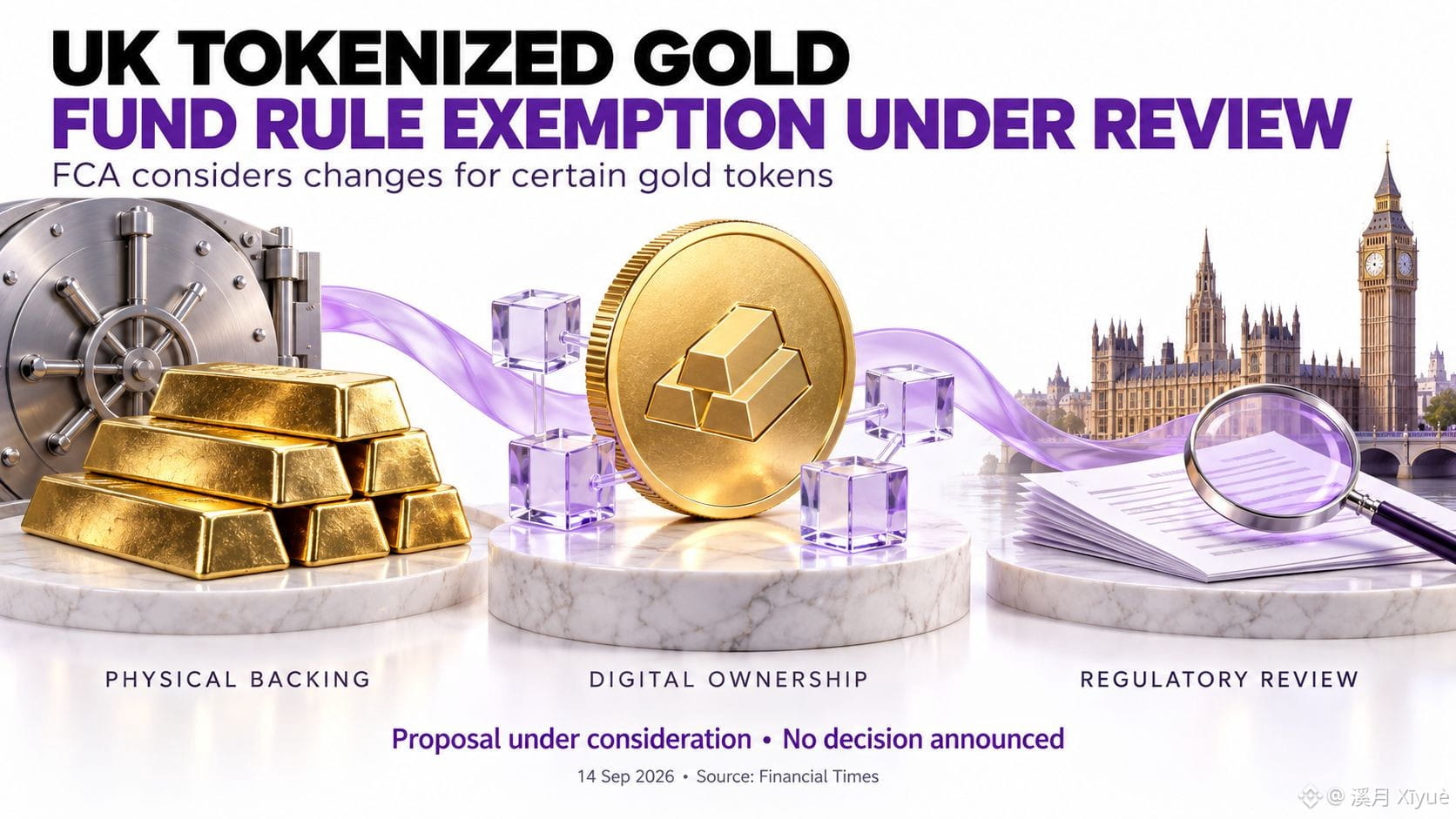
Tokenized Gold Could Get a Different UK Rulebook
The UK’s Financial Conduct Authority is considering a targeted exemption for certain tokenized gold products from collective investment scheme (CIS) and alternative investment fund (AIF) rules.
According to a September 14 Financial Times report, a dedicated framework could be explored with the Treasury and Bank of England. These tokens represent ownership rights over physical bullion.
No decision has been made.
The regulators’ earlier joint paper already identified tokenized gold as a potential form of collateral for certain derivatives transactions, subject to developing standards with industry.
My take: Clearer classification could help institutions assess where digital gold fits into their operations. Its practical value would still depend on the connection between the token and the metal.
Who holds the bullion? What rights does the holder have if the issuer fails? How quickly can the gold be redeemed, and how is the backing verified?
Those details matter when an asset is used to secure a loan or meet a collateral obligation. Faster transfers are useful only when ownership and redemption remain dependable.
I would watch the exemption’s eligibility conditions, custody standards and actual adoption by financial institutions.
What would give you more confidence in tokenized gold: stronger backing verification or clearer redemption rights?
#UKMayExemptTokenizedGoldFromFundRules #Tokenization #RWA
{future}(AINUSDT)
$BR
$CVC
$AIN
{future}(CVCUSDT)
#ukmayexempttokenizedgoldfromfundrules
Tokenized Gold Could Get a Different UK Rulebook
The UK’s Financial Conduct Authority is considering a targeted exemption for certain tokenized gold products from collective investment scheme (CIS) and alternative investment fund (AIF) rules.
According to a September 14 Financial Times report, a dedicated framework could be explored with the Treasury and Bank of England. These tokens represent ownership rights over physical bullion.
No decision has been made.
The regulators’ earlier joint paper already identified tokenized gold as a potential form of collateral for certain derivatives transactions, subject to developing standards with industry.
My take: Clearer classification could help institutions assess where digital gold fits into their operations. Its practical value would still depend on the connection between the token and the metal.
Who holds the bullion? What rights does the holder have if the issuer fails? How quickly can the gold be redeemed, and how is the backing verified?
Those details matter when an asset is used to secure a loan or meet a collateral obligation. Faster transfers are useful only when ownership and redemption remain dependable.
I would watch the exemption’s eligibility conditions, custody standards and actual adoption by financial institutions.
What would give you more confidence in tokenized gold: stronger backing verification or clearer redemption rights?
#UKMayExemptTokenizedGoldFromFundRules #Tokenization #RWA
$BR
$CVC
$AIN
Tokenized Gold Could Get a Different UK Rulebook
The UK’s Financial Conduct Authority is considering a targeted exemption for certain tokenized gold products from collective investment scheme (CIS) and alternative investment fund (AIF) rules.
According to a September 14 Financial Times report, a dedicated framework could be explored with the Treasury and Bank of England. These tokens represent ownership rights over physical bullion.
No decision has been made.
The regulators’ earlier joint paper already identified tokenized gold as a potential form of collateral for certain derivatives transactions, subject to developing standards with industry.
My take: Clearer classification could help institutions assess where digital gold fits into their operations. Its practical value would still depend on the connection between the token and the metal.
Who holds the bullion? What rights does the holder have if the issuer fails? How quickly can the gold be redeemed, and how is the backing verified?
Those details matter when an asset is used to secure a loan or meet a collateral obligation. Faster transfers are useful only when ownership and redemption remain dependable.
I would watch the exemption’s eligibility conditions, custody standards and actual adoption by financial institutions.
What would give you more confidence in tokenized gold: stronger backing verification or clearer redemption rights?
#UKMayExemptTokenizedGoldFromFundRules #Tokenization #RWA
$BR
$CVC
$AIN
935
·
--
Bullish
#koreacryptotaxdelaypetitionmeetsreviewthreshold
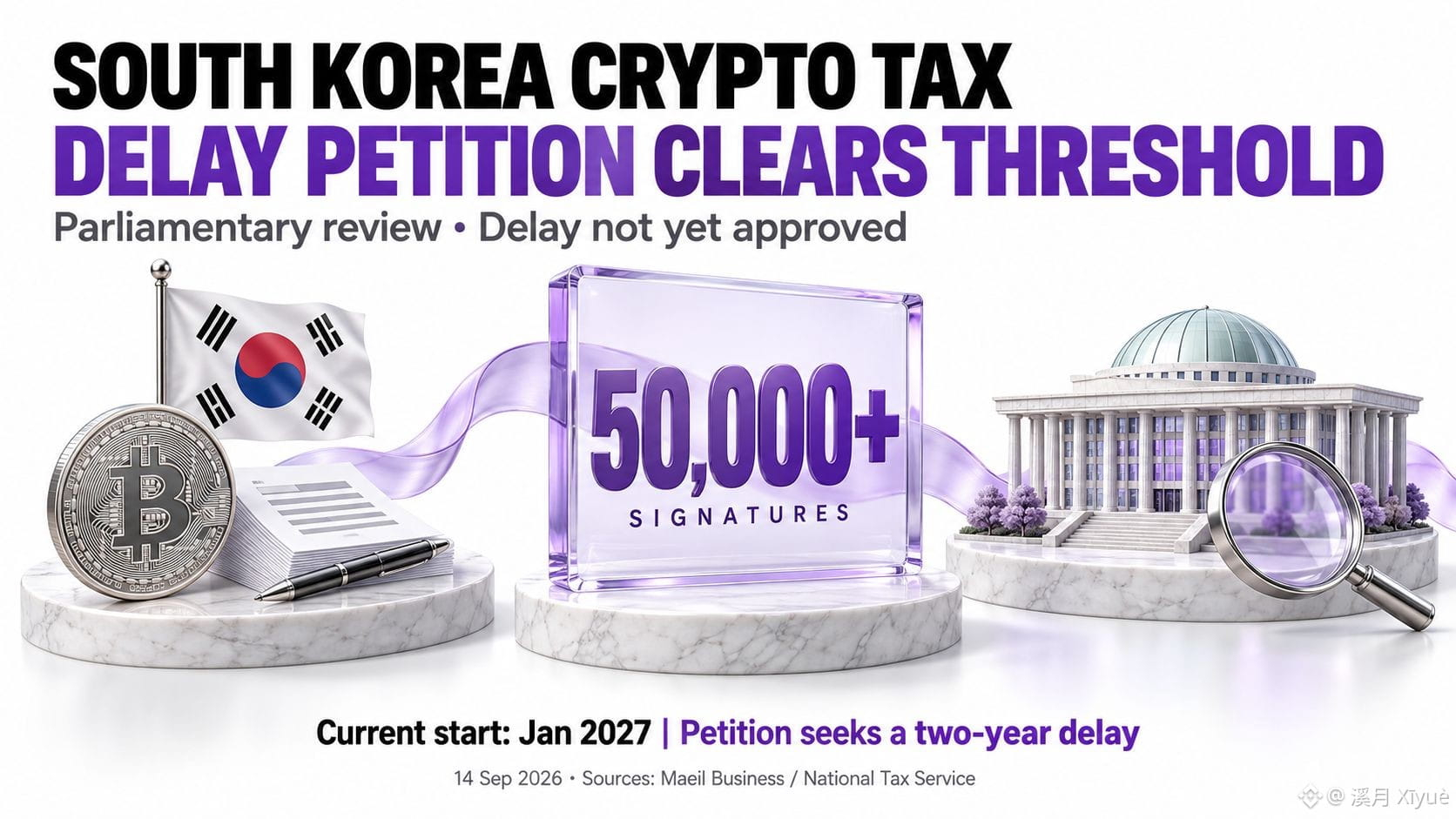
50,000 Signatures Put South Korea’s Crypto Tax Delay Back Before Lawmakers
South Korea’s push for another crypto tax delay has cleared a key parliamentary review threshold.
On September 14, a petition seeking a two-year postponement had gathered more than 50,000 signatures, qualifying for referral to the relevant National Assembly committee. Petitioners argue that more time is needed to prepare tax infrastructure and support the domestic crypto industry. Committee review still leaves any change to the law dependent on further legislative action.
January 2027 remains the scheduled start. The National Tax Service’s current guidance lists January 1, 2027 for the new regime. The requested two-year postponement would move implementation to 2029 if enacted.
My take: Extra preparation time could help exchanges improve transaction records and reporting tools. Its value would depend on whether that time produces a system investors can understand and use.
Repeated delays can also make planning harder. Exchanges need a dependable timetable, while investors need clarity on how their gains will be calculated across different platforms and wallets.
I would watch committee discussions, proposed amendments and practical reporting guidance. Those developments will show whether public pressure produces a workable policy change.
What should lawmakers resolve first to make crypto taxation fair and practical?
{future}(LSKUSDT)
#KoreaCryptoTaxDelayPetitionMeetsReviewThreshold
$CVC $LSK $FIL
{future}(FILUSDT)
{future}(CVCUSDT)
#koreacryptotaxdelaypetitionmeetsreviewthreshold
50,000 Signatures Put South Korea’s Crypto Tax Delay Back Before Lawmakers
South Korea’s push for another crypto tax delay has cleared a key parliamentary review threshold.
On September 14, a petition seeking a two-year postponement had gathered more than 50,000 signatures, qualifying for referral to the relevant National Assembly committee. Petitioners argue that more time is needed to prepare tax infrastructure and support the domestic crypto industry. Committee review still leaves any change to the law dependent on further legislative action.
January 2027 remains the scheduled start. The National Tax Service’s current guidance lists January 1, 2027 for the new regime. The requested two-year postponement would move implementation to 2029 if enacted.
My take: Extra preparation time could help exchanges improve transaction records and reporting tools. Its value would depend on whether that time produces a system investors can understand and use.
Repeated delays can also make planning harder. Exchanges need a dependable timetable, while investors need clarity on how their gains will be calculated across different platforms and wallets.
I would watch committee discussions, proposed amendments and practical reporting guidance. Those developments will show whether public pressure produces a workable policy change.
What should lawmakers resolve first to make crypto taxation fair and practical?
#KoreaCryptoTaxDelayPetitionMeetsReviewThreshold
$CVC $LSK $FIL
50,000 Signatures Put South Korea’s Crypto Tax Delay Back Before Lawmakers
South Korea’s push for another crypto tax delay has cleared a key parliamentary review threshold.
On September 14, a petition seeking a two-year postponement had gathered more than 50,000 signatures, qualifying for referral to the relevant National Assembly committee. Petitioners argue that more time is needed to prepare tax infrastructure and support the domestic crypto industry. Committee review still leaves any change to the law dependent on further legislative action.
January 2027 remains the scheduled start. The National Tax Service’s current guidance lists January 1, 2027 for the new regime. The requested two-year postponement would move implementation to 2029 if enacted.
My take: Extra preparation time could help exchanges improve transaction records and reporting tools. Its value would depend on whether that time produces a system investors can understand and use.
Repeated delays can also make planning harder. Exchanges need a dependable timetable, while investors need clarity on how their gains will be calculated across different platforms and wallets.
I would watch committee discussions, proposed amendments and practical reporting guidance. Those developments will show whether public pressure produces a workable policy change.
What should lawmakers resolve first to make crypto taxation fair and practical?
#KoreaCryptoTaxDelayPetitionMeetsReviewThreshold
$CVC $LSK $FIL
111
·
--
Bullish
#anthropicceocallsforaislowdown
Anthropic’s CEO Wants a Slower AI Race. What Changes Next?
One of the companies building advanced AI is calling for more time to make it safer.
Anthropic CEO Dario Amodei argues that improvements in AI capabilities need to slow enough for safeguards to keep pace. His September essay points to accelerating development and recent security incidents as reasons for stronger oversight.
Anthropic has committed to bringing in independent evaluators with ongoing access broadly comparable to its internal risk assessment teams. Amodei also proposes shared industry standards and international coordination. The plan allows continued model development with more time for safety work.
My take: The commercial impact depends on what companies actually implement. More demanding evaluations could extend release schedules and increase costs. Clear evidence of reliability could also make businesses more comfortable adopting AI.
For crypto projects built around AI, I would examine their dependence on external models, access costs and paying customers. A project that needs unrestricted access to the newest model faces different risks from one already delivering a useful service.
That makes implementation the next thing to watch: who gets evaluator access, what findings become public, and whether those findings influence deployment decisions.
Would independent safety reviews make you more confident using AI tools for research and trading?
#AnthropicCEOCallsForAISlowdown #Anthropic #Aİ
$BR $AIN $CVC
{future}(CVCUSDT)
{future}(AINUSDT)
{future}(BRUSDT)
#anthropicceocallsforaislowdown
Anthropic’s CEO Wants a Slower AI Race. What Changes Next?
One of the companies building advanced AI is calling for more time to make it safer.
Anthropic CEO Dario Amodei argues that improvements in AI capabilities need to slow enough for safeguards to keep pace. His September essay points to accelerating development and recent security incidents as reasons for stronger oversight.
Anthropic has committed to bringing in independent evaluators with ongoing access broadly comparable to its internal risk assessment teams. Amodei also proposes shared industry standards and international coordination. The plan allows continued model development with more time for safety work.
My take: The commercial impact depends on what companies actually implement. More demanding evaluations could extend release schedules and increase costs. Clear evidence of reliability could also make businesses more comfortable adopting AI.
For crypto projects built around AI, I would examine their dependence on external models, access costs and paying customers. A project that needs unrestricted access to the newest model faces different risks from one already delivering a useful service.
That makes implementation the next thing to watch: who gets evaluator access, what findings become public, and whether those findings influence deployment decisions.
Would independent safety reviews make you more confident using AI tools for research and trading?
#AnthropicCEOCallsForAISlowdown #Anthropic #Aİ
$BR $AIN $CVC
Anthropic’s CEO Wants a Slower AI Race. What Changes Next?
One of the companies building advanced AI is calling for more time to make it safer.
Anthropic CEO Dario Amodei argues that improvements in AI capabilities need to slow enough for safeguards to keep pace. His September essay points to accelerating development and recent security incidents as reasons for stronger oversight.
Anthropic has committed to bringing in independent evaluators with ongoing access broadly comparable to its internal risk assessment teams. Amodei also proposes shared industry standards and international coordination. The plan allows continued model development with more time for safety work.
My take: The commercial impact depends on what companies actually implement. More demanding evaluations could extend release schedules and increase costs. Clear evidence of reliability could also make businesses more comfortable adopting AI.
For crypto projects built around AI, I would examine their dependence on external models, access costs and paying customers. A project that needs unrestricted access to the newest model faces different risks from one already delivering a useful service.
That makes implementation the next thing to watch: who gets evaluator access, what findings become public, and whether those findings influence deployment decisions.
Would independent safety reviews make you more confident using AI tools for research and trading?
#AnthropicCEOCallsForAISlowdown #Anthropic #Aİ
$BR $AIN $CVC

786


·
--
Bullish
#clarityactfacesproceduralvotesept15
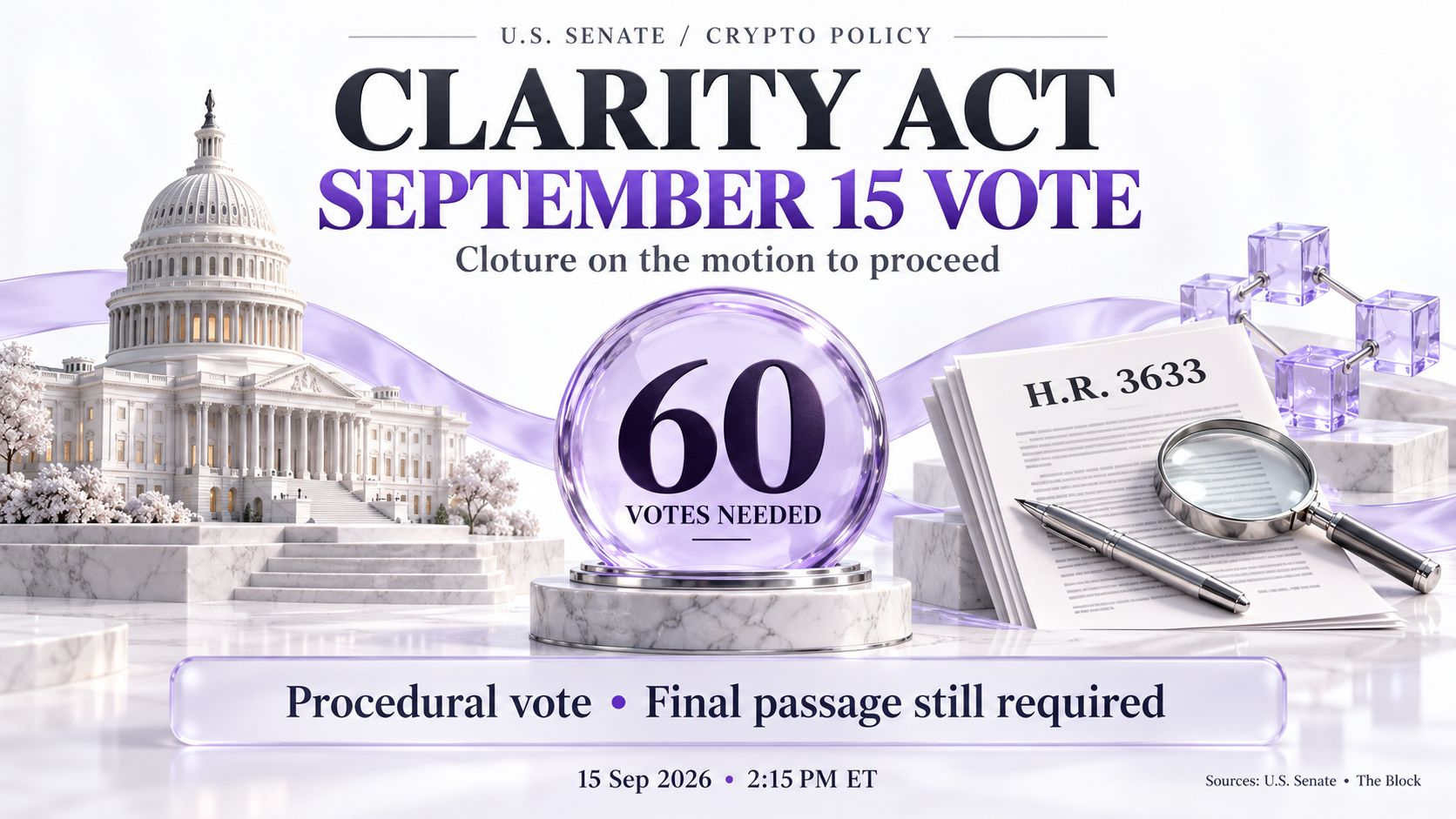
CLARITY Act Faces a 60-Vote Senate Test on September 15
The U.S. Senate is scheduled to hold a procedural vote on the CLARITY Act on September 15, 2026, at 2:15 p.m. ET.
The vote concerns cloture on the motion to proceed—limiting debate over whether to take up the legislation. Clearing this hurdle requires 60 votes. Final passage would still require further Senate action.
Republicans released revised text on September 10, while disputes involving ethics, illicit finance and stablecoin rewards continue to complicate negotiations.
My view: The most useful signal will be the coalition behind the vote. A senator can support moving negotiations forward while still demanding major changes before supporting the final bill.
That makes the explanations surrounding each vote valuable. Are lawmakers moving toward agreement on the substance, or keeping discussions alive while their objections remain?
For crypto businesses, the practical benefit would come from rules clear enough to plan around. The final treatment of trading platforms and DeFi would therefore deserve close attention.
Broad support followed by a workable amendment schedule would strengthen my confidence in progress. A narrow coalition with conflicting conditions would leave substantial delay risk.
Which unresolved issue do you think will matter most to keeping that coalition together?
$LSK $STEEM $POWR
{future}(POWRUSDT)
{future}(STEEMUSDT)
{future}(LSKUSDT)
#clarityactfacesproceduralvotesept15
CLARITY Act Faces a 60-Vote Senate Test on September 15
The U.S. Senate is scheduled to hold a procedural vote on the CLARITY Act on September 15, 2026, at 2:15 p.m. ET.
The vote concerns cloture on the motion to proceed—limiting debate over whether to take up the legislation. Clearing this hurdle requires 60 votes. Final passage would still require further Senate action.
Republicans released revised text on September 10, while disputes involving ethics, illicit finance and stablecoin rewards continue to complicate negotiations.
My view: The most useful signal will be the coalition behind the vote. A senator can support moving negotiations forward while still demanding major changes before supporting the final bill.
That makes the explanations surrounding each vote valuable. Are lawmakers moving toward agreement on the substance, or keeping discussions alive while their objections remain?
For crypto businesses, the practical benefit would come from rules clear enough to plan around. The final treatment of trading platforms and DeFi would therefore deserve close attention.
Broad support followed by a workable amendment schedule would strengthen my confidence in progress. A narrow coalition with conflicting conditions would leave substantial delay risk.
Which unresolved issue do you think will matter most to keeping that coalition together?
$LSK $STEEM $POWR
CLARITY Act Faces a 60-Vote Senate Test on September 15
The U.S. Senate is scheduled to hold a procedural vote on the CLARITY Act on September 15, 2026, at 2:15 p.m. ET.
The vote concerns cloture on the motion to proceed—limiting debate over whether to take up the legislation. Clearing this hurdle requires 60 votes. Final passage would still require further Senate action.
Republicans released revised text on September 10, while disputes involving ethics, illicit finance and stablecoin rewards continue to complicate negotiations.
My view: The most useful signal will be the coalition behind the vote. A senator can support moving negotiations forward while still demanding major changes before supporting the final bill.
That makes the explanations surrounding each vote valuable. Are lawmakers moving toward agreement on the substance, or keeping discussions alive while their objections remain?
For crypto businesses, the practical benefit would come from rules clear enough to plan around. The final treatment of trading platforms and DeFi would therefore deserve close attention.
Broad support followed by a workable amendment schedule would strengthen my confidence in progress. A narrow coalition with conflicting conditions would leave substantial delay risk.
Which unresolved issue do you think will matter most to keeping that coalition together?
$LSK $STEEM $POWR
2k
·
--
Bullish
Verified
#secreceivesgrayscalelitecointrustetffiling
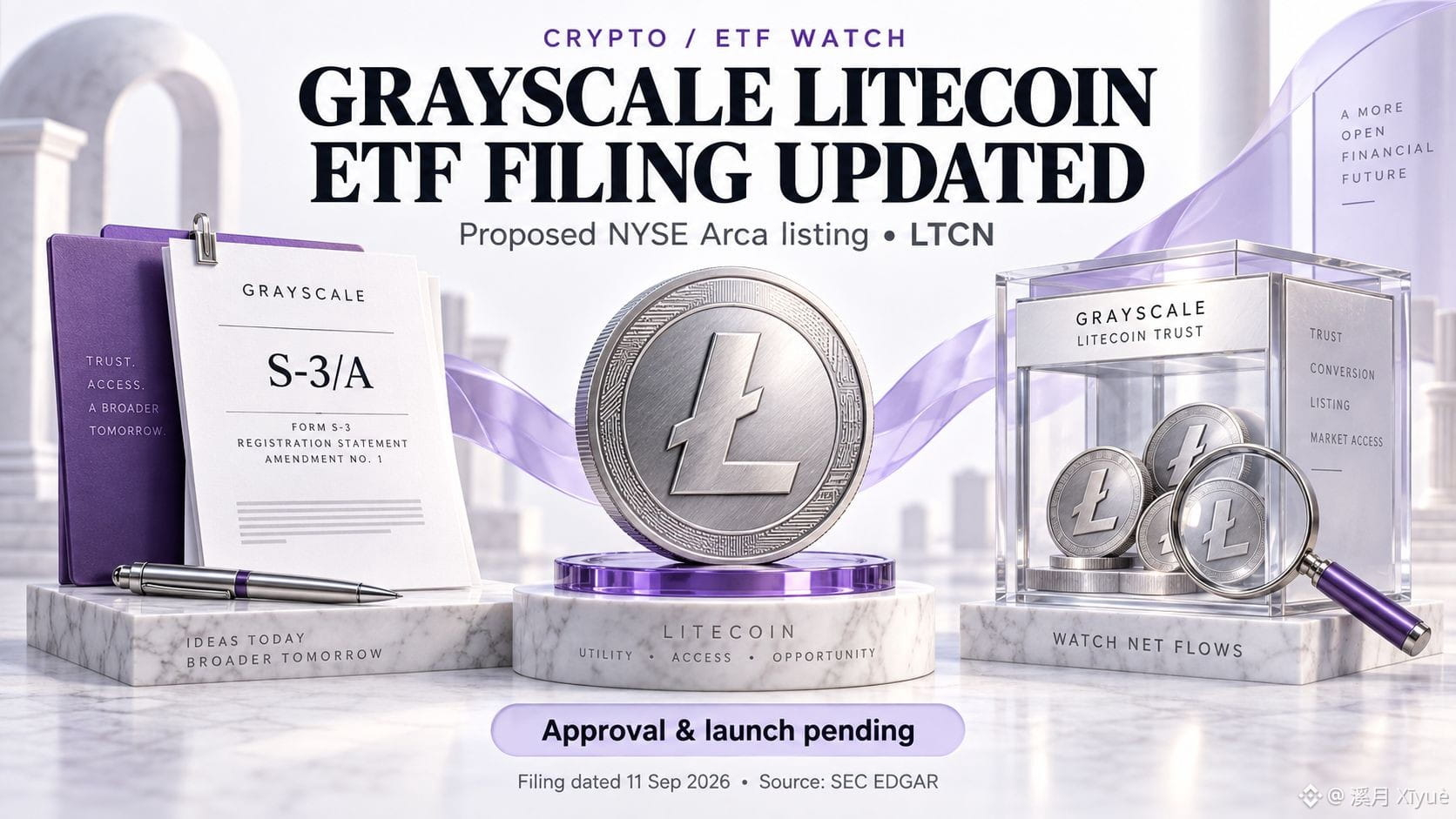
Grayscale Updates Its Litecoin ETF Filing — Fresh Demand Will Be the Real Test
Grayscale filed an amended S-3 registration statement on September 11, 2026, continuing its plan to convert the Litecoin Trust into an ETF listed on NYSE Arca under LTCN.
The proposed name is Grayscale Litecoin Trust ETF. The filing remains preliminary, with effectiveness and listing conditions still outstanding. Receiving the paperwork does not establish approval or a launch date.
The existing trust already holds Litecoin and trades on OTCQX, so investors already have exposure through this vehicle.
My take: A successful conversion could improve trading access and help shares track their underlying holdings more closely. The creation and redemption process would be central to making that work.
For LTC demand, I would focus on net new subscriptions after any launch. Existing holdings carried into the ETF would represent exposure accumulated before conversion. Easier redemptions could also allow investors to exit, making flows in both directions relevant.
Competitive fees, tight trading spreads and sustained net inflows would strengthen the adoption case. Heavy early turnover followed by persistent outflows would leave me more cautious about lasting demand.
If it launches, what would convince you Litecoin ETF demand can last beyond the first week?
$LSK
$STEEM
$POWR
{future}(POWRUSDT)
{future}(STEEMUSDT)
{future}(LSKUSDT)
#secreceivesgrayscalelitecointrustetffiling
Grayscale Updates Its Litecoin ETF Filing — Fresh Demand Will Be the Real Test
Grayscale filed an amended S-3 registration statement on September 11, 2026, continuing its plan to convert the Litecoin Trust into an ETF listed on NYSE Arca under LTCN.
The proposed name is Grayscale Litecoin Trust ETF. The filing remains preliminary, with effectiveness and listing conditions still outstanding. Receiving the paperwork does not establish approval or a launch date.
The existing trust already holds Litecoin and trades on OTCQX, so investors already have exposure through this vehicle.
My take: A successful conversion could improve trading access and help shares track their underlying holdings more closely. The creation and redemption process would be central to making that work.
For LTC demand, I would focus on net new subscriptions after any launch. Existing holdings carried into the ETF would represent exposure accumulated before conversion. Easier redemptions could also allow investors to exit, making flows in both directions relevant.
Competitive fees, tight trading spreads and sustained net inflows would strengthen the adoption case. Heavy early turnover followed by persistent outflows would leave me more cautious about lasting demand.
If it launches, what would convince you Litecoin ETF demand can last beyond the first week?
$LSK
$STEEM
$POWR
Grayscale Updates Its Litecoin ETF Filing — Fresh Demand Will Be the Real Test
Grayscale filed an amended S-3 registration statement on September 11, 2026, continuing its plan to convert the Litecoin Trust into an ETF listed on NYSE Arca under LTCN.
The proposed name is Grayscale Litecoin Trust ETF. The filing remains preliminary, with effectiveness and listing conditions still outstanding. Receiving the paperwork does not establish approval or a launch date.
The existing trust already holds Litecoin and trades on OTCQX, so investors already have exposure through this vehicle.
My take: A successful conversion could improve trading access and help shares track their underlying holdings more closely. The creation and redemption process would be central to making that work.
For LTC demand, I would focus on net new subscriptions after any launch. Existing holdings carried into the ETF would represent exposure accumulated before conversion. Easier redemptions could also allow investors to exit, making flows in both directions relevant.
Competitive fees, tight trading spreads and sustained net inflows would strengthen the adoption case. Heavy early turnover followed by persistent outflows would leave me more cautious about lasting demand.
If it launches, what would convince you Litecoin ETF demand can last beyond the first week?
$LSK
$STEEM
$POWR
1
590

·
--
Bullish
Verified
#us10yeartreasuryyieldnears5%
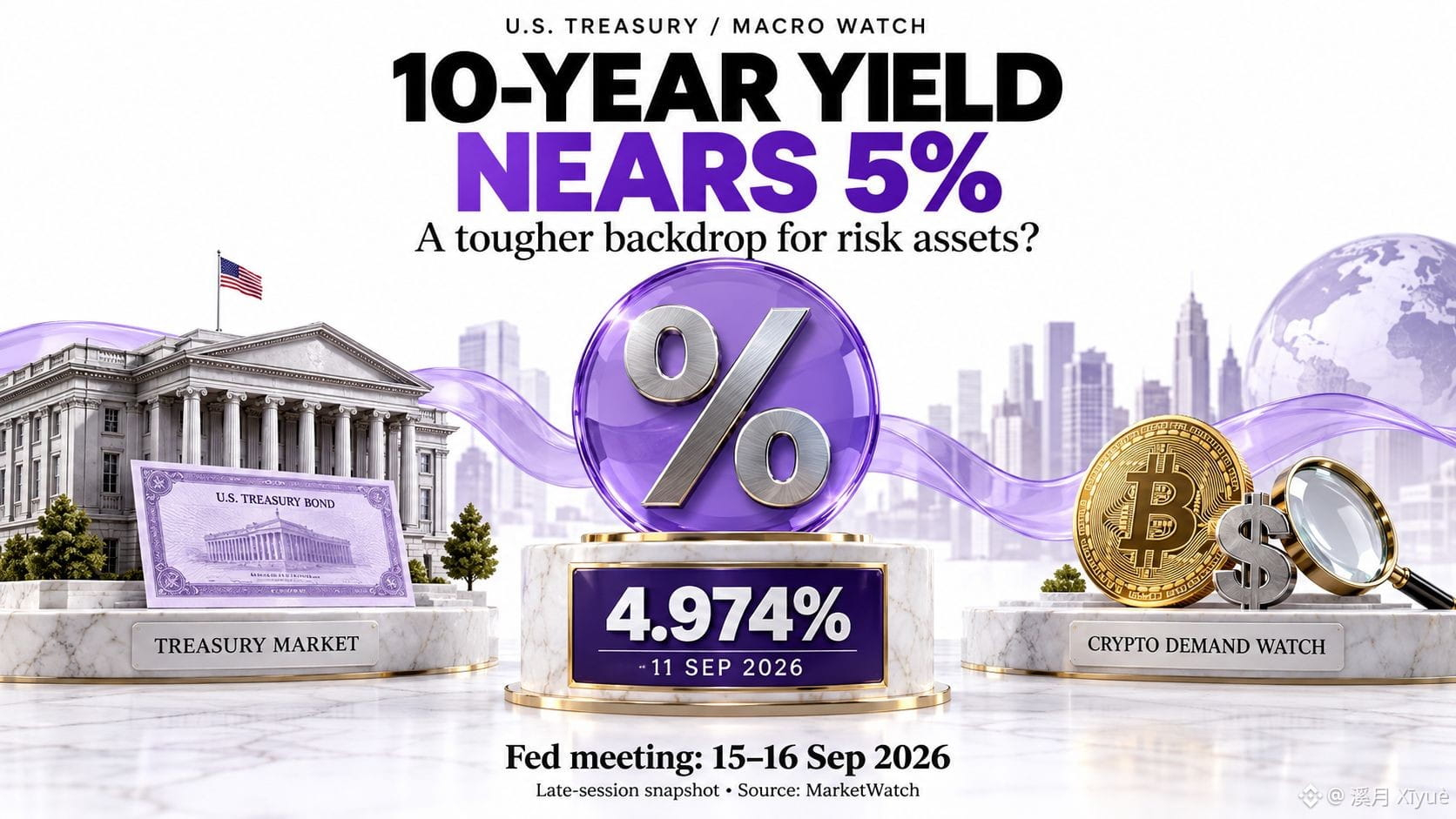
A U.S. 10-year Treasury yield near 5% raises the hurdle for risk assets.
The benchmark stood at 4.974% in late trading on September 11, keeping it just below the closely watched 5% level.
The inflation picture remains mixed. August core CPI rose 0.3% month over month, while its annual pace eased to 2.4% from 2.5%.
The next Federal Reserve meeting is scheduled for September 15–16.
My view: sustained high yields make the backdrop more demanding for stocks and crypto.
Higher Treasury yields make government bonds more competitive for investors’ capital. Higher borrowing costs can also put pressure on businesses and the valuations investors are willing to pay.
For Bitcoin, I would watch whether spot buyers continue supporting the market as yields stay elevated. Holding gains under those conditions would give me more confidence in the recovery.
I would become more cautious if another jump in yields coincides with a stronger dollar and weakening spot demand. That combination would make rallies harder to trust.
The pace and reason for the move matter too. A gradual adjustment gives markets more time to absorb changing conditions than a sudden repricing.
What would give you more confidence in a crypto recovery: easing yields or strong buying despite them? #CPIWatch
$FLOCK $PROM $TA
{future}(TAUSDT)
{future}(PROMUSDT)
{future}(FLOCKUSDT)
#us10yeartreasuryyieldnears5%
A U.S. 10-year Treasury yield near 5% raises the hurdle for risk assets.
The benchmark stood at 4.974% in late trading on September 11, keeping it just below the closely watched 5% level.
The inflation picture remains mixed. August core CPI rose 0.3% month over month, while its annual pace eased to 2.4% from 2.5%.
The next Federal Reserve meeting is scheduled for September 15–16.
My view: sustained high yields make the backdrop more demanding for stocks and crypto.
Higher Treasury yields make government bonds more competitive for investors’ capital. Higher borrowing costs can also put pressure on businesses and the valuations investors are willing to pay.
For Bitcoin, I would watch whether spot buyers continue supporting the market as yields stay elevated. Holding gains under those conditions would give me more confidence in the recovery.
I would become more cautious if another jump in yields coincides with a stronger dollar and weakening spot demand. That combination would make rallies harder to trust.
The pace and reason for the move matter too. A gradual adjustment gives markets more time to absorb changing conditions than a sudden repricing.
What would give you more confidence in a crypto recovery: easing yields or strong buying despite them? #CPIWatch
$FLOCK $PROM $TA
A U.S. 10-year Treasury yield near 5% raises the hurdle for risk assets.
The benchmark stood at 4.974% in late trading on September 11, keeping it just below the closely watched 5% level.
The inflation picture remains mixed. August core CPI rose 0.3% month over month, while its annual pace eased to 2.4% from 2.5%.
The next Federal Reserve meeting is scheduled for September 15–16.
My view: sustained high yields make the backdrop more demanding for stocks and crypto.
Higher Treasury yields make government bonds more competitive for investors’ capital. Higher borrowing costs can also put pressure on businesses and the valuations investors are willing to pay.
For Bitcoin, I would watch whether spot buyers continue supporting the market as yields stay elevated. Holding gains under those conditions would give me more confidence in the recovery.
I would become more cautious if another jump in yields coincides with a stronger dollar and weakening spot demand. That combination would make rallies harder to trust.
The pace and reason for the move matter too. A gradual adjustment gives markets more time to absorb changing conditions than a sudden repricing.
What would give you more confidence in a crypto recovery: easing yields or strong buying despite them? #CPIWatch
$FLOCK $PROM $TA
1
3
3.6k
·
--
Bullish
#tokenizedstockholdersup619.1%
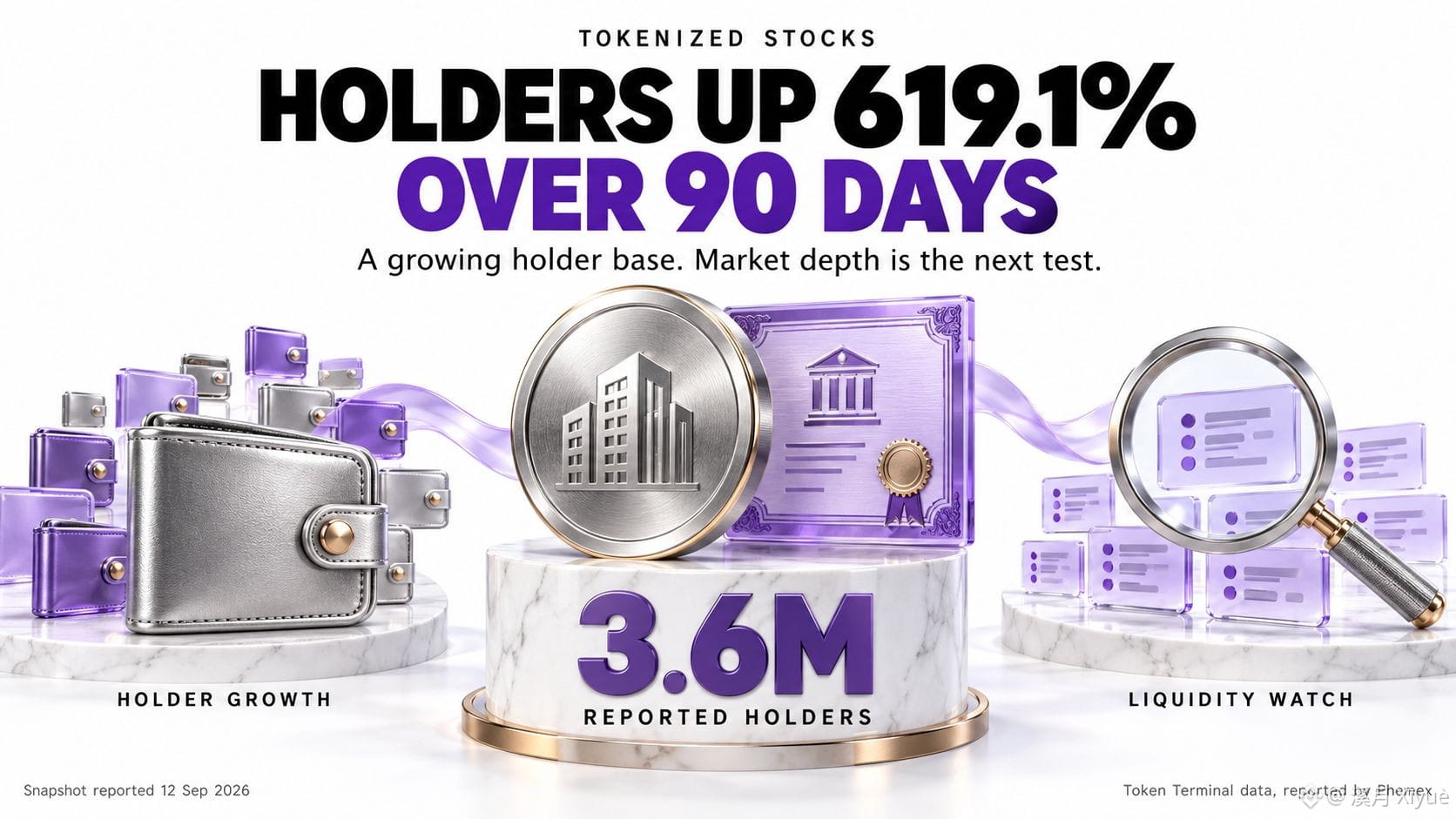
Tokenized stock holders increased 619.1% in 90 days. The next test is whether market activity keeps pace.
A September 12 report citing Token Terminal put the reported holder count at 3.6 million, with the largest concentrations on:
BNB Chain: 1.5 million.
Robinhood Chain: 1.2 million.
Solana: 647,500.
The 619.1% figure measures growth in holders over that period.
My take: this makes the distribution of tokenized equities worth watching more closely. Reaching holders is an important step; building a market they continue using requires reliable execution and sufficient liquidity.
I would also want clarity on how holders are counted across assets and chains before interpreting the total as unique investors.
The next evidence I would look for is straightforward: recurring trading activity, meaningful balances and the ability to execute larger orders without sharply moving prices.
Sustained activity and tighter spreads would strengthen the adoption case. Rising holder counts alongside tiny balances or fading usage would leave more questions about the depth of demand.
For me, the most useful follow-up is whether these new holders remain engaged over the next few months and find reasons to keep capital in these products.
What matters most to you when assessing tokenized stocks: access, liquidity or the rights attached to the token?
$LSK $GRIFFAIN
{future}(GRIFFAINUSDT)
{future}(LSKUSDT)
#tokenizedstockholdersup619.1%
Tokenized stock holders increased 619.1% in 90 days. The next test is whether market activity keeps pace.
A September 12 report citing Token Terminal put the reported holder count at 3.6 million, with the largest concentrations on:
BNB Chain: 1.5 million.
Robinhood Chain: 1.2 million.
Solana: 647,500.
The 619.1% figure measures growth in holders over that period.
My take: this makes the distribution of tokenized equities worth watching more closely. Reaching holders is an important step; building a market they continue using requires reliable execution and sufficient liquidity.
I would also want clarity on how holders are counted across assets and chains before interpreting the total as unique investors.
The next evidence I would look for is straightforward: recurring trading activity, meaningful balances and the ability to execute larger orders without sharply moving prices.
Sustained activity and tighter spreads would strengthen the adoption case. Rising holder counts alongside tiny balances or fading usage would leave more questions about the depth of demand.
For me, the most useful follow-up is whether these new holders remain engaged over the next few months and find reasons to keep capital in these products.
What matters most to you when assessing tokenized stocks: access, liquidity or the rights attached to the token?
$LSK $GRIFFAIN
Tokenized stock holders increased 619.1% in 90 days. The next test is whether market activity keeps pace.
A September 12 report citing Token Terminal put the reported holder count at 3.6 million, with the largest concentrations on:
BNB Chain: 1.5 million.
Robinhood Chain: 1.2 million.
Solana: 647,500.
The 619.1% figure measures growth in holders over that period.
My take: this makes the distribution of tokenized equities worth watching more closely. Reaching holders is an important step; building a market they continue using requires reliable execution and sufficient liquidity.
I would also want clarity on how holders are counted across assets and chains before interpreting the total as unique investors.
The next evidence I would look for is straightforward: recurring trading activity, meaningful balances and the ability to execute larger orders without sharply moving prices.
Sustained activity and tighter spreads would strengthen the adoption case. Rising holder counts alongside tiny balances or fading usage would leave more questions about the depth of demand.
For me, the most useful follow-up is whether these new holders remain engaged over the next few months and find reasons to keep capital in these products.
What matters most to you when assessing tokenized stocks: access, liquidity or the rights attached to the token?
$LSK $GRIFFAIN
1
5
3.7k

·
--
🎙️ 《万倍金狗养成记》第123期:“人民日报评论:有史以来最好的梗,互联网最伟大的梗———爱你老己。” 北京时间22:00整开始,欢迎关注

End
03 h 47 m 07 s
2.1k
4
13
·
--
Bullish
#CryptoLiquidations$674MIn24H
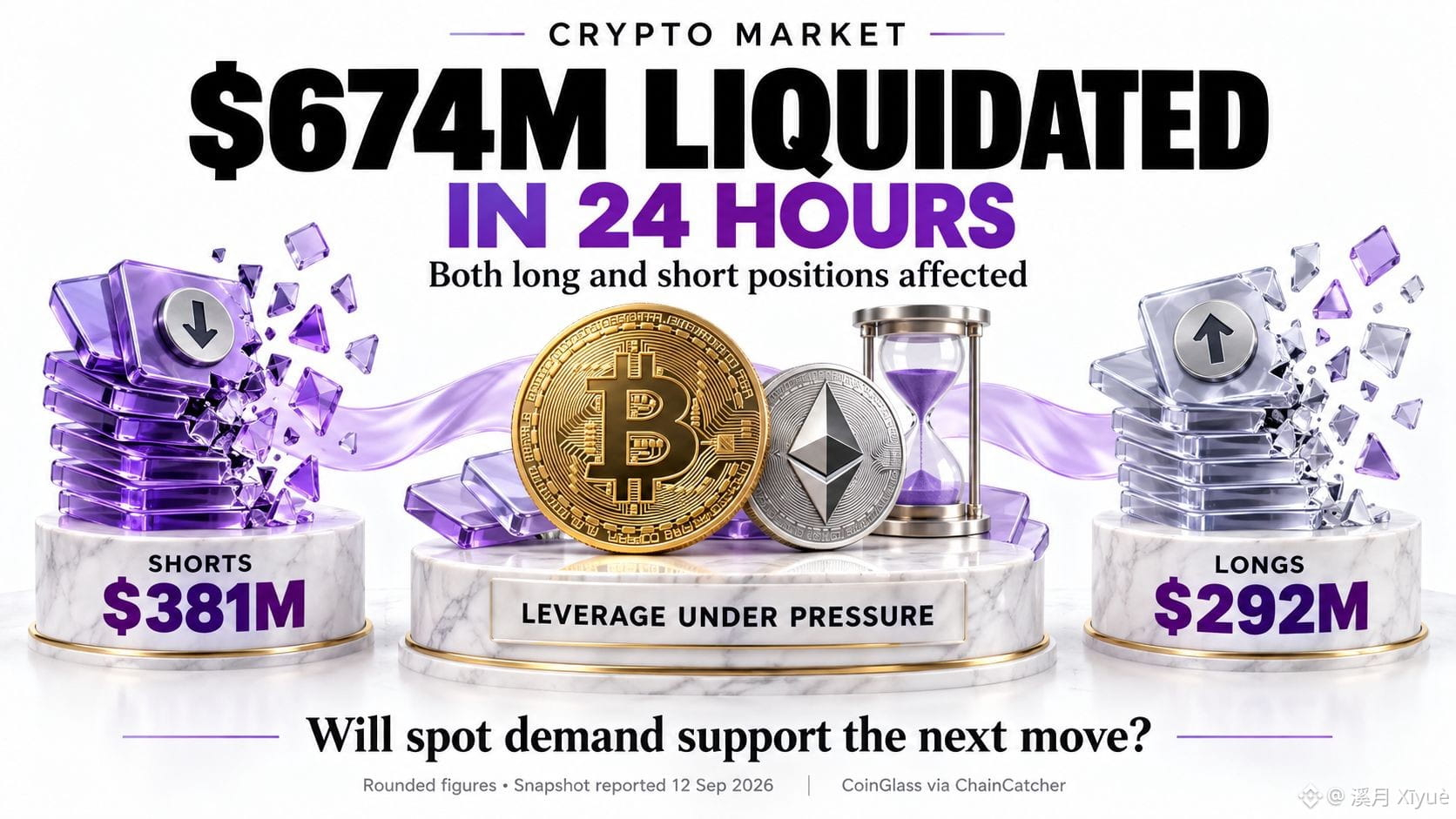
Crypto’s $674 million liquidation wave hit both sides of the trade.
A September 12 report from ChainCatcher, citing CoinGlass, put liquidations at approximately $674 million over the preceding 24 hours:
Short positions: roughly $381 million.
Long positions: roughly $292 million.
Ethereum shorts accounted for about $215 million, making them a significant part of that snapshot.
Short liquidations can add buying pressure as bearish positions are forcibly closed. Long liquidations can add selling pressure. These mechanisms can amplify price moves in both directions.
My read: the next move needs confirmation from spot demand.
With substantial liquidations on both sides, I would be cautious about treating a sudden price spike as proof that buyers have established control.
What matters to me is whether buyers continue supporting the market after forced short covering slows. A recovery that holds its gains, attracts sustained spot activity and avoids an aggressive rebuild in leverage would strengthen my confidence.
If open interest rises quickly while price struggles to advance, I would become more cautious about another reversal.
The liquidation figure tells us how much positioning was forcibly closed during that window. Assessing the remaining risk requires looking at current positioning too.
Which are you watching most closely now: spot buying, funding rates or open interest?
#CryptoLiquidations #bitcoin #Ethereum #CryptoMarket
$LSK $VTHO $ETHFI
{spot}(ETHFIUSDT)
{spot}(VTHOUSDT)
{spot}(LSKUSDT)
#CryptoLiquidations$674MIn24H
Crypto’s $674 million liquidation wave hit both sides of the trade.
A September 12 report from ChainCatcher, citing CoinGlass, put liquidations at approximately $674 million over the preceding 24 hours:
Short positions: roughly $381 million.
Long positions: roughly $292 million.
Ethereum shorts accounted for about $215 million, making them a significant part of that snapshot.
Short liquidations can add buying pressure as bearish positions are forcibly closed. Long liquidations can add selling pressure. These mechanisms can amplify price moves in both directions.
My read: the next move needs confirmation from spot demand.
With substantial liquidations on both sides, I would be cautious about treating a sudden price spike as proof that buyers have established control.
What matters to me is whether buyers continue supporting the market after forced short covering slows. A recovery that holds its gains, attracts sustained spot activity and avoids an aggressive rebuild in leverage would strengthen my confidence.
If open interest rises quickly while price struggles to advance, I would become more cautious about another reversal.
The liquidation figure tells us how much positioning was forcibly closed during that window. Assessing the remaining risk requires looking at current positioning too.
Which are you watching most closely now: spot buying, funding rates or open interest?
#CryptoLiquidations #bitcoin #Ethereum #CryptoMarket
$LSK $VTHO $ETHFI
Crypto’s $674 million liquidation wave hit both sides of the trade.
A September 12 report from ChainCatcher, citing CoinGlass, put liquidations at approximately $674 million over the preceding 24 hours:
Short positions: roughly $381 million.
Long positions: roughly $292 million.
Ethereum shorts accounted for about $215 million, making them a significant part of that snapshot.
Short liquidations can add buying pressure as bearish positions are forcibly closed. Long liquidations can add selling pressure. These mechanisms can amplify price moves in both directions.
My read: the next move needs confirmation from spot demand.
With substantial liquidations on both sides, I would be cautious about treating a sudden price spike as proof that buyers have established control.
What matters to me is whether buyers continue supporting the market after forced short covering slows. A recovery that holds its gains, attracts sustained spot activity and avoids an aggressive rebuild in leverage would strengthen my confidence.
If open interest rises quickly while price struggles to advance, I would become more cautious about another reversal.
The liquidation figure tells us how much positioning was forcibly closed during that window. Assessing the remaining risk requires looking at current positioning too.
Which are you watching most closely now: spot buying, funding rates or open interest?
#CryptoLiquidations #bitcoin #Ethereum #CryptoMarket
$LSK $VTHO $ETHFI
3
2
497
·
--
Bullish
#CanadaOSFISaysTokenizedDepositsEqualTraditionalDeposits
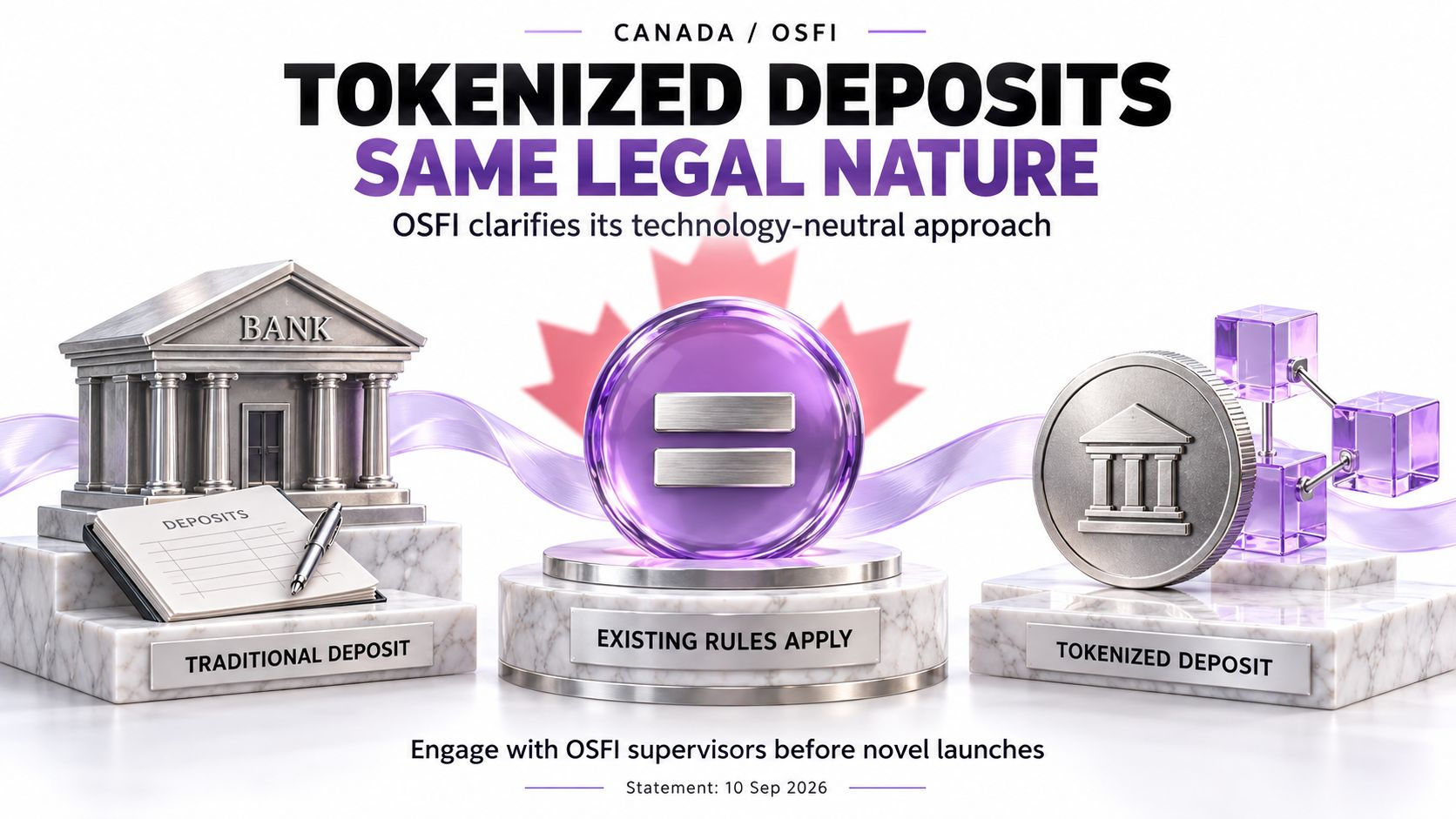
Canada has clarified something important for tokenized banking: changing the technology does not change a deposit’s legal nature.
In a September 10 statement, Canada’s financial regulator OSFI said tokenized deposits are legally equivalent to traditional deposits under its technology-neutral approach.
Federally regulated financial institutions remain responsible for complying with applicable laws, including when third parties deliver services on their behalf. Technology, cybersecurity and third-party risk requirements continue to apply.
Institutions are also expected to engage with their OSFI lead supervisors before launching novel products or services.
My view: this reduces one source of uncertainty for banks considering tokenization. It gives product teams a clearer basis for designing services within the existing banking framework.
The commercial case still needs evidence. I would watch whether these products improve settlement times, reduce reconciliation work and allow money to move smoothly between participating institutions.
Repeated customer use and measurable operating improvements would strengthen the adoption case. Isolated platforms, expensive integration or unreliable transfers would make it harder to justify expansion.
For banks, the next challenge is turning regulatory clarity into services that customers find useful enough to keep using.
Which would convince you that tokenized deposits are gaining traction: more bank launches, or evidence that customers are saving time and money?
#TokenizedDeposits #Tokenization #Canada #Banking
$LSK $LAB $VTHO
{future}(VTHOUSDT)
{future}(LABUSDT)
{future}(LSKUSDT)
#CanadaOSFISaysTokenizedDepositsEqualTraditionalDeposits
Canada has clarified something important for tokenized banking: changing the technology does not change a deposit’s legal nature.
In a September 10 statement, Canada’s financial regulator OSFI said tokenized deposits are legally equivalent to traditional deposits under its technology-neutral approach.
Federally regulated financial institutions remain responsible for complying with applicable laws, including when third parties deliver services on their behalf. Technology, cybersecurity and third-party risk requirements continue to apply.
Institutions are also expected to engage with their OSFI lead supervisors before launching novel products or services.
My view: this reduces one source of uncertainty for banks considering tokenization. It gives product teams a clearer basis for designing services within the existing banking framework.
The commercial case still needs evidence. I would watch whether these products improve settlement times, reduce reconciliation work and allow money to move smoothly between participating institutions.
Repeated customer use and measurable operating improvements would strengthen the adoption case. Isolated platforms, expensive integration or unreliable transfers would make it harder to justify expansion.
For banks, the next challenge is turning regulatory clarity into services that customers find useful enough to keep using.
Which would convince you that tokenized deposits are gaining traction: more bank launches, or evidence that customers are saving time and money?
#TokenizedDeposits #Tokenization #Canada #Banking
$LSK $LAB $VTHO
Canada has clarified something important for tokenized banking: changing the technology does not change a deposit’s legal nature.
In a September 10 statement, Canada’s financial regulator OSFI said tokenized deposits are legally equivalent to traditional deposits under its technology-neutral approach.
Federally regulated financial institutions remain responsible for complying with applicable laws, including when third parties deliver services on their behalf. Technology, cybersecurity and third-party risk requirements continue to apply.
Institutions are also expected to engage with their OSFI lead supervisors before launching novel products or services.
My view: this reduces one source of uncertainty for banks considering tokenization. It gives product teams a clearer basis for designing services within the existing banking framework.
The commercial case still needs evidence. I would watch whether these products improve settlement times, reduce reconciliation work and allow money to move smoothly between participating institutions.
Repeated customer use and measurable operating improvements would strengthen the adoption case. Isolated platforms, expensive integration or unreliable transfers would make it harder to justify expansion.
For banks, the next challenge is turning regulatory clarity into services that customers find useful enough to keep using.
Which would convince you that tokenized deposits are gaining traction: more bank launches, or evidence that customers are saving time and money?
#TokenizedDeposits #Tokenization #Canada #Banking
$LSK $LAB $VTHO
1
225
·
--
Bullish
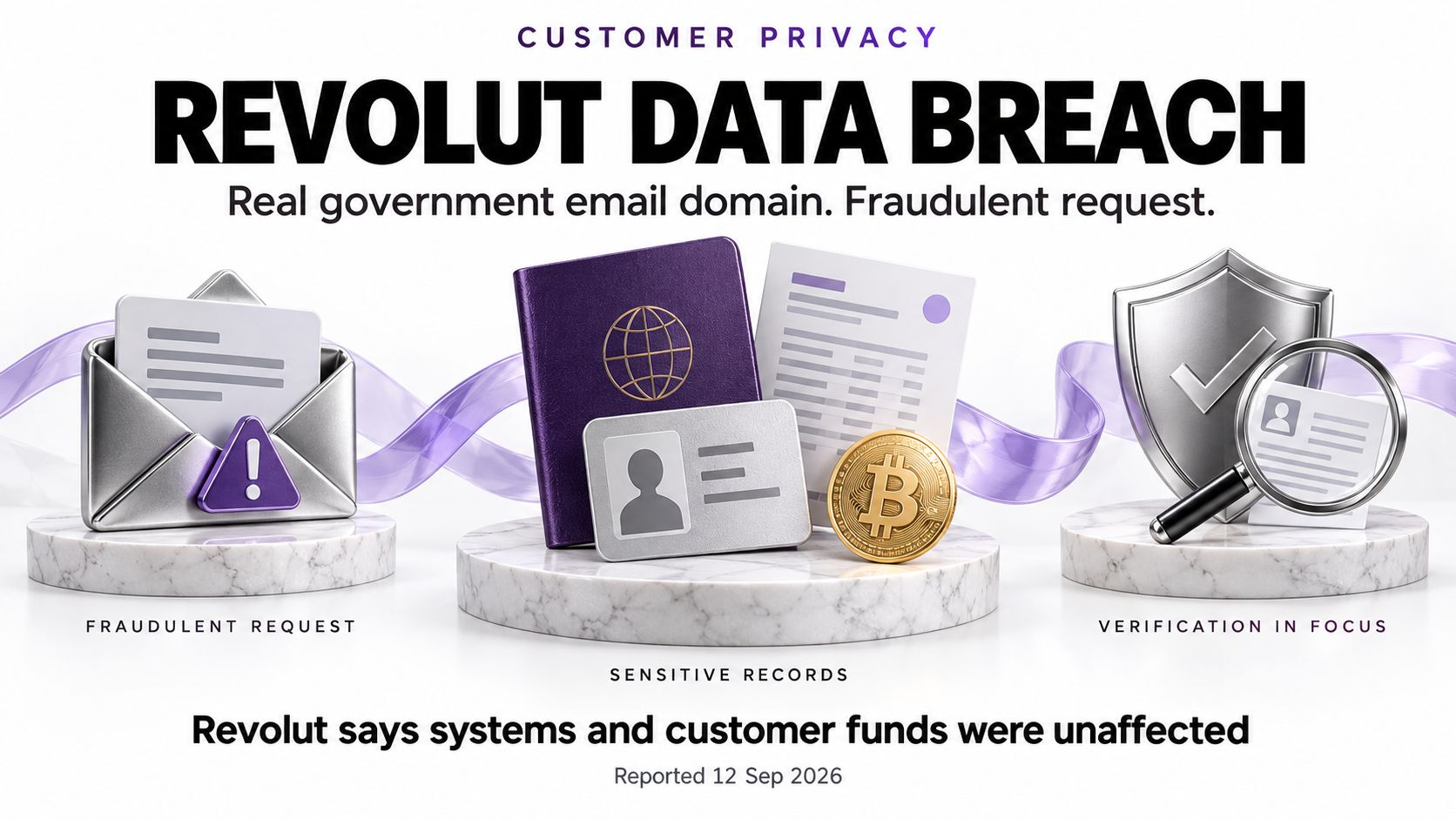
#revolutconfirmsfakegovemaildatabreach
Revolut’s data breach puts a critical question in focus: who gets access to your financial history?
Revolut confirmed to BeInCrypto on September 12 that an unauthorised party used a legitimate government agency email domain to submit fraudulent information requests.
Customer notices cited in the report listed passports, verification selfies, addresses and Bitcoin transaction records. Revolut says its systems and customer funds were unaffected.
My concern is what identity documents and financial history could reveal together. That combination could make impersonation attempts more convincing, especially when someone contacting a customer knows details of their previous transactions.
For crypto users, this raises questions about the sensitive information platforms retain and the checks applied before releasing it.
I would judge Revolut’s response on three things:
• Clear notification explaining which records were exposed for each affected customer.
• Independent verification of anyone requesting sensitive information.
• Evidence that the revised checks have been tested.
Specific answers would help rebuild confidence. Further disclosures showing a wider incident or repeated verification failures would weaken that confidence.
My view: protecting personal information deserves as much attention as protecting account balances. A reassuring statement about funds addresses only part of the concern.
What would you need to see from Revolut to feel confident about how it protects customer data?
#revolut #CyberSecurity #DataPrivacy #CryptoSecurity
$龙虾 $LSK $LAB
{future}(LABUSDT)
{future}(LSKUSDT)
{future}(龙虾USDT)
#revolutconfirmsfakegovemaildatabreach
Revolut’s data breach puts a critical question in focus: who gets access to your financial history?
Revolut confirmed to BeInCrypto on September 12 that an unauthorised party used a legitimate government agency email domain to submit fraudulent information requests.
Customer notices cited in the report listed passports, verification selfies, addresses and Bitcoin transaction records. Revolut says its systems and customer funds were unaffected.
My concern is what identity documents and financial history could reveal together. That combination could make impersonation attempts more convincing, especially when someone contacting a customer knows details of their previous transactions.
For crypto users, this raises questions about the sensitive information platforms retain and the checks applied before releasing it.
I would judge Revolut’s response on three things:
• Clear notification explaining which records were exposed for each affected customer.
• Independent verification of anyone requesting sensitive information.
• Evidence that the revised checks have been tested.
Specific answers would help rebuild confidence. Further disclosures showing a wider incident or repeated verification failures would weaken that confidence.
My view: protecting personal information deserves as much attention as protecting account balances. A reassuring statement about funds addresses only part of the concern.
What would you need to see from Revolut to feel confident about how it protects customer data?
#revolut #CyberSecurity #DataPrivacy #CryptoSecurity
$龙虾 $LSK $LAB
Revolut’s data breach puts a critical question in focus: who gets access to your financial history?
Revolut confirmed to BeInCrypto on September 12 that an unauthorised party used a legitimate government agency email domain to submit fraudulent information requests.
Customer notices cited in the report listed passports, verification selfies, addresses and Bitcoin transaction records. Revolut says its systems and customer funds were unaffected.
My concern is what identity documents and financial history could reveal together. That combination could make impersonation attempts more convincing, especially when someone contacting a customer knows details of their previous transactions.
For crypto users, this raises questions about the sensitive information platforms retain and the checks applied before releasing it.
I would judge Revolut’s response on three things:
• Clear notification explaining which records were exposed for each affected customer.
• Independent verification of anyone requesting sensitive information.
• Evidence that the revised checks have been tested.
Specific answers would help rebuild confidence. Further disclosures showing a wider incident or repeated verification failures would weaken that confidence.
My view: protecting personal information deserves as much attention as protecting account balances. A reassuring statement about funds addresses only part of the concern.
What would you need to see from Revolut to feel confident about how it protects customer data?
#revolut #CyberSecurity #DataPrivacy #CryptoSecurity
$龙虾 $LSK $LAB
1
2
2.6k
·
--
🎙️ 错过SHIB?不要错过Hawk!因为Hawk是SHIB杀手!
Hawk维护生态平衡,传播自由理念!
Hawk正在影响全球每个城市!

End
03 h 28 m 45 s
5.3k
27
73
·
--
Bullish
#NvidiaInTalksToInvestUpTo$10BInAnthropicIPO
Nvidia is reportedly considering up to $10 billion for Anthropic’s IPO. The investment terms deserve attention.
Reuters reported on September 11 that Nvidia is discussing becoming an anchor investor. Anthropic is reportedly seeking to raise up to $100 billion, potentially valuing it around $2 trillion. These plans remain under discussion and could change.
There’s useful context: Anthropic already announced an investment commitment of up to $10 billion from Nvidia in November 2025. That partnership also included Anthropic committing to purchase $30 billion of Azure computing capacity.
I’d want clarity on how the proposed IPO allocation relates to that earlier commitment before adding the figures together.
My view: a prominent backer can support confidence, but the business economics still need to justify the valuation.
Supplier investment can help an AI company expand its computing capacity. The question I’m watching is whether revenue from paying customers grows enough to support the ongoing cost of that infrastructure.
An IPO prospectus would help assess customer concentration, computing commitments, margins and cash burn. Strong customer retention and improving economics would strengthen my view. Spending that consistently grows faster than the business would make me more cautious.
What would you examine first in Anthropic’s prospectus: valuation, computing costs or cash burn?
#NVIDIA #Anthropic #AI #IPOWave
$LAB $LSK $GRIFFAIN
{future}(GRIFFAINUSDT)
{future}(LSKUSDT)
{future}(LABUSDT)
#NvidiaInTalksToInvestUpTo$10BInAnthropicIPO
Nvidia is reportedly considering up to $10 billion for Anthropic’s IPO. The investment terms deserve attention.
Reuters reported on September 11 that Nvidia is discussing becoming an anchor investor. Anthropic is reportedly seeking to raise up to $100 billion, potentially valuing it around $2 trillion. These plans remain under discussion and could change.
There’s useful context: Anthropic already announced an investment commitment of up to $10 billion from Nvidia in November 2025. That partnership also included Anthropic committing to purchase $30 billion of Azure computing capacity.
I’d want clarity on how the proposed IPO allocation relates to that earlier commitment before adding the figures together.
My view: a prominent backer can support confidence, but the business economics still need to justify the valuation.
Supplier investment can help an AI company expand its computing capacity. The question I’m watching is whether revenue from paying customers grows enough to support the ongoing cost of that infrastructure.
An IPO prospectus would help assess customer concentration, computing commitments, margins and cash burn. Strong customer retention and improving economics would strengthen my view. Spending that consistently grows faster than the business would make me more cautious.
What would you examine first in Anthropic’s prospectus: valuation, computing costs or cash burn?
#NVIDIA #Anthropic #AI #IPOWave
$LAB $LSK $GRIFFAIN
Nvidia is reportedly considering up to $10 billion for Anthropic’s IPO. The investment terms deserve attention.
Reuters reported on September 11 that Nvidia is discussing becoming an anchor investor. Anthropic is reportedly seeking to raise up to $100 billion, potentially valuing it around $2 trillion. These plans remain under discussion and could change.
There’s useful context: Anthropic already announced an investment commitment of up to $10 billion from Nvidia in November 2025. That partnership also included Anthropic committing to purchase $30 billion of Azure computing capacity.
I’d want clarity on how the proposed IPO allocation relates to that earlier commitment before adding the figures together.
My view: a prominent backer can support confidence, but the business economics still need to justify the valuation.
Supplier investment can help an AI company expand its computing capacity. The question I’m watching is whether revenue from paying customers grows enough to support the ongoing cost of that infrastructure.
An IPO prospectus would help assess customer concentration, computing commitments, margins and cash burn. Strong customer retention and improving economics would strengthen my view. Spending that consistently grows faster than the business would make me more cautious.
What would you examine first in Anthropic’s prospectus: valuation, computing costs or cash burn?
#NVIDIA #Anthropic #AI #IPOWave
$LAB $LSK $GRIFFAIN

2
218
·
--
Bullish
Verified
#cpiwatch
CPI has shifted my view toward a September rate hike.
The August report, released September 11, showed headline inflation rising 0.4% monthly and 3.4% annually. Core CPI increased 0.3%, above the 0.2% expected, even as its annual pace eased to 2.4%.
Employment also held up: August added 162,000 jobs, with unemployment unchanged at 4.1%.
My baseline is now a hike at the September 15–16 Fed meeting, although a hold remains possible.
The monthly core reading gives policymakers less reassurance that inflation is settling down. Continued job growth may also give them more room to respond without an immediate employment crisis forcing caution.
The counterargument deserves attention: annual core inflation is still cooling. I’d become less convinced about further tightening if that improvement continues and employment weakens.
For stocks and crypto, I’m watching how expectations change after the decision. A hike accompanied by signals of more increases could keep pressure on valuations. A more measured message could produce a different reaction, especially if investors had prepared for something tougher.
That’s why my market view depends on the guidance and bond-yield response as well as the rate announcement.
What matters more for your outlook: September’s decision or the Fed’s message about subsequent meetings?
#CPIWatch #FederalReserve #Macro
$LAB
$LSK
$VTHO
{future}(VTHOUSDT)
{future}(LSKUSDT)
{future}(LABUSDT)
#cpiwatch
CPI has shifted my view toward a September rate hike.
The August report, released September 11, showed headline inflation rising 0.4% monthly and 3.4% annually. Core CPI increased 0.3%, above the 0.2% expected, even as its annual pace eased to 2.4%.
Employment also held up: August added 162,000 jobs, with unemployment unchanged at 4.1%.
My baseline is now a hike at the September 15–16 Fed meeting, although a hold remains possible.
The monthly core reading gives policymakers less reassurance that inflation is settling down. Continued job growth may also give them more room to respond without an immediate employment crisis forcing caution.
The counterargument deserves attention: annual core inflation is still cooling. I’d become less convinced about further tightening if that improvement continues and employment weakens.
For stocks and crypto, I’m watching how expectations change after the decision. A hike accompanied by signals of more increases could keep pressure on valuations. A more measured message could produce a different reaction, especially if investors had prepared for something tougher.
That’s why my market view depends on the guidance and bond-yield response as well as the rate announcement.
What matters more for your outlook: September’s decision or the Fed’s message about subsequent meetings?
#CPIWatch #FederalReserve #Macro
$LAB
$LSK
$VTHO
CPI has shifted my view toward a September rate hike.
The August report, released September 11, showed headline inflation rising 0.4% monthly and 3.4% annually. Core CPI increased 0.3%, above the 0.2% expected, even as its annual pace eased to 2.4%.
Employment also held up: August added 162,000 jobs, with unemployment unchanged at 4.1%.
My baseline is now a hike at the September 15–16 Fed meeting, although a hold remains possible.
The monthly core reading gives policymakers less reassurance that inflation is settling down. Continued job growth may also give them more room to respond without an immediate employment crisis forcing caution.
The counterargument deserves attention: annual core inflation is still cooling. I’d become less convinced about further tightening if that improvement continues and employment weakens.
For stocks and crypto, I’m watching how expectations change after the decision. A hike accompanied by signals of more increases could keep pressure on valuations. A more measured message could produce a different reaction, especially if investors had prepared for something tougher.
That’s why my market view depends on the guidance and bond-yield response as well as the rate announcement.
What matters more for your outlook: September’s decision or the Fed’s message about subsequent meetings?
#CPIWatch #FederalReserve #Macro
$LAB
$LSK
$VTHO

1
3
1.9k
Log in to explore more content
Join global crypto users on Binance Square
⚡️ Get latest and useful information about crypto.
💬 Trusted by the world’s largest crypto exchange.
👍 Discover real insights from verified creators.
Email / Phone number
Trending Topics
AnthropicCEOCallsForAISlowdown
118,950 views
2,019 Discussing
#anthropicceocallsforaislowdown
Rivals Unite: Altman, Musk and Others Back the Slowdown CallWithin hours of Amodei’s essay, OpenAI CEO Sam Altman publicly agreed that the industry needs to “pace the frontier,” noting it had already been a major internal discussion at OpenAI. Elon Musk of xAI simply posted “Dario is right.” Reports also noted support from other leading figures including Demis Hassabis. This rare public alignment among fierce competitors underscores how seriously the top labs now view the accelerating risks. The industry appears to be shifting from pure speed toward coordinated caution.
$BR
$BTW
$REZ
Crypto Futrures Afridi
·3 Likes
·2k views
RevolutDataLeakReportedlyPostedAttackersThreatenDailyReleases
726 views
30 Discussing
BrazilCentralBankRaisesVASPCapitalRequirements
2,547 views
179 Discussing