

Messianh
212 Posts

Messianh
Report
Block User
Web3 Community Manager | Content Creator | Crypto Project Ambassador | BP-662F4CF0162B
3 Following
80 Followers
265 Liked
Posts
All
Quotes
·
--
Verified
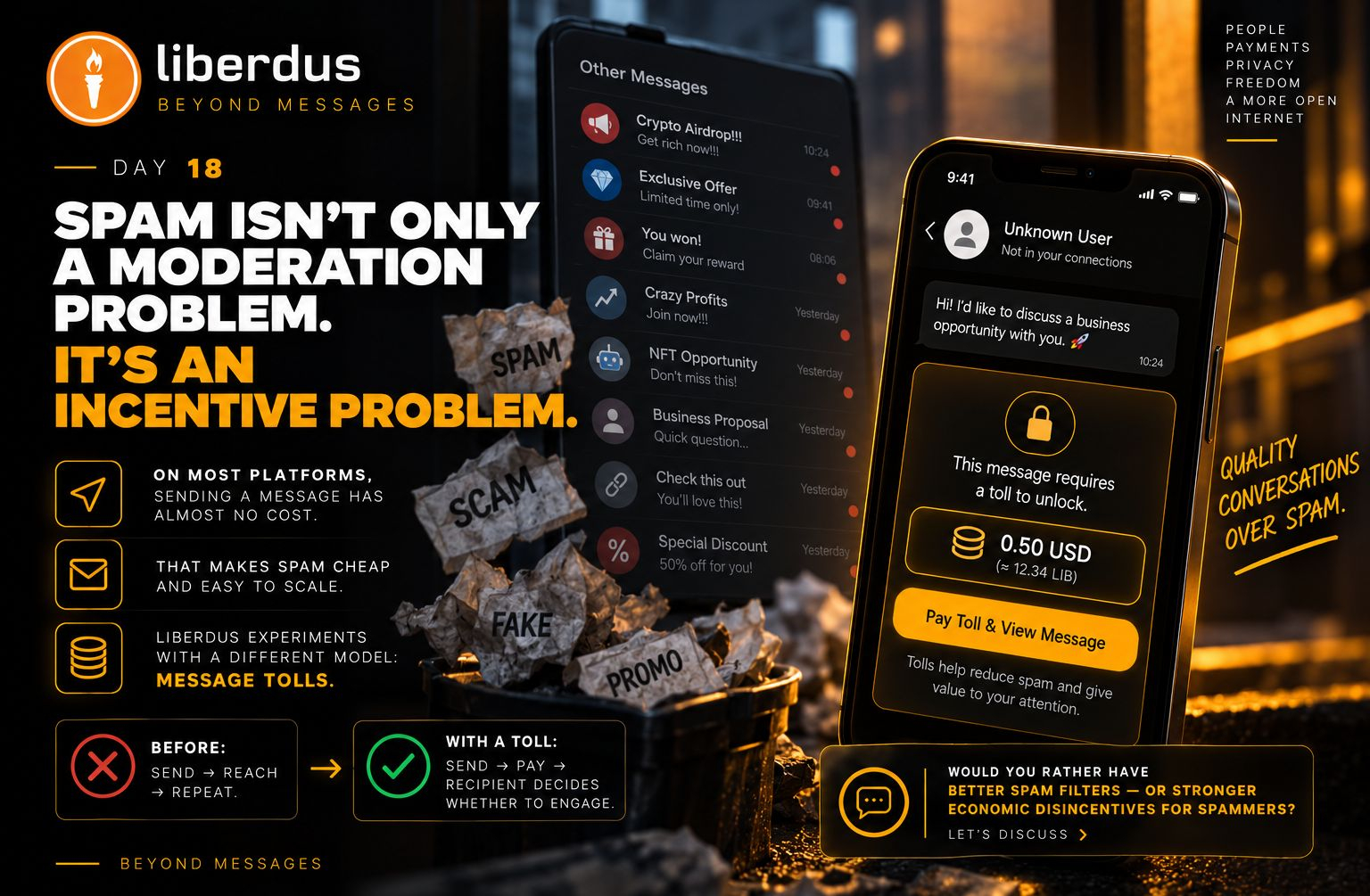
Spam isn’t only a moderation problem. It’s an incentive problem.
On most platforms, sending another person a message has almost no economic friction. That makes it cheap to send the same message to thousands of people.
Liberdus experiments with a different mechanism: message tolls. If someone isn’t your Friend or Connection, a toll can be required before they message you. The amount is set by the recipient and can also be disabled entirely.
The interesting part isn't the fee itself. It’s the change in incentives:
Before:
Send → reach → repeat.
With a toll:
Send → pay → recipient decides whether to engage.
And the system can return the unused toll if the recipient never interacts.
So maybe the bigger question for Web3 messaging isn't how do we filter more spam? But, how do we make spam less economically attractive in the first place? That’s a very different way of thinking about digital communication.
Would you rather have better spam filters or stronger economic disincentives for spammers?
#liberdus #CircleMints500MUSDCOnSolana $ZEC
{spot}(ZECUSDT)
Spam isn’t only a moderation problem. It’s an incentive problem.
On most platforms, sending another person a message has almost no economic friction. That makes it cheap to send the same message to thousands of people.
Liberdus experiments with a different mechanism: message tolls. If someone isn’t your Friend or Connection, a toll can be required before they message you. The amount is set by the recipient and can also be disabled entirely.
The interesting part isn't the fee itself. It’s the change in incentives:
Before:
Send → reach → repeat.
With a toll:
Send → pay → recipient decides whether to engage.
And the system can return the unused toll if the recipient never interacts.
So maybe the bigger question for Web3 messaging isn't how do we filter more spam? But, how do we make spam less economically attractive in the first place? That’s a very different way of thinking about digital communication.
Would you rather have better spam filters or stronger economic disincentives for spammers?
#liberdus #CircleMints500MUSDCOnSolana $ZEC
On most platforms, sending another person a message has almost no economic friction. That makes it cheap to send the same message to thousands of people.
Liberdus experiments with a different mechanism: message tolls. If someone isn’t your Friend or Connection, a toll can be required before they message you. The amount is set by the recipient and can also be disabled entirely.
The interesting part isn't the fee itself. It’s the change in incentives:
Before:
Send → reach → repeat.
With a toll:
Send → pay → recipient decides whether to engage.
And the system can return the unused toll if the recipient never interacts.
So maybe the bigger question for Web3 messaging isn't how do we filter more spam? But, how do we make spam less economically attractive in the first place? That’s a very different way of thinking about digital communication.
Would you rather have better spam filters or stronger economic disincentives for spammers?
#liberdus #CircleMints500MUSDCOnSolana $ZEC
1
554
·
--
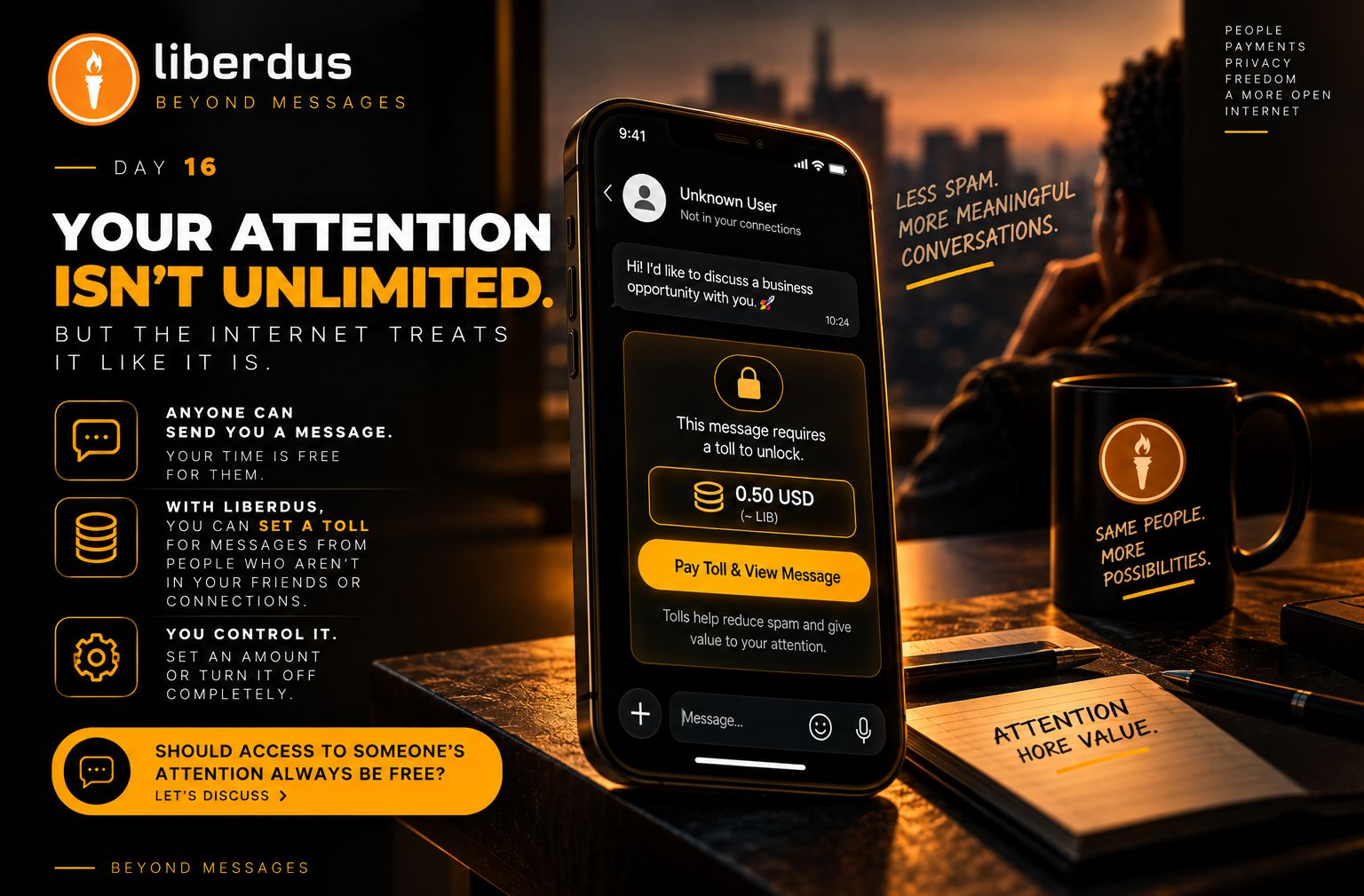
Your attention is one of the few things the internet treats as unlimited.
Anyone can send you a message. Your time is the one thing they’re spending for free. @liberdus experiments with a different model: message tolls.
If someone outside your Friends or Connections messages you, they may have to pay a toll. You can set it, or turn it off entirely. It’s a small mechanism, but it raises a bigger question, should access to someone’s attention always be free?
That’s a Web3 question worth exploring.
#Liberdus $ONDO
{spot}(ONDOUSDT)
Your attention is one of the few things the internet treats as unlimited.
Anyone can send you a message. Your time is the one thing they’re spending for free. @liberdus experiments with a different model: message tolls.
If someone outside your Friends or Connections messages you, they may have to pay a toll. You can set it, or turn it off entirely. It’s a small mechanism, but it raises a bigger question, should access to someone’s attention always be free?
That’s a Web3 question worth exploring.
#Liberdus $ONDO
Anyone can send you a message. Your time is the one thing they’re spending for free. @liberdus experiments with a different model: message tolls.
If someone outside your Friends or Connections messages you, they may have to pay a toll. You can set it, or turn it off entirely. It’s a small mechanism, but it raises a bigger question, should access to someone’s attention always be free?
That’s a Web3 question worth exploring.
#Liberdus $ONDO
1
185
·
--
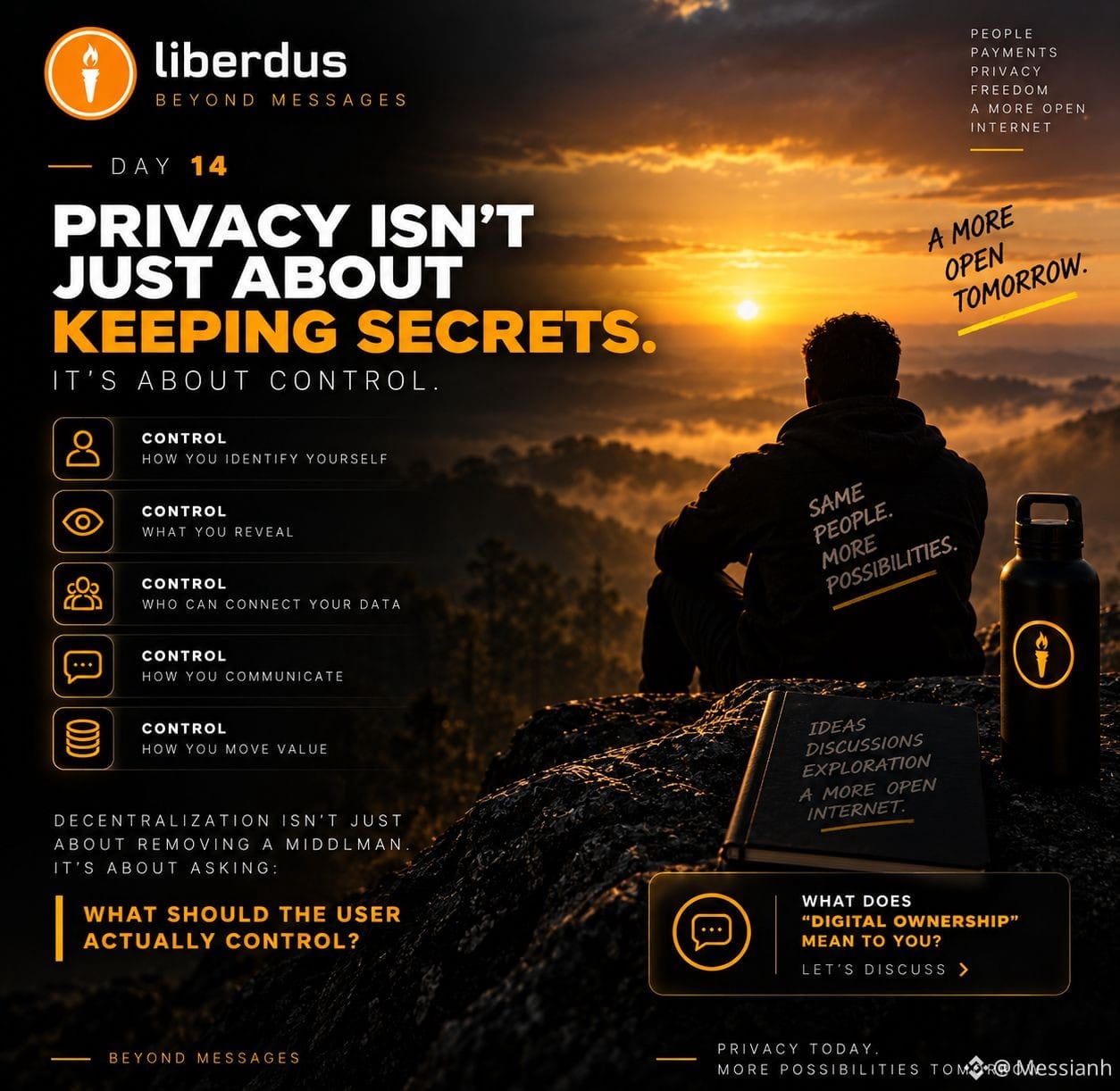
I used to think privacy was mostly about keeping secrets. The more I explore Web3, the more I see it differently. Privacy is also about control.
Control over, how you identify yourself, what you reveal, who can connect your data, how you communicate, how you move value. And that’s what makes decentralization interesting to me.
It’s not just about removing a middleman. It’s about asking, what should the user actually control?
That’s the question I want to keep exploring here.
Less hype
More understanding
More proof
More uncomfortable questions
What does digital ownership mean to you?
#AIStocksWhatNext #bnb $BNB
{spot}(BNBUSDT)
I used to think privacy was mostly about keeping secrets. The more I explore Web3, the more I see it differently. Privacy is also about control.
Control over, how you identify yourself, what you reveal, who can connect your data, how you communicate, how you move value. And that’s what makes decentralization interesting to me.
It’s not just about removing a middleman. It’s about asking, what should the user actually control?
That’s the question I want to keep exploring here.
Less hype
More understanding
More proof
More uncomfortable questions
What does digital ownership mean to you?
#AIStocksWhatNext #bnb $BNB
Control over, how you identify yourself, what you reveal, who can connect your data, how you communicate, how you move value. And that’s what makes decentralization interesting to me.
It’s not just about removing a middleman. It’s about asking, what should the user actually control?
That’s the question I want to keep exploring here.
Less hype
More understanding
More proof
More uncomfortable questions
What does digital ownership mean to you?
#AIStocksWhatNext #bnb $BNB
1
52
·
--
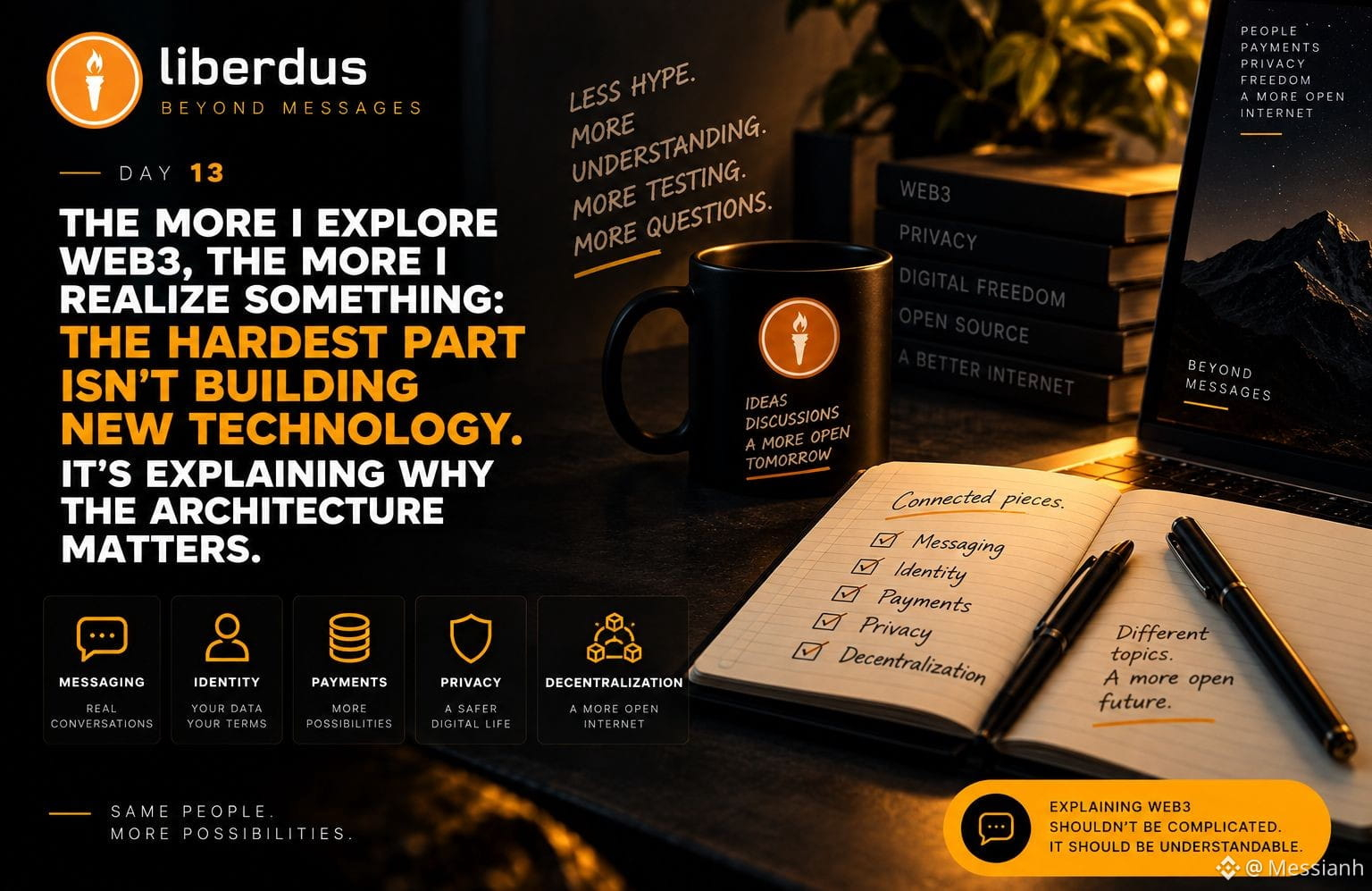
The more I explore Web3, the more I realize something, the hardest part isn’t building new technology. It’s explaining why the architecture matters.
Messaging, identity, payments, privacy and decentralization. They can look like separate topics. But they’re increasingly connected. That’s what I find interesting about projects like Liberdus.
Not just what the app does, but what changes when these pieces are designed to work together. And that’s the kind of Web3 content I want to keep exploring:
Less hype, more understanding, more testing and more questions. Because explaining Web3 shouldn’t mean making it sound complicated.
It should mean making the complexity understandable.
#ZetaChainVotesToMigrateZETAToSolana $ZETA
{future}(ZETAUSDT)
The more I explore Web3, the more I realize something, the hardest part isn’t building new technology. It’s explaining why the architecture matters.
Messaging, identity, payments, privacy and decentralization. They can look like separate topics. But they’re increasingly connected. That’s what I find interesting about projects like Liberdus.
Not just what the app does, but what changes when these pieces are designed to work together. And that’s the kind of Web3 content I want to keep exploring:
Less hype, more understanding, more testing and more questions. Because explaining Web3 shouldn’t mean making it sound complicated.
It should mean making the complexity understandable.
#ZetaChainVotesToMigrateZETAToSolana $ZETA
Messaging, identity, payments, privacy and decentralization. They can look like separate topics. But they’re increasingly connected. That’s what I find interesting about projects like Liberdus.
Not just what the app does, but what changes when these pieces are designed to work together. And that’s the kind of Web3 content I want to keep exploring:
Less hype, more understanding, more testing and more questions. Because explaining Web3 shouldn’t mean making it sound complicated.
It should mean making the complexity understandable.
#ZetaChainVotesToMigrateZETAToSolana $ZETA
1
2.1k
·
--
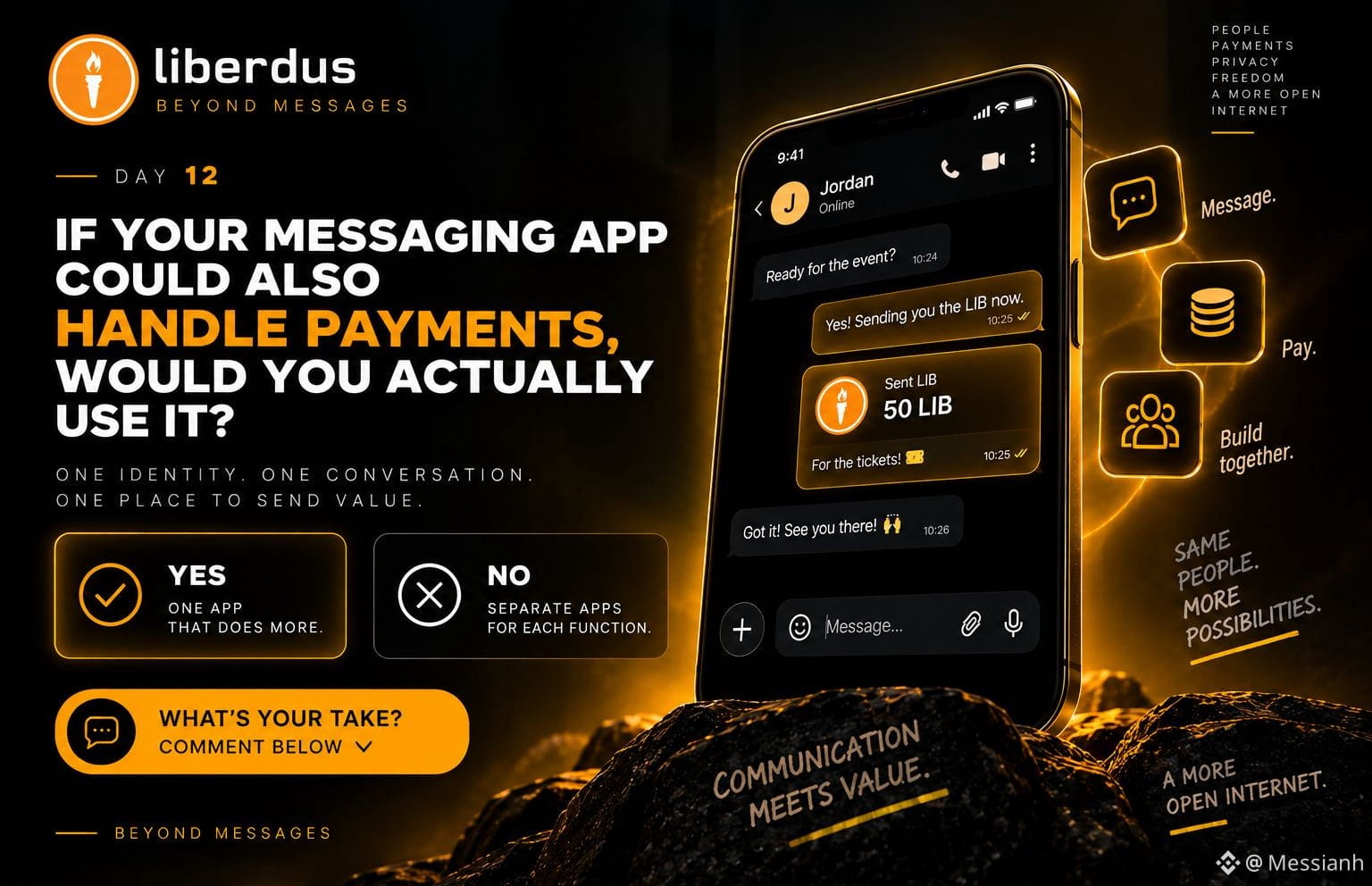
If your messaging app could also handle payments, would you actually use it?
Not because it’s Web3. Just because it might be simpler. One identity, one conversation and one place to send value.
But there’s another side, more functionality in one place can also mean more responsibility. Especially when your identity, conversations and transactions are connected.
So I’m curious, would you rather have one app that does more or separate apps for each function? Why?
#Liberdus #SaylorHintsStrategyBitcoinBuy $ZEC
{spot}(ZECUSDT)
If your messaging app could also handle payments, would you actually use it?
Not because it’s Web3. Just because it might be simpler. One identity, one conversation and one place to send value.
But there’s another side, more functionality in one place can also mean more responsibility. Especially when your identity, conversations and transactions are connected.
So I’m curious, would you rather have one app that does more or separate apps for each function? Why?
#Liberdus #SaylorHintsStrategyBitcoinBuy $ZEC
Not because it’s Web3. Just because it might be simpler. One identity, one conversation and one place to send value.
But there’s another side, more functionality in one place can also mean more responsibility. Especially when your identity, conversations and transactions are connected.
So I’m curious, would you rather have one app that does more or separate apps for each function? Why?
#Liberdus #SaylorHintsStrategyBitcoinBuy $ZEC
1
72
·
--
The interesting part about crypto payments isn’t the payment. It’s what happens when money becomes part of the communication layer.
For years, we’ve treated messaging and payments as two completely different things.
You talk in one app, you pay in another, you manage your wallet somewhere else. But Web3 makes another model possible.
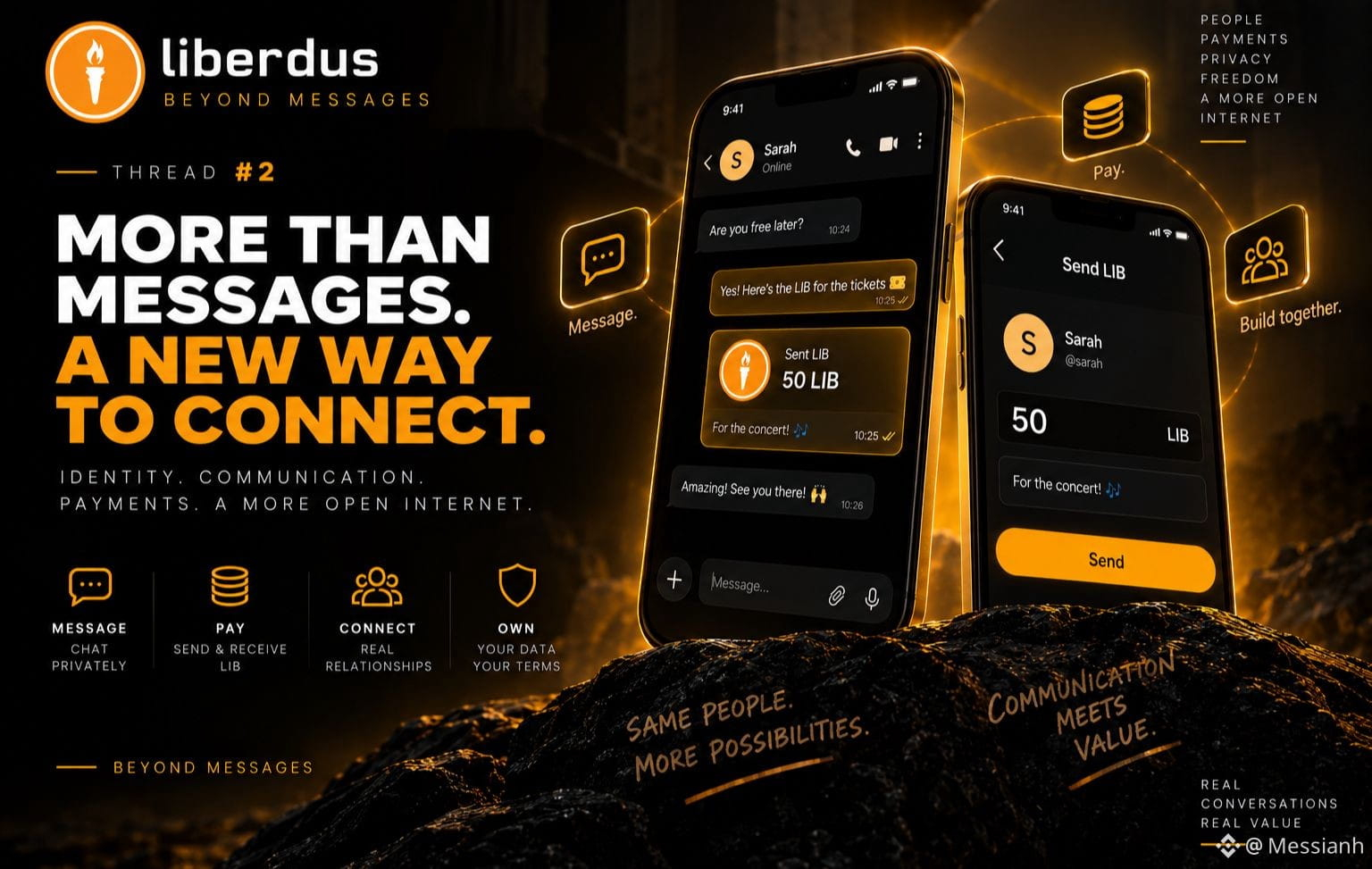
Liberdus combines messaging and LIB payments in the same ecosystem. You can send LIB directly from a conversation, with the recipient already selected from the chat. That sounds simple, but the architecture behind it is more interesting.
Think about the layers:
Identity → Communication → Value
The same username can be used for messaging and payments, while being mapped to a Liberdus wallet address.
One identity layer can therefore connect different interactions.
That changes the meaning of a messaging app. It’s no longer only, how do I send a message?
It becomes, what can I do with someone I’m already connected to?
Message, pay, receive value, interact.
But there’s an important trade-off. Combining identity, communication and payments also means you need to understand what information each layer exposes. For example, Liberdus states that LIB transactions are not anonymous and contain transaction metadata.
That’s why I think privacy needs more precise conversations. No phone number ≠ anonymous transactions.
Decentralized ≠ invisible.
Self-custody ≠ no responsibility.
The interesting questions are in the details.
And that’s where Web3 becomes more than a collection of tokens. It becomes an experiment in redesigning how we
identify → communicate → exchange value.
The question I keep coming back to,
should money be a separate layer from our digital relationships or should they eventually work together?
#FIRO #BOJRaisesRatesTo31YearHigh $FIRO
The interesting part about crypto payments isn’t the payment. It’s what happens when money becomes part of the communication layer.
For years, we’ve treated messaging and payments as two completely different things.
You talk in one app, you pay in another, you manage your wallet somewhere else. But Web3 makes another model possible.
Liberdus combines messaging and LIB payments in the same ecosystem. You can send LIB directly from a conversation, with the recipient already selected from the chat. That sounds simple, but the architecture behind it is more interesting.
Think about the layers:
Identity → Communication → Value
The same username can be used for messaging and payments, while being mapped to a Liberdus wallet address.
One identity layer can therefore connect different interactions.
That changes the meaning of a messaging app. It’s no longer only, how do I send a message?
It becomes, what can I do with someone I’m already connected to?
Message, pay, receive value, interact.
But there’s an important trade-off. Combining identity, communication and payments also means you need to understand what information each layer exposes. For example, Liberdus states that LIB transactions are not anonymous and contain transaction metadata.
That’s why I think privacy needs more precise conversations. No phone number ≠ anonymous transactions.
Decentralized ≠ invisible.
Self-custody ≠ no responsibility.
The interesting questions are in the details.
And that’s where Web3 becomes more than a collection of tokens. It becomes an experiment in redesigning how we
identify → communicate → exchange value.
The question I keep coming back to,
should money be a separate layer from our digital relationships or should they eventually work together?
#FIRO #BOJRaisesRatesTo31YearHigh $FIRO
For years, we’ve treated messaging and payments as two completely different things.
You talk in one app, you pay in another, you manage your wallet somewhere else. But Web3 makes another model possible.
Liberdus combines messaging and LIB payments in the same ecosystem. You can send LIB directly from a conversation, with the recipient already selected from the chat. That sounds simple, but the architecture behind it is more interesting.
Think about the layers:
Identity → Communication → Value
The same username can be used for messaging and payments, while being mapped to a Liberdus wallet address.
One identity layer can therefore connect different interactions.
That changes the meaning of a messaging app. It’s no longer only, how do I send a message?
It becomes, what can I do with someone I’m already connected to?
Message, pay, receive value, interact.
But there’s an important trade-off. Combining identity, communication and payments also means you need to understand what information each layer exposes. For example, Liberdus states that LIB transactions are not anonymous and contain transaction metadata.
That’s why I think privacy needs more precise conversations. No phone number ≠ anonymous transactions.
Decentralized ≠ invisible.
Self-custody ≠ no responsibility.
The interesting questions are in the details.
And that’s where Web3 becomes more than a collection of tokens. It becomes an experiment in redesigning how we
identify → communicate → exchange value.
The question I keep coming back to,
should money be a separate layer from our digital relationships or should they eventually work together?
#FIRO #BOJRaisesRatesTo31YearHigh $FIRO
1
63
·
--
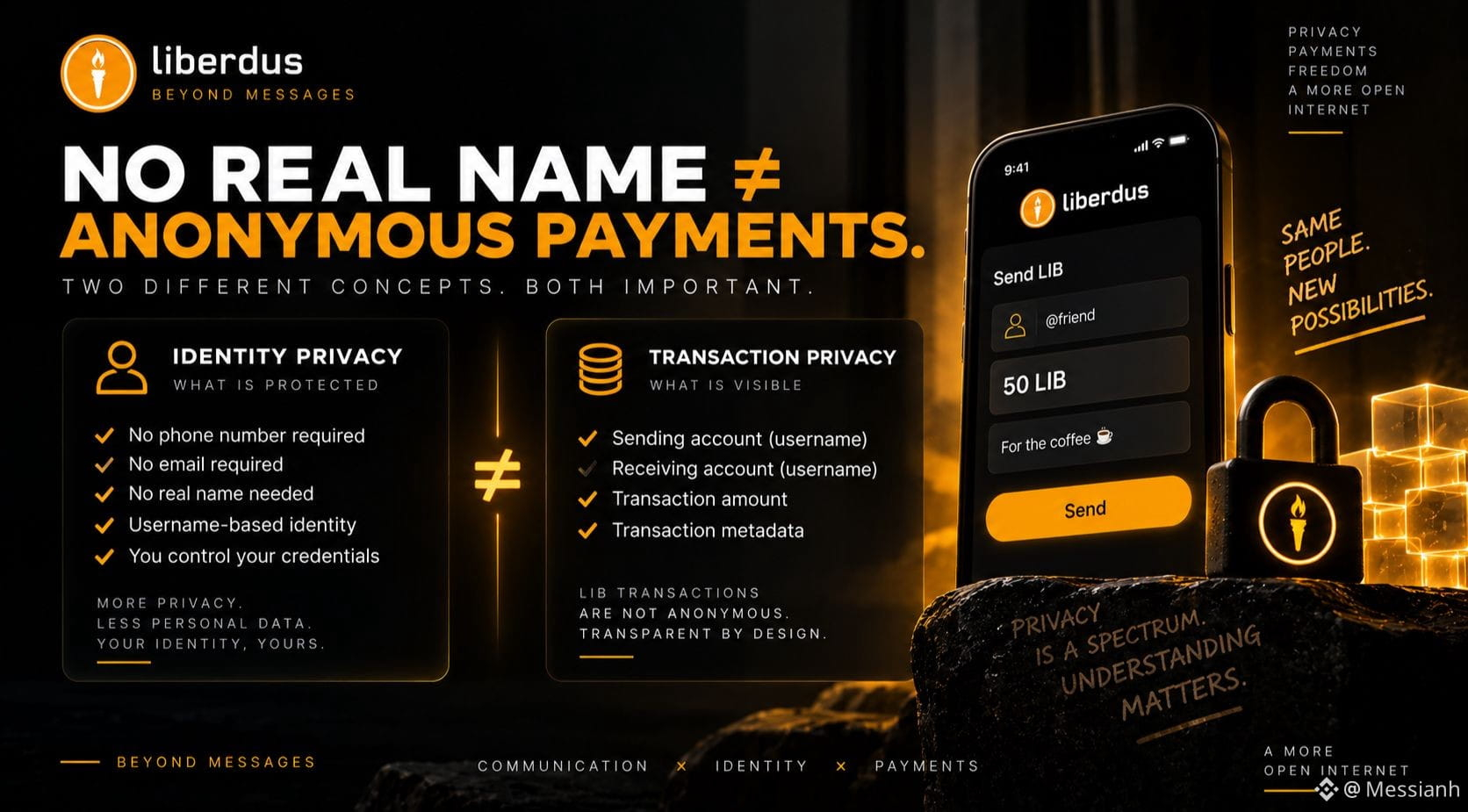
No real name ≠ anonymous payments.
That distinction matters.
With @liberdus, you can create an account without a phone number or email, and your username can be mapped to a wallet address.
But LIB transactions are not anonymous.
The project’s own documentation says transaction metadata can include the sending account, receiving account and amount.
So there are two different concepts,
identity privacy ≠ transaction privacy.
And honestly, this is the kind of distinction more Web3 conversations should make. Because privacy isn't about throwing the word anonymous everywhere. It's about understanding exactly what is protected and what isn't.
Where do you draw the line between identity privacy and transaction privacy?
#Liberdus #XRP #BTCBreaks80K $BTC
{spot}(BTCUSDT)
No real name ≠ anonymous payments.
That distinction matters.
With @liberdus, you can create an account without a phone number or email, and your username can be mapped to a wallet address.
But LIB transactions are not anonymous.
The project’s own documentation says transaction metadata can include the sending account, receiving account and amount.
So there are two different concepts,
identity privacy ≠ transaction privacy.
And honestly, this is the kind of distinction more Web3 conversations should make. Because privacy isn't about throwing the word anonymous everywhere. It's about understanding exactly what is protected and what isn't.
Where do you draw the line between identity privacy and transaction privacy?
#Liberdus #XRP #BTCBreaks80K $BTC
That distinction matters.
With @liberdus, you can create an account without a phone number or email, and your username can be mapped to a wallet address.
But LIB transactions are not anonymous.
The project’s own documentation says transaction metadata can include the sending account, receiving account and amount.
So there are two different concepts,
identity privacy ≠ transaction privacy.
And honestly, this is the kind of distinction more Web3 conversations should make. Because privacy isn't about throwing the word anonymous everywhere. It's about understanding exactly what is protected and what isn't.
Where do you draw the line between identity privacy and transaction privacy?
#Liberdus #XRP #BTCBreaks80K $BTC
1
166
·
--
Understand Liberdus
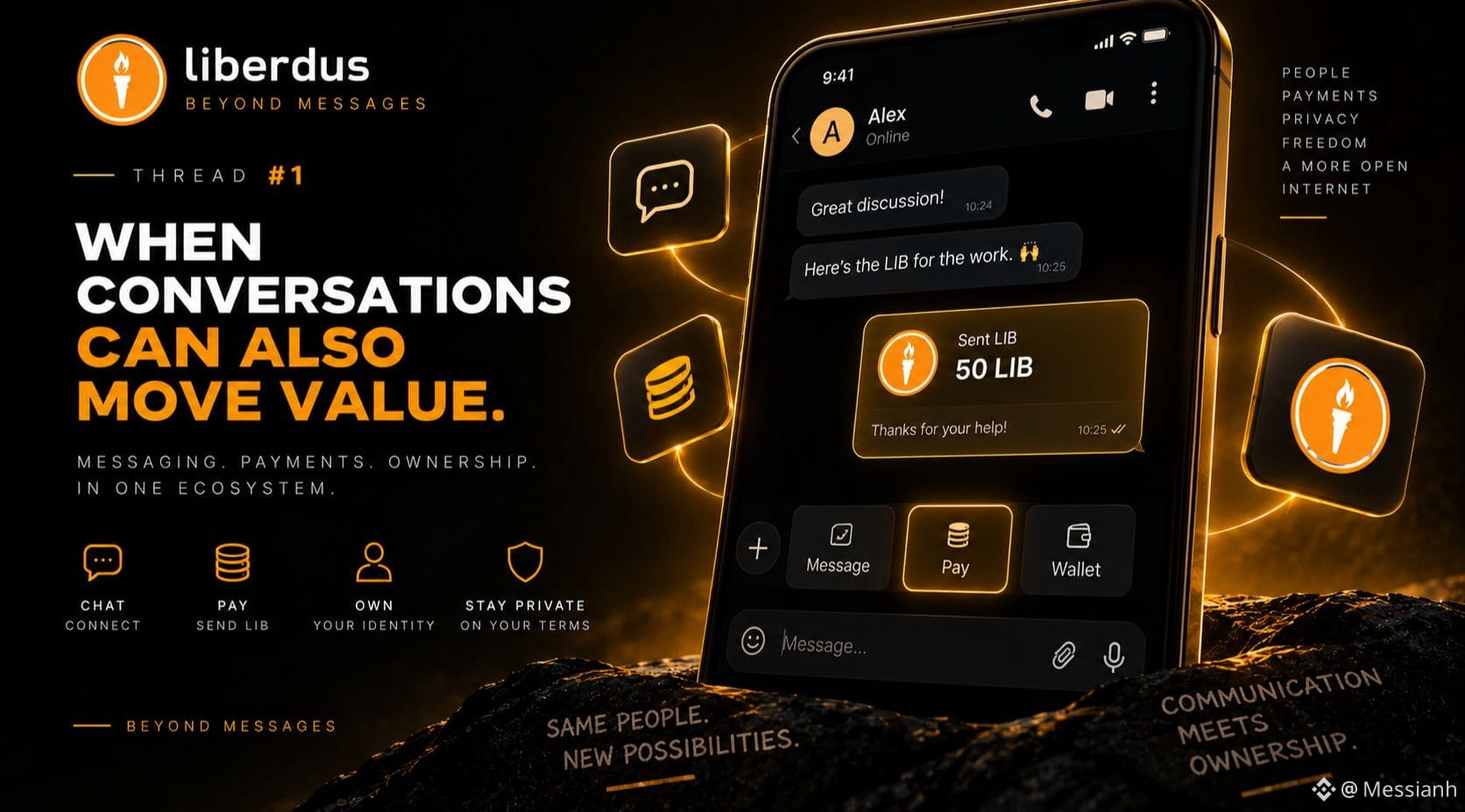
Most messaging apps separate conversation from payments. One app for chatting. Another for sending money. Another wallet to manage crypto. Liberdus takes a different approach.
What happens when messaging and payments exist in the same ecosystem?
Liberdus has a built-in wallet that lets users send and receive LIB directly inside the app. So payments aren't treated as a completely separate experience. They can happen alongside communication.
For example, when you're already chatting with someone, you can open the payment option, enter the amount, optionally add a memo, review the transaction and confirm it. The transaction then appears in the conversation.
You can also send LIB directly from the wallet. The recipient can be specified using:
→ their username
→ a QR code
→ or a wallet address
The transaction can also include an optional memo.
Why does this matter?
Because a username can serve as more than a way to find someone. Liberdus documents that usernames can be used for both messaging and payments, and are mapped to wallet addresses.
That creates an interesting model,
Identity → Communication → Payment
instead of treating each as a completely separate layer. Your conversation can become the starting point for an interaction that also includes value transfer.
But there's an important privacy detail. LIB transactions are not anonymous.
Liberdus says transaction metadata can include the sending account, receiving account and amount. So no phone number ≠ anonymous transactions.
That's an important distinction.
And that's what makes this architecture interesting to me. It's not simply about adding a wallet to a messaging app. It's about asking what should communication + identity + payments look like when they're designed together?
The bigger Web3 question, if messaging and payments can share the same identity layer does the wallet become part of how we communicate online?
That's a conversation worth having.
#Liberdus $AVAX #ZcashRises6%
{spot}(AVAXUSDT)
Understand Liberdus
Most messaging apps separate conversation from payments. One app for chatting. Another for sending money. Another wallet to manage crypto. Liberdus takes a different approach.
What happens when messaging and payments exist in the same ecosystem?
Liberdus has a built-in wallet that lets users send and receive LIB directly inside the app. So payments aren't treated as a completely separate experience. They can happen alongside communication.
For example, when you're already chatting with someone, you can open the payment option, enter the amount, optionally add a memo, review the transaction and confirm it. The transaction then appears in the conversation.
You can also send LIB directly from the wallet. The recipient can be specified using:
→ their username
→ a QR code
→ or a wallet address
The transaction can also include an optional memo.
Why does this matter?
Because a username can serve as more than a way to find someone. Liberdus documents that usernames can be used for both messaging and payments, and are mapped to wallet addresses.
That creates an interesting model,
Identity → Communication → Payment
instead of treating each as a completely separate layer. Your conversation can become the starting point for an interaction that also includes value transfer.
But there's an important privacy detail. LIB transactions are not anonymous.
Liberdus says transaction metadata can include the sending account, receiving account and amount. So no phone number ≠ anonymous transactions.
That's an important distinction.
And that's what makes this architecture interesting to me. It's not simply about adding a wallet to a messaging app. It's about asking what should communication + identity + payments look like when they're designed together?
The bigger Web3 question, if messaging and payments can share the same identity layer does the wallet become part of how we communicate online?
That's a conversation worth having.
#Liberdus $AVAX #ZcashRises6%
Most messaging apps separate conversation from payments. One app for chatting. Another for sending money. Another wallet to manage crypto. Liberdus takes a different approach.
What happens when messaging and payments exist in the same ecosystem?
Liberdus has a built-in wallet that lets users send and receive LIB directly inside the app. So payments aren't treated as a completely separate experience. They can happen alongside communication.
For example, when you're already chatting with someone, you can open the payment option, enter the amount, optionally add a memo, review the transaction and confirm it. The transaction then appears in the conversation.
You can also send LIB directly from the wallet. The recipient can be specified using:
→ their username
→ a QR code
→ or a wallet address
The transaction can also include an optional memo.
Why does this matter?
Because a username can serve as more than a way to find someone. Liberdus documents that usernames can be used for both messaging and payments, and are mapped to wallet addresses.
That creates an interesting model,
Identity → Communication → Payment
instead of treating each as a completely separate layer. Your conversation can become the starting point for an interaction that also includes value transfer.
But there's an important privacy detail. LIB transactions are not anonymous.
Liberdus says transaction metadata can include the sending account, receiving account and amount. So no phone number ≠ anonymous transactions.
That's an important distinction.
And that's what makes this architecture interesting to me. It's not simply about adding a wallet to a messaging app. It's about asking what should communication + identity + payments look like when they're designed together?
The bigger Web3 question, if messaging and payments can share the same identity layer does the wallet become part of how we communicate online?
That's a conversation worth having.
#Liberdus $AVAX #ZcashRises6%
1
69
·
--
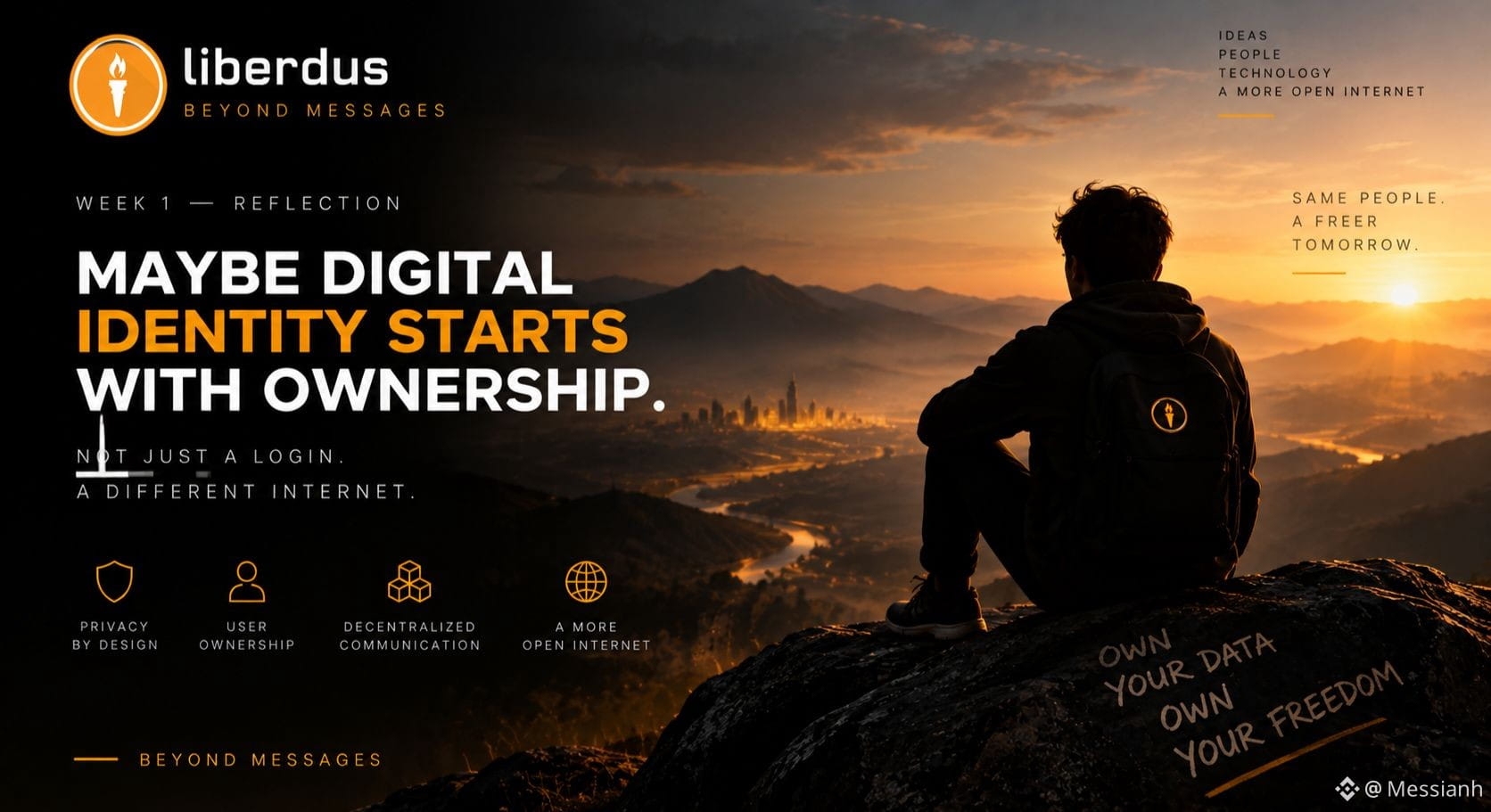
The more I learn about digital identity, the less I think it should be about identification.
We’ve built the internet around usernames, emails, phone numbers and accounts. But we rarely stop to ask who actually controls the identity behind all of this?
That question is becoming more important as Web3 evolves. Maybe digital ownership isn't only about owning assets.
Maybe it starts with owning how you exist online.
#Liberdus $BTC #FedRateWatch
{spot}(BTCUSDT)
The more I learn about digital identity, the less I think it should be about identification.
We’ve built the internet around usernames, emails, phone numbers and accounts. But we rarely stop to ask who actually controls the identity behind all of this?
That question is becoming more important as Web3 evolves. Maybe digital ownership isn't only about owning assets.
Maybe it starts with owning how you exist online.
#Liberdus $BTC #FedRateWatch
We’ve built the internet around usernames, emails, phone numbers and accounts. But we rarely stop to ask who actually controls the identity behind all of this?
That question is becoming more important as Web3 evolves. Maybe digital ownership isn't only about owning assets.
Maybe it starts with owning how you exist online.
#Liberdus $BTC #FedRateWatch
1
64
·
--
BitMine Immersion purchases another 27,180 Ethereum, now holds over 5.96M
$ETH
{spot}(ETHUSDT)
#AnthropicCEOCallsForAISlowdown
BitMine Immersion purchases another 27,180 Ethereum, now holds over 5.96M
$ETH
#AnthropicCEOCallsForAISlowdown
$ETH
#AnthropicCEOCallsForAISlowdown
52
·
--
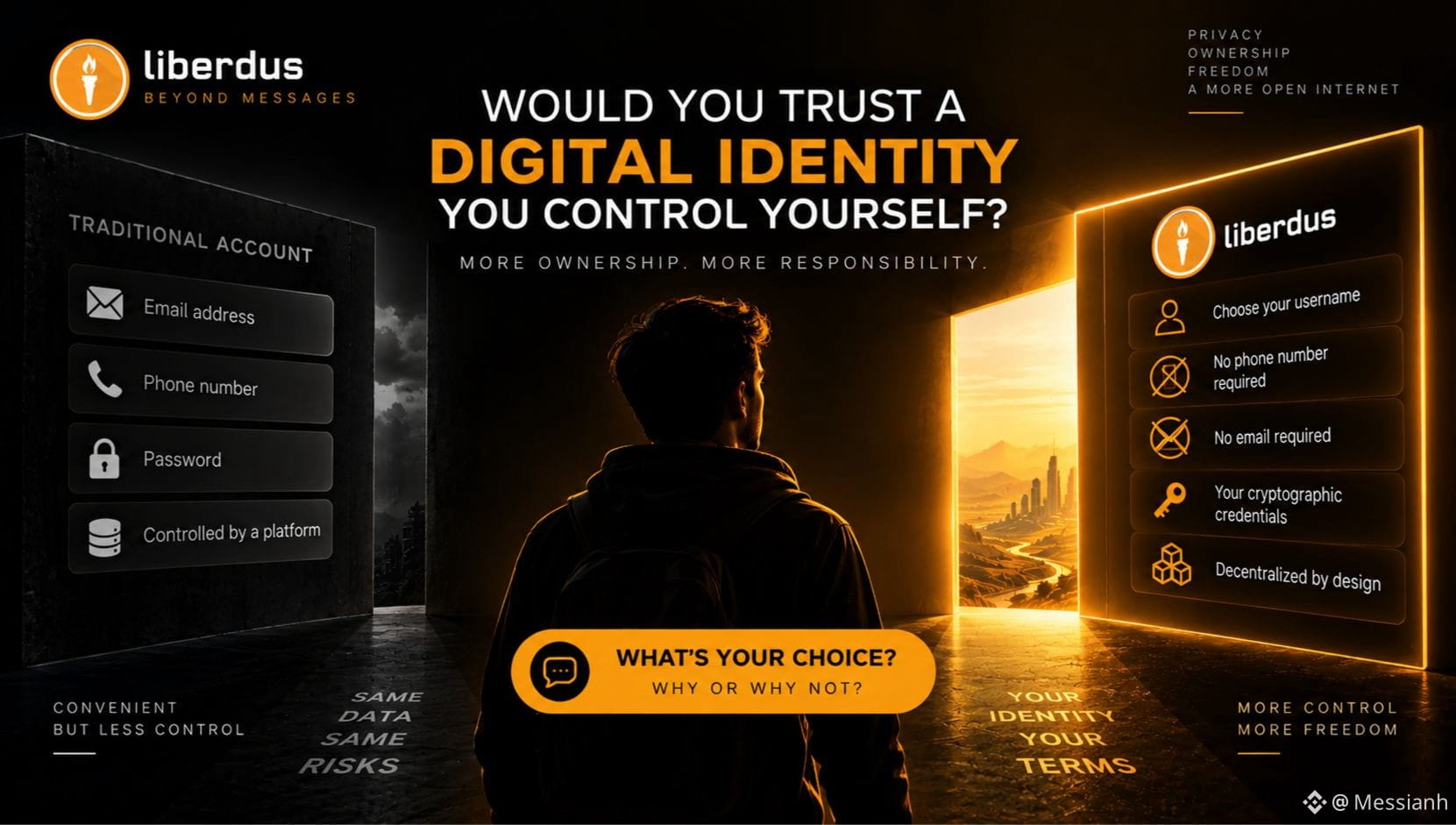
Would you trust a digital identity you control yourself?
No phone number, no email required, no central account recovery. Instead, your account is tied to cryptographic credentials you control.
More ownership sounds great. But it also means more responsibility. Would you choose that model over the traditional email + password system?
Why or why not?
#Liberdus #xrp $XRP #UKSeeksViewsOnTokenizingGold
{spot}(XRPUSDT)
Would you trust a digital identity you control yourself?
No phone number, no email required, no central account recovery. Instead, your account is tied to cryptographic credentials you control.
More ownership sounds great. But it also means more responsibility. Would you choose that model over the traditional email + password system?
Why or why not?
#Liberdus #xrp $XRP #UKSeeksViewsOnTokenizingGold
No phone number, no email required, no central account recovery. Instead, your account is tied to cryptographic credentials you control.
More ownership sounds great. But it also means more responsibility. Would you choose that model over the traditional email + password system?
Why or why not?
#Liberdus #xrp $XRP #UKSeeksViewsOnTokenizingGold
1
72
·
--
How to open a Liberdus account on the app.
1/
What if creating a messaging account didn't require your phone number or email?
Let's actually look at how Liberdus handles it.
No theory, just the process.
2/
Open Liberdus,
from the home screen, select:
create Account
that's where the process begins.
3/
Choose your username, you don't need to provide a phone number or email during account creation. Your username becomes the identifier you use within the platform.
4/
Then comes the interesting part. Liberdus generates your account keys. The account is cryptographically secured, with quantum-resistant cryptography used by the platform.
5/
Once the keys are generated, your account appears on the dashboard. No traditional signup flow built around:
enter your phone number or verify your email.
Instead, the account is built around cryptographic credentials.
6/
And there's another useful detail:
You can create multiple Liberdus accounts on the same device. Each account is independent and has its own private key and wallet address.
7/
So the interesting part isn't simply:
Liberdus doesn't ask for your phone number. It's the architecture behind that choice. Your account doesn't have to start with a real-world identifier. It can start with a cryptographic identity.
8/
That's a very different way of thinking about digital accounts. And it raises a bigger question,
#liberdus $ONDO
{spot}(ONDOUSDT)
How to open a Liberdus account on the app.
1/
What if creating a messaging account didn't require your phone number or email?
Let's actually look at how Liberdus handles it.
No theory, just the process.
2/
Open Liberdus,
from the home screen, select:
create Account
that's where the process begins.
3/
Choose your username, you don't need to provide a phone number or email during account creation. Your username becomes the identifier you use within the platform.
4/
Then comes the interesting part. Liberdus generates your account keys. The account is cryptographically secured, with quantum-resistant cryptography used by the platform.
5/
Once the keys are generated, your account appears on the dashboard. No traditional signup flow built around:
enter your phone number or verify your email.
Instead, the account is built around cryptographic credentials.
6/
And there's another useful detail:
You can create multiple Liberdus accounts on the same device. Each account is independent and has its own private key and wallet address.
7/
So the interesting part isn't simply:
Liberdus doesn't ask for your phone number. It's the architecture behind that choice. Your account doesn't have to start with a real-world identifier. It can start with a cryptographic identity.
8/
That's a very different way of thinking about digital accounts. And it raises a bigger question,
#liberdus $ONDO
1/
What if creating a messaging account didn't require your phone number or email?
Let's actually look at how Liberdus handles it.
No theory, just the process.
2/
Open Liberdus,
from the home screen, select:
create Account
that's where the process begins.
3/
Choose your username, you don't need to provide a phone number or email during account creation. Your username becomes the identifier you use within the platform.
4/
Then comes the interesting part. Liberdus generates your account keys. The account is cryptographically secured, with quantum-resistant cryptography used by the platform.
5/
Once the keys are generated, your account appears on the dashboard. No traditional signup flow built around:
enter your phone number or verify your email.
Instead, the account is built around cryptographic credentials.
6/
And there's another useful detail:
You can create multiple Liberdus accounts on the same device. Each account is independent and has its own private key and wallet address.
7/
So the interesting part isn't simply:
Liberdus doesn't ask for your phone number. It's the architecture behind that choice. Your account doesn't have to start with a real-world identifier. It can start with a cryptographic identity.
8/
That's a very different way of thinking about digital accounts. And it raises a bigger question,
#liberdus $ONDO


1
121

·
--
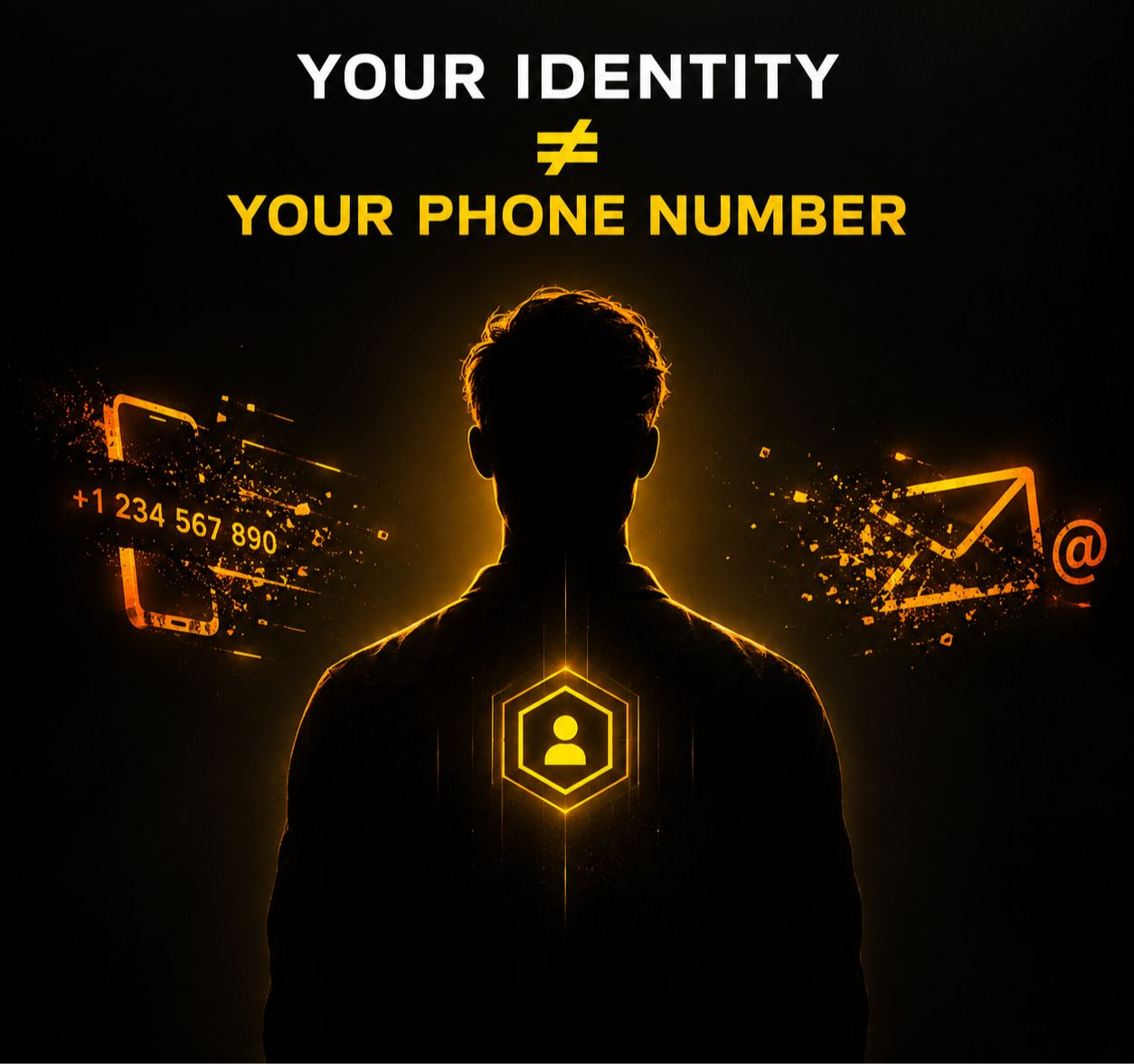
Understand that your phone number isn't your identity.
Your phone number isn't your identity. Yet most digital services treat it like one. You give them a number, they give you an account. But there's a deeper question:
Who actually controls that identity?
Think about what happens when you create a typical online account.
Email
Phone number
Password
Sometimes even government-issued ID
Your identity becomes tied to identifiers controlled outside the platform.
That's convenient, but convenience and ownership aren't the same thing. If your account depends on an identifier you don't control, losing access to that identifier can become a problem.
Web3 approaches identity differently.
Instead of making an email address or phone number the foundation of your account, you can use cryptographic keys and wallet-based identities.
The important shift is identity → something you can control cryptographically.
Liberdus takes this approach for its accounts. According to its current documentation, you can create an account by choosing a username without providing a phone number or email. The username is mapped to your Liberdus wallet address.
That doesn't magically solve digital identity. It simply changes the architecture.
Instead of asking:
Which phone number belongs to this user?
the system can ask:
Which cryptographic account controls this identity?
That's a very different model.
And that's where things get interesting.
Because digital identity isn't just about logging in. It's about control, portability, privacy and ownership.
The real question isn't can I create an account?
It's xhat actually belongs to me when I create one?
#Liberdus #ETH🔥🔥🔥🔥🔥🔥 $ETH #TSMCAugustRevenueUp53.3%YoY
{spot}(ETHUSDT)
Understand that your phone number isn't your identity.
Your phone number isn't your identity. Yet most digital services treat it like one. You give them a number, they give you an account. But there's a deeper question:
Who actually controls that identity?
Think about what happens when you create a typical online account.
Email
Phone number
Password
Sometimes even government-issued ID
Your identity becomes tied to identifiers controlled outside the platform.
That's convenient, but convenience and ownership aren't the same thing. If your account depends on an identifier you don't control, losing access to that identifier can become a problem.
Web3 approaches identity differently.
Instead of making an email address or phone number the foundation of your account, you can use cryptographic keys and wallet-based identities.
The important shift is identity → something you can control cryptographically.
Liberdus takes this approach for its accounts. According to its current documentation, you can create an account by choosing a username without providing a phone number or email. The username is mapped to your Liberdus wallet address.
That doesn't magically solve digital identity. It simply changes the architecture.
Instead of asking:
Which phone number belongs to this user?
the system can ask:
Which cryptographic account controls this identity?
That's a very different model.
And that's where things get interesting.
Because digital identity isn't just about logging in. It's about control, portability, privacy and ownership.
The real question isn't can I create an account?
It's xhat actually belongs to me when I create one?
#Liberdus #ETH🔥🔥🔥🔥🔥🔥 $ETH #TSMCAugustRevenueUp53.3%YoY
Your phone number isn't your identity. Yet most digital services treat it like one. You give them a number, they give you an account. But there's a deeper question:
Who actually controls that identity?
Think about what happens when you create a typical online account.
Phone number
Password
Sometimes even government-issued ID
Your identity becomes tied to identifiers controlled outside the platform.
That's convenient, but convenience and ownership aren't the same thing. If your account depends on an identifier you don't control, losing access to that identifier can become a problem.
Web3 approaches identity differently.
Instead of making an email address or phone number the foundation of your account, you can use cryptographic keys and wallet-based identities.
The important shift is identity → something you can control cryptographically.
Liberdus takes this approach for its accounts. According to its current documentation, you can create an account by choosing a username without providing a phone number or email. The username is mapped to your Liberdus wallet address.
That doesn't magically solve digital identity. It simply changes the architecture.
Instead of asking:
Which phone number belongs to this user?
the system can ask:
Which cryptographic account controls this identity?
That's a very different model.
And that's where things get interesting.
Because digital identity isn't just about logging in. It's about control, portability, privacy and ownership.
The real question isn't can I create an account?
It's xhat actually belongs to me when I create one?
#Liberdus #ETH🔥🔥🔥🔥🔥🔥 $ETH #TSMCAugustRevenueUp53.3%YoY
1
56
·
--
Verified
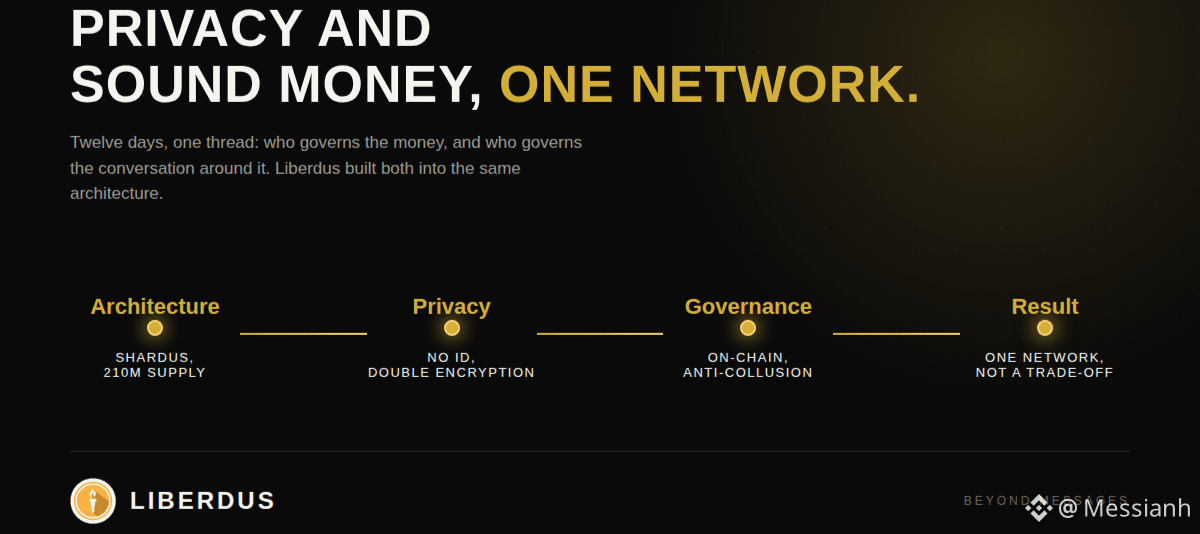
What Twelve Days Add Up To
Twelve articles, one thread running through all of them: every design choice in Liberdus traces back to a single founding question from Day 14: who governs the money, and who governs the conversation around it.
The architecture answers the first half. Shardus sharding lets the network scale without concentrating power in fewer, larger validators. A fixed 210 million supply, distributed only to the people building and securing the network, keeps the "sound money" half of the name more than a marketing line. On-chain governance, with proposal margins that scale against collusion, puts changes to those rules in the hands of the network rather than a company board.
The privacy layer answers the second half. Accounts with no phone number, no email, and no persistent identifier remove the single thread that ties most digital lives to a real name. Double encryption, classical and post-quantum, protects what gets said against both today's attackers and tomorrow's. And the toll system turns spam from a filtering problem into a pricing problem, charging unknown senders instead of asking recipients to tolerate them for free.
None of these pieces work in isolation, which is the actual point of building them together. A messenger with strong encryption but centralized identity still knows who's talking to whom. A payment network with sound tokenomics but no privacy layer still exposes every transaction to the same surveillance crypto was supposed to escape. Liberdus's bet is that privacy and sound money solve the same underlying problem, so it built both into one network instead of choosing one.
That's the whole arc, from the name's Latin roots to the chains LIB now trades on. What Liberdus does next isn't something this series can confirm in advance. What it's built so far is on the record, and now, after twelve days, so is the reasoning behind it.
#Liberdus #XRP $XRP #AppleDebutsFoldablePhone
{spot}(XRPUSDT)
What Twelve Days Add Up To
Twelve articles, one thread running through all of them: every design choice in Liberdus traces back to a single founding question from Day 14: who governs the money, and who governs the conversation around it.
The architecture answers the first half. Shardus sharding lets the network scale without concentrating power in fewer, larger validators. A fixed 210 million supply, distributed only to the people building and securing the network, keeps the "sound money" half of the name more than a marketing line. On-chain governance, with proposal margins that scale against collusion, puts changes to those rules in the hands of the network rather than a company board.
The privacy layer answers the second half. Accounts with no phone number, no email, and no persistent identifier remove the single thread that ties most digital lives to a real name. Double encryption, classical and post-quantum, protects what gets said against both today's attackers and tomorrow's. And the toll system turns spam from a filtering problem into a pricing problem, charging unknown senders instead of asking recipients to tolerate them for free.
None of these pieces work in isolation, which is the actual point of building them together. A messenger with strong encryption but centralized identity still knows who's talking to whom. A payment network with sound tokenomics but no privacy layer still exposes every transaction to the same surveillance crypto was supposed to escape. Liberdus's bet is that privacy and sound money solve the same underlying problem, so it built both into one network instead of choosing one.
That's the whole arc, from the name's Latin roots to the chains LIB now trades on. What Liberdus does next isn't something this series can confirm in advance. What it's built so far is on the record, and now, after twelve days, so is the reasoning behind it.
#Liberdus #XRP $XRP #AppleDebutsFoldablePhone
Twelve articles, one thread running through all of them: every design choice in Liberdus traces back to a single founding question from Day 14: who governs the money, and who governs the conversation around it.
The architecture answers the first half. Shardus sharding lets the network scale without concentrating power in fewer, larger validators. A fixed 210 million supply, distributed only to the people building and securing the network, keeps the "sound money" half of the name more than a marketing line. On-chain governance, with proposal margins that scale against collusion, puts changes to those rules in the hands of the network rather than a company board.
The privacy layer answers the second half. Accounts with no phone number, no email, and no persistent identifier remove the single thread that ties most digital lives to a real name. Double encryption, classical and post-quantum, protects what gets said against both today's attackers and tomorrow's. And the toll system turns spam from a filtering problem into a pricing problem, charging unknown senders instead of asking recipients to tolerate them for free.
None of these pieces work in isolation, which is the actual point of building them together. A messenger with strong encryption but centralized identity still knows who's talking to whom. A payment network with sound tokenomics but no privacy layer still exposes every transaction to the same surveillance crypto was supposed to escape. Liberdus's bet is that privacy and sound money solve the same underlying problem, so it built both into one network instead of choosing one.
That's the whole arc, from the name's Latin roots to the chains LIB now trades on. What Liberdus does next isn't something this series can confirm in advance. What it's built so far is on the record, and now, after twelve days, so is the reasoning behind it.
#Liberdus #XRP $XRP #AppleDebutsFoldablePhone
1
2
77
·
--
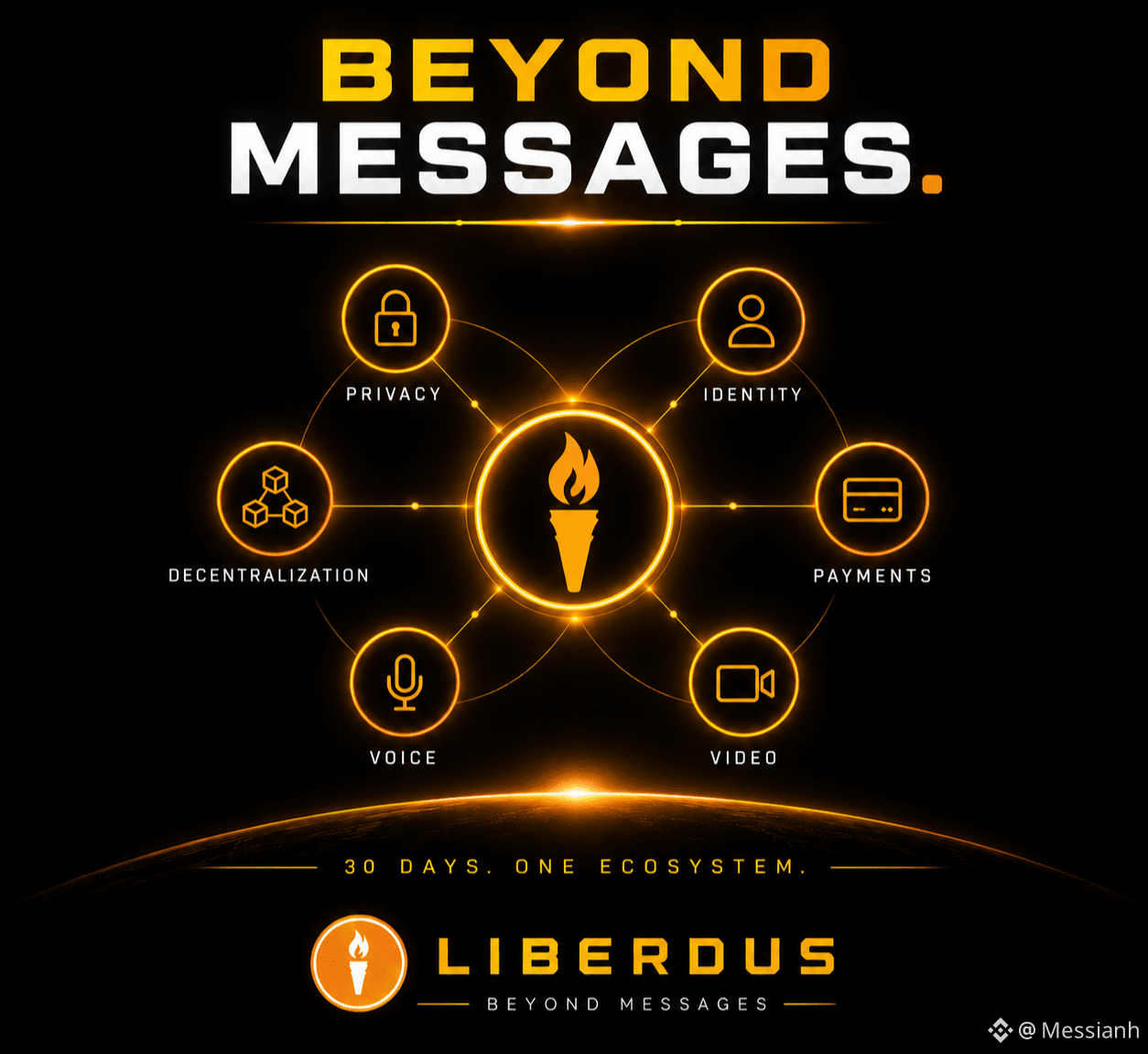
Liberdus was never just about messaging.
Privacy
Decentralization
Payments
Digital identity
Voice & video
Open source
User participation
All inside one ecosystem
That's what Beyond Messages means. The future of communication shouldn't just be about sending a message.
It should be about owning the way you communicate.
@liberdus #Liberdus $BNB #BNB金鏟子
{spot}(BNBUSDT)
Liberdus was never just about messaging.
Privacy
Decentralization
Payments
Digital identity
Voice & video
Open source
User participation
All inside one ecosystem
That's what Beyond Messages means. The future of communication shouldn't just be about sending a message.
It should be about owning the way you communicate.
@liberdus #Liberdus $BNB #BNB金鏟子
Privacy
Decentralization
Payments
Digital identity
Voice & video
Open source
User participation
All inside one ecosystem
That's what Beyond Messages means. The future of communication shouldn't just be about sending a message.
It should be about owning the way you communicate.
@liberdus #Liberdus $BNB #BNB金鏟子
1
224
·
--
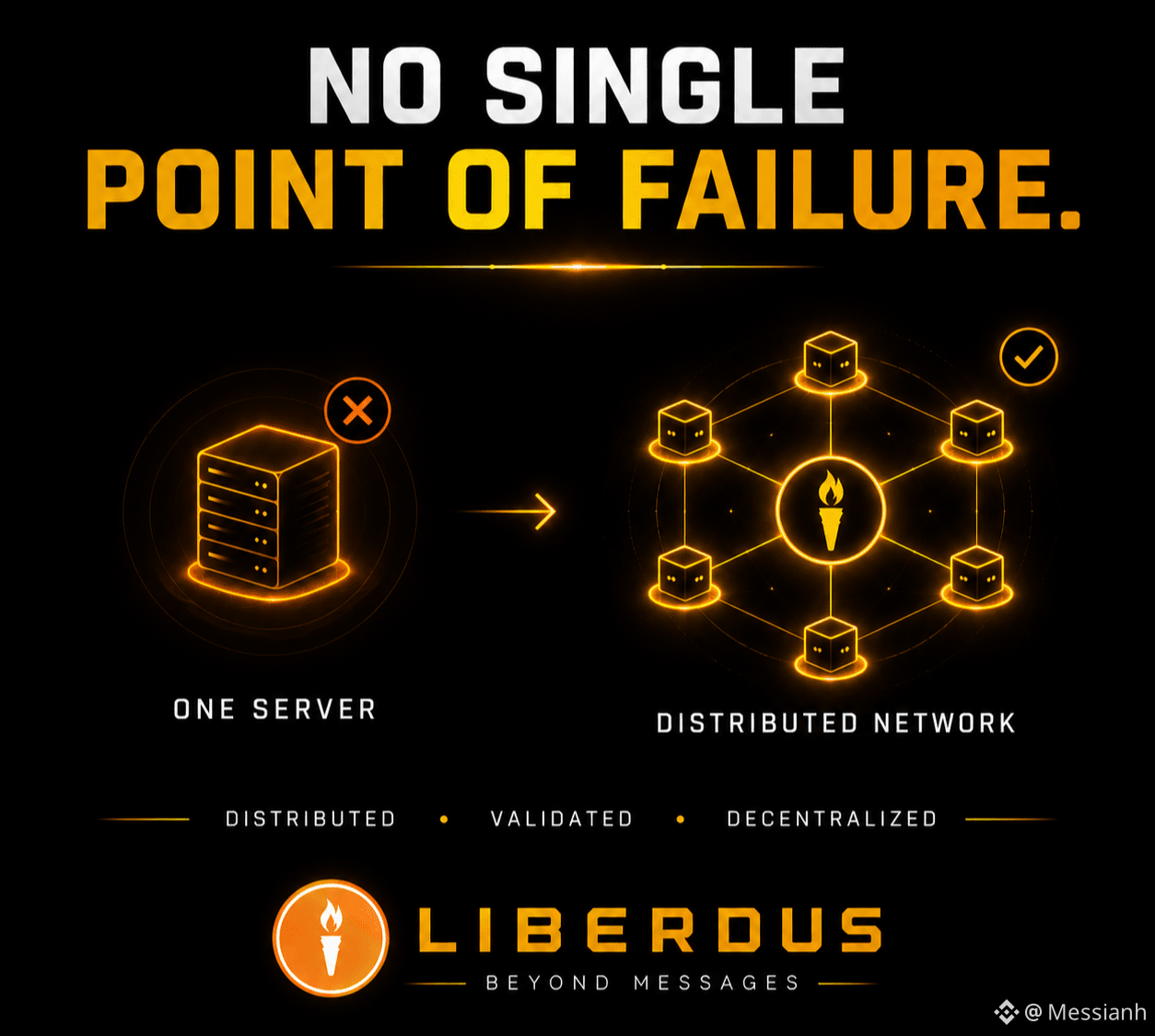
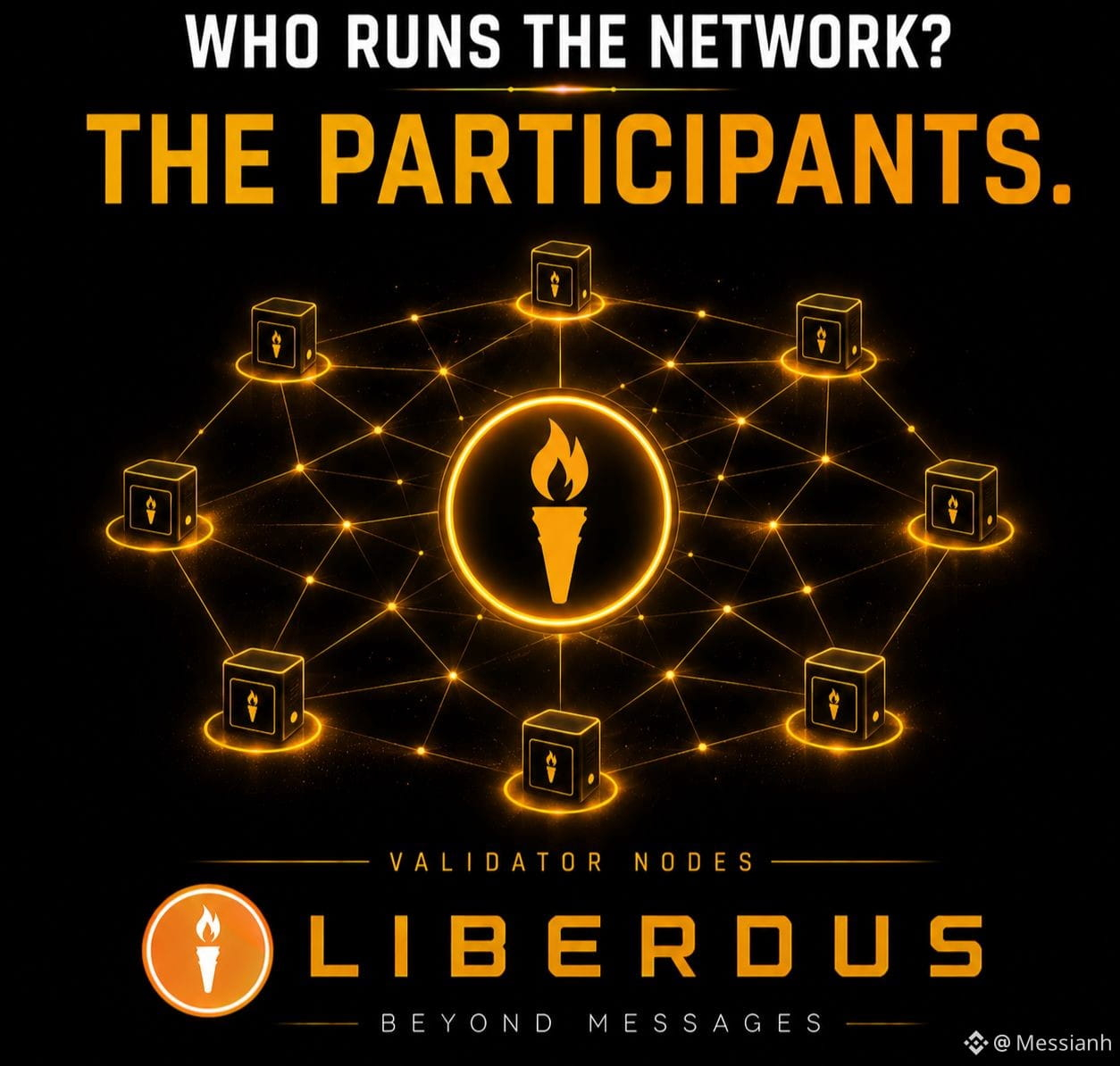
One server, one failure point.
Liberdus takes a different approach.
Its network runs across distributed validator nodes instead of relying on a centralized server. Nodes collectively keep the network online and participate in validation.
No single server at the center just a network of participants.
#Liberdus #IranSaysItHit3USShips3Tankers $BTC
{spot}(BTCUSDT)
One server, one failure point.
Liberdus takes a different approach.
Its network runs across distributed validator nodes instead of relying on a centralized server. Nodes collectively keep the network online and participate in validation.
No single server at the center just a network of participants.
#Liberdus #IranSaysItHit3USShips3Tankers $BTC
Liberdus takes a different approach.
Its network runs across distributed validator nodes instead of relying on a centralized server. Nodes collectively keep the network online and participate in validation.
No single server at the center just a network of participants.
#Liberdus #IranSaysItHit3USShips3Tankers $BTC
1
96
·
--
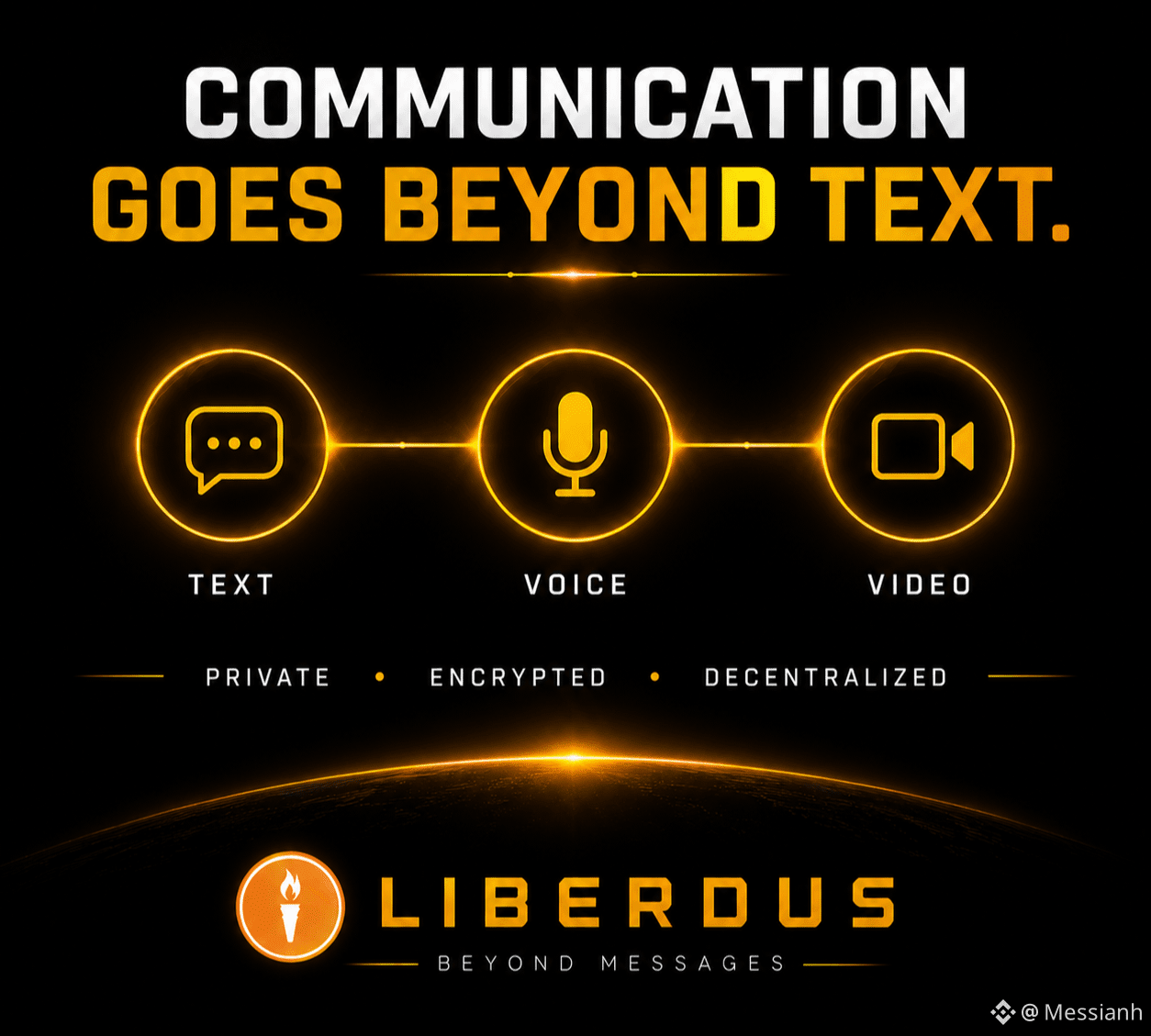
Who keeps a decentralized network alive?
Not one company, not one server but nodes.
@liberdus uses a distributed network of validator nodes to process transactions and maintain the network.
And participation is permissionless. You don't need a central authority to approve you.
Run a node, stake LIB and help secure the network.
Decentralization needs participants.
#Liberdus #Privacy #XRP’ $XRP
{spot}(XRPUSDT)
Who keeps a decentralized network alive?
Not one company, not one server but nodes.
@liberdus uses a distributed network of validator nodes to process transactions and maintain the network.
And participation is permissionless. You don't need a central authority to approve you.
Run a node, stake LIB and help secure the network.
Decentralization needs participants.
#Liberdus #Privacy #XRP’ $XRP
Not one company, not one server but nodes.
@liberdus uses a distributed network of validator nodes to process transactions and maintain the network.
And participation is permissionless. You don't need a central authority to approve you.
Run a node, stake LIB and help secure the network.
Decentralization needs participants.
#Liberdus #Privacy #XRP’ $XRP
134
·
--
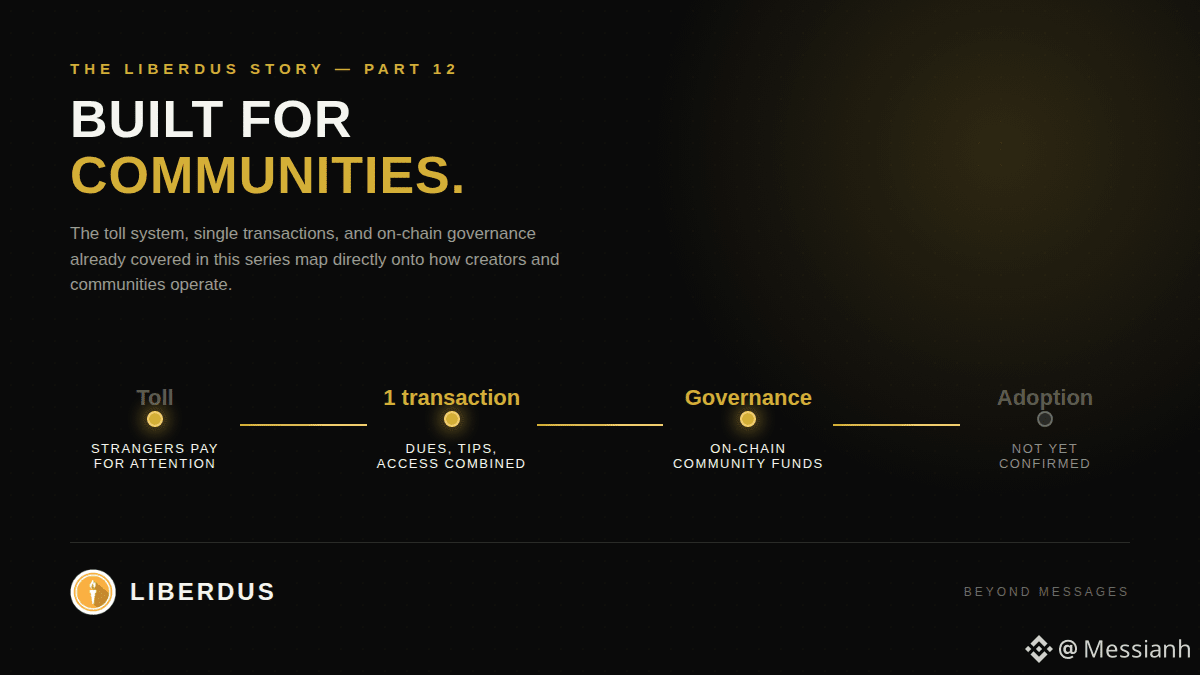
What this actually means for a community
Every mechanic covered so far in this series has a natural home in the same place: a creator or community running on tips, memberships, and constant unsolicited contact from strangers.
Start with the toll system from Day 18. A creator with any public presence gets flooded with messages from people they've never met, most of them low-value, some of them spam. Configuring a toll for unknown senders means that traffic either stops, or it starts paying the creator for the attention it demands. That's a direct answer to a problem most creators currently solve by simply not reading their DMs.
Then there's the single transaction from yesterday's article. A community collecting dues, a patron sending a tip, a member paying for access: each of those becomes one action instead of a message plus a separate wallet transfer. For a community treasurer juggling both a group chat and a payment tool, that's one less system to reconcile.
DAO governance layer from Day 21 applies at the community level too, at least structurally. On-chain proposals with scaled voting margins are the same mechanism whether the "network" being governed is Liberdus itself or a community pool built on top of it, assuming a group chooses to structure its funding that way.
#liberdus #GoldFalls3.24%ThisWeek $ASTER
What this actually means for a community
Every mechanic covered so far in this series has a natural home in the same place: a creator or community running on tips, memberships, and constant unsolicited contact from strangers.
Start with the toll system from Day 18. A creator with any public presence gets flooded with messages from people they've never met, most of them low-value, some of them spam. Configuring a toll for unknown senders means that traffic either stops, or it starts paying the creator for the attention it demands. That's a direct answer to a problem most creators currently solve by simply not reading their DMs.
Then there's the single transaction from yesterday's article. A community collecting dues, a patron sending a tip, a member paying for access: each of those becomes one action instead of a message plus a separate wallet transfer. For a community treasurer juggling both a group chat and a payment tool, that's one less system to reconcile.
DAO governance layer from Day 21 applies at the community level too, at least structurally. On-chain proposals with scaled voting margins are the same mechanism whether the "network" being governed is Liberdus itself or a community pool built on top of it, assuming a group chooses to structure its funding that way.
#liberdus #GoldFalls3.24%ThisWeek $ASTER
Every mechanic covered so far in this series has a natural home in the same place: a creator or community running on tips, memberships, and constant unsolicited contact from strangers.
Start with the toll system from Day 18. A creator with any public presence gets flooded with messages from people they've never met, most of them low-value, some of them spam. Configuring a toll for unknown senders means that traffic either stops, or it starts paying the creator for the attention it demands. That's a direct answer to a problem most creators currently solve by simply not reading their DMs.
Then there's the single transaction from yesterday's article. A community collecting dues, a patron sending a tip, a member paying for access: each of those becomes one action instead of a message plus a separate wallet transfer. For a community treasurer juggling both a group chat and a payment tool, that's one less system to reconcile.
DAO governance layer from Day 21 applies at the community level too, at least structurally. On-chain proposals with scaled voting margins are the same mechanism whether the "network" being governed is Liberdus itself or a community pool built on top of it, assuming a group chooses to structure its funding that way.
#liberdus #GoldFalls3.24%ThisWeek $ASTER
1
48
Log in to explore more content
Join global crypto users on Binance Square
⚡️ Get latest and useful information about crypto.
💬 Trusted by the world’s largest crypto exchange.
👍 Discover real insights from verified creators.
Email / Phone number
Trending Topics
BNBSurpasses$790
5,512 views
64 Discussing
$BNB strategic long plan -> FOCUS NOW
BNB has created 2 strong lows after taking out internal liquidity
I'm expecting a move towards swing high $815-$830 and looking for a long on a retest of the green box
#BNBSurpasses$790 #bnb
Ghost Writer
·3 Likes
·2.3k views
ZamaRises15.99%ToIntradayHigh$0.09
1,923 views
60 Discussing
BitcoinSpotETFsDraw$6.34BInflowsInQ3
2,621 views
48 Discussing