
Matrix Kinetic
58 Posts

Matrix Kinetic
Report
Block User
Algo Trading Lab. I test my own trading beliefs with live bots and drop the ones the numbers don't support. Goal: no manual trading. Losses included.
12 Following
26 Followers
59 Liked
Posts
All
Quotes
PINNED
Article
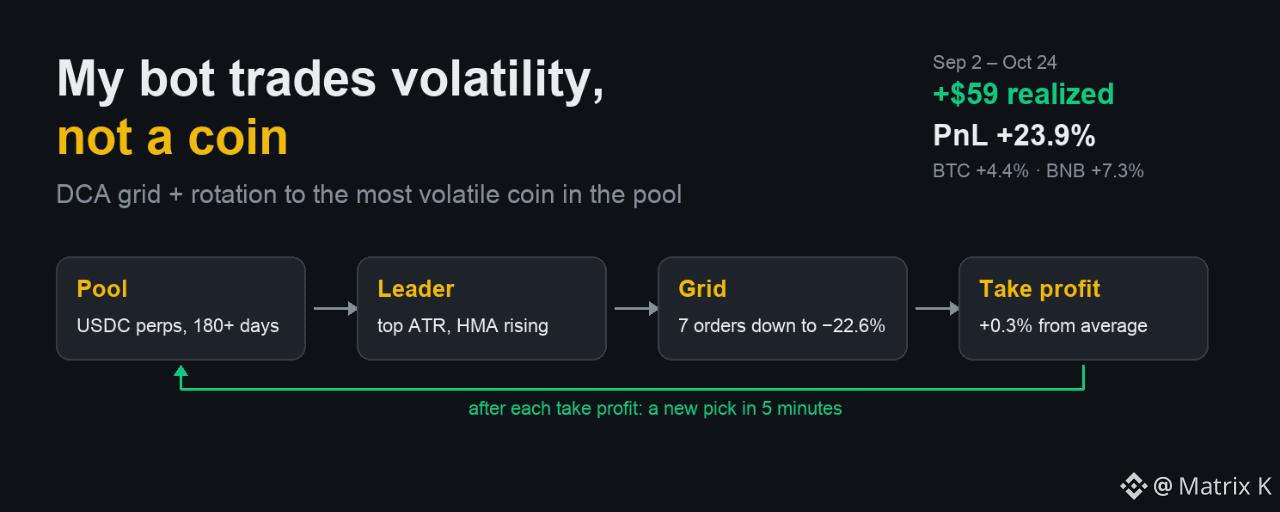
My bot trades volatility, not a coin. Starting a public diaryUpdate, Nov 3: the TIA lock described below ended in liquidation on Oct 29 (−$49), the planned expense this post talks about. The bot has been back in trade since Nov 1 and is still in profit since launch: +$5.04.
If you’re staring at one coin’s chart and trying to guess where price goes next, you’re looking in the wrong place.
My DCA bot has been running on Binance Futures for almost two months. Let me be honest up front: this is not “a bot that found a good coin.” Such coins barely exist. I ran the same grid on each of 38 USDC pairs on its own, on 1-minute data over 2 years. Most coins end in the red, $TIA and PENGU included.
But if every hour you pick the coin from the whole pool that moves the most while rising, and pick again after every take profit, the same grid on the same coins ends in the green. The income comes not from the coin but from switching to the leader.
Why volatility. It’s what DCA feeds on. The more the price moves, the more often the grid builds a position and closes it with a take profit. More rounds, more profit. The bot doesn’t guess direction; it looks for movement.
How it works now:
• pool: all Binance USDC perpetuals trading for at least 180 days. Fresh listings are the main source of liquidations, checked on history. A market scanner refreshes the pool once a day;
• pick: every hour, the coin with the highest ATR in a rising trend;
• grid: 7 orders down to −22.6%, take profit 0.3% from the average; after a take profit, a new pick on the next 5-minute candle;
• one slot, isolated margin $50 at x4, so a $200 grid. Liquidation is my stop. In 2-year backtests it happens on average once every month and a half; live, since launch, it hasn’t happened yet. It’s part of the system, not a failure.
I didn’t get to this setup right away. There were months of backtests and live trading, and almost everything that seems obvious fell away: single orders, stops, trend indicators for entries. Fees eat a grid’s thin edge, so the bot trades USDC pairs, where limit orders on Binance are fee-free. Over this time the bot has traded $41,214 of volume. At the regular maker fee (0.02%, 0.018% with BNB) that would have cost about $7.4, one in every eight dollars earned.
Numbers from Sep 2 to Oct 24 (Binance app, “Futures PnL”):
• closed in profit: +$59.00;
• PnL curve growth: +23.9% (Binance counts it as a percentage of the subaccount balance by day), vs $BTC +4.4% and $BNB +7.3% over the same period;
• 44 days in profit, 9 in loss. All 9 losing days are funding while the bot sat in a position without a take profit: −$0.29 in total.
The first real exam. For the first time in almost two months, a position used up all its safety orders and locked: since Oct 17 the slot has held TIA, with the grid fully filled. Two outcomes from here. Either the price returns to the average and the bot exits with a take profit; on history, about half of such locks ended that way. Or TIA reaches liquidation and the bot loses the slot margin, $49. Both outcomes interest me equally: a backtest can show anything, and the only measure of truth is live trading.
How the money works. To keep the experiment clean, the bot trades on a separate, clean subaccount. Profit isn’t reinvested: I withdraw it to spot right away, where it works in Earn and goes to regular buys of BTC and BNB. If the position is liquidated, a new deposit of the same size goes into the bot. So a liquidation isn’t a catastrophe for me, it’s a planned expense. The real question is different: can profit pay for liquidations with room to spare over time? So far the answer is yes: the $59 withdrawn already covers one full loss of margin ($49).
The bot is constantly being improved based on live results. The latest update, a scanner of the whole market instead of a fixed list of 11 coins, I switched on right during this lock. When I decide the system has proven itself, I’ll load serious money into it.
What you’ll find here:
reports from live trading: take profits, locks, liquidations, as they are;findings from research: what I tested and what didn’t work (a lot didn’t).
Not financial advice. Leveraged futures can wipe out a deposit.
#DCA #trading #volatility #RiskManagement #bitcoin
My bot trades volatility, not a coin. Starting a public diary
Update, Nov 3: the TIA lock described below ended in liquidation on Oct 29 (−$49), the planned expense this post talks about. The bot has been back in trade since Nov 1 and is still in profit since launch: +$5.04.
If you’re staring at one coin’s chart and trying to guess where price goes next, you’re looking in the wrong place.
My DCA bot has been running on Binance Futures for almost two months. Let me be honest up front: this is not “a bot that found a good coin.” Such coins barely exist. I ran the same grid on each of 38 USDC pairs on its own, on 1-minute data over 2 years. Most coins end in the red, $TIA and PENGU included.
But if every hour you pick the coin from the whole pool that moves the most while rising, and pick again after every take profit, the same grid on the same coins ends in the green. The income comes not from the coin but from switching to the leader.
Why volatility. It’s what DCA feeds on. The more the price moves, the more often the grid builds a position and closes it with a take profit. More rounds, more profit. The bot doesn’t guess direction; it looks for movement.
How it works now:
• pool: all Binance USDC perpetuals trading for at least 180 days. Fresh listings are the main source of liquidations, checked on history. A market scanner refreshes the pool once a day;
• pick: every hour, the coin with the highest ATR in a rising trend;
• grid: 7 orders down to −22.6%, take profit 0.3% from the average; after a take profit, a new pick on the next 5-minute candle;
• one slot, isolated margin $50 at x4, so a $200 grid. Liquidation is my stop. In 2-year backtests it happens on average once every month and a half; live, since launch, it hasn’t happened yet. It’s part of the system, not a failure.
I didn’t get to this setup right away. There were months of backtests and live trading, and almost everything that seems obvious fell away: single orders, stops, trend indicators for entries. Fees eat a grid’s thin edge, so the bot trades USDC pairs, where limit orders on Binance are fee-free. Over this time the bot has traded $41,214 of volume. At the regular maker fee (0.02%, 0.018% with BNB) that would have cost about $7.4, one in every eight dollars earned.
Numbers from Sep 2 to Oct 24 (Binance app, “Futures PnL”):
• closed in profit: +$59.00;
• PnL curve growth: +23.9% (Binance counts it as a percentage of the subaccount balance by day), vs $BTC +4.4% and $BNB +7.3% over the same period;
• 44 days in profit, 9 in loss. All 9 losing days are funding while the bot sat in a position without a take profit: −$0.29 in total.
The first real exam. For the first time in almost two months, a position used up all its safety orders and locked: since Oct 17 the slot has held TIA, with the grid fully filled. Two outcomes from here. Either the price returns to the average and the bot exits with a take profit; on history, about half of such locks ended that way. Or TIA reaches liquidation and the bot loses the slot margin, $49. Both outcomes interest me equally: a backtest can show anything, and the only measure of truth is live trading.
How the money works. To keep the experiment clean, the bot trades on a separate, clean subaccount. Profit isn’t reinvested: I withdraw it to spot right away, where it works in Earn and goes to regular buys of BTC and BNB. If the position is liquidated, a new deposit of the same size goes into the bot. So a liquidation isn’t a catastrophe for me, it’s a planned expense. The real question is different: can profit pay for liquidations with room to spare over time? So far the answer is yes: the $59 withdrawn already covers one full loss of margin ($49).
The bot is constantly being improved based on live results. The latest update, a scanner of the whole market instead of a fixed list of 11 coins, I switched on right during this lock. When I decide the system has proven itself, I’ll load serious money into it.
What you’ll find here:
reports from live trading: take profits, locks, liquidations, as they are;findings from research: what I tested and what didn’t work (a lot didn’t).
Not financial advice. Leveraged futures can wipe out a deposit.
#DCA #trading #volatility #RiskManagement #bitcoin
3
2
713
Article
Why I don't stake: a reverse grid mines coins with no lockOff the bot #2. Stocks fell, crypto followed, and both my bots are locked. Good time to return to the deaf frog: the reader who staked 30,000 $TIA and sent me a Chinese fable. Why don't I stake? Two reasons.
Reason 1: the lock
Staking takes a moment, unstaking takes 2–3 weeks. In a crash, or when you just need cash today, you can do nothing.
Reason 2: a reverse spot grid
It starts with your coin. On a fall it sells higher and buys lower, so your coin count grows. Sideways it keeps doing that, 24/7, with no electricity: mining, in effect. A miner doesn't care about the dollar price either. On a rise it unloads into cash. No lock: one click and it's closed, at the current price.
The numbers
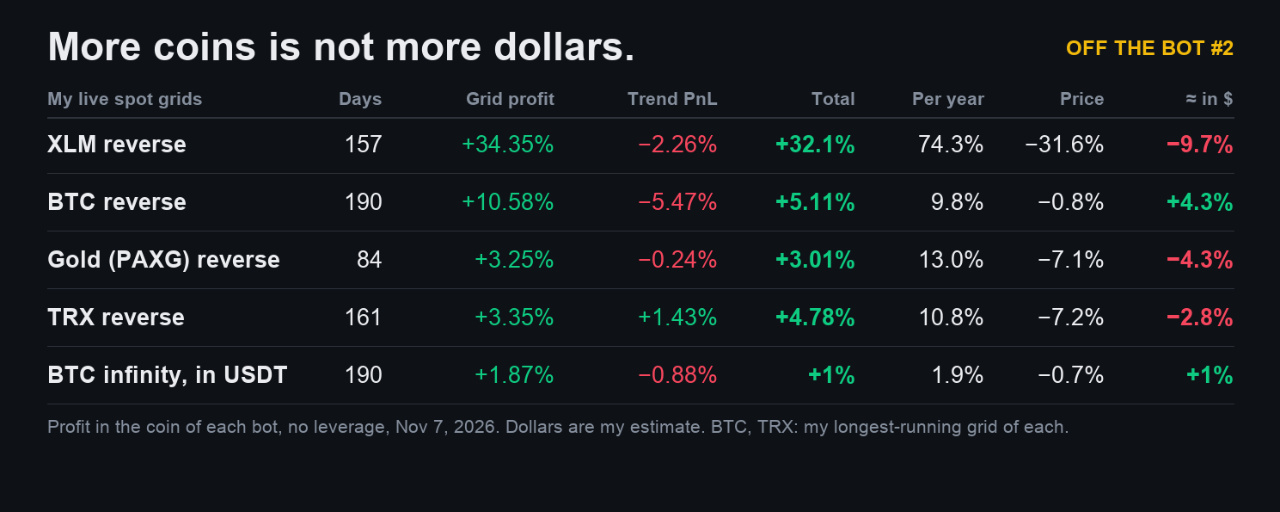
Take $BTC , my cleanest case: 190 days, price almost back at entry, +5.11% in coins. That's about 10% a year. Show me a staking that pays that on BTC.
$XLM looks far better and isn't: +32.1% in coins, 74% a year on the poster. But most of it is the fall. The same cash share, with no trades at all, would be about +28%. The grid itself added 3–4 points.
In dollars that bot is about −10%, while just holding is −32%. But a miner counts coins too.
On a rally it flips: the grid sells coins, a staker keeps them all. And totals move with price: my BTC grid was +2.47% five days ago, +5.11% now.
The loop
Binance Recurring Convert with Smart DCA buys BTC daily: double on dips, a tenth on rallies. What it buys doesn't sit as dead weight. Each batch goes into two bots: a reverse grid (pays in BTC) and an infinity grid (pays in USDT).
On a fall the first adds coins, on a rise the second adds dollars. It's not a hedge: a fall still costs dollars. My oldest pair, 190 days, BTC almost back at its entry: +5.11% BTC and +1% USDT.
A reverse grid also lets me withdraw its grid profit in dollars. An infinity grid can't; if I need that, I run a plain grid with the same 40K–85K range.
What a grid doesn't fix
The coin. TIA is −81% in three years. Even with 30% more coins, that's about −75%.
And the range. If price leaves it, a grid stops: I wait, or close it and restart with a new range. My XLM bot's floor is 0.15, the price is 0.1525.
If I needed TIA
I'd run it like this: range 0.4 to 1, 150 grids, 0.30–0.89% per grid. That's my setup, not advice. TIA touched 0.4034 on Nov 5, right at that floor.
All numbers are as of Nov 7, when I wrote this. Prices move, so they may differ by the time you read it.
What do you do with the coins you hold?
#RiskManagement #trading #bitcoin
Why I don't stake: a reverse grid mines coins with no lock
Off the bot #2. Stocks fell, crypto followed, and both my bots are locked. Good time to return to the deaf frog: the reader who staked 30,000 $TIA and sent me a Chinese fable. Why don't I stake? Two reasons.
Reason 1: the lock
Staking takes a moment, unstaking takes 2–3 weeks. In a crash, or when you just need cash today, you can do nothing.
Reason 2: a reverse spot grid
It starts with your coin. On a fall it sells higher and buys lower, so your coin count grows. Sideways it keeps doing that, 24/7, with no electricity: mining, in effect. A miner doesn't care about the dollar price either. On a rise it unloads into cash. No lock: one click and it's closed, at the current price.
The numbers
Take $BTC , my cleanest case: 190 days, price almost back at entry, +5.11% in coins. That's about 10% a year. Show me a staking that pays that on BTC.
$XLM looks far better and isn't: +32.1% in coins, 74% a year on the poster. But most of it is the fall. The same cash share, with no trades at all, would be about +28%. The grid itself added 3–4 points.
In dollars that bot is about −10%, while just holding is −32%. But a miner counts coins too.
On a rally it flips: the grid sells coins, a staker keeps them all. And totals move with price: my BTC grid was +2.47% five days ago, +5.11% now.
The loop
Binance Recurring Convert with Smart DCA buys BTC daily: double on dips, a tenth on rallies. What it buys doesn't sit as dead weight. Each batch goes into two bots: a reverse grid (pays in BTC) and an infinity grid (pays in USDT).
On a fall the first adds coins, on a rise the second adds dollars. It's not a hedge: a fall still costs dollars. My oldest pair, 190 days, BTC almost back at its entry: +5.11% BTC and +1% USDT.
A reverse grid also lets me withdraw its grid profit in dollars. An infinity grid can't; if I need that, I run a plain grid with the same 40K–85K range.
What a grid doesn't fix
The coin. TIA is −81% in three years. Even with 30% more coins, that's about −75%.
And the range. If price leaves it, a grid stops: I wait, or close it and restart with a new range. My XLM bot's floor is 0.15, the price is 0.1525.
If I needed TIA
I'd run it like this: range 0.4 to 1, 150 grids, 0.30–0.89% per grid. That's my setup, not advice. TIA touched 0.4034 on Nov 5, right at that floor.
All numbers are as of Nov 7, when I wrote this. Prices move, so they may differ by the time you read it.
What do you do with the coins you hold?
#RiskManagement #trading #bitcoin
1
614
Lab check #2. "40% winners at 1:3": everyone quotes it. Math answers it before any backtest.
The risk rule in this post is sound: isolated margin, $10 at risk on $1,000. The 40% is the problem.
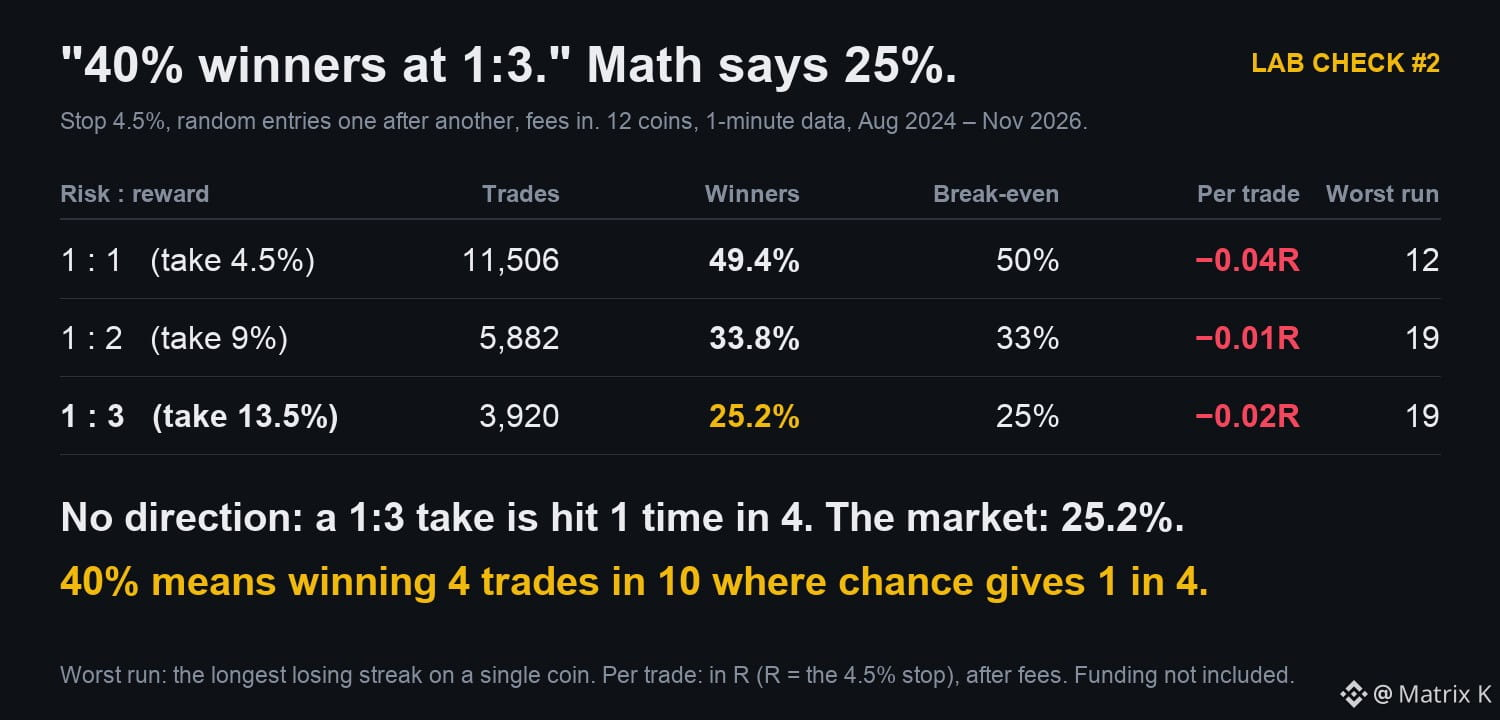
If price has no direction, a stop 1 step away is mathematically hit 3 times more often than a take 3 steps away. At 1:3 that's 25% winners, at 1:1 it's 50%. R:R doesn't create an edge: it only sets the break-even win rate. 40% is a wish, not a result.
I checked it anyway: 12 coins, including $ADA $ENA $AVAX , 1-minute data, Aug 2024 to Nov 2026. Stop 4.5%, take 13.5%, random entries, fees in. 3,920 trades, 25.2% winners. 1:1 gave 49.4%, 1:2 gave 33.8%. The market agrees with the math, and fees push it below zero.
So 40% at 1:3 isn't a rule. It means winning 4 trades in 10 where chance gives 1 in 4. The best entry I've measured, with an ATR stop, won about 3 in 10.
And the losing runs: up to 19 in a row on one coin.
Where does your win rate come from?
#RiskManagement #trading

Maxim S
·
--
Как торговать крупно, рискуя копейками? 🧠
Расскажу на пальцах как правильно торговать с бюджетом в $1000 (к примеру)! 👇
Большинство новичков думают, что кредитное плечо — это инструмент для быстрого разгона депозита. В итоге они берут 20х плечо, заходят на всю котлету и ловят ликвидацию при первом рыночном шуме.
Кредитное плечо нужно использовать не для завышения риска, а для освобождения вашего капитала.
Профессиональный подход — это стратегия «Умного залога» на ИЗОЛИРОВАННОЙ марже. Она позволяет контролировать сделку на $200, замораживая на бирже всего $10. Как правильно распределить $1 000 депозита? Разбираем по шагам.
🛡️ Стратегия «Умный залог» в действии
Железное правило риск-менеджмента: в одной сделке вы можете потерять не более 1–2% от общего депозита (для $1 000 это $10–$20).
🔹 Шаг 1. Определяем номинальный объем
Вы планируете открыть позицию по Биткоину общим объемом $200 (это 20% от вашего капитала).
Важно: Это не сумма, которой вы рискуете. Это просто рыночная стоимость контракта, который вы берете в управление.
🔹 Шаг 2. Включаем изолятор и плечо 20х
Вместо того чтобы блокировать на бирже реальные $200, вы включаете изолированную маржу и плечо 20х.
Ваш залог (маржа): всего $10 ($200 / 20).
Свободный остаток: на балансе остается $990. Они в полной безопасности, не заморожены в сделке и могут быть использованы для других ордеров.
🔹 Шаг 3. Выставляем Stop-Loss (Защита от ликвидации) По сути ликвидация и есть нашим стоп-лоссом, но лучше не доводить сделку до автоматической ликвидации биржей! При ликвидации площадка спишет с вас огромную комиссию.
Решение: Мы ставим системный Stop-Loss чуть ближе цены ликвидации — например, на потерю $10 (1% от общего депозита). На графике с 20х плечом это движение цены против вас примерно на 4.5–4.8% (чуть раньше, чем наступит ликвидация на 5%).
Итог: Если рынок пойдет против вас, позиция закроется по стопу. Вы потеряете строго $10. На балансе останется $990.
💡 В чём же фишка такой стратегии?
При такой математике вам нужно ошибиться 100 раз подряд, чтобы полностью обнулить свой депозит. В реальности, имея даже 40% прибыльных сделок, но с правильным соотношением риска к прибыли (Risk/Reward) хотя бы 1:3, вы будете стабильно расти.
Сохрани и оцени, если было полезно 🫡
$ADA $ENA $AVAX
1
542
Thriller #2. Same coin, same week.
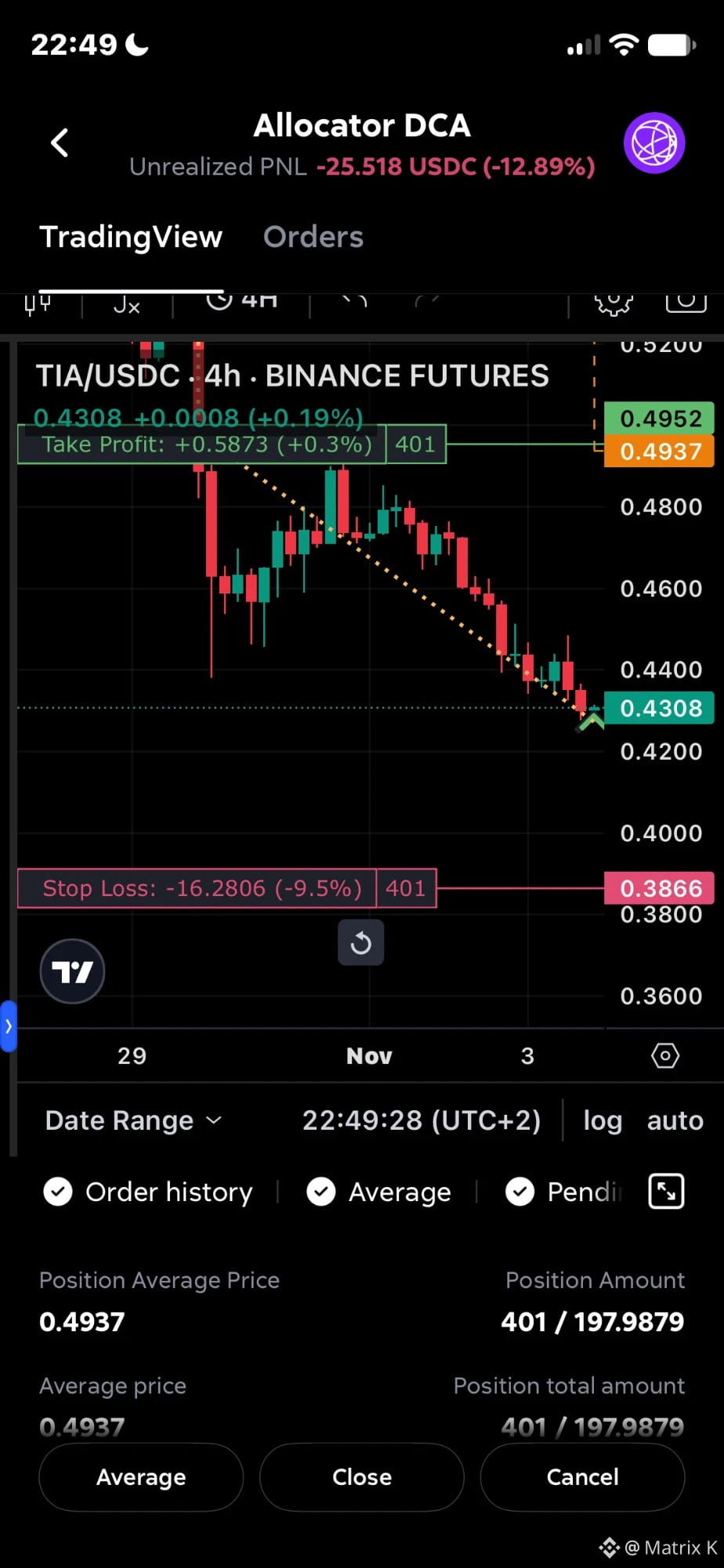
On Oct 29 my server bot was liquidated in $TIA (−$49). My second bot, on Veles, was in TIA that same night. It survived: no liquidation, just a deep stop. Tonight it filled its last order.
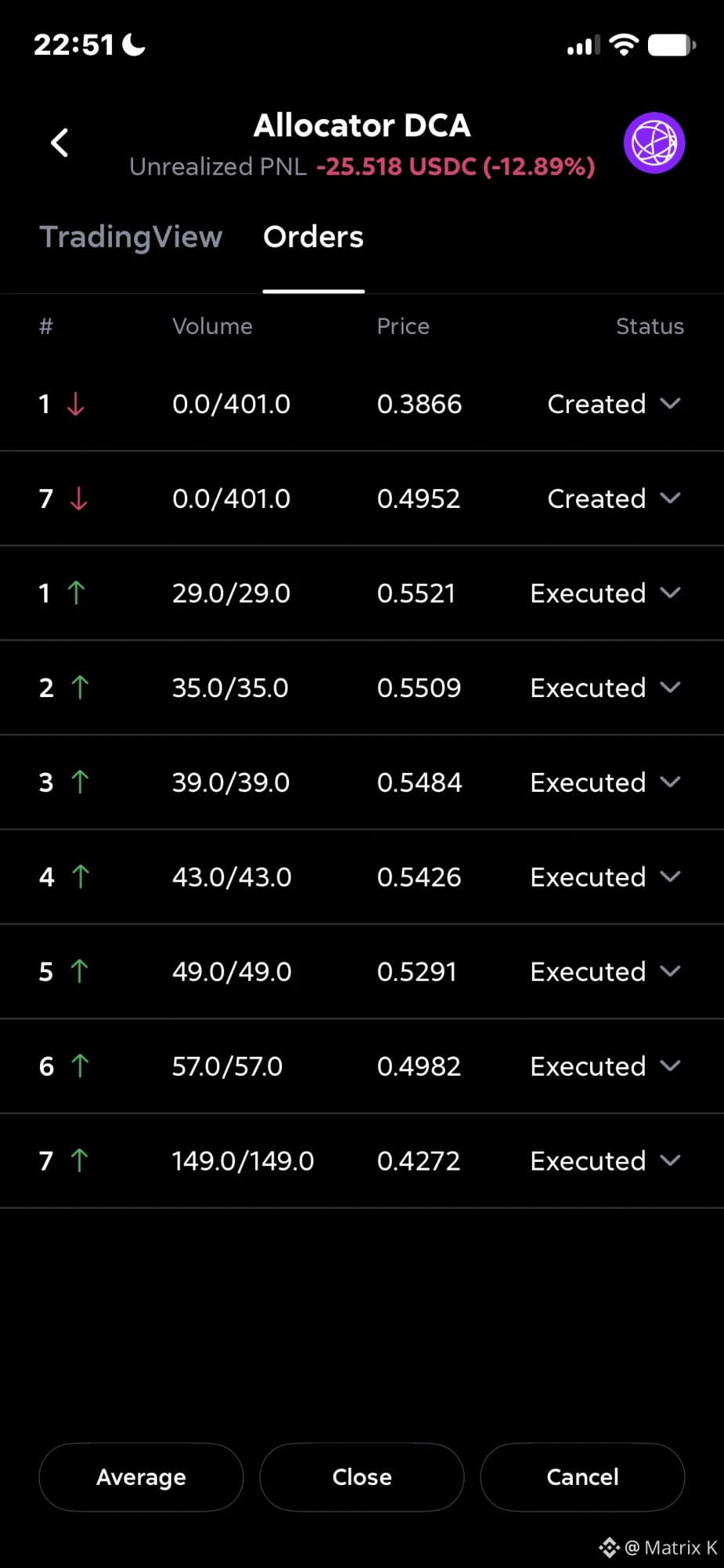
All 7 orders filled: first buy 0.5521 → last 0.4272 (−22.6%) average 0.4937, position $198 (4x on a $50 deposit)
TIA now at 0.4295: take profit 0.4952:
+15% away, pays less than $0.60 stop 0.3866:
−10% away, costs about $43
That's the shape of this grid: many small takes, one rare big loss. The last order is the biggest on purpose: $64, a third of the whole $198 position. It pulled the take profit down from 0.5347 to 0.4952. From the fill, the coin needs +16% instead of +25%.
The stop was set before the trade: −30% from the first buy. Tonight I only read the numbers. I'll report whichever comes first.
What do you think comes first?
#DCA #trading #RiskManagement #tia
Take profit first (+15%)
Stop first (−10%)
Neither this week
2 day(s) left
1
2k
Off the bot #1. A deaf frog can climb. But the climb is not the goal.
A reader staked 30,000 $TIA in [Keplr](https://www.binance.com/en/square/post/383914064424624?sqb=1) and sent me a Chinese fable: "Only a deaf frog can climb to the top of a tall tower."
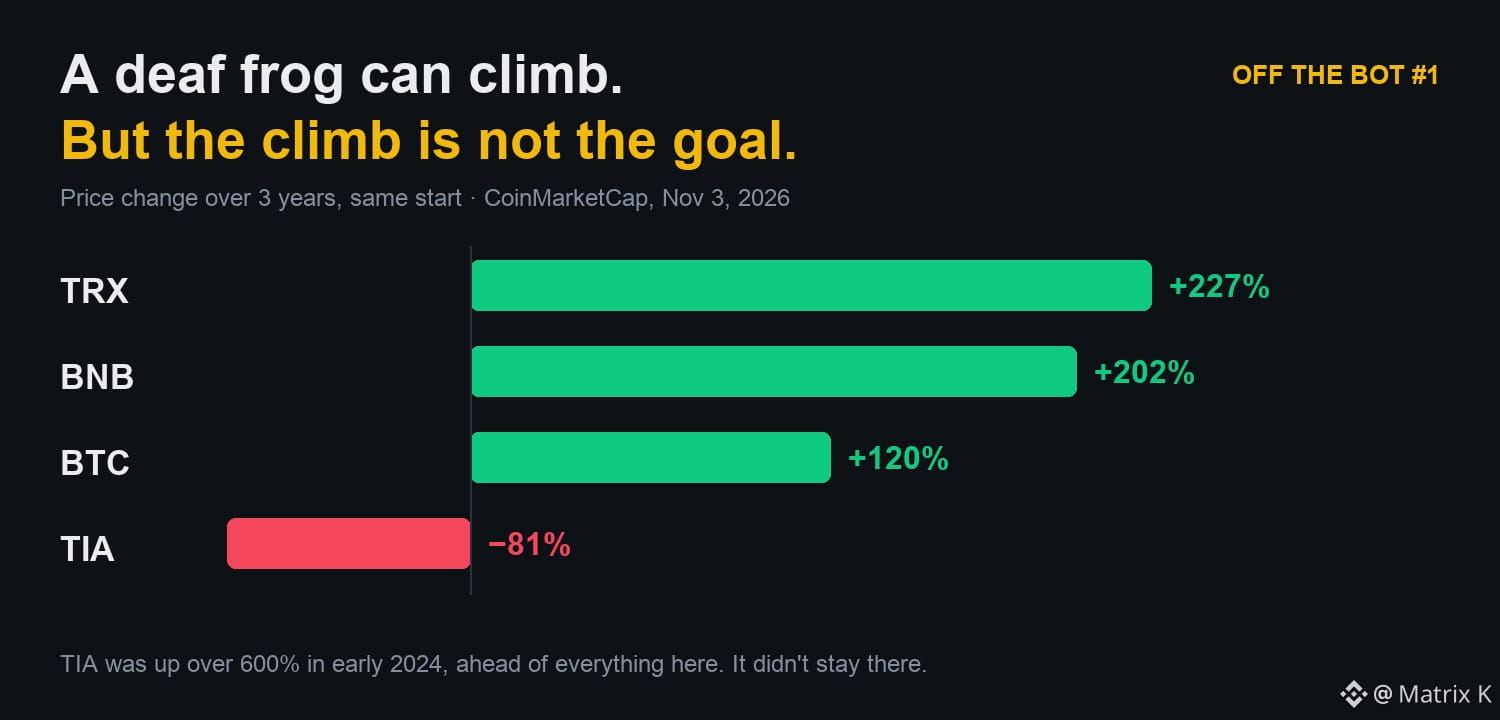
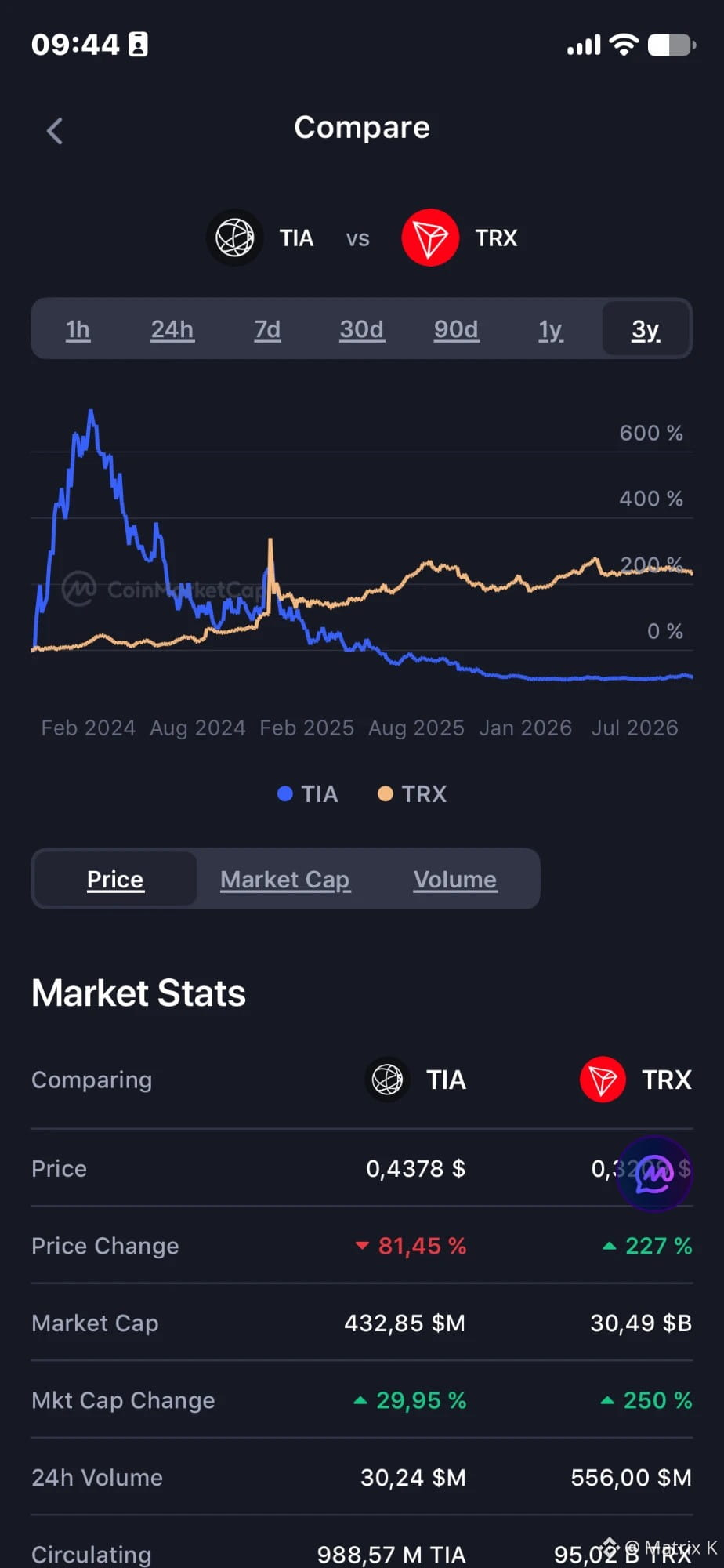
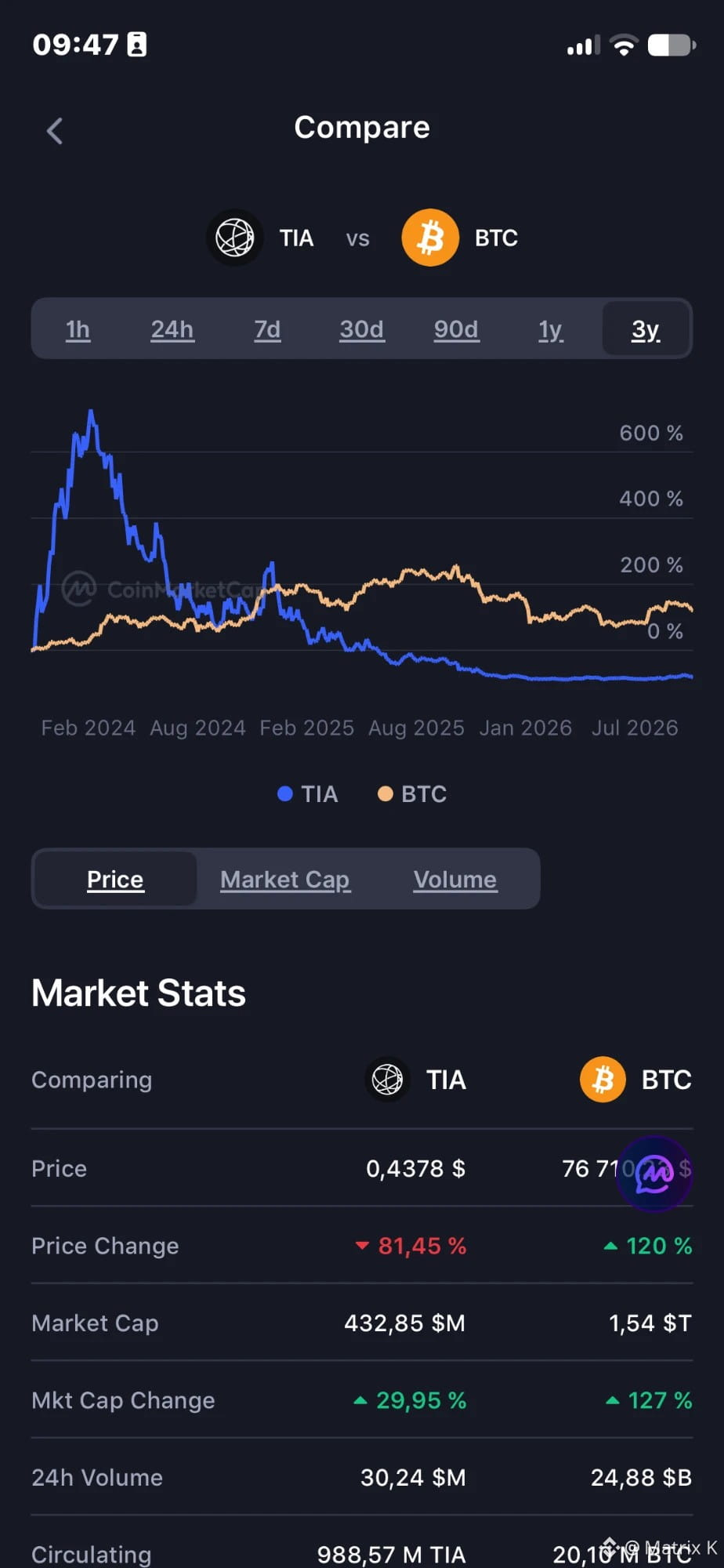
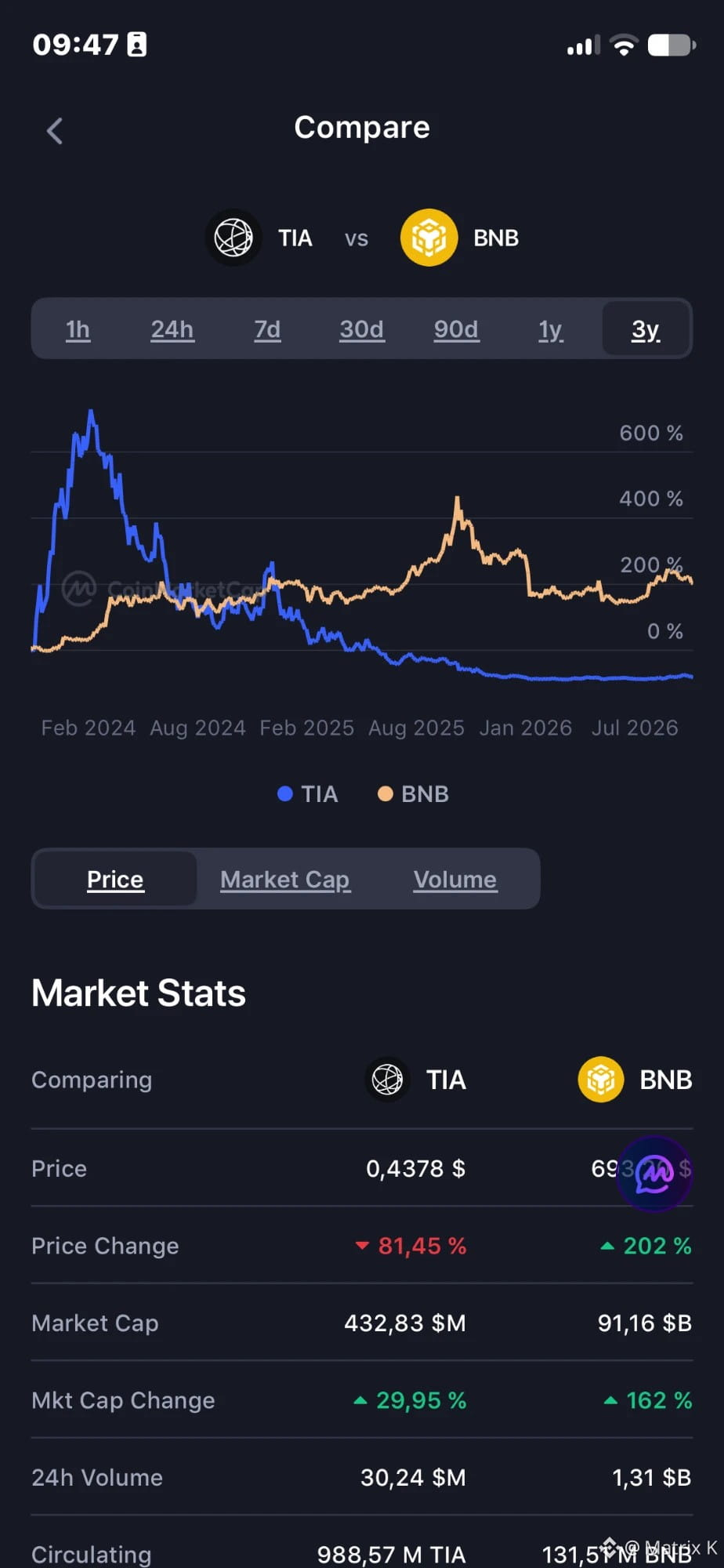
I respect his choice. Let's just open the charts. Three years, same start, price change on CoinMarketCap:
$TRX +227% $BNB +202% $BTC +120% TIA −81%
TIA did climb: in early 2024 it was up over 600%, ahead of everything on this list. I don't know when my reader bought his 30,000, near the top or at some local bottom. But an alt sitting on a bottom is not a reason to buy it. Some towers are Babel: a staircase up that leads down.
I know that tower. TIA and ATOM sat in my Keplr too. A year ago I sold everything except BTC from the previous cycle (average around 28K). The trigger: BTC closed a month below its 12-month average. For me, that's where a bull market ends. Not a feeling, a rule.
The same rule is bringing me back. BTC closed a month above that average again, and I'm returning to speculative positions in alts. Not at the bottom of 57.7K, but later and higher. The right price isn't the lowest one. It's the confirmed one.
Exceptions to this rule? There are. But that's another story.
Long-term buying is a separate track. When BTC fell below its 200-week EMA, the cycle bottom for me, I switched on regular buys of my favorites. What I buy doesn't sit as dead weight: it goes to spot grid bots and keeps working.
A deaf frog can climb. But the climb is a path, not a goal. I know my goals. Does the frog know its own? I can't tell. If the goal is to catch a few X's by buying some bottom, that's not a goal. That's hope. And hope and a goal are different things.
What's the goal behind the coin you hold?
#RiskManagement #InvestSmart #bitcoin
P.S. The market is sleepy and my bot has nothing new to report. A good excuse to talk about everything around it. Hence the #1.
Off the bot #1. A deaf frog can climb. But the climb is not the goal.
A reader staked 30,000 $TIA in Keplr and sent me a Chinese fable: "Only a deaf frog can climb to the top of a tall tower."
I respect his choice. Let's just open the charts. Three years, same start, price change on CoinMarketCap:
$TRX +227% $BNB +202% $BTC +120% TIA −81%
TIA did climb: in early 2024 it was up over 600%, ahead of everything on this list. I don't know when my reader bought his 30,000, near the top or at some local bottom. But an alt sitting on a bottom is not a reason to buy it. Some towers are Babel: a staircase up that leads down.
I know that tower. TIA and ATOM sat in my Keplr too. A year ago I sold everything except BTC from the previous cycle (average around 28K). The trigger: BTC closed a month below its 12-month average. For me, that's where a bull market ends. Not a feeling, a rule.
The same rule is bringing me back. BTC closed a month above that average again, and I'm returning to speculative positions in alts. Not at the bottom of 57.7K, but later and higher. The right price isn't the lowest one. It's the confirmed one.
Exceptions to this rule? There are. But that's another story.
Long-term buying is a separate track. When BTC fell below its 200-week EMA, the cycle bottom for me, I switched on regular buys of my favorites. What I buy doesn't sit as dead weight: it goes to spot grid bots and keeps working.
A deaf frog can climb. But the climb is a path, not a goal. I know my goals. Does the frog know its own? I can't tell. If the goal is to catch a few X's by buying some bottom, that's not a goal. That's hope. And hope and a goal are different things.
What's the goal behind the coin you hold?
#RiskManagement #InvestSmart #bitcoin
P.S. The market is sleepy and my bot has nothing new to report. A good excuse to talk about everything around it. Hence the #1.
1
406
Bot diary: back to work
Since the TIA liquidation on Oct 29, my bot sat on $9.97 and did nothing. A new grid needs $52.49 of margin, so every hour it reported “HOLD” and waited. That’s the behavior I want: no money, no trade.
Today Binance withdrawals were open again on several networks. I checked. Then I topped the bot’s margin back up.
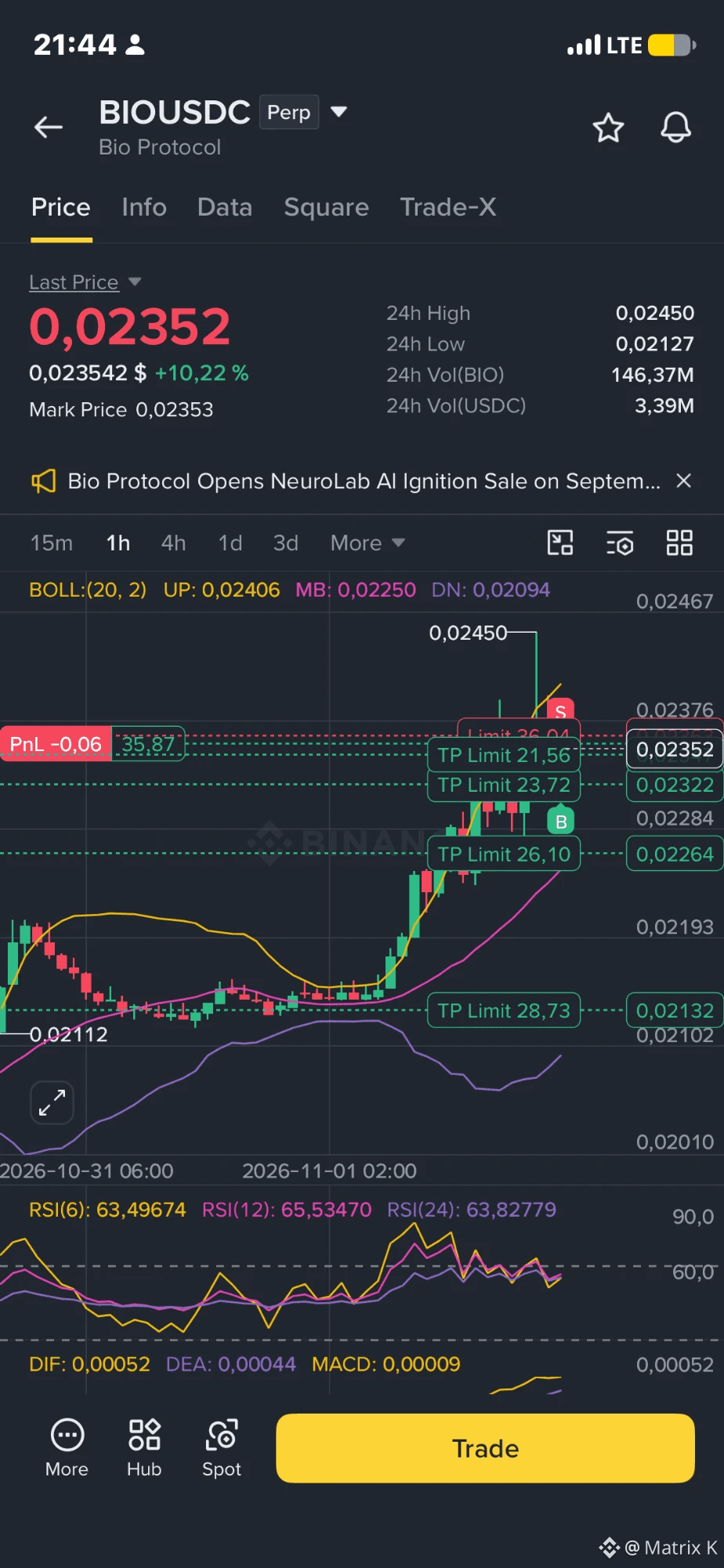
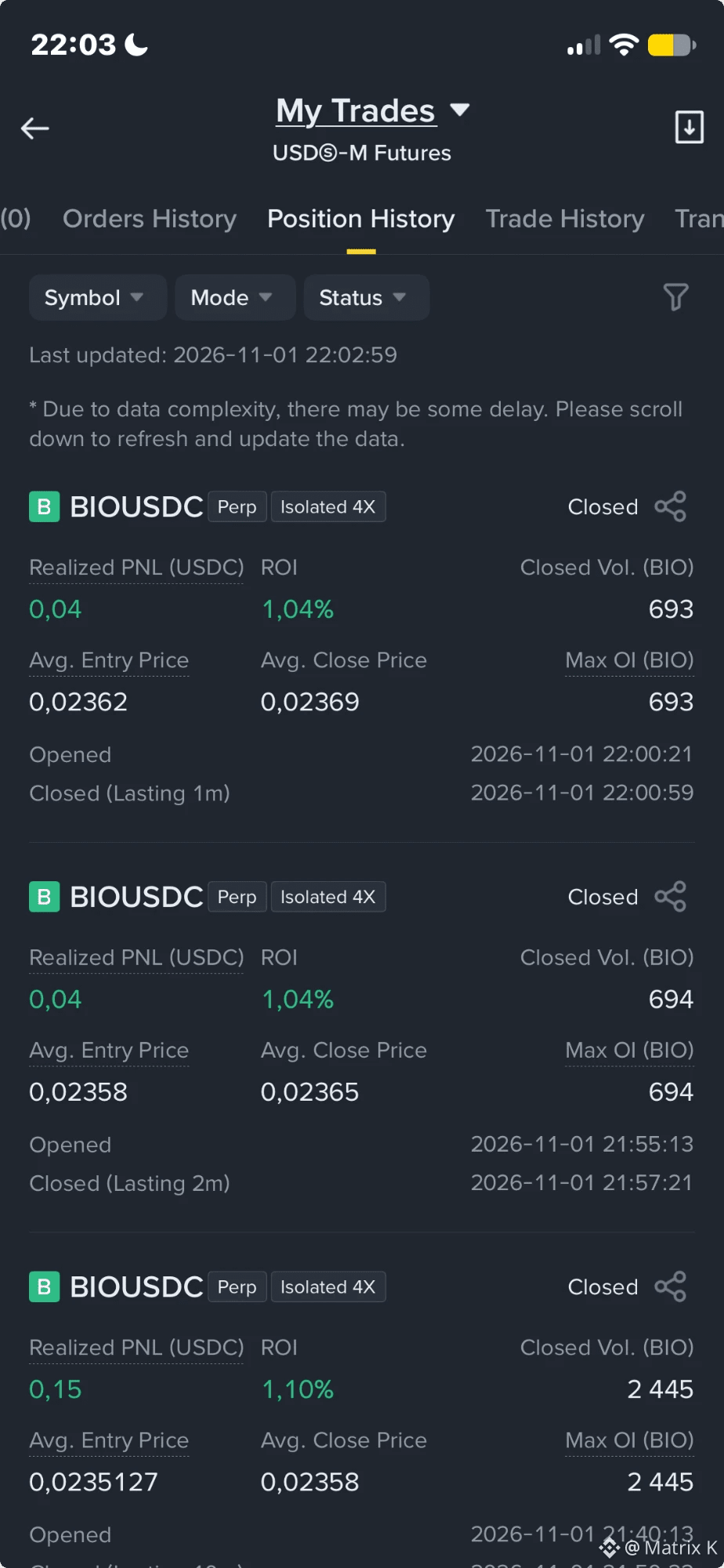
21:35 — HOLD lifted. The bot picked $BIO .
22:02 — 4 cycles closed, +$0.29.
What’s new: the bot no longer picks from my hand-made list. Its pool is now 32 of 38 USDC perpetuals, every coin with at least 180 days of futures history. The most volatile of the rising ones gets the slot.
Before tonight: +$5.04 since launch, +3.37% on average capital in 55 days. That’s after the liquidation.
Four cycles in half an hour is noise, not a result. I’ll report the week.
#DCA #trading #RiskManagement #crypto
1
529
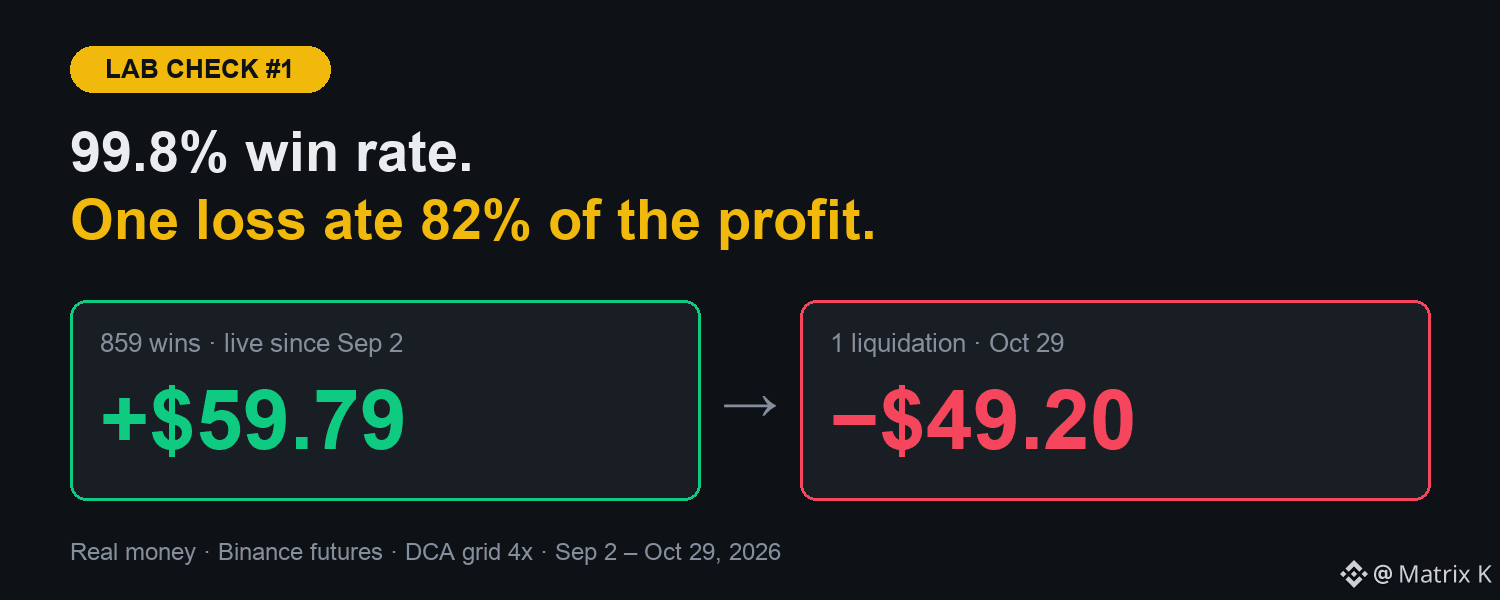
Lab check #1: 99.8% win rate. One loss ate 82% of the profit.
A post here tested RSI 30/70: 63% win rate, deposit zeroed. High win rate ≠ profit. True — and my own bot proves it with real money.
Live since Sep 2 (Binance futures, DCA grid, 4x):
— 859 cycles closed in profit: +$59.79
— 1 closed at zero
— 1 liquidation ($TIA , Oct 29): −$49.20 Win rate 99.8%. One loss ate 82% of two months of profit.
Two-year model of the same setup:
— 11,898 take-profits: +460% of capital
— 17 liquidations: −284% Win rate 99.86%. One liquidation = 27 days of take-profits. And one came about every six weeks.
Win rate tells you how often you get paid. It says nothing about what one loss costs.
What I track instead: take-profits divided by losses. In my model it's 1.62×. Positive, but thin.
Next in Lab check: what should I test? Name a strategy below.
#algoTrading #TradingBots #RiskManagement #trading
Not financial advice.
8
3
678
Article
Boring beats brilliant: why TRX sits next to my BTC and BNBEarlier today, in a comment, I wrote that I hold $BTC , $BNB and $TRX — and know why. Here's the why, checked.
I count in BTC. Measured in BTC, almost every coin bleeds. I took 29 large coins and asked: which are worth more in BTC today than at the start of each year since 2020? — From Jan 2022: 2 of 23. From Jan 2023: 2 of 25. And the list only has survivors. — TRX is the only one ahead of BTC from every start: ×2.0 since 2020, ×2.7 since 2022, ×1.5 since 2024. — BNB: ×4.7 since 2020, ×6.8 since 2021. But behind BTC if you started in 2022 or 2023.
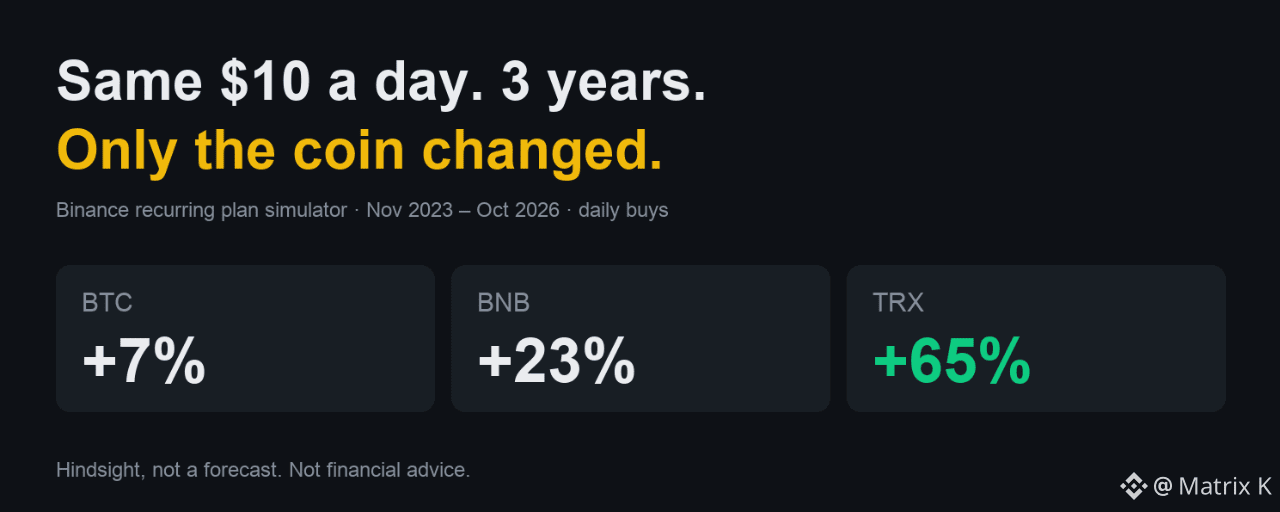
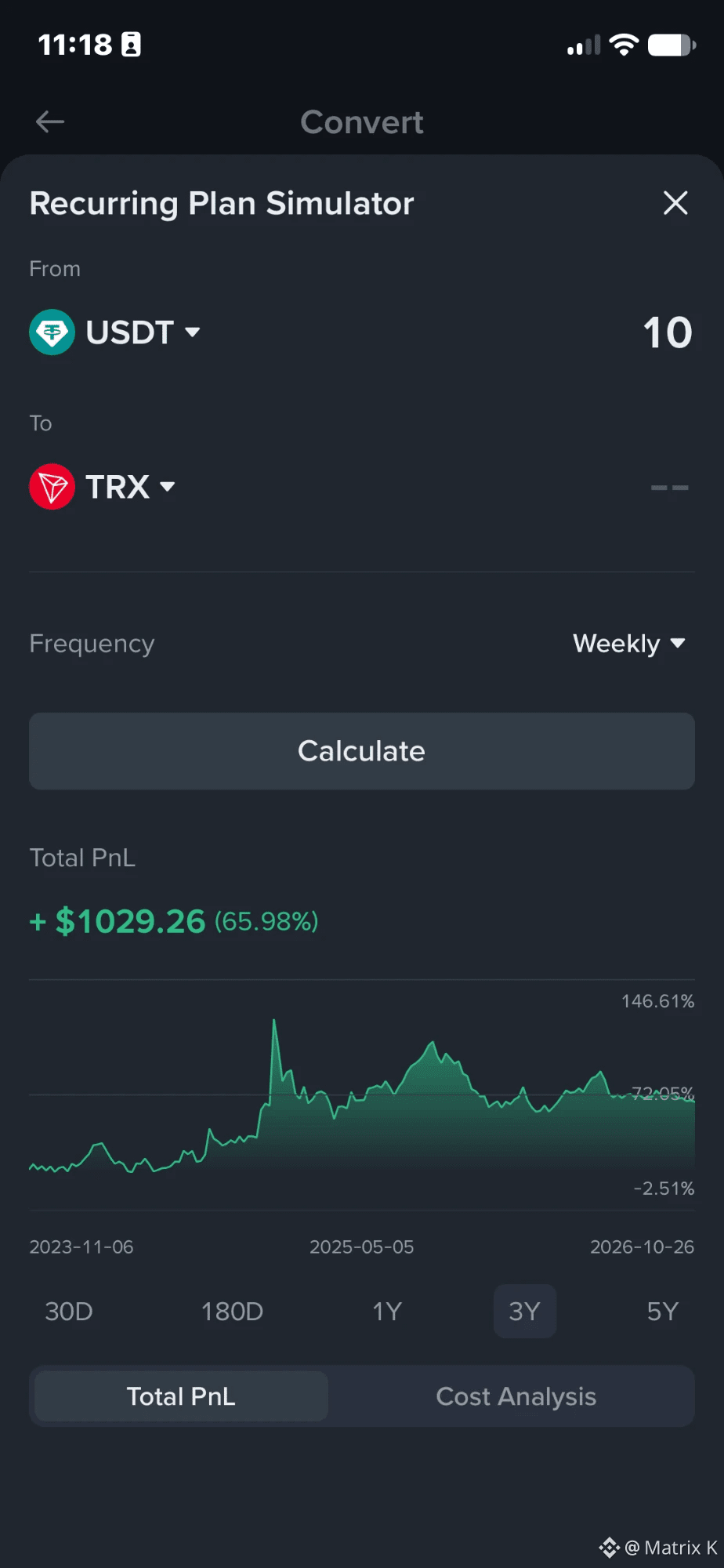
Same plan, different coin. Binance's recurring plan simulator, $10 a day for 3 years: BTC +7%, BNB +23%, TRX +65%. Same discipline, same dates. The coin made the difference.
The story I dropped. I thought TRX grows when everything falls. Daily data, Apr 2024 – Oct 2026: in weeks when BTC fell over 5%, TRX rose only 29% of the time. It just falls far less — about a third of BTC's moves. A shock absorber, not a hedge. Not a perfect one: after the Dec 2024 spike it fell 51%.
Why it behaves this way. Ethereum builds a spaceship of the future: elegant, but hard and expensive for ordinary people to ride. Tron built a paved highway, and trucks of real cash drive on it around the clock. About $90 billion in USDT lives on Tron. People use it to send money across borders and to protect savings from inflation, for cents per transfer. For long stretches Tron has earned more in fees than Ethereum, Solana or Bitcoin. In crypto, the winner is often not the most elegant tech, but whoever solves today's pain.
The risks I accept.
— Tron is centralized, and a lot depends on one founder.
— Its main use depends on one stablecoin issuer, which can freeze addresses.
— The burn story got weaker: Tron cut fees in Aug 2025, and its own estimate said supply would turn inflationary.
— BNB is tied to one exchange. This week showed what that means.
Past ratios aren't a forecast. This time I kept the coins and dropped one story.
Follow along: I test what I believe — and drop what the numbers don't support.
#algoTrading #bitcoin #TradingBots #RiskManagement #bnb
Not financial advice.
Boring beats brilliant: why TRX sits next to my BTC and BNB
Earlier today, in a comment, I wrote that I hold $BTC , $BNB and $TRX — and know why. Here's the why, checked.
I count in BTC. Measured in BTC, almost every coin bleeds. I took 29 large coins and asked: which are worth more in BTC today than at the start of each year since 2020? — From Jan 2022: 2 of 23. From Jan 2023: 2 of 25. And the list only has survivors. — TRX is the only one ahead of BTC from every start: ×2.0 since 2020, ×2.7 since 2022, ×1.5 since 2024. — BNB: ×4.7 since 2020, ×6.8 since 2021. But behind BTC if you started in 2022 or 2023.
Same plan, different coin. Binance's recurring plan simulator, $10 a day for 3 years: BTC +7%, BNB +23%, TRX +65%. Same discipline, same dates. The coin made the difference.
The story I dropped. I thought TRX grows when everything falls. Daily data, Apr 2024 – Oct 2026: in weeks when BTC fell over 5%, TRX rose only 29% of the time. It just falls far less — about a third of BTC's moves. A shock absorber, not a hedge. Not a perfect one: after the Dec 2024 spike it fell 51%.
Why it behaves this way. Ethereum builds a spaceship of the future: elegant, but hard and expensive for ordinary people to ride. Tron built a paved highway, and trucks of real cash drive on it around the clock. About $90 billion in USDT lives on Tron. People use it to send money across borders and to protect savings from inflation, for cents per transfer. For long stretches Tron has earned more in fees than Ethereum, Solana or Bitcoin. In crypto, the winner is often not the most elegant tech, but whoever solves today's pain.
The risks I accept.
— Tron is centralized, and a lot depends on one founder.
— Its main use depends on one stablecoin issuer, which can freeze addresses.
— The burn story got weaker: Tron cut fees in Aug 2025, and its own estimate said supply would turn inflationary.
— BNB is tied to one exchange. This week showed what that means.
Past ratios aren't a forecast. This time I kept the coins and dropped one story.
Follow along: I test what I believe — and drop what the numbers don't support.
#algoTrading #bitcoin #TradingBots #RiskManagement #bnb
Not financial advice.
1
133

Gwenn Gaser W5XT
·
--
I bought 30,000 and have been staking them in Keplr all along.
3
1
127
Article
Four right public calls prove nothing. The future is still dark.I don’t post signals. But I traded and invested long before I built bots, and my public calls are still online, with dates: on CoinMarketCap, under the same name.
The record.
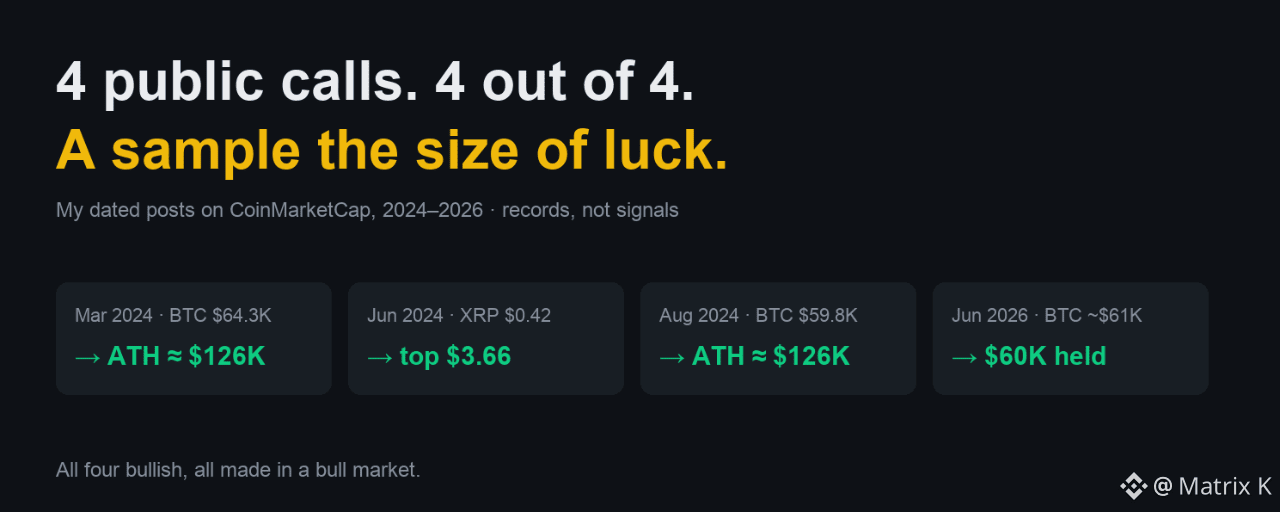
— Mar 23, 2024, $BTC at $64.3K. On the weekly chart, EMA100 was turning up under EMA200. “Draw your own conclusions.” The all-time high came at about $126K.
— Jun 2024, $XRP at $0.42. First a squeeze down, then a breakout from a multi-year triangle to the old high of $3.31 by Jun 30, 2025. The squeeze came 13 days later, at $0.38. The old high broke on Jul 14, 2025, two weeks late. Top so far: $3.66.
— Aug 29, 2024, BTC at $59.8K. Weekly EMA100 about to cross EMA200 from below. “Are you ready? )))” The all-time high came at about $126K.
— Jun 10, 2026: “BTC lost its 50-month EMA, next stop below 60K?” My answer: watch the 50-month MA, not the EMA. It sat near $59K. BTC hasn’t gone below 60K since.
Four out of four. And it proves nothing. Four calls is a sample the size of luck. All four were bullish, all made in a bull market. A coin lands heads four times in a row once in sixteen tries. On four calls I can’t tell skill from luck — and neither can you.
That’s the reason for the bots. A bot’s rule runs thousands of times. Two years of my DCA engine in backtests give over 12,000 deals — enough to see whether an edge is real, and how big. A chart reading gives me one data point a year. That’s the difference between a story and a statistic. And a rule doesn’t need me at the monitor.
Why show this now. The market is shaken by the Binance hack, and my server bot was just liquidated. The weekly chart doesn’t care about one night’s liquidations. Zoom out before you panic.
Where the money goes. My bot profits go into BTC and BNB, not fiat. The bots work the short swings. The long-term money sits where I believe it belongs.
So, are you ready? I’m not — the future is still dark. My bots don’t need to be: their rules are written for any outcome.
Follow along: I test what I believe — and drop what the numbers don’t support.
#algoTrading #bitcoin #xrp #TradingBots
Not financial advice. Old posts are records, not signals.
Four right public calls prove nothing. The future is still dark.
I don’t post signals. But I traded and invested long before I built bots, and my public calls are still online, with dates: on CoinMarketCap, under the same name.
The record.
— Mar 23, 2024, $BTC at $64.3K. On the weekly chart, EMA100 was turning up under EMA200. “Draw your own conclusions.” The all-time high came at about $126K.
— Jun 2024, $XRP at $0.42. First a squeeze down, then a breakout from a multi-year triangle to the old high of $3.31 by Jun 30, 2025. The squeeze came 13 days later, at $0.38. The old high broke on Jul 14, 2025, two weeks late. Top so far: $3.66.
— Aug 29, 2024, BTC at $59.8K. Weekly EMA100 about to cross EMA200 from below. “Are you ready? )))” The all-time high came at about $126K.
— Jun 10, 2026: “BTC lost its 50-month EMA, next stop below 60K?” My answer: watch the 50-month MA, not the EMA. It sat near $59K. BTC hasn’t gone below 60K since.
Four out of four. And it proves nothing. Four calls is a sample the size of luck. All four were bullish, all made in a bull market. A coin lands heads four times in a row once in sixteen tries. On four calls I can’t tell skill from luck — and neither can you.
That’s the reason for the bots. A bot’s rule runs thousands of times. Two years of my DCA engine in backtests give over 12,000 deals — enough to see whether an edge is real, and how big. A chart reading gives me one data point a year. That’s the difference between a story and a statistic. And a rule doesn’t need me at the monitor.
Why show this now. The market is shaken by the Binance hack, and my server bot was just liquidated. The weekly chart doesn’t care about one night’s liquidations. Zoom out before you panic.
Where the money goes. My bot profits go into BTC and BNB, not fiat. The bots work the short swings. The long-term money sits where I believe it belongs.
So, are you ready? I’m not — the future is still dark. My bots don’t need to be: their rules are written for any outcome.
Follow along: I test what I believe — and drop what the numbers don’t support.
#algoTrading #bitcoin #xrp #TradingBots
Not financial advice. Old posts are records, not signals.
1
173
My server bot is paused. Not because of the liquidation.
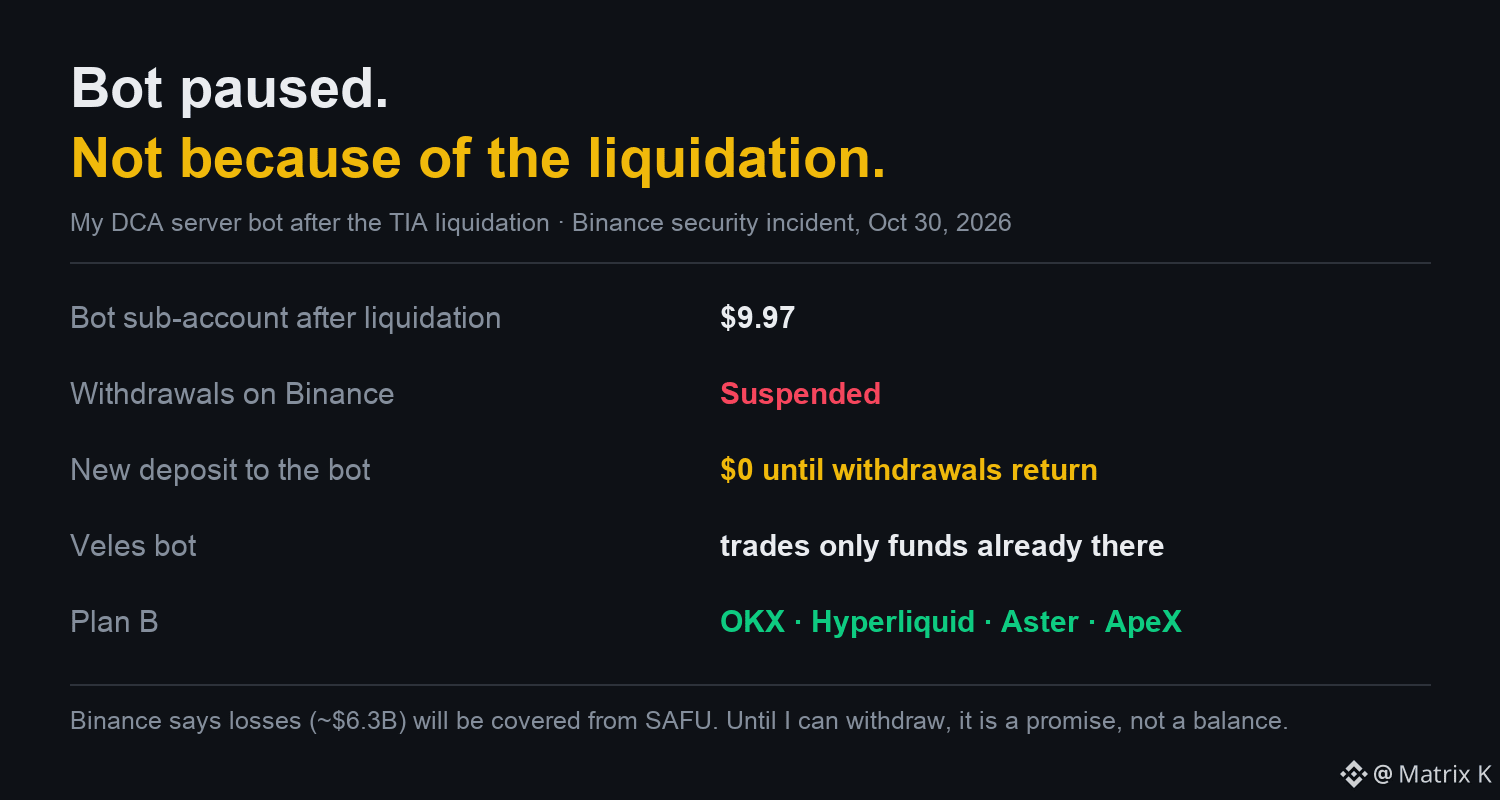
After Thursday night’s liquidation in $TIA , the bot’s sub-account has $10 left. My rule says: refill the margin from profit already withdrawn and carry on. I’m not doing it. Not yet.
The reason is the exchange, not the strategy or the algorithm. Binance has confirmed a security incident: about $6.3B taken, deposits and withdrawals paused. Binance says it will cover all losses from SAFU and its own funds. Good. But until I can withdraw, that’s a promise, not a balance.
It makes no sense to trade where you can lose a deposit but can’t take it out. So no new money goes in until withdrawals are fully back. My Veles bot keeps trading with what’s already there: stopping it wouldn’t make that money withdrawable.
This isn’t a bug in the algorithm. It’s a risk I don’t control. I can pull my bot’s API key in seconds. I can’t switch an exchange back on.
That’s why, after FTX and Celsius, not keeping everything on one exchange is part of my plan, not a reaction. I don’t only research bots — I trade and invest, and in both I put not losing ahead of earning. The earning tends to follow.
My bot isn’t tied to one exchange. If withdrawals don’t come back within a few days, it moves to OKX, where fees are comparable, or to a perp DEX like Hyperliquid, Aster or ApeX, where I hold my own keys. Different risks, but not this one. Either way, the experiment goes on.
#algoTrading #DCA #trading #bot #RiskManagement
Not financial advice.
Matrix Kinetic
·
--
Liquidated.
Two days ago I wrote: my bot is down 91% on $TIA , I’m not touching it. Take profit or liquidation — which comes first? Tonight we got the answer.
The market dumped on reports of a Binance hack. TIA wicked to 0.486 — 1% below my liquidation price of 0.491 — and the position was closed at 22:47. Within minutes the price was back above that level.
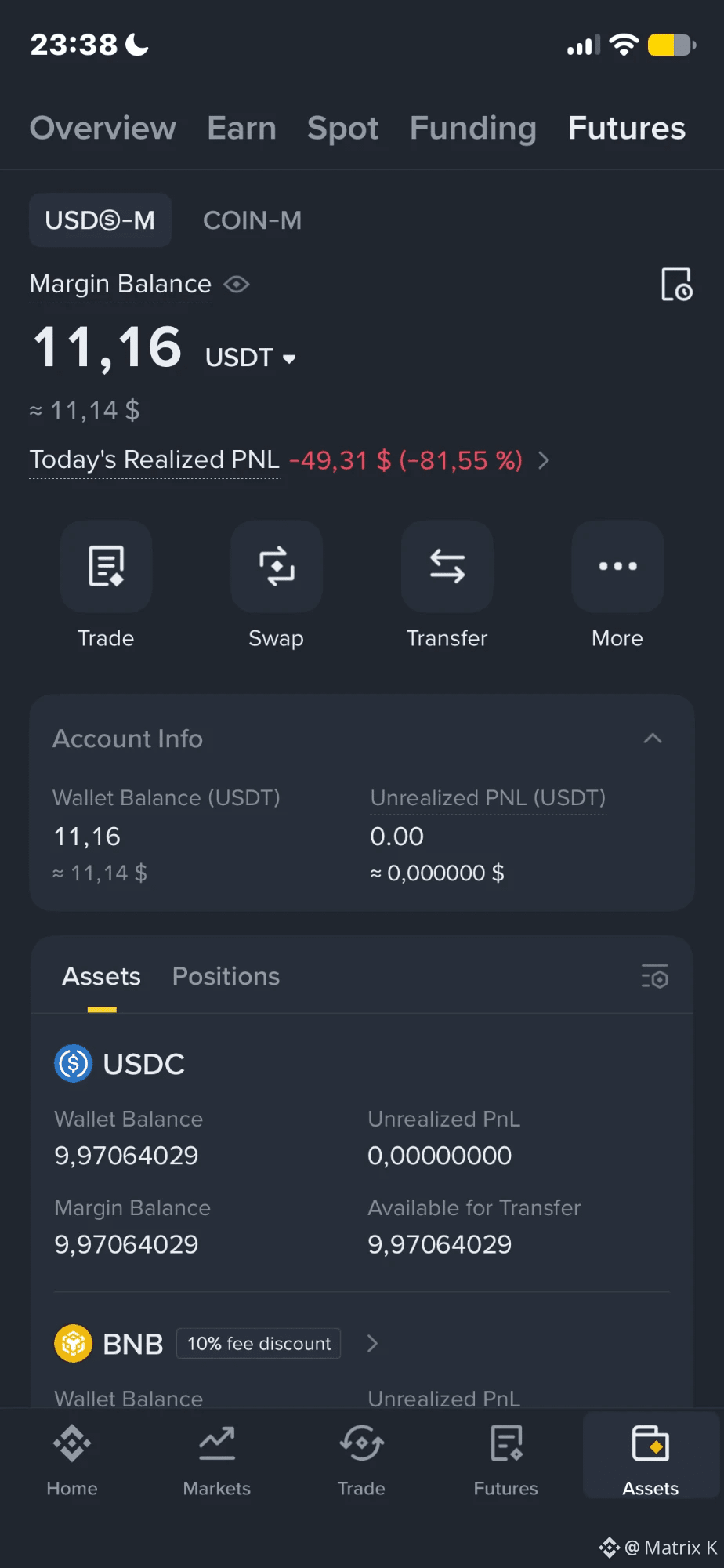
The damage: −$49.31. The margin of this position, as planned — not a cent more.
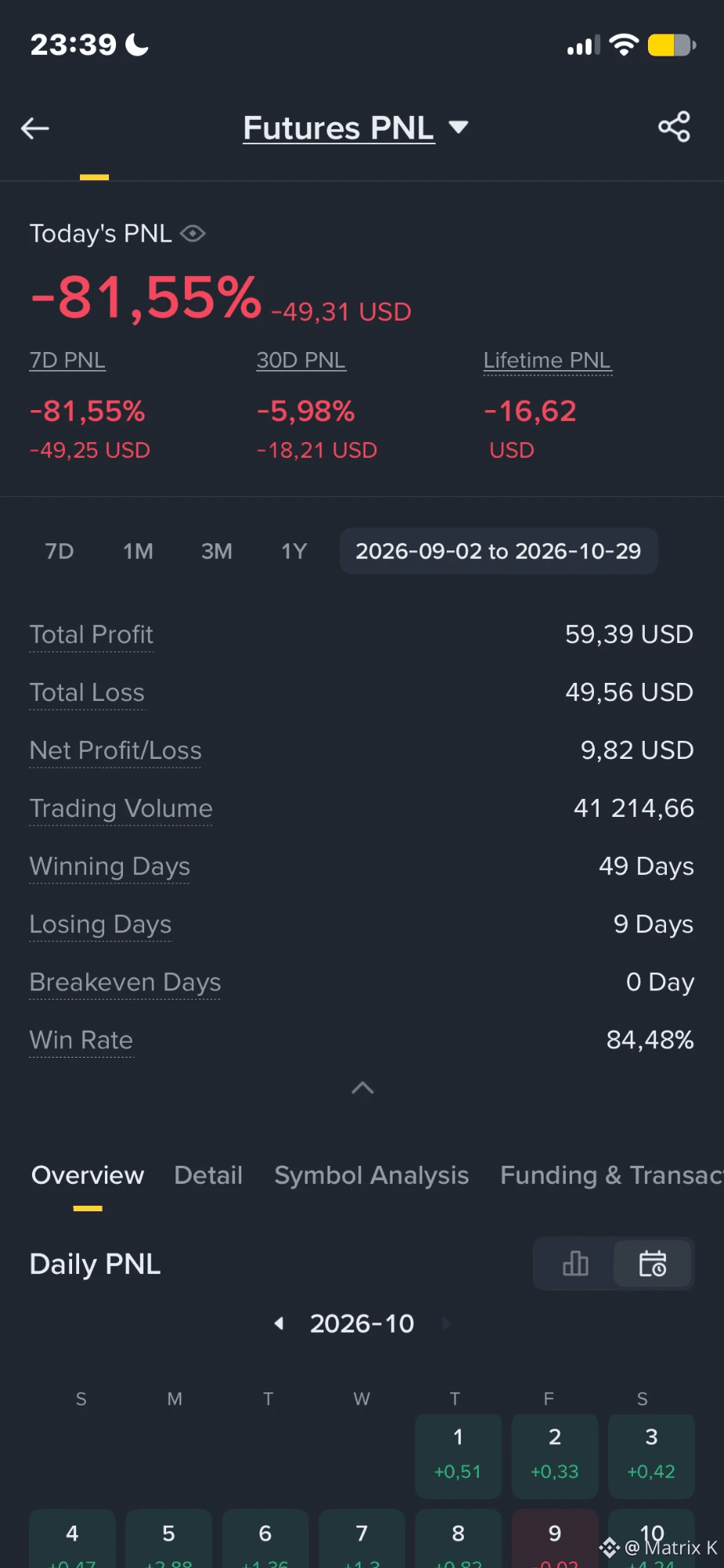
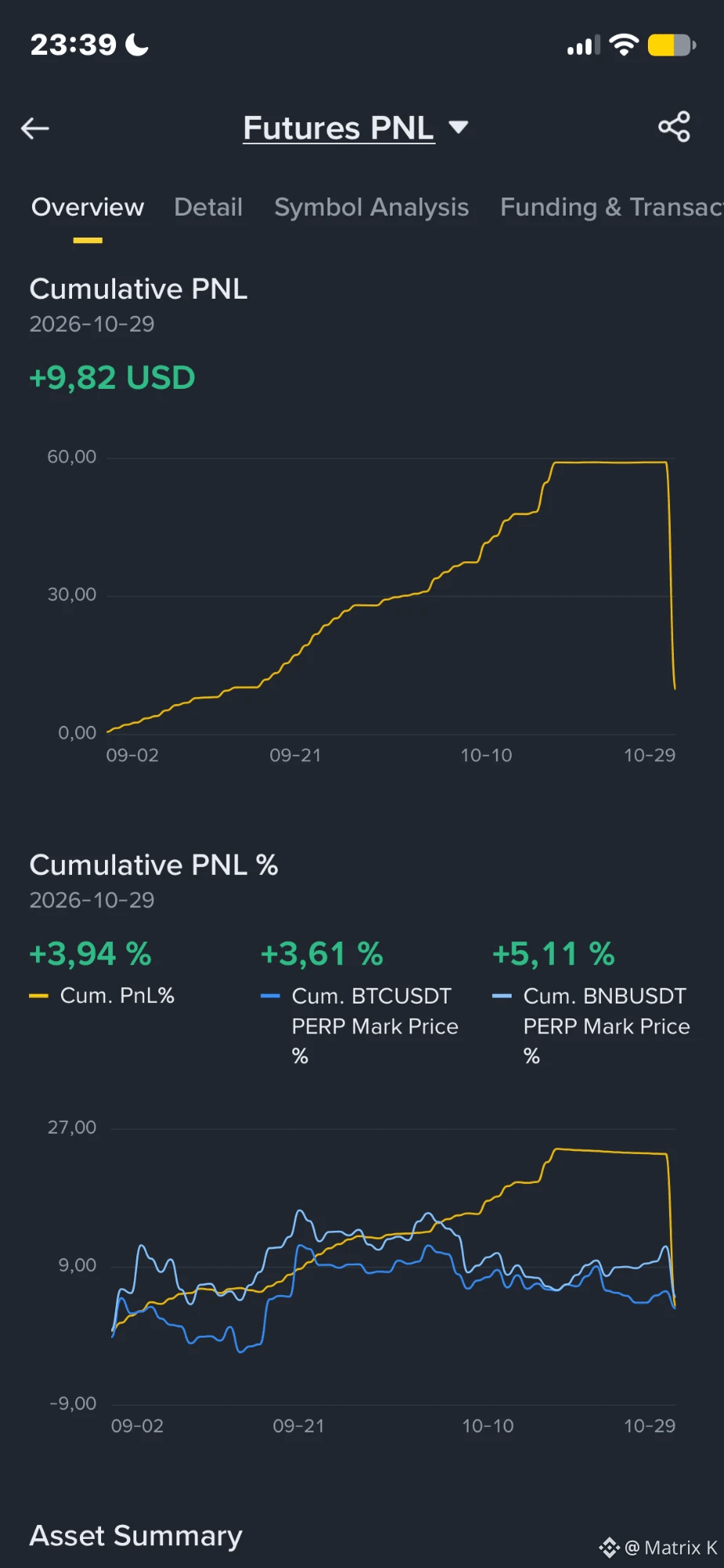
Now the part that matters. Before this liquidation the bot had taken $59.39 in profit since Sep 2, and I had withdrawn it. One liquidation took $49.56 back. Net: +$9.82 — still a bit ahead of holding $BTC over the same period (+3.94% vs +3.61%), behind $BNB (+5.11%).
Is that good? No — it’s thin. A DCA bot lives on hundreds of small take profits and dies on one liquidation. So 84% winning days says nothing here. The real metric is how many times the bot earned back its margin before losing it. This one: 1.2×.
Same coin, same night: my Veles bot entered TIA at 0.55, not 0.72. It rode the same wick with 5 of 6 orders filled — and it’s still in the game. You can’t step into the same river twice.
#DCA #trading #RiskManagement
Not financial advice. Leveraged futures can wipe out your deposit.
1
418
Article
I could make a third more by cutting stuck positions after 10 days. I didn’t.[My server bot](https://www.binance.com/ru-UA/square/post/381731011887894) was liquidated in $TIA on Oct 29, on day 12. A 10-day exit would have closed it on Oct 27 at about −$36 instead of −$49. So this time the cut would have won. I’m still not switching — here’s why.
Idle time has a price. A DCA bot has a small take profit and a heavy loss. And while a position is stuck, the slot earns nothing. So the obvious idea: don’t wait, cut the stuck position after a few days and move on. It would be the only exception to my rule: take profit or liquidation, nothing in between.
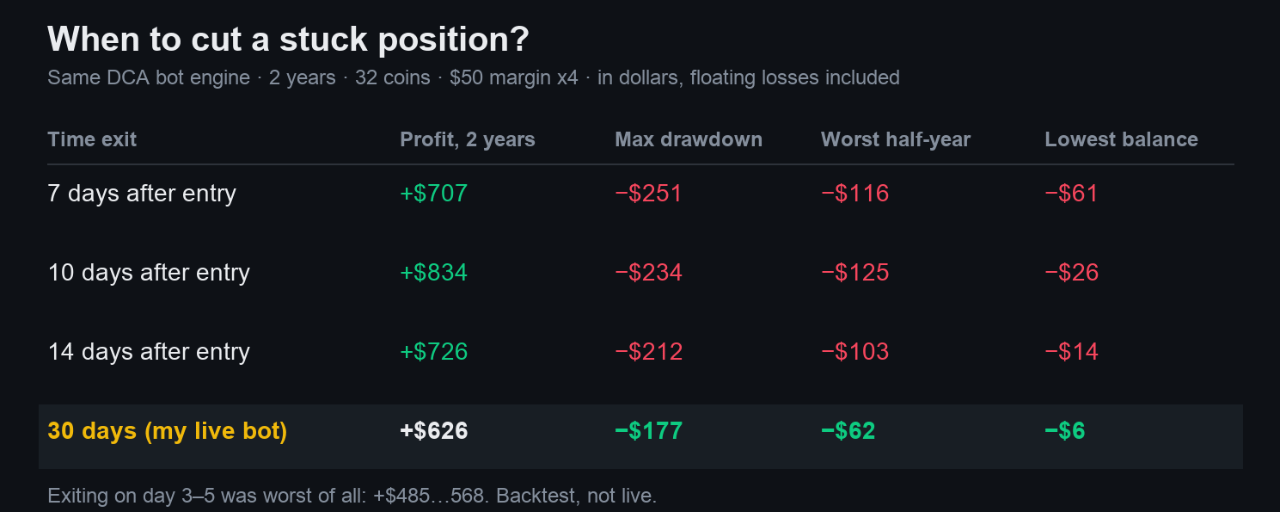
What two years of history say. I tested it on two years of data, in dollars, floating losses included (table above):
— exit on day 3–5: the worst of all. You lock in the loss right before the bounce;
— exit after 10 days: the most profitable, +$834 vs +$626 for my live rule;
— but the worst half-year doubles: −$125 vs −$62. Max drawdown −$234 vs −$177.
And the peak at 10 days looks like luck of the dates, not a rule: 7 and 14 days already give less. A real edge changes smoothly.
My live rule. So my live bot exits by a stop after 30 days — if it hasn’t taken profit or been stopped by liquidation by then. In two years of history that never happened once. It’s a safety net, not a strategy.
The bot runs on a dedicated sub-account and can size the grid from whatever is on it — one switch in the settings. That turns reinvesting into a simple choice: how much of the profit to leave in.
I chose a calmer worst case over the maximum profit.
What would you pick: +33% profit, or a worst half-year twice as calm?
Follow along: I test what I believe — and drop what the numbers don’t support.
#AlgoTrading #DCA #DCABot #TradingBot
No guessing here about where price goes or which levels to watch. Here it’s statistics and math against an unknown future.
Not financial advice. Leveraged futures can wipe out your deposit.
I could make a third more by cutting stuck positions after 10 days. I didn’t.
My server bot was liquidated in $TIA on Oct 29, on day 12. A 10-day exit would have closed it on Oct 27 at about −$36 instead of −$49. So this time the cut would have won. I’m still not switching — here’s why.
Idle time has a price. A DCA bot has a small take profit and a heavy loss. And while a position is stuck, the slot earns nothing. So the obvious idea: don’t wait, cut the stuck position after a few days and move on. It would be the only exception to my rule: take profit or liquidation, nothing in between.
What two years of history say. I tested it on two years of data, in dollars, floating losses included (table above):
— exit on day 3–5: the worst of all. You lock in the loss right before the bounce;
— exit after 10 days: the most profitable, +$834 vs +$626 for my live rule;
— but the worst half-year doubles: −$125 vs −$62. Max drawdown −$234 vs −$177.
And the peak at 10 days looks like luck of the dates, not a rule: 7 and 14 days already give less. A real edge changes smoothly.
My live rule. So my live bot exits by a stop after 30 days — if it hasn’t taken profit or been stopped by liquidation by then. In two years of history that never happened once. It’s a safety net, not a strategy.
The bot runs on a dedicated sub-account and can size the grid from whatever is on it — one switch in the settings. That turns reinvesting into a simple choice: how much of the profit to leave in.
I chose a calmer worst case over the maximum profit.
What would you pick: +33% profit, or a worst half-year twice as calm?
Follow along: I test what I believe — and drop what the numbers don’t support.
#AlgoTrading #DCA #DCABot #TradingBot
No guessing here about where price goes or which levels to watch. Here it’s statistics and math against an unknown future.
Not financial advice. Leveraged futures can wipe out your deposit.
1
3
390
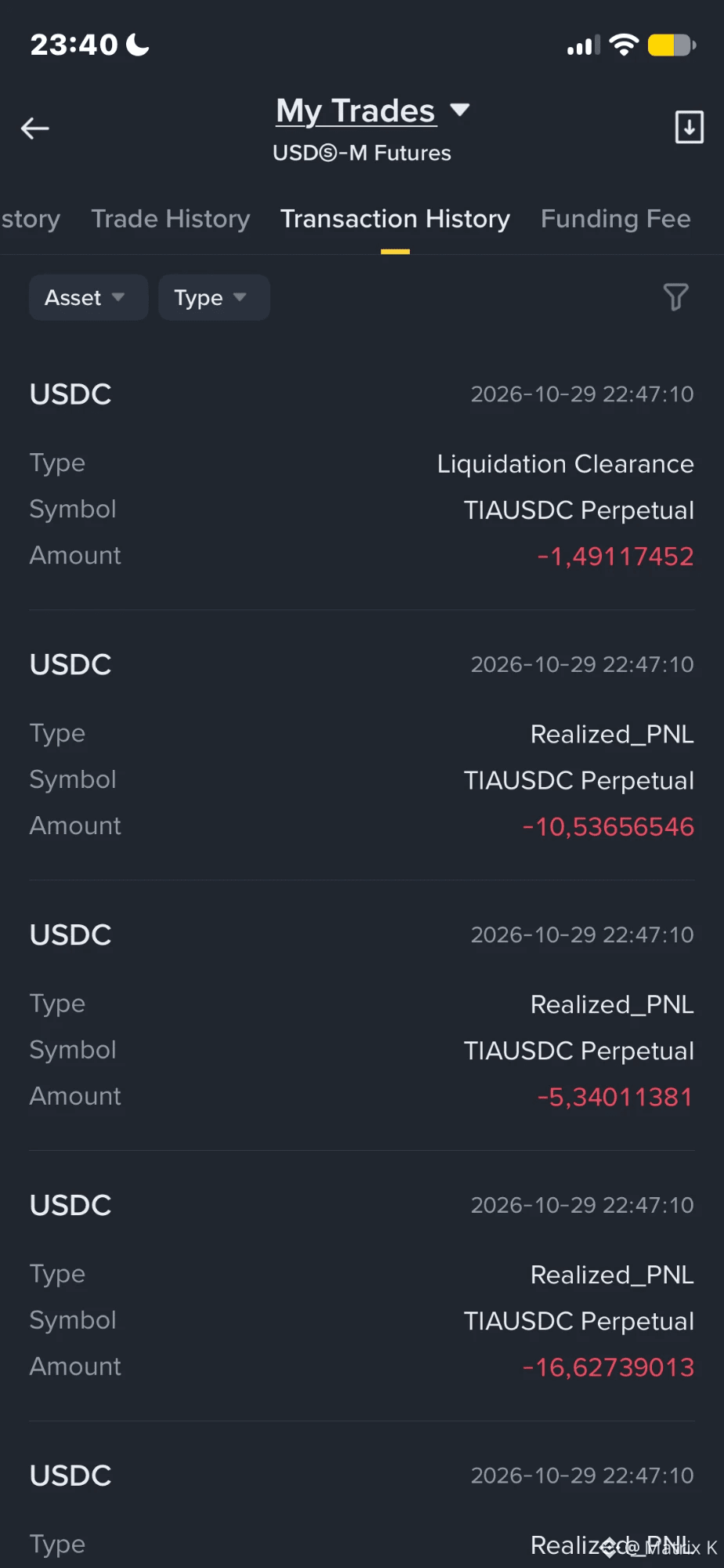
Liquidated.
Two days ago I wrote: my bot is down 91% on $TIA , I’m not touching it. Take profit or liquidation — which comes first? Tonight we got the answer.
The market dumped on reports of a Binance hack. TIA wicked to 0.486 — 1% below my liquidation price of 0.491 — and the position was closed at 22:47. Within minutes the price was back above that level.
The damage: −$49.31. The margin of this position, as planned — not a cent more.
Now the part that matters. Before this liquidation the bot had taken $59.39 in profit since Sep 2, and I had withdrawn it. One liquidation took $49.56 back. Net: +$9.82 — still a bit ahead of holding $BTC over the same period (+3.94% vs +3.61%), behind $BNB (+5.11%).
Is that good? No — it’s thin. A DCA bot lives on hundreds of small take profits and dies on one liquidation. So 84% winning days says nothing here. The real metric is how many times the bot earned back its margin before losing it. This one: 1.2×.
Same coin, same night: my Veles bot entered TIA at 0.55, not 0.72. It rode the same wick with 5 of 6 orders filled — and it’s still in the game. You can’t step into the same river twice.
#DCA #trading #RiskManagement
Not financial advice. Leveraged futures can wipe out your deposit.
Matrix Kinetic
·
--
My bot is down 91% on this position. I’m not touching it.
Day 11 in $TIA . All 7 orders filled since Oct 22. Average entry 0.648, price now 0.528. Floating loss −$36.6 on $49 of margin. Liquidation at 0.491 — about 7% below. The take profit order waits at 0.650, +23% from here.
Why so calm? Because the worst case was priced in before the first order: the loss is capped at this position’s margin, and every dollar of profit so far has already been withdrawn — $59, more than this whole margin. In two years of history, about half of such stuck positions ended with a take profit.
A drop or a flat is a phase of the market, not a flaw of the bot or of this one position. So a stuck position isn’t an accident — it’s a normal, built-in part of this kind of trading.
Patience works when both the good and the bad outcome are not hope, but part of the plan.
Take profit or liquidation — which comes first?
#DCA #trading #bot #RiskManagement
Not financial advice.
1
1
331
Thriller: [same coin](https://www.binance.com/ru-UA/square/post/382454336813501), two bots, opposite fates.
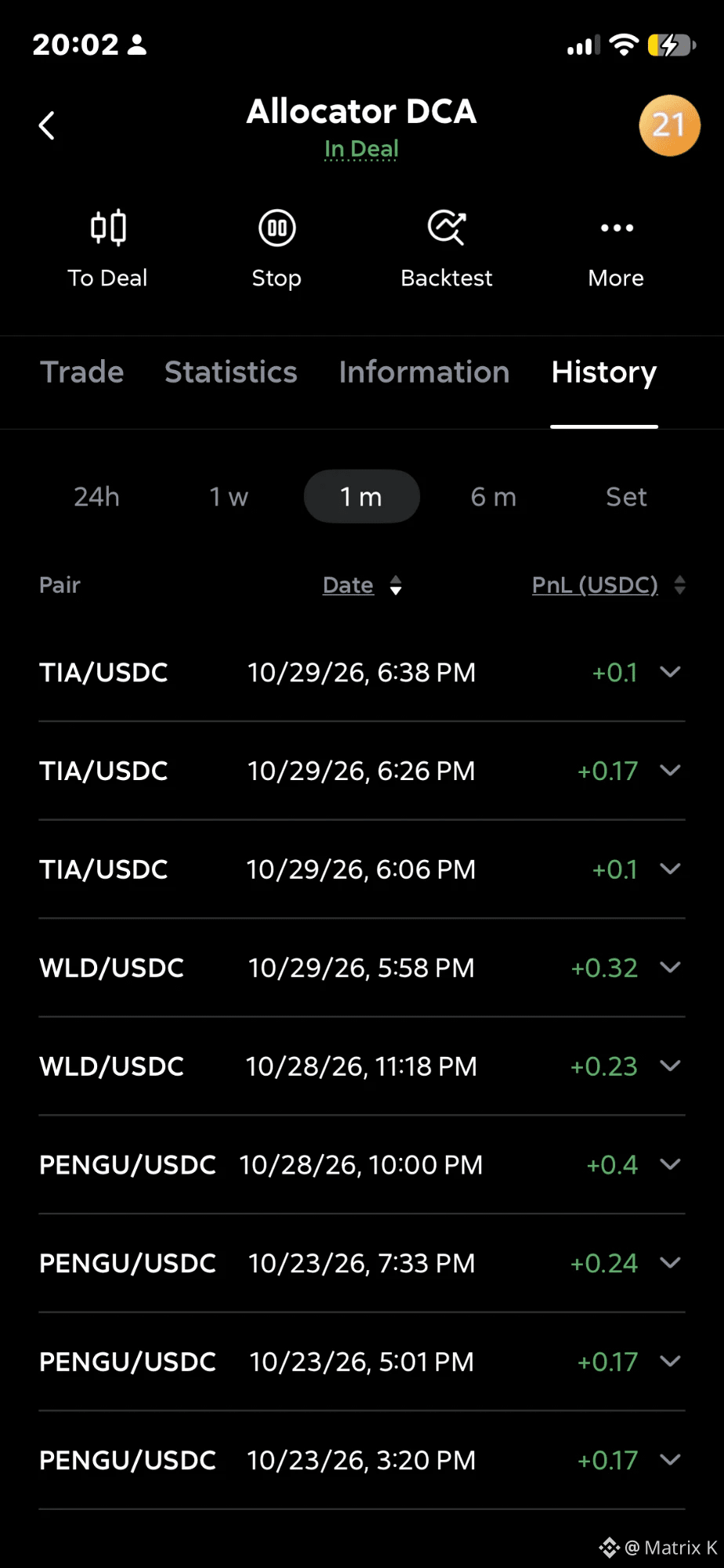
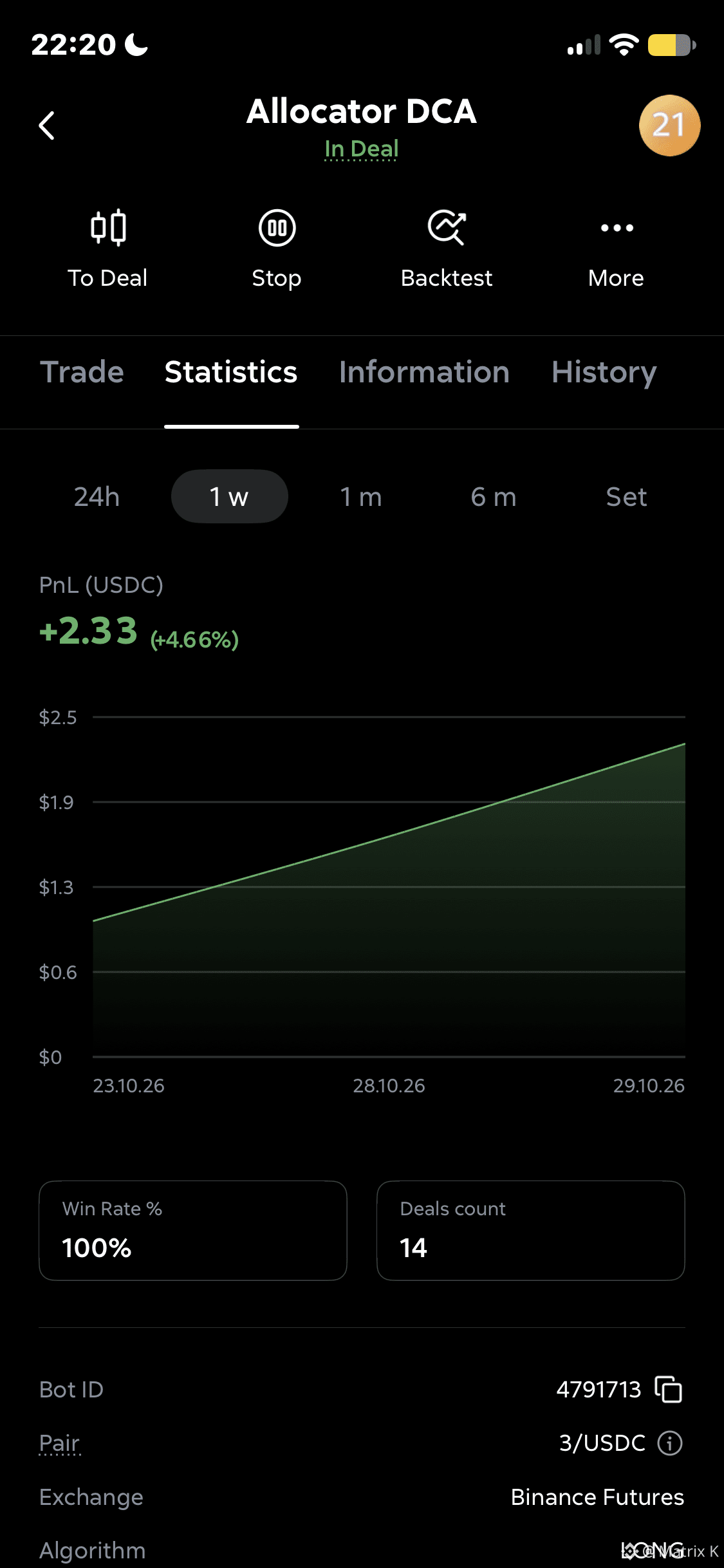
My Veles bot got out of a soft lock in $PENGU (5 days, 6 of 7 orders filled) with a take profit. And [my TradingView Allocator](https://www.binance.com/ru-UA/square/post/381524950388521) moved it on right away: first to $WLD — two take profits, +$0.23 and +$0.32 — then to $TIA . The very coin my server bot has been stuck in for 12 days. Only at completely different price levels.
Why right away? The Allocator doesn’t see the exchange — it models the bot’s grid on the chart. And now that its model matches the live bot deal for deal, it knew the slot was free the moment PENGU closed. That’s what I spent weeks getting right.
In 32 minutes the Veles bot took three take profits on TIA: +$0.10, +$0.17, +$0.10.
Same coin. Same model. Same $50. [One bot entered](https://www.binance.com/ru-UA/square/post/381731011887894) TIA on Oct 17 at 0.72 and averaged down — it’s still waiting. The other came in today, far below that average, and is harvesting the bounces.
Look at the coin tags below: today WLD is −4% and TIA −0.8% — and the bot took profit on both. It doesn’t need a coin to rise over the day. It needs bounces inside the day. Direction only bites when the bounces stop — that’s when a position gets stuck.
The coin isn’t good or bad. The moment of entry is everything. You can’t step into the same river twice.
Veles bot so far: 14 deals, all closed in profit, +$2.33.
#DCA #trading #RiskManagement
Not financial advice.
Thriller: same coin, two bots, opposite fates.
My Veles bot got out of a soft lock in $PENGU (5 days, 6 of 7 orders filled) with a take profit. And my TradingView Allocator moved it on right away: first to $WLD — two take profits, +$0.23 and +$0.32 — then to $TIA . The very coin my server bot has been stuck in for 12 days. Only at completely different price levels.
Why right away? The Allocator doesn’t see the exchange — it models the bot’s grid on the chart. And now that its model matches the live bot deal for deal, it knew the slot was free the moment PENGU closed. That’s what I spent weeks getting right.
In 32 minutes the Veles bot took three take profits on TIA: +$0.10, +$0.17, +$0.10.
Same coin. Same model. Same $50. One bot entered TIA on Oct 17 at 0.72 and averaged down — it’s still waiting. The other came in today, far below that average, and is harvesting the bounces.
Look at the coin tags below: today WLD is −4% and TIA −0.8% — and the bot took profit on both. It doesn’t need a coin to rise over the day. It needs bounces inside the day. Direction only bites when the bounces stop — that’s when a position gets stuck.
The coin isn’t good or bad. The moment of entry is everything. You can’t step into the same river twice.
Veles bot so far: 14 deals, all closed in profit, +$2.33.
#DCA #trading #RiskManagement
Not financial advice.
2
1.3k
Same strategy, same $50, two bots. One has been stuck for 12 days. The other just got out.
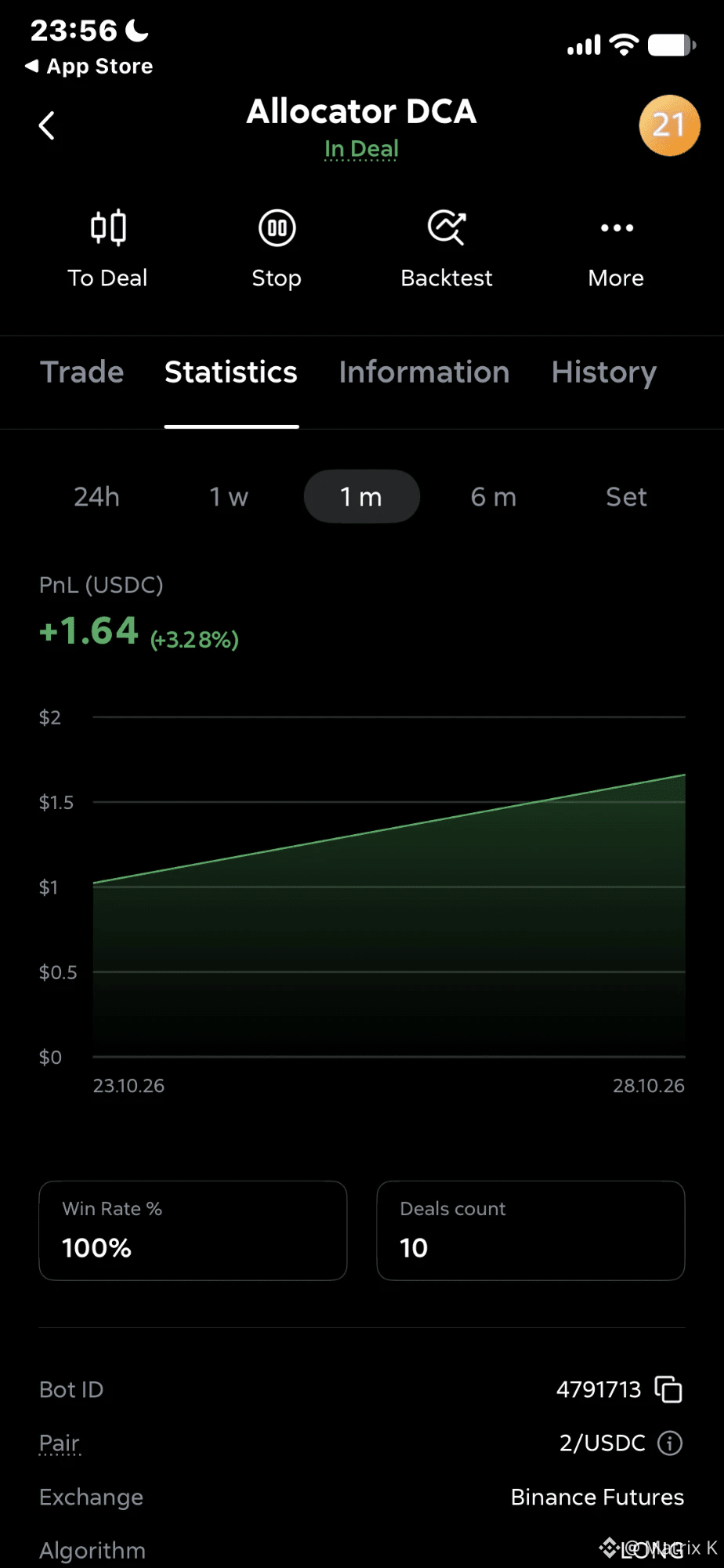
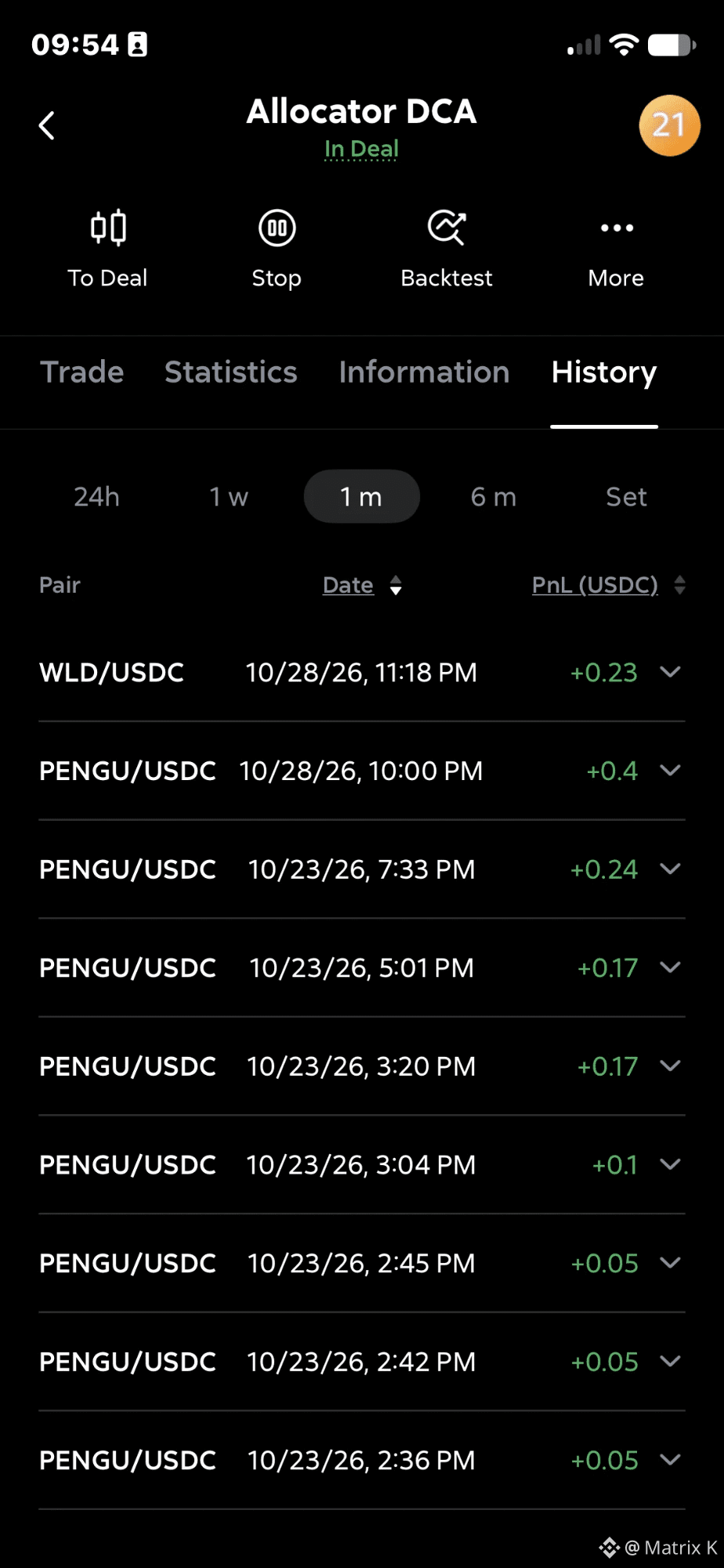
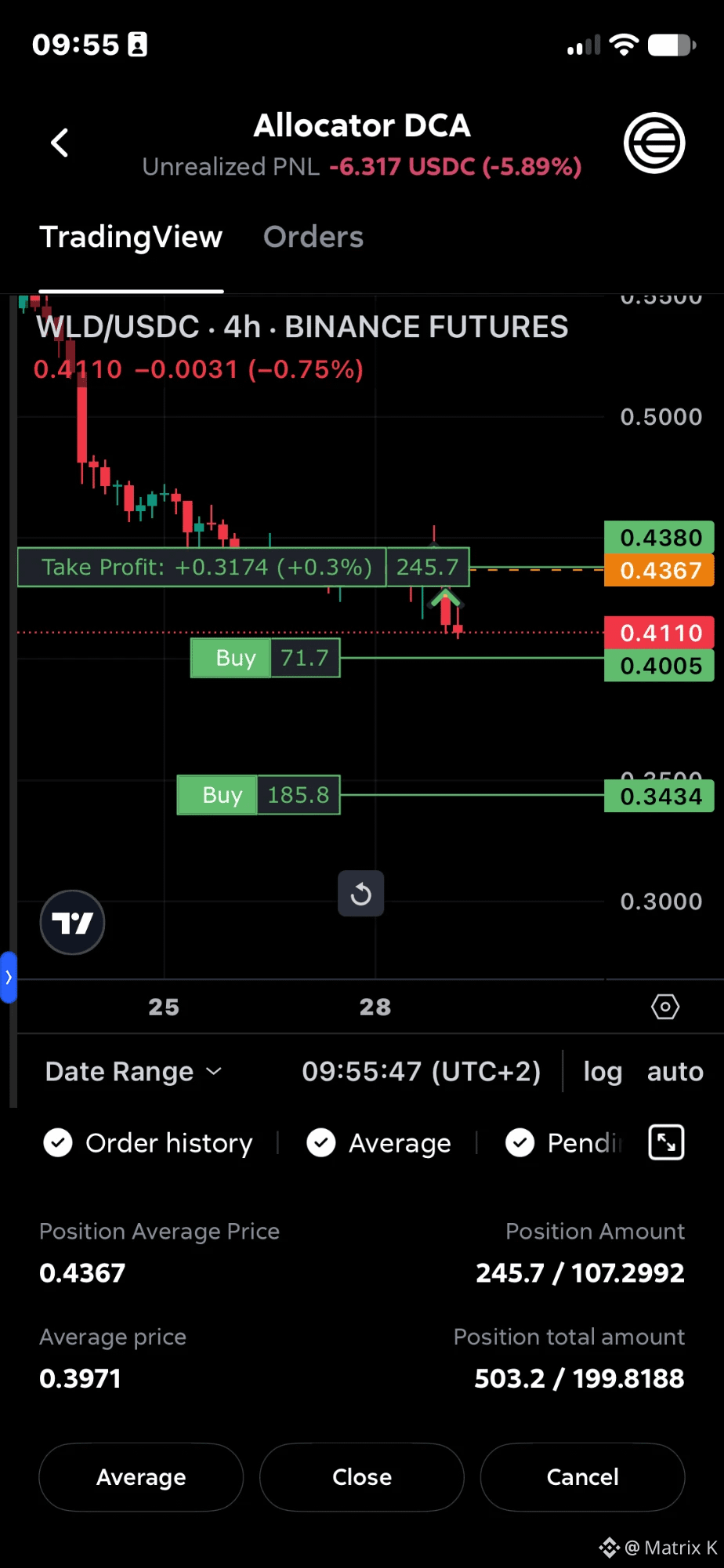
[My server bot](https://app.binance.com/uni-qr/cpos/381731011887894?r=TNJU8S9U&l=ru&uco=AagGjLOokrPuIhYfyh11nQ&uc=app_square_share_link&us=copylink) has held $TIA since Oct 17 (all orders filled by Oct 22). My second bot — running on Veles, driven by the same model through my TradingView Allocator, also with a $50 limit — was stuck in $PENGU for 5 days with 6 out of 7 orders filled. Last night PENGU finally bounced: take profit +$0.40. An hour later, the bot was already in $WLD : another +$0.23, and now a new WLD deal is open (screenshots below).
Why different coins? Same logic, but different pools — the server bot picks from 32 coins, the Veles bot from 12 — and different start dates: Sep 2 vs Oct 23. The exact same model launched at a different moment lives a completely different life. You can’t enter the market twice the same way, just as you can’t step into the same river twice.
So while one $50 waits, the other works. Call it diversification of idle time. And every round of the second bot is one more live check of the model: 10 deals, all closed in profit, +$1.64 in 6 days.
It might sound small until you do the math: that’s +3.28% to the deposit in closed deals in less than a week. The open WLD deal is −$6.3 right now — that’s part of the picture too.
#DCA #trading #RiskManagement
Not financial advice.
Same strategy, same $50, two bots. One has been stuck for 12 days. The other just got out.
My server bot has held $TIA since Oct 17 (all orders filled by Oct 22). My second bot — running on Veles, driven by the same model through my TradingView Allocator, also with a $50 limit — was stuck in $PENGU for 5 days with 6 out of 7 orders filled. Last night PENGU finally bounced: take profit +$0.40. An hour later, the bot was already in $WLD : another +$0.23, and now a new WLD deal is open (screenshots below).
Why different coins? Same logic, but different pools — the server bot picks from 32 coins, the Veles bot from 12 — and different start dates: Sep 2 vs Oct 23. The exact same model launched at a different moment lives a completely different life. You can’t enter the market twice the same way, just as you can’t step into the same river twice.
So while one $50 waits, the other works. Call it diversification of idle time. And every round of the second bot is one more live check of the model: 10 deals, all closed in profit, +$1.64 in 6 days.
It might sound small until you do the math: that’s +3.28% to the deposit in closed deals in less than a week. The open WLD deal is −$6.3 right now — that’s part of the picture too.
#DCA #trading #RiskManagement
Not financial advice.
3
1.1k
Judging by the reactions, not everyone gets me right.
This blog is not about complaining about my own bot that needs fixing ASAP.
I’m actually quite happy with it :) — because I built something no service gives you at any price. Simply because there is no such service.
This blog is about algo trading, tested on data and not dressed up with anything.
About what you won’t find on Square or anywhere else, buried under generic phrases, reposts and information spam.
About what will finally free me from the damn monitor full of charts — so that trading by hand becomes rest, not work :)
Practical advice and constructive criticism are welcome :)
#DCA #trading #RiskManagement
Not financial advice.
1
88
Article
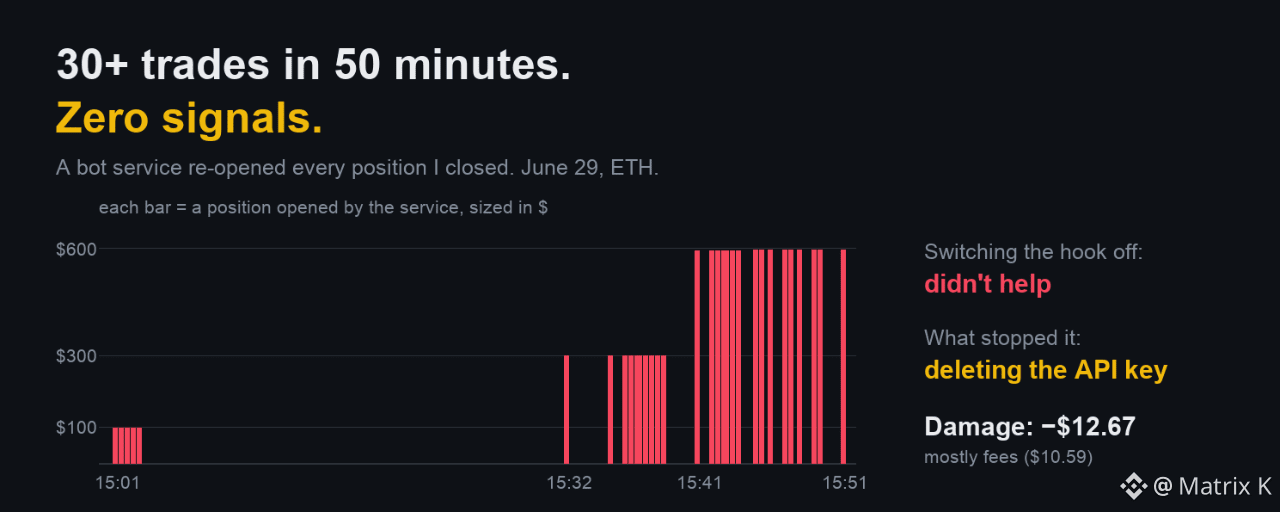
A bot can't withdraw your money. It can still wipe your depositJune 29. Finandy was running my $ETH strategy: enter on a signal, exit by take profit or stop. The last signal came in the morning. At 15:01 the stop fired — and Finandy instantly opened a new position on its own. Then again. Each time I closed it, it reopened, and the size grew: $100, then $300, then $600.
Turning the hook off didn't help. Only one thing stopped it: deleting the API key on the exchange.
Damage: −$12.67, most of it fees for all those market entries and exits. Cheap — because Telegram alerts made me look in time.
The day in numbers: 33 trades, 4 winners, $10.59 in fees.
Our best explanation: the platform kept the signal "alive" after a stop and kept re-entering, unless a "close position" option was enabled — nothing in the docs said it was required.
Finandy itself wouldn't let me close those positions, so I closed them on the exchange directly. Support used exactly that to reject my claim: "we don't review positions traded through an external interface." :) In September Finandy shut down for good.
What every third-party bot user should know. An API key without withdrawal rights is the standard advice, and it's right — it protects you from theft. It doesn't protect you from a bot that goes rogue: with trading rights alone, it can burn a deposit through fees, market orders, leverage — and positions opened against the market. My loop had 2x leverage and growing size. Without Telegram alerts, −$12.67 could have been the whole account. So: trade from a sub-account with only the money you're ready to lose, use isolated margin, turn on alerts — and know that your real kill switch is deleting the API key on the exchange, not a button in the app.
Why my own bot now. A platform is a black box: you can't see its state, you can't fix it, and its support decides whether it was your fault. My own server bot checks the real position on the exchange before every order — and if something goes wrong, I can read the code and change it. Don't trust any platform with what you can't change yourself.
#UKAlgorithmicCryptoTradingAppsMayNeedFCAAuthorization #TradingBot #DCABot
Not financial advice.
A bot can't withdraw your money. It can still wipe your deposit
June 29. Finandy was running my $ETH strategy: enter on a signal, exit by take profit or stop. The last signal came in the morning. At 15:01 the stop fired — and Finandy instantly opened a new position on its own. Then again. Each time I closed it, it reopened, and the size grew: $100, then $300, then $600.
Turning the hook off didn't help. Only one thing stopped it: deleting the API key on the exchange.
Damage: −$12.67, most of it fees for all those market entries and exits. Cheap — because Telegram alerts made me look in time.
The day in numbers: 33 trades, 4 winners, $10.59 in fees.
Our best explanation: the platform kept the signal "alive" after a stop and kept re-entering, unless a "close position" option was enabled — nothing in the docs said it was required.
Finandy itself wouldn't let me close those positions, so I closed them on the exchange directly. Support used exactly that to reject my claim: "we don't review positions traded through an external interface." :) In September Finandy shut down for good.
What every third-party bot user should know. An API key without withdrawal rights is the standard advice, and it's right — it protects you from theft. It doesn't protect you from a bot that goes rogue: with trading rights alone, it can burn a deposit through fees, market orders, leverage — and positions opened against the market. My loop had 2x leverage and growing size. Without Telegram alerts, −$12.67 could have been the whole account. So: trade from a sub-account with only the money you're ready to lose, use isolated margin, turn on alerts — and know that your real kill switch is deleting the API key on the exchange, not a button in the app.
Why my own bot now. A platform is a black box: you can't see its state, you can't fix it, and its support decides whether it was your fault. My own server bot checks the real position on the exchange before every order — and if something goes wrong, I can read the code and change it. Don't trust any platform with what you can't change yourself.
#UKAlgorithmicCryptoTradingAppsMayNeedFCAAuthorization #TradingBot #DCABot
Not financial advice.
3
489
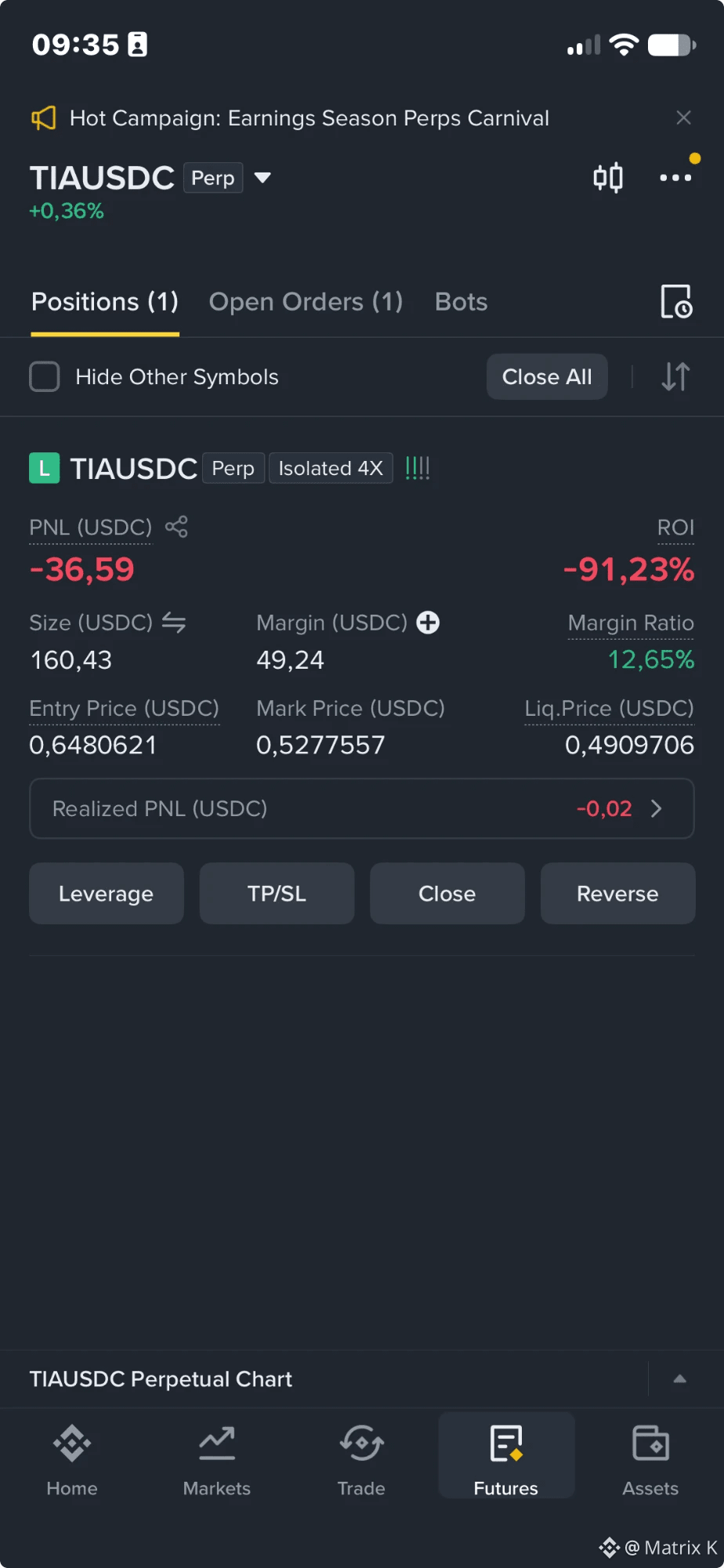
My bot is down 91% on this position. I’m not touching it.
Day 11 in $TIA . All 7 orders filled since Oct 22. Average entry 0.648, price now 0.528. Floating loss −$36.6 on $49 of margin. Liquidation at 0.491 — about 7% below. The take profit order waits at 0.650, +23% from here.
Why so calm? Because the worst case was priced in before the first order: the loss is capped at this position’s margin, and every dollar of profit so far has already been withdrawn — $59, more than this whole margin. In two years of history, about half of such stuck positions ended with a take profit.
A drop or a flat is a phase of the market, not a flaw of the bot or of this one position. So a stuck position isn’t an accident — it’s a normal, built-in part of this kind of trading.
Patience works when both the good and the bad outcome are not hope, but part of the plan.
Take profit or liquidation — which comes first?
#DCA #trading #bot #RiskManagement
Not financial advice.
Take profit first
0%
Liquidation first
0%
0 votes • Voting closed
1
1
1.8k
Article
Why grid backtests on 5-minute candles lie — and how I made my model match the live botMy main DCA bot is code on a server — it sees the exchange directly. But one day I wanted to run the same strategy on another exchange and another market, here and now. Why dig into the server and rewrite the bot when you can have a separate engine that launches in minutes? So I moved its logic to TradingView — for myself: every hour, pick the most volatile coin with a rising trend from a pool and send it to any bot with a webhook. That's how the Allocator was born.
Moving the idea turned out to be only half the job. An idea can be right while its execution is wrong. I've tried plenty of strategies and indicators on TradingView, and none of them survived contact with live trading. So I decided to test mine live from day one.
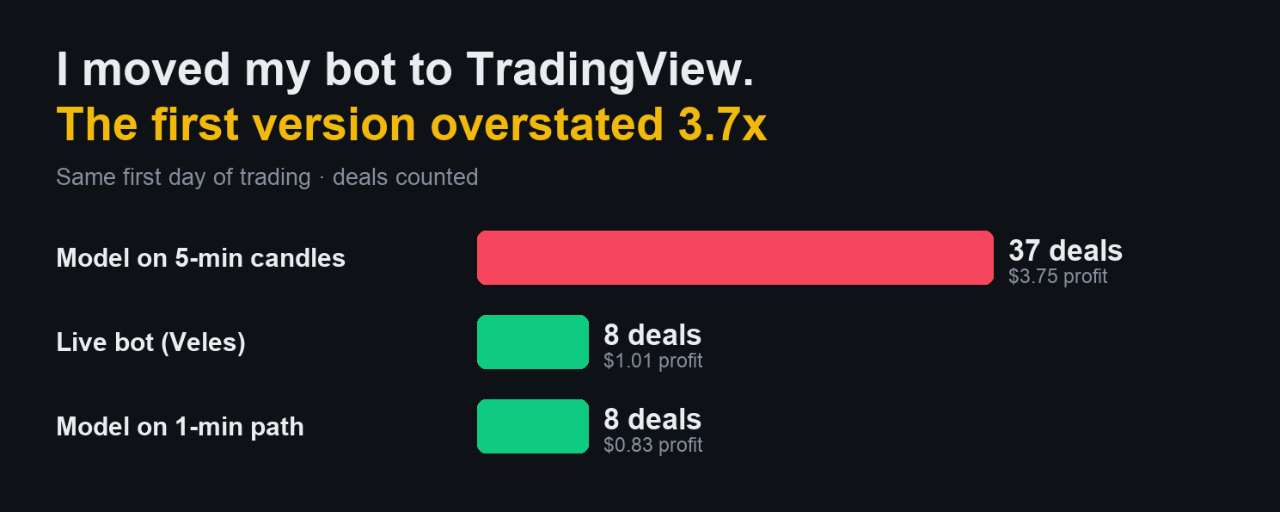
The test. On October 23 I launched a multi-pair bot on Veles driven by the Allocator and watched the TradingView model side by side. In the first 24 hours the bot made 8 deals and $1.01 profit. The model counted 37 deals and $3.75. A 3.7x gap. On history, the Pine model overstated deals and profit 3–5x.
The cause is not the idea but TradingView itself. The model was calculated on 5-minute candles. Inside a candle it sees the high and the low, but not which came first. It "bought" at the low and immediately "sold" at the high — while in reality the high often came before the low, and that trade never happened. This trap applies to any grid backtest: if the take profit is smaller than the candle's range, the model draws trades that never existed.
As often happens, I found this by chance — only because I ran the bot next to the model. As Pushkin put it: "And chance, the god of invention."
The fix. Now the Allocator walks every candle minute by minute, in the right order. The same 24 hours: 8 deals vs 8, $0.83 vs $1.01. And right now, with a live stuck position in $PENGU , the model and the bot match: same entry, same 6 of 7 orders filled, average price 0.00786 vs 0.00787 (screenshots below). Where TradingView has no minute history (beyond roughly three weeks), the table itself marks the numbers red as "overstated".
https://www.tradingview.com/x/xETdrAUx/
Besides picking the coin, the Allocator is built as a handy test bench: turn on the second dashboard and change the grid's geometry and depth on the fly — and even how it's built, by price step or by total coverage. No separate script for each test run: the whole picture and the alternatives are right in front of you.
I now have two executors of one strategy: the server bot since September 2 and Veles with the Allocator since October 23.
Follow along: I test what I believe — and drop what the numbers don't support.
#DCA #trading #RiskManagement
No guessing here about where price goes or which levels to watch. Here it's statistics and math against an unknown future.
Not financial advice. Leveraged futures can wipe out your deposit.
Why grid backtests on 5-minute candles lie — and how I made my model match the live bot
My main DCA bot is code on a server — it sees the exchange directly. But one day I wanted to run the same strategy on another exchange and another market, here and now. Why dig into the server and rewrite the bot when you can have a separate engine that launches in minutes? So I moved its logic to TradingView — for myself: every hour, pick the most volatile coin with a rising trend from a pool and send it to any bot with a webhook. That's how the Allocator was born.
Moving the idea turned out to be only half the job. An idea can be right while its execution is wrong. I've tried plenty of strategies and indicators on TradingView, and none of them survived contact with live trading. So I decided to test mine live from day one.
The test. On October 23 I launched a multi-pair bot on Veles driven by the Allocator and watched the TradingView model side by side. In the first 24 hours the bot made 8 deals and $1.01 profit. The model counted 37 deals and $3.75. A 3.7x gap. On history, the Pine model overstated deals and profit 3–5x.
The cause is not the idea but TradingView itself. The model was calculated on 5-minute candles. Inside a candle it sees the high and the low, but not which came first. It "bought" at the low and immediately "sold" at the high — while in reality the high often came before the low, and that trade never happened. This trap applies to any grid backtest: if the take profit is smaller than the candle's range, the model draws trades that never existed.
As often happens, I found this by chance — only because I ran the bot next to the model. As Pushkin put it: "And chance, the god of invention."
The fix. Now the Allocator walks every candle minute by minute, in the right order. The same 24 hours: 8 deals vs 8, $0.83 vs $1.01. And right now, with a live stuck position in $PENGU , the model and the bot match: same entry, same 6 of 7 orders filled, average price 0.00786 vs 0.00787 (screenshots below). Where TradingView has no minute history (beyond roughly three weeks), the table itself marks the numbers red as "overstated".
https://www.tradingview.com/x/xETdrAUx/
Besides picking the coin, the Allocator is built as a handy test bench: turn on the second dashboard and change the grid's geometry and depth on the fly — and even how it's built, by price step or by total coverage. No separate script for each test run: the whole picture and the alternatives are right in front of you.
I now have two executors of one strategy: the server bot since September 2 and Veles with the Allocator since October 23.
Follow along: I test what I believe — and drop what the numbers don't support.
#DCA #trading #RiskManagement
No guessing here about where price goes or which levels to watch. Here it's statistics and math against an unknown future.
Not financial advice. Leveraged futures can wipe out your deposit.
3
610
My bot used to sit idle 55 minutes out of every hour
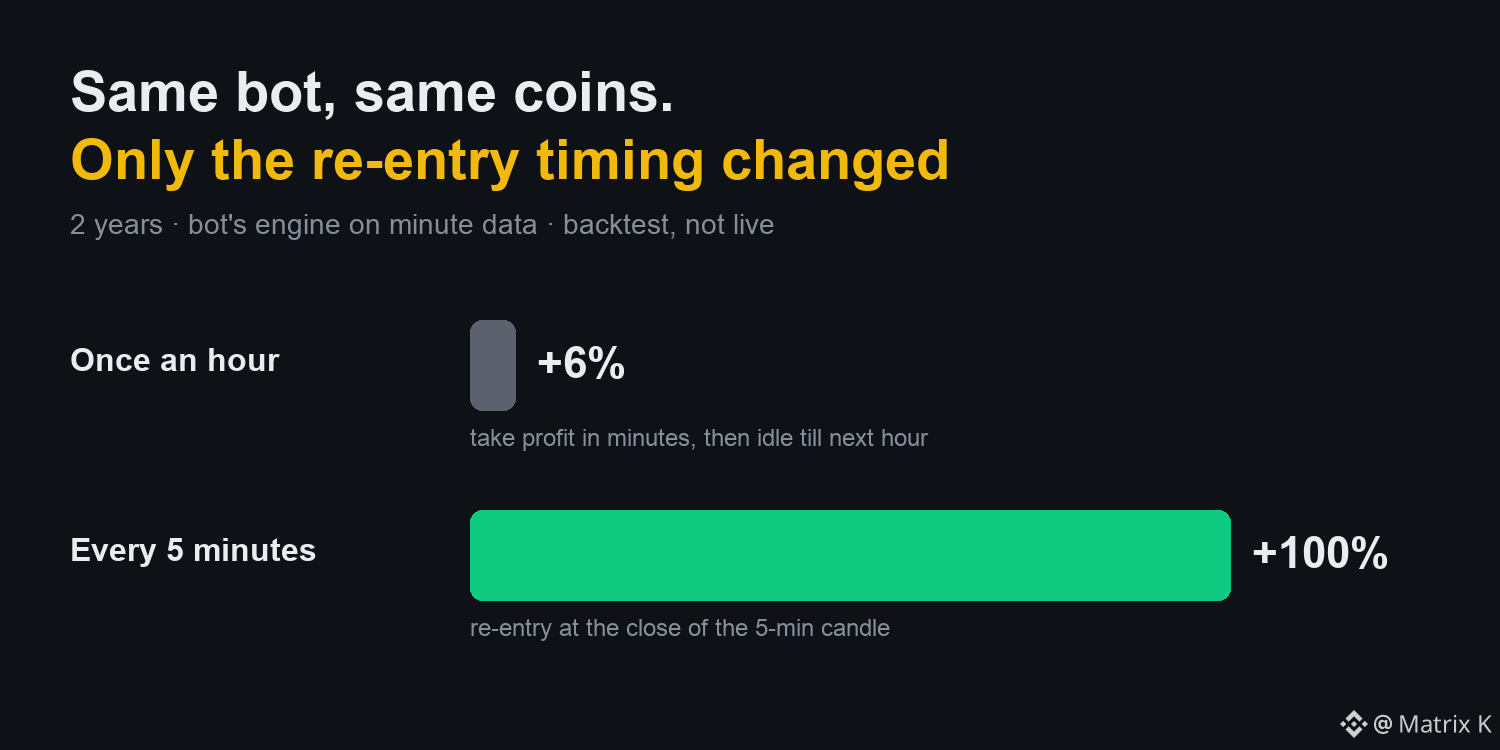
At first my DCA bot lived strictly on the 1-hour chart. Every hour it picked the most volatile coin and opened a grid. Often the take profit filled within 30 seconds to 5 minutes — and then the bot sat on the fence until the next hour, skipping exactly the same entries. A closed hourly candle felt like the measure of truth.
So I tested re-entries inside the hour. The coin is still picked by the last closed hourly candle, but after a take profit the bot may come back every 30, 15 or 5 minutes. Every 30 minutes gave about the same as once an hour, every 15 minutes was noticeably better, every 5 minutes was best of all: +100% over two years versus +6% for once an hour. (These are backtests of the bot's engine on minute data, not live results.)
One rule matters: the bot re-enters at the close of the current 5-minute candle — the one where the take profit filled — not right after the take profit. A take profit fills on a spike near the top of the candle, so buying immediately means buying that top. Waiting for the candle to close filters out entries on wicks and local pumps — and in tests, re-entering immediately was worse than not re-entering at all.
Since October this is how my bot works: the hour picks the coin, the 5 minutes decide when to come back. Up to 12 entries an hour instead of one.
#DCA #TradingBot #GridTrading
Not financial advice.
1
124
Log in to explore more content
Join global crypto users on Binance Square
⚡️ Get latest and useful information about crypto.
💬 Trusted by the world’s largest crypto exchange.
👍 Discover real insights from verified creators.
Email / Phone number
Trending Topics
BinanceReopensWithdrawalsForHYPE&APT
4,728 views
145 Discussing
#binancereopenswithdrawalsforhype&apt
🚨 Binance Reopens Withdrawals for HYPE and APT – Another Step Toward Normal Operations!
More good news for Binance users!
Binance has reopened withdrawals for HYPE and APT, allowing users to access and move these assets again after the recent withdrawal disruption.
But why does this matter?
🔍 What Happened?
Withdrawals for HYPE and APT are available again.
Users can once again move their assets off the exchange.
Binance continues restoring services following the recent disruption.
🔥 Why It Matters:
After the security incident that shook market confidence, every restored service matters.
Users are watching closely, and the return of withdrawals is another important step toward normal operations.
However, reopening withdrawals doesn't automatically mean every concern has disappeared. Security, transparency, and user confidence remain critical.
The real question now: Can Binance fully restore user confidence and put this incident behind it?
#Binance #hype #APT $BTC $HYPE $APT
Faizan Crypto Learner
·0 Likes
·467 views
SouthKoreaDraftLawTargets15To20%ShareholderCap
8,286 views
128 Discussing
TradFiForBeginners
118,964 views
1,189 Discussing