
N P Centre
178 Posts

N P Centre
Report
Block User
Processing Centre...
Follow for #Tips, #Queries, #Advice, #Breaks, #Signals, #Jokes, #News, #Memes etc...
NEW!!! @MrPus-Trader Tips...👍🏻👍🏻👍🏻👍🏽👍🏽👍🏽
Open Trade
High-Frequency Trader
2.2 Years
683 Following
265 Followers
163 Liked
Posts
Portfolio
All
Quotes
·
--
Article
📰 IN CASE YOU MISSED IT…NPC…📢
Hey☺️noobies…
Binance Blockchain Week – Key Highlights
A look at some of the announcements, milestones and forward-looking developments shared during Binance Blockchain Week.
🔶 BINANCE
Added approximately 7,000 tokenized stocks, expanding access to traditional equity markets for users who might otherwise have limited exposure.Fractional ownership is helping broaden participation in globally successful companies, bringing more people into the shareholder ecosystem.Reported significant growth, with figures of $1B and $1.5B recorded over a five-month period.Binance Chat is now open to all users, broadening community interaction across the platform.Continued emphasis on building products for a wider spectrum of users.Community highlighted as a valuable asset to the platform and the wider blockchain ecosystem.Expansion into new regions and markets remains ongoing.
🔵 TRON INC. – JUSTIN SUN
2026: The Stablecoin Focus
TRON's stablecoin market capitalization stands at approximately $95B, with $100B as the next milestone.Reported daily transaction figures of approximately $30B.USDT market capitalization recorded roughly 50% year-on-year growth.Continued expansion of productive capacity across other products and services.Tokenized stocks identified as a Q4 priority.AI and quantum technologies also featured, including the launch of a proprietary AI website.TRON Inc. reported $40B in profit during the first nine months of 2026.Briefly highlighted the TRON ETF milestone.
2027 Outlook: Strengthening financial infrastructure through RWAs, tokenized stocks, AI and AI APIs, asset management, and improved global financial access.
🟢 CELO
Reported more than 20 million users, doubling its user base this year.Positioned itself as a blockchain where stablecoins have meaningful everyday utility, particularly across Latin America, Sub-Saharan Africa and Southeast Asia.Real-world applications include swaps, mobile airtime and data, utility payments and salary distributions.More than 75 mini-apps reportedly operating within its ecosystem.Visa on Celo offers up to 5% gold cashback.Reported a 99.3% market share in tokenized gold tied to Tether.USAT, issued by Anchorage, also featured in the discussion.Added 29 currencies to its FX offering, with exponential growth reported during 2026.Celo buybacks exceeded $10M, representing a tenfold increase.
🟣 KITE
Building Payment Infrastructure for AI Agents
Developing a payment infrastructure that allows AI agents to transact through Kite Passports.Mainnet launched approximately five months ago.Reported more than 1.9 billion transactions processed.User base increased by 80%.Payment infrastructure now supports more than 3,000 services across eight or more blockchain networks.
2027 Outlook: Expanding agent-driven applications into retail and finance, with further emphasis on security and the infrastructure needed to support autonomous AI transactions.
THE BIGGER PICTURE
Across these presentations, a few themes stood out: tokenization, stablecoin adoption, real-world utility, broader financial access and the emerging relationship between AI and blockchain.
The industry is increasingly moving beyond speculation and toward infrastructure designed to facilitate everyday economic activity.
The next phase may be less about who has the biggest blockchain, and more about who can make blockchain indispensable.
#BinanceSquareTalks #BinanceBlockchainWeek
$BNB $BTC $ZEC
📰 IN CASE YOU MISSED IT…
NPC…📢
Hey☺️noobies…
Binance Blockchain Week – Key Highlights
A look at some of the announcements, milestones and forward-looking developments shared during Binance Blockchain Week.
🔶 BINANCE
Added approximately 7,000 tokenized stocks, expanding access to traditional equity markets for users who might otherwise have limited exposure.Fractional ownership is helping broaden participation in globally successful companies, bringing more people into the shareholder ecosystem.Reported significant growth, with figures of $1B and $1.5B recorded over a five-month period.Binance Chat is now open to all users, broadening community interaction across the platform.Continued emphasis on building products for a wider spectrum of users.Community highlighted as a valuable asset to the platform and the wider blockchain ecosystem.Expansion into new regions and markets remains ongoing.
🔵 TRON INC. – JUSTIN SUN
2026: The Stablecoin Focus
TRON's stablecoin market capitalization stands at approximately $95B, with $100B as the next milestone.Reported daily transaction figures of approximately $30B.USDT market capitalization recorded roughly 50% year-on-year growth.Continued expansion of productive capacity across other products and services.Tokenized stocks identified as a Q4 priority.AI and quantum technologies also featured, including the launch of a proprietary AI website.TRON Inc. reported $40B in profit during the first nine months of 2026.Briefly highlighted the TRON ETF milestone.
2027 Outlook: Strengthening financial infrastructure through RWAs, tokenized stocks, AI and AI APIs, asset management, and improved global financial access.
🟢 CELO
Reported more than 20 million users, doubling its user base this year.Positioned itself as a blockchain where stablecoins have meaningful everyday utility, particularly across Latin America, Sub-Saharan Africa and Southeast Asia.Real-world applications include swaps, mobile airtime and data, utility payments and salary distributions.More than 75 mini-apps reportedly operating within its ecosystem.Visa on Celo offers up to 5% gold cashback.Reported a 99.3% market share in tokenized gold tied to Tether.USAT, issued by Anchorage, also featured in the discussion.Added 29 currencies to its FX offering, with exponential growth reported during 2026.Celo buybacks exceeded $10M, representing a tenfold increase.
🟣 KITE
Building Payment Infrastructure for AI Agents
Developing a payment infrastructure that allows AI agents to transact through Kite Passports.Mainnet launched approximately five months ago.Reported more than 1.9 billion transactions processed.User base increased by 80%.Payment infrastructure now supports more than 3,000 services across eight or more blockchain networks.
2027 Outlook: Expanding agent-driven applications into retail and finance, with further emphasis on security and the infrastructure needed to support autonomous AI transactions.
THE BIGGER PICTURE
Across these presentations, a few themes stood out: tokenization, stablecoin adoption, real-world utility, broader financial access and the emerging relationship between AI and blockchain.
The industry is increasingly moving beyond speculation and toward infrastructure designed to facilitate everyday economic activity.
The next phase may be less about who has the biggest blockchain, and more about who can make blockchain indispensable.
#BinanceSquareTalks #BinanceBlockchainWeek
$BNB $BTC $ZEC
1
407
·
--
Article
NPC🗞️NEWS:💡 EDITORIAL UPDATE:
When we first examined the $6.34 billion Binance hack, the central concern was how stolen funds could be laundered despite blockchain's transparent transaction records.
{future}(BTCUSDT)
The FBI's latest $1.2 billion seizure action suggests that transparency is becoming a powerful recovery tool. But tracing, freezing and actually recovering stolen assets remain very different challenges.
The original breach exposed weaknesses in crypto security and enforcement. This recovery operation demonstrates what's possible when blockchain intelligence, international cooperation and regulatory authority work together.
THE BIGGER TAKEAWAY: Crypto doesn't necessarily need to abandon decentralisation to become safer. It needs an ecosystem where transparency is matched by accountability, security by design, and enforcement that can keep pace with innovation.
{future}(BNBUSDT)
Because if we can trace billions after they're stolen, we should be investing just as much effort in making them harder to steal in the first place. Recovery is progress. Prevention is the real victory.
$BTC $BNB $NVDAB #CryptoSecurity #bull #bearishmomentum
NPC🗞️NEWS:
💡 EDITORIAL UPDATE:
When we first examined the $6.34 billion Binance hack, the central concern was how stolen funds could be laundered despite blockchain's transparent transaction records.
The FBI's latest $1.2 billion seizure action suggests that transparency is becoming a powerful recovery tool. But tracing, freezing and actually recovering stolen assets remain very different challenges.
The original breach exposed weaknesses in crypto security and enforcement. This recovery operation demonstrates what's possible when blockchain intelligence, international cooperation and regulatory authority work together.
THE BIGGER TAKEAWAY: Crypto doesn't necessarily need to abandon decentralisation to become safer. It needs an ecosystem where transparency is matched by accountability, security by design, and enforcement that can keep pace with innovation.
Because if we can trace billions after they're stolen, we should be investing just as much effort in making them harder to steal in the first place. Recovery is progress. Prevention is the real victory.
$BTC $BNB $NVDAB #CryptoSecurity #bull #bearishmomentum
133
·
--
Article
Crypto Intrusions/Oversights Pre-Clarity📣From Our Editor…🗞️
Hey Noobs another interesting article on the recent crypto hacks and their implications pre stalled Clarity Act…
🚨 CRYPTO SECURITY: WE CAN TRACE THE MONEY, BUT WHY CAN'T WE STOP THE THIEVES?
The recent Binance security breach and continued exploitation of cryptocurrency infrastructure raise serious questions about the industry's security, oversight and investor protection.
Blockchain technology gives us something remarkable: transparency. Investigators can trace stolen assets, follow laundering activities and identify suspicious wallets. Yet hackers can continue moving billions across wallets, exchanges and networks.
So where is the breakdown?
Why can't suspicious funds be frozen immediately? Why does it take so long for exchanges, stablecoin issuers, regulators and law enforcement to coordinate? And when stolen assets are converted, bridged or transferred across jurisdictions, who has the authority and responsibility to intervene?
The answer lies partly in decentralisation, jurisdictional limitations and the difference between tracing an asset and having the legal or technical authority to freeze it. But these complications also expose weaknesses in the industry's oversight and emergency response systems.
Then there's the market impact. Major breaches undermine investor confidence, trigger withdrawals and liquidations, disrupt liquidity and create selling pressure across Bitcoin, exchange tokens and altcoins. Even projects untouched by the breach can suffer from the resulting loss of confidence.
WHO PROTECTS THE INVESTOR?
Are exchange emergency funds such as Binance's SAFU equivalent to genuine insurance? Not quite. Proof of Reserves does not guarantee protection against theft, and commercial crypto insurance, where available, comes with limits and exclusions. There is no universal government-backed deposit guarantee for cryptocurrency holdings.
CAN THE CLARITY ACT HELP CHANGE THIS?
The proposed US Digital Asset Market CLARITY Act represents an important opportunity to address some of these shortcomings.
Rather than treating cryptocurrency as an industry that must be suppressed or forced into traditional financial structures, the legislation seeks to establish clearer boundaries between SEC and CFTC oversight, define digital asset classifications, strengthen exchange accountability, improve disclosure requirements and extend anti-money-laundering and consumer-protection obligations.
Importantly, it also recognises the need to protect legitimate blockchain developers and software innovation rather than treating every participant in a decentralised ecosystem as a financial intermediary.
Its proposed provisions include customer-asset safeguards, stronger oversight of exchanges, suspicious-transaction monitoring and mechanisms to assist law enforcement in addressing illicit activity.
The objective should not be to regulate cryptocurrency out of existence, but to regulate the risks created by those who control, custody and facilitate access to other people's assets.
There is, however, a distinction between proposed legislation and enforceable law. The CLARITY Act failed to advance in the Senate in September 2026, and further negotiations are necessary.
THE INDUSTRY NEEDS BOTH INNOVATION AND ACCOUNTABILITY.
Exchanges should face independent security audits, multi-party transaction authorisation, transparent insurance disclosures, verified customer reserves and faster international cooperation to freeze stolen assets.
Replacing stolen funds is commendable, but it is not the same as recovering them. Nor should investors have to depend entirely on an exchange's willingness or financial ability to reimburse losses.
The blockchain can show us where the money went. Why is the industry still struggling to bring it back?
Cryptocurrency cannot claim the credibility of a mature financial ecosystem while leaving fundamental questions of security, accountability and investor protection unresolved.
Transparency is not protection. Reputation is not insurance. And regulation should not be the enemy of innovation.
The goal should be a crypto industry where innovation is free to develop, investors are protected, criminals have fewer places to hide, and accountability is built into the system rather than introduced after the damage is done.
#CryptoSecurity #CLARITYAct #InvestorProtection #CryptoRegulation #DeFi $BTC $BNB
Crypto Intrusions/Oversights Pre-Clarity
📣From Our Editor…🗞️
Hey Noobs another interesting article on the recent crypto hacks and their implications pre stalled Clarity Act…
🚨 CRYPTO SECURITY: WE CAN TRACE THE MONEY, BUT WHY CAN'T WE STOP THE THIEVES?
The recent Binance security breach and continued exploitation of cryptocurrency infrastructure raise serious questions about the industry's security, oversight and investor protection.
Blockchain technology gives us something remarkable: transparency. Investigators can trace stolen assets, follow laundering activities and identify suspicious wallets. Yet hackers can continue moving billions across wallets, exchanges and networks.
So where is the breakdown?
Why can't suspicious funds be frozen immediately? Why does it take so long for exchanges, stablecoin issuers, regulators and law enforcement to coordinate? And when stolen assets are converted, bridged or transferred across jurisdictions, who has the authority and responsibility to intervene?
The answer lies partly in decentralisation, jurisdictional limitations and the difference between tracing an asset and having the legal or technical authority to freeze it. But these complications also expose weaknesses in the industry's oversight and emergency response systems.
Then there's the market impact. Major breaches undermine investor confidence, trigger withdrawals and liquidations, disrupt liquidity and create selling pressure across Bitcoin, exchange tokens and altcoins. Even projects untouched by the breach can suffer from the resulting loss of confidence.
WHO PROTECTS THE INVESTOR?
Are exchange emergency funds such as Binance's SAFU equivalent to genuine insurance? Not quite. Proof of Reserves does not guarantee protection against theft, and commercial crypto insurance, where available, comes with limits and exclusions. There is no universal government-backed deposit guarantee for cryptocurrency holdings.
CAN THE CLARITY ACT HELP CHANGE THIS?
The proposed US Digital Asset Market CLARITY Act represents an important opportunity to address some of these shortcomings.
Rather than treating cryptocurrency as an industry that must be suppressed or forced into traditional financial structures, the legislation seeks to establish clearer boundaries between SEC and CFTC oversight, define digital asset classifications, strengthen exchange accountability, improve disclosure requirements and extend anti-money-laundering and consumer-protection obligations.
Importantly, it also recognises the need to protect legitimate blockchain developers and software innovation rather than treating every participant in a decentralised ecosystem as a financial intermediary.
Its proposed provisions include customer-asset safeguards, stronger oversight of exchanges, suspicious-transaction monitoring and mechanisms to assist law enforcement in addressing illicit activity.
The objective should not be to regulate cryptocurrency out of existence, but to regulate the risks created by those who control, custody and facilitate access to other people's assets.
There is, however, a distinction between proposed legislation and enforceable law. The CLARITY Act failed to advance in the Senate in September 2026, and further negotiations are necessary.
THE INDUSTRY NEEDS BOTH INNOVATION AND ACCOUNTABILITY.
Exchanges should face independent security audits, multi-party transaction authorisation, transparent insurance disclosures, verified customer reserves and faster international cooperation to freeze stolen assets.
Replacing stolen funds is commendable, but it is not the same as recovering them. Nor should investors have to depend entirely on an exchange's willingness or financial ability to reimburse losses.
The blockchain can show us where the money went. Why is the industry still struggling to bring it back?
Cryptocurrency cannot claim the credibility of a mature financial ecosystem while leaving fundamental questions of security, accountability and investor protection unresolved.
Transparency is not protection. Reputation is not insurance. And regulation should not be the enemy of innovation.
The goal should be a crypto industry where innovation is free to develop, investors are protected, criminals have fewer places to hide, and accountability is built into the system rather than introduced after the damage is done.
#CryptoSecurity #CLARITYAct #InvestorProtection #CryptoRegulation #DeFi $BTC $BNB
156
·
--
Bearish
📣News Desk📰
Crypto liquidations hit $550M as Bitcoin price dips below $84K.
Liquidations hit $550M as Bitcoin price dips below $84K Markets. Bitcoin fell 2.3% in two hours amid suspicion over the appearance of leveraged BTC short positions on Hyperliquid.
Bitcoin (BTC) dipped below $84,000 on Wednesday as flash downside liquidated over $500 million in crypto long positions.
Cumulative 24-hour crypto long liquidations hit $550 million, per data from CoinGlass...
$BTC $ETH $SOL
{future}(HYPEUSDT)
📣News Desk📰
Crypto liquidations hit $550M as Bitcoin price dips below $84K.
Liquidations hit $550M as Bitcoin price dips below $84K Markets. Bitcoin fell 2.3% in two hours amid suspicion over the appearance of leveraged BTC short positions on Hyperliquid.
Bitcoin (BTC) dipped below $84,000 on Wednesday as flash downside liquidated over $500 million in crypto long positions.
Cumulative 24-hour crypto long liquidations hit $550 million, per data from CoinGlass...
$BTC $ETH $SOL
51
·
--
📣NewsDesk📰
A Survey shows affluent investors seen boosting crypto exposure...
Survey news Published on Oct 6, 2026 shows most affluent investors across seven countries own and are increasing their crypto holdings despite financial advisers who remain overly cautious about digital assets.
Bitcoin (BTC) remained the most widely held digital asset, owned by 80% of digital asset investors on average, though 89% of BTC investors also held other digital assets.
$SUI $ADA $XRP
{future}(XRPUSDT)
📣NewsDesk📰
A Survey shows affluent investors seen boosting crypto exposure...
Survey news Published on Oct 6, 2026 shows most affluent investors across seven countries own and are increasing their crypto holdings despite financial advisers who remain overly cautious about digital assets.
Bitcoin (BTC) remained the most widely held digital asset, owned by 80% of digital asset investors on average, though 89% of BTC investors also held other digital assets.
$SUI $ADA $XRP
133
·
--
📰Breaking News...💥
Another Zcash ETF Is Coming:
Winklevoss Twins File for 'WINK'.
In brief Cameron and Tyler Winklevoss filed an S-1 with the SEC for a spot Zcash ETF that would hold ZEC directly, trade on Nasdaq under ticker "WINK."
Winklevoss Capital Fund signaled non-binding interest in buying up to $100 million of shares, and Winklevoss-backed Cypherpunk Technologies would advise as "Zcash Ecosystem Partner." The filing rides a Zcash resurgence, including Grayscale's ETF and 21Shares' European Zcash ETP.
Cameron and Tyler Winklevoss are making a bet on privacy coins, filing with regulators to launch a spot Zcash exchange-traded fund as the once-shunned asset enjoys a dramatic revival. The trust also tapped Cypherpunk Technologies, the Winklevoss-backed Zcash treasury company, as its "Zcash Ecosystem Partner" to advise on protocol matters and coinholder voting.
$ETH $SOL $BCH
{future}(BCHUSDT)
📰Breaking News...💥
Another Zcash ETF Is Coming:
Winklevoss Twins File for 'WINK'.
In brief Cameron and Tyler Winklevoss filed an S-1 with the SEC for a spot Zcash ETF that would hold ZEC directly, trade on Nasdaq under ticker "WINK."
Winklevoss Capital Fund signaled non-binding interest in buying up to $100 million of shares, and Winklevoss-backed Cypherpunk Technologies would advise as "Zcash Ecosystem Partner." The filing rides a Zcash resurgence, including Grayscale's ETF and 21Shares' European Zcash ETP.
Cameron and Tyler Winklevoss are making a bet on privacy coins, filing with regulators to launch a spot Zcash exchange-traded fund as the once-shunned asset enjoys a dramatic revival. The trust also tapped Cypherpunk Technologies, the Winklevoss-backed Zcash treasury company, as its "Zcash Ecosystem Partner" to advise on protocol matters and coinholder voting.
$ETH $SOL $BCH
346
·
--
🗞From Our Desk...📣
💥Breaking News💥
A Bill aiming to stop US lawmaker placing bets on their own elections ahead of midterms, have been introduced...
The 'No Betting on Your Own Race Act' aims at stopping US lawmaker bets on their own elections ahead of midterms.
the latest News published as of Oct 6, 2026 says that the Act will not be addressed before the 2026 US midterms as Congress is on recess until after the election.
On Monday, Representative Don Davis introduced the 'No Betting on Your Own Race Act', prohibiting federal candidates, their campaigns, their spouses and children from “buying, selling, acquiring, disposing of, or holding contracts” related to their elections...
$BTC $HYPE $ZEC
{future}(BTCUSDT)
🗞From Our Desk...📣
💥Breaking News💥
A Bill aiming to stop US lawmaker placing bets on their own elections ahead of midterms, have been introduced...
The 'No Betting on Your Own Race Act' aims at stopping US lawmaker bets on their own elections ahead of midterms.
the latest News published as of Oct 6, 2026 says that the Act will not be addressed before the 2026 US midterms as Congress is on recess until after the election.
On Monday, Representative Don Davis introduced the 'No Betting on Your Own Race Act', prohibiting federal candidates, their campaigns, their spouses and children from “buying, selling, acquiring, disposing of, or holding contracts” related to their elections...
$BTC $HYPE $ZEC
92
·
--
Article
The Great Onboarding...📣From Our Desk:
The Great Onboarding: Crypto’s Next Billion Users.
At a recent Binance Square discussion, CZ highlighted a simple but potentially profound idea: the world is still in the early stages of crypto adoption.
Crypto.com estimates roughly 774 million crypto owners globally by June 2026. But against a global population of more than eight billion, the bigger point remains intact: Hundreds of millions have entered crypto. Billions have not.
And that gap could define the industry's next decade. From speculation to utility, Crypto's first wave was driven largely by early adopters, speculation and investment.
The next wave could look very different. People may enter crypto not because they want to “buy crypto,” but because they want:
cheaper international payments;
access to digital dollars;
protection against currency depreciation;
tokenized investments;
faster financial settlement;
access to decentralized financial services.
This distinction matters. The next billion users may never describe themselves as crypto users.
They may simply use financial products powered by blockchain infrastructure.
Stablecoins could lead the way.
Stablecoins may be one of the biggest gateways to mass adoption.
For someone in a developed economy, a stablecoin can initially look like another financial product. For someone facing inflation, expensive remittances or limited access to foreign currency, a digital dollar can solve a very real problem.
Chainalysis' 2026 adoption research points toward this shift, highlighting stablecoins and practical on-chain activity as important drivers of adoption, particularly across emerging markets.
The opportunity therefore extends far beyond Bitcoin trading.
It includes the infrastructure required to move, store, exchange and settle digital dollars.
Institutions are arriving too. The retail adoption story is happening alongside institutional adoption.
Institutional investors are increasingly exploring Bitcoin, stablecoins, tokenized assets, custody and blockchain-based financial infrastructure.
Coinbase and EY-Parthenon found that 84% of surveyed institutions were already using stablecoins or interested in doing so, while 76% expected to invest in tokenized assets by 2026.
This creates a powerful dynamic: institutions bring capital and infrastructure; emerging markets can bring enormous numbers of users. The companies that connect the two could become major beneficiaries of the next adoption cycle.
Where are the opportunities?
For existing crypto investors and projects, the great onboarding suggests several areas worth watching.
Bitcoin's opportunity is increasingly tied to its role as a scarce, non-sovereign asset and institutional portfolio allocation rather than simply a speculative instrument.
If global ownership expands substantially, even modest increases in portfolio allocation could have significant implications for demand.
Smart-contract networks such as Ethereum and competing Layer-1s could benefit if more financial activity moves on-chain. But investors should look beyond user numbers.
The important questions are: How much activity does the network process? How much revenue does it generate? And how much of that economic value actually accrues to the token?
The stablecoin opportunity may extend well beyond the stablecoins themselves.
Think:
issuance → custody → wallets → payments → liquidity → compliance → settlement.
The winners may be the companies and networks providing the rails through which billions of dollars of digital money move.
Tokenization could bring traditional financial assets onto blockchain infrastructure. Bonds, funds, equities, real estate and other assets could increasingly become programmable and transferable around the clock.
The opportunity may therefore be less about crypto replacing traditional finance and more about blockchain becoming part of traditional finance.
Wallets and financial interfaces:
Today's crypto wallet is still relatively complicated. The mass-market version could look more like a bank account or super-app.
A single interface could eventually combine fiat, stablecoins, Bitcoin, tokenized securities, payments, lending and other financial services.
The biggest winners may be those who make the blockchain effectively invisible.
The biggest shift for crypto investors:
The great onboarding changes the questions investors should ask.
Instead of simply asking: “Which token will go up?” consider asking: Where will the next billion users enter crypto?
What will they actually use?
Which networks will process that activity?
Who controls the user interface?
Who captures the fees?
Does the token have genuine economic value capture?
Can the project operate at global scale?
Can it survive increasing regulation and competition?
This moves crypto investing away from pure narrative and toward something closer to infrastructure investing.
A possible roadmap:
The next phase of crypto adoption could broadly develop through three stages:
1. Financialization: institutions increase exposure through ETFs,
custody, derivatives and structured products.
2. Utility: stablecoins, payments, tokenization and on-chain financial
services become increasingly useful.
3. Embedded crypto: blockchain becomes an invisible layer underneath mainstream financial products.
The third stage could be the most important. When people no longer need to know they are using blockchain, adoption no longer depends on convincing them to “join crypto.”
They simply use the product.
The great onboarding: The most important takeaway from CZ's observation isn't whether the industry has onboarded 1%, 5% or 10% of humanity. It is that the potential user base remains enormous.
The first generation came looking for crypto. The next generation may come looking for better money, better payments, better access to investments and better financial infrastructure.
That creates a potentially much larger opportunity for today's investors and projects.
The question is no longer simply:
“What happens when more people buy crypto?”
It is:
“What happens when billions of people start using financial infrastructure powered by crypto?”
That is the opportunity behind the great onboarding... Happy🤠Trading...🚀🚀🚀
The Great Onboarding...
📣From Our Desk:
The Great Onboarding: Crypto’s Next Billion Users.
At a recent Binance Square discussion, CZ highlighted a simple but potentially profound idea: the world is still in the early stages of crypto adoption.
Crypto.com estimates roughly 774 million crypto owners globally by June 2026. But against a global population of more than eight billion, the bigger point remains intact: Hundreds of millions have entered crypto. Billions have not.
And that gap could define the industry's next decade. From speculation to utility, Crypto's first wave was driven largely by early adopters, speculation and investment.
The next wave could look very different. People may enter crypto not because they want to “buy crypto,” but because they want:
cheaper international payments;
access to digital dollars;
protection against currency depreciation;
tokenized investments;
faster financial settlement;
access to decentralized financial services.
This distinction matters. The next billion users may never describe themselves as crypto users.
They may simply use financial products powered by blockchain infrastructure.
Stablecoins could lead the way.
Stablecoins may be one of the biggest gateways to mass adoption.
For someone in a developed economy, a stablecoin can initially look like another financial product. For someone facing inflation, expensive remittances or limited access to foreign currency, a digital dollar can solve a very real problem.
Chainalysis' 2026 adoption research points toward this shift, highlighting stablecoins and practical on-chain activity as important drivers of adoption, particularly across emerging markets.
The opportunity therefore extends far beyond Bitcoin trading.
It includes the infrastructure required to move, store, exchange and settle digital dollars.
Institutions are arriving too. The retail adoption story is happening alongside institutional adoption.
Institutional investors are increasingly exploring Bitcoin, stablecoins, tokenized assets, custody and blockchain-based financial infrastructure.
Coinbase and EY-Parthenon found that 84% of surveyed institutions were already using stablecoins or interested in doing so, while 76% expected to invest in tokenized assets by 2026.
This creates a powerful dynamic: institutions bring capital and infrastructure; emerging markets can bring enormous numbers of users. The companies that connect the two could become major beneficiaries of the next adoption cycle.
Where are the opportunities?
For existing crypto investors and projects, the great onboarding suggests several areas worth watching.
Bitcoin's opportunity is increasingly tied to its role as a scarce, non-sovereign asset and institutional portfolio allocation rather than simply a speculative instrument.
If global ownership expands substantially, even modest increases in portfolio allocation could have significant implications for demand.
Smart-contract networks such as Ethereum and competing Layer-1s could benefit if more financial activity moves on-chain. But investors should look beyond user numbers.
The important questions are: How much activity does the network process? How much revenue does it generate? And how much of that economic value actually accrues to the token?
The stablecoin opportunity may extend well beyond the stablecoins themselves.
Think:
issuance → custody → wallets → payments → liquidity → compliance → settlement.
The winners may be the companies and networks providing the rails through which billions of dollars of digital money move.
Tokenization could bring traditional financial assets onto blockchain infrastructure. Bonds, funds, equities, real estate and other assets could increasingly become programmable and transferable around the clock.
The opportunity may therefore be less about crypto replacing traditional finance and more about blockchain becoming part of traditional finance.
Wallets and financial interfaces:
Today's crypto wallet is still relatively complicated. The mass-market version could look more like a bank account or super-app.
A single interface could eventually combine fiat, stablecoins, Bitcoin, tokenized securities, payments, lending and other financial services.
The biggest winners may be those who make the blockchain effectively invisible.
The biggest shift for crypto investors:
The great onboarding changes the questions investors should ask.
Instead of simply asking: “Which token will go up?” consider asking: Where will the next billion users enter crypto?
What will they actually use?
Which networks will process that activity?
Who controls the user interface?
Who captures the fees?
Does the token have genuine economic value capture?
Can the project operate at global scale?
Can it survive increasing regulation and competition?
This moves crypto investing away from pure narrative and toward something closer to infrastructure investing.
A possible roadmap:
The next phase of crypto adoption could broadly develop through three stages:
1. Financialization: institutions increase exposure through ETFs,
custody, derivatives and structured products.
2. Utility: stablecoins, payments, tokenization and on-chain financial
services become increasingly useful.
3. Embedded crypto: blockchain becomes an invisible layer underneath mainstream financial products.
The third stage could be the most important. When people no longer need to know they are using blockchain, adoption no longer depends on convincing them to “join crypto.”
They simply use the product.
The great onboarding: The most important takeaway from CZ's observation isn't whether the industry has onboarded 1%, 5% or 10% of humanity. It is that the potential user base remains enormous.
The first generation came looking for crypto. The next generation may come looking for better money, better payments, better access to investments and better financial infrastructure.
That creates a potentially much larger opportunity for today's investors and projects.
The question is no longer simply:
“What happens when more people buy crypto?”
It is:
“What happens when billions of people start using financial infrastructure powered by crypto?”
That is the opportunity behind the great onboarding... Happy🤠Trading...🚀🚀🚀
85
·
--
Article
NPC-News📰Bulletin...🚨🔴 BITGET HACK: WHAT REALLY HAPPENED & WHAT USERS SHOULD DO NOW 🔴🚨
The Bitget security incident has escalated into one of the largest crypto exchange breaches of 2026. What was initially reported as approximately $351.6 MILLION in affected assets has now been revised to approximately $387.5 MILLION after additional on-chain tracing identified transfers involving assets on Zcash and TRON. Bitget says the higher figure represents a more complete accounting of the original incident, rather than another $35.9M being stolen. 💰🧨
🧩 WHAT HAPPENED?
Bitget detected unauthorized transfers at approximately 18:31 UTC on September 24.
The breach was contained to portions of Bitget Exchange's hot and warm wallet infrastructure. According to Bitget, its offline cold wallets were not compromised. The company's separate self-custodial Bitget Wallet also operates on separate infrastructure and has not been reported as affected. 🔐
The emerging explanation is particularly interesting:
🖥️ Investigators say the attackers compromised a backend wallet-management system.
🎭 Rather than simply stealing private keys, the attacker allegedly manipulated/spoofed transaction information so that the exchange's authorization process treated malicious transfers as legitimate.
🚨 Bitget says the intrusion method itself remains under investigation and that the unauthorized-transfer pathway has been contained. Mandiant and SlowMist are assisting with the forensic investigation.
💰 WHAT ABOUT CUSTOMER FUNDS?
Bitget says customer account balances remain accurate and that the loss falls within its User Protection Fund, which it says currently holds more than $464M.
However, there is an important distinction:
“Covered by the protection fund” ≠ “the stolen crypto has already been recovered.”
Blockchain investigators are still tracing the assets, and some stolen funds have reportedly been frozen through cooperation with other industry participants. Bitget has also launched a recovery-bounty initiative offering 5% of funds directly recovered or frozen to eligible contributors. 🕵🏾♂️⛓️
🚧 WITHDRAWALS
Bitget suspended withdrawals while its security review continues.
Deposits and ordinary trading were initially reported as operational, although Bitget Onchain trading was subsequently also temporarily suspended during the security review.
So if you're holding funds there:
DON'T PANIC. DON'T RUSH. VERIFY. 🧠
🛡️ RISK MITIGATION — WHAT SHOULD USERS DO?
🔐 1. DON'T give anyone your seed phrase.
No legitimate Bitget employee, recovery agent, investigator or “support representative” needs your seed phrase or private key.
🚫 2. Watch out for recovery scams.
Major hacks create a perfect environment for scammers pretending to recover funds. Anyone asking you to send crypto first to “unlock,” “verify,” or “recover” your assets should be treated as extremely suspicious.
📲 3. Ignore unsolicited DMs.
Don't trust Telegram, WhatsApp, X or email accounts claiming to be Bitget support unless independently verified through Bitget's official channels.
🔑 4. Secure your account.
Change passwords if you have any reason to believe your credentials may have been exposed, enable strong 2FA/passkey protection, review API keys and revoke anything you don't recognize.
🏦 5. Don't keep unnecessary large balances on exchanges.
An exchange is a trading venue — not necessarily the ideal long-term vault for every asset.
🧊 6. Consider self-custody for long-term holdings.
Hardware wallets and properly secured self-custody can remove exchange-counterparty risk, but they introduce another responsibility: YOU become responsible for protecting the keys.
🧪 7. Test withdrawals.
When withdrawals reopen, don't immediately move everything in one transaction. Verify the official withdrawal announcement, confirm the network/address, and consider a small test transaction first.
🌐 8. Verify the network.
BTC, ETH, USDT, XRP and other assets can exist across multiple networks. Sending through the wrong network can create a completely different problem from the original hack.
⚠️ THE BIGGER LESSON
This incident is a reminder that crypto security isn't simply:
“Did someone steal the private key?”
Modern exchanges are complicated software systems.
You can have:
🔒 Cold storage
🔑 Key-management systems
🖥️ Backend infrastructure
✍🏾 Transaction authorization
🤖 Automated signing
🌐 Multiple blockchains
👤 Human operators
…and a vulnerability somewhere in that chain can potentially become the attack surface.
That's why proof of reserves, insurance/protection funds, cold storage and security audits all address different pieces of the risk puzzle.
For now, the investigation is still developing. Bitget says it has contained the unauthorized-transfer pathway, while forensic work and asset recovery continue. The reported attacker attribution to North Korean-linked actors remains an investigative assessment rather than a judicially established fact.
🧠 CRYPTO RULE #1:
Don't panic.
Don't trust DMs.
Don't surrender your keys.
Verify before you click.
And never put more on an exchange than you're prepared to expose to exchange risk. 🛡️₿
#Bitget #BitgetHack #Crypto #CryptoSecurity #Bitcoin #XRP #Ethereum #USDT #Web3 #Blockchain #CryptoNews #SelfCustody #NotYourKeysNotYourCoins #DeFi
NPC-News📰Bulletin...
🚨🔴 BITGET HACK: WHAT REALLY HAPPENED & WHAT USERS SHOULD DO NOW 🔴🚨
The Bitget security incident has escalated into one of the largest crypto exchange breaches of 2026. What was initially reported as approximately $351.6 MILLION in affected assets has now been revised to approximately $387.5 MILLION after additional on-chain tracing identified transfers involving assets on Zcash and TRON. Bitget says the higher figure represents a more complete accounting of the original incident, rather than another $35.9M being stolen. 💰🧨
🧩 WHAT HAPPENED?
Bitget detected unauthorized transfers at approximately 18:31 UTC on September 24.
The breach was contained to portions of Bitget Exchange's hot and warm wallet infrastructure. According to Bitget, its offline cold wallets were not compromised. The company's separate self-custodial Bitget Wallet also operates on separate infrastructure and has not been reported as affected. 🔐
The emerging explanation is particularly interesting:
🖥️ Investigators say the attackers compromised a backend wallet-management system.
🎭 Rather than simply stealing private keys, the attacker allegedly manipulated/spoofed transaction information so that the exchange's authorization process treated malicious transfers as legitimate.
🚨 Bitget says the intrusion method itself remains under investigation and that the unauthorized-transfer pathway has been contained. Mandiant and SlowMist are assisting with the forensic investigation.
💰 WHAT ABOUT CUSTOMER FUNDS?
Bitget says customer account balances remain accurate and that the loss falls within its User Protection Fund, which it says currently holds more than $464M.
However, there is an important distinction:
“Covered by the protection fund” ≠ “the stolen crypto has already been recovered.”
Blockchain investigators are still tracing the assets, and some stolen funds have reportedly been frozen through cooperation with other industry participants. Bitget has also launched a recovery-bounty initiative offering 5% of funds directly recovered or frozen to eligible contributors. 🕵🏾♂️⛓️
🚧 WITHDRAWALS
Bitget suspended withdrawals while its security review continues.
Deposits and ordinary trading were initially reported as operational, although Bitget Onchain trading was subsequently also temporarily suspended during the security review.
So if you're holding funds there:
DON'T PANIC. DON'T RUSH. VERIFY. 🧠
🛡️ RISK MITIGATION — WHAT SHOULD USERS DO?
🔐 1. DON'T give anyone your seed phrase.
No legitimate Bitget employee, recovery agent, investigator or “support representative” needs your seed phrase or private key.
🚫 2. Watch out for recovery scams.
Major hacks create a perfect environment for scammers pretending to recover funds. Anyone asking you to send crypto first to “unlock,” “verify,” or “recover” your assets should be treated as extremely suspicious.
📲 3. Ignore unsolicited DMs.
Don't trust Telegram, WhatsApp, X or email accounts claiming to be Bitget support unless independently verified through Bitget's official channels.
🔑 4. Secure your account.
Change passwords if you have any reason to believe your credentials may have been exposed, enable strong 2FA/passkey protection, review API keys and revoke anything you don't recognize.
🏦 5. Don't keep unnecessary large balances on exchanges.
An exchange is a trading venue — not necessarily the ideal long-term vault for every asset.
🧊 6. Consider self-custody for long-term holdings.
Hardware wallets and properly secured self-custody can remove exchange-counterparty risk, but they introduce another responsibility: YOU become responsible for protecting the keys.
🧪 7. Test withdrawals.
When withdrawals reopen, don't immediately move everything in one transaction. Verify the official withdrawal announcement, confirm the network/address, and consider a small test transaction first.
🌐 8. Verify the network.
BTC, ETH, USDT, XRP and other assets can exist across multiple networks. Sending through the wrong network can create a completely different problem from the original hack.
⚠️ THE BIGGER LESSON
This incident is a reminder that crypto security isn't simply:
“Did someone steal the private key?”
Modern exchanges are complicated software systems.
You can have:
🔒 Cold storage
🔑 Key-management systems
🖥️ Backend infrastructure
✍🏾 Transaction authorization
🤖 Automated signing
🌐 Multiple blockchains
👤 Human operators
…and a vulnerability somewhere in that chain can potentially become the attack surface.
That's why proof of reserves, insurance/protection funds, cold storage and security audits all address different pieces of the risk puzzle.
For now, the investigation is still developing. Bitget says it has contained the unauthorized-transfer pathway, while forensic work and asset recovery continue. The reported attacker attribution to North Korean-linked actors remains an investigative assessment rather than a judicially established fact.
🧠 CRYPTO RULE #1:
Don't panic.
Don't trust DMs.
Don't surrender your keys.
Verify before you click.
And never put more on an exchange than you're prepared to expose to exchange risk. 🛡️₿
#Bitget #BitgetHack #Crypto #CryptoSecurity #Bitcoin #XRP #Ethereum #USDT #Web3 #Blockchain #CryptoNews #SelfCustody #NotYourKeysNotYourCoins #DeFi
136
·
--
🗞From our Desk; Hey Noobs😰getting easier right? Consider this then: $BCH Payments and #ZEC anonymity, the basic fundamentals and utility of crypto...😉
#ShareYourTrades 🤠 #DASHUSDT #XMR
🗞From our Desk; Hey Noobs😰getting easier right? Consider this then: $BCH Payments and #ZEC anonymity, the basic fundamentals and utility of crypto...😉
#ShareYourTrades 🤠 #DASHUSDT #XMR
#ShareYourTrades 🤠 #DASHUSDT #XMR
95
·
--
Bullish
$BTC institutional adoption meeting High Liquidity. Long?..
{future}(BTCUSDT)
$BTC institutional adoption meeting High Liquidity. Long?..
65
·
--
📉Many moon$ ago, alot of today's graduating class were😉newbies. Today gives a fre$h opportunity in welcoming the fre$hman class...
Remember, despite what many lucky or better capitalized traders, who may have just happened to pick that meme or alt which pumped on launch, say; the charts are very relevant...📈They are particularly good at tracking historical data, and cycles advising on net inflow/outflow periods, etc. Which will become increasingly relevant re: ETF's and institutional adoption post CLARITY Act[think feeding-inflow/outflow volume frenzy and time stamps😉].📉That has always been the advantage of big data; staying informed.
Yet, much like weather prediction which surprisingly or no, employs incredible amounts of instrumentation or data, the market can remain for lack of a better word, unpredictable. Day traders, traders who have broken-even after months of being in the red HODL'ing, repositioning. Others in mild profit who may choose to lock sum in, upsetting the bullish price trajectory at times...
All that being said noobies, not everyday is a green day.😀Discipline, staying informed of macro/micro analysis; News and practices such as setting TP/SL limits or trailing stops, can make all the difference seeing more seasoned traders displaying their trading percentages or PNL balances...
As always stay informed; DYOR and Happy🤠Trading...🚀🚀🚀
$BTC $ZEC $BNB
171
·
--
Bullish
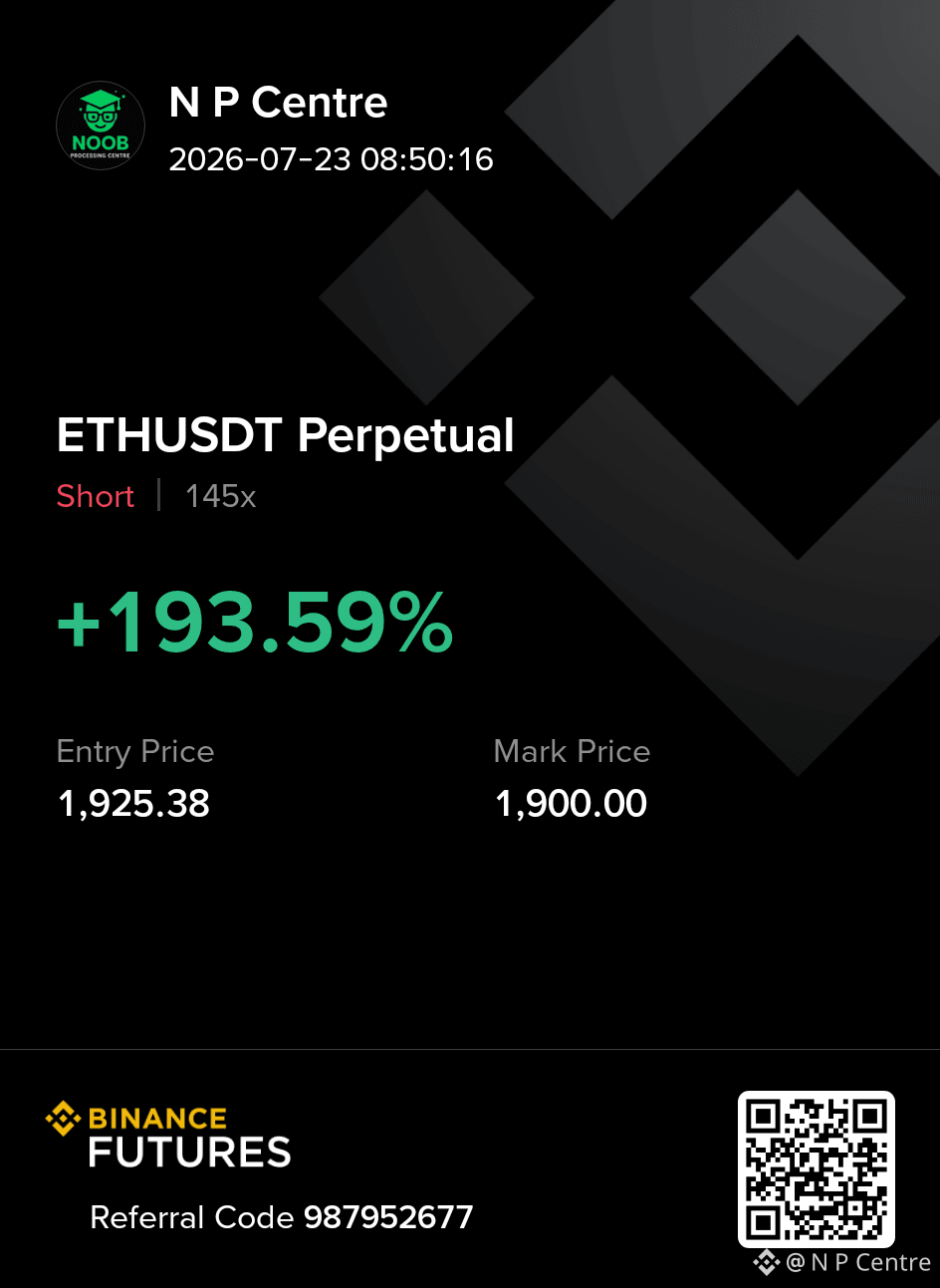
#ShareYourTrades $ZEC
ZCASH HITS A NEW LEVEL 🚀🛡️
Zcash ($ZEC) is about to make a serious move into traditional finance.
Grayscale’s Zcash Trust is expected to begin trading on NYSE Arca around August 25 under the ticker $ZCSH, with the vehicle being rebranded as The Zcash ETF.
This matters because Wall Street is getting a regulated, exchange-traded gateway to Zcash — one of crypto’s original privacy-focused networks.
And the bigger question is 👀:
If institutional capital gets easier access to ZEC, what happens to demand for the underlying asset?
There are still issues with reliable price discovery with $ZEC due transaction encryption; but with that being $ZEC's operating model, how will available liquidity factor into this new era for #Zcash
Scarcity. Privacy. Institutional access...
Zcash may be entering a very different chapter. ❤️Hold on to ur hats...📉🤠📈
$ZEC 🛡️
#Zcash #ZEC #Crypto #Privacy #CryptoETF #NYSE #Bitcoin #Altcoins
#ShareYourTrades $ZEC
ZCASH HITS A NEW LEVEL 🚀🛡️
Zcash ($ZEC ) is about to make a serious move into traditional finance.
Grayscale’s Zcash Trust is expected to begin trading on NYSE Arca around August 25 under the ticker $ZCSH, with the vehicle being rebranded as The Zcash ETF.
This matters because Wall Street is getting a regulated, exchange-traded gateway to Zcash — one of crypto’s original privacy-focused networks.
And the bigger question is 👀:
If institutional capital gets easier access to ZEC, what happens to demand for the underlying asset?
There are still issues with reliable price discovery with $ZEC due transaction encryption; but with that being $ZEC 's operating model, how will available liquidity factor into this new era for #Zcash
Scarcity. Privacy. Institutional access...
Zcash may be entering a very different chapter. ❤️Hold on to ur hats...📉🤠📈
$ZEC 🛡️
#Zcash #ZEC #Crypto #Privacy #CryptoETF #NYSE #Bitcoin #Altcoins
171
·
--
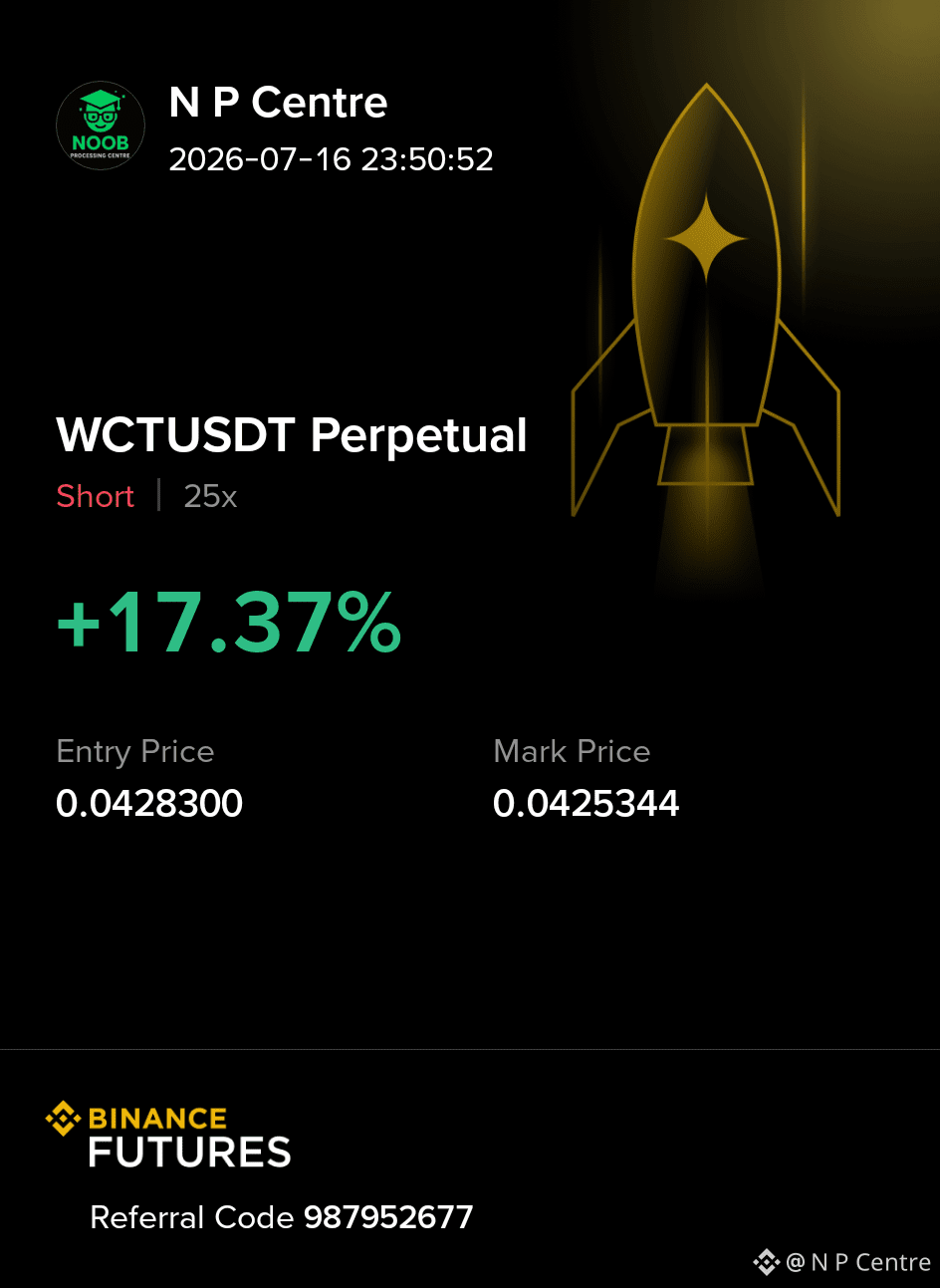
However little, consistency adds over time...
a bearish market still has opportunities. Watch👀Out! for those swings and tight squeezes. Manage risk by tweaking your TP/SL Trailing stops and what have you just right😉. $WCT
{future}(WCTUSDT)
🎓Give back to the Centre with your likes, comments, shares and follows...📚
However little, consistency adds over time...
a bearish market still has opportunities. Watch👀Out! for those swings and tight squeezes. Manage risk by tweaking your TP/SL Trailing stops and what have you just right😉. $WCT
🎓Give back to the Centre with your likes, comments, shares and follows...📚
a bearish market still has opportunities. Watch👀Out! for those swings and tight squeezes. Manage risk by tweaking your TP/SL Trailing stops and what have you just right😉. $WCT
🎓Give back to the Centre with your likes, comments, shares and follows...📚
1
6
·
--
Bearish
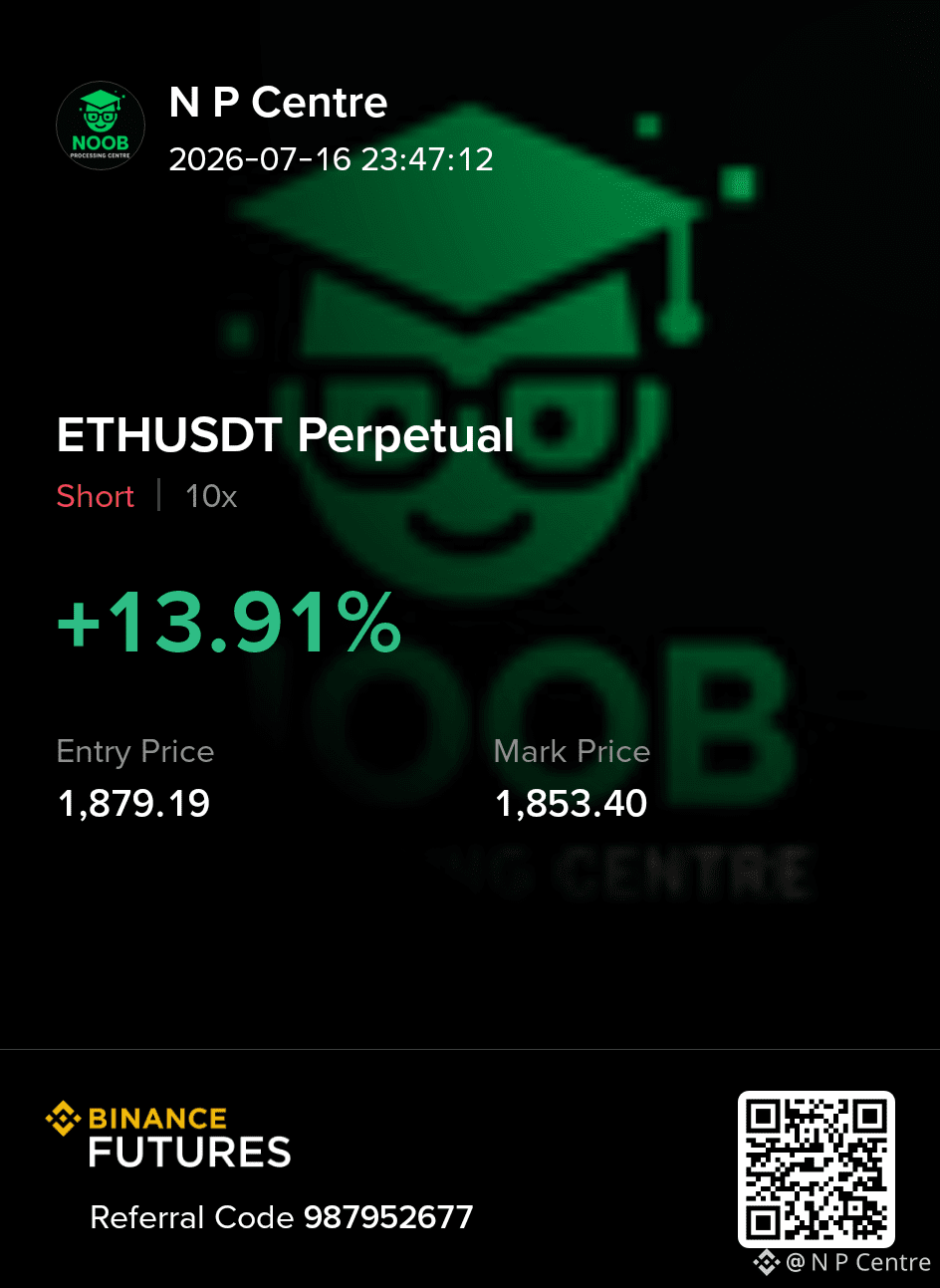
🚀Don't forget noobies, every trade is an education. Set your stop losses, set your limits and go get that $$$.🚀🚀🚀
🚀Don't forget noobies, every trade is an education. Set your stop losses, set your limits and go get that $$$.🚀🚀🚀
1
96
·
--
Great info here...
Surviving the Bears 101.
- For ny noobies...☺️
Great info here...
Surviving the Bears 101.
- For ny noobies...☺️
Surviving the Bears 101.
- For ny noobies...☺️


CRYPTO MECHANIC
·
--
Things I do and keep in mind during a bear market
If this is your first bear market, write down everything you learn because you are gonna need it in the next bear market.
👇
• Every long is a counter-trend trade until proven otherwise.
• Most breakouts turn into fakeouts.
• Price usually falls faster than it rises.
• Support breaks easily, resistance becomes strong.
• Bullish news often gives only temporary pumps.
• Protect capital first. Catching the exact bottom isn’t important.
• I do not care if everyone in the world is bullish i wait for my own edge.
• Sometimes the best trade is no trade.
Bear markets aren’t for making fast money.
They’re for surviving until the next bull run.
1
1
·
--
🚀 OpenGradient continues to build toward a future where AI isn't just powerful—it’s verifiable.
$OPG is positioning itself at the intersection of two of the strongest narratives in tech: decentralized infrastructure and artificial intelligence. Instead of relying on opaque AI systems,
OpenGradient focuses on cryptographically verifiable AI computation, allowing users and developers to verify how AI outputs are generated.
The network supports AI inference, model hosting, and on-chain verification, creating a foundation for trustless AI applications. �
As adoption of AI agents, autonomous systems, and decentralized compute grows, infrastructure projects that emphasize transparency and verifiability could become increasingly important.
OpenGradient’s ecosystem already includes products such as BitQuant, MemSync, and digital twin applications, demonstrating real-world utility beyond simple speculation. �
The AI race is accelerating. Watching projects that focus on open intelligence, verifiable inference, and decentralized AI infrastructure remains one of the most interesting trends in crypto today.
@OpenGradient nt #OPG $OPG 🤖⚡

1
75
·
--
🚀 As AI and blockchain continue to converge, projects focused on verifiable intelligence are becoming increasingly important. That's one reason I'm keeping a close eye on
@OpenGradient and the growing utility of $OPG.
OpenGradient is building decentralized AI infrastructure where model inferences can be cryptographically verified rather than blindly trusted. Instead of relying on opaque "black box" systems, developers and users can interact with AI services backed by transparent verification and on-chain settlement.
The network is designed to support AI agents, model hosting, memory layers, and verifiable LLM interactions, creating a foundation for a more open AI economy. �
OpenGradient; What stands out is that $OPG isn't just a speculative asset—it serves as the fuel for inference payments, network incentives, and ecosystem participation.
As demand for trustworthy AI grows, infrastructure projects solving the verification problem could become increasingly relevant.
The AI narrative is evolving from hype to utility, and OpenGradient is positioning itself at that intersection.
#OPG $OPG @OpenGradient 🤖⚡🔗
🚀 As AI and blockchain continue to converge, projects focused on verifiable intelligence are becoming increasingly important. That's one reason I'm keeping a close eye on
@OpenGradient and the growing utility of $OPG .
OpenGradient is building decentralized AI infrastructure where model inferences can be cryptographically verified rather than blindly trusted. Instead of relying on opaque "black box" systems, developers and users can interact with AI services backed by transparent verification and on-chain settlement.
The network is designed to support AI agents, model hosting, memory layers, and verifiable LLM interactions, creating a foundation for a more open AI economy. �
OpenGradient; What stands out is that $OPG isn't just a speculative asset—it serves as the fuel for inference payments, network incentives, and ecosystem participation.
As demand for trustworthy AI grows, infrastructure projects solving the verification problem could become increasingly relevant.
The AI narrative is evolving from hype to utility, and OpenGradient is positioning itself at that intersection.
#OPG $OPG @OpenGradient 🤖⚡🔗

72
·
--
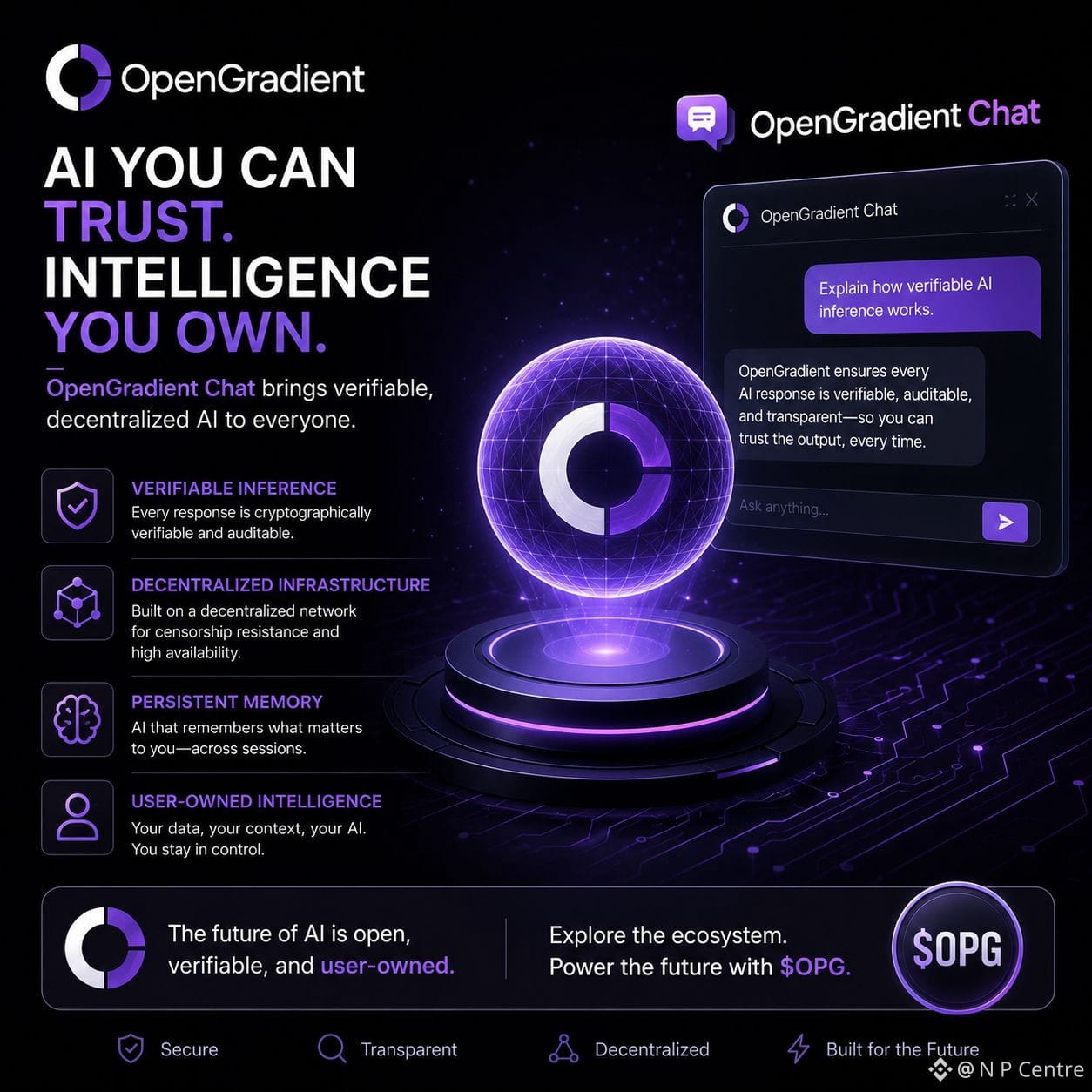
AI is moving fast, but trust and transparency remain major challenges. That’s why @OpenGradient is building infrastructure where AI inference can be verified, audited, and secured rather than treated as a black box.
With OpenGradient Chat, users gain access to intelligent conversations backed by decentralized, verifiable AI systems and persistent memory layers that can enhance context and personalization over time.
As AI and blockchain continue to converge, projects focused on user-owned intelligence, secure execution, and transparent computation could play a key role in the next generation of applications.
Keeping a close eye on the evolution of $OPG and the broader OpenGradient ecosystem. 🚀🤖
#OPG $OPG#opg $OPG
AI is moving fast, but trust and transparency remain major challenges. That’s why @OpenGradient is building infrastructure where AI inference can be verified, audited, and secured rather than treated as a black box.
With OpenGradient Chat, users gain access to intelligent conversations backed by decentralized, verifiable AI systems and persistent memory layers that can enhance context and personalization over time.
As AI and blockchain continue to converge, projects focused on user-owned intelligence, secure execution, and transparent computation could play a key role in the next generation of applications.
Keeping a close eye on the evolution of $OPG and the broader OpenGradient ecosystem. 🚀🤖
#OPG $OPG #opg $OPG
52
Log in to explore more content
Join global crypto users on Binance Square
⚡️ Get latest and useful information about crypto.
💬 Trusted by the world’s largest crypto exchange.
👍 Discover real insights from verified creators.
Email / Phone number
Trending Topics
MoreHikesExpectedIsBTCUnderPressure
16,874 views
190 Discussing
FOMC Minutes | Fed Minutes Show Almost All Officials Expect More Rate Hikes, With Some Open to a Larger December Move
Binance News
·25 Likes
·30.2k views
NvidiaBeatsEstimatesWith$130BQ4Outlook
82,783 views
318 Discussing
AnthropicIPOPriceCouldExceed$80
79,027 views
262 Discussing