
Lilyx_
4.6k Posts

Lilyx_
"I'll take what I came for"
482 Following
6.0K+ Followers
6.4K+ Liked
Posts
All
Quotes
Live
🔥$0G Sharp Pump, Fresh Rejection. The Short Setup Is Building.
SHORT SETUP 📉
💰 Current Price: 0.2327
🎯 Entry Zone: 0.2320 – 0.2370
🛑 Stop Loss: 0.2525
🎯 TP1: 0.2240
🎯 TP2: 0.2140
🎯 TP3: 0.2020
🎯 Extended: 0.1880
Why this setup? 👇
• +26% in 24H after a powerful upside expansion
• Price just rejected the 0.255–0.258 resistance zone
• The latest push produced a sharp wick and immediate selling pressure
• Price is now back below 0.240, showing that buyers couldn't hold the breakout
• Multiple reactions around 0.23–0.24 make this the key battlefield
• A clean break below 0.225 could trigger another leg lower
• If the broader pump structure starts unwinding, 0.21 → 0.20 becomes increasingly vulnerable
⚠️ Don't blindly short the green candle. The cleaner trade is a failed reclaim around 0.235–0.240, followed by weakness below 0.225.
🚨 Invalidation: Strong 15m/1H acceptance above 0.2525. If that happens, the short thesis is wrong.
Pump → resistance rejection → failed reclaim → breakdown.
That's the sequence I'm watching. 🎯📉
$USELESS
$ARB
#USStocksCloseLowerAmazonSuedByFTC #NvidiaToInvest$3.5BInMediaTek #BitcoinHolds$78K #SaylorHintsStrategyBitcoinBuy #TradingCommunity
SHORT SETUP 📉
💰 Current Price: 0.2327
🎯 Entry Zone: 0.2320 – 0.2370
🛑 Stop Loss: 0.2525
🎯 TP1: 0.2240
🎯 TP2: 0.2140
🎯 TP3: 0.2020
🎯 Extended: 0.1880
Why this setup? 👇
• +26% in 24H after a powerful upside expansion
• Price just rejected the 0.255–0.258 resistance zone
• The latest push produced a sharp wick and immediate selling pressure
• Price is now back below 0.240, showing that buyers couldn't hold the breakout
• Multiple reactions around 0.23–0.24 make this the key battlefield
• A clean break below 0.225 could trigger another leg lower
• If the broader pump structure starts unwinding, 0.21 → 0.20 becomes increasingly vulnerable
⚠️ Don't blindly short the green candle. The cleaner trade is a failed reclaim around 0.235–0.240, followed by weakness below 0.225.
🚨 Invalidation: Strong 15m/1H acceptance above 0.2525. If that happens, the short thesis is wrong.
Pump → resistance rejection → failed reclaim → breakdown.
That's the sequence I'm watching. 🎯📉
$USELESS
$ARB
#USStocksCloseLowerAmazonSuedByFTC #NvidiaToInvest$3.5BInMediaTek #BitcoinHolds$78K #SaylorHintsStrategyBitcoinBuy #TradingCommunity
GOING LONG
0%
GOING SHORT
100%
1 votes • Voting closed
🔥 $ZORA just delivered the pump, now the question is whether the breakout can hold.
$ZORA SHORT SETUP 📉
💰 Current Price: 0.00927
🎯 Entry: 0.00925 – 0.00960
🛑 SL: 0.01065
🎯 TP1: 0.00880
🎯 TP2: 0.00820
🎯 TP3: 0.00750
🎯 Extended: 0.00685
Why this setup is interesting 👇
• +36% today after a steep vertical expansion
• Price rejected the 0.0110 area and has failed to reclaim the previous high
• 1H structure is beginning to form lower highs after the spike
• Current consolidation around 0.0090–0.0095 is the key decision zone
• A clean loss of 0.0090 would expose the lower support levels quickly
• The huge volume shows strong participation — but after a parabolic move, that can also mean distribution and profit-taking
⚠️ Confirmation: Don't short just because $ZORA pumped. The better trigger is a failed reclaim of 0.0096–0.0100, followed by a break below 0.0090.
🚨 Invalidation: Strong 1H acceptance above 0.01065.
The setup isn't “pump = short.”
It's pump → rejection → lower high → support breakdown.
That's the sequence I'm watching. 🎯
✨ ALWAYS DYOR ✨
CHECK OUT THESE ALSO
$ZORA SHORT SETUP 📉
💰 Current Price: 0.00927
🎯 Entry: 0.00925 – 0.00960
🛑 SL: 0.01065
🎯 TP1: 0.00880
🎯 TP2: 0.00820
🎯 TP3: 0.00750
🎯 Extended: 0.00685
Why this setup is interesting 👇
• +36% today after a steep vertical expansion
• Price rejected the 0.0110 area and has failed to reclaim the previous high
• 1H structure is beginning to form lower highs after the spike
• Current consolidation around 0.0090–0.0095 is the key decision zone
• A clean loss of 0.0090 would expose the lower support levels quickly
• The huge volume shows strong participation — but after a parabolic move, that can also mean distribution and profit-taking
⚠️ Confirmation: Don't short just because $ZORA pumped. The better trigger is a failed reclaim of 0.0096–0.0100, followed by a break below 0.0090.
🚨 Invalidation: Strong 1H acceptance above 0.01065.
The setup isn't “pump = short.”
It's pump → rejection → lower high → support breakdown.
That's the sequence I'm watching. 🎯
✨ ALWAYS DYOR ✨
CHECK OUT THESE ALSO
GOING SHORT
67%
GOING LONG
33%
3 votes • Voting closed
$BTC is sitting at a decision point on the 1H chart.
Price: ~$77,995
📈 Bullish case:
A clean reclaim and hold above $78.5K–$79K could open the door toward $80K–$81K.
📉 Bearish case:
Failure around the moving-average cluster, followed by a break below $77K, would strengthen the downside setup toward $76K–$75K.
The important part: don't force a trade in the middle of the range. The chart is compressing after a sharp move, so the next confirmed breakout is more valuable than guessing the direction.
⚠️ With leverage, waiting for confirmation matters more than being first.
$BTR
$4
#KoreaSingleStockLeveragedETFTradingFalls #VietnamPilotsCryptoAssetMarket #GoldFalls3.24%ThisWeek #VenezuelaUSSign25YearOilDeal #TrumpReachesVenezuelaOilDealOn17Fields
Price: ~$77,995
📈 Bullish case:
A clean reclaim and hold above $78.5K–$79K could open the door toward $80K–$81K.
📉 Bearish case:
Failure around the moving-average cluster, followed by a break below $77K, would strengthen the downside setup toward $76K–$75K.
The important part: don't force a trade in the middle of the range. The chart is compressing after a sharp move, so the next confirmed breakout is more valuable than guessing the direction.
⚠️ With leverage, waiting for confirmation matters more than being first.
$BTR
$4
#KoreaSingleStockLeveragedETFTradingFalls #VietnamPilotsCryptoAssetMarket #GoldFalls3.24%ThisWeek #VenezuelaUSSign25YearOilDeal #TrumpReachesVenezuelaOilDealOn17Fields
BTC bullish
100%
BTC bearish
0%
5 votes • Voting closed
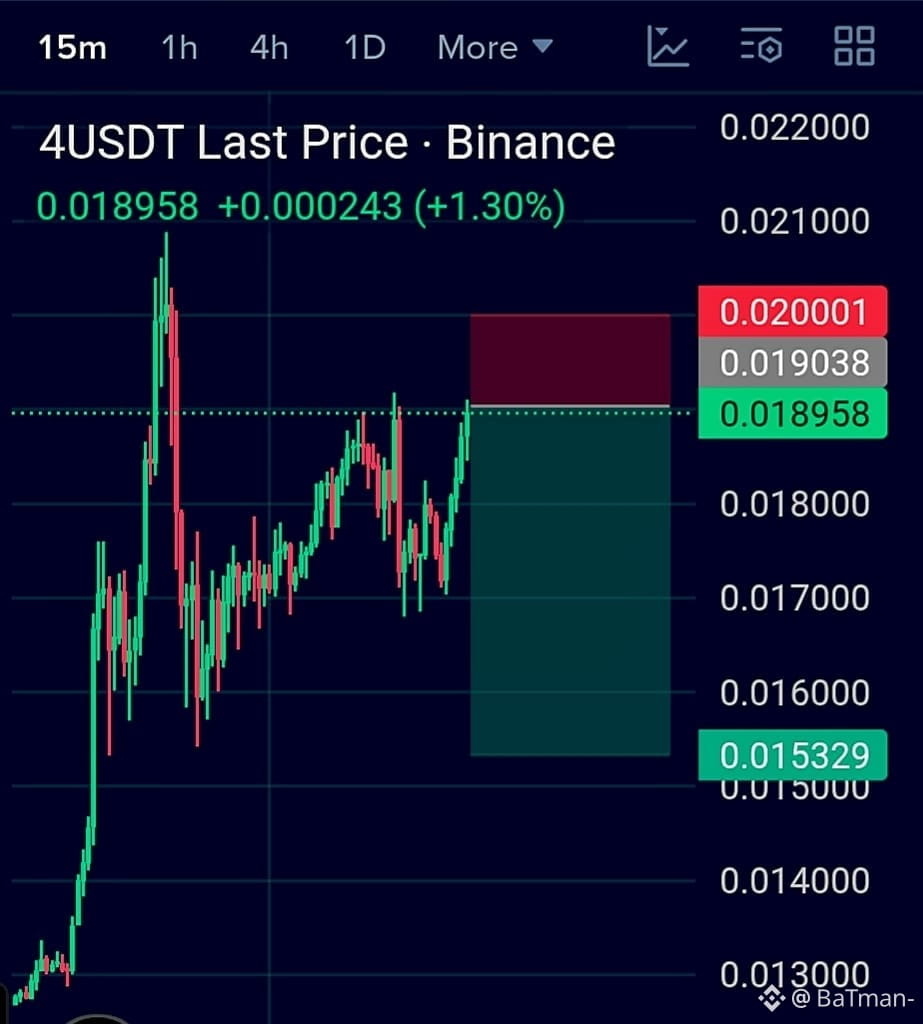
$4 🎯 SHORT Entry: 0.0189–0.0191
🛑 Stop Loss: 0.0200
🎯 TP1: 0.0180
🎯 TP2: 0.0170
🎯 TP3: 0.0153
Bias: 🔴 Bearish below 0.0200
A clean 15m close above 0.0200 invalidates the short idea.
⚠️ This is a highly volatile perp after a huge pump. Don't blindly short just because it's pumped—wait for rejection/confirmation, and leverage can wipe the position quickly.
$PROM $ZKP
#TrumpReachesVenezuelaOilDealOn17Fields #AfghanistanTalibanReportedlyBansCryptoNationwide #TradingCommunity #signaladvisor #FutureTarding
🛑 Stop Loss: 0.0200
🎯 TP1: 0.0180
🎯 TP2: 0.0170
🎯 TP3: 0.0153
Bias: 🔴 Bearish below 0.0200
A clean 15m close above 0.0200 invalidates the short idea.
⚠️ This is a highly volatile perp after a huge pump. Don't blindly short just because it's pumped—wait for rejection/confirmation, and leverage can wipe the position quickly.
$PROM $ZKP
#TrumpReachesVenezuelaOilDealOn17Fields #AfghanistanTalibanReportedlyBansCryptoNationwide #TradingCommunity #signaladvisor #FutureTarding
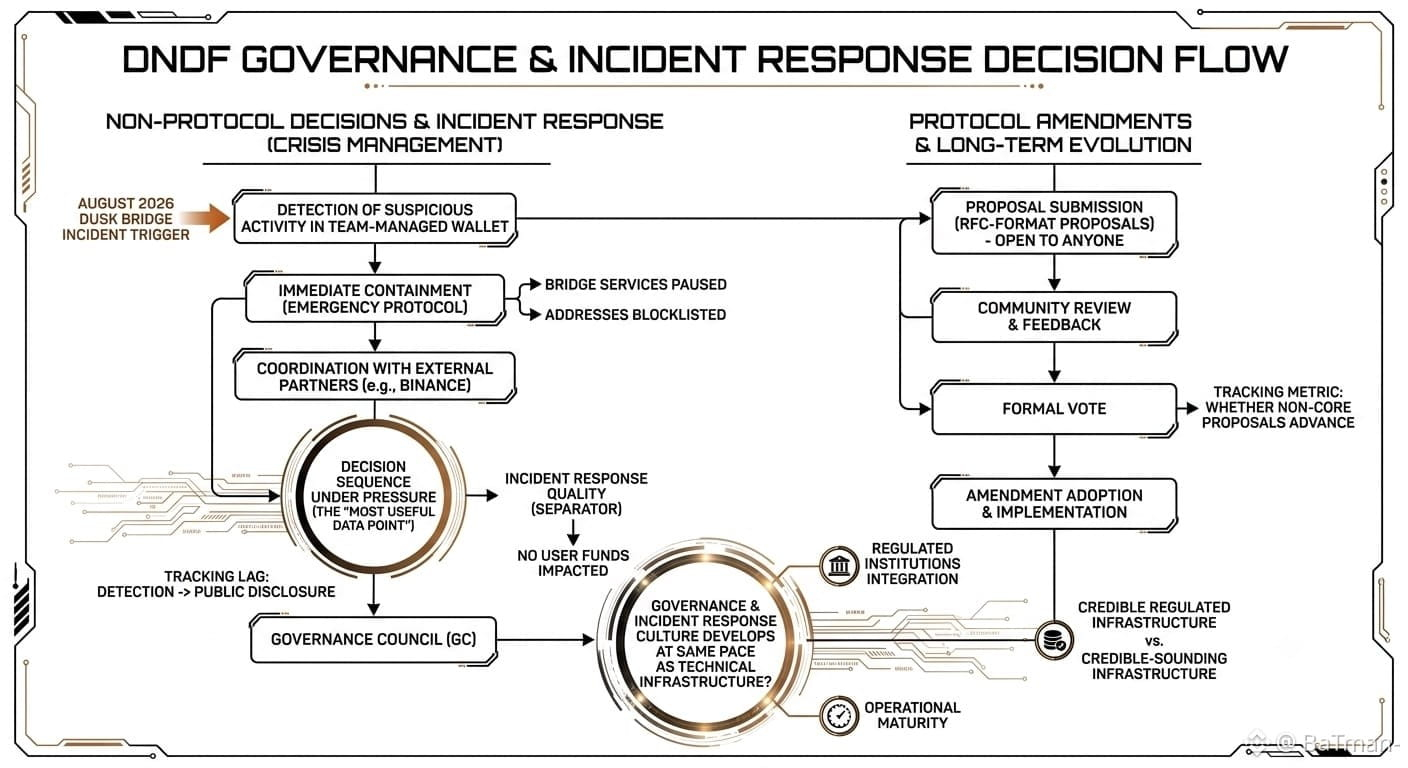
Security incidents reveal more about a project than architecture does. The August 2026 bridge incident on Dusk is the most useful data point I have had on that question.
Suspicious activity in a team-managed wallet triggered containment. Bridge services were paused, addresses blocklisted, and the team coordinated with Binance. No user funds were impacted.
What I find useful is not the incident but the decision sequence under pressure. Incident response quality separates credible regulated infrastructure from credible-sounding infrastructure.
The DNDF runs on a dual track. Protocol amendments use RFC-format proposals anyone can submit. Non-protocol decisions go to the Governance Council. That split looks well-designed on paper.
I track the lag between detection and public disclosure across Dusk security events. Whether non-core proposals advance through the RFC process also signals operational maturity.
Whether governance and incident response culture develops at the same pace as technical infrastructure is the open question. Regulated institutions do not separate the two. Neither do I.#dusk $DUSK @Dusk $BTR $BMT
#USStocksCloseHigherNvidiaGains2% #BrentWTICrudeFallOver3% #KOSPIRisesNearly1% #KoreaMemoryChipStocksReverseLate
Suspicious activity in a team-managed wallet triggered containment. Bridge services were paused, addresses blocklisted, and the team coordinated with Binance. No user funds were impacted.
What I find useful is not the incident but the decision sequence under pressure. Incident response quality separates credible regulated infrastructure from credible-sounding infrastructure.
The DNDF runs on a dual track. Protocol amendments use RFC-format proposals anyone can submit. Non-protocol decisions go to the Governance Council. That split looks well-designed on paper.
I track the lag between detection and public disclosure across Dusk security events. Whether non-core proposals advance through the RFC process also signals operational maturity.
Whether governance and incident response culture develops at the same pace as technical infrastructure is the open question. Regulated institutions do not separate the two. Neither do I.#dusk $DUSK @Dusk $BTR $BMT
#USStocksCloseHigherNvidiaGains2% #BrentWTICrudeFallOver3% #KOSPIRisesNearly1% #KoreaMemoryChipStocksReverseLate
Verified
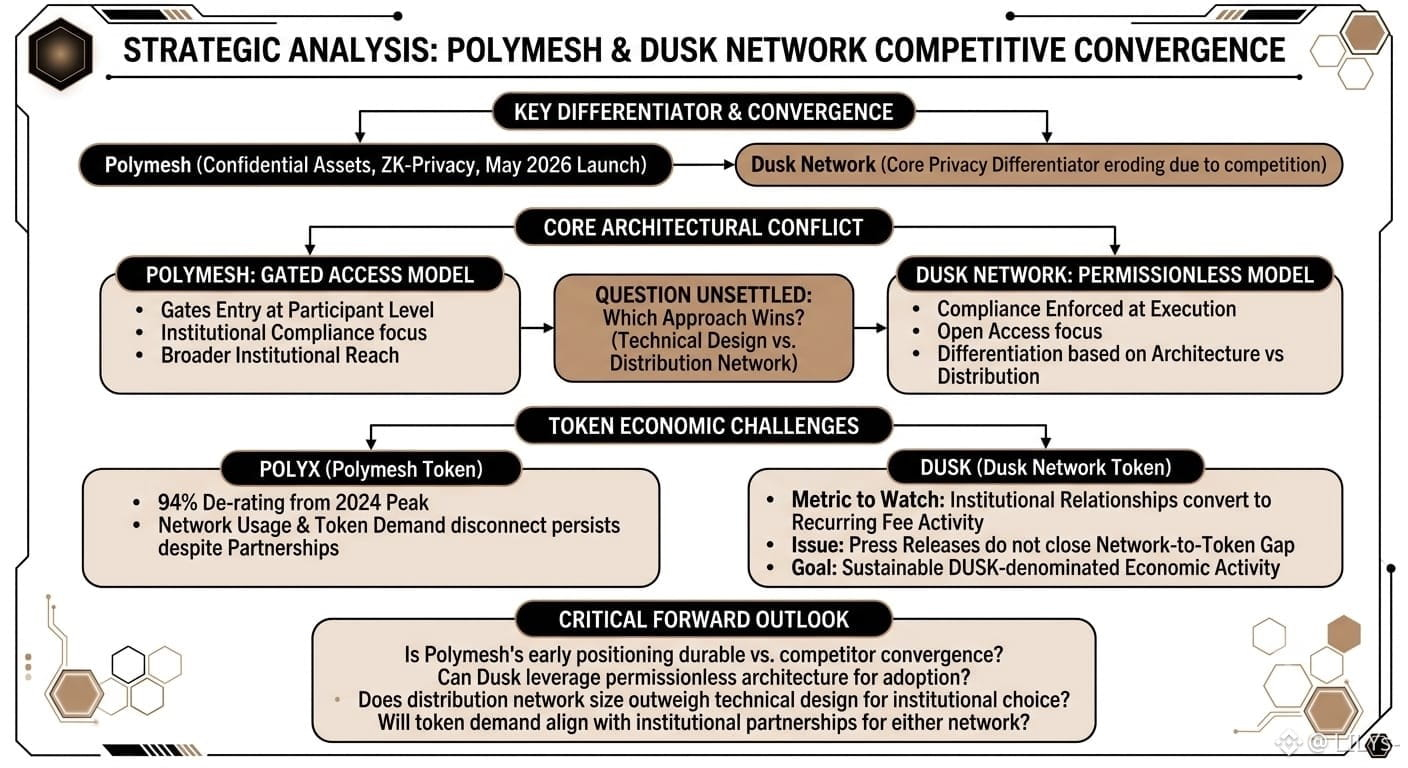
I track the gap between a project's claimed position and where competitors are converging. That gap determines whether early positioning is durable or buying time.
Polymesh launched Confidential Assets in May 2026, adding ZK-based privacy at the protocol layer. That is Dusk's most visible differentiator appearing in a competitor with broader institutional reach.
The structural difference is the access model. Polymesh gates entry at the participant level. Dusk is permissionless but enforces compliance at execution. Which approach wins is not settled.
POLYX de-rated 94 percent from its 2024 peak despite consistent institutional partnerships. Network usage and token demand are different problems. That disconnect persists.
I watch whether Dusk's institutional relationships convert into recurring fee activity denominated in DUSK. Press releases do not close the network-to-token gap. Economic activity does.
Whether differentiation is decided by technical architecture or by who builds the larger distribution network first is the question I cannot answer from design documents alone.#dusk $DUSK @Dusk
$TAC $PROM
#BTCReaches$80000 #OilHoldsLosses #ZECBreaksKeyResistanceUp75.5% #KOSPI200NightFuturesFall1.77%
Polymesh launched Confidential Assets in May 2026, adding ZK-based privacy at the protocol layer. That is Dusk's most visible differentiator appearing in a competitor with broader institutional reach.
The structural difference is the access model. Polymesh gates entry at the participant level. Dusk is permissionless but enforces compliance at execution. Which approach wins is not settled.
POLYX de-rated 94 percent from its 2024 peak despite consistent institutional partnerships. Network usage and token demand are different problems. That disconnect persists.
I watch whether Dusk's institutional relationships convert into recurring fee activity denominated in DUSK. Press releases do not close the network-to-token gap. Economic activity does.
Whether differentiation is decided by technical architecture or by who builds the larger distribution network first is the question I cannot answer from design documents alone.#dusk $DUSK @Dusk
$TAC $PROM
#BTCReaches$80000 #OilHoldsLosses #ZECBreaksKeyResistanceUp75.5% #KOSPI200NightFuturesFall1.77%
Verified
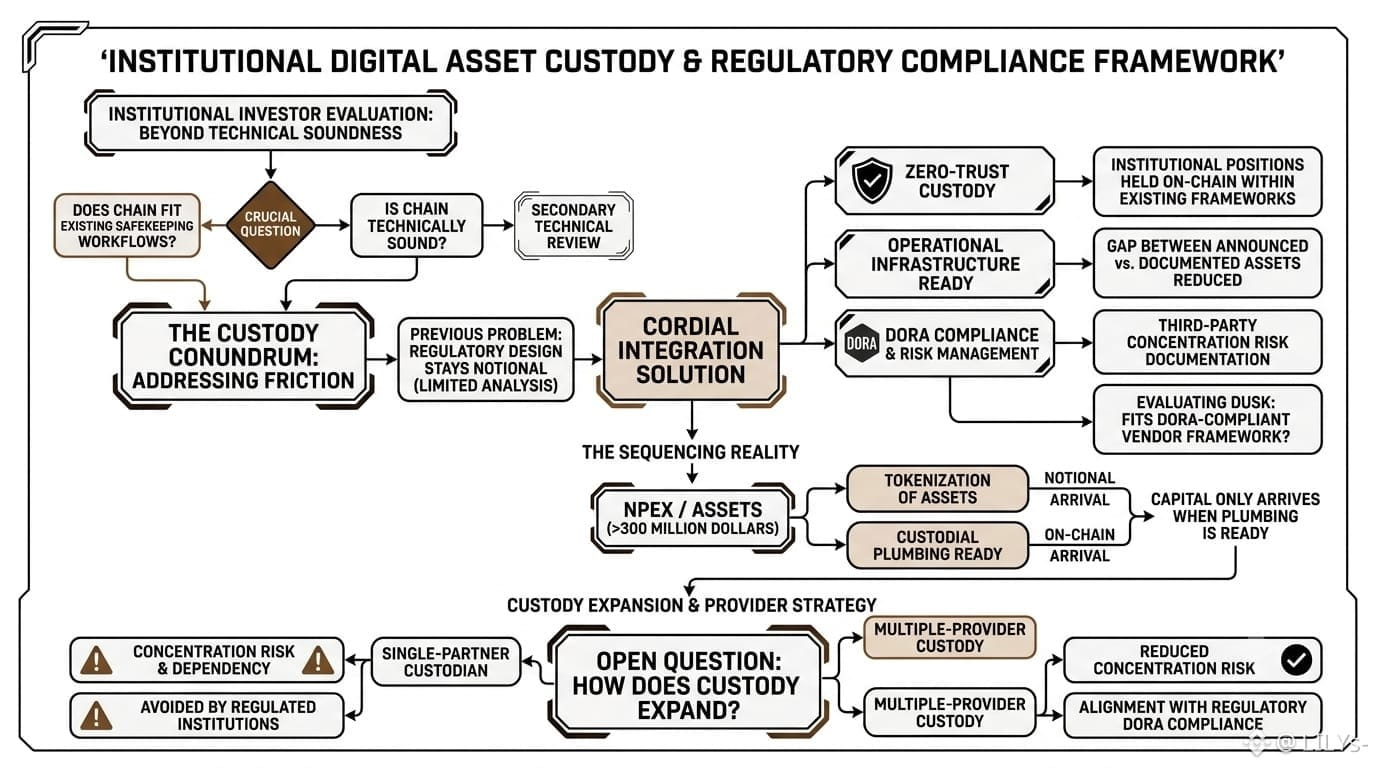
Custody receives the least analysis and causes the most friction. Teams evaluate whether a chain fits existing safekeeping workflows, not whether it is technically sound.
The Cordial integration addresses this. Zero-trust custody lets institutions hold on-chain positions within frameworks they already operate. Without it, regulatory design stays notional.
The sequencing tells me something. NPEX holds over 300 million dollars in assets. That capital only arrives on-chain when custodial plumbing is ready. Protocol and custody readiness differ.
DORA adds a dimension most analysis misses. EU institutions must document third-party concentration risk. Evaluating Dusk means asking whether it fits a DORA-compliant vendor framework.
I watch whether announcements convert into documented assets held versus assets merely tokenized. That gap tells me how much institutional infrastructure is operational versus announced.
Whether custody expands to multiple providers or stays single-partner is the open question. Concentration in one custodian introduces dependency that regulated institutions avoid.#dusk $DUSK @Dusk $PROM $VELVET
#BrentDrops1.87% #AlibabaRaises$10.2BInHKShareSale #GoldNearsThreeMonthHigh #CanadaUSTradeTalksCollapse
The Cordial integration addresses this. Zero-trust custody lets institutions hold on-chain positions within frameworks they already operate. Without it, regulatory design stays notional.
The sequencing tells me something. NPEX holds over 300 million dollars in assets. That capital only arrives on-chain when custodial plumbing is ready. Protocol and custody readiness differ.
DORA adds a dimension most analysis misses. EU institutions must document third-party concentration risk. Evaluating Dusk means asking whether it fits a DORA-compliant vendor framework.
I watch whether announcements convert into documented assets held versus assets merely tokenized. That gap tells me how much institutional infrastructure is operational versus announced.
Whether custody expands to multiple providers or stays single-partner is the open question. Concentration in one custodian introduces dependency that regulated institutions avoid.#dusk $DUSK @Dusk $PROM $VELVET
#BrentDrops1.87% #AlibabaRaises$10.2BInHKShareSale #GoldNearsThreeMonthHigh #CanadaUSTradeTalksCollapse
Verified
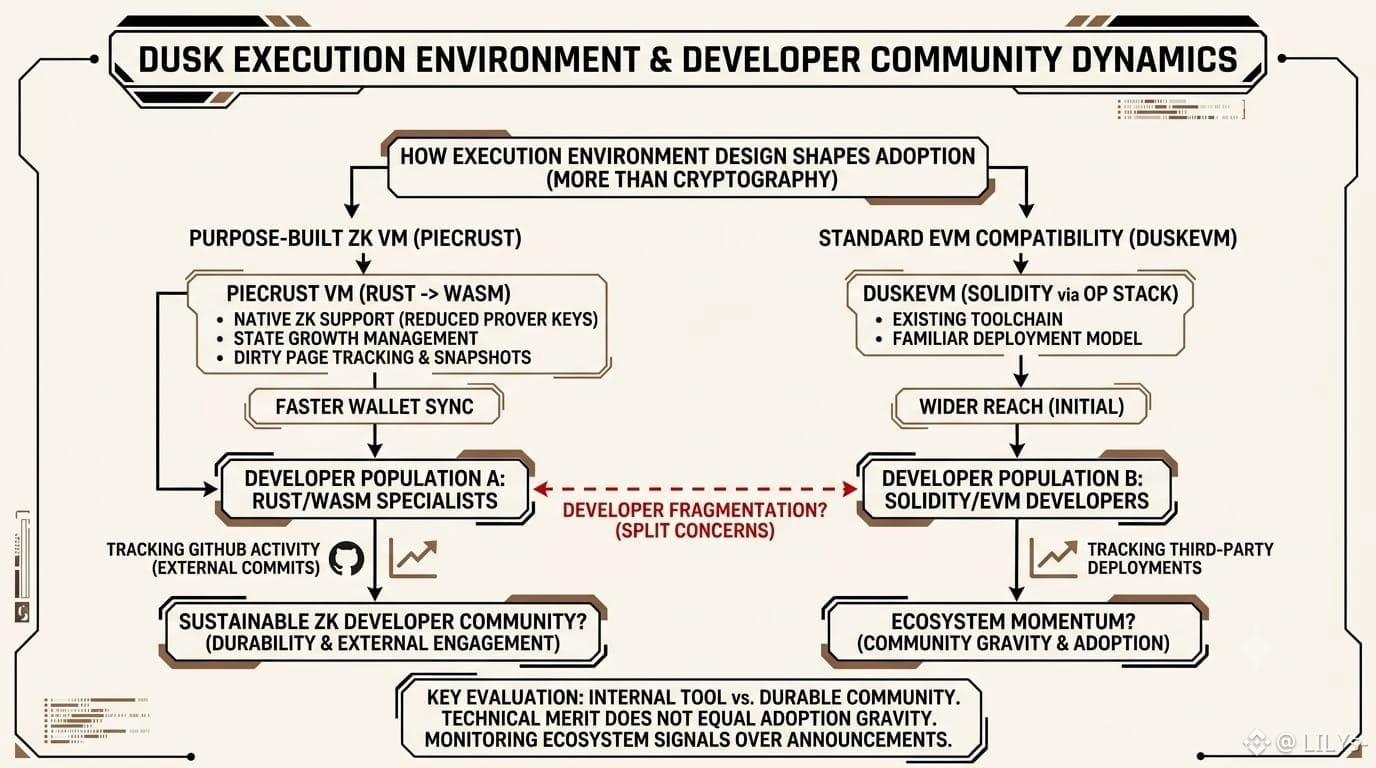
Execution environment design shapes adoption more than cryptography. On privacy chains, the VM is where hidden friction accumulates. I keep returning to this question with Dusk.
Piecrust replaced Rusk VM because state growth became a constraint. Its memory model tracks dirty pages and snapshots, letting wallets sync against relevant state rather than replaying.
What I find significant is native ZK support at the VM level. Privacy contracts earlier required prover keys exceeding 200 megabytes, blocking deployment. Solving that was not incremental.
The developer split concerns me. Piecrust uses Rust compiled to WASM while DuskEVM runs Solidity via OP Stack. Two populations, two toolchains, two deployment models for one network.
I track GitHub activity across both repositories separately. External commits and independent third-party deployments tell me more about ecosystem momentum than any announcement.
Whether a purpose-built ZK VM builds a durable developer community or remains an internal tool is the open question. Technical merit is not what I am evaluating here. Community gravity is.#dusk $DUSK @Dusk
$TUT $ZRO
#AnthropicIPOCouldTopSpaceXRecordReportsSay #NvidiaAIServerPricesRiseOver15% #BSTREndsCantorSPACGoPublicPlan #SP500EndsWeeklyWinStreak
Piecrust replaced Rusk VM because state growth became a constraint. Its memory model tracks dirty pages and snapshots, letting wallets sync against relevant state rather than replaying.
What I find significant is native ZK support at the VM level. Privacy contracts earlier required prover keys exceeding 200 megabytes, blocking deployment. Solving that was not incremental.
The developer split concerns me. Piecrust uses Rust compiled to WASM while DuskEVM runs Solidity via OP Stack. Two populations, two toolchains, two deployment models for one network.
I track GitHub activity across both repositories separately. External commits and independent third-party deployments tell me more about ecosystem momentum than any announcement.
Whether a purpose-built ZK VM builds a durable developer community or remains an internal tool is the open question. Technical merit is not what I am evaluating here. Community gravity is.#dusk $DUSK @Dusk
$TUT $ZRO
#AnthropicIPOCouldTopSpaceXRecordReportsSay #NvidiaAIServerPricesRiseOver15% #BSTREndsCantorSPACGoPublicPlan #SP500EndsWeeklyWinStreak
Partly True
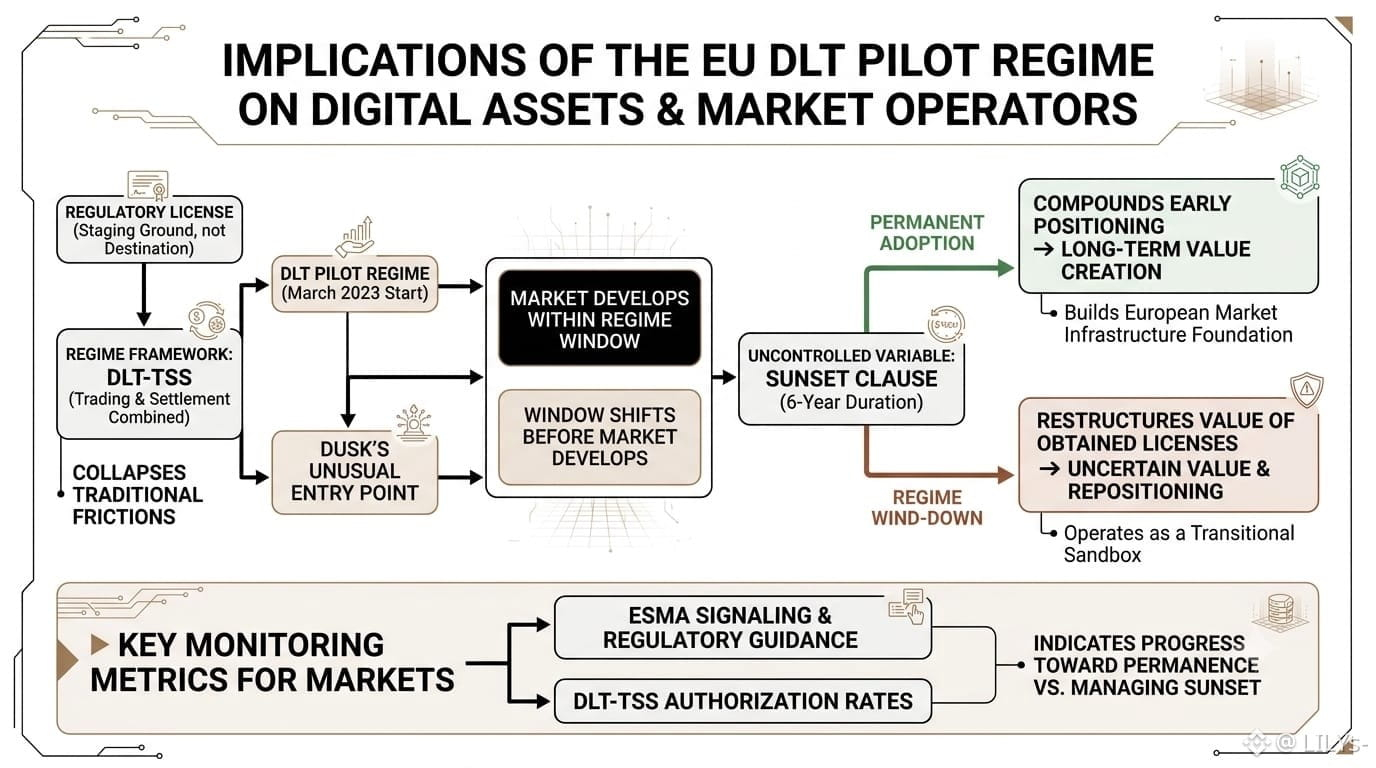
Regulatory licenses are often misread as destinations. I treat them as staging grounds. A license shows where an entity can operate, not whether the market develops before the window shifts.
The DLT Pilot Regime gave Dusk an unusual entry point. The DLT-TSS combines trading and settlement under one operator, collapsing a split that created friction in traditional markets.
The sunset clause is what I find underappreciated. The Regime runs six years from March 2023. Whether it is extended, made permanent, or wound down sits entirely outside Dusk's control.
That asymmetry is worth pricing carefully. Permanent adoption compounds early positioning. A wind-down restructures the value of licenses that took 18 months to obtain.
I watch ESMA signaling and DLT-TSS authorization rates. The pace of approvals tells me whether regulators are building toward permanence or managing toward sunset.
Whether the DLT Pilot Regime becomes the foundation of European market infrastructure or a transitional sandbox shapes the long-term value of everything Dusk has built inside it.
#dusk $DUSK @Dusk
$ENA #BitcoinTops$70KFirstTimeInTwoMonths #BTCSurpasses$72000 #TreasuryBuybacksCouldExceed$4BPerIssue #USJoblessClaimsFallTo206000 $ONG
The DLT Pilot Regime gave Dusk an unusual entry point. The DLT-TSS combines trading and settlement under one operator, collapsing a split that created friction in traditional markets.
The sunset clause is what I find underappreciated. The Regime runs six years from March 2023. Whether it is extended, made permanent, or wound down sits entirely outside Dusk's control.
That asymmetry is worth pricing carefully. Permanent adoption compounds early positioning. A wind-down restructures the value of licenses that took 18 months to obtain.
I watch ESMA signaling and DLT-TSS authorization rates. The pace of approvals tells me whether regulators are building toward permanence or managing toward sunset.
Whether the DLT Pilot Regime becomes the foundation of European market infrastructure or a transitional sandbox shapes the long-term value of everything Dusk has built inside it.
#dusk $DUSK @Dusk
$ENA #BitcoinTops$70KFirstTimeInTwoMonths #BTCSurpasses$72000 #TreasuryBuybacksCouldExceed$4BPerIssue #USJoblessClaimsFallTo206000 $ONG
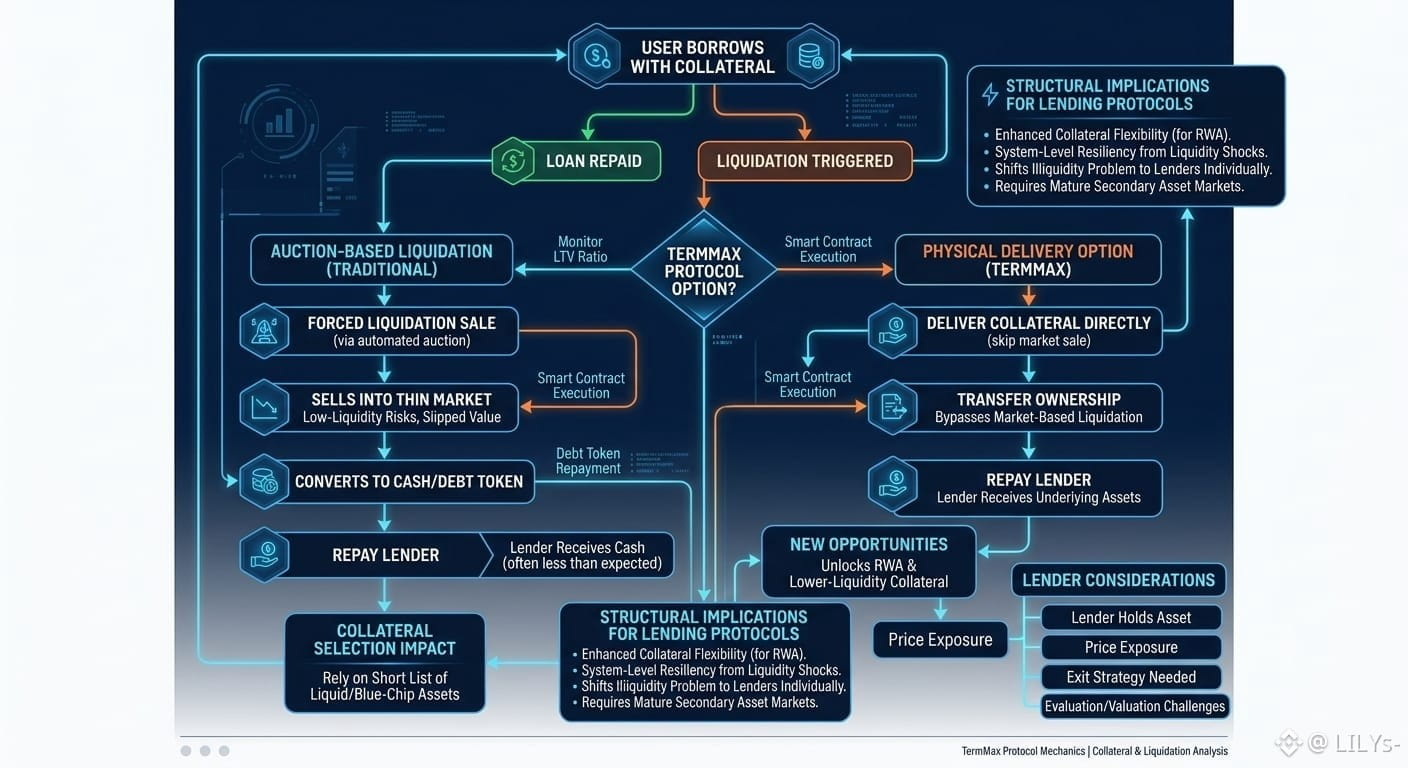
I've been burned before by a liquidation that technically executed on time but still left me with less than expected, because the collateral had to be dumped into a thin market to raise cash. The mechanism worked as designed. The result still felt like a loss nobody accounted for.
That's the piece of TermMax that made me pause: its physical delivery option. Instead of forcing a liquidation sale through an auction when a position turns bad, the protocol can deliver the underlying collateral directly to the lender. No forced market sale, no assumption that there's enough depth to absorb it cleanly.
The quieter implication is what this unlocks for collateral selection. Auction-based liquidation only works if you trust there's a liquid market to sell into, which is why most lending protocols stick to a short list of blue-chip assets. Physical delivery removes that dependency, opening the door to RWAs and lower-liquidity collateral that would otherwise be too risky to support at all.
That flexibility isn't free of tension. Receiving collateral instead of cash means a lender now holds an asset they didn't choose, with its own price exposure and exit problem. For illiquid or RWA collateral specifically, holding the asset can mean sitting with something harder to value or offload than the debt token you originally lent out.
What I'd want to see is how often physical delivery actually triggers versus standard liquidation, and what lenders do with delivered collateral afterward, hold, sell immediately, or route it elsewhere. That behavior would tell me whether this option genuinely protects lenders or just shifts the illiquidity problem from the protocol onto them individually.
Expanding what counts as usable collateral is a real structural choice, not a minor feature. Whether it makes the system more resilient or just moves risk to a less visible place is something I'd only trust after watching it handle a genuinely stressed asset, not a calm one.#termmax @TermMax
$ONG $ENA $BOME
#BitcoinTops$70KFirstTimeInTwoMonths #ETHSurpasses$2300
That's the piece of TermMax that made me pause: its physical delivery option. Instead of forcing a liquidation sale through an auction when a position turns bad, the protocol can deliver the underlying collateral directly to the lender. No forced market sale, no assumption that there's enough depth to absorb it cleanly.
The quieter implication is what this unlocks for collateral selection. Auction-based liquidation only works if you trust there's a liquid market to sell into, which is why most lending protocols stick to a short list of blue-chip assets. Physical delivery removes that dependency, opening the door to RWAs and lower-liquidity collateral that would otherwise be too risky to support at all.
That flexibility isn't free of tension. Receiving collateral instead of cash means a lender now holds an asset they didn't choose, with its own price exposure and exit problem. For illiquid or RWA collateral specifically, holding the asset can mean sitting with something harder to value or offload than the debt token you originally lent out.
What I'd want to see is how often physical delivery actually triggers versus standard liquidation, and what lenders do with delivered collateral afterward, hold, sell immediately, or route it elsewhere. That behavior would tell me whether this option genuinely protects lenders or just shifts the illiquidity problem from the protocol onto them individually.
Expanding what counts as usable collateral is a real structural choice, not a minor feature. Whether it makes the system more resilient or just moves risk to a less visible place is something I'd only trust after watching it handle a genuinely stressed asset, not a calm one.#termmax @TermMax
$ONG $ENA $BOME
#BitcoinTops$70KFirstTimeInTwoMonths #ETHSurpasses$2300
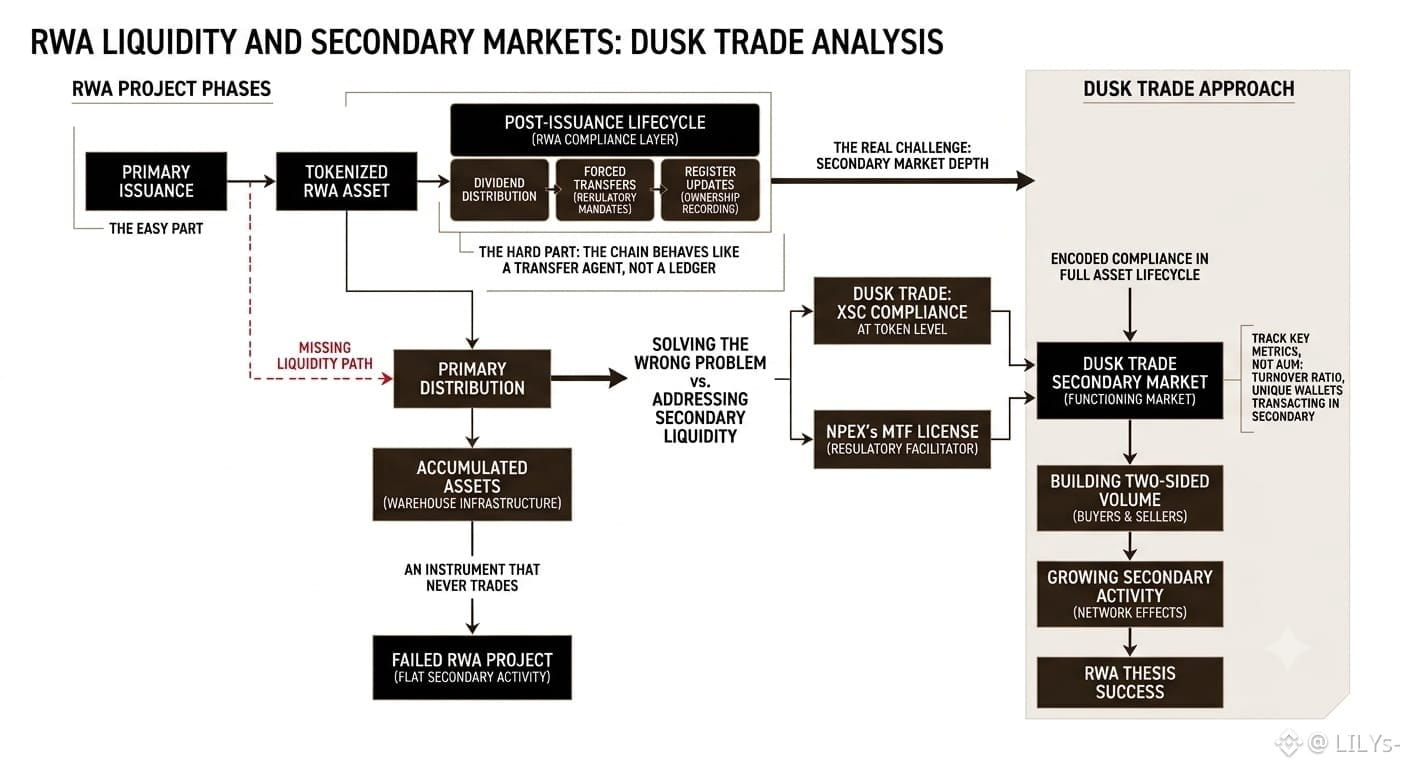
Most RWA projects have solved the wrong problem. Issuance is not the hard part. Dividends, forced transfers, and register updates require the chain to behave like a transfer agent, not a ledger.
Dusk Trade addresses this through XSC, encoding compliance at the token level rather than in a wrapper. That matters more for the full asset lifecycle than for initial issuance.
Secondary liquidity is the question most analysis skips. Tokenizing a bond creates an instrument, not a buyer. Primary distribution is solvable. Secondary depth is not.
NPEX's MTF license helps, but I watch whether Dusk Trade builds two-sided volume or accumulates assets that rarely trade. An instrument that never trades is warehouse infrastructure, not a market.
I track unique wallets transacting in secondary rather than AUM. Turnover ratio tells me more. Growing issuance with flat secondary activity is the most common failure mode in this space.
Whether Dusk moves from issuance infrastructure to a functioning secondary market is what the RWA thesis rests on. That depends on network effects more than design.#dusk $DUSK @Dusk
$BOME $ACE #BTCSurpasses$72000 #WalmartFalls7% #USJoblessClaimsFallTo206000 #GrayscaleFilesToListZcashTrustOnNYSEArca
Dusk Trade addresses this through XSC, encoding compliance at the token level rather than in a wrapper. That matters more for the full asset lifecycle than for initial issuance.
Secondary liquidity is the question most analysis skips. Tokenizing a bond creates an instrument, not a buyer. Primary distribution is solvable. Secondary depth is not.
NPEX's MTF license helps, but I watch whether Dusk Trade builds two-sided volume or accumulates assets that rarely trade. An instrument that never trades is warehouse infrastructure, not a market.
I track unique wallets transacting in secondary rather than AUM. Turnover ratio tells me more. Growing issuance with flat secondary activity is the most common failure mode in this space.
Whether Dusk moves from issuance infrastructure to a functioning secondary market is what the RWA thesis rests on. That depends on network effects more than design.#dusk $DUSK @Dusk
$BOME $ACE #BTCSurpasses$72000 #WalmartFalls7% #USJoblessClaimsFallTo206000 #GrayscaleFilesToListZcashTrustOnNYSEArca
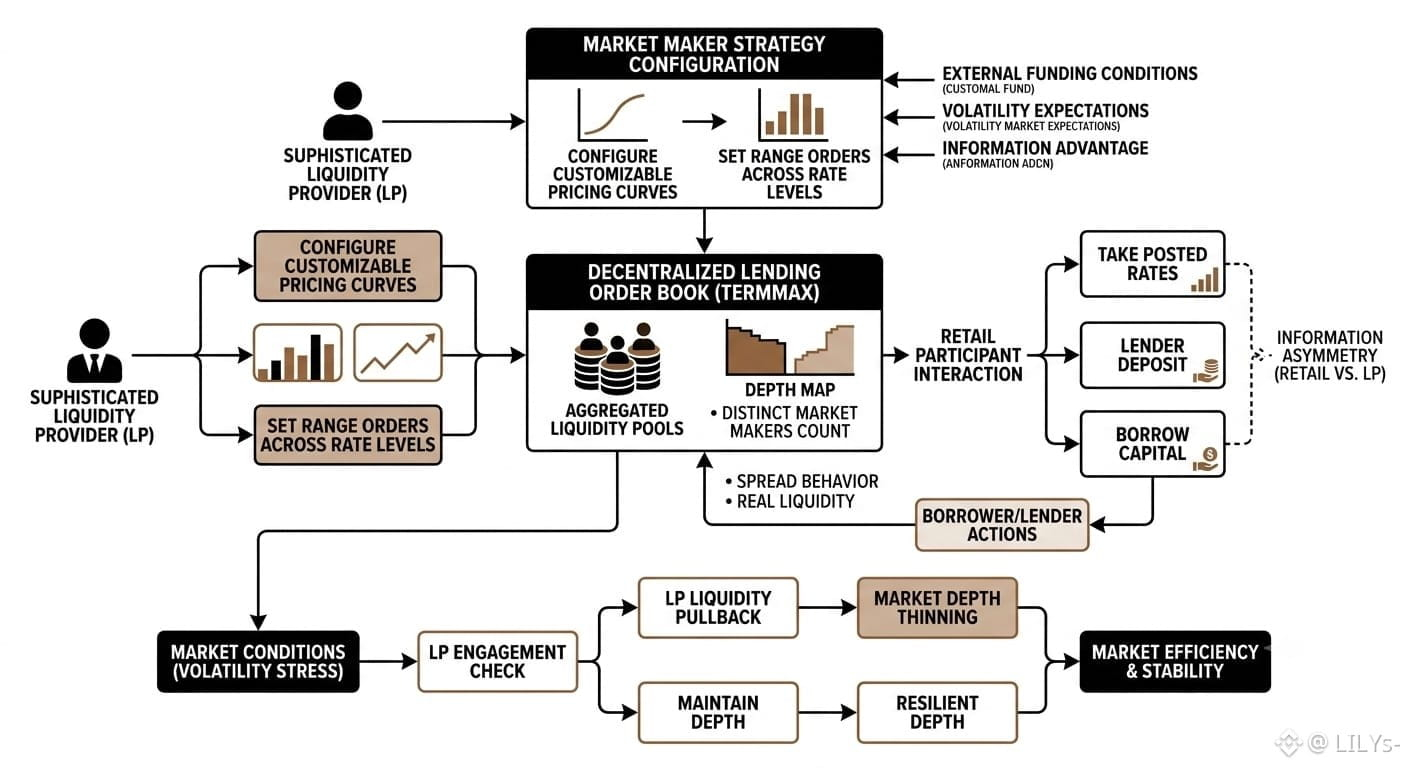
I've noticed that in most on-chain lending markets, the real price of capital isn't set by the borrowers and lenders you see in the interface. It's set by market makers running strategies most users never notice. Retail just takes the posted rate without knowing who shaped it.
That's what caught my eye in TermMax's order flow. Market makers configure range orders with custom pricing curves instead of one flat rate. It behaves less like a savings account and more like a lending order book, where sophisticated players actively manage liquidity across rate levels.
What's worth sitting with is the information asymmetry this creates. A maker adjusting curves based on conditions elsewhere is pricing in information most lenders lack. Aggregating those orders gives borrowers more choice, but the rate shown still reflects someone else's read, not a neutral average.
That structure carries a cost. Range orders only work if makers stay engaged, and DeFi has enough history of liquidity pulling back when conditions turn. If curve configuration concentrates among a few actors, depth could thin out right when volatility hits hardest.
What I'd track isn't the number of active markets, it's how many distinct makers post range orders per market and whether that holds through stress. Spread behavior between posted and executed rates in volatile periods says more than any TVL figure.
I don't know yet if this pricing structure ends up more efficient for lenders or just relocates the information gap somewhere less visible. That's a question only real stress reveals.#termmax @TermMax
$BOME $AVAAI $MAGMA #BTCSurpasses$72000 #GrayscaleFilesToListZcashTrustOnNYSEArca #KOSPICloses5.9%HigherOnChipmakerBuybacks #ETHSurpasses$2300
That's what caught my eye in TermMax's order flow. Market makers configure range orders with custom pricing curves instead of one flat rate. It behaves less like a savings account and more like a lending order book, where sophisticated players actively manage liquidity across rate levels.
What's worth sitting with is the information asymmetry this creates. A maker adjusting curves based on conditions elsewhere is pricing in information most lenders lack. Aggregating those orders gives borrowers more choice, but the rate shown still reflects someone else's read, not a neutral average.
That structure carries a cost. Range orders only work if makers stay engaged, and DeFi has enough history of liquidity pulling back when conditions turn. If curve configuration concentrates among a few actors, depth could thin out right when volatility hits hardest.
What I'd track isn't the number of active markets, it's how many distinct makers post range orders per market and whether that holds through stress. Spread behavior between posted and executed rates in volatile periods says more than any TVL figure.
I don't know yet if this pricing structure ends up more efficient for lenders or just relocates the information gap somewhere less visible. That's a question only real stress reveals.#termmax @TermMax
$BOME $AVAAI $MAGMA #BTCSurpasses$72000 #GrayscaleFilesToListZcashTrustOnNYSEArca #KOSPICloses5.9%HigherOnChipmakerBuybacks #ETHSurpasses$2300
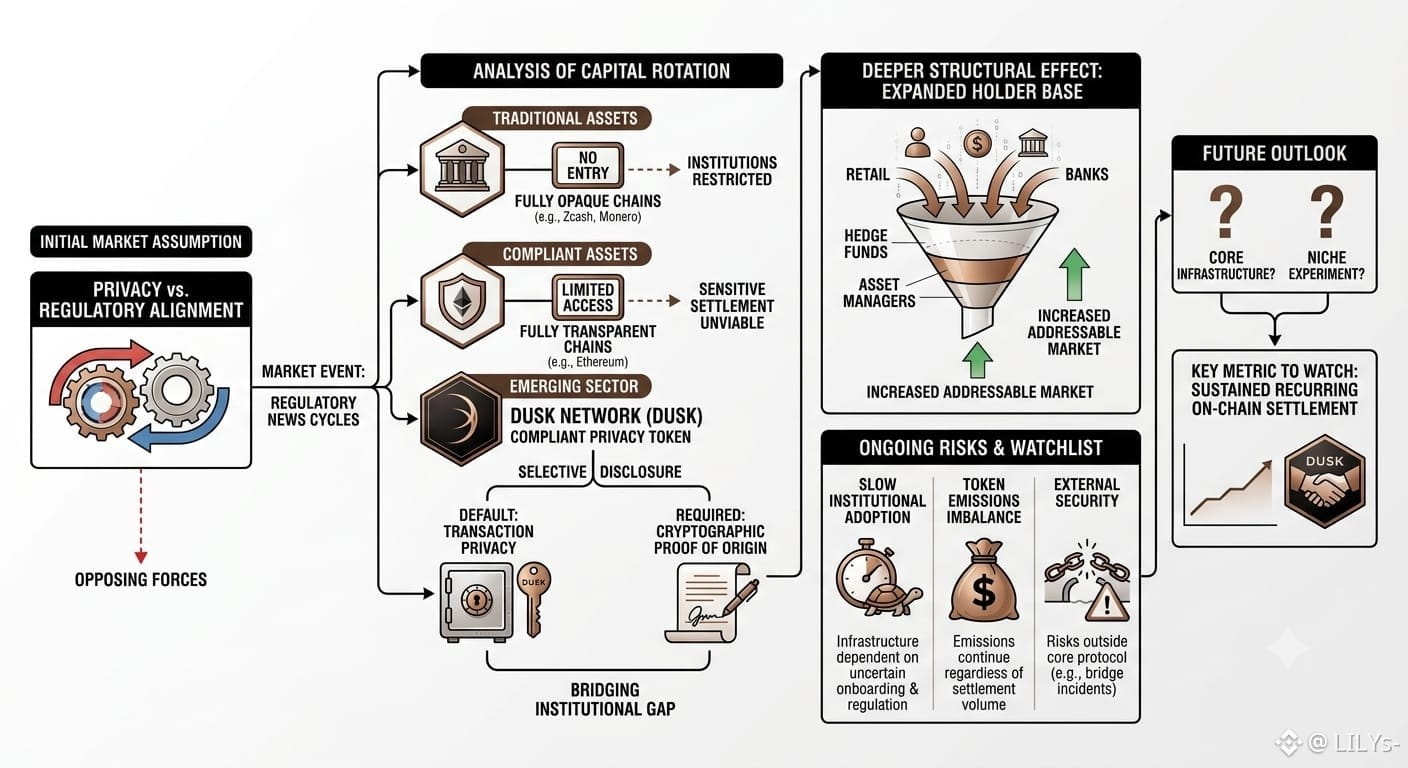
I noticed something strange last quarter watching order flow around several "compliant privacy" tokens. I used to assume privacy and regulatory alignment were opposing forces in crypto, that you had to sacrifice one for the other. Then I started tracking how capital rotated during regulatory news cycles, and that assumption cracked a little.
That's when Dusk kept showing up in my research. What caught me wasn't the privacy angle itself, it was selective disclosure, the ability for a transaction to stay private by default yet prove its origin cryptographically when required. I hadn't seen that balance executed cleanly before.
Most traders I talk to treat this as a compliance checkbox. I think the deeper effect is structural, it changes who's allowed to hold the asset. Institutions can't touch fully opaque chains, but they also can't use fully transparent ones for sensitive settlement. Selective disclosure quietly expands the addressable holder base without anyone calling it that.
My concern sits elsewhere. Infrastructure built for institutions depends on institutions actually onboarding, and that's slow, uneven, and dependent on regulatory interpretation shifting favorably. Token emissions keep flowing regardless of whether real settlement volume shows up. A bridge incident earlier this year also reminded me that security assumptions outside the core protocol still matter.
What I'm watching now isn't headlines, it's recurring on-chain settlement activity, staking participation that isn't just yield chasing, and whether institutional partners actually route volume through DuskEVM rather than just announcing intent. Announcements are cheap, repeated usage isn't.
I don't know yet whether compliant privacy becomes core infrastructure or stays a niche experiment. The market hasn't answered whether institutions want this enough to change behavior, or whether they're just watching from the sidelines like I am.
#dusk $DUSK @Dusk $HEMI $TREE
#CryptoRally #FOMCWatch #WyomingMovesFRNTToChainlinkCCIP #ToyotaFinanceLaunchesTokenizedBondForRetail
That's when Dusk kept showing up in my research. What caught me wasn't the privacy angle itself, it was selective disclosure, the ability for a transaction to stay private by default yet prove its origin cryptographically when required. I hadn't seen that balance executed cleanly before.
Most traders I talk to treat this as a compliance checkbox. I think the deeper effect is structural, it changes who's allowed to hold the asset. Institutions can't touch fully opaque chains, but they also can't use fully transparent ones for sensitive settlement. Selective disclosure quietly expands the addressable holder base without anyone calling it that.
My concern sits elsewhere. Infrastructure built for institutions depends on institutions actually onboarding, and that's slow, uneven, and dependent on regulatory interpretation shifting favorably. Token emissions keep flowing regardless of whether real settlement volume shows up. A bridge incident earlier this year also reminded me that security assumptions outside the core protocol still matter.
What I'm watching now isn't headlines, it's recurring on-chain settlement activity, staking participation that isn't just yield chasing, and whether institutional partners actually route volume through DuskEVM rather than just announcing intent. Announcements are cheap, repeated usage isn't.
I don't know yet whether compliant privacy becomes core infrastructure or stays a niche experiment. The market hasn't answered whether institutions want this enough to change behavior, or whether they're just watching from the sidelines like I am.
#dusk $DUSK @Dusk $HEMI $TREE
#CryptoRally #FOMCWatch #WyomingMovesFRNTToChainlinkCCIP #ToyotaFinanceLaunchesTokenizedBondForRetail
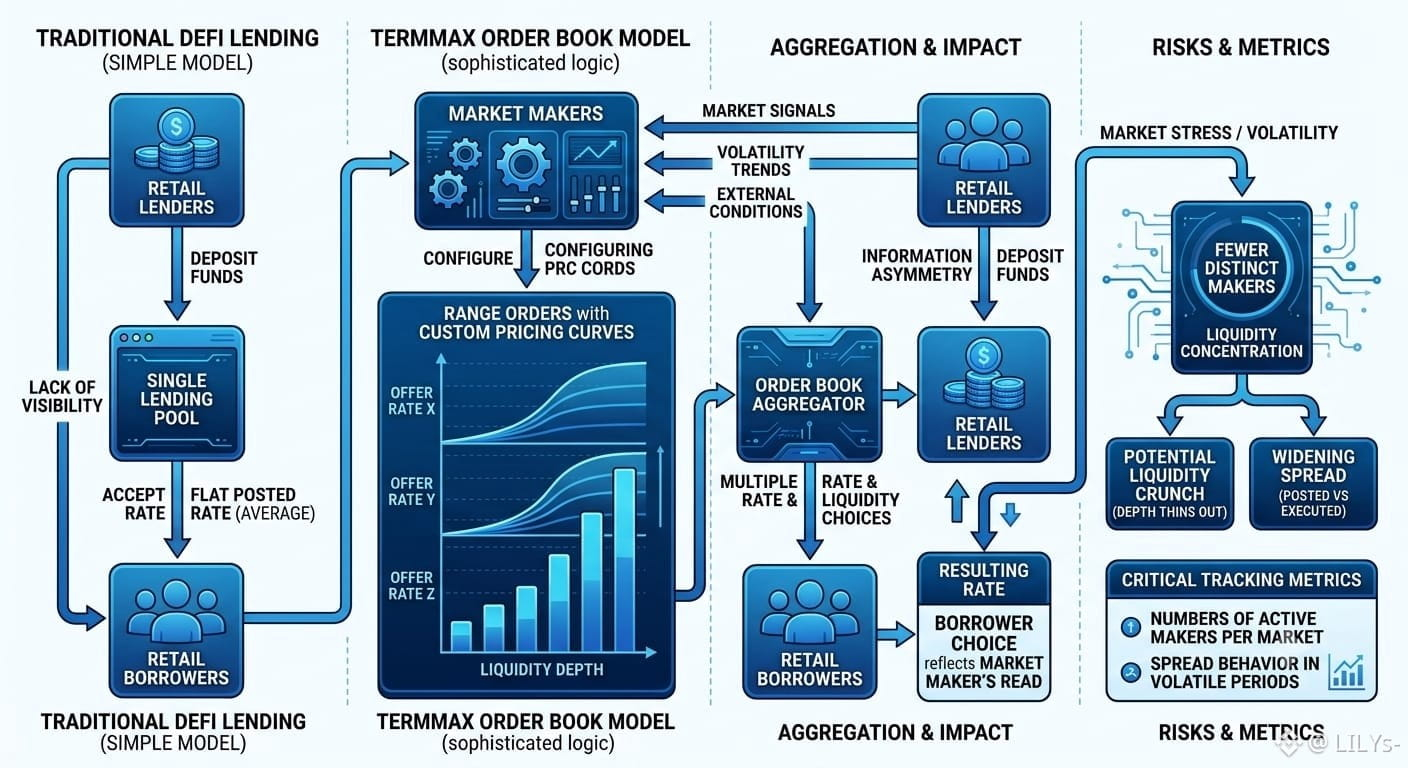
I've noticed that in most on-chain lending markets, the real price of capital isn't set by the borrowers and lenders you see in the interface. It's set by a handful of market makers running strategies most users never notice. Retail participants just take the posted rate without knowing who's shaping it.
That's what caught my eye in how TermMax handles order flow. Market makers can configure range orders with custom pricing curves instead of posting one flat rate. It behaves less like a savings account and more like a lending order book, where sophisticated players actively manage liquidity across different rate levels.
What's worth sitting with is the information asymmetry this creates. A market maker adjusting curve parameters based on conditions elsewhere is effectively pricing in information most lenders don't have. Aggregating those orders gives borrowers more choice, but the rate you see still reflects someone else's read on the market, not a neutral average.
That structure carries a cost. Range orders only work if the makers running them stay engaged, and DeFi has enough history of liquidity providers stepping back the moment conditions turn. If curve configuration concentrates among a few sophisticated actors, depth could thin out exactly when volatility hits hardest.
What I'd track isn't the number of active markets, it's how many distinct makers are posting range orders per market and whether that holds through stress. Spread behavior between posted and executed rates during volatile periods tells me more than any total value locked figure.
I don't know yet if this pricing structure ends up more efficient for lenders or just relocates the information gap somewhere less visible. That's the kind of question only real stress reveals.#termmax @TermMax
$BTW $HEMI $BR
#UAESaysItDetectedTwoIranianBallisticMissiles #USStorageStocksExtendLosses #US30YearYieldHitsHighestSince2002 #CitiPlansBitcoinCustodyForInstitutionsThisYear
That's what caught my eye in how TermMax handles order flow. Market makers can configure range orders with custom pricing curves instead of posting one flat rate. It behaves less like a savings account and more like a lending order book, where sophisticated players actively manage liquidity across different rate levels.
What's worth sitting with is the information asymmetry this creates. A market maker adjusting curve parameters based on conditions elsewhere is effectively pricing in information most lenders don't have. Aggregating those orders gives borrowers more choice, but the rate you see still reflects someone else's read on the market, not a neutral average.
That structure carries a cost. Range orders only work if the makers running them stay engaged, and DeFi has enough history of liquidity providers stepping back the moment conditions turn. If curve configuration concentrates among a few sophisticated actors, depth could thin out exactly when volatility hits hardest.
What I'd track isn't the number of active markets, it's how many distinct makers are posting range orders per market and whether that holds through stress. Spread behavior between posted and executed rates during volatile periods tells me more than any total value locked figure.
I don't know yet if this pricing structure ends up more efficient for lenders or just relocates the information gap somewhere less visible. That's the kind of question only real stress reveals.#termmax @TermMax
$BTW $HEMI $BR
#UAESaysItDetectedTwoIranianBallisticMissiles #USStorageStocksExtendLosses #US30YearYieldHitsHighestSince2002 #CitiPlansBitcoinCustodyForInstitutionsThisYear
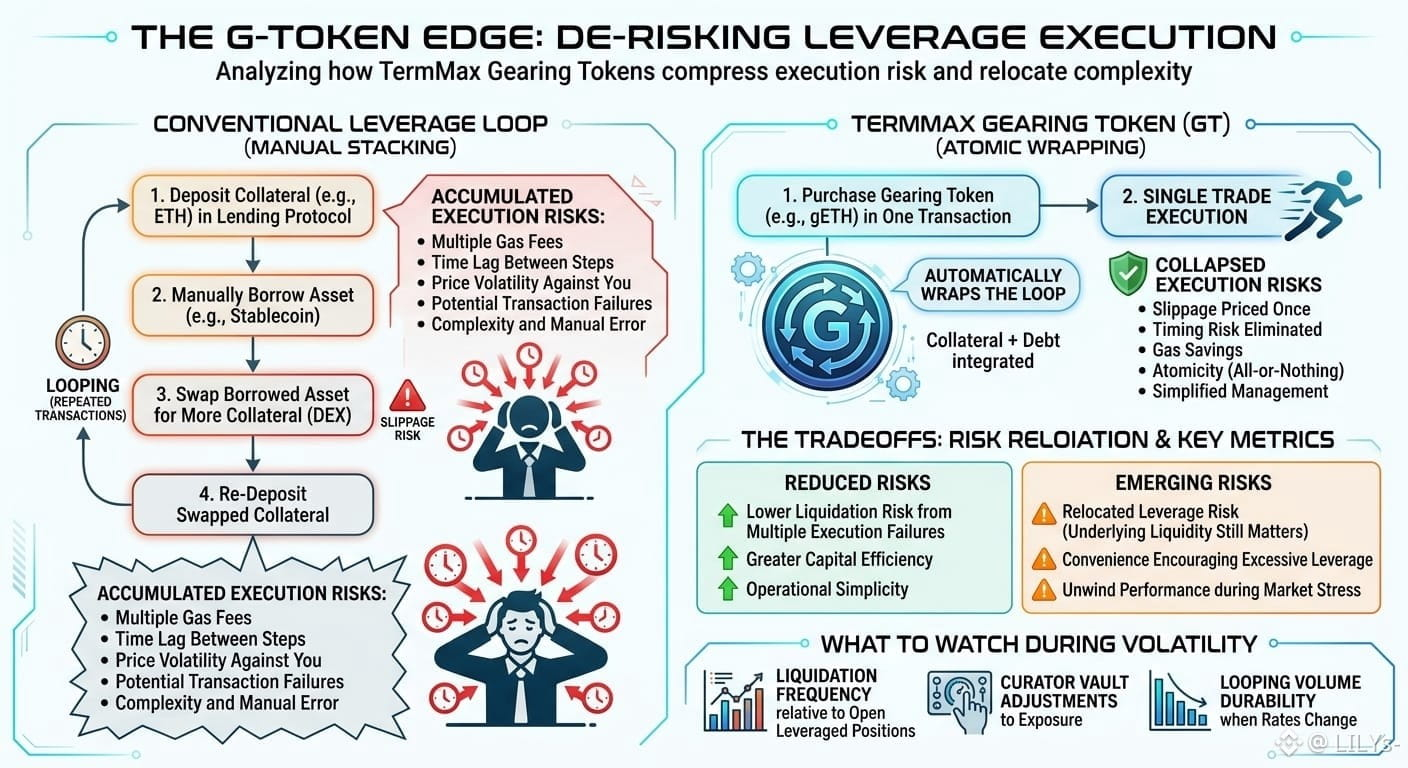
I've spent enough time on leveraged positions to know that most liquidation events aren't caused by bad calls, they're caused by the mechanics of getting into and out of a position taking too many steps under pressure. Every extra transaction is a window where price can move against you before you finish executing.
That's the angle that made me look closer at TermMax's Gearing Token. Instead of manually borrowing, swapping, and re-depositing to build a leveraged position, GT wraps the whole loop into a single token representing collateral plus debt. One transaction instead of a sequence of them.
The interesting part isn't the convenience, it's what compressing that sequence does to execution risk. When looping happens atomically, slippage and timing risk collapse into one priced event instead of accumulating across several separate trades. That's a structural advantage over manually stacked leverage, even before you account for gas savings, and I think most people evaluating the protocol focus on the yield side and miss this.
The tradeoff is that wrapping complexity into a single token doesn't remove the underlying leverage risk, it just relocates where you have to look for it. Collateral quality still matters, and a token that behaves simply on the surface can still unwind badly if the underlying market for that collateral thins out during stress. Convenience can quietly encourage people to take on more leverage than they'd otherwise manage by hand.
Given that, I'd watch how GT positions behave during actual volatility rather than during calm markets. Liquidation frequency relative to open leveraged positions, how curator-managed vaults adjust exposure when conditions shift, and whether looping volume holds up or disappears the moment rates get uncomfortable all tell me more than adoption numbers collected in quiet periods.
I don't think convenience and risk ever fully separate, they just get repackaged. Whether GT's design meaningfully lowers risk or just makes it easier to accumulate is something I am looking forward. #TermMax @TermMax $ACE $CLO
That's the angle that made me look closer at TermMax's Gearing Token. Instead of manually borrowing, swapping, and re-depositing to build a leveraged position, GT wraps the whole loop into a single token representing collateral plus debt. One transaction instead of a sequence of them.
The interesting part isn't the convenience, it's what compressing that sequence does to execution risk. When looping happens atomically, slippage and timing risk collapse into one priced event instead of accumulating across several separate trades. That's a structural advantage over manually stacked leverage, even before you account for gas savings, and I think most people evaluating the protocol focus on the yield side and miss this.
The tradeoff is that wrapping complexity into a single token doesn't remove the underlying leverage risk, it just relocates where you have to look for it. Collateral quality still matters, and a token that behaves simply on the surface can still unwind badly if the underlying market for that collateral thins out during stress. Convenience can quietly encourage people to take on more leverage than they'd otherwise manage by hand.
Given that, I'd watch how GT positions behave during actual volatility rather than during calm markets. Liquidation frequency relative to open leveraged positions, how curator-managed vaults adjust exposure when conditions shift, and whether looping volume holds up or disappears the moment rates get uncomfortable all tell me more than adoption numbers collected in quiet periods.
I don't think convenience and risk ever fully separate, they just get repackaged. Whether GT's design meaningfully lowers risk or just makes it easier to accumulate is something I am looking forward. #TermMax @TermMax $ACE $CLO
Log in to explore more content