Binance Square
Bella伊娃
5k Posts

Bella伊娃

📊 Spot Trader || Binance Square ✅ || Live streamer || Learn smart. Invest wisely || Binance since 2024✅ || Follow for real crypto vibes✅
Open Trade
Frequent Trader
2.5 Years
612 Following
11.7K+ Followers
10.1K+ Liked
Posts
Portfolio
·
--
Bullish
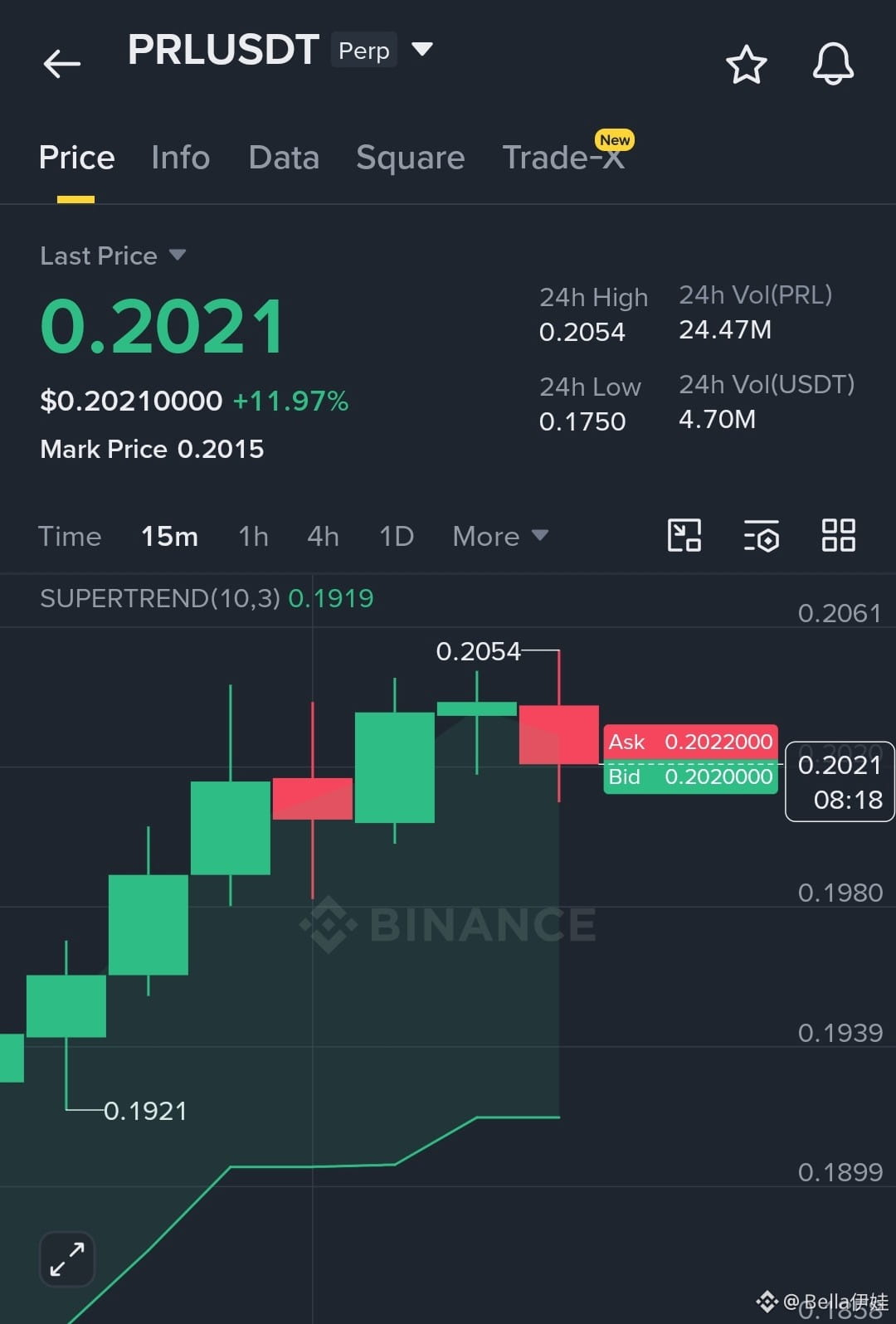
$PRL LONG DON'T MISS THE PUMP🫠 Entry 0.1920 – 0.2020 Stop Loss 0.1850 Take Profit ✅TP1 0.2100 ✅TP2 0.2220 ✅TP3 0.2350 Supply & Risk There is a supply zone higher up around 0.2054 where selling came in before, so we need to be careful there. Keep your risk strictly at 2%, and as soon as TP1 hits, move your stop loss to entry to keep your capital safe. $PRL $ON #Write2Earn #BinanceSquareFamily #SouthKoreaFSCPlansDigitalAssetAct {future}(ONUSDT) {future}(PRLUSDT)
$PRL LONG

DON'T MISS THE PUMP🫠

Entry 0.1920 – 0.2020

Stop Loss 0.1850

Take Profit

✅TP1 0.2100

✅TP2 0.2220

✅TP3 0.2350

Supply & Risk
There is a supply zone higher up around 0.2054 where selling came in before, so we need to be careful there. Keep your risk strictly at 2%, and as soon as TP1 hits, move your stop loss to entry to keep your capital safe.
$PRL $ON #Write2Earn #BinanceSquareFamily #SouthKoreaFSCPlansDigitalAssetAct
$BABY Every blockchain eventually reaches a point where users have to trust that the data they're seeing is correct. What interests me is how Babylon approaches that question without expecting everyone to verify every detail themselves. One concept that stood out to me is ZK-SNARK-based verification. The value isn't simply that proofs are smaller or verification is faster. It's that a complex computation can be validated without revealing the underlying data or forcing every participant to repeat the same work. For a protocol that connects Bitcoin security with a broader staking ecosystem, that matters. As networks grow, verification can become just as important as execution. If checking correctness becomes too expensive or too slow, decentralization starts to suffer because fewer participants can verify independently. ZK-SNARKs offer a different direction. They reduce the cost of proving correctness while preserving privacy, making verification more practical as the system scales. Of course, they also introduce engineering complexity, so the challenge is finding the right balance between cryptographic sophistication and operational simplicity. I think this is one of those technical choices that rarely gets attention because it's mostly invisible when everything works. Yet invisible infrastructure often determines whether a protocol can continue scaling without asking users to place more trust in intermediaries. As Babylon evolves, do you think efficient cryptographic verification will become just as important as Bitcoin-backed security itself? @babylonlabs_io $BABY #baby $BANK {future}(BANKUSDT) Which challenge do ZK-SNARKs help solve best?
$BABY Every blockchain eventually reaches a point where users have to trust that the data they're seeing is correct. What interests me is how Babylon approaches that question without expecting everyone to verify every detail themselves.

One concept that stood out to me is ZK-SNARK-based verification.

The value isn't simply that proofs are smaller or verification is faster. It's that a complex computation can be validated without revealing the underlying data or forcing every participant to repeat the same work.

For a protocol that connects Bitcoin security with a broader staking ecosystem, that matters.
As networks grow, verification can become just as important as execution. If checking correctness becomes too expensive or too slow, decentralization starts to suffer because fewer participants can verify independently.

ZK-SNARKs offer a different direction. They reduce the cost of proving correctness while preserving privacy, making verification more practical as the system scales. Of course, they also introduce engineering complexity, so the challenge is finding the right balance between cryptographic sophistication and operational simplicity.

I think this is one of those technical choices that rarely gets attention because it's mostly invisible when everything works. Yet invisible infrastructure often determines whether a protocol can continue scaling without asking users to place more trust in intermediaries.

As Babylon evolves, do you think efficient cryptographic verification will become just as important as Bitcoin-backed security itself?
@BabylonLabs_io $BABY #baby $BANK

Which challenge do ZK-SNARKs help solve best?
🚀 Scalability
0%
🔒 Privacy
0%
✔️ Trustless Verification
0%
⚡ Efficient Validation
0%
0 votes • Voting closed
The relationship between BTC stakers and BABY stakers is one of the more interesting design choices in Babylon, and I don't think it gets enough attention. At first glance, it might seem like both groups are doing the same job because they are both staking assets into the same ecosystem. But their roles are actually quite different. BTC stakers contribute Bitcoin as the foundation of the network's economic security while keeping their coins in self-custody. Their participation helps strengthen the protocol by extending Bitcoin's security model beyond the Bitcoin blockchain itself. BABY stakers, on the other hand, take on responsibilities that go beyond economic security. They participate in validator operations and governance, helping shape how the network evolves over time. In other words, one group contributes security, while the other contributes coordination and decision-making. I find this separation interesting because it avoids forcing a single asset to perform every role. Instead, Babylon assigns different responsibilities to different participants, creating a system where security and governance are connected but not identical. The real question is whether this balance will continue to work as the ecosystem grows. As more users join and the network becomes more decentralized, will the incentives between BTC stakers and BABY stakers remain aligned, or will new trade-offs begin to appear? @babylonlabs_io #baby $DEXE {future}(DEXEUSDT) $EUL {future}(EULUSDT) $BABY {future}(BABYUSDT)
The relationship between BTC stakers and BABY stakers is one of the more interesting design choices in Babylon, and I don't think it gets enough attention.

At first glance, it might seem like both groups are doing the same job because they are both staking assets into the same ecosystem. But their roles are actually quite different.

BTC stakers contribute Bitcoin as the foundation of the network's economic security while keeping their coins in self-custody. Their participation helps strengthen the protocol by extending Bitcoin's security model beyond the Bitcoin blockchain itself.

BABY stakers, on the other hand, take on responsibilities that go beyond economic security. They participate in validator operations and governance, helping shape how the network evolves over time. In other words, one group contributes security, while the other contributes coordination and decision-making.

I find this separation interesting because it avoids forcing a single asset to perform every role. Instead, Babylon assigns different responsibilities to different participants, creating a system where security and governance are connected but not identical.

The real question is whether this balance will continue to work as the ecosystem grows. As more users join and the network becomes more decentralized, will the incentives between BTC stakers and BABY stakers remain aligned, or will new trade-offs begin to appear?

@BabylonLabs_io #baby
$DEXE
$EUL
$BABY
🟠 BTC Stakers
50%
👥 BABY Stakers
50%
🤝 Both Equally Critical
0%
🔍 Need More Research
0%
2 votes • Voting closed
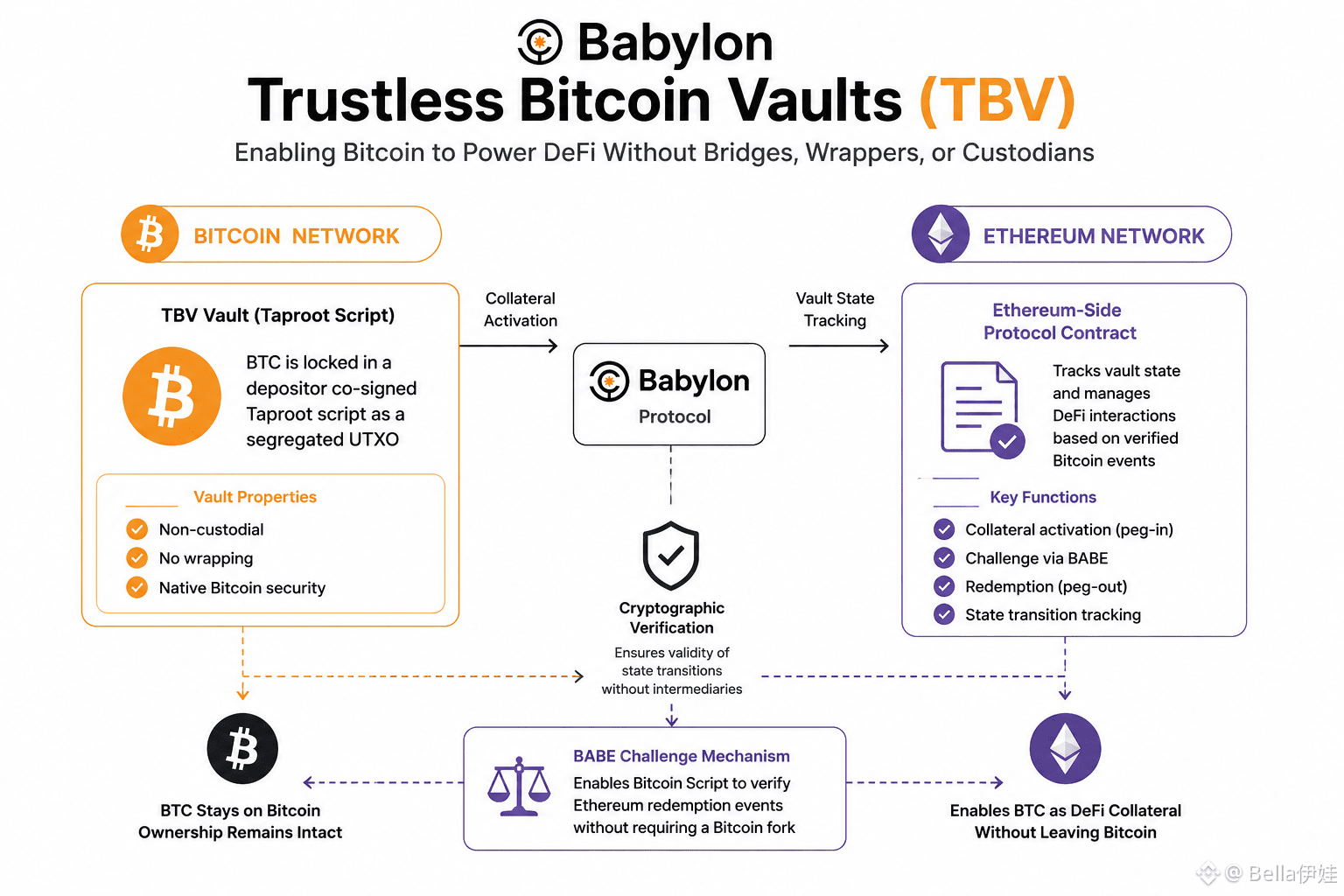
$BABY Most approaches that bring Bitcoin into DeFi introduce an additional trust layer through bridges, custodians, or wrapped assets. Babylon's Trustless Bitcoin Vaults (TBV) follow a different security model. BTC remains locked on the Bitcoin network inside a depositor co-signed Taproot script as a segregated UTXO, while an Ethereum-side protocol contract tracks the vault state for DeFi use. $BABY Collateral activation binds the Bitcoin lockup to Ethereum through cryptographic verification, and redemption relies on the BABE challenge mechanism, allowing Bitcoin Script to verify Ethereum redemption events without requiring a Bitcoin fork. The result is a model where Bitcoin can serve as DeFi collateral while ownership stays on Bitcoin and trust shifts from intermediaries to protocol-enforced cryptography. @babylonlabs_io $BABY #baby
$BABY Most approaches that bring Bitcoin into DeFi introduce an additional trust layer through bridges, custodians, or wrapped assets.

Babylon's Trustless Bitcoin Vaults (TBV) follow a different security model.

BTC remains locked on the Bitcoin network inside a depositor co-signed Taproot script as a segregated UTXO, while an Ethereum-side protocol contract tracks the vault state for DeFi use. $BABY

Collateral activation binds the Bitcoin lockup to Ethereum through cryptographic verification, and redemption relies on the BABE challenge mechanism, allowing Bitcoin Script to verify Ethereum redemption events without requiring a Bitcoin fork.

The result is a model where Bitcoin can serve as DeFi collateral while ownership stays on Bitcoin and trust shifts from intermediaries to protocol-enforced cryptography. @BabylonLabs_io $BABY #baby
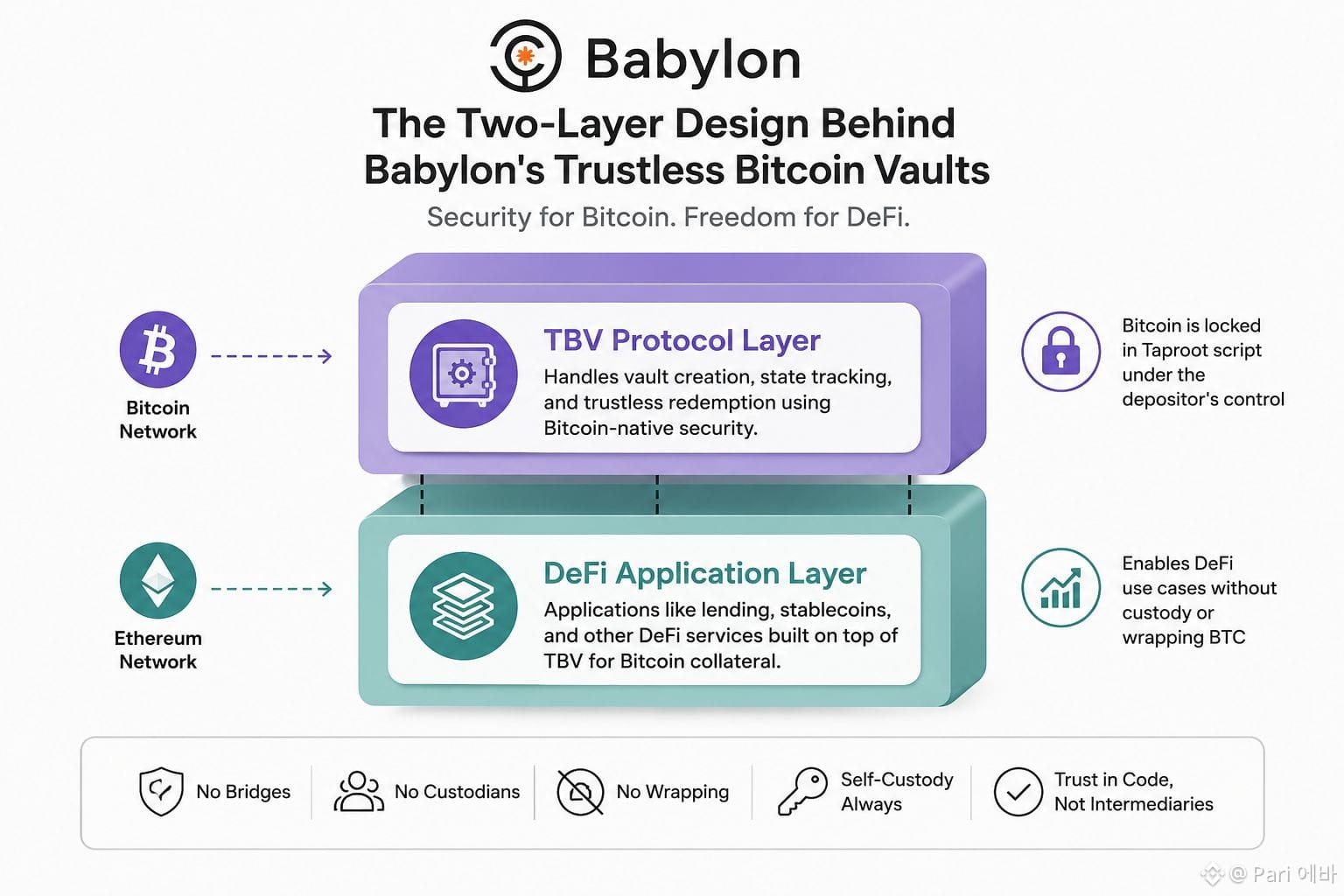
$BABY While reading Babylon's documentation, I noticed that its two-layer architecture solves more than a technical challenge. The Trustless Bitcoin Vault protocol is responsible only for creating, tracking, and redeeming Bitcoin vaults, while DeFi applications focus on lending and other financial services. This clear separation keeps Bitcoin locked under protocol rules instead of application control. It also allows different DeFi products to build on the same secure foundation without changing how the vault itself works. To me, this design makes Bitcoin-backed DeFi more modular, transparent, and easier to expand over time. @babylonlabs_io $BABY #Babylon #baby
$BABY While reading Babylon's documentation, I noticed that its two-layer architecture solves more than a technical challenge.
The Trustless Bitcoin Vault protocol is responsible only for creating, tracking, and redeeming Bitcoin vaults, while DeFi applications focus on lending and other financial services.
This clear separation keeps Bitcoin locked under protocol rules instead of application control.
It also allows different DeFi products to build on the same secure foundation without changing how the vault itself works.

To me, this design makes Bitcoin-backed DeFi more modular, transparent, and easier to expand over time.
@BabylonLabs_io $BABY #Babylon #baby
·
--
Bullish
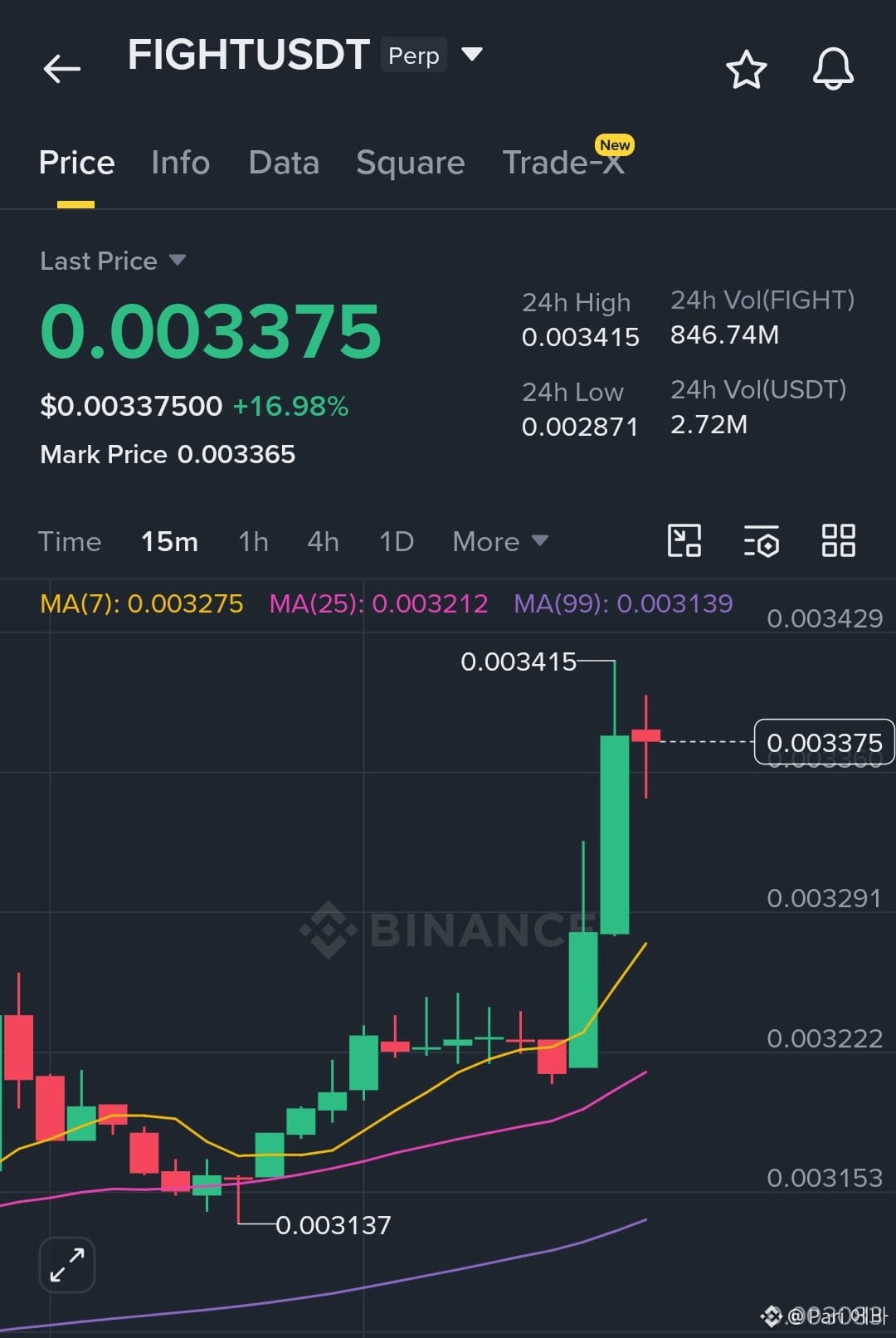
$FIGHT LONG Trade Plan Entry 0.003250 – 0.003380 Stop Loss 0.003100 Take Profit ✅TP1 0.003550 ✅TP2 0.003750 ✅TP3 0.004000 Supply & Risk There is a supply zone higher up around 0.003415 where selling came in before, so we need to be careful there. Keep your risk strictly at 2%, and as soon as TP1 hits, move your stop loss to entry to keep your capital safe. $FIGHT $PTB #FİGHT #FootballSeason2026 #TrumpMeetsOnWiderIranOffensive {future}(PTBUSDT) {future}(FIGHTUSDT)
$FIGHT LONG

Trade Plan

Entry 0.003250 – 0.003380

Stop Loss 0.003100

Take Profit

✅TP1 0.003550

✅TP2 0.003750

✅TP3 0.004000

Supply & Risk
There is a supply zone higher up around 0.003415 where selling came in before, so we need to be careful there. Keep your risk strictly at 2%, and as soon as TP1 hits, move your stop loss to entry to keep your capital safe.
$FIGHT $PTB
#FİGHT #FootballSeason2026 #TrumpMeetsOnWiderIranOffensive
·
--
Bullish
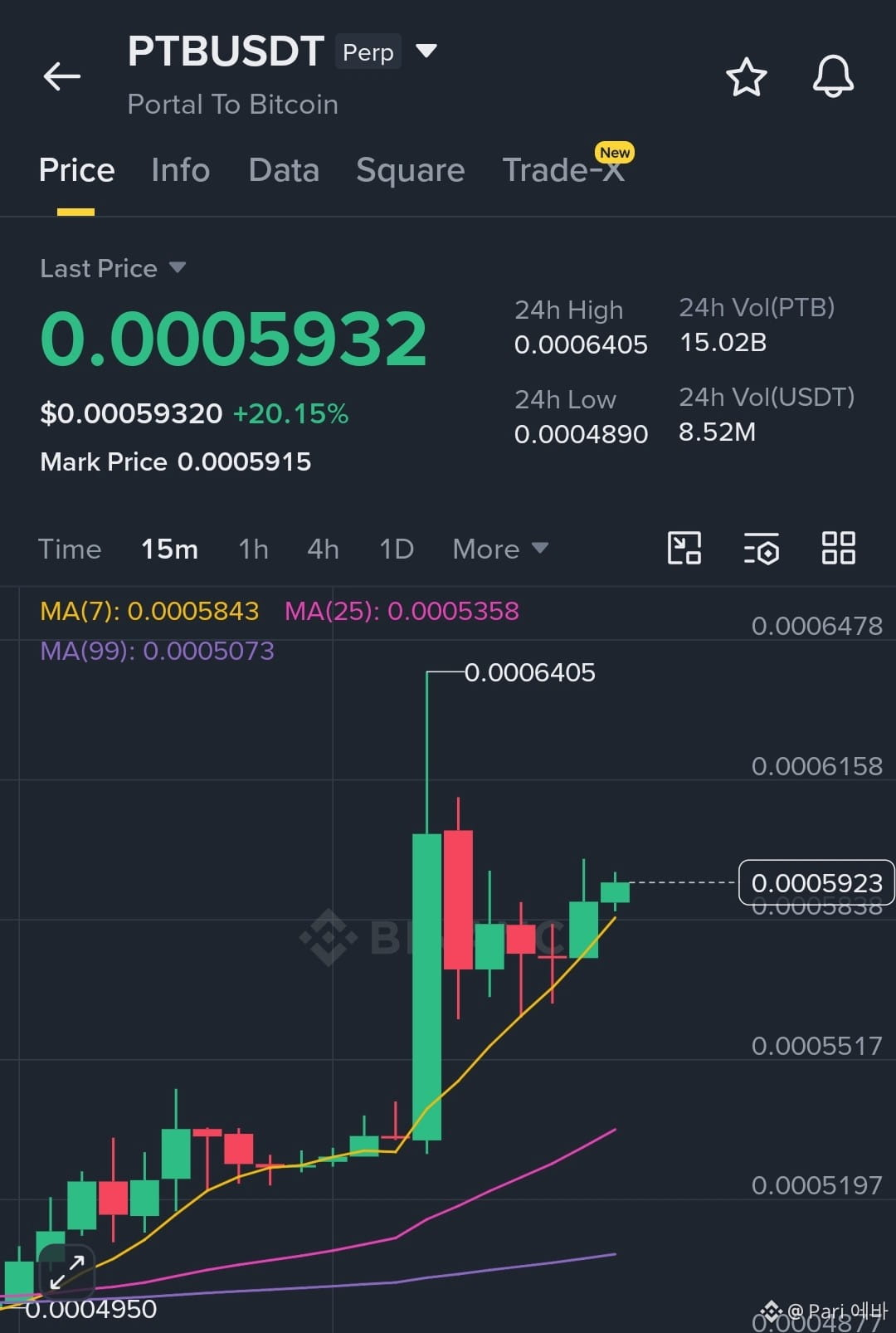
$PTB LONG Trade Plan Entry 0.0005650 – 0.0005950 Stop Loss 0.0005300 Take Profit ✅TP1 0.0006400 ✅TP2 0.0006900 ✅TP3 0.0007500 Supply & Risk There is a supply zone higher up around 0.0006158 and 0.0006405 where selling came in before, so we need to be careful there. Keep your risk strictly at 2%, and as soon as TP1 hits, move your stop loss to entry to keep your capital safe. $PTB {future}(PTBUSDT) $MEGA {future}(MEGAUSDT) #FootballSeason2026 #PTB
$PTB LONG

Trade Plan

Entry 0.0005650 – 0.0005950

Stop Loss 0.0005300

Take Profit

✅TP1 0.0006400

✅TP2 0.0006900

✅TP3 0.0007500

Supply & Risk
There is a supply zone higher up around 0.0006158 and 0.0006405 where selling came in before, so we need to be careful there. Keep your risk strictly at 2%, and as soon as TP1 hits, move your stop loss to entry to keep your capital safe.
$PTB
$MEGA
#FootballSeason2026 #PTB
·
--
Bullish
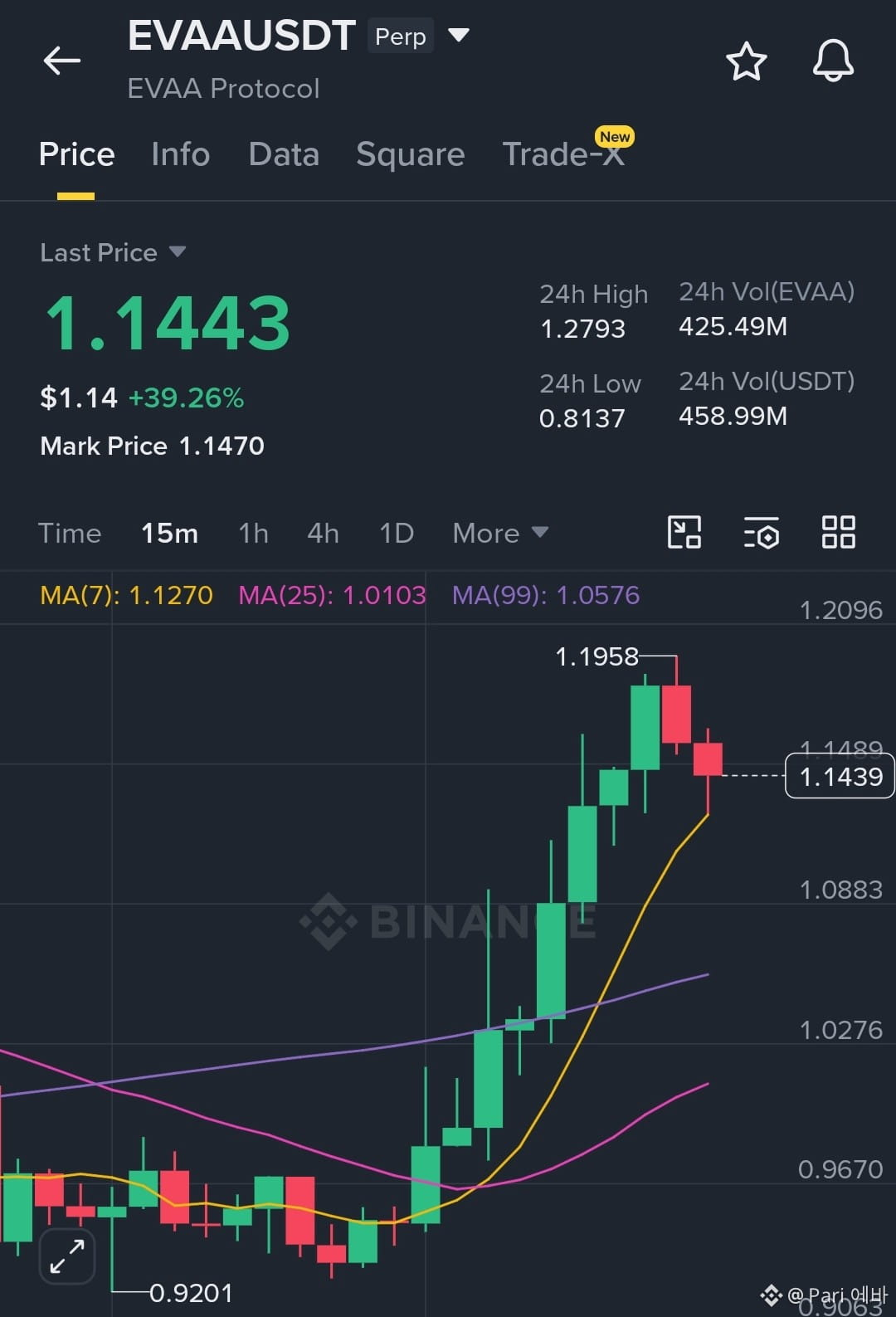
$EVAA LONG WAKE UP TRADERS Trade Plan Entry 1.0950 – 1.1450 Stop Loss 1.0450 Take Profit ✅TP1 1.1950 ✅TP2 1.2450 ✅TP3 1.2800 Supply & Risk There is a supply zone higher up around 1.1958 and 1.2793 where selling came in before, so we need to be careful there. Keep your risk strictly at 2%, and as soon as TP1 hits, move your stop loss to entry to keep your capital safe. $EVAA $NVDAB #EVA #FootballSeason2026 #JuneCPIFedHike20% {future}(EVAAUSDT)
$EVAA LONG
WAKE UP TRADERS

Trade Plan

Entry 1.0950 – 1.1450

Stop Loss 1.0450

Take Profit

✅TP1 1.1950

✅TP2 1.2450

✅TP3 1.2800

Supply & Risk
There is a supply zone higher up around 1.1958 and 1.2793 where selling came in before, so we need to be careful there. Keep your risk strictly at 2%, and as soon as TP1 hits, move your stop loss to entry to keep your capital safe.
$EVAA $NVDAB #EVA #FootballSeason2026 #JuneCPIFedHike20%
·
--
Bullish
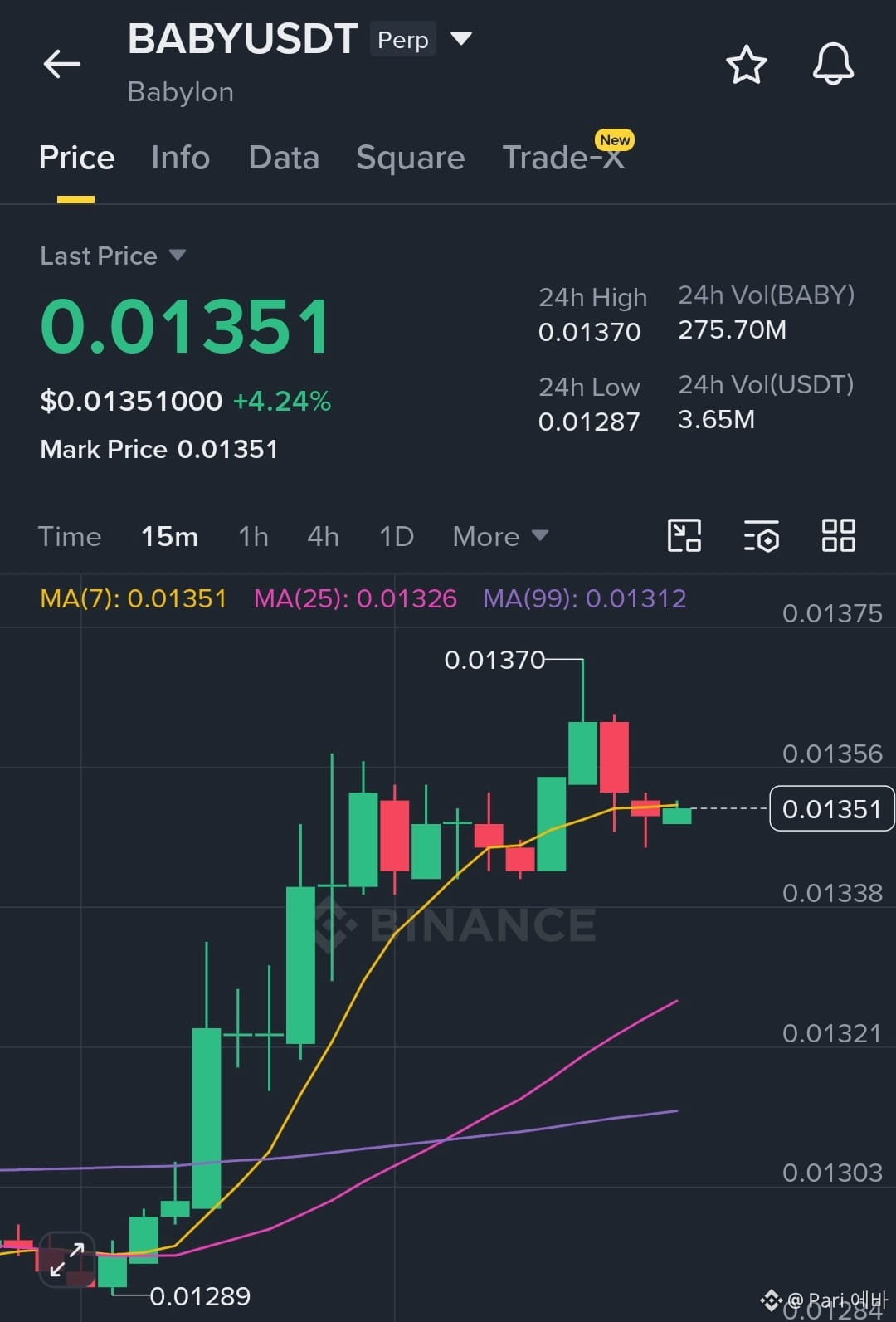
BABY LONG Attention now … wait a minute 👀 Trade Plan Entry 0.01250 – 0.01350 Stop Loss 0.01180 Take Profit ✅TP1 0.01450 ✅TP2 0.01550 ✅TP3 0.01680 The price has made a strong support floor at the bottom and is now getting ready to move up. 📌Supply & Risk There is a supply zone higher up around 0.01408 and 0.01525 where selling came in before, so we need to be careful there. Keep your risk strictly at 2%, and as soon as TP1 hits, move your stop loss to entry to keep your capital safe.
BABY LONG
Attention now … wait a minute 👀

Trade Plan

Entry 0.01250 – 0.01350

Stop Loss 0.01180

Take Profit

✅TP1 0.01450

✅TP2 0.01550

✅TP3 0.01680

The price has made a strong support floor at the bottom and is now getting ready to move up.

📌Supply & Risk
There is a supply zone higher up around 0.01408 and 0.01525 where selling came in before, so we need to be careful there. Keep your risk strictly at 2%, and as soon as TP1 hits, move your stop loss to entry to keep your capital safe.

Newton Protocol: Tech ke Peechay Chhupa Hua Centralization ka SawalHar system jo “decentralized” hone ka dawa karta hai, kya waqai decentralize hota hai? Ya phir sirf us ka bohat khoobsurat technical wrapper hota hai? Newton Protocol ko dekho to pehli nazar mein yeh ek advanced compliance layer lagti hai: EigenLayer, AVS, BLS signatures, TEE, ZKP—sab lafz aise hain jo trust ko mathematically strong banate hue lagte hain. Lekin asli sawal yeh hai: kya yeh trust ko tod raha hai, ya sirf usay ek aur zyada polished shape de raha hai?Agar architecture ko neeche tak khol kar dekha jaye, to distributed operators asal mein independent decision-makers nazar nahi aate. Woh zyada tar execution workers hain—aise log jo tayari shuda rules ko follow karte hain, lekin rules banate nahi. Yani un ke paas power ka naam to hota hai, magar power ki asal rooh un ke paas nahi hoti. To phir decentralization ka matlab kya hua? Agar policy kisi institution ke paas ho aur execution kai nodes mein bant di jaye, to kya yeh governance ka bikhra hua version hai, ya sirf risk ko distribute karne ka naya tareeqa?Yahan se ek aur layer khulti hai: BLS aggregated signatures. Yeh technique efficiency ke liye bohat impressive hai, kyun ke multiple signatures ko ek hi compact signal mein badal deti hai. Lekin kya har efficient cheez transparent bhi hoti hai? Kabhi kabhi jo cheez network ko tez banati hai, woh auditability ko dheela kar deti hai. Jab har node ki individual verification dikhai hi na de, to outsider kaise jaanay ke kis node ne asli check kiya aur kis ne bas collective flow ko follow kiya? Efficiency agar observation ko ghata de, to phir security ka claim kitna majboot reh jata hai?Sab se aham kamzori aksar computation mein nahi, input mein hoti hai. TEE aur ZKP yeh prove kar sakte hain ke computation rules ke mutabiq hui, lekin yeh zyada tar yeh guarantee nahi dete ke jo data andar gaya woh khud sahi tha. Yahin “garbage in, garbage out” ka masla paida hota hai. Agar oracle ka source hi compromised ho jaye, ya price feed mein distortion aa jaye, to cryptographic proof bas itna kahega ke “galat data ko sahi tareeqay se process kiya gaya.” Kya yeh sach mein trust hai, ya sirf tamper-proof wrongness?Phir AI guardrails ka sawaal aata hai. Log sochte hain ke AI non-compliance ko pakar lega, magar kya AI har tarah ki clever masking ko bhi samajh sakta hai? Agar koi large suspicious action ko chhoti chhoti harmless-looking steps mein tod de, to kya model usay pakar payega? Guardrails aksar blunt attacks ke liye effective hote hain, lekin layered evasion ke samne un ki aankhen band ho sakti hain. Is se yeh khauf paida hota hai ke system “smart protection” ka impression to de, lekin real world mein usay beat karne ke liye sirf strategy ka pattern badalna kaafi ho.Strategy re-use bhi aik interesting but risky design choice hai. Agar har app ek hi core strategy library ko use kare, to development fast ho jati hai, magar kya yeh same dependency ka ek bara nuksan nahi? Security mein decoupling is liye hoti hai ke aik flaw poore ecosystem ko na gira de. Lekin jab sab kuch ek hi shared logic par chal raha ho, to ek chhoti si bug chain reaction ban sakti hai. Yahan innovation aur fragility ek hi line mein kharay nazar aate hain.Aur akhir mein token economics. NEWT ki value agar re-staked ETH ke security narrative par dependent ho, to kya us ki apni independent value creation limited nahi ho jati? Agar market ka ceiling kisi aur asset ki gravity se bound ho, aur unlock pressure bhi saath chal raha ho, to long-term conviction banana asaan nahi rehta. Token ka design sirf utility ka masla nahi hota; woh incentives, scarcity, adoption aur trust ka combined ecosystem hota hai. Agar yeh ecosystem immature ho, to price ko support karne ke liye sirf narrative bachi reh jati hai.Newton Protocol ka sab se bara sawal yeh hai: kya yeh real decentralization ki taraf ja raha hai, ya compliance ko code mein outsource karke central authority ko aur zyada sophisticated bana raha hai? Agar keys ab bhi ek central wall par latki hain, to phir fortress kitna bhi modern kyun na ho, us ka darwaza to ek hi jagah se khulta hai. $NEWT #Newt @NewtonProtocol #newt $BEE $BEAT {future}(NEWTUSDT)

Newton Protocol: Tech ke Peechay Chhupa Hua Centralization ka Sawal

Har system jo “decentralized” hone ka dawa karta hai, kya waqai decentralize hota hai? Ya phir sirf us ka bohat khoobsurat technical wrapper hota hai? Newton Protocol ko dekho to pehli nazar mein yeh ek advanced compliance layer lagti hai: EigenLayer, AVS, BLS signatures, TEE, ZKP—sab lafz aise hain jo trust ko mathematically strong banate hue lagte hain.
Lekin asli sawal yeh hai: kya yeh trust ko tod raha hai, ya sirf usay ek aur zyada polished shape de raha hai?Agar architecture ko neeche tak khol kar dekha jaye, to distributed operators asal mein independent decision-makers nazar nahi aate. Woh zyada tar execution workers hain—aise log jo tayari shuda rules ko follow karte hain, lekin rules banate nahi.
Yani un ke paas power ka naam to hota hai, magar power ki asal rooh un ke paas nahi hoti. To phir decentralization ka matlab kya hua? Agar policy kisi institution ke paas ho aur execution kai nodes mein bant di jaye, to kya yeh governance ka bikhra hua version hai, ya sirf risk ko distribute karne ka naya tareeqa?Yahan se ek aur layer khulti hai: BLS aggregated signatures.
Yeh technique efficiency ke liye bohat impressive hai, kyun ke multiple signatures ko ek hi compact signal mein badal deti hai.
Lekin kya har efficient cheez transparent bhi hoti hai? Kabhi kabhi jo cheez network ko tez banati hai, woh auditability ko dheela kar deti hai. Jab har node ki individual verification dikhai hi na de, to outsider kaise jaanay ke kis node ne asli check kiya aur kis ne bas collective flow ko follow kiya? Efficiency agar observation ko ghata de, to phir security ka claim kitna majboot reh jata hai?Sab se aham kamzori aksar computation mein nahi, input mein hoti hai.
TEE aur ZKP yeh prove kar sakte hain ke computation rules ke mutabiq hui, lekin yeh zyada tar yeh guarantee nahi dete ke jo data andar gaya woh khud sahi tha. Yahin “garbage in, garbage out” ka masla paida hota hai.
Agar oracle ka source hi compromised ho jaye, ya price feed mein distortion aa jaye, to cryptographic proof bas itna kahega ke “galat data ko sahi tareeqay se process kiya gaya.” Kya yeh sach mein trust hai, ya sirf tamper-proof wrongness?Phir AI guardrails ka sawaal aata hai.
Log sochte hain ke AI non-compliance ko pakar lega, magar kya AI har tarah ki clever masking ko bhi samajh sakta hai? Agar koi large suspicious action ko chhoti chhoti harmless-looking steps mein tod de, to kya model usay pakar payega? Guardrails aksar blunt attacks ke liye effective hote hain, lekin layered evasion ke samne un ki aankhen band ho sakti hain.
Is se yeh khauf paida hota hai ke system “smart protection” ka impression to de, lekin real world mein usay beat karne ke liye sirf strategy ka pattern badalna kaafi ho.Strategy re-use bhi aik interesting but risky design choice hai.
Agar har app ek hi core strategy library ko use kare, to development fast ho jati hai, magar kya yeh same dependency ka ek bara nuksan nahi? Security mein decoupling is liye hoti hai ke aik flaw poore ecosystem ko na gira de.
Lekin jab sab kuch ek hi shared logic par chal raha ho, to ek chhoti si bug chain reaction ban sakti hai. Yahan innovation aur fragility ek hi line mein kharay nazar aate hain.Aur akhir mein token economics. NEWT ki value agar re-staked ETH ke security narrative par dependent ho, to kya us ki apni independent value creation limited nahi ho jati? Agar market ka ceiling kisi aur asset ki gravity se bound ho, aur unlock pressure bhi saath chal raha ho, to long-term conviction banana asaan nahi rehta.
Token ka design sirf utility ka masla nahi hota; woh incentives, scarcity, adoption aur trust ka combined ecosystem hota hai. Agar yeh ecosystem immature ho, to price ko support karne ke liye sirf narrative bachi reh jati hai.Newton Protocol ka sab se bara sawal yeh hai:
kya yeh real decentralization ki taraf ja raha hai, ya compliance ko code mein outsource karke central authority ko aur zyada sophisticated bana raha hai? Agar keys ab bhi ek central wall par latki hain, to phir fortress kitna bhi modern kyun na ho, us ka darwaza to ek hi jagah se khulta hai.
$NEWT #Newt @NewtonProtocol #newt $BEE $BEAT
#newt Everyone, for the past few days I haven't been working at my best, and my ranking has kept slipping. It's been three or four days without earning any post points, so I decided to slow down, think more deeply, and create something more meaningful. Let's see what you think. After spending more time studying on-chain AI, I’ve started to think that the real challenge may not be whether AI can execute transactions, but whether it truly understands the intent behind every permission it receives. Many discussions focus on contract exploits, yet what if the larger risk appears when an AI correctly follows incomplete instructions instead of rejecting them?Imagine asking an AI to protect a portfolio during market volatility. Should it freely decide the protocol, execution timing, slippage limits, and retry logic, or should some of those decisions always require another layer of approval? If the system reaches a profitable outcome through a path the user never expected, can that still be considered faithful execution? This is one reason Newton Protocol has attracted my attention. Its vision of connecting user authorization, intent interpretation, and secure execution is promising, but an important question remains: can execution boundaries be defined precisely enough that AI never drifts beyond the user's original objective?I've shared all my thoughts above. Now I'd really like to hear yours. Do you think this kind of post deserves points? Please share your opinion in the comments! $NEWT #Newt @NewtonProtocol $BEAT $POL
#newt Everyone, for the past few days I haven't been working at my best, and my ranking has kept slipping.

It's been three or four days without earning any post points, so I decided to slow down, think more deeply, and create something more meaningful. Let's see what you think.

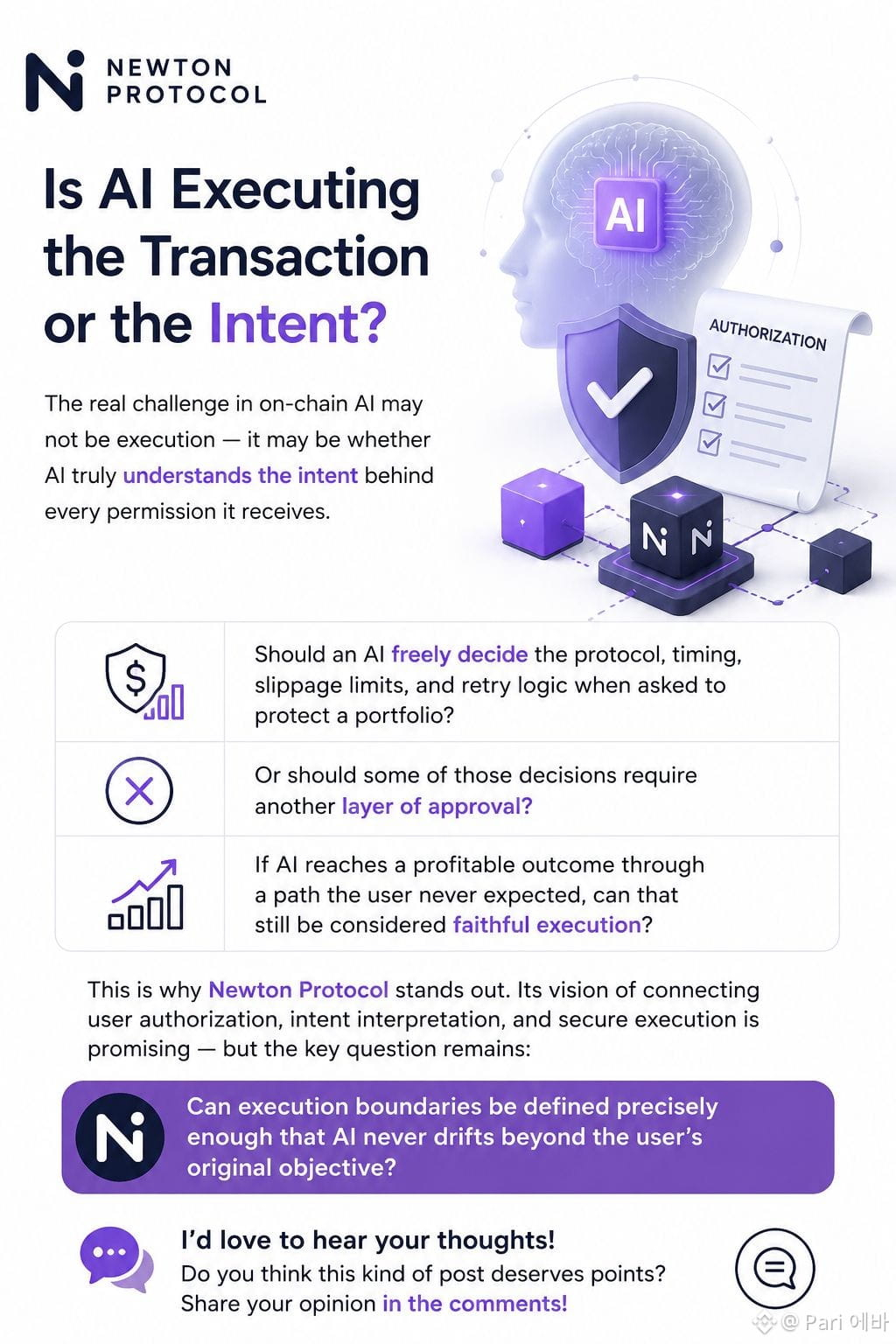
After spending more time studying on-chain AI, I’ve started to think that the real challenge may not be whether AI can execute transactions, but whether it truly understands the intent behind every permission it receives.

Many discussions focus on contract exploits, yet what if the larger risk appears when an AI correctly follows incomplete instructions instead of rejecting them?Imagine asking an AI to protect a portfolio during market volatility.

Should it freely decide the protocol, execution timing, slippage limits, and retry logic, or should some of those decisions always require another layer of approval? If the system reaches a profitable outcome through a path the user never expected, can that still be considered faithful execution?

This is one reason Newton Protocol has attracted my attention.

Its vision of connecting user authorization, intent interpretation, and secure execution is promising, but an important question remains: can execution boundaries be defined precisely enough that AI never drifts beyond the user's original objective?I've shared all my thoughts above. Now I'd really like to hear yours.

Do you think this kind of post deserves points? Please share your opinion in the comments!
$NEWT #Newt @NewtonProtocol $BEAT $POL
Article
Newton Protocol’s Real Test: The Data Layer Behind the PolicyA little while ago, I found myself asking a simple question: what is actually the best way to examine a system? Every system can be viewed from many different angles, but how do we identify the one angle that reveals the most about how it will behave under real conditions? The more I thought about it, the more I realized that understanding a system is often less about reading its features and more about identifying the point where small assumptions can create large consequences. That idea stayed in my mind while reading Newton Protocol's mainnet Beta architecture.When I first looked through Newton Protocol's mainnet Beta design, I didn't spend much time asking whether the authorization policy itself was strict enough. That part is relatively easy to understand because policies can always be updated, tightened, or expanded. The question that stayed with me was different: when a policy depends on outside information, how much confidence should we place in the path that brings that information into the system?I remember reviewing a digital asset strategy where almost everything looked technically sound. The smart contracts were well organized, the execution logic made sense, and the risk model appeared carefully designed. Yet one detail kept bothering me. Instead of relying entirely on established data providers, part of the decision process depended on a privately maintained data connector. It wasn't obviously insecure, but I kept wondering what would happen if the connector quietly produced inaccurate information without anyone realizing it. A system can execute every instruction perfectly while still reaching the wrong conclusion if the information entering the system is already flawed. That experience shaped how I read Newton's architecture.Most discussions focus on the three major stages of the authorization flow: user intent, policy evaluation, and distributed consensus. On paper, the separation is sensible. One participant does not make the final decision alone. Multiple Operators independently evaluate the same request before a signature is produced. Combined with economic staking and cryptographic verification, this creates several layers designed to reduce blind trust. But each of those words—evaluation, consensus, verification, infrastructure—actually represents an entire ecosystem rather than a single feature.Take evaluation, for example. Evaluation is not simply reading a price feed. It may include market prices, historical volatility, wallet reputation, sanctions screening, liquidity conditions, vault health, risk ratings, timing information, and many other external signals. Every one of these inputs follows its own collection process, update schedule, validation rules, and failure conditions. If just one of those pieces behaves differently than expected, the final evaluation may still complete successfully while quietly drifting away from reality.The same applies to infrastructure. Infrastructure is far more than servers running software. It includes communication between Operators, execution environments, data synchronization, monitoring systems, logging, recovery mechanisms, security boundaries, software updates, and operational procedures. When people say an infrastructure is secure, are they referring only to code security, or are they also including the quality of operational decisions made every day?Newton's documentation explains that developers can introduce custom data connectors whenever built-in providers cannot satisfy a particular use case. From a flexibility standpoint, that makes complete sense. Every ecosystem eventually encounters assets or datasets that existing providers do not support. However, flexibility introduces another layer of responsibility.Sandboxing protects the execution environment by preventing custom modules from accessing resources they shouldn't. But sandbox isolation is different from validating whether the information being collected is logically correct. If timestamps are inconsistent, fallback sources activate incorrectly, or calculation methods contain subtle assumptions, the module may execute flawlessly while still producing misleading inputs. The authorization system would then faithfully process incorrect information without technically malfunctioning.This raises another question that I haven't found fully answered. If every Operator executes the same custom WASM connector independently, how is deterministic behavior guaranteed across different environments? Are runtime differences completely eliminated? If two Operators receive identical requests but slightly different outputs because of implementation details, what happens to consensus? More importantly, who reviews these third-party connectors before institutions begin relying on them? Is the review limited to security vulnerabilities, or does it also examine data methodology, operational assumptions, maintenance practices, and accountability after deployment?I also find myself thinking beyond today's supported chains. As Newton expands into additional ecosystems, will every chain maintain identical levels of data quality, Operator participation, and service-provider coverage? Or will authorization confidence naturally differ depending on where the transaction originates? If so, institutions may eventually evaluate not only Newton itself, but also the maturity of each individual deployment. None of these questions suggest that the overall direction is wrong. In fact, I think Newton has built a thoughtful framework that addresses several long-standing weaknesses in on-chain authorization. But strong frameworks are often tested at their boundaries rather than at their center. Sometimes the biggest risks are not hidden inside the architecture itself—they appear where new components, external data, and human responsibility connect to an otherwise reliable system. That is why my attention remains on the data layer. Technology can verify execution, cryptography can verify signatures, and economic incentives can discourage malicious behavior. Yet if uncertainty still exists around who validates custom connectors, how deeply they are reviewed, and who accepts responsibility when data quality fails, then perhaps those are the questions worth answering before the next stage of institutional adoption begins. This is simply the angle that made the most sense to me while thinking through the system. But I'm genuinely curious whether this is the right lens to evaluate a design like this, or whether there's an even more important perspective that deserves attention.I'd really like to hear your thoughts. Do you think this is the best way to analyze a system like Newton Protocol, or would you approach it from a completely different angle? Share your perspective in the comments. $SXT $NEWT $OL @NewtonProtocol #newt #Newt

Newton Protocol’s Real Test: The Data Layer Behind the Policy

A little while ago, I found myself asking a simple question: what is actually the best way to examine a system? Every system can be viewed from many different angles, but how do we identify the one angle that reveals the most about how it will behave under real conditions?
The more I thought about it, the more I realized that understanding a system is often less about reading its features and more about identifying the point where small assumptions can create large consequences.
That idea stayed in my mind while reading Newton Protocol's mainnet Beta architecture.When I first looked through Newton Protocol's mainnet Beta design, I didn't spend much time asking whether the authorization policy itself was strict enough.
That part is relatively easy to understand because policies can always be updated, tightened, or expanded.
The question that stayed with me was different: when a policy depends on outside information, how much confidence should we place in the path that brings that information into the system?I remember reviewing a digital asset strategy where almost everything looked technically sound. The smart contracts were well organized, the execution logic made sense, and the risk model appeared carefully designed.
Yet one detail kept bothering me. Instead of relying entirely on established data providers, part of the decision process depended on a privately maintained data connector. It wasn't obviously insecure, but I kept wondering what would happen if the connector quietly produced inaccurate information without anyone realizing it.
A system can execute every instruction perfectly while still reaching the wrong conclusion if the information entering the system is already flawed.
That experience shaped how I read Newton's architecture.Most discussions focus on the three major stages of the authorization flow: user intent, policy evaluation, and distributed consensus.
On paper, the separation is sensible.
One participant does not make the final decision alone.
Multiple Operators independently evaluate the same request before a signature is produced. Combined with economic staking and cryptographic verification, this creates several layers designed to reduce blind trust.
But each of those words—evaluation, consensus, verification, infrastructure—actually represents an entire ecosystem rather than a single feature.Take evaluation, for example.
Evaluation is not simply reading a price feed. It may include market prices, historical volatility, wallet reputation, sanctions screening, liquidity conditions, vault health, risk ratings, timing information, and many other external signals.
Every one of these inputs follows its own collection process, update schedule, validation rules, and failure conditions. If just one of those pieces behaves differently than expected, the final evaluation may still complete successfully while quietly drifting away from reality.The same applies to infrastructure. Infrastructure is far more than servers running software.
It includes communication between Operators, execution environments, data synchronization, monitoring systems, logging, recovery mechanisms, security boundaries, software updates, and operational procedures.
When people say an infrastructure is secure, are they referring only to code security, or are they also including the quality of operational decisions made every day?Newton's documentation explains that developers can introduce custom data connectors whenever built-in providers cannot satisfy a particular use case.
From a flexibility standpoint, that makes complete sense. Every ecosystem eventually encounters assets or datasets that existing providers do not support.
However, flexibility introduces another layer of responsibility.Sandboxing protects the execution environment by preventing custom modules from accessing resources they shouldn't.
But sandbox isolation is different from validating whether the information being collected is logically correct. If timestamps are inconsistent, fallback sources activate incorrectly, or calculation methods contain subtle assumptions, the module may execute flawlessly while still producing misleading inputs.
The authorization system would then faithfully process incorrect information without technically malfunctioning.This raises another question that I haven't found fully answered.
If every Operator executes the same custom WASM connector independently, how is deterministic behavior guaranteed across different environments?
Are runtime differences completely eliminated? If two Operators receive identical requests but slightly different outputs because of implementation details, what happens to consensus?
More importantly, who reviews these third-party connectors before institutions begin relying on them? Is the review limited to security vulnerabilities, or does it also examine data methodology, operational assumptions, maintenance practices, and accountability after deployment?I also find myself thinking beyond today's supported chains.
As Newton expands into additional ecosystems, will every chain maintain identical levels of data quality, Operator participation, and service-provider coverage? Or will authorization confidence naturally differ depending on where the transaction originates? If so, institutions may eventually evaluate not only Newton itself, but also the maturity of each individual deployment.
None of these questions suggest that the overall direction is wrong. In fact, I think Newton has built a thoughtful framework that addresses several long-standing weaknesses in on-chain authorization.
But strong frameworks are often tested at their boundaries rather than at their center. Sometimes the biggest risks are not hidden inside the architecture itself—they appear where new components, external data, and human responsibility connect to an otherwise reliable system.
That is why my attention remains on the data layer. Technology can verify execution, cryptography can verify signatures, and economic incentives can discourage malicious behavior.
Yet if uncertainty still exists around who validates custom connectors, how deeply they are reviewed, and who accepts responsibility when data quality fails, then perhaps those are the questions worth answering before the next stage of institutional adoption begins.
This is simply the angle that made the most sense to me while thinking through the system. But I'm genuinely curious whether this is the right lens to evaluate a design like this, or whether there's an even more important perspective that deserves attention.I'd really like to hear your thoughts.
Do you think this is the best way to analyze a system like Newton Protocol, or would you approach it from a completely different angle? Share your perspective in the comments.
$SXT $NEWT $OL
@NewtonProtocol #newt #Newt
#newt Institutional DeFi often treats compliance as a checkpoint after execution, but is that approach still practical when strategies operate in milliseconds? If compliance always arrives after the transaction, can it truly reduce risk, or does it simply document what has already happened? That question becomes more important as automated trading continues to accelerate. Newton Protocol approaches the challenge differently by turning compliance into programmable rules rather than a slow manual workflow. But what does that actually mean? A rule engine is more than software—it combines policy logic, verification steps, permission controls, and automated decision-making into one coordinated process. Instead of relying only on human review, predefined conditions can be evaluated before actions moveforward. The architecture also separates heavy computation from on-chain execution through trusted environments while recording only cryptographic proof on-chain. This lowers blockchain costs and helps protect sensitive identity information. Yet another question remains: if verification depends on external node networks and custom compliance logic, how much resilience exists when infrastructure changes or regulations differ across jurisdictions?Perhaps the bigger lesson is that technology can organize compliance, but it cannot create regulatory consensus. As policies evolve, the real measure of success may not be faster automation alone, but whether one adaptable framework can remain trustworthy across different legal environments over time. $NEWT $LDO $B3 @NewtonProtocol #Newt
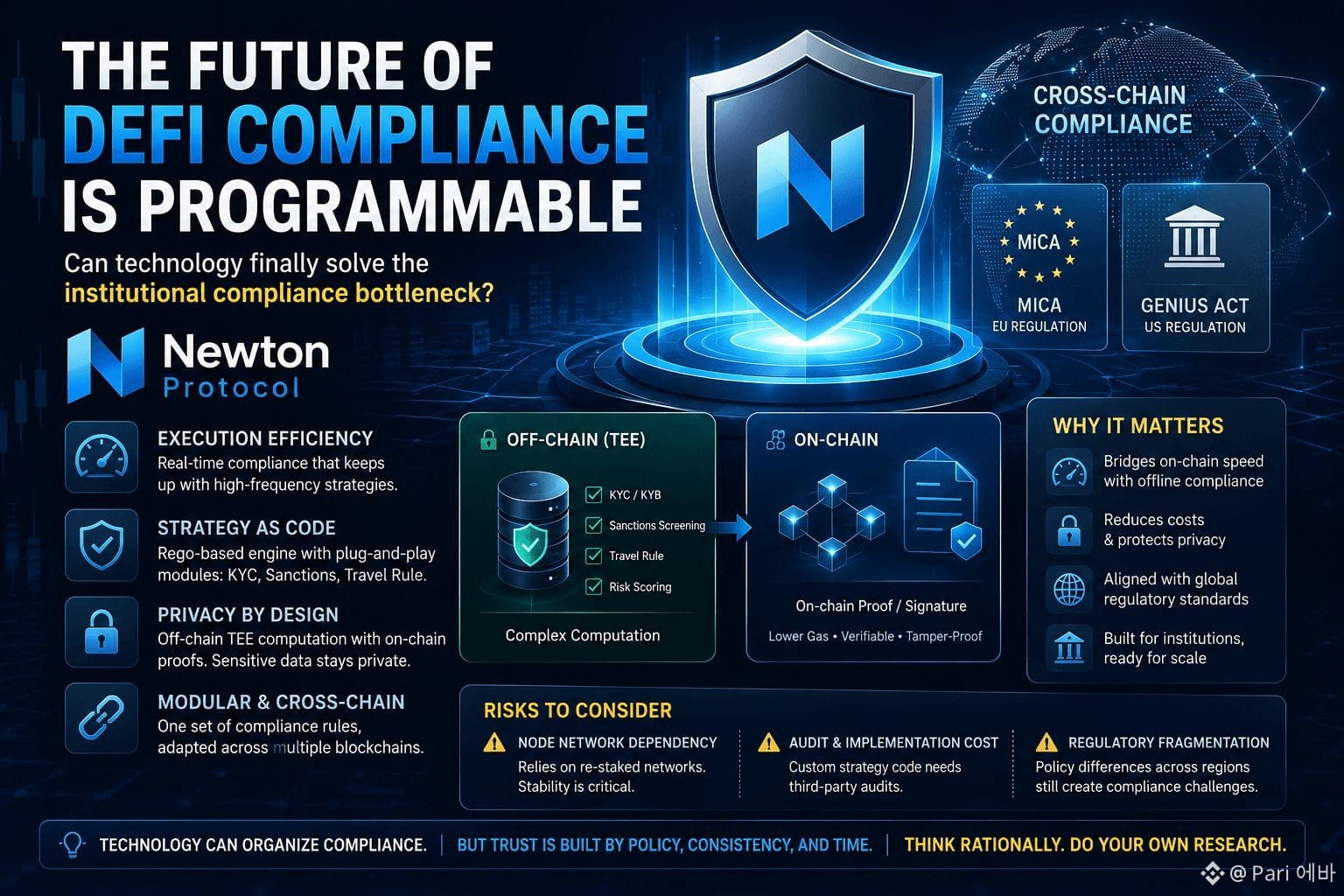
#newt Institutional DeFi often treats compliance as a checkpoint after execution, but is that approach still practical when strategies operate in milliseconds? If compliance always arrives after the transaction, can it truly reduce risk, or does it simply document what has already happened? That question becomes more important as automated trading continues to accelerate.
Newton Protocol approaches the challenge differently by turning compliance into programmable rules rather than a slow manual workflow. But what does that actually mean? A rule engine is more than software—it combines policy logic, verification steps, permission controls, and automated decision-making into one coordinated process.

Instead of relying only on human review, predefined conditions can be evaluated before actions moveforward.

The architecture also separates heavy computation from on-chain execution through trusted environments while recording only cryptographic proof on-chain.
This lowers blockchain costs and helps protect sensitive identity information. Yet another question remains: if verification depends on external node networks and custom compliance logic, how much resilience exists when infrastructure changes or regulations differ across jurisdictions?Perhaps the bigger lesson is that technology can organize compliance, but it cannot create regulatory consensus.

As policies evolve, the real measure of success may not be faster automation alone, but whether one adaptable framework can remain trustworthy across different legal environments over time.
$NEWT $LDO $B3
@NewtonProtocol #Newt
Article
The Part of Onchain Finance I Had Been Ignoring Until I Looked at Newton ProtocolFor a long time, I evaluated crypto projects by asking familiar questions. Is the technology faster? Is the token useful? Is there enough demand to justify the valuation? Those questions still matter, but recently I found myself asking something different: who decides whether an onchain transaction should happen in the first place? That question led me to Newton Protocol. Newton does not present itself as another Layer 1 or DeFi application. Instead, it describes itself as a decentralized policy engine that sits between transaction intent and execution. Rather than focusing on moving assets faster, it focuses on deciding whether a transaction satisfies predefined rules before it is allowed to execute.At first, that sounded like a technical detail. The more I read, the more I realized it represents a different way of thinking about blockchain infrastructure. Traditional smart contracts are deterministic, but they are also limited. They cannot naturally verify whether a wallet belongs to a sanctioned entity, whether an AI agent is acting within spending limits, or whether a transaction satisfies institutional compliance requirements. Most of these checks happen outside the blockchain through centralized services or application interfaces. Newton's argument is that these decisions should become verifiable parts of the protocol itself rather than assumptions hidden behind APIs.I find this idea compelling because the industry increasingly wants to automate financial decisions. AI agents, institutional treasury systems, tokenized real-world assets, and stablecoins all introduce situations where executing a transaction is no longer enough. The decision process itself becomes valuable. However, this also made me ask a more difficult question. Does blockchain actually need another execution layer, or does it need a trustworthy authorization layer? Newton clearly believes the second answer is becoming more important.Its architecture combines decentralized operators, offchain information, cryptographic proofs, and onchain enforcement. External data such as market prices, compliance information, identity credentials, or risk assessments are collected by multiple operators before policy evaluation occurs. Those operators then reach consensus and generate aggregated cryptographic signatures proving that the required policy was evaluated consistently before execution. That is an interesting design because it acknowledges something many crypto discussions avoid: blockchains rarely operate in complete isolation from the real world. If regulation, identity, or financial risk matters, some information must originate outside the chain.The challenge therefore is not eliminating trust entirely. It is reducing unnecessary trust while making external decisions verifiable. Newton appears to build its entire protocol around this philosophy. Privacy is another area that caught my attention. Institutional compliance often requires sensitive financial or identity information that should never become public blockchain data. Newton addresses this using layered privacy techniques including threshold encryption, multi-party computation, and a future roadmap toward fully homomorphic encryption. The objective is to evaluate policies without unnecessarily exposing private information. Whether these advanced cryptographic techniques become practical at large scale remains an engineering challenge, but I appreciate that the protocol recognizes privacy and compliance as interconnected rather than competing objectives. The token itself also deserves examination.According to the available documentation, NEWT has a fixed supply of one billion tokens with no planned inflation after launch. Initially it exists as an ERC-20 token before an eventual migration toward Newton's own rollup architecture. Utility is expected to include staking, governance, validator participation, protocol fees, and registration within the Newton Model Registry, where developers can publish AI models and potentially earn royalties. Approximately 21.5% of the supply was planned to circulate at launch, while the remaining distribution follows allocations defined by the project. Still, token utility should always be examined carefully.One question I kept asking myself was whether the protocol genuinely requires NEWT or whether the authorization network could theoretically function without it. From the available documentation, the token appears tied to economic security, governance, validator incentives, and ecosystem participation rather than existing solely as a fundraising asset. That is encouraging, although the long-term effectiveness will ultimately depend on real protocol adoption rather than token design alone.$NEWT Another observation is that Newton's security depends on more than cryptography.Its policy decisions rely on external information such as price feeds, compliance databases, and other real-world data providers. Cryptographic proofs can demonstrate that operators evaluated identical inputs correctly, but they cannot independently guarantee that the external inputs themselves were accurate. In other words, the protocol can prove correct execution of a decision, but not necessarily the correctness of every external fact feeding that decision. I do not view this as a weakness unique to Newton. Instead, it highlights one of the deepest challenges facing programmable finance. Whenever blockchain interacts with the real world, someone—or something—must provide external information.The real innovation lies in making those dependencies transparent rather than pretending they do not exist. After spending time researching Newton Protocol, I came away with a perspective that feels different from most infrastructure projects I have studied. Many protocols compete to execute transactions more efficiently. Newton asks whether transactions should be executed at all until predefined rules have been verified.$NEWT That subtle shift changes where trust lives inside blockchain systems.Whether this becomes foundational infrastructure will depend on adoption by developers, institutions, and applications that genuinely need programmable authorization rather than simple transaction execution. The concept is ambitious, and meaningful implementation will take time. What I appreciate most is not the promise of faster finance, but the attempt to make decision-making itself verifiable. The crypto industry has spent years optimizing settlement. Perhaps the next stage is optimizing authorization.And if that happens, the most valuable infrastructure may not be the chain that moves assets the fastest, but the one that can prove why those assets were allowed to move in the first place #newt @NewtonProtocol $NEWT {future}(NEWTUSDT)

The Part of Onchain Finance I Had Been Ignoring Until I Looked at Newton Protocol

For a long time, I evaluated crypto projects by asking familiar questions. Is the technology faster? Is the token useful? Is there enough demand to justify the valuation? Those questions still matter, but recently I found myself asking something different: who decides whether an onchain transaction should happen in the first place?
That question led me to Newton Protocol.
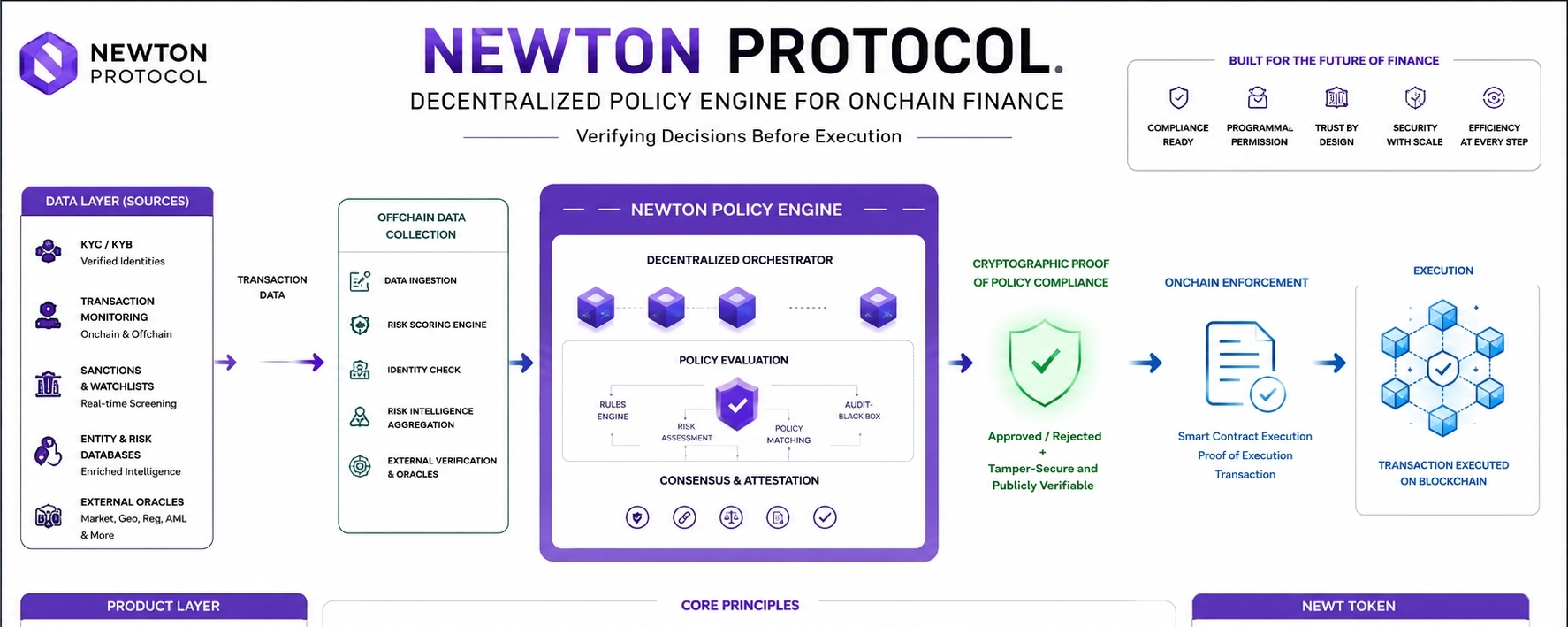
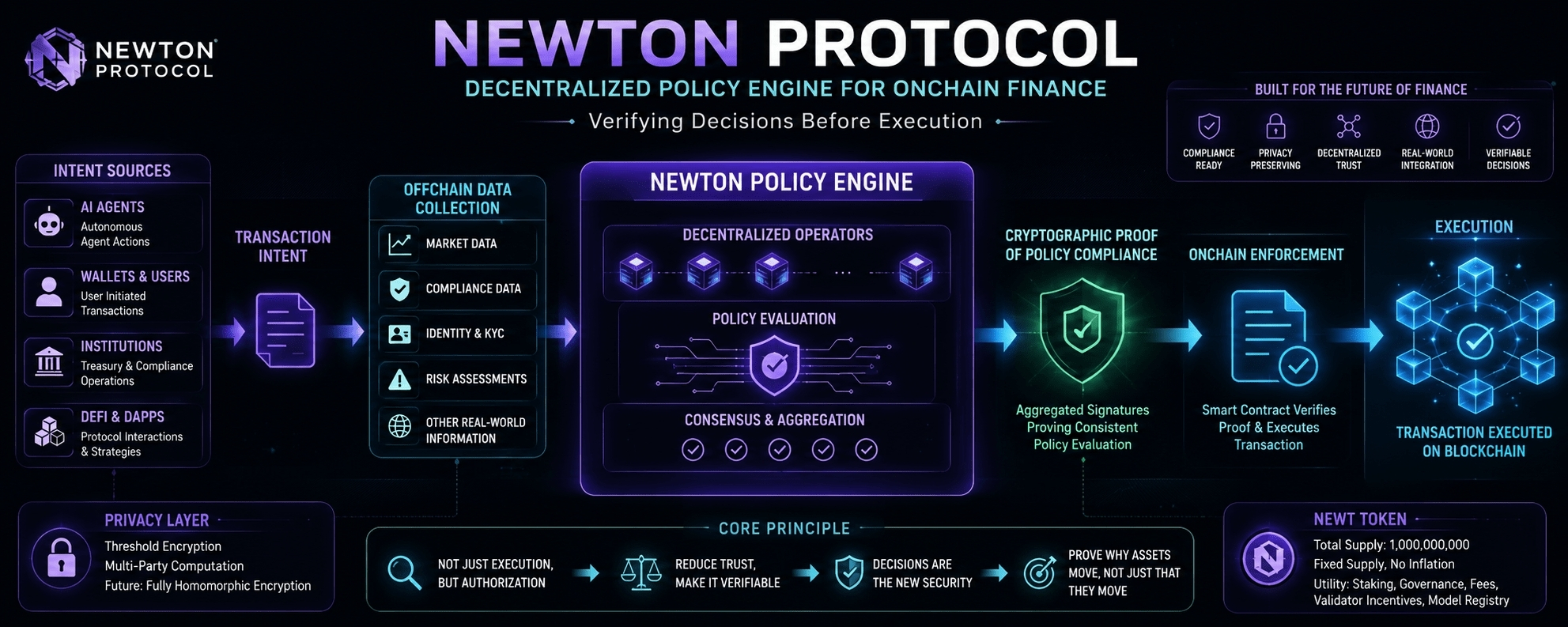
Newton does not present itself as another Layer 1 or DeFi application. Instead, it describes itself as a decentralized policy engine that sits between transaction intent and execution. Rather than focusing on moving assets faster, it focuses on deciding whether a transaction satisfies predefined rules before it is allowed to execute.At first, that sounded like a technical detail. The more I read, the more I realized it represents a different way of thinking about blockchain infrastructure.
Traditional smart contracts are deterministic, but they are also limited. They cannot naturally verify whether a wallet belongs to a sanctioned entity, whether an AI agent is acting within spending limits, or whether a transaction satisfies institutional compliance requirements. Most of these checks happen outside the blockchain through centralized services or application interfaces. Newton's argument is that these decisions should become verifiable parts of the protocol itself rather than assumptions hidden behind APIs.I find this idea compelling because the industry increasingly wants to automate financial decisions. AI agents, institutional treasury systems, tokenized real-world assets, and stablecoins all introduce situations where executing a transaction is no longer enough. The decision process itself becomes valuable.
However, this also made me ask a more difficult question.
Does blockchain actually need another execution layer, or does it need a trustworthy authorization layer?
Newton clearly believes the second answer is becoming more important.Its architecture combines decentralized operators, offchain information, cryptographic proofs, and onchain enforcement.
External data such as market prices, compliance information, identity credentials, or risk assessments are collected by multiple operators before policy evaluation occurs.
Those operators then reach consensus and generate aggregated cryptographic signatures proving that the required policy was evaluated consistently before execution.
That is an interesting design because it acknowledges something many crypto discussions avoid: blockchains rarely operate in complete isolation from the real world.
If regulation, identity, or financial risk matters, some information must originate outside the chain.The challenge therefore is not eliminating trust entirely.
It is reducing unnecessary trust while making external decisions verifiable.
Newton appears to build its entire protocol around this philosophy.
Privacy is another area that caught my attention. Institutional compliance often requires sensitive financial or identity information that should never become public blockchain data.
Newton addresses this using layered privacy techniques including threshold encryption, multi-party computation, and a future roadmap toward fully homomorphic encryption. The objective is to evaluate policies without unnecessarily exposing private information.
Whether these advanced cryptographic techniques become practical at large scale remains an engineering challenge, but I appreciate that the protocol recognizes privacy and compliance as interconnected rather than competing objectives.
The token itself also deserves examination.According to the available documentation, NEWT has a fixed supply of one billion tokens with no planned inflation after launch.
Initially it exists as an ERC-20 token before an eventual migration toward Newton's own rollup architecture. Utility is expected to include staking, governance, validator participation, protocol fees, and registration within the Newton Model Registry, where developers can publish AI models and potentially earn royalties.
Approximately 21.5% of the supply was planned to circulate at launch, while the remaining distribution follows allocations defined by the project.
Still, token utility should always be examined carefully.One question I kept asking myself was whether the protocol genuinely requires NEWT or whether the authorization network could theoretically function without it.
From the available documentation, the token appears tied to economic security, governance, validator incentives, and ecosystem participation rather than existing solely as a fundraising asset. That is encouraging, although the long-term effectiveness will ultimately depend on real protocol adoption rather than token design alone.$NEWT
Another observation is that Newton's security depends on more than cryptography.Its policy decisions rely on external information such as price feeds, compliance databases, and other real-world data providers. Cryptographic proofs can demonstrate that operators evaluated identical inputs correctly, but they cannot independently guarantee that the external inputs themselves were accurate.
In other words, the protocol can prove correct execution of a decision, but not necessarily the correctness of every external fact feeding that decision.
I do not view this as a weakness unique to Newton.
Instead, it highlights one of the deepest challenges facing programmable finance.
Whenever blockchain interacts with the real world, someone—or something—must provide external information.The real innovation lies in making those dependencies transparent rather than pretending they do not exist.
After spending time researching Newton Protocol, I came away with a perspective that feels different from most infrastructure projects I have studied.
Many protocols compete to execute transactions more efficiently.
Newton asks whether transactions should be executed at all until predefined rules have been verified.$NEWT
That subtle shift changes where trust lives inside blockchain systems.Whether this becomes foundational infrastructure will depend on adoption by developers, institutions, and applications that genuinely need programmable authorization rather than simple transaction execution. The concept is ambitious, and meaningful implementation will take time.
What I appreciate most is not the promise of faster finance, but the attempt to make decision-making itself verifiable.
The crypto industry has spent years optimizing settlement.
Perhaps the next stage is optimizing authorization.And if that happens, the most valuable infrastructure may not be the chain that moves assets the fastest, but the one that can prove why those assets were allowed to move in the first place
#newt @NewtonProtocol $NEWT
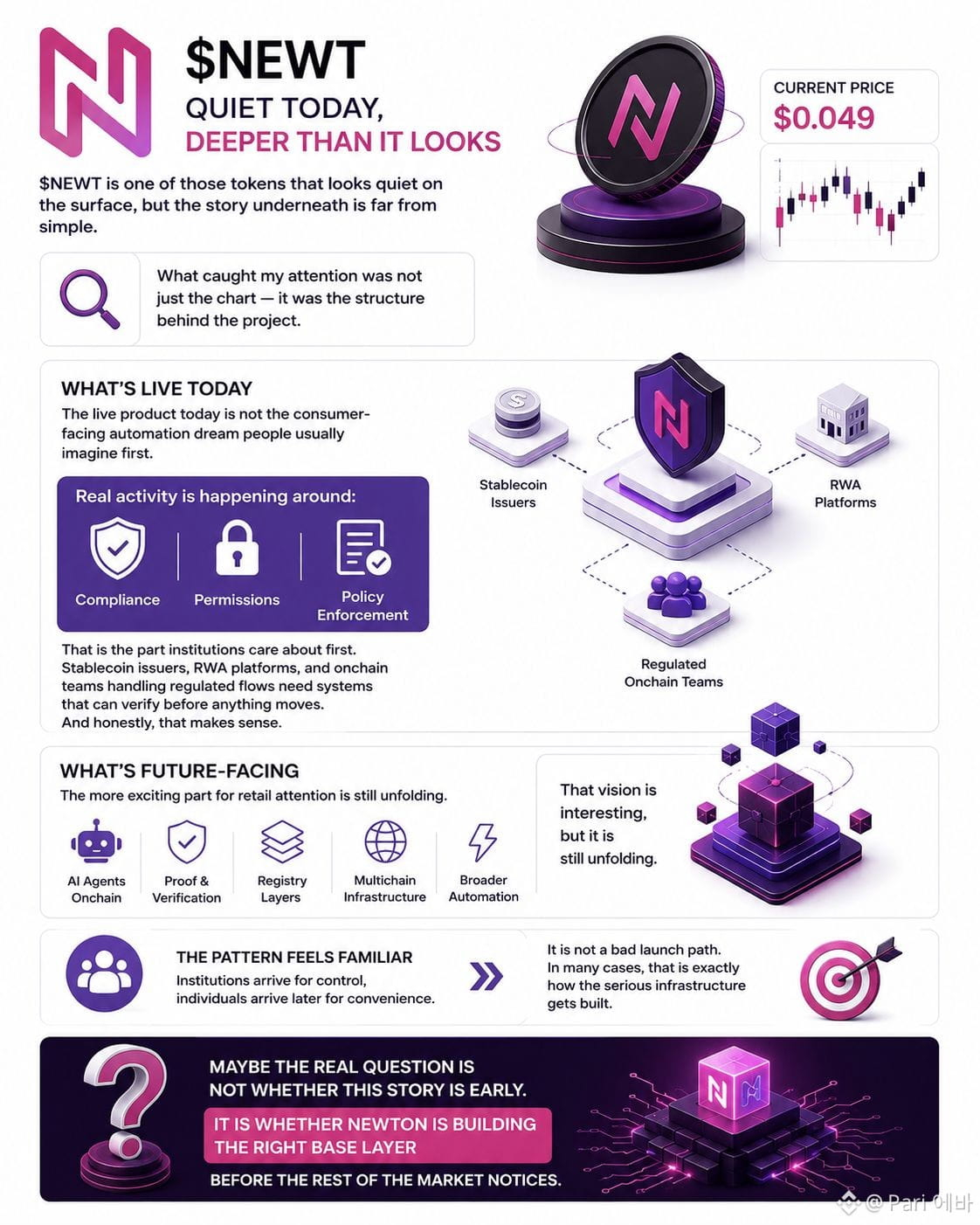
#newt $NEWT is one of those tokens that looks quiet on the surface, but the story underneath is far from simple. Today the price is hovering around $0.049, and what caught my attention was not just the chart — it was the structure behind the project. The more I dug into Newton Protocol, the clearer it became that the live product today is not the consumer-facing automation dream people usually imagine first.$NEWT Right now, the real activity seems to be happening around compliance, permissions, and policy enforcement. That is the part institutions care about first. Stablecoin issuers, RWA platforms, and onchain teams handling regulated flows need systems that can verify before anything moves. And honestly, that makes sense. What is still future-facing is the more exciting part for retail attention: AI agents carrying out tasks onchain with proof, registry layers, multichain infrastructure, and broader automation use cases. That vision is interesting, but it is still unfolding. So the pattern feels familiar: institutions arrive for control, individuals arrive later for convenience. It is not a bad launch path. In many cases, that is exactly how the serious infrastructure gets built. Maybe the real question is not whether this story is early. It is whether Newton is building the right base layer before the rest of the market notices. $NEWT {future}(NEWTUSDT) @NewtonProtocol #Newt
#newt $NEWT is one of those tokens that looks quiet on the surface, but the story underneath is far from simple.

Today the price is hovering around $0.049, and what caught my attention was not just the chart — it was the structure behind the project. The more I dug into Newton Protocol, the clearer it became that the live product today is not the consumer-facing automation dream people usually imagine first.$NEWT

Right now, the real activity seems to be happening around compliance, permissions, and policy enforcement. That is the part institutions care about first.

Stablecoin issuers, RWA platforms, and onchain teams handling regulated flows need systems that can verify before anything moves.

And honestly, that makes sense.

What is still future-facing is the more exciting part for retail attention: AI agents carrying out tasks onchain with proof, registry layers, multichain infrastructure, and broader automation use cases.

That vision is interesting, but it is still unfolding.

So the pattern feels familiar: institutions arrive for control, individuals arrive later for convenience.

It is not a bad launch path.

In many cases, that is exactly how the serious infrastructure gets built.
Maybe the real question is not whether this story is early. It is whether Newton is building the right base layer before the rest of the market notices.
$NEWT
@NewtonProtocol #Newt
Log in to explore more content
Join global crypto users on Binance Square
⚡️ Get latest and useful information about crypto.
💬 Trusted by the world’s largest crypto exchange.
👍 Discover real insights from verified creators.
Email / Phone number
Sitemap
Cookie Preferences
Platform T&Cs